FM 3-04.240 Instrument Flight for Army Aviators (April 2007) - page 1
*FM 3-04.240 (FM 1-240)
Field Manual
Headquarters
Department of the Army
No. 3-04.240
Washington, DC, 30 April 2007
Instrument Flight for Army Aviators
Contents
Page
PREFACE
xii
Chapter 1
FLIGHT INSTRUMENTS AND SYSTEMS
1-1
Section I - Pitot-Static Systems
1-1
Altimeter
1-2
Airspeed Indicator
1-7
Vertical Speed Indicator
1-8
Section II - Compass Systems
1-10
Magnetic Compass
1-10
Radio Magnetic Indicator
1-15
Section III - Gyroscopic Systems
1-16
Gyroscope
1-16
Attitude Indicator
1-17
Turn-and-Slip Indicator/Turn Coordinator
1-18
Section IV - Flight Management System
1-20
Horizontal Situation Indicator
1-20
Vertical Situation Indicator
1-21
Chapter 2
ROTARY WING INSTRUMENT FLIGHT MANEUVERS
2-1
Section I - Maneuver Performance
2-1
Instruments
2-1
Performance
2-2
Procedural Steps
2-3
Primary and Supporting Methods
2-3
Section II - Flight Management System
2-5
Cross-Check
2-5
Instrument Interpretation
2-7
Aircraft Control
2-8
Section III - Instrument Takeoff
2-8
Preparing
2-9
Performing From Hover/Ground
2-9
DISTRIBUTION RESTRICTION: Approved for public release; distribution is unlimited.
*This publication supersedes FM 1-240, 15 December 1984.
30 April 2007
FM 3-04.240
i
Contents
Takeoff
2-9
Common Errors
2-10
Section IV - Straight-and-Level Flight
2-10
Pitch Attitude Control
2-10
Bank Control
2-12
Power Control
2-13
Common Errors
2-15
Section V - Straight Climbs and Descents
2-15
Climbs
2-15
Descents
2-17
Common Errors
2-18
Section VI - Turns
2-18
Predetermined Heading
2-19
Timed
2-19
Changing Airspeed
2-20
Compass
2-20
Thirty-Degree Bank
2-22
Climbing and Descending
2-22
Common Errors
2-23
Section VII - Other Maneuvers
2-23
Unusual Attitudes
2-23
Autorotations
2-23
Chapter 3
FIXED WING INSTUMENT FLIGHT MANEUVERS
3-1
Section I - Instrument Takeoff
3-1
Takeoff
3-1
Common Takeoff Errors and Resolutions
3-2
Section II - Straight-and-Level Flight
3-2
Pitch Control
3-2
Bank Control
3-6
Power Control
3-8
Trim Technique
3-12
Section III - Straight Climbs and Descents
3-12
Climbs
3-12
Descents
3-16
Common Climb and Descent Errors and Resolutions
3-18
Section IV - Turns
3-19
Standard-Rate Turns
3-19
Steep Turns
3-20
Climbing and Descending Turns
3-21
Change of Airspeed During Turns
3-21
Common Turn Errors
3-22
ii
FM 3-04.240
30 April 2007
Contents
Section V - Other Maneuvers
3-24
Approach to Stall
3-24
Unusual Attitudes and Recoveries
3-24
Chapter 4
AIR NAVIGATION CHARTS
4-1
Section I - Air Navigation
4-1
Measuring a Position Using Latitude and Longitude
4-1
Measuring Direction
4-3
Navigation Charts
4-4
Departure Procedure Chart
4-11
Standard Terminal Arrival Route Charts
4-11
Instrument Approach Procedure Chart
4-11
Inoperative Components
4-25
Section II - Plotting and Measuring
4-25
Plotter
4-25
Measurements and Course Lines
4-27
Chapter 5
AIR NAVIGATION HANDHELD COMPUTER
5-1
Section I - Calculator Side
5-1
Values
5-1
Indexes
5-1
Time and Distance
5-2
Short Time and Distance (Use of the 36 Index)
5-3
Computing Time for Outbound Leg During Holding
5-4
Fuel Consumption
5-6
True Airspeed
5-8
Distance Conversion
5-9
True Altitude Calculation
5-10
Multiplication and Division Calculations
5-11
Converting Distance to Time
5-12
Section II - Wind Side
5-13
Disk and Correction Scales
5-13
Reversible Grid
5-13
Determining Heading and Ground Speed
5-14
Determining Unknown Wind
5-15
Determining Altitude for Most Favorable Wind
5-16
Determining Radius of Action
5-17
Chapter 6
INSTRUMENT WEATHER
6-1
Effects of Wind
6-1
Turbulence
6-3
Structural Icing
6-4
Fog
6-5
Volcanic Ash
6-5
Thunderstorms
6-6
Wind Shear
6-6
30 April 2007
FM 3-04.240
iii
Contents
Chapter 7
NAVIGATION AIDS
7-1
Section I - Basic Radio Principles
7-1
Radio Wave Propagation
7-1
Types of Waves
7-1
Radio Wave Reception Disturbances
7-2
Precautions
7-3
Section II - Navigation Systems
7-3
NonDirectional Radio Beacon
7-3
Very High Frequency OmniDirectional Range
7-5
Tactical Air Navigation
7-8
Very High Frequency OmniDirectional Range/Tactical Air Navigation
7-10
Distance Measuring Equipment
7-10
Global Positioning System
7-11
Inertial Navigation System
7-14
Section III - Navigation Procedures
7-14
Application
7-14
Homing to a Station
7-16
Tracking to a Station
7-17
Course Intercept
7-21
Arc Interceptions
7-27
Area Navigation
7-30
Global Positioning System Navigation
7-32
Chapter 8
AIRSPACE
8-1
Section I - National Airspace System
8-1
Airspace Classification
8-1
Special-Use Airspace
8-3
Other Airspace
8-4
Federal Airway
8-5
Section II - International Civil Aviation Organization
8-7
Safety
8-7
Applicability
8-7
Current Information and Procedures
8-7
Terminal Instrument Approach Procedures
8-7
Compliance
8-8
Definitions
8-8
Departure Procedures
8-9
Approach Procedures
8-10
Holding
8-17
Altimeter Setting Procedures
8-19
Transponder Operating Procedures
8-20
Chapter 9
AIR TRAFFIC CONTROL SYSTEM
9-1
Communications
9-1
Control Sequence
9-6
Letters of Agreement
9-8
iv
FM 3-04.240
30 April 2007
Contents
Chapter 10
INSTRUMENT FLIGHT RULES INFORMATION AND PROCEDURES
10-1
Section I - Sources of Flight Planning Information
10-1
Department of Defense Flight Information Publications
10-1
Civil Publications
10-3
Section II - Instrument Flight Rules Flight Plan
10-4
Filing
10-4
Canceling
10-8
Section III - Clearances
10-8
Separations
10-9
Visual Flight Rules-on-Top
10-10
Visual Flight Rules Over-the-Top
10-11
Section IV - Notice to Airmen System
10-11
Notice to Airmen
10-11
Notices to Airmen Types
10-11
Internet Distribution System
10-13
Section V - Navigation Options in the National Airspace System
10-15
On Airways
10-15
Off Airways (Direct)
10-16
Section VI - Departures
10-17
Departure Procedures
10-17
Diverse Departure
10-17
Radar Controlled Departure
10-19
Departure From Airports Without an Operating Control Tower
10-19
Section VII - En Route
10-19
Procedures
10-19
Holding Procedures
10-22
Section VIII - Approaches
10-29
Published Procedure Compliance
10-29
Approaches to Airports
10-29
Low-Altitude Approaches
10-32
High-Altitude Approach
10-38
Final Approach
10-43
Other Approaches
10-52
Missed Approaches
10-55
Section IX - Landing
10-56
Land and Hold Short Operations
10-56
Landing Fees
10-56
Chapter 11
EMERGENCY OPERATIONS
11-1
Section I - Emergencies
11-1
Unforecasted Adverse Weather
11-1
Aircraft System Malfunctions
11-3
Communication/Navigation
11-4
Loss of Situational Awareness
11-4
Inadvertent Instrument Meteorological Condition
11-4
30 April 2007
FM 3-04.240
v
Contents
Section II - Air Traffic Control Requirements and Responsibilities
11-6
Provide information
11-6
Request Assistance
11-7
Responsibility
11-8
Appendix A INSTRUMENT FLIGHT RULES OPERATIONS
A-1
Appendix B INSTRUMENT FLIGHT IN A THEATER OF OPERATIONS
B-1
Appendix C WEATHER REPORTS AND RISK MANAGEMENT
C-1
Appendix D INTERNET ADDRESSES AND ACCESS
D-1
Appendix E AIRCREW COORDINATION AND INSTRUMENT FLIGHT
E-1
GLOSSARY
Glossary-1
REFERENCES
References-1
INDEX
Index-1
vi
FM 3-04.240
30 April 2007
Contents
Figures
Figure
1-1. Pitot-static head
1-2
Figure
1-2. Altimeter components
1-2
Figure
1-3. Types of altitude
1-3
Figure
1-4. Altimeter error caused by nonstandard temperature
1-4
Figure
1-5. Altimeter error caused by nonstandard atmospheric pressure
1-5
Figure
1-6. Temperature correction chart (height in feet)
1-6
Figure
1-7. Encoding altimeter with a malfunction
1-7
Figure
1-8. Mechanism of an airspeed indicator
1-8
Figure
1-9. Vertical speed indicator
1-9
Figure
1-10. Instantaneous vertical speed indicator
1-10
Figure
1-11. Magnetic compass
1-11
Figure
1-12. Lines of magnetic variation
1-12
Figure
1-13. Pilot compass correction card
1-13
Figure
1-14. Turning error
1-14
Figure
1-15. Acceleration error
1-15
Figure
1-16. Radio magnetic indicator
1-16
Figure
1-17. Precession diagram
1-17
Figure
1-18. Attitude indicator
1-18
Figure
1-19. Turn indicator
1-19
Figure
1-20. Horizontal situation indicator
1-21
Figure
1-21. UH-60 vertical situation indicator
1-22
Figure
2-1. Control instruments of a UH-60
2-2
Figure
2-2. Performance instruments of a UH-60
2-2
Figure
2-3. Navigation instruments on a UH-60
2-3
Figure
2-4. Pitch control instruments
2-4
Figure
2-5. Bank control instruments
2-4
Figure
2-6. Cross-check pattern
2-6
Figure
2-7. Instrument interpretation comparison
2-7
Figure
2-8. Instrument takeoff indications
2-10
Figure
2-9. Straight-and-level flight at normal cruise speed
2-14
Figure
2-10. Straight-and-level flight with airspeed deceasing
2-14
Figure
2-11. Climb entry
2-16
Figure
2-12. Stabilized constant airspeed climb
2-16
Figure
2-13. Stabilized constant-rate climb
2-17
Figure
2-14. Standard rate turn to the left
2-19
Figure
2-15. Compass turn correction diagram
2-21
Figure
2-16. Stabilized left climbing turn, constant airspeed
2-22
Figure
3-1. Pitch attitude and airspeed in level flight
3-3
Figure
3-2. Slip indication
3-7
Figure
3-3. Skid indication
3-7
Figure
3-4. Straight-and-level flight
3-9
Figure
3-5. Airspeed deceasing
3-10
Figure
3-6. Reduced airspeed stabilized
3-10
Figure
3-7. Climb entry
3-13
Figure
3-8. Stabilized constant airspeed climb
3-14
Figure
3-9. Stabilized constant rate climb
3-15
Figure
3-10. Level-off
3-16
Figure
3-11. Constant airspeed descent, airspeed high—reduce power
3-17
Figure
3-12. Level-off at descent airspeed
3-18
Figure
3-13. Standard rate turn
3-19
Figure
3-14. Steep right turn
3-20
30 April 2007
FM 3-04.240
vii
Contents
Figure
3-15.Change of airspeed in turn
3-21
Figure
3-16. Unusual attitude—nose high
3-25
Figure
3-17. Unusual attitude—nose low
3-25
Figure
4-1. Longitude and latitude
4-3
Figure
4-2. En route airport legend
4-6
Figure
4-3. Navigational aid and communication boxes
4-8
Figure
4-4. Air traffic services and airspace information
4-9
Figure
4-5. Instrument approach chart
4-13
Figure
4-6. Procedures and notes
4-14
Figure
4-7. Basic T design of terminal arrival area
4-18
Figure
4-8. Profile view features
4-19
Figure
4-9. Landing minimums
4-21
Figure
4-10. Point in space approach
4-24
Figure
4-11. Remote altimeter settings
4-25
Figure
4-12. Inoperative components
4-26
Figure
4-13. East/west course reading, using outer/inner scale
4-27
Figure
4-14. North course reading, using inner scale
4-28
Figure
4-15. Drawing a course line from a known point
4-29
Figure
5-1. CPU-26A/P calculator side
5-1
Figure
5-2. Calculator side of CPU-26A/P computer
5-2
Figure
5-3. Computing time and distance
5-3
Figure
5-4. Computing speed
5-3
Figure
5-5. Short time and distance
5-4
Figure
5-6. Estimated outbound time more than one minute
5-5
Figure
5-7. Estimated outbound time less than one minute
5-5
Figure
5-8. Gallons and pounds conversion
5-6
Figure
5-9. Computing time for fuel consumption
5-7
Figure
5-10. Fuel required
5-7
Figure
5-11. Rate of fuel consumption
5-8
Figure
5-12. True airspeed computation
5-9
Figure
5-13. Nautical, statute, and kilometer correlation
5-10
Figure
5-14. Inner scale computation
5-10
Figure
5-15. True altitude calculation
5-11
Figure
5-16. Multiplication
5-12
Figure
5-17. Division
5-12
Figure
5-18. Converting feet per nautical mile to feet per minute
5-13
Figure
5-19. Wind side of CPU-26A/P computer
5-14
Figure
5-20. Heading and ground speed
5-15
Figure
5-21. Determining unknown wind
5-16
Figure
5-22. Determining altitude for most favorable wind
5-16
Figure
5-23. Determining radius of action, part I
5-17
Figure
5-24. Determining radius of action, part II
5-18
Figure
5-25. Determining radius of action, part III
5-18
Figure
6-1. Wind effect and ground speed
6-2
Figure
6-2. Wind drift
6-2
Figure
6-3. Wind drift angle
6-3
Figure
6-4. Wind correction angle
6-3
Figure
6-5. Instrument scan in severe turbulence (blurry instrument panel)
6-4
Figure
6-6. Glide-slope deviations in wind shear
6-7
Figure
7-1. Surface, space, and sky wave propagation
7-2
Figure
7-2. Very (high frequency) omnidirectional range radials
7-6
Figure
7-3. Homing to a station
7-16
Figure
7-4. Push the head
7-17
Figure
7-5. Pull the tail
7-18
Figure
7-6. Tracking inbound
7-19
viii
FM 3-04.240
30 April 2007
Contents
Figure 7-7. Tracking outbound
7-20
Figure 7-8. Inbound course intercept of less than 45 degrees
7-23
Figure 7-9. Inbound course intercept
7-24
Figure 7-10. Inbound course intercept of greater than 45 degrees
7-25
Figure 7-11. Outbound course intercept immediately after station passage
7-26
Figure 7-12. Outbound course intercept away from station
7-27
Figure 7-13. Arc interception from a radial
7-28
Figure 7-14. Localizer interception from a distance measuring equipment arc
7-29
Figure 7-15. Flying a distance measuring equipment arc
7-30
Figure 7-16. Area navigation computation
7-31
Figure 7-17. Aircraft/very (high frequency) omnidirectional radio range tactical air navigation
aid/waypoint relationship
7-32
Figure 8-1. Airspace classification
8-2
Figure 8-2. Victor airways and charted information
8-6
Figure 8-3. The 45-degree/180-degree procedure turn
8-11
Figure 8-4. The 80-degree/260-degree procedure turn
8-12
Figure 8-5. Base turn
8-12
Figure 8-6. Comparison of Federal Aviation Administration and International Civil Aviation
Organization protected airspace for a procedure turn
8-13
Figure 8-7. Procedure turn entry
8-14
Figure 8-8. Base turn entry
8-14
Figure 8-9. Racetrack procedure
8-16
Figure 8-10. International Civil Aviation Organization holding pattern entry sectors
8-18
Figure 10-1. Types of aeronautical charts
10-4
Figure 10-2. Department of Defense Form 175
10-5
Figure 10-3. Department of Defense Form 1801
10-6
Figure 10-4. Federal Aviation Administration Form 7233-1
10-7
Figure 10-5. Departure procedure
10-18
Figure 10-6. Standard terminal arrival route
10-23
Figure 10-7. Standard holding pattern—no wind
10-24
Figure 10-8. Standard holding pattern with drift correction
10-25
Figure 10-9. Holding pattern entry procedures
10-27
Figure 10-10. Holding and outbound timing
10-28
Figure 10-11. Facilities with standard approach procedures
10-29
Figure 10-12. Approach procedure without an operating control tower
10-31
Figure 10-13. Instrument approach procedure chart with maximum air traffic control facilities
available
10-33
Figure 10-14. Teardrop pattern
10-35
Figure 10-15. 45/180 procedure turn
10-36
Figure 10-16. 80/260 procedure turn
10-36
Figure 10-17. Descent at the holding fix
10-37
Figure 10-18. Descent on the inbound leg
10-37
Figure 10-19. Procedural track approach—arcing final
10-39
Figure 10-20. Procedural track approach—teardrop turn
10-40
Figure 10-21. High-altitude instrument approach plate
10-41
Figure 10-22. Instrument landing system
10-47
Figure 10-23. Parallel and simultaneous instrument landing system approaches
10-53
Figure 10-24. Circling approach area radii
10-54
Figure 10-25. Circling approaches
10-55
Figure 11-1. Additional ATC information
11-6
Figure C-1. Takeoff data
C-1
Figure C-2. En route and mission data
C-3
Figure C-3. Aerodrome forecasts
C-5
Figure C-4. Comments/remarks
C-6
Figure C-5. Briefing record
C-6
30 April 2007
FM 3-04.240
ix
Contents
Figure C-6. Meteorological aviation report
C-8
Figure C-7. Terminal area forecast
C-16
x
FM 3-04.240
30 April 2007
Contents
Tables
Table
2-1. Maneuver instrum
2-4
Table
2-2. Compass turn computation
2-22
Table
4-1. Distance conversions
4-3
Table
4-2. Aircraft approach categories and circling limits
4-22
Table
4-3. Runway visual range conversion table
4-22
Table
5-1. Gallons and pounds conversion
5-6
Table
6-1. Temperature ranges for ice formation
6-5
Table
7-1. Standard wind drift correction
7-21
Table
8-1. Aircraft category and maximum airspeed
8-10
Table
8-2. Aircraft category and airspeed
8-15
Table
8-3. Airspeeds
8-18
Table
9-1. Air traffic control facilities, services, and radio call signs
9-6
Table
10-1. Air traffic control separation parameters
10-10
Table
10-2. Attention notice groups
10-12
Table
10-3. Holding altitudes and airspeeds
10-26
Table
10-4. Course reversal steps
10-35
Table A-1. Sample instrument flight rules planning requirements
A-5
Table B-1. Initial air traffic control capabilities
B-2
Table B-2. Transition to sustained air traffic control operations
B-3
Table B-3. Service capabilities and references
B-4
Table C-1. Takeoff data block explanation
C-2
Table C-2. En route and mission data block explanation
C-3
Table C-3. Aerodrome forecasts block explanation
C-5
Table C-4. Comments/remarks block explanation
C-6
Table C-5. Briefing record block explanation
C-7
Table C-6. Special weather report criteria
C-8
Table C-7. Descriptor qualifiers
C-11
Table C-8. Precipitation types
C-12
Table C-9. Obscuration types
C-12
Table C-10. Other types of weather phenomena
C-12
Table C-11. Reportable descriptions for sky cover
C-13
Table C-12. Automated, manual, and plain language remarks
C-15
Table C-13. Automated weather observing system models
C-21
Table C-14. Weather briefing
C-24
Table C-15. Derived mission information
C-25
Table C-16. Radar system precipitation intensity levels
C-29
Table D-1. Internet resources for flight operation planning
D-1
Table E-1. Examples of standard words and phrases
E-8
Table E-2. Rotary and fixed wing instrument takeoff callouts
E-9
Table E-3. Climb/cruise/descent callouts
E-10
Table E-4. Examples of calls/responses for all phases of flight
E-10
Table E-5. Examples of instrument approach calls/responses
E-10
Table E-6. Examples of missed approach calls/responses
E-11
Table E-7. Examples of calls/responses for instrument reference to visual
E-11
Table E-8. Examples of calls/responses for approach deviations
E-12
Table E-9. Examples of emergency calls/responses
E-12
30 April 2007
FM 3-04.240
xi
Preface
Field manual (FM) 3-04.240 is specifically prepared for aviators authorized to fly Army aircraft. This manual
presents the fundamentals, procedures, and techniques for instrument flying and air navigation.
FM 3-04.240 facilitates adherence to Army regulation (AR) 95-1 by providing guidance and procedures for
standard Army instrument flying. Aircraft flight instrumentation and mission objectives are varied, making
instruction general for equipment and detailed for accomplishment of maneuvers. Guidance found in this
manual is both technique and procedure oriented. Aircraft operator manuals provide the detailed instructions
required for particular aircraft instrumentation or characteristics. When used with related flight directives and
publications, this publication provides adequate guidance for instrument flight under most circumstances but is
not a substitute for sound judgment; circumstances may require modification of prescribed procedures. Aircrew
members charged with the safe operation of United States Army, Army National Guard (ARNG), or United
States Army Reserve (USAR) aircraft must be knowledgeable of the guidance contained herein. This manual
applies to all military, civilian, and/or contractor personnel who operate Army aircraft, and adherence to its
general practices is mandatory.
The Aeronautical Information Manual (AIM) published by the Federal Aviation Administration (FAA) is not
regulatory; however, the AIM provides information that reflects examples of operating techniques and
procedures required in other regulations. AIM is not binding on Army aircrews. Furthermore, the AIM contains
some techniques and procedures not consistent with Army mission requirements, regulatory guidance, waivers,
exemptions, and accepted techniques and procedures. However, AIM is the accepted standard for civil aviation
and reflects general techniques and procedures used by other pilots. Much of the information contained in this
manual is reproduced from AIM and adapted for Army use. If a subject is not covered in this manual or other
Army regulations, follow guidance in the AIM unless mission requirements dictate otherwise.
All figures and tables that display partial or complete navigational excerpts from other publications (such as
instrument approach charts, legends, and low-altitude en route charts) are provided for reference only and
should not be used in planning for or the conduct of any flight.
This publication applies to the Active Army, the Army National Guard/Army National Guard of the United
States, and the United States Army Reserve unless otherwise stated.
The proponent of this publication is Headquarters, United States Army Training and Doctrine Command
(TRADOC). Send comments and recommended changes, using Department of the Army (DA) Form 2028
(Recommended Changes to
publications
and
Blank
Forms)
or
automated
link
Warfighting Center (USAAWC), ATTN: ATZQ-TD-D, Fort Rucker, AL 36362-5000; or e-mail the Directorate
of Training and Doctrine (DOTD) at av.doctrine@us.army.mil. Other doctrinal information can be found on the
Internet through Army Knowledge Online (AKO) or by calling the defense switched network (DSN) 558-3551
or commercial (334) 255-3551.
Note. For immediate assistance on issues affecting this FM, contact the Directorate of Training
and Doctrine (DOTD), Doctrine Division, at DSN 558-3551, commercial 334-255-3551, or via
e-mail at the following address: av.doctrine@us.army.mil.
Unless this publication states otherwise, masculine nouns and pronouns do not refer exclusively to men.
This publication has been reviewed for operations security considerations.
xii
FM 3-04.240
30 April 2007
Chapter 1
Flight Instruments and Systems
The efficiency and utility of Army aircraft depend largely on flight instruments and
systems accurately depicting what the aircraft is doing in flight and how well its
power plants and components are functioning. Important navigation instruments are
the magnetic compass, slaved gyro compass system, heading indicator, airspeed
indicator, and altimeter. These instruments provide information concerning direction,
airspeed, and altitude. The attitude indicator allows the aviator to control the aircraft
by showing the attitude of the aircraft in relation to the natural horizon. The
performance of an aircraft in a given attitude and with a certain power setting is
indicated by the airspeed indicator, heading indicator, altimeter, vertical speed
indicator/vertical velocity indicator, and turn-and-slip indicator. Flight instruments
are grouped into three systems: pitot-static, compass, and gyroscopic.
SECTION I - PITOT-STATIC SYSTEMS
1-1.
Most aircraft instrument panels have three basic pressure-operated instruments: the altimeter,
airspeed indicator, and vertical speed indicator
Contents
(VSI). All three receive the pressures that they
measure from the aircraft pitot-static system. Flight
Section I - Pitot-Static Systems
1-1
instruments depend on accurate sampling of ambient
atmospheric pressure to determine the height and
Section II - Compass Systems
1-10
speed of aircraft movement through the air, both
Section III - Gyroscopic Systems
1-16
horizontally and vertically. Ambient atmospheric
Section IV - Flight Management System ... 1-20
pressure is sampled at two or more locations outside
of the aircraft by the pitot-static system.
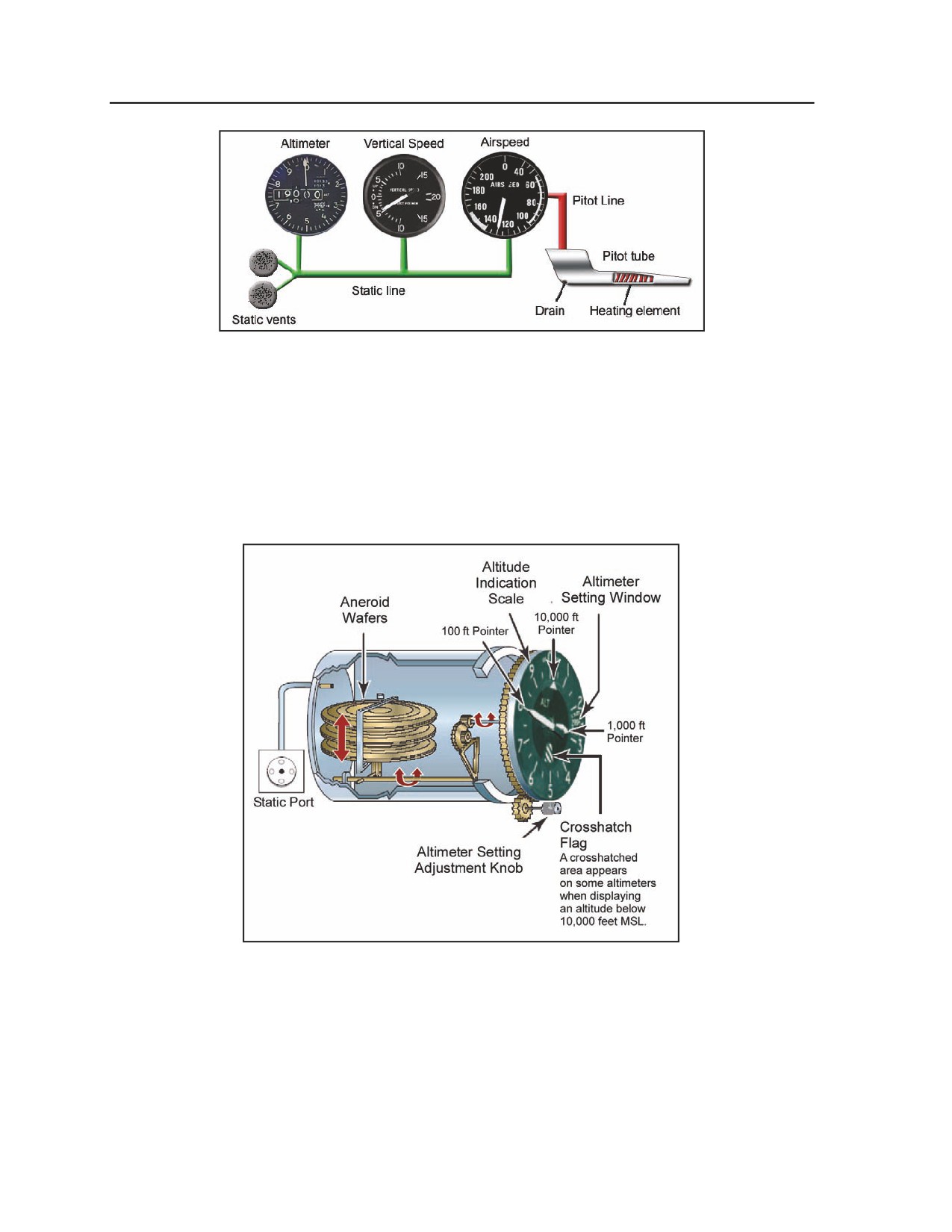
1-2. Static pressure, or still air, is measured at a flush port where air is not disturbed. On some aircraft,
this air is sampled by static ports on the side of the fuselage (Figure 1-1). A pitot-static head is a
combination pickup used to sample pitot and static air pressures. Other aircraft pick up the static pressure
through flush ports on the side of the electrically heated pitot-static head. These ports are in locations
proven by flight tests to be in undisturbed air, and they are normally paired, one on either side of the
aircraft. This dual location prevents lateral movement of the aircraft from giving erroneous static pressure
indications. The areas around the static ports may be heated with electric heater elements to prevent ice
forming over the port and blocking the entry of static air.
1-3. Pitot pressure, or impact air pressure, is taken in through an open-end tube pointed directly into the
relative wind flowing around the aircraft. The pitot tube connects to the airspeed indicator, and the static
ports deliver pressure to the airspeed indicator, altimeter, and VSI (Figure 1-1, page 1-2).
30 April 2007
FM 3-04.240
1-1
Chapter 1
Figure 1-1. Pitot-static head
ALTIMETER
1-4. An altimeter is an aneroid barometer that measures the absolute pressure of ambient air and displays
that absolute pressure in terms of feet or meters above a selected pressure level. The sensitive element in an
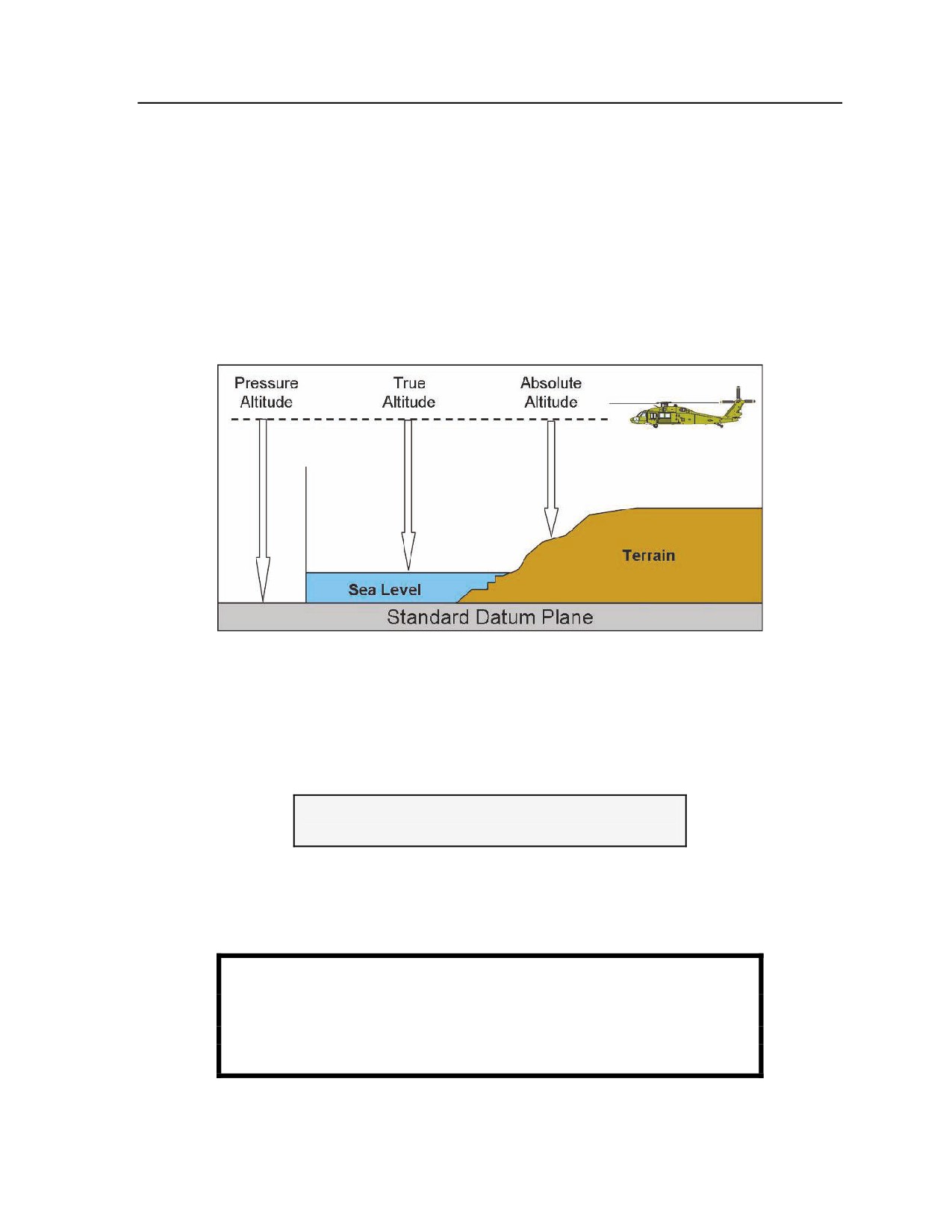
altimeter is a stack of evacuated, corrugated bronze wafers (Figure 1-2). The air pressure tries to compress
the wafers against their natural springiness, which works to expand them. As a result, their thickness
changes as air pressure changes.
Figure 1-2. Altimeter components
1-5. An altimeter has an adjustable barometric scale that allows the aviator to set the reference pressure
from which the altitude is measured. This scale is visible in the Kollsman window (altimeter setting
window) and adjusted by a knob on the instrument. The range of the scale is from 28.00 to 31.00 inches of
mercury (Hg), or 948 to 1,050 millibars.
1-6. Rotating the knob changes both the barometric scale and altimeter pointers in such a way that a
change in the barometric scale of 1 inch Hg changes the pointer indication by 1,000 feet. This is the
1-2
FM 3-04.240
30 April 2007
Flight Instruments and Systems
standard pressure lapse rate below 5,000 feet. When the barometric scale is adjusted to 29.92 inches Hg, or
1,013.2 millibars, the pointers indicate the pressure altitude. To display indicated altitude, adjust the
barometric scale to the local altimeter setting. The instrument then indicates the height above the existing
sea-level pressure.
TYPES OF ALTITUDE
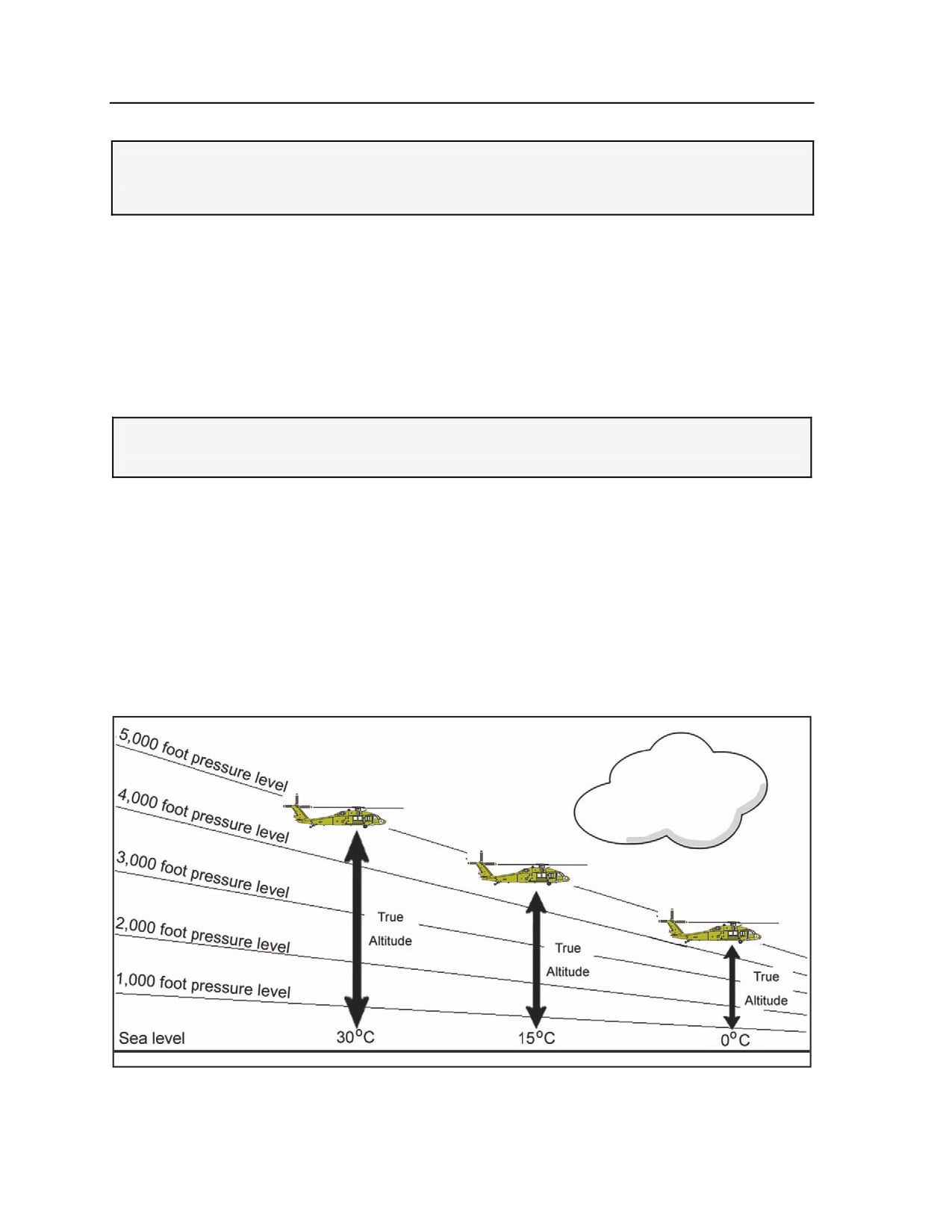
1-7. The five types of altitude are indicated, absolute, true, pressure, and density. Figure 1-3 compares
pressure, true, and absolute altitudes. Indicated altitude is altitude as read on the dial with a current
altimeter setting (sea-level pressure) set in the Kollsman window. Absolute altitude is the altitude above the
surface or terrain where the aircraft is flying, also called above ground level (AGL). True altitude is the
altitude above mean sea level (MSL).
Figure 1-3. Types of altitude
1-8. Pressure altitude is the height measured above the 29.92-inches-of-mercury pressure level (standard
datum plane). If the Kollsman window is set to 29.92 Hg, the hands of the dial indicate pressure altitude.
This setting is called the standard altimeter setting. In the United States, the use of pressure altitudes
(standard altimeter setting) begins at 18,000 feet. These altitudes are referred to as flight levels (FLs). The
following are examples of conversions of altitude in feet to flight levels.
Examples of Conversions to Flight Levels
18,000 feet equals FL180; 35,000 feet equals FL350.
1-9. Density altitude is the altitude for which a given air density exists in the standard atmosphere. If the
barometric pressure is lower or the temperature is higher than standard, then density altitude of the field is
higher than its actual elevation such as in the following example. Density altitudes can be obtained from
many airfield towers or may be computed on the dead reckoning computer (CPU-26A/P).
WARNING
Because higher density altitude requires a greater takeoff
distance and reduces aircraft performance, failure to calculate
density altitude could be fatal.
30 April 2007
FM 3-04.240
1-3
Chapter 1
Example of Density Exceeding Actual Elevation
For Denver, Colorado, with an elevation of 5,500 feet, at a temperature of 100º Fahrenheit (F) and a
barometer reading (corrected to MSL) of 29.55 inches of mercury, density altitude is about 10,000 feet.
ALTIMETER ERROR
1-10. An altimeter indicates standard changes from standard conditions; most flying, however, involves
errors caused by nonstandard conditions, where the aviator must modify the indications to correct for these
errors. Two types of errors are mechanical and inherent.
1-11. A preflight check to determine the condition of an altimeter consists of setting the altimeter pointer
to the airport elevation or actual aircraft location altitude, if known, and noting the Kollsman window
setting. After obtaining the local altimeter setting, compute altimeter error as described in the following
example.
Example Illustrating Difference of Actual and Displayed Altitudes
Set 29.95 with pointer on field elevation; the local altimeter setting is 29.98. This setting causes a difference of
30 feet between actual and displayed altitudes (29.98 - 29.95 = .03, 10 feet for every .01).
1-12. According to the FAA, if the indication is off more than 75 feet from the surveyed elevation, the
instrument must be referred to a certified instrument repair station for recalibration. According to current
Army operator manuals, aircraft are allowed up to 70 feet from the surveyed elevation. The appropriate
operator or maintenance manual should be referenced to confirm which limit is accurate. Differences
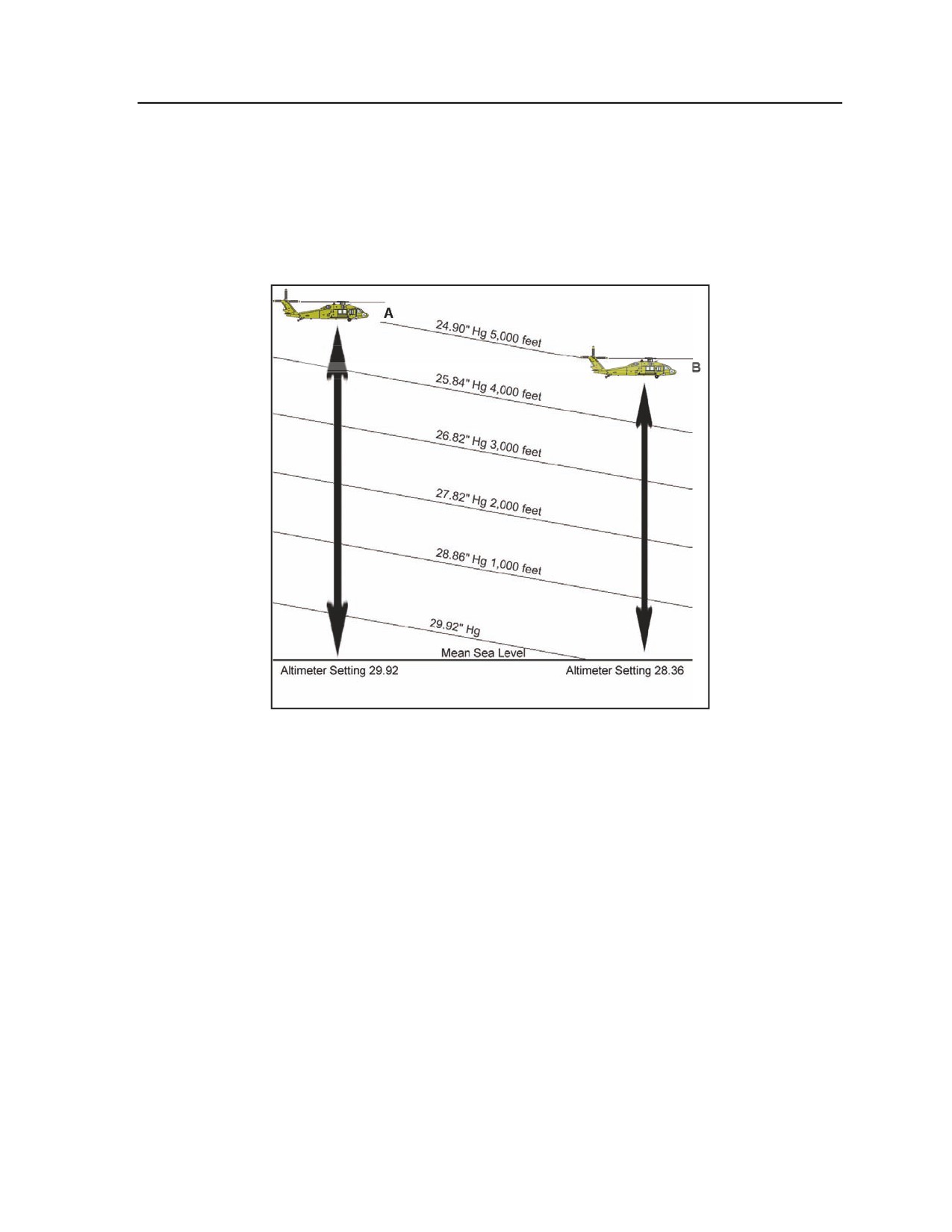
between ambient temperature and pressure will cause an erroneous indication on the altimeter. Figure 1-4
shows the way that nonstandard temperature affects an altimeter. When the aircraft is flying in air warmer
than standard, the air is less dense and pressure levels are farther apart. When the aircraft is flying at an
indicated altitude of
5,000 feet, the pressure level for that altitude is higher than in air at standard
temperature, and the aircraft flies higher than if the air were cooler. If the air is colder than standard, air is
denser and pressure levels are closer together. When the aircraft is flying at an indicated altitude of 5,000
feet, its true altitude is lower than if the air were warmer.
Figure 1-4. Altimeter error caused by nonstandard temperature
1-4
FM 3-04.240
30 April 2007
Flight Instruments and Systems
1-13. Any time that the barometric pressure lapse rate differs from the standard of inches of Hg per
thousand feet in lower elevations, the indicated altitude will be different from the true altitude. Figure 1-5
shows a helicopter at point A flying in air in which conditions are standard; the altimeter setting is 29.92
inches Hg. When the altimeter indicates 5,000 feet, the true altitude is also 5,000 feet. The helicopter flies
to point B, where pressure is lower than standard, and the altimeter setting is 28.36 inches Hg; however,
the aviator does not change the altimeter to this new altimeter setting. When the altimeter shows an
indicated altitude of 5,000 feet, the true altitude, or height above MSL, is 3,500 feet.
Figure 1-5. Altimeter error caused by nonstandard atmospheric pressure
COLD-WEATHER ALTIMETER CORRECTION
1-14. Pressure altimeters are calibrated to indicate true altitude under international standard atmospheric
(ISA) conditions. Any deviation from these standard conditions results in an erroneous reading on the
altimeter. This error becomes important when the aviator considers obstacle clearances in temperatures
lower than standard because the aircraft’s altitude is below the figure indicated by the altimeter. The error
is proportional to the difference between actual and ISA temperature and the height of the aircraft above
the altimeter setting source. The amount of error is about 4 feet per 1,000 feet for each degree Celsius (°C)
of difference. Corrections are only made for decision altitudes (DAs)/decision heights (DHs), minimum
descent altitudes (MDAs), and other altitudes inside, but not including, the final approach fix (FAF). The
same correction made to DAs/DHs and MDAs is applied to other altitudes inside the FAF. For current
cold-weather altimeter correction procedures, refer to the Flight Information Handbook (FIH), section D.
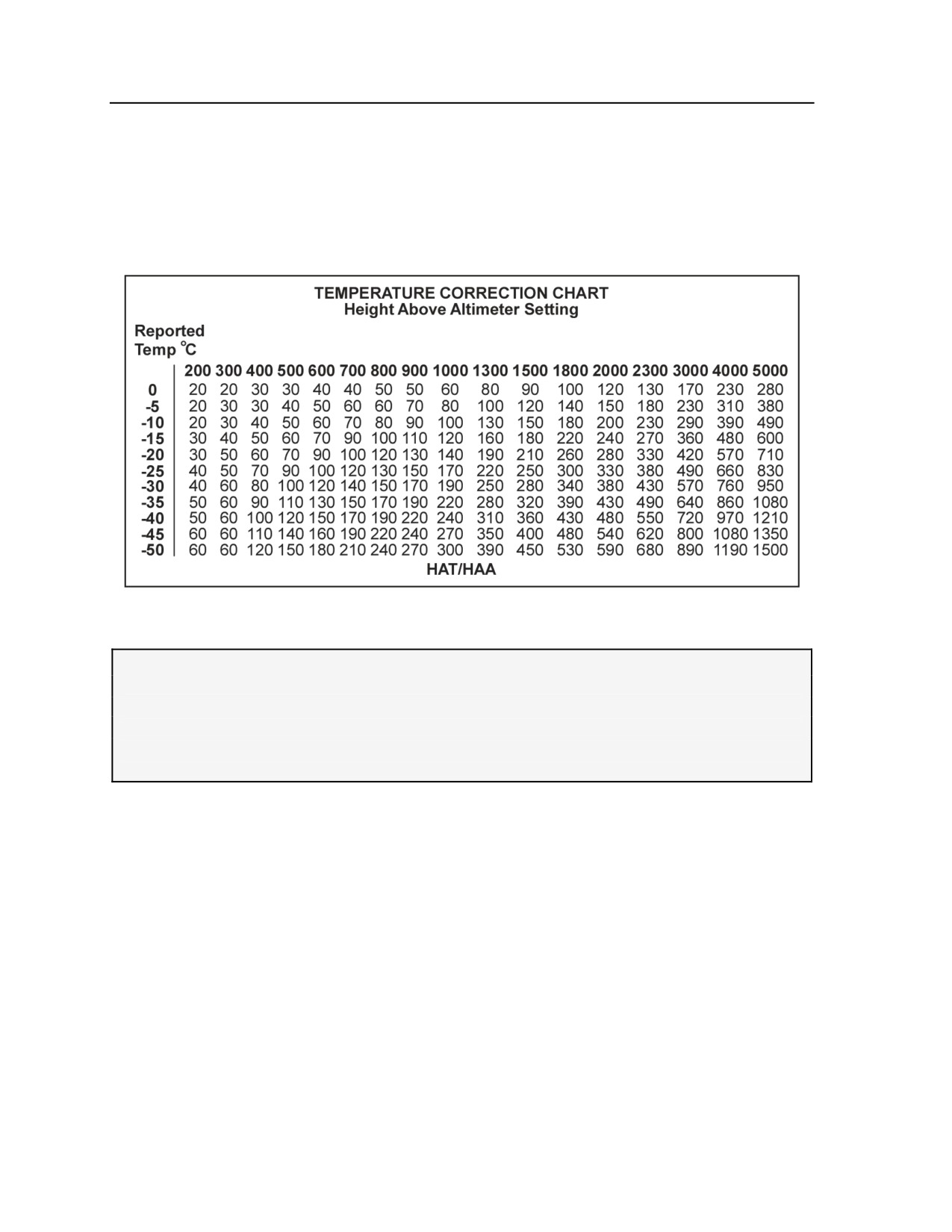
An example of cold-weather altimeter correction follows Figure 1-6, page 1-6. The following guidance is
an example of how to accomplish the procedure found in the FIH. To ensure adequate obstacle clearance,
the values in the chart in Figure 1-6 are—
Added to the published decision altitude (DA)/DH or MDA and step-down fixes inside the FAF
whenever outside air temperature is less than 0 degree C.
30 April 2007
FM 3-04.240
1-5
Chapter 1
Added to all altitudes in the procedure in designated mountainous regions whenever outside air
temperature is 0 degree C or less.
Added to all altitudes in the procedure whenever outside air temperature is -30 degrees C or
less.
Added to procedure turn, intermediate approach altitude, and height above touchdown
(HAT)/height above airport (HAA) when they are 3,000 feet or more above the altimeter setting
source.
Figure 1-6. Temperature correction chart (height in feet)
Example of Cold-Weather Altimeter Correction
Published MDA 1,180 feet MSL
HAT 402 (feet)
Temp -30ºC
Correction 80 feet
MDA to use: 1,180 + 80 = 1,260 feet MSL
ENCODING ALTIMETER
1-15. An encoding altimeter is also known as an AIMS altimeter. In the term AIMS, A stands for Air
Traffic Control Radar Beacon System (ATCRBS), I stands for identification friend or foe (IFF), M
represents the Mark XII identification system, and S means system.
1-16. When the air traffic control (ATC) transponder is set to Mode C, the encoding altimeter supplies the
transponder with a series of pulses identifying the flight level (in increments of 100 feet) at which the
aircraft is flying. This series of pulses is transmitted to ground radar and appears on the controller’s scope
as an alphanumeric display around the return for the aircraft. The transponder allows the ground controller
to identify the aircraft under his control and determine the pressure altitude that the aircraft is flying.
1-17. A computer inside the encoding altimeter measures the pressure referenced from 29.92 inches Hg
and delivers this data to the transponder. When the aviator adjusts the barometric scale to the local
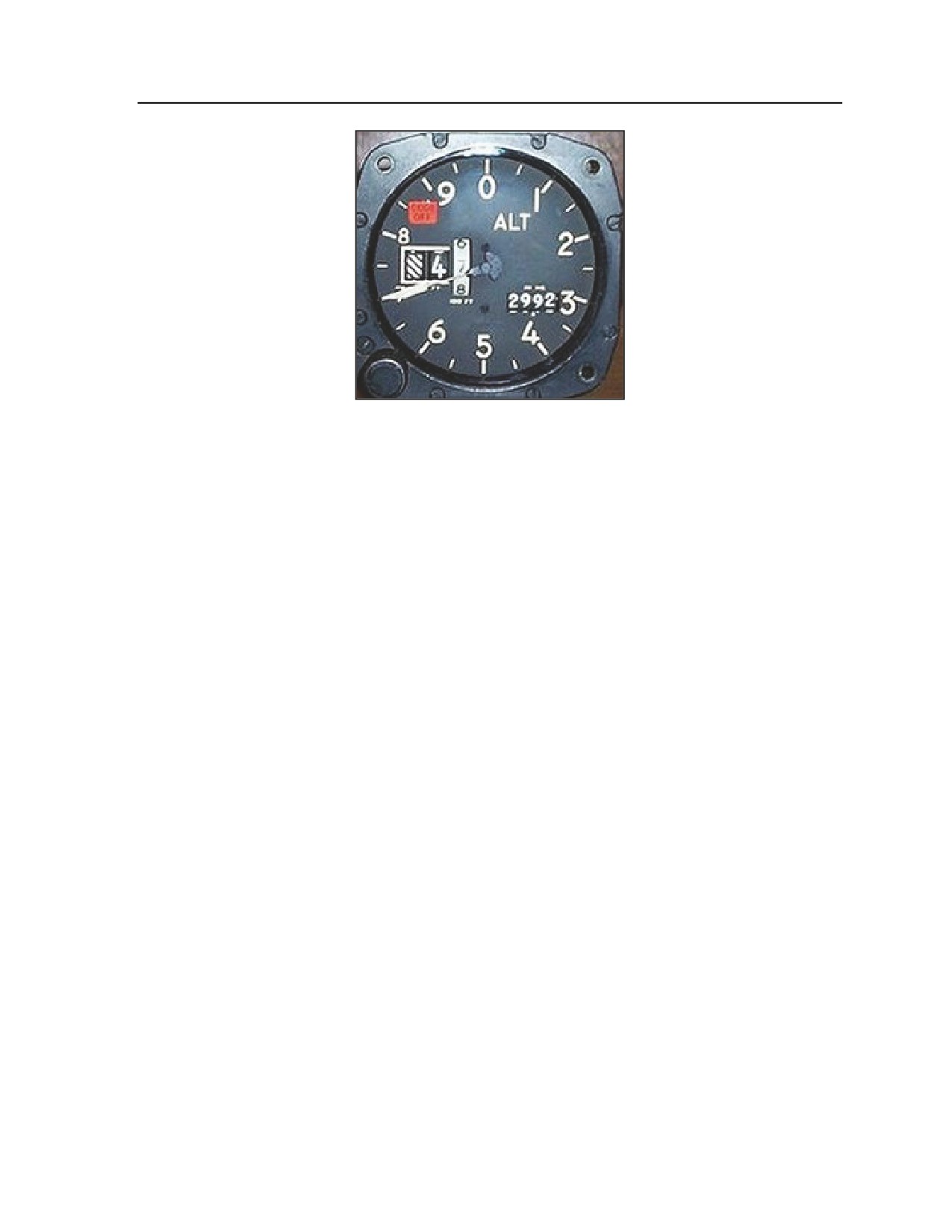
altimeter setting, the data sent to the transponder is not affected. Figure 1-7, page 1-7, shows an altimeter
with a failed encoder displayed by a red blocked code off between the 8 and 9 on the altimeter.
1-6
FM 3-04.240
30 April 2007
Flight Instruments and Systems
Figure 1-7. Encoding altimeter with a malfunction
RADAR ALTIMETER
1-18. The radar altimeter, also known as an absolute altimeter, measures the height of the aircraft above
terrain by transmitting a radio signal, either a frequency-modulated (FM) continuous-wave or a pulse to the
ground, and accurately measuring the time used by the signal in traveling from the aircraft to the ground
and returning. This transit time is modified with a time delay and converted inside the indicator to distance
in feet.
1-19. Most absolute altimeters have a provision for setting a low/high altitude. When the aircraft reaches
this height above ground, a light illuminates and/or an aural warning sounds. Aircraft with a flight
management system may have a provision for setting a DA/DH or a MDA; when the aircraft reaches this
height, a light illuminates and/or an aural warning sounds. For example, the utility helicopter (UH)-60
vertical situation indicator has a DH advisory light that illuminates whenever the radar altimeter is
operating and the altitude indicator is at or below the set altitude on the radar altimeter. See the operator’s
manual for operation of the radar altimeter. A radar altimeter has three main functions:
Serves as a ground proximity warning device.
Is an accurate cross-check for the barometric altimeter.
Indicates absolute height above terrain.
AIRSPEED INDICATOR
1-20. An airspeed indicator is a differential pressure gauge that measures the dynamic pressure of the air
through which the aircraft is flying. Dynamic pressure is the difference in ambient static air pressure and
total, or ram, pressure caused by motion of the aircraft through the air. These two pressures are taken from
the pitot-static system.
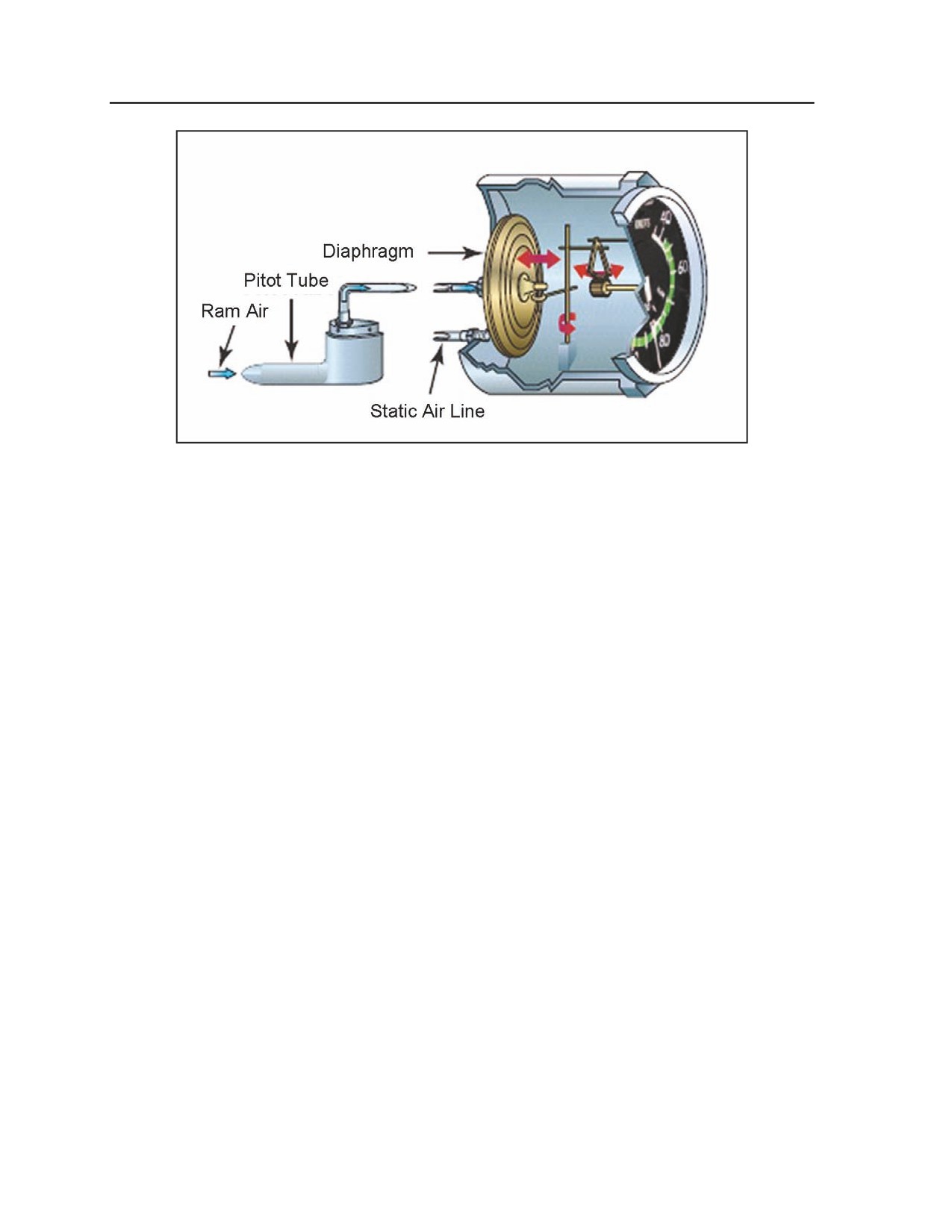
1-21. The mechanism of the airspeed indicator in Figure 1-8, page 1-8, consists of a thin, corrugated
phosphor-bronze aneroid, or diaphragm, that receives its pressure from the pitot tube. The instrument case
is sealed and connected to the static ports. As pitot pressure increases or static pressure decreases, the
diaphragm expands. This dimensional change is measured by a rocking shaft and gears driving a pointer
across the instrument dial. Most airspeed indicators are calibrated in knots, or nautical miles per hour;
some instruments show statute miles per hour, and some instruments show both.
30 April 2007
FM 3-04.240
1-7
Chapter 1
Figure 1-8. Mechanism of an airspeed indicator
1-22. There are four types of airspeed. The four types are indicated, calibrated, equivalent, and true.
Indicated airspeed (IAS) is shown on the dial of the instrument, uncorrected for instrument or
system errors.
Calibrated airspeed (CAS) is the speed that the aircraft is moving through the air, which is found
by correcting IAS for instrument and position errors; the aircraft operator’s manual has a chart
or graph to correct IAS for these errors and provide correct CAS for various aircraft
configurations.
Equivalent airspeed (EAS) is CAS corrected for compression of air inside the pitot tube; EAS is
the same as CAS in standard atmosphere at sea level. As airspeed and pressure altitude increase,
the CAS becomes higher and a correction for compression must be subtracted from CAS.
True airspeed (TAS) is CAS corrected for nonstandard pressure and temperature; TAS and CAS
are the same in standard atmosphere at sea level. Under nonstandard conditions, TAS is found
by applying a correction for pressure altitude and temperature to CAS. Aircraft equipped with
TAS indicators have a temperature-compensated aneroid bellows inside the instrument case. The
bellows modifies the movement of the rocking shaft inside the instrument case so that the
pointer shows actual TAS; the TAS indicator provides TAS and IAS. These instruments have a
conventional airspeed mechanism with an added subdial visible through cutouts in the regular
dial. A knob on the instrument allows rotation of the subdial and alignment of an indication of
the outside air temperature with the pressure altitude being flown; this alignment causes the
instrument pointer to indicate TAS on the subdial.
1-23. In addition to the four airspeeds above, aviators must also consider and calculate ground speed.
Ground speed is the speed of an aircraft relative to the surface of the earth. Ground speed is TAS corrected
for wind.
VERTICAL SPEED INDICATOR
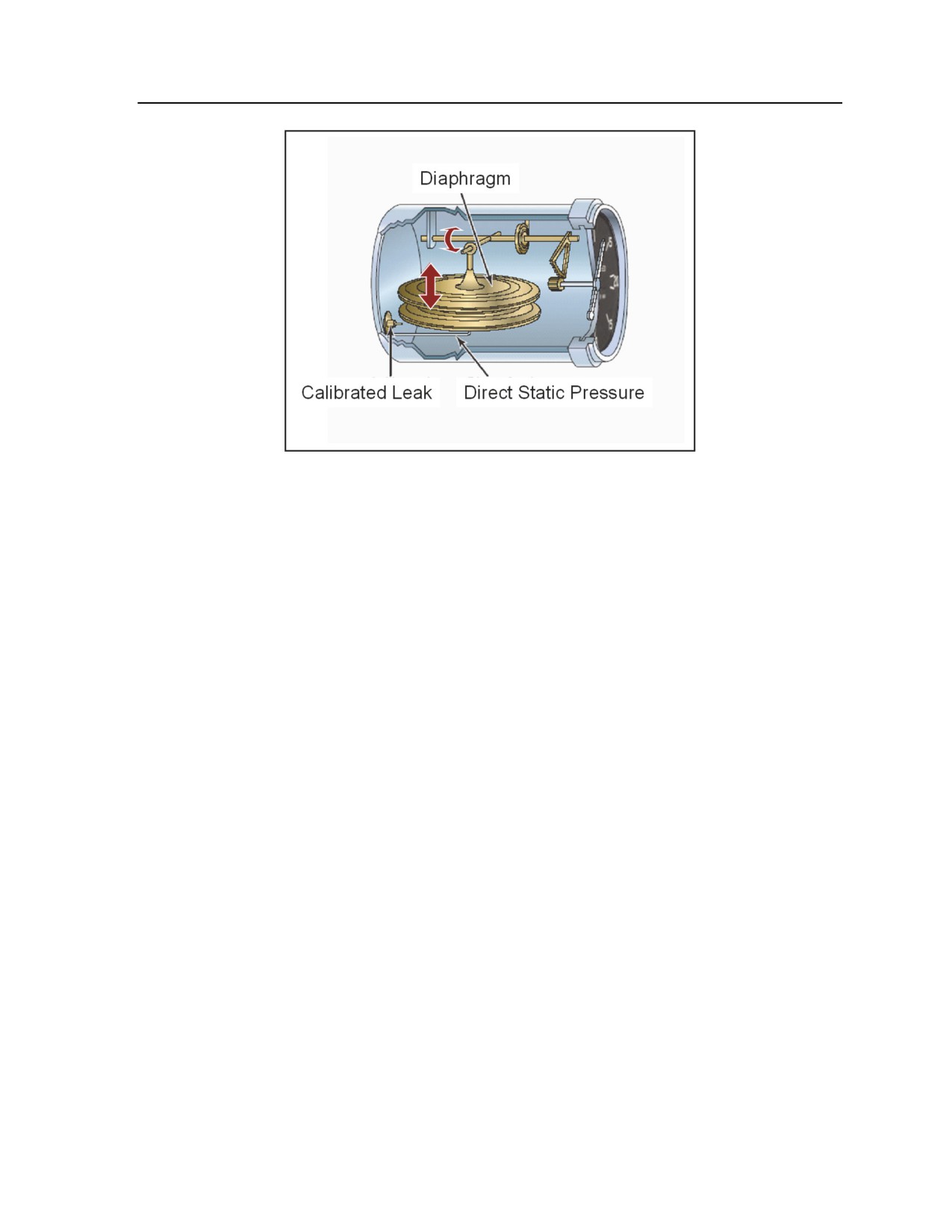
1-24. The VSI (Figure 1-9, page 1-9) is also called a vertical velocity indicator (VVI) and was formerly
known as a rate-of-climb indicator. The VSI/VVI is a rate-of-pressure change instrument that indicates any
deviation from a constant pressure level.
1-8
FM 3-04.240
30 April 2007
Flight Instruments and Systems
Figure 1-9. Vertical speed indicator
1-25. Inside of the instrument case is an aneroid (also called a diaphragm) much like the one in an airspeed
indicator. Both the inside of this aneroid and the inside of the instrument case are vented to the static
system. The case is vented through a calibrated orifice that causes pressure inside the case to change more
slowly than pressure inside the aneroid. As the aircraft ascends, static pressure becomes lower and pressure
inside the case compresses the aneroid, moving the pointer upward—showing a climb and indicating the
number of feet per minute (FPM) that the aircraft is ascending.
1-26. When the aircraft levels off and static pressure is no longer changing, pressure inside the case
becomes the same as that inside the aneroid and the pointer returns to the horizontal, or zero, position.
When the aircraft descends, static pressure increases and the aneroids expand, moving the pointer
downward, indicating a descent. The pointer indication in a VSI lags a few seconds behind the actual
change in pressure. The VSI is more sensitive than an altimeter and useful in alerting the aviator of an
upward or downward trend, thereby helping maintain a constant altitude.
INSTANTANEOUS VERTICAL SPEED INDICATOR
1-27. Instantaneous vertical speed indicators
(IVSIs)
(Figure
1-10, page
1-10) differ from VSI
construction by having two accelerometer-actuated air pumps that sense an upward or downward pitch of
the aircraft and instantaneously creating a pressure differential. By the time that pressure caused by the
pitch acceleration dissipates, the altitude pressure change is effective.
1-28. Because accelerometers are not vertically stabilized, some error is generated in turns. If a zero
indication is maintained on the IVSI when the aircraft is entering a turn, some loss in altitude will be
encountered. A corresponding gain in altitude results when the aircraft is recovering from a turn. The IVSI
should not be used for directly controlling vertical speed when the aircraft is rapidly banking in excess of
40 degrees. The indicator is not affected once the aircraft is in a steady turn.
1-29. The fade-out of acceleration in a steady turn happens when a turn has been started and the
accompanying change in normal acceleration has been completed. Fade-out occurs because the accelerator
masses settle to new balance points corresponding to the normal acceleration maintained in the turn. When
a 30-degree bank is being established, altitude deviation should not exceed 90 feet while the IVSI is
maintained at zero. In more steeply banked turns, turn error rapidly increases with bank angle.
30 April 2007
FM 3-04.240
1-9
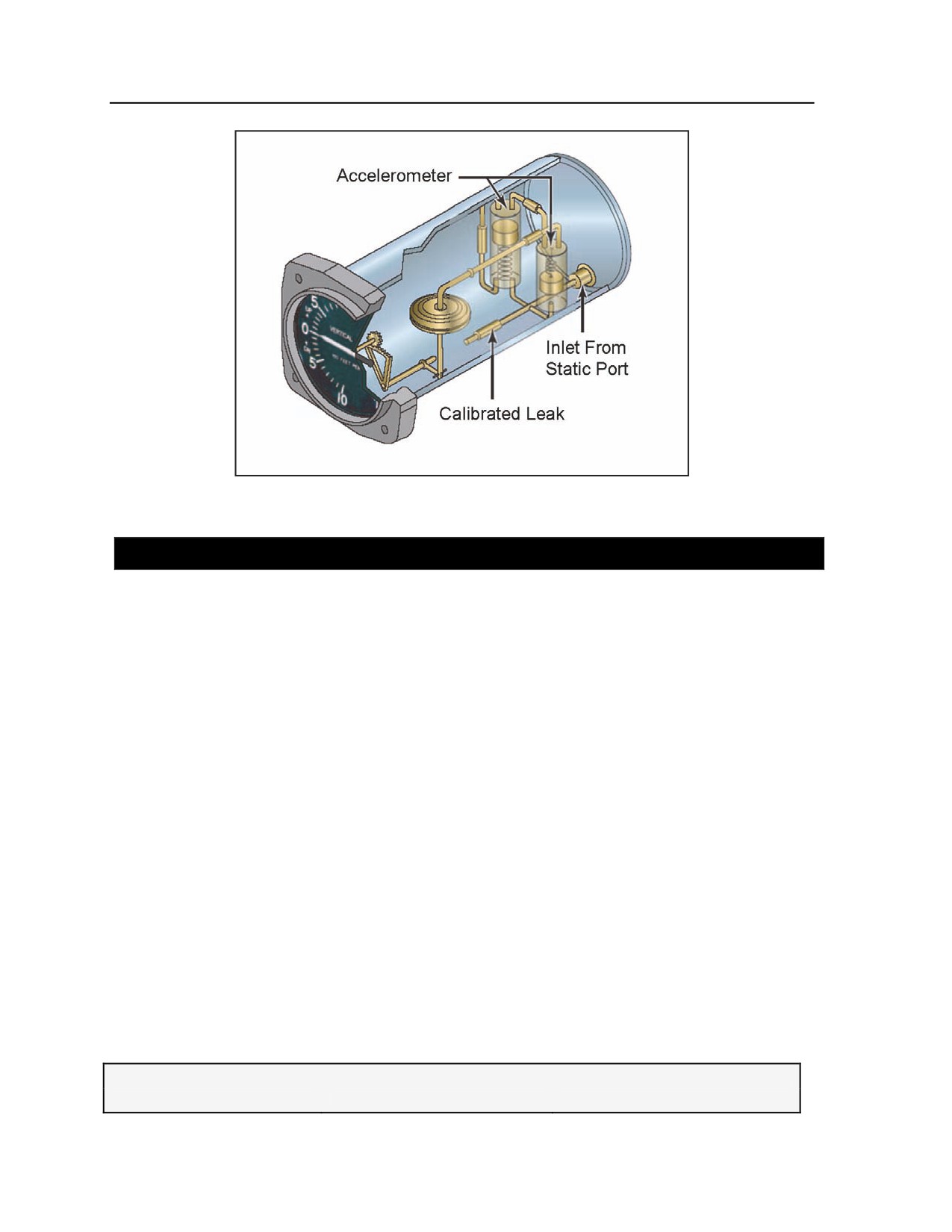
Chapter 1
Figure 1-10. Instantaneous vertical speed indicator
SECTION II - COMPASS SYSTEMS
1-30. The Earth is a huge magnet surrounded by a magnetic field made up of invisible lines of flux. These
lines leave the surface at the magnetic north pole and reenter at the magnetic South Pole. Lines of magnetic
flux have two important characteristics: any magnet free to rotate aligns with them, and an electrical
current is induced into any conductor that cuts across them. Most direction indicators installed in aircraft
make use of one of these two characteristics.
MAGNETIC COMPASS
1-31. A magnet is a piece of material, usually a metal containing iron, which attracts and holds lines of
magnetic flux. Every magnet, regardless of size, has two poles: north and south. When one magnet is
placed in the field of another, the unlike poles attract each other and like poles repel.
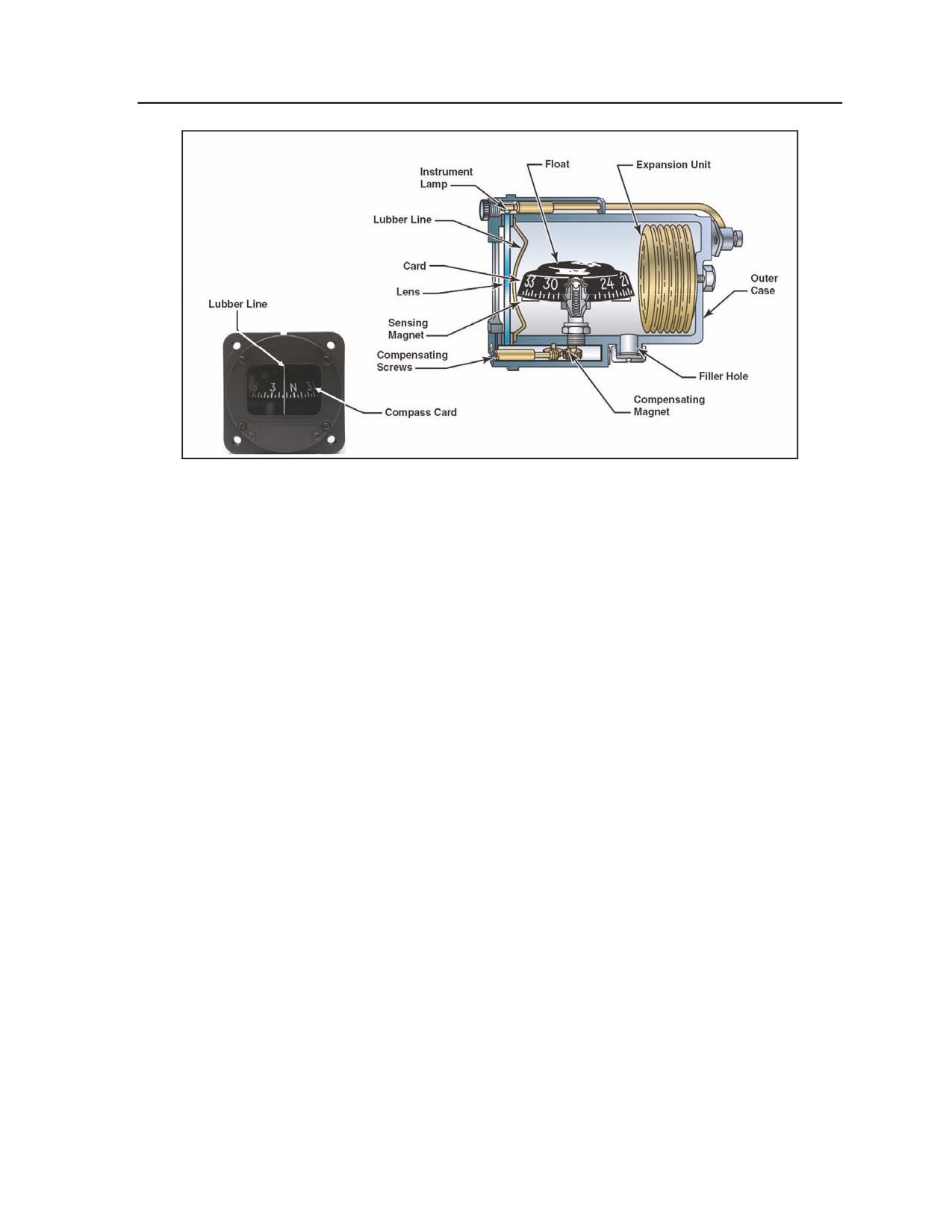
1-32. The magnetic compass (Figure 1-11, page 1-11) is one of the oldest, simplest, and most basic
instruments. AR 95-1 requires a magnetic compass for all flights. The compass bowl is the interior portion
of the compass card that supports the dial and float. The bowl is filled with liquid that has minimum
volume and viscosity changes with temperature variations. Some compasses have an expansion bellows to
allow for fluid expansion. The bowl supports a metal float that has two small magnets attached to it. A
graduated scale, called a card, is wrapped around the float and viewed through a glass window with a
lubber line across the center of the glass. The float and card assembly has a hardened steel pivot in its
center that rides inside a special, spring-loaded, hard-glass jewel cup. The buoyancy of the float takes most
of the weight off the pivot, and the fluid dampens the oscillation of the float and card. This jewel-and-pivot
type of mounting allows the float to freely rotate and tilt about 18 degrees. Compass indications are erratic
and unreliable at steeper bank angles.
1-33. The compass card is marked with letters representing the cardinal directions—north, east, south, and
west—and a number for each 30 degrees between these letters. The final “0” is omitted from these
directions as in the following examples.
Examples of Compass Card Degree Equivalents
3 equals 30 degrees
6 equals 60 degrees
33 equals 330 degrees
1-10
FM 3-04.240
30 April 2007
Flight Instruments and Systems
Figure 1-11. Magnetic compass
1-34. There are long and short graduation marks between the letters and numbers, with each long mark
representing 10 degrees and each short mark representing 5 degrees. The numbers and letters on the
graduated scale are marked to allow the aviator to view the direction being flown. The markings appear
backward from conventional compasses that are viewed from above.
COMPASS ERROR
Variation
1-35. The Earth rotates about its geographic axis, and maps and charts are drawn using meridians of
longitude that pass through the geographic poles. Directions measured from the geographic poles are called
true directions. The north magnetic pole, to which the magnetic compass points, is not collocated with the
north geographic pole but is some 1,300 miles away. Directions measured from the magnetic poles are
called magnetic directions. In aerial navigation, the difference between true and magnetic directions is
called variation. In surveying and land navigation, the difference is called declination.
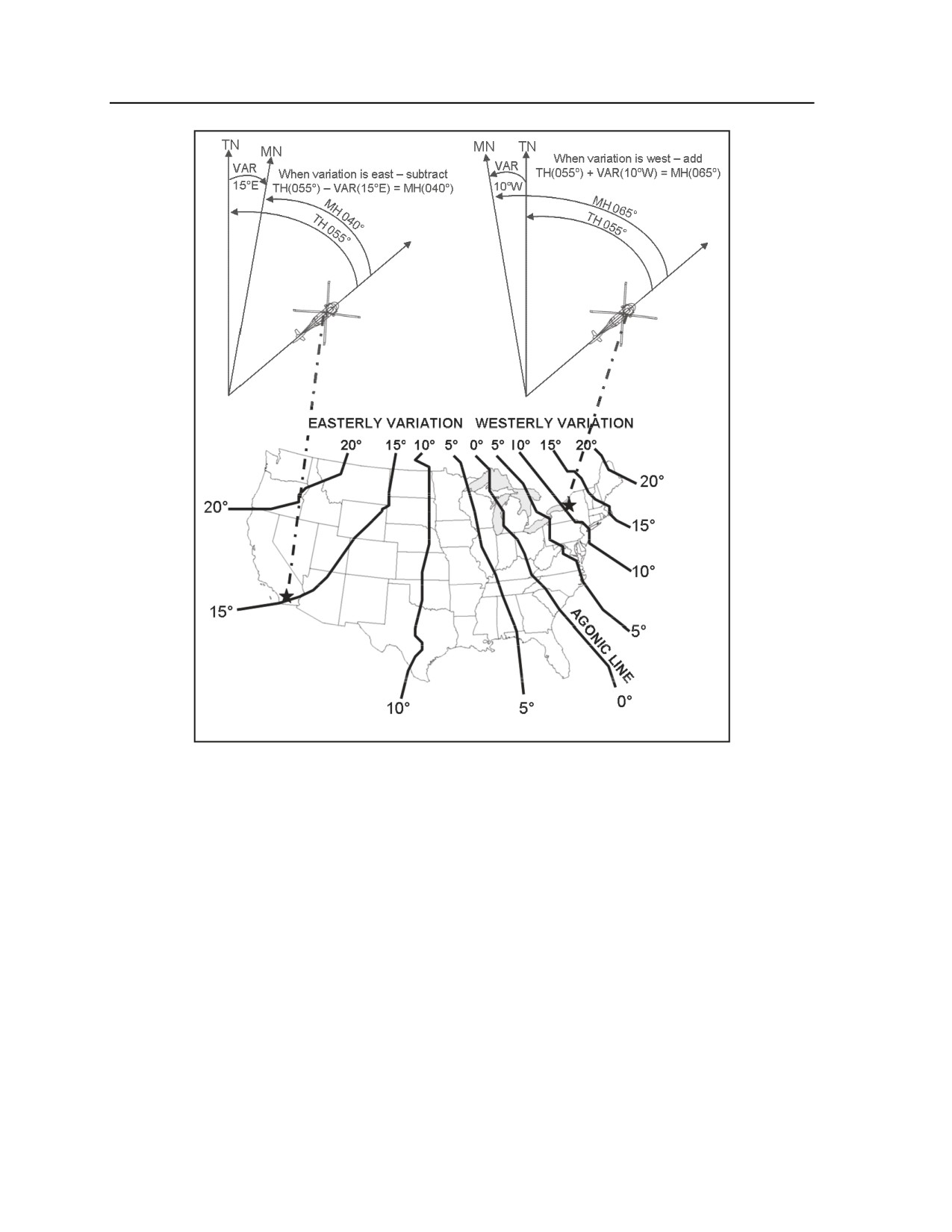
1-36. Figure 1-12, page 1-12, shows the isogonic lines that identify the number of degrees of variation in
their area. The line that passes near Chicago is called the agonic line, and anywhere along this agonic line,
the two poles are aligned and there is no variation.
30 April 2007
FM 3-04.240
1-11
Chapter 1
Figure 1-12. Lines of magnetic variation
1-37. Variation values to the east of the agonic line are called westerly variation; the magnetic north pole is
west of true north (TN). Likewise, the variation values west of the agonic line are known as easterly
variation; the magnetic north pole is east of true north. Variation error does not change with the aircraft’s
heading and is the same anywhere along that particular isogonic line.
1-38. Magnetic north
(MN) changes in small amounts each year. Aeronautical charts are updated
periodically to correct for this yearly change. On instrument flight rules
(IFR) en route low- and
high-altitude charts, all radials and bearings are displayed as magnetic and, therefore, do not require the use
of the compass correction formula.
1-39. When aviators plot a course on an aeronautical chart, they measure the degrees of heading against
latitude and longitude lines. This measure is called a true heading (TH) because it is being measured
relative to the true north pole. Because the aviator relies on the magnetic compass for direction, the aviator
will be steering the aircraft relative to the magnetic north pole. Therefore, the aviator must convert the TH,
as plotted on the navigation chart, to a magnetic heading (MH) by which to steer, using the compass. A
method for remembering magnetic variation is to add westerly variation and subtract easterly variation by
using the phrase “west is best/east is least.” The following example demonstrates how to convert the true
heading to a magnetic heading.
1-12
FM 3-04.240
30 April 2007
Flight Instruments and Systems
Example of Compass Correction
To convert TH to MH, add westerly variation to TH to get MH (see right-hand example Figure 1-12). In other
words, the aviator must steer 065 degrees magnetic to fly over a true heading of 055 degrees.
055 degrees (TH) + 10 degrees west (variation) = 065 degrees (MH).
Likewise, subtract easterly variation from TH to get MH (see left hand example Figure 1-12). In other words,
the aviator must steer 040 degrees magnetic to fly over a true heading of 055 degrees.
055 degrees (TH) - 15 degrees east (variation) = 040 degrees (MH).
1-40. To find true heading when magnetic heading is known, the equation in the previous example is
written in reverse. This procedure is shown in the following example.
Example of Reversing the Equation for Compass Correction
Convert MH to TH by adding easterly variation and subtracting westerly variation. This is the reverse of
changing from TH to MH. The 10 degrees west is subtracted from the MH (065 degrees), and this figure (055
degrees) is the TH. Likewise, the 15 degrees east is added to the MH (040 degrees), and this figure (055
degrees) is the TH.
065 degrees (MH) - 10 degrees west (variation) = 055 degrees (TH).
040 degrees (MH) + 15 degrees east (variation) = 055 degrees (TH).
Deviation
1-41. Magnets in a compass align with any magnetic field. Local magnetic fields in an aircraft caused by
electrical current flowing in the structure, in nearby wiring, or in any magnetized part of the structure will
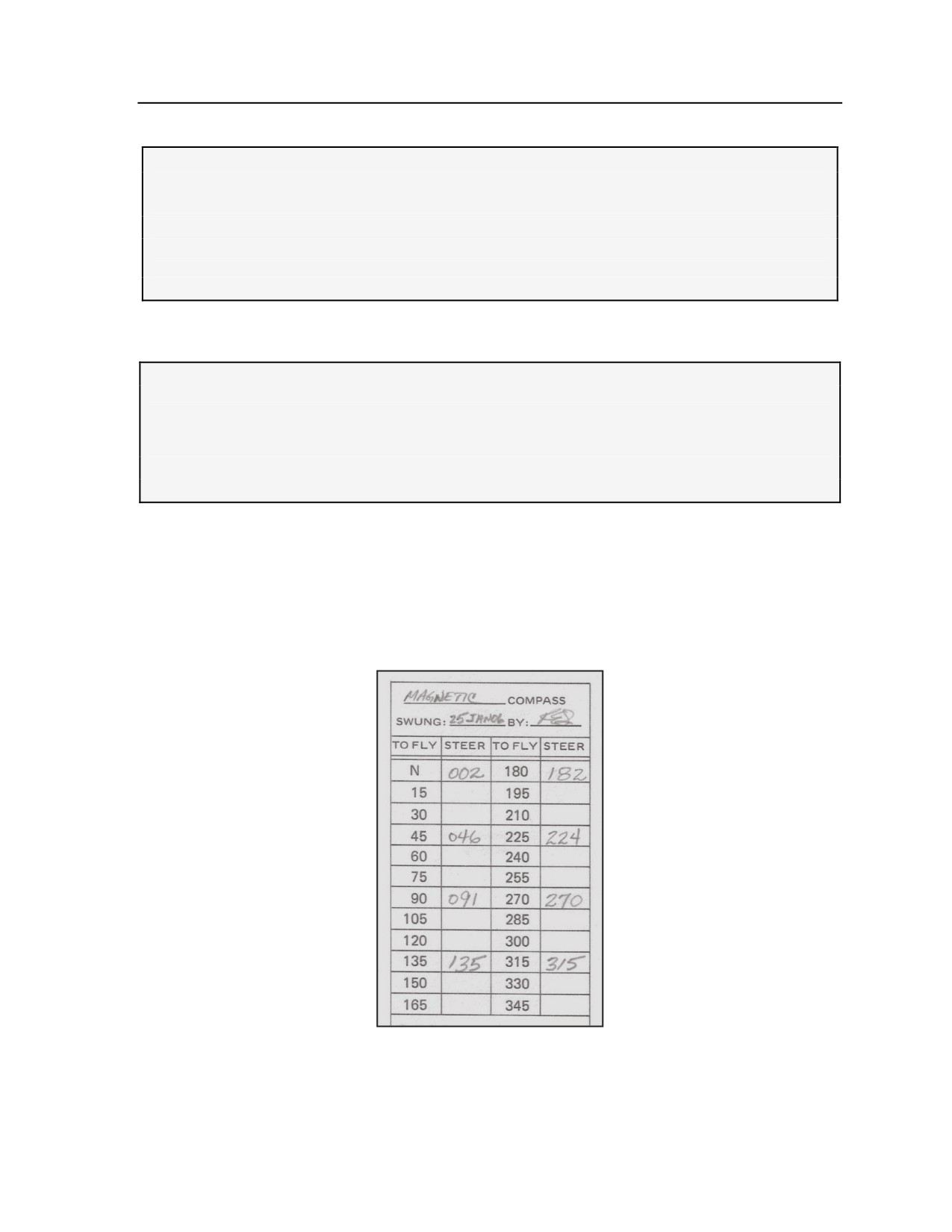
conflict with the Earth’s magnetic field and cause a compass error called deviation. To reduce deviation,
the compensating assembly is adjusted as much as possible. A Department of Defense (DD) Form 1613
(Pilot’s Compass Correction Card) (Figure 1-13) is prepared and mounted near the compass. Figures from
this card are applied to the indications of the compass so that a desired heading may be flown.
Figure 1-13. Pilot compass correction card
30 April 2007
FM 3-04.240
1-13
Chapter 1
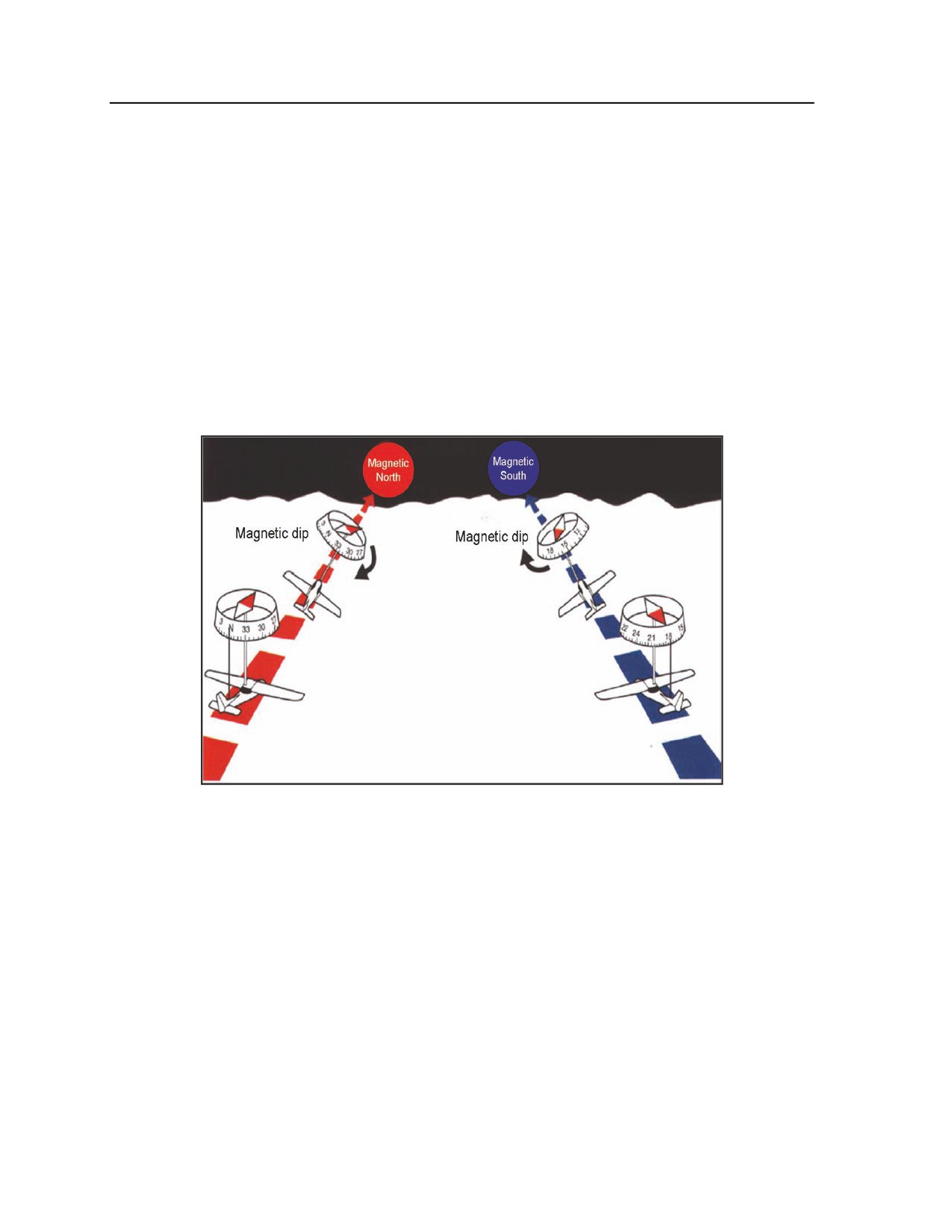
Dip Error
1-42. The lines of magnetic flux are considered to leave the Earth at the magnetic north pole and enter at
the magnetic south pole. At both locations, the lines are perpendicular to the Earth’s surface. At the
magnetic equator, which is halfway between the poles, the lines are parallel with the surface. Magnets in
the compass align with this field, and near the poles they dip, or tilt, the float and card. The float is
balanced with a small dip-compensating weight and stays relatively level when operating in the middle
latitudes of the northern hemisphere. The dip, along with this weight, causes two very noticeable errors:
turning error and acceleration error.
Turning Error
1-43. Pull of the vertical component of the Earth’s magnetic field causes northerly turning error, which is
apparent on a heading of north or south. If an aircraft flying a heading of north makes a turn east, the
aircraft banks to the right and the compass card tilts to the right. The vertical component of the Earth’s
magnetic field pulls the north-seeking end of the magnet to the right, and the float rotates, causing the card
to rotate toward the west, the direction opposite the direction of the turn (Figure 1-14).
Figure 1-14. Turning error
1-44. If the turn is made from north to west, the aircraft banks to the left and the card tilts to the left. The
magnetic field pulls on the end of the magnet, causing the card to rotate toward the east. This indication is,
again, opposite to the direction in which the turn is being made. The rule for this error is the following:
when the aircraft starts a turn from a northerly heading, compass indication lags behind the turn.
1-45. When an aircraft is flying on a heading of south and begins a turn east, the magnetic field of the
earth pulls on the end of the magnet, rotating the card toward the east, the same direction in which the turn
is being made. If the turn is made from the south toward the west, magnetic pull starts the card rotating
toward the west, again; in the same direction in which the turn is being made. The rule for this error is the
following: when the aircraft starts a turn from a southerly heading, compass indication leads the turn.
Acceleration Error
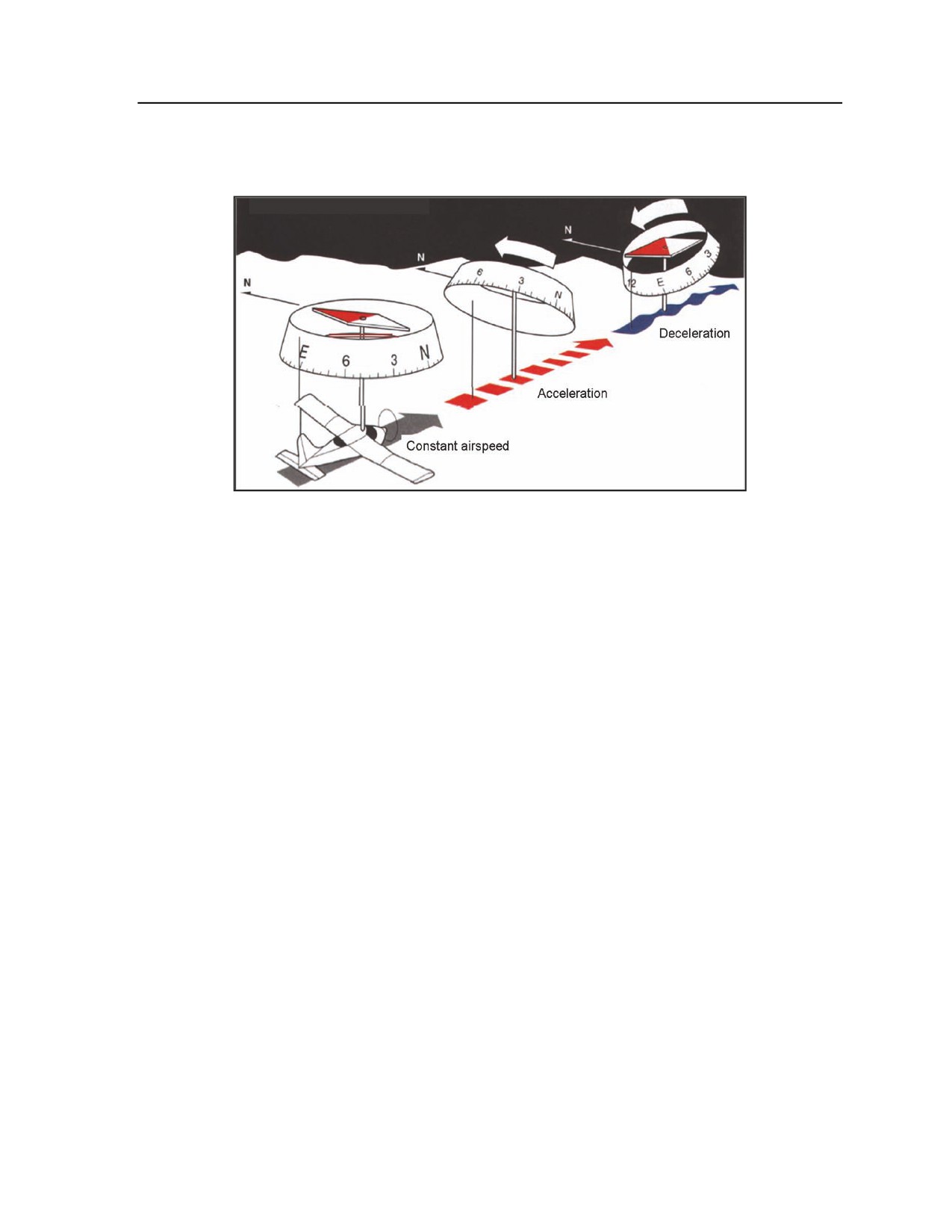
1-46. In acceleration error, dip-correction weight causes the end of the float and card marked “N” (this is
the south-seeking end) to be heavier than the opposite end. When the aircraft is flying at a constant speed
on a heading of either east or west, the float and card are level. Effects of magnetic dip and weight are
1-14
FM 3-04.240
30 April 2007
Flight Instruments and Systems
about equal. If the aircraft accelerates on a heading of east (Figure 1-15), inertia of the weight holds its end
of the float back and the card rotates toward north. The card swings back to its east indication as soon as
the speed of the aircraft stabilizes.
Figure 1-15. Acceleration error
1-47. If, while flying on this easterly heading, the aircraft decelerates, inertia causes the weight to move
ahead and the card rotates toward the south until the speed again stabilizes. While the aircraft is flying on a
heading of west, inertia from acceleration causes the weight to lag and the card rotates toward the north.
When the aircraft decelerates on a heading of west, inertia causes the weight to move ahead and the card
rotates toward the south. A helpful way to remember acceleration error is the acronym ANDS:
acceleration-north/deceleration-south.
Oscillation Error
1-48. Oscillation is a combination of all other errors, including rough air or poor control technique, and
results in the compass card swinging back and forth around the heading being flown. When setting the
gyroscopic heading indicator to agree with the magnetic compass, use the average indication between the
swings.
RADIO MAGNETIC INDICATOR
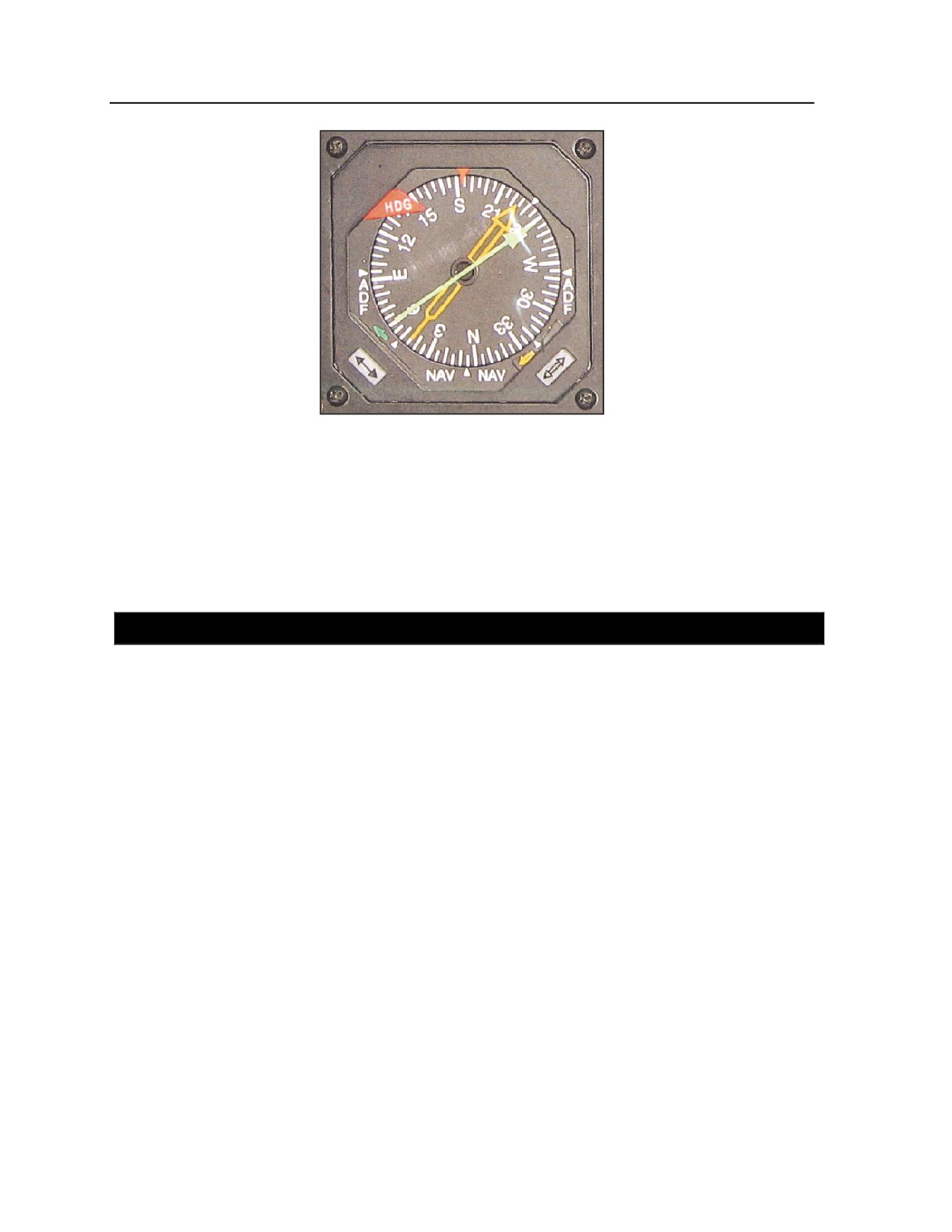
1-49. The radio magnetic indicator (RMI) (Figure 1-16, page 1-16) is a navigational aid providing aircraft
magnetic or directional gyro heading and very (high frequency) omnidirectional range (VOR) or automatic
direction finder (ADF) bearing information. Remote indicating compasses were developed to compensate
for errors in and limitations of older types of heading indicators.
1-50. The slaving control and compensator unit has a push button, providing a means of selecting either
the slaved gyro or free gyro mode. This unit also has a slaving meter and two manual heading-drive
buttons. The slaving meter indicates the difference between displayed heading and magnetic heading. A
right deflection indicates a clockwise error of the compass card; a left deflection indicates a
counterclockwise error. When the aircraft is in a turn and the card rotates, the slaving meter shows a full
deflection to one side or the other. When the system is in free gyro mode, the compass card may be
adjusted by depressing the appropriate heading-drive button.
30 April 2007
FM 3-04.240
1-15
Chapter 1
Figure 1-16. Radio magnetic indicator
1-51. The remote compass transmitter is a separate unit and is usually mounted in a wingtip to eliminate
the possibility of magnetic interference. The remote compass transmitter contains the flux valve, which is
the direction-sensing device of the system. A concentration of lines of magnetic force, after being
amplified, becomes a signal relayed to the heading indicator unit, which is remotely mounted. This signal
operates a torque motor in the heading indicator unit, which precesses the gyro unit until aligned with the
transmitter signal. The remote compass transmitter is connected electrically to the RMI. The two pointers
are driven by any two combinations of a global positioning system (GPS), an ADF, and/or a VOR.
SECTION III - GYROSCOPIC SYSTEMS
GYROSCOPE
1-52. A gyroscope is a wheel or rotor mounted to spin rapidly around an axis. The gyroscope is free to
rotate about one axis or both axes that are perpendicular to each other and the axis of spin. A spinning
gyroscope offers resistance (inertia) to any force that tends to change the direction of the axis of spin. The
rotor has great weight (high density) for its size and is rotated at high speeds; therefore, it offers high
resistance to any applied force.
PROPERTIES
Rigidity
1-53. When spinning, the rotor remains in its original plane of rotation regardless of how the base is
moved and the aircraft rotates about the rotor. Attitude and heading instruments operate on the principle of
rigidity.
Precession
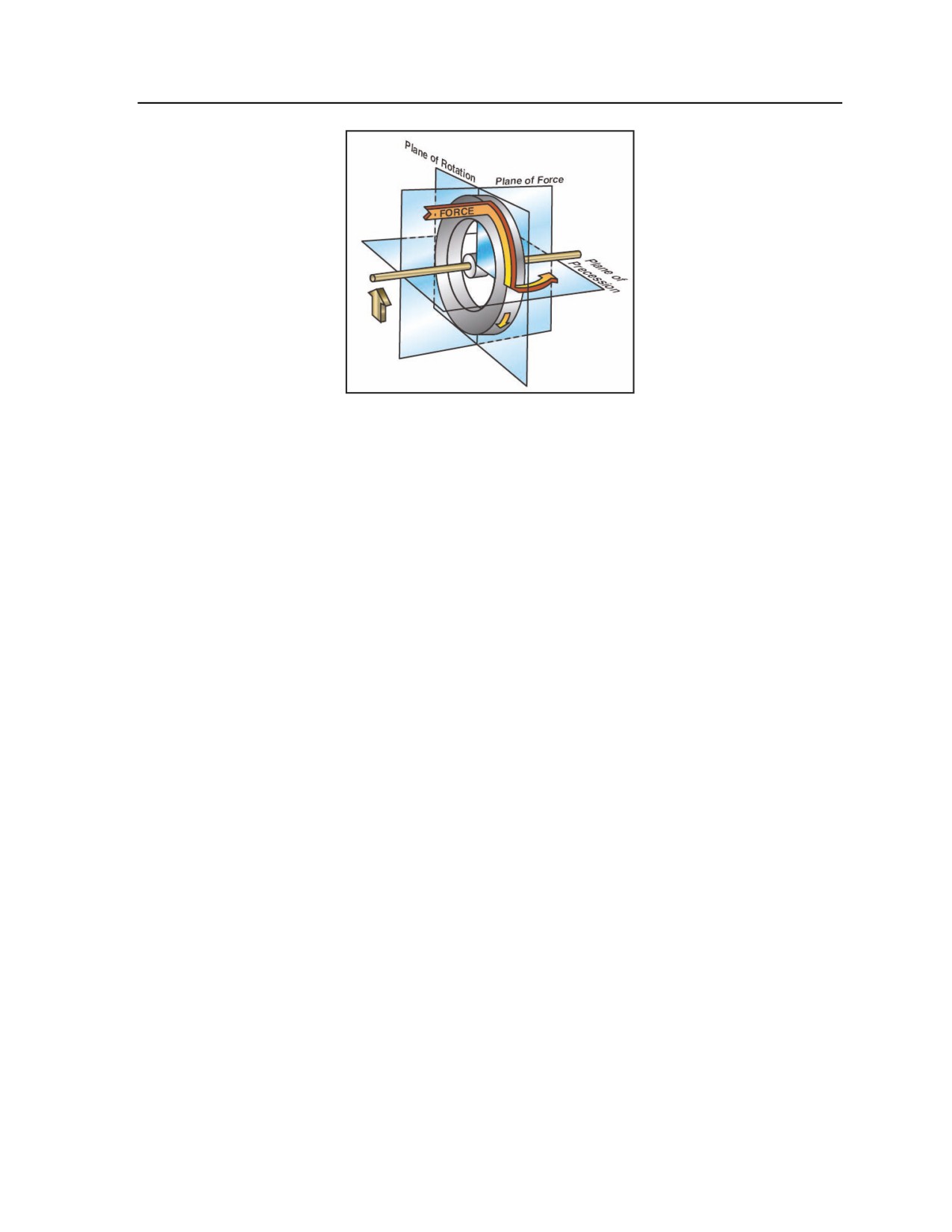
1-54. Precession is the resultant action or deflection of a spinning rotor when a deflective force is applied
to its rim. Precession causes a force applied to a spinning wheel to be felt 90 degrees from the point of
application in the direction of rotation (Figure 1-17, page 1-17). Rate indicators, such as the turn-and-slip
indicator and turn coordinator, operate on the principle of precession.
1-16
FM 3-04.240
30 April 2007
Flight Instruments and Systems
Figure 1-17. Precession diagram
Instrument Power Sources
1-55. Army aircraft use electrical power to keep rotors of gyroscopic instruments rotating continuously. At
higher altitudes and lower temperatures, electrically-operated gyroscopes have proven more reliable than
vacuum-driven gyroscopes. In electrically-driven gyroscopes, the rotor and stator of an electric motor are
enclosed in a gyroscopic housing and become, in effect, the gyro. The gyro, or rotor, is operated on current
supplied from the electrical system of the aircraft. An advantage of this system is that the instrument case
can be hermetically sealed, eliminating the danger of moisture condensation while blocking foreign
material. When the gyro reaches operating speed, enough heat is generated to ensure effective lubrication
at altitudes where the outside air temperature is extremely low.
ATTITUDE INDICATOR
1-56. The attitude indicator was originally referred to as an artificial horizon and later as a gyro horizon.
Its operating mechanism is a small brass wheel with a vertical spin axis, spun at a high speed by an electric
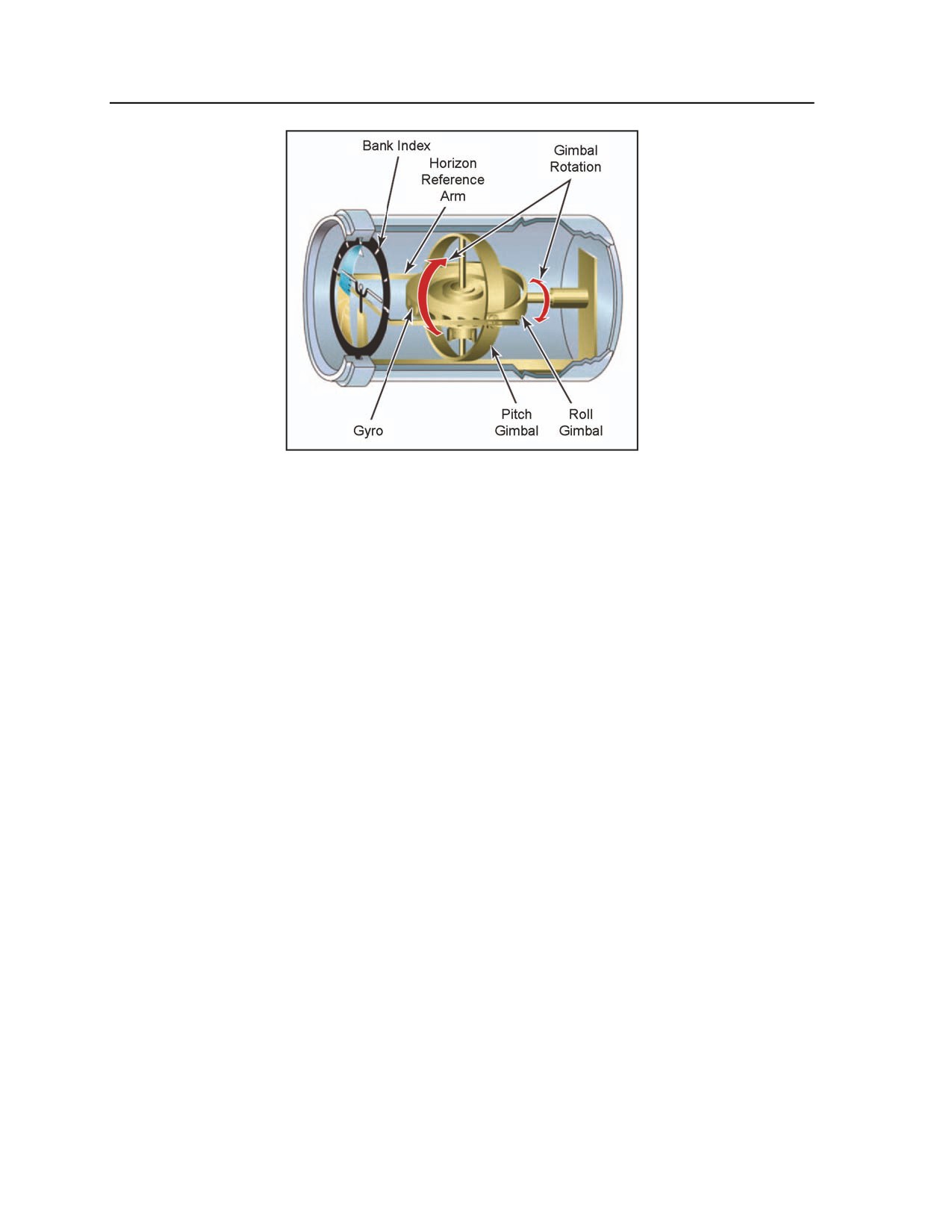
motor (Figure 1-18, page 1-18). The gyro is mounted in a double gimbal, allowing the aircraft to pitch and
roll about the gyro, which remains fixed in space.
1-57. A horizon disk is attached to the gimbals, which keeps the horizon disk in the same plane as the gyro
while the aircraft pitches and rolls. On early instruments, a bar represented the horizon, but now a disc with
a line represents the horizon, both pitch marks, and bank-angle lines. The top half of the instrument dial
and horizon disc is blue or white, representing sky; the bottom half is brown or black, representing ground.
A bank index at the top or bottom of the instrument shows the bank angle marked on the banking scale
with any possible variation of lines representing 10, 20, 30, 45, 60, or 90 degrees based on manufacturer
criteria.
1-58. Mounted in the instrument case is a small symbolic aircraft, which appears to fly relative to the
horizon. A knob at the bottom center of the instrument case raises or lowers the aircraft to compensate for
pitch trim changes as airspeed changes. The width of wings of the symbolic aircraft and the dot in the
center of the wings represent a pitch change of about 1 to 2 degrees.
1-59. When an aircraft engine is first started and electric power is supplied to the instruments, the gyro is
not erect. A self-erecting mechanism inside the instrument, actuated by the force of gravity, applies a
precessive force, causing the gyro to rise to its vertical position. This erection can take as long as five
minutes but is normally complete within two to three minutes.
30 April 2007
FM 3-04.240
1-17
Chapter 1
Figure 1-18. Attitude indicator
1-60. Attitude indicators are free from most errors, but depending upon the speed with which the erection
system functions, there may be a slight nose-up indication during a rapid acceleration and a nose-down
indication during a rapid deceleration. A small bank angle and pitch error may occur after a 180-degree
turn. These inherent errors are small and correct themselves quickly after the aircraft returns to
straight-and-level flight.
TURN-AND-SLIP INDICATOR/TURN COORDINATOR
TURN-AND-SLIP INDICATOR
1-61. The first gyroscopic aircraft instrument was the turn-and-bank indicator. More recently, it has been
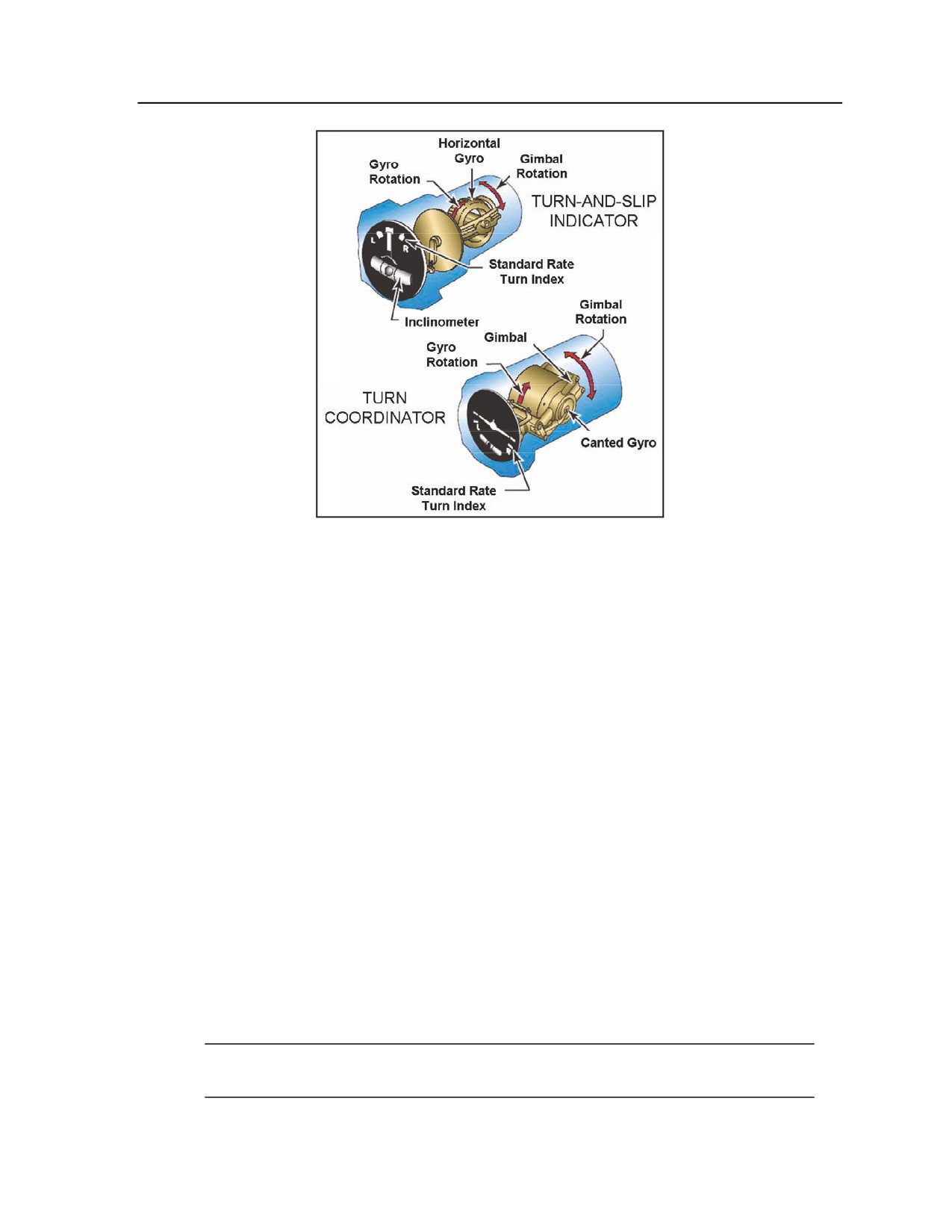
called a turn-and-slip indicator (Figure 1-19, page 1-19).
1-62. The inclinometer in the instrument is a black glass ball sealed inside a curved glass tube partially
filled with a liquid, much like compass fluid. This ball measures relative strength of the force of gravity
and force of inertia caused by a turn. When the aircraft is flying straight-and-level, no inertia is acting on
the ball, and the ball remains in the center of the tube between two wires. In a turn made with too steep a
bank angle, the force of gravity is greater than inertia and the ball rolls down to the inside of the turn. If the
turn is made with too shallow a bank angle, inertia is greater than gravity and the ball rolls upward to the
outside of the turn. The inclinometer only indicates the relationship between bank angle and rate of yaw.
1-63. A small gyro, located in either device, is spun either by air or by an electric motor (Figure 1-19). The
gyro is mounted in a single gimbal with its spin axis parallel to the lateral axis of the aircraft and axis of the
gimbal parallel with the longitudinal axis.
1-18
FM 3-04.240
30 April 2007
Flight Instruments and Systems
Figure 1-19. Turn indicator
1-64. When the aircraft yaws, or rotates about its vertical axis, a force is produced in the horizontal plane
that, because of precession, causes the gyro and its gimbal to rotate about the gimbal axis. The gyro is
restrained in this rotation plane by a calibration spring—rolling over just enough to cause the pointer to
deflect until aligned with one of the doghouse-shaped marks on the dial when the aircraft is making a
standard-rate turn.
1-65. The dial of these instruments is marked 2 MIN TURN. Some turn-and-slip indicators used in faster
aircraft are marked 4 MIN TURN. In either instrument, a standard-rate turn is being made whenever the
needle aligns with a doghouse-shaped mark.
TURN COORDINATOR
1-66. The major limitation of the older turn-and-slip indicator is the sensing of rotation only about the
vertical axis of the aircraft, telling nothing of the rotation around the longitudinal axis, which in normal
flight, occurs before the aircraft begins to turn.
1-67. A turn coordinator operates on precession, the same as the turn indicator, but its gimbal frame is
angled upward about 30 degrees from the longitudinal axis of the aircraft, allowing a sense of roll and yaw.
Some turn coordinator gyros are dual-powered and can be driven by air or electricity. Rather than using a
needle as an indicator, the gimbal moves a dial in which the rear view is of a symbolic aircraft. The bezel
of the instrument is marked to show wings-level flight and bank angles for a standard-rate turn (Figure 1
19).
1-68. The inclinometer, similar to the one in a turn-and-slip indicator, is called a coordination ball. It
shows the relationship between bank angle and rate of yaw. The turn is coordinated when the ball is in the
center between the marks. The aircraft is skidding when the ball rolls toward the outside of the turn and is
slipping when it is moving toward the inside of the turn.
Note. A turn coordinator does not sense changing pitch attitudes of the aircraft. Some
instruments are labeled NO PITCH INFORMATION.
30 April 2007
FM 3-04.240
1-19
Chapter 1
SECTION IV - FLIGHT MANAGEMENT SYSTEM
1-69. Many newer aircraft are equipped with a flight management system (FMS) consisting of a flight
management computer (FMC), one or more control display units (CDUs), an internal navigation database,
and various displays and annunciators (electrically powered indicators). The FMS uses aircraft sensors and
navigation database information to compute and display aircraft position, performance data, and navigation
information during all phases of flight. The FMS may interface and provide data and signals to autopilot,
flight director, and engine fuel control systems.
1-70. The FMC is a sophisticated computer system that gathers aircraft position information from multiple
onboard sensors and navigation aids including VOR, distance measuring equipment (DME), tactical air
navigation (TACAN), inertial navigation system (INS), GPS, and air data computers. From this sensor
data, the FMC computes and continually updates the aircraft present position throughout the flight. Using
this aircraft position information, navigation functions—such as course and distance to a waypoint, desired
track, ground speed, and estimated time of arrival—are computed and displayed on the CDU and other
aircraft instruments. Navigation information may also be provided in the form of steering commands to
autopilot and flight director systems. In addition, fuel-flow information may be used by the FMC to
calculate and update fuel consumption and specific range.
1-71. The CDU serves as the aircrew’s interface to the FMC and associated navigation sensors. The CDU
normally consists of a display screen, data-entry pad, and function and line select keys. The CDU allows
menu-driven selection of various FMS modes such as initialization, fuel planning, performance, and
navigation. The aviator may input a flight-plan route, vertical profile and speed information, aircraft weight
and fuel parameters, and certain waypoint data into the FMC. Data from the navigation database may be
displayed and reviewed by the aviator on the CDU.
1-72. An FMS normally contains an internal navigation database with either regional or worldwide
coverage. The database typically includes information on navigation aids, airports, runways, waypoints,
routes, airways, intersections, departures, arrivals, and instrument approaches. Aircrews may also store
defined routes and waypoints in the database. Navigation databases require periodic updates, normally on a
28-day cycle, to ensure that data are current. Refer to the appropriate operator’s manual for the specific
capabilities of the system installed in the aircraft.
HORIZONTAL SITUATION INDICATOR
1-73. The horizontal situation indicator (HSI) is a direction indicator that uses the output from a flux valve
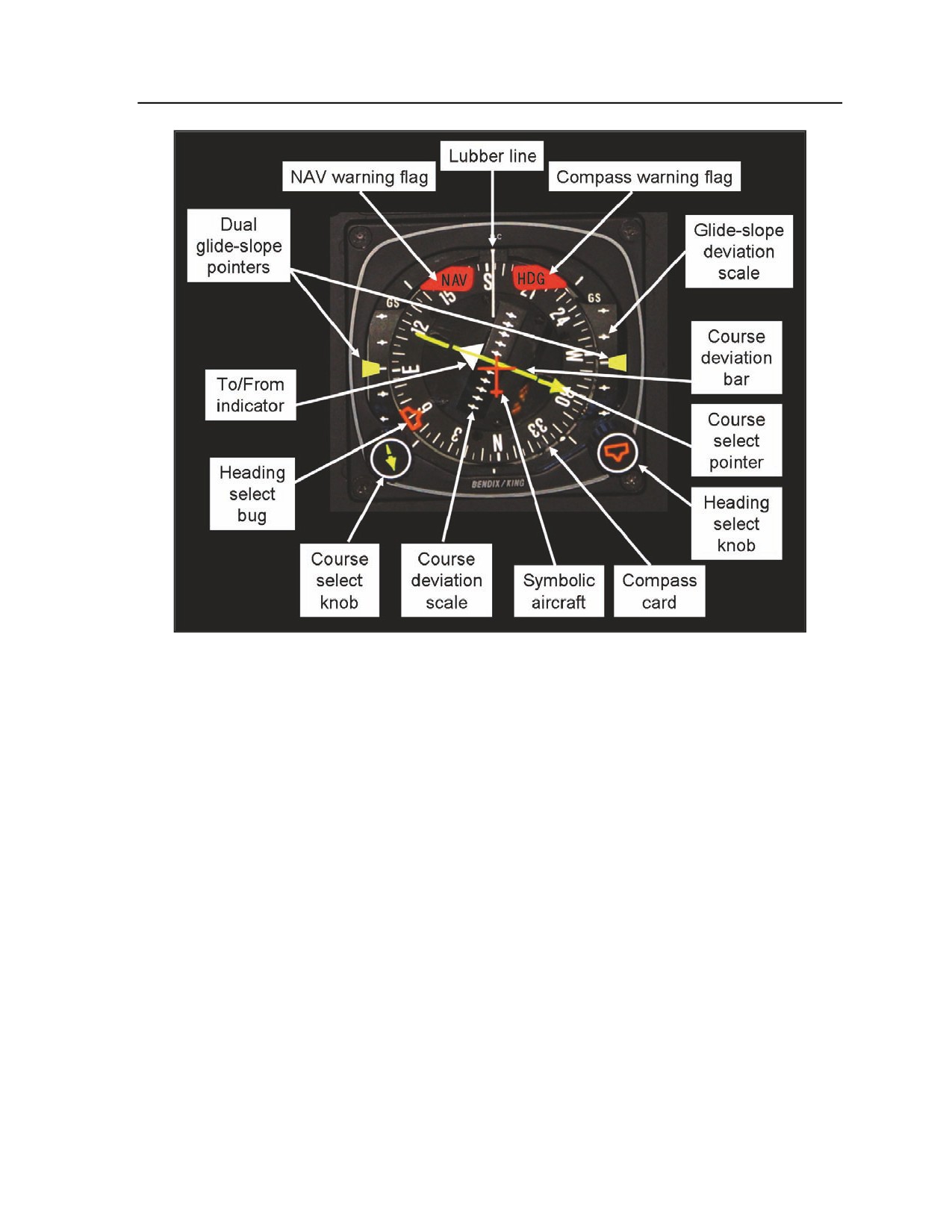
to drive the dial, which acts as the compass card. This instrument (Figure 1-20) combines the magnetic
compass with navigation signals and a glide slope. The HSI gives the aviator an indication of the location
of the aircraft with relationship to the chosen course.
1-74. In Figure 1-20, page 1-21, the aircraft heading displayed on the rotating azimuth card under the
upper lubber line is 184 degrees. The course-indicating arrowhead shown is set to 295 degrees; the tail
indicates the reciprocal, 115 degrees. The course deviation bar operates with a VOR/Localizer (VOR/LOC)
navigation receiver to indicate left or right deviations from the course selected with the course-indicating
arrow; operating in the same manner, the angular movement of a conventional VOR/LOC needle indicates
deviation from course.
1-20
FM 3-04.240
30 April 2007
Flight Instruments and Systems
Figure 1-20. Horizontal situation indicator
1-75. The desired course is selected by rotating the course select pointer, in relation to the azimuth card, by
means of the course select knob. The HSI shows the fixed aircraft symbol and course deviation bar to
display relative position to the selected course. The TO/FROM indicator is a triangular-shaped pointer.
When the indicator points to the head of the course, the arrow shows the course selected, if properly
intercepted and flown, will take the aircraft to the chosen facility. When the indicator points to the tail of
the course, the arrow shows that the course selected, if properly intercepted and flown, will take the aircraft
directly away from the chosen facility.
1-76. The glide-slope pointer indicates the relation of the aircraft to the glide slope. When the pointer is
below the center position, the aircraft is above the glide slope and an increased rate of descent is required.
In some installations, the azimuth card is a remote indicating compass; however, in others the heading must
be checked occasionally against the magnetic compass and reset.
VERTICAL SITUATION INDICATOR
1-77. The vertical situation indicator provides a cockpit display of the helicopter’s pitch, roll attitude, turn
rate, slip or skid, and certain navigational information. The vertical situation indicator accepts command
instrument system processor signals and displays the flight command information needed to arrive at a
predetermined point. The system also monitors and displays warnings when selected navigation instrument
readings lack reliability.
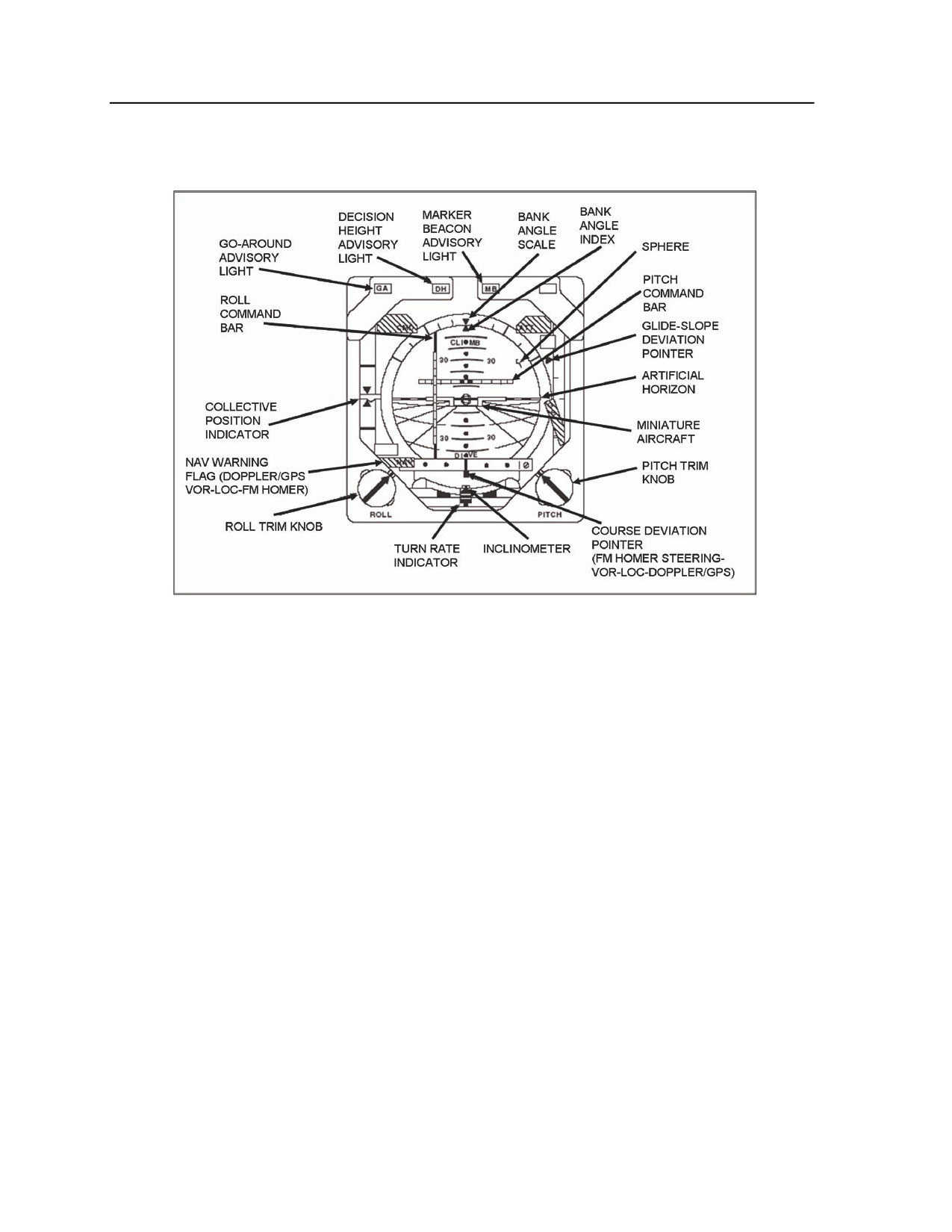
1-78. The vertical situation indicator is typically composed of a miniature airplane, navigation warning
indicator flags, trim knobs for pitch and roll, a bank angle scale and an index, a turn rate indicator, an
inclinometer, and a course/glide slope deviation pointer. An example of a vertical situation indicator is the
30 April 2007
FM 3-04.240
1-21
Chapter 1
one installed in a UH-60 (Figure 1-21), which in addition to the typical items listed above, has pitch and
roll command bars and a collective position pointer.
Figure 1-21. UH-60 vertical situation indicator
1-22
FM 3-04.240
30 April 2007
Chapter 2
Rotary Wing Instrument Flight Maneuvers
Instrument flying in helicopters is essentially visual flying with the flight instruments
substituted for various reference points on the helicopter and natural horizon. Control
changes, required to produce a given attitude by reference to instruments, are
identical to those used in helicopter visual flight rules (VFR) flight; therefore, the
thought processes remain the same.
SECTION I - MANEUVER PERFORMANCE
2-1. Proper instrument interpretation is the basis
for aircraft control during instrument flying. Pilot
Contents
skill, in part, depends on an understanding of how a
particular instrument or system functions, including
Section I - Maneuver Performance
2-1
its indications and limitations. With this knowledge,
Section II - Flight Management System
2-5
an aviator can quickly scan an instrument and
Section III - Instrument Takeoff
2-8
translate information into a control response.
Section IV - Straight-and-Level Flight
2-10
Section V - Straight Climbs and
2-2. Aircraft attitude is the relationship of its
Descents
2-15
longitudinal and lateral axes to the horizon of the
Section VI - Turns
2-18
Earth. An aircraft is flown in instrument flight by
Section VII - Other Maneuvers
2-23
controlling attitude and power, as necessary, to
produce desired performance. All basic instrument
maneuvers require correct attitude and power settings. Flight instruments used for instrument flight are
categorized as control, performance, and/or navigation.
INSTRUMENTS
CONTROL
2-3. Control instruments display immediate attitude and power indications and are calibrated to permit
attitude and power adjustments in precise amounts. Control is determined by reference to the power and
attitude indicators (figure 2-1, page 2-2, bold dashed boxes). These power indicators vary with aircraft and
may include tachometers and torque.
30 April 2007
FM 3-04.240
2-1
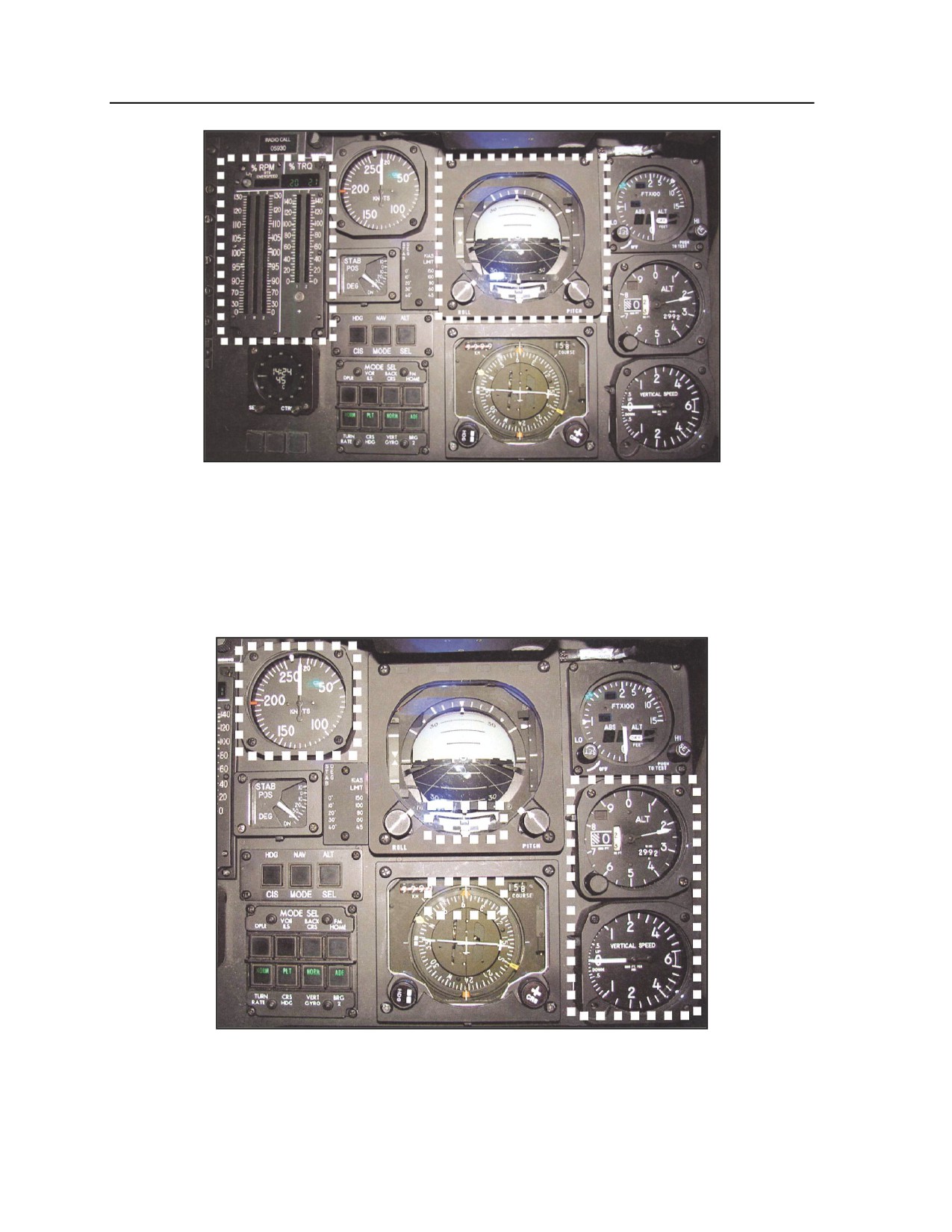
Chapter 2
Figure 2-1. Control instruments of a UH-60
PERFORMANCE
2-4. Performance instruments indicate the aircraft’s actual performance. Performance is determined by
referencing the airspeed indicator, turn-and-slip indicator, heading indicator, altimeter, and VSI (Figure
2-2, bold dashed boxes).
Figure 2-2. Performance instruments of a UH-60
2-2
FM 3-04.240
30 April 2007
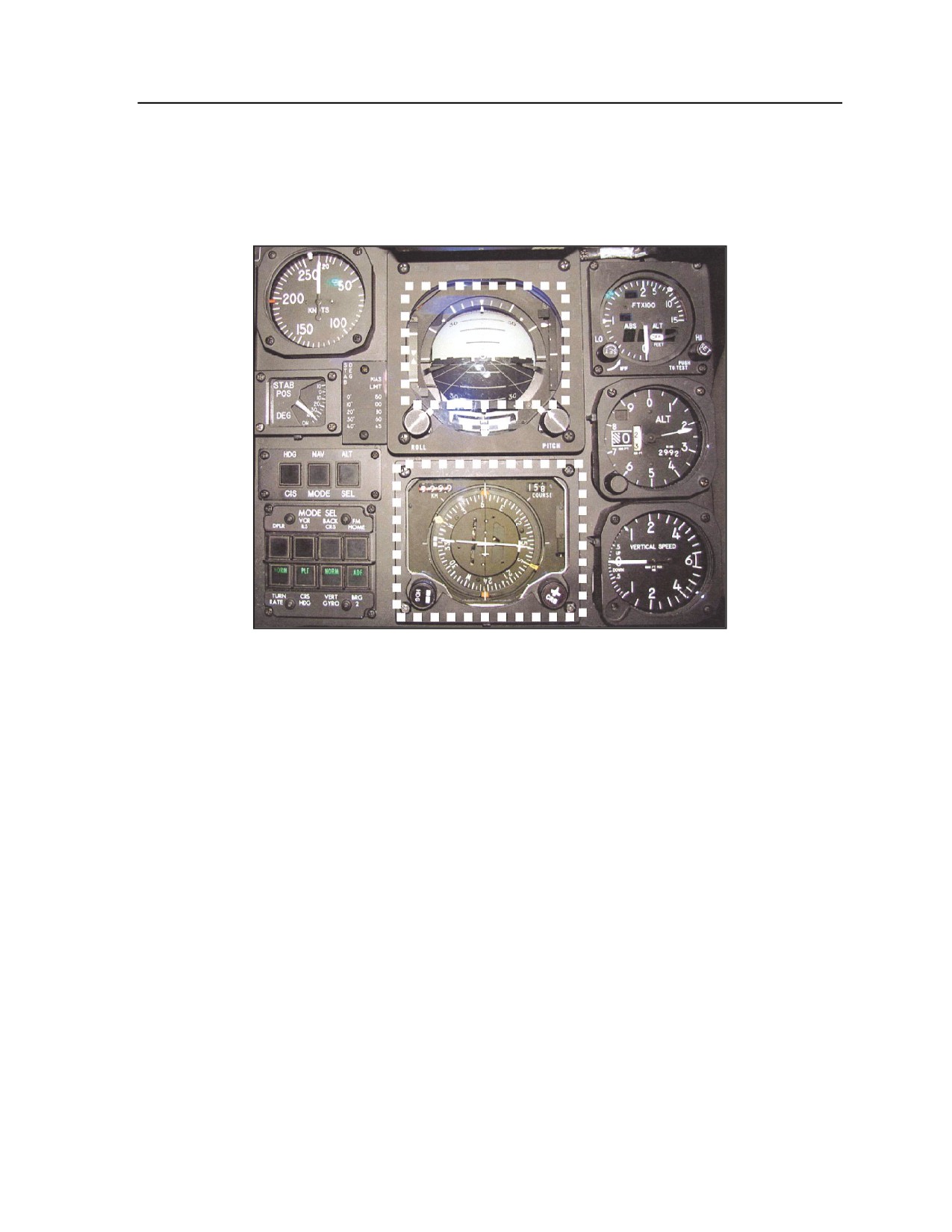
Rotary Wing Instrument Flight Maneuvers
NAVIGATION
2-5. Navigation instruments indicate aircraft position in relation to a selected navigation facility or fix.
This group of instruments includes various types of course, range, and glide-slope indicators and bearing
pointers usually found on the GPS, HSI, and/or RMI (figure 2-3, bold dashed boxes). Some aircraft have
navigation instrument indications combined with the attitude indicator and other instruments.
Figure 2-3. Navigation instruments on a UH-60
PROCEDURAL STEPS
2-6. Procedural steps are provided to guide the aviator to successfully react and apply the appropriate
flight control inputs based on indications derived from control, performance, and navigation instruments.
When following the procedural steps, aviators—
Establish an attitude and power setting on the control instruments resulting in desired
performance; known or computed attitude changes and approximate power settings reduce
aviator workload.
Maintain trim in rotary wing aircraft by cross-checking the instruments and using the cyclic
centering button and/or pedals.
Cross-check performance instruments to determine if the established attitude or power setting
provides desired performance; cross-checking involves both seeing and interpreting. When
noting a deviation, determine the magnitude and direction of adjustment required to achieve
desired performance.
Adjust the attitude or power setting on control instruments as necessary.
PRIMARY AND SUPPORTING METHODS
2-7. Another basic method for presenting attitude instrument flying classifies instruments as they relate to
control function and aircraft performance (table 2-1, page 2-4). All maneuvers involve some degree of
motion about the lateral (pitch), longitudinal (bank/roll), and vertical (yaw) axes. Attitude control is
stressed in terms of pitch (figure 2-4, page 2-4), bank (figure 2-5, page 2-4), power, and trim.
30 April 2007
FM 3-04.240
2-3
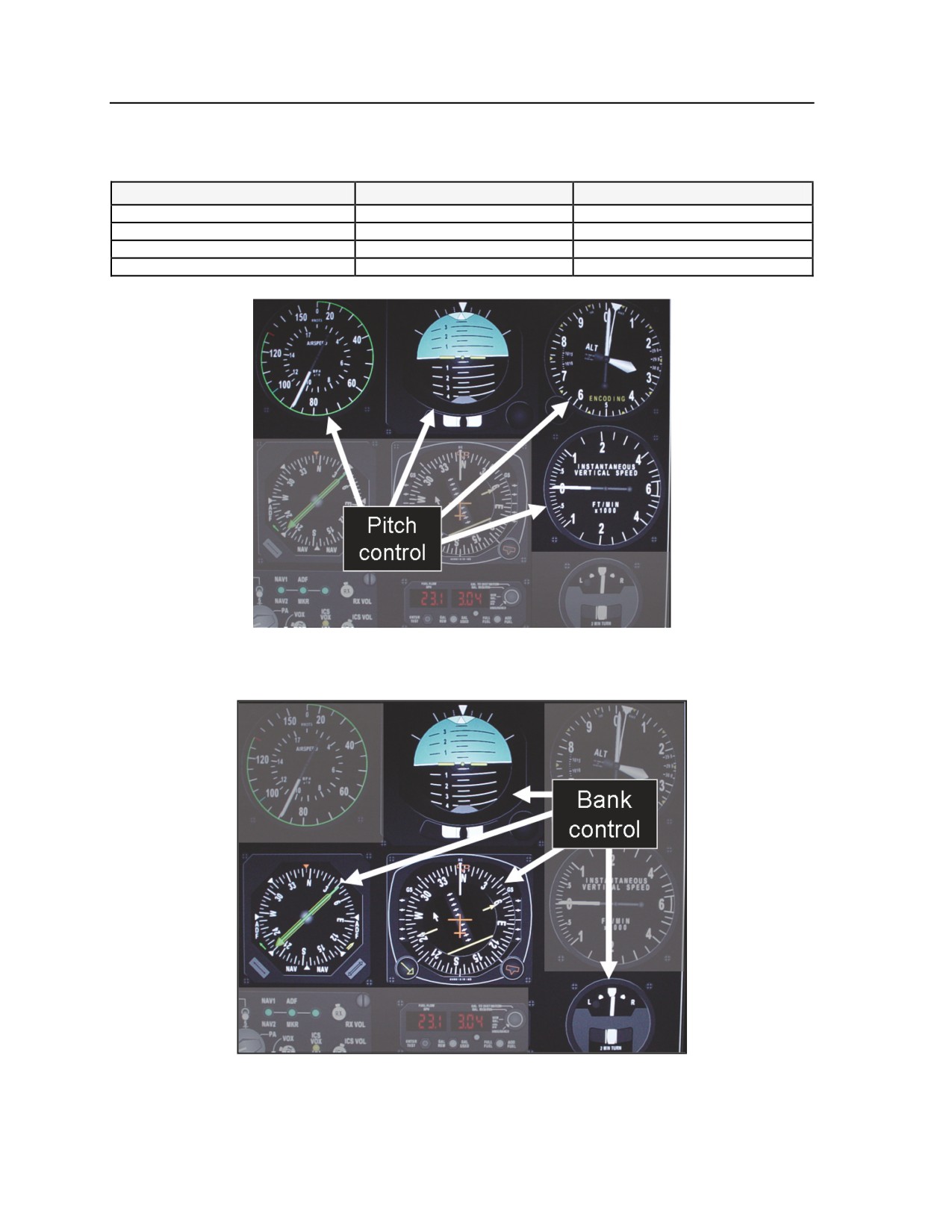
Chapter 2
Table 2-1. Maneuver instruments
Pitch
Bank
Power
Airspeed indicator
Attitude indicator
Airspeed indicator
Attitude indicator
Heading indicator
Torque indicator
Altimeter
Magnetic compass
Vertical speed indicator
Turn-and-slip indicator
Figure 2-4. Pitch control instruments
Figure 2-5. Bank control instruments
2-4
FM 3-04.240
30 April 2007
Rotary Wing Instrument Flight Maneuvers
2-8. For any maneuver or condition of flight, the pitch, bank, and power control requirements are most
clearly indicated by specific maneuver instruments (table 2-1). The instruments that provide the most
pertinent and essential information are referred to as primary instruments. Supporting instruments back up
and supplement information shown on primary instruments. Straight-and-level flight at a constant airspeed,
for example, means an exact altitude is to be maintained with no bank (constant heading). The pitch, bank,
and power instruments that provide data related to maintaining this flight condition are the following:
Altimeter, which supplies the most pertinent altitude information and is primary for pitch.
Heading indicator, which supplies the most pertinent bank or heading information and is
primary for bank.
Airspeed indicator, which supplies the most pertinent information concerning performance in
level flight in terms of power output and is primary for power.
2-9. Although the attitude indicator is the basic attitude reference, this concept of primary and supporting
instruments does not devalue any particular flight instrument. The attitude indicator is the only instrument
that portrays instantly and directly the actual flight attitude. Always use the attitude indicator, when
available, in establishing and maintaining pitch-and-bank attitudes. Instrument maneuvers presented, in
detail, in later sections of this chapter identify the specific use of primary and supporting instruments.
SECTION II - FLIGHT MANAGEMENT SYSTEM
2-10. Three fundamental skills needed to achieve smooth, positive control of the helicopter during
instrument flight are instrument cross-check, instrument interpretation, and aircraft control.
CROSS-CHECK
2-11. A major factor influencing a cross-check, or scanning technique, is the way in which instruments
respond to attitude and power changes. The control instruments provide a direct and immediate indication
of attitude and power changes, but indications on the performance instruments will lag. Lag will not
appreciably affect the tolerances within which the aviator controls the aircraft; however, at times, a slight,
unavoidable delay in knowing the results of attitude/power changes will occur.
2-12. When the attitude and power are smoothly controlled, the lag factor is negligible and the indications
on the performance instruments will stabilize or change smoothly. Do not make abrupt control movements
in response to the lagging indications on the performance instruments without first checking the control
instruments. Failure to do so leads to erratic aircraft maneuvers, which will cause additional fluctuations
and lag in the performance instruments. Frequent scanning of the control instruments assists in maintaining
smooth aircraft control.
2-13. The attitude indicator is the instrument that should be used to develop all maneuvering attitudes and
be scanned most frequently. A description of a typical scan is as follows: an aviator glances from the
attitude indicator, taking only a brief glance at one of the flight instruments (for this discussion, the
instruments surrounding the attitude indicator are called the flight instruments), back to the attitude
indicator, then glancing at another flight instrument, back to the attitude indicator, and so on (Figure 2-6,
page 2-6).
30 April 2007
FM 3-04.240
2-5
///////////////////////////////////////