FM 3-04.240 Instrument Flight for Army Aviators (April 2007) - page 4
Chapter 5
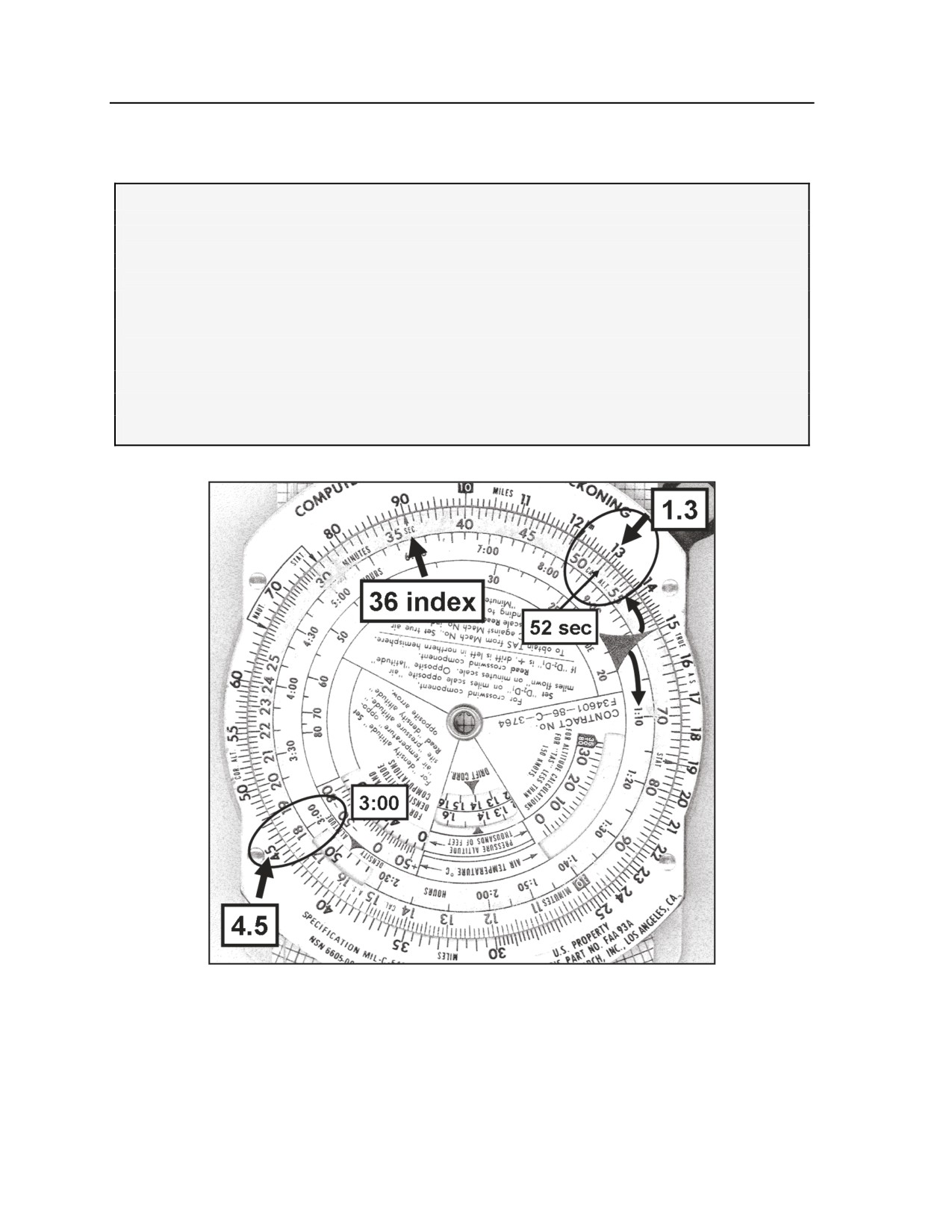
aviator uses the 36 (seconds) index, the minutes scale reads as seconds (first example) and the hour scale
reads as minutes and seconds (second example). Figure 5-5 depicts the following examples.
36 Index Scale Examples
Example 1
If an aircraft has a ground speed of 90 kt & flies for 1.3 NM, how much time is required to fly the distance (Figure 5-5)? 52
sec.
Set the 36 index under 90 (outer scale) for 90 kt.
Below 13 (outer scale) for 1.3 NM, read 52 sec (minutes scale).
Note. Read left, or counterclockwise, from the 60 (speed) index; the correct time is taken from the minutes scale and read
as seconds.
Example 2
If an aircraft has a ground speed of 90 kt and flies for 4.5 NM, how much time is required to fly the distance (Figure 5-5)?
3:00 minutes.
Set the 36 index under 90 (outer scale) for 90 kt.
Below 45 (outer scale) for 4.5 NM read 3:00 minutes (hour scale).
Note. Read right, or clockwise, from the 60 (speed) index; the correct time is taken from the hours scale and read as
minutes and seconds.
Figure 5-5. Short time and distance
COMPUTING TIME FOR OUTBOUND LEG DURING HOLDING
5-7. Because holding is concerned with inbound time and not distance inbound, knowing wind velocity
and direction is not necessary. By using the computer side of the dead-reckoning computer, the aviator can
determine the time outbound that will result in one minute inbound. Place the initial 60-second outbound
5-4
FM 3-04.240
30 April 2007
Air Navigation Handheld Computer
time on the outer scale over the inbound time on the inner scale, and the number above the speed index is
the number of seconds to subsequently fly outbound to achieve a one-minute inbound time. The following
examples show how to compute estimated outbound times depicted in Figures 5-6 and 5-7.
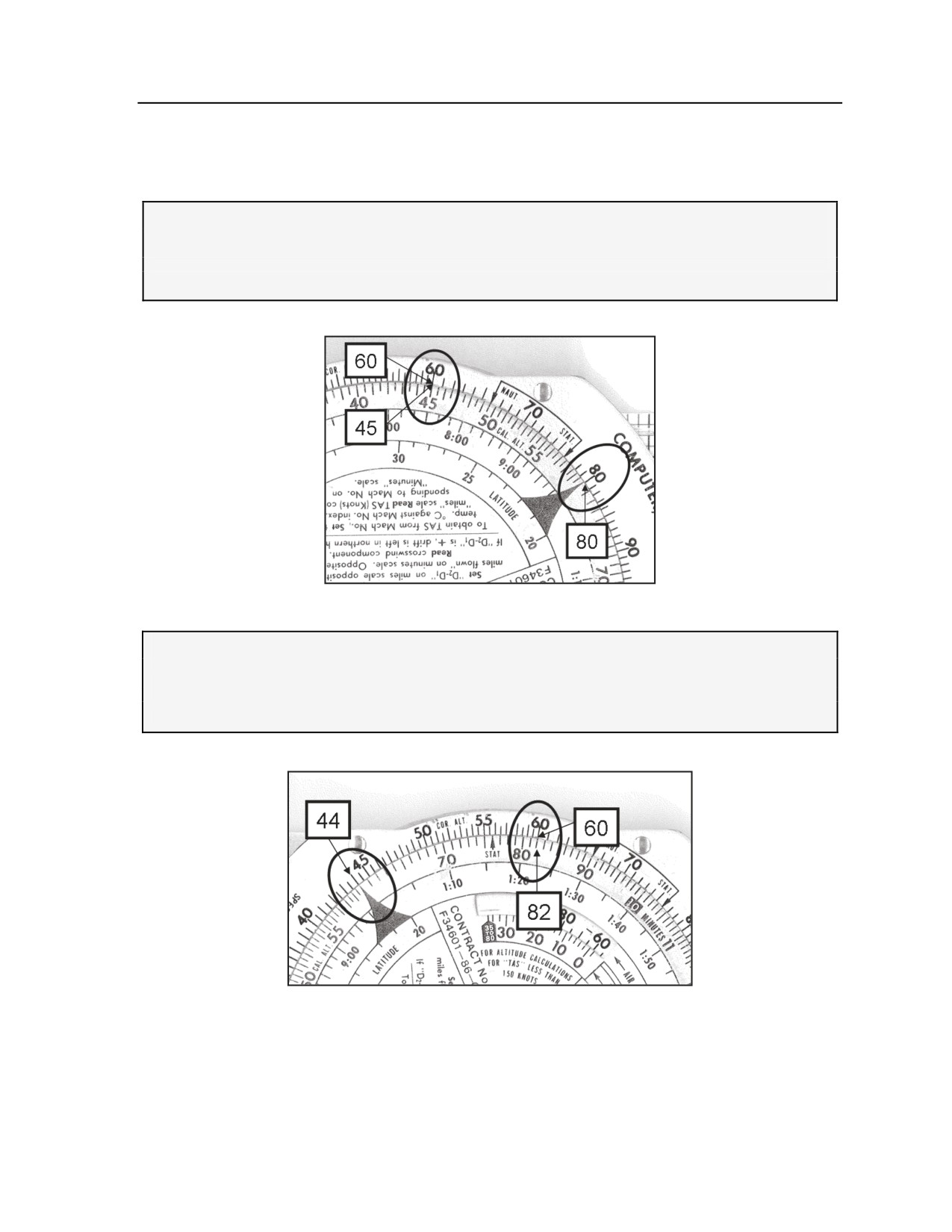
Estimated Outbound Time More Than 1 Minute Example
If an outbound time of 1 minute results in an inbound time of 45 sec, how much time on the subsequent outbound leg must
the aircraft fly to achieve an inbound time of 1 minute (Figure 5-6)? 80 sec.
Set 45 for actual inbound time of 45 sec (inner scale) under 60 for time flown outbound of 1 minute or 60 sec (outer scale).
Above speed index, read 80 (outer scale) for 80 sec subsequent outbound time to be flown.
Figure 5-6. Estimated outbound time more than one minute
Estimated Outbound Time Less Than 1 Minute Example
If an outbound time of 1 minute results in an inbound time of 82 sec, how much time on the subsequent outbound leg must
the aircraft fly to achieve an inbound time of 1 minute (Figure 5-7)? 44 sec.
Set 82 for actual inbound time of 82 sec (inner scale) under 60 for time flown outbound of 1 minute or 60 sec (outer scale).
Above the speed index, read 44 (outer scale) for 44 sec subsequent outbound time to be flown.
Figure 5-7. Estimated outbound time less than one minute
30 April 2007
FM 3-04.240
5-5
Chapter 5
FUEL CONSUMPTION
5-8. Fuel consumption problems are solved in the same manner as time and distance problems, except
gallons per hour and gallons are used in place of miles per hour and miles.
GALLONS AND POUNDS CONVERSION
5-9. The CPU-26A/P is useful for determining weights of fuel and gallon-pound conversions. table 5-1
shows gallons-to-pounds or pounds-to-gallons conversion ratios. Figure 5-8 provides an example of
gallons-to-pounds conversion based on the following example.
Table 5-1. Gallons and pounds conversion
Fuel
Conversion
JP-4
6.5:1
JP-5/JET-A
6.8:1
JP-8/JET A-1
6.7:1
JP = Jet propulsion
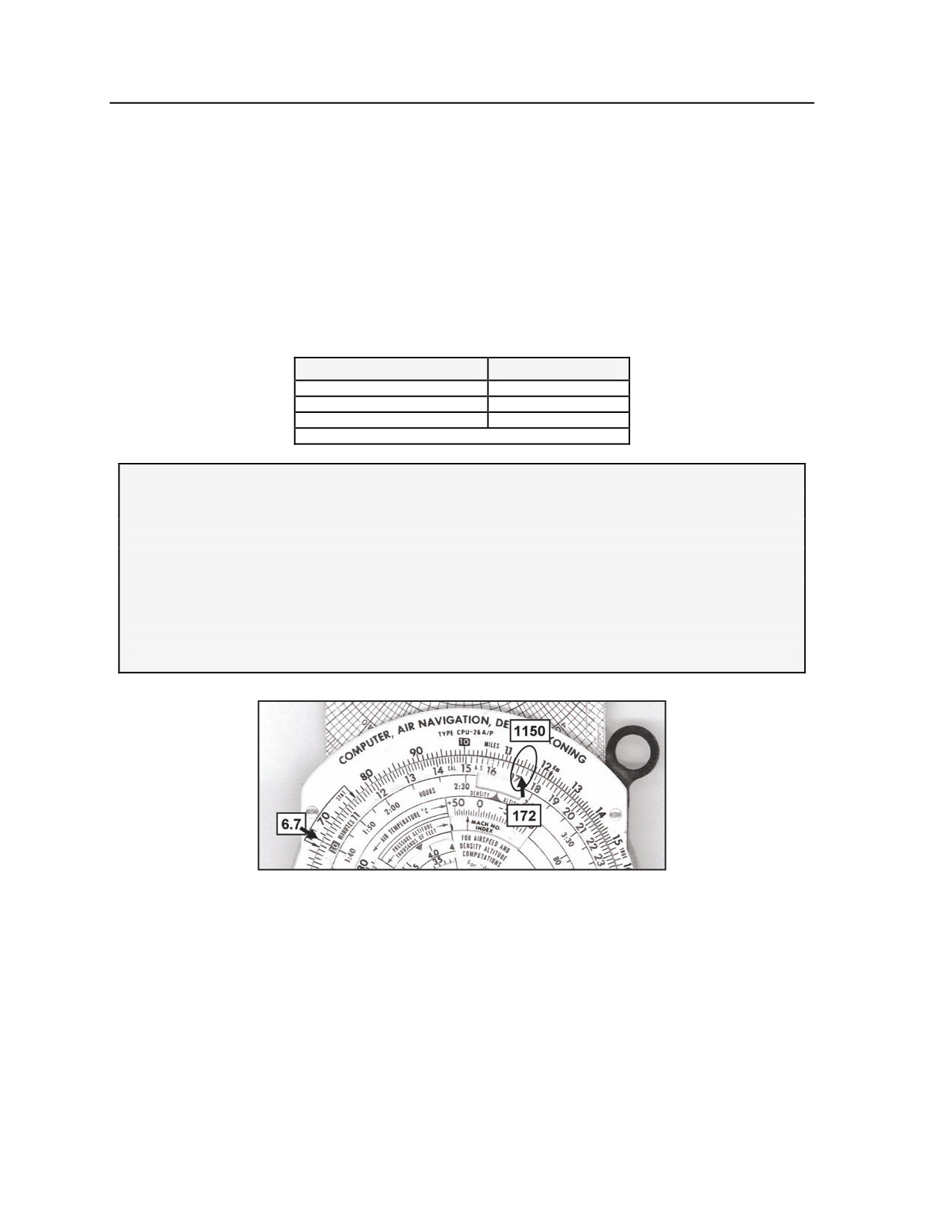
Gallons and Pounds Conversion Example
If
172 gallons of JP-8 are added to the aircraft, how many pounds does that fuel weigh (Figure 5-8)? 1,150 pounds of
JP-8.
Using JP-8 as onboard fuel, set the 10 index (inner scale) under 67 (outer scale) for 6.7:1. The inner scale now
represents gallons, & the outer scale represents pounds.
Find 17 on the inner scale, move right (clockwise) to the next mark (17.2), & read above to see 11.5. The answer is 1,150
pounds.
The black boxed 10 index is a representation of 1.0 gallons, which is set in this equation under 67 (outer scale) for 6.7
pounds (weight of 1 gallon of JP-8, Table 5-1). Therefore, reading from the 10 index clockwise; 11 is equal to 1.1 gallons,
12 is equal to 1.2 gallons, & so on. Continue clockwise to the next mark after 17 (1.7 gallons), which is equal to 1.72; the
decimal point must be moved two places to the right to achieve 172.0 gallons. Consequently, the same number of
decimal point places must be moved for the correct fuel weight so that 11.5 (outer scale) reads as 1,150.0 pounds.
Figure 5-8. Gallons and pounds conversion
COMPUTING ENDURANCE TIME
5-10. The CPU-26A/P can be used for determining endurance time based on fuel burn rate and gallons of
useable fuel onboard. Figure 5-9, page 5-7, shows an endurance time based on the example depicted.
5-6
FM 3-04.240
30 April 2007
Air Navigation Handheld Computer
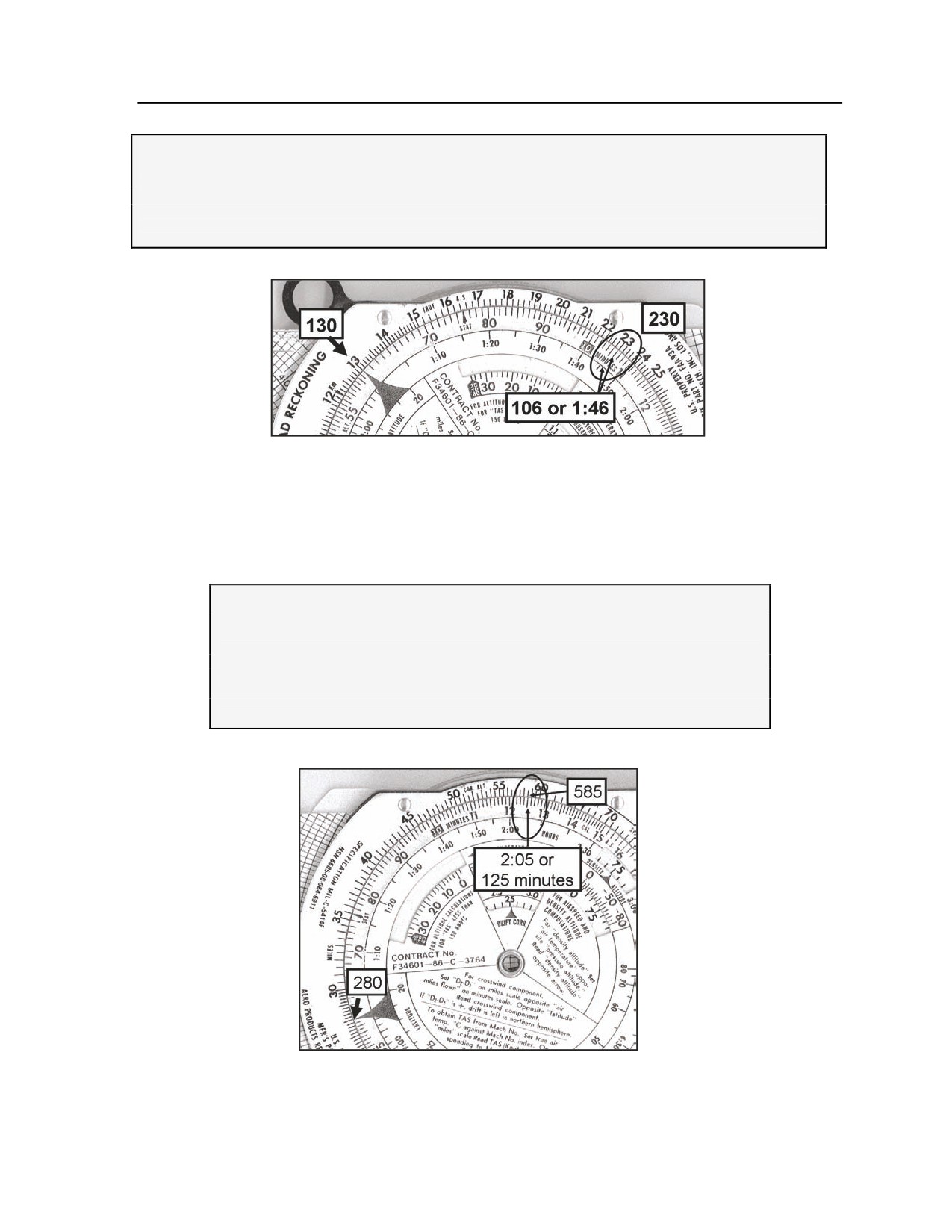
Computing Endurance Time Example
If an aircraft has a fuel burn rate of 130 gallons per hour & 230 gallons of useable fuel onboard, how long until aircraft fuel
burnout (Figure 5-9) occurs? 1 hour & 46 minutes.
Set the 60 index under 13 (outer scale) for 130 gallons per hour.
Below 23 (outer scale) for 230 gallons, read 106 minutes (minutes scale), or 1 hour & 46 minutes (hours scale).
Figure 5-9. Computing time for fuel consumption
COMPUTING FUEL REQUIRED
5-11. The CPU-26A/P can be used during premission planning to determine fuel requirements. Figure 5
10 shows calculations based on the following example.
Fuel Required Example
If an aircraft has an estimated burn rate of 280 pounds per hour and time of flight of 2 hours & 5
minutes, how many pounds of fuel are required for the mission (Figure 5-10)? 585 pounds of fuel
required.
Set the 60 index (inner scale) under 28 (outer scale) for 280 pounds per hour.
Above 2:05 (hours scale), read 58.5 (outer scale) for 585 pounds of fuel required.
Note. This computation does not include VFR and IFR reserves.
Figure 5-10. Fuel required
30 April 2007
FM 3-04.240
5-7
Chapter 5
COMPUTING RATE OF FUEL CONSUMPTION
5-12. The CPU-26A/P can be used to compute fuel consumption rate. Figure 5-11 shows computations for
the following example.
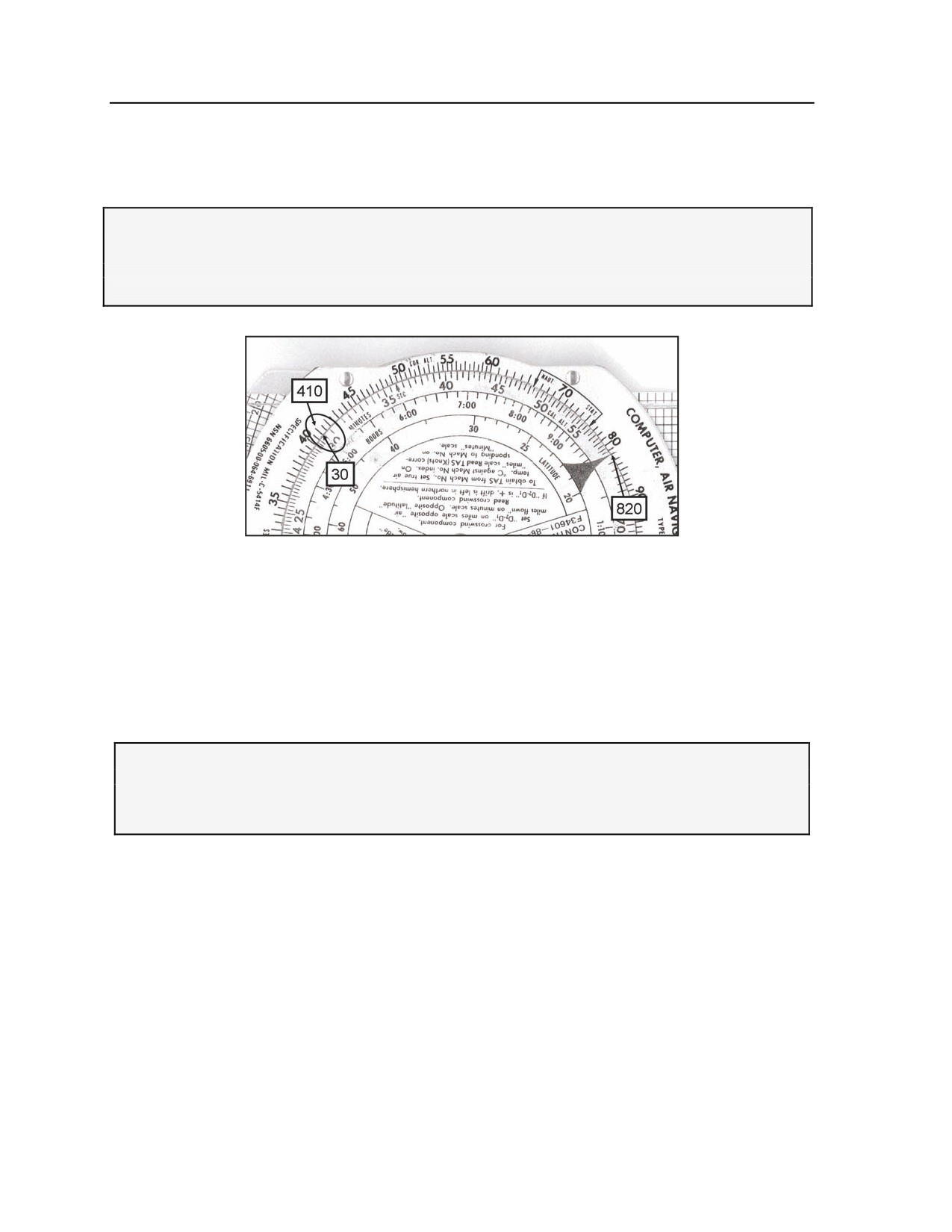
Rate of Fuel Consumption Example
If an aircraft burns 410 pounds of fuel in 30 minutes, how many pounds is the aircraft burning per hour (Figure 5-11)? 820
pounds per hour.
Set 30 (minutes/inner scale) under 41 (outer scale) for 410 pounds burned.
Above the 60 index (inner scale), read 82 (outer scale) for 820 pounds per hour.
Figure 5-11. Rate of fuel consumption
TRUE AIRSPEED
5-13. The window marked FOR AIRSPEED AND DENSITY ALTITUDE COMPUTATIONS (figure 5
12, page 5-9, provides a means for computing TAS when CAS, temperature, and altitude are known or vice
versa. To change from one to the other, correct for altitude and temperature differences existing from those
standard at sea level. Free air temperature (FAT) is read from a free air thermometer, and pressure altitude
is found by setting the altimeter at 29.92 inches Hg and reading the altimeter directly.
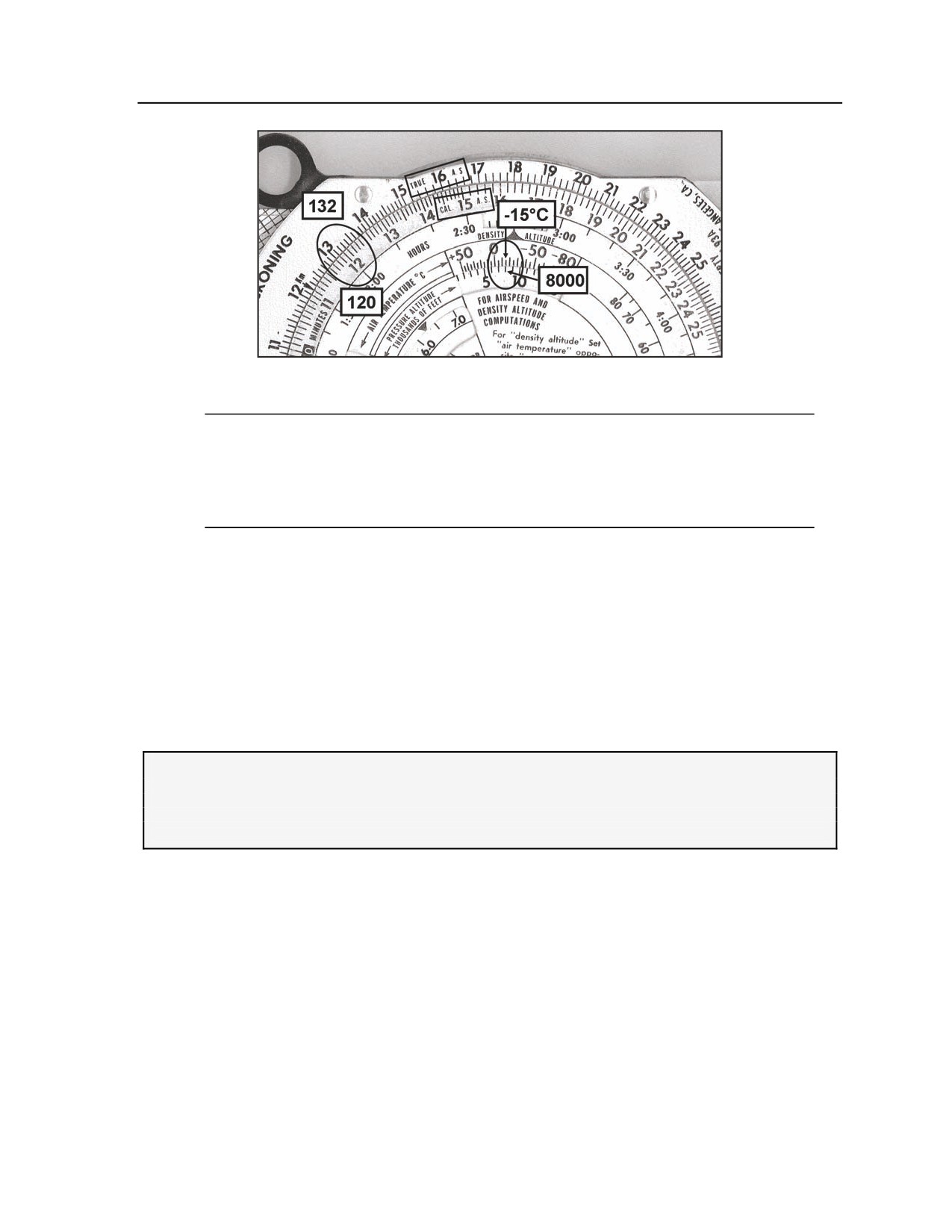
True Airspeed Computation Example
The CAS is 120 kt, FAT is -15 degrees Celsius (C), & pressure altitude is 8,000 ft. What is the TAS (Figure 5-12)? 132 kt.
Set -15 degrees C for air temperature above the 8 position mark in the “pressure altitude thousands of ft” window for 8,000
ft.
Over 12 (inner scale) for 120 kt, read 13.2 (outer scale) for a TAS of 132 kt.
5-8
FM 3-04.240
30 April 2007
Air Navigation Handheld Computer
Figure 5-12. True airspeed computation
Note. The outer scale is marked TRUE A.S. between 15 and 17. The inner scale is marked CAL.
A.S. between 14 and 16.
Note. To solve CAS when TAS is known, locate TAS on the outer scale and read answer (CAS)
in the inner scale.
DISTANCE CONVERSION
5-14. This problem is made simple by a small conversion scale, consisting of three arrows, labeled NAUT,
STAT, and Km. These arrows are located on the outer scale at 66, 76, and 12.2 respectively and point
toward the inner scale.
OUTER SCALE COMPUTATIONS
5-15. The following example shows distance conversions using the outer scale of the CPU-26A/P. Figure
5-13, page 5-10, illustrates the calculations in the following example.
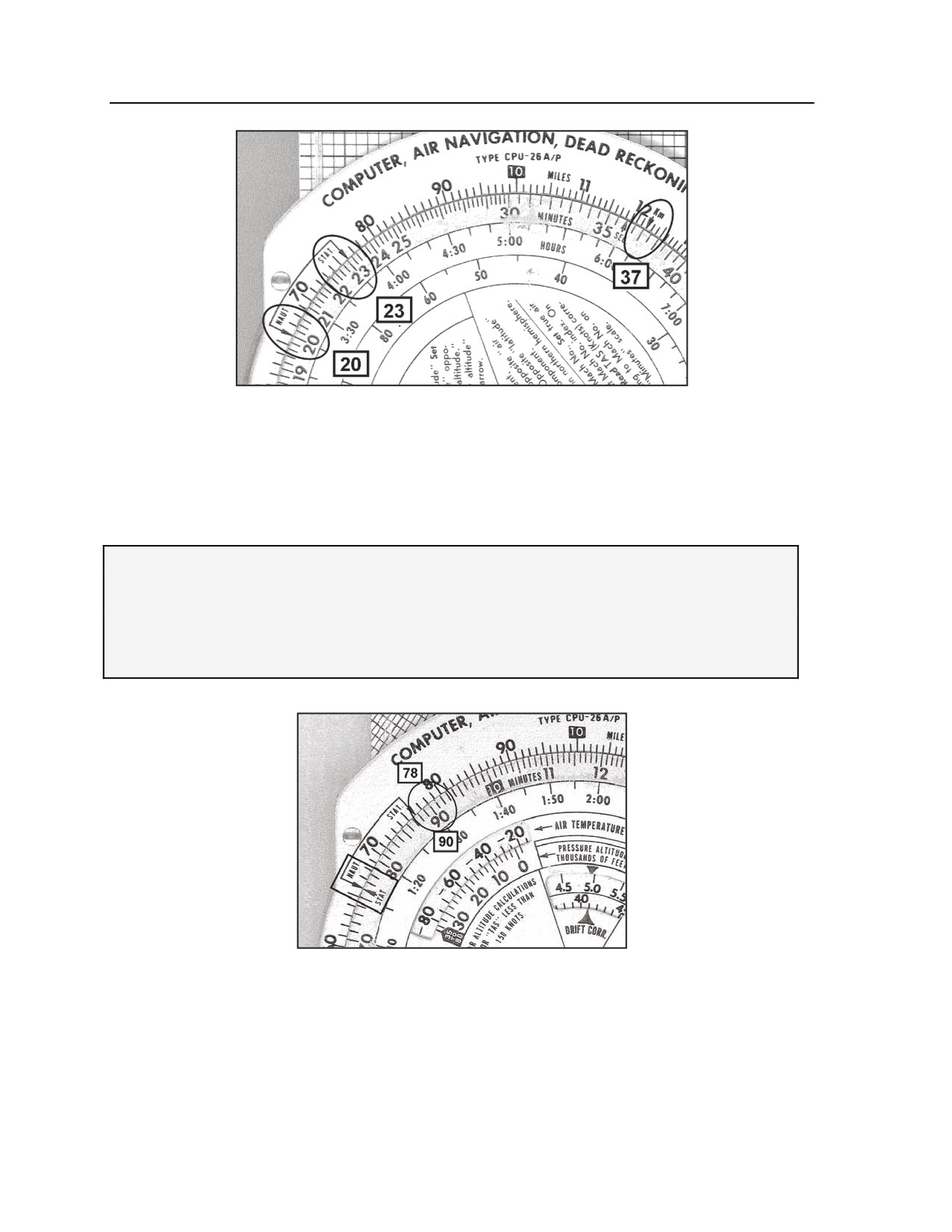
Distance Conversion (Outer Scale) Example
To change 20 NM to SMs or Km (Figure 5-13):
Set 20 (inner scale) under the NAUT arrow at 66 (outer scale).
Under STAT arrow head (outer scale), read 23 (inner scale); the answer is 20 NM = 23 SM.
Under Km arrowhead (outer scale), read 37 (inner scale); the answer is 20 NM or 23 SM = 37 KM.
30 April 2007
FM 3-04.240
5-9
Chapter 5
Figure 5-13. Nautical, statute, and kilometer correlation
INNER SCALE COMPUTATIONS
5-16. The following example shows distance conversions using the inner scale of the CPU-26A/P. Figure
5-14 illustrates the calculations in the following example.
Distance Conversion (Inner Scale) Example
Another statute index arrow is located on the inner scale at 76. The index arrow allows for the conversion of SM (inner
scale) to NM or KM on the outer scale.
Align the statute index (inner scale) directly below the NAUT on the outer scale.
Select any value, and the corresponding value will be above or below the selected value. For example, 90 SM equals 78
NM (Figure 5-14).
Align the statute index (inner scale) directly below the Km on the outer scale to read selected/corresponding value as in the
above example.
Figure 5-14. Inner scale computation
TRUE ALTITUDE CALCULATION
5-17. The window marked FOR ALTITUDE CALCULATIONS provides a means for computing
corrected altitude by applying any variations from standard temperature to indicated or calibrated altitude.
Figure 5-15, page 5-11, illustrates the calculations in the following example.
5-10
FM 3-04.240
30 April 2007
Air Navigation Handheld Computer
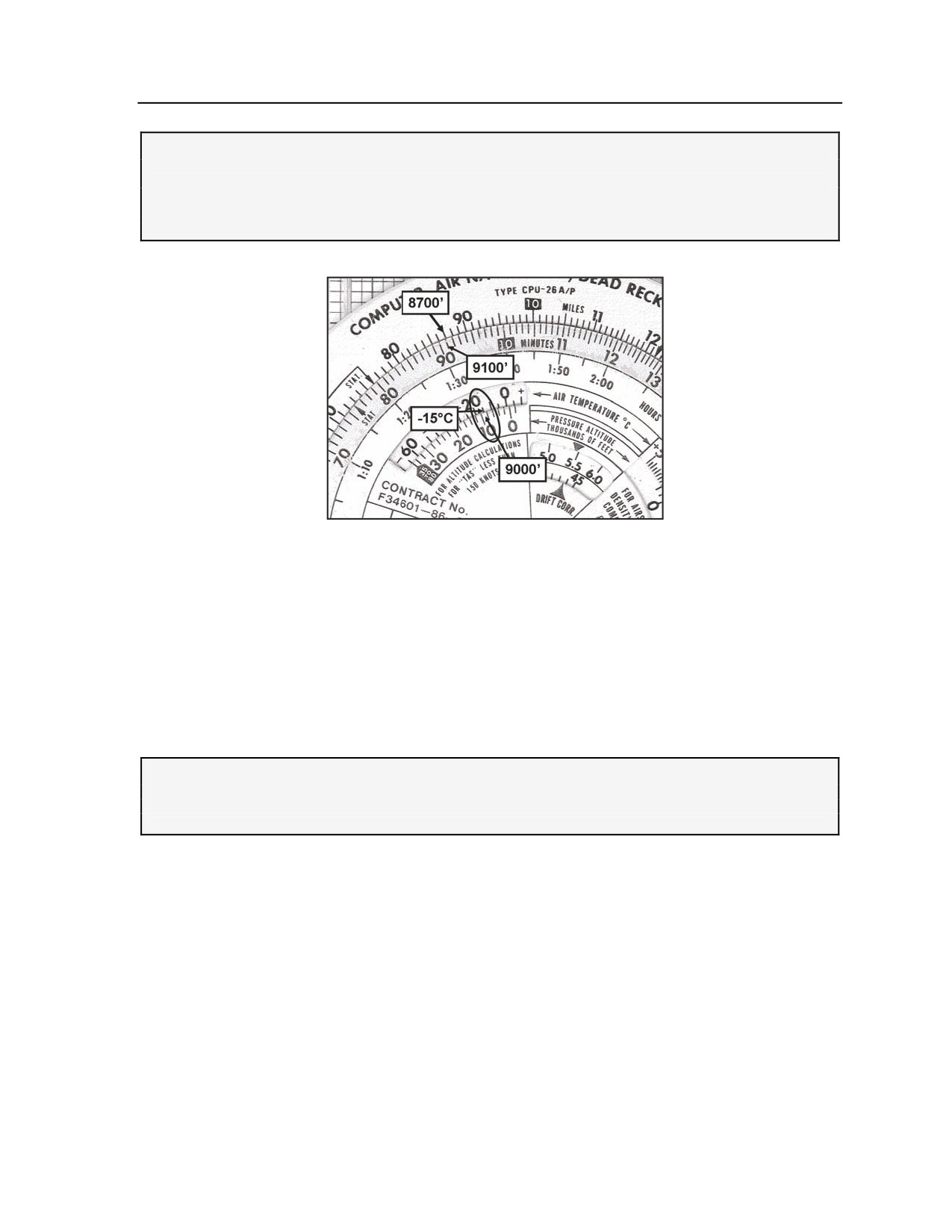
Altitude Calculation Example
Pressure altitude is 9,000 feet, indicated altitude is 9,100 feet, and the FAT is -15 degrees C. What is the corrected altitude
(Figure 5-15)? 8,700 feet.
Set -15 degrees C for the air temperature above the 9 position mark in the “pressure altitude thousands of feet” window for
9,000 feet.
Above 91 for 9,100 feet indicated altitude (inner scale), read 87 for 8,700 feet corrected altitude (outer scale).
Figure 5-15. True altitude calculation
MULTIPLICATION AND DIVISION CALCULATIONS
5-18. The computer can be used for multiplication and division. The index for these problems is the 10
index.
MULTIPLICATION
5-19. CG-26A/P can be used for simple multiplication calculations. Figure 5-16, page 5-12, illustrates
calculations for the following example.
Altitude Calculation Example
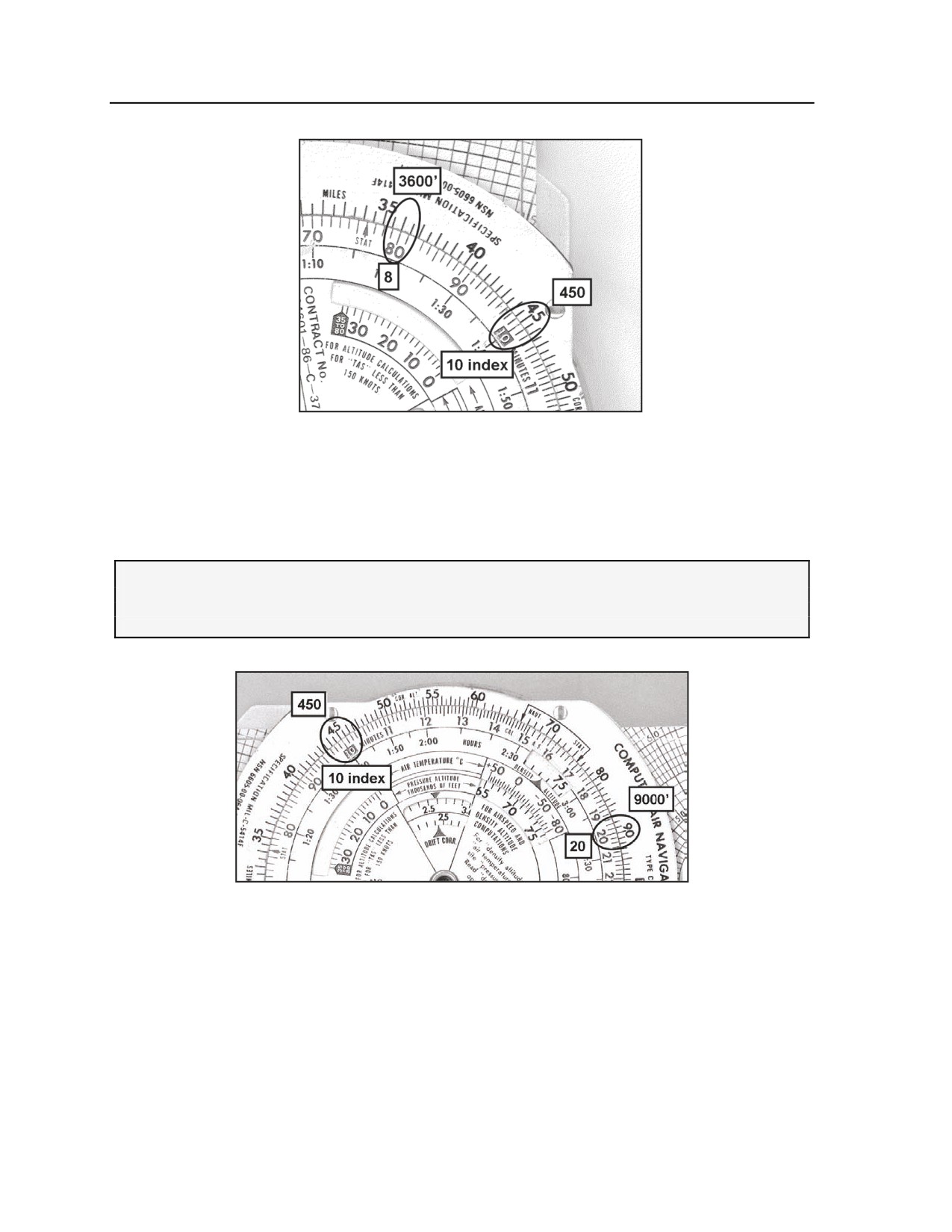
If the aircraft is climbing at 450 fpm for 8 minutes, how much altitude would be gained (Figure 5-16)? 3,600 feet.
Set 10 index (inner scale) under 45 (outer scale) for 450.
Above 80 (inner scale) for 8 minutes, read 36 (outer scale) for 3,600 feet.
30 April 2007
FM 3-04.240
5-11
Chapter 5
Figure 5-16. Multiplication
DIVISION
5-20. CG-26A/P can be used for simple division calculations. Figure 5-17 illustrates calculations for the
following example.
Rate of Descent Calculation Example
An aircraft must lose 9,000 feet in 20 minutes; what is the rate-of-descent (Figure 5-17)? 450 FPM.
Set 90 (outer scale) for 9,000 feet over 20 (inner/minutes scale).
Find 10 index (inner scale), and read 45 (outer scale) for 450 FPM.
Figure 5-17. Division
CONVERTING DISTANCE TO TIME
5-21. Certain IFR DPs require a minimum climb rate to assure proper obstruction clearance. However, the
minimum climb requirement is stated in terms of feet to be gained per nautical mile. The aviator can easily
convert FPNM to a number representative of FPM. Figure 5-18, page 5-13, illustrates the following
example.
5-12
FM 3-04.240
30 April 2007
Air Navigation Handheld Computer
Converting Distance to Time Example
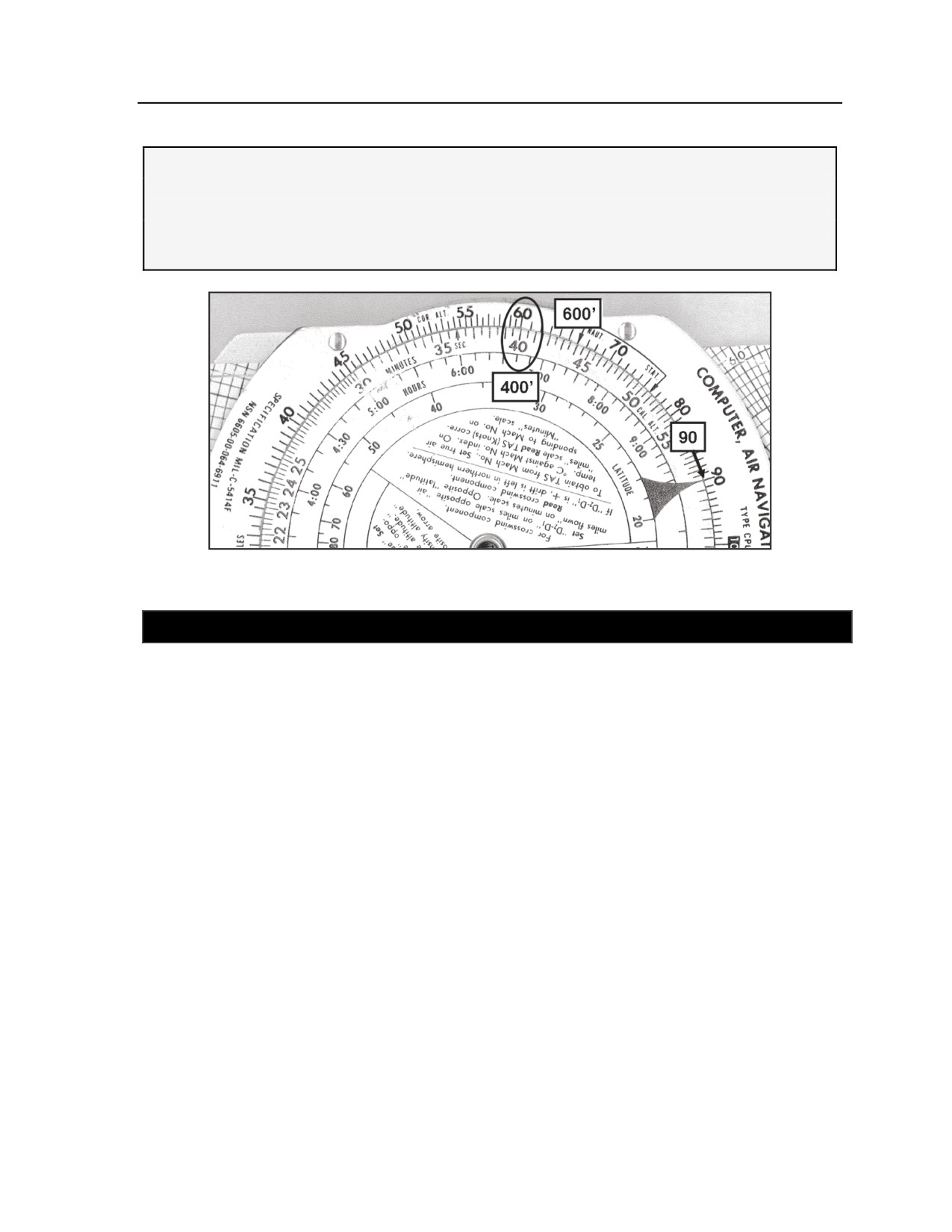
With a ground speed of 90 knots and a climb requirement of 400 FPNM, what is the rate of climb in FPM (Figure 5-18)?
600 FPM.
Set 60 (speed) index to 90 (outer scale) for 90 knots.
Above 40 (inner scale) for 400 feet, read 60 (outer scale) for 600 FPM.
Figure 5-18. Converting feet per nautical mile to feet per minute
SECTION II - WIND SIDE
DISK AND CORRECTION SCALES
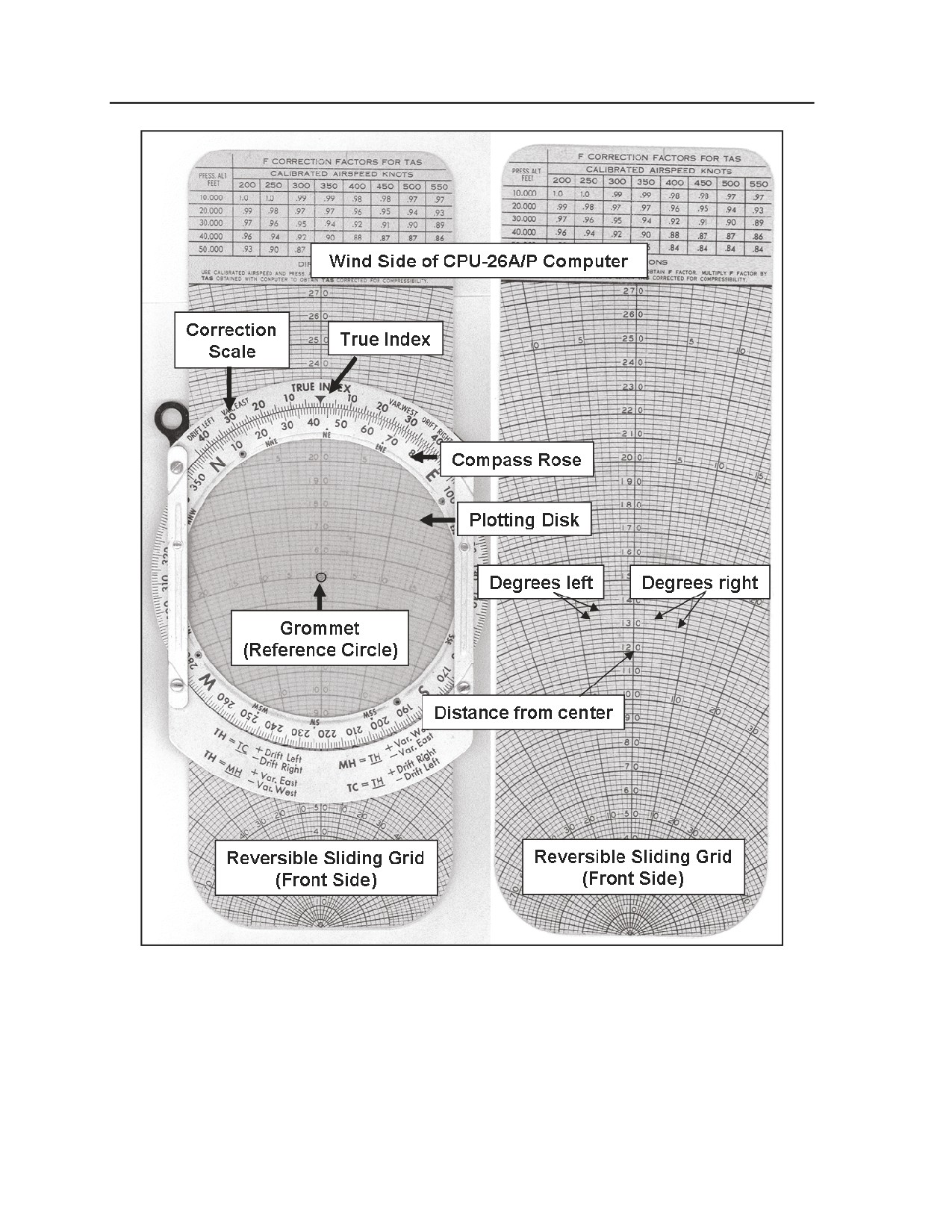
5-22. Solve wind problems by the grid side of the DR computer (Figure 5-19, page 5-14), which consists
of a transparent, rotational plotting disk mounted in a frame on the reverse side of the circular slide rule. A
compass rose is located around the plotting disk. The correction scale on the top frame of the circular grid
is graduated in degrees right and left of the true index (labeled TRUE INDEX). This scale is used for
calculating drift or drift correction (labeled DRIFT RIGHT and DRIFT LEFT). A small reference circle,
called a grommet, is located at the center of the plotting disk.
REVERSIBLE GRID
5-23. A reversible sliding grid (Figure 5-19), inserted between the circular slide-rule and plotting disk, is
used for wind computations. The slide has converging lines, spaced
2 degrees apart, between the
concentric arcs marked 0 to 150 and 1 degree apart above the 150 arc. Concentric arcs are used to calculate
speed and spaced 2 units (usually knots or miles per hour) apart. The direction of the centerline coincides
with the index. The common center of the concentric arcs and point at which all converging lines meet is
located at the lower end of the slide. On one side of the sliding grid, the speed arcs are scaled from 0 to
270. The low range of speeds on the sliding grid helps solve navigation problems for aircraft with slow
flight-speed characteristics. On the reverse side, which is not shown in Figure 5-19, the scale ranges from
70 to 800 knots; this side is normally used by aircraft that can exceed speeds of 270 knots.
30 April 2007
FM 3-04.240
5-13
Chapter 5
Figure 5-19. Wind side of CPU-26A/P computer
DETERMINING HEADING AND GROUND SPEED
5-24. To determine the total effect of wind on a flight, wind direction and velocity, TAS, and true course
(track) must be known. Figure 5-20, page 5-15, illustrates the following example.
5-14
FM 3-04.240
30 April 2007
Air Navigation Handheld Computer
Heading and Ground Speed Example
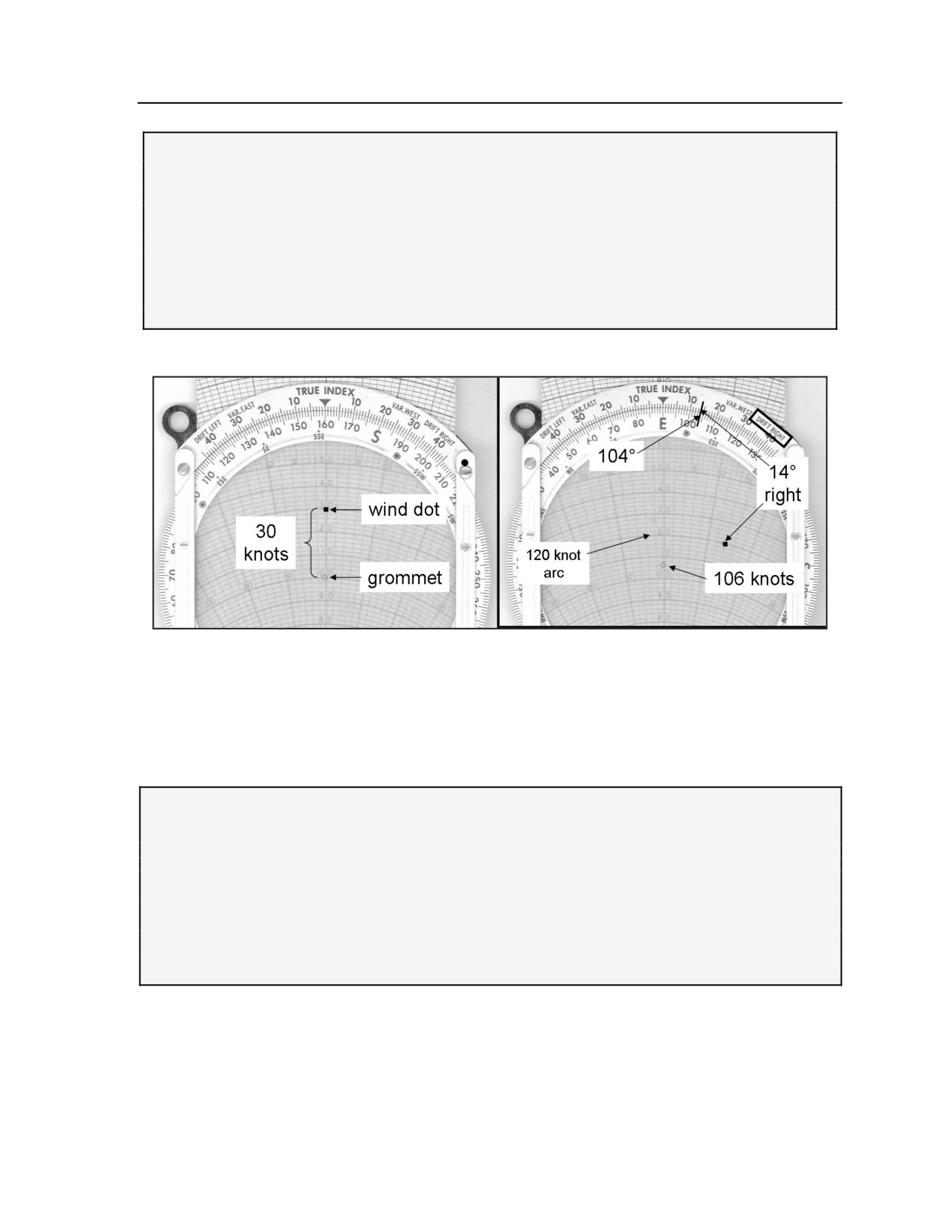
The wind is from 160 degrees at 30 knots; TAS is 120 knots; and the course (track) is 090 degrees. What are the heading
and ground speed? 104 degrees and 106 knots.
Set 160 (direction from which the wind is blowing) under the TRUE INDEX (Figure 5-20, left side).
Plot the wind vector above the grommet 30 units (wind speed), and place a wind dot within a circle at this point (Figure
5-20, left side).
Set 90 (course/track) at the TRUE INDEX (Figure 5-20, right side).
Adjust the sliding grid so that the TAS arc (120 knots) is at the wind dot (Figure 5-20, right side). Note that the wind dot is
at the 14 degrees converging line to the right of centerline.
Under the 14 degrees correction scale (DRIFT RIGHT) to the right of center at the top of the computer, read the heading
(104 degrees).
Under the grommet, read the ground speed (106 knots) (Figure 5-20, right side).
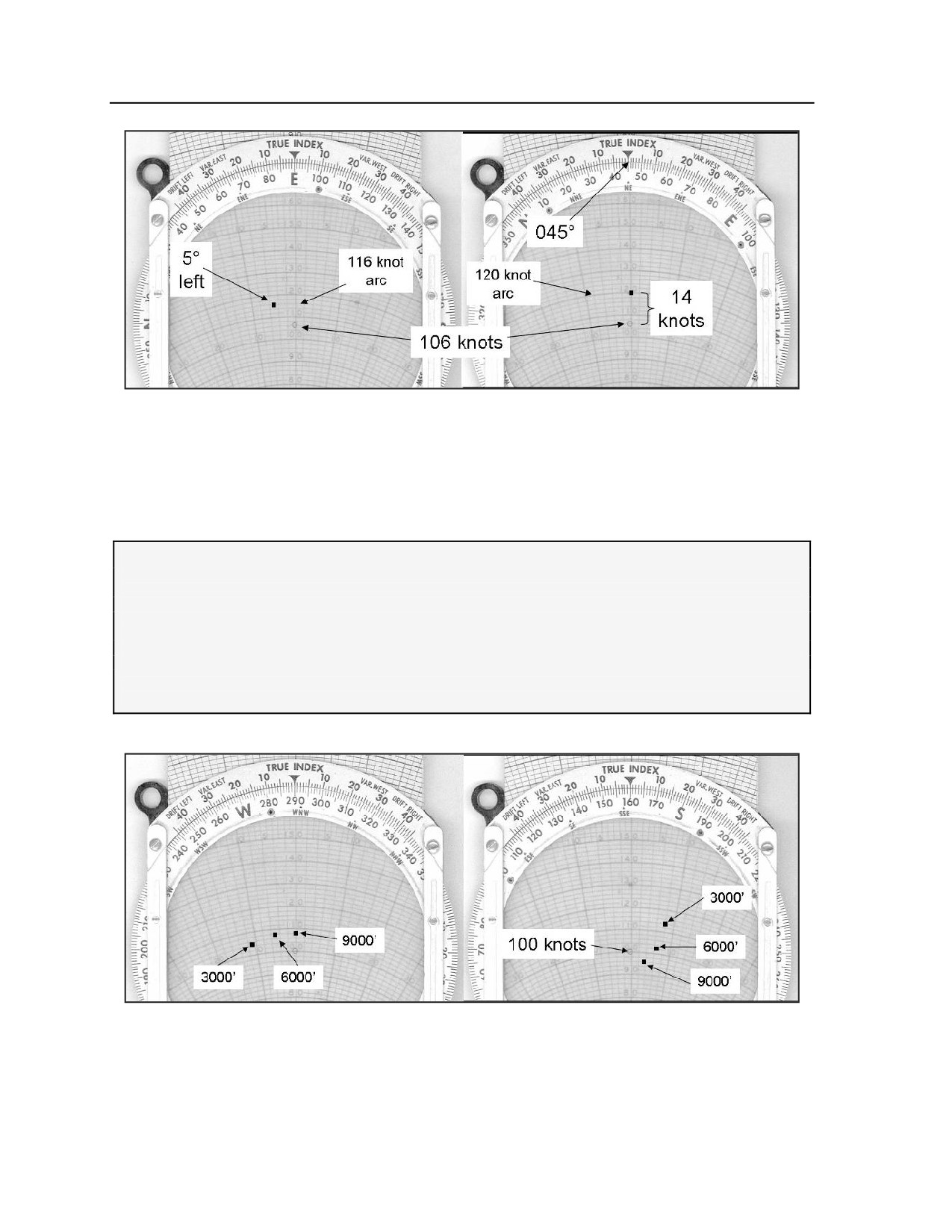
Figure 5-20. Heading and ground speed
DETERMINING UNKNOWN WIND
5-25. To solve for an unknown wind condition, four factors are required: true course (track), ground
speed, true heading, and TAS. Figure 5-21, page 5-16, illustrates the following example.
Determining Unknown Wind Example
True course (track) is 090 degrees, ground speed is 106 knots, true heading 085 degrees, and TAS is 116 knots; what are the
wind direction and speed? The unknown wind is 045 degrees at 14 knots.
Place the true course under the index (Figure 5-21, left side).
Place the line representing the ground speed under the grommet (Figure 5-21, left side).
Subtract true heading from true course (track), and find the true heading is 5 degrees less than the true course, which means
the 5 degrees is a left wind correction angle.
With the center on 106, the ground speed, move up the grid to the TAS line of 116 knots. Then move left 5 degrees and use a
pencil to make a wind dot on the 116 knots arc (Figure 5-21, left side).
Rotate the compass rose/plotting disk until the wind dot is resting directly on the centerline (Figure 5-21, right side).
By checking the lines between the grommet & wind dot, find the wind speed is 14 knots (Figure 5-21, right side).
Find wind direction by looking under the true index; the wind direction is 045 degrees (Figure 5-21, right side).
30 April 2007
FM 3-04.240
5-15
Chapter 5
Figure 5-21. Determining unknown wind
DETERMINING ALTITUDE FOR MOST FAVORABLE WIND
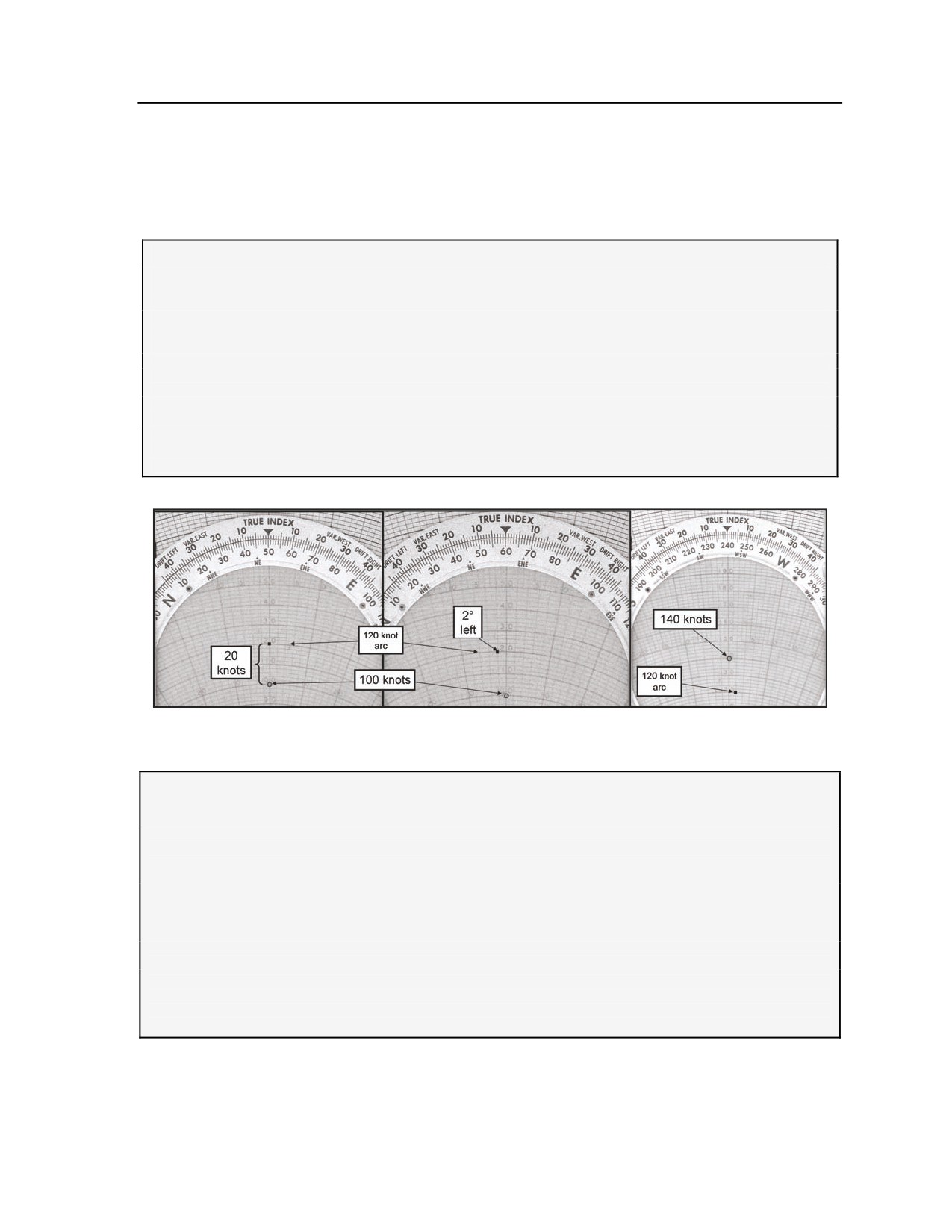
5-26. By comparing winds aloft, the aviator can determine the best altitude to obtain the highest ground
speed. Figure 5-22 illustrates the following example.
Determining Altitude for Most Favorable Wind
Winds aloft are 3,000 feet - 210 degrees at 20 knots, 6,000 feet - 240 degrees at 12 knots, and 9,000 feet - 290 degrees at 08
knots.
The true course/track is 160degrees and a ground speed of 100 knots.
Plot the winds aloft on the plotting disk, ensuring that the compass rose and arc are properly aligned for each entry (Figure
5-22, left side). Left side is positioned for last entry of 290 at 08 knots for 9,000 feet.
Place the true course/track (160 degrees) under the index (Figure 5-22, right side).
Place the line representing the ground speed under the grommet (Figure 5-22, right side).
The most favorable altitude is 9,000 feet; with a tailwind, the ground speed is 105 knots. The winds at 3,000 feet and 6,000
feet are headwinds.
Figure 5-22. Determining altitude for most favorable wind
5-16
FM 3-04.240
30 April 2007
Air Navigation Handheld Computer
DETERMINING RADIUS OF ACTION
5-27. Radius of action means the time or distance that an aircraft can fly out on a given course, turn
around, and have enough fuel to return to the departure point. Figure 5-23 and figures 5-24 and 5-25, page
5-18, illustrate the following three examples.
Determining Radius of Action Example (Part I)
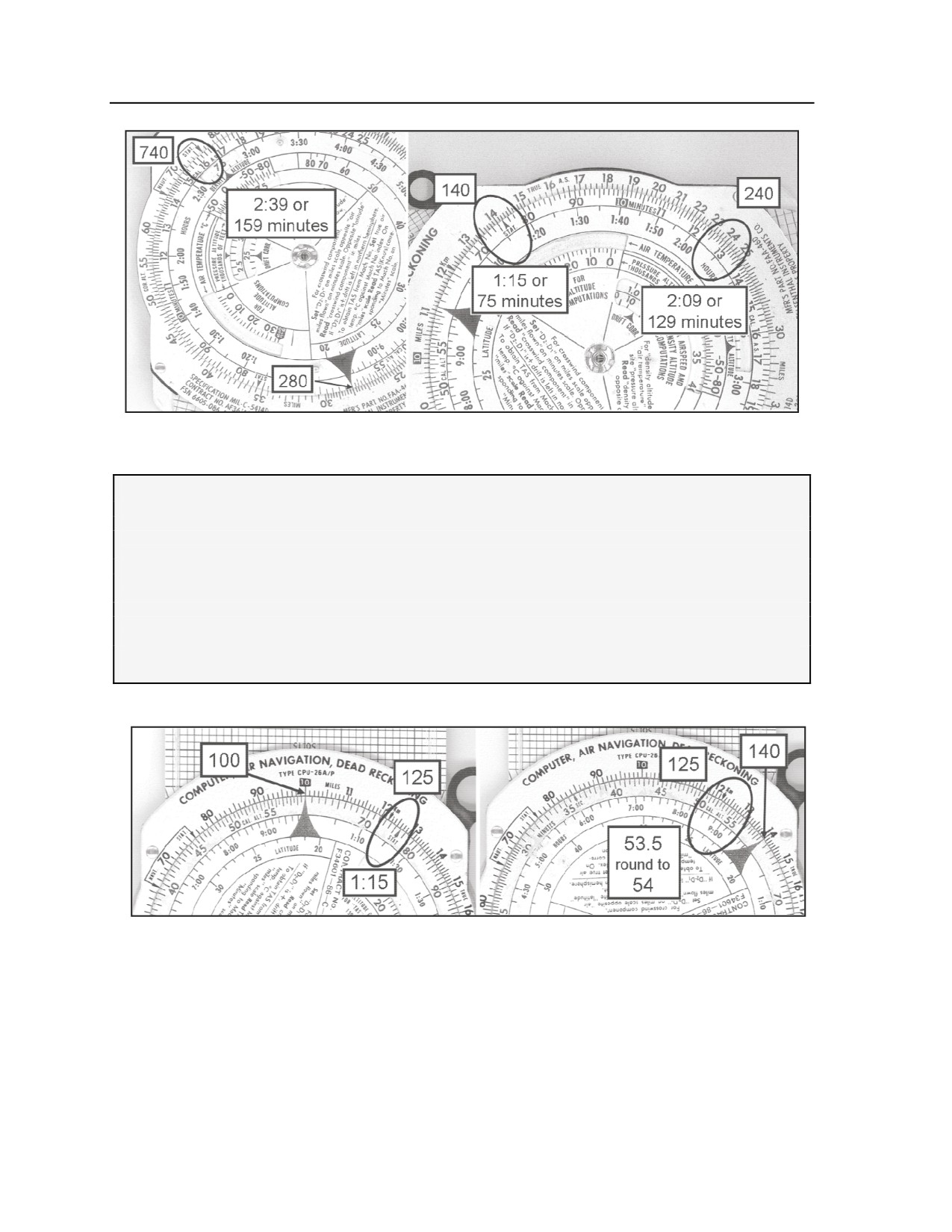
The true course/track is 060 degree, TAS is 120 knots, wind is 050 degrees at 20 knots, and useable fuel is 110 gallons/740
pounds (JP-8) at a fuel consumption of 42 gallons/280 pounds an hour. How long can the aircraft fly outbound before
having to return to the departure point? 1 hour and 15 minutes.
Place the wind direction of 050 degrees under the true index; use the 100 arc as the base point by placing the grommet
centered on the 100 arc; then move up to the 120 arc for a wind speed of 20 knots, and place a small pencil mark in the
center (Figure 5-23, left side).
Rotate the compass rose until the true course/track of 060 degrees is under the true index (Figure 5-23, center).
To find the ground speed, slide the grid until the wind dot is on the 120 arc, representing the TAS of 120 knots. Then look
at the grommet to find the ground speed, which is 100 knots (Figure 5-23, center). Record values for use later.
Now, reverse the compass rose to the reciprocal of 060 degrees, which is 240 degrees, the true course back to the departure
point (Figure 5-23, right side).
To find ground speed, slide the grid until the wind dot is on the 120 knots arc, which is the TAS. Look at the grommet to find
ground speed, which is 140 knots (Figure 5-23, right side).
Add ground speed outbound to ground speed back to departure point (100 + 140 = 240); the total is 240 knots.
Figure 5-23. Determining radius of action, part I
Determining Radius of Action (Part II)
Now, change fuel in pounds/gallons to fuel in hours on the calculator side. Set 60 index under 28 (outer scale) for 280
pounds of fuel consumption (Figure 5-24, page 5-18, left side).
Look directly under 74 (outer scale) for 740 pounds of useable fuel, and find 2 hours and 39 minutes (hours scale) (Figure 5
24, left scale). The density altitude index obscures the hours scale, so note that 15 (minute scale) aligns with 2 hours and 30
minutes. Count over 4½ graduations; each graduation equals 2 minutes, to be directly under 74. Now add the 9 minutes to
the 2 hours and 30 minutes for a total of 2 hours and 39 minutes (Figure 5-24, left side).
AR 95-1 requires a 30-minute reserve for rotary wing and 45-minute reserve for fixed wing on an IFR flight, so deduct 30
minutes (rotary-wing) or 45 minutes (fixed wing) from the total hours & minutes. The total is now 2 hours and 9 minutes
(rotary wing) or 1 hour and 54 minutes (fixed wing). The remainder of the calculations will continue to use the rotary wing
information.
Now place 24 (outer scale) for 240 knots, total of out and back ground speeds, directly over 2 hours and 9 minutes (hours
scale) (Figure 5-24, right side).
Visually move along the outer scale counterclockwise to the ground speed back to departure point of 14 for 140 knots. Look
directly under 14, and read 75 minutes, or 1 hour and 15 minutes, on the hours scale. The aircraft should turn back to the
departure point at 1 hour and 15 minutes to have enough fuel to make the return trip and arrive at the departure point with a
30-minute reserve.
30 April 2007
FM 3-04.240
5-17
Chapter 5
Figure 5-24. Determining radius of action, part II
Determining Radius of Action (Part III)
To convert the times calculated above to distance, perform the following actions:
Set 60 index under 10 (outer scale) for 100 knots ground speed outbound (Figure 5-25, left side).
Look directly over 75 minutes, or 1 hour and 15 minutes (hours scale), and find that the aircraft will fly 125 NM in this time
(Figure 5-25, left side).
The radius of action is 125 NM. The radius of action in time is 1 hour and 15 minutes.
To check the problem, find the time required to fly back over the 125-mile course with a ground speed back to departure
point of 140 knots as follows:
Set 60 index under 14 (outer scale) for 140 knots ground speed back to departure point (Figure 5-25, right side).
Under 12.5 (outer scale) for 125 NM, find the aircraft will take 53.5 minutes, round up to 54 minutes, (minutes scale) to
make the return trip (Figurer 5-25, right side).
This is the final check. By adding the time out of 1 hour and 15 minutes to the time back of 54 minutes, the total time equals
2 hours and 9 minutes. The calculations are confirmed and accurate.
Figure 5-25. Determining radius of action, part III
5-18
FM 3-04.240
30 April 2007
Chapter 6
Instrument Weather
After more than a century of flight, weather is still the most likely factor to result in
fatal accidents. From the hangar, second guessing an aviator’s decisions is easy.
Many aviators have had the experience of hearing about a weather-related accident
and thinking themselves immune from a similar experience because they believe that
they would never attempt to fly in adverse conditions. Aviators escaping aviation
weather accidents indicate that they found themselves in weather conditions they did
not expect and could not safely handle. Although the focus of this manual is
instruments, the principles in this chapter apply to all flight. More detailed weather
information is found in FM 1-230.
EFFECTS OF WIND
6-1. Wind is a mass of air moving over the surface of
the Earth in a definite direction. When the wind is
Contents
blowing from the north at 25 knots, it simply means
Effects of Wind
6-1
that air is moving southward over the Earth’s surface
Turbulence
6-3
at the rate of 25 nautical miles in one hour.
Structural Icing
6-4
6-2. Under these conditions, any inert object free
Fog
6-5
from contact with the Earth is carried 25 nautical miles
Volcanic Ash
6-5
southward in one hour. This effect becomes apparent
Thunderstorms
6-6
when clouds, dust, and toy balloons are observed
Wind Shear
6-6
being blown along by the wind. An aircraft flying
within the moving mass of air is similarly affected. Therefore, at the end of one hour of flight, the aircraft
is in a position that results from a combination of these two motions:
The movement of the air mass in reference to the ground.
The forward movement of the aircraft through the air mass.
6-3. These two motions are independent. As far as the aircraft’s flight through the air is concerned, there
is no difference, whether the air mass is moving or stationary. An aviator flying in a 70-knot gale is
unaware of any wind (except for possible turbulence) unless the ground is observed. In reference to the
ground, however, the aircraft would appear to fly faster with a tailwind, slower with a headwind, or to drift
right or left with a crosswind.
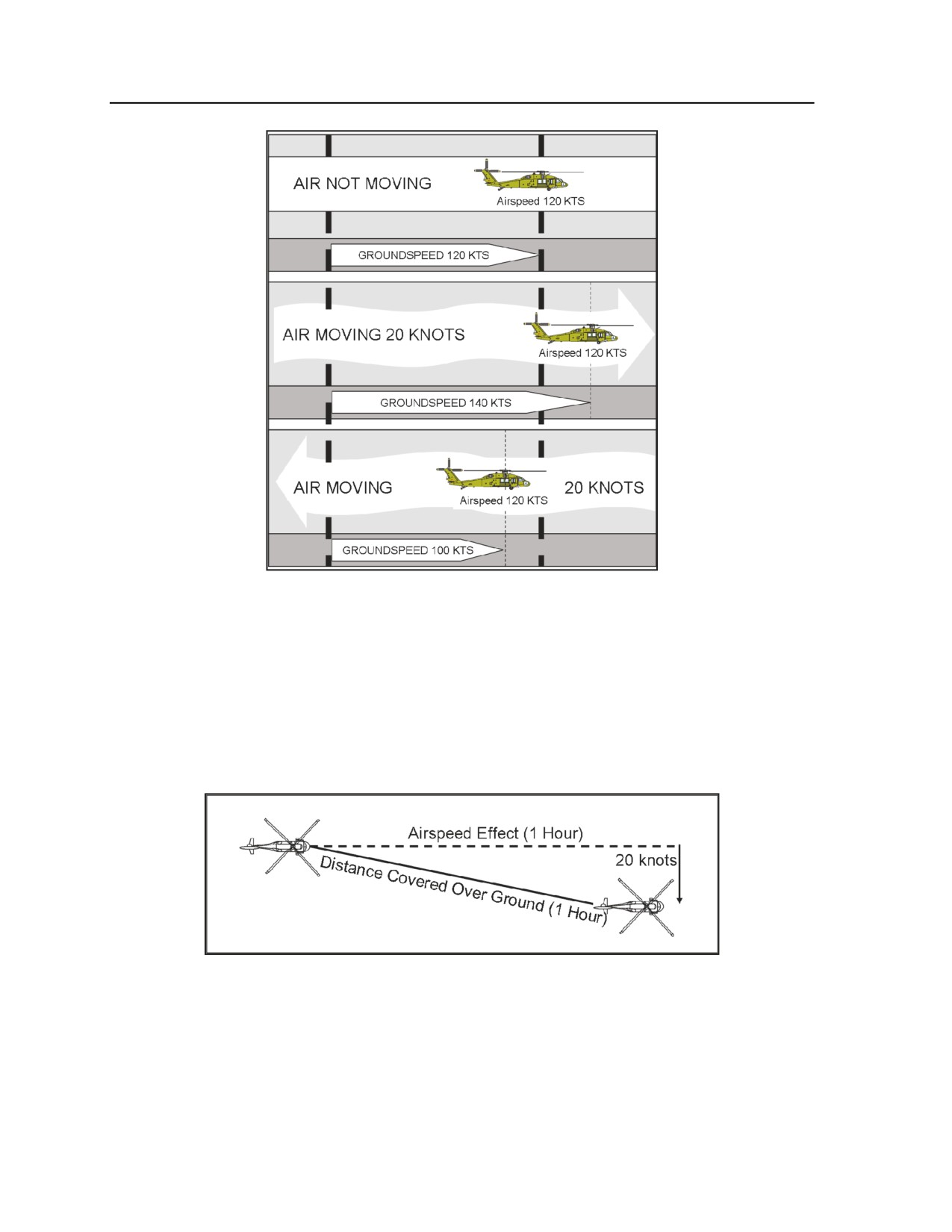
6-4. In addition, wind has an effect on ground speed and drift. An aircraft flying eastward at an airspeed
of 120 knots in still air has a ground speed of 120 knots (Figure 6-1, page 6-2). If the air mass is moving
eastward at 20 knots, airspeed of the aircraft is not affected, but progress of the aircraft over the ground is
120 knots plus 20 knots, or a ground speed of 140 knots. Conversely, if the air mass is moving westward at
20 knots, the airspeed of the aircraft still remains the same, but ground speed becomes 120 knots minus 20
knots, or 100 knots.
30 April 2007
FM 3-04.240
6-1
Chapter 6
Figure 6-1. Wind effect and ground speed
6-5. Assuming that no correction is made for wind effect, if an aircraft is heading eastward at 120 knots
through an air mass moving southward at 20 knots, at the end of one hour, the aircraft is almost 120 miles
east of its point of departure because of its progress through the air. It is also 20 miles south because of the
motion of the air. Under these circumstances, airspeed remains 120 knots, but ground speed is determined
by combining the movement of the aircraft with that of the air mass. Ground speed can be measured as the
distance from the point of departure to the position of the aircraft at the end of one hour. The ground speed
can be computed by the time required to fly between two points a known distance apart and can be
determined before flight by constructing a wind triangle (Figure 6-2).
Figure 6-2. Wind drift
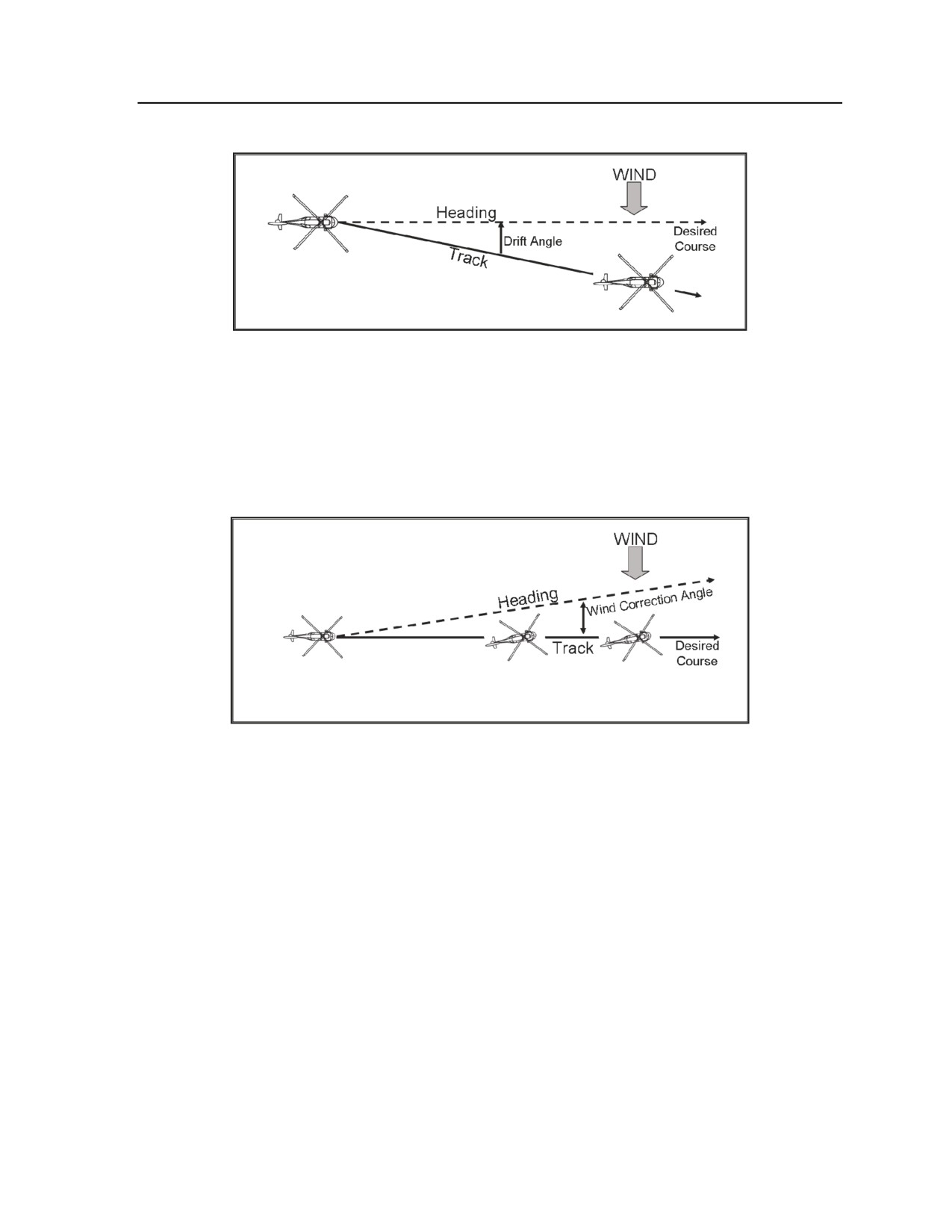
6-6. Heading is the direction in which the aircraft is flying. Track is its actual path over the ground, which
is a combination of the motion of the aircraft and motion of the air. The angle between the heading and
track is drift angle. If the aircraft’s heading coincides with the true course and the wind is blowing from the
left, the track will not coincide with the true course. The wind will drift the aircraft to the right so that the
track will fall to the right of the desired course or true course (Figure 6-3). Standard wind drift correction
procedures are depicted in table 7-1, page 7-21.
6-2
FM 3-04.240
30 April 2007
Instrument Weather
Figure 6-3. Wind drift angle
6-7. By determining the amount of drift, the aviator can counteract the effect of wind and make the track
of the aircraft coincide with the desired course. If the air mass is moving across the course from the left, the
aircraft will drift to the right and a correction must be made by heading the aircraft sufficiently to the left to
offset this drift. Therefore, if the wind is from the left, correction is made by pointing the aircraft to the left
a certain number of degrees to correct for wind drift. This wind correction angle is expressed in terms of
degrees right or left of the true course (Figure 6-4).
Figure 6-4. Wind correction angle
TURBULENCE
6-8. Turbulence is caused by winds, thermals, and other movement of air. Turbulence effects on aircraft
can range from occasional bumps to extreme airspeed and altitude variations in which aircraft control is
difficult. To reduce the risk factors associated with turbulence, aviators must learn methods of avoidance as
well as piloting techniques.
6-9. Turbulence avoidance begins with a thorough preflight weather briefing. Many reports and forecasts
are available to assist the aviator in determining areas of potential turbulence to include the severe weather
warning (WW), significant meteorological information (SIGMET) (WS), convective SIGMET (WST),
airman’s meteorological information (AIRMET) (WA), severe weather outlook (advisory circular [AC]),
center weather advisory (CWA), area forecast (FA), and pilot reports (pilot weather reports [PIREPs]).
Because thunderstorms always indicate turbulence, areas of known and forecast thunderstorm activity are
always of interest to the aviator. In addition, clear air turbulence (CAT) associated with jet streams, strong
winds over rough terrain, and fast-moving cold fronts are also good indicators of turbulence.
6-10. Aviators are alert while in flight for the signposts of turbulence. Clouds with vertical
development—such as cumulus, towering cumulus, and cumulonimbus—are indicators of atmospheric
instability and possible turbulence. Standing lenticular clouds lack vertical development but indicate strong
30 April 2007
FM 3-04.240
6-3
Chapter 6
mountain wave turbulence. (For more information on cloud types, see FM 1-230. While en route, aviators
can monitor the HIWAS broadcast for updated weather advisories or contact the nearest AFSS or en route
flight advisory service (EFAS) for the latest turbulence-related PIREPs.
6-11. Avoid turbulence associated with strong thunderstorms. Circumnavigate cells by at least 20 miles.
Turbulence may also be present in the clear air above a thunderstorm. Fly at least 1,000 feet above the
cloud tops for every 10 knots of wind at that level, or fly around the storm. Do not underestimate
turbulence underneath a thunderstorm. Never attempt to fly under a thunderstorm even if the other side is
visible. The possible results of turbulence and wind shear under the storm could be disastrous.
6-12. Aircraft control is difficult for the aviator to maintain while flying in moderate to severe
turbulence The aviator may not be able to maintain a proper scan of the instruments because of the higher
workload associated with turbulence (Figure 6-5). Aviators should immediately reduce power and slow the
aircraft to the recommended turbulence penetration speed as described in the appropriate aircraft operator’s
manual. To minimize the load factor imposed on the aircraft, the wings should be kept level and the
aircraft’s pitch attitude should be held constant, while the altitude of the aircraft is allowed to fluctuate up
and down. Maneuvering to maintain a constant altitude only increases stress on the aircraft. If necessary,
the aviator should advise ATC of the fluctuations and request a block altitude clearance. In addition, the
power should remain constant at a setting to maintain the recommended turbulence penetration airspeed.
Figure 6-5. Instrument scan in severe turbulence (blurry instrument panel)
6-13. PIREPs are the best source of information on the location and intensity of turbulence. Therefore,
aviators are encouraged to familiarize themselves with the turbulence reporting criteria found in the AIM.
The AIM also describes the procedure for volunteering turbulence-related PIREPs.
STRUCTURAL ICING
6-14. The very nature of IFR requires flight in visible moisture such as clouds. At the right temperatures,
this moisture can freeze on the aircraft, causing increased weight, degraded performance, and unpredictable
aerodynamic characteristics. Understanding, avoiding, and early recognition, followed by prompt action,
are the keys to avoiding this potentially hazardous situation.
6-15. Structural icing refers to the accumulation of ice on the exterior of the aircraft and is broken down
into three classifications: rime ice, clear ice, and mixed ice. For ice to form, moisture must be present in the
air, and the air must be cooled to a temperature of 0 degrees Celsius (32 degrees Fahrenheit [F]) or lower.
6-4
FM 3-04.240
30 April 2007
Instrument Weather
Aerodynamic cooling can lower the surface temperature of an airfoil, causing ice to form on the airframe
even when the ambient temperature is slightly above freezing.
6-16. Rime ice forms if droplets are small and freeze immediately when contacting the aircraft surface.
This type of ice usually forms on areas such as the leading edges of wings or struts. Rime ice has a
somewhat rough-looking appearance and a milky-white color. Clear ice forms from larger water droplets or
freezing rain that can spread over a surface. This is the most dangerous type of ice because it is clear, hard
to see, and can change the shape of the airfoil. Freezing rain and drizzle occur during inversion levels and
are extremely hazardous. Mixed ice is a mixture of clear ice and rime ice. It has the characteristics of both
types and can form rapidly. Ice particles become imbedded in clear ice, building a very rough
accumulation. Table 6-1 lists the temperatures at which various types of ice form.
Table 6-1. Temperature ranges for ice formation
Outside Air Temperature Ranges
Icing Type
0°C to -10°C
Clear
-10°C to -15°C
Mixed clear & rime
-15°C to -20°C
Rime
6-17. Structural icing is a condition that can only worsen; therefore, during an inadvertent icing
encounter, the aviator must act to prevent additional ice accumulation. Regardless of the level of anti-ice or
deice protection offered by the aircraft, the first course of action should be to avoid the area of visible
moisture with icing conditions. Therefore, the aviator should descend to an altitude below the cloud bases,
climb to an altitude above the cloud tops, climb to an altitude of minus 20 degrees Celsius or below, or turn
to a different course. If one of these courses of action is not possible, the aviator should move to an altitude
free of icing. Report icing conditions to ATC, and request new routing or altitude if icing will be a hazard.
Refer to the AIM for information on reporting icing intensities, and comply with AR 95-1 and the aircraft
operator’s manual for flight into icing. Commanders will assess the risk management considerations for
flight into icing conditions based on severity of icing, duration of time in icing conditions, criticality of
mission, and availability of deice and anti-ice systems.
FOG
6-18. Instrument aviators must anticipate conditions leading to the formation of fog and take appropriate
action early in flight. Before a flight, close examination of current and forecast weather should alert the
aviator to possible fog formation. When fog is a consideration, aviators should plan adequate fuel reserves
and alternate landing sites. En route, the aviator must stay alert for fog formation through weather updates
from EFAS, the automatic terminal information service (ATIS), and the automated surface observation
system (ASOS)/automated weather observing system (AWOS) sites.
6-19. Two conditions lead to the formation of fog: air is cooled to saturation, or sufficient moisture is
added to the air until saturation occurs. In either case, fog can form when the temperature/dew-point spread
is
5 degrees or lower. Aviators planning to arrive at their destination near dusk with decreasing
temperatures should be particularly concerned about possible fog formation.
VOLCANIC ASH
6-20. Volcanic eruptions create volcanic ash clouds containing an abrasive dust that poses a serious
safety threat to flight operations. Ash clouds are not easily discernible from ordinary clouds when aviators
encounter clouds at some distance from a volcanic eruption.
6-21. When an aircraft enters a volcanic ash cloud, dust particles and smoke may become evident in the
cabin often along with the odor of an electrical fire. Inside the volcanic ash cloud, the aircraft may also
experience lightning and St. Elmo’s fire on the windscreen. The abrasive nature of volcanic ash can pit the
windscreens, thus reducing or eliminating forward visibility. The pitot-static system may become clogged,
causing instrument failure. Severe engine damage is probable in both piston and turbine-powered aircraft.
30 April 2007
FM 3-04.240
6-5
Chapter 6
6-22. Every effort is made to avoid volcanic ash. Because volcanic ash clouds are carried by the wind,
aviators should plan their flights to remain upwind of ash-producing volcanoes. Visual detection and
airborne radar are not considered reliable means of avoiding volcanic ash clouds. Aviators witnessing
volcanic eruptions or encountering volcanic ash should immediately pass this information along in a PIREP
(if in flight, immediately inform the nearest agency). As with other hazards to flight, the best source of
volcanic information comes from PIREPs. The National Weather Service monitors volcanic eruptions,
estimates ash trajectories, and passes this information along to aviators in a SIGMET. Volcanic ash forecast
transport and dispersion (VAFTAD) charts are also available. These charts depict volcanic ash cloud
locations in the atmosphere following an eruption and forecast dispersion of the ash concentrations over 6-
and 12-hour time intervals (see AC 00-45).
THUNDERSTORMS
6-23. A thunderstorm contains nearly every weather hazard known to aviation. Turbulence, hail, rain,
snow, lightning, sustained updrafts and downdrafts, and icing conditions are all present in thunderstorms.
Do not take off in the face of an approaching thunderstorm or fly an aircraft not equipped with
thunderstorm detection in clouds. Likewise, do not fly at night in areas of suspected thunderstorm activity.
6-24. Unlike VMC, in which thunderstorms can be easily detected and avoided, in IMC flight there is
greater difficulty in determining where thunderstorms are located or where they are likely to develop.
Aviators should obtain a weather update immediately before departure to determine thunderstorm location,
approximate direction, and speed of movement, as well as suspected areas of instability along the planned
route where thunderstorms might develop. Because of the dynamic nature of thunderstorms, aircrews
should seek frequent updates while en route.
6-25. There is no useful correlation between the external visual appearance of thunderstorms and the
severity or amount of turbulence or hail within them. All thunderstorms are considered hazardous, and
thunderstorms with tops above 35,000 feet are considered extremely hazardous.
6-26. Weather radar, airborne or ground-based, normally reflects areas of moderate to heavy
precipitation
(radar does not detect turbulence). The frequency and severity of turbulence generally
increases with radar reflectivity closely associated with the areas of highest liquid water content of the
storm. A flight path through an area of strong or very strong radar echoes separated by 20 to 30 miles, or
less, may not be considered free of severe turbulence.
6-27. The probability of lightning strikes occurring to aircraft is greatest when operating at altitudes
where temperatures are between -5 degrees Celsius and +5 degrees Celsius. In addition, an aircraft flying
in the clear air near a thunderstorm is also susceptible to lightning strikes. Thunderstorm avoidance is
always the best policy.
WIND SHEAR
6-28. Wind shear is defined as a change in wind speed and/or wind direction in a short distance. Wind
shear can exist in a horizontal or vertical direction and, occasionally, in both. Wind shear can occur at any
and all atmospheric levels and is typically associated with thunderstorms and low-level temperature
inversions; however, the jet stream and weather fronts are also sources of wind shear. Wind shear is of
greatest concern during takeoffs and landings.
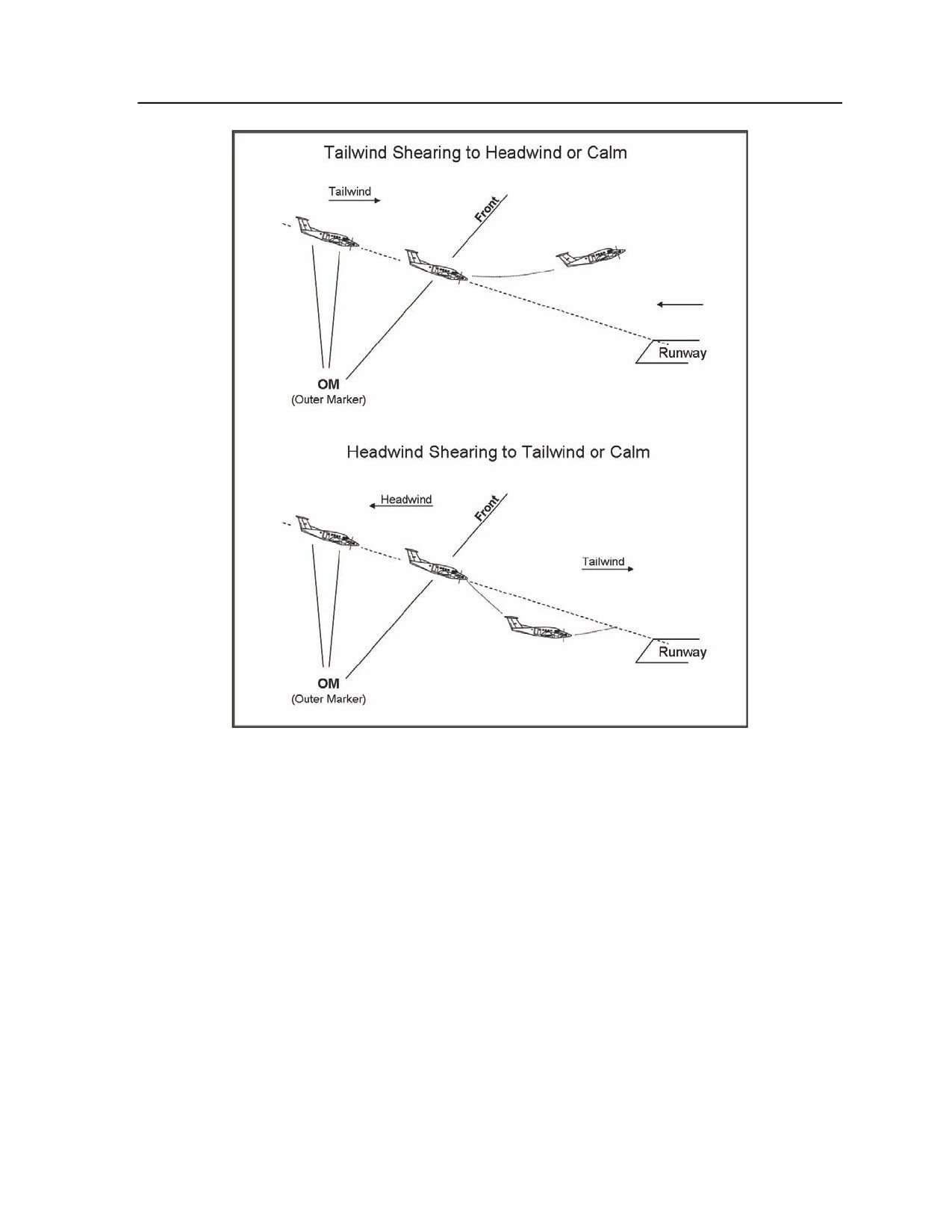
6-29. As Figure 6-6, page 6-7, illustrates, while an aircraft is on an instrument approach, a shear from a
tailwind to a headwind causes the airspeed to increase and the nose to pitch up with a corresponding
balloon above the glide path. A shear from a headwind to a tailwind has the opposite effect, and the aircraft
sinks below the glide path.
6-6
FM 3-04.240
30 April 2007
Instrument Weather
Figure 6-6. Glide-slope deviations in wind shear
6-30. A headwind shear followed by a tailwind/downdraft shear is particularly dangerous because the
aviator has reduced power and lowered the nose in response to the headwind shear. The aircraft is,
therefore, in a nose-low, power-low configuration when the tailwind shear occurs. This situation makes
recovery more difficult, particularly near the ground. This type of wind-shear scenario is likely to occur
during an approach into an oncoming thunderstorm. Aviators should be alert for early indications of wind
shear during the approach phase and be ready to initiate a missed approach. An aviator may not be able to
recover an aircraft from a wind-shear encounter at low altitude.
6-31. To inform aviators of hazardous wind shear activity, some airports have installed a low-level wind
shear alert system
(LLWAS) consisting of a centerfield wind indicator and several surrounding
boundary-wind indicators. With this system, controllers are alerted of wind discrepancies (an indicator of
wind-shear possibility) and provide this information to aviators. Aviators encountering wind shear are
encouraged to pass along a PIREP. Refer to the AIM for additional information on wind-shear PIREPs. A
typical wind-shear alert issued to an aviator is,
“Wind-shear alert, centerfield wind 230 at 8, south
boundary wind 170 at 20.”
30 April 2007
FM 3-04.240
6-7
This page intentionally left blank.
Chapter 7
Navigation Aids
This chapter provides basic radio principles applicable to navigation equipment as
well as an operational knowledge of how to use these systems in instrument flight.
This information provides the framework for all instrument procedures including
DPs, holding patterns, and approaches. Each of these maneuvers consists mainly of
accurate attitude instrument flying and accurate tracking using navigation systems.
Chapter 10 contains more information on DPs, holding patterns, and approaches.
SECTION I - BASIC RADIO PRINCIPLES
7-1. A radio wave is an electromagnetic
(EM)
wave with frequency characteristics that are useful
Contents
in radio. The wave travels long distances through
space (in or out of the atmosphere) without losing
Section I - Basic Radio Principles
7-1
much strength. The antenna is used to convert the
Section II - Navigation Systems
7-3
electric current into a radio wave, allowing for
Section III - Navigation Procedures
7-14
travel through space to the receiving antenna, which
converts the radio wave back into an electric current.
RADIO WAVE PROPAGATION
7-2. All matter has a varying degree of conductivity or resistance to radio waves. The Earth itself acts as
the greatest resistor to radio waves. Radiated energy traveling near the surface induces a voltage in the
ground that subtracts energy from the wave, decreasing its strength as the distance from the antenna
increases. Trees, buildings, and mineral deposits affect wave strength to varying degrees. Radiated energy
in the upper atmosphere is likewise affected as the energy is absorbed by molecules of air, water, and dust.
The characteristics of radio-wave propagation vary according to signal frequency, design, use, and
limitations of equipment.
TYPES OF WAVES
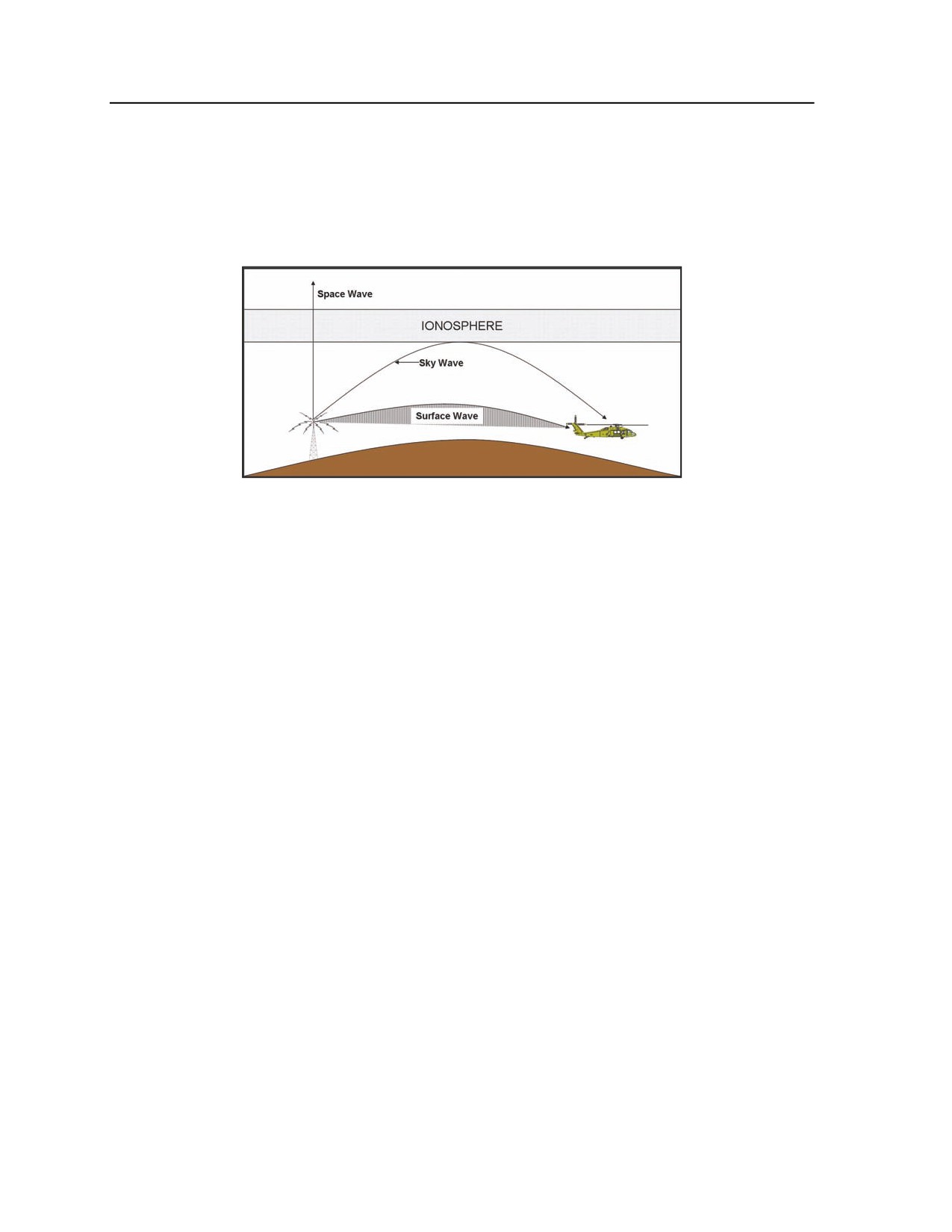
SURFACE WAVE
7-3. Surface waves travel across the surface of the Earth. The surface wave’s path is like being in a tunnel
or alley, bound by the surface of the Earth and ionosphere, which prohibit the surface wave from vectoring
into space. Generally, the lower the frequency, the farther the signal travels.
7-4. Surface waves are usable for navigation purposes because they reliably and predictably travel the
same route daily and are not influenced by many outside factors. The surface-wave frequency range is
generally from the lowest frequencies in the radio range (perhaps as low as 100 Hertz) up to about 1,000
kilohertz (1 megahertz). Although there is a surface-wave component to frequencies between 1 and 30
megahertz, the surface wave at these higher frequencies loses strength over very short distances.
SKY WAVE
7-5. The sky wave, at frequencies of 1 to 30 megahertz, is good for long distances because these
frequencies are refracted, or bent, by the ionosphere causing the signal to be sent back to Earth from high
30 April 2007
FM 3-04.240
7-1
Chapter 7
in the sky (Figure 7-1). Used by high frequency (HF) radios in aircraft, messages are sent across oceans
using only 50 to 100 watts of power. Frequencies producing a sky wave are not used for navigation
because the signal pathway from transmitter to receiver is highly variable. The wave bounces off the
ionosphere, which is always changing because of varying amounts of the sun’s radiation (night/day,
seasonal variations, and sunspot activity). The sky wave is not reliable for navigation purposes. For
aeronautical communication purposes, the sky wave (HF) is about 80 to 90 percent reliable.
Figure 7-1. Surface, space, and sky wave propagation
SPACE WAVE
7-6. Radio waves of 15 megahertz and above (up to many gigahertz), when able to pass through the
ionosphere, are considered space waves. Most navigation systems operate with their signals propagating as
space waves. Frequencies above 100 megahertz have nearly no surface or sky-wave components. They are
space waves, except for GPS; the navigation signal is used before reaching the ionosphere. This signal
usage makes the effect of the ionosphere, which can cause some propagation errors, minimal. GPS errors
caused by passage through the ionosphere are significant and corrected for by the GPS receiver system.
7-7. Space waves also reflect off hard objects and may be blocked if the object is between the transmitter
and receiver. Site and terrain error, as well as propeller/rotor modulation error in VOR systems, is caused
by this bounce. ILS course distortion is also the result of this phenomenon, which led to the need for ILS
critical areas.
7-8. Space waves are line-of-sight receivable, but those of lower frequencies bend over the horizon
somewhat. Because the VOR signal at 108 to 118 megahertz is a lower frequency than DME at 962 to
1213 megahertz, when aircraft fly over the horizon from a VOR/DME station, the DME is normally the
first to stop functioning.
RADIO WAVE RECEPTION DISTURBANCES
7-9. Static distorts the radio wave and interferes with normal reception of both communications and
navigation signals. Low-frequency airborne equipment is particularly subject to static disturbance. Signals
in the higher frequency bands are static free.
7-10. Precipitation static (P-static) occurs when static electricity is generated on various aircraft surfaces in
flight and is discharged onto other surfaces or into the air. An aircraft generally accumulates little or no
static charge when flying in a clear atmosphere. An aircraft flying in particle-laden air may encounter
P-static because charged particles adhere to the aircraft, create a charge through frictional contact, or divide
into charged fragments on impact with the aircraft surfaces. Some problems caused by P-static are the
following:
Complete loss of VHF communications.
Erroneous magnetic compass readings.
7-2
FM 3-04.240
30 April 2007
Navigation Aids
High-pitched squeal on audio.
Motorboat sound on audio.
Loss of all avionics.
Very low frequency (VLF) navigation system inoperative.
Erratic instrument readouts.
Weak transmissions and poor radio reception.
St. Elmo’s Fire.
PRECAUTIONS
7-11. Various types of navigation aids serve a special purpose; although operating principles and cockpit
displays vary among navigation systems, several precautionary actions must be taken to prevent erroneous
navigation signals:
Identification. Check identification of any navigation aid and monitor during flight according to
the navigation procedures in Section III.
Navigation information. Use all suitable navigation equipment aboard the aircraft, and
cross-check heading and bearing information; most aircraft navigation systems have fail flags or
warnings that appear when reestablished criteria are not met.
Estimated time of arrival (ETA). Never overfly an ETA without a careful cross-check of
navigation aids and ground checkpoints.
Notice to airmen
(NOTAM). Check NOTAMs and FLIP for possible malfunctions or
limitations to navigation aids.
Navigation aids. Discontinue use of any navigation aids that may be malfunctioning or
erroneous; if necessary, confirm aircraft position with radar or other equipment. Advise ATC of
any problems receiving NAVAIDs; the problem may stem from the ground station, not aircraft
equipment.
SECTION II - NAVIGATION SYSTEMS
NONDIRECTIONAL RADIO BEACON
7-12. The ground station portion of the nondirectional radio beacon is the NDB that transmits radio energy
in all directions. The airborne receiver is the ADF.
FREQUENCY
7-13. The NDB is a low, medium, or UHF ground-based radio beacon that transmits nondirectional signals
whereby a properly equipped aircraft can automatically determine and display bearing to any radio station
within its frequency and sensitivity range. These facilities normally operate on frequencies between 190
and 1750 kilohertz or
275 to
287 megahertz and transmit a continuous carrier keyed to provide
identification except during voice transmission. The 190 to 1750 kilohertz band is displayed on navigation
charts as a brown-colored symbol,
and the frequency range NDB used by Army aircraft. The 275- to
287-megahertz band is displayed on navigation charts as a black symbol,
not currently received and
used by most Army aircraft.
30 April 2007
FM 3-04.240
7-3
Chapter 7
AUTOMATIC DIRECTION FINDER
Components
7-14. The purpose of the ADF is to point to an NDB. The ADF equipment includes two antennas, a
receiver, and the indicator instrument. The sense antenna (nondirectional) receives signals with nearly
equal efficiency from all directions. The loop antenna receives signals from two directions (bidirectional).
The ADF can tell from loop antenna signals that the NDB is one of two possible directions, 180 degrees
apart; the sense antenna helps the ADF determine which of the two is correct. When the loop and sense
antenna inputs are processed together in the ADF radio, the aircraft is able to receive a radio signal in all
directions.
7-15. The radio waves from an NDB consist of an electric field, called the E-field, and magnetic field,
called the H-field. These fields are perpendicular in space, and their amplitudes vary sinusoidally with
time. NDBs transmit a vertically polarized wave, meaning that the E-field is vertical and the H-field is
horizontal. The H-field induces a voltage into the windings of the ADF loop antenna. The loop antenna
consists of two perpendicular windings on a square ferrite core. By measuring the phase difference
between these two windings, the ADF is able to determine the direction of the beacon.
7-16. All ADF systems have loop and sense antennas. With older ADFs, they are two separate antennas
(UH-60A/L Black Hawk). The loop antenna is a flat antenna, usually located on the bottom of the aircraft,
while the sense antenna may also be located there. More recent ADFs have a combined loop/sense antenna
(UH-60Q/HH-60L Black Hawk and CH-47D Chinook), which works far better than older systems, has less
drag, and is much less vulnerable to icing.
Operation
7-17. Most ADF receivers have several modes. If the antenna (ANT) mode is selected, the loop antenna is
disabled, and receiving is done through the sense antenna. This mode provides the clearest audio reception,
and is normally used to identify a station. On some ADFs, the needle should park in the 90-degree position
when the receiver is in ANT mode; other models may work differently:
In the ADF mode, the pointer is activated and the ADF tries to point to the station. Some ADF
systems have a beat frequency oscillator (BFO) position that generates an audio tone for
beacons identifying themselves using interrupted-carrier keying; this feature is seldom used in
the United States except for a few marine beacons but can be useful in other parts of the world.
If the ADF has a TEST button, this should cause the needle to slew to the 90-degree position
whenever the button is pressed and held; if not, then this function is usually activated by
switching to ANT mode.
The ADF indicator consists of a needle and compass card. The needle points to the stations
when the receiver is in ADF mode; the compass card is slaved automatically to the aircraft
heading.
COMPASS LOCATOR
7-18. A radio beacon, used with ILS markers, is a compass locator. Compass locators are low-powered
NDBs, operating between 200 and 415 kilohertz with a reliable reception range of at least 15 nautical
miles, which is received and indicated by the ADF receiver. Higher powered low-frequency NDBs may be
collocated with the marker beacons and used as compass locators. These generally carry transcribed
weather broadcast information. When used with an ILS front course, the compass locator facilities are
collocated with the OM and/or middle marker (MM) facilities. The coding identification of the outer
locator consists of the first two letters of the three-letter identifier of the associated LOC. For example,
with an ILS localizer identified by the letters “I-DAL” (Dallas/Love Field), the outer locator is identified as
“DA.” The middle locator at DAL is identified by the last two letters “AL.” On the profile view of the
approach chart, the locators are depicted by the letters LOM or LMM (locator outer marker or locator
middle marker).
7-4
FM 3-04.240
30 April 2007
Navigation Aids
VOICE TRANSMISSION
7-19. NDB stations are capable of voice transmission—unless the letter W (without voice) is included in
the class designator—and are often used for transmitting the prerecorded AWOS data. The aircraft must be
in operational range of the NDB. Coverage depends on the strength of the transmitting station. Before
relying on ADF indications, identify the station by listening to the Morse code identifier.
IDENTIFICATION
7-20. Most radio beacons within the United States transmit a continuous three-letter identifier. A two-letter
identifier is normally used with an ILS. Some NDBs have only a one-letter identifier. Outside the
contiguous U.S., one-, two-, or three-letter identifiers are transmitted.
ACCURACY
7-21. Course accuracy of the VOR is generally plus or minus 1 degree but no more than 2.5 degrees.
When the aircraft nears the station, slight deviations from the desired track result in large deflections of the
needle. Therefore, establish the correct drift correction angle as soon as possible. Make small heading
corrections (not over 5 degrees) as soon as the needle shows a deviation from course, until the needle
begins to rotate steadily toward a wingtip position or shows erratic left/right oscillations. Aviators are
abeam a station when the needle points to the 90- or 270-degree position. Hold last corrected heading
constant and time station passage when the needle shows either wingtip position or settles at or near the
180-degree position. The time interval from the first indications of station proximity to positive station
passage varies with altitude (a few seconds at low levels to three minutes at high altitude).
7-22. When the aviator uses ADF equipment, the loop antenna is automatically positioned to the null
position. However, the antenna can only rotate about the vertical axis (in relation to the aircraft) and cannot
tilt. When the aircraft is banked, the antenna becomes tilted. This tilting moves the loop away from the
null, and the motor is not capable of correcting for this error. This error is called dip error and is present
anytime the aircraft is not in level flight. The magnitude of this error depends on the position of the aircraft
from the station, altitude, range from the station, and angle of bank used. Dip error is most noticeable when
the aircraft is banked and the station is on the nose or tail. The ADF bearings should be considered
accurate only when the aircraft is in level flight.
DISTURBANCES
7-23. Radio beacons are subject to disturbances that may result in erroneous bearing information. Such
disturbances result from intermittent or unpredictable signal propagation because of such factors as
lightning and precipitation static. At night, radio beacons are vulnerable to interference from distant
stations. Nearly all disturbances affecting the ADF bearing also affect the facility’s identification. Noisy
identification usually occurs when the ADF needle is erratic. Voice, music, or erroneous identification will
usually be heard when a steady false bearing is being displayed.
Note. Because ADF receivers do not have a flag to warn the aviator when erroneous bearing
information is being displayed, the aviator must continuously monitor the NDB’s identification.
VERY HIGH FREQUENCY OMNIDIRECTIONAL RANGE
FREQUENCY
7-24. VOR operates within the 108.0 to 117.95 megahertz VHF frequency band and has a power output
necessary to provide coverage within the assigned operational service volume. The equipment is subject to
line-of-sight restriction, and its range varies proportionally to the altitude of the receiving equipment.
30 April 2007
FM 3-04.240
7-5
Chapter 7
VOICE TRANSMISSION
7-25. Most VORs are equipped for voice transmission. VORs without voice capability are indicated on en
route and sectional charts by underlining the VOR frequency and by the designation VORW in the IFR
supplement. Because a large portion of the frequencies available on the VOR control panel may overlap the
VHF communication frequency band, aviators may use the VOR receiver as a VHF communications
receiver. For example, the AN/ARC-186 VHF-amplitude modulation (AM)/FM radio has frequencies
116.0 through 151.975 megahertz range and 108.0 through 115.975 megahertz receive only.
IDENTIFICATION
7-26. The only method of identifying a VOR is by its Morse code identification or the recorded automatic
voice identification. Voice identification consists of a voice announcement (CAIRNS VOR), alternating
with the usual Morse code identification. During periods of maintenance, the facility may radiate T-E-S-T
in Morse code or the code may be removed.
RADIALS
7-27. The courses oriented from the station are called radials. The VOR information received by an aircraft
is not influenced by aircraft attitude or heading
(Figure
7-2). The following example shows VOR
information.
Figure 7-2. Very (high frequency) omnidirectional range radials
7-6
FM 3-04.240
30 April 2007
Navigation Aids
Example of VOR Information
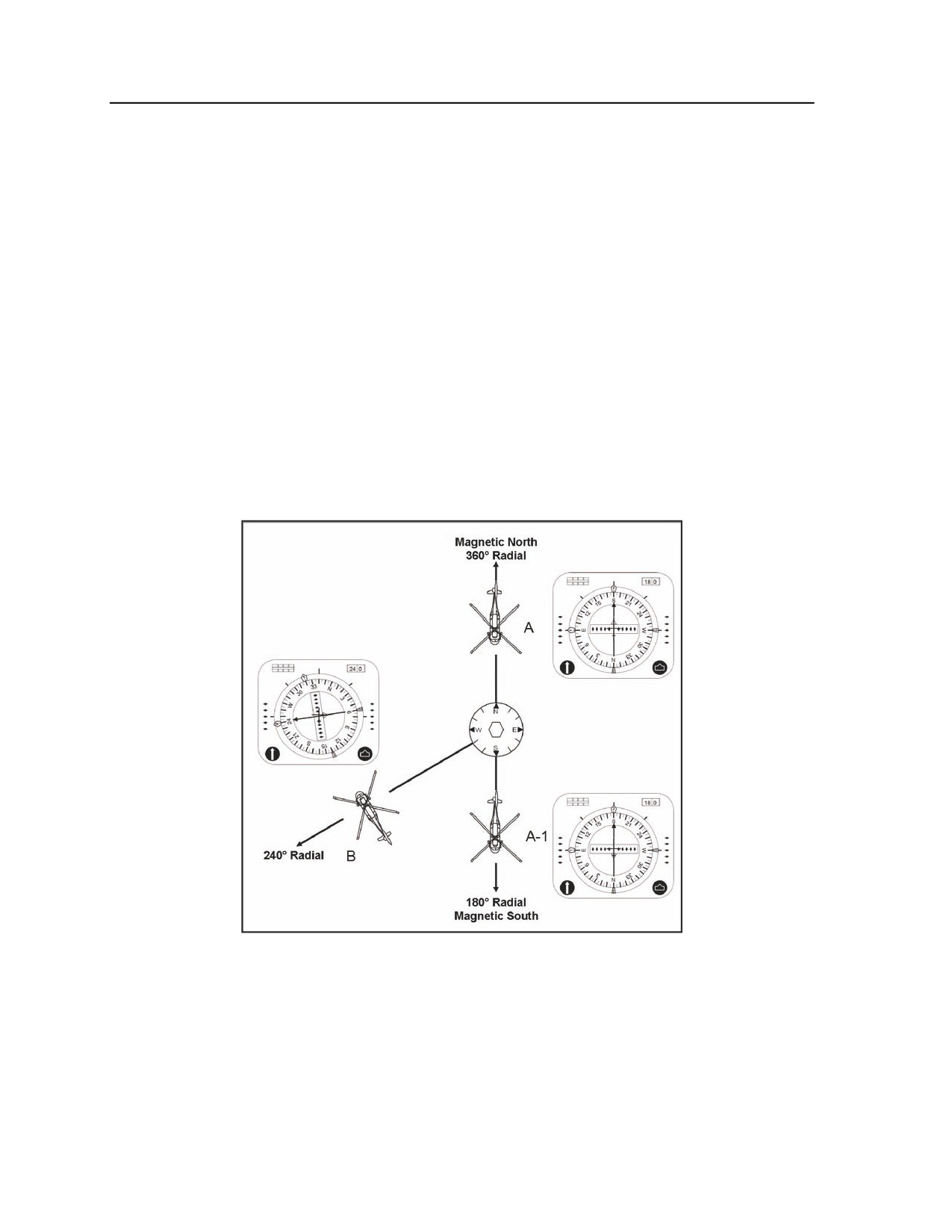
For example, aircraft A (heading 180 degrees) is inbound on the 360 degrees radial, and the omnibearing
selector (OBS) was used to select 180 degrees, thereby displaying a TO indication. If the OBS was used to
select the 360 degrees radial, the instrument will display a reverse sensing. Reverse sensing is when the VOR
needle indicates the reverse of normal operation. This reversal occurs when the aircraft is heading toward the
station with a FROM (FR) indication or when the aircraft is headed away from the station with a TO indication.
After crossing the station, the aircraft is outbound on the 180 degrees radial at A-1 and displaying a FR
indication. Aircraft B is shown crossing the 240 degrees radial while flying a heading of 340 degrees. The OBS
was used to select 240 degrees, thereby displaying an FR indication. Similarly, at any point around the station,
an aircraft can be located somewhere on a VOR radial. The heading selected on the OBS determines the
sensitivity of the instrument.
TRACKING TO AND FROM THE STATION
7-28. To track to the station, rotate the OBS until TO appears and then center the course deviation
indicator (CDI). Fly the course indicated by the index. If the CDI moves off center to the left, follow the
needle by correcting course to the left, beginning with a 20-degree correction.
7-29. When an aviator flies the course indicated on the index, a left deflection of the needle indicates a
crosswind component from the left. If the amount of correction brings the needle back to center, decrease
the left course correction by half. If the CDI moves left or right now, the movement should be much slower
and the aviator can make a smaller heading correction for the next iteration.
7-30. Keeping the CDI centered will take the aircraft to the station. To track to the station, the OBS value
at the index is not changed. To home to the station, the CDI needle is periodically centered and the new
course, under the index, is used for the aircraft heading. Homing will follow a circuitous route to the
station, just as with ADF homing.
7-31. To track from the station on a VOR radial, first orient the aircraft’s location, with respect to the
station and the desired outbound track, by centering the CDI needle with a from indication, shown as FR.
The track is intercepted by either flying over the station or establishing an intercept heading. The magnetic
course of the desired radial is entered under the index, using the OBS, and the intercept heading is held
until the CDI centers. Then the procedure for tracking to the station is used to fly outbound on the specified
radial.
ACCURACY
7-32. The accuracy of course alignment of the VOR is excellent, generally ± 1 degree, but no more than
2.5 degrees. The effectiveness of the VOR depends on proper use and adjustment of both ground and
airborne equipment.
7-33. On some VORs, minor course roughness may be observed, evidenced by course needle or brief flag
alarm. At a few stations, usually in mountainous terrain, the aviator may occasionally observe a brief
course needle oscillation, similar to the indication of approaching station. Aviators flying over unfamiliar
routes are cautioned to be on the alert for these course needle oscillations and, in particular, to use the
TO/FR indicator to determine positive station passage.
RECEIVER ACCURACY CHECK
7-34. Title 14 of the Code of Federal Regulations (14 CFR), part 91.171, provides certain VOR equipment
accuracy checks and an appropriate endorsement within 30 days before flight under IFR for civil aircraft.
This requirement does not apply to military aircraft because they are defined as public aircraft. Army
aircraft operator manuals and checklists require avionics to be tested before each flight and any
malfunction to be written on the appropriate forms in the aircraft logbook.
30 April 2007
FM 3-04.240
7-7
Chapter 7
7-35. VOR system course sensitivity may be checked by noting the number of degrees of change when the
aviator rotates the OBS to move the CDI from center to the last dot on either side. The course selected
should not exceed 10 or 12 degrees either side. To ensure satisfactory operation of the airborne system, use
the following means for checking VOR receiver accuracy:
VOR test facility (VOT) or a radiated test signal from an appropriately rated radio repair station.
Certified checkpoints on the airport surface.
Certified airborne checkpoints.
Test Facility
7-36. The FAA VOT transmits a test signal that provides users with a convenient means to determine the
operational status and accuracy of a VOR receiver while on the ground where a VOT is located. Locations
of VOTs are published in the Airport/Facility Directory (A/FD). Two means of identification are used. One
is a series of dots, and the other is a continuous tone. Information concerning an individual test signal can
be obtained from the local FSS. The airborne use of VOT is permitted; however, its use is strictly limited to
those areas/altitudes specifically authorized in the A/FD or appropriate supplement.
7-37. To use the VOT service, tune in the VOT frequency 108.0 megahertz on the VOR receiver. With the
CDI centered, the OBS should read 0 degrees with the TO/FR indication showing FROM, or the OBS
should read 180 degrees, with the TO/FR indication showing TO. Should the VOR receiver operate an
RMI, the indication will be 180 degrees on any OBS setting.
7-38. A radiated VOT from an appropriately rated radio repair station serves the same purpose as an FAA
VOT signal. The check is made in much the same manner as a VOT with some differences.
Certified Checkpoints
7-39. Airborne and ground checkpoints consist of certified radials received at specific points on the airport
surface or over specific landmarks while the aircraft is airborne in the immediate vicinity of the airport.
Locations of these checkpoints are published in the A/FD.
7-40. Should an error in excess of ± 4 degrees be indicated through use of a ground check, or ± 6 degrees
using the airborne check, IFR flight will not be attempted without first correcting the source of the error.
No correction other than the correction card figures supplied on the DD Form 1613 (Pilot’s Compass
Correction Card) should be applied in making these VOR receiver checks.
7-41. If a dual system VOR (units independent of each other except for the antenna) is installed in the
aircraft, one system may be checked against the other. Turn both systems to the same VOR ground facility,
and note the indicated bearing to that station. If the receivers are within 4 degrees of each other, both may
be considered reliable.
TACTICAL AIR NAVIGATION
PRINCIPLES OF OPERATION
7-42. The theoretical and technical principles of operation of TACAN equipment are different from those
of VOR; however, the result is the same. In addition to the displayed bearing information, TACAN adds a
continuous display of range information. DME, an integral part of TACAN, provides continuous slant-
range distance information.
GROUND EQUIPMENT
7-43. TACAN ground equipment consists of either a fixed or mobile transmitting unit. The airborne unit,
with the ground unit, reduces the transmitted signal to a visual presentation of both azimuth and distance
information. TACAN operates in the UHF band of frequencies. The system presently has a total of 252
7-8
FM 3-04.240
30 April 2007
Navigation Aids
channels available and is identified by two sets of channel numbers, from 1 to 126, with suffixes X or Y
for discrimination between the sets.
7-44. TACAN ground equipment consists of a rotating type of antenna for transmitting bearing
information and a receiver-transmitter (transponder) for transmitting distance information. The TACAN
station is identified by an international Morse code tone modulated at 1,350 hertz with a reception interval
of about 30 seconds. Permanent TACAN ground stations are usually dual transmitter equipped (one
operating and one on standby) or full monitored installations, which automatically switch to the standby
transmitter when a malfunction occurs. The ground monitor, set to alarm at any radial shift of ± 1 degree, is
usually located in the base control tower or approach control and sets off a light and buzzer to warn the
ground crew when an out-of-tolerance condition exists. Sometimes TACAN reception might be suspected
of being in error, or bearing/distance unlock conditions might be encountered in flight. When errors occur,
the aviator can check the status of the ground equipment by calling ATC. When ground equipment is
undergoing tests or repairs, the identification is silenced to prevent transmission of erroneous signals.
MALFUNCTIONS
7-45. Several forms of TACAN malfunctions can give false or erroneous information to the navigation
display equipment.
Bearing/Distance Unlock
7-46. TACAN bearing and distance signals are subject to line-of-sight restrictions because of utilization of
UHF frequencies. Because of the transmission/reception principles, unlock (indicated by rotating of
bearing pointer and/or range indicator) will occur if these signals are obstructed. Temporary obstruction of
TACAN signals can occur in flight when aircraft fuselage, wing, gear, external stores, or wingmen get
between the ground and aircraft antenna. Aircraft receiver memory circuits prevent unlock for short
periods (about 10 seconds for DME and 2 seconds for azimuth). Beyond this, unlock occurs and will
persist until the obstruction is removed and search cycles are completed. Unlock may occur during
maneuvers, such as procedure turns, which cause the aircraft antenna to be obstructed for longer than 2 to
10 seconds.
Azimuth Cone of Confusion
7-47. The structure of the azimuth cone of confusion over a TACAN station is considerably different from
other NAVAIDs. The azimuth cone can be up to 100 degrees or more in width (about 15 nautical miles
wide at 40,000 feet). Indications on the aircraft instruments make the cone appear even wider. Approaching
the TACAN station, usable azimuth information is lost before the actual cone is reached. This is correct
although actual azimuth unlock is prevented by the memory circuit until after the aircraft has entered the
cone. After the cone is crossed and usable signals are regained, the search cycle extends the unusable area
beyond the actual cone. Only azimuth information is unusable in the cone of confusion; slant-range
distance information continues to be displayed on the range indicator.
40-Degree Azimuth Error Lock-On
7-48. Because of the nature of the TACAN signal, the TACAN azimuth can lock on in multiples of 40
degrees from the true bearing, with no warning flag appearing. The aviator should cross-check other
navigation aids available to verify TACAN azimuth. Rechanneling the airborne receiver to deliberately
cause unlock may correct the problem. Although some TACAN sets are designed to eliminate 40-degree
lock-on error, the aviator should cross-check the bearing with other available navigation aids.
Co-Channel Interference
7-49. Co-channel interference occurs when the aircraft is in a position to receive TACAN signals from
more than one ground station on the same channel, normally at high altitude. DME, azimuth, or
identification from either ground station may be received.
30 April 2007
FM 3-04.240
7-9
Chapter 7
False or Incorrect Lock-on
7-50. False or incorrect lock-on is caused by misalignment or excessive wear of the airborne equipment
channel selection mechanism. Rechanneling from the selected channel number and back, preferably from
the direction opposite the original setting, sometimes corrects this problem.
VERY HIGH FREQUENCY OMNIDIRECTIONAL RANGE/TACTICAL
AIR NAVIGATION
7-51. A VORTAC is a facility consisting of two components, VOR and TACAN, which provide three
individual services: VOR azimuth, TACAN azimuth, and TACAN distance (DME) at one site. Although
consisting of more than one component—incorporating more than one operational frequency and using
more than one antenna system—a VORTAC is considered to be a unified navigation aid. Both components
of a VORTAC operate simultaneously and provide the three services at all times.
7-52. Transmitted signals of VOR and TACAN are each identified by a three-letter code transmission and
interlocked so that aviators using VOR azimuth with TACAN distance can be assured of both signals being
received are from the same ground station. The frequencies of the VOR, TACAN, and DME at each
VORTAC facility are paired according to a national plan to simplify airborne operation. Frequency pairing
information is published in the FIH.
DISTANCE MEASURING EQUIPMENT
OPERATION
7-53. In the operation of DME, paired pulses at a specific spacing are sent out from the aircraft and
received at the ground station. The ground station then transmits paired pulses back to the aircraft at the
same pulse spacing but on a different frequency. The time required for the round trip of this signal
exchange is measured in the airborne DME unit and translated into distance in nautical miles from the
aircraft to the ground station.
LINE-OF-SIGHT PRINCIPLE
7-54. Operating on the line-of-sight principle, DME furnishes distance information with a very high
degree of accuracy. Reliable signals may be received at distances up to 199 nautical miles at line-of-sight
altitude with an accuracy of better than a half mile or 3 percent of the distance, whichever is greater.
Distance information received from DME equipment is slant-range distance and not actual horizontal
distance.
FREQUENCIES
7-55. DME operates on frequencies in the UHF spectrum between 962 megahertz and 1213 megahertz.
Aircraft equipped with TACAN equipment will receive distance information from a VORTAC
automatically, while aircraft equipped with only a VOR receiver must have a separate DME airborne unit.
FACILITIES
7-56. VOR/DME, VORTAC, ILS/DME, and LOC/DME navigation facilities provide course and distance
information from collocated components under a frequency-pairing plan. Aircraft receivers equipped to
provide automatic DME selection ensure reception of azimuth and distance information from these
common sources when selected by the pilot.
7-10
FM 3-04.240
30 April 2007
Navigation Aids
IDENTIFICATION
7-57. VOR/DME, VORTAC, ILS/DME, and LOC/DME facilities are identified by synchronized
identifications, which are transmitted on a time-sharing basis. The DME or TACAN coded identification is
transmitted one time for each three or four times that the VOR or localizer coded identification is
transmitted. When either the VOR or DME is inoperative, the aviator needs to recognize which identifier is
retained for the operative facility. A single coded identification with a repetition interval of about 30
seconds indicates that the DME is operative.
Note. DME unlocks can occur periodically because of ground station overload when more than
100 aircraft interrogations are received at the same time. This problem is most likely to occur at
locations of heavy traffic (such as Chicago [Illinois] O’Hare International Airport).
GLOBAL POSITIONING SYSTEM
7-58. The GPS is a space-based navigation system that provides highly accurate three-dimensional
navigation information to an infinite number of equipped users anywhere on or near the Earth. The typical
GPS integrated system provides position, velocity, time, altitude, steering information, ground speed,
ground track error, heading, and variation.
SYSTEM OVERVIEW
Signal Accuracy
7-59. GPS measures distance by timing a radio signal that starts at the satellite and ends at the GPS
receiver. The signal carries data that disclose satellite position and time of transmission and synchronize
the aircraft GPS system with satellite clocks. There are two levels of accuracy available: standard
positioning service (SPS) and precise positioning service (PPS). Course acquisition (C/A) data will provide
position accurate to within 100 meters and can be received by anyone with a GPS receiver.
7-60. Current accuracy for SPS users is better than 7 meters horizontal with a probability of 95 percent.
Precision data can be received only by authorized users (PPS) in possession of the proper codes. The data
is accurate to within 16 meters.
Segments
7-61. GPS is composed of the three following major segments:
Space segment. The GPS constellation is composed of multiple satellites whose orbits and
spacing are arranged to optimize the GPS coverage area.
Control segment. The control segment includes a number of monitor stations and ground
antennas located throughout the world. Monitor stations use GPS receivers to track all satellites
in view and accumulate ranging data from satellite signals; information is processed at the
master control station (MCS) and used to manage the satellite system.
User segment. The user segment consists of GPS equipment (such as aircraft avionics,
surveying equipment, and handheld GPS receivers) used in a variety of ways; GPS equipment
uses data transmitted by the satellites to provide instantaneous position information.
Navigation Database
7-62. Navigation databases supporting GPS equipment certified for en route and terminal operations
contain, as a minimum, all airports, VORs, VORTACs, NDBs, and named waypoints
(WPs) and
intersections shown on en route and terminal area charts, SIDs, and STARs. In the terminal area, the
database includes WPs for SIDs and STARs, as well as other flight operations from the beginning of a
departure to the en route structure or from an en route fix to the beginning of an approach procedure. All
30 April 2007
FM 3-04.240
7-11
Chapter 7
named WPs are identified with a five-letter designation provided by the National Flight Data Center
(NFDC). WPs unnamed by the NFDC, such as a DME fix, are assigned a five-letter alphanumeric coded
name in the database. For example, D234T is a coded WP, representing a point located on the 234-degree
radial of XYZ VORTAC at 20 nautical miles. The letter T is the twentieth letter of the alphabet and
indicates a distance of 20 nautical miles.
USE OUTSIDE UNITED STATES NATIONAL AIRSPACE SYSTEM
7-63. GPS use may be further restricted depending on the area of operation. Flight using GPS is not
authorized in some countries. If planning to use GPS outside the NAS, check for additional restrictions in
the FLIP GP and area planning (AP) documents in areas of intended operation.
RECEIVER AUTONOMOUS INTEGRITY MONITORING
7-64. GPS equipment certified for IFR use must have the capability of verifying the integrity of the signals
received from the GPS constellation. Loss of satellite reception and receiver autonomous integrity
monitoring (RAIM) warnings may occur because of aircraft dynamics (changes in pitch or bank angle).
Antenna location on the aircraft, satellite position relative to the horizon, and aircraft attitude may also
affect reception of one or more satellites. Because the relative positions of the satellites are constantly
changing, prior experience with the airport does not guarantee reception at all times and RAIM availability
should always be checked. The integrity of the GPS signal is verified by determining if the integrity
solution is out of limits for the particular phase of flight, if a satellite is providing corrupted information, or
there are an insufficient number of satellites in view. When the integrity of the GPS information does not
meet the integrity requirements for the operation being performed, the GPS avionics of the aircraft provide
a warning in the cockpit. A GPS integrity warning in the cockpit is equivalent to an off flag on the HSI; the
GPS navigation information may no longer be reliable. Refer to the aircraft operator’s manual for specific
information regarding GPS avionics.
7-65. To use GPS for IFR navigation in the terminal area or for GPS nonprecision approaches, the
aircraft’s GPS equipment must include an updatable navigation database. GPS airborne navigation
databases may come from the NGA via the mission planning system or from an approved commercial
source.
MANUAL DATABASE MANIPULATION
7-66. Manual entry/update of the validated data in the navigation database is not possible. However, this
requirement does not prevent the storage of user-defined data within the equipment.
EMBEDDED GLOBAL POSITIONING SYSTEM/INERTIAL NAVIGATION SYSTEM
7-67. Although GPS is meant to replace some navigation equipment, the embedding into the navigation
system depends on the mission of the aircraft. The combination of GPS and INS is referred to as embedded
global positioning system/inertial navigation system (EGI). GPS can greatly enhance the performance of an
INS, and the INS, in turn, increases the usefulness of GPS equipment. INS can accurately measure changes
in position and velocity over short periods using no external signal; however, errors are cumulative and
increase with time. GPS can provide a continual position update that allows the INS to calculate error
trends and improve its accuracy as time increases. The INS aids the GPS receiver by improving GPS
antijam performance. When GPS is not available, (because of mountain shadowing of satellites, jamming,
or high dynamic maneuvers), this improved INS provides the integrated navigation system with accurate
position information until the satellites are in view or the jamming is over. GPS provides an in-flight
alignment capability for the INS as an added advantage.
7-12
FM 3-04.240
30 April 2007
Navigation Aids
COURSE SENSITIVITY
7-68. The course deviation bar or indicator sensitivity related to GPS equipment varies with the mode of
operation and type of equipment. Refer to the appropriate aircraft operator’s manual for specific
information. Unlike traditional ground-based NAVAIDs, GPS course sensitivity is normally linear,
regardless of the distance from the WP.
WIDE-AREA AUGMENTATION SYSTEM
7-69. The Wide-Area Augmentation System (WAAS) augments the basic GPS signal for IFR use from
takeoff through Category I precision approach. This system improves the accuracy, availability, and
integrity currently provided by GPS, thereby improving capacity and safety.
System Description
7-70. Unlike traditional ground-based navigation aids, the WAAS covers a more extensive service area.
Wide-area ground reference stations (WRSs) are linked to form a United States WAAS network. These
precisely surveyed ground reference stations receive signals from GPS satellites, and any errors in the
signals are then determined. Each station in the network relays the data to a wide-area master station
(WMS) where correction information for specific geographical areas is computed. A correction message is
prepared and uplinked to a geostationary satellite via a ground uplink station (GUS). The current WAAS
site installation consists of 25 WRSs, two WMSs, four GUSs, and the required terrestrial communications
to support the WAAS network. The message is then broadcast on the same frequency as GPS (L1, 1575.42
megahertz) to WAAS receivers within the broadcast coverage area of the WAAS. The WAAS broadcast
message improves the GPS 95 percent signal accuracy from 100 meters to about 7 meters.
Planned Expansion
7-71. Planned expansion of the U.S. ground-station network will include Canada, Iceland, Mexico, and
Panama and may expand to other countries. In addition, Japan and Europe are building similar systems,
planned to be interoperable with the United States WAAS. The merging of these systems will create a
worldwide seamless navigation capability, similar to GPS but with greater accuracy and availability.
Operations
7-72. The FAA is moving directly to a lateral navigation (LNAV)/vertical navigation (VNAV) capability
using WAAS. This capability will facilitate improved instrument approaches to include vertical (glide
path) guidance to an expanded number of airports. Concurrently, the FAA will evaluate the approach to
achieve global navigation satellite system (GNSS) landing system (GLS) capability in later years.
LOCAL AREA AUGMENTATION SYSTEM
7-73. The local area augmentation system (LAAS) augments the GPS to provide an all-weather approach,
landing, and surface navigation capability. LAAS focuses its service on a local area (about a 20- to 30-mile
radius), such as an airport, and broadcasts its correction message via a VHF radio data link from a
ground-based transmitter. LAAS has a profound effect on aviation navigation; LAAS yields the extreme
high accuracy, availability, and integrity necessary for Category I, II, and III precision approaches. The
end-state configuration pinpoints the aircraft’s position to within
1 meter or less with a significant
improvement in service flexibility and user operating costs. Curved approach paths, not possible using the
current instrument landing systems, are possible for Category I, II, and III precision approaches.
Approaches are designed to avoid obstacles, restricted airspace, noise-sensitive areas, or congested
airspace. Unlike current landing systems, LAAS provides multiple precision approach capabilities to
runways within the LAAS coverage area. Duplication of equipment solely for the purpose of serving
multiple runways can be eliminated. Also, airports with the need for precise surface area navigation may
use the accuracy of LAAS for the position determination of aircraft. Using this capability, controllers know
the location of all airport service vehicles and taxiing aircraft to assist in the prevention of runway
30 April 2007
FM 3-04.240
7-13
Chapter 7
incursions in low-visibility conditions. Furthermore, aircraft operators benefit from the reduction of
expenses associated with purchasing a variety of radio navigation equipment. Potentially, WAAS and
LAAS could use the same aircraft avionics to accomplish both types of missions, reduce avionics
maintenance costs, and realize savings in aircrew training.
INERTIAL NAVIGATION SYSTEM
DESCRIPTION
7-74. The INS is a primary source of ground speed, attitude, heading, and navigation information. A basic
system consists of acceleration sensors mounted on a gyro-stabilized, gimbaled platform, a computer unit
to process raw data and maintain present position, and a CDU for data input and monitoring. The aircrew
can selectively monitor a wide range of data, define a series of courses, and update present position. The
INS operates by sensing the movement of the aircraft. Its accuracy is theoretically unlimited and affected
only by technology and manufacturing precision. Because neither transmitting nor receiving any signal, the
INS is unaffected by electronic countermeasures or weather conditions.
OPERATION
7-75. Before use, the INS must be aligned. During alignment, present position coordinates are inserted
manually while the INS derives local level and true north. This operation must be completed before the
aircraft is moved. If alignment is lost in flight, navigation data may be lost; however, in some cases,
attitude and heading information may still be used. Coordinate or radial and distance information
describing points that define the route of flight are inserted as needed through the CDU. For complete
operation procedures of any specific INS, consult the appropriate aircraft operator’s manual.
SECTION III - NAVIGATION PROCEDURES
APPLICATION
7-76. Instrument procedures are flown using a combination of the techniques described in this chapter.
Aircraft operator manuals should provide proper procedures for using the navigation equipment installed.
The following discussions apply to ground-based radio aids to navigation only. A discussion on RNAV
and GPS procedures is provided at the end of this section.
7-77. Unless otherwise authorized by ATC, no person may operate an aircraft within controlled airspace
under IFR except as follows:
On a Federal airway, along the centerline of that airway.
On any other route, along the direct course between the navigational aids or fixes defining that
route; however, this section does not prohibit maneuvering the aircraft to pass well clear of other
air traffic or maneuvering of the aircraft in VFR conditions to clear the intended flight path both
before and during climb or descent.
7-78. Where procedures depict a ground track, the aviator is expected to correct for known wind
conditions. In general, the only time that wind correction should not be applied is during radar vectors. The
following general procedures apply to all aircraft.
TUNE
7-79. Tune to or select the desired frequency or channel.
7-14
FM 3-04.240
30 April 2007
Navigation Aids
IDENTIFY
7-80. Positively identify the selected station via an aural or visual signal. Through human error or
equipment malfunction, the intended station may not be the one being received. These problems may occur
as the result of failure to select the correct frequency or the receiver to channelize to the new frequency.
7-81. For aircraft with the capability to translate Morse code station identification into an alphanumeric
visual display, the visual display may be used as the sole means of identifying the station identification
provided—
The alphanumeric visual display must always be in view of the aviator.
Loss of the Morse code station identification will cause the alphanumeric visual display to
disappear or a warning to be displayed.
Note. Be cognizant of station identification being displayed. If from the DME portion of a
VOR/DME station, only the DME alphanumeric display may be used; VOR azimuth station
identification must still be identified aurally. Voice communication is possible on VOR, ILS,
and ADF frequencies. The only positive method of identifying a station is by its Morse code
identifier (aurally or alphanumeric display) or recorded automatic voice identification, indicated
by VOR following the station name. Listening to other voice transmissions by an FSS or other
facility (TWEB) is not a reliable method of station identification and is not used. Consult FLIP
documents to determine availability of specific stations.
MONITOR STATION IDENTIFICATION
7-82. Monitor station identification to ensure that a reliable signal is being transmitted. Removal of
identification serves as a warning to aviators that the facility is officially off the air for tune-up or repairs
and may be unreliable although intermittent or constant signals are received. The navigation signal is
considered unreliable when the station identifier is not being received. Three methods for monitoring
station identification are the following:
The first method is the traditional aural Morse code identifier; this is transmitted by all VOR,
TACAN, VORTAC, NDB, and ILS transmitters. If this method is selected to monitor the
station, aviators should monitor the station continuously during navigation.
The second method applies to aircraft with the capability to translate Morse code station
identification into an alphanumeric visual display.
The third method of monitoring a station involves monitoring the visual warning, or off, flags;
this method is acceptable as the sole means of monitoring the station identification if—
Initial station identification is accomplished via an aural Morse code identifier,
alphanumeric display, or recorded automatic voice identification.
The off flag, or equivalent, is displayed immediately upon losing station identification.
The off flag, or equivalent, is displayed directly in the aviator’s view immediately upon
activation.
SELECT
7-83. Select the proper position for the navigation system switches.
SET
7-84. Set the selector switches to display the desired information on the navigation instruments.
30 April 2007
FM 3-04.240
7-15
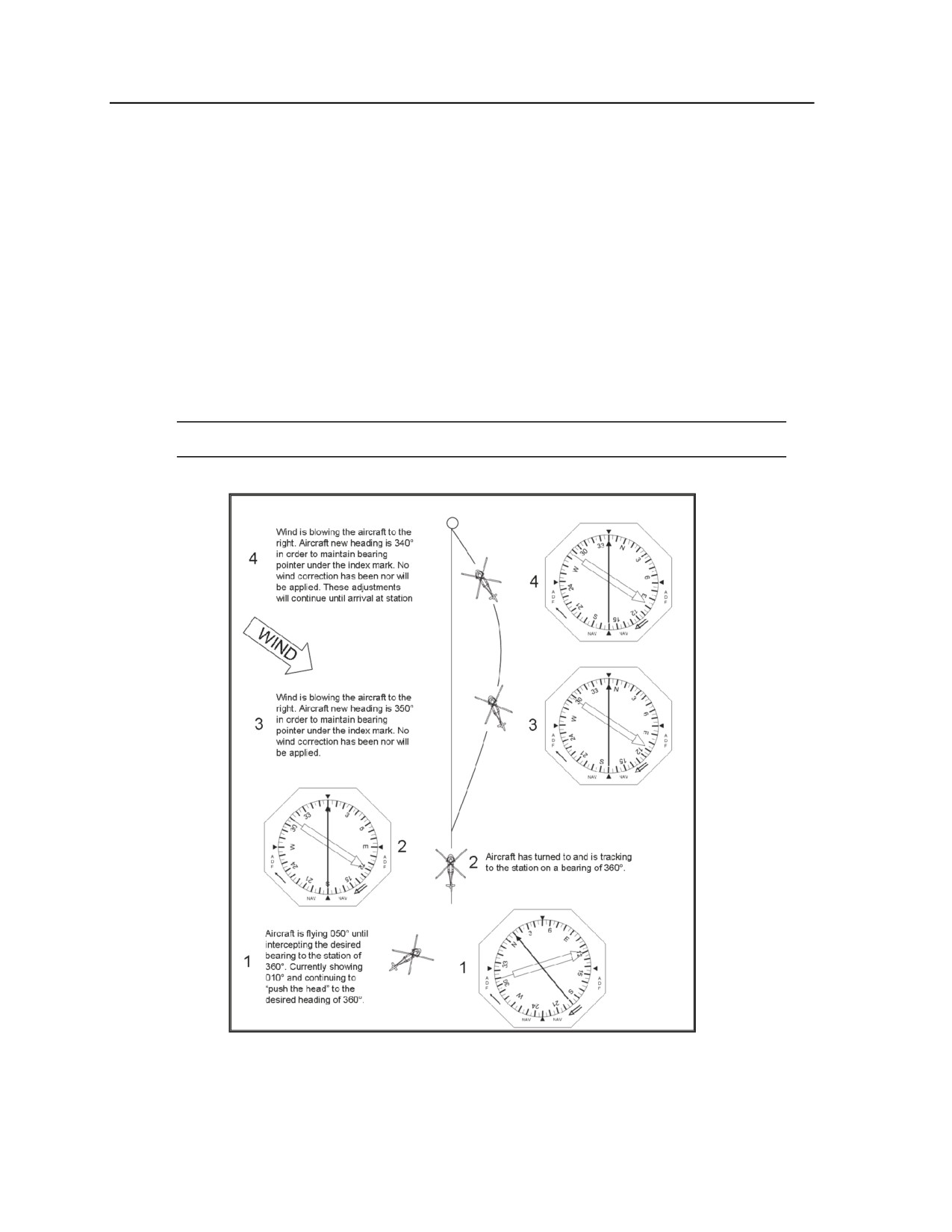
Chapter 7
MONITOR FOR WARNING FLAGS
7-85. Monitor the course warning flag (if installed) or aural or alphanumeric display continuously to
ensure adequate signal reception strength.
CHECK
7-86. Check the appropriate instrument indicators for proper operation.
HOMING TO A STATION
7-87. Tune and identify the station. Turn the aircraft in the shorter direction to place the head of the
bearing pointer under the top index of the RMI or upper lubber line of the HSI. Adjust aircraft heading, as
necessary, to keep the bearing pointer under the top index or upper lubber line. Because homing does not
incorporate wind-drift correction, in a crosswind, the aircraft follows a curved path to the station (Figure
7-3). Therefore, homing should be used only when maintaining course is not required.
Note. The online version of this manual contains a video clip of the procedure in Figure 7-3.
Figure 7-3. Homing to a station
7-16
FM 3-04.240
30 April 2007
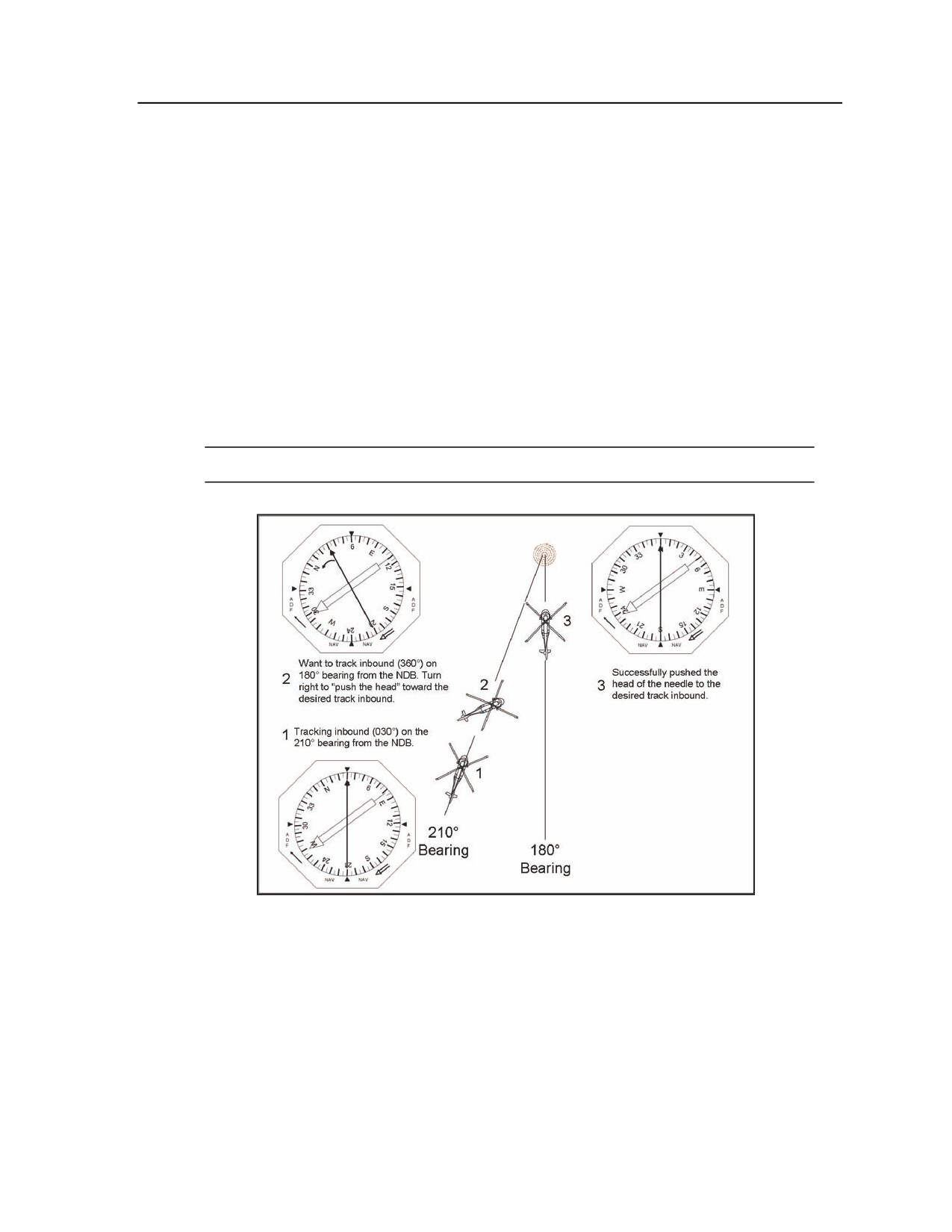
Navigation Aids
TRACKING TO A STATION
PUSH THE HEAD, PULL THE TAIL
7-88. This is one of several techniques that may be used to achieve a desired track to a selected
bearing/radial. Push the head towards the desired bearing/radial, and pull the tail towards the desired
bearing/radial. This phrase states the method to obtain the intercept of a desired bearing or radial of a
navigation aid. The application is shown below.
Push the Head
7-89. Figure 7-4 illustrates tracking to a station using the ADF/VOR needle. If the aircraft is flying toward
the navigation aid, look at the heading. Then look at the head of the ADF/VOR needle. If the head of the
needle is right of the desired heading, turn right until past the head of the needle. The aviator should
continue flying on a course that is slightly right of the needle. The needle will be pushed to the left, back
toward the desired on-course bearing. When the ADF/VOR needle is pointing toward the desired heading,
the pilot can resume the desired heading.
Note. The online version of this manual contains a video clip of the procedure in Figure 7-4.
Figure 7-4. Push the head
Pull the Tail
7-90. Figure 7-5, page 7-18, illustrates tracking from a station using the ADF/VOR needle. If the aircraft is
flying away from the navigation aid, look at the heading. Then look at the tail of the ADF/VOR needle. If
the tail of the needle is left of the desired heading, turn right to pull the tail right. When the tail of the
ADF/VOR needle is pointing toward the desired bearing from the station, the pilot can resume the desired
heading.
30 April 2007
FM 3-04.240
7-17