FM 3-04.240 Instrument Flight for Army Aviators (April 2007) - page 7
Chapter 10
Example of CTAF Call
“Folsom Field traffic, Army 12345, white Cessna King—Air, 5 miles north on the straight-in GPS Runway
20, touch and go, Folsom Field.”
Approach Control Present
10-140. Radar approved for approach control service is used to provide vectors with published IAPs.
Radar vectors provide course guidance and expedite traffic to the final approach course of any established
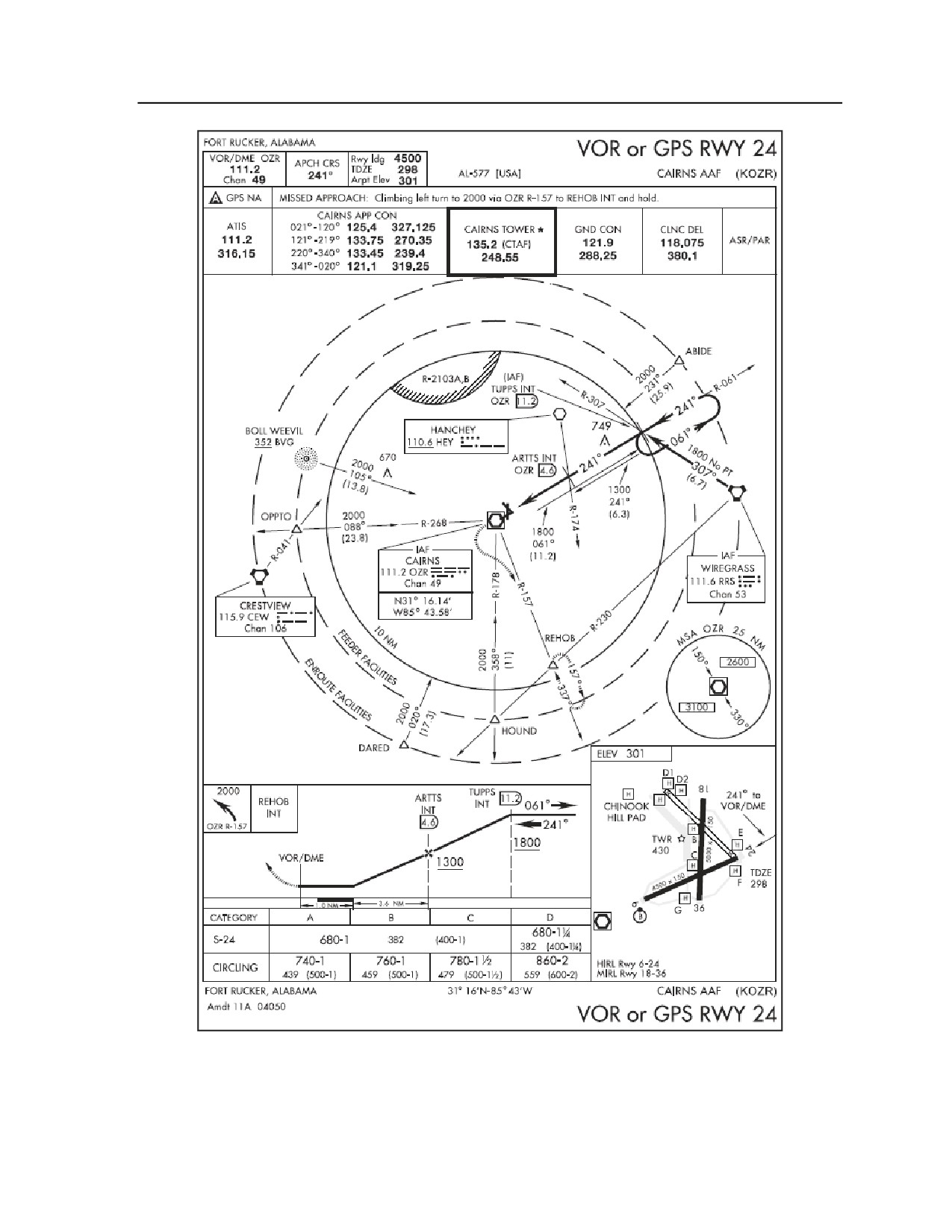
IAP. Figure 10-13, page 10-33, shows an IAP chart with maximum ATC facilities available. Approach
control facilities provide radar services and clear arriving aircraft to an outer fix most appropriate to the
route being flown with vertical separation. If required, approach control facilities also issue holding
information. If radar handoffs are effected between ARTCC and approach control or between two
approach control facilities, aircraft are cleared to the airport or to a fix located so that the handoff is
completed before the time that the aircraft reaches the fix. When radar handoffs are used, successive
arriving flights may be handed off to approach control with radar separation in lieu of vertical separation.
After handoff to approach control, aircraft are vectored to the appropriate final-approach course. Radar
vectors and altitude/flight levels are issued, as required, for spacing and separating aircraft; therefore,
aircraft must not deviate from headings issued by approach control.
10-141. Normally, an aviator is informed when necessary to vector the aircraft across the final-approach
course. When the determined approach course crossing is imminent and the aviator has not been informed,
the controller should be questioned. Do not turn inbound on the course unless approach control issues a
clearance. The clearance includes the final vector for interception of the final approach course allowing the
aircraft to establish this course before reaching the FAF. If the aircraft is already inbound, the aviator is
issued clearance before reaching the FAF. After the flight is established inbound on the final approach
course, radar separation is maintained with other aircraft. The aircraft is expected to complete the approach
using the NAVAID designated in the clearance (ILS, VOR, NDB, or GPS) as the primary means of
navigation. After passing the FAF inbound, proceed direct to the airport and complete the approach or
execute the published missed approach procedure. Radar service is automatically terminated when the
landing is complete or the tower controller has the aircraft in sight, whichever occurs first.
LOW-ALTITUDE APPROACHES
10-142. Low-altitude approaches are used for aircraft to make the transition from a low-altitude
environment to final approach for landing. Low-altitude IAPs assist in guiding aircraft to the FAF on
course, on altitude, and in final-approach configuration. ATC usually provides radar vectors to final;
however, be prepared to execute the full procedure when appropriate. The two broad categories of
low-altitude approaches are course reversals and procedure tracks. Before reviewing each type in detail,
listed below are guidelines applying to low-altitude approaches.
INITIAL-APPROACH FIX
10-143. Most approaches begin at an IAF. ATC normally clears the aircraft to the appropriate IAF and
then for the approach. Unless ATC specifically clears the aircraft otherwise, the aircraft is expected to fly
to the IAF and execute the full IAP as published.
FINAL-APPROACH SEGMENT
10-144. Some approaches depict only a final-approach segment starting at the FAF. In these cases, radar is
required to ensure proper alignment with the final-approach course at the appropriate altitude. When ATC
clears for the approach, maintain the last assigned altitude until established on a segment of the published
IAP.
10-32
FM 3-04.240
30 April 2007
Instrument Flight Rules Information and Procedures
Figure 10-13. Instrument approach procedure chart with maximum air traffic control facilities
available
30 April 2007
FM 3-04.240
10-33
Chapter 10
ESTABLISHED ON COURSE
10-145. Established on course is defined as being within that instrument maneuver course standard as
specified within the aircraft specific ATM. For example, a UH-60 aviator would be considered established
on course when within 2.5 degrees of course centerline IAW TC 1-237, Task 1178, Standard number 2.
For an instrument landing system (ILS) approach, intercept and maintain the localizer course within 2.5
degrees of course centerline (two dots on the horizontal situation indicator [HSI]).
COURSE REVERSALS
10-146. The two common types of course reversals are the PT and the holding in lieu of procedure turn.
Do not execute either procedure in the following situations:
When ATC gives clearance for a straight-in approach.
When flying the approach via No PT routing.
When the aircraft is established in holding and subsequently cleared for the approach and the
holding course and procedure turn course are the same.
When ATC provides radar vectors to the final-approach course.
When ATC clears the aircraft for a timed approach (when the aircraft is established in a holding
pattern and the aviator is given a time to depart the FAF inbound).
10-147. In any of the previous bulleted situations, proceed over the FAF at the published FAF altitude.
Continue inbound on the final approach course without making a procedure turn, holding pattern, or any
other aligning maneuver until the aircraft reaches the FAF unless otherwise cleared by ATC. If necessary
to make additional circuits in a published holding pattern or to become better established on course before
departing the FAF, it is the aviator’s responsibility to request such maneuvering from ATC. Historically,
these restrictions have created confusion between aviators and controllers. If ever in doubt about what
ATC expects, query the controller.
PROCEDURE TURN
10-148. One of the most common types of low-altitude course reversals is the procedure turn. Procedure
turns are depicted in the plan view of U.S. Government charts with a barb symbol (
), indicating the
direction or side of the outbound course on which the procedure turn or maneuvering is to be
accomplished. The absence of the procedure-turn barbed arrow in the plan view indicates that a procedure
turn is not authorized for that procedure. The procedure-turn fix is identified on the profile view of the
approach at the point where the IAP begins. The FAA recommends a maximum airspeed of 200 KIAS
during procedure-turn course reversals. Four common techniques for executing a procedure turn (course
reversal) are the following:
Teardrop pattern.
Standard 45-degree turn (45/180).
The 80/260 course reversal.
Holding/racetrack pattern (see standard holding pattern above).
10-149. The outbound course direction of turn, distance within which the turn must be completed, and
minimum altitude are specified in the procedure. However, the point at which the turn may be commenced
and the type and rate of turn are left to the discretion of the aviator.
10-150. Regardless of the method chosen, plan the outbound leg to allow enough time for configuration
and any descent required before the aircraft arrives at the FAF. Ensure that the outbound leg length is
adjusted so that the flight stays inside the “remain within distance” noted on the profile view of the
approach plate. Remain-within distance is measured from the procedure turn fix unless the IAP specifies
otherwise. Turn to intercept the procedure-turn course inbound at the completion of the outbound leg.
10-151. When the NAVAID is on the field and no FAF is depicted, plan the outbound leg so that the
descent to MDA can be completed with sufficient time to acquire the runway and position the aircraft for a
10-34
FM 3-04.240
30 April 2007
Instrument Flight Rules Information and Procedures
normal landing. Consideration should be given to configuring on the outbound leg to minimize aviator
tasking on final approach. When flying this type of approach, the aviator can consider the FAF to be the
descent point from the procedure-turn completion altitude. Establish approach configuration and airspeed
before departing procedure-turn completion altitude unless the aircraft operator’s manual procedures
require otherwise.
10-152. Begin timing once the aircraft is outbound abeam the procedure turn fix. If the abeam position
cannot be determine while in the turn, start timing after completing the outbound turn. Fly one to three
minutes for the outbound leg. Do not descend from the procedure-turn fix altitude (published or assigned)
until the aircraft is abeam the procedure-turn fix heading outbound. If determining when the aircraft is
abeam is not possible, start descent after completing the outbound turn. Do not descend from the procedure
turn completion altitude until the flight is established on the inbound segment of the approach.
Teardrop Pattern
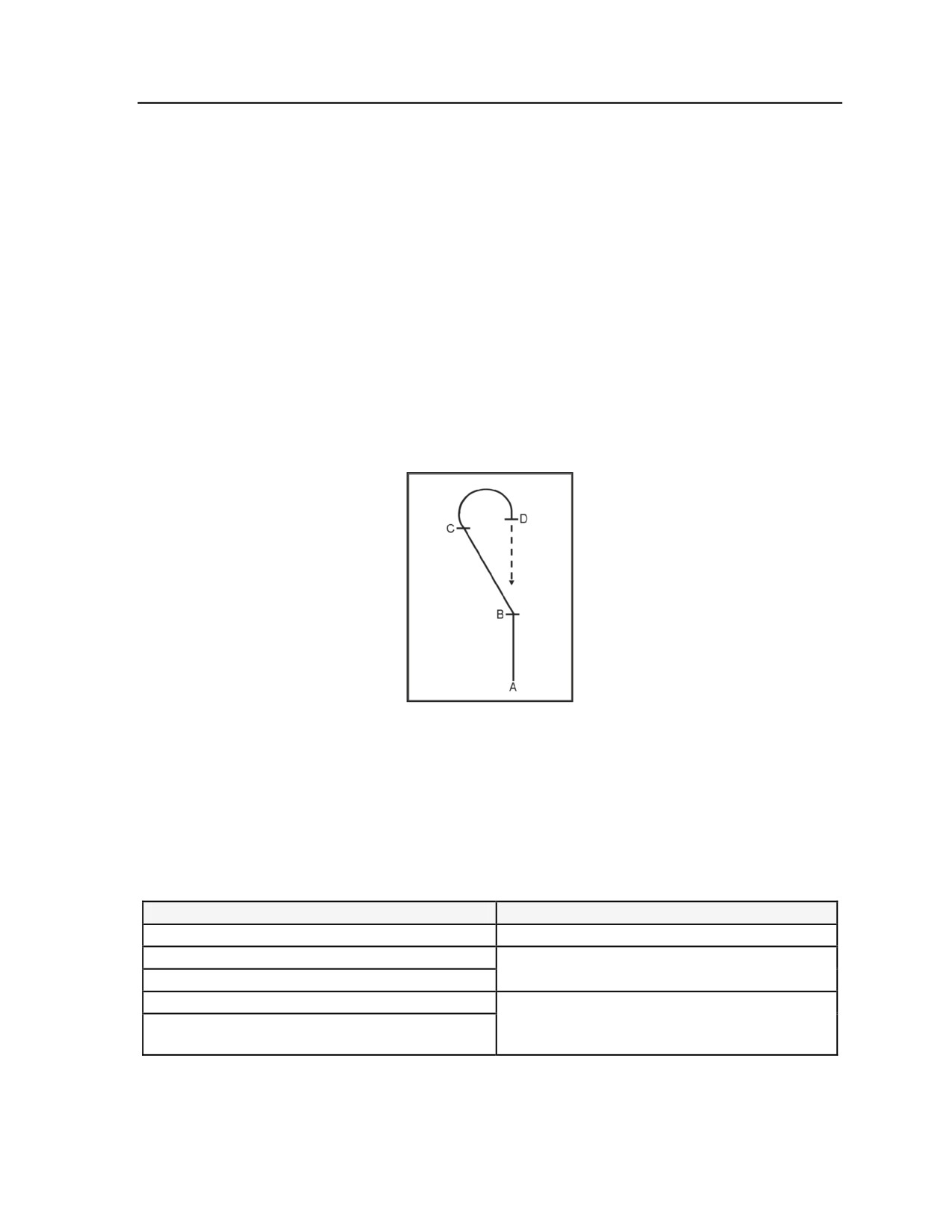
10-153. For the teardrop entry, start timing at A for two minutes from A to B (Figure 10-14). Reduce
airspeed to holding speed in this interval. At B, enter standard-rate turn for a 30-degree change of heading.
Time is one minute from B to C. At C, enter standard-rate turn for a 210-degree change of heading, rolling
out on the reciprocal of the original entry heading.
Figure 10-14. Teardrop pattern
Standard 45-Degree Turn (45/180) and 80/260 Course Reversal
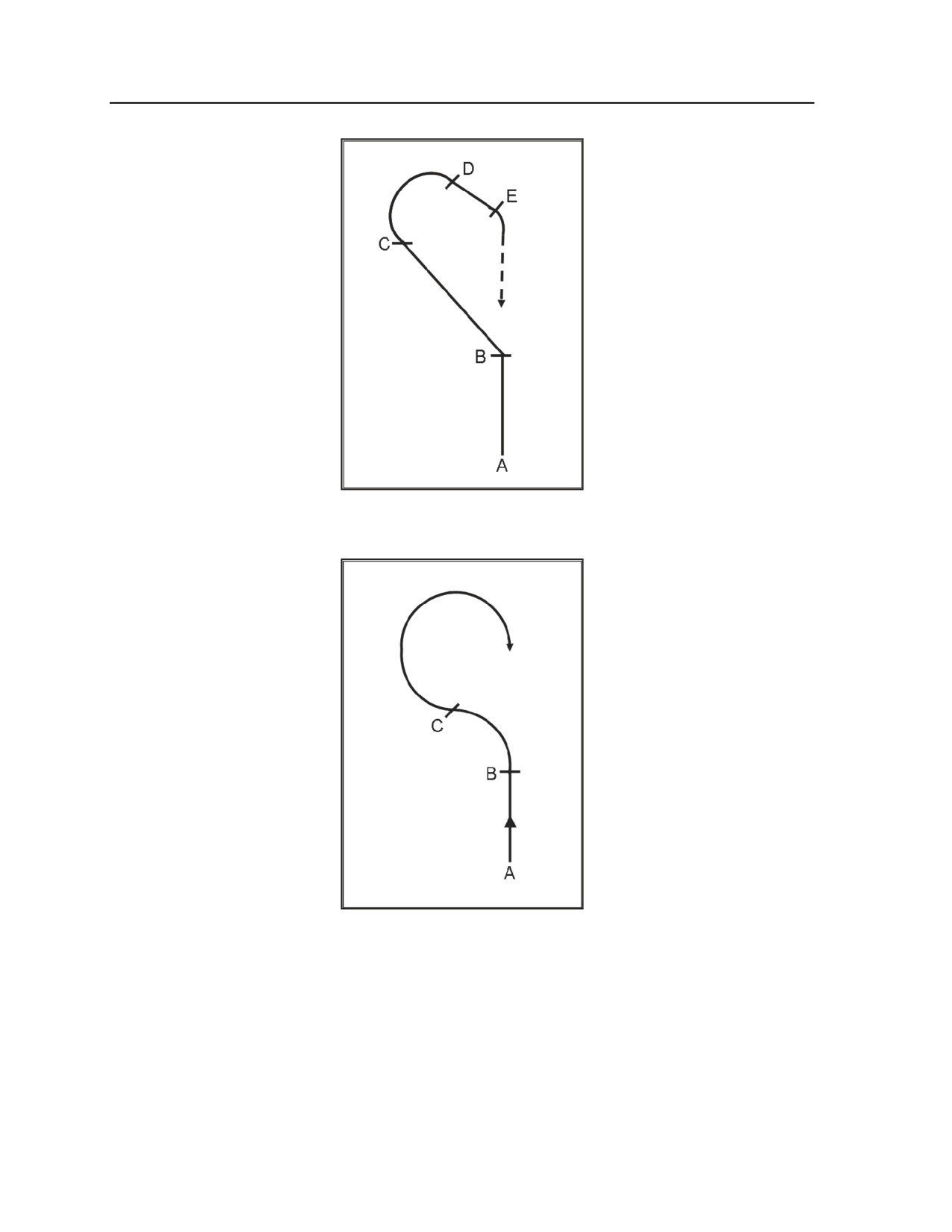
10-154. Two other methods used to accomplish a procedure turn approach are the 45/180 (Figure 10-15,
page 10-36) and 80/260 (Figure 10-16, page 10-36) course reversal maneuvers (table 10-4). Procedures for
flying each maneuver are identical with the exception of the actual course reversal.
Table 10-4. Course reversal steps
45/180 course reversal
80/260 course reversal
Start timing at A for 2 minutes from A to B (Figure 10-15).
Start timing at A for 2 minutes from A to B (Figure 10-16).
At B, turn 45° (standard rate). After roll-out, fly 1 minute to C.
At B, enter a left standard-rate turn for a heading change
of 80°.
At C, turn 180°.
At completion of turn, time 45 seconds from D to E.
At the completion of the 80° turn at C, immediately turn
right for a heading change of 260°, rolling out on the
Start turn at E for a 45° change of heading to reciprocal of
reciprocal of the entry heading.
heading at beginning of maneuver.
10-155.
10-156.
30 April 2007
FM 3-04.240
10-35
Chapter 10
Figure 10-15. 45/180 procedure turn
Figure 10-16. 80/260 procedure turn
10-157. Upon reaching the procedure-turn fix, turn in the shortest direction to intercept the procedure-turn
course outbound. Intercept and maintain the course outbound as soon as possible after passing the
procedure-turn fix. Do not descend from the fix altitude (published or assigned) until abeam the fix and on
a parallel or intercept heading to the outbound track. Do not descend from the procedure-turn completion
altitude until the aircraft is established on the inbound segment of the approach. At the appropriate time on
the outbound leg, begin the course-reversal maneuver. In both cases, comply with the published
remain-within distance.
10-36
FM 3-04.240
30 April 2007
Instrument Flight Rules Information and Procedures
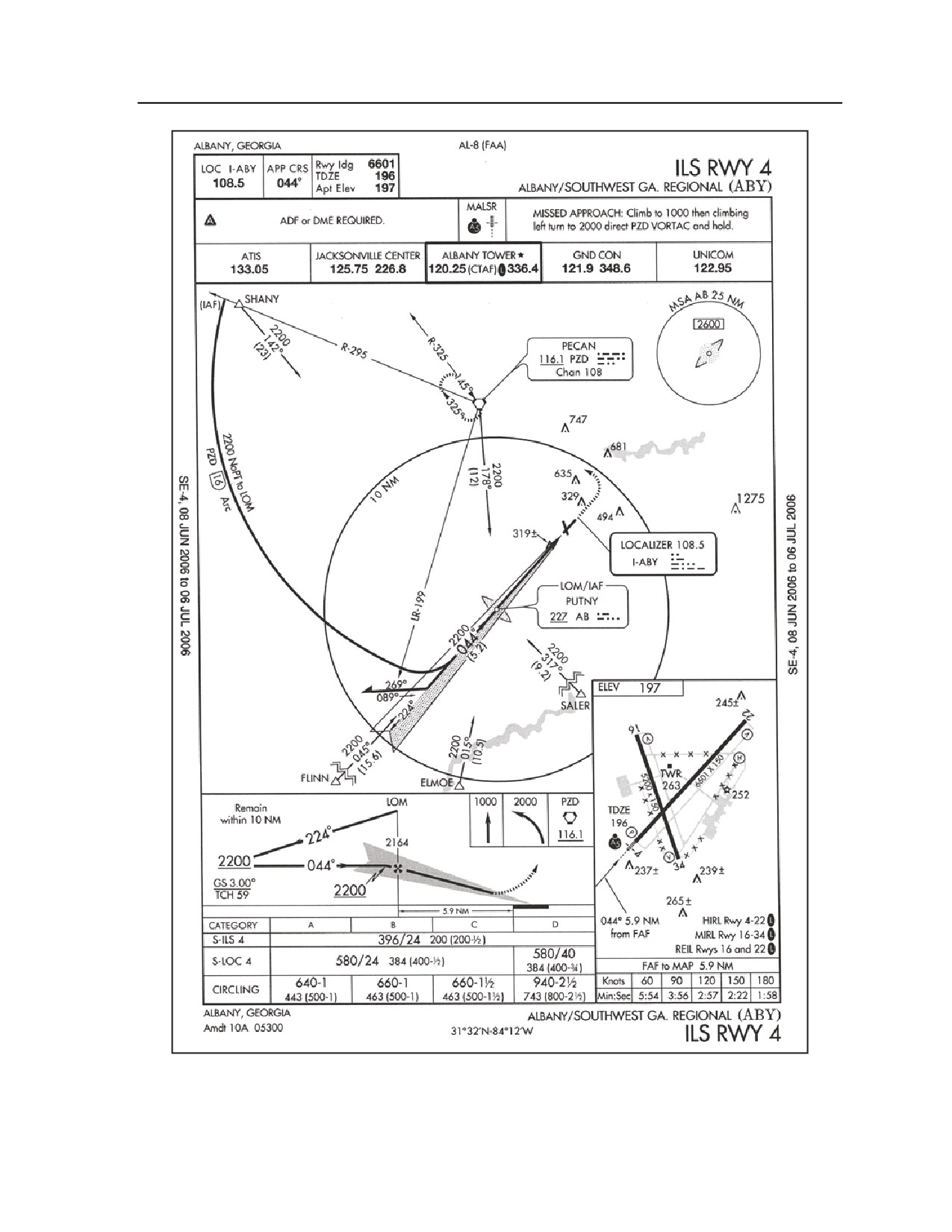
Note. When flying procedure turns designed in FAA airspace, the aviator is not required to wait
until the aircraft is on a parallel or intercept heading to begin descent from the procedure turn fix
altitude; however, when the aviator flies these types of course reversals in ICAO airspace, this
procedure is mandatory because of different TERPS criteria.
HOLDING IN LIEU OF PROCEDURE TURN
10-158. Holding in lieu of procedure turn is another common way to execute a low-altitude course
reversal. Holding in lieu of procedure turn is depicted like any other holding pattern except the holding
pattern track is printed with a heavy black line (
) in the plan view. The depiction of the
approach in the profile view varies, depending on where descent should begin. Enter and fly the holding in
lieu of procedure turn according to procedures previously described.
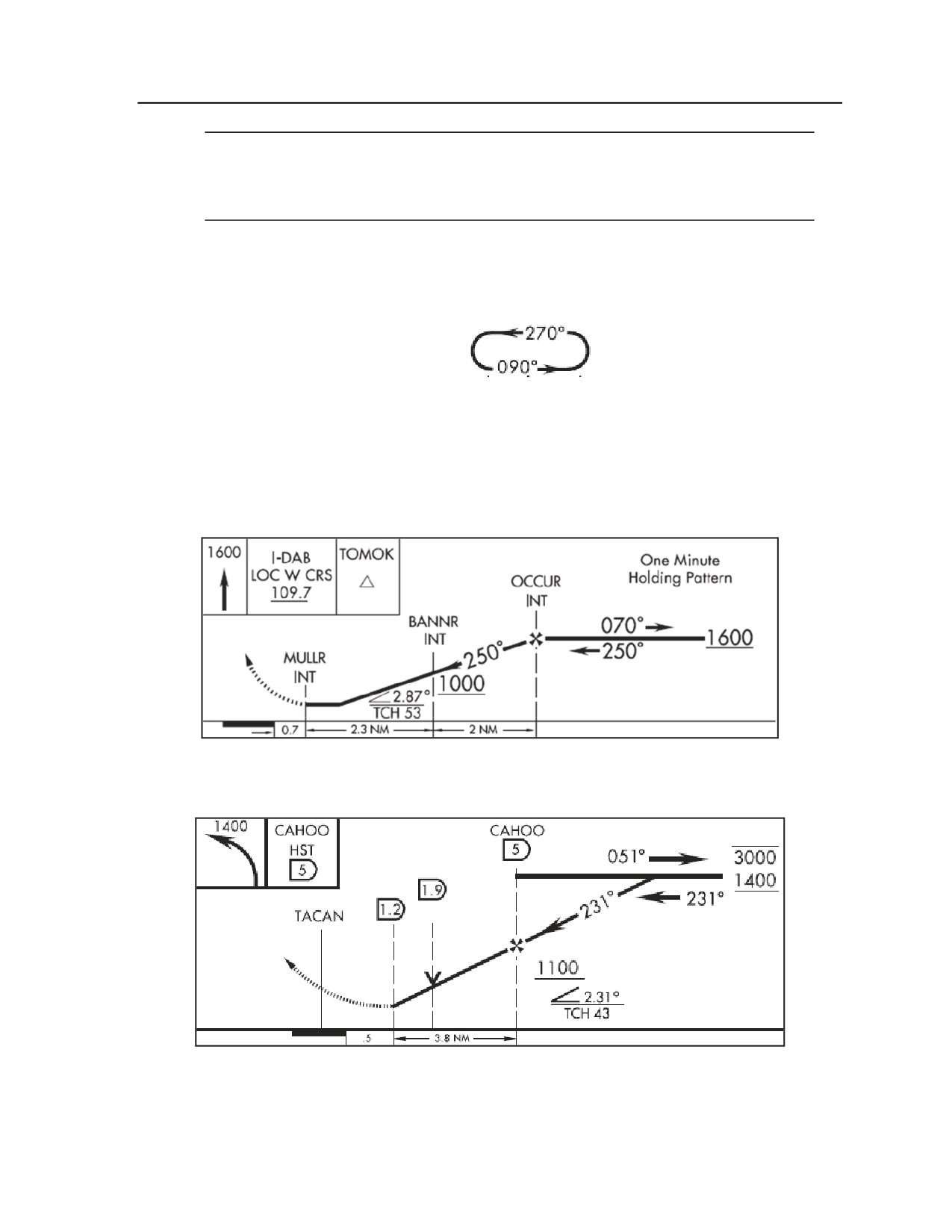
10-159. Descent from the minimum holding altitude is depicted two ways: descent at the holding fix
(Figure 10-17) or descent on the inbound leg (Figure 10-18). When a descent is depicted on the inbound
leg, the aircraft must be established on the inbound segment of the approach before the aviator begins the
descent.
Figure 10-17. Descent at the holding fix
Figure 10-18. Descent on the inbound leg
30 April 2007
FM 3-04.240
10-37
Chapter 10
10-160. If cleared for the approach while holding in a published holding in lieu of procedure turn,
complete the holding pattern and commence the approach without making additional turns in the holding
pattern (altitude permitting). If an additional turn is needed to lose excessive altitude, request clearance
from ATC because additional circuits of the holding pattern are not expected by ATC. If the aircraft is at
an altitude from which the approach can be safely executed and the aviator is ready to turn inbound
immediately, he may request approval for an early turn from ATC.
PROCEDURAL TRACKS
10-161. There is no specific depiction for a procedural track, and it may employ arcs, radials, courses, or
turns. When a specific flight path is required, procedural track symbology is used to depict the flight path
between the IAF and FAF. The depiction, a heavy black line, shows the intended aircraft ground track
(Figure 10-19, page 10-39).
10-162. When over the IAF, turn immediately in the shorter direction to intercept the published track. If
the heading is within 90 degrees of the procedure track course, use normal lead points to intercept the
course. If the heading is not within 90 degrees of the course, overfly the fix and turn in the shorter direction
to intercept the procedure track course.
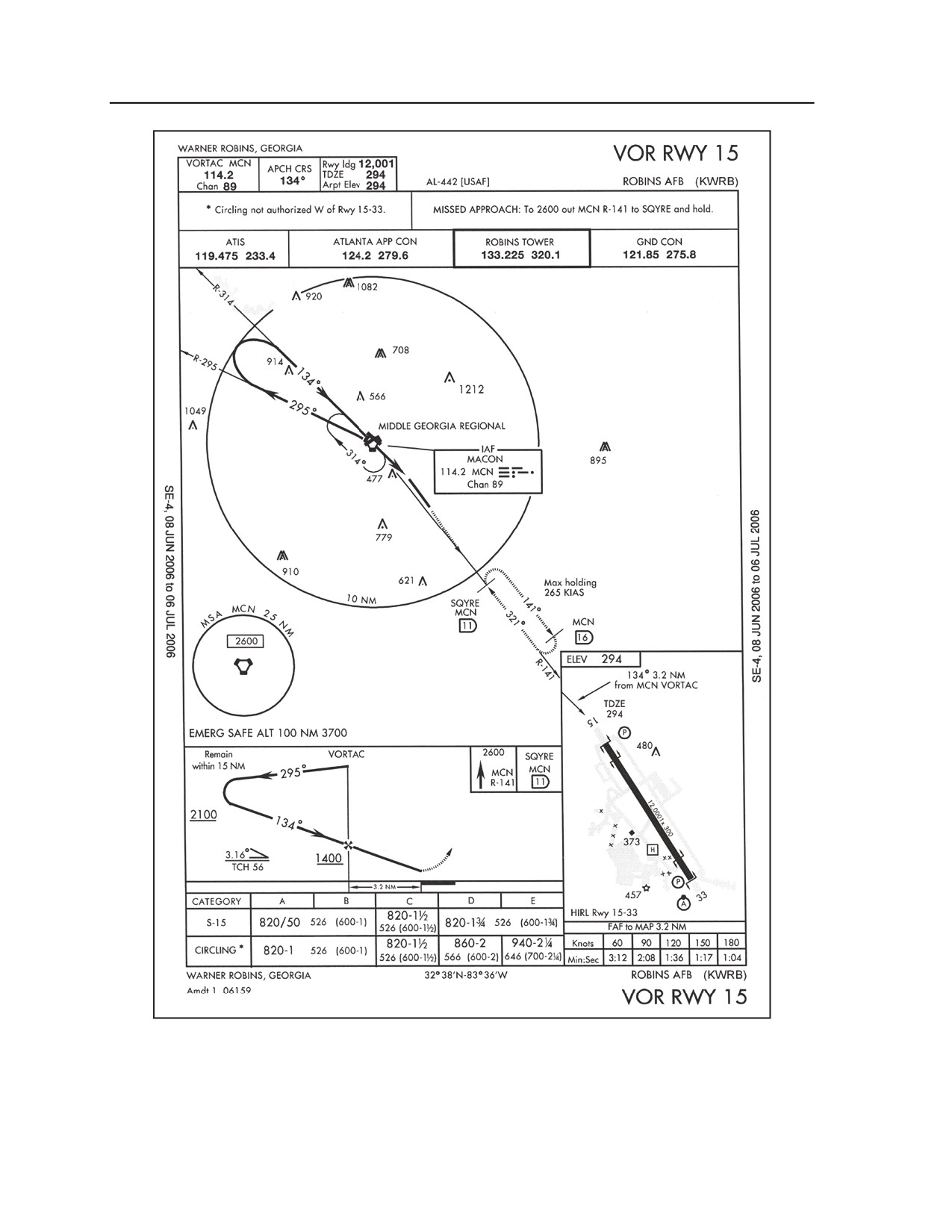
10-163. Conform to the specific ground track shown on the IAP. Where a teardrop turn is depicted, turn to
the inbound course at any time unless otherwise restricted by the approach plate (Figure 10-20, page 10
40). Determine when to turn by using aircraft turn performance, winds, and the amount of descent required
on the inbound course; however, do not exceed the published remain-within distance.
10-164. A descent can be depicted at any point along the procedural track. When the descent is depicted at
the IAF, start descent when abeam or past the IAF and on a parallel or intercept heading to the procedural
track course. Except for initial descents at an IAF, be established on the appropriate segment of the
procedural track before descending to the next altitude shown on the IAP.
10-165. Low-altitude approaches may include arc-to-radial and radial-to-arc combinations. An arc-to
radial altitude restriction applies only while the aircraft is established on that segment of the IAP. Once a
lead point is reached and a turn to the next segment is begun, consider the aircraft established on the next
segment and descend to the next applicable altitude. When an altitude restriction is depicted at a fix defined
as an intersection of a radial and an arc, the restriction must be complied with no later than the completion
of the lead turn associated with that fix. If the restriction is met during the lead turn, consider the aircraft
established on the next segment and continue to descend to the next applicable altitude restriction.
10-166. Maximum designed obstacle clearance is based on the ability to maintain the course centerline; use
position orientation and judgment to determine when to descend while attempting to intercept the
procedural track. Where a teardrop is depicted, do not descend from the turn altitude until established on
the inbound segment of the procedural track.
HIGH-ALTITUDE APPROACH
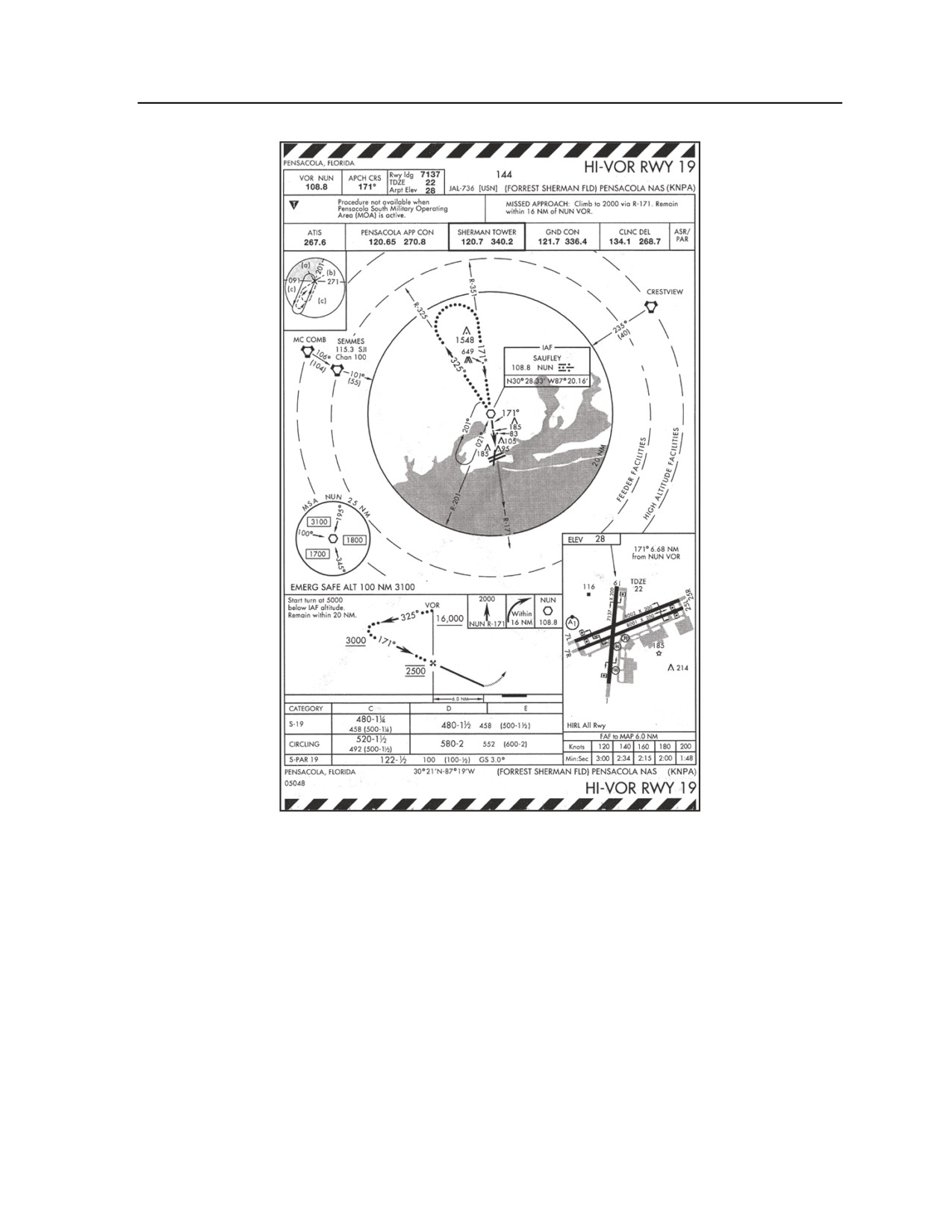
10-167. An en route descent or high-altitude instrument approach (Figure 10-21, page 10-41) enables an
aircraft to make the transition from a high-altitude structure to a position on and aligned with an inbound
course to the FAF, at FAF altitude in the final approach configuration. ATC will issue clearance for a
specific type of approach; omission of the clearance indicates that any published instrument approach may
be used. Unless ATC provides an appropriate clearance to deviate, fly the entire instrument approach
procedure starting at the IAF.
10-168.
10-38
FM 3-04.240
30 April 2007
Instrument Flight Rules Information and Procedures
Figure 10-19. Procedural track approach—arcing final
30 April 2007
FM 3-04.240
10-39
Chapter 10
Figure 10-20. Procedural track approach—teardrop turn
10-40
FM 3-04.240
30 April 2007
Instrument Flight Rules Information and Procedures
Figure 10-21. High-altitude instrument approach plate
NON-DISTANCE MEASURING EQUIPMENT TEARDROP APPROACHES
10-169. Teardrop approaches are usually associated with VOR or NDB facilities.
Station Passage
10-170. When station passage occurs at the IAF, turn immediately in the shorter direction toward the
outbound course and attempt to intercept. Begin descent when the aircraft is established on a parallel or
intercept heading to the approach course and outbound from the IAF. When arriving at the IAF at an
altitude below that published, maintain altitude and proceed outbound 15 seconds for each 1,000 feet that
the aircraft is below the published altitude before starting the descent. When arriving at an altitude above
that published, the aviator should descend to the published IAF altitude before starting the approach. If
descent is required at the IAF, obtain clearance to descend in a holding pattern. Set the altimeter according
to FLIP.
30 April 2007
FM 3-04.240
10-41
Chapter 10
Note. Use a descent gradient of 800 to 1,000 feet/nautical miles (8 to 10 degrees) to ensure that
the aircraft remains within protected airspace.
Fly Off
10-171. Some approaches use a fly-off (altitude or range) restriction before the aircraft starts descent.
Attempt to intercept the outbound course and comply with altitudes depicted on the approach chart unless
otherwise instructed by ATC. Because the aviator cannot be expected to determine accurate ground speed
during a constantly changing true airspeed descent, depicted range restrictions should not be shown on
non-DME teardrop high-altitude approaches. Penetration turns are annotated “left or right turn at
(altitude).” When a penetration-turn altitude is not published, start the turn after descending one-half the
total altitude between the IAF and FAF altitudes. One technique to determine the start-turn altitude is to
add the IAF and FAF altitudes and divide by two. Before reaching the penetration-turn altitude, set up the
navigation equipment to intercept the published inbound approach course. Recheck the altimeter and the
direction of the penetration turn.
Penetration Turn
10-172. Fly the penetration turn in the direction published. A 30-degree bank angle is used during the
penetration turn; however, bank may be shallower if undershooting course. If it is apparent that the aircraft
will undershoot the inbound penetration course, roll out on an intercept heading. Use normal inbound
course interception procedures to intercept the course.
Note. If a penetration-turn completion altitude is depicted, do not descend below depicted the
altitude until the aircraft is established on the inbound segment of the published approach
procedure. Obstacle clearance is based on attempting to maintain course centerline; an aviator
must use position orientation and judgment to determine when to descend while attempting to
intercept the course.
Descent
10-173. Continue descent to FAF altitude. Establish approach configuration and airspeed before reaching
the final approach fix unless the aircraft operator’s manual procedures require otherwise.
RADIAL APPROACHES
10-174. Radial approaches are associated with TACAN or VORTAC facilities. The entire approach track
is formed by one or more radials.
Crossing the Initial Approach Fix
10-175. When over the IAF, turn immediately in the shorter direction toward the approach course.
Intercept the published approach course using appropriate course-intercept procedures. When the heading
is within 90 degrees of the approach course, the aviator is not required to overfly the IAF and may use
normal lead points to intercept the course.
Descent
10-176. Start descent when the aircraft is abeam or past the IAF on a parallel or intercept heading to the
approach course. For DME approaches, crossing the arc is considered abeam the IAF. Intercept the course
and comply with altitudes depicted on the approach chart. Aircraft configuration and airspeed requirements
before the aircraft reaches the FAF are the same as non-DME teardrop.
10-42
FM 3-04.240
30 April 2007
Instrument Flight Rules Information and Procedures
RADIAL AND ARC COMBINATION APPROACHES
10-177. Flight procedures are the same for both radial and arc combination approaches when using an arc
intercept. However, if established in a holding pattern and the IAF is located on an arc or a radial at a
distance less than required for a normal lead point, the aviator may turn early to intercept the arc. Start
descent when the aircraft is established on an intercept to the arc and abeam or past the IAF in relation to
the initial approach track. Aircraft configuration and airspeed requirements before the aircraft reaches the
FAF are the same as the non-DME teardrop. An arc or radial altitude restriction only applies while the
aircraft is established on that segment of the approach to which the altitude restriction applies. Once a lead
point is reached and a turn to the next segment is initiated, the aviator may descend to the next applicable
altitude restriction. These restrictions may be especially important to facilitate a reasonable rate of descent
to FAF altitude.
Note. When an altitude restriction is depicted at a fix defined as an intersection of a radial and
an arc, the restriction must be complied with no later than the completion of the lead turn
associated with that fix. If the restriction is met during the lead turn, consider the aircraft
established on the next segment and continue to descend to the next applicable altitude
restriction.
MULTIPLE FACILITY APPROACHES
10-178. The multiple facility type approach uses a combination of two or more VORs, NDB, and TACANs
to provide the track. Approach entry procedures are the same as prescribed for non-DME teardrop
approaches. The entire approach must be flown as depicted to comply with all course and altitude
restrictions. Aircraft configuration and airspeed requirements before the aircraft reaches the FAF are the
same as for non-DME teardrop approaches.
FINAL APPROACH
10-179. There are numerous types of differing final-approach guidance. In this chapter, final-approach
guidance is categorized as nonradar approaches, radar approaches, and procedures with a visual
component.
NONRADAR APPROACHES
Nonprecision
10-180. Nonprecision, nonradar approaches include VOR, TACAN, and NDB. Other approaches include
VOR/DME, localizer, back course localizer, and GPS.
10-181. The final approach starts at the FAF and ends at the MAP. The optimum length of the final
approach is 5 miles; the maximum length is 10 miles. According to AR 95-1, dual VOR equipment
requirements specified on approach charts do not apply to Army aircraft. Off tuning from the approach aid
to identify an approach fix is authorized. Dual VOR approach minimums apply.
10-182. Nonprecision approach procedures published with an ILS cannot always clearly depict the FAF
crossing altitude. Carefully review the IAP using the following guidance. The minimum altitude to be
maintained until crossing the fix following the glide-slope intercept point (normally the FAF will be the
next fix) is the published glide-slope intercept altitude, altitude published at that fix, or ATC assigned
altitude. For most nonprecision approaches, the glide-slope intercept altitude is the minimum FAF crossing
altitude.
30 April 2007
FM 3-04.240
10-43
Chapter 10
Time
10-183. Avoid rapid descent requirements on final by crossing the FAF at the published altitude. Timing is
required when final approach does not terminate at a published fix as is the case with VOR, NDB, and
localizer. If timing is required for MAP identification, begin timing when passing the FAF or the starting
point designated in the timing block of the approach plate. This point is usually the FAF but may be a fix
not colocated with the FAF such as a LOM, NDB, crossing radial, DME fix, or outer marker. Time and
distance tables on the approach chart are based on ground speed; therefore, existing wind and TAS are
considered to accurately time final approach. If timing is published on the approach plate, such published
timing is a valuable backup in case of DME loss or other events precluding determination of the MAP; if
not, do not use timing to identify the MAP. If timing is not specifically depicted on the IAP, this is not an
authorized means of MAP identification. Timing is the least precise method for identification; therefore,
when it is not authorized for a particular approach because of TERPS considerations, timing information is
not published. If other means of identifying the MAP are published (DME), they become the primary
means to determine the MAP. When reaching the published DME depicting the MAP, do not delay in
executing the missed approach just because timing is not reached.
Minimum Descent Altitude
10-184. When a turn is required over the FAF, turn immediately and intercept the final-approach course to
ensure that obstruction clearance airspace is not exceeded. Do not descend to the MDA or step down fix
altitude until passing the FAF, if published.
Visual Descent Point
10-185. Arrive at MDA with enough time and distance remaining to identify the runway environment.
Depart MDA from a normal VDP to touch down at a rate normally used for a visual approach in the
aircraft.
Runway Environment
10-186. Descent below MDA is not authorized until sufficient visual reference with the runway
environment has been established and the aircraft is in a position to execute a safe landing. Thorough
preflight planning aids the aviator in locating the runway environment (lighting, final approach
displacement from runway). The definition of runway environment for nonprecision and precision
approaches is the same and consists of one or more of the following elements:
Approach light system—the aviator may not descend below 100 feet above the TDZE using
approach lights as a reference unless red termination bars or red side-row bars are visible and
identifiable.
Threshold, threshold markings, or threshold lights.
Runway end identifier lights.
Touchdown zone, touchdown zone markings, or touchdown zone lights.
Runway or runway markings, and runway lights.
Visual approach slope indicator.
Note. Most approach lighting systems serving runways where there is no electronic glide-path
guidance do not have red termination bars or red side row bars; therefore, one other element of
the runway environment must be sighted to descend below 100 feet above the TDZE.
Depending on the location of the MAP, descent from the MDA (once the runway environment is
sighted) has to be initiated before reaching the MAP to execute a normal (roughly 3 degrees)
descent to landing.
10-44
FM 3-04.240
30 April 2007
Instrument Flight Rules Information and Procedures
10-187. In many cases, the minimum visibility required for the approach will not permit viewing of the
runway environment until the aircraft is beyond the VDP, accentuating the need to compute a VDP and
determine a point along the approach when the aviator no longer attempts to land. A common error is to
establish a high descent rate once the runway environment is in sight. This descent rate can go unnoticed
during an approach without visual glide-path guidance and may lead to a short and/or hard landing.
Caution is used to avoid accepting a long touchdown and landing roll.
Alignment
10-188. The final approach course on a nonradar final may vary from the runway heading as much as 30
degrees and still be published as a straight-in approach. The exception is a localizer approach.
Step-Down Fix
10-189. A step-down fix between the FAF and missed approach point is sometimes used. According to AR
95-1, dual VOR equipment requirements specified on approach charts do not apply to Army aircraft. Off-
tuning from the approach aid to identify an approach fix is authorized. Dual VOR approach minimums
apply. Fixes requiring radar for identification are depicted with the word RADAR appearing next to the
fix. Only ground-based radar, such as airport surveillance, precision, or air route surveillance radar, is used
to position the aircraft.
GLOBAL POSITIONING SYSTEM APPROACH PROCEDURES
Receiver Autonomous Integrity Monitoring
10-190. If predictive RAIM is not available, another navigation and approach system must be used,
another destination selected, or the trip delayed until RAIM is predicted to be available on arrival. A
predictive RAIM check is accomplished before arrival to allow for crews to plan for an alternate means of
navigation. If a RAIM failure/status annunciation occurs before the final approach waypoint (FAWP), do
not commence the approach; coordinate for an alternate clearance.
10-191. If the receiver does not make the transition from armed to approach mode before the aircraft
reaches the FAWP (usually the transition occurs 2 nautical miles before), do not commence the approach.
If a RAIM failure/status annunciation occurs before the aircraft reaches the FAWP, do not descend to
MDA; instead, proceed to the missed approach waypoint (MAWP), via the FAWP, and perform a missed
approach. Contact ATC as soon as practical to coordinate for an alternate clearance.
10-192. If a RAIM failure occurs after the FAWP, the receiver, based on equipage, can continue operating
without an annunciation for up to five minutes to allow completion of the approach. Check the receiver
operator’s manual to ensure that the aircraft has this capability; if not and a RAIM flag/status annunciation
appears after the FAWP, climb to the missed approach altitude, proceed to the MAWP, and execute a
missed approach.
Flying the Approach
10-193. Do not fly the approach unless retrieved in its entirety from a current approved database.
Cross-check database waypoints against the published approach plate. If discrepancies exist, do not fly the
approach except when the FAWP altitude is raised above that shown on the published chart to ensure
adequate clearance at a step-down fix.
10-194. Before commencing the approach, determine which area of the TAA that the aircraft will enter,
using bearing and distance to the IF/IAF. Fly the full approach from an initial approach waypoint (IAWP)
or feeder fix unless specifically cleared otherwise. Entry from other than an IAWP does not assure terrain
clearance.
10-195. Some receivers automatically arm the approach mode, while others require manual arming.
Arming the approach mode switches the aircraft to terminal course deviation indicator scaling (+1 nautical
30 April 2007
FM 3-04.240
10-45
Chapter 10
mile). If the IAWP is beyond 30 nautical miles from the airfield, course deviation indicator sensitivity will
not change until the aircraft is within 30 nautical miles of the airport reference point. Feeder route obstacle
clearance is predicated on terminal sensitivity and RAIM at the IAWP. For manual systems, aircrews must
ensure that the approach is loaded before being established on any portion of the approach.
10-196. When within 2 nautical miles of the FAWP with the approach mode armed, the receiver
automatically initiates a RAIM check and switches to approach sensitivity and RAIM (0.3 nautical miles).
Distance is provided based on active WP. Aviators must cross-check the active WP identifier to ensure SA.
Some operations (such as holding course-reversal maneuvers) may require manual intervention to stop or
resume automatic waypoint sequencing. Ensure that the receiver is sequenced to the appropriate waypoint,
especially if not flying the full procedure. If the aircraft is on vectors to final approach, ensure that the
receiver is set according to flight manual procedures. Being established on the final-approach course before
initiation of the sensitivity change at 2 nautical miles from the FAWP aids aviators in course deviation
indicator interpretation before descent to MDA/DA. Requesting or accepting vectors that causes the
aircraft to intercept the final approach course within 2 nautical miles of the FAWP is not recommended.
When the aviator receives vectors to final approach, most receiver operating manuals suggest placing the
receiver in nonsequencing mode before the aircraft reaches the FAWP and setting the course manually.
This setting provides an extended final approach course when vectors place the aircraft outside of any
existing segment aligned with the runway. Maintain altitudes until established on a published segment of
the approach. Required altitudes at waypoints outside of the FAWP or step-down fixes are also considered.
10-197. Flying point to point on the approach does not assure compliance with published procedure;
proper RAIM sensitivity will not be available. The course deviation indicator sensitivity will not
automatically change to +0.3 nautical miles. Manually setting indicator sensitivity does not automatically
change RAIM sensitivity on some receivers.
10-198. Loss of final-approach guidance on an RNAV or a GPS approach procedure is annunciated
differently, depending on the particular avionics installation. In some aircraft, the CDI centers when the
“GPS Integrity” light illuminates and gives the illusion that the aircraft is on course. Ensure thorough
familiarity with aircraft failure annunciations, and discontinue approach immediately if course guidance is
questionable.
Final Approach
10-199. Do not descend to MDA, DA, or step-down fix altitude until passing the FAF. VNAV guidance
may be used to LNAV minimums; however, the aircraft must level off at the MDA if the runway
environment is not in sight. Because of temperature and pressure-altitude effects, aviators shall not use
VNAV guidance below published MDA or DA. Comply with step-down fixes depicted on the IAP. VNAV
guidance should provide clearance from all step-down fix altitudes; however, crews must monitor altitude
at step-down fixes to ensure compliance.
Missed Approach
10-200. To execute a missed approach, activate the missed approach after crossing the MAWP. GPS
missed approach procedures require aviator action to sequence from the MAWP to the missed approach
procedure. If the missed approach is not activated, the GPS receiver displays an extension of the inbound
final-approach course and displayed distance will increase from the MAWP. Do not activate the missed
approach before reaching the MAWP. Once the missed approach is activated, course deviation indicator
sensitivity is set to 1 nautical mile. Missed approach routings where the first track is via a course, rather
than direct to the next waypoint, require additional action from the aviator to set the course. Consult the
aircraft operator’s manual. Do not turn off the final-approach course before the aircraft crosses the MAWP.
INSTRUMENT LANDING SYSTEM
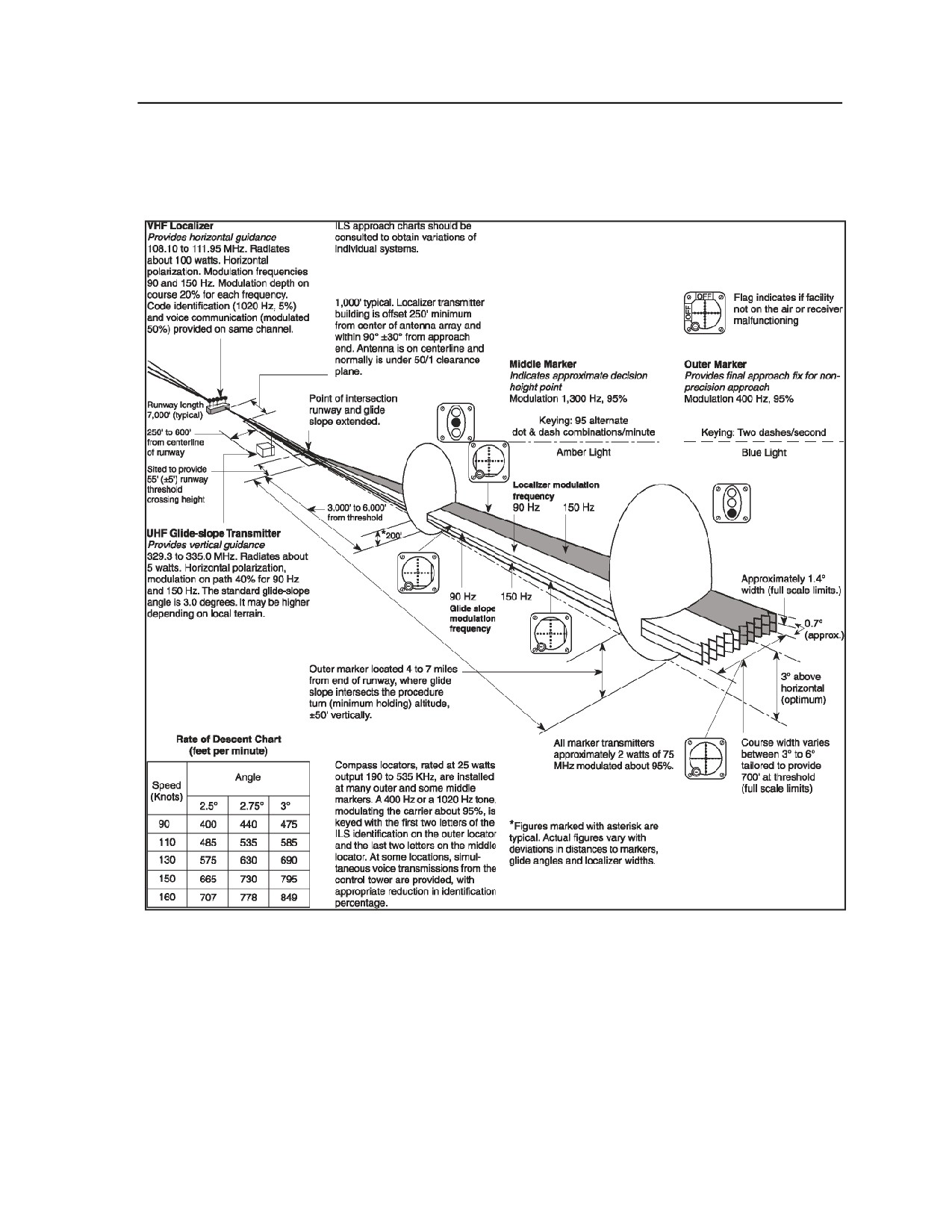
10-201. The ILS is a precision, nonradar approach. In the United States, the glide slope, localizer, and
outer marker are required components for an ILS (Figure 10-22, page 10-47). If the outer marker is
10-46
FM 3-04.240
30 April 2007
Instrument Flight Rules Information and Procedures
inoperative or not installed, it may be replaced by DME, another NAVAID, a crossing radial, or radar if
these substitutes are depicted on the approach plate or identified by NOTAM. If the glide slope fails or is
unavailable, the approach reverts to a nonprecision approach system. If the localizer fails, the procedure is
not authorized. If the OM or one of its substitutes is not available, the procedure is not authorized.
Figure 10-22. Instrument landing system
Transition to the Instrument Landing System Localizer Course
10-202. The transition to the instrument landing system localizer course is performed by using radar
vectors or a published approach procedure. First, tune the ILS, as soon as practical during the transition,
and monitor the identifier during the entire approach. Set the published localizer front course in the course
selector window before attempting localizer interception. If the aviators is using a flight director system or
flight management system, the switches are positioned according to instructions in the aircraft operator’s
manual for intercept and final-approach modes of operation. Normally, manual selection of the final
30 April 2007
FM 3-04.240
10-47
Chapter 10
approach mode is delayed until the aircraft heading is within 15 degrees of the localizer course and the
course deviation indicator is within one dot of center. Use any available navigation facility (TACAN) to
aid in remaining position oriented in relation to the localizer course and glide-slope intercept point. The
glide slope has a usable range of 10 miles.
Accomplishing the Approach
10-203. Once the localizer course is intercepted, reduce heading corrections as the aircraft continues
inbound. Heading changes made in increments of 5 degrees or less usually result in more precise course
control. When on the localizer course, maintain glide-slope intercept altitude (published or assigned) until
intercepting the glide slope. Published glide-slope intercept altitudes may be minimum, maximum,
mandatory, or recommended altitudes and are identified by a lightning bolt (
). When the glide-slope
intercept altitude is a recommended altitude, only comply with other IAP altitudes (FAF altitude for
example) until established on the glide slope. When on glide slope, cross-check the aircraft altitude with
the published glide-slope altitude at the outer marker/FAF to ensure that the aircraft is established on the
correct glide slope. Do not descend below a descent restrictive altitude (minimum or mandatory) if the
course deviation indicator indicates full-scale deflection. On approaches where the glide-slope altitude at
the outer marker/FAF is not published, use all means available to ensure that the aircraft is on the proper
glide slope and a normal descent rate is established. Airborne marker beacon receivers having a selective
sensitivity feature should operate in low-sensitivity position to ensure proper reception of ILS marker
beacons.
Using the Glide-Slope Indicator
10-204. Prepare to intercept the glide slope as the glide-slope indicator moves downward from its upper
limits. Determine the approximate rate of descent to maintain the glide slope. The vertical velocity required
depends on aircraft ground speed and ILS glide-slope angle. Slightly before the glide-slope indicator
reaches center position, coordinate pitch and power control adjustments to the desired rate of descent.
10-205. Pitch adjustments made in increments of 2 degrees or less usually result in more precise glide-path
control. As the approach progresses, smaller pitch and bank corrections are required for a given course or
glide-slope indicator deviation. During the latter part of the approach, pitch changes of 1 degree and
heading corrections of 5 degrees or less prevent overcontrolling.
Steering Commands
10-206. If using pitch and bank steering commands supplied by a flight director system, monitor flight-
path and aircraft performance instruments to ensure that the desired flight path is being flown and aircraft
performance is within acceptable limits. A dangerous error often occurs when the aviator is flying an ILS
approach on the flight director system: the aviator concentrates on the steering bars and ignores flight path
and aircraft performance instruments.
WARNING
Failure of the flight director computer (steering bars) may not
always be accompanied by the appearance of warning flags.
Cross-Check
10-207. Maintain a complete instrument cross-check throughout the approach, with increased emphasis on
the altimeter during the latter part. DA/DH is determined by the barometric altimeter. Establish a
systematic scan for the runway environment before reaching DA/DH.
10-48
FM 3-04.240
30 April 2007
Instrument Flight Rules Information and Procedures
Decision Altitude/Decision Height
10-208. DA/DH is the height at which a decision must be made during a precision approach to continue
the approach or execute a missed approach. Continued descent below DA/DH is not authorized until
sufficient visual reference with the runway environment has been established. A momentary deviation
below DA/DH without the runway environment in sight is only authorized with a proper missed approach
initiated at DA/DH.
RADAR APPROACHES
Precision and Surveillance Approaches
10-209. The two basic radar approaches are the PAR and ASR. The precision approach provides the
aviator with precise course, glide slope, and range information; the surveillance approach provides course
and range information and is classified as a nonprecision approach. Upon request, the controller provides
recommended altitudes on final approach to the last whole mile that is at or above the published MDA.
Recommended altitudes are computed from the start descent point to the runway threshold. At the MAP,
the straight-in surveillance system approach error may be as much as 500 feet from the runway edges.
Lost Communications
10-210. In preparation for radar approach, select a backup approach compatible with existing weather and
the aircraft, where available. Be prepared to fly this approach in case of radar failure or lost
communications. When experiencing lost communications, the aviator is automatically cleared to fly any
published approach unless the controller previously issued a specific lost-communications approach.
Attempt contact with the controlling agency if no transmissions are received for about one minute while
being vectored to final, 15 seconds while on final for ASR approach, and 5 seconds on final for PAR
approach.
Backup Approach
10-211. If unable to reestablish communications and maintain VFR, make the transition to backup
approach. Intercept the approach at the nearest point that allows a normal rate of descent without
compromising safety. Maintain the last assigned altitude or the minimum safe/sector altitude (emergency
safe altitude if more than 25 nautical miles from the facility), whichever is higher, until established on the
published approach.
No Backup Approach
10-212. If no backup approaches are compatible with the weather or the aircraft, the aviator advises the
controller, upon initial contact, of his intent in case of lost communications. If local conditions dictate, the
controller may specify the approach to fly when the aviator loses communications. The aviator is
responsible for determining the adequacy of any issued lost-communications instructions.
Voice Procedures
10-213. The radar approach is predicated on voice instructions from approach control or radar controller.
Repeat headings, altitudes (departing and assigned), and altimeter settings until the final controller advises
“do not acknowledge further transmissions.” During high-density radar operations, communication time is
limited. Keep transmissions brief and specific, commensurate with safety of flight. Do not sacrifice aircraft
control to acknowledge receipt of instructions.
30 April 2007
FM 3-04.240
10-49
Chapter 10
Making the Transition to Final
10-214. The transition to final segment of the approach includes all maneuvering up to a point where the
aircraft is inbound and about 8 nautical miles from touchdown. A dogleg to final is considered to be part of
the transition to final segment.
10-215. During the transition to final approach, the radar controller directs heading and altitude changes,
as required, to position the aircraft on final approach. Turns and descents should be initiated immediately
after instructed. Perform turns by establishing a bank angle on the attitude indicator, which approximates a
standard rate turn for the TAS flown but does not exceed 30 degrees of bank. When aircraft or mission
characteristics dictate low turn rates, inform the controller; he can assist in clarifying lead points for turns
or corrections.
10-216. Weather information issued by the radar controller includes altimeter setting, ceiling, and
visibility. The controller is required to issue ceiling and visibility only when the ceiling is below 1,500 feet
(1,000 feet at civil airports) or below the highest circling minimum, whichever is greater, or if the visibility
is less than 3 miles. The controller furnishes pertinent information on known field conditions considered
necessary for safe aircraft operation. Request additional information, as necessary, to make a safe
approach. Use available NAVAIDs to remain position-oriented in relation to the landing runway and the
glide-slope intercept point. The controller advises of aircraft position at least once before starting final
approach.
10-217. Start the before-landing checklist (landing check), review approach minimums, and tune
navigation equipment to comply with lost communication instructions when practical. Determine the
approximate initial descent rate required on final approach by referring to the rate-of-descent chart located
inside the back cover of the DOD FLIP (Terminal) IAP volumes or by using one of the formulas for two
common glide slopes:
A 3-degree glide slope equals ground speed multiplied by 10, then divided by 2, as shown in the
following example.
A 2½-degree glide slope equals ground speed multiplied by 10, minus 100, then divided by 2.
Example of Glide-Slope Formula
For a final approach ground speed of 180 knots and a 3-degree glide slope, 180 times 10, divided by 2, equals
a 900 FPM rate of descent.
Accomplishing the Approach
Nonprecision (Airport Surveillance Radar)
10-218. The controller informs the aviator of the approach runway, the straight-in MDA (if a straight-in
approach is being made), and the MAP location and issues advance notice where the descent to MDA
begins. When the approach will terminate in a circling approach, furnish the controller with the aircraft
category. The controller will issue the circling MDA. Circling MDA for ASR approaches is found in the
DOD FLIP (Terminal) volumes. The circling MDA found on the individual IAP refers only to nonradar
approaches.
10-219. When the aircraft reaches the descent point, the controller advises descent to MDA. If a descent
restriction exists, the controller specifies the prescribed restriction altitude. When the aircraft is past the
altitude limiting point, the controller advises to continue descent to MDA. The descent rate should be
sufficient to allow the aircraft to arrive in time to see the runway environment and make a normal descent
to landing.
10-220. Because of possible different locations of the MAP, recommended altitudes may position the
aircraft at MDA at or slightly before reaching the MAP. Consider this in relation to the normal VDP
required for the aircraft. The controller issues course guidance, when required, and gives range information
each mile while the aircraft is on final approach. Approach guidance is provided until the aircraft is over
10-50
FM 3-04.240
30 April 2007
Instrument Flight Rules Information and Procedures
the MAP unless a discontinuation of guidance is requested. The controller informs the aviator when the
aircraft is at the MAP. Fly the aircraft at or above MDA until arrival at the MAP or until establishing visual
contact with the runway environment. The aviator may be instructed to report the runway in sight; if the
runway environment is not in sight, report it and missed approach instructions will be given. Depending on
MAP location, descent from the MDA (once the runway environment is in sight) is often initiated before
reaching the MAP to execute a normal (about 3 degrees) descent to landing.
Precision Approach Radar
10-221. The precision final approach, which normally occurs at 8 miles from touchdown, starts when the
aircraft is within range of the precision radar and contact is established with the final controller. About 10
to 30 seconds before final descent, the controller advises the aircraft that it is approaching the glide path.
When the aircraft reaches the point to start final descent, the controller states “begin descent.” At this point,
establish the predetermined rate of descent. Adjust power or use drag devices, as required, to maintain
desired airspeed or angle of attack. When the airspeed or angle of attack and glide path are stabilized, note
the power, attitude, and vertical velocity. Use these values as guides during the approach.
10-222. The controller issues course and glide-path guidance, and often informs the aviator of any
deviation from course or glide path. Controller terminology includes “on course,” “on glide path,”
“slightly/well above/below glide path,” or “slightly/well left/right of course.” Controllers may also issue
trend information to assist in conducting precision approach radar (PAR) approach. Examples of trend
information phraseologies used are the following: “going above/below glide path,” “holding above/below
glide path,” “holding left/right or course.” Trend information may be modified by using the terms “rapidly”
or “slowly” as appropriate. The terms “slightly” or “well” are used with trend information.
10-223. Corrections are made immediately after instructions are given or when deviation from established
attitude or desired performance is noted. Avoid excessive throttle, pitch, or bank changes. Normally, pitch
changes of 1 degree are sufficient to correct back to glide path.
10-224. Accurate heading control is important for runway alignment during the final approach phase.
When instructed to make heading changes, make them immediately. Heading instructions are preceded by
the phrase “turn right” or “turn left.” To prevent overshooting the desired course, the bank angle should
approximate the number of degrees to be turned, not to exceed a one-half standard-rate turn. At high final-
approach speeds, a large bank angle may be required to prevent a prolonged correction. In any case, do not
exceed the one-half standard-rate turn. After a new heading is directed, the controller assumes that it is
being maintained. Additional heading corrections are based on the last assigned heading.
10-225. The controller advises the aviator when the aircraft reaches the published DA/DH. DA/DH is
determined in the cockpit either as read on the altimeter or when advised by the controller, whichever
occurs first. The controller continues to provide advisory course and glide-path information until the
aircraft passes over the landing threshold, at which time the controller advises “over landing threshold.” To
provide a smooth transition from instrument to visual conditions, a systematic scan for runway
environment should be integrated into the cross-check before reaching DA/DH.
10-226. The controller ceases providing course and glide path guidance when—
The aviator reports the runway/approach lights in sight.
The aviator requests to or advises that he will proceed visually (“Cairns radar, runway in sight,
taking over visual.”).
10-227. An aviator’s report of “runway in sight” or “visual” alone does not constitute a request/advisement
to proceed visually, and the controller continues to provide course and glide-path guidance. If the decision
is made to discontinue the approach, based on aviator judgment or radar controller guidance, advise the
controller as soon as practical during execution of the missed approach.
30 April 2007
FM 3-04.240
10-51
Chapter 10
No-Gyro Approach (heading indicator inoperative)
10-228. If the heading indicator fails during flight, advise the radar controller and request a no-gyro
approach. The final approach may be either precision or surveillance. Perform turns during the transition to
final by establishing an angle of bank on the attitude indicator that approximates a standard rate turn, not to
exceed 30 degrees of bank. Perform turns on final by establishing an angle of bank on the attitude indicator
that approximates a half standard-rate turn. If unable to comply with these turn rates, inform the controller
so that ATC may determine lead points for turn and heading corrections. Initiate turns immediately upon
hearing “turn right” or “turn left.” Stop the turn on receipt of “stop turn.” Acknowledge controller
commands to start or stop turns until advised not to acknowledge further transmissions. Do not use half
standard-rate turns on final approach until instructed; the controller may want standard-rate turns even on
final approach if abnormal conditions exist (such as strong crosswinds and turbulence).
OTHER APPROACHES
TIMED APPROACHES FROM A HOLDING FIX
10-229. Timed approaches from a holding fix are conducted when many aircraft are waiting for an
approach clearance. Although the controller will not specifically state “timed approaches are in progress,”
the assigning of a time to depart the FAF inbound (nonprecision approach), or outer marker or fix used in
lieu of the outer marker inbound (precision approach) indicates that timed approach procedures are being
used.
10-230. In lieu of holding, the controller may use radar vectors to the final-approach course to establish a
distance between aircraft, ensuring an appropriate time sequence between the FAF and outer marker or fix
used in lieu of the outer marker and airport. Each aviator in the approach sequence is given advance notice
about the time that he should leave the holding point on approach to the airport. When a time to leave the
holding point is received, the aviator should adjust the flight path to leave the fix as closely as possible to
the designated time. Timed approaches may be conducted when—
A control tower is in operation at the airport where the approaches are conducted.
Direct communications are maintained between the aviator and center or approach controller
until the aviator is instructed to contact the tower.
If more than one missed approach procedure is available, none require a course reversal.
If only one missed approach procedure is available, the following conditions are met:
Course reversal is not required.
Reported ceiling and visibility are equal to or greater than the highest prescribed circling minimums for the
IAP.
When cleared for the approach, aviators should not execute a procedure turn.
APPROACHES TO PARALLEL RUNWAYS
10-231. Procedures permit ILS instrument approach operations to dual or triple parallel runway
configurations. Parallel approaches are an ATC procedure that permits parallel ILS approaches to airports
with parallel runways separated by at least 2,500 feet between centerlines. When parallel approaches are in
progress, aviators are informed that approaches to both runways are in use. During parallel approaches,
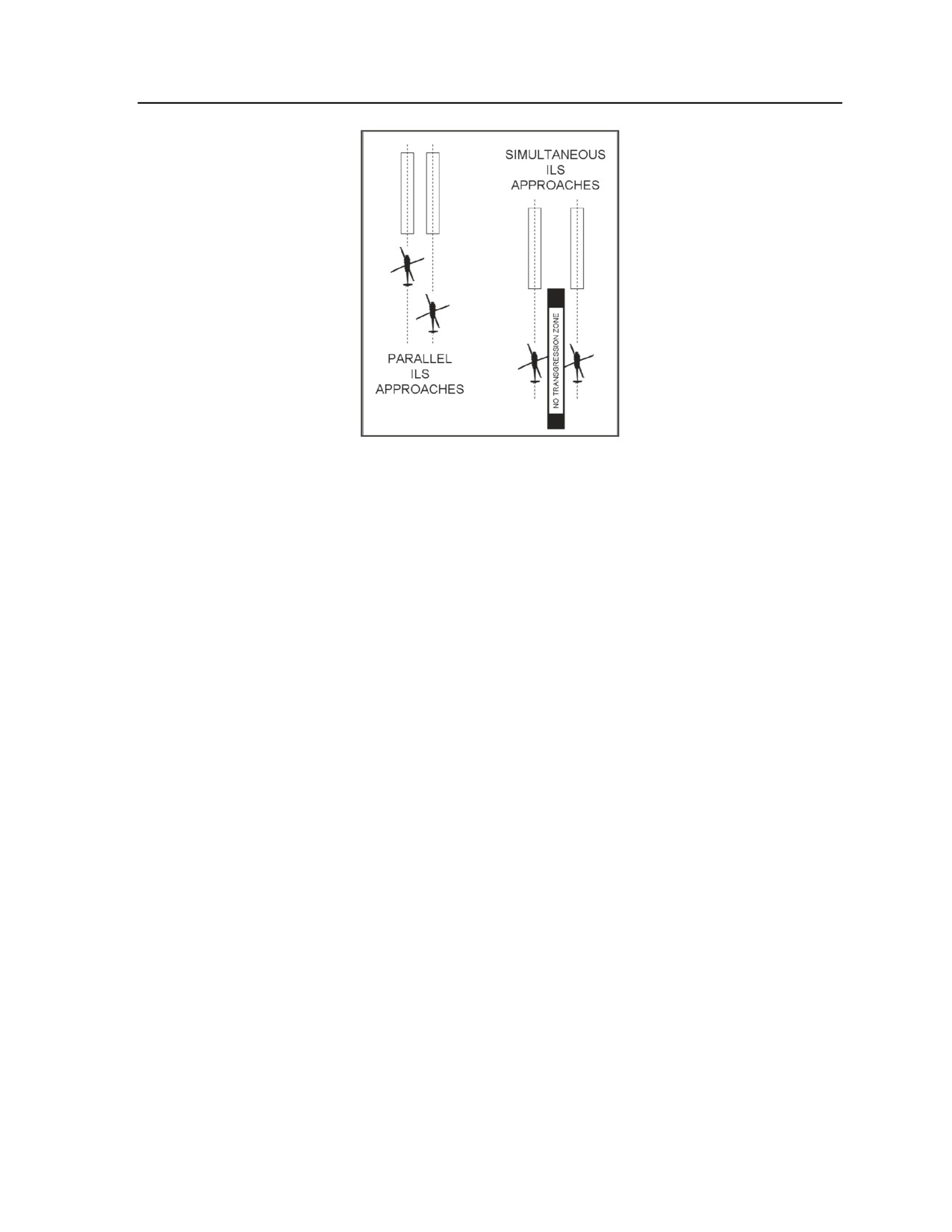
ATC diagonally separates or staggers aircraft; in simultaneous approaches, ATC directs aircraft side-by
side on the approach (Figure 10-23, page 10-53).
10-52
FM 3-04.240
30 April 2007
Instrument Flight Rules Information and Procedures
Figure 10-23. Parallel and simultaneous instrument landing system approaches
10-232. Simultaneous approaches are permitted to runways—
With centerlines separated by 4,300 to 9,000 feet.
Equipped with final monitor controllers.
That require radar monitoring to ensure separation of aircraft on the adjacent parallel approach
course.
10-233. The approach procedure chart includes the note “simultaneous approaches authorized runways
14L and 14R,” identifying appropriate runways. When advised that simultaneous parallel approaches are in
progress, aviators must advise approach control immediately of malfunctioning or inoperative components.
10-234. Parallel approach operations demand heightened aviator SA. The proximity of adjacent aircraft
conducting simultaneous parallel approaches mandates strict compliance with all ATC clearances and
approach procedures. Aviators must pay particular attention to the following approach chart information:
name and number of approach, localizer frequency, inbound course, glide-slope intercept altitude, DA/DH,
missed approach instructions, special notes/procedures, and the assigned runway location and proximity to
adjacent runways. Aviators exercise strict radio discipline, which includes continuous monitoring of
communications and avoidance of lengthy, unnecessary radio transmissions.
SIDE-STEP MANEUVER
10-235. ATC may authorize a side-step maneuver to either one of two parallel runways that are separated
by 1,200 feet or less, followed by a straight-in landing on the adjacent runway. Aircraft that execute a
side-step maneuver will be cleared for a specific approach procedure and landing on the adjacent parallel
runway. For example, “Cleared ILS runway seven left approach, side-step to runway seven right.” Aviators
are expected to commence the side-step maneuver as soon as possible after the runway or runway
environment is in sight. Landing minimums to the adjacent runway are based on nonprecision criteria and
are higher than precision minimums to the primary runway but are normally lower than published circling
minimums.
CIRCLING APPROACH
10-236. Landing minimums are listed on the approach chart under “CIRCLING.” Circling minimums
apply when it is necessary to circle the airport or maneuver for landing or when no straight-in minimums
are specified on the approach chart. The circling minimums published on the instrument approach chart
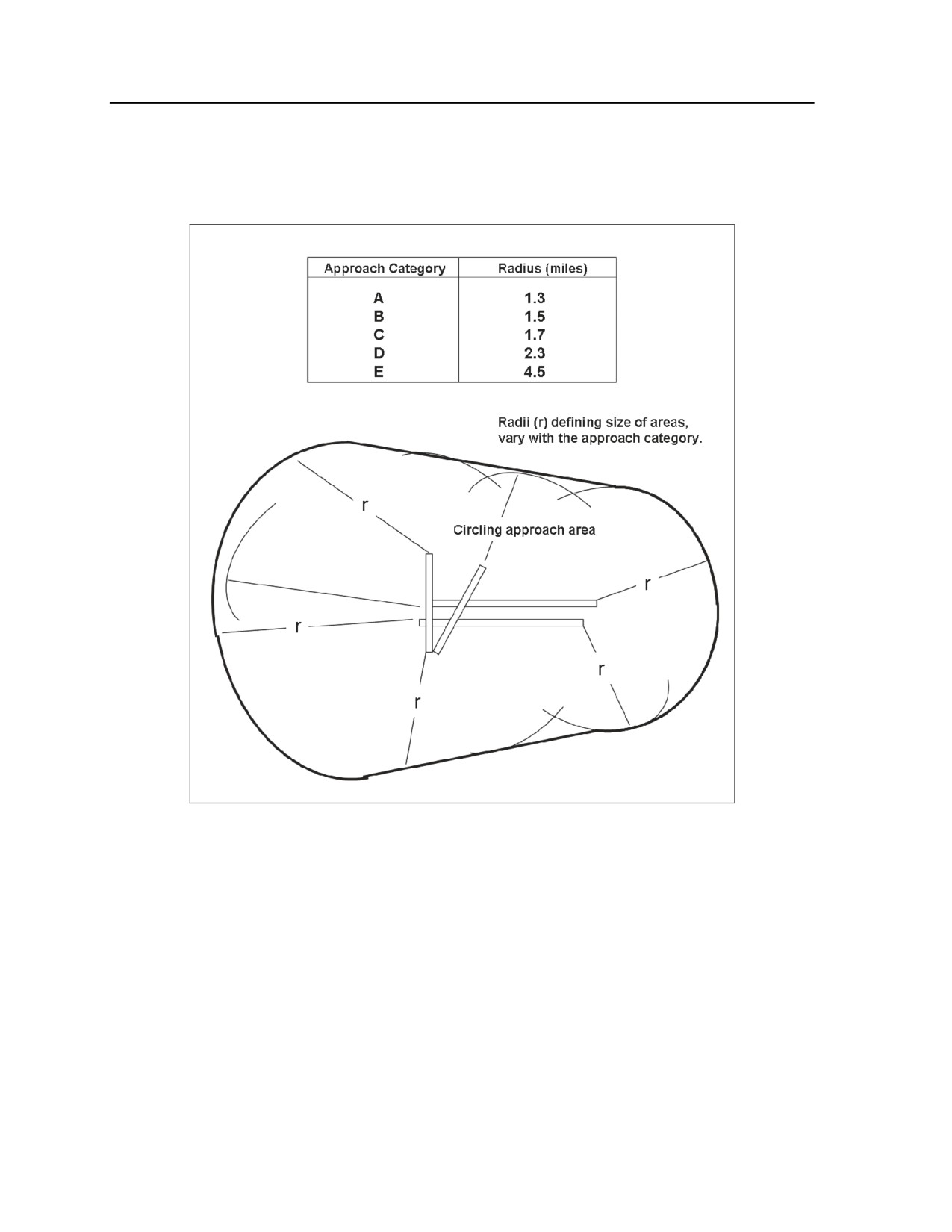
provide a minimum of 300 feet of obstacle clearance in the circling area (Figure 10-24, page 10-54).
30 April 2007
FM 3-04.240
10-53
Chapter 10
During a circling approach, maintain visual contact with the runway of intended landing and fly no lower
than the circling minimums until in position to make a final descent for a landing. If the ceiling allows, fly
at an altitude that more nearly approximates the aircraft’s VFR traffic pattern altitude. This altitude makes
maneuvering safer and brings the view of the landing runway into a more normal perspective.
Figure 10-24. Circling approach area radii
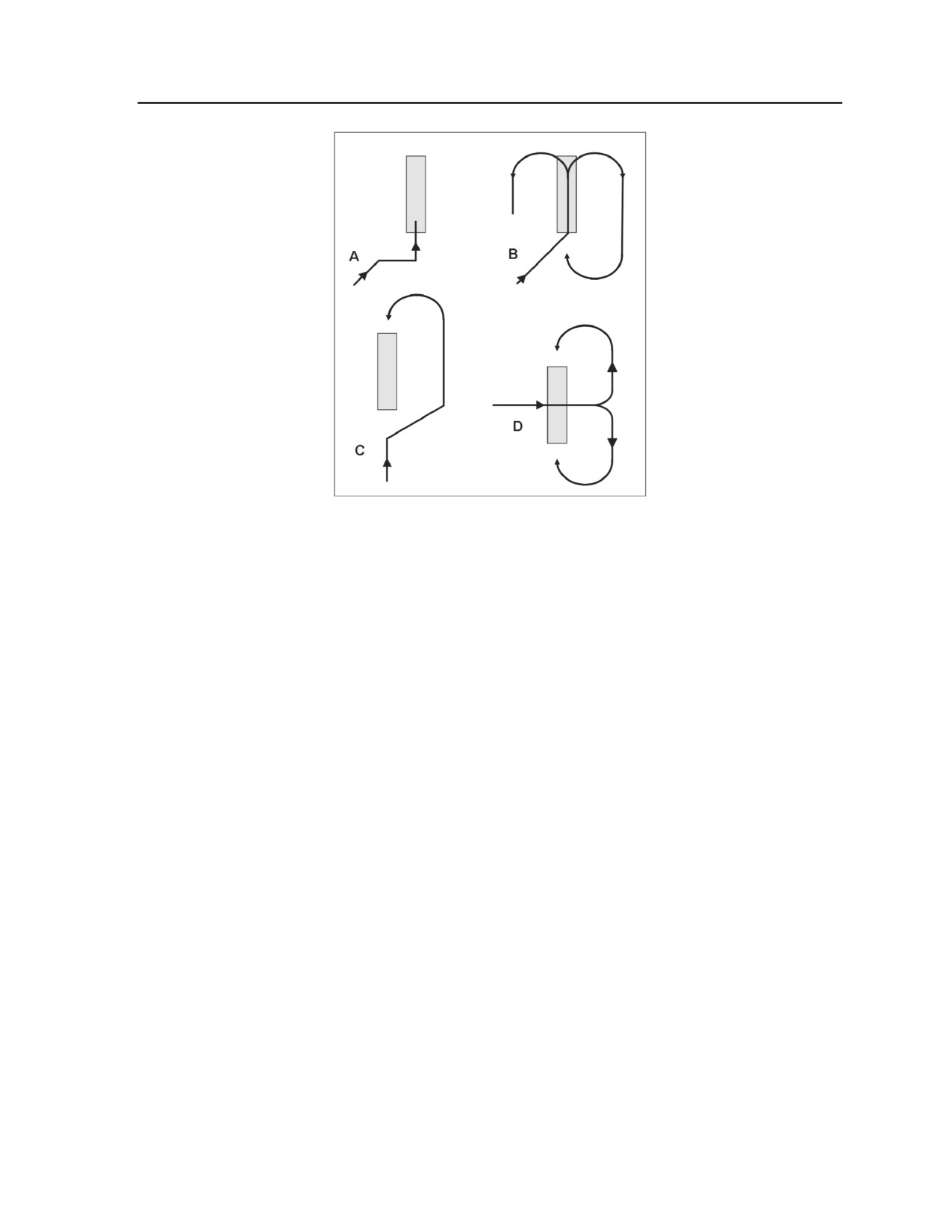
10-237. Figure 10-25, page 10-55, shows patterns that can be used for circling approaches. Pattern “A” can
be flown when the final approach course intersects the runway centerline at less than a 90-degree angle and
the aviator sights the runway early enough to establish a base leg. When sighting the runway too late to fly
pattern “A,” circle as shown in “B.” Fly pattern “C” if desirable to land opposite the direction of the final
approach and the runway is sighted in time for a turn to downwind leg. If the runway is sighted too late for
a turn to downwind, fly pattern “D.” Regardless of the pattern flown, the aviator must maneuver the
aircraft to remain within the designated circling area.
10-238. Sound judgment and knowledge of the capabilities and performance of the aircraft are the criteria
for determining the pattern flown in each instance. It is necessary to consider all factors when an aviator
flies a circular approach to include airport design, ceiling and visibility, wind direction and velocity, final
approach course alignment, distance from the FAF to the runway, and ATC instructions.
10-54
FM 3-04.240
30 April 2007
Instrument Flight Rules Information and Procedures
Figure 10-25. Circling approaches
MISSED APPROACHES
10-239. A missed approach procedure is formulated for each published instrument approach allowing the
aviator to return to the airway structure while remaining clear of obstacles. The procedure is shown on the
approach chart in text and graphic form and should be studied and mastered before beginning the approach.
10-240. When the aviator initiates a missed approach procedure at the MAP, the aviator establishes a climb
pitch attitude while setting climb power. Configure the aircraft for climb, turn to the appropriate heading,
advise ATC that the aircraft is executing a missed approach, and request further clearances. If initiating the
missed approach before reaching the MAP (unless otherwise cleared by ATC), continue to fly the IAP as
specified on the approach plate at or above the MDA or DA/DH before beginning a turn. If visual
reference is lost while circling to land IFR, execute the appropriate missed approach procedure. Make the
initial climbing turn toward the landing runway and maneuver to intercept and fly the missed approach
course. Aviators should immediately execute the missed approach procedure when—
The runway environment is not in sight.
Unable to make a safe landing.
Directed by the controlling agency.
10-241. Missed approach procedures are related to FAF location. When the FAF is not located on the field,
the missed approach procedure specifies distance from the facility to the MAP. The airport diagram on the
IAP shows the time from the facility to the missed approach at various ground speeds, which are
determined from airspeed, wind, and distance values. This time determines when to report and execute a
missed approach if applicable minimums are not available. Missed approach instructions are provided
before starting final approach of an ASR or a PAR approach.
10-242. If an aviator decides to execute a missed approach before reaching the missed approach point, the
aviator should continue along the IAP routing at or above the MDA/DA/DH until reaching the missed
approach point. Climb to the missed approach altitude while following the IAP routing. Do not initiate any
turns on the missed approach until reaching the missed approach point. If ATC issues a vector on the
missed approach, consider this the new clearance.
30 April 2007
FM 3-04.240
10-55
Chapter 10
SECTION IX - LANDING
10-243. ATC provides current visibility reports appropriate to the runway in use. These reports may be in
the form of prevailing visibility, runway visual value (RVV), or RVR. However, only the aviator can
determine if flight visibility meets landing requirements indicated on the approach chart. If flight visibility
meets the minimum prescribed for the approach, then the approach may be continued to a landing. If flight
visibility is less than that prescribed for the approach, the aviator must execute a missed approach,
regardless of reported visibility.
10-244. The landing minimums published on IAP charts are based on full operation of all components and
visual aids associated with the instrument approach chart being used. Higher minimums are required with
inoperative components or visual aids. For example, if the approach lighting with sequenced flashing lights
(ALSF)-1 approach lighting system is inoperative, visibility minimums for an ILS are increased by
one-quarter mile. If more than one component is inoperative, each minimum is raised to the highest
minimum required by any single inoperative component. ILS glide-slope inoperative minimums are
published on instrument approach charts as localizer minimums. Consult the “Inoperative Components or
Visual Aids Table” (printed on the inside front cover of each TPP) or “Inop Components Table” in the
supplementary enclosures of the DOD FLIP (Terminal) IAP charts for a complete description of the effect
of inoperative components on approach minimums.
LAND AND HOLD SHORT OPERATIONS
10-245. LAHSO includes landing and holding short of an intersecting runway or taxiway, or some other
predetermined point on the runway other than specifically on a runway or taxiway. Previously,
simultaneous operations on intersecting runways (SOIR) were used exclusively to describe simultaneous
operations on two intersecting runways-either two aircraft landing simultaneously or one aircraft landing
and another departing. The term LAHSO incorporates SOIR and is expanded to include holding short of a
taxiway and predetermined points on the runway. Additional operations are outlined in FAA Order 7210.3,
chapter 10.
10-246. U.S. Army aircraft are not authorized to accept LAHSO clearances because of safety concerns.
Army aircraft types were omitted from FAA Order 7210.3, chapter 10, for these reasons.
LANDING FEES
10-247. Check the FLIP for airfields of intended use to determine if a landing fee is charged. If so, have
sufficient funds but consider that CFR Title 14, Part 152, appendix D, paragraph 26 states, in part, that “All
facilities of the Airport developed with Federal aid and all those usable for the landing and taking off of
aircraft, will be available to the United States at all times, without charge, for use by government aircraft in
common with other aircraft, except that if use by government aircraft is substantial, a reasonable share,
proportional to such use, of the cost of operating and maintaining facilities so used, may be charged.” If
paying a landing fee, obtain a receipt. If possible, relay the person’s name, organization, airport name, and
telephone numbers to the USAASA, Airspace Support Division.
Note. If using fixed base operator (FBO) services or facilities, payment may be required.
Marshaling and use of restrooms and lounge are not considered landing fees.
10-56
FM 3-04.240
30 April 2007
Chapter 11
Emergency Operations
Changing weather conditions, ATC, aircraft, and aviators are variables that make
instrument flying an unpredictable and challenging operation. Safety of the flight
depends on the aviator’s ability to manage these variables while maintaining positive
aircraft control and adequate situational awareness. This chapter discusses
recognition and suggested remedies for emergency events related to unforecasted,
adverse weather, aircraft system malfunctions, communication/navigation system
malfunctions, loss of SA, and inadvertent instrument meteorological conditions
(IIMCs).
SECTION I - EMERGENCIES
11-1. An emergency can be either a distress or
urgency condition as defined in the pilot/controller
Contents
glossary:
Section I - Emergencies
11-1
Distress—a
condition
of
being
threatened by serious and/or imminent
Section II - Air Traffic Control Requirements
danger
and requiring
immediate
and Responsibilities
11-6
assistance.
Urgency—a condition of being concerned about safety and requiring timely but not immediate
assistance; a potential distress condition.
11-2. Aviators do not hesitate to declare an emergency when faced with distress conditions such as fire,
mechanical failure, or structural damage. However, some are reluctant to report an urgency condition when
encountering situations that may not be immediately perilous but are potentially catastrophic. An aircraft is
in an urgency condition the moment that the aviator becomes doubtful about position, fuel endurance,
weather, or any other condition that could adversely affect flight safety. This is the time to request
assistance—not after the situation has developed into a distress condition.
11-3. The PC is responsible for crew, passengers, and operation of the aircraft at all times. Both AR 95-1
and FAR 91.3 allow deviations from regulations during emergencies. This leeway allows the PC to make
the best decision to ensure safety of all personnel during these contingencies. Also, by declaring an
emergency during flight, that aircraft becomes a priority to land safely. Aviators who become apprehensive
for their safety for any reason should request assistance immediately. Assistance is available in the form of
radio, radar, direction finding stations, and other aircraft.
UNFORECASTED ADVERSE WEATHER
INADVERTENT THUNDERSTORM ENCOUNTER
11-4. An aviator should avoid flying through a thunderstorm of any intensity. However, certain conditions
may be present that could lead to an inadvertent thunderstorm encounter. For example, flying in areas
where thunderstorms are embedded in large cloud masses may make thunderstorm avoidance difficult,
even when the aircraft is equipped with thunderstorm detection equipment. Aviators must be prepared to
deal with inadvertent thunderstorm penetration. At the very least, a thunderstorm encounter subjects the
30 April 2007
FM 3-04.240
11-1
Chapter 11
aircraft to turbulence that could be severe. The aviator, as well as the crew and any passengers, should
tighten seat belts and shoulder harnesses and secure any loose items in the cabin.
11-5. As with any emergency, the first order of business is to fly the aircraft. The aviator workload will be
high; therefore, increased concentration is necessary to maintain an instrument scan. Once in a
thunderstorm, it is better to maintain a course straight through the thunderstorm rather than turning around.
A straight course will most likely get the aviator out of the hazard in the least amount of time, and turning
maneuvers only increase structural stress on the aircraft.
11-6. Reduce power to a setting that will maintain a recommended turbulence penetration speed as
described in the appropriate aircraft operator’s manual, and try to minimize additional power adjustments.
Concentrate on keeping the aircraft in a level attitude while allowing airspeed and altitude to fluctuate.
Similarly, if using autopilot, disengage altitude and speed hold modes because they only increase the
aircraft’s maneuvering-which increases structural stress.
11-7. During a thunderstorm encounter, the potential for icing also exists. As soon as possible, turn on
anti-icing/deicing equipment, if the aircraft is equipped with it. Icing can be rapid at any altitude and may
lead to power failure and/or loss of airspeed indication.
11-8. Lightning is also present in a thunderstorm and can temporarily blind an aviator. To reduce risk, turn
up cockpit lights to the highest intensity, concentrate on flight instruments, and resist urge to look outside.
INADVERTENT ICING ENCOUNTER
11-9. Because icing is unpredictable, aviators may find themselves in icing conditions although they have
done everything to avoid the condition. To stay alert to this possibility while operating in visible moisture,
aviators should monitor the outside air temperature (OAT).
11-10. Anti-icing/deicing equipment is critical to safety of the flight. If anti-icing/deicing equipment is
used before sufficient ice has accumulated, it may not be able to remove all ice accumulation. Use of
anti-icing/deicing will reduce power availability. Refer to the appropriate aircraft operator’s manual for use
of anti-icing/deicing equipment.
11-11. Before entering visible moisture with temperatures at 5 degrees above freezing or cooler, activate
appropriate anti-icing/deicing equipment in anticipation of ice accumulation; early ice detection is critical.
Detecting ice may be particularly difficult during night flight. The aviator may need to use a flashlight to
check for ice accumulation on the wings, fuselage, landing gear, and horizontal stabilizer. At the first
indication of ice accumulation, the aviator must act to circumvent icing conditions. Options for action once
ice has begun to accumulate on the aircraft are the following:
Move to an altitude with significantly colder temperatures.
Move to an altitude with temperatures above freezing.
Fly to an area clear of visible moisture.
Change the heading, and fly to an area of known nonicing conditions.
11-12. If these options are not available, consider an immediate landing at the nearest suitable airport.
Anti-icing/deicing equipment does not allow aircraft to operate in icing conditions indefinitely; it only
provides more time to evade icing conditions.
PRECIPITATION STATIC
11-13. P-static occurs when accumulated static electricity discharges from extremities of the aircraft. This
discharge has the potential to create problems for the instrument aviator. These problems range from
serious, such as complete loss of VHF communications and erroneous magnetic compass readings, to the
annoyance of high-pitched audio squealing and St. Elmo’s fire.
11-14. P-static is caused when an aircraft encounters airborne particles during flight (rain or snow) and
develops a negative charge. It can also result from atmospheric electric fields in thunderstorm clouds.
When a significant negative voltage level is reached, the aircraft discharges it, creating electrical
11-2
FM 3-04.240
30 April 2007
Emergency Operations
disturbances. To reduce problems associated with P-static, the aviator ensures that the aircraft’s static
wicks are maintained and accounted for. Broken or missing static wicks are replaced before an instrument
flight.
AIRCRAFT SYSTEM MALFUNCTIONS
11-15. Preventing aircraft system malfunctions that might lead to an in-flight emergency begins with a
thorough preflight inspection. In addition to items normally checked before VFR flight, aviators intending
to fly IFR should pay particular attention to antennas, static wicks, anti-icing/deicing equipment, pitot tube,
and static ports. During taxi, verify operation and accuracy of all flight instruments. The aviator must
ensure that all systems are operational before departing into IFR conditions.
GENERATOR
11-16. Depending on aircraft being flown, a generator failure is indicated in different ways. Some aircraft
use an ammeter that indicates the state of charge or discharge of the battery. A positive indication on the
ammeter indicates a charge condition; a negative indication reveals a discharge condition. Other aircraft
use a loadmeter to indicate the load being carried by the generator. If the generator fails, a zero load
indication is shown on the loadmeter. As a minimum, a caution light is installed to indicate a generator
failure. Review the appropriate aircraft operator’s manual for information on the type of systems installed
in the aircraft.
11-17. Once a generator failure is detected, the aviator must reduce electrical load on the battery and land
as soon as practical. Depending on electrical load and condition of the battery, sufficient power may be
available for an hour or more of flight or for only a matter of minutes. The aviator must be familiar with
systems requiring electricity to run and which continue to operate without power. The aviator can attempt
to troubleshoot generator failure by following established procedures published in the appropriate aircraft
operator’s manual. If the generator cannot be reset, inform ATC of an impending electrical failure.
INSTRUMENT
11-18. System or instrument failure is usually identified by a warning indicator or an inconsistency
between indications on the attitude indicator, supporting performance instruments, and instruments at the
other pilot station, if so equipped. Aircraft control must be maintained while the aviator identifies the failed
components. Expedite cross-check including all flight instruments. The problem may be individual
instrument failure or a system failure affecting several instruments.
11-19. One method of identification involves an immediate comparison of the attitude indicator with
rate-of-turn indicator and VSI. Along with providing pitch-and-bank information, this technique compares
the static system with the pressure system and electrical system. Identify failed components, and use
remaining functional instruments to maintain aircraft control.
11-20. Attempt to restore inoperative components by checking the appropriate power source, changing to
a backup or alternate system, and resetting the instrument if possible. Covering failed instruments may
enhance the ability to maintain aircraft control and navigate the aircraft. ATC is advised of the problem
and, if necessary, declares an emergency before the situation deteriorates beyond the ability to recover.
PITOT/STATIC SYSTEM
11-21. A pitot or static system failure can also cause erratic and unreliable instrument indications. When a
static system problem occurs, it affects the airspeed indicator, altimeter, and VSI. In the absence of an
alternate static source in an unpressurized aircraft, the aviator could break the glass on the VSI. The VSI is
not required for instrument flight, and breaking the glass provides the altimeter and airspeed indicator a
source of static pressure. Breaking the glass could cause additional instrument errors.
30 April 2007
FM 3-04.240
11-3
Chapter 11
COMMUNICATION/NAVIGATION
TWO-WAY RADIO FAILURE
11-22. Avionics equipment has become very reliable, and the likelihood of a complete communications
failure is remote. However, each IFR flight should be planned and executed in anticipation of a two-way
radio failure. At any point during a flight, the aviator must know exactly what route and altitude to fly and
when to continue beyond a clearance limit. The FIH describes procedures to be followed in case of two-
way radio communications failure.
COMMUNICATION/NAVIGATION MALFUNCTION
11-23. Reports are made to ATC or FSS facilities of any loss in controlled airspace of VOR, TACAN,
ADF, LF navigation receiver capability, complete or partial loss of ILS receiver capability, or impairment
of air-to-ground communications capability. Reports include aircraft identification, equipment affected,
degree to which the capability to operate under IFR in the ATC system is impaired, and nature and extent
of assistance desired from ATC.
LOSS OF SITUATIONAL AWARENESS
11-24. SA is an overall assessment of environmental elements and how they affect flight. A
knowledgeable aviator makes proactive decisions. SA permits the aviator to make decisions ahead of time
and allows evaluation of several different options. Conversely, an aviator missing important pieces of the
puzzle makes reactive decisions. Poor SA means that this aviator lacks vision regarding future events; the
aviator is forced to make decisions quickly, often with limited options. During a typical IFR flight, an
aviator operates at varying levels of SA. An aviator may be en route to a destination with a high level of
SA when ATC issues an unexpected STAR. Because the STAR is unexpected and the aviator is unfamiliar
with the procedure, SA is reduced. However, after becoming familiar with the STAR and resuming normal
navigation, the aviator returns to a higher level of SA.
11-25. Factors reducing SA include distractions, unusual or unexpected events, complacency, high
workload, unfamiliar situations, and inoperative equipment. In some situations, a loss of SA may be
beyond an aviator’s control. With an electrical system failure and associated loss of an attitude indication,
an aviator may find the aircraft in an unusual attitude. In this situation, established procedures are used to
regain SA. Aviators must be alert to loss of SA especially when hampered by a reactive mindset. To regain
SA, reassess the situation and work toward understanding. The aviator may need to seek additional
information from other sources, such as navigation instruments, other crew members, or ATC.
INADVERTENT INSTRUMENT METEOROLOGICAL CONDITION
11-26. Some aviators have the misconception that IIMC does not apply to an IFR flight. Two potential
scenarios are below:
Aircraft has entered VMC during an IAP and while circling to land encounters IMC.
During a nonprecision IAP, the aircraft is VMC while continuing at MDA and the aviator on the
controls has made the transition to visual too soon; as the aircraft is slowed for landing, it climbs
back up into IMC.
11-27. To survive an encounter with IIMC, an aviator must recognize and accept the seriousness of the
situation. The aviator needs to immediately commit to the instruments and perform recovery procedures
according to the appropriate ATM.
RECOGNITION
11-28. When an aviator is in IMC, he is unable to maintain aircraft attitude control by reference to the
natural horizon. During IMC encounters, whether inadvertent or intentional, the aviator is unable to
11-4
FM 3-04.240
30 April 2007
Emergency Operations
navigate or establish geographical positions by visual reference to landmarks on the surface. IIMC must be
accepted as a genuine emergency, requiring appropriate action. When IIMC is encountered, the crew must
commit to instruments and applicable recovery procedures.
MAINTAINING AIRCRAFT CONTROL
11-29. Once the crew members recognize the situation, they commit to controlling the aircraft by using
and trusting flight instruments. Attempting to search outside the cockpit for visual confirmation can result
in spatial disorientation and complete control loss. The crew must rely on instruments and depend on crew
coordination to facilitate that transition. Although the task at hand may appear overwhelming and the
situation may be compounded by extreme apprehension, the crew must consciously commit to maintaining
aircraft control.
11-30. The most important concern, along with maintaining aircraft control, is to initiate a climb
immediately. An immediate climb will provide a greater separation from natural and man-made obstacles,
as well as improve radar reception of the aircraft by ATC. An immediate climb should be appropriate for
the current conditions, environment, and known or perceived obstacles.
11-31. The five basic procedures listed below assist in maintaining aircraft control after encountering
IIMC with the most critical action being to immediately announce IIMC and begin a substantial climb
while procedures are being performed. These procedures are performed nearly simultaneously:
Attitude - Level wings on the attitude indicator.
Heading - Maintain heading; turn only to avoid known obstacles or as briefed for multiship
operations.
Torque - Adjust torque as necessary for desired climb rate.
Airspeed - Adjust airspeed as necessary.
Complete the IIMC recovery according to local regulations and policies.
11-32. The aviator must trust flight instruments concerning the aircraft’s attitude regardless of intuition or
visual interpretation. The vestibular sense (motion sensing by the inner ear) can confuse the aviator.
Because of inertia, sensory areas of the inner ear cannot detect slight changes in aircraft attitude nor can
they accurately sense attitude changes that occur at a uniform rate over time. Conversely, false sensations
often push the aviator to believe that the attitude of the aircraft has changed when, in fact it has not,
resulting in spatial disorientation.
ASSISTANCE
11-33. After aircraft control is stabilized, other duties can be performed such as the following:
Changing the transponder to the appropriate code.
Contacting ATC on guard (if the frequency is not known).
Complying with local directives and guidance.
Tuning required navigational radios.
Preparing the crew for IAP to be performed.
RECOVERY
11-34. In case of IIMC, aviators must be prepared to execute preplanned recovery procedures according
to AR 95-1, the applicable ATM, and local rules and regulations. Aviators may have limited or multiple
options for recovery based on availability of approved IAP, NAVAIDs, and installed/operational aircraft
equipment. The first option is to use approved DOD/U.S. Government IAP. The second option is to use
FAA, ICAO, or host-nation IAP. Third, if operating in areas where no approved IAP exists, commanders
should contact USAASA, which can develop and approve IAP for those areas. While operating in areas
that do not facilitate the use of an approved IAP or flying aircraft that are not equipped to fly approved
IAP, the aviator can use an emergency GPS recovery procedures as a last resort. Commanders determine
30 April 2007
FM 3-04.240
11-5
Chapter 11
the need for an emergency GPS recovery procedure, task an instrument examiner to develop the procedure,
and have the procedure approved by the first 06 in the chain of command according to AR 95-1.
Emergency GPS recovery procedures should be used only for training during VMC or actual emergencies
when no other approved approach is available. The emergency GPS recovery procedure is developed using
a simple calculation that meets or exceeds TERPS requirements. ATMs provide more detailed instructions
for developing emergency GPS recovery procedures.
SECTION II - AIR TRAFFIC CONTROL REQUIREMENTS AND
RESPONSIBILITIES
11-35. ATC personnel can help aviators during in-flight emergency situations. Aviators should
understand the services provided by ATC and the resources and options available. These services enable
aircrews to focus on aircraft control and help them make better decisions in a time of stress.
PROVIDE INFORMATION
11-36. During emergency situations aviators should provide as much information as possible to ATC.
ATC uses the information to determine what kind of assistance it can provide with available assets and
capabilities. Information requirements vary depending on the existing situation. ATC requires at a
minimum, the following information for in-flight emergencies:
Aircraft identification and type.
Nature of the emergency.
Aviator’s desires.
11-37. The aviator, if time and the situation permit, should provide ATC with more information. Figure
11-1 lists additional information that would help ATC in further assisting the aviator.
• Aircraft altitude
• Point of departure and destination
• Airspeed
• Fuel remaining in time
• Heading since last known position
• Visible landmarks
• NAVAID signals received
• Time and place of last known position
• Aircraft color
• Aviator reported weather
• Emergency equipment on board
• Number of people on board
• Aviator capability for IFR flight
• Navigation equipment capability
Figure 11-1. Additional ATC information
11-6
FM 3-04.240
30 April 2007
Emergency Operations
REQUEST ASSISTANCE
11-38. When the aviator requests, or when deemed necessary, ATC can enlist services of available radar
facilities and DF facilities operated by the FAA and military services. ATC can also coordinate with other
agencies, such as the Federal Communications Commission and local authorities, and request their
emergency services and facilities.
RADAR ASSISTANCE
11-39. Radar is a invaluable asset that can be used by aviators during emergencies. With radar, ATC can
provide navigation assistance to aircraft and provide last-known location during catastrophic emergencies.
If a VFR aircraft encounters, or is about to encounter, IMC weather conditions, the aviator can request
radar vectors to VFR airports or VFR conditions. If the aviator determines that he is qualified for and the
aircraft is capable of conducting IFR flight, the aviator should file an IFR flight plan and request a
clearance from ATC to the destination airport as appropriate. If the aircraft has already encountered IFR
conditions, ATC can inform the aviator of appropriate terrain/obstacle clearance minimum altitude. If the
aircraft is below appropriate terrain/obstacle clearance minimum altitude and sufficiently accurate position
information has been received or radar identification is established, ATC can furnish a heading or radial on
which to climb to reach appropriate terrain/obstacle clearance minimum altitude.
EMERGENCY AIRPORT
11-40. ATC personnel consider the following factors when recommending an emergency airport to
aircraft requiring assistants.
Remaining fuel in relation to airport distances.
Weather conditions.
Note. Depending on the nature of the emergency, certain weather phenomena may deserve
weighted consideration. An aviator may elect to fly further to land at an airport with VFR
conditions instead of closer airfield with IFR conditions.
Airport conditions.
NAVAID status.
Aircraft type.
Aviator’s qualifications.
Vectoring or homing capability to the emergency airport.
11-41. In addition, ATC and aviators should determine which guidance can be used to fly to the
emergency airport. The following options may be available:
Radar.
DF.
Following another aircraft.
NAVAIDs.
Pilotage by landmarks.
Compass headings.
EMERGENCY OBSTRUCTION VIDEO MAP
11-42. The emergency obstruction video map (EOVM) is intended to facilitate advisory service in an
emergency situation when appropriate terrain/obstacle clearance minimum altitude cannot be maintained.
The EOVM, and the service provided, are used only under the following conditions:
The aviator has declared an emergency.
30 April 2007
FM 3-04.240
11-7
Chapter 11
The controller has determined an emergency condition exists or is imminent because of the
aviator’s inability to maintain an appropriate terrain/obstacle clearance minimum altitude.
Note. Appropriate terrain/obstacle clearance minimum altitudes may be defined as minimum
IFR altitude (MIA), MEA, MOCA, or MVA.
11-43. When providing emergency vectoring service, the controller advises the aviator that any headings
issued are emergency advisories intended only to direct the aircraft toward and over an area of lower
terrain/obstacle elevation.
Note. Altitudes and obstructions depicted on the EOVM are actual altitudes and locations of the
obstacle/terrain and contain no lateral or vertical buffers for obstruction clearance.
RESPONSIBILITY
11-44. ATC, in communication with an aircraft in distress, should handle the emergency and coordinate
and direct the activities of assisting facilities. ATC will not transfer this responsibility to another facility
unless that facility can better handle the situation.
11-45. When an ATC facility receives information about an aircraft in distress, they will forward detailed
data to the center in the area of the emergency. Centers serve as central points for collecting information,
coordinating with SAR, and distributing information to appropriate agencies.
11-46. Although 121.5 megahertz and 243.0 megahertz are emergency frequencies, the aviator should
keep the aircraft on the initial contact frequency. The aviator should change frequencies only when a valid
reason exists. When necessary and if weather and circumstances permit, ATC should recommend that
aircraft maintain or increase altitude to improve communications, radar, or DF reception.
ESCORT
11-47. An escort aircraft, if available, should consider and evaluate an appropriate formation. Special
consideration must be given if maneuvers take the aircraft through clouds. Aircraft should not execute an
in-flight join up during emergency conditions unless both crews involved are familiar with and capable of
formation flight and can communicate and have visual contact with each other.
COMMUNICATIONS FAILURE
11-48. When an IFR aircraft experiences two-way radio communications failure, air traffic control is
based on anticipated aviator actions. Aviator procedures and recommended practices are set forth in the
AIM, CFRs, and pertinent military regulations such as the FIH. When the aviator of an aircraft equipped
with a coded radar beacon transponder experiences a loss of two-way radio capability, the aviator is
expected to adjust the transponder to reply on Mode 3/A Code 7600. ATC takes the following actions, as
appropriate, if two-way radio communications are lost with an aircraft:
For aircraft under immediate control jurisdiction, use all means available to reestablish
communications with the aircraft; these may include, but are not limited to, emergency
frequencies, NAVAIDs equipped with voice capability, FSS, and Aeronautical Radio
Incorporated (ARINC).
Broadcast clearances through available means of communications including the voice feature of
NAVAIDs.
Attempt to reestablish communications by having aircraft use its transponder or make turns to
acknowledge clearances and answer questions; request any of the following in using the
transponder:
Request aircraft to reply Mode 3/A IDENT.
11-8
FM 3-04.240
30 April 2007
Emergency Operations
Request aircraft to reply on Code 7600 or, if already on Code 7600, appropriate stratum code.
Request aircraft to change to stand-by for sufficient time to ensure the lack of a target is the
result of requested action.
Broadcast a clearance for aircraft to proceed to its filed alternate airport at the MEA if the
aircraft operator concurs.
30 April 2007
FM 3-04.240
11-9
Appendix A
Instrument Flight Rules Operations
Planning for an IFR flight depends on the nature of the mission, type and number of
aircraft, distance to be flown, selected route, weather conditions, and navigational
facilities. The checklist presented in this appendix applies to instrument flight
planning within the United States. Aviator proficiency and judgment dictate
necessary modifications to these procedures and techniques. When assigned a
mission, the flight is planned to arrive at a fixed destination at a definite time. The
type of aircraft, load, and personnel onboard are often predetermined; however, when
aviators plan proficiency flights, they usually choose aircraft, destination, route, time,
and other factors that affect the flight. When possible, variable factors affecting the
mission are controlled to produce optimum flight conditions.
FLIGHT PLANNING
WEATHER BRIEFING SOURCES
A-1. All aviators are responsible and accountable for procurement and analysis of aeronautical weather
reports and forecasts, including recognizing critical weather situations and estimating visibility while in
flight. Local commanders establish policies specifying when DD Form 175-1 (Flight Weather Briefing) is
required to be filed with the DD Form 175 flight plan (AR 95-1). Weather information for DD 175-1 is
obtained from a military weather facility. If a military forecaster is not available, the PC will obtain a
weather forecast according to DOD/U.S. Government FLIP. Army priority for obtaining a formal DD 175
1 weather briefing is the following:
U.S. military weather forecaster.
Combat weather team or supporting operational weather squadron (OWS).
Other military or Government weather service.
A-2. If departing a location with no military or Government weather briefing and NOTAM services,
obtain information by—
Contacting the OWS for that area (see FIH, section C).
Note. Current operational publications should be checked for procedures and listings.
WEATHER DATA BRIEFING
A-3. The weather briefing includes the forecast for destination and alternate airfields at ETA to include
the following elements of the forecast:
Ceiling and visibility—applicable regulations should be checked for compliance; the destination
forecast determines the requirement for selecting an alternate. If minimum conditions specified
in AR 95-1 exist at the destination, an alternate airport is not required.
Weather phenomena producing low ceilings and visibility.
Hazards to flight such as thunderstorms, icing, gusty winds, and high-density altitude.
Height of cloud tops.
30 April 2007
FM 3-04.240
A-1
Appendix A
A-4. The weather briefing forecast covers en route conditions to destination and alternate airfields to
include the following elements:
Hazards to flight.
Freezing level.
Height of cloud tops and bases.
Flight-level winds and temperatures.
A-5. With the aid of a forecaster, a clear mental picture of the overall weather situation should be
obtained, including locations of frontal systems and high- or low-pressure areas. The rate and direction of
their movement and the associated weather conditions should be clearly understood.
AIRCRAFT EQUIPMENT
A-6. Check the aircraft logbook or other available source for onboard navigational equipment. Check for
restrictions that might affect the mission (such as oil samples due and inoperative equipment).
FLIGHT INFORMATION PUBLICATION RESEARCH
A-7. The list provided is not all-inclusive and should be modified according to pertinent publications:
Check the appropriate en route supplement (IFR or VFR) for departure, destination, and
alternate if required.
Check availability of fuel at destination and alternate.
Check low-altitude en route chart for effective control zone hours.
Check NOTAMs—flight information bulletins are no longer a source of NOTAM data.
Review SIDs, published nonstandard DPs and weather minimums, and approach plate for
departure airfield; this information assists in maintaining obstruction clearance during the
takeoff and departure phases and aids in planning an orderly transition to the en route phase.
Review approach plate for destination and alternate. Become familiar not only with the approach
planned but also other available approaches; check for outlying IAFs or published feeder routes
that may provide an orderly transition from en route to approach phases.
ROUTE SELECTION
A-8. Select the best route based on weather conditions and preferred routes. Check current operational
publications for listings. Deviate from preferred routes only when safety or the mission requires. Departure
and IAF and feeder route information are also considered. The closest available IAF or transition fix
should be planned because it is normally assigned by ATC.
A-9. File for direct flight only if the mission requires or if considerable savings of fuel or time can be
realized. If the flight penetrates uncontrolled airspace, ATC will not provide traffic separation.
ROUTE SURVEY
A-10. Conduct a route survey to destination and alternate airfields using navigational charts to determine
the following:
Primary radio aids for en route navigation. List frequencies, station identifiers, courses, and
radials on the flight log.
Supplementary radio aids to be used for position fixing and secondary navigation.
Availability of ATC and weather radar en route.
Distance between reporting points and total flight distance—total distance is computed from
takeoff to the destination airport via the flight planned route.
MEA, MOCA, MAA, MRA, and MCA.
A-2
FM 3-04.240
30 April 2007
Instrument Flight Rules Operations
ALTITUDE SELECTION
A-11. Select the best altitude for the flight based on the following:
Weather conditions. Avoid altitudes where icing and turbulence will be hazardous.
Direction. Unless otherwise required to avoid flight hazards or if requested by ATC, direction
of flight in controlled airspace is based on the hemispherical rule. Hemispherical rule application
in controlled airspace considers overall flight direction rather than individual legs that may vary
from easterly to westerly directions; in uncontrolled airspace, hemispherical rule is mandatory
for each individual leg.
Odd altitudes apply to magnetic courses, from 0 to 179 degrees.
Even altitudes apply to magnetic courses, from 180 to 359 degrees.
MEA, MOCA, MAA, MRA, and MCA:
Select altitudes that comply with published minimum altitudes applicable to the flight.
On direct flights, determine minimum altitude based on charted obstacles and regulation
requirements; when direct routes are planned, there are two basic considerations: FAR
91.177 must be complied with to ensure obstruction clearance, and NAVAID ranges and
restrictions must be researched to ensure reception for the entire leg.
Do not plan a flight at the MEA if the flight-level temperature will be significantly below
standard. Lowering of pressure levels in air significantly colder than standard results in true
altitude being significantly lower than indicated altitude; request an altitude assignment
above the MEA under these cold air temperature conditions.
Aircraft performance and equipment. In selecting a flight altitude, consider the following:
Optimum operating conditions for the aircraft.
Oxygen availability.
Radio equipment limitations (such as range and altitude).
Air traffic control.
Avoid relatively low altitudes that may conflict with approach control service in complex
terminal areas.
Do not request unnecessary altitude changes.
DEPARTURE
A-12. Plan departures to comply with SIDs at airports where established. ATC normally employs SIDs,
because it may assign a departure other than the one requested. Check availability of departure control
(conventional or radar). Note appropriate frequencies. Study the local area chart, if published, or the
departure area on the en route chart. Be familiar with radio facilities and intersections within the departure
area.
PERFORMANCE PLANNING CARD
A-13. Consult the aircraft operator’s manual to determine the performance planning card
(PPC)
information required to include TAS, Vne, cruise power setting, and cruise fuel consumption. Compute and
file the TAS accurately. Later in flight, compute TAS to verify preflight calculations. If the actual TAS
varies more than 10 knots from the filed TAS, notify ATC of the difference.
GROUND SPEED
A-14. Compute ground speed for each leg of the flight by combining forecast winds with the planned
course and TAS (see Chapter 5).
30 April 2007
FM 3-04.240
A-3
Appendix A
ESTIMATED TIME EN ROUTE
A-15. Based on ground speed and distance, compute estimated time en route (ETE) for each leg of the
flight between reporting points (see Chapter 5). On the initial leg, allow sufficient additional time for the
planned departure and climb to flight altitude. If en route climbs are made at reduced airspeed, allow
additional time for significant changes on the leg. Compute total ETE for the flight. This is the estimated
time required en route from the airport of departure to the destination airport based on the flight plan route.
Remember that the ETE is exclusive of the time required for planned en route delays. The ETE to the
alternate airfield should include time from the—
MAP to the missed approach holding point to include one circuit in the holding pattern.
Missed approach holding point to the alternate including approach and landing time.
FUEL
A-16. Compute the fuel-on-board flight plan entry by subtracting the warm up, takeoff, and taxi fuel
allowance (see the aircraft operator’s manual) from the total fuel onboard (see Chapter 5). Divide this
quantity by the cruise consumption rate. The cruise consumption rate is determined by cruise conditions
and aircraft gross weight as explained in the aircraft operator’s manual. Compute total fuel required for the
flight based on the appropriate consumption rate specified in the operator’s manual and include allowance
for the following:
Warm up and taxi.
Initial climb (consult aircraft operator’s manual for extended climbs).
En route cruise to destination and alternate. Allow time, in addition to ETE, for known en route
delays required by the mission; en route ATC delays usually cannot be anticipated. Also allow
time for the approach.
Fuel reserves required for IFR flight.
A-17. Compute surplus fuel by subtracting total fuel required from total fuel capacity. Surplus fuel is
important because en route traffic delays and holding at the destination are not provided for in the fuel
requirements. The purpose of reserve fuel is for unforeseen circumstances; do not plan to use reserves for
routine delays.
TERMINAL AREA
A-18. If an area chart is published for the destination, study it carefully to become familiar with radio
facilities, intersections, published transitions, and STARs. Study all published destination approaches that
the aircraft is equipped to make. Become familiar with the following:
Transitions.
Final approach courses.
Procedure turns.
Approach minimums (DA/DH or MDA, ceiling, and visibility).
Restrictions, warning, caution, and notes.
AIRCRAFT FLIGHT PLAN
A-19. Army aviators use a military flight plan according to DOD FLIP. FAA flight plans may be used in
lieu of military forms when aviators depart from U.S. installations not having a military base operations
facility.
SAMPLE INSTRUMENT FLIGHT RULES PLANNING
REQUIREMENTS
A-20. Table A-1 provides techniques used in planning and preparation of flight under IFR conditions. It is
not all-inclusive or aircraft specific but provides a starting point of common aircraft items.
A-4
FM 3-04.240
30 April 2007

Instrument Flight Rules Operations
Table A-1. Sample instrument flight rules planning requirements
Aircraft Capabilities
Installed navigation equipment
(ADF, VOR,
PPC data (hover, cruise airspeed/fuel flow, arrival)
DME, GPS)
Weight/balance (AR 95-1, Chapter 5)
Anti-ice/deice equipment
Maintenance requirements (inspections, torque checks)
Aircrew Capabilities
Pilot takeoff minimums (AR 95-1, chapter 5)
Required publications (DA Pam 738-751; AR 95-1, Chapter 5)
Physical limitations (illness, crew endurance)
Weather Planning
Departure (AR 95-1, Chapter 5)
En route
Arrival (AR 95-1, Chapter 5)
Hazards to flight (TRW, icing, turbulence)
FLIP/NOTAM Research
En route supplement (airfield data, fuel, PPR, NAVAIDs)
En route chart (airways, direct routing, altitudes, course changes, MEA/MOCA changes)
IAP (approach selection, weather/visibility, alternate requirements)
FIH (lost communications, position reporting)
AP3 (theater-specific procedures)
GP (flight-plan preparation, aviator responsibilities, weather interpretation)
NOTAMs
Departure
Standard/nonstandard departures (IAP; AR 95-1, Chapter 5)
Weather requirements
Departure IAP for emergencies
En Route
Route selection (airways, direct routing, IAPs, transitions)
Altitudes (airway, hemispherical, ORTCA)
En route weather hazards (DD Form 175-1)
Course changes
MEA, MOCA, MRA changes
Arrival
IAP availability (based on weather [WX], NOTAMS, aircraft equipment)
Weather requirements
Transitions from en route phase
Alternate requirements (AR 95-1, Chapter 5)
Inoperative components
Estimated Time En Route Planning
Times based on ground speed according to winds for each leg of flight
Adjust for climbs/radar vectors
Missed approach/alternate planning
Calculate total time
Fuel Requirements
ETE-based
Alternate/missed approach planning
Reserve requirement (AR 95-1, Chapter 5)
Flight Plan Preparation
According to GP, Chapter 4; and AR 95-1, Chapter 5
30 April 2007
FM 3-04.240
A-5
This page intentionally left blank.