FM 3-34.170/MCWP 3-17.4 ENGINEER RECONNAISSANCE (March 2008) - page 6
Appendix D
Environmental Baseline Survey
The EBS is a multidiscipline site survey. It is conducted during the initial stage of
any Service or joint operational deployment, and followed by a closeout survey when
a site is returned to the HN or when joint forces depart the site. The EBS documents
existing deployment area environmental conditions (to include cultural), determines
the likelihood for present and past site contamination
(for example, hazardous
substances, petroleum products, and derivatives), and identifies potential
vulnerabilities (to include occupational and environmental health risks). The closeout
survey defines the conditions existing at the time of departure from a site and
documents any changes/variations in conditions from the EBS. Surveys
accomplished in conjunction with operational deployments that do not involve
training or exercises (contingency/expeditionary operations) should be completed to
the extent practicable—consistent with operational requirements for all occupations
exceeding 30 days. In cases where less than 30 days of occupation are expected, an
environmental assessment should still be conducted to support servicemember force
health protection. The EBS is generally performed in conjunction with an EHSA.
PREPARATION AND IMPLEMENTATION OF THE SURVEY
D-1. This appendix provides guidance for preparing the EBS (see FM 3-100.4). As discussed in chapter 6,
environmental reconnaissance is conducted to collect the information necessary for the EBS. The
reconnaissance is typically focused by IR identified by environmental staff planners researching the
potential AO. An EBS is typically performed by or with support from general engineer elements, including
an on-site visit by environmental specialists as soon as the situation permits. However, ERTs may need to
perform an initial site assessment before an EBS with or without assistance from general engineers. While
this appendix provides guidance to the general engineer and environmental specialist for completing a
detailed EBS including the site survey, it can also guide the ERT conducting an initial assessment to begin
developing the EBS.
PREPARATION
D-2. The EBS addressed in this manual is focused for use during contingency/expeditionary operations
where other established HN agreements or arrangements for a base campsite may not exist. (See FM 5-104
and AFDD 2-4.4 for specific planning considerations). Guidance should be provided in annex L of the
joint OPORD/OPLAN to direct the conduct of surveys, especially in those situations where specific HN
agreements or arrangements may not exist, or a HN government may not be operating. It may also come
from appendix 2 (Environmental Considerations) to annex L (Engineer) of an OPORD/OPLAN. By using
the EBS, services can maintain situational awareness, maximize combat power, and reduce and/or
eliminate the negative effects of occupational health and environmental exposures.
D-3. The primary purposes for an EBS are—
z
The protection of service personnel
(eliminating, minimizing, or mitigating environmental
health risks to servicemembers).
z
Allowing for a sustainability determination of designated location
(includes encroachment
considerations and potential requirements to increase the population of servicemembers or their
actions performed at a site).
25 March 2008
FM 3-34.170/MCWP 3-17.4
D-1
Appendix D
z
Sensitivities involved with cultural or architectural considerations.
z
Minimizing any potential U.S. liability for the condition of a site at the time U.S. forces depart.
D-4. Environmental specialists initiate EBS planning and preparation during the initial planning stages of
any military operation through deliberate information gathering and staff estimates. These specialists
include, but are not limited to, engineer and medical expertise that incorporate medical intelligence and
geospatial information into the planning process. While containing some considerations of force health
protection, the EBS is not a complete medical assessment, and so it is always linked to the conduct of the
EHSA and ideally accomplished in direct conjunction with this document and process. (See United States
Army Center for Health Promotion and Preventive Medicine [USACHPPM] Technical Guide 251, A
Soldiers Guide to Environmental and Occupation Field Sampling for Military Deployment (Draft),”
August 2001, for more information on the EHSA.)
D-5. Researching the AO and the specific potential sites that the operational commander will want to
inhabit and use for base camps, airfields, logistic sites, and a host of other relatively permanent locations in
an AO are part of the staff planning process. This includes map reconnaissance with supporting geospatial
products, review of medical information and intelligence about a site, and any other information obtainable
(historical or current information) about proposed locations during the planning process. The respective
staff estimates by the engineer, surgeon, logistician, joint staff/component/brigade or battalion
civil-military operations officer (J-9/G-9/S-9) (with CA support), and others must include this assessment
as a part of their normal planning process to evaluate all relevant environmental considerations. The
preparation work performed at this point is not considered an EBS but rather the preparation work to
minimize the likelihood of choosing poor sites from an environmental and force health protection
viewpoint. If adequate information is not available on likely sites to be used, this information becomes IR
that are fed into the IPB. Some of these may be critical enough to be considered PIR. All of this assessment
process is a part of the predeployment work required to ultimately create an EBSs for each specific site, but
does not in itself create an EBS. A physical visit of each site by environmental specialists is required for an
EBS to be completed. Similarly, while research and preparation are completed to be able to perform a site
closeout, a physical survey is required for one to be accomplished.
D-6. The preventive aspects present through the planning of required EBSs serve as a force multiplier and
mission enabler through the early identification of environmental, health, and safety conditions that may
pose potential health threats to military personnel and civilians that occupy designated areas within the
theater of operations. They also assist in making recommendations on a particular site by taking into
consideration suitability
(to include both natural and cultural considerations) and sustainability
determinations for that site. It is critical to obtain an assessment of projected/sustained use for a site and a
projected duration of use for a given site from the operational planners. The engineer staff officer is
directly involved and uses this information in the engineering support plan (ESP) and integrates this
information into staff planning.
IMPLEMENTATION
D-7. Estimates from the planning process are confirmed or adjusted based upon physical site inspection
during the EBS. An EBS is conducted for any base camp or similar site that will be in existence for greater
than 30 days. Ideally the EBS will be accomplished in conjunction with an EHSA. This survey (and
potential preceding assessment) conducted during contingency/ expeditionary operations documents
environmental conditions before (or immediately after) the occupation of any base camp or related site.
This serves to protect servicemembers by documenting property suitability as well as prevent the United
States from receiving unfounded claims for past environmental damage.
D-8. While damage claims are the primary focus for many of the other EBSs performed by the DOD, it is
of secondary importance in supporting the operational commander during contingency operations. When
ultimately departing from a site, a closure survey is completed using the same basic format as the EBS to
provide comparative information documenting the change in conditions over the life of occupation of that
site by servicemembers.
D-2
FM 3-34.170/MCWP 3-17.4
25 March 2008
Environmental Baseline Survey
D-9. The importance of a standardized multi-Service format should be apparent. This format is intended
to include adequate minimal medical considerations in the case where an EHSA is not able to be conducted
in conjunction with the EBS. While each situation/site will be unique, the format for the EBS is intended to
provide the standardized multi-Service framework for completing the physical survey/assessment.
Additional applicable references and tools are also listed with this template. (See table D-1 on page D-5.)
D-10. In between the timeframe of the EBS and the closure report is a requirement to periodically conduct
inspections of the base camp or other similar facility to ensure environmental considerations are being
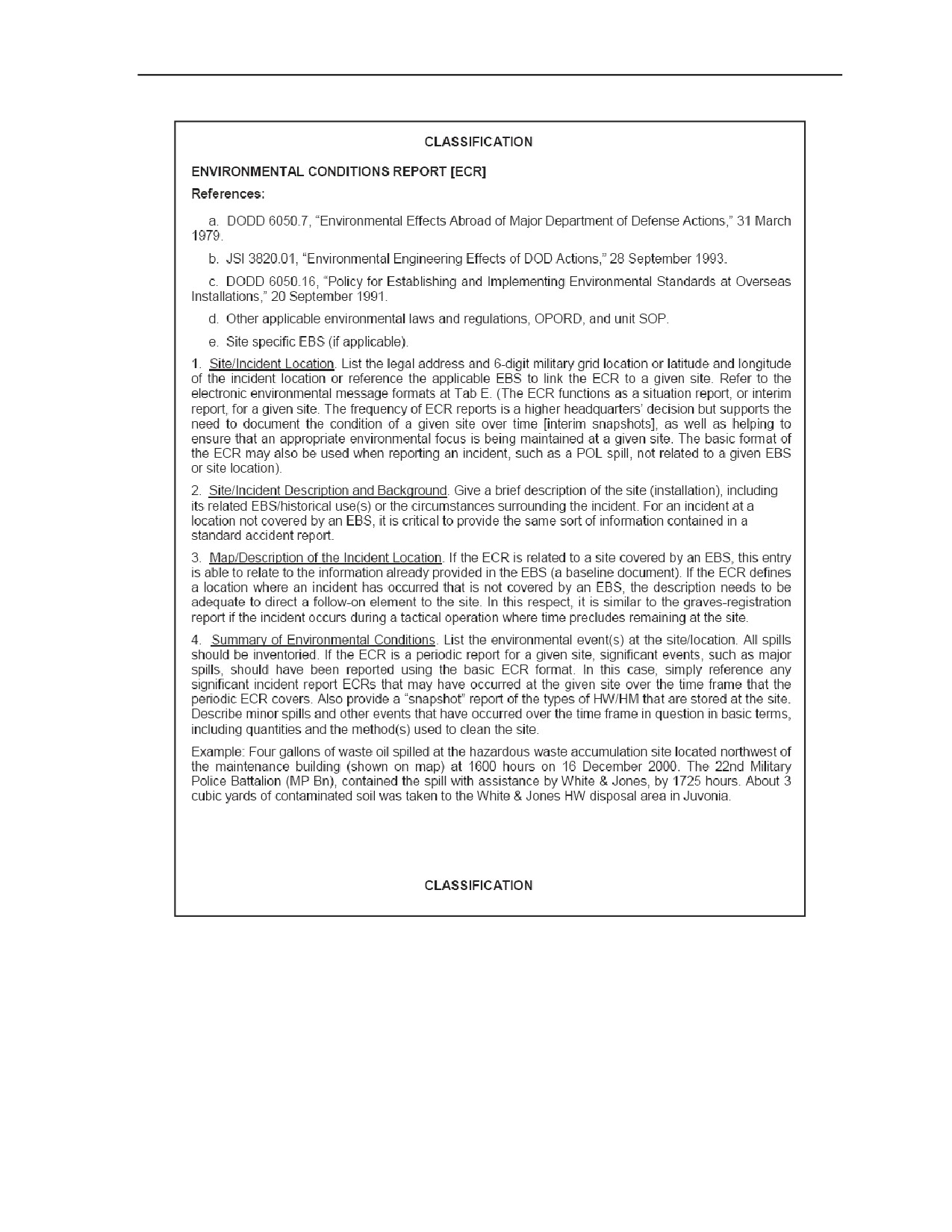
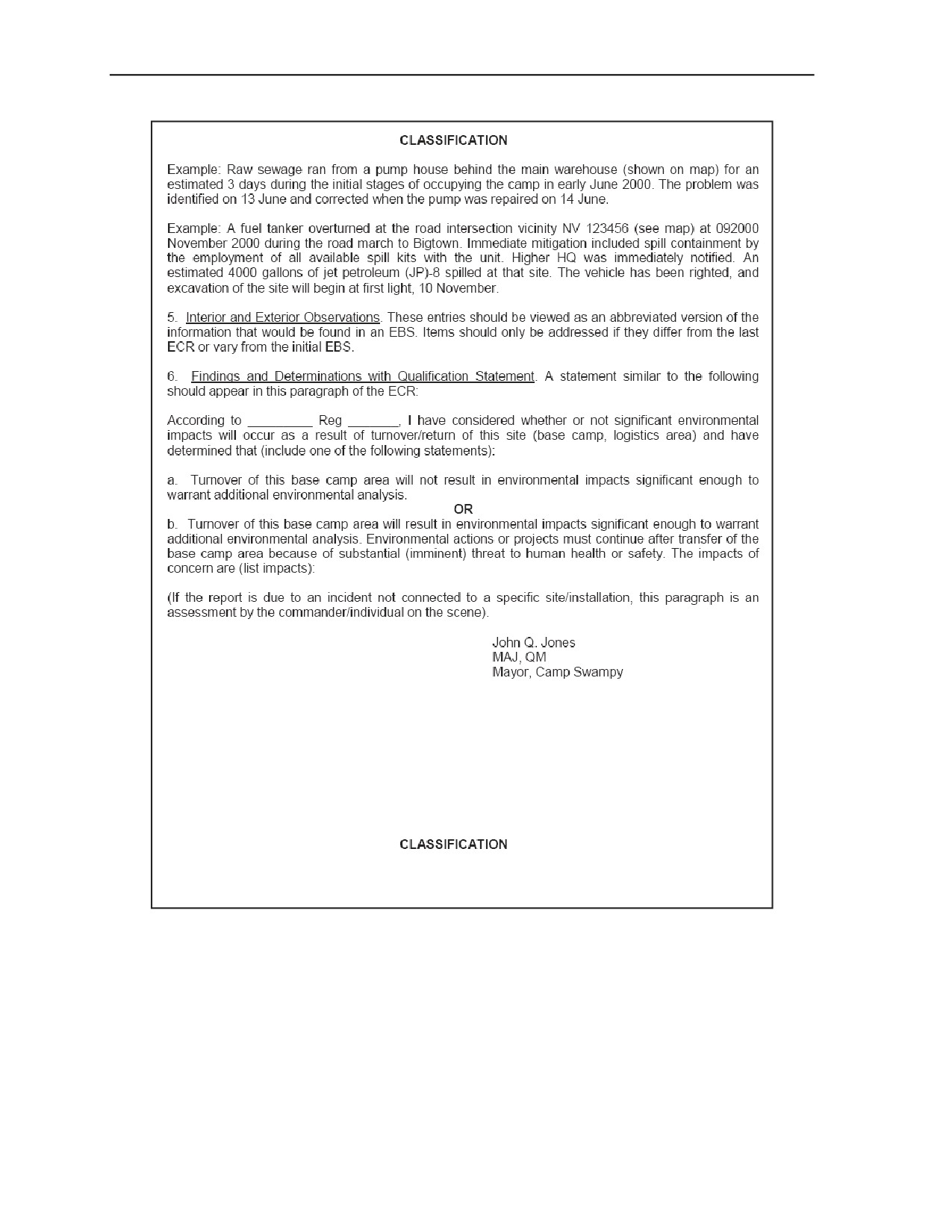
actively incorporated in the life of the site. This report is called an environmental conditions report (ECR)
and is focused on how well the commander of that site is applying relevant and directed environmental
considerations. ECRs will be conducted for as long as the site is occupied and not less than on a quarterly
basis to measure the environmental health/status of the base camp or similar site. These are ideally linked
to medical survey efforts to both combine their effect and to minimize their administrative effects on the
command. A standardized template is included as figure D-1 on page D-7.
ENVIRONMENTAL BASELINE SURVEY CONTENT
D-11. Ideally, an EBS will be prepared to the fullest extent possible for each site to document
environmental and environmental health conditions prior to the time of servicemember arrival. This
snapshot provides immediate information to the commander as well as creating a baseline record of
conditions at that time. At some point it is also likely that a closure report will also be completed, but this is
not the focus of the commander occupying the site. The EBS investigation is designed to provide the
commander and his staff with an overview of the designated location/site using real-time field sampling,
historical information, and readily available intelligence. Information sources include, but are not limited
to,—
z
IPB.
z
Current reconnaissance reports of a given location/site.
z
Intelligence reports.
z
Digital information sources (National Geospatial-Intelligence Agency, Armed Forces Medical
Intelligence Center, Defense Intelligence Agency, and others).
z
Other geospatial information and products.
D-12. Deliberate information gathering and research for environmentally specific and historical
information must be part of the investigative process in the execution of the EBS. This will include
interviews with personnel having knowledge of the designated location to gain historical information about
a site if possible. In some cases, this may be performed by real estate personnel before a site is ever
occupied.
D-13. A physical site inspection is performed by environmental specialists to obtain firsthand visual and
physical information pertaining to the property to identify recognized environmental conditions and
characteristics. The linkage of environmental and occupational health hazards are integrated as a part of the
inspection. These inspections include the information categories contained in the EBS format. This
inspection should include (as a minimum) the following:
z
Physical description and condition. Note the condition and location of facilities/improvements
(if applicable) including the presence of buildings and other structures. Also record sites of
known contamination within or immediately adjacent to the property boundaries and, if possible,
try to determine the contaminant(s) of concern and the media affected. Include information, if
available, on any remediation efforts and sampling conducted.
z
Historical use(s) and user(s). Identify any visual and physical indications of past use(s) that
may have impacted the property through the use, treatment, storage, disposal, or generation of
hazardous substances or petroleum products. Include a list of past owners, occupants, and past
uses of the property where available.
z
Adjacent land use. The general type of property usage (such as residential, commercial,
industrial) should be documented. Identify any visual and physical indications (for example, soil
25 March 2008
FM 3-34.170/MCWP 3-17.4
D-3
Appendix D
staining, stressed vegetations) of current and past land use practices that may be indicative of a
contaminant release.
z
Soil type and land cover. Note the soil type and general types of vegetation present on the
property. Include in this paragraph any observations of stressed vegetation and potential causes
(for example, hazardous substances or petroleum product release, lack of irrigation, high traffic
area, and so forth).
z
Hydrologic and geologic features. In this portion, include hydrologic features important to
drainage such as creeks, ditches, and riverbeds.
z
Water supply. Identify any sources of potable water on the property as well as an estimated
associated capacity. Note the presence of water facilities such as pump stations, storage tanks,
system age and condition, and its components. In addition, document any wastewater or other
liquids discharging from the property into a drain, ditch, or stream on or adjacent to the
location/property.
D-14. Typically an EBS will come upon situations that require the survey team to take samples to obtain
more detailed analysis. The procedures associated with sampling, whether their focus is engineering or
medical related, are very similar. (Refer to FM 3-100.4 for a discussion of these procedures.)
D-4
FM 3-34.170/MCWP 3-17.4
25 March 2008

Environmental Baseline Survey
Table D-1. Environmental baseline survey format
1.
Cover page for EBS
3.2.1.
Current use of site
1.1. Title will be “Environmental Baseline Survey”
3.2.2.
Historical use of site
1.2. Location identification
3.3. Use of adjoining properties
1.2.1.
This identification will indicate the
3.3.1.
Current use of adjoining properties
location’s recognized name or similar
3.3.2.
Historical use of adjoining properties
means of identification, such as
4.
Site description
Logistics Staging Area Doe
4.1. Location. General description of the site
1.2.2.
Name of city, township, or area of
location that will include the following
operation for the location of the site
information:
1.3. Identification of lead surveyor
4.1.1.
Detailed description of the site
1.3.1.
Organization/agency with
location
responsibility for conducting EBS
4.1.2.
Organization designated for
1.3.2.
Standard name line of project leader
occupation of the site
1.3.3.
Period of survey
4.1.3.
Grid location of area
1.3.3.1. Start date of survey
4.1.4.
Map series
1.3.3.2. End date of survey
4.2. Site and vicinity characteristics
1.3.4.
DSN phone number (if available)
4.2.1.
Physical setting
2.
Executive summary (separate page)
4.2.2.
Topography
2.1. Findings. Written to provide users of the EBS
4.2.3.
Geology
a broad overview of the findings regarding
4.2.4.
Soils
the designated location where the EBS was
conducted. Discuss specific PIRs
4.2.5.
Vegetation
addressed/evaluated in the EBS
4.2.6.
Hydrology
2.2. Recommendations. General
4.2.7.
Raw materials
recommendations to be considered by users
4.3. Detailed site description
of the EBS that addresses any controls or
4.3.1.
Structures
actions that should be addressed.
Recommendations must be supported by
4.3.2.
Roads
findings during the execution of the EBS
4.3.3.
Drinking water sources
2.3. Notes. General comments regarding
4.3.4.
Waste disposal
sampling, additional testing conducted, and
4.3.5.
Other improvements
related items considered during the
development of the recommendations in 2.2
4.4. Use of site
3.
Introduction
5.
Information sources and supporting documents
3.1. Purpose of the EBS, include PIRs to be
addressed
3.2. Limitations of assessment in the execution of
the EBS
25 March 2008
FM 3-34.170/MCWP 3-17.4
D-5
Appendix D
Table D-1. Environmental baseline survey format
6.
Information from site reconnaissance
7. Environmental and environmental health sampling
data
6.1. Background of location upon identification for
occupation
7.1. Sampling and analysis plan(s) to include
justification for number, type, and location of
6.2. Detailed analysis of information gathered
samples collected, as well as analysis to be
that includes (but not limited to)—
performed on the samples collected.
6.2.1.
Presence of animals or other vectors
Sampling should be identified as either
such as insects (mosquitoes, sand flies,
confirmation or delineation
and so forth.)
7.2. Sampling results analysis to include a
6.2.2.
Potential radioactive sources
summary table of sampling results
(present or past)
7.3. Environmental health site assessment
6.2.3.
Hazards and health risks
summary (if applicable)
6.2.3.1. Site specific
8. Findings and conclusions
6.2.3.2. Offset site
8.1. Identification of environmental conditions that
6.2.4.
Environmental hazards
have the potential for significant impacts to
6.2.4.1. Site specific
health or mission
6.2.4.2. Offset site
8.2. Detailed concerns
6.2.5.
Waste disposal
9. Recommendations
6.2.5.1. Current status
9.1.
Usability
6.2.5.2. Historical perspective
9.2.
Further investigation and additional
assessments required to fully address
6.2.5.3. Planned Improvements or
concerns
changes
9.3.
Identify and recommend controls to address
6.2.6.
Agricultural implications
concerns where applicable
6.2.6.1. Site specific
6.2.6.2. Offset site
6.2.7.
Identified environmental and
environmental health hazards
6.2.7.1. Historical
6.2.7.2. Present
6.2.7.3. Potential future
6.2.8.
Site assessment to include detailed
walk-through with building and
infrastructure assessments
D-15. The primary purpose for a base camp is mission support, synchronized with the overall military
mission of the deployed force. To execute mission support, a base camp must provide force protection to
deployed forces, resource management of critical infrastructure, training opportunities for deployed forces
and permanent party, and maintenance of the facilities. Included in that mission support is the continued
application of environmental considerations, to include the critical aspects of force health protection. This
includes periodic, sustained site surveys/assessments similar to those performed by an installation staff.
The ECR (see figure D-1) assists with that requirement.
D-6
FM 3-34.170/MCWP 3-17.4
25 March 2008
Environmental Baseline Survey
Figure D-1. Environmental conditions report format
25 March 2008
FM 3-34.170/MCWP 3-17.4
D-7
Appendix D
Figure D-1. Environmental conditions report format (continued)
D-8
FM 3-34.170/MCWP 3-17.4
25 March 2008

Appendix E
Military Load Classification
The basis for MLC is the effect (load, vehicle speed, tire width, and so forth) a
vehicle has on a bridge when crossing. Heavy loads, such as artillery and tanks, make
vehicle classification an important factor in determining bridge capacity as well as
classifying the overall trafficability of a route.
REQUIREMENT FOR CLASSIFICATION NUMBERS
E-1. Classification numbers are mandatory for all self-propelled vehicles having a total weight of 3 tons
or more, as well as all trailers with a payload of 1 ½ tons or greater (in compliance with STANAGs 2010
and 2021). Trailers with a rated capacity of less than 1 ½ tons are usually combined with their towing
vehicle for classification.
E-2. MLC information is found in the vehicle’s TM or on the vehicle data plate. Table E-1 provides a
reference list of common vehicles and their MLCs.
Table E-1. Reference list of common vehicles with MLCs
MLC
MLC
Nomenclature
Name
Description
Empty
Loaded
(use 26.5
AAV
Amphibious assault vehicle
tons)
Abrams
See M1
(use 24.75
AGS
Armored gun system
tons)
ASWDS
Airborne scraper
Wheeled: truck, 2-axle
19
Airborne water distribution
ASWDS
Wheeled: truck, 2-axle
19
33
system
ATEC
All terrain crane
Wheeled: truck, 2-axle
22
All terrain lifter, army
ATLAS with 10,000-pound
Wheeled: truck, 2-axle
17
system (ATLAS)
carriage
ATLAS with 10,000-pound and
ATLAS
Wheeled: truck, 2-axle
17
6,000-pound carriage
ATLAS with 6,000-pound
ATLAS
Wheeled: truck, 2-axle
19
carriage
ATLAS
With armor protection
Wheeled: truck, 2-axle
19
AVLB with M48
AVLB launcher with bridge
Tracked: vehicle
49
67
chassis
AVLB with M60
AVLB launcher with bridge
Tracked: vehicle
43
58
chassis
Breacher
Breacher at gross curb weight
Tracked: vehicle
73
30
Buffalo
MRAP- Cat III
Wheeled: truck, 3-axle
(Preliminary)
38
Buffalo
With expedient armor
Wheeled: truck, 3-axle
(Preliminary)
Loader, scoop 2.5 cubic yards
C7
20
without roll cage
25 March 2008
FM 3-34.170/MCWP 3-17.4
E-1

Appendix E
Table E-1. Reference list of common vehicles with MLCs
MLC
MLC
Nomenclature
Name
Description
Empty
Loaded
Mine resistant ambush
Caiman
Wheeled: truck, 2-axle
15
protected (MRAP) - Cat I
Caiman
MRAP - Cat II
Wheeled: truck,, 3-axle
19
11
CB-543
Roller, motorized, vibrating
Wheeled: truck, 2-axle
(Estimated)
CCE 130G
Grader, road
18
Cougar
MRAP - Cat I
Wheeled: truck, 2-axle
19
Cougar
MRAP - Cat II
Wheeled: truck, 3-axle
25
Crane, crawler
mounted, 12.5-ton at
Tracked: vehicle
23
12 feet
Crusader
Crusader - resupply vehicle
Tracked: vehicle
50
Crusader - self-propelled
Crusader
Tracked: vehicle
50
howitzer
Deuce
Deuce, special
Tracked: vehicle
23
D4
Tractor, tracked, Caterpillar™
Tracked: vehicle
13
Tractor, full tracked, air
D5BNS
Tracked: vehicle
21
droppable, nonsectionalized
Tractor, full tracked, air
D5BS
Tracked: vehicle
22
droppable, nonsectionalized
D7 dozer
With blade, with winch
23
Tractor, full tracked, diesel
engine driven (DED): with
D7F
Tracked: vehicle
34
ripper, rollover protective
structures (ROPS), and blade
Tractor, full tracked, DED: with
D7F
Tracked: vehicle
23
winch and blade
Tractor, full tracked, DED: with
D7F
Tracked: vehicle
24
winch, ROPS, and blade
Tractor, full tracked, DED: with
D7F DV29
Tracked: vehicle
31
ripper and blade
D7G dozer with blade, ripper,
44
D7G dozer
Tracked: vehicle
10,000 pounds of armor
(Estimated)
D7G dozer with blade, ripper,
38
D7G dozer
Tracked: vehicle
5,000 pounds of armor
(Estimated)
D7G
D7G tractor crawler
Tracked: vehicle
32
D7G
D7G with ROPS
Tracked: vehicle
35
40
D7G
D7G with armor
Tracked: vehicle
(Preliminary)
With ROPS capability and
133
D9 dozer
Tracked: vehicle
ripper, armored
(Preliminary)
E-2
FM 3-34.170/MCWP 3-17.4
25 March 2008

Military Load Classification
Table E-1. Reference list of common vehicles with MLCs
MLC
MLC
Nomenclature
Name
Description
Empty
Loaded
110
D9R
D9R Caterpillar dozer
Tracked: vehicle
(Estimated)
Engineer squad
Stryker - engineer squad
Wheeled: truck, 4-axle
20
vehicle (ESV)
vehicle with mine roller
Stryker - engineer squad
ESV
Wheeled: truck, 4-axle
19
vehicle with surface mine plow
Tractor, with excavator and
Wheeled: truck-tractor,
FLU 419
9
front loader
2-axle
Tractor, all wheel drive with
FLU 10244
Wheeled: truck, 2-axle
9
hatch, high mobility entrencher
FMTV
FMTV expansible van
Wheeled: truck, 3-axle
14
17
FMTV load handling system
FMTV
Wheeled: truck, 3-axle
11
20
(LHS) truck
Wheeled, combination:
FMTV
FMTV LHS truck and trailer
3-axle truck with 2-axle
13
28
trailer
Wheeled, combination:
FSCS/Tracer
26
3-axle truck with 1-axle
concept
(Estimated)
trailer
HMEE Type III
Backhoe Loader
Loader, 2-axle
10
12
Husky
Husky
Wheeled: truck, 2-axle
8
Husky
With expedient armor
Wheeled: truck, 2-axle
10
Wheeled, combination:
Husky
Husky with trailer set
2-axle truck with >4-axle
26
trailer
HYEX
HYEX, Type I
Tracked: vehicle
29
HYEX w/ Armor
HYEX, Type I
Tracked: vehicle
31
HYEX
HYEX, Type II
Tracked: vehicle
33
HYEX
HYEX, Type III
Tracked: vehicle
36
Stryker - infantry carrier vehicle
ICV
Wheeled: truck, 4-axle
20
(rifle)
Interim - high
mobility engineer
I-HMEE without armor
Wheeled: truck, 2-axle
12
excavator
(I-HMEE)
I-HMEE
I-HMEE with armor
Excavator, 2-axle
14
Wheeled: truck-tractor,
JD-410
Loader
9
10
2-axle
Joint explosive
ordnance disposal
JERRV
Wheeled: truck, 3-axle
19
rapid response
vehicle (JERRV)
JERRV
JERRV with expedient armor
Wheeled: truck, 3-axle
23
14
Light assault vehicle
Light assault vehicle
Wheeled: truck, 4-axle
(Estimated)
LMTV
Trailer, cargo, 2.5-ton
<3
4
Crane, rough terrain, Type I,
LRT-110
Wheeled: truck, 2-axle
11
7.5-ton
25 March 2008
FM 3-34.170/MCWP 3-17.4
E-3

Appendix E
Table E-1. Reference list of common vehicles with MLCs
MLC
MLC
Nomenclature
Name
Description
Empty
Loaded
MaxxPro
MRAP - Cat I
Wheeled: truck, 2-axle
18
MaxxPro XL
MRAP - Cat II
Wheeled: truck, 2-axle
21
Modular base
Modular base petroleum
Wheeled: semitrailer,
petroleum laboratory
14
laboratory
2-axle
(MBPL)
Mortar carrier (MC) -
Stryker - mortar carrier vehicle
Wheeled: truck, 4-axle
21
(B)
(Version B)
Mortar carrier vehicle
Stryker - mortar carrier vehicle
Wheeled: truck, 4-axle
21
(MCV) -A
(Version A)
Medical evaluation
Stryker - medical evaluation
Wheeled: truck, 4-axle
20
vehicle (MEV)
vehicle
Mobile gun system
Stryker - mobile gun system
Wheeled: truck, 4-axle
25
(MGS)
with slat armor
Stryker - mobile gun system
MGS
Wheeled: truck, 4-axle
24
without slat armor
Tracked: trailer,
Mill unit
Mill unit, mobile pipe mill
62
quadritracked
Logistics vehicle system, LVS,
MK 48/17
articulated drop side cargo
Wheeled: truck, 4-axle
20
41
truck
Crane, truck mounted,
MT 250
Wheeled: truck, 4-axle
31
25-ton
Abrams towing explosive
Tracked, combination:
75
M1
standoff minefield breacher
vehicle
(Estimated)
(ESMB) trailer
Abrams with minefield clearing
79
M1
Tracked: vehicle
blade
(Estimated)
Abrams with mine roller
Hybrid, combination: half
M1
109
(lowered)
track with 1-axle trailer
M1
Abrams at 70-short tons
Tracked: vehicle
71
M1 towing M1
Abrams towing Abrams
Tracked: quadritracked
150+
Abrams with Abrams reactive
M1
armor tile (ARAT) and belly
Tracked: vehicle
80
armor
M1
Abrams with belly armor
Tracked: vehicle
77
M1 with mine roller
Abrams with mine roller (raised)
Tracked: vehicle
88
E-4
FM 3-34.170/MCWP 3-17.4
25 March 2008

Military Load Classification
Table E-1. Reference list of common vehicles with MLCs
MLC
MLC
Nomenclature
Name
Description
Empty
Loaded
Abrams with tank urban
M1A2
survivability kit (TUSK) and
Tracked: vehicle
82
belly armor
Abrams with TUSK and belly
Tracked, combination:
M1A2 towing M1A2
armor towing Abrams with
150+
vehicle
TUSK and belly armor
Bradley, fighting vehicle,
M2
Tracked: vehicle
21
25
cavalry
Bradley, fighting vehicle,
M2A1
Tracked: vehicle
23
30
infantry
Bradley, fighting vehicle,
M2A2
Tracked: vehicle
27
33
infantry
Bradley fighting vehicle with
M2A3
Tracked: vehicle
36
reactive armor kit
Bradley fighting vehicle without
M2A3
Tracked: vehicle
33
reactive armor
Bradley, fighting vehicle,
M3
Tracked: vehicle
21
25
cavalry
Landing vehicle, track
M5
Tracked: vehicle
31
43
personnel
Bradley linebacker without
30
M6
Tracked: vehicle
hybrid armor
(Estimated)
Bradley linebacker with hybrid
M6
Tracked: vehicle
33
armor
Bradley fire support vehicle with
M7
Tracked: vehicle
34
hybrid armor
Bradley fire support vehicle
M7
Tracked: vehicle
31
without hybrid armor
M9
Armored combat earthmover
Tracked: vehicle
18
36
Bulldozer, earthmoving, tank
M9
Tracked: vehicle
54
mounted
Truck, cargo, 2.5-ton 6x6 with
Wheeled, combination:
M35A2 towing
trailer with mine-clearing line
3-axle truck with 1-axle
8
10
M200A1
charge
trailer
Truck, cargo: 2.5-ton, 6x6, drop
M35A2C
Wheeled: truck, 3-axle
7
side, M35A2C
Tank, combat, full tracked, 90
M48A1
Tracked: vehicle
48
54
mm gun
M48A1 with
Tank, combat, full tracked, 90
Tracked: vehicle
54
62
bulldozer
mm gun with bulldozer
Wheeled, combination:
Truck, cargo, van, 5-ton, 6x6,
M50 towing M2
3-axle truck with 3-axle
21
30
towing, howitzer
trailer
Truck-tractor, 5-ton, 6x6 with
Wheeled: truck-tractor,
M52
8
winch
3-axle
25 March 2008
FM 3-34.170/MCWP 3-17.4
E-5

Appendix E
Table E-1. Reference list of common vehicles with MLCs
MLC
MLC
Nomenclature
Name
Description
Empty
Loaded
Truck-tractor, 5-ton, 6x6 with
Wheeled, combination:
winch towing semitrailer, 5,000
M52 towing M967
3-axle truck-tractor with
14
29
allon, bulk haul, self-
2-axle semitrailer
load/unload
Truck-tractor, 5-ton, 6x6 with
Wheeled, combination:
winch towing semitrailer, 5,000
M52 towing M969
3-axle truck-tractor with
14
30
gallon, automotive fueling
2-axle semitrailer
dispenser
Truck-tractor, 5-ton, 6x6 with
Wheeled, combination:
winch towing semitrailer, 5,000
M52 towing M970
3-axle truck-tractor with
15
30
allon, underwing/overwing
2-axle semitrailer
aircraft fueling dispenser
Truck-tractor, 5-ton, 6x6 with
Wheeled: truck-tractor,
M52A1
9
winch
3-axle
Truck-tractor, 5-ton, 6x6 with
Wheeled: truck-tractor,
M52A2
8
winch
3-axle
Truck, cargo, 5-ton, 6x6 with
M54
Wheeled: truck, 3-axle
9
19
winch
Truck, cargo, 5-ton, 6x6, towing
Wheeled, combination:
M54 towing M198A1
semitrailer, tank, gasoline,
3-axle truck with 3-axle
14
36
5,000 gallon
trailer
M60A1
Tank, combat, 105-mm gun
Tracked: vehicle
47
52
M60A2
Tank, combat 152-mm
Tracked: vehicle
58
M60A3
Tank, combat 105-mm
Tracked: vehicle
58
Reconnaissance system, NBC
18
M93A1
Wheeled: truck, 3-axle
Fox
(Estimated)
M107
Gun, 175-mm, self-propelled
Tracked: vehicle
31
Howitzer, 155-mm,
M109A4/A5
Tracked: vehicle
28
self-propelled
Howitzer, heavy,
M110A2
Tracked: vehicle
28
31
self-propelled, 8 inch
M113
M113
Tracked: vehicle
12
Carrier, personnel, tracked,
M113A1
Tracked: vehicle
12
armored
Carrier, cargo, amphibious,
M116
Tracked: vehicle
5
tracked
Wheeled, combination:
M123 6x6 towing 6k
Truck-tractor with 6,000-gallon
3-axle truck-tractor with
17
38
water trailer
water semitrailer
2-axle semitrailer
Truck, firefighting: 1,000
M158
gallons per minute, tactical
Wheeled: truck, 2-axle
14
type, multipurpose, M158
Wheeled: semitrailer,
M172A1
Trailer, low-bed, 25-ton
6
36
2-axle
Wheeled: trailer,
M198
Howitzer, towed, 155-m
10
1-axle
Wheeled: semitrailer,
M270A1
Semitrailer, low-bed, 12-ton
7
17
2-axle
M270/A1
MLRS
Tracked: vehicle
22
27
E-6
FM 3-34.170/MCWP 3-17.4
25 March 2008

Military Load Classification
Table E-1. Reference list of common vehicles with MLCs
MLC
MLC
Nomenclature
Name
Description
Empty
Loaded
M328A2
Bridge transporter, 5-ton
Wheeled: truck, 3-axle
12
22
M412 RT240
Kalmar RTCH
Wheeled: truck, 2-axle
118
Truck, cargo, 5-ton, 6x6, with
M54 series
9
19
winch, with equipment
M520
Truck, cargo, 8-ton
Wheeled: truck, 2-axle
12
18
M548
Carrier, cargo, 6-ton
7
13
Armored reconnaissance ABN
M551
Tracked: vehicle
15
17
vehicle
M553
Truck, wrecker, 10-ton
Wheeled: truck, 2-axle
18
24
M559
Truck, tank, 2,500 gallon
Wheeled: truck, 2-axle
12
22
M577A1
Carrier, command post
Tracked: vehicle
11
12
M578
Recovery vehicle, light
Tracked: vehicle
27
M728
Combat engineer vehicle
Tracked: vehicle
59
Wheeled: semitrailer,
M747
HET semitrailer 52, 5-ton
13
68
4-axle and higher
M88
Hercules
Tracked: vehicle
55
M88A1
Hercules
56
M88A2
Hercules
Tracked: vehicle
71
Truck, cargo: drop side,
M813A1
Wheeled: truck, 3-axle
9
20
5-ton
M814
Truck, cargo, 5-ton
Wheeled: truck, 3-axle
10
21
M816
Truck, tactical, 5-ton
Wheeled: truck, 3-axle
18
32
Wheeled, combination:
M818 towing
Truck tractor 5-ton towing low-
3-axle truck-tractor with
14
30
M172A1 with D7
bed 25-ton trailer
2-axle semitrailer
Wheeled: semitrailer,
M870
Semitrailer, low-bed, 40-ton
7
50
3-axle
Semitrailer, dual purpose, 22.5
Wheeled: semitrailer,
M871A1
7
52
ton
2-axle
Semitrailer, flatbed, 34-ton,
Wheeled: semitrailer,
M872A1
8
39
container transporter
3-axle
M901
Combat vehicle, TOW
Tracked: vehicle
12
Truck-tractor, commercial
Wheeled: truck-tractor,
M911
heavy equipment transporter
18
4-axle
(C-HET)
Wheeled, combination:
M911 towing 604 NL
M911 towing 604 NL
3-axle truck-tractor with
82
4-axle semitrailer
Wheeled, combination:
M911 towing 635 N
M911 towing 635 N
3-axle truck-tractor with
95
5(>4)-axle semitrailer
Wheeled: truck-tractor,
M915
Line haul tractor
9
3-axle
17
Wheeled, combination:
M915 with XM 990
Line hauler tractor and
3-axle truck-tractor with
with XM21
semitrailer
1-axle semitrailer
25 March 2008
FM 3-34.170/MCWP 3-17.4
E-7

Appendix E
Table E-1. Reference list of common vehicles with MLCs
MLC
MLC
Nomenclature
Name
Description
Empty
Loaded
Wheeled: truck-tractor,
M915A1/A2
Truck-tractor
8
3-axle
Wheeled, combination:
M915A3 towing
Truck-tractor towing 34-ton
3-axle truck-tractor with
42
M872A4
semitrailer
3-axle semitrailer
Wheeled: truck-tractor,
M915A3
Truck-tractor, line haul
8
3-axle
Truck-tractor, line haul towing
Wheeled, combination:
M915A3 towing
14
30
semitrailer, 5,000 gallon,
3-axle truck-tractor with
M969
(Estimated)
(Estimated)
automotive fuel dispensing
2-axle semitrailer
Truck-tractor, line haul towing
Wheeled, combination:
M915A3 towing
semitrailer,
13
29
3-axle truck-tractor with
M967
5,000-gallon, bulk haul self
(Estimated)
(Estimated)
2-axle semitrailer
load/unload
M916
Truck-tractor
12
20-ton, light equipment, 5,600
Wheeled, combination:
M916 towing 6K
GVW, towing 6,000-gallon
3-axle truck-tractor with
16
37
W6DS/M60 PRS
water distributor
2-axle semitrailer
20-ton, light equipment, 6x6
Wheeled, combination:
M916 towing
towing semitrailer, low-bed:
3-axle truck-tractor with
18
42
M870A1
construction equipment
3-axle semitrailer
transporter
Truck, tractor, 20-ton, 6x6,
Wheeled, combination:
M916A1 towing
towing semitrailer, low-bed, 40
3-axle truck-tractor with
18
50
M870
ton
3-axle semitrailer
20-ton, light equipment, 6x6,
Wheeled, combination:
M916A1 towing
56,000 gross vehicle weight
3-axle truck-tractor with
18
39
M172A1
towing semitrailer, low-bed: 25
2-axle semitrailer
ton, 4 wheel
Wheeled: truck-tractor,
M916A3
Truck-tractor,
12
3-axle
Truck-tractor, LET towing
Wheeled, combination:
M916A3 towing
18
33
semitrailer, 5,000-gallon,
3-axle truck-tractor with
M969
(Estimated)
(Estimated)
automotive fuel dispensing
2-axle semitrailer
Truck-tractor, LET towing
Wheeled, combination:
M916A3 towing
17
32
semitrailer, 5,000-gallon, bulk
3-axle truck-tractor with
M967
(Estimated)
(Estimated)
haul self-load/unload
2-axle semitrailer
Wheeled, combination:
M916A3 towing
Truck-tractor, LET towing
56
3-axle truck-tractor with
21
M1143
semitrailer, SLOT
(Estimated)
3-axle semitrailer
Truck, dump, 20-ton, 8x6,
M917
75,000-pound gross vehicle
Wheeled: truck, 4-axle
47
weight
Wheeled: truck-tractor,
M918
Distributor, bituminous
21
3-axle
Truck, concrete, mobile, 8x6,
M919
75,000-pound gross vehicle
Wheeled: truck, 4-axle
43
weight
Truck-tractor, medium
Wheeled: truck-tractor,
M920
14
equipment transport (MET)
3-axle
E-8
FM 3-34.170/MCWP 3-17.4
25 March 2008

Military Load Classification
Table E-1. Reference list of common vehicles with MLCs
MLC
MLC
Nomenclature
Name
Description
Empty
Loaded
M920 towing 6K
Truck-tractor, 20-ton, 8x6,
Wheeled, combination:
water distribution
towing 6,000 gallon water
4-axle truck-tractor with
18
39
trailer
distribution trailer
2-axle semitrailer
Truck-tractor, 20-ton, 8x6,
Wheeled, combination:
M920 towing
towing semitrailer, low-bed, 40
4-axle truck-tractor with
20
52
M870A1
ton
3-axle semitrailer
Truck, cargo: 5-ton, 6x6,
Wheeled: truck,
M923A1
12
M923A1 (without winch)
3-axle
Truck, cargo, drop side,
Wheeled, combination:
M923 towing
5-ton, 6x6, towing dolly set, lift,
3-axle truck with 2-axle
11
19
M1061A1
transportable shelter
trailer
5 ¼-ton
Truck, cargo, drop side,
Wheeled, combination:
M923 towing
5-ton, 6x6, towing trailer,
3-axle truck with 2-axle
17
M1061A1
5-ton
trailer
Truck, cargo, drop side,
Wheeled, combination:
M923 towing M1073
5-ton, 6x6, towing trailer,
3-axle truck with 2-axle
11
18
flatbed, 7.5-ton
trailer
Truck, cargo: 5-ton, 6x6,
M925A1
Wheeled: truck, 3-axle
11
16
M925A1 (with winch)
Wheeled, combination:
M927 towing M200 A1 with
M927 with M200A1
3-axle truck with 1-axle
17
power unit
trailer
Truck, cargo: 5-ton, 6x6,
M928A
Wheeled: truck, 3-axle
11
17
M928A2 (with winch)
Truck, dump, 5-ton, without
M929A2
Wheeled: truck, 3-axle
10
16
winch
Truck, dump: 5-ton, 6x6,
M930A
Wheeled: truck, 3-axle
11
17
M930A2 (with winch)
M931
Tractor, 5-ton
Wheeled: truck, 3-axle
9
17
M966
HMMWV, TOW missile carrier
Wheeled: truck, 2-axle
4
Semitrailer, 5,000-gallon, bulk
Wheeled: semitrailer,
M967
6
21
haul, self load/unload
2-axle
Semitrailer, 5,000-gallon,
Wheeled: semitrailer,
M969
7
22
automotive fuel dispensing
2-axle
Semitrailer, 5,000-gallon
Wheeled: semitrailer,
M970
underwing/overwing aircraft fuel
15
22
2-axle
dispensing
Heavy expanded mobility
M977
18
28
tactical truck (HEMTT)
M978
HEMTT, tanker
Wheeled: truck, 4-axle
25
M981
Fire support vehicle
14
14
M984
HEMTT, wrecker
Wheeled: truck, 4-axle
19
Wheeled, combination:
M984A1 towing
HEMTT towing rear of truck,
4-axle truck with 1-axle
24
M966
light duty, TOW missile carrier
trailer
18
M985
HEMTT, cargo
Wheeled: truck, 4-axle
28
(Estimated)
M985 towing
HEMTT towing heavy
Wheeled, combination:
20
39
25 March 2008
FM 3-34.170/MCWP 3-17.4
E-9

Appendix E
Table E-1. Reference list of common vehicles with MLCs
MLC
MLC
Nomenclature
Name
Description
Empty
Loaded
M989A1
expanded mobility ammunition
4-axle truck with 2-axle
trailer (HEMAT) (MLRS) trailer
trailer
Wheeled, combination:
23
46
M985 with M1076
HEMTT with PLS trailer
4-axle truck with 3-axle
(Estimated)
(Estimated)
trailer
M992
Carrier, ammunition (FAASV)
Tracked: vehicle
29
M997
HMMWV, ambulance
Wheeled: truck, 2-axle
4
M998
HMMWV, cargo/troop carrier
Wheeled: truck, 2-axle
4
M1000
HET trailer
18
M1002
Truck, tactical, wrecker, 8x8
Wheeled: truck, 4-axle
21
Truck, cargo: 1 ¼-ton, 4x4,
M1028 w S-250
shelter carrier, M1028, with
Wheeled: truck, 2-axle
4
shelter, S-250
Wheeled, combination:
M1031 with shelter towing PU
M1031 with PU-573
2-axle truck with 1-axle
5
5
753/M generator set
trailer
M1037
HMMWV, S250 shelter carrier
Wheeled: truck, 2-axle
4
M1038
HMMWV, cargo/troop carrier
Wheeled: truck, 2-axle
4
M1059
Carrier, smoke generator M157
Tracked: vehicle
13
M1068
Carrier, armored, command
Tracked: vehicle
13
Wheeled, combination:
M1070 with M1000
HET with trailer
4-axle truck-tractor with
31
5-axle semitrailer
Wheeled, combination:
M1070 towing
HET carrying M1A2
4-axle truck-tractor with
96
M1000
5-axle semitrailer
HET equipped with sand
Wheeled, combination:
M1070 towing
mobility enhancement kit
4-axle truck-tractor with
94
M1000
carrying M1
5-axle semitrailer
Wheeled, combination:
M1070 towing
HET equipped with Simula
4-axle truck-tractor with
98
M1000
Armor Kit (SAK) carrying M1
5-axle semitrailer
Wheeled, combination:
M1070 towing
Unarmored HET carrying
4-axle truck-tractor with
100
M1000
M1with TUSK and belly armor
5-axle semitrailer
Wheeled: truck-tractor,
M1070
HET tractor
18
4-axle
Wheeled, combination:
M1070 with Dolly
96
HET with dolly, 70-ton payload
4-axle truck-tractor with
with M1000
(Estimated)
>5-axle semitrailer
100
Wheeled, combination:
(Estimated)
M1070 towing
HET with relocated Abrams
4-axle truck-tractor with
M1000
5-axle semitrailer
HET with Simula Armor
Wheeled, combination:
M1070 towing
101
carrying 74.5-ton Abrams
4-axle truck-tractor with
M1000
(similar to TUSK)
5-axle semitrailer
E-10
FM 3-34.170/MCWP 3-17.4
25 March 2008

Military Load Classification
Table E-1. Reference list of common vehicles with MLCs
MLC
MLC
Nomenclature
Name
Description
Empty
Loaded
Wheeled, combination:
M1070 towing
HET with tank with
4-axle truck-tractor with
101
M1000
mine-clearing blade
5-axle semitrailer
Wheeled: truck-tractor,
M1074
PLS, with MHC
25
41
>4-axle
Wheeled, combination:
M1074 towing
PLS with MHC towing PLS
4-axle truck with 4-axle
30
62
M1076
trailer
trailer
Wheeled, combination:
M1074 towing
PLS without MHC towing PLS
4-axle truck with 4-axle
30
59
M1076
trailer
trailer
Wheeled: truck-tractor,
M1075
PLS, without MHC
23
39
>4-axle
M1076
PLS trailer
Wheeled: trailer, 3-axle
8
26
Truck, cargo, 4x4 LMTV with
M1078
9
12
equipment
M1078
LMTV cargo with winch
Wheeled: truck, 2-axle
10
12
M1080
LMTV chassis
Wheeled: truck, 2-axle
8
M1081
LMTV cargo, air drop
Wheeled: truck, 2-axle
9
12
LMTV cargo, air drop, with
M1081
Wheeled: truck, 2-axle
12
12
winch
M1083
MTV cargo
Wheeled: truck, 3-axle
10
16
M1083
MTV cargo with winch
Wheeled: truck, 3-axle
10
16
M1084
MTV cargo with MHE
Wheeled: truck, 3-axle
11
17
M1085
MTV long cargo
Wheeled: truck, 3-axle
10
16
M1085
MTV long cargo with winch
Wheeled: truck, 3-axle
11
17
M1086
MTV long cargo with MHE
Wheeled: truck, 3-axle
12
17
M1088
MTV off-road tractor
Wheeled: truck, 3-axle
9
18
M1088
MTV off-road tractor with winch
Wheeled: truck, 3-axle
9
19
M1088
MTV tractor
Wheeled: truck, 3-axle
9
22
M1088
MTV tractor with winch
Wheeled: truck, 3-axle
9
22
M1089
MTV wrecker
Wheeled: truck, 3-axle
13
22
M1090
MTV dump
Wheeled: truck, 3-axle
11
17
M1090
MTV dump with winch
Wheeled: truck, 3-axle
11
17
M1092
MTV chassis
Wheeled: truck, 3-axle
9
M1093
MTV cargo, air drop
Wheeled: truck, 3-axle
10
16
M1093
MTV cargo, air drop, with winch
Wheeled: truck, 3-axle
11
17
M1094
MTV dump, air drop
Wheeled: truck, 3-axle
11
17
M1094
MTV dump, air drop with winch
Wheeled: truck, 3-axle
11
17
M1096
MTV long chassis
Wheeled: truck, 3-axle
8
M1097
Truck, utility: HMMWV
Wheeled: truck, 2-axle
<3
4
HMMWV, utility truck, up-
M1114
4x4 carrier
4
6
armored
25 March 2008
FM 3-34.170/MCWP 3-17.4
E-11

Appendix E
Table E-1. Reference list of common vehicles with MLCs
MLC
MLC
Nomenclature
Name
Description
Empty
Loaded
HMMWV utility tow carrier,
M1121
Wheeled: truck, 2-axle
4
1 ¼-ton,
HEMTT, tactical firefighting
M1142
Wheeled: truck, 4-axle
23*
29
truck
Wheeled: semitrailer,
M1143
Semitrailer, SLOT
11
56
3-axle
Wheeled: truck-tractor,
M1975
DSB launcher
41
>4-axle
DSB launcher with armor, A/C
Wheeled: truck-tractor,
42
M1975
kit
>4-axle
(Preliminary)
Wheeled, combination:
M1975 towing
DSB launcher with trailer
4-axle truck with 4-axle
49
M1076
trailer
M1977
Common bridge transporter
Wheeled: truck, 4-axle
27
Wheeled, combination:
Common bridge transporter
M1977 and M1076
4-axle truck with 3-axle
44
towing PLS trailer
trailer
Stryker - NBC reconnaissance
20
NBCRV
Wheeled: truck, 4-axle
vehicle (NBCRV)
Stryker - NBCRV with slat
NBCRV
Wheeled: truck, 4-axle
22
armor
Power unit
Power unit, mobile pipe mill
tracked: quadritracked
50
RG-31
MRAP - Cat I
Wheeled: truck, 2-axle
15
RG-31 extended
MRAP - Cat II
Wheeled: truck, 2-axle
17
RG-31
RG-31 MK5
Wheeled: truck, 2-axle
18
RG-31 MK5 with expedient
21
RG-31
Wheeled: truck, 2-axle
armor
(Preliminary)
RG33
MRAP - Cat I
Wheeled: truck, 2-axle
20
RG33L
MRAP - Cat II
Wheeled: truck, 3-axle
31
Crane, rough terrain, 40-ton,
RTCC
Wheeled: truck, 2-axle
85
150+
container
Crane, rough terrain, 40-ton,
RTCCS
container, service life extension
Wheeled: truck, 2-axle
87
program upgrade
50,000-pound rough terrain
RTCH 988F
container handler (RTCH)
Wheeled: truck, 2-axle
105
without top handler
50,000-pound RTCH with 40
RTCH 988F
Wheeled: truck, 2-axle
123
foot top handler
50,000-pound RTCH with pallet
RTCH 988F
Wheeled: truck, 2-axle
107
fork kit
50,000-pound RTCH with 20
RTCH 988F
Wheeled: truck, 2-axle
115
foot top handler
50,000-pound RTCH (with
either 20- or 40-foot top handler
RTCH 988F
Wheeled: truck, 2-axle
150+
carrying
50,000-pound load)
E-12
FM 3-34.170/MCWP 3-17.4
25 March 2008

Military Load Classification
Table E-1. Reference list of common vehicles with MLCs
MLC
MLC
Nomenclature
Name
Description
Empty
Loaded
SM54A
Roller, towed, vibrating, Raygo
Wheeled: trailer, 2-axle
1
Wheeled, combination:
76
Talbert Trailer
WHH with dolly with booster
4-axle truck-tractor with
(Estimated)
>5-axle semitrailer
Terrain crane
USMC ATC
Crane
31
Tractor, wheeled, towing
Wheeled, combination:
Tractor 830M towing
scraper, earth moving 18 cubic
2-axle truck-tractor with
45
68
scraper 18M
yards
1-axle semitrailer
Wheeled, combination:
Truck-tractor with
Truck-tractor, special RO/RO,
2-axle truck-tractor with
21
39
M127A2C
with 40-foot semitrailer
2-axle semitrailer
Vibratory roller
Vibratory roller, Types I and III
Wheeled: truck, 2-axle
8
Vibratory roller
Vibratory roller, Type II
Wheeled: truck, 2-axle
12
WD6S water
Wheeled: semitrailer,
WD6S water distributor
24
distributor
2-axle
Wheeled, combination:
Truck-tractor, 10-ton (modified)
XM916 towing M870
4-axle truck with 3-axle
49
with trailer
trailer
Wheeled, Combination:
XM1070 towing
XM1070 towing M747
4-axle truck-tractor with
77
M747
4-axle semitrailer
613 BNS
Tractor, scraper, Type I
Wheeled: truck, 2-axle
15
36
613 BWDS
Water distributor, Type II
Wheeled: truck, 2-axle
15
30
966H heavy loader (Type I and
Wheeled: truck-tractor,
966H heavy loader
31
II)
2-axle
Notes.
* The MLC is determined by the equipment being hauled.
Model: This field relates to the model description for a National Stock Number (NSN). Vehicles contained in the table are sorted
alphabetically and numerically by their model number.
MLC of the heaviest vehicle is given in the MLC column.
MLC loaded estimations on actual loads were determined from calculations and not actually measured.
25 March 2008
FM 3-34.170/MCWP 3-17.4
E-13

Appendix E
E-3. MLC information for allied vehicles must be provided by the vehicle’s operator or on a vehicle data
plate. Table E-2 provides a reference list of common allied vehicles and their MLCs.
Table E-2. Reference list of selected allied vehicles with MLCs
Model
Item Description
MLC
Grove All-Terrain AT635B Crane
Crane, wheel mounted, grove
40
CAT E200B 1
Excavator multipurpose crawler, MED E200B
24
CAT E120B
Excavator multipurpose crawler, MTD E120B
16
CAT 14G
Grader, road, motorized
20
CAT 130G
Grader, road, motorized, CAT 130G
16
CAT 920
Loader, scoop type, CAT 920B
12
CAT 950E
Loader, scoop type, CAT 950
16
CAT 966D
Loader, scoop type, CAT 966D
20
CAT 966C
Tractor, wheeled, 966C
20
Bomag 120AD
Roller, motorized, BW120AD
4
Bomag 172D
Roller, motorized, BW172D
8
Bomag 213D
Roller, motorized, BW213D
12
Bomag 213PD
Roller, motorized, BW213PD
12
CAT D6C
Tractor, full track, D6C
24
CAT D8N
Tractor, full tracked caterpillar, D8N
50
CAT D4E
Tractor, full tracked, low speed, D4E
16
CAT D6D
Tractor, full tracked, low speed, D6D
24
CAT D7E
Tractor, full tracked, low speed, D7E
30
CAT D8H
Tractor, full tracked, CAT D8H
50
JCB 3CX 2
Tractor, wheeled, earthmoving (JCB)
8
Pinzgauer General Service
Truck, utility, NZ-Pinz-GS
5
Pinzgauer Comd & Control
Truck, utility, NZ-Pinz-C2
5
Pinzgauer Shelter (Information Systems)
Truck, utility, NZ-Pinz-S(I)
5
Pinzgauer Shelter (Maintenance)
Truck, utility, NZ-Pinz-S(M)
5
Pinzgauer Ambulance
Truck, utility, NZ-Pinz-Amb
5
Pinzgauer Special Ops
Truck, utility, NZ-Pinz-SO
5
Unimog U1700L
Truck, cargo 4-ton, GS, 4x4, Unimog U1700L
12
NZ LAV 3
NZ light armoured vehicle, infantry
19
NZ LAV-R
Light armoured vehicle, recovery
19
Notes. 1 CAT - Caterpillar Inc. 2JCB - JCB Co. Ltd. 3 NZ - New Zealand
E-14
FM 3-34.170/MCWP 3-17.4
25 March 2008
Military Load Classification
REQUIREMENT FOR VEHICLE CLASSIFICATION
E-4. The mathematical computation of a vehicle's MLC is beyond the scope of this manual. If a
requirement to determine a vehicle's classification exists when time allows, classification is requested
through reachback by supplying the dimensions of the vehicle in question and requesting computation of
the MLC number. Requests for classification of vehicles should be sent directly to the U.S. Army Tank
Automotive Research, Development, and Engineering Center, ATTN: AMSRD-TAR-D/BRDG MS#21,
6501 East 11 Mile Road, Warren, Michigan 48397-5000 (commercial telephone 1-800-574-5608). If not
practical, you may send your requests for reachback through the TEOC or Engineering Infrastructure
Intelligence Reachback Center (EI2RC) who will coordinate the classified action for you. Listed below are
the appropriate e-mail, Web sites, and telephone numbers for the TEOC and EI2RC.
TELEENGINEERING EMERGENCY OPERATIONS CENTER
z
Classified e-mail. teoc@teleengineering.army.smil.mil
z
Unclassified e-mail. teoc@usace.army.mil
z
Classified Web site. http://www.teleengineering.army.smil.mil
z
Nonclassified Web site. https://teleengineering.usace.army.mil
z
Commercial telephone. (601) 634-2735/3485 or 1-877-223-8322
z
Secure voice telephone number: (601) 634-4231
z
Defense switched network (DSN). (312) 446-2735/3485
ENGINEERING INFRASTRUCTURE INTELLIGENCE REACHBACK CENTER
z
Classified e-mail. OrgMBoxCEEI2RC@usace.army.smil.mil
z
Unclassified e-mail. CEEI2RC@usace.army.mil
z
Classified Web site. http://ei2rc.usace.army.smil.mil
z
Nonclassified Web site. http://ei2rc.usace.army.mil
z
Classified FTP. ftp://ei2rc.usace.army.smil.mil
z
Nonclassified FTP. ftp://155.82.160.151
z
Commercial telephone number. (251) 690-2039 (STUIII)
z
DSN. (312) 457-2039 (STUDIII)
E-5. Requests for classification that do not include all of the necessary information may not be met. Some
of the data may be obtained from the vehicle weight and dimension card (STANAG 2021) that is displayed
by vehicles during transport. The following information must be supplied:
z
Weight (empty, loaded for cross-country, and loaded for highway).
z
Load on each axle (empty, loaded for cross country, and loaded for highway).
z
Load on lunette, pintle, or fifth wheel
(empty, loaded for cross-country, and loaded for
highway).
z
Tires (number per axle, size, and inflation pressure).
z
Distance between axles.
z
Distance from nearest axle(s) to pintle, lunette, or fifth wheel.
z
Outside-to-outside width of tires or tracks and inside-to-inside width of tires or tracks.
z
Length of track in contact with the ground.
z
The national stock number (NSN), if available.
25 March 2008
FM 3-34.170/MCWP 3-17.4
E-15
Appendix E
TEMPORARY PROCEDURES FOR VEHICLE CLASSIFICATION
E-6. Temporary vehicle classification numbers may be assigned under special conditions. Sometimes
military vehicles carry loads that are more than or less than their normal payloads. In this case, a temporary
vehicle MLC number may need to be assigned. The classification number assigned increases or decreases
by an amount equal to the overload or underload.
E-7. It is sometimes necessary to classify a vehicle under field conditions. This may be done in one of two
ways. A temporary MLC may be assigned either through comparison with a similarly classified vehicle or
through the expedient classification procedure. In both cases the using unit must verify the classification as
soon as possible.
VEHICLE COMPARISON
E-8. For all vehicles, a comparison of the unclassified vehicle may be made by comparing the axle loads,
gross weight, and dimensions of the unclassified vehicle with those of a similar classified vehicle. If no
comparable vehicle is available, then use the expedient vehicle classification.
EXPEDIENT VEHICLE CLASSIFICATION
E-9. This expedient procedure to estimate the MLC is available and effective when the situation requires
an immediate determination. During the classification process, vehicles are divided into two categories—
those with trailers
(vehicle combination class number
[CCN]) and those without
(single vehicle
classification number)—and calculated accordingly.
E-10. When a vehicle tows another vehicle at a distance less than 30.5 meters and the vehicles are not
designed to operate as one unit, the combination is referred to as a nonstandard combination. A temporary
vehicle MLC number may be assigned to this combination. The classification number assigned is nine
tenths the sum of the normal vehicle classification numbers if the total of both classifications is less than
60. If the sum of the two military classification numbers is 60 or over, the total becomes the MLC number
for the nonstandard combination.
CCN = 0.9 (A + B) if A + B < 60
CCN = A + B if A + B > 60
where—
A = class of first vehicle
B = class of second vehicle
E-16
FM 3-34.170/MCWP 3-17.4
25 March 2008
Military Load Classification
E-11. The expedient classification for a wheeled vehicle is estimated to be 85 percent of its total weight.
Therefore, you must determine the vehicle’s gross weight. Multiply the air pressure in the tires (in pounds
per square inch [psi]) by the total area (in square inches) of the tires in contact with the ground. If a gauge
is not available, use 75 psi as an average value. This yields an approximate weight of the vehicle in pounds.
Convert this figure to tons and find 85 percent of the weight in tons. The resulting figure is the expedient
classification.
WT = ATPTNT / 2,000
where—
W T = gross weight of vehicle, in tons
AT = average tire contact-area (hard surface), in square inches
PT = tire pressure, in psi
NT = number of tires
Estimated classification (wheeled vehicles) = 0.85 WT
E-12. Tracked vehicles weigh about one ton per square foot of track contact with the ground. By
determining the area of track in contact with the ground, the vehicle’s gross weight can be assigned. The
estimated classification equals the gross weight of the vehicle in tons (WT) for tracked vehicles. In the case
of vehicles that weigh a fraction over whole tonnage, the next higher classification number is assigned.
E-13. A wheeled vehicle MLC for a flexible surface road can be estimated using the bearing capacity
determined in Chapter 5 (see figure 5-20 on page 5-26). Classification numbers and their relationship to
wheel loads are shown in table 5-7 on page 5-25. Since the maximum allowable single wheel load for all
vehicles from 50 to 120 is the same (20,000 pounds), the load class for roads in this range relies on a
determination of the single axel load and exceeds the scope of this manual. Road classification for tracked
vehicles is normally not assigned.
25 March 2008
FM 3-34.170/MCWP 3-17.4
E-17
Appendix F
Rapid Classification of Bridge Spans
Bridge and vehicle classification allows vehicle operators to avoid bridge failure due
to overloading. Vehicle operators may drive across without restrictions if their
vehicles’ MLC numbers are less than or equal to the bridge classification number.
Appendix E provides a table of classifications for standard vehicles. This appendix
provides a rapid method of estimating bridge capacity in the field—but only as a
temporary measure. A full analytical classification must be performed as soon as
possible to determine an accurate classification of the bridge (see FM 3-34.343).
BRIDGE DIMENSIONS
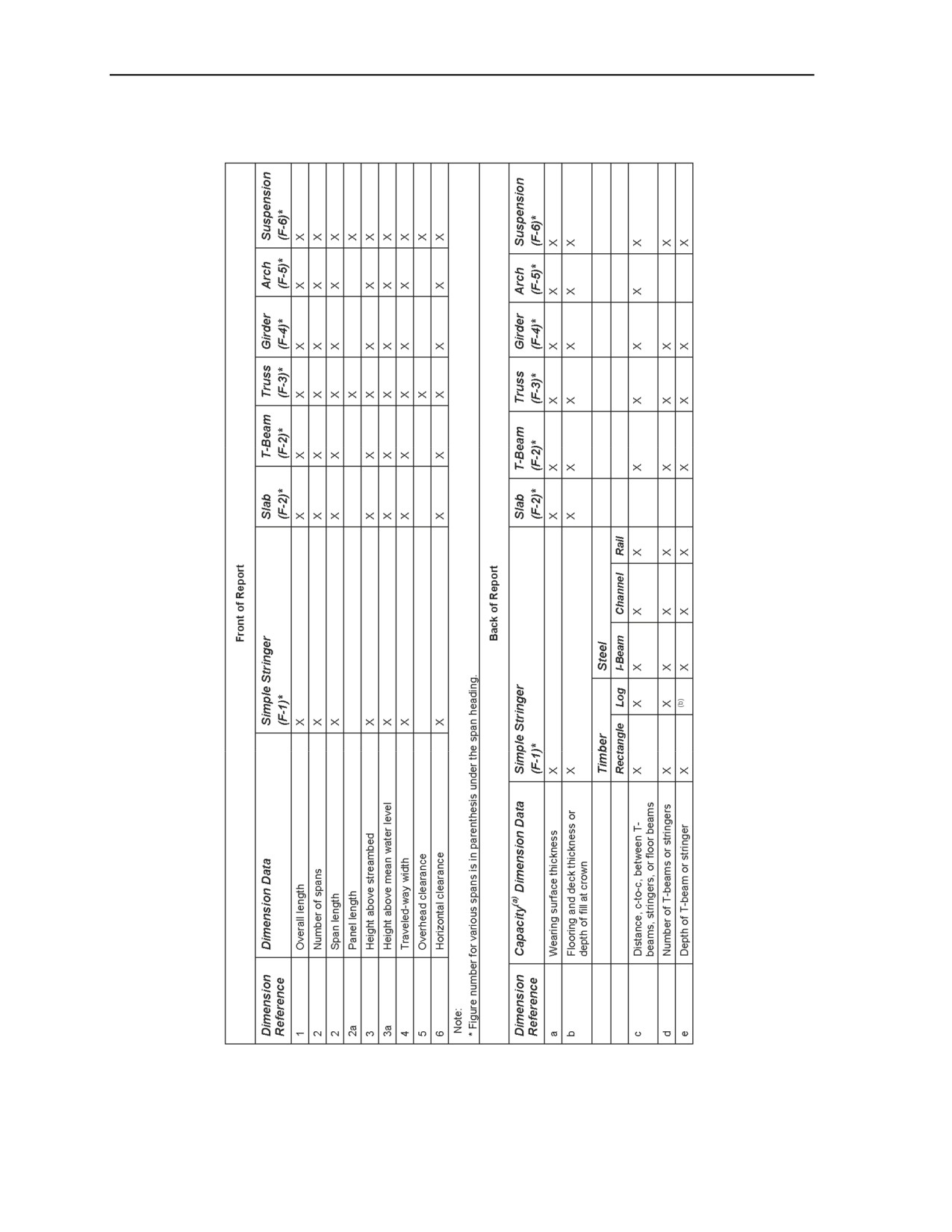
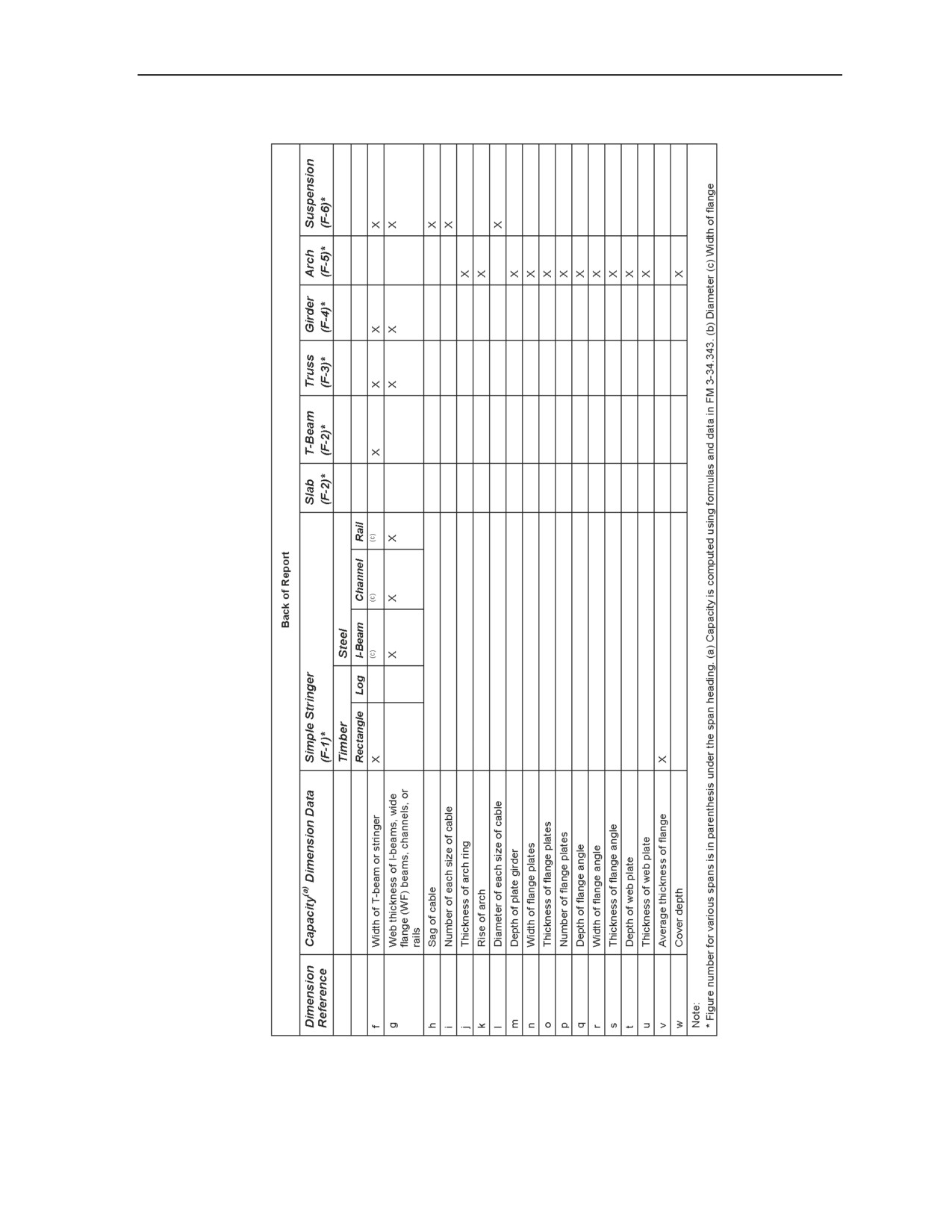
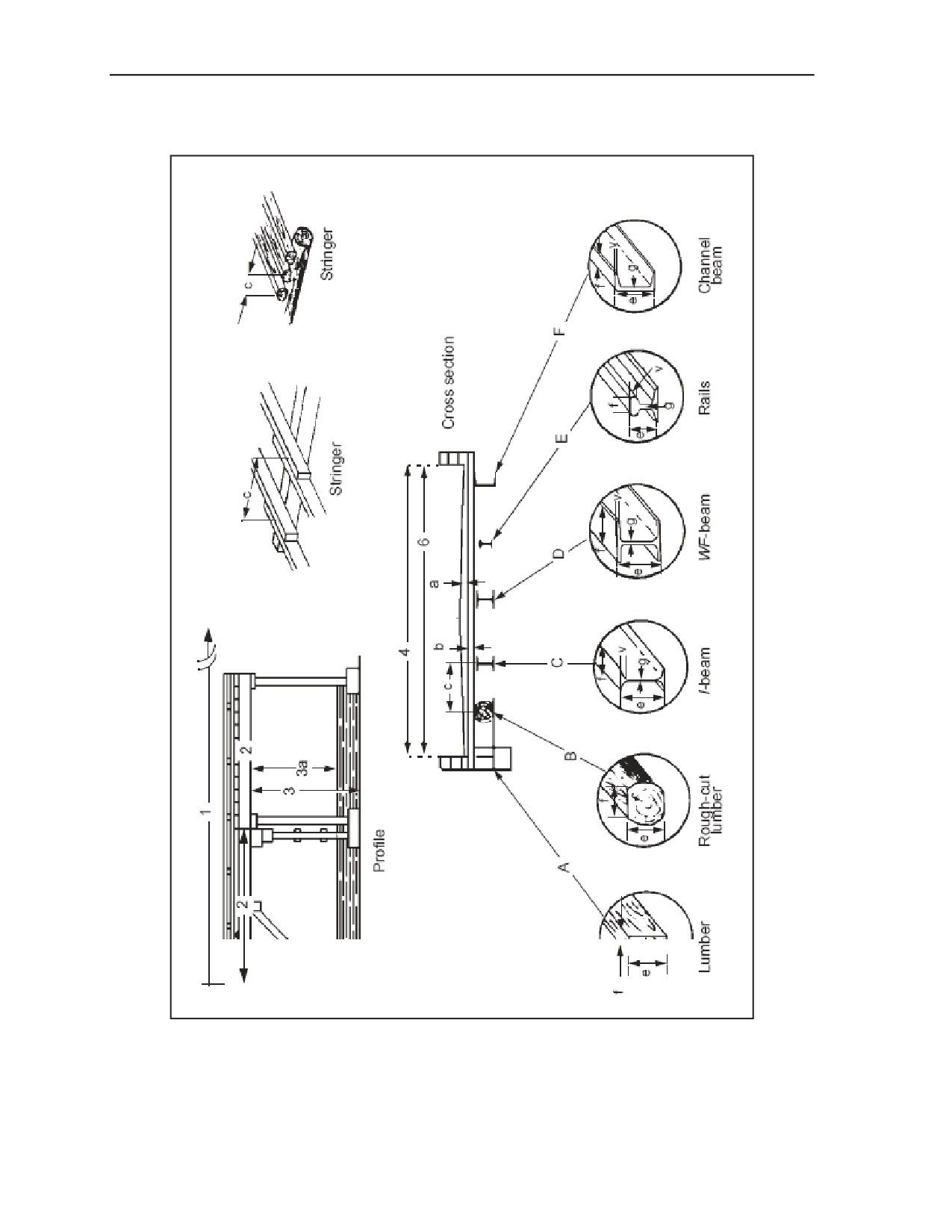
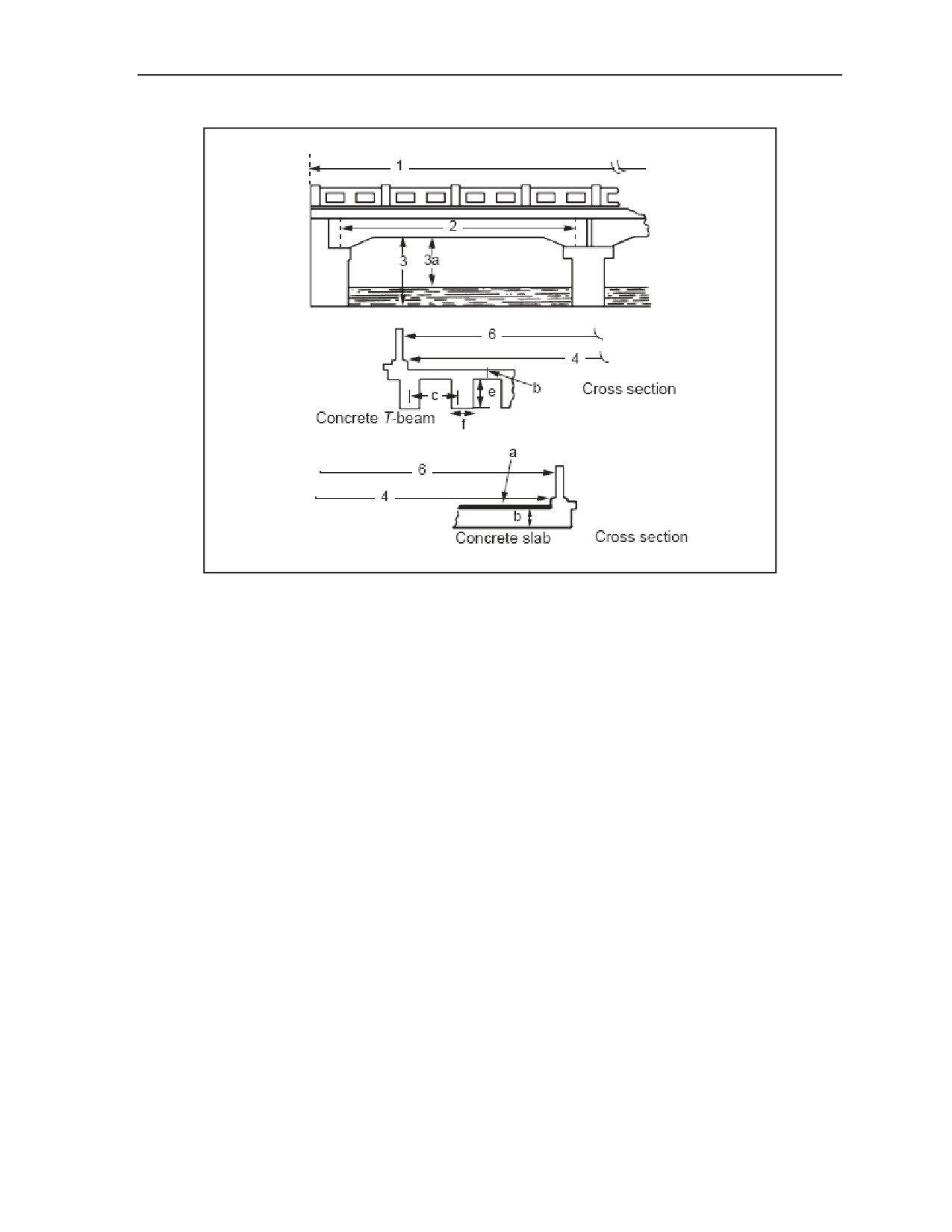
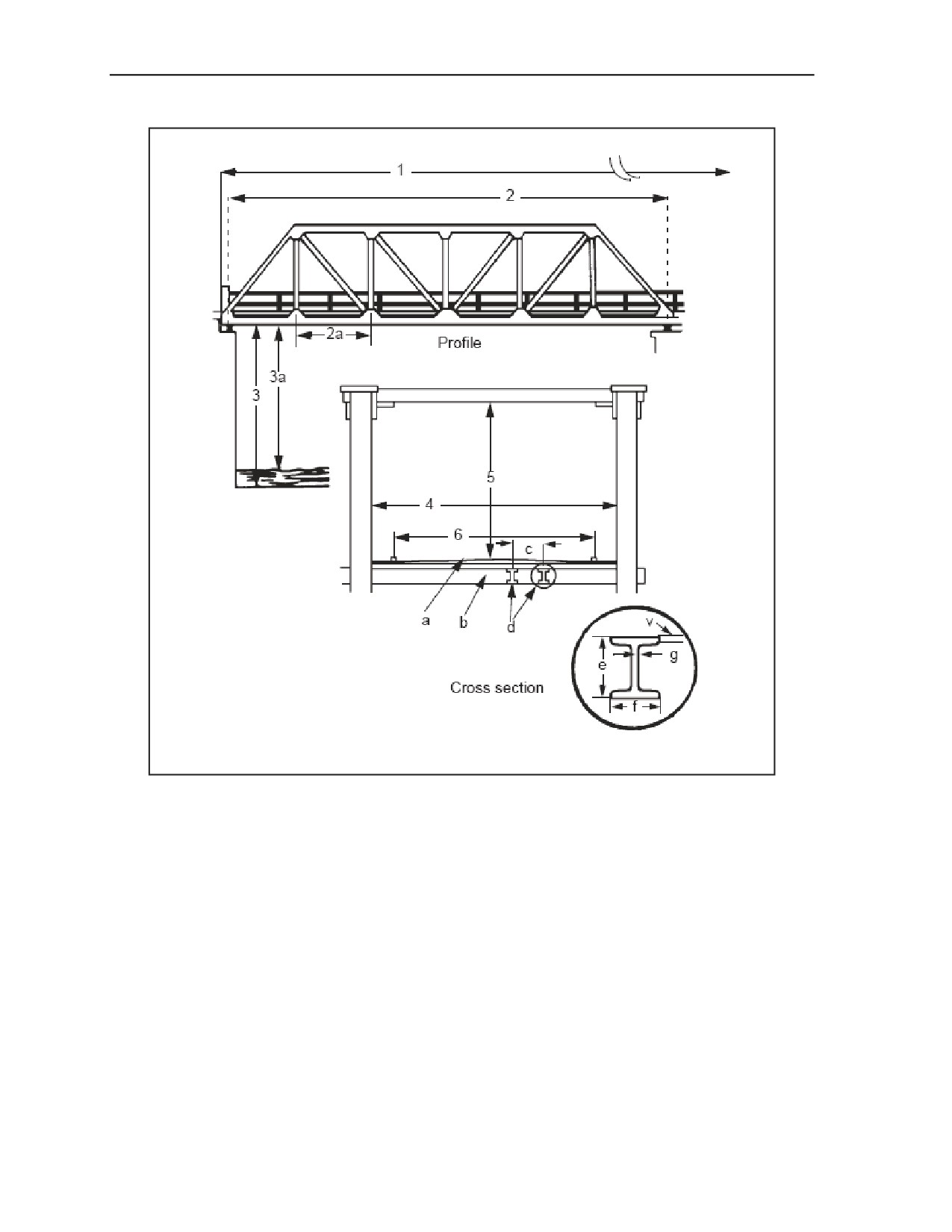
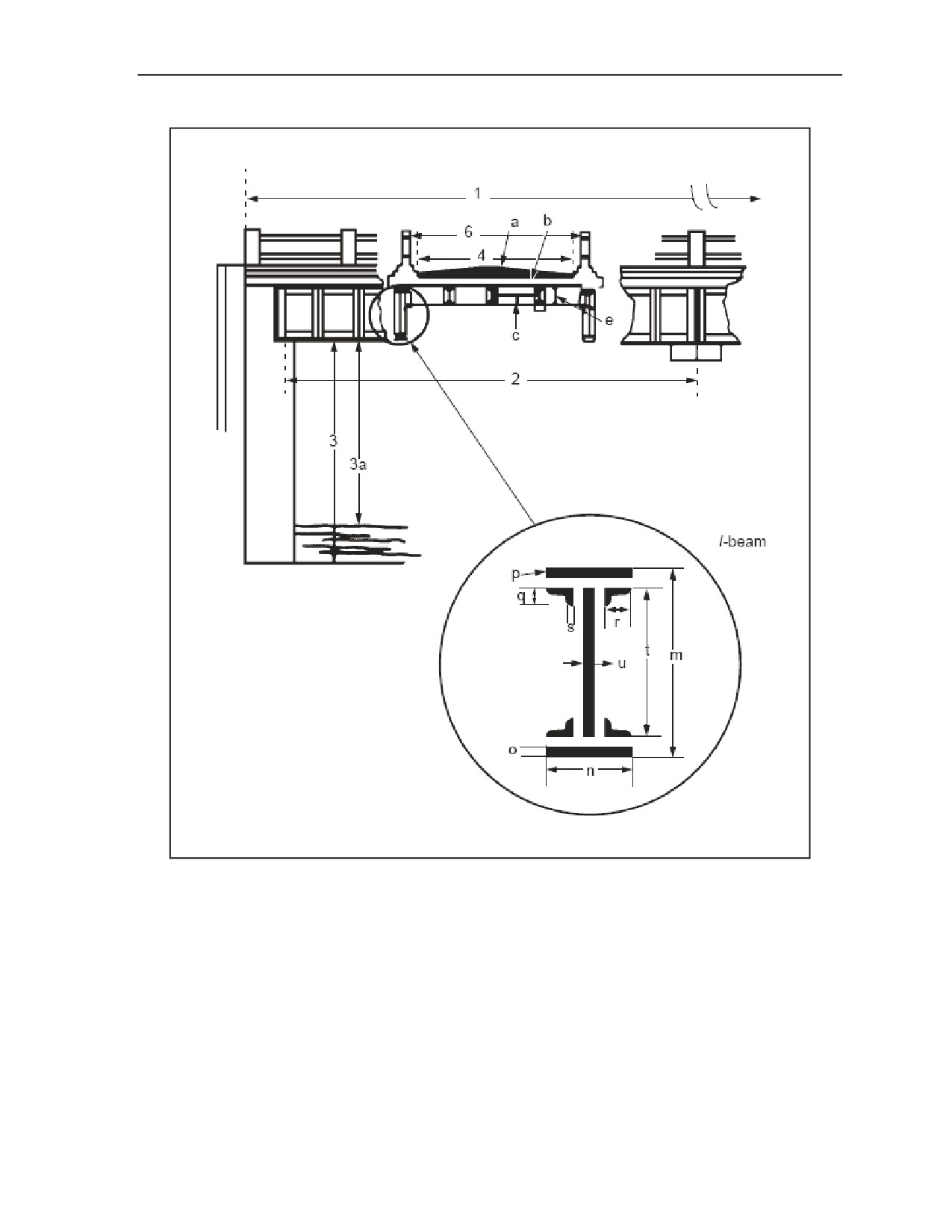
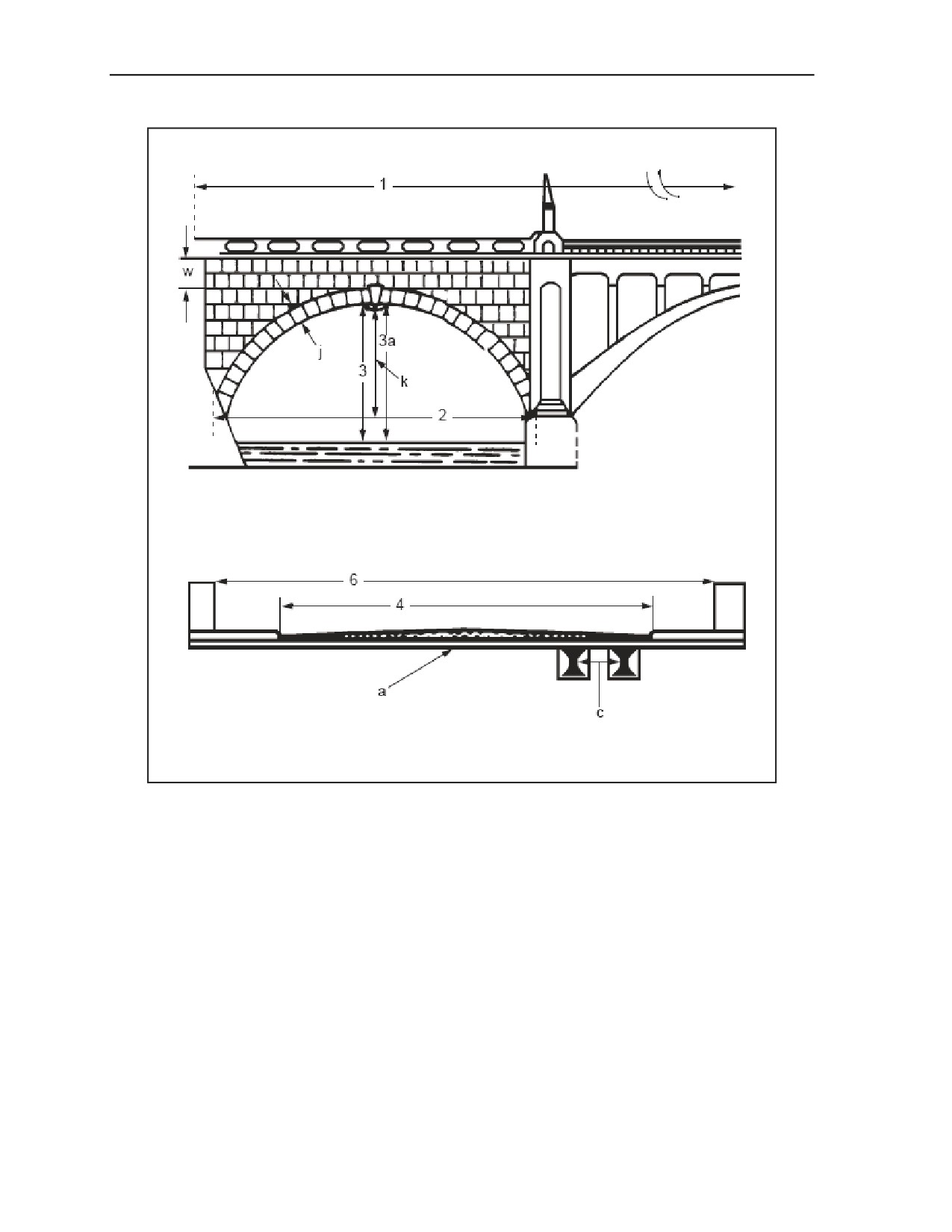
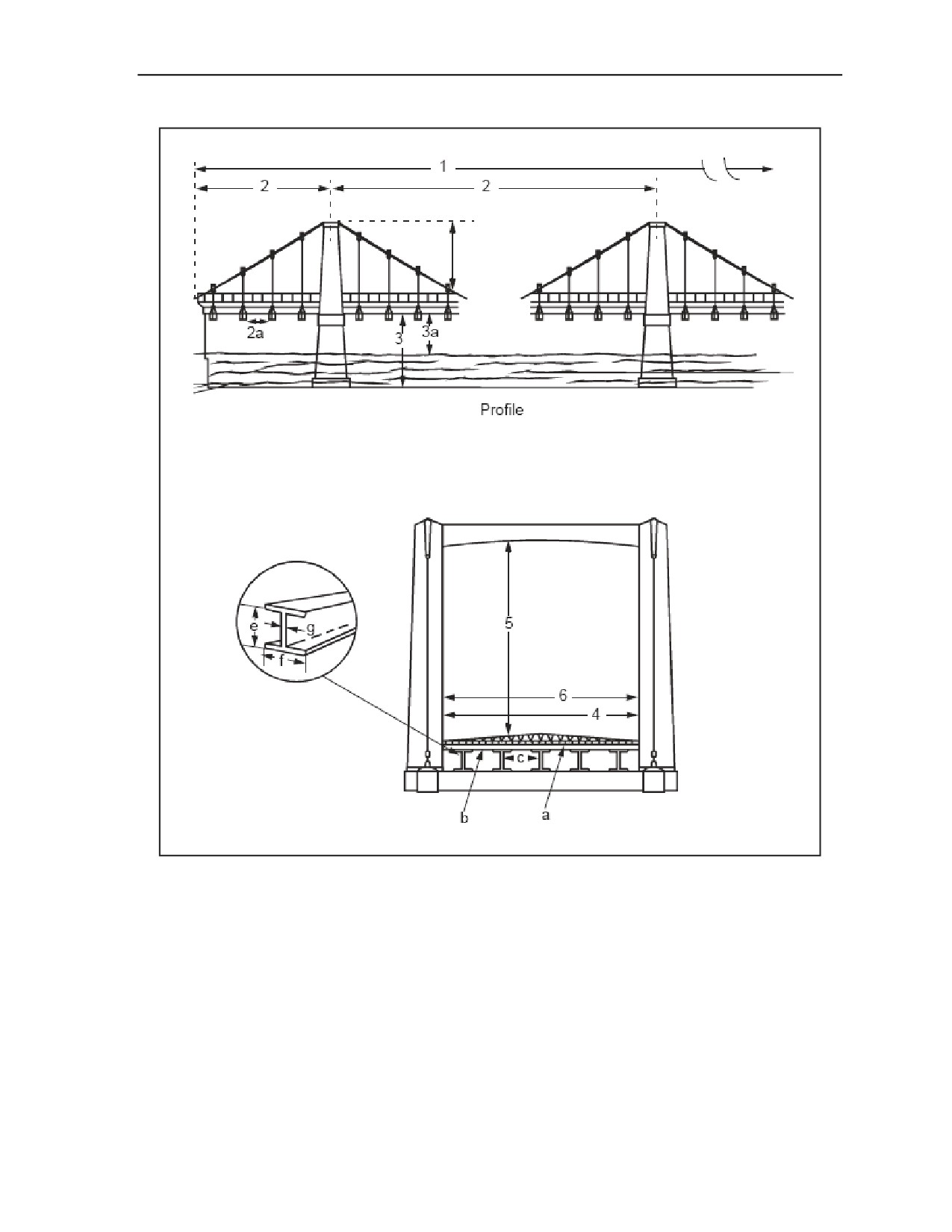
F-1. The reconnaissance team collects specific bridge dimensions if the information will be necessary to
determine the hasty bridge load-classification. The dimensions required vary for each of the seven basic
bridge types. Table F-1 on page F-2 summarizes the dimensions that the reconnaissance team must collect
if the information will be used to classify the bridge. Entries in the table correspond to figures F-1 through
F-6 on pages F-4 through F-9 as indicated in parenthesis under the span type.
25 March 2008
FM 3-34.170/MCWP 3-17.4
F-1
Appendix F
Table F-1. Entries required for Bridge Reconnaissance Report, DA Form 1249
F-2
FM 3-34.170/MCWP 3-17.4
25 March 2008
Rapid Classification of Bridge Spans
Table F-1. Entries required for Bridge Reconnaissance Report, DA Form 1249 (continued)
25 March 2008
FM 3-34.170/MCWP 3-17.4
F-3
Appendix F
Figure F-1. Dimensions for a simple stringer bridge
F-4
FM 3-34.170/MCWP 3-17.4
25 March 2008
Rapid Classification of Bridge Spans
Figure F-2. Dimensions for concrete bridges
25 March 2008
FM 3-34.170/MCWP 3-17.4
F-5
Appendix F
Figure F-3. Dimensions for a steel truss bridge
F-6
FM 3-34.170/MCWP 3-17.4
25 March 2008
Rapid Classification of Bridge Spans
Figure F-4. Dimensions for plate girder bridges
25 March 2008
FM 3-34.170/MCWP 3-17.4
F-7
Appendix F
Figure F-5. Dimensions for arch bridges
F-8
FM 3-34.170/MCWP 3-17.4
25 March 2008
Rapid Classification of Bridge Spans
Figure F-6. Dimensions for suspension bridges
CLASSIFICATION PROCEDURES
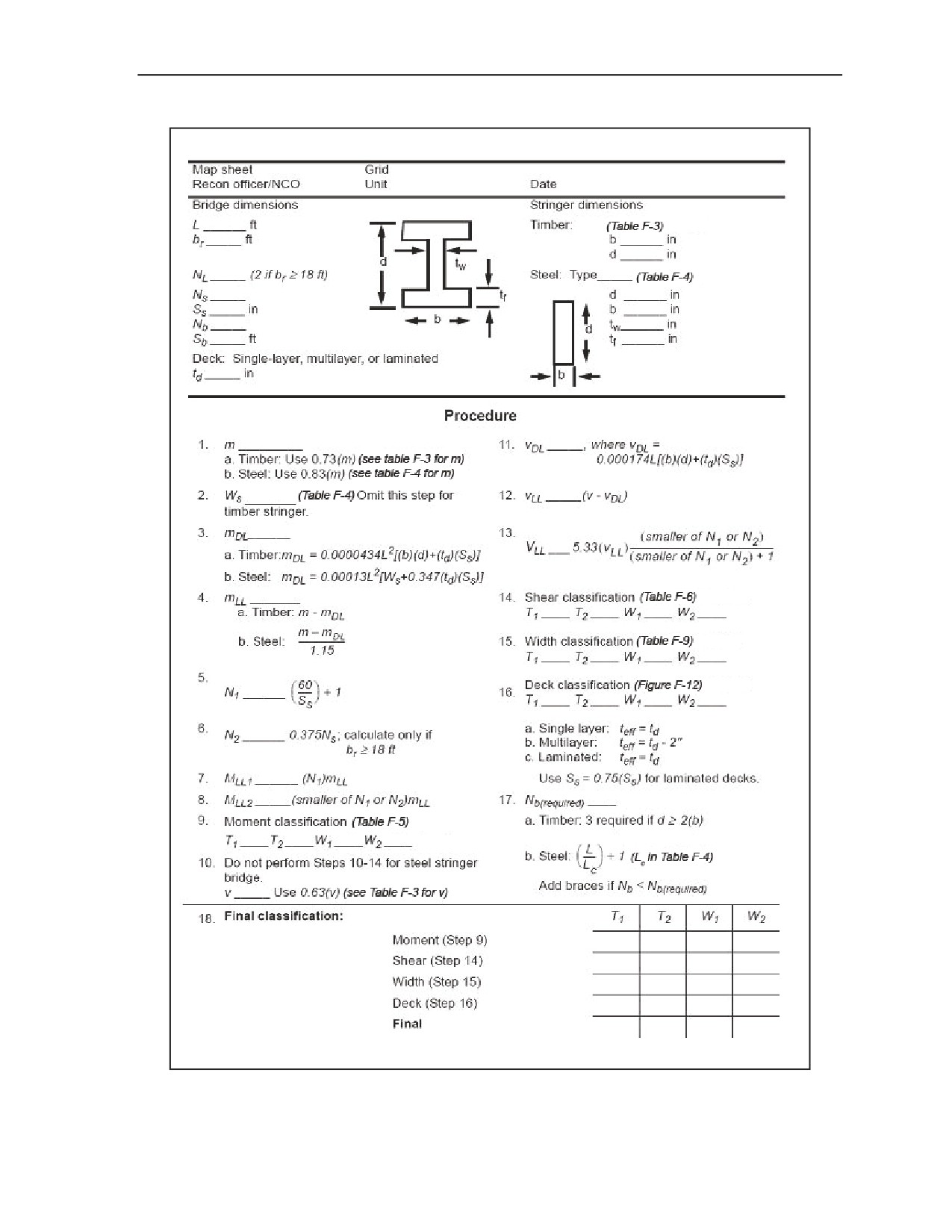
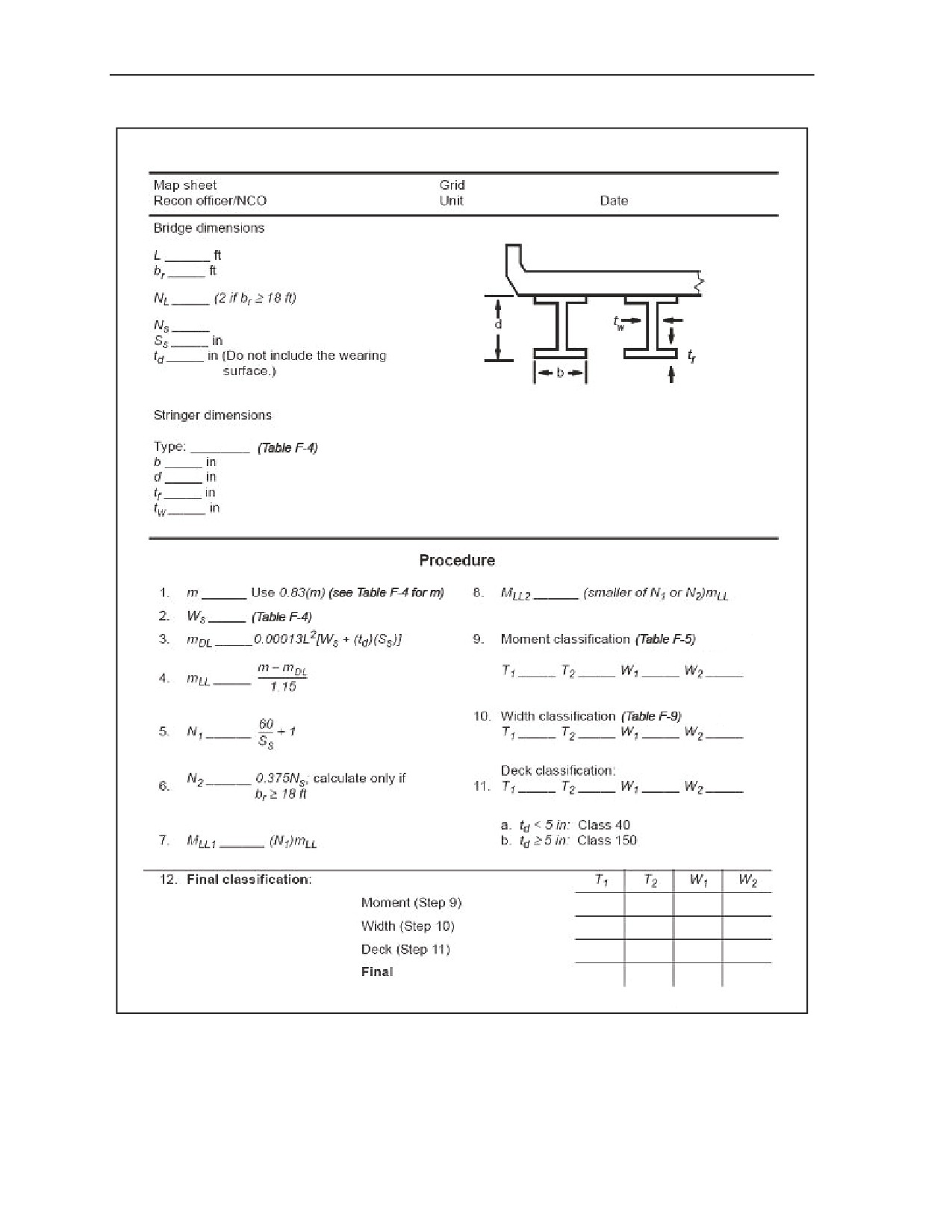
F-2. Table F-2 on page F-10 provides a key for the notations used in the classification worksheets shown
in figures F-7 through F-11 on pages F-11 through F-15. Those classification worksheets provide the rapid
classification procedure for the basic bridge types. In tables F-3 through F-9 on pages F-15 through F-34
and figures F-12 through F-16 on pages F-34 through F-38 following the worksheet figures, various
properties of bridge members are provided. These properties are used to determine appropriate values in
the worksheets.
25 March 2008
FM 3-34.170/MCWP 3-17.4
F-9

Appendix F
Table F-2. Notations
Variable
Definition
Variable
Definition
b
stringer width, in inches
N2
effective number of stringers for two-lane
traffic
bd
concrete slab width, in feet
PLC
provisional load classification
be
effective slab width, in feet
R
rise of arch, in feet
be1
effective slab width for one-lane traffic, in
S
section modulus, in cubic inches
feet
be2
effective slab width for two-lane traffic, in
Sb
actual brace spacing, in feet
feet
br
curb-to-curb roadway width, in feet
Ss
center-to-center stringer spacing, in feet
d
stringer depth, in inches
tc
crown thickness, in inches
df
depth of fill, in inches
td
deck thickness, in inches
Fy
yield stress
teff
effective deck thickness, in inches
ksi
kips per square inch
tf
flange thickness, in inches
L
span length, in feet
tw
web thickness, in inches
Lc
maximum brace spacing, in feet
T1
one-lane, tracked-vehicle classification
m
moment capacity per stringer, in ft-kips
T2
two-lane, tracked-vehicle classification
mDL
dead-load moment per stringer, in ft-kips
v
shear capacity per stringer, in kips
mLL
live-load moment per stringer, in ft-kips
vDL
dead-load shear per stringer, in kips
MLL
live-load moment per lane, in ft-kips
VDL
estimated dead-load shear of span, in
kips
MLL1
live-load moment for one-lane traffic, in ft
vLL
Iive-load shear per stringer, in kips
kips
MLL2
live-load moment for two-lane traffic, in ft
VLL
live-load shear per lane, in kips
kips
Nb
number of braces
Ws
stringer weight, in lbs/ft
NL
number of lanes
W1
one-lane, wheeled-vehicle classification
NS
number of stringers
W2
two-lane, wheeled-vehicle classification
N1
effective number of stringers for one-lane
traffic
F-10
FM 3-34.170/MCWP 3-17.4
25 March 2008
Rapid Classification of Bridge Spans
Figure F-7. Timber or steel trestle bridge with timber deck
25 March 2008
FM 3-34.170/MCWP 3-17.4
F-11
Appendix F
Figure F-8. Steel stringer bridge with concrete deck
F-12
FM 3-34.170/MCWP 3-17.4
25 March 2008
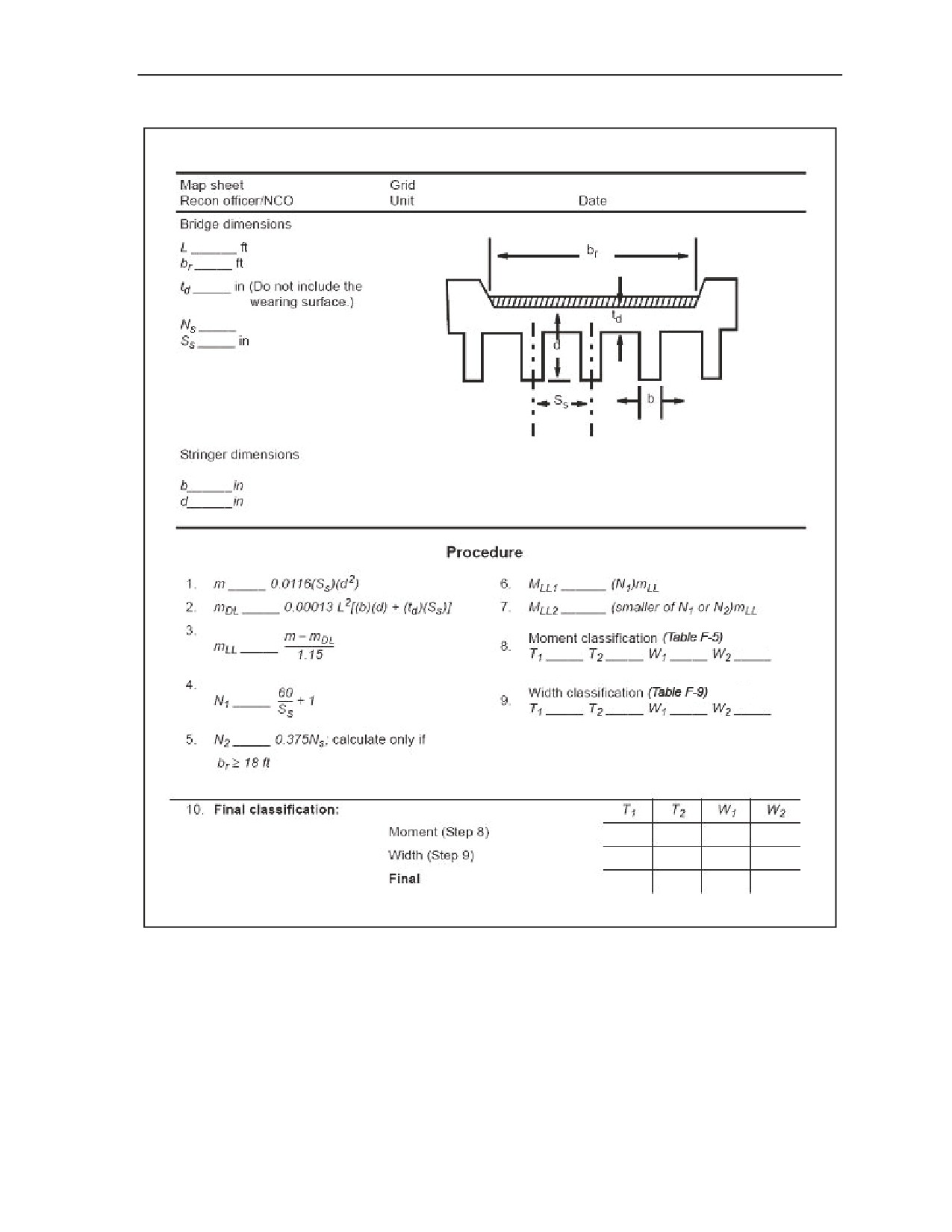
Rapid Classification of Bridge Spans
Figure F-9. Reinforced concrete t-beam bridge with asphalt wearing surface
25 March 2008
FM 3-34.170/MCWP 3-17.4
F-13
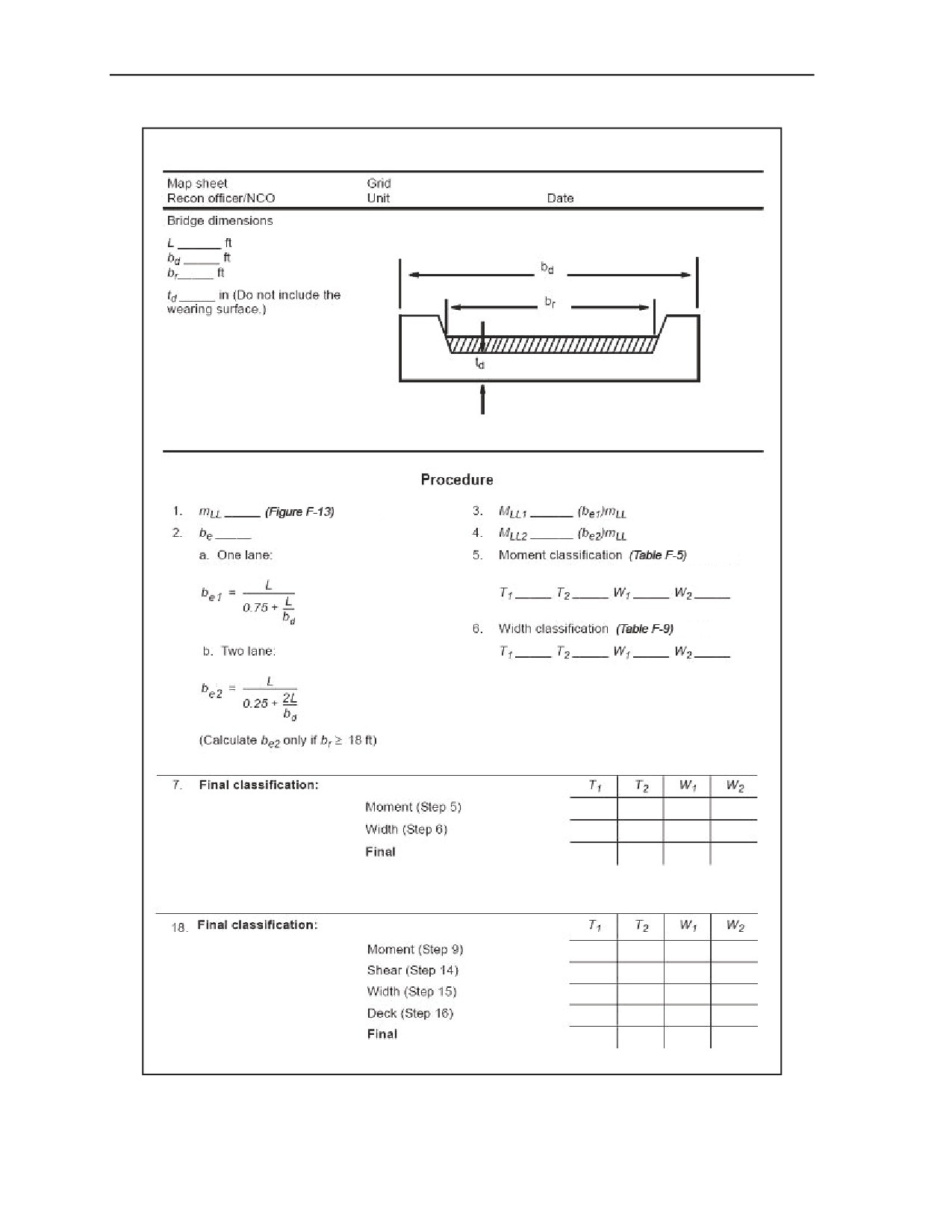
Appendix F
Figure F-10. Reinforced concrete-slab bridge with asphalt wearing surface
F-14
FM 3-34.170/MCWP 3-17.4
25 March 2008
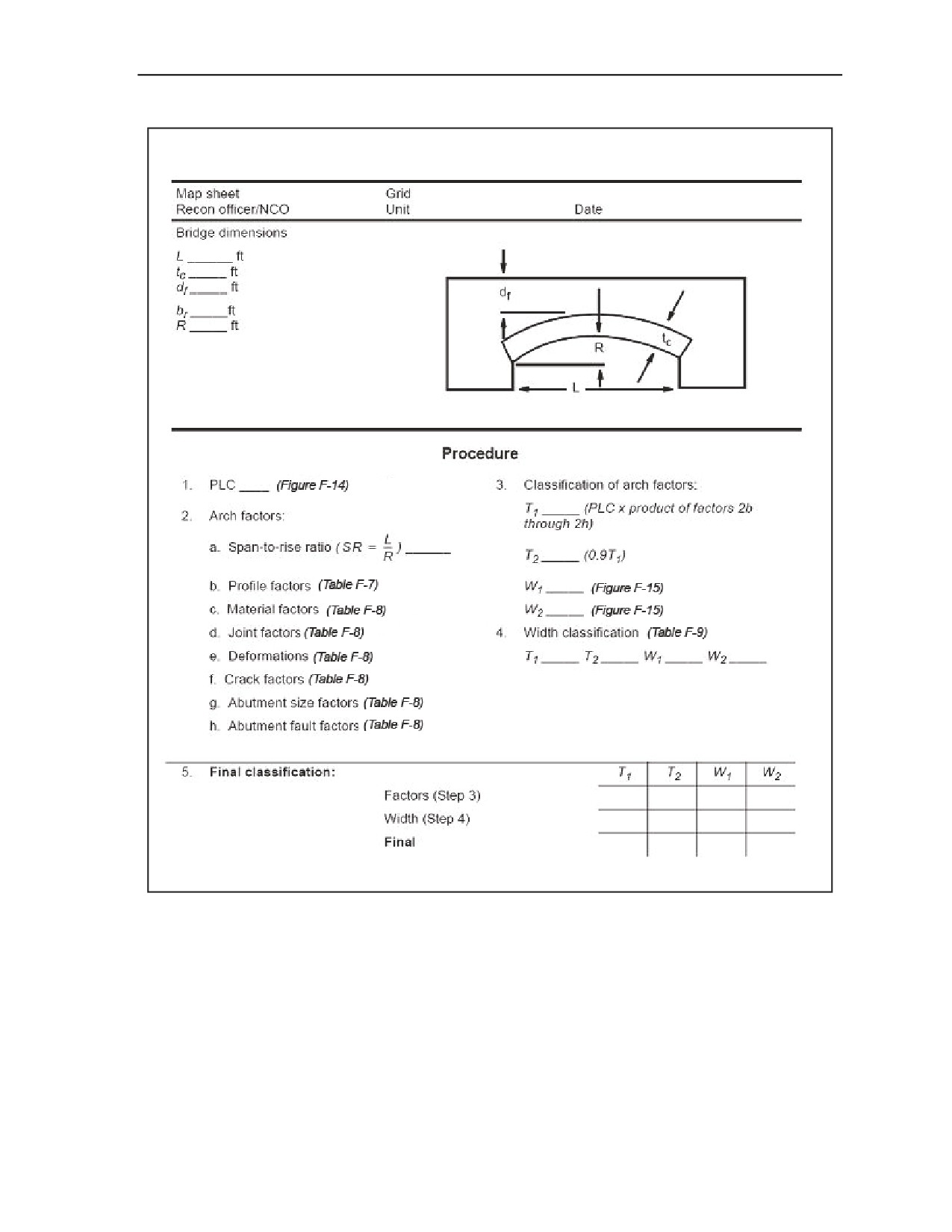
Rapid Classification of Bridge Spans
Figure F-11. Masonry arch bridge
25 March 2008
FM 3-34.170/MCWP 3-17.4
F-15