FM 3-34.170/MCWP 3-17.4 ENGINEER RECONNAISSANCE (March 2008) - page 4
Technical Reconnaissance - Assessments and Surveys
6-12. The minimum lane width is the clear distance between curbs. Place this figure below the symbol and
express it in meters. Bridges may be obstructions to traffic flow because the traveled-way width of the
overall route may be reduced on the bridge to below the minimum standards prescribed in table 6-1.
6-13. The overhead clearance is the minimum distance between the bridge’s surface and any obstruction
above it. This figure is shown (in meters) to the left of the symbol. Underline any overhead clearance less
than the minimum required by the bridge classification number (see table 6-1). Unlimited overhead
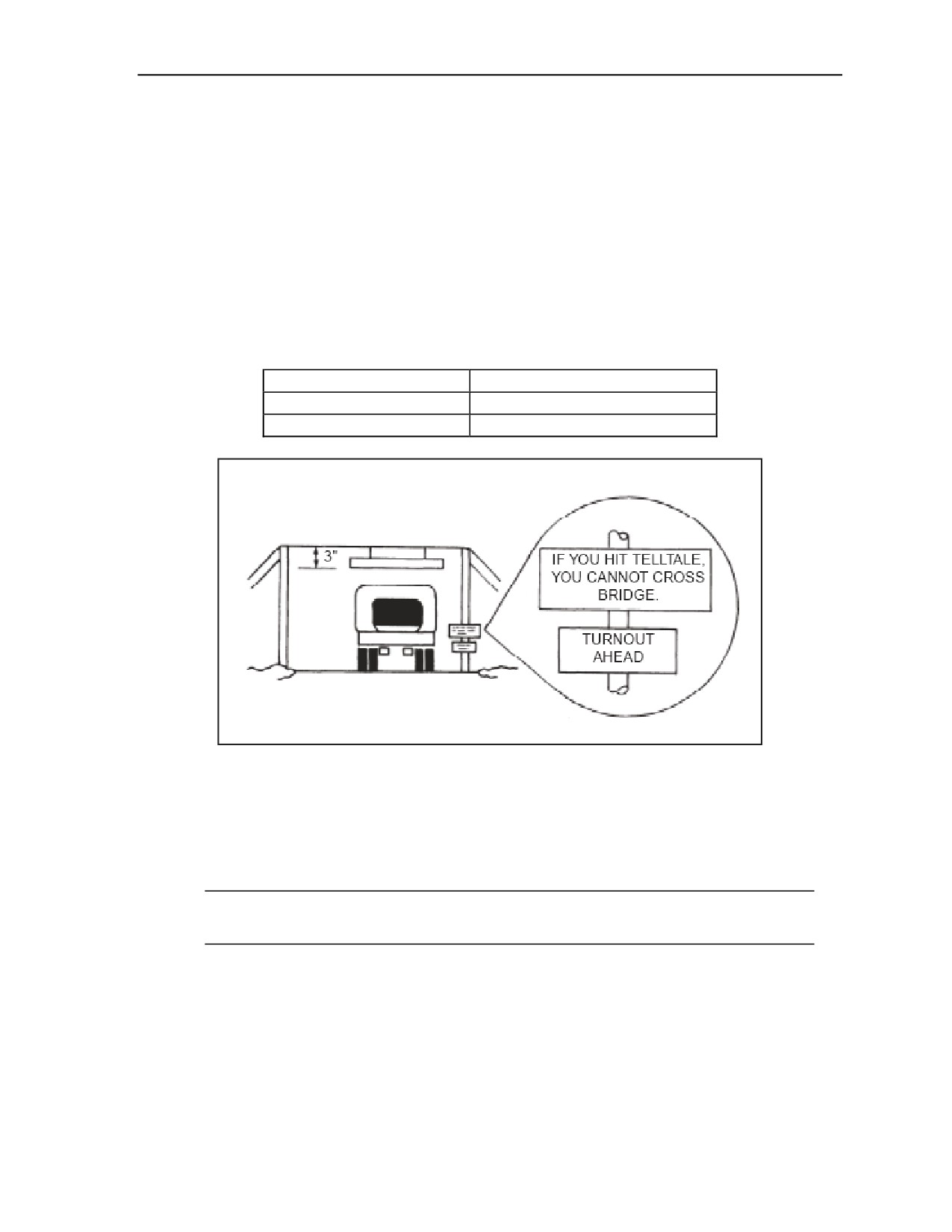
clearance is indicated by the symbol ∞. Often a telltale or other warning device is placed before the bridge
to indicate overhead-clearance limitations (see figure 6-3). Report any overhead clearance less than 4.3
meters as an obstruction in the route classification formula. A question mark is used to indicate information
that is unknown or undetermined and is included as part of the bridge reconnaissance symbol. (See
appendix G for signs used to mark roads and bridges.)
Table 6-1. Minimum overhead clearance for bridges
Bridge Classification
Minimum Overhead Clearance
Up to 70
4.3 meters
Above 70
4.7 meters
Figure 6-3. Telltale
6-14. The reconnaissance team may be interested in railway bridges which could be used by road vehicles
in an emergency. The team conducts a bridge reconnaissance and makes an overall assessment of the
adaptability of the railway bridge for road traffic indicating “use easy” or “use difficult” on the bridge
symbol. (A sample of the full NATO bridge symbol used to indicate a railway bridge can be found in
appendix B.)
Note. A railroad bridge is considered easy to adapt for use if it can be adapted in less than 4
hours with 35 Soldiers and Marines and the appropriate resources.
BRIDGE DIMENSIONS
6-15. The reconnaissance team collects specific bridge dimensions if the information will be necessary to
determine the hasty bridge load classification (see appendix F). The dimensions required vary for each of
the seven basic bridge types.
(Table F-1 on page F-2 F-2 summarizes the dimensions that the
reconnaissance team must collect if the information will be used to classify the bridge. Entries in the table
correspond to figures F-1 through F-6 on pages F-4 through F-9 as indicated in parenthesis under the span
type.)
25 March 2008
FM 3-34.170/MCWP 3-17.4
6-5
Chapter 6
OTHER GAP CROSSING SITES
6-16. Like bridges, the range of engineer reconnaissance capabilities is employed to collect detailed
technical information on gap crossing sites where bridges are not present. Also like bridge reconnaissance,
these missions are typically conducted as part of a route or road classification, or as a separate mission
focused on the selected site. Based on the situation, the reconnaissance may be conducted by an ERT, an
augmented ERT, an assessment team, or a survey team. The level of detail of the information collected
increases in the progression from ERT to survey team. The information collected is used to determine the
route classification and to estimate resources for repair or upgrade of the site or for construction of a bridge
at the site. The various gap crossing reconnaissance capabilities and their corresponding report forms
(instruction for reporting for each are included in appendix B) are—
z
Ford Reconnaissance (use DA Form 1251).
z
Ferry Reconnaissance (use DA Form 1252).
z
River Reconnaissance (use DA Form 7398, River Reconnaissance Report).
z
Underwater Reconnaissance (also uses DA Form 7398).
FORDS
6-17. A ford is a location in a water barrier where the current, bottom, and approaches allow personnel and
vehicles and other equipment to cross and remain in contact with the bottom during crossing. Fords are
obstructions to traffic flow and are shown by the abbreviation “OB” in the route classification formula for
ford information on DA Form 1251 (see appendix B).
6-18. During high-water periods, low-water bridges are easily confused with paved fords because both are
completely submerged. It is important to know the difference between this type of bridge and a paved ford
because of corresponding military load limitations.
6-19. Fords are classified according to the crossing potential (or trafficability) for pedestrians or vehicles.
Fordable depths for vehicular traffic can be increased by suitable waterproofing and adding deepwater
fording kits. These kits permit fording depths up to an average of 4.3 meters. Check vehicle TMs for
further fording information.
6-20. Record the composition of the approaches. They may be paved or covered with mat or trackway, but
they are usually unimproved. The composition and the slope of the approaches to a ford should be carefully
noted to determine the trafficability after fording vehicles saturate the surface material of the approaches.
Identify the ford’s left and right approaches when looking downstream.
6-21. Record the current velocity and the presence of debris to determine the effect, if any, on the ford’s
condition and passability. Estimate the current as—
z
Swift (more than 1.5 meters per second).
z
Moderate (1 to 1.5 meters per second).
z
Slow (less than 1 meter per second).
6-22. The ford’s stream-bottom composition largely determines its trafficability. It is important to
determine whether the bottom is composed of sand, gravel, silt, clay, or rock and in what proportions.
Record whether the ford’s natural river bottom has been improved to increase the load-bearing capacity or
to reduce the water depth. Improved fords may have gravel, macadam, or concrete surfacing; layers of
sandbags; metal screening or matting; or timber (corduroy) planking. Note if there is material nearby that
may be used to improve the ford. Record limited ford information (such as the following) on maps or
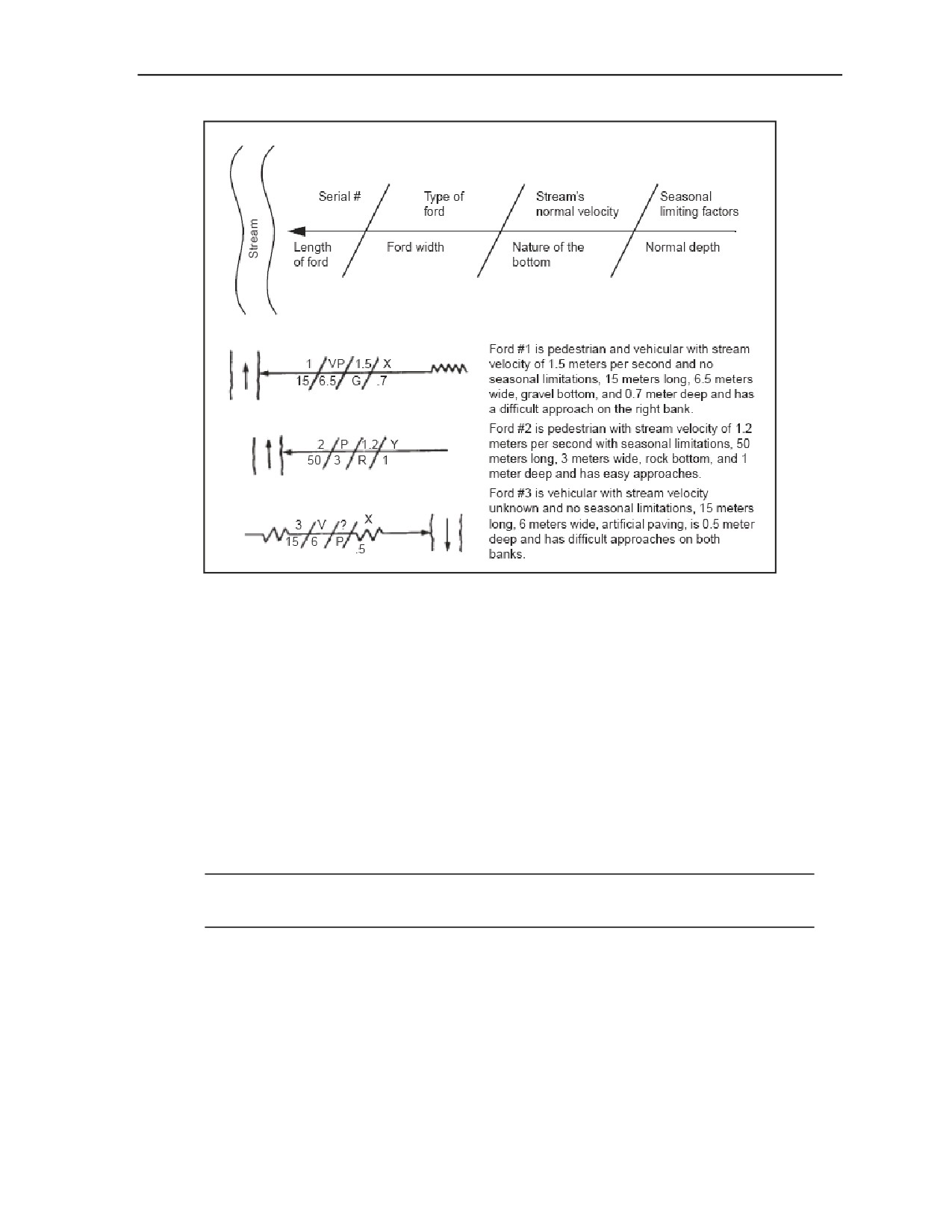
overlays using a symbol as shown in figure 6-4.
6-6
FM 3-34.170/MCWP 3-17.4
25 March 2008
Technical Reconnaissance - Assessments and Surveys
Figure 6-4. Ford symbols
z
The ford’s geographic location is shown by an arrow from the symbol to the ford location on a
map or overlay. The symbol is drawn on either side of the stream.
z
A serial number is assigned to each ford for reference (if the map sheet has a preassigned serial
number, use it). Follow the unit’s SOP in assigning serial numbers. They must not be duplicated
within any one map sheet, overlay, or document.
z
The type of ford is determined by bottom conditions, width, and water depth. Use the letters “V”
for vehicular or “P” for pedestrian to show the ford type. Approaches are not considered in
determining the ford type.
z
The stream’s normal velocity is expressed in meters per second. Seasonal limiting factors follow
the stream velocity notation and are shown by the following letters:
X = no seasonal limitations except for sudden flooding of limited duration (such as flash
floods).
Y = serious, regular, or recurrent flooding or snow blockage.
Note. If the Y symbol is used, the route type in the route classification formula automatically
becomes type Z.
z
The length of the ford, expressed in meters, is the distance from the near to far shores. The width
of the ford is the traveled-way width of the ford’s bottom.
25 March 2008
FM 3-34.170/MCWP 3-17.4
6-7
Chapter 6
z
The nature of the bottom is indicated by the most appropriate letter symbol:
M = mud.
C = clay.
S = sand.
G = gravel.
R = rock.
P = artificial paving.
z
The normal depth is the depth of water at the deepest point, expressed in meters. During a hasty
reconnaissance, the actual water depth is used.
z
A stream’s left and right banks are found by looking downstream. Imagine yourself in the
middle of the stream and looking downstream. Your left arm would indicate the left bank and
the right arm the right bank. In drawing this portion of the symbol, pay attention to the direction
of the stream flow. A difficult approach is shown by irregular lines placed on the corresponding
side of the basic symbol.
6-23. All elements of the ford symbol are separated by slashes. If you do not know or cannot determine
any item of the ford symbol, substitute a question mark for the required information.
FERRY RECONNAISSANCE
6-24. Ferries are considered obstructions to traffic flow and are indicated by the abbreviation “OB” in the
route classification formula. Ferryboat construction varies widely and ranges from expedient rafts to ocean
going vessels. Ferries differ in physical appearance and capacity depending upon the water’s width, depth,
and current and the characteristics of the traffic to be moved. Ferries may be propelled by oars; cable and
pulleys; poles; the stream current; or steam, gasoline, or diesel engines. Detailed ferry reconnaissance
information is recorded on DA Form 1252 (see appendix B).
6-25. Usually, the capacity of a civil ferryboat is expressed in tons and total number of passengers. In
addition, it is often assigned an MLC number. Ensure that you record the capacity of each ferry when more
than one is used at a given site. The ferries may vary in capacity.
6-26. Ferry slips (or piers) are usually provided on each shore to permit easy loading of passengers, cargo,
and vehicles. The slips may range from simple log piers to elaborate terminal buildings. A distinguishing
characteristic of a ferry slip is often the floating pier that adjusts, with changes in the water depth, to the
height of the ferryboat.
6-27. Approach routes to ferry installations have an important bearing on using the ferry. Reconnoitering
and recording the conditions of the approaches (including the load-carrying capacity of landing facilities) is
very important.
6-28. Limiting characteristics of ferry sites that should be considered are the—
z
Width of the water barrier from bank to bank.
z
Distance and time required for the ferryboat to travel from one bank to the other.
z
Depth of the water at each ferry slip.
z
Ease in which each landing site can be defended.
6-29. Climatic conditions affect ferry operations. Fog and ice substantially reduce the total traffic-moving
capacity and increase the hazard of the water route. Therefore, you must consider data on tide fluctuations,
freezing periods, floods, excessive dry spells, and those effects on ferry operations.
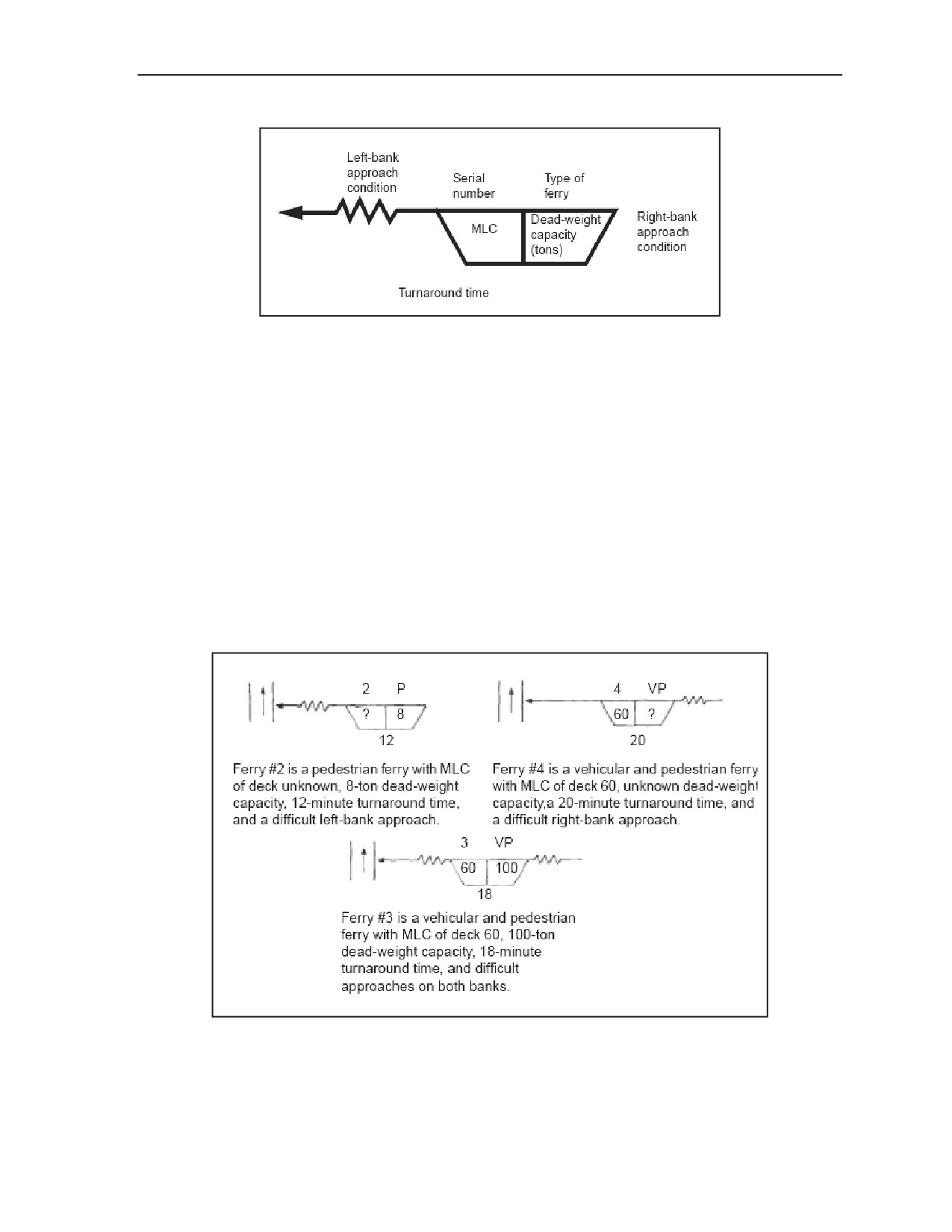
6-30. Record limited ferry information (such as the following) on maps or overlays by using the symbol
shown in figure 6-5. Figure 6-6 gives examples of completed ferry symbols.
6-8
FM 3-34.170/MCWP 3-17.4
25 March 2008
Technical Reconnaissance - Assessments and Surveys
Figure 6-5. Ferry symbol
z
The geographic location of the ferry is shown by an arrow from the symbol to the location of the
ferry on a map or overlay. The symbol may be drawn on the map or overlay on either side of the
stream.
z
A serial number is assigned to each ferry, for later reference. Numbers must not be duplicated
within any one map sheet, overlay, or document. Some maps will already show a ferry serial
number. Use this number for your reconnaissance. If you do not find a number, record a number
according to the unit’s SOP.
z
The type of ferry (V for vehicular and P for pedestrian) is shown after the serial number. If the
ferry can haul vehicles, it can also haul pedestrians.
z
The deck’s MLC is placed in the bottom left box of the symbol. Most ferries have this
information on the data plate.
z
The dead-weight capacity of the ferry is the MLC plus the actual weight of the ferry, in short
tons.
z
The turnaround time is shown by the number of minutes required to cross the water obstacle,
unload, and return.
Figure 6-6. Sample ferry symbols
25 March 2008
FM 3-34.170/MCWP 3-17.4
6-9
Chapter 6
6-31. When drawing the approach-condition portion of the symbol, pay attention to the direction of stream
flow. Left and right banks are determined by looking downstream. Approach conditions are determined in
the same manner as for fords. A difficult approach is shown by irregular lines placed on the corresponding
side of the basic symbol. A question mark is substituted for unknown or undetermined information.
RIVER RECONNAISSANCE
6-32. River reconnaissance may be conducted to collect technical information used to locate and report
suitable sites for military rafting or bridging operations. River reconnaissance is also useful for identifying
sites suitable for amphibious or vehicle swimming operations. Desirable site characteristics are—
z
Current velocity between 0 and 1.6 meters per second.
z
Banks that permit loading without a great deal of preparation.
z
Approaches that permit easy access and egress.
z
Strong, natural anchorage or holdfasts.
z
Sites with no shoals, sandbars, or snags.
z
Sites clear of obstacles immediately downstream.
z
Sites clear of mines and booby traps.
z
Sites with enough depth to prevent grounding the raft during loading and unloading operations
or when crossing.
z
Suitable raft-construction sites (depends on the type of raft).
z
Holding areas for vehicles awaiting passage.
z
A suitable road network to support crossing traffic.
Note. Refer to FM 90-13 for wet and dry gap crossing operations.
6-33. Units complete a river reconnaissance report to transmit important information about the river’s
location, nearshore and far shore characteristics, and river characteristics. The information is recorded on
DA Form 7398 as shown in appendix B. Some confusion may exist regarding the use of the Ferry
Reconnaissance Report and the River Reconnaissance Report. The Ferry Reconnaissance Report includes a
section to record information about an existing ferry operating at the site targeted for reconnaissance. The
River Reconnaissance Report is appropriate when no existing crossing means—such as ferry, ford, bridge,
and so forth—are present.
6-34. Identify and report locations that permit smooth traffic flow and reduce route obstructions as much
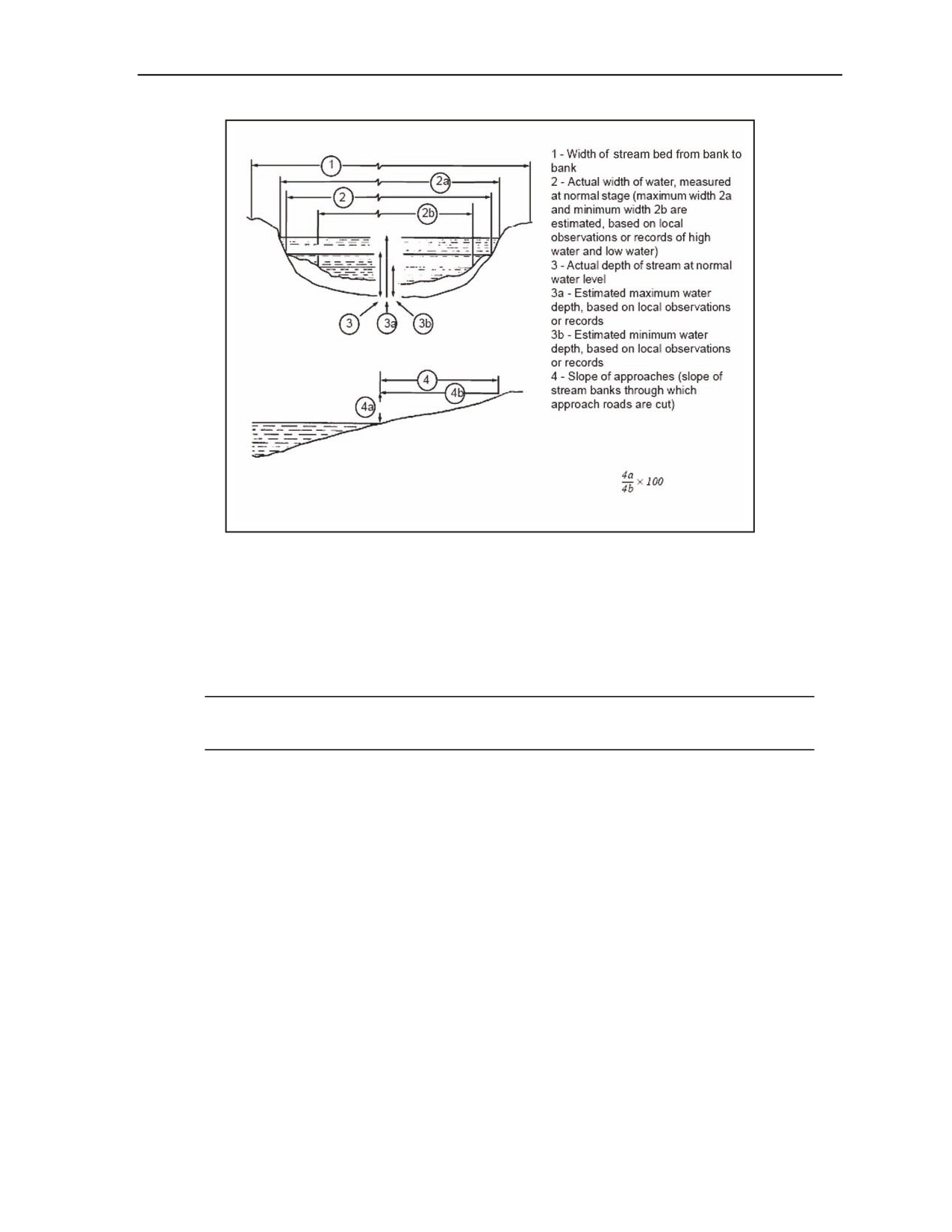
as possible. When conducting a river reconnaissance, record the river’s depth, width, approaches,
velocities, and natural and manmade obstacles (see figure 6-7).
6-10
FM 3-34.170/MCWP 3-17.4
25 March 2008
Technical Reconnaissance - Assessments and Surveys
Figure 6-7. Dimensions required for streams
6-35. Stream depth is usually measured using field-expedient devices such as poles or weighted ropes.
Measure the depth every 3 meters along the planned stream-crossing route. Recheck depths and currents
frequently during inclement weather. As a result of sudden, heavy rainfall, a sluggish stream or river may
become a torrent very quickly, particularly in tropical and arid regions. Monitor weather reports of the
surrounding area. Storms occurring miles away can cause flash flooding. Always consider the importance
of upstream dams and locks that may cause elevated levels or flooding when opened or destroyed.
Note. The actual depth you measure is recorded as normal depth when there is little time to
reconnaissance.
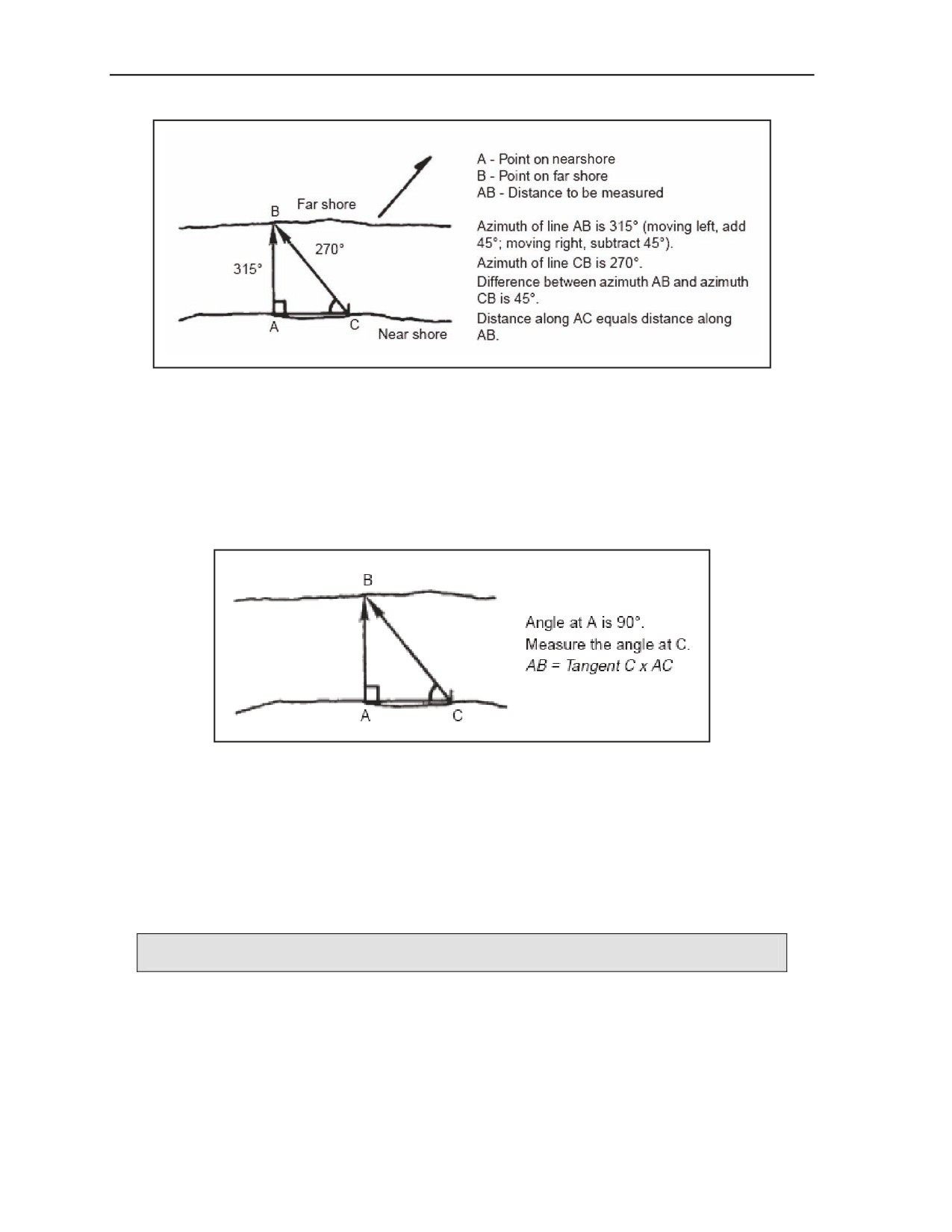
6-36. Determine the stream width by using the compass method; an aiming circle, azimuth indicator, or
alidade; or a GPS, or by taking a direct measurement.
z
Compass method. Determine stream width by using a compass to take an azimuth from a point
on the nearshore and close to the water’s edge to a point on the opposite shore and close to the
water’s edge. (See figure 6-8, page 6-12). On the nearshore, establish another point that is on a
line and at a right angle to the azimuth selected. The azimuth to the same point on the far shore
is ± 45 degrees (800 mils) from the previous azimuth. Measure the distance between the two
points on the nearshore. This distance is equal to the distance across the stream.
25 March 2008
FM 3-34.170/MCWP 3-17.4
6-11
Chapter 6
Figure 6-8. Measuring stream width with a compass
z
Aiming circle, azimuth indicator, or alidade. Use an aiming circle, azimuth indicator, or alidade
to measure the angle between two points that are a known distance apart on the nearshore and a
third point directly across the river from one of these points.
(See figure
6-9). Using
trigonometric relationships, compute the distance across the stream.
z
Global positioning system. Calculate the distance using two known grid points (from the GPS).
z
Direct measurement. Measure short gaps with a tape measure or a dark rope that is marked and
accurately measured.
Figure 6-9. Measuring stream width with a surveying instrument
6-37. Current velocities vary in different parts of a stream. Velocity is usually slower near the shore and
faster in the main channel. Perform the following procedure to determine stream velocity:
z
Measure a distance along a riverbank.
z
Throw a light floating object (not affected by the wind) into the stream.
z
Record the time of travel it takes the object to travel the measured distance. Repeat the
procedure at least three times. Use the average time of the test in the following formula (see
figure 6-10) to determine the stream’s velocity:
Stream velocity, in meters per second = measured distance, in meters/average time, in seconds.
6-12
FM 3-34.170/MCWP 3-17.4
25 March 2008

Technical Reconnaissance - Assessments and Surveys
Figure 6-10. Finding stream velocity
6-38. Gently sloping stream approaches are desirable for fording and swimming operations. Slope is
expressed in percent. Ensure that the slope-climbing capability is considered for the vehicles that are
expected to ford/swim the stream. This information is found on the vehicle’s data plate or dash plate or in
the vehicle’s TM. When considering slope-climbing capability, consider the degrading effects of weather,
the condition of the vehicle’s tires or tracks, and the condition of the ground surface of both sides of the
stream. When bank improvements are necessary, include the amount and type of work on DA Form 1711.
(See appendix B for further details on DA Form 1711.)
6-39. Consider the following obstacles during river reconnaissance:
z
High, vertical banks.
z
Mines and booby traps that are located at the entrance and exit or at likely approaches,
submerged, or attached to poles and floating logs.
z
Debris and floating objects such as logs and brush, poles, or floating logs with wire attached
(which will foul propellers and suspension systems).
z
Ice crusts.
UNDERWATER RECONNAISSANCE
6-40. In deeper water, divers may have to determine bottom conditions. Diving teams trained and equipped
for underwater reconnaissance select deepwater fording sites. When the divers cannot easily span the
distance between banks, inflatable combat rubber reconnaissance craft or bridge-erection boats enter the
water at a selected entrance and drop off teams at regular intervals. Unless the area is under enemy fire or
observation, the craft remain in the water during the reconnaissance and pick up divers when the operation
has been completed. Helicopters may be used to drop teams in the water or place teams on the far shore if
the situation permits. Engineer light diving teams routinely conduct river reconnaissance at night.
6-41. To assist underwater reconnaissance teams in maintaining direction, weighted lines (transverse lines)
may be placed across the bottom of the water obstacle. Buoys or other floating objects are attached to the
lines to indicate the survey area for the underwater reconnaissance team(s). When the current is greater
than 1.3 meters per second, underwater reconnaissance personnel will have difficulty maintaining a
position along the line selected. To assist divers, another transverse line, parallel to the original line and
with lateral lines connecting both lines, may be placed upstream.
6-42. Bottom conditions are easily determined during periods of good visibility and when the water is
clear. However, under blackout conditions or when the water is murky, the reconnaissance is much slower
because swimmers must feel their way across. If the tactical situation permits, divers may use underwater
lanterns.
6-43. Environmental conditions (such as depth, bottom type, tides and currents, visibility, and temperature)
have an effect on divers, diving techniques, and equipment. The length of time that divers can remain
underwater depends on water depth, time at depth, and equipment used. When conducting a reconnaissance
25 March 2008
FM 3-34.170/MCWP 3-17.4
6-13
Chapter 6
in a current, swimmers expend more energy, tire more easily, and use their air supply more quickly. In
water temperatures between 73 degrees and 85 degrees Fahrenheit, divers can work comfortably in their
swimsuits but will chill in one to two hours if not exercising. In water temperatures above 85 degrees
Fahrenheit, the divers overheat. The maximum water temperature that can be endured, even at rest, is 96
degrees Fahrenheit. At temperatures below 73 degrees Fahrenheit, unprotected divers will be affected by
excessive heat loss and become chilled within a short period of time. In cold water, the sense of touch and
the ability to work with the hands are affected. Air tanks vary in size and govern how long divers can
operate. Extra tanks should be available for underwater reconnaissance teams, and the facilities to recharge
equipment should be located close enough to respond to team requirements.
ENGINEER RESOURCE ASSESSMENT
6-44. ERTs, augmented ERTs, and assessment teams conduct an engineer resource assessment to assess
the availability of materials and resources in an AO that may be useful or necessary to engineer support.
ERTs will typically include an assessment of engineer resources as part of an area reconnaissance, while an
assessment team may be nearly exclusively focused on collecting specific engineer resource information.
FM 5-170, superseded by this manual, used the term “engineer recon” (DA Form 1711) to describe a
“general engineer reconnaissance to gather engineer information of a broad nature within the AO. It
considers material, resources, and terrain features having engineer applications.” This manual changes the
designation of this task to an engineer resource assessment but retains the engineer resource assessment as
a valid, relevant task employed by engineer elements in support of their operations.
6-45. The reconnaissance focus of an engineer resource assessment is to collect detailed technical
information on the resources that may be useful or necessary to engineer support. An assessment team will
typically be assigned to collect information on a more narrowly focused area or specified list of resources.
The team assesses the availability of materials (aggregates, Portland cement, fill materials, and construction
materials), terrain features that impact material availability or requirements (quarry sites, timber stands,
water sources, and other significant features) as well as local engineering and/or construction capabilities
(labor, equipment, contractors and firms, and other capabilities). The assessment can be conducted in
conjunction with other reconnaissance operations or as a stand-alone mission but must be fully coordinated
with maneuver forces in the targeted area. (Appendix B provides instructions for completing the resource
assessment report, DA Form 1711.) The assessment report is also used to report engineer IR not adequately
covered by any of the other reconnaissance capabilities.
INFRASTRUCTURE RECONNAISSANCE
6-46. Infrastructure reconnaissance is focused on gathering technical information on the status of the
large-scale public systems, services, and facilities of a country or region that are necessary for
economic activity. (See the complete definition in the glossary.) A common memory aid (SWEAT-MSO)
reminds users of categories included or of concern within the infrastructure. (See figure C-1, page C-1, for
a concise summary of the infrastructure reconnaissance categories.) However, several additional categories
within the infrastructure have since been identified as areas of concern. Because this memory aid attempts
to make it valid for all possible infrastructure requirements, the last letter is simply “O” to ensure we
consider other aspects that may not be otherwise identified by the memory aid. Military commanders are
increasingly concerned about infrastructure issues, the quality of the local infrastructure or problems within
it, and how those infrastructure issues impact military operations.
6-47. Infrastructure reconnaissance is a multidiscipline task conducted by a base team augmented as
necessary with additional expertise. The engineer will likely be responsible for coordinating infrastructure
reconnaissance but should rely on other branches for help depending on the category or required expertise.
The base infrastructure reconnaissance team includes expertise from at least engineer, CA, preventive
medicine, and military police disciplines. Augmentation from additional disciplines is provided when
possible. Table
6-2 lists the infrastructure reconnaissance categories and corresponding base and
augmented teams that inspect those categories of the local infrastructure.
6-14
FM 3-34.170/MCWP 3-17.4
25 March 2008

Technical Reconnaissance - Assessments and Surveys
Table 6-2. Infrastructure reconnaissance categories and team composition
Infrastructure Category
Base Team
Augmented Team
Sewage
Engineer
FFE
Water
Engineer
FFE
Electricity
Engineer
Prime Power
Academics
Civil Affairs
Trash
Engineer
Quartermaster
Medical
Medical Services
Civil Affairs, Veterinary Corps
Safety
MP
Other: Roads and Railroads
Engineer
FFE
Other: Bridges and Waterways
Engineer
FFE
Other: Airports
Engineer
Transportation, Aviation/Air Force
Other: Housing
Engineer
Quartermaster
Other: Communications
Engineer
Signal
Other: Food Supply
Civil Affairs
Veterinary Corps
Other: Socio/Government
Civil Affairs
Other: Cultural/ Historical/: Religious
Civil Affairs
Historian
Other: Hazardous Materials
Engineer
CBRN, Ordnance/Medical
Other: Attitude
All
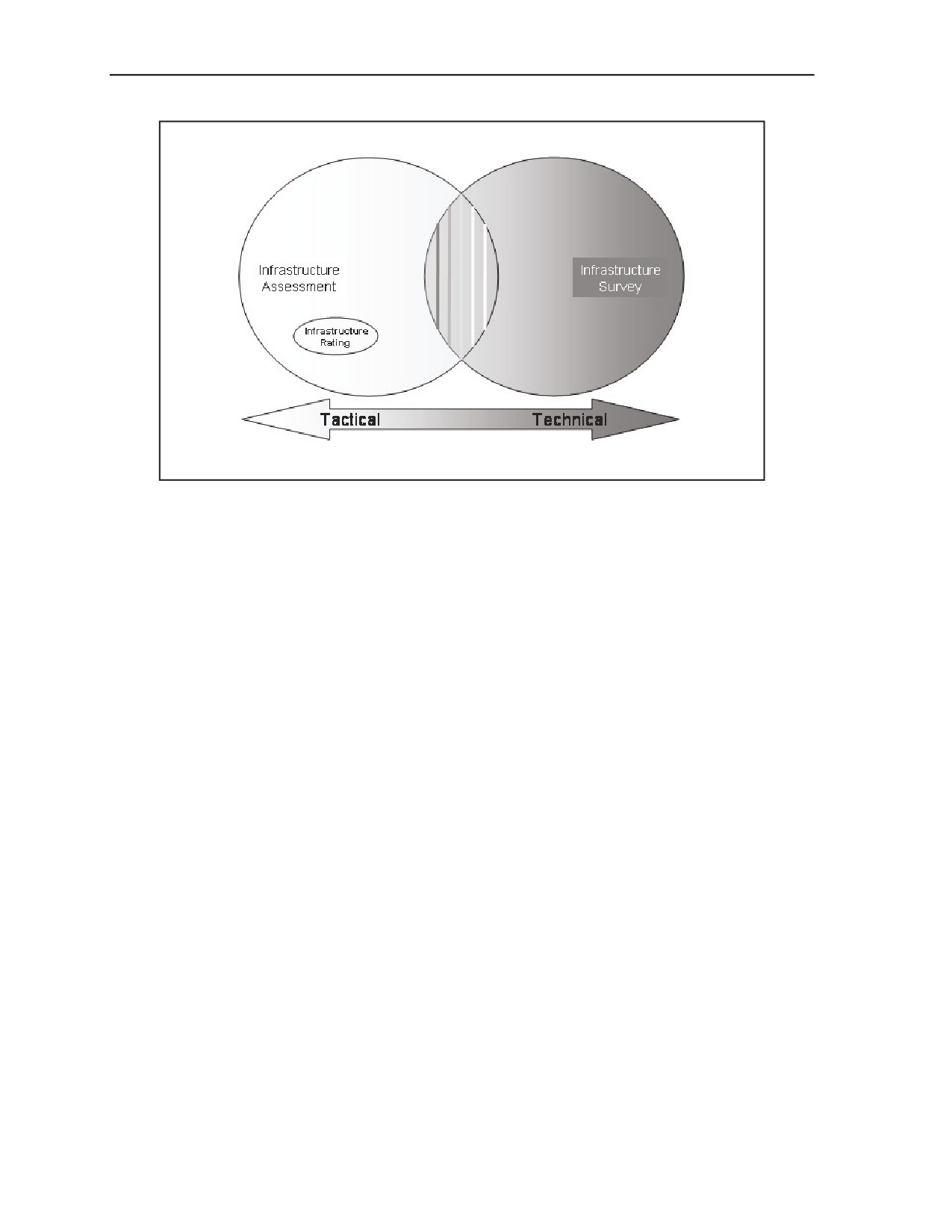
6-48. Infrastructure reconnaissance is accomplished in stages—the infrastructure assessment and the
infrastructure survey. The assessment and survey are not clearly distinguishable but rather, as shown in
figure 6-11, page 6-16, the stages overlap and vary according to METT-T[C]. Initially, especially during an
offensive mission, it is most likely that combat engineer units will be on site first. Accordingly, it would be
expected that those combat engineer units (and available discipline representatives organic or attached to
the BCT/RCT) will have an extremely limited number of personnel with the training and experience to do a
thorough analysis of the infrastructure (such as infrastructure survey). Therefore a sample infrastructure
assessment
(see appendix C) can be used to assist the ERT
(and any other available discipline
representatives) conducting this initial assessment. The ERT provides the initial infrastructure rating and
assessment to be forwarded to more qualified personnel who follow in later stages of the mission. As
operations continue, general engineer and other supporting technical support elements will become
available to provide teams more qualified for infrastructure survey. The infrastructure survey teams use the
infrastructure assessments from the ERTs to prioritize categories and parts of the infrastructure to be
reassessed in more detail via an infrastructure survey. A series of smartcards (see appendix C) are available
to assist with the more detailed infrastructure survey.
25 March 2008
FM 3-34.170/MCWP 3-17.4
6-15
Chapter 6
Figure 6-11. Assessment overlapping survey
6-49. As the commander becomes concerned about infrastructure issues and how those issues impact the
military operation, demand for infrastructure information becomes a priority. Common questions of interest
regarding the infrastructure include—
z
Has the infrastructure been maintained?
z
Who built that component of the infrastructure?
z
Are repair parts and equipment available?
z
Will the infrastructure be targeted by the HN?
z
Will HN employees return to the site after hostilities?
z
Is the infrastructure protected or can it be?
6-50. A systematic way of prioritizing infrastructure is needed to support this part of the commander’s
information priorities. The commander may establish a project coordination cell (PCC) within the staff to
supervise the gathering of information and development of priorities. The PCC is responsible for
resourcing, prioritizing, and executing civil-military operations (CMO) to achieve the commander’s desired
effects. Project nominations come to the PCC from subordinate TF commanders and the effects working
group (EWG). The PCC then resources projects and provides the brigade commander with a staff
recommendation for prioritization approval. Once a project is resourced and approved by the commander,
the PCC brings them into the synchronization meeting for inclusion in the next effects tasking order
(ETO).
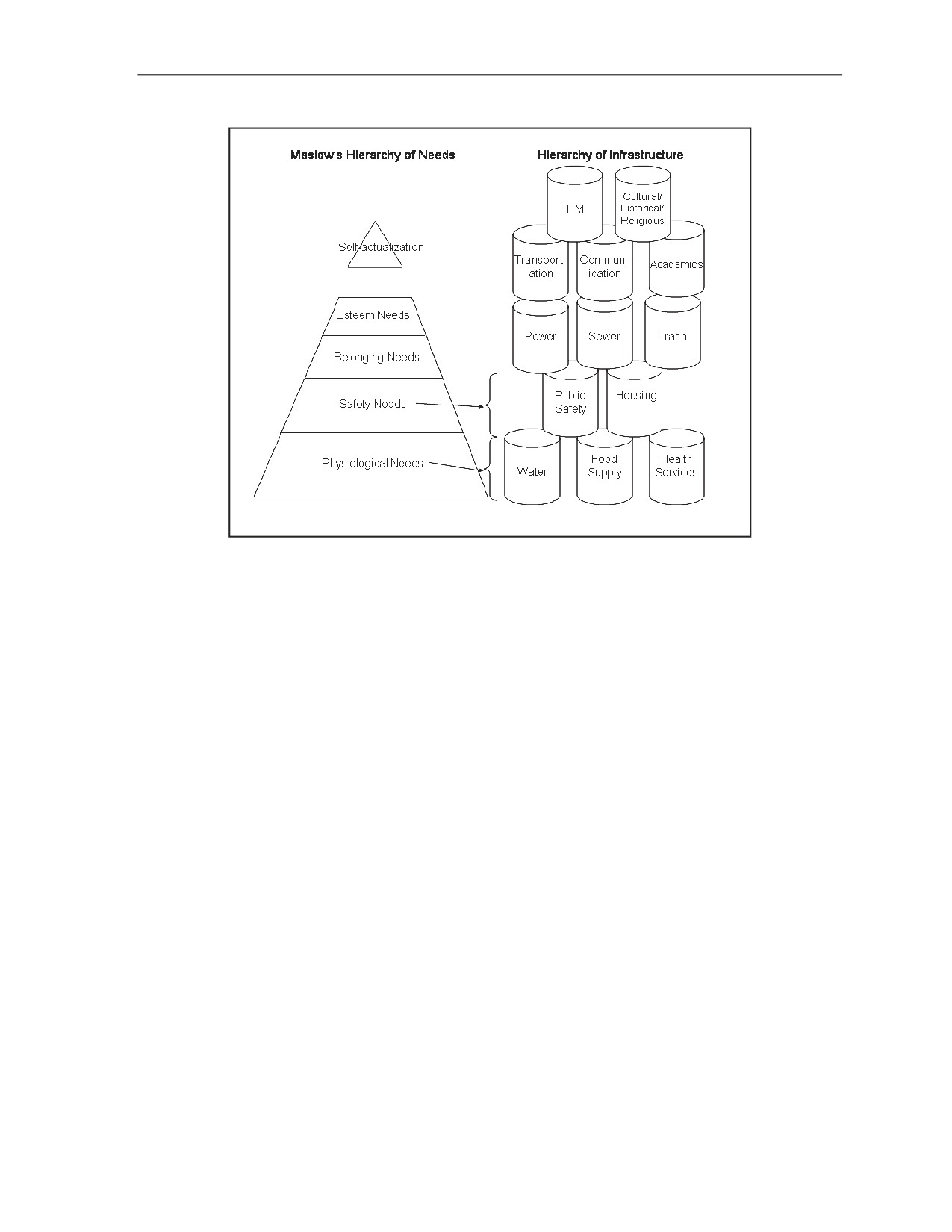
6-51. The PCC manages projects by setting priorities. The first priority is the basic life support
requirements of the population. (Secondary priorities are focused on as time and resources become
available.) An infrastructure hierarchy is shown in figure
6-12, page
6-17. The highest priority
infrastructure categories provide the foundation—basic human needs such as food, water, health care,
safety, and so forth. Without them, the local populace may be forced to take extreme measures to see that
their needs are met (such as stealing, rioting, demonstrating, committing terrorist acts, and so forth).
Without meeting these basic needs, work on the other infrastructure categories may be ineffective or
compromised. Once the basic human needs are met, the categories of electricity, water, trash, and sewage
should be assessed. As time progresses and success is found on basic human needs, priorities shift to the
upper tier categories of infrastructure.
6-16
FM 3-34.170/MCWP 3-17.4
25 March 2008
Technical Reconnaissance - Assessments and Surveys
Figure 6-12. Hierarchy of infrastructure categories
6-52. In some infrastructure reconnaissance cases and typically with assessments, the assessment team will
be required to collect information on or to inspect infrastructure categories without significant knowledge
of the systems being inspected. The results will have significant gaps but should be adequate to help
prioritize and plan further reconnaissance. Smartcards are employed to focus collection within each
infrastructure category on the major technical components of the systems. The smartcards have the
following objectives:
z
Assist the inspector in identifying and inventorying the primary components of the system.
z
Indicate what types of damage the inspector should be looking for and reporting.
z
Provide guidance for collecting the information visually or from operators and locals workers.
6-53. Infrastructure reconnaissance smartcards are provided in appendix C. Specific situations may not
require inspection and inventory of all the components covered in each smartcard. In general, the first part
of the smartcard provides a brief overview of the infrastructure category; how it works, and some of the
major components in the system. The second part is the form that the inspector uses to collect inventory
and inspection information. In addition to the relevant smartcards, the assessment team should consider the
following tools to assist in collecting information.
z
Gerber knife.
z
Flashlight.
z
Hammer.
z
GPS receiver.
z
Digital camera.
z
Safety equipment.
z
Tape measure.
z
Measuring wheel.
z
Binoculars.
25 March 2008
FM 3-34.170/MCWP 3-17.4
6-17

Chapter 6
6-54. The assessment team may be required to determine an overall status for each infrastructure category.
Color coding is a common status indicator. Table 6-3 provides guidance for the status color coding of each
infrastructure category.
Table 6-3. Status color coding of infrastructure categories
Area
Green
Amber
Red
Black
Sewage
Sewage system works
Sewage system works
No treatment observed
No sewage treatment
consistently
but treatment status
but treatment plant
system, destroyed
undetermined
exists
No sewage observed and
No sewage observed but
Sewage observed and
Presence of raw
no odor
odor present and/or
odor present
sewage is a public
system damaged
health issue
Operational in 100% of
Operational in 50% or
Operational in less
No operational
public facilities
more of public facilities
than 50% of public
sewage in public
facilities
facilities
Water
Water distribution works
Water distribution works
Water distribution does
No water distribution
at 100% capacity
at 50% or more of
not work
system, destroyed
capacity/some leaks
Tested as clean and/or
Appears clean, no smell
Does not appear clean
Tested nonpotable
local populace is
and local populace
and local populace
and/or appears
consuming
states that it is clean
states that it is not
contaminated and
clean
has bad odor
Running water in 100% of
Running water in 50% or
Running water in less
No running water in
public facilities
more of public facilities
than 50% of public
public facilities
facilities
Electricity
Power distribution system
Power distribution
Power distribution
No power distribution
works; blackouts are
system works; blackouts
system is unreliable;
system, destroyed
planned
unplanned
frequent blackouts
Electric lines are 100%;
Electric lines are 50%;
Electric lines are less
Electric lines are all
no damage/no power loss
some minor damage/
than 50%; major
down; hot wires
undetermined power loss
damage/ noticeable
exposed; significant
power loss
power loss
Power grid station intact;
Power grid station
Power grid station
Power grid station
secure
operational; unsecure
nonoperational; unable
stripped; destroyed
to secure
Academics
Building is serviceable; all
Building is adequate;
Building is useable;
Building is not
utilities operational;
utilities operate over
utilities operate less
useable; utilities are
secure
50%; not secure
than 50%; not secure
nonfunctional
Academic resources
Academic resources
Academic resources
Extremely limited
available to all students
available to 50% or more
available to less than
academic resources
50%
Trash
Formal trash collection
Formal trash collection
No formal trash
No trash collection
system is operational
system exists but is
collection system
limited
Trash collection is in a
Unknown central trash
Central trash collection
Trash is consolidated
central area that does not
collection area
area presents a
in an area that
present a health hazard
possible health hazard
presents a health
hazard
No trash buildup in public
Limited trash in public
Public facilities have no
Public facilities have
facilities
facilities; relatively clean
means to remove trash
excess trash
Medical
Medical facilities are
Medical facilities are
Medical facilities are
Medical facilities are
functional; backup power;
useable; no backup
unsanitary; significant
not useable due to
minimal equipment
power; some equipment
equipment/supply
damage and
issues; secure
shortages; not secure
shortages
unsanitary conditions;
looted
Emergency services
Emergency services
No emergency
No emergency
including multiple
exist; ground transport
services; ground
services
ambulatory services
only
transport without
available
medically trained
personnel
Veterinary services
Limited veterinary
On-call veterinary
No veterinary
6-18
FM 3-34.170/MCWP 3-17.4
25 March 2008

Technical Reconnaissance - Assessments and Surveys
Table 6-3. Status color coding of infrastructure categories
Area
Green
Amber
Red
Black
available; animal holding
services available;
services; no holding
services
area
inadequate holding area
area
Safety
Police department
Police department
Police department
Police department is
functional; secure
functional a minimum of
functional less than
nonfunctional;
building; equipment
50%; building securable;
50%; unable to secure
building is not
available and operational
equipment available and
building; limited
useable; no
operational >50%
equipment available
equipment
Fire department
Fire department
Fire department
Fire department is
functional; secure
functional a minimum of
functional less than
nonfunctional;
building; equipment
50%; building securable;
50%; unable to secure
building is not
available and operational
equipment available and
building; limited
useable; no
operational more than
equipment available
equipment
50%
Other
Minimum of a Class C
Minimum of a Class D
Minimum of a Class E
Road is not trafficable
Considerations:
road; can be upgraded;
road; damage/upgrade
road; upgrade
no visible damage
requirements will impact
requirements are
Roads and
traffic flow
significant; materials
Railroads
not readily available
Operational railroad
Railroad is damaged but
Railroad damage is
Railroad system did
system
resources to repair are
extensive; resources to
exist but now has
available; jacks available
repair are not readily
extensive damage to
available
both track and trains
Other
Bridges are trafficable; no
Bridges are trafficable;
Bridges are not
Bridges are not
visible damage
damage to spans;
trafficable for military;
trafficable and are
Considerations:
supports intact
risky for civilians;
impassable
Bridges and
damage to spans and
Waterways
supports
MLC verified through
MLC calculated but not
MLC is ineffective due
Construction repair
ERDC or other structural
verified due to damage
to damage
required before MLC
engineer
can be determined
Inspection/evaluation
Inspection/evaluation
Inspection/evaluation
Inspection/evaluation
shows original strength
determines strength
determines minimal
determines bridge
assessment valid
support issues
supportable strength
cannot support weight
Other
Airport capable of
Airport can support
Airport damaged;
No working airport
supporting military and
limited military traffic; no
utilities and structures
Considerations:
civilian traffic
visible damage
are not reliable or safe
Airports
concurrently; no visible
damage
Runway/taxiway/parking
Runway serviceable but
Runway is not
Runway is not
aprons are serviceable;
taxiway and parking
serviceable; can repair
serviceable;
working and parking
limited; C130/C17 only
with available
dimensions will not
maximum aircraft on the
resources
support military
ground (MOG) greater
aircraft; major repair
than or equal to 2
and upgrades
(military)
required
Other
Residences are
Residences are
Residences are
Residences are
structurally sound and
damaged and need
damaged and
destroyed
Considerations:
offer protection from the
structural evaluation;
structurally unsafe; no
Housing
environment
offer limited protection
protection from the
from the environment
environment
Utilities are working and
Utilities are working over
Utilities work less than
Utilities are
reliable
50%; not reliable
50%; require significant
nonoperational
repairs
25 March 2008
FM 3-34.170/MCWP 3-17.4
6-19

Chapter 6
Table 6-3. Status color coding of infrastructure categories
Area
Green
Amber
Red
Black
Other
Telephone system
Telephone hookups
Limited telephone
No telephone
operational and reliable in
available; some
hookups and
hookups or
Considerations:
public facilities
equipment available;
equipment available;
equipment
Communications
somewhat reliable
not reliable
Postal system is
Postal system is slow;
Postal system exists;
No postal system
operational and reliable
over 50% of mail
extremely slow; less
delivered
than 50% of mail
delivered
Media - television (TV),
One form of media
One form of media
No form of media
Internet, Radio,
exists, is operational,
exists but has limited
Newspaper operational,
available, and reliable
availability and
available, and reliable
reliability
Other
Hazardous
Some hazardous
Hazardous
Hazardous
materials/hazardous
materials/hazardous
materials/hazardous
materials/hazardous
Considerations:
waste properly
waste not properly
waste not properly
waste not
Hazardous
segregated, stored, and
segregated, stored, or
segregated, stored, or
segregated, stored, or
Materials
labeled.
labeled
labeled
labeled.
Containers adequate for
Containers not generally
Containers inadequate,
Containers
the material
adequate, but limited
corroded, and leaking
inadequate, corroded,
corrosion or damage
and leaking
Safety measures/
Inadequate safety
No safety measures or
No safety measures
secondary containment in
measures and secondary
secondary containment
or secondary
place
containment
containment
Hazards communications
Limited hazards
No hazards
No hazards
system in place
communications system
communications
communications
system
system
No leaks or spills
Potential for leaks and
Some leaks and spills
Gross contamination
spills
already present.
present;
Contaminants may
contaminants have
enter air, soil,
entered air, soil,
groundwater, or water
ground water, and
courses
water courses
Spill prevention and
Limited spill prevention
No ability to prevent or
No ability to prevent
cleanup measures in
and cleanup measures
cleanup spills
or cleanup spills
place/ available
available
Other
Community leaders not
Community leaders are
Community leaders are
Community leaders
Considerations:
hostile; religious centers
neutral; religious centers
negative; religious
hostile; religious
are intact; supportive of
are damaged but
centers are damaged
centers destroyed; do
Attitude
general engineering effort
securable
and not securable;
not want general
skeptic of general
engineering
engineering support
assistance
No ethnic tension
Distinct ethnic groups
Distinct ethnic groups
Ethnic violence
within AO; supportive of
within AO; one group
occurs; one group
general engineering
dominant; general
extremely dominant;
effort if equal among
engineering tasks
general engineering
groups
cannot be
effort would increase
accomplished for all
ethnic tension
groups
Unemployment is less
Unemployment is greater
Unemployment is
Unemployment is a
than 50%
than 50%; willing and
greater than 50%;
serious issue;
able to work to support
unable to support
unwilling to support
general engineering
general engineering
general engineering
effort
work effort
work effort
No formal paramilitary
Paramilitary threat
Paramilitary threat a
Paramilitary threat a
threat
briefed at the BCT/RCT
concern at BCT/RCT
concern at echelons
level
level
above BCT/RCT level
Note. Food Supply and Cultural/Historical/Religious are still under development.
6-20
FM 3-34.170/MCWP 3-17.4
25 March 2008
Technical Reconnaissance - Assessments and Surveys
6-55. Infrastructure protection may be another element of the infrastructure reconnaissance process that
would commonly be addressed as part of the survey stage. This may be important to maintaining the status
quo of the infrastructure evaluated during the survey or in providing security while identified repairs are
implemented. Infrastructure protection may also be necessary for a time after the infrastructure elements
are in full operation to ensure continuing operation. Considering infrastructure protection in the survey
phase requires identifying threats to the infrastructure elements, identifying vulnerabilities associated with
those threats, and developing courses of action for mitigating those vulnerabilities. Those courses of action
could involve hardening components of infrastructure elements, identifying forces to protect them, and
identifying redundancies that make protection of individual elements unnecessary.
ENVIRONMENTAL RECONNAISSANCE
6-56. Environmental reconnaissance is focused on collecting technical information on existing
environmental conditions and identifying areas that are environmentally sensitive or of relative
environmental concern. The information collected is used to assess both the impact of military operations
on the environment as well as to identify potential environmental impacts on safety and protection. Military
commanders are increasingly aware of the linkage from environmental concerns to local or regional
instabilities. Commanders are equally aware of the potential threats from environmental hazards. With
adequate information on both the risks from environmental hazards and the potential for damage to
environmentally sensitive areas, planners can mitigate the impact of environmental concerns on the
operation.
6-57. Like infrastructure reconnaissance, environmental reconnaissance is a multidiscipline task conducted
by a base team augmented as necessary with additional expertise. The engineer will likely be responsible
for coordinating environmental reconnaissance but should rely on other branches (CBRN, medical, CA,
and EOD) for help depending on expected areas of concern and required expertise.
6-58. Many operations require fixed facilities, structures, or other real property as logistics, command and
control, administration, communications, billeting, base camp, or other mission purposes. If the tactical
situation permits, commanders conduct or direct an EBS before occupying any of these sites. An EBS is
typically performed by or with support from general engineer elements. However, ERTs may need to
perform an initial site assessment prior to an EBS with or without assistance from general engineers.
(Appendix D provides detailed EBS guidance and an example. Ideally the EBS is conducted in conjunction
with an EHSA conducted by a medical base team that is also augmented with other specialties [engineer,
chemical, and perhaps others]. For more information see FM 3-100.4.)
6-59. The initial site assessment gathers information which assists in determining whether a parcel of land
is acceptable for military use. This assessment is only as detailed as the situation permits and is focused on
determining whether the site is healthy for Soldiers and Marines. The paragraph below lists areas that are
addressed by the site assessment and EBS. An EBS documents the proposed site’s existing environmental
conditions and the likelihood of past or ongoing activities that may have created environmental, safety, or
health problems. These problems include contamination of air, soil, groundwater, and surface water by
toxic substances or POL.
6-60. An EBS should address the following areas:
z
Property description and condition.
z
Soil type and land cover.
z
Water supply and source.
z
Air quality.
z
Signs of contamination.
z
Presence of drums or containers.
z
Biological and biomedical hazards (medical wastes).
z
Lead-based paint.
z
Unexploded ordnance.
z
Other environmental and health hazards.
z
Adjacent land use.
25 March 2008
FM 3-34.170/MCWP 3-17.4
6-21
Chapter 6
z
Topographic, hydrologic, and geologic features.
z
Sanitary waste disposal.
z
Solid waste and hazardous waste (HW) presence.
z
Presence of storage tanks.
z
Heating and ventilation.
z
Electrical-associated hazards.
z
Fire protection systems.
z
Presence of asbestos-containing materials.
z
Radiological hazards.
6-61. An environmental reconnaissance is conducted to collect the data and information necessary for the
EBS. Before conducting an initial reconnaissance, planners focus the reconnaissance effort on areas
identified in a review of any available records (records indicate POL usage in buildings or hospitals on
site). The environmental reconnaissance then gathers as much information as possible as described below
in the site reconnaissance steps. If additional, more detailed information is required, a follow-on site survey
is conducted unless an EBS can be conducted.
z
Step 1. Describe the location of the site in detail with grid coordinates and maps or sketches.
Note the following:
Topography of the site (terrain is rolling, flat, mountainous, and so forth; composition is
sandy, rocky, grassy, wooded, and so forth) and note any dramatic changes.
Soil condition (sandy, clay, and so forth.) and note any dramatic changes.
z
Step 2. List the six-digit military grid location or latitude/longitude and legal address of the
property being surveyed.
z
Step 3. Document (using words and photos) improvements to the property such as new roads or
a roof on a building. Include any damages such as damaged roads, a collapsed roof/building,
abandoned storage tanks, or any other damages. Documenting these damages could prevent
future liability.
z
Step 4. Describe any environmental issues. Note any obvious environmental contamination
using grid patterns or GPSs. Take as many photos as possible and include in the photo
descriptions the direction the camera was facing when each picture was taken. The need for a
good photographic record with descriptions of pictures taken of the initial site conditions cannot
be overstated. Often times these are noted by—
Areas of dead vegetation (flora) and/or wildlife (fauna) and/or insects.
Underground storage tanks and/or aboveground storage tanks (use records and interviews as
well as the site walk-through to determine locations of any storage tanks on site).
Stained areas.
Areas and/or water sources avoided by the local population.
Areas that may contain suspect materials (asbestos is typically found in roof and floor tiles
and in pipe insulation; polychlorinated biphenyls are typically found in electrical
transformers).
Areas, water supplies, and so forth avoided by the local populous.
z
Step 5. Note and describe any industrial facility/activity. These may have been identified during
the planning process and records review in the EHSA or through map reconnaissance. Common
facilities include—
Hospitals.
Funeral homes.
Factories/buildings with smokestacks.
Maintenance area/motor pools.
Powerplants.
Fuel stations/processing.
6-22
FM 3-34.170/MCWP 3-17.4
25 March 2008
Technical Reconnaissance - Assessments and Surveys
z
Step 6. Describe each existing building and location, size, basic construction type, number of
stories, approximate age, and heating, ventilation, air conditioning systems (including fuel/power
sources), and fire suppression systems.
z
Step 7. Locate and describe utilities at or that enter or leave the site. Include the following:
Sewerage.
Water.
Power source.
Transmission lines.
Phone lines.
z
Step 8. Note and describe public thoroughfares adjoining the property and describe all roads,
streets, parking areas, and walkways.
z
Step 9. List natural, geological, hydrological, and cultural/religious sites. Typical sites include—
Bodies of water and groundwater sources.
Caves, mines, wells, quarries.
Cemeteries.
Churches/mosques/temples.
z
Step 10. Determine if current or past use involved hazardous material (HM) or POL and include
a detailed description or indicators of this use (55-gallon drums, buildings with warning labels,
and so forth.).
z
Step 11. List limitations to the site reconnaissance such as physical obstructions, bodies of
water, weather, uncooperative occupants, and so forth.
z
Step 12. Conduct all of the above steps for adjacent properties as well, if possible.
6-62. The environmental reconnaissance can be reported on an EBS document (see appendix D). EBS
documentation provides the necessary outline of information required and can serve to focus the
reconnaissance team as well as provide a formatted report. The EBS and the closure report bracket the
timeframe of use for each particular site/area. (Appendix D provides additional discussion on preparing the
EBS.)
AIRFIELD ASSESSMENT
6-63. An airfield assessment is conducted to collect detailed technical information on selected airfields and
heliports. It typically is preceded by the use of geospatial and other intelligence information to provide a
baseline level of information and questions about the airfield before physically arriving at the airfield. The
assessment is conducted as part of an infrastructure assessment or as a separate mission focused on the
selected facility. Based on the situation, the assessment may be conducted by an ERT, an augmented ERT,
an assessment team, or a survey team. The level of detail of the information collected increases in the
progression from ERT to survey team. The highest level of survey team will often include Air Force
technical participation. In every case, the information collected can be used to determine the airfield
operating capacity and to estimate resources for repair or upgrade of the airfield and/or its supporting
facilities. (The assessment is recorded using the airfields smartcard tool in the infrastructure reconnaissance
smartcards package in appendix C.)
6-64. Contingency operation airfield and heliport planning involves much more than just the airfield layout
(geometry) and pavement structure. It involves planning for all of the supporting facilities and
infrastructure—such as the air traffic control and landing system, and POL and munitions storage facilities
needed to sustain airfield operations. It also involves survivability, security measures, health, safety, and
environmental factors. As discussed in chapter 4, FACE prepares or repairs LZs, FARPs, landing strips, or
other aviation support sites in the forward combat area, and ERTs conduct area reconnaissance to collect
the information required to support FACE. All other airfield and heliport planning, design, and
construction are considered general engineering tasks, and an airfield assessment team collects the
technical information required for general engineer support of airfields and heliports.
25 March 2008
FM 3-34.170/MCWP 3-17.4
6-23
Chapter 6
6-65. Army, Air Force, Navy, and Marine Corps engineers all have the capability to design, plan,
construct, upgrade, repair, and maintain airfields and heliports; however, the level of expertise and organic
resources vary with each of the Services. Army engineers are responsible for forcible entry airfield damage
repair (combat engineering) and may assist other engineers as directed in airfield and heliport design,
planning, construction, repair, and maintenance. The Army provides the following construction support to
Air Force-controlled airfields:
z
Develops engineering design criteria, standard plans, and material to meet Air Force
requirements.
z
Performs reconnaissance, survey, design, construction, or improvement of airfields, roads,
utilities, and structures.
z
Repairs Air Force bases and facilities beyond the immediate emergency recovery requirements
of the Air Force (semipermanent and permanent repair).
z
Supplies construction materials and equipment.
z
Assists in emergency repair of war-damaged air bases.
z
Assists in providing expedient facilities (force bed down).
z
Manages war damage repair and base development; supervises Army personnel. The Air Force
base commander sets priorities.
z
Performs emergency and permanent repair of war damage to forward tactical airlift support
facilities.
6-66. Airfields could be subjected to damage by an increasingly capable and complex array of destructive
weapons, including cannon fire, rocket fire, small or large bombs, and bomblets. Explosive hazards such as
UXOs (to include scatterable mines and unexploded bomblets) and IEDs, a variety of potential barriers,
and other hindrances may challenge efforts to make airfields capable of supporting air traffic. The Army,
USMC engineers, and Navy Seabees conduct rapid runway repair (RRR) to provide the minimal repairs
necessary to facilitate the safe landing of the required sorties to establish the lodgment area. Before making
these repairs, engineers must conduct a damage assessment, prepare for explosive hazards reconnaissance
and removal, understand the repair quality criteria, and know the requirements for the minimum aircraft
operating surface. Air Force technical experts may be included as a part of the Army combat engineer
element participating in the forcible entry operation to—
z
Approve the aircraft operating surface.
z
Control aircraft landing and departure.
z
Serve as liaison for follow-on RRR or airfield damage repair (ADR) with general engineer
elements to take the runway and/or infrastructure associated with the airfield to a higher
standard of repair after the lodgment area has been secured.
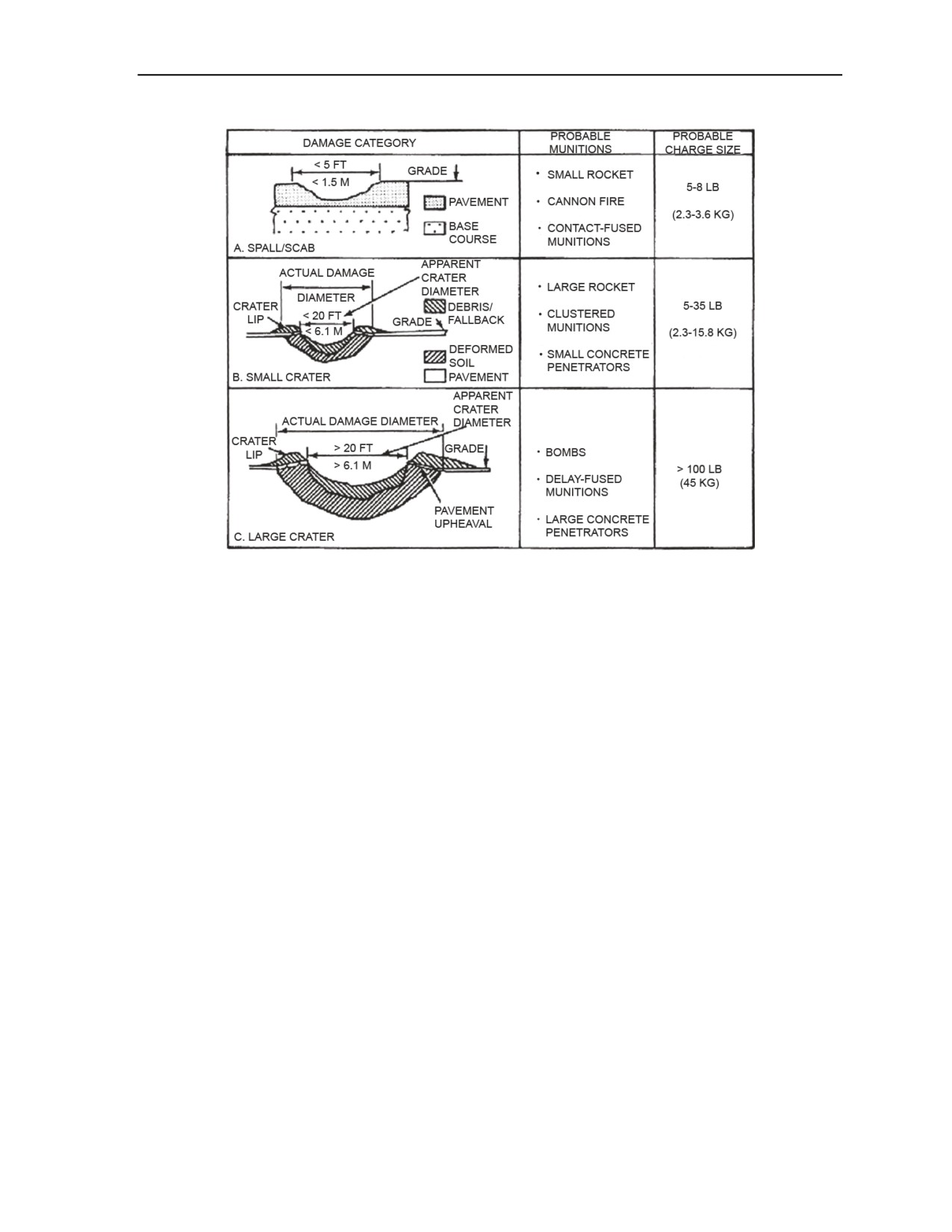
6-67. Pavement damage categories are shown in figure 6-13. Damage to the pavement includes both the
apparent crater damage and the upheaval of pavement around the crater. The damage category for a given
munition depends on the delivery method and extent of penetration as well as charge size. (For additional
information, see UFC 3-270-07).
6-24
FM 3-34.170/MCWP 3-17.4
25 March 2008
Technical Reconnaissance - Assessments and Surveys
Figure 6-13. Airfield damage categories
6-68. The branch of Service that is the primary user of the airfield or heliport has the responsibility for
certifying that facility for flight operations. In most cases during airfield contingency operations, this is an
Air Force responsibility. Air Force engineers may assist other Army engineers, Navy construction
engineers (Seabees), or Marine Corps engineers as directed in airfield and heliport design, planning,
construction, repair, and maintenance. The Air Force provides the following engineer support:
z
Performs primary emergency repair of war damage to air bases (RRR and repair of other critical
operating facilities).
z
Constructs expedient facilities for Air Force units and weapon systems. This excludes
responsibility for Army base development.
z
Operates and maintains Air Force facilities. Air Force engineer units perform maintenance tasks.
z
Provides crash rescue and fire suppression.
z
Provides HAZMAT response.
z
Manages emergency repair of war damage and force bed-down construction.
z
Provides infrastructure support for solid waste and hazardous waste disposal.
z
Supplies material and equipment for its own engineering mission.
z
Provides the EBS and EHSA for the airfield and its support facilities.
6-69. Airfields and heliports are classified by their degree of permanence and type of aircraft, either fixed-
or rotary-wing, they are designed to support. These controlling aircraft, or aircraft combination, are
identified for each kind of facility to establish limiting airfield and/or heliport geometric and surface
strength requirements. For information on survivability (hardening) support to include the construction of
revetments for helicopters, see FM
5-103.
(For information on Air Force aircraft survivability, see
AFM 91-201, Category Code 141-182, Hardened Aircraft Shelters.)
6-70. A bare base airfield is a site with a usable runway, taxiway, parking areas, and a source of water that
can be made potable. It must be capable of supporting assigned aircraft and providing other
mission-essential resources, such as a logistical support and services infrastructure composed of people,
facilities, equipment, and supplies. This concept requires modular, mobile facilities, utilities, and support
25 March 2008
FM 3-34.170/MCWP 3-17.4
6-25
Chapter 6
equipment packages that can be rapidly deployed and installed. A bare base airfield forms the baseline for
contingency operations airfield planning.
6-71. The maximum (aircraft) on the ground (MOG) is the maximum number of aircraft that can be
accommodated on an airfield. There are two types of MOG:
z
Parking MOG is the total number of aircraft that can be parked at an airfield. Parking MOG is
affected by both the overall size of the airfield and by how available space is managed.
z
Working MOG refers to how many or how quickly parked aircraft can be offloaded, material
throughputted from the aerial port of debarkation, and aircraft serviced and prepared for
departure.
6-72. Materials handling equipment, trucks, buses, and other surface transport vehicles, road networks,
aircraft support equipment, fuel tankers, personnel, and other factors affect working MOG. Ideally,
working MOG equals parking MOG—when it does not, backlogs occur. MOG is normally expressed in
terms of C-141s. A minimum of MOG 2 is desired for contingency operations airfields. (Refer to
AFPAM 10-1403 for aircraft dimensions.)
6-73. Army airfields and heliports are divided into six classes:
z
Class I. Helipads-heliports with aircraft
25,000 pounds
(11,340 kilogram) or less. The
controlling aircraft is a UH-60 aircraft at a 16,300-pound (7,395 kilogram) operational weight.
z
Class II. Helipads-heliports with aircraft over 25,000 pounds (11,340 kilogram Marline Myers
[sqdancer2005@gmail.com]). The controlling aircraft is a CH-47 aircraft at a 50,000-pound
(22,680 kilogram) operational weight.
z
Class III. Airfields with Class A runways. The controlling aircraft combination is a C-23
aircraft at a
24,600-pound (11,158 kilogram) operational weight and a CH-47 aircraft at a
50,000-pound (22,680 kilogram) operational weight. Class A runways are primarily intended for
small aircraft such as C-12s and C-23s.
z
Class IV. Airfields with Class B runways. The controlling aircraft is a C-130 aircraft at a
155,000-pound (70,307 kilogram) operational weight or a C-17 aircraft at a 580,000-pound
(263,084 kilogram) operational weight. Class B runways are primarily intended for high
performance and large heavy aircraft such as C-130s, C-17s, and C-141s.
z
Class V. Contingency operations heliport or helipads supporting Army assault training missions.
The controlling aircraft is a CH-47 aircraft at a 50,000-pound (22,680 kilogram) operational
weight.
z
Class VI. Assault Landing Zones for contingency operations airfields supporting Army training
missions that have semi-prepared or paved surfaces (also known as forward landing strips). The
controlling aircraft is a C-130 aircraft at a 155,000-pound (70,307 kilogram) operational weight
or a C-17 aircraft at a 580,000-pound (263,084 kilogram) operational weight.
6-74. Air Force airfields are classified into six mission categories. A controlling aircraft or combination of
controlling aircraft has been designated for each category to establish limiting airfield, geometric, and
surface strength requirements. These airfield categories include—
z
Light - F15, C-17.
z
Medium - F-15, C-17, B-52.
z
Heavy - F-15, C-5, B-52.
z
Modified heavy - F-15, C-17, B-1.
z
Auxiliary - F-15.
z
Assault landing zone - C-130, C-17.
6-75. On normal operational airfields, pavements are grouped into the following four traffic areas based on
their intended use and design load:
z
Type A. Those traffic areas that receive concentrated traffic and the full design weight of the
aircraft. These traffic areas require a greater pavement thickness than other areas on the airfield
6-26
FM 3-34.170/MCWP 3-17.4
25 March 2008
Technical Reconnaissance - Assessments and Surveys
and include all airfield runways and, in some cases, taxiways as well. All airfield pavement
structures on contingency operations airfields are considered Type A traffic areas.
z
Type B. Those traffic areas that receive a more even traffic flow and the full design weight of
the aircraft. These traffic areas include parking aprons, pads, and hardstands.
z
Type C. Those traffic areas with a low volume of traffic or the applied weight of the operating
aircraft is generally less than the design weight. These traffic areas include secondary taxiways
and washrack pavements.
z
Type D. Those traffic areas with an extremely low volume of traffic and/or the applied weight
of the operating aircraft is considerably lower than the design weight.
6-76. An airfield can also be described based on its location within the AO:
z
Forward airfields intended to provide focused logistics support and/or support combat missions
of short-range aircraft such as attack helicopters and UASs during contingency operations.
These airfields are designed to initial or temporary contingency operations standards depending
on mission and operational requirements and may be paved or semiprepared. These may be
initially prepared or repaired as FACE tasks.
z
Intermediate airfields intended to provide general logistics support, support combat missions of
longer-range aircraft during contingency operations, and/or training. These airfields are
designed to temporary or semipermanent standards depending on mission and operational
requirements. Normally these airfields are paved. These airfields provide a link between forward
tactical airfields and sustainment level airfields.
z
Airfields intended to provide logistics support forward from fixed, secure bases, support combat
operations of long-range aircraft, and/or training. These airfields are designed to be
semipermanent or permanent facilities.
6-77. For airfield planning and design, refer to the following manuals.
z
FM 5-430-00-1/AFJPAM 32-8013
z
FM 5-430-00-2/AFJPAM 32-8013
z
FM 3-34.2 (specifically regarding FACE operations)
z
TM 5-820-1
z
TM 5-820-3/AFM 88-5
z
UFC 3-260-01
z
UFC 3-260-02
z
UFC 4-141-10N
TECHNICAL RESOURCES AND FIELD FORCE ENGINEERING
6-78. This section discusses some of the support available for engineers conducting technical
reconnaissance. Support from both the United States Army Engineer School (USAES) and the USACE is
provided in the form of ad hoc (especially designed for a particular mission) teams, in modular deployable
elements, or through nondeployed expertise supplied via reach-back support. This type of reach-back
capability is one of the characteristics of FFE. The Air Force and Navy provide similar reach-back
capabilities and support through the Air Force Civil Engineering Support Agency (AFCESA) and the
Naval Facilities Engineering Command (NAVFAC). This section provides a broad overview of FFE,
multi-Service, and interagency support. (Additional specific technical tools and resources are discussed in
appendix H.)
FIELD FORCE ENGINEERING
6-79. FFE works to provide seamless general engineering (and associated geospatial) support for the
warfighter by fusing the capabilities resident in USACE, USAES, the engineer command (ENCOM),
public works, and civilian contractors. The mission of FFE is to support the engineer in theater by
providing modular teams capable of deploying forward and focused technical engineer support through
25 March 2008
FM 3-34.170/MCWP 3-17.4
6-27
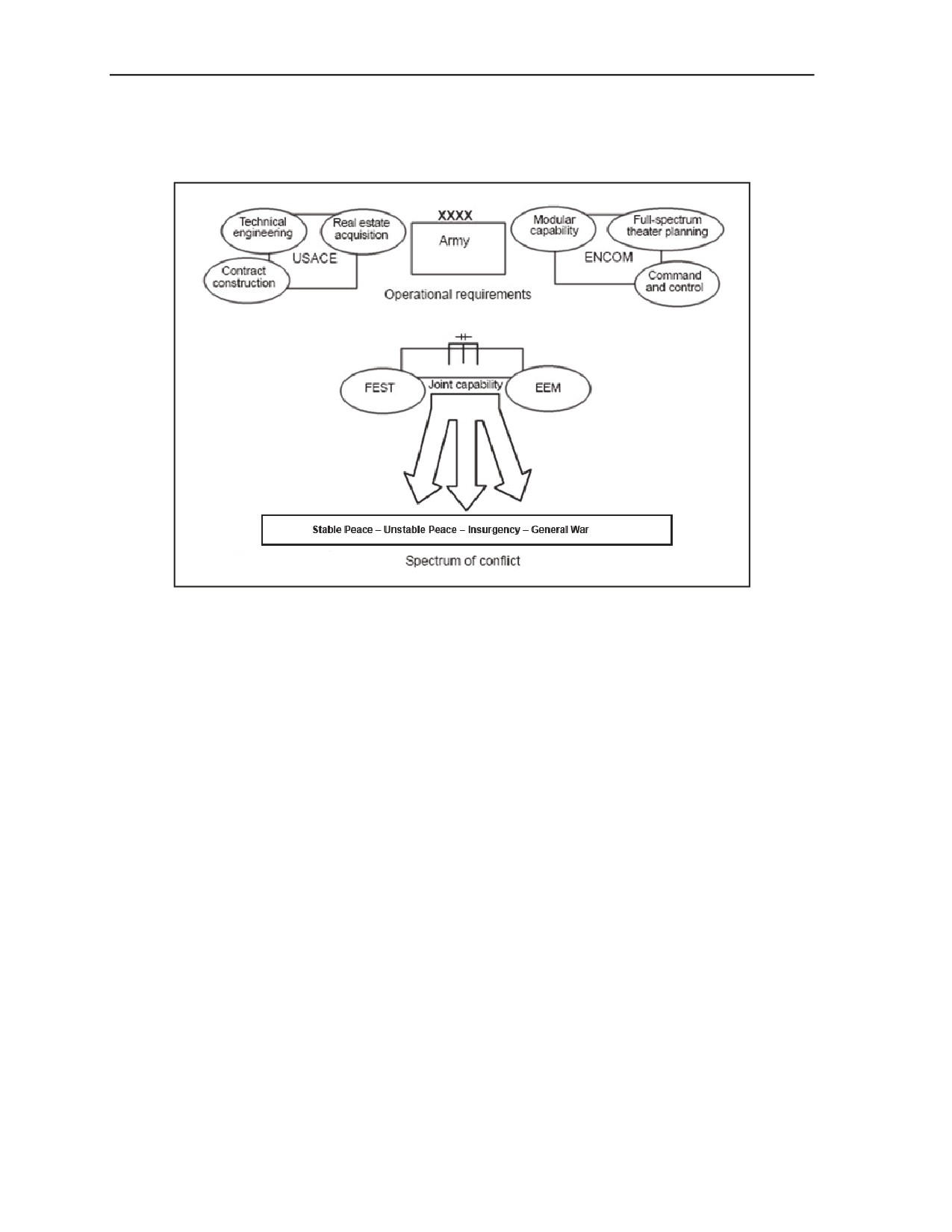
Chapter 6
reach-back capabilities. FFE is applicable to the support of not only Army forces but also the other services
and governmental agencies outside of DOD. Figure 6-14 highlights the majority of capabilities the
engineer regiment offers to support contingency operations.
Figure 6-14. Field force engineering
6-80. Modular teams are available to meet the needs for general engineering staff, planning, facilities
engineering, troop construction, topographic engineering, contract construction, technical engineering, real
estate, and environmental engineering. Examples of USACE modular capabilities support are listed below:
z
Forward engineer support team-main
(FEST-M)—deployable USACE organization that
executes the USACE mission in the AO; it is usually subordinate to the senior engineer
commander in the AO.
z
Forward engineer support team-advanced (FEST-A)—deployable planning augmentation cell
that augments the engineer staff of other organizations to include combatant commander/joint
force commander/Army service component commander (ASCC)/ENCOMs. If a FEST-M is also
deployed, the FEST-A will come under the command of the FEST-M commander.
z
Contingency real estate support team (CREST)—deployable 5- or 6-person real estate team and
typically a component of a forward engineer support team (FEST); it can quickly execute real
property (land and facilities) leases at forward locations.
z
Environmental support team (ENVST)—deployable 4-person environmental team and typically
a component of a FEST; it provides baseline and other environmental studies at forward
locations and is staffed with environmental specialists that can provide technical expertise to
staff engineers and ultimately the commander of the combined-arms force.
z
Base development team—a nondeployable team that can quickly provide base development
engineering and planning and facilities design for staging bases, base camps, forward operating
bases, displaced persons camps, and any similar requirement.
z
Infrastructure assessment team
(IAT)—nondeployable team that provides engineering
infrastructure assessments/surveys for military deployments and civil-military operations in
forward areas. Focus areas for the IAT are infrastructure related to USACE missions and aspects
of the AO impacting contract construction to include roads, utilities, water resources, and HNS.
6-28
FM 3-34.170/MCWP 3-17.4
25 March 2008
Technical Reconnaissance - Assessments and Surveys
6-81. A partial list of potential missions performed by deployed FFE units/organizations includes—
z
Project management, to include supervising work done by military engineers of all Services,
logistics civilian augmentation program-type contractors, and local contractors.
z
Expertise in survivability engineering and engineering services, including areas such as
wastewater treatment, nontactical power generation, water production, snow and ice removal,
and entomology.
z
Expertise in both theater operational (for example, inland petroleum distribution system) and
infrastructure pipeline construction.
z
Expertise in mining and demining.
z
Development and maintenance of base camp standards according to ASCC guidance.
z
Development of prioritized facilities requirements with supporting construction engineers.
z
Management of the installation and regional/area of responsibility
(AOR) master
plan
development process, such as—
Developing base camp master plans.
Reviewing and approving base camp master plans developed by others.
Developing regional master plans in support of the operational support structure.
z
Base camp maintenance, to include—
Structures.
Utilities.
Roads and airfields.
Provision of water.
Treatment of wastewater.
Disposal of solid waste.
Training ranges.
z
Management of base camp facilities use, to include—
Environmental compliance.
Maintenance of real property records.
Plans for future expansions or contractions of base camps.
Quality control for construction projects and facilities upgrades.
Establishment of a fire prevention program and management of fire-fighting teams.
Facility engineering supplies management.
6-82. Reach-back may be used to obtain much of the specialized support required forward. One method
for this is the use of the USACE TeleEngineering Emergency Operations Center (TEOC) and a forward
deployed TeleEngineering Communication Suite. Reachback and TeleEngineering describe the ability to
conduct engineering analysis and support using expertise
(professional engineers, scientists, and
technicians), as well as databases that are not resident in the theater or the AO. The source of this expertise
and data is real time via secure voice and video information technology to the forward mission site. The
results are faster response times—the application of greater levels of expertise examining and solving
problems and providing solution options. An additional set of benefits includes a reduced deployment
footprint, associated support and protection requirements, and a general reduction in cost.
MULTI-SERVICE SUPPORT
6-83. Engineer operations in the COE are becoming increasingly integrated efforts by engineer units,
elements, and support from two or more Services. United States Air Force (USAF) civil engineering
expertise coupled with Army and USMC combat engineers routinely work in concert to repair and upgrade
contingency airfields. United States Navy (USN) construction engineers are routinely integrated in general
support of USMC forces and have begun teaming with USAF and Army engineers to support theaterwide
requirements. Each service brings extensive engineering expertise which can be useful in support of the
technical reconnaissance requirement.
25 March 2008
FM 3-34.170/MCWP 3-17.4
6-29
Chapter 6
6-84. USAF civil engineering capabilities are organized as Rapid Engineer Deployable Heavy Operational
Repair Squadron, Engineer (RED HORSE) or Prime Base Engineer Emergency Force (Prime BEEF) units.
RED HORSE units are deployable worldwide and provide support to force bed down, expedient airfield
and heavy construction and repair, and environmental cleanup and spill response. Prime BEEF units are
also deployable and provide force bed-down support, engineering and construction management, facilities
operation and maintenance (O&M), emergency repair, EOD, fire protection, and CBRN monitoring and
protection.
6-85. USN civil engineer capabilities are organized under both First Naval Construction Division and the
Naval Beach Groups. The First Naval Construction Division is the operational command responsible for
global force management of Seabees of the Naval Construction Regiments, Naval Mobile Construction
Battalions, Construction Battalion Maintenance Units, Underwater Construction Teams, and its sole Naval
Construction Force Support Unit. It also has Seabee Readiness Groups to conduct training and logistical
support. The common thread that is woven throughout all Seabee units is responsiveness and flexibility.
Naval Mobile Construction Battalions are the Navy’s primary capability and possess robust vertical
construction, bridging, and heavy earthmoving capabilities. Naval Mobile Construction Battalions are
deployable, self sufficient and task-organize to provide general construction and disaster relief support.
They also reinforce and augment the USMC limited general engineering capability. Under the Atlantic and
Pacific Naval Beach Groups, the amphibious construction battalions deploy to provide specialized
construction, barge ferry, elevated piers, offshore petroleum systems, and beach camp support. Refer to
FM 3-34 and NWP 4-04 for additional information on these units.
6-86. Army and USMC engineers tasked to conduct technical engineer reconnaissance should determine
what USAF and/or USN engineer elements are available to potentially provide general or specialized
support. In many cases, the deployed USAF and/or USN elements will possess technical expertise not
available elsewhere.
FEDERAL EMERGENCY MANAGEMENT AGENCY AND OTHER GOVERNMENT AGENCIES
6-87. Throughout the Nation's history, citizens have relied on the Army to respond to their needs in
disasters. In a typical year, the Corps of Engineers responds to more than
30 presidential disaster
declarations, plus numerous state and local emergencies. Emergency responses usually involve cooperation
with other military elements and federal agencies in support of state and local efforts. The Corps of
Engineers conducts its emergency response activities under two basic authorities: the Flood Control and
Coastal Emergency Act (P.L. 84-99, as amended) and the Stafford Disaster and Emergency Assistance Act
(P.L.
93-288, as amended). Under the Stafford Act, the Corps supports the Federal Emergency
Management Agency (FEMA) in carrying out the Federal Response Plan, which calls on 26 federal
departments and agencies to provide coordinated disaster relief and recovery operations. Under this plan,
the Army has the lead responsibility for public works and engineering missions.
6-88. Under the National Response Plan, the USACE is designated as the lead agency for Public Works
and Engineering. The USACE can be authorized to provide the following assistance on a temporary basis:
z
Emergency services including supplying potable water, removing debris, conducting urban
search and rescue, and providing emergency electrical power and ice.
z
Technical advice and evaluations including structural analysis.
z
Construction management and inspection.
z
Emergency contracting.
z
Emergency repair of public infrastructure and facilities such as water supply sources.
z
Real estate support.
6-89. The FEMA, a former independent agency that became part of the new Department of Homeland
Security (DHS) in March 2003, is tasked with responding to, planning for, recovering from, and mitigating
against disasters. In March 2003, FEMA joined 22 other federal agencies, programs, and offices in
becoming the DHS. The new department, headed by Secretary of Homeland Security, brings a coordinated
approach to national security from emergencies and disasters, both natural and manmade. FEMA is one of
four major branches of DHS. About 2,500 full-time employees in the Emergency Preparedness and
6-30
FM 3-34.170/MCWP 3-17.4
25 March 2008
Technical Reconnaissance - Assessments and Surveys
Response Directorate are supplemented by more than 5,000 standby disaster reservists. FEMA has 10
regional offices and two area offices. Each region serves several states, and the regional staffs work
directly with the states to help plan for disasters, develop mitigation programs, and meet needs when major
disasters occur. In response to a presidentially declared disaster, FEMA may work with up to 28 federal
agencies and the American Red Cross to provide assistance. These agencies provide state and local
governments with personnel, technical expertise, equipment, and other resources and assume an active role
in managing the response.
6-90. To coordinate the federal efforts, FEMA recommends—and the president appoints—a federal
coordinating officer (FCO) for each state that is affected by a disaster. The FCO and the state response
team set up a disaster field office near the disaster scene. It is from there that the federal and state personnel
work together to carry out response and recovery functions. These functions are grouped into
12
emergency support functions, each headed by an agency supported by other agencies. The federal agencies
that provide assistance include the following:
z
Department of Agriculture
z
Department of Commerce
z
Department of Defense
z
Department of Education
z
Department of Energy
z
Department of Health and Human Services
z
Department of Housing and Urban Development
z
Department of the Interior
z
Department of Justice
z
Department of Labor
z
Department of State
z
Department of Transportation
z
Department of the Treasury
z
Internal Revenue Service
z
Department of Veterans Affairs
z
Agency for International Development
z
American Red Cross
z
Environmental Protection Agency
z
Federal Communications Commission
z
Federal Emergency Management Agency
z
General Services Administration
z
National Aeronautical and Space Administration
z
National Communications System
z
Nuclear Regulatory Commission
z
Office of Personnel Management
z
Office of Science and Technology Policy
z
Small Business Administration
z
Tennessee Valley Authority
z
U.S. Postal Service
25 March 2008
FM 3-34.170/MCWP 3-17.4
6-31
This page intentionally left blank.

Appendix A
Metric Conversion Table
A-1. When planning general engineering missions, it is often necessary to use metric units to standardize
project measurements. Table A-1 is intended to serve as a basic conversion table for that purpose.
Table A-1. Metric conversion table
US Units
Multiplied By
Equals Metric Units
Acres
0.4947
Hectares
Acres
43,560
Square feet
Acres
4,047
Square meters
Bulk fuel, 55 gallon drum
0.17
Stons
Cubic feet
0.0283
Cubic meters
Cubic inches
16.3872
Cubic centimeters
Cubic inches
0.0164
Liters
Cubic yards
0.7646
Cubic meters
Feet
0.3048
Meters
Fluid ounces
29.573
Milliliters
Feet per second
18.288
Meters per second
Gallons
0.1337
Cubic feet
Gallons
0.00378
Cubic meters
Gallons
3.7854
Liters
Gallons (bulk fuel)
0.004
Stons
Inches
2.54
Centimeters
Inches
0.0254
Meters
Inches
25.4001
Millimeters
Miles (nautical)
1.85320
Kilometers
Miles(statue)
1.6093
Kilometers
Ounces
28.349
Grams
Pounds
453.59
Grams
Pounds
0.4536
Kilograms
Square inches
6.4516
Square centimeters
Square feet
0.0929
Square meters
Square miles
2.59
Square kilometers
Square yards
0.8361
Square meters
Yards
0.914
Meters
Subtract 32, multiply by 5, and
Degrees Fahrenheit
Degrees Celsius
divide the sum by 9
25 March 2008
FM 3-34.170/MCWP 3-17.4
A-1

Appendix A
Metric Units
Multiplied By
U.S. Units
Centimeters
0.3937
Inches
Cubic centimeters
0.061
Cubic inches
Cubic meters
35.3144
Cubic feet
Cubic meters
1.3079
Cubic yards
Milliliters
0.03380
Fluid ounces
Grams
0.03527
Ounces
Kilograms
2.2046
Pounds
Kilometers
0.5396
Miles (nautical)
Kilometers
0.62137
Miles (statute)
Meters
3.2808
Feet
Meters
39.37
Inches
Meters
1.0936
Yards
Millimeters
0.03937
Inches
Square centimeters
0.155
Square inches
Square kilometers
0.3861
Square miles
Square meters
1.196
Square yards
Square meters
10.764
Square feet
By 9 and divide the sum by 5;
Degrees Celsius
Degrees Fahrenheit
add 32
A-2
FM 3-34.170/MCWP 3-17.4
25 March 2008
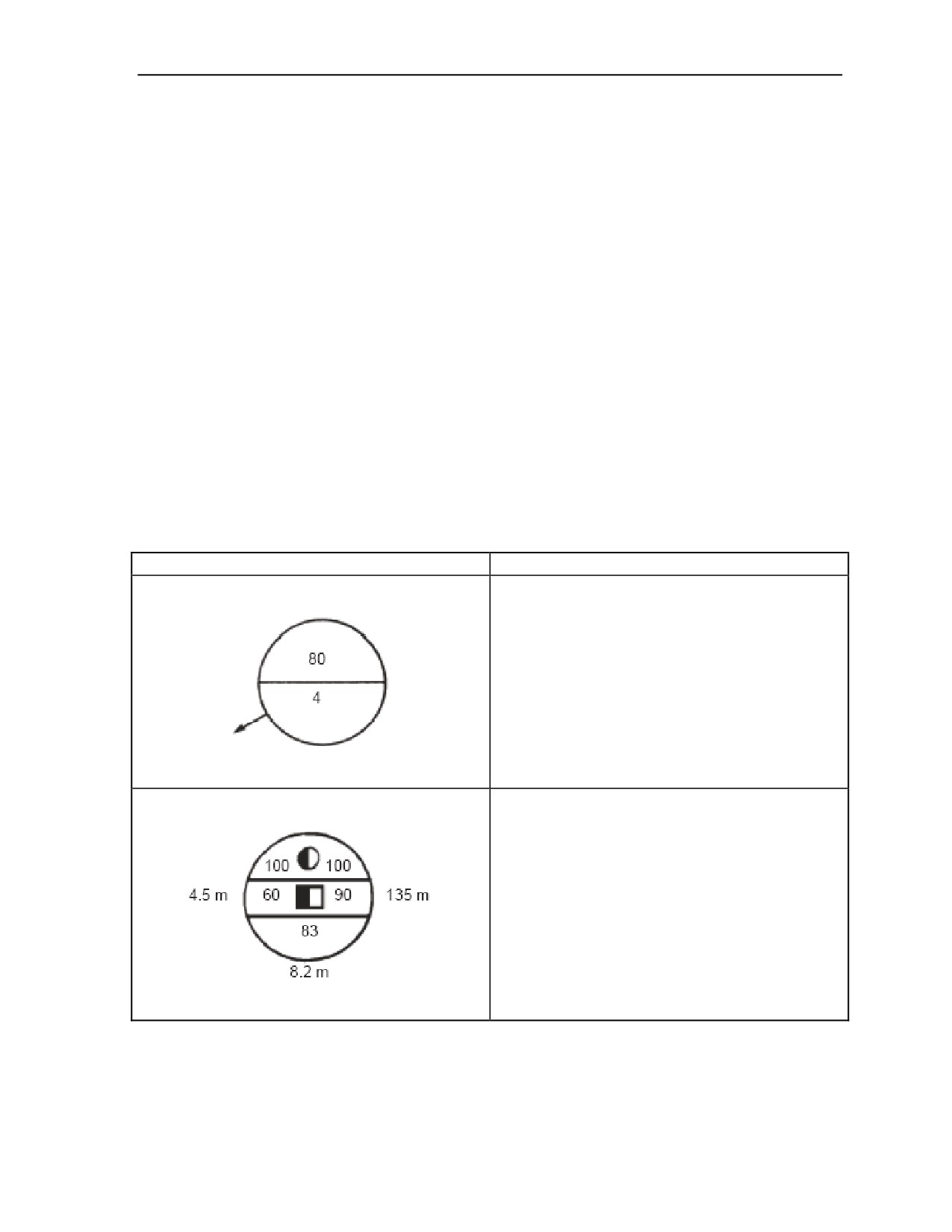
Appendix B
Reporting
This appendix is intended to provide a quick reference for reporting of engineer
related technical information. The first section provides, in table format, the various
symbols used to describe the results of a route classification on an overlay (as
discussed in chapter 5). The second section provides examples of various report
formats useful in documenting and reporting the results of technical engineer
reconnaissance support.
(See MCRP 3-17B for additional report formats. See
FM 3-34.210 for an explosive hazard survey form and instructions. Infrastructure
smartcards, which support infrastructure reconnaissance, are provided separately in
appendix C. The EBS is provided separately in appendix D.)
ROUTE CLASSIFICATION SYMBOLS
B-1.
Table B-1 identifies symbols used on route classification overlays (as discussed in chapter 5).
Table B-1. Route classification symbols
Symbol
Definition
Bridge symbol (abbreviated). Use this symbol only
when the map scale does not permit the use of the full
NATO bridge symbol. Submit DA Form 1249 if this
symbol is used. Draw an arrow to the map location of
the bridge. Show the bridge’s serial number in the
lower portion of the symbol and the MLC for single-flow
traffic in the upper portion. If there are separate load
classifications for tracked or wheeled vehicles, show
the lesser classification. Underline the classification
number if the width or overhead clearance is below
minimum requirements.
Bridge symbol (NATO) shows:
• Two-way wheeled classification, top left.
• One-way wheeled classification, top right.
• Two-way tracked classification, middle left.
• One-way tracked classification, middle right.
• Assigned serial number, bottom inside circle.
• Traveled-way width, bottom outside circle.
• Overhead clearance, outside left.
• Length, outside right.
25 March 2008
FM 3-34.170/MCWP 3-17.4
B-1
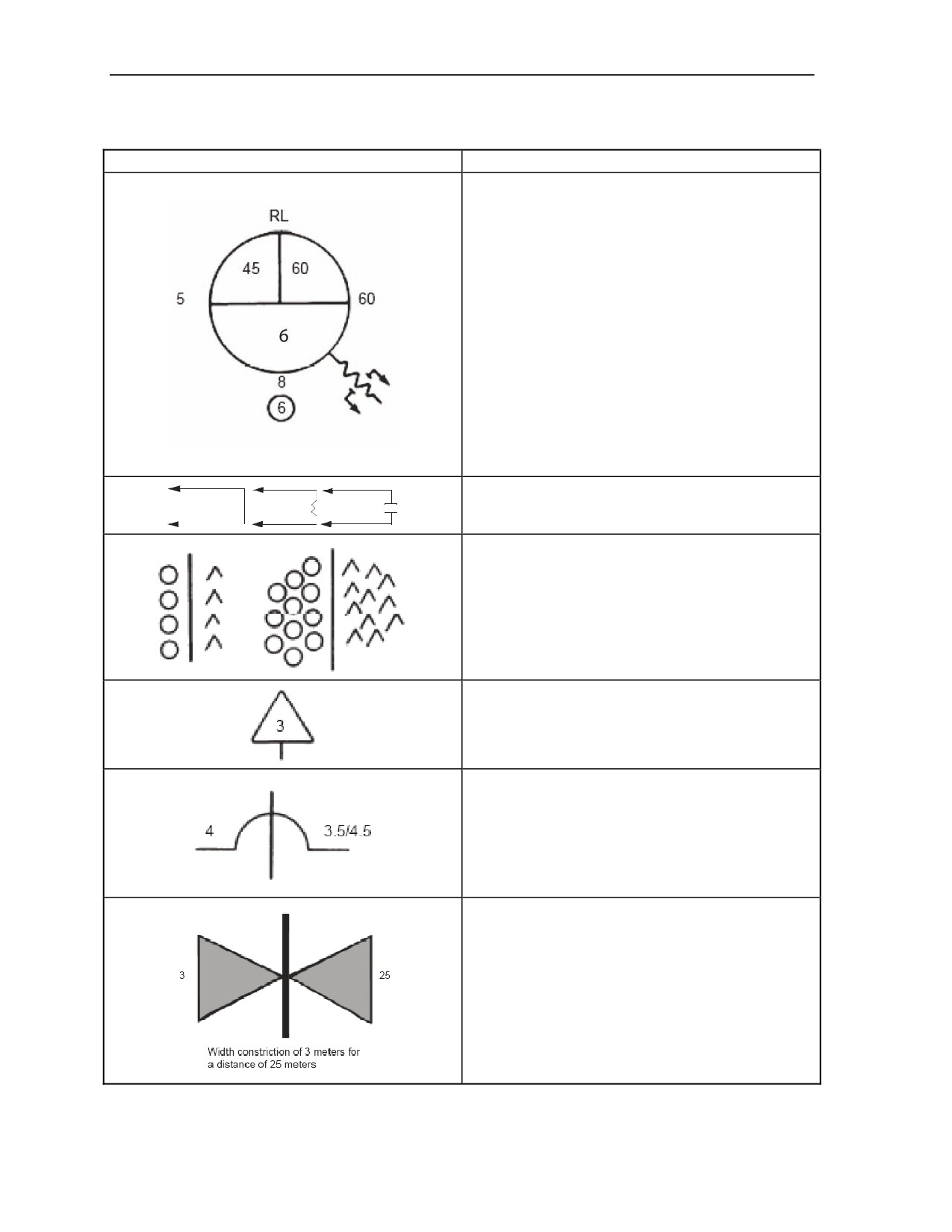
Appendix B
Table B-1. Route classification symbols
Symbol
Definition
Bridge symbol (railway). Place RL above the symbol to
indicate a railway bridge. At the left of the symbol,
show the overhead clearance. Show the bridge’s
overall length at the right of the symbol. Indicate the
traveled-way width below the symbol and underline it if
it is below standard for the classification. Inside the
symbol, show the bridge classification in the upper half.
If the class is different for single- and double-flow
traffic, show single flow on the left and double flow on
the right. Place the railway bridge’s serial number in
the lower half of the symbol. Draw an arrow to the map
location of the bridge. On the arrow shaft, indicate the
ease of adapting the bridge for road-vehicle use. A
zigzag line means it would be difficult to adapt; a
straight line means it would be easy to adapt. Place the
bypass symbol on the arrow shaft to indicate bypass
conditions.
Bypass, symbols shown indicate (from left to right)
bypass is easy, difficult, or impossible.
Concealment. Show roads lined with trees by a single
line of circles for deciduous trees and a single line of
inverted Vs for evergreen trees. Show woods bordering
a road by several rows of circles for deciduous trees
and several rows of inverted Vs for evergreen trees.
Critical points. Number (in order) and describe critical
points on DA Form 1711. Use critical points to show
features not adequately covered by other symbols on
the overlay.
Constriction (underpass). The number on the left
shows the narrowest width of the constriction; the
number on the right is the overhead clearance
(minimum/maximum). Both dimensions are in meters.
Constriction (width). The number on the left shows the
narrowest width of the constriction; the number on the
right is the overhead clearance (minimum/maximum).
Both dimensions are in meters.
B-2
FM 3-34.170/MCWP 3-17.4
25 March 2008
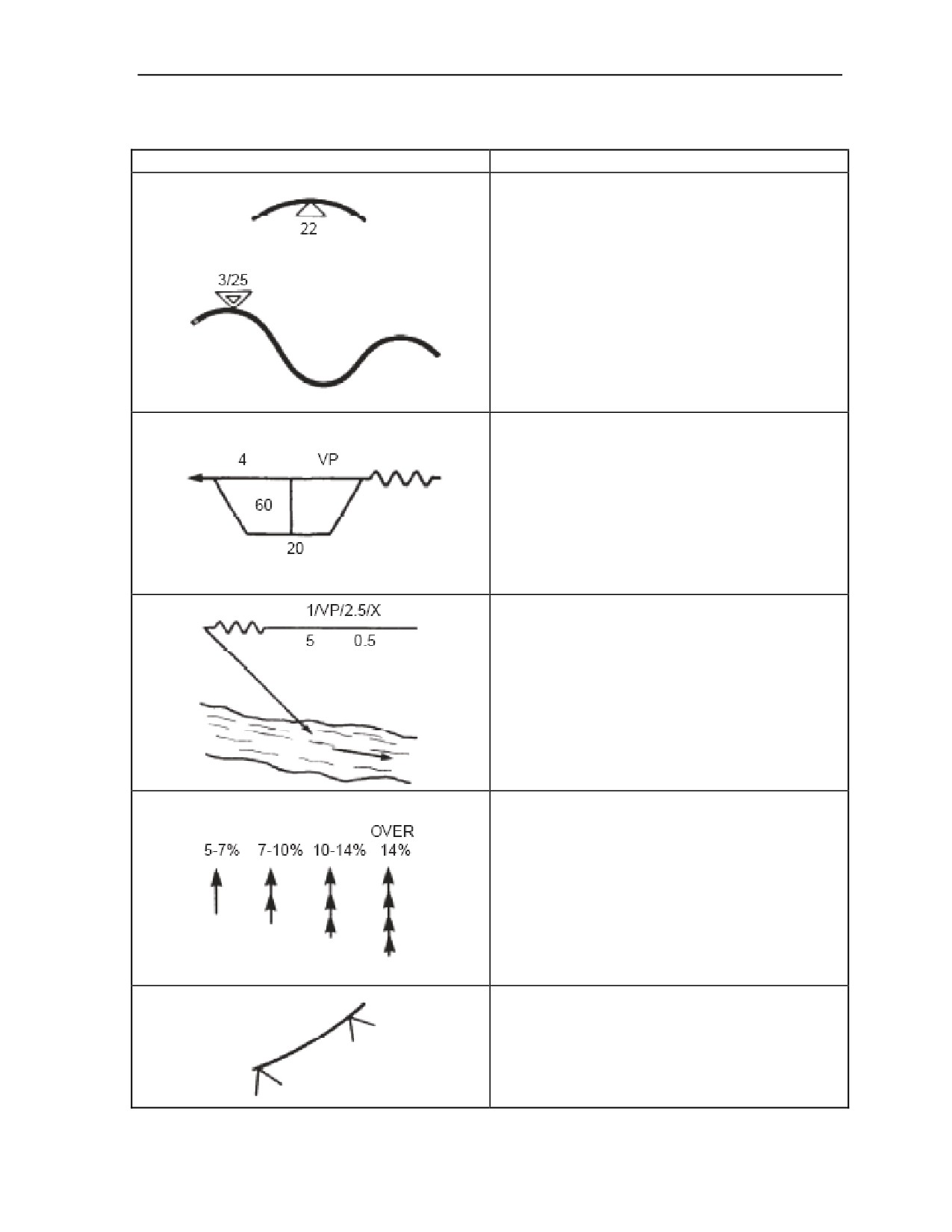
Reporting
Table B-1. Route classification symbols
Symbol
Definition
Curve with a radius less than 45 meters. Symbol points
toward curve location and shows actual radius of curve
outside of triangle.
Series of sharp curves shown with a triangle drawn
inside another triangle. The number of curves followed
by the radius of the sharpest curve shown outside of
the triangles.
Ferry symbol shows—
• Assigned serial number, top left.
• Ferry type (V, P, or both), top right.
• MLC, enclosed left.
• Dead-weight capacity (if known), enclosed right.
• Ferry turnaround time, bottom bank conditions
shown by arrow neck and tail.
Ford symbol shows—
• Assigned serial number, top left.
• Ford type (V, P or both), top 2nd from left.
• Stream’s normal velocity, top 2nd from right.
• Seasonal limiting factors (X or Y), top right.
• Length of ford, bottom left.
• Ford width, bottom 2nd from left.
• Nature of ford bottom, bottom 2nd from right.
- normal depth, bottom right
Grades.
• Single arrowhead pointing up—indicates grade
between 5 - 7 percent.
• Double arrowhead pointing up—indicates grade
between 7- 10 percent.
• Triple arrowhead pointing up—indicates grade
between 10 - 14 percent.
• Four arrowheads pointing up—indicates grade
over 14 percent.
Limits of sector. Show the beginning and ending of a
section of a route covered by reconnaissance with this
symbol.
25 March 2008
FM 3-34.170/MCWP 3-17.4
B-3
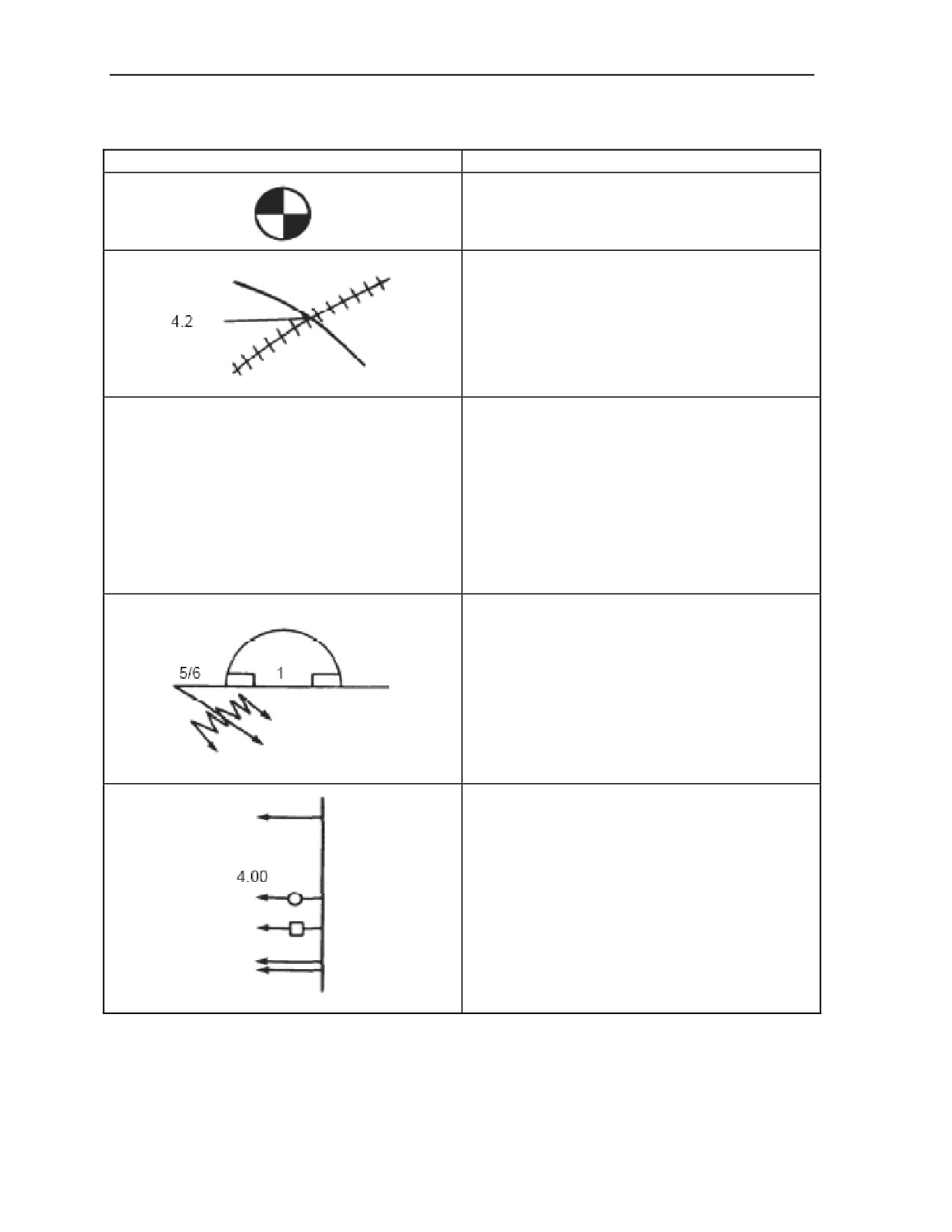
Appendix B
Table B-1. Route classification symbols
Symbol
Definition
Parking area.
Railroad grade crossing. Use this symbol to show a
level crossing where passing trains would interrupt
traffic flow. If there is a power line present, show its
height (in meters) from the ground. Underline the
overhead clearance if it is less than 4.3 meters.
Route classification formula consists of, from left to
right—
• Route width, in meters.
10.5 m/X/120/00
• Route type (X, Y, or Z).
6 m/Z/30/4.1 m/(OB)
• Lowest MLC.
9 m/V/40/5 m/(OB) (W)
• Lowest overhead clearance, in meters.
• Obstructions to traffic flow (OB).
• Special conditions (T or W).
Tunnel symbol shows—
• Minimum/maximum overhead clearance, top
left.
• Traveled-way width, bottom center.
• Tunnel length, top right.
• Assigned serial number, inside tunnel type
sketch.
• Bypass type, on arrow toward tunnel.
Turnout. Use this symbol to show the possibility of
driving off the road. Draw the arrow in the direction of
the turnout (right or left of the road). For wheeled
vehicles, draw a small circle on the arrow’s shaft. For
tracked vehicles, draw a small square on the arrow’s
shaft and place the length of the turnout, in meters, at
the tip of the arrow. When a turnout is longer than 1
kilometer, use double arrows.
B-4
FM 3-34.170/MCWP 3-17.4
25 March 2008

Reporting
ENGINEER RECONNAISSANCE REPORTS
B-2. Table B-2 provides a summary of the various engineer reconnaissance reports and the page reference
in this appendix where an example is provided.
Table B-2. Engineer reconnaissance reports
Route Classification Report, DA Form 1247
Page B-6
Road Reconnaissance Report, DA Form 1248
Page B-13
Bridge Reconnaissance Report, DA Form 1249
B-19
Tunnel Reconnaissance Report, DA Form 1250
Page B-22
Ford Reconnaissance Report, DA Form 1251
Page B-24
Ferry Reconnaissance Report, DA Form 1252
Page B-26
Engineer Reconnaissance Report, DA Form 1711
Page B-29
Demolition Reconnaissance Record, DA Form 2203
Page B-36
River Reconnaissance Report, DA Form 7398
Page B-41
ROUTE CLASSIFICATION REPORT
B-3. Use a Route Classification Report, DA Form 1247, to report the technical information collected
during route classification. Additionally, route classification information is summarized on the route
classification overlay as described in chapter 5. Complete the route classification form as follows (see
figure B-1 on pages B-6 through B-11).
25 March 2008
FM 3-34.170/MCWP 3-17.4
B-5
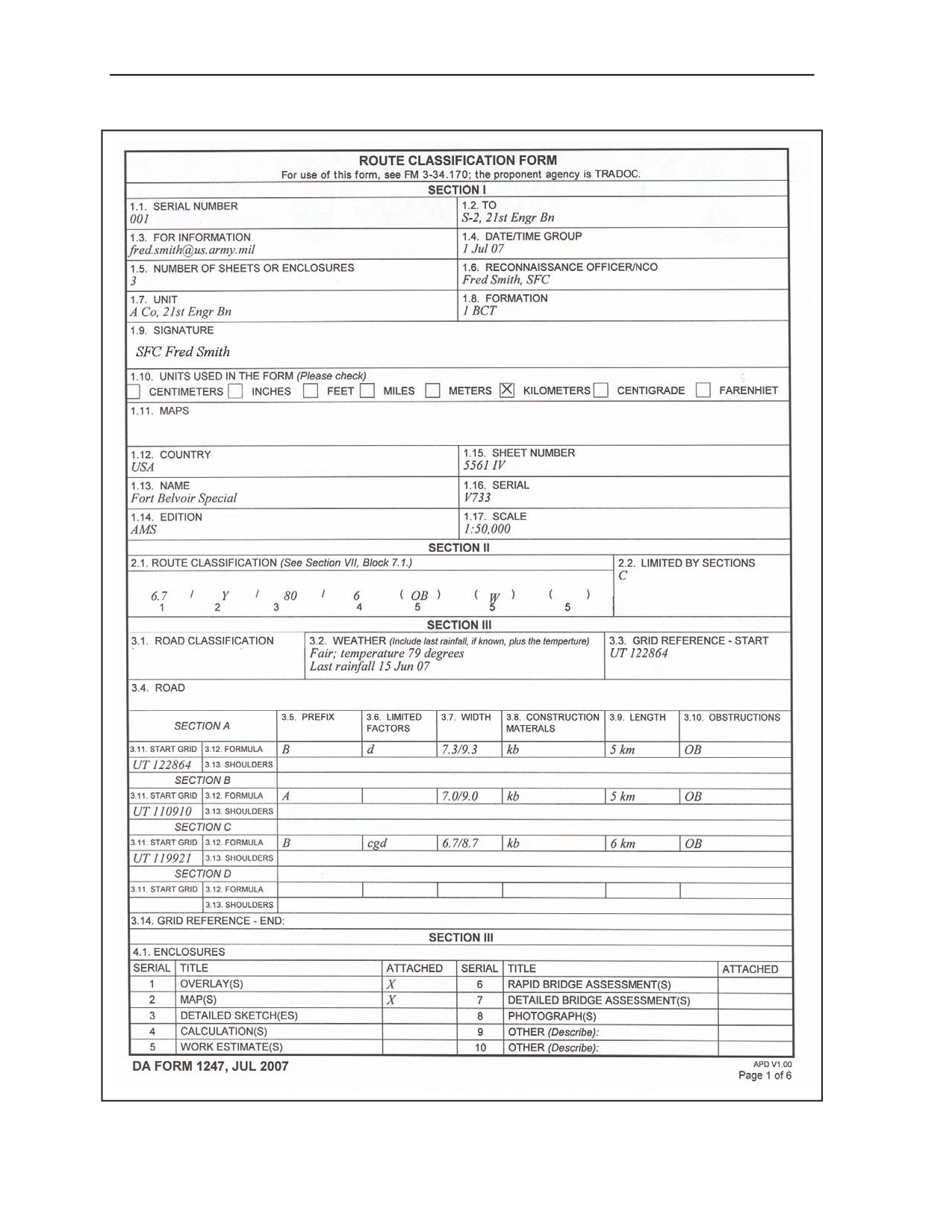
Appendix B
Figure B-1. Sample DA Form 1247
B-6
FM 3-34.170/MCWP 3-17.4
25 March 2008
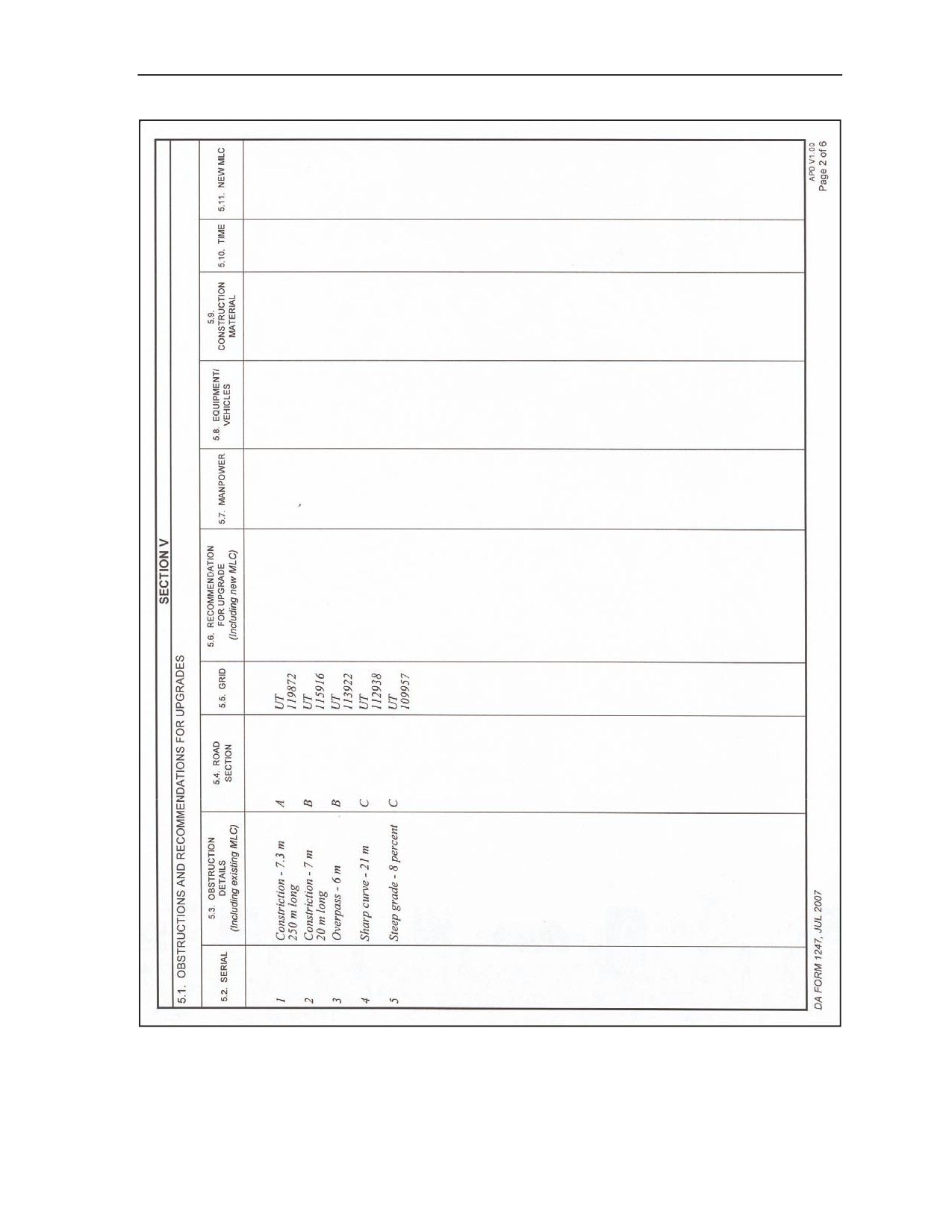
Reporting
Figure B-1. Sample DA Form 1247 (continued)
25 March 2008
FM 3-34.170/MCWP 3-17.4
B-7
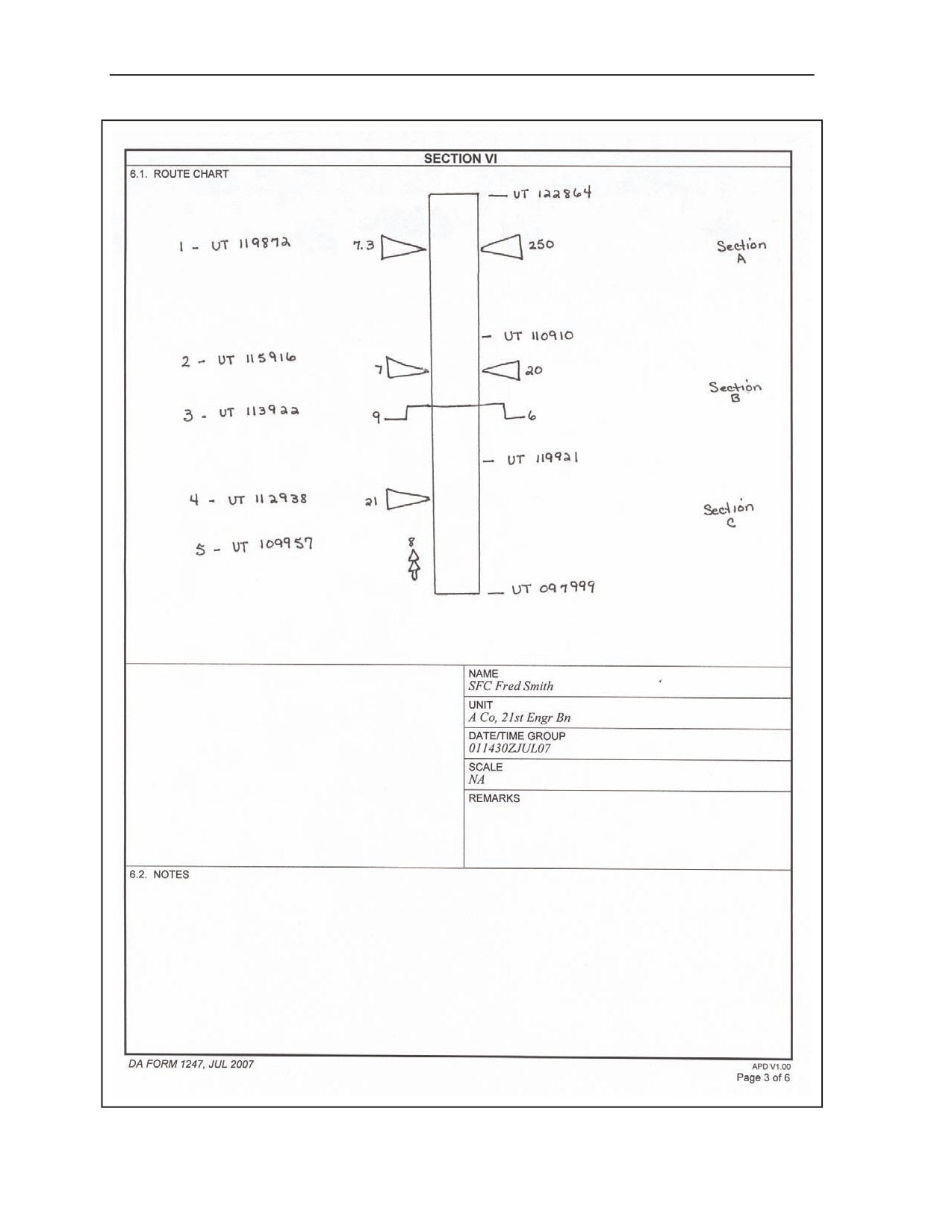
Appendix B
Figure B-1. Sample DA Form 1247 (continued)
B-8
FM 3-34.170/MCWP 3-17.4
25 March 2008
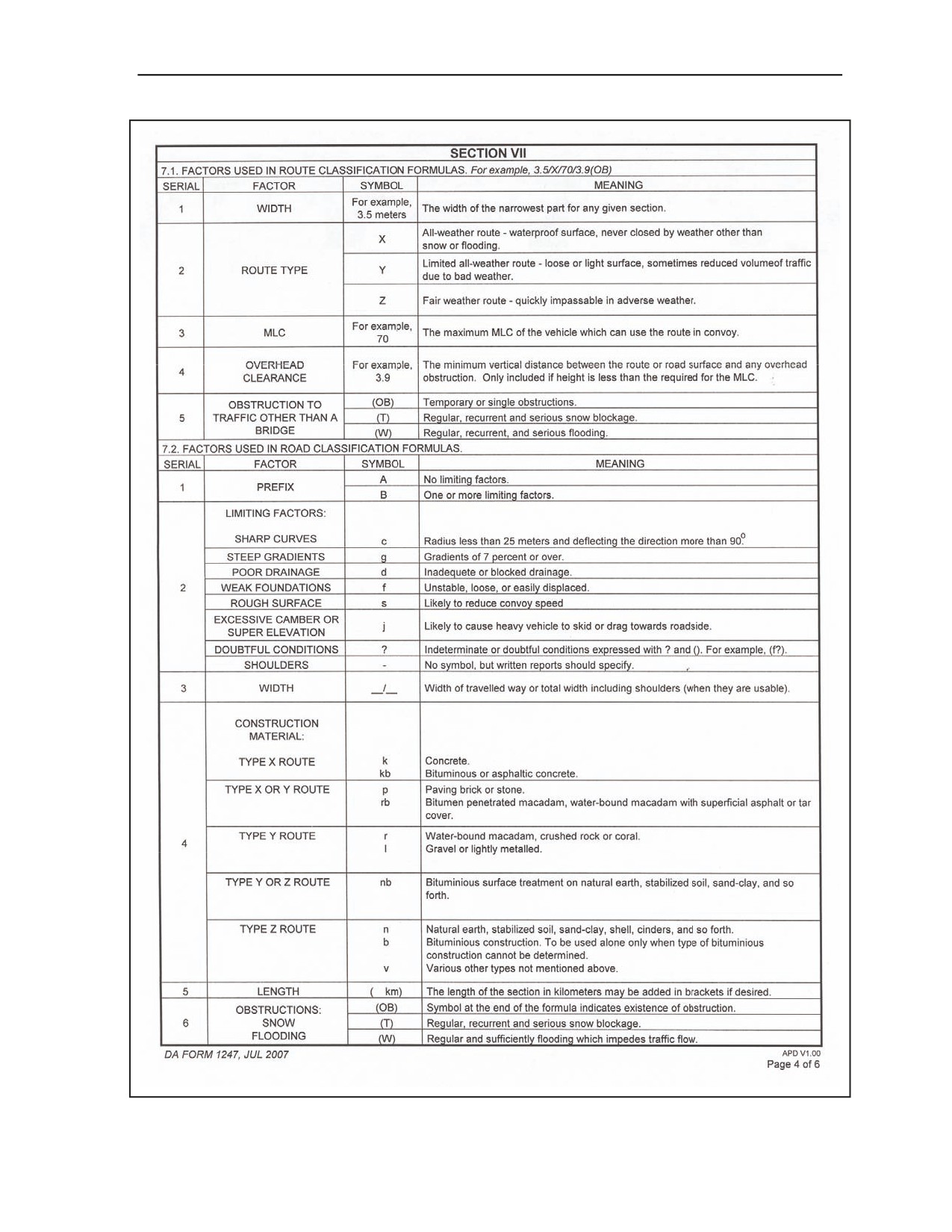
Reporting
Figure B-1. Sample DA Form 1247 (continued)
25 March 2008
FM 3-34.170/MCWP 3-17.4
B-9
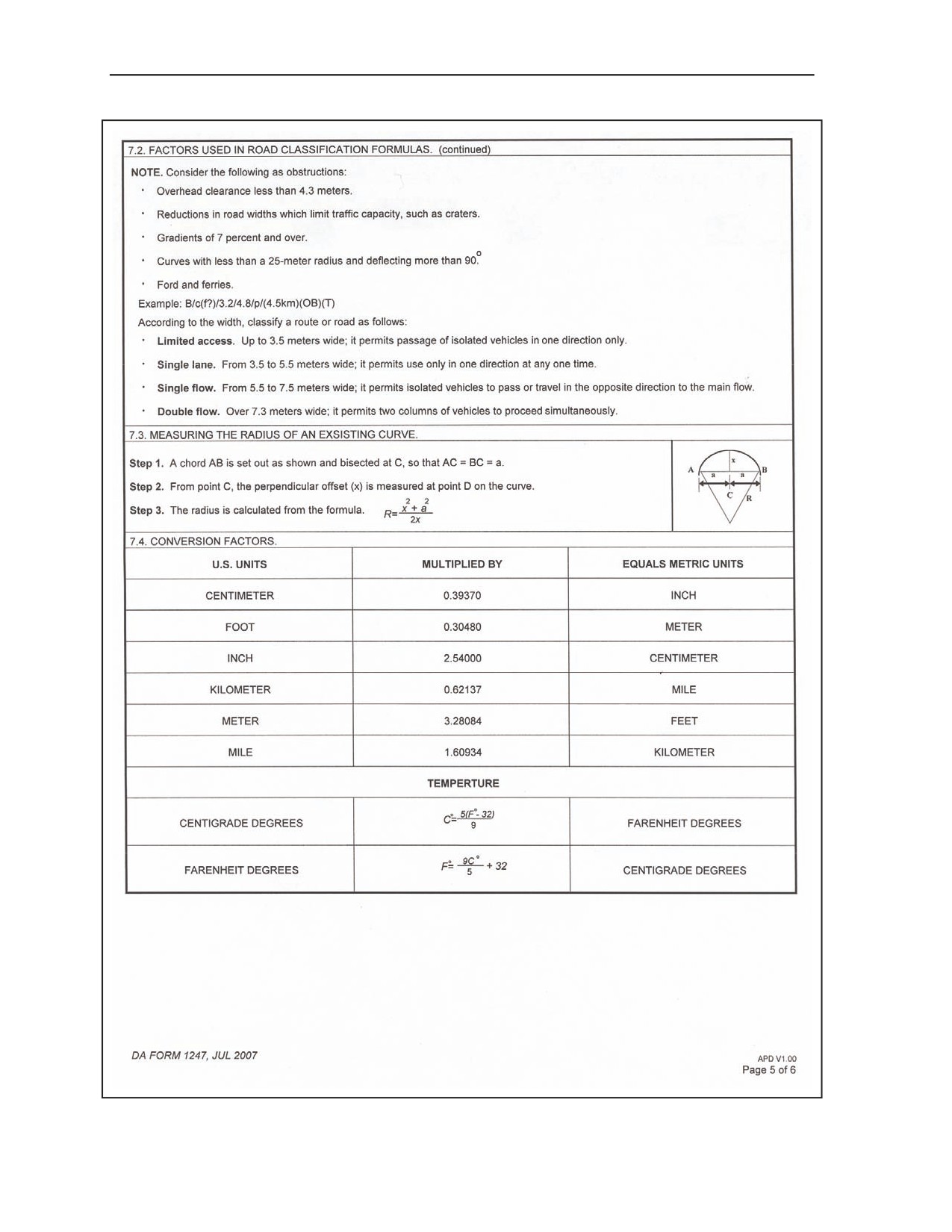
Appendix B
Figure B-1. Sample DA Form 1247 (continued)
B-10
FM 3-34.170/MCWP 3-17.4
25 March 2008