FM 3-34.170/MCWP 3-17.4 ENGINEER RECONNAISSANCE (March 2008) - page 3
Tactical Reconnaissance Support
planned route search could focus on collecting information on the cover and concealment potential and
vulnerable points along the route (such as the location of culverts and drainage ditches that may be
employed to conceal hazards) and the amount of debris found along the route that could be employed to
conceal hazards. Similarly, a reconnaissance in support of a force/venue protection would allow the
identification of locations such as mortar base plates and attack routes into and away from fixed sites. For
planned search operations, a search advisor must provide specific focus for the tactical engineer
reconnaissance support required.
TUNNELS AND SUBSURFACE OPERATIONS
4-86. This section discusses reconnaissance to collect information on the use of tunnels, natural caves, or
underground facilities by enemy forces. Caves and underground facilities can be used for command and
control centers, logistics staging areas, hospitals, or fortifications. The larger underground facilities can be
quite complex. They can be wired for electricity and communications and can have pumping stations for
supplying air to lower levels. Caves can have many large chambers connected by passageways. Also,
tunnel systems can have many large rooms joined by interconnecting tunnels. Search operations include a
specified target, whereas the reconnaissance objective is to collect specified information. Search team
organization and the reconnaissance team organization may differ significantly as well.
Note. This section should not be confused with the discussion on reconnaissance of tunnels on
routes which is included in chapter 5. Reconnaissance support involving tunnels and subsurface
operations should not be confused with engineer support for military search operations (see
FM 34.210).
Tunnel Uses
4-87. Tunnels can be dug with zigzags and sumps to reduce the effects inside them of small-arms fire,
explosives, and gas. Some tunnels, rooms, passageways, or chambers can contain concealed exits to allow
an enemy to hide or escape if the complex or cave is penetrated. Other tunnels can be booby-trapped to kill
intruders. Tunnels and caves are hard to detect from the air or ground. Their construction can make them
impossible to destroy with conventional ammunition. Tunnels can also be dug in the basement of safe
houses for use as escape routes if a house is compromised. Tunnel entrances are normally covered by fire
from another point on the complex.
4-88. An enemy can use tunnels in penetration operations to gain access to restricted areas. In built-up
areas, they can infiltrate through sewers, or they can tunnel to their target from the basement of a nearby
building, subway tunnel, or sewer. When insurgents are below the target, they can either build an exit and
penetrate the target from below or fill the tunnel with explosives and destroy the target.
4-89. Tunnels are used for approach and escape and for access to caves and underground bunkers for
firing positions and for protection against indirect fires. They are also used as a common method for
storing food and materials in underground caches. If large enough, some tunnel complexes can house
underground hospitals and base camps.
Tunnel Detection
4-90. The first step in detecting or locating tunnels is to reduce a large geographical area of interest to a
smaller area of interest, to a smaller area of probable locations. This can be accomplished by studying
indications of probable tunnel locations. Some indicators that tunnels are being employed by insurgent
forces include—
z
Movement of insurgents in a specific direction after being spotted by aircraft.
z
Sniper fire occurring from areas where there are no obvious avenues of withdrawal.
z
Vegetable gardens far from places of habitation.
25 March 2008
FM 3-34.170/MCWP 3-17.4
4-21
Chapter 4
z
Operations where insurgents inflict casualties at relatively long range and disappear without
making close contact or being detected by friendly forces.
z
The smell of burning wood or food cooking in an area lacking habitation.
4-91. Conventional aerial photography produces results if the appearance of the surface and vegetation is
changed from the normal. This requires skilled personnel to interpret photographs. In a jungle
environment, aerial photography may be prohibited since dense vegetation, such as double or triple canopy
jungle, obscures the ground.
4-92. Once determined that a certain area may contain a tunnel system, several indicators can be helpful in
detecting tunnels. Visual inspections often disclose the general area of a tunnel but not its precise location.
The key to finding a tunnel system is applying common sense to the situation. A platoon or company
should be assigned a small search area (never larger than a 1,000-meter grid square). These small areas are
chosen based on intelligence reports or on past actions of the insurgent force. The unit searches every
square meter of the area. Some visual indicators usually found include—
z
Worn places on trees that the insurgent uses as handholds.
z
A small trail, much like a game trail, through brush into a clump of small trees.
z
Cut trees—not a sure indicator.
z
Limbs tied near the treetop to conceal the use of a tunnel from aircraft.
z
Slight depression in or around a group of small trees.
z
Air holes—sure indicators.
z
A lone individual, mainly a female, in the area.
z
Freshly cooked food with no one attending the site.
z
Fresh human feces in the area.
4-93. These are all good indicators. However, they can vary depending on the area. The places to look for
indicators are in the corners of hedgerows and trails and streams. The enemy often hides in these places in
order to see without being seen. Also, hiding in these places allows those who finished the camouflage to
escape undetected. The insurgents are aware of the danger of setting a pattern. However, they must have a
location that provides observation as well as concealment. Soldiers and Marines should look for OPs that
allow the insurgent to move into or out of an area undetected.
4-94. Sometimes, the exact location of a tunnel can be obtained by questioning the local populace or
prisoners, who may have occupied or helped dig the system. Due to compartmentalization, they may not be
able to locate an entrance or exit unless they have seen or used the completed tunnel.
Tunnel Reconnaissance
4-95. Entering an area where a tunnel complex is located requires a methodical approach. Security to the
flanks and rear is imperative. The size of the objective area of operations determines the strength of the
unit assigned the search mission. The unit, company, or platoon is task organized for tunnel operations.
z
Security element—plus headquarters element to cordon search area.
z
Search element—to search the immediate area for tunnels. The search element is subdivided into
search and security teams.
z
Reserve element—to assist in cordon and reinforce as needed.
4-96. The techniques of deliberate search are centered on the rifle squad. Each squad is divided into a
security and a search team. A slow methodical search is conducted in the area of operations. Once assigned
a search area, the squad systematically searches every square meter. The security element moves toward
the limits of the search area. Once a hole (tunnel) is discovered, the security element surrounds the area while
the search team prepares to destroy or neutralize the hole (tunnel).
4-97. The reconnaissance element may require the following special items to perform tunnel operations:
z
Mine detector— used to detect ammunition and weapon caches.
z
Grenades—fragmentary, smoke, white phosphorus, and concussion types. Grenades should not
be used after friendly forces have entered a tunnel.
4-22
FM 3-34.170/MCWP 3-17.4
25 March 2008
Tactical Reconnaissance Support
z
Demolitions—used to destroy tunnel systems. Due to the complexity of charges needed to
destroy some tunnel complexes, an engineer team should support the search unit. Also, the large
amount of demolitions required for some operations can present unique logistics problems,
mainly in a jungle environment. (See FM 3-06.11 for information on the urban environment).
z
Air generator—used to force smoke into tunnel complex.
z
Flashlights—to search tunnels.
z
Weapons—Pistols should be used inside tunnels. The pistol has good stopping power and is
effective at close range.
z
Loudspeaker—used to call the enemy from tunnels.
Tunnel Destruction
4-98. The destruction of a tunnel is a four-step process:
z
Step 1. A Soldier and Marine fires one or two magazines from a rifle into the tunnel entrance.
This discourages the enemy from staying close to the entrance. After gaining the attention of the
insurgents, the insurgents are told to vacate the hole or tunnel or be killed. They may surrender
without a fight, saving not only the efforts of killing but also of excavating the hole or tunnel for
weapons and documents.
z
Step 2. If step 1 fails, breaching operations are used. A grenade is placed on the entrance cover
to gain access. The entrance cover is removed in this manner to reduce the effects of any
attached booby traps.
z
Step 3. Once the entrance cover has been destroyed, the following measures are used (depending
on the situation):
Insert grenades (fragmentary or concussion) to kill or incapacitate the enemy.
Insert smoke grenades to reveal the locations of other entrances or exits.
z
Step 4. Soldiers and Marines then enter to ensure that all weapons and documents are recovered
and all enemy (dead or wounded) are removed. The hole or tunnel is searched for small
compartments built to hide weapons and ammunition. If a tunnel complex proves to be extensive
with bunkers and large rooms, it is cleared systematically. Bunkers are destroyed or occupied to
prevent the enemy from reoccupying them through another tunnel. Do not clear more bunkers
than friendly forces can hold.
4-99. Deliberate search techniques emphasize where to look for the enemy (locations that provide the
enemy with observation, cover, concealment, and an escape route). When the Soldier and Marine learns
what to look for, any of these indicators are likely to trigger a mental alert that the enemy is not far away.
After searching the tunnel destroy it with explosives.
4-100. Neutralization and clearing of tunnels are slow and deliberate procedures, which can be costly in
terms of casualties. Since each tunnel system differs in size and construction, different quantities and
placements of explosives are needed for each type.
z
Block explosives. Using block explosives to destroy a tunnel system has a disadvantage and
advantages:
Disadvantage: All the explosive power is concentrated at one point. Thus, the destruction is
localized, and often portions of the tunnel are unaffected. However, a large (10- to 12-pound)
block of explosive tamped against the ceiling may cause an entire tunnel to collapse.
Advantages: The ease of emplacement, ease of procurement, and feasibility of aerial
resupply. Also, block or satchel charges are effective in destroying bunkers, sunken living
quarters, underground rooms, and short tunnels. Cratering charges are also effective for
underground rooms.
z
Shaped charge. The shaped charge in tunnel destruction is effective in certain circumstances. A
shaped charge placed underground in the middle of a tunnel complex and aimed downward
destroys the area around and above the charge. Also, a shaped charge placed in a deep complex
and aimed upward results in extensive destruction.
25 March 2008
FM 3-34.170/MCWP 3-17.4
4-23
Chapter 4
z
Bangalore torpedoes. Another effective method of tunnel destruction uses bangalore torpedoes
placed throughout the tunnel length (regardless of depth). The constant length of explosives
throughout the tunnel ensures complete destruction. The bangalore (5 feet long) adapts to the
twists and turns in tunnels. A disadvantage of a bangalore torpedo is the logistics problems
arising from its size and weight. Resupply may be a problem if large quantities are used to
destroy a tunnel system.
COMPLEX TERRAIN
4-101. Tactical reconnaissance will require engineer support in all types of terrain and climate. Each
environment’s advantages and disadvantages are considered in the planning and conduct of ERT
operations. ERTs conduct route, zone, and area reconnaissance in jungles, mountainous areas, deserts, cold
regions, and employ specialized knowledge, skills, techniques, and equipment for each of these areas. This
section presents characteristics of four environments which impact tactical engineer reconnaissance support
and their associated considerations.
Jungles
4-102. Jungles are humid, tropic areas with a dense growth of trees and vegetation. Visibility is typically
less than 100 feet, and areas are sparsely populated. Mounted infantry and armor operations are limited in
jungle areas, and jungle vegetation provides excellent concealment from air and ground observation.
Vegetation does not provide adequate cover from small caliber direct-fire and artillery indirect-fire
fragments. Adequate cover is available using the natural ravines and gullies produced by erosion from the
area’s high annual rainfall. Few natural or locally procurable materials are available in jungle areas. Other
considerations are high water tables, dense undergrowth, and tree roots (often requiring aboveground level
protective construction).
4-103. The focus of engineer reconnaissance support in jungle terrain is influenced by the engineer tasks
typically conducted. The following discussion highlights common M/CM/S tasks requiring engineer
reconnaissance in jungle terrain.
4-104. The construction and maintenance of roads/tracks/trails are the initial means of improving
mobility. Heavy rainfall, the clearance of vegetation, drainage, and the movement of equipment and
materials all combine to make this a long and painstaking task. Once constructed, routes will need regular
maintenance. Landing sites and drop zones will also need to be constructed to enhance the ability to move
troops and stores by air transport and helicopters. However, with training and advice, other nonengineer
troops should also be able to take on some of these tasks. Crossing obstacles, such as large rivers, may
require engineer advice, support and, possibly, equipment; but once suitable material for the construction
of boats, rafts, and small bridges has been provided, other troops will often be able to complete the task.
Bridging of obstacles to allow vehicle passage normally requires special equipment and should remain an
engineer task. Minefields in the jungle are likely to be of the nuisance or protective variety and will remain
an engineer task for clearance. Engineers may also be required to breach enemy defensive positions and to
clear booby traps and other EHs.
4-105. The main countermobility tasks for engineers will be to block roads/tracks/trails, lay mines and
booby traps (where ROE permit), and to carry out demolitions. Blocking roads/tracks/trails is always
particularly effective to provide opportunities for counteraction, such as ambush or air strike.
Countermobility tasks may also assist in developing a deception plan—provided it is coordinated at the
highest appropriate level.
4-106. Engineers may be required to construct defensive positions, field fortification (including artillery
gun positions), and protective locations for combat supplies.
4-107. Engineers will have a large variety of other tasks and commitments which will demand their
advice and attention. In the early states of a deployment, the engineers are more likely to be concerned with
establishing a secure base.
4-24
FM 3-34.170/MCWP 3-17.4
25 March 2008
Tactical Reconnaissance Support
Mountainous Areas
4-108. Characteristics of mountain ranges include rugged and poorly trafficable terrain, steep slopes, and
altitudes greater than
1,600 feet. Irregular mountain terrain provides numerous places for cover and
concealment. Because of rocky ground, it is difficult and often impossible to dig below ground positions;
therefore, boulders and loose rocks are used in aboveground construction. Construction materials used for
both structural and shielding components are most often indigenous rocks, boulders, and rocky soil. Often,
rock formations are used as structural wall components without modification. Conventional tools are
inadequate for preparing individual and crew-served weapons fighting positions in rocky terrain. Engineers
assist with light equipment and tools (such as pneumatic jackhammers) delivered to mountain areas by
helicopter. Explosives and demolitions are used extensively for positions requiring rock and boulder
removal. (FM 3-97.6 provides detailed information on mountain operations.)
4-109. The focus of engineer reconnaissance support in mountainous terrain is influenced by the engineer
tasks typically conducted. The following discussion highlights common M/CM/S tasks in mountainous
terrain.
4-110. Mobility support is likely to be the major task, particularly the construction, improvement, and
maintenance of routes. Main supply routes may be vulnerable particularly where they run through defiles.
The provision of drainage and bridging is likely to be required because of the large number of mountain
streams and their susceptibility to flash flooding. New bridges may be required to cross streams, replace
weak bridges, and cross gorges. Constructing new routes is likely to involve major engineering work
especially excavation and fill. Because of the shortage of routes and restricted access, the following
mobility tasks will also assume particular significance:
z
Obstacle clearance.
z
Construction of passing and parking areas.
z
Snow clearance.
z
Helicopter landing sites.
z
Tasks related to resupply by air.
4-111. As routes are restricted, the effect of obstacles will be greatly enhanced. Blocking roads and
passes, destroying tunnels, and laying mines are particularly effective in rugged terrain. Care must be taken
not to restrict the movement of your own forces. All obstacles may have to be coordinated at a higher
formation level than for normal operations.
4-112. Digging in may be difficult even when using explosive means. It is likely that defensive positions
will largely be based on raised fortifications and sangars. The construction of defensive positions remains
an all arms/branches responsibility but engineers may be called upon to provide advice and enhanced
engineer capabilities to support their efforts. Some measure of tunneling may even be required. Irregular
mountain terrain provides many opportunities for cover and concealment. Light engineer equipment
transported by helicopters can provide valuable assistance in protecting maneuver units. There may also be
the need to construct support bases for indirect-fire weapons.
4-113. Other common engineer tasks may include—
z
Construction and operation of aerial ropeways.
z
Construction of logistic facilities.
z
Antihelicopter measures.
z
Support to remote signals sites.
z
Geographic and survey support.
Deserts and Extremely Hot Conditions
4-114. Deserts are extensive, arid, treeless, suffer from a severe lack of rainfall, and possess extreme daily
temperature fluctuations. The terrain is sandy with boulder-strewn areas, mountains, dunes, deeply eroded
valleys, areas of rock and shale, and salt marshes. Effective natural barriers are found in steep slope rock
formations. Wadis and other dried up drainage features are used extensively for protective position
25 March 2008
FM 3-34.170/MCWP 3-17.4
4-25
Chapter 4
placement. Camouflage and concealment, as well as light and noise discipline, are important considerations
in desert terrain. Target acquisition and observation are relatively easy in desert terrain. (FM 90-3 provides
detailed information on the considerations associated with desert operations.)
4-115. The focus of engineer reconnaissance support in desert terrain is influenced by the engineer tasks
typically conducted. The following discussion highlights common M/CM/S tasks in desert terrain.
4-116. The vastness of the desert makes mobility a prime concern. Cross-country mobility may be poor in
soft sand, rocky areas, and salt flats. Greater engineer reconnaissance effort will be needed to identify
routes, existing obstacles, and minefield locations. Engineer tasks may include—
z
Assisting maneuvers by reducing slopes, smoothing rock steps, and maintaining routes.
z
Providing dry-gap crossings including those required to traverse oil pipelines.
z
Increasing weight-bearing capacity through soil stabilization to provide good roads or sites for
aircraft landing strips or helicopter landing zones.
z
Suppressing dust using, for example, diesel fuel or oil mixtures.
z
Obscuring enemy lines of sight during breaching operations.
4-117. A minefield, to be of any tactical value in the desert, must usually cover a relatively large area, so
mechanical means are best suited for employment. SCATMINEs may also be widely used. Since there are
often too many avenues of approach to be covered with mines, it is usually best to employ tactical
minefields to cover any gaps between units, especially for night defense. Target-oriented obstacles may
often be the best choice to reduce the enemy’s mobility. Terrain dependent obstacles may be extensive and
must be used in conjunction with each other and with any natural obstacles. All should support EAs.
4-118. Sand is effective in covering mines. However, shifting sand creates potential problems such as
exposing the mines
(causing them to malfunction) or accumulating excessive sand
(degrading
performance). Shifting sand can also cause mines to drift. Antitank ditches require extensive preparation
time and may require extensive maintenance. Caution must be exercised to prevent the ditch from
identifying a defensive front or flank and to deny their use as protection for enemy infantry.
4-119. Deserts provide little cover and concealment from ground-based observers and even less from
aircraft. Because of the lack of concealment, camouflage must often be used. Hull and turret defilade
positions for tactical vehicles may be important. Dispersion and frequent moves are other survivability
techniques. Preparation of fortifications in the desert is difficult. Sandy soil requires revetments, while
rocky plains or plateaus may be impossible to dig in. To counter this problem, emplacements are built up
with rocks and depressions are used whenever possible. Hardening of logistics facilities, C2 nodes, and
upgrades to or construction of forward landing strips and main supply routes are important in desert
operations. A safety inspection of construction works is likely to be required daily, after any heavy rain,
and after receiving direct or indirect fire.
4-120. Other engineer tasks that may be applicable in these conditions include analyzing terrain,
providing water and fuel, and erecting sun shelters for equipment and personnel. Bridging may also be
required for wadis or other gaps.
Arctic and Cold Regions
4-121. Cold regions of the world are characterized by deep snow, permafrost, seasonally frozen ground,
frozen lakes and rivers, glaciers, and long periods of extremely cold temperatures. Digging in frozen or
semifrozen ground is difficult with equipment and virtually impossible for the Soldier and Marine with an
entrenching tool. Fighting and protective position construction in snow or frozen ground takes up to twice
as long as positions in unfrozen ground. Operations in cold regions are affected by wind and the possibility
of thaw during warming periods. An unexpected thaw causes a severe drop in the soil strength which
creates mud and drainage problems. Positions near bodies of water, such as lakes or rivers, are carefully
located to prevent flooding damage during the spring melting season. Wind protection greatly decreases
the effects of cold on both Soldiers and Marines and equipment.
(FM 3-97.11 provides detailed
information on the considerations associated with arctic and cold region operations.)
4-26
FM 3-34.170/MCWP 3-17.4
25 March 2008
Tactical Reconnaissance Support
4-122. The focus of engineer reconnaissance support in cold regions is influenced by the engineer tasks
typically conducted. The following discussion highlights common M/CM/S tasks in cold regions.
4-123. Mobility will be impeded by snow, ice-covered terrain, weather, and long hours of darkness.
z
Increased engineer effort will be necessary for the construction, improvement, and maintenance
of forward airstrips, helicopter landing sites and roads, especially LOC roads, which are likely to
be high priority targets.
z
Roads and tracks may quickly become impassable to wheeled and tracked vehicles in heavy
snowfalls. Snow clearance and route maintenance equipment must always be available.
z
The LOC will often follow river valleys and cross many bridges which may make the gaps they
cross become impossible to bypass if they are destroyed. There may be a major requirement for
new bridges, overbridging, rafting, and/or ferrying. Improvisation is possible using ice and
snow. (Technical Manual [TM] 5-349 provides a detailed discussion on the improvised use of
ice in bridge operations.) Equipment bridging can be used but the following should be
considered:
It must be used with care as light alloy and cast metal can become brittle at low
temperatures.
Construction times are increased (normally doubled).
An adequate reserve of spare parts is required.
z
Heating equipment and warming/drying facilities should be readily available.
4-124. Countermobility tasks are likely to concentrate on the limited routes available. Route denial,
demolitions, and off-route mines will be particularly important. Minefields may also be used but the
following must be considered in planning and laying:
z
The effect of cold on materials.
z
The reduced work rates in arctic and cold weather conditions.
z
The variable performance of equipment and systems in deep snow conditions, especially
SCATMINEs.
z
The need for subsequent adjustment to be made after a fresh fall of snow or a sudden thaw.
4-125. Shelter is essential to survival. Preserving your own shelters and destroying the enemy’s become
important ends in themselves, which can influence the outcome of the battle. Measures to increase chances
of survival from enemy action and from the hostile environment will include—
z
Constructing field defenses—snow and ice fortifications with overhead protection using either
improvised or equipment shelters and snow/ice concrete.
z
Providing advice and assistance with countersurveillance plans and works.
4-126. Other engineer support includes increased resources for water supply and facilities for shelter with
heating and lighting.
OTHER TYPES OF RECONNAISSANCE
4-127. Other types of engineer reconnaissance are generally intended to support a survey by more
technical elements. Both the environmental assessment and infrastructure assessments tend to be linked to
urban operations although not exclusively.
ENVIRONMENTAL ASSESSMENT
4-128. If the tactical situation permits, commanders conduct or direct an EBS before occupying the AO in
conjunction with an environmental health site assessment (EHSA). An EBS is typically performed by or
with support from and centered on general engineer elements supported by other technical specialties. An
EHSA is performed by a team centered on preventive medicine personnel and supported by other technical
specialties. ERTs may need to perform an initial site assessment to gather information for an EBS and/or
the engineer portion of the EHSA with or without assistance from general engineers. (Chapter 6 discusses
25 March 2008
FM 3-34.170/MCWP 3-17.4
4-27
Chapter 4
environmental reconnaissance in detail while appendix D provides detailed EBS guidance and an
example.)
INFRASTRUCTURE ASSESSMENT
4-129. Infrastructure reconnaissance is accomplished in stages; the infrastructure assessment and the
infrastructure survey. (The assessment and survey are in detail in chapter 6.) Since it is most likely that
combat engineer units will be on site first, an ERT can be expected to conduct the initial assessment along
with whatever other technical expertise is available in the unit it is supporting. The ERT uses a series of
smartcards (see appendix C) to provide the initial infrastructure rating and assessment to be forwarded to
more qualified personnel who follow in later stages of the mission. As operations continue, general
engineer and other supporting technical support elements will be available to provide teams that are more
qualified to perform an infrastructure survey. The infrastructure survey teams use the infrastructure
assessments from the ERTs to prioritize categories and parts of the infrastructure to be reassessed in more
detail via an infrastructure survey. (See appendix C and FM 5-104 for more information.)
4-28
FM 3-34.170/MCWP 3-17.4
25 March 2008
Chapter 5
Technical Reconnaissance - Route Classification
The art of war is, in the last result, the art of keeping one’s freedom of action.
Xenophon, Greek Historian (c. 430-355 BC)
ERTs and engineer assessment and survey teams collect technical information to
determine a route classification for specified routes. The route classification is
assigned to a route using factors of minimum width and worst route type; least
bridge, raft, or culvert military load classification; and obstructions to traffic
flow. The classification is displayed using a classification formula and route symbols
on an overlay. The information collected is assembled and retained as supporting data
for the formula and graphical representation. This data is also useful in planning and
designing repairs and upgrades along the route. While ERTs provide a degree of
technical expertise in many if not all of the route classification components, they
operate as an integrated part of an overall tactical reconnaissance operation at the
BCT/RCT level and below. The ERT would typically conduct a route reconnaissance,
the tactical task, with a specified additional focus on collecting information required
to assign the classification. Technical augmentation to ERTs adds to the degree of
technical expertise available to collect more detailed information on specific route
components: roads, bridges, tunnels, and so forth. Assessment and survey teams
employ a routinely high degree of technical expertise and are focused nearly
exclusively on detailed technical information required for design of repairs or
upgrades along the route. The capabilities in both cases overlap substantially and
could be conducted in phases. An ERT could conduct an initial route reconnaissance
collecting only the technical information necessary to assign an overall classification.
An augmented ERT could then be tasked to conduct an area reconnaissance to collect
more detailed information on limiting factors along the route. Finally, using both the
initial classification information and the subsequent information on limiting factors,
an assessment or survey could be conducted to gather details necessary to design an
upgrade. This chapter discusses the technical information required for a route
classification, with the exception of bridges and other gap crossings discussed in
chapter 6.
ROUTE CLASSIFICATION
5-1. Route classification results from collecting detailed technical information on various components of
a designated route—such as the road network, the bridges along a selected route, any underpasses and/or
overpasses, and so forth. Route classification provides a graphical display of both the load-carrying
capacity and rate of travel capacity of the selected route. In a route classification, the designated route
components are reconnoitered and a classification formula is determined. The resulting formula along with
graphical information from the classification components are displayed as a route classification overlay,
which may be included directly on the COP, and is supplemented by the components reports that were
generated to determine the classification.
5-2. In a general sense, route classification is based on technical information collected on the various
components of the selected route. In application, a route classification may include only the most critical
25 March 2008
FM 3-34.170/MCWP 3-17.4
5-1
Chapter 5
details—such as if the route includes bridges with limited crossing capacity, underpasses with low
overhead clearance, or critical sections of poorly maintained road. These components would be the
determining components and possible sole components of a route classification. A route classification may
also include alternate roads on which movement can be made and what type of vehicle and traffic load the
alternate or bypass can handle. The route classification as discussed in this section includes a full menu of
components that may be based on each situation critical to determining a route classification.
5-3. During combat operations, only the necessary and essential facts about a route are gathered as
quickly and safely as possible from a route reconnaissance. ERTs are most likely employed to collect the
required technical information, and the results of the ERT’s route reconnaissance may or may not provide
the detailed information necessary to determine a full route classification. Their tempo of operations will
generally be dictated by the tempo of the reconnaissance element with which they are traveling. As the
primary concern along a route shifts to tactical sustainment, the reconnaissance focus may shift to
collecting information necessary to assess improvements along the route. ERTs may again be employed,
but more likely a supporting general engineer element will be tasked to conduct the necessary assessment.
During stability operations or as the primary concern along a route again shifts to operational sustainment,
detailed route classification missions including a broader selection of the route components are performed
to obtain in-depth information for upgrade or maintenance missions of, or along, the route.
5-4. Routes are classified by obtaining the most pertinent information concerning trafficability and
applying it to the route classification formula as described in this chapter. DA Form
1248, Road
Reconnaissance Report; DA Form
1249, Bridge Reconnaissance Report; DA Form
1250, Tunnel
Reconnaissance Report; DA Form 1251, Ford Reconnaissance Report; and DA Form 1252, Ferry
Reconnaissance Report, help organize the collected reconnaissance information. (These forms are covered
in detail in appendix B.)
ROUTE CLASSIFICATION OVERLAY
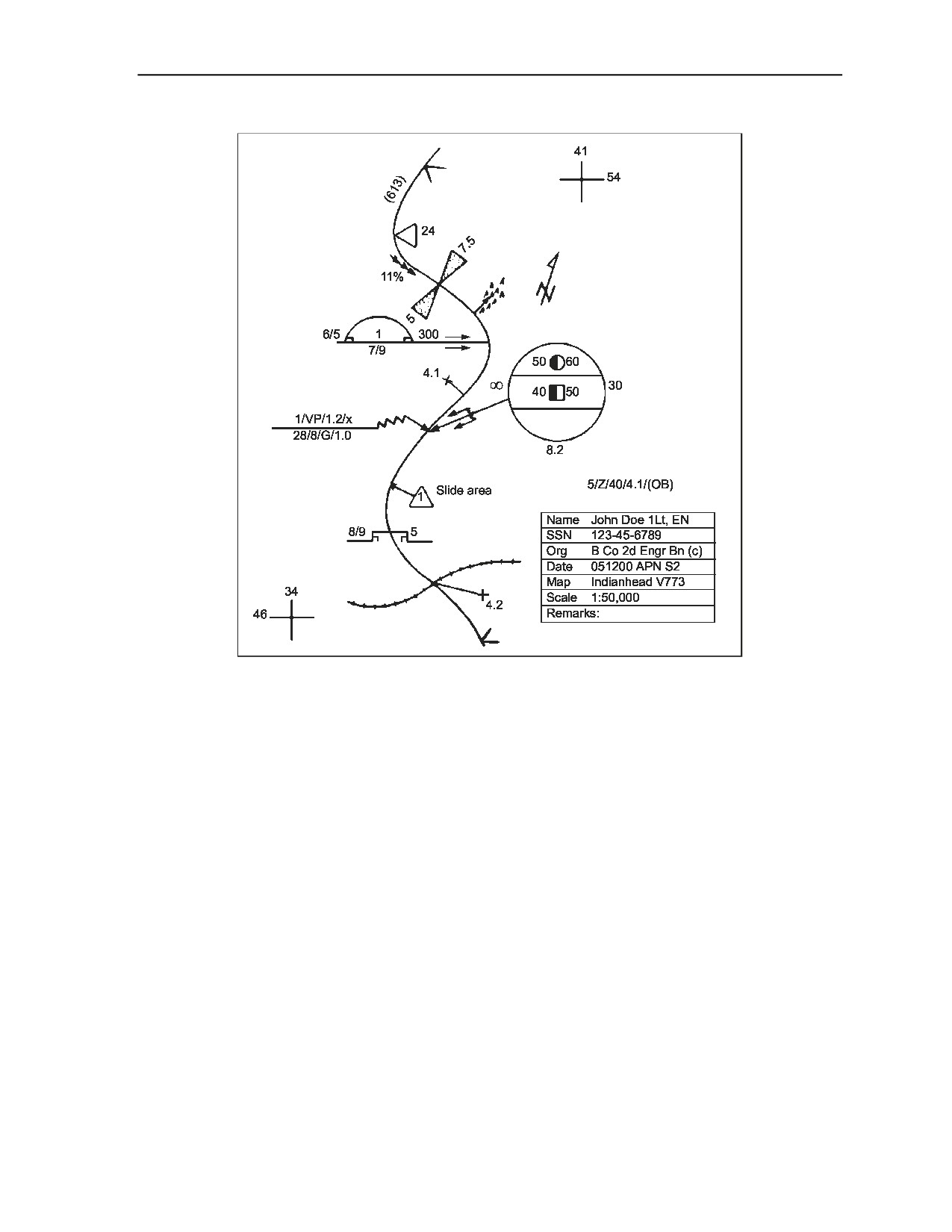
5-5. A route classification overlay graphically depicts a route’s network of roads, bridge sites, and other
components. The route components are reconnoitered and the data recorded as support documentation for
the complete route. A route classification overlay gives specific details on what obstructions will slow
down a convoy or maneuver force along a route. The following information is included on the route
classification overlay (see figure 5-1):
z
The route classification formula.
z
The name, rank, and Social Security number (SSN) of the person in charge of performing the
classification.
z
The unit conducting the classification.
z
The date-time group (DTG) that the classification was conducted.
z
The map name, edition, and scale. Ensure that a North arrow and grid reference marks are
indicated on the overlay.
z
Any remarks necessary to ensure complete understanding of the information on the overlay.
Include a route name in this section when applicable. Include a legend for any nonstandard
symbols used on the overlay.
5-2
FM 3-34.170/MCWP 3-17.4
25 March 2008
Technical Reconnaissance - Route Classification
Figure 5-1. Route classification overlay
BYPASSES
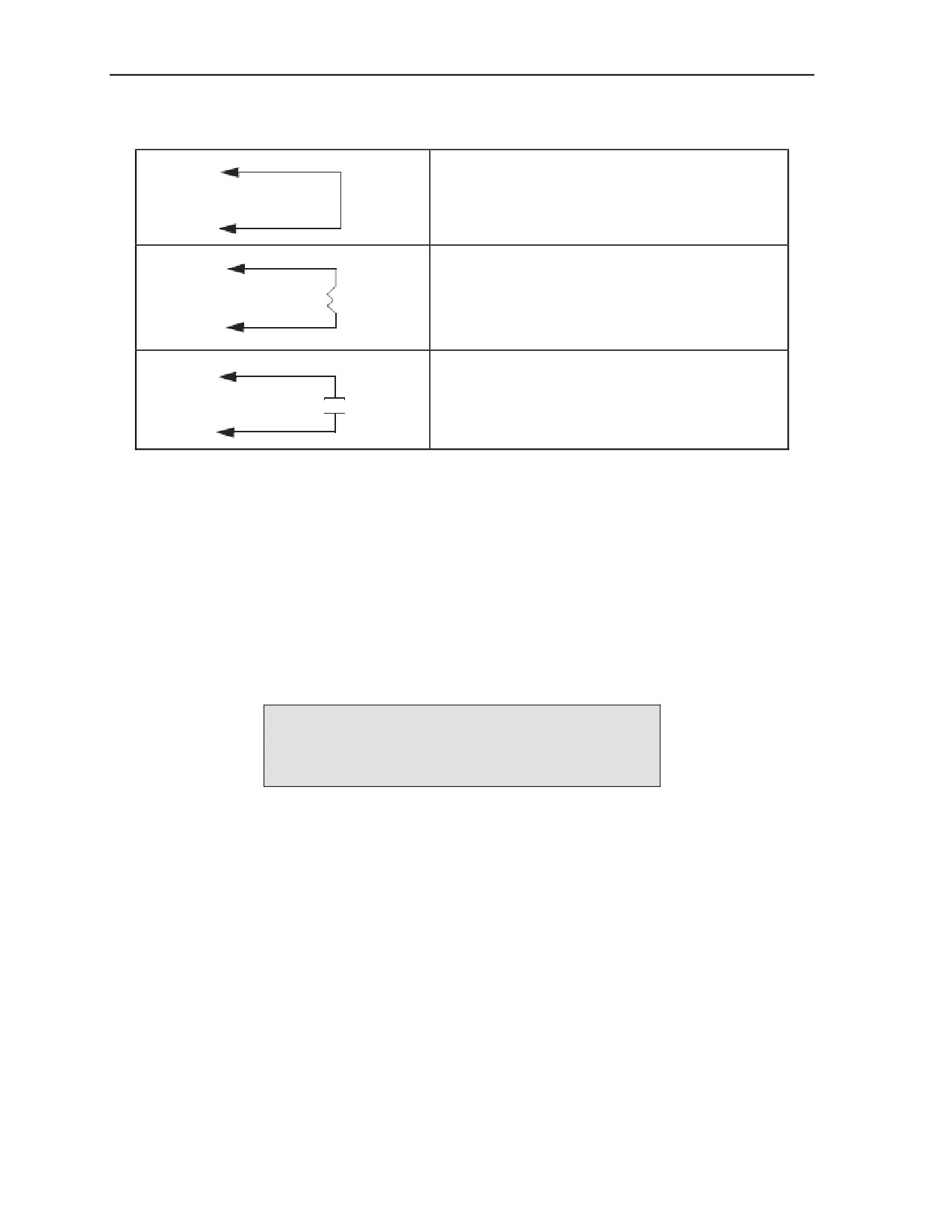
5-6. Bypasses are detours along a route allowing traffic to avoid an obstruction. Bypasses limited to
specific vehicle types, such as those capable of swimming or deep-water fording, are noted on the
reconnaissance report. Bypasses are classified as easy, difficult, or impossible. Each type of bypass is
represented symbolically on the arrow extending from the tunnel, ford (see chapter 6), bridge (see
chapter 6), or overpass symbol to the map location (see table 5-1 on page 5-4).
25 March 2008
FM 3-34.170/MCWP 3-17.4
5-3
Chapter 5
Table 5-1. Bypass symbols
Bypass easy. Use when the obstacle can be crossed in
the immediate vicinity by a U.S. 5-ton truck without
work to improve the bypass.
Bypass difficult. Use when the obstacle can be crossed
in the immediate vicinity, but some work to improve the
bypass is necessary (the estimation of time, troops,
and equipment necessary to prepare the bypass is
included on the reconnaissance report).
Bypass impossible. Use when the obstacle can be
crossed only by repairing the existing or constructing a
new bridge or tunnel or by constructing a detour.
ROUTE CLASSIFICATION FORMULA
5-7. The route classification formula is derived from information gathered during the route
reconnaissance and/or reconnaissance of key components of the route. The formula is recorded on the
route classification overlay (see figure 5-1 on page 5-5) and consists of the following:
z
(1) Route width, in meters.
z
(2) Route type (based on ability to withstand weather).
z
(3) Lowest military load classification (MLC).
z
(4) Lowest overhead clearance, in meters.
z
(5) Obstructions to traffic flow (OB), if applicable.
z
(6) Special conditions, such as snow blockage (T) or flooding (W).
Example
in (1) / (2) / (3) / (4) (5) (6) format
5.5 / Y / 30 / 4.6 (OB) (T or W)
(1) ROUTE WIDTH
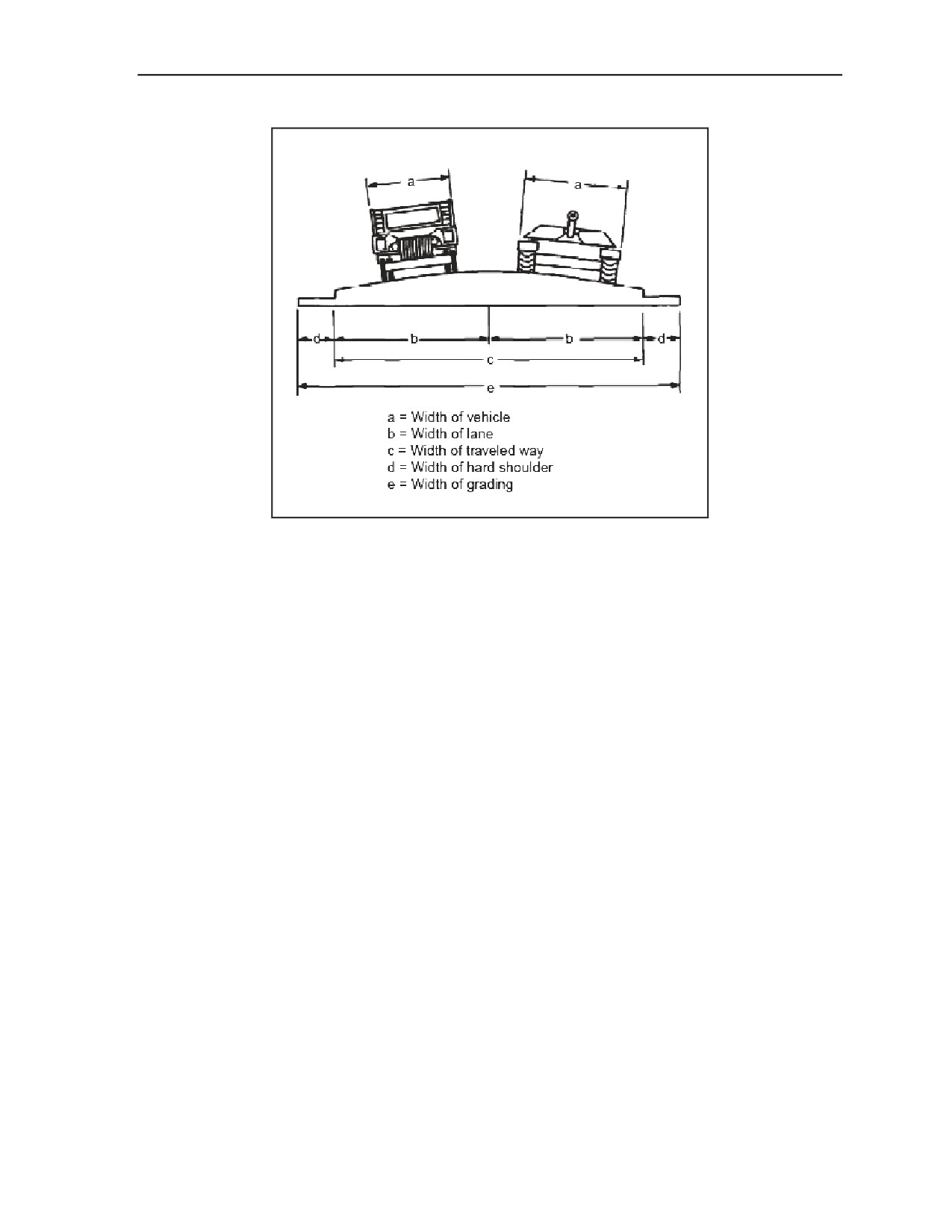
5-8. The route width is the narrowest width of traveled way on a route (see figure 5-2). This narrow
width may be the width of a bridge, a tunnel, a road, an underpass, or other constriction that limits the
traveled-way width. The number of lanes is determined by the traveled-way width. The lane width
normally required for—
z
Wheeled vehicles is 3.5 meters.
z
Tracked vehicles is 4.0 meters.
5-4
FM 3-34.170/MCWP 3-17.4
25 March 2008
Technical Reconnaissance - Route Classification
Figure 5-2. Route widths
5-9. According to the number of lanes, a road or route can be classified as follows:
z
Limited access—Permits passage of isolated vehicles of appropriate width in one direction only.
z
Single lane—Permits use in only one direction at any one time. Passing or movement in the
opposite direction is impossible.
z
Single flow—Permits the passage of a column of vehicles and allows isolated vehicles to pass or
travel in the opposite direction at predetermined points. It is preferable that such a route be at
least 1.5 lanes wide.
z
Double flow—Permits two columns of vehicles to proceed simultaneously. Such a route must be
at least two lanes wide.
(2) ROUTE TYPE
5-10. The route type is determined by its ability to withstand weather. It is determined by the worst section
of road on the entire route and is categorized as follows:
z
Type X—An all-weather route that, with reasonable maintenance, is passable throughout the
year to a volume of traffic never appreciably less than its maximum capacity. This type of route
is normally formed of roads having waterproof surfaces and being only slightly affected by rain,
frost, thaw, or heat. This type of route is never closed because of weather effects other than
snow or flood blockage.
z
Type Y—A limited, all-weather route that, with reasonable maintenance, is passable throughout
the year but at times having a volume of traffic considerably less than maximum capacity. This
type of route is normally formed of roads that do not have waterproof surfaces and are
considerably affected by rain, frost, thaw, or heat. This type of route is closed for short periods
(up to one day at a time) by adverse weather conditions during which heavy use of the road
would probably lead to complete collapse.
z
Type Z—A fair-weather route passable only in fair weather. This type of route is so seriously
affected by adverse weather conditions that it may remain closed for long periods. Improvement
of such a route can only be achieved by construction or realignment.
25 March 2008
FM 3-34.170/MCWP 3-17.4
5-5

Chapter 5
(3) MILITARY LOAD CLASSIFICATION
5-11. A route’s MLC is a class number representing the safe load-carrying capacity and indicating the
maximum vehicle class that can be accepted under normal conditions. Usually, the lowest bridge MLC
(regardless of the vehicle type or conditions of traffic flow) determines the route’s MLC. If there is not a
bridge on the route, the worst section of road will determine the route’s overall classification. (Appendix E
provides additional discussion of the MLC.)
5-12. In cases where vehicles have a higher MLC than the route, an alternate route may be sought or an
additional reconnaissance of the roads within the route may be necessary to determine whether a change in
traffic flow (such as single-flow crossing of a weak point) will permit heavier vehicles on the route. When
possible, ensure that the route network includes a number of heavy-traffic roads, as well as average-traffic
roads. This helps staff planners manage heavy-traffic loads to decrease the bottleneck effect.
5-13. The entire network’s class is determined by the minimum load classification of a road or a bridge
within the network. The broad categories are—
z
Class 50—average-traffic route.
z
Class 80—heavy-traffic route.
z
Class 120—very heavy-traffic route.
(4) OVERHEAD CLEARANCE
5-14. The lowest overhead clearance is the vertical distance between the road surface and any overhead
obstacle (power lines, overpasses, tunnels, and so forth) that denies the use of the road to some vehicles.
Use the infinity symbol (∞) for unlimited clearance in the route classification formula. (Points along the
route where the minimum overhead clearance is less than 4.3 meters are considered an obstruction).
(5) ROUTE OBSTRUCTIONS
5-15. Route obstructions restrict the type, amount, or speed of traffic flow. They are indicated in the route
classification formula by the abbreviation “OB.” If an obstruction is encountered, its exact nature must be
depicted on the route classification overlay. Obstructions include—
z
Overhead obstructions such as tunnels, underpasses, overhead wires, and overhanging buildings
with a clearance of less than 4.3 meters.
z
Reductions in traveled-way widths that are below the standard minimums prescribed for the type
of traffic flow (see table 5-2). This includes reductions caused by bridges, tunnels, craters, lanes
through mined areas, projecting buildings, or rubble.
z
Slopes (gradients) of 7 percent or greater.
z
Curves with a radius of 25 meters and less. Curves with a radius of 25.1 to 45 meters are not
considered an obstruction; however, they must be recorded on the route classification overlay.
z
Ferries.
z
Fords.
Table 5-2. Traffic flow capability based on route width
Limited Access
Single Lane
Single Flow
Double Flow
Wheeled
At least 3.5 m
3.5 to 5.5 m
5.5 to 7.3 m
Over 7.3 m
Tracked and
At least 4.0 m
4.0 to 6.0 m
6.0 to 8.0 m
Over 8 m
combination vehicles
5-6
FM 3-34.170/MCWP 3-17.4
25 March 2008
Technical Reconnaissance - Route Classification
(6) SNOW BLOCKAGE AND FLOODING
5-16. In cases where snow blockage is serious and blocks traffic on a regular and recurrent basis, the
symbol following the route classification formula is “T.” In cases where flooding is serious and blocks
traffic on a regular and recurrent basis, the symbol following the route classification formula is “W.”
5-17. The following are examples depicting the use of the route classification formula:
z
6.1m/Z/40/∞—A fair-weather route (Z) with a minimum traveled way of 6.1 meters and an
MLC of 40. Overhead clearance is unlimited (∞) and there are no obstructions to traffic flow.
This route, based on its minimum traveled-way width, accommodates both wheeled and tracked,
single-flow traffic without obstruction.
z
6.1m/Z/40/∞ (OB)—A fair-weather route (Z) similar to the previous example, except there is an
obstruction. This obstruction could consist of overhead clearances of less than 4.3 meters,
grades of 7 percent or greater, curves with a radius of 25 meters and less, or fords and ferries. A
traveled way of 6.1 meters limits this route to one-way traffic without a width obstruction. If the
route is used for double-flow traffic, then
6.1 meters of traveled way is considered an
obstruction and is indicated in the formula as an obstruction.
z
7m/Y/50/4.6 (OB)—A limited, all-weather route (Y) with a minimum traveled way of 7 meters,
an MLC of 50, an overhead clearance of 4.6 meters, and an obstruction. This route width is not
suitable for double-flow traffic (wheeled or tracked). This width constriction is indicated as OB
in the route classification formula if the route is used for double-flow traffic.
z
10.5m/X/120/∞ (OB) (W)—An all-weather route (X) with a minimum traveled-way width of
10.5 meters, which is suitable for two-way traffic of both wheeled and tracked vehicles; an MLC
of 120; unlimited overhead clearance; an obstruction; and regular, recurrent flooding.
CURVE CALCULATIONS
5-18. The speed at which vehicles move along a route is affected by sharp curves. Curves with a radius of
25 meters or less are obstructions to traffic and are indicated by the abbreviation “OB” in the route
classification formula and identified on DA Form 1248 (see appendix B). Curves with a radius between
25.1 and 45 meters are recorded on the overlay but are not considered obstructions.
Measuring Methods
5-19. Several methods are used to measure curves: the tape-measure, triangulation, and formula methods.
Tape-Measure Method
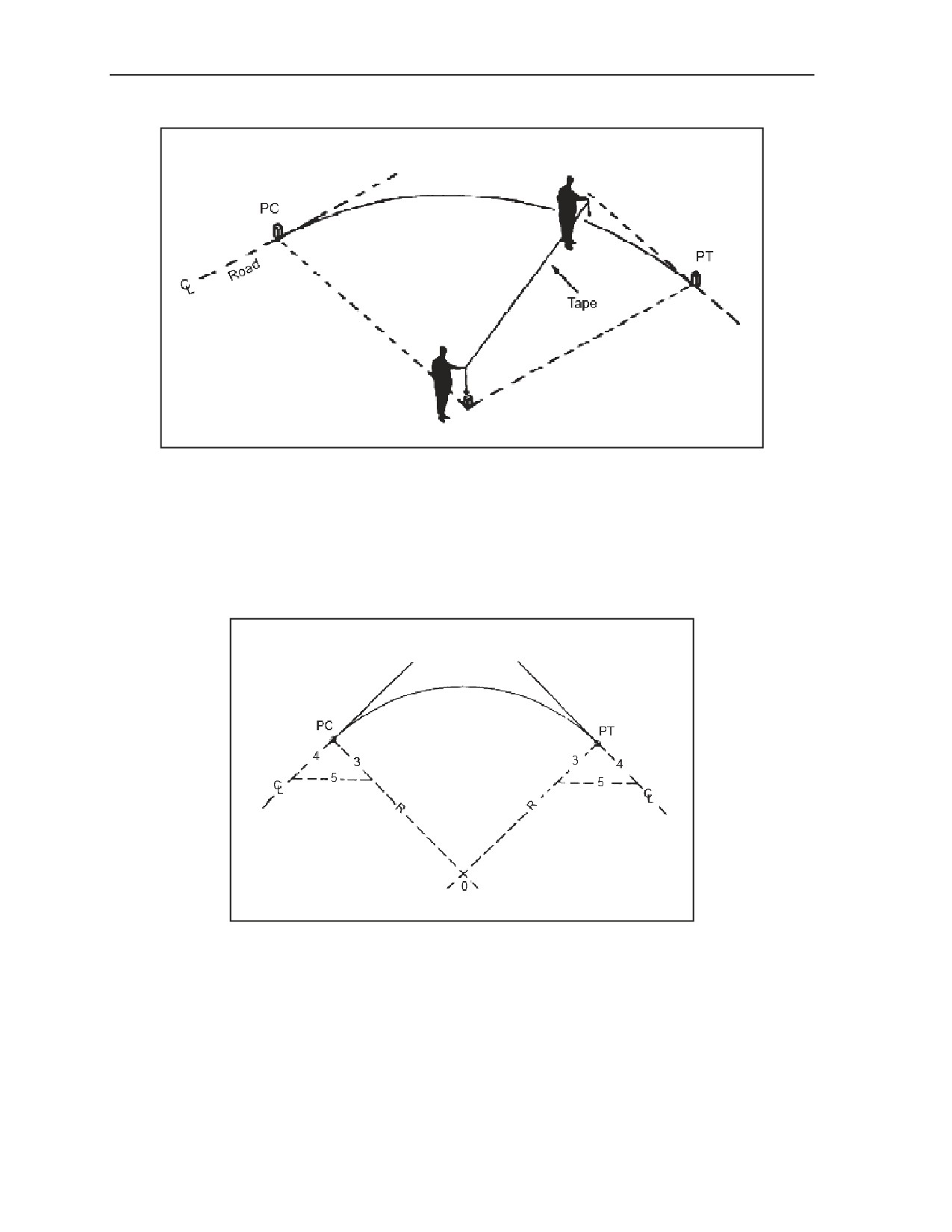
5-20. A quick way to estimate the radius of a sharp curve is by using a tape measure to find the radius (see
figure 5-3, page 5-8). Imagine the outer edge of the curve as the outer edge of a circle. Find (estimate) the
center of this imaginary circle and then measure the radius using a tape measure. Start from the center of
the circle and measure to the outside edge of the curve. The length of the tape measure from the center of
the imaginary circle to its outer edge is the curve’s radius. This method is practical for curves located on
relatively flat ground and having a radius up to 15 meters.
25 March 2008
FM 3-34.170/MCWP 3-17.4
5-7
Chapter 5
Figure 5-3. Tape-measure method
Triangulation Method
5-21. You can determine a curve’s approximate radius by “laying out” right triangles (3:4:5 proportion) at
the point of curvature (PC) and point of tangency (PT) locations (see figure 5-4). The intersection (o),
which is formed by extending the legs of each triangle, represents the center of the circle. The distance (R)
from point o to either point PC or PT represents the curve’s radius.
Figure 5-4. Triangulation method
Formula Method
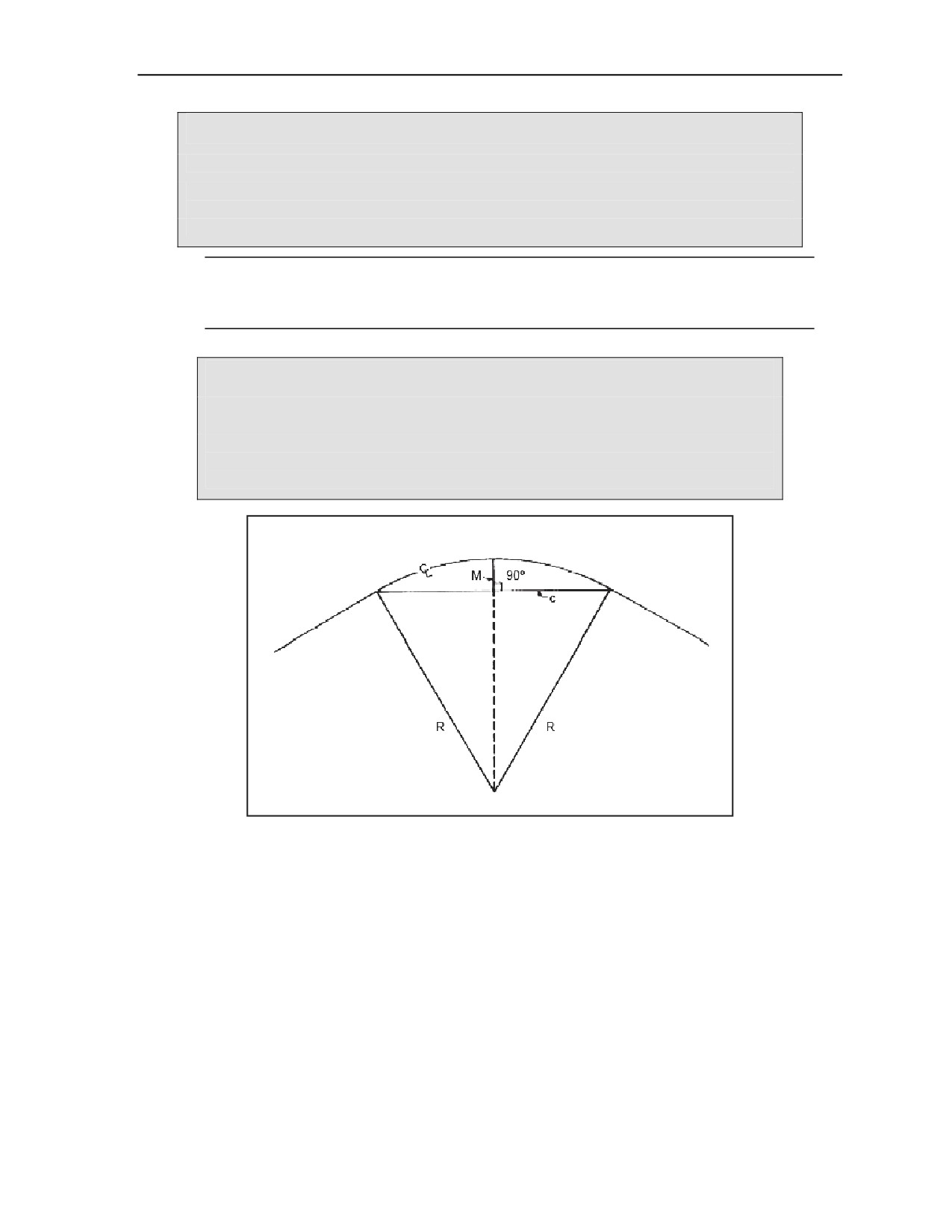
5-22. Another method of determining the curve’s radius (see figure 5-5) is based on the following formula
(all measurements are in meters):
5-8
FM 3-34.170/MCWP 3-17.4
25 March 2008
Technical Reconnaissance - Route Classification
R = (C2/8M) + (M/2)
R = radius of curve
C = distance from the centerline of the road to the centerline of the road at the outer
extremities of the curve
M = perpendicular distance from the center of the tape to the centerline of the road
Note. When conditions warrant, set M at 2 meters from the centerline and then measure C2
meters from the centerline. Use this method when there is a time limitation or because natural or
manmade restrictions prevent proper measurements.
Example
If C is 15 meters and M is fixed at 2 meters, the formula becomes: R = (152/16) + 2/2
The result of this calculation R = (225/16) + 1 solve as R = 15.06 would be an
obstruction to traffic flow, and “OB” would be placed in the route classification
formula.
Figure 5-5. Formula method
Curve Symbol
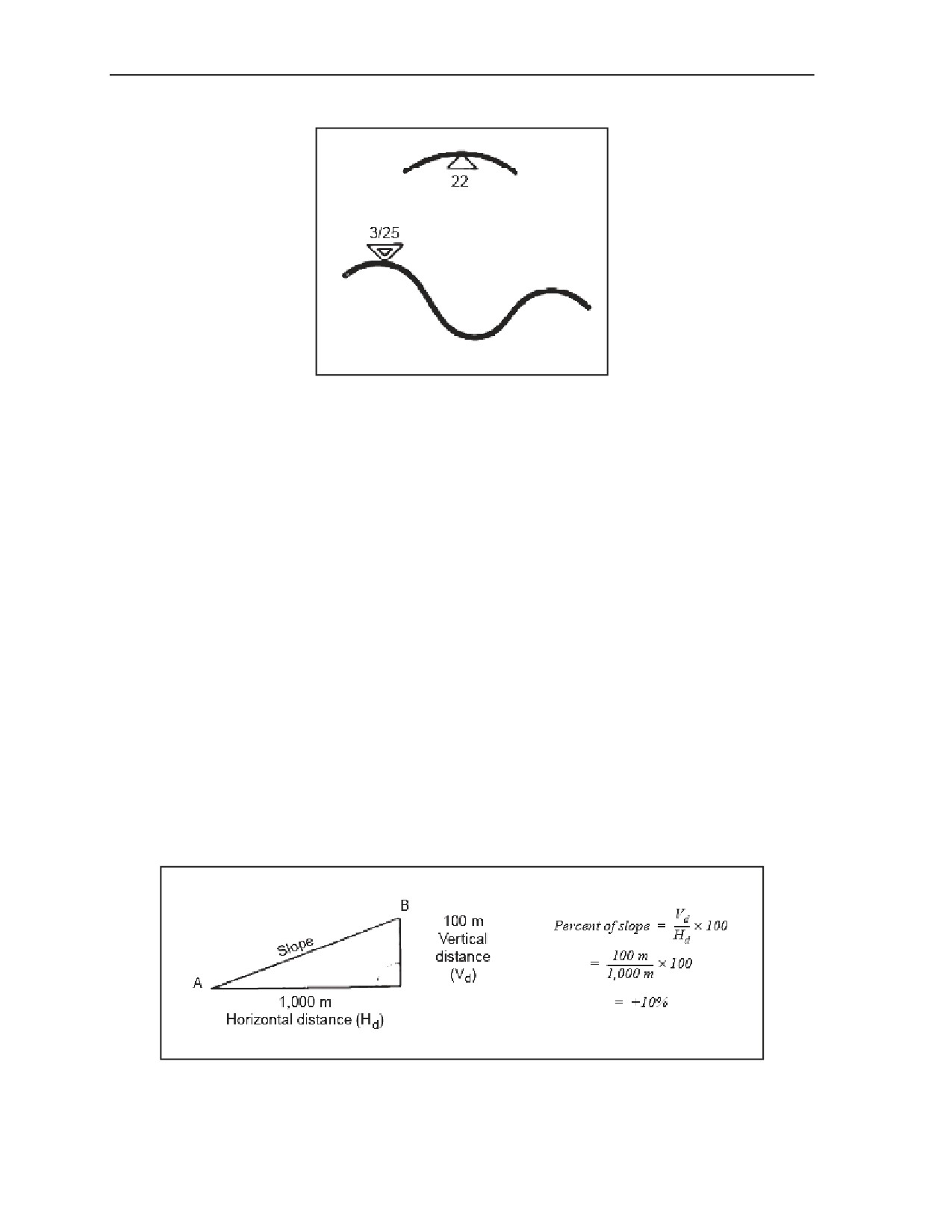
5-23. Sharp curves with a radius of 45 meters or less are symbolically represented on maps or overlays by
a triangle that points to the curve’s exact map location. In addition, the measured value (in meters) for the
radius of curvature is written outside the triangle (see figure 5-6, page 5-10). All curves with a radius of 45
meters are reportable and need to be noted on DA Form 1248 (see appendix B).
25 March 2008
FM 3-34.170/MCWP 3-17.4
5-9
Chapter 5
Figure 5-6. Curve symbols
Series of Sharp Curves
5-24. A series of sharp curves is represented by two triangles, one drawn inside the other. The outer
triangle points to the location of the first curve. The number of curves and the radius of curvature for the
sharpest curve of the series are written to the outside of the triangle (see figure 5-6).
SLOPE ESTIMATION
5-25. The rise and fall of the ground is known as the slope or gradient (grade). Slopes of 7 percent or
greater affect the movement speed along a route and are considered an obstruction. The percent of slope is
used to describe the effect that inclines have on movement rates. It is the ratio of the change in elevation
(the vertical distance to the horizontal ground distance) multiplied by 100 (see figure 5-7). It is important to
express the vertical distance and the horizontal in the same unit of measure. Report all slopes greater then 5
percent on the route classification overlay.
Percent of Slope
5-26. The following paragraphs discuss the methods used to determine the percent of slope.
Clinometer Method
5-27. A clinometer is an instrument that directly measures the percent of slope. It can be found in engineer
survey units, as part of an artillery compass, and as part of an engineer platoon sketch set. (In some kits, the
clinometer has been replaced by a surveying level. Follow the instructions included with the instrument.)
Figure 5-7. Percent-of-slope formula
5-10
FM 3-34.170/MCWP 3-17.4
25 March 2008
Technical Reconnaissance - Route Classification
Map Method
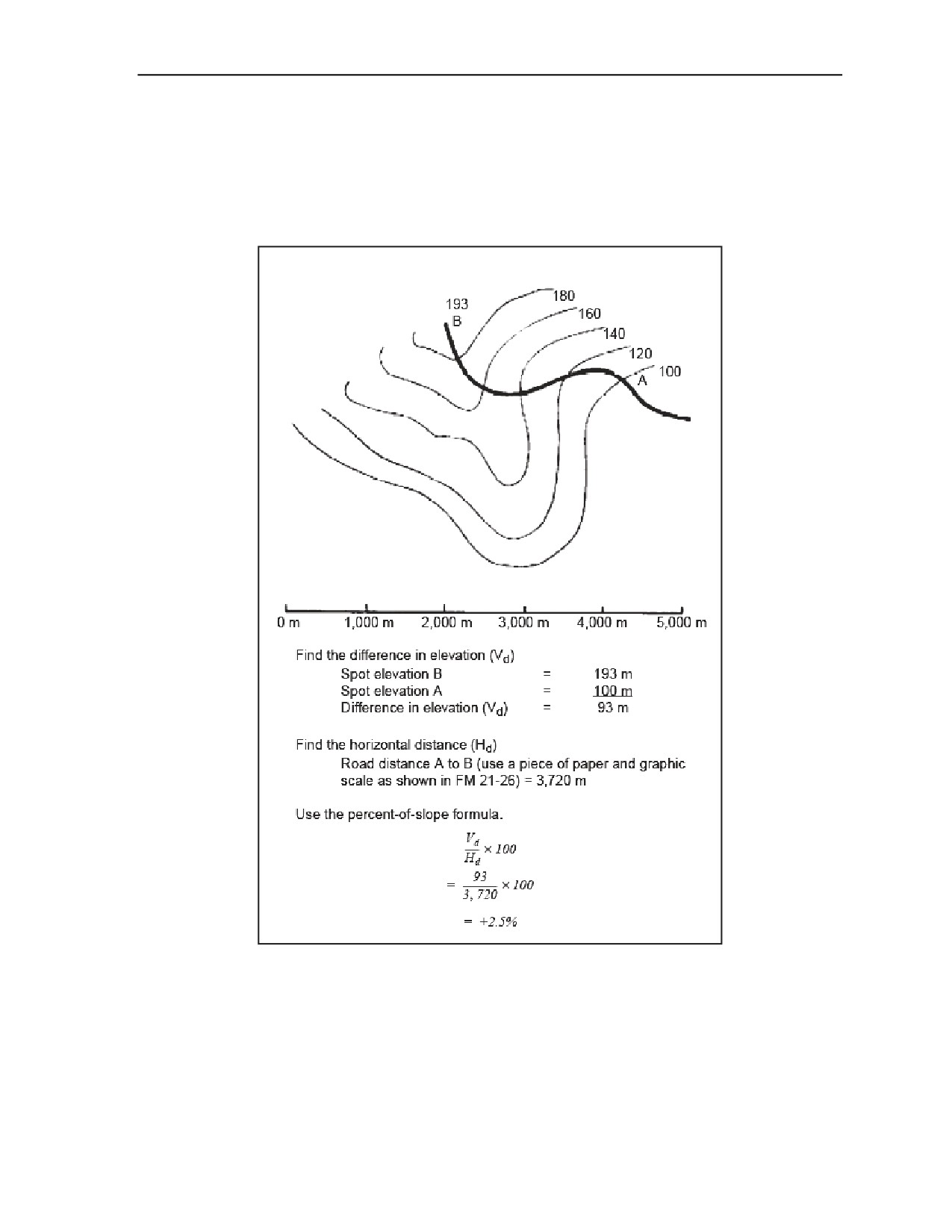
5-28. Use a large-scale map (such as 1:50,000) to estimate the percent of slope quickly. After identifying
the slope on the map, find the difference in elevations between the top and bottom of the slope by reading
the elevation contours or spot elevation. Then, measure and convert the horizontal distance (usually road
distance) to the same unit of measurement as the elevation difference. Substitute the vertical and horizontal
distances in the percent-of-slope formula and compute the percent of slope. (See figure 5-8.)
Figure 5-8. Map method to determine percent of slope
Pace Method
5-29. The pace method is a quick way to estimate percent of slope. Determine, accurately, the height and
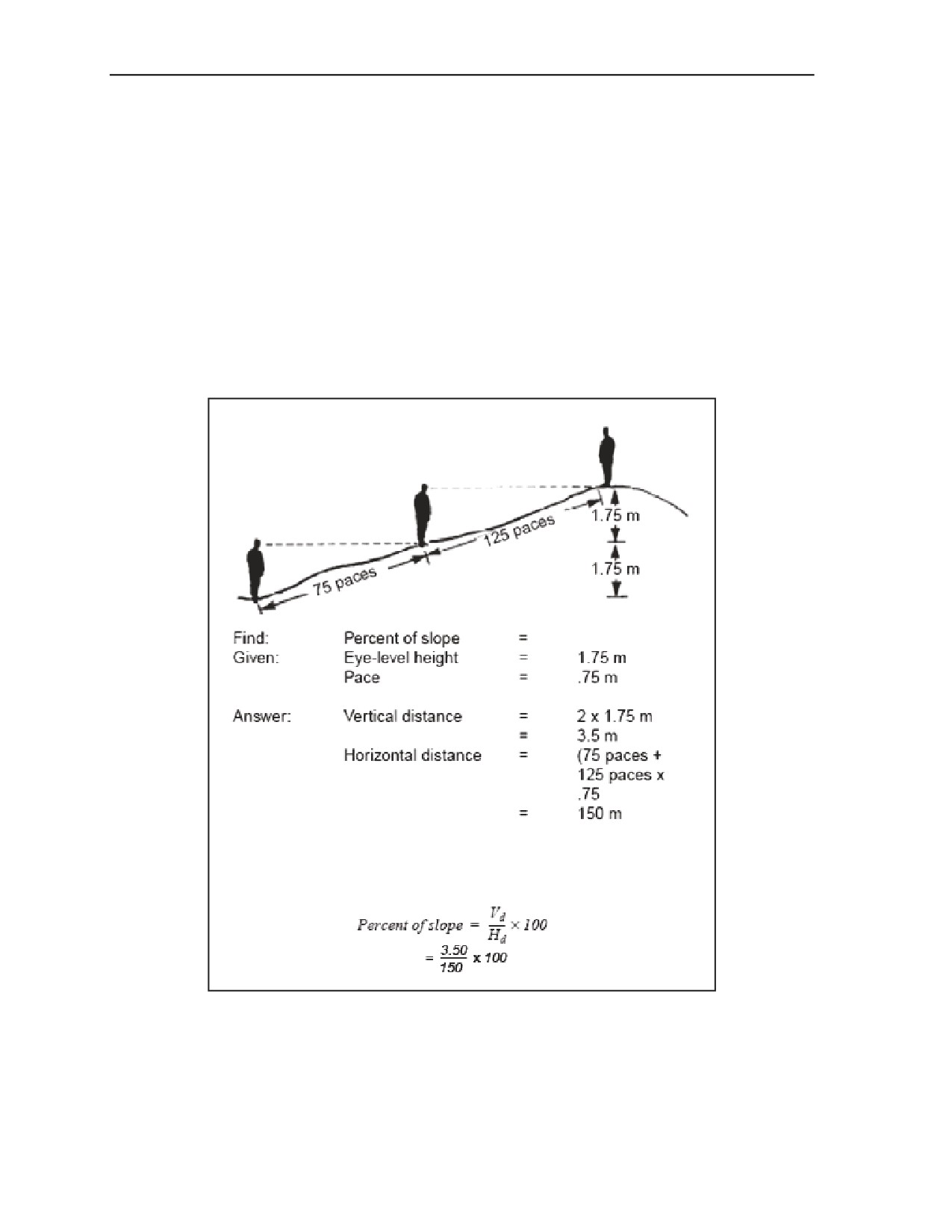
pace of each Soldier and Marine for each member of a reconnaissance team before using this method. As a
rule of thumb, the eye level of the average Soldier and Marine is 1.75 meters above the ground. The pace
of the average Soldier and Marine is 0.75 meter.
25 March 2008
FM 3-34.170/MCWP 3-17.4
5-11
Chapter 5
5-30. Perform the following procedures for the pace method:
z
Stand at the bottom of the slope with head and eyes level.
z
Sight a spot on the slope. This spot should be easily identifiable. If it is not, another member of
the team should go forward to mark the location.
z
Walk forward and stand on the marked spot. Record the number of paces. Repeat this procedure
until you reach the top of the slope (estimate fractions of an eye level).
z
Compute the vertical distance by multiplying the number of sightings by the eye-level height
(1.75 meters). Compute the horizontal distance by totaling the number of paces and converting
them to meters by multiplying by 0.75 (or the known pace-to-meter conversion factor).
z
Calculate the percent of slope by substituting the values into the percent-of-slope formula (see
figure 5-9). Because this method considers horizontal ground distance and incline distance as
equal, you can obtain reasonable accuracy only for slopes less than 30 percent. This method
requires practice to achieve acceptable accuracy. A line level and string can be used to train this
method.
Figure 5-9. Pace method to determine percent of slope
Angle-of-Slope Method
5-31. The angle-of-slope method is a quick way to estimate the percent of slope. The angle of slope is first
measured by using an elevation quadrant, an aiming circle, an M2 compass, or binoculars with a standard
5-12
FM 3-34.170/MCWP 3-17.4
25 March 2008
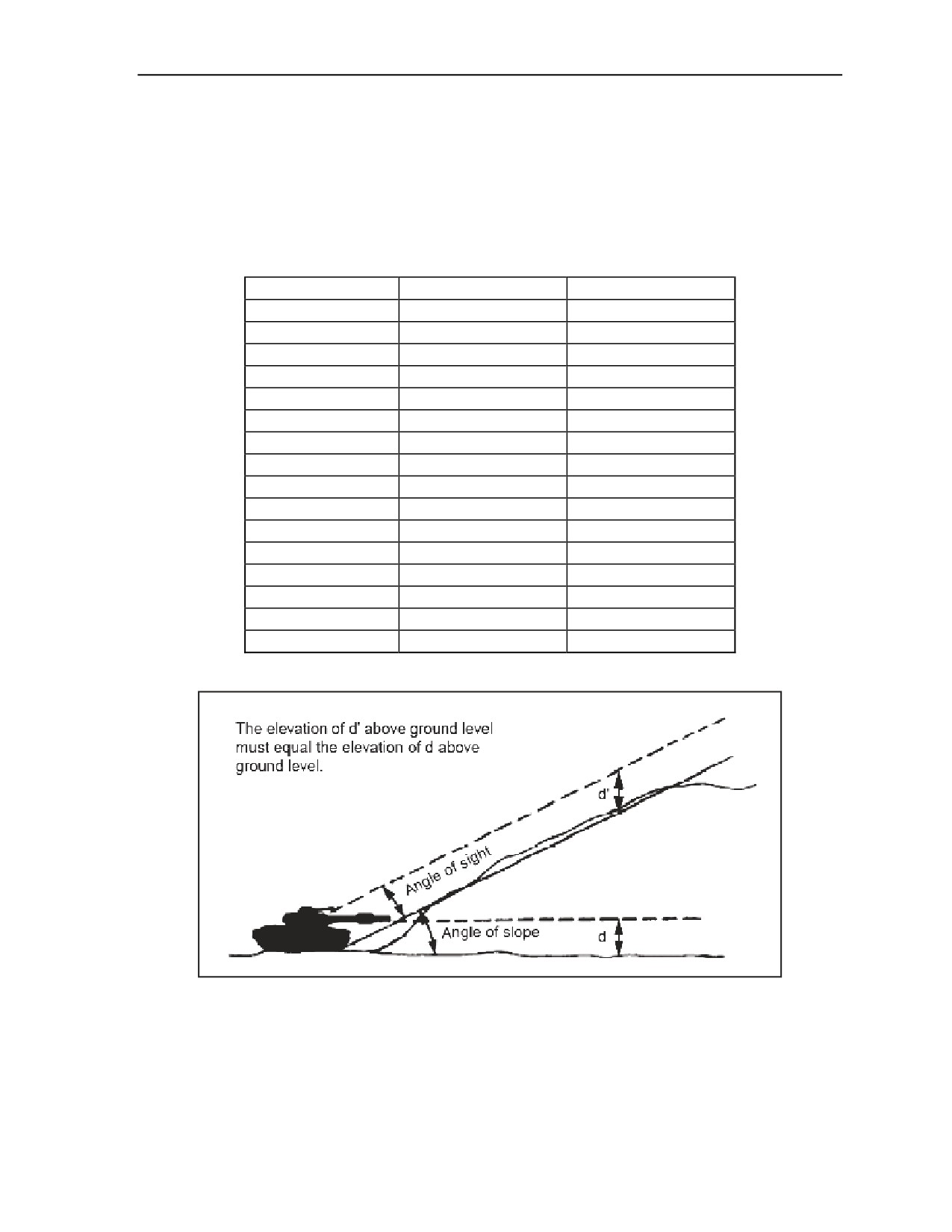
Technical Reconnaissance - Route Classification
reticle. If the instrument used to take the angle of measurement is mounted above ground level, the height
difference must be compensated for by sighting above the slope a corresponding, equal distance. (The
corresponding distance is the distance the instrument is above the ground). You must conduct the angle of
measurement at the base of the slope. Once you obtain the angle of measurement, refer to table 5-3 and
enter the column corresponding to the measured angle of slope. You can read the percent of slope directly
from table 5-3 (see figure 5-10).
Table 5-3. Conversion of degrees and mils to percent of slope
Degrees of Slope
Mils of Slope
Percent of Slope
1
18
1.7
2
36
3.5
3
53
5.2
4
71
7.0
5
89
8.7
10
175
17.6
15
267
26.7
20
356
36.4
25
444
46.6
30
533
57.7
35
622
70.0
40
711
83.9
45
800
100.0
50
889
108.7
55
978
117.6
60
1,067
126.7
Figure 5-10. Angle-of-slope method to determine percent of slope
Slope Symbol
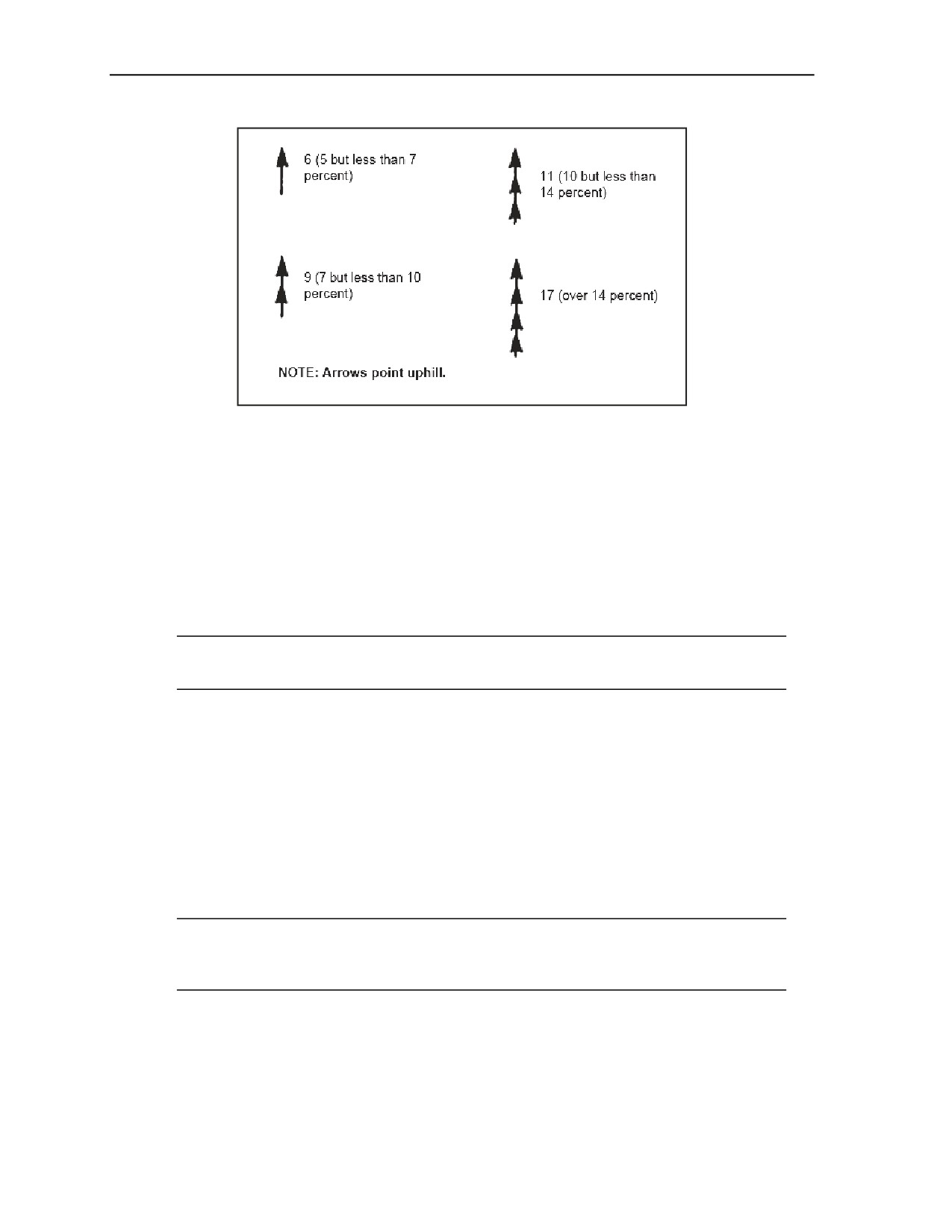
5-32. Most vehicles negotiating slopes of 7 percent or greater for a significant distance will be slowed.
Such slope characteristics must be accurately reported. The symbols illustrated in figure 5-11, page 5-14,
are used to represent various slopes.
25 March 2008
FM 3-34.170/MCWP 3-17.4
5-13
Chapter 5
Figure 5-11. Percent-of-slope symbols
Description of Slope Symbols
5-33. A single arrowhead along the trace of a route pointing in the uphill direction indicates a grade of at
least 5 but less than 7 percent. Two arrowheads represent a grade of at least 7 but less than 10 percent.
Three arrowheads represent a grade of at least 10 but less than 14 percent. Four arrowheads represent a
grade of 14 percent or more. A symbol is not required for slopes less than 5 percent.
5-34. The percent of slope is written to the right of the arrow (see figure 5-11). When the map scale
permits, the length of the arrow shaft will be drawn to map scale to represent the approximate length of the
grade.
Note. Slopes of 7 percent or greater are obstructions to traffic flow and are indicated by the
abbreviation “OB” in the route classification formula.
CONSTRICTIONS
5-35. Reductions traveled-way widths (constrictions) include narrow streets in built-up areas, drainage
ditches, embankments, and war damage. These constrictions may limit vehicle movement; therefore, the
physical dimensions of the vehicles that will be using the route must be known and considered when
conducting the route classification.
5-36. Constrictions in the traveled-way width below minimum requirements are depicted on maps and
overlays by two opposing shaded triangles. The width of the usable traveled way (in meters) is written next
to the left triangle. The length of the constriction (in meters) is written next to the right triangle (see
figure 5-12).
Note. Constrictions of traveled-way widths below the minimum standard for the type and flow
of traffic are obstructions and are indicated by the symbol “OB” in the route classification
formula.
5-14
FM 3-34.170/MCWP 3-17.4
25 March 2008
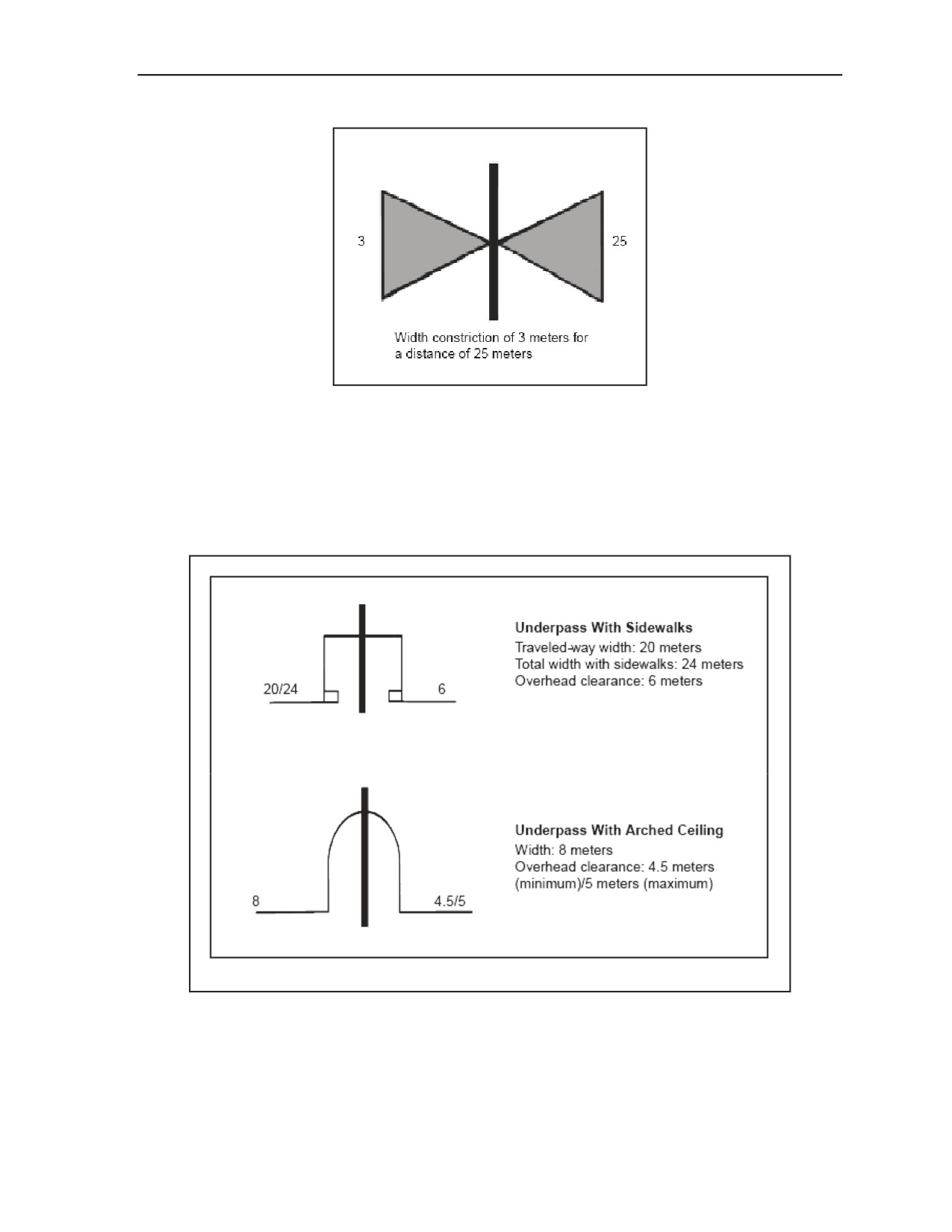
Technical Reconnaissance - Route Classification
Figure 5-12. Route constriction symbol
UNDERPASSES
5-37. An underpass is depicted on a map or overlay by a symbol that shows the structure’s ceiling. It is
drawn over the route at the map location. The width (in meters) is written to the left of the underpass
symbol, and the overhead clearance (in meters) is written to the right of the underpass symbol (see
figure 5-13).
Figure 5-13. Underpass symbols
5-38. If sidewalks permit emergency passage of wider vehicles, the sidewalks are symbolically
represented. This information should be noted on DA Form 1250 (see appendix B). The traveled-way
width is recorded first, followed by a slash, and then the structure’s total width, including sidewalks.
25 March 2008
FM 3-34.170/MCWP 3-17.4
5-15
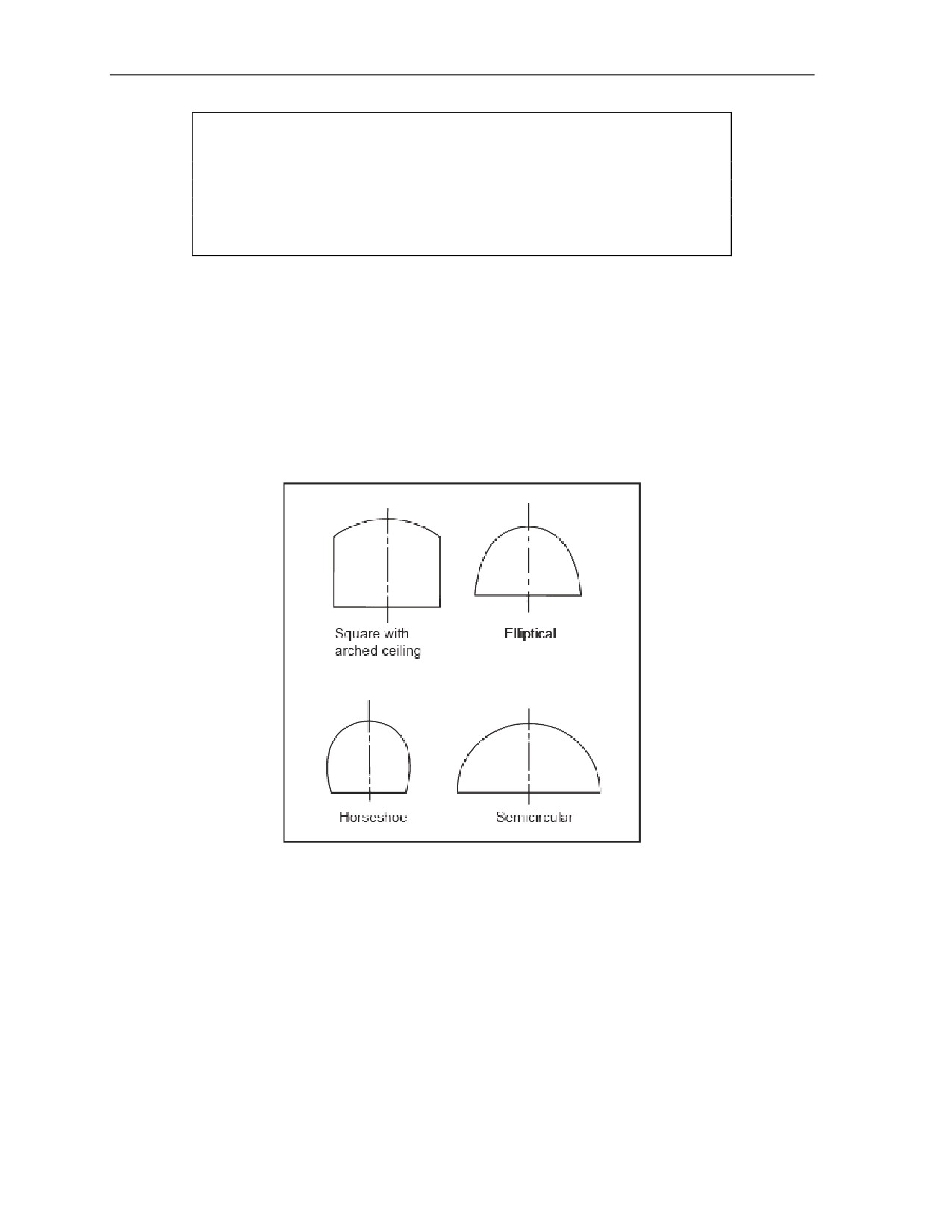
Chapter 5
CAUTION
Items such as arched ceilings or irregularities in ceilings that result in a
decrease in overhead clearance must be noted. In such cases, an
extension of width may not mean that the structure will accommodate
wider vehicles.
5-39. Both minimum and maximum overhead clearances, if different, will be recorded. The minimum will
be recorded first, followed by a slash, and then the maximum overhead clearance.
TUNNELS ON ROUTES
5-40. A tunnel on a route is an artificially covered (such as a covered bridge or a snowshed) or an
underground section of road along a route. A tunnels reconnaissance determines essential information such
as the serial number, location, type, length, width (including sidewalks), bypasses, alignment, gradient, and
cross section. Tunnel reconnaissance is reported on DA Form 1250 (see appendix B). A tunnel consists of
a bore, a tunnel liner, and a portal. Common shapes of tunnel bores (see figure 5-14) are semicircular,
elliptical, horseshoe, and square with an arched ceiling.
Figure 5-14. Types of tunnel bores
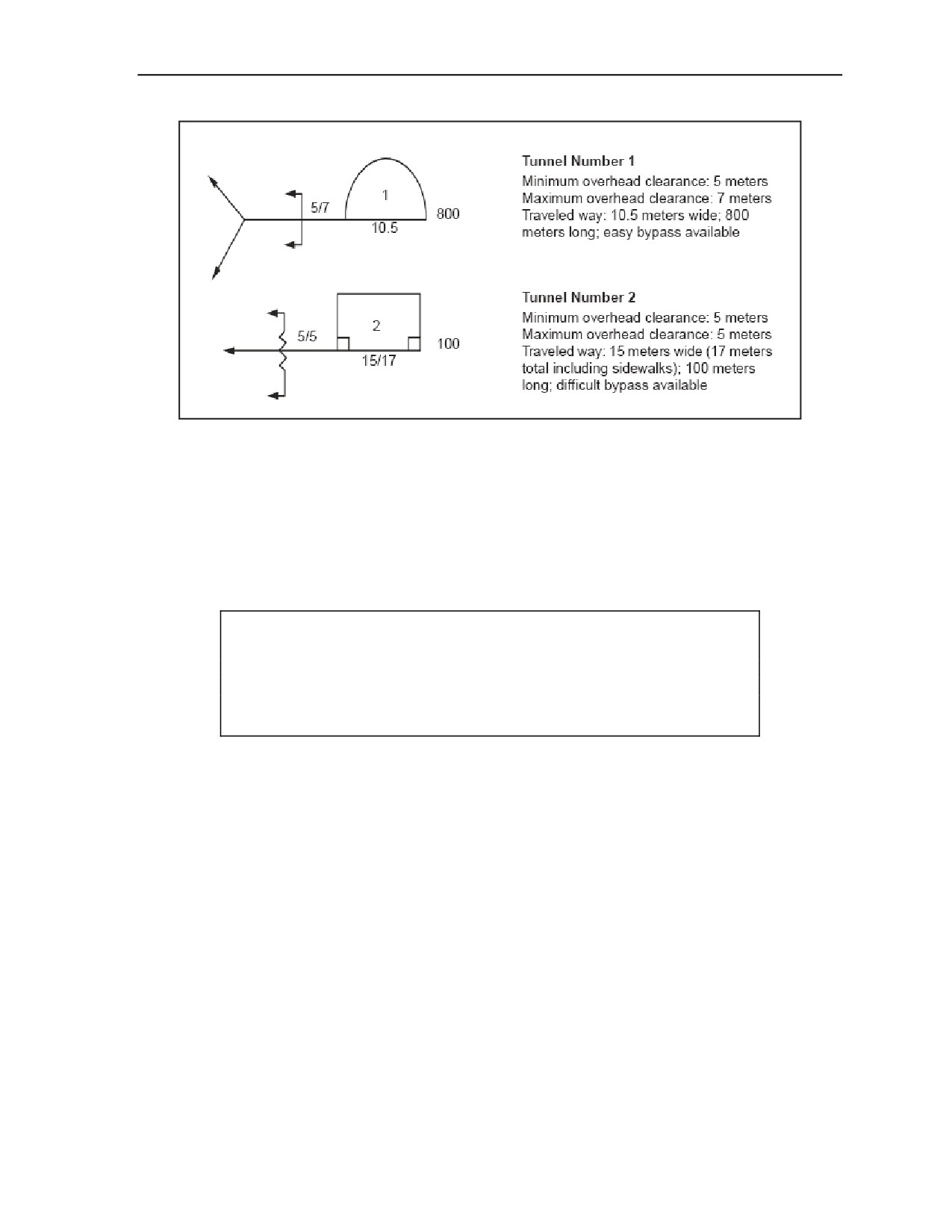
5-41. Basic tunnel information is recorded on maps or overlays using symbols (see figure 5-15). The
location of the tunnel entrance is shown on a map or overlay by an arrow from the symbol to the location
of the entrance. For long tunnels (greater than 30.5 meters), both tunnel entrance locations are indicated.
5-16
FM 3-34.170/MCWP 3-17.4
25 March 2008
Technical Reconnaissance - Route Classification
Figure 5-15. Tunnel symbols
5-42. For later reference, a serial number is assigned to each tunnel. (Check for an existing fixed serial
number on the actual tunnel or map sheet; if it does not have a serial number, assign a number based on the
unit’s SOP.) Serial numbers are not duplicated on any one map sheet, overlay, or document. The number is
recorded inside the symbol. The traveled-way width is shown in meters and is placed below the symbol.
5-43. If sidewalks permit the emergency passage of wider vehicles, then the sidewalks are symbolically
represented and the traveled-way width is written first, followed by a slash, and then the total width
including the sidewalks.
CAUTION
Structures with arched or irregular ceilings will decrease overhead
clearance. An extension of width does not always mean that the
structure will accommodate wider vehicles.
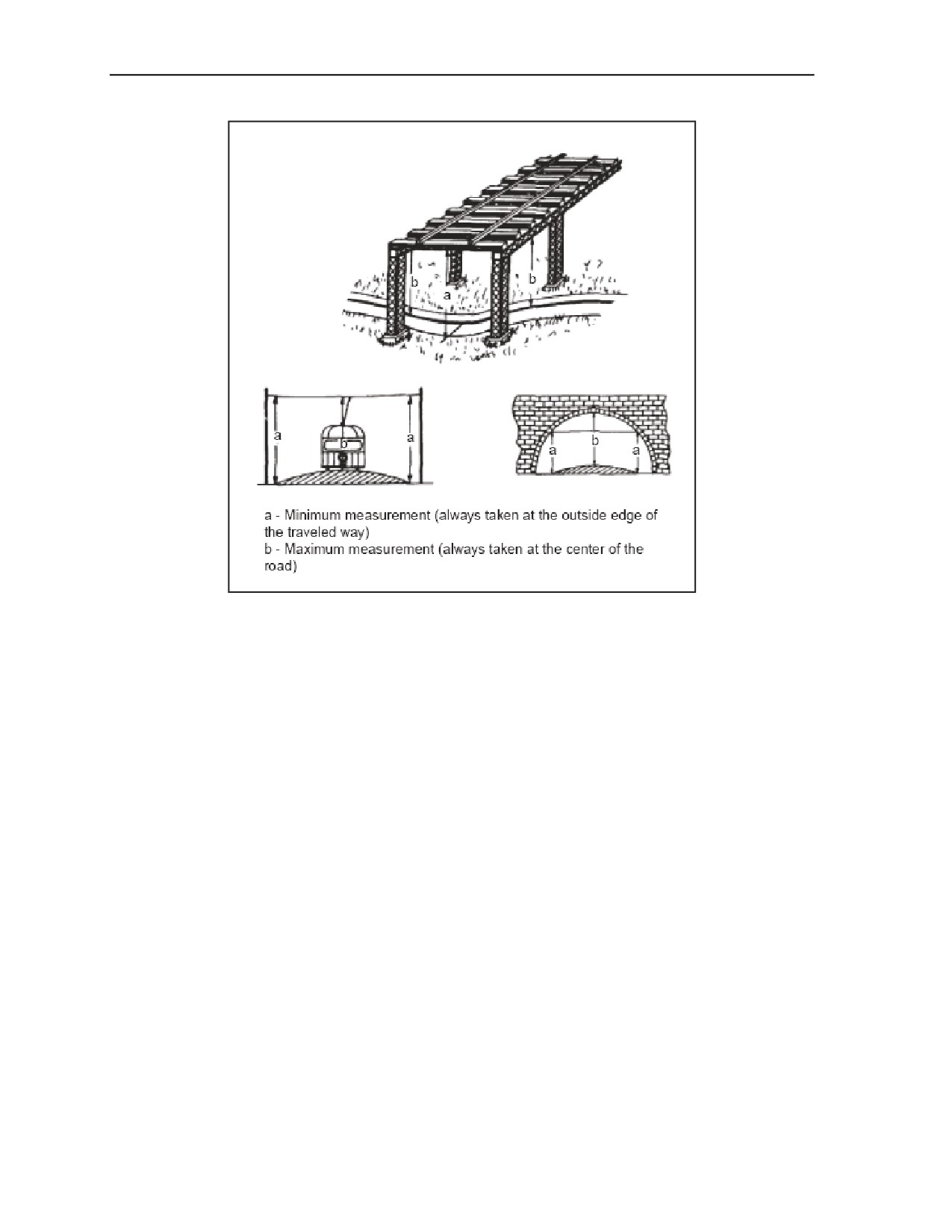
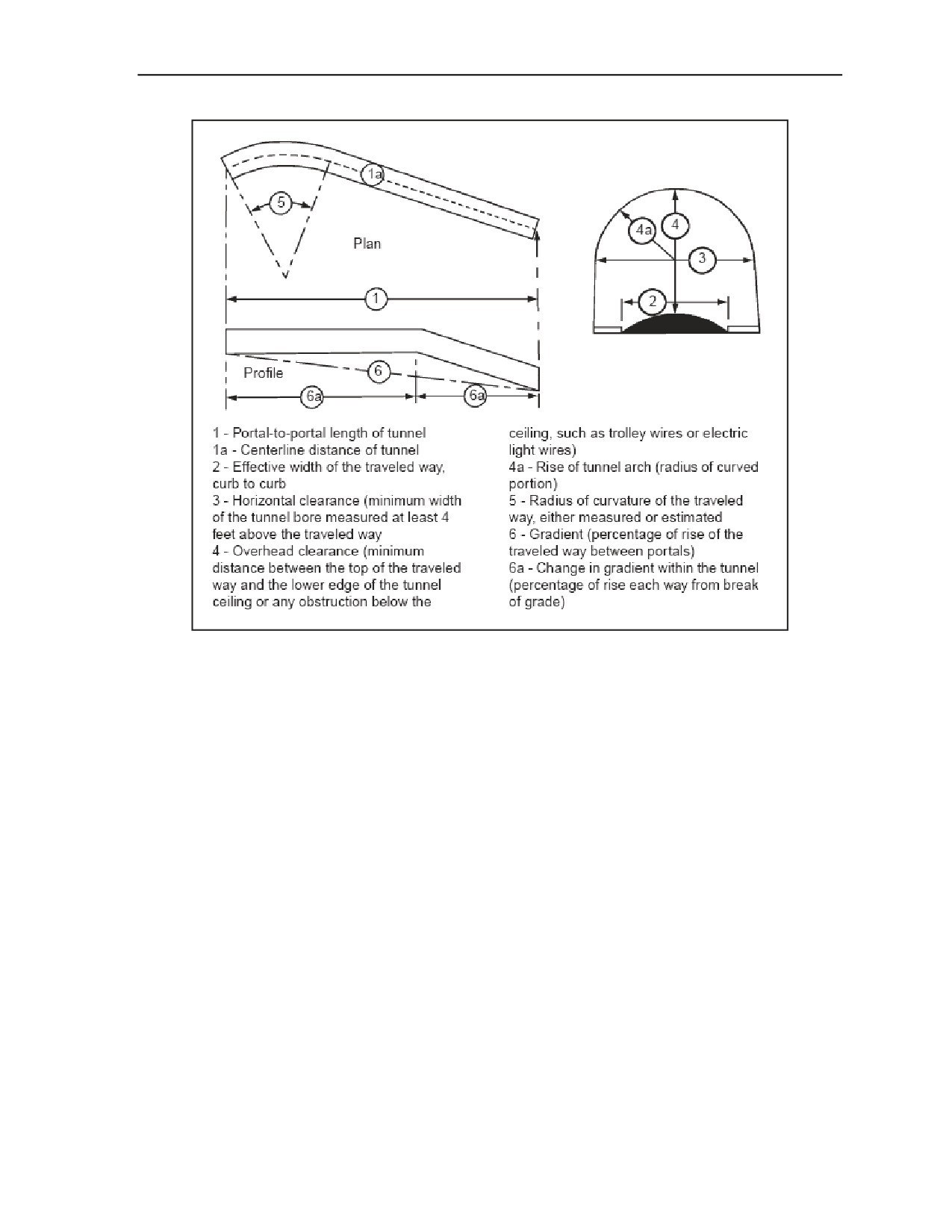
5-44. Overhead clearance is the shortest distance between the surface of a traveled way and any
obstruction vertically above it. The measurement of overhead clearance must be accurate. Obtain the
measurements shown in figure 5-16 (page 5-18) and figure 5-17 (page 5-19) and record them on DA Form
1250 (see appendix B).
25 March 2008
FM 3-34.170/MCWP 3-17.4
5-17
Chapter 5
Figure 5-16. Overhead clearance measurements
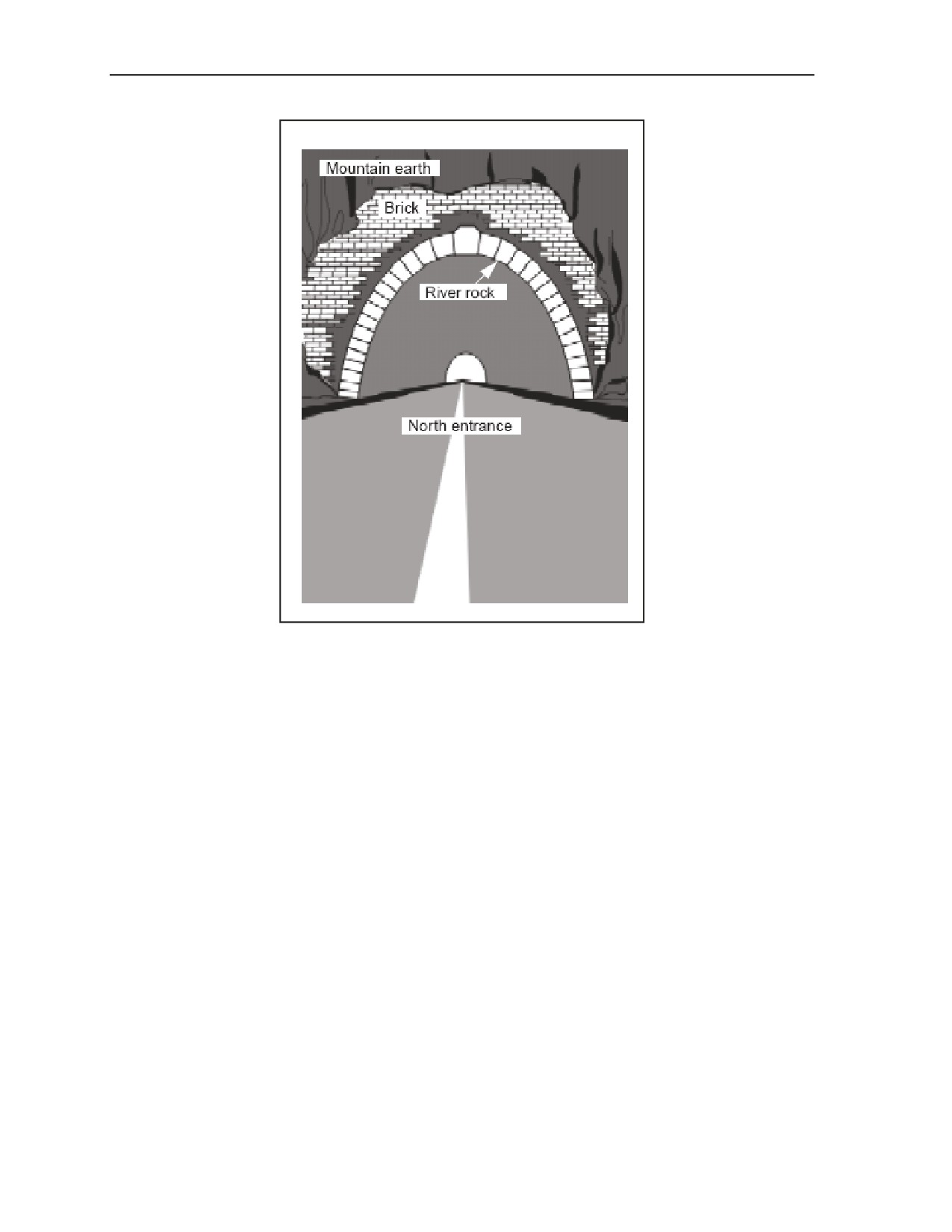
5-45. The reconnaissance element records a general description and sketch of what the tunnel entrances
(portals) look like and the composition. The portal view information and sketch are recorded (see figure
5-18 on page 5-20) on DA Form 1250 (see appendix B).
5-18
FM 3-34.170/MCWP 3-17.4
25 March 2008
Technical Reconnaissance - Route Classification
Figure 5-17. Dimensions required for tunnels
25 March 2008
FM 3-34.170/MCWP 3-17.4
5-19
Chapter 5
Figure 5-18. Portal view of tunnel
ROAD RECONNAISSANCE PROCEDURE
5-46. A road reconnaissance collects detailed technical information on the engineering characteristics and
trafficability of a road or road section within a route. Report results of a road reconnaissance on DA Form
1248 (see appendix B).
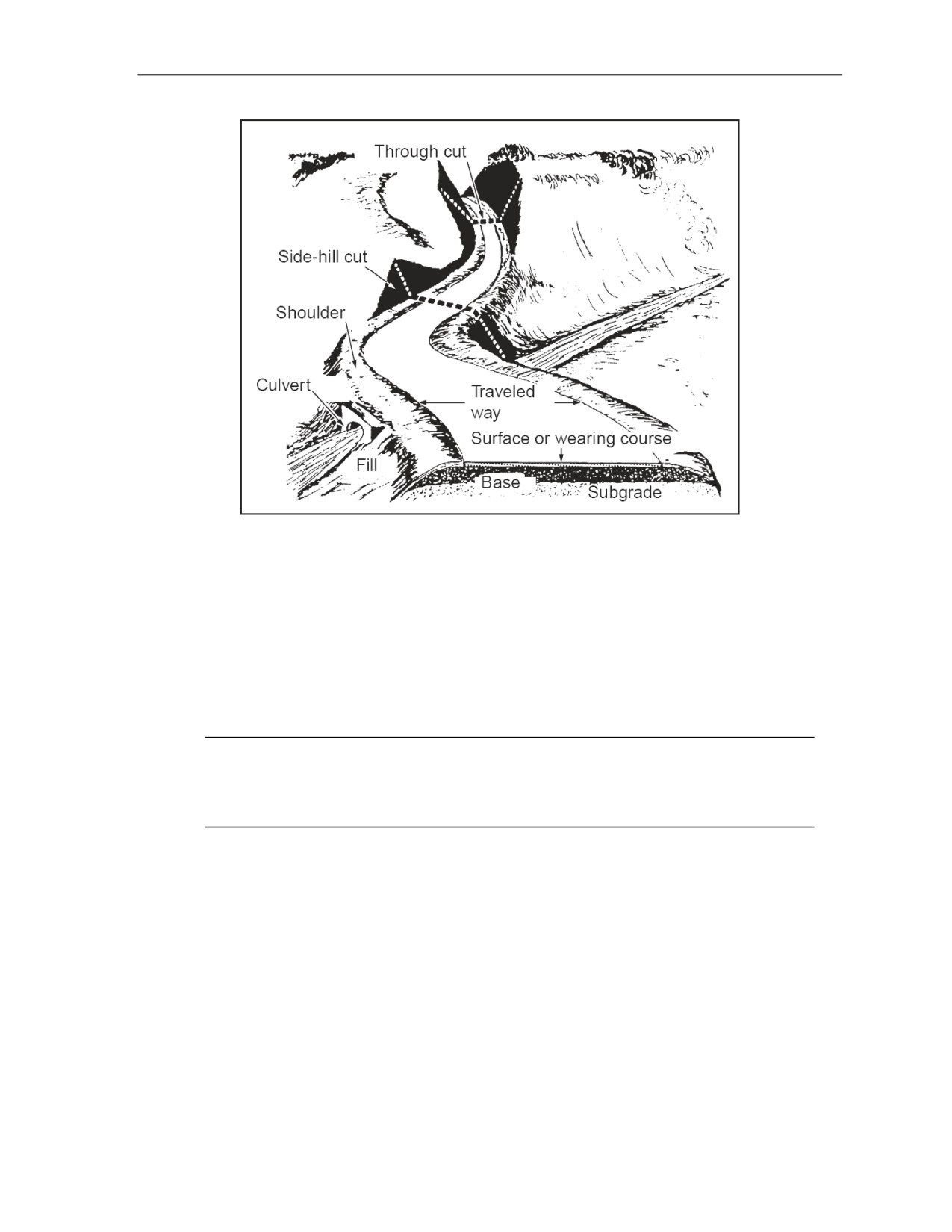
5-47. In general, a road consists of a road surface, base course, and subgrade (see figure 5-19).
5-20
FM 3-34.170/MCWP 3-17.4
25 March 2008
Technical Reconnaissance - Route Classification
Figure 5-19. Parts of a road
SOIL TYPES AND CHARACTERISTICS
5-48. Identifying the soil type used in road construction is a critical component of the road reconnaissance.
Soils, stabilized when necessary, form the subgrade and base course for the vast majority of roads. Soils
are considered according to type, characteristics, and allowable foundation bearing pressure. See table 5-4
(page 5-22) and table 5-5 (page 5-23). Soil types (table 5-4) range from gravel and sandy soils to clay and
silty soils. The principal soil type described in table 5-4 is further analyzed in table 5-5 including an
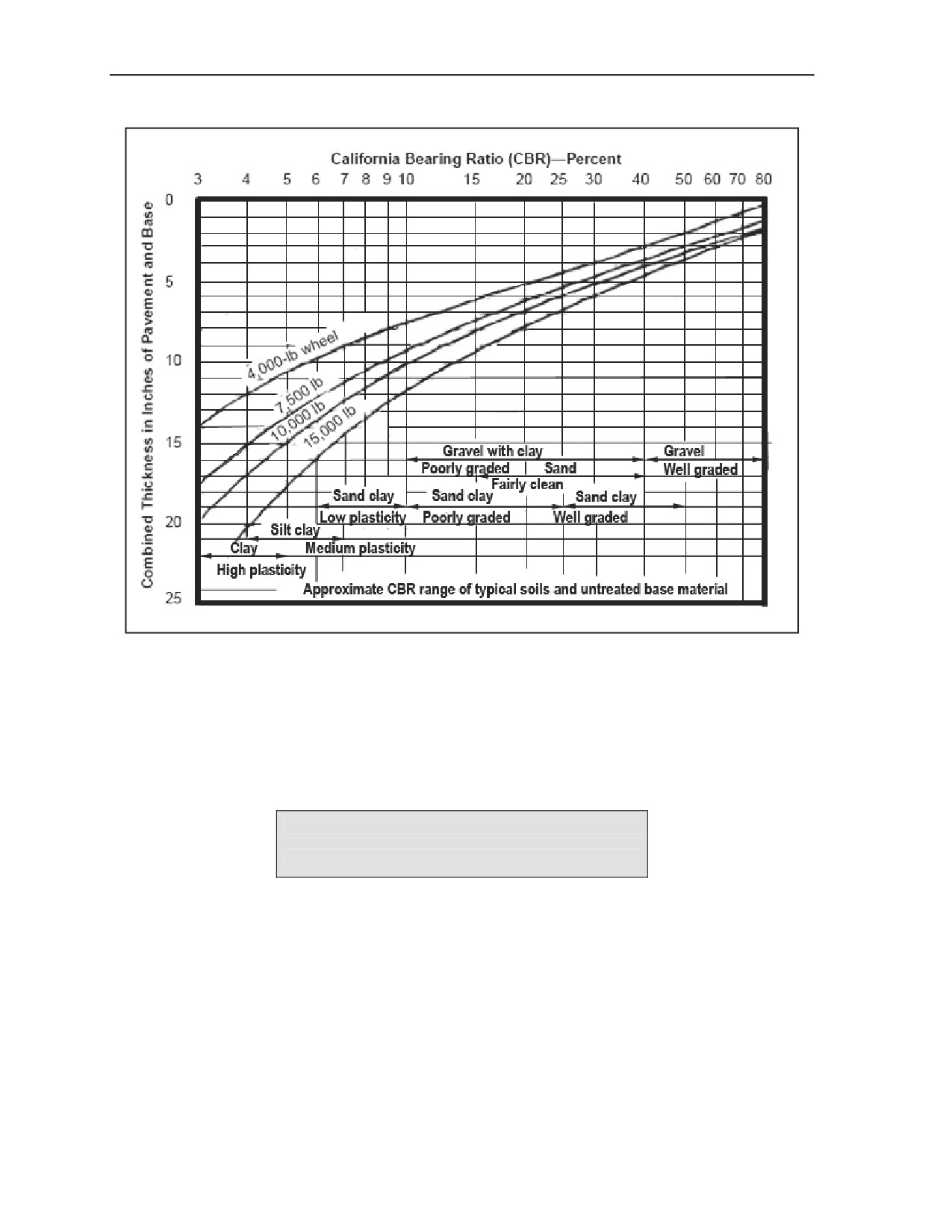
allowable bearing pressure. The allowable bearing pressure is expressed as a California Bearing Ratio
(CBR) and which is then used in determining the load-bearing capacity of a flexible road surface.
Note. The CBR is a measure of the shearing resistance of soil under controlled density and
moisture conditions (figure 5-20, page 5-26). It is expressed as a ratio of the unit load required
to force a piston into the soil to the unit load required to force the same piston the same depth
into standard crushed stone.
25 March 2008
FM 3-34.170/MCWP 3-17.4
5-21

Chapter 5
Table 5-4. Principal soil types
Name
Description
Gravel
A mass of detached rock particles, generally water worn, which passes a 3-inch sieve and is
retained on a No. 4 sieve (0.187 inches).
Sand
Granular material composed of rock particles which pass a No. 4 sieve (0.187 inches) and are
retained on a No. 200 sieve (0.0029 inches). It is difficult to distinguish sand from silt when the
particles are uniformly small. Dried sand, however, differs from silt in that it has no cohesion and
feels grittier.
Silt
A fine, granular material composed of particles which pass the No. 200 sieve (0.0029 inches). It
lacks plasticity and has little dry strength. To identify, prepare a pat of wet soil and shake it
horizontally in the palm of the hand. With typical inorganic silt, the shaking action causes water to
come to the surface of the sample, making it appear glossy and soft. Repeat tests with varying
moisture contents. Squeezing the sample between the fingers causes the water to disappear from
the surface and the sample quickly stiffens and finally cracks or crumbles. Allow sample to dry, test
its cohesion, and feel by crumbling with the fingers. Typical silt shows little or no dry strength and
feels only slightly gritty in contrast to the rough grittiness of fine sand.
Clay
Extremely fine-grained material composed of particles which pass the No. 200 sieve (0.0029
inches). To identify, work a sample with the fingers, adding water when stiffness requires. Moist
sample is plastic enough to be kneaded like dough. Test further by rolling ball of kneaded soil
between palm of hand and a flat surface. Clay can be rolled to a slender thread, about 1/4 inch in
diameter, without crumbling; silt crumbles, without forming a thread. Measure hardness of dry clay
by finger pressure required to break a sample. It requires much greater force to break dry clay than
dry silt. Clay feels smooth in contrast to the slight grittiness of silt.
Organic
Soil composed of decayed or decaying vegetation, sometimes mixed with fine-grained mineral
sediments such as peat or muskeg. It is identified by coarse and fibrous appearance and odor. Odor
may be intensified by heating. Plastic soils containing organic material can be rolled into soft, spongy
threads.
5-22
FM 3-34.170/MCWP 3-17.4
25 March 2008

Technical Reconnaissance - Route Classification
Table 5-5. Soil characteristics of roads and airfields
Major Divisions
Letter
Name
Field CBR
GW
Well-graded gravels or gravel-
60-80
sand mixtures, little or no fines
GP
Poorly graded gravels or
25-60
gravel-sand mixtures, little or
Gravel and
no fines
gravelly soils
d1
Silty gravels, gravel-sand-silt
40-80
GM
mixtures
u2
20-40
GC
Clayey gravels, gravel-sand
20-40
Coarse-grained
clay mixtures
soils
SW
Well-graded sands or gravelly
20-40
sands, little or no fines
SP
Poorly graded sands or
10-25
Sand and
gravelly sands, little or no fines
sandy soils
SM
d1
Silty sands, sand-silt mixtures
20-40
u2
10-20
SC
Clayey sands, sand-clay
10-20
mixtures
ML
Inorganic silts and very fine
5-15
sands, rock flour, silty or clayey
fine sands, or clayey silts with
slight plasticity
Silts and
CL
Inorganic clays of low to
5-15
clays (liquid
medium plasticity, gravelly
Fine-grained
limits <50)
clays, sandy clays, silty clays,
soils
lean clays
OL
Organic silts and organic silt-
4-8
clays of low plasticity
MH
Inorganic silts, micaceous or
4-8
Silts and clays
diatomaceous fine sandy or
(liquid limits >50)
silty soils, elastic silts
CH
Inorganic clays of high
3-5
plasticity, fat clays
OH
Organic clays of medium to
3-5
high plasticity, organic silts
Highly organic soils
Pt
Peat and other highly organic
soils
Note. Division of GM and SM groups into suddivisions of d and u are for roads and airfields only; subdivision is basis of
Atterberg limits.
1 Indicates liquid limit is 28 or less, and plasticity index is 6 or less.
2 Indicates liquid limit is 28 or greater.
BASE COURSE AND SUBGRADE
5-49. The base course and subgrade are the intermediate fill under the traveled surface of the roadway.
Base courses are usually composed of gravel or crushed rock. Subgrade soils are typically more silts and
clay soils. Table 5-6, page 5-24, cross-references various engineering properties of soils to the soil letter
designator.
25 March 2008
FM 3-34.170/MCWP 3-17.4
5-23

Chapter 5
Table 5-6. Engineering properties of soil types
Value as
Value as
Base
Foundation
Directly
Potential Frost
Compressibility
Drainage
Letter
when Not
Under
Action4
and Expansion
Characteristics
Subject to Frost
Bituminous
Action3
Pavement
None to very
GW
Excellent
Good
Almost none
Excellent
slight
None to very
GP
Good to excellent
Poor to fair
Almost none
Excellent
slight
d1
Good to excellent
Fair to good
Slight to medium
Very slight
Fair to poor
GM
u2
Poor to
Good
Poor
Slight to medium
Slight
practically
impervious
Poor to
GC
Good
Poor
Slight to medium
Slight
practically
impervious
None to very
SW
Good
Poor
Almost none
Excellent
slight
Poor to not
None to very
SP
Fair to good
Almost none
Excellent
suitable
slight
d1
Good
Poor
Slight to high
Very slight
Fair to poor
SM
Poor to
u2
Fair to good
Not suitable
Slight to high
Slight to medium
practically
impervious
Poor to
SC
Fair to good
Not suitable
Slight to high
Slight to medium
practically
impervious
Practically
CL
Fair to poor
Not suitable
Medium to high
Medium
impervious
OL
Poor
Not suitable
Medium to high
Medium to high
Poor
MH
Poor
Not suitable
Medium to high
High
Fair to poor
Practically
CH
Poor to very poor
Not suitable
Medium
High
impervious
Practically
OH
Poor to very poor
Not suitable
Medium
High
impervious
Pt
Not suitable
Not suitable
Slight
Very high
Fair to poor
1 Indicates liquid limit is 28 or less, and plasticity index is 6 or less.
2 Indicates liquid limit is 28 or greater.
3 Values are for subgrades and base courses except for base courses directly under bituminous pavement.
4 Indicates whether these soils are susceptible to frost.
5-24
FM 3-34.170/MCWP 3-17.4
25 March 2008

Technical Reconnaissance - Route Classification
ROAD CAPACITY AND COMPUTATIONS
5-50. The load-bearing capacity of a road is its ability to support traffic and is expressed by a military load
classification (MLC). The load-bearing capacity of a road with a flexible surface describes its ability to
support traffic and is expressed initially as a maximum allowable wheel load and then converted to an
equivalent MLC. After determining the type of subgrade material using tables 5-4, 5-5, and 5-6 (pages 5
21 through 5-24), an accurate estimation of the load-bearing capacity of a road for wheeled vehicles can be
made by measuring the combined thickness of the surface and base course and using figure 5-20, page 5-5
26, to obtain the corresponding load bearing capacity in pounds. Note that some pavement sections may
include a SP (sand) subbase material between the base course and a silt or clay subgrade, the thickness of
SP can be included in the calculations for combined thickness in inches of pavement and base in Figure 5
20. The load-bearing determined in Figure 5-20 is expressed as a maximum allowable wheel load in
pounds. See Table 5-7 to convert the bearing capacity in pounds to an equivalent MLC.
Note. That road classification for tracked vehicles is not normally assigned. Other factors such
as wear and tear on the roads surface by track action usually determines the road’s capacity to
support track vehicles.
Table 5-7. Wheeled vehicle classification related to single wheel load
Classification number
Maximum single wheel load (pounds)
4
2,500
8
5,500
12
8,000
16
10,000
20
11,000
24
12,000
30
13,500
40
17,000
50 - 150
20,000
5-51. If the MLC of the road is greater than the classification of the weakest bridge on the route, the bridge
classification determines the capacity of the route.
5-52. After determining the type of subgrade material, an accurate estimation of the load-bearing capacity
of a road for wheeled vehicles can be made by measuring the combined thickness of the surface and base
course and using figure 5-20 to obtain the corresponding load-bearing capacity in pounds. Note that some
pavement sections may include a sand (depicted as SP) subbase material between the base course and a silt
or clay subgrade. The thickness of SP can be included in the calculations for combined thickness in inches
of pavement and base in figure 5-20. (See appendix E to convert the bearing capacity in pounds to an
equivalent MLC).
25 March 2008
FM 3-34.170/MCWP 3-17.4
5-25
Chapter 5
Figure 5-20. Load bearing capacity of roads with a flexible surface
ROAD CLASSIFICATION FORMULA
5-53. The road classification formula is a systematic description of the limiting section of a road. Do not
confuse it with the route classification formula. Recorded information from the road classification formula
is included in the route classification formula. The following paragraphs describe each portion of the
formula shown below:
B g s 4 / 5 r (8 km) (OB) (T)
(1) (2) (3) (4) (5) (6)
z
(1) Limiting characteristics. Prefix the formula with “A” if there are no limiting characteristics
and
“B” if there are one or more limiting characteristics. Represent an unknown or
undetermined characteristic by a question mark, together with the feature to which it refers. In
the example above, the letter g indicates steep gradients and the letter s indicates a rough surface
(see table 5-8).
z
(2) Minimum traveled-way width. Express this width in meters followed by a slash and the
combined width of the traveled way and the shoulders. In the example above, the minimum
traveled way is 4 meters and the combined width is 5 meters.
5-26
FM 3-34.170/MCWP 3-17.4
25 March 2008

Technical Reconnaissance - Route Classification
z
(3) Road surface material. Express this with a letter symbol. The formula above describes the
surface material as r, meaning water-bound macadam. Use the symbols listed in table 5-9 (page
5-28); they are further related to the X, Y, and Z route types of the route classification described
earlier in route reconnaissance procedures.
z
(4) Road length. Express the road length in kilometers and place in parentheses.
z
(5) Obstructions. Indicate any obstructions along a road by placing the symbol “OB” after the
road length, as shown in the example above. Details of the obstructions are not shown in the
formula; they are reported separately by appropriate symbols on accompanying maps or
overlays or on DA Form 1248 (see appendix B). Report the following obstructions:
Overhead obstructions (less than 4.3 meters over the route).
Constrictions in traveled-way widths less than 6 meters for single-flow traffic or less than 8
meters for double-flow traffic (tracked or combination vehicles [see table 5-2, page 5-6]).
Slopes of 7 percent or greater.
Curves with a radius of less than 25 meters (report curves of 25.1 to 45 meters).
z
(6) Blockage. If blockage is regular, recurrent, and serious, the effects of snow blockage and
flooding are indicated in the road classification formula. The symbol for snow blockage is “T”
and the symbol for frequent flooding is “W.”
Table 5-8. Symbols for limiting characteristics
Limiting Characteristics
Criteria
Symbol
Sharp curves with a radius of 25 meters or less (82 feet) are reported
Sharp curves
c
as obstructions.
Steep gradients, 7 percent or steeper; such gradients are reported as
Steep gradients
g
obstructions.
Inadequate ditches, crown or camber, or culverts; culverts and ditches
Poor drainage
d
blocked or otherwise in poor condition.
Weak foundation
Unstable, loose, or easily displaced material.
f
Rough surface
Bumpy, rutted, or potholed to an extent likely to reduce convoy speeds.
s
Excessive camber or
Falling away so sharply as to cause heavy vehicles to skid or drag
j
superelevation
toward shoulders.
25 March 2008
FM 3-34.170/MCWP 3-17.4
5-27

Chapter 5
Table 5-9. Symbols for type of surface materials
Symbol
Material
Route Type
K
Concrete
Type X; generally heavy duty
kb
Bituminous (asphaltic) concrete (bituminous plant mix)
Type X; generally heavy duty
P
Paving brick or stone
Type X or Y; generally heavy duty
Pb
Bituminous surface on paving brick or stone
Type X or Y; generally heavy duty
Bitumen-penetrated macadam, water-bound macadam with
rb
Type X or Y; generally medium duty
superficial asphalt or tar cover
Water-bound macadam, crushed rock or coral or stabilized
r
Type Y; generally light duty
gravel
L
Gravel or lightly metaled surface
Type Y; generally light duty
Bituminous surface treatment on natural earth, stabilized soil,
nb
Type Y or Z; generally light duty
sand-clay, or other select material
Used when type of bituminous construction cannot be
b
Type Y or Z; generally light duty
determined
Natural earth stabilized soil, sand-clay, shell, cinders,
n
Type Z; generally light duty
disintegrated granite, or other select material
Classify X, Y, or Z depending on
V
Various other types not mentioned above
the type of material used (indicate
length when this symbol is used).
EXAMPLES OF THE ROAD CLASSIFICATION FORMULA
5-54. A sample DA Form 1248 is shown in appendix B. The following are examples of the road
classification formula:
z
A 5.0/6.2k—road with no limiting characteristics or obstructions, a minimum traveled way of
5.0 meters, a combined width of traveled way and shoulders of 6.2 meters, and a concrete
surface.
z
B g s 4/5 1 (OB)—road with limiting characteristics of steep gradients and a rough surface, a
minimum traveled way of 4 meters, a combined width of 5 meters, gravel or lightly metaled
surfaces, and obstructions.
z
B c (f?) 3.2/4.8 p (4.3km) (OB) (T)—road with limiting characteristics of sharp curves and
unknown foundation, a minimum traveled way of 3.2 meters, a combined width of 4.8 meters,
paving brick or stone surface, obstructions, and 4.3 kilometers long subject to snow blockage.
Notes.
1. Where rockslides are a hazard or poor drainage is a problem, include information on a written
enclosure or legend.
2. Ensure that a new classification formula is entered on the DA Form 1248 each time the road
changes significantly.
5-28
FM 3-34.170/MCWP 3-17.4
25 March 2008
Chapter 6
Technical Reconnaissance - Assessments and Surveys
Bring war material with you from home, but forage on the enemy…use the conquered foe
to augment one’s own strength.
Sun Tzu, The Art of War
Engineer assessments span the overlap area from tactical to technical on the range of
engineer reconnaissance capabilities. ERTs conduct tactical reconnaissance but may
include all or key portions of an assessment as part of the specified focus of technical
information. General engineers may augment the ERT, form an ERT, or form an
assessment team as the situation requires. Assessments may be conducted as an
integrated requirement in the tactical reconnaissance operation or may be in support
of IR at the operational level. Engineer surveys are typically conducted at the
operational level and in support of the general engineer function. While ERTs may
provide the degree of technical expertise required for an assessment, they operate as
an integrated part of an overall tactical reconnaissance operation at the BCT/RCT
level and below. Even when conducting an assessment, the ERT retains a significant
tactical reconnaissance focus. Operational level assessments and survey teams
employ a routinely high degree of technical expertise and are focused nearly
exclusively on the technical requirements of the reconnaissance support mission. The
capabilities in both cases overlap substantially, but the overall nature of the engineer
reconnaissance support is distinct. This chapter discusses the assessment and/or
survey capabilities typically provided by general engineer elements, and those
assessment capabilities available as necessary from ERTs. Technical capabilities
included in this chapter are often augmented with robust support from other Services,
OGAs, contractors, host-nation support (HNS), and reach-back support through FFE
and similar capabilities found in other Services. Regardless of the level of
reconnaissance support integration, when operating within assigned maneuver AOs,
the assessment or survey team must fully coordinate their activity with the maneuver
unit.
BRIDGE RECONNAISSANCE
6-1. A bridge reconnaissance is conducted to collect detailed technical information on selected bridges.
The bridge reconnaissance is conducted as part of a route or road classification or as separate mission
focused on the selected bridge. Based on the situation, the reconnaissance may be conducted by an ERT, an
augmented ERT, an assessment team, or a survey team. The level of detail of the information collected will
increase in the progression from ERT to survey team. In every case, the information collected can be used
to determine the bridge load-carrying capacity
(see appendix F for a detailed discussion on bridge
classification) and to estimate resources for repair or upgrade of the bridge. ERTs also conduct bridge
reconnaissance to collect information to enable the planning and estimation of the materials required for a
bridge demolition. (See FM 3-34.214 for additional information on bridge demolition requirements).
DA Form 1249 (see appendix B) is used to report the information collected from a bridge reconnaissance.
6-2. Appendix F of this manual provides the procedure for applying the information collected in the
bridge reconnaissance to determine the hasty bridge load classification. This assessment provides the basic
25 March 2008
FM 3-34.170/MCWP 3-17.4
6-1
Chapter 6
MLC information necessary for the commander to plan for the use of the bridge. Refer to FM 3-34.343 for
a complete discussion of bridge classification procedures. The method of bridge load classification covered
in appendix F is adequate for most applications.)
6-3. Large, multilane highway bridges are common in the common operational environment (COE).
These bridges with steel girders or prestressed concrete beams may be difficult to classify using the
procedure in appendix F. Damaged bridges will also present a challenge for classification resulting from
the damage as well as for repair options to mitigate the damage. The USACE has developed specific
expertise to assist in assessing bridges that present a challenge to reconnaissance elements in the field. The
assistance is available through reach-back support as discussed under FFE in this chapter and in appendix
H.
BRIDGE SPAN TYPES AND COMPONENTS
6-4. The most common span types for nonstandard bridges include—
z
Timber or steel trestle bridge with timber deck (including steel truss type highway bridges).
z
Steel-stringer bridge with concrete deck (including steel multigirder and two-girder highway
bridges).
z
Concrete steel-stringer bridge.
z
Concrete T-beam bridge with asphalt surface (including reinforced concrete and prestressed
highway bridges).
z
Masonry arch bridge.
6-5. Ice bridging is a type of nonstandard bridge that may be encountered where appropriate climate
conditions exist. Ice bridges typically reinforce an already present ice cover on large bodies of water,
streams, and rivers allowing the passage of heavier load classifications that would otherwise be supported
by the existing ice. Reconnaissance should focus on determining whether the initial ice span is stable and
not simply a floating ice mass (see TM 5-349 and TM 5-852-1).
6-6. Based on the type of span, basic components including the following:
z
Approaches (the portions of a route leading to a bridge). Approaches may be mined or
booby-trapped, requiring thorough investigation during a reconnaissance.
z
Substructure
(lower part of a bridge). The substructure consists of the abutments and
intermediate supports that transfer the bridge’s load to the ground. It is important to measure all
aspects of an abutment, including its height, width, and length; the abutment wings; and the
intermediate support.
z
Superstructure
(the upper part of a bridge). The superstructure consists of the following
components (see figure 6-1):
Stringers rest on and span the distance between the intermediate supports or abutments.
Stringers are the superstructure’s main load-carrying members. They receive the load from
the flooring and the vehicles and transfer it to the substructure.
The flooring system often consists of both decking and tread. The decking is laid directly
over the stringers at right angles to the centerline of the bridge. The tread is laid parallel to
the centerline of the bridge and between the curbs.
Curbs are placed at both edges of the flooring to guide the vehicles. A vehicle with an axle
that is wider than the traveled-way width (between the curbs) cannot cross the bridge. Most
bridges, however, allow for vehicular overhang beyond the normal traveled area. This
allowance is called horizontal clearance above the curbs and is a safety factor.
Railings along the bridge are built to guide drivers and to protect vehicular and foot traffic.
Trusses are used in some bridge superstructures, either above or below the traveled way, to
increase the load-carrying capacity. A truss is a structural element made of several
members joined together to form a series of triangles.
6-2
FM 3-34.170/MCWP 3-17.4
25 March 2008
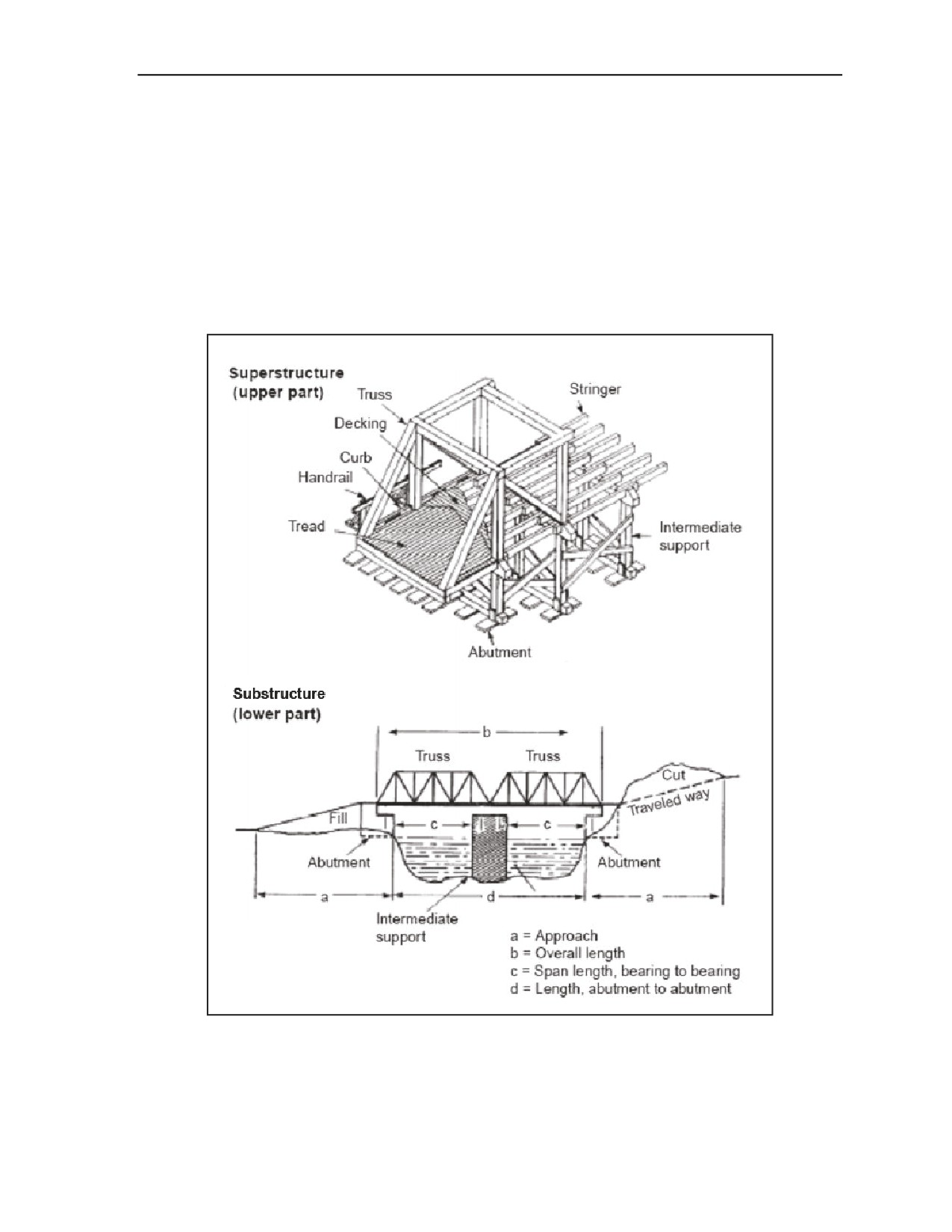
Technical Reconnaissance - Assessments and Surveys
The number of members in each span is noted where applicable (for example, stringer
bridges and concrete T-beam bridges). Exact dimensions of specific bridge members are
taken as outlined later in this chapter.
The span length is measured from center to center of the supports. The bridge’s
classification is usually based on the weakest span. If the weakest span is apparent, no other
spans need to be examined. However, if the weakest span is difficult or impossible to
locate, all spans must be classified. Even if several spans look identical, actual
measurements should be taken to prevent error.
The traveled-way width is measured between the inside faces of the curbs. However, the
horizontal clearance on a truss bridge is measured from a point 1.21 meters above the
roadway.
Figure 6-1. Bridge components
25 March 2008
FM 3-34.170/MCWP 3-17.4
6-3
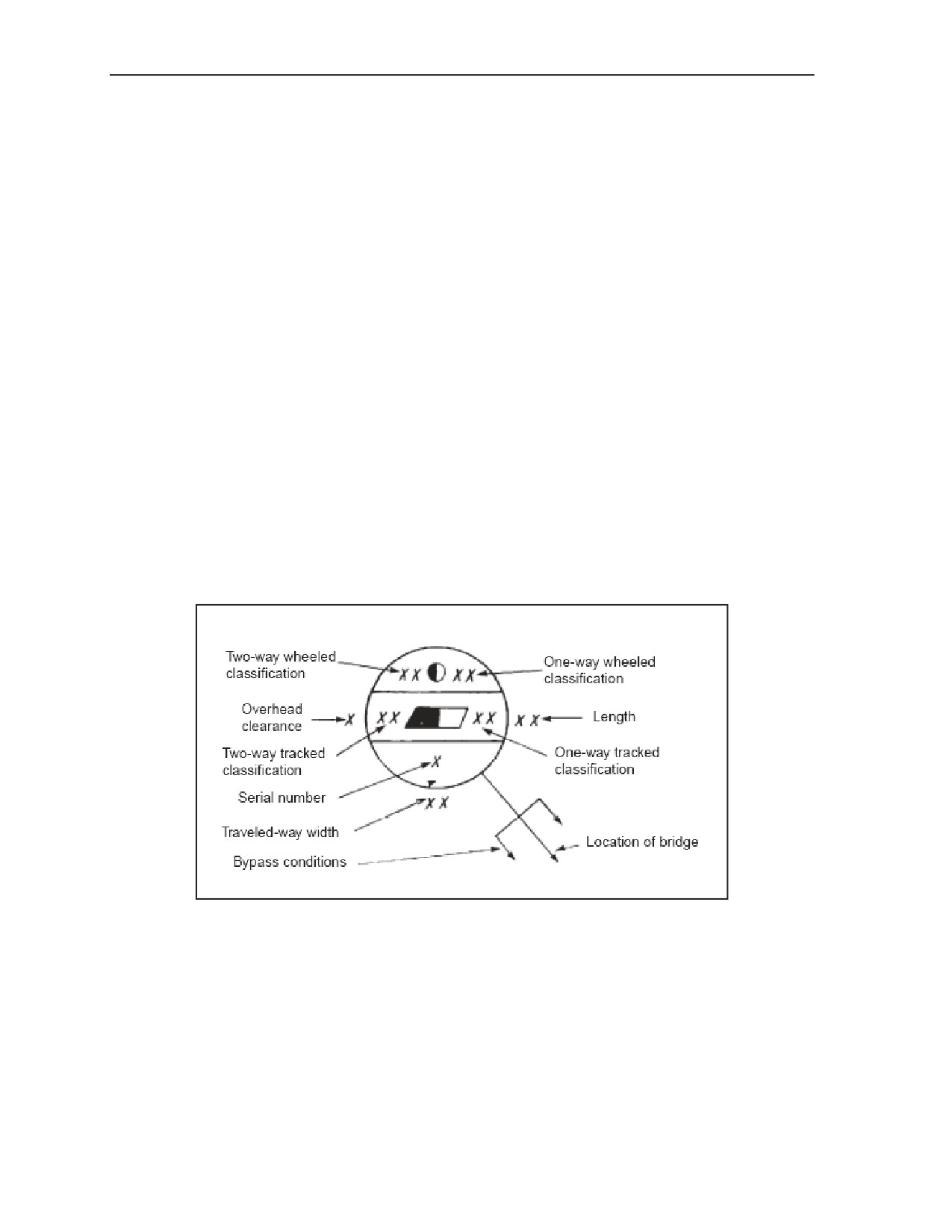
Chapter 6
BRIDGE CONDITION
6-7. The reconnaissance team collects general information and assesses the bridge’s general condition,
paying particular attention to evidence of damage from natural causes (rot, rust, and deterioration) or
combat action. Classification procedures presume that a bridge is in good condition. If the bridge is in poor
condition, the classification obtained from mathematical computations must be reduced according to the
classifier’s judgment.
BRIDGE SYMBOL
6-8. The reconnaissance team collects the specific bridge information necessary to fill out the full North
Atlantic Treaty Organization (NATO) bridge symbol (see figure 6-2) on a map or overlay. This symbol is
different from an on-site bridge classification sign as shown in appendix G; do not confuse the two. The
information necessary for the full bridge symbol includes the—
z
Bridge serial number.
z
Geographic location.
z
Bridge’s MLC.
z
Overall length.
z
Traveled-way width.
z
Overhead clearance.
z
Available bypasses.
6-9. A bridge serial number is assigned for future reference and is recorded in the symbol’s lower portion
(assign a number according to the unit’s SOP). For proper identification, do not duplicate serial numbers
within any one map sheet, overlay, or document.
Figure 6-2. Full NATO bridge symbol
6-10. The bridge’s geographic location is shown by an arrow extending from the symbol to the exact map
location. The bridge’s MLC number is shown in the symbol’s top portion. This number indicates the
bridge’s carrying capacity; classifications for both single- and double-flow traffic are included. In those
instances where dual classifications for wheeled and tracked vehicles exist, both classifications are shown.
6-11. The bridge’s overall length is the distance between abutments, measured along the bridge’s
centerline. This figure is placed to the right of the circle and is expressed in meters.
6-4
FM 3-34.170/MCWP 3-17.4
25 March 2008