FM 3-34.170/MCWP 3-17.4 ENGINEER RECONNAISSANCE (March 2008) - page 2
Chapter 3
Engineer Support to Intelligence, Surveillance,
and Reconnaissance Operations
No matter how enmeshed a commander becomes in the elaboration of his own thoughts,
it is sometimes necessary to take the enemy into account.
Sir Winston Churchill
Commanders make decisions and direct actions based on their SU. They keep their
SU current by continuously assessing the situation and stating the information they
need in CCIR. Throughout a continuous operations process, the commander’s
directions take different forms during planning, preparation, and execution. Chapter 2
discussed integrating engineer reconnaissance capabilities in the commander’s
planning processes. During preparation, commanders take every opportunity to
improve their SU about the enemy and environment. Commanders integrate
reconnaissance missions and surveillance means to form an integrated ISR plan that
capitalizes on their different capabilities. Engineer reconnaissance can be an
important part of this activity, providing data that contribute to answering the CCIR.
Commanders normally initiate reconnaissance operations before completing the
overall plan. Again, engineer reconnaissance operations, integrated with the
commander’s ISR plan, can gather important information which impacts the final
plan. This chapter discusses considerations for employing engineer reconnaissance
within ISR operations. Reconnaissance is not a static, one-time effort that achieves a
goal and stops. To sustain the engineer reconnaissance capability, consideration must
be made for its support. This chapter includes a discussion of sustainment
considerations for engineer reconnaissance.
INTELLIGENCE, SURVEILLANCE, AND RECONNAISSANCE
PLANNING
3-1. BCTs/RCTs conduct ISR operations producing intelligence on the enemy, environment (to include
weather and terrain), and civil considerations necessary to support the commander in developing SU and
making decisions. ISR operations are a commander’s function supported by the entire staff and subordinate
units. ISR operations are multifaceted and develop, synchronize, and integrate intelligence from a
multitude of collection sources to eliminate functional “stovepipes” for planning, reporting, and processing
information and producing intelligence. ISR operations must be nested from division to battalion level to
ensure integration of all available assets towards a single purpose that results in increased security and
flexibility to gain and maintain the initiative at the tactical level—the focus of the BCT/RCT and its
subordinate elements.
3-2. ISR operations are a continuing activity that allows units to produce a continuous feed of relevant
intelligence on the enemy, environment, and civil considerations required for the commander to make
critical decisions. This information answers requirements developed throughout the operations process.
Timely and accurate intelligence developed by aggressive and continuous ISR encourages audacity and can
facilitate actions that negate enemy symmetric or asymmetric strengths.
25 March 2008
FM 3-34.170/MCWP 3-17.4
3-1
Chapter 3
STAFF SUPPORT OF THE INTELLIGENCE, SURVEILLANCE, AND RECONNAISSANCE PROCESS
3-3. The BCT/RCT commander and the executive officer (XO) must ensure an integrated staff process to
conduct planning and disseminate ISR orders. In the past, while the S-3 was doctrinally responsible,
developing the ISR plan habitually fell on the brigade S-2 since the S-2 normally coordinated ISR assets
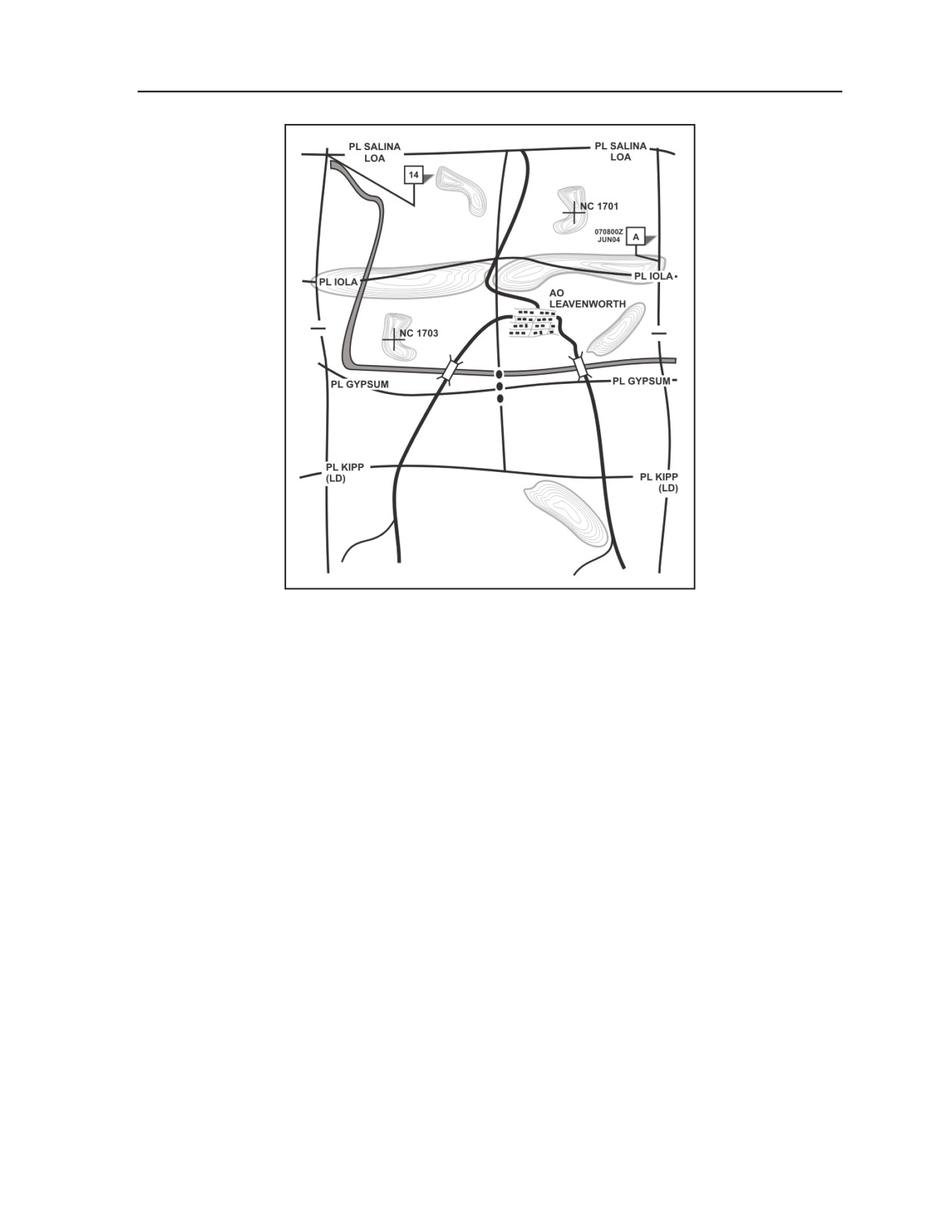
and was the primary user of ISR products. Given the complex nature of the OE, combined with the
significantly enhanced ISR capabilities of the BCT/RCT, it is imperative that the S-3, S-2, the FSCOORD,
the ENCOORD, and other required staff work together to develop the ISR plan. The engineer is especially
critical in ensuring that the reconnaissance effort will facilitate and enable the mobility of the BCT/RCT.
Further, the significance of ISR operations on unit success dictates involvement by the entire staff, not just
the ISR section. This allows the S-2 to focus on fusing information from national through tactical
intelligence sensors, better enabling the S-2 to provide the commander with timely and accurate
intelligence assessments. The commander uses the fused intelligence provided by ISR to make decisions
that allow him to place combat effects on the enemy to impede, harass, or attrite the enemy and then to
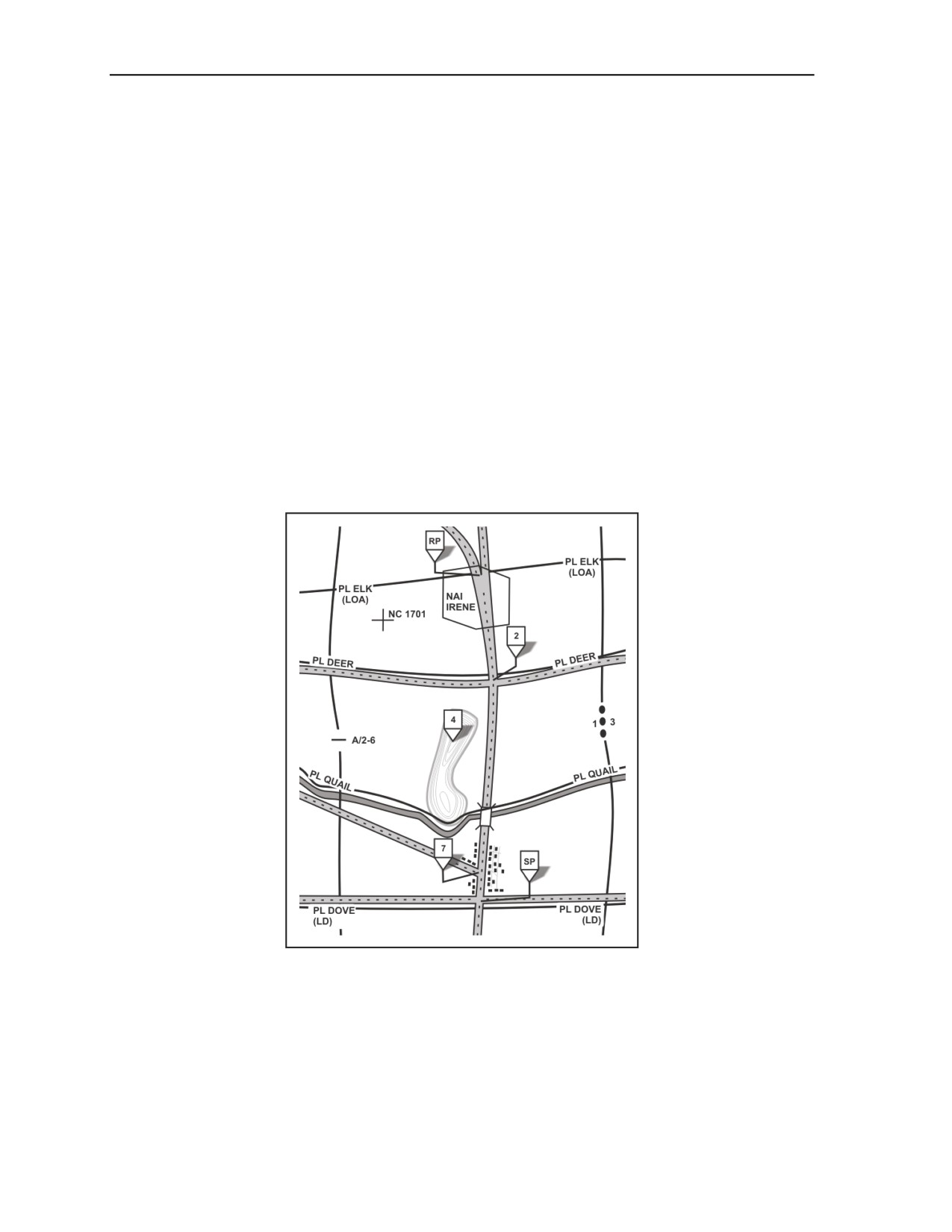
employ maneuver forces to destroy it. The BCT/RCT XO integrates the staff actions of the S-2 and S-3, as
well as the rest of the staff and reconnaissance squadron commander to identify collection requirements
and implement the ISR plan.
3-4. With staff participation, the BCT/RCT S-2 supports the ISR effort by focusing the collection,
processing, analysis, and intelligence products on the critical needs of the commander. The BCT/RCT S-3,
in coordination with the S-2, tasks and directs the available ISR assets to answer the CCIRs. The required
information is obtained through various detection methods and systematic observation, reconnaissance, and
surveillance. A continuous process, this task has four subtasks: perform intelligence synchronization,
perform ISR integration, conduct surveillance, and conduct reconnaissance.
INTELLIGENCE SYNCHRONIZATION
3-5. The S-2, with staff participation, synchronizes the entire collection effort to include all assets the
commander controls, assets of lateral units and higher echelon units and organizations, and intelligence
reach to answer the commander’s PIRs and IRs. Intelligence synchronization activities include the
following:
z
Conducting requirements management: anticipate, develop, analyze, validate, and prioritize
intelligence requirements. Recommend PIRs to the commander. Manage the commander’s
intelligence requirements, requests for information
(RFIs) from subordinate and lateral
organizations, and tasks from higher headquarters. Eliminate satisfied requirements and add new
requirements as necessary.
z
Developing indicators for each enemy COA.
z
Developing specific information requirements (SIRs) that will answer the PIR and IR.
z
Converting the SIRs into ISR tasks or RFIs that tailor the reporting criteria to the collection
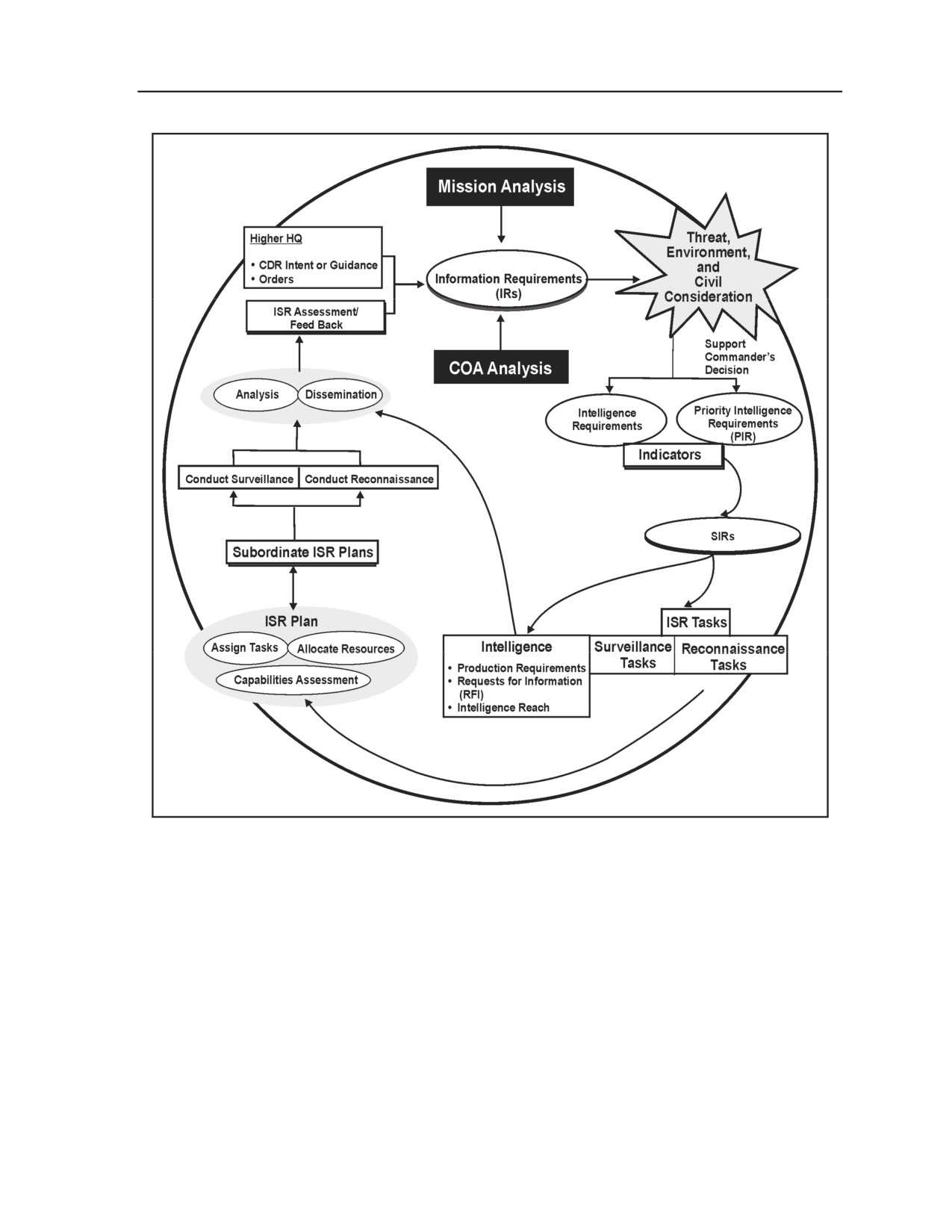
capabilities of tasked assets (See figure 3-1 for the ISR task development process). The S-2
assigns intelligence production and reach tasks to subordinate intelligence elements or
personnel, submits RFIs to higher and lateral echelons, and coordinates with (or assists) the S-3
to develop and assign ISR tasks.
z
Comparing the ISR tasks to the capabilities and limitations of the available ISR assets (in
coordination with the S-3).
z
Forwarding SIRs that cannot be answered by available assets to higher or lateral organizations
as RFIs.
z
Assessing collection asset reporting and intelligence production to evaluate the effectiveness of
the ISR effort.
z
Maintaining SU to identify gaps in coverage and to identify the need to cue or redirect ISR
assets.
z
Updating the intelligence synchronization plan. The S-2 manages and updates the intelligence
synchronization plan as PIRs are answered and new requirements arise.
3-2
FM 3-34.170/MCWP 3-17.4
25 March 2008
Engineer Support to Intelligence, Surveillance,
and Reconnaissance Operations
Figure 3-1. ISR task development process
Intelligence Synchronization Considerations
3-6. The S-2 generally follows six considerations in planning intelligence synchronization and ISR
activities: anticipate, integrate, prioritize, balance, control, and reach.
(Refer to FM 34-2 for more
information regarding intelligence synchronization).
z
Anticipate. The intelligence staff must recognize when and where to shift collection or identify
new intelligence requirements. The overall intent of this principle is to identify a new, or adjust
an existing requirement, and present it to the commander for approval before waiting for the
commander or staff to identify it.
25 March 2008
FM 3-34.170/MCWP 3-17.4
3-3
Chapter 3
z
Integrate. The intelligence staff must be fully integrated into the unit’s orders production and
planning activities to ensure early identification of intelligence requirements. Early and
continuous consideration of collection factors enhances the unit’s ability to direct collection
assets in a timely manner, ensures thorough planning, and increases flexibility in selecting
assets.
z
Prioritize. Prioritize each intelligence requirement based on its importance in supporting the
commander’s intent and decisions. Prioritization, based on the commander’s guidance and the
current situation, ensures that limited ISR assets and resources are directed against the most
critical requirements.
z
Balance. ISR capabilities complement each other. The intelligence staff should resist favoring or
becoming too reliant on a particular unit, discipline, or system. Balance is simply planning
redundancy when required, eliminating redundancy when not desired, and ensuring an
appropriate mix of ISR assets or types. The intelligence synchronization matrix (ISM) is useful
in determining or evaluating balance.
z
Control. To ensure timely and effective responses to intelligence requirements, a unit should
first use the ISR assets it controls. These assets usually are more responsive to their respective
commander and serve to lessen the burden on the ISR assets of other units, agencies, and
organizations.
z
Reach. Intelligence reach may be the only way to satisfy an intelligence requirement. If possible,
one should not depend solely on intelligence to answer a PIR.
3-7. An effective discussion of ISR has to include an understanding of the CCIRs. The CCIRs are
elements of information required by commanders that may affect decision making and dictate the
successful execution of missions. The commander decides what information is critical based on experience,
the mission, the higher commander’s intent, the staff’s input, initial IPB, information, intelligence, and
recommendations. (Refer to FM 3-0 for more information regarding CCIRs.)
3-8. Based on the CCIRs, two types of supporting IRs are generated: PIRs and FFIRs. However,
commanders may determine that they need to know whether one or more EEFI have been compromised or
that the enemy is collecting against a designated EEFI. In those cases, commanders may designate that
question as one of their CCIRs.
3-9. IRs are all of the information elements required by the commander and staff to successfully plan and
execute operations; that is, all elements necessary to address the METT-T[C] factors. Vetting by the
commander or his designated representative turns an IR into either a PIR or an intelligence requirement.
IRs are developed during COA analysis based on METT-T[C] factors.
3-10. PIRs are those intelligence requirements for which a commander has an anticipated and stated
priority in his task of planning and decision-making. PIRs are associated with a decision based on action or
inaction or the OE that will affect the overall success of the commander’s mission. The commander
designates intelligence requirements as CCIR
(PIR and FFIR). Answers to the PIRs help produce
intelligence essential to the commander’s SU and decision making.
3-11. The S-2 recommends to the commander those IRs produced during the MDMP that meet the criteria
for PIR. They do not become CCIR until approved by the commander. Additionally, the commander may
unilaterally designate PIRs. The IRs that are not designated by the commander as PIRs remain intelligence
requirements. The intelligence requirement is a gap in the command’s knowledge or understanding of the
OE or threat that the intelligence Army warfighting function must fill.
3-4
FM 3-34.170/MCWP 3-17.4
25 March 2008
Engineer Support to Intelligence, Surveillance,
and Reconnaissance Operations
3-12. The S-3 then tasks the unit’s assets to answer both the PIR and intelligence requirements through the
ISR plan. PIR should—
z
Ask only one question.
z
Support a decision.
z
Identify a specific fact, event, activity (or absence thereof) that can be collected.
z
If linked to an enemy course of action (ECOA), indicate an ECOA prior to, or as early as
possible in, its implementation.
z
Indicate the latest time the information is of value (LTIOV). The LTIOV is the absolute latest
time the information can be used by the commander in making the decision the PIR supports.
The LTIOV can be linked to time, an event, or a point in the battle or operation to friendly
force IRs. The staff also develops FFIRs which, when answered, provide friendly force
information that the commander and staff need to achieve SU and to make decisions.
Friendly Force Intelligence Requirements
3-13. The staff also develops FFIRs which, when answered, provide friendly force information that the
commander and staff need to achieve SU and to make decisions.
Essential Elements of Friendly Information
3-14. EEFI establish information to protect—not information to obtain. Thus, EEFI are established to
inform or direct BCT/RCT unit and element efforts to deny enemy efforts to collect against specific
BCT/RCT actions, units, intentions, or capabilities. In some cases, EEFI may form the underlying basis for
tasks to subordinate units, particularly during security operations. Further, commanders may determine that
they need to know whether one or more EEFI have been compromised or that the enemy is collecting
against a designated EEFI. In those cases, commanders may designate that question as one of their CCIRs,
using the ISM which generates PIRs and/or FFIRs. For example, a commander may determine that if the
enemy discovers the location and movement of the friendly reserve, the operation is at risk. In this case, the
location and movement of the friendly reserve are EEFI. The commander designates determining whether
the enemy has discovered the location and movement of the friendly reserve as one of his CCIR. That
CCIR, in turn, generates PIR and FFIR to support staff actions in determining whether the EEFI have been
compromised.
Development of the Intelligence Synchronization Plan
3-15. The entire unit staff develops its IRs and determines how best to satisfy them. The staff uses
reconnaissance and surveillance assets to collect information. The ISR synchronization plan includes all
assets that the operations officer can task or request and coordination mechanisms to ensure adequate
coverage of the areas of interest.
3-16. The ISR synchronization plan, often presented in a matrix format, aids in synchronizing the entire
ISR effort with the overall operation and the commander’s decisions and/or decision points (DPs). The
intelligence synchronization plan is often produced in conjunction with the ISR plan. However, before
performing intelligence synchronization and finalizing the intelligence synchronization plan, the S-2
must have the following:
z
The CCIR (PIR and FFIR).
z
A prioritized list of the remaining intelligence requirements.
z
Evaluated ISR assets and resources.
z
All of the assigned ISR tasks.
25 March 2008
FM 3-34.170/MCWP 3-17.4
3-5
Chapter 3
INTELLIGENCE, SURVEILLANCE, AND RECONNAISSANCE INTEGRATION
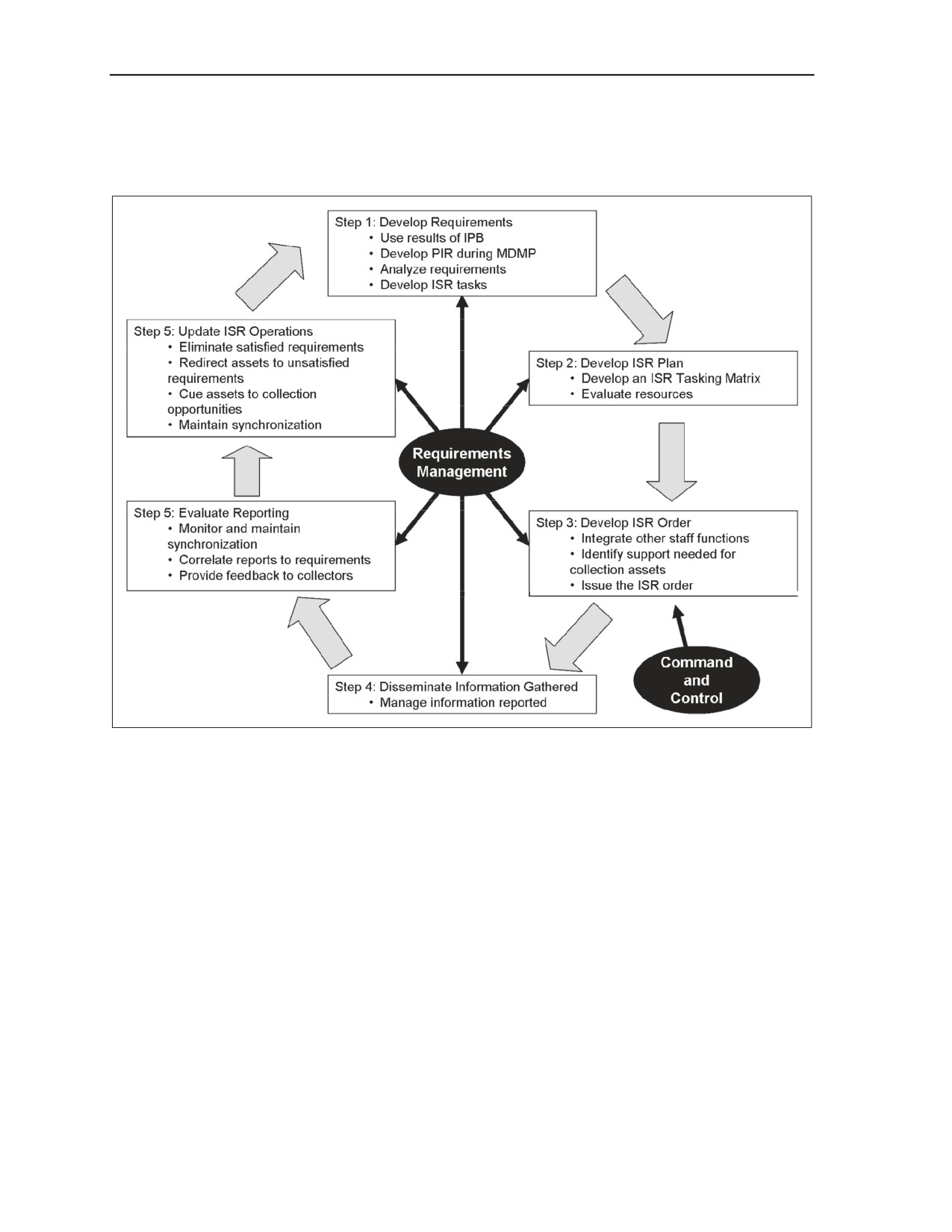
3-17. As depicted in figure 3-2 on page 3-6, ISR integration is a continuing process. Engineer planners
must be integrated throughout the cycle.
Figure 3-2. ISR integration
3-18. The S-3, in coordination with the S-2 and other staff members, orchestrates the tasking and directing
of all available ISR assets to answer the PIRs, FFIRs, and IRs by matching requirements with specific
collection assets using the following factors:
z
Availability. Determine what assets are organic and readily available. When will attachments
arrive? What systems are not fully mission capable and when will they be repaired? What are
the maintenance and crew rest requirements? What systems are available in higher, adjacent,
and subordinate units? How long will it take the asset to get into position?
z
Capability. Can the asset answer the questions asked? Does it have sufficient range? Can it
operate in the expected climate and visibility conditions? Will you need to maintain contact with
the target when it is identified?
z
Vulnerability. What is the threat’s ability to locate, identify, and destroy the collector both at the
target area and on the route to and from the mission? Is the risk of loss greater than the potential
gain of information? Will the asset be needed for other subsequent operations?
z
Performance History. How reliable is the specific asset based on training, leadership, and past
experience. Who are the “work horses” that can get the job done?
3-6
FM 3-34.170/MCWP 3-17.4
25 March 2008
Engineer Support to Intelligence, Surveillance,
and Reconnaissance Operations
Formation of the Intelligence, Surveillance, and Reconnaissance Plan
3-19. The result of this process forms the ISR plan. The ISR plan provides a list of all the ISR tasks to be
accomplished, both internal and external to the BCT/RCT. The S-2 and the S-3 develop tasks, orders, and
requests from the SIRs. These tasks, orders, and requests are then assigned based on the capabilities and
limitations of the available ISR assets and the LTIOV taking into account the concepts of—
z
Cuing. Cuing involves the use of one or more sensor systems to provide data that directs
collection by other systems. For example, sweeping the AO electronically with a wide area
surveillance system may reveal activity that in turn triggers direct collection by a more accurate,
pinpoint sensor system such as an UAS or scout team.
z
Redundancy. Redundancy involves the application of several identical assets to cover the same
target. Use redundant tasking against high-payoff targets when the probability of success by any
one system is low (for example, several scout teams infiltrating over different routes when the
risk of detection is high but no other systems are capable of collecting the required information).
z
Mix. Mix refers to planning for complementary coverage by a combination of assets from
multiple disciplines. Sensor mix increases the probability of collection, reduces the risk of
successful enemy deception, facilitates cueing, and provides more complete reporting. For
example, thermal imagery from a UAS may indicate several vehicle-like hot spots in a suspected
enemy battle position (BP). A scout team observing the same NAI may reveal that half of those
hot spots are actually decoys and not enemy armored vehicles.
z
Integration. Integration is the resource management aspect of collection strategy development.
Barring a decision to use redundant coverage of a critical target, attempt to integrate new
requirements into planned or ongoing missions. Integration helps avoid the common problem of
under tasking very capable collectors. During limited periods of time, collection capability may
exceed that of the tasking. Brigades can resolve this by reevaluating each collection asset for
excess capability, focusing excess collection capability on the most important of the remaining
unfulfilled requirements, and finally redirecting assets to maximize support to the most
important requirements—new or old.
Finalized Intelligence, Surveillance, and Reconnaissance ISR Plan
3-20. The finalized ISR plan is produced as an ISR order in the ISR annex to a BCT/RCT OPORD. (Refer
to FM 5-0 for specific information on the ISR annex). However, an initial ISR order is usually prepared at
the conclusion of mission analysis during the planning process and issued prior to the completed BCT/RCT
operations order to start reconnaissance and surveillance operations required to achieve the intended ISR
effect.
Execution of and Updating the Intelligence, Surveillance, and Reconnaissance Plan
3-21. The S-3 updates the ISR plan based on information received from the S-2. The S-3 is the integrator
and manager of the ISR effort through an integrated staff process and procedures. As PIRs are answered
and new IR arise, the S-2 updates intelligence synchronization requirements and provides the new input to
the S-3 who updates the ISR plan. The S-2 works closely with all staff elements to ensure the unit’s
organic collectors receive appropriate tasking. The ISR plan reflects an integrated collection strategy and
employment, production, and dissemination scheme that will effectively answer the commander’s PIR.
RECONNAISSANCE OPERATIONS
3-22. Engineer reconnaissance occurs within the context of the maneuver commander’s reconnaissance
operations. Combat engineers may be assigned a tactical reconnaissance mission. For example, a sapper
company augmenting the BCT/RCT may be tasked to conduct an area reconnaissance as part of the
BCT/RCT reconnaissance operation. More likely, the engineer reconnaissance team will be tasked to
conduct technical reconnaissance tasks in support of a broader tactical reconnaissance mission. In this case,
for example, the sapper company is tasked with providing a team to conduct a crossing site reconnaissance
as part of a supported element’s area reconnaissance mission. In both situations, the engineer
25 March 2008
FM 3-34.170/MCWP 3-17.4
3-7
Chapter 3
reconnaissance is one component of a broader combined arms reconnaissance operation. To ensure that the
engineer component fits effectively within the combined arms operation, it is critical for the engineer
reconnaissance planners and team leaders to understand the language of the maneuver commander’s
tactical reconnaissance operation. Similarly, the staff planners and team leader must describe their engineer
reconnaissance capabilities and support requirements in terms of the tactical operation to ensure integration
with the overall reconnaissance operation.
DEFINITIONS
3-23. Reconnaissance is defined as a mission undertaken to obtain, by visual observation or other
detection methods, information about the activities and resources of an enemy or potential enemy, or to
secure data concerning the meteorological, hydrographical, or geographical characteristics and the
indigenous population of a particular area (FM 3-0). Reconnaissance is the focused collection effort
performed before, during, and after other combat operations to provide combat information and
intelligence, which are then used by the BCT/RCT commander and staff to develop, confirm, or modify the
commander’s plan.
3-24. Surveillance is a task defined as the systematic observation of airspace, surface, or subsurface areas
by visual, auditory, electronic, photographic, or other means (FM 1-02). Surveillance tasks are inherent in
reconnaissance and security missions; they are also conducted during offensive, defensive, and stability
operations.
3-25. A reconnaissance objective is a terrain feature, geographical area, enemy force, and/or infrastructure
about which the commander wants to obtain additional information (FM 3-90). It clarifies the intent of the
reconnaissance effort by specifying the most important result that the reconnaissance is to accomplish.
When a reconnaissance team does not have enough time to complete all of the tasks associated with a
specific form of reconnaissance, it uses the reconnaissance objective to guide it in setting priorities.
3-26. The reconnaissance focus defines the “what” on which the reconnaissance team must concentrate its
efforts and assets
(threat, society, infrastructure, or terrain). It is linked to answering the BCT/RCT
commanders’ CCIR, supporting lethal and nonlethal targeting, and filling any additional voids in RI.
Reconnaissance focus, combined with one or more reconnaissance objectives, serves to efficiently
concentrate the effort of the reconnaissance assets on a chaotic, changing battlefield (FM 3-90).
Note. The reconnaissance tempo defines the pace of the operation and as such specifies the
depth of detail that the reconnaissance is required to yield (FM 3-90).
3-27. Engagement criteria (lethal and nonlethal) establish minimum thresholds for engagement. They
clearly specify which targets the reconnaissance teams are expected to engage and which they will hand off
to other assets. Nonlethal contact, for example, identifies engagement criteria for tactical questioning of
civilians and/or factional leaders. This criterion allows team leaders to anticipate bypass criteria and to
develop a plan to maintain visual contact with bypassed threats (FM 3-90).
METHODS
3-28. Two general reconnaissance methods may be employed by a commander to solve tactical dilemmas
and conduct battles and engagements: reconnaissance push and reconnaissance pull. These are not rigidly
established prescriptions that are followed in checklist sequence or with by-the-numbers precision; rather,
they are descriptive generalizations explaining how and when reconnaissance elements are to be employed
(in the MDMP chronology) and what the results of reconnaissance will yield or drive in terms of the
MDMP.
3-29. The answers to the following questions help provide a basis for categorizing methods of
reconnaissance employment:
z
Are reconnaissance elements deployed early in the planning process before the BCT/RCT plan
is even known, or later, after the plan is fairly fleshed out?
3-8
FM 3-34.170/MCWP 3-17.4
25 March 2008
Engineer Support to Intelligence, Surveillance,
and Reconnaissance Operations
z
Does reconnaissance confirm or deny specifics of an evolving plan or help generalize a plan
from the very start?
Reconnaissance Push
3-30. Reconnaissance push emphasizes a detailed plan prior to deployment of reconnaissance assets.
Initially, a detailed ISR plan is developed to focus the reconnaissance effort on an evolving maneuver
COA—or on several COAs—prior to the deployment of reconnaissance. As reconnaissance is deployed,
commanders and staff begin work on one or more plans or COAs with the intent of refining these evolving
plans as reconnaissance yields relevant combat information. Results of the reconnaissance effort, which
tends to be broader and more extensive over a longer period of time, continue to be fed back to the
BCT/RCT. There, commanders and planners, already actively engaged in MDMP, continue to update the
evolving plans or COAs. They make refinements until available planning time is exhausted. The plan is
then disseminated and rehearsed by subordinates.
3-31. In reconnaissance push, the detailed plan often encompasses several viable, well-digested branches
or COAs that will be triggered by DP. These branches are understood by leaders at all levels and are well
rehearsed. As the BCT/RCT deploys, the reconnaissance effort shifts to two other purposes:
z
Providing DP trigger criteria information to facilitate the commander’s decisions to adopt
planned branches.
z
Finding previously undiscovered enemy strengths and weaknesses on which the BCT/RCT can
capitalize with greater success outside of planned branches.
Reconnaissance Pull
3-32. Reconnaissance pull represents any of the various methods of reconnaissance in which the
commander deliberately refrains from committing to a specific plan or COA prior to deploying
reconnaissance elements. The commander and staff develop an integrated ISR plan designed to yield
information on the most tactically advantageous way to maneuver the BCT/RCT. Reconnaissance is
focused on collecting information on enemy strengths and weaknesses or information to update the terrain
analysis (to include OBSTINTEL) that will be critical in formulating the future plan or COA.
3-33. Upon discovering enemy strengths and weaknesses, reconnaissance essentially “pulls” the BCT/RCT
maneuver battalions along the path of least enemy resistance into positions of marked tactical advantage.
Success is predicated on all maneuver units fully understanding the commander’s intent—the “glue” that
holds the BCT/RCT together in a decentralized, rapidly changing situation. Weaknesses are often
discovered in the very midst of execution, necessitating an ability to rapidly shift and alter schemes of
maneuver to exploit opportunities. These on-the-fly modifications, however, have to be executed according
to the commander’s intent. Reconnaissance pull knowingly emphasizes opportunity at the expense of a
detailed, well-rehearsed plan and unity of effort.
TECHNIQUES
3-34. Reconnaissance can be conducted using four techniques—dismounted, mounted, aerial, and sensor.
For the most effective reconnaissance, the commander should consider using a combination of all methods.
3-35. The BCT/RCT employs numerous sensor systems in executing reconnaissance and surveillance.
Commanders and staffs need to know the capabilities and limitations of the various systems. They must
also understand that these systems are susceptible to countermeasures and that they lack the ability to
convey the human dimension of the OE in terms of assessing the threat’s morale, taking prisoners, or
making crucial on-the-spot decisions or judgment calls. The scout directly observing the target is still the
commander’s most valuable reconnaissance asset. Therefore, the commander needs to maximize the use of
dismounted scout observer teams to accurately assess the threat and the effects of the terrain on both
forces. Engineer reconnaissance support is especially valuable to the commander for reporting
OBSTINTEL—providing information on gaps and physically confirmed terrain conditions.
25 March 2008
FM 3-34.170/MCWP 3-17.4
3-9
Chapter 3
3-36. Stealth is a primary consideration in reconnaissance operations. Given the engineer reconnaissance
team’s lighter organization, stealth is even more essential. The team can expect to operate over extended
distances well before the BCT’s/RCT’s execution of combat operations and must use stealth to gain
information without alerting the enemy to the BCT’s/RCT’s intentions. They may operate independently or
as a part of a larger reconnaissance element.
3-37. Without organic direct-fire systems (such as the mobile gun system or tanks), the ERT will seldom
employ aggressive reconnaissance techniques. Exceptions to this may include situations in which the
establishment of a military presence is desired and those in which the commander has determined that the
target meets his engagement criteria and it is necessary to fight for information. If fighting is required, it
should be on a limited scale, precisely focused against a target that meets the engagement criteria
established by the commander, and under conditions favorable to the ERT. Some ERTs may be mounted in
the engineer squad vehicle, but many will not be. In situations where a Soldier and Marine/unit is
compromised by a threat, self-defense will always override the need for stealth.
COMMANDER’S RECONNAISSANCE GUIDANCE
3-38. The BCT/RCT commander’s reconnaissance guidance is developed early in the MDMP. The
commander’s reconnaissance guidance covers the following considerations:
z
Focus of reconnaissance.
z
Tempo of reconnaissance.
Stealthy or forceful.
Deliberate or rapid.
z
Engagement criteria (if any), both lethal and nonlethal.
Aggressive.
Discreet.
Focus
3-39. Reconnaissance focus defines where and on what the reconnaissance team needs to concentrate its
information-gathering activities and allows the commander to select which critical tasks must be
accomplished and with what asset(s). Reconnaissance focus must be linked to the tasks of answering the
commanders’ CCIR, supporting targeting (lethal and nonlethal), and filling additional voids in IR. The
reconnaissance objectives of the team must be focused, at a minimum, on one or more of the following:
z
Threat. These may include conventional and known enemy forces, insurgents, paramilitary
forces, guerrillas, criminal groups, and even civilian groups and individuals.
z
Society (social/human demographics). Gaining an awareness of how the local society affects
military operations, as well as the impact of military operations on the society, may be critical to
the commander when making operational decisions.
z
Infrastructure. Infrastructure covers those systems that support the inhabitants, economy, and
government of an area. Destroying, controlling, or protecting vital parts of the infrastructure can
isolate the enemy from potential sources of support. Because these systems are inextricably
linked, destroying or disrupting any portion of the urban infrastructure can have a cascading
effect
(either intentional or unintentional) on the other elements of the infrastructure. See
chapter 6 for an in-depth discussion of infrastructure reconnaissance.
z
Terrain. Terrain-focused reconnaissance identifies voids in terrain-related IR that a map or
digital analysis simply cannot satisfy to an acceptable degree. Terrain reconnaissance also
includes the effect of weather on the military aspects of the terrain. Typical engineer focus
includes OBSTINTEL, route classification, and gap crossing sites.
Tempo
3-40. The tempo of the reconnaissance allows the commander to correlate time requirements for the
reconnaissance with such factors as planning time, movement formations, and operational methods (such
3-10
FM 3-34.170/MCWP 3-17.4
25 March 2008
Engineer Support to Intelligence, Surveillance,
and Reconnaissance Operations
as dismounted or mounted). The commander establishes the tempo by answering several questions: Given
available time, will troops need to conduct stealthy or forceful reconnaissance? Is the reconnaissance
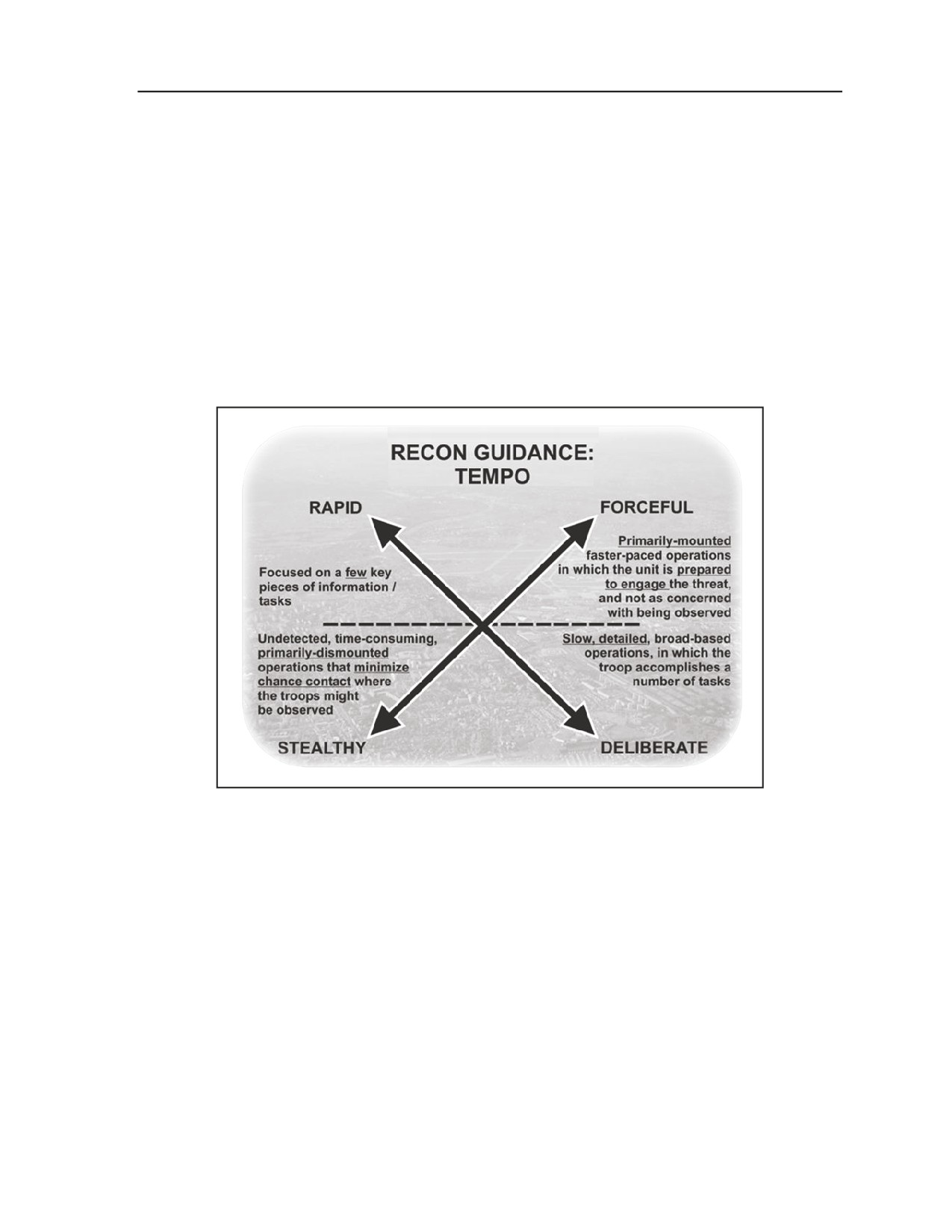
mission deliberate or rapid? Figure 3-3 illustrates these terms used to describe reconnaissance tempo:
z
Stealthy reconnaissance entails methodical, time-consuming operations that minimize chance
enemy contact. It is conducted predominantly dismounted, although mounted reconnaissance
may be involved as well.
z
Forceful reconnaissance, the opposite of stealthy, involves predominantly mounted operations
that are much faster paced and in which reconnaissance units are less concerned about being
detected by the enemy.
z
Deliberate reconnaissance entails slow, detailed, broad-based operations in which the troop
accomplishes several tasks.
z
A rapid tempo, the opposite of deliberate, focuses the troops on a few key pieces of information
required by the squadron commander.
Figure 3-3. Reconnaissance guidance—tempo
3-41. Terminology describing the tempo of reconnaissance is not as important as the requirement that the
commander and his subordinates talk the same language when it comes to determining what type of tempo
is to be adopted and how that looks in the AO. Although the ERT may not receive specifically worded
reconnaissance guidance from the commander, the ERT leader must analyze requirements for tempo based
on collaborative huddles with the commander, WARNORDs, and his experience; the ERT leader can then
articulate the requirements clearly to his subordinates in terms that have meaning.
Engagement Criteria
3-42. Engagement criteria establish which targets the reconnaissance squadron and its troops are expected
to engage with direct or indirect fires and which ones they are expected to handover to the BCT’s/RCT’s
maneuver battalions. In general, engagement criteria will apply only to ERTs directly augmenting
reconnaissance elements. Criteria fall into the following categories:
z
Aggressive reconnaissance implies liberal engagement criteria (weapons free/tight).
z
Discreet reconnaissance is conducted with restrictive engagement criteria (weapons tight/hold).
25 March 2008
FM 3-34.170/MCWP 3-17.4
3-11
Chapter 3
3-43. Engagement criteria may be articulated in terms of the type and number of threat systems that a
reconnaissance unit may be required to engage (or are prohibited from engaging). They may describe
situations in which engagement will or will not occur. They may even address what types of friendly
weapon systems may be employed or prohibited. Engagement criteria are linked closely with established
ROE; however, they define important deviations from the ROE as opposed to being merely a reiteration of
them.
3-44. Engagement criteria may also pertain to how the troop handles nonlethal contact, such as tactical
questioning of civilians and/or factional leaders. Additionally, they allow troop commanders to anticipate
bypass criteria and to develop a plan to maintain visual contact with bypassed or bypassing threat elements.
FORMS
3-45. There are four forms of reconnaissance—zone, area, route, and reconnaissance in force. As noted
earlier in this chapter, these forms of reconnaissance will normally be conducted with a multidimensional
focus that includes such factors as society and infrastructure as well as the threat and terrain. (Zone, area,
and route reconnaissance are discussed further in this section. For information on reconnaissance in force,
and additional information on the forms of reconnaissance, see FM 3-90.)
Note. A route reconnaissance is one of the three forms of tactical reconnaissance. It should not be
confused with a route classification which can be included as part of the route reconnaissance (see
chapter 5) or a road reconnaissance which is a technical component of the route classification.
Zone Reconnaissance
3-46. Zone reconnaissance is the directed effort to obtain detailed information concerning threat, terrain,
society, and infrastructure according to the commander’s reconnaissance focus within a location delineated
by a line of departure (LD), lateral boundaries, and a limit of advance (LOA). A zone reconnaissance is
assigned when the threat situation is vague or when information concerning cross-country trafficability is
desired. It is appropriate when previous knowledge of the terrain is limited or when combat operations
have altered the terrain. The reconnaissance may be threat-oriented, terrain-oriented, society-oriented,
infrastructure-oriented, or a combination. Additionally, the commander may focus the reconnaissance
effort on a specific force, such as the threat’s reserve. A terrain-focused zone reconnaissance must include
the identification of obstacles (OBSTINTEL), both existing and reinforcing, as well as areas of CBRN
contamination or toxic industrial material (TIM). Focused reconnaissance capabilities (engineer, CBRN,
and others) may augment one or more of the primary reconnaissance elements as required and available.
3-47. Zone reconnaissance takes more time to execute than many other reconnaissance missions because
the target area is larger and the initial IPB usually generates many unanswered questions. If the time
available is not adequate, the reconnaissance leader seeks additional time, reinforcements, or systems to
assist in the reconnaissance effort. If necessary, the reconnaissance leader may accelerate the
reconnaissance effort—and accept a degree of risk—by reducing the number of critical tasks to be
accomplished.
3-48. A zone reconnaissance is organized with subordinate elements operating abreast of one another
within a portion of the zone as designated by graphic control measures (see figure 3-4). If the BCT/RCT
commander expects significant threat forces to be found within the zone, he considers attaching armored,
mechanized, or aviation forces to the reconnaissance element to deal with the anticipated threat. If it is
likely that the reconnaissance elements will encounter significant obstacles or other mobility impediments,
the commander may provide combat engineer augmentation. If the zone reconnaissance will be outside the
supporting range of the BCT/RCT, additional fire support elements may be task organized to move with
the reconnaissance element.
3-49. As noted, a zone reconnaissance is controlled using lateral boundaries, an LD, and an LOA. Within
the zone, the element conducting the reconnaissance further divides the AO with additional lateral
boundaries to define subordinate unit zones. Subordinate zones may differ in size. Phase lines (PLs) and
3-12
FM 3-34.170/MCWP 3-17.4
25 March 2008
Engineer Support to Intelligence, Surveillance,
and Reconnaissance Operations
contact points are designated to coordinate the movement of elements operating abreast. Critical terrain
features or points of interest are designated as checkpoints. Fire support coordinating measures (FSCMs)
are included as needed. A route for the reconnaissance unit to enter the zone must be designated as well.
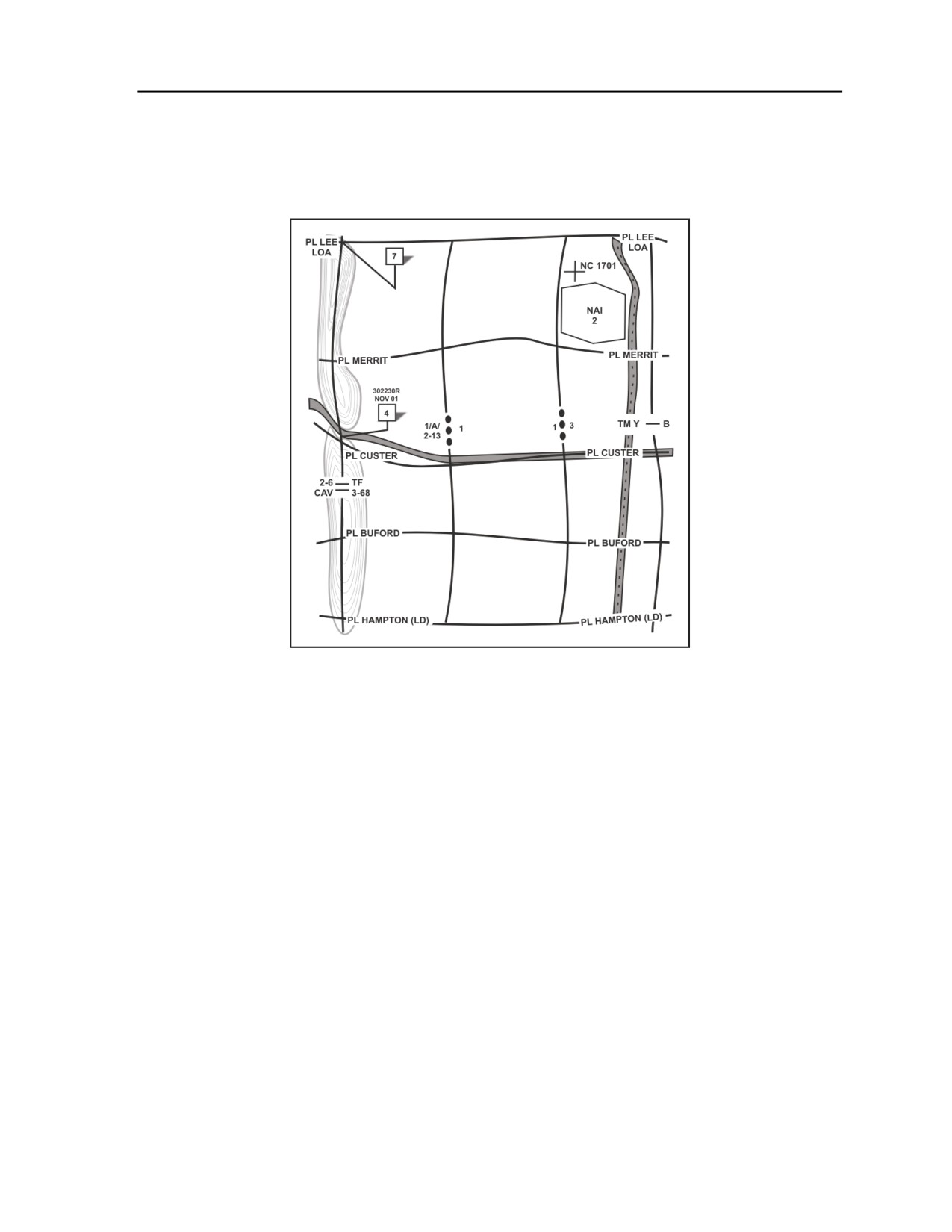
All control measures should be on recognizable terrain when possible. Figure 3-4 illustrates graphic control
measures for a zone reconnaissance.
Figure 3-4. Zone reconnaissance graphic coordinating measures
3-50. Zone reconnaissance is a deliberate, time-consuming process; therefore, it must be focused. The
reconnaissance force must accomplish certain critical tasks unless the BCT/RCT commander specifically
directs otherwise. These tasks serve as a guide to indicate the actions associated with the zone
reconnaissance, although they are not a set checklist and are not necessarily arranged sequentially. Not all
critical tasks will be appropriate in all situations. The tasks to be accomplished as part of a zone
reconnaissance are the following:
z
Threat. Find and report threat forces within the zone.
z
Society.
Determine the size, location, and composition of the populace within the zone, as well as
applicable social demographics (such as race, sex, age, religion, language, national origin,
tribe, clan, class, party affiliation, education, or any other significant social grouping).
Reconnoiter the society to determine local centers of gravity; the size, location, and
composition of identifiable groups; and the interests and actions of these groups.
Establish and maintain contact with local civilian and military leadership.
Identify allegiances of the local populace to factions, religious groups, or other
organizations.
z
Infrastructure (see chapter 6 for more detailed discussion of infrastructure reconnaissance).
Identify key municipal infrastructure that can affect military operations (utilities, sewage,
transportation [such as rail, bus, subway, or heliports and airfields], and communications).
Inspect and evaluate all bridges, overpasses, underpasses, and culverts within the zone.
25 March 2008
FM 3-34.170/MCWP 3-17.4
3-13
Chapter 3
z
Terrain.
Locate all obstacles; create and mark lanes as specified in the execution orders.
Locate and determine the extent of contaminated areas within the zone, including CBRN
and TIM.
Reconnoiter and determine the trafficability of all terrain within the zone, including urban
areas.
Locate bypasses around urban areas, obstacles, and contaminated areas.
Provide OBSTINTEL and recommendations for breaching if necessary.
Locate fords or crossing sites near all bridges within the zone.
Area Reconnaissance
3-51. An area reconnaissance is a directed effort to obtain detailed information concerning threat, terrain,
society, and infrastructure according to the commander’s reconnaissance focus within a location often
depicted as a reconnaissance objective. The objective in an area reconnaissance is substantially smaller
than the terrain reconnoitered in a zone reconnaissance. These objectives may be a small village or town;
facilities such as water treatment plants, weapon storage sites, or political headquarters; or other sites of
tactical importance (such as a suspected assembly area, a cache site, or an airport). The reconnaissance
squadron in the BCT can conduct decentralized reconnaissance in multiple areas simultaneously, either by
maneuvering elements through the areas or by establishing stationary observation posts (OPs) within
and/or external to them.
3-52. Forces conducting an area reconnaissance are organized according to the size, geography, physical
infrastructure, and social dynamics of the area to be reconnoitered as well as the time available for
conducting the reconnaissance. The forces may be required to reconnoiter one large area or several smaller
ones. In many cases, areas to be reconnoitered are given to platoon-sized teams. A company-sized team
may be committed to a larger area. Focused reconnaissance capabilities (engineer, CBRN, and others) may
augment one or more of the primary reconnaissance elements as required and available. Area
reconnaissance proceeds faster than zone reconnaissance because the effort is focused on a relatively
smaller, specific piece of terrain or threat force.
3-53. The “area” for an area reconnaissance is delineated with a single continuous line enclosing the area
to be reconnoitered and should be designated as an AO. If the AO is a large or complex urban area, it may
also be delineated by marking lateral boundaries, an LD, and an LOA (similar to a zone reconnaissance).
The graphic control measures for an area reconnaissance should always include the routes to and within the
AO. See figure 3-5.
3-14
FM 3-34.170/MCWP 3-17.4
25 March 2008
Engineer Support to Intelligence, Surveillance,
and Reconnaissance Operations
Figure 3-5. Area reconnaissance graphic control measures
3-54. The tasks accomplished as part of an area reconnaissance are the same as those for a zone
reconnaissance—only the scale of the reconnaissance is different.
Route Reconnaissance
3-55. Route reconnaissance is the directed effort to obtain information (usually focused on threat and/or
terrain) according to the commander’s reconnaissance focus along a specified route and on all adjacent
terrain (including lateral routes) from which movement along the route could be negatively influenced. The
route is a prescribed course from a point of origin (start point [SP]) to a specific destination (release point
[RP]); it could be a road or an axis of advance. Route reconnaissance is conducted to determine whether
the route is clear of obstacles and/or threat forces and how well or poorly it will support the planned
movement. Below the BCT/RCT level, route reconnaissance is often a task performed during zone or area
reconnaissance.
3-56. A route reconnaissance may be assigned as a separate mission or as a specified task for a unit
conducting a zone or area reconnaissance. Reconnaissance platoons can reconnoiter only one route at a
time; therefore, the number of reconnaissance platoons available directly influences the number of routes
that can be covered at one time. Integrating ground, air, and other technical assets assures a faster and more
detailed route reconnaissance.
3-57. Reconnaissance elements will reconnoiter the route out to threat direct-fire range, focusing on key
terrain that threat elements can use to influence the route. Determining trafficability of a route requires the
reconnaissance element to determine the capability or extent to which the terrain will bear traffic or permit
continued movement of a force. A thorough ground reconnaissance is required for developing detailed
information on the route. Modern roadway features are often difficult to evaluate quickly in the process of
route reconnaissance. Unless directed, the reconnaissance element does not conduct a deliberate engineer
route classification. In some cases, the reconnaissance element may be reinforced with engineers to
perform that mission; in others, the element may identify key features for follow-on engineers to classify or
25 March 2008
FM 3-34.170/MCWP 3-17.4
3-15
Chapter 3
obstacles for engineers to clear. If enemy contact is expected, fire support from the fires battalion should be
readily available. If CBRN or TIM contamination is expected, CBRN reconnaissance assets should
accompany the force conducting ground reconnaissance because they can detect and determine the extent
of contamination more quickly and accurately. When time is limited, air reconnaissance (manned and
unmanned) can be used to determine which areas are clear of enemy forces and obstacles and to cue
ground reconnaissance elements on where to focus their efforts.
3-58. Control measures for a route reconnaissance create an AO for the unit conducting the
reconnaissance. (See figure 3-6 for an illustration.) The commander places lateral boundaries—on both
sides of the route that are far enough out to allow reconnaissance of all terrain from which the threat could
dominate the route. An LD perpendicular to the route is placed short of the SP. This allows adequate space
for the unit conducting the reconnaissance to deploy into formation before reaching the SP. The LD creates
one of the boundaries of the AO. An LOA is placed far enough beyond the route’s RP to include any
terrain from which the threat could dominate the route. Normally, coordination points or contact points are
included to enable proper flank coordination. If air reconnaissance is employed, an air LOA is normally
established to provide greater depth and to take advantage of the aircrafts’ elevated observation platform
and long-range acquisition capability. The SP and RP define that section of the route on which the unit
collects detailed information. PLs and checkpoints are added to maintain coordinated reconnaissance, to
control movement, or to designate critical points. Additional fire distribution measures and FSCMs are
included to coordinate indirect and direct fires as necessary. All of these graphic control measures are
placed along or on recognizable terrain features and, if possible, are identifiable from both the ground and
the air to assist in air-ground coordination.
Figure 3-6. Route reconnaissance graphic control measures
3-59. Certain tasks are accomplished during route reconnaissance unless the commander specifically
directs otherwise. IPB and CCIR often indicate exclusive critical information required by the higher
commander that narrows the focus of the reconnaissance. The critical tasks are the following:
z
Reconnoiter and determine trafficability of the route.
z
Find and report any threat elements that can influence movement along the route.
z
Reconnoiter routes approaching and inside urban areas.
3-16
FM 3-34.170/MCWP 3-17.4
25 March 2008
Engineer Support to Intelligence, Surveillance,
and Reconnaissance Operations
z
Reconnoiter lateral routes.
z
Inspect and classify bridges along the route.
z
Inspect and classify overpasses, underpasses, and culverts.
z
Reconnoiter defiles along the route. Clear defiles of threat and obstacles within capability, or
locate a bypass.
z
Locate mines, obstacles, and barriers along the route. Within capabilities and according to the
commander’s intent, clear the route.
z
Locate bypasses around built-up areas, obstacles, and contaminated areas.
z
Update route information.
ENGINEER RECONNAISSANCE OPERATIONS
3-60. Within the combined arms reconnaissance operation, every unit has an implied mission to report
information about the terrain, civilian activities, and friendly and enemy dispositions. The commander
tasks reconnaissance elements to collect information that addresses his CCIR. When components of the
CCIR include technical information, supporting arms with the appropriate specialty will be tasked to
support the reconnaissance operation. As is also the case for CBRN, medical, EOD, and other supporting
arms, engineer reconnaissance will typically occur within the context of tactical reconnaissance operations
but include a focus on technical elements for which the supporting arms have been trained. As discussed in
chapter 1, engineer reconnaissance generated from and organized by the engineer functions provides a
range of technical as well as tactical reconnaissance capabilities. Specific considerations for engineer
reconnaissance support will vary not only based on METT-T[C] but also based on the degree of technical
expertise and effort required for the assigned mission and tasks.
3-61. Engineer reconnaissance operations support those operations undertaken to obtain, by visual
observation or other detection methods, information about the activities and resources of an enemy or
potential enemy, or to secure data concerning the meteorological, hydrographical, or geographical
characteristics and the indigenous population of a particular area. Engineer reconnaissance relies on the
human dynamic but focuses on collecting technical information. It fits within the broader context of
tactical reconnaissance operations but offers a range of capabilities based on the information required.
Specific considerations for each engineer reconnaissance mission will vary as well.
ENGINEER RECONNAISSANCE TEAM OPERATIONS
3-62. ERTs are employed generally at the tactical level and in support of the combat engineer function.
(ERT operations are discussed in detail in chapter 4 as tactical reconnaissance support.) The ERT will
usually employ the same techniques and forms for their reconnaissance mission as the supported
reconnaissance or maneuver element. The technical information collected by an ERT is an embedded part
of a tactical reconnaissance mission, and the ERT is most effective as an integral part of (attached or
OPCON to) a tactical reconnaissance element. Combat engineer units are more likely to provide the ERT,
especially when it is attached or OPCON to a supported reconnaissance element. Combat engineer units
organic to the BCTs/RCTs, as well as those typically augmenting the BCT/RCT, can more effectively
integrate their ERT operations and coordinate for their required support.
3-63. ERTs conduct the basic tactical reconnaissance mission with an added focus on collecting the
required technical information. The degree of technical focus required of the ERT will vary based on
METT-T[C] but will generally highlight critical aspects of the combat engineer function: M/CM/S. ERTs
will often conduct a zone, area, or route reconnaissance mission with added specified tasks to collect
information on suspected obstacles, a possible crossing site or gap, or other aspects of mobility,
countermobility, and/or survivability. While the ERT’s technical focus is typically on the specified
mobility, countermobility, and/or survivability mission, they have the capability to bring substantially
increased technical expertise as required. With EOCA trained members or when augmented by EOCAs, the
ERT can conduct limited UXO reconnaissance. The ERT can be augmented with general engineer
capability if required to focus more specifically on detailed technical information required. The ERT can
also use reach-back capability to apply substantial additional technical resources in support of IR.
25 March 2008
FM 3-34.170/MCWP 3-17.4
3-17
Chapter 3
3-64. General engineer units operate throughout the OE from the tactical level within BCTs/RCTs to the
operational level supporting theaterwide requirements. General engineers have a limited capability to
provide ERTs but are less effectively postured at the tactical level to integrate and coordinate the support
of an ERT within BCT/RCT reconnaissance operations. General engineer units are more likely to provide
expert augmentation to ERTs provided by combat engineers. A general engineer ERT may be employed to
conduct reconnaissance to collect specific information supporting tactical sustainment missions
(for
example, a bridge reconnaissance along an MSR or a road reconnaissance in preparation for MSR upgrade
missions). Although the ERT in this case is operating at the tactical level and within the BCT/RCT AO, the
reconnaissance task is conducted more in support of a general engineer mission than as an integrated part
of the BCT’s/RCT’s reconnaissance operations.
3-65. In every case, ERTs operating within the BCT/RCT AO must coordinate their activities and address
the terrain management considerations as discussed at the end of chapter 2. The ENCOORD on the
BCT/RCT staff is best postured to assist the engineer unit providing the ERT with the necessary
coordination. The ENCOORD is also postured to assist with coordinating operational level reconnaissance
missions—missions identified and/or assigned at echelons above the BCT/RCT—when those missions
must occur within the BCT/RCT AO.
ASSESSMENTS AND SURVEYS
3-66. Engineer assessments and surveys are typically conducted at the operational level and in support of
the general engineer function. (Assessments and surveys are discussed in detail in chapter 6 as technical
reconnaissance support.) The assessment or survey teams are generally not employed when direct contact
with the enemy is likely. Rather, engineer assessment or survey is typically conducted in a relatively secure
area and is focused on specific and detailed technical information required for a future-engineered, or at
least heavily engineered, mission. When operating within an assigned maneuver AO (BCT/RCT, division,
corps, JTF, and so forth) the assessment or survey team must fully coordinate its activity with the
maneuver unit. But, the engineer team’s mission may or may not be an integrated part of the maneuver
unit’s reconnaissance operation. While combat engineer units will in some situations conduct an
assessment (see figure 1-2 on page 1-6), general engineer units are more likely to provide the required
assessment or survey team. Additional specialized assistance may also be provided from assets not
typically organized into tactical units
(United States Army Corps of Engineers
[USACE], other
government agency [OGA], contractors, HN, and so forth).
3-67. An assessment is a judgment about something based on a technical understanding of the
situation. (See the complete definition in the glossary.) An assessment may follow the same format as a
survey, but in the case of the assessment, time and/or specific technical expertise are not adequate to call it
a survey. The assessment requires less time but provides less technical detail. Other, nonspecialized
reconnaissance elements may also do assessments, but surveys require specialized technical expertise.
3-68. A survey looks at or considers something closely, especially to form a technical opinion. (See the
complete definition in the glossary.) Examples include an environmental baseline survey (EBS) (see
FM 3-100.4), an infrastructure survey (see chapter 6), and the more technical components of route
classification.
3-69. Assessment and survey teams are specifically tailored to collect the detailed technical information
required. Horizontal construction specialists are employed if the mission includes information required for
road or airfield construction. Pipeline specialists are added if the mission will include petroleum
distribution requirements. Structural engineers and antiterrorism specialists are added if the mission will
include evaluations of buildings. The teams include the variety of specialties necessary for the supported
mission. Substantial additional technical capabilities are added as necessary from joint Service,
multiagency, contractor, HN, and reach-back elements. FFE is the broad range of activities linked through
the general engineer element on the ground to apply a high degree of technical expertise to the engineer
mission. (FFE is discussed in detail in chapter 6. Some of the reach-back resources available are discussed
in appendix H. See FM 3-34 for additional information.)
3-70. FM 5-170, superseded by this manual, used the term “engineer recon” (and DA Form 1711,
Engineer Reconnaissance Report,) to describe a general engineer reconnaissance to gather engineer
3-18
FM 3-34.170/MCWP 3-17.4
25 March 2008
Engineer Support to Intelligence, Surveillance,
and Reconnaissance Operations
information of a broad nature within the AO. It considers material, resources, and terrain features having
engineer applications. This manual changes the designation of this task to an engineer resource assessment
to avoid confusion with using engineer reconnaissance in a broader sense. The engineer resource
assessment remains a valid, relevant task and is included in the discussion in chapter 6.
3-71. The ENCOORD on the appropriate maneuver unit staff is best postured to assist the engineer unit
providing the assessment or survey team with the necessary coordination. The ENCOORD is also postured
to assist with coordination for any required sustainment or other support of the team. In the HBCT or the
IBCT, this organic support is likely to come from coordination with the BSTB.
SUSTAINMENT CONSIDERATIONS
3-72. An engineer unit providing an ERT capability will likely be able to provide only a limited amount of
logistical support, especially after the ERT crosses the LD. For this reason, it is essential that the supported
unit understands the ERT’s requirements and embraces the support of the element. The engineer unit must
coordinate closely with the brigade or battalion/TF for support that they cannot provide or that can be
provided more effectively by the maneuver units. Examples include casualty evacuation, vehicle recovery,
and maintenance support (including vehicle, communications, and weapon repair). Security considerations
may also require assistance from the supported unit.
3-73. The sustainment concepts and organizational structures in the modular BCT reflect a paradigm shift
from the supply-based sustaining system of the Army of Excellence to a technology-enhanced,
distribution-based sustaining system. A distribution-based logistics system combines information
capabilities with efficient delivery systems to form an efficient distribution pipeline. Direct throughput of
supplies from the division and BCT to the battalion or company team is the rule rather than the exception
with distribution-based logistics. For the BCT’s organic engineer companies, the burden of sustainment
operations is removed from the company commander and placed under the control of the combined arms or
BSTB. The engineer company commander concentrates on fighting his unit to accomplish the tactical
mission. The sustainment responsibility at company level is primarily to report status, supervise operator-
level maintenance, request support, and ensure that sustaining operations are properly executed in the
company’s area.
3-74. For engineer units augmenting the BCT/RCT, staff coordination must be made at the appropriate
battalion or brigade level so that the supporting unit’s requirements are included in sustainment planning.
Within the BCT/RCT, the maneuver and BSTB commanders ensure that support is provided not only for
organic and attached elements but for any supporting units as well. The attached unit leader must
coordinate with the battalion personnel staff officer (S-1) and furnish the S-1 with a copy of his unit battle
roster as well as provide the battalion S-4 with the status of all key elements of equipment. The battalion S
4 coordinates support for the attachments and verifies who is to provide this sustainment and how support
for attachments is to be requested. When a large unit attachment joins the BCT/RCT, the attachment should
bring an appropriate slice of support assets from its parent unit. These sustainment assets are controlled by
the BSB commander like the rest of the BCT/RCT sustainment elements.
3-75. Sustainment planning at the battalion level is the primary responsibility of the battalion S-4. In
coordination with all company XOs and first sergeants, the process is integrated into operations planning
with the concept of logistics support synchronized with operations. The unit SOP should be the basis for
battalion level sustainment operations with planning to determine specific requirements and contingency
preparation. The battalion and company orders should address only specific support matters for the
operation and any deviations from the SOP.
25 March 2008
FM 3-34.170/MCWP 3-17.4
3-19
Chapter 3
EFFECTIVE SUSTAINMENT PLANNING
3-76. To provide effective support, sustainment planners and operators must understand the mission
statement, commander’s intent, and concept of the operation. The S-4 produces the service support
paragraph and annexes of the OPORD, which include the following:
z
Commander’s priorities.
z
Class III/Class V resupply during the mission (if necessary).
z
Movement criteria.
z
Type and quantities of support required.
z
Priority of support, by type and unit.
z
Sustainment overlay.
z
Supply routes.
z
Casualty evacuation (CASEVAC) points.
z
Maintenance collection points.
SUPPORTING OPERATIONS
3-77. There are certain general considerations that guide planning and preparation of supporting
operations. The following considerations are key to successful sustainment operations planning.
Reports
3-78. BCT/RCT SOPs establish report formats, reporting times, and voice brevity codes to keep logistics
nets manageable. Digital communications provide sustainment functionality by providing accurate logistics
situation and personnel situation reports, logistical call for support and logistics task order messaging, and
task management capabilities. This functionality affects the synchronization of all logistics support in the
AO between the supported and the supporter.
Logistics Package Resupply
3-79. The most efficient resupply of dispersed units is accomplished by logistics packages (LOGPACs).
The support platoon at each forward support company organizes LOGPACs based on the S-4’s guidance.
LOGPACs are normally organized once a day for routine resupply. A habitual LOGPAC organization
facilitates operations and allows direct coordination by the supply sergeant as necessary. LOGPACs
normally consist of the following:
z
A supply truck controlled by the food service sergeant. The supply truck contains the Class I
rations for the unit (normally for the next 24-hour period) and the unit water trailer. The truck
also brings requested Class II, V, and IX supplies.
z
A petroleum, oil, and lubricants (POL) truck brings bulk fuel while packaged POL products are
transported on cargo trucks.
z
Additional trucks as necessary to carry supplies or replacement Soldiers and Marines.
z
Escort vehicles.
Sustainment for Attachments
3-80. When a company, team, or detachment is attached to the maneuver battalion or special battalion, the
S-4 should ensure the adequacy of medical, maintenance/recovery, and Classes III, V, and IX supply
support. Basic support information sustainment planners should be obtained from the sending unit’s S-4
when the receiving attachments includes—
z
Number and type of vehicles, personnel by specialty, and weapon systems.
z
Current status/strength.
z
When the attachment is effective and for how long.
z
What support assets are coming with the attachment.
z
When and where the linkup will occur, and who is responsible for the linkup.
3-20
FM 3-34.170/MCWP 3-17.4
25 March 2008
Chapter 4
Tactical Reconnaissance Support
Tactics are the cutting edge of strategy, the edge which chisels out the plan into action;
consequently, the sharper this edge, the clearer cut will be the result.
Major General J.F. C. Fuller
Engineers are active participants in tactical reconnaissance operations: collecting
information about the terrain, enemy engineer activity, obstacles, and weather effects
within an AO. The ERT is the baseline engineer reconnaissance element for tactical
reconnaissance support, and their operations share many of the characteristics that
define the tactical reconnaissance operation. Tactical reconnaissance support is
normally guided by the same objective, receives the same commander’s guidance,
and is conducted at the same tempo as the overall reconnaissance operation. ERT
operations take the basic form of a route, area, or zone reconnaissance and use
techniques compatible with the supported force. ERTs conduct zone, area, and route
reconnaissance with a reconnaissance focus linked directly to answering the CCIR
but with a specified additional focus on the required technical information. ERT
operations share the characteristics of tactical reconnaissance while employing some
of the same capabilities from the technical range of support as discussed in chapters 5
and 6. The majority of tactical engineer reconnaissance support enables the collection
of information in support of M/CM/S operations and is conducted primarily by ERTs
composed of combat engineers. General engineer capabilities—either teamed with
ERTs or in stand-alone organizations—conduct reconnaissance that enables engineer
support to tactical sustainment, but these operations typically resemble the technical
range of support described in chapters 5 and 6 more than tactical reconnaissance.
This chapter focuses on a discussion of reconnaissance support of the five functions
of mobility operations, support of obstacle integration and turnover in
countermobility operations, support to fighting and other protective positions, and
support to other tactical operations performed by the BCT/RCT.
SUPPORT TO MOBILITY OPERATIONS
4-1. The ART, Conduct Mobility Operations, is defined in FM 7-15 as “Maintain freedom of movement
for personnel and equipment within an AO without delays due to terrain or barriers, obstacles and mines.”
The following five functional areas of mobility operations (see FM 3-34.2) are intended to meet the
challenges of mobility and maintain freedom of tactical maneuver and operational movement:
z
Conduct Combined Arms Breaching Operations: detect, neutralize (by combined arms breach or
bypass), mark, and proof mined areas and obstacles. Countermine and counterobstacle activities
are typically performed in a close combat environment.
z
Conduct Clearing Operations: employ tactics and equipment to detect and eliminate obstacles,
mines, and other EHs. While this is not always part of a combined arms breaching operation and
is typically not performed in a close combat environment, it will still generally include the task
of breach.
z
Conduct Gap Crossing Operations: fill gaps in the terrain to allow personnel and equipment to
pass.
25 March 2008
FM 3-34.170/MCWP 3-17.4
4-1
Chapter 4
z
Construct/Maintain Combat Roads and Trails: expediently prepare or repair routes of travel for
personnel and equipment. This includes temporary bypasses of damaged roads and bridges.
z
Perform Forward Aviation Combat Engineering (FACE): Construct/maintain forward airfields
and landing zones (LZs), forward arming and refueling points (FARPs), landing strips, or other
aviation support sites in the forward combat area.
4-2. The primary focus of the ERT collecting technical information in support of the functional areas of
mobility operations is obstacles. The task is to conduct route, zone, or area reconnaissance to determine
terrain trafficability and the location and boundaries of barriers, obstacles, and minefields. An obstacle is
any obstruction designed or employed to disrupt, fix, turn, or block the movement of an enemy force. They
are also employed to impose additional losses in personnel, time, and equipment on the enemy. Obstacles
can exist naturally or be manmade or can be a combination of both. The effectiveness of obstacles is
enhanced considerably when covered by observation and fire. Obstacles include abatis, antitank ditches,
blown bridges, built-up areas, minefields, rivers, road craters, terrain, and wire. As mentioned above, mines
are employed in combination with other obstacles to create complex obstacles.
OBSTACLE RECONNAISSANCE
4-3. In any operation where enemy obstacles can interfere with friendly maneuver, OBSTINTEL is one
of the IR and should become PIR. Finding enemy obstacles or seeing enemy obstacle activity validates and
refines the S-2's picture of the AO/OE. OBSTINTEL helps the S-2 determine the enemy’s intentions,
plans, and defense strength. The force engineer is the unit’s expert on enemy countermobility capabilities
and assists the S-2 in templating enemy obstacles, analyzing OBSTINTEL, and analyzing the effects of
terrain. The S-3, S-2, and engineer establish effective OBSTINTEL collection by determining specific
obstacle IR. Obtaining OBSTINTEL requires dedicated collection assets. Reconnaissance assets are tasked
to collect specific information that is needed to fulfill obstacle IR.
4-4. Obstacle reconnaissance is one of the high frequency tasks conducted by ERTs. The task is to
conduct reconnaissance of obstacles focused on answering obstacle intelligence IR—obstacle location,
length, width, and depth; obstacle composition (wire, mines by type, and so forth.); soil conditions;
locations of lanes and bypasses; and the location of enemy direct-fire systems. An ERT moves with scouts
or a patrol and conducts dismounted reconnaissance of templated or confirmed obstacles. The purpose of
the reconnaissance is not only to locate the obstacle but also to determine how best to overcome the effects
of the obstacle—reduction or bypass. The following tasks may be associated with the reconnaissance:
z
Locating and marking a bypass.
Note. If the obstacle is to be bypassed, the ERT can be employed to provide guides as well as
mark the bypass.
z
Locating and marking the best location to reduce.
z
Estimating the reduction assets necessary to reduce the obstacle.
4-5. Although an ERT may have limited capability to clear or reduce small obstacles that are not covered
by fire or observation, ERTs engaged in a reconnaissance mission for OBSTINTEL should rarely be used
to reduce obstacles during the reconnaissance mission. Inadvertent detonation during reduction may
compromise engineers and scouts, defeating the reconnaissance mission. It may also compromise the entire
attack. If a decision is made to breach an obstacle, the ERT can typically provide guides to the breach
forces for subsequent breaching operations.
4-6. The ERT approaches a known or suspected obstacle location with caution. Security is established,
with support from the tactical reconnaissance element if possible, and selected engineers move dismounted
to the obstacle. Trip wires and other wires may indicate that the enemy is using booby traps or command-
detonated mines to prevent friendly forces from collecting information on the obstacle. The ERT prepares
an obstacle report with the relevant information. Examples of OBSTINTEL collected through obstacle
reconnaissance include—
z
The location of existing and reinforcing obstacles.
4-2
FM 3-34.170/MCWP 3-17.4
25 March 2008
Tactical Reconnaissance Support
z
The orientation and depth of obstacles.
z
Conditions of the soil (in the case of a minefield) to determine the ability to use tank plows.
z
The presence, location, and type of wire.
z
Lanes and bypasses.
z
The composition of the minefield (buried or surface-laid AT and antipersonnel (AP) mines,
antihandling devices [AHDs], and the depth of the mines).
z
Types of mines and fuses; composition of the minefield.
z
The location of enemy indirect-fire systems that can fire into the breach area.
z
The composition of complex obstacles.
z
Areas between successive obstacle belts.
4-7. The ERT forwards an obstacle report to both the supported unit tactical operations center (TOC) and
its parent unit whenever possible. In the digital environment, information required remains the same;
however, the means by which the ERT collects data and retransmits it back to the maneuver TOC has
changed. Information obtained about the terrain, terrain features, and obstacles can now be digitally
transmitted to the maneuver TOC to facilitate BCT/RCT force mobility. Information collected can be
digitally transmitted in near real or real time via the digital reconnaissance system (DRS). The ERT
employs DRS to record and report breached lanes, route critical points, bypasses, logistics resources, and
the locations of wounded personnel or damaged equipment.
4-8. After collecting the information, the scout platoon or ERT leader analyzes the situation and the
METT-T[C] factors to select a COA. Once the scouts and ERTs have determined the best COA for a
situation, they execute it or recommend it to higher headquarters for approval. Generally, the
reconnaissance team executes a particular COA without specific approval if it is addressed in the OPORD
received from higher headquarters or if it is in the unit SOP. If the situation discovered is not covered by
previous guidance, the reconnaissance team determines the best COA and recommends it to the
commander before execution. The four COAs are—
z
Use a bypass.
z
Reduce the obstacle.
z
Support a breaching operation.
z
Continue the mission.
4-9. Using a bypass is the preferred method when it offers a quick, easy, and tactically sound means of
avoiding the obstacle. A good bypass must allow an entire force to avoid the primary obstacle without
risking further exposure to enemy fire and without diverting the force from its objective. Bypassing
conserves reduction assets and maintains the momentum. If a reconnaissance team locates a bypass and the
commander approves its use, scouts and engineers must mark it according to the supported unit tactical
SOP and report it to their commander. At a minimum, this report should include the grid location to the far
recognition marker and information on how the obstacle is marked, even if it is just to confirm that the
bypass is marked according to the SOP. If the reconnaissance team is tasked to mark a bypass, the team
must emplace markers so that they are not visible to the enemy. Engineers and scouts may be required to
provide guides for the main body, especially if the bypass is difficult to locate or if visibility conditions are
poor.
4-10. Bypassing is not always possible, and breaching may be the best or only solution, as in the following
situations:
z
The obstacle is integrated into a prepared defensive position, and the only available bypass
moves friendly forces into the fire sack or an ambush.
z
The reconnaissance mission specifically tasks the reconnaissance team to clear the original route
for follow-on forces.
z
The best available bypass route does not allow follow-on forces to maintain their desired rate of
movement, or it diverts the force from the objective.
z
Improvements to the bypass may require more time and assets than breaching the primary
obstacles.
25 March 2008
FM 3-34.170/MCWP 3-17.4
4-3
Chapter 4
4-11. Reducing an obstacle significantly degrades the ability to maintain the momentum of the
reconnaissance or follow-on forces. Obstacles that the scout and engineer are able to reduce include small
minefields, simple wire obstacles, small roadblocks, and similar obstacles. The supported commander
should make the decision to have the reconnaissance team reduce an obstacle while considering the risk to
the reconnaissance team and the potential for prematurely identifying the route. Obstacle reduction should
not be attempted if the obstacle is part of an integrated defensive position.
4-12. When a large obstacle is located and cannot be bypassed easily, the alternative is to support a
breaching operation. Scouts and engineers perform additional reconnaissance tasks in support of the
breaching operation. These tasks include determining the assets and time needed to reduce the obstacle and
determining the best location for the reduction site. Scout and engineer reconnaissance efforts focus on the
following:
z
Trafficable routes to the reduction site and routes from the far side leading to the objective.
z
Proposed locations for positioning the support force.
z
Dispersed, covered, and concealed areas near the reduction site.
z
The best location for the reduction effort at the obstacle. It is imperative that the reduction plan
be sent to the reconnaissance teams once the scheme of maneuver is finalized. Information (such
as the number of lanes required and the distance between lanes) is needed for the reconnaissance
forces to conduct the necessary reconnaissance.
z
Positions on both sides of the obstacle that could provide enemy observation of the reduction
site.
z
Trafficability and soil conditions near the reduction site. This is especially important for
minefield reduction because mine-clearing blades will not work properly in all soil conditions.
z
Soil type (loamy, rocky, sandy, and so forth).
z
The width, depth, and bottom conditions of wet and dry gaps and fords.
z
The bank height and slope and the soil stability of wet and dry gaps.
z
The water velocity and the direction of flow of wet gaps and fords.
z
The wind direction for using smoke to obscure enemy vision.
z
The location of the forward edge of the minefield to support mine-clearing line charge use.
4-13. The ERT must provide timely, valuable information when large obstacles are encountered during a
mission. The information is used by all elements of the breaching operation to finalize the suppression,
obscuration, security, reduction, and assault plans for the breaching operation.
CLEARING OPERATIONS
4-14. Clearing operations are designed to clear or neutralize all explosive hazards and other obstacles from
a route or area. As with most mobility operations, clearing operations are often conducted by a combined
arms force built around an engineer-based clearing force. Clearing operations include route clearance and
area clearance. The reconnaissance focus in clearing operations is again on OBSTINTEL—but in support
of clearing operations. The OBSTINTEL must be comprehensive and detailed to enable the neutralization
of all obstacles along the route or in the area. The task is to conduct detailed reconnaissance of obstacles
focused on answering obstacle intelligence IR—obstacle location, length, width, and depth; obstacle
composition (wire, mines by type, and so forth); and soil conditions. The location of lanes and bypasses as
well as information on enemy positions is also collected, but the focus is on detailed OBSTINTEL.
Route Clearance
4-15. Maneuver units or scouts (augmented by engineers) conduct a route reconnaissance to gain detailed
information about a specific route and the terrain on both sides of the route that the enemy could use to
influence movement. When the commander wants to perform reconnaissance of a specific route, a
maneuver unit or scout platoon with an ERT conducts a route reconnaissance to gain information on
obstacles obstructing trafficability of the route. This information provides the basis for the planning
process of the clearance mission. Since the clearing operation is designed to ensure that the route is clear of
4-4
FM 3-34.170/MCWP 3-17.4
25 March 2008
Tactical Reconnaissance Support
obstacles and enemy forces and will support vehicle movement, detailed OBSTINTEL is required for every
obstacle along the route. (See FMI 3-34.119/MCIP 3-17.01 and FM 3-34.210 for specifics about the
considerations of IEDs in route clearance.)
4-16. Chapter 3 included a discussion of route reconnaissance as a form of tactical reconnaissance. A route
reconnaissance element must accomplish a specified number of tasks unless directed to do otherwise. In
the route reconnaissance specifically in support of a route clearance, the focus narrows to those obstacles
and enemy forces obstructing trafficability along the route. The situation may require varying the
reconnaissance tempo and engagement criteria, but the reconnaissance focus in support of route clearance
must remain the detailed information required for the complete neutralization of all explosive hazards and
other obstacles from the route.
4-17. Based on the time available and the commander’s intent, the reconnaissance element may be directed
to conduct clearance of some identified obstacles. The reconnaissance element may be organized as part of
the clearance element or be directed to assist in planning the follow-on clearance mission. The
reconnaissance leader must clearly understand the engagement criteria and focus on the OBSTINTEL
required for the clearance mission. A route reconnaissance supporting a follow-on clearance mission
focuses on—
z
Locating obstacles along the route. In some situations, reconnaissance units may be required to
clear routes, or portions or a route, of obstacles. Although using digital cameras during route
reconnaissance is becoming more popular, the reconnaissance element must still capture all of
the critical OBSTINTEL for obstacles along the route and not rely solely on the images relayed
via the digital camera.
z
Reconnoitering to the limit of the direct-fire range and terrain that dominate the route.
z
Reconnoitering all built-up areas along the route (identify bypass routes, construction supplies
and equipment, ambush sites, evidence of booby traps, and suitable sites for C2 and sustainment
facilities).
z
Locating bypasses around built-up areas, obstacles, and contaminated areas.
z
Reporting route information (see reports discussed in appendix B).
z
Finding and reporting all enemy forces that can influence movement along the route.
Area Clearance
4-18. Area clearance is the detection and if found, the identification, marking, neutralization, destruction,
or removal of mines or other explosive ordnance, IEDs, and booby traps in a defined area to allow a
military operation to continue with reduced risk. It is a combined arms operation. Clearing land mine
hazards is primarily the responsibility of combat engineer units; the clearing of all other EHs is primarily
the responsibility of EOD units within the Army or from EOD elements in other supporting Services.
4-19. ERTs conduct area reconnaissance to support the information gathering phase of an area clearance
mission. The area reconnaissance enables detailed planning for the area clearance and provides the initial
information needed to enable the technical survey described in FM
3-34.210. As with a route
reconnaissance in support of clearance operations, the focus of the area reconnaissance narrows to those
obstacles and enemy forces obstructing freedom of movement in the targeted area. The situation may
require varying the reconnaissance tempo and engagement criteria, but the reconnaissance focus in support
of area clearance must remain the detailed information required for the complete neutralization of all
explosive hazards and other obstacles from the area.
4-20. Area reconnaissance provides the initial information needed to enable area clearance operations. The
gathering of detailed technical and topographical information of known or suspected hazardous areas is
conducted through a technical survey. (A technical survey is similar to intelligence preparation of the
battlefield.) The primary aim of a technical survey is to collect sufficient information to enable the
clearance requirement to be more accurately defined. The results of the survey drive the entire area
clearance process from planning, task organization, and equipment and resource allocation to completion.
Planners use all available intelligence assets to gather historical and existing EH information. Assets
include—
25 March 2008
FM 3-34.170/MCWP 3-17.4
4-5
Chapter 4
z
Coalition, joint, and Service fire support and air planners can provide information on possible
friendly UXO locations and types.
z
Human intelligence (HUMINT), minefield records from former warring factions, coalition
intelligence, and nongovernmental agencies are all potential assets.
z
Aerial reconnaissance must be used to analyze and determine the EH threat during the technical
survey.
4-21. An on-site briefing by the technical survey team to the clearing team is the capstone of the technical
survey. This ensures that the clearing team fully understands the templated and verified threat assessment
with specific locations of threats. The technical survey is the first phase of area clearance and consists of
three tasks:
z
Information gathering.
z
Reconnaissance.
z
EHs survey.
4-22. Consider the following in gathering information:
z
Coordinate hazard areas. Use a map or imagery to draw the hazard area for the operation.
Identify units, security forces, observation towers, and roads. Identify those personnel or
indigenous peoples who will need to be evacuated or controlled during the operation. The base
operations center shift change is the best place to coordinate operations and resolve issues.
Conduct coordination meetings to ensure success. Announce the operation during all concerned
or appropriate daily update briefings.
z
Employ HUMINT. Local commanders have some value in showing their own and enemy
positions. This will help you see the no-man’s-land in between and enable you to template
obstacle reinforcement of the terrain. Local commanders can also tell you generally what types
of EHs are in the area and where they are located.
z
Integrate CA. CA personnel can help in understanding the impacts of clearing operations to
local civilians. They are trained to gain and maintain contact with the locals to avoid
confrontations, gain explosive hazard (mine/UXO) HUMINT, get local force’s security help,
and resolve any land rights issues in a timely fashion.
z
Confirm recent incident/accident reports.
z
Brief survey team prior to deploying to site.
4-23. Consider the following in conducting the reconnaissance:
z
Terrain. If the terrain is rough or full of battle positions and debris instead of flat, this adds
difficulty.
z
Equipment or resources available.
Detection. Soldiers and Marines with hand-held detectors, sniffers, probes, trip-wire
feelers, and mine detection dog teams.
Clearance. Flails, rollers, and mine-protected clearance vehicles.
Marking. The design of EH marking systems should take account of materials available and
the period for which the marking system will be in place. The amount of materials needed
change from the technical survey phase through the clearing phase.
z
Weather. The effects of adverse weather on enemy and friendly systems must be factored into
the plan.
z
Using aerial reconnaissance. This is the next best source to imagery. It allows the commander
and his key leaders to see the ground and to take high-resolution photographs for future
magnification and printing. As many of the area clearance leaders as possible should take part in
the aerial reconnaissance.
z
Using visual reconnaissance. Key leaders should conduct a reconnaissance on the ground. Using
the top of a mine-protected vehicle to stand on or a security observation tower, they should
spend time viewing through binoculars. Coordinate and ensure EOD personnel are present.
Their knowledge of UXOs will greatly assist in planning, clearing, and proofing the area.
4-6
FM 3-34.170/MCWP 3-17.4
25 March 2008
Tactical Reconnaissance Support
z
Using imagery. Use both recent and older imagery to support change detection methods and
know what the colors or shading levels mean. Recent imagery is the single most useful tool to
describe the threats. Be cautious when printing the area of operations, and overlay the threats in
as much detail as possible because possible threats may be over templated. This may cause the
recognition and assessment to be unnecessarily cautious or over resourced.
z
Observing local nationals. Local nationals typically use trails and paths in the area. Observe
and/or talk to those in the area that use these trails and paths on a daily basis. Show these trails
on the technical survey. These are low risk start paths for the recognition phase to begin its
cross-hatching network.
4-24. Consider the following when conducting the EH survey (see FM 3-34.210 for a more detailed
discussion on completing DA Form 7602 (EH Survey Report Form):
z
Confirmation of the presence of EH.
z
Confirmation of any data that has been initially collected.
z
Assessment of the ground in terms of the soil, metal contamination, vegetation, and slope.
z
A definition of the area in terms of its size, described through measurements and azimuths.
z
The required depth per area to which clearance will be conducted (may require adjustment from
the depth specified in the tasking order).
z
The resources required to carry out clearance activities in the identified area and the estimated
time for manual teams, mechanically assisted teams, mine detection dog teams, and EOD teams,
as appropriate.
z
Boundary lane around the hazard area.
z
Location of known safe areas and known or suspected hazard areas adjoining the area to be
cleared.
z
Survey marking. Use and record physical survey markers and indicators to assist subsequent
area clearing operations.
Reference point. A reference point, or landmark, is a fixed point of reference some distance
outside the hazardous area. It should be an easily recognizable and permanent feature (such
as a crossroads or the abutment of a bridge) which can be used to assist in navigating to one
or more benchmarks. The coordinates of a reference point should be surveyed by global
positioning system (GPS).
Benchmark. A benchmark is a fixed point of reference that is used to locate a marked and
recorded EH area. It should normally be located a short distance outside the suspected
hazardous area. A benchmark may not be necessary if the reference point is sufficiently
close to the perimeter of the hazardous area. The coordinates of a reference point should be
surveyed by GPS.
Start point. An SP can be the same point as the benchmark or the first turning point.
Turn point (TP). A TP is a fixed point on the ground which indicates a change in direction
of the perimeter of the hazardous area. It must be clearly marked and recorded. TP survey
markers will be made of permanent or semipermanent material and will be buried or driven
into the ground. Buried metal objects may be used to reinforce the marking of all TPs for
permanent future reference.
Intermediate point
(IP). The distance between survey markers on the perimeter of a
hazardous area must not exceed 50 meters. IP survey markers will be used between TPs
that are more than 50 meters apart. IP survey markers will be made of permanent or
semipermanent material and will be buried or driven into the ground. Buried metal objects
will be used to reinforce the marking of all IPs for permanent future reference.
Detailed site sketch. In addition to the information mentioned above, a detailed site sketch
(drawn to scale) is prepared and provided to the unit that will eventually carry out the
clearance task. This process must be completed to ensure gaining units fully understand the
area and the EH threat. The technical survey should describe the threats, likeliness of each
threat, imagery showing the locations of the threats, and where any change in threat occurs.
25 March 2008
FM 3-34.170/MCWP 3-17.4
4-7
Chapter 4
Marking the perimeter. Mark the perimeter of the area to be cleared with red and white
markers spaced no more than five meters apart. The red markers represent the hazard side
and the white markers represent the safe side. The marking is done to provide a clear
warning of danger to personnel and, where possible, to install a physical barrier to reduce
the risk of unintentional entry into hazardous areas.
Marking left and right edges. For boundary and safe lanes, left and right edges of the lanes
should also be marked with red and white markers. The red markers are spaced five meters
apart on the inside edge of the cleared lanes. White markers should be placed two to three
inches inside the red markers on both sides of the cleared lane. Looking down a cleared
lane, troops will see two rows of red markers on the outer edge of the lane and two rows of
white markers inside the rows of red markers.
Note. If clearance does not immediately follow a technical survey, then survey markers should
be left securely in place. Such markers will enable the hazardous area to be located accurately
and safely at a later date.
GAP CROSSING
4-25. Military traffic engaged in rapid decisive maneuvers must be able to cross wet or dry gaps in existing
road networks or natural high-speed avenues of approach. Very few LOCs will exist without some form of
bridge, bypass, or detour. Maneuver forces and logistical support depend on three types of bridging:
tactical, support, and LOC (and existing or permanent bridges). Tactical operations of combined arms
forces within the BCT/RCT are primarily focused on the first two of these forms of bridging or the seizure
of existing or permanent bridges. Tactical bridging is typically linked to combat engineers and immediate
support of combined arms ground maneuver. (See FM 90-13 for a more in-depth discussion of bridging as
a component of combined arms gap crossing operations.)
4-26. Engineers support gap crossing through construction, repair, and reinforcement of bridges; by
providing bridge reconnaissance and classification; and in the construction of bypasses and detours. The
specific mission undertaken is planned in a manner that maintains the momentum of the force. Bypasses
and fording sites can be used to overcome obstacles when it is more feasible or when bridges are not
available. Existing bridges may need to be repaired or reinforced to keep MSRs and LOCs open. As the
tactical situation changes, MSRs are moved or adjusted to support the force. Forward elements may
demand that expedient, standard, and nonstandard structures be emplaced to replace tactical bridging and
support bridging and those assets returned for their use by the combat maneuver elements of the force.
These types of bridges are also not designed for the multiple passes that are typical for MSRs and will need
to ultimately be replaced by other bridging. Requirements for engineer units to employ tactical, support,
and LOC bridging continue throughout the fight.
4-27. Engineers use products and support from geospatial engineering to greatly improve SU (to include
terrain) and select optimal bridging sites. High-resolution satellite imagery or UAS video are precise
pictures of terrain. The requirement for the engineer is to have the appropriate software. Engineer terrain
teams assist in determining conditions in areas at or around potential gap crossing sites. Terrain teams have
software that can assist in mission planning by determining soil conditions, hydrology, vegetation types,
general weather patterns, and other useful aspects of the terrain.
4-28. ERTs conduct route or area reconnaissance with a focus on existing structures to gather information
on trafficability of existing bridges. Chapter 6 provides a discussion on technical assessment of bridges.
ERTs inspect the bridge to determine its load-carrying capacity (classification) and its structural integrity
(see appendix F for classification instructions). The ERT determines whether the situation warrants
emplacing a tactical, support, or LOC bridge. When a damaged bridge is to be replaced, reconnaissance
information includes a report on the serviceability of the in-place structural members and other local
materials that might be reused in other construction (see appendix B for reporting instructions). Maximum
use should be made of existing bridge sites to take advantage of the existing roads, abutments, piers, and
spans that are serviceable.
4-8
FM 3-34.170/MCWP 3-17.4
25 March 2008
Tactical Reconnaissance Support
4-29. Bridge reconnaissance is classified as either hasty or deliberate, depending on the amount of detail
required, time available, and security in the AO. ERTs typically conduct the hasty reconnaissance while
augmented ERTs, assessment, or survey teams are tasked to conduct the deliberate reconnaissance. A
deliberate reconnaissance is usually conducted in support of MSR and LOC bridging operations since
greater traffic requirements dictate that time and qualified personnel be made available to support the task.
An engineer light dive team can assist with the deliberate reconnaissance by providing near shore and far
shore crossing site data. Additionally, they can mark and prepare landing sites, riverbanks, and exit routes
for the crossing force. A deliberate reconnaissance includes a thorough structural analysis; a report on
approaches to the bridge site; a report on the nature of the crossing site, abutments, intermediate supports;
and bridge structure; repair and demolition information; and the possibility of alternate crossing sites.
4-30. When existing structures are not present or adequate to the crossing requirement, ERTs conduct area
reconnaissance to collect data to determine acceptable terrain and conditions for new construction. ERTs
use the assessment tools and procedures discussed in chapter 6 to provide the required technical focus for
other gap crossing sites. Using the results of reconnaissance, planners can determine which type of bridge
or bridge combinations are right for the mission based on available resources. The location ultimately
chosen for the bridge is determined by numerous factors which are reflected in its structural design.
Primary screening considerations include—
z
Access and approach roads. Determine if the preexisting roads are adequate. The time to
construct approaches can be a controlling factor in determining if a crossing site is feasible.
Approaches should be straight, with two lanes, and less than a 6-percent slope.
z
Width. Determine the width of the gap to be spanned at both normal and flood stage for wet
gaps.
z
Banks. Estimate the character and shape of the banks accurately enough to establish abutment
positions. The banks should be firm and level to limit the need for extensive grading. Select
straight reaches to avoid scour.
z
Flow characteristics. Determine the stream velocity and erosion data, taking into consideration
the rise and fall of the water. A good site has steady current that runs parallel to the bank at less
than 3 feet per second.
z
Stream bottom. Record the characteristics of the bottom. This will help in determining the type
of supports and footings required. An actual soil sample is useful in the planning process,
particularly in wide gaps that may require an intermediate pier.
z
Elevation. Determine and record accurate cross-section dimensions of the site for determining
the bridge’s height. Planners must also know of any existing structures that the bridge must
cross over.
z
Materials. Determine the accessibility of material for improving bank conditions such as rock,
gravel, or other expedient construction materials.
COMBAT ROADS AND TRAILS
4-31. The maneuver commander may require that a new or upgraded route be constructed to facilitate the
mobility of his forces and support a scheme of maneuver or movement within an AO. An entirely new
section of road may need to be constructed, for example, to bypass a known obstacle (natural or manmade).
This may include the bypass of a densely populated location. The maneuver commander may also order an
unusable road upgraded or a trail created to permit the passage of his forces. This combat construction
could be a stand-alone mission to open or reopen a necessary route, or it may be part of a larger mobility
operation; for example, a river crossing operation that may require access and egress roads. Construction
and maintenance of combat roads and trails is a tactical task to enhance maneuver but is not the road
construction mission performed by horizontal construction units within the general engineering function.
Combat roads and trails include a requirement for a combination of route and area reconnaissance to gather
the required technical information.
4-32. Thorough reconnaissance is essential in the selection of combat roads or trails. It normally starts with
a study of available maps and aerial photos. Aerial reconnaissance provides much valuable information.
25 March 2008
FM 3-34.170/MCWP 3-17.4
4-9
Chapter 4
Detailed information, however, is obtained only by ground reconnaissance. The types of reconnaissance
and their applicability to combat roads and trails include—
z
Route reconnaissance. A route reconnaissance (chapter 3) is one of the three forms of tactical
reconnaissance. It should not be confused with a route classification which can be included as
part of the route reconnaissance (below and in chapter 5) or a road reconnaissance which is a
technical component of the route classification.
z
Route classification. A route classification is assigned to a route using factors of minimum
width and worst route type; least bridge, raft, or culvert military load classification; and
obstructions to traffic flow. Reconnaissance collects information about roads, bridges, tunnels,
fords, waterways, and other natural terrain features that may affect the desired traffic flow.
Information obtained in a hasty route classification may be adequately recorded on a simple
sketch or overlay. Because of the greater detail obtained in a deliberate route classification, the
overlays discussed in Chapter 5 along with specifically designed report formats (appendix B) are
used.
z
Road reconnaissance. ERTs conduct road reconnaissance as a component of route classification
while assessment teams conduct road reconnaissance as the primary focus of technical
reconnaissance support. The ERTs are primarily interested in the road as it impacts a route’s
trafficability. The assessment team is interested in the engineering details of the road to support
its upgrade or repair.
(Road reconnaissance is described in detail in chapter
5, and
DA Form 1248 is included in appendix B.)
z
Area reconnaissance. New road construction is avoided whenever possible to save time and
labor. When a new road is necessary, however, the first step is area reconnaissance. This
requires a specific type of area reconnaissance in which all possible route layouts are included to
ensure selection of the best route. Its main objective is to locate a new road or trail in an area
that will hold up under anticipated traffic and meets mission requirements.
4-33. ERTs conduct route reconnaissance to determine trafficability of the selected route and its
components. Typically a route classification is included as a specified task for the ERT as part of an
assigned route reconnaissance. The route classification describes the traffic-bearing capabilities and
condition of selected route and supports decisions on improvements needed before a route can carry the
proposed traffic. Route classification is classified as either hasty or deliberate. The way in which route
reconnaissance is performed depends upon the amount of detail required, the time available, the terrain
problems encountered, and the tactical situation. Hasty route classification determines the immediate
military trafficability of a specified route. It is limited to critical terrain data necessary for route
classification. The results are part of the mobility input to the COP. Information concerning the route is
updated with additional reports as required by the situation and/or the commander's guidance. A deliberate
route classification (including road, bridge, tunnel, and other technical components) is conducted when
sufficient time and qualified technical personnel are available. Deliberate route classification is usually
conducted when operational requirements are anticipated to cause heavy, protracted use of the road and
may follow the conduct of a hasty route reconnaissance. An overlay is made as described in chapter 5 and,
along with attachments, describes the route, its components, and pertinent terrain features in detail.
4-34. The ERT is briefed as to the anticipated traffic (wheeled, tracked, or a combination) and the
anticipated traffic flow. Single flow traffic allows a column of vehicles to proceed while individual
oncoming or overtaking vehicles pass at predetermined points. Double flow traffic allows two columns of
vehicles to proceed simultaneously in the same or in opposite directions. The reconnaissance team may
also be asked to determine the grade and alignment, horizontal and vertical curve characteristics, and the
nature and location of obstructions. Obstructions are defined as anything that reduces the road
classification below what is required to support the proposed traffic efficiently. Obstructions include—
z
Restricted lateral clearance, including traveled way width such as bridges, built-up areas, rock
falls or slide areas, tunnels, and wooded areas.
z
Restricted overhead clearance, including overpasses, bridges, tunnels, wooded areas, built-up
areas.
z
Sharp curves.
4-10
FM 3-34.170/MCWP 3-17.4
25 March 2008
Tactical Reconnaissance Support
z
Excessive gradients.
z
Poor drainage.
z
Snow blockage.
z
Unstable foundation.
z
Rough surface conditions.
4-35. Other obstacles include CBRN contamination, roadblocks, craters, explosive hazards (to include
mines and other UXOs and IEDs), cultural sites, and environmental restrictions. Existing bridging may
require special attention, as it is often a weak link. It may be necessary to conduct a bridge reconnaissance
and classification computations.
4-36. Information collected can be digitally transmitted in near real or real time via the DRS. When
available, an automated route reconnaissance kit (ARRK) can provide engineer units with an automated
reconnaissance package that allows the reconnaissance element to collect and process reconnaissance
information. Use of the ARRK assists the ERT by tracking location, speed, curve, and slope of roads and
obstacles encountered along the route. (The ARRK is described in detail in appendix H.)
4-37. ERTs conduct area reconnaissance when shortfalls are identified and the need to move or maneuver
cannot be supported by the existing road or trail network. With their understanding of force mobility
requirements in the forward area, the ERT can quickly evaluate the terrain for possible cross-country
movement. The ERT can also evaluate and collect preliminary information on the potential for combat road
or trail construction creation. Typically, the decision to construct combat roads or trails can be made with
the technical information collected in the area reconnaissance. For more permanent new construction, an
assessment or survey team will typically conduct specific site investigations to collect the detailed technical
information required for planning a road network. Site investigation requires a thorough knowledge of
soils engineering, hydrology, and technical design requirements. A detailed site investigation will serve as
the foundation behind the design of a new road and/or the upgrade, repair, and maintenance of an existing
road.
4-38. Periodic reconnaissance is especially important during frozen, wet, or unusually dry weather to
determine the effects of these conditions on the roads and trails. During winter months in cold
environments, this will include the feasibility of snow roads for off-route traffic or ice roads across lakes
and streams. Maintenance requirements based on periodic reconnaissance (to include basic snow removal)
must be coordinated with the units using the roads. This ensures that engineer effort will not be spent on
roads that are no longer needed and that engineer crews will not interfere with the movement of critical
convoys.
FORWARD AVIATION COMBAT ENGINEERING
4-39. Airfields and heliports are built, upgraded, repaired, and maintained to meet mission and operational
requirements. FACE prepares or repairs LZs, FARPs, landing strips, or other aviation support sites in the
forward combat area and is considered combat engineering tasks focused on providing support to tactical
combat maneuver forces. (See FM 3-34.2.) All other airfield and heliport construction is considered
general engineering tasks.
4-40. Airfields and heliports are classified by their degree of permanence and type of aircraft they are
designed to support. They are essential for controlling aircraft, either fixed wing and/or rotary wing. These
controlling aircraft, or aircraft combination, are identified for each kind of facility to establish limiting
airfield and/or heliport geometric and surface strength requirements. Army airfields and heliports are
divided into six classes (see Unified Facilities Criteria [UFC] 3-260-01):
z
Class I. Helipads-heliports with aircraft
25,000 pounds
(11,340 kilograms) or less. The
controlling aircraft is a UH-60 aircraft at a 16,300-pound (7,395 kilograms) operational weight.
z
Class II. Helipads-heliports with aircraft over
25,000 pounds
(11,340 kilograms). The
controlling aircraft is a CH-47 aircraft at a 50,000-pound (22,680 kilograms) operational weight.
z
Class III. Airfields with Class A runways. The controlling aircraft combination is a C-23 aircraft
at a
24,600-pound
(11,158 kilograms) operational weight and a CH-47 aircraft at a
25 March 2008
FM 3-34.170/MCWP 3-17.4
4-11
Chapter 4
50,000-pound (22,680 kilogram) operational weight. Class A runways are primarily intended for
small aircraft such as C-12s and C-23s.
z
Class IV. Airfields with Class B runways. The controlling aircraft is a C-130 aircraft at a
155,000-pound (70,307 kilograms) operational weight or a C-17 aircraft at a 580,000-pound
(263,084 kilograms) operational weight. Class B runways are primarily intended for high
performance and for large, heavy aircraft such as C-130s, C-17s, and C-141s.
z
Class V. Contingency operations heliport or helipads supporting Army assault training missions.
The controlling aircraft is a CH-47 aircraft at a 50,000-pound (22,680 kilograms) operational
weight.
z
Class VI. Assault landing zones for contingency operations airfields supporting Army training
missions that have semiprepared or paved surfaces (also known as forward landing strips). The
controlling aircraft is a C-130 aircraft at a 155,000-pound (70,307 kilograms) operational weight
or a C-17 aircraft at a 580,000-pound (263,084 kilograms) operational weight.
4-41. Air Force airfields are classified into six mission categories. A controlling aircraft or combination of
controlling aircraft has been designated for each category to establish limiting airfield, geometric, and
surface strength requirements. These airfield categories include (see UFC 3-260-01)—
z
Light - F15, C-17.
z
Medium - F-15, C-17, B-52.
z
Heavy - F-15, C-5, B-52.
z
Modified Heavy - F-15, C-17, B-1.
z
Auxiliary - F-15.
z
Assault Landing Zone - C-130, C-17.
4-42. A bare base airfield is a site with a usable runway, taxiway, parking areas, and a source of water that
can be made potable. It must be capable of supporting assigned aircraft and providing other
mission-essential resources, such as a logistical support and services infrastructure composed of people,
facilities, equipment, and supplies. This concept requires modular, mobile facilities, utilities, and support
equipment packages that can be rapidly deployed and installed. A bare base airfield forms the baseline for
contingency operations airfield planning.
4-43. On normal operational airfields, pavements are grouped into the following four traffic areas based on
the intended use and design load:
z
Type A. Those traffic areas that receive concentrated traffic and the full design weight of the
aircraft. These traffic areas require a greater pavement thickness than other areas on the airfield
and include all airfield runways and, in some cases, taxiways as well. All airfield pavement
structures on contingency operations airfields are considered type A traffic areas.
z
Type B. Those traffic areas that receive a more even traffic flow and the full design weight of
the aircraft. These traffic areas include parking aprons, pads, and hardstands.
z
Type C. Those traffic areas with a low volume of traffic or the applied weight of the operating
aircraft is generally less than the design weight. These traffic areas include secondary taxiways
and washrack pavements.
z
Type D. Those traffic areas with an extremely low volume of traffic and/or the applied weight of
the operating aircraft is considerably lower than the design weight.
4-44. An airfield can also be described based on its location within the AO:
z
Forward airfields intended to provide focused logistics support and/or support combat missions
of short-range aircraft such as attack helicopter and UASs during contingency operations. These
airfields are designed to initial or temporary contingency operations standards depending on the
mission and operational requirements and may be paved or semiprepared. These may be initially
prepared or repaired as FACE tasks.
z
Intermediate airfields intended to provide general logistics support, support combat missions of
longer-range aircraft during contingency operations, and/or training. These airfields are
designed to temporary or semipermanent standards depending on mission and operational
4-12
FM 3-34.170/MCWP 3-17.4
25 March 2008
Tactical Reconnaissance Support
requirements. Normally these airfields are paved. These airfields provide a link between forward
tactical airfields and sustainment level airfields.
z
Airfields intended to provide logistics support forward from fixed, secure bases to support
combat operations of long-range aircraft and/or training. These airfields are designed to be
semipermanent or permanent facilities.
4-45. ERTs conduct area reconnaissance to collect technical information required to support FACE. This
information can also provide the base level information for planning follow-on assessments and/or general
engineering airfield support and a survey if necessary. The ERT focuses on collecting the minimum
information required for the intended use of the facility. The ERT employs the appropriate components of
the full airfield assessment as discussed in chapter 6 to understand the information required by the FACE
mission. Additional technical expertise can augment the ERT when the information required exceeds the
ERT resident capability. The focus of reconnaissance in support of FACE may include any or all of the
following:
z
Site drainage system structure.
z
Design and condition of runways, taxiways, and hardstands.
z
Availability of soils and other materials and their usefulness for improving subgrade.
z
Type and thickness of the base course.
z
Type and thickness of the surface course.
z
Information on related facilities, including access and service roads, ammunition and POL
storage areas, navigation aids, maintenance aprons, warm-up aprons, corrosion control facilities,
control towers, airfield lighting, and other facilities.
z
Environmental considerations to include applicable force health protection intelligence.
SUPPORT TO COUNTERMOBILITY OPERATIONS
4-46. Countermobility operations involve constructing reinforcing obstacles integrated with fires to inhibit
the maneuver of an enemy force, increase the time for target acquisition, and increase weapon
effectiveness. Commanders integrate obstacle planning into the MDMP, integrate obstacles into the
concept of operations (primarily through proper siting), and maintain integration through obstacle turnover,
protection, and tracking. The force constructs, emplaces, or detonates tactical and protective obstacles to
reinforce existing obstacles. Tactical obstacles are designed and integrated with fires to achieve a tactical
effect—disrupt, fix, turn, or block. The three types of tactical obstacles are directed obstacles, situational
obstacles, and reserve obstacles. They are distinguished by the differences in execution criteria. Protective
obstacles are a key component of survivability operations. ERTs are employed to conduct area
reconnaissance of proposed locations of obstacle complexes.
OBSTACLE PLACEMENT
4-47. Terrain analysis is used to identify areas suitable for obstacles. Reconnaissance is used to determine
the exact location of individual obstacles based on the enemy force (target), desired location of massed
fires, tentative weapon system positions, and the intended effect (disrupt, fix, turn, or block). An area
reconnaissance is conducted to verify that individual obstacles are covered by fires, note locations of fire
control measures and obstacles, and record the appropriate data on range cards. (For a detailed discussion
on obstacle integration and siting of obstacles, see FM 90-7.)
4-48. Terrain analysis is also used to identify areas suitable for situational obstacles. Reconnaissance is
used to determine the best location on the ground for a situational obstacle based on the enemy force
(target), desired location of integrated fires, tentative DP, and the intended effect (disrupt, fix, turn, or
block). Area reconnaissance is conducted to verify that selected locations are suitable for SCATMINE or
other situational obstacles.
4-49. The integrated obstacle plan may include the use of demolition obstacles in conjunction with other
types of obstacles. Demolition obstacle planning requires detailed technical information to design the
demolition attack and estimate the resources necessary. ERTs conduct area reconnaissance to collect
25 March 2008
FM 3-34.170/MCWP 3-17.4
4-13
Chapter 4
specific technical information for planning the demolition of selected targets. The ERT is given any
information available on the selected target and must understand the demolition objective. This information
helps the ERT to determine the best method of destroying the target and to estimate the preparation time
required. For example, if the reconnaissance party knows that manpower and time are limited but
explosives are plentiful, they may design demolitions requiring few men and little time but large quantities
of explosives. With the information provided below, the ERT conducts reconnaissance of the target
collecting and reporting the information on DA Form 2203 (Demolition Reconnaissance Record). (See
appendix B):
z
Location and nature of the target.
z
Proposed classification of the demolition (reserved or preliminary).
z
Type of firing system desired (dual or single).
z
Economy of effort
(whether the demolition must be completed in one stage or
multiple stages).
z
Utility of the target during demolition operations (whether the target must remain open to traffic
during demolition preparations).
z
Amount of time allowed or expected between preparation and execution of the demolition
operation.
z
Amount of time allowed for changing the state of readiness (safe to armed).
z
Labor and equipment available for preparing the demolitions.
z
Types and quantities of explosives.
MAINTAIN OBSTACLE INTEGRATION
4-50. ERTs conduct area reconnaissance periodically to ensure emplaced obstacles remain integrated into
the scheme of maneuver. The task includes turnover and transfer, protection, repair, and tracking of
obstacles. Obstacle protection includes counterreconnaissance to prevent the enemy from gathering
obstacle intelligence and enemy mobility asset destruction to ensure maximum effectiveness of obstacles.
Obstacle tracking includes supervising achievement of key milestones as part of the unit’s timeline
(Classes IV/V forward, EA development initiated, siting completed), collation and dissemination of
obstacle information, and maintenance of records.
SUPPORT TO SURVIVABILITY OPERATIONS
4-51. Survivability provides cover and mitigates the effects of enemy weapons on personnel, equipment,
and supplies while simultaneously deceiving the enemy regarding the intentions of the force. Survivability
operations range from employing camouflage, concealment, and deception (CCD) to the hardening of
facilities, C2 nodes, and critical infrastructure. Engineers may be called on to mass their skills and
equipment to augment combat units in developing defensive positions into fortifications or strong points
and improving defensive positions (see FM 5-103). More often, however, engineers participate in and
provide staff advice on CCD (see FM 20-3) measures and the hardening of facilities to resist the
destruction of C2 facilities (as part of integrated plans), air and missile defense weapons systems, and
support structures within the communications zone. Within a missile threat environment, engineers provide
field fortification support to harden key assets against missile attacks. Protection includes survivability
engineering applications to HN facilities and United States (U.S.)-operated facilities as protective measures
against terrorist or extremist groups that threaten U.S. forces or national interests. Survivability also
includes providing concealment and protective shelter from the effects of enemy weapons. ERTs conduct
area reconnaissance to collect the technical information required to plan survivability operations.
FIGHTING POSITIONS
4-52. The creation of company- and battalion-sized BPs involves constructing numerous fighting and
protective positions to meet the commander’s intent for those particular sites. Although engineers assist
with design and prioritization within the commander’s guidance, the maneuver unit is responsible for siting
each position and developing the BP. The maneuver unit representative (typically the unit first sergeant or
4-14
FM 3-34.170/MCWP 3-17.4
25 March 2008
Tactical Reconnaissance Support
XO) and the ERT conduct an area reconnaissance to design primary, alternate, and supplementary fighting
positions and decide correct placement to maximize terrain effectiveness. The ERT also collects
information necessary to estimate the survivability effort required.
4-53. Within the battle position, protective obstacles provide friendly forces with close-in protection and
are part of their protection plan. During the area reconnaissance to design the BP, the ERT assists with
design of close-in protection by identifying appropriate locations to employ protective obstacles.
PROTECTIVE POSITIONS
4-54. A protective position is one that has been specifically modified and enhanced to repel or minimize
enemy weapons effects against personnel, equipment, facilities, or battle functions. The supported force
uses protective positions (natural or artificial), measures, or equipment to reduce the effects of enemy
weapons systems. These positions may require the construction of checkpoints and entry control points,
especially if constructed in support of stability operations. Protective positions provide cover and
concealment for personnel, systems, equipment, supplies, and other materiel not directly involved in
fighting, including medical patients. These positions reduce the risks associated with all forms of enemy
contact, such as direct and indirect fires, enemy observations, employment of CBRN weapons, and so
forth.
4-55. ERTs conduct area reconnaissance—
z
To design protective positions for personnel, systems, equipment, supplies, and other materiel
not directly involved in fighting and to decide correct placement to maximize terrain
effectiveness.
z
To design protective earth walls, berms, and revetments for personnel, systems, equipment,
supplies, and other materiel not directly involved in fighting and to decide correct placement to
maximize terrain effectiveness.
z
To identify vulnerabilities to buildings that could leave personnel, operations, and equipment
unprotected based on identified threats. Existing and/or temporary buildings may be used to
house troops, operations, and equipment. Protecting conventionally constructed and temporary
buildings from threats, which can include large explosives and indirect- and direct-fire threats, is
an engineering challenge. The buildings may have to be strengthened, hardened, or shielded.
They should be located away from perimeters, roadways, and vantage points.
z
To plan or revise the plan to employ bridge protective systems of river approaches to selected
bridges. Protective systems for an existing floating bridge or river crossing site protect the
bridge/site from waterborne demolition teams, floating mines, or floating debris. The three types
of floating protective systems are antimine booms, impact booms, and antiswimmer nets.
SUPPORT TO OTHER COMBAT OPERATIONS
4-56. ERTs conduct zone, area, and route reconnaissance with a reconnaissance focus linked directly to
answering the CCIR but with a specified additional focus on the required technical information. While the
basic principles associated with engineer reconnaissance support is similar in support of M/CM/S
operations, there are specific considerations that apply only to certain other types of combat operations.
This section provides considerations for tactical engineer reconnaissance support to urban operations,
search operations, tunnels and subsurface operations, as well as operations in complex terrain. This section
also includes brief discussions on both environmental and infrastructure reconnaissance in support of
tactical operations.
URBAN OPERATIONS
4-57. ERTs support tactical reconnaissance operations in urban terrain with route, area, and zone
reconnaissance integrated closely with tactical reconnaissance elements. In urban operations, the preferred
means of employment is to task organize ERTs directly to maneuver battalion scouts or reconnaissance
squadron troops to augment those units during tactical reconnaissance operations. Engineers teamed
directly with dedicated reconnaissance assets add required technical skills to the team which can increase
25 March 2008
FM 3-34.170/MCWP 3-17.4
4-15
Chapter 4
the tempo and effectiveness of the reconnaissance mission. But in urban operations, the ERT must be
familiar with planning considerations unique to the urban environment. This discussion focuses on the
following elements of planning for urban reconnaissance operations:
z
Collect and analyze existing intelligence.
z
Determine reconnaissance and surveillance objectives.
z
Plan infiltration and exfiltration routes.
z
Synchronize aerial and ground reconnaissance plans.
z
Develop communications and sustainment plans.
z
Coordinate for support.
z
Continue to improve the urban operations sketch.
Collect and Analyze Existing Intelligence
4-58. The reconnaissance squadron conducts collaborative planning with the BCT/RCT. Tactical
reconnaissance elements collect information to allow the BCT/RCT commander to gain an understanding
of the AO and select the most advantageous COA. Because of their complex nature, urban operations (UO)
require time for development of SU. HUMINT and signal intelligence (SIGINT) will be major contributors
of the required information; however, time requirements for locating sources and corroborating
information must be taken into consideration.
4-59. Crucial in the planning of urban reconnaissance operations is urban IPB (see FM 3-06 for detailed
information). Urban IPB will involve numerous agencies, some of which are not only external to the
Department of Defense (DOD) but also to the U.S. government as well—including nongovernmental
organizations
(NGO) and international agencies. The MI company has the technical capability and
operational expertise to use multisource information and to conduct fusion, rapid analysis, and
dissemination of intelligence down to the lowest possible level in the chain of command. The staff
identifies all relevant forces, their strengths and critical vulnerabilities, and the critical nodes of the urban
areas that, if controlled, may provide leverage. The IPB process must also take into account special
considerations of urban infrastructure components, such as cultural mapping in the social component and
the location of industrial or other sites that may have implications in terms of hazardous materials
(HAZMAT) or weapons of mass destruction. Aerial sensors will prove vital in this effort; however, there
will be extensive requirements for ground reconnaissance and HUMINT efforts to collect and/or
corroborate information.
4-60. Urban IPB must consider the impact of noncombatants, whose presence in the urban area may be
substantial and dynamic. Determining the ethnic and religious composition of the populace and, if possible,
their intent—to flee or remain in the urban areas—may prove crucial.
4-61. Tactical reconnaissance operations focus efforts on collecting information about the urban area that
supports the BCT/RCT commander’s designated COA. This information may be directly linked to the
CCIR or may support triggers established in the COA (targeting lethal and nonlethal effects).
4-62. The development and dissemination of standardized urban mapping products can enhance the
success of urban reconnaissance operations. Most commonly, these products are based on aerial
photographic products from UAS reconnaissance overflights or satellite imagery. Using digital systems,
these products can be enhanced with graphic overlays showing unit/element sectors, building numbering
systems, and key buildings, sites, and terrain features. They can then be distributed through hard copy
reproduction or digital broadcasting. When tactically and technically feasible, units should gain access to
city planner or civil engineer maps, which will provide detailed information on the urban area.
4-63. The UO sketches will include a reference system to identify buildings and streets. Naming
conventions should be simple, allowing for ease of navigation and orientation in the urban environment
(for example, odd-numbered buildings on the left side of streets, even numbers on the right). Street names
should not be used as references because signs can be missing or can be changed to confuse friendly
forces.
4-16
FM 3-34.170/MCWP 3-17.4
25 March 2008
Tactical Reconnaissance Support
4-64. Units conduct initial map and/or aerial photograph reconnaissance to pinpoint key terrain and other
important locations that can be identified in the AO. These areas include the following:
z
Safe havens, including—
Hospitals.
Police stations.
Embassies.
Other (friendly) facilities.
z
Hazardous areas, including—
Construction sites.
Industrial areas.
Dangerous intersections.
Bridges.
Criminal areas.
z
Major terrain features, including—
Historical, cultural, or religious sites.
Parks.
Airports and train stations.
Determine Reconnaissance and Surveillance Objectives
4-65. From the understanding gained through analysis of existing intelligence, the staff begins to identify
reconnaissance objectives based on the mission assigned by the BCT/RCT commander.
4-66. The IR identified by the staff may be complex, detailed, and extensive. The ability of the BCT/RCT
commander to understand the AO/OE and accurately assess information regarding the terrain and the
presence of friendly, threat, and noncombatant personnel is vital in developing reconnaissance objectives.
Note. Tactical reconnaissance elements not only answer the IR of the BCT/RCT but also those
of higher level commanders (such as for a JTF or Army forces) as well.
4-67. The considerations for IR development in the urban environment are unique, placing greater demand
on HUMINT and imagery intelligence (IMINT) sources. In developing objectives, the staff must weigh the
assigned IR against the time available to accomplish the mission. The following are samples of IR that can
help define reconnaissance objectives:
z
What is the threat’s most likely/most dangerous COA?
z
Where are the threat’s critical C2 nodes located?
z
What is the status of the key LOCs leading into and within the urban area?
z
What are the likely threat withdrawal routes and choke points?
z
Are there obstacles impeding movement along the routes to and from assembly areas?
z
Would isolation cause the threat to withdraw from the urban area?
z
Has the deployed threat force had any training in UO?
z
What are the potential vulnerabilities to the infrastructure facilities?
z
Where are cross-mobility corridors located within the urban area?
z
Where are cultural, political, or symbolic facilities located?
z
How do locals (by faction) view friendly forces and U.S. efforts in general?
z
What are the locations of diplomatic embassies and missions in the urban area?
z
What are the locations of U.S. citizens (if any) within the urban area?
z
Is the threat indigenous to the urban area or from the outside the area?
25 March 2008
FM 3-34.170/MCWP 3-17.4
4-17
Chapter 4
4-68. These IR examples demonstrate the need for detailed information collection planning. The key to
successful urban reconnaissance is gathering information from outside the urban area and refining
objectives as reconnaissance elements approach the area. Though time-consuming, this layered
reconnaissance approach—“peeling back the onion”—will significantly increase the commander’s and
staff’s ability to gain SU while reducing potential threats to Soldiers and Marines and assets.
Plan Infiltration and Exfiltration Routes
4-69. When tactically feasible, tactical reconnaissance elements enter the urban area using infiltration
techniques that allow orientation on the reconnaissance objective without having to engage the threat or
fight through prepared defenses. Elements will infiltrate to establish urban OPs and conduct surveillance or
target acquisition on NAIs or targeted areas of interest (TAIs). Because reconnaissance teams may be
required to remain during BCT/RCT operations, these elements must carefully select positions for them—
as well as exfiltration routes if they are to leave the area during the conduct of the operation. A general rule
of thumb is to exfiltrate on routes different from those used for infiltration. Parent and/or controlling units
must also develop a plan to support the infiltrated teams.
Synchronize Aerial and Ground Reconnaissance Plans
4-70. During UO, it is most effective to task organize UAS assets to the lowest possible level. This will
allow the company and troop commanders on the scene to control the employment of UAS and keep its use
synchronized with reconnaissance operations. If the BCT/RCT chooses to maintain control of the UAS
assets, it must ensure that the employment of the UAS supports the actions of the tactical reconnaissance
elements and that these elements have direct access to the information being collected.
Develop Communication and Sustainment Plans
4-71. Communications in the urban environment require detailed planning that will allow units freedom of
movement while maintaining C2 with elements dispersed within the urban environment. To communicate
effectively and continuously, leaders must minimize limitations imposed by the urban environment and
maximize the advantages of existing civil communications. Tactical reconnaissance elements must plan for
redundant communications because of the limiting effects of urban terrain.
4-72. To ensure effective communications, the staff must identify terrain along the approach route and in
the urban AO that supports line-of-sight communications. They then coordinate to establish retransmission
sites on supporting terrain or structures to facilitate C2 during the units’ initial entry into the urban area.
4-73. In developing a sustainment plan to support the urban reconnaissance, the staff should identify
potential logistics release points
(LRP) that can be secured by limited forces. Stadiums, warehouse
facilities in industrial transportation areas, and schools in dispersed residential areas are examples of
possible LRPs. If the reconnaissance elements are tasked to conduct sustained operations or transition to
stability operations, LRPs can be expanded into logistical sites or operating bases. Because of security
considerations and the limited support vehicles and supplies available, casualty evacuation and vehicle
recovery are the main logistical functions that should occur within the urban area.
Coordinate for Fire Support
4-74. The staff must consider numerous factors when coordinating and planning targets that will support
operations in an urban environment. The most likely mission that must be planned entails identifying
targets to support disengagement from unexpected contact. Examples of fire support considerations for UO
include the following:
z
Do the ROE support the use of lethal fires within the urban area?
z
Who controls each fire support asset?
z
Has the fire plan been exchanged with adjacent units?
z
Has the observer plan been developed, including OPs in buildings, location of laser designators,
and overwatch of trigger points?
4-18
FM 3-34.170/MCWP 3-17.4
25 March 2008
Tactical Reconnaissance Support
z
Have locations of hazardous sites been identified? This includes both above- and below-ground
sites (such as fuel and industrial storage tanks and gas distribution lines) and any other areas
where incendiary effects of detonating artillery and mortar rounds could start structure fires.
z
Has the general construction or composition of buildings and road surfaces been identified? This
may affect the type of munitions used.
z
Where do buildings, overhead power lines, or towers mask or degrade GPS devices and
compasses?
z
Will obscurants and illumination favor friendly or threat units?
z
Will buildings or structures require fire support personnel to carry/use equipment not normally
on hand
(for example, field expedient antennas, climbing ropes, wire gloves, axes, or
sledgehammers)?
z
What are the requirements for radar coverage? Should radar zones be established? If so, where?
For how long?
4-75. In addition to conventional munitions, the use of precision guided munitions (PGM) must also be
carefully considered. The biggest consideration for using PGMs is that some sort of laser or infrared
designator equipment must be available. In the event these assets are not available, augmentation may be
required from the BCT/RCT.
4-76. Reconnaissance elements may be supported by a variety of attack helicopters. The increased risk of
small arms, rocket propelled grenade, and man-portable air defense system engagements means aviation
forces normally support UO by operating away from built-up areas. If the risk analysis determines that the
payoff is higher than the risk, however, aviation forces can be employed in and around the urban area. The
most common missions assigned to attack helicopters in UO are the following:
z
Reconnaissance.
z
Security of friendly locations.
z
Isolation of urban objectives.
z
Precision engagement of hardened point targets.
z
Interdiction and destruction of threat armored vehicles moving against friendly forces.
4-77. In addition to these missions, aviation assets may be called on to perform additional, more
nontraditional roles during UO. This is particularly true during stability operations in urban areas.
Additional missions may include the following:
z
Providing limited relay of radio messages from isolated ground units.
z
Videotaping and/or photographing routes or objectives for later analysis by ground
commanders.
z
Assisting, for limited periods, in the control and coordination of fires with the maneuver of
ground forces.
z
Marking or identifying specific buildings and areas by smoke, fires, or targeting lasers.
z
Providing navigational and directional assistance to ground units.
z
Providing countersniper and countermortar armed reconnaissance patrols around friendly unit
locations.
4-78. Reconnaissance elements may be supported by a variety of assault or lift helicopters. These assets
can be crucial for the flexible and responsive movement of troops and supplies and for C2. The most
common missions assigned to assault/lift helicopters in the urban environment are the following:
z
Air assault.
z
CASEVAC and medical evacuation.
z
Air movement of troops and supplies.
z
Emplacement of LRPs.
z
C2 operations.
z
Noncombatant evacuation operations.
25 March 2008
FM 3-34.170/MCWP 3-17.4
4-19
Chapter 4
z
Electronic warfare operations.
z
Combat search and rescue. (Marines perform tactical recovery of aircraft and personnel vice
combat search and rescue.)
z
Emplacement of volcano mines.
4-79. The need to deliver hovering fires from temporary BP may require the aircraft to carry less than a
full load of munitions or fuel. This is especially true in hot climates and high altitudes. Reduced loads
mean more frequent trips to FARP and less time on station. Long route distances during air movements
may require the establishment of FARPs along the route prior to operations. Climate will also affect the
number of troops or amount of supplies the aircraft can transport.
4-80. From the ground unit perspective, helicopters are most effective when they operate under the
OPCON of the ground unit commander closest to the threat; therefore, company commanders and platoon
leaders must be proficient in directing attack helicopter fires. At the same time, because ground
reconnaissance leaders can direct the efforts of only a few aircraft at a time, it may be more effective for
the aviation unit to retain control of its individual aircraft. They then operate by continuously rotating
attack helicopter elements into the battle area where they then coordinate their attacks with the ground
commander’s maneuver.
Improving the Urban Operations Sketch
4-81. Because individual vehicles and sections execute urban reconnaissance operations, every Soldier and
Marine must have an understanding of the sketch and reference system. In addition, sketches are critical to
C2; they facilitate control in tracking units with greater detail and in obtaining precise location updates
throughout operations.
4-82. The staff confirms and updates urban sketches during planning and execution of UO and continues
to add more detail throughout the operation. Specifically, reconnaissance elements assess entry routes that
the BCT/RCT could use in support of operations. Because most maps do not provide the necessary level of
detail to meet these important operational considerations, selected reconnaissance elements will usually
have to create overlays to enhance SU. Included with the sketches are overlays that categorize sections of
the urban area by ethnicity, religious affiliation, and other prevailing characteristics that could affect
operations. The consolidated sketches and overlays are used to create an urban map with overlays for the
BCT/RCT.
SEARCH OPERATIONS
4-83. ERTs support military search operations by collecting technical information on the potential target of
the search. The information collected through route, zone, or area reconnaissance supports the planning
and targeting for subsequent search operations. While the ERT and search team are distinct and mission
specific organizations, the ERT can be augmented by a military search advisor to ensure that the
information collected is relevant to planned search operations. Each team has the potential to enable the
other team.
4-84. Military search is the application of systematic procedures at every level of command to locate
specified targets in support of military or civil police operations. Specified targets include people,
information, and material resources employed by an adversary. (Military search operations are discussed in
detail in FM 3-34.210.) They include six standard search procedures:
z
Person searches.
z
Vehicle searches, incorporating deliberate vehicle checkpoints.
z
Area searches.
z
Route searches.
z
Nondisruptive building searches (occupied).
z
Disruptive building searches (unoccupied).
4-85. The reconnaissance conducted in support of planned search operations will include collection of
information on terrain and likely hazard locations. For example, a route reconnaissance in support of a
4-20
FM 3-34.170/MCWP 3-17.4
25 March 2008