FM 7-100.1 OPFOR Opposing Force Operations (DECEMBER 2004) - page 8
FM 7-100.1 ________________________________________________________________________________
have a significant impact on the outcome of an operation. For this reason,
every aviation mission has an implied task to conduct reconnaissance along
the route of flight and report any activity or inactivity that may affect the
ground commander’s plan. However, the execution of this implied mission does
not alter the specified mission plan, in keeping with the principle of purpose.
SURPRISE
8-60. To maximize the effects that aviation can bring to the operation,
surprise is an essential element of all aviation missions. Means of achieving
surprise include—
• Choosing unexpected or concealed axes.
• Attacking at unlikely times.
• Attacking in unanticipated strength.
• Using new weapons or tactics.
• Limiting or eliminating radio and radar emissions.
• Degrading the enemy’s early warning radar net.
• Making decoy raids.
• Using camouflage, concealment, cover, and deception (C3D) on airfields.
RESPONSIVENESS
8-61. The OPFOR aviation assets provide the most agile, flexible, and reactive
firepower to the ground commander. Plans to employ aviation assets must
capitalize on these traits and provide the commander the responsiveness to
be employed in a timely manner across the entire area of responsibility
(AOR). An example to illustrate this principle is the attack helicopters used
as the reserve force in the operation plan. In addition to attack helicopters,
commanders can use lift aircraft with infantry soldiers. By using helicopters to
move ground forces, the OPFOR can use a smaller force to cover larger AORs.
DEGREE OF AIRSPACE DOMINANCE
8-62. The OPFOR uses standardized terms to define the degree of airspace
dominance of its airspace. This allows planners to best employ assets in the
theater to satisfy the requirements to support ground forces.
AIR SUPREMACY
8-63. Air supremacy is defined as the condition when the enemy air force is
incapable of effective interference. Through the complete destruction of the
enemy air forces, this condition is the ultimate goal of air operations. Yet, this
condition may be difficult or even impossible to achieve. It may occur, however,
through the establishment of a diplomatic “no-fly zone.” Under the condition of
air supremacy, the OPFOR commander employs all of his aircraft at will.
AIR SUPERIORITY
8-64. Air superiority is defined as the condition when the conduct of opera-
tions is possible at a given time and place without prohibitive interference by
the enemy. The most efficient method of attaining air superiority is to attack
8-12
_________________________________________________________________________________Chapter 8
early warning and C2 sites, ground-based air defense sites, and enemy
aviation assets close to their source of maintenance and launch facilities.
LOCAL AIR SUPERIORITY
8-65. Even though the OPFOR hopes to attain air superiority, it recognizes
the potential for only local air superiority to exist. Purely geographic in nature,
this condition is characterized by well-timed aviation missions to coincide
with enemy aircraft downtime, returning sorties, aircraft rearming, or gaps
in air defense coverage. This condition may also occur in areas across the theater
where the OPFOR or the enemy may not have adequate assets available to
ensure air superiority. In certain situations or against certain enemies, local air
superiority for a specified period of time may be a more realistic goal.
AIR PARITY
8-66. Air parity is defined as the functional equivalency between enemy and
friendly air forces in strength and capability to attack and destroy targets. Under
the condition of air parity, where neither side has gained superiority, some enemy
capabilities affect friendly ground forces at times and places on the battlefield.
STRATEGIC CONTEXT
8-67. OPFOR aviation planners modify the employment of aviation assets
(both fixed- and rotary-wing) according to the strategic goals of the State and the
degree of airspace dominance attained by the OPFOR. This section examines
some of these differences as the OPFOR fights in regional, transition, and
adaptive operations.
REGIONAL OPERATIONS
8-68. The OPFOR relies heavily on its aviation assets when planning its
strategic campaign against a regional enemy. It does not initiate hostilities
unless air superiority can be attained prior to ground combat. Because the
OPFOR has a superior aviation force, it is confident that it can attain air su-
periority quickly against any regional opponent.
8-69. In the initial days of any strategic campaign against a regional oppo-
nent, the OPFOR focuses the air campaign on attaining air superiority. Once
that is established, aircraft apportionment is gradually shifted to ground at-
tacks while maintaining air superiority. The ultimate goal of the OPFOR is to
dedicate minimal aircraft to maintaining air superiority while dedicating
maximum assets to ground attacks. Secondary missions include reconnais-
sance, transportation, logistics support, and insertion of troops.
8-70. Rotary-wing aircraft can fly missions with relative ease with few
restrictions during day and night operations while the OPFOR maintains air
superiority. The regional opponent’s limited air defense assets can be
targeted early to improve the survivability of all aviation missions.
TRANSITION OPERATIONS
8-71. With the introduction of superior forces from an extraregional enemy,
the OPFOR cannot rely on the continued dominance of the airspace. In re-
sponse, it shifts its air operations to control the access of the enemy into the
8-13
FM 7-100.1 ________________________________________________________________________________
region and slow or alter the enemy’s deployment progress by attacking ports,
airfields, railheads, and other infrastructure. The OPFOR tries to maintain
air superiority as long as possible without losing excessive aircraft to the
extraregional forces. During this limited time of marginal airspace dominance,
it can use its aviation forces to support the ground forces’ transition to adaptive
operations by performing security, support, and deception missions. The
OPFOR transitions to maintaining local air superiority and even air parity to
support the ground transition to adaptive operations.
8-72. Transition operations can also be a shift from adaptive operations
to regional operations. In this case, the OPFOR uses its aviation assets to
regain air superiority once the air dominance of the extraregional force has
diminished. This process may be initiated by establishing and maintaining
local air superiority in a given area, followed by establishing air superiority
over the entire region.
ADAPTIVE OPERATIONS
8-73. During adaptive operations, the OPFOR has realized that the domi-
nance of the airspace by the extraregional enemy has severely limited the
employment of its aviation forces in the conventional manner. The OPFOR is
not willing to lose its aviation assets and will find creative means to use its
air power during limited windows of opportunity. The primary concern,
though, is to preserve combat power in order to remain a dominant force
within the region after the extraregional force has departed.
8-74. As the OPFOR transitions to adaptive operations, it relies more on
helicopter operations and less on fixed-wing assets for ground attacks.
This allows the OPFOR to keep the fixed-wing assets in sanctuaries, while
helicopters use flight profiles minimizing the risk against enemy air defense
systems. Because helicopters do not require runways, they provide the
OPFOR the means to attack quickly from more dispersed locations.
8-75. During adaptive operations, the OPFOR can employ operational shielding
to protect its aviation assets. Helicopters will be more dispersed than in regional
operations. Fixed-wing assets may be shielded by positioning them in relative
safe areas of the regionsuch as neighboring neutral countries, areas of high
civil population, and areas that may cause high collateral damage if attacked.
8-76. The centralized control of aviation assets may be elevated to a higher
level during adaptive operations. Because of the high risk associated with fly-
ing missions against the extraregional force, theater and OSC commanders
may retain the authority to determine what targets are valuable enough to
risk aviation assets. This elevation of employment authority also allows for
windows of opportunity to be recognized or created in a timely manner using
other assets found at these levels.
8-77. In addition to scrutinizing the target selection, the theater or OSC
commanders closely analyze the mission planning. During adaptive opera-
tions, the OPFOR commander is more likely to plan and execute missions:
during periods of limited visibility, within specified ranges, and with minimal
numbers of aircraft. The objective of every aviation mission during adaptive
operations must support a strategic goal.
8-14
Chapter 9
Air Defense Support
The OPFOR system of air defense includes assets and actions at the stra-
tegic (national), operational, and tactical levels. The focus in this chapter
is on air defense of maneuver forces at the operational level. However, op-
erational-level air defense does not exist in isolation from the overall sys-
tem of OPFOR air defense. For more information on tactical-level air de-
fense, see FM 7-100.2.
ALL-ARMS AIR DEFENSE
9-1. The main objective of air defense is to prevent enemy air action from in-
terfering with mission accomplishment of the entire force. For the OPFOR,
air defense is not just a particular organization or branch of service. It is a
mission.
9-2. To do this, the OPFOR uses a combined arms and joint approach, involv-
ing not only air defense units, but also other forces such as
• Aviation.
• Special-purpose forces (SPF).
• Rockets and surface-to-surface missiles (SSMs).
• Artillery and mortars.
• Infantry.
• Engineers.
• Affiliated forces.
These forces are often used in combination or participate separately in at-
tacking targets, which in effect achieves a combined result.
9-3. Against a sophisticated enemy, the OPFOR recognizes that it will have
to adapt the operations and tactics employed by air defense units to improve
their chances of success. It also views the creative and adaptive use of other
arms to accomplish air defense objectives as part and parcel of the overall air
defense effort. This practical application of the combined arms concept calls
for the simultaneous employment of several arms, in some cases including air
defense systems, to achieve an effect against the enemy air threat that will
render greater results than the use of air defense assets and systems alone.
9-4. The extent to which the concept of all-arms air defense can be applied is
limited only by the commander’s and staff’s knowledge of the enemy air
threat, capabilities of their own systems, and their ability to apply that
knowledge to come up with innovative solutions. The air defense-related
activities of all arms are part of an overall campaign to defeat or at least
degrade enemy air capabilities. The results may produce effects at the
strategic, operational, or tactical levels.
9-1
FM 7-100.1 ________________________________________________________________________________
GOALS
9-5. Air defense forces and other arms work together to protect ground
units and other potential targets from attacks by fixed-wing ground-attack
aircraft, cruise missiles, and armed helicopters. They also try to deny aerial
reconnaissance platforms, including unmanned aerial vehicles (UAVs). A
secondary mission is to protect OPFOR air and airborne or heliborne mis-
sions over enemy-held territory. OPFOR air defense focuses on destroying or
disrupting the activities of not only enemy aircraft, but also the command
and control (C2) systems associated with enemy air operations.
CONCEPTS
9-6. The OPFOR’s concept of air defense is not purely defensive in nature.
Destruction of enemy aircraft is not always linked to military objectives. The
destruction of high-visibility or unique systems employed by enemy forces of-
fers exponential value in terms of increasing the relative combat power of the
OPFOR. However, it also has possibly decisive effects in the information and
psychological arenas. Losses among these premier systems demonstrate the
vulnerability of even a technologically superior enemy and may undermine
enemy morale, degrade operational capability, and inhibit employment of
other enemy weapon systems. High-visibility (flagship) systems that could be
identified for destruction could include stealth aircraft, attack helicopters, or
aerial reconnaissance and surveillance platforms. The OPFOR can also at-
tack high-payoff targets such as high-technology communications nodes and
other information systems that support enemy air operations.
9-7. The OPFOR emphasizes that air defense does not necessarily have to
destroy aircraft to accomplish the mission, although that is obviously de-
sirable. The mission is accomplished if air defense prevents enemy aircraft
from conducting successful air activities. For example, air defense units can
force enemy aircraft to break off their attacks or to expend their ordnance
inaccurately without having to destroy the aircraft. In fact, the mere
presence of active and effective air defense weapon systems can reduce the
effectiveness of enemy air activities by forcing aircraft to avoid the systems
or otherwise use less than optimum procedures. The OPFOR can also use air
defense jammers, GPS jammers, and other electronic warfare (EW) methods
to disrupt the enemy’s air capability.
9-8. The role of air defense can be to create opportunity for fire and ma-
neuver by clearing or minimizing the air threat in the airspace above
friendly forces. This is especially important when the OPFOR lacks the air
power or air superiority necessary to create opportunity with air attacks. The
OPFOR can concentrate the fires of its air defense assets to create a window
of opportunity for a limited-duration and limited-objective offensive action
(such as a spoiling attack, counterattack, raid, or ambush). Likewise, air
defense can enhance the ability to defend or transition from defense to
offense. Air defense can also mass fires to protect the key reconnaissance
and fire assets that perform reconnaissance fires.
9-9. Another important OPFOR concept is that air defense is an integral part of
combined arms combat. The maneuver unit commander who disregards the enemy
air threat or fails to properly plan for defending against it risks mission failure.
9-2
_________________________________________________________________________________Chapter 9
9-10. A closely related concept is that air defense weapons, radars, and asso-
ciated equipment cannot be regarded as single pieces of equipment or even
units engaged in combat actions but as parts of an integrated air defense system
(IADS). Proper integration of these assets in mission planning and execution is
the only way the commander can effectively deal with the enemy air threat.
PRINCIPLES
9-11. In pursuit of these goals and concepts, the OPFOR follows several basic
principles when conducting air defense: surprise, firepower, mobility, conti-
nuity, initiative, coordination, and security. Of these, the element of surprise
is the most critical.
Surprise
9-12. Achieving surprise is fundamental to successful air defense. Surprise
can be achieved by
• Positioning air defense systems in unexpected locations.
• Using other arms for air defense.
• Using camouflage, concealment, cover, and deception (C3D).
The OPFOR is aware of the potential physical destruction it can achieve by
attacking an unsuspecting and unprepared enemy. It is also aware of the
psychological effects of violent and unexpected fires on aviation crews. These
effects are often only temporary, but at critical moments they can reduce the
effectiveness of aircrews preparing to attack.
9-13. The element of surprise is also increasingly important because of
modern technological advances. The speed and evasiveness of modern air-
craft reduce engagement times. Modern aircraft also have a great amount of
firepower with which to suppress air defenses. These two factors make it
necessary for units to achieve some degree of surprise. Of course, the air
enemy also is trying to achieve surprise, and the OPFOR must consider how
enemy aircraft might exploit the terrain in making a concealed approach.
9-14. The principle of surprise is also important in the wider context of
denying the enemy's intelligence organization an accurate and comprehensive
picture of the deployment of air defense weapons and radars. Otherwise, the en-
emy also can use air defense formations as a principal means of determining the
organization for combat and organization of forces of supported maneuver units.
Firepower
9-15. The OPFOR force structure includes a wide variety of air defense
weapons (both missiles and guns). This mix of capabilities gives ground force
commanders outstanding firepower for air defense. It is important that air
defense planning consider and employ all assets available, across all arms, to
achieve maximum firepower.
Mobility
9-16. Air defense assets must have mobility comparable to the ground forces
for which they provide cover. When planning air defense, the commander
must always consider the mobility of air defense weapons and the time required
9-3
FM 7-100.1 ________________________________________________________________________________
for their deployment. The ground forces, for which air defenses provide cover,
are quite mobile and frequently change formation as they deploy. The air en-
emy is mobile and can attack from many directions or altitudes. Therefore,
the commander must use to the maximum the mobility and firepower of his
assets, creating optimum groupings and fire plans.
Continuity
9-17. Air defense forces must provide continuous protection of critical or-
ganizations and assets. Only constantly-moving air defense units that have
adequate logistics support can ensure comprehensive air coverage. They
must provide air defense day or night in all weather conditions. Mobility
contributes directly to continuity.
Initiative
9-18. The modern battlefield is a fluid and volatile environment. Air defense
unit commanders must respond to constant changes in the situation with ini-
tiative and aggressive action. Units must continue to operate efficiently even
when communications with other air defense units fail. For example, if the
supported unit receives a modified mission, the air defense commander must
reevaluate his own unit’s deployment in light of the new requirements. He also
must be aware of changes in the tactics that enemy air forces are employing.
Coordination
9-19. The OPFOR stresses coordination between air defense units and
supported maneuver units, other air defense units, and units of other arms
performing air defense functions. It views air defense as a single, integrated
system composed of various parts. Air defense is an integral element of the
air and ground battle.
9-20. All tactical-level air defense weapons must coordinate precisely with
flanking units, with operational-level air defense units, and with aviation
units. Failure to coordinate can result in gaps in the air defense umbrella,
excessive ammunition expenditure, and casualties to friendly air forces. To
achieve efficient coordination, the OPFOR stresses centralization of control,
with operational-level headquarters playing a key role as a land-air interface.
Security
9-21. The OPFOR recognizes that enemy air assets can attack from any
quarter. Therefore, it must provide security for units anywhere on the battlefield
or in sanctuary areas against air attack from any direction. Air defense must
function with unremitting reliability and overall security. This requires careful
deployment, uninterrupted ammunition supply, and a comprehensive early-
warning system. Commanders must factor security into air defense planning.
COMMAND AND CONTROL
9-22. The OPFOR combines ground-based national-, operational-, and tactical-
level air defense assets with fixed-wing aircraft forces to provide an integrated
air defense umbrella for ground units. Consequently, effective control of the
9-4
_________________________________________________________________________________Chapter 9
airspace becomes more complex. The OPFOR stresses the need for operations
conducted with a single integrated plan under unified command and control.
INTEGRATED AIR DEFENSE SYSTEM
9-23. OPFOR air defense weapons and surveillance systems at all levels of
command are part of an integrated air defense system (IADS) that presents a
threat to any potential enemy. Air defense effectively supports the concept
and requirements of combined arms combat. The best way to accomplish this
is to integrate a large number and variety of weapons and associated equip-
ment into a redundant air defense system.
9-24. The OPFOR’s intent is to integrate air defense assets at all levels of
command into a continuous, unbroken umbrella of air defense coverage. In-
tegration can be vertical and/or horizontal. Vertical integration is between
the strategic, operational, and tactical levels, while horizontal integration is
within each of those levels.
9-25. The dispersed positions of OPFOR units, as well as enemy actions to
suppress OPFOR air defense and C2 capabilities, may make it difficult to
maintain vertical or horizontal integration. Enemy capabilities may present
a situation where a vertically integrated system at the strategic or even
operational level is neither possible nor desirable.
9-26. An integrated communications system is established to provide target
information and early warning to air defense and ground maneuver units. If
communications with other air defense units fail, however, commanders may
have to use their own initiative and flexibility, in order to respond to fre-
quent changes in the ground or air situation.
National Level
9-27. Against regional opponents, the OPFOR may be able to use an IADS
that is centrally directed from the national level. Centralization of control
gives the OPFOR flexibility in the employment of resources to meet the over-
all goal of air defense. The national-level air defense organization can play a
major role in the control of air defense assets of operational-level commands.
Sector Level
9-28. Against a modern extraregional force, however, the OPFOR accepts
that it may not be able to employ a nationally integrated air defense system
to defend its entire airspace. In fact, a vertically integrated system centrally
directed from the national level could be a liability from a C2 standpoint.
Thus, the OPFOR is prepared to adapt its air defense operations to use IADS
at sector levels. Within sectors, it may be able to challenge the most modern
air forces, at least initially. It can prevent extraregional air forces from at-
taining air supremacy, for a time.
9-29. Air defense sector boundaries do not necessarily parallel geographic
boundaries or the boundaries of military areas of responsibility (AORs). It is
quite possible that boundaries could coincide, if air defense assets are allo-
cated to provide support for theater- or operational-level commands. In some
cases, however, an air defense sector could cover a larger area that includes
9-5
FM 7-100.1 ________________________________________________________________________________
the AORs of one or more operational-level commands and could cover air-
space not included in any of those AORs. It is possible that the OPFOR could
divide a large geographic area into air defense sectors even when it does not
establish multiple theater headquarters within that area.
9-30. Sector air defense can reduce the physical and electronic signature of
defensive systems. To the extent possible, the OPFOR disperses high-value
assets. Still, air defense assets may be close enough together to be hard-
wired. Sector IADS enables the OPFOR to mass the effects of air defense assets
from dispersed sites to protect the most critical targets. It also facilitates the use
of passive air defense techniques including dispersal, deception, and camouflage.
9-31. In choosing to fight within sectors, the OPFOR accepts risk, in that air
defense sectors present seams in the defenses and may be unable to provide
mutual support. Within sectors, the OPFOR develops air defense ambushes
along the most likely air avenues of approach.
Operational and Tactical Level
9-32. In most situations, an operational-strategic command (OSC) directs the
employment of the air defense assets of at least its immediate tactical-level
subordinatesdivisions and division tactical groups (DTGs) or separate bri-
gades or brigade tactical groups (BTGs). Brigades and BTGs that are part of
a division or DTG provide coverage for their own units and vertically inte-
grate with division or DTG coverage. When not part of a division or DTG,
they vertically integrate with OSC-level coverage, which would be their next-
higher level of command. There may be skip-echelon situations when the
OSC will specify how divisional maneuver brigades employ their air defense
batteries. Normally, however, the division or DTG will dictate that.
9-33. At the tactical level, the commander normally strives to achieve
horizontal integration. His ability to integrate or be integrated vertically will
depend on the air defense course of action taken at the next-higher level.
CENTRALIZATION VERSUS DECENTRALIZATION
9-34. Air defense control relationships are subject to conflicting pressures for
centralization and decentralization. Factors favoring centralized control
include the greater efficiency and effectiveness of centralized target detection
systems and the increased ranges of modern surface-to-air missiles (SAMs).
Centralized control is necessary, especially during defensive operations, to
ensure that the coverage of air defense units is mutually supporting and
comprehensive. Centralization of control gives the OPFOR flexibility in the
employment of air defense resources to meet the overall goal of an operation. In most
situations, therefore, an operational-level command directs the employment of
the air defense assets of at least its immediate tactical-level subordinates.
9-35. Nevertheless, the complexity and fluidity of the modern battlefield
require the possibility of some decentralization. Decentralized control provides
flexibility and shorter response times for supporting fast-paced operations by
ground maneuver units and the many contingencies that can arise in local
situations. The OPFOR expects its air defense commanders, like their
maneuver counterparts, to demonstrate aggressive action and originality,
responding to changes in the tactical situation and operating effectively when
9-6
_________________________________________________________________________________Chapter 9
cut off from communications with other air defense units. In general, the
OPFOR imposes enough centralization to optimize efficiency while allowing
sufficient decentralization for effectiveness.
AIRSPACE MANAGEMENT
9-36. When the OPFOR Air Force is able to fly, airspace management is the
most complex aspect of air defense operations. Commanders must divide the
airspace among ground-based air defense systems and aviation.
Staff Responsibility
9-37. A single operational-level commander must control the full scope of
combined arms and/or joint activity, including air defense within his AOR. It
is the combined arms or joint commander who is ultimately responsible for
the success or failure of air defense in his AOR. He approves the overall
operation plan prepared by his staff. The operation plan includes the air
defense plan and coordinating instructions.
9-38. The OSC is the lowest level of joint command with control of both Army
and Air Force units. On the staff of an OSC, under the operations officer, the
chief of airspace operations (CAO) is responsible for airspace management is-
sues and procedures. The CAO maintains the airspace control net for control-
ling the command’s airspace. OSC headquarters typically receive liaison
teams from all constituent, dedicated, and supporting Air Force, army avia-
tion, and air defense units associated with the command. All these units and
their liaison teams are on the airspace control net.
Zones of Responsibility
9-39. The OPFOR establishes zones of responsibility in order to minimize
mutual interference between its fighter aircraft and ground-based air defense
weapons. Zones of responsibility could also be used to determine areas or
altitudes to be covered by national-level Air Defense Forces, as opposed to
operational- or tactical-level air defense assets. However, the use of such
zones does not preclude engagement of high-priority targets by more than
one type of weapon system if there is centralized control of all weapon
systems involved.
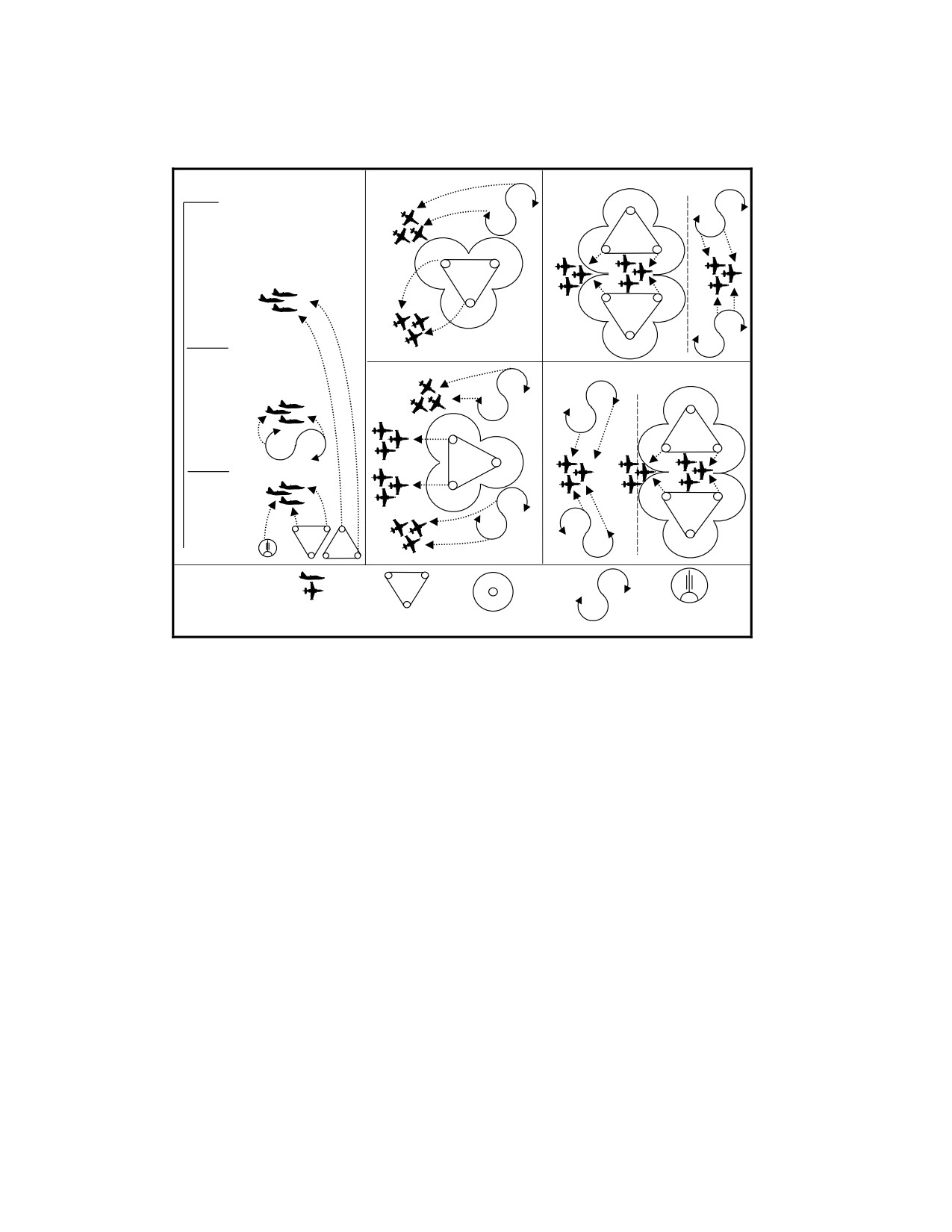
9-40. The OPFOR may assign zones of responsibility in the vertical dimen-
sion. Thus, fighter aviation would engage enemy aircraft at certain altitudes,
while ground-based air defense assets would be responsible for engagement
at other altitudes. See example A in Figure 9-1.
9-41. In the horizontal dimension, zones of responsibility may be in terms of
the direction from which target aircraft are approaching (example B). The
OPFOR may also choose to delineate responsibility according to the type of
target (example C). For instance, fighter aircraft might engage manned
aircraft, while ground-based air defense might be responsible for engaging
enemy missiles or UAVs. Sometimes, specific targets are assigned to specific
systems. However, the latter is likely only in a very low air threat environment.
9-7
FM 7-100.1 ________________________________________________________________________________
(A) In terms of altitude
(B) In terms of direction (axis)
(D) In terms of lines (no air superiority)
30,000 m
Zone lll:
Zone of responsibility
of SAM units.
Fighter aviation may
operate only in complicated
situations and by special
permission.
7000 m
Zone ll:
(C) In terms of targets
(E) In terms of lines (with air superiority)
Zone of responsibility
of fighter aviation.
SAM units may
operate only
in complicated
situations and
by special
permission.
2000 m
Zone l:
Zone of
responsibility
of AA guns and
low-altitude
SAMs.
Legend:
Enemy Aircraft
AA Gun Battery
SAM Battalion
SAM Battery
Coverage
Combat Air Patrol
Figure 9-1. Coordination of Fighter Aviation and Ground-Based Air Defenses (Examples)
9-42. Another way of dividing air defense responsibility is in terms of lines.
Particularly when the OPFOR does not have air superiority, the first line(s)
of air defense responsibility could be for ground-based air defense weapons to
engage enemy aircraft. OPFOR fighter aviation would then operate in the
relatively safe airspace behind those lines, where its fighters would engage
only those aircraft that managed to get through the first line(s). See example
D in Figure 9-1.
9-43. If the OPFOR does have air superiority, it might establish a boundary
line parallel to and forward of the battle line. This boundary would be gener-
ally at the range limit of medium-range SAMs, possibly beyond the supported
ground force unit’s limit of responsibility. Ground-based air defense systems
would engage aircraft out to this boundary. Fixed-wing aircraft would engage
the enemy beyond this boundary. See example E in Figure 9-1. However, the
OPFOR is unlikely to use this technique unless it possesses air superiority.
9-44. There will never be sufficient specialized air defense assets to protect
all units and vital assets from air attack. Therefore, all units must be capable
of using their organic weapons for self-defense against air attack. Self-
defense is never denied. Thus, air defense units with short-range weapons
always have the capability to defend themselves from immediate air threats,
regardless of whether another aviation or ground-based air defense unit has
responsibility for the airspace above them.
9-8
_________________________________________________________________________________Chapter 9
Air Defense Control Measures
9-45. The OPFOR uses various types of air defense weapons control status
and procedural controls to coordinate the use of airspace by aviation assets
and ground-based air defense. Primarily, it employs a system of identification,
friend or foe (IFF) between aircraft and air defense systems. When using
non-IFF-capable systems, it may enact strict procedural controls in order to
protect friendly aircraft from fratricide. The air defense coverage may be
“switched off” to allow friendly aircraft to pass on a mission planned in ad-
vance and then “switched on” as they exit the area. For other missions, air
defense coverage may allow aircraft to transit only on “safe corridors” based
on air routes or other procedural methods. In general, however, the OPFOR
would prefer to risk losing some aircraft through fratricide, rather than al-
lowing gaps in its radar and air defense coverage that the enemy might exploit.
COMMAND POSTS AND COMMUNICATIONS
9-46. The CAO and his staff are part of the OSC staff at the main command
post (CP). Also located there are Air Force, army aviation, and air defense
liaison teams with whom he closely coordinates for airspace management. A
deputy CAO and possibly an air defense officer from the liaison team may
also be present at the forward CP to advise the OSC commander.
9-47. The basic rule for the establishment of communications between
supported and supporting unit is that the higher command allocates
landline, radio relay, and mobile communication means, while radio equip-
ment is allocated by both higher and subordinate levels. This ensures proper
coordination of communications. If communication is lost, the commanders
and staffs of all units involved are responsible for the immediate restoration
of communication. An air defense and NBC warning communications net
is established to warn maneuver units, the staffs, and logistics units of
incoming enemy aircraft. The warning is communicated through signal
equipment that is specially allocated for this purpose.
PHASES
9-48. The OPFOR plans to employ its air defense units and all-arms air de-
fense in three phases. The phases are defined by where the enemy aircraft
are and what they are doing:
• Phase I: Actions against enemy aircraft and control systems on the
ground before they are employed.
• Phase II: Actions against enemy aircraft while in flight but before
they enter the airspace over OPFOR ground maneuver forces.
• Phase III: Actions against enemy aircraft that have penetrated into
that airspace.
While these phases may occur sequentially after the initiation of hostilities,
they are not wholly distinct. They may overlap, and all three may occur
simultaneously. The OPFOR roughly equates the three phases with where
they will primarily occur on the ground and in the air. Thus, phases I, II, and
III occur in the “basing area,” “flight area,” and “target area,” respectively.
The purpose of these phases and areas is to assist planners in rationalizing,
planning, and organizing the overall air defense effort.
9-9
FM 7-100.1 ________________________________________________________________________________
PHASE I
9-49. The first phase includes all actions taken to destroy enemy aircraft and
control systems before they are employed. It targets aircraft while they are
still on the ground at airfields or in marshalling or staging areas. This “basing
area” extends from enemy home territory, to allied basing and staging areas,
to and including in-theater enemy support areas down to enemy division
level.1 It is the area in which aircraft are based, refueled, maintained, and
resupplied. This area is the overall responsibility of the OPFOR theater
commander. A large part of it could be given an OSC. Part of the area as-
signed could fall within the OSC’s disruption zone, which can include enemy
airfields and attack helicopter forward arming and refueling points (FARPs).
Planning
9-50. Planning for Phase I begins at the national level, when the General
Staff is considering various contingency plans for possible strategic campaigns
before the actual threat of war or extraregional intervention. This planning in-
cludes any OSCs that might be involved in a particular contingency.
9-51. Each contingency plan developed includes detailed analysis of the area
involved, including the identification of key airfields, facilities, and lines of
communication (LOCs) that could support enemy air operations. In those
areas controlled by the OPFOR, preparations are made to support planned
missions. These include the identification of complex terrain in the vicinity of
identified targets, potential cache sites, and forces to perform missions.
9-52. Areas not in the direct control of the OPFOR, but anticipated to be
included in the contingency, are also analyzed. In this case, in addition to all
the factors mentioned above, planners would also examine potential means
and routes of infiltration and potential sources of supply. They would also try
to identify potential “affiliated” forces that could assist in attacking key
targets: insurgent groups, groups with ethnic ties to the OPFOR, groups that
sympathize with the OPFOR for political reasons, individual sympathizers,
terrorist groups, and even criminal organizations.
9-53. Based on this information, planners identify key targets and missions
and task OPFOR units and/or affiliated forces to be prepared to perform
them. This information is shared with the OSCs assigned to the particular
contingency, and the planning effort is coordinated with them.
9-54. What is developed is an integrated plan consisting of a large number of
tactical actions that support air defense objectives at all levels. This is the
basic plan from which the OPFOR operates at the initiation of hostilities. It
is modified and updated and new missions are assigned as the contingency
situation develops.
9-55. Plans are developed which, taken as a whole, may constitute a battle or
operation within the designated area. This is particularly true in the basing
area, since most of the forces operating there will be small units. Their ac-
tions are timed to occur simultaneously or sequentially to achieve a result
over time. For example, a series of actions against an airfield, set to occur
1 For U.S. forces other than aviators, this phase may present the greatest threat.
9-10
_________________________________________________________________________________Chapter 9
within certain timeframes, can have the net effect of not only destroying air-
craft and their support facilities but also degrading enemy air operations. An
additional payoff is the possible diversion of enemy forces from other areas to
secure the facility.
Participants
9-56. Attacks on airfields and related facilities feature coordinated opera-
tions by all available forces, and they are primarily not air defense units.
Aviation, SSMs, artillery, or SPF can destroy air C2 facilities, aviation
support facilities, and the enemy’s aircraft while they are still on the ground.
When the enemy is operating from bases in or near State territory, the de-
struction or degradation of these systems may be achieved through the use of
raids and ambushes by regular ground forces, insurgents, or partisans.
9-57. Disruption Forces. Typical targets for attack by all forces in the dis-
ruption zone include enemy airfields and attack helicopter FARPs. The forces
employed for such attacks consist almost exclusively of small units.
9-58. When the OPFOR is forced to withdraw from an area, this may become
a basing area for the enemy. In such cases, the OPFOR may leave behind
a multiple rocket launcher (MRL) in a hide position. In other cases, it can
infiltrate a single-round rocket launcher or single mortars to occupy hide
positions near the target. The hides are situated in complex terrain,
highly camouflaged, and dispersed over a wide area. Once given the order
to execute, the firing systems work on a predetermined firing schedule issued as
part of an overall plan.
9-59. MRL system hides might contain only one system, which is loaded and
ready to fire, with previously determined firing data set on the weapon.
Crews manning the systems bivouac away from the system to keep it cold.
Crews have communication capability but are kept on radio silence. When
monitoring and acknowledging one-time orders to execute, they do so away
from the system. Once given the order to execute, the firing systems work on
a predetermined firing schedule issued as part of an overall plan. Each MRL
may be assigned the mission of firing once. Firing occurs in a predetermined
sequence separated by time. The net effect of this tactic is to destroy or
damage facilities and/or aircraft on the ground and degrade the operating
capability of support personnel. Munitions loads can be mixed dependent
on the desired effect. They can include scatterable mines, delayed-fuzed
munitions, high-explosive (HE), and chemical.
9-60. This effort can be enhanced through the employment of single mortars
and/or single-round rocket launchers. The weapon crews operating from pre-
selected hides can move to firing positions where rounds are cached. Once
laid in, the mortars can fire rounds in rapid succession at targets on the air-
field and then move back to hides. Given range and terrain considerations,
larger-caliber mortars (120-mm) can be used in conjunction with laser target
designators to place rounds on point targets such as large aircraft, fuel stor-
age and ammunition facilities, and hangers.
9-61. Small SPF teams equipped with explosives or man-portable antitank
guided missiles (ATGMs) can target aircraft on the ground, or air traffic con-
trol or maintenance vehicles and facilities. SPF teams with shoulder-fired
9-11
FM 7-100.1 ________________________________________________________________________________
SAMs can engage enemy aircraft taking off or landing at airfields. OPFOR
SPF or affiliated insurgents or terrorists can conduct raids against enemy air
bases and other installations, using terror tactics to destroy enemy systems
and generate fear. The goal is to present the enemy with a nonlinear,
simultaneous battlefield. Attacking such targets not only denies the enemy
sanctuary, but also can weaken his national will to continue the conflict.
9-62. Infiltrated or stay-behind SPF and infantry can conduct on-call raids
against airfields and ground support facilities. These raids can be timed in
conjunction with other methods so that they assist in keeping the target
under constant pressure. SPF or infantry can also conduct ambushes along
LOCs to destroy certain types of vehicles or equipment related to air operations.
9-63. National- and Operational-Level Assets. Some of the means
available to attack these targets may be national- and operational-level
assets. Since the OPFOR may be unable to reach such targets with its own Air
Force aircraft, it may use long-range artillery, rockets, or missiles—possibly
to deliver persistent chemical attacks or other weapons of mass destruction
(WMD)—to disrupt or degrade enemy activities in the basing area.
9-64. Affiliated Forces. In each contingency area, OPFOR planners try to
identify insurgents, sympathizers, terrorist groups, and even criminal or-
ganizations that might participate in Phase I. Some of these affiliated forces
can conduct raids or ambushes and any of them can employ terror tactics to
disrupt enemy operations at bases. They can also intimidate host country
civilian contractors to force them to sabotage the enemy operations they
were hired to support.
PHASE II
9-65. The second phase of air defense aims at destroying enemy aircraft
while in flight and before they enter the airspace over OPFOR ground
maneuver forces. The “flight area” overlaps the basing area and extends
from enemy bases to the battle zones of OPFOR units. Thus, the OPFOR’s
disruption zone(s) are included in this area, since one of the missions per-
formed in this zone is to destroy aerial platforms before they get to the battle
zone. The OPFOR often plans air defense ambushes in the flight area.
Planning
9-66. As with Phase I, planning for Phase II occurs primarily at the national
and operational levels. This planning includes any OSCs whose AORs fall in
the “flight area.” Although tactical units in the disruption zone can carry out
air defense-related actions, these actions are part of a larger plan.
Participants
9-67. In Phase II, OPFOR SPF teams can infiltrate man-portable, shoulder-
fired SAMs close to airfields or along identified and potential flight routes in
the flight area. These teams are best employed in pairs. One team can over-
watch an airfield and transmit information on the departure of aircraft and
their direction of flight to another team with SAMs. Alternatively, the SPF
observers could pass this information as early warning to other air defense
units.
9-12
_________________________________________________________________________________Chapter 9
9-68. After that, the Phase II mission is performed primarily by air defense
forces at the strategic and operational levels. Interceptor aircraft and long-
and medium-range SAMs conduct this phase of the air defense.
9-69. When the enemy aircraft enter an OPFOR disruption zone, shorter-range
operational- and tactical-level air defense systems can engage them. Such systems
often conduct air defense ambushes from positions within the disruption zone.
PHASE III
9-70. The third phase entails the destruction of enemy aircraft that have
penetrated into the airspace over OPFOR ground maneuver forces. Thus, the
“target area” consists of the area where enemy aircraft have penetrated over
the OPFOR disruption, battle, and support zones. The disruption zone is in-
cluded here, since part of the air defense mission in it is to protect forces on
the ground within that zone.
9-71. In Phase III, it is not always necessary to destroy the enemy aircraft.
After all, the objective is to deny enemy aviation the ability to interfere with
OPFOR ground maneuver units. The OPFOR can accomplish this either by
destroying enemy aircraft or by forcing them to expend their munitions beyond
effective range or by diverting the aircraft before they reach their targets.
Planning
9-72. Planning for Phase III extends down to the tactical level. However,
tactical efforts are typically part of a plan for integrated air defense at the
operational and perhaps the national level.
Participants
9-73. In Phase III, the OPFOR may be able to employ its own tactical fighter
aircraft, operating in the relatively safe airspace of the “target area.” These
fighters and fighter-interceptors can engage enemy aircraft that have “leaked
through” ground-based air defenses. However, the bulk of the air defense effort
in Phase III falls upon short- to medium-range SAMs and antiaircraft (AA)
guns of tactical air defense units, complemented by operational- and national-
level air defense assets and other weapons of the ground maneuver units.
9-74. In the “target area,” the OPFOR is particularly concerned about attack
helicopters using standoff firing techniques. It is critical to identify likely fir-
ing positions for these helicopters through terrain analysis. These sites will
be located primarily in the disruption zone. The planned combined use of
antihelicopter mines, artillery, and remote sensors by OSCs and their con-
stituent organizations can be an effective tactic against attack helicopters.
9-75. Once identified, potential sites for attack helicopter firing positions can
be seeded with antihelicopter mines. These are directional fragmentation
mines that function like a Claymore mine, but are larger. Once emplaced, the
mines can be left unattended. Built-in sensors detect approaching helicopters
and initiate the mine when a helicopter enters the lethal zone. Thus, the
antihelicopter mine systems can autonomously detect and engage enemy
helicopters. This technique can be used at some potential sites to economize
other air defense assets for use at the most likely sites.
9-13
FM 7-100.1 ________________________________________________________________________________
9-76. Another method is to emplace remote sensors to overwatch the sites,
and have the sites registered as preplanned artillery targets. Once the sen-
sors pick up the incoming helicopters, the information is relayed to artillery
units that take the sites under fire using variable-time-fuzed munitions. This
tactic can either destroy or damage the aircraft or cause the area to be unusable.
In lieu of remote sensors, small teams of SPF or affiliated forces can be posi-
tioned to overwatch the most likely sites and relay information back to the guns.
9-77. Another crude but potentially effective method is to have engineers
string cables across the helicopters’ avenues of ingress. Engineers can also
assist in the construction of deception positions to divert enemy air attack
from actual forces or to lure the enemy into air defense ambushes.
ASSETS
9-78. In the OPFOR’s approach to all-arms air defense, various services of
the Armed Forces and various branches within the services participate in the
mission of air defense. However, there are some forces that specialize in air
defense.
9-79. Both the Air Force and the Army maintain air defense forces. In
peacetime, all these air defense assets belong to the OPFOR’s administrative
force structure. Even in wartime, some of themsuch as the national-level
Air Defense Forcesmay remain centrally controlled at the national or
theater level. Other assets from the administrative force structure are
initially allocated to OSCs. An OSC, in turn, may allocate some of its air
defense assets to augment those of its tactical subordinates. Thus, it is
hard to predict where national-, operational-, and tactical-level assets may
actually appear in the wartime, fighting force structure.
9-80. Within the limits of its economic capabilities, the OPFOR has incorpo-
rated recent technological developments into its air defense weapons. It may
invest in a few high-technology systems that provide it a technological niche
that it can exploit against even the most modern enemy air forces. Deploy-
ment of advanced air defense systems, even in limited numbers, would affect
all enemy air operations.
NATIONAL-LEVEL ASSETS
9-81. National-level air defense forces focus their efforts on destroying enemy
aircraft, while protecting critical defensive positions and key political and
economic sites. National-level assets include fighter-interceptor aircraft of
the Air Force. Against a regional opponent, the OPFOR can use these aircraft
to prevent enemy aircraft from entering or operating in OPFOR airspace. It
can destroy enemy aircraft before they even take off by using air attacks and
the long-range rockets and missiles of the Strategic Forces or direct action
teams from its SPF Command.
9-82. The Air Force also includes Air Defense Forces with which the
OPFOR can successfully defend its airspace against regional opponents.
These national-level assets, along with operational-level air defenses, also
provide the capability to challenge or deny air access into the region by out-
side forces, at least initially.
9-14
_________________________________________________________________________________Chapter 9
9-83. The State’s national-level Air Defense Forces have medium- and long-
range SAMs, some short-range AA guns, and early warning radar units.
These forces reflect the State’s force development philosophy. They combine
obsolescent and state-of-the-art air defense firing units to support area cov-
erage and point protection of high-value assets. The State is investing in
point-protection technology that it believes can prove effective in defending
against cruise missiles. This capability would include the ability to deploy
and use GPS jammers.
OPERATIONAL-LEVEL ASSETS
9-84. The Army recognizes the importance of preventing or at least delay-
ing enemy air superiority. Therefore, it maintains its own operational- and
tactical-level air defense forces in addition to those subordinate to the Air
Force. Army air defense includes mobile air defense units and large numbers
of shoulder-fired SAMs. However, air defense involves use of all arms of the
ground forces, not just the specialized air defense units.
9-85. The inventory of operational-level air defense weapons includes a vari-
ety of missiles, guns, and support equipment. The numbers and types of air
defense assets vary with the size and composition of the OSC. An OSC may
have some air defense assets that it reserves for coverage of its own operational
support zone and for engaging enemy aircraft that get past tactical air defenses.
It also has assets it can allocate to subordinates to augment tactical air defenses
at critical points on the battlefield or to cover gaps in the air defense umbrella.
Surface-to-Air Missiles
9-86. Operational-level air defense systems include medium-range SAMs
(and perhaps some long-range SAMs) for medium- to high-altitude area cov-
erage. Some SAMs have the capability to engage ballistic or cruise missiles,
as well as aircraft. Medium-range SAM units typically have some AA guns or
shoulder-fired SAMs for self-protection.
Antiaircraft Guns
9-87. Operational-level commands may have some short-range AA guns for
point protection. The AA guns found at the operational level are typically
towed systems that lack the mobility of self-propelled SAM systems and
cannot fire on the move. These AA gun units are capable of only a limited
area coverage and are better suited for short-range, point protection of
individual locations. Within their range capabilities, however, these AA
guns are extremely lethal weapons.
Radars
9-88. OSCs normally have early warning units with a variety of air surveil-
lance and target acquisition radars, plus some AA guns or shoulder-fired
SAMs for self-protection. The majority of air defense surveillance radars are
at the operational level. (See the Air Surveillance section later in this chapter
for more detail.)
9-15
FM 7-100.1 ________________________________________________________________________________
TACTICAL-LEVEL ASSETS
9-89. Aside from air defense assets that might be allocated down from the
operational level, tactical maneuver units have a number of systems de-
signed for air defense. They also have systems belonging to other arms that
can contribute to the air defense mission.
Air Defense Systems
9-90. Tactical-level air defense includes short- and medium-range SAMs,
short-range AA guns, and shoulder-fired SAMs. Tactical assets may also
include some combination AA gun and missile systems, offering added
flexibility. The OPFOR’s tactical air defenses support the need to protect
ground forces and the desire to seize any opportunity to shoot down high-
visibility (flagship) enemy airframes.
9-91. The Army considers every soldier with a shoulder-fired SAM to be an
air defense firing unit. These weapons are readily available at a relatively
low cost. Therefore, the OPFOR is acquiring as many of them as possible,
within economic constraints, and issuing them in large numbers to a wide
variety of units. The small size and easy portability of these systems provides
the opportunity for ambush of enemy airframes operating in any area near
OPFOR units. The OPFOR could also employ them to set ambushes for enemy
helicopters in an attempt to bring down what it perceives to be an enemy flag-
ship system.
9-92. Radar-controlled self-propelled AA guns can fire on the move. Aside
from short-range air defense, they also can be employed against all but the
heaviest of enemy ground force systems, as well as against personnel, with
devastating effects. Shoulder-fired SAMs can also find use against light vehi-
cles when other, more likely systems are unavailable.
Other Arms
9-93. Throughout maneuver units, there are also a number of other systems
that can be used in an air defense role. The heavy AA machineguns on tanks
are specifically designed for air defense, although they can also be used
against ground targets. Machineguns on APCs and automatic cannon on
IFVs can engage both ground and air targets. Some ATGMs can be effective
against low-flying rotary-wing aircraft. Field artillery and small arms can
also be integral parts of the air defense scheme.
9-94. A variety of relatively new systems, which significantly enhance air defense
capabilities, have entered the OPFOR inventory. These include remote heli-
copter infrared (IR) sensing devices and passive acoustic acquisition systems.
Antihelicopter mines are widely available and increase the OPFOR ability to
deny firing positions and landing sites to enemy rotary-wing aircraft. Another
example of OPFOR all-arms air defense is the use of artillery in conjunction
with antihelicopter mines against attack helicopter firing positions.
9-95. The OPFOR continuously looks for new and adaptive ways of employ-
ing not only air defense systems but also systems not traditionally associated
with air defense. It attempts to adapt these systems and develop new tactics
9-16
_________________________________________________________________________________Chapter 9
that may help to fill the void when a more sophisticated enemy denies the
OPFOR a specific capability.
NONLETHAL AIR DEFENSE ASSETS
9-96. The OPFOR also uses nonlethal air defense-related systems, such as
air defense jammers, radar corner reflectors, and GPS jammers. Such sys-
tems are potential combat multipliers, when employed in conjunction with
SAM and AA gun systems, to defend high-value assets.
Air Defense Jammers
9-97. OSCs can have air defense jamming units. These units employ a vari-
ety of radar and communications jamming and target acquisition systems.
Electronic intercept systems provide targeting information to the jammers.
9-98. Air defense jammers target the onboard emitters of enemy aircraft
used for terrain-following, navigation, and radar-aided bombing, as well as
airborne radar reconnaissance systems. The goal of jamming these systems is
twofold. The primary goal is to force the attacking enemy aircraft to alter
their flight profile, bringing them into the targeting umbrella of SAMs or AA
guns. Jamming the terrain-following radars or radar altimeters employed by
attacking aircraft does this by forcing low-flying aircraft to gain altitude. The
secondary goal is to cause the aircraft to miss their target or abort the
mission through the disruption of radar-aided bombing and target acquisition
systems.
9-99. The OPFOR deploys air defense jamming assets, in conjunction with le-
thal systems, to defend what the OPFOR has identified as high-value assets.
Examples of these include air bases, major logistics centers, critical LOCs
and choke points, and higher-level military CPs.
Corner Reflectors
9-100. Radar corner reflectors provide a low-cost and effective addition to ex-
pensive air defense jammers. These passive systems can deceive enemy air-
borne surveillance and target acquisition radars by providing false or multi-
ple targets. Corner reflectors can also mask or distort radar reference points.
GPS Jammers
9-101. The OPFOR also can employ low-cost GPS jammers to disrupt aircraft
navigation and precision munitions targeting. GPS jammers are also effective
against cruise missiles.
PASSIVE AIR DEFENSE MEASURES
9-102. In addition to active air defense, the OPFOR practices a variety of
passive air defense measures. Many of these measures involve use of C3D or
maneuver and dispersal techniques. Sophisticated camouflage, deception, de-
coy, or mockup systems can degrade the effects of enemy systems. When con-
ducting actions against a superior foe, the OPFOR must seek to operate on
the margins of enemy technology and maneuver during periods of reduced
exposure. These and other measures constitute passive air defense.
9-17
FM 7-100.1 ________________________________________________________________________________
Camouflage, Concealment, Cover, and Deception
9-103. The OPFOR emphasizes the use of natural terrain and vegetation,
camouflage netting and other artificial materials, smokescreens, and decoy
equipment to provide C3D. Deception includes deception positions and decoys.
The OPFOR can use quick-setup, high-fidelity decoys; derelict vehicles;
radar emitter decoys; quick-hardening foams; and many other types of
manufactured and field-expedient means. It also employs simple heat
sources to confuse IR sensors and weapons seekers.
9-104. The dispersion measures discussed below should be employed with
consideration of the protective and screening properties of natural and artifi-
cial screens, and would be combined with thermal camouflage and engineer
preparation of positions. Natural screens consist of vegetation, terrain folds,
populated areas, and local features or objects. Artificial screens include
camouflage nets that would enhance natural screens, and radar-opaque
screens using local features, radar nets, metallic nets, and corner reflectors.
Concealment would be combined with the use of deception positions, using
decoy equipment and activities. Like real positions, deception positions would
be changed periodically. Dummy emitters and jammers would be used to
attract enemy reconnaissance and targeting.
Maneuver and Dispersal
9-105. Maneuver and dispersal of air defense assets, both emitters and other
types of equipment, is important for their survival both during movement
and in combat formations. Sudden maneuver and periodic changes of position
are simple and effective means to counter enemy reconnaissance and preci-
sion weapons; these measures are planned and implemented at the tactical
level.
9-106. All, or only a portion of, an air defense unit may maneuver to alter-
nate positions, depending on such factors as the degree of air threat, time of
day, and meteorological conditions. The first parts of the unit to shift posi-
tions are those that have performed combat alert duty for an extended pe-
riod, or that have been deployed in the position they currently occupy since
before the onset of combat. The optimum configuration for shifting to alter-
nate positions involves no more than one-third of the assets of a given unit
shifting at one time, in order to maintain adequate air defense coverage.
9-107. The OPFOR uses certain rules of thumb for distances related to dis-
persion and distances of air defense units from supported units and from the
battle line. The OPFOR recognizes that these distances vary with the situa-
tion and the threat. Of special concern is the enemy ATGM and precision
weapon capability. If it is high, the OPFOR increases the spacing between
SAM launchers and the distances of air defense systems from the battle line.
Ideally, the degree of dispersal for units would be the same whether the en-
emy is employing conventional or precision weapons or even tactical nuclear
weapons. A general rule for the degree of dispersion is that the enemy attack
should not destroy two adjacent units simultaneously. A maximum of one-
third of a unit should be vulnerable to a single precision weapon attack.
9-18
_________________________________________________________________________________Chapter 9
Other Survivability Measures
9-108. Other measures taken to improve the security and survivability of air
defense systems include the following:
• Signals security. SAM and AA gun system radars, which move forward
to cover the offensive or defensive action of a maneuver unit, remain
silent until after the maneuver unit begins to execute its mission.
• Frequency spread. Each of the air defense systems operates within
separate radar frequency bands. (No one jamming system could oper-
ate simultaneously against all bands.)
• Frequency diversity. Tracking and guidance radars change frequen-
cies to overcome jamming.
• Multiple and interchangeable missile guidance systems. Some
OPFOR systems work on pulsed radar; others work on continuous
waves. Some radar tracking systems also possess optical tracking for
continued operations in a high electronic countermeasures environ-
ment; others systems use IR homing.
• Mobility. All OPFOR tactical air defense systems and most opera-
tional-level systems are mobile. They can quickly change positions af-
ter firing or after enemy reconnaissance units detect them.
RECONNAISSANCE
9-109. Reconnaissance related to air defense takes two basic forms. First,
commanders conduct terrain reconnaissance to determine likely avenues of
approach for enemy aircraft and optimum positions for air defense weapons.
Then air surveillance seeks to detect approaching aircraft and provide early
warning and target information.
TERRAIN RECONNAISSANCE
9-110. The OPFOR places significant emphasis on identifying all potential
attack routes for low-flying enemy aircraft of all types. Routes of approach suit-
able for armed helicopters and positions from which these helicopters might em-
ploy ATGMs are of special concern. The OPFOR considers armed helicopters to
be a serious threat to its ground maneuver units. The OPFOR trains command-
ers to look for areas masked by trees or folds in the terrain where enemy aircraft
might use nap-of-the-earth (NOE) flight techniques to avoid radar detection.
9-111. Both the commander of the supported maneuver unit and the com-
mander of the supporting air defense unit usually conduct terrain reconnais-
sance. A preliminary map reconnaissance can tentatively identify positions
for deployment of air defense weapons in defensive areas, along movement
routes, or in areas seized by advancing OPFOR units.
AIR SURVEILLANCE
9-112. The principle objective of air surveillance is to provide the earliest
possible warning of approaching enemy aircraft and to develop target informa-
tion for planning and conducting air defense. Forearmed with this information,
the OPFOR can ensure that it can mass the fires of dispersed air defense
units to engage the intruders. Ground-based and airborne reconnaissance assets
9-19
FM 7-100.1 ________________________________________________________________________________
at the operational level play a major role in gathering, integrating, and
disseminating information to tactical units. Continuous surveillance of
surrounding airspace ensures current data on the enemy air situation.
9-113. The OPFOR uses electronic and electro-optical means and visual
observation to conduct air surveillance. The air defense forces have a passive
early warning system based on a combination of radar systems and observers
that will serve them well in the early stages of combat operations against
even the most modern opponents. In later stages, the OPFOR accepts that it
will either lose many of its airborne and/or ground-based early warning systems
or at least not be able to use them with optimum effectiveness. When technical
early warning systems are not available, the OPFOR is prepared to continue air
defense operations while relying primarily on observers for air surveillance.
Radars
9-114. Air defense radars fall into two general categories: surveillance and
fire control. The category of surveillance radars includes early warning,
target-acquisition, and height-finding radars. Some fire control radars also
have limited target-acquisition capability.
9-115. National-, operational-, and tactical-level surveillance and target-
acquisition radars detect and monitor targets. The radars then provide the
necessary data for engagement. Radars work as part of the IADS rather than as
separate units. Air defense planners at all levels integrate radars into an overall
system of coverage.
9-116. Operational-level early warning units deploy their radars as close as
possible to the supported ground force unit’s battle line, in order to detect
enemy aircraft at maximum radar range. National-level early warning
units can establish a second line of radar posts behind the first line of op-
erational-level systems, in order to give depth. The types and capabilities
of the systems employed and whether the battlefield is linear or nonlinear
will determine the distances between lines.
9-117. Both national- and operational-level air defense forces maintain
reserves to expand coverage as the operation develops, to replace casualties,
or to establish a new line of radar posts. When the OPFOR is preparing for
offensive operations, operational-level early warning radars remain inactive
as part of C3D, and the national-level reserve radars deploy forward.
9-118. In many cases, long-range surveillance radars in early warning units
at the national and operational levels can gather target information long be-
fore the enemy aircraft come into the range of air defense firing units. These
radar units pass preliminary target data to air defense commanders and
their firing batteries. Commanders then select the weapon system that can
best engage a given target. The early warning units also pass warning infor-
mation to operational and tactical maneuver units and air defense firing units.
9-119. SAM systems and AA guns may have their own radars in the firing
positions or mounted on self-propelled systems. However, higher-level radars
can gather the information without unnecessarily exposing the air defense
firing units to detection and subsequent neutralization by enemy forces. This
practice reduces the vulnerability of battery radars and radar-equipped gun
9-20
_________________________________________________________________________________Chapter 9
carriages and missile launchers to jamming or to destruction by antiradiation
missiles (ARMs) or other means.
9-120. The air surveillance radar network is difficult to avoid or defeat. Many
air defense radars are highly mobile and can displace quickly. Fire control
units turn on radars at the last minute to achieve surprise and to avoid exposing
themselves to enemy electronic or physical attack. The more advanced radar
systems have enhanced electronic protection from jamming and ARMs. The
wide spread of operating frequencies makes jamming difficult. Operator training
stresses electronic counter-countermeasure skills and the use of radio and elec-
tronic silence where possible. Units back up radar reconnaissance with visual
observation. Maneuver units have a radio net devoted exclusively to the passage
of air and NBC warnings. Radar provides an all-weather detection capability.
Visual Observation
9-121. Despite the presence of a technologically advanced early warning
system, the OPFOR continues to stress the importance of visual observation.
Air defense and maneuver units deploy air observers as a backup to radars
and so air defense units may not need to use their radars. In later stages of
combat against more modern opponents, the OPFOR may have to rely
heavily on observers after losing much of its radar capability.
9-122. An effective system of visual observation may often provide the first
warning of an enemy air attack, especially one conducted by low-flying aircraft
or armed helicopters using NOE techniques. When operating close to enemy
forces or in areas where enemy air attack is considered likely, all units post
air observers. In the defense, air observation posts are set up at suitable loca-
tions, usually on terrain offering good visibility, near CPs, and/or close to air
defense units in firing positions. During tactical movement and during both the
defense and offense, observers are posted on each vehicle. Observers are
changed frequently to reduce fatigue and maintain their effectiveness.
9-123. Whenever possible, the OPFOR tries to get SPF teams, human intelligence
(HUMINT) agents, or sympathetic civilians to visually observe enemy airfields
in or near the region. These observers report by radio or telephone the number
and types of aircraft taking off and their direction of travel. Other observers
stationed along probable approach routes can monitor and report the progress of
the enemy aircraft en route to their targets. Thus, OPFOR air defense units may
not need to use their radars to detect and track incoming aircraft.
REQUIREMENTS
9-124. The information required by air defense units falls into two categories:
information on enemy air actions and information that can complete the pic-
ture of the overall air situation. The first category is a joint responsibility of
all reconnaissance forces, and the second is the specific responsibility of air
defense reconnaissance units.
9-125. The first category includes data from which the OPFOR can determine
probable enemy air actions. This information is critical for planning and or-
ganizing the air defense system. Such information could include—
• The composition and strength of enemy air power.
9-21
FM 7-100.1 ________________________________________________________________________________
• The capabilities of enemy aircraft.
• The enemy’s basic methods for operational and tactical employment of
air power.
• The locations of enemy airfields, C2 centers, resupply bases, and pro-
duction facilities.
• Avenues of low-level flight.
• Locations of FARPs.
• Locations of ground stations for UAVs.
9-126. The second category includes data from which the OPFOR can develop
a clear picture of the air situation as it unfolds. This information is necessary
to determine the enemy’s plans, air order of battle, and air attack objectives.
The OPFOR can then assign targets to fire units or redeploy resources.
Necessary data also include the positions, types, numbers, direction, speed,
and altitude of aircraft in flight. Radio intercept provides some data, but
most comes from air defense radars.
MISSIONS AND EMPLOYMENT
9-127. Whatever the nature of combat being conducted by maneuver
forcesoffense or defense, most actions of supporting air defense units are,
as the term implies, inherently defensive. The essence of an air defense unit’s
combat mission is to provide area coverage and/or point protection. However, air
defense missions can also have an offensive nature, with the purpose of destroy-
ing certain enemy air platforms or denying or disrupting their employment.
9-128. The OPFOR recognizes that it may be unable to defend its entire
airspace adequately. Therefore, it must establish priorities to ensure denser
coverage in certain areas or increased protection for key assets. Priorities
include airfields, SSMs, artillery, maneuver units, headquarters and
communications centers, and critical logistics units and LOCs. The priority
assigned to a particular area, entity, or site may change during the course
of operations, as the tactical, operational, or strategic situation changes.
NATIONAL-LEVEL
9-129. National-level Air Defense Forces use their own air defense weapons
for various missions, depending on the situation. Some of these assets might
cover the air defense weapons of subordinate commands. Others might fill
gaps between operational-level commands. They usually are somewhere to
the rear of operational-level air defense weapons in order to engage aircraft
that penetrate forward air defenses. Some national assets might provide
general air defense coverage of the State and nearby airspace. In any event,
the intent is for Air Defense Forces to ensure continuous coverage in both
detection and engagement capabilities.
OPERATIONAL-LEVEL
9-130. Operational-level commands (primarily OSCs) can use their air de-
fense units in many ways. Some medium-range SAM units may augment
tactical-level assets. Others provide cover for gaps between tactical units or
9-22
_________________________________________________________________________________Chapter 9
provide general area coverage of the OSC’s entire AOR. This area coverage
gives depth to the defensive effort and overlaps with envelopes of tactical
units. Where possible, this SAM coverage overlaps the envelopes of adjacent
operational-level commands.
9-131. The medium-range SAM units engage enemy aircraft at some distance
from tactical maneuver units and other high-value assets within the OSC’s
AOR. These SAMs and shorter-range AA guns also protect key targets such
as operational-level CPs, tactical ballistic missiles
(TBMs), long-range
rockets and artillery, and reserves.
TACTICAL-LEVEL
9-132. In the best-case situation, a division or DTG will have sufficient air
defense assets to provide area coverage over its AOR, including the AORs of
subordinate units. At brigade or BTG level, there is a significant element of
point protection in support of subordinate units and brigade- or BTG-level
assets. This is due to the nature of the units defended and the relatively
short range of air defense weapons at this level.
9-133. Tactical-level short- and medium-range SAMs provide area coverage for
the entire tactical-level unit, overlapping with the envelopes of flanking units.
Short-range AA guns and shoulder-fired SAMs can provide point protection.
AIR DEFENSE UMBRELLA
9-134. Air defense assets from national down through tactical level create an
air defense umbrella. Radars can provide an unbroken detection envelope ex-
tending well into enemy territory and across the entire AOR. If OPFOR
fighter-interceptors are able to operate farther out against enemy aircraft in
the “flight area,” national-level long- and medium-range SAMs might be the
first to engage enemy aircraft that slip past fighters. When OPFOR fighters
must operate in “friendly” OPFOR airspace, the national-level SAMs proba-
bly would be the first air defense assets to engage the enemy aircraft. The
next layer of defense is operational-level medium-range SAMs. The final layer in
the battle zone would consist of tactical-level SAMs and AA guns. If enemy aircraft
escape air defenses in the battle zone, they may still encounter operational- or
national-level air defense systems protecting key assets in the support zone.
This deployment scheme causes enemy aircraft to run into overlapping defensive
systems as they approach and penetrate the airspace over OPFOR units.
9-135. There is no set pattern for the deployment of air defense assets. A
basic and flexible guideline is that, depending on their functions and weapon
capabilities, air defense units occupy positions at a distance from the battle
line that ensures the accomplishment of their mission and provides relative
safety from enemy fire. For area coverage, this generally means that weap-
ons at the operational level and below deploy rearward from the supported
unit’s battle line at from one-third to one-half of their engagement range.
However, the OPFOR recognizes that “rules of thumb” are just that, and the
operational or tactical situation and common sense may dictate that these
distances be modified. Actual deployment depends primarily on the supported
unit’s mission, terrain, and the ground and air situations at a given time and
place in the operation. Sometimes, air defense systems can be much closer to the
9-23
FM 7-100.1 ________________________________________________________________________________
battle line, realizing that such placement increases their vulnerability to enemy
direct fire systems. When necessary, tactical- or even operational-level air de-
fense systems may deploy beyond the battle line, out into the disruption zone.
9-136. As OPFOR units maneuver, the air defense umbrella also moves when
necessary, in order to prevent maneuver units from becoming exposed to enemy
ground-attack aircraft and armed helicopters. In a fluid, fast-developing
situation, textbook efficiency may not be possible. While the OPFOR strives
to maintain continuous area coverage, temporary gaps might appear in the air
defense umbrella, both in surveillance and in weapons coverage. Commanders
must be flexible and prepared to use standard and nonstandard solutions to
prevent gaps in air defense coverage from developing during combat. The
objective is to deny enemy aviation the ability to interfere with ground
maneuver units. Air defense forces can accomplish this either by destroying
enemy aircraft, by forcing them expend their munitions beyond effective
range, or by diverting the aircraft before reaching their targets.
30,000
25,000
OPERATIONAL-
20,000
LEVEL SAMs
STRATEGIC-
STRATEGIC-
LEVEL SAMs
LEVEL SAMs
10,000
Height in
Meters
TACTICAL-
5,000
LEVEL
SAMs
3,000
2,000
1,000
250
200
150
100
50
0
50
100
150
200
250 km
Range in Kilometers
Figure 9-2. Air Defense Coverage (Example)
9-137. Figure 9-2 illustrates the vertical and horizontal coverage typically
provided by OPFOR air defense systems at the tactical, operational, and
strategic (national) levels. The example altitudes and ranges are illustrative
of a principle. The actual systems and their capabilities can vary. Although
not shown in this example, all SAM systems have a minimum range and a
minimum altitude. Of course, the range beyond the battle line or limit of
responsibility of supported forces depends on the situation and where the air
defense systems deploy within the supported unit’s AOR.
9-24
_________________________________________________________________________________Chapter 9
ENGAGEMENT PROCEDURES
9-138. On a priority basis, the OPFOR engages aircraft posing the greatest
threat. The preferred technique is to fire at an already engaged target rather
than switching from target to target. This priority continues unless a later-
acquired target seriously threatens air defense units.
9-139. The OPFOR prefers to engage a hostile aircraft prematurely and
waste some ammunition rather than allowing the aircraft to expend its ord-
nance. The OPFOR fires on aircraft as long as they remain within range.
9-140. Air observers and weapon crews outside the attacked area maintain
observation and readiness to fire. This precludes enemy success through
simultaneous air attacks from several directions.
OFFENSE
9-141. Operations from the air have ceased to be auxiliary and have become
a critical component of combined arms combat. Thus, air defense is a
vital part of the combined arms operation. The OPFOR can successfully
execute operational offensive actions only if it can negate enemy air
power. Conversely, failure to provide effective air defense against enemy air
power can result in operational and tactical failures. Therefore, the OPFOR
has an extensive air defense system to protect attacking maneuver units. Air
defense weapons can fully support dynamic offensive combat.
DEPLOYMENT
9-142. In an offense, the exact location of air defense weapons depends on the
following factors:
• The assessment of the air threat.
• The mission of the supported unit.
• The commander’s chosen organization of forces.
• The tempo of operations.
• The terrain.
• Fields of fire and observation.
9-143. The shape of the air defense deployment can change as supported
units maneuver. The most common methods follow:
• Where the air threat is low, the commander assigns the complete air
defense unit lines of deployment to occupy in succession.
• When the air threat is continuous, air defense units may move forward
in bounds into successive firing positions, maintaining continuous
coverage of supported units.
• In a highly mobile, fragmented operation, the OPFOR might integrate
air defense into combat formations and occupy temporary firing positions
on less likely approaches or in gaps between the coverage of the main
air defenses.
SAM units at the operational and tactical levels deploy where they can provide
area coverage for as much as possible of the supported maneuver unit’s AOR.
9-25
FM 7-100.1 ________________________________________________________________________________
Disruption Zone
9-144. In many cases, dispersed ground ambushing forces and other key as-
sets in the disruption zone will require point air defense protection. Regular
infantry, SPF, and affiliated forces operating in the disruption zone should
have air defense systems as mobile and survivable as the force they are
protecting. This may require extensive use of man-portable, shoulder-fired
SAMs. Some forces may rely strictly on C3D for protection from enemy air.
9-145. Some air defense forces may be deployed in the disruption zone, par-
ticularly in the form of air defense ambush teams. Their purpose can be to
deny aerial attack and/or to prevent enemy reconnaissance platforms from
targeting forces in the disruption zone or battle zone.
9-146. Area coverage is desirable for protecting the overall disruption force.
When necessary, the OPFOR will move divisional assets or even OSC assets
(both normally located in the battle zone) well out into the disruption zone to
assist in area coverage or to provide early warning for other air defense units.
Battle Zone
9-147. Most air defense forces would normally be within the battle zone. In
order to provide continuous coverage for supported maneuver forces, air de-
fense systems need to have the mobility to move with those forces. Their
main role is to allow friendly ground forces the freedom to maneuver as the
operational situation develops rapidly. Air defense units in a fixing force can
help prevent enemy aviation from coming to the aid of the enemy formation
targeted for attack by assault and exploitation forces. Air defense action or
even an uncertain air defense environment can help create the window of
opportunity for an attack.
Support Zone
9-148. Some air defense units may be deployed in the support zone to help
keep this zone free of significant air action and thus permit the effective logistics
and administrative support of forces. Generally, commanders can afford to de-
fend the support zone with less mobile air defense assets than in the disruption
and battle zones. Throughout the support zone, the OPFOR makes extensive use
of passive air defense measures, including C3D, maneuver, and dispersal.
MOVEMENT
9-149. The OPFOR anticipates that its units may be subject to air attack
during movement. Accordingly, units engaged in movement are protected by
their constituent air defense assets and, in many cases, by additional air de-
fense assets allocated by their parent unit.
9-150. When a subordinate tactical unit is conducting tactical movement, an
operational-level command may order its own air defense assets to provide
cover for the moving unit. Due to their longer-range systems, operational-
level air defense units may be able to provide this coverage from their
original positions or with minimal repositioning. Alternatively, the opera-
tional command may direct that the subordinate unit conducting movement
receive air defense coverage from another, adjacent tactical subordinate
whose air defense assets are within range of the moving unit.
9-26
_________________________________________________________________________________Chapter 9
9-151. Air defense units relocate as necessary to provide continuous and ef-
fective protection to the supported unit. OPFOR commanders maintain effective
protection by leaving at least one air defense battery in firing position to cover
the movement. Air defense units constituent to or augmenting a maneuver unit
usually move as a part of that unit if the air threat is high. If there is little or no
air threat, these air defense assets may move separately to a new location.
DEFENSE
9-152. Air defense units seek to provide coverage to all levels of the organiza-
tion. They must integrate this coverage with the ground operation and ensure
continuous air defense. Air defense must provide all-around security because
air attack can come from any direction. The OPFOR must coordinate fires
among all air defense units and supported maneuver units. This provides an
integrated air defense.
9-153. Under conditions when the OPFOR can employ integrated defense, it
generally can also employ integrated air defense, integrated both vertically
and horizontally. During transition and adaptive operations, however, decen-
tralized conditions may affect the ability to integrate horizontally and thus
provide mutual support. The same would apply to the commander’s ability to
achieve vertical integration between the tactical and operational levels.
DEPLOYMENT
9-154. Deployments closely parallel those in the offense, but there are some
differences. The positioning of operational-level air defense assets depends on
the overall organization of the battlefield for the defense. Operational-level
SAM units might deploy to provide point protection for the main CP, SSM
units, airfields, or other high-value assets. The SAMs might cover units in
sanctuary areas or sanctuaries into which maneuver units may deploy. They
might cover lines of commitment for an operational-level counterattack. The
OPFOR sees the threats posed by air reconnaissance and airborne or heli-
borne assault as being greater in the defense and devotes greater effort to
guarding against those threats.
Disruption Zone
9-155. Air defense in the disruption zone should provide area coverage to de-
fend forces in the zone and provide point protection for key assets involved in
conducting fires. Even the systems providing point protection must be highly
mobile and capable of moving with units as they displace to hides or new fir-
ing positions or conduct survivability moves.
9-156. Forces operating in the disruption zone are typically separated from
sanctuary areas in both time and space. This separation typically requires
the OSC commander to place air defense units in the disruption zone to sup-
port the disruption mission. Such deployment allows the OPFOR to detect,
track, and attack air platforms in the disruption zone and beyond. This can
involve deployment of divisional or even OSC air defense assets (radars as
well as weapon systems) well into the disruption zone. These forces occupy pre-
pared and camouflaged positions to support other units in the disruption zone.
As in the offense, they try to prevent enemy aerial reconnaissance platforms
9-27