FM 7-100.1 OPFOR Opposing Force Operations (DECEMBER 2004) - page 7
FM 7-100.1 ________________________________________________________________________________
STRATEGIC CONTEXT
6-45. Reconnaissance plays a critical role in all OPFOR strategic courses of
action. Targets of reconnaissance actions may be the same during different
strategic courses of action, but for different reasons.
REGIONAL OPERATIONS
6-46. Military operations during regional operations attempt to achieve stra-
tegic political or military decision by destroying the enemy’s will and capabil-
ity to fight. This is often brought about by destroying the C2 and logistics sys-
tems the enemy needs for continued operations. Reconnaissance actions dur-
ing this period are therefore focused on locating and tracking enemy C2 nodes
and logistics centers.
6-47. Other targets of OPFOR RISTA during regional operations include the
enemy’s
• Precision weapons delivery means.
• Long-range fire systems.
• WMD.
• RISTA assets.
TRANSITION OPERATIONS
6-48. A key reconnaissance task during transition operations is to support
the requirements of access-control operations. RISTA assets can gather in-
formation on likely enemy aerial and sea ports of debarkation and other
targets of access-control activities, such as potential operating or staging
bases.
6-49. Reconnaissance efforts are directed against vulnerable early-entry
forces before the enemy can bring his technological overmatch to bear. They
can also support sophisticated ambushes to destroy high-visibility enemy
systems or cause mass casualties.
ADAPTIVE OPERATIONS
6-50. In adaptive operations, RISTA assets support the creation of windows
of opportunity that permit OPFOR units to move out of sanctuary and attack.
OPFOR RISTA can do this by locating and tracking key elements of the
enemy’s C2, RISTA, air defense, and long-range fires systems for attack.
6-51. RISTA assets can also play a direct role in supporting counterrecon-
naissance operations. Extraregional powers rely heavily on situational
awareness, both to employ standoff weapons and to preclude being deceived
by OPFOR IW efforts.
6-10
Chapter 7
Fire Support
The integration of air, artillery, and missile assets into a unified fire support
plan is a major task for the combined arms commander. Integration is a
decisive element, fundamental to the success of any operation on the
modern battlefield. The OPFOR does not consider itself to be an “artillery-
centric” army. Rather, it views itself as using various forms of fire support
to achieve success during offensive and defensive operations. In the offense,
fire support is important to the success of any attack. It can destroy key
systems; disrupt, immobilize, or destroy enemy groupings; and repel
counterattacks. Fire support is also the cornerstone of any defense, blunt-
ing attacks at the crucial point in the battle. It disrupts enemy prepara-
tions for the attack, causes attrition as he approaches, and repels forces.
FIRE SUPPORT CONCEPTS
7-1. Fire support is the collective and coordinated use of target acquisition,
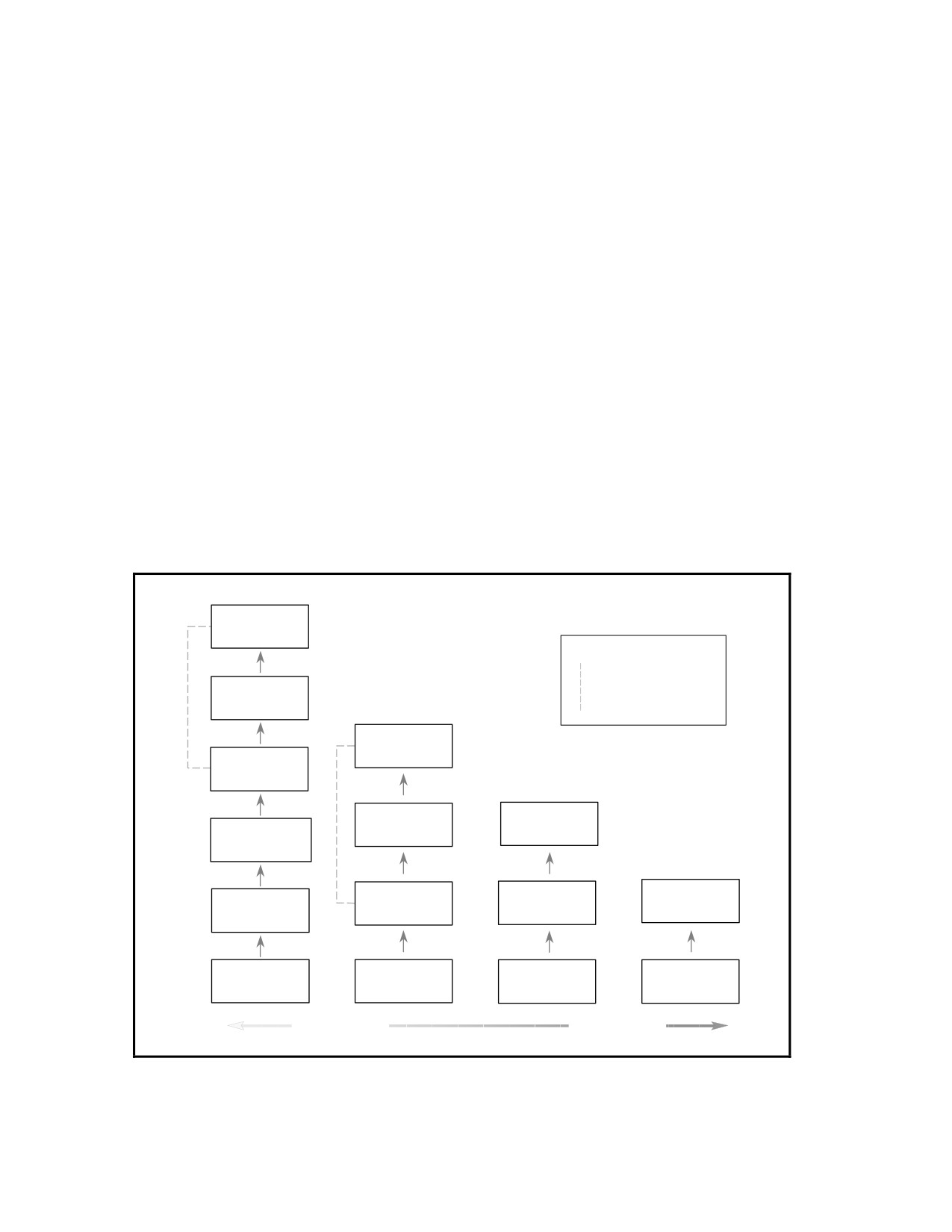
indirect fire weapons, aircraft, and other lethal and nonlethal means in
support of operational or tactical objectives. The goal is to synchronize all
available fire support systems to achieve the most effective results,
thereby maximizing combat power. Effective fire support enables OPFOR
ground forces to attack successfully and quickly to exploit weaknesses.
Commanders try to accomplish their missions using a combination of
maneuver and fire. The OPFOR continues to expand and upgrade fire
support systems to achieve a qualitative edge over its regional opponents.
However, it realizes that it may be at a qualitative disadvantage compared to
a modern extraregional force.
7-2. The OPFOR stresses that fire support should integrate air assets, surface-
to-surface missiles (SSMs), and artillery to attack enemy targets throughout the
area of responsibility (AOR). The combined arms commander always seeks to
increase the effectiveness of air and missile attacks and artillery fire to destroy
enemy formations, weapon systems, or key components of an enemy combat
system. (See Systems Warfare later in this chapter and in Chapter 1.) This
ensures continuous fire support for maneuver units throughout the AOR.
7-3. The OPFOR considers information warfare (IW) an essential element of
fire support. It provides a nonlethal alternative or supplement to attack by
fire and maneuver. It is integrated into the overall concept of the operation,
to confuse, deceive, delay, and disorganize the enemy.
FIRE SUPPORT PRINCIPLES
7-4. The principles of fire support are the framework for a thought process
that ensures the most effective use of fire support assets. These principles apply
at all levels of command, regardless of the specific fire support assets available:
• Plan early and continuously.
7-1
FM 7-100.1 ________________________________________________________________________________
• Exploit all available reconnaissance, intelligence, surveillance, and
target acquisition (RISTA) assets.
• Consider airspace management and the use of all fire support (lethal
and nonlethal) means.
• Use the lowest echelon capable of furnishing effective support.
• Avoid unnecessary duplication of effort.
• Use the most effective means to accomplish the mission.
• Provide rapid and effective coordination.
• Provide for flexibility of employment.
• Provide for safeguarding and survivability of OPFOR fire support assets.
• Attempt to achieve surprise when possible.
• Deliver highly accurate and effective fire.
SYSTEMS WARFARE
7-5. The foundation of OPFOR planning is the systems warfare approach to
combat. Thus, the OPFOR analyzes its own combat system and how it can use
the combined effects of this “system of systems” to degrade or destroy the en-
emy’s combat system. In systems warfare, the subsystems or components of a
combat system are targeted and destroyed individually. Once a favorable com-
bat situation has developed, the targeted enemy subsystem is quickly destroyed
in high-intensity operations, thus making the enemy’s overall combat system
vulnerable to destruction or at least degrading its effectiveness. (See Systems
Warfare in Chapter 1 for further information.)
7-6. Within the systems warfare approach, the OPFOR employs a fire sup-
port concept centered on a phased-cycle of finding a critical component of the
enemy combat system and determining its location with RISTA assets;
engaging it with precision fires, maneuver, or other means; and recovering to
support the fight against another part of the enemy force. The primary
reason for attacking an enemy with fires is to degrade or destroy one or more
key components of the enemy’s combat system and/or to create favorable
conditions for degrading or destroying other parts of his combat system.
TECHNIQUES TO EXPLOIT ENEMY VULNERABILITIES
7-7. The OPFOR seeks to avoid enemy strengths and exploit his vulnerabilities.
In conflicts with extraregional powers, the OPFOR typically would be operat-
ing from relative strategic weakness. Therefore, it seeks to operationally
outmaneuver, overwhelm, and outpace the enemy. It also seeks to deny him
any sanctuary on the battlefield, as well as in the local theater or in his
strategic depth. (See Strategic Context later in this chapter.)
7-8. The OPFOR will also leverage the effects of its available fire support
means by integrating them into an integrated fires command (IFC) in or-
ganizations down to division or division tactical group (DTG) level. The
IFC (described in detail in Chapter 2) synchronizes and focuses the efforts
of RISTA and fire to destroy key enemy formations or systemsor key
components of an enemy combat system. Destroying such targets can not
7-2
_________________________________________________________________________________Chapter 7
only shift the balance of power in the region in the OPFOR’s favor, but
also undermine enemy morale and resolve.
TARGET DAMAGE CRITERIA
7-9. Target damage is the effect of fires on a given military target. It results
in total, partial, or temporary loss of the target’s combat effectiveness.
The OPFOR categories of target damage are annihilation, demolition,
neutralization, and harassment.1 Of these categories, the first three fall
under the general term destruction.
Annihilation
7-10. Annihilation fires render targets completely combat-ineffective and
incapable of reconstruction or token resistance. For a point target such as
an antitank guided missile launcher, the OPFOR must expend enough
munitions to ensure a 70 to 90 percent probability of kill. For area targets
such as platoon strongpoints or nuclear artillery assets, the OPFOR must fire
enough rounds to destroy from 50 to 60 percent of the targets within a group.
These fires result in the group ceasing to exist as a viable fighting force.
Demolition
7-11. The OPFOR uses the term demolition in reference to the destruction of
buildings and engineer works (such as bridges, fortifications, or roads).
Demolition requires enough munitions to make such material objects unfit for
further use.
Neutralization
7-12. Fire for neutralization inflicts enough losses on a target to—
• Cause it to temporarily lose its combat effectiveness, or
• Restrict or prohibit its maneuver, or
• Disrupt its command and control (C2) capability.
To achieve neutralization, the OPFOR must deliver enough munitions to de-
stroy 30 percent of a group of unobserved targets. The expectation is that the
target is severely damaged but could again become capable of coordinated re-
sistance after the fire is lifted. The term neutralization applies only in an ar-
tillery context.
Harassment
7-13. The OPFOR uses a limited number of fire support systems and
munitions within a prescribed time to deliver harassment fires. The goal of
these fires is to put psychological pressure on enemy personnel in locations
such as defensive positions, command posts (CPs), and logistics installations.
Successful harassment fire inhibits maneuver, lowers morale, interrupts
rest, and weakens enemy combat readiness.
1 The use of precision weapons may render such target damage criteria obsolete, since precision weapons
are always supposed to “annihilate” the targets completely, not just destroying a certain percentage of them.
7-3
FM 7-100.1 ________________________________________________________________________________
COMMAND AND CONTROL
7-14. The nature of fire support units, with assets capable of long ranges and
their potential wide influence and flexibility on the battlefield, requires that
C2 be more complex than for maneuver units. The ability to engage and de-
stroy targets at longer ranges has generally resulted in C2 being retained at a
high level of command in order to maximize overall effectiveness. However,
the requirement for a rapid response between the detection of targets and their
subsequent engagement requires C2 to be exercised at a low level of command.
Low-level C2 facilitates accurate judgement in both the timing of engagements
and the fire support adjustments as the combat situation develops. The OPFOR
instituted the IFC as the principal fire support C2 structure to ensure flexibility
of C2 and response in meeting the fire support challenges on future battlefields.
CHIEF OF INTEGRATED FIRES
7-15. Within the operations section of the operational-strategic command
(OSC) staff, there is a chief of integrated fires. This officer is responsible for
coordinating and advising the commander on the effective integration of C2
and RISTA means with fire support means (including precision fires) to sup-
port the overall operation plan. He controls, but does not command, the fire
support units subordinate to or supporting the OSC. He advises the OSC
commander on how best to use available fire support assets.
INTEGRATED FIRES COMMAND
7-16. The IFC is a combination of a standing C2 structure and task organiza-
tion of constituent and dedicated fire support units. All division-level and
above OPFOR organizations possess an IFC C2 structurestaff, CPs,
communications and intelligence architecture, and automated fire control
system. The IFC exercises C2 of all constituent and dedicated fire support
assets retained by its level of command. This can include Air Force, army
aviation, artillery, and SSM units. It also exercises C2 over all RISTA assets
constituent or dedicated to it. There is one IFC per OSC.
7-17. An OSC-level IFC is capable of engaging designated operational and
strategic targets. However, there are circumstances where an IFC may be
formed at the theater level. For example, the theater could have two separate
campaigns, requiring a centralization of critical fire support assets at theater
level to achieve the strategic or theater campaign objectives. When this oc-
curs, the theater commander forms a theater-level IFC commanded by the
deputy theater commander. This IFC exercises C2 over all fire support assets
retained at the theater level of command.
7-18. The mission of the IFC is to execute all fire support tasks required to
accomplish the mission of the command to which the IFC belongs. The IFC is
designed to
• Exploit the combat power inherent in carefully integrated ground and
air fire support actions.
• Reduce to the absolute minimum the amount of time from target acqui-
sition to engagement.
7-4
_________________________________________________________________________________Chapter 7
• Permit fire support assets to mass their effects without having to oper-
ate in concentrated formations.
• Ensure the optimal fire support asset(s) are assigned any given mission.
• Ensure the commander’s priorities for fire support are adhered to.
• Act, if necessary, as the organization’s alternate command structure.
• Integrate the effects of fires from units placed in support of the organi-
zation.
7-19. The number and type of fire support and RISTA units allocated to an
IFC is mission dependent. The IFC is not organized according to a table of
organization and equipment, but is task organized to accomplish the missions
assigned.
7-20. In addition to constituent or dedicated assets that become part of its
IFC, an OSC can receive fire support and/or RISTA assets allocated to it from
national or theater level in a supporting relationship. In that case, the OSC or its
IFC commander can position those assets and give them mission priorities, but
the supporting assets would still be commanded by their parent organization.
FIRE SUPPORT COORDINATION CENTER
7-21. A fire support coordination center (FSCC) is established at each
organizational level (maneuver battalion to IFC). The FSCC is the staff
element responsible for the planning and coordination of fires to support
the respective maneuver unit. It performs the following coordination functions:
• Acquire and identify high-payoff targets (HPTs).
• Recommend targets.
• Use target value analysis to identify target priorities.
• Determine fire support needs.
• Expedite fire support.
• Assess fire support effects.
• Change fire support plans.
• Coordinate the timing of fire support attacks (to include IW).
• Recommend the use of aviation.
SUPPORTING MANEUVER COMMANDERS’ FIRE REQUESTS
7-22. Requests for supporting fires may originate at any organizational level.
They are initiated when constituent or dedicated fire support means at that
level are fully engaged, when the range of the target exceeds the constituent
or dedicated fire support means, or when the constituent or dedicated fire
support means have suffered combat loss. There are two methods of request-
ing supporting fires. The preferred method is for the request to be forwarded
from the division or DTG commander to the integrated fires subsection in the
OSC headquarters. An alternate method is for the division or DTG com-
mander to request supporting fires from the OSC commander. The OSC
commander either approves or denies the request. If the request is approved,
the OSC commander tasks the IFC to provide the requested support.
7-5
FM 7-100.1 ________________________________________________________________________________
NAVAL FIRE SUPPORT
7-23. Naval fire support, when available, gives the ground maneuver
commander long-range indirect fires. Naval fire support includes shipborne
gunfire and sea-launched cruise missiles. Depending on the hydrography and
the orientation of the ground operation, naval fire support may provide deep
indirect fire attacks on enemy formations and installations.
7-24. Naval fire support assets allocated to a theater or OSC in a constituent
or dedicated relationship are under the command of the theater- or OSC-level
IFC. Another option is for naval fire support assets to remain under the
command of the Navy but to provide support for ground operations. During
the course of such a supporting relationship, if enemy actions threaten naval op-
erations, the target attack priorities of the ship may cause it to suspend or cancel
land fire missions until the other threats subside. Once the threats have sub-
sided, the fire support assets resume their support of the ground maneuver force.
7-25. A naval fire support liaison team augments the operations section of
the IFC staff when naval fire support is required to support the ground ma-
neuver force, whether in a constituent, dedicated, or supporting relationship.
The liaison team provides special staff representation and advice on naval
fire support to the IFC commander. Additionally, it coordinates requests for
naval fire support and operates the naval fire support nets in the IFC’s FSCC.
FIRE SUPPORT PLANNING
7-26. Fire support planning is the determination of the content, manner, and
sequence of delivery of fire on the enemy in an operation. The OPFOR accom-
plishes fire support planning at the highest possible levels. The fire support
plan also includes input from subordinate units. The fire support planning
process includes—
• Target acquisition.
• Organization of forces for combat.
• Assignment of fire support missions.
• Determination of ammunition requirements.
• Formulation of a detailed fire support plan.
7-27. Fire support planning includes consideration of the following:
• The scheme of maneuver of the supported forces.
• The enemy force to receive fire.
• The location and character of individual targets within the designated
enemy force.
• The required or desired level of target damage.
• Fire support assets available, both delivery systems and ordnance.
• Requirements for allocation of weapons and units (organization of
forces for combat).
• Missions assigned to IFCs, units, and weapons.
• The manner and procedure of delivery of fire during the performance of
missions.
7-6
_________________________________________________________________________________Chapter 7
• Requirements and distribution of ammunition by missions.
• Organization of coordination and command and control.
• Preparation of appropriately detailed fire support plans at various levels.
7-28. In the OPFOR’s “top-down” approach to the planning and allocation of
fire support, fire support planning occurs at the highest level possible. The
IFC commander at the OSC or theater level plans and coordinates fire sup-
port, always under the direction of the maneuver commander. The highest
level of participating units coordinates and approves the fire support plan,
with input from subordinate units. The OSC headquarters performs general
fire support planning. Detailed planning occurs in maneuver units, IFCs, and
fire support units. The fires of all indirect fire support units within a brigade
or brigade tactical group (BTG) are incorporated into the brigade or BTG fire
support plan. In turn, brigade or BTG fire support plans become part of divi-
sion or DTG fire support plans. Division or DTG fire support plans become part
of OSC fire support plans.
7-29. In its simplest form, fire support planning is the process of determining
the best way to engage all of the enemy’s units with firesensuring that the
required level of damage is inflicted in a manner consistent with the com-
mander’s concept of the operation. Above all else, this means that the fire
support plan must match his concept for the sequence with which the opera-
tion will develop. The focus of fire support planning is on establishing and
maintaining fire superiority over the enemy. Therefore, timing is critical.
ESTIMATE OF SITUATION
7-30. The planning process begins with an estimate of the situation. This
estimate includes the following:
• Scheme of maneuver of supported forces.
• Locations and type of enemy targets.
• Required level of damage.
• Delivery means and ordnance available.
7-31. The OSC commander, his IFC commander, and other staff members
establish the basis for fire support planning during the commander’s
reconnaissance of the area of anticipated action. During this reconnaissance,
the commander refines the organization of forces for combat and the
means of coordination. The OSC commander gives the IFC commander the
information base to determine the following:
• Targets for fire support weapons to engage and fire upon.
• Priority of each target.
• Sequence in which to attack targets.
• Time to attack each target.
7-32. The commander of a fire support unit at any level coordinates the fires
under his control. He determines new requirements and missions and, with
the IFC commander, makes suggestions to the maneuver commander about
adjustments in organization of forces as the situation develops.
7-7
FM 7-100.1 ________________________________________________________________________________
IFC PLANNING
7-33. An IFC commander and members of his staff conduct their planning in
coordination with the rest of the OSC staff, concurrently with the OSC staff
developing the operation plan. The IFC has targets for each phase of the
battle. Planning considerations include target type, dimensions, degree of
fortification, mobility, and depth into the enemy’s defense.
Allocation Procedures
7-34. The OPFOR carefully calculates fire support requirements in terms of
weapons and munitions needed to produce a required effect on enemy targets.
If insufficient fire support or ammunition is available to achieve the neces-
sary result, the OPFOR does not fire less and hope for the best. Rather, if
necessary, it engages fewer targets, adjusting the fire support plan and the
operation plan.
7-35. The priority of allocation of fire support assets to the OSC from the ad-
ministrative force structure is normally to the OSC’s IFC. Fire support assets
that are allocated to the OSC and not used in the IFC are allocated, normally
in a constituent or dedicated relationship, to maneuver units such as DTGs.
Fire support units remaining under IFC command may provide fires for tacti-
cal maneuver units in a supporting relationship. The supporting relationship
allows the IFC commander the flexibility to task fire support assets to engage
key enemy targets throughout the AOR.
Synchronization
7-36. The IFC is synchronized at two levels. First, the OSC commander and his
staff are responsible for synchronizing fire support with ground maneuver.
The key element is to ensure that all fire support occurs at the right place
and time to produce the desired effect. The OSC commander’s maneuver plan
forms the basis for the synchronization of the IFC.
7-37. The commanders of the individual fire support components accomplish
the second level of synchronization when they plan and execute the fire sup-
port operations. They must synchronize the supporting fire components to
produce the concentration of combat power at the decisive point. For exam-
ple, the priority of initial attack helicopter fires may be to suppress enemy air
defense systems to protect attacking fixed-wing aircraft. The artillery may be
assigned missions to attack targets to assist the attacking ingress and egress
of aircraft.
FIRE SUPPORT COORDINATION MEASURES
7-38. Fires from mortars, cannon artillery, multiple rocket launchers (MRLs),
and SSMs pose a potential hazard to friendly maneuver forces and aircraft
activities. The highest probability of conflict between aircraft and indirect fire
weapons occurs at relatively low altitudes in the immediate vicinity of firing
positions and targeted areas. (See Chapter 8 for more information on air and
artillery coordination measures.) To reduce potential conflicts between indi-
rect fires and maneuver forces or aircraft, information pertaining to firing po-
sitions, targeted areas, and fire support plans is distributed to all involved
7-8
_________________________________________________________________________________Chapter 7
commanders and their staffs. The fire support plan includes a map with
graphics outlining the following control lines:
• Coordinated Fire Line. A line beyond which indirect fire systems
can fire at any time within the AOR of the establishing headquarters
without additional coordination.
• Final Coordination Line. A line established by the appropriate
maneuver commander to ensure coordination of fire of converging
friendly forces. It can be used to prohibit fires or the effects of fires
across the line without coordination with the affected force. For
example, this line may be used during link-up operations between an
airborne or heliborne insertion and converging ground forces.
• Joint Fire Line. A line established by the appropriate OSC-level and
above commander to ensure coordination of fire not under his control
but which may affect his operations. The joint fire line is used to coor-
dinate fires of air, ground, or sea weapons systems using various types
of ammunition against surface targets.
• Safety Line. A line that denotes the fragmentation footprint of
indirect fire munitions or bombs/rockets released from aircraft.
This indicates the minimum distance between the impact area and
the nearest friendly troops.
ASSIGNING FIRE MISSIONS
7-39. When assigning missions, indirect fire support commanders and plan-
ners consider several variables, depending on the situation. These variables
include
• Type of target (for example, equipment or personnel, deliberate or
hasty defensive positions, hard- or soft-skinned vehicles, point or area
targets).
• Deployment of target (dug-in or in the open).
• Whether the target is stationary or moving.
• Whether the target is under direct observation during the artillery
attack.
• Range to the target.
• Type, caliber, and number of weapons engaging the target.
• Types of ammunition available.
• Time available to prepare for firing.
PRECISION MUNITIONS
7-40. The OPFOR defines a precision weapon as one capable of delivering
guided conventional munitions with a high probability of destroying enemy
targets with a first-round hit (within range of the weapon delivery system).
The presence of the precision munition transforms a weapon into a precision
weapon. However, a precision weapon system must also incorporate a target
acquisition and tracking subsystem and a missile or projectile guidance sub-
system. Some of these subsystems may be combined. Precision munitions are
primarily designed to effectively defeat armored vehicles; self-propelled artil-
lery systems; MRLs; C2 and RISTA centers; defensive fortifications; and bridges.
7-9
FM 7-100.1 ________________________________________________________________________________
7-41. Precision weapons have enabled the OPFOR to mass firepower at
critical points on the battlefield and simultaneously reduce ammunition
expenditure and mission time. Reconnaissance fire (defined later in this
chapter) is an effective form of precision weapon engagement. It is some-
times called a “unified precision weapon system,” because it links the
highly accurate weapon to an automated reconnaissance and control system.
7-42. Precision munitions delivered by mortars, artillery, missiles, and air-
craft can include—
• Homing and guided SSMs (some delivering advanced submunitions).
• Semiactive laser-guided artillery projectiles and bombs.
• Sensor-fuzed artillery submunitions.
• Terminally homing cannon and mortar projectiles.
• Terminally homing submunitions.
Air-delivered precision munitions include homing and guided air-to-surface
missiles (including radar-seeking antiradiation missiles); guided bombs and
cluster bombs containing homing elements; and air-launched cruise missiles.
7-43. Not all OPFOR artillery units have precision munitions, making it nec-
essary to allocate those rounds available against high-value targets (HVTs).
Even the units that do receive them do not distribute them evenly among all
delivery means, but typically designate one particular unit to fire them.
NBC WEAPONS
7-44. The OPFOR might use nuclear, biological, and chemical (NBC) weap-
ons either to deter aggression or as a response to an enemy attack on the
State. The State considers the employment of NBC weapons as a responsibil-
ity of the National Command Authority. Delivery means such as long-range
missiles and rockets are political tools, first and foremost. The OPFOR
has SSMs capable of carrying nuclear, chemical, or biological warheads.
Additionally, it can employ aircraft systems and cruise missiles to deliver an
NBC attack.
7-45. OPFOR military doctrine distinguishes between fire support and an
NBC attack. However, the two are closely related. Strategic and operational
fire support units must plan and deliver the attacks. They must also adjust
the fire support plan to account for the effects of NBC attacks on the enemy.
Such attacks greatly affect the tempo of combat activity. This, in turn, influ-
ences the type of fire support required. It also influences the kind of logistics
support needed, such as fuel or ammunition.
7-46. If needed, the majority of OPFOR artillery (152-mm and above) is ca-
pable of firing nuclear or chemical munitions. However, continued improve-
ments in conventional munitions, especially precision munitions, increase the
likelihood that the OPFOR can achieve operational- or tactical-level fire su-
periority at the desired location and time without resorting to NBC weapons.
TARGETING
7-47. Targeting is the process of selecting targets and matching the appro-
priate response, taking into account operational requirements and OPFOR
7-10
_________________________________________________________________________________Chapter 7
capabilities. Targeting requires constant interaction between maneuver,
reconnaissance, fire support, and IW, at all levels. Target value analysis is an
analytical tool that is used in the targeting process by which the supported
maneuver commander
• Provides focus for his target acquisition effort.
• Identifies priorities for the engagement of enemy targets that will
facilitate the success of his mission.
• Identifies the target damage criteria.
• Permits planning for identified contingencies based on enemy options
available when the enemy operation fails.
HIGH-VALUE TARGETS
7-48. HVTs are targets deemed important to the enemy commander for the
successful accomplishment of his mission. The loss of HVTs can be expected
to contribute to a substantial degradation of an important battlefield function.
HIGH-PAYOFF TARGETS
7-49. HPTs are HVTs that must be successfully acquired and attacked to
contribute substantially to the success of OPFOR operations. They are devel-
oped on the basis of factors such as enemy situation, unit mission, terrain,
and the time and resources available. They are not dependent on the ability
of the fire support unit to acquire or attack them. If an HPT is beyond the ca-
pability of the target acquisition or reconnaissance unit to acquire, it should
be passed to the next-higher headquarters as a priority intelligence requirement.
7-50. Based on a battlefield analysis, the OSC commander, with advice from
his IFC commander, selects HPTs and establishes a prioritized list of them.
The HPT list identifies the HPTs for a specific point in the operation in the
order of their priority for acquisition and attack. While their target value is
usually the greatest factor contributing to the target payoff, other considera-
tions include the following:
• Sequence or order of occurrence.
• Ability to locate and identify the target.
• Degree of accuracy and identification available from the acquisition system.
• Ability to engage and defeat the target in accordance with the estab-
lished target damage criteria.
• Resource requirements necessary to accomplish all of the above.
TIME-SENSITIVE TARGETS
7-51. Time-sensitive targets are those targets requiring an immediate re-
sponse. The reason for this urgency is that they either pose (or will soon pose)
a clear and present danger to the OPFOR or are highly lucrative, fleeting
targets of opportunity.
TARGET ATTACK METHODOLOGY
7-52. The vast array of targets anticipated on the battlefield can generate
competing demands for fire support. These demands could exceed the capability
7-11
FM 7-100.1 ________________________________________________________________________________
of fire support assets to adequately respond to all requirements. Therefore, the
OPFOR uses the target attack methodology of plan, detect, deliver, and assess.
Plan
7-53. The plan phase provides the focus and priorities for the reconnaissance
collection management and fire planning process. It employs an estimate of
enemy intent, capabilities, and vulnerabilities in conjunction with an under-
standing of the OPFOR mission and concept of operations. During the plan
phase, the OSC commander, with advice from his IFC commander, makes a
determination of what HPTs to look for, when and where they are likely to
appear on the battlefield, who (reconnaissance or target acquisition assets)
can locate them, and how the targets should be attacked.
Detect
7-54. During the detect phase, the reconnaissance plan is executed. As speci-
fied targets are located, the appropriate command observation post (COP) or
delivery system is notified to initiate the attack of the target. Figure 7-1 illus-
trates the varying methods of reporting targets for attack from the point of
detection by a sensor through delivery. The figure displays the methods along
a range from the least to the most responsive.
WEAPON
PLATFORM
LEGEND
Units equipped with firing
systems with onboard manual
FIRING UNIT
or automated fire direction
capability
COP/FDC
WEAPON
PLATFORM
OSC IFC
FSCC
FIRING UNIT
WEAPON
OSC
COP/FDC
PLATFORM
INTEL & INFO
SECTION
OSC IFC
FIRING UNIT
WEAPON
SENSOR HQ
OR DOWNLINK
FSCC
COP/FDC
PLATFORM
SITE
HUMINT/TECH
HUMINT/TECH
HUMINT/TECH
HUMINT/TECH
SENSOR OR
SENSOR
SENSOR
SENSOR
MANEUVER CDR
Less Responsive
More Responsive
Figure 7-1. Target Report Flow
7-12
_________________________________________________________________________________Chapter 7
Deliver
7-55. Timely, accurate delivery is the culmination of synchronization of
fire support. The delivery is rapidly executed by having designated attack
systems respond to the maneuver commander’s guidance when the HPTs are
observed.
Assess
7-56. Following the attack of the target, the RISTA assets are cued to deter-
mine if the target has been defeated in accordance with the established target
damage criteria. If it is determined that the target damage criteria are not
achieved, delivery assets re-engage the target until the desired target dam-
age has been achieved.
METHODS OF FIRE
7-57. Critical to the success of OPFOR operations is the ability to plan, de-
tect, deliver, and assess fire (in accordance with the commander’s target
damage criteria) against enemy C2 and RISTA and weapons systems
throughout the AOR. The focus is a systems warfare approach to combat,
where the objective of the combat action is to deny the enemy’s combat sys-
tem its synergistic capabilities. Thus, the OPFOR is able to compel enemy
forces into multiple and rapid tactical transitions and to create opportunity
by keeping them off balance, breaking their momentum, and slowing
movement. The OPFOR uses various types of fires against the enemy. The
methods of fire may have different purposes in the offense and defense.
FIRE SUPPORT TO A STRIKE
7-58. At the operational level, a strike involves the employment of a combina-
tion of strategic- and operational-level RISTA systems with fire support, SPF,
and maneuver forces to conduct precision strike operations that can result in
a decisive operational victory. The strike can be employed in both defensive
and offensive operations.
7-59. Fire support to a strike involves the employment of a wide variety of
ammunition types (such as standard, course-corrected, advanced, and precision
munitions) to destroy an enemy formation after typically setting the conditions
for its destruction through reconnaissance fire. IFC fire support units are as-
signed interdiction fire missions to support the maneuver component throughout
the strike. Constituent and dedicated indirect fire support units (allocated to the
maneuver component) provide close support fire throughout the operation. Thus,
fire support to a strike incorporates other methods of fire.
RECONNAISSANCE FIRE
7-60. Reconnaissance fire is the integration of RISTA, fire control, and weapon
systems into a closed-loop, automated fire support system that detects,
identifies, and destroys critical targets in minutes. This integration capability
normally exists only within an IFC. One reason for this requirement for acceler-
ated engagement is that high-value targets may expose themselves for only
fleeting periods. Reconnaissance fire is primarily designed to attack and destroy
key enemy capabilities and/or set the conditions for a strike (see Chapter 3).
7-13
FM 7-100.1 ________________________________________________________________________________
7-61. Reconnaissance fire enables the OPFOR to deliver fixed- and rotary-
wing air, SSM, cruise missile, and artillery fires (including precision muni-
tions) on enemy targets within a very short time after acquisition. The
OPFOR can use reconnaissance fire in offensive and defensive phases of com-
bat. Assets designated for reconnaissance fire use are under control of the
IFC commander, and control remains centralized for planning, analysis, and
evaluation of reconnaissance data, and for execution of the reconnaissance
fire mission. This type of arrangement allows the assets to execute other mis-
sions or taskings until the desired HPTs are detected. The IFC commander
may establish a window of time for assets tasked to support reconnaissance
fire (based on an intelligence assessment of when the enemy targets should
be in designated kill zones).
7-62. The OSC commander selects and establishes the target priority and
target damage criteria of the combat system component or components to be
attacked in order to force the favorable condition to conduct a strike. The IFC
staff and fire support component commanders develop the fire support plan
designed to conduct reconnaissance fire necessary to create the favorable
condition. The IFC commander then briefs the fire support plan to the OSC
commander to ensure compliance with the overall operation plan. The IFC
executes reconnaissance fire in accordance with the approved fire support plan.
CLOSE SUPPORT FIRE
7-63. Close support fire is fire used to support maneuver forces and attack
targets of immediate concern to units such as battalions and BTGs. The re-
quirement is to provide a quick response time and accurate fires capable of
either neutralizing or destroying all types of targets.
INTERDICTION FIRE
7-64. Interdiction fire is fire designed to attack targets in depth (such as
logistics sites or assembly areas) and to prevent enemy follow-on or reserve
forces from reinforcing or influencing a battle or situation. Generally,
interdiction fire (when compared to close fire) has a slower response time,
especially for stationary targets; accuracy may be lower; and the targets are
generally not as well protected. However, technological improvements such as
course-corrected rockets, projectiles, and fuzes facilitate long-range precision
targeting.
7-65. The OPFOR employs long-range fire systems (operating from dispersed
areas) to continuously engage targeted forces and systems. Operational and
tactical RISTA systems direct them.
COUNTERFIRE
7-66. Counterfire is fire designed to destroy the enemy fire support infra-
structure throughout the battlefield. The fire support infrastructure includes
mortars, cannon, rockets, missiles, fire support C2 and RISTA, and logistics
assets. Counterfire enables the ground forces to achieve effective fire support
on the battlefield. It is especially important for the early destruction of the
enemy’s long-range and precision weapons.
7-14
_________________________________________________________________________________Chapter 7
COUNTERBATTERY FIRE
7-67. Counterbattery fire is fire that accomplishes the annihilation or neu-
tralization of enemy artillery batteries. It enables ground forces to maneuver
on the battlefield with little to no suppression by enemy artillery. However,
combat with enemy artillery requires more than counterbattery fire.
FIRE SUPPORT OF MANEUVER OPERATIONS
7-68. The fire support of maneuver operations is characterized by the use of
all available fire support to carry out the commander’s plan. The OPFOR be-
lieves that fire support must be flexible to meet all contingencies during com-
bat operations. The OPFOR masses fires against an enemy objective with
available fire support assets, with the goal of achieving the OSC commander’s
specified target damage criteria in the shortest time possible.
OFFENSE
7-69. Fire support considerations for the offense apply to all types of offensive
action discussed in Chapter 3. The OPFOR plans and executes fires to sup-
port the offensive action and complete the destruction of the enemy. The use
of selected lines or zones controls the shifting of fires, and the displacement of
fire support units reflects changes in command and support relationships be-
tween fire support units and maneuver units. Fires are planned to
• Suppress enemy troop activity and weapon systems.
• Deny the enemy information about friendly forces.
• Prevent the enemy from restoring fire support, C2, and RISTA systems
neutralized during previous fire support missions.
• Deny the enemy the ability to use reserve forces to conduct a counter-
attack.
• If necessary, create favorable conditions for the conduct of a strike.
• Support the exploitation force.
DEFENSE
7-70. Fire support considerations for the defense apply to all types of
defensive action discussed in Chapter 4. Key is the application of fire support
as early as possible throughout the AOR in support of the defensive operation
plan. Emphasis is placed on RISTA assets locating enemy formations and
attack positions, with the goal of determining the direction and composition
of the enemy main attack. Carefully analyzing the terrain over which the
enemy will advance and canalizing his movement into kill zones can create
conditions for fires in the defense. Fires are planned to
• Deny the enemy information about friendly forces.
• Develop the situation early by forcing the enemy to deploy early and
thus reveal the location of his main effort.
• Maximize the effect of obstacles as combat multipliers.
• Create favorable conditions for the conduct of a strike or counterattack.
7-15
FM 7-100.1 ________________________________________________________________________________
STRATEGIC CONTEXT
7-71. During all strategic-level courses of action, the OPFOR may use various
fire support assets to attack the most vulnerable parts of the enemy’s combat
system. These attacks are coordinated with perception management efforts to
convey a message of political and military dominance to the regional civilian
populace as well as to convey an adverse view of an intervening extraregional
opponent.
7-72. The OPFOR is able to employ all of its methods of fire in regional and
transition operations. However, it is unable or finds it difficult to employ the
counterbattery method of fire during adaptive operations due to an extrare-
gional force’s technological advantage in ability to target OPFOR fire support
assets.
REGIONAL OPERATIONS
7-73. During regional operations, the OPFOR can use fire support means
(primarily aviation, SSMs, and long-range rockets) to attack targets in the
homeland of a regional opponent. The OPFOR generally possesses an
overmatch in military capability against its regional neighbor and is able
to control the airspace, thus allowing it freedom of maneuver. However, the
OPFOR is concerned about the intervention of an extraregional force during a
strategic campaign against a regional neighbor.
7-74. The OPFOR realizes that its regional opponent may receive RISTA
support (such as satellite and fixed-wing signals intelligence and imagery)
from an extraregional power. OPFOR fire support planners also develop con-
tingency plans to preserve their fire support assets during transition and
adaptive operations, if necessary. Common countermeasures are to disperse
fire support assets and to use decoys and camouflage.
TRANSITION OPERATIONS
7-75. During transition operations, the OPFOR is concerned about the
extraregional force’s military capabilities arriving or being established be-
fore the OPFOR can completely achieve its strategic objectives. Therefore, the
overall focus is on the disaggregation of the enemy’s combat system (see
Systems Warfare earlier in this chapter and in Chapter 1).
7-76. Starting with transition operations, the OPFOR may use various fire
support assets in access-control operations and attack of the enemy’s LOCs
and rear. It attacks the most vulnerable parts of the enemy’s combat system.
This may include attacks on the infrastructure or even civilian targets. The
OPFOR coordinates such attacks with perception management efforts to
convey the view that these terror tactics are no worse than enemy bombing
campaigns.
7-77. The goal of the OPFOR is to disrupt the deployment tempo of the ex-
traregional force by attacking unique or key targets in aerial and sea ports of
debarkation. These targets include key C2 nodes, contractors and contractor-
operated facilities, logistics operating bases, and ground and airborne RISTA
platforms. For example, the OPFOR can greatly reduce an extraregional
force’s combat power by attacking a logistics system that depends on “just-in-
time” or “reach-back” delivery. The OPFOR would also seek to conduct these
7-16
_________________________________________________________________________________Chapter 7
attacks in concert with the perception management portion of the IW plan to
leverage the world media to report adverse perceptions of the extraregional
force.
7-78. During transition operations, the OPFOR begins to disperse its fire
support assets and emphasize the use of fire and decoy tactics, techniques,
and procedures (TTP). The OPFOR employs the fire and decoy TTP to in-
crease survivability as well as to deceive the enemy as to the actual firing
unit location.
ADAPTIVE OPERATIONS
7-79. An extraregional force must maintain a degree of information domi-
nance that enables it to use information systems to achieve an operational
advantage, while denying that capability to the OPFOR. Such systems pro-
vide battlefield visualization, situational awareness, combat identification,
spectrum supremacy, and C2 attack and protection. Therefore, the OPFOR
primarily shifts its emphasis to force preservation and seeks opportunities to
attack and destroy key components of the enemy’s combat system, including
his information systems.
7-80. The extraregional force may have the perception that the tempo of
OPFOR continuous fire support has substantially decreased, since the
OPFOR no longer possess the advantage of information dominance nor the
ability to control its airspace. However, the OPFOR mindset is that the tempo
has been adjusted to attack targets (using reconnaissance fire) at critical times
in order to preserve the force. For example, during adaptive operations, fire
support is centrally planned and executed. The OSC commander can establish
both the firing and target damage criteria and exercise C2 of units conducting
fire support. The IFC headquarters develops the firing orders and firing data
computation and transmits this information in a coded format to the firing
unit. Because the OPFOR’s communications are particularly vulnerable to
attacks, transmission may have to be via a civilian telephone system (to
include cellular phone), messenger, or even newspaper.
7-81. The OPFOR continues to emphasize the use of the fire and decoy TTP.
While using such TTP, it seeks to colocate its fire support assets with the ci-
vilian populace, especially in urban areas to create a moral sanctuary. If the
extraregional force attacks the fire support assets colocated with the civilian
populace, the OPFOR will seek to leverage the world media to report adverse
perceptions of the extraregional force through the perception management
portion of the IW plan.
7-17
Chapter 8
Aviation
Aviation operations are an integral part of all OPFOR operations. Most
fixed-wing assets belong to the Air Force, while most of the rotary-wing
aircraft belong to the Army. The Air Force is the largest, best equipped,
and best trained in the geographic region. The capabilities of the
OPFOR’s fixed- and rotary-wing aircraft far exceed those of its neighbors,
allowing for regional air superiority. However, the Air Force is not strong
enough to defeat the air force of a modern power from outside this region.
Realizing this limitation, the OPFOR will modify its use of aviation assets
to ensure effective use against high-payoff targets. The air doctrine of the
OPFOR represents a blend of principles growing out of past experience
and doctrine adapted from foreign advisors.
ORGANIZATION
8-1. The State’s aviation organizations are structured similar to the ground
components. As with the ground forces, the administrative force structure is
a system in peacetime that mans, trains, and equips units to deploy for war.
In wartime, the Air Force’s peacetime air armies may be utilized in whole or
may be parceled to provide units to a theater- or operational-level command.
The Army’s aviation units are structured similarly to other Army units, with
brigades and battalions being the primary size of deployable units. This
structure provides timely and effective use of assets at all levels of combat
from the strategic campaign to the tactical ground maneuver plan.
AIR FORCE
8-2. The OPFOR has a variety of Air Force assets at national and theater
levels in the administrative force structure. It has organized these assets so
that each of these levels of command can have its own aviation forces to fulfill
mission requirements. The subordinate Air Force organizations are grouped
on a functional, mission-related basis, into divisions, regiments, and
squadrons. For example, a bomber division is composed primarily of bomber
regiments, and a fighter regiment is composed mainly of fighter squadrons.
Rotary-wing assets of the Air Force are organized along the same lines as
those of army aviation, with brigades and battalions. The Air Force also has
some mixed aviation units with a combination of fixed- and rotary-wing
assets; these follow the normal Air Force organization pattern, with mixed
aviation regiments and squadrons, although rotary-wing subordinates would
be battalions and companies. Various fixed- and/or rotary-wing assets of the
Air Force may be task organized as part of an operational-level command in
wartime.
8-1
FM 7-100.1 ________________________________________________________________________________
National-Level Air Force
8-3. The State has subordinated air armies directly to the Supreme High
Command (SHC) for strategic missions. Aircraft include bombers, interceptors,
fighters, electronic warfare (EW) platforms, transport aircraft, and tankers.
Some bombers can deliver long-range, air-launched cruise missiles (ALCMs)
with high accuracy and a standoff range of 3,000 km or more. Tankers
provide a capability for air-to-air refueling of bombers. A national-level air
army has the mission of inflicting losses on vital targets and conducting aerial
reconnaissance in support of the strategic campaign. The SHC can also allocate
these air armies to support a specific theater- or operational-level command.
8-4. The size and composition of an air army can vary greatly. However, most
air armies have one or more units each for
• Fighter aviation.
• Bomber aviation.
• Reconnaissance aviation.
• Mixed aviation (fixed- and rotary-wing).
• Heliborne jamming.
In addition, some air armies may have one or more units for
• Ground-attack aviation.
• Airborne jamming aviation.
• Transport helicopters.
• Air ambulance.
Generally, units with the term aviation in their titles are either fixed-wing
units or mixed aviation units with a mixture of fixed-and rotary-wing
aircraft. During wartime, some aviation divisions and regiments may be task
organized into aviation tactical groups.
Theater-Level Air Force
8-5. Theater air armies are subordinate to the theater headquarters (if
created) and play a key role in all types of combat, from participating in
theater-level campaigns to supporting low-level tactical units of the ground
forces. In the former role, they complement national-level aviation, and in the
latter, army aviation.
8-6. High-performance fighters, interceptors, and some light bombers com-
prise the air army of the theater. At theater level, the Air Force also controls
a substantial number of fixed- and rotary-wing EW aircraft, as well as
medium- and heavy-lift helicopters. Thus, a theater air army can have the
same types of units as found in air armies at the national level.
8-7. The size and composition of the theater air army vary greatly depending
on the theater’s needs. Those aviation assets retained to provide fire support
at the theater level are part of the theater’s integrated fires command (IFC).
Theater headquarters may also use these assets to support high-priority
operational-level actions.
8-2
_________________________________________________________________________________Chapter 8
Operational-Level Air Force
8-8. At the operational level, an operational-strategic command (OSC) is a
joint command. Therefore, the SHC may include Air Force units in the forma-
tion of the OSC. These units are sized and equipped according to the mission
assigned to the OSC. Those Air Force assets allocated to an OSC in a con-
stituent or dedicated relationship for fire support become part of the OSC’s IFC.
ARMY AVIATION
8-9. The OPFOR has a variety of attack, transport, multipurpose, and special-
purpose helicopters that belong to the ground forces (Army) rather than the
Air Force. Hence the term army aviation. In addition to these helicopters,
army aviation also owns a limited number of small fixed-wing aircraft to sup-
port transport and reconnaissance missions. Army aviation units may remain
under centralized control at theater level or may be task organized within an
OSC, division tactical group (DGT), or brigade tactical group (BTG).
Theater-Level Army Aviation
8-10. The theater headquarters’ army aviation assets are critical in theater
campaigns. Army aviation provides reconnaissance, lift for heliborne land-
ings, and direct air support (DAS) for ground forces. The OPFOR generally
uses helicopters for reconnaissance only within the protection of the ground
forces’ air defense umbrella. Helicopters perform such tasks as route or NBC
reconnaissance. In the DAS role, it is common for army aviation to supple-
ment theater’s fixed-wing ground-attack aircraft. All attack helicopter units
and perhaps some other army aviation assets retained at theater level would
be part of the theater IFC.
8-11. The type and number of army aviation brigades or battalions subordinate
to the theater headquarters or theater IFC varies according to the theater’s
needs and the importance of that theater in the OPFOR’s strategic campaign.
Army aviation assets at theater-level can include one or more units of each of
the following:
• Attack helicopters.
• Medium-lift helicopters.
• Heavy-lift helicopters.
• Reconnaissance, jamming, and command and control (C2) helicopters.
• Drones.
• Light and medium transport airplanes, replacing some lift helicopters
in mixed aviation units.
Other than these standing army aviation organizations, the OPFOR may also
form some task-organized army aviation tactical groups or detachments with
a mix of different aircraft types.
Operational-Level Army Aviation
8-12. As discussed in Chapter 2, the OSC is a standing headquarters. When
the OSC is formed for combat operations, an army aviation brigade or battalion
may be task organized under this command to provide agility, versatility, and
increased firepower. The type, size, and quantity of the units vary depending
8-3
FM 7-100.1 ________________________________________________________________________________
on the mission of the OSC. In some cases, the OPFOR may include a limited
number of army aviation assets in the formation of a DTG or BTG.
COMMAND AND CONTROL
8-13. The commander of the theater air army (Air Force asset) is subordinate
to the theater commander. If the majority of the air army’s assets retained at
theater level are allocated to the theater IFC, the air army commander may
also become subordinate to the IFC commander. The air army command post
(CP) is normally within 10 to 15 km of the theater’s main CP or IFC CP to
ensure a close relationship. This relationship ensures that there is no danger
of the air army conducting separate, divergent operations as opposed to sub-
ordinating the air effort to the needs of the ground operation.
8-14. The senior commander of the army aviation component is also directly
subordinate to the theater commander or the theater IFC commander. The
army aviation CP is located within 30 km of the theater main CP or IFC CP
to allow for rapid coordination from theater to the executing unit. The staff of
the aviation unit works closely with the theater staff to plan and coordinate
the employment of the theater’s army aviation assets.
8-15. The command structure at the OSC level is similar to that at theater
level. The OSC may have an air army, division, or regiment as the largest Air
Force organization. Depending on the type of aviation assets involved, the
commander of this unit is subordinate to the OSC commander or to the OSC
IFC commander.
8-16. The command structure for army aviation units in an OSC depends on
the types of aviation units assigned and whether or not they perform or support
fire support missions. Thus, the commander of the army aviation unit may be di-
rectly subordinate to the commander of the OSC or to the OSC IFC commander.
CENTRALIZED CONTROL
8-17. The OPFOR has a limited number of aviation units compared to the
size of the ground force. For this reason, it believes that maintaining centralized
control over its aviation assets is essential to the effective employment of both
fixed-wing and rotary-wing aircraft. However, centralization is a relative term,
depending on what levels of command are involved.
Fixed-Wing
8-18. The OPFOR establishes relatively centralized control over its fixed-
wing assets. Centralization takes advantage of the mobility and maneuver-
ability of aircraft to concentrate them at the decisive point and time from
dispersed bases. Centralized control simplifies the coordination with ground
forces and allows for the integration of aircraft being used in different, but
complimentary roles (for example, reconnaissance, fighter, and ground attack). It
also allows a rapid reallocation of air support resources to accomplish the
more important missions that suddenly arise during an operation. Aviation
units not originally assigned for ground support may sometimes take part in
delivering air attacks against ground targets. To execute their missions, the
OPFOR uses centralized planning to allocate air support resources to the ground
commander by flights or aircraft sorties with the appropriate ammunitions.
8-4
_________________________________________________________________________________Chapter 8
Rotary-Wing
8-19. The OPFOR can use less centralized procedures for the allocation of its
helicopter assets, especially the combat helicopter in the DAS role. However,
if the number of assets in theater allows and the mission dictates, it may de-
centralize control over an aviation unit. It can do this in two ways. The first
is a constituent subordination of an aviation unit, or the higher headquarters
can establish a dedicated or supporting relationship for a specified period of time.
AIRSPACE OPERATIONS SUBSECTION
8-20. The chief of airspace operations (CAO) at theater, OSC, and tactical
group levels is the primary person in the staff responsible for the coordina-
tion of all airspace users. He, along with his staff, make up the airspace
operations subsection (AOS). They work directly for the operations officer in
the planning of future operations and the execution of current operations. At
theater level, this AOS generally consists of—
• An air controller team (Air Force).
• An intelligence team.
• A communications team.
• Liaison teams from subordinate units requiring airspace deconfliction.
8-21. At OSC level and below, the AOS is sized according to needs, but per-
forms the same functions. Some functions of this staff are to—
• Recommend the employment of air assets.
• Deconflict airspace for all users.
• Plan the effective suppression of enemy air defense.
• Transmit air support requests.
• Maintain communications with aircraft in the area of responsibility.
• Provide the commander with all air reconnaissance information.
8-22. The AOS at every level is manned and equipped to provide 24-hour
operations. Additionally, the AOS provides representation to the IFC CP and
to the forward CP when the latter is operational.
PLANNING AND PREPARATION
8-23. The theater air army and ground forces have an integrated C2 struc-
ture. This ensures close and continuous coordination in joint operations. The
CAO evaluates the situation based on the theater commander’s guidance. He
then plans the air portion of an operation and recommends the proper em-
ployment of air assets. The same process is being performed simultaneously
at the OSC-level AOS.
8-24. In addition to the air missions planned at theater level, the theater
staff allocates assets to integrate into the subordinate ground commander’s
plan. To achieve a coordinated operation plan, the theater air army sends
personnel and communications equipment to ground force units at battalion
level and above. These personnel forward requests for air assets through the
chain of command to the theater staff. The theater CAO then screens the
8-5
FM 7-100.1 ________________________________________________________________________________
requests and identifies the missions that can be supported by army aviation
and those that must be supported with Air Force assets. The allocations are
then sent to the theater commander for approval.
8-25. At OSC level, the commander consults his CAO and develops detailed
targeting plans for the current fight through the next 48 hours. He also
makes rough estimates for 5 subsequent days. Requests are formulated for
mission type, not for specific type of aircraft. For example, the OSC does not
identify helicopters in its request for DAS. These requests are forwarded to
the theater CAO and continually revised until 48 hours prior to execution.
Once approved, these become part of the published theater aviation support
plan (ASP). There can also be an ASP at OSC level, particularly when the
OSC is not subordinate to a theater headquarters.
8-26. Then, the theater or OSC AOS issues the ASP to the executing aviation
units. These orders cover targets, numbers of sorties, air approach corridors,
communications codes, and mission timing. Air Force representatives at sub-
ordinate levels then confirm, for their respective commanders, the allocation
of air resources. Normally, the commander holds a percentage of his air
power in reserve to meet the unforeseen demands.
8-27. Once the allocation is received by the OSC, the OSC commander may
assign specific air support to a subordinate unit or maintain control at his
level. The OSC AOS then continues to coordinate the effort until the end of
the mission.
MISSION REQUEST TYPES
8-28. The OPFOR recognizes the criticality of providing support to the
ground forces. Available air support is assigned missions according to the
following categories of requests: preplanned, on-call, and immediate.
Preplanned
8-29. A preplanned mission is a mission planned well in advance of its execu-
tion, usually 24 hours prior to launch. Such missions are normally planned
against static or non-moving targets with known locations.
On-Call
8-30. An on-call mission is one in which the target may be predesignated,
but the timing of the attack remains at the discretion of the ground force
commander. These missions are normally planned to support maneuver
forces not yet in contact with the enemy, but expected to make contact
once the aircraft are available. The on-call mission is planned the same as
preplanned missions, with the exception of the attack’s timing. A “window of
availability,” usually no longer than 4 to 5 hours, is established. The mission
can be launched at any time during that window. On-call missions are
planned with secondary targets in the event the window of availability
expires before the primary target becomes available for attack.
Immediate
8-31. The OPFOR designates a limited number of aircraft to respond only to
requests from ground commanders for unplanned immediate air support.
8-6

_________________________________________________________________________________Chapter 8
A request for immediate air support is forwarded through AOS channels.
As with preplanned support, the AOS at each command level participates
directly in the evaluation of each air support request.
LEVELS OF COMBAT READINESS
8-32. The OPFOR recognizes three levels of combat readiness for aircraft and
crews. (See Figure 8-1.) Aircraft in categories one and two respond to on-call
missions.
Category
Crew and Aircraft
Duration of
Time
Readiness
Before
Takeoff
One
Aircraft are fully serviced and armed. Combat crews are briefed on
1-2 hours
3-5
their mission and are in the aircraft ready to start engines. Ground
minutes
personnel are assisting the combat crews.
Two
Aircraft are fully serviced and armed. Combat crews are briefed and
2-4 hours
15
are on standby in the vicinity of the aircraft, ready to take off within a
minutes
specified short period of time after receiving a mission order.
Three
Aircraft are refueled and serviced. Cannons are loaded. External sys-
2-4 days
1-2 hours
tems (bombs, rockets, missiles, fuel tanks, etc.) are not loaded. Com-
bat crews are designated, but not on standby; they have not been
briefed on the air and ground situation, but will be before takeoff.
Figure 8-1. Levels of Combat Readiness
CAPABILITIES
8-33. The priority for organizational strength and equipment modernization
depends on the importance of a unit within the overall strategic plan. Mod-
ernization, in particular, depends greatly on the economic capability of the
State to acquire the latest-generation fixed-wing aircraft and helicopters. As
an example, the OPFOR helicopter combat units range from armed lift air-
craft employed as gunships to state-of-the-art attack helicopters. The OPFOR
continues to modernize units with aircraft having—
• Improved avionics.
• Improved electronic countermeasures (ECM) and electronic counter-
countermeasures (ECCM) equipment.
• Increased payload.
• Longer combat radius.
• Increased night capability.
8-7
FM 7-100.1 ________________________________________________________________________________
8-34. The OPFOR will continue to modify the employment of its aviation
units as the modernization continues. On the lowest level, for example, gun-
ship units are employed almost exclusively during daytime, while modernized
attack helicopter battalions can be effectively employed at night.
DIRECT AIR SUPPORT
8-35. Aviation continues to improve nighttime and poor-weather air recon-
naissance and ordnance delivery in support of ground maneuver formations.
With the heavy emphasis on night combat, the OPFOR recognizes limitations
in its ability to maintain continuity of air support at night and in poor weather.
8-36. The OPFOR is making efforts to correct these shortcomings. The all-
weather fighters and bombers are capable assets to support ground forces
even for night missions. They have the range and payload to attack deep targets.
Many modern fixed-wing aircraft and combat helicopters have electronic and in-
frared instruments that enable pilots to conduct sorties at night and in poor
weather at low altitudes. The pilots can search for, detect, and destroy targets.
COUNTERAIR
8-37. The Air Force has the most lethal air intercept aircraft in the region.
However, it would be challenged by air forces of a first-class power and would
modify its operations when required. The deployment of a wide array of
mobile and semi-mobile ground air defense systems has freed some aircraft
from air defense missions for ground support roles. (See Chapter 9 for more
details on air defense support.)
RECONNAISSANCE
8-38. Aerial reconnaissance includes visual observation, imagery, and signals
reconnaissance. Imagery reconnaissance encompasses all types of optical
cameras utilizing conventional fixed-frame and strip photography, infrared
photography, and television systems; it also includes side-looking airborne
radar (SLAR) and synthetic-aperture radar (SAR) capabilities. Airborne
signals reconnaissance includes communications and noncommunications
emitter intercept and direction finding.
ELECTRONIC WARFARE
8-39. The OPFOR continues to improve its capabilities to conduct EW, in-
cluding sophisticated jamming equipment. It might deploy equipment on its
aircraft to—
• Jam multiple enemy radars.
• Jam only when the target radar reaches a certain intensity.
• Select the correct jamming signal for the specific target radar.
8-40. The OPFOR can jam the enemy air defense network’s major surveillance
and acquisition radars. It also uses advanced deception jamming techniques.
All these capabilities allow OPFOR aviation to provide increased support that
combines accuracy in ordnance delivery, greater flexibility in employment,
increased survivability, and increased responsiveness to combined arms
commanders.
8-8
_________________________________________________________________________________Chapter 8
UNMANNED AERIAL VEHICLE
8-41. The OPFOR is currently acquiring unmanned aerial vehicles (UAVs).
As technology allows, it will develop doctrine for employing UAVs in the
reconnaissance, attack, deception, and resupply roles.
MISSIONS
8-42. Based on the capabilities outlined in the preceding section, the OPFOR
conducts a wide variety of missions with its aviation assets. This section
describes the typical missions assigned to aviation units.
COUNTERAIR
8-43. If engaged in a regional operations, the Air Force attempts to establish
and maintain the desired degree of air dominance. Air superiority is
established through a combination of offensive and defensive actions.
Preplanned attacks while the enemy’s aircraft are on the ground would be
an example of offensive air defense missions, while flying intercept missions
to engage enemy aircraft firing on air or ground troops is an example of a
defensive mission.
8-44. When the State is attacked by a major power, the Air Force will at-
tempt to defend strategic centers and conduct precision attacks early to inflict
politically significant damage on invaders. An invasion of the State may dic-
tate an “all-out” effort to control access to the region or harass the early-entry
forces before they build up sufficient air and air defense capabilities to domi-
nate the airspace. Alternatively, the OPFOR could save its Air Force assets
for a surge effort at a critical point later in the conflict. However, it will not
delay use of its air forces until such a surge unless it has means to ensure the
survivability of its aircraft on the ground. Survivability means may include
underground shelters. The OPFOR also will attempt to conduct missions from
more dispersed locations or from a safe haven such as neighboring country.
RECONNASSIANCE
8-45. Aerial reconnaissance is a principal method of gathering target in-
telligence. The theater and OSC staffs each prepare a reconnaissance plan,
which details tasks for Air Force and/or army aviation assets. Theater avia-
tion’s reconnaissance forces gather tactical and operational intelligence up to
a 300-km radius. They may also be tasked to collect strategic intelligence to
support national-level requirements.
8-46. Aircrews on any mission should immediately report observed enemy
activity or conspicuous inactivity. Specialized reconnaissance aviation
regiments have the primary responsibility for aerial reconnaissance. These
regiments have specially-equipped reconnaissance aircraft. Aviation assets
also can have airborne signals reconnaissance collectors.
8-47. The processing of data from an air reconnaissance mission can take 2 to
8 hours. To shorten this time, the aircraft transmit perishable target intelli-
gence by radio to ground CPs. OPFOR planners are also modernizing their
techniques to shorten the process.
8-9
FM 7-100.1 ________________________________________________________________________________
COUNTERRECONNAISSANCE
8-48. The OPFOR knows the significance of having reconnaissance forces on the
battlefield to ensure mission success. For this reason, it heavily emphasizes the
destruction of the enemy reconnaissance teams and dedicates numerous assets
to accomplish this mission. The OPFOR includes either armed or lift helicopters
in the counterreconnaissance plan to search for, locate, and report enemy
reconnaissance teams. Depending on the plan, the OPFOR may use the armed
helicopters, infantry, artillery, or other methods to destroy these teams.
DIRECT AIR SUPPORT
8-49. DAS is a mission to disrupt or destroy enemy forces in proximity to friendly
forces. This mission can be accomplished using fixed-wing assets and fire support
helicopters. Because these assets are centrally controlled, the missions are
formulated at various staff levels and allocated based on assets available and
significance of the mission. DAS missions are part of the fire support plan.
INTERDICTION
8-50. Air interdiction is planned and executed to destroy targets that are not
in proximity to friendly troops. These missions are planned at the theater or
OSC level to support the ground commander’s overall plan. Interdiction mis-
sions can be conducted in advance of ground maneuver to set the conditions,
or simultaneously to force the enemy to fight on different fronts.
HELICOPTERS AS A MANEUVER FORCE
8-51. As an exception to the rule, the OPFOR might employ a highly-trained
unit equipped with modern attack helicopters as a maneuver force in the
ground commander’s scheme of maneuver. In this role, the attack helicopter
unit can be used as the fixing, assault, or exploitation force in the offense or
as the disruption or counterattack force in the defense. In either offense or
defense, it could be a deception force or reserve. Such employment is among
the most complex missions conducted by aviation units and requires detailed
planning, rehearsals, and execution.
COMBAT SUPPORT AND COMBAT SERVICE SUPPORT MISSIONS
8-52. Lift helicopters can support the ground commander in numerous
combat support (CS) and combat service support (CSS) roles. For example,
they can
• Transport ground units conducting heliborne assaults.
• Rapidly move forces on the battlefield.
• Insert reconnaissance teams.
• Conduct emergency resupply missions to isolated units.
The aircraft can also be equipped as a gunship, minelayer, electronic jammer,
or C2 platform.
8-53. The OPFOR has a variety of medium- and heavy-lift helicopters that
can provide transport capability throughout the battlefield. These aircraft are
lightly armed and are used to move troops, equipment, and supplies in the
relatively safe areas. Periodically, these aircraft are tasked to assist in CS
8-10
_________________________________________________________________________________Chapter 8
and CSS missions such as large heliborne assaults, combat search and
rescue, and forward arming and refueling point (FARP) emplacement.
PRINCIPLES OF EMPLOYMENT
8-54. The OPFOR’s use of aviation assets is guided by key employment prin-
ciples. Because the State has purchased aircraft (both fixed- and rotary-wing)
with a wide array of capabilities, some units are equipped with the latest
technology, while other units make do with older systems. This requires the
OPFOR to modify its operations based on the capabilities of the unit’s air-
craft, but within these employment principles.
PURPOSE
8-55. Every mission must be focused toward a clearly defined, decisive, and
attainable task. It must directly contribute to the higher commander’s imme-
diate plan. As an example, a lift helicopter unit is given a mission to insert a
reconnaissance team. All planning efforts should be aimed at accomplishing this
goal. Actions that do not contribute to achieving this mission must be avoided.
COORDINATION
8-56. The coordination of aviation with artillery, air defense, and maneuver
units is one of the most difficult tasks of modern combat, particularly in the
absence of air superiority. CAOs are assigned at various levels of command to
ensure a coordinate effort among the airspace users. Liaison teams from
aviation units also assist in this effort. The aviation commanders and staffs
develop detailed plans, working closely with the other members of the
combined arms team, not only to ensure the most effective use of all systems
employed, but also to prevent fratricide.
CONCENTRATION OF EFFECTS
8-57. The OPFOR does not distribute resources evenly throughout the theater.
A commander identifies goals to be achieved with his aviation assets and
organizes them accordingly. As an example, commanders can use fixed-wing
aviation to concentrate on opening a few corridors through enemy air de-
fenses to attack specific targets. The OPFOR makes every effort to maintain
air superiority over these corridors when it cannot do so over the entire theater.
ECONOMY
8-58. If the OPFOR hopes to achieve the principles of concentration and purpose,
it cannot use air assets to perform missions that can be adequately executed by
other means. The OPFOR must carefully assess the risks and payoff of using the
limited assets of aviation for each mission. For example, the OPFOR may employ
its artillery fires instead of ground-attack aircraft for targets within artillery
range. Additionally, the OPFOR can minimize the risk of all missions through
thorough planning and the use of artillery fires to suppress enemy air defense.
RECONNASSIANCE
8-59. Aerial reconnaissance is an important source of information for the
OPFOR commander. It can provide timely and accurate information that can
8-11