FM 7-100.1 OPFOR Opposing Force Operations (DECEMBER 2004) - page 5
FM 7-100.1 ________________________________________________________________________________
3-100. Spoiling attacks are characterized by
• A requirement to have a clear picture of enemy preparations and dis-
positions.
• A number of independent subordinate unit actions.
• Highly focused objectives.
• The possibility that a spoiling attack may open a window of opportu-
nity for other operations.
3-101. The OPFOR seeks to have the following conditions met in order to
conduct a spoiling attack:
• RISTA establishes a picture of enemy attack preparations.
• Enemy security, reserve, and response forces are located and tracked.
• Enemy ground reconnaissance in the attack zone is destroyed or ren-
dered ineffective.
3-102. Spoiling attacks are actually executed using one of the other types of
offensive action as the base method: integrated attack, dispersed attack, or
sophisticated ambush. Thus, the forces engaged in a spoiling attack would be
organized accordingly. The primary difference between a spoiling attack and
the other types of limited-objective attack is the purpose of the attack.
Counterattack
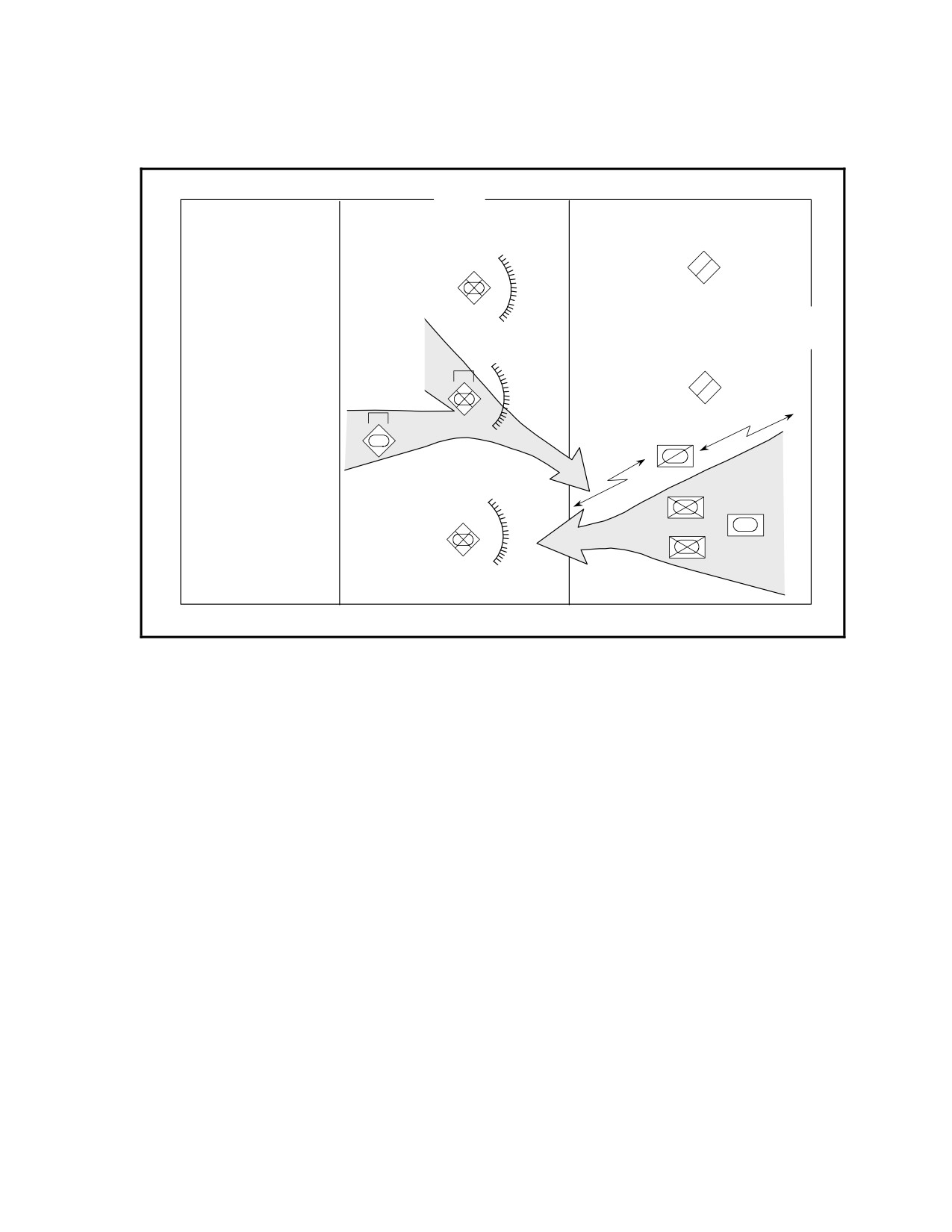
3-103. A counterattack is designed to cause an enemy offensive operation to
culminate and allow the OPFOR to return to offensive operations. A counter-
attack is designed to control the tempo of operations by returning the initia-
tive to the OPFOR. Like a spoiling attack, a counterattack often develops as
a situational attack, when the commander wishes to take advantage of a
fleeting opportunity. The difference is that the counterattack occurs after the
enemy begins his attack. See Figure 3-9 for an example of a counterattack.
3-104. Counterattacks are characterized by
• A shifting in command and support relationships to assume an offen-
sive posture for the counterattacking force.
• A proper identification that the enemy is at or near culmination.
• The planned rapid transition of the remainder of the force to offensive
operations.
• The possibility that a counterattack may open a window of opportu-
nity for other operations.
3-105. The OPFOR seeks to set the following conditions for a counterattack:
• Locate and track enemy reserve forces and cause them to be committed.
• Destroy enemy reconnaissance forces that could observe counterattack
preparations.
3-24
_________________________________________________________________________________Chapter 3
OSC
LOR
Support Zone
Battle Zone
Disruption Zone
I I
X X
Main
Defense
Force
OSC
LOR
Assault
I I
Force
XX
XX
I I I
Exploitation
Force
X X
X X
Fixing
X X
Force (Former
X X
Main Defense
Force)
Figure 3-9. Counterattack (Example)
Organizing Forces for a Counterattack
3-106. Since counterattacks develop out of a defensive posture, the organiza-
tion of forces involves the rapid shifting of some forces from their previously
defensive roles to attack the enemy. Generally, the disruption force was al-
ready part of a previous OPFOR defensive posture and continues to perform
the same functions during a counterattack. Like other offensive actions, a
counterattack employs fixing, assault, and exploitation forces. Within the
context of a larger defensive action, these forces come from the main defense
force and/or the reserve, and they collectively make up the counterattack force.
Other forces in the AOR may continue to perform their original defensive roles.
3-107. Fixing Force. The fixing force in a counterattack is that part of the
force engaged in defensive action with the enemy. These forces continue to
fight from their current positions and seek to account for the key parts of the
enemy array and sure they are not able to break contact and reposition.
Additionally, the fixing force has the mission of making contact with and
destroying enemy reconnaissance forces and any combat forces that may
have penetrated the OPFOR defense.
3-108. Assault Force. In a counterattack, the assault force (if one is used) is
assigned the mission of forcing the enemy to commit his reserve so that the
enemy commander has no further mobile forces with which to react. If the fixing
3-25
FM 7-100.1 ________________________________________________________________________________
force has already forced this commitment, the counterattack design may
forego the creation of an assault force.
3-109. Exploitation Force. The exploitation force in a counterattack ma-
neuvers through or bypasses engaged enemy forces to attack and destroy the
enemy’s support infrastructure before he has time or freedom to react. An
armored or attack helicopter unit is often best suited to be the core of an ex-
ploitation force in a counterattack due to the combination of mobility, protec-
tion, and firepower possessed by such forces.
STRIKE
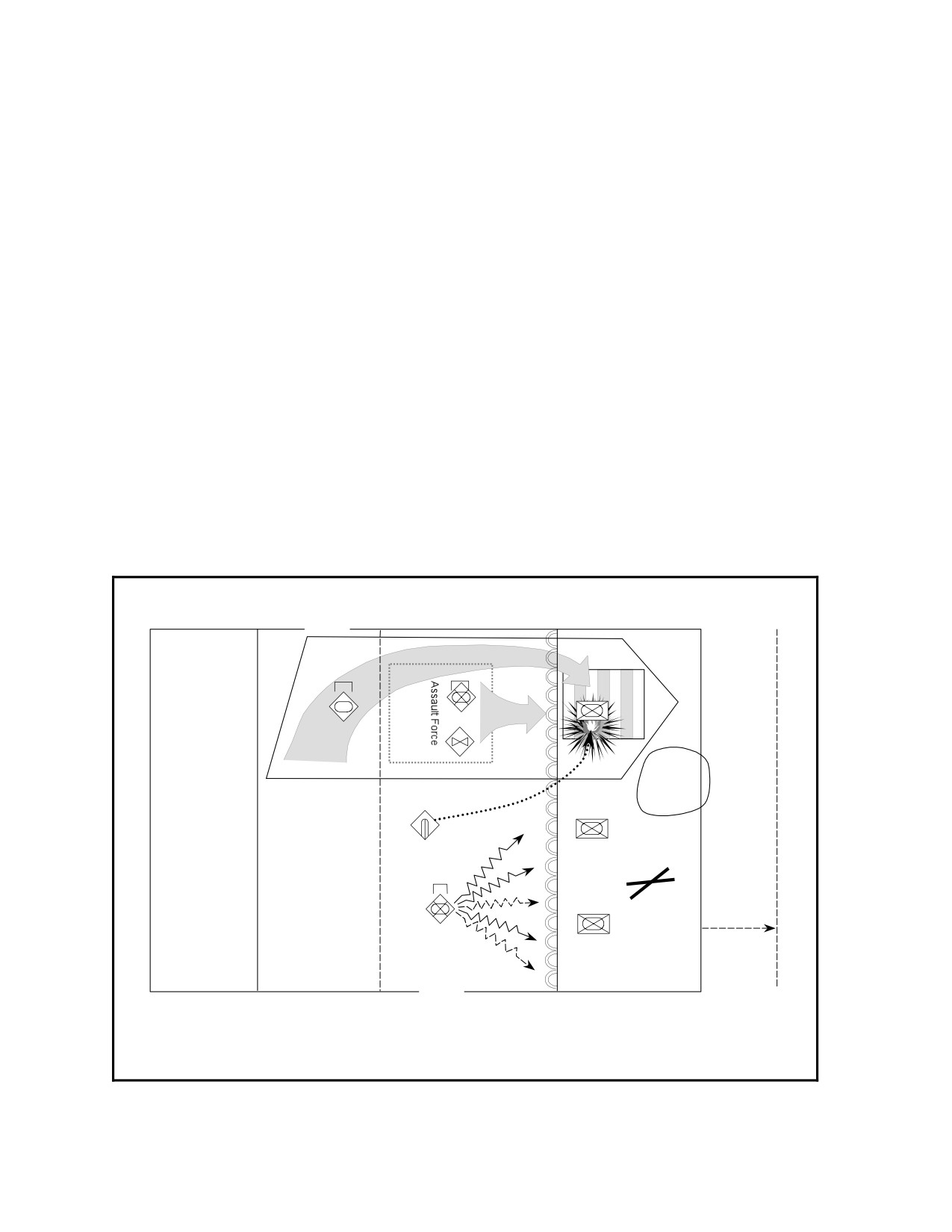
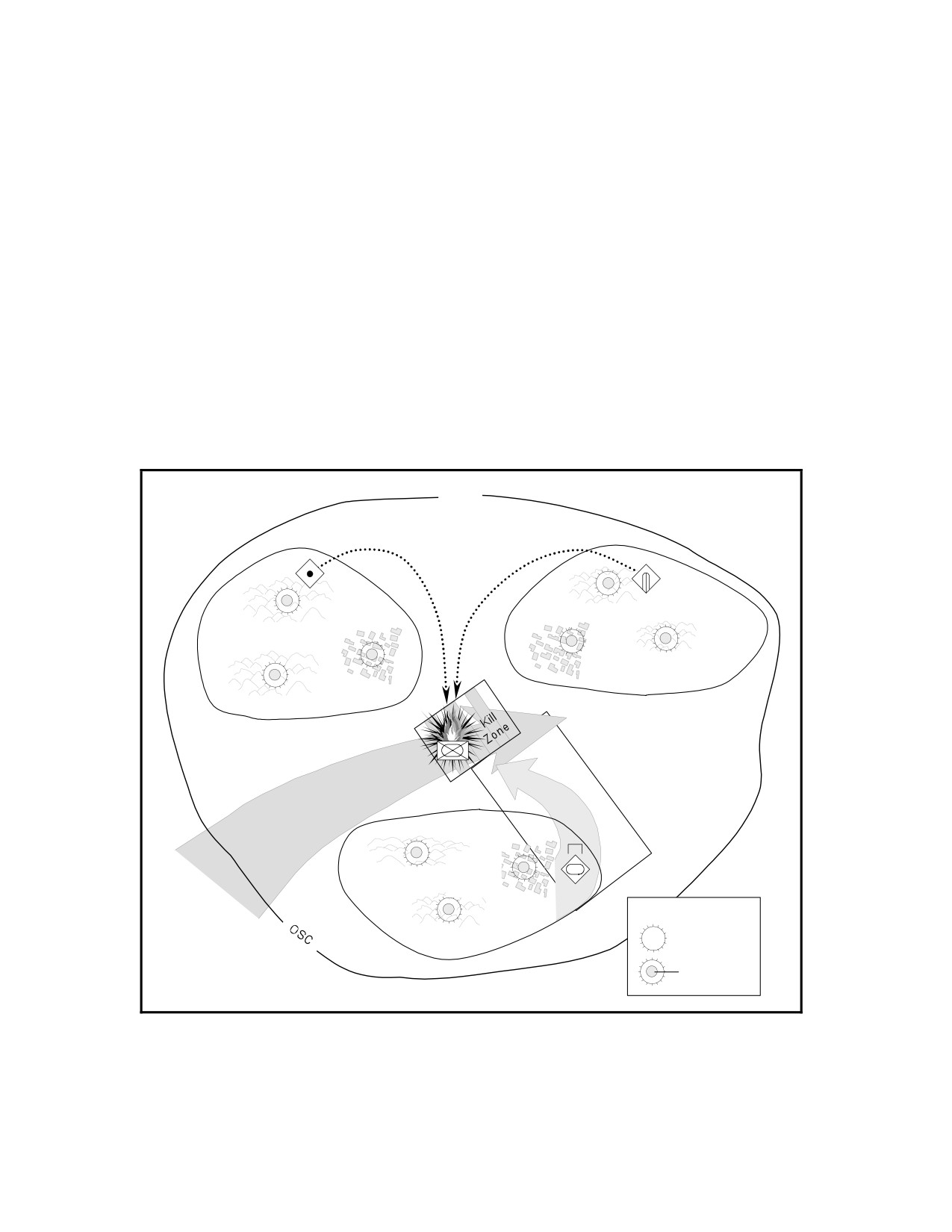
3-110. A strike is an offensive course of action that rapidly destroys a key en-
emy organization through a synergistic combination of massed precision fires
and maneuver. The targeted enemy formation is usually a battalion task
force or larger. Defeat for the enemy does not come through the simple de-
struction of armored weapon systems or combat soldiers but through the sub-
sequent paralyzation that occurs when a key organization is completely dev-
astated in a small span of time. See Figures 3-10 and 3-11 for examples of
strikes. The overall objective is to destroy an enemy formation, typically after
carefully setting the conditions for its destruction. The strike can be em-
ployed in larger operations that are either defensive or offensive in nature.
Enemy Main Line of
Resistance
OSC
Attack Zone
XX
XX
Kill
X
Zone
X
Exploitation
Force
Enemy
Support
Area
X
X
Exploitation
Force
Enemy Tactical
Airfield
X
X
Fixing Force
OSC
Initial
Subsequent
Initial
Initial
Subsequent
Support
Support
Battle
LOR
LOR
Line
Line
Line
Subsequent
Battle Line
Figure 3-10. Strike (Example 1)
3-26
_________________________________________________________________________________Chapter 3
3-111. The primary objective of a strike is the enemy’s will and ability to
fight. The OPFOR recognizes that modern militaries cannot rapidly reconsti-
tute entire combat formations and that significant destruction is both capa-
ble of removing all momentum possessed by a combat formation and elimi-
nating support at home for continued combat operations.
3-112. Strikes are characterized by
• Being focused on the complete destruction of a particular enemy for-
mation.
• Typically following a period of reconnaissance fire (see Chapter 7).
• Requiring effective and integrated C2 and RISTA means.
• The use of complex terrain to force the enemy to fight at a dis-
advantage.
• Significant reliance on deception and other IW measures.
OSC
X
X
DTG
DTG
Battle
Battle
Zone
Zone
Disruption
X
Zone
Disruption
Zone
Axis
Enemy
Attack
X
Zone
DTG
Battle
Zone
LEGEND
Complex
Battle
Position
Support Zone
Figure 3-11. Strike (Example 2)
3-27
FM 7-100.1 ________________________________________________________________________________
3-113. The window of opportunity needed to establish conditions favorable to
the execution of a strike may be one created by the OPFOR or one that devel-
ops due to external factors in the operational environment. When this window
must be created, the OPFOR keys on several tasks that must be accomplished:
• Destroy enemy ground reconnaissance.
• Deceive enemy imagery and signals sensors.
• Create an uncertain air defense environment.
• Selectively deny situational awareness.
• Maximize use of complex terrain.
Reconnaissance Fire
3-114. In addition to the above, the OPFOR will typically precede a strike
with significant reconnaissance fire (see Chapter 7) designed to remove one
or more key capabilities from the enemy force. The targeted capabilities could
be ground reconnaissance, effective C2, effective logistics, or casualty evacuation.
Organizing Forces for a Strike
3-115. A strike employs fixing, assault, and exploitation forces. The disrup-
tion force can play an important role in determining when the target forma-
tion will enter the kill zone for the strike.
3-116. Fixing Force. The fixing force in a strike is primarily focused on fix-
ing enemy forces that might come to the aid of the target formation. The bat-
tle will develop rapidly, and enemy forces cannot be allowed to reposition to
influence the assault and exploitation forces. Maneuver forces, precision
fires, air defense units, long-range antiarmor systems, situational obstacles,
chemical weapons, and EW are well suited to fix defending forces.
3-117. Assault Force. The assault force in a strike is charged with creating
the conditions that allow the exploitation force to complete the destruction of
the target formation. Since the exploitation force is principally required to
act within the window of opportunity, the assault force may successfully em-
ploy infiltration of infantry to carefully pre-selected points to assist the ex-
ploitation force in its action. Smoke and suppressive artillery and rocket
fires, combat engineer units, and air-delivered weapons are also suited to this
mission.
3-118. Exploitation Force. The exploitation force in a strike has the mis-
sion of completing the destruction of the target formation. Strike exploitation
forces are almost always combinations of highly lethal ground maneuver
formations and precision long-range fire systems. A strike must be capable of
eliminating the target enemy force before the higher enemy commander has
time to react. An armored or attack helicopter unit is often best suited to be
the core of an exploitation force in a strike, due to the combination of mobil-
ity, protection, and firepower possessed by such forces. However, a strike
may be successfully executed without any maneuver forces, and the exploita-
tion force may consist entirely of long-range fire systems.
3-28
Chapter 4
Defensive Operations
While the OPFOR sees the offense as the decisive form of military action,
it recognizes defense as the stronger form of military action, particularly
when faced with a superior, extraregional foe. Defensive operations can
lead to strategic victory if the extraregional enemy abandons his mission.
It may be sufficient for the OPFOR simply not to lose. Even when an
operational-level commandsuch as a field group (FG) or operational-
strategic command (OSC)as a whole is conducting an offensive operation,
it is likely that one or more subordinate units may be executing defensive
missions to preserve offensive combat power in other areas, to protect an
important formation or resource, or to deny access to key facilities or geo-
graphic areas.
OPFOR defenses can be characterized as a “shield of blows.” Each force
and zone of the defense plays an important role in the attack of the en-
emy’s combat system. An operational-level defense is structured around
the concept that destroying the synergy of the enemy’s combat system will
make enemy forces vulnerable to attack and destruction.
Commanders and staffs do not approach the defense with preconceived
templates. The operational situation may cause the commander to vary
his defensive methods and techniques. Nevertheless, there are basic
characteristics of defensive operations (purposes and types of action) that
have applications in all situations.
STRATEGIC CONTEXT
4-1. Defensive operations are an important component of all OPFOR stra-
tegic campaigns. However, the scale and purpose of defensive actions may
differ during the various types of strategic-level actions.
REGIONAL OPERATIONS
4-2. The State possesses an overmatch in all elements of power against
internal and regional opponents. It is able to employ that power in regional
operations in a conventional operational design. This overmatch does not
imply, however, that regional operations are entirely offensive. Consolidation
of gains, security actions, and economy-of-force measures can all produce de-
fensive courses of action inside a larger offensive design.
4-3. The State’s military forces are sufficient to overmatch any single re-
gional neighbor, but not necessarily an alliance or coalition of neighboring
countries. They may not be a match for the forces an extraregional power
can bring to bear. Thus, the OPFOR seeks to exploit its numerical and
4-1
FM 7-100.1 ________________________________________________________________________________
technological overmatch against one regional opponent rapidly, before other
regional neighbors or an extraregional power can enter the fight. In some
cases, this may require defensive operations against one or more regional
neighbors who are not the main target of the strategic campaign, to mitigate
their ability to disrupt an OPFOR offensive against the one that is.
4-4. Regional operations include essentially defensive security actions to
maintain internal stability. In addition, the Internal Security Forces help
control the population in territory the OPFOR seizes or engage enemy forces
that invade State territory.
4-5. The State’s military goal during regional operations is to destroy its re-
gional opponents’ military power in order to achieve specific ends. The State
plans regional operations well in advance and executes them as rapidly as is
feasible in order to preclude intervention by outside forces. Still, at the very
outset of these operations, it lays plans and positions forces to conduct access-
control operations in the event of outside intervention. Extraregional
forces may also be vulnerable to conventional operations during the time
they require to build combat power and create support at home for their
intervention.
TRANSITION OPERATIONS
4-6. If an extraregional force starts to deploy into the region, the balance of
power begins to shift away from the State. Although the OPFOR may not yet
be totally overmatched by the enemy force, it faces a threat it cannot handle
with normal, “conventional” patterns of operation designed for regional
conflict. Therefore, the OPFOR must begin to adapt its operations to the
changing threat.
4-7. As the State begins transition operations, its immediate goal is preser-
vation of its instruments of power while seeking transition back to regional
operations. Transition operations therefore feature a mixture of offensive and
defensive actions.
4-8. This combination of offensive and defensive actions can allow the State
to control the strategic tempo while changing the nature of conflict to
something for which the intervening force is unprepared. If these actions are
successful and the extraregional force is no longer a factor, the OPFOR may
be able to transition back to regional operations without having to complete
the shift to adaptive operations.
4-9. During transition operations, the State must decide whether to keep
its forces in any territory it has occupied in a neighboring country or to
withdraw them back to its home territory. The decision to stay or withdraw
at this point may be based on the presence or absence of complex terrain
suitable for defensive operations in the occupied territory against an
extraregional power with overmatch in technology and conventional forces.
The OPFOR is more likely to remain in the occupied territory if it has already
achieved its strategic goal in regional operations or at least achieved major
intermediate objectives leading toward that goal and can structure an
effective defense in that territory. Military forces in the immediate vicinity
of the point of intervention move into defensive positions as opportunity
allows, making use of existing command and control (C2) and logistics.
4-2
_________________________________________________________________________________Chapter 4
4-10. The OPFOR can use the time it takes the extraregional force to prepare
and deploy into the region to change the nature of the conflict into something
for which the intervening force is unprepared. The OPFOR tries to establish
conditions that force the new enemy to fight at less than full strength and on
terrain for which his forces are not optimized. It seeks to take advantage of
complex terrain whenever possible, while controlling the enemy’s access to
such terrain. It plans operations to exploit the opportunities created by the
presence of NGOs, PVOs, media, and other civilians on the battlefield.
4-11. Meanwhile, transition operations permit other key forces the time,
space, and freedom of action necessary to move into sanctuary in preparation
for a shift to adaptive operations. These forces preserve combat power and
prepare to defend the State homeland, if necessary. Transition operations
usually include mobilization of reserve and militia forces to assist in defending
the State.
4-12. At some point, the OPFOR may conclude that it cannot deny entry or
defeat the extraregional force by destroying his early-entry forces. The
OPFOR then shifts its emphasis to completing the transition to adaptive
operations as soon as possible, before the enemy can deploy overwhelming
forces into the region.
ADAPTIVE OPERATIONS
4-13. From the perspective of the extraregional power, any regional crisis has
the potential to expand into a major theater war. Therefore, it will try to
avoid crisis expansion by early engagement and rapid response. The longer
the State can delay effective extraregional response to the crisis in the region,
the greater its chances for success. Failing to limit or interrupt access to the
region, the State will attempt to degrade further enemy force projection, hold
initial gains, and extend the conflict, while preserving its own military capa-
bility and other instruments of national power.
4-14. When the OPFOR shifts to adaptive operations, these are more defensive
in nature than were regional or transition operations. When overmatched
in conventional power, the OPFOR seeks to preserve its own power and
apply it in adaptive ways. It expects its commanders to seize opportunity,
tailor organizations to the mission, and make creative use of existing
resourceseven more than they did in regional and transition operations.
4-15. Generally, the OPFOR conducts adaptive operations during the strate-
gic campaign as a consequence of intervention from outside the region. If it
cannot control the extraregional enemy’s access into the region or defeat his
forces before his combat potential in the region equals or exceeds its own, the
OPFOR must resort to adaptive operations. The primary objectives are to
preserve combat power, to degrade the enemy’s will and capability to fight,
and to gain time for aggressive strategic operations to succeed.
4-16. Adaptive operations occur as a result of an extraregional power
intervening with sufficient forces to thwart the OPFOR’s original of-
fensive operations in the region. The OPFOR disperses to the extent its C2
allows and conducts decentralized operations in both offense and defense.
The OPFOR views adaptive operations as temporary in nature, serving as a
means for the OPFOR to return to regional operations.
4-3
FM 7-100.1 ________________________________________________________________________________
4-17. Adaptive operations are often sanctuary-based. Sanctuaries are areas
that limit the ability of an opponent to apply his full range of capabilities.
The OPFOR can use physical and/or moral sanctuaries for preserving and
applying forces. It can defend in sanctuaries or attack out of them. It may
conduct limited-objective attacks from these positions to prevent buildup
of intervening forces, to facilitate the defense, or to take advantage of an
opportunity to counterattack. When defending, the OPFOR generally does
not employ fixed, contiguous defensive fronts.
4-18. The OPFOR uses flexible and unpredictable force structures task-
organized for particular missions. Forces may be combined arms, joint,
interagency, and possibly multinational. The State may fully mobilize all
available means to create large conventional force and paramilitary capability in
support of adaptive operations. Full mobilization involves all military and
paramilitary forces, including militia. During adaptive operations, the
State will use conventional forces in adaptive ways. It will also employ
unconventional and specialized forces tailored to the needs of combat against
an extraregional force with technological overmatch. Operations may also
involve various types of affiliated forces.
PURPOSE OF THE DEFENSE
4-19. Defensive operations are designed to achieve the goals of the strategic
campaign through active measures while preserving combat power. However,
the purpose of any given defensive operation depends on the situation.
4-20. The primary distinction among types of OPFOR defensive operations is
their purpose. Therefore, the OPFOR recognizes three general types of defen-
sive operations according to their purpose: to destroy, preserve, or deny.
DEFENSE TO DESTROY
4-21. A defense to destroy is designed to eliminate an attacking formation’s
ability to continue offensive operations while preserving friendly forces and
setting the military conditions for a favorable political settlement. Such a
defense may be the entirety of an operation or may be used to defeat a
counterattack during a larger OPFOR offensive action. An operational
defense to destroy often has one or more tactical offensive actions as
subcomponents.
DEFENSE TO PRESERVE
4-22. A defense to preserve is designed to protect key components of the
OPFOR from destruction by the enemy. Such a defense may occur
• To preserve combat power for future operations.
• Before the outbreak of a war, or in its early stages, to cover the mobili-
zation and deployment of the main forces.
• When facing numerically or qualitatively superior enemy forces.
• During an offense, to economize force in one area and achieve superior-
ity in another.
4-4
_________________________________________________________________________________Chapter 4
DEFENSE TO DENY
4-23. A defense to deny is intended to deny the enemy access to a geographic
area or use of facilities that could enhance his combat operations or provide
him substantial value for information operations. An example of this would
be enemy capture of a religious or cultural center. This type of defense is
most often used as part of an overall campaign of theater access control.
It may also be used to consolidate, retain, and protect critical positions that
attacking forces have captured.
PLANNING DEFENSIVE OPERATIONS
4-24. For the OPFOR, the key elements of planning defensive operations
are
• Determining the level of planning possible (planned versus situational
defense).
• Organizing the battlefield.
• Organizing forces.
• Organizing information warfare (IW) activities in support of the de-
fense (see Chapter 5).
4-25. Defensive actions during transition and adaptive operations will not be
able to rely simply on attrition-based operations in layered engagement
areas. Such actions will typically include increased use of
• Infiltration to conduct spoiling attacks and ambushes.
• Perception management (see Chapter 5) in support of defensive opera-
tions.
• Camouflage, concealment, cover, and deception (C3D) measures.
• Affiliated forces for reconnaissance, counterreconnaissance, security,
and attacks against key enemy systems.
PLANNED DEFENSE
4-26. A planned (or deliberate) defense is a defensive operation undertaken
when there is sufficient time and knowledge of the situation to prepare and re-
hearse forces for specific tasks. Typically, the enemy is in a staging or assembly
area and in a known location and status. The OPFOR plans a defense using the
method described in Chapter 2. Key considerations in defensive planning are
• Selecting operationally significant areas in complex terrain from which
to dominate surrounding avenues of approach.
• Determining the method that will deny the enemy his operational
objectives.
• Developing a plan for reconnaissance, intelligence, surveillance, and
target acquisition (RISTA) that locates and tracks major enemy forma-
tion and determines enemy patterns of operations and probable objectives.
• Creating or taking advantage of a window of opportunity that frees
friendly forces from any enemy advantages in precision standoff and
situational awareness.
4-5
FM 7-100.1 ________________________________________________________________________________
SITUATIONAL DEFENSE
4-27. The OPFOR recognizes that the modern battlefield is chaotic, and fleet-
ing opportunities to attack an enemy weakness will continually present
themselves and just as quickly disappear. If the OPFOR determines that, by
conserving resources in one area, it may be able to take advantage of a win-
dow of opportunity in another, it may assume a situational (or hasty) defense.
It may also do so when an OPFOR attack culminates prior to achieving the
objective.
4-28. The OPFOR may also be forced to employ a situational defense when it
has been conducting offensive operations against a regional neighbor and in-
tervention by a powerful extraregional force materializes more quickly than
anticipated. Thus, the OPFOR may have to make the transition from regional
to adaptive operations more rapidly than planned. Units may still be able to
move into preplanned positions in complex terrain, but without some meas-
ures they anticipated being able to take during transition operations. They
may or may not have fully-prepared, complex battle positions, with engineer
preparation, C3D measures, and logistics caches.
4-29. The commander develops his assessment of the conditions leading to a
situational defense rapidly and without a great deal of staff involvement. He
provides a basic course of action to the staff, who then quickly turn that
course of action into an executable operational directive.
4-30. Organization of the battlefield in a situational defense is normally lim-
ited to minor changes to existing control measures. Organization of forces in
a situational defense typically relies on minor modifications to existing
structure.
4-31. The following are examples of conditions that might lead to a
situational defense:
• The enemy gains or regains air superiority sooner than anticipated.
• An enemy counterattack was not effectively fixed.
• An attacking force makes contact with an enemy formation it did not
expect.
ORGANIZING THE BATTLEFIELD FOR THE DEFENSE
4-32. In his operation plan, the commander specifies the organization of the
battlefield from the perspective of his level of command. Within his unit’s
area of responsibility (AOR), as defined by the next-higher commander, he
designates AORs for his subordinates, along with zones related to his own
overall mission.
4-33. In organizing the defensive battlefield, the operational commander
organizes forces to begin attack of the combat system of the enemy force as
soon as feasible. By attacking subsystems or components of the enemy’s
combat system appropriate to the situation, the operational commander can
create windows of opportunity for offensive action.
4-6
_________________________________________________________________________________Chapter 4
Areas of Responsibility
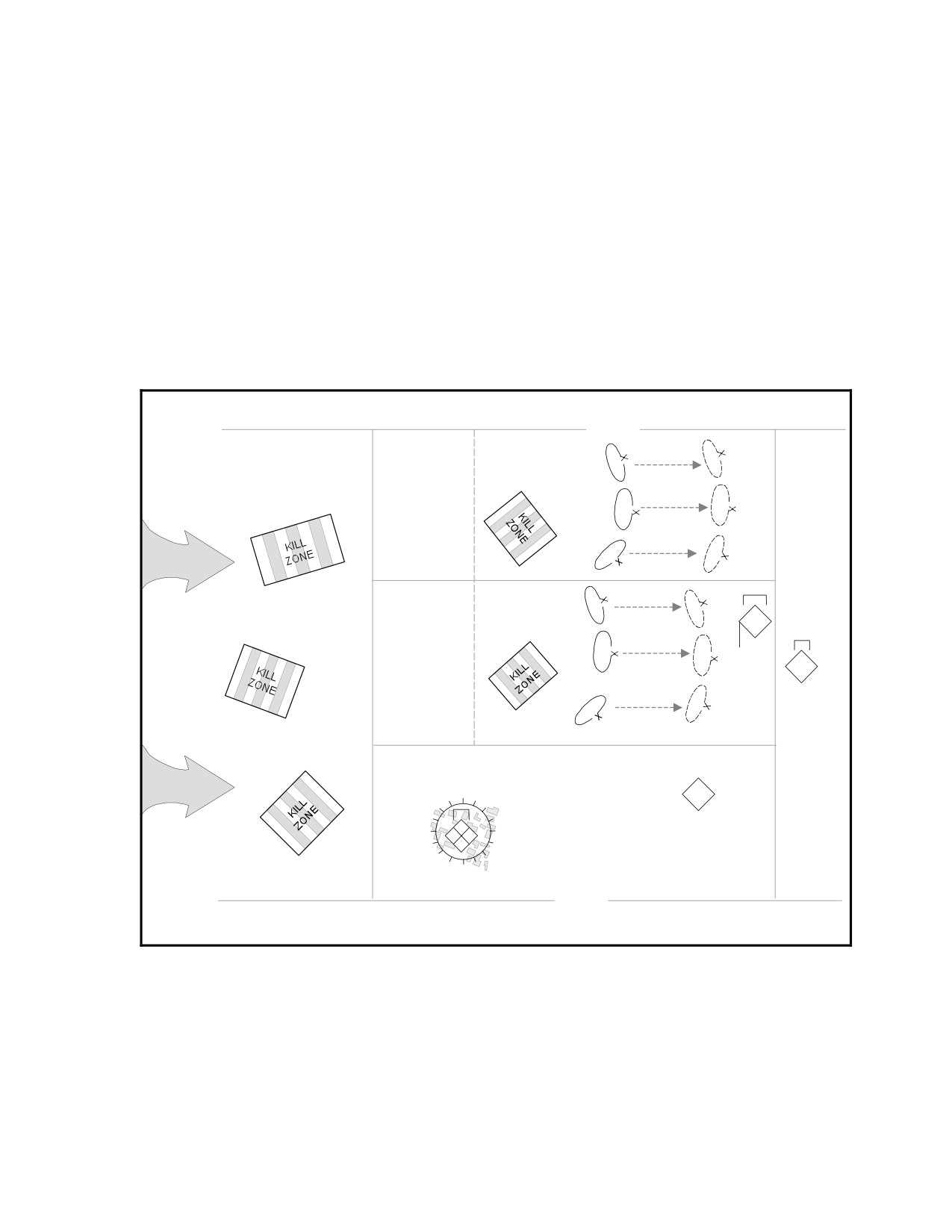
4-34. OPFOR AORs normally consist of three principal zones: disruption,
battle, and support zones. Zones may be linear or nonlinear in nature and
are designed to facilitate rapid transition between linear and nonlinear
operations, as well as between offense and defense. These zones have the
same basic purposes in all types of defenses. In addition to the basic zones in an
AOR, the operational-level commander may also employ attack zones and kill
zones to control subordinate offensive operations conducted in support of the
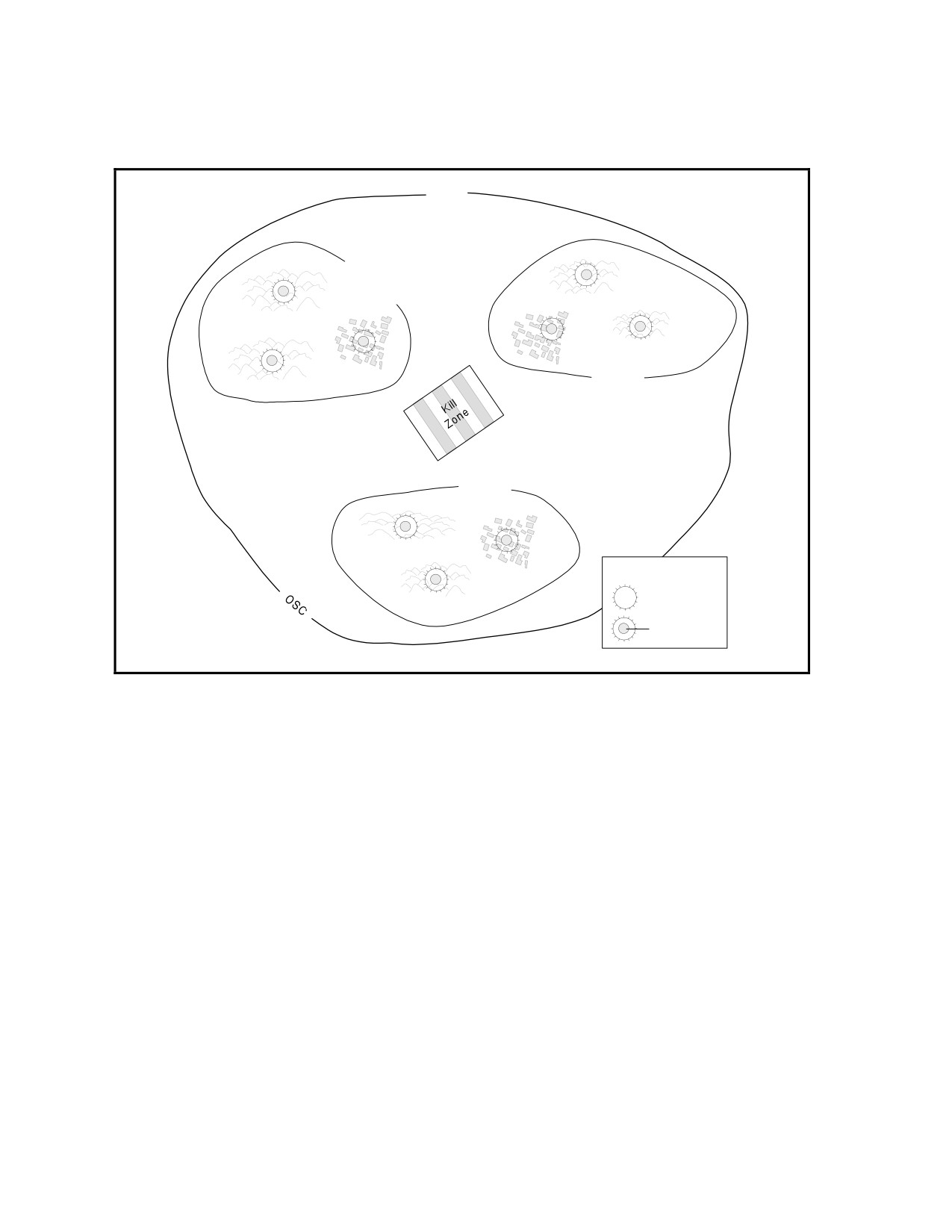
overall defensive scheme. See Figures 4-1 and 4-2 for generalized examples of
AORs and zones in linear and nonlinear defensive operations.
OSC
OSC
DTG
DTG
OSC
Disruption
Disruption
Battle Zone
Support
Zone
Zone
Zone
(if employed)
Enemy
DTG
DTG
XXX
Disruption
Battle Zone
Zone
OSC
(if employed)
X
OSC
Reserve
BTG
Battle Zone
I I
Enemy
X
OSC
Antilanding
Reserve
OSC
Figure 4-1. Example of AOR (Linear Battlespace)
4-7
FM 7-100.1 ________________________________________________________________________________
OSC
DTG
Battle
Zone
DTG
Battle
Zone
Disruption
Zone
Disruption
Zone
DTG
Battle
Zone
LEGEND
Complex
Battle
Position
Support Zone
Figure 4-2. Example of AOR (Nonlinear Battlespace)
Disruption Zone
4-35. In the defense, the disruption zone is that battlespace where opera-
tional forces begin their attack on the designated component or subsystem of
the enemy’s combat system. It is located between the OSC’s battle zone and
the limit of responsibility (LOR) that defines the extent of the AOR. Within
this battlespace, the OPFOR seeks to set the conditions for the defeat of the
attacking force in the battle zone. For example, the operational-level com-
mander may determine that destruction of the enemy’s mobility assets will
create an opportunity to destroy maneuver units in the battle zone. The dis-
ruption force would be given the mission of seeking out and destroying enemy
mobility assets while avoiding engagement with maneuver forces.
4-36. The disruption zone is the primary area in which the operational-level
commander will employ long-range joint fires and strikes. He may establish
kill zones within his disruption zone for the purpose of integrating the actions
of long-range fire elements and disruption force elements.
4-37. The operational-level disruption zone may be the aggregate of the disrup-
tion zones of subordinates. For example, an FG’s disruption zone could include
the disruption zones of one or more OSCs and/or tactical-level commands directly
subordinate to the FG. An OSC’s disruption zone could include disruption zones
4-8
_________________________________________________________________________________Chapter 4
of subordinate division and brigade tactical groups (DTGs and BTGs), al-
though assets directly controlled by the OSC could also operate throughout
an OSC disruption zone. In such cases, each subordinate would be responsi-
ble for a portion of the operational-level disruption zone, and that portion
would constitute the subordinate’s disruption zone within its own AOR. In
other cases, an operational-level disruption zone may extend beyond those of
the FG’s or OSC’s subordinates, to include an area occupied by forces sent out
under direct control of the FG or OSC commander.
4-38. Operational-level forces in the disruption zone could include special-
purpose forces (SPF) and affiliated forces, which could be operating in enemy-
held territory even before the beginning of hostilities. There could also be
stay-behind forces in areas seized by the enemy.
Battle Zone
4-39. The battle zone is that battlespace in which the main defense force uses
fires and maneuver to exploit the conditions created by successful disruption
zone operations. In the battle zone, the main defense force completes the dis-
aggregation of the enemy’s combat system by destroying the components ex-
posed by the disruption force. By inflicting significant damage or denying the
enemy his objectives, the main defense force causes the enemy to culminate
and, in the best case, to quit the field entirely. An operational-level battle
zone is often the aggregate of the battle zones of subordinate units.
4-40. The battle zone ties all available obstacles into an integrated fire sup-
port plan of all available weapons. It denies complex terrain to the enemy. It
allows the enemy to enter easily, but to exit only at great cost or ideally not
at all. The operational-level commander may establish kill zones within the
battle zone for the purpose of integrating long-range fire, ground attack avia-
tion, and main defense forces. Long-range fires from the battle zone may also
reach kill zones in the disruption zone, where these fires can be integrated
with the actions of disruption forces.
Support Zone
4-41. The support zone is that area of the battlespace designed to be free of
significant enemy action and to permit the effective logistics and administra-
tive support of forces. Security forces (see Organizing Forces for the Defense
below) operate in the support zone in a combat role to defeat enemy special
operations forces and other threats. Camouflage, concealment, cover, and de-
ception (C3D) measures occur throughout the support zone to protect the force
from standoff RISTA and precision attack.
Attack Zone
4-42. During an overall defensive operation, an attack zone may be employed
to conduct an offensive action inside a larger defensive action. It will have the
characteristics described in Chapter 3. An axis is a control measure showing
the location through which a counterattack force, for example, will move as it
proceeds from its assembly area to its attack zone. At the operational level,
multi-division OSCs may conduct offensive actions as a part of a larger de-
fensive scheme.
4-9
FM 7-100.1 ________________________________________________________________________________
Kill Zone
4-43. A kill zone is a designated area on the battlefield where the OPFOR
plans to destroy a key enemy target, usually by fire. Kill zones may be within
any of the zones described above.
Battle Position
4-44. Within the AOR of an operational command, tactical-level subordinates
may occupy battle positions. A battle position is a defensive location designed
to maximize the occupying unit’s ability to accomplish its mission. A battle
position is selected such that the terrain in and around it is complementary
to the occupying unit’s capabilities and its tactical task. There are two kinds
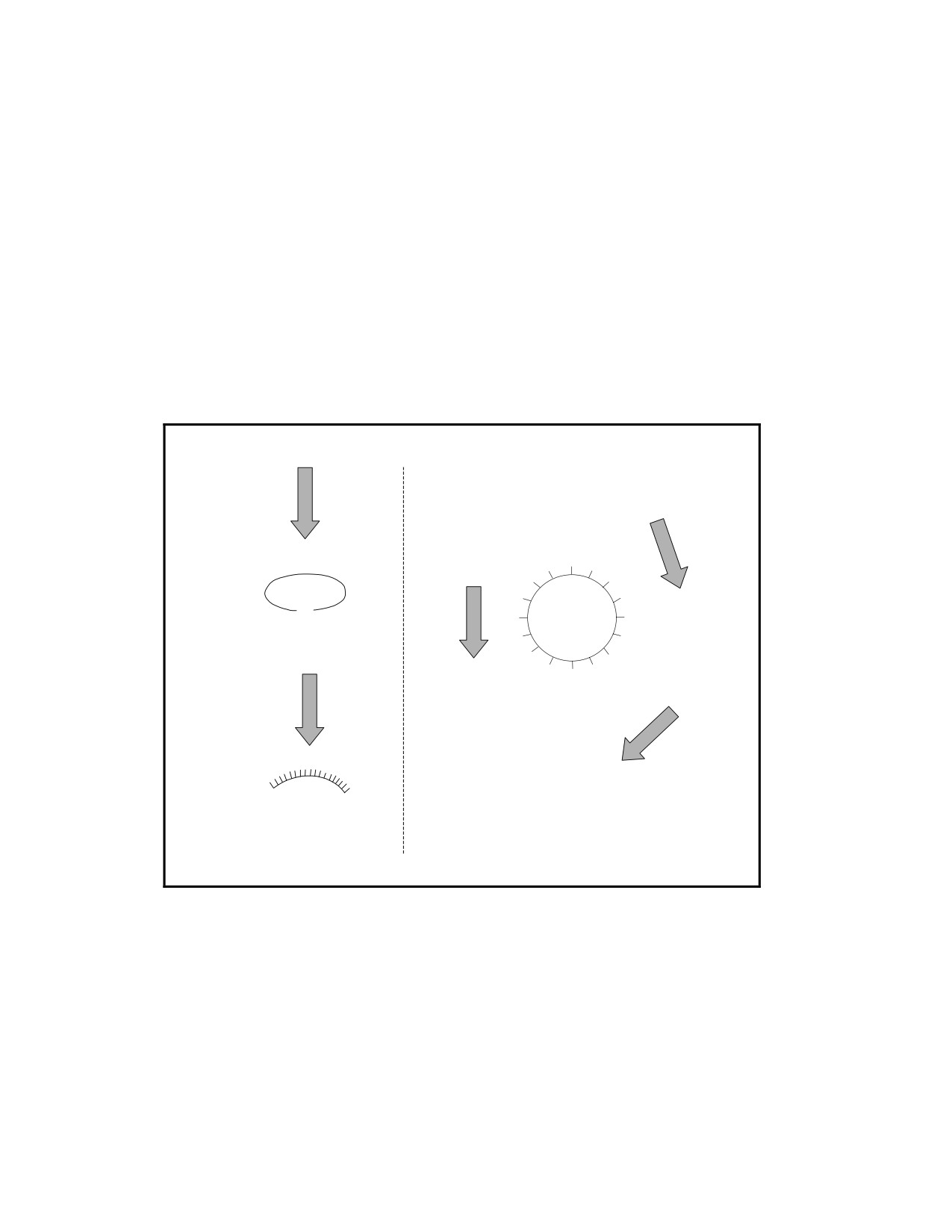
of battle positions: simple and complex. See Figure 4-3.
Enemy
Enemy
Enemy
X
Enemy
Enemy
Complex Battle Position
Simple Battle Positions
Figure 4-3. Battle Positions
4-45. A simple battle position is a defensive location oriented on the most
likely enemy avenue of approach. Simple battle positions are not necessarily
tied to complex terrain but often employ as much engineer effort as time allows.
4-46. Complex battle positions are defensive locations designed to protect the
units within them from detection and attack while denying their seizure and
occupation by the enemy. They typically employ a combination of complex
terrain, C3D measures, and engineer effort to protect combat forces from en-
gagement by precision standoff attack.
4-10
_________________________________________________________________________________Chapter 4
4-47. A typical complex battle position contains
• Complex terrain.
• A substantial logistics cache.
• Extensive engineer fortification and obstacle work.
• C3D effort to confuse the enemy picture of strength and disposition.
• Precision fire capability.
• Mobile reserves.
• Air defense systems.
• Redundant C2 systems.
ORGANIZING FORCES FOR THE DEFENSE
4-48. In his operation plan, the operational-level commander also specifies
the organization of the forces within his level of command. Thus, subordinate
forces understand their roles within the overall operation. However, the or-
ganization of forces can shift dramatically during the course of an operation.
For example, a unit that initially was part of a disruption force may eventu-
ally occupy a battle position within the battle zone and become part of the
main defense force or act as a reserve.
4-49. Each of the separate functional forces has an identified commander.
This is often the senior commander of the largest subordinate unit assigned
to that force. For example, if two DTGs and a separate BTG are acting as the
OSC’s main defense force, the senior of the two DTG commanders is the main
defense force commander. During decentralized operations, even when the force
consists of like units of the same command level, control can be delegated to the
senior commander of that force’s like units. Since, in this option, each force
commander is also a subordinate unit commander, he controls the force from
his unit’s command post (CP).
4-50. Another option is to have one of the OSC’s or FG’s CPs be in charge
of a functional force. Particularly during dispersed defensive operations,
functional forces that contain units of the same command level might be
controlled from the forward, auxiliary, or airborne CP of the OSC or FG.
For example, the forward CP could control a disruption force. Another
possibility would be for the IFC CP to command the disruption force or
any other force whose actions must be closely coordinated with fires deliv-
ered by the integrated fires command (IFC).
4-51. In any case, the force commander is responsible to the OSC or FG
commander to ensure that combat preparations are made properly and to
take charge of the force during the operation. This frees the operational-level
commander from decisions specific to the force’s mission. Even when tactical-
level subordinates of an OSC or FG have responsibility for parts of the OSC
or FG disruption zone, there is still an overall OSC or FG disruption force
commander.
4-11
FM 7-100.1 ________________________________________________________________________________
Disruption Force
4-52. The size and composition of forces in the disruption zone depends on
the level of command involved, the commander’s concept of operations, and
the circumstances in which the unit adopts the defense. An operational-level
disruption force has no set organization but may be as large as a multi-division
OSC or consist only of SPF teams to direct reconnaissance fires and conduct
direct action. The operational-level commander will always make maximum use
of stay-behind forces and affiliated forces existing within his AOR. Subordinate
commanders can employ forces in a disruption zone role independent of the
operation plan only with approval of the operational-level commander.
4-53. A disruption force has no set order of battle, but may contain
• Ambush teams (ground and air defense).
• SPF teams.
• RISTA assets and forces.
• Counterreconnaissance forces.
• Artillery systems.
• Target designation teams.
• Affiliated forces (such as terrorists, insurgents, criminals, or special police).
• Antilanding reserves.
4-54. The purpose of the disruption force is to prevent the enemy from
conducting an effective attack. The disruption force does this by initiating
the attack on components of the enemy’s combat system. Successful attack of
designated components or subsystems begins the disaggregation of the
enemy’s combat system and creates vulnerabilities for exploitation in the
battle zone. Skillfully conducted disruption operations will effectively deny
the enemy the synergy of effects of his combat system.
4-55. The disruption force may also have a counterreconnaissance mission.
It may selectively destroy or render irrelevant the enemy’s RISTA forces.
There will be times, however, when the OPFOR wants enemy reconnaissance
to detect something that is part of the deception plan. In those cases, the dis-
ruption force will not seek to destroy all of the enemy’s RISTA assets.
Main Defense Force
4-56. The main defense force is the component of the operational-level command
that is charged with execution of the defensive mission. It operates in the battle
zone to accomplish the purpose of the operation (destroy, preserve, or deny).
Protected Force
4-57. In a defense to preserve, the protected force is the force being kept from
detection or destruction by the enemy. Protection can be afforded by C3D
and/or the actions of other OPFOR units. There is generally some force that
the OPFOR is trying to protect from enemy observation and fire, to ensure
that it will still have that force after the current operation is over. At the
operational level, this force is critical to future operations and the preser-
vation of the regime. It may be in the battle zone or the support zone.
4-12
_________________________________________________________________________________Chapter 4
Security Force
4-58. The security force conducts activities to prevent or mitigate the effects
of hostile actions against the overall operational-level command and/or its
key components. If the commander chooses, he may charge this security force
with providing force protection for the entire AOR, including the rest of the
functional forces; logistics and administrative elements in the support zone;
and other key installations, facilities, and resources. The security force may
include various types of unitssuch as infantry, SPF, counterreconnaissance,
and signals reconnaissance assetsto focus on enemy special operations and
long-range reconnaissance forces operating throughout the AOR. It can also
include internal security forces units allocated to the operational-level com-
mand, with the mission of protecting the overall command from attack by
hostile insurgents, terrorists, and special operations forces. The security
force may also be charged with mitigating the effects of weapons of mass
destruction (WMD). The security force commander can be given control over
one or more reserve formations, such as the antilanding reserve.
Counterattack Forces
4-59. In a defensive operation with a planned counterattack scheme (typically in
a maneuver defense), the operational-level commander designates one or
more counterattack forces. He also shifts his task organization to create a
counterattack force when a window of opportunity opens that leaves the enemy
vulnerable to such an action. At the operational level, the counterattack force
may be a multi-division force with the mission to destroy a major enemy for-
mation that is exposed. The operational-level commander uses counterattack
forces to complete the defensive mission assigned and regain the initiative
for the offense. The counterattack force can have within it fixing, assault,
and exploitation forces (as outlined in Chapter 3).
Types of Reserves
4-60. At the commander’s discretion, forces may be held out of initial action
so that he may influence unforeseen events or take advantage of developing
opportunities. He may employ a number of different types of reserve forces of
varying strengths, depending on the situation.
4-61. Maneuver Reserve. The size and composition of a reserve force is
entirely situation-dependent. However, the reserve is normally a force
strong enough to respond to unforeseen opportunities and contingencies at
the operational level. A reserve may assume the role of counterattack
force to deliver the final blow that ensures the enemy can no longer conduct his
preferred operation.
4-62. A reserve force is given a list of possible missions for rehearsal and
planning purposes. The staff assigns to each of these missions a priority,
based on likelihood that the reserve might be called upon to execute that
mission. Some missions given to the reserve may include
• Conducting a counterattack. (The counterattack goal is not limited to
destroying enemy forces, but may also include recovering lost positions
or capturing positions operationally advantageous for subsequent
combat actions.)
4-13
FM 7-100.1 ________________________________________________________________________________
• Conducting counterpenatration (blocking or destroying enemy pene-
trations).
• Conducting antilanding operations (eliminating vertical envelopments).
• Assisting forces heavily engaged on a defended line to break contact
and withdraw.
• Act as a deception force.
4-63. Antitank Reserve. OPFOR commanders faced with significant ar-
mored threats may keep an antitank reserve (ATR). It is generally an anti-
tank unit and often operates in conjunction with an obstacle detachment (OD).
Based on the availability of antitank and engineer assets, an operational-level
command may form more than one ATR.
4-64. Antilanding Reserve. Because of the potential threat from enemy
airborne or airmobile troops, an operational-level commander may designate
an antilanding reserve (ALR). Operational-level ALRs would be resourced for
rapid movement to potential drop zones (DZs) and landing zones (LZs). The
ALR commander would have immediate access to the operational intelligence
system for early warning of potential enemy landing operations. ALRs typically
include maneuver forces, air defense assets, and engineer units, but may be
allocated any unit capable of disrupting or defeating an airborne or heliborne
landing, such as smoke or electronic warfare (EW). While other reserves can
perform this mission, the commander may create a dedicated ALR to prevent
destabilization of the defense by vertical envelopment of OPFOR units or seizure
of key terrain. ALRs assume positions prepared to engage the enemy primary DZ
or LZ as a kill zone. They rehearse and plan for rapid redeployment to other sus-
pected DZs or LZs. Operational-level commanders may direct long-range fires or
SPF direct action to prevent enemy forces from mounting air insertions. The de-
struction of airframes or fuel sources, or the positioning of air defense assets may
serve to take this option away from enemy forces.
4-65. Special Reserves. An operational-level command may form an
engineer reserve of earthmoving and obstacle-creating equipment. A com-
mander can deploy this reserve to strengthen defenses on a particularly
threatened axis during the course of the operation. An operational-level
command threatened by enemy use of WMD may also form a chemical
defense reserve.
Deception Force
4-66. When the IW plan requires the creation of nonexistent or partially ex-
isting formations, these forces are designated deception forces in close-hold
executive summaries of the operation plan. Wide-distribution copies of the
plan make reference to these forces according to the designation given them in
the deception story. The deception force in the defense is typically given its own
command structure to both replicate the organization(s) necessary to the decep-
tion story and to execute the multidiscipline deception required to replicate an
actual military organization. For example, FG commanders can use deception
OSC command structures to deny enemy forces information on operation plans
for the defense.
4-14
_________________________________________________________________________________Chapter 4
PREPARING FOR THE DEFENSE
4-67. In the preparation phase, the OPFOR focuses on ways of applying all
available resources and the full range of actions to conduct defensive operations.
Commanders organize their forces and the battlefield with an eye toward
capitalizing on conditions created by successful defensive actions, and seizing
opportunities for offensive actions wherever possible. The defensive dispositions
are based on the application of the systems warfare approach to combat, as
described in Chapter 1. OPFOR defensive operations focus on attacking
components or subsystems to of the enemy’s combat system to disaggregate
the “system of systems.” By denying the enemy the synergy created by an
integrated, aggregated system, vulnerabilities are created that defensive
forces can exploit.
DENY ENEMY INFORMATION
4-68. Operational-level commanders realize that enemy operations hinge on
an appreciation of the situation. So, defensive preparations focus on de-
struction and deception of enemy national and theater sensors. Lethal and
nonlethal attack of enemy intelligence satellites and reconnaissance aircraft
can limit the ability of enemy forces to understand the OPFOR defensive
plan. The OPFOR recognizes that, when conducting operations against an
extraregional power, it will often be impossible to destroy the ability of the
enemy’s standoff RISTA means to observe its defensive preparations.
However, the OPFOR also recognizes the reluctance of enemy military
commanders to operate without human confirmation of intelligence, as well
as the relative ease with which imagery and signals sensors may be deceived.
The OPFOR operational-level commander considers ground reconnaissance
by enemy special operations Forces as a significant threat in the enemy
RISTA suite and focuses significant effort to ensure its removal. While the
OPFOR will execute missions to destroy standoff RISTA means, C3D would
be the method of choice for degrading the capability of such systems.
MAKE THOROUGH COUNTERMOBILITY AND SURVIVABILITY PREPARATIONS
4-69. The more time available, the greater the preparation of an AOR for
the defense. This is a reflection of engineer effort and time to devote to
that effort. The OPFOR employs every method to maximize the time
available to prepare for the defense. This includes preparation of the State
during peacetime and highly detailed plans for transition from regional to
adaptive operations to take full advantage of any operational lull as the
enemy builds combat power. This might involve an offensive operation
with limited objectives that transitions to the defense by design.
4-70. Operational-level commanders realize that engineer works are vital to
the stability of the defense. Engineer assets will be used to improve the ad-
vantages of complex terrain in protecting friendly forces and exposing enemy
forces to engagement. Engineer efforts can contribute to creating windows of
opportunity by degrading the ability of the enemy’s combat system to inte-
grate the effects of its subsystems.
4-15
FM 7-100.1 ________________________________________________________________________________
4-71. Engineer units specializing in rapid obstacle construction and minelaying
form mission-specific units known as ODs. These ODs normally deploy in
conjunction with reserves to block enemy penetrations or to protect the flanks
of counterattack forces. In the initial stages of the defense, engineer assets
concentrate on creating obstacles in the disruption zone, in gaps in the combat
formation, and to the flanks, and preparing lines for counterpenetration and
counterattack and routes to such lines. The obstacle plan ensures that the
effort is coordinated with fires and maneuver to produce the desired effects.
In conjunction with other tasks, engineers support the IW plan through
activities such as constructing false defensive positions and preparing false
routes. More information on countermobility and survivability planning at the
operational level can be found in Chapter 10.
MAKE USE OF COMPLEX TERRAIN
4-72. The OPFOR tries to make maximum use of complex terrain in all
defensive operations. Complex terrain provides cover from fires, concealment
from standoff RISTA assets, and intelligence and logistics support from the
population of urban areas. It plays into the strength of OPFOR resolve to win
through any means and through protracted conflict if necessary.
MAKE THOROUGH LOGISTICS ARRANGEMENTS
4-73. The overwhelming ability of extraregional intervention forces to attack
exposed logistics elements makes it difficult to resupply forces. The OPFOR
understands that there is as much chance of a defensive operation being
brought to culmination by a lack of sufficient logistics support as there is by
enemy action. Careful consideration is given to carried days of supply and
pre-established caches to obviate the need for easily disrupted lines of
communication (LOCs).
MODIFY THE PLAN WHEN NECESSARY
4-74. The OPFOR takes into account that, while it might consider itself to be
in the preparation phase for one operation, it is continuously in the execution
phase. Plans are never considered final. Plans are checked throughout the
course of their development to ensure they are still valid in light of battlefield
events.
REHEARSE EVERYTHING POSSIBLE, IN PRIORITY
4-75. At the operational level, rehearsals are usually confined to map or
sand table exercises to ensure understanding by subordinate commanders.
The commander establishes the priority for critical parts of the operation,
and rehearses those operations with his subordinates. Typical actions to
be rehearsed in a defensive operation include
• Commitment of a reserve.
• Initiation of a counterattack.
• Execution of the fire support plan.
4-16
_________________________________________________________________________________Chapter 4
EXECUTING THE DEFENSE
4-76. Successful execution depends on forces that understand their roles in
the operation and can swiftly follow preparatory actions with implementation
of the operation plan or rapid modifications to the plan, as the situation
requires. A successful execution phase results in the culmination of the
enemy’s offensive action. It ideally ends with transition to the offense in
order to keep the enemy under pressure and destroy him completely. During
adaptive operations against superior enemy force, however, a successful
defense may end in a stalemate.
4-77. A successful operational-level defense sets the military conditions for a
return to the offense or a favorable political resolution of the conflict. The
OPFOR may have to surrender territory to preserve forces. Territory can al-
ways be recaptured, but the destruction of OPFOR operational formations
threatens the survival of the State. Destruction of the protected force is
unacceptable.
4-78. Success criteria for an operational-level commander conducting an area
or maneuver defense may include
• Major combat formations remain intact.
• The enemy is forced to withdraw or, at a minimum, forego offensive
operations due to losses.
• A stalemate allows theater- and national-level assets time to conduct
attacks against enemy strategic centers of gravity.
MAINTAIN CONTACT
4-79. OPFOR operational-level commanders go to great lengths to maintain
contact with enemy formations and headquarters that may influence theater
operations. This includes rapid reconstitution of reconnaissance assets and
forces.
MODIFY THE PLAN WHEN NECESSARY
4-80. The OPFOR is sensitive to the effects of mission dynamics and realizes
that the enemy’s actions may well make the original mission of an OPFOR
unit achievable, but completely irrelevant. As an example, an OSC assigned a
mission to secure a critical area or facility may find that mission is not viable
if the enemy conducts a major air insertion that threatens the overall defen-
sive plan. Parts of that OSC may be called upon to initiate limited offensive
action while the air insertion is still vulnerable.
SEIZE OPPORTUNITIES
4-81. The OPFOR places maximum emphasis on decentralized execution, ini-
tiative, and adaptation. Subordinate units are expected to take advantage of
fleeting opportunities so long as their actions are in concert with the purpose
of the operational directive.
4-17
FM 7-100.1 ________________________________________________________________________________
INTEGRATED AND DECENTRALIZED DEFENSES
4-82. The OPFOR recognizes two general forms of defense: integrated and
decentralized. The distinction between the two rests on the ability of the
OPFOR to operate freely in the battlespace with full joint and combined arms
synchronization and adequate C2 and logistics support.
INTEGRATED DEFENSE
4-83. A defensive operation is integrated if the OPFOR has the ability to
achieve full joint and/or combined arms synchronization through all levels of
command and throughout the battlespace. This requires a modernized C2
system, a robust logistics capability, and the ability to operate relatively
free of enemy influence in the support zone and battle zones prior to the
commencement of full-fledged enemy offensive action. The OPFOR force
structure possesses the first two of these characteristics, at least in relation
to regional opponents. Thus, during regional operations and perhaps
transition operations, it would often be operating in an integrated fashion
unless the enemy is able to achieve a sufficient level of overmatch in RISTA
and standoff attack capability to deny the OPFOR freedom of action.
4-84. Integrated defenses are able to
• Operate, at least partially, without the requirement for windows of
opportunity.
• Maximize the effects of destructive fire and maneuver.
• Achieve operational decision through primarily military means.
DECENTRALIZED DEFENSE
4-85. A defensive operation is decentralized if the OPFOR’s C2 and/or logis-
tics capability has been significantly degraded or it does not have the ability
to operate freely in the battlespace. This typically occurs when the enemy en-
joys significant technological overmatch, particularly in technical RISTA
means and standoff precision attack. Decentralized defenses do not achieve
decision in and of themselves. Rather, they focus on preserving combat power
while buying time for the execution of strategic operations (see Chapter 1).
4-86. In some cases, an operational-level commander may chose to adopt a
decentralized defense to preserve his C2 and logistics, understanding that
his ability to synchronize operations will be degraded. Operational-level
commanders are constantly estimating the situation to determine risk versus
reward for active measures. A decentralized defense relies on initiative of
subordinate commanders and the discrete targeting of elements of the
enemy’s combat system to reduce combat capability and expose enemy forces
to destruction.
4-87. To be successful, decentralized defenses must
• Operate primarily in complex terrain.
• Maximize the effects of countermobility and survivability measures.
• Rely heavily on IW.
• Make the best possible use of reconnaissance fires (see Chapter 7).
4-18
_________________________________________________________________________________Chapter 4
TYPES OF DEFENSIVE ACTION
4-88. The types of defensive action in OPFOR doctrine are both tactical
methods and guides to the design of operational courses of action. The two
basic types are maneuver and area defense. An operational-level defensive
plan may include subordinate units that are executing various combinations
of maneuver and area defenses, along with some offensive courses of action,
within the overall defensive mission framework.
MANEUVER DEFENSE
4-89. In situations where the OPFOR is not completely overmatched, it
may conduct an operational maneuver defense. This type of defense is
designed to achieve operational decision by skillfully using fires and
maneuver to destroy key components of the enemy’s combat system and
deny enemy forces their objective, while preserving the friendly force.
Maneuver defenses cause the enemy to continually lose effectiveness until
he can no longer achieve his objectives. They can also economize force in
less important areas while the OPFOR moves additional forces onto the
most threatened axes.
4-90. Maneuver defenses are almost always integrated defenses. Decentralized
maneuver defenses typically occur as part of transition operations. As an
extraregional enemy builds combat power to overmatch levels, but before
the OPFOR is completely overmatched, maneuver defense can buy time
for other forces to move into sanctuary areas and prepare for adaptive
operations.
4-91. Even within a maneuver defense, the OPFOR may use area defense on
some enemy attack axes, especially on those where it can least afford to lose
ground. (See Figure 4-1.) An operational-level commander may use both
forms of defense simultaneously across the theater. A command may employ
maneuver defense techniques to conduct operations in the disruption zone if
it enhances the attack on the enemy’s combat system and an area defense in
the battle zone.
Method
4-92. Maneuver defense inflicts losses on the enemy, gains time, and protects
friendly forces. It allows the operational defender to choose the place and
time for engagements. Each portion of a maneuver defense allows a
continuing attack on the enemy’s combat system. As the system begins to
disaggregate, more elements are vulnerable to destruction. The maneuver
defense accomplishes this through a succession of defensive battles in
conjunction with short, violent counterattacks and fires. It allows
abandoning some areas of terrain when responding to an unexpected enemy
attack or when conducting the battle in the disruption zone. In the course
of a maneuver defense, the operational-level commander tries to force the
enemy into a situation that exposes enemy formations to destruction. See
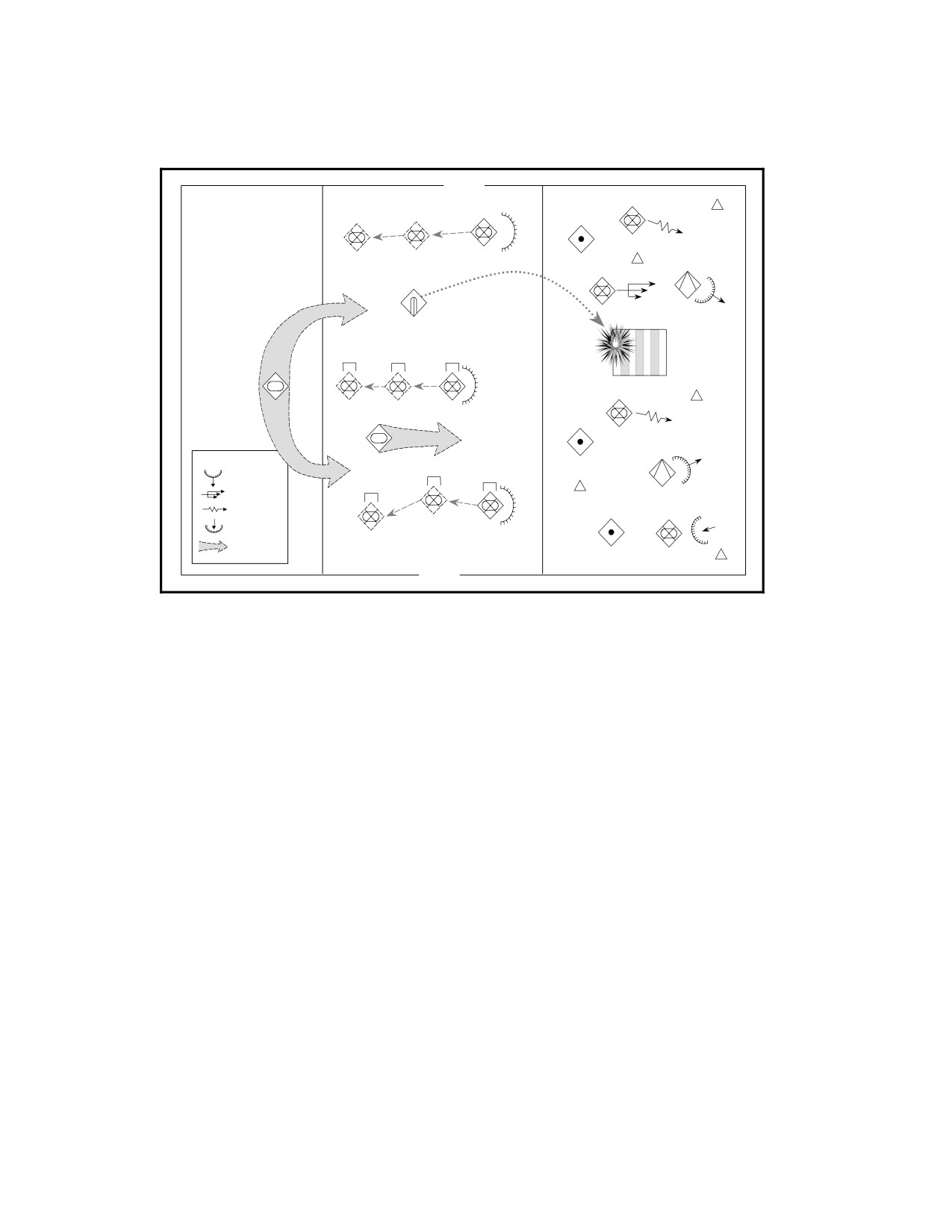
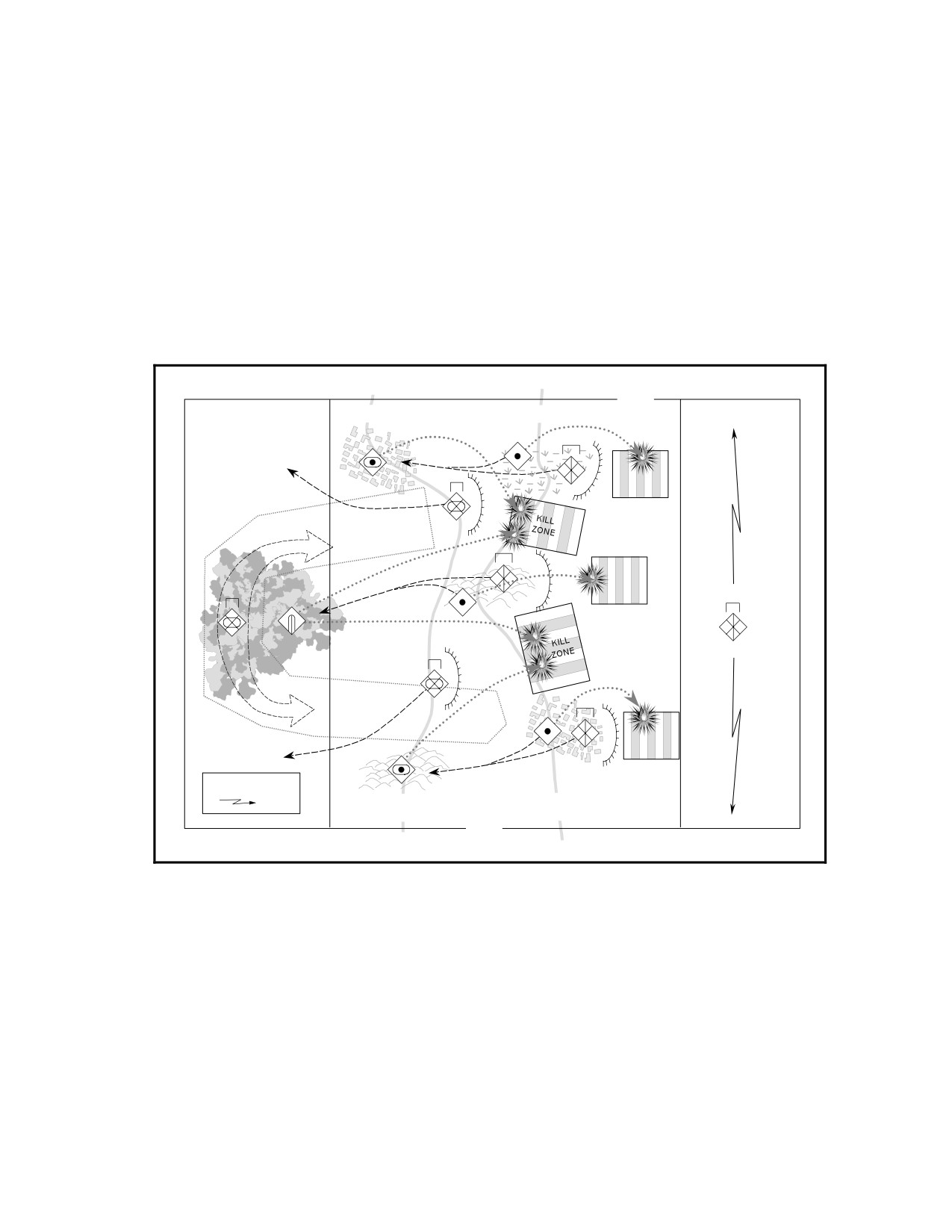
Figures 4-4 and 4-5 for examples of maneuver defense.
4-19
FM 7-100.1 ________________________________________________________________________________
OSC
Battle Zone
Disruption Zone
I I
Support Zone
X X
X X
I
X X
I
I I
X
KILL
ZONE
X X
XX
XX
XX
I I
X
I
Counterattack
I
LEGEND
Ambush
XX
XX
Disrupt
XX
Fix
I
I I
Contain
Counterattack
OSC
Figure 4-4. Maneuver Defense (Example 1)
4-93. A maneuver defense trades terrain for the opportunity to destroy
portions of the enemy formation and render the enemy’s combat system
ineffective. The OPFOR might use a maneuver defense when
• It can afford to surrender territory.
• It possesses a mobility advantage over enemy forces.
• Conditions are suitable for canalizing the enemy into areas where the
OPFOR can destroy him by fire or deliver decisive counterattacks.
4-94. Compared to area defense, the maneuver defense involves a higher de-
gree of risk for the OPFOR, because it does not rely heavily on the inherent
advantages of prepared defensive positions. Units conducting a maneuver de-
fense typically place smaller forces forward in defensive positions and retain
much larger reserves than in an area defense.
Defensive Lines
4-95. The basis of maneuver defense is for units to conduct maneuver from
position to position on a succession of defensive lines. In this case, the “line”
defended on is not a continuous line of defenses, but rather a notional line on
which one or more units have orders to defend for a certain time at a certain
depth within a unit’s AOR. The OPFOR accepts large intervals between de-
fensive positions on such a line. Part of the line may consist of natural or
manmade obstacles or of deception defensive positions.
4-96. These “lines” are not necessarily linear, in the sense of forming a
straight line. Nor are they necessarily at regular intervals from one another.
4-20
_________________________________________________________________________________Chapter 4
A particular unit’s position on a subsequent line may not be directly behind
its previous position. In the spaces between the lines, the defenders can or-
ganize reconnaissance fire, raids, and counterattacks. Thus, it is difficult for
the enemy to predict where he will encounter resistance.
4-97. The number of lines and duration of defense on each line depend on the
nature of the enemy’s actions, the terrain, and the condition of the defending
units. Lines are selected based on the availability of natural obstacles and
shielding terrain, with consideration of being able to leave the lines without
being observed.
OSC
Support Zone
Shielding Force
Battle Zone
Contact Force
Disruption Zone
City
X
X
XX
KILL
X
Marsh
ZONE
Attack Zone
XX
KILL
X
ZONE
C
X
X
X
C
X
City
Attack Zone
X
XX
KILL
X
ZONE
Mountains
LEGEND
C
Cover
Shielding
Contact
Force
Force
OSC
Figure 4-5. Maneuver Defense (Example 2)
Defensive Maneuver
4-98. Defensive maneuver consists of movement by bounds and the mainte-
nance of continuous fires on enemy forces. A disruption force and/or a main
defense force (or part of it) can perform defensive maneuver. In either case,
the force must divide its combat power into two smaller components: a con-
tact force and a shielding force. The contact force is the component occupying
the forward-most defensive line at any point in time. The shielding force is
the component occupying the next line immediately to the rear.
4-21
FM 7-100.1 ________________________________________________________________________________
4-99. At each line, the contact force ideally forces the enemy to deploy his
maneuver units and perhaps begin his artillery preparation for the attack.
Then, before the contact force becomes decisively engaged, it maneuvers to its
next preplanned line, behind the line occupied by the shielding force. While
the original contact force is moving, the shielding force is able to keep the en-
emy under continuous fires. When the original contact force passes to the
rear of the original shielding force, the latter force becomes the new contact
force. When the original contact force occupies its next line, it becomes the
shielding force for the new contact force. In this manner, units continue to
move by bounds to successive lines, preserving their own forces while delay-
ing and destroying the enemy.
4-100. Figures 4-1, 4-4, and 4-5, due to the operational scope of the overall
maneuver defense shown, depict only the general location of a BTG or DTG
as it moves to subsequent positions. These figures do not reflect the reality
that the contact and shielding forces moving by bounds are likely to be de-
tachments within a BTG or DTG. See FM 7-100.2 for examples of how this
process works at the tactical level.
4-101. Subsequent lines are far enough apart to permit defensive maneuver
by friendly units. The distance should also preclude the enemy from engaging
one line and then the other without displacing his indirect fire weapons. This
means that the enemy, having seized one line, must change the majority of
his firing positions and organized his attack all over again in order to get to
the next line. However, the lines are close enough to allow the defending
units to maintain coordinated, continuous fires on the enemy while moving
from one to the other.
4-102. OPFOR commanders may require a unit holding a line to continue
defending, even if this means it becomes decisively engaged or enveloped.
This may be necessary in order to allow the construction of defenses to the
rear of the line this unit is defending.
Disruption Force
4-103. An operational-level defense may have an OSC occupying an opera-
tional disruption zone if it is important to delay enemy forces to allow theater
transition to adaptive operations. The task organization of such an OSC
would have sufficient mobility to conduct a maneuver defense and a signifi-
cant allocation of artillery and rocket units. The disruption force initiates the
attack on the enemy’s combat system by targeting and destroying subsystems
that are critical to the enemy. If successful, the disruption force can cause
culmination of the enemy attack before the enemy enters the battle zone. In
the worst case, the enemy would enter the battle zone unable to benefit from
an integrated combat system and vulnerable to defeat by the main defense
force.
4-104. Forces committed to the disruption zone battle for an OSC usually
would be a BTG or DTG, along with supporting and affiliated assets from the
OSC. The OSC conducts the defense throughout the depth of the disruption
zone. Maneuver units conduct the defense from successive battle positions.
Intervals between these positions provide space for deployment of mobile
attack forces, precision fire systems, and reserves.
4-22
_________________________________________________________________________________Chapter 4
4-105. The distance between successive positions in the disruption zone is
such that the enemy is forced to displace the majority of his supporting weap-
ons to continue the attack on the subsequent positions. This aids the force in
breaking contact and permits time to occupy subsequent positions. Long-
range fires, ODs, and ambushes to delay pursuing enemy units can assist
units in breaking contact and withdrawing.
4-106. If the disruption force has not succeeded in destroying or halting
the attacking enemy, but is not under too great a pressure from a pursuing
enemy, it may occupy prepared battle positions in the battle zone and assist
in the remainder of the defensive mission as part of the main defense
force. A disruption force may have taken losses and might not be at full
capability; a heavily damaged disruption force may pass into hide positions.
In that case, main defense or reserve forces occupy positions to cover the dis-
ruption force’s disengagement.
Main Defense Force
4-107. The mission of the main defense force is complete the defeat of the enemy
by attack of those portions of the force exposed by disruption zone operations.
In a multi-OSC operation, this may involve resubordination of units and in some
cases attacks by fire or maneuver forces across OSC limits of responsibility.
4-108. The main defense force in a maneuver defense divides its combat
power into contact and shielding forces. These forces move in bounds to
successive defensive lines. If maneuver defense in the disruption zone has
provided sufficient time, the defensive positions on these lines may take on
more of the characteristics of prepared battle positions.
4-109. The basic elements of the battle zone are battle positions, firing lines,
and repositioning routes. Battle positions use the terrain to protect forces
while providing advantage in engagements.
4-110. The commander may order a particular unit to stand and fight on a
line long enough to repel an attack. He may order this if circumstances are
favorable for defeating the enemy at that line. The unit also might have to
remain on that line because the next line is still being prepared or a vertical
envelopment threatens the next line or the route to it.
Reserves
4-111. An operational-level command in the maneuver defense can employ a
number of reserve forces of varying strengths. The maneuver reserve is a
force strong enough to respond to unforeseen opportunities and contingencies
at the operational level. It is normally strong enough to defeat the enemy’s
exploitation force. The commander positions this reserve in an assembly area
using C3D to protect it from observation and attack. From this position, it
can transition to a situational defense or conduct a counterattack. The re-
serve must have sufficient air defense coverage to allow maneuver. If the
commander does not commit the reserve from its original assembly area, it
maneuvers to another assembly area, possibly on a different axis, where it
prepares for other contingencies. (See the Reserves section above for discussion
of other types of reserves.)
4-23
FM 7-100.1 ________________________________________________________________________________
AREA DEFENSE
4-112. In situations where the OPFOR must deny geographic areas (or the
access to them) or where it is overmatched, it may conduct an operational
area defense. An area defense uses complex battle positions to protect key
components of the OPFOR’s combat power while creating opportunities, if
possible, to attack the enemy’s combat system. Not every component of
OPFOR combat power needs to or will be able to operate from complex battle
positions. However, those components most central for the OPFOR com-
mander’s plan will be the priority for preservation. Area defense is designed to
achieve a decision in one of two ways:
• By forcing the enemy’s offensive operations to culminate before he can
achieve his objectives.
• By denying the enemy his objectives while preserving combat power until
decision can be achieved through strategic operations (see Chapter 1).
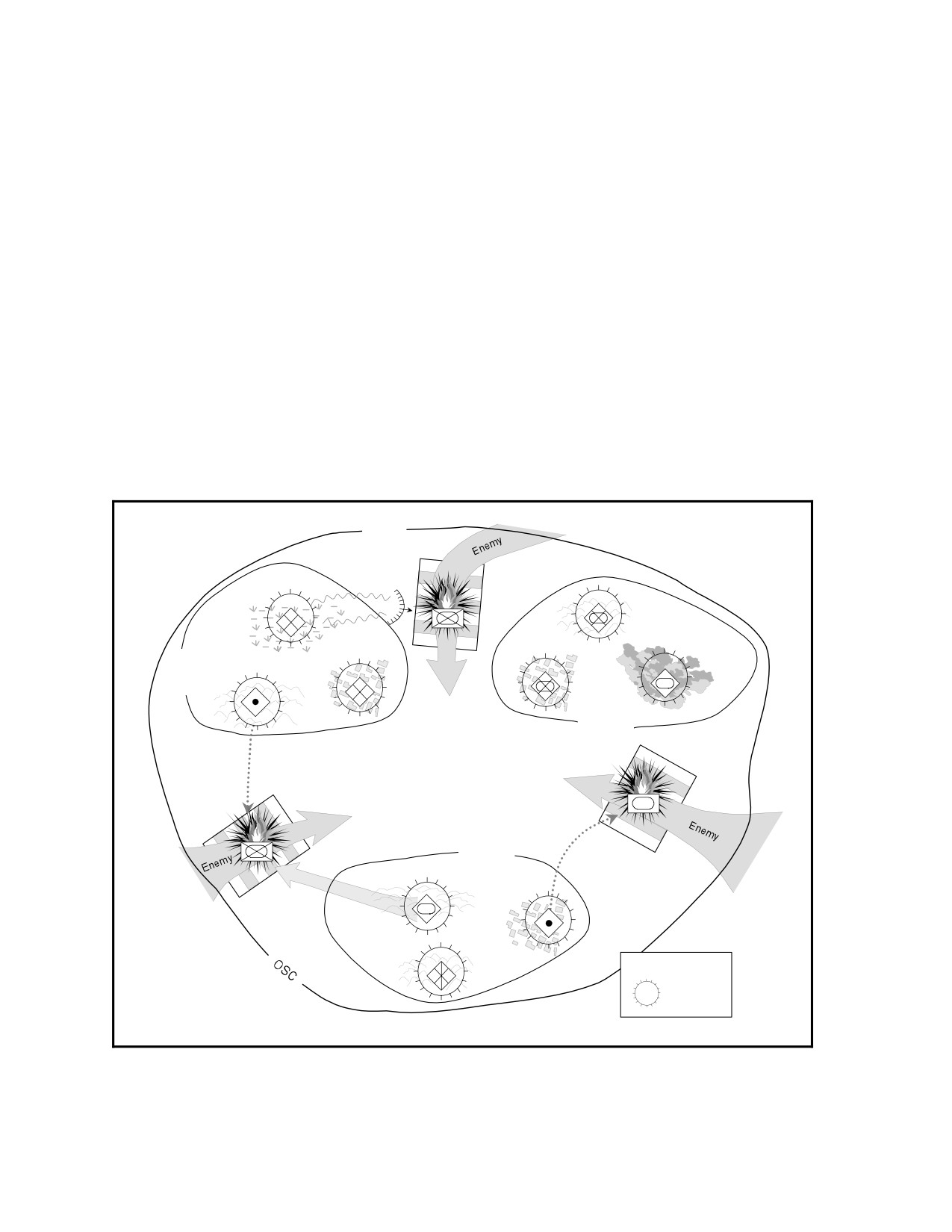
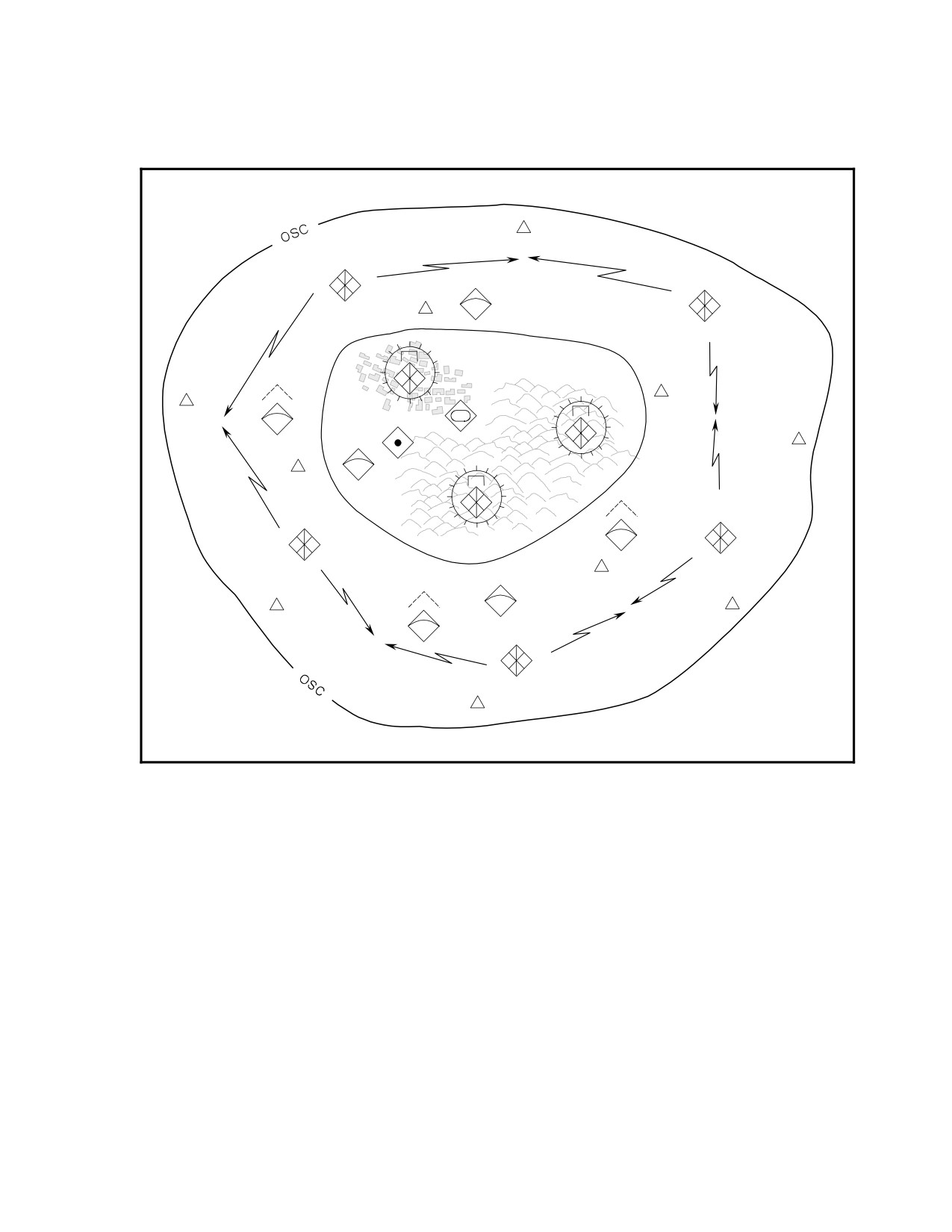
See Figures 4-6 and 4-7 for examples of area defense.
OSC
Kill
Zone
X
X
X
Marsh
DTG
X
X
Battle
X
Zone
I I
Forest
DTG
Battle
Zone
Disruption
Zone
Kill
Zone
Kill
X
Zone
X
DTG
Disruption
Battle
Zone
Zone
X
X
X
LEGEND
Complex
Battle
Position
Figure 4-6. Area Defense (Example 1)
4-24
_________________________________________________________________________________Chapter 4
OSC
Disruption
Zone
I I
C
I
I I
C
C
C
OSC Battle
XX
Zone
City
X
I
XX
X
I
OSC
Reserve
XX
C
OSC
I
I I
I I
Disruption
C
Zone
C
C
I
I
I I
OSC
C
Disruption
C
Zone
Figure 4-7. Area Defense (Example 2)
4-113. The area defense does not surrender the initiative to the attacking
forces, but takes action to create windows of opportunity that permit forces to
conduct small-scale offensive actions to attack key components of the enemy
combat system and cause unacceptable casualties. Area defense can set the
conditions for destroying a key enemy force in a strike. Extended windows of
opportunity permit the action of maneuver forces and facilitate transition to a
larger offensive action. IW is particularly important to the execution of the
area defense in adaptive and transition operations. Deception is critical to the
creation of complex battle positions, and effective perception management is
vital to the creation of the windows of opportunity needed to execute ma-
neuver and fires.
4-25