FM 7-100.1 OPFOR Opposing Force Operations (DECEMBER 2004) - page 3
FM 7-100.1 ________________________________________________________________________________
INTEGRATED FIRES COMMAND
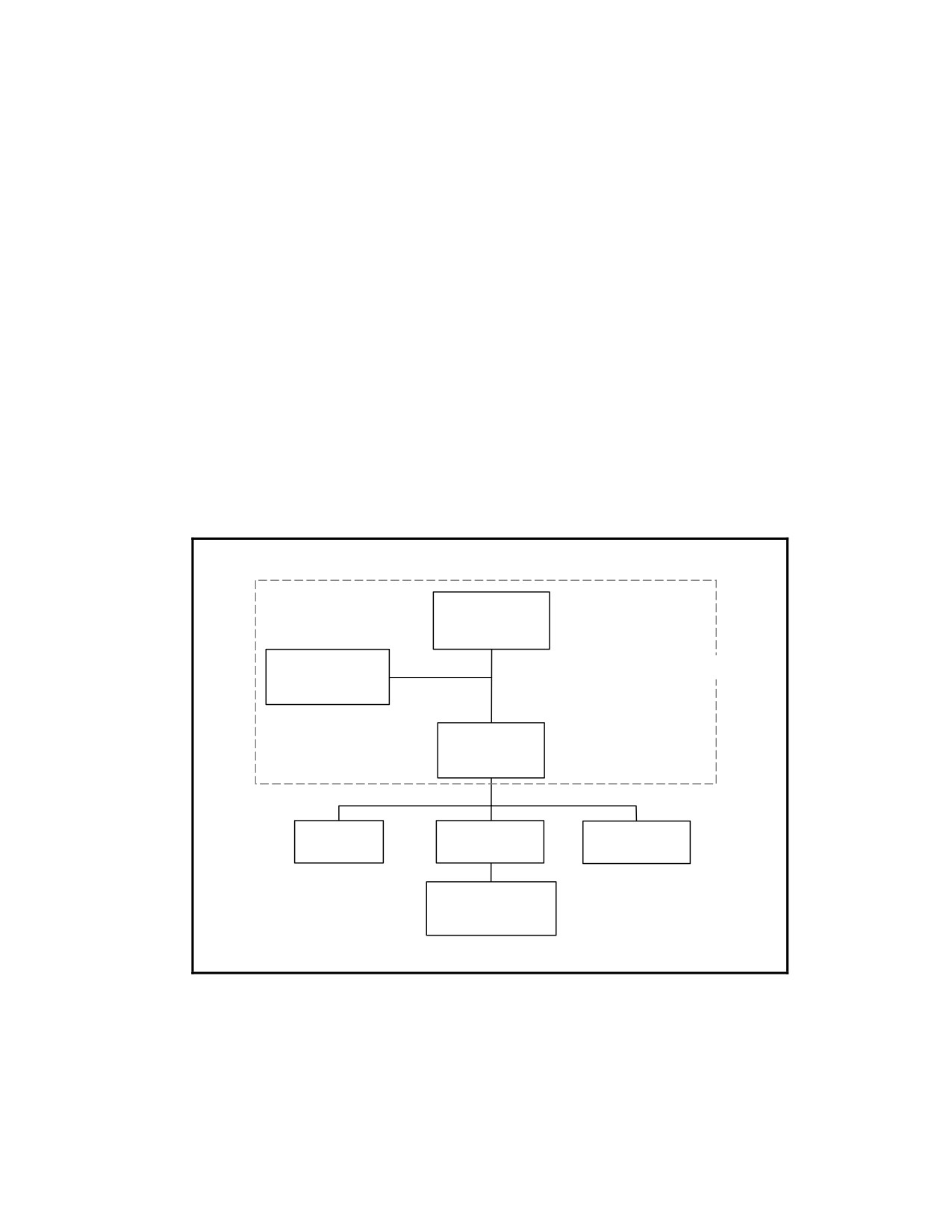
2-47. The integrated fires command (IFC) is a combination of a standing C2
structure and task organization of constituent and dedicated fire support
units. (See Figure 2-8.) All division-level and above OPFOR organizations
possess an IFC C2 structurestaff, CP, communications and intelligence ar-
chitecture, and automated fire control system (AFCS). The IFC exercises
command of all constituent and dedicated fire support assets retained by its
level of command. This includes aviation, artillery, and missile units. It also
exercises command over all reconnaissance, intelligence, surveillance, and
target acquisition (RISTA) assets allocated to it.3
OSC
IFC
IFC
HEADQUARTERS
ARTILLERY
AVIATION
MISSILE
SPF
COMPONENT
COMPONENT
COMPONENT
COMPONENT
INTEGRATED
SUPPORT
GROUP
Figure 2-8. Possible IFC Components in an OSC
2-48. The mission of the IFC is to execute all fire support tasks required to
accomplish the unit mission. It is designed to
• Exploit the combat power inherent in carefully integrated ground and
air fire support actions.
• Reduce the amount of time from target acquisition to attack to the ab-
solute minimum.
• Permit fire support assets to mass their effects without having to oper-
ate in concentrated formations.
3 Based on mission requirements, the commander may also allocate maneuver forces to the IFC. This is most often
done when he chooses to use the IFC CP to provide C2 for a strike, but can also be done for the execution of other
missions.
2-14
_________________________________________________________________________________Chapter 2
• Ensure the optimal fire support asset(s) are assigned any given mission.
• Ensure the commander’s priorities for fire support are adhered to.
• Act, if necessary, as the organization’s alternate command structure.
• Integrate the effects of fires from units placed in support of the
organization.
2-49. The number and type of fire support and RISTA units allocated to an
IFC is mission-dependent. The IFC is not organized according to a table of
organization and equipment, but is task organized to accomplish the mis-
sions assigned.
IFC Headquarters
2-50. The OSC IFC headquarters, like the overall OSC headquarters, exists
in peacetime in order to be ready to accommodate and exercise C2 over all
forces made subordinate to it in wartime. The IFC headquarters is composed
of the IFC commander and his command group, a RISTA and IW section, an
operations section, and a resources section. (See Figure 2-9.)
IFC
COMMANDER
IFC
COMMAND GROUP
DEPUTY
COMMANDER
CHIEF
OF
STAFF
RISTA/IW
OPERATIONS
RESOURCES
SECTION
SECTION
SECTION
FIRE SUPPORT
COORDINATION
CENTER
Figure 2-9. IFC Headquarters
2-51. The deputy commander (DC) of the OSC serves as IFC commander.
The RISTA and IW section provides the complete spectrum of intelligence
and IW support for the IFC. The operations section provides the control, co-
ordination, and communications for the headquarters. Located within the op-
erations section is the fire support coordination center (FSCC). To ensure the
2-15
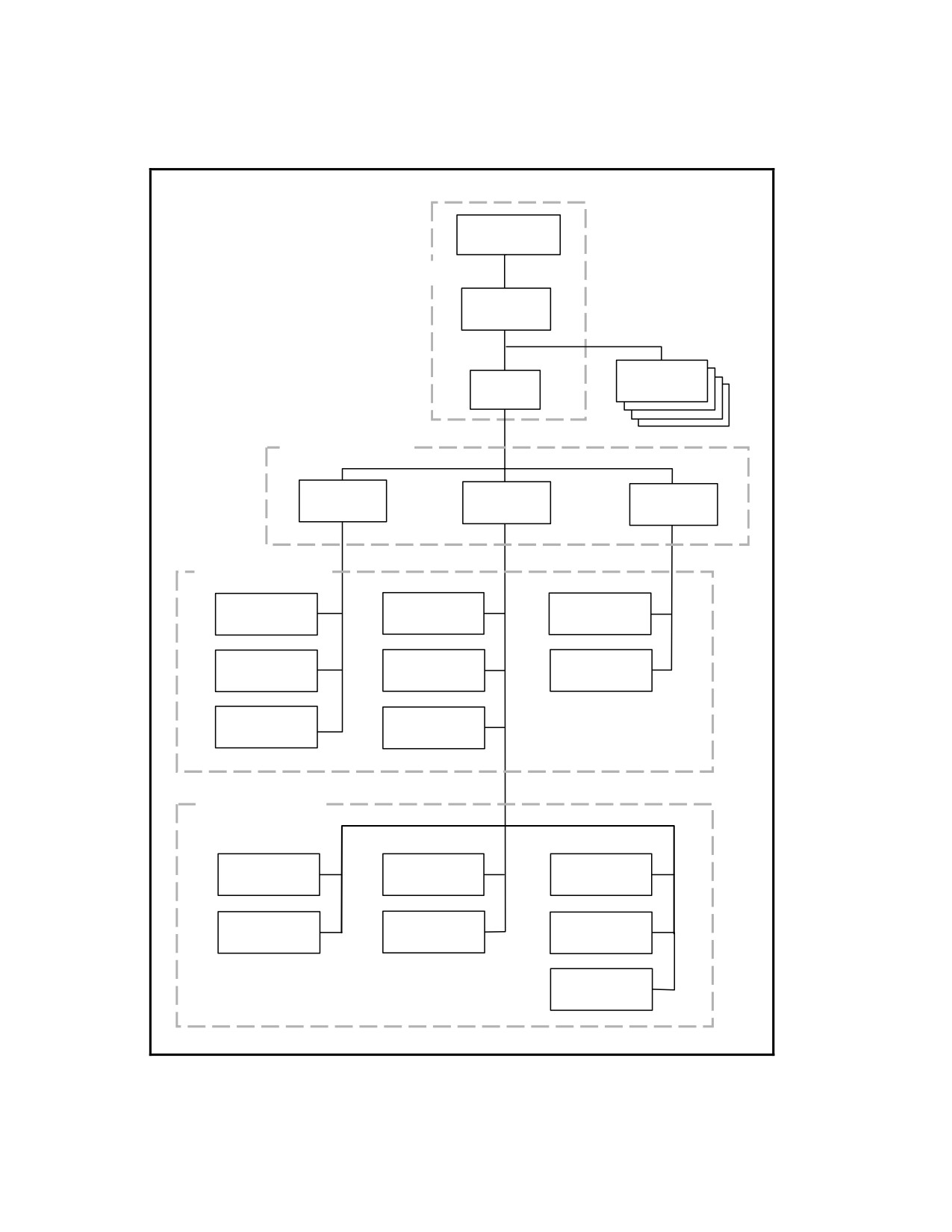
FM 7-100.1 ________________________________________________________________________________
necessary coordination of fire support and associated RISTA, the operations
section of the IFC headquarters also includes liaison teams from subordinate
units. The resources section provides control and coordination of various
logistics and administrative support functions.
Artillery Component
2-52. The artillery component is a task organization tailored for the conduct
of artillery support during combat operations. In an OSC’s IFC, it is typically
organized around one or more artillery brigades, or parts of these that are
not allocated in a constituent or dedicated relationship to tactical-level sub-
ordinates. The artillery component includes appropriate target acquisition,
C2, and logistics support assets.
2-53. The number of artillery battalions assigned to an IFC varies according
such factors as mission of friendly units, the enemy situation, and terrain.
However, the number of artillery units also can vary based on the capabili-
ties of the supporting AFCS. For example, a multiple rocket launcher (MRL)
brigade AFCS can have enough command and staff vehicles for the brigade
commander and his chief of staff, as well as the subordinate commanders of
battalions and up to 18 batteries (6 battalions). An AFCS supporting a can-
non, MRL, or mortar battalion may consist of enough command and staff ve-
hicles to support 3 to 4 batteries (each consisting of 4 to 8 systems).
Aviation Component
2-54. The aviation component is a task organization tailored for the conduct
of aviation operations. The aviation component is task organized to provide a
flexible and balanced air combat organization capable of providing air support to
the OSC commander. It may be organized around an Air Force aviation
regiment or an air army, or parts of these, as required by the mission. It may
also include rotary-wing assets from army aviation. It includes ground attack
aviation capability as well as requisite ground and air service support assets.
The IFC commander exercises control through facilities provided by the airspace
operations subsection of the OSC staff and/or the aviation unit(s).
Missile Component
2-55. The missile component is a task organization consisting of long-range
missiles or rockets capable of delivering conventional or nuclear, biological,
and chemical (NBC) munitions. It is organized around an SSM or rocket bat-
talion or brigade and includes the appropriate logistics support assets. Mis-
sile and rocket units may come from the Strategic Forces or from other parts
of the administrative force structure (where they may be part of a corps,
army, or army group).
2-56. The State considers the long-range rocket and missile capability, even
when delivering conventional munitions, the responsibility of the NCA. For
example, the SHC or theater commander may allocate Strategic Forces as-
sets to an IFC in order to use long-range missiles and rockets to advance
State political ends during regional, transition, or adaptive operations. Un-
able to mount robust air campaigns, the State can use these weapons to
mount an equivalent effort.
2-16
_________________________________________________________________________________Chapter 2
Special-Purpose Forces Component
2-57. The SPF component normally consists of assets from an SPF brigade.
Personnel of such a brigade are specially trained for insertion in small SPF
teams. These assets provide the OPFOR the ability to attack both regional
and extraregional enemies throughout their tactical, operational, and strate-
gic depth. SPF assets are inserted in advance of regional operations and in
support of transition and adaptive operations. They are an essential part of
the concept of using all means necessary and are critical to access-control
operations. SPF assigned to the Army, Air Force, and Navy are designed for
use at the operational level. The national-level SPF Command has its own
SPF units.
2-58. The SPF conduct operations to achieve strategic military, political, eco-
nomic, and/or psychological objectives or achieve tactical or operational goals
in support of strategic objectives. Such operations may have either long-
range or immediate impact on the enemy. The OPFOR concept of SPF opera-
tions includes reconnaissance, direct action, and diversionary measures. The
SPF component of the IFC has a capability to support terrorist and irregular
forces operations.
2-59. If an OSC has received SPF units, it may further allocate some of these
units to supplement the long-range reconnaissance assets a division or DTG
has in its own IFC. However, the scarce SPF assets normally would remain
at OSC level.
Integrated Support Group
2-60. The integrated support group (ISG) is a compilation of units perform-
ing logistics tasks that support the IFC. Other combat support and combat
service support units may be grouped in this component for organizational ef-
ficiency although they may support only one of the major units of the IFC.
The ISG is discussed in detail in Chapter 12. It can perform the same func-
tions as the integrated support command (see below and in Chapter 12), but
on a different scale and tailored to the support requirements of the IFC.
INTEGRATED SUPPORT COMMAND
2-61. The integrated support command (ISC) is the aggregate of combat ser-
vice support units (and perhaps some combat support units) allocated from
the administrative force structure to an OSC and not suballocated in a con-
stituent or dedicated command relationship to a subordinate headquarters
within the OSC. The OSC further allocates part of its combat service support
units to its tactical-level subordinates and some, as an ISG, to support its
IFC. The rest remain in the ISC at OSC level to provide overall support of
the OSC. For organizational efficiency, other combat service support units
may be grouped in this ISC, although they may support only one of the major
units of the OSC. Sometimes, an ISC might also include units performing
combat support tasks (such as chemical warfare, IW, or law enforcement)
that support the OSC. (See Chapter 12 for more detail on the ISC.)
2-17
FM 7-100.1 ________________________________________________________________________________
ORGANIZING THE OPERATIONAL BATTLEFIELD
2-62. The OPFOR organizes the battlefield in such a way that it can rapidly
transition between offensive and defensive operations and between linear
and nonlinear operations. This flexibility can help the OPFOR adapt and
change the nature of the conflict to something for which the enemy is not
prepared.
Battlefield Geometry
2-63. The OPFOR recognizes the complexity of the modern battlefield. This
will often lead to situations where part of the OPFOR may be able to effec-
tively operate in a linear fashion, while other parts may be able to (or need
to) conduct nonlinear operations. The OPFOR’s understanding of what makes
a battlefield linear or nonlinear is based on general military theory accepted
by the armed forces of many countries. Battlefield geometry can be described
in two dimensions: the relationship of units to each other, the enemy, and
their support base; and the expected effects of that relationship.
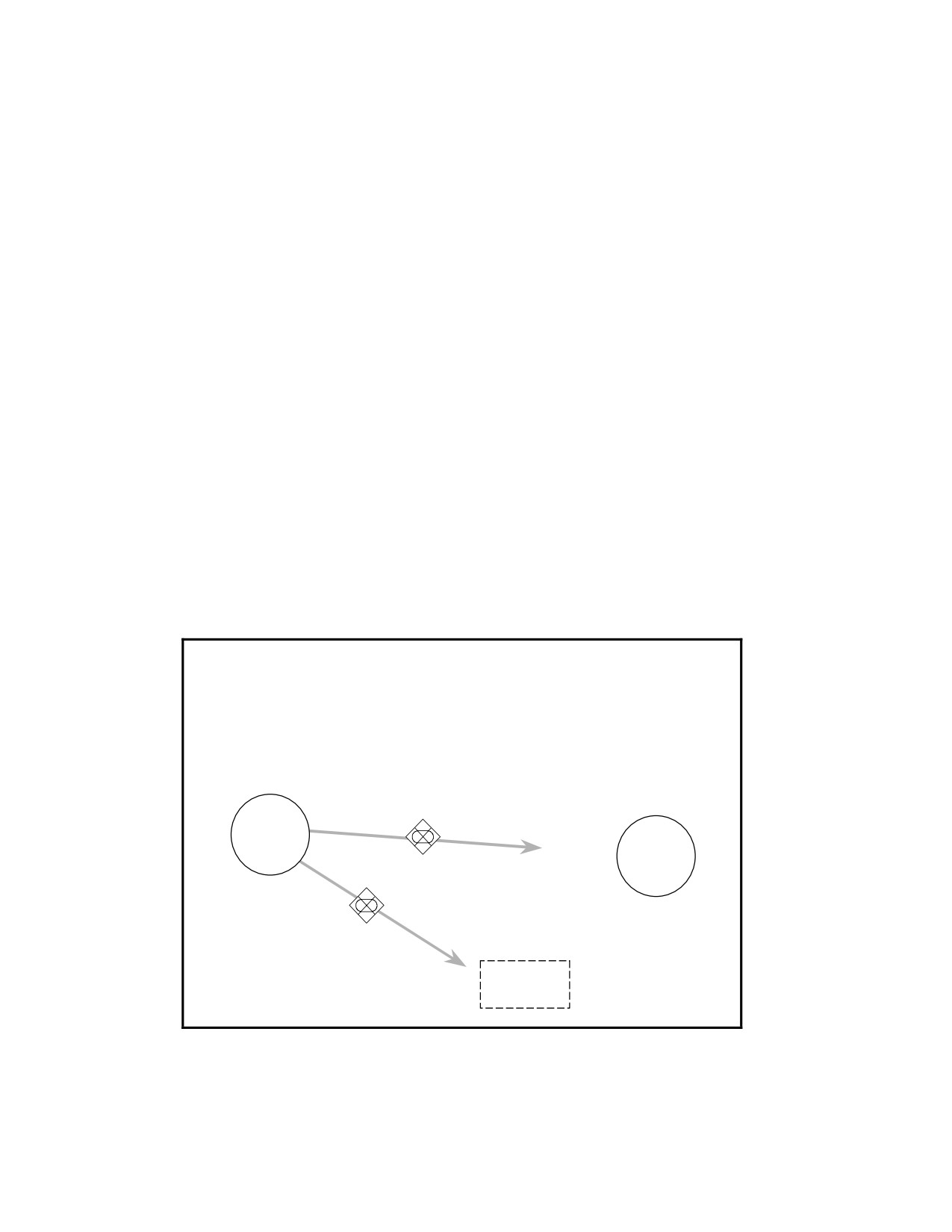
2-64. Linear Operations. Some military operations develop along a secure
line from a base toward a geographically-based objective. These linear opera-
tions are characterized by an easily definable front and rear across the entire
force. Orientation of the bulk of the force is in one general direction, defined
as the front, normally facing the enemy and/or the objective. (See Figure 2-
10.) During linear operations, the flanks of units are normally protected by
other units, natural terrain features, or manmade obstacles.
Rear
Front
X
Base
Objective
X
Enemy
Figure 2-10. Linear Operations
2-18
_________________________________________________________________________________Chapter 2
Objective
X
Enemy
Base
Enemy
X
Objective
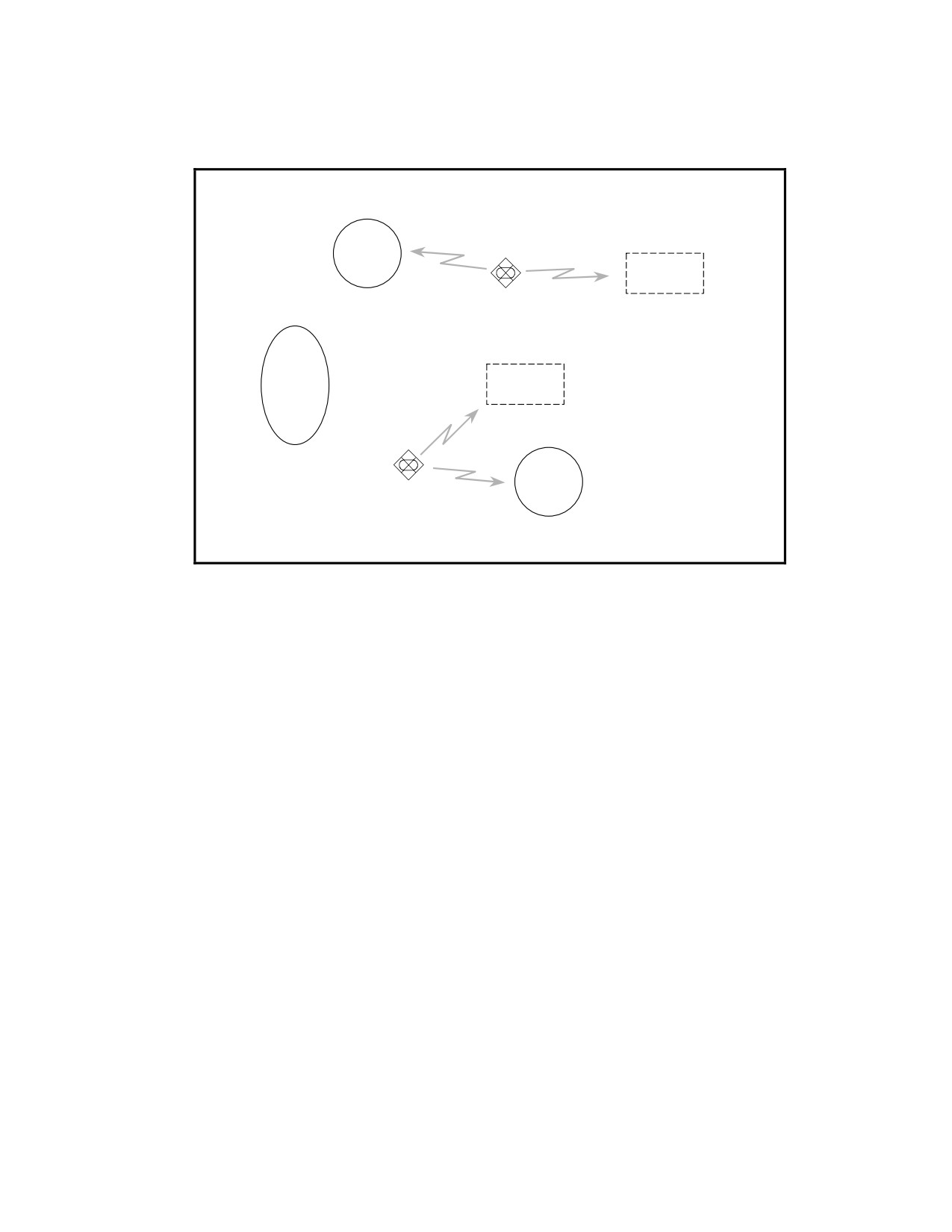
Figure 2-11. Nonlinear Operations
2-65. Nonlinear Operations. Military operations that seek to complete a
force- or systems-based mission, with no secure connection to a base and no
easily defined front and rear across the force, are nonlinear. Orientation of
the force is determined by the location of the immediate threat or the objec-
tive. (See Figure 2-11.) In most cases, units in a nonlinear environment rely
on movement, deception, cover, and concealment to provide protection for po-
tentially exposed portions of the force.
2-66. Expected Effects. The OPFOR considers the difference between lin-
ear and nonlinear operations less in terms of geography and more in terms of
effects desired. Linear operations normally produce small effects from small
actions and large effects from large actions (or perhaps large effects from an
aggregation of small actions)a linear relationship. Linear operations are
proportional and additive, and typically produce a predictable, measurable
effect. In contrast, this relationship may not always be present in nonlinear
operations, which can produce large effects from small actions. In some cases,
small actions produce small effects or no effects at all. Thus, nonlinear opera-
tions produce disproportionate, often unpredicted effects.
2-67. The OPFOR believes the worst of all possible situations is for a force to
be operating in a linear mode against an enemy that can operate freely
throughout the battlespace with excellent situational awareness and signifi-
cant forces and fires. The OPFOR seeks, as a base case, to create such a
situation for its enemies.
2-19
FM 7-100.1 ________________________________________________________________________________
Areas of Responsibility
2-68. OPFOR organizations are given a specific area of responsibility. An
AOR is a clearly defined geographic area with associated airspace. An AOR is
bounded by a limit of responsibility (LOR) beyond which the organization
may not operate or fire without coordination through the next-higher head-
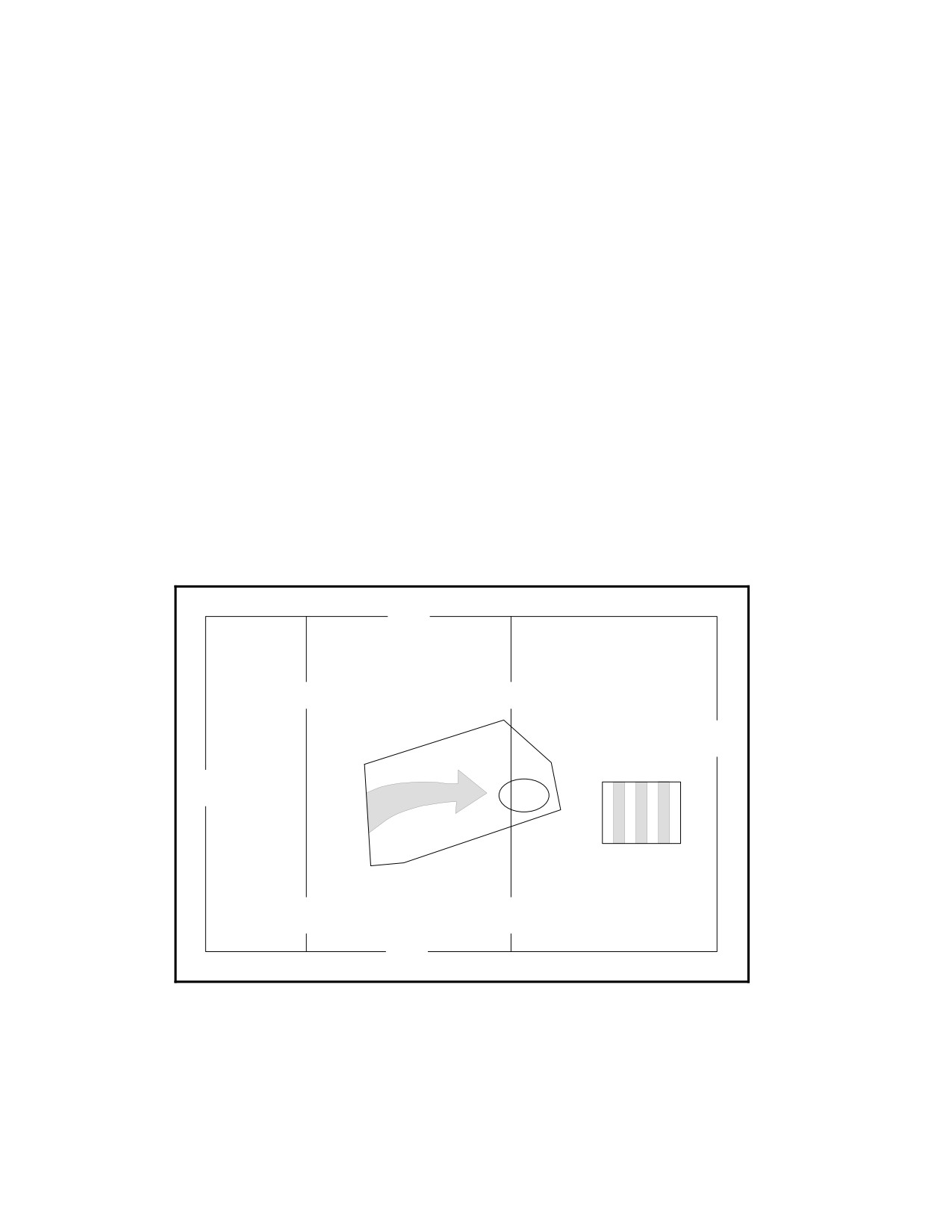
quarters. AORs may be linear or nonlinear in nature (see Figures. 2-12 and
2-13 for examples; see Chapters 3 and 4 for additional examples). Linear
AORs may contain subordinate nonlinear AORs and vice versa.
2-69. AORs normally consist of three basic zones: the battle zone, the
disruption zone, and the support zone. An AOR may also contain one or
more attack and/or kill zones. Zones may be linear or nonlinear in nature.
These zones have the same basic purposes within each type of offensive and
defensive operation (see Chapters 3 and 4). The size of these zones depends
on the size of the OPFOR units involved, engagement ranges of weapon sys-
tems, the terrain, and the nature of the enemy’s operation.
2-70. An AOR is not required to have all of these zones in any particular
situation. A particular command might have a battle zone and no disruption
zone. It might not have a battle zone, if it is the disruption force of a higher
command. If it is able to forage, it might not have a support zone. (See exam-
ples in Figure 2-13.)
OSC
LOR
Support
Battle
Disruption
Zone
Zone
Zone
OSC AREA OF RESPONSIBILITY
OSC
LOR
Attack Zone
OSC
LOR
Axis
Objective
Kill
Zone
Support
Battle
Line
Line
OSC
LOR
Figure 2-12. Linear AOR Example
2-71. Within the overall LOR, the OPFOR normally refers to two types of
control lines. The battle line separates the battle zone from the disruption
zone. The support line separates the support zone from the battle zone. LORs
give maximum latitude to the subordinate commander. Within the LOR, the
2-20
_________________________________________________________________________________Chapter 2
commander has the flexibility to do as he sees fit unless the higher com-
mander also assigns a kill zone, which he proposes to support with additional
resources.
2-72. An operation plan or directive normally defines AORs and zones by
specifying boundary lines in terms of distinct local terrain features through
which a line passes, specifying whether each terrain feature is included or
excluded from the unit’s AOR or zones within it. Normally, a specified terrain
feature is included unless the order identifies it as “excluded.”
2-73. In either linear or nonlinear operations, military reason normally dic-
tates a contiguous force deployment. The OPFOR does not recognize the idea
of
“‘noncontiguous operations.” Senior OPFOR commanders ensure that all
parts of a theater are within the assigned AOR of some subordinate organiza-
tion, whether or not ground forces are actually present or expected to operate
in any given area. A given AOR or zone might be not be contiguous with
other AORs of its level of command or with other zones of the same type, but
the geographic area between such control measures will be identified as be-
ing in the AOR of some other organization.
DTG
OSC
Battle Line
LOR
DTG
Support Line
DTG
Battle Zone
DTG
AOR
DTG
Support
AOR
Zone
Objective
Enemy
SPOD
Support
Enemy
DTG
Zone
Kill
APOD
Battle Zone
Zone
Sea
OSC AREA OF RESPONSIBILITY
DTG
OSC
Disruption
Zone
Disruption
Zone
BTG
AOR
OSC
LOR
Figure 2-13. OSC Nonlinear AOR Example
2-74. In his operation plan, the commander specifies the organization of the
battlefield from the perspective of his level of command. Within his unit’s
AOR, as defined by the next-higher commander, he designates AORs for his
subordinates, along with zones, objectives, and axes related to his own over-
all mission. (See Chapter 3 for further discussion of objectives and axes.)
Whether the overall operation plan is offensive or defensive in nature, some
2-21
FM 7-100.1 ________________________________________________________________________________
subordinate units are likely to be occupying defensive battle positions. (See
Chapter 4 for further discussion of simple and complex battle positions.)
2-75. Disruption Zone. The disruption zone is where the OPFOR sets the
conditions for successful operations by beginning the attack on the compo-
nents of the enemy combat system. A successful disruption zone operation
can create a window of opportunity that is exploitable in the battle zone. In
the disruption zone, the OPFOR attacks specific components of the enemy’s
combat system in order to begin the breakdown of the system. For example,
attack of all enemy engineer forces can leave a maneuver force unable to con-
tinue effective combat operations in complex terrainexposing them to de-
struction by forces in the battle zone. Actions of forces in the disruption zone
are detailed in Chapters 3 and 4. Disruption zones may be contiguous or non-
contiguous with other disruption zones, or they may be “layered.”
2-76. Battle Zone. The battle zone is the portion of the AOR where the
OPFOR expects to conduct decisive operations. Using all components of its
combat power, the OPFOR will engage the enemy and defeat him in this
zone. Units operating in the battle zone can have various missions and objec-
tives, depending on the nature of the overall offensive or defensive operation
(see Chapters 3 and 4).
2-77. An FG or OSC does not form an operational-level battle zone per
sethat zone is the aggregate of the battle zones of its subordinate units. In
a nonlinear operation, multiple, noncontiguous battle zones may exist, and
within each a certain task would be assigned to the OPFOR unit or units
charged to operate in that space. The battle zone provides the commander of
each of those units the battlespace in which to frame his operations.
2-78. Support Zone. The support zone is that area of the battlespace de-
signed to be free of significant enemy action and to permit the effective logis-
tics and administrative support of forces. Security forces operate in the sup-
port zone in a combat role to defeat enemy special operations forces and other
threats. Camouflage, concealment, cover, and deception (C3D) measures oc-
cur throughout the support zone to protect the force from standoff RISTA and
precision attack. The OSC support zone may be dispersed within the support
zones of subordinate tactical units, or the OSC may have its own support
zone that is separate from subordinate AORs. The support zone may be in a
sanctuary that is noncontiguous with other zones of the AOR.
2-79. Attack Zone. An attack zone is given to a subordinate unit with an of-
fensive mission, to delineate clearly where forces will be conducting offensive
maneuver. Attack zones are often used to control offensive action by a subor-
dinate unit inside a larger defensive operation.
2-80. Kill Zone. A kill zone is a designated area on the battlefield where the
OPFOR plans to destroy a key enemy target, usually by fires. A kill zone may
be within the disruption zone or the battle zone. In defensive operations, it
could also be in the support zone.
2-22
_________________________________________________________________________________Chapter 2
COMMAND GROUP AND STAFF
2-81. Within the C2 structure, the headquarters includes the command group
and the staff. (See Figure 2-14.) These elements perform the functions re-
quired to control the activities of forces preparing for and conducting combat.
The primary functions of headquarters are to
• Make decisions.
• Plan combat actions that accomplish those decisions.
• Acquire and process the information needed to make and execute effec-
tive decisions.
• Support the missions of subordinates.
The commander exercises C2 functions through his staff and subordinate
commanders.
Command Group
2-82. The command group consists of the commander, deputy commander,
and chief of staff. Together, they direct and coordinate the activities of the
staff and of subordinate forces.
2-83. Commander. The commander directs subordinate commanders and,
through his staff and liaison teams, controls any supporting units. OPFOR
commanders have complete authority over their subordinates and overall re-
sponsibility for those subordinates’ actions. This centralized authority en-
ables the commander to maintain troop discipline and unity and to act deci-
sively. Under the fluid conditions of modern warfare, even in the course of
carefully planned operations, the commander must accomplish assigned mis-
sions on his own initiative without constant guidance from above.
2-84. The commander is responsible for the combat capability of subordinate
units, the organization of combat operations, the maintenance of uninter-
rupted C2, and the successful conduct of combat missions. He examines and
analyzes the mission he receives (that is, he determines his forces’ place in
the senior commander’s concept of operations). He may do this alone or
jointly with the chief of staff. He then gives instructions to the chief of staff
on preparing his forces and staff for combat. He also provides instructions
about the timing of preparations. The commander makes his own assessment
of intelligence data supplied by the intelligence officer. Then, with advice
from the primary staff officers, he makes an assessment of his own forces.
After discussing his deductions and proposals with the operations officer
and his staff, the commander reaches a decision, issues combat missions to
subordinates, and gives instructions about planning the operation. He then
directs coordination within his organization and with adjacent forces and
other units operating in his AOR.
2-85. During the course of operations, the commander must constantly
evaluate the changing situation, predict likely developments, and issue new
combat missions in accordance with his vision of the battlefield. He also
keeps his superiors informed as to the situation and character of friendly and
enemy actions and his current decisions.
2-23
FM 7-100.1 ________________________________________________________________________________
COMMANDER
Command Group
Deputy
Commander
Commanders of
Chief
Subordinate
of
Forces
Staff
Primary Staff
Intelligence
Operations
Resources
Officer
Officer
Officer
Secondary Staff
Chief of
Chief of
Chief of
Current
Reconnaissance
Operations
Logistics
Chief of
Chief of
Chief of
Information
Future
Administration
Warfare
Operations
Chief of
Chief of
Airspace
Communications
Operations
Functional Staff
Chief of
Chief of
Chief of
Integrated
Special-Purpose
Population
Fires
Operations
Management
Chief of
Chief of
Chief of
Force
Infrastructure
WMD
Protection
Management
Chief of
Littoral
Warfare
Figure 2-14. OSC Command Group and Staff
2-24
_________________________________________________________________________________Chapter 2
2-86. Deputy Commander. In the event the commander is killed or inca-
pacitated, the DC would assume command. Barring that eventuality, the
DC’s primary responsibility is to command the OSC’s IFC. As IFC com-
mander, he is responsible for executing operational-level fire support in a
manner consistent with the commander’s intent.
2-87. Chief of Staff. Preeminent among OPFOR staff officers is the chief of
staff position (found at every level from the General Staff down to battalion).
He exercises direct control over the primary staff. During combat, he is in
charge of the main CP when the commander moves to the forward CP. He
has the power to speak in the name of the commander and DC, and he nor-
mally countersigns all written orders and combat documents originating from
the commander’s authority. He alone has the authority to sign orders for the
commander or DC and to issue instructions in the commander’s name to sub-
ordinate units. In emergency situations, he can make changes in the tasks
given to subordinate commanders. Thus, it is vital that he understands
not merely the commander’s specific instructions but also his general con-
cept and train of thought. He controls the battle during the commander’s ab-
sences.
2-88. The chief of staff is a vital figure in the C2 structure. His role is to serve
as the director of staff planning and as coordinator of all staff inputs that as-
sist the commander’s decision making. He is the commander’s and DC’s focal
point for knowledge about the friendly and enemy situation. He has overall
responsibility for providing the necessary information for the commander to
make decisions. Thus, he plays a key role in structuring the overall recon-
naissance effort to meet the commander’s information requirements.
Staff
2-89. A staff provides rapid, responsive planning for combat activity, and
then coordinates and monitors the execution of the resulting plans on behalf
of the commander. Proper use of this staff allows the commander to focus on
the most critical issues in a timely manner and to preserve his energies.
2-90. The staff releases the commander from having to solve administrative
and technical problems, thereby allowing him to concentrate on the battle.
The primary function of the staff is to plan and prepare for combat. Evalua-
tion and knowledge of the situational elements of combat is fundamental to
the decision-making process and the direction of troops. After the commander
makes the decision, the staff must organize, coordinate, disseminate, and
support the missions of subordinates. Additionally, it is their responsibility to
train and prepare troops for combat, and to monitor the pre-combat and combat
situations.
2-91. In the decision-making and planning process, the staff—
• Prepares the data and estimates the commander uses to make a deci-
sion.
• Plans and implements the basic measures for comprehensive support
of a combat action.
• Organizes communications with subordinate and adjacent headquar-
ters and the next-higher staff.
2-25
FM 7-100.1 ________________________________________________________________________________
• Monitors the activities of subordinate staffs.
• Coordinates ongoing activity with higher-level and adjacent staffs
during an operation.
2-92. All operational-level headquarters have the same basic organization,
although each differs in size and complexity. The higher the level, the larger
and more complex the staff. Therefore, the organization of command and
staff elements is similar at theater, FG, or OSC.
2-93. The staff consists of three elements: the primary staff, the secondary
staff and the functional staff. Figure 2-14 depicts the primary, secondary,
and functional staff officers of an OSC headquarters; it does not show the li-
aison teams, which support the primary, secondary, and functional staff.
Primary and Secondary Staff
2-94. Each member of the primary staff heads a staff section. Within each
section are two or three secondary staff officers heading subsections subordi-
nate to that primary staff officer.
2-95. Operations Officer. The operations officer heads the operations
section, and conducts planning and prepares operation plans and operational
directives. Thus, the operations section is the principal staff section. It
includes current operations, future operations, and airspace operations
subsections, as well as the functional staff.
2-96. The operations officer is responsible for training and the formulating of
plans and orders. He monitors the work of all other staff sections, remains
knowledgeable of the current situation, and is ready to present information
and recommendations concerning the situation. He writes combat orders and
important combat reports. In coordination with the information section, the
operations officer keeps the commander informed on the progress of the op-
eration. Specific duties of the operations section include—
• Assisting the commander in the making and execution of combat decisions.
• Collecting information concerning the situation of friendly forces.
• Preparing and disseminating operational directives, plans and reports,
summaries, and situation overlays.
• Providing liaison for the exchange of information within the headquar-
ters and with higher, subordinate, and adjacent units.
• Organizing the main CP.
• Organizing troop movement and traffic control.
• Coordinating the organization of reconnaissance with the information section.
2-97. The chief of current operations is a secondary staff officer who proac-
tively monitors the course of current operations and coordinates the actions of
forces to ensure execution of the commander’s intent. He serves as the represen-
tative of the commander, chief of staff, and operations officer in their absence
and has the authority to control forces in accordance with the operation plan.
2-98. The chief of future operations is a secondary staff officer who heads the
planning staff and ensures continuous development of future plans and pos-
sible branches, sequels, and contingencies. While the commander and the
2-26
_________________________________________________________________________________Chapter 2
chief of current operations focus on the current operation, the chief of future op-
erations and his subsection monitor the friendly and enemy situations and their
implications for future operations. They try to identify any developing situations
that require command decisions and/or adaptive measures. They advise the
commander on how and when to make adjustments to the operation plan during
the fight. Planning for various contingencies and anticipated opportunities can
facilitate immediate and flexible response to changes in the situation.
2-99. The chief of airspace operations (CAO) is a secondary staff officer who
is responsible for the control of the OSC’s airspace. See Chapters 8 and 9 for
further information on his duties.
2-100. Intelligence Officer. The intelligence officer heads the intelligence
and information section, which consists of the reconnaissance subsection, the
IW subsection, and the communications subsection. The intelligence officer is
responsible for the acquisition, synthesis, analysis, dissemination, and protec-
tion of all information and intelligence related to and required by the OSC’s
operations. He ensures the commander’s intelligence requirements are met.
He provides not only intelligence on the current and future operational envi-
ronment, but also insight on opportunities for adaptive and creative re-
sponses to ongoing operations. The intelligence officer works in close coordi-
nation with the chief of future operations to establish feedback and input for
future operations and the identification of possible windows of opportunity.
2-101. The intelligence officer also formulates the OSC’s IW plan and must
effectively task organize his staff resources to conduct and execute IW in a
manner that supports the strategic IW plan. He is responsible for the coordi-
nation of all necessary national or theater level assets in support of the IW
plan and executes staff supervision over the IW and communications plans.
He is supported by three secondary staff officers: the chief of reconnaissance,
the chief of IW, and the chief of communications.
2-102. The chief of reconnaissance develops collection plans, gathers
information, and evaluates data on the battlefield situation. During combat,
he directs the efforts of subordinate reconnaissance units and reconnaissance
staff subsections of subordinate units. Specific responsibilities of the
reconnaissance subsection include—
• Collecting, analyzing and disseminating information on the enemy, terrain,
and weather to the commander and subordinate, higher, and adjacent units.
• Organizing reconnaissance missions, including requests for aerial re-
connaissance, in coordination with the operations section and in sup-
port of the IW plan.
• Preparing the reconnaissance plan, in coordination with the operations section.
• Preparing the reconnaissance portion of operation plans and opera-
tional directives.
• Preparing intelligence reports.
• Supervising the exploitation of captured enemy documents and materiel.
• Supervising interrogation and debriefing operations throughout the command.
• Providing targeting data for long-range fires.
2-27
FM 7-100.1 ________________________________________________________________________________
2-103. The chief of information warfare is responsible supervising the execu-
tion of the OSC’s IW plan. (Chapter 5 details the components of the IW plan.)
These responsibilities include
• Coordinating the employment of IW assets, both those constituent to
the OSC and those available at the national or theater level.
• Planning for and supervising all information protection and security
measures.
• Supervising the implementation of the deception and perception man-
agement plans.
• Working with the operations staff to ensure that targets scheduled for
destruction support the IW plan, and if not, resolving conflicts between
IW needs and operational needs.
• Recommending to the intelligence officer any necessary actions re-
quired to implement the IW plan.
2-104. The chief of communications develops a communications plan for the
command that is approved by the intelligence officer and chief of staff. He or-
ganizes communications with subordinate, adjacent, and higher headquarters.
The communications subsection plans the use of all forms of communications, to
include satellite communications (SATCOM), wire, radio, digital, cellular, and
couriers, to ensure that the commander has continuous and uninterrupted
control. Specific responsibilities of the communications subsection include
• Establishing SATCOM and radio nets.
• Establishing call signs and radio procedures.
• Organizing courier and mail service.
• Operating the command’s message center.
• Supervising the supply, issue, and maintenance of signal equipment.
2-105. An additional and extremely important role of the communications of-
ficer is to ensure the thorough integration of joint, interagency, and allied
forces into the OSC’s C2 structure. The OSC headquarters is permanently
equipped with a full range of C2 systems compatible with each of the services
of the State’s Armed Forces as well as with government agencies commonly
operating as part of OSCs (such as special police or border guard units that
were originally subordinate to the Ministry of the Interior). Other govern-
ment agencies and allied partners are also the responsibility of the communi-
cations officer and he plans and provides for their C2 integration.
2-106. Resources Officer. The resources officer is responsible for the requi-
sition, acquisition, distribution, and care of all of the command’s resources,
both human and materiel. He ensures the commander’s logistics and admin-
istrative requirements are met and executes staff supervision over the com-
mand’s logistics and administrative procedures. (Sustainment procedures are
detailed in Chapter 12.) He is supported by two secondary staff officers: the
chief of logistics and the chief of administration. One additional major task of
the resources officer is to free the commander from the need to bring his
influence to bear on priority logistics and administrative functions. He is also
the officer in charge of the sustainment CP.
2-28
_________________________________________________________________________________Chapter 2
2-107. The chief of logistics heads the logistics system. He is responsible for
managing the order, receipt, and distribution of supplies to sustain the com-
mand. He is responsible for the condition and combat readiness of armaments
and related combat equipment and instruments. He is also responsible for their
supply, proper utilization, repair, and evacuation. He oversees the supply and
maintenance of the command’s combat and technical equipment. These respon-
sibilities encompass the essential wartime tasks of organizing and controlling
the command’s recovery, repair, and replacement system. During combat, he
keeps the commander informed on the status of the command’s equipment.
2-108. The chief of administration supervises all personnel actions and
transactions in the command. His subsection maintains daily strength re-
ports and TO&E changes; assigns personnel; requests replacements; records
losses; administers awards and decorations; and collects, records, and dis-
poses of war booty.
Functional Staff
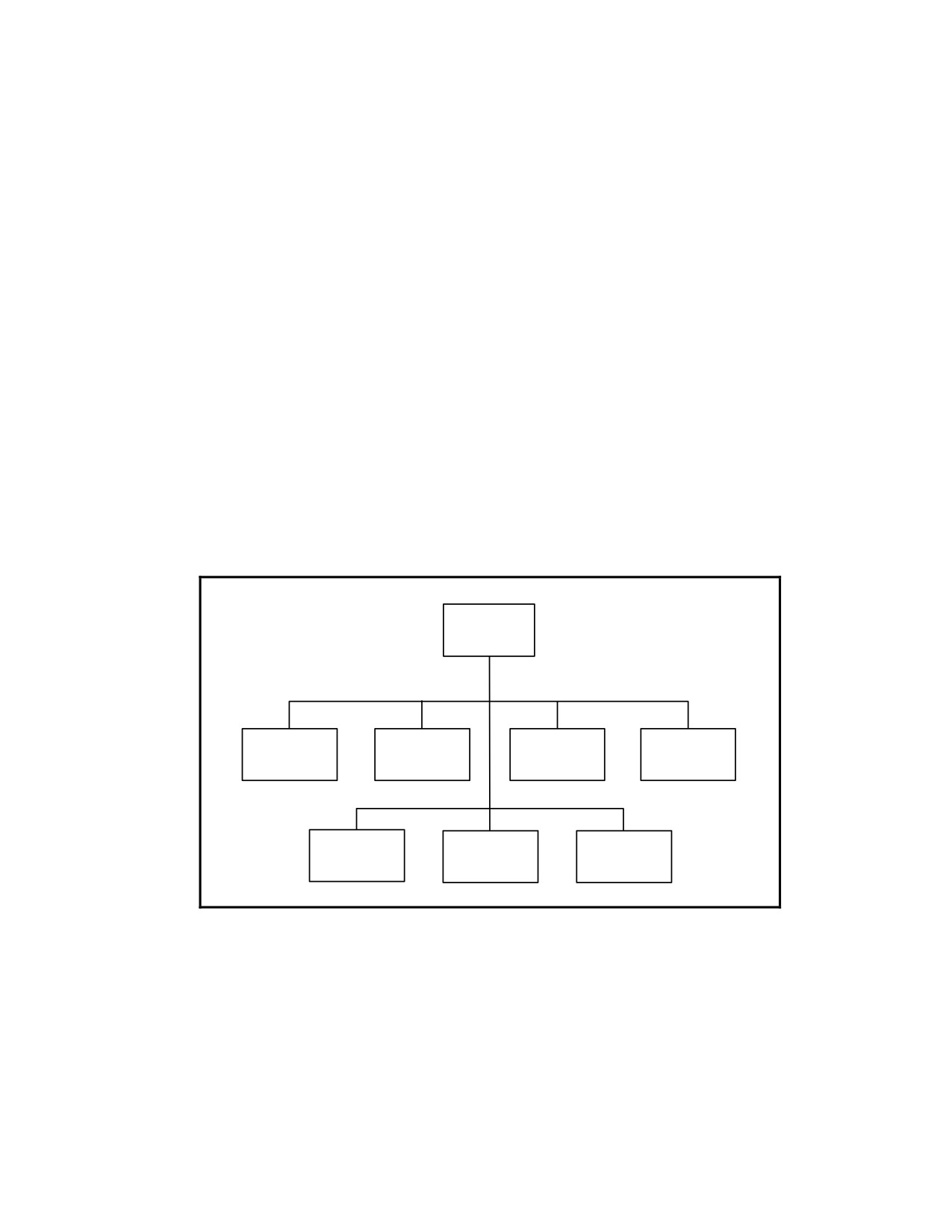
2-109. The functional staff consists of experts in a particular type of military
operation or function (see Figure 2-15). These experts advise the command
group and the primary and secondary staff on issues pertaining to their indi-
vidual areas of expertise.
Operations
Officer
Chief of
Chief of
Chief of
Chief of
Integrated
Force
Special-Purpose
WMD
Fires
Protection
Operations
Chief of
Chief of
Chief of
Population
Infrastructure
Littoral
Management
Management
Warfare
Figure 2-15. OSC Functional Staff
2-110. In peacetime, the functional staff is a cadre with personnel assigned
from appropriate branches and services. It has enough personnel to allow
continuous
24-hour capability and the communications and information
management tools to allow them to support the commander’s decision-
making process and exercise staff supervision over their functional areas
throughout the AOR. In wartime, the functional staff receives liaison teams
from subordinate and supporting units that perform tasks in support of those
functional areas.
2-29
FM 7-100.1 ________________________________________________________________________________
2-111. Chief of Integrated Fires. The chief of integrated fires is responsi-
ble for integrating C2 and RISTA means with fires and maneuver. He works
closely with the OSC chief of reconnaissance and the IFC staff. He also coor-
dinates with the chief of IW to ensure that deception and protection and se-
curity measures contribute to the success of the fire support to offensive and
defensive operations.
2-112. Chief of Force Protection. The chief of force protection is responsi-
ble for coordinating activities to prevent or mitigate the effects of hostile ac-
tions against OPFOR personnel, resources, facilities, and critical information.
This protection includes air, space, and missile defense; NBC defense; defensive
IW; counterterrorism; counterreconnaissance; and engineer survivability
measures. This subsection works closely with those of the chief of weapons of
mass destruction (WMD) and the chief of IW. Liaison teams from internal se-
curity, air defense, chemical defense, and engineer forces provide advice within
their respective areas of protection.
2-113. Chief of Special-Purpose Operations. The chief of special-purpose
operations is responsible for planning and coordinating the actions of SPF
units allocated to an OSC. When possible, this subsection receives liaison
teams from any affiliated forces that act in concert with the SPF.
2-114. Chief of Weapons of Mass Destruction. The chief of WMD is re-
sponsible for planning the offensive use of WMD. This functional staff ele-
ment receives liaison teams from any subordinate or supporting units that
contain WMD delivery means.
2-115. Chief of Population Management. The chief of population man-
agement is responsible for coordinating the actions of Internal Security
Forces, as well as psychological warfare, perception management, civil affairs,
and counterintelligence activities. There is always a representative of the Minis-
try of the Interior, and frequently one from the Ministry of Public Information.
This subsection works closely with the chief of IW and receives liaison teams
from psychological warfare, civil affairs, counterintelligence, and Internal Secu-
rity Forces units allocated to the OSC or operating within the OSC’s AOR.
2-116. Chief of Infrastructure Management. The chief of infrastructure
management is responsible for establishing and maintaining roads, airfields,
railroads, hardened structures (warehouses and storage facilities), inland
waterways, ports, and pipelines. He coordinates with the OSC resources offi-
cer regarding improvement and maintenance of supply and evacuation
routes. He exercises staff supervision or cognizance over the route construc-
tion and maintenance functions of both civil and combat engineers operating
in the OSC’s AOR. He coordinates with civilian agencies and the OSC chief of
communications to ensure adequate telecommunications support.
2-117. Chief of Littoral Warfare. The chief of littoral warfare is responsi-
ble for planning and coordinating coastal defense and amphibious operations.
His subsection includes liaison teams from not only naval and naval infantry
units, but also any ground forces, aviation, air defense, airborne, SPF, or af-
filiated forces that participate in or support the coastal defense or amphibi-
ous operation. He also coordinates with border guard units assigned to patrol
coastal border areas.
2-30
_________________________________________________________________________________Chapter 2
Liaison Teams
2-118. Liaison teams support the staff with detailed expertise in the mission
areas of their particular branch or service and provide direct communications
to subordinate and supporting units executing missions in those areas. Liaison
team leaders speak for the commanders of their respective units. Liaison teams
to OSCs are organized with a liaison team leader, two current operations officers
or senior NCOs and two plans officers or senior NCOs. This gives liaison teams
the ability to conduct continuous operations and simultaneously execute current
plans and develop future plans. The staff would also receive liaison teams from
multinational and interagency subordinates and from affiliated forces.
COMMAND AND CONTROL PROCESS
2-119. C2 is a continuous process at all levels of command. The OPFOR rec-
ognizes five elements in this process:
• Acquiring and processing information.
• Decision making.
• Planning.
• Preparation.
• Execution.
ACQUIRING AND PROCESSING OF INFORMATION
2-120. Acquiring and processing information is always the first function in
the C2 process. This function is a continuous, active process of requesting, re-
ceiving, collating, analyzing, and disseminating information commanders and
staffs need for decision making and planning. However, the physical collec-
tion of information is not actually part of the C2 process.
2-121. An operational-level commands receives information collected at
higher and lower levels, as the information relates to its own requirements.
Likewise, operational-level commands pass information to both those levels
to meet strategic or tactical information requirements.
Strategic-Level Information Requirements
2-122. At the General Staff level and above, military and political informa-
tion requirements are global in scope. The OPFOR has a continuous re-
quirement to evaluate changes in the military or political capabilities and in-
tentions of foreign nations in relation to the State. The accuracy of these as-
sessments can directly influence the selection of strategic military and politi-
cal goals, the structure of the State’s Armed Forces, and the strategic concept
for using military power.
Operational-Level Information Requirements
2-123. FG and OSC staffs are the focal points for detailed situation evalua-
tion and large-scale planning for combat units. Therefore, they have a par-
ticularly heavy demand for information to support the decision-making and
planning process. To function efficiently, operational-level staffs require high-
resolution data on both enemy and friendly forces. Required periodic and special
reporting is the primary source of detailed, accurate, and timely information on
2-31
FM 7-100.1 ________________________________________________________________________________
friendly forces. The availability and timeliness of such friendly force data de-
pends largely on the availability and efficiency of the necessary communica-
tions links. On the other hand, acquiring information on the enemy involves
collecting and reporting in a hostile environment. Operational staffs must
analyze conflicting and incomplete data and assess and correlate intelligence
provided by higher headquarters.
Tactical-Level Information Requirements
2-124. The commander and staff must bring together all available data ap-
plicable to their mission and use the data skillfully to achieve their objec-
tives. At a minimum, these data include information on enemy and friendly
forces, the combat environment, and the population in the AOR.
2-125. Enemy. Of these elements, information about the enemy is the most
important. An OPFOR commander must have continuous, reliable informa-
tion about the enemy’s effective combat strength and organization to conduct
forces analysis. He must receive information concerning enemy locations, re-
inforcing units, C2 systems, and defensive positions. Information pertaining
to the disposition and potential use of precision weapons is important. The
required degree of detail will vary in different situations and at various lev-
els of command. Constant attention is given to identifying enemy deception
efforts. The OPFOR emphasizes multi-spectral collection efforts to reduce the
potential effects of the enemy’s deceiving a single RISTA asset.
2-126. Friendly Forces. Information about friendly forces is necessary to
help the commander determine how best to use them and to identify re-
quirements for coordination. OPFOR planners consider training status when
making qualitative calculations of relative strengths of their own and enemy
forces. In addition, they must consider how missions of other friendly forces
may affect the accomplishment of their own assigned tasks.
2-127. Combat Environment. The NBC environment, terrain, weather,
and climatic and seasonal conditions also provide OPFOR planners insight as
to what they can and cannot do effectively during a combat action. Planners use
this information to determine routes, use of NBC weapons, and types of camou-
flage. This information can also help determine the effects these factors could
have on friendly actions and on the enemy’s possible courses of action.
2-128. Population. The economic and sociopolitical makeup of the AOR in-
terests OPFOR military planners. Information about potentially hostile, neu-
tral, and friendly populations in the AOR enables the OPFOR to exploit local
resources and to plan appropriate levels of security and perception manage-
ment strategies to manipulate the population.
DECISION MAKING
2-129. The military decision-making process consists of five phases: assess,
orient, decide, act, and adapt. These phases are not completely independent
processes or stages of thought. Each phase overlaps and relies on the others.
2-32
_________________________________________________________________________________Chapter 2
Assess
2-130. The command group and staff develop estimates across the compo-
nents of the combat system, including combat, combat support, C2, RISTA,
and logistics forces. There are three separate purposes served by the assess-
ment process, including
• Develop situational awareness of forces and means at the disposal of
the OPFOR and the enemy.
• Determine possible enemy weaknesses.
• Develop an understanding of OPFOR requirements.
2-131. The assessment phase requires the staff elements responsible for the
discrete components of the combat system to conduct analysis and synthesis.
Typically the analysis includes
• Mission. The commander must understand the senior commander’s
concept of the campaign or operation and his own command’s role in it.
• Time and Space. The OPFOR considers time a factor it can use to its
advantage and prefers to exercise patience if that will achieve the goal.
The OPFOR views time as an ally in developing a strategy of exhaust-
ing the enemy in pursuit of the State’s goals.
• Environment. In the assessment of the environment, the OPFOR
includes terrain, population, and other physical dimensions of the
battlespace.
• Capabilities and Intentions. This is not limited to the immediate
opponent, but includes all relevant regional and global actors.
• Opportunities and Risks. In its decision making, the OPFOR at-
tempts to identify both risks and opportunity posed by the environ-
ment, time and space, or capabilities and intentions of other actors.
Orient
2-132. The orientation step or phase in the process enables the commander to
direct preparatory steps prior to determining his aim or making his final de-
cision. He first examines the mission given his unit and determines what
tasks must be performed to accomplish this mission. This phase also includes
activating RISTA assets to develop information requirements identified in
the assessment of the situation. Typically, the orientation phase would in-
clude preliminary instructions appropriate to the assessment of the situation.
If the assessment phase reveals shortfalls or information requirements es-
sential to reaching a final decision, orienting the command group, staff, and
units enables the OPFOR to develop “pace” prior to final decision. This phase
requires coordination with appropriate civilian authorities at the higher
echelons, particularly in support of transition operations or adaptive operations.
During the orientation phase, the commander and his staff develop several
courses of action and compare them, attempting to refine the information re-
quired for decision.
Decide
2-133. In the “decide” step, the commander determines his aim or decision
and communicates his concept for execution. He includes his directions for
2-33
FM 7-100.1 ________________________________________________________________________________
sustaining the aim. Typically, sustaining the aim involves assigning re-
sources and developing parameters for execution that define the limits of
subordinates’ discretion. In communicating his thinking, the commander al-
ways includes branches and sequels that he is able to anticipate. In establishing
the aim, he remains focused on the mission that he was assigned, but does so
in the context of the systems warfare approach to combat and how he may best
achieve the ends envisioned in his mission. He attempts to reach a choice that
enables the OPFOR to operate successfully by defeating an opponent through
disaggregating one or more components of the enemy combat system. Conse-
quently, the OPFOR is not very interested in classic calculations of correlation of
military forces, but more in finding a way to produce disproportionate effects.
2-134. When the commander has selected a base course of action with appro-
priate branches and sequels, he provides this decision to his staff for further
planning and for dissemination of the finalized missions to the troops. The
decision includes the concept, missions for major subordinates, the organiza-
tion of forces, and the organization of the AOR. The components of the deci-
sion are the following:
2-135. Objective (Subordinate Unit Missions). The commander deter-
mines the objective of the operation and the missions to be assigned to con-
stituent and dedicated forces. This part of the decision defines the priorities
for supporting and affiliated forces.
2-136. Opportunity. The commander describes how the unit will achieve
the necessary window of opportunity to execute the plan. This includes meas-
ures for protecting the force from standoff attack as well as creating or taking
advantage of an enemy vulnerability.
2-137. Method (Concept of Operations). The commander describes by
what means to accomplish the task or mission. He organizes the battlefield
and his forces. He lays out the method by which the OSC will support the
theater or national IW campaign.
2-138. End State. The commander describes his vision for how the operation
ends on OPFOR terms. He also describes how this operation sets the stage
for follow-on operations.
Act
2-139. On the basis of the available data and the recommendations from the
staff, the commander makes a decision. The decision may be one of the rec-
ommended courses of action, a combination of two or more recommendations,
or a new solution. The commander can also keep the more promising non-
selected variants as contingency plans.
2-140. Commanders avoid using stereotyped patterns that would make en-
emy templating and targeting easier. To aid in deception, they may create
courses of action that appear on the surface as established fighting methods
but are actually something else.
Adapt
2-141. Operational-level decision making is highly flexible. This flexibility
comes from mission-type orders from the General Staff (or SHC or theater
2-34
_________________________________________________________________________________Chapter 2
headquarters) to the operational-level commands. The staff structure pro-
vides operational-level commanders the capability for rapid situation as-
sessment and decision making.
2-142. Since operational planning occurs well in advance, it would be difficult
for the enemy to disrupt the initial decision making and planning. However,
the operational-level commanders and staffs are continually updating and
adapting the operation plan. The OPFOR uses IW measures to help ensure
that the OPFOR commander has sufficient time to acquire and process in-
formation on the combat situation.
PLANNING
2-143. The commander conveys his decision to the chief of staff, who, with his
subordinates, fleshes it out with detailed planning tailored to the circum-
stances of the operation and the terrain. The chief of staff issues detailed,
precise orders for the initial phase of an operation only. At this point, there
usually is not enough hard data to allow an accurate forecast of how the
situation will develop. The plan includes intelligence, the commander’s deci-
sion, limits of responsibility, the missions of flanking forces, the missions of
combat support and combat service support units, coordinating instructions,
and the deployment of CPs.
2-144. Planning usually begins with the receipt of preliminary instructions
for execution of the SCP. The planning process is continuous and will be af-
fected by changes in the battlefield situation, amendments to orders and di-
rectives, or assignment of new missions. Situational intensity dictates the
planning method used.
2-145. Central to OPFOR planning is the concept of opportunity. In transition
or adaptive operations, the OPFOR recognizes that it will often be operating
in conditions where it is overmatched by enemy technological superiority. In
these conditions, the OPFOR will plan and conduct deliberate operations to
create windows of opportunity in which to operate proactively with freedom
of maneuver from enemy RISTA and standoff attack. Each OPFOR plan in-
cludes specific instructions to subordinate units concerning how this oppor-
tunity will be achieved and utilized.
2-146. Examples of means by which the OPFOR can create opportunity are
• IW activities, including selective denial of enemy situational understanding.
• Use of complex terrain.
• Freedom-of-movement operations (such as feints, ruses, demonstra-
tions, or ambushes).
Planning Framework
2-147. The military SCP developed and issued by the General Staff directs
operational-level military forces. Each operational-level command identified in the
SCP prepares an operation plan that supports the execution of its role in that SCP.
2-148. From the General Staff down through the operational and tactical lev-
els, the staff of each military headquarters has an operations directorate or
section that is responsible for planning. The plan at each level specifies the
AOR and task organization of forces allocated to that level of command, in
2-35
FM 7-100.1 ________________________________________________________________________________
order to best accomplish the mission assigned by a higher headquarters.
Once the commander at a particular level approves the plan, he issues it to
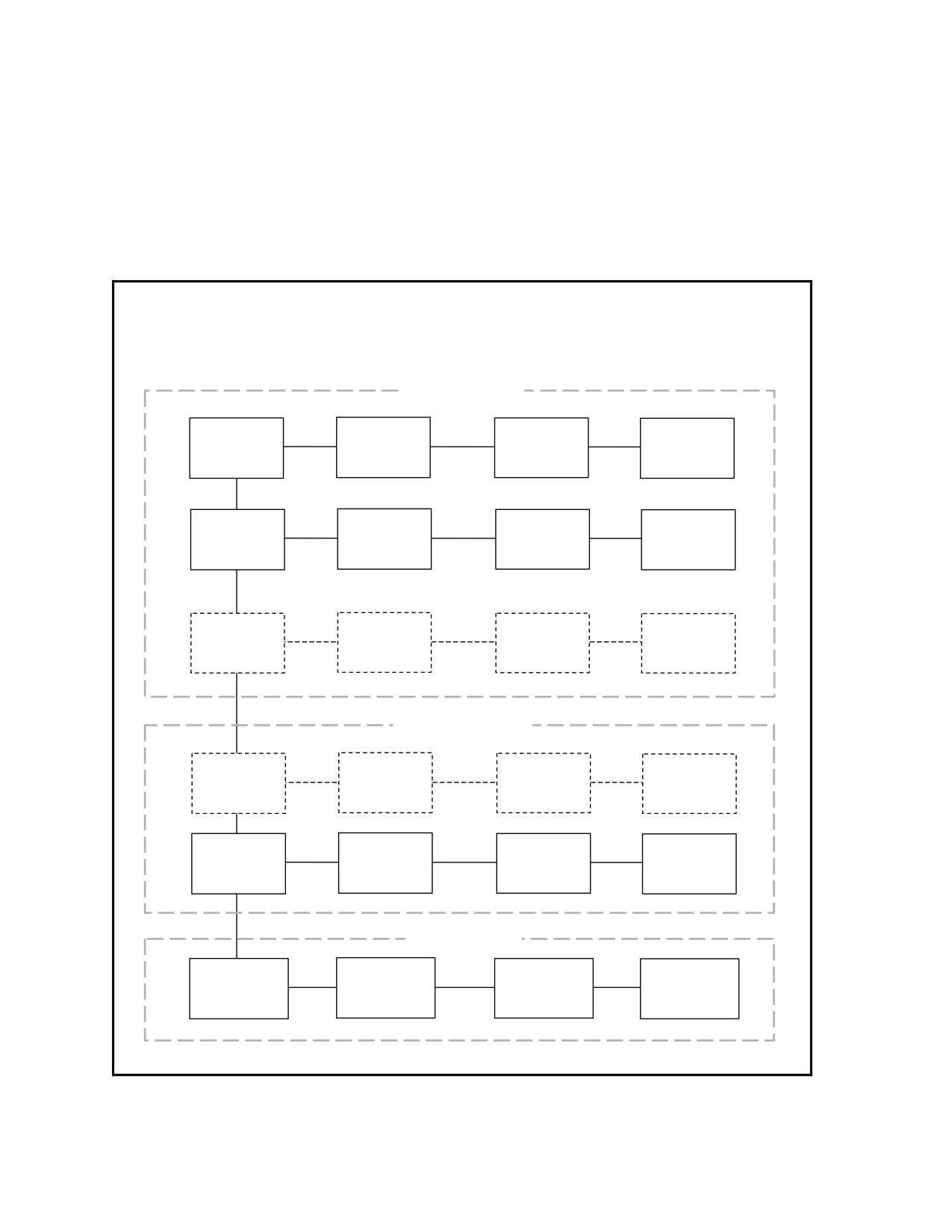
the subordinate commanders who will execute it. Figure 2-16 illustrates the
framework for planning from the national level down through military chan-
nels to the operational and tactical levels.
Decision-Making
Staff
Executing
(Plan-Approval)
Planning
Plan
Organizations
Authority
Organization
Strategic Level
National
National
Strategic
Strategic
All State
Command
Integration
Campaign
Ministries
Authority
Department
Plan
Military
Chief of
Operations
Strategic
Armed
General Staff
Directorate
Campaign
Forces
Plan
Theater
Forces
Theater
Operations
Campaign
Allocated to
Commander
Directorate
Plan
Theater
Operational Level
Forces
Field Group
Operations
Operation
Allocated to
Commander
Section
Plan
Field Group
Forces
OSC
Operations
Operation
Allocated to
Commander
Section
Plan
OSC
Tactical Level
Forces
Tactical-Level
Operations
Allocated to
Battle Plan
Commander
Section
Tactical-Level
Command
Figure 2-16. State and OPFOR Planning Framework
2-36
_________________________________________________________________________________Chapter 2
Planning Factors
2-149. Planning factors serve as a basis for staff calculations and as meas-
ures against which to test and assess troops and units. The OPFOR sees
these planning factors as guides in planning rather than figures to which one
must adhere rigidly in all circumstances.
2-150. The OPFOR views planning factors as practical expressions of the re-
lationships dictated by military common sense and the principles of war. Op-
erations planning factors include space and time factors concerning the mis-
sions of forces and their areas of combat activity. For example, such planning
factors establish parameters for the time available to take advantage of a
window of opportunity, the space required to disperse forces, and the number
of ambushing forces necessary to ensure a key target is destroyed. The basis
for these planning factors is a close study of potential adversaries, military
history, field training exercises, and military simulations. The resulting plan-
ning factors are tailored to the makeup of OPFOR organizations, their
capabilities, enemy capabilities, and conditions on the modern battlefield.
2-151. Planning factors also express timeliness and quantitative and qualita-
tive factors. Examples include normal expenditures of ammunition to destroy
a given target, rates of fuel consumption under specific conditions, and the
number of halts in a road march of a given duration. Such factors ensure a
uniform and objective approach to expected performance in combat and a
standard for evaluating the training level of personnel and units.
Forces Analysis
2-152. For determining the amount and type of force required to accomplish
a given mission (for planning purposes), OPFOR planners use a very detailed
method known as forces analysis. This involves qualitative calculations of the
relative strengths of their own and enemy forces. Forces analysis includes study
of opponents previous military operations and the historical trends for application
of military power at all levels. Vulnerabilities and strengths are assessed for
potential exploitation by OPFOR operational forces. Forces analysis is seldom a
simple one-to-one comparison of combat systems. It involves an examination of
the enemy’s entire combat system and the linkages of military forces to national
strategies. By determining the relationships of the systems that give a military
force its strength the OPFOR can determine where, and now much combat
power to apply for desired effects. The results of forces analysis are used to rec-
ommend to the commander the organization of forces and the battlefield, as well
as to identify any shortfalls in the available components of combat power.
Advances in Planning
2-153. Advances in information technology have resulted in changes in the
OPFOR’s planning process. Some of the advances have resulted in the fielding of
new hardware providing increased capabilities, while others caused changes in how
the OPFOR conducts operations. The following paragraphs address these factors.
2-154. Timeliness. The high pace of modern combat imposes time con-
straints on the OPFOR decision-making process and planning cycle.
Commanders must expect the situation to be subject to sudden, sharp
2-37
FM 7-100.1 ________________________________________________________________________________
changes, or to be shrouded in obscurity and ambiguity. As a result, there may
be insufficient time to produce and disseminate intelligence and to formulate
and issue plans and orders.
2-155. Timely and rapid information collection and reporting are critical to
ensuring that commanders have constant, up-to-date knowledge of the situa-
tion. To be successful, the commander must be able to react swiftly to
changes, while updating subordinate unit missions.
2-156. To OPFOR decision makers and planners, time assumes a role of un-
paralleled importance on the battlefield. The effectiveness of their C2 is in-
separably linked to the ability to make and implement decisions that allow
the OPFOR to control the pace of combat.
2-157. Commanders and staffs must plan their available time carefully. The
OPFOR emphasizes parallel planning and action at all levels. Even when less
time is available for planning, it works out plans in as much detail as possible.
2-158. Staff Procedures. While the time available for making and commu-
nicating decisions has decreased, the quantity of information collected has
increased dramatically. Improved reconnaissance systems have increased the
volume of information to be processed and analyzed. Despite this information
explosion, commanders must still be able to make rapid decisions while
guarding against information overload and a resulting slowdown of the
decision-making process.
2-159. The OPFOR has increased automation of the staff calculations sup-
porting the decision-making and planning processes. Automation extends the
use of prepared calculations and formulas, while reducing paperwork.
OPFOR staff procedures are streamlined to provide commanders with more
time to prepare their forces for combat. The issuance of preliminary instruc-
tions outlining the broad concept of operations, along with the acceptance of
subordinates’ initiative, allows subordinate staffs to use parallel planning.
2-160. Detailed Planning. When the commander decides on the final con-
cept of operations, the staff begins detailed planning. Detailed planning is a
prerequisite for success. Modern combined arms, joint, interagency, and multi-
national operations integrate the actions of many types of forces and combat
equipment, as well as diverse support requirements. In terms of detail, OPFOR
planning considers forces an echelon below the immediately subordinate units to
which it assigns tasks in the operation plan. Thus, planning in an OSC with
division-size subordinates looks at brigade-level requirements in detail.
PREPARATION
2-161. Preparation links planning and execution. The commander supervises
the preparations of his subordinates, either personally or through his DC or
chief of staff. He issues instructions and directives.
Dissemination of Missions
2-162. The dissemination of missions to subordinates is a critical C2 task.
The commander usually establishes the general procedures of staffs and
other headquarters for disseminating missions to the troops. However, the chief
of staff is the main organizer for carrying out this work. He must accomplish
2-38
_________________________________________________________________________________Chapter 2
this quickly, in order to give subordinate commanders and staffs, and units
as well, sufficient time to prepare for their combat missions. In order to de-
crease the time this task requires, the OPFOR applies technology, such as
graphic display panels and other sophisticated signal equipment.
2-163. Disseminating mission-type information concerning upcoming or
planned combat activity occurs at several points in the decision-making and
planning process. At any level, preliminary instructions from higher-level
commanders first present this information in general outline, allowing sub-
ordinate commanders and staffs to begin preliminary planning (as part of the
decision-making process). Only when they receive the senior commander’s fi-
nal decision in operational directives can lower-level commanders decide on
their own final concept of the operation. The process at a given level ends
when commanders issue combat orders to their own subordinates.
2-164. Preliminary Instructions. The means by which commanders can
make the earliest possible dissemination of information concerning an up-
coming operation are preliminary instructions. These instructions contain the
missions of the subordinate units and the higher commander’s general concept
of operations. These normally serve as a vehicle to provide the outline of the
commander’s decision, basic information on the situation, and the mission for
which the receiving headquarters should begin planning. These instructions
may revise a previous order or issue a new, time-sensitive mission. Similar to a
warning order in the U.S. Army, they allow subordinate units to prepare for the
flurry of activity demanded of headquarters on receipt of a new mission. They
enable subordinate headquarters to begin their planning process concurrently
with the higher command levels. The commander may issue preliminary in-
structions to subordinates in either oral or written form. However, it is normal
to transmit preliminary instructions by electronic, secure-voice means rather
than in written form.
2-165. Operation Plan. Operational-level commands prepare operation
plans to control execution of their portion of an SCP. The operation plan must
• Optimally allocate forces and resources to each mission.
• Provide concrete methods to coordinate the actions of maneuver, fire
support, and logistics support.
• Provide for a specific sequence and methods for conducting each sub-
task required to assure mission success.
From the completed operation plan, the staff creates operational directives or
combat orders to inform subordinates of their missions, roles, and time re-
quirements for executing the plan.
2-166. The operation plan details the commander’s thinking and reflects the
input of various subordinates and staff elements according to their functional
responsibilities. It normally includes the following specific areas:
• Assessment of the enemy situation and probable intentions.
• Scope, aim, and concept of operations.
• Organization of forces.
• Organization of the battlefield.
• Results of forces analysis.
2-39
FM 7-100.1 ________________________________________________________________________________
• Plan for commitment of reserves.
• Missions of subordinate units.
• Missions of supporting and adjacent units.
• Plan for logistics support.
• Locations of CPs.
2-167. The operation plan includes a varying number of annexes. There are
normally annexes for C2, SPF, airborne landings, preparation and occupation
of assembly areas, and movement routes, among others.
Execution Orders
2-168. After planning and preparation, it is time to issue directives and or-
ders for execution of the planned operation. The commander may continue to
revise and re-issue these during the course of the operation.
2-169. Operational Directive. An operational directive contains complete
information for accomplishing a particular mission. Commanders issue op-
erational directives during the course of an operation to implement upcoming
phases of the operation plan, implement a foreseen contingency, or to effect
changes in the operation plan. Time constraints necessitate heavy dependence
on verbal dissemination of missions and planning guidance. The operational-
level staff usually issues a formal, written directive to supplement the verbal
instructions the commander has already issued.
2-170. The operational-level staff may also prepare and issue annexes to op-
erational directives. If annexes are incomplete when the staff transmits the
directive, it sends them out separately to prevent delay in dissemination of
the directive. Types of annexes include coordination requirements, recon-
naissance, IW, force protection, communications, fire support, logistics, and
counterattack plans.
2-171. Combat Orders. Commanders at all levels issue combat orders both
during combat and during the preparation for combat. The orders are de-
signed to direct a unit to perform a specific task or to adjust a former mis-
sion. Combat orders typically include an estimate of the enemy situation, the
new (or revised) mission, the support available from the commander for the
mission, and the time when the unit must be ready to execute the task. Be-
cause they are time-sensitive, combat orders are usually disseminated orally
either by radio or in person.
Rehearsals
2-172. Rehearsals are an integral part of OPFOR preparation for combat.
OPFOR commanders expect all key phases of an operation to be well re-
hearsed using the most realistic means possible. OPFOR staffs take action to
relieve subordinate units of other time pressures to permit the maximum
time for rehearsals and other combat checks during preparation. OPFOR
commanders often forego planning detail in order to spend time with key
subordinates during their rehearsals.
2-40
_________________________________________________________________________________Chapter 2
EXECUTION
2-173. Planning and preparation are important, but they alone are not suffi-
cient for success. The enemy’s actions can have a dynamic effect on executing
plans. Friction and uncertainty can distort the best of plans, imposing new
realities on the situation. Dealing with those realities is the art of execution.
Planned Flexibility
2-174. Operational-level C2 is highly flexible. This flexibility comes from mis-
sion-type orders from the General Staff (or SHC or theater headquarters) to
the operational-level commands. The staff structure provides operational-
level commanders the capability for rapid situation assessment and decision
making. A standardized, streamlined process, using automated support, pro-
duces the decision and the accompanying plans to implement it.
2-175. Since operational planning occurs well in advance, it would be difficult
for the enemy to disrupt the initial decision making and planning. However,
the operational-level commanders and staffs are continually updating of the
operation plan. By limiting a commander’s time to plan, an enemy could force
the OPFOR staff to forsake the preferable parallel or sequential planning
methods for less desirable executive planning. The OPFOR uses IW meas-
ures to help ensure that the OPFOR commander has sufficient time to ac-
quire and process information on the combat situation.
2-176. Planning continues during execution. The process of forecasting and
modeling the commander began in his decision process usually has produced
a series of variants, or contingency plans, which the commander can imple-
ment without completely changing his concept of operations. Such planning
also accounts for a range of probable enemy responses to OPFOR combat
actions. Each variant, however, must allow the achievement of the assigned
mission by the designated time; this aspect of the plan is not subject to
contingency planning.
Monitoring Execution and Sustaining the Aim
2-177. Issuing directives does not ensure they will be carried out or under-
stood. The OPFOR places great emphasis on supervision after the directive is
issued. The chief of staff is responsible to the commander for the overall or-
ganization of staff supervision. Each staff section is responsible for checking
on the execution of the directives it prepares and also ensuring that subordi-
nates have correctly understood the directives. The chief of staff may issue
additional directives, with the operational commander’s approval, to resolve
any misunderstandings.
2-178. Proper supervisory control takes many forms. These include observa-
tion from air and ground observation points, and instructions and questions
passed by radio, wire, or messenger. The preferred method is personal
contact. The OSC commander may personally supervise the most important
combat action. In fast-moving situations, control is somewhat looser. Subor-
dinate commanders then react as the situation dictates, realizing they are re-
sponsible for acting in accordance with the commander’s concept.
2-41
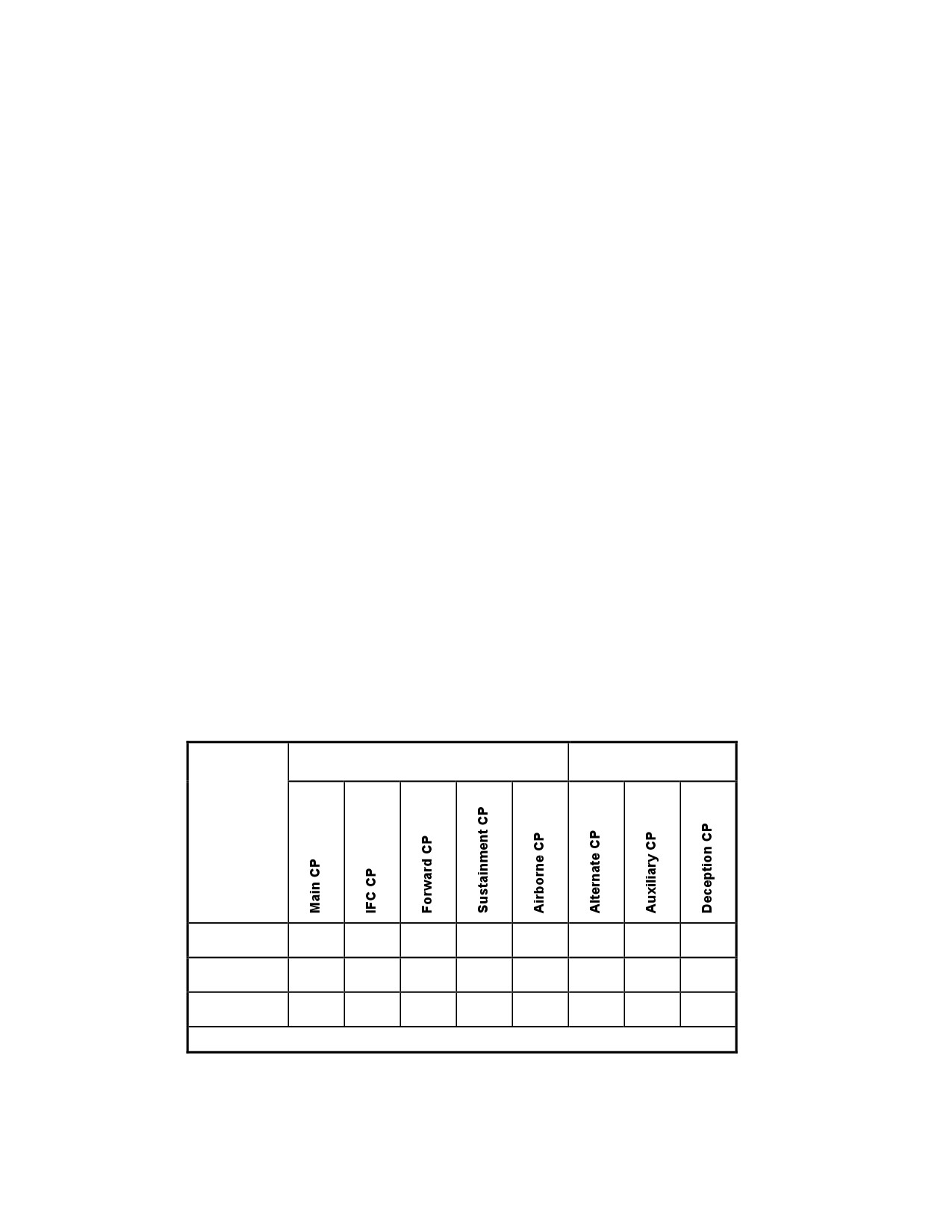
FM 7-100.1 ________________________________________________________________________________
COMMAND POSTS
2-179. The OPFOR plans to exercise strategic, operational, and tactical con-
trol over its wartime forces from an integrated system of CPs. It has designed
this system to ensure uninterrupted control of forces.
2-180. CPs are typically formed in three parts: a control group, a support
group, and a communications group. The control group includes members of
the command group and staff. The support group consists of the transport
and logistics units. Whenever possible, the communications group, is remoted
from the control and support groups, because of its large number of signal vans,
generators, and other special vehicles that would provide a unique signature.
2-181. Because the OPFOR expects its C2 to come under heavy attack in war-
time, its military planners have created a CP structure that emphasizes sur-
vivability through dispersal, stringent security measures, redundancy, and
mobility. They have constructed a CP system that can sustain damage with
minimum disruption to the actual C2 process. In the event of disruption, they
can quickly reestablish control. This extensive system of CPs extends from
the hardened command facilities of the NCA to the specially designed com-
mand vehicles from which OPFOR tactical commanders control their units.
Most operational-level CPs have been designed to be very mobile and smaller
than comparable enemy CPs. The number, size, and types of CPs depend on
the level of command.
COMMAND POST TYPES
2-182. OPFOR ground forces use five basic and three special types of CPs.
Not all levels of command use all types at all times. (See Figure 2-17, where
parentheses indicate that a type of CP may or may not be employed at a cer-
tain level.) The redundancy provided by multiple CPs helps to ensure that
the C2 process remains survivable.
Basic
Special
Level of
Command
OSC
X
X
X
X
(X)
(X)
(X)
(X)
Field Group*
X
X
(X)
X
X
(X)
(X)
(X)
Theater*
X
X
(X)
X
X
(X)
(X)
(X)
* When formed.
Figure 2-17. Command Post System
2-42
_________________________________________________________________________________Chapter 2
2-183. FGs and OSCs can use the same basic types of CPs (main, IFC, for-
ward, sustainment, and airborne). FG and OSC airborne CPs may be aboard
fixed-wing aircraft. However, helicopters are more likely to serve this pur-
pose at OSC level.
2-184. A theater headquarters normally deploys main, IFC, and sustainment
CPs. An airborne CP will always be available to the theater commander. A
theater forward CP may be established. The main CP at this level may ini-
tially be in permanent, hardened bunkers; the other CP types may be at less-
protected sites. The airborne CP is most likely aboard fixed-wing aircraft.
2-185. For brevity, OPFOR plans and orders may use acronyms for the
various types of CP. Thus, main CP may appear as MCP, integrated fires
command CP as IFC CP, forward CP as FCP, sustainment CP as SUSCP,
airborne CP as AIRCP, alternate CP as ALTCP, auxiliary CP as AUXCP,
and deception CP as DCP.
Main Command Post
2-186. The main CP generally is located in a battle zone or in a key sanctu-
ary area or fortified position. It contains the bulk of the staff. The chief of
staff directs its operation. Its primary purpose is to simultaneously coordi-
nate the activities of subordinate units not yet engaged in combat and plan
for subsequent missions. The particular emphasis on planning in the main
CP is on the details of transitioning between current and future operations.
The main CP is the focus of control. It is less mobile and much larger than
the forward CP. It makes use of hardened sites when possible.
2-187. The chief of staff directs the staff in translating the commander’s deci-
sions into plans, directives, and orders. He also coordinates the movement
and deployment of all subordinate units not yet in combat and monitors their
progress and combat readiness. In addition to the chief of staff, personnel
present at the main CP include the liaison teams from subordinate, supporting,
allied, and affiliated units, unless their presence is required in another CP.
IFC Command Post
2-188. The DC directs the IFC from the IFC CP. The IFC CP possesses the
communications, airspace control, and automated fire control systems re-
quired to integrate RISTA means and execute long-range fires. Each secon-
dary staff subsection and some functional staff subsections have an element
dedicated to the IFC CP. The IFC CP includes liaison teams from fire sup-
port, army aviation, and Air Force units. The IFC CP is typically separated from
the main CP. Also for survivability, the various sections of the IFC headquarters
that make up the IFC CP do not necessarily have to be located in one place.
Forward Command Post
2-189. An OSC commander often establishes a forward CP with a small
group of selected staff members. Its purpose is to provide the commander
with information and communications that facilitate his decisions. The for-
ward CP is deployed at a point from which he can more effectively and per-
sonally observe and influence the operation. The need for this is less likely at
2-43