FM 7-100.1 OPFOR Opposing Force Operations (DECEMBER 2004) - page 4
FM 7-100.1 ________________________________________________________________________________
the FG and theater levels. This CP is mobile, but at the operational level may
consist of a large number of command vehicles.
2-190. The personnel at the forward CP are not permanent. The assignment
of officers to accompany the commander is dependent on the mission, situa-
tion, availability of officers, communications, and transport means. Officers
who may accompany the commander include the operations officer and the
chief of reconnaissance. Other primary and or secondary staff officers may
also deploy with the forward CP, depending on the needs of the situation.
The secondary staff contains enough personnel to man the forward CP with-
out degrading its ability to man the main or IFC CPs.
2-191. When formed, and when the commander is present, the forward CP is
the main focus of command, though the chief of staff (remaining in the main
CP) has the authority to issue directives in the commander’s absence.
Sustainment Command Post
2-192. The resources officer establishes and controls the sustainment CP.
This CP is deployed in a position to permit the supervision of execution of
sustainment procedures and the movement of support troops, typically in the
support zone. It contains staff officers for fuel supply, medical support, com-
bat equipment repair, ammunition supply, clothing supply, food supply, pris-
oner-of-war, and other services. It interacts closely with the subordinate
units to ensure sustained combat capabilities. In nonlinear operations, mul-
tiple sustainment CPs may be formed.
Airborne Command Post
2-193. To maintain control in very fluid situations, when subordinates are
operating over a wide area, or when the other CPs are moving, a commander
may use an airborne CP. This is very common in higher-level commands and
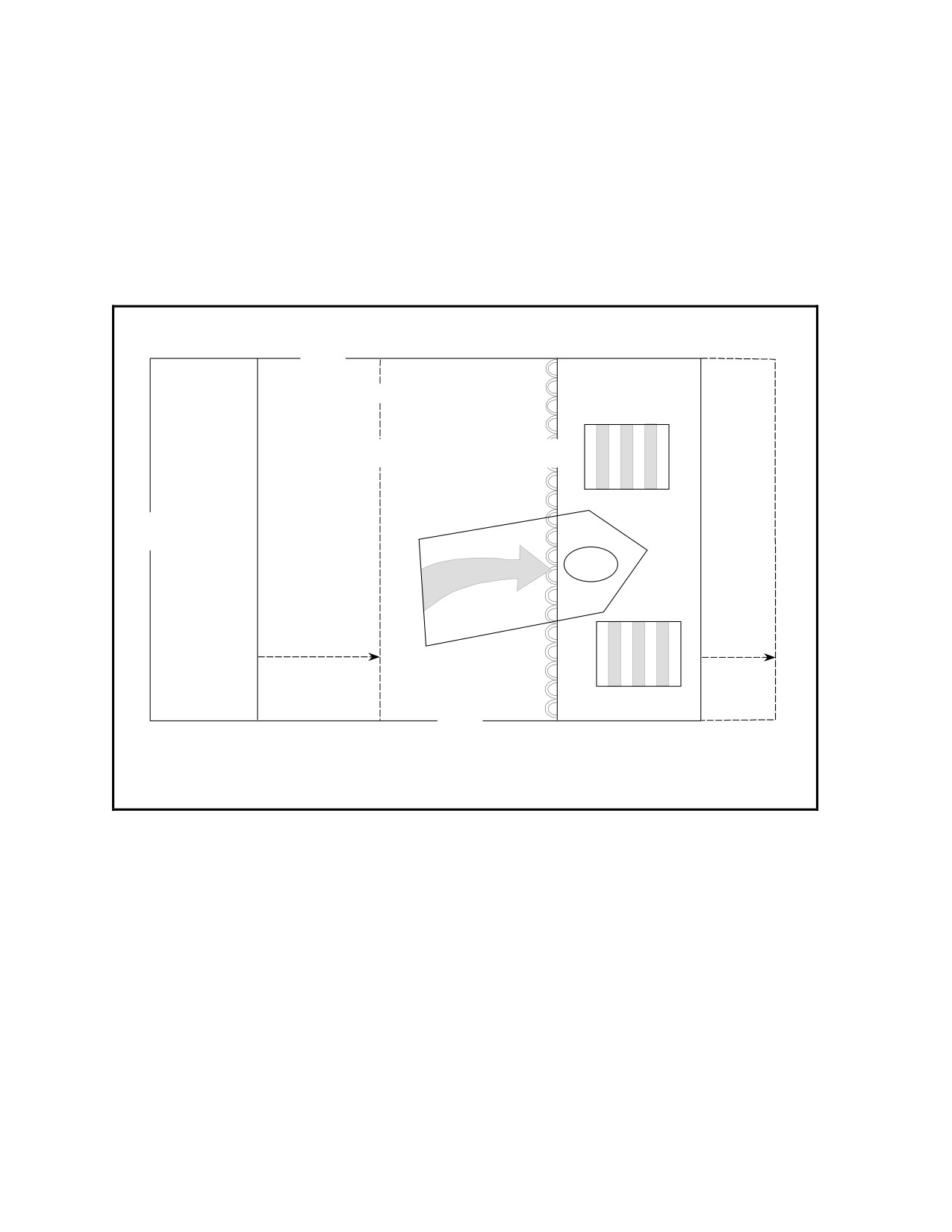
typically employs fixed-wing aircraft above OSC level.
Alternate Command Post
2-194. The alternate CP provides for the assumption of command should the
CP containing the commander be incapacitated. The alternate CP is a desig-
nation given to an existing CP and is not a separately established entity. The
commander establishes which CP will act as an alternate CP to take com-
mand if the main (or forward) CP is destroyed or disabled. For example, the
commander might designate the IFC CP as the alternate CP during an op-
eration where long-range fires are critical to mission success. For situations
that require reconstituting, he might designate the sustainment CP instead.
Alternate CPs are also formed when operating in complex terrain, or if the
organization is dispersed over a wider area than usual and lateral communi-
cation is difficult.
Auxiliary Command Post
2-195. At OSC and FG levels, the operational commander may create an aux-
iliary CP to provide C2 over subordinate units operating on isolated or remote
axes. He may also use it in the event of disrupted control or when he cannot
adequately maintain control from the main CP. An officer appointed at the
2-44
_________________________________________________________________________________Chapter 2
discretion of the commander mans it. The auxiliary CP may also find uses at
the theater level, when subordinate forces may be far from the main CP.
Deception Command Post
2-196. As part of the overall IW plan, the OPFOR very often employs decep-
tion CPs. These are complex, multi-sensor-affecting sites integrated into the
overall deception plan to assist in achieving battlefield opportunity by forcing
the enemy to expend command and control warfare (C2W) effort against
meaningless positions.
COMMAND POST MOVEMENT
2-197. Plans for relocating the CPs are prepared by the operations section.
The CPs are deployed and prepared in order to ensure that they are reliably
covered from enemy ground and aerial reconnaissance, or from attack by en-
emy raiding forces.
2-198. Commanders deploy OSC CPs in depth to facilitate control of their
AORs. During lengthy moves, CPs may bound forward along parallel routes,
preceded by reconnaissance parties that select the new locations. Normally,
the main and forward CPs do not move at the same time, with one moving
while the other is set up and controlling operations. During an administra-
tive movement, when there is little or no likelihood of contact with the en-
emy, a CP may move into a site previously occupied by another CP. However,
during a tactical movement or when contact is likely, the OPFOR does not
occupy a site twice, because to do so would increase the chances of an enemy
locating a CP. While on the move, CPs maintain continuous contact with
subordinates, higher headquarters, and flanking organizations. During
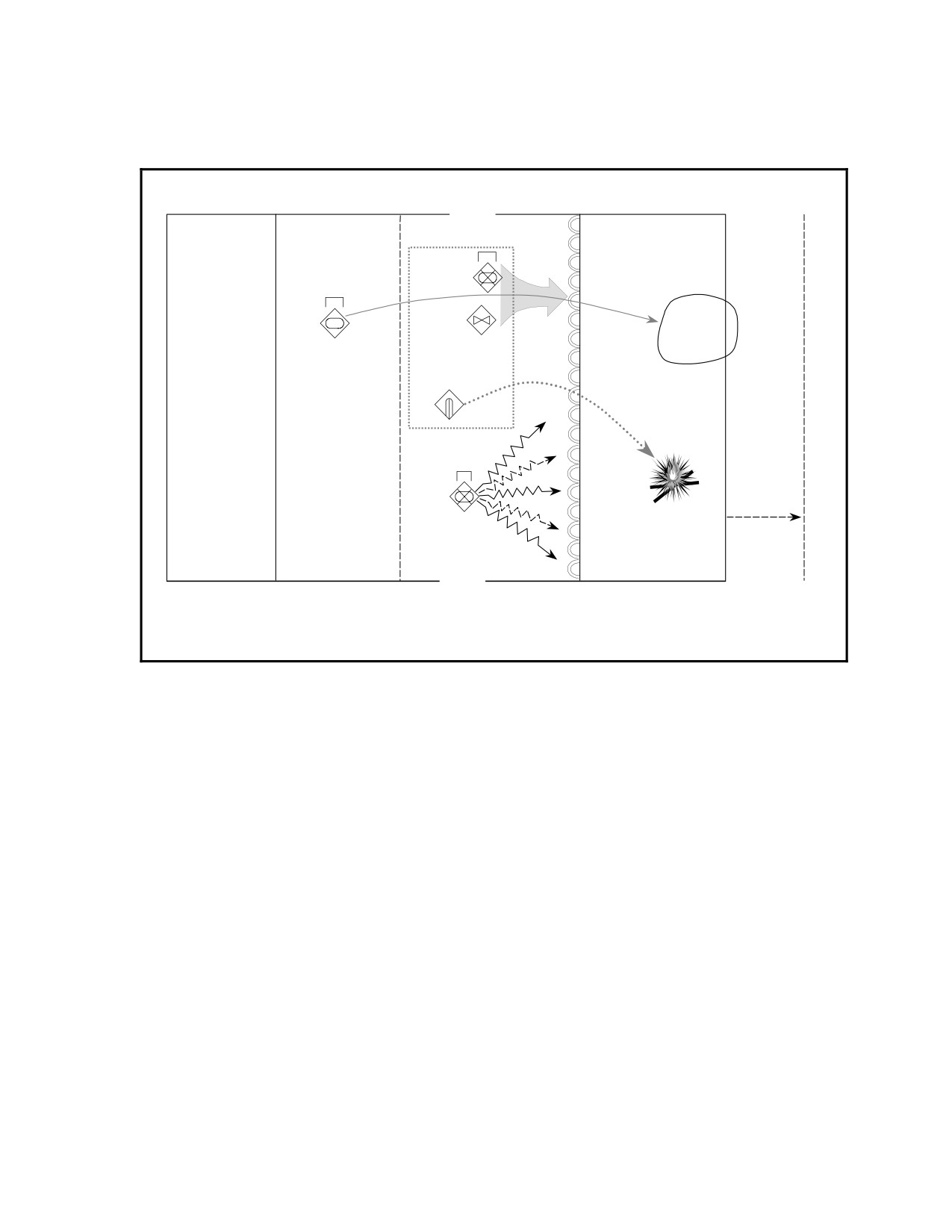
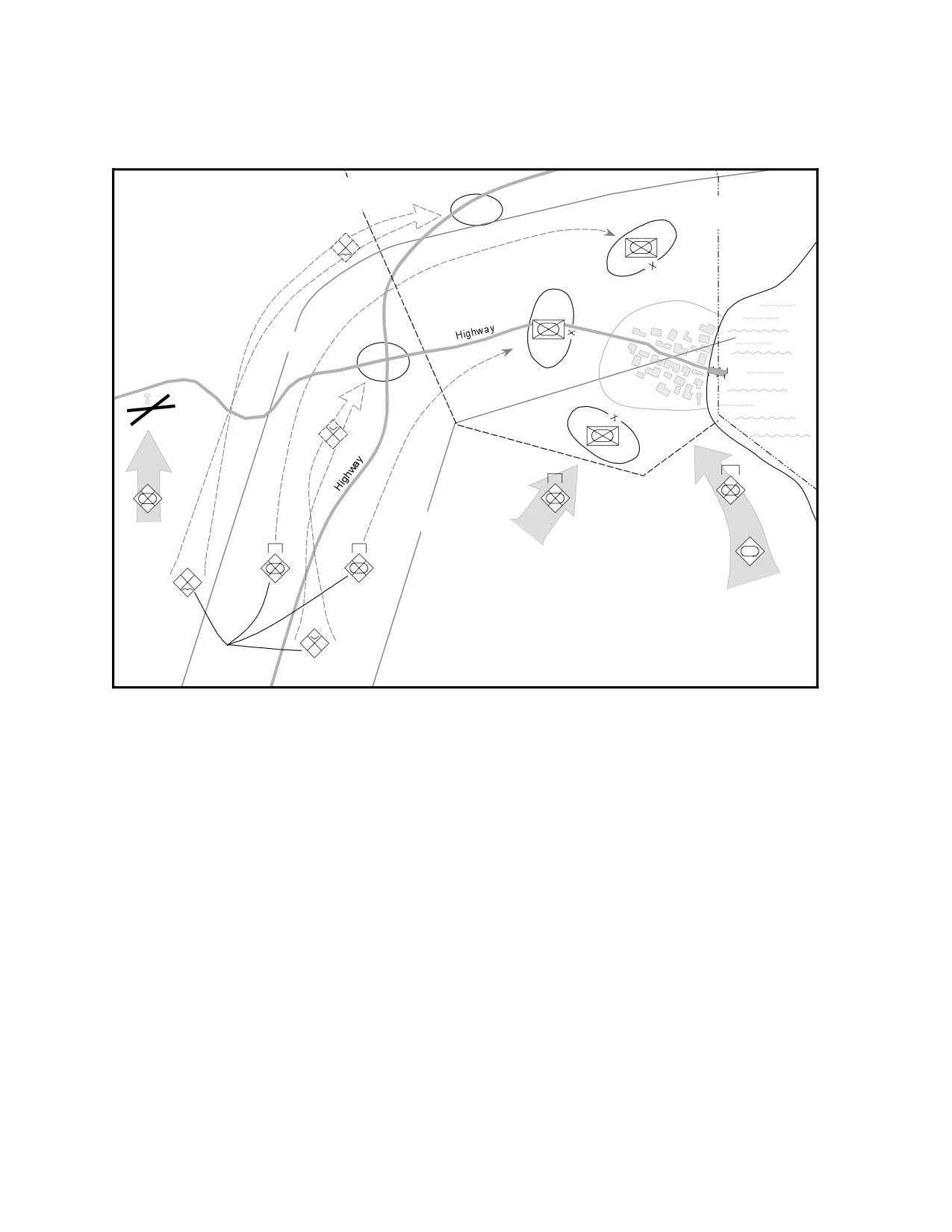
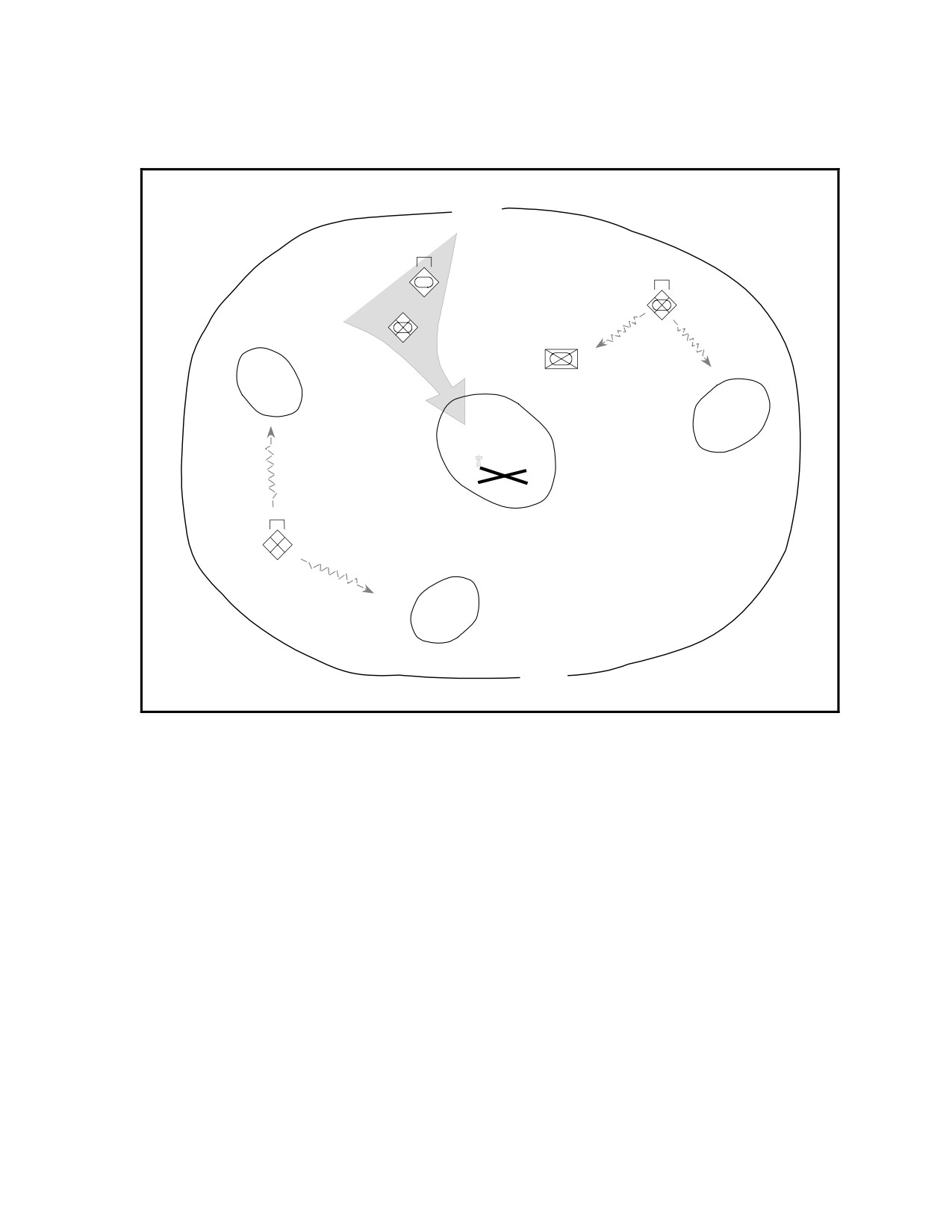
movement halts, the practice is to disperse the post in a concealed area, cam-
ouflaging it if necessary and locating radio stations and special vehicles some
distance from the control and support groups. Because of dispersion in a mobile
environment, CPs are often responsible for their own local ground defenses.
2-199. During the movement of a main CP, the OPFOR maintains continuity
of control by handing over control to either the forward or airborne CP or,
more rarely, to the alternate CP. Key staff members often move to the new
location by helicopter to reduce the time spent away from their posts. Before
any move, headquarters’ troops carefully reconnoiter and mark the new
location. Engineer preparation provides protection and concealment.
COMMAND POST LOCATION
2-200. The OPFOR locates CPs in areas affording good concealment, with
good road net access being a secondary consideration. It situates CPs so that
no single weapon can eliminate more than one. Remoting communications
facilities lessens the chance of the enemy’s locating the actual CP by radio
direction finding.
2-201. During some particularly difficult phases of an operation, where close
cooperation between units is essential, the forward CP of one unit may be col-
located with the forward or main CP of another. Examples are the commit-
ment of an exploitation force, the execution of a strike, or the passing of one
organization through another.
2-45
FM 7-100.1 ________________________________________________________________________________
COMMAND POST SECURITY
2-202. Security of CPs is important, and the OPFOR takes a number of
measures to ensure it. CPs are a high priority for air defense protection. Ideally,
main CPs also locate near reserve forces to gain protection from ground at-
tack. Nevertheless, circumstances often dictate that they provide for their
own local defense. Engineers normally dig in and camouflage key elements.
2-203. Good camouflage, the remoting of communications facilities, and the
deployment of alternate CPs make most of the C2 structure fairly survivable.
Nevertheless, one of the most important elements, the forward CP, often re-
mains vulnerable. It forms a distinctive, if small, grouping, well within en-
emy artillery range, even at OSC level. The OPFOR therefore typically pro-
vides key CPs with sufficient engineer and combat arms support to protect
them from enemy artillery or special operations raids.
COMMAND AND CONTROL SYSTEMS
2-204. The OPFOR commander’s C2 requirements are dictated generally by
the doctrine, tactics, procedures, and operational responsibilities applicable
to commanders at higher echelons. Battlefield dispersion, mobility, and in-
creasing firepower under conventional or WMD conditions require reliable,
flexible, and secure command and control.
2-205. Expanding C2 requirements include the need for
• High mobility of combat headquarters and subordinate units.
• Rapid collection, analysis, and dissemination of information as the ba-
sis for planning and decision making.
• Maintaining effective control of forces operating in a hostile IW envi-
ronment.
Supporting communications systems, which are the principal means of C2,
must have a degree of mobility, reliability, flexibility, security, and surviv-
ability comparable to the C2 elements being supported.
2-206. Modern warfare has resulted in a shift away from large formations
arrayed against one another in a linear fashion, to maneuver warfare con-
ducted across large areas with more lethal, yet smaller, combat forces. C2 must
provide the reliable, long-range communications links necessary to control
forces deployed over greater distances. In order to move with the maneuver
forces, the communications systems must be highly mobile.
COMMUNICATIONS
2-207. The chief characteristics of communications supporting the C2 struc-
ture are security, survivability, and flexibility. In the OPFOR view, centrali-
zation of operational planning is a prerequisite to achieving the flexibility re-
quired to ensure timely concentration of forces and fires. Redundancy in
equipment, as well as communications links and CPs, is the primary means
of ensuring the control structure’s security and survivability.
2-208. The organization of communications to meet operational requirements
is the responsibility of the commander at each level. Prior to combat, the OSC
chief of communications, under the personal direction of the intelligence officer,
2-46
_________________________________________________________________________________Chapter 2
prepares the communications plan. After approval by the chief of staff, it be-
comes an annex to the operational directive for implementation by subordi-
nate signal units. OPFOR communications reflect the concern of commanders
to maintain uninterrupted C2, flexibility, and security.
Signal Assets
2-209. Communication systems employed include
• Manportable high-frequency
(HF) and very-high-frequency
(VHF)
radios.
• HF radio stations.
• VHF and ultra-high-frequency (UHF) multichannel radio relay.
• Super-high-frequency (SHF) troposcatter systems.
• Satellite communications (SATCOM).
• Wire and cable (landline as far forward as possible).
• Commercial communications networks (including cellular, microwave,
radio, wire, digital, and satellite)
• Local area networks (LANs) and wide area networks (WANs).
• Internet and Intranet.
Encrypted communications are common from brigade upward, but may ex-
tend to the lowest levels in the most modern OPFOR units.
2-210. At the operational level, headquarters normally task-organize their
signal assets to support the formation of forward, main, IFC, and sustain-
ment CPs. The numbers and types of signal units can vary greatly depending
on the size and makeup of the operational force grouping under a particular
headquarters.
2-211. Signal communications are organized through the communications
groups that are established to provide communications for the CPs. Telephone
exchanges and cable are used extensively to integrate the control and sup-
port groups of the CPs with the communications groups. It is possible to ex-
tend mobile communications through the integration of wire and wireless
and by connecting with fixed military and civil communications facilities.
2-212. The OPFOR also stresses the use of non-electronic means of communi-
cations. While radio must be the principal means of communication in a fluid,
mobile battle, the OPFOR is aware of the threat from enemy signals intelli-
gence, direction finding, and communications jamming. Also, wire and cable
are often not practical in fast-moving situations.
2-213. During periods of radio silence or disruption of radio communications,
the OPFOR employs messengers, liaison teams, and visual and sound signals.
Messengers are the preferred method for delivering combat orders at any
time. Representatives from the OSC staff may observe and supervise the exe-
cution of directives. Whenever possible, the OPFOR prefers personal contact
between commanders (or their representatives) and subordinates.
2-47
FM 7-100.1 ________________________________________________________________________________
Communications Nets
2-214. C2 of OPFOR organizations relies on extensive and redundant com-
munications. The OPFOR primarily uses UHF/SHF SATCOM, radio relay
multichannel, HF radio stations, HF and VHF single-channel radios, and
wire or cable. In modernized OPFOR units, the command, operations, intelli-
gence, and logistics nets may operate over a digital network of linked com-
puters, obviating the need for voice communications.
2-215. The OSC operates two command nets. The commander normally con-
trols the primary command net from the forward CP, while the chief of staff
maintains control of the alternate net from the main CP. Depending on the
distances involved, the primary net may be either HF or VHF. All of the
command’s constituent and dedicated units monitor the command nets. The
IFC CP also monitors the command nets
2-216. The operations officer maintains an operations net monitored by
the commander, subordinate and supporting units, and any alternate or
auxiliary CP created. The resources officer also monitors this net from the
sustainment CP.
2-217. The DC, as IFC commander, maintains the integrated fires net. This
net is monitored by the subordinates of the IFC and RISTA assets assigned
IFC missions.
2-218. The resources officer maintains the support net. The OSC’s materiel
support, maintenance, and medical units monitor this net. Subordinate com-
bat arms units may also use this net when requiring additional, immediate
assistance that constituent support assets are unable to provide.
2-219. The chief of reconnaissance maintains an intelligence net, monitored
by reconnaissance units, maneuver units, the commander, DC, chief of staff,
and resources officer.
2-220. The CAO maintains the airspace control net for the purpose of control-
ling the command’s airspace. Organizations on this net include aviation
units, air defense assets, and army aviation and Air Force liaison teams.
2-221. When required, the commander can create a special mission net,
monitored by the chief of staff, that is employed to control the activities of
units conducting a special mission, such as a reconnaissance detachment or
an airborne or heliborne landing force deployed behind enemy lines. Specific
communications systems employed are dependent on the depth and type of
mission.
2-222. The chief of force protection maintains an air defense and NBC warn-
ing communications net, monitored by all constituent, dedicated, and sup-
porting units. This net is used for passing tactical alerts or NBC and air
warning reports. The chief of staff maintains a watch on the OSC-level warning
nets at the main CP; he then disseminates warning where appropriate.
2-223. The command establishes multichannel links between the main and
sustainment CPs and the CPs of subordinate units. These links are used for
high-capacity voice and data transmissions. The OSC also establishes
multichannel links between the main and sustainment CPs.
2-48
_________________________________________________________________________________Chapter 2
2-224. The primary responsibility for maintaining communications of an
OSC with the General Staff or SHC (or a parent FG or theater headquarters)
rests with the main CP. With the larger staffs and greater communications
capabilities of the main CP, the commander is allowed to focus more on the
actual conduct of the operation from the forward CP. Obviously, when staff
members, such as the CAO or chief of reconnaissance, accompany the com-
mander, they will establish control over their respective nets as required.
2-225. The chief of IW may also control one or more deception nets designed
to mislead enemy signals intelligence analysis. Integrated into the IW plan
are a description of these nets and procedures for their use.
Procedures
2-226. Before making contact with the enemy, most radio and radio-relay
systems maintain a listening watch with transmission forbidden or strictly
controlled. OPFOR units usually observe radio silence when defending or de-
parting assembly areas. During radio silence, wire and courier are the pri-
mary communications means. While moving toward the enemy, units nor-
mally limit radio transmissions to various code words informing commanders
they have accomplished assigned tasks or have encountered unexpected diffi-
culties. The OPFOR also uses visual signals, such as flags and flares, to a
great extent during movement. Usually only the commander and reconnais-
sance forces have permission to transmit.
2-227. In the offense, OPFOR units maintain radio silence until the outbreak
of battle, when those authorized to transmit may do so without restriction.
When contact with the enemy occurs, units initiate normal radio procedures.
Subordinate commanders inform the OSC commander—usually by code
wordwhen they reach objectives, encounter NBC contamination, make con-
tact with the enemy, or have important information to report.
COMMAND AND CONTROL SYSTEMS SURVIVABILITY
2-228. Survivability of C2 systems is of great concern, since the C2 elements
are typically located within range of enemy standoff systems, with increased
potential for disruption or destruction. The OPFOR stresses the need to
maintain continuous, reliable control of its forces and has undertaken a
number of measures to prevent disruption and enhance survivability,
while remaining flexible enough to retain control of units in combat. These
include
• High mobility of C2 systems and facilities.
• Redundancy of the C2 elements and networks.
• Adherence to operations- and information-security measures.
• Deception
2-229. IW activities contribute to C2 survivability. So does the principle of
centralized planning and decentralized execution. The survivability of the
headquarters’ command group is facilitated by the fact that the commander,
DC, and chief of staff can be in separate CPs (forward, IFC, and main CPs,
respectively).
2-49
FM 7-100.1 ________________________________________________________________________________
Mobility
2-230. C2 elements must be highly mobile, due to the emphasis on maintain-
ing combat at a rapid tempo. Because of their proximity to the enemy, CPs
and supporting communications must frequently relocate to avoid detection
and subsequent destruction.
2-231. CPs are usually mobile (that is, in vehicles) but may also be fixed. By
emphasizing the use of multiple, mobile CPs, planners minimize the disrup-
tion of C2 that would occur with the enemy’s destruction of this element of
the C2 structure. Highly mobile signal units employing transportable com-
munications equipment support mobile CPs. This gives OPFOR commanders
great flexibility in organizing and deploying their C2 elements. Thus, they
are able to provide effective control in varied situations.
Redundancy
2-232. The OPFOR has built extensive redundancy into the C2 structure.
Multiple CPs are fielded as low as possible. For communications between
levels of command, multiple communications types are employed. Providing a
variety of single- and multichannel links, these systems operate over a wide
frequency spectrum.
Operations and Information Security
2-233. The consistent adherence to operations- and information-security
measures is especially critical, given the increased capabilities of enemy re-
connaissance, the increased role of surprise, and the proliferation of precision
weapons. Given the high priority the enemy places on C2 elements as targets,
maintaining operations security is an important requirement for C2 nodes.
This is achieved by the stringent adherence to information-security proce-
dures and extensive use of C3D.
2-50
Chapter 3
Offensive Operations
The OPFOR sees the offensive as the decisive form of operations and the
ultimate means of imposing its will on the enemy. While conditions at a
particular time or place may require the OPFOR to defend, defeating an
enemy force ultimately requires shifting to offensive operations. Even
within the context of defense, victory normally requires some sort of of-
fensive action. Therefore, OPFOR commanders at all levels seek to create
and exploit opportunities to take offensive action, whenever possible.
In the context of the theater strategic or operational level of war, offensive
operations are often “conventional” in nature. Conventional operations
are not, however, the only form of offensive operations. Accordingly, this
chapter includes discussions of operational-level offensive actions that
do not rely only on large formations of mechanized or motorized units.
Offensive operations may include operations done by paramilitary or
irregular forces. The OPFOR recognizes the traditional forms of ma-
neuver: envelopment, turning movement, infiltration, penetration, and
frontal attack.
STRATEGIC CONTEXT
3-1. Offensive operations are an important component of all OPFOR strate-
gic campaigns. However, the scale and purpose of offensive actions may differ
during the various types of strategic-level actions.
REGIONAL OPERATIONS
3-2. Offensive operations during regional operations attempt to achieve stra-
tegic political or military decision by destroying the enemy’s will and capabil-
ity to fight. This is brought about by destroying components of the enemy’s
combat system. This may include discrete attacks on any of the four compo-
nents of an enemy’s combat system: combat forces, combat support forces, lo-
gistics forces, and command and control (C2) and reconnaissance, intelli-
gence, surveillance, and target acquisition (RISTA). It may also include an
attempt to destroy one or more of the enemy’s systems simultaneously.
3-3. Due to its military superiority over a regional adversary in regional op-
erations, the State is able to pursue primarily offensive military courses of
action. It is also prepared to use offensive means against internal and possi-
ble extraregional threats.
3-4. The State’s military forces are sufficient to overmatch any single re-
gional neighbor, but may not be a match for the forces an extraregional
power can bring to bear. Thus, the State seeks to exploit its numerical and
3-1
FM 7-100.1 ________________________________________________________________________________
technological overmatch against one regional opponent rapidly, before other
regional neighbors or an extraregional power can enter the fight. Thus, a
characteristic of regional operations is a rapid tempo of offensive combat.
3-5. The State’s military goal during regional operations is to destroy its re-
gional opponents’ military power in order to achieve specific ends. The State
plans regional operations well in advance and executes them as rapidly as is
feasible in order to preclude intervention by outside forces. Still, at the very
outset of these operations, it lays plans and positions forces to conduct ac-
cess-control operations in the event of outside intervention. Extraregional
forces may also be vulnerable to conventional operations during the time they
require to build combat power and create support at home for their intervention.
3-6. In comparison to the forces of the State’s regional neighbors, the OPFOR
is a relatively large and modern force. Therefore, it is capable of offensive op-
erations against such opponents. The OPFOR will use armor, mechanized in-
fantry, airborne, and heliborne forces, when available. Generally, it will use
infantry forces suitable for operating in the complex terrain that dominates por-
tions of the region. When the OPFOR is dependent on infantry forces or ir-
regular forces, it will attack by infiltration or maneuver to conduct ambushes
of more capable enemy forces.
3-7. The OPFOR may attack along a suboptimal approach to exploit an en-
emy vulnerability or to achieve surprise. To maintain a high tempo of opera-
tions and reach key targets, the OPFOR often accepts the risk of bypassing
pockets of resistance.
TRANSITION OPERATIONS
3-8. Offensive operations play two key roles in transition operations. First,
they are used to continue to achieve the State’s regional goals as rapidly
as possible, to make the act an extraregional power is trying to prevent a fait
accompli. Second, they are a component of access-control operations to ex-
clude the extraregional power from key areas and contain him in areas of the
OPFOR’s choosing. The OPFOR uses offensive operations to preclude or put a
quick end to expansion of the conflict and to either consolidate its previous
gains or conduct further operations against the original regional enemy.
3-9. During transition operations, military forces solidify gains made during
regional operations. However, the central aim is to prevent or defeat outside
intervention. Although transition operations are primarily defensive in
nature, attacks will continue. As a minimum, the OPFOR will maintain
counterattack forces at virtually all levels of command and will attempt to
physically attack one or more components of an enemy’s combat system. A
combination of operational and tactical offensive and defensive actions help
the OPFOR control tempo.
3-10. Military forces in the immediate vicinity of the point of intervention
move into sanctuary as opportunity allows, making use of existing C2 and
logistics. They conduct limited-objective attacks to secure positions, protect
flanks, and control access. They may attack vulnerable early-entry forces
before the enemy can bring his technological overmatch to bear. Even at this
stage, the State may be able to inflict politically unacceptable casualties that
could cause the extraregional power to terminate its intervention.
3-2
_________________________________________________________________________________Chapter 3
3-11. During transition operations, the OPFOR plans and conducts sophisti-
cated ambushes to destroy high-visibility enemy systems or cause mass casu-
alties. These ambushes are not always linked to maneuver or ground objec-
tives, but are designed to have a huge psychological and political impact by
demonstrating enemy vulnerability. The OPFOR may use niche technology it
has acquired to achieve technological surprise and limited-duration over-
match in specific areas.
3-12. The OPFOR can use weapons of mass destruction (WMD) to deny an
extraregional opponent the use of complex terrain for a period of time. This
creates opportunities for operational forces to destroy key enemy systems
with precision fires or to engage the enemy forces with fires and maneuver.
3-13. Transition operations are combined arms and/or joint efforts, although
the air and naval forces increasingly revert to defensive measures to preserve
their capability. Ground forces or, more often, Special-Purpose Forces (SPF)
conduct raids against logistics sites, lines of communication (LOCs), and
other vulnerable military targets in the region, along the routes to the region,
and to the enemy’s strategic depth. Occasionally, if the risks are worth the
costs, the OPFOR attacks such targets by air and sea. It may also use long-
range missiles or rockets to deliver conventional warheads or WMD against
these kinds of targets. Paramilitary forces, air defense forces, and precision
attack can also play important roles. The OPFOR may also use long-range
weapons or SPF to conduct attacks outside the theater, to divert enemy re-
sources to protect politically or ecologically sensitive targets.
ADAPTIVE OPERATIONS
3-14. Once an extraregional power commits forces in the region, the OPFOR
does not avoid battle. It seeks it often, but on its own terms. Battles will occur at
a place and time of the OPFOR’s choosing and involve dispersed maneuver,
precision fires, and simultaneous actions by all services of the Armed Forces as
well as affiliated forces. Tactical counterattacks characterize adaptive opera-
tions, and larger counteroffensive operations are undertaken when feasible.
3-15. During adaptive operations, the OPFOR may conduct limited-objective
operational- and tactical-level offensive actions to prevent buildup of inter-
vening forces, to facilitate the defense, or to take advantage of an opportunity
to counterattack.
3-16. When the OPFOR can create a window of opportunity or exploit oppor-
tunity created by natural conditions that limit or degrade enemy capabilities, its
forces move out of sanctuary and attack. They try to force the enemy to operate
in areas where OPFOR interdiction fire can be most effective. The OPFOR uses
windows of opportunity to destroy key enemy systems or cause mass casualties.
PURPOSE OF THE OFFENSE
3-17. All offensive operations are designed to achieve the goals of a strategic
campaign through active measures. However, the purpose of any given offen-
sive operation varies with the situation. The primary distinction among types
of offensive operations is their purpose. Thus, the OPFOR recognizes three
general types of offensive operations according to their purpose: to destroy,
seize, or expel.
3-3
FM 7-100.1 ________________________________________________________________________________
ATTACK TO DESTROY
3-18. An attack to destroy is designed to eliminate a target entity as a useful
fighting force. Operational-level attacks to destroy usually focus on key en-
emy combat formations or capabilities. Not every soldier or system need be
destroyed for such an attack to be successful. Attacks to destroy are often fo-
cused on a single component of an enemy’s combat system. For example, it
may be enough to remove the enemy force’s ability to sustain itself or exer-
cise effective command and control. Therefore, attacks to destroy are often fo-
cused on the logistics and C2 systems of the target entity. Such attacks are
most often conducted during regional operations. However, an attack to de-
stroy may also occur during transition or adaptive operations, whenever the
OPFOR can recognize and exploit a window of opportunity.
ATTACK TO SEIZE
3-19. An attack to seize is designed to gain control of a key terrain feature or
man-made facility. The OPFOR does not adhere to the idea that seizure may
be accomplished simply by placing a feature in weapons range. In the
OPFOR lexicon, seize means to have OPFOR soldiers on and/or in the feature
in question. Attacks to seize can occur as part of all strategic-level courses of
action during OPFOR strategic campaigns. In regional operations, the sei-
zure may facilitate the movement of an exploitation force. In transition or adap-
tive operations, the seizure may be part of a campaign to control access into the
theater.
ATTACK TO EXPEL
3-20. An attack to expel is used to force the defender to vacate an area. At-
tacks to expel often have a strong information warfare (IW) component, so
that the enemy removes himself from the area largely through a loss of re-
solve. Attacks to expel typically focus on a key enemy capability or vulner-
ability. Attacks to expel are primarily conducted within the context of transi-
tion or adaptive operations.
PLANNING OFFENSIVE OPERATIONS
3-21. For the OPFOR, the key elements of planning offensive operations are
• Determining the level of planning possible (planned versus situational
offense).
• Organizing the battlefield.
• Organizing forces.
• Organizing IW activities (see Chapter 5).
• Determining the objective of the offensive operation.
3-22. Offensive actions during transition and adaptive operations are not
able to rely simply on massing combat power at a decisive point. Such actions
typically include increased use of
• Infiltration.
• Perception management (see Chapter 5) in support of operations.
• Affiliated forces in support of operations.
3-4
_________________________________________________________________________________Chapter 3
PLANNED OFFENSE
3-23. A planned (deliberate) offense is an offensive operation or action under-
taken when there is sufficient time and knowledge of the situation to prepare
and rehearse forces for specific tasks. Typically, the enemy is in prepared de-
fensive positions and in a known location. The OPFOR plans an offense using
the method described in Chapter 2. Key considerations in offensive planning
are
• Selecting a clear and appropriate objective.
• Determining which enemy forces (security, reaction, or reserve) must
be fixed.
• Developing a reconnaissance plan that locates and tracks relevant en-
emy targets and elements.
• Creating or taking advantage of a window of opportunity to free
friendly forces from any enemy advantages in precision standoff and
situational awareness.
• Determining which component or components of an enemy’s combat
system to attack.
SITUATIONAL OFFENSE
3-24. The OPFOR may also conduct a situational (hasty) offense. It recog-
nizes that the modern battlefield is chaotic. Fleeting opportunities to at-
tack an enemy weakness continually present themselves and just as
quickly disappear. Although detailed planning and preparation greatly
mitigate risk, they are often not achievable if a window of opportunity is
to be exploited.
3-25. The following are examples of conditions that might lead to a situ-
ational offense:
• A key enemy unit, system, or capability is exposed.
• The OPFOR has an opportunity to conduct a spoiling attack to disrupt
enemy defensive preparations.
• An OPFOR unit makes contact on favorable terms for subsequent of-
fensive action.
3-26. In a situational offense, the commander develops his assessment of the
conditions rapidly and without a great deal of staff involvement. He provides
a basic course of action to the staff, who then quickly turn that course of ac-
tion into an executable operational directive. The situational offense relies
heavily on implementation of battle drills by subordinate tactical units (see
FM 7-100.2).
3-27. Organization of the battlefield in a situational offense is normally lim-
ited to minor changes to existing control measures. Organization of forces in
a situational offense typically requires the use of detachments or tactical
groups (see FM 7-100.2). The nature of situational offense is such that it of-
ten involves smaller, independent forces accomplishing discrete missions dis-
persed from the main body of the operational-strategic command (OSC).
3-5
FM 7-100.1 ________________________________________________________________________________
ORGANIZING THE BATTLEFIELD FOR THE OFFENSE
3-28. In his operation plan, the commander specifies the organization of the
battlefield from the perspective of his level of command. Within his unit’s
area of responsibility (AOR), as defined by the next-higher commander, he
designates AORs for his subordinates, along with zones, objectives, and axes
related to his own overall mission.
Enemy Main Line of
Resistance
OSC
LOR
Initial
Initial
Support
Initial Battle Zone
Disruption
Zone
Zone
Kill
OSC AREA OF RESPONSIBILITY
Zone
OSC
LOR
Objective
Axis
Attack Zone
Kill
Zone
OSC
LOR
Initial
Subsequent
Initial
Initial
Subsequent
Support
Support
Battle
LOR
LOR
Line
Line
Line
Subsequent
Battle Line
Figure 3-1. Example of an AOR (Linear Battlespace)
Areas of Responsibility
3-29. OPFOR AORs normally consist of three basic zones: the disruption
zone, the battle zone, and the support zone. These zones have the same basic
purposes in all types of offense. In the offense, AORs also may contain one
or more attack zones, kill zones, objectives, and/or axes. Zones may be linear
or nonlinear in nature. See Figures 3-1 and 3-2 for generalized examples of
AORs and zones.
3-6
_________________________________________________________________________________Chapter 3
Kill
Battle Zone
II
Zone
Support
DTG
Zone
OSC
AOR
LOR
Attack
Zone
Disruption
Zone
BTG
AOR
Axis
X
X
OSC AREA OF RESPONSIBILITY
Support
Zone
Battle Zone
BTG
Battle Zone
AOR
Support
Zone
OSC
LOR
Figure 3-2. Example of AOR (Nonlinear Battlespace)
3-30. The intent of this method of organizing the battlefield is to preserve as
much flexibility as possible for subordinate units within the parameters that
define the aim of the senior commander. An important feature of the basic
zones in an AOR is the variations in actions that can occur within them in
the course of a specific offensive operation.
Disruption Zone
3-31. In the offense, the disruption zone is that battlespace in which the
OPFOR seeks to use direct and indirect fires to destroy the integrity of en-
emy forces and capabilities without decisive engagement. In general, this
zone is the space between the battle line and the limit of responsibility (LOR). In
linear operations, it typically begins at what the OPFOR anticipates to be the
enemy main line of resistance and extends to the LOR. The dimensions of this
zone are based on OPFOR weapons envelopes and the targets the OPFOR
wishes to affect. For example, counterreconnaissance activity may draw the at-
tention of enemy forces and cause them to enter the kill zone of a sophisticated
ambush (described later in this chapter) executed by long-range precision fires.
3-32. The OSC disruption zone may be the aggregate of the disruption zones
of subordinates, such as division and brigade tactical groups (DTGs and
BTGs). However, assets directly controlled by the OSC could also operate
throughout the OSC disruption zone. In that case, each subordinate would be
responsible for a portion of the OSC disruption zone, and that portion would
constitute the subordinate’s disruption zone within its own AOR. In other
3-7
FM 7-100.1 ________________________________________________________________________________
cases, an OSC disruption zone may extend beyond those of its subordinates,
to include an area occupied by forces sent out under direct control of the
OSC. OSC-level forces could include SPF and affiliated forces, which could be
operating in enemy-held territory even before the beginning of hostilities.
There could also be stay-behind forces in areas seized by the enemy. A field
group (FG) or theater commander controlling multiple OSCs can have a disrup-
tion zone and may assign an OSC to operate in that zone.
3-33. In the offense, the disruption zone exists to
• Disrupt defensive works and preparations.
• Delay or fix enemy counterattacks or response forces.
• Attack lucrative targets (key systems or vulnerable troops).
3-34. Disruption forces often maneuver to fix enemy forces and place long-
range fire on key enemy units. They can also strip away the enemy’s recon-
naissance assets (to deceive him of the location and configuration of the at-
tack) while denying him the ability to acquire and engage the OPFOR with
deep fires. This includes an air defense effort to deny aerial attack and re-
connaissance platforms from targeting forces in the zone. A disruption force
seeks to conduct highly damaging local attacks. It ensures that a covered
withdrawal route exists to avoid decisive engagement.
3-35. Typical systems, units, or facilities to be attacked by a disruption force
are
• C2 systems.
• RISTA assets.
• Aviation assets.
• Precision fire systems.
• Logistics support areas.
• LOCs.
• Mobility and countermobility assets.
• Casualty evacuation routes and means.
3-36. The disruption zone is bounded by the battle line and the LOR of the
overall AOR. In linear offensive operations, the higher headquarters may
move this LOR forward as the force continues successful offensive operations.
Thus, the boundaries of the disruption zone will also move forward during
the course of an operation. The higher commander can push the disruption
zone forward or outward as forces adopt a defensive posture while consolidat-
ing gains at the end of a successful offensive operation and/or prepare for a
subsequent offensive operation.
Battle Zone
3-37. In the offense, the battle zone is that battlespace in which the OPFOR
seeks to fix and/or destroy enemy forces through simultaneous or sequential
application of all components of combat power. The dimensions of this zone
are based on OPFOR objectives and the time-space relationships for the
forces involved.
3-8
_________________________________________________________________________________Chapter 3
3-38. The battle zone is separated from the disruption zone by the battle line
and from the support zone by the support line. The commander may adjust
the location of these lines in order to accommodate successful offensive op-
erations. In a linear situation, those lines can shift forward during the course
of a successful attack. Thus, the battle zone would also shift forward.
3-39. In the offense, the battle zone exists to
• Control forces in proximity to the enemy.
• Define objectives.
• Support understanding of roles and missions.
3-40. Forces operating in the battle zone engage the enemy in close combat to
achieve a specific operational objective. This objective is typically one of the
following:
• Create a penetration in the enemy defense, through which exploitation
forces can pass.
• Draw enemy attention and resources to the action.
• Seize operationally significant geographic areas.
• Inflict casualties on a vulnerable enemy unit.
• Prevent the enemy from moving a part of his force to impact OPFOR
actions elsewhere on the battlefield.
3-41. In nonlinear offensive operations, multiple battle zones may exist, and
within each a certain task would be assigned to the OPFOR unit or units
charged to operate in that space. The tasks given to the units that operate in
the zone can range from demonstration to attack. The battle zone provides
the commander of those units the battlespace in which to frame his operations.
Support Zone
3-42. The support zone is that area of the battlespace designed to be free of
significant enemy action and to permit the effective logistics and administra-
tive support of forces. Security forces operate in the support zone in a combat
role to defeat enemy special operations forces and other threats. Camouflage,
concealment, cover, and deception (C3D) measures throughout the support
zone aim to protect the force from standoff RISTA and precision attack. If the
battle zone moves during the course of an operation, the support zone would
move accordingly.
Attack Zone
3-43. The attack zone is the assigned zone of action for an attacking force. In
operation plans and directives, the senior commander assigns attack zones to
subordinate units.
Kill Zone
3-44. A kill zone is a designated area on the battlefield where the OPFOR
plans to destroy a key enemy target. Kill zones are tied to enemy targets and
the OPFOR weapon systems that will engage them, and not a particular zone
3-9
FM 7-100.1 ________________________________________________________________________________
of the AOR. They may be designated by a senior commander in order to focus
combat power.
Objectives and Axes
3-45. An objective is a geographic location or physical object, the seizing
and/or holding of which is a goal of an offensive operation.1 An axis is a con-
trol measure showing the location through which a force will move as it pro-
ceeds from its starting location to its objective.
ORGANIZING FORCES FOR THE OFFENSE
3-46. In planning and executing offensive actions, the OPFOR organizes and
designates various forces according to their function. This provides a common
language for how the OPFOR fights functionally, rather than geometrically.
The functions do not change, regardless of where the force might happen to
be located on the battlefield. Thus, functional forces that perform the common
operational and tactical tasks of disrupting, fixing, assaulting, exploiting,
providing security, and deceiving are logically designated as disruption, fix-
ing, assault, exploitation, security, and deception forces, respectively. A force
held in reserve is designated as a reserve, until it receives a mission to per-
form a specific function.
3-47. In his operation plan, the operational-level commander specifies the
organization of the forces within his level of command. Thus, subordinate
forces understand their roles within the overall operation. However, the or-
ganization of forces can shift dramatically during the course of an operation,
if part of the plan does not work or works better than anticipated. For exam-
ple, a unit that started out being part of a fixing force might split off and be-
come an exploitation force, if the opportunity presents itself.
3-48. Each of the separate functional forces has an identified commander.
This is often the senior commander of the largest subordinate unit assigned
to that force. For example, if two DTGs are acting as the OSC’s fixing force,
the senior of the two DTG commanders is the fixing force commander. Since,
in this option, each force commander is also a subordinate unit commander,
he controls the force from his unit’s command post (CP). Another option is to
have one of the OSC’s or FG’s CPs be in charge of a functional force. For ex-
ample, the forward CP could control a disruption force or a fixing force. An-
other possibility would be for the IFC CP to command the disruption force or
the exploitation force or any other force whose actions must be closely coordi-
nated with fires delivered by the IFC.
3-49. In any case, the force commander is responsible to the OSC or FG
commander to ensure that combat preparations are made properly and to
take charge of the force during the operation. This frees the operational-level
commander from decisions specific to the force’s mission. Even when tactical-
level subordinates of an OSC or FG have responsibility for parts of the dis-
ruption zone, there is still an overall OSC or FG disruption force commander.
1 The term objective may also refer to the defined aim(s) of a particular operation. It is not always tied to ground or
places. It could be a desired effect on a particular enemy formation or capability.
3-10
_________________________________________________________________________________Chapter 3
Disruption Force
3-50. In the offense, the disruption force would include the disruption force
that already existed in a preceding defensive situation (see Chapter 4). It is
possible that forces assigned for operations in the disruption zone in the de-
fense might not have sufficient mobility to do the same in the offense or that
targets may change and require different or additional assets. Thus, the dis-
ruption force might require augmentation.
Fixing Force
3-51. OPFOR offensive operations are founded on the concept of fixing enemy
forces so that they are not free to maneuver. The OPFOR recognizes that
units and soldiers can be fixed in a variety of ways. For example
• They find themselves without effective communication with higher
command.
• Their picture of the battlefield is unclear.
• They are (or believe they are) decisively engaged in combat.
• They have lost mobility to due to complex terrain, obstacles, or WMD.
3-52. In the offense, planners identify which enemy forces need to be fixed
and the method by which they will be fixed. They then assign this responsi-
bility to a force that has the capability to fix the required enemy forces with
the correct method. The fixing force may consist of a number of units sepa-
rated from each other in time and space, particularly if the enemy forces re-
quired to be fixed are likewise separated. A fixing force could consist entirely of
affiliated irregular forces. It is possible that a discrete attack on logistics or
C2 (or other systems) could fix an enemy without resorting to deploying large fix-
ing forces.
Assault Force
3-53. The assault force is charged with creating the conditions that allow the
exploitation force the freedom to operate. In order to create a window of op-
portunity for the exploitation force to succeed, the assault force may be re-
quired to operate at a high degree of risk and may sustain substantial casu-
alties. However, an assault force may not even make contact with the enemy,
but instead conduct a demonstration.
Exploitation Force
3-54. The exploitation force is assigned the task of achieving the objective of
the mission. It typically exploits a window of opportunity created by the as-
sault force. However, effective IW, a mismatch in system capabilities, or even
the enemy’s own dispositions may create a situation in which the exploitation
force is able to achieve the objective without a formal assault force. An exploi-
tation force could engage the ultimate objective with fires only.
Security Force
3-55. The security force conducts activities to prevent or mitigate the effects
of hostile actions against the overall operational-level command and/or its
key components. If the commander chooses, he may charge this security force
3-11
FM 7-100.1 ________________________________________________________________________________
with providing force protection for the entire AOR, including the rest of the
functional forces; logistics and administrative elements in the support zone;
and other key installations, facilities, and resources. The security force may
include various types of unitssuch as infantry, SPF, counterreconnais-
sance, and signals reconnaissance assetsto focus on enemy special opera-
tions and long-range reconnaissance forces operating throughout the AOR. It
can also include internal security forces units allocated to the operational-
level command, with the mission of protecting the overall command from at-
tack by hostile insurgents, terrorists, and special operations forces. The secu-
rity force may also be charged with mitigating the effects of WMD.
Deception Force
3-56. When the IW plan requires combat forces to take some action (such as
a demonstration or feint), these forces are designated as deception forces in
close-hold executive summaries of the plan. However, wide-distribution cop-
ies of the plan refer to these forces according to the designation given them in
the deception story.
Reserves
3-57. At the commander’s discretion, forces may be held out of initial action
so that he may influence unforeseen events or take advantage of developing
opportunities. OPFOR offensive reserve formations are given priorities in
terms of whether the staff thinks it most likely that they will act as a fixing,
assault, or exploitation force. The size and composition of an offensive reserve
is entirely situation-dependent. (See Chapter 4 for more detail on the various
types of reserves, some of which are more common in defensive operations.)
PREPARING FOR THE OFFENSE
3-58. In the preparation phase, the OPFOR focuses on ways of applying all
available resources and the full range of actions to place the enemy in the
weakest condition and position possible. Commanders prepare their forces for
all subsequent phases of the offensive operation. They organize their forces
and the battlefield with an eye toward capitalizing on conditions created by
successful attacks.
ESTABLISH CONTACT
3-59. The number one priority for all offensive operations is to gain and
maintain contact with key enemy forces. As part of the decision-making proc-
ess (see Chapter 2), the commander and staff identify which forces must be
kept under watch at all times. The OPFOR will employ whatever technical
sensors it has at its disposal to locate and track enemy forces, but the method
of choice is ground reconnaissance. It may also receive information on the en-
emy from the civilian populace, local police, or affiliated irregular forces.
MAKE THOROUGH LOGISTICS ARRANGEMENTS
3-60. The OPFOR understands that there is as much chance of an offensive
operation being brought to culmination by a lack of sufficient logistics support
3-12
_________________________________________________________________________________Chapter 3
as by enemy action. Careful consideration is given to carried days of supply
and advanced caches to obviate the need for easily disrupted LOCs.
MODIFY THE PLAN WHEN NECESSARY
3-61. The OPFOR takes into account that, while it might consider itself to be
in the preparation phase for one operation, it is continuously in the execution
phase. Plans are never considered final. Plans are checked throughout the
course of their development to ensure they are still valid in light of battlefield
events.
REHEARSE CRITICAL ACTIONS IN PRIORITY
3-62. The commander establishes the priority for the critical actions expected
to take place during the operation. The force rehearses those actions in as re-
alistic a manner as possible for the remainder of the preparation time.
EXECUTING THE OFFENSE
3-63. The degree of preparation often determines the nature of the attack in
the execution phase. Successful execution depends on forces that understand
their roles in the operation and can swiftly follow preparatory actions with
the maximum possible shock and violence and deny the enemy any opportu-
nity to recover. A successful execution phase often ends with transition to the
defense in order to consolidate gains, defeat enemy counterattacks, or avoid
culmination. In some cases, the execution phase is followed by continued of-
fensive action to exploit opportunities created by the operation just completed.
MAINTAIN CONTACT
3-64. The OPFOR will go to great lengths to ensure that its forces maintain
contact with key elements of the enemy force throughout the operation. This
includes rapid reconstitution of reconnaissance assets and forces and the use
of whatever combat power is necessary to ensure success.
MODIFY THE PLAN WHEN NECESSARY
3-65. The OPFOR is sensitive to the effects of mission dynamics and realizes
that the enemy’s actions may well make an OPFOR unit’s original mission
achievable, but completely irrelevant. As an example, a unit of the fixing
force in an attack may be keeping its portion of the enemy force tied down while
another portion of the enemy force is maneuvering nearby to stop the exploita-
tion force. In this case, the OPFOR unit in question must be ready to transition
to a new mission quickly and break contact to fix the maneuvering enemy force.
SEIZE OPPORTUNITIES
3-66. The OPFOR places maximum emphasis on decentralized execution, ini-
tiative, and adaptation. Subordinate units are expected to take advantage of
fleeting opportunities so long as their actions are in concert with the purpose
of the operational directive.
3-13
FM 7-100.1 ________________________________________________________________________________
DOMINATE THE TEMPO OF OPERATIONS
3-67. Through all actions possible, the OPFOR plans to control the tempo
of operations. It will use continuous attack, IW, and shifting targets, objectives,
and axes to ensure that operational events are taking place at the pace it
desires.
TYPES OF OFFENSIVE ACTION
3-68. The types of offensive action in OPFOR doctrine are both tactical meth-
ods and guides to the design of operational courses of action. An FG or OSC of-
fensive operation plan may include subordinate units that are executing different
offensive and defensive courses of action within the overall offensive mission
framework.
ATTACK
3-69. An attack seeks to achieve operational decision through primarily mili-
tary means by defeating the enemy’s military power. This defeat does not
come through the destruction of armored weapons systems but through the
disruption, dislocation, and subsequent paralyzation that occurs when com-
bat forces are rendered irrelevant by the loss of the capability or will to con-
tinue the fight. Attack is the method of choice for OPFOR offensive action.
There are two types of attack: integrated attack and dispersed attack.
3-70. The OPFOR does not have a separate design for “exploitation” as a dis-
tinct offensive course of action. Rather, exploitation is considered a central
part of all integrated and dispersed attacks.
3-71. The OPFOR does not have a separate design for “pursuit” as a distinct
offensive course of action. A pursuit is conducted using the same basic
course-of-action framework as any other integrated or dispersed attack. The
fixing force gains contact with the fleeing enemy force and slows it or forces it
to stop while the assault and exploitation forces create the conditions for and
complete the destruction of the enemy’s C2 and logistics structure or other
systems.
Integrated Attack
3-72. Integrated attack is an offensive action where the OPFOR seeks
military decision by destroying the enemy’s will and/or ability to continue
fighting through the application of joint and combined arms effects.
Integrated attack is often employed when the OPFOR enjoys overmatch
with respect to its opponent and is able to bring all components of offensive
combat power to bear. It may also be employed against a more sophisticated
and capable opponent, if the appropriate window of opportunity is created or
available. See Figures 3-3 through 3-5 for examples of integrated attacks.
3-14
_________________________________________________________________________________Chapter 3
Enemy Main Line of
Resistance
OSC
XX
XX
X
Enemy
Support
Area
Exploitation
Assault Force
Force
X
X
Enemy Tactical
Fixing Force
Airfield
OSC
Initial
Subsequent
Initial
Initial
Subsequent
Support
Support
Battle
LOR
LOR
Line
Line
Line
Subsequent
Battle Line
Figure 3-3. Integrated Attack (Linear Battlespace Example1)
3-73. The primary objective of an integrated attack is the enemy’s will and
ability to fight. The OPFOR recognizes that modern militaries cannot con-
tinue without adequate logistics support and no military, modern or other-
wise, can function without effective command and control.
3-74. Integrated attacks are characterized by
• Not being focused solely on destruction of ground combat power but of-
ten on C2 and logistics.
• Fixing the majority of the enemy’s force in place with the minimum
force necessary.
• Isolating the targeted subcomponent(s) of the enemy’s combat system
from his main combat power.
• Using complex terrain to force the enemy to fight at a disadvantage.
• Using deception and other components of IW to degrade the enemy’s
situational understanding and ability to target OPFOR formations.
• Using flank attack and envelopment, particularly of enemy forces that
have been fixed.
3-15
FM 7-100.1 ________________________________________________________________________________
Initial
Battle Line
Subsequent
OBJ B
Battle Line
I I
X
X
OSC
Enemy
Objective Red
Sea
OBJ A
APOD
I I
X
XX
X X
X
Assault Force
OSC
Fixing Force
Assault
X
Force
X
X
I I
Exploitation Force
I I
Fixing
Force
Figure 3-4. Integrated Attack (Linear Battlespace Example 2)
3-75. The OPFOR prefers to conduct integrated attacks when most or all of
the following conditions exist:
• The OPFOR possesses significant overmatch in combat power over en-
emy forces.
• It possesses at least air parity over the critical portions of the battle-
field.
• It is sufficiently free of enemy standoff reconnaissance and attack sys-
tems to be able to operate without accepting high levels of risk.
3-16
_________________________________________________________________________________Chapter 3
OSC
(moves to capture the APOD
X
through the path created by assault
Exploitation
Force
force)
X
Fixing
X X
Force 2
Assault
Force
I I
Enemy
Base
Enemy
Camp
QRF
Enemy
Enemy
Base
Support
Camp
Area
APOD
X
Fixing
Force 1
Enemy
Base
Camp
OSC
Figure 3-5. Integrated Attack (Nonlinear Battlespace Example)
Organizing Forces for an Integrated Attack
3-76. An integrated attack employs fixing, assault, and exploitation forces. A
disruption forces exists, but is not created specifically for this type of offen-
sive action.
3-77. Fixing Force. The fixing force in an integrated attack is required to
prevent enemy defending forces, reserves, and quick-response forces (QRF)
from interfering with the actions of the assault and exploitation forces. The
battle will develop rapidly, and enemy forces not in the attack zone cannot be
allowed to reposition to influence the assault and exploitation forces. Maneu-
ver forces, precision fires, air defense units, long-range antiarmor systems,
situational obstacles, chemical weapons, and electronic warfare (EW) are
well suited to fix defending forces.
3-78. Assault Force. The assault force in an integrated attack is charged
with creating conditions that allow the exploitation force to rapidly penetrate
enemy defenses. Since the exploitation force is principally required to act
within the window of opportunity, the assault force may successfully employ in-
filtration of infantry to carefully pre-selected points to assist the exploitation
3-17
FM 7-100.1 ________________________________________________________________________________
force in its penetration. Smoke and suppressive artillery and rocket fires, com-
bat engineer units, and air-delivered weapons are also suited to this mission.
3-79. Exploitation Force. The exploitation force in an integrated attack
must be capable of penetrating or avoiding enemy defensive forces and at-
tacking and destroying the enemy’s support infrastructure before he has time
to react. An armored or attack helicopter unit is often best suited to be the
core of an exploitation force in an integrated attack due to the combination of
mobility, protection, and firepower possessed by such forces.
Dispersed Attack
3-80. Dispersed attack (also known as decentralized attack) is the primary
manner in which the OPFOR conducts offensive action when threatened by a
superior enemy and/or when unable to mass or provide integrated C2 to an
attack. This is not to say that the dispersed attack cannot or should not be
used against peer forces, but as a rule integrated attack will more completely
attain objectives in such situations. Dispersed attack relies on IW and dis-
persion of forces to permit the OPFOR to conduct tactical offensive opera-
tions while overmatched by precision standoff weapons and imagery and
signals sensors. The dispersed attack is continuous and comes from multi-
ple directions. It employs multiple means working together in a very in-
terdependent way. The attack can be dispersed in time as well as space.
See Figures 3-6 and 3-7 for examples of dispersed attacks.
3-81. The primary objective of dispersed attack is to take advantage of a win-
dow of opportunity to bring enough joint and combined arms force to bear to
destroy the enemy’s will and/or capability to continue fighting. To achieve
this, the OPFOR does not necessarily have to destroy the entire enemy force,
but often just a key portion of that force.
3-82. Selecting the appropriate portion of the enemy to destroy is the first
step in planning the dispersed attack. This element is chosen because of its
importance to the enemy and varies depending on the force involved and the
current military situation. For example, an enemy force dependent on one
geographical point for all of his logistics support and reinforcement would be
most vulnerable at that point. Disrupting this activity at the right time and
to the right extent may bring about operational decision on the current bat-
tlefield or it may open further windows of opportunity to attack the enemy’s
weakened forces at little cost to the OPFOR. In another example, an enemy
force preparing to attack may be disrupted by an OPFOR attack whose purpose
is to destroy long-range missile artillery, creating the opportunity for the
OPFOR to achieve standoff with its own missile systems. In a final example, the
key system chosen may be the personnel of the enemy force. Attacking and caus-
ing mass casualties among infantrymen may delay an enemy offensive in com-
plex terrain while also being politically unacceptable for the enemy command
structure.
3-83. Dispersed attacks are characterized by
• Not being focused on complete destruction of ground combat power but
rather on destroying a key portion of the enemy force (often targeting
enemy C2 and logistics).
• Fixing and isolating enemy combat power.
3-18
_________________________________________________________________________________Chapter 3
•
Using smaller, independent subordinate elements.
•
Conducting rapid moves from dispersed locations.
•
Massing at the last possible moment.
•
Conducting simultaneous attack at multiple, dispersed locations.
•
Using deception and other components of IW to degrade the enemy’s
situational understanding and ability to target OPFOR formations.
Neutral Country
Hostile Country
Sea
XX
X
X X
X
X
X
Enemy
X
APOD
X
X
Mountains
X
OSC
X
Sea
“THE STATE”
X
X
XX
Neutral Country
Figure 3-6. Dispersed Attack (Example 1)
3-84. The window of opportunity needed to establish conditions favorable to
the execution of a dispersed attack may be one created by the OPFOR or one
that develops due to external factors in the operational environment. When
this window must be created, the OPFOR keys on several tasks that must be
accomplished:
• Destroy enemy ground reconnaissance.
• Deceive enemy imagery and signals sensors.
• Create an uncertain air defense environment.
• Selectively deny situational awareness.
• Maximize use of complex terrain.
3-19
FM 7-100.1 ________________________________________________________________________________
Neutral
Allied
X
Enemy
Country
Country
APOD
Sea
X
X
Hostile
X X
NSF
Country
XX
Mountains
X
XX
X
OSC
XX
X
XX
“THE STATE”
Mountains
XX
X X
X X
City
City
OSC
X
XX
X X
Sea
Enemy
X
LEGEND
SPOD
NSF = National Security
Forces
Sea
Figure 3-7. Dispersed Attack (Example 2)
Organizing Forces for a Dispersed Attack
3-85. A dispersed attack employs fixing, assault, and exploitation forces. A dis-
ruption force exists, but is not created specifically for this type of offensive action.
Deception forces can also play an important role in dispersed attack operations.
3-86. Fixing Force. The fixing force in a dispersed attack is primarily fo-
cused on fixing enemy response forces. Enemy reserves, response forces, and
precision fire systems that can reorient rapidly will be those elements most
capable of disrupting a dispersed attack. Maneuver forces, precision fires, air
defense and antiarmor ambushes, situational obstacles, chemical weapons,
and EW are well suited to fix these kinds of units and systems.
3-87. Assault Force. The assault force in a dispersed attack is charged with
creating favorable conditions for the exploitation force to rapidly move from
dispersed locations and penetrate or infiltrate enemy defenses. Since it is the
exploitation force that is principally required to act within the window of op-
portunity, the assault force may successfully employ infiltration of infantry
to carefully pre-selected points to assist the exploitation force in its penetra-
tion. Smoke and suppressive artillery and rocket fires, combat engineer
units, and air-delivered weapons are also suited to this mission. Dispersed
attacks often make use of multiple assault forces separated in time and/or space.
3-20
_________________________________________________________________________________Chapter 3
3-88. Exploitation Force. The exploitation force in a dispersed attack must
be capable, through inherent capabilities or positioning relative to the en-
emy, of destroying the target of the operation. An armored force may be the
weapon of choice to maneuver throughout the battlefield as single platoons in
order to have one company reach a vulnerable troop concentration or soft C2
node. Alternatively, the exploitation force may be a widely dispersed group of
SPF teams set to attack exposed logistics targets simultaneously. Dispersed
attacks often make use of multiple exploitation forces separated in time
and/or space, but often oriented on the same objective(s).
LIMITED-OBJECTIVE ATTACK
3-89. A limited-objective attack seeks to achieve results critical to the strate-
gic campaign plan (SCP) by destroying or denying the enemy key capabilities
through primarily military means. The results of a limited-objective attack
typically fall short of operational decision on the day of battle, but may be vi-
tal to the overall success of the SCP. Limited-objective attacks are common
during adaptive operations in which the objective is to preserve forces and
wear down the enemy, rather than achieving a military decision.
3-90. The primary objective of a limited-objective attack is a particular enemy
capability. This may or may not be a particular man-made system or group of
systems, but may also be the capability to take action at the enemy’s chosen
tempo.
3-91. Limited-objective attacks are characterized by
• Not being focused solely on destruction of ground combat power but of-
ten on C2 and logistics.
• Denying the enemy the capability he most needs to execute his plans.
• Maximal use of the systems warfare approach to combat (see Chapter 1).
• Significant reliance on a planned or seized window of opportunity.
3-92. At the operational level, there are three types of limited-objective at-
tack: sophisticated ambush, spoiling attack, and counterattack. One of these
types, the sophisticated ambush, requires conditions similar to those needed
for a dispersed attack, but is executed by autonomous tactical-level forces
with the OSC providing coordination and support. The other two types, the
spoiling attack and counterattack, share some common characteristics, but
differ in purpose.
Sophisticated Ambush
3-93. A sophisticated ambush is the linking in time and task of RISTA, at-
tacking forces, and window of opportunity to destroy key enemy systems or
cause politically unacceptable casualties. What makes a sophisticated am-
bush “sophisticated” is not the actual attack means. In fact, the actual am-
bush is executed by tactical-level forces. (See FM 7-100.2 for examples.) What
makes it “sophisticated,” however, is the linking of sensor, ambusher, window
of opportunity, and a target that affects an enemy center of gravity. This
typically requires sophisticated ambushes to be planned, coordinated, and
resourced at the operational level.
3-21
FM 7-100.1 ________________________________________________________________________________
3-94. Like any other ambush, a sophisticated ambush is conducted against a
moving or temporarily halted target. In this case, however, the IW plan is de-
signed to facilitate infiltration or positioning of the ambushing forces and ex-
pose the target. The OSC will be involved in IW planning and the coordina-
tion of operational-level assets needed to support the ambush.
3-95. A sophisticated ambush is conducted by forces autonomous on the bat-
tlefield, but linked by C2 and purpose. It can often involve affiliated forces,
particularly when conducted as part of adaptive operations. A sophisticated
ambush is not necessarily tied to scheme of maneuver in that the larger part
of the OPFOR force may be involved in an operation not directly related to
the ambush.
3-96. Sophisticated ambushes are characterized by
• A key enemy target that, if destroyed, would significantly degrade the
enemy’s will or ability to fight.
• OPFOR sensor(s) with capability and mission to find and track the
target. Sensors are often ground reconnaissance, but may include un-
manned aerial vehicles (UAVs) or satellites.
• A C2 method to link the ambushing forces and sensors.
• Supporting operation(s)usually primarily IWto create a window of
opportunity for the ambushing forces to act.
3-97. A sophisticated ambush requires conditions similar to those needed for
a dispersed attack. However, since less combat power is typically at risk in a
sophisticated ambush, the window of opportunity does not need to be as ex-
tensive. The window of opportunity needed to establish conditions favorable
to the execution of a sophisticated ambush may be one created by the OPFOR
or one that develops due to external factors in the operational environment.
When this window must be created, the OPFOR keys on several tasks that
must be accomplished:
• Destroy enemy ground reconnaissance in the ambush area.
• Deceive enemy imagery and signals sensors.
• Establish effective air defense protection for ambushing forces.
• Selectively deny situational awareness.
• Maximize use of complex terrain.
• Locate and track enemy security and response forces that could inter-
fere with the ambush.
• Locate and track ambush target.
Spoiling Attack
3-98. A spoiling attack is designed to control the tempo of combat by disrupt-
ing the timing of enemy operations. This is accomplished by attacking during
the planning and preparation for the enemy’s own offensive operations. Spoil-
ing attacks do not have to accomplish a great deal to be successful. Con-
versely, planners must focus carefully on what effect the attack is trying to
achieve and how the attack will achieve that effect. In some cases, the pur-
pose of the attack is to remove a key component of the enemy’s force array or
3-22
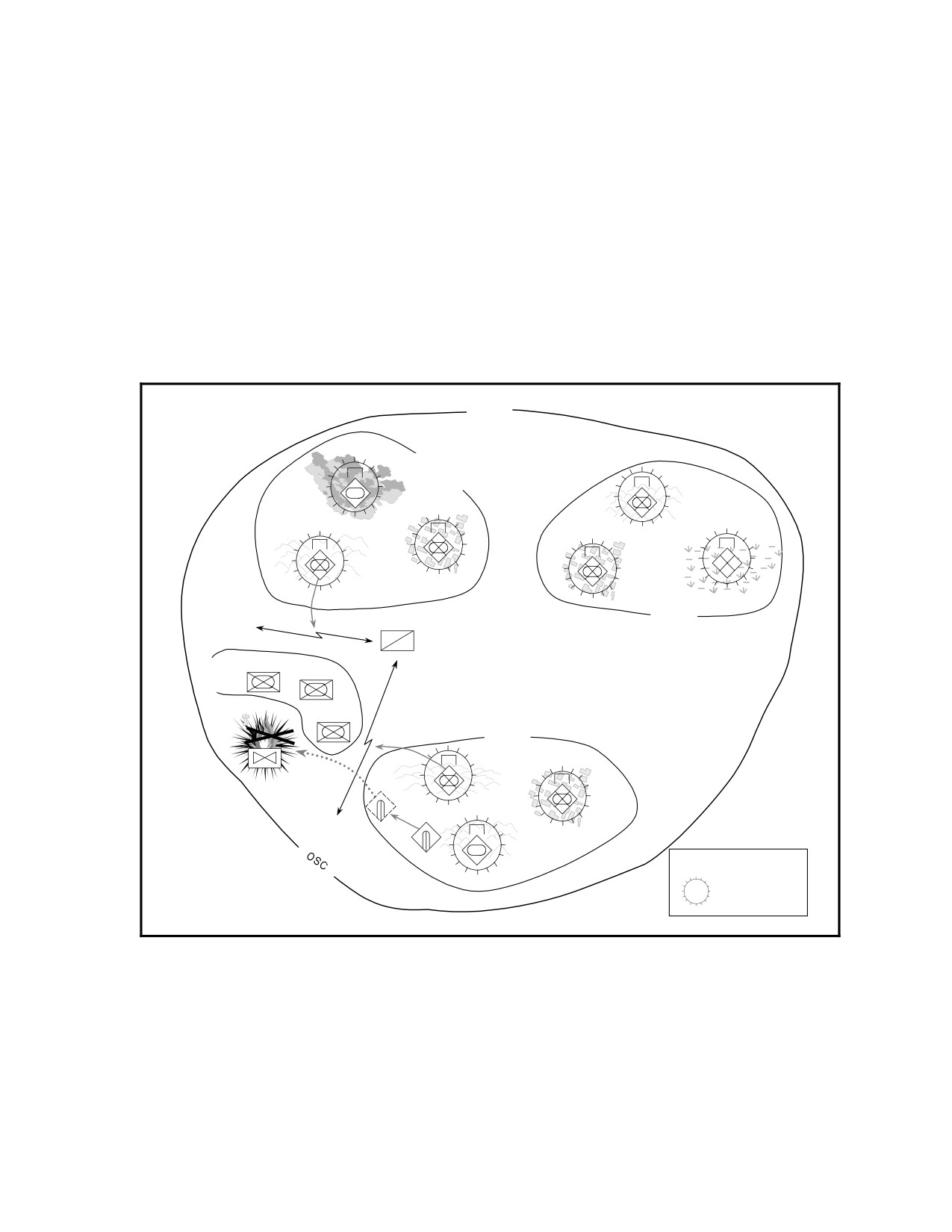
_________________________________________________________________________________Chapter 3
combat system so it is unavailable for the planned attack and therefore re-
duces his overall chances of success. More typically, the attack is designed to
slow the development of conditions favorable to the enemy’s planned attack.
See Figure 3-8 for an example of a spoiling attack.
3-99. Quite often, the spoiling attack develops as a situational attack (see
above). This occurs when an unclear picture of enemy dispositions suddenly
clarifies to some extent and the commander wishes to take advantage of the
knowledge he has gained to disrupt enemy timing. This means that spoiling
attacks are often conducted by reserve or response forces that can rapidly
shift from their current posture to attack the enemy.
OSC
DTG
X
Battle
Zone
X
Forest
Mountains
X
X
X
X
Mountains
Marsh
DTG
Battle
I I
Zone
Enemy
X
Attack
X
Position
Disruption
Zone
X
DTG
APOD
Battle
X
Zone
X
X
X
Mountains
X
X
LEGEND
Complex
Battle
Position
Figure 3-8. Spoiling Attack (Example)
3-23