FM 7-100.1 OPFOR Opposing Force Operations (DECEMBER 2004) - page 2
FM 7-100.1 ________________________________________________________________________________
1-35. To seize territory or otherwise expand its influence in the region, the
State must destroy a regional enemy’s will and capability to continue the
fight. It will attempt to achieve strategic political or military decision or
achieve specific regional goals as rapidly as possible, in order to preclude re-
gional alliances or outside intervention.
1-36. During regional operations, the State relies on its continuing strategic
operations to preclude or control outside intervention. It tries to keep foreign
perceptions of its actions during a regional conflict below the threshold that
will invite in extraregional forces. The State wants to win the regional con-
flict, but has to be careful how it does so. It works to prevent development of
international consensus for intervention and to create doubt among possible
participants. Still, at the very outset of regional operations, it lays plans and
positions forces to conduct access-control operations in the event of outside
intervention.
1-37. At the military level, regional operations are combined arms, joint, in-
teragency, and/or multinational operations. They are conducted in the State’s
region and, at least at the outset, against a weaker regional opponent. The
State’s doctrine, organization, capabilities, and national security strategy al-
low the OPFOR to deal with regional threats and opportunities primarily
through offensive action.
1-38. The State designs its military forces and employs an investment
strategy that ensures superiority in conventional military power over any
of its regional neighbors. Regionally-focused operations typically involve
“conventional” patterns of operation. However, the term conventional does
not mean that the OPFOR will use only conventional forces and conventional
weapons in such a conflict, nor does it mean that the OPFOR will not use
some adaptive approaches.
TRANSITION OPERATIONS
1-39. Transition operations serve as a pivotal point between regional and
adaptive operations. The transition may go in either direction. The fact that
the State begins transition operations does not necessarily mean that it
must complete the transition from regional to adaptive operations (or vice versa).
As conditions allow or dictate, the “transition” could end with the State conduct-
ing the same type of operations as before the shift to transition operations.
1-40. The State conducts transition operations when other regional and/or
extraregional forces threaten the State’s ability to continue regional opera-
tions in a conventional design against the original regional enemy. At the
point of shifting to transition operations, the State still has the ability to ex-
ert all instruments of national power against an overmatched regional en-
emy. Indeed, it may have already defeated its original adversary. However,
its successful actions in regional operations have prompted either other re-
gional actors or an extraregional actor to contemplate intervention. The State
will use all means necessary to preclude or defeat intervention.
1-41. Although the State would prefer to achieve its strategic goals through
regional operations, an SCP has the flexibility to change and adapt if re-
quired. Since the State assumes the possibility of extraregional intervention,
1-10
_________________________________________________________________________________Chapter 1
any SCP will already contain thorough plans for transition operations, as
well as adaptive operations, if necessary.
1-42. When an extraregional force starts to deploy into the region, the bal-
ance of power begins to shift away from the State. Although the State may
not yet be overmatched, it faces a developing threat it will not be able to han-
dle with normal, “conventional” patterns of operation designed for regional
conflict. Therefore, the State must begin to adapt its operations to the chang-
ing threat.
1-43. While the State and the OPFOR as a whole are in the condition of tran-
sition operations, an operational- or tactical-level commander will still re-
ceive a mission statement in plans and orders from higher headquarters stat-
ing the purpose of his actions. To accomplish that purpose and mission, he
will use as much as he can of the conventional patterns of operation that
were available to him during regional operations and as much as he has to of
the more adaptive-type approaches dictated by the presence of an extrare-
gional force.
1-44. Even extraregional forces may be vulnerable to “conventional” opera-
tions during the time they require to build combat power and create support
at home for their intervention. Against an extraregional force that either
could not fully deploy or has been successfully separated into isolated ele-
ments, the OPFOR may still be able to use some of the more conventional
patterns of operation. The State will not shy away from the use of military
means against an advanced extraregional opponent so long as the risk is
commensurate with potential gains.
1-45. Transition operations serve as a means for the State to retain the ini-
tiative and still pursue its overall strategic goal of regional expansion despite
its diminishing advantage in the balance of power. From the outset, one part
of the set of specific goals for any strategic campaign was the goal to defeat
any outside intervention or prevent it from fully materializing. As the State
begins transition operations, its immediate goal is preservation of its instru-
ments of power while seeking to set conditions that will allow it to transition
back to regional operations. Transition operations feature a mixture of offen-
sive and defensive actions that help the OPFOR control the strategic tempo
while changing the nature of conflict to something for which the intervening
force is unprepared. Transition operations can also buy time for the State’s
strategic operations to succeed.
1-46. There are two possible outcomes to transition operations. If the ex-
traregional force suffers sufficient losses or for other reasons must withdraw
from the region, the OPFOR’s operations may begin to transition back to re-
gional operations, again becoming primarily offensive. If the extraregional
force is not compelled to withdraw and continues to build up power in the re-
gion, the OPFOR’s transition operations may begin to gravitate in the other di-
rection, toward adaptive operations.
1-11
FM 7-100.1 ________________________________________________________________________________
ADAPTIVE OPERATIONS
1-47. Generally, the State conducts adaptive operations as a consequence of
intervention from outside the region. Once an extraregional force intervenes
with sufficient power to overmatch the State, the full conventional design
used in regionally-focused operations is no longer sufficient to deal with this
threat. The State has developed its doctrine, organization, capabilities, and
strategy with an eye toward dealing with both regional and extraregional op-
ponents. It has already planned how it will adapt to this new and changing
threat and has included this adaptability in its doctrine.
1-48. The State’s immediate goal is survivalas a regime and as a nation.
However, its long-term goal is still the expansion of influence within its re-
gion. In the State’s view, this goal is only temporarily thwarted by the ex-
traregional intervention. Accordingly, planning for adaptive operations fo-
cuses on effects over time. The State believes that patience is its ally and an
enemy of the extraregional force and its intervention in regional affairs.
1-49. The State believes that adaptive operations can lead to several possible
outcomes. If the results do not completely resolve the conflict in the State’s
favor, they may at least allow the State to return to regional operations. Even
a stalemate may be a victory for the State, as long as it preserves enough of
its instruments of power to preserve the regime and lives to fight another day.
1-50. When an extraregional power intervenes with sufficient force to over-
match the State’s, the OPFOR has to adapt its patterns of operation. It still
has the same forces and technology that were available to it for regional op-
erations, but must use them in creative and adaptive ways. It has already
thought through how it will adapt to this new or changing threat in general
terms. (See Principles of Operation Versus an Extraregional Power below.) It has
already developed appropriate branches and sequels to its basic SCP and does
not have to rely on improvisation. During the course of combat, it will make fur-
ther adaptations, based on experience and opportunity.
1-51. Even with the intervention of an advanced extraregional power, the State
will not cede the initiative. It will employ military means so long as this does not
either place the regime at risk or risk depriving it of sufficient force to remain a
regional power after the extraregional intervention is over. The primary objec-
tives are to preserve combat power, to degrade the enemy’s will and capability to
fight, and to gain time for aggressive strategic operations to succeed.
1-52. The OPFOR will seek to conduct adaptive operations in circumstances,
opportunities, and terrain that optimize its own capabilities and degrade
those of the enemy. It will employ a force that is optimized for the terrain or
for a specific mission. For example, it will use its antitank capability, tied to ob-
stacles and complex terrain, inside a defensive structure designed to absorb the
enemy’s momentum and fracture his organizational framework.
1-53. The types of adaptive actions that characterize “adaptive operations” at
the strategic level can also serve the OPFOR well in regional or transition
operationsat least at the tactical and operational levels. However, once an
extraregional force becomes fully involved in the conflict, the OPFOR will
conduct adaptive actions more frequently and on a larger scale.
1-12
_________________________________________________________________________________Chapter 1
PRINCIPLES OF OPERATION VERSUS AN EXTRAREGIONAL POWER
1-54. The State assumes the distinct possibility of intervention by a major
extraregional power in any regional conflict. Consequently, it has devised the
following principles for applying its various instruments of diplomatic-
political, informational, economic, and military power against this type of threat.
CONTROL ACCESS INTO REGION
1-55. Extraregional enemies capable of achieving overmatch against the
State must first enter the region using power-projection capabilities. There-
fore, the State’s force design and investment strategy is focused on access
controlto selectively deny, delay, and disrupt entry of extraregional forces
into the region and to force them to keep their operating bases beyond con-
tinuous operational reach. This is the easiest manner of preventing the ac-
cumulation of enemy combat power in the region and thus defeating a techno-
logically superior enemy.
1-56. Access-control operations are continuous throughout a strategic cam-
paign and can reach beyond the theater as defined by the State’s NCA. They
begin even before the extraregional power declares its intent to come into the re-
gion, and continue regardless of whether the State is conducting regional, transi-
tion, or adaptive operations. Access-control operations come in three basic forms:
strategic preclusion, operational exclusion, and access limitation.
Strategic Preclusion
1-57. Strategic preclusion seeks to completely deter extraregional involve-
ment or severely limit its scope and intensity. The State would attempt to
achieve strategic preclusion in order to reduce the influence of the extrare-
gional power or to improve its own regional or international standing. It
would employ all its instruments of power to preclude direct involvement by
the extraregional power. Actions can take many forms and often contain sev-
eral lines of operation working simultaneously.
1-58. The primary target of strategic preclusion is the extraregional power’s
national will. First, the State would conduct diplomatic and perception man-
agement activities aimed at influencing regional, transnational, and world
opinion. This could either break apart ad hoc coalitions or allow the State to
establish a coalition of its own or at least gain sympathy. For example, the
State might use a disinformation campaign to discredit the legitimacy of dip-
lomatic and economic sanctions imposed upon it. The extraregional power’s
economy and military would be secondary targets, with both practical and
symbolic goals. This might include using global markets and international fi-
nancial systems to disrupt the economy of the extraregional power, or con-
ducting physical and information attacks against critical economic centers.
Similarly, the military could be attacked indirectly by disrupting its power
projection, mobilization, and training capacity. Preclusive actions are likely
to increase in intensity and scope as the extraregional power moves closer to
military action. If strategic preclusion fails, the State will turn to operational
methods that attempt to limit the scope of extraregional involvement or cause
it to terminate quickly.
1-13
FM 7-100.1 ________________________________________________________________________________
Operational Exclusion
1-59. Operational exclusion seeks to selectively deny an extraregional force
the use of or access to forward bases of operation within the region or even
outside the theater defined by the NCA. For example, through diplomacy,
economic or political connections, information campaigns, and/or hostile ac-
tions, the State might seek to deny the enemy the use of bases in other for-
eign nations. It might also attack population and economic centers for the in-
timidation effect, using long-range surface-to-surface missiles (SSMs), WMD,
or SPF.
1-60. Forces originating in the enemy’s homeland must negotiate long and
difficult air and surface lines of communication (LOCs) merely to reach the
region. Therefore, the State will use any means at its disposal to also attack
the enemy forces along routes to the region, at transfer points en route, at ae-
rial and sea ports of embarkation (APOEs and SPOEs), and even at their
home stations. These are fragile and convenient targets in support of transi-
tion and adaptive operations.
Access Limitation
1-61. Access limitation seeks to affect an extraregional enemy’s ability to in-
troduce forces into the theater. Access-control operations do not necessarily
have to deny the enemy access entirely. A more realistic goal is to limit or in-
terrupt access into the theater in such a way that the State’s forces are capa-
ble of dealing with them. By controlling the amount of force or limiting the
options for force introduction, the State can create conditions that place its
conventional capabilities on a par with those of an extraregional force. Capa-
bility is measured in terms of what the enemy can bring to bear in the thea-
ter, rather than what the enemy possesses.
1-62. The State’s goal is to limit the enemy’ accumulation of applicable com-
bat power to a level and to locations that do not threaten the accomplishment
of a strategic campaign. This may occur through many methods. For example,
the State may be able to limit or interrupt the enemy’s deployment through
actions against his aerial and sea ports of debarkation (APODs and SPODs)
in the region. Hitting such targets also has political and psychological value.
The State will try to disrupt and isolate enemy forces that are in the region or
coming into it, so that it can destroy them piecemeal. It might exploit and
manipulate international media to paint foreign intervention in a poor
light, decrease international resolve, and affect the force mix and rules of
engagement (ROE) of the deploying extraregional forces.
EMPLOY OPERATIONAL SHIELDING
1-63. The State will use any means necessary to protect key elements of its
combat power from destruction by an extraregional forceparticularly by air
and missile forces. This protection may come from use of any or all of the fol-
lowing:
• Complex terrain.
• Noncombatants.
• Risk of unacceptable collateral damage.
1-14
_________________________________________________________________________________Chapter 1
• Countermeasure systems.
• Dispersion.
• Fortifications.
• IW.
1-64. Operational shielding generally cannot protect the entire force for an
extended time period. Rather, the State will seek to protect selected elements
of its forces for enough time to gain the freedom of action necessary to prose-
cute important elements of a strategic campaign.
CONTROL TEMPO
1-65. The OPFOR initially employs rapid tempo to conclude regional opera-
tions before an extraregional force can be introduced. It will also use rapid
tempo to set conditions for access-control operations before the extraregional
force can establish a foothold in the region. Once it has done that, it needs to
be able to control the tempoto ratchet it up or down, as is advantageous to
its own operational or tactical plans.
1-66. During the initial phases of an extraregional enemy’s entry into the re-
gion, the OPFOR may employ a high operational tempo. Taking advantage of
the weaknesses inherent in enemy power projection, it seeks to terminate the
conflict quickly before main enemy forces can be brought to bear. If the
OPFOR cannot end the conflict quickly, it may take steps to slow the tempo and
prolong the conflict, taking advantage of enemy lack of commitment over time.
CAUSE POLITICALLY UNACCEPTABLE CASUALTIES
1-67. The OPFOR will try to inflict highly visible and embarrassing losses on
enemy forces to weaken the enemy’s domestic resolve and national will to
sustain the deployment or conflict. Modern wealthy nations have shown an
apparent lack of commitment over time, and sensitivity to domestic and
world opinion in relation to conflict and seemingly needless casualties.
1-68. The OPFOR has the advantage of disproportionate interests: the ex-
traregional power may have limited objectives and only casual interest in the
conflict, while the State approaches it from the perspective of total war and a
threat to its aspirations or even to its national survival. The State is willing
to commit all means necessary, for as long as necessary, to achieve its strate-
gic goals. Compared to the extraregional enemy, the State stands more will-
ing to absorb higher military and civilian casualties in order to achieve vic-
tory. It will try to influence public opinion in the enemy’s homeland to the ef-
fect that the goal of intervention is not worth the cost.
NEUTRALIZE TECHNOLOGICAL OVERMATCH
1-69. Against an extraregional force, the OPFOR will forego massed forma-
tions, patterned echelonment, and linear operations that would present easy
targets for such an enemy. It will hide and disperse its forces in areas where
complex terrain limits the enemy’s ability to apply his full range of techno-
logical capabilities. However, the OPFOR can rapidly mass forces and fires
from these dispersed locations for decisive combat at the time and place of its
own choosing.
1-15
FM 7-100.1 ________________________________________________________________________________
1-70. Another way to operate on the margins of enemy technology is to ma-
neuver during periods of reduced exposure. The OPFOR trains its forces to
operate in adverse weather, limited visibility, rugged terrain, and urban envi-
ronments that shield them from the effects of the enemy’s high-technology weap-
ons and deny the enemy the full benefits of his advanced reconnaissance, intelli-
gence, surveillance, and target acquisition (RISTA) systems.
1-71. Modern militaries rely upon information and information systems to
plan and conduct operations. For this reason, the OPFOR will conduct exten-
sive information attacks and other offensive IW actions. It can also use the
enemy’s robust array of RISTA systems against him. A sophisticated enemy’s
large numbers of sensors can overwhelm subordinate units’ ability to receive,
process, and analyze raw intelligence data and to provide timely and accurate
intelligence analysis. The OPFOR can add to this saturation problem by us-
ing deception to flood enemy sensors with masses of conflicting information.
Conflicting data from different sensors at different levels (such as satellite
imagery conflicting with data from unmanned aerial vehicles) can confuse the
enemy and degrade his situational awareness.
1-72. The OPFOR will concentrate its own RISTA, maneuver, and fire sup-
port means on the destruction of high-visibility (flagship) enemy systems.
This offers exponential value in terms of increasing the relative combat
power of the OPFOR and also maximizes effects in the information and psy-
chological arenas. Losses among these premier systems may not only degrade
operational capability, but also undermine enemy morale. Thus, attacks
against such targets are not always linked to military objectives.
CHANGE THE NATURE OF CONFLICT
1-73. The OPFOR will try to change the nature of conflict to exploit the dif-
ferences between friendly and enemy capabilities. Following an initial period
of regionally-focused conventional operations and utilizing the opportunity af-
forded by phased enemy deployment, the OPFOR will change its operations
to focus on preserving combat power and exploiting enemy ROE. This shift in
the focus of operations will present the fewest targets possible to the rapidly
growing combat power of the enemy. Also, the OPFOR or affiliated forces can
use terror tactics against enemy civilians or soldiers not directly connected to
the intervention as a device to change the fundamental nature of the conflict.
1-74. Against early-entry forces, the OPFOR may still be able to use the de-
sign it employed in previous operations against regional opponents, particu-
larly if access-control operations have been successful. However, as the extrare-
gional force builds up to the point where it threatens to overmatch the OPFOR,
the OPFOR is prepared to disperse its forces and employ them in patternless op-
erations that present a battlefield that is difficult for the enemy to analyze and
predict.
1-75. The OPFOR may hide and disperse its forces in areas of sanctuary. The
sanctuary may be physical, often located in urban areas or other complex ter-
rain that limits or degrades the capabilities of enemy systems. However, the
OPFOR may also use moral sanctuary by placing its forces in areas shielded
by civilians or close to sites that are culturally, politically, economically, or
ecologically sensitive. It will defend in sanctuaries when necessary. However,
1-16
_________________________________________________________________________________Chapter 1
units of the OPFOR will move out of sanctuaries and attack when they can
create a window of opportunity or when opportunity is presented by physical
or natural conditions that limit or degrade the enemy’s systems.
1-76. OPFOR units do not avoid contact; rather, they often seek contact, but
on their own terms. Their preferred tactics under these conditions would be
the ambush and raid as a means of avoiding decisive combat with superior
forces. They will also try to mass fires from dispersed locations to destroy key
enemy systems or formations. However, when an opportunity presents itself,
the OPFOR can rapidly mass forces and execute decisive combat.
ALLOW NO SANCTUARY
1-77. Along with dispersion, decoys, and deception, the OPFOR uses urban
areas and other complex terrain as sanctuary from the effects of enemy
forces. Meanwhile, its intent is to deny enemy forces the use of such terrain.
This forces the enemy to operate in areas where the OPFOR’s long-range fires
and strikes can be more effective.
1-78. The OPFOR seeks to deny enemy forces safe haven during every phase
of a deployment and as long as they are in the region. It is prepared to attack
enemy forces anywhere on the battlefield, as well as to his strategic depth.
The resultant drain on manpower and resources to provide adequate force-
protection measures can reduce the enemy’s strategic, operational, and tacti-
cal means to conduct war and erode his national will to sustain conflict. The
goal is to present the enemy with a nonlinear, simultaneous battlefield. Such
actions will not only deny the enemy sanctuary, but also weaken his national
will, particularly if the OPFOR or affiliated forces can strike targets in the
enemy’s homeland.
OPFOR MILITARY AND OPERATIONAL ART
1-79. The OPFOR embraces the concept that military strategy and opera-
tions are an important part, but not the whole, of the conduct of war. Military
strategy is not separate from politics and political leadership but a means to
support the State in achieving its political objectives. The national security
strategy is essentially a political document that sets forth the goals of the
State and informs military strategists. It is their responsibility to build,
train, and employ forces for the purpose of achieving those political goals.
1-80. When the political leadership makes the decision to employ military
forces to achieve a goal, the military strategy for that employment is closely
associated with diplomatic-political, informational, and economic strategies
to bring about a favorable political result. Thus, the military leadership re-
quires a broad understanding of the overall national strategy, and the politi-
cal leadership needs an understanding of the capabilities and limitations of
the military.
MILITARY STRATEGY
1-81. The OPFOR views military strategy as the art of developing the ways
and means for the application of military power to achieve State objectives.
Ways and means encompass the threatened or actual use of force. Military
1-17
FM 7-100.1 ________________________________________________________________________________
doctrine describes fundamental principles and provides guidelines for the use
of military forces in pursuit of national objectives.
1-82. Military and operational art is the theory and practice of conducting
armed conflict. It recognizes that war is a human endeavor and therefore not
amenable to quantifiable formulas that limit thinking and lead to unimagina-
tive and predictable solutions. It is the intellectual and intuitive synthesis of
military doctrine, military science, and intangibles to address the problem at
hand. Military science is not discarded but, like military doctrine, is seen as
providing tools that support the practice of military art. The single, most im-
portant ingredient in the practice of military strategy, and of military and
operational art, is the commander. The commander who develops creative so-
lutions to military problems is highly valued.
1-83. The study and analysis of political and military history has an impor-
tant place in the development of OPFOR military thought and doctrine. The
OPFOR views the role of history and past experience as one that provides in-
sights and observations into the present and future conduct of war. It is a
significant source for the development of new and adaptive ways of conduct-
ing military operations. The OPFOR has developed an effective method for
identifying, analyzing, validating, and applying new concepts. It is an inter-
active process that establishes a partnership between military colleges and
civilian institutions on one side and the active force on the other.
OPERATIONAL ART
1-84. Operational art links tactics and strategy to form a coherent structure
for the conduct of war. Some strategists have traditionally expressed opera-
tional art as the sequencing of battles and engagements so that the collective
outcomes will produce a specified military condition in a theater. Others de-
scribe operational art as the blending of direct and indirect approaches to
achieve necessary conditions in a theater. The OPFOR has developed a style
of operational art that is an amalgam of both theories, capturing the best
from each.
1-85. No particular level of command is uniquely concerned with operational
art. The Chief of the General Staff and the theater commander(s) normally
plan and direct strategic and theater campaigns, respectively, while field
group and operational-strategic command (OSC) commanders normally de-
sign the major operations of a campaign. The OPFOR recognizes the classic
division of warfare between the strategic, operational, and tactical levels.
However, the boundaries between these levels are not associated so much
with particular levels of command as with the effect or contribution to achiev-
ing strategic, operational, or tactical objectives.
OPERATIONAL ART AND THE NATIONAL SECURITY STRATEGY
1-86. As discussed earlier in this chapter, the national security strategy can
involve four types of strategic-level actions: strategic, regional, transition,
and adaptive operations. In specific terms, OPFOR operational art consists of
the sequencing of the actions of military forces to attain strategic goals set
forth within and across this spectrum of strategic-level actions. In practical
terms, this is expressed in the strategic campaign plan.
1-18
_________________________________________________________________________________Chapter 1
1-87. Regional operations are largely conventional actions against a less ca-
pable force. While dealing with such a regional opponent primarily
through offensive means, the State employs its economic, informational,
and diplomatic-political instruments of power in a peacetime, “defensive”
mode against other regional and extraregional parties with whom it is not at
war. This overall strategy constitutes a “strategic defense” that supports the
offensive military operations being conducted in the region while seeking to
preclude outside involvement. The practitioner of operational art must insure
that his plan for use of forces is congruent with the aims of the SCP and vice
versa. The soldier does not view the proper, coordinated use of these other in-
struments of power as a hindrance. From his perspective, their use to influ-
ence an extraregional power not to commit forces or to delay their commit-
ment is the equivalent of having extra divisions.
1-88. Transition and particularly adaptive operations are at the core of what
makes OPFOR military and operational art distinctive, if not unique. The po-
litical and military leadership recognizes that attempts to achieve national
strategic goals through the use of force can result in a military response from
within and outside the region. Strategic plans take this possibility into ac-
count and, depending on the degree of risk, contingencies are planned to ac-
count for such an eventuality.
1-89. Applying the principles of operation versus an extraregional power,
(discussed earlier in this chapter) and taking a “systems warfare” approach,
the State and the OPFOR seek to develop contingency plans that transition
to a “strategic offense” while conducting military operations that are, at least
initially, defensive in nature. The purpose of the strategy is to disaggregate
the enemy’s elements of power through the conduct of strategic operations,
while seeking to disaggregate his combat systems at the operational level.
The ultimate goal is to exhaust the enemy and destroy his will to continue
the fight.
1-90. In preparing contingency plans, the political and military leadership
conducts a detailed analysis to determine major actions that might be taken
by an intervening force to mobilize, deploy, and operate within the region.
Using this analysis (which is continually updated) and the assessed risk, they
further refine the plan. Actions to support the plan, prior to its execution,
could include increasing the readiness of units, organizations, and industry
required to support an intervention scenario. Other actions could include pre-
positioning forces, weapons, and logistics to those areas that support the con-
tingency plan. Plans for strategic operations in support of transition and
adaptive operations are developed while the military operational planners
continue to plan for the employment of tactical forces to achieve the aims set
forth in the strategy. All of this is set against a matrix that identifies key
events that would trigger execution of the contingency.
1-91. Inherent in the concept of adaptive operations is the idea that the op-
erational planner assigns missions and arrays tactical forces in such a way to
support the operation. Although the tactical commander will understand,
from a conceptual context, that he is involved in adaptive operations, from a
tactical perspective that will be transparent. It is through the manner in
which the operational commander arrays and employs his forces that adap-
tive operations are achieved. Tactical commanders are adaptive in the sense
1-19
FM 7-100.1 ________________________________________________________________________________
that they have the flexibility within the missions assigned by the operational
commander and within the techniques and procedures they develop to more
effectively accomplish those missions.
1-92. The OPFOR includes in its planning and execution the use of paramili-
tary forces. It is important to stress that, with the exception of internal security
forces, those paramilitary organizations that are not part of the State structure
and do not necessarily share the State’s views on national security strategy.
THE ROLE OF PARAMILITARY AND IRREGULAR FORCES IN
OPERATIONS
1-93. Paramilitary forces are those organizations that are distinct from the
regular armed forces but resemble them in organization, equipment, training,
or purpose. Basically, any organization that accomplishes its purpose, even
partially, through the force of arms is considered a paramilitary organization.
These organizations can be part of the government infrastructure or operate
outside of the government or any institutionalized controlling authority.
1-94. In consonance with the concept of “all means necessary,” the OPFOR
views these organizations as assets that can be used to its advantage in time
of war. Within its own structure, the OPFOR has formally established this
concept by assigning the Internal Security Forces, part of the Ministry of the
Interior in peacetime, to the SHC during wartime. Additionally, the OPFOR
cultivates relationships with and covertly supports nongovernment paramili-
tary organizations to achieve common goals while at peace and to have a high
degree of influence on them when at war.
1-95. The primary paramilitary organizations are the Internal Security
Forces, insurgents, terrorists, and drug and criminal organizations. The de-
gree of control the OPFOR has over these organizations varies from absolute,
in the case of the Internal Security Forces, to tenuous when dealing with ter-
rorist and drug and criminal organizations. In the case of those organizations
not formally tied to the OPFOR structure, control can be enhanced through
the exploitation of common interests and ensuring that these organizations
see personal gain in supporting OPFOR goals.
1-96. The OPFOR views the creative use of these organizations as a means of
providing depth and continuity to its operations. A single attack by a terrorist
group will not in itself win the war. However, the use of paramilitary organi-
zations to carry out a large number of planned actions, in support of strategy
and operations, can play an important part in assisting the OPFOR in achiev-
ing its goals. These actions, taken in conjunction with other adaptive actions,
can also supplement a capability degraded due to enemy superiority.
INTERNAL SECURITY FORCES
1-97. The Internal Security Forces subordinated to the SHC provide support
zone security and collect information on foreign organizations and spies. They
perform civil population control functions and ensure the loyalty of mobi-
lized militia forces. Some units are capable of tactical-level defensive ac-
tions if required. These basic tasks are not all-inclusive, and within their
capability these forces can perform a multitude of tasks limited only by
1-20
_________________________________________________________________________________Chapter 1
the commander’s imagination. While performing these functions, the Inter-
nal Security Forces may be operating within their own hierarchy of com-
mand, or they may be assigned a dedicated command relationship within an
OSC or one of its tactical subordinates.
1-98. During regional operations, the Internal Security Forces may serve to
control the population situated in newly seized territory. They are an excel-
lent source of human intelligence and can provide security for key sites lo-
cated in the support zones. The Internal Security Forces can either augment
or replace regular military organizations in all aspects of prisoner-of-war
processing and control. While continuing their normal tasks in the homeland,
they can assist regular military organizations in the areas of traffic control
and regulation.
1-99. During transition operations, the Internal Security Forces evacuate im-
portant political and military prisoners to safe areas where they can continue
to serve as important sources of information or means of negotiation. Traffic
control and the security of key bridges and infrastructure take on a higher
level of importance as the OPFOR repositions and moves forces transitioning
to adaptive operations. The Internal Security Forces can continue to gather
intelligence from the local population and assist in mobilizing civilians in oc-
cupied territory for the purpose of augmenting OPFOR engineer labor re-
quirements. Finally, the use of qualified personnel to stay behind as intelli-
gence gatherers and liaison with insurgent, terrorist, and criminal organiza-
tions can provide the OPFOR an increased capability during the adaptive op-
erations that follow.
1-100. Especially important in the conduct of adaptive operations is the abil-
ity of the Internal Security Forces to free up regular military organizations
that can contribute directly to the fight. The security of support zones within
an OSC area of responsibility is just one example of this concept. Where nec-
essary, some units can augment the defense or defend less critical areas, thus
freeing up regular military forces for higher-priority tasks. Stay-behind
agents working with insurgent, terrorist, and criminal organizations can
contribute by directing preplanned actions that effectively add depth to the
battlefield. Their actions can cause material damage to key logistics and
command and control (C2) assets, inflict random but demoralizing casualties,
and effectively draw enemy forces away from the main fight in response to
increased force-protection requirements.
INSURGENT FORCES
1-101. The OPFOR ensures that the exploitation and use of insurgent forces
operating against and within neighboring countries is an integral part of its
strategic and operational planning. Insurgent forces, properly leveraged, can
provide an added dimension to the OPFOR’s capabilities and provide options
not otherwise available. During peacetime, a careful balance is kept between
covert support for insurgent groups that may prove useful later and overt re-
lations with the government against which the insurgents are operating.
1-102. During peacetime, support to insurgents can consist of weapons, stag-
ing and sanctuary areas within the State, and training by OPFOR SPF. It is
during this time that the OPFOR attempts to cultivate the loyalty and trust
1-21
FM 7-100.1 ________________________________________________________________________________
of insurgent groups they have identified as having potential usefulness in
their strategic and operational planning. In all operations of the strategic
campaign, insurgent forces serve as an excellent source of intelligence.
1-103. During the conduct of regional operations, the decision to influence in-
surgents to execute actions that support operations will depend on a number
of factors. If the OPFOR views extraregional intervention as unlikely, it may
choose to keep insurgent participation low. A key reason for making this de-
cision is the potential for those forces to become an opponent once the OPFOR
has accomplished its goals. On the other hand, the OPFOR may plan to have
these groups take part in directly supporting its operations in anticipation of
further support in the case of an extraregional intervention. Insurgent in-
volvement during regional operations may be held to furthering OPFOR IW
objectives by creating support for the State’s actions among the population,
harassing and sniping enemy forces, conducting raids, and assassinating
politicians who are influential opponents of the State. Insurgents can also
serve as scouts or guides for OPFOR regular forces moving through unfamil-
iar terrain and serve as an excellent source of political and military intelligence.
1-104. The usefulness of insurgent forces can be considerable in the event of
extraregional intervention and the decision to transition to adaptive opera-
tions. During transition operations, insurgent forces can support access-
control operations to deny enemy forces access to the region or at least delay
their entry. Delay provides the OPFOR more time to conduct an orderly tran-
sition and to reposition its forces for the conduct of adaptive operations. The
principal means of support include direct action in the vicinity of APODs and
SPODs and along LOCs in the enemy’s rear area. Dispersed armed action for
the sole purpose of creating casualties can have a demoralizing effect and
cause the enemy to respond, thus drawing forces from his main effort.
OPFOR regular forces can coordinate with insurgents, supported by SPF ad-
visors, to execute a variety of actions that support the strategic campaign or a
particular operation plan. Insurgents can support deception by drawing at-
tention from an action the OPFOR is trying to cover or conceal. They can de-
lay the introduction of enemy reserves through ambush and indirect fire,
cause the commitment of valuable force-protection assets, or deny or degrade
the enemy’s use of rotary-wing assets through raids on forward arming and
refueling points and maintenance facilities.
TERRORIST AND CRIMINAL ORGANIZATIONS
1-105. Through the use of intelligence professionals and covert means, the
OPFOR maintains contact with and to varying degrees supports terrorist and
criminal organizations. During peacetime, these organizations can be useful,
and in time of war they can provide an added dimension to OPFOR strategy
and operations.
1-106. Although the OPFOR recognizes that these groups vary in reliability,
it constantly assesses both their effectiveness and usefulness. It develops re-
lationships with those organizations that have goals, sympathies, and inter-
ests congruent with those of the State. In time of war, it can encourage and
materially support criminal organizations to commit actions that contribute
to the breakdown of civil control within a neighboring country. It can provide
support for the distribution and sale of drugs to enemy military forces, which
1-22
_________________________________________________________________________________Chapter 1
creates both morale and discipline problems within those organizations. The
production of counterfeit currency and attacks on financial institutions help
to weaken the enemy’s economic stability. Coordination with and support of
terrorists to attack political and military leaders and commit acts of sabotage
against key infrastructure (such as ports, airfields, and fuel supplies) add to
the variety and number of threats that the enemy must address. The State
and OPFOR leadership also have the ability to promote and support the
spread of these same kinds of terrorist acts outside the region. However, they
must carefully consider the political and domestic impact of these actions be-
fore making the decision to execute them.
SYSTEMS WARFARE
1-107. The OPFOR defines a system as a set of different elements so con-
nected or related as to perform a unique function not performable by the ele-
ments or components alone. The essential ingredients of a system include the
components, the synergy among components and other systems, and some
type of functional boundary separating it from other systems. Therefore, a
“system of systems” is a set of different systems so connected or related as to
produce results unachievable by the individual systems alone. The OPFOR
views the operational environment, the battlefield, the State’s own instru-
ments of power, and an opponent’s instruments of power as a collection of
complex, dynamic, and integrated systems composed of subsystems and com-
ponents.
1-108. Systems warfare serves as a conceptual and analytical tool to assist in
the planning, preparation, and execution of warfare. With the systems ap-
proach, the intent is to identify critical system components and attack them
in a way that will degrade or destroy the use or importance of the overall system.
PRINCIPLE
1-109. The primary principle of systems warfare is the identification and iso-
lation of the critical subsystems or components that give the opponent the
capability and cohesion to achieve his aims. The focus is on the disaggrega-
tion of the system by rendering its subsystems and components ineffective.
While the aggregation of these subsystems or components is what makes the
overall system work, the interdependence of these subsystems is also a poten-
tial vulnerability. Systems warfare has applicability or impact at all three
levels of warfare.
APPLICATION AT THE STRATEGIC LEVEL
1-110. At the strategic level, the instruments of power and their application
are the focus of analysis. National power is a system of systems in which the
instruments of national power work together to create a synergistic effect.
Each instrument of power (diplomatic-political, informational, economic, and
military) is also a collection of complex and interrelated systems.
1-111. The State clearly understands how to analyze and locate the critical
components of its own instruments of power and will aggressively aim to pro-
tect its own systems from attack or vulnerabilities. It also understands that
an adversary’s instruments of power are similar to the State’s. Thus, at the
1-23
FM 7-100.1 ________________________________________________________________________________
strategic level, the State can use the OPFOR and its other instruments of
power to counter or target the systems and subsystems that make up an op-
ponent’s instruments of power. The primary purpose is to subdue, control, or
change the opponent’s behavior.
1-112. If an opponent’s strength lies in his military power, the State and the
OPFOR can attack the other instruments of power as a means of disaggre-
gating or disrupting the enemy’s system of national power. Thus, it is possi-
ble to render the overall system ineffective without necessarily having to de-
feat the opponent militarily.
APPLICATION AT THE OPERATIONAL LEVEL
1-113. At the operational level, the application of systems warfare pertains
only to the use of armed forces to achieve a result. Therefore, the “system of
systems” in question at this level is the combat system of the OPFOR and/or
the enemy.
Combat System
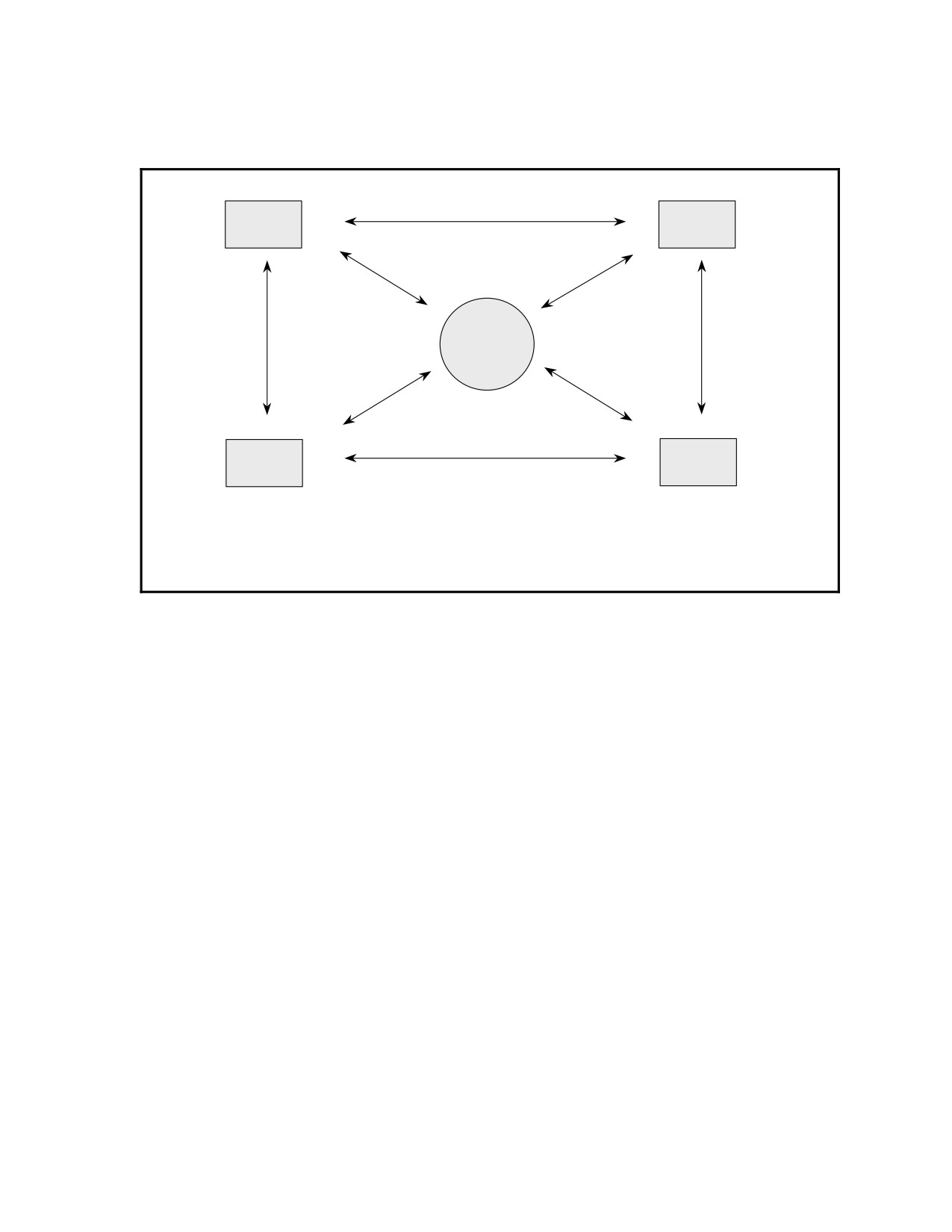
1-114. A combat system (see Figure 1-5) is the “system of systems” that re-
sults from the synergistic combination of four basic subsystems that are inte-
grated to achieve a military function. The subsystems are as follows:
• Combat forces (such as main battle tanks, IFVs and/or APCs, or infantry).
• Combat support forces (such as artillery, SSMs, air defense, engineers,
and direct air support).
• Logistics forces (such as transportation, ammunition, fuel, rations, main-
tenance, and medical).
• C2 and RISTA (such as headquarters, signal nodes, satellite downlink
sites, and reconnaissance sensors).
1-115. The combat system is characterized by interaction and interdepend-
ence among its subsystems. Therefore, the OPFOR will seek to identify key
subsystems of an enemy combat system and target them and destroy them
individually. Against a technologically superior extraregional force, the
OPFOR will often use any or all subcomponents of its own combat system to
attack the most vulnerable parts of the enemy’s combat system rather than
the enemy’s strengths. For example, attacking the enemy’s logistics, C2, and
RISTA can undermine the overall effectiveness of the enemy’s combat system
without having to directly engage his superior combat and combat support
forces. Aside from the physical effect, the removal of one or more key subsys-
tems can have a devastating psychological effect, particularly if it occurs in a
short span of time.
1-24
_________________________________________________________________________________Chapter 1
COMBAT
LOGISTICS
FORCES
FORCES
Examples:
Examples:
Tanks,
Transportation,
IFVs/APCs,
Ammunition,
Infantry
Fuel,
Rations,
Maintenance,
Medical
COMBAT
SYSTEM
COMBAT
C2 AND
SUPPORT
RISTA
FORCES
Examples:
Examples:
Artillery,
Headquarters,
SSMs,
Signal Nodes,
Air Defense,
Satellite Downlinks,
Engineers,
Reconnaissance Sensors
Direct Air Support
Figure 1-5. Combat System
Planning and Execution
1-116. The systems warfare approach to combat is a means to assist the
commander in the decision-making process and the planning and execution of
his mission. The OPFOR believes that a qualitatively and/or quantitatively
weaker force can defeat a superior foe, if the lesser force can dictate the terms of
combat. It believes that the systems warfare approach allows it to move away
from the traditional attrition-based approach to combat. It is no longer neces-
sary to match an opponent system-for-system or capability-for-capability.
Commanders and staffs will locate the critical component(s) of the enemy com-
bat system, patterns of interaction, and opportunities to exploit this connectivity.
Systems warfare has applications in both offensive and defensive contexts.
1-117. The essential step after the identification of the critical subsystems
and components of a combat system is the destruction or degradation of the
synergy of the system. This may take the form of total destruction of a sub-
system or component, degradation of the synergy of components, or the sim-
ple denial of access to critical links between systems or components. The de-
struction of a critical component or link can create windows of opportunity
that can be exploited, set the conditions for offensive action, or support a con-
cept of operation that calls for exhausting the enemy on the battlefield. Once
the OPFOR has identified and isolated a critical element of the enemy com-
bat system that is vulnerable to attack, it will select the appropriate method
of attack.
1-25
FM 7-100.1 ________________________________________________________________________________
1-118. Today’s state-of-the-art combat and combat support systems are im-
pressive in their ability to deliver precise attacks at long standoff distances.
However, the growing reliance of some extraregional forces on these systems
offers opportunity. Attacking critical ground-based C2 and RISTA nodes or
logistics systems and LOCs can have a very large payoff for relatively low in-
vestment and low risk to the OPFOR. Modern logistics systems assume se-
cure LOCs and voice or digital communications. These characteristics make
such systems vulnerable. Therefore, the OPFOR can greatly reduce a military
force’s combat power by attacking a logistics system that depends on “just-in-
time delivery.”
1-119. For the operational commander, the systems warfare approach to
combat is not an end in itself. It is a key component in his planning and se-
quencing of tactical battles and engagements aimed toward achieving as-
signed strategic goals. Systems warfare supports his concept; it is not the
concept. The ultimate aim is to destroy the enemy’s will and ability to fight.
APPLICATION AT THE TACTICAL LEVEL
1-120. It is at the tactical level that systems warfare is executed in attacking
the enemy’s combat system. While the tactical commander may use systems
warfare in the smaller sense to accomplish assigned missions, his attack on
systems will be in response to missions assigned him by the operational
commander.
APPLICATION ACROSS ALL TYPES OF STRATEGIC-LEVEL ACTIONS
1-121. Systems warfare is applicable against all types of opponents in all
strategic-level courses of action. In regional operations, the OPFOR will seek
to render a regional opponent’s systems ineffective to support his overall con-
cept of operation. However, this approach is especially conducive to the con-
duct of transition and adaptive operations. The very nature of this approach
lends itself to adaptive and creative options against an adversary’s techno-
logical overmatch.
RELATIONSHIP TO THE C2 PROCESS
1-122. The systems warfare approach to combat is an important part of
OPFOR planning. It serves as a means to analyze the OPFOR’s own combat
system and how it can use the combined effects of this system to degrade the
enemy’s combat system. The OPFOR believes that the approach allows its
decision makers to be anticipatory rather than reactive.
1-26
Chapter 2
Command and Control
This chapter examines the OPFOR system and process of command and
control (C2). It explains how the OPFOR expects to direct the forces and ac-
tions described in other chapters of this manual. It provides insights into the
OPFOR theory and practice of controlling combined arms, joint, interagency,
and multinational forces in war. Most important, it shows how OPFOR com-
manders and staffs think and work.
In modern war, victory is likely to go to the side that acts most quickly.
The overriding need for speedy decisions to seize fleeting opportunities
drastically reduces the time available for decision making and for issuing
and implementing orders. The need to seize opportunities on the battle-
field, coupled with dispersion to avoid the threat of precision weapons,
dictates the replacement of concentration in terms of space by concentra-
tion in terms of time and effects. Moreover, the operational and tactical
situation is subject to sudden and radical changes, and the results of
combat are more likely to be decisive than in the past. OPFOR C2 par-
ticipants, processes, and systems are designed to operate effectively
and efficiently in this new environment. The successful execution of an
information warfare (IW) plan is critical to victory.
Although dealing briefly with strategic control of forces, this chapter fo-
cuses on operational command and control. All OPFOR levels of command
share a common decision-making and planning process. They also share a
parallel staff organization and command post (CP) structure, tailored to
match the differences in scope and span of control.
CONCEPT
2-1. The OPFOR’s C2 concept is grounded in the essential principles of the
States’ process for exercising command and control. At the core of the State’s
C2 concept is the assumption that modern communications are susceptible to
attack and/or monitoring. Accordingly, the State operates from the view that
centralized planning defines the means for assuring both command (estab-
lishing the aim) and control (sustaining the aim). It leads to strategic and op-
erational directions. Necessarily, then, the State relies on the loyalty of its
forces and accords far-ranging authority to act within the aim while foregoing
rigorous control as both unproductive and unlikely in the modern environment.
2-2. For the OPFOR, this concept translates into centralized planning and
decentralized execution, requiring a high degree of initiative at low opera-
tional and tactical levels. The OPFOR not only accepts this condition as neces-
sary, but also considers decentralized execution the essence of its operational
2-1
FM 7-100.1 ________________________________________________________________________________
doctrine. It requires the commander at each level of command to act flexibly,
exercising his judgment as to what best meets and sustains the aim of his
superior. The OPFOR believes that this approach provides an absolute ad-
vantage particularly when operating against a sophisticated enemy equipped
with advanced information technology. This view stems from the conviction
that, if the means to exercise control from the top exists, then there is a dan-
ger that it will be used to the extent that it stifles creativity and initiative.
The OPFOR seeks to avoid this pitfall in its own C2 process, while recogniz-
ing that even sophisticated opponents may fall prey to it. It realizes that sti-
fled initiative and creativity can ultimately preclude such an opponent from
acting decisively or quickly.
PRINCIPLES OF COMMAND AND CONTROL
2-3. The OPFOR specifically defines command and control at tactical and
operational levels as the actions of commanders, command groups, and staffs
of military headquarters to maintain continual combat readiness and combat
efficiency of forces, to plan and prepare for combat operations, and to provide
leadership and direction during the execution of assigned missions. The ob-
jective of command is to accomplish the mission. The objective of control is to
attain maximum combat effectiveness from all available resources. To obtain
this objective, the OPFOR identifies several principles of command and control.
CENTRALIZED PLANNING
2-4. OPFOR military art is fundamentally based on a system of political con-
trol and the presumption of loyalty among subordinates who have been pre-
pared for high position in either the civil or military structure. Thus, military
art and the principles of command within the military are closely related to
those found in the political system. Indeed, the State views military capabil-
ity as one of its four instruments of national power. Centralized planning
characterizes the State and its various components, including the military.
DECENTRALIZED EXECUTION
2-5. The State accepts that decentralized execution is essential to controlling
the tempo of operations. The OPFOR, therefore, is organized to provide ini-
tiative within the bounds of the aim as stipulated in the planning process.
The OPFOR accepts some risk in this approach, but mitigates that risk in the
planning process by determining branches (accommodations made to the plan
that require diversion from the central plan) and sequels (follow-on opera-
tions in accordance with the plan). This approach depends on clearly stated
aims and delineation of the limits of authority at the each level of command.
It provides considerable flexibility to subordinates and is deemed essential by
the State and the OPFOR for meeting the needs of the modern operational
environment.
DELIBERATE DECISION-MAKING PROCESS
2-6. The OPFOR decision-making process consists of five phases: assess,
orient, decide, act, and adapt. (See the section on Decision Making for more
detail.)
2-2

_________________________________________________________________________________Chapter 2
COMMAND AND CONTROL STRUCTURES
2-7. C2 at each level of command is very similar, designed with the same ba-
sic structure and emphasis on survivability through mobility, redundancy,
and security. The higher the level of command, the larger and more complex
the staff. Supporting each staff is a series of multiple CPs and communica-
tions systems, providing the flexibility required on a highly fluid, lethal
battlefield.
2-8. The professional training of commanders and staffs emphasizes consis-
tency in staff planning procedures at all levels of command. Emphasis on re-
sponsive planning (assisted by automation) in the C2 process has produced a
cadre of professional, highly-trained staff officers. Thoroughly educated in all
aspects of strategy, operations, and tactics, these officers are capable of func-
tioning from the General Staff down to tactical level.
2-9. Operational commanders must be equipped to control the full scope of
combined arms, joint, interagency, and multinational activity. The OPFOR
operational C2 structure is designed to facilitate this control.
COMMAND AND SUPPORT RELATIONSHIPS
2-10. OPFOR units are organized using four command and support relation-
ships, summarized in Figure 2-1 and described in the following paragraphs.
These relationships may shift during the course of an operation in order to
best align the force with the tasks required. The general category of subordi-
nate units includes both constituent and dedicated relationships; it can also
include interagency and multinational (allied) subordinates.
Relationship
Commanded by
Logistics from
Positioned by
Priorities from
Constituent
Gaining
Gaining
Gaining
Gaining
Dedicated
Gaining
Parent
Gaining
Gaining
Supporting
Parent
Parent
Supported
Supported
Affiliated
Self
Self or “Parent”
Self
Mutual Agreement
Figure 2-1. Command and Support Relationships
2-11. Constituent. Constituent units are those forces assigned directly to a
unit and forming an integral part of it. They may be organic to the table of
organization and equipment of the administrative structure forming the ba-
sis of a given unit, assigned at the time the unit was created, or attached to it
after its formation.
2-12. Dedicated. Dedicated is a command relationship identical to constitu-
ent with the exception that a dedicated unit still receives logistics support
from a parent organization of similar type. An example of a dedicated unit
would be the case where one or two surface-to-surface missile (SSM) battal-
ions from an SSM brigade could be dedicated to an operational-strategic
command (OSC). Since the OSC does not otherwise possess the technical experts
2-3
FM 7-100.1 ________________________________________________________________________________
or transloading equipment for missiles, the dedicated relationship permits
the SSM battalion(s) to fire exclusively for the OSC while still receiving its
logistics support from the parent SSM brigade. In OPFOR plans and orders,
the dedicated command and support relationship is indicated by (DED) next
to a unit title or symbol.
2-13. Supporting. Supporting units continue to be commanded by and re-
ceive their logistics from their parent headquarters, but are positioned and
given mission priorities by their supported headquarters. This relationship
permits supported units the freedom to establish priorities and position sup-
porting units while allowing higher headquarters to rapidly shift support in
dynamic situations. The supporting unit does not necessarily have to be
within the supported unit’s area of responsibility (AOR). An example of a
supporting unit would be a fighter-bomber regiment supporting an OSC for a
particular phase of the strategic campaign plan (SCP) but ready to rapidly
transition to a different support relationship when the OSC becomes the
theater reserve in a later phase. In OPFOR plans and orders, the supporting
command and support relationship is indicated by (SPT) next to a unit title
or symbol.
2-14. Affiliated. Affiliated organizations are those operating in a unit’s AOR
that the unit may be able to sufficiently influence to act in concert with it for
a limited time. No “command relationship” exists between an affiliated or-
ganization and the unit in whose AOR it operates. Affiliated organizations
are typically nonmilitary or paramilitary groups such as criminal cartels, in-
surgencies, terrorist cells, or mercenaries. In some cases, affiliated forces
may receive support from the OSC as part of the agreement under which
they cooperate. Although there would typically be no formal indication of this
relationship in OPFOR plans and orders, in rare cases (AFL) is used next to
unit titles or symbols.
STRATEGIC-LEVEL ORGANIZATION
2-15. The National Command Authority (NCA) is responsible for the prepa-
ration and conduct of strategic campaigns. It also resolves issues regarding
the overall wartime situation of the State and the allocation of strategic re-
sources. The NCA allocates forces and establishes general plans for the con-
duct of national strategic campaigns.
General Staff
2-16. The General Staff is a major link in the centralization of military com-
mand at the national level, since it provides staff support and acts as the ex-
ecutive agency for the NCA. Together with the Ministry of Defense (MOD),
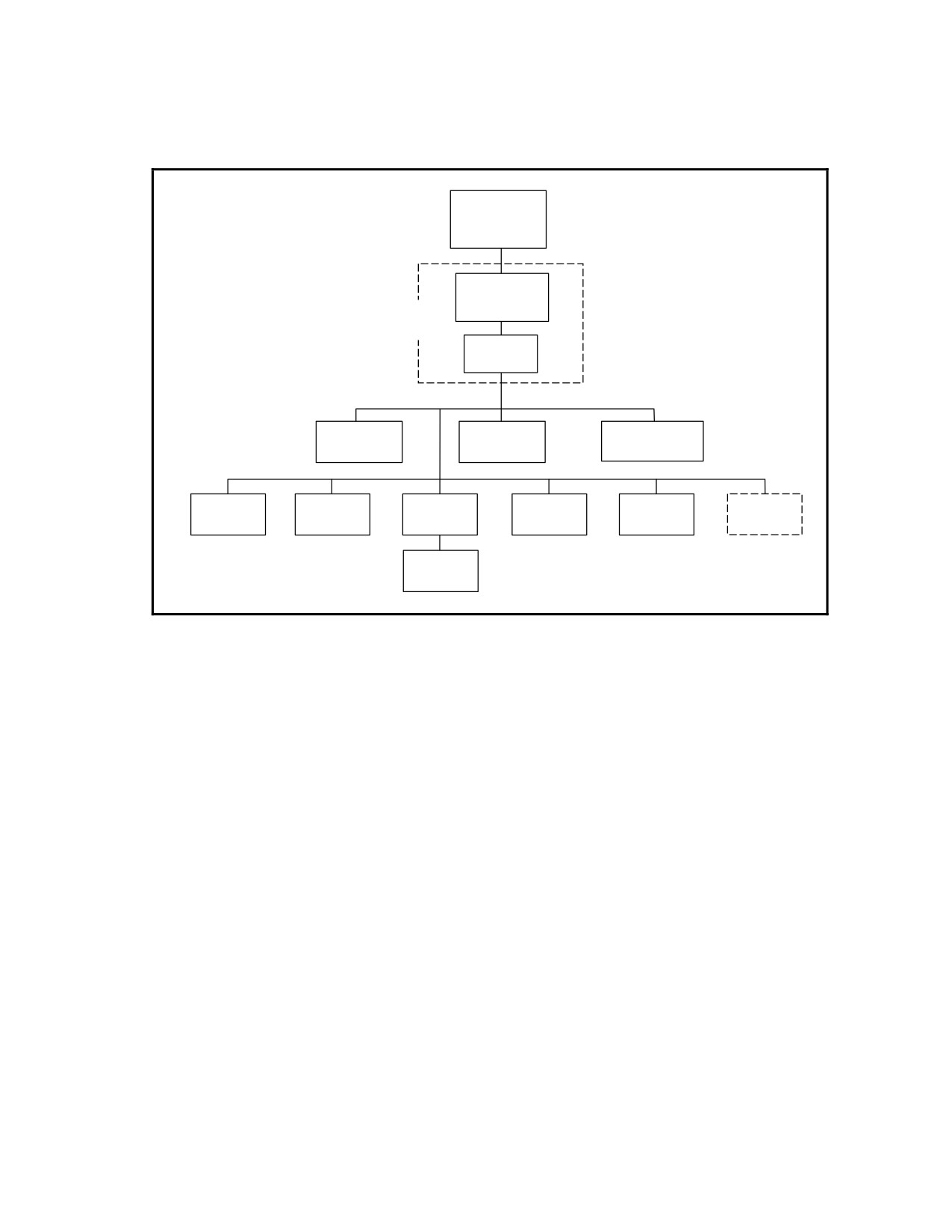
the General Staff forms the Supreme High Command (SHC) in wartime. (See
Figure 2-2.) The General Staff has direct control over the six services, and all
military forces report through it to the NCA. The Chief of the General Staff
(CGS) commands the SHC. The General Staff consists of three functional
directorates. These are the Operations, Intelligence, and Organization and
Mobilization directorates.
2-4
_________________________________________________________________________________Chapter 2
NATIONAL
COMMAND
AUTHORITY
MINISTRY OF
DEFENSE
SUPREME
HIGH COMMAND
GENERAL
STAFF
ORGANIZATION &
OPERATIONS
INTELLIGENCE
MOBILIZATION
DIRECTORATE
DIRECTORATE
DIRECTORATE
INTERNAL
STRATEGIC
SPF
ARMY
NAVY
AIR FORCE
SECURITY
FORCES
COMMAND
FORCES
AIR
DEFENSE
FORCES
Figure 2-2. Supreme High Command
2-17. Working with the staffs of each of the services, the Operations Direc-
torate of the General Staff drafts the military SCP for the CGS. Once the
CGS approves the military SCP, it becomes part of the national SCP, and the
General Staff issues it to appropriate operational-level commanders. During
peacetime and preparation for war, the Operations Directorate continues to
review and refine the plan. The military SCP assigns forces to operational-
level commands and designates AORs for those commands.
2-18. During combat operations, the Operations Directorate is responsible,
along with the Intelligence Directorate, for maintaining a continuous esti-
mate of the situation for the SHC. Because of the uncertainties of combat, the
Operations Directorate continually reevaluates the military SCP and modifies it
or develops a new plan based on guidance from the CGS. The Organization and
Mobilization Directorate determines the assets that each component of the mili-
tary needs to execute its portion of the national strategic campaign.
Theater Headquarters
2-19. For the State, a theater is a clearly defined geographic area in which
the OPFOR plans to conduct or is conducting military operations. Within its
region, the State may plan or conduct a strategic campaign in a single thea-
ter or in multiple theaters, depending on the situation. The General Staff
may create one or more separate theater headquarters, even in peacetime,
for planning purposes. However, no forces would be subordinated to such a
headquarters until the activation of a particular SCP.
2-5
FM 7-100.1 ________________________________________________________________________________
2-20. A theater headquarters provides flexible and responsive control of all
theater forces. When there is only one theater, as is typical, the theater head-
quarters may also be the field headquarters of the SHC, and the CGS may
also be the theater commander. Even in this case, however, the CGS may
choose to focus his attention on national strategic matters and to create a
separate theater headquarters, commanded by another general officer, to
control operations within the theater.
2-21. When parts of the strategic campaign take place in separated geographi-
cal areas and there is more than one major line of operations, the OPFOR
may employ more than one theater headquarters, each of which could have
its own theater campaign plan. In this case, albeit rare, the SHC field
headquarters would be a separate entity exercising control over the multiple
theater headquarters.
2-22. Theater command provides flexibility to the OPFOR, since the exis-
tence of one or more separate theater headquarters enables the SHC to fo-
cus on the strategic campaign and sustaining the forces in the field. A
theater headquarters acts to effectively centralize and integrate General
Staff control over theater-wide offensive and/or defensive operations. The
chief responsibility of this headquarters is to exercise command over all
forces assigned to a theater in accordance with mission and aim assigned by
the SHC. A theater headquarters links the operational efforts of the OPFOR
to the strategic efforts and reports directly to the SHC.
Administrative Force Structure
2-23. The OPFOR has an administrative force structure that manages its
military forces in peacetime. This structure is the aggregate of various military
headquarters, organizations, facilities, and installations designed to man,
train, and equip the forces. In peacetime, forces are commonly grouped into
corps, armies, or army groups for administrative purposes. An army group
can consist of several armies, corps, or separate divisions and brigades. The
administrative force structure also has responsibility for disaster manage-
ment and support to other State agencies. In some cases, forces may be
grouped administratively under geographical commands designated as
military regions or military districts.1 Normally, these administrative group-
ings differ from the OPFOR’s go-to-war (fighting) force structure.
2-24. The administrative force structure includes all components of the
Armed Forcesnot only regular, standing forces (active component), but also
reserve and militia forces (reserve component). For administrative purposes,
both regular and reserve forces come under the headquarters of their respec-
tive service component. Each of the six service components is responsible for
manning, equipping, and training of its forces and for organizing them within
the administrative force structure.
2-25. If the General Staff or SHC elects to create more than one theater
headquarters, it may allocate parts of the administrative force structure to
each of the theaters, normally along geographic lines. One example would be
to divide Air Force assets into theater air armies. Another would be to assign
1
A military district may or may not coincide with a political district within the State government.
2-6
_________________________________________________________________________________Chapter 2
units from the Special-Purpose Forces (SPF) Command to each theater, ac-
cording to theater requirements.
2-26. The administrative force structure also includes some assets centrally
controlled at the national level. For instance, major portions of the Air Force,
Navy, Strategic Forces, and the SPF Command often remain under the direct
control of their respective service component headquarters. The Army com-
ponent headquarters may retain centralized control of certain elite units of
the ground forces, including airborne units and Army SPF. This permits
flexibility in the employment of these relatively scarce assets in response to
national-level requirements. In peacetime, the internal security forces are
under the administrative control of the Ministry of the Interior. The pool of
national assets also includes major logistics facilities and installations.
2-27. In wartime, the normal role of administrative commands is to serve as
force providers during the creation of operational- and tactical-level fighting
commands. After transferring control of its major fighting forces to one or
more task-organized fighting commands, an administrative headquarters, facil-
ity, or installation continues to provide depot- and area support-level adminis-
trative, supply, and maintenance functions. (See Chapter 12.) A geographically-
based administrative command also provides a framework for the continuing
mobilization of reserves to complement or supplement regular forces.
2-28. In rare cases, an administrative command could function as a fighting
command. This could occur, for instance, when a particular administrative
command happens to have just the right combination of forces for executing a
particular SCP. Another case would be in times of total mobilization, when
an administrative command has already given up part of its forces to a fight-
ing command and then is called upon to form a fighting command with what-
ever forces remain under the original administrative headquarters.
2-29. Operational-level commands in the administrative force structure that
are called upon to fight will employ the doctrine in this manual. However,
they will not be able to employ joint or interagency forces effectively without
additional training, staff, and C2 systems.
OPERATIONAL-LEVEL ORGANIZATION
2-30. An SCP always contains both military and nonmilitary subordinate actions.
The operational level of command is that which executes military tasks as-
signed directly by an SCP. Operational-level commands translate actions di-
rectly supporting the SCP into an operation plan. The most common OPFOR
operational-level commands are field groups (FGs) and operational-strategic
commands (OSCs).2 Figure 2-3 shows one example of FG and OSC missions
within such a hypothetical SCP.
2 For the OPFOR, military actions above the tactical level will most commonly involve one or more OSCs, but could
possibly involve an FG as an additional level of operational command. In most cases, the statements about an
OSC in this manual would also apply to an FG, if one is created. Therefore, for the sake of brevity, references to
FG will appear only where it is important to make a distinction between the OSC and FG levels.
2-7
FM 7-100.1 ________________________________________________________________________________
Neutral
Allied
Country
Country
Sea
OSC AOR
Strategic Goal 3
Hostile
Strategic Goal 1
Country
“THE STATE”
OSC AOR
OSC AOR
OSC AOR
Sea
Strategic Goal 1
Strategic Goals 1+2
FG
AOR
LEGEND
Strategic Goals
Sea
1: Coastal Defense
2:
Invasion of Hostile Country
3: Neutralization of Unrest
Figure 2-3. Example of FGs and OSCs in an SCP
2-31. There is also the possibility that a division or division tactical group
(DTG) could be directly subordinate to the SHC in the fighting force structure
and thus perform tasks assigned directly by an SCP. In such cases, the OPFOR
would consider the divisions or DTGs to be operational-level commands. More
typically, however, they perform tactical missions as subordinates of an FG or
OSC. (For more detail of divisions and DTGs and their tactics, see FM 7-100.2.)
2-32. The SCP specifies the geographic AOR within which the operational-
level command’s allocated forces are intended to operate. A single SCP could
include more than one strategic goal. Thus, a particular FG or OSC could be
task organized to achieve one or more goals within its assigned AOR.
Field Group
2-33. A field group is the largest operational-level organization, since it has one
or more smaller operational-level commands subordinate to it. An FG is a group-
ing of subordinate organizations with a common headquarters, a common AOR,
and a common operation plan. FGs are always joint and interagency organiza-
tions and are often multinational. However, this level of command may or may
not be necessary in a particular SCP. An FG may be organized when the num-
ber of forces and/or the number of major military efforts in a theater exceeds the
theater commander’s desired or achievable span of control. This can facilitate
2-8
_________________________________________________________________________________Chapter 2
the theater commander’s remaining focused on the theater-strategic level of war
and enable him to coordinate effectively the joint forces allocated for his use.
Sea
Neutral Country
XXX
OSC
Mountains
“THE STATE”
XXX
Strategic Goal 2: Invasion of
OSC
Neighboring Country
Hostile Country
Sea
XXX
OSC
Strategic Goal 1:
Defense of
Homeland
Neutral Country
Figure 2-4. Field Group in Control of Multiple OSCs in a Major Military Effort
2-34. The General Staff does not normally form standing FG headquarters,
but may organize one or more during full mobilization, if necessary. An FG
can be assigned responsibilities in controlling forces in the field during adap-
tive operations in the homeland, or forward-focused functionally (an FG may
be assigned an access-control mission). However, FGs may exist merely to ac-
commodate the number of forces in the theater.
2-35. FGs are typically formed for one or more of the following reasons:
• An SCP may require a large number of OSCs and/or operational-level
commands from the administrative force structure. When the number
of major military efforts in a theater exceeds the theater commander’s
desired or achievable span of control, he may form one or more FGs.
(See Figure 2-4.)
• In the rare cases when multiple operational-level commands from the
administrative force structure become fighting commands, they could
come under the command of an FG headquarters. (See Figure 2-5.)
2-9
FM 7-100.1 ________________________________________________________________________________
• Due to modifications to the SCP, a standing operational-level head-
quarters that was originally designated as an OSC headquarters may
receive one or more additional major operational-level commands from
the administrative force structure as fighting commands. Then the
OSC headquarters would transition into an FG headquarters.
In the first two cases, a separate FG staff would be formed and identified as
having control over two or more OSCs (or operational-level commands from
the administrative force structure) as part of the same SCP. In the third case,
the original OSC headquarters would be redesignated as an FG headquar-
ters. In any case, the FG command group and staff would be structured in
the same manner as those of an OSC.
“THE STATE”
Field
Field
Group
Group
XXXX
Sea
XXX
XXXX XXXX
XXXX
XXXX
XXX
XXX
XXX
XXXX
Neutral
Country
Hostile Country
Sea
Figure 2-5. Field Groups Consisting of Multiple Operational-Level Commands from
the Administrative Force Structure
Operational-Strategic Command
2-36. The OPFOR’s primary operational organization is the OSC. Once the
General Staff writes a particular SCP, it forms one or
more standing OSC
headquarters. Each OSC headquarters is capable of controlling whatever
combined arms, joint, interagency, or multinational operations are necessary
to execute that OSC’s part of the SCP. However, the OSC headquarters does
not have any forces permanently assigned to it.
2-10
_________________________________________________________________________________Chapter 2
2-37. Figure 2-6 shows an example of allocation of forces to an OSC. The
units allocated from the administrative force structure to form the OSC typi-
cally come from an army group, army, or corps (or perhaps a military district
or military region) or from forces directly subordinate to a service headquar-
ters. There can also be cases where forces from the services have initially
been allocated to a theater headquarters and are subsequently re-allocated
down to the OSC. The organizations shown under the OSC, like those shown
under the theater headquarters in this example, indicate a pool of assets
made available to that command. The commander receiving these assets may
choose to retain them at his own level of command, or he may choose to sub-
allocate them down to one or more of his subordinates for their use in their
own task organization.
THEATER
OTHER
OTHER
THEATER
SPF
THEATER
ARMY
AIR ARMY
BRIGADE
ASSETS
GROUPS
ARMY
OTHER
FIGHTER-BOMBER
AIR FORCE
AVIATION
GROUP
ASSETS
DIVISION
FIGHTER-BOMBER
AVIATION
OTHER
REGIMENT
ARMY
OTHER
ARMY GROUP
AIRBORNE
ARMIES
ASSETS
BRIGADE
ARTILLERY
OTHER
OTHER
MECHANIZED
TANK
BRIGADE
ARMY
INFANTRY
DIVISIONS
ASSETS
DIVISION
DIVISION
COMBAT
UAV
SAM
SSM
HELICOPTER
SQUADRON
BRIGADE
BRIGADE
BRIGADE
ANTITANK
OSC
BRIGADE
OSC
MECHANIZED
TANK
AIRBORNE
INFANTRY
HQ
DIVISION
BRIGADE
DIVISION
LEGEND
Theater assets
resubordinated to
the OSC
SPF
ARTILLERY
SSM
SAM
Army group
assets
BRIGADE
BRIGADE
BRIGADE
BRIGADE
resubordinated to
the OSC
Army assets
FIGHTER-BOMBER
COMBAT
resubordinated to
ANTITANK
UAV
AVIATION
HELICOPTER
the OSC
REGIMENT
BRIGADE
BRIGADE
SQUADRON
Figure 2-6. Allocation of Forces to an OSC (Example)
2-38. When the NCA decides to execute
a particular SCP,
each OSC
partici-
pating in that plan receives appropriate units from
the OPFOR’s administra-
tive force structure, as well as interagency and/or multinational forces.
Forces subordinated to an OSC may continue to depend
on the administra-
tive force structure for support.
2-11
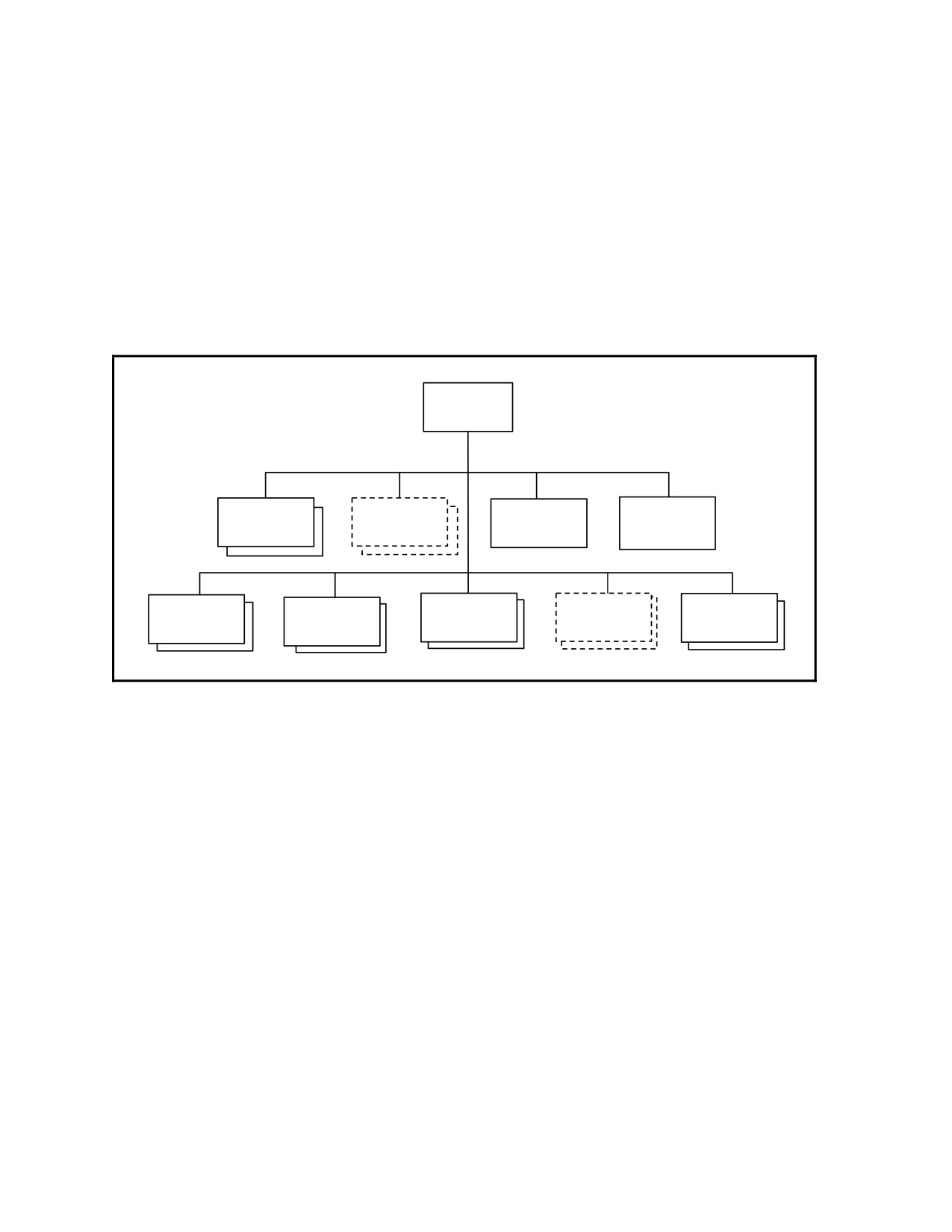
FM 7-100.1 ________________________________________________________________________________
2-39. If a particular OSC has contingency plans for participating in more
than one SCP, it could receive a different set of forces under each plan. In
each case, the forces would be task organized according to the mission re-
quirements in the given plan. Thus, each OSC consists of those division-,
brigade-, and battalion-size organizations allocated to it by the SCP currently
in effect. These forces also may be allocated to the OSC for the purpose of
training for a particular SCP. When an OSC is neither executing tasks as
part of an SCP nor conducting exercises with its identified subordinate
forces, it exists as a planning headquarters.
OSC
INTEGRATED
INTEGRATED
DTGs
DIVISIONS
FIRES
SUPPORT
COMMAND
COMMAND
AIR FORCE
MARITIME
INTERAGENCY
BTGs
BRIGADES
UNITS
UNITS
UNITS
Figure 2-7. Possible OSC Organization (Example)
2-40. Figure 2-7 shows an example of the types of organizations that could
make up a particular OSC organization. The numbers of each type of
subordinate and whether they actually occur in a particular OSC can vary.
As shown in this example, the composition of an OSC is typically joint,
with Air Force and possibly maritime (naval or naval infantry) units,
and it can also be interagency. If some of the allocated forces come
from another, allied country, the OSC could be multinational. The
simplified example of an OSC shown here does not show all the combat
support and combat service support units that would be present in such an
organization. Many of these support units are found in the integrated fires
command (outlined below) and the integrated support command (outlined
below and in Chapter 12). Other support units could be allocated initially
from the administrative force structure to the OSC, which further allocates
them to its tactical subordinates.
2-12
_________________________________________________________________________________Chapter 2
2-41. Once allocated to an OSC, a division or brigade often receives augmen-
tation that transforms it into a DTG or brigade tactical group (BTG), respec-
tively. However, an OSC does not have to task organize subordinate divisions
and brigades into tactical groups. Most divisions would become DTGs, but
maneuver brigades in the administrative force structure may be sufficiently
robust to accomplish their mission without additional task organization.
2-42. The OPFOR has great flexibility regarding possible OSC organizations
for different missions. There is virtually no limit to the possible permutations
that could exist. The allocation of organizations to an OSC depends on what
is available in the State’s administrative force structure, the mission re-
quirements of that OSC, and the requirements of other operational-level
commands.
TACTICAL-LEVEL ORGANIZATIONS
2-43. In the OPFOR’s administrative force structure, the largest tactical-
level organizations are divisions and brigades. In wartime, they are often
subordinate to a larger, operational-level command. However, they may also
be directly subordinate to a theater headquarters or to the SHC. In either
wartime role, a division or brigade may receive additional assets that trans-
form it into a tactical group.
2-44. A tactical group is a task-organized division or brigade that has re-
ceived an allocation of additional land forces in order to accomplish its mis-
sion. These additional forces may come from within the Ministry of Defense,
from the Ministry of the Interior, or from affiliated forces. Typically, these
assets are initially allocated to an OSC or FG, which further allocates them
to its tactical subordinates. If the tactical group operates as a separate com-
mand, it may receive additional assets directly from the theater headquar-
ters or the SHC that are necessary for it to carry out an operational-level
mission. The same higher command that augments a division or brigade to
transform it into a tactical group can also use some units from one divi-
sion or brigade to augment tactical groups based on other divisions or bri-
gades.
2-45. The purpose of a tactical group is to ensure unity of command for all
land forces in a given AOR. Tactical groups formed from divisions are divi-
sion tactical groups (DTGs), and those from brigades are brigade tacti-
cal groups (BTGs).
2-46. If a DTG has a mission directly assigned by an SCP, it acts as an op-
erational-level command. If a DTG has a mission assigned by an intermedi-
ate operational-level command (such as an FG or an OSC), then it acts as a
tactical-level command. In either of those cases, the original division head-
quarters becomes the DTG headquarters.
2-13