FM 7-100.1 OPFOR Opposing Force Operations (DECEMBER 2004) - page 1
*FM 7-100.1
Field Manual
Headquarters
No. 7-100.1
Department of the Army
27 December 2004
Opposing Force
Operations
Contents
Page
PREFACE
v
INTRODUCTION
vi
Chapter 1
STRATEGIC FRAMEWORK
1-1
National Security Strategy
1-1
Strategic Campaign
1-6
Strategic Operations
1-8
Regional Operations
1-9
Transition Operations
1-10
Adaptive Operations
1-12
Principles of Operations Versus an Extraregional Power
1-13
OPFOR Military and Operational Art
1-17
The Role of Paramilitary and Irregular Forces in Operations
1-20
Systems Warfare
1-23
Chapter 2
COMMAND AND CONTROL
2-1
Concept
2-1
Principles of Command and Control
2-2
Command and Control Structures
2-3
Command and Control Process
2-31
Command Posts
2-42
Command and Control Systems
2-46
_______________
Distribution Restriction: Approved for public release; distribution is unlimited.
*This publication supersedes FM 100-61, 26 January 1998.
i
FM 7-100.1 ________________________________________________________________________________
OFFENSIVE OPERATIONS
3-1
Strategic Context
3-1
Purpose of the Offense
3-3
Planning Offensive Operations
3-4
Preparing for the Offense
3-12
Executing the Offense
3-13
Types of Offensive Action
3-14
Chapter 4
DEFENSIVE OPERATIONS
4-1
Strategic Context
4-1
Purpose of the Defense
4-4
Planning Defensive Operations
4-5
Preparing for the Defense
4-15
Executing the Defense
4-17
Integrated and Decentralized Defenses
4-18
Types of Defensive Action
4-19
Chapter 5
INFORMATION WARFARE
5-1
New Concepts of Information in Warfare
5-1
Elements of IW
5-5
Tools and Targets
5-10
Strategic IW
5-10
Operational-Level IW
5-11
IW Planning and Execution
5-13
Strategic Context
5-15
Chapter 6
RECONNAISSANCE
6-1
Mission
6-1
Concept
6-1
Strategic Assets
6-5
Operational Assets
6-8
Strategic Context
6-10
Chapter 7
FIRE SUPPORT
7-1
Fire Support Concepts
7-1
Command and Control
7-4
Fire Support Planning
7-6
Targeting
7-10
Methods of Fire
7-13
Fire Support of Maneuver Operations
7-15
Strategic Context
7-16
ii
_________________________________________________________________________________ Contents
Chapter 8
AVIATION
8-1
Organization
8-1
Command and Control
8-4
Capabilities
8-7
Missions
8-9
Principles of Employment
8-11
Degree of Air Dominance
8-12
Strategic Context
8-13
Chapter 9
AIR DEFENSE SUPPORT
9-1
All-Arms Air Defense
9-1
Goals
9-2
Command and Control
9-4
Phases
9-9
Assets
9-14
Reconnaissance
9-19
Missions and Employment
9-22
Offense
9-25
Defense
9-27
Sanctuary Areas
9-28
Mountains and Water Obstacles
9-29
Air Defense Ambushes and Roving Units
9-29
Air Defense Against Unmanned Aerial Vehicles
9-31
Strategic Context
9-33
Chapter 10
ENGINEER SUPPORT
10-1
Assets
10-1
Command and Control
10-1
Missions
10-3
Engineer Reconnaissance
10-6
Survivability
10-8
Countermobility
10-8
Strategic Context
10-12
Chapter 11
NBC AND SMOKE OPERATIONS
11-1
Preparedness
11-1
Staff Responsibility
11-3
Chemical Warfare
11-3
Nuclear Warfare
11-7
Biological Warfare
11-10
NBC Protection
11-11
Smoke
11-13
Strategic Context
11-17
iii
FM 7-100.1 ________________________________________________________________________________
Chapter 12
LOGISTICS
12-1
Strategic Context
12-1
Tailored Logistics Units
12-4
Logistics Missions
12-5
Operational Logistics Concepts
12-5
Command and Control
12-7
Materiel Support
12-11
Maintenance
12-12
Transportation
12-12
Personnel
12-15
Medical Support
12-17
Support to Combat Operations
12-19
Post-Combat Support
12-21
Chapter 13
AIRBORNE, SPECIAL-PURPOSE FORCES, AND AMPHIBIOUS OPERATIONS .. 13-1
Airborne and Heliborne Operations
13-1
Special-Purpose Forces Operations
13-8
Amphibious Operations
13-17
GLOSSARY
Glossary-1
BIBLIOGRAPHY
Bibliography-1
INDEX
Index-0
iv
Preface
This manual is one of a series that describes a contemporary Opposing Force
(OPFOR) for training U.S. Army commanders, staffs, and units. See the
Bibliography section for a list of the manuals in this series. Together, these
manuals outline an OPFOR than can cover the entire spectrum of military and
paramilitary capabilities against which the Army must train to ensure success in
any future conflict.
Applications for this series of manuals include field training, training simula-
tions, and classroom instruction throughout the Army. All Army training venues
should use an OPFOR based on these manuals, except when mission rehearsal or
contingency training requires maximum fidelity to a specific country-based
threat. Even in the latter case, trainers should use appropriate parts of the
OPFOR manuals to fill information gaps in a manner consistent with what they
do know about a specific threat.
The proponent for this publication is HQ TRADOC. Send comments and
recommendations on DA Form 2028 directly to the OPFOR and Threat In-
tegration Directorate (OTID) of the TRADOC Office of Deputy Chief of Staff for
Intelligence at the following address: Director, OTID, ADCSINT-Threats, ATTN:
ATIN-T (Bldg 53), 700 Scott Avenue, Fort Leavenworth, KS 66027-1323.
This publication is available at Army Knowledge Online
(AKO) at
Doctrine Digital Library (ADTDL) at http://www.adtdl.army.mil. Readers should
monitor those sites and also the TRADOC ADCSINT-Threats Knowledge Center
on AKO for the status of this manual and information regarding updates.
Periodic updates, subject to the normal approval process, will occur as a result of
the normal production cycle in accordance with TRADOC regulation 25-36,
paragraphs 2-17 and 4-7. The date on the cover and title page of the electronic
version will reflect the latest update.
Unless this publication states otherwise, masculine nouns or pronouns do not re-
fer exclusively to men.
v
Introduction
This manual is part of the FM 7-100 series, which describes a contemporary
Opposing Force (OPFOR) that exists for the purpose of training U.S. forces
for potential combat operations. This OPFOR reflects the characteristics of
military and paramilitary forces that may be present in the contemporary
operational environment (COE). Like those real-world threats, the OPFOR
will continue to present new and different challenges for U.S. forces. The COE is
constantly changing, and it is important for U.S. Army training environments
to keep pace with real-world developments.
CONTEMPORARY OPERATIONAL ENVIRONMENT
The DOD officially defines an operational
Contemporary Operational
environment
(OE) as
“a composite of the
Environment (COE)
conditions, circumstances, and influences
that affect the employment of military forces
The operational environment
and bear on the decisions of the unit
that exists today and for the
commander”
(JP
1-02). The contemporary
clearly foreseeable future.
operational
environment
(COE) is the
operational environment that exists today
and for the clearly foreseeable future. There are some “constants” or common
threads that define the general nature of this COE:
• The United States in not likely to have a peer competitor until 2020 or be-
yond.
• However, nations will continue to field armed forces and use these forces
as a tool to pursue national interests.
• As nations use their armed forces (or other instruments of national power)
in pursuit of national interests, their actions may cause U.S. intervention,
either unilaterally or as a coalition partner, with or without United Na-
tions mandate.
• Nations that believe the United States may act to counter their national
interests will develop diplomatic, informational, economic, and military
plans for managing U.S. intervention.
• Nations will continue to modernize their armed forces within the con-
straints of their economies, but in ways that may negate U.S. overmatch.
• Advanced technology will be available on the world market for a wide va-
riety of nation-state and non-state actors.
• Non-state actors will play an important role in any regional conflictas
combatants or noncombatants.
• All combat operations will be significantly affected by a number of vari-
ables in the environment beyond simple military forces.
Thus, one of the constants is that there are variables. Those “variables” in the
COE result in a number of different OEs that can occur in specific circumstances
or scenarios.
vi
______________________________________________________________________________ Introduction
CRITICAL VARIABLES
Any OE, in the real world or in the
training environment, can be defined
Critical Variables of COE
in terms of eleven critical variables.
• Nature and Stability of the State.
While these variables can be useful in
• Regional and Global Relationships.
describing the overall
(strategic)
• Economics.
environment, they are most useful in
• Sociological Demographics.
defining the nature of specific OEs.
• Information.
Each of these “conditions, circumstances,
• Physical Environment.
and influences” and their possible
• Technology.
combinations will vary according to
• External Organizations.
the specific situation. In this sense,
• National Will.
they are “variables.” These variables
• Time.
are interrelated and sometimes
• Military Capabilities.
overlap. Different variables will be
more or less important in different
situations. Each OE is different, because the content of the variables is different.
Only by studying and understanding these variablesand incorporating them
into its trainingwill the U.S. Army be able to keep adversaries from using them
against it or to find ways to use them to its own advantage.
Nature and Stability of the State
It is important to understand the nature and stability of the state (or states) with
which or in which the conflict takes place. Study of this variable measures how
strong or weak a country is and determines where the real strength of the state
lies; it may be in the political leadership, the military, the police, or some other
element of the population. Understanding this variable will allow U.S. forces to
better understand the nature of the military campaign and the true aims of an
enemy campaign, operation, or action. It also helps determine what kinds of
threats may be present in a particular country. The real threat to U.S. forces
may come from elements other than the military.
Regional and Global Relationships
Nation-states and/or non-state actors often enter into relationships, which can be
regional or global. These partnerships support common objectives, which can be
political, economic, military, or cultural. An actor’s membership or allegiance to
such a relationship can determine its actions of support and motivation. Virtually all
conflict will occur with alliances and coalitions, some involving the United States
and some involving its adversaries. When actors create regional or global alliances,
it can add to their collective capability and broaden the scale of operations and
actions.
As the world moves away from the traditional long-term, fixed alliances of the
past, regional and global relationships are much more fluid and unpredictable.
The choice of a state to be nonaligned does not mean that it will not become in-
volved in a conflict or crisis. It simply means that the state does not make a
commitment to another state, alliance, or cause before a situation arises. This
lack of precommitment makes it difficult to predict how actors and forces may
align when a situation does arise. Alliances can form or change rapidly, even dur-
ing the course of an operation or campaign.
vii
FM 7-100.1 ________________________________________________________________________________
Economics
The economic variable establishes the boundaries between the “haves” and the
“have-nots.” This gap of economic differences among nation-states and other ac-
tors can cause conflict. Economic superiority, rather than military superiority,
may be the key to power or dominance within a region. However, economic posi-
tion often represents a nation or non-state actor’s ability to buy military technol-
ogy or to conduct prolonged operations. Economics help define the relationship
between a nation or non-state actor and other actors at the regional or global
level. These regional or global economic relationships could result in military or
political assistance.
Sociological Demographics
The demographics variable includes the cultural, religious, and ethnic makeup of
a given region, nation, or non-state actor. Extreme devotion to a particular cause
or significant hatred of a particular group may provide an enemy with an unshak-
able will and a willingness to die for the cause. U.S. forces may also find that large
segments of the population around them are sympathetic to the same cause as the
enemy force. The needs of the local population can create heavy demands on U.S.
military units, particularly their supply and medical systems. Refugees and inter-
nally displaced persons may increase the complexity of the environment. The enemy
may use civilians as shields or obstacles or as cover for hostile intelligence services.
Information
Media and other information means can make combat operations transparent to
the world, visible to all who have access to data. Various actors seek to use per-
ception management to control and manipulate how the public sees things. They
will exploit U.S. mistakes and failures and use propaganda to sway the local
population to support their cause. Media coverage can impact on U.S. political
decision making, international opinion, or the sensitivities of coalition members.
Even without sophisticated sensors and information systems, actors native to the
area or region often have greater situational awareness than U.S. forces. Various
actors are able to access commercial systems (such as satellite communications
and imagery) for the larger picture. For a more detailed view, they can use hu-
man networks operating over normal telephone lines or with cellular telephones.
Physical Environment
The main elements in the physical environment are terrain and weather. Poten-
tial enemies clearly understand that less complex and open environments favor a
U.S. force with its long-range, precision-guided weapons and sophisticated re-
connaissance capability. So they will try to avoid the types of operations and en-
vironments for which such U.S. forces are optimized. They will try to operate in
urban areas and other complex terrain and in weather conditions that may ad-
versely affect U.S. military operations and mitigate technological advantages.1
1 Complex terrain is a topographical area consisting of an urban center larger than a village and/or of two or more
types of restrictive terrain or environmental conditions occupying the same space. (Restrictive terrain or environ-
mental conditions include but are not limited to slope, high altitude, forestation, severe weather, and urbanization.)
Complex terrain, due to its unique combination of restrictive terrain and environmental conditions, imposes signifi-
cant limitations on observation, maneuver, fires, and intelligence collection.
viii
______________________________________________________________________________ Introduction
Technology
The technology that nations or non-state actors can bring to the OE includes
what they can develop and produce, as well as what they could import. Access to
technological advances available on the global market is slowly eating away at
the technological advantage the United States has enjoyed in the past.
It is likely that some high-end forces in a particular region of the world could
field a few systems that are more advanced than those of the U.S. force deployed
there. Easy access to new technology allows potential adversaries to achieve
equality or even overmatch U.S. systems in selected niche areas. Many countries
are trying to acquire relatively low-cost, high-payoff, new technologies. In addi-
tion, upgrades and hybridization allow older systems to compete with more mod-
ern capabilities, thus neutralizing the technical advantage of many modern
forces. In urban areas or other complex terrain, less advanced systems may still
find effective uses. Various actors may find adaptive and innovative ways of us-
ing systems for other than their originally intended applications.
External Organizations
When the U.S. Army goes into a failed state or into areas torn by conflict, it is
likely to find international humanitarian relief organizations at work there.
These external organizations continue to grow in influence and power, as well as in
willingness to become involved in crisis situations that were previously purely mili-
tary operations. These external organizations can have both stated and hidden in-
terests and objectives that can either assist or hinder U.S. mission accomplishment.
The presence of transnational corporations operating in a country or region can also
place added pressure on U.S. forces to avoid collateral damage to civilian life and
property. U.S. forces may have to divert troops and resources from their assigned
missions to conduct rescues or provide security for various external organizations.
Prior to the outbreak of hostilities in a given region (or at least prior to U.S. mili-
tary intervention there), during such hostilities, or after the conclusion of hostili-
ties in a particular area, members of external organizations and other civilian
noncombatants from outside the region may be endangered. Diplomatic person-
nel, other government employees, or private citizens from the United States or
other countries might be present in one or more countries within the region. The
private citizens might be associated with an external organization (media, hu-
manitarian relief organization, or transnational corporation) or might be there on
private business or as tourists. If their lives are endangered by war, civil unrest,
or natural disaster, such U.S. citizens and their dependents, as well as selected
host-nation citizens and third-country nationals, could be eligible for evacuation
in noncombatant evacuation operations conducted by U.S. forces.
National Will
The variable of national will reflects how much each country’s people and gov-
ernment are behind what the military or paramilitary forces are doing. This can
influence the objectives of a conflict, its duration, and the conditions for ending it.
A country will try to attack its opponent’s national will and still preserve its own.
Clearly, most foreign countries view U.S. national will as a point of vulnerability.
Thus, a potential adversary may perceive the collective will of his people as a
comparative advantage against the United States.
ix
FM 7-100.1 ________________________________________________________________________________
History has proven that battlefield victory does not always go to the best-trained,
best-equipped, and most technologically advanced force. Victory often goes to the
side that most wants to win, needs to win, and is willing to sacrifice to do so.
Time
In most cases, potential opponents of the United States view time as being in
their advantage. When U.S. forces have to deploy into the area over long time
and distance, the opponent can use this time to adjust the nature of the conflict
to something for which the U.S. forces are not prepared.
First, the opponent will try to control the entry of U.S. forces into the area. If ac-
cess control fails, the enemy still has the opportunity to oppose lightly equipped
U.S. early-entry units and try to prevent full deployment of the rest of the force.
The opponent will try to speed up the tempo, to rapidly defeat its local or re-
gional enemy or to defeat U.S. early-entry forces before the United States can
deploy overwhelming military power. If that fails, the opponent will try to pro-
long the conflict and to outlast the U.S. will to continue.
Military Capabilities
Military capabilities of a nation-state or non-state actor are measured in relative
terms, in comparison to the capabilities of other actors against which they might
be applied. Most of the military forces in the world continue to operate in conven-
tional ways, which remain sufficient against other local and regional actors.
However, once the United States becomes involved, these same military forces
may have to use adaptive or asymmetric approaches. Various nations and
other foreign entities around the world study the United States and its military
forces. They generally view the United States as a major power—the world’s only
superpower—with an overall advantage in technology and warfighting capabil-
ity. Despite these strengths, other actors see some weaknesses that they may be
able to exploit. They can use these perceptions as a guide to optimizing the effec-
tiveness of their own forces and to find ways to negate current U.S. advantages.
Military capabilities may be the most critical and the most complex variable that
affects military operations. However, the military variable does not exist in isola-
tion from the other variables that help determine the overall OE. It interacts
with the other variables, and all the other variables can affect military capabilities.
Potential enemies can use any or all of these factors against the Army as it tries to
accomplish its missions in various parts of the world or in various training environ-
ments.
REAL WORLD
In the real world, the COE is the entire set of conditions, circumstances, and influ-
ences that U.S. Armed Forces can expect to face when conducting military opera-
tions to further the national interests of the United States, its friends, and allies.
The COE is “contemporary” in the sense that it does not represent conditions that
existed only in the past or that might exist only in the remote future, but rather
those conditions that exist today and in the clearly foreseeable, near future. This
COE consists not only of the military and/or paramilitary capabilities of potential
real-world adversaries, but also of the manifestations of the ten other variables that
help define any OE.
x
______________________________________________________________________________ Introduction
TRAINING
In training environments, the COE is the OE created to approximate the de-
mands of the real-world COE and to set the conditions for desired training out-
comes. This involves the appropriate combination of an OPFOR (with military
and/or paramilitary capabilities representing a composite of a number of potential
adversaries) and other OE variables in a realistic, feasible, and plausible manner.
The purpose of the COE in training simulations is to produce the necessary training
outcomes.2
Even in the COE for training, it is possible to speak of an overall COE that ad-
dresses the qualities of virtually any OE in which the units or individuals being
trained might be called upon to operate. In this sense, there are the same “con-
stants” as in the real-world COE.
INTERACTION AND LINKAGE OF VARIABLES
The variables of the COE do not exist in isolation from one another. The linkages
of the variables cause the complex and often simultaneous dilemmas that a
military force might face. In order to provide realistic training, training
scenarios must try to simulate this synergistic effect to the maximum degree
that is feasible.
The COE is not just about the OPFOR. The COE variables and their interaction
provide the robust environment and context for OPFOR operations. The com-
plexity of the specific OE in training can be adjusted to keep it appropriate for
the required training objectives and the training state of various U.S. Army
units.
ADAPTIVE AND CHANGING
The nature of the COE is adaptive and constantly changing. As the United States
and its military forces interact with the COE in a real-world sense, the OE
changes. As the Army applies the lessons learned from training in a COE setting,
the OPFOR and potential real-world adversaries will also learn and adapt.
The development of the COE for training started with research to develop an un-
derstanding of the real-world COE and trends that affect military operations. Then,
taking into consideration the desired training outcomes and leader development
goals, the authors of the FM 7-100 series proceeded to document an OPFOR doctrine
and structure that reflect the real-world COE, and the Army began integrating this
OPFOR and other COE variables into training scenarios. Meanwhile, the authors of
the FM 7-100 series are continuing to research the real-world COE and to mature
the OPFOR and the COE in training in order to provide a richer, appropri-
ately challenging training environment and keep the OPFOR and the COE
truly “contemporary.”
2 The same type of COE conditions can be created to support some combat development activities that do not re-
quire simulation of a specific real-world potential adversary. However, some combat development activities may
require portrayal of an OE that extends further into the future than is typical for the COE.
xi
FM 7-100.1 ________________________________________________________________________________
ENEMY, THREAT, AND OPFOR
Before going further into the COE, the contemporary OPFOR, and the intended
uses of this manual, it may be useful to define some key terms and the distinc-
tions among them. It is important to distinguish among the terms enemy, threat,
and OPFOR and to use them correctly.
ENEMY
From the U.S. perspective, an enemy is an individual, group of individuals (or-
ganized or not organized), paramilitary or military force, national entity, or na-
tional alliance that is in opposition to the United States, its allies, or multina-
tional partners. In other words, the enemy is whoever is actually opposing the
United States in a particular conflict.3 Thus, this term is synonymous with ad-
versary or opponent.
THREAT
A potential adversary is sometimes designated as a threat. In this sense, the
Army defines threat as “any specific foreign nation or organization with inten-
tions and military capabilities that suggest it could become an adversary or chal-
lenge the national security interests of the United States or its allies.” Once hos-
tilities actually begin, the threat becomes the enemy.
OPPOSING FORCE
An Opposing Force (OPFOR) is a training tool that should allow the U.S. Army to
train against a challenging and plausible sparring partner that represents the
wide range of possible opponents the Army could face in actual conflict. It en-
ables training of all arms of the Army and prepares the Army for potential
combat operations.4
During the road to war leading up to events in a training scenario, the OPFOR
may play the role of a “threat” (potential enemy) that is on the verge of becoming
an enemy. However, the actual training event usually deals with a state of hos-
tilities. Thus, once hostilities begin in the training event, the OPFOR acts as the
“enemy” of the U.S. force in the training environment.5
During the Cold War period, the Army employed OPFORs based on specific real-
world threats. However, the Army needs a different type of OPFOR to meet its
training requirements for the COE.
3 This definition of enemy is from the U.S. point of view. After this Introduction, the chapters of this manual address
their topics from the OPFOR point of view. So, friendly refers to the OPFOR and its allies, and enemy refers to the
enemy of the OPFOR, which may be an opponent within its own country or region or an extraregional opponent
(normally the United States or a U.S.-led coalition).
4 Although the OPFOR is primarily a training tool, it may be used for other purposes. For example, some combat de-
velopment activities that do not require simulation of a specific real-world potential adversary may use an OPFOR to
portray the “threat” or “enemy.”
5 From the OPFOR point of view, its leadership plans and develops forces and methods to deal with one or more
threats to its own interests, goals, or survival.
xii
______________________________________________________________________________ Introduction
Cold War OPFOR
When the Army established its OPFOR program in 1976 with Army Regulation
350-2, it could hardly have envisioned today’s computerized constructive and vir-
tual simulations, or even the evolving requirements of live simulations. It de-
fined an OPFOR simply as “an organized force created by and from U.S. Army
units to portray a unit of a potential adversary armed force.” Thus, all OPFORs
were originally threat-based, in the sense that they replicated the forces, capa-
bilities, and doctrine of a particular country officially recognized as a threat or
potential adversary. In the midst of the Cold War, the 1976 regulation identified
only one potential adversary against which to train: the Soviet Union; by 1978, a
revision of the regulation added North Korea as a second threat for replication by
an OPFOR. Over time, the Army developed other OPFORs to replicate other
threats emerging in places ranging from Latin America and Southwest Asia.
In its time, the threat-based OPFOR served the Army very well, particularly for
units targeted against specific threats. The benefits of this training were borne out,
for example, in Operation Desert Storm. Techniques and doctrine, including deep at-
tack and the intelligence preparation of the battlefield, developed to cope with spe-
cific threats and honed against the OPFOR, enabled the Army to achieve decisive
results on the battlefield. However, the OE is dynamic, and the pace of that dynamism
has increased with the end of the Cold War and the rapid advancement of informa-
tion technology.
Contemporary OPFOR
Training U.S. forces for the COE re-
Contemporary OPFOR
quires a different kind of OPFOR from
that of the past. The contemporary
A plausible, flexible military and/or
OPFOR must be less predictable and
paramilitary force representing a
not based on the armed forces of a par-
composite of varying capabilities of
ticular country. In today’s world, the
actual worldwide forces, used in
U.S. Army must be prepared to go into
lieu of a specific threat force, for
any OE and perform its full range of
training and developing U.S. forces.
missions. It must be ready to do so in
the face of a wide variety of possible threats and at the same time be prepared to
deal with third-party actors that may have other interests. Not all threats are
purely military in nature. Therefore, the U.S. Army now defines an OPFOR as “a
plausible, flexible military and/or paramilitary force representing a composite of
varying capabilities of actual worldwide forces, used in lieu of a specific threat
force, for training and developing U.S. forces.”
Thus, in some training environments, a military force alone may be the OPFOR.
In other cases, military forces may have paramilitary forces acting in loose affilia-
tion with them, or acting separately from them within the same training environ-
ment. These relationships depend on the scenario, which is driven by training re-
quirements.
Various agencies and experts have different lists of real-world threats the United
States might have to face. If the U.S. Army were to pick any one of these threats
as the threat against which to train, that threat would almost certainly not be
the one it would actually fight. What is needed is a composite that is representa-
tive of the full range and variety of possible threats and OEs. It must have a bit
xiii
FM 7-100.1 ________________________________________________________________________________
of everythingit could be virtually anybody, anywhere. Therefore, this manual de-
fines this representative composite in a way that is flexible enough to fit the most
demanding U.S. Army training requirements and provides a framework for training
that creates the leaders, soldiers, and unit skills necessary for success on the next
battlefield.
CONTEMPORARY THREATS AND OTHER ACTORS
There are many types of actors or participants in today’s complex world envi-
ronment. Some of the actors are countries (also called nation-states) and some
are not. Nation-states are still dominant actors. However, some power is shifting
to nontraditional actors and transnational concerns. There are many potential
challenges to traditional concepts like balance of power, sovereignty, national in-
terest, and roles of nation-state and non-state actors.
Of course, not all actors are threats. To be a threat, a nation or organization must
have both the capabilities and the intention to challenge the United States. The
capabilities in question are not necessarily purely military, but encompass all the
elements of power available to the nation or organization.
NATION-STATE ACTORS
Nation-states fall into four basic categories according to their roles in the inter-
national community. The categories are core states, transition states, rogue
states, and failed or failing states.
The category of core states includes more than half of the nearly 200 countries in
the world today. These are basically democratic (although to varying degrees)
and share common values and interests. Within this larger group, there is an
“inner core” of major powers. These are the advanced countries, including the
United States, that generally dominate world politics. Most conflict with global
consequences will involve the core states in some fashion or another.
Transition states are other larger, industrial-based countriesmostly emerging
regional powersthat are striving to become major powers. High-end transition
states are moving from an industrial-based society to an information-based soci-
ety. Low-end transition states are seeking to move from an agricultural-based so-
ciety to an industrial base. As states try to make this transition, there are cycles
of political stability and instability, and the outcome of the transition is uncer-
tain. Some transition states may successfully join the ranks of core states and
even become major powers within that context; others may become competitors.
Rogue states are those that are hostile to their neighbors or to core states’ inter-
ests. These countries can sponsor international terrorism or even confront U.S.
military forces operating in the region. Failed or failing states are fragmented in
such a way that a rule of law is absent; their instability is a threat to their neigh-
bors and the core states.
Countries can move from one category to another, as conditions change. Some-
times countries join together in multinational alliances and coalitions. Together,
they have more strength and can become a power to be reckoned with.
xiv
______________________________________________________________________________ Introduction
NON-STATE ACTORS
Non-state actors are those that do not represent the forces of a particular
nation-state. Such non-state elements include rogue actors as well as third-
party actors.
Like rogue states, rogue actors are hostile to other actors; however, they may be
present in one country or extend across several countries. Examples include
insurgents, guerrillas, mercenaries, and transnational or subnational political
movements. Particular sources of danger are terrorists and drug-trafficking or
criminal organizations, since they may have the best technology, equipment, and
weapons available, simply because they have the money to buy them. These non-
state rogue actors may use terror tactics and militarily unconventional methods to
achieve their goals.
Third-party actors may not be hostile to other actors. However, their presence,
activities, and interests can affect the ability of military forces to accomplish
their mission when operating in a foreign country. These third-party actors can
be refugees, internally displaced persons, and other civilians on the battlefield,
including international humanitarian relief agencies, transnational corporations,
and the news media. These individuals and groups bring multiple sources of mo-
tivation, ideology, interests, beliefs, or political affiliations into consideration.
They may be sources of civil unrest. Their presence may require military forces to
consider the potential impacts of traffic congestion, demonstrations, sabotage,
and information manipulation.
REAL-WORLD AND TRAINING CONSIDERATIONS
When U.S. forces become involved in a particular country or region, they must
take into account the presence and influence of these various types of threats and
other actors. In a training environment, an OPFOR can represent a composite of
those nation-state or non-state actors that constitute military and/or paramilitary
forces that could present a threat to the United States, its friends, or its allies.
Other, non-state actors that fall in the category of nonmilitary forces or elements
are not part of the OPFOR, but could be part of the COE used in the training
environment.
CONTEMPORARY OPFOR
This manual introduces the baseline operational doctrine of a flexible, thinking,
adaptive, contemporary OPFOR that applies its doctrine with considerable ini-
tiative. (See the definition of contemporary OPFOR above.) It is applicable to the
entire training community, including the OPFORs at all of the combat training
centers (CTCs), the TRADOC schools, and units in the field. It provides an
OPFOR that believes that, through adaptive use of all available forces and capa-
bilities, it can create opportunities that, properly leveraged, can allow it to fight
and win, even against a technologically superior opponent such as the United
States.
xv
FM 7-100.1 ________________________________________________________________________________
BASELINE
As a baseline for developing specific OPFORs for specific training environments,
this manual describes an OPFOR that is representative of the forces of con-
temporary nation-states. This composite of the characteristics of real-world
military and paramilitary forces provides a framework for the realistic and
relevant portrayal of capabilities and actions that U.S. armed forces might
face in the COE.
The State
For this composite of real-world threats, the manual refers to the country in
question as “the State.”6 It describes this artificial country in terms of the eleven
critical variables of the COE. As the baseline for the contemporary OPFOR that
is representative of real-world forces, the State is not a peer competitor of the
United States. However, it is a dominant power in its region of the world and is
capable of challenging U.S. interests there. The general characteristics of the State
could fit a number of different types of potential adversaries in a number of different
scenarios.
Like most countries in the world, the State does not design its forces just to fight
the United States or its allies. It designs them principally to deal with regional
threats and to take advantage of regional opportunities. Therefore, the State’s
national security strategy (including its doctrine, force design, and investment
strategy) focuses primarily on maintaining and expanding its position as a re-
gional power. It develops its military forces in a way that ensures conventional
power superiority over any of its regional neighbors. These forces, together with
the State’s other instruments of power, make it a dominant force in its region.
At the same time, the State is aware that aggressive pursuit of its regional goals
might lead to intervention by a major power, such as the United States, from out-
side the region. To the extent possible, therefore, it invests in technologies and
capabilities that have utility against both regional and extraregional opponents.
The basic force structure of the OPFOR is the same for either type of threat. The
State must go to waror continue the war after extraregional interventionwith
whatever it had going into the war.
When an extraregional power intervenes with sufficient force to overmatch the
State’s, the State has to adapt its patterns of operation. It realizes that the forces
and technology that allow it to dominate its neighbors may not be a match for the
modern, high-technology forces of a wealthy extraregional power like the United
Statesat least not in a head-to-head conventional confrontation. However, it can
use those means in creative and adaptive ways. To the maximum extent possible,
the State plans and trains for adaptive operations and how it will make the transi-
tion to them. It is the combination of the State’s capabilities and its adaptive strat-
egy, operations, and tactics that make it believe it can take on such an extraregional
force and win.
6 In specific U.S. Army training environments, the generic name of the State may give way to other (fictitious)
country names such as Atlantis, Upper Flambokia, or Westland.
xvi
______________________________________________________________________________ Introduction
Broadened Context
At the strategic level, the State’s ability to challenge U.S. interests includes not
only the military and paramilitary forces of the State, but also the State’s dip-
lomatic-political, informational, and economic instruments of power. Rarely
would any country engage the United States or a U.S.-led coalition with purely
military means. It is also possible that the State could be part of an alliance or
coalition, in which case the OPFOR could include allied forces. These nation-
state forces may also operate in conjunction with non-state actors such as insur-
gents, terrorists, and drug or criminal organizations.
The FM 7-100 series, as a whole, covers not only the military and paramilitary forces
of the State, but also other, non-state paramilitary and nonmilitary organizations
present in the State’s region of the world. An extraregional power becoming involved
in that region may have to deal with any or all of these types of military, paramilitary,
and nonmilitary elements. It might encounter these elements individually or, more
likely, in combination with other such elements. Whether these elements operate in
concert or independently, they are an important part of the COE.
Trainers need to consider the total OE and all instruments of power at the
disposal of the State and the OPFORnot just the military element, but also
diplomatic-political, informational, and economic means. For a nation-state,
these are instruments of national power. For non-state actors whose forces are
paramilitary in nature, the other three instruments of power are generally
present to one degree or another. Together, these instruments represent the
power that actors can bring to bear against the United States.
Terminology
Since OPFOR baseline doctrine is a composite of how various forces worldwide
might operate, it uses some terminology that is in common with that of other
countries, including the United States. Whenever possible, OPFOR doctrine uses
established U.S. military termswith the same meaning as defined in FM 1-02
(formerly FM 101-5-1) and/or JP 1-02. However, the FM 7-100 series also in-
cludes some concepts for things the OPFOR does differently from how the U.S.
military does them. Even if various real-world foreign countries might use the
same concept, or something very close to it, different countries might give it dif-
ferent names. In those cases, the OPFOR manuals either use a term commonly
accepted by one or more other countries or create a new, “composite” term that
makes sense and is clearly understandable. In any case where an operational or
tactical term is not further specifically defined in the FM 7-100 series, it is used
in the same sense as in the U.S. definition.
FLEXIBILITY
As a training tool, the OPFOR must be a challenging, uncooperative sparring
partner, capable of stressing any or all battlefield operating systems of the U.S.
force. However, it also must be tailored to meet training requirements.
In the OPFOR baseline presented in this manual, the FM authors often say that
the State or the OPFOR “may” be able to do something or “might” or “could” do
something. They often use the progressive forms of verbs to say that the State has a
“growing” economy or “is developing” a capability or “is continually modernizing.”
xvii
FM 7-100.1 ________________________________________________________________________________
The State participates in the global market, which can allow it to acquire things
it cannot produce domestically. Such descriptions give scenario writers consider-
able flexibility in determining what the State or the OPFOR actually has at a
given point in time or a given place on the battlefieldin a particular scenario.
The composite example of this baseline may meet the OPFOR requirements for
many U.S. Army training environments. For cases that require an OPFOR based
on a type of nation-state with characteristics different from those of the State de-
scribed in this manual, this baseline provides a framework from which trainers
can develop an OPFOR appropriate for their particular training requirements.
The OPFOR must be flexible enough to fit various training requirements. It must
be scalable and tunable. Depending on the training requirement, the OPFOR
may be a large, medium, or small force. Its technology may be state-of-the-art,
relatively modern, obsolescent, obsolete, or an uneven combination of those cate-
gories. Its ability to sustain operations may be limited or robust.
THINKING
This manual describes how the OPFOR thinks, especially how it thinks about
fighting its regional neighbors and/or the United States. This thinking deter-
mines basic OPFOR operationsas well as strategy and tactics, which are the
subjects of other manuals in this series. It drives OPFOR organizational
structures and equipment acquisition or adaptation. It also determines how
the nation-state OPFOR that represents the armed forces of the State would
interact with other, non-state actors that may be present in the COE.
Just because the U.S. force knows something about how the OPFOR has fought
in the past does not mean that the OPFOR will always continue to fight that
way. A thinking OPFOR will learn from its own successes and failures, as well as
those of its potential enemies. It will adapt its thinking, its makeup, and its way
of fighting to accommodate these lessons learned. It will continuously look for
innovative ways to deal with the United States and its armed forces.
ADAPTABILITY
Like all military forces, the OPFOR has a basic, conventional design for dealing
with forces with capabilities equal to or inferior to its own. Prior to a U.S. force
becoming involved, therefore, the OPFOR can use the application or threat of ap-
plication of that conventional design to dominate or influence its regional neighbors.
The OPFOR plans these operations well in advance and tries to execute them as
rapidly as possible, in order to preclude regional alliances or outside intervention.
The OPFOR has developed its doctrine, force structure, and capabilities with an
eye toward employing them against both regional and extraregional opponents, if
necessary. It has thought about and trained for how to adapt once an extraregional
force becomes engaged. It has included this adaptability in its doctrine in the
form of general principles, based on its perceptions of the United States and
other threats to its goals and aspirations. It will seek to avoid types of operations
and environments for which U.S. forces are optimized. During the course of con-
flict, it will make further adaptations, based on experience and opportunity.
xviii
______________________________________________________________________________ Introduction
When a U.S. force or a U.S.-led coalition first begins to deploy into theater, the
OPFOR will seek to disrupt the deployment and thus create opportunity. In such
cases, the conventional design the OPFOR used in regionally-focused operations
may still provide the framework for military operations against an advanced ex-
traregional force. The OPFOR will not shy away from the use of military means
against such an opponent, so long as the risk is commensurate with potential
gains. As a U.S. or coalition force builds up power in the region, the OPFOR must
rely on adaptive applications of its basic design in order to mitigate its disadvan-
tages and exploit its advantages compared to this new opponent.
In general, the contemporary OPFOR will be less predictable than OPFORs in
the past. It will be difficult to template as it adapts and attempts to create oppor-
tunity. Its patterns of operation will change as it achieves success or experiences
failure. OPFOR doctrine might not change, but its way of operating will.
INITIATIVE
Like U.S. Army doctrine, OPFOR doctrine must allow sufficient freedom for bold,
creative initiative in any situation. OPFOR doctrine is descriptive, but not prescrip-
tive; authoritative, but not authoritarian; definitive, but not dogmatic. The OPFOR
that U.S. units encounter in various training venues will not apply this doctrine
blindly or unthinkingly, but will use its experience and assessments to interpolate
from this baseline in light of specific situations. Thus, U.S. units can no longer say
that the OPFOR has to do certain things and cannot do anything that is not ex-
pressly prescribed in established OPFOR doctrine. Doctrine guides OPFOR actions
in support of the State’s objectives; OPFOR leaders apply it with judgment and
initiative.
KEEPING THE COE AND THE OPFOR CONTEMPORARY
The COE is extremely fluid, with rapidly changing regional and global relation-
ships. New actorsboth nations and non-state actorsare constantly appearing
and disappearing from the scene. The OPFOR operational doctrine provided in
this manual should meet most of the U.S. Army’s training needs for the foresee-
able future. During the period covered by the COE, almost anyone who fights the
United States would probably have to use the same kinds of adaptive action as
outlined in this doctrine. As the geopolitical situation, forces, or capabilities
change over time, OPFOR doctrine and its applications will evolve along with
them, to continue to provide the Army a “contemporary” OPFOR. Thus, the
OPFOR will remain capable of presenting a challenge that is appropriate to meet
evolving training requirements at any given point in time.
xix
Chapter 1
Strategic Framework
This chapter describes the State’s national security strategy and how the
State designs campaigns and operations to achieve strategic goals out-
lined in that strategy. This provides the general framework within which the
OPFOR plans and executes military actions at the operational level, which
are the focus of the remainder of this manual. The nature of the State and its
national security strategy are explained in greater detail in FM 7-100.
NATIONAL SECURITY STRATEGY
1-1. The national security strategy is the State’s vision for itself as a nation
and the underlying rationale for building and employing its instruments of
national power. It outlines how the State plans to use its diplomatic-political,
informational, economic, and military instruments of power to achieve its
strategic goals. Despite the term security, this strategy defines not just what
the State wants to protect or defend, but what it wants to achieve.
NATIONAL COMMAND AUTHORITY
PRESIDENT
MINISTER OF
NATIONAL
SECURITY
MINISTER
MINISTER OF
MINISTER OF
MINISTER
MINISTER
OF FOREIGN
PUBLIC
FINANCE AND
OF THE
OF
AFFAIRS
INFORMATION
ECONOMIC AFFAIRS
INTERIOR
DEFENSE
STRATEGIC
INTEGRATION
DEPARTMENT
MINISTRY
MINISTRY OF
MINISTRY OF
MINISTRY
MINISTRY
OF FOREIGN
PUBLIC
FINANCE AND
OF THE
OF
OTHER
MINISTRIES
AFFAIRS
INFORMATION
ECONOMIC AFFAIRS
INTERIOR
DEFENSE
GENERAL
STAFF
SUPREME
HIGH COMMAND
Figure 1-1. National Command Authority
1-1
FM 7-100.1 ________________________________________________________________________________
NATIONAL COMMAND AUTHORITY
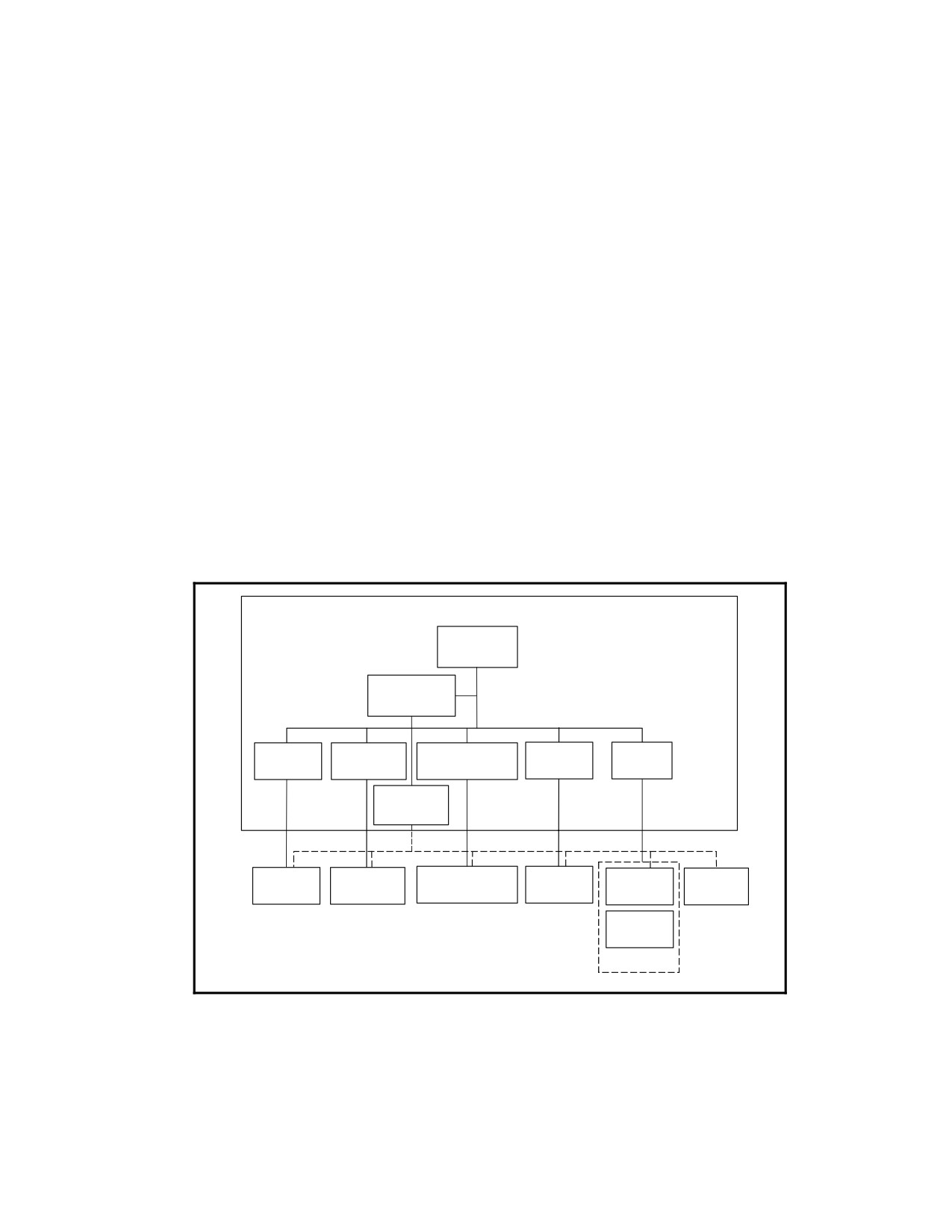
1-2. The National Command Authority (NCA) exercises overall control of the
application of all instruments of national power in planning and carrying out
the national security strategy. Thus, the NCA includes the cabinet ministers
responsible for those instruments of power: the Minister of Foreign Affairs,
Minister of Public Information, Minister of Finance and Economic Affairs,
Minister of the Interior, and Minister of Defense, along with other members
selected by the State’s President, who chairs the NCA. (See Figure 1-1.)
1-3. The President also appoints a Minister of National Security, who heads
the Strategic Integration Department (SID) within the NCA. The SID is the
overarching agency responsible for integrating all the instruments of national
power under one cohesive national security strategy. The SID coordinates the
plans and actions of all State ministries, but particularly those associated
with the instruments of power.
NATIONAL STRATEGIC GOALS
1-4. The NCA determines the State’s strategic goals. The State’s overall goals
are to continually expand its influence within its region and eventually
change its position within the global community. These are the long-term
aims of the State.
1-5. Supporting the overall, long-term, strategic goals, there may be one or
more specific goals, each based on a particular threat or opportunity. Exam-
ples of specific strategic goals might be
• Annexation of territory.
• Economic expansion.
• Destruction of an insurgency.
• Protection of a related minority in a neighboring country.
• Acquisition of natural resources located outside the State’s boundaries.
• Destruction of external weapons, forces, or facilities that threaten the
existence of the State.
• Defense of the State against invasion.
• Preclusion or elimination of outside intervention.
Each of these specific goals contributes to achieving the overall strategic
goals.
FRAMEWORK FOR IMPLEMENTING NATIONAL SECURITY STRATEGY
1-6. In pursuit of its national security strategy, the State is prepared to con-
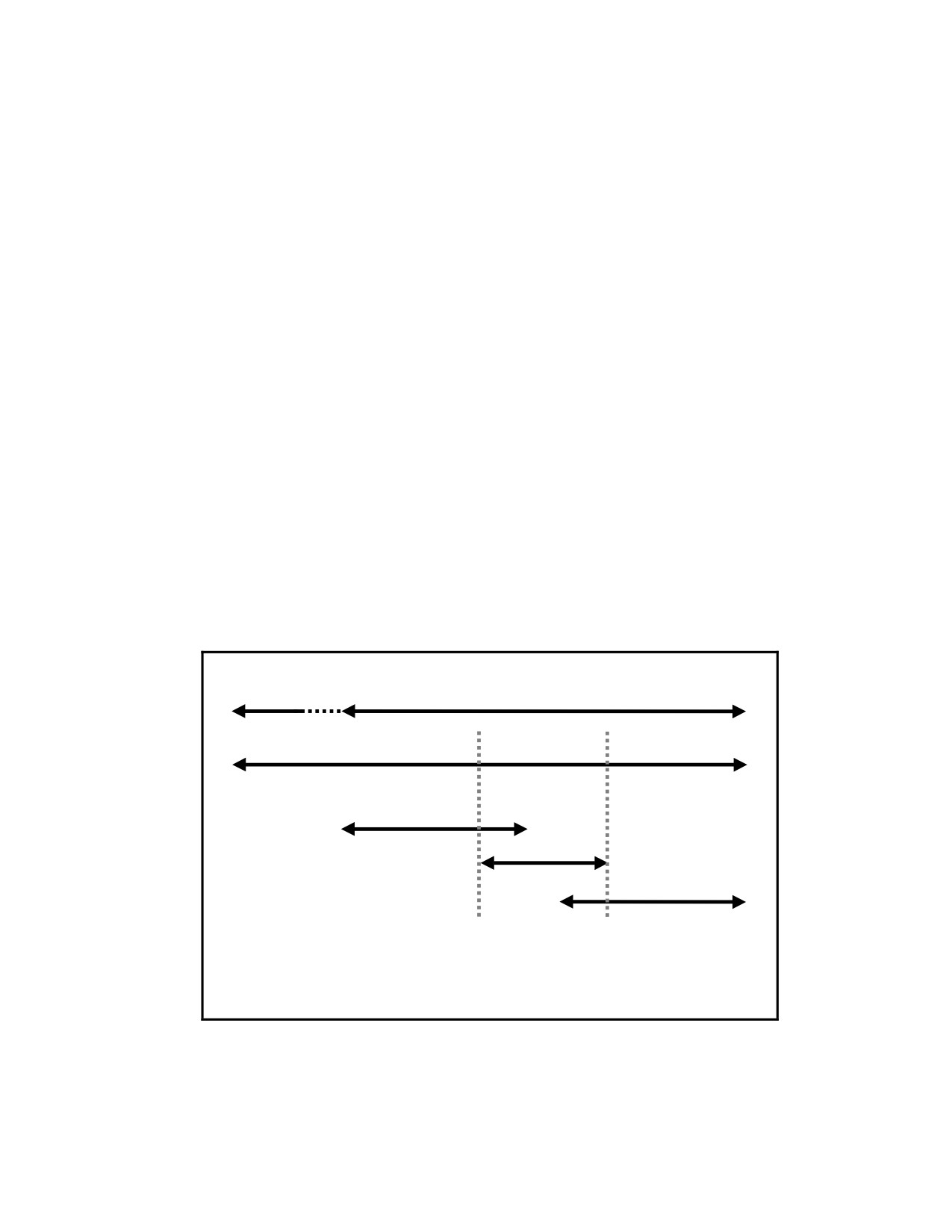
duct four basic types of strategic-level courses of action. Each course of action
involves the use of all four instruments of national power, but to different de-
grees and in different ways. The State gives the four types the following names:
• Strategic operationsstrategic-level course of action that uses all in-
struments of power in peace and war to achieve the goals of the State’s na-
tional security strategy by attacking the enemy’s strategic centers of grav-
ity. (See the Strategic Operations section of this chapter for more detail.)
1-2
_________________________________________________________________________________Chapter 1
• Regional operationsstrategic-level course of action (including con-
ventional, force-on-force military operations) against opponents the
State overmatches, including regional adversaries and internal threats.
(See the Regional Operations section of this chapter for more detail.)
• Transition operationsstrategic-level course of action that bridges
the gap between regional and adaptive operations and contains some
elements of both, continuing to pursue the State’s regional goals while
dealing with the development of outside intervention with the potential
for overmatching the State. (See the Transition Operations section of
this chapter for more detail.)
• Adaptive operationsstrategic-level course of action to preserve the
State’s power and apply it in adaptive ways against opponents that
overmatch the State. (See the Adaptive Operations section of this chap-
ter for more detail.)
Although the State refers to them as “operations,” each of these courses of
action is actually a subcategory of strategy. Each of these types of “opera-
tions” is actually the aggregation of the effects of tactical, operational, and
strategic actions, in conjunction with the other three instruments of national
power, that contribute to the accomplishment of strategic goals. The type(s) of
operations the State employs at a given time will depend on the types of
threats and opportunities present and other conditions in the operational en-
vironment. Figure 1-2 illustrates the State’s basic conceptual framework for
how it could apply its various instruments of national power in the imple-
mentation of its national security strategy.
Peace
War
STRATEGIC OPERATIONS
Against Enemy Strategic Centers of Gravity
REGIONAL
OPERATIONS
TRANSITION
OPERATIONS
ADAPTIVE
OPERATIONS
Against Opponents
Against Opponents
the State
that Overmatch
Overmatches
the State
Figure 1-2. Conceptual Framework for Implementing the State’s National Security Strategy
1-7. Strategic operations are a continuous process not limited to wartime or
preparation for war. Once war begins, they continue during regional, transition,
1-3
FM 7-100.1 ________________________________________________________________________________
and adaptive operations and complement those operations. Each of the latter
three types of operations occurs only during war and only under certain con-
ditions. Transition operations can overlap regional and adaptive operations.
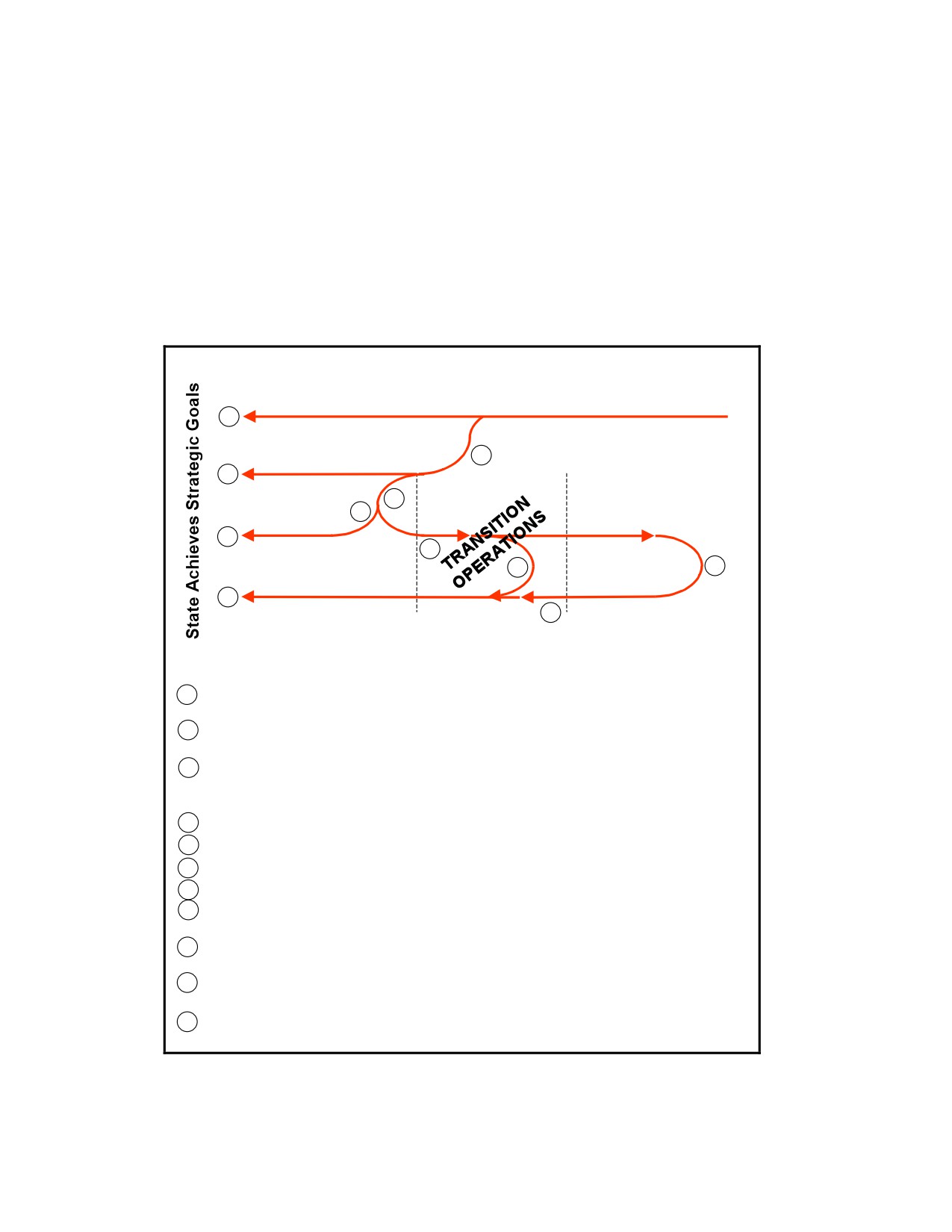
1-8. The national security strategy identifies branches, sequels, and contin-
gencies and the role and scope of each type of strategic-level action within
these modifications to the basic strategy. Successful execution of these
branches and sequels can allow the State to resume regional operations and
thus achieve its strategic goals. (See Figure 1-3.)
STRATEGIC OPERATIONS
Against Opponents’ Strategic Centers of Gravity
1
and
REGIONAL
OPERATIONS
2
3
or
REGIONAL
4
5
OPERATIONS
or
6
7
or
REGIONAL
ADAPTIVE
8
9
OPERATIONS
OPERATIONS
11
10
Against Regional
Opponents
Against Extraregional Opponents
1
State achieves its strategic goals without combat, through strategic
operations that compel other actors to yield to State’s will.
2
State must react to a particular regional threat or seizes an
opportunity to change status quo in region.
3
While strategic operations continue, State achieves its strategic
goals through regional operations against weaker neighbors, without
extraregional intervention.
4
Extraregional power threatens to intervene.
5
State deters extraregional intervention through strategic operations.
6
State achieves its strategic goals after deterring intervention.
7
State unable to deter intervention; begins transition operations.
8
State defeats early-entry forces or causes extraregional forces to
withdraw from region; transitions back to regional operations.
9
Extraregional forces fully deployed and overmatch State forces;
State conducts adaptive operations.
10
Extraregional forces withdraw from region after defeat or stalemate;
State begins transition back to regional operations.
State achieves its strategic goals after extraregional intervention.
11
Figure 1-3. Examples of Branches and Sequels in National Security Strategy
1-4
_________________________________________________________________________________Chapter 1
1-9. The national security strategy is designed to achieve one or more specific
strategic goals within the State’s region. Therefore, it typically starts with
actions directed at an opponent within the regionan opponent that the
State overmatches in conventional military power, as well as other instru-
ments of power.
1-10. The State will attempt to achieve its ends without resorting to armed
conflict. Accordingly strategic operations are not limited to military means
and usually do not begin with armed conflict. The State may be able to achieve
the desired goal through pressure applied by other-than-military instruments of
power, perhaps with the mere threat of using its superior military power against
the regional opponent. These actions would fall under the general framework of
“strategic operations.”
1-11. When nonmilitary means are not sufficient or expedient, the State may
resort to armed conflict as a means of creating conditions that lead to the de-
sired end state. However, strategic operations continue even if a particular re-
gional threat or opportunity causes the State to undertake “regional operations”
that include military means.
1-12. Prior to initiating armed conflict and throughout the course of armed
conflict with its regional opponent, the State continues to conduct strategic
operations to preclude intervention by outside playersby other regional
neighbors or by an extraregional power that could overmatch the State’s
forces. However, those operations always include branches and sequels for
dealing with the possibility of intervention by an extraregional power.
1-13. When unable to limit the conflict to regional operations, the State is
prepared to engage extraregional forces through “transition and adaptive
operations.” Usually, the State does not shift directly from regional to adap-
tive operations. The transition is incremental and does not occur at a single,
easily identifiable point. If the State perceives intervention is likely, transi-
tion operations may begin simultaneously with regional and strategic opera-
tions. Transition operations overlap both regional and adaptive operations.
Transition operations allow the State to shift to adaptive operations or back to
regional operations. At some point, the State either seizes an opportunity to
return to regional operations, or it reaches a point where it must complete
the shift to adaptive operations. Even after shifting to adaptive operations,
the State tries to set conditions for transitioning back to regional operations.
1-14. If an extraregional power were to have significant forces already de-
ployed in the region prior to the outbreak of hostilities, the State would not
be able to conduct regional operations using its normal, conventional design
without first eliminating those forces. In this case, the State would first use
strategic operationswith all means availableto put pressure on the al-
ready present extraregional force to withdraw from the region or at least re-
main neutral in the regional conflict. Barring that, strategic operations could
still aim at keeping the extraregional power from committing additional
forces to the region and preventing his forces already there from being able to
fully exercise their capabilities. If the extraregional force is still able to intervene,
the rest of the State’s strategic campaign would have to start with adaptive op-
erations. Eventually, the State would hope to move into transition operations. If
1-5
FM 7-100.1 ________________________________________________________________________________
it could neutralize or eliminate the extraregional force, it could finally complete
the transition to regional operations and thus achieve its strategic goals.
STRATEGIC CAMPAIGN
1-15. To achieve one or more specific strategic goals, the NCA would develop
and implement a specific national strategic campaign. Such a campaign is the
aggregate of actions of all the State’s instruments of power to achieve a specific
set of the State’s strategic goals against internal, regional, and/or extraregional
opponents. There would normally be a diplomatic-political campaign, an infor-
mation campaign, and an economic campaign, as well as a military campaign.
All of these must fit into a single, integrated national strategic campaign.
1-16. The NCA will develop a series of contingency plans for a number of dif-
ferent specific strategic goals that it might want or need to pursue. These
contingency plans often serve as the basis for training and preparing the
State’s forces. These plans would address the allocation of resources to a po-
tential strategic campaign and the actions to be taken by each instrument of
national power contributing to such a campaign.
Neutral
Allied
Country
Country
Sea
Hostile
Country
Strategic Goal:
Defense Against Invasion
“THE STATE”
Strategic Goal:
Annexation of Territory
Sea
Sea
Figure 1-4. Example of a Strategic Campaign
1-17. Aside from training exercises, the NCA would approve only one strate-
gic campaign for implementation at a given time. Nevertheless, the single
campaign could include more than one specific strategic goal. For instance,
any strategic campaign designed to deal with an insurgency would include
contingencies for dealing with reactions from regional neighbors or an ex-
traregional power that could adversely affect the State and its ability to
achieve the selected goal. Likewise, any strategic campaign focused on a goal
that involves the State’s invasion of a regional neighbor would have to take
into consideration possible adverse actions by other regional neighbors, the
1-6
_________________________________________________________________________________Chapter 1
possibility that insurgents might use this opportunity to take action against
the State, and the distinct possibility that the original or expanded regional
conflict might lead to extraregional intervention. Figure 1-4 shows an exam-
ple of a single strategic campaign that includes three strategic goals. (The
map in this diagram is for illustrative purposes only and does not necessarily
reflect the actual size, shape, or physical environment of the State or its
neighbors.)
NATIONAL STRATEGIC CAMPAIGN PLAN
1-18. The purpose of a national strategic campaign plan (national SCP) is to
integrate all the instruments of national power under a single plan. Even if
the State hoped to achieve the goal(s) of the campaign by nonmilitary means,
the national campaign plan would leverage the influence of its Armed Forces’
strong military presence and provide for the contingency that military force
might become necessary.
1-19. The national SCP is the end result of the SID’s planning effort. Based
on input from all State ministries, this is the plan for integrating the actions
of all instruments of power to set conditions favorable for achieving the cen-
tral goal identified in the national security strategy. The Ministry of Defense
(MOD) is only one of several ministries that provide input and are then re-
sponsible for carrying out their respective parts of the consolidated national plan.
1-20. In waging a national strategic campaign, the State never employs mili-
tary power alone. Military power is most effective when applied in combina-
tion with diplomatic-political, informational, and economic instruments of
power. State ministries responsible for each of the four instruments of power
will develop their own campaign plans as part of the unified national SCP.
1-21. A national SCP defines the relationships among all State organizations,
military and nonmilitary, for the purposes of executing that SCP. The SCP
describes the intended integration, if any, of multinational forces in those in-
stances where the State is acting as part of a coalition.
MILITARY STRATEGIC CAMPAIGN PLAN
1-22. Within the context of the national strategic campaign, the MOD and
General Staff develop and implement a military strategic campaign. During
peacetime, the Operations Directorate of the General Staff is responsible for
developing, staffing, promulgation, and continuing review of the military
SCP. It must ensure that the military plan would end in achieving military
conditions that would fit with the conditions created by the diplomatic-
political, informational, and economic portions of the national plan that are
prepared by other State ministries. Therefore, the Operations Directorate as-
signs liaison officers to other important government ministries.
1-23. Although the State’s Armed Forces (the OPFOR) may play a role in
strategic operations, the focus of their planning and effort is on the military
aspects of regional, transition, and adaptive operations. A military strategic
campaign may include several combined arms, joint, and/or interagency op-
erations. If the State succeeds in forming a regional alliance or coalition,
these operations may also be multinational.
1-7
FM 7-100.1 ________________________________________________________________________________
1-24. The General Staff acts as the executive agency for the NCA, and all
military forces report through it to the NCA. The Chief of the General Staff
(CGS), with NCA approval, defines the theater in which the Armed Forces
will conduct the military campaign and its subordinate operations. He de-
termines the task organization of forces to accomplish the operational-level
missions that support the overall campaign plan. He also determines whether
it will be necessary to form more than one theater headquarters. For most
campaigns, there will be only one theater, and the CGS will serve as thea-
ter commander, thus eliminating one echelon of command at the strategic
level.
1-25. In wartime, the MOD and the General Staff combine to form the Su-
preme High Command (SHC). The Operations Directorate continues to re-
view the military SCP and modify it or develop new plans based on guidance
from the CGS, who commands the SHC. It generates options and contingency
plans for various situations that may arise. Once the CGS approves a particular
plan for a particular strategic goal, he issues it to the appropriate operational-
level commanders.
1-26. The military SCP directs operational-level military forces, and each
command identified in the SCP prepares an operation plan that supports the
execution of its role in that SCP. The SCP assigns forces to operational-level
commands and designates areas of responsibility (AORs) for those com-
mands.
STRATEGIC OPERATIONS
1-27. What the State calls “strategic operations” is actually a universal stra-
tegic course of action the State would use to deal with all situationsin
peacetime and war, against all kinds of opponents, potential opponents, or
neutral parties. Strategic operations involve the application of any or all of
the four instruments of national power at the direction of the national-level
decision makers in the NCA. They occur throughout a strategic campaign.
The nature of strategic operations at any particular time corresponds to the
conditions perceived by the NCA. These operations differ from the other op-
erations of a strategic campaign in that they are not limited to wartime and
can transcend the region.
1-28. Strategic operations typically target elements that constitute the en-
emy’s strategic centers of gravitysuch as soldiers’ and leaders’ confidence,
political and diplomatic decisions, public opinion, the interests of private in-
stitutions, national will, and the collective will and commitment of alliances
and coalitions. National will is not just the will to fight, but also the will to
intervene by other than military means.
1-29. The State will employ all means available against the enemy’s centers
of gravity: diplomatic initiatives, information warfare (IW), economic pres-
sure, terrorist attacks, State-sponsored insurgency, direct action by special-
purpose forces (SPF), long-range precision fires, and even weapons of mass
destruction (WMD) against selected targets. These efforts often place non-
combatants at risk and aim to apply diplomatic-political, economic, and
psychological pressure by allowing the enemy no sanctuary.
1-8
_________________________________________________________________________________Chapter 1
1-30. Strategic operations occur continuously, from prior to the outbreak of
war to the post-war period. They can precede war, with the aim of deterring
other regional actors from actions counter to the State’s interests or compel-
ling such actors to yield to the State’s will. Before undertaking regional op-
erations, the State lays plans to prevent outside intervention in the region.
During the course of regional operations, the State uses strategic operations
primarily in defensive ways, in order to prevent other parties from becoming
involved in what it regards as purely regional affairs. At this point, the State
relies primarily on diplomatic-political, informational, and economic means in
a peacetime mode in relation to parties with whom it is not at war.
1-31. If preclusion of outside intervention is not possible, the State continues
to employ strategic operations while conducting transition and adaptive op-
erations. With the beginning of transition operations, the military aspects of
strategic operations become more aggressive, while the State continues to
apply other instruments of power to the full extent possible. The aim becomes
getting the extraregional force to leave or stop deploying additional forces
into the region. Successful strategic operations can bring the war to an end.
1-32. Once war begins, strategic operations become an important, powerful
component of the State’s strategy for total war using “all means necessary.”
What the various instruments of power do and which ones dominate in stra-
tegic operations at a given time depends on the same circumstances that dic-
tate shifts from regional through transition to adaptive operations. In most
cases, the diplomatic-political, informational, and economic means tend to
dominate. During strategic operations, military means are most often used to
complement those other instruments of national power. For example, the
military means are likely to be used against key political or economic centers
or tangible targets whose destruction affects intangible centers of gravity,
rather than against military targets for purely military objectives.
1-33. Even within the military instrument of power, actions considered part
of strategic operations require a conscious, calculated decision and direction
or authorization by the NCA. It may not be readily apparent to outside par-
ties whether specific military actions are part of strategic operations or an-
other strategic course of action occurring simultaneously. In fact, one action
could conceivably fulfill both purposes. For example, a demoralizing military
defeat that could affect the enemy’s strategic centers of gravity could also be
a defeat from an operational or tactical viewpoint. In other cases, a particular
action on the battlefield might not make sense from a tactical or operational
viewpoint, but could achieve a strategic purpose. Its purpose may be to inflict
mass casualties or destroy high-visibility enemy systems in order to weaken
the enemy’s national will to continue the intervention.
REGIONAL OPERATIONS
1-34. The State possesses an overmatch in most, and sometimes all, elements
of power against regional opponents. It is able to employ that power in a con-
ventional operational design focused on offensive action. A weaker regional
neighbor may not actually represent a threat to the State, but rather an op-
portunity that the State can exploit.
1-9
///////////////////////////////////////