FM 5-277 BAILEY BRIDGE (May 1986) - page 10
FM 5-277
A source of electrical power is available
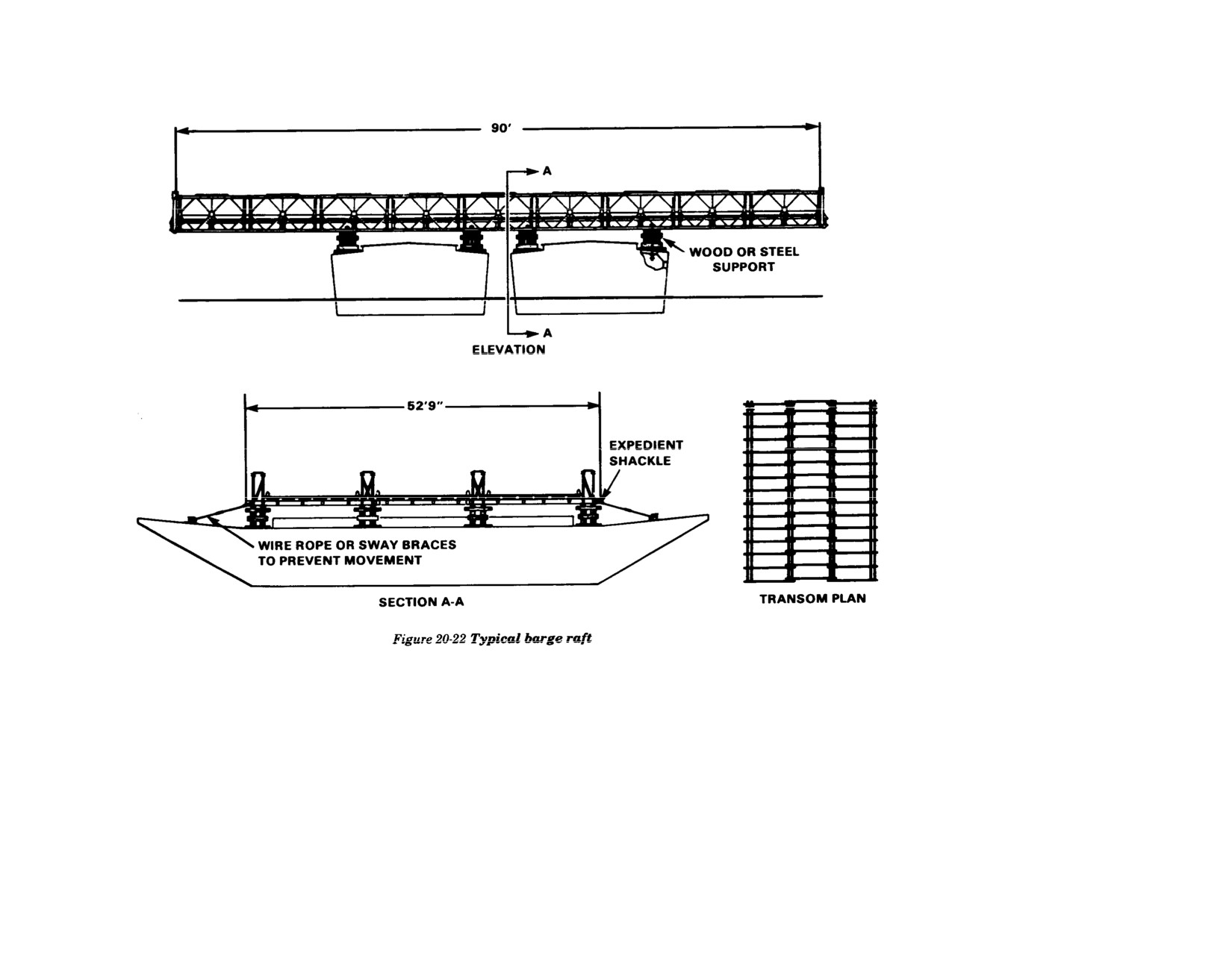
A typical barge raft used successfully is
Use quays or docks to facilitate assembly and
for operation of trouble lights and tools.
shown in Figure 20-22. This raft has a three-
operation of a raft. It is preferable to operate
carriageway superstructure of four
double-
between quays or docks of proper height for
Immediate approach roads are main-
single
girders 90 feet (27.4 meters) long on
convenience in loading and unloading the
tained.
two 100-ton (91 metric tons) capacity Thames-
raft. Where such site conditions exist, the
type barges. This raft accommodates 12
height of the raft deck can be adjusted, within
All signs in the vicinity of the bridge are
vehicles having a combined weight of 120
limits, by packing the superstructure girders
maintained.
tons (109.2 metric tons).
up on cribs or by building a deck-type rather
than a through-type raft. If quays or docks
Traction strips and decking are main-
Inset position of barges in the raft as shown
are unavailable, build ramps.
tained. All nailheads must be kept flush
in Figure 20-22 is necessary, except in cases
with surface.
where the raft will be used in smooth water;
Operation
otherwise, if the barges are placed near the
For continuous use of the raft as a ferry,
Tugs are stationed upstream and down-
ends of the raft in rough water, there is
install an upstream cable. Run bridle lines to
stream at the bridge.
excessive stress in the connections between
winches mounted on the barges, allowing the
the barges and superstructure.
raft to be swung at suitable angles to the
A fireboat is available.
current, and operate as a trail ferry.
When the raft is towed in heavy seas, the
USE OF RAFTS
decks may become awash, causing complete
When the raft is being grounded, the barges
Multiple-lane rafts can be assembled from
bays of decking to lift off the barges. To
may assume different angles of slope. To
panel-bridge equipment supported on barges.
prevent this, use stringer clamps.
relieve the superstructure of stresses, remove
Because of their ample freeboard and sta-
either all top or all bottom pins at the center-
bility, such rafts can be used either as trail or
The superstructure must be secured to the
panel connections of the raft. This allows the
as free ferries in swift currents and rough
barges to prevent fore-and-aft movement.
two halves of the raft to articulate and
water.
Sway braces can be used for this purpose by
conform to the lay of each barge. Close
fixing one end of the brace to a barge deck
observation is required as the tide falls to
Assembly
bollard or cleat and attaching the other end
determine whether the top or bottom pins are
Normally, the raft superstructure is
double-
to a deck transom by means of two tie plates.
to be removed, and also the proper time to
single
or
triple-single
assembly. Details of
The brace can then be tightened in the normal
remove them.
assembly and launching, and of barge prepa-
manner.
ration, are given elsewhere in this chapter.
276
FM 5-277
277
FM 5-277
CHAPTER 21
BRIDGE MAINTENANCE AND REPAIR
This chapter tells how to handle and store
Protect pieces of erection equipment, such as
Checks bridge thoroughly after first 30
panel-bridge parts and equipment. It also
rollers, jacks, panel levers, pin extractors,
minutes of use and periodically thereafter
tells how to repair damaged Bailey bridges,
and wrenches, by keeping them clean and
for tightness of bracing bolts, chord bolts,
as well as how to dismantle and to replace
lubricated to prevent rust.
transom clamps, and sway braces.
them.
Before launching abridge, lubricate bearings
Examines base plates and grillages
CARE OF PARTS AND EQUIPMENT
of plain and rocking rollers through grease
periodically for uneven settlement and
When storing and transporting panel-bridge
fittings at both ends of shafts. Lubricate
adds grill age when necessary.
parts, keep them clean and handle them as
plain rollers as follows:
follows:
Checks tightness of cribbing under end
1
Clean out old grease and dirt around
transoms and ramps.
For panels, grease jaws and inside of all
shaft at each end of both rollers.
holes. Panels are easily distorted by
Makes sure all panel-bridge pin retainers
improper storage and handling. When-
2
Wedge rollers tight against outer bearings
are in place.
ever possible, store them in upright posi-
where grease fittings are located.
tion resting on the long side. If it is
Lubricates all exposed threads and occa-
necessary to store them horizontally for
3
Add grease until it is forced out around
sionally pours a small quantity of oil over
stability, do not stack more than 10 on a
shaft at inner bearings.
each panel joint if the bridge is to remain
flat base. Stack on timber cribbing rather
in place for a long period or if it is to be
than on the ground.
4
If no grease appears at inner bearing of
dismantled in freezing weather.
either roller, disassemble and clean entire
For bracing frame, rakers, and tie plates,
unit.
Repairs wearing surface on deck and
grease conical dowels.
ramps, and keeps stone and gravel off
5 After reassembling the roller, repeat the
deck.
For end posts, grease curved bearing
second and third steps above.
surfaces and pinholes.
Maintains immediate approaches and
BRIDGE MAINTENANCE DETAIL
ditches.
For bearings, grease bar segments.
For important bridges subject to enemy
action, the maintenance party usually con-
During heavy rainstorms, checks closely
For panel pins, grease shanks.
sists of the entire assembly crew. For routine
for erosion of bank seats, abutments,
repair work, however, the detail consists of
approaches, and drainage ditches.
For sway braces, grease threads and pins.
only six soldiers. In rear areas, one traveling
crew maintains all bridges in an assigned
Replaces damaged end-post guards.
For bolts, grease entire bolt.
area or route. The maintenance detail—
278
FM 5-277
ASSESSMENT OF DAMAGE
The class of damaged bridge is found by
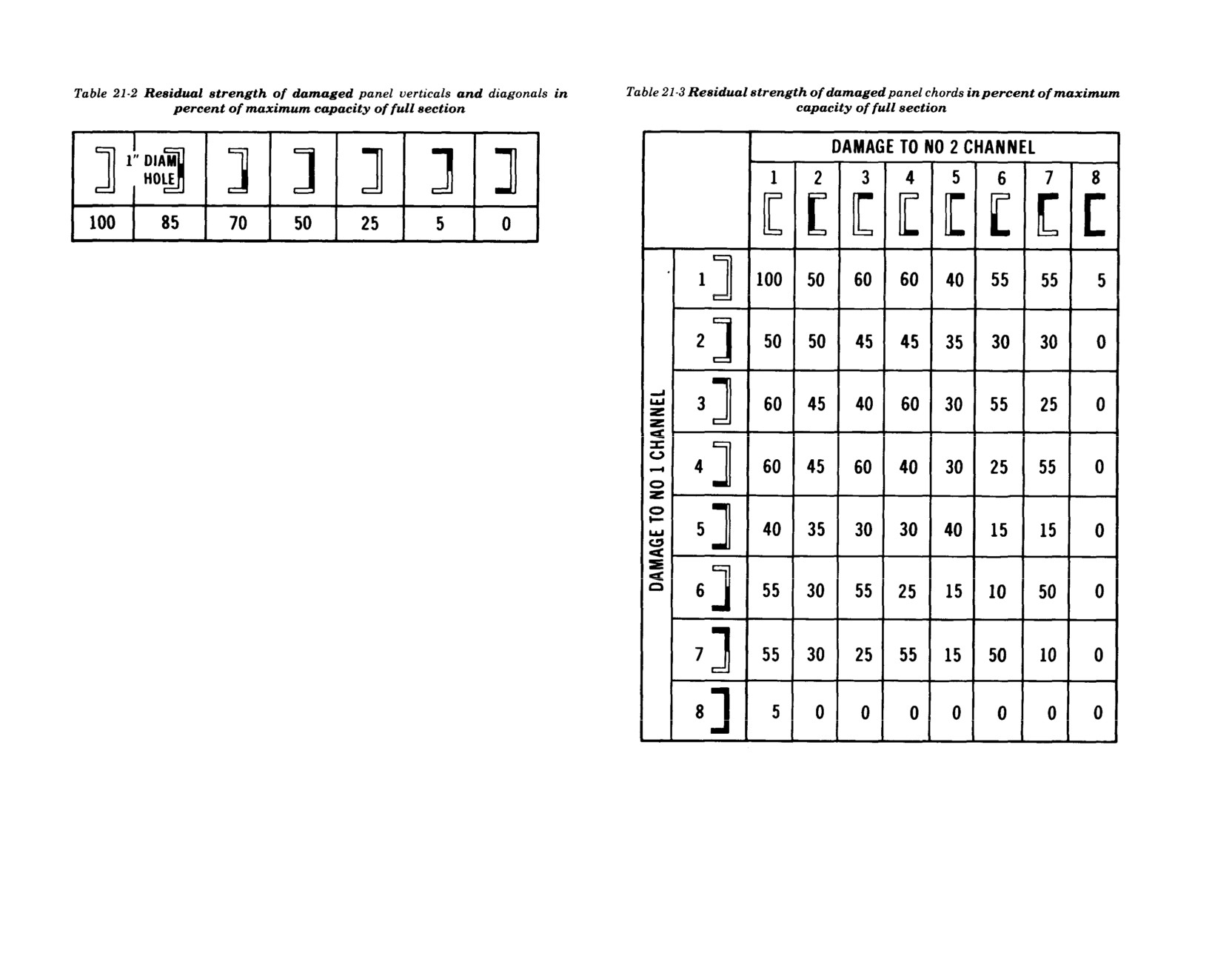
result of damage to the two channels ex-
comparing the residual strength of a
pressed as a percentage of the strength of the
damaged member with the actual maximum
undamaged chord is found at the intersection
stress it must take according to its position in
of the appropriate column and row. In Tables
the bridge. Unit assembly of the panel bridge
21-2 and 21-3, darkened portion indicates
produces girders of uniform section through-
damage. When length of damage exceeds 15
out their entire length. Many individual panel
inches, values must be reduced to 0.
members are therefore not stressed to full
capacity when the bridge is under maximum
SHEAR AND MOMENT
load. Only chords of the center bays and
DISTRIBUTION
vertical and diagonal members of the end
To simplify calculations, shear and moment
bays are fully stressed. Any damage to these
in single-story bridges are assumed to be
members decreases the bridge class in direct
taken equally by all trusses. Shear in a
proportion. Lightly stressed verticals and
double-story bridge is taken equally by both
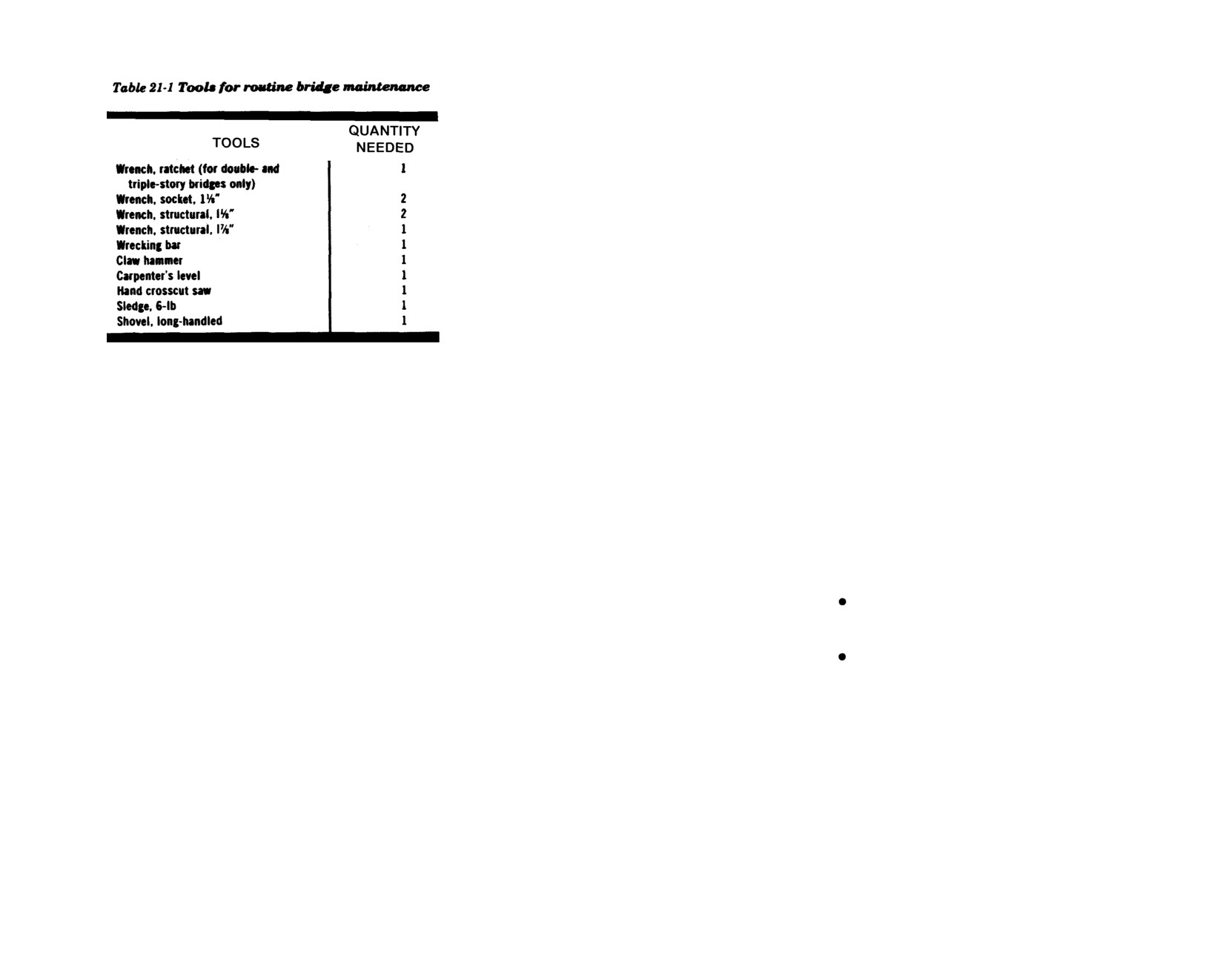
Tools for routine maintenance work are listed
diagonals of the center bays, and chords of
stories except in end bays, where the bottom
in Table 21-1.
the end bays, can sustain considerable
story takes 60 percent of the total shear. Top
damage without affecting the bridge class.
and bottom chords of double-story bridges
SPARE BRIDGE PARTS
provide all resistance to bending. Damage to
Bridge supplies include about 10 to 25 percent
Since they can easily be replaced, the effect of
intermediate chords can be disregarded if it
spares for all bridge and nose parts except
damage to deck, transoms, sway braces,
does not reduce shear capacity of web-member
bearings, ramp pedestals, pickets, base
rakers, and bracing frames is not considered
connections.
plates, ramps, and ribbands. For replacing
here.
damaged parts of bridges subject to enemy
Shear in a triple-story bridge is taken equally
fire, the spare parts in the bridge supply and
RESIDUAL STRENGTH OF
by all three stories except in end bays, as
additional parts covering the above excep-
DAMAGED PANEL MEMBERS
follows:
tions are dispersed about the bridge site after
Table 21-2 (page 280) gives the residual
completion of the bridge. Depending on the
strength of panel vertical and diagonal
Only bottom and middle stories resist
tactical situation, the spares may be in-
members expressed as percent maximum
shear when deck is in the bottom story.
creased up to 50 percent for forward-area
capacity of the complete cross section. The
bridges. Rear-area bridges require only
figures apply to both tension and compression
Only middle and top stories resist shear
enough spare deck parts and wear-tread
members.
when deck is in the middle story.
planking to replace those worn or damaged
by normal use.
Residual strength of damaged panel chords
Stress in top and bottom chords of triple-
is given in Table 21-3 (page 268). The two
story bridges is about three times that in
For bridges subject to enemy action, complete
channels of a panel chord act as one member.
intermediate chords. However, to simplify
erection equipment must be kept available at
Damage to one channel is indicated in the left
calculations, it can be assumed that top and
the site.
column of the table and damage to the other
bottom chords provide all bending resistance.
channel is shown in the top row. Combined
279
FM 5-277
Damage to intermediate chords causing loss
of chord capacity up to 50 percent need not be
considered, but cases of more extensive
damage should be investigated and correlated
with any damage in top or bottom chords of
the same bay.
SHEAR AND MOMENT TABLE
Table A-16, Appendix A, gives maximum
shear and bending moment in each bay of all
spans of fixed-panel bridges expressed as
percentages of maximum capacity. Dead-
load shear and moment values (DL) show
percentage of shear and moment capacity of
each bay required to support dead weight of
the bridge itself. Live-load values (LL) show
percentage of shear and moment capacity of
each bay required to support a tank load of
the weight class of the bridge. Tank loads are
placed at maximum eccentricity against one
curb, increased 10 percent for impact, and
moved along bridge to point of maximum
effect for each bay.
280
FM 5-277
EVALUATION OF DAMAGE
Deformed members
The two main girders of a bridge are inde-
in compression and the other in tension.
When a member struck by flying metal is
pendent of each other and each must be
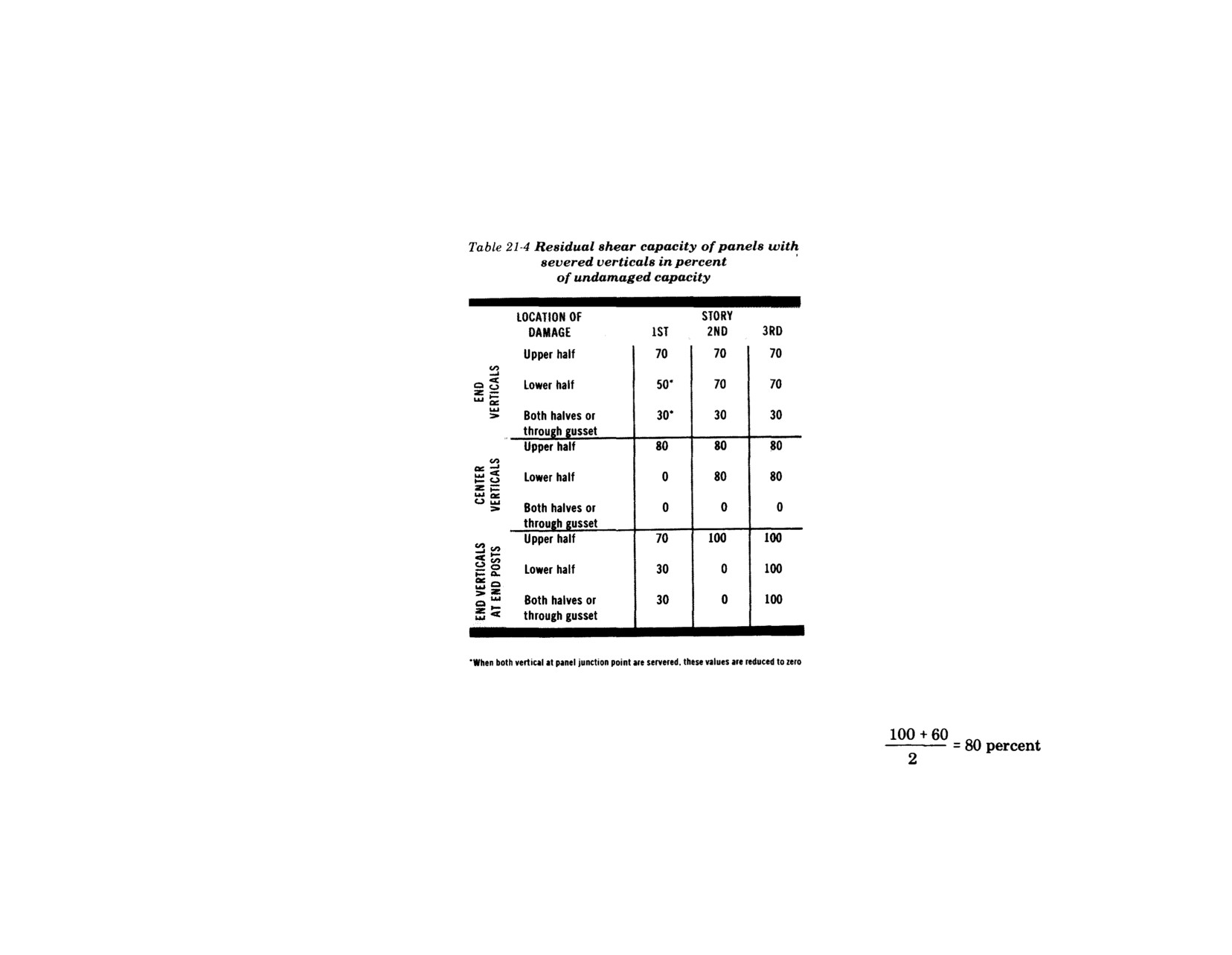
Residual shear capacities of panels with
deformed and not severed, it must be watched
capable of taking at least half the total bridge
damaged verticals in percent of undamaged
as loads pass over the bridge. If further
loads. If one girder is damaged it cannot be
capacity are shown in Table 21-4.
deformation takes place, it must be treated as
helped by any reserve capacity of the other.
if it were severed.
Chords
EXAMPLE:
The members at a given section of a bridge
Given:
which have an identical function and act
A 90-foot
(27.4
meters) span, class 40
together must be considered as a unit. For
double-single
bridge damaged as follows:
example, each main girder of a
triple-double
bridge consists of three trusses. If a chord of
Case 1.
In the third bay from one end, a
one truss is completely severed, the remaining
flange of one channel in the bottom
undamaged construction of that girder is
chord of one truss is missing.
double-double
and capacity of the bridge is
that of a
double-double
bridge of the same
Case 2.
In the second bay from the end, a
span. Moreover, if the damaged truss is
flange of one diagonal channel is
incapable of supporting itself, the
double-
severed.
double
capacity must be further reduced by
half the weight in tons of the damaged truss.
Case 3.
In the end bay, the center vertical
If the chord in one panel of a
single-single
of one panel is completely severed.
bridge is completely severed, the capacity of
the girder and bridge is reduced to zero.
Required:
What is the load class of the damaged
Web members
bridge without repair or reinforcement?
Effects of damage to diagonals and verticals
depend partly on the condition of adjacent
Solution:
members. When both diagonals at a vertical
Case 1.
From Table 21-3, the residual
section of a panel are seriously damaged,
strength of the damaged chord is 60
shear strength of the panel at that section is
percent. As there are two trusses, the
reduced to 30 percent because shear is resisted
residual strength of the girder is—
only by bending in the chords. Any damage
to the chords or other diagonals in the same
half of the panel reduces the shear strength to
zero. When one of the diagonals at a vertical
section is completely severed, panel shear
strength at the section is reduced to 50 per-
cent. Each diagonal takes half the shear, one
281
FM 5-277
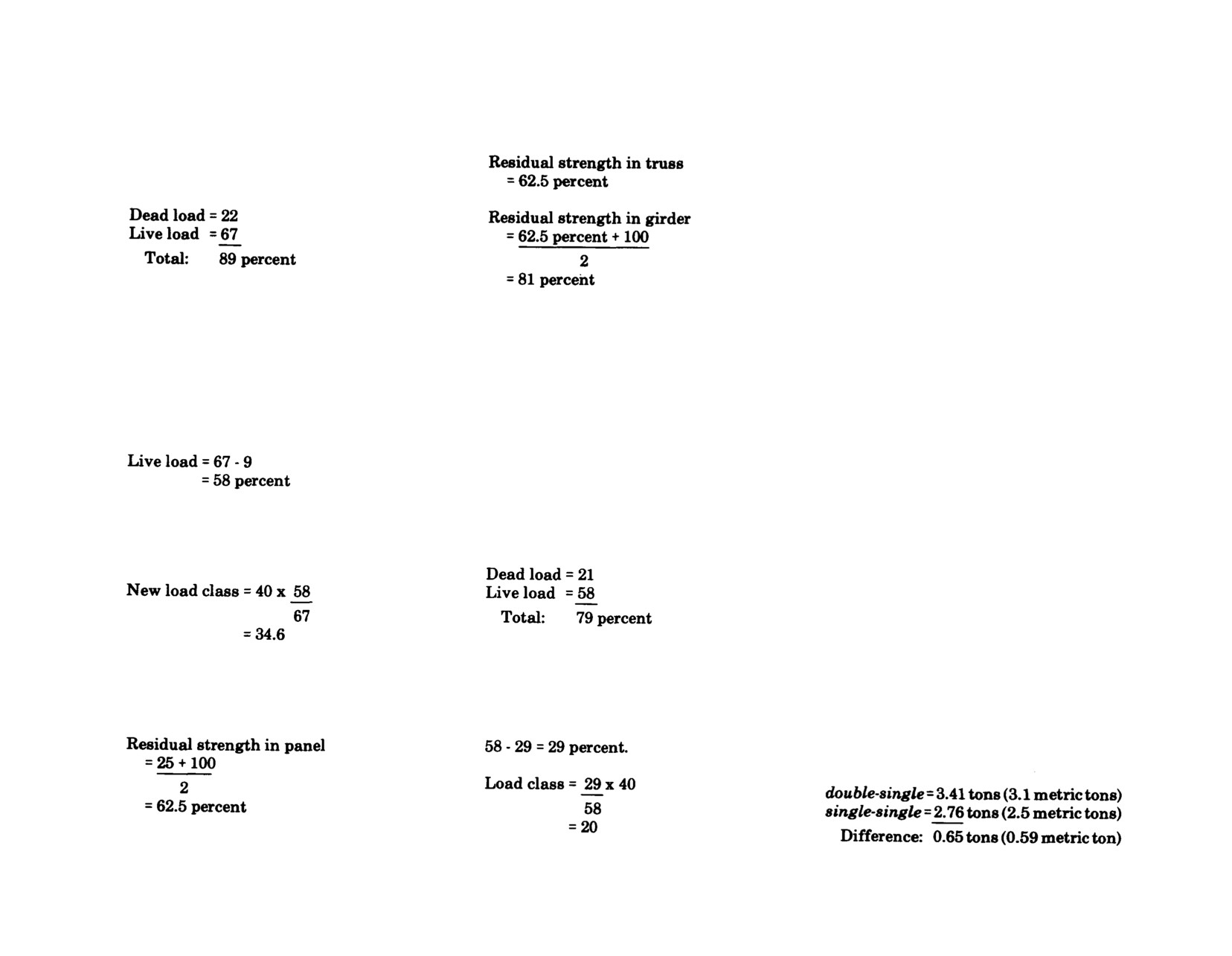
From Table A-16, Appendix A, bending
Load class of the bridge is therefore
stresses in the third bay are-
determined by this damage to a center
vertical in an end bay and must be
lowered to class 20.
EXAMPLE:
Given:
The damaged girder section is capable
The 90-foot, US class 40
double-single
of taking on 80 percent of its original
From Table A-16, Appendix A, total
bridge of the example above has the chord
capacity. Therefore, the rated bridge
of one truss in the third bay from one end
shear in the second bay is 67 percent of
capacity must be lowered to reduce
completely severed.
maximum capacity, so this damage has
stresses at this section from 89 to 80
no effect on the bridge class.
percent. Dead load remains the same.
Required:
Therefore, live load must be reduced by 9
Case 3.
The center vertical of one panel
What is the load class of the damaged
percent.
being completely severed reduces shear
bridge without repair or reinforcement if—
capacity in that panel to zero (Table 21-
4) with one truss carrying zero percent
Case 1.
The damaged truss is capable of
shear and the other 100 percent shear.
supporting its own weight?
Therefore, the girder shear capacity is
Reduction in live load is approximately
50 percent. From Table A-16, Appendix
Case 2.
The damaged truss is not capable
proportional to the lowering of the load
A, shear in the end bay is—
of supporting its own weight?
class.
Solution:
Case 1.
We know from above that capacity
is reduced to that of a
single-single
bridge of the same span or class 12.
Total load must therefore be reduced 29
Case 2.
We also know from it that capacity
Case 2.
From Table 21-2, residual strength
percent to the girder shear capacity of 50
of the corresponding
single-single
bridge
of the diagonal with one flange severed
percent. With dead load remaining con-
must be further reduced by half the
is 25 percent.
stant, allowable live load becomes—
weight of the damaged truss. Table 1-2
shows the difference in weight of the two
types of bridge bay as—
282
FM 5-277
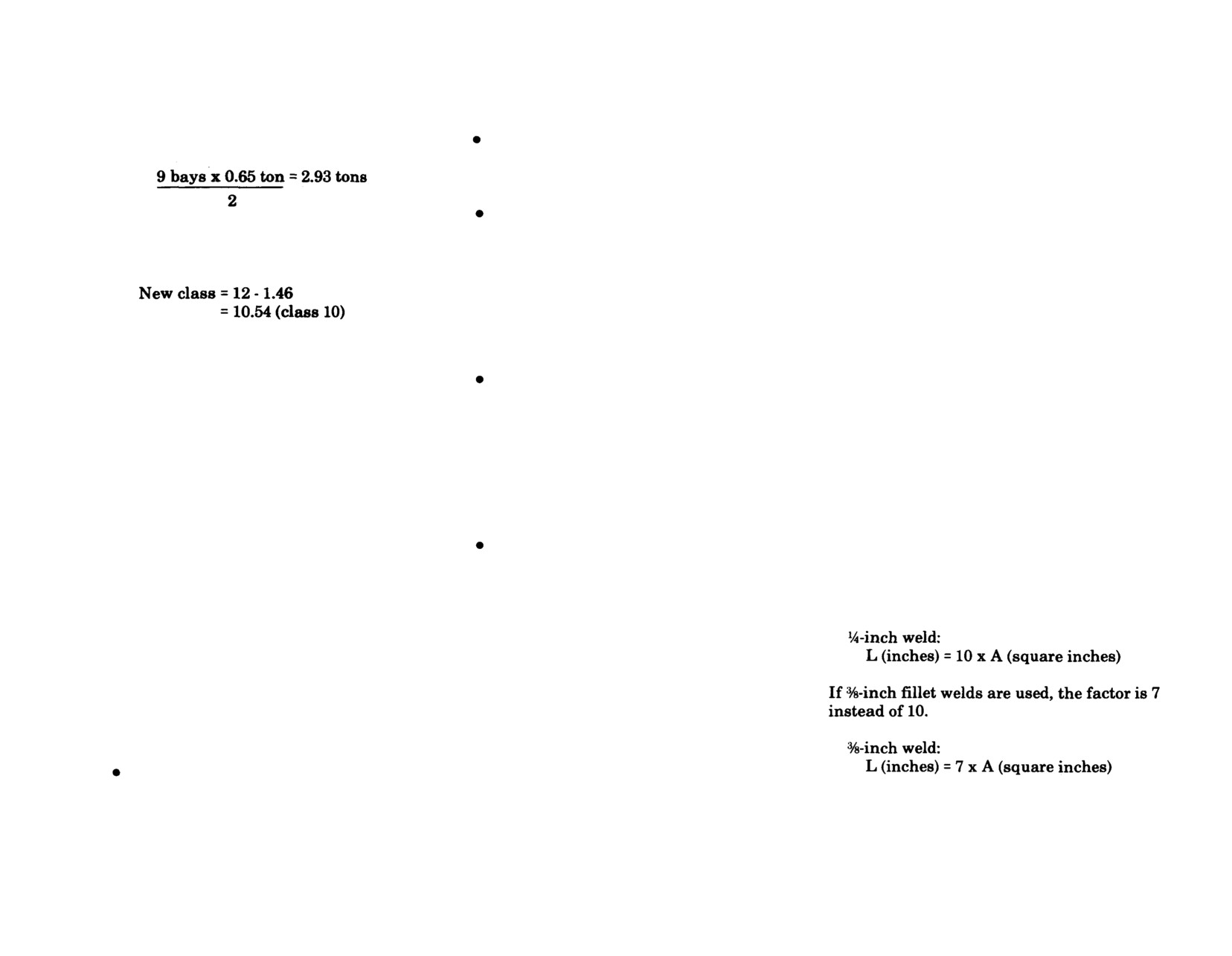
The damaged truss, therefore, weighs—
Use a complete truss when damage ex-
The capacity of a girder reinforced with a
tends through several bays of double-
complete truss is determined by the method
truss bridges.
for assessment of damage in terms of reduc-
tion of load class.
Add a partial story when damage is con-
fined to one or two bays on long spans.
WELDING
Capacity of the 90-foot
single-single
The partial story must extend two bays
All panel-bridge parts can be repaired by
must be reduced by half this weight.
beyond both ends of damaged panels. In
welding. Damaged parts which can be re-
case of damage to first or second end
moved, however, preferably are replaced with
bays, the partial story extends from end
spares. Repair work must be carefully done to
of bridge to two bays beyond the damaged
prevent distortion and ensure proper fit of all
panels.
parts.
REPAIR METHODS
Damaged deck and bracing parts can be
If the end bay of double or triple-story
Splice plates secured by fillet welds are more
easily replaced with spares. However, re-
bridges is seriously damaged it must be
reliable than butt welding alone. Splice
placing damaged panels is almost impossible
replaced. Jack the bridge onto launching
material should be mild steel plate about 50
without first relaunching bridge, which is
rollers and build a new bay at the un-
percent greater in cross-sectional area than
difficult and time-consuming. If panel
damaged end of bridge. Roll the new bay
the damaged section of the member being
damage results in greater loss of capacity
over the gap, dismantle the damaged bay,
repaired. Splice plates should be arranged to
than can be tolerated, the bridge can be
and lower the bridge onto its original
match as closely as possible the shape and
repaired by reinforcement or welding. Rein-
bearings.
position of the damaged section they replace.
forcement is preferred because welding can
The minimum length, in inches, of a ¼-inch
cause serious added damage unless it is done
If chord and web damage occur together,
(.64 centimeters) fillet weld required on each
in favorable conditions by experienced
make repairs according to the above rules.
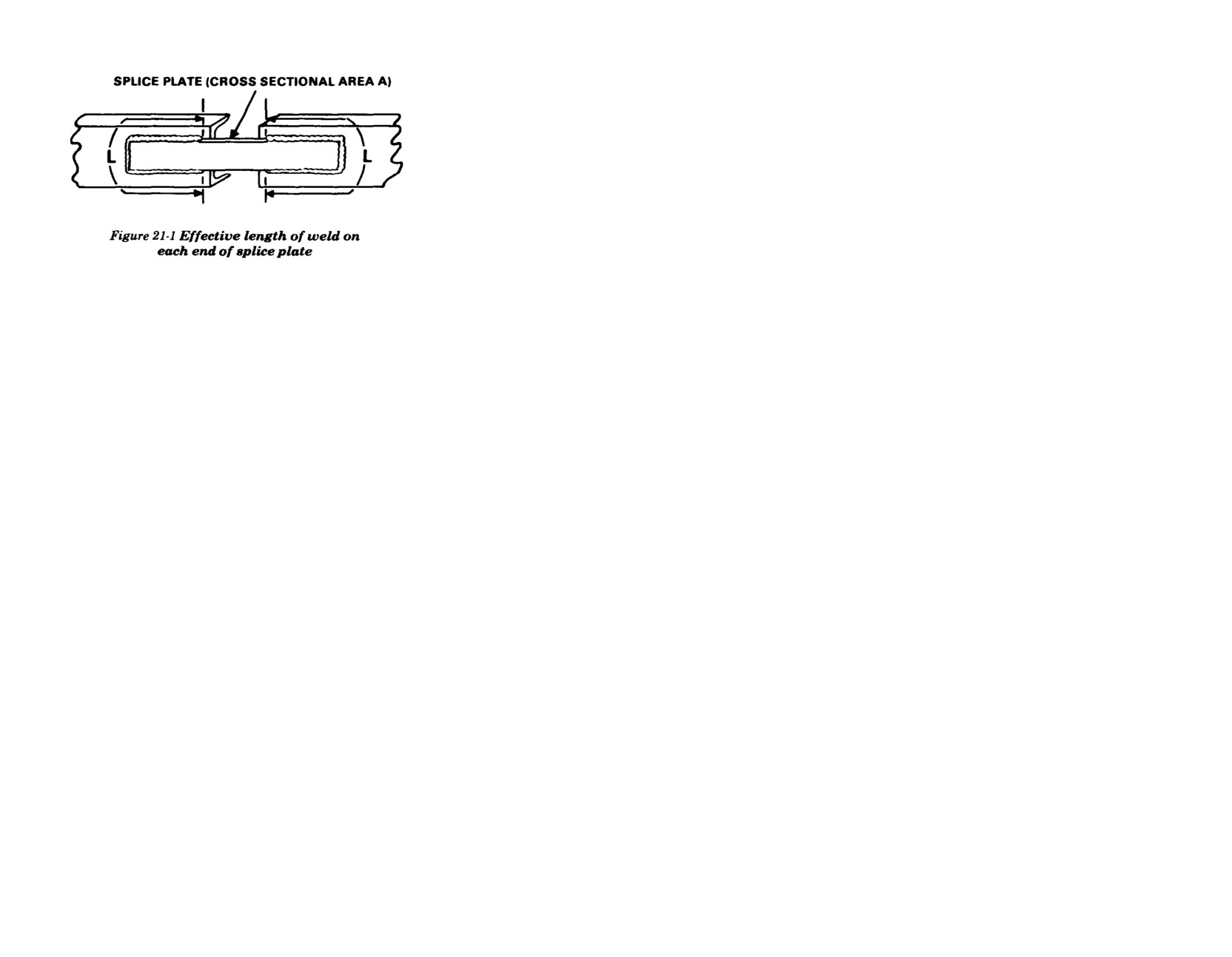
end of a splice plate is 10 times the cross-
personnel.
Damage to exterior chords alone can be
sectional area of the plate in square inches
repaired with supplementary chords ex-
(Figure 21-1, page 284).
REINFORCEMENT
tending two bays on both sides of
Damaged panels and chords are reinforced in
damaged panel. Modified bracing frames
several ways.
must be used with supplementary chord
splices of top chords of double- and triple-
Shear capacity lost by damage to panel
truss bridges to maintain a continuous
vertical and diagonal members is restored by
bracing system.
adding complete trusses or partial stories or
by replacing damaged bays, as follows:
CLASS
The posted class of the bridge must be reduced
Repair damaged
single-single
bridges by
by the dead weight of the partial story or
adding complete trusses.
supplementary chord.
283
FM 5-277
REPLACING OF BRIDGE
Removable parts can be repaired using the
While the new bridge is being constructed,
same general procedure as for panel members.
some provision must be made to allow traffic
Splice plates on transoms must not interfere
to cross the gap. This can be done by building
with stringers or with positioning the tran-
a bypass, by building the new bridge directly
som seats on the girders. Welding of the
under the panel bridge, or by building the
lighter parts must be done carefully to prevent
new bridge alongside the panel bridge and
distortion and loss of interchangeability.
relocating the approaches.
Before making welded repairs, clear the area
DISMANTLING OF BRIDGE
Traffic can be diverted over a nearby bypass,
around the fracture by cutting all jagged
Panel bridges are temporary structures and
such as a temporary bridge or culvert, while
edges. Always do straightening cold.
should be replaced as soon as possible with
the panel bridge is being dismantled and the
semipermanent bridges. A panel bridge is
new bridge is being built.
Both mild- and high-tensile low-alloy steels
dismantled in reverse of the order in which it
of American parts can be repaired by either
was assembled. After dismantling, the panel-
When a new two-lane bridge is being built,
electric-arc or oxyacetylene welding. For
bridge parts are returned to the depot for
one lane is completed before the panel bridge
electric-arc welding, the heavy-coated mild-
reuse at another site.
is removed. This completed lane carries the
steel shielded-arc electrode
(Lincoln Fleetweld
traffic while the panel bridge is dismantled
No. 5 or equal),
included in the electric arc-
The proper sequence of operations in dis-
and the second lane is built.
welding set No. 1, is the most satisfactory. If
mantling a panel bridge is—
welding is done by the oxyacetylene process,
When the new bridge is built directly under
use a copper-coated mild-steel rod.
1
Take up ramps, jack up bridge, and place
the panel bridge, traffic is interrupted only
rocking rollers under each end and plain
for a short time while the panel bridge is
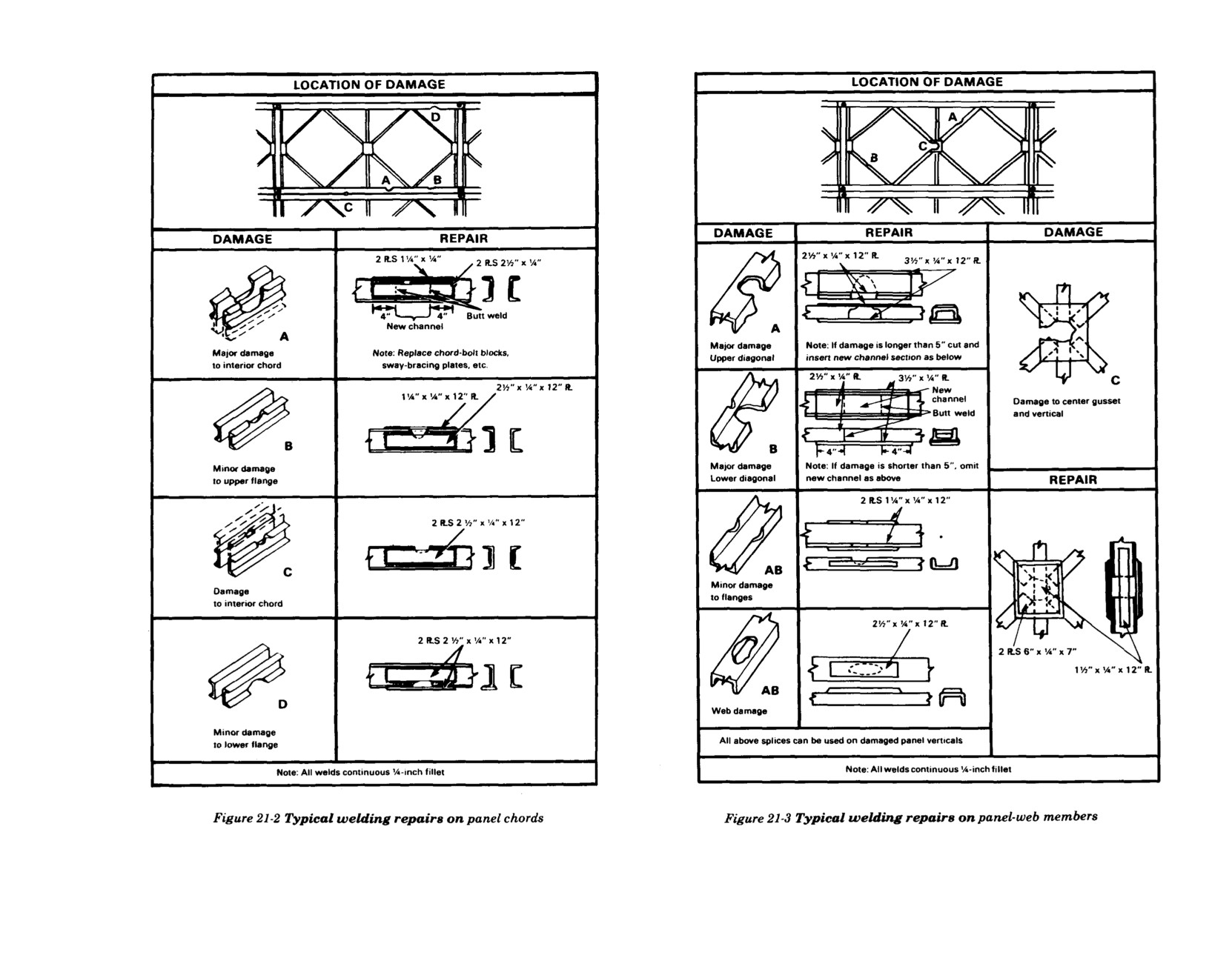
Cases of typical chord damage with correct
rollers on near-bank assembly site.
dismantled and the finishing touches are
repair are shown in Figure 21-2. Figure 21-3
added to the new bridge deck and approaches.
shows typical damage repair of panel-web
2
Remove end posts and assemble
The new bridge can be either a timber trestle
members. It is possible to use a standard set
launching nose or counterweighted tail.
or a culvert with solid fill.
of strips in many cases, the more useful sizes
being 3½ by ¼ by 12 inches (8.9 by .64 by 30.5
3
Pull bridge back on near-bank plain
Timber trestle bridges can usually be con-
centimeters), and 1 ½ by ¼ by 12 inches (3.8 by
rollers.
structed beneath the panel bridge and can be
.61 by 30.5 centimeters). The choice of strip
used as a working platform for driving piles
sizes is determined by the requirement of
4 Dismantle bridge and nose parts.
or erecting trestle. Culverts can be constructed
using downhand welding wherever possible.
directly underneath the panel bridge and an
earth fill built up to the underside of the panel
bridge. This fill is compacted, if only a shallow
fill, and surfaced after the panel bridge is
removed.
284
FM 5-277
285
FM 5-277
CHAPTER 22
EXPEDIENT USES OF PANEL-BRIDGE EQUIPMENT
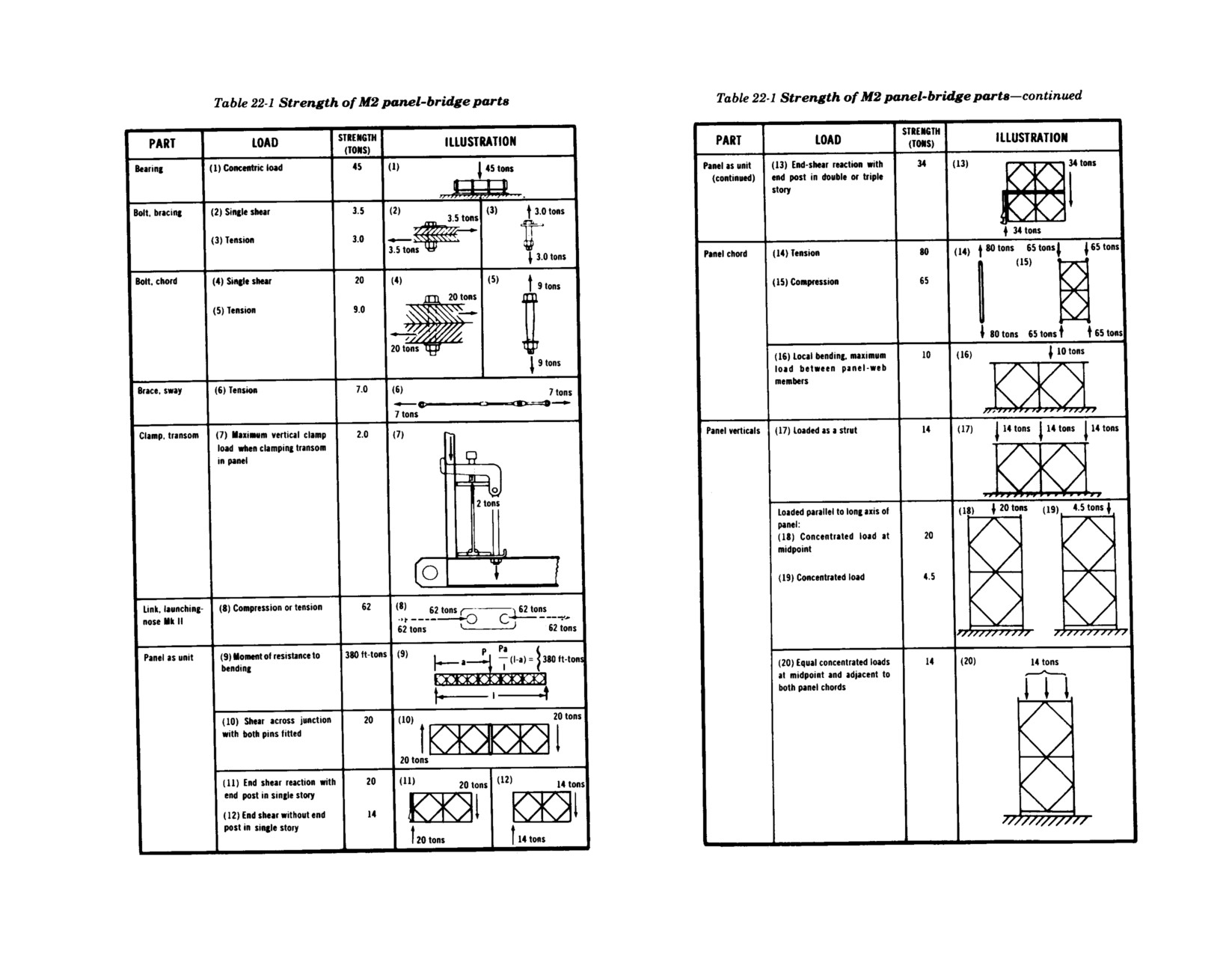
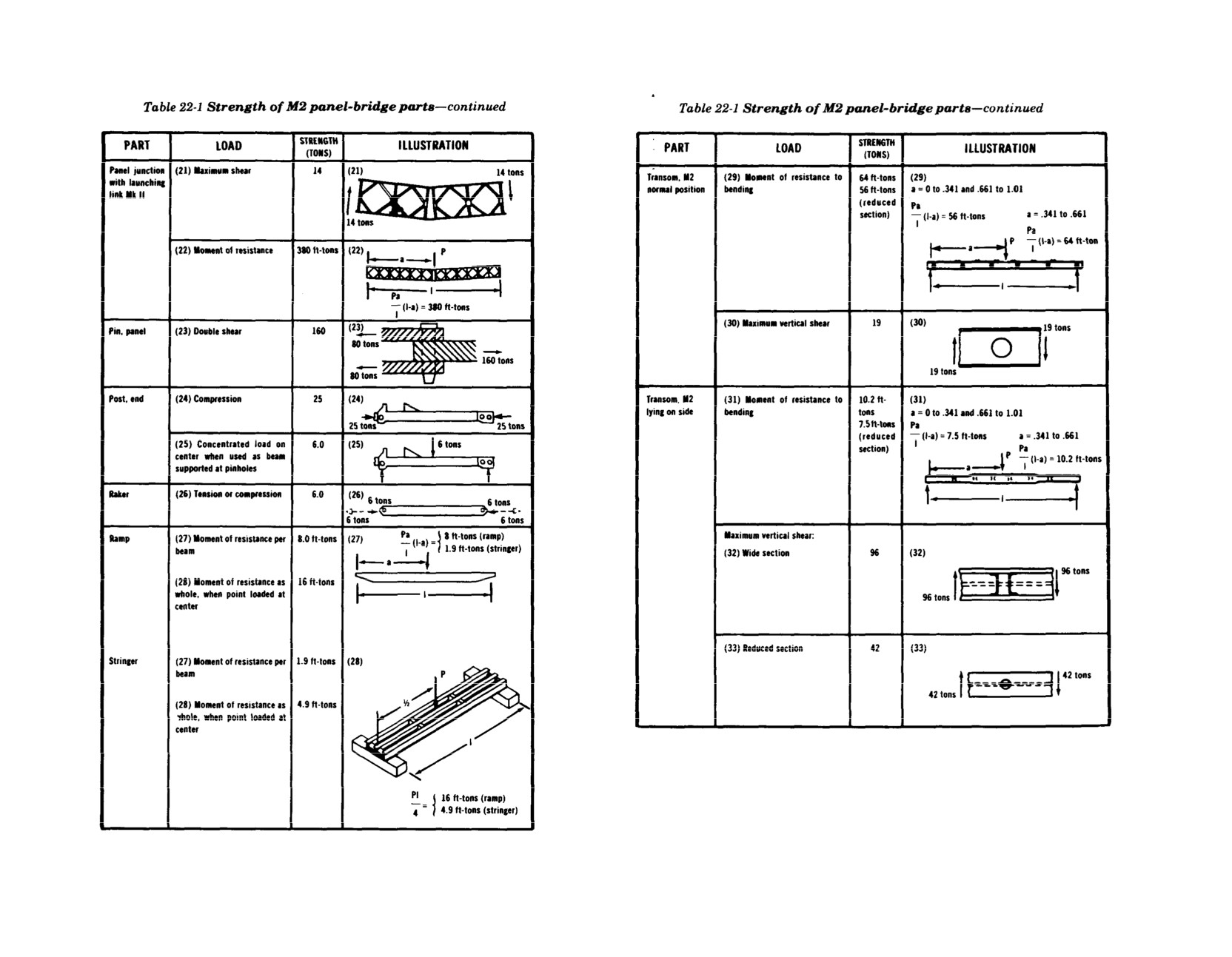
Panel bridge parts are often used in the field
Certain non-US vehicles are more than 150
to build improvised structures. To aid in their
inches (381.8 centimeters) wide. By removing
proper use, the capacities of the parts are
the ribbands, a roadway width of 165 inches
given here. In all cases, allowance must be
(419.1 centimeters) may be obtained. Normal
made for impact and load-distribution fac-
chess, used for a guard rail, should be bolted
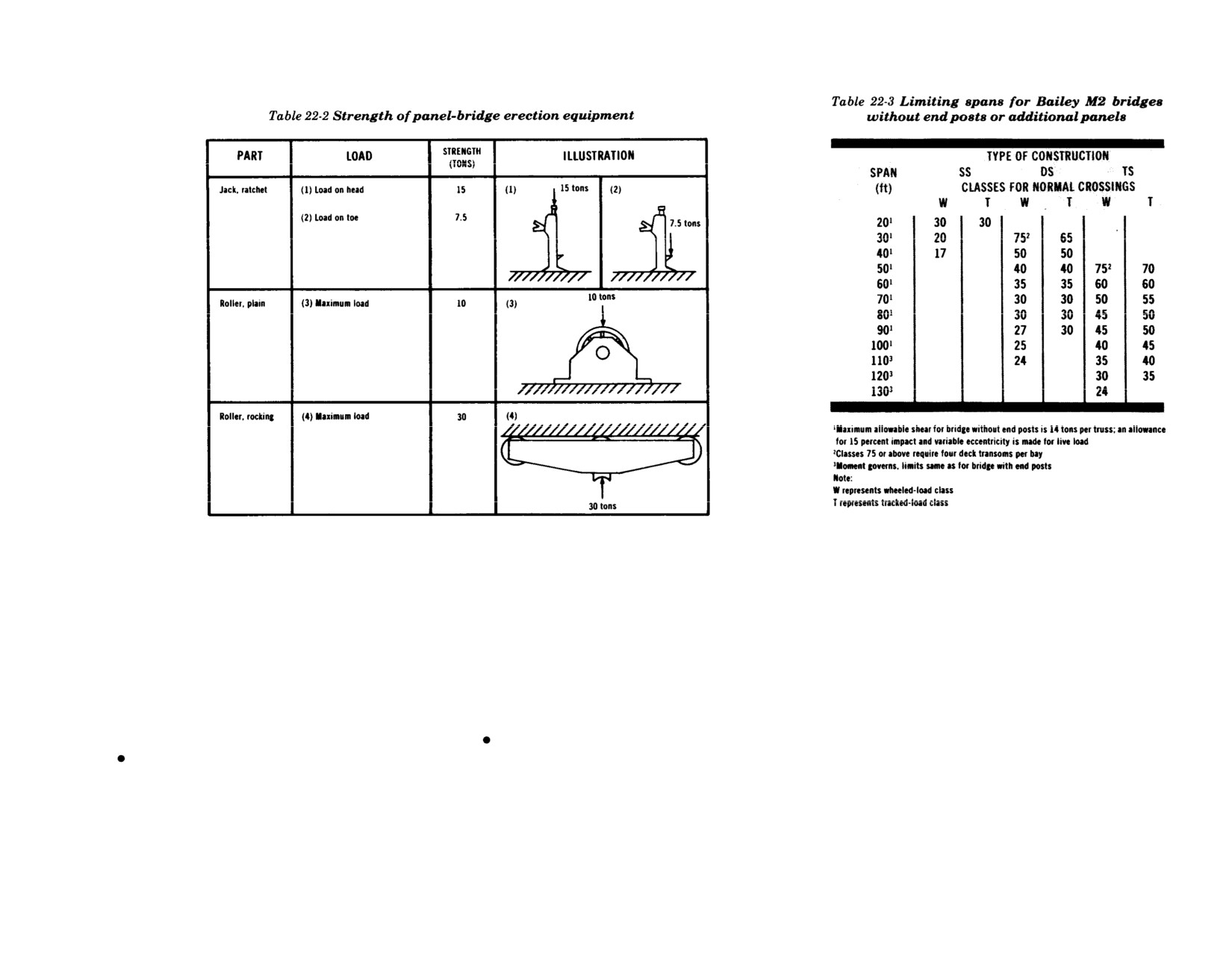
tors. Table 22-1 (page 287) gives the strength
to the panels just below the top chord of the
of M2 panel-bridge parts, and Table 22-2
bottom story as protection against damaging
(page 289) gives the strength of panel-bridge
the truss panels. To secure the chess to the
erection equipment.
panels, use carriage bolts with washers, with
either steel plates or an added plank behind
EXPEDIENT DECKING
the truss to bolt through. Limiting the wear
FOR PANEL BRIDGE
tread to the normal width between curbs will
If stringers and chess are not available, an
allow the curbs to be replaced promptly after
expedient deck can be laid on the transoms of
the wide vehicles have crossed. Prompt
a panel bridge. Timber or steel stringers with
replacement of these curbs is necessary to
a wood floor can be used, or steel treadways
ensure the bridge’s normal operating
can be laid on the transom.
capacity. (A few crossings by tanks may
quickly loosen the nails so that the treads
EXPEDIENT WIDENING
must frequently be renailed. The guard rails
OF PANEL BRIDGE
may be left on the truss panels either with the
The normal panel-bridge roadway width is
widened roadway or with the normal bridge.)
150 inches (381.8 centimeters). The roadway
can be widened to accommodate wider ve-
The capacity of the widened bridge may vary
hicles. Some wide vehicles will have very
some from the standard bridge due to the
little roadway clearance and require caution
increased eccentricity possible in the widened
in entering the bridge; however, it has been
bridge. Use normal capacities under caution
found that the ribbands should be retained
restrictions at all times when the curbs are
on the bridge for these wide vehicles. The
removed.
ribbands help guide the vehicles across the
bridge and prevent damage to the bridge
trusses.
286
FM 5-277
287
FM 5-277
288
FM 5-277
SPANS WITHOUT END POSTS
verticals of the end panel. Wedge blocking
supports the ends of the stringers and
Single-story bridges can be built without end
between these two transoms and lash
ramps. Place rakers on this transom and
posts or bearings, the bridge resting on timber
them together. The ends of the stringers
bracing frames between the trusses at the
cribbing under the end vertical member of the
and ramps rest on and engage with the
end of the bridge proper. Extend grillage
end panels. However, this method of construc-
lugs of the end transom. Bolt bracing
under the end vertical 2 feet (61.1 centi-
tion is not recommended unless absolutely
frames between the trusses at the end of
meters) on each side of the panel joint. A
necessary. When this is done, the transoms
the bridge. Table 22-3 lists the maximum
bridge of this assembly can carry the
supporting the ends of the last bay of
spans that can be built with ends of the
same load as a corresponding bridge with
stringers must be supported by one of the
bridge supported in this way.
its end transom not supported by trusses.
following methods:
If the extra panel is added to all the
When the end transom is supported by
trusses, the bridge can carry the same
When the end transom is not supported
trusses, add an extra panel to the inner
load as a corresponding bridge with end
by trusses, place it outside the verticals of
truss on each side of the bridge, and place
posts. In both cases, place cribbing under
the panels and on grillage. Place an extra
a transom in this panel on the seating
the center of the end transom when loads
transom in the seating just inside the
nearest the bridge proper. This transom
are over 30 tons (27.3 metric tons).
289
FM 5-277
CAUSEWAYS
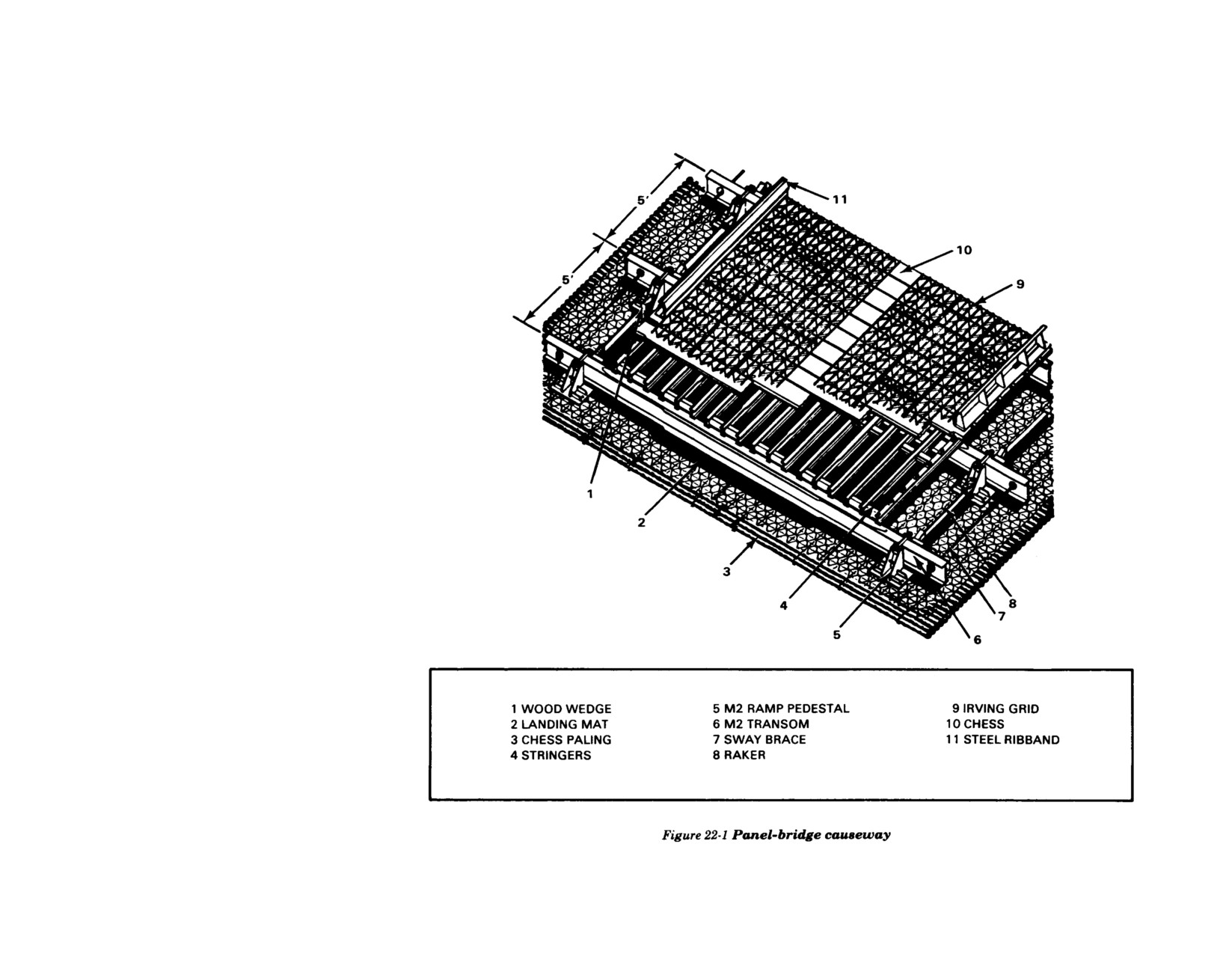
Panel-bridge decking can be used to build an
expedient causeway over the soft mud of a
tidal riverbed. The causeway described here
(Figure 22-1) has a capacity of 45 tons (41
metric tons) and can be used at all stages of
tide to load heavy vehicles such as medium
tanks on rafts. Its roadway can have a slope
up to 1 in 5 and is not affected by heavy
tracked vehicles that would normally cause a
roadway of landing mats on corduroy mate-
rial to break up. Use of panel bridge equip-
ment or causeways is expensive in equipment,
however, and should be controlled carefully
to prevent a shortage of panel-bridge parts.
Preliminary work
The causeway consists of a normal panel-
bridge deck of chess, ribband, and stringers
supported on transoms set in ramp pedestals.
To prevent scour and to distribute the load,
rest the pedestals on a foundation of landing
mats and sapling mats (chess paling or
similar material). Place two pedestals under
each transom and space the transoms 5 feet
(1.5 meters) center to center. Use precut 4- by
3-inch (10.2 by 7.62 centimeters) timber
spacers, or rakers with timber wedges, be-
tween the pedestals to take longitudinal
thrust. Thread sway bracing through the
outside holes in the transom webs and hold in
place by bolts. Wire the button stringers to
the transoms to prevent the decking from
being lifted by the tide. Provide a nonskid
surface by nailing down landing mat to the
chess or wear treads. Use steel ribbands for
curbing. Use holdfasts at each side of the
causeway to anchor bays having a steep
slope.
290
FM 5-277
Erection
About 100 man-hours are required to erect
bridge the gap between the causeway and
100 feet (30.8 meters) of this causeway. If the
shore end of the raft. The shoreward ponton
precut timber spacers are used instead of
can be grounded on the submerged causeway,
rakers with wedges, erection time can be
but care must be taken to position the raft so
reduced 25 percent. Place spacers at the same
the water is deep enough to permit maximum
time as the pedestals, before transoms are
displacement when the shoreward ponton
laid. Do not tighten sway braces until
grounds.
stringers have been placed.
PANEL BOX ANCHORS
The maintenance party keeps wedges, sway
An expedient heavy rubble box anchor can be
braces, and anchor lines tight.
made from four panels welded into a box with
heavy wire net and filled with rock. Com-
Operation
pletely filled with rock, the anchor weighs
At low tide, and at high tide during construc-
about 10 tons. Heavy anchors of this type are
tion of the causeway, vehicles generally can
used to anchor heavy floating bridges in
be loaded and unloaded at the end of the
swift currents and in streambeds in which
causeway. The overhanging deck or adjust;
the standard anchor will not hold.
able ramp of the raft rests on the end bay of
the causeway so vehicles pass directly from
OTHER EXPEDIENT USES
the raft deck to the causeway. Where the
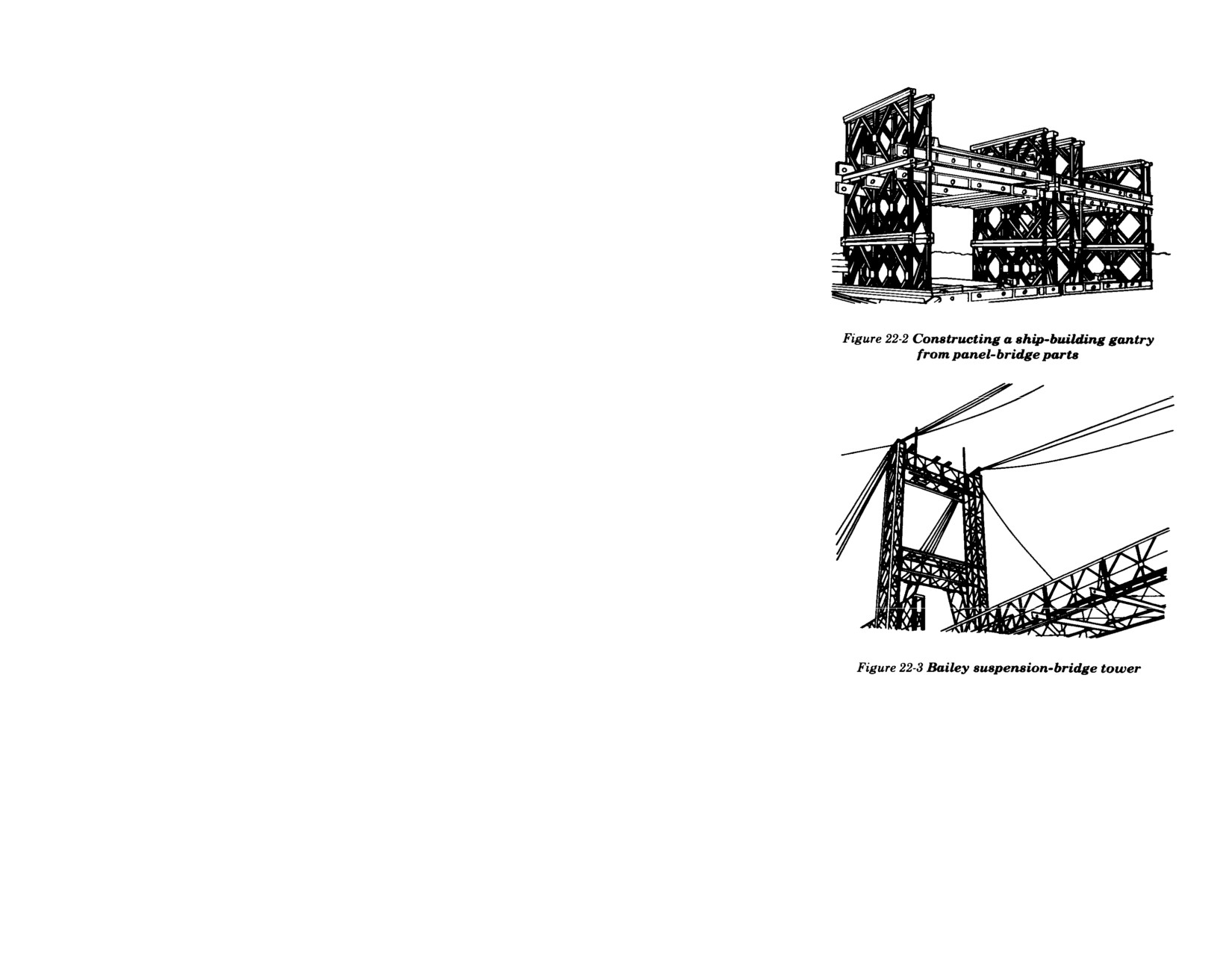
Panel-bridge parts can be used to build
causeway is begun at high tide, bays can be
gantries (Figure 22-2), anchor-cable towers,
added at the rate of one bay in about 20
high-line towers, towers for suspension
minutes as the tide lowers.
bridges (Figure 22-3), truck-loading traps,
and other structures when building materials
At high tide, the lower end of the completed
are not available. Angles and I-beams can be
causeway is submerged and rafts are loaded
salvaged from damaged panel-bridge parts
and unloaded at the higher bays. Use an
to be used for expedient construction.
adjustable landing ramp hinged to the raft to
291
FM 5-277
CHAPTER 23
DEMOLITION OF BRIDGE AND PARTS
The success of these demolition methods
After the bridge is collapsed and the abut-
DESTRUCTION OF BRIDGE
depends on the use of a uniform procedure by
ments destroyed, and if time permits, destroy
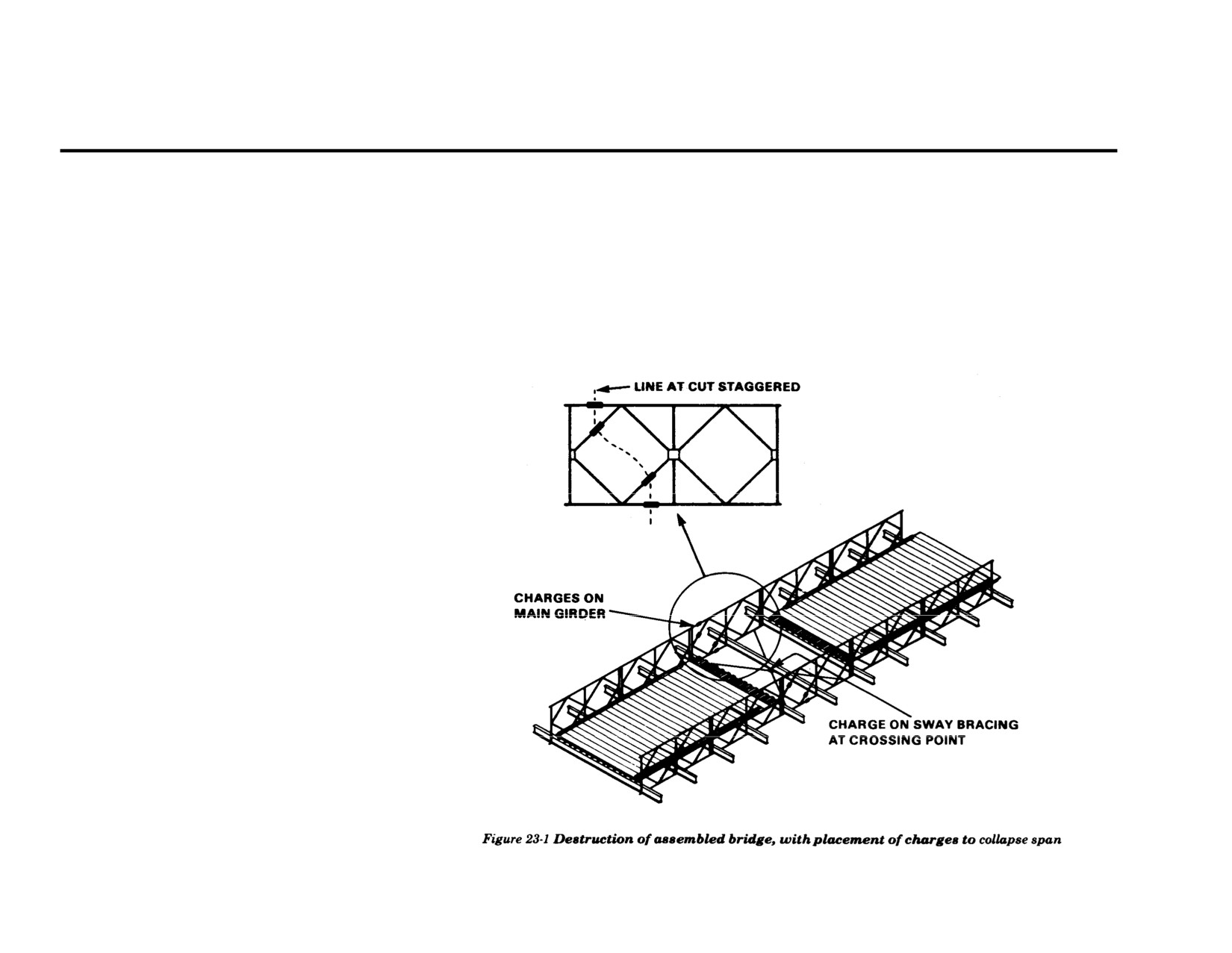
Cut bridge in one or more places by cutting
all units in the theater. All ranks must be
individual components in the order used for
panels on each side of the bridge and sway
impressed with the importance of following
destroying stacked equipment female lugs in
braces in the same bay (Figure 23-l). Stagger
the principles stated in this chapter. The
lower chord of all panels; transoms and
the line of cut through the panels (inset,
destruction must prevent both enemy use of
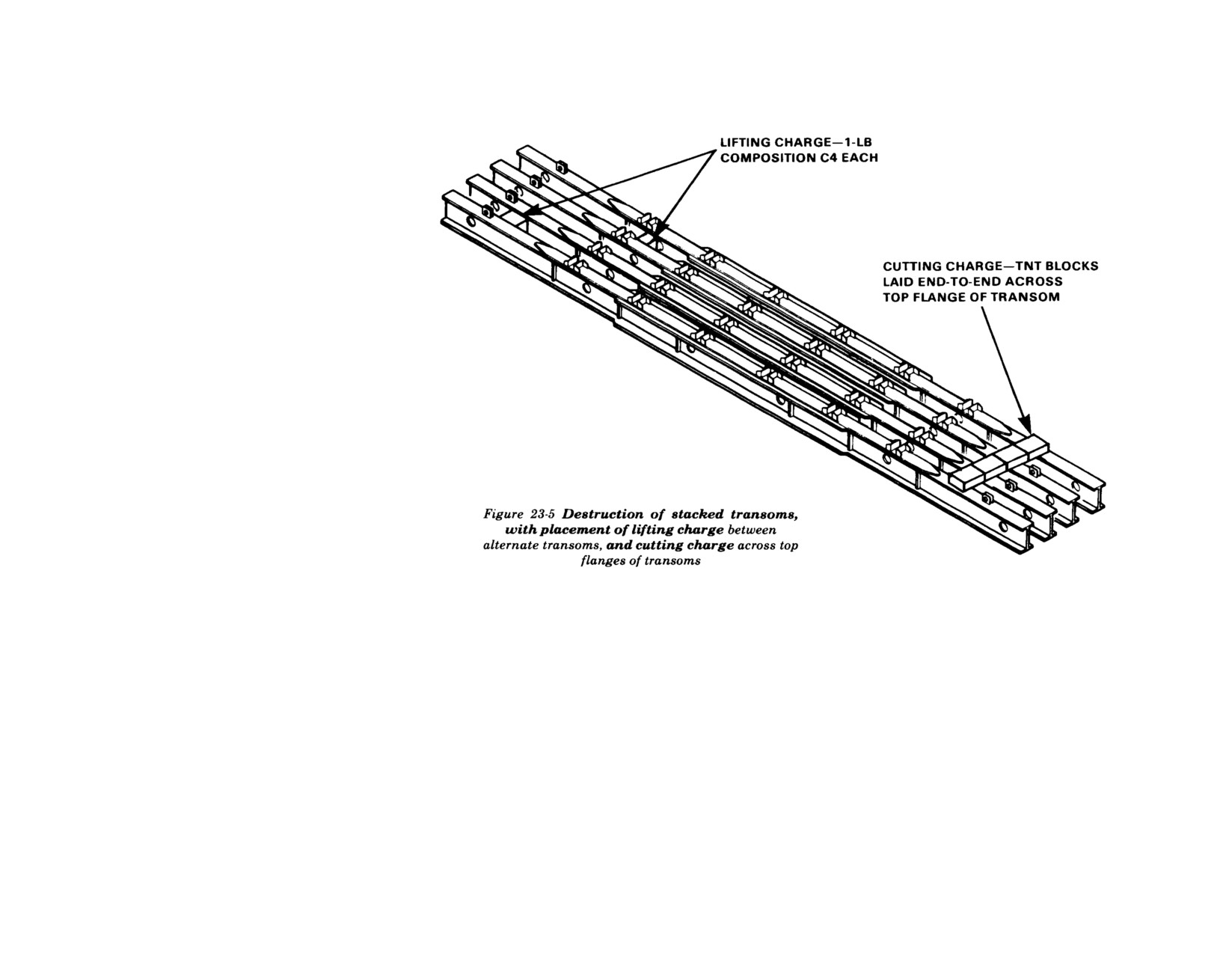
panels (Figures 23-4 and 23-5, pages 295 and
Figure 23-l). Otherwise the top chords may
the bridge as a unit and use of its parts for
296); chess; stringers and ramps; jacks,
jam and prevent the bridge from dropping. In
normal or improvised construction.
rollers, and erection tools; and remaining
double or triple-story bridges, increase the
small parts.
ORDER AND METHODS
OF DESTRUCTION
To prevent use of existing bridge, cut tresses
so bridge drops into gap, and destroy abut-
ments. To prevent reconstruction of a com-
plete bridge, destroy one essential component
not easily replaced or improvised. This com-
ponent must be the same throughout the
theater so replacements cannot be obtained
from other sectors. The panel is the only
component fulfilling these conditions.
Always destroy all panels first. To make a
panel useless, remove or distort female lug in
lower or tension chord. Destruction of both
female lugs is unnecessary.
Also destroy certain other components, such
as transoms and decking, useful to the enemy
for improvised bridging. Destroy components
such as stringers, ramps, jacks, rollers, and
erection tools only if time allows and explo-
sives are available. Because the relative
importance of these components varies con-
siderably, follow the order of destruction
given just below.
292
FM 5-277
charges on the chords at the junction line of
the stories.
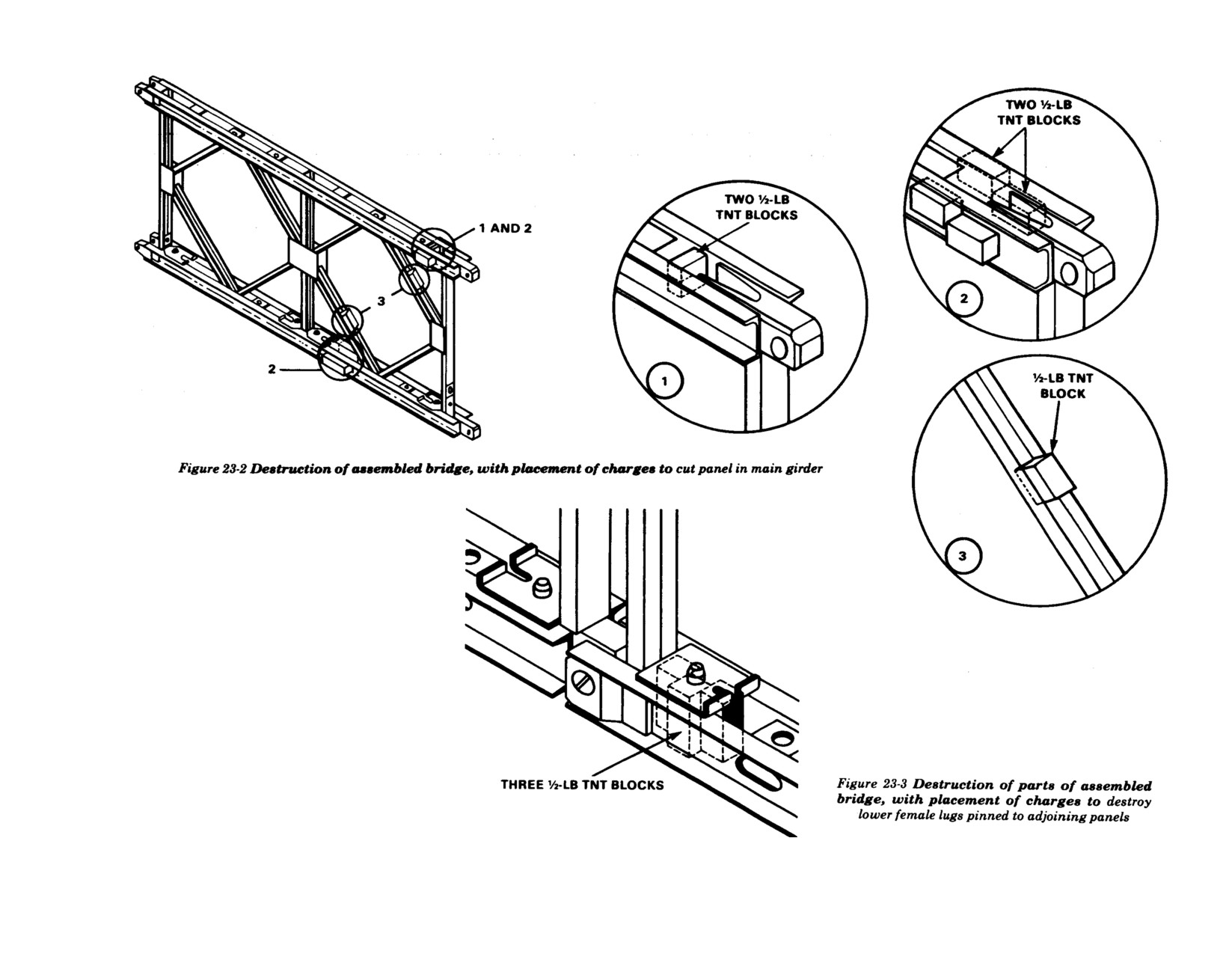
For further destruction, place charges on
component parts of the bridge, such as panels,
transoms, and stringers (Figures 23-2 and
23-3). Stack and bum decking.
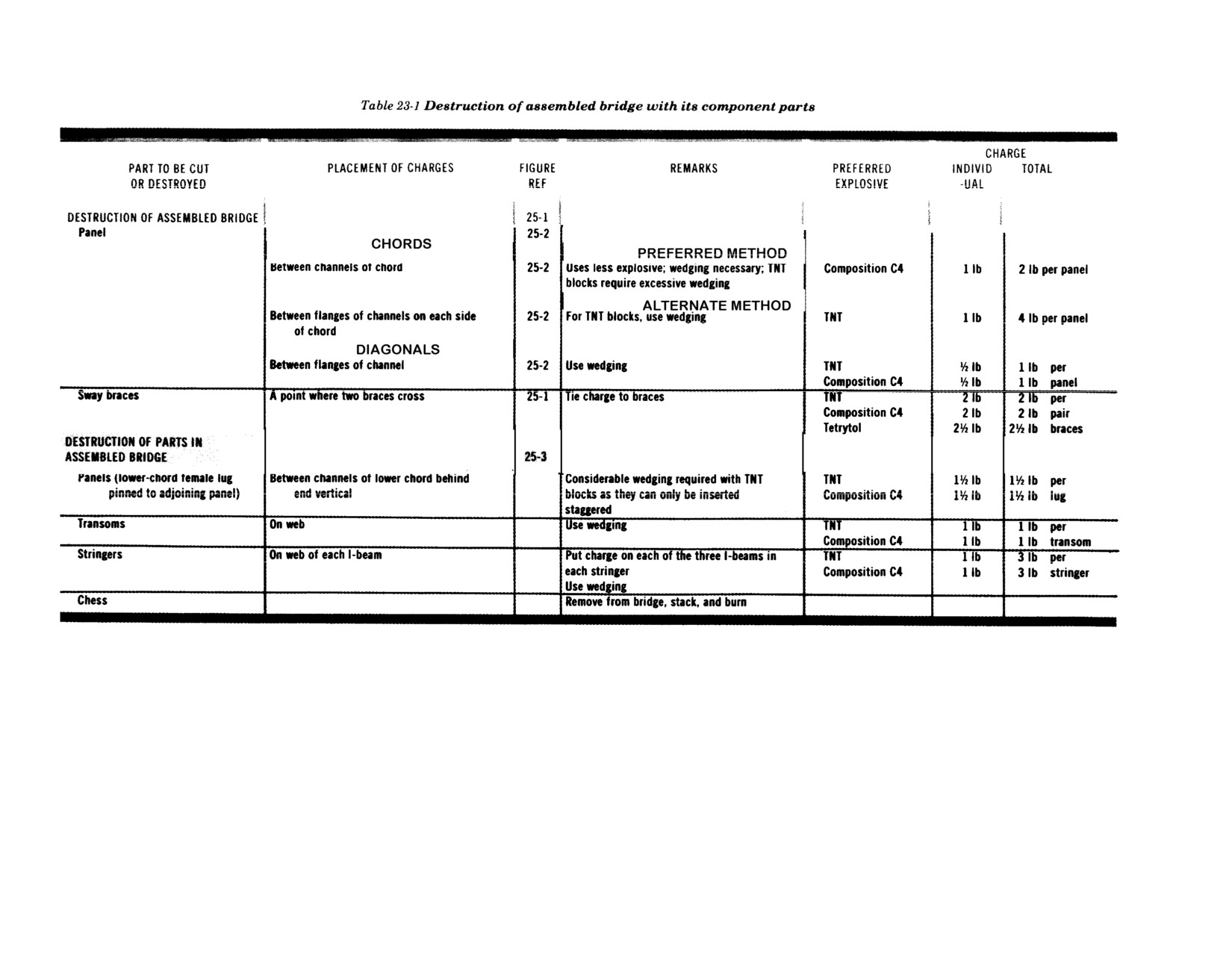
Charges and methods of placing various
explosives are given in Table 23-1 (page 294).
Wedge all charges in place. Use methods and
charges described in FM 5-25 for destroying
abutments.
293
FM 5-277
DESTRUCTION OF
DESTRUCTION OF CABLE
parts of all cable reinforcement sets and all
STACKED EQUIPMENT
REINFORCEMENT SET
corresponding repair parts.
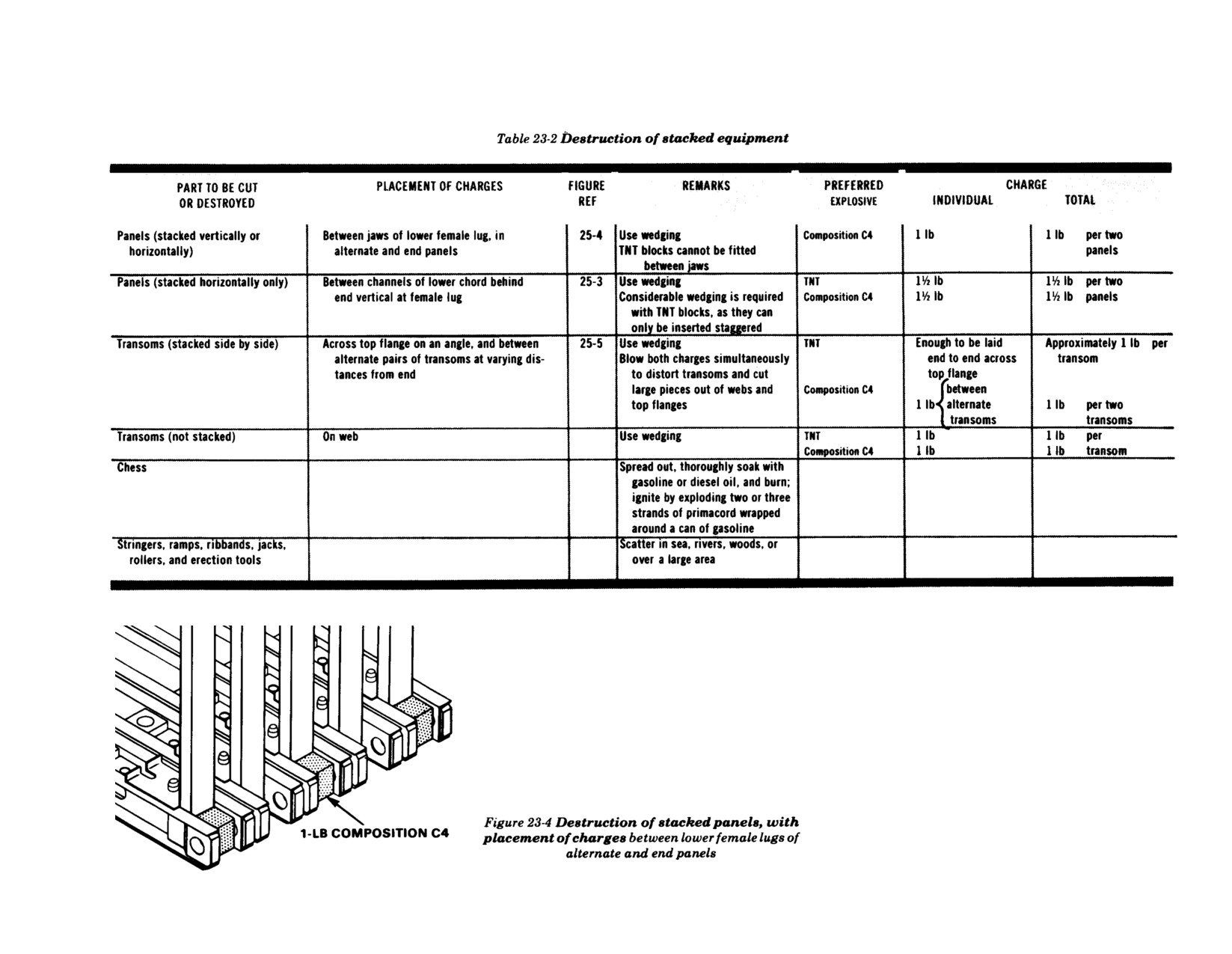
Destroy panels and transoms in stacks. To
When capture or abandonment of the cable
dispose of stringers, ramps, jacks, rollers,
reinforcement set is imminent, the respon-
For demolition by mechanical means, use
small parts, and erection tools, dump them
sible unit commander must make the decision
sledgehammers, crowbars, picks, axes, or
over large areas in places such as the sea,
either to destroy the equipment or to make it
any other heavy tool available to destroy the
rivers, or woods. Bum decking. Methods of
inoperative. Based on this decision, that
post assemblies, fixtures, and braces; the
destruction are described in Table 23-2, and
commander orders how much should be
cable-connection beams and span junction
shown in Figures 23-4 and 23-5 (page 296).
destroyed. Whatever method of demolition
posts; the cable assemblies; and the cable-
Tamp all charges.
used, it is essential to destroy the same vital
tensioning or manual hydraulic-pump assem-
294
FM 5-277
blies. For demolition by explosives, place as
All operators should be thoroughly trained in
many charges as the situation permits.
the destruction of the cable reinforcement set.
Detonate charges simultaneously with deto-
Simulated destruction, using all methods
nating cord and suitable detonator. Place at
listed above, should be included in the
least one ½-pound (.2 kilo) charge on each
operator training program. It must be empha-
cable and each cable-connection beam
sized in training that demolition preparations
assembly. For demolition by weapons, fire on
are usually made in critical situations with
the cable-connection beams and vertical posts
little time available for destruction. For this
with the heaviest suitable weapons available.
reason, operators must be fully familiar with
all methods of destruction of equipment and
be able to carry out demolition instructions
without reference to this or any other manual.
295
FM 5-277
296
APPENDIX A
OVERSIZED TABLES
See pocket envelope inside back cover for
uneven-numbered pages
297.1 through
321.
Even-numbered pages 298 through 322 are blank.
297
APPENDIX B
CABLE REINFORCEMENT SET
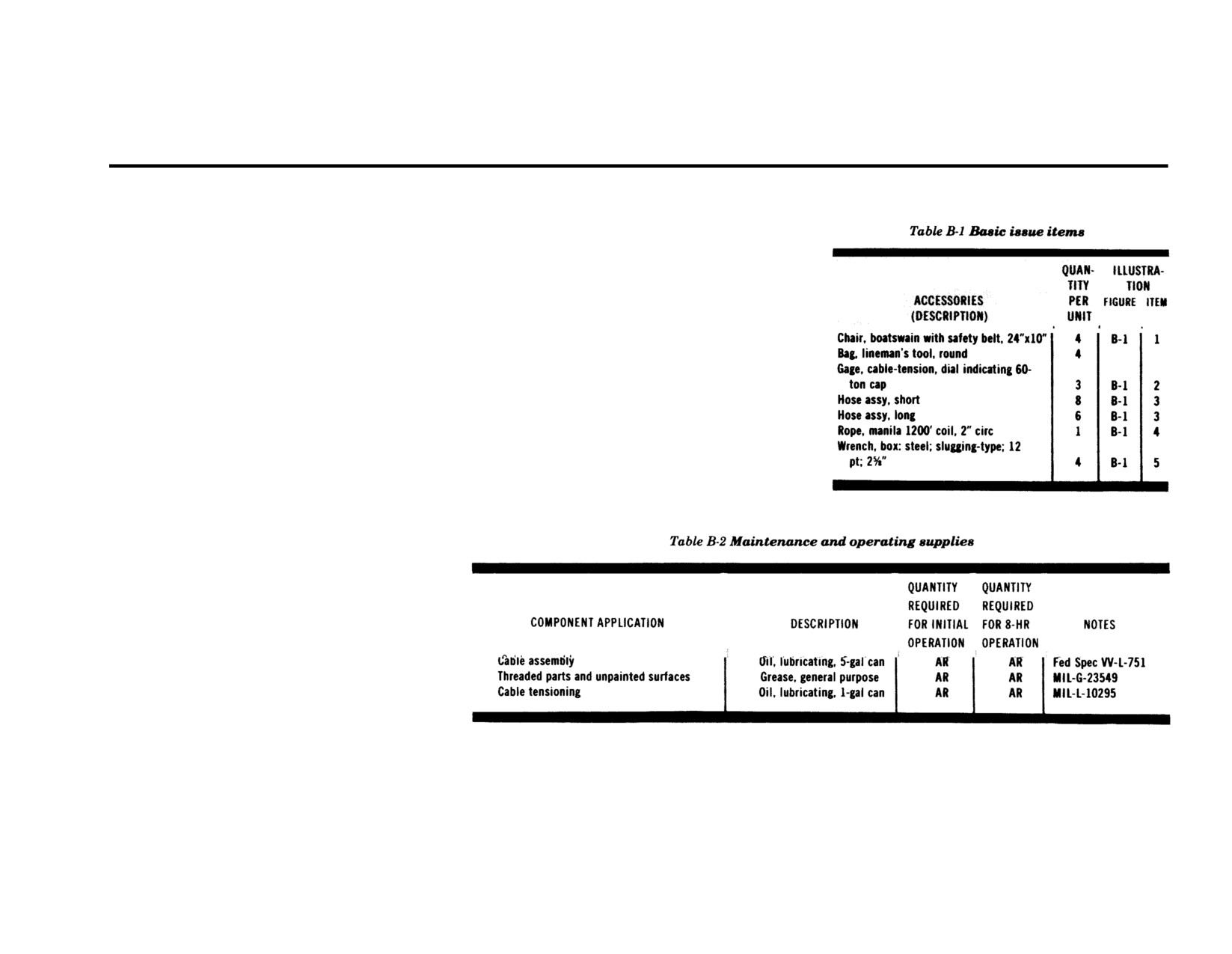
Tables B-1 and B-2 of this appendix list items
which accompany the cable reinforcement
set for installation or crew maintenance, as
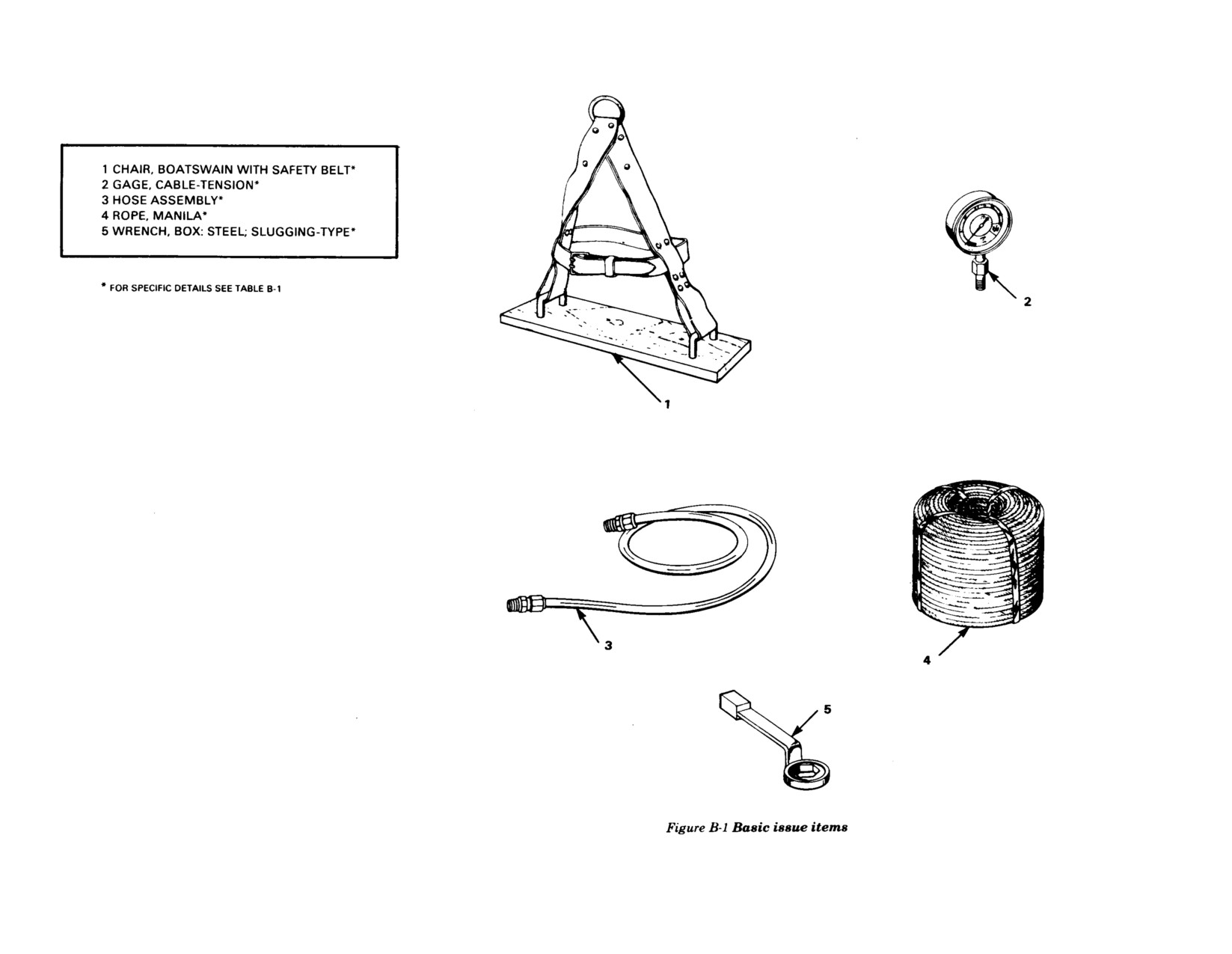
well as supplies needed for initial operation
of the set. Figure B-1 (page 324) shows the five
basic issue items listed in Table B-1. Figures
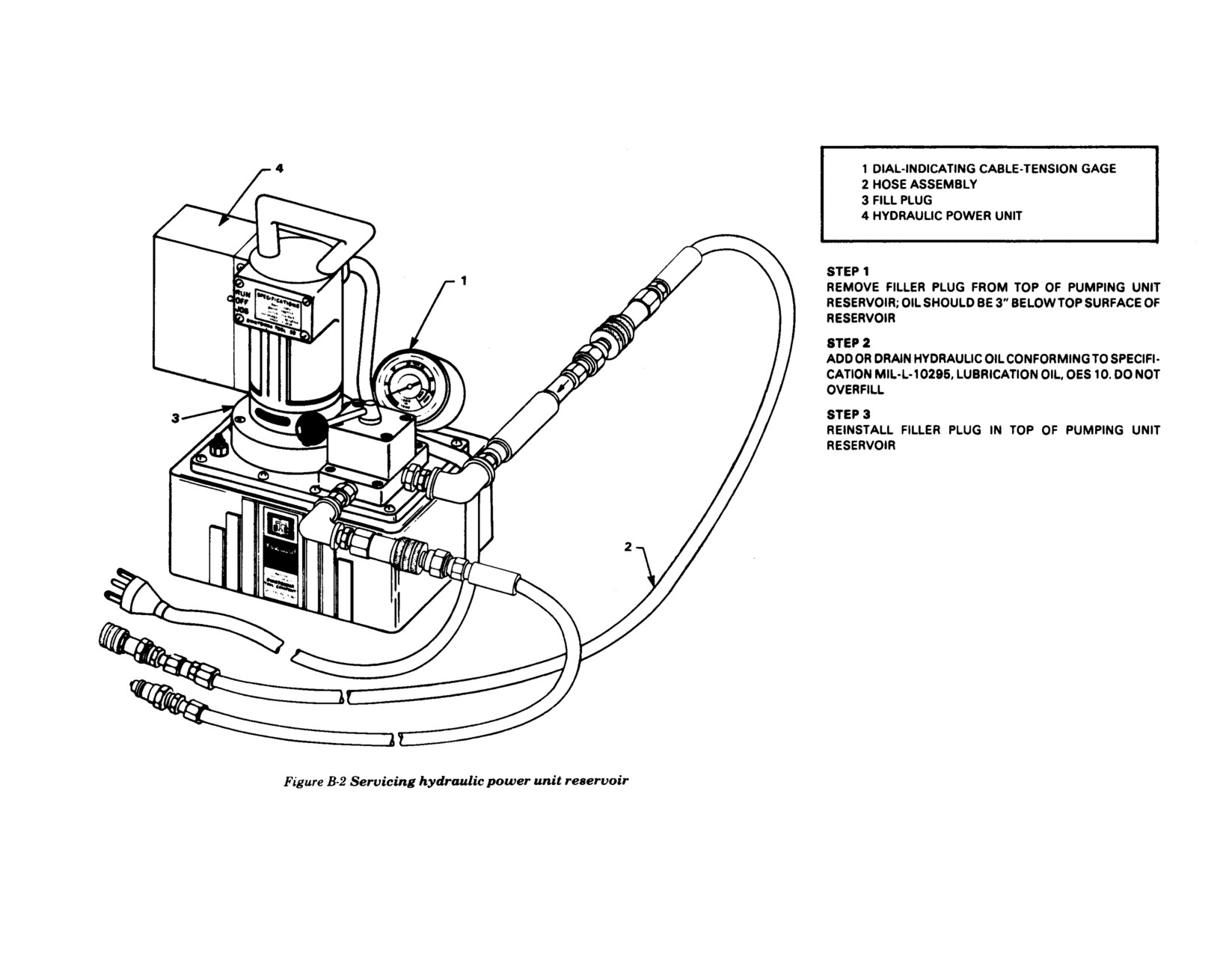
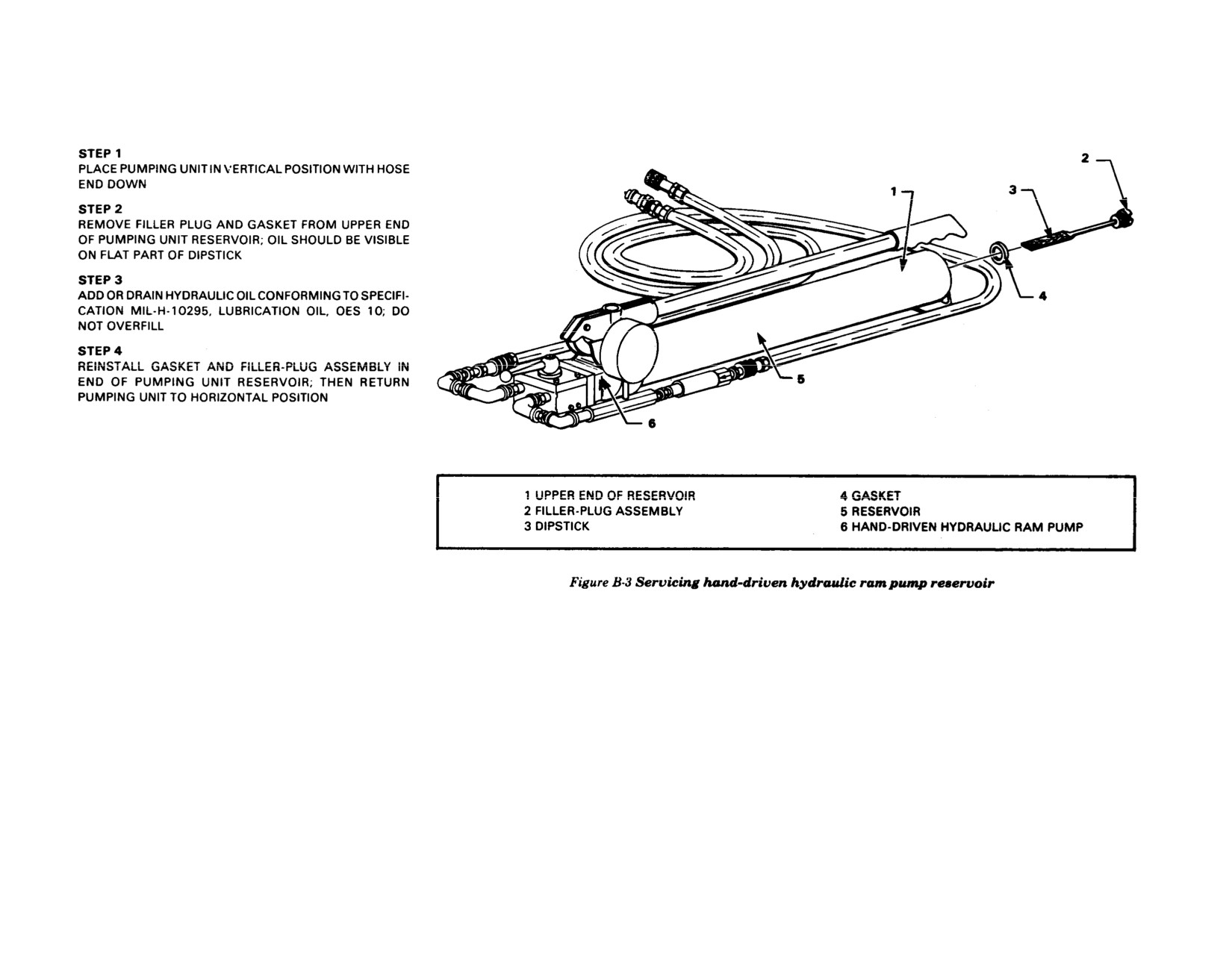
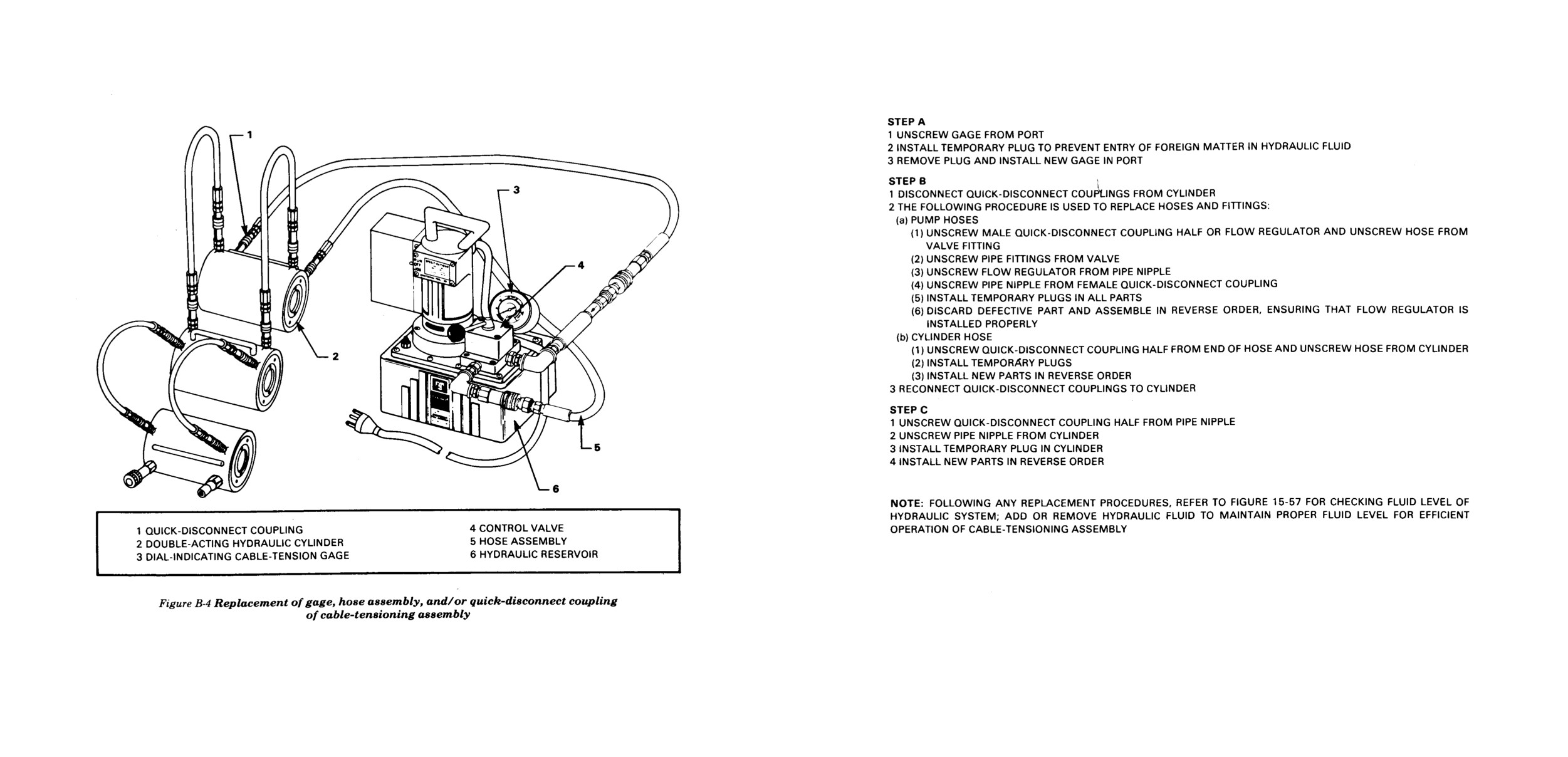
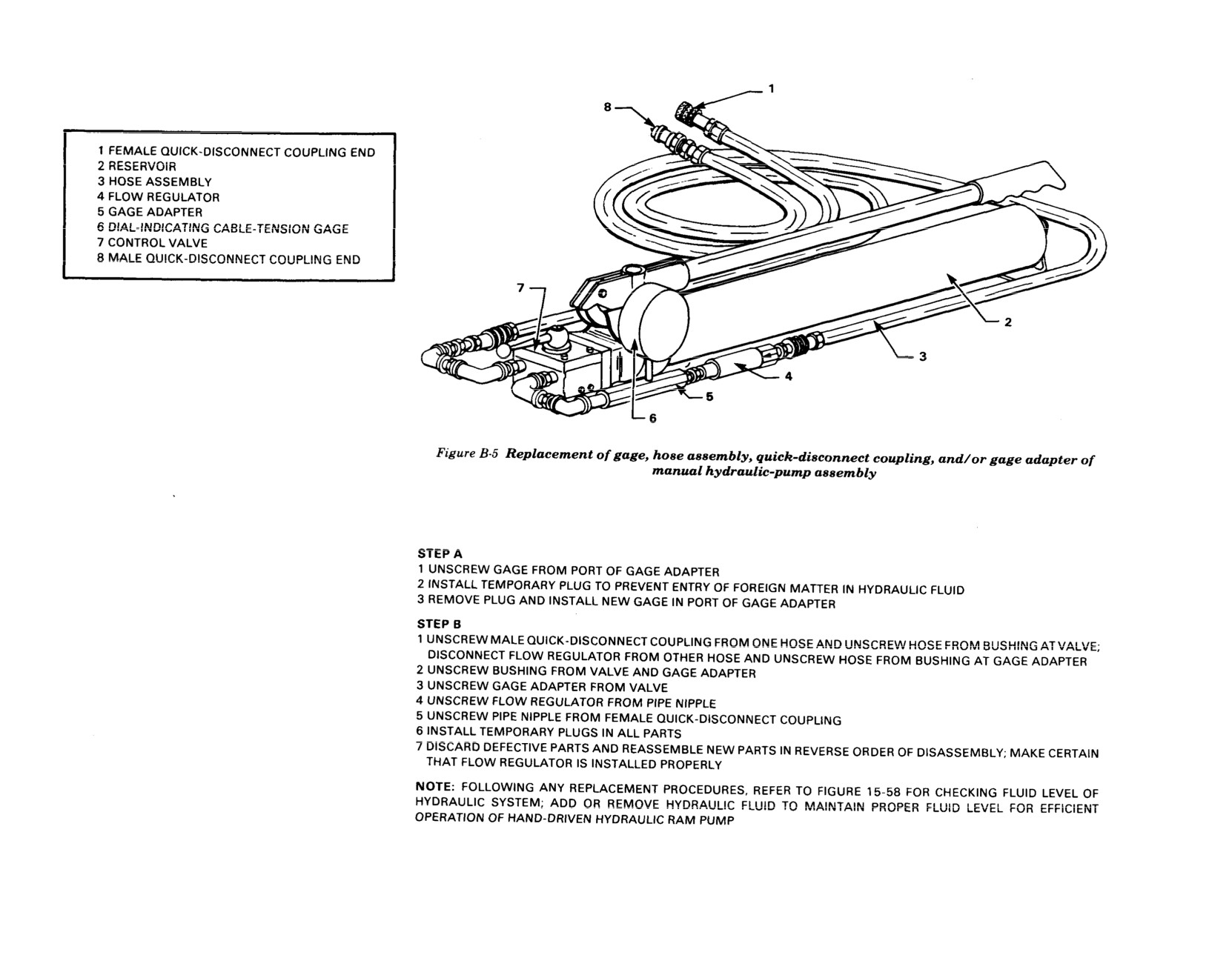
B-2 through B-5 (pages 325 through 328) and
Tables B-3 (page 329) and B-4 (page 330),
show maintenance and troubleshooting pro-
cedures for the set, as described in Chapter
15. Table B-5 (page 331) lists the repair parts
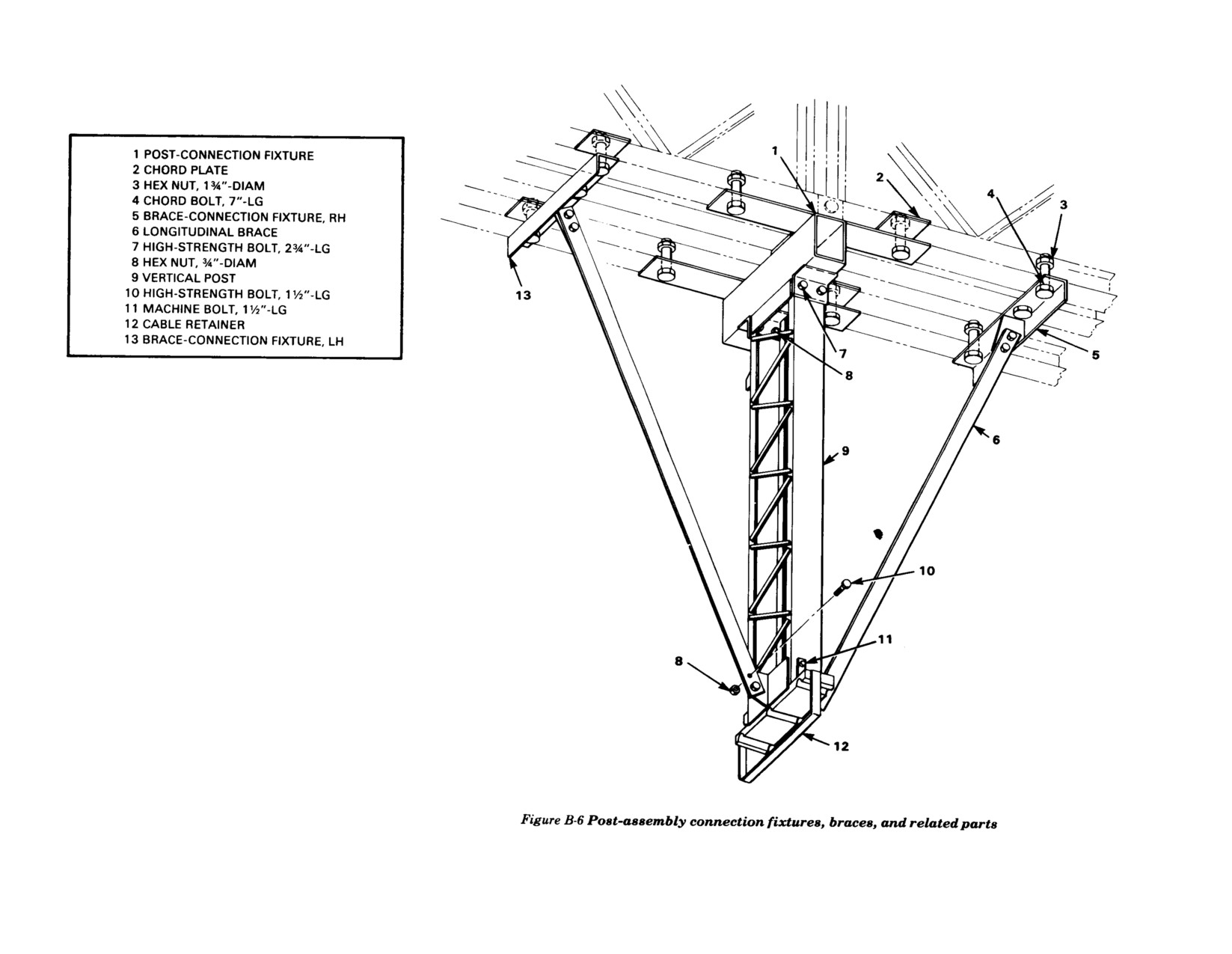
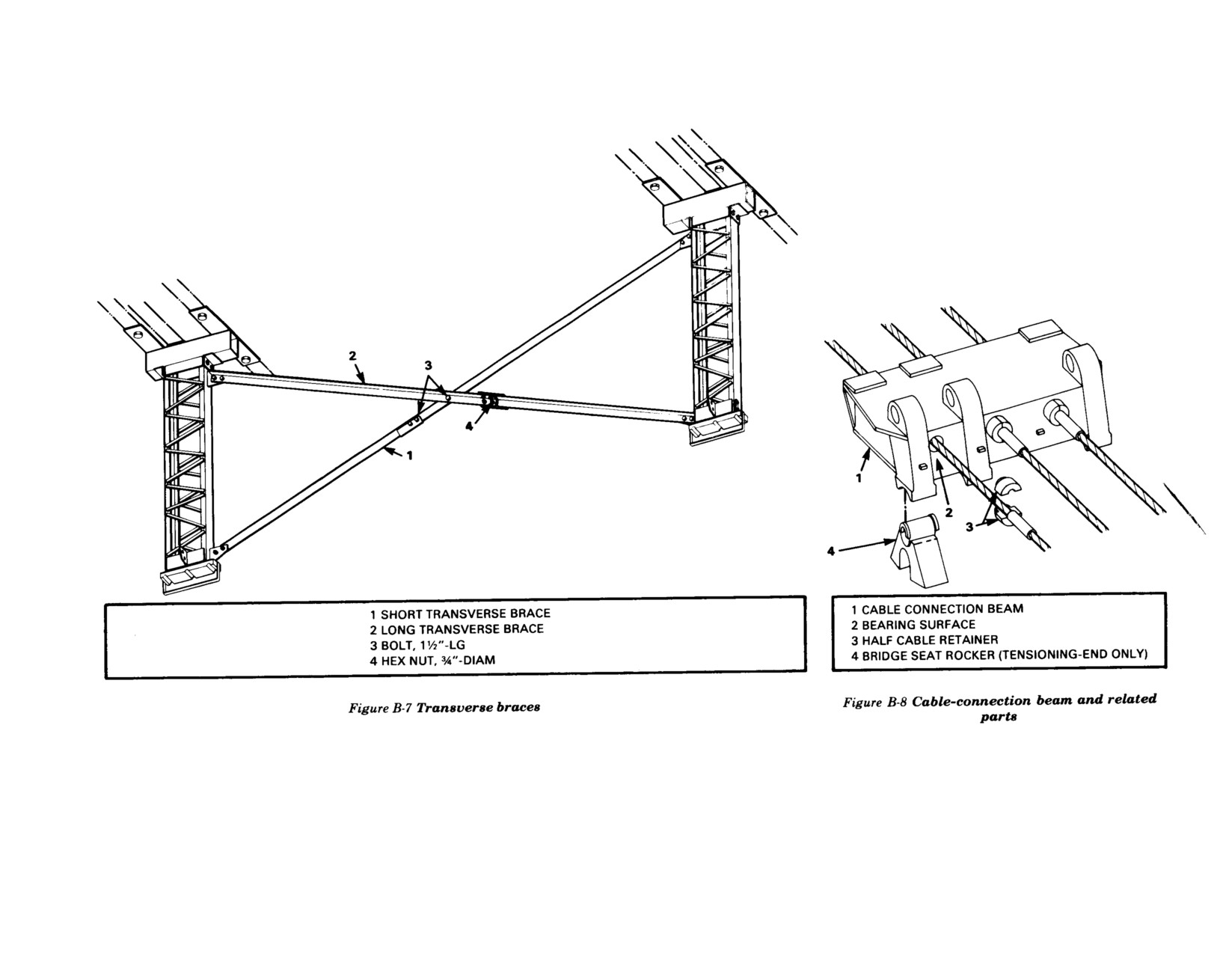
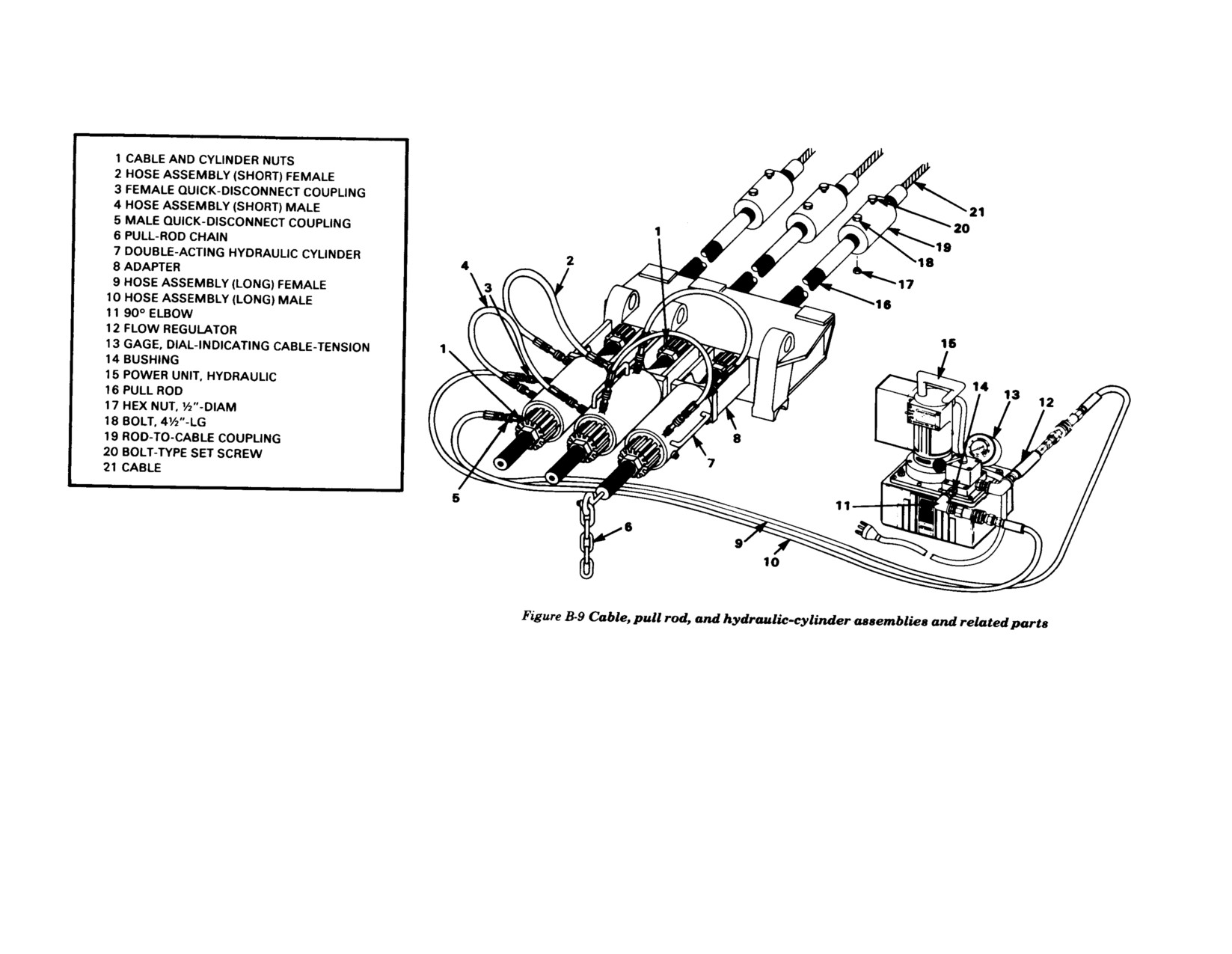
needed to maintain the set, while Figures B-6
through B-12 (pages 332 through 336) show a
number of these parts separately.
323
FM 5-277
324
FM 5-277
325
FM 5-277
326
FM 5-277
327
FM 5-277
328
FM 5-277
332
FM 5-277
333
FM 5-277
334