FM 5-277 BAILEY BRIDGE (May 1986) - page 11
FM 5-277
335
FM 5-277
336
FM 5-277
APPENDIX C
USE OF SALE CHARTS IN DETERMINING MOMENT AND SHEAR
When a simple horizontal beam is loaded, it
deflects, or bends downward, and the hori-
zontal fibers in the lower part of the beam are
lengthened (tension) and those in the upper
part are shortened (compression). The exter-
nal forces act to produce a bending moment.
The moment of the internal forces (stresses)
resisting this bending is called the resisting
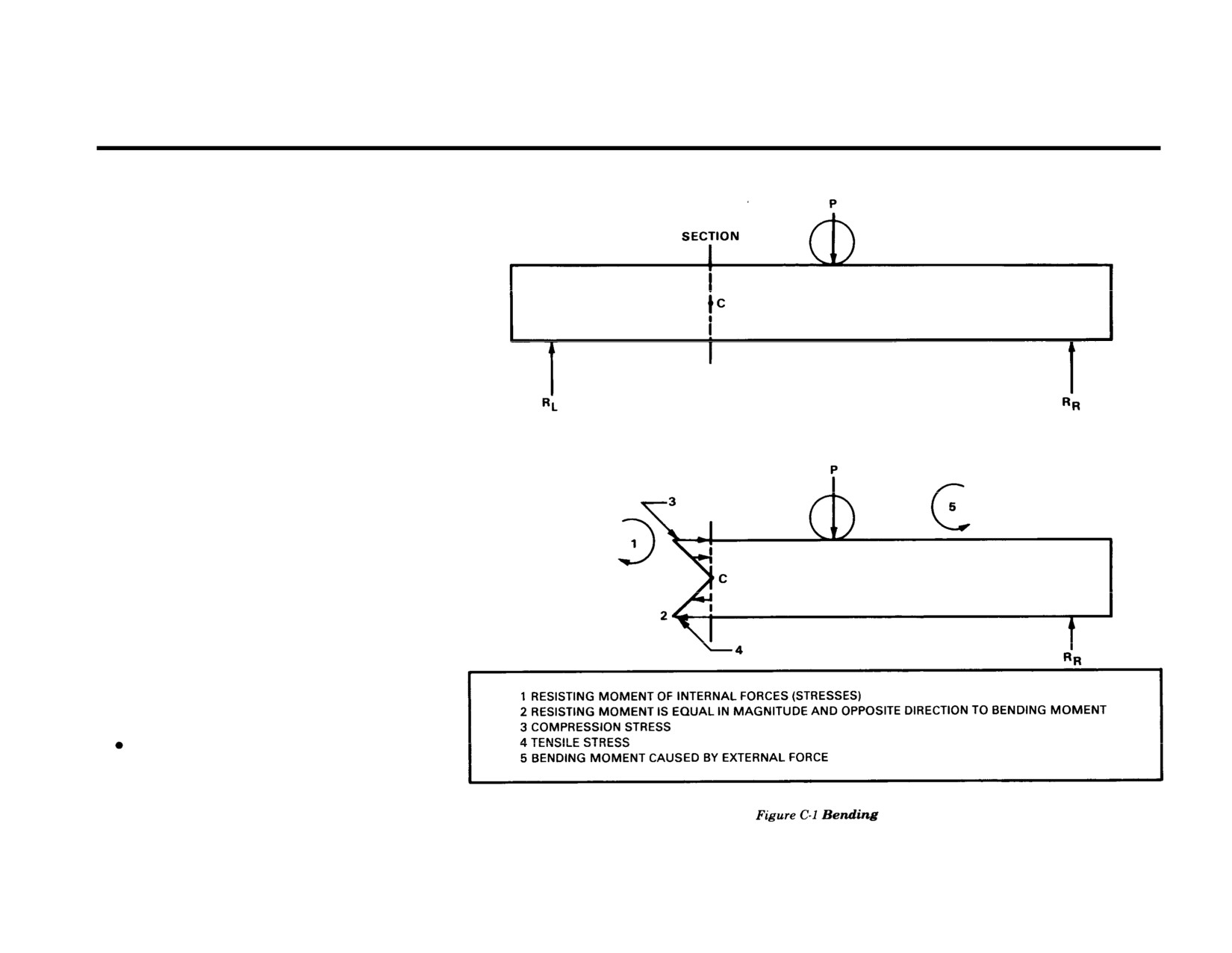
moment. In Figure C-1, in that part of the
beam to the right of section C, the counter-
clockwise bending moment produced by the
external force P and Rr is resisted by the
clockwise resisting moment produced by the
tensile and compressive stresses in the beam
at section C. Within the strength of the
material, the resisting moment at any section
is equal to the betiding moment at that
section. When abeam is designed, the dimen-
sions must be such that the maximum
resisting moment that the beam can develop
is at least equal to the greatest bending
moment that may be imposed on it by the
external loads.
BENDING MOMENT
The following procedures, formulas, and
other data are relevant to the determination
of maximum allowable bending moment:
The bending moment at any section
(point) of a beam for an external load in a
specific position is found as follows:
1 Determine reactions caused by load in
this position.
337
FM 5-277
M = w12
(Load w per linear foot distri-
buted over span 1)
(Load W partially distri-
buted over span 1)
Where
M=
Moment in inch-pounds at
center of beam
P=
Concentrated load in
pounds
W=
Total distributed load in
pounds
2
Take either reaction and multiply it by
center of span when load is at center of
w=
Distributed load per linear
distance of that reaction from section
span.
foot in pounds
under consideration.
1=
Span in inches
Maximum bending moment produced by
b=
Length of load in inches
3
From this product, subtract product of
a uniformly distributed load occurs at
each load applied to beam between
center of span when distributed load
EXAMPLES:
What is the maximum
reaction and section times the distance
covers entire span.
bending moment produced in a 20-foot
from that load to section.
span by a single concentrated axle load
If distributed load is shorter than span,
of 30 tons? By a total load of 5 tons
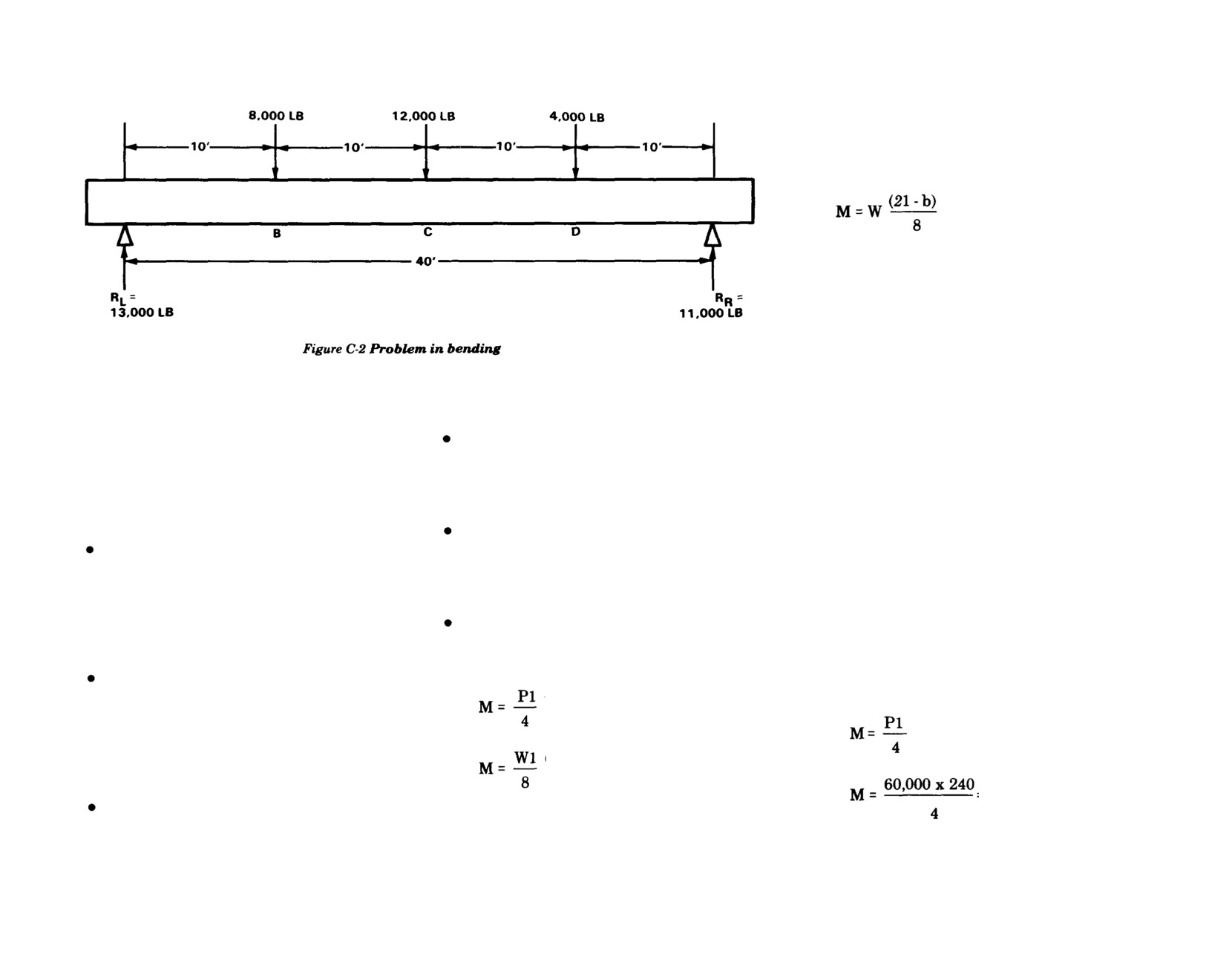
In Figure C-2, external bending moment
maximum bending moment occurs at
uniformly distributed over the span
at C equals M
c
= (RL
x 20) - (8,000 x 10) =
center of span when center of load is at
(dead load)?
By a 30-ton tank that has
260,000 - 80,000 = 180,000 foot-pounds, or
center of span.
147 inches of track?
M= 18,000 x 12 = 2,160,000 inch-pounds.
c
This may also be found by taking forces
The following formulas are useful in
SOLUTIONS:
from the right end.
determining maximum bending moments
caused by single loads on simple beams:
For a single concentrated axle load of
The bending moment at any point in a
30 tons:
beam due to a moving load varies with the
(Concentrated center load P)
position of the load. For design, it is
Where
necessary to know the maximum moment
P= 30 tons (60,000 pounds)
that is caused by the load as it moves
(Total load W uniformly distri-
1 = 20 feet (240 inches)
across the bridge.
buted over span 1)
= 3,600,000 inch-
Maximum bending moment caused by a
pounds
single concentrated axle load occurs at
338
FM 5277
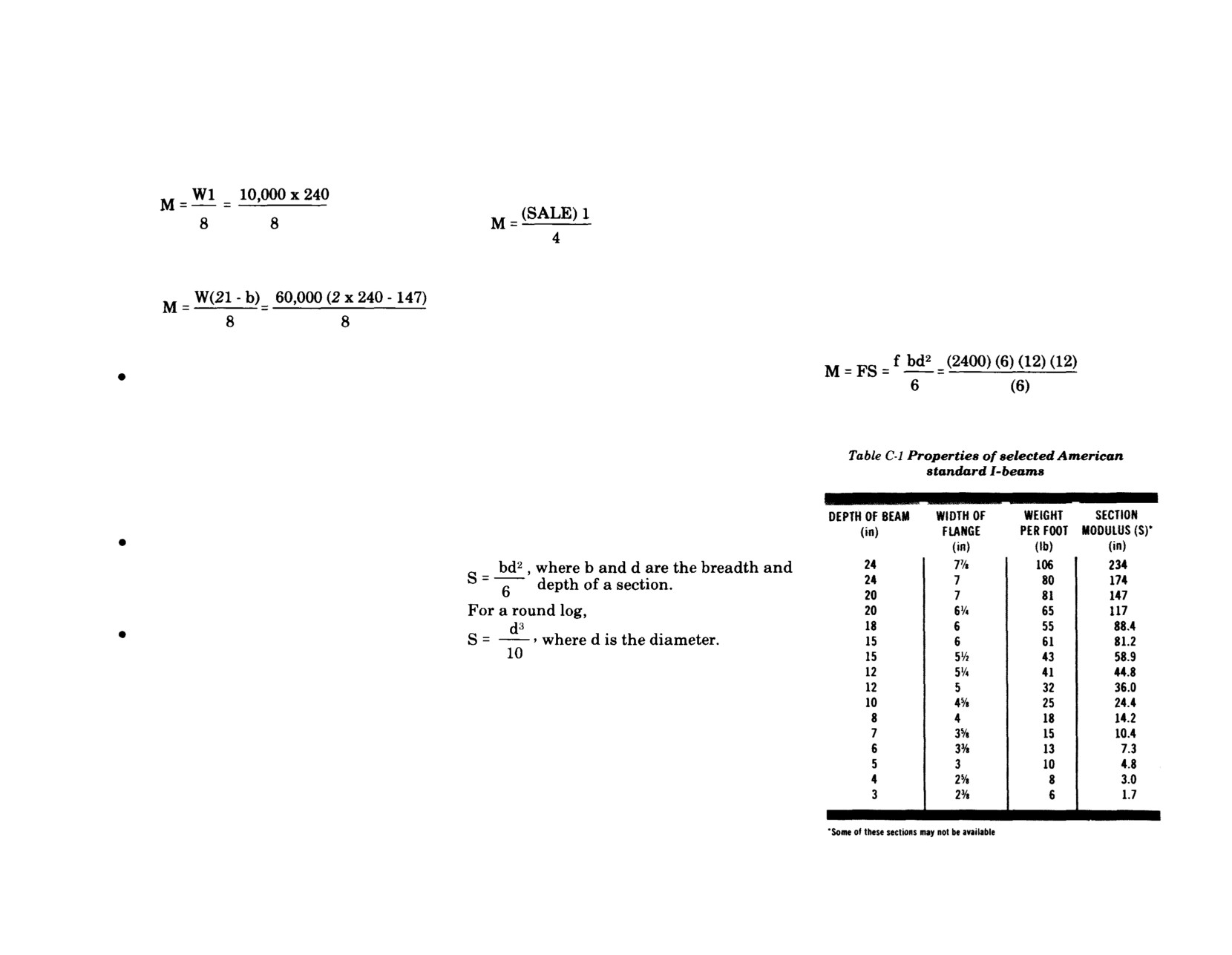
For a uniformly distributed load of 5
by the actual vehicle. From the formula
per square inch, and band din inches, giving
tons:
above for a concentrated center load P,
M in inch-pounds. Values of f will vary
and substituting SALE, we have
according to type of stress and type of
material. For this text and the majority of
=
300,00 inch-
field design, values as given in the next
pounds
section are used. For example, if the extreme
allowable fiber stress (f) in bending of the
For a 30-ton tank:
wood in a rectangular beam 6 by 12 inches is
RESISTING MOMENT
2,400 pounds per square inch, then the
Maximum allowable resisting moment that a
maximum allowable bending moment that
beam can develop is the product of maximum
allowable fiber stress for the material and
beam can resist is:
=
2,497,500 inch-pounds
section modulus of the beam, which is a
measure of the capacity of the cross section of
For a series of axle loads on a span,
the beam to resist bending. Where M is the
maximum moment may occur under the
maximum allowable resisting moment that a
heaviest load when that load is at the
beam can develop; f, the allowable extreme
=
345,600 inch-pounds.
center of the span, or it may occur under
fiber stress for the material; and S, the section
one of the heavier loads when that load
modulus, their relationship is expressed by
and the center of gravity of all the loads
the formula M = fS.S depends solely on shape
on the span are equidistant from the
and size of the cross section and f on the
center of the span.
material of the beam. For rectangular beams,
such as timber stringers,
Further details on computing maximum
bending moment produced by two or more
loads on a span can be found in engi-
neering handbooks.
For the design of military bridges the
computation of maximum bending pro-
duced by a series of axle loads or that
produced by a uniformly partially distri-
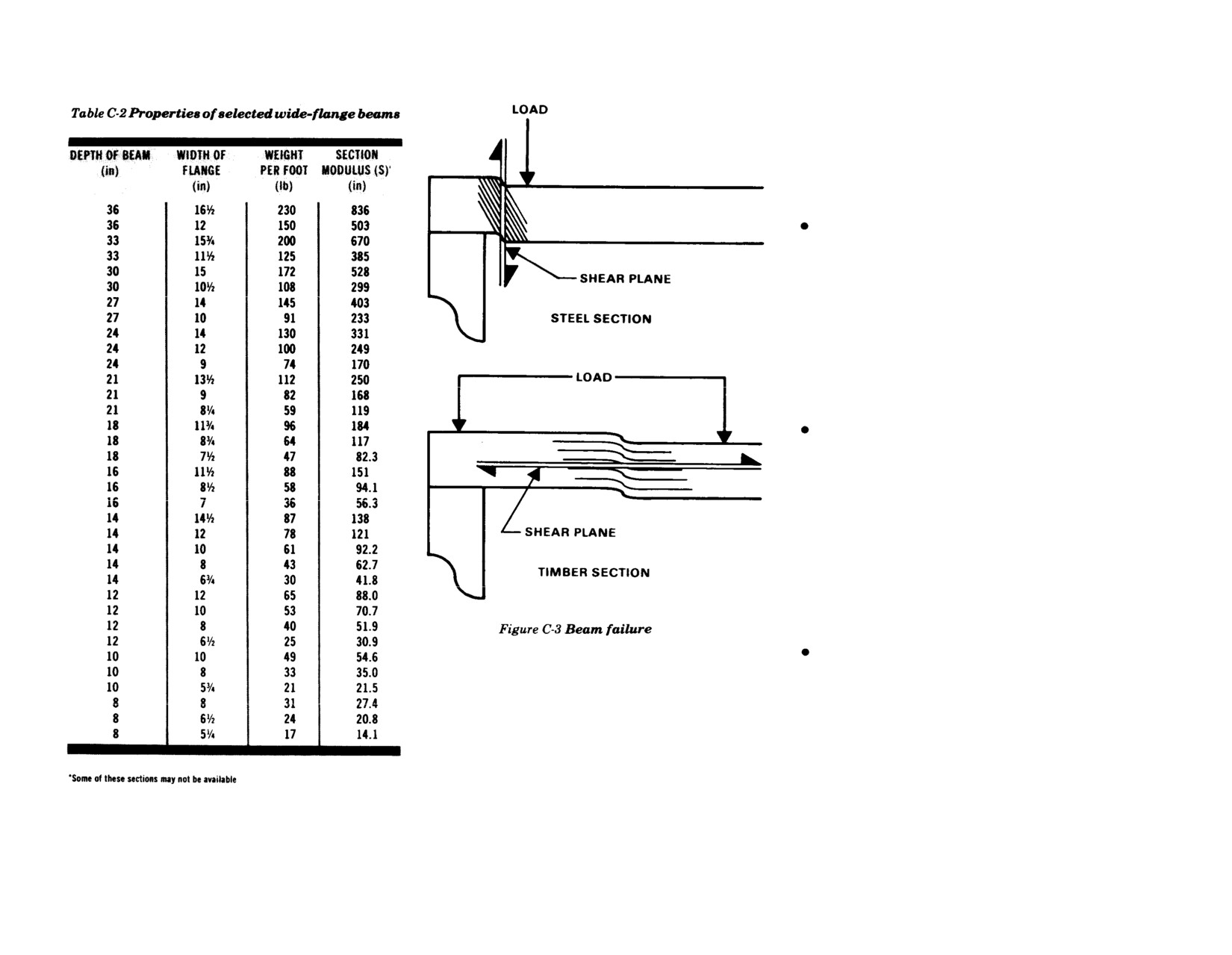
S for I-bems and other structural steel
buted load, such as a tank, has been
shapes may be found in tables in standard
simplified by the use of single-axle load
engineering handbooks. Values of S for
equivalents (SALE). The SALE is that
selected I-beams and WF (wide flange) beams
single-axle load that, when placed at
are given in Tables C-1 and C-2 (page 340).
midspan, will cause the same maximum
The stress f is ordinarily expressed in pounds
moment as the maximum moment caused
339
FM 5-277
The following procedures, formulas, and
other data are relevant to the determination
of maximum allowable shearing stress:
For beams supported at both ends, the
shear at any section (point on the beam) is
equal to the reaction at one end of the
beam minus all the loads between that
end and the section in question. To cal-
culate maximum shear, it is necessary to
find the position of the loads that produces
the greatest end reaction. This usually
occurs when the heaviest load is over one
support.
In timber we find that because of the layer
effect of the grain, the stringers are
weaker horizontally along the member.
But the stress numerically equal to the
horizontal direction is numerically equal
to the vertical direction, so design is on
the basis of the stress in the vertical
direction. In military bridge design a
shear check must be made if the span
length in inches is less than 13 times the
depth of the stringer.
The average intensity of shear stress
SHEAR AND SHEARING STRESS
(horizontal and vertical) in a beam is
Any load applied to a beam induces shearing
obtained by dividing maximum external
stresses. There is a tendency for the beam to
shear by cross-sectional area of the beam.
fail by dropping down between the supports
However, shear is not evenly distributed
(Figure C-3 (A)). This is called vertical shear.
throughout the beam from top to bottom,
There is also a tendency for the fibers of the
so maximum shear intensity is greater
beam to slide past each other in a horizontal
than the average. Maximum shear inten-
direction (Figure C-3 (B)). The name given to
sity occurs at the midpoint of the vertical
this is horizontal shear.
section.
340
FM 5-277
CLASSIFICATION OF
VEHICLES AND BRIDGES
For a rectangular section, maximum
The purpose of this paragraph is to outline
thetical vehicles for each standard class,
horizontal shear intensity equals 3/2
office and field procedures for classifying
converting these values to single-axle-load
times average intensity, or—
vehicles and bridges in accordance with the
equivalents (SALE), in short tons, and plot-
vehicle and bridge classification system and
ting the SALE against the simple-beam span
to explain the field design of simple bridges.
in feet. The envelope curve is then drawn
It explains vehicle and bridge classification
through the maximum moment and shear
Where
S
procedures in sufficient detail to enable engi-
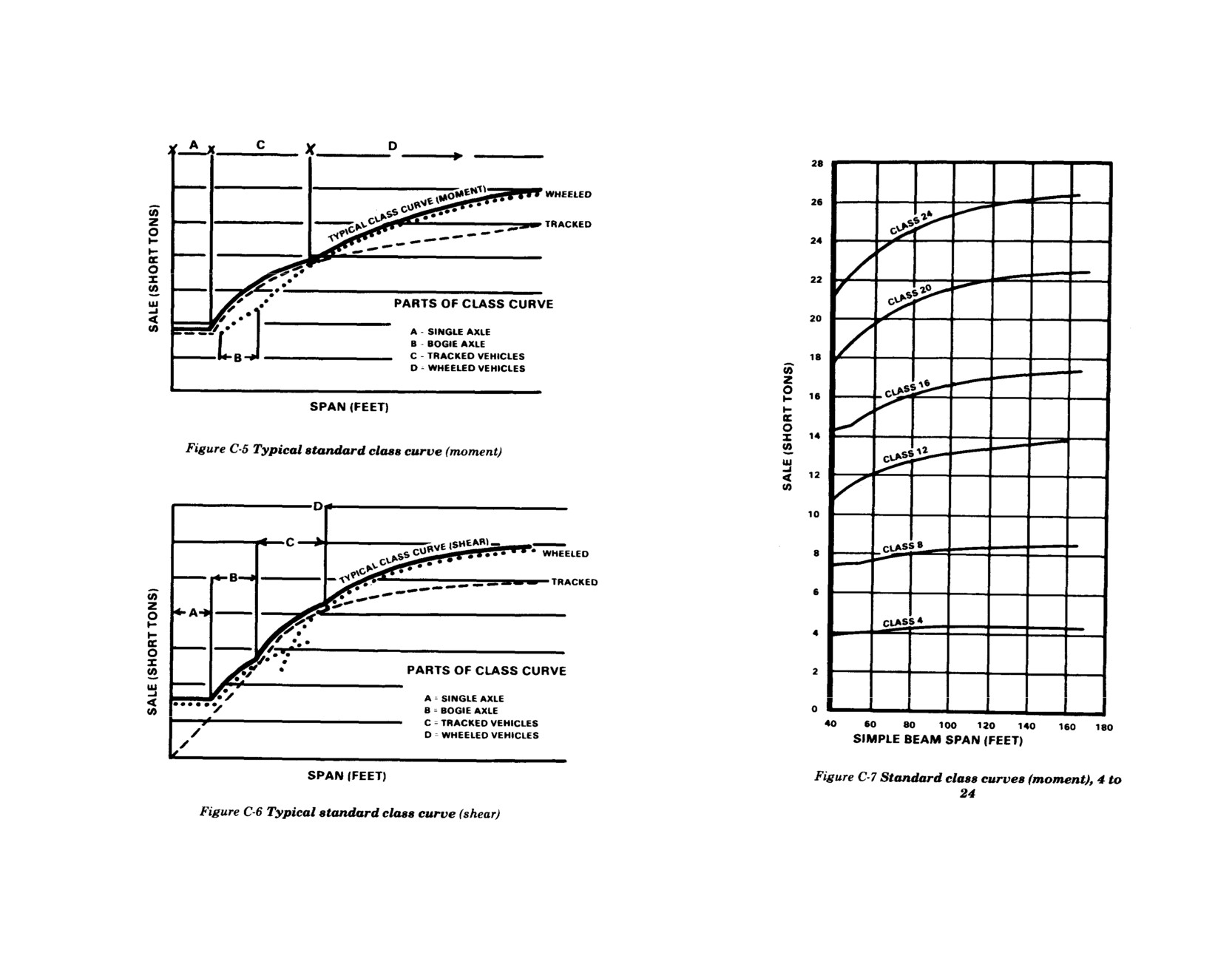
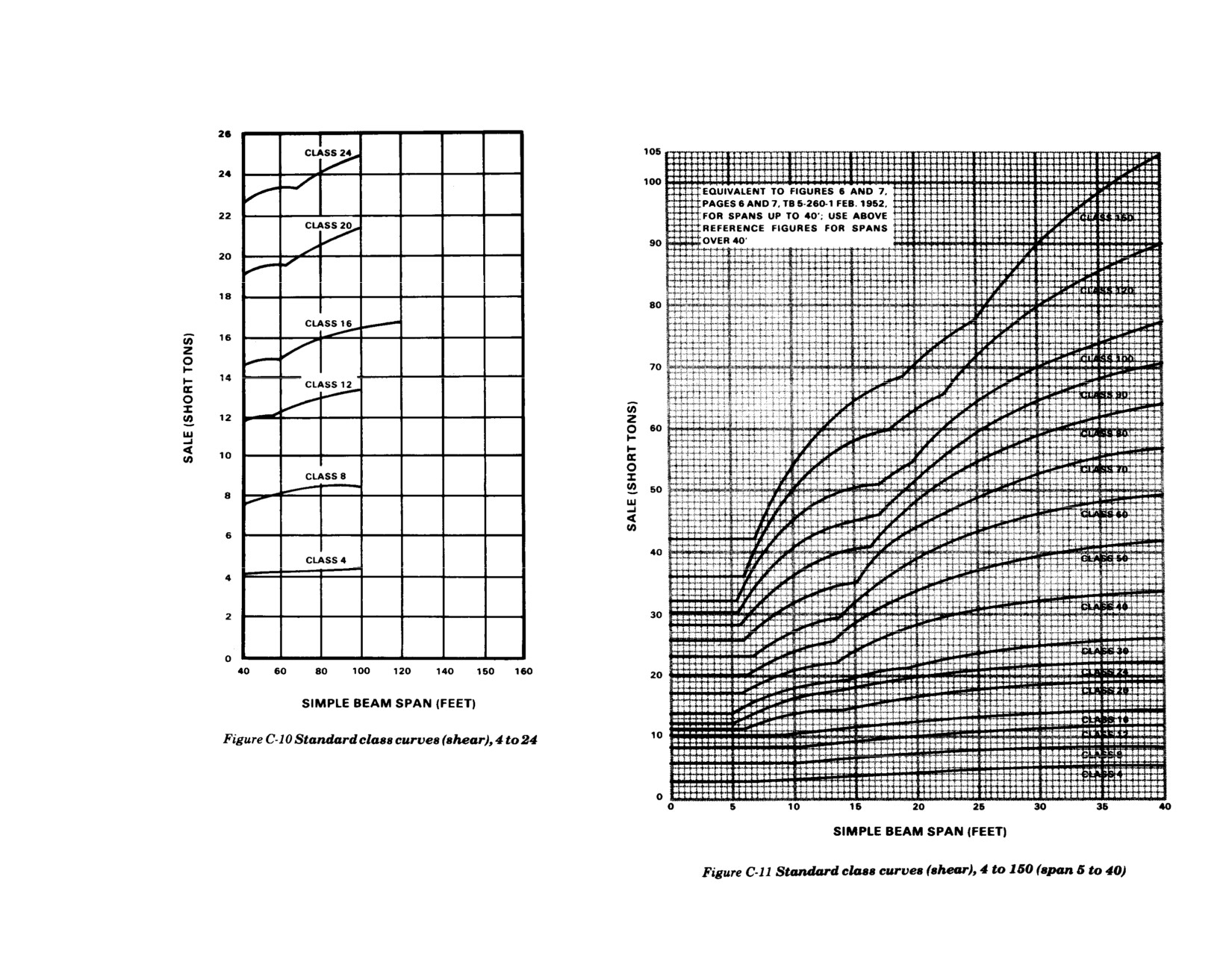
values as shown in Figures C-5 and C-6 (page
h=
maximum shear intensity
neers who are familiar with the classification
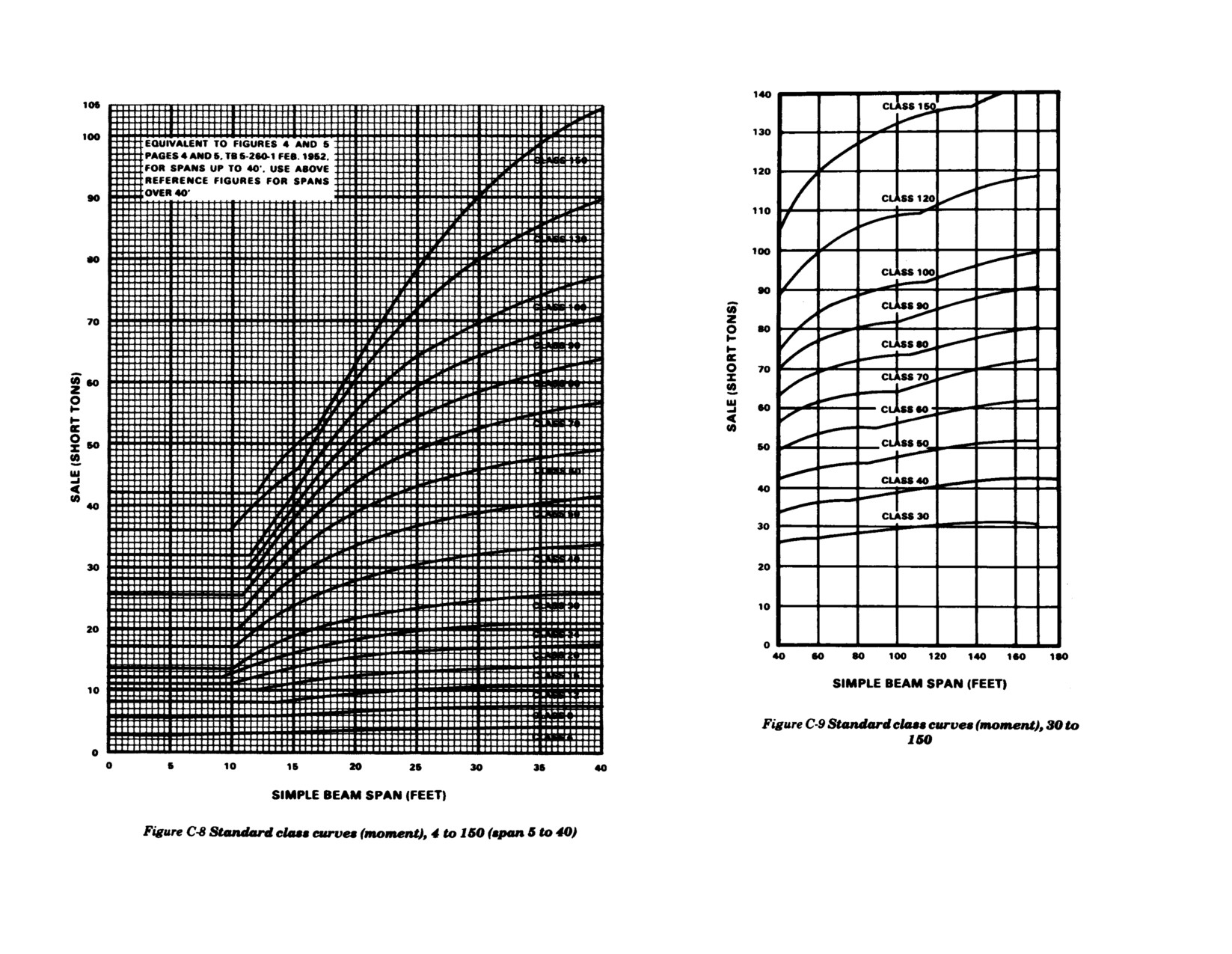
345). The standard class curves are shown in
(unit shear stress) induced in
system to determine the proper classification
Figures C-7 through C-12 (pages 345 through
the beam, in pounds per
of vehicles and bridges. It also explains how
348). In computing maximum moment and
square inch
V=
to select stringers for simple-span bridges
shear, space the vehicles at normal convoy
maximum shear, in pounds
b =
and to design the substructure using timber
spacing, with an interval of 30 yards from the
breadth of beam, in inches
d =
trestle intermediate supports.
tail of one vehicle to the front of the next
depth of beam, in inches
vehicle.
Over short spans where shear rather than
STANDARD CLASSES
A group of 16 standard classes ranging from
bending may control, beams warrant
4 to 150 has been established at the intervals
SPECIFICATIONS
special means of analysis. In computing
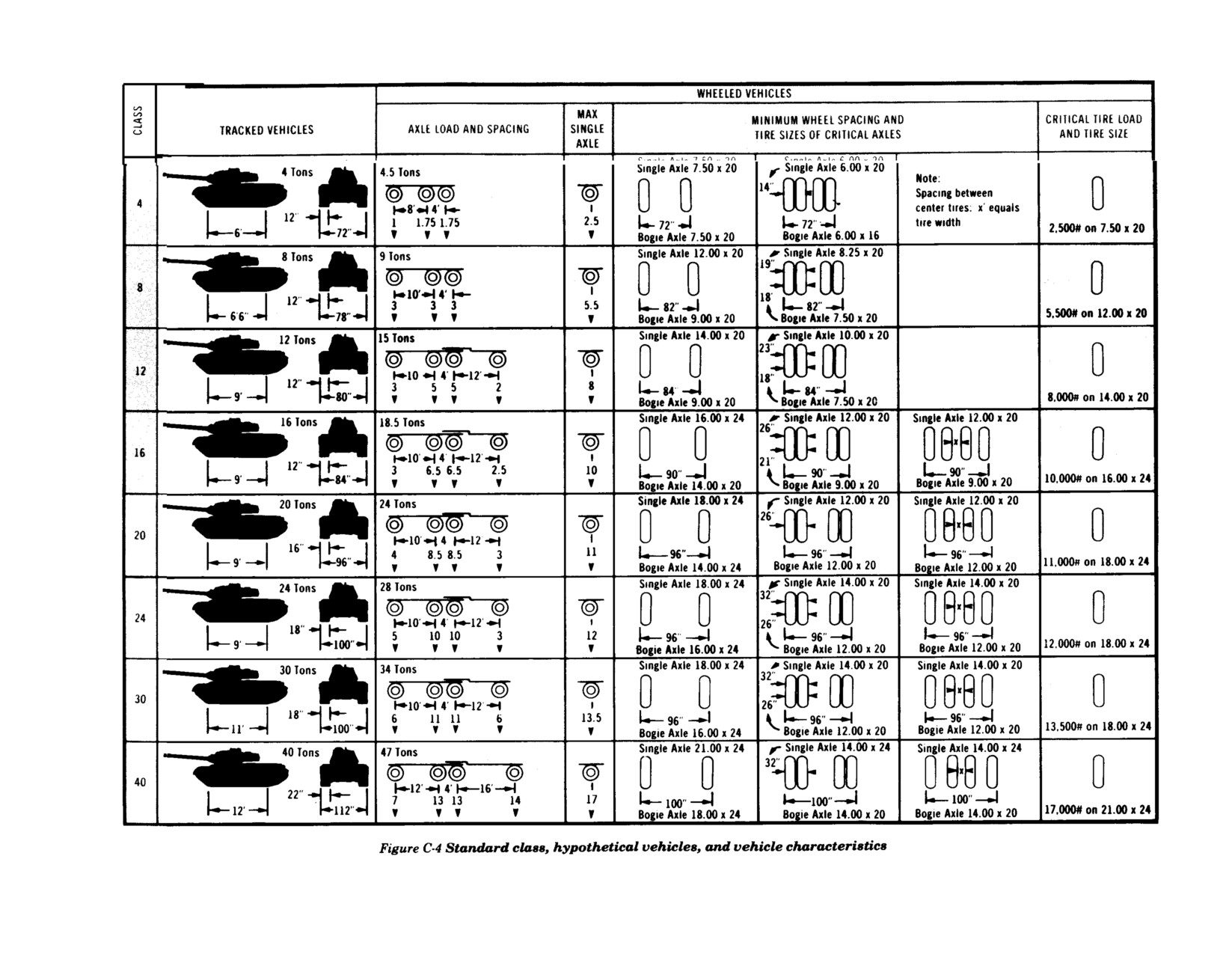
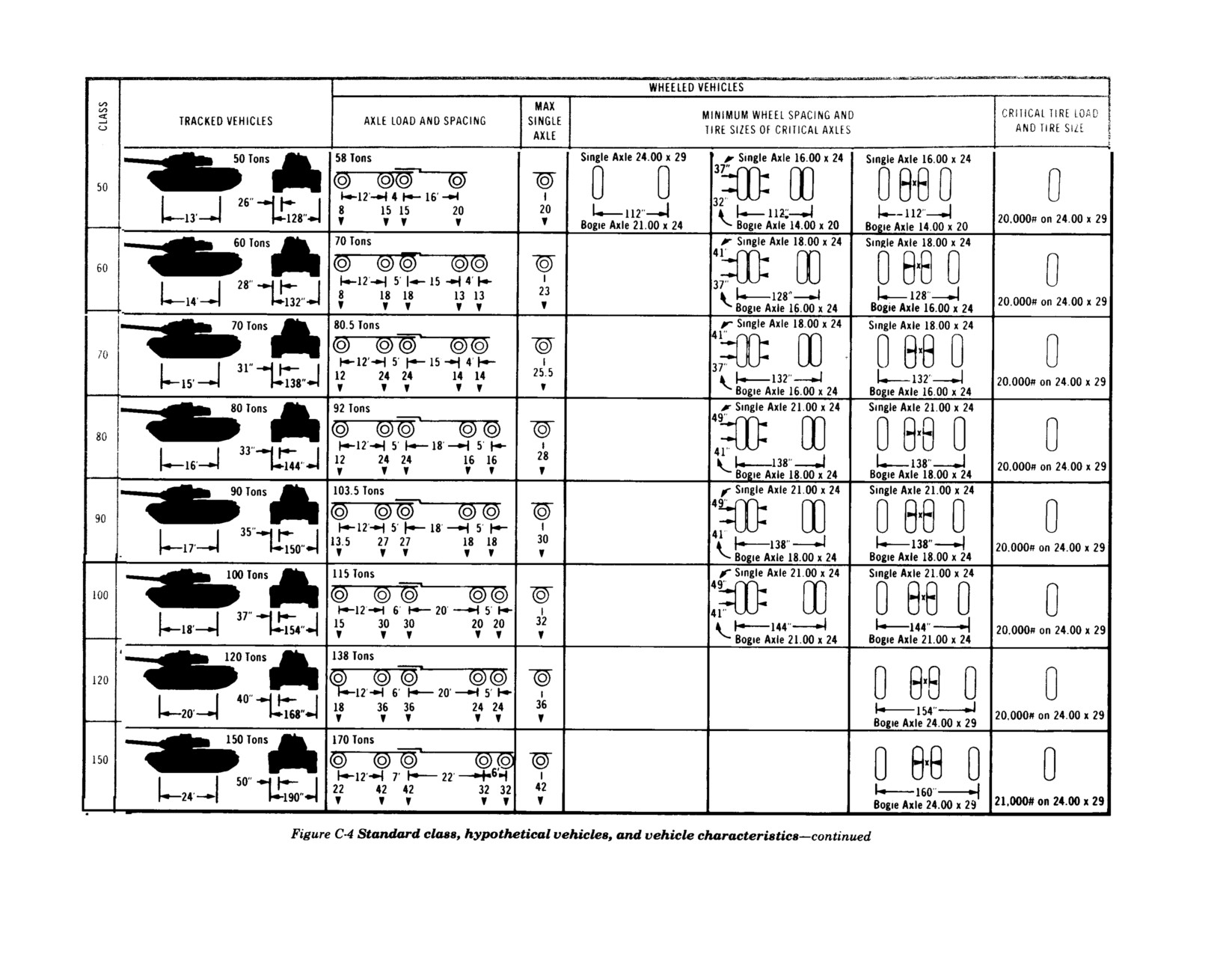
shown in Figure C-4 (pages 343 and 344). For
The basic assumptions and specifications
maximum horizontal shear intensity, use
each of the standard classes two hypothetical
used here for design and capacity estimation
the formula given above. In determining
vehicles are assumed: a tracked vehicle whose
data are as follows:
V for use in this formula, neglect all loads
weight in short tons is the standard class
within a distance equal to or less than the
number, and a wheeled vehicle of greater
As regards bending stress: steel—27,000
beam height from either support, and
place the design moving load at a distance
weight which induces about the same maxi-
pounds per square inch; timber—2,400
three times the height of the beam from
mum stresses in a given span. For example,
pounds per square inch.
the support.
in standard class 4 the tracked vehicle weighs
4 tons, the wheeled vehicle 4.5 tons; in class 8,
As regards shear stress: structural steel
For a circular section, maximum horizon-
8 tons and 9 tons, respectively. The hypo-
sections—16,500 pounds per square inch;
thetical vehicles and their characteristics are
steel pins and rivets—20,000 pounds per
tal shear intensity equals 4/3 times
average intensity, or—
shown in Figure C-4. Although these vehicles
square inch; timber—150 pounds per
are hypothetical, they approximate actual
square inch.
United States and United Kingdom army
vehicles.
As regards impact: steel—15 percent of
Where
live load moment; timber—none.
d = s diameter of beam, in inches
For each standard class both a moment class
curve and a shear class curve are drawn.
As regards the lateral distribution factor
These curves are determined by computing
theoretically, two stringers are twice as
the maximum moment and maximum shear
strong as one, four are twice as strong as
induced in simple spans by the two hypo-
two, and so on; actually, this is true only if
341
FM 5-277
each stringer carries an equal share of the
As regards the distance between road
4
Draw curve through the points plotted.
total load. A stringer directly under a
contacts of vehicles following in line: 100
This is the moment class curve for the
wheel load is more highly stressed and
feet.
vehicle.
carries a greater portion of the load than
those farther to the side. Because of this
OFFICE DETERMINATION
5
Superimpose the curve over the standard
nonuniform lateral distribution of a wheel
Use the following method to determine ve-
class curves for moment (Figures C-7, C-8,
load among stringers, the total width (or
hicle class number in the office:
and C-9).
number) of stringers required to carry a
particular load is greater than the total
1
Compute the maximum moment produced
6 Determine the class of the vehicle by the
width (or number) that would be required
by the vehicle in at least six simple spans
position of the vehicle class curve with
if all stringers carried an equal share of
of different length.
respect to the standard class curves.
the load. This requires an increase in
Round off any fraction to the next larger
stringer width (or number of stringers)
2
Convert maximum moment to SALE
whole number.
and is expressed as a ratio called lateral
using the formula,
distribution factor. For design of two-lane
Repeat the last three steps for maximum
military bridges with vehicles on the
shear, using the formula, SALE = shear.
in which M = maximum moment in foot-
centerline of each lane, the factor is 1.5.
tons, and L = span length in feet.
The class of the vehicle is the maximum class
As regards roadway widths: a minimum
determined from either the moment or shear
3
Plot SALE against corresponding span
clear width between curbs of 13 feet 6
curve. In most cases, moment will govern.
length.
inches for single-lane bridges and 22 feet
for two-lane bridges.
342
FM 5-277
343
FM 5-277
344
FM 5-277
345
FM 5-277
346
FM 5-277
347
FM 5-277
it is seen that the curve for this vehicle lies
similarly determined by inspection of the
between the class 4 and the class 8 curves
curves, and this information is placed on
and from its position with respect to these
a cab plate. The section of the cab plate
curves the vehicle is class 8.
for this vehicle, loaded, shows the class
restrictions for the various spans, listed
Combination vehicle over class 40
in Table C-3.
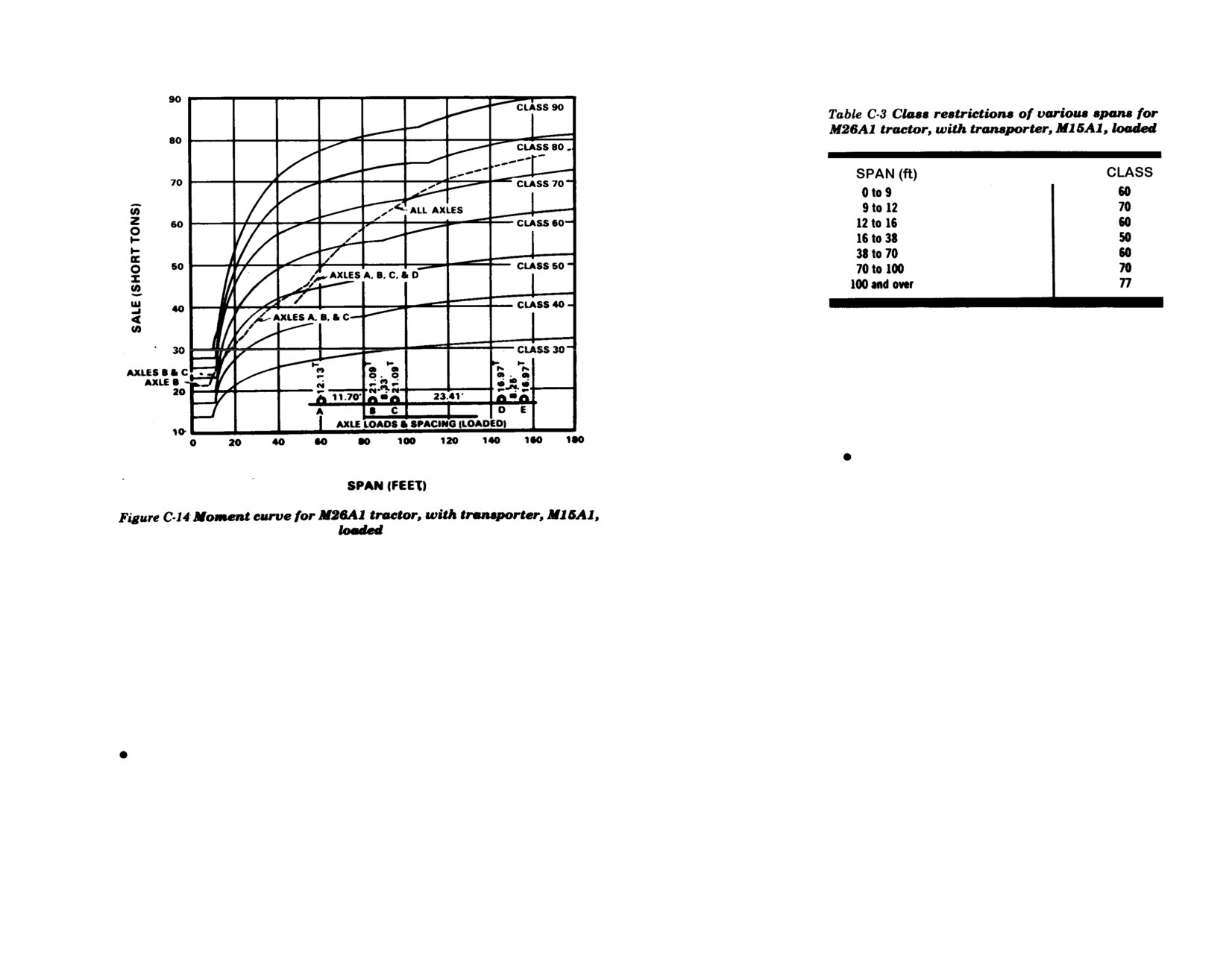
Figure C-14 shows the moment curve for a
M26A1 tractor with transporter M15A1,
FIELD DETERMINATION
loaded, superimposed on the standard
If time, information, or a qualified engineer is
class curves. From the figure it is seen
unavailable, and the office methods cannot
that at a span length of 100 feet the
be used, substitute one of the following
superimposed curve crosses the standard
methods:
class 70 curve and begins to level off. It
does not cross the class 80 curve. From its
Compare characteristics such as dimen-
position with respect to the standard class
sions, axle loads, and gross weight with
curves, the class of the vehicle is 77.
characteristics of the hypothetical ve-
Figure C-14 shows that the vehicle has
hicles shown in Figure C-4.
lower classes at shorter span lengths. At
EXAMPLES:
a span length of 70 feet, for example, the
EXAMPLE:
Single vehicle
vehicle’s class curve crosses the standard
An unclassified wheeled vehicle has a
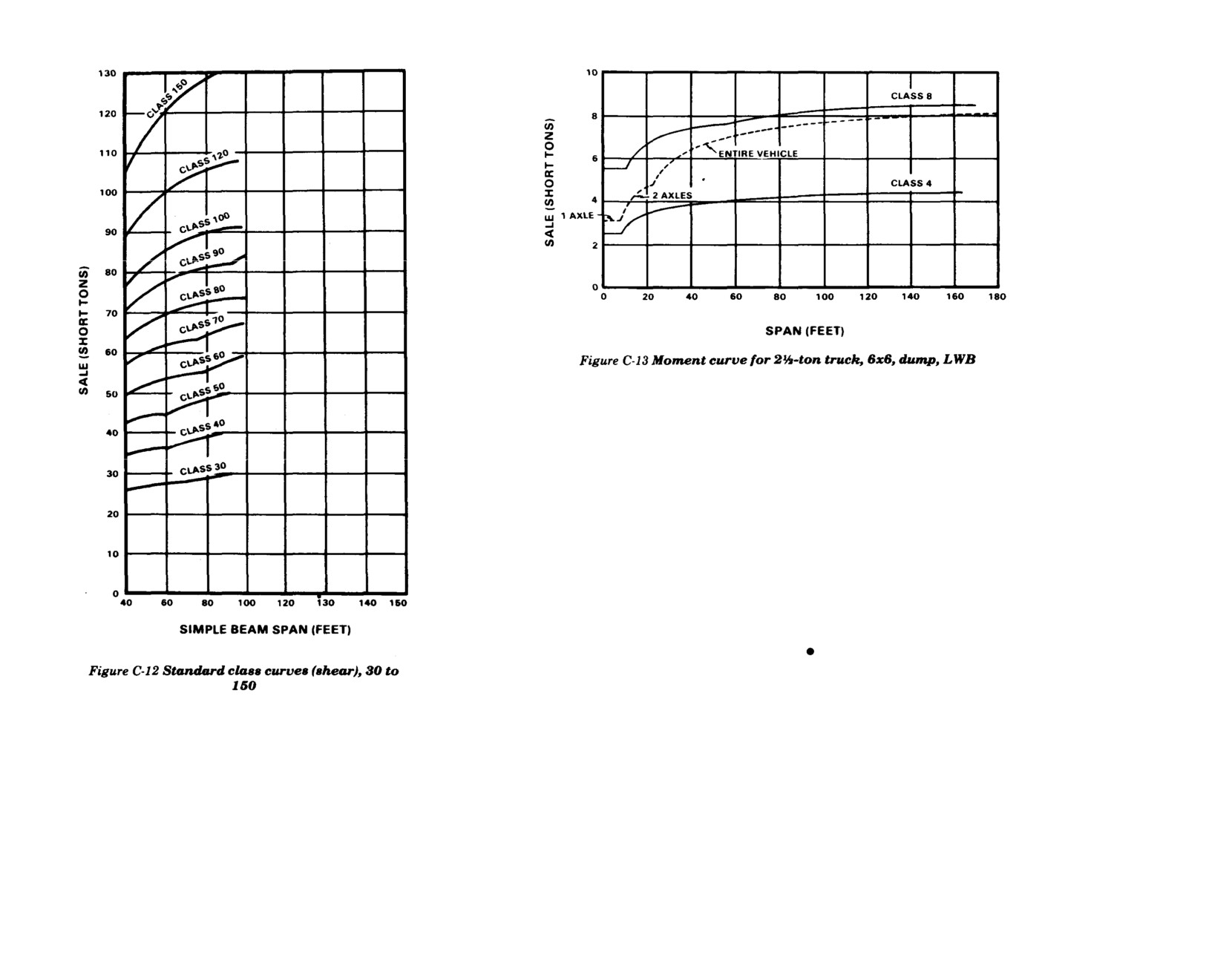
Figure C-13 shows the moment curve for a
class 60 curve, and for this span the class
gross weight of 27 tons and a length of
2 1/2-ton, 6x6 dump truck superimposed on
of the vehicle is 60. The other classes of
about 27 feet. By interpolation in Figure
the standard class curves. From the figure
the vehicle for shorter span lengths are
C-4, it is class 23. If, however, because of
348
FM 5-277
EXAMPLE:
An unclassified tracked vehicle has a
ground contact area of about 5,500 square
inches. By comparison with an M4 tank,
which has a ground contact area of 5,444
square inches, it is class 36.
Compare the deflection in a long steal
span caused by an unclassified vehicle
with the deflections caused by classified
vehicles. In this method the span must be
at least twice as long as the vehicles and
the vehicles must be placed for maximum
deflection. Measuring apparatus must be
axle spacing and weight distribution the
EXAMPLE:
accurate to at least one thirty-second of
maximum single-axle load for this vehicle
An unclassified single vehicle has three
an inch.
is 12.5 tons (greater than Figure C-4 shows
axles, is about 166 inches long, and weighs
as allowable for class 23), the maximum
about 8 1/2 tons. By comparison with a
EXAMPLE:
single-axle load is used as the classifying
standard 2 1/2-ton truck 6x6-LWB, which
Select two vehicles of known class which
criterion. By interpolation in the maxi-
weighs 8.85 tons, it is class 8.
are estimated to bracket the unknown
mum single-axle load column (Figure C-
vehicle class. Measure the deflections of a
4), the vehicle is then class 26.
Compare the ground-contact area of an
long steel span when loaded individually
unclassified tracked vehicle with that of a
by each of the three vehicles. Move each
Compare the characteristics of an un-
classified tracked vehicle. Tracked ve-
vehicle on the span three times and read
classified vehicle with those of a similar
hicles can be assumed to be designed with
the deflection. Then average the three
classified vehicle.
about the same ground pressure.
readings.
349
FM 5-277
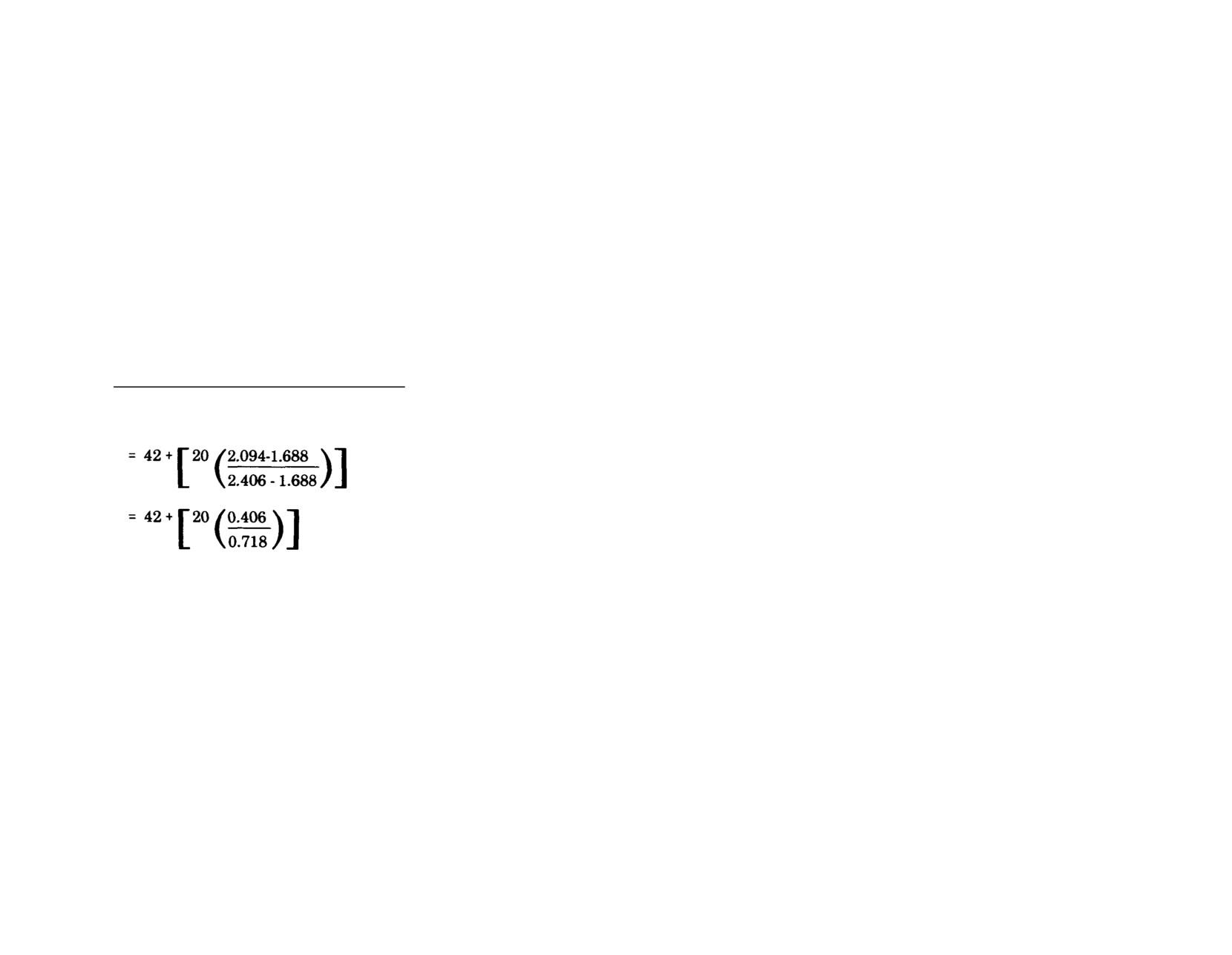
Deflection
Vehicle
Class
(average of three loadings)
A
62
2 13/32 in, or 2.406in
B
42
1 11/16 in, or 1.688 in
C unknown
2 3/32 in, or 2.094 in
Class is considered proportional to deflection
so—
Unknown class = lower class +
(Upper class-lower class) x
deflection of unknown class
minus deflection of lower class
Deflection of upper class
minus deflection of lower class
= 42+ 11.31 = 53.31, or class 53
350
FM 5-277
GLOSSARY
ACRONYMS AND ABBREVIATIONS
A
anchor span
Mk
Mark (model)
AR
as required
MOPP
mission-oriented protection posture
assy
assembly
mph
miles per hour
B
bridge
N
normal, nose
BP
base plate
NATO
North Atlantic Treaty Organization
BSS
British standard specification
no
number
C
cantilever span, caution
NPT
national pipe thread
C-C
center to center
NPTF
national pipe thread fine
cad pltd
cadmium plated
NS
near shore
circ
circular
pcs
pieces
centerline
panel
cm
centimeter(s)
pt
point
d
distance from center of gravity
QD
quadruple-double
to tail of bridge
QS
quadruple-single
DD
double-double
QT
quadruple-triple
diam
diameter
qty
quantity
DL
dead load
R
risk, rocking roller
DQ
double-quadruple
ref
reference
DS
double-single
reinf
reinforced
DT
double-triple
RH
right-handed
D5
double-five stories
RRT
rocking-roller template
ETO
European theater of operations
S
simple suspended span
far shore
SALE
single-axle-load equivalent(s)
FS
foot, feet
SBC
soil-bearing capacity
gal
gallon(s)
sq
square
H
horizontal
SS
safety setback, single-single
hex (hd)
hexagonal (head)
T
tracked-load class
hr
hour
t/sf
tons per square foot
hyd
hydraulic
TD
triple-double
impact
thd
thread
in
inch(es)
TS
triple-single
L
length of bridge
TT
triple-triple
l
length of span of bridge
T5
triple-five stories
lb
pound(s)
T6
triple-six stories
lg
long
V
vertical
LH
left-handed
W
wheeled-load class, wide-flange
Li
length, initial
beam (formerly WF)
LL
live load
w
with
LR
lift required
wo
without
max
maximum
wt
weight
mess
measure
yd
yard(s)
min
minimum
351
FM 5-277
DEFINITIONS
Angle of repose
For field design, assumed to be an angle of 45 degrees from the horizontal. The base of this
angle starts at the toe of slope and proceeds upward to ground level. Placement of any load in
front (toward the gap) of this angle would probably result in bank failure.
Backspace
The amount of space available for construction of the bridge.
Bailey bridge Ml
The original US design of the British prefabricated Bailey bridge.
Bailey bridge M2
The revised US design of the Bailey bridge Ml, with a greater roadway width of 121/2 feet. Also
called the Panel Bridge.
Bailey bridge M3
The revised, wider, British design of the Bailey bridge M2. It is often referred to as the
extra-widened Bailey bridge and is not stocked by the US Army.
Bay
One complete section of a Bailey bridge, equivalent to the length of one panel 10 feet (3.04
meters) wide. The term bay is used regardless of the truss type.
Bays
Floating:
Interior bays of a floating bridge that are located between the near- and far-bank
end floating bays.
End Floating:
Those which form the continuation of the bridge between the floating and the
landing bays.
Landing:
Those which form the connection between the end floating bay and the bank. There
are two types:
Variable-slope -
these span the gap between the bank and the landing bay, or the intermediate
landing bay if a fixed-slope landing bay is used.
Fixed-slope -
these span the gap between the intermediate landing bay and the landing bay.
Beam, distributing
Rigid:
A steel beam securely attached to the top of a pier or abutment which is designed to
spread the weight applied to it over a large area.
Rocking-bearing:
A steel beam attached to the bottom chord of Bailey bridge panels. It is
used to prevent excessive local bending of the bottom chord.
Blocking
Timber used to support the junction of the first and second bays of bridge when building
deck-type bridges without end posts. Also, any timber used under girders during jacking down
of deck-type bridges.
352
FM 5-277
Bridge
Through-type truss:
A bridge with a roadway between the main load-carrying girders.
Deck-type:
A bridge with the roadway on top of the main load-carrying girders.
Broken-span:
A multispan bridge with the top chord broken and the bottom chord either
broken or pinned at the piers.
Continuous-span:
A bridge of which both upper and lower chords are continuous over
intermediate piers between abutments.
Chords
The upper and lower horizontal members of a Bailey panel.
Cribbing
Grillage placed in alternating layers under the roller templates and bridge baseplates to
provide the correct horizontal plane on which the bridge is built, launched, and positioned for
trafficking.
Decking
Laminated:
Timbers laid on edge and nailed together horizontally, and then positioned on
top of Bailey panels to form a type of roadway for deck-type bridges.
Layered:
Roadway on deck-type bridges comprised of timbers laid across the trusses
perpendicular to the bridge centerline. The second layer is placed diagonally to the first, and a
third layer (optional wear tread) is placed parallel to centerline. Sometimes referred to as deck,
or flooring.
Grillage
Standard:
Square-cut timber positioned under the Bailey bridge to spread the weight of the
ridge over a large area. The Bailey grillage set has a fixed number of two sizes of standard
grillage.
Non-standard:
Timber other than that supplied in the Bailey set. This timber must be at least
as large as standard Bailey grillage.
Harmonious vibration
Vibration in a bridge caused by the loads crossing it.
Node points
Critical-load centering points used for exact alignment of components bearing on each other.
Packing
Timber used during raising and lowering, which the bridge rests on while jacks are reposi-
tioned.
Panel bridge
See
Bailey bridge M2.
Panel points
Points under panel verticals and junctions of diagonals that must be supported by a rocker-
bearing distributing beam.
353
FM 5-277
Pier
Floating-bay:
Supports the floating bay in the interior of the Bailey bridge.
Landing-bay:
Supports the shore end of the floating bay and riverward end of either the
fixed-slope or the variable-slope landing bay.
Intermediate landing-bay:
Supports the shore end of the fixed-slope landing bay and the
riverward end of the variable-slope landing bay.
Placement control lines
Used to ensure that the rollers are placed and leveled accurately.
Point of contraflexure
The point where the downward sag of a girder changes to an upward bend as it approaches an
intermediate support.
Roller clearance
The distance between the center of the rocking rollers and the center of the bearing on which
the bridge end posts will rest.
Safety setback
The minimum distance that a rocking roller is placed from the edge of the gap.
Skidding
Moving the bridge or a single girder over greased timbers or steel beams.
Spacing
Lateral:
Spacing of the rollers in rows across the centerline of the bridge.
Longitudinal:
Spacing of the rollers in a line parallel to the centerline of the bridge.
Span
Lift:
Connects two adjacent floating bays and provides a span that can be lifted vertically to
allow passage of water traffic.
Draw:
Connects two adjacent floating bays and provides a span that can be split in the
middle and the two parts pivoted upward to allow passage of water traffic.
Connecting:
Connects two adjacent floating bays where barges are grounded.
Supplementary chords
Upper or lower chords used to reinforce a Bailey bridge.
Temporary launching pier
A pier used during the building of bridges with an underslung story.
Toe of slope
The point in the gap considered to be the base of the bank.
Underslung story
One story of a through-type truss bridge that is below the level of the roadway.
Wear tread
Lumber laid across the chess of the Bailey bridge to prevent damage by vehicles crossing it.
354
FM 5-277
REFERENCES
REQUIRED PUBLICATIONS
These are sources that users must read in order to understand or comply with this publication.
Department of the Army Pamphlet (DA Pamphlet)
736-750
The Army Maintenance Management System (TAMMS)
Field Manuals (FMs)
5-34
Engineer Field Data
5-134
Pile Construction
Tables of Organization and Equipment (TOEs)
05077H200
Engineer Panel Bridge Company
05077J200
Engineer Panel Bridge Company
Technical Manuals (TMs)
5-312
Military Fixed Bridges
9-2320-260-10
Operators Manual for Truck, 5-Ton, 6 x 6, M809 Series (Diesel)
9-2320272-10
Operators Manual for Truck, 5-Ton, 6 x 6, M939 Series (Diesel)
9-2330-287-14&P
Operator’s, Organizational, Direct Support and General Support Maintenance
740-90-1
Administrative Storage of Equipment
750-244-3
Procedures for Destruction of Equipment to Prevent Enemy use
RELATED PUBLICATIONS
These are sources of additional information. They are not required in order to understand this publication.
Department of the Army Form (DA Form)
2258
Depreservation Guide for Vehicles and Equipment
Federal Supply Group (FSG)
9100
Identification List (IL): FSG 9100, Fuels, Lubricant, Oils, and Waxes
Field Manuals (FMs)
5-1
Engineer Troop Organizations and Operations
5-25
Explosives and Demolitions
5-36
Route Reconnaissance and Classification
55450-1
Army Helicopter External Load Operations
101-5-1
Operational Terms and Symbols
Lubrication Order (LO)
9-2320-260-12
Truck Chassis 5-ton, 6 x 6, M809
Technical Manuals (TMs)
5-210
Military Floating Bridge Equipment
5-232
Elements of Surveying
36-230-1
Packaging of Materiel: Preservation (Vol I)
43-0139
Painting Instructions for Field Use
355