FM 5-277 BAILEY BRIDGE (May 1986) - page 9
FM 5-277
Limitations
There are limitations of this kind of
launching. Launching by single girders takes
longer than the normal method of launching
panel bridges.
A girder is always launched as a single-story
girder; other trusses or stones are added after
the girder has been launched. Bracing frames
between trusses prevent overturning and give
the girder rigidity. (However, when launching
long girders in the wind with counterweight
TYPES OF GIRDERS
3
To complete the bridge, add standard
or launching nose, the end is subject to
A single girder may be made up of a single
sway braces, transoms, stringers, and
considerable whipping.) And plain rollers
truss or of two or more trusses connected by
decking, or expedient bracing and
must be placed under every truss to support
bracing frames and tie plates. Five trusses
flooring.
the girder evenly and prevent twisting.
are the maximum number that can be han-
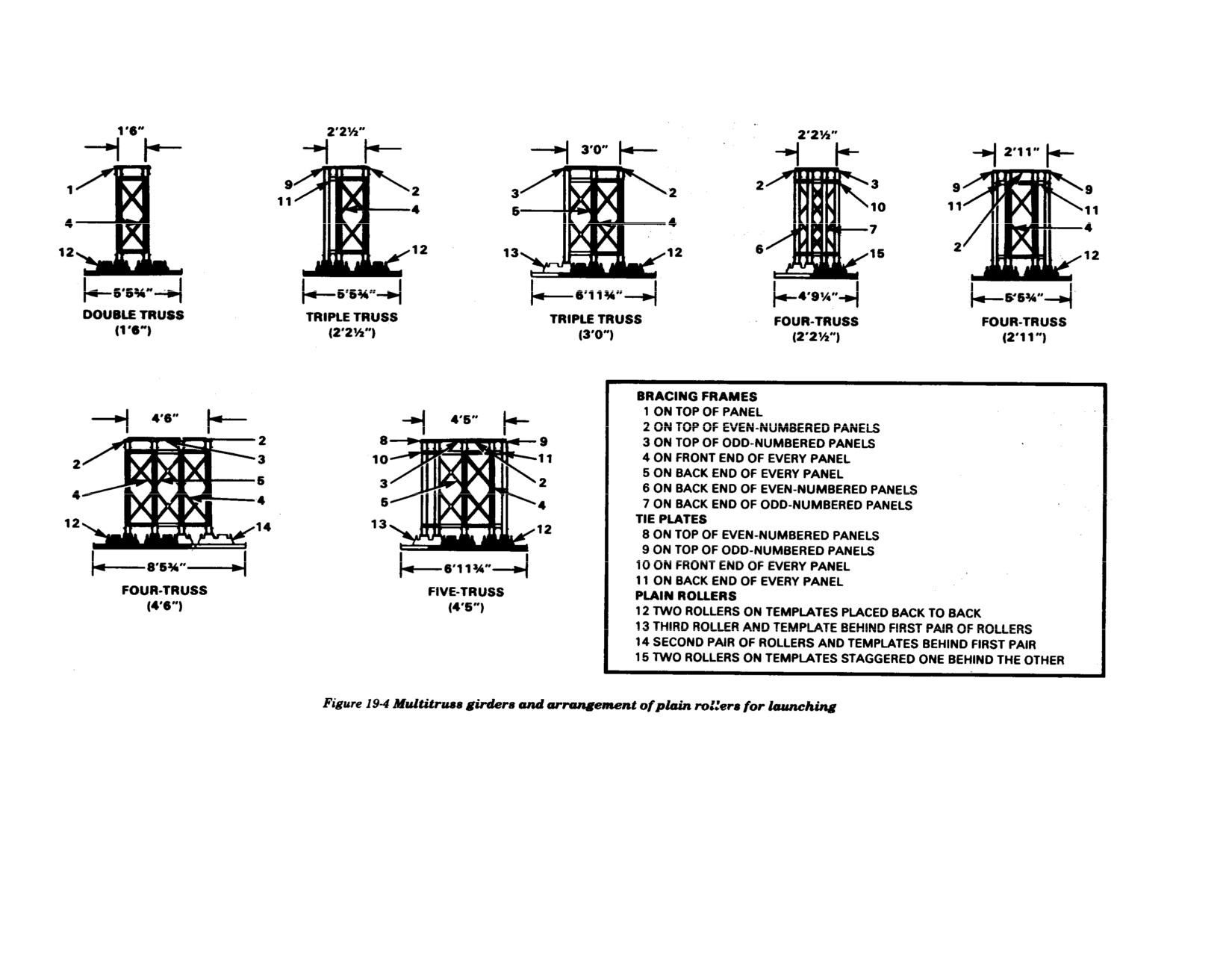
dled practicably. Figure 19-4 (page 246) shows
Methods of launching
LAYOUT OF ROLLERS
girders with various combinations of two to
Single-truss girders may be launched with
Plain rollers are used in sets under the girder,
five trusses. Single, double-, and triple-truss
gin poles or high line. Multitruss girders may
so each truss rests on a roller. In some cases,
girders are used for through-type panel
be launched by any one of the following
plain rollers must be staggered to prevent
bridges. Any of the girders may be used for a
methods:
interference between rollers. Figure 19-4
deck-type panel bridge.
shows the arrangement of plain rollers in
Counterweight.
sets under the girder.
To save launching time, the wider girders are
preferred to many narrow bridges. Four- and
Launching nose.
Rocking rollers cannot be staggered. When
five-truss girders usually are used for mul-
trusses are spaced 1 foot 6 inches (5.3 centi-
tilane deck-type bridges.
Gin pole and snubbing tackle.
meters) on center, rocking rollers are placed
under every truss. The two outer trusses are
Assembly sequence
High line.
spaced 8½ inches (21.6 centimeters) on centers
The assembly sequence for launching by
by tie plates and a single rocking roller is
single girders is as follows:
Working parties
placed under the inner of the two trusses
The size of working parties varies with size of
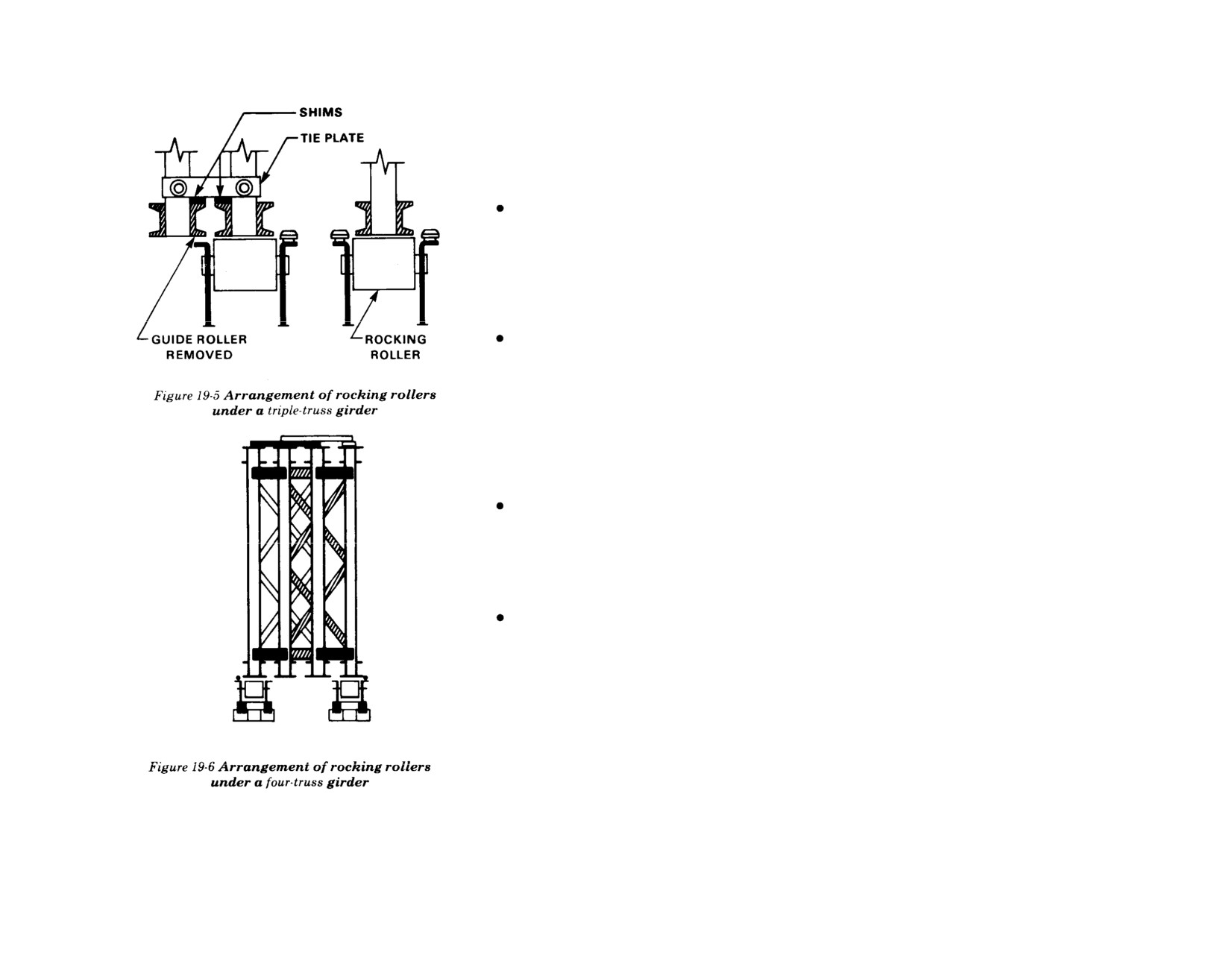
(Figure 19-5, page 247). Remove the outer
1
Assemble girder on deck of existing
girder. To assemble girders, divide soldiers
guide roller. Wedge shims between tie plate
bridges and then launch over gap.
into panel parties, pin parties, and bracing
and chord-channel flanges to prevent outside
parties. Combine them to launch the girders.
truss from slipping down. Under the four-
2
Lower or slide it into position and then
After the girders are in place, divide the
truss (2-foot 21½-inch) (67.4 centimeter) girder,
launch next girder.
soldiers into bracing and decking parties to
the rocking rollers are placed under the outer
complete the bridge.
trusses (Figure 19-6, page 247).
245
FM 5-277
246
FM 5-277
The procedure for laying out sets is—
rollers is more than 14 tons (12.7 metric
tons), use two transoms under the rollers;
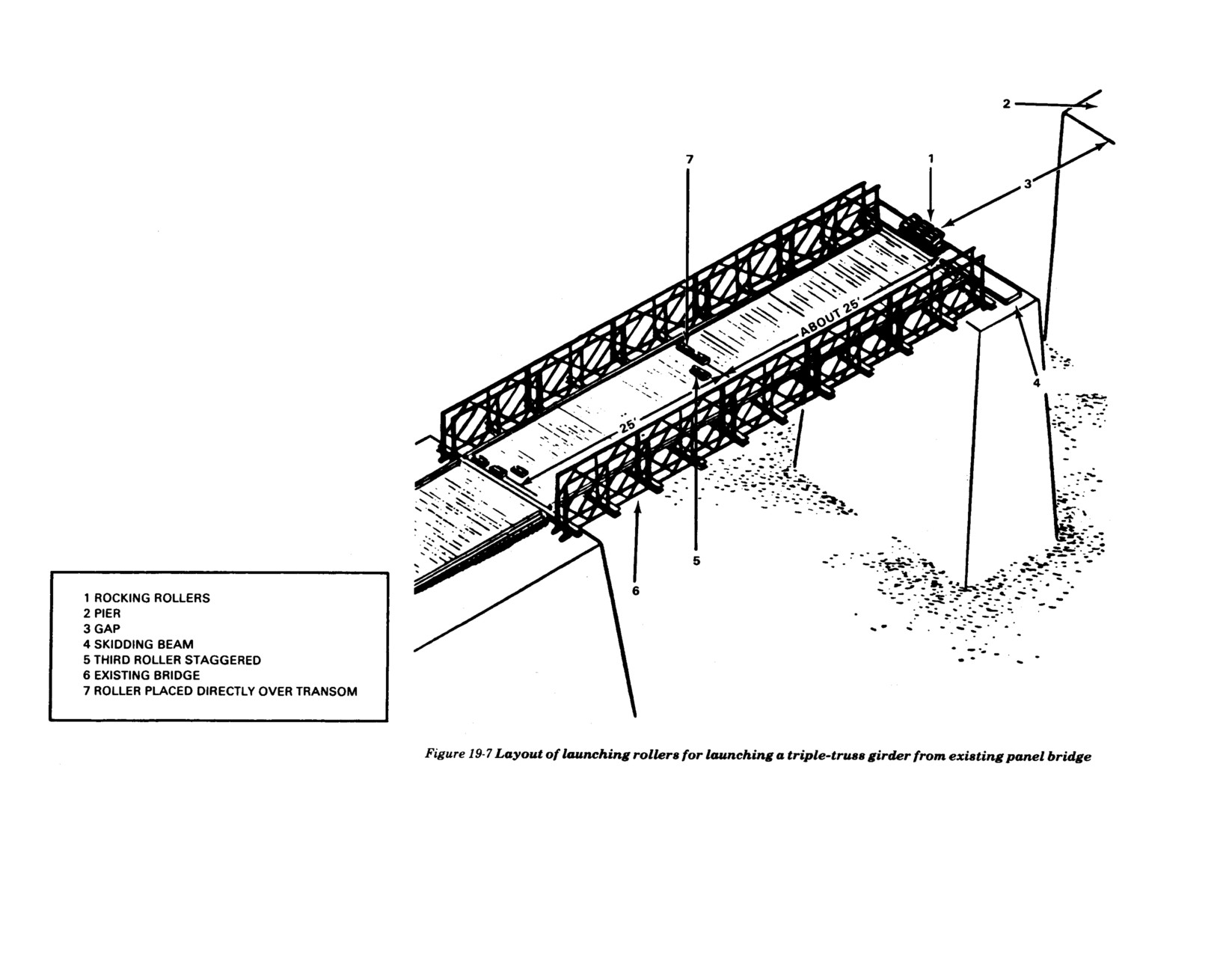
Use rocking rollers at the edge of the gap
if the launching weight is more than 28
and place plain rollers at about 25-foot
tons (25.5 metric tons), wedge the cribbing
(7.6-meter) intervals back along the girder
under the center of the end transoms.
(Figure 19-7, page 248). With double-truss
girders, plain rollers can be used instead
ASSEMBLY OF GIRDERS
of rocking rollers at the edge of the gap.
The girder may have from two to five trusses
(Figure 13-10).
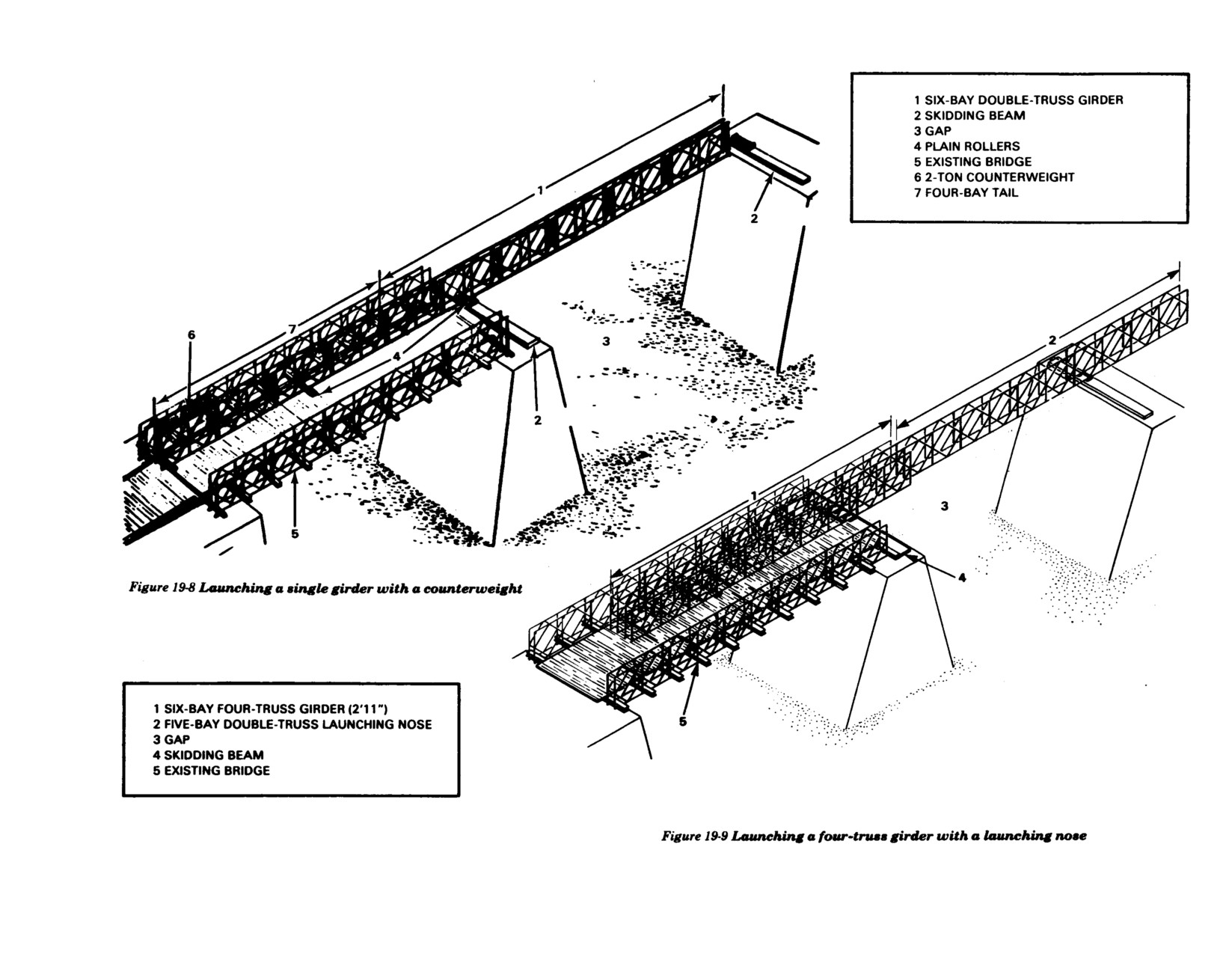
When using a counterweight (Figure 19-8,
page 249) or launching nose (Figure 19-9,
Connect trusses of multitruss girders at every
page 250), assemble and launch the girder
possible place by bracing frames and tie
on the side of the existing bridge nearest
plates across the top chords and ends of
its final position. Assemble a second
panels. All tie-plate bolts must be tight and
girder simultaneously at the other side of
shims must be used to prevent the outer truss
the deck of the existing bridge. Lay out
from slipping down when the end of the
rollers accordingly.
girder is over the gap (Figure 19-5). In girders
with outer trusses spaced 8 ½ inches (21.6
When using a gin pole and snubbing
centimeters), insert panel pins connecting
tackle, two gin poles, or a high line, lay
the nose to the main girder from the inside so
out the rollers so as to assemble and
the nose can be disconnected after launching.
launch the girder along the centerline of
In both the main girder and the nose, always
the bridge.
insert the pins from the outside toward the
centerline of the girder.
When launching from an existing panel
bridge, place all plain rollers directly over
Place end posts on the front end of all trusses
transoms to avoid overstressing stringers
before launching, except when using a
(Figure 19-7). Set rocking rollers pre-
launching nose, in which case place the front
ferably on cribbing directly on the pier. If
end posts after the girder has been launched.
it is necessary to place the rocking rollers
Place the rear-end posts when the girder is in
on the deck of the existing panel bridge,
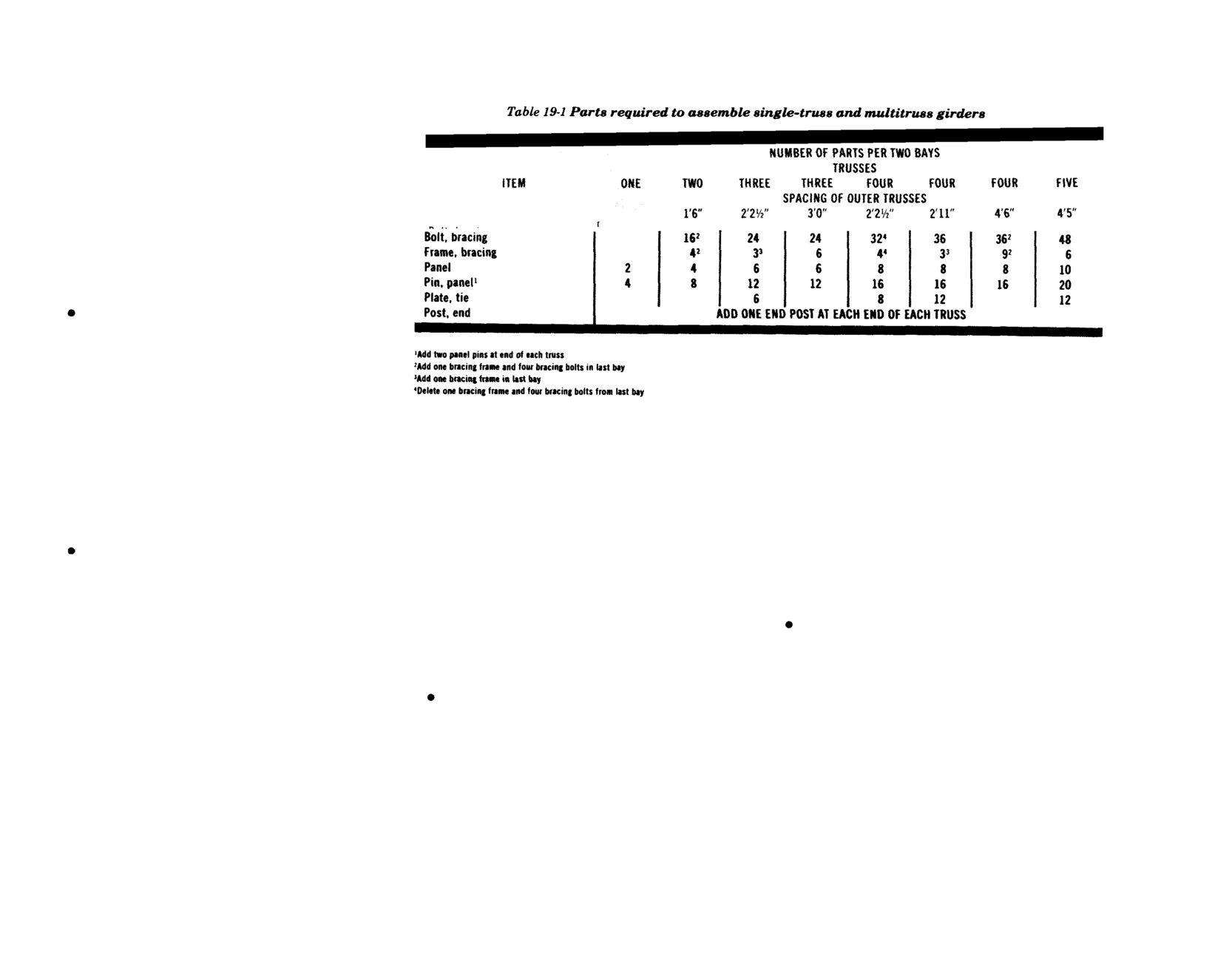
position for jacking down. Table 19-1 (page
place them directly over the end transom.
250) lists the parts required to assemble each
If the total launching weight on rocking
type of girder.
247
FM 5-277
248
FM 5-277
249
FM 5-277
LAUNCHING OF GIRDERS
There are several methods of launching by
single girders. These are the counterweight,
launching-nose, gin-pole and snubbing-
tackle, direct-lift, and high-line methods.
Counterweight method
Launch a single girder by counterweight as
follows:
Add the counterweight to the rear end of
the girder to balance the front end of the
girder as it is pushed on rollers out over
the gap. Long girders may be kept in line
by using side guys and a pull winch from
the far pier. When across the gap, the
front end lands on rollers at the far bank
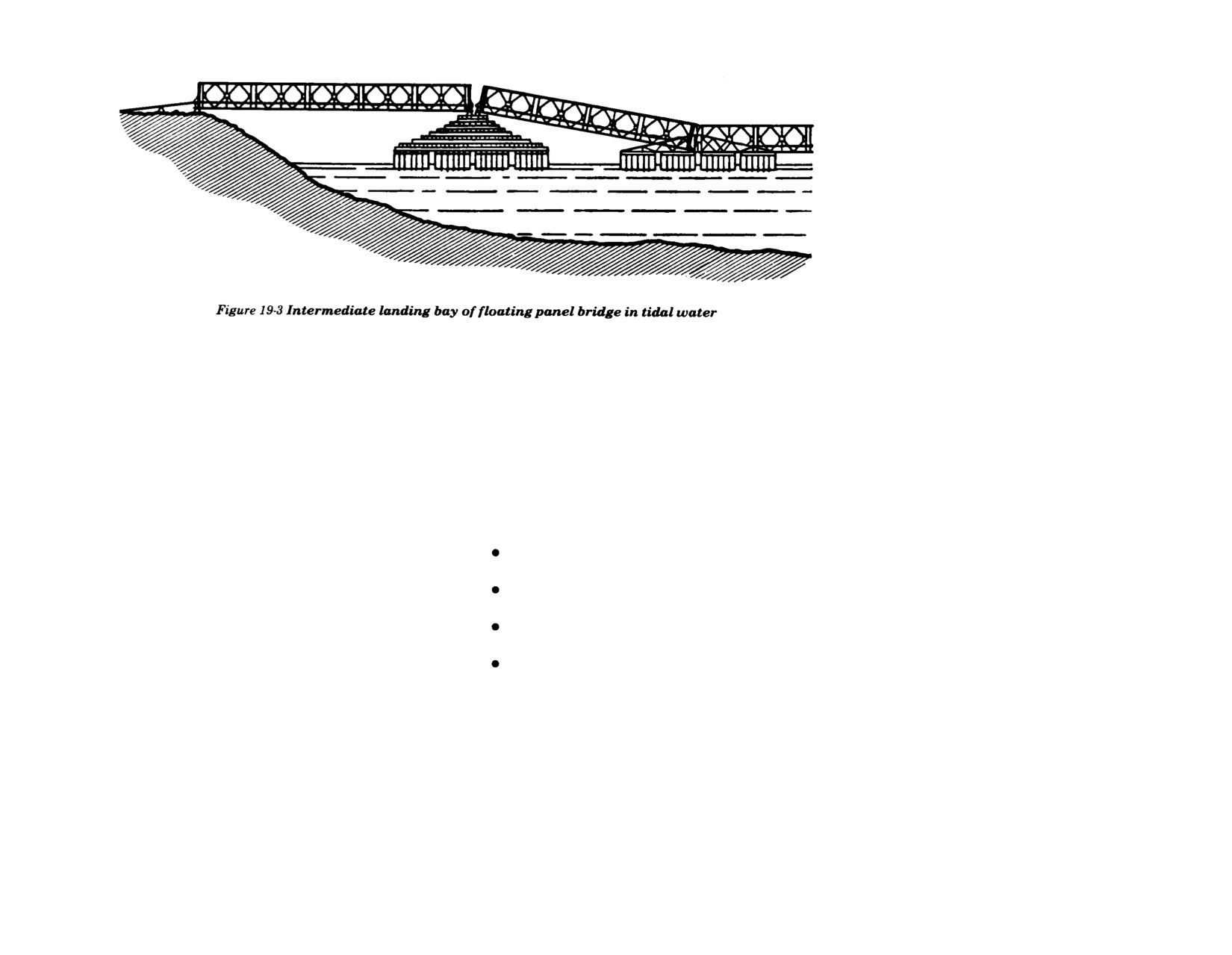
or pier, or on landing-bay pier of a floating
bridge. Then disconnect the counter-
weight, attach the rear end posts, remove
The counterweight method is useful when
panel bridge. Long girders may be kept in
the rollers at each end, and jack down the
site conditions at the far side prevent use,
line by using side guys and a pull winch.
girder onto a skidding beam.
removal, or disposal of a launching nose, or
When across the gap, the nose lands on
erection of a gin pole or high line. When
rollers on the far bank. Then disconnect
Girders may be counterweighted either
launching long girders of a deck-type bridge,
nose, attach front end posts, remove
by adding weights to the last bay of a
a counterweight permits tipping the far end
rollers at each end, and jack down the
short tail on the girder or by making the
directly onto the pier without jacking down.
girder onto skidding beams.
girder of the same assembly and twice as
long as the span so the tail alone will
Launching-nose method
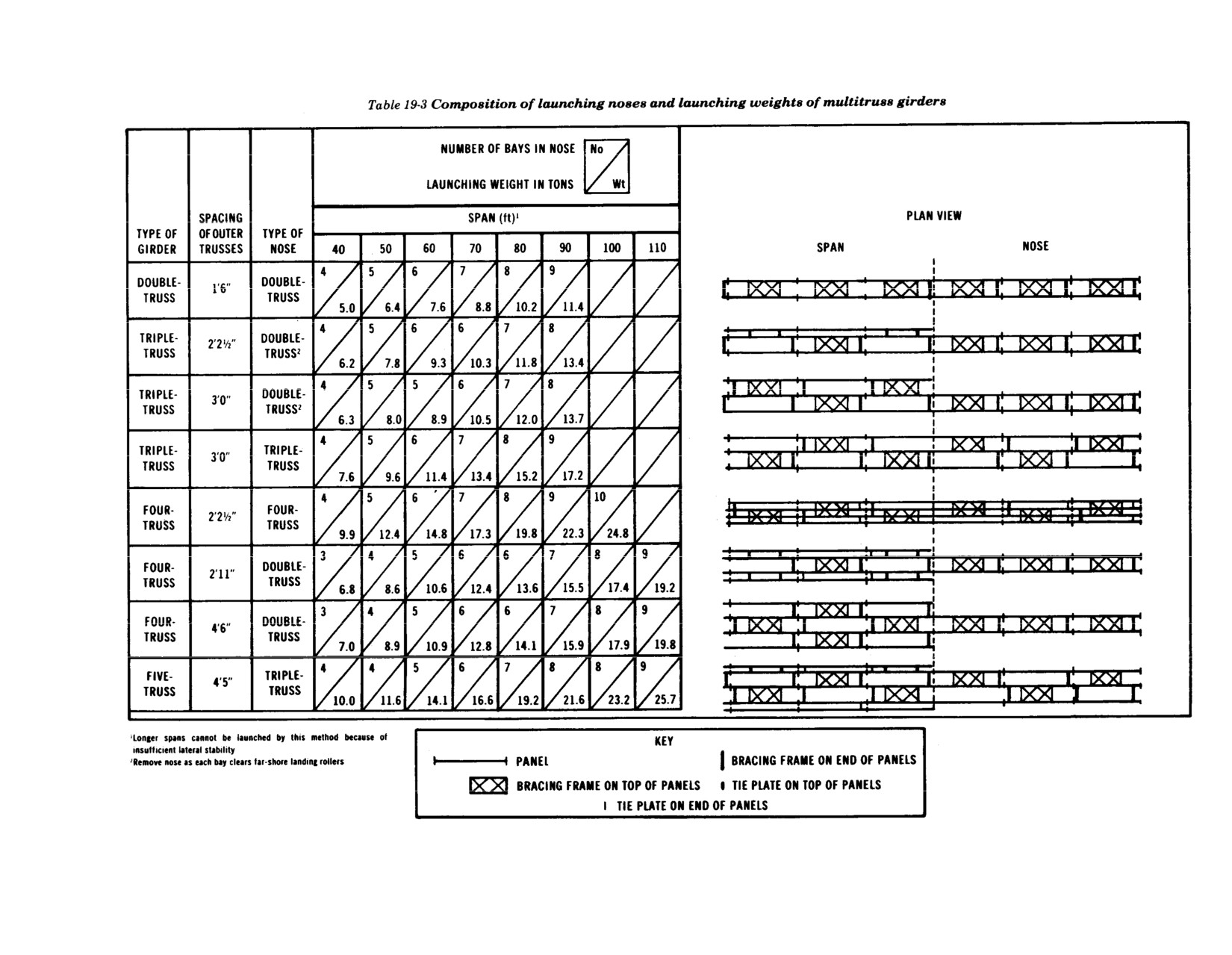
Table 19-3 (page 253) lists the types and
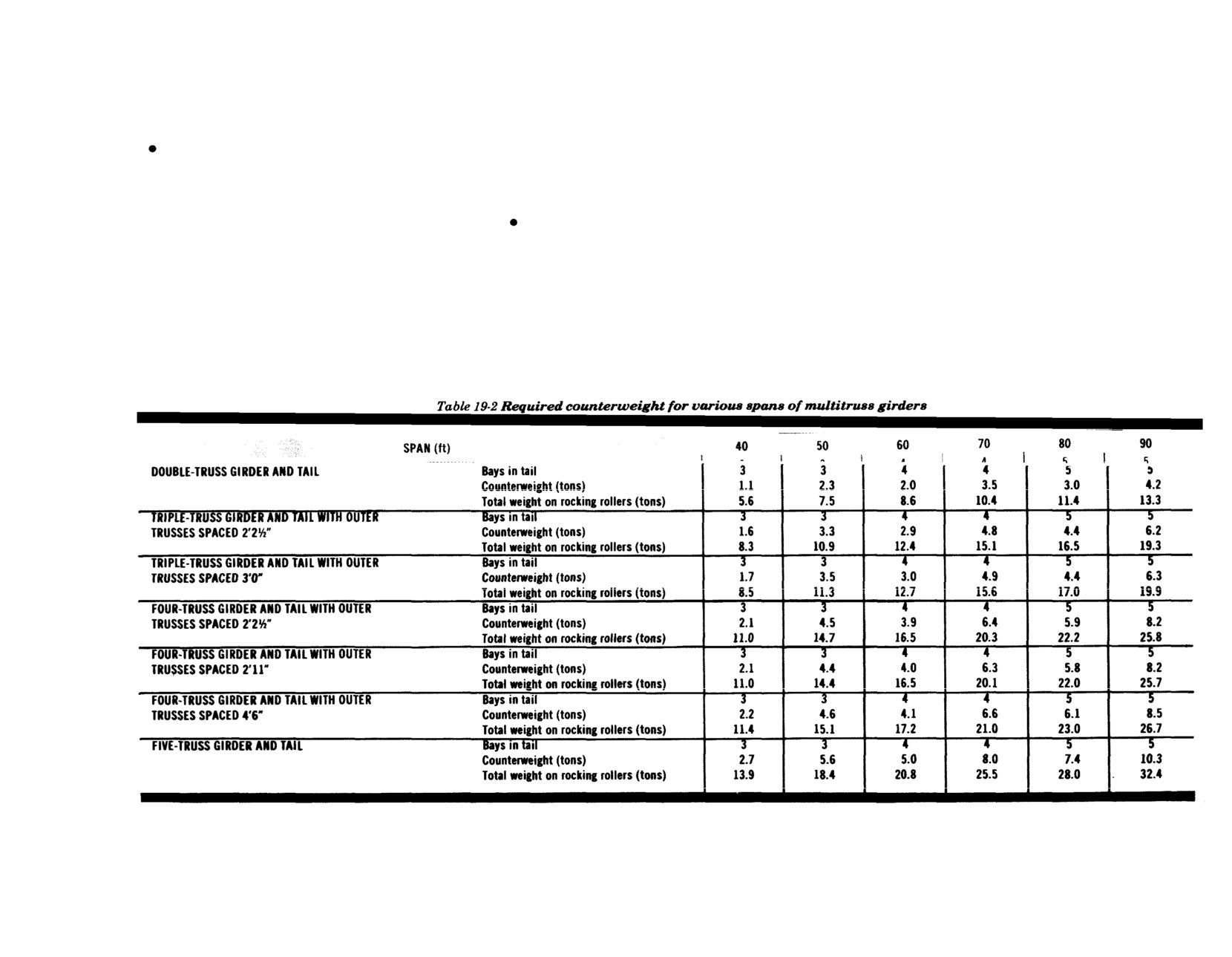
counterbalance the span. Table 19-2 lists
Launch a single girder by the launching-nose
lengths of noses needed to launch multi—
weights needed on short tails to counter-
method as follows:
truss girders. Single-truss girders cannot
weight various spans of multitruss
be launched by this method. Brace
girders. (Longer spans cannot be
Attach a lightweight launching nose to
launching noses the same as the girder.
launched by this method because of insuf-
the front end of the girder, and push the
When launching the triple-truss girder
ficient lateral stability.) If the long tail is
girder with nose on rollers out over the
with an eccentric double-truss nose, the
used, it may be disconnected after the
gap. To compensate for sag, launching-
nose must be dismantled bay by bay as it
first girder is launched, and used for a
nose links may be used in the same
passes over the landing rollers. Otherwise,
second girder.
manner as when launching the normal
the nose beyond the landing rollers twists
the girder, and may cause failure.
250
FM 5-277
Gin-pole and snubbing-tackle method
The launching-nose method is used for
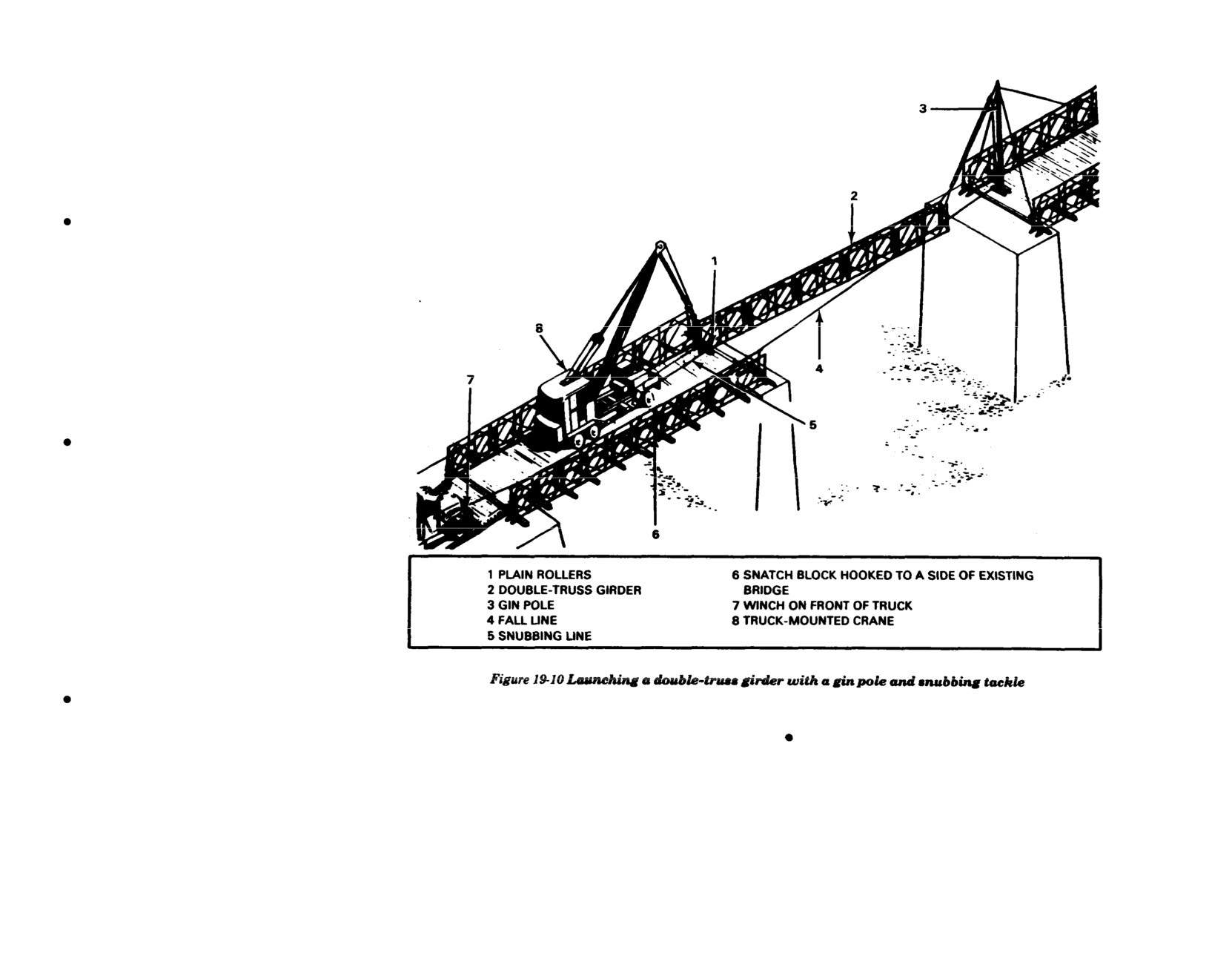
Launch a single girder by the gin-pole and
girder on each side and control by winches
longer girders, where sag is appreciable.
snubbing-tackle method (Figure 19-10, page
on trucks to each side of bridge. The
It can also be used for girders too heavy
252) as follows:
girder rides on rollers on the near bank.
for a gin pole or high line. Launching by
Brake it by snubbing tackle attached to
this method is easier than with a counter-
Erect a gin pole at the far bank or pier. Rig
the rear end of the girder to keep it upright
weight, because the girder with nose is
tackle from the gin pole to the front end of
and to lift it onto the bearings. Power
lighter than the girder with counter-
the girder with the fall line running to the
applied to the hauling winch pulls the
weight.
winch of a truck on the bridge or bank.
girder across the gap. Move a truck-
When a truck-mounted crane or tractor is
mounted crane forward with the girder,
used at the tail of the girder, lead the fall
keeping the snubbing line taut to prevent
line around it by a snatch block at the side
too rapid movement. When the girder has
of the bridge. For long, heavy girders,
passed its balance point, let it dip about
attach guy lines near the center of the
one-tenth of its length to lessen stress in
251
FM 5-277
the tackle. After the girder is across the
gap, the gin pole and truck-mounted crane
lift it directly onto the bearings.
When a truck-mounted crane is not avail-
able, two gin poles may be used, one on
each bank. Attach both gin-pole lines to
the front end of the girder, which is pulled
over the gap by taking up on the far gin-
pole line and slacking off on the near gin-
pole line. When the front end of the girder
is over the far bank, change the line from
the near gin pole from the front to the rear
of the girder. Then lower the girder onto
its bearings.
This method is better for short spans,
since long girders are heavy and difficult
to handle. It also saves bridge equipment,
because it eliminates the need for either a
launching nose or counterweight. In
addition to handling girders, the gin pole
and truck-mounted crane can be used to
telegraph transoms and decking into
place.
Direct-lift method
Launch a single girder by the direct-lift
method as follows:
Assemble the girder on ground beside the
piers. Use two cranes or gin poles to lift
the girder into place on the piers. In case
not needed if the piers are low enough so
The length of girder that can be launched
of a water gap, the girder may be floated
the girder can be floated into place and
by this method is limited by the capacity
out to the piers and lifted into place by
lowered onto the piers by pumping water
of the cranes. If the girders are short and
cranes on rafts or on the piers. Cranes are
into the raft pontons.
light, a single crane can be used.
262
FM 5-277
253
5-277
High-line method
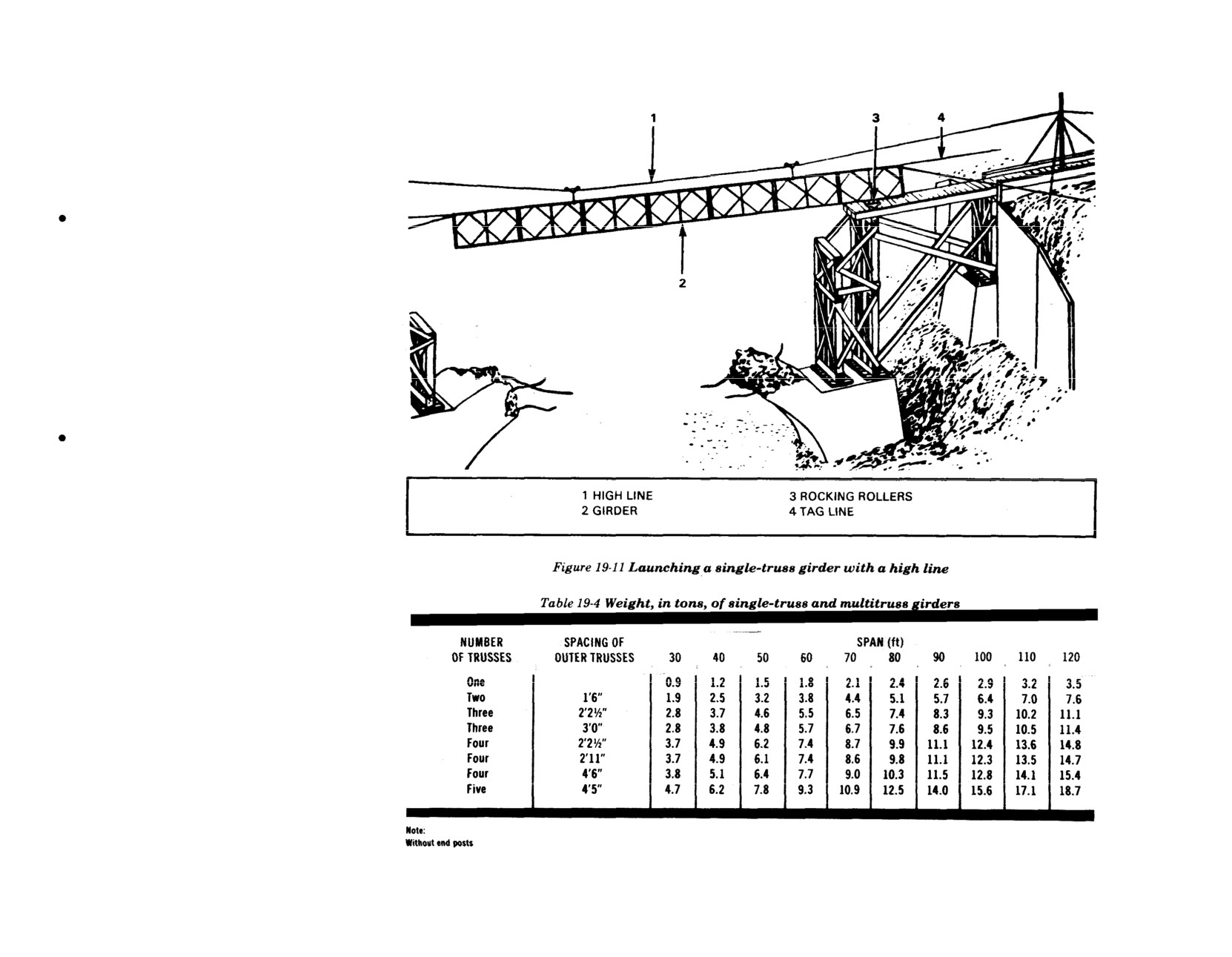
Launch a single girder by the high-line
method (Figure 19-11) as follows:
Rig a high line of suitable capacity across
the gap along the centerline of the bridge.
Suspend the girder from the high line,
pull it over the gap, and lower it onto
skidding beams. Attach the trolleys on
the high line to slings on the girder near
the quarter points. Roll the girder on the
approach span to its balance point on the
first roller before it is carried by the high
line. Use tag lines at both ends of the
girder to control it during launching.
This method is useful for launching deck-
type bridges where the girder has to be
lowered a considerable distance to the
skidding beams. In addition to handling
the girders, the high line can be used to
carry out the transoms and decking, and
where trestle-approach spans are used, it
can be used to carry out bridge parts for
the approach spans. This method also
eliminates the need for either a launching
nose or counterweight. The capacity of
high lines is usually limited to short
single or double-truss girders. Table 19-4
lists the weight, in tons, of various lengths
of girders.
JACKING DOWN
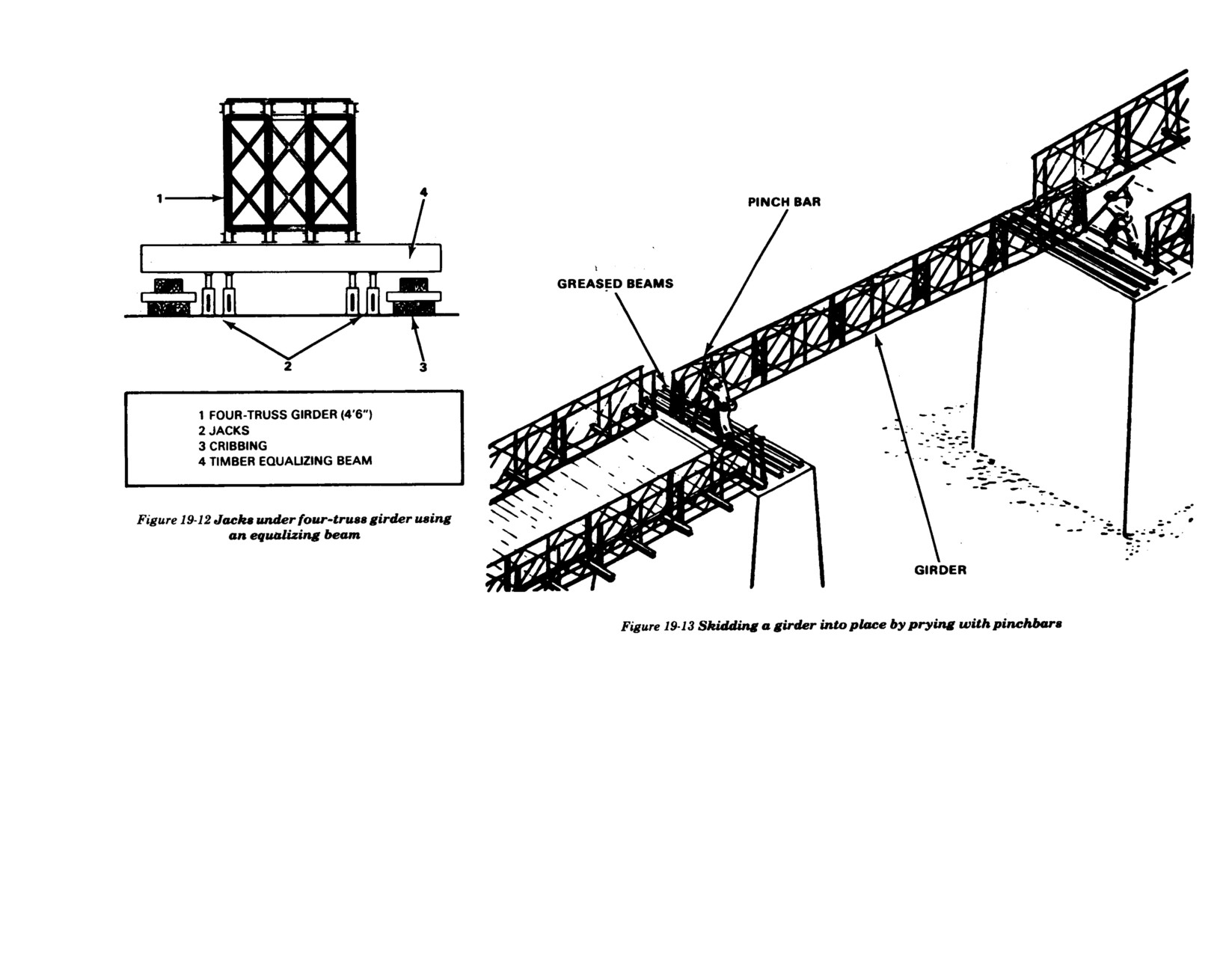
Jack down the girders either with a jack
under each end post or with jacks under an
equalizing beam supporting the underside of
the girder (Figure 19-12). Work the jacks in
unison so the girder is lowered evenly. During
the lowering, guy the girders to prevent
254
FM 5-277
SKIDDING AND SQUARING UP
After the first girder is lined up with the
overturning. To lower the girder in its final
After launching, move the girder into position
existing bridge, square up the second girder
stage, place equalizer beam under top chord
by truck cranes, or skid it into position on
with the first. If the trusses cannot be moved
as in Figure 16-18. Place cribbing under the
greased skidding beams by prying with panel
in a longitudinal direction without rollers,
bottom chords or equalizer beam to prevent
the girder from dropping if it slips off the
levers or pinchbars (Figure 19-13). Panel-
reinsert rollers after skidding.
jacks. If the distance to be lowered is great,
bridge stringers are preferred for skidding
lower the girder by successive stages. When
beams, but I-beams or timber beams may be
truck-mounted cranes or gin poles are avail-
used.
able at each end of the bridge, lower the
girders directly on the bearings.
255
FM 5-277
COMPLETION OF BRIDGE
For normal through-type assembly, complete
to fit at first, but this becomes easier as
the bridge bay by bay, working out from the
more bays are completed.
near shore as follows:
3
Place stringers in first bay.
1
Insert sway braces of first bay with
adjusting collars on the same side of
4
Remove vertical bracing frames and in-
bridge. Use two lashings from centers of
sert rakers. Do not tighten.
bottom brace to hold center of sway braces
up until ends are pinned in place. Do not
5
Repeat above procedure to install sway
tighten.
braces, transoms, stringers, and rakers in
second bay.
2
Place transoms in first bay. A truck-
mounted crane with gin pole on far bank
6
After bracing members are inserted in
may be used to telegraph transoms into
second bay, tighten all bracing in first
place, or they may be placed by hand. In
bay and lay chess and ribbands in first
the telegraph method, attach to the tran-
bay.
som both a line from the gin pole on the
far bank and a line from the crane on the
7
Add remainder of decking in the same
near bank. Then pick up the transom and
manner.
place it by taking up the gin-pole line and
slacking off on the crane line. Use a tag
8
Install ramps.
line on the transom to guide it. When
handling it manually, push the transom
Deck-type bridges take either standard panel-
out from the bank and swing it into
bridge decking or expedient timber decking.
position with the aid of ropes attached to
For details of deck-type bridges, see Chapters
the top chords. The transoms are difficult
12 and 13.
256
FM 5-277
CHAPTER 20
BRIDGES ON BARGES
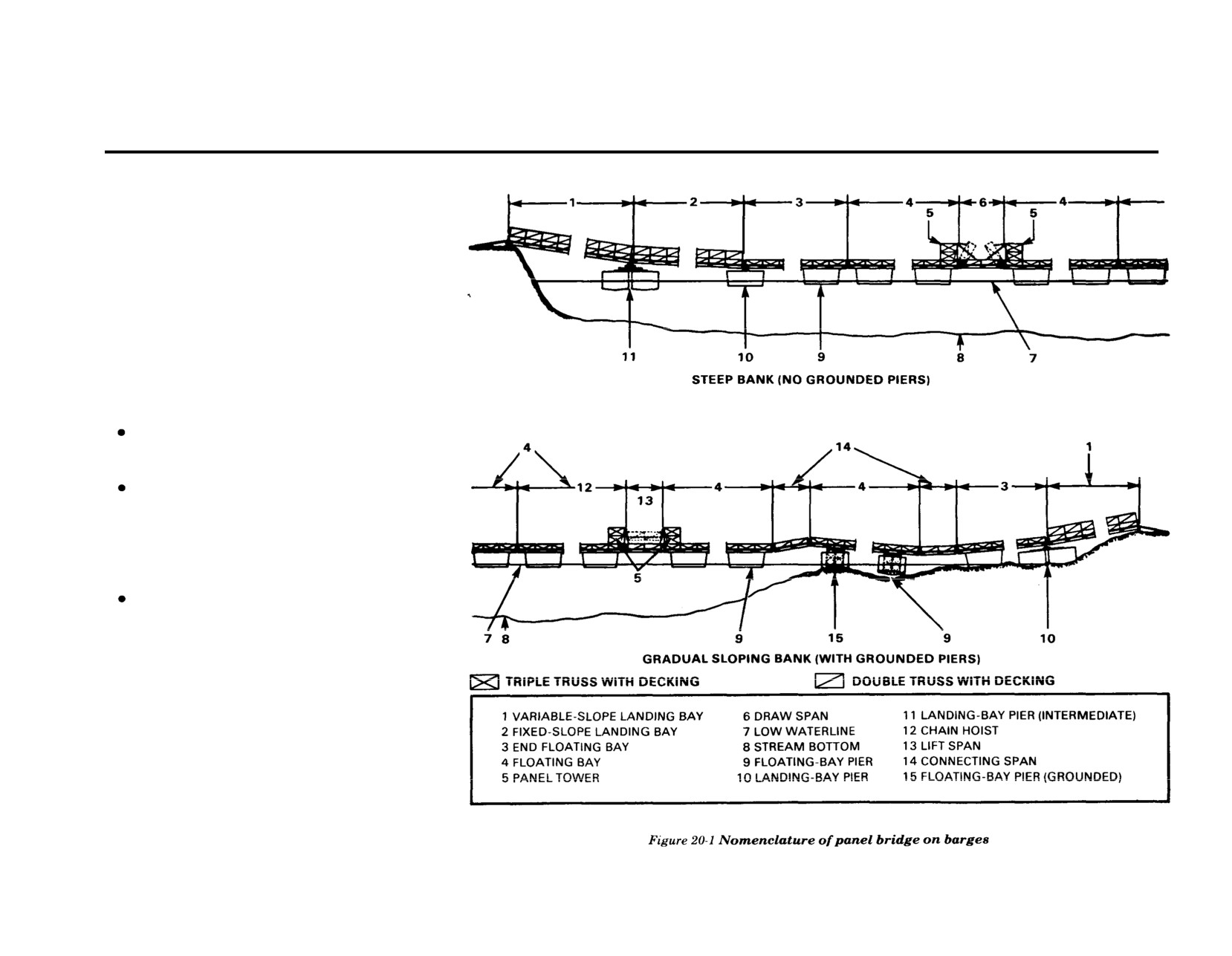
The panel bridge on barges consists of a
standard panel bridge supported on floating
piers made from river or coastal barges of
suitable type and capacity. Special spans or
parts are used to provide hinged joints
between floating bays (Figure 20-1).
PIERS
Piers consist of barges or vessels suitably
prepared to support the panel-bridge super-
structure. The several kinds of piers are—
Floating-bay piers, which support the
floating bays in the interior of the bridge.
Landing-bay piers, which support the
shore end of the floating bay and the
riverward end of either the fixed-slope
landing bay or the variable-slope landing
bay.
Intermediate landing-bay piers, which
support the shore end of the fixed-slope
landing bay and the riverward end of the
variable-slope landing bay. The inter-
mediate landing-bay pier is not used
without the fixed-slope landing bay.
257
FM 5-277
BAYS
The span between two articulating points
Landing bays, which form the connection
changes in slope between the floating bays.
supported by two floating piers or between
between the end floating bay and the
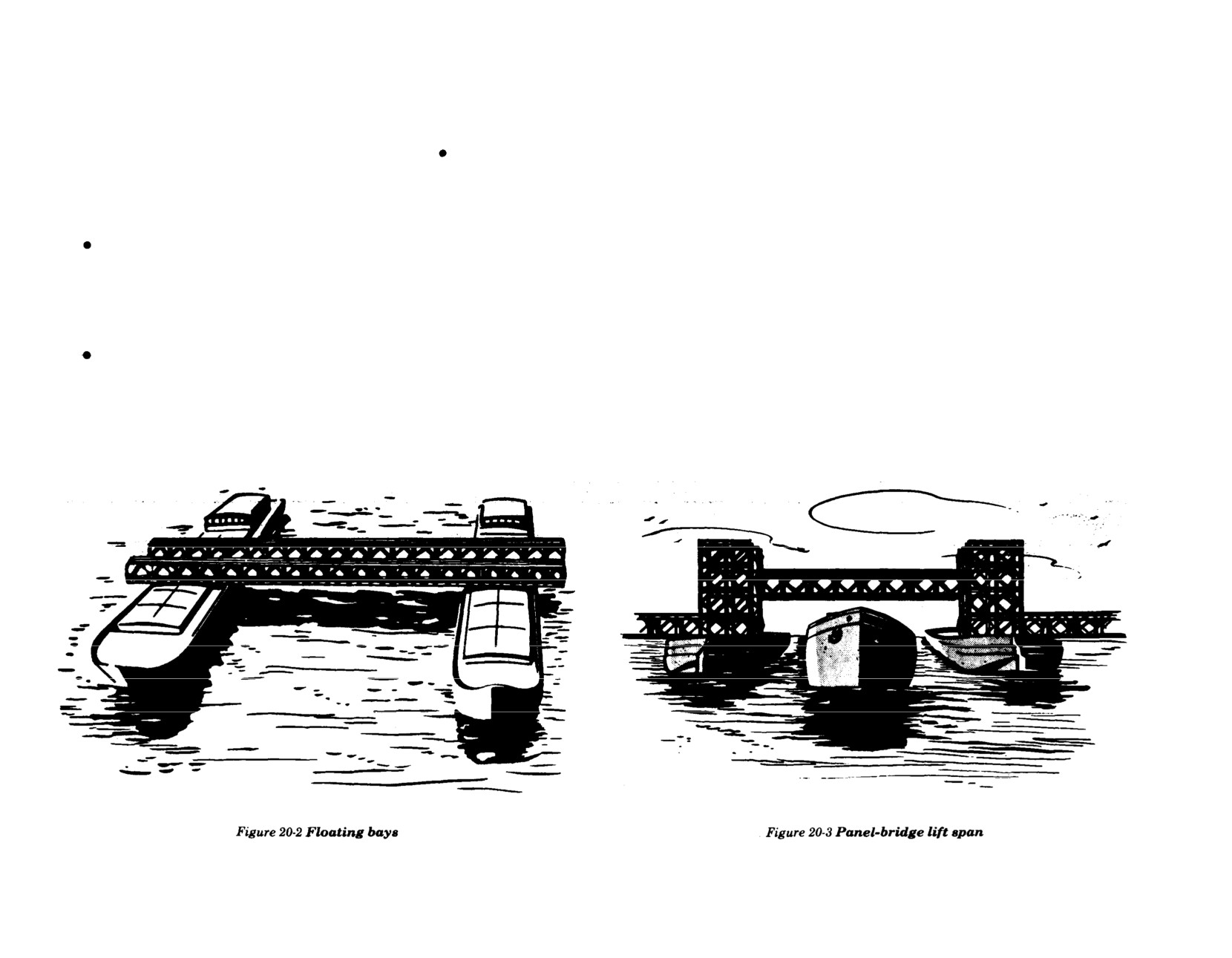
Lift spans (Figure 20-3) connect two adjacent
the shore and a floating pier is called a bay
bank. There are two types of landing
floating bays. They can be lifted vertically by
(Figure 20-2). The several-kinds of bays are-
bays: the variable-slope landing bay,
use of block and tackle or chain hoists to
which spans the gap between the bank-
allow passage of water traffic through the
Floating bays, which are the interior of
seat and the landing-bay pier (or the
bridge. Draw spans provide a wider gap
the bridge from the end floating bay on
intermediate landing-bay pier if a fixed
between adjacent floating bays for passage
the near shore to the end floating bay on
slope landing bay is used); and the fixed-
of river traffic. They can be split in the middle
the far shore. They are supported near
slope landing bay, which, spans the gap
and each half pivoted up.
each end by floating-bay piers.
between, the intermediate landing-bay
pier and the landing-bay pier.
DESIGN AND
End-floating bays, which form the con-
CAPACITIES OF BARGES
tinuation of the bridge between the
SPECIAL SPANS
Coastal and river barges differ widely in
floating bays and the landing bays. They
Special spans include connecting spans, lift
construction and capacity throughout the
are supported by a landing-bay pier and a
spans; and draw spans. Connecting spans
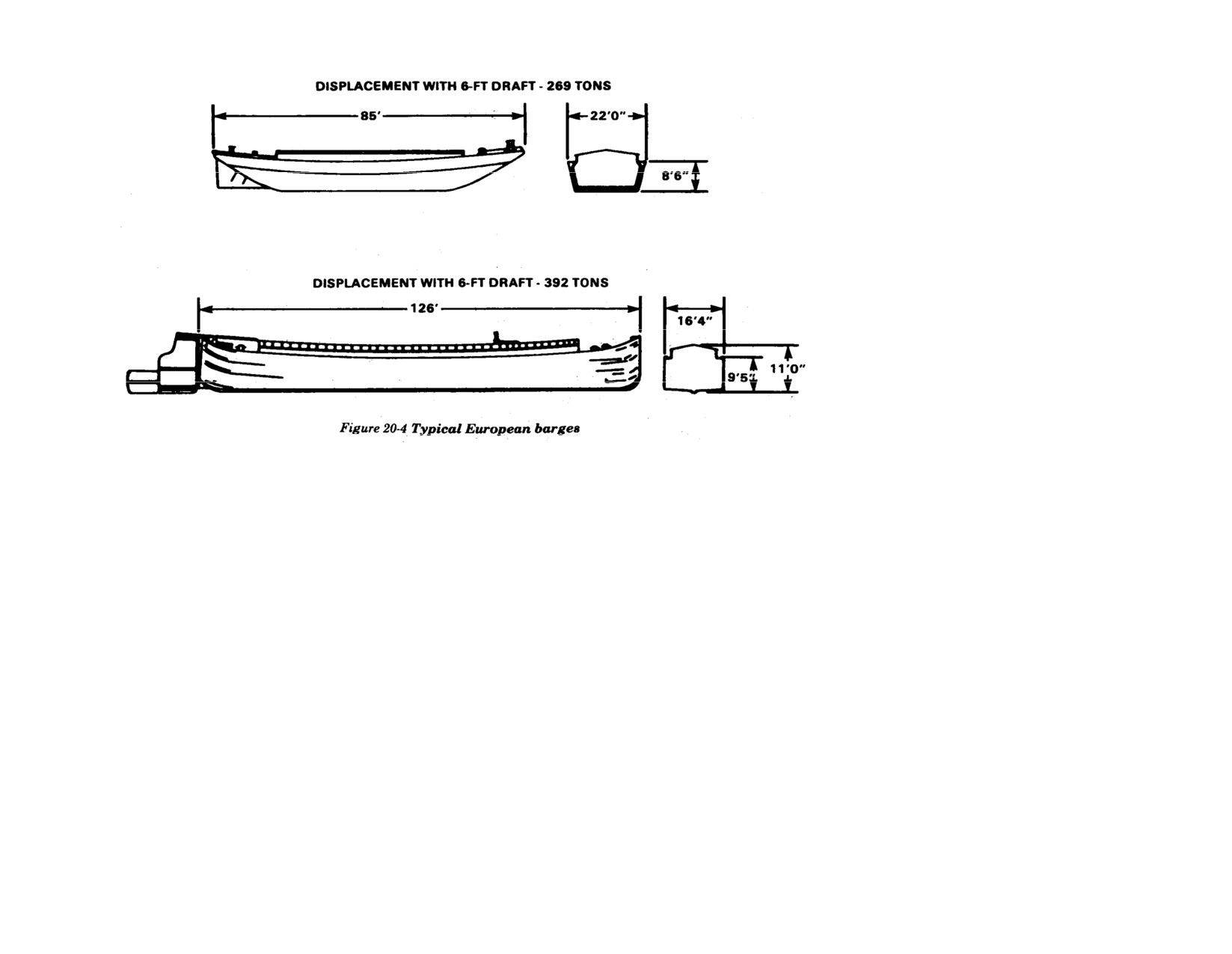
world. In Europe and the Americas, barges
floating-bay pier.
connect two adjacent floating bays where
are generally flatbottomed. Barges with
barges are grounded. They each provide two
round or semiround keels are also found on
articulating points to compensate for the
European canals and rivers (Figure 20-4).
258
FM 5-277
double,
or
triple-double
assembly of standard
panel-bridge equipment. Normally, a
floating-bay superstructure is a single-story
assembly and a landing-bay superstructure
is a double-story assembly.
Decking for a superstructure of normal bays
consists of standard chess with 3-inch (7.6
centimeters) wear treads laid diagonally over
the chess. Add angle irons to deck on landing
bay to increase traction. When connecting
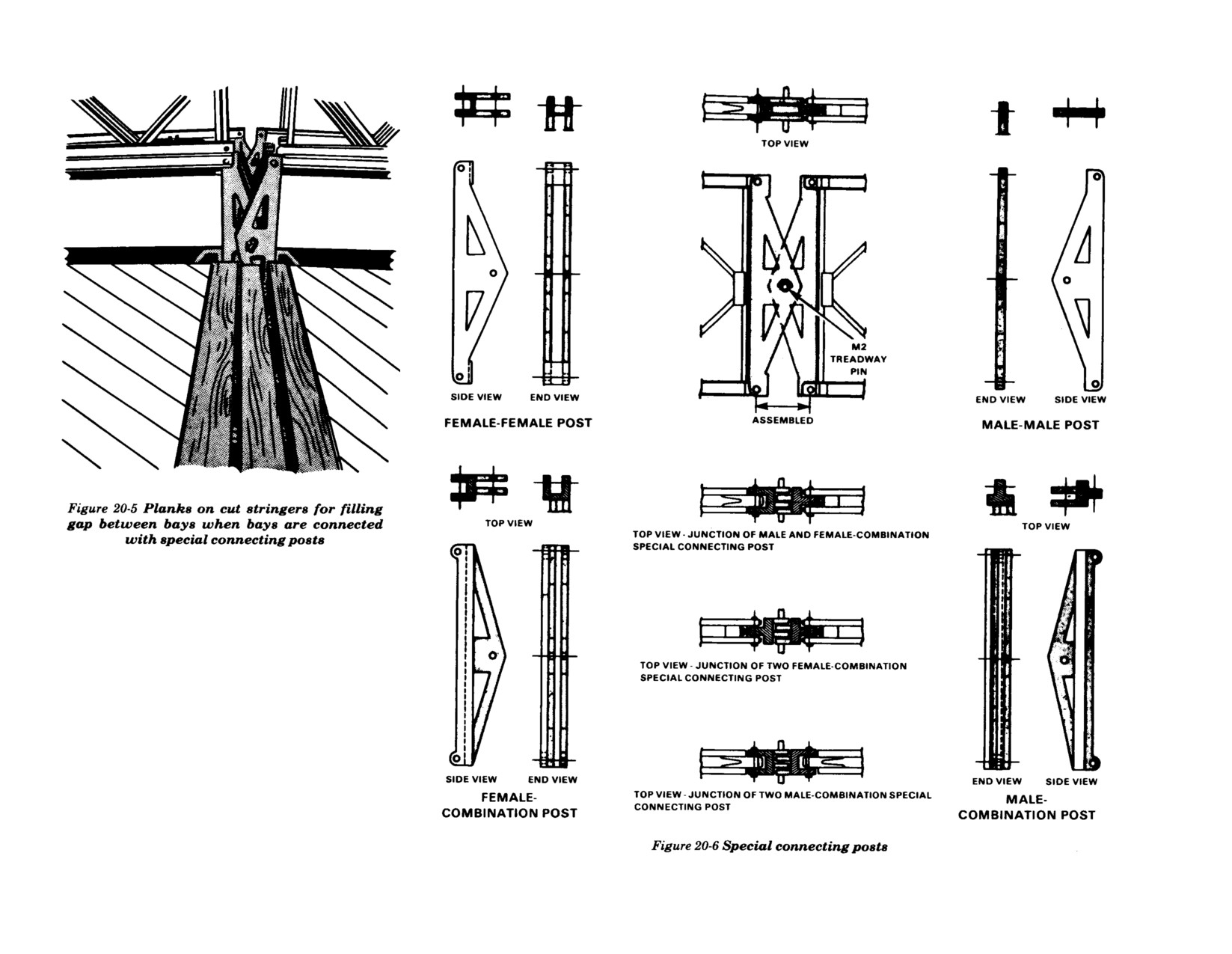
posts are used to connect floating bays,
transoms and junction chess cannot be used
to fill gap between bays. Place cut stringers
on the two transoms at the end of each bay,
and place two thicknesses of 3- by 12-inch (7.6
by 30.5 centimeters) planks spiked together
on top of the cut stringers (Figure 20-5, page
Asiatic barges have less capacity than
will support approximately 5 tons (4.6 metric
260). Wire planks in place to prevent shifting.
European or American barges. Generally,
tons).
When span junction posts are used to connect
European and American barges have a
bays, fill gap between bays in normal manner,
capacity of from 80 to 600 tons (73 to 546
Decks
using transoms and junction chess. Where
metric tons). The general condition of the
Barge decks are designed for distributed
maximum road width is desired, ribbands
barge has a direct effect on its use in a bridge.
loads. A wide variation of deck design exists
can be eliminated by a 2- by 24-inch (5.1 by
and care must be taken in estimating their
61.1 centimeters) hub guard installed 6 inches
Ribs
capacity. European flat-bottomed barges
(15.2 centimeters) above deck to protect
Structural ribs of barges are designed for
normally use transverse beams of Z section, 6
panels.
bending stresses induced by water pressure
to 7 inches (15.3 to 17.8 centimeters) deep,
on the outside of the hull. They are normally
carrying light channels or I-beams fore and
Use special connecting posts to connect bays
bulb-angled steel sections 5½ to 7 inches (14
aft to support a timber deck. A deck of this
and provide articulation (Figure 20-6, page
to 17.8 centimeters) deep, closely spaced, and
type can carry a bearing pressure of 0.5 ton
260). These special connecting posts provide
curved rather than straight. Ribs should not
(.45 metric ton) per square foot.
ample strength and allow development of full
be loaded as struts unless they are braced and
capacity of superstructure. Equal articulation
load is distributed. To distribute the load,
DESIGN OF SUPERSTRUCTURE
above and below connecting pin provides
timber cribbing can be used along the gun-
The superstructure of a bridge on barges may
unrestricted space for movement in the
wale directly over the ribs. If the rib is not
be assembled either by normal or by special
connection. Such connectors do not require
curved and the length of rib from deck to keel
means. Superstructures of normal bays con-
restrictive linkages, guides, or maintenance.
does not exceed 10 feet (3.1 meters), each rib
sist of
double-single, triple-single, double-
Combination special connecting posts can be
259
FM 5-277
used in place of normal posts and also to
connect two male or two female ends of
panels.
Use special spans when barges are grounded
or when passage of water traffic through the
bridge is necessary. The capacities of the
special spans are the same as the normal
spans. However, their full capacity cannot be
developed unless the suspending connection
at each end is made strong enough. In addi-
tion, the weight of the lift span and draw
span is limited by the lifting power and
strength of the hoists, thus affecting the type
of construction that can be used in these
260
FM 5-277
assembly 20 or 30 feet (6.1 or 9.4 meters)
meters) from the centerline of the barge.
long. It is raised horizontally by block
However, a single barge can be used if it has
and tackle attached to span and to panel
ample width and capacity and the bay is
towers in adjacent bays.
stable under the load.
Use and restrictions of the draw span are
The type of assembly used in landing bays
the same as for the lift span. The draw
depends on length of span and on loads to be
span is a
single-single
or
double-single
carried. A
triple-double
assembly is the
assembly, usually 20 feet (6.1 meters) long
heaviest type used. Maximum slope of the
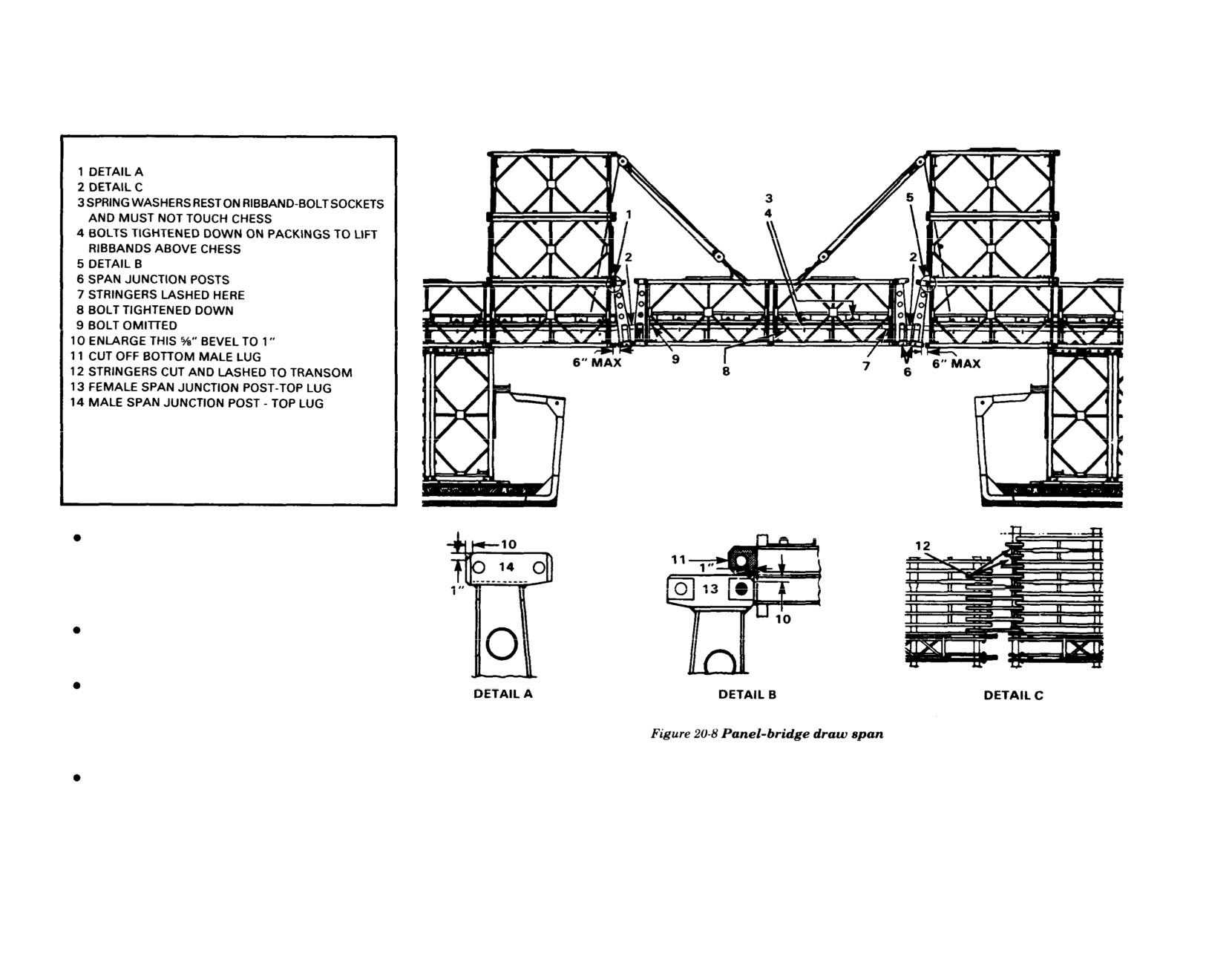
(Figure 20-8, page 262). Hinge and sus-
bay is 1 to 10 with adequate traction devices
pend it to adjacent bays by span junction
provided; without traction devices, slope is 1
posts. Raise it at one end by block and
to 21. Length of landing bay depends on
tackle attached to span and a panel tower
conditions near shore. Use double landing
in one of the adjacent bays. If resulting
bays where considerable change in water
gap is insufficient, use span of 40 feet
level is expected or when high banks are
(12.2 meters) and make cut at center of
encountered. Assemble landing bays the
span. Then use towers with block and
same as normal panel bridges and use the
tackle at both ends and lift each half
same type of end support.
separately.
spans. The three types of special spans used
ADVANTAGES AND
are connecting spans, lift spans, and draw
DESIGN OF BAYS
DISADVANTAGES
spans. They are used as follows:
The barges and the superstructure together
The panel bridge on barges has the following
form sections called bays. These are designed
advantages:
Use the connecting span when barges are
as either floating or landing bays.
grounded or when special connecting
It does not use standard floats and
posts are not used. It is a short span of
Floating bays are normally
double-single
pontons which may be needed at other
single-single
or
double-single
assembly
assembly. However, for loads of 100 tons (9.1
sites.
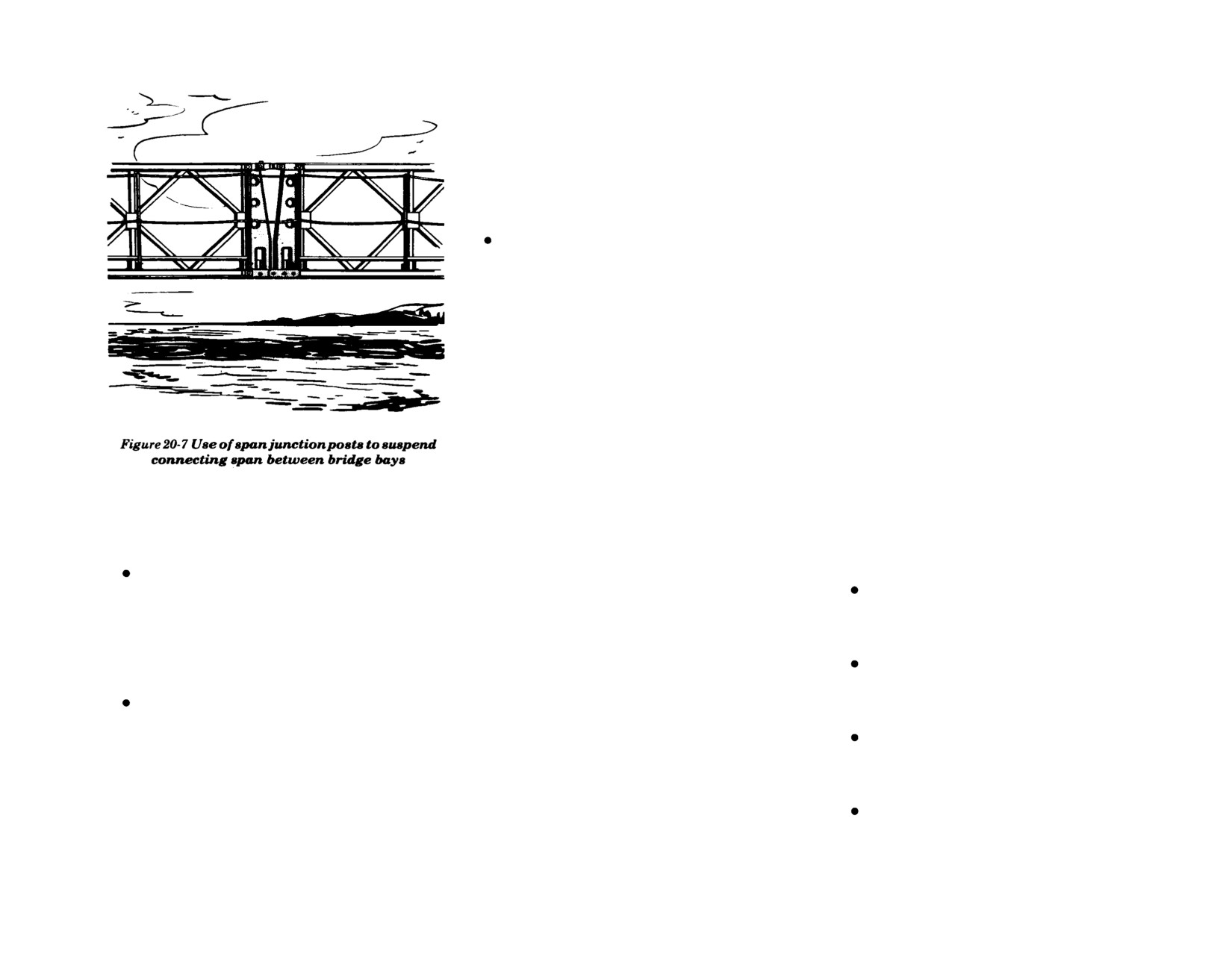
suspended between two floating bays by
metric tons) or more, unsupported span
span junction posts (Figure 20-7).
lengths are limited to 60 feet (18.3 meters) and
It allows long landing floating bays for
assembly must be
triple-single.
The class is
use in tidal estuaries or rivers with high
Use the lift span only in short bridges
limited by type of assembly, by the span
banks.
where current is slow and there are no
between centers of barges, and by the method
longitudinal forces in the bridge. When
used to support the superstructure on the
It has large capacity barges which allow
current is swift, pier heights can be
barges. The class of floating bays is given in
greater bridge capacity than standard
increased to arch the bridge enough to
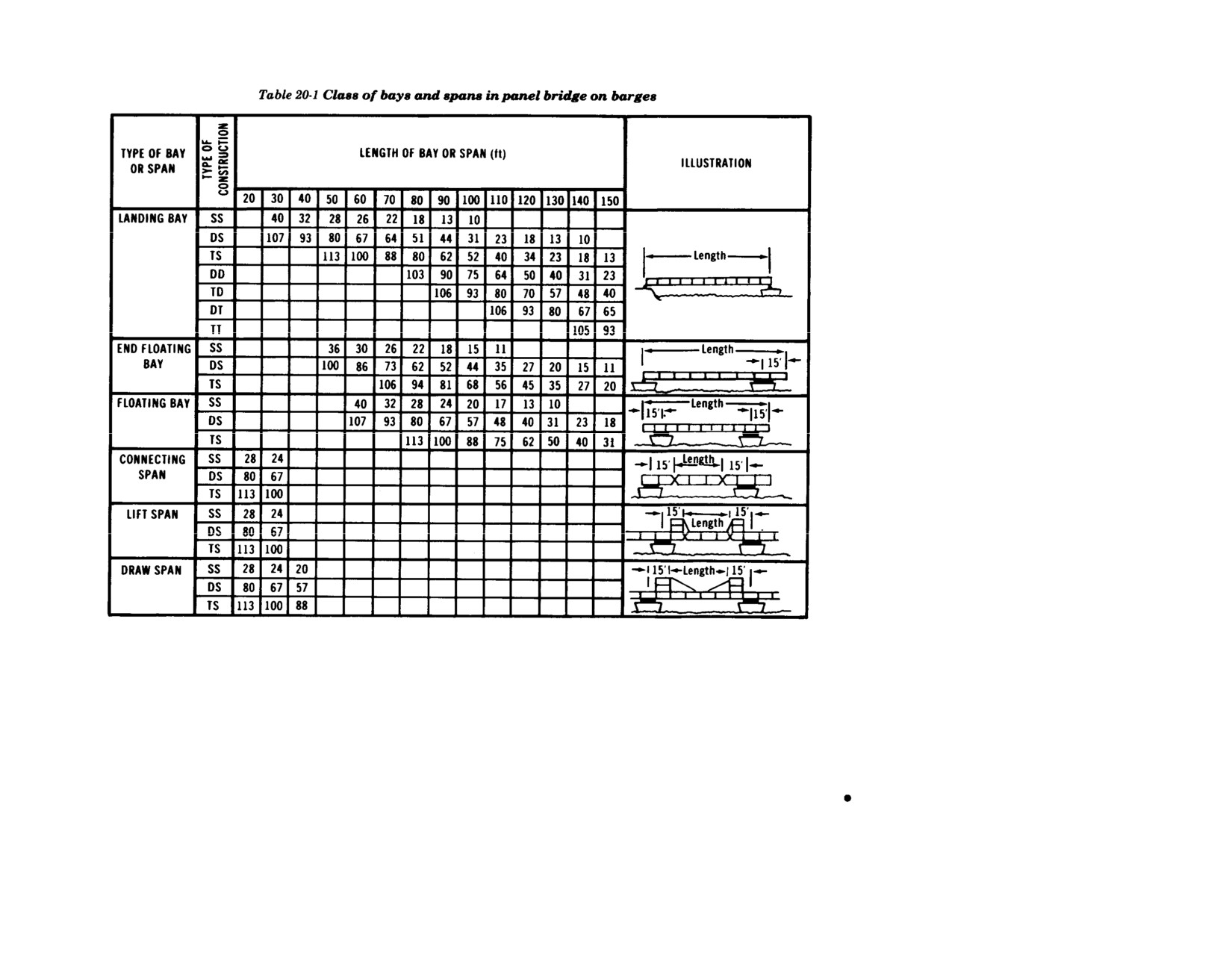
Table 20-1 (page 263). Normally, a barge near
military floating supports.
pass water traffic under one of the center
each end of a bay supports the superstructure.
spans without use of a lift span. The lift
The superstructure must not overhang the
It provides a stable bridge in swift cur-
span is
single-single
or
double-single
barge at each end more than 15 feet (4.6
rents.
261
FM 5-277
It minimizes hazards of floating debris
and ice.
The bridge has the following disadvantages:
It uses barges which may be hard to
obtain.
It can be used only in navigable streams
or waterways used by barges or vessels of
the type and size necessary for use in the
piers.
It is not adaptable in combat areas
because of equipment, material, labor,
and time requirements.
262
FM 5-277
PARTS FOR SUPERSTRUCTURE
Normal spans use fixed-span panel-bridge
parts (Chapter 1). Connections between spans
are made with special connecting posts that
must be fabricated in the field (Figure 20-6) or
by connecting spans using span junction
posts supplied in the panel crib pier set
(Chapter 17).
Special fittings to guide both the lift span and
the draw span during raising and lowering
must be made in the field. Block and tackle
required are supplied in the freed-panel bridge
set. Counterweights to aid in raising and
lowering the span can be improvised. The lift
span or the draw span, and the floating bays,
are connected by span junction posts from
the panel crib pier set.
The normal erection equipment supplied in
the fixed-panel bridge set is sufficient to
assemble the superstructure. Truck cranes
aid the erection of the superstructure and the
preparation of the barges. Acetylene torches,
arc welders, chain falls, power and hand
winches, diving equipment, and sea mules or
power tugs with enough power to move
floating bays into position should be avail-
BARGE EQUIPMENT
After determining the type of barge loading.
able at the site.
Barges must be processed and their required
prepare a material estimate and an an eq.ui.-
equipment determined. Procure barges locally
ment requirement list for each barge. Nor-
SITE SELECTION
and then examine and rate them for capacity;
mally, steel beams, timber, blocking, wire
Tactical requirements determine the general
determine the best point for use in the bridge;
rope, and miscellaneous bolts and fittings are
area within which a site must be selected. The
establish the type of barge loading (described
needed. See Chapter 17 for equipment re-
following factors should be carefully con-
later in this chapter) to be used; and sketch
quired if panel crib piers are used as supports
sidered in choosing the site:
the construction needed to bring the bearings
on the barges.
to exactly the elevation established for super-
There should be a road net close to the site
structure bearings.
over which equipment can be moved.
263
FM 5-277
SITE RECONNAISSANCE
Roads and approaches should require as
After the general area has been determined,
Location of adjacent quarries and aggre-
little preparation and construction as
make a study of aerial and terrain maps to
gate supplies.
possible and should be straight and level
determine possible bridge sites along the
for at least 150 feet (45.7 meters) before
stream within the specified area.
Ground reconnaissance gives the following
reaching the stream bank.
data:
Direct aerial reconnaissance generally gives
Near-shore area should afford suitable
the following information on these bridge
Width of river from bank to bank.
sites along the shore for barge preparation
sites:
and bay assembly.
Profile of approaches and streambed.
Site relation to existing road net, with
Banks should be reasonably steep and
estimate of road construction required.
Character of soil in approaches, banks,
firm so that water gap will not change
and streambed.
materially with water level. Banks high
Alignment of river at site and channel
enough to allow launching of superstruc-
obstruction in the vicinity.
Profiles of possible routes of approach
ture to barge piers are desirable.
and linking roads to existing road nets.
Approximate height of banks to decide
The site should be on a straight reach of
suitability for approaches and landing
Current velocity.
the stream or estuary and free from cross
bays.
currents that would exert a longitudinal
High and low water data indicated
on
force on the bridge. Water at bridge site
Approximate width, shore to shore, of
profile and rate of flood and ebb of tide, if
should be deep enough to float barges at
river, and length of bridge required.
possible.
low water if no barges are to be grounded.
Water at assembly sites should be deep
Location, relative to bridge site, of
Sketch showing location and description
enough to allow preparation of barges
material storage, equipment, and work
of suitable material storage and work
close to shore and launching of super-
areas, and of barge site next to near shore
areas, downstream assembly area with
structure directly to barges. If barges can
for floating-bay assembly.
profiles at possible shore barge prepara-
be grounded at low water, the stream
tion sites, and floating-span erection sites.
bottom should be reasonably smooth and
Location of barges large enough to be
level. The stream should be free of
examined later in detail by ground recon-
Sketch of barges located in aerial recon-
obstruction at the assembly sites and
naissance.
naissance.
bridge site.
Nature of open water route from barges to
Routing on open water from assembly
bridge site, noting and locating obstruc-
sites to bridge site, with description and
tions to navigation.
location of obstacles and estimate of work
necessary to clear passage.
Routes over existing road nets for trans-
portation of bridge materials from dump
Information on location, quality, and
or other sources to bridge site.
quantity of nearest aggregate source.
264
FM 5-277
SITE LAYOUT AND PREPARATION
Before actual construction, alignment and
An example of how to distribute work parties
One battalion to construct:
grade of roads and approaches must be
is—
One 100-foot (30.4 meters)
double-
determined. Plan and locate storage and
double
landing bay.
Assume bridge will consist of the following
One 90-foot (27.4 meters)
triple-single
assembly areas so as to ensure uninterrupted
progression of work and avoid unnecessary
bays, proceeding from near to far bank:
end floating bay.
handling. After determining location and
One 100-foot (30.4 meters)
double-double
0ne 40-foot (12.2 meters)
double-single
layout of site, complete road work and
variable-slope landing bay.
draw span.
approaches to expedite delivery of bridge
One 100-foot (30.4 meters)
double-double
Two 100-foot (30.4 meters)
triple-single
material. At the same time, prepare landing-
fixed-slope landing bay.
floating bays.
bay and floating-bay assembly areas.
One 80-foot (24.4 meters)
triple-single
end floating bay.
One battalion to:
WORKING PARTIES
One 40-foot (12.2 meters)
double-single
Prepare approach roads.
To build bridges of 500 feet (152.4 meters) or
draw span.
Unload equipment.
more, assign an engineer combat or construc-
Three 100-foot (30.4 meters)
triple-single
Prepare anchorages.
tion group of three battalions, two panel
floating bays.
bridge companies, one light equipment
One 90-foot (27.4 meters)
triple-single
Two panel bridge companies to:
company, and one harbor craft company.
For
end floating bay.
Haul bridge equipment.
shorter bridges, reductions in personnel can
One 100-foot (30.4 meters)
double-double
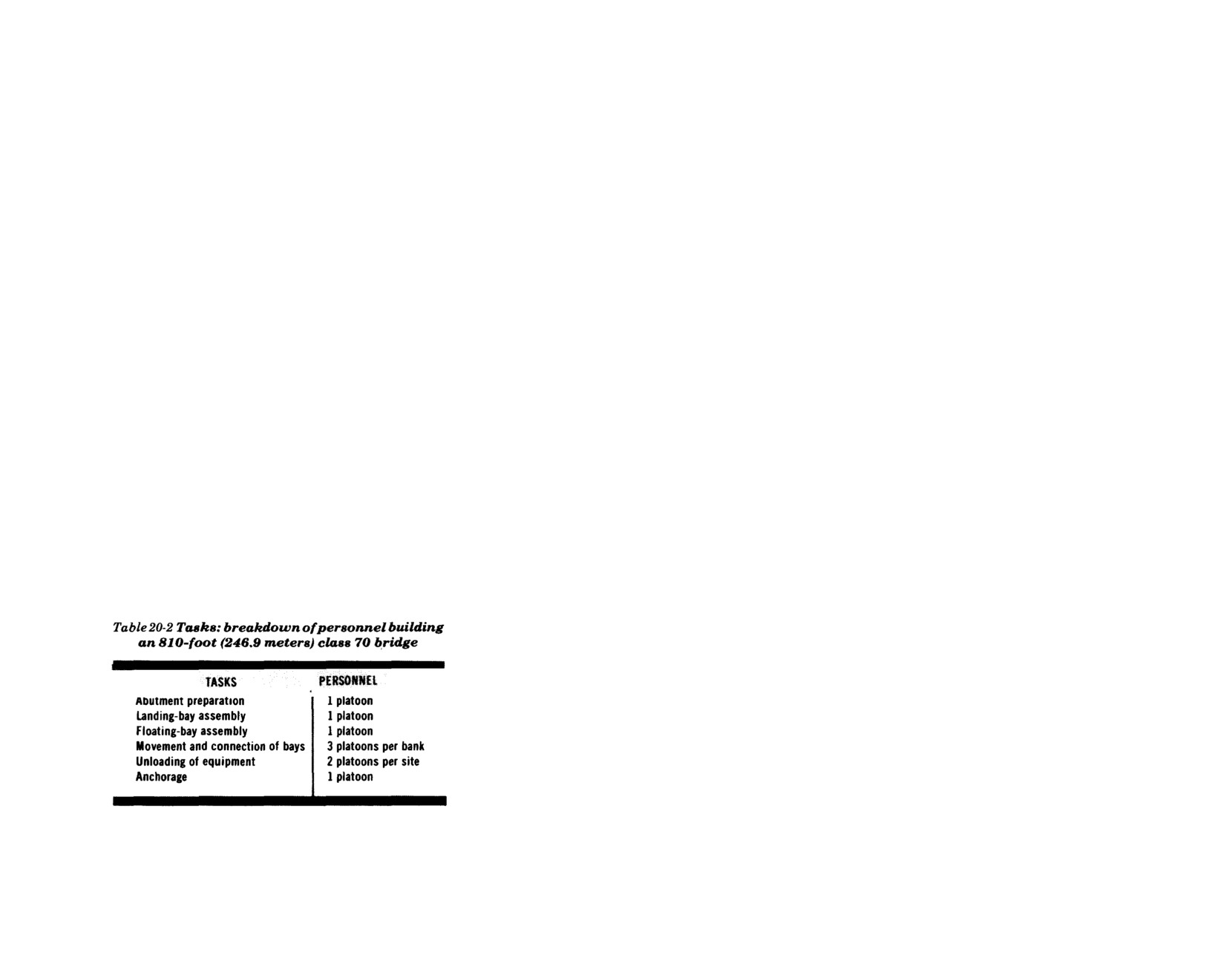
be made. Table 20-2 presents a suggested
landing bay.
One harbor craft company to:
breakdown of tasks and troops required for
Assist in maneuvering barges and
constructing an 810-foot (246.9 meters) class
Assume an engineer group of:
bays.
70 bridge in a moderate current. Approach
3
battalions.
2 panel bridge companies.
One light equipment company to:
road construction will need five company
1 light equipment company.
Supply construction equipment with
days.
1 harbor craft company.
operators.
One possible assignment of units to con-
Time required for completion is approxi-
struct this bridge is as follows:
mately 6 days of daylight construction.
One battalion to construct:
BARGE SELECTION
One 100-foot (30.4 meters)
double-
Before starting to build the bridge, barges
double
variable-slope landing bay.
must be chosen and positioned with care. In
One 100-foot (30.4 meters)
double-
selecting barges, structural condition, capac-
double
fixed-slope landing bay.
ity, shape, freeboard, type, and location of
One 80-foot (24.4 meters)
triple-single
barge must all be considered. Examine and
end floating bay.
rate barges located on the reconnaissance.
One 100-foot (30.4 meters)
triple-single
Barges which meet the requirements should
floating bay.
be assigned a position in the bridge. Working
265
FM 5-277
sketches and a plan of preparation for each
barge are necessary to adapt it for use as a
floating pier. Clear nonusable, easily un-
loaded material from the selected barges to
help towing to barge preparation sites.
METHODS OF LOADING
Barges are adapted for use as piers by three
methods. The method employed depends on
the type of barge,
flat-bottomed
or
keeled,
and
grounding conditions. The three methods of
loading are gunwale loading, crib loading,
and grillage loading.
Gunwale loading
As few barges are designed for gunwale
loading, determine the strength of the barge
ribs before using this method. Barges are
normally built with a narrow deck running
full length along each side of the hold. This
deck space can be used for gunwale loading if
the ribs and the deck are strong enough and
the load is applied as nearly as possible over
the ribs. Gunwale loading must not be applied
to barges that will ground at low water unless
the barge and the bay will remain level. If
keel-type barges are used, the site of
grounding should be in soft mud. Flat-
bottomed barges should ground on flat sandy
bed free from obstructions.
Use packing between the gunwale and the
superstructure to distribute the load. The
deck is normally cantilevered from the ribs
and considerable load is placed on the ribs
when the deck is loaded. The deck will
probably have to be supported by struts from
the barge floor to the edge of the deck or by
266
FM 5-277
recting misalignment of superstructurs. Se-
cure anchorage of cribs prevents most of this
difficulty.
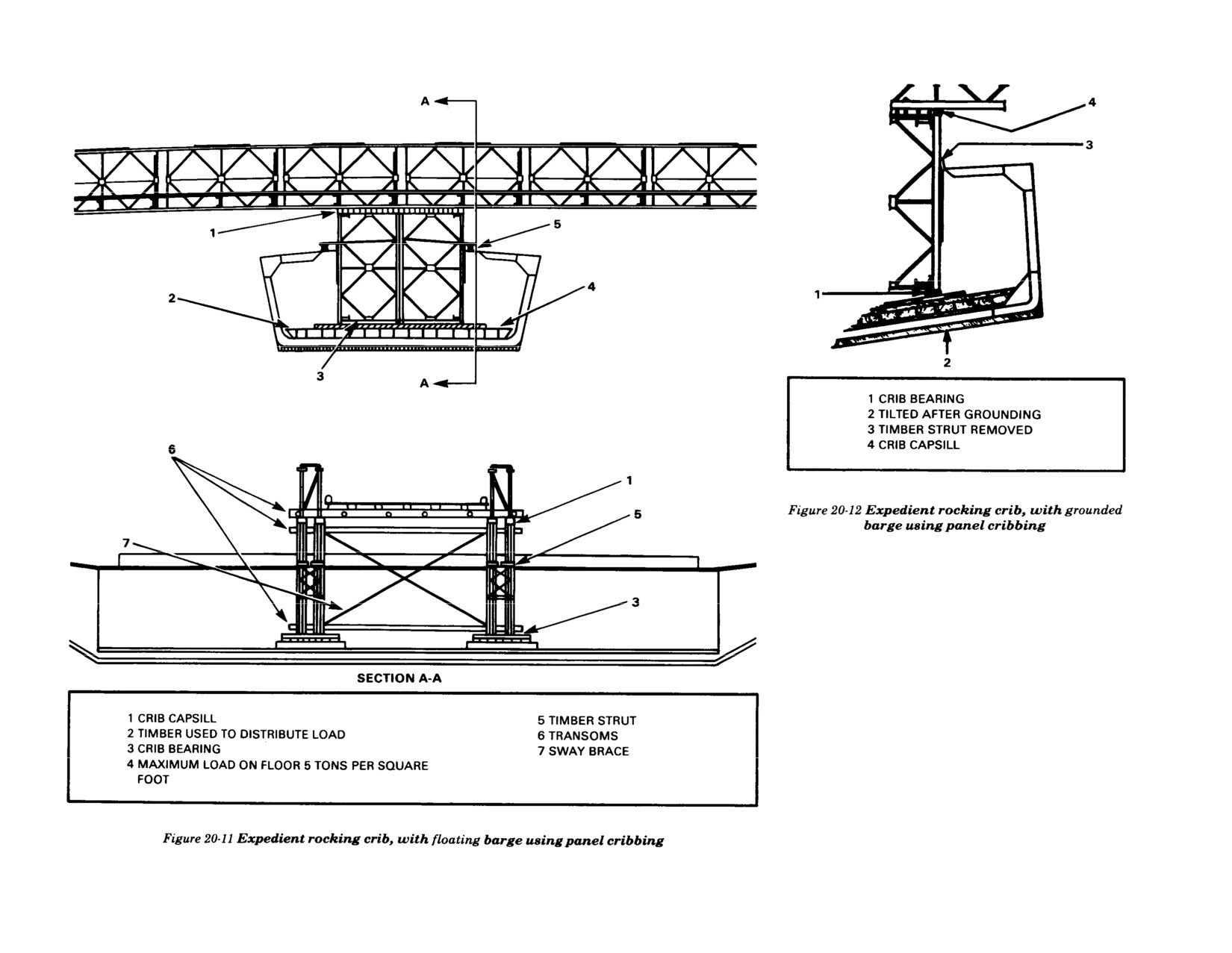
There are two types of cribs: fixed, and
rocking. Fixed cribs are used in both flat-
bottomed and keeled barges that do not
ground during low water. Use them also in
keeled barges that ground during low water
to prevent the barge from tipping. Connect
fixed cribs rigidly to both the superstructure
and the barge floor and guy both laterally
and longitudinally to the gunwale. Details of
assembly and methods of attaching the cribs
to the superstructure and the barge floor are
similar to those given in Chapter 17. Rocking
cribs are used in flat-bottomed barges when
uneven grounding occurs. Details of assembly
and methods of making the rocking connec-
tions are given in Chapter 17. Clearance
between the crib and the gunwale must be
enough to permit the full articulation re-
quired. Determine the required clearance from
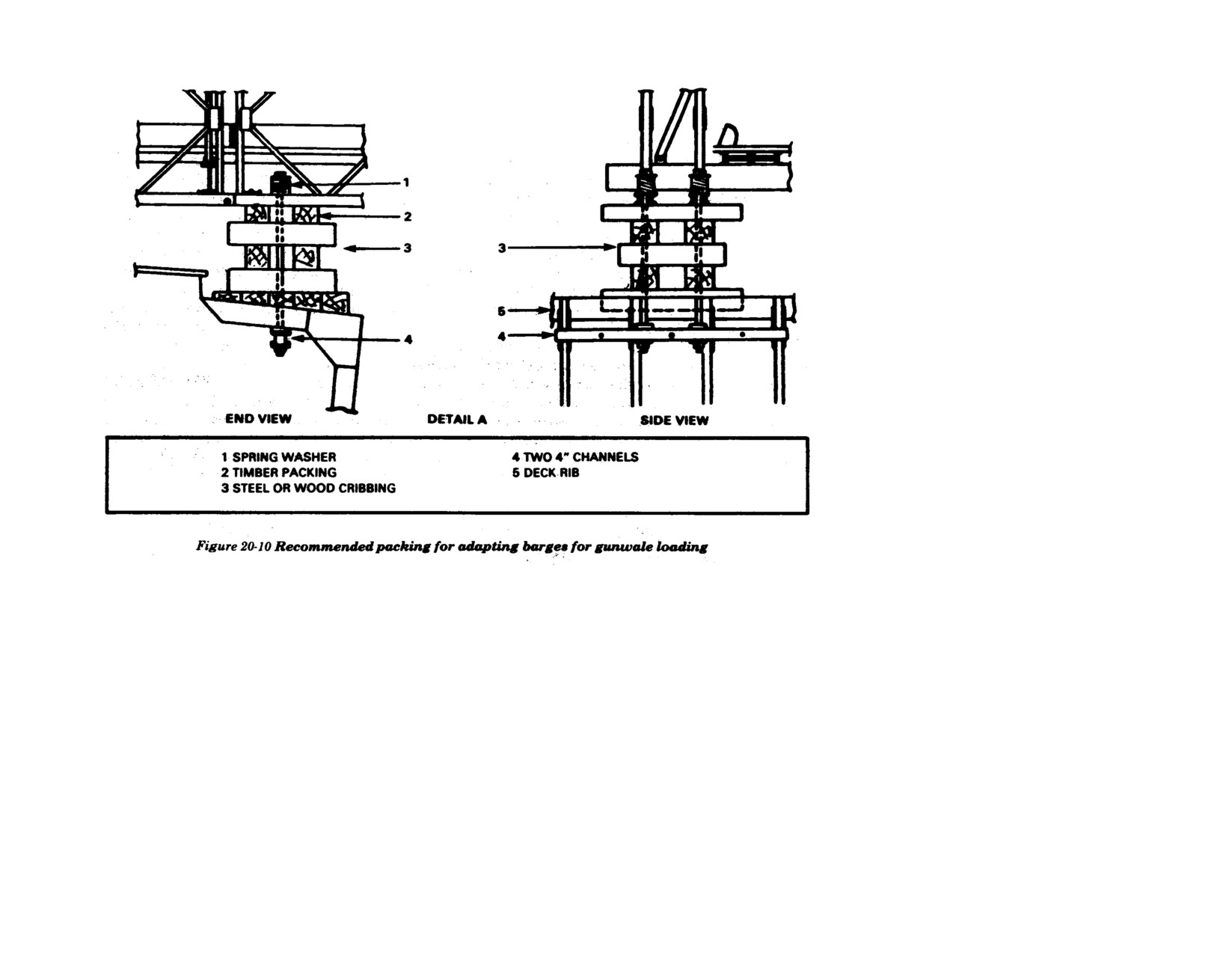
packing the gunwales. The load on the gun-
Barge floors are designed to carry distributed
the slope of the stream bottom where the
wale can also be reduced by using a rein-
loads, and grillage must be used under the
grounding occurs. Guy rocking cribs fore and
forcing bent built up from the floor in the
cribs to ensure adequate distribution of the
aft on the centerline of the barge as an added
center of the barge. Barges with curved ribs
load. Crib loading requires more time for
safeguard against movement. An expedient
must be braced by rods between the gunwales
construction than gunwale loading but crib
rocking crib is shown in Figures 20-11 and
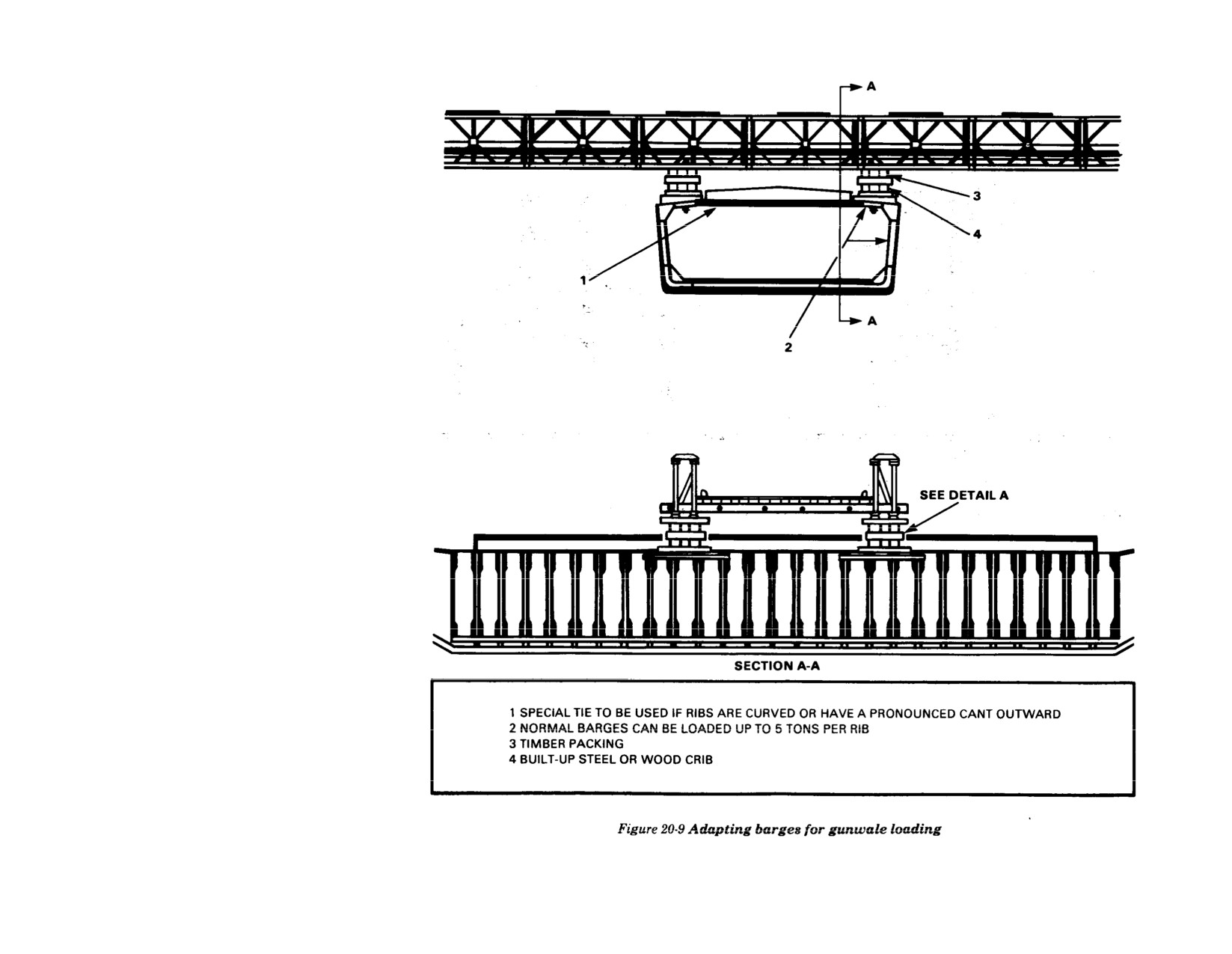
or by struts from the reinforcing bent (Figures
loading distributes the load to the floor of the
20-12 (page 268). The crib is made to rock by
20-9 and 20-10). If ribs are not curved and the
barge, which is able to carry more load than
removing one of the panel pins in the crib
length of rib from deck to keel does not exceed
the gunwales. Take special care to observe
bearing before the barge has grounded.
10 feet, reinforcing of ribs is unnecessary.
the behavior of cribs when the bridge is first
loaded and during tidal changes. Mark the
Grillage loading
Crib loading
position of bearings so that movements can
Use grillage loading when the barge is
Cribs made of panel-crib parts (Chapter 17)
be determined. If careful observations are
unsuitable for gunwale loading and the panel
can be used to support the superstructure on
made, adjustments can be made in time to
crib pier parts are unavailable. Build up
the barge if the barge is unsuitable for gun-
prevent serious movements and avoid the
grillages from the floor of the barge with steel
wale loading or uneven grounding occurs
difficulty of repositioning barges and cor-
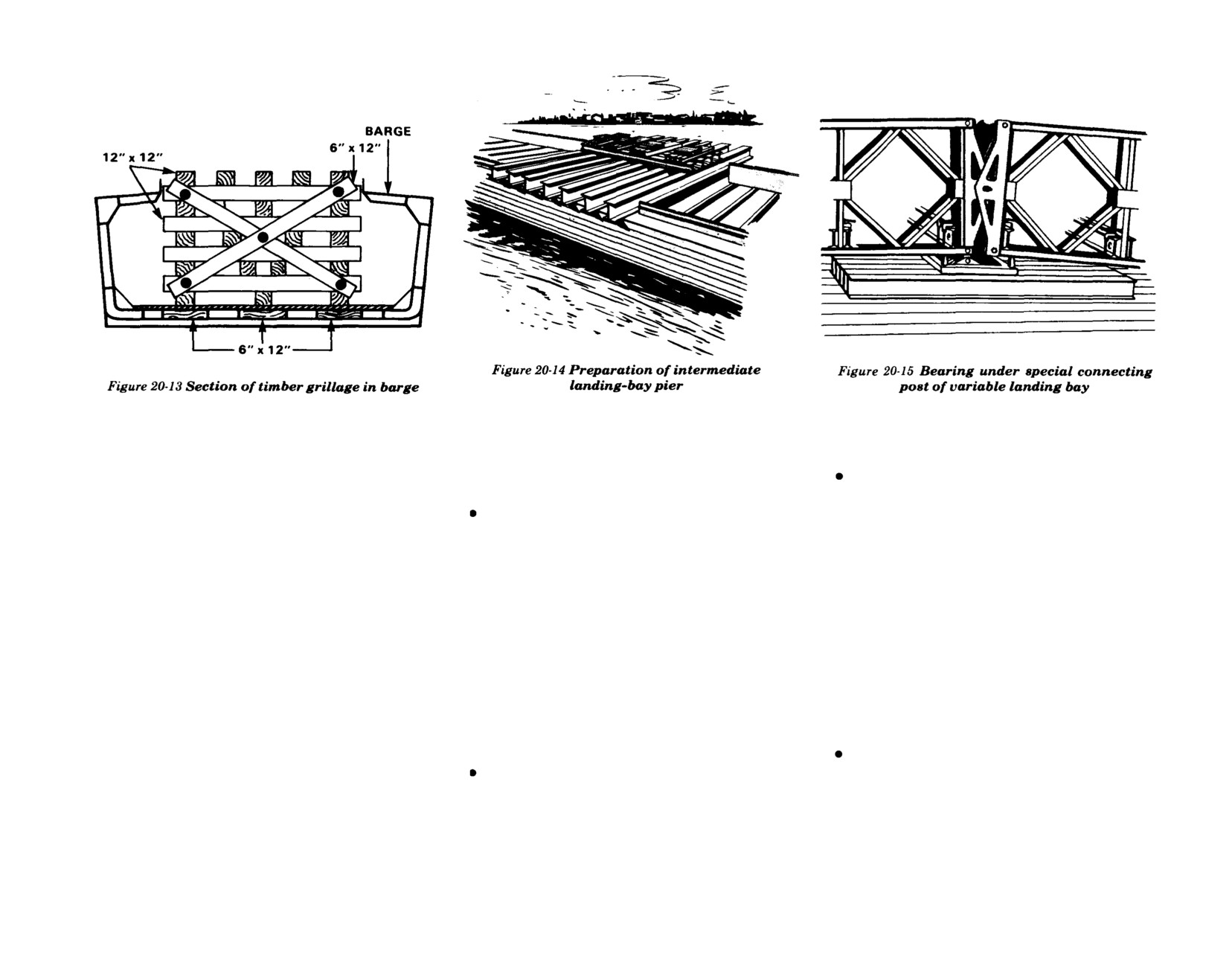
or timber beams (Figure 20-13). When using
267
FM 5-277
grillage loading, take care in bracing and
typing of grillage and in ensuring adequate
distribution of the load on the floor of the
barge.
PREPARATION OF PIERS
Both types of landing-bay pier are prepared
in a similar manner (Figures 20-14 and 20-
15). Since the intermediate landing-bay pier
acts as a compensator in ramping, it always
has a higher elevation than the landing-bay
pier. Build up piers to the required elevation
using I-beams, bolted down or welded to
prevent sliding. When special connecting
posts are not used to connect landing bays,
268
FM 5-277
weld base plates to the piers, and standard
Where double landing bays are required,
instead of on the bank. Then launch the
bearings to the plates, to support end posts.
launch them as a continuous span, sepa-
variable-slope bay.
rately, or by use of construction barges, as
Floating-bay piers are prepared similar to the
follows:
The fixed-slope bay can be assembled off
landing-bay piers. Pair barges so those used
site and launched to position on the
in any pier have about the same freeboard.
Assemble the two bays as a continuous
intermediate floating-bay pier and a
When the barges in the floating-bay piers
span on the centerline of the bridge
construction barge. Float the bay thus
have different freeboards, crib up the super-
abutment. Launch this span over rollers
formed into position and connect to the
structure seats to the elevation of the super-
placed on intermediate landing-bay pier
end floating bay. Remove the construction
structure seat on the barge with the greatest
onto cribbing on the landing-bay pier.
barge. Then launch the variable-slope
freeboard.
Break the top chord over the intermediate
bay.
pier by removing pins, and then jack the
LANDING-BAY ASSEMBLY
river end into final position. Remove
FLOATING-BAY ASSEMBLY
AND LAUNCHING
bottom pins and pull back the variable-
AND LAUNCHING
Use normal assembly methods given in
slope bay to permit installation of end
Use methods given in Chapter 6 for assem-
Chapter 6 for assembling landing bays. Long
fittings on the intermediate pier for both
bling floating bays. Several methods of
spans are normally launched undecked.
bays. Place abutment fittings in usual
launching floating bays are as follows:
manner.
Where the piers can be moved close to the
Where barges can be placed close to the
bank, launch landing bays over rollers on the
When launching separately, launch the
bank, launch the span over rollers on the
bank to the pier. Use the skeleton tail method
fixed-slope bay as described earlier, but
bank to the off-bank barge. Then push out
(Chapter 18) where bank conditions prevent
place rollers on the intermediate pier
barge, permitting in-bank barge to be
moving barges in close.
269
FM 5-277
positioned, and jack down the span into
welded to the bottom. The posts are seated
loaded for adjusting freeboard of the bay.
place on the in-bank barge. A construction
on bearings welded to base plates which
A vehicle on the bay to be connected can
barge can be placed adjacent to shore to
are welded to the intermediate landing-
be moved to aid in aligning connecting
use jacks on. This should have a lower
bay pier grillage.
pinholes.
freeboard than other barges.
Fix the shore end of the variable-slope
Considerable tug power is required to
Where bank conditions permit, moor both
landing bay with standard end posts
move and handle bays into connecting
barges side by side and launch the span
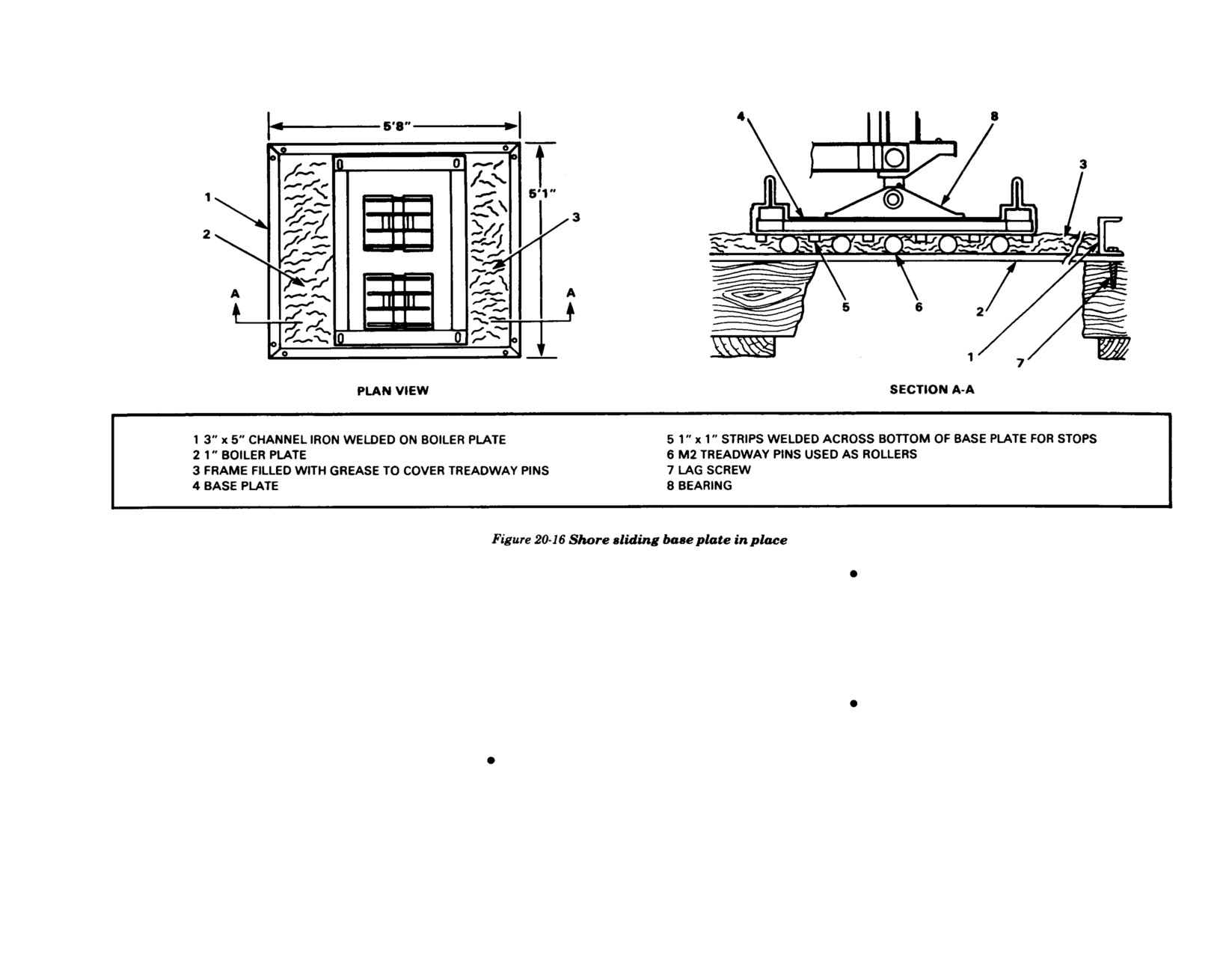
mounted on bearings welded to base
position. Use both towing and pusher
over rollers on the in-bank barge to a
plates. The base plates rest on rollers set
tugs to provide adequate control of the
position on the off-bank barge. Then jack
in an expedient box plate (Figure 20-16).
bays and prevent damage. Floating bays
down the span into position on the in-
This provides for lengthening and con-
over 100 feet (30.5 meters) long are hard to
bank barge.
traction of the bridge during changes in
tow and control.
water level. The river and shore ends of
When barges have wide beams, assemble
the fixed-slope landing bay are suspended
In connecting bays fitted with special
sections of the bridge on each barge and
by treadway pins in the special connecting
connecting posts, it may be necessary to
then join to form bays; for long bays,
post.
jack truss into place to get enough pin-
partly flood surplus barges and float from
hole alignment for treadway pin.
under the superstructure.
Where special connecting posts are not
available for connecting landing bays,
Carefully estimate maximum articulation
Cranes can place bridge equipment on
the bays can be seated on standard end
and movement of junctions between bays
barges, where it can be assembled on
posts on bearings. Rest the end posts on
during grounding. Too much articulation
rollers. Spread barges to obtain proper
adjacent ends of variable-slope and fixed-
will cause undesirable changes of slope in
bay length as superstructure is assembled.
slope landing bays on bearings welded to
the decking and may cause tilting or
base plates mounted on the intermediate
lifting of stringers or chess. If such a
CONNECTING BRIDGE SECTIONS
landing-bay pier grillage. Seat the river
condition develops at grounding, mini-
Bridge sections are linked by landing and
end of the fixed-slope landing bay on
mize junction articulation by use of a
floating bays. Landing bays have either
standard end-post bearings resting on
connecting span between bays.
special connecting posts or standard end
base plates welded to the end floating-bay
posts, as follows:
pier. Mount the shore end of the variable-
CONNECTING SPANS
slope landing bay as described for special
Connecting spans are normally 20 to 30 feet
Special connecting posts are desirable for
connection posts.
(6.1 to 9.1 meters) long. Assemble each con-
connecting all bays. The articulation
necting span directly on a single construction
provided is normally ample under all
Details of floating bay connection are as
barge at a correct elevation for connection in
conditions. When both a fixed-slope
follows:
the bridge. Install proper male and female
landing bay and variable-slope landing
connecting posts at span ends to connect and
bay are required, the special connecting
Connection of floating bays is made easier
suspend the span to girders of the adjacent
post on the river end of the variable-
by carefully constructing each bay to the
bays in the bridge.
slope landing bays have bearing blocks
same elevation. A ballast of water can be
270
FM 5-277
LIFT SPANS
porting the lift span must be designed to
One-half the draw span can be added to
The lift span (Figures 20-3 and 20-17, pages
ensure a level bridge.
each adjacent floating bay after tower
258 and 272) is normally assembled on a
erection at the bay-assembly site. The two
construction barge at a correct elevation for
DRAW SPANS
floating bays can then be connected into
connection in the bridge. Determine length
The length of the span is determined by the
the bridge, and the draw-span halves can
and lift of span by the beam and clearance of
beam of the vessels to be passed. Build towers
then be connected.
vessels to be passed through the bridge. To
on adjacent floating bays similar to lift span
lift the span, build panel towers on the ends of
towers. Methods of building draw spans are
Draw spans can be built by assembly of
adjacent floating bays. Install suitable con-
as follows:
single girders on the deck of adjacent
nectors, guides, and lifting and counter-
spans. These girders can be launched by
balancing devices on the towers for control
Draw spans can be assembled on a
using tackle from towers to support free
and lifting of the lift span; install girders of
construction barge to the correct eleva-
ends. Pin girders to bays and then deck
adjacent floating bays for connection when
tion, and then moved and connected into
them.
span is lowered and in position to receive
the bridge.
vehicular bridge traffic. Floating bays sup-
271
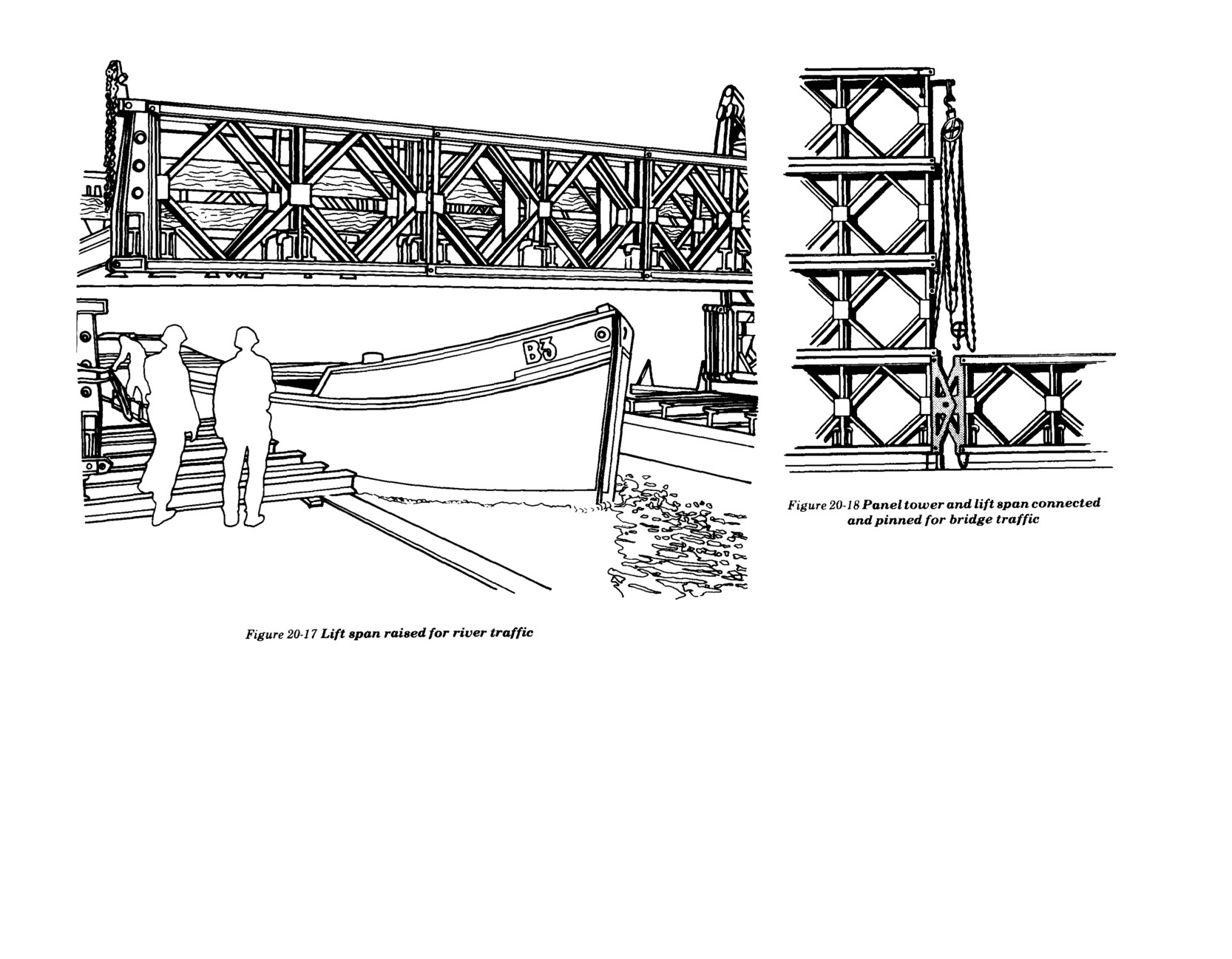
FM 5-277
span to ensure proper pinhole alignment for
reinsertion of connecting pins upon lowering
(Figure 20-18).
Use the following procedure to connect a
CONNECTING SPECIAL SPANS
Connect a lift span to supporting adjacent draw span:
When used to connect grounded bridge bays bays by special connecting posts or span
1
Connect draw span to its adjacent floating
with special connecting posts, no special junction posts when positioned and pinned
girders with a suspension link or hinge
devices or maintenance is required after a for vehicular bridge traffic. Provide a vertical
mechanism. The link consists of span
connecting span is connected and suspended guide system on the tower to control longi-
junction posts.
from girders of adjacent bay ends.
tudinal movement of span during lifting of
272
FM 5-277
ANCHORS AND ANCHOR LINES
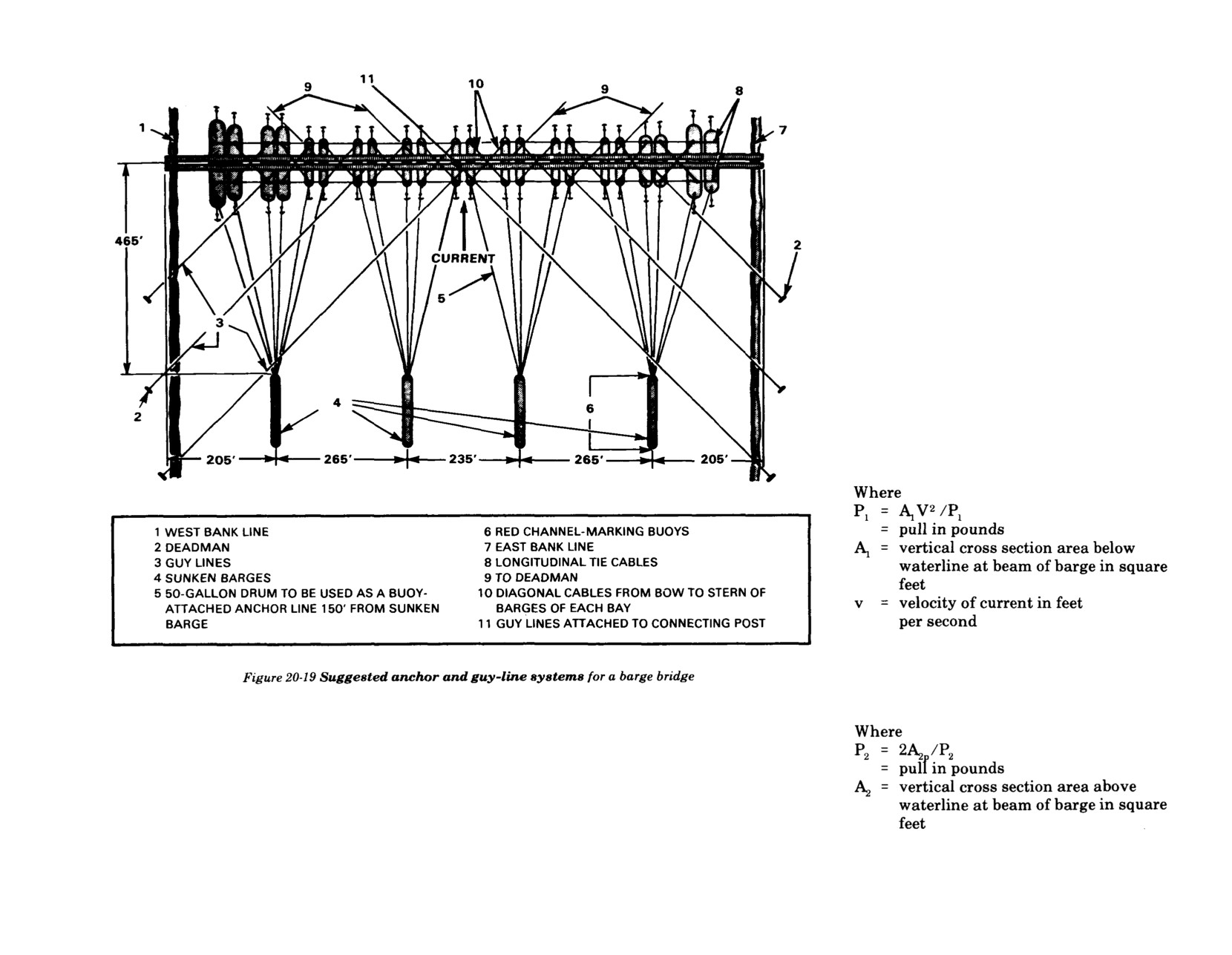
The bridge is secured by anchors and guy
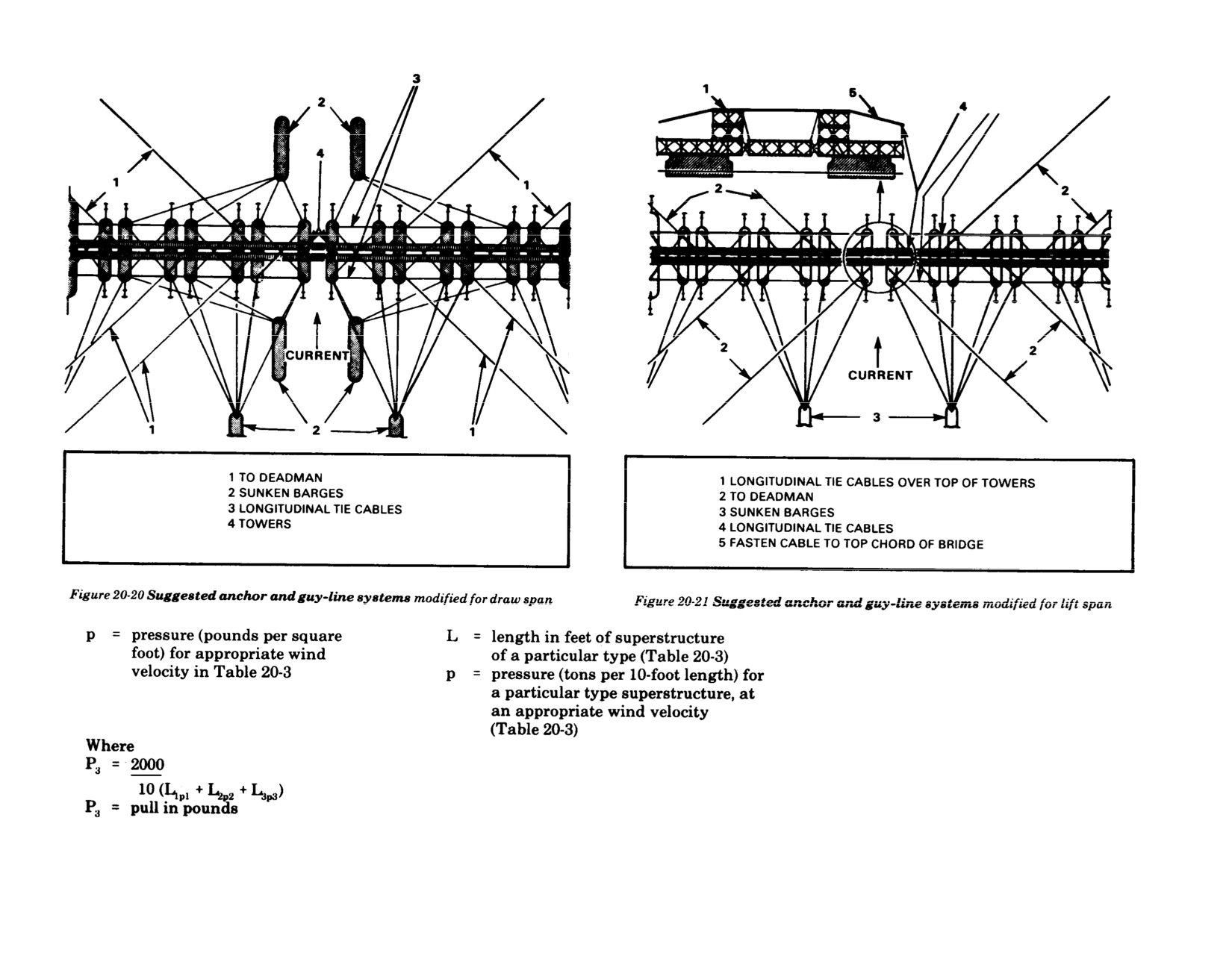
lines (Figures 20-19 through 20-21, page 274)
against the effects of wind and current.
To determine needed types of anchors, exa-
mine the stream bottom and compute the
expected pull on anchor lines due to these
conditions. Barges loaded with stone or metal
can be sunk upstream of bridge to serve as
anchors.
Anchor line pull equals the sum of pull due to
effect of current on submerged portion of
barge and effect of wind on exposed portion
of barge and superstructure. The following
formulas may be used to determine this pull:
Pull due to current:
Pull due to wind:
On barge:
2
Arrange the decking to allow for move-
The pins are readily removed when the
ment across junctions. Cut stringers as
weight of the draw span is taken on the
shown in Figure 20-8, with one end lashed
tower tackles. In lifting draw span halves,
down to the end transom of draw span.
raise one side until jaws are clear. Then
lever panels sideways, if required, to allow
3
Install a pair of span junction posts at the
simultaneous raising of the span halves
center of the draw span to ease procedure.
without fouling.
273
FM 5-277
Winches should be placed on barges to adjust
tension in anchor lines.
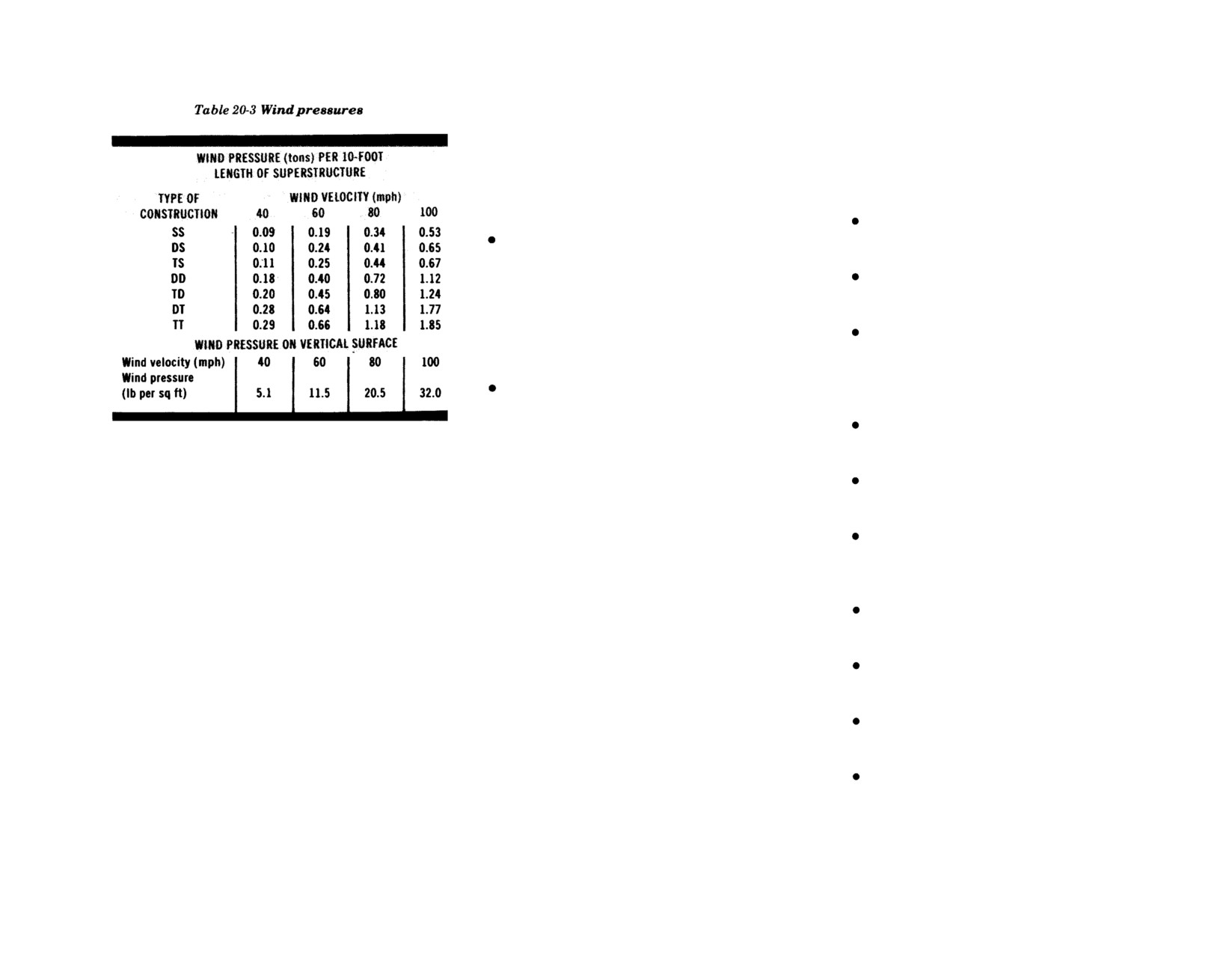
On superstructure:
The pull due to current and wind is computed
based on maximum expected conditions.
Anchor lines should pull parallel to current.
274
FM 5-277
ANCHORAGE OF
GROUNDING BARGES
Grounding barges may slide downhill, which
A duty officer should be at the bridge 24 hours
can cause the landing bay to slide and dis-
a day. The officer must ensure that the
lodge the base plate and its bearings. Such
following regulations are in force at all times:
slides can be avoided as follows:
Communication is maintained between
A barge which tends to slide down the
the ends of the bridge.
bank when grounded must be suitably
anchored to shore. Cables fastened to the
A wrecker is on call to remove disabled
bank can be passed under the barge to a
vehicles from the bridge.
connection on the off-bank gunwale of the
barge. Use packings to prevent damage to
Guides having thorough knowledge of
the barge chines by the cables.
standard hand signals are available to
guide minimum-clearance vehicles across
When a barge slides on grounding, the
the bridge.
resulting shift in the superstructure may
cause the landing bay to slide beyond the
Alignment of the bridge is constantly
limits allowed for bearings in the base
maintained.
GUY LINES
plates. Rig tackle to prevent further
Use guy lines to anchor landing-bay piers to
movement until the bearings and base
Tension in all anchor cables is kept uni-
the riverbank. Place these lines at about a
plates are reinstalled and secured in
form.
45-degree angle to the bridge centerline.
proper position.
Longitudinal tie cables from stern to stern
Buffers are maintained between all
and bow to bow of each barge help to keep
MAINTENANCE DETAIL
anchor and guy cables that rub against
bridge aligned and to prevent longitudinal
Bridges on barges require round-the-clock
metal.
movement of parts of the bridge.
maintenance arrangements. A detail of about
one engineer combat company is needed to
All cable connections are inspected every
Special spans need modification of the anchor
maintain an 800-foot (243.8 meters) panel
12 hours.
and guy system, as shown in Figures 20-20
bridge on a 24-hour-a-day basis. Normally,
and 20-21. In the lift span and draw span, the
two squads each shift are enough to tighten
All pins, bolts, and clamps are inspected
longitudinal tie cables must be broken to
bolts, check anchor cables, repair decking,
every 24 hours.
allow passage of river traffic. In lift spans,
and maintain adequate bridge signs. This
extra cables can be strung over the top of the
leaves three squads to maintain approach
All barges are inspected and bailed at
towers to tie the bridge together over the gap.
roads, perform any major repairs, and man
least once every 24 hours.
In draw spans, extra anchor barges may be
fireboat and standby tugs.
sunk at each side of the gap to prevent the
All base plates are inspected once every
bridge from shifting when the span is open.
24 hours.
275