FM 5-277 BAILEY BRIDGE (May 1986) - page 7
FM 5-277
bottoms. Insert a
1/2-inch (1.3 centimeters)
assemblies and component parts on each side
diameter setscrew.
of the bridge as close to the area of installation
as possible. Next, remove the cable reels from
5
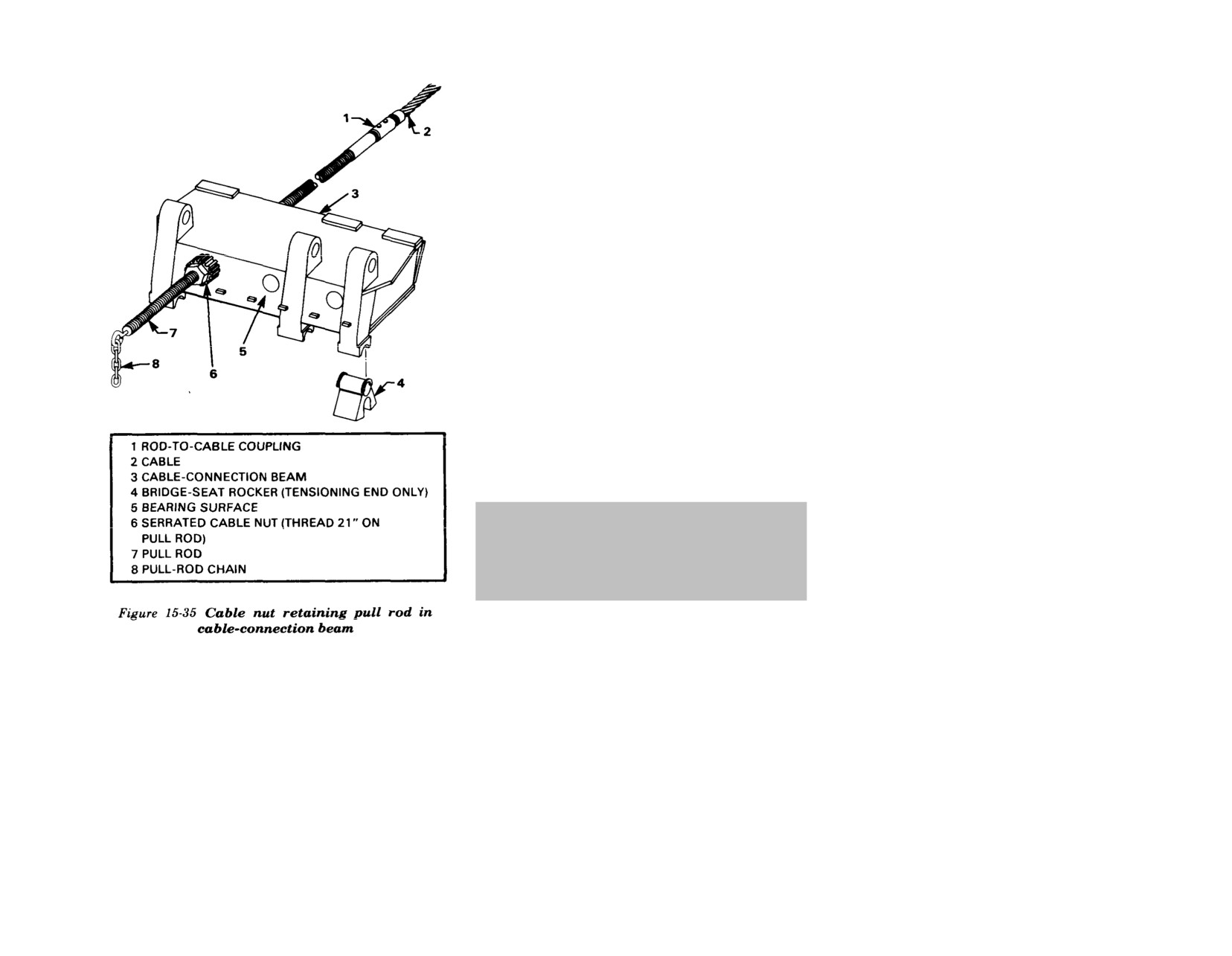
Feed pull rod through proper hole in
the trucks on the near shore and install on
cable-connection beam and retain with
cable reel supports on each side of the
cable nut (Figure 15-35). Then advance
roadway, close to the bridge.
cable nut so that pull rod extends beyond
cable-connection beam at least 21 inches
Cable-supporting structures
(53.4 centimeters). This may be done by
Install the post-connection fixture, post cable
threading the eyebolt on the 12-foot (3.7
assembly, brace-connection fixtures, and lon-
meters) pull-rod chain into pull rod and
gitudinal and transverse braces like the
pulling, advancing the cable nut as pull
installation for a new bridge and as follows:
rod advances; by advancing pull rod using
hemp rope tied to cable at or near rod-to-
1
Using rope, lower post-connection fixtures
cable coupling; or by advancing cable nut
over side. Pull up into position using
using chord-bolt wrench.
ropes placed through the two openings
between the three panels. Note that
6
Position cable below vertical posts and
bearing plate on top of post-connection
remove all rope lashings from cable.
fixture must be placed under center panel.
Caution:
The cable must be guided
2
Remove cable retainer from vertical post
into the correct slot of the vertical-
by removing four
1/2-inch (1.3 centimeters)
post saddle by bridge personnel while
diameter bolts and hex nuts. Install ver-
the cables are being tensioned.
tical post using a rope over outside of
bridge. Attach two ropes to the top of
7
Repeat the six steps above to install all
vertical post and pull it into position with
cables on bridge. After cables are installed
ropes through the two openings between
on both sides of bridge, secure each cable
the three panels. Note that fixtures on
Continue turning pull rod until it bottoms
retainer to vertical-post saddle with four
vertical post for transverse braces must
in rod-to-cable coupling. Turn pull rod
1/2-inch (1.3 centimeters) diameter bolts
be on inside.
back one-half turn or more to align hole
and hex nuts.
through pull rod and rod-to-cable
3
Attach brace-connection fixtures in a
coupling. Insert a
1/2-inch (1.3 centimeters)
USE WITH EXISTING BRIDGE
similar manner. Note that bolts on the
diameter bolt (inset, Figure 15-14) through
The procedures for installing the cable rein-
brace-connection fixture not using the
the rod-to-cable coupling and pull rod.
forcement set on an existing panel bridge,
slotted holes in the bridge panel should
Install hex nut on end of bolt. Thread
M2, are similar to those for a new bridge.
not be tightened yet, to allow for lateral
coupling onto stud end of cable until it
Place the contents of the trucks carrying all
movement when fitting longitudinal
brace.
183
FM 5-277
4
Attach longitudinal and transverse
support, can be measured. The purpose of
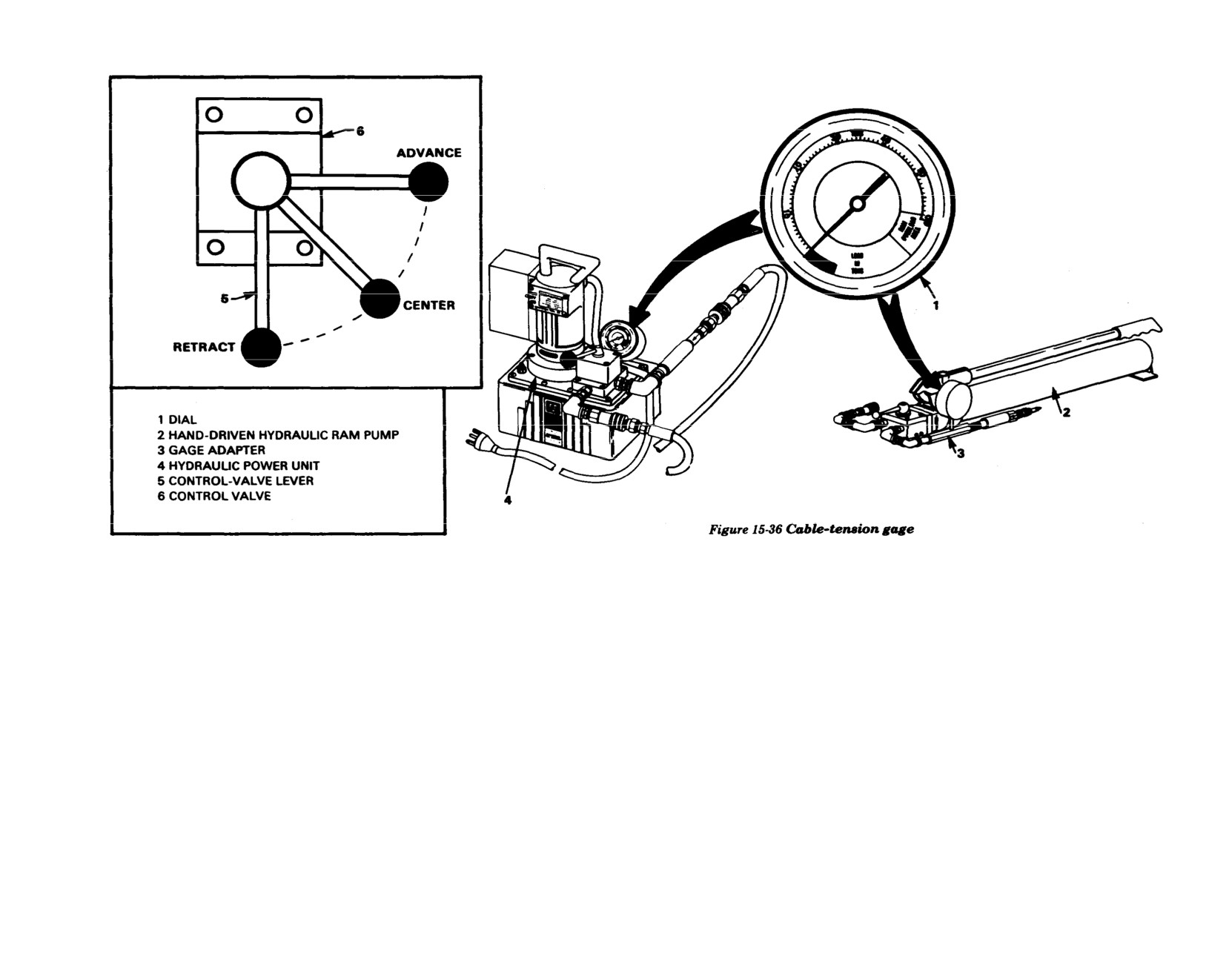
The cable-tension gage (Figure 15-36) is
braces, using a boatswain's chair.
measuring deflections is to provide a check
located on the hydraulic power unit of the
during cable tensioning. Tension all cables
cable-tensioning assembly and the hand-
WARNING: All personnel who are lowered
simultaneously.
driven hydraulic ram pump. The gage is 31/2
over the side of the bridge in a boatswain's
inches (8.9 centimeters) in diameter and has
chair must also wear a safety belt connected
Note:
One 10-kilowatt or two 5-kilowatt,
l-ton (.9 metric ton) graduations on the dial
to lashings, which, in turn, are secured to
60-cycle alternating current (ac) generators
throughout a 60-ton (54.6 metric tons) scale.
are required for operation of the hydraulic
Cable tensions for the various bridge spans
the side of the bridge.
power unit.
are given in Table 15-1.
Span junction posts
To tension each cable, install an adapter and
Note:
Loads should be read while ten-
To install span junction posts and cable-
a double-acting hydraulic cylinder on each
sioning cables. Readings during deten-
connection beams, jack up end of bridge
pull-rod assembly; connect the hydraulic hose
sioning are inaccurate due to gage lag.
enough to place cribbing under lower panel
to the cylinders and the hydraulic power unit;
chords near end posts to temporarily support
and install and tighten cylinder nut on each
The retract position is used to return cylinders
bridge. Remove jacks from end of bridge.
pull rod to retain adapter and cylinder of
to normal operating position, after cable nuts
cable-tensioning assembly (Figure 15-20).
have been tightened during tensioning
Note:
Ignore any reference to rocking
procedures.
rollers, since these items have been pre-
The hydraulic power unit is operated as
viously removed from under bridge.
follows:
Operate the hydraulic power unit of the cable-
tensioning assembly to cause one complete
Remove standard end posts from bridge and
1
Loosen filler plug to vent reservoir.
stroke of the cylinder at a time to tension the
install span junction posts. Install cable-
cables. Cable tensioning is accomplished in
connection beams.
2
Place control-valve lever in advance posi-
increments of cylinder strokes, as follows:
tion (inset, Figure 15-36).
Cable assemblies
1
As cylinder advances, tighten cable nut
To install cable assemblies, do the prelimi-
3
Turn switch to RUN position.
by hand against bearing surface of the
nary procedure to prepare cables for instal-
cable-connection beam. At the end of each
lation on the bridge. Carry the cable across
4
Turn switch to OFF position when any
cylinder stroke, release pressure, retract
the bridge and install button end of cable
cylinder has reached full stroke. The JOG
cylinder, and hand tighten cylinder nut
through cable-connection beam on far shore.
position on switch may be used to run
back to retracted cylinder.
Then complete installation of cables as
power unit in short bursts.
described earlier.
Note:
If cable nut cannot be hand tightened
5
Pressure may be slowly released by
because thread on pull rod is damaged or
CABLE TENSIONING
moving control-valve lever toward center
burred, use a Bailey structural wrench, as
Before tensioning the cables, set up a level
position.
shown in Figure 15-37 (page 186) to pry
reference so the deflection of a point on the
bridge at midspan, relative to a point at the
184
FM 5-277
cable nut free of damaged area. Hand
listed in Table 15-1. Repressurize to appro-
4
Measure deflection of bridge at midspan,
tightening of cable nut can then be con-
priate value in Table 15-1. This must be
relative to end of bridge. Compare the
tinued. Cylinder nut can also be turned
done with the cylinders near midstroke.
measured value obtained to values shown
through damaged or burred threads, using
in Table 15-1. If the deflection measure-
a chord-bolt wrench.
Note:
This procedure eliminates friction
ment is less than the values listed in
between the cable and vertical post.
Table 15-1, refer to maintenance pro-
2
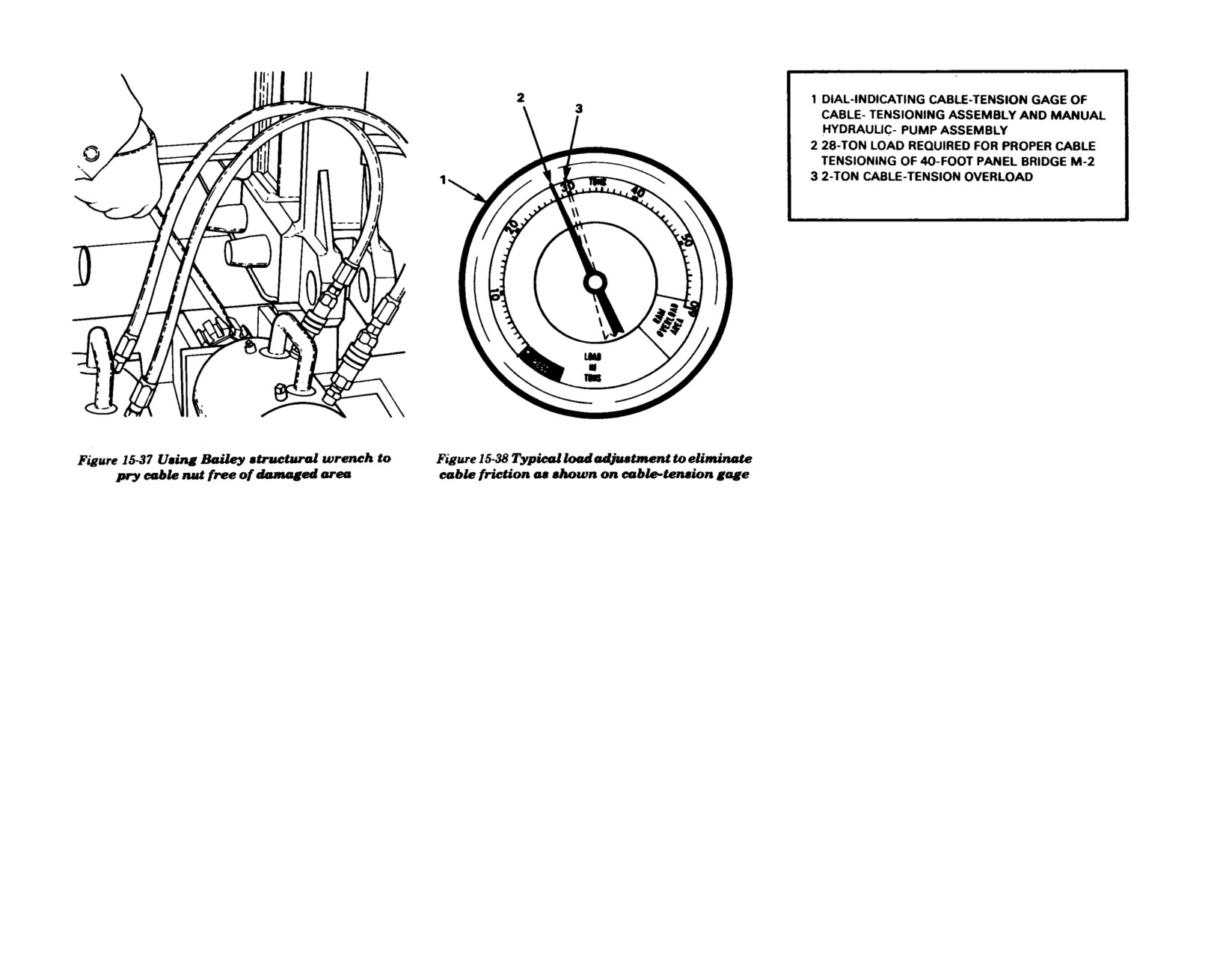
Repeat the last two steps until load, as
cedures later in this chapter for trouble-
indicated on gage of cable-tensioning
3
Tighten cable nut against bearing surface
shooting tips to correct conditions. As
assembly (Figure 15-38, page 186), is equal
of cable-connection beam. Release all pres-
part of regular maintenance, check cable
to 2 tons (1.82 metric tons) more than
sure in cable-tensioning assembly by
tension using manual hydraulic-pump
value listed in Table 15-1. Then slowly
opening valve on power unit. Then hand
assembly by pressurizing cylinders just
release pressure in hydraulic cylinder by
tighten cylinder nut against cylinder.
enough to free cable nuts, and comparing
slightly opening valve on hydraulic power
gage reading with cable-tension value in
unit until gage indicates a tension value 4
Note:
Cylinders must be fully retracted
Table 15-1.
tons (3.64 metric tons) less than that
before disconnecting hydraulic power unit.
185
FM 5-277
Cable removal
To retrieve the cable, the following procedure
for cable removal must be used for all cables
installed on the M2 panel bridge
1
Reinstall lashing ropes 20 feet (6.2 meters)
apart, along entire length of the cables.
Make certain that cables are fully sup-
ported by lashings before continuing with
removal operations.
2
Remove cable retainer from each vertical-
post saddle by removing bolts and hex
nuts.
DISMANTLING OF SET
opening valve on the power unit, per-
The sequence for dismantling the cable
mitting cylinder to slowly collapse.
3
On near-shore tensioning end of the
reinforcement set must be closely followed in
bridge, continue retrieval as follows:
order to prevent damage to equipment or
3
Tighten cable nut against bearing surface
unscrew cable nut from pull rod; pull pull
possible injury to personnel.
when cylinder is almost completely col-
rod out of cable-connection rod; remove
lapsed. Cylinder should not be completely
bolt and hex nut which retain pull rod on
Cable tension
collapsed because tension in cable pre-
rod-to-cable coupling, unthread pull rod
To relieve cable tension, unload tension on all
vents hand loosening of cylinder nut.
from rod-to-cable coupling; and reinstall
cables simultaneously, as follows:
cable and cylinder nuts on threads of pull
4
Repeat the three steps above until tension
rod.
1
Move cylinder nuts away from cylinders
in cables is relieved and cables are free of
to
1/4
inch (.6 centimeter) lees than full
vertical-post saddles.
4
On the far shore, pull cable from dead-end
cylinder stroke. By pumping, increase
cable-connection beam far enough to
load on each cable until cable nut turns
5
With cable nut against bearing surface of
remove half-cable retainers. Then pull
freely.
cable-connection beam, remove cylinder
cable back through dead-end cable-
nut, cylinder, and adapter from pull rod.
connection beam.
2
Keep cable nut free of cable-connection
beam bearing surface while carefully
186
FM 5-277
5
Lift cable up and over panels of bridge.
2
Place safety cribbing under lower panel
7
Remove jacks, jack shoes, jacking lugs,
Carry cable to cable reel. Wind cable on
chords.
span junction posts, and cable-connection
cable reel, removing lashing ropes as
beams.
cable wraps on reel.
3
Install jacking lugs and railroad jacks,
and jack up end of bridge enough to
Posts and bracing
unload panel pins connecting span junc-
To remove braces, post assemblies, and
Caution:
During winding of cable on
tion posts to connection beams.
connection fixtures do the reverse of instal-
cable reel, be careful to prevent cable
buttons from snagging on structure,
lation procedures outlined earlier in this
and cable from wearing against any-
4
Continue jacking up end of bridge until
chapter. After removing post assemblies from
thing which could fray or break the
cable-connection beam is clear of span
bridge, reinstall cable retainer on vertical-
wire.
junction posts.
post saddle with four
1/2-inch (1.3 centimeters)
diameter bolts and hex nuts. To complete
Cable-connection beams and
5
Install rocking rollers as when dis-
dismantling, continue removal of the bridge
span junction posts
mantling normal Bailey bridge (Chapter
as outlined in Chapter 21.
To remove cable-connection beams and span
21).
junction posts correctly, do as follows:
6
Jack bridge down onto rocking rollers.
1
Remove retainer clips from ends of panel
pins (Figure 15-33).
OPERATION UNDER UNUSUAL CONDITIONS
TEMPERATURE EXTREMES
SPECIAL ENVIRONMENTS
Paint surfaces of parts which are subject
The cable-reinforcement set can be installed When operating in dusty, sandy, tropical, or
to rust and corrosion, in accordance with
and used in all extremes of temperature salty areas, do as follows:
TM 43-0139, if surfaces indicate absence
without a change of existing components.
of paint or excessive weathering. Do not
Cable tensions in Table 15-1 are higher than
Lubricate cable, bridge set rockers,
paint cable.
required under normal conditions, to com-
threaded surfaces, and slots in vertical-
pensate for extremes of temperature.
post saddles.
OPERATOR’S AND ORGANIZATIONAL MAINTENANCE
BASIC TOOLS
performed by the using organization. Basic
Appendix B. There are no special tools
Tools and equipment normally issued to the issue tools and supplies issued with or au-
required to perform operator’s and organi-
panel bridge company and those issued with thorized for the cable reinforcement set are
zational maintenance on the cable reinforce
the cable reinforcement set are adequate for listed in Table B-1, and shown in Figure B-1,
ment set.
maintaining this set. All maintenance will be
187
FM 5-277
WARNING: Do not permit open flames in
LUBRICATION
immediate area because hydraulic fluid is
Lubrication of parts and equipment is an
Preventive maintenance checks and services
flammable.
essential part of maintenance. Lubrication
are listed and described in Table B-3, Appen-
procedures are as follows:
dix B. The item list indicates the sequence of
Service the pumping reservoirs as shown
minimum inspection requirements.
in Figures B-2 and B-3, Appendix B.
Keep all lubricants in closed containers
and store in a clean dry place away from
MAINTENANCE PROCEDURES
When inspection reveals the need, replace
external heat. Allow no dust, dirt, water,
Perform maintenance procedures as follows:
the following parts of the cable-tensioning
or other foreign material of any kind to
assembly and manual hydraulic-pump
mix with lubricants. Keep all lubrication
Service the cable-tensioning and manual
assembly, as illustrated and described in
equipment clean and ready to use.
hydraulic-pump assemblies by checking
Figures B-4 and B-5, Appendix B, respec-
the level of the hydraulic oil in the
tively: cable-tension gage; hose assem-
Service lubrication points at proper
reservoir of the pumping unit and filling
blies and quick-disconnect couplings;
intervals.
or draining this component. This includes
gage adapter (hand pump only); and cyl-
replacing the gage, quick-disconnect
inders (cable-tensioning assembly only).
Keep all external parts not requiring lubri-
couplings, or hose assemblies when inspec-
cation clean of lubricants.
tion reveals a need for this.
TROUBLESHOOTING
Malfunctions which may occur in the cable
Before lubricating equipment, wipe all
Note:
Always use the following standard
reinforcement set and its components are
lubrication points free of dirt and grease.
procedures when disassembling a
listed in Table B-4, Appendix B. Each mal-
hydraulic component
function is followed by a list of probable
Clean all lubrication points after lubri-
causes of the trouble and the corrective action
cating to prevent accumulation of foreign
1
Make certain all pressure has been relieved
recommended to remedy it. Malfunction may
matter.
before opening any part of a hydraulic
occur while the cable reinforcement set is
component.
being used in the field where supplies and
PREVENTIVE MAINTENANCE
repair parts are not available and normal
To ensure that the cable reinforcement set is
2
Provide a container to catch any
corrective action cannot be done. When this
ready for operation at all times, inspect it
draining fluid.
occurs, follow the expedient remedies also
systematically to discover and correct defects
listed in Table B-4, Appendix B.
before they cause serious damage or failure.
3
Cover any exposed openings to prevent
Note defects found during operation of the
foreign matter from entering the hy-
REPAIR PARTS
unit and correct them immediately. Stop
draulic system.
Repair parts needed to maintain the cable
operation at once if a defect is noted which
reinforcement set are listed in Table B-5,
would damage the equipment were operation
4
Apply a small amount of pipe dope to
Appendix B. A number of these parts are
continued. Every organization equipped with
all threaded connections to assure a
illustrated in Figures B-6 through B-12,
the cable reinforcement set must train its
tight connection.
Appendix B.
personnel to effectively maintain it.
188
FM 5-277
SHIPMENT AND LIMITED STORAGE
PREPARING FOR SHIPMENT
Prepare the cable reinforcement set for do-
blank space on form. Put completed guide
Caution:
Attach a guide rope when
mestic shipment as follows
in waterproof envelope marked "Depre
lifting the equipment to avoid
servation Guide," and fasten it in a con-
swinging and damaging the cable rein-
1
Inspect entire unit for unusual conditions
spicuous place. Before using equipment,
forcemnent set.
such as damage, rusting, and theft. Do
and before inspection, do depreservation
preventive maintenance services outlined
of the item as outlined in the guide.
Securely block and lash the cable rein-
earlier in this chapter.
forcement set in M51 trucks. The cable-
5
Coat exposed machined surfaces with
tensioning assembly is contained in its own
2
Remove all contamination from unit by
preservative (P-6), conforming to speci-
box with protective wrapping. Also, the pull
an approved method. Approved methods
fication MIL-C-11796, class 3. If pre-
rods can be stored in cardboard tubes to
of cleaning and drying, types of pre-
servatives is not available, GGP-GREASE,
protect the threads from dirt or other foreign
servatives, and methods of application
General Purpose, may be used.
matter. This set may also be stored in a
are described in TM 38-230-1.
shelter or motor pool. If stored in the open,
LOADING EQUIPMENT
make sure components are placed on cribbing
3
Repaint all surfaces where paint has been
To load the equipment for shipping, use a
to reduce rust and corrosion.
removed or damaged. DO NOT paint the
lifting device of suitable capacity to lift heavy
cables.
components. The cable reinforcement set may
be transported in three M51 trucks. One truck
4
Complete properly annotated DA Form
transports cables, reels, and supports,
2258 (Depreservation Guide for Vehicles
another transports the span junction post,
and Equipment), concurrently with pre-
and the third truck transports the remaining
servation for each item of mechanical
parts of the cable reinforcement set (Figures
equipment, and outline unusual needs in
15-5, 15-6, and 15-7).
189
FM 5-277
CHAPTER 16
BRIDGES ON PIERS
BROKEN-SPAN BRIDGES 190
CONTINUOUS-SPAN BRIDGES 198
CANTILEVER-SPAN BRIDGES 206
Long simple spans become increasingly un-
feet (46.2 meters) or class 75 continuous spans
the time required to assemble one span and
economical because of excessive dead weight
longer than 120 feet (36.9 meters). Bridges
prepare it for launching should be as nearly
and reduced class. Generally, intermediate
supported by piers may be either broken (at
equal as possible to the time required to
piers should be used to avoid assembly of
each pier) into separate spans or continuous
assemble and place one pier.
class 50 continuous spans longer than 150
for their entire length. For efficient assembly,
BROKEN-SPAN BRIDGES
DESCRIPTION
17), the heavier assembly should be continued
bays tight. If a triple-truss panel crib pier
Broken-span bridges are multispan structures
for two bays into the lighter assembly to
supports a double-truss bridge, distribute the
with the top chord broken and the bottom
stabilize the junction link. For example, if a
load to all trusses in the pier by triple-truss
chord either broken or pinned at the piers.
double-single
bridge is joined to a
triple-
assembly, and use three transoms over the
The two adjacent spans act independently
single
or
double-double
bridge, the
triple-
pier and in three adjacent bays of each span.
under load. One advantage of broken-span
single
or
double-double
should be continued
Piers
over continuous-span assembly is that the
for two bays past the junction into the lighter
reaction on intermediate piers is less. Also,
truss types. Keep transom clamps in these
Any type of supporting crib or pier capable of
pier settlement will not result in reduced
bridge capacity, adjacent spans may be of
any length, and seating operations are simpli-
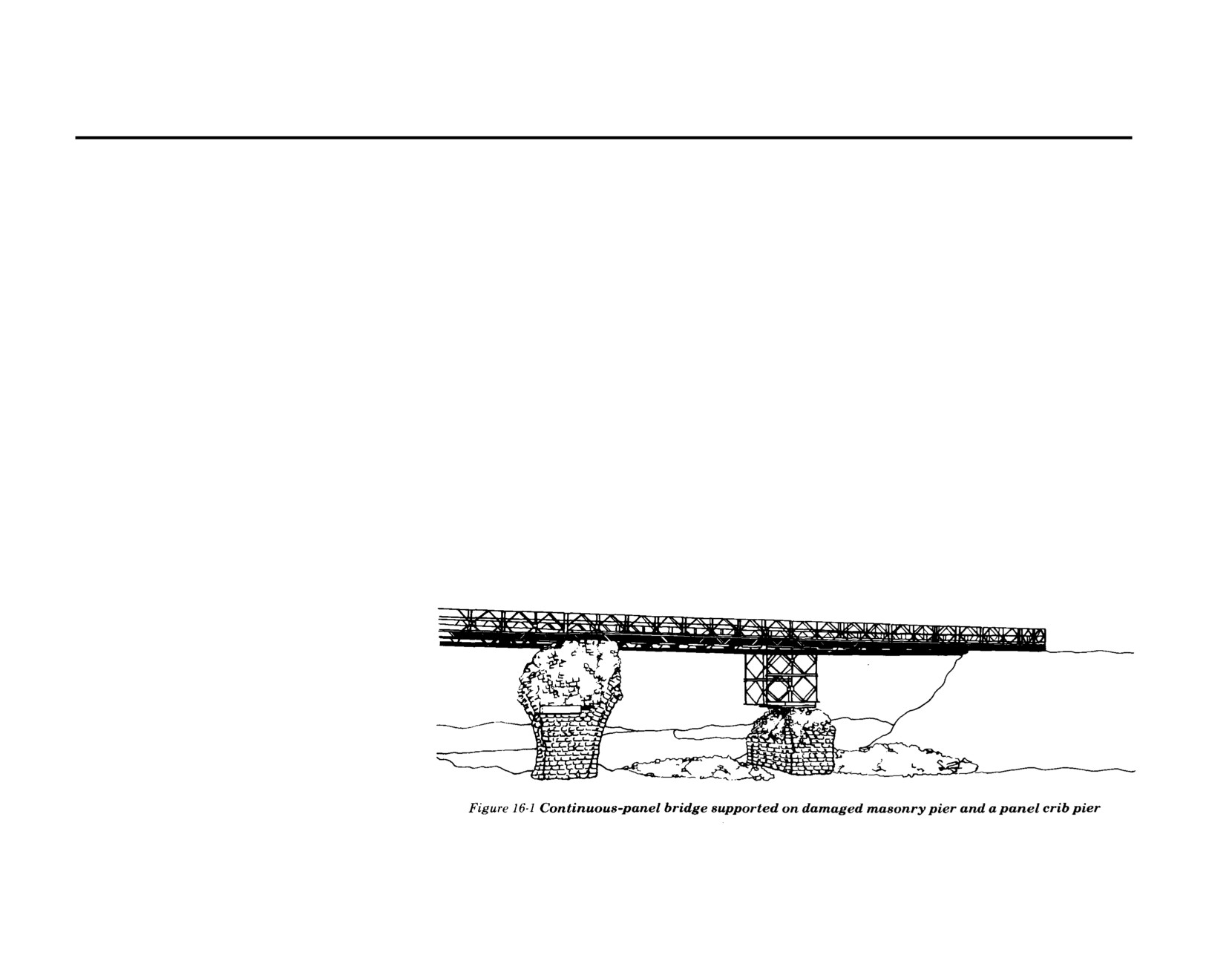
fied. Existing piers of demolished structures
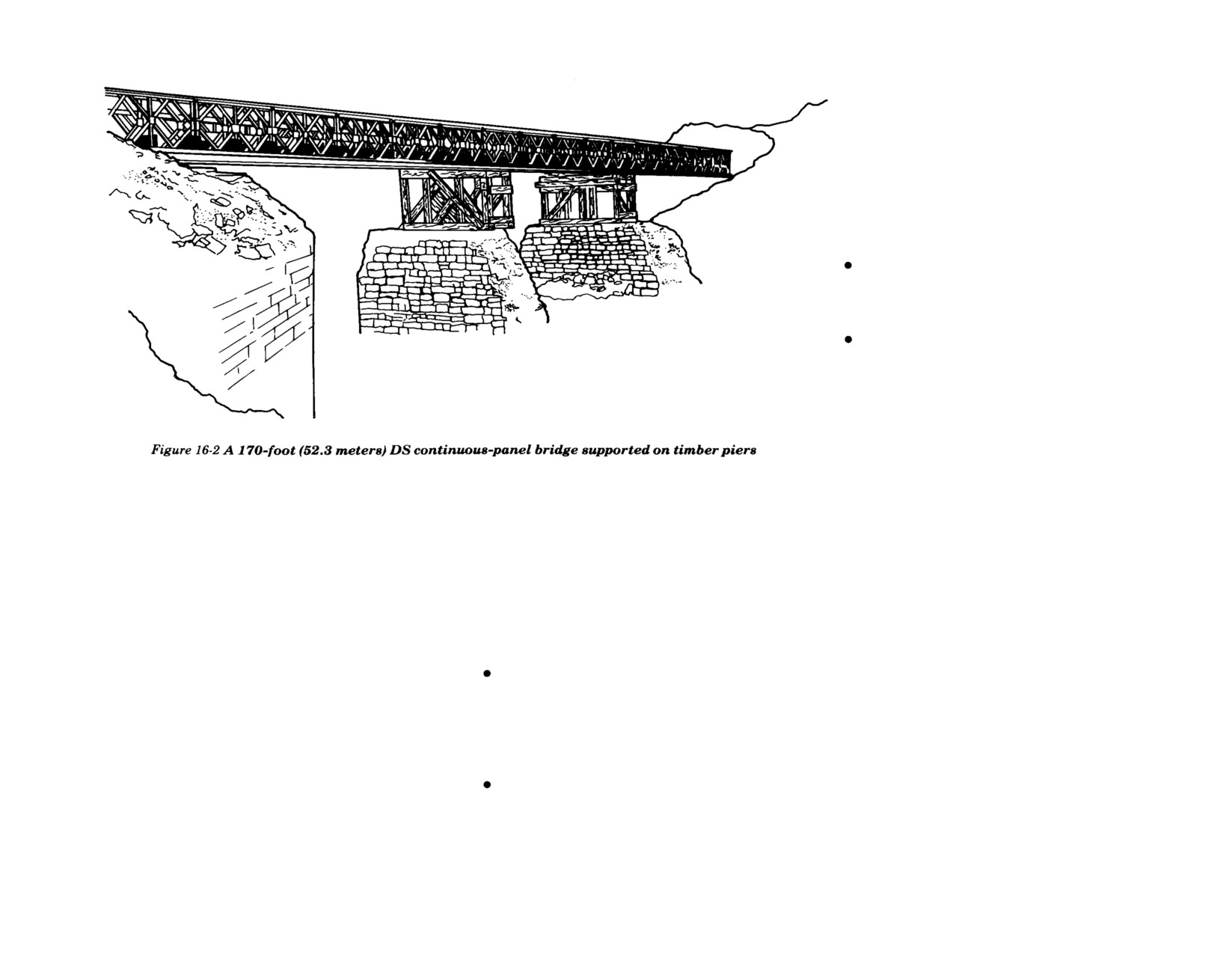
(Figure 16-1), panel crib piers, framed bents
or cribs (Figure 16-2), pile piers, or combi-
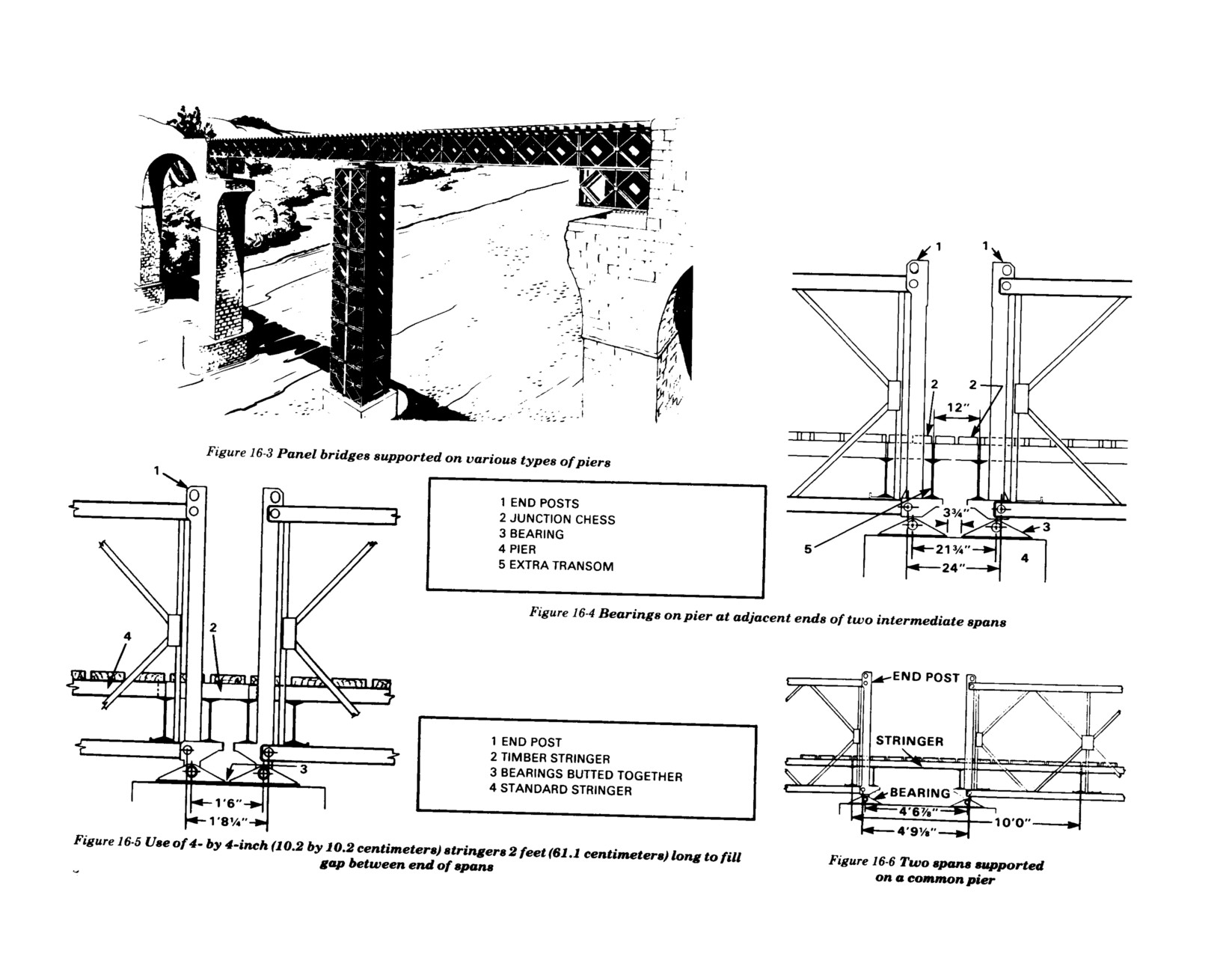
nations of these (Figure 16-3, page 192) are
used for intermediate supports.
ASSEMBLY
Independent spans can be single-, double-, or
triple-truss and single- or double-story as-
sembly. If truss assembly is changed over the
pier when using conversion set No. 3 (Chapter
190
FM 5-277
centimeters) timber stringers decked with
two chess. If bearings are butted against
each other (Figure 16-5, page 192), the
stringers must be 2 feet (61.1 centimeters)
long.
Standard stringers cut to desired length
can be used to bridge the gap between
spans.
If bearings are spaced 4 feet 6
7/8
inches
(1.4 meters) center to center, bridge the
gap by setting standard panel-bridge
stringers back 5 feet (1.5 meters) along
bridge (Figure 16-6, page 192). Use extra
panels to support overhanging stringers
at one end of bridge.
taking the end reactions of the spans can be
junction chess. The use of standard con-
If end posts are not used, fasten steel plates to
used. Bailey-type panel crib piers for sup-
version set No. 3 severely limits the bridge
pier cap for truss bearings. Pin only the lower
porting broken-span bridges are described in
pier reaction.
chords of spans. Omit top pin at junction so
Chapter 17. It is desirable to make the top of
two spans can act independently.
all piers in the same plane as the abutments,
If the panel crib pier parts are unavailable,
but a change in slope between spans may be
attach the end posts to the ends of adjacent
If timber trestle or pile bents are used as
used if needed. Guy tall, narrow piers to
spans and seat on separate bearings (Figure
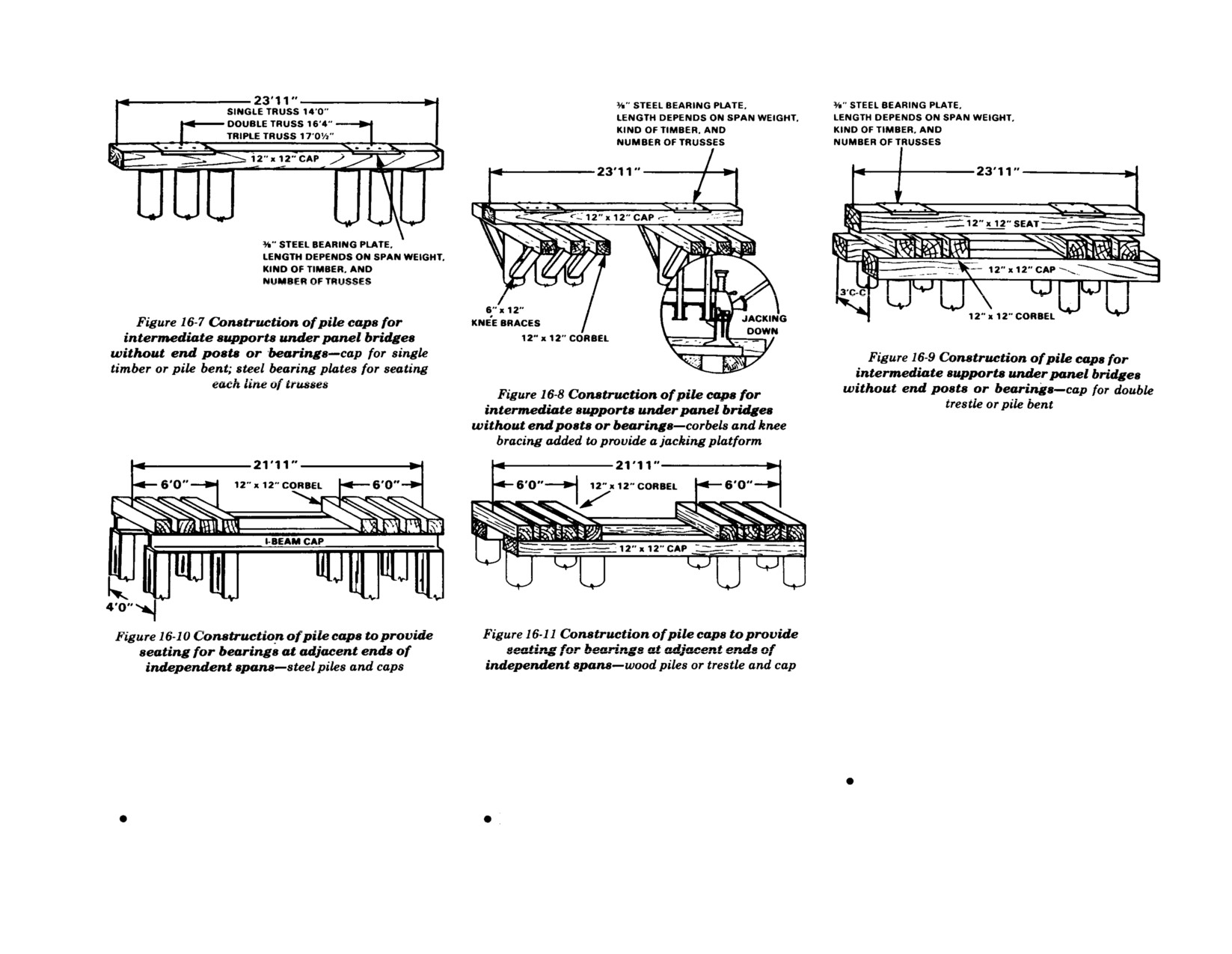
intermediate piers, build the top of the bent as
prevent lateral movement.
16-4, page 192). Use any of the following three
shown in Figures 16-7 through 16-11 (page
methods to bridge the gap between spans:
193). If end posts are not used, reinforce the
Bridge seatings
capsill with a steel bearing plate under each
With panel crib pier parts (conversion set No.
If junction chess are used, seat an extra
line of trusses. On single bents, use corbels
3), take special care that piers are exactly
transom in the end posts of one span and
with knee braces to provide a jacking plat-
aligned and spaced so that the ends of two
space the bearings 21¾ inches (55.4
form for light bridges (Figure 16-8). If double
adjacent spans are on a common junction-
centimeters) apart center to center (Figure
bents are used with end posts and standard
link bearing. Attach span junction posts to
16-4).
bearings, lay timbers across caps to provide a
the end of each span, and pin the posts to the
platform for seating bearings (Figures 16-10
junction links fitting in junction-link
If junction chess are unavailable, use
and 16-11). Group timbers together under
bearings. Bridge gap between two spans with
seventeen 4- by 4-inch (10.2 by 10.2
each line of trusses.
191
FM 5-277
192
FM 5-277
CLASS
class when fitted with end posts or span
classes of Bailey bridges without end
Normal spans, spans without end posts, and
junction posts as a simple-span bridge of
posts, see Table 22-3.
piers each have their own class designation,
the same span length and type of
as follows:
assembly.
In a series of broken spans, the class of
the weakest span is the class of the bridge.
Since spans of a broken-span bridge act
If end posts or span junction posts are not
For classes of panel crib piers, see Chapter
independently, each span has the same
used, the class of spans is limited. For
17.
193
FM 5-277
The load on a pier from two adjacent in-
span
double-single
truss assembly. The
diate piers and then broken at the piers.
dependently supported spans can be com-
triple-double
construction must be con-
Long, heavy single- or double-story bridges
puted. The formula is based on a vehicle
tinued for two bays of the
double-single
can be launched incomplete to make the
spacing of 100 feet (30.8 meters). Allowing 15
construction to stabilize the junction link.
launching easier. Connect the spans directly
percent of the live load for impact, and a
or by span junction posts and launching
coefficient of 1.13 for eccentricity, the total
Using the formula given, P is determined
links. Push the bridge across the gap or pull it
factor is 1.3. The formula is—
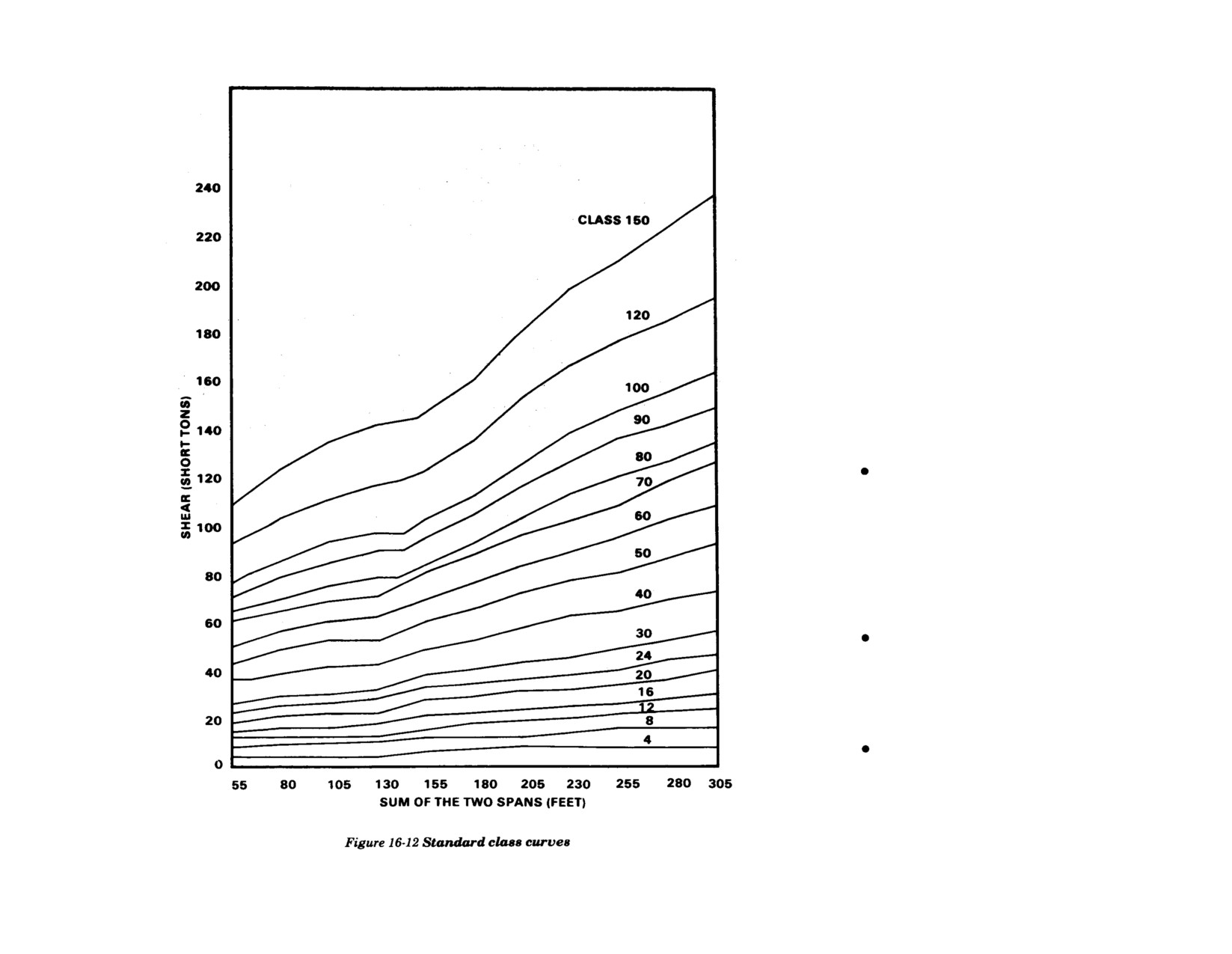
from Figure 16-12 by entering the bottom
across by winch line. In general, launch a
of the graph at 210 feet (64.6 meters) (total
continuous bridge as follows:
R
= 1.3P +
1/2
W
of the two spans), reading up to the class 50
d
curve and then to the left margin. In this
1
Place rocking rollers on each pier and on
R
= load in tons on pier.
instance P is determined to be 74 tons. To
abutments in the same horizontal plane.
determine W
d, refer to Table 1-2 which
Spike or lash rocking-roller bearings, base
P
= maximum live-load shear in
shows that
one
bay of
triple-double
bridge
plates, or templates to piers to prevent
tons.
weighs 5.88 tons and one bay of
double-
shifting during launching. When span
single
weighs 3.41 tons. The heavier con-
junction posts are not used and the bridge
W
= total dead weight in tons of
struction must be continued two bays into
is to be cut over the pier, the pier top must
d
the two spans.
the lighter construction. This results in 15
be wide enough to allow placing of two
bays of
triple-double
and 6 bays of
double-
rocking rollers end to end under each
The following example illustrates how to find
single
construction. By multiplication we
truss.
the pier reaction of a broken-span bridge:
find W
d
is 108.66 tons. Load on pier is
then—
Note:
The number of rocking rollers on a
Given:
pier must be equal to the number required
Spans of 130 and 80 feet (40 and 24.6
R
= 1.3P +
1/2
W
on the near shore.
d
meters) on each side of an intermediate
= 1.3(74) =
1/2(108.66)
pier.
= 96.2 + 54.33
2
Use a launching nose in the same manner
= 150.53 tons
as for a normal bridge. The length of the
Broken-span panel bridge to span these gaps
launching nose should be the same as
must carry class 50 load in normal crossing.
METHODS OF LAUNCHING
required for a single span bridge of the
Broken-span bridges are launched by canti-
same length as the longest span in the
Required:
levering the entire bridge with launching
broken-span bridge. Use launching-nose
Determine bridge assembly needed.
nose over the gap as a continuous bridge and
links in bottom chords of nose to com-
breaking it, by launching each span by single
pensate for sag. When estimating sag in
Determine load on pier.
girders, or by floating each span into position.
nose to determine position of links, allow
an extra 6 inches (15.3 centimeters) of sag
Solution:
LAUNCHING AS A
for safety.
From Table A-7, Appendix A, the 130-foot
CONTINUOUS BRIDGE
(40 meters) span will require
triple-double
Normally, an entire single- or double-story
3
During launching, guy piers to offset
truss
assembly and the 80-foot (24.6 meters)
bridge with nose is launched over interme-
longitudinal thrust of the bridge. When
194
FM 5-277
completely launched, pull bridge back
slightly to relieve stress in guy lines.
4
Jacking down over intermediate piers
requires jacking beams similar to those
described later in this chapter.
SPANS WITH SPAN JUNCTION POSTS
ON JUNCTION-LINK BEARINGS
Launch spans with span junction posts on
junction-link bearings as follows:
1
Fit span junction posts to ends of spans
and pin bottom jaws of adjacent posts
together. Three methods of making junc-
tions are-
If spans are all the same length, begin
with first junction and fit alternate
junctions with launching links between
tops of span junction posts. This makes
bridge continuous at these points.
These junctions are called locked junc-
tions. Do not connect top chords at
other junctions.
If spans are not all the same length,
make first length of continuous bridge
plus launching nose twice the length of
longest span. This counterweights the
nose over the gap.
In double-story assembly, place span
junction posts in each story. Pin the
bottom jaws of posts in lower story
together and use Mk II launching-nose
links to connect top of posts in top
story. Do not make a pin connection
195
FM 5-277
between posts at top of lower story and
remove rollers and cribbing at each
Whether 2, 4, 6, or 12 jacks are used,
bottom of top story.
center pier and jack bridge down slowly.
truss spacing causes eccentric load
As jacks at center pier are lowered,
on jacking beam.
2
Remove launching-nose links from top
tension in top chord decreases. When
chords at locked junctions by the fol-
tension is zero, remove pins in Mk II
SPANS WITH END JUNCTION POSTS
lowing two methods:
links. Then jack bridge down on center
ON STANDARD BEARINGS
pier. Repeat this procedure at adjacent
Launch spans with end posts on standard
For bridges with several long heavy
piers, working toward abutments. See
bearings as follows:
spans, remove launching-nose links at
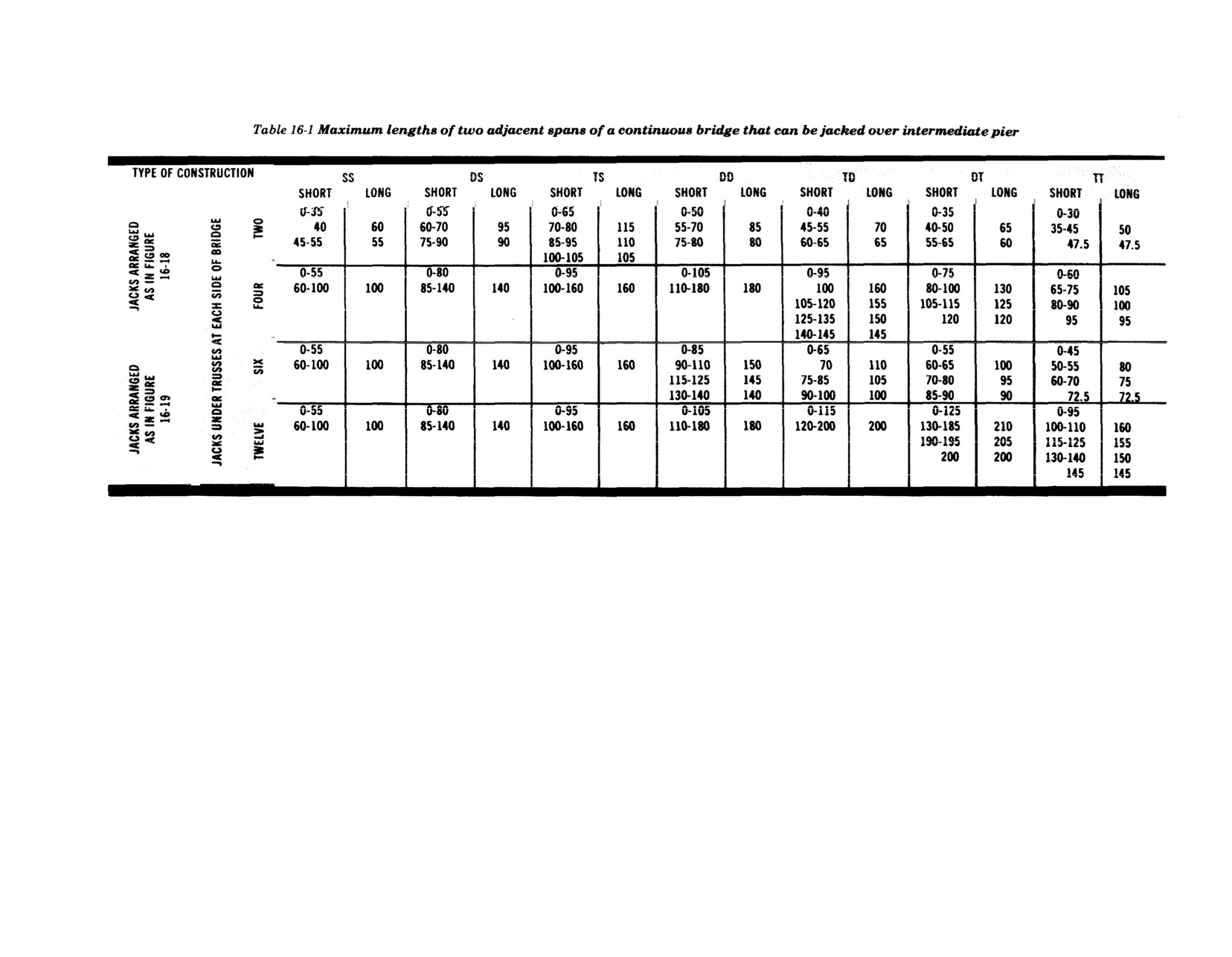
Table 16-1 for maximum lengths of
point of contraflexure. In a continuous
bridge and jacking arrangements,
1
Launch as a continuous bridge until far
girder, there is a point near each sup-
based on dead weight of two spans over
span is in position.
port where the girder changes from a
the intermediate pier. When using this
downward sag in the gap to an upward
table, note the following:
2
Disconnect far span from rest of bridge,
bend over the pier. At this point (point
and pull bridge back until next span is in
of contraflexure), there is no bending
For heavier bridges, use jacks at the
position. To remove pins, bridge may be
moment in girder, no stress in links in
pier also.
jacked up slightly either at junction or at
top chord, and panel pins are easy to
end.
remove. If the pins are heavily greased,
With jacks arranged as in Figure 16-
they can be pulled by hand. To find
18 (page 205), and two jacks under
3
Repeat procedure until all spans are dis-
point of contraflexure in span, station
trusses at each side of bridge, jack
connected over their piers.
personnel at each link to test pins for
strength (15 tons) limits this arrange-
slackness as soon as links are one-third
ment to a capacity of 56 tons. With
4
Pin end posts to ends of spans, and jack
span length from far pier. Push bridge
four jacks used instead of two under
spans down on bearings.
ahead slowly and continue to test pins.
trusses, jack strength limits this
When pins are loose, remove links.
arrangement to a capacity of 111
LAUNCHING WITHOUT END POSTS
After removing links, continue
tons.
Launch spans without end posts as follows:
launching until bridge is in final posi-
tion over piers. Then jack down bridge
With jacks arranged as in Figure 16-
If bottom chords of all spans are to be
simultaneously at alternate supports.
19 (page 205), and 6 jacks under
pinned together and only top chords
trusses at each side of bridge, jack
broken at piers, make junctions, launch
For short light bridges of two or three
strength limits this arrangement to
bridge, and remove pins in same manner
spans, remove launching-nose links
a capacity of 85 tons (jack strength
as for spans with span junction posts.
over piers. Launch bridge completely
on toe is 7.5 tons). With 12 jacks used
before attempting to remove links. After
instead of 6 under trusses, jack
If both top and bottom chords are to be
launching, jack up ends of bridge and
strength limits this arrangement to
broken at piers, launch bridge in same
substitute cribbing at same height as
a capacity of 168 tons, and two ramps
manner as for bridge with end posts.
rocking rollers at abutments. Then
on each side of bridge are needed.
196
FM 5-277
LAUNCHING BY SINGLE GIRDERS
JACKING ON PIERS
1 Place jacks beneath panel verticals or
To launch by single girders, assemble bridge
Where it is necessary to jack on intermediate
diagonals of inner trusses on each side of
by launching girders of each span from deck
piers, the distance through which the bridge
bridge with handles toward the center,
of previously completed spans. Add transoms
is raised or lowered should be kept to the
and remove sway braces. Lift bridge clear
and decking after girders are in place. For
minimum by adjusting the levels of the
of rocking rollers, and remove rollers and
detailed procedure, see Chapter 19.
intermediate rollers. In the case of flat cribs,
cribbing. Place temporary cribbing under
the jacking problem is considerably eased,
inner trusses, and position base plate
LAUNCHING BY FLOTATION
since the jacks can be readily positioned
with bridge bearing placed centrally.
To launch by flotation, assemble span on
under the inner trusses of the bridge. A
rollers on shore, launch onto pontons or
satisfactory method of jacking the bridge off
2 Place distributing beams on bridge
crafts, and float into position between piers.
the intermediate rollers and positioning the
bearings under middle and outer trusses.
For detailed procedure, see Chapter 18.
distributing beams is as follows:
Jack down to within 3 inches (7.6 centi-
meters) of final position. Place cribbing
197
FM 5-277
between bottom chords of bridge and top
4
Place jacks beneath distributing beam
6
Secure bridge bearing in position in base
of distributing beams and lower bridge on
under inner truss of bridge, jack up,
plate with timber.
the cribbing. Remove jacks from under
remove packing from middle and outer
inner truss.
trusses, and lower onto bearings.
MAINTENANCE
Check periodically to record any sinking of
3 Put distributing beams centrally under
5
Weld guide plates to end stiffeners of
piers. Prevent lateral shifting of the bridge by
inner truss so that crib bearing is over
distributing beams, with lug on top of
timber blocking on each side of bearings and
bridge bearing.
plate between middle and inner trusses.
lateral guy lines on high piers.
CONTINUOUS-SPAN BRIDGES
ADVANTAGES
A continuous-span bridge is one in which
both upper and lower chords are continuous
over intermediate piers between abutments.
Advantages of continuous-span bridges are
that siting of piers is not limited to 10-foot
increments or to exact longitudinal alignment
by panel junction, as in broken-span bridges.
Assembly is faster and class is increased for
most types of assembly. Classes for contin-
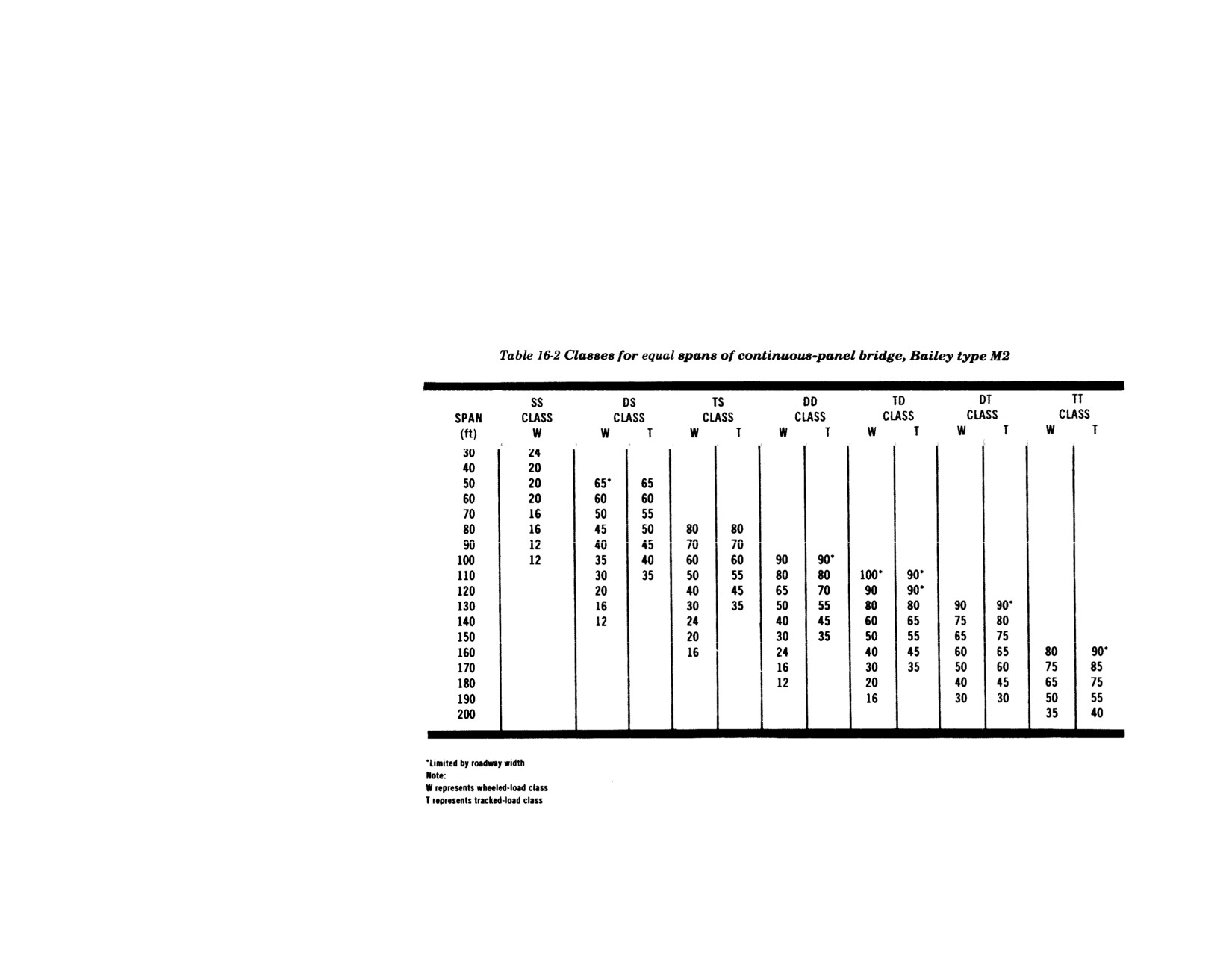
uous spans over piers are found in Table 16-2.
ASSEMBLY
The number of spans is limited by the effect
of harmonious vibration setup by loads and
by the difficulty of keeping long bridges in
alignment during launching. Normally, con-
tinuous-span bridges are limited to four spans
or 500 feet (153.8 meters).
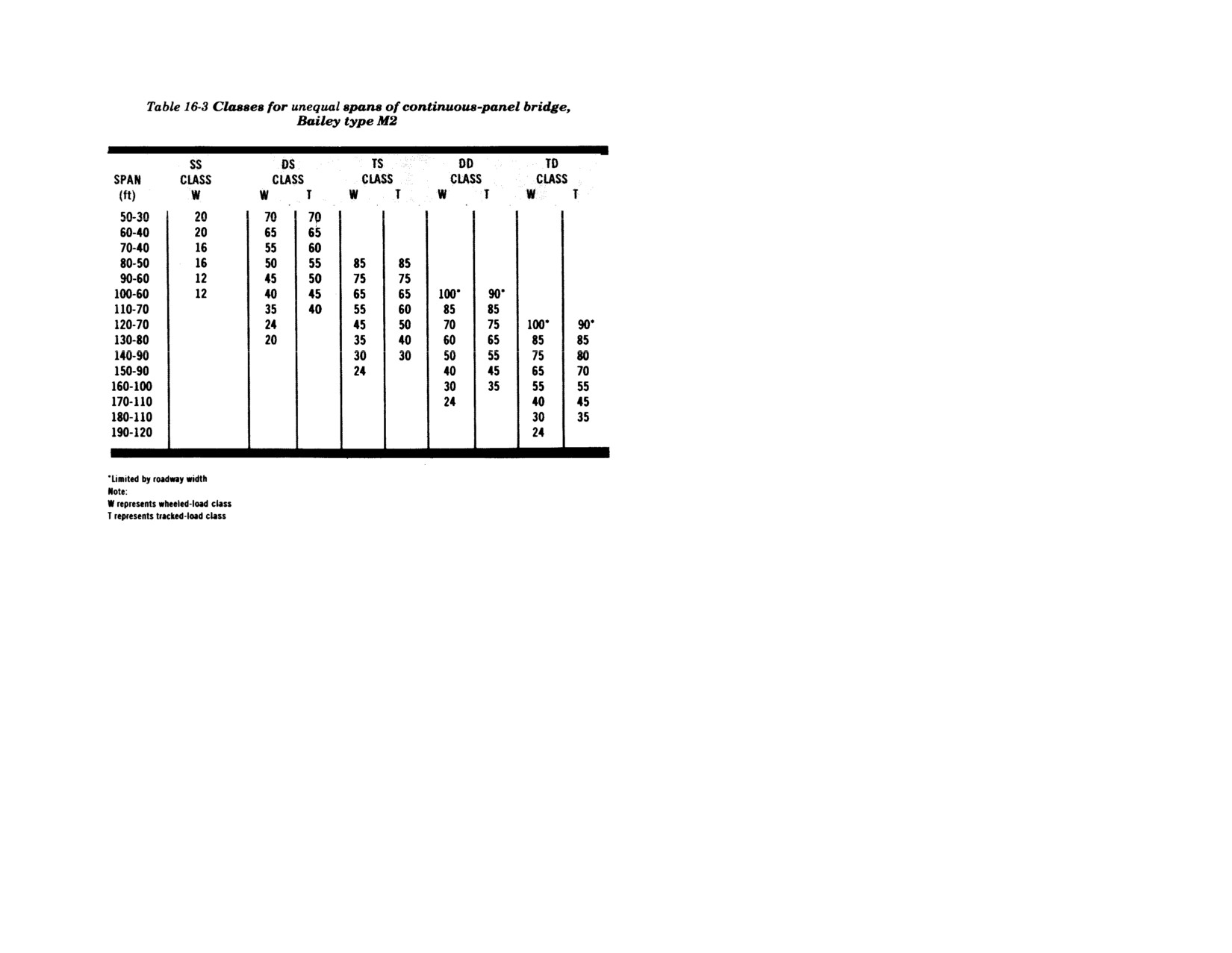
The maximum span of a continuous-span
bridge to carry a specified load is given in
Tables 16-2 and 16-3. The short span must be
at least 60 percent of the length of the longer
adjacent span. If the short span is less than
60 percent, a heavy load on the long span
198
FM 5-277
triple-triple
respectively over a pier for
two bays on each side of the pier-bridge
connection.
Construction of piers
Use any type of supporting crib or pier
capable of taking the reactions of the spans.
Piers are normally built before the bridge is
launched over them. Where piers are inaccess-
ible from the ground because of extreme
height or a rapid stream, a high line can be
used in construction or the soldiers and
materials can be lowered from the end of the
cantilevered launching nose of the bridge.
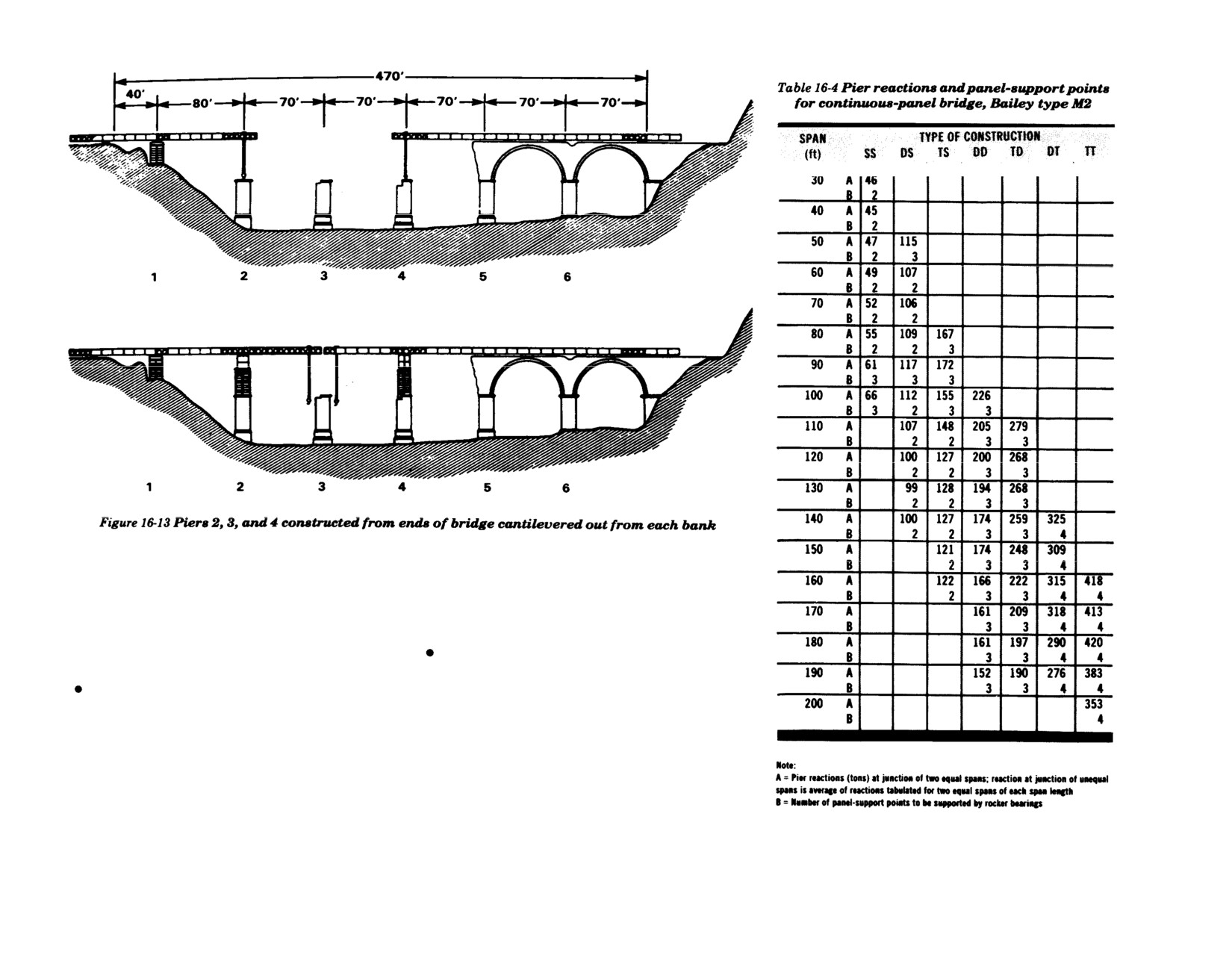
Figure 16-13 (page 200) illustrates how this
has been done. On two-span bridges, the
bridge may be launched across the gap and
pier parts lowered from the bridge. Be sure to
check the capacity of the bridge over the
combined gap to ensure that it will carry the
pier construction crew and materials. Guy
raises the end of the short span off its bearing.
If two or more piers are used in the assembly
tall, narrow piers to prevent lateral
If spans less than 60 percent are essential,
of continuous spans (for example, 120 feet
movement.
break the bridge at the pier to make the short
[36.9 meters], 120 feet, and 70 feet [21.5
span independent.
meters]), the assembly may change over the
Construction of bridge seating
last bay of the bridge. To determine whether
Some form of rocker bearing must be used at
Change of assembly over a pier
a change is permissible, check Tables 16-2
the intermediate pier to allow for deflection of
Avoid changes in truss assembly whenever
and 16-3 to see if the lighter construction will
girders under load. Normally, a rocker
possible. If changes must be made, change
give a sufficient class. Extend heavier
bearing for the bridge is placed at the top of
number of stories rather than number of
assembly of longer span beyond intermediate
the pier. If a rocker is placed at the base of the
trusses to give better redistribution of stresses
pier a distance equal to 25 percent of shorter
pier, the bridge can be fastened rigidly to the
between adjacent spans. If one pier is used,
span. Make only the following changes of
pier (Chapter 17). Various types of rockers at
the construction of both sides of the pier
assembly between spans:
single-single
to
top of pier are described below. The distri-
should be the same. Use Table 16-2 for equal-
double-single, double-single
to
double-double,
buting beam on the rocker bearing must be
length spans and Table 16-3 for unequal-
triple-single
to
triple-double,
and
double-
strong enough to prevent excessive local
length spans. For both types of span, bridges
double
to
double-triple.
Whenever
double-
bending in the bottom panel chord. Table
with a normal rating over class 70 must be
double
or
double-triple
truss types are used,
16-4 (page 200) gives the number of panel-
built with double transoms.
they must be reinforced to
triple-double
and
support points (points under panel verticals
199
FM 5-277
and junctions of panel diagonals) that must
capsill, this rocker gives full support to
be effectively supported by the distributing
only two panel-support points. Pier reac-
beam to prevent excessive bending stress in
tion with this arrangement is limited to
the bottom chord. The procedures for pro-
17 tons (15.5 metric tons) per truss.
viding rocker support to panel-support points
are as follows:
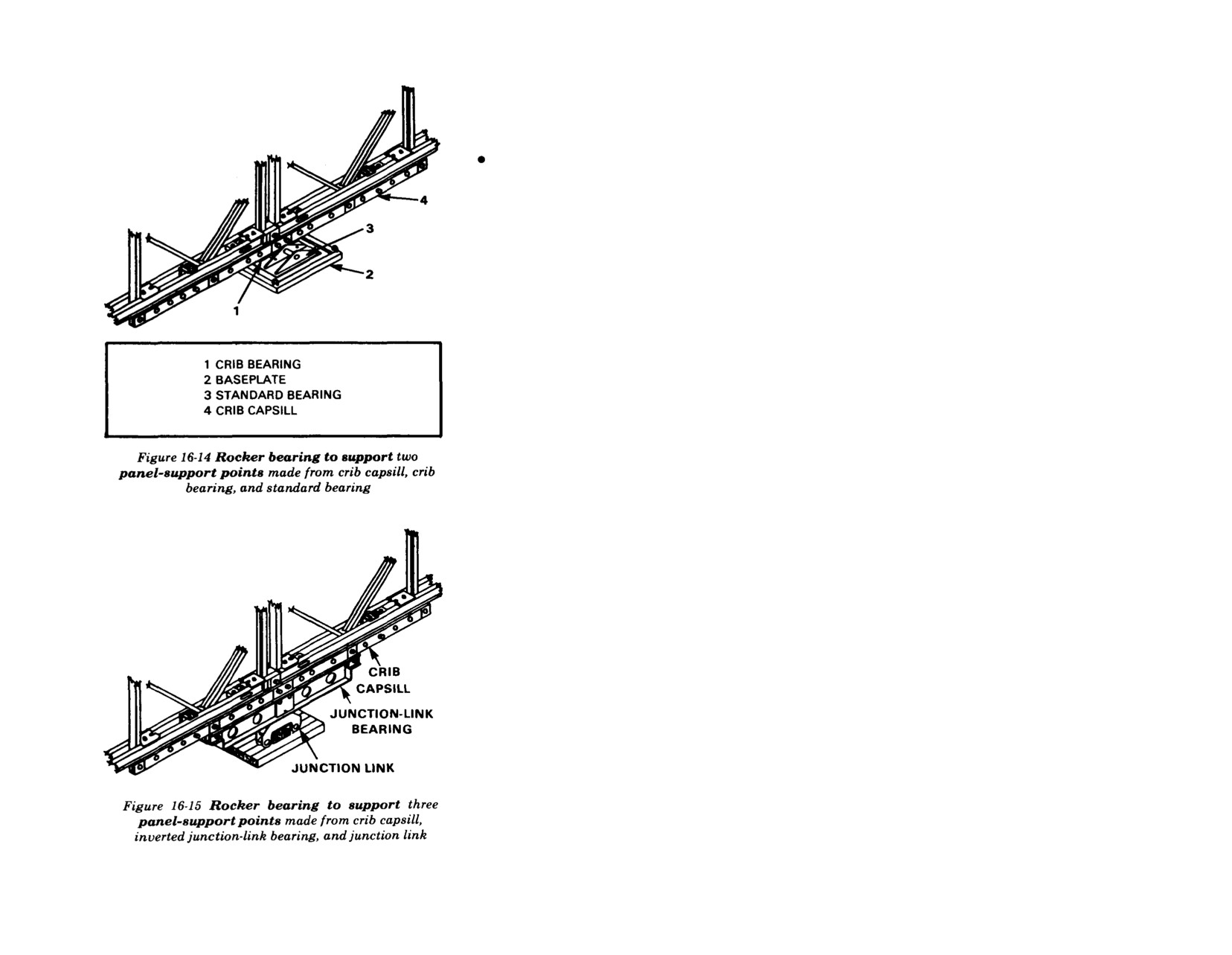
When rocker must support three panel-
support points, use a crib capsill, an
When rocker must support two panel-
inverted junction-link bearing, and a
support points, use a crib capsill, crib
junction link from the panel crib pier set
bearing, and standard bearing from the
as shown in Figure 16-15. Pier reaction
panel crib pier set as shown in Figure
with this arrangement is limited to 25
16-14. Because of the flexibility of the crib
tons (22.3 metric tons) per truss.
200
FM 5-277
Leveling supports
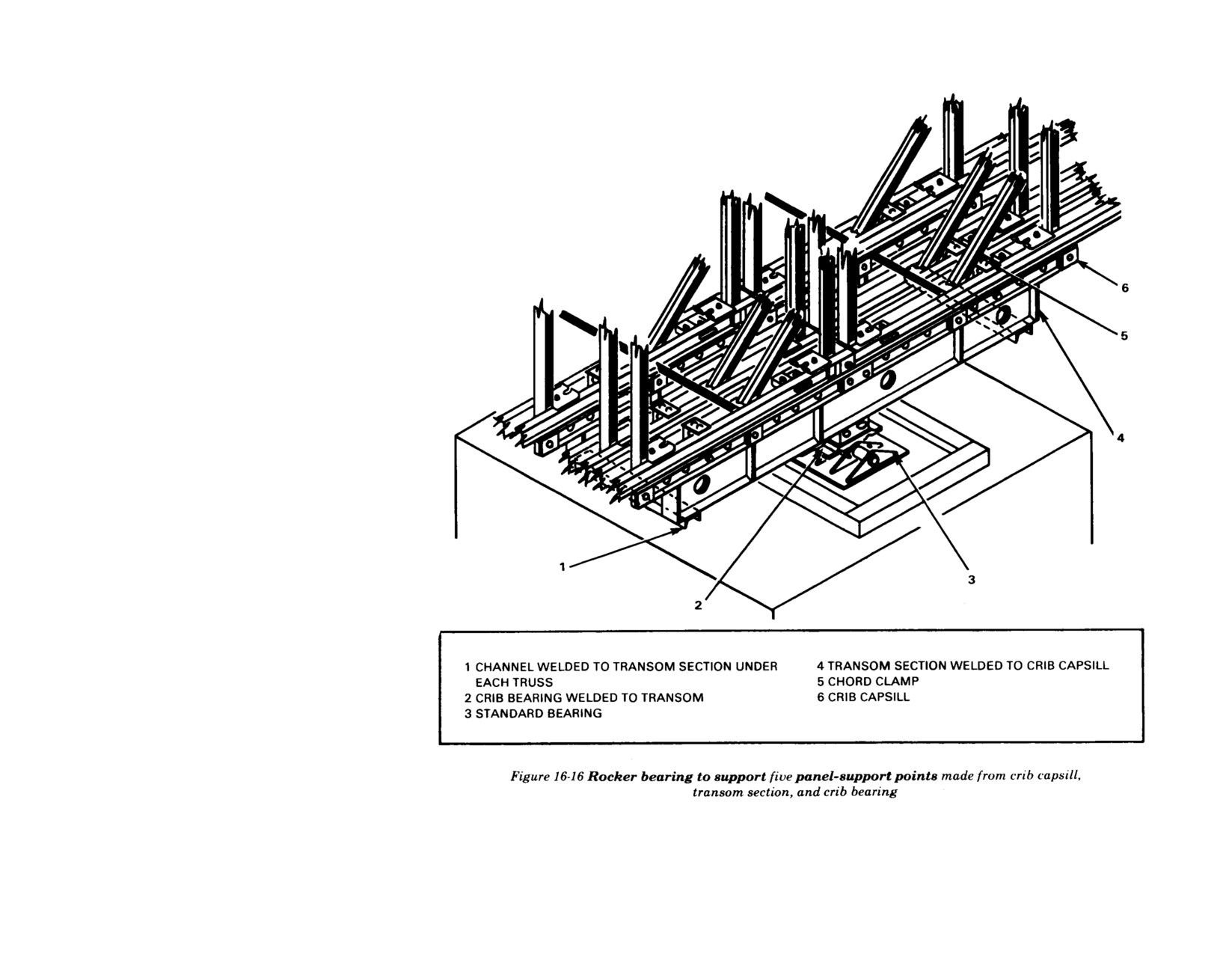
When rocker must support five panel-
The bottom chord of the bridge must be in the
support points, reinforce the crib capsill
same plane over all the intermediate supports.
in Figure 16-14 with an 8-foot 4-inch (2.6
Normally, this plane is level, but a slight
meters) section of transom as shown in
inclination is permissible. If any pier settles
Figure 16-16 (page 202). Weld capsill,
more than 6 inches (15.3 centimeters) below
transom, and crib bearing together and
the bridge plane, then the rockers must be
pin by chord clamps to panel chord. Weld
cribbed up. Without the cribbing, the super-
small channels across bottom of transom
structure will fail.
sections at each side of bridge to give
lateral stability to each rocker. Weld more
PIER REACTION
diaphrams and an end plate to the rocker
The class of continuous-span bridges varies
bearing. The crib capsill may be omitted
with span lengths. For shorter spans, it may
if a 10-foot (3.1 meters) section of transom
be less than that of broken-span bridges
is used, but end plates must be recessed to
because shear at the piers is greater. Tables
prevent lateral movement of the trusses
16-2 and 16-3 give the capacities of continuous-
being supported.
span bridges. Note that in most cases, the
class is greater than it is for corresponding
Anchoring of bridge
simple spans. Table 16-4 gives pier reactions
Allowance must be made for slight long-
and the number of panel points (points under
itudinal movement of the bridge due to
panel verticals and junctions of panel diag-
deflection under loads, and for expansion
onals) that must be supported by the rocker-
and contraction due to temperature changes.
bearing distributing beam to distribute
With temperature changes of 60 degrees
stresses in bridge panels over the pier. The
Fahrenheit (15.6 degrees Centigrade), a move-
rocker bearing shown in Figure 16-16 has a
ment of 1/2 inch (1.3 centimeters) per 100 feet
distributing beam long and stiff enough to
(30.8 meters) of bridge can be expected. To
support five panel-support points and suitable
allow for this movement, grease base plates
for any of the spans in the tables.
so bearings can move longitudinally on them.
Restrain the bearings laterally with timber
The following example illustrates how to use
guides. If sloping bridges are erected, alter-
this table:
nate expansion and contraction makes the
bridge creep downhill. To offset this, keep
Given:
slopes under 1 in 30 and fix the uphill end of
Spans of 130 and 80 feet (40 and 24.6
bridge to prevent creeping. At the end of a
meters) respectively on each side of an
bridge with a short end span, lash or clamp
intermediate pier.
end posts to bearings so posts cannot jump
their seatings if end of bridge lifts when a
heavy load is on the second span.
201
FM 5-277
Continuous-span bridge to span these gaps
must carry class 50 loads in normal
crossing.
Required:
Determine bridge assembly needed.
Determine type of rocker bearing to use.
Determine load on pier.
Solution:
Table 16-3 shows that
double-double
truss
construction will provide desired class
loading.
Table 16-4 shows three panel-support
points are required for two equal spans of
130 feet (40 meters) using
double-double
construction. Since the 80-foot (24.6 meters)
double-double
span is not given, the 100-
foot (30.8 meters)
double-double
span is
used because this is the maximum reaction
that can be generated on a
double-double
truss. The panel-support points required
are again three; therefore, truss of the
girder must be supported under three
panel-support points (use bearing shown
in Figure 16-15).
Table 16-4 shows the pier reaction is 194
tons (176.5 metric tons) for two equal spans
of 130 feet (40 meters) using
double-double
construction. Again, since the 80-foot (24.6
meters)
double-double
span is not shown,
the length is taken as the worst condition,
in this case 100-foot (30.8 meters)
double-
double
construction. The reaction under
202
FM 5-277
two such spans is given as 226 tons (205.7
Solution:
metric tons). The average of these two
Three panel-support points must be used
spans is used to determine the pier loading,
(Table 16-4). Use bearing shown in Figure
which in this instance is 210 tons (191.1
16-16 to support pier load.
metric tons).
Load on pier from two 80-foot (24.6 meters)
Note:
One advantage of continuous-span
triple-single
bridges is 167 tons (152 metric
bridges over broken-span bridges is shown
tons) and load on pier from two 120-foot
by the example problem for finding pier
(36.9 meters)
triple-single
bridges is 127
reaction of a broken-span bridge given
tons (115.6 metric tons). The average of the
earlier in this chapter. Span lengths and
two is 147 tons (133.8 metric tons).
class requirements are identical; however,
in broken-span construction a total of 15
METHODS OF LAUNCHING
bays of
triple-double
and 6 bays of
double-
Continuous-span bridges are launched by
single
construction are required to obtain
cantilevering the entire bridge with
class 50/55. In continuous-span construc-
launching nose over the gap or by floating
tion, a total of 21 bays of
double-double
intermediate spans into position and then
construction will suffice and provide class
pinning.
60/65. Assuming panels are a critical item,
the continuous-span bridge is more eco-
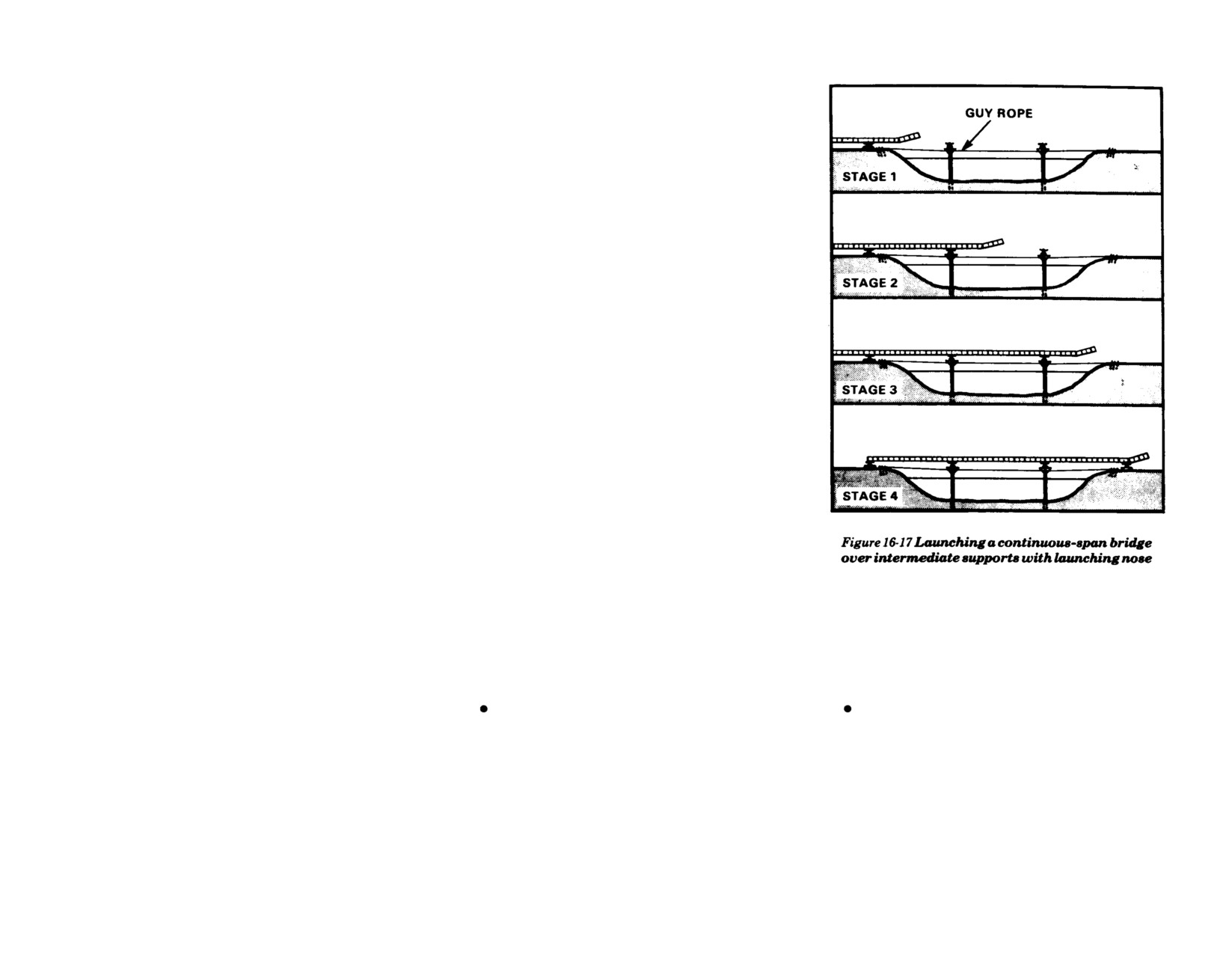
When launching with launching nose (Figure
nomical since it requires only 168 panels,
16-17), the length of launching nose required
whereas the broken-span bridge requires
is the same as for a simple-span bridge of the
204 panels.
same length as the longest span in the
continuous-span bridge. Use launching links
Another example of the use of Table 16-4 is as
to compensate for sag. When estimating sag
Place rollers on intermediate piers in the
follows:
in nose to determine position of links, allow
same plane as near- and far-shore rollers,
an extra 6 inches (15.3 centimeters) of sag for
and spike or lash them to piers. Check
Given:
safety. The launching procedures are as
level and alignment of rollers before
Spans of 80 and 120 feet (24.6 and 36.9
follows:
starting bridge assembly.
meters) respectively on each side of an
intermediate pier with
triple-single
truss
Use plain rollers as in a single-span
For long bridges, mechanical power may
assembly and class 30 overall.
bridge. Place rocking rollers at each
be needed to launch the bridge. Use
abutment and on top of each intermediate
methods described in Chapter 7. In addi-
Required:
pier.
tion, or as an alternative, use winch on far
Determine type of rocker bearing.
shore to pull bridge across gap. Careful
Note:
The quantity of rocking rollers on
alignment of bridge during early stages
Determine load on pier.
top of each intermediate pier is equal to the
of launching is important.
near-shore requirement.
203
FM 5-277
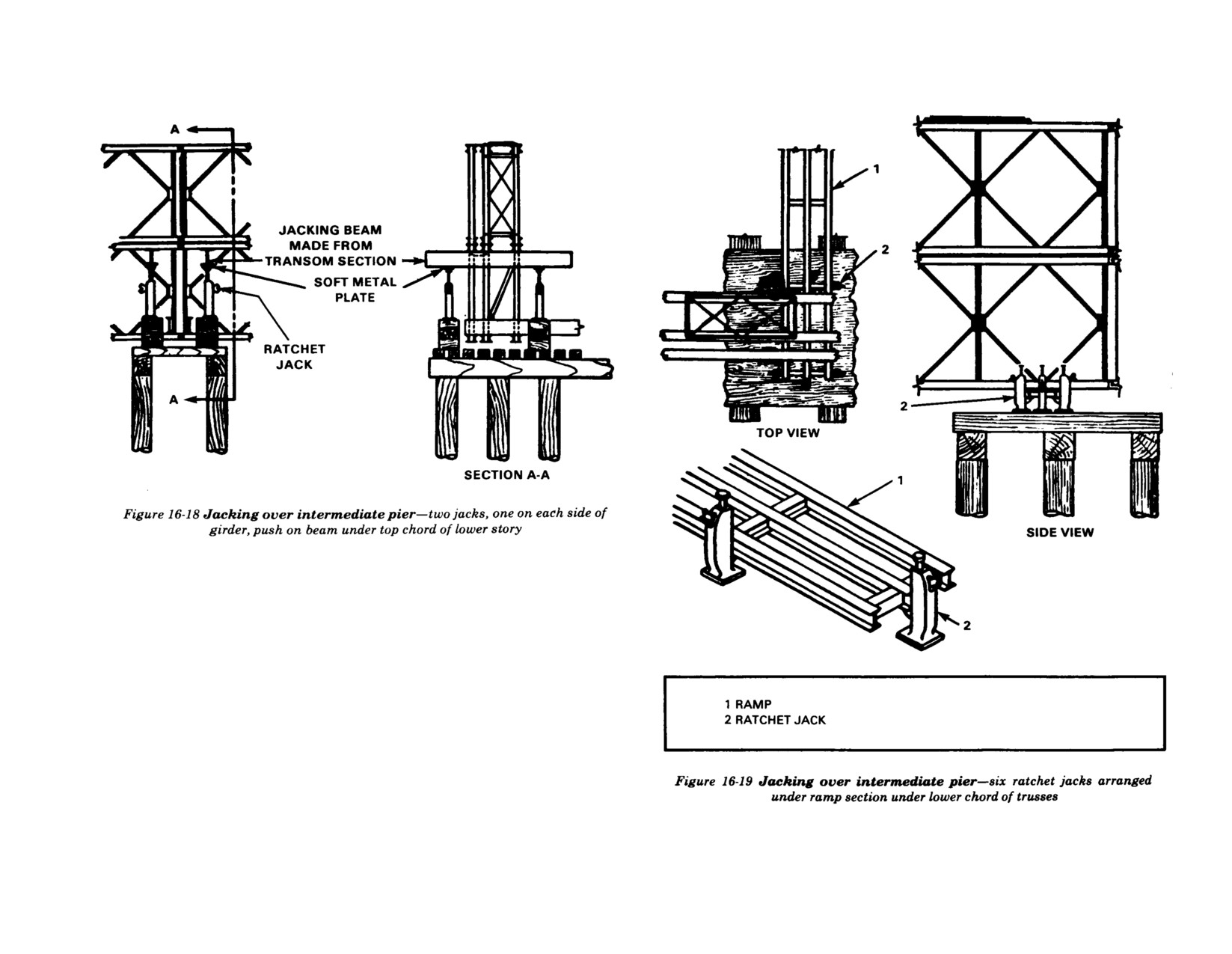
Long, heavy bridges can be launched
Use two jacks, one on each side of trusses,
Solution:
incompletely to make the launching
under a section of transom under top
First select method to be used over pier.
easier. Add extra trusses and decking
chords of lower story (Figure 16-18). A soft
The method used in Figure 16-18 is the best
needed to complete bridge after it is
metal plate between jack head and tran-
one because it makes maximum use of
launched.
som eliminates danger of jack head
mechanical advantage of jack.
slipping. Place transom section close to
During launching, use guy lines to
verticals of panels. Block under jacks to
Table 16-1 indicates four jacks are required
counteract forward thrust of launching.
raise transom sections to level of top
under trusses at each side of bridge.
When bridge is completely launched, pull
chord.
back slightly to relieve stress in guy lines
Total number of jacks required for the pier
if necessary.
Arrange six jacks under ramp section
is 4 + 4 = 8 jacks.
placed across underside of bottom chords
When launching by flotation, float interme-
(Figure 16-19).
MAINTENANCE
diate spans into position, as described in
Pier sinking causes increased stress in the
Chapter 18. Lower and then pin to adjacent
SAMPLE PROBLEM
bridge and must be checked immediately by
spans.
Given:
blocking or wedging under bridge bearings.
Spans of 80 and 120 feet (24.6 and 36.9
Check ends of short spans for any tendency
METHODS OF JACKING
meters) over an intermediate pier with
to lift off bearings. If end posts do lift off
Jack down shore ends of bridges with jacks
triple-single
truss assembly.
bearings, lash posts to bearings or break
under end posts, as described in Chapter 6. At
short end span at pier. Check anchorage to
intermediate piers, use expedient jacking
Required:
keep bridge from creeping under traffic.
methods. Jacking load on toe of each jack
Determine number of jacks required to
Maintain blocking to prevent lateral move-
must not exceed 71/2
tons (6.8 metric tons);
jack down bridge.
ment on piers.
jacking load on top, 15 tons (13.6 metric tons).
Also, jacks operated in unison must be of the
same manufacture. Figures 16-18 and 16-19
show two methods of jacking at intermediate
piers. Table 16-1 gives lengths of adjacent
spans of continuous-span bridges that can be
jacked with these arrangements. The two
methods are as follows:
204
FM 5-277
205
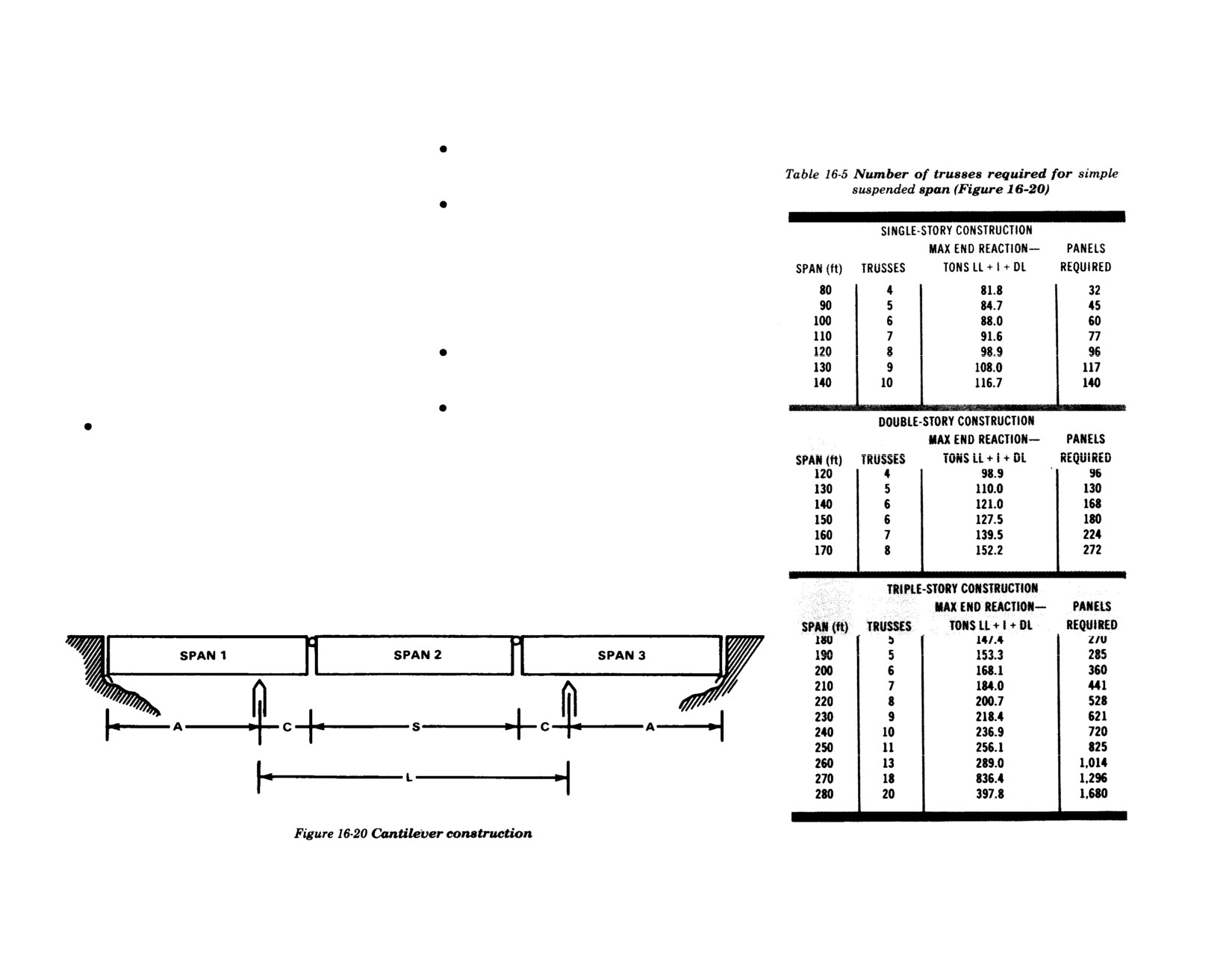
FM 5-277
CANTILEVER-SPAN BRIDGES
USES
It is possible to use cantilever construction to
An impact equal to 15 percent of the live
produce clear span lengths greater than those
load was used.
obtained with conventional through-type
construction. A clear span of 400 feet (123.1
The minimum number of trusses in both
meters) can be obtained using cantilever
the simple span and the cantilever span
construction, but this span requires the use of
was set at four. If less than four trusses
20 trusses, which is excessive and which
are used, the allowable capacities must be
would become too cumbersome. The design
decreased due to excessive concentration
data and information contained in this sec-
of wheel loads on a truss, and the type of
tion are based on cantilever construction, as
floor must be changed.
shown in Figure 16-20.
The maximum number of trusses was
DESIGN
taken at 10.
The following design features are assumed:
The single-axle load equivalents (SALE)
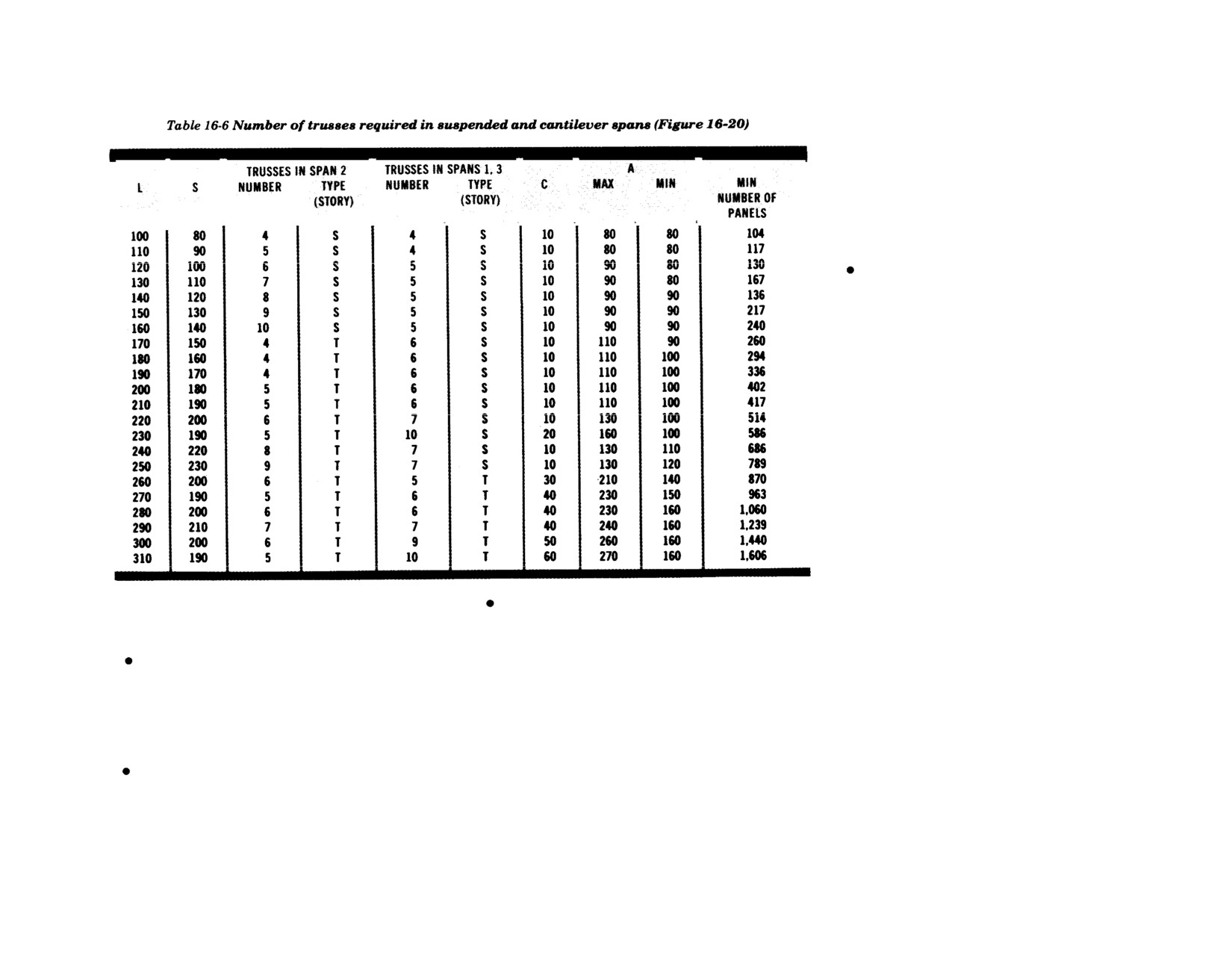
Tables 16-5, 16-6, and 16-7 (page 208) are
charts for moment and shear have been
based on a class 60 live load on a single
used for those spans on which wheeled
lane, with a 14-foot (4.3 meters) roadway.
vehicles governed. Appendix C describes
The dead load is based on a panel weight
in detail the use of SALE charts in deter-
with bracing of 600 pounds (272.7 kilos)
mining moment and shear. For spans of
and an 8-inch (20.4 centimeters) wooden
120 feet (36.9 meters) and above, the
flooring weighing 400 pounds (181.8 kilos)
critical vehicle is the 60-ton (54.6 metric
per foot. A single-story truss was assumed
tons) tracked vehicle. A spacing of 100
capable of resisting 380 foot-tons, a double-
feet (30.8 meters) from front to rear of a
story truss 700 foot-tons, and a triple-
convoy of tanks moving across the spans
story truss 1,310 foot-tons.
gives a center of gravity of the loads at
206
FM 5-277
of the counterweight span is not being
used to its full capacity. The maximum
span length shown provides for this use
but, if this length is exceeded, even with
proper loading, the section may fail.
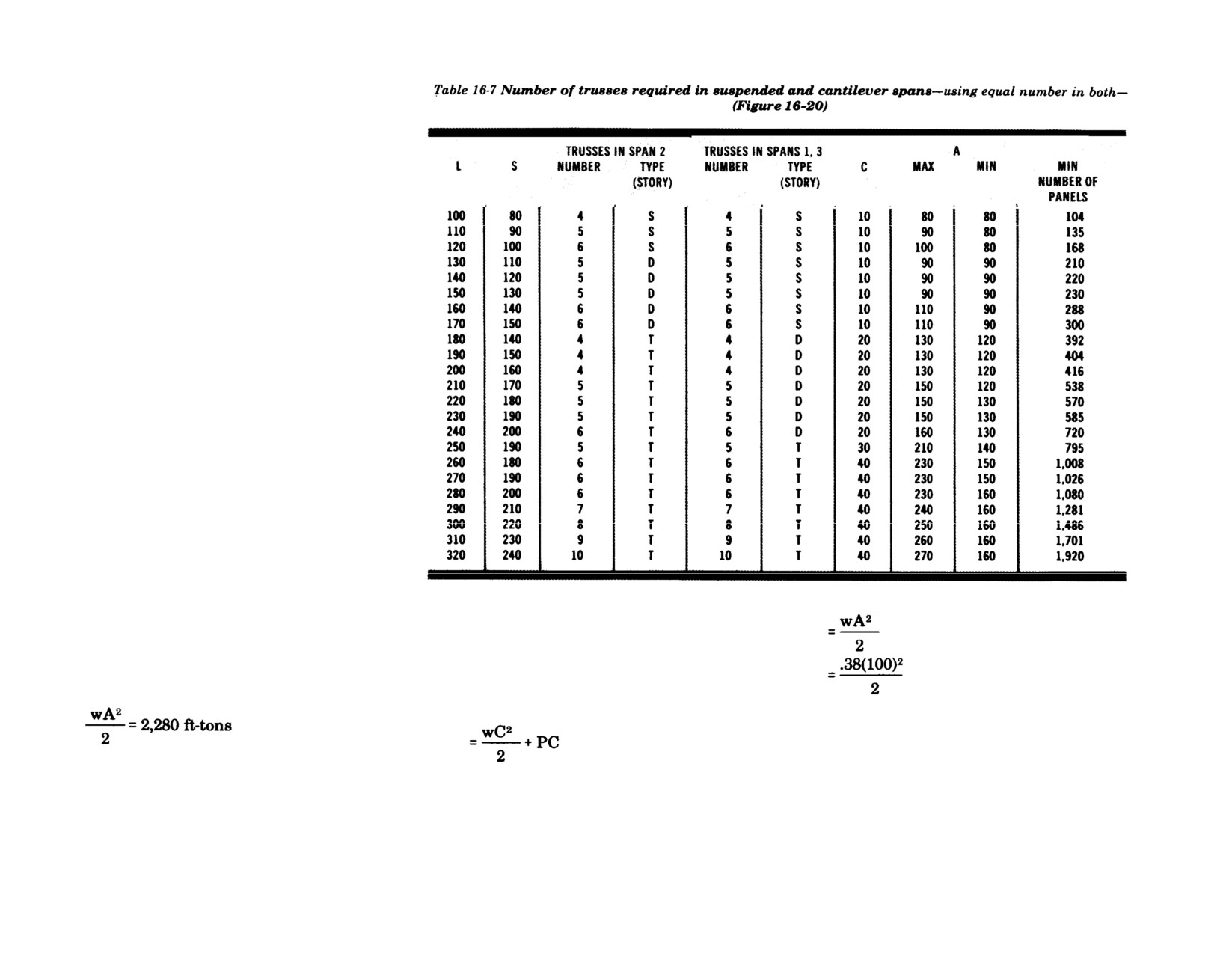
Table 16-7 gives combinations with the
same number of trusses in both the
cantilever and the suspended spans.
These combinations are not as economical
as those in Table 16-6.
The following is a design example:
Step 1:
Design of suspended span(S) (Figure
16-20).
Assume S = 190 ft
SALE = 66.7 tons
MLL = PL/4
= 66.7 x 190/4
= 3,170 ft-tons
M
LL
+ M
I
= 3,170 x 1.15
= 3,650 ft-tons
114 feet (35.1 meters) center to center, and
Table 16-6 gives the various spans which
this was the maximum load used.
can be built-using cantilever-type construc-
Estimated triple-story trusses = 5
tion. The combination shown is the most
M
= [5(.09) + .2] 1902/8
DL
A minimum safety factor of 1.15
was
used
economical based on the number of panels
= 2,930 ft-tons
against overturning of the cantilever span
required for the center-to-center pier spans
M
= 6,580 ft-tons
TOT
(c).
(L) using the minimum length of anchor
Actual number of trusses required=
arm. It is important to note that there is
6,580/1,310 = 5
The following tables should be used
both a maximum and a minimum length
Therefore, 5 triple-story trusses will be
of anchor arm. The minimum length of
used.
Table 16-5 gives the required number of
anchor span (A) provides the necessary
triple-, double-, and single-story trusses
counterweight for the cantilever arm, and
which were used for the simple suspended
the bridge is stable if built in this way.
span (S).
However, the positive resisting moment
207
FM 5-277
Maximum end shear:
LL+ I = 84 + .15 (84)
= 96.6 tons
DL shear = 61.7 tons
Shear
TOT
= 96.6+ 61.7
= 158.3 tons
Step 2:
Design of cantilever span (C) (Figure
16-20).
Assume single-story construction with 6
trusses
Try 10-ft span:
Resisting moment = 6 x 380
= 2,280 ft-tons
M
DL
= [6(.03) + .2] 102/2
= 19 ft-tons
End shear (on hinge) possible:
P(10) = 2,280-19
= 2,261 ft-tons
P = 2,261/10
= 226.1 tons.
Therefore, this construction and span
length is suitable to carry end shear of
suspended span of 118 tons.
(R
assumed= 0)
Resisting moment about R
1
2
Step 3:
Design of minimum anchor span (A)
(Figure 16-20).
A = 2,280 X 2/.38
= 12,000
W = 6(.03) + .2
A = 109.5 ft (try 100 ft)
= .38 ton/ft
=
1,900 ft-tons
Overturning moment about R2
Safety factor = 1,900/1,602
= 1.18
= 19 + 158.3(10)
(within 1.15 assumed allowable)
= 1,602 ft-tons
Therefore, minimum A = 100 ft (30.48m)
208
FM 5-277
Step 4:
Design of maximum anchor span (A)
Therefore, the total maximum length of
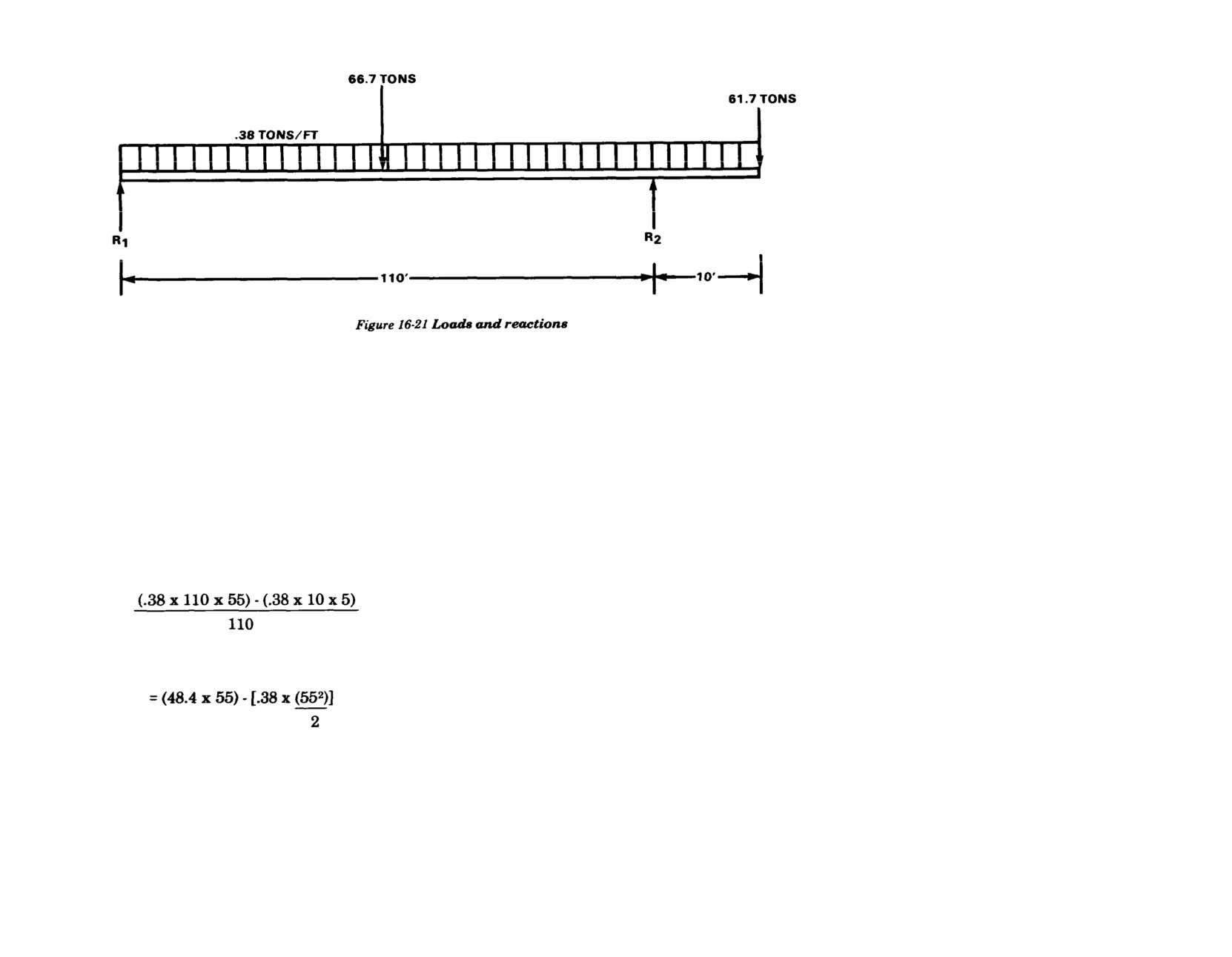
(Figure 16-21).
bridge for this combination is:
Maximum resisting positive moment
S+2(C)+ 2(A) = 190+20+220
= 2,280 ft-tons
= 430 ft (131.06m)
Assume span = 110 ft
The pier-to-pier span length:
SALE + SALE
1
=58 X 1.15
L = S+2(C)
=
66.7 tons
= 190+20
R
= 66.7(55) - (61.7 X 10)+
= 210 ft
1
(64.0lm) (Table 16-7)
Note:
Although six single-story trusses
would be able to carry more than the
= 48.4 tons
maximum end shear of 158.3 tons (144.1
metric tons) on a cantilevered 10-foot span,
Moment at center
an examination of steps 3 and 4 shows
they are needed for even the minimum
length of anchor span required.
=
2,087 ft-tons
Therefore, maximum A = 110 ft (33.53m)
209
FM 5-277
CHAPTER 17
PANEL CRIB PIERS AND TOWERS
Panel crib piers are made of trusses with
in a given story); and the position of panels in
foot 1-inch (.16 meter) increment in pier
panels set horizontally or vertically and are
each story (horizontal or vertical). Table 17-1
height. They are, however, weak laterally
normally braced with transoms, sway
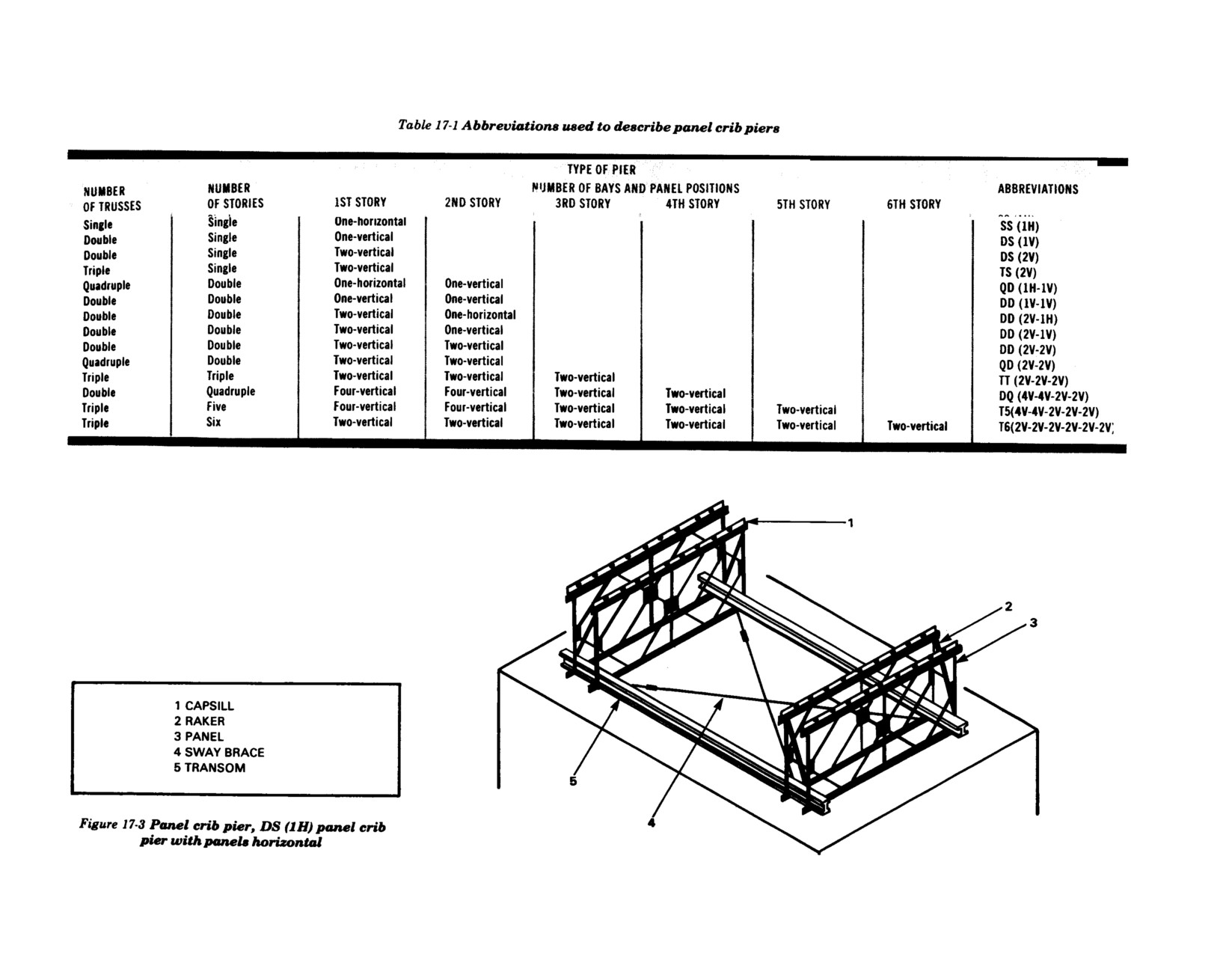
(page 212) lists the abbreviations used to
and are used one above the other when
bracing, rakers, bracing frames, and tie plates
describe typical panel crib piers. Panel cribs
expedient bracing is added. When ultimate
in a panel bridge.
have from one to four trusses on each side,
capacity piers are used, any horizontal stories
depending on the desired capacity. There
are weaker than vertical ones. Vertical panels
Panel crib piers assembled from parts of the
must always be at least as many trusses in
provide 10-foot (3.1 meters) increments in pier
Bailey bridge set can be used as—
the crib as in the bridge it supports.
height. They can be used one above the other
in piers up to 70 feet (21.5 meters) high
Intermediate supports for through- and
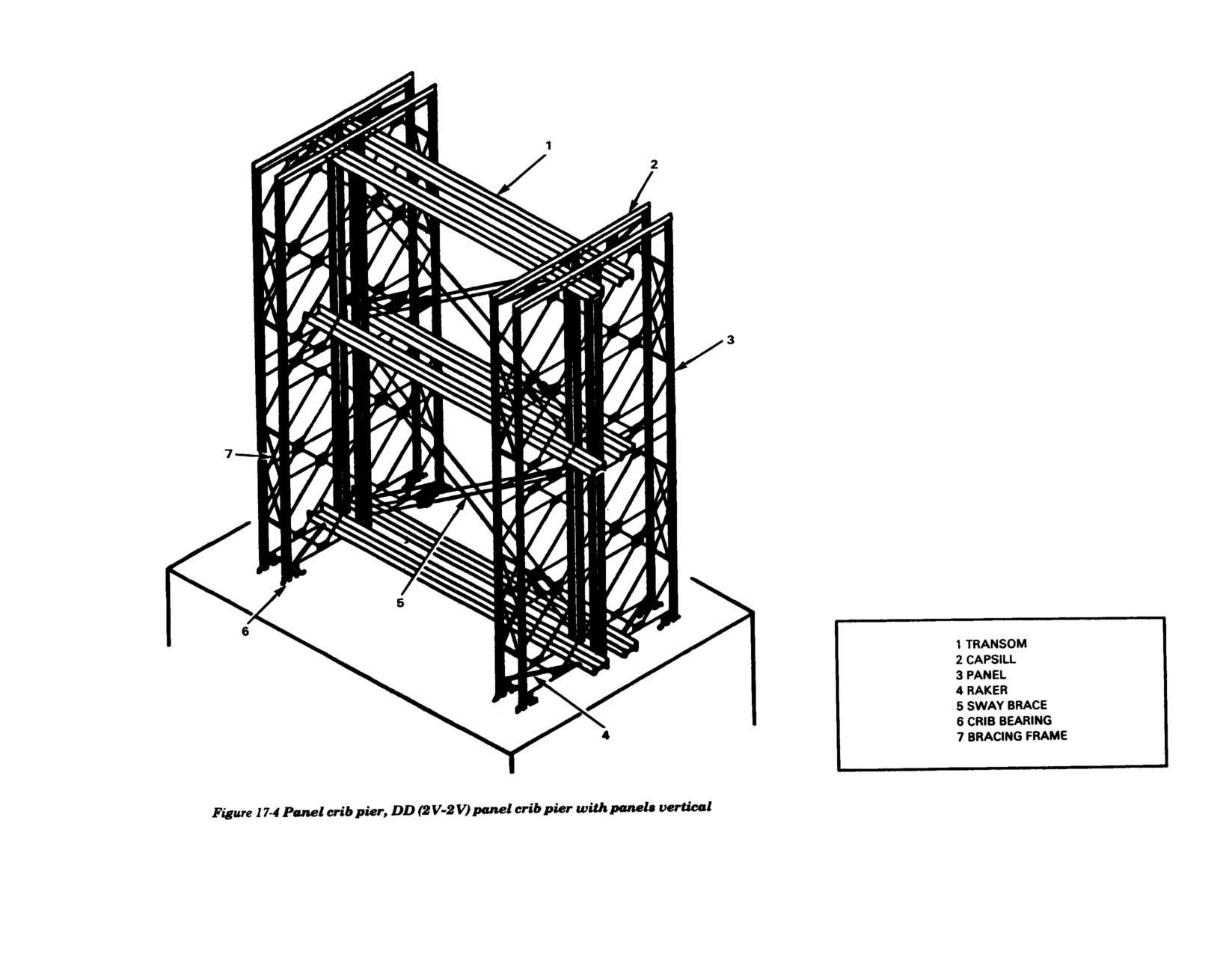
Panels in a panel crib pier are horizontal
supporting continuous spans and up to 110
deck-type fixed bridges. The piers can be
(Figure 17-3, page 212) or vertical (Figure 17-
feet (33.8 meters) supporting broken spans.
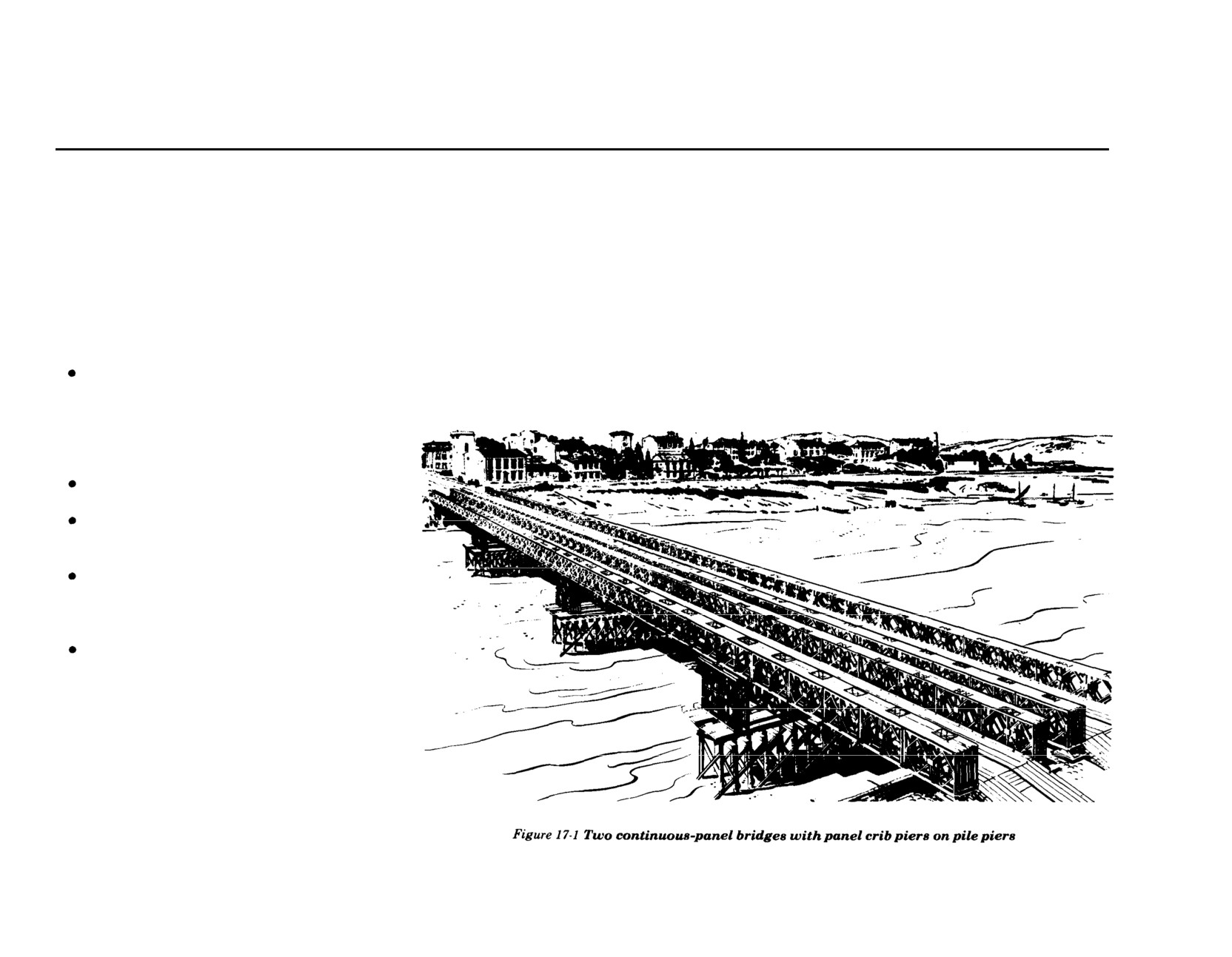
set on timber grillage, piles (Figure 17-1),
4, page 213). Horizontal panels provide a 5-
In high piers, exceeding three vertical stories,
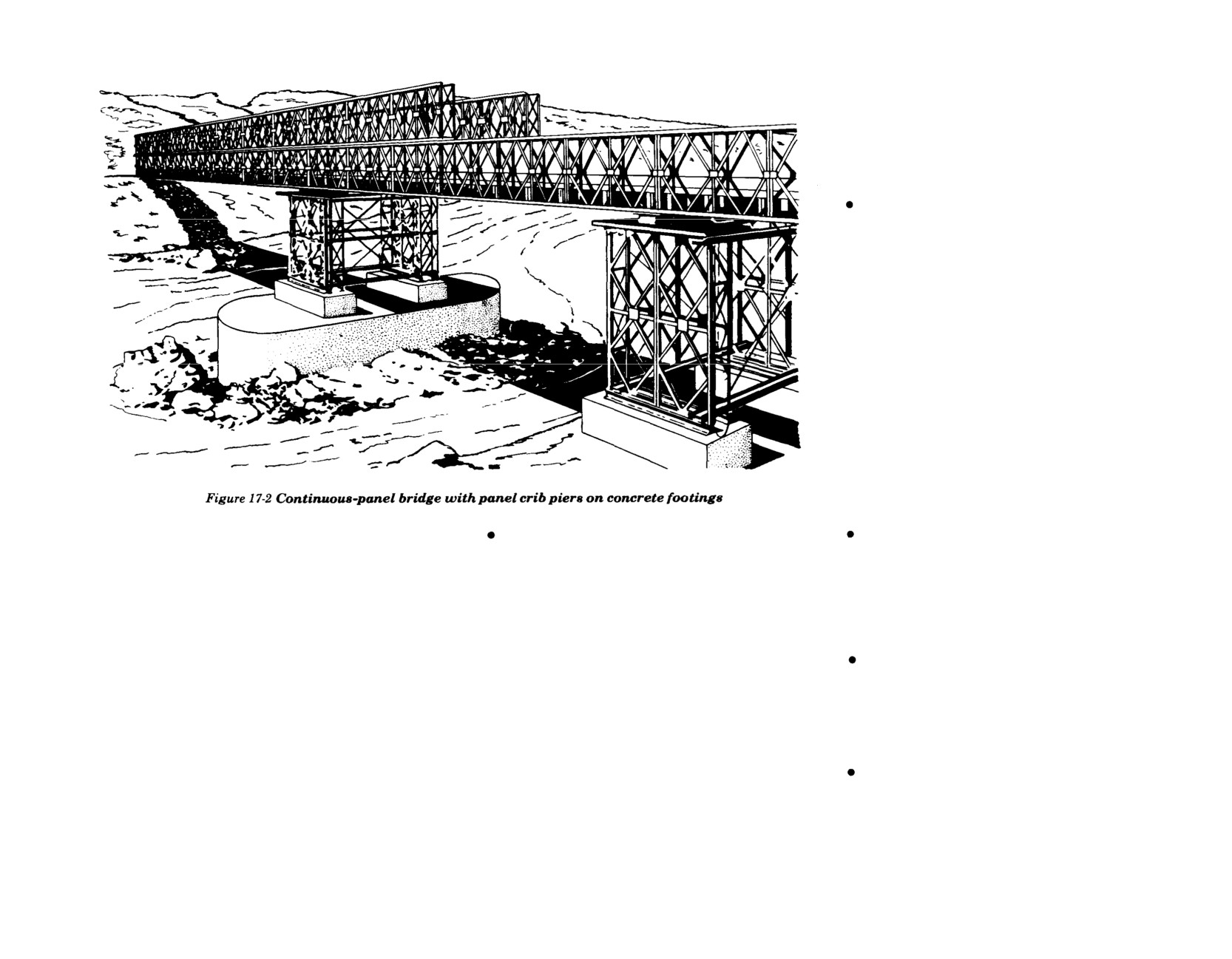
masonry footings (Figure 17-2), or par-
tially demolished piers.
Piers in barge bridges.
Intermediate landing-bay piers in floating
panel bridges with double landing bays.
Expedient towers for suspension bridges,
lift bridges, gantries, and floating-bridge
anchor-cable systems.
Expedient marine piers.
CHARACTERISTICS OF CRIBS
Types of panel crib piers have their own
distinguishing characteristics. Panel crib
piers are described by the number of trusses
(single, double, triple, and so on, as in a panel
bridge); the number of stories (number of
panels along the vertical axis in one bay, as
in the panel bridge); the number of bays
(number of panels along the horizontal axis
210
FM 5-277
are described and illustrated in Chapter
16.
If the crib is fastened rigidly to the bridge,
it must rock with the bridge as the girders
deflect under load. A rocker at the base of
the crib can be built of crib bearings on
standard bearings or inverted junction-
link bearings on junction links. This type
of pier construction may prove useful on
piers less than 10 feet (3.1 meters) wide
along the axis of the bridge. It must be
built from the bridge downward and the
bridge must be capable of holding itself,
the pier, and the work crews while resting
on rollers for both span lengths until the
pier is in position. Heavy bearing plates
are needed beneath the crib-bearing so
that the entire bridge-pier reaction may
be distributed to the pier base.
the pier base must be doubled for at least half
Deflection of a span under load tends to
As an expedient when rocker bearings
its height or the lower story must be imbedded
change the slope of the bridge at the piers.
cannot be improvised, seat bridge on
in concrete for ¾ of its height.
To prevent large stresses in the bridge
timber on top of the piers.
and pier, allow some rocking movement
To assemble 15-, 25-, 35-, 45-, 55-, and 65-foot
at intermediate supports of continuous
Broken-span bridge seating includes the
(4.6, 9.1, 10.8, 13.8, 16.9, and 20 meters) piers,
bridges.
following features:
vertical stories are used with only one 5-foot
(1.5 meters) horizontal story placed at the top
A rocker at top of the crib can be built of
In broken-span assembly, the adjacent
of the crib.
crib bearings on standard bearings, in-
ends of the two spans are seated on the
verted junction-link bearings on junction
junction-link bearings by use of span
junction posts and junction links (Figure
TYPES OF BRIDGE SEATING
links, or one or two I-beams at right
Seating for a continuous bridge is different
angles to the bridge axis. With this type of
17-5, page 214).
than that for a broken-span bridge. Con-
bridge seating, bottom chords of the
tinuous-bridge seating includes the following
bridge over the seating are normally
As an expedient, the adjacent ends of the
features:
reinforced by a steel beam to distribute
two spans can be pinned to the vertical
the load and prevent failure of the panel
panels in the pier, or the two ends can rest
chords due to local bending. These rockers
on separate bearings.
211
FM 5-277
212
FM 5-277
213