FM 5-277 BAILEY BRIDGE (May 1986) - page 5
FM 5-277
120
FM 5-277
121
FM 5-277
WORKING PARTIES
AND ASSEMBLY TIME
Assembling
With the same party organization as for a
this girder to prevent overloading them.
Assemble a
single-single/double-single,
and
single-lane bridge, assembly time for a two-
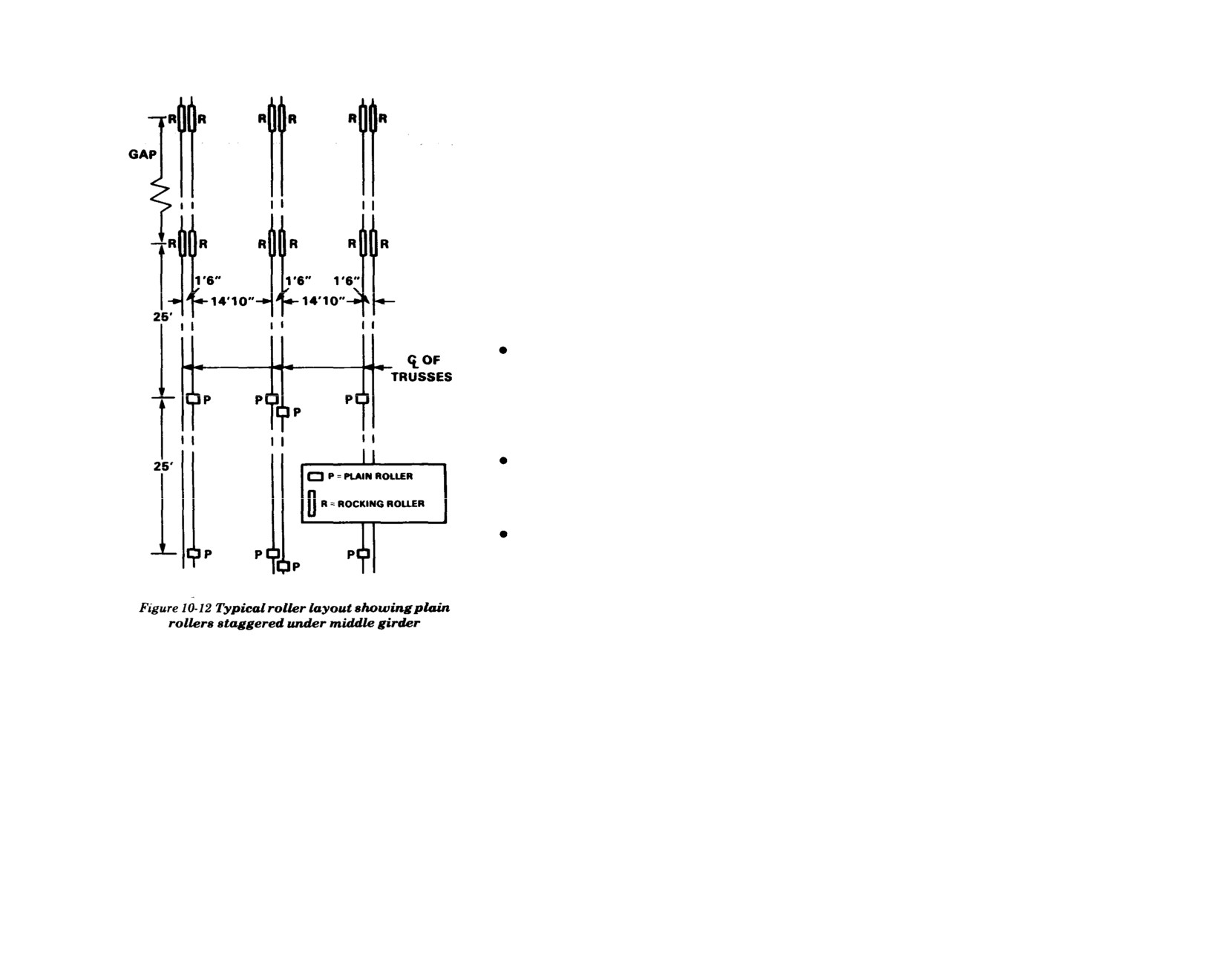
These plain rollers must be staggered to
double-single/double-double bridge
as
lane bridge is slightly more than twice as
provide clearance between them (Figure 10-
follows:
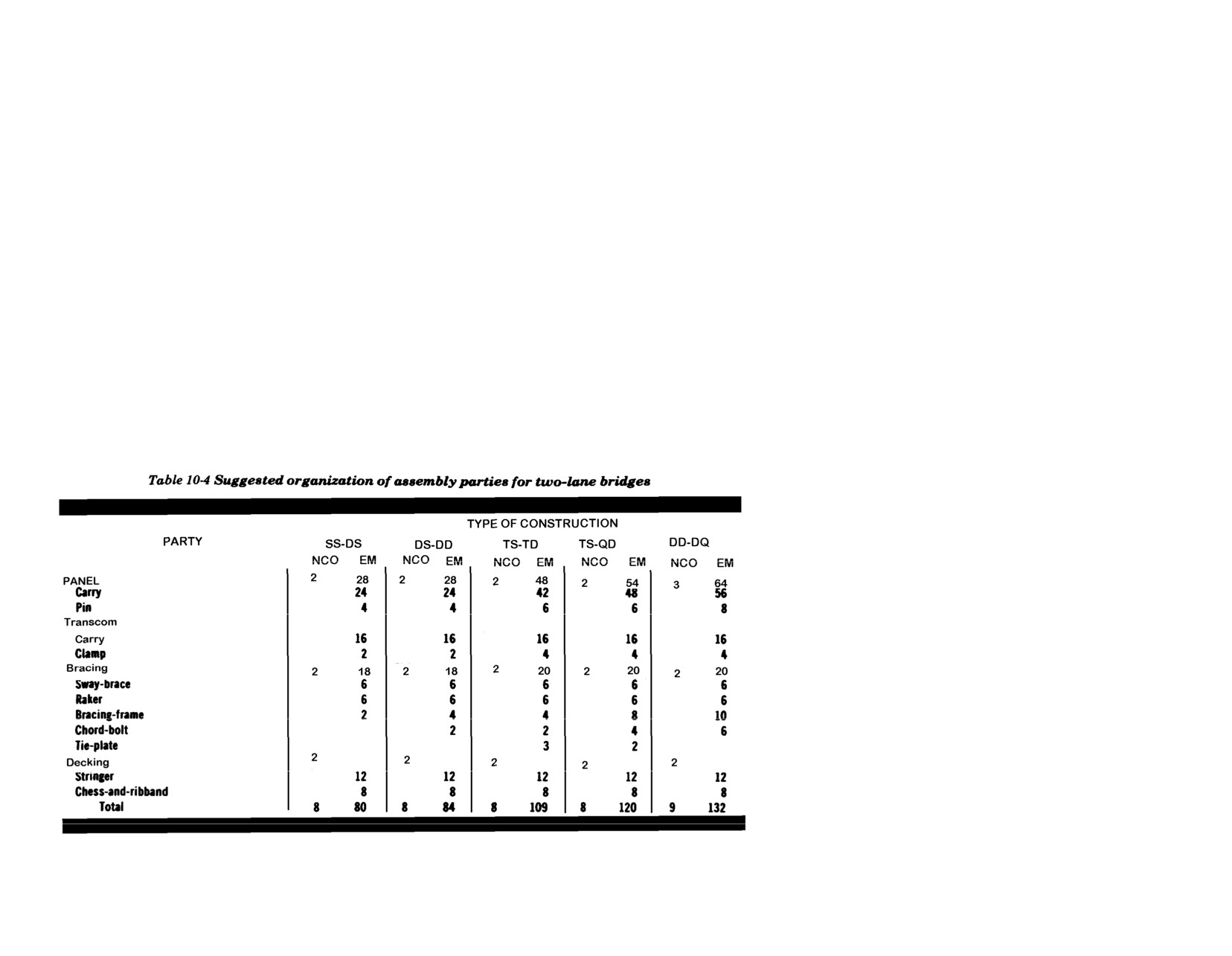
long. With a specially organized crew (Table
12). Chapter 5 describes the method of using a
10-4), assembly time for a two-lane bridge is
transom to position bearings for rocking
1
Assemble one lane of launching nose
slightly less than twice the assembly time for
rollers. Rocking rollers are used on the far
with sway bracing in every bay, using
a single-lane bridge. Unloading and security
bank for all bridges except
single-single/
launching links if necessary. Place one
details are the same as for a single-lane
double-single,
where plain rollers may be
transom behind forward upright of panel
bridge.
used.
in first bay and one transom on front of
rear upright of panel at each joint. Fix
ROLLER LAYOUT
ASSEMBLY AND LAUNCHING
rakers at each joint.
Figures 10-2 to 10-7 show lateral spacing of
Methods of assembling and launching the
rocking rollers for various types of bridge
two-lane bridge are the same for both the
2
Add third truss for other lane, using
assembly. Roller loads for outer girders are
single-lane assembly party and the organi-
launching links if necessary.
the same as for single-lane bridges. However,
zation given in Table 10-4.
since roller loads for the middle girder are
3
Place one transom of panel in first bay
about double, use enough plain rollers under
and one transom behind upright of panel
at each joint. Fix rakers at each joint.
4
Assemble bridge the same as for single-
lane bridge assembly, keeping panels in
one lane one bay ahead of panels in the
other lane. Attach all bracing frames as
for a single-lane bridge.
Assemble a
triple-single/triple-double,
a
triple-
single/quadruple-double,
and a
double-
double/quadruple-double
bridge the same as
for single-lane assembly, keeping panels in
one lane one bay ahead of panels in other
lane. For double- and triple-truss middle
girders, attach bracing frames, tie plates,
and rakers as in single-lane bridge assembly.
When middle girder is quadruple-truss as-
sembly, do not use tie plates between center
trusses; use full number of bracing frames
and rakers (Figures 10-2 to 10-7).
122
FM 5-277
Launching
REINFORCED TWO-LANE BRIDGES
Table 10-3 gives the launching weight for
Two-lane bridges are reinforced by adding
each type of assembly. The lighter bridges
trusses or stones using the same methods as
listed in the table can be launched by single-
for single-lane bridges. Normally, reinforce-
lane launching methods. For heavier bridges,
ment for only one lane is necessary. For
use vehicles with winches to aid in launching.
capacity greater than class 70, the deck
To keep the balance point of bridge and nose
system must be reinforced by using four
behind the near-shore rocking rollers, be
transoms per bay instead of two and by
careful not to overload rollers. Spans longer
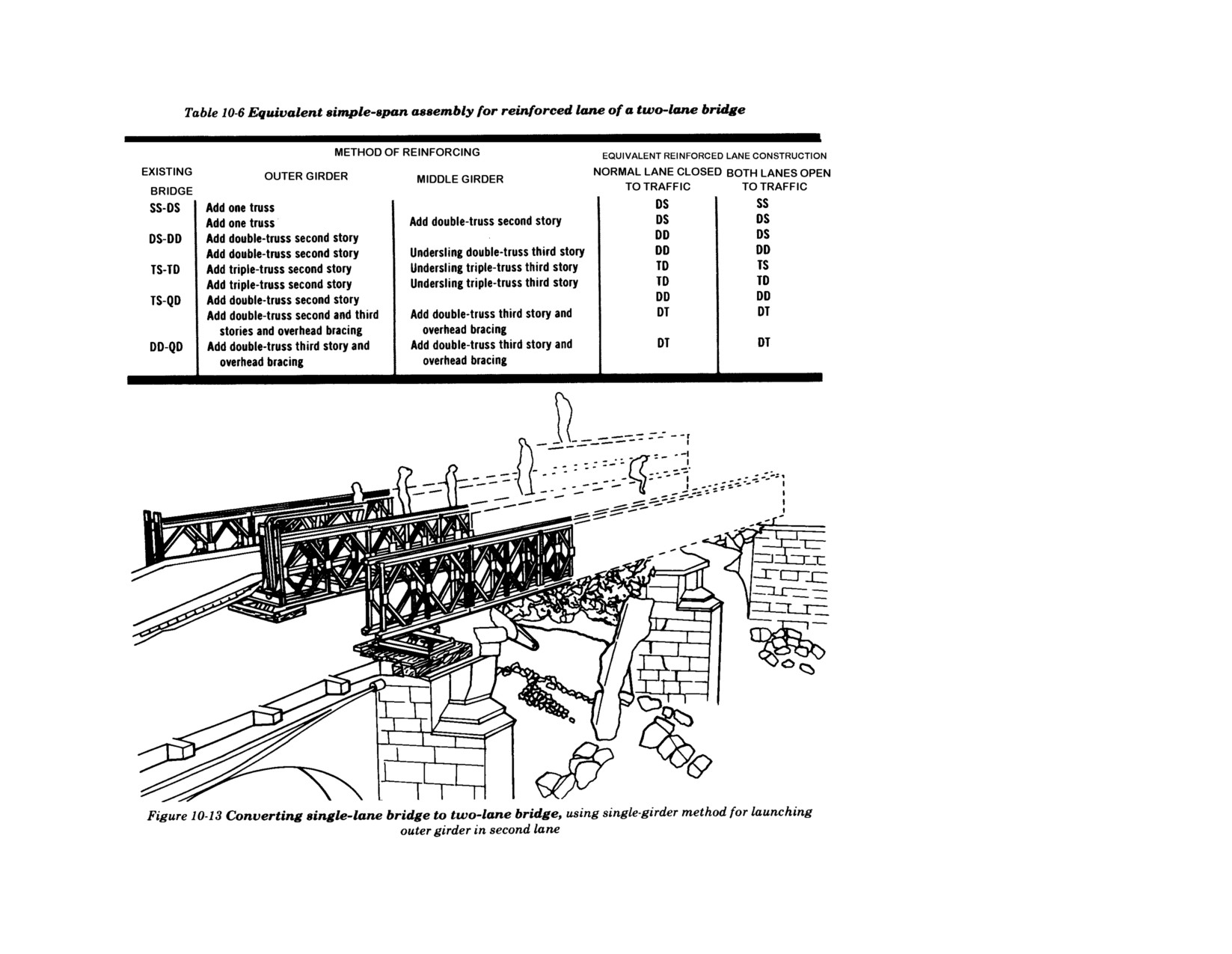
adding longitudinal wear treads. Table 10-6
than those listed in Table 10-2 can be
(page 125) gives the truss asssembly of
launched by—
reinforced two-lane bridges. Stories can be
added to the top of the existing girders or they
Skidding the bridge over greased timbers
can be underslung. However, when the middle
to give more bearing along the lower
girder is reinforced to triple-story, the panels
chord of the girders. The bridge load,
must be underslung unless the reinforced
however, must not exceed the crushing
outer girder is also triple-story; otherwise,
strength of the timber.
overhead bracing cannot be installed.
Launching the bridge in skeleton form so
Reinforcing one outer girder
the allowable load on the rollers is not
One lane of a two-lane bridge can be rein-
exceeded.
forced by reinforcing one outer girder. How-
ever, the reinforced lane has the capacity of a
Using a special rocking distributing beam
single-lane bridge of the same assembly as
for mounting two rocking rollers in line
the reinforced outer girder only when the
under each truss.
normal lane is closed to traffic.
Jacking
Reinforcing one outer girder
Jacking of a single-span two-lane bridge is
and middle girder
done the same as for a single-lane bridge. For
When both the outer and middle girders are
Assemble a
double-triple/quadruple-triple
jacking bridges on piers, see Chapter 16.
reinforced, the reinforced lane has the same
bridge the same as a
double-double/quad-
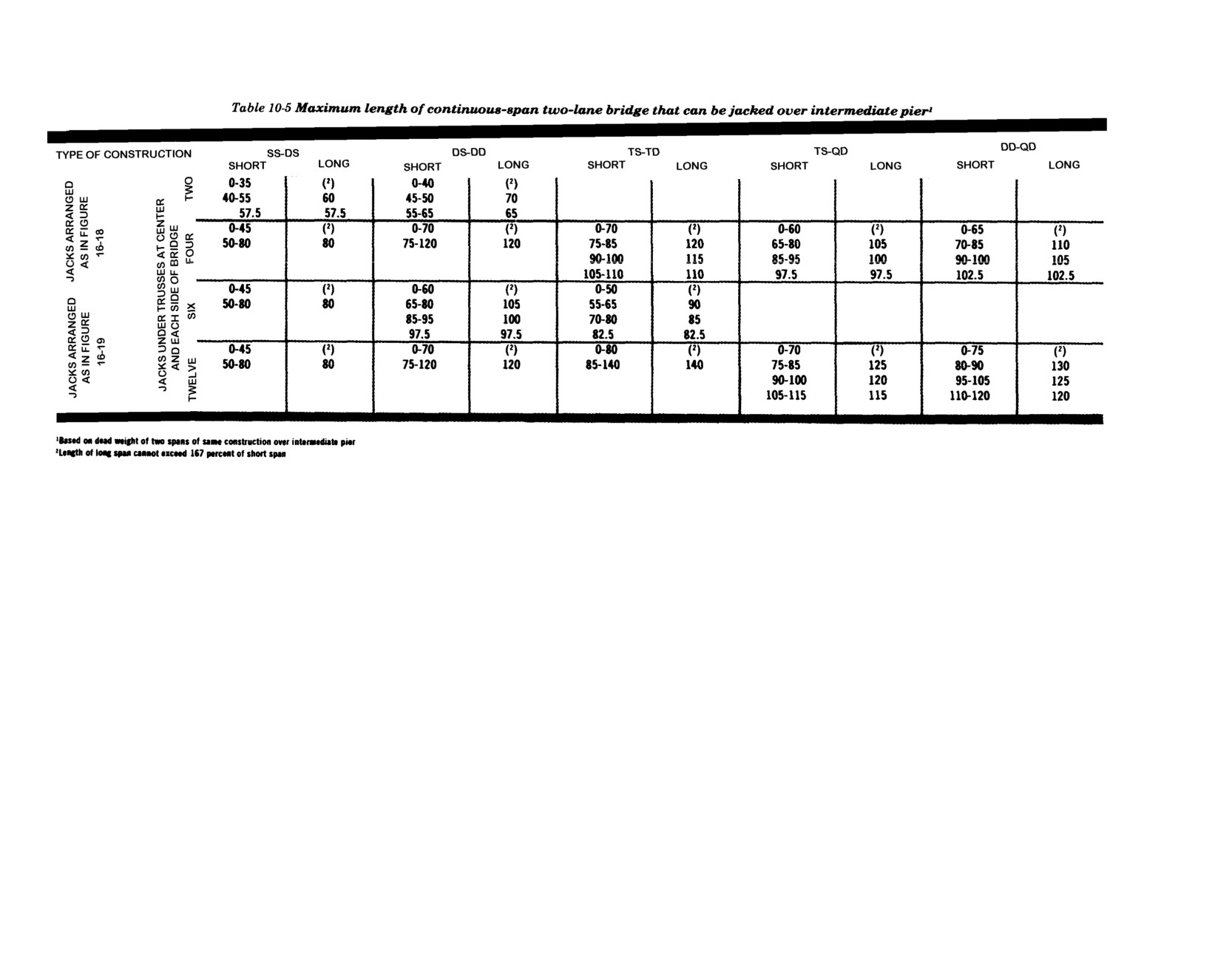
Table 10-5 (page 124) gives maximum lengths
capacity as a single-lane bridge of the same
ruple-double
bridge. However, when using
of adjacent spans of continuous-span two-
assembly, without closing the normal lane to
overhead bracing supports in both lanes,
lane bridges that can be jacked over inter-
traffic.
make sure female panel lugs in one lane face
mediate piers with jacks arranged as shown
in opposite direction to female lugs in other
in Figures 16-18 and 16-19.
lane. This prevents interference between over-
lapping transoms.
123
FM 5-277
CONVERSION OF SINGLE-LANE
2
Prepare new bank seats and position
4
Position bearings for bridge in its new
BRIDGES TO TWO-LANE BRIDGES
grillage. The center grillage must be twice
location. Bearings are placed under orig-
A single-lane bridge can be converted to a
the width of the outer grillage.
inal end span or extra span, depending on
two-lane bridge without closing the bridge to
bank conditions. Jack bridge onto
traffic for along period. If a two-lane bridge is
3
Jack bridge down on the transoms resting
bearings.
to be centered on an old bridge centerline,
on the rollers, and move bridge sideways
proceed as follows
to new position.
5
Place ramps and open single lane of
bridge to traffic (Figure 10-13).
1
Remove approach ramps on each bank
Note: Launching nose for
triple-
and jack bridge up. Lay transom on three
single/triple-double, triple-single/quad-
6
Position rollers for third girder and launch
plain rollers on each bank perpendicular
ruple-double,
and the remainder of
double-
by single-girder method (Figure 10-13).
to bridge centerline, so raker lugs come
double/quadruple-double
bridges is sim-
See Chapter 19 for launching by single
directly under space between girders of
ilar, with extra transom and two bays of
girders. The third girder can also be
end bays. Add extra bays to the bridge
double-single/quadruple-single
assembly
launched by using a truck crane on deck
where insufficient working space on bank
omitted.
of existing bridge.
is available, before placing transoms.
124
FM 5-277
7
Connect third girder to rest of bridge with
transoms. If available, use a truck crane
to place transoms. If a truck crane is not
available or if sag is great, add second
story to middle girder before connecting
third girder with transoms.
8
Add second story to middle girder.
9
Deck second lane.
If the existing bridge is to remain in position,
proceed as follows:
1
Jack bridge up and double grillage area
under center girder. Jack bridge down. If
bridge is to be lengthened, add extra bays
and locate bearings and grillage in new
position.
2
Proceed as for two-lane bridge.
Note:
Single lane is open to traffic during
construction.
125
FM 5-277
127
FM 5-277
CHAPTER 11
EXTRA-WIDENED BAILEY BRIDGE M3
COMPONENT PARTS 130
ASSEMBLY AND LAUNCHING OF SINGLE-STORY BRIDGES 132
ASSEMBLY AND LAUNCHING OF DOUBLE-STORY BRIDGES 135
ASSEMBLY AND LAUNCHING OF TRIPLE-STORY BRIDGES 136
GRILLAGES AND RAMP SUPPORTS 136
The introduction of wider vehicles prompted
the development of the extra-widened Bailey
bridge M3. The US Army does not stock the
M3 Bailey bridge. It is a standard bridge in
the United Kingdom. This bridge has a 13-
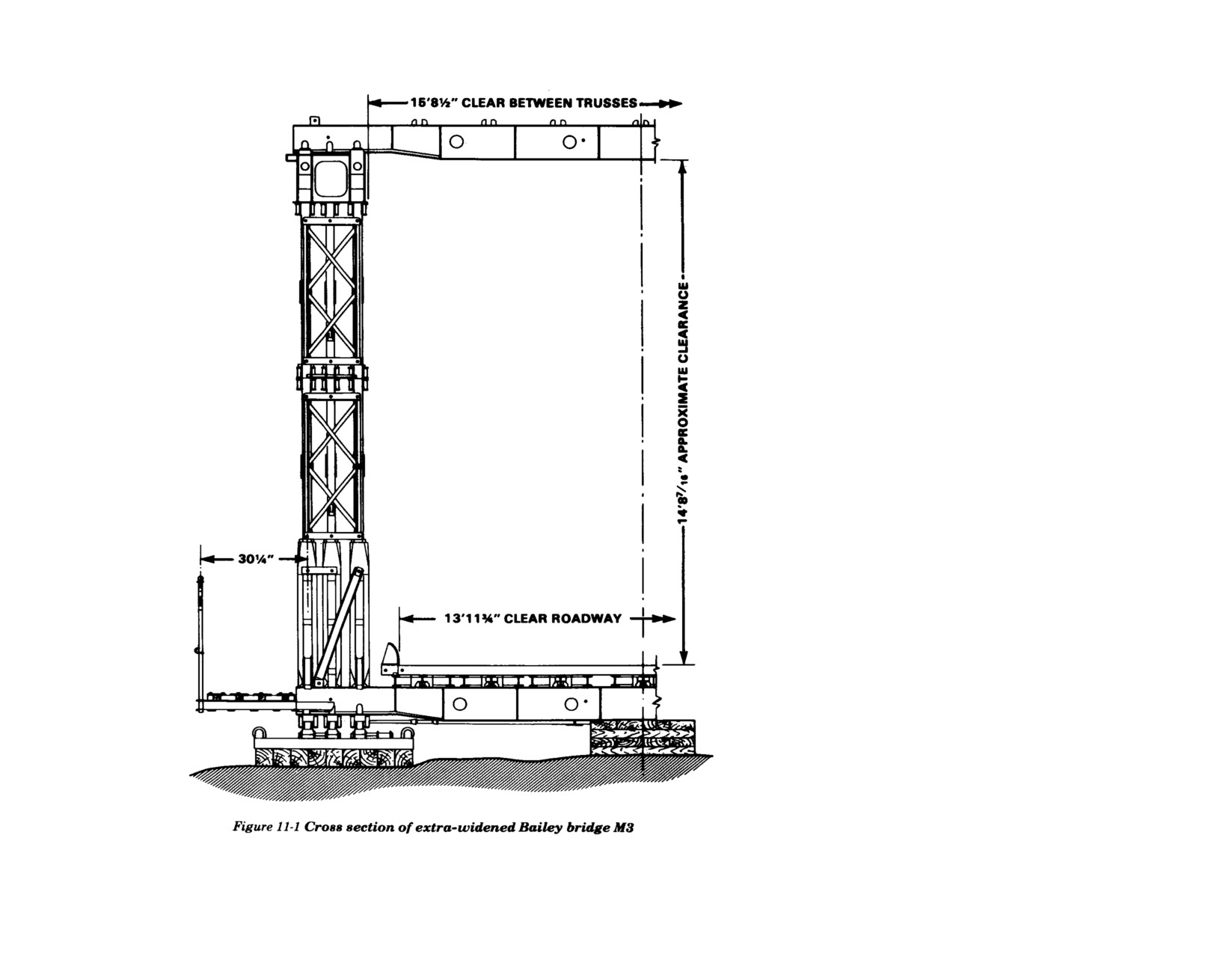
foot 11¾-inch (4.3 meters) clear roadway and
a clear distance between trusses of 15 feet 81/2
inches (4.8 meters), as shown in Figure 11-1.
This added width requires certain new parts
that are not contained in the M2 bridge set.
The most important of these are a long
transom, more stringers, long chess, sway
braces, and bracing frames. The bridge nor-
mally is assembled for either class 30 or class
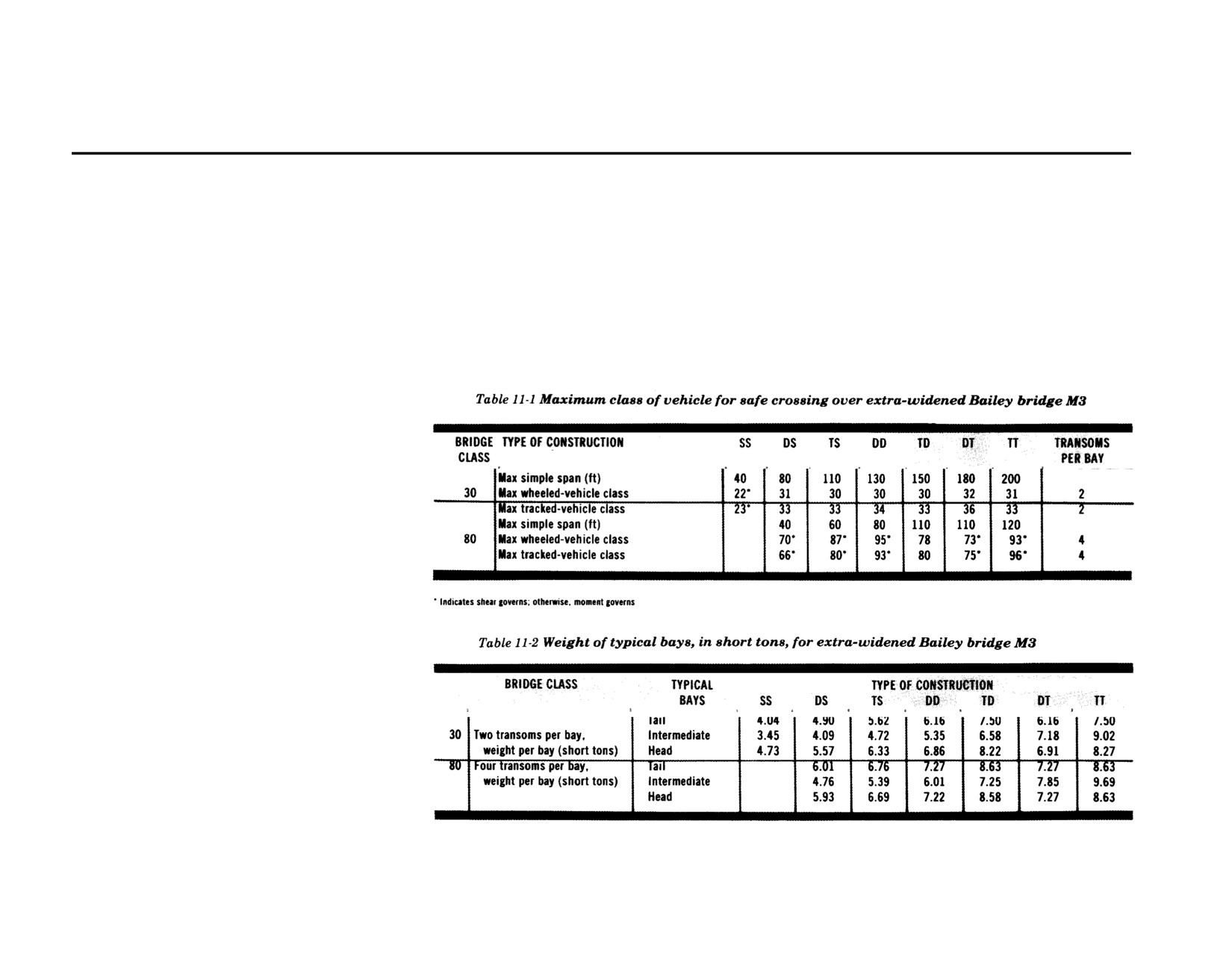
80 loads. The maximum spans for each type
of assembly at these classes are given in
Table 11-1. The weight, in short tons, per
typical bay for each type of assembly, class,
and span is given in Table 11-2.
128
FM 5-277
129
FM 5-277
COMPONENT PARTS
TRANSOM
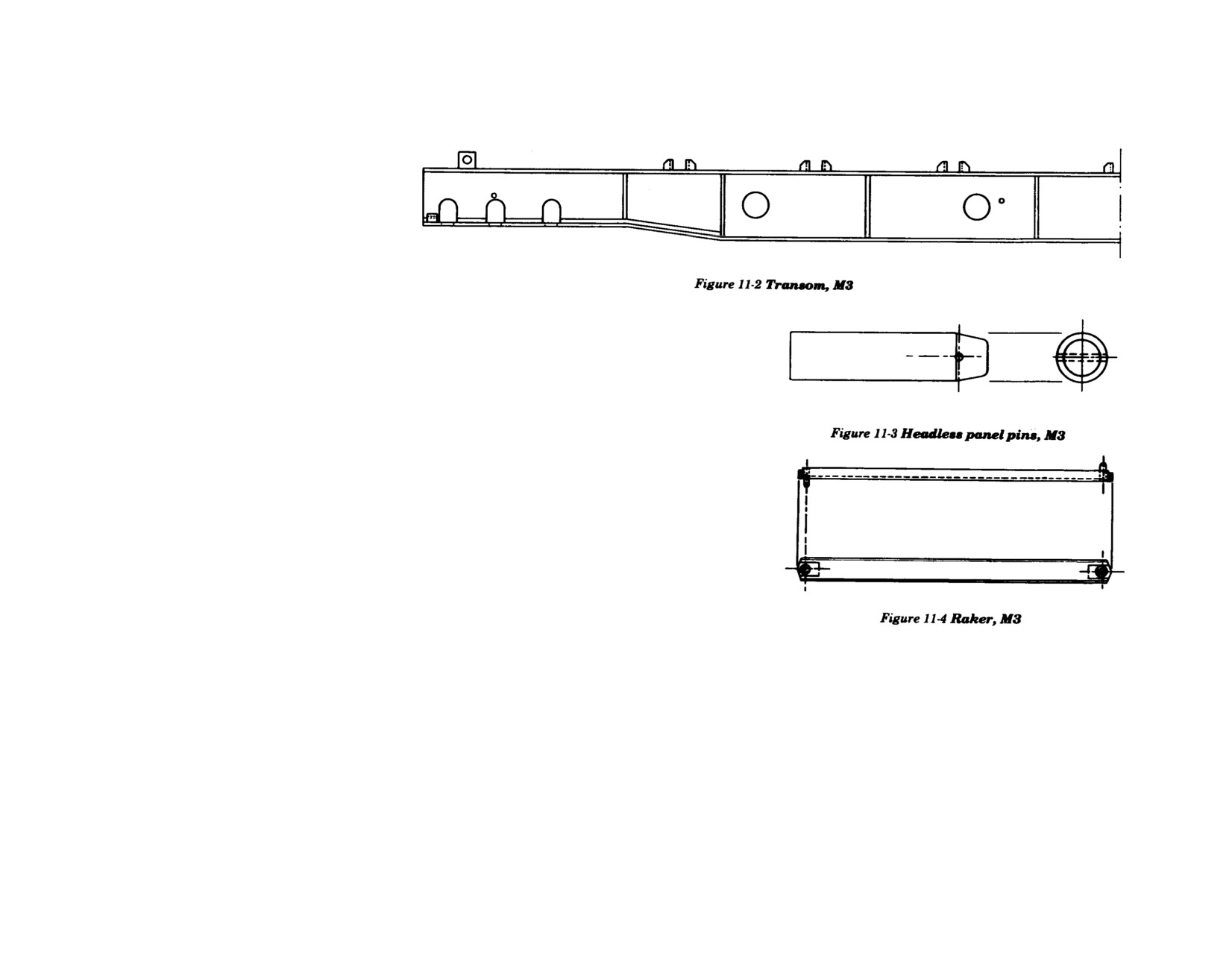
The transom is a 12-inch (29.4 centimeters)
I-beam, 19 feet 11 inches (6.1 meters) long,
tapered at the ends to 10 inches (24.5 centi-
meters) as shown in Figure 11-2. Two tran-
soms per bay are used for class 30 bridges and
four transoms per bay are used for class 80.
CHESS
The chess are 15 feet (4.6 meters) long, 8¾
inches (21.4 centimeters) wide, and 3 5/8 inches
bridge. These are 10 feet 11¼ inches (3.4
(8.9 centimeters) deep. Thirteen chess are
meters) long.
required for each bay of the bridge except the
head bay, which requires 14. The latter is for
END POSTS
class 80 only.
The male and female end posts are the same
as those used in the M2 bridge except that in
STRINGERS
tripe-truss bridges the male end posts for the
The plain and button stringers are the same
middle truss of both class 30 and class 80
as those used in the M2 bridge, except that
bridges above the transom bracket removed.
the length of the head bay for class 80 bridges
This permits rakers to be connected between
requires two long button stringers, M3, and
the end posts on the inner trusses and the
two plain stringers, M3. These stringers are
transom. Use female end posts, M3, only on
10 feet 11½ inches (3.2 meters) long. They are
the middle truss of the end bay of class 80
used in the class 80 bridge only and not in the
bridges.
class 30 bridge.
HEADLESS PANEL PIN
TRANSOM CLAMP
Headless panel pins are used on triple-truss
The transom clamp is the same as that used
assembly to connect the end posts, M3, to the
in the M2 bridge except that the width across
middle trusses. They enable the end posts to
M3. It is a 3-inch (7.4 centimeters) channel, 3
the top has been reduced slightly to prevent
be fitted after the launching nose has been
feet 8 5/16 inches (1.1 meters) long, as shown in
the arm from interfering with the vertical
removed and allow damaged end posts to be
Figure 11-4.
bracing frame used in the bottom story of
replaced. These panel pins, M3, are similar to
triple-truss bridges.
those in the M2 bridge except the head is
RIBBLT BOLT
removed (Figure 11-3).
A ribband bolt, M3, is used as shown in
RIBBANDS
Figure 11-5.
The ribbands are the same as those in the M2
RAKER
bridge, except that two long ribbands, M3,
A new type of raker, M3, has been developed
are required in the head bay of the class 80
for use with the extra-widened Bailey bridge,
130
FM 5-277
BRACING FRAME
The bracing frame, M3, has an additional
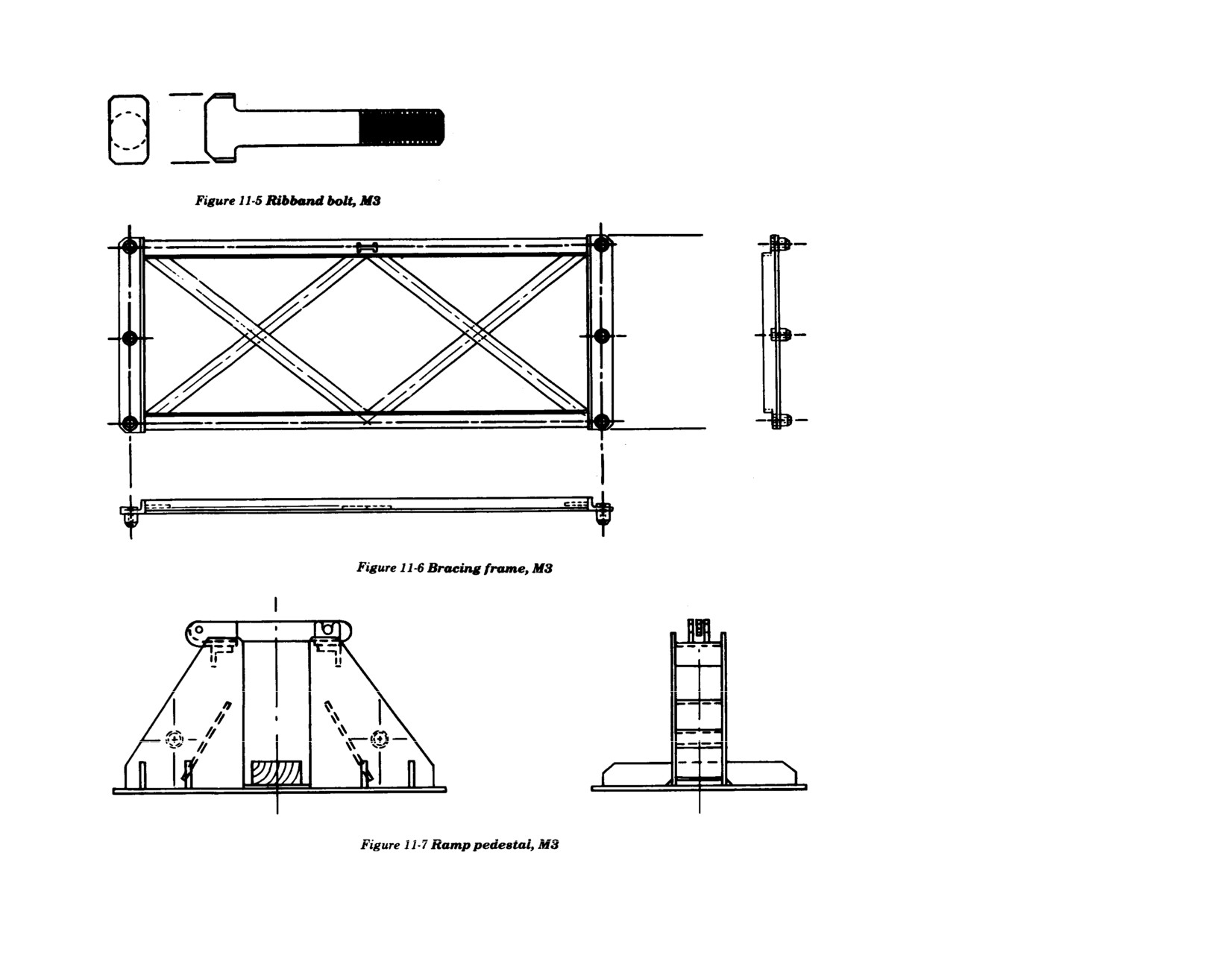
pair of dowels, as shown in Figure 11-6, to
accommodate the bracing bolts connecting it
to the middle truss of a triple-truss bridge.
SWAY BRACE
The sway brace, M3, is similar to that in the
M2 bridge, but is 18 feet 1/8 inches (5.3 meters)
between centers of eyes with the turnbuckle
screwed tight.
OVERHEAD SWAY-
BRACE EXTENSION
The overhead sway-brace extension has an
eye at one end and a jaw at the other. It is
connected to the sway brace, M3, for use in
the overhead bracing of intermediate bays of
triple-story bridges.
RAMP PEDESTAL
The ramp pedestal, M3, is used to support the
deeper (12-inch) (29.4 centimeters) portion of
the M3 transom. It is similar to the pedestal
used in the M2 bridge, but is deeper and has a
wider space for the transom (Figure 11-7).
131
FM 5-277
ASSEMBLY AND LAUNCHING OF SINGLE-STORY BRIDGES
METHOD
The method of assembling and launching
single-story M3 bridges is the same as that
for the M2 bridge except for roller layout,
launching nose, triple-truss assembly, and
class 80 decking. The number of parts re-
quired per bay is given in Tables A-9 and
A-10, Appendix A, for class 30 and class 80
bridges.
ROLLER LAYOUT
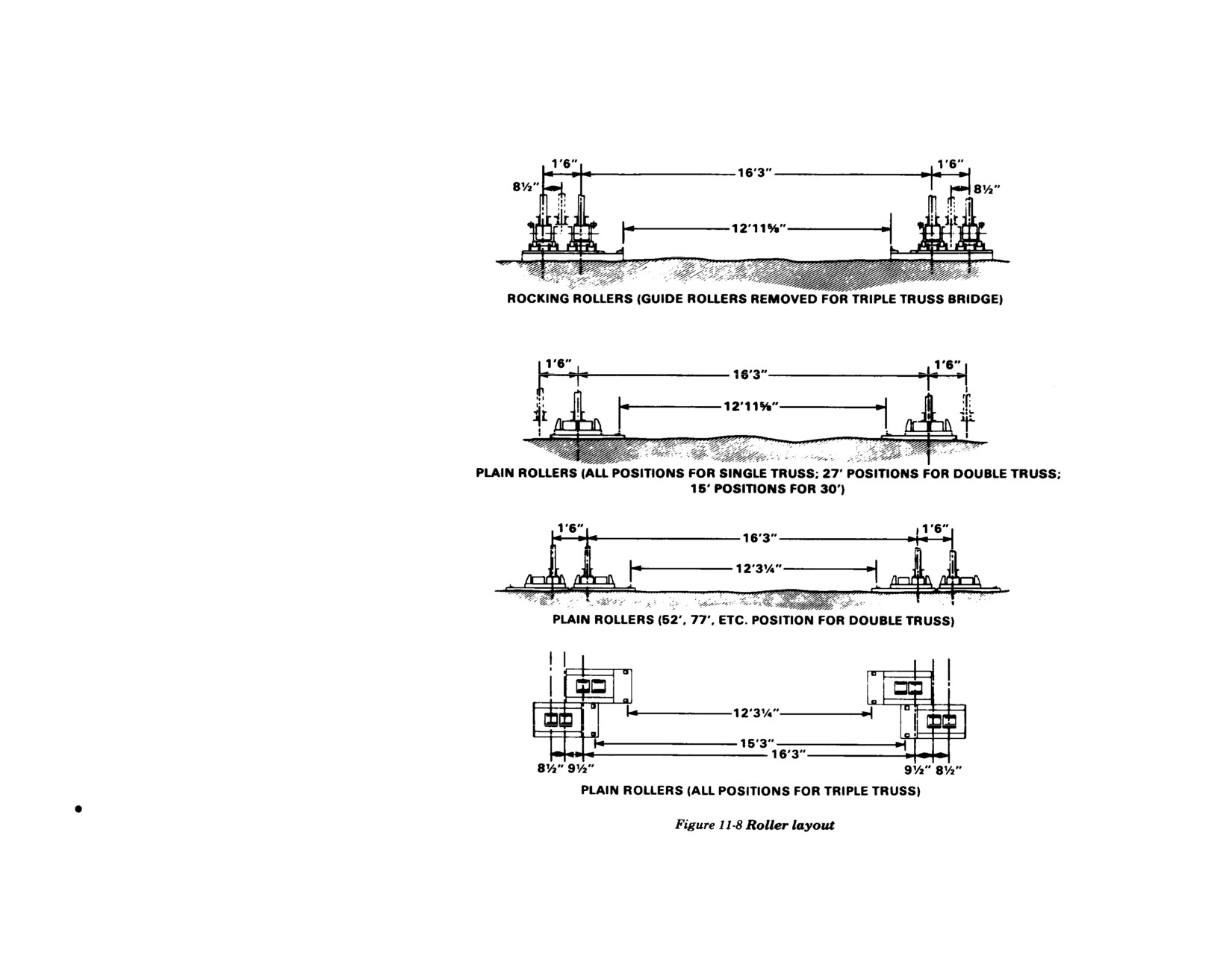
The lateral spacing of rollers is shown in
Figure 11-8. The rollers must be staggered for
triple-truss assembly. There is no suitable
bridge part to use as a distance gage, and the
roller templates must be positioned by means
of steel tape or improvised gage.
For 30- and 40-foot (9.2 and 12.3 meters)
bridges, place a plain roller 15 feet (4.6 meters)
from the rocking roller. On longer spans,
space plain rollers at 27 feet (8.3 meters) and
up, in increments of 25 feet (7.7 meters);
consequently, the longitudinal spacing of
plain rollers is normally at 27 feet (8.3 meters),
52 feet (23.3 meters), 77 feet (23.7 meters), and
so forth.
LAUNCHING NOSE
Information on launching weights and
launching nose assemblies for various types
of class 30 and class 80 bridges is given in
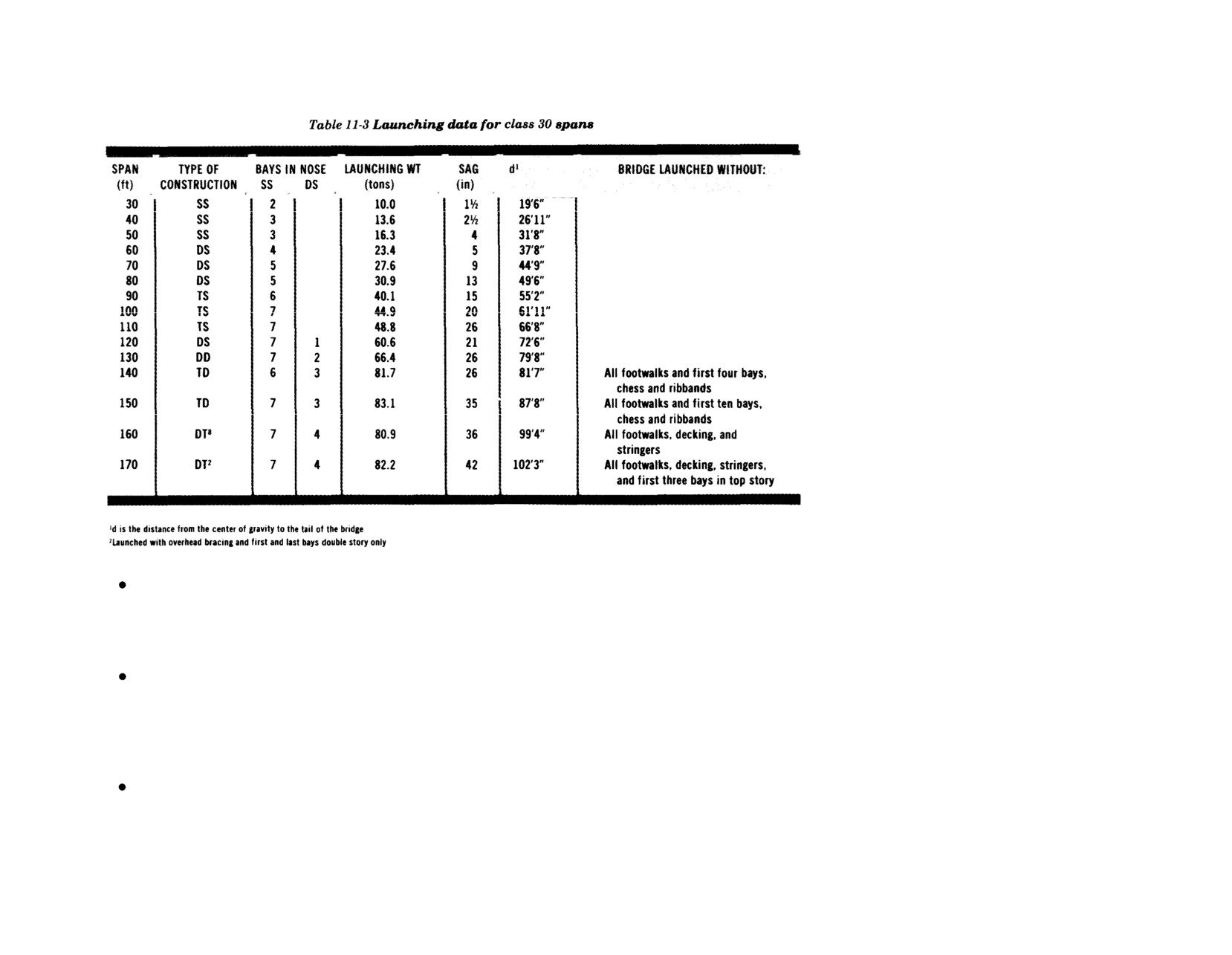
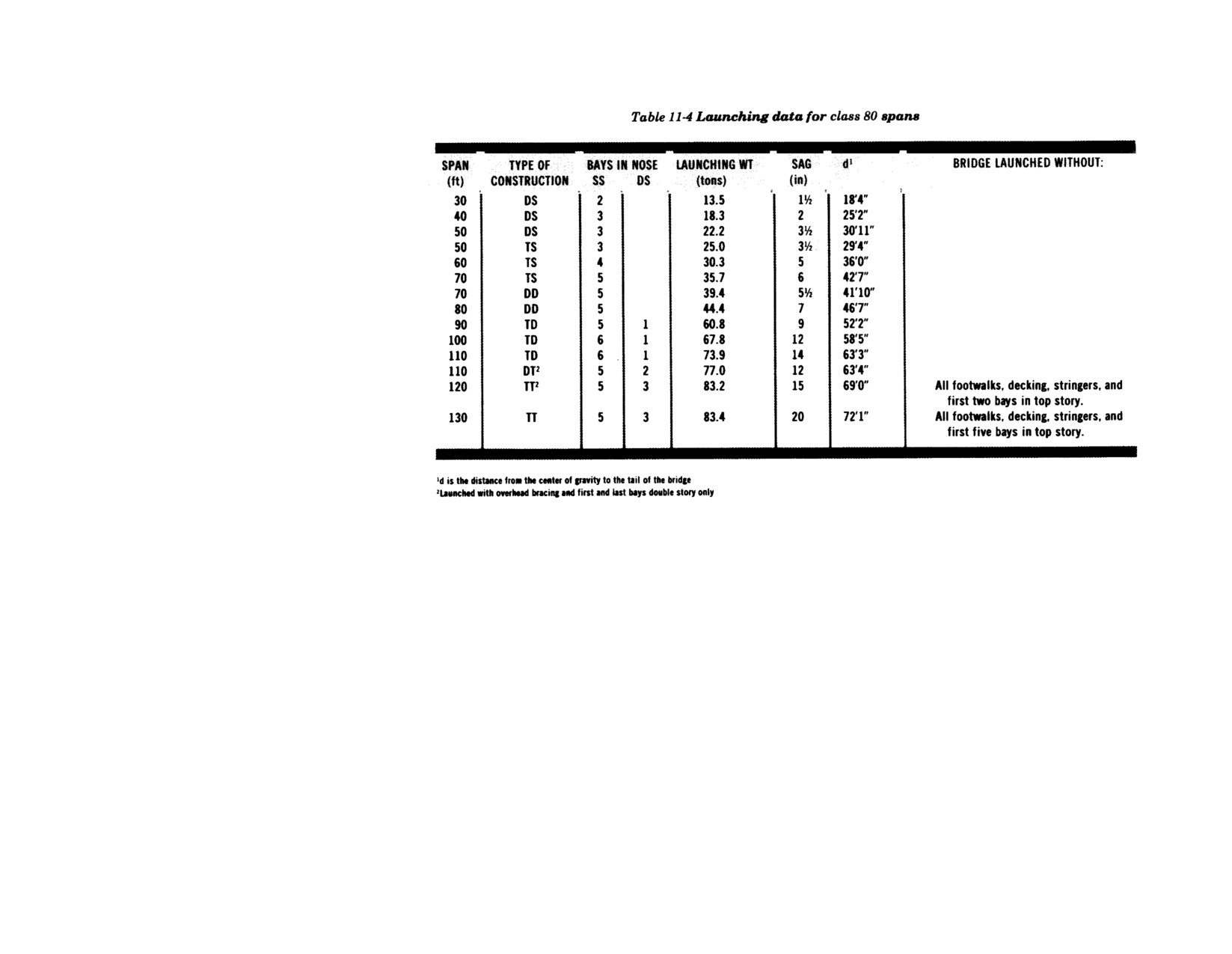
Tables 11-3 and 11-4 (page 134).
Note the following:
The bridge is launched complete with
decking and footwalks, except where
shown.
132
FM 5-277
2
Place a transom through these panels in
front of the center vertical, and connect
the long arms of the sway braces to the
front ends of the panels.
3
Assemble two panels for the middle
trusses, and connect them to the transom
clamps.
4
Assemble two panels for the outer trusses,
and connect them to the transom clamps.
5
Pass a second transom through all three
trusses of the first bay behind the front
vertical, and a third transom in front of
the rear vertical. Connect the panels to
the transom with transom clamps.
6
Connect the short arms of the sway braces
to the rear position, and fit bracing frames
in the first bay on the top chords.
7
Fit bracing frames in front of the front
For the class 80 double- or triple-truss
TRIPLE-SINGLE ASSEMBLY
verticals and behind the rear verticals.
bridge, two rocking rollers are needed
After assembly of the skeleton launching
The front bracing frames are removed
under each side, including the far bank
nose, assemble the bridge trusses in echelon,
before the end posts are fitted.
for the launching nose.
with each outer truss always having one
panel more than the adjacent truss. It is not
8
Tighten transom clamps and sway braces.
Use launching links not more than 40 feet
possible to add a third truss to a double-truss
Place stringers and decking.
behind the end of the
single-single
portion
bridge.
of the nose, and not more than 20 feet
Assemble the second bay of the bridge as
behind the end of the
double-single
portion
Assemble the first bay of the bridge as
follows:
of the nose.
follows:
1
Place two panels for the outer trusses and
Due to the greater width of the bridge, set
1
Connect the first two inner-truss panels
connect them with pins driven inward.
one transom with two rakers in each bay
to the inner trusses of the launching nose,
Drive outward all further pins on all
of the nose, and also set sway braces in
driving the panel pins outward.
trusses.
each bay.
133
FM 5-277
2
Place two panels for the outer trusses of
the third bay, and connect them with pins
driven outward.
3
Place two panels for the middle trusses in
the second bay, using headless panel
pins.
4
Connect two additional panels in bays
four, three, and two, driving the panel
pins outward.
5
Fit front end of sway brace in the second
bay.
6
Pass a transom through all trusses in the
second bay in front of the rear vertical,
and another in front of the center vertical.
Connect them with transom clamps.
7
Connect the sway braces to the rear
positions.
all bays, and the number of chess in the head
truss, and the rear transom to the panels
8
Fit the bracing frames on the top chords,
bay.
in the first and third trusses.
and behind the rear verticals of the second
bay.
CLASS 80 DECKING
3
Continue the stringers to the transoms on
The
triple-single
assembly procedure just
the end posts at each end. This makes the
9
Tighten transom clamps and sway braces.
given is based on class 30 decking. For class
head bay of decking an n-foot bay. To do
80 decking, the procedure is as follows:
this, lay the first bay of stringers with two
For subsequent bays, the sequence of as-
button stringers, M3, on the outside, then
sembly is similar to that described above.
1
Four transoms are required per bay. In
two plain stringers, M2, inside these, and
Make sure that each truss in each outer bay
both double- and triple-truss bridges, add
two plain stringers, M3, inside again, and
has one more panel than the truss in the next
the extra two transoms behind the center
one plain stringer, M2, in the center. In
inner bay.
and front verticals.
the last bay use three plain stringers, M3.
In all other bays use plain and button
For decking, the placing of stringers and
2
Fit transom clamps alternately on the
stringers, M2.
chess follows the same sequence as in the M2
center vertical. For example, clamp the
bridge, except for the number of stringers in
front transom to the panel in the second
134
FM 5-277
4
In the first bay use 14 chess and ribbands,
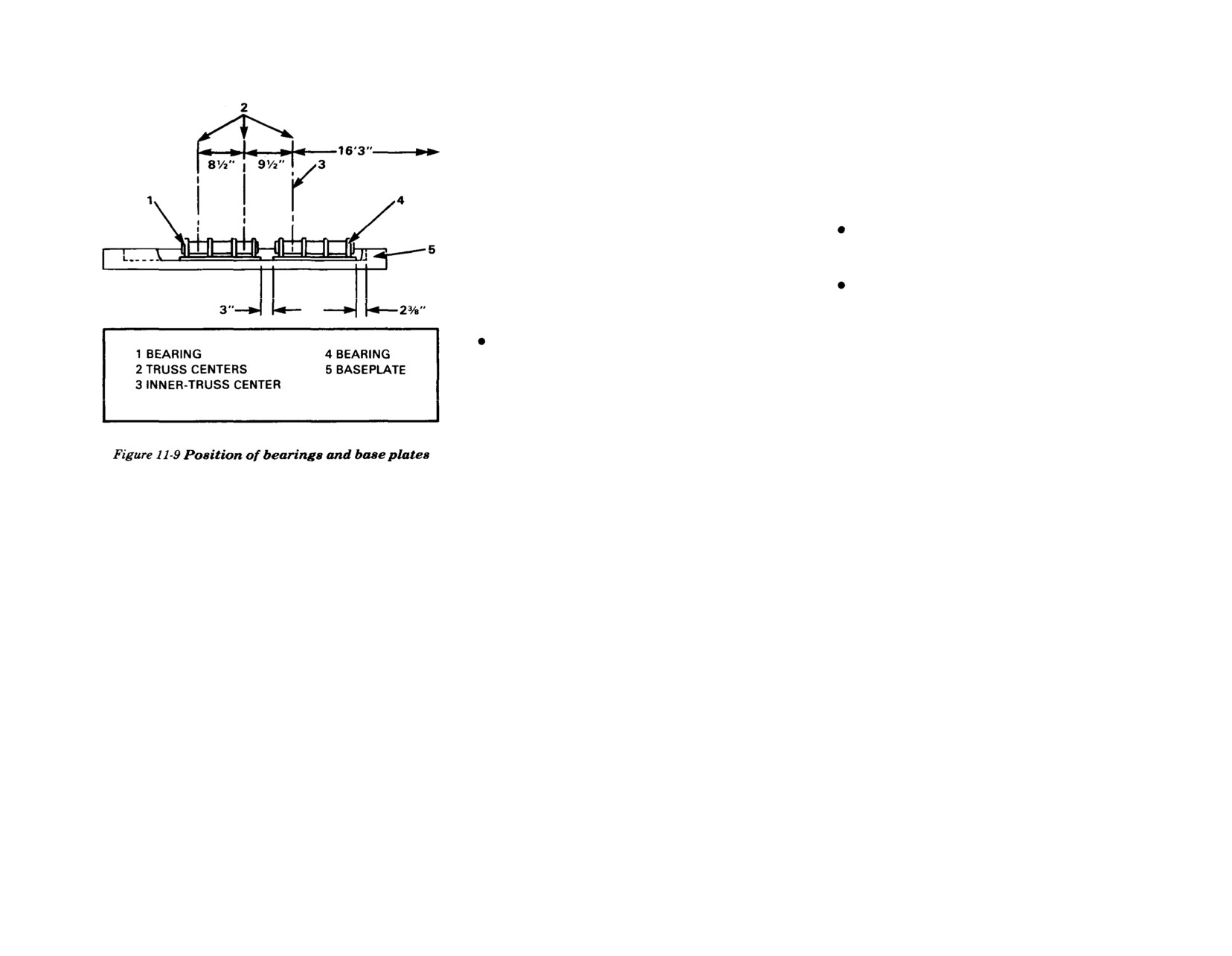
seating. The inner bearing carries the end
M3. Use M2 ribbands and 13 chess in
post of the inner truss on its outer seating,
other bays.
as shown in Figure 11-9.
END OF BRIDGE
Fit end posts, M3, to each end of the
Place the end posts, bearings, and base plates
second truss, using headless panel pins.
in the same way as the M2 bridge for single-
and double-truss bridges. Make the following
Fit rakers on inner end posts, and tie
changes on triple-truss bridges:
plates between end posts on second truss.
It is not possible in the class 30 bridge to
Place base plates as for double-truss
fit rakers at the tail end of the bridge
bridges. The outer bearing carries the end
because there is no transom on the end
posts of the second and third trusses on
posts.
the two seatings each side of the center
ASSEMBLY AND LAUNCHING OF DOUBLE-STORY BRIDGES
METHOD
SECOND-STORY,
Bay No. 2—Second panel
The method of assembling and launching a
TRIPLE-TRUSS BRIDGE
Bay No. l—Inner panel
double-story M3 bridge is the same as that for
For a second-story, triple-truss bridge, the
the M2 bridge, except for a few differences
assembly is the same as that for the M2
Bay No. 4—Outer panel
and the need to assemble the lower story.
bridge, but the sequence of adding panels
Bay No. 3—Second panel
must be the same as in
triple-single
assembly.
ROLLERS
It is not necessary to use headless pins,
Headless pins must be used on the end posts,
In addition to the pair of plain rollers required
provided the order of assembly is as follows:
M3, where they are connected to the lower
on each side of the bridge 50 feet (15.4 meters)
chords of the second truss of the second story.
behind the launching rollers, a pair is re-
Bay No. l—Outer panel
Tie plates are not required.
quired 75 feet (23.1 meters) behind them. For
Bay No. 2—Outer panel
bridges over 140 feet (43.1 meters), double
rollers are required at 125 feet (38.5 meters)
Bay No. l—Second panel
behind the launching rollers.
Bay No. 3—Outer panel
135
FM 5-277
ASSEMBLY AND LAUNCHING OF TRIPLE-STORY BRIDGES
METHOD
OVERHEAD BRACING
The method of assembling and launching a
for the lower story of a bridge with underslung The only difference from the assembly of the
triple-story bridge is the same as that for an
bottom story must be the same.
M2 bridge is that the overhead sway-brace
M2 bridge, except for several factors. For a
extensions are fitted to the sway braces before
triple-triple
bridge, the sequence of adding
LAUNCHING
they are connected to the overhead-bracing
panels in the top story must follow the order
For all class 30 bridges, launch the bridge
supports, which are reversed so that the
given for a second-story, triple-truss bridge
with the top story in place. For the class 80
sway-brace pinholes are on the outside of the
except that assembly begins in the second
bridge with a span of 120 feet (36.9 meters), it
girders.
bay. There are no panels in the top story of
is possible to launch the bridge as double
the first and last bays. Similarly, the sequence
story and add the third story afterwards.
GRILLAGES AND RAMP SUPPORTS
GRILLAGES
The same grillages as those for the M2 bridge
can be used. The maximum base plate re-
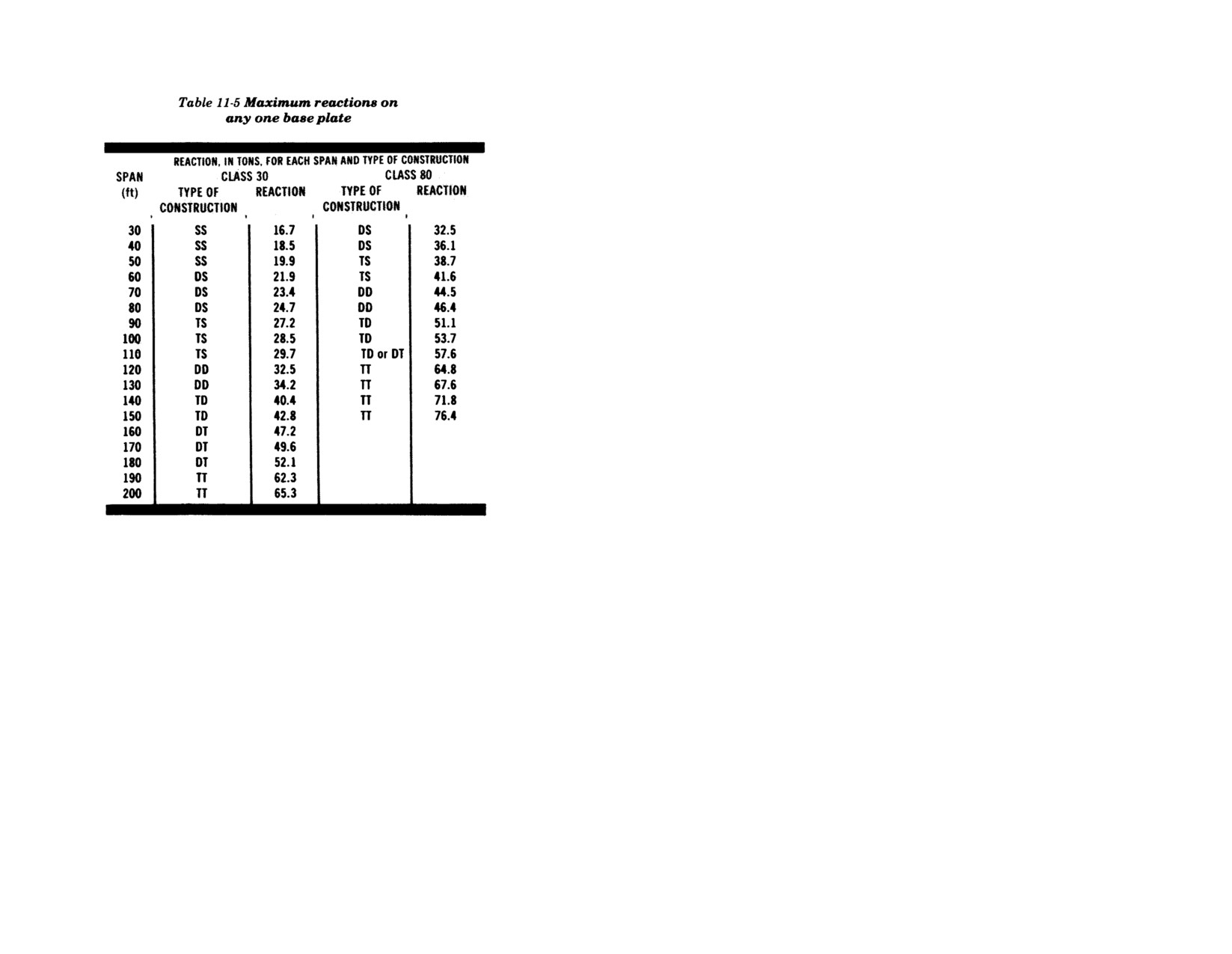
actions are given in Table 11-5 and the
maximum launching roller weights in Tables
11-3 and 11-4.
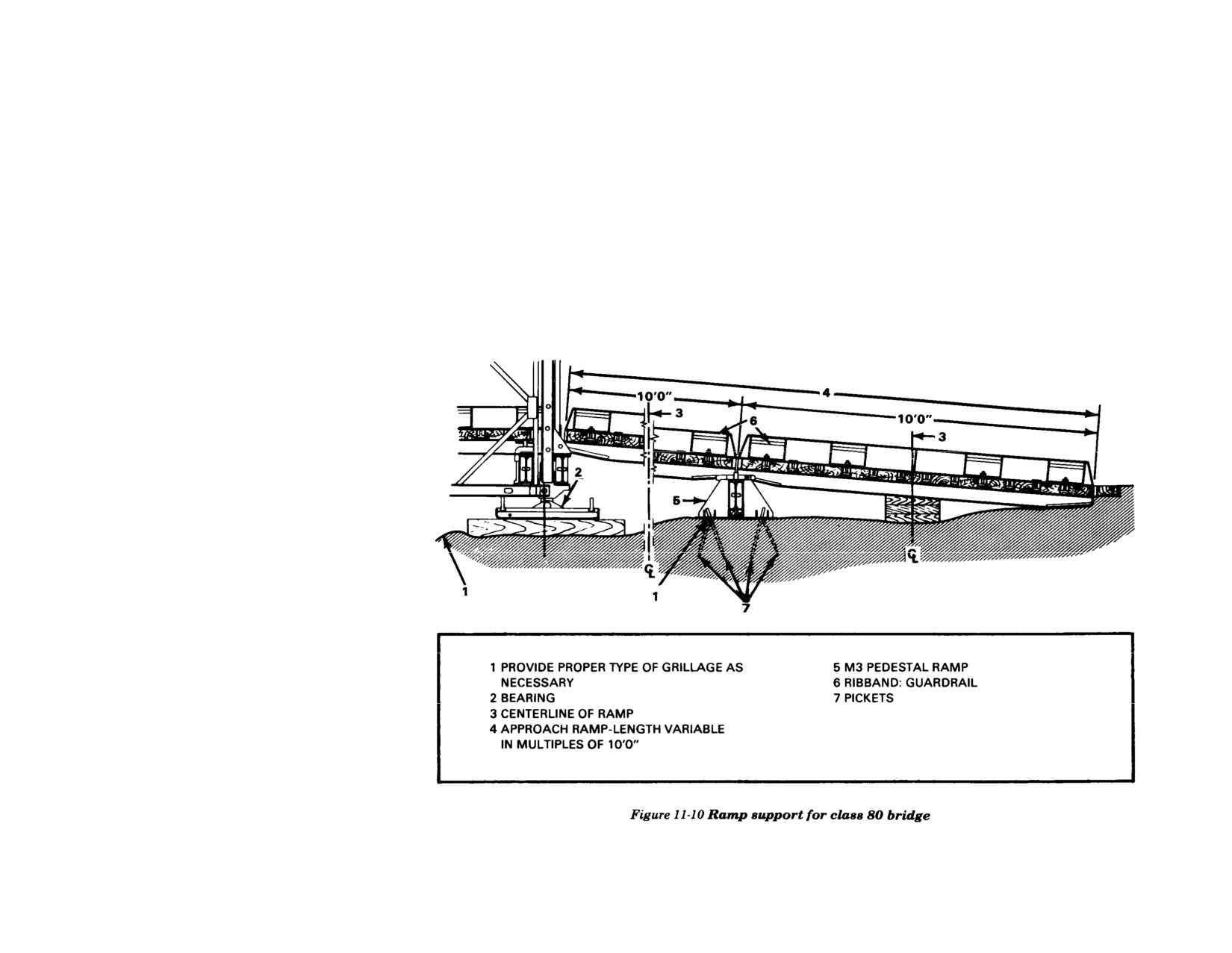
RAMP SUPPORTS
The end transoms of both class 30 and class
80 bridges must be supported at their mid-
point. For class 80 bridges, the ramps must be
supported as shown in Figure 11-10.
136
FM 5-277
137
FM 5-277
CHAPTER 12
DECK-TYPE BRIDGES
Deck-type panel bridges are normally two-
It must be lowered 5 feet (1.5 meters) onto
joint between the first and second bay
lane, class 50 or higher bridges assembled to
the bearings.
from each end. If the spans are broken at
replace single-lane bridges. A deck-type panel
the pier, fit the two ends with end posts. If
bridge has the following advantages over a
Waterway clearance is decreased.
the spans are continuous, use a distri-
through-type bridge
buting beam and rocker bearing (see
RECOMMENDED BRIDGE DESIGNS
Chapter 16).
Roadway can be wider for passage of
Use the following guidance in designing
extra-wide vehicles.
deck-type bridges:
CLASS
The capacity of the standard two-lane deck-
Deck-type assembly allows greater side
Group the trusses into three-truss girders,
type panel bridge varies with the span and
overhang of vehicles.
and space girders evenly under the road-
the number of traffic lanes loaded. The
way. The trusses may be single-or double-
bridges are given two class ratings, one for
A lighter decking system can be used
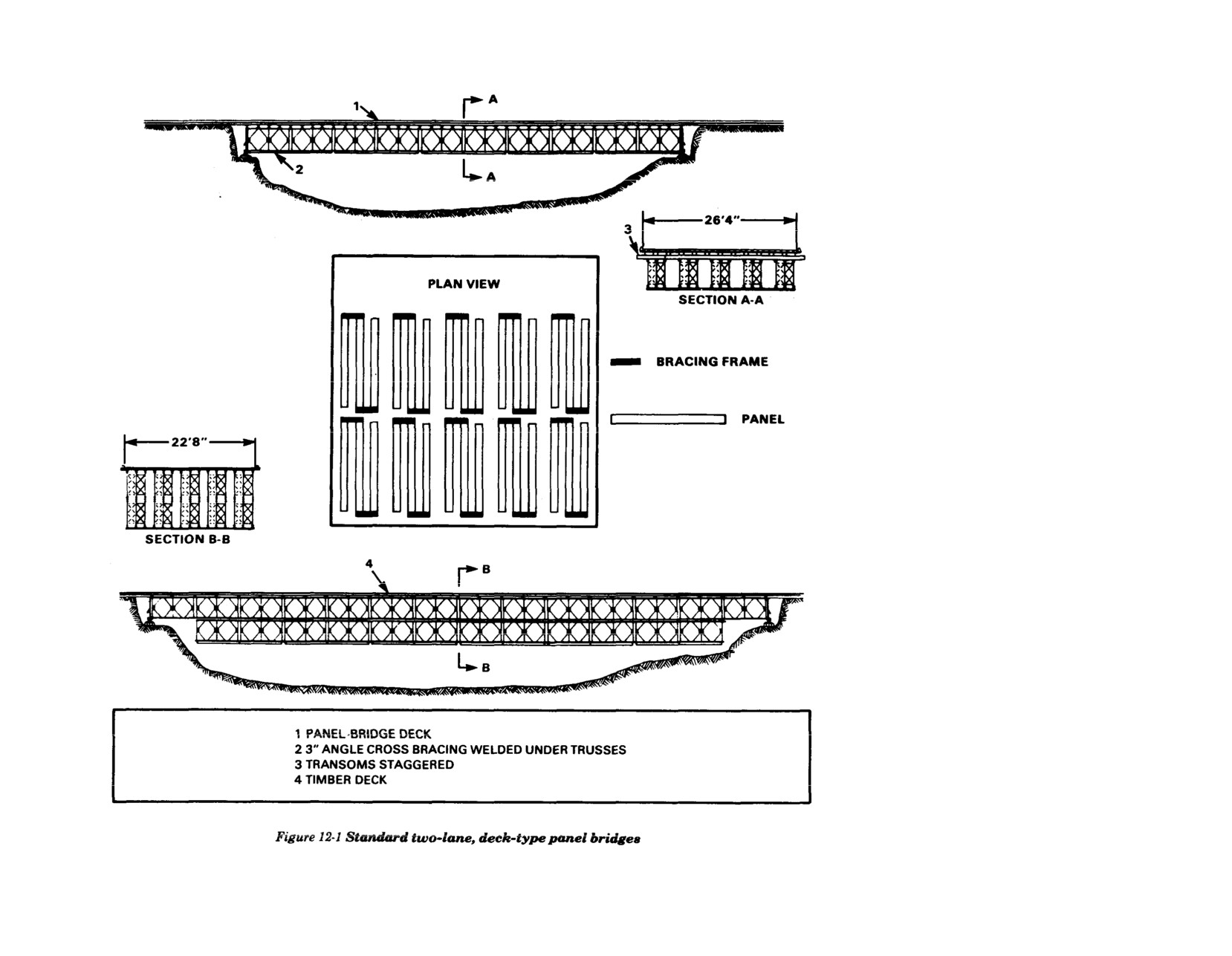
story assembly, as shown in Figure 12-1.
one-way traffic and the other for two-way
when the roadway is supported by trusses.
traffic. Each of these ratings may be either a
Use bracing frames staggered at opposite
single or a dual classification. For maximum
With some sloping banks, the span be-
ends of each bay (see Figure 12-1) to tie the
spans and classes of standard design two-
tween abutments is shorter than in a
trusses of each girder together. Every two
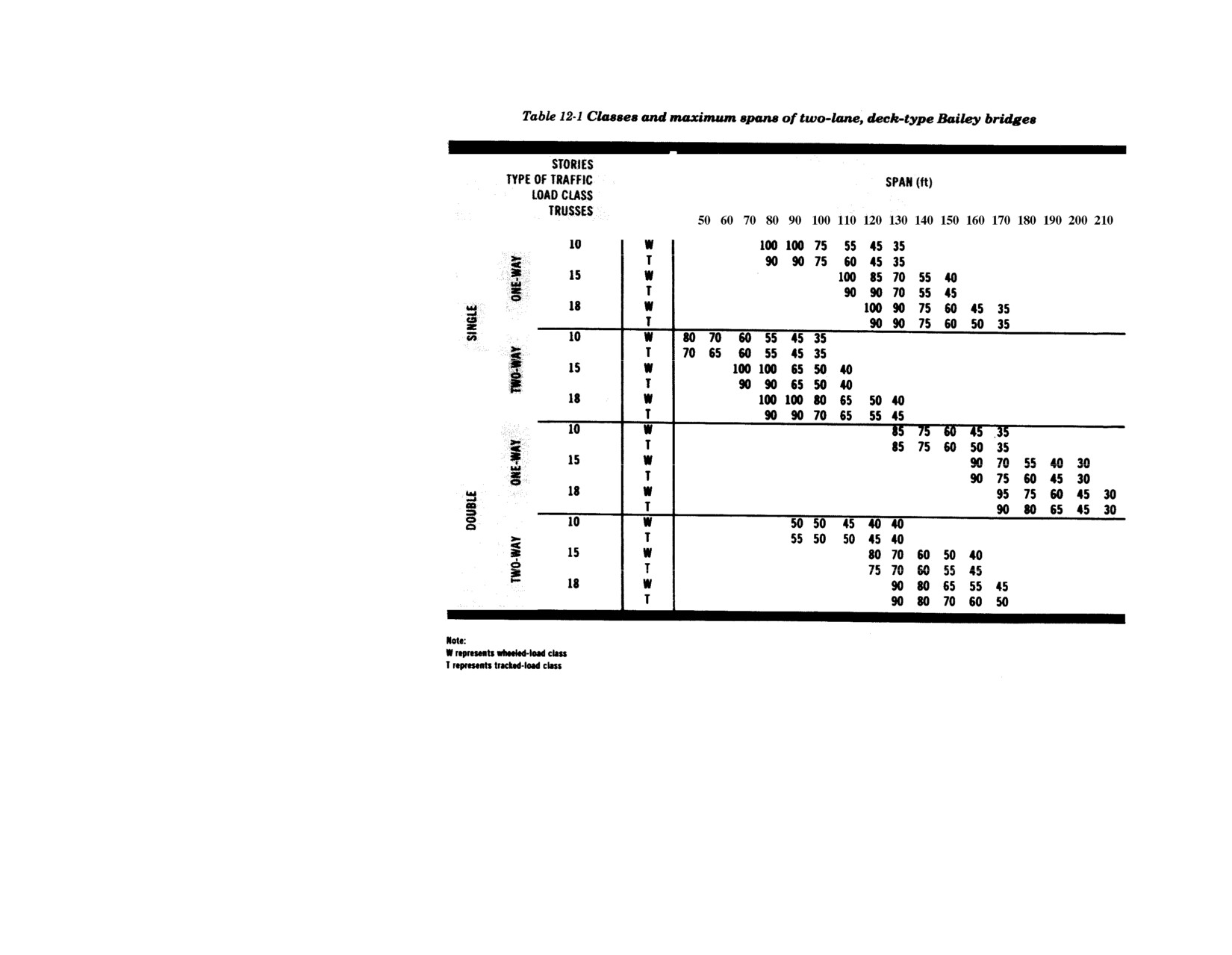
lane deck-type bridges, see Table 12-1 (page
through-type bridge, because bearings are
bays are cross braced by angles welded
140).
set 5 feet (1.5 meters) below road level.
diagonally across the bottom chords of all
trusses. The decking system serves as top
STANDARD DESIGNS
Demolished piers need not be built Up to
lateral bracing.
Standard design deck-type panel bridges are
the level of the roadway.
illustrated in Figure 12-1. Material require-
Make the decking system from standard
ments of the standard-design deck-type
There are no overhead restrictions.
panel-bridge parts (transom, stringers,
panel bridge can be found in Table A-11,
and chess) or timber.
Appendix A.
A deck-type panel bridge has the following
disadvantages:
End posts attached to top-story panels
ASSEMBLY
may be rested on standard panel-bridge
The most practical load distribution is ob-
Excavation at abutments may be neces-
bearings. In multistory assembly, omit
tained by spacing the trusses uniformly under
sary because bearings are 5 feet (1.5
the end panels of the lower stories to allow
a relatively stiff deck. Use five three-truss
meters) below the roadway.
room for the abutment. If end posts are
girders (15 trusses) under the bridge deck.
not used, rest the trusses on timber
Space trusses in each girder 1 foot 6 inches
It is more difficult to launch.
blocking or a rocker bearing under the
(44.1 centimeters) apart and tie together with
bracing frames.
138
FM 5-277
Bracing
Use bracing frames as much as possible at
panel junctions to space the trusses and to
provide lateral stability in each three-truss
girder. To brace and tie the five three-truss
girders together, weld 3-by 3-inch (7.4 by 7.4
centimeters) angles diagonally across the
bottom chords of each two bays. Welding
must be done carefully so the properties of the
high tensile steel in the panel-bridge parts
are not changed. Use mild steel bracing members,
and weld them in place before any loads are
applied to the bridge.
Decking
Before the timber decking is laid, weld 3-inch
(7.4 centimeters) angles transversely to the
top chords of the trusses at 5-foot (1.5 meters)
centers. These angles tie the trusses together
and provide a brace for clamping the ribband
bolts.
Laminate the timber decking or lay it in two
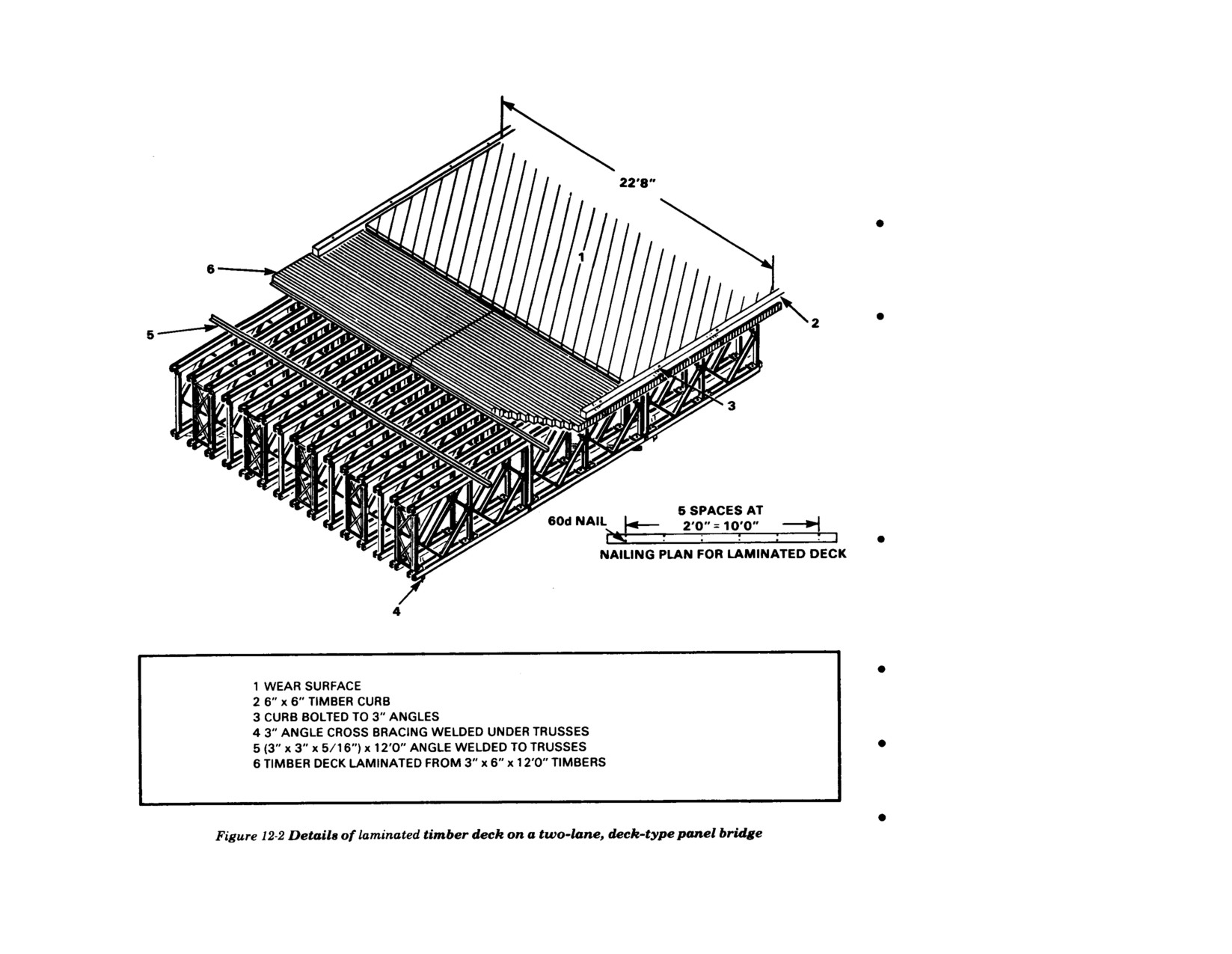
layers. Laminated decking (Figure 12-2, page
141) is better than layered decking because
the nails cannot work out under traffic
vibration. This reduces maintenance. Lay
timbers on edge perpendicular to the long
axis of the bridge and nail together horizon-
tally. For ease of assembly, 2½-foot (73.5
centimeters) sections of laminated deck can
be prefabricated before-hand and then two
sections laid between each pair of angles.
Notch the end timber of each section to fit
over the horizontal legs of the angles. Then
nail timber wear treads to the deck.
139
FM 5-277
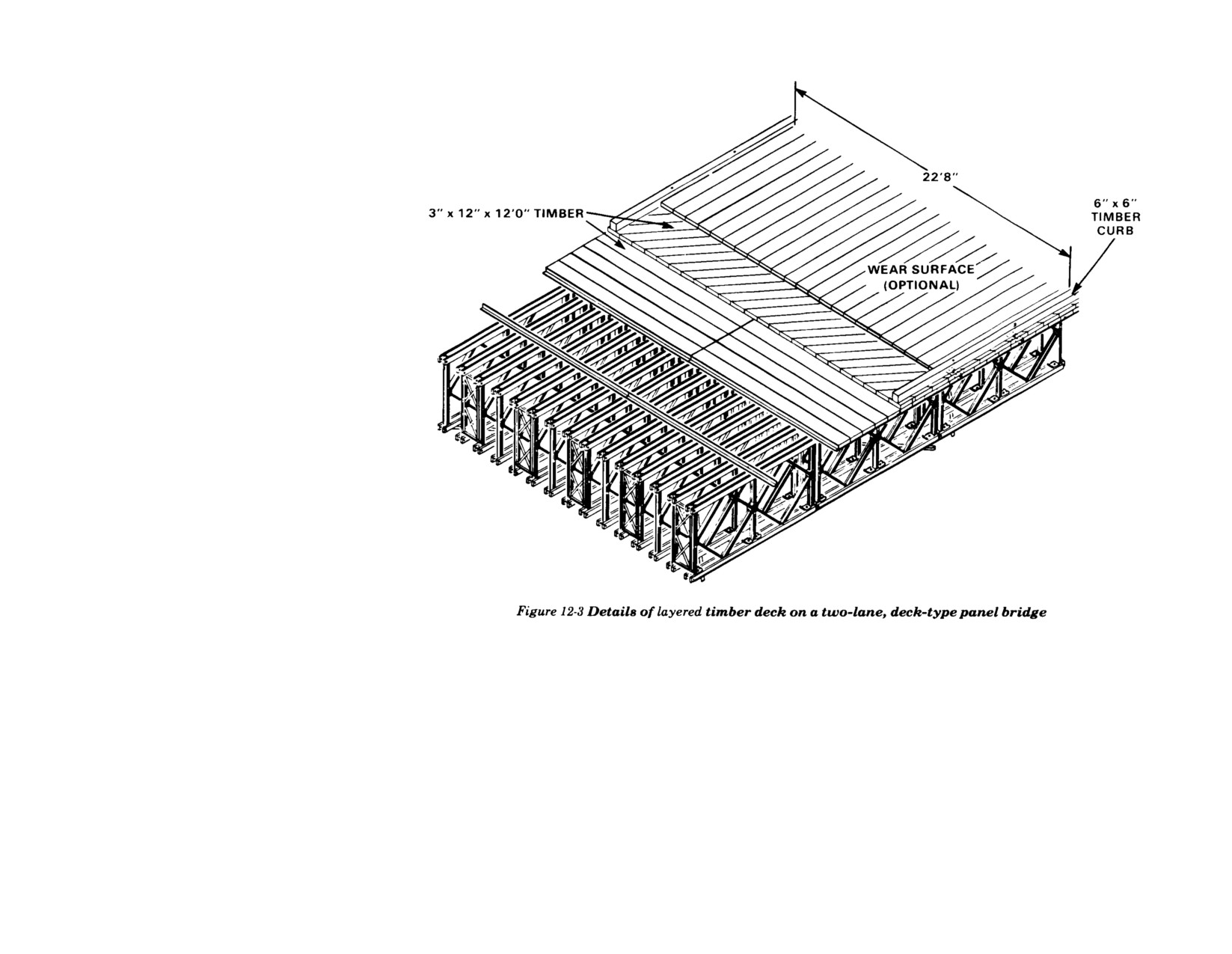
For layered decking (Figure 12-3, page 142),
lay 3- by 12-inch (7.4 by 29.4 centimeters)
planks across the trusses between the angles.
Notch every fifth timber to fit over the
horizontal legs of the angles. Then nail timber
wear treads to the deck.
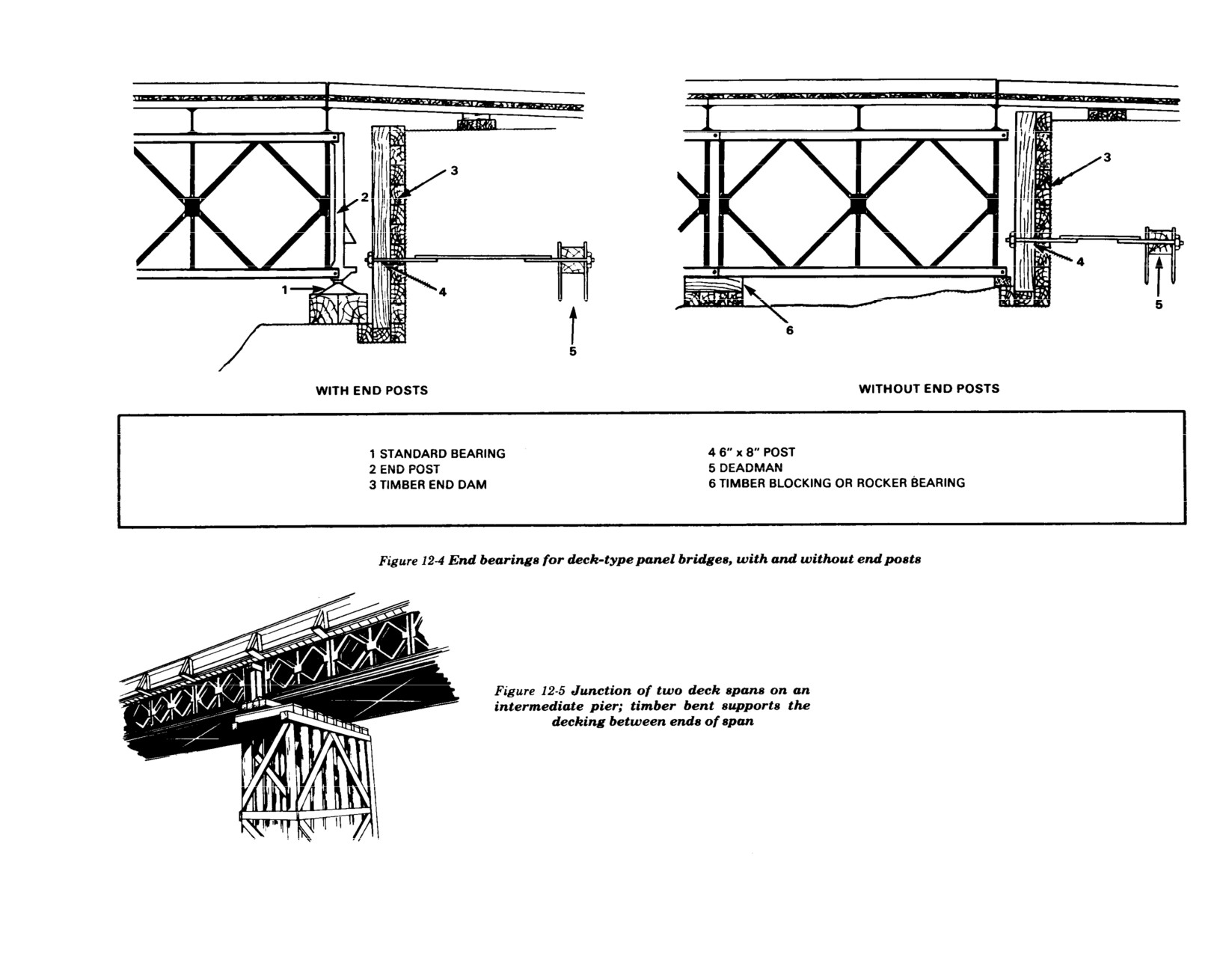
Bearings
When end posts are used (Figure 12-4, page
143), place them at both ends of each truss
and seat them on standard bearings. Cutoff
the top lugs of the end posts flush with the
trusses so they do not interfere with the
decking.
When end posts are not used (Figure 12-4),
support the span on timber blocking at the
first panel junction from each end. The timber
blocking must extend at least 1 foot (29.4
centimeters) on each side of the joint. An
alternative method is to use a distributing
beam on a rocker bearing similar to the
support over immediate piers. With this type
of bearing, the effective bridge length is 20
feet (15.2 meters) greater than the gap be-
tween bearings. Also add timber blocking
under the cantilevered end of the panel to
eliminate a reversal of stress in panels near
the end of the bridge as a vehicle moves onto
the bridge. Over intermediate piers, the
trusses can be continuous or broken. If they
With panel-bridge decking, the gap between
frames. (Space these girders uniformly under
are continuous, provide a rocker bearing
the ends of spans can be bridged by expedient
the deck.) If other spacings of the trusses are
(Chapter 16). If they are broken, attach end
timber or steel stringers and chess (Chapter
used, expedient braces must be welded to the
posts to the ends of the trusses and seat two
16).
end verticals of the panels in place of bracing
ends on separate bearings. If timber decking
frames. Cross bracing must also be welded
is used, the gap between the ends of the
EXPEDIENT ASSEMBLY
across the bottom chords. Examples of ex-
spans may require an intermediate trestle to
For ease in launching, group trusses into two-
pedient assembly are given in Table A-12,
support the decking (Figure 12-5, page 143).
or three-truss girders tied together by bracing
Appendix A.
140
FM 5-277
LAUNCHING
Use the following guidelines when launching
a deck-type panel bridge:
Each three-truss girder may be launched
separately, or the entire bridge may be
launched as a unit by welding added
bracing to tie the girders together.
Launch individual girders of a single-
story bridge by pushing or pulling the
girder and launching nose out over the
gap, by launching from a high line, by
launching with derrick and preventer
tackle, or by lifting directly into place
with one or two cranes. Over a water gap,
girders may be placed on rafts and floated
out into the gap and then lifted into place
by a crane on a raft. See Chapter 19 for
details of these launching methods.
A single-story bridge may also be
launched as a unit by pushing or pulling
it on rollers out over the gap.
Use the following guidelines when launching
a double-story bridge as a unit
Tie the girders together by transverse
channels welded across the tops of the
bottom and intermediate chords.
The entire unit may be launched with a
launching nose and then jacked down
onto the bearings.
If a temporary pier can be built in the
middle of the gap to support the canti-
levered end, the bridge can be launched as
141
FM 5-277
a single-story platform just below the
near-bank seat. This method reduces the
jacking height. It is similar to the method
for launching triple-story bridges with
the underslung bottom story described in
Chapter 8.
LOWERING TO BEARINGS
A crane at each end of the bridge can be used
to lower the girders to the bearings. Jacks can
be used as an expedient, although the 5-foot
(1.5 meters) drop requires several lifts. During
jacking, blocking must be used under the
trusses to take the load in case the jacks fail.
EXPEDIENT DESIGN BRIDGES
Table A-12, Appendix A lists several typical
World War II deck-type panel bridges built in
the European theater of operations (ETO).
142
FM 5-277
143
FM 5-277
CHAPTER 13
RAILWAY BRIDGES
Panel-bridge equipment can be used as an
expedient for the assembly of railway bridges.
However, use it only in special conditions
because there is much deflection. Spans
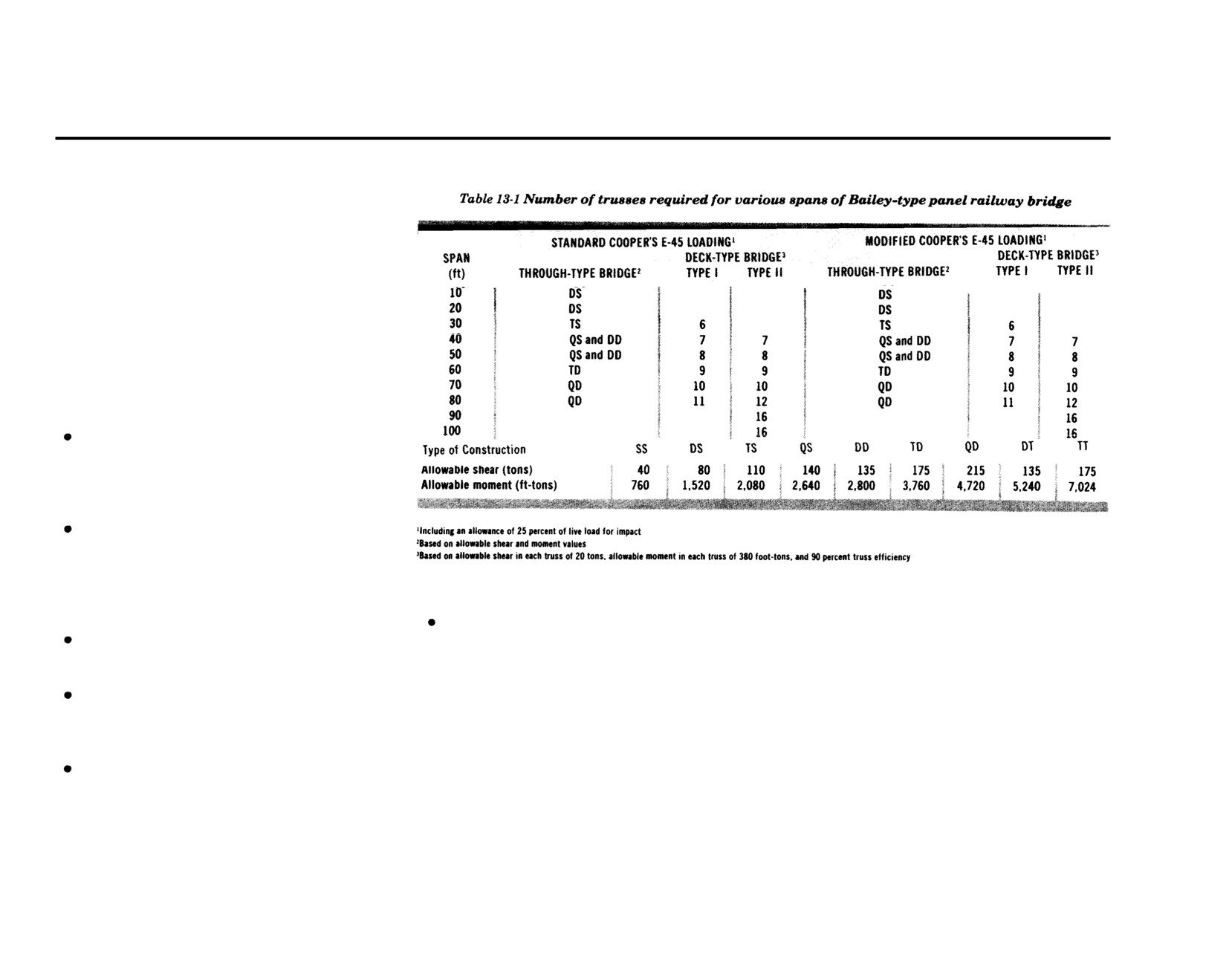
longer than 70 feet (21.5 meters) are normally
impractical because a
quadruple-double
truss
bridge is required (Table 13-1). Usually,
panel-bridge railway bridges are assembled
as single-track bridges.
Panel-bridge equipment has the following
advantages for use as railway bridging
Equipment can be transported in trucks
to the bridge site. This permits bridge
assembly at the same time repairs are
being made on the approach tracks.
Either through- or deck-type brid—es can
be assembled.
Panel-bridge equipment has the following
disadvantages for use as railway bridging:
Bridge requires more maintenance than a
The trusses of double-story bridges infringe
Through-type bridges provide restricted
standard bridge.
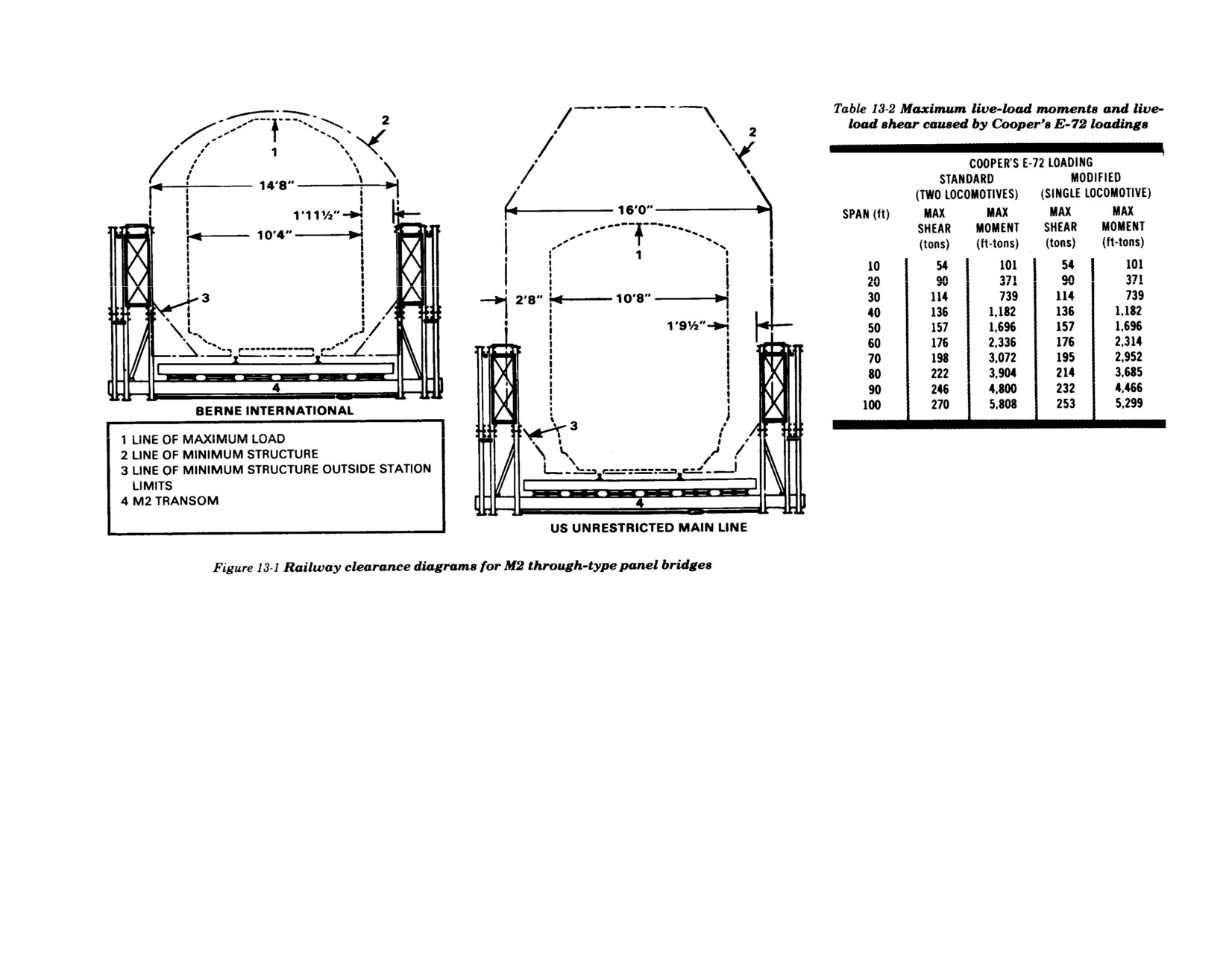
US main line and Berne international clear-
clearance.
ance gages but allow passage at slow speeds
RAILWAY BRIDGE ASSEMBLY
(Figure 13-1). If decking of double-story
Traffic over bridge must be controlled to
Railway panel bridges are either through-
trusses is placed in the top story, the trusses
eliminate excessive vibration and side
type or deck-type. Assemble the through-type
do not infringe standard clearance gages.
sway.
railway bridge the same as the normal panel
bridge, but use ties and rails in place of chess.
In the deck-type railway bridge, space the
Pin clearance allows more sag than is
Girders can be single-, double-, triple-, or
trusses under the ties. The trusses are usually
found in a normal bridge.
quadruple-truss and single- or double-story.
single story. Tie them together laterally by
144
FM 5-277
cutting a hole in the flange and web at each
end to seat the pintle of the fourth truss. Since
the fourth truss interferes with the use of
rakers, double-story quadruple-truss bridges
are usually assembled with the decking in the
top story.
bracing frames, tie plates, expedient angle
ASSEMBLY OF
cross bracing, and the ties.
THROUGH-TYPE BRIDGE
Decking system
Single-, double-, and triple-truss assembly
For railway loads, always use double tran-
CLASS
can be used as in normal panel-bridge as-
soms. Place stringers as in a normal panel
The standard designs described will carry
sembly. A quadruple truss can be assembled
bridge. If 8- by 10-inch (19.6 by 24.5 centi-
standard or modified Cooper’s E-72 loading.
by inserting a fourth truss between the inner
meters) by 14-foot (4.3 meters) ties are used,
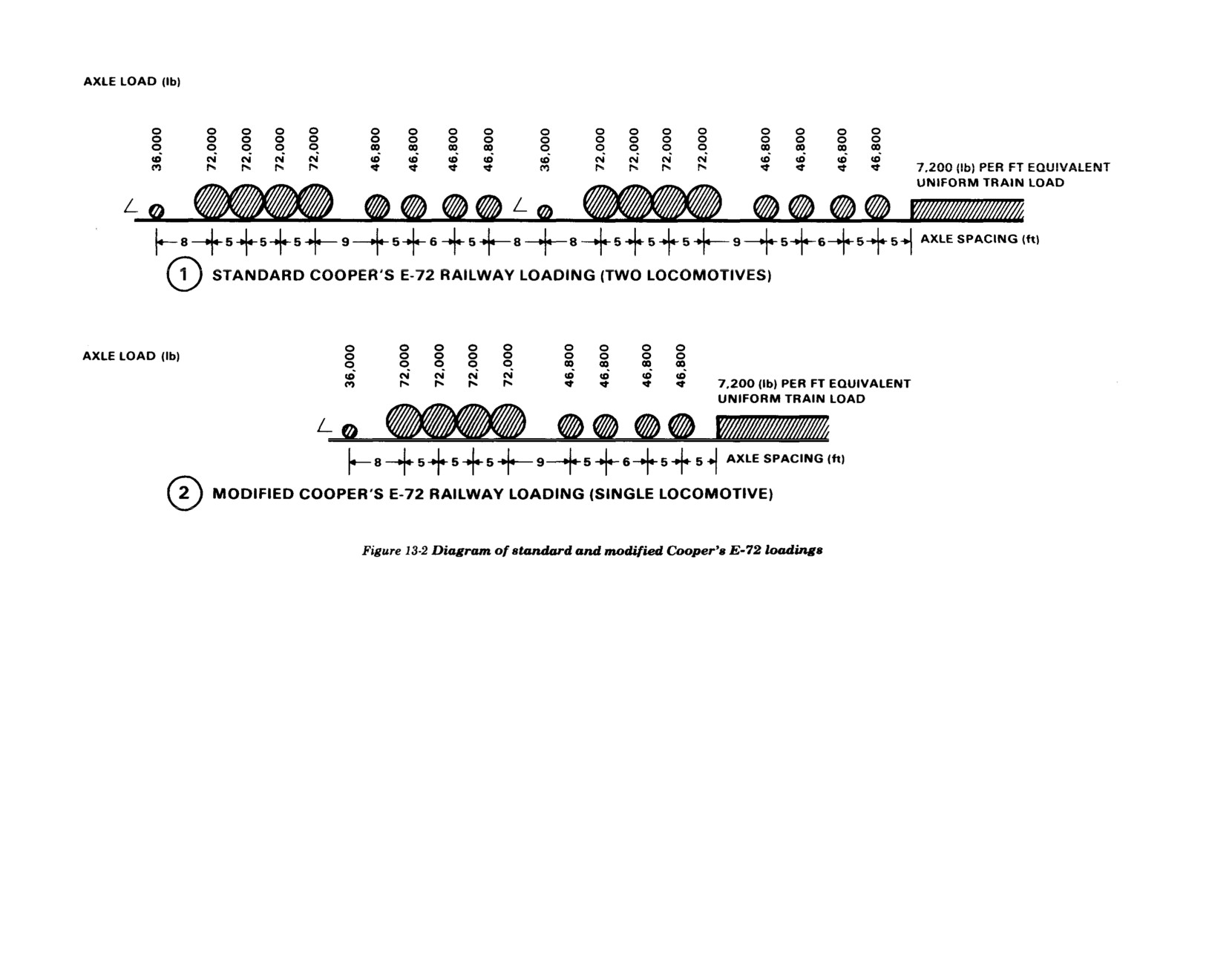
See Figure 13-2 (page 146) for diagrams of
and second truss of a triple-truss assembly.
place them directly on the stringers at 2-inch
loadings. Table 13-2 gives the shears and
Use bracing frames and tie plates to tie the
(4.9 centimeters) spacings and hook-bolted to
moments caused by these loadings. Table 13-
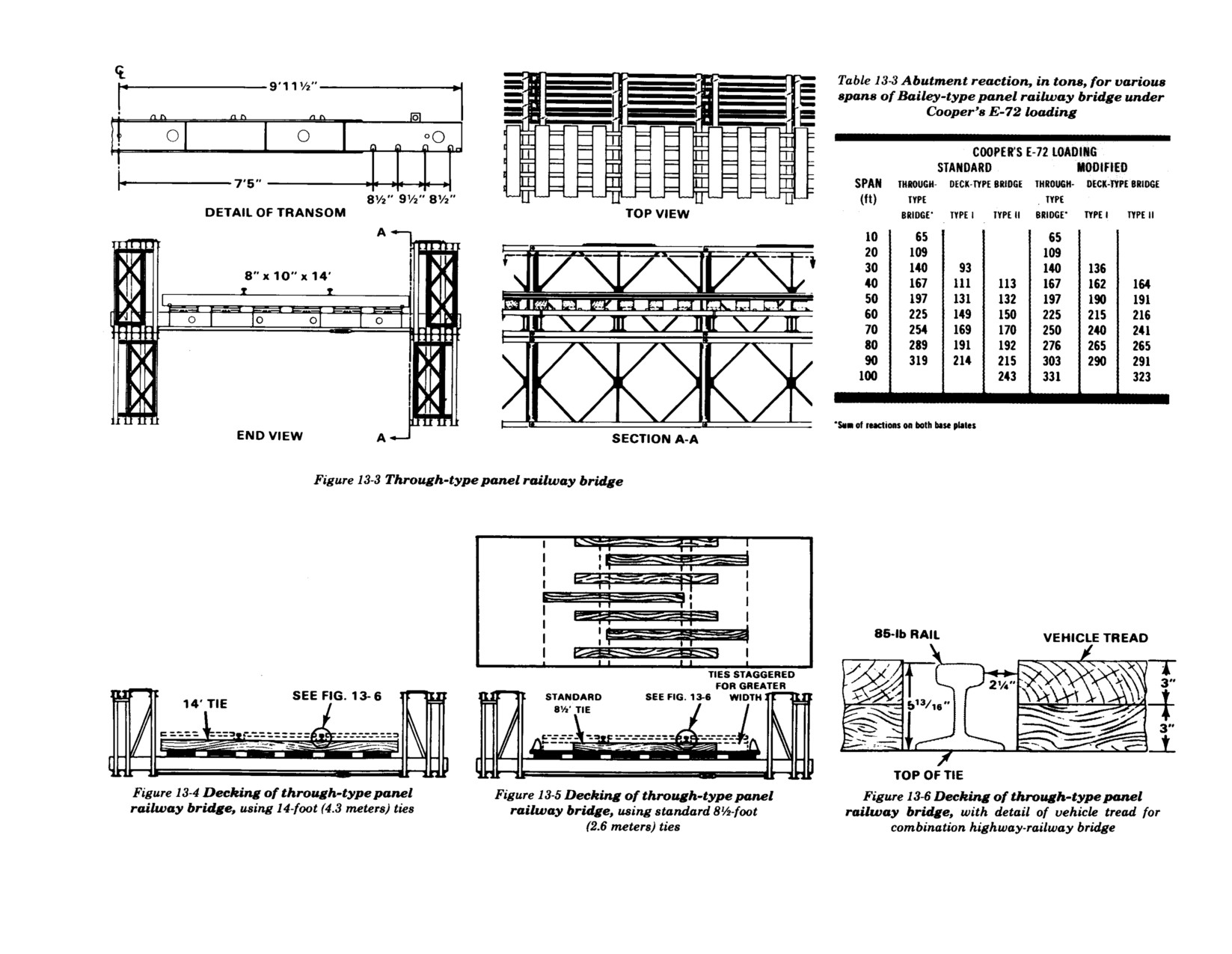
four trusses together (Figure 13-3, page 147).
the button stringers (Figure 13-4 page 147).
1 gives the assembly required for 10-to 100-
Use transom clamps on all panel verticals
To use standard ties (6 by 8 inches by 8 feet 6
foot (3.1 to 30.1 meters) spans using two
except the three verticals in each bay covered
inches) (14.7 by 19.6 centimeters by 2.6
standard designs.
by bracing frames. Modify transoms by
meters), lay chess and ribbands in the normal
145
FM 5-277
manner and spike the ties to the chess (Figure
End bearings
13-5). By building up timber treads on each Use end posts and bearings as in a normal
side and between the rails, the bridge can be panel bridge. Grillage must be enough to
used for rail or highway traffic (Figure 13-6).
carry the loads given in Table 13-3. Ramp
To reduce impact, rail joints on the bridge
sections must be level with the bridge deck.
should be tight, with no allowance for
expansion.
146
FM 5-277
147
FM 5-277
ASSEMBLY OF DECK-TYPE BRIDGE
Two deck-type assembly designs are de-
scribed here.
Type I
is used for spans up to 90
feet (27.7 meters),
type II
is used for spans up
to 100 feet (30.8 meters). Use the following
steps to assemble
type I
designs:
1
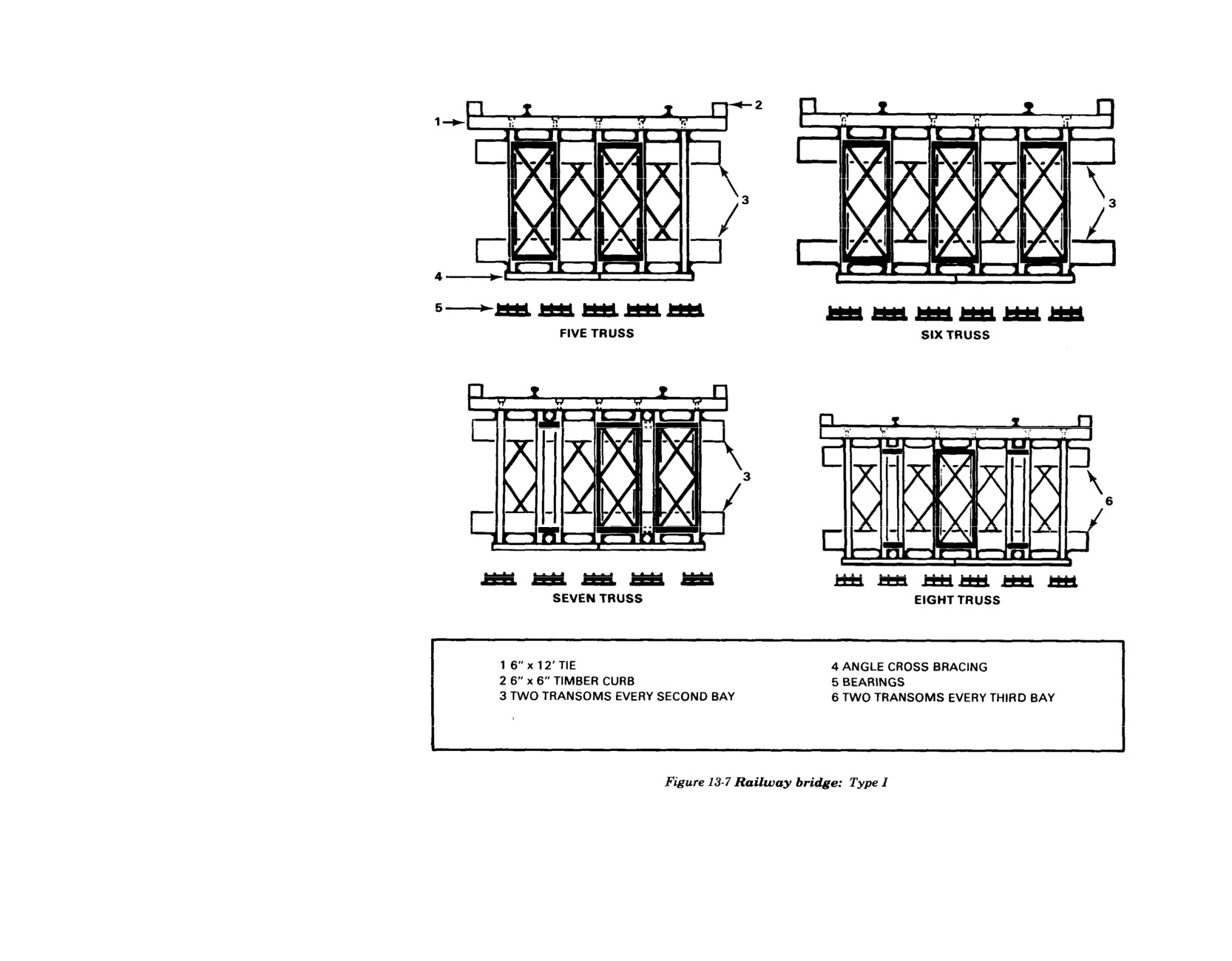
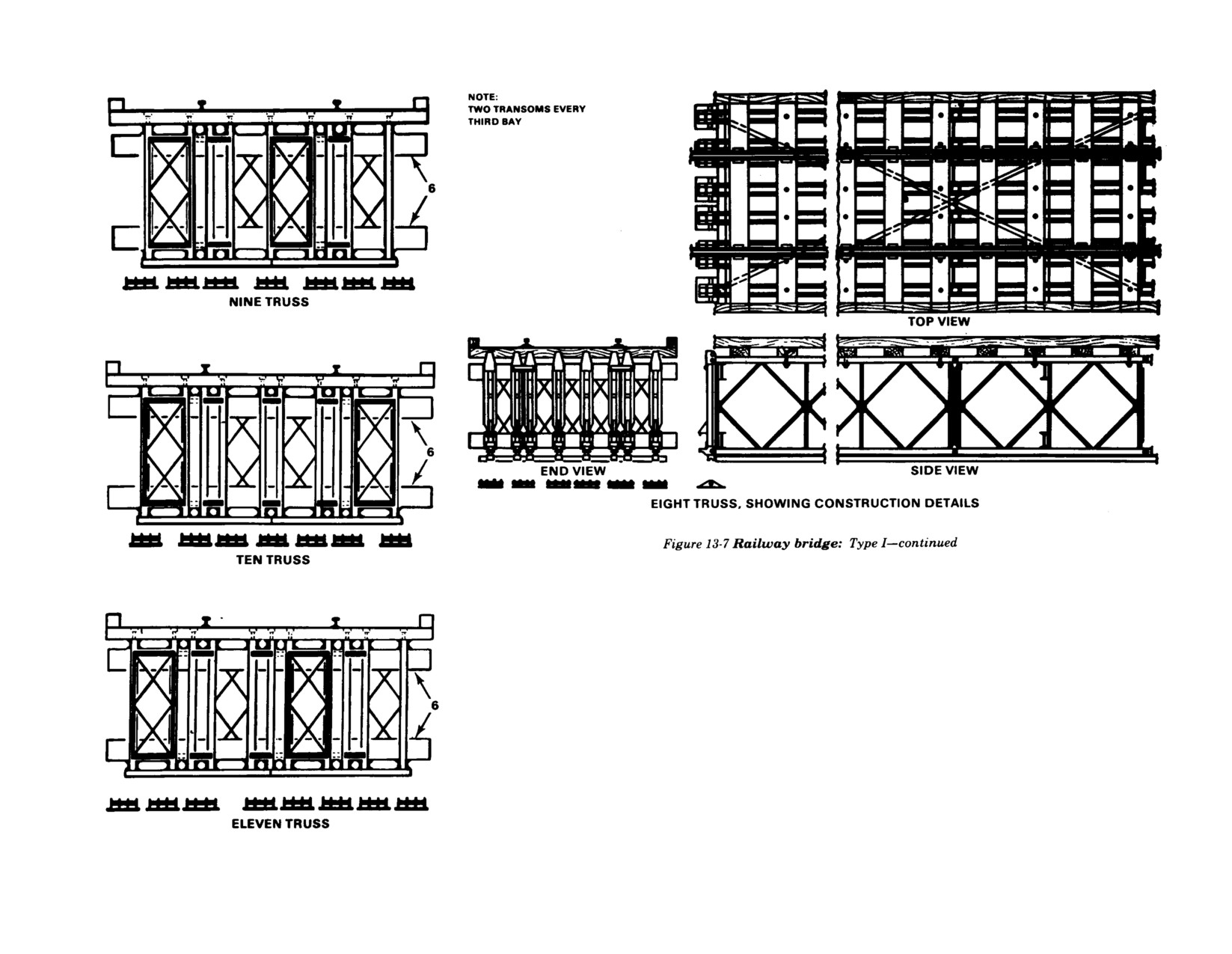
Arrange trusses side by side and connect
them by bracing frames and tie plates, as
shown in Figure 13-7. Bracing is supplied
by the ties, welded sway bracing, and
modified transoms. Seat the modified tran-
soms adjacent to the center vertical in the
top and bottom chord of every second and
third bay. To seat the upper transom,
invert every other truss. Cut the modified
transoms to the desired length and hole
them to seat the pintles on the panels.
Weld three-inch (7.4 centimeters) angle
sway bracing diagonally under the bot-
tom chords of every two bays.
2
Use four 6- by 12-inch (14.7 by 29.4
centimeters) ties in each bay for the deck
system. Chord bolt every other tie to the
trusses. Drill holes for the chord bolts as
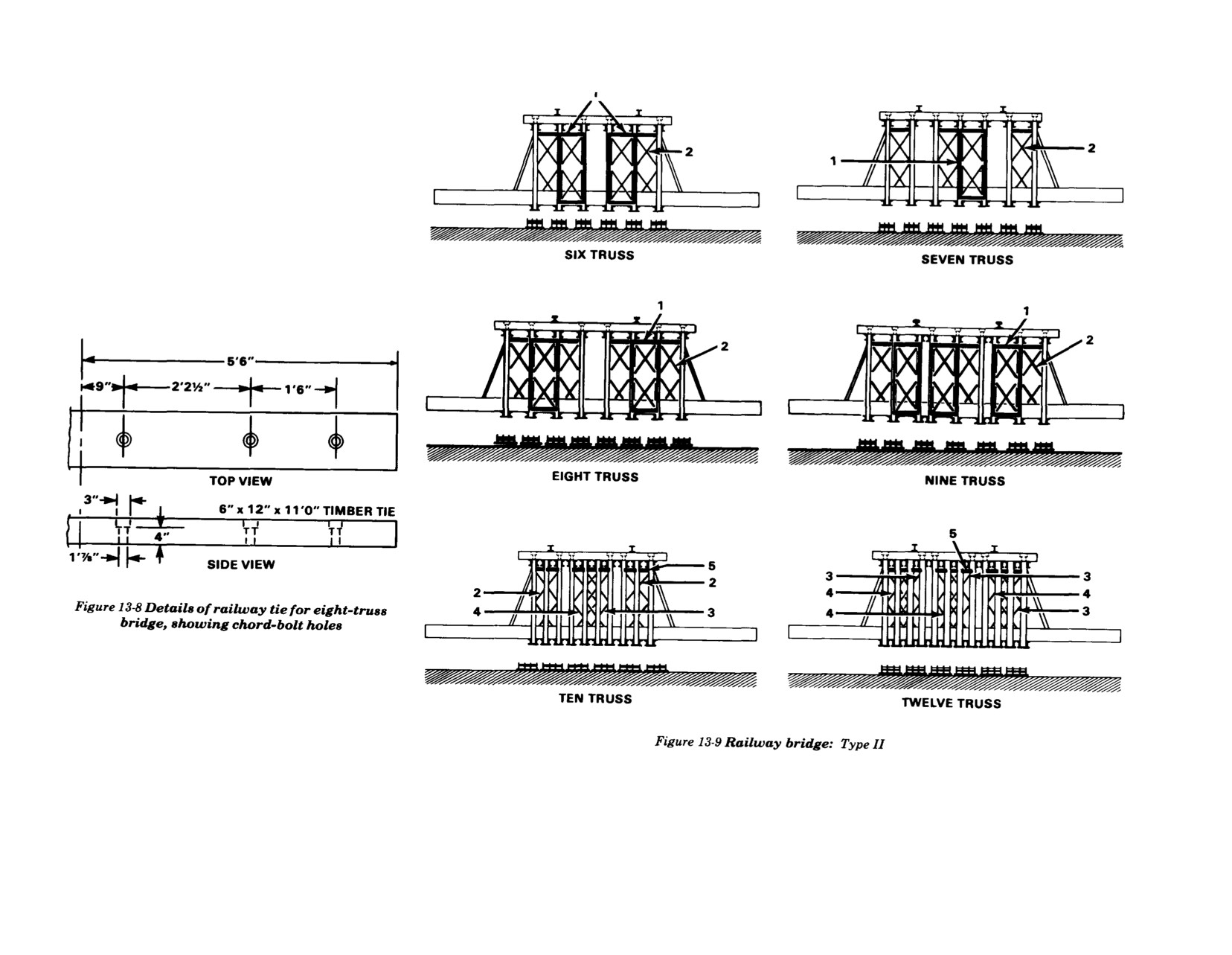
shown in Figure 13-8 (page 150). Spike a
6-by 6-inch (14.7 by 17.4 centimeters) curb
to the ties.
3
Use end posts at each end of each truss
and seat them on standard bearings.
Grillage under the bearings at each abut-
ment must be sufficient to support loads
given in Table 13-3. Rocker bearings over
intermediate piers can be made similar to
those described in Chapter 16.
148
FM 5-277
Use the following steps to assemble
type II
made from three trusses braced by bracing
designs:
frames. A 1½-foot (44.1 centimeters) three-
truss girder is made by adding a third
1
Brace trusses by bracing frames and tie
truss between the trusses of the two-truss
plates into two-, three-, or four-truss
girder and bracing it with tie plates to one
girders suitable for launching separately.
of the outer trusses. A four-truss girder is
Group the girders together to form six-,
made by adding another truss 8½ inches
seven-, eight-, nine-, ten-, twelve-, and
(21.6 centimeters) outside a 1½-foot (45.7
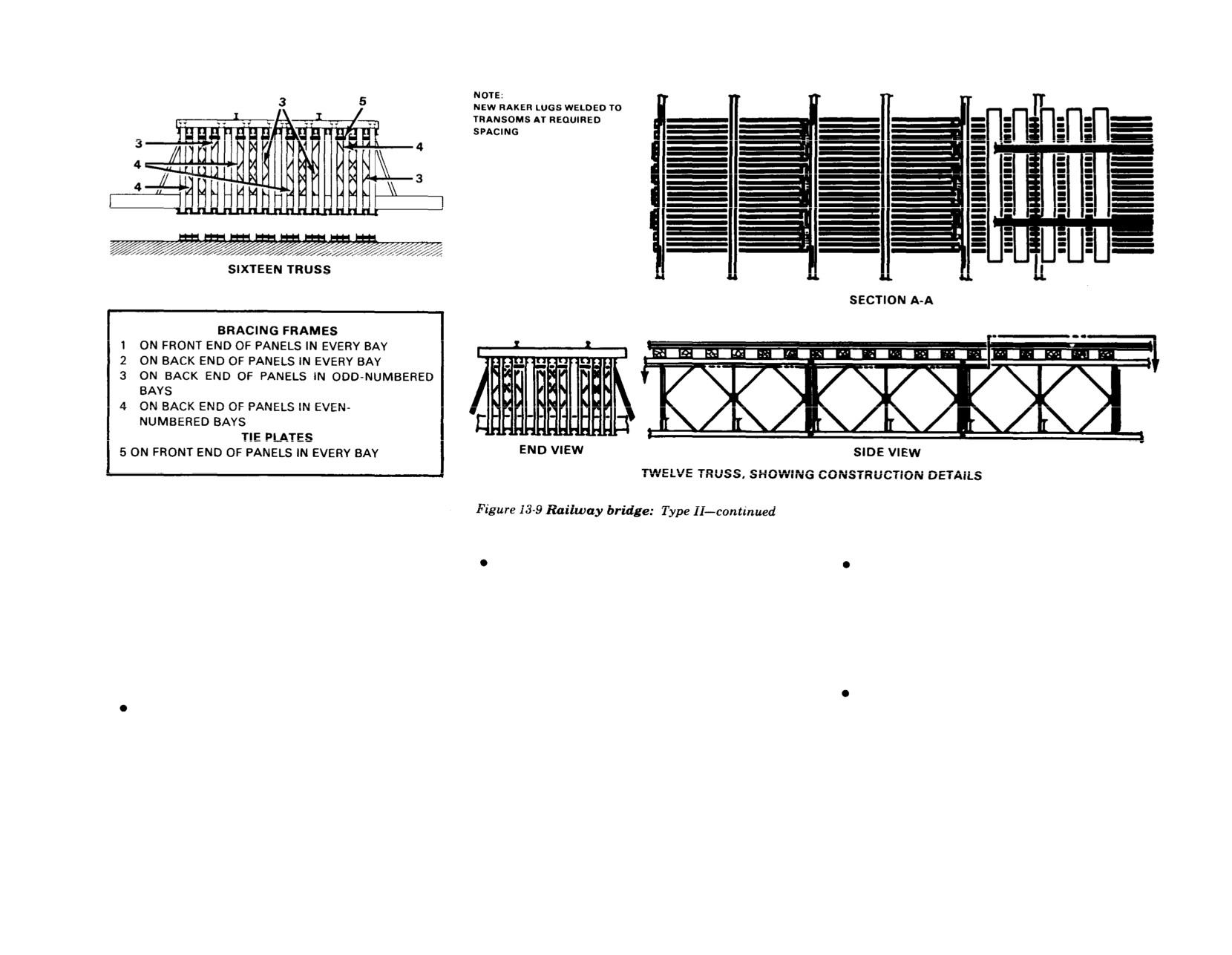
sixteen-truss bridges as shown in Figure
centimeters) three-truss girder and
13-9 (page 150). The two-truss girder is
bracing it with tie plates. Tie the girders
made from two trusses braced at the end
together in the bridge by the ties and two
verticals by bracing frames. A 3-foot (92.3
modified transoms on the bottom chord of
centimeters) wide three-truss girder is
each bay. Modify transoms by cutting
149
FM 5-277
holes in the flange to seat the pintles on
the panels. Weld raker lugs to the transom
so rakers can be used betweeen the
transom and the outside trusses.
2
Use the same deck system as that used in
the
type I
bridge.
3
Use bearings of the same type as those
used in the
type I
bridge.
150
FM 5-277
LAUNCHING
Type II bridges are launched, girder by
Welded vertical cross bracing at each
Launch a through-type bridge on rollers in
girder, by cantilevering out on rollers.
panel junction can be used instead of
the same manner as that for a normal panel
Add decking and bracing between girders
bracing frames and tie plates. Four-inch
bridge.
after girders are in place. For other
(10.2 centimeters) channels welded across
methods of launching single girders, see
the panel chords can be used in place of
Use the following guidance when launching
Chapter 19.
transoms.
a deck-type bridge:
EXPEDIENTS
If end posts are not used, the abutment
Type I
bridges are designed to be launched
Table A-13, Appendix A lists panel railway
bearings can be made from a rigid distri-
complete on rollers. They can be pushed
bridges built in World War II in the European
buting beam on timber grillage. The beam
or pulled across by a winch line.
theater of operations (ETO). Figures 13-11
must support at least two panel-support
Launching noses can be used as shown in
through 13-17 (pages 153 and 154) illustrate
points (Figure 13-11).
Figure 13-10 (page 152). During launching,
expedient bridges. The following expedients
use extra bracing frames and tie plates on
are available:
the top chords.
151