FM 5-277 BAILEY BRIDGE (May 1986) - page 3
FM 5-277
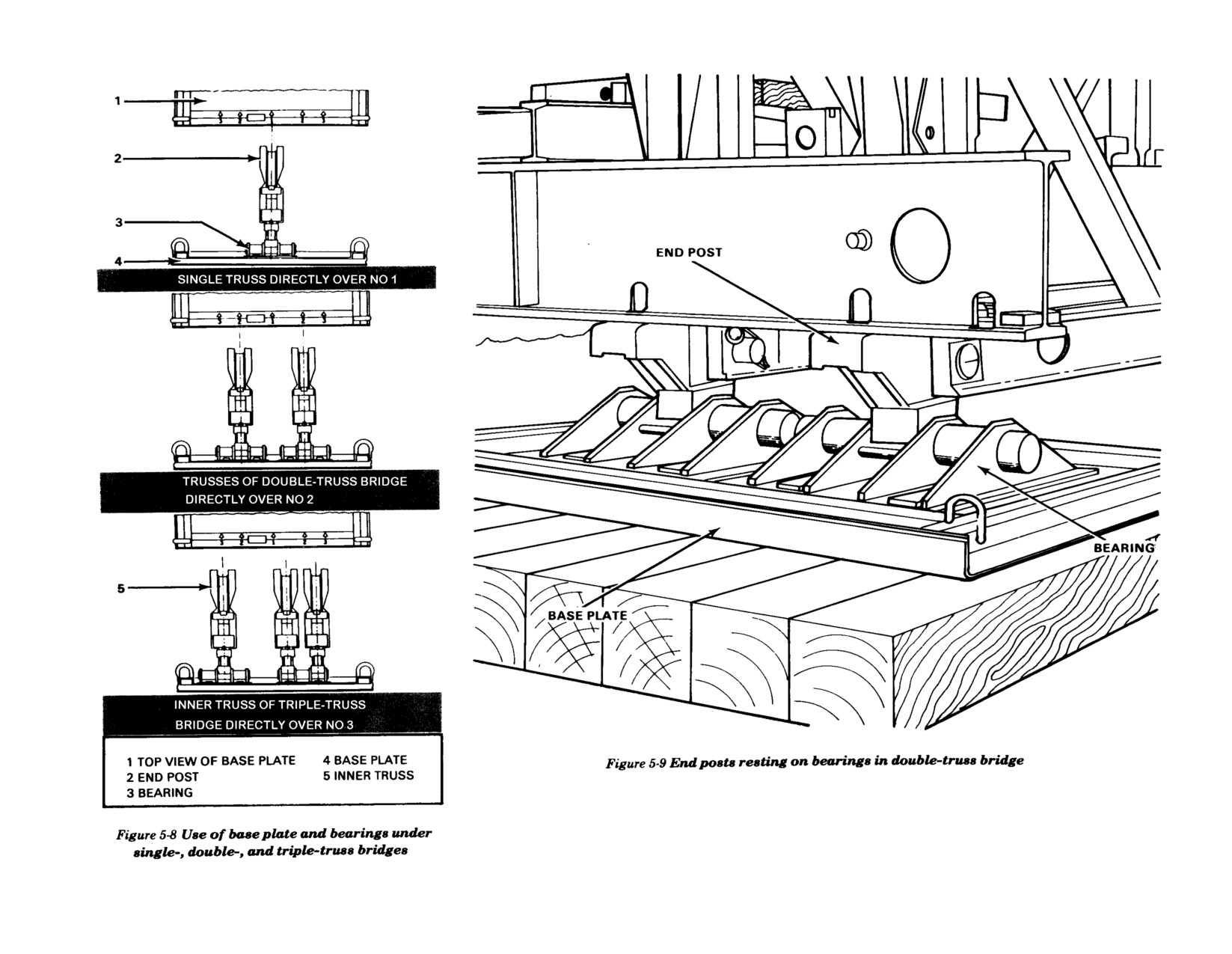
Space the bearings on the base plates (under
the trusses), as shown in Figures 5-8 (page 61)
and 5-9.
GRILLAGES
Figures 4-5 through 4-11 show the size of the
areas to be leveled off to accommodate the
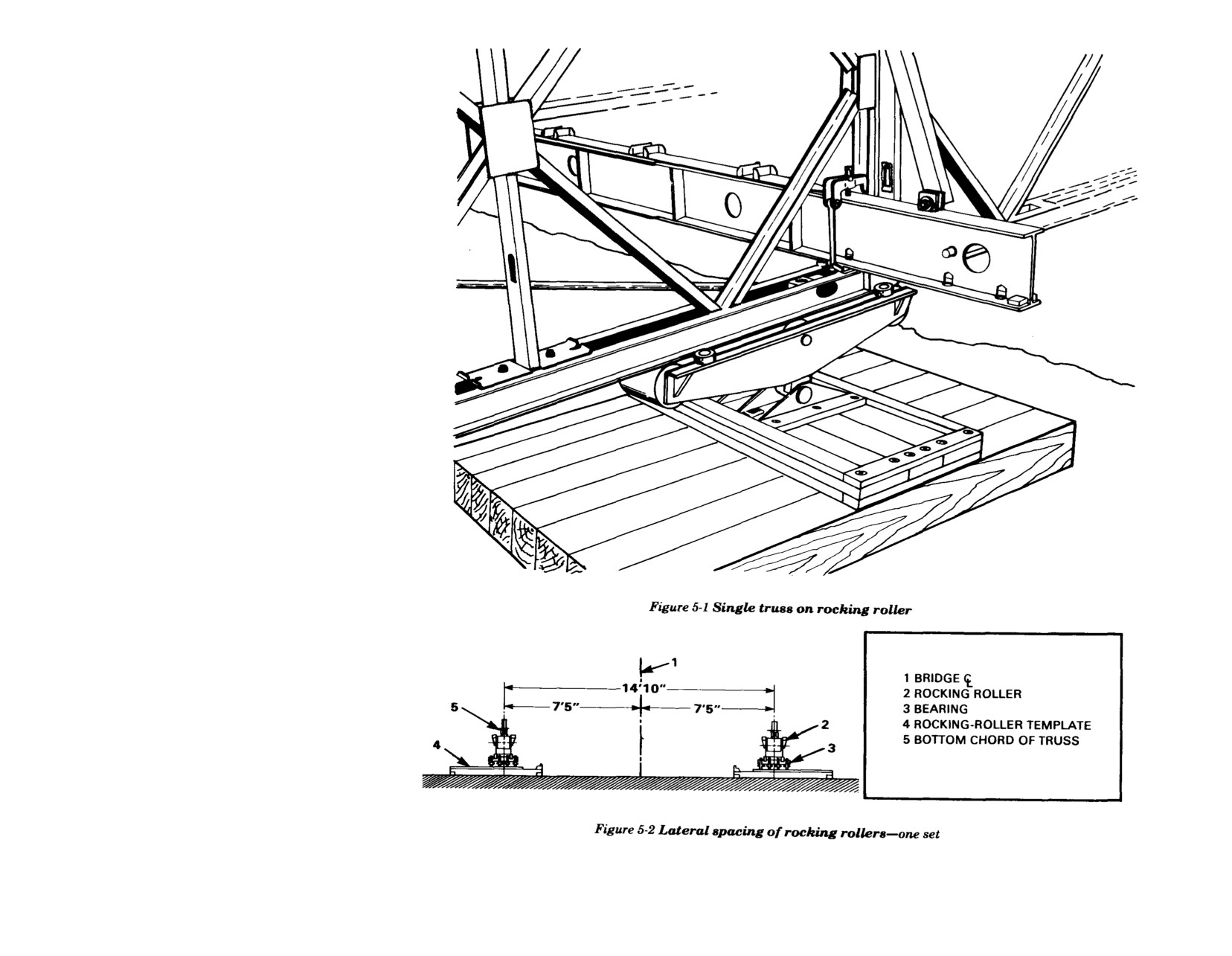
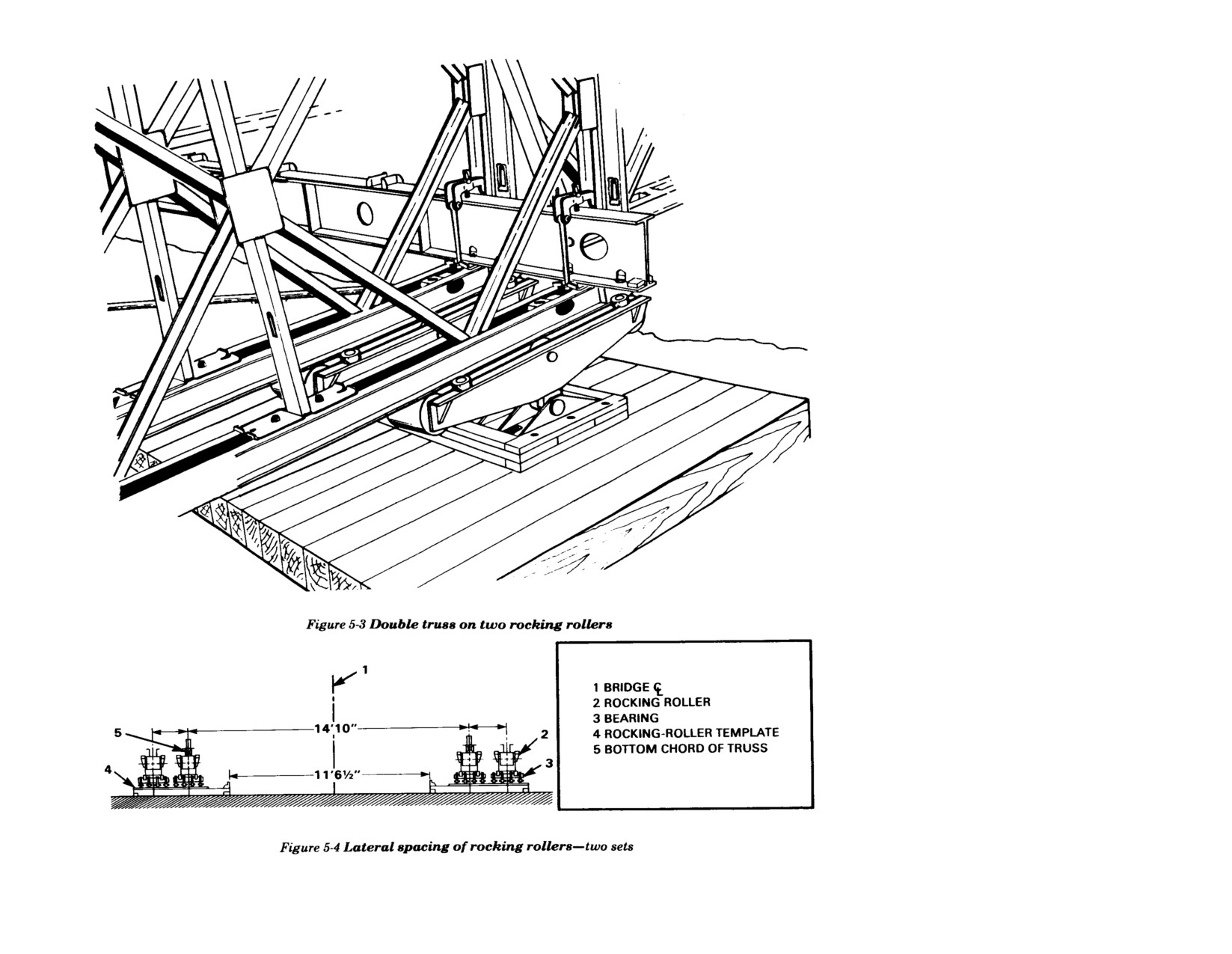
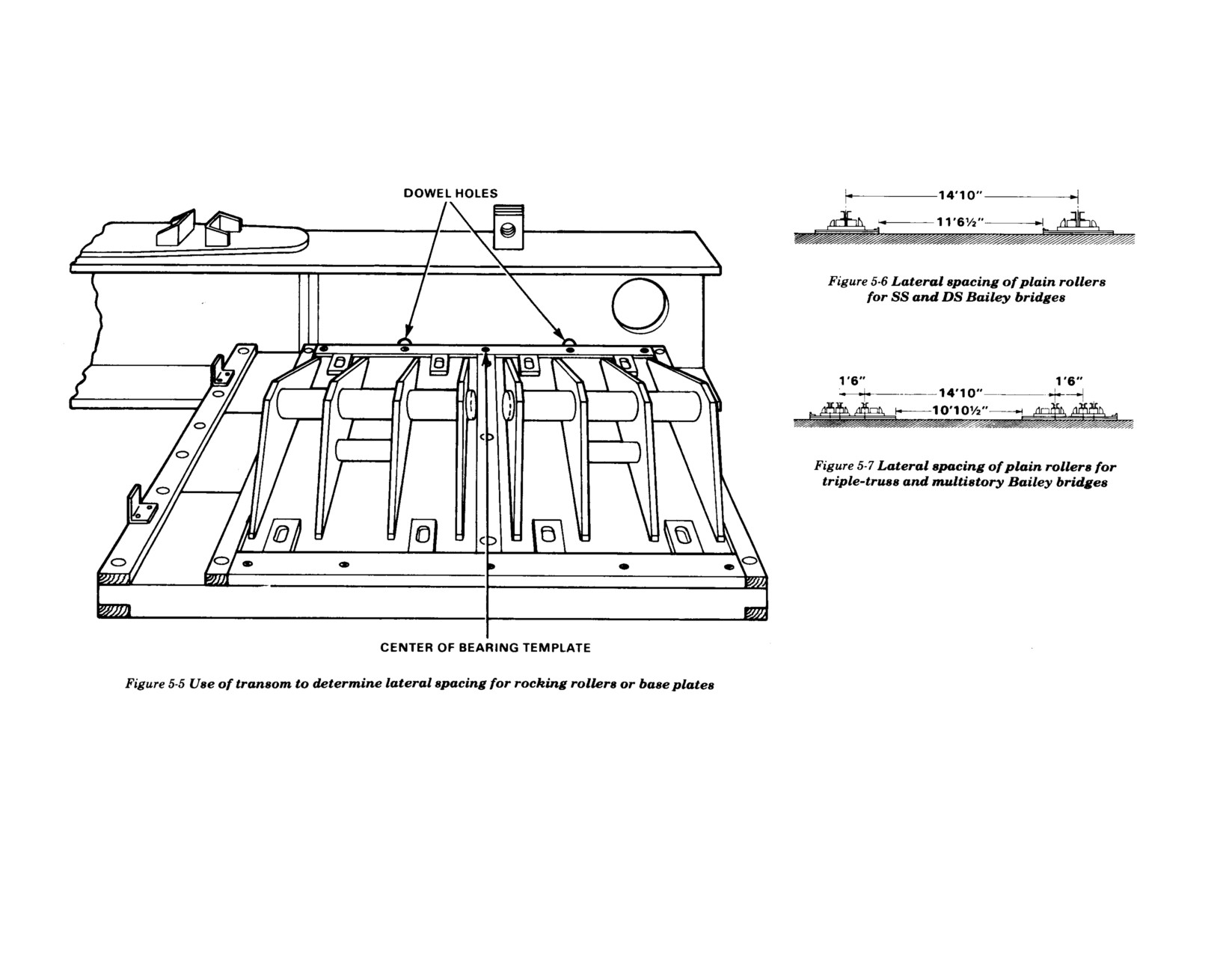
grillages. Take care that the rocking rollers
and base plates are properly positioned when
placed on the grillage. The grillage can be
cribbed up or dug in as needed for leveling.
ELEVATION OF ROLLERS AND BASE
PLATES
Set the base plates at an elevation to keep the
slope of the ramp bays less than 10 to 1. Also,
allow for the depth of wear tread. Set all
rollers (both plain and rocking), except the
construction rollers, so their tops are in the
same horizontal plane. Normally this plane
is level, but a slight inclination, not to exceed
30 to 1 slope along the line of the bridge, is
permissible. Set the construction rollers 2 to 4
inches (5.1 to 10.1 centimeters) below the level
of the other rollers. Placing the far-bank
rocking rollers a few inches lower than the
plane formed by near-bank rollers allows for
near-bank settlement caused by bridge
weight.
PLACEMENT CONTROL LINES
A simple method of leveling and placing
rollers is the use of placement control lines.
The bridge centerline is first placed and
extended 25 feet (7.6 meters) on the far shore
and the length of the bridge and launching
nose on the near shore. Then position two
placement control lines parallel to and 7 feet
58
FM 5-277
5 inches (2.26 meters) to either side of the
centerline. Position the placement control
lines level with the proposed plane of the
rollers. Use line levels at several spots on the
placement control lines to ensure that they
are level. It is also important to ensure that
the placement control lines are parallel to the
centerline. The rollers can then be cribbed up
or dug in as needed to bring their tops to the
level of the placement control lines (Figure
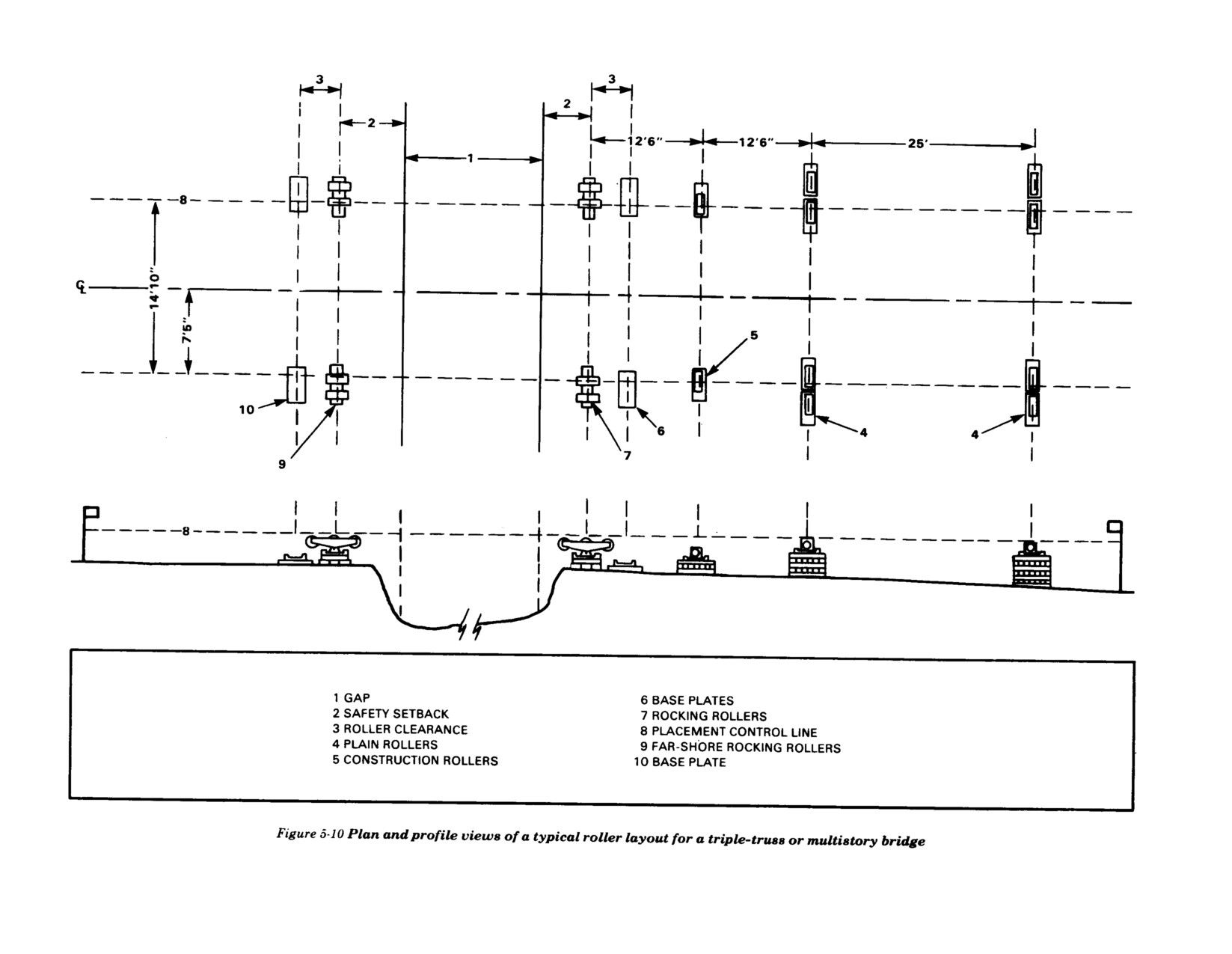
5-10, page 62).
59
FM 5-277
60
FM 5-277
61
FM 5-277
This change supersedes page 62.
62
FM 5-277
CHAPTER 6
ASSEMBLY OF SINGLE-SINGLE BRIDGES
LAUNCHING NOSE 64
ASSEMBLY OF DOUBLE-SINGLE BRIDGE 71
ASSEMBLY OF TRIPLE-SINGLE BRIDGE 83
LAUNCHING, JACKING DOWN, AND RAMPING 85
REINFORCING BRIDGE AND CONVERTING BRIDGE 91
This chapter describes the assembly and
procedure for adding extra trusses to increase
composition of double-truss single-story and
the class of single- and double-truss bridges is
triple-truss single-story bridges and their
also covered.
respective launching noses. The assembly of
single-truss single-story bridges, which have
Single-story bridges are normally assembled
little carrying capacity, is the same as that
and launched by manpower. They can be
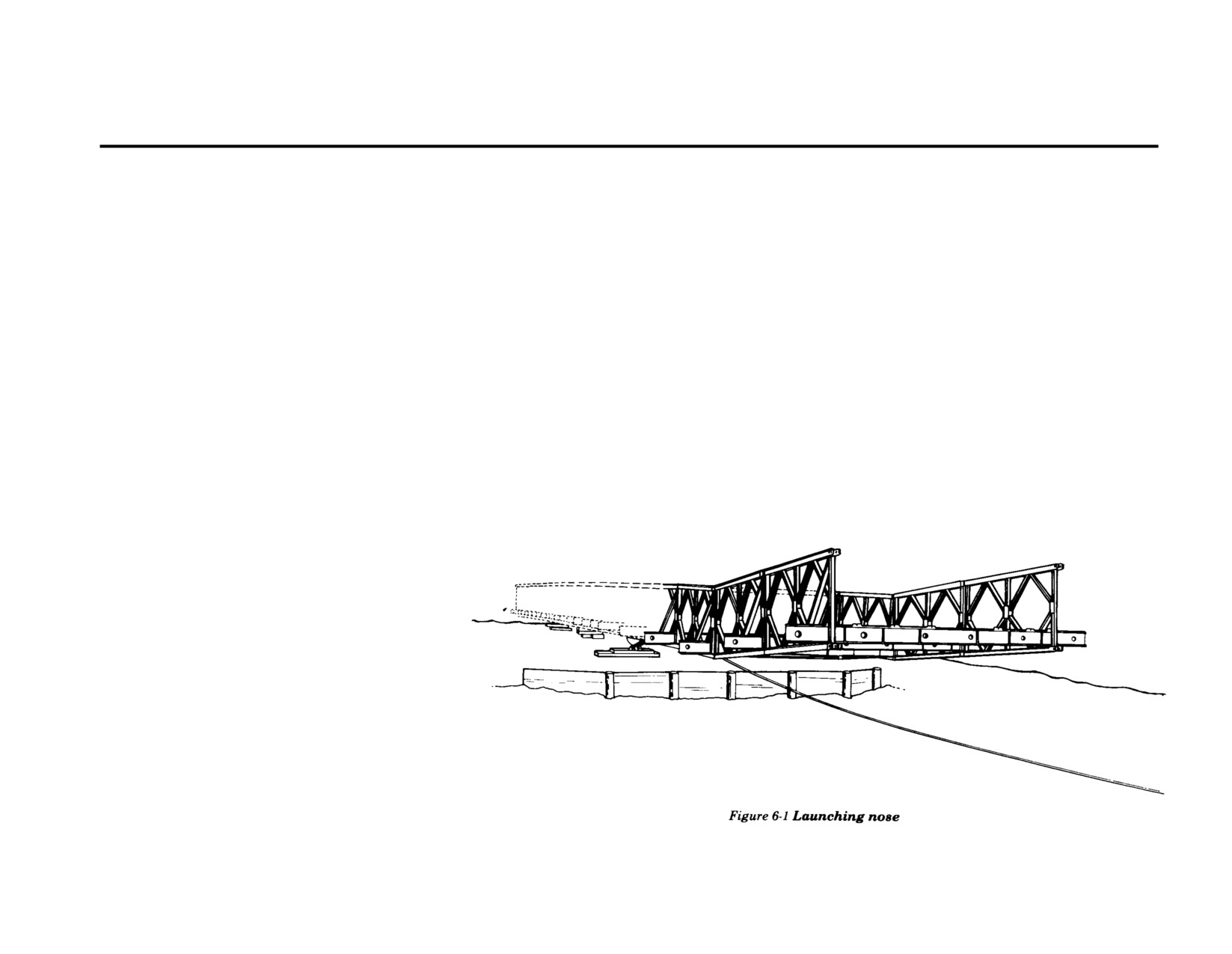
for the launching nose (Figure 6-l). This
assembled on the rollers and launched or the
chapter also covers the launching, jacking
bridge and nose can be pushed out over the
down, and ramping of these bridges. The
gap after every two bays are assembled.
63
FM 5-277
LAUNCHING NOSE
COMPOSITION
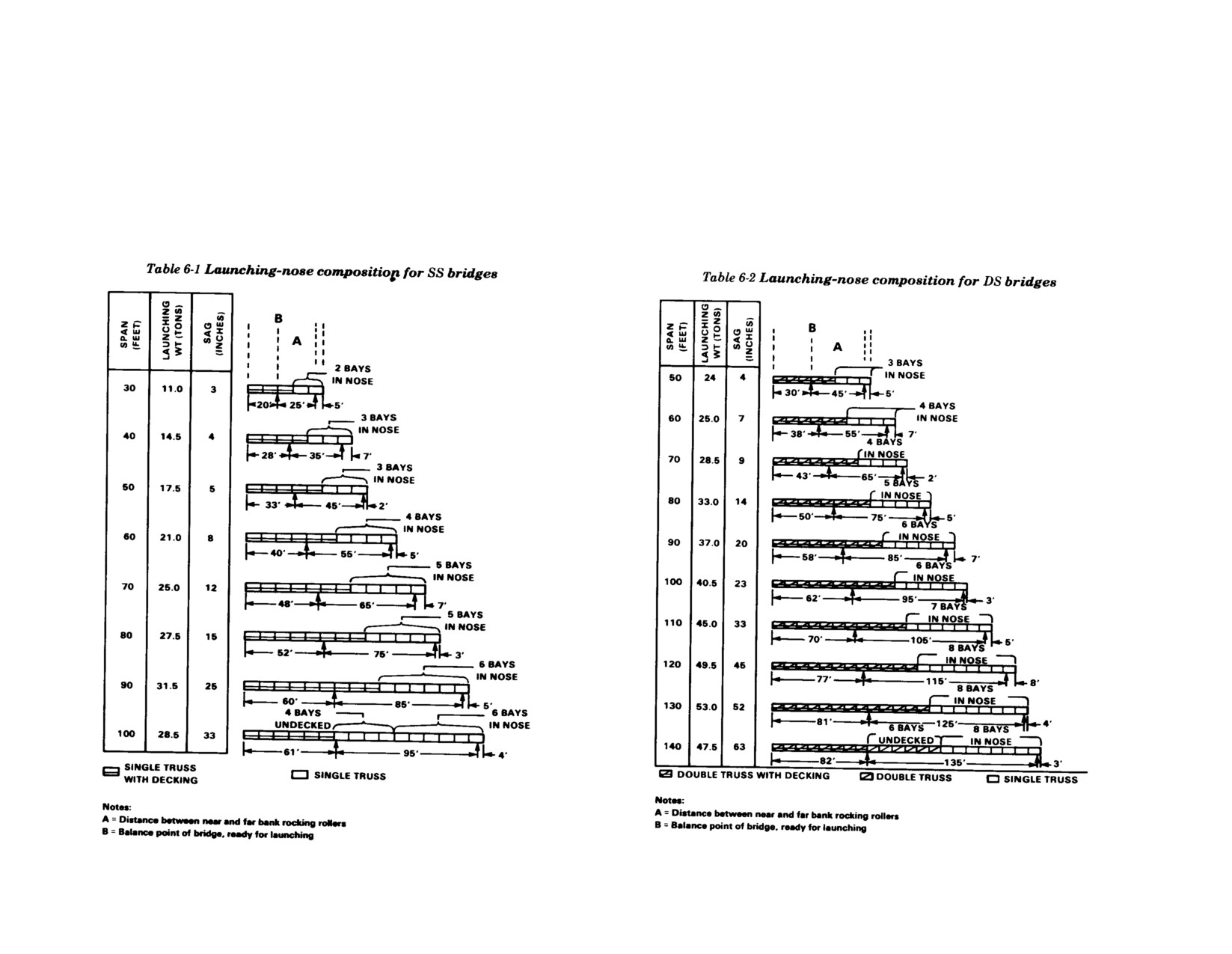
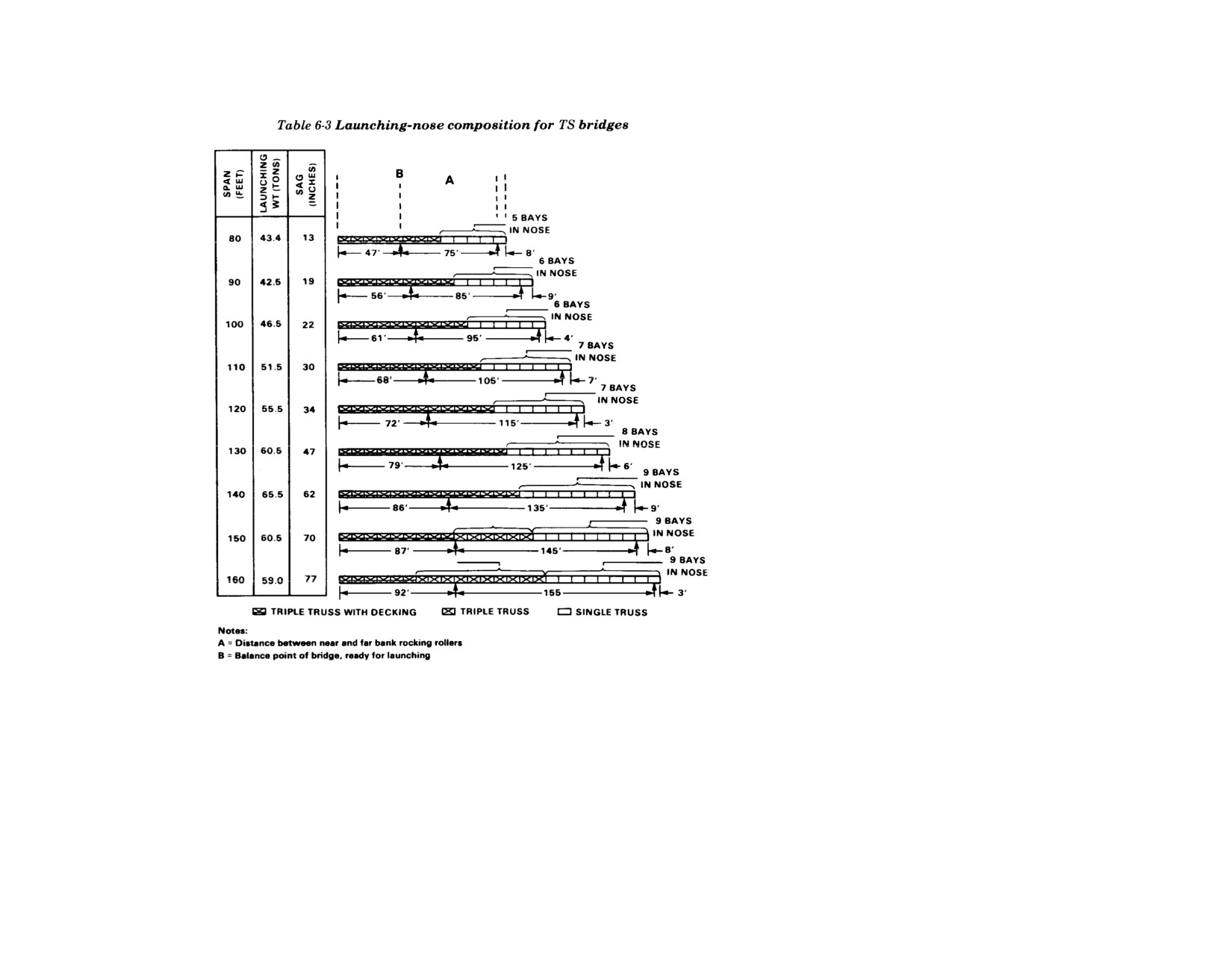
The number and types of bays used in the
6-3. These tables must be followed exactly
nose depend on the length and truss type of
with respect to the composition of the
the bridge. The composition of the launching
launching nose. Assembly of the launching
nose for the various lengths of the single-
nose is the same for all three types of single-
story bridge is given in Tables 6-1 through
story Bailey bridges.
64
FM 5-277
3
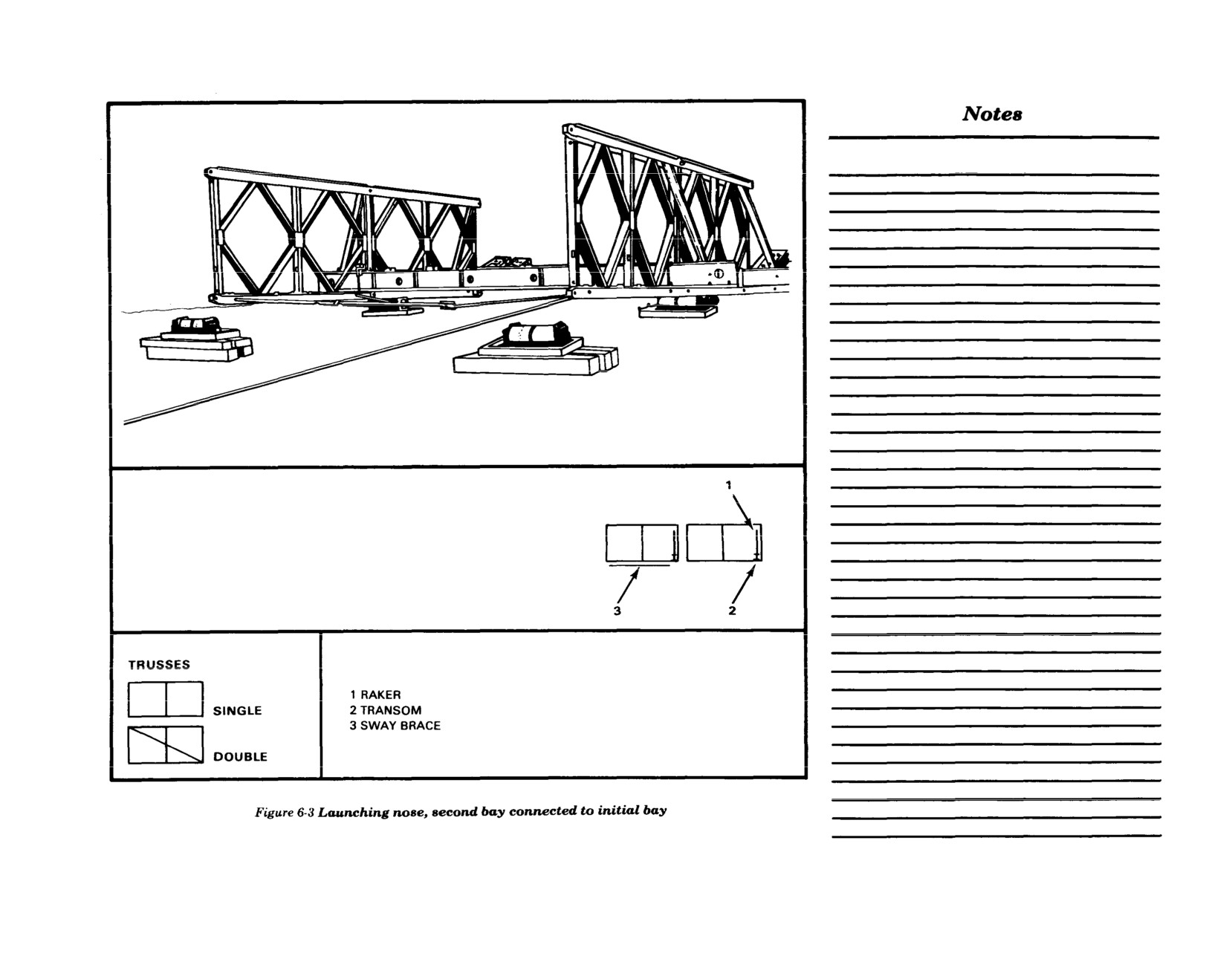
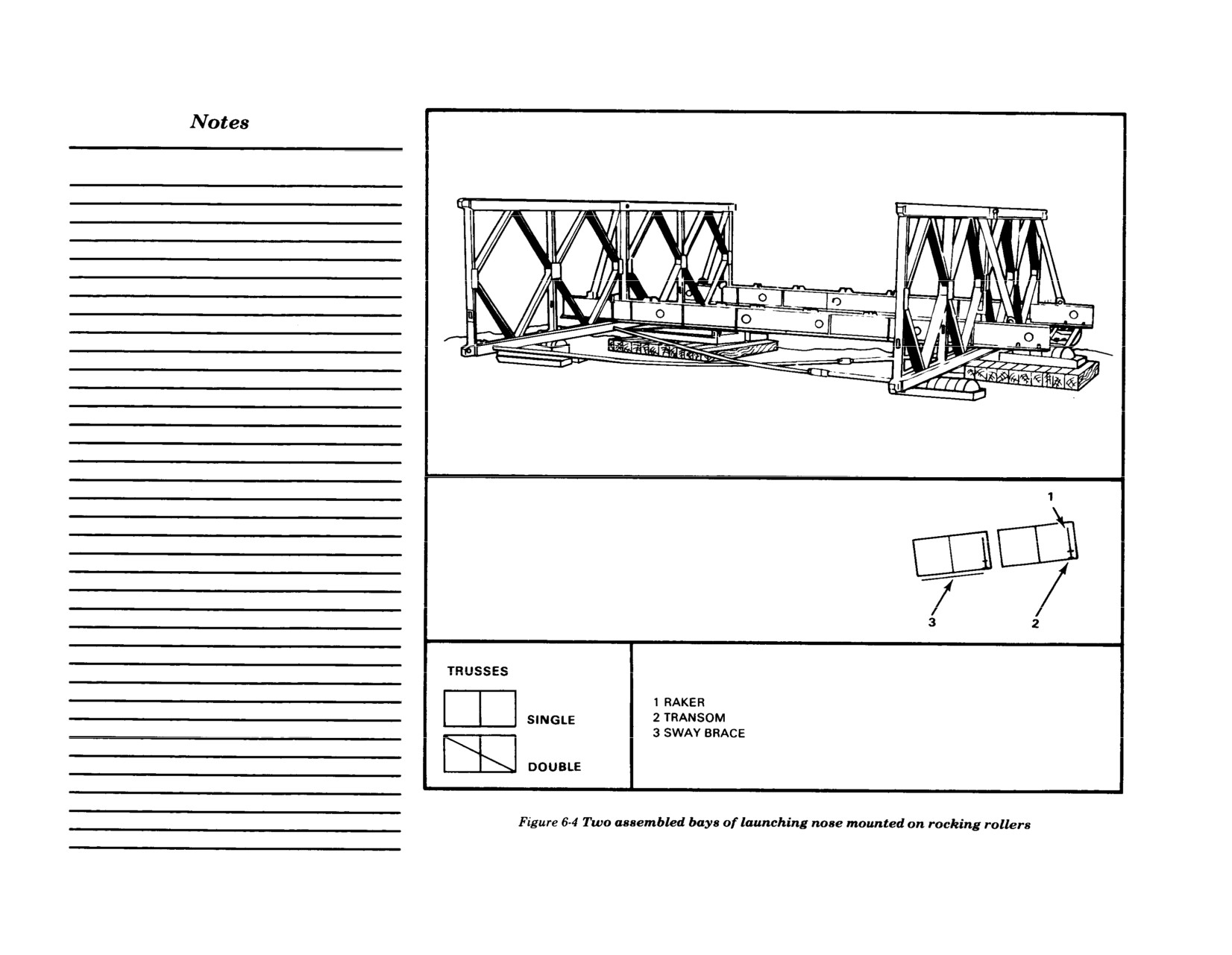
Place pair of sway braces in second bay.
4
Lift front end of assembled bays onto
rocking rollers (Figure 6-4, page 68) and
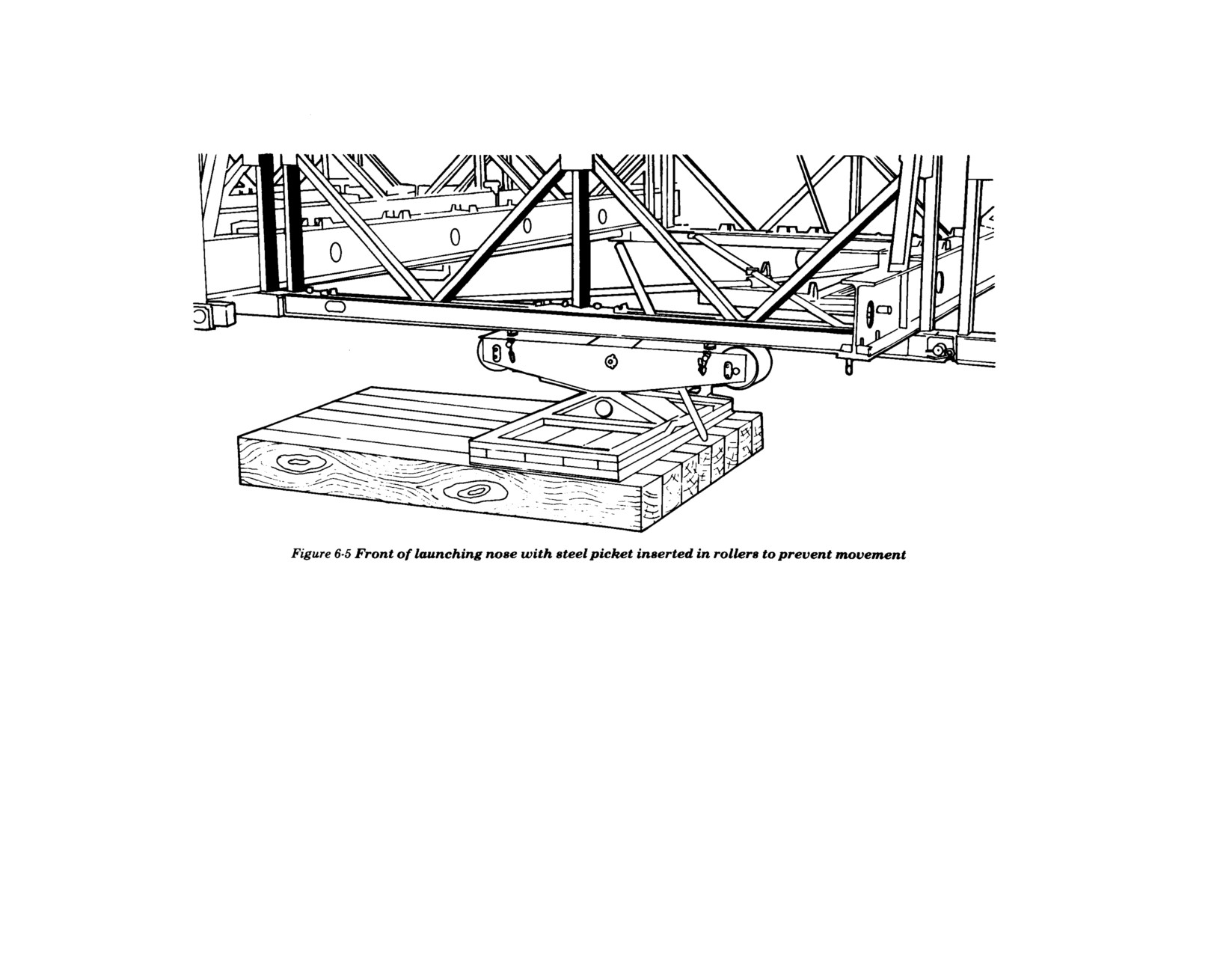
secure with steel pickets through bottom
chord of panels and rocking rollers (Figure
6-5, page 69) to prevent rolling.
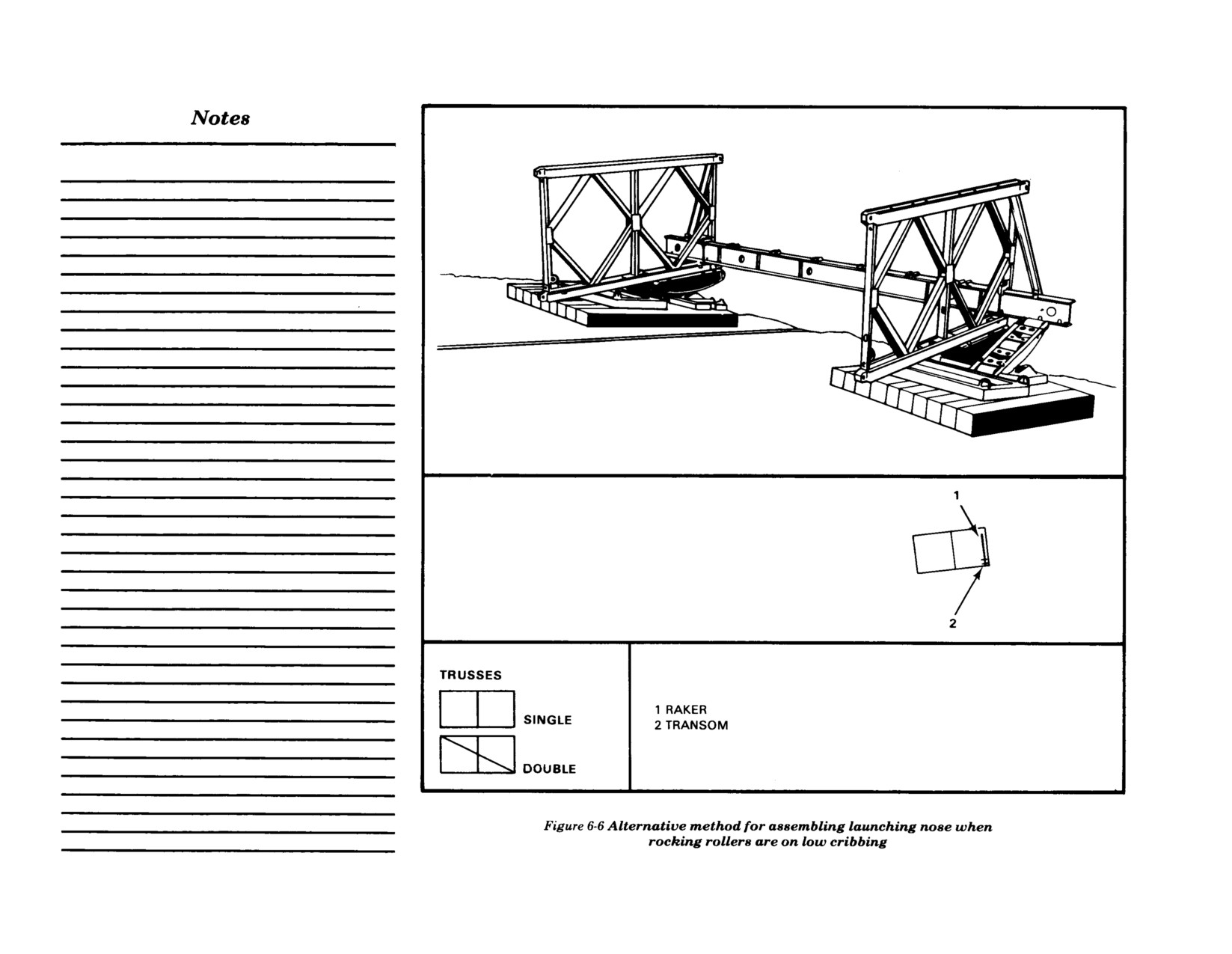
An alternative method (for rocking rollers
on low cribbing) is as follows:
a
Assemble first bay on ground.
b
Lift front end of bay onto rocking rollers
(Figure 6-6, page 70) and secure with
steel pickets.
c
Raise rear end and slide construction
rollers under it 2 inches (5.1 centi-
meters) below plane of tops of rollers.
This places construction rollers approxi-
mately 9 feet (2.7 meters) from rocking
rollers.
d Add second bay.
5
If required, place launching-nose links in
position between panels as determined by
assembly conditions. See Chapter 4 to
ASSEMBLY AND LAUNCHING
panel behind the forward uprights. Secure
determine the number of links and their
After roller layout is complete, proceed with
rakers to transom and panel with bracing
position in the nose.
assembling and launching of nose as follows:
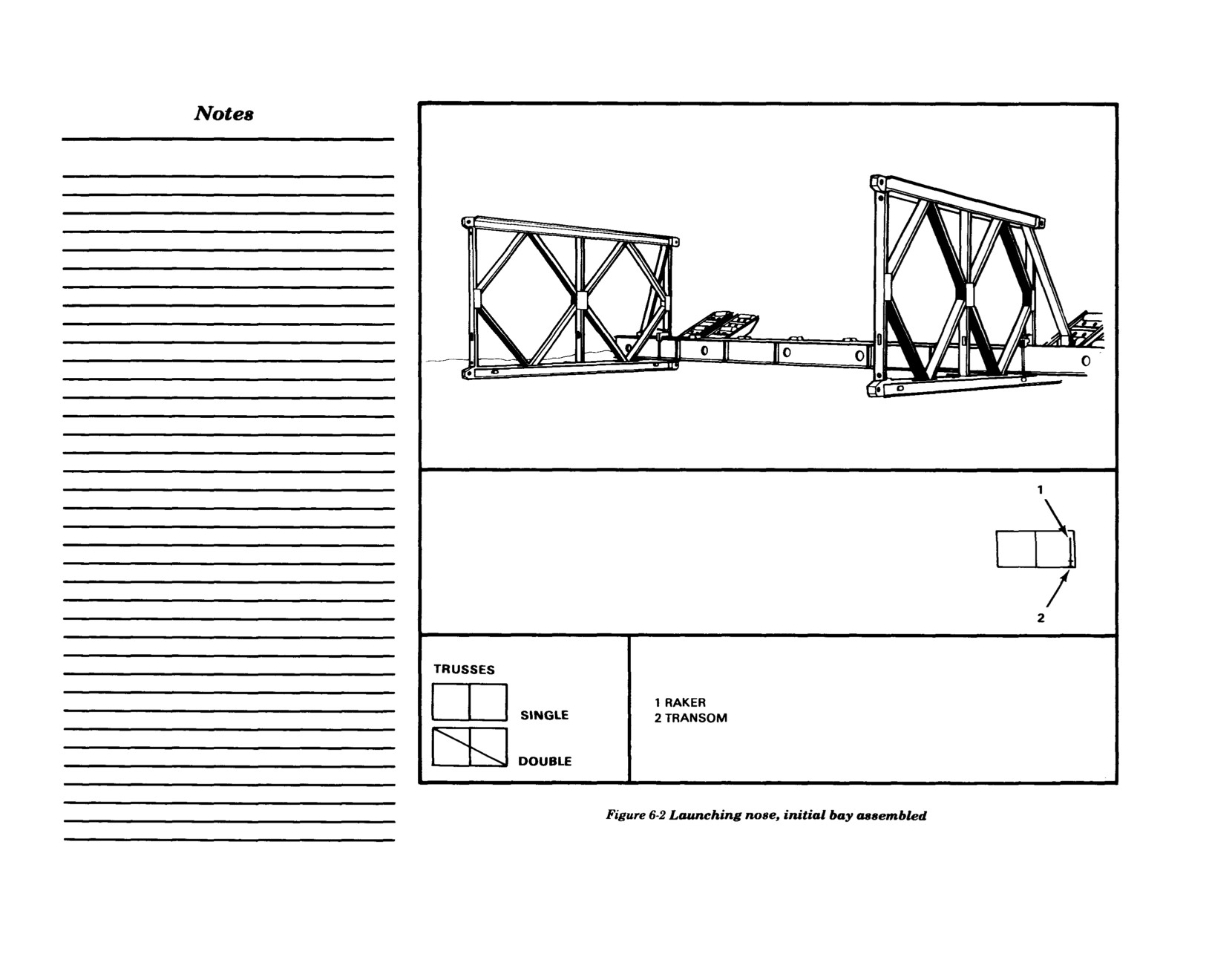
bolts (Figure 6-2, page 66).
6
Continue adding panels with a transom
1 Place two panels (female ends forward
2 Connect second bay (Figure 6-3, page 67).
every 10 feet (3.0 meters). Add sway braces
and male ends resting on construction
Insert panel pins (points outward) with
in every bay and rakers on every transom
roller) on the ground directly behind the
grooves in the heads of pins horizontal.
until the required amount of skeleton is
rocking rollers. Clamp the transom to the
Clamp transom to panels behind forward
built.
uprights.
65
FM 5-277
66
FM 5-277
67
FM 5-277
68
FM 5-277
69
FM 5-277
70
FM 5-277
ASSEMBLY OF DOUBLE-SINGLE BRIDGE
FIRST BAY OF BRIDGE
When assembly of the nose is completed,
assemble the first bay of the bridge as follows:
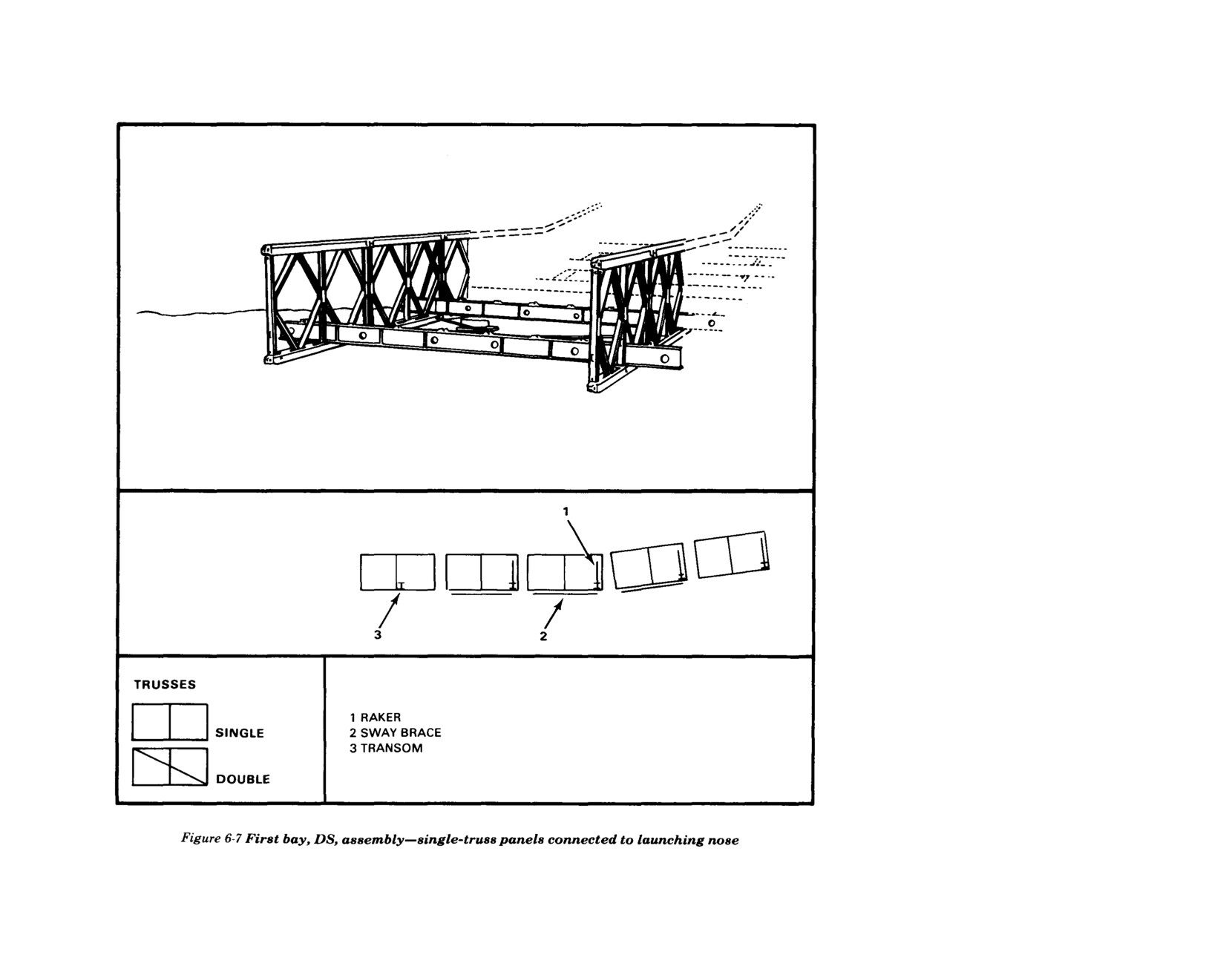
1
Connect first two panels of inner truss
with last bay of nose (Figure 6-7). Insert
panel pins with points outward and
grooves in heads of pins horizontal. Place
transom roller on top of the lower panel
chord at the transom location. Hook the
bottom angle lug of the roller over the
near side of the top flange on the chord to
hold the roller assembly in position. Lift
the head of the transom onto the roller
and shove it halfway across bridge width,
at which point two soldiers should guide
it to its seat on the panel chord. Then raise
the near end of the transom enough to
permit removal of the roller. Place the
first transom in front of the middle ver-
tical and clamp loosely with transom
clamps. Then move the transom roller to
each succeeding transom point.
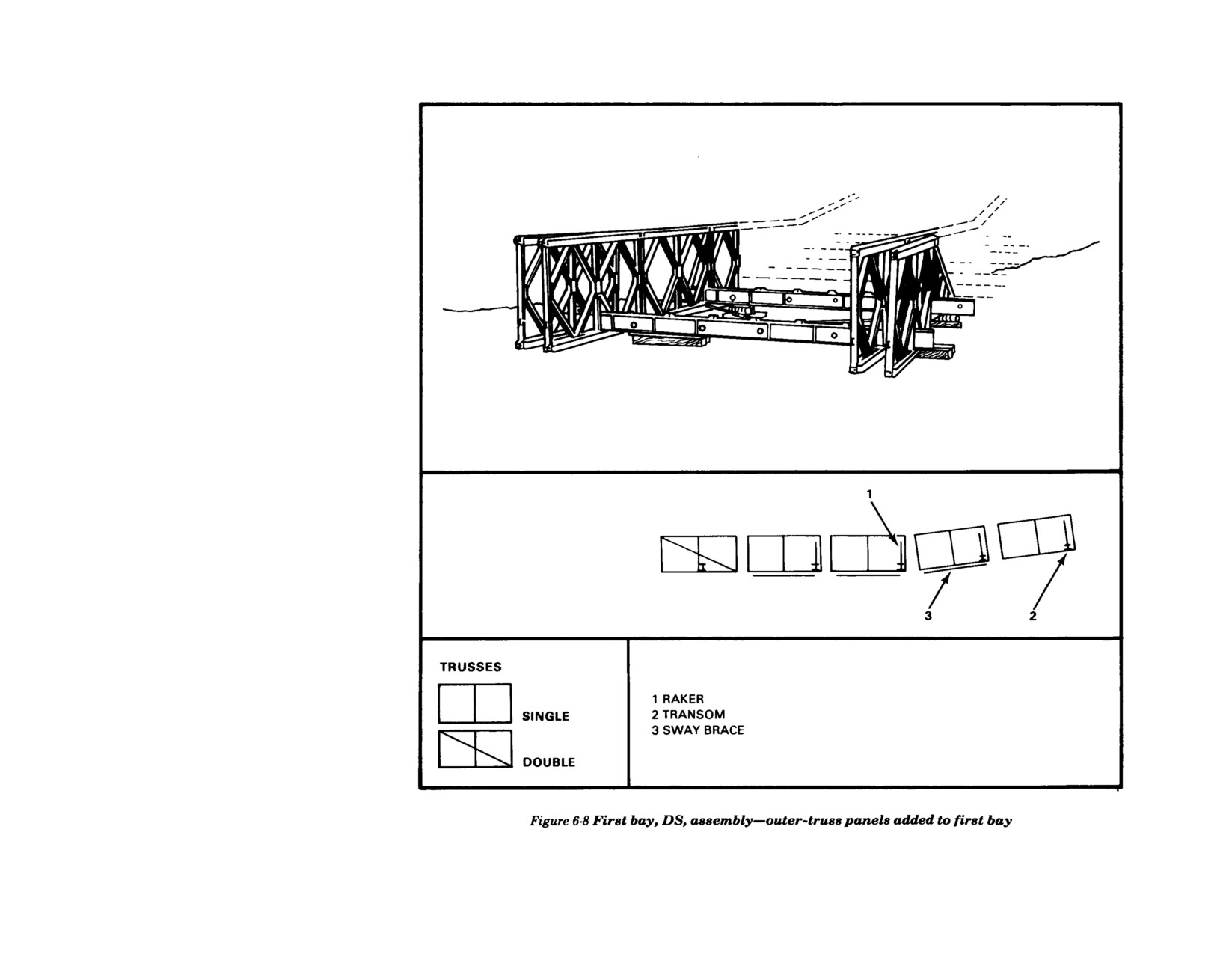
2
Add panels of outer truss in first bay and
hold in place with transom clamps (Figure
6-8, page 72).
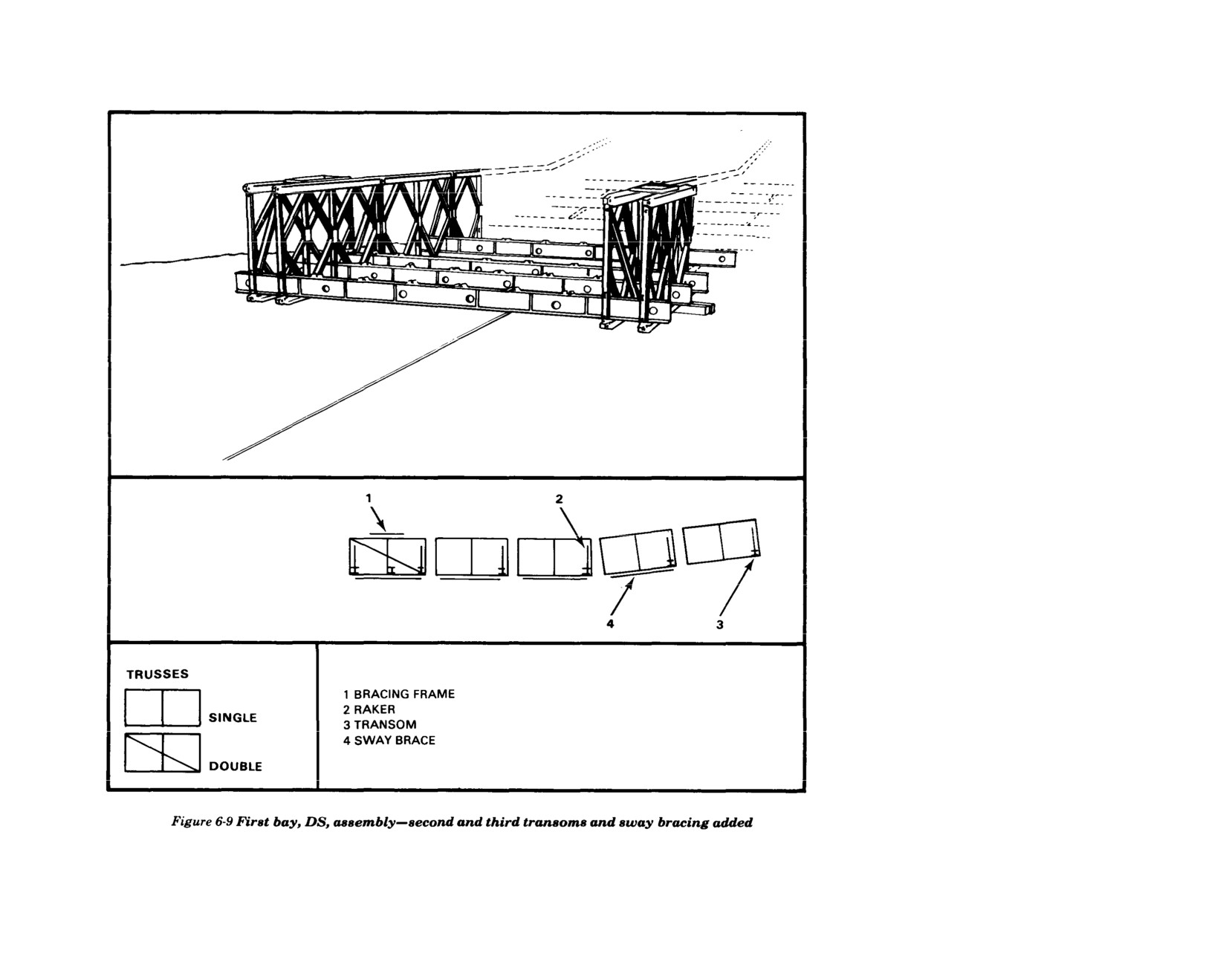
3
Insert second transom in front of rear
vertical and third transom behind front
vertical. Clamp loosely. Fix rakers to
second transom and panel (Figure 6-9,
page 73). Then position sway braces with
short ends pinned to same side of bridge
so both turnbuckles are under one string-
er. All sway braces, transom clamps,
bracing frames, rakers, and tie plates in
one bay should be left loose until all parts
71
FM 5-277
except stringers and decking are fitted for
the next bay being assembled.
4
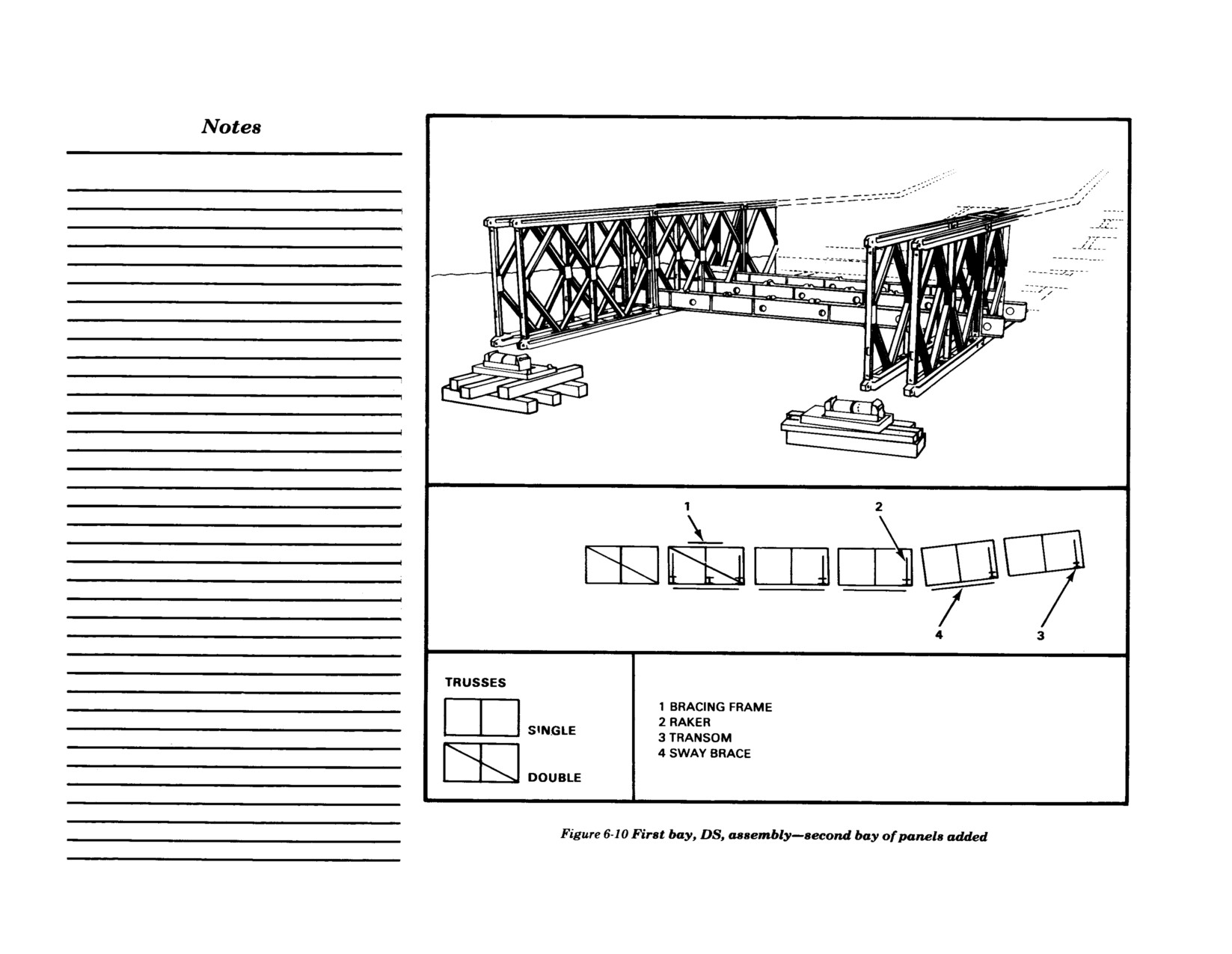
Add second bay of panels (Figure 6-10,
page 74). Place outer truss with panel pins
pointing inward and inner truss with
panel pins pointing outward.
5
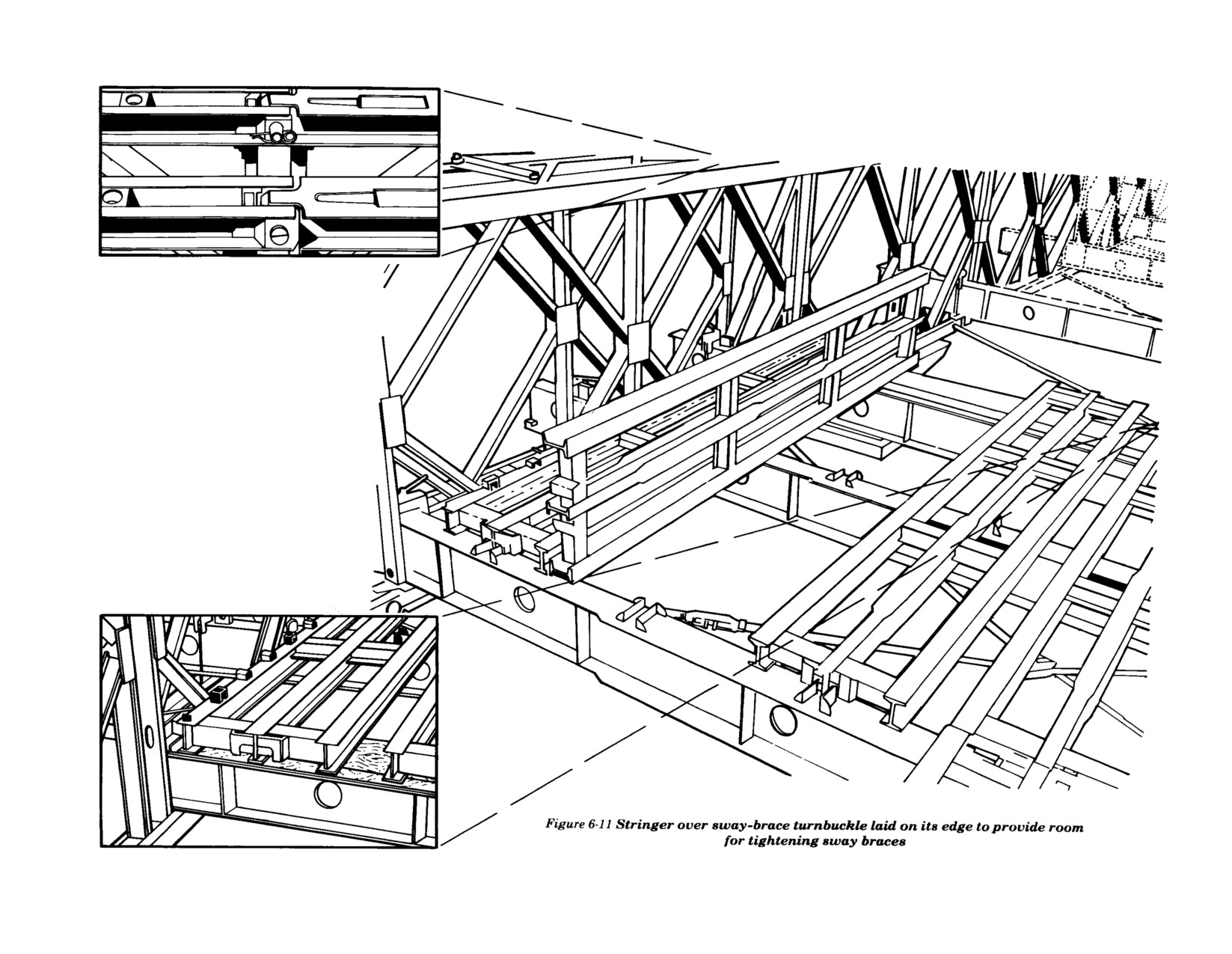
Place a chess on top of transom behind
front vertical in first bay and position
stringers for first bay. Leave stringer over
sway-brace turnbuckles on edge until
sway braces have been tightened (Figure
6-11, page 75). After bridge has been
launched and end-post transom is in-
serted, the chess holding up the stringers
and decking in the first bay can be pushed
clear with crowbars, and decking will
drop into position.
6
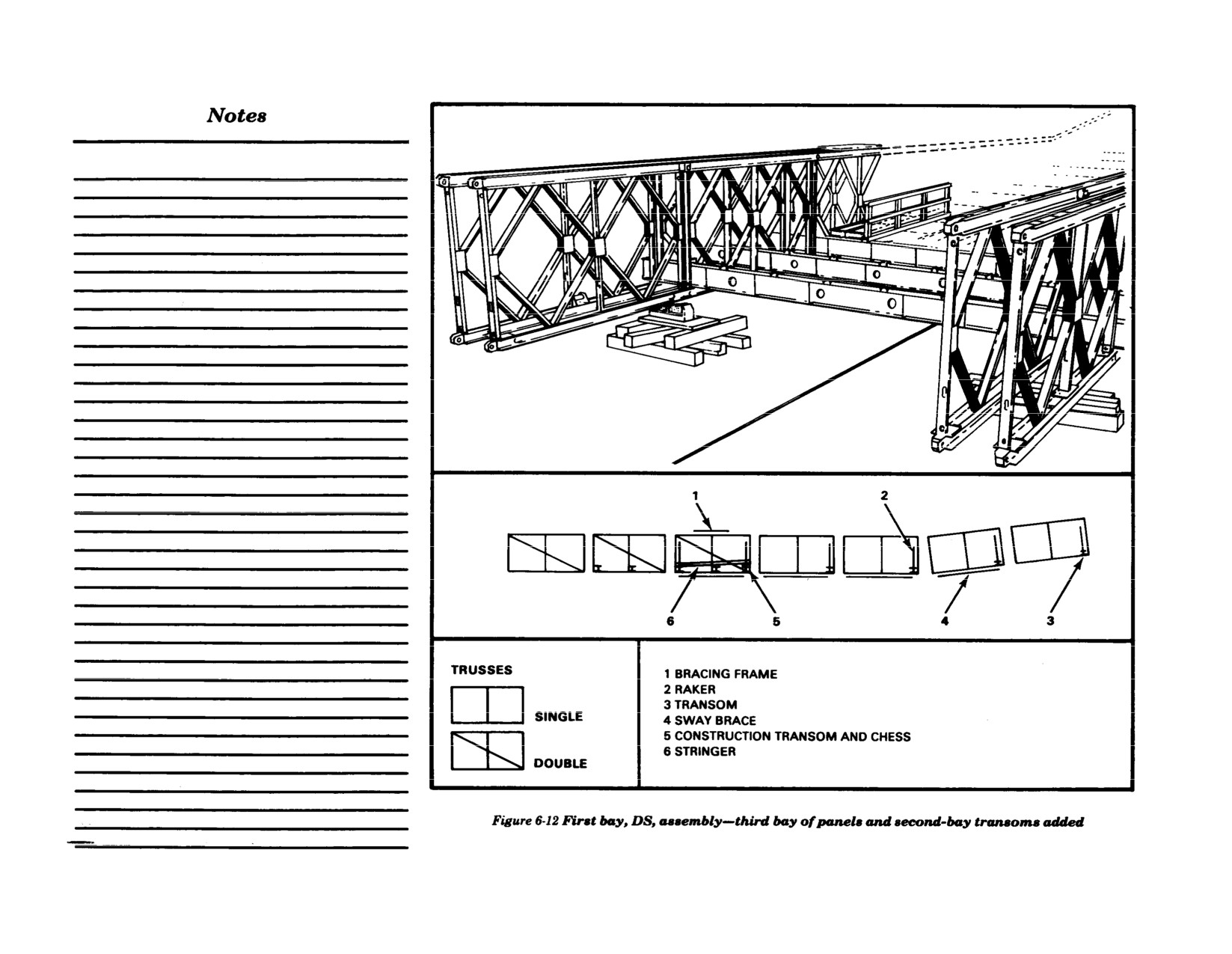
Position panels of third bay. As panels of
the third bay are being placed, insert
transoms in second bay, one in front of
middle vertical and one in front of rear
vertical (Figure 6-12, page 76).
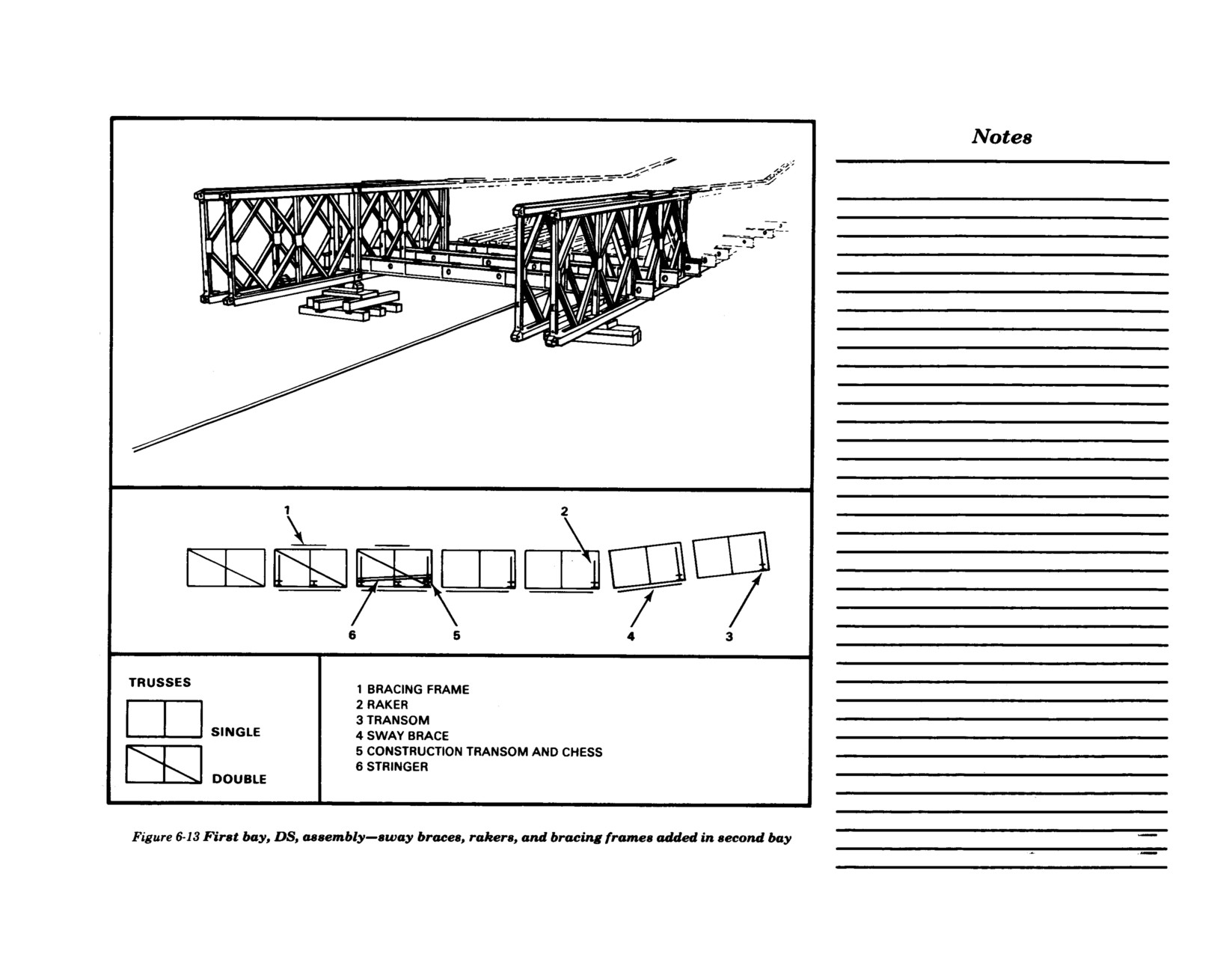
7
After transoms are in position in second
bay, fix sway braces, rakers, and bracing
frames loosely (Figure 6-13, page 77).
Rakers are installed only on the transoms
at the end verticals.
8
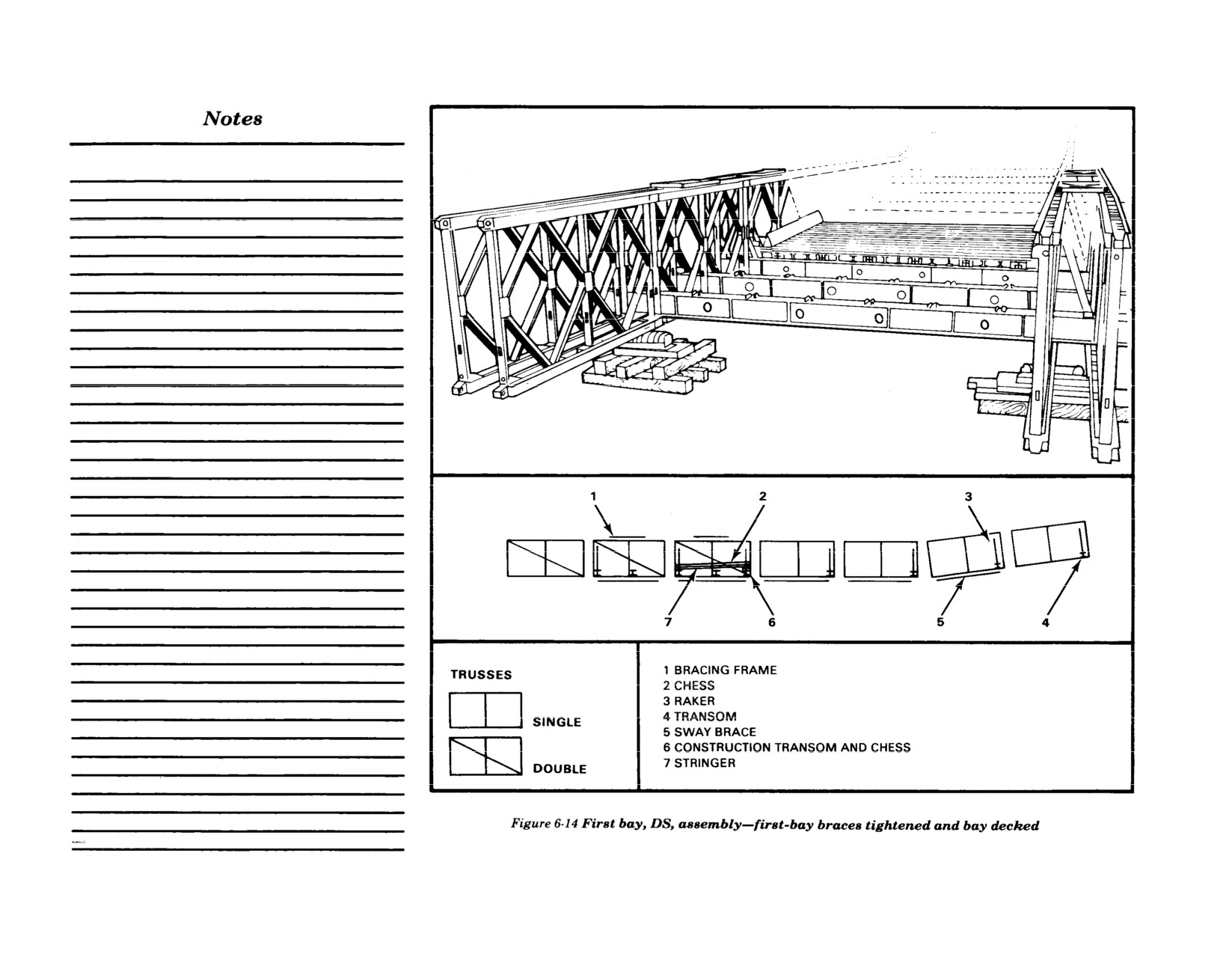
Tighten bracing in first bay, and deck
first bay (Figure 6-14, page 78).
72
FM 5-277
REMAINDER OF BRIDGE
Assemble the remainder of the bridge as
follows:
1
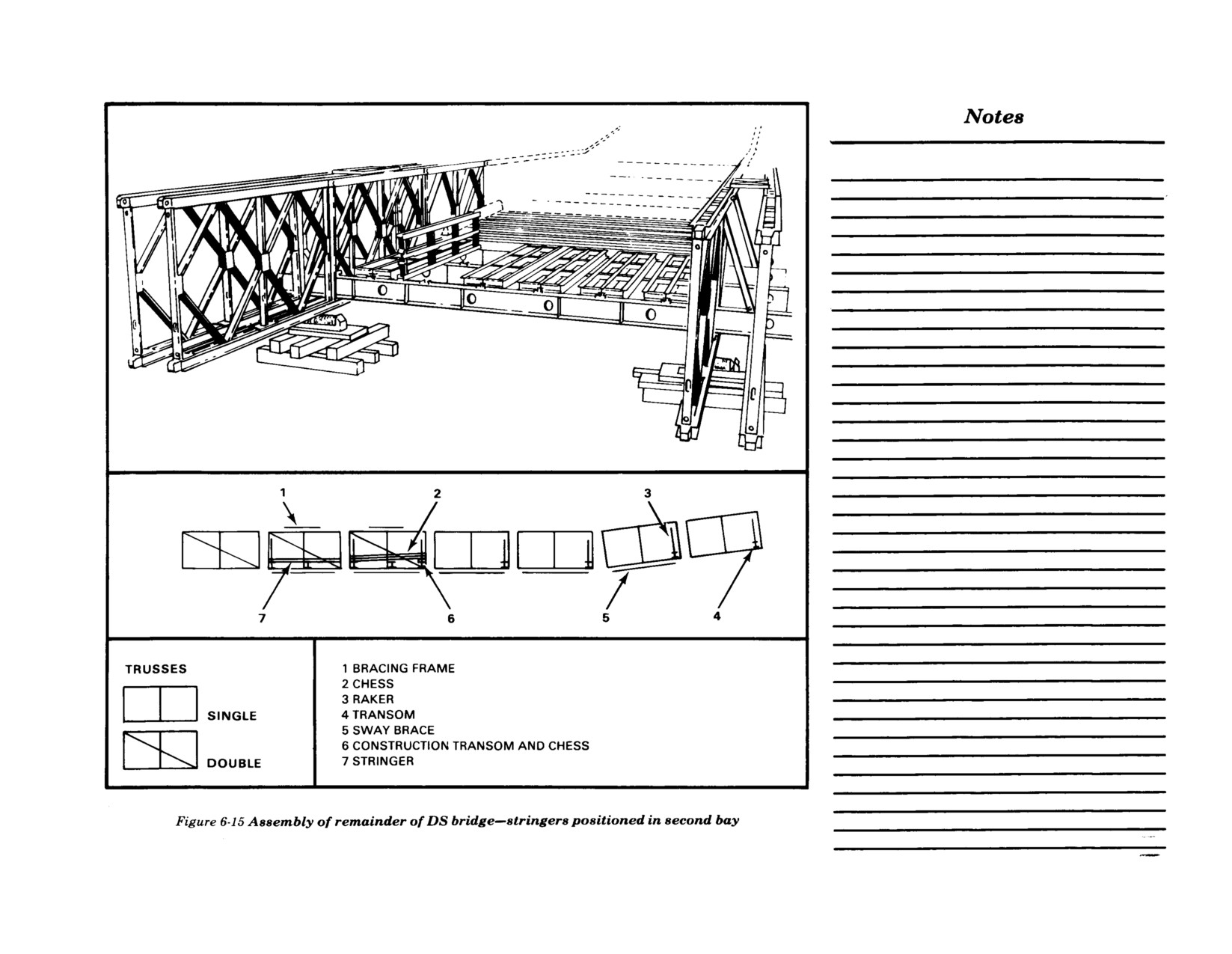
Position stringers in second bay and leave
stringer over sway-brace turnbuckles on
edge until sway braces have been
tightened (Figure 6-15, page 79).
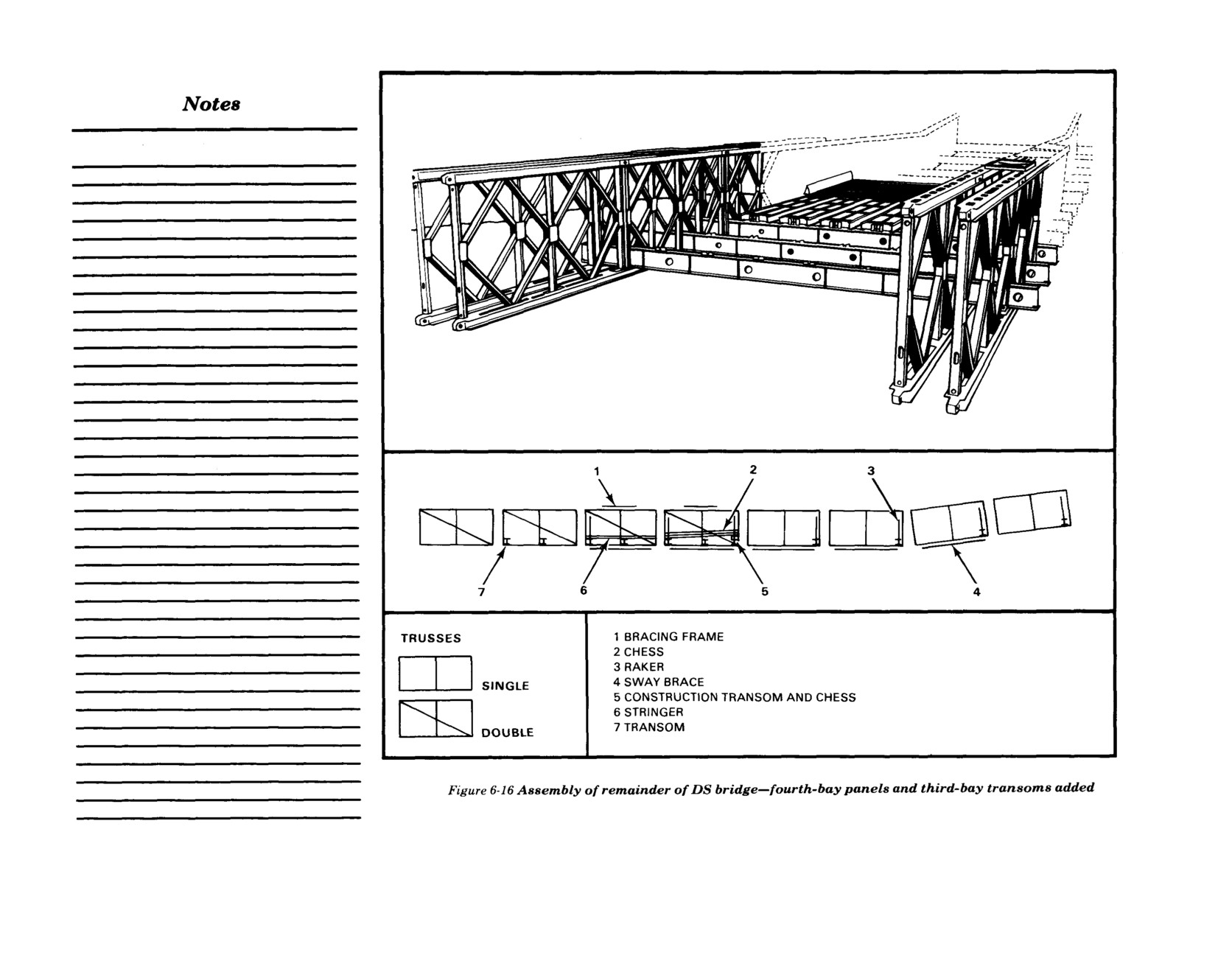
2
Add fourth bay of panels and at same
time insert transoms in third bay (Figure
6-16, page 80).
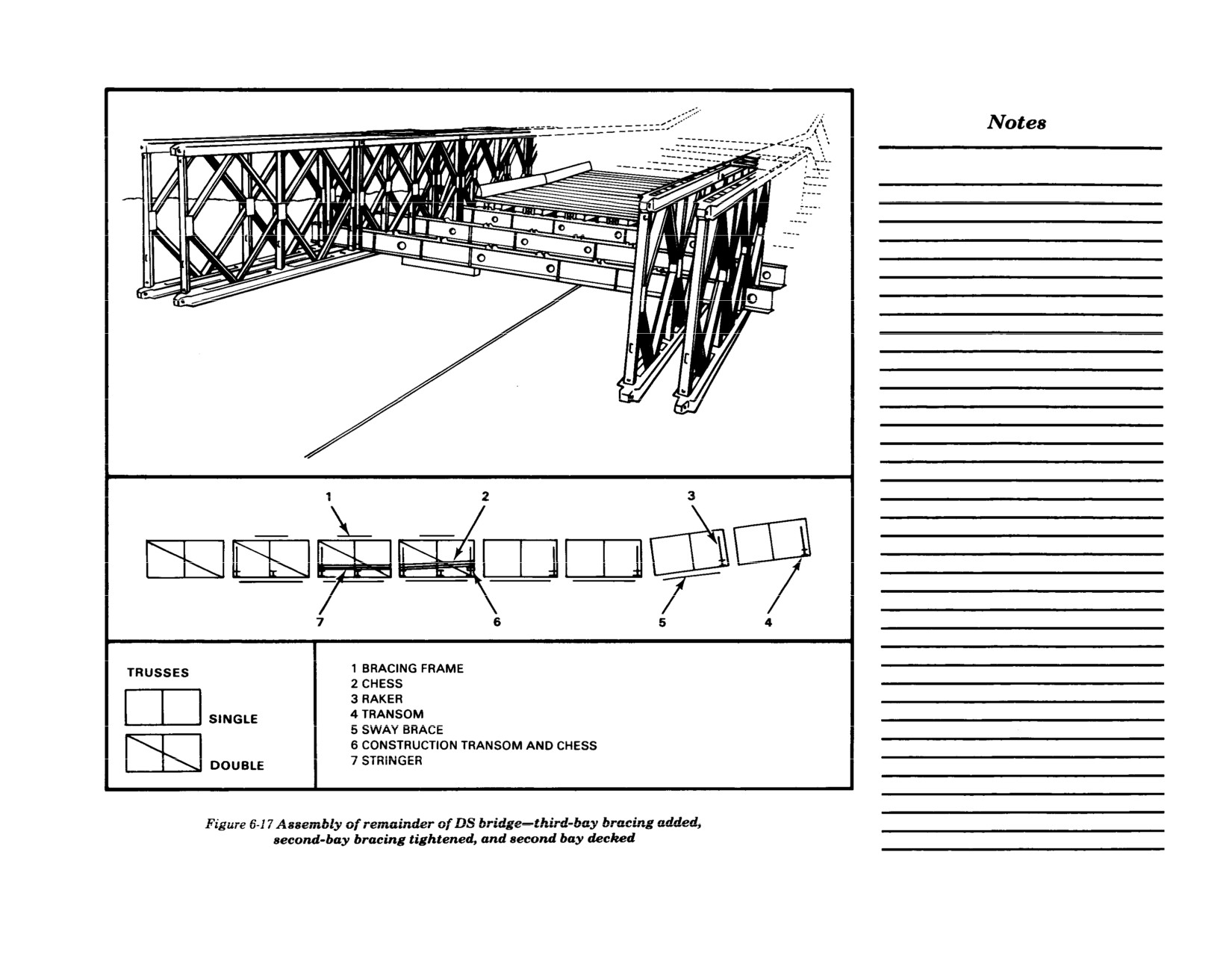
3 Add bracing in third bay. Tighten bracing
in second bay, and deck second bay
(Figure 6-17, page 81).
The sequence is complete. Use the same
sequence for the rest of the bridge. Do all jobs
at the same time; the sequence is used to
prevent crowding of assembly and carrying
parties.
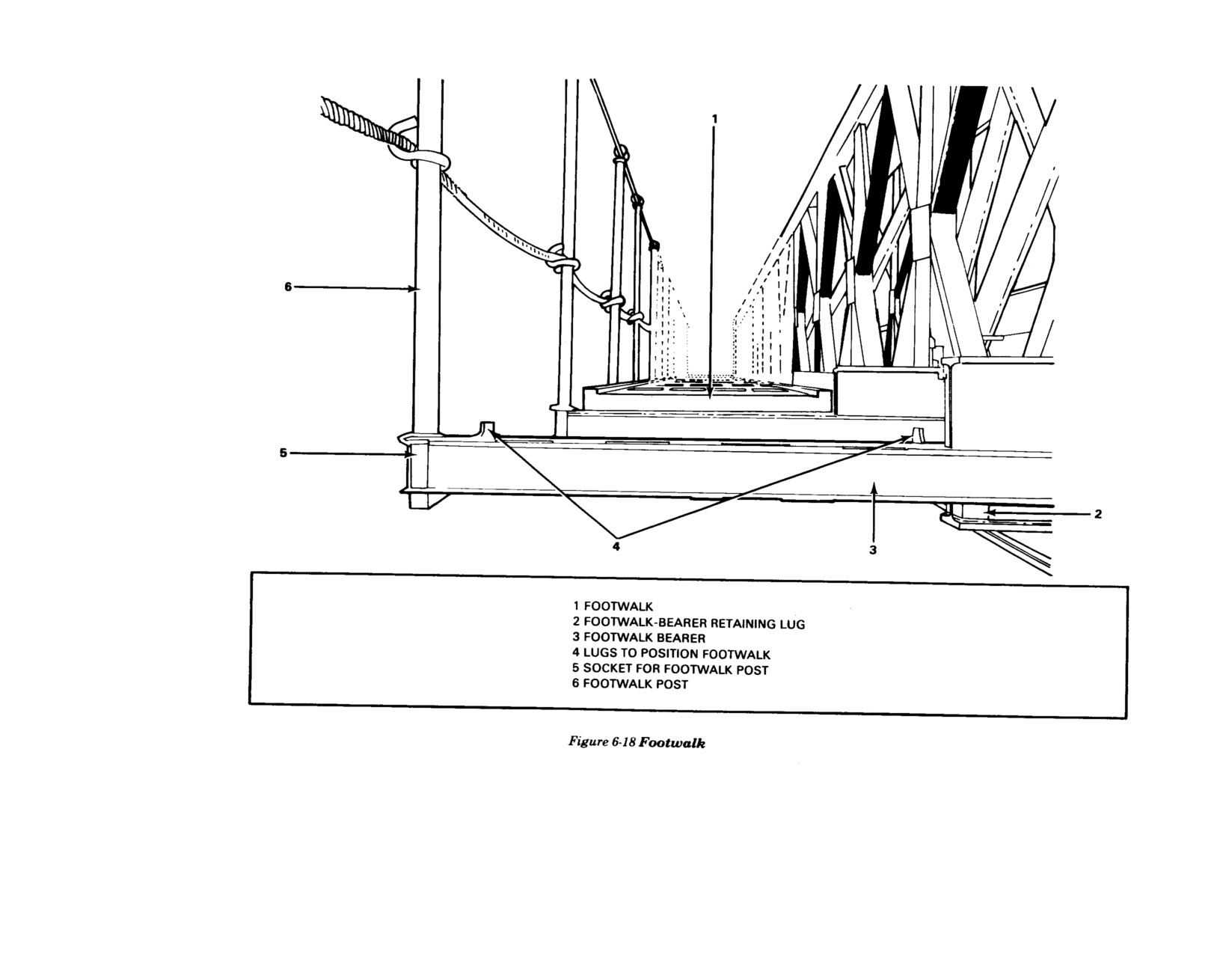
Normally, footwalks are not used. However,
when time, troops, and materials are avail-
able, footwalks can be assembled. Footwalks
should be assembled before launching be-
cause it is awkward to place bearers and
footwalks after bridge is in place. Attach
bearers to all transoms. They fit over and
under special lugs welded to the transom.
Position footwalks by lugs on bearers. Insert
footwalk posts in sockets at the ends of
bearers and thread hand ropes through the
eyes of the posts. Figure 6-18 (page 82) shows
the completed footwalk.
73
FM 5-277
74
FM 5-277
75
FM 5-277
76
FM 5-277
77
FM 5-277
78
FM 5-277
79
FM 5-277
80
FM 5-277
81
FM 5-277
82
FM 5-277
ASSEMBLY OF TRIPLE-SINGLE BRIDGE
METHOD OF ASSEMBLY
The method of assembly for the
triple-single
5
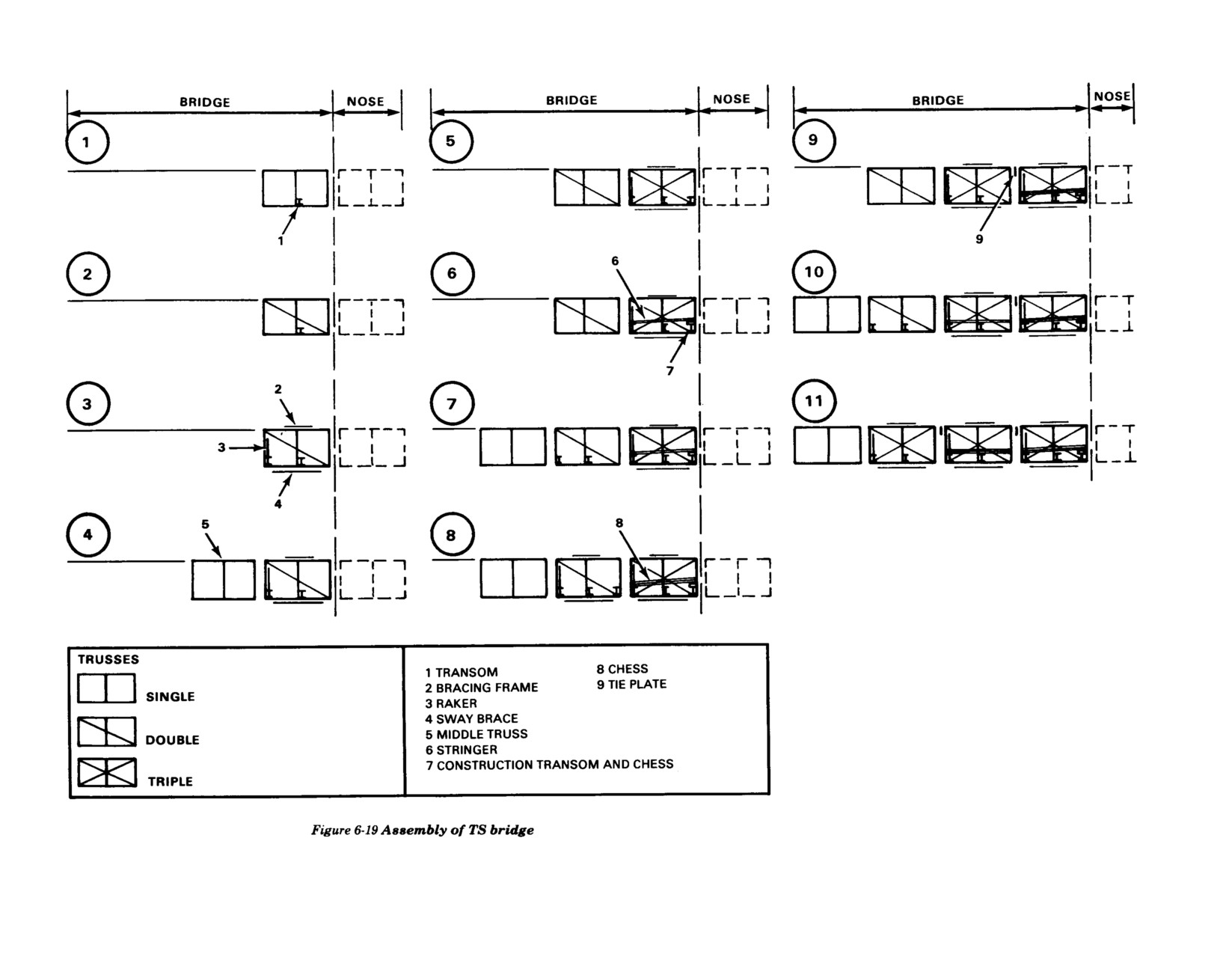
Add outer truss panels to first bay. Posi-
2 Place stringers in second bay. Position
bridge is similar to that for the
double-single
tion construction transom behind forward
middle truss panels in fourth bay, and at
bridge. The assembly of the outer truss in one
verticals in first bay. Add inner truss
same time insert transoms in third bay
bay must be delayed, however, so panel pins
panels to second bay.
(Figure 6-19).
in the second truss can be inserted. In addi-
tion, use short pins in the middle and outer
6
Place chess on the construction transom
3 Add bracing in third bay. Tighten bracing
truss end posts because normal length pins
and position stringers in the first bay.
in second ‘bay, and deck second bay
will not fit.
(Figure 6-19).
7
Position middle truss panels in third bay.
FIRST BAY OF BRIDGE
As panels are being placed in the third
The sequence is complete, and the same
Assemble the first bay of the bridge as follows
bay, insert transoms in second bay, one in
sequence is used for the rest of the bridge.
(Figure 6-19, page 84):
front of the middle vertical and one in
front of the end vertical.
When loads greater than class 70 are to be
1
Connect first two panels of inner truss
carried, such as an 80-foot (24.4 meters)
triple-
with last bay of nose. Insert first transom
8 Add bracing in second bay. Tighten
single
bridge, four transoms per bay are
in front of middle vertical and clamp
bracing in first bay, and deck first bay.
required. The procedure for assembling the
loosely with transom clamp.
transoms in the first bridge bay is the same.
REMAINDER OF BRIDGE
In addition. a fourth transom is added behind
2
Add panels of middle truss in first bay
Assemble the remainder of the bridge as
the center vertical. In order to clamp both
and hold in place with transom clamps.
follows:
transoms at the center vertical, the transom
held behind the vertical should be clamped to
3
Insert second transom in front of rear
1 Position outer truss of second bay. Con-
the inside trusses and the other to the outside
vertical. Attach rakers and position
nect to middle truss with tie plates bolted
trusses. In all subsequent bays, the four
bracing frames and sway braces. The
to top raker holes in forward verticals of
transoms are placed in regular order, the first
construction transom behind front ver-
panels (Figure 6-21, page 85). Add inner
behind the front vertical, one in front of the
tical is omitted until the outer truss in the
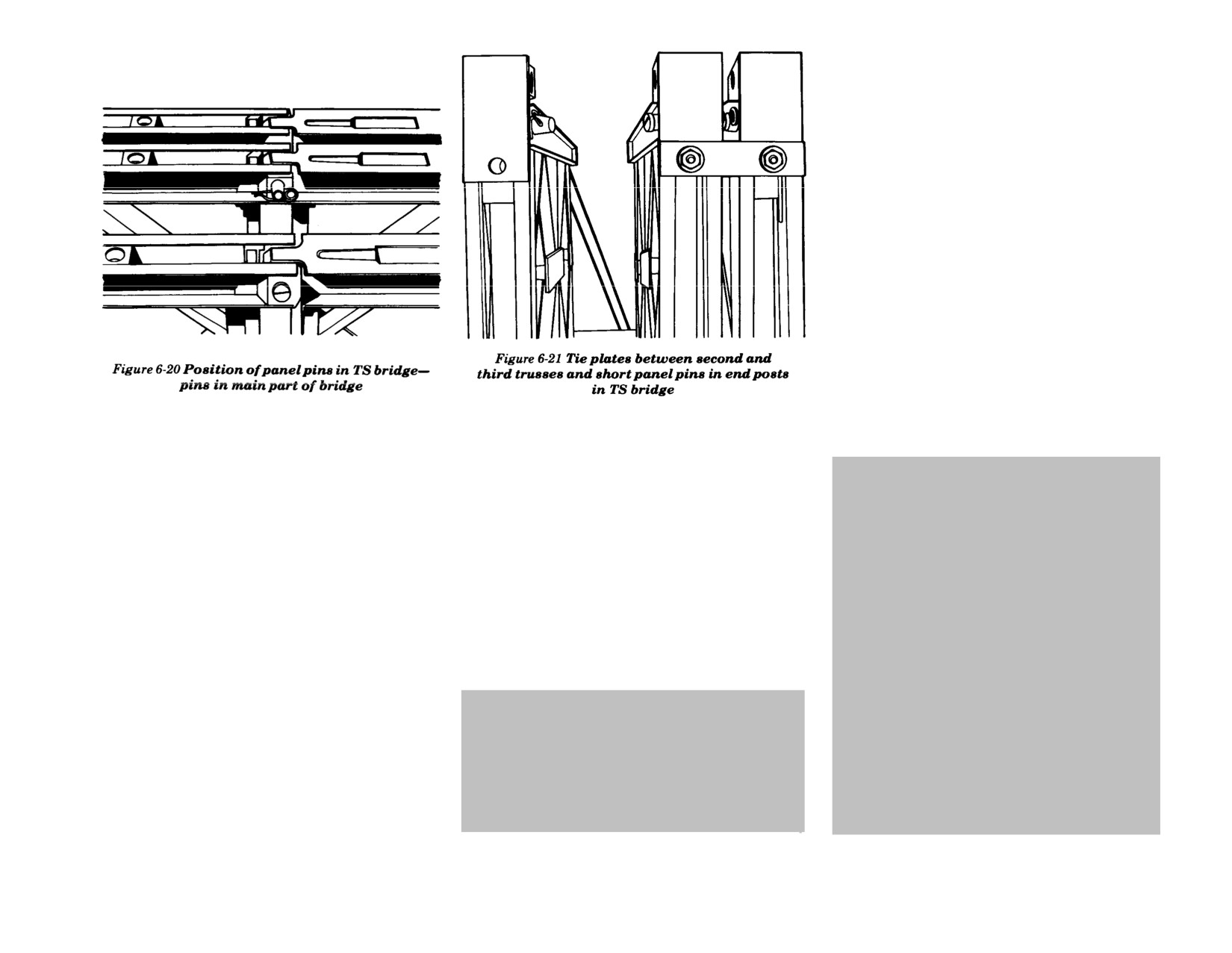
truss of third bay (Figure 6-19). Figures
center vertical, one behind it, and one in front
first bay has been positioned.
6-20 (page 85) and 6-21 show the position
of the rear vertical.
of panel pins in
triple-single
bridge.
4
Add middle truss panels in second bay.
This panel must be positioned before the
outer truss panel in the first bay so panel
pins can be inserted.
83
FM 5-277
84
FM 5-277
LAUNCHING, JACKING DOWN, AND RAMPING
USE OF COUNTERWEIGHT
longer needed to maintain balance since
mitted to carry any load after the nose
During launching, the entire bridge (in-
there is now no danger of it tipping into the
reaches the far-bank rocking rollers.
cluding the nose) must be counterbalanced so
gap.
The rear of the bridge must hang free
the structure does not tip into the gap. The
to act as a counterweight. This is done
counterbalance is normally obtained by
Note:
Counterbalance is still needed, how-
by cribbing up the near-bank rocking
adding enough bays of bridge behind the
ever, to avoid excess stress in the launching
rollers, or removing plain rollers so
near-shore rocking rollers to act as a counter-
nose until launching is complete. Dis-
the rear end of the bridge does not
weight, keeping the balance point between
mantling any part of the bridge behind the
rest on them after the launching nose
the plain rollers and the rocking rollers. This
rocking rollers will throw additional stress
reaches the far-bank rocking rollers.
condition must prevail until the launching
on the launching nose and on the part of
nose reaches the rollers on the far bank. The
the bridge which is across the gap. This
If removal of plain rollers does not
point is illustrated in Tables 6-1 through 6-3
may result in failure of the nose.
provide the required clearance, exca-
which show the bridge and launching nose
vate until the overhang is free of the
just spanning the gap. In this position, the
Caution:
The near-bank rocking
ground. If the far-bank rocking rollers
bridge is completely assembled and the
rollers and the far-bank rocking
are placed several inches below the
balance point is slightly behind the near-
roIlers must carry the entire load after
level of the other rollers, the entire
shore rocking rollers. As the bridge is pushed
the launching nose reaches the far-
weight of the bridge on the near-bank
across the gap from this position, the balance
bank rocking rollers (Figure 6-22,
rocking rollers will be offset so that
point passes the rocking rollers. The part of
page 86). The launching nose may fail
the resulting launching plane will be
the bridge acting as a counterweight is no
if the near-bank plain rollers are per-
level or err on the safe side. In addi-
85
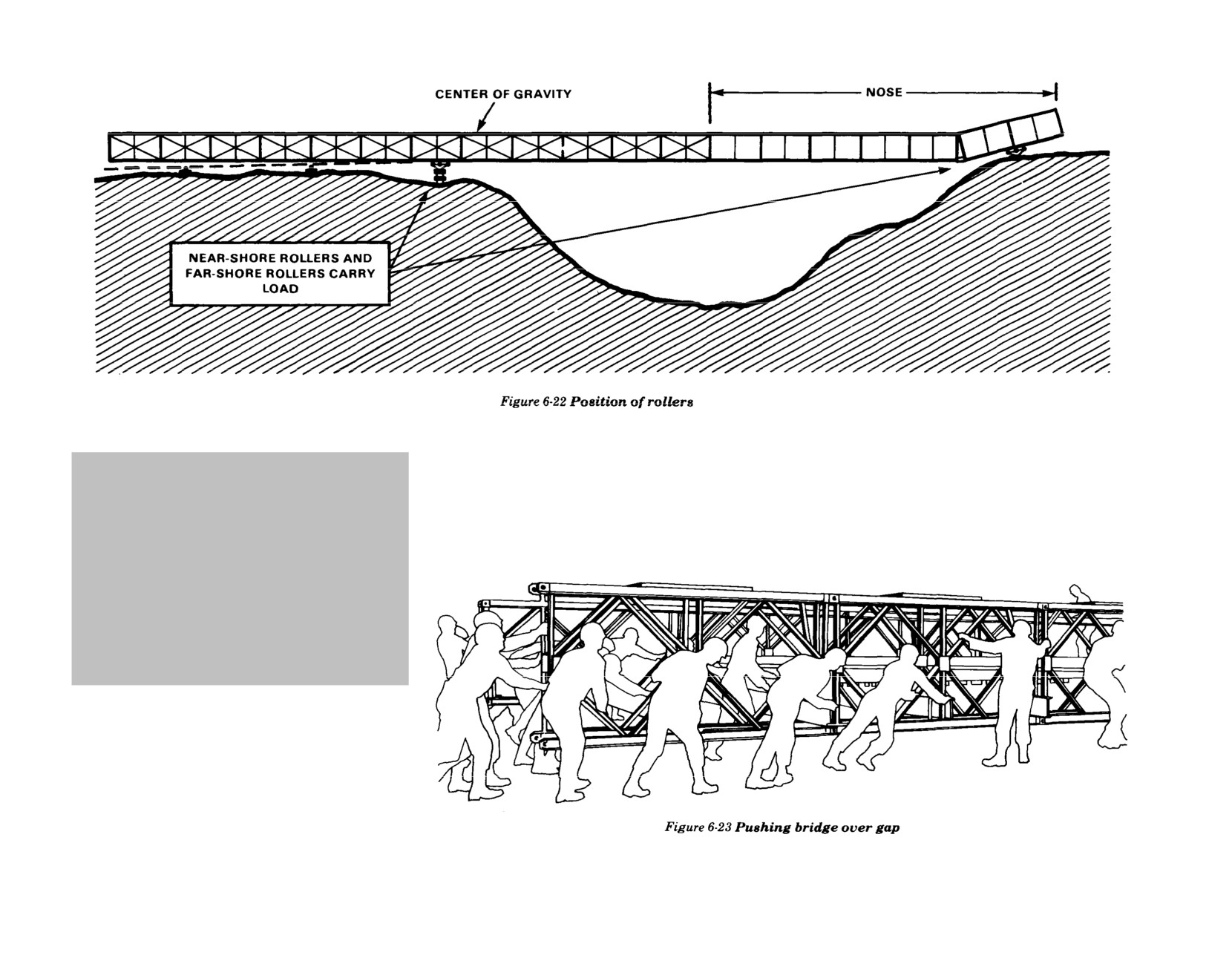
FM 5-277
are not required when launching bridges
jacks are used to aid insertion of the lower
tion, the extra 6-inch (15.2 centi-
up to 80 feet (24.4 meters) long. Bridges
panel pins of panels resting on rollers.
meters) safety allowance in the posi-
over 80 feet (24.4 meters) long require
tioning of the launching-nose links
additional sets of plain rollers spaced at
2
Continue assembly of bridge and pushing
will help prevent an unsupported
25-foot (7.6 meters) intervals. Bridges are
it out on the rollers (Figure 6-23). When
length of bridge from the far-bank
assembled on the rollers. When necessary,
the forward end of the launching nose
reeking rollers to the first near-bank
plain rollers from being clear of the
rocking rollers. Once the links have
passed over the far-bank rollers,
check the launching plane. If too much
settlement has occurred on the near
bank, remove the plain rollers.
LAUNCHING
After the nose and first bay of the bridge have
been completed, proceed with launching as
follows:
1 One pair of plain rollers has been placed
25 feet (7.6 meters) behind the near-bank
rocking rollers. Additional plain rollers
86
FM 5-277
all of the launching nose has cleared the
far-bank rocking rollers.
After the launching nose passes over the
far-bank rocking rollers, always make
certain the weight of the bridge is carried
only by the near-and the far-bank rocking
rollers.
JACKING DOWN
After the end posts and end transom have
been installed, proceed with jacking down as
follows:
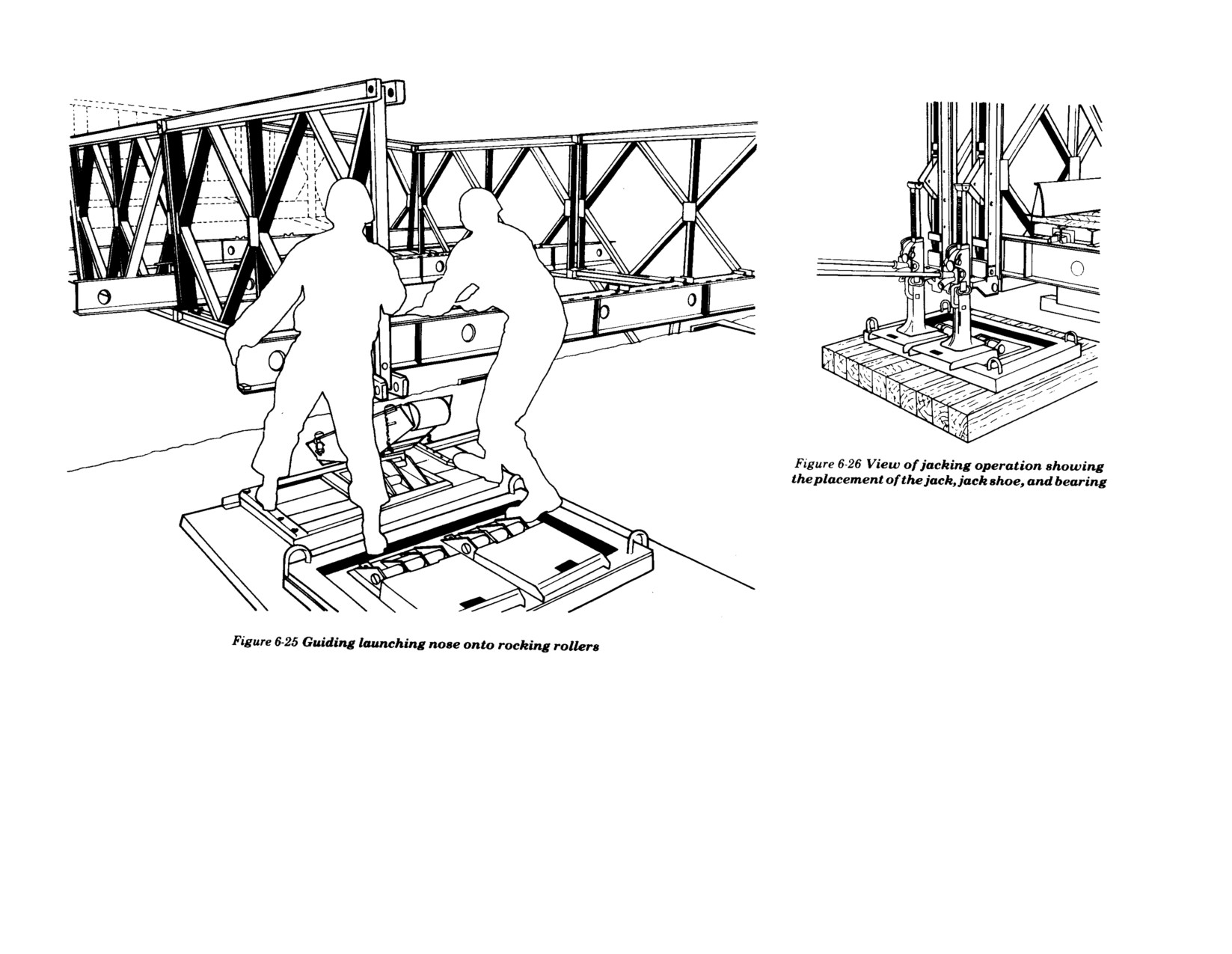
1 Place jack shoe in baseplate and jacks on
shoes with toes of jacks under steps of end
posts (Figure 6-26, page 88). Only enough
room is present to work four jacks at one
end of the bridge. More jacks may be
placed under a transom only when held
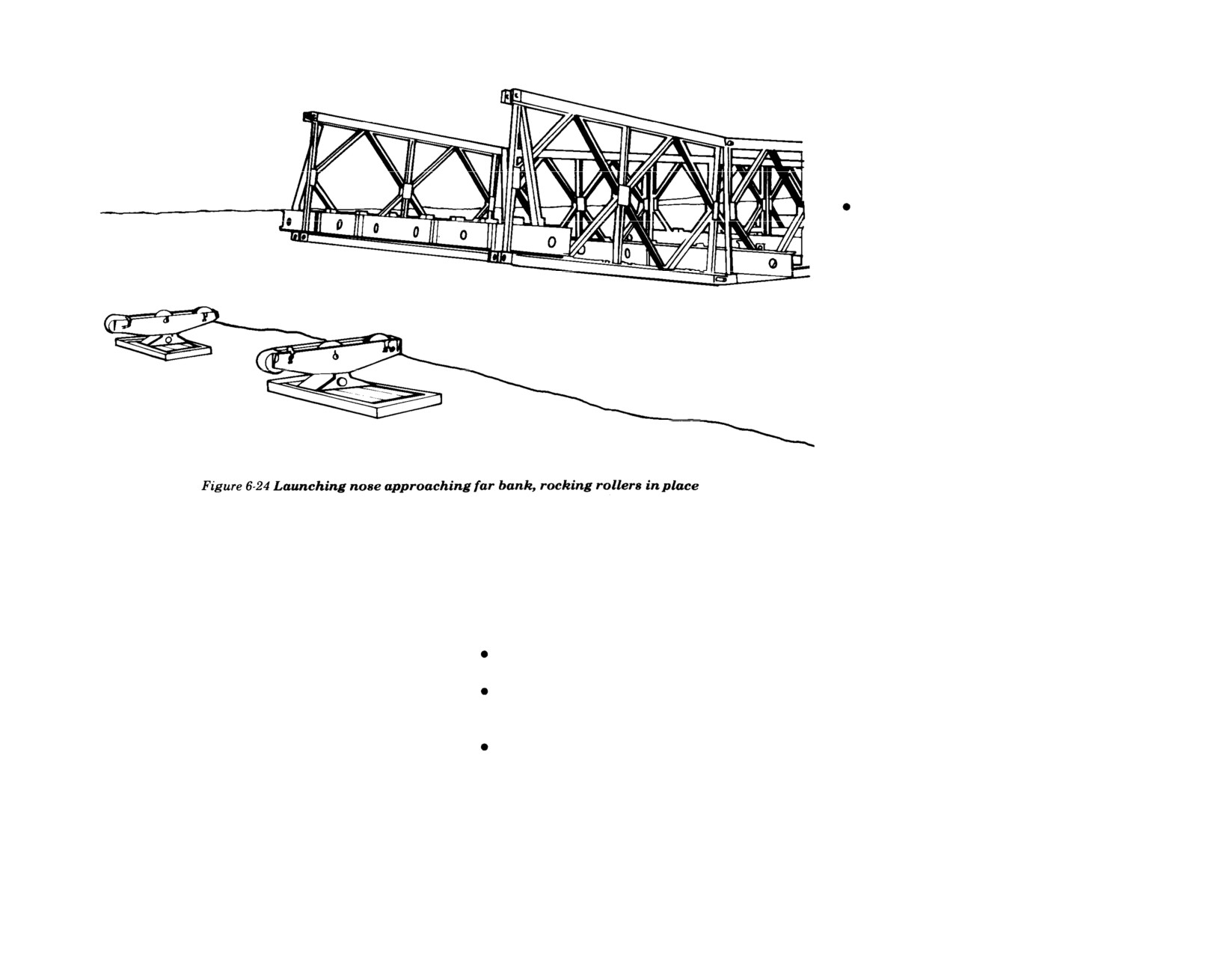
reaches the rollers on the far bank (Figure
truss end posts. Remove construction
by end posts. To prevent failure of jacks,
6-24), a detail guides it onto the rollers
chess behind the front vertical in the first
use them in unison so the load is distri-
(Figure 6-25, page 88) and dismantles it
bay so decking drops into place.
buted evenly between them.
bay by bay.
Take the following precautions when
com-
Note:
Pitch of teeth may vary in jacks of
3
When the end of the bridge proper clears
pleting the assembly and launching
different manufacture. Jacks used together
the rollers on the far bank, attach the
must always have the same pitch. Check
near-bank end posts. At the same time,
Do not use bent or distorted parts.
jacks to ensure that they have the same
attach the far-bank end posts and lay a
manufacturer’s name.
transom across their steps. The middle
Do not attempt to convert the launching
and outer truss end posts on the triple-
nose into the bridge by adding parts to it.
2 Jack up the ends of the bridge successively
truss bridge are pinned with short panel
and remove the rocking rollers. Place
pins and tied together with tie plates in
In launching the bridge over rollers, keep
bearings on baseplate as shown in Figure
the raker holes. Pins in middle truss end
the center of gravity behind the rocking
5-9.
posts are inserted with points outward
rollers until the launching nose reaches
and in outer truss with points inward
the far bank. Thereafter, do not dismantle
3 Lower bridge in stages (Figure 6-27, page
(Figures 6-20 and 6-21). Normal pins and
the bridge behind the near-bank rocking
89). Place cribbing under the bottom chord
methods of pinning are used on the inner-
rollers or remove the counterweight until
of the trusses to catch the bridge if it slips
87
FM 5-277
off the jacks. It does not matter which end
RAMPING
of the bridge is lowered first, but the jacks Refer to already determined design in Chapter
must be operated in unison.
4 for installing cribbing and supports (Figure
6-28). Position ramps and add decking (Figure
Note:
Jacks must be operated on only one
6-29, page 90). Brace approach to ramps, and
end of the bridge at a time.
bridge is complete.
88