FM 5-277 BAILEY BRIDGE (May 1986) - page 1
*FM 5-277
Field Manual
HEADQUARTERS
No. 5-277
DEPARTMENT OF THE ARMY
Washington, DC, 9 May 1986
B A I L E Y B R I D G E
Distribution Restriction: Approved for public release. Distribution is unlimited
*This publication supersedes
TM 5-277, 3 August 1972.
i
FM 5-277
PREFACE
bridge to the British War Office which paid
This manual is intended for use by engineer
him the equivalent of $48,000 in 1985
commanders, staff officers, combat engi-
American currency.
neers, and bridge specialists who are required
to build the Bailey bridge.
The Bailey bridge used in World War II was
designed to be moved, rebuilt, or replaced in
The purpose of this manual is to provide the
several hours, even under enemy fire. It was
user instructions needed to build the standard
used widely and well by Allied armies in Italy
Bailey bridge and its several variants. It
and northwest Europe, 1943-45. British Field
describes bridge components, loading and
Marshal Lord Bernard Law Montgomery
transport, methods of assembly, and main-
said: “Without the Bailey bridge, we should
tenance. It also describes special applica-
not have won the war. It was the best thing in
tions, such as two-lane, extra-wide, deck,
that line we ever had.” Donald Bailey was
railway, pier- and barge-supported bridges,
knighted in 1946 for this contribution to the
and towers built from Bailey bridge compo-
Allied victory in World War II.
nents.
The Bailey bridge has several distinctive
features. It is built by manpower alone. It is
The proponent agency of this publication is
made entirely from prefabricated parts, the
the US Army Engineer School. Submit
most notable of which are its light-steel
changes for improving this publication on
panels linked by pinned joints. It is a
DA Form 2028 (Recommended Changes to
‘through-type bridge. And it can be moved
Publications and Blank Forms) and forward
from one site to another.
to Commandant, US Army Engineer School,
The Bailey bridge was invented by
Donald
ATTN: ATZA-TD-P, Fort Belvoir, Virginia
Coleman Bailey,
an English civil engineer.
22060-5291.
In 1941, Bailey gave his first sketch of the
xvii
FM 5-277
1
FM 5-277
This change supersedes page 2.
CHAPTER 1
HISTORY AND USE OF THE BRIDGE
At the outset of World War II, the United
It is highly mobile. All parts of the bridge
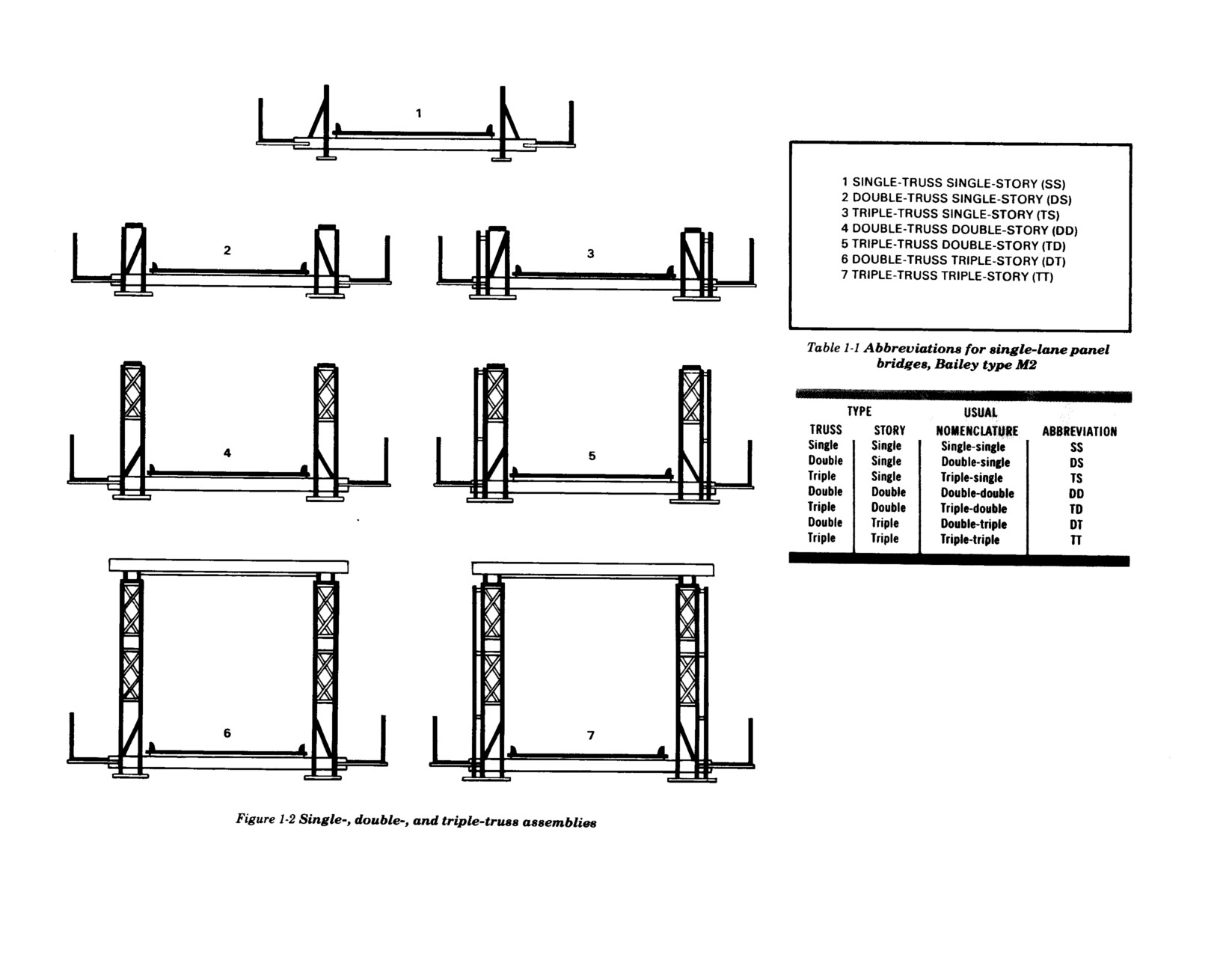
shown in Figure 1-2 (page 4). The types of
States (US) Army sought a versatile bridge
can be transported to and from the bridge
possible truss assemblies are given in Table
that could span a variety of gaps and be
site by 5-ton dump trucks and trailers.
1-1 (page 4). A single-truss, double-or triple-
quickly assembled by manpower alone. For
story bridge is never assembled because it
this reason, we adopted the design for the
It is versatile. Standard parts can be used
would be unstable. All triple-story bridges
British prefabricated Bailey bridge, US
to assemble seven standard truss designs
with the deck in the bottom story are braced
nomenclature Ml. We revised the design to
for efficient single spans up to 210 feet
at the top by transoms and sway braces
provide a greater roadway width of 12% feet
long and to build panel crib piers sup-
which are fastened to overhead-bracing sup-
and designated it the Panel Bridge, Bailey
porting longer bridges. With minor non-
ports bolted to the top chords.
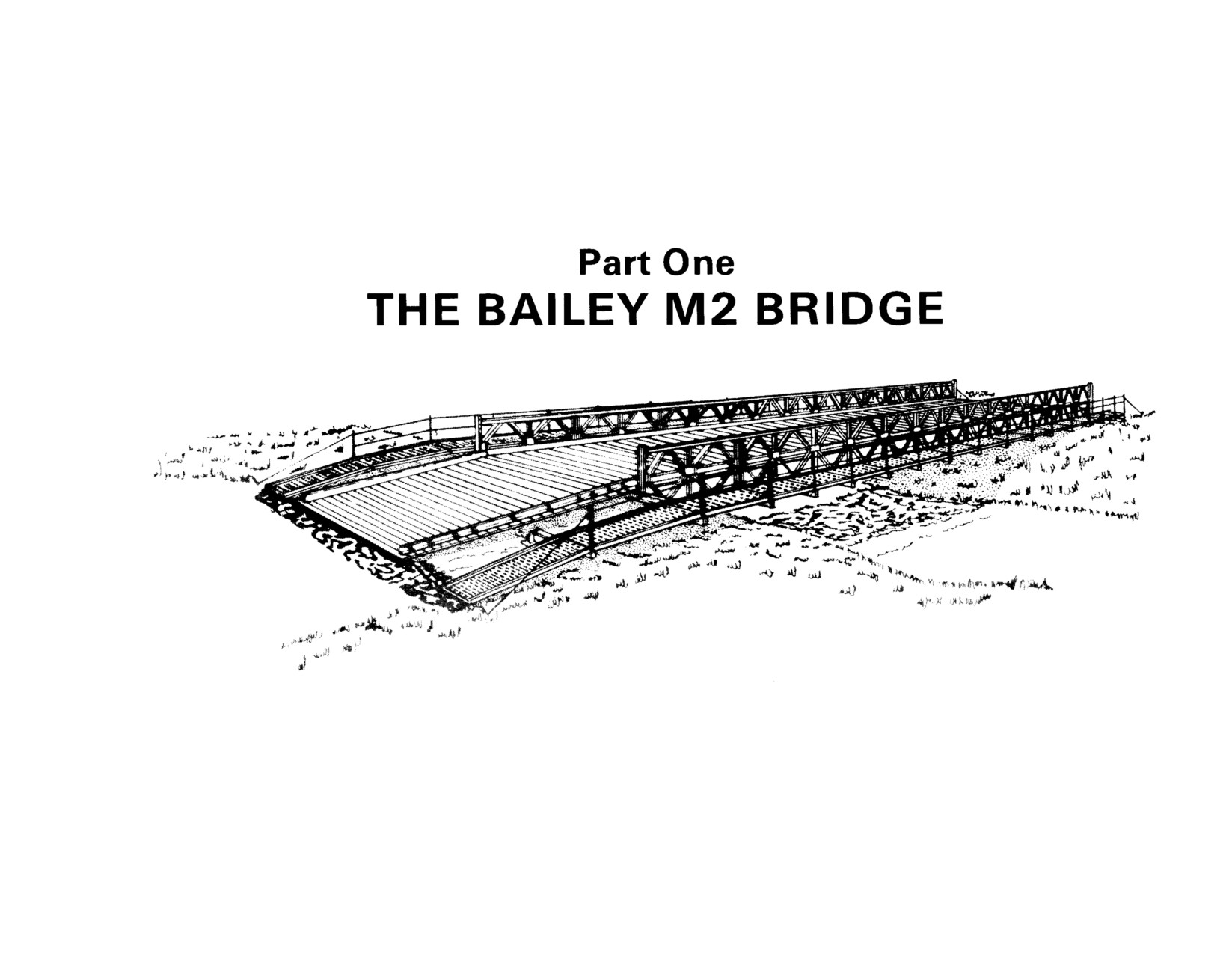
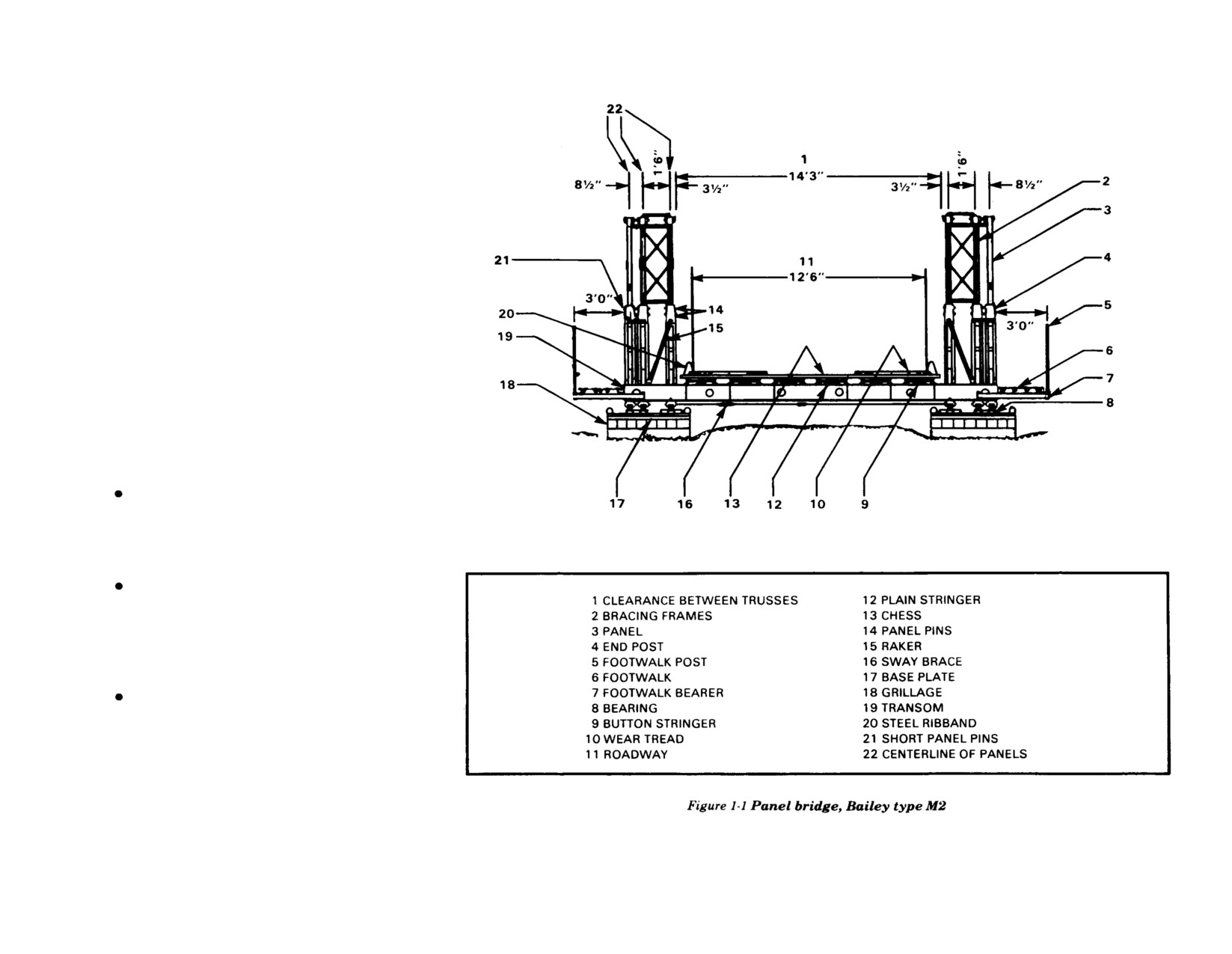
M2 (Figure l-l). The British then modified
standard modifications, the expedient
the US version by widening the bridge again,
uses of bridge parts are limited only by
Materials
thus producing the extra-wide Bailey M3
the user’s imagination.
The decking, called chess, is wood. Panels,
bridge. The US Army does not stock the M3
end posts, transoms, and ramps are a low-
bridge in its arsenal. The Bailey bridge is a
CONSTRUCTION
alloy, high-tensile steel. All other parts are
through-type truss bridge, the roadway being
Transverse floor beams, called transoms, are
carbon structural steel. All joints in the parts
carried between two main girders. The trusses
clamped to the bottom chords of the trusses
are welded.
in each girder are formed by 10-foot panels
and support stringers and decking. Sway
Deck
pinned end to end. In this respect, the Bailey
braces between the girders provide horizontal
The clear roadway between curbs, called rib-
bridge is often referred to as the “panel” or
bracing; rakers between the trusses and
bands, is 12 feet 6 inches wide. The transoms
“truss” bridge.
transoms keep the trusses upright; and
supporting the roadway are normally set on
bracing frames and tie plates between the
the bottom chords of the bottom story. Foot-
ADVANTAGES
trusses provide lateral bracing within each
walks can be carried on the transoms outside
Some of the characteristics that make the
girder.
of the main trusses on each side of the bridge.
Bailey bridge valuable to field commanders
are—
Main girders
The main girders on each side of the center-
Bearings
It is easy to install. Each part of the
line of the bridge can be assembled from a
End posts pinned to the end of each truss sit
Bailey bridge is a standard machine-
single truss or from two or three trusses side
on cylindrical bearings which rest on a steel
made piece and is interchangeable among
by side. For greater strength, a second story
base plate. On soft soil, timber grillage is
spans. Inmost cases, no heavy equipment
of panels can be added to the trusses. The
used under the base” plates to distribute the
is required to assemble or launch a Bailey
upper stories are bolted to the top chord of the
load. The bridge can be assembled between
bridge; only basic pioneer skills and equip-
lower story. For greatest strength, a third
banks of different elevations, but the slope
ment are needed.
story is added. These three basic types are
should not exceed 30 to 1.
2
FM 5-277
This change supersedes page 3.
TYPES OF STRUCTURES
Panel bridge equipment can be used to
assemble fixed bridges and panel crib piers
and towers. Other special structures such as
floating bridges, suspension bridges, retract-
able bridges, and mobile bridges, can be
assembled using special parts. Panel bridge
equipment is normally used to assemble fixed
simple-span, through-type bridges from 30 to
210 feet long. The bridge can be assembled to
meet varying conditions of span and load.
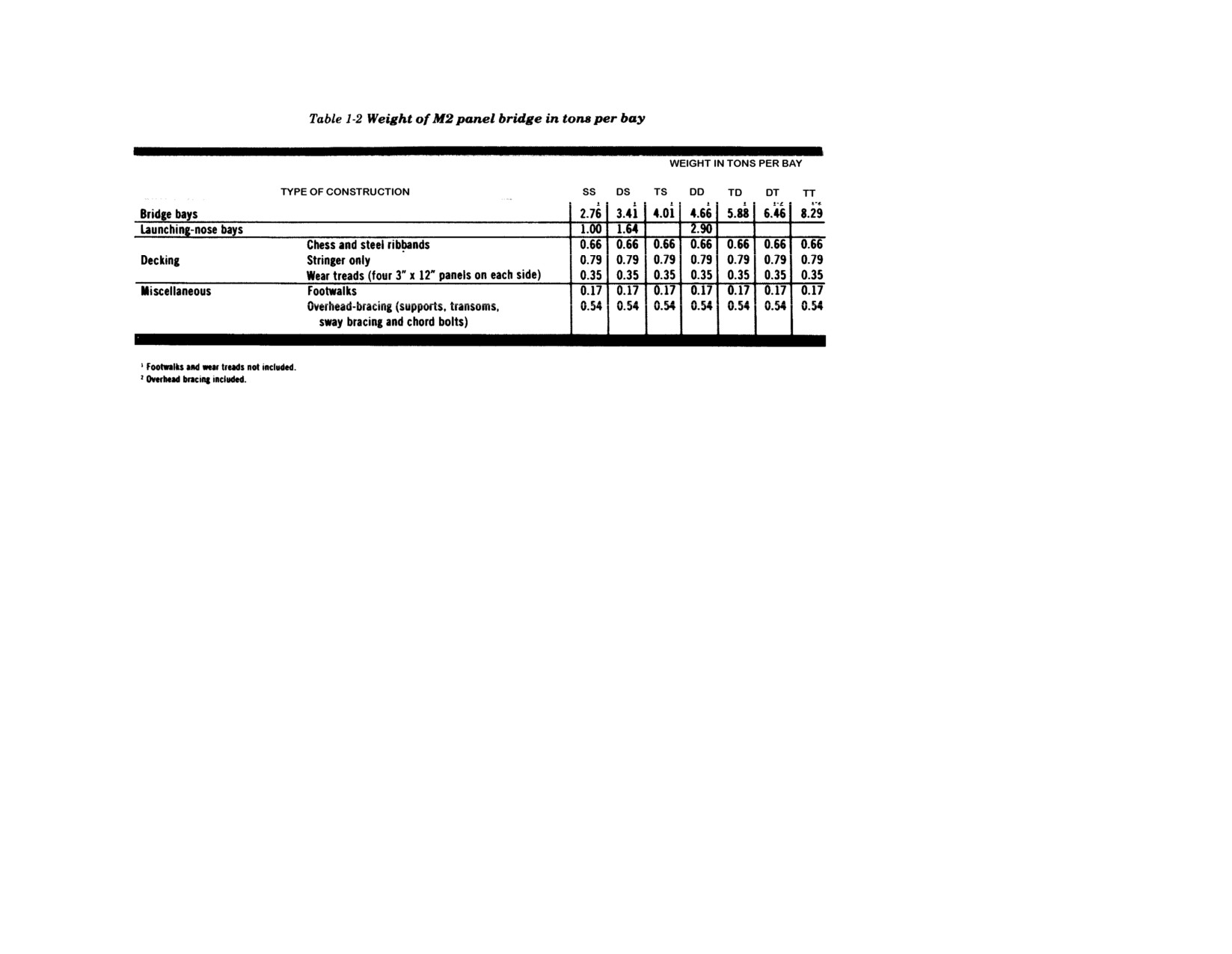
Bridge weight per bay is given in Table 1-2
(page 5). The following special assemblies are
also possible:
Two-lane, through-type bridges; deck-type
bridges; railway bridges; bridges on piers;
and floating bridges can be built with
panel bridge equipment.
Panel crib piers and towers up to 70 feet
high supporting continuous spans, and
up to 110 feet high supporting broken
spans, can be assembled with panel bridge
equipment and special crib-pier parts.
Many expedient structures can also be
built with panel bridge equipment. These
include causeways, box anchors, towers
for floating bridge cables, and loading
hoppers and gantries.
3
FM 5-277
4
FM 5-277
This change supersedes page 5.
5
FM 5-277
CHAPTER 2
BASIC EQUIPMENT
BRIDGE PARTS 6
ERECTION EQUIPMENT 15
BRIDGING TRUCK LOADS 19
The Bailey M2 bridge set contains 29 different
items of bridge parts and 30 items of erection
equipment. Table A-1 in Appendix A shows
the number of parts needed to build a specific
Bailey bridge.
BRIDGE PARTS
WARNING: Due to the size and weight of
PANEL PIN
components, personnel are advised to use
support the bridge roadway will be clamped
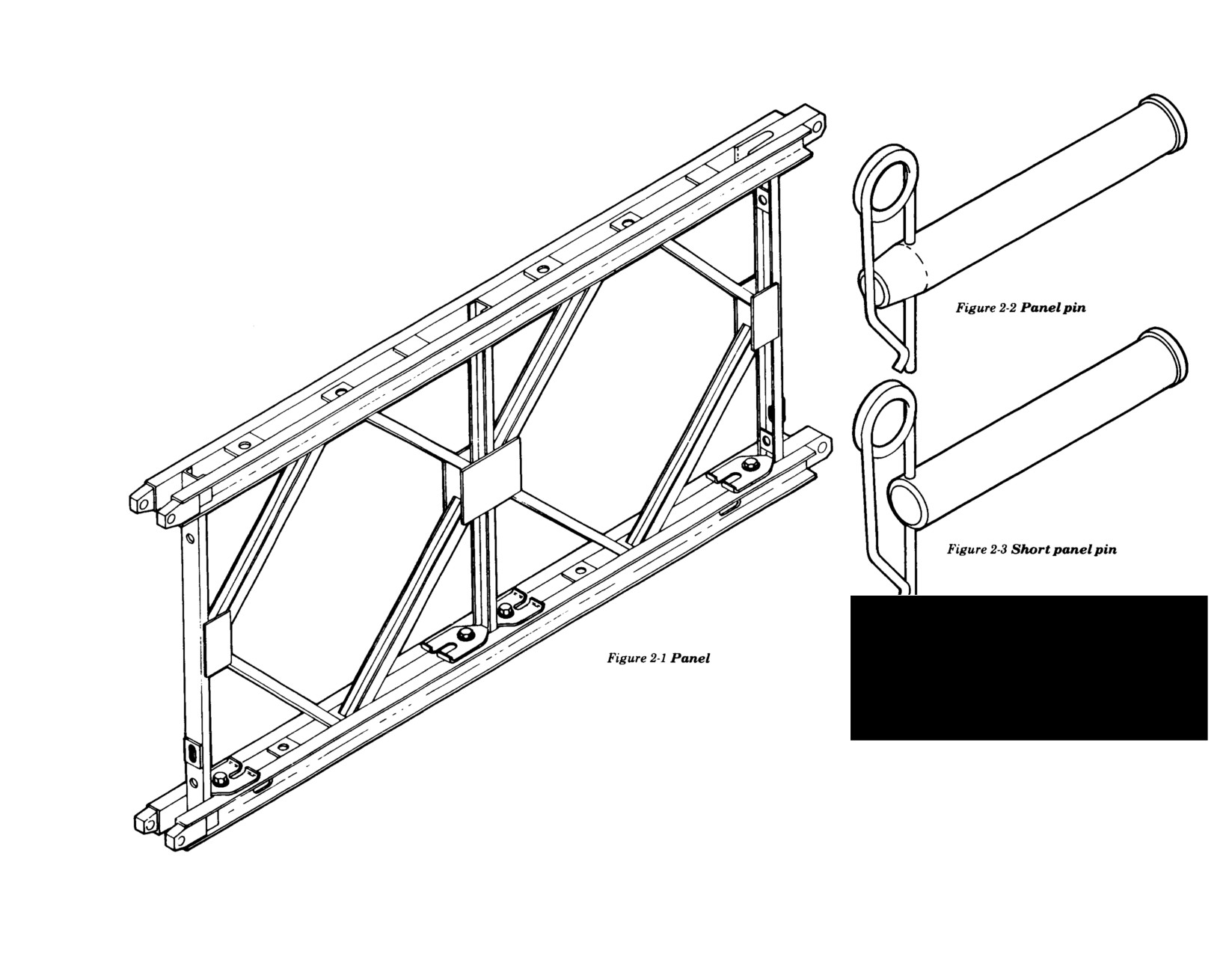
The panel pin (Figure 2-2) is 8 5/16 inches (21.1
extreme care when handling them. Failure
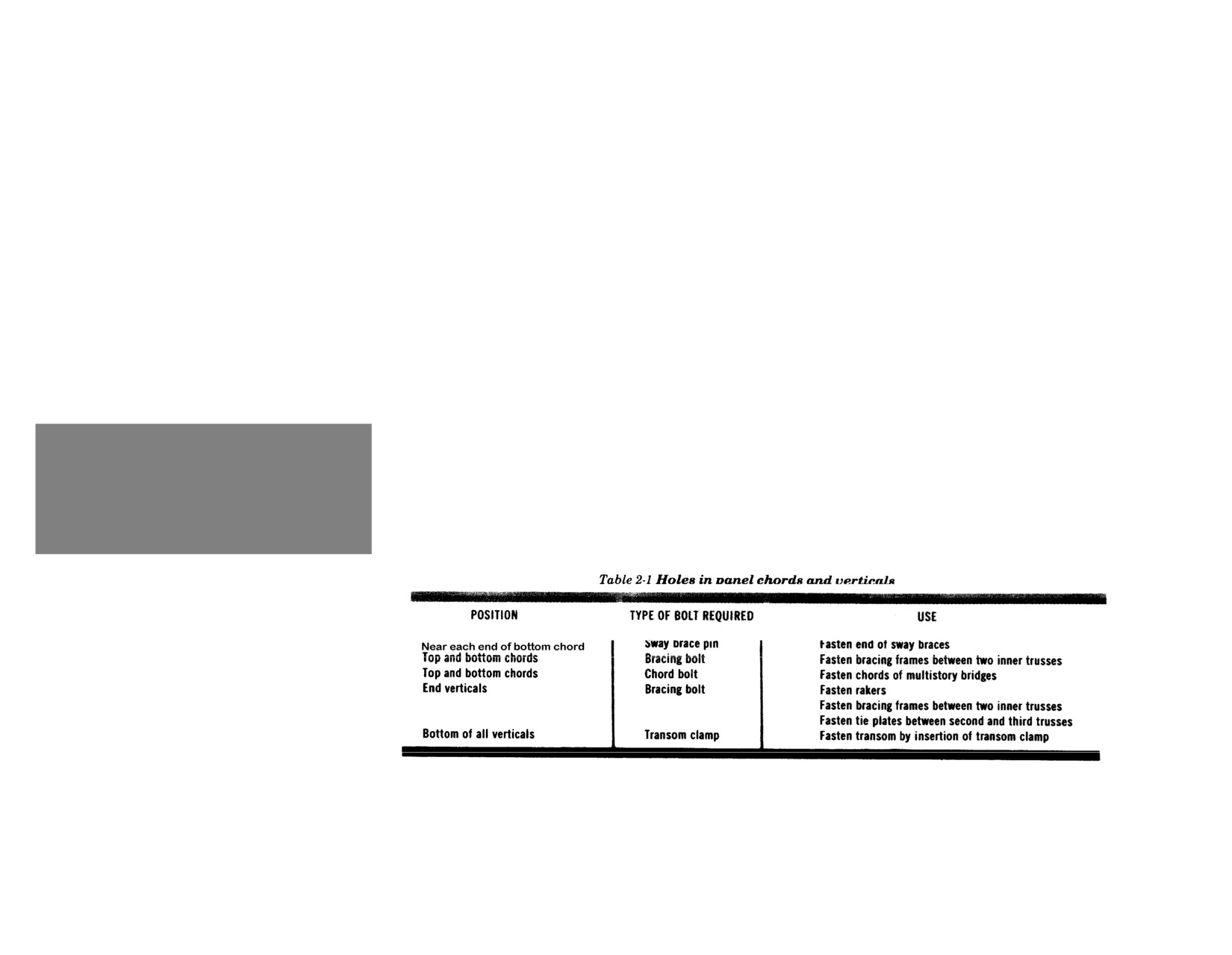
to these dowels. Table 2-1 lists the holes in the
centimeters) long, 1 7/8 inches (4.8 centimeters)
panel.
in diameter, and weighs 6 pounds (2.7 kilo-
to do so may result in serious.
grams). It has a tapered end with a small hole
PANEL
The panel (Figure 2-1) is the basic member of
the bridge. It is a welded, high-tensile steel
truss section 10 feet (3.0 meters) long, 5 feet 1
inch (1.5 meters) high, and 6 1/2 inches (16.5
centimeters) wide. It weighs 577 pounds (262
kilograms) and can be carried by six soldiers
using carrying bars.
The horizontal members of the panel are
called chords. Both chords have male lugs at
one end and female lugs at the other. Panels
are joined end to end by engaging these lugs
and placing panel pins through the holes in
the lugs. On the top of the bottom chord are
four seatings or dowels. The beams that
6
FM 5-277
for a retainer clip. A groove is cut across the
head of the panel pin parallel to the bridge
pin retainer hole. Panel pins should be
inserted with the groove horizontal; other-
wise, the flanges of the panel chord channels
make it difficult to insert the retainer clip.
WARNING: Never jack against transoms
that are held in place by transom clamps, as
the clamps will fail. This failure may result
in severe injury or death and/or extreme
damage to bridge components.
SHORT PANEL PIN
TRANSOM
The short panel pin (Figure 2-3) is 3/4 inch (1.9
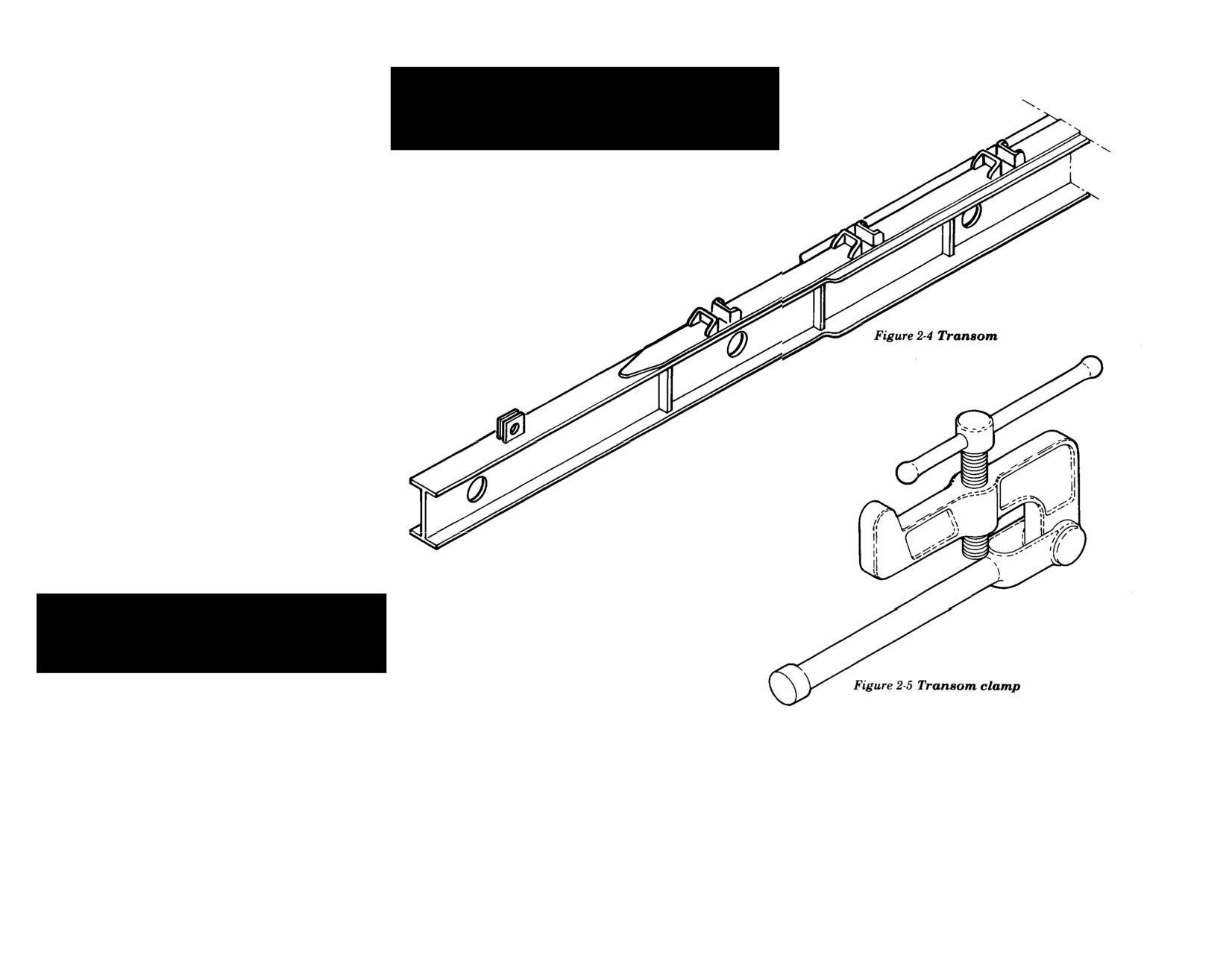
The transom (Figure 2-4, page 8) is a steel
centimeters) shorter than the normal panel
beam that supports the floor system of the
pin and weighs 5.8 pounds (2.6 kilograms). It
bridge. It is 10 inches (25.4 centimeters) by 19
is used to pin the end posts of the outer and
feet 11 inches (6.1 meters) long. It has a 4 1/2-
middle trusses in a triple-truss bridge.
inch (11.4 centimeters) flange and a 5/16-inch
7
FM 5-277
WARNING: Sway brace is a multi-hinged
component; use care when handling to
prevent injury.
(0.8 centimeter) cover plate on each flange.
The transom weighs 618 pounds (280 kilo-
SWAY BRACE
grams). It can be carried by eight soldiers
The sway brace (Figure 2-6) is a 1 1/8-inch (2.9
using carrying tongs clamped to the upper
centimeters) steel rod, hinged at the center,
flange or carrying bars inserted through
holes in the web.
The underside of the transom has six holes
into which the panel dowels fit. The transom
rests on the lower chord of the panel and is
held in place with a transom clamp. The
upper side of the transom has six lugs with an
additional lug near each end. The stringers
and rakers (explained later in this chapter)
attach to these lugs.
Transoms are normally spaced 5 feet (1.5
meters) apart, one at the middle and one at
the end of each panel, to support vehicles of
class 70 or less. Four transoms per bay—two
in the middle and one at each end of the
panel—are required to support vehicles over
class 70.
WARNING: Transom clamp is a hinged
and adjusted by a turnbuckle. It weighs 68
component; use care when handling to
pounds (30.8 kilograms). At each end is an
prevent injury.
eye, and a chain with a pin attached. This pin
is inserted through the eye to the sway brace
TRANSOM CLAMP
to the panel. The sway brace is given the
The transom clamp (Figure 2-5) is a hinged
proper tension by inserting the tail of an
screw-in type clamp, 13 1/2 inches (34.3 centi-
erection wrench in the turnbuckle and
screwing it tight. The locknut is then screwed
meters) high and 8 inches (20.3 centimeters)
RAKER
up against the turnbuckle. Two sway braces
The raker (Figure 2-7) is a 3-inch (7.6 centi-
across the top. It weighs 7 pounds (3.2 kilo-
are required in the lower chord of each bay of
meters) steel beam with a 2 3/8-inch (6.0 centi-
grams). It clamps the transom to the vertical
the bridge, except the first bay of the
meters) flange. It is 3 feet 8 5/16 inches (1.11
and bottom chord of the panel. It is tightened
launching nose, and in each bay of overhead
meters) long and weighs 22 pounds (10.0
by a vise-handled screw.
bracing.
kilograms). A raker connects the ends of the
8
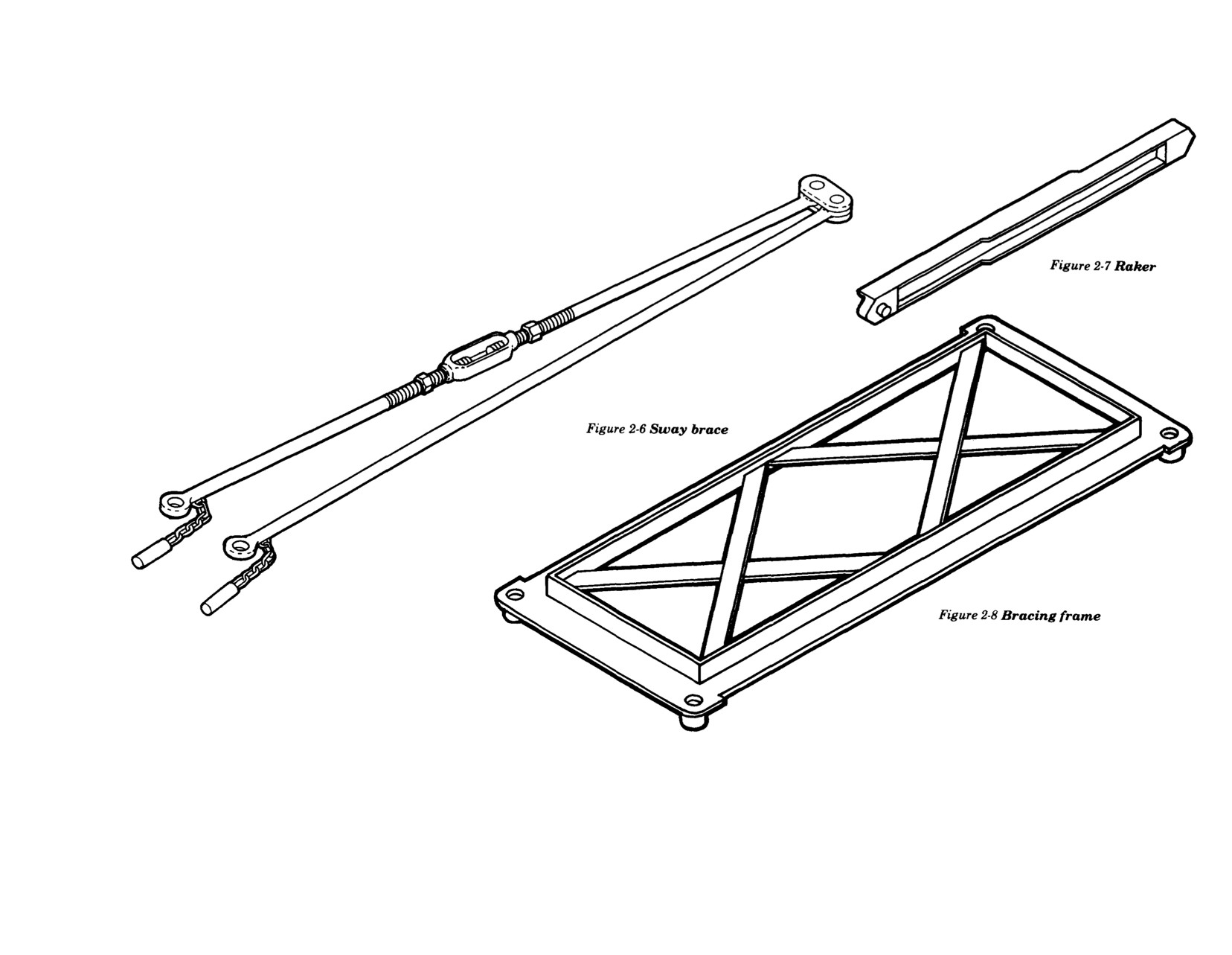
FM 5-277
transom to the top of one end of each panel of
the inner truss. This prevents the panels from
overturning. An additional raker is used at
each end of the bridge. Both ends of the raker
have hollow dowels for the bracing bolts. The
dowels fit through a hole in the panel and a
hole in the transom.
BRACING FRAME
TIE PLATE
The bracing frame (Figure 2-8) is a rec-
A tie plate (Figure 2-9, page 10) is a piece of
tangular frame, 4 feet 3 inches (1.3 meters) by
flat steel 2 1/2 by 3/8 by 12 inches (6.4 by 1.0 by
1 foot 8 inches (50.8 centimeters) with a
30.5 centimeters) weighing 3 1/2 pounds (1.6
hollow conical dowel in each comer. It weighs
kilograms). It has a hollow conical dowel at
44 pounds (20.0 kilograms). The bracing
each end. The tie plate is used only in triple-
frame is used to brace the inner two trusses
truss bridges. It secures the second truss to
on each side of the double- and triple-truss
the third truss using the unoccupied raker
bridge. Bracing bolts attach the bracing bridge, and vertically on one end of each
holes in the panels at each joint and at the
frames horizontally to the top chords of the
panel in the second and third stories.
ends of the bridge.
9
FM 5-277
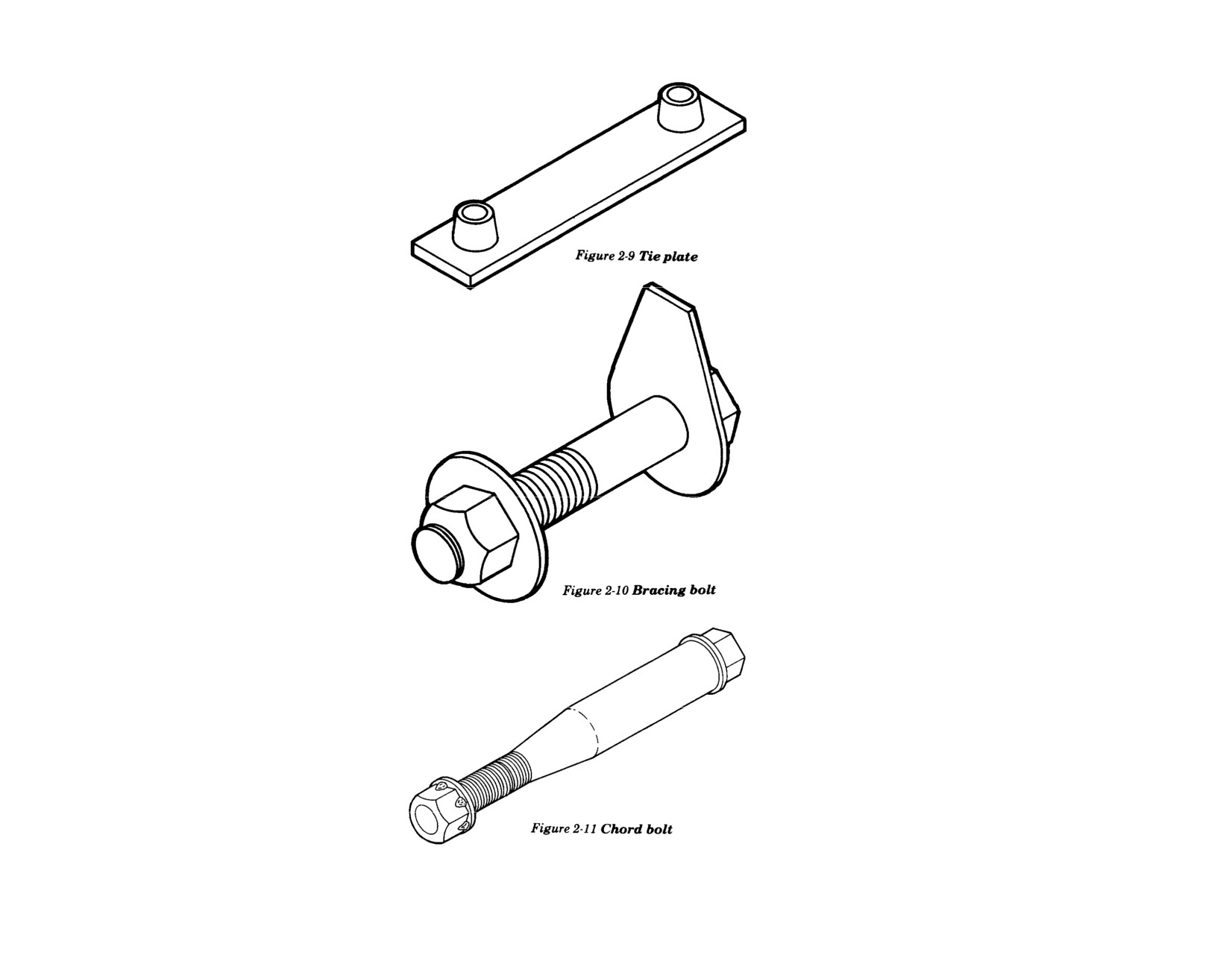
BRACING BOLT
A bracing bolt (Figure 2-10) is 3/4 inch
hold the ends of the chess (roadway) in place.
(1.9 centimeters) in diameter, 3 1/2 inches
Each bay of the bridge has six stringers: four
(8.9 centimeters) long, and weighs about
plain stringers in the middle, and a button
1 pound (0.5 kilograms). A special lug on its
stringer on each side. The stringers are posi-
head prevents rotation when the bolt is
tioned by the lugs on the top of the transoms.
tightened. A l 1/8inch (2.9 centimeters) wrench
is used to tighten it. The bracing bolt is used
CHESS
to attach rakers, bracing frames, and tie
Chess (Figure 2-13), often referred to as deck
plates to panels. It is inserted into the hollow
or decking, form the road surface. A piece
dowels of the braces to draw parts into proper
of chess is 2 inches (5.1 centimeters) by
alignment.
8 3/4 inches (22.2 centimeters) by 13 feet
10 inches (4.2 meters). It is made of wood and
CHORD BOLT
weighs 65 pounds (29.5 kilograms). It is
A chord bolt (Figure 2-11) is 1 3/4 inches (4.4
notched at the ends to fit between the buttons
centimeters) in diameter, 10 1/2 inches (26.7
of the bottom stringer. Each bay of the bridge
centimeters) long, and weighs 7 1/2 pounds (3.4
contains 13 chess, which lie across the
kilograms). It is tapered through half its
stringers and are held in place by the buttons.
length to assist in drawing the panels into
Chess are held down by ribbands.
alignment. A 1 7/8-inch (4.8 centimeters)
wrench is used to tighten the bolt. Chord
STEEL RIBBAND (CURBS)
bolts join the panels, one above the other, to
A ribband (Figure 2-14) is a metal curb
form double and triple-story bridges. Two
8 inches (20.3 centimeters) high and 10 feet
bolts per panel pass upward through holes in
(3.0 meters) long. It weighs 162 pounds (73.5
the panel chords and are tightened with nuts
kilograms). It is fastened to the button
on the lower chord of the upper story. They
stringers by four J-type ribband bolts.
are also used to fasten overhead bracing
supports to the top panel chord.
RIBBAND BOLT
A ribband bolt (Figure 2-15) is a J-type bolt, 1
STRINGERS
inch (2.5 centimeters) in diameter and 8 5/8
Stringers (Figure 2-12) carry the bridge’s
inches (21.9 centimeters) long. It weighs 4 1/2
roadway. Each stringer consists of three 4-
pounds (2.0 kilograms). A 1 1/2-inch (3.8 centi-
inch (10.2 centimeters) steel beams, 10 feet
meters) wrench is used to tighten it. The
(3.0 meters) long, joined by welded braces.
ribband bolt fastens the ribband to the button
There are two types of stringers: plain
stringers and ramps. The hook end of the bolt
stringers weighing 260 pounds (118 kilo-
grips the lower flange of the outer beam of the
grams) and button stringers weighing 267
button stringer or ramp.
pounds (122 kilograms). They are identical
except that the latter has 12 buttons which
10
FM 5-277
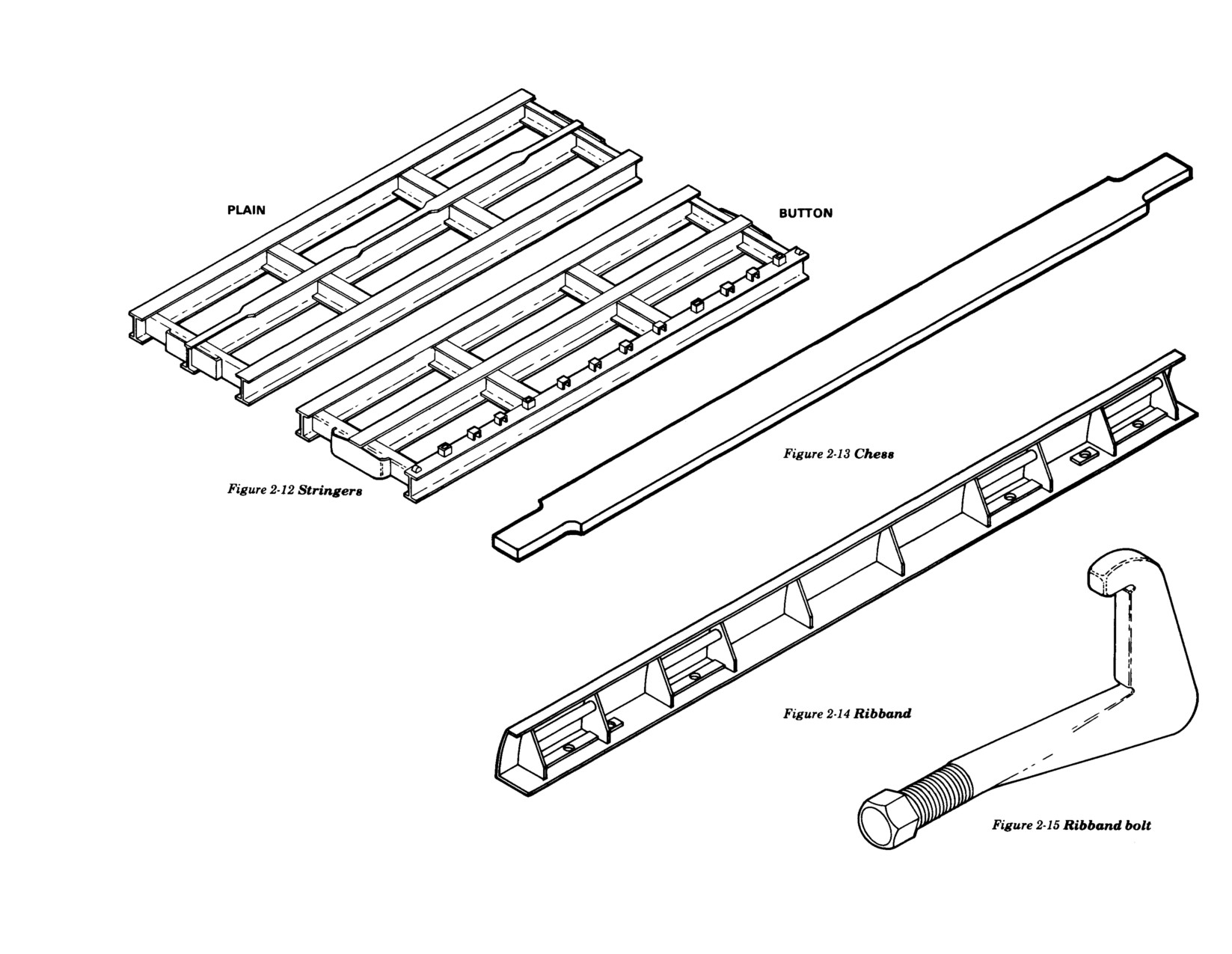
END POSTS
End posts (Figure 2-16, page 12) are used on
both ends of each truss of the bridge to take
the vertical shear. They are placed only on
the story carrying the decking. They are 5-
foot 8-inch (1.7 meters) columns made of two
4-inch (10.1 centimeters) channels and plates
welded together. There are two types; male
and female, having male and female lugs,
respectively. These lugs are secured to the
end panels of the bridge by panel pins placed
through holes in the lugs. The male and
female end posts weigh 121 and 130 pounds
(54.9 and 59.0 kilograms), respectively. End
posts have a step to support a transom outside
11
FM 5-277
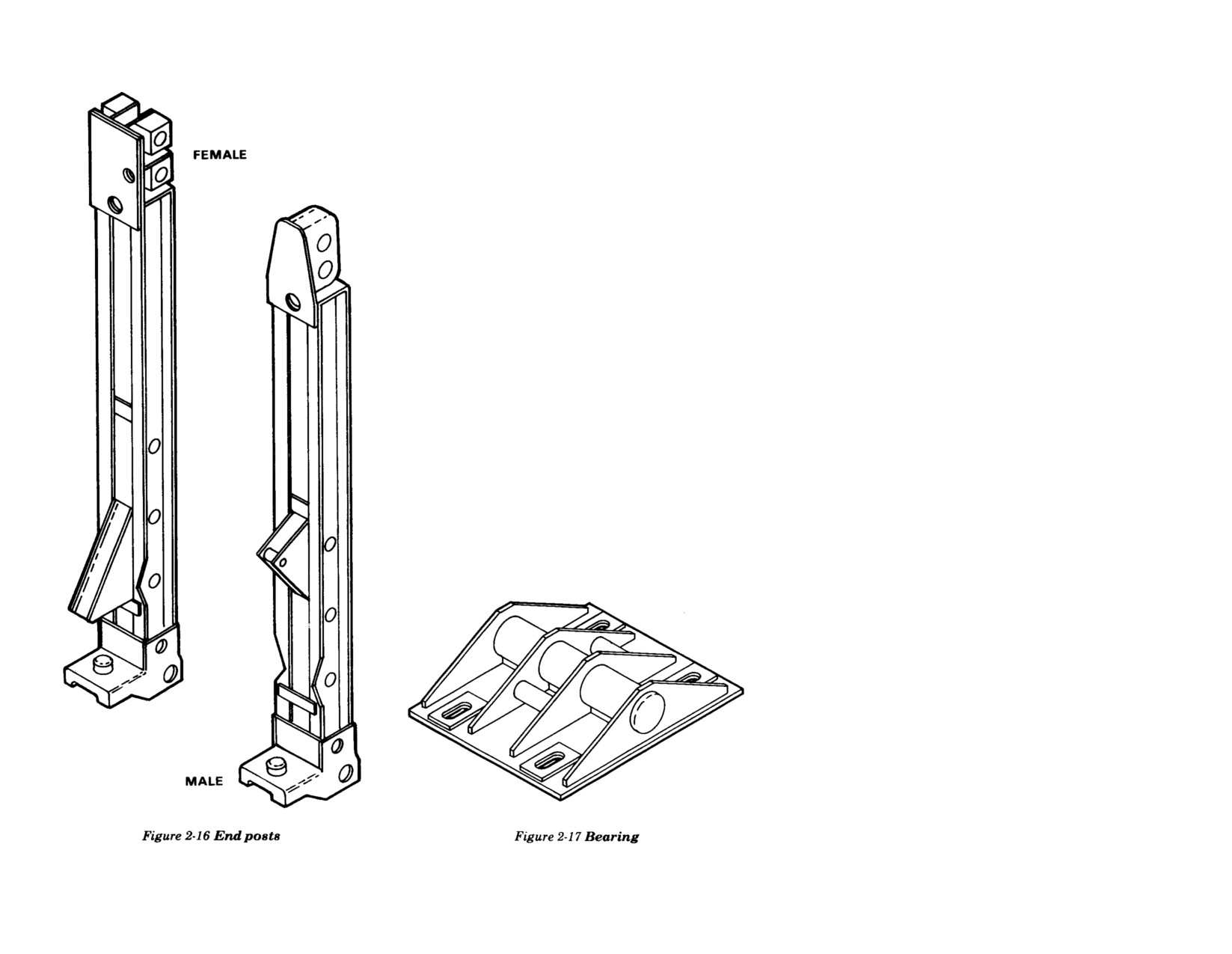
BASE PLATE
the panel at one end of the bridge. In jacking
The base plate (Figure 2-18) is a welded steel
the bridge, the jack is placed under the step.
assembly with built-up sides and lifting-hook
The lower end of the end post has a bearing
eyes on the top at each corner. It is used under
block with a semicircular groove which fits
the bearings to spread the load from the
over the bearing.
bearings over the ground or grillage. The
bottom surface of the baseplate is 13 1/2 square
BEARING
feet (1.25 meters 2). The base plate weighs 381
The bearing (Figure 2-17) spreads the load of
pounds (173 kilograms) and is large enough
the bridge to the base plate. A bearing is a
for the bearings at one corner of a single-,
welded steel assembly containing a round
double-, or triple-truss bridge. Bearings can
bar which, when the bridge is completed,
slide 9 inches (22.9 centimeters) longitudi-
supports the bearing blocks of the end posts.
nally on the baseplate. The numbers 1,2, and
During assembly of the bridge, it supports
3 are embossed on the edges of the base plate
the bearing block of the rocking roller (ex-
to indicate the position of the plate under the
plained later in this chapter). The bar is
inner truss of single-, double-, and triple-truss
divided into three parts by two intermediate
bridges respectively.
sections that act as stiffeners. The bearing is
4 5/16 inches (11.9 centimeters) high and
RAMPS
weighs 68 pounds (30.8 kilograms). One
Ramps (Figure 2-19) are similar to stringers
bearing is used at each corner of a single-
but consist of three 5-inch (12.7 centimeters),
truss bridge and two bearings per corner for a
instead of 4-inch (10.2 centimeters), steel
double- or triple-truss bridge.
beams. They are 10 feet (3.0 meters) long and
are joined by welded braces. The lower surface
of the ramp tapers upward near the ends.
There are two types of ramps: plain ramps
weighing 338 pounds (153 kilograms), and
button ramps weighing 349 pounds (158 kilo-
grams). They are identical except that. the
latter have 12 buttons which hold the ends of
the chess in place. The ends of the ramps fit
into lugs on the transoms at the ends of the
bridge.
RAMP PEDESTAL
Ramp pedestals (Figure 2-20) are built-up
welded steel assemblies weighing 93 pounds
(42.2 kilograms). They prevent the transoms
supporting multiple-length ramps from over-
12
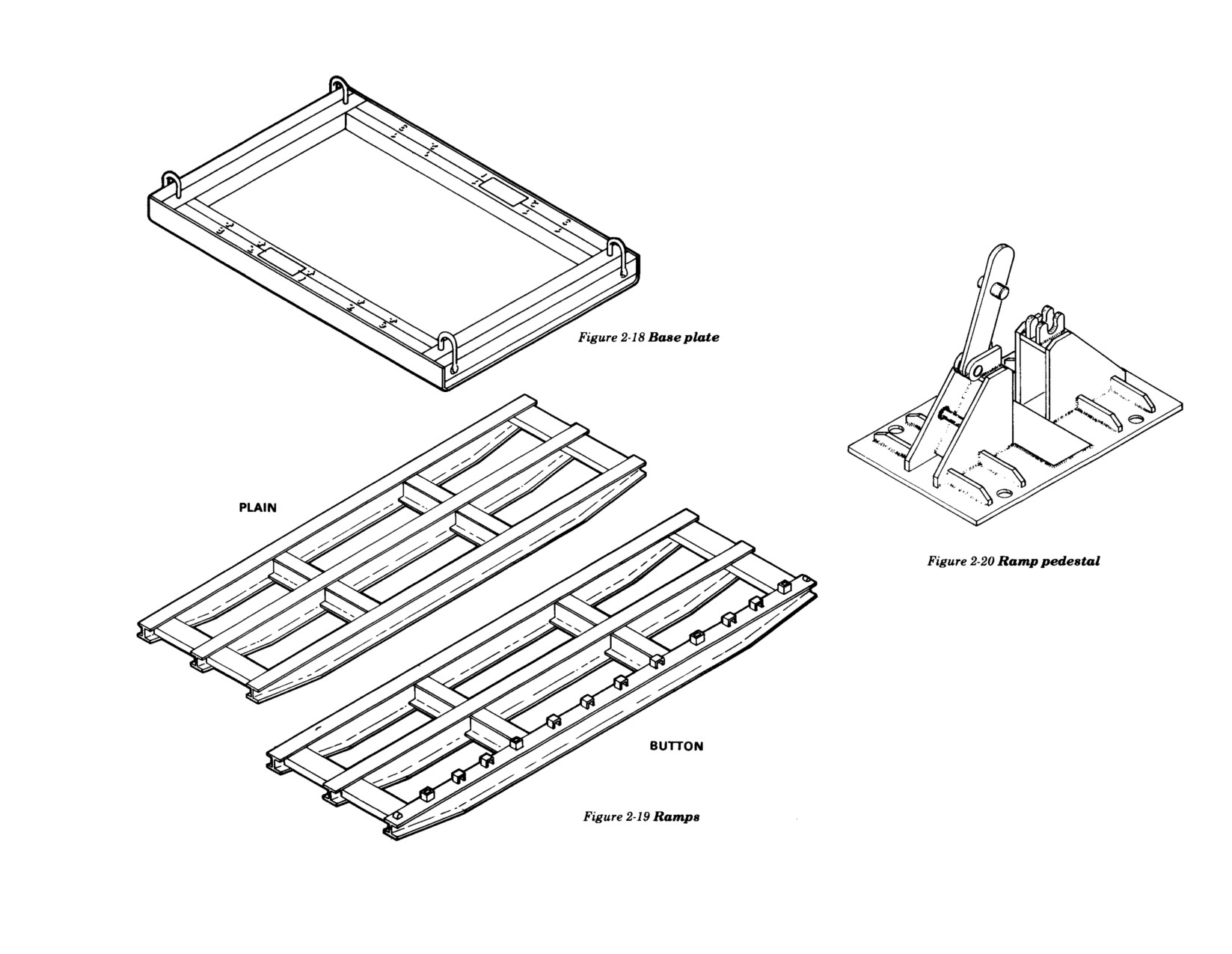
FM 5-277
turning and spread the transom load over the
ground. They are held in place by spikes or
pickets driven through holes in their base
plates.
FOOTWALK
The footwalk (Figure 2-21, page 14) may be of
wood or aluminum. The wood footwalks are 2
feet 6 inches (0.8 meter) wide and 10 feet (3.0
meters) long. The aluminum footwalks are
25 3/4 inches (65.4 centimeters) wide and 9 feet
11 1/2 inches (3.0 meters) long. Supported on
footwalk bearers, footwalks are laid along
the outer sides of the bridge for use by foot
troops.
FOOTWALK BEARER
A footwalk bearer (Figure 2-22) is a built-up
beam of pressed steel 4 feet (1.2 meters) long,
13
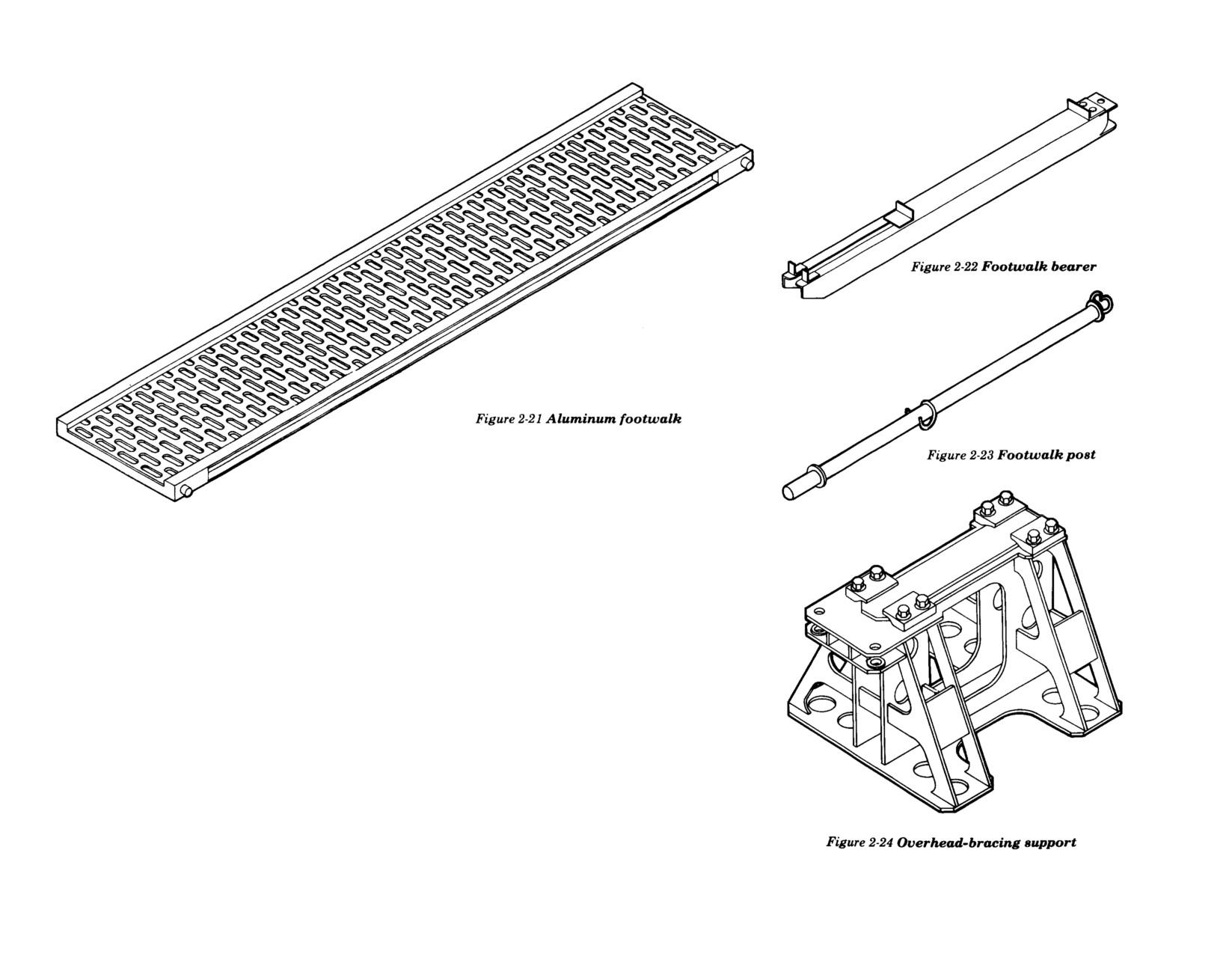
FM 5-277
weighing 23 pounds (10.4 kilo grams). Bearers
are attached to all transoms and hold the
footwalk post.
FOOTWALK POST
sway braces to trusses for overhead bracing
A footwalk post (Figure 2-23) is 4 feet (1.2
of triple-story bridges. The support is a welded
meters) high, weighs 10 pounds (4.5 kilo-
metal assembly that weighs 150 pounds (68.0
grams), and is fitted into every footwalk
kilograms). It is fastened to the tops of third-
bearer. Hand ropes are threaded through two
story panels by chord bolts. A transom is
eyes on each post and secured either to
seated over the pintles on top of the support
holdfasts on the banks or end footwalk posts.
and secured by cleats over the lower flange
held by four nuts and bolts. One support per
OVERHEAD-BRACING SUPPORT
girder is placed on each bay of bridge.
The overhead-bracing support (Figure 2-24)
is used to clamp overhead transoms and
14
FM 5-277
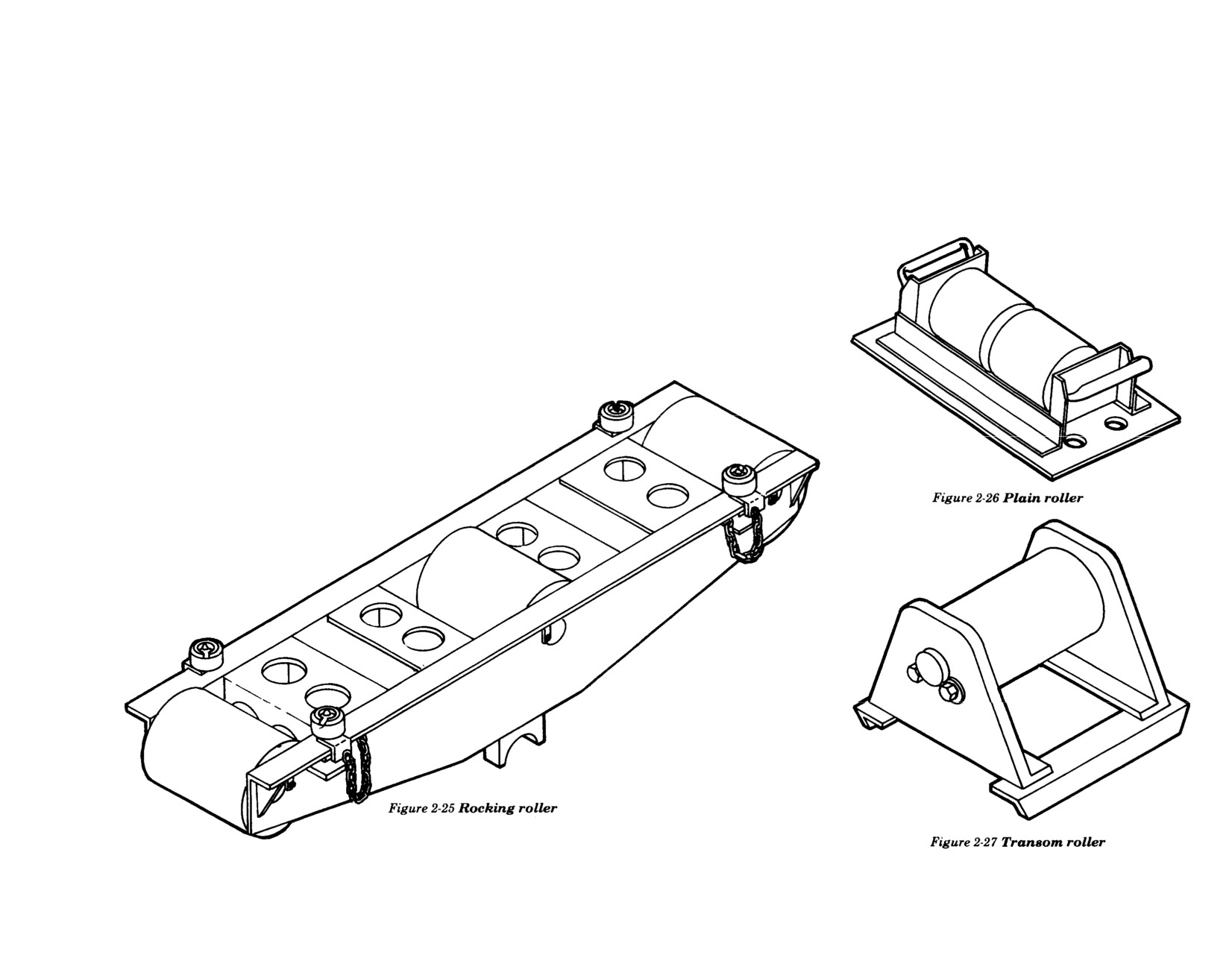
ERECTION EQUIPMENT
PLAIN ROLLER
TRANSOM ROLLER
ROCKING ROLLER
The rocking roller (Figure 2-25), weighing 206
The plain roller (Figure 2-26) is 2 feet 1 1/2
The transom roller (Figure 2-27) is a roller
inches (64.8 centimeters) wide and weighs
having an outside diameter of about 1 7/8
pounds (93.4 kilograms), consists of three
116 pounds (52.6 kilograms). It consists of a
inches (4.8 centimeters) (or 1 1/2-inches [3.8
rollers housed in a balanced arm which fits
welded housing containing a single roller
centimeters] extra-heavy steel pipe) and a
over the bearing, and is free to rock on it. Two
side rollers on the flange on each side of the
split in two. The maximum allowable load on
rocking roller frame act as guides for the
one roller is 10 tons (9.1 metric tons). Trusses
trusses. The side rollers can be removed from
of single-truss bridges can be carried on
the flanges by removing split pins from
either half of the roller. Second and third
spindles underneath the flange; they then
trusses of triple-truss bridges are carried on
remain loosely attached to the frame by a
both halves.
chain. The rollers distribute the bridge load
along the bottom chord during launching.
The maximum allowable load on one rocking
roller is 30 tons (27.2 metric tons).
15
FM 5-277
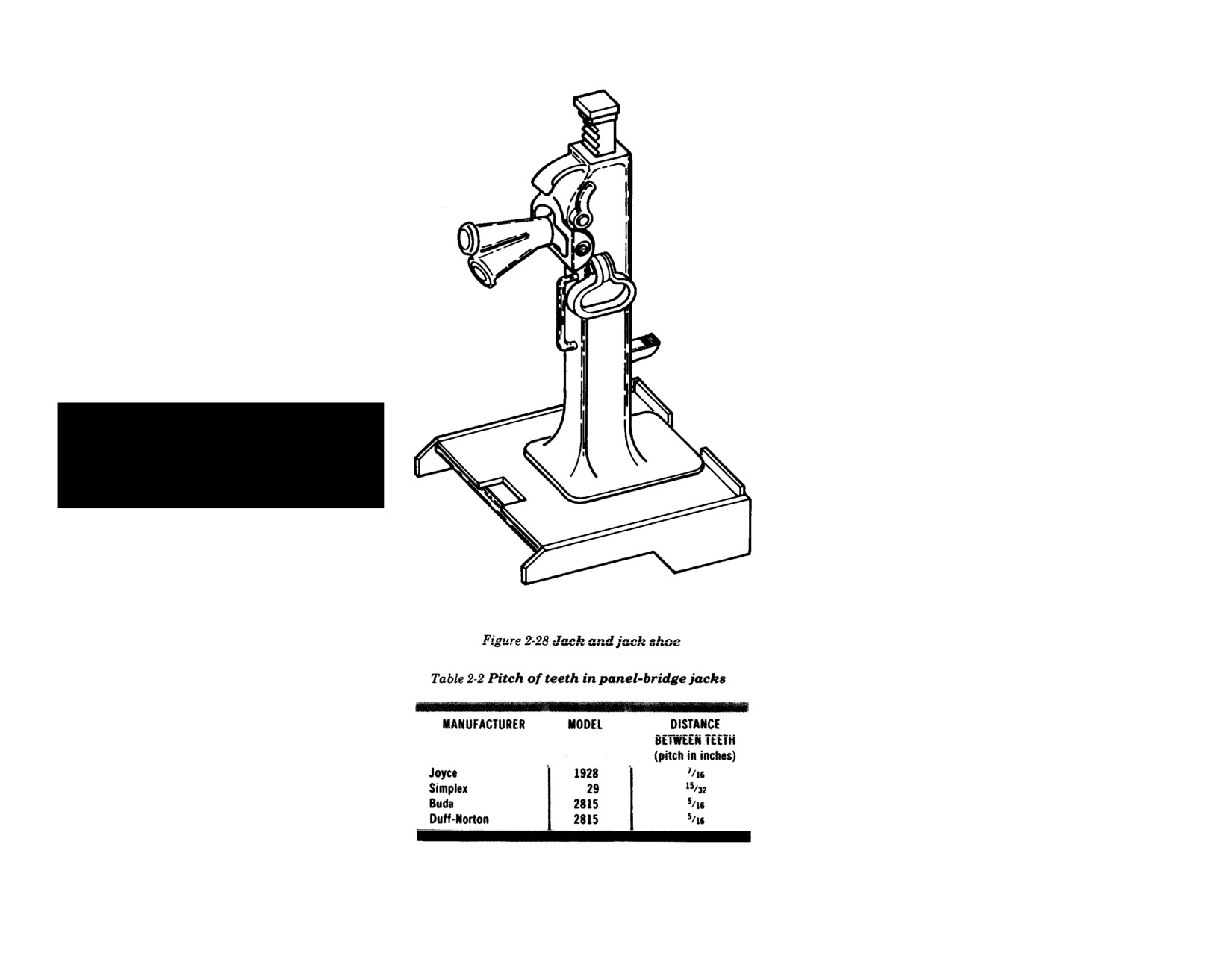
JACK SHOE
length of 6 5/8 inches (16.8 centimeters). The
The jack shoe (Figure 2-28)
is a welded
roller is fitted with bronze bushings at each
assembly which fits over the
bearing and
end and revolves on a l-inch (2.5 centimeters)
supports the jack. In jacking under the step of
diameter steel pin mounted in a steel frame
the end posts, the bearing can be placed
which is built up from standard steel bars
readily without removing the jack shoe. The
and angles. The roller assembly is 8 inches
shoe is 4 3/16 inches (10.6 centimeters) high
(20.3 centimeters) long, 7 5/8 inches (19.4 centi-
and weighs 36 pounds (16.3 kilograms). It fits
meters) wide, and 5 3/4 inches (14.6 centimeters)
over the bearing on the base plate.
high overall. It weighs about 12 pounds (5.4
kilograms). The roller is used to make the
WRENCHES
placement and removal of transoms easier
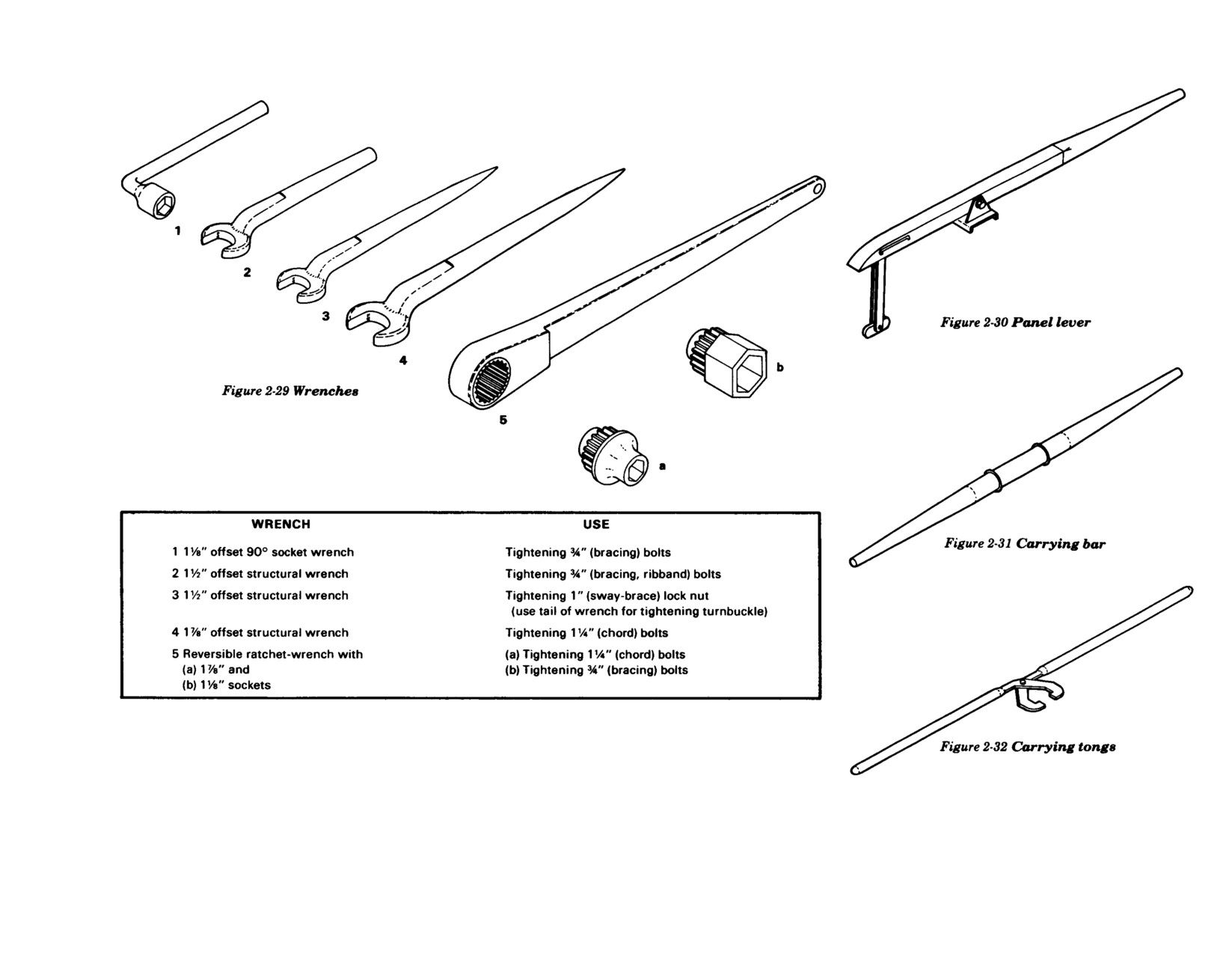
The wrenches provided in the bridge set are
during the assembly and disassembly of the
shown and listed in Figure 2-29.
bridge.
PANEL LEVER
WARNING: Two personnel are required
The panel lever (Figure 2-30), used in assem-
bling the second and third trusses after the
on each jack handle to operate jack. These
first truss is in place over the gap, is a wooden
two persons must work together to prevent
bar 7 feet 9 inches (2.4 meters) long weighing
either from taking all of the load.
48 pounds (21.8 kilograms). It has a fulcrum
near the center and a lifting link at the end.
JACK
The lifting link has a swiveling crosspiece
The jack (Figure 2-28) is used to lift the bridge
which can be readily attached to the top of a
on and off the rocking rollers. It is a mechan-
panel by passing it through the upper chord
ical lifting jack (the type normally used in
and turning it. The upper end of the link
rigging, railroad, and construction work). It
slides in a slot—the inner end of the slot is
has a lifting range of 15 inches (38.1 centi-
used when erecting the second truss, the
meters) and a capacity on the top of 15 tons
outer end is used when erecting the third
(13.6 metric tons). When the weight is carried
truss. The fulcrum is always placed on the top
on its toe, its capacity is only 7 1/2 tons (6.8
of the first truss. Two levers per panel are
metric tons). Jacks from different manufac-
required, with two soldiers operating each
turers have different spacing (pitch) between
lever.
the teeth, as listed in Table 2-2. Where jacks
are lifting at the same point, all jacks used
CARRYING BAR AND TONGS
must have the same tooth pitch so they can be
A wooden carrying bar (Figure 2-31) is 3 feet 6
operated in unison. The jack weighs 128
inches (1.1 meters) long and reinforced by a
pounds (58.1 kilograms).
steel band at the middle. It is used to carry
panels and transoms. It weighs 8 pounds (3.6
kilograms). Carrying tongs are steel and
16
FM 5-277
shaped like railroad tongs, as shown in Figure
soldier carries one of the two handles. Nor-
2-32. These tongs are used to carry transoms
mally, four pair of tongs and eight soldiers
by clamping them over the top flange. One
are used to carry a transom.
17
FM 5-277
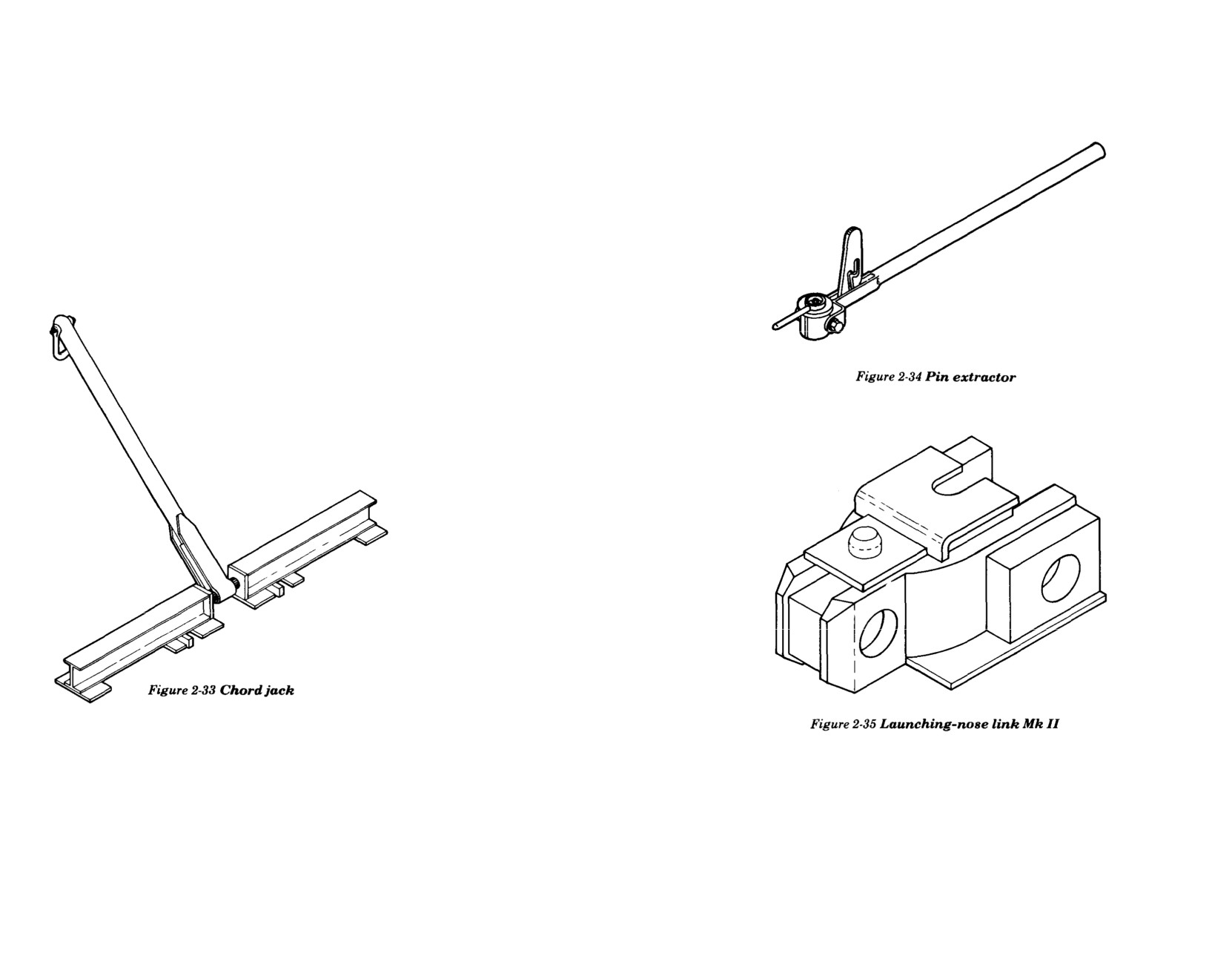
CHORD JACK
The chord jack (Figure 2-33) consists of two
useful for dismantling the third truss of a
welded steel frames joined by a knuckle-
triple-truss bridge where the closeness of the
threaded screw assembly. It is operated by a
second truss makes it impossible to drive the
ratchet lever. The lever has a shackle at its
pins out with a hammer.
end to which a rope can be attached, making
operation easier. The chord jack is used to
LAUNCHING-NOSE LINK MK II
force the panels apart so the chord lug holes
The launching-nose link Mk II (Figure 2-35)
align and the chord bolts can be inserted.
is about 10 inches (25.4 centimeters) long and
7 inches (17.8 centimeters) wide and weighs
28 pounds (12.7 kilograms). It consists of two
steel frames welded back to back. The lugs of
two panels fit into the link. The sides of the
link have holes into which panel pins can be
inserted. The links lie flush with the underside
of the bottom chords and have a false flange
welded on the bottom edge so the bridge can
be rolled out on launching rollers. It also has
a pintle on the top to seat a transom.
Launching-nose links overcome the sag
occurring when the launching nose is canti-
levered over the gap. They are also used
between the upper jaws of span junction
posts during the launching of broken-span
bridges.
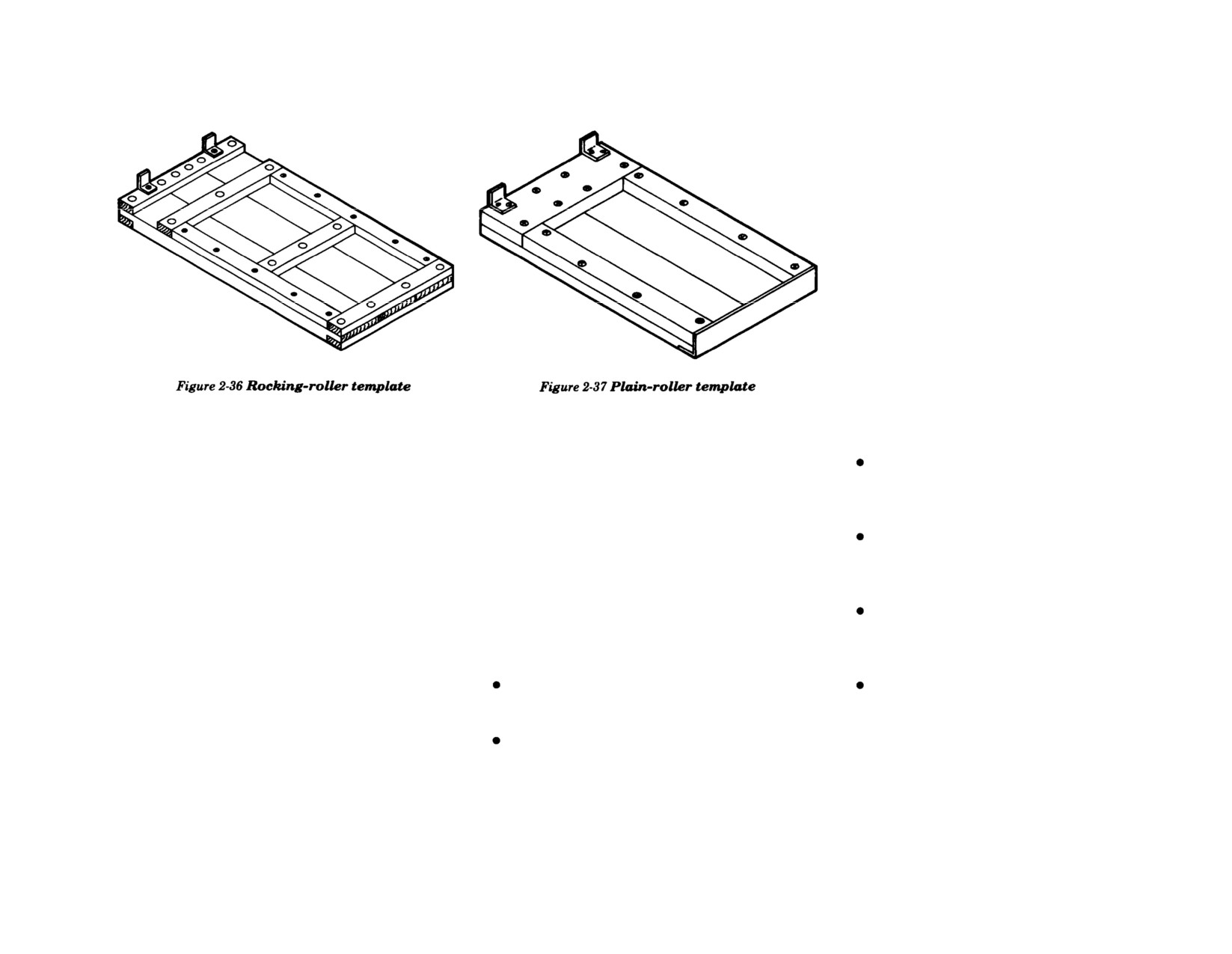
TEMPLATES
Two types of templates are provided, one to
locate the bearings for the rocking rollers and
the other for the plain rollers. The rocking-
roller template (Figure 2-36) weighs 78 pounds
(35.4 kilograms) and consists of a timber base
PIN EXTRACTOR
with timber strips on top forming two spaces
The pin extractor (Figure 2-34) assists in
large enough for rocking-roller bearings. At
dismantling the bridge. After the pin has
one end of the template are two angle cleats
and a steel strip on the fourth. The strips
been driven part way out, and the recess
which are used as measuring points. The
surround a space large enough for the base-of
under the head of the pin is exposed, the pin
plain-roller template (Figure 2-37) weighs 22
a single plain roller. The template also has
extractor grips the pin head and forces the
pounds (10.0 kilograms). It consists of a
two angle cleats at one end for measuring
pin out by a levering action. It is particularly
timber base with timber strips on three sides
points.
18
FM 5-277
BRIDGING TRUCK LOADS
BASIC BRIDGE SET
RECOMMENDED BRIDGING LOADS
The number of trailers is 40 percent of the
Parts for standard truck loads are drawn
The engineer company (panel bridge) nor-
number of trucks. This makes it possible
from these basic sets. Tables A-2 and A-3 in
mally transports one set of the Bailey bridge
to use trucks to tow trailers if necessary.
Appendix A list components of the M2 panel
on 5-ton dump trucks and 4-ton bolster
bridge basic set. The set contains enough
trailers. The company has two platoons, each
Erection equipment is spread over four
parts. and equipment to install two 80-foot
capable of transporting one 80-foot (24.4
trucks and one trailer, thereby minimizing
(24.4 meters)
double-single
M2 bridges with
meters) bridge (the most common bridge
the effect of loss or breakdown.
launching nose or one 130-foot (39.0 meters)
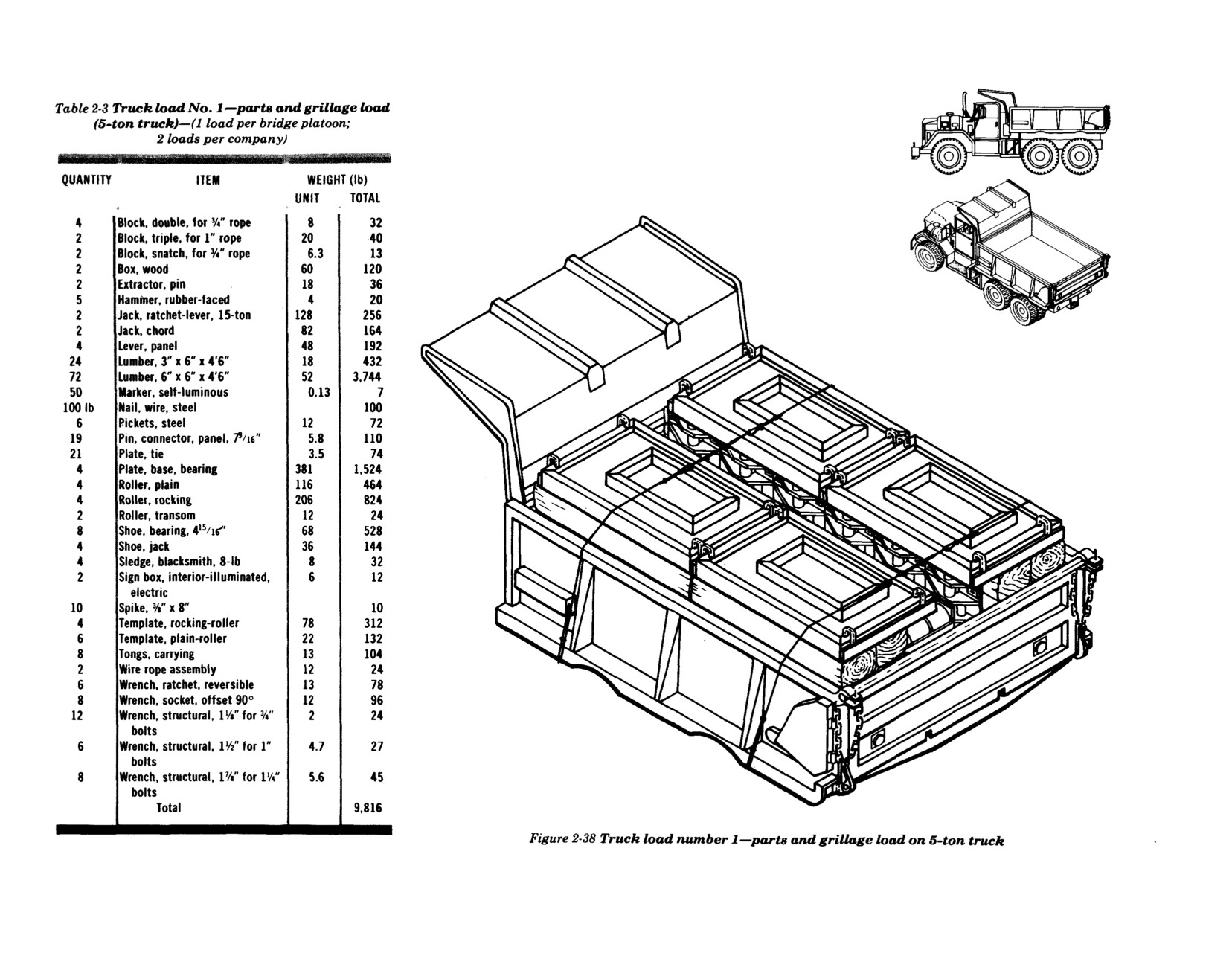
installed). The loads shown in Figures 2-38
double-double
bridge with launching nose.
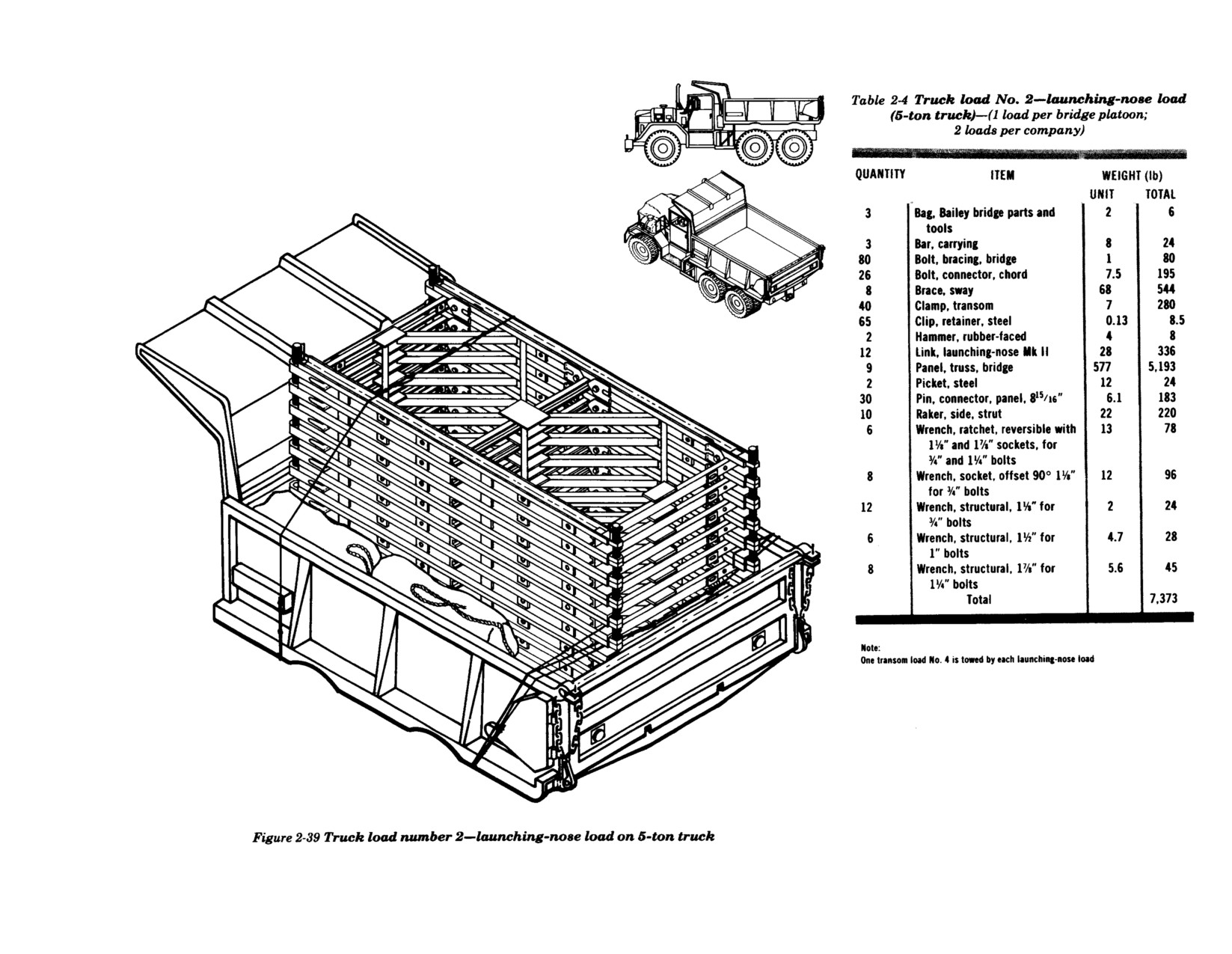
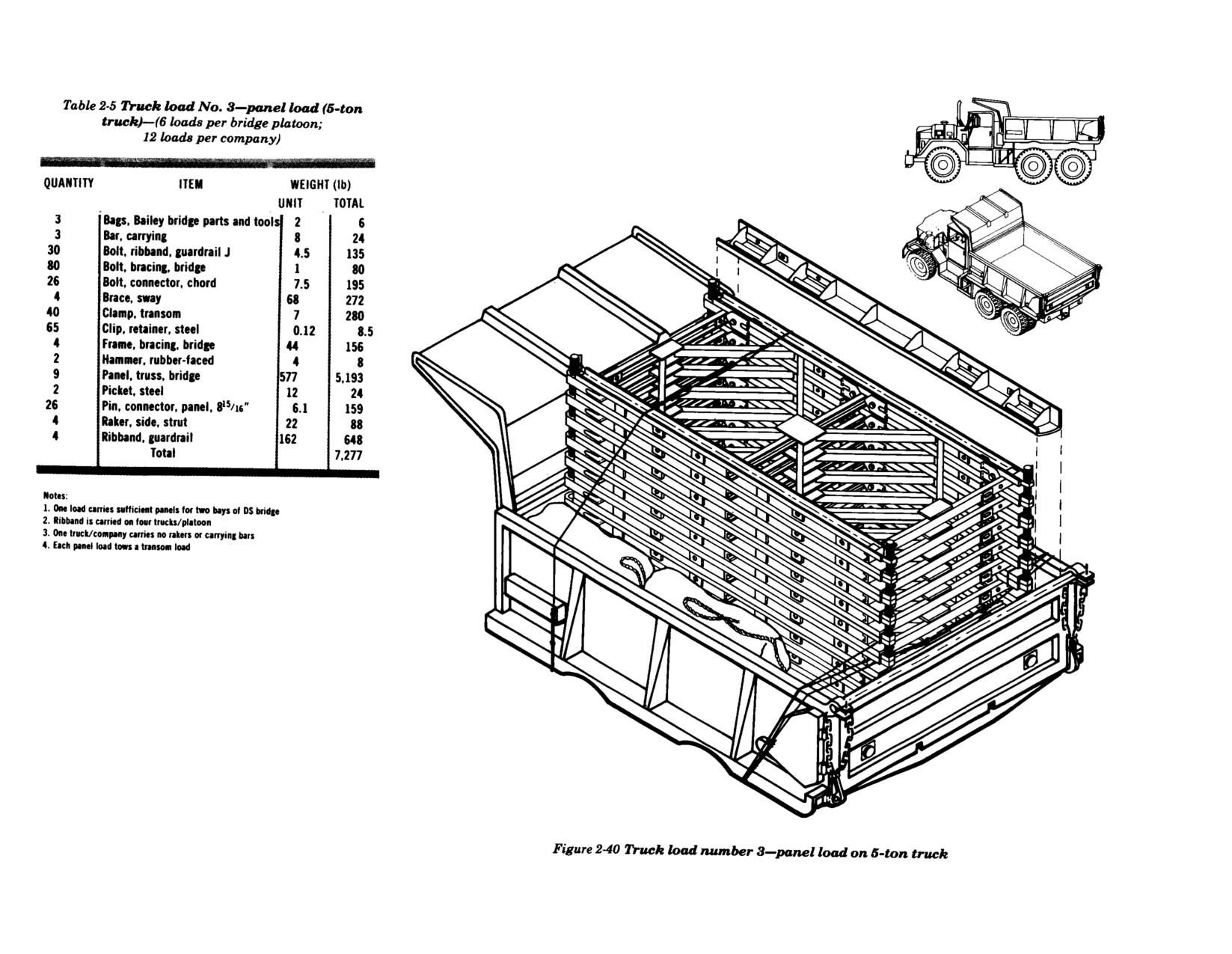
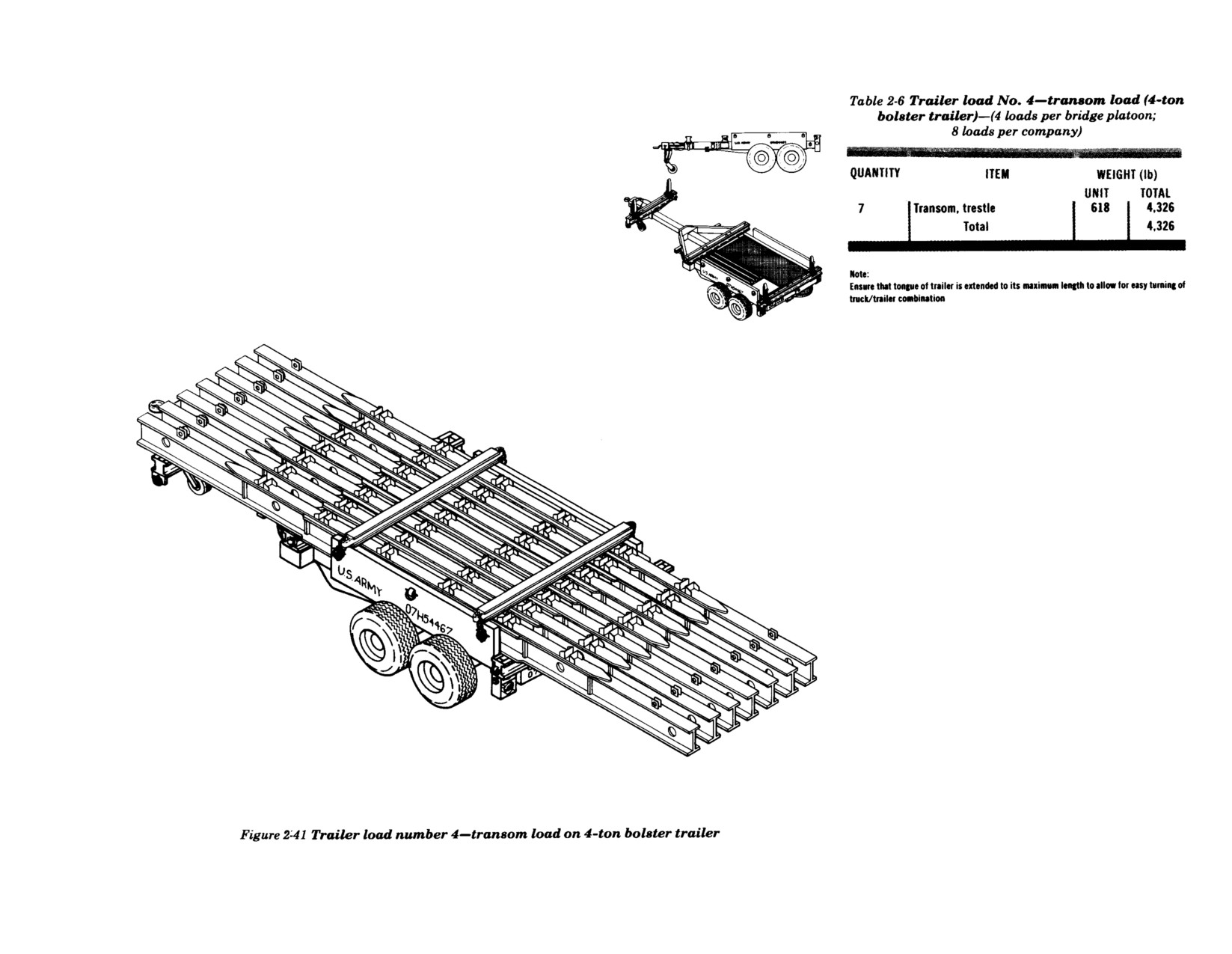
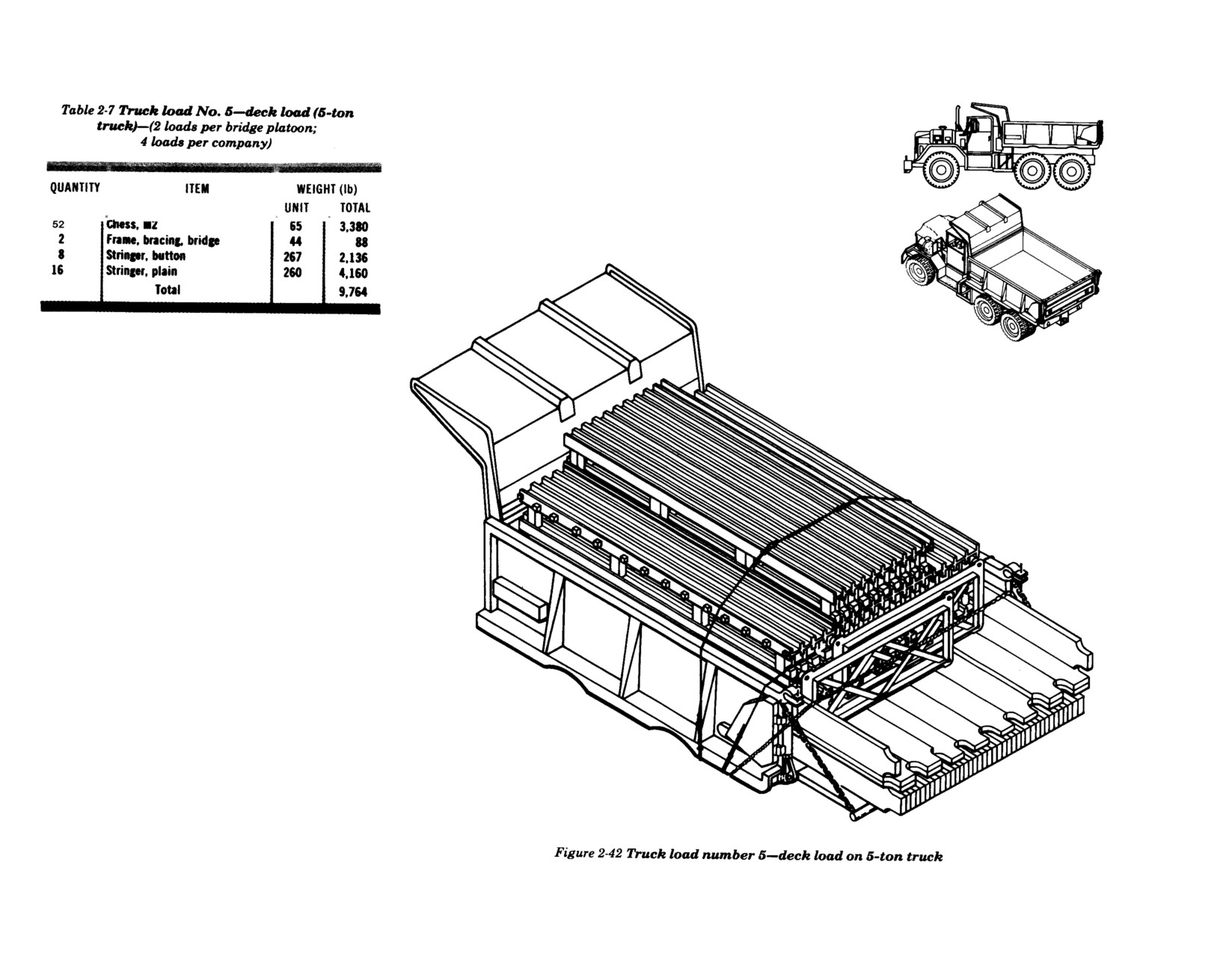
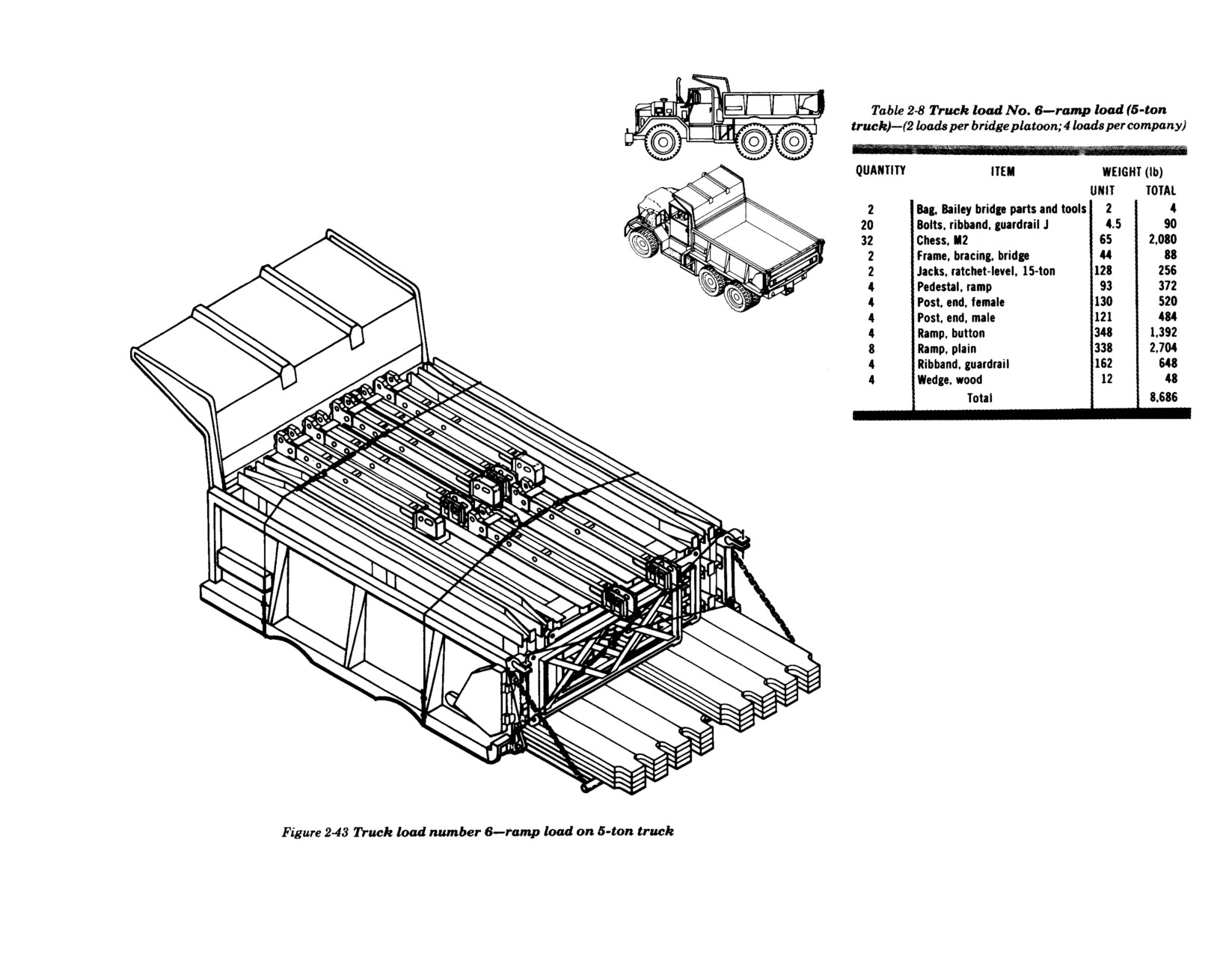
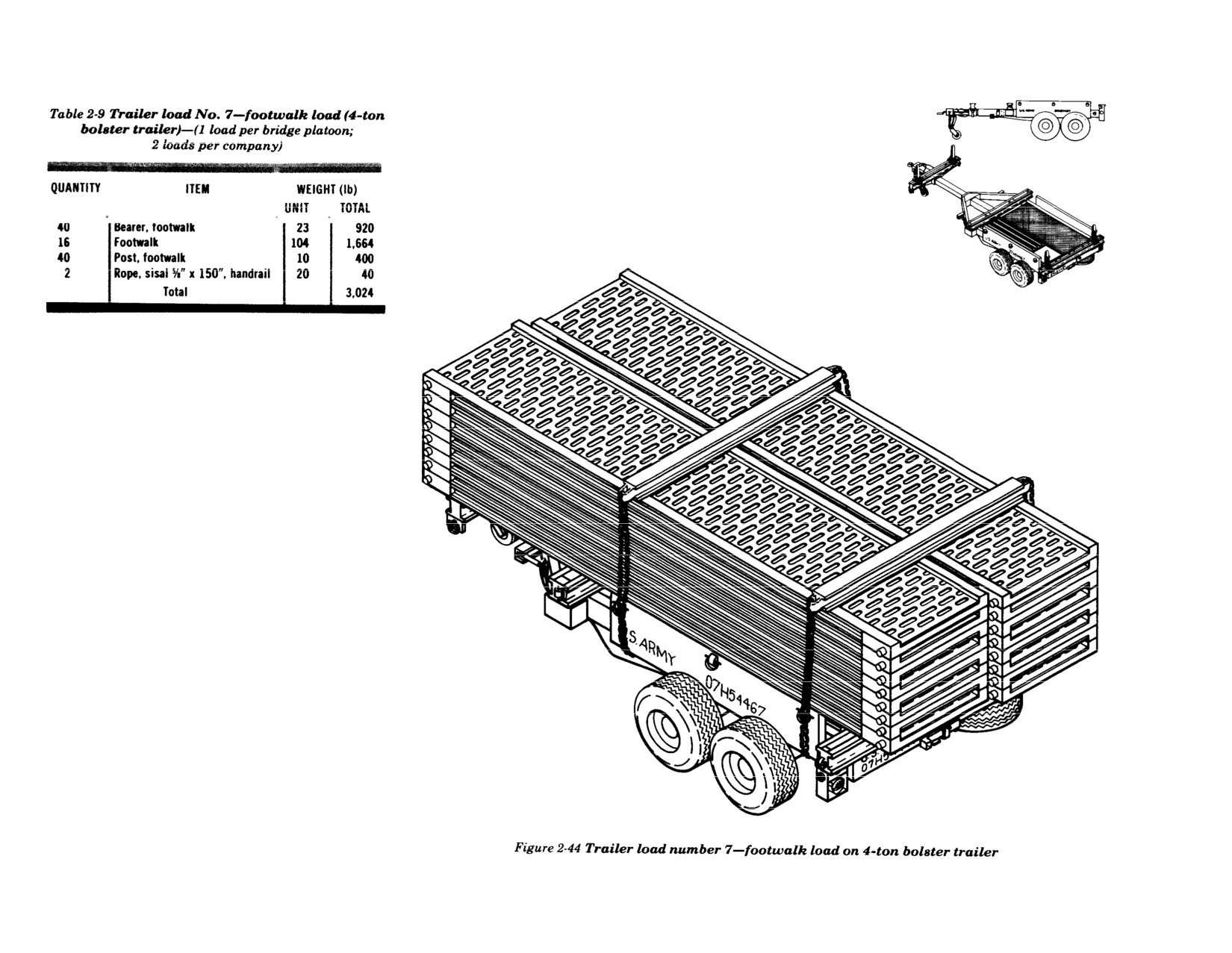
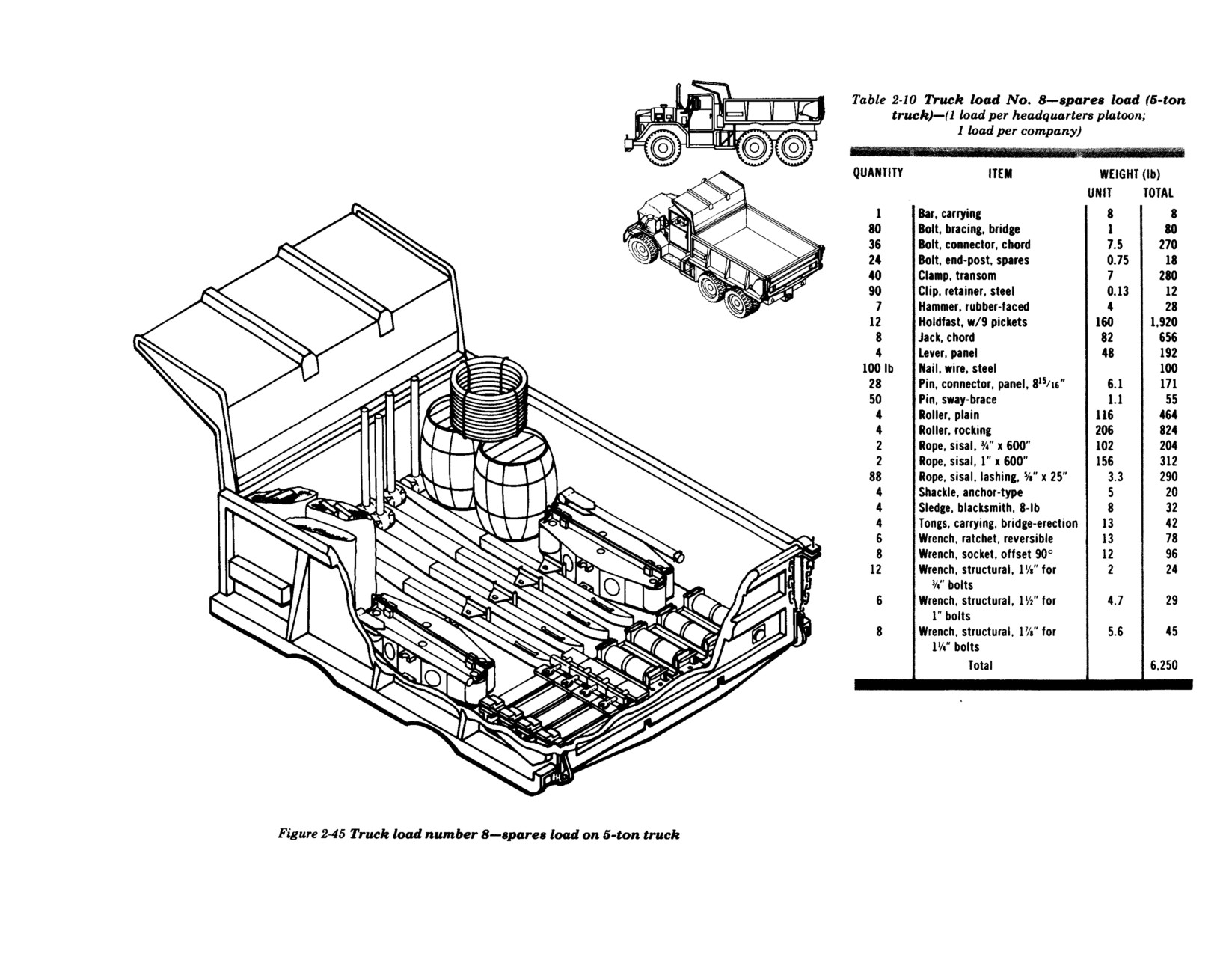
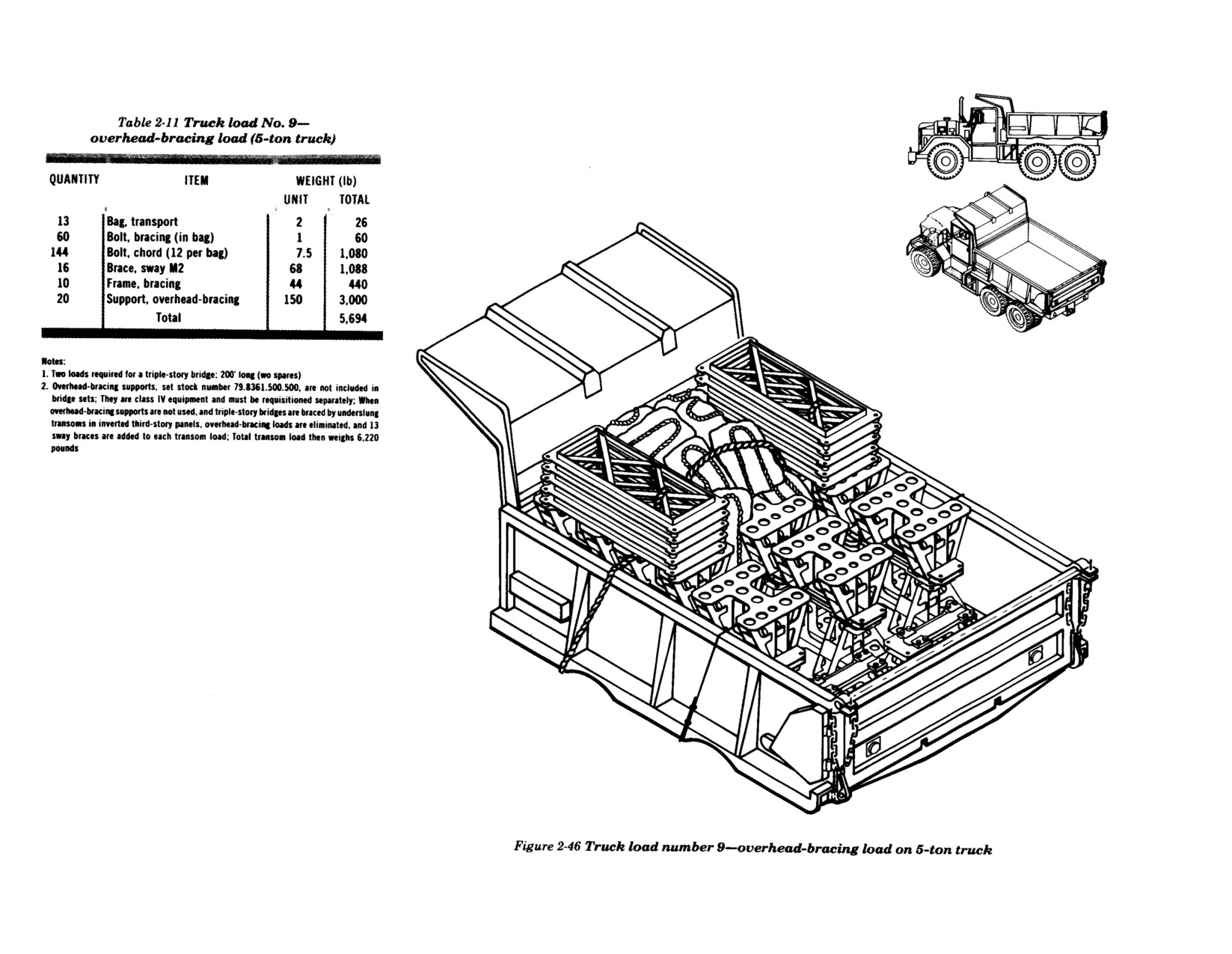
through 2-47 and Tables 2-3 through 2-13
Trucks are loaded with all the female or
(pages 20 through 30) have the following
all the male panel ends toward the rear of
Conversion Set No. 3, Panel Crib Pier, M2 is
features:
the vehicles.
used with equipment from the basic set to
build panel crib piers. Table A-4 in Appendix
All loads are within the rated capacity of
Steel cables are used for tiedowns on all
A lists component parts of conversion set No.
the assigned vehicles.
truckloads.
3. Enough parts are issued with each of these
sets to provide the assembly of a triple-truss
The loading lends itself to stockpiling or
pier supporting two triple-truss broken spans
assembly on a restricted site. A launching
and containing both horizontal and vertical
nose can be started with only three loads
stories.
on the site.
19
FM 5-277
20
FM 5-277
21
FM 5-277
22
FM 5-277
23
FM 5-277
24
FM 5-277
25
FM 5-277
26
FM 5-277
27
FM 5-277
28
///////////////////////////////////////