FM 5-277 BAILEY BRIDGE (May 1986) - page 2
FM 5-277
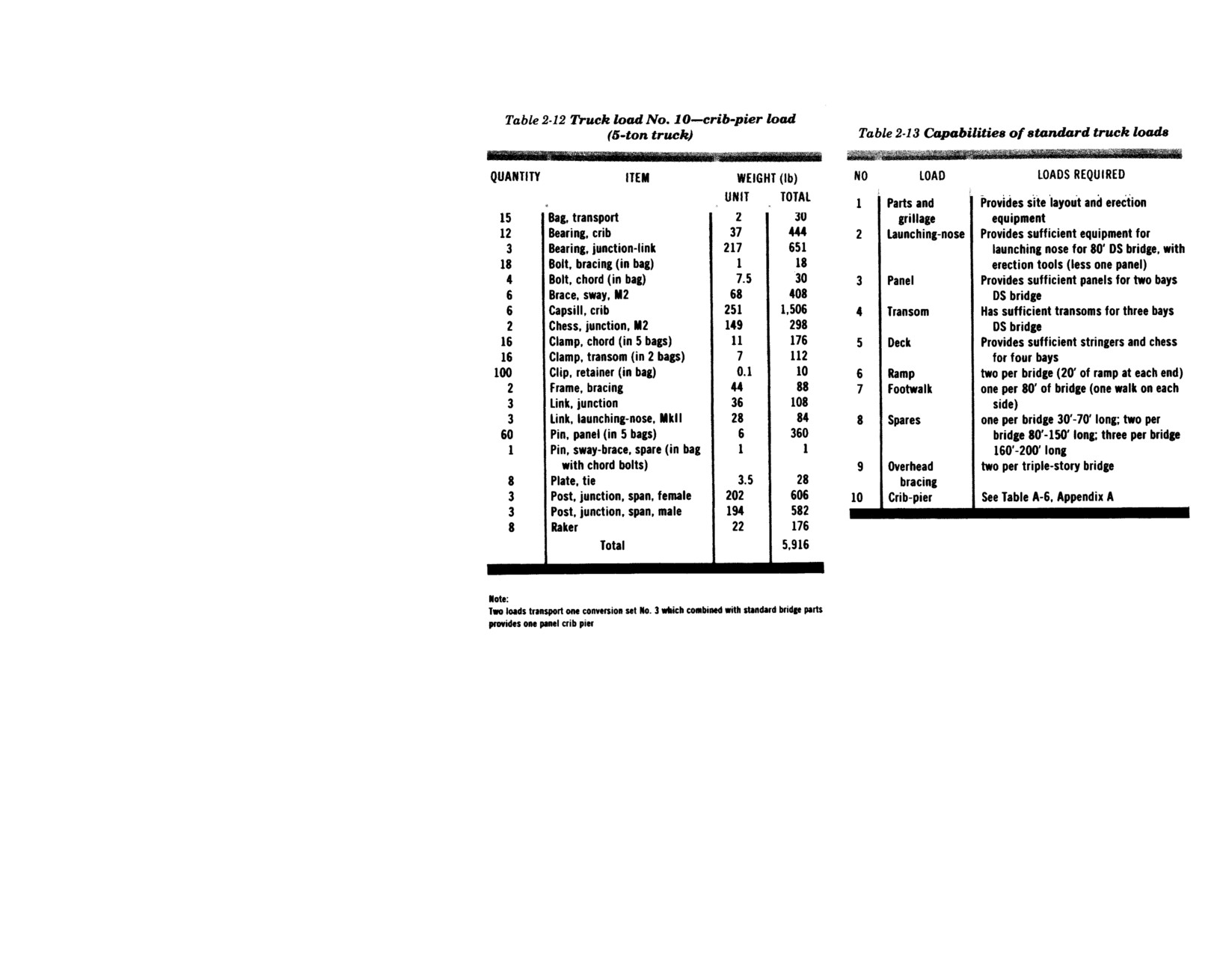
Conversion set No. 3 is carried in 2 crib-pier
loads. Information on the capabilities of dif-
ferent standard truck loads is given in Table
2-13, and Tables A-5 and A-6 in Appendix A.
BAY LOADS
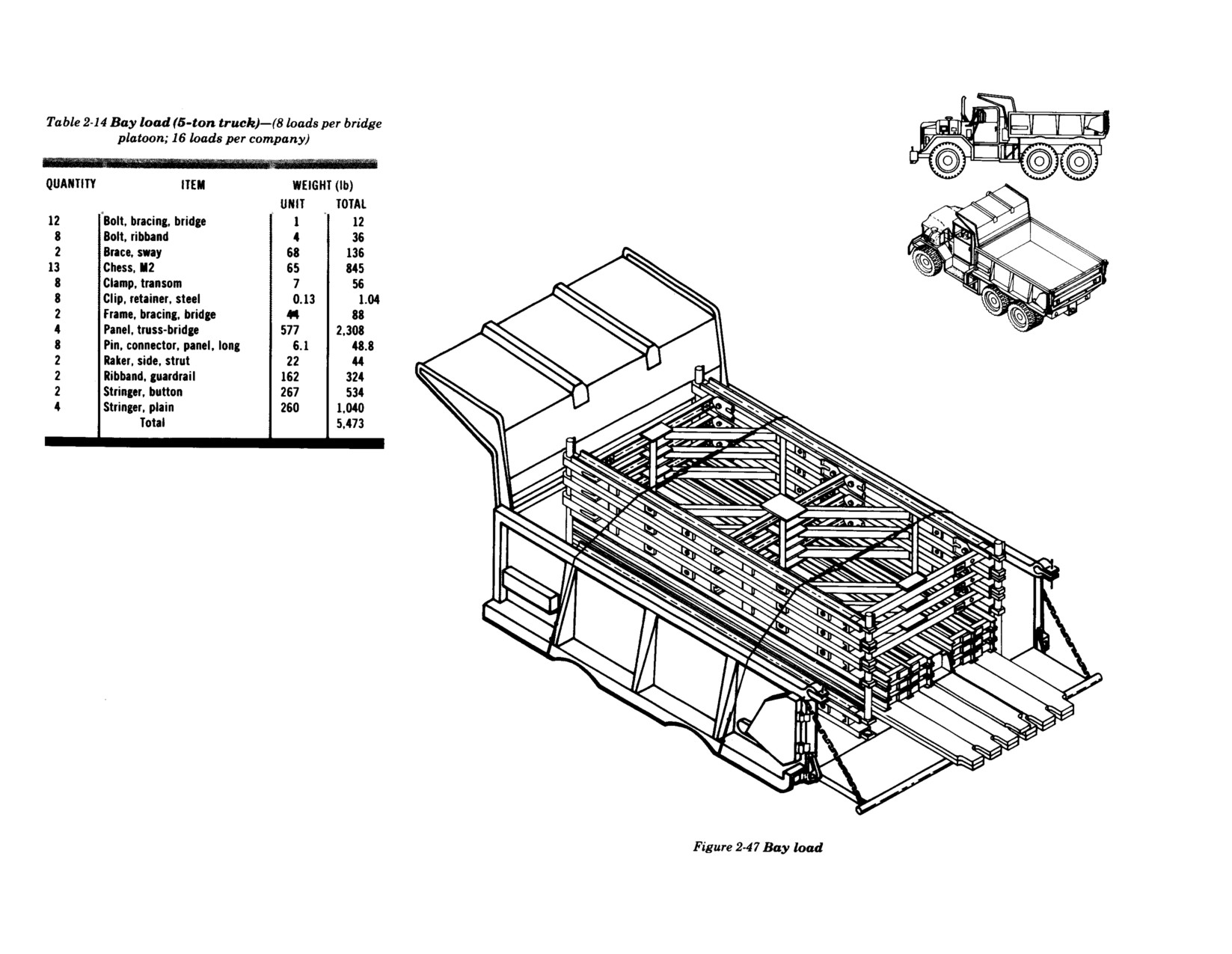
The recommended bridge load for combat
operations is the bay load (Figure 2-47, page
30). Each bay load truck contains all the
parts, except transoms, required for one bay
(10 feet) (3.0 meters) of
double-single
Bailey
bridge. This loading lends itself well to most
combat engineer Bailey bridge missions.
Table 2-14 (page 30) lists the parts found in
the bay load. Four-ton bolster trailers carry
the transoms with the bridge load mentioned
earlier. The bay load is designed to be easily
unloaded by crane. However, the load may
also be unloaded by hand or dumped if a
crane is not available. If the load is dumped,
take care not to damage the chess. For a
complete bridge, parts and grillage,
launching nose, ramp, footwalk, spares, and
overhead-bracing loads must also
be included.
29
FM 5-277
30
FM 5-277
CHAPTER 3
PLANNING AND ORGANIZATION
Each bridge site must be reconnoitered to
There should be access routes at each end
site, in which to store vehicles and
select the site most economical in use of
of the bridge tying into the main road net.
equipment when not in use at the bridge
available personnel, equipment, and time.
These routes should not require excessive
site.
The reconnaissance officer must be told the
maintenance or preparation.
following before making the reconnaissance
A bivouac site for construction and main-
Approaches should require little prepara-
tenance crews and crossing noncommis-
Where bridge is needed. The general
tion. These approaches should be two
sioned officer in charge should be
location of the bridge is determined by
lane and straight for 150 feet (45.7 meters)
available.
tactical requirements.
at each end of the bridge. Their slope
should not exceed 10 percent (1 in 10).
Following the reconnaissance, make out a
Class of bridge needed. The class of the
Special consideration must be given to
report. The reconnaissance report describes
bridge is determined by the type of
the amount of work required to prepare
every usable site reconnoitered, and recom-
vehicles it must carry.
the approaches and piers, since this work
mends a site. The report includes
frequently takes as much time as the
When bridge is needed. The time set for
bridge installation itself.
Location of site.
the bridge to become operational affects
seriously planning for the mission.
Banks should be firm and stable and of
Width at gap.
about equal height.
Who is to construct the bridge.
Length, truss type, and type of grillage of
The site should be large enough for
bridge that would be assembled at site.
SITE RECONNAISSANCE
assembly of the bridge and wide enough
A thorough evaluation of information from
for unloading and stacking the parts and
Slope of bridge.
preliminary studies may aid the reconnais-
erection tools. The approach road often
sance by limiting it to a few suitable sites.
provides such space.
Condition of banks and capacity of
Sources of preliminary information are intel-
abutments.
ligence studies and reports, interviews with
There should be a turnaround area large
local civilians, maps, aerial photographs
enough to allow trucks and bolster trailers
Proposed location of site layout.
(including stereo-pairs), and aerial recon-
to completely turn around so they can
naissance.
back into the site. This area is normally
Site preparation required.
located about 50 feet (15.2 meters) from
SITE SELECTION
the bridge site.
Recommended method of transporting
Whenever possible, make aground reconnais-
troops and equipment to far bank.
sance. The following site selection factors are
There should be space for an engineer
desirable for a panel bridge:
equipment park—a covered and concealed
Sketch showing profile of centerline of
area ½ to 5 kilometers behind the bridge
the bridge, extending 100 feet (30.5 meters)
31
FM 6-277
on the near shore and 50 feet (15.2 meters)
on the far shore.
Sketch showing layout of assembly site,
and location of turnaround and engineer
equipment park.
Truck route to bridge site from engineer
equipment park.
SITE LAYOUT
When the bridging is being unloaded directly
from the trucks, the site must be cleared for at
least as long as the width of the gap, but the
width of the site need only be the width of the
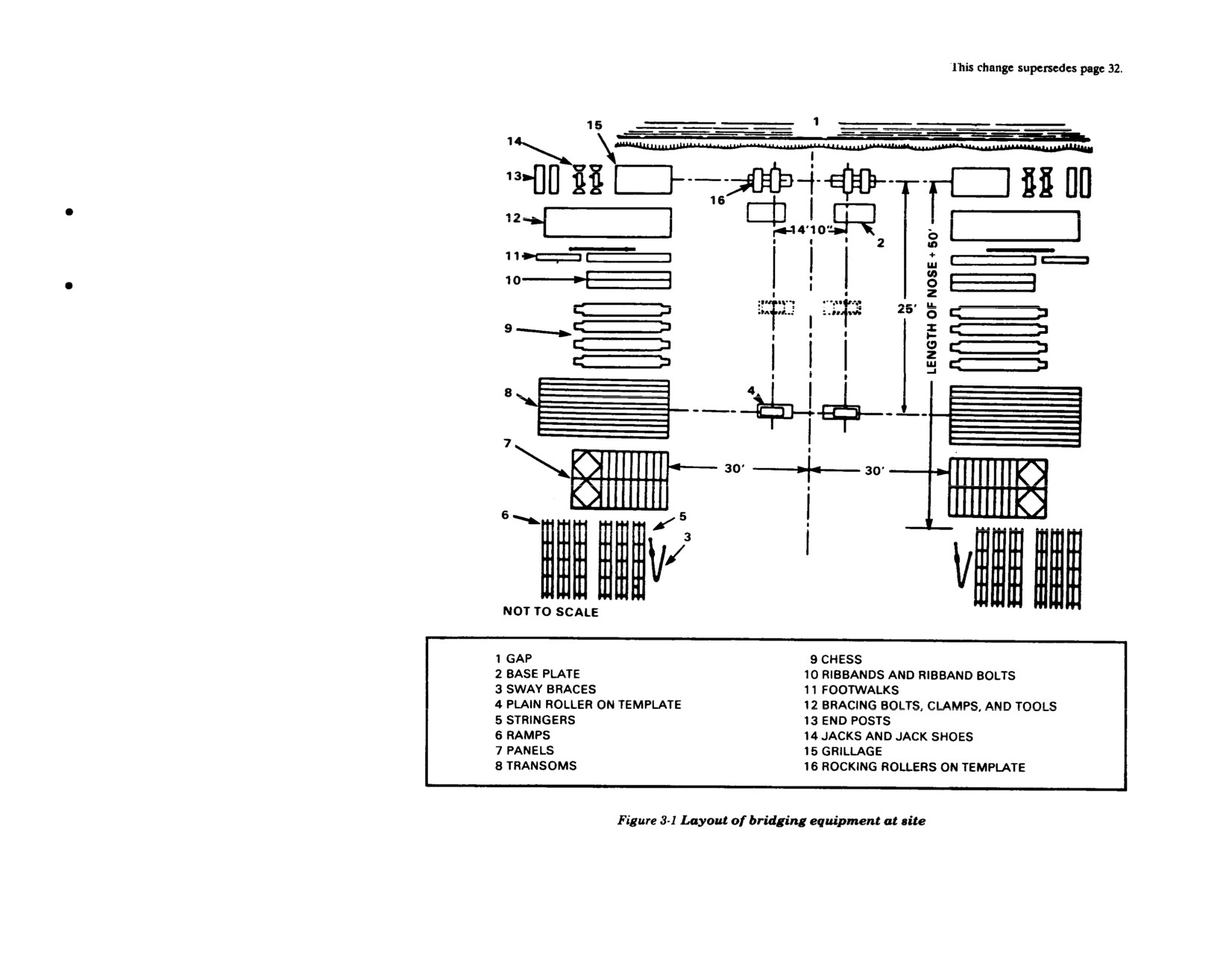
approach. If the bridging is to be unloaded
and stacked at the site, the site must be about
150 feet (45.7 meters) wide. The stacks are
arranged as shown in Figure 3-1. In restricted
areas, 30 feet (9.1 meters) should be available
at least on one side of the bridge to permit
insertion of transoms. Otherwise, transoms
must be threaded from within two bridge
truss girders.
ORGANIZATION
The work force is normally organized into
unloading parties and an assembly party.
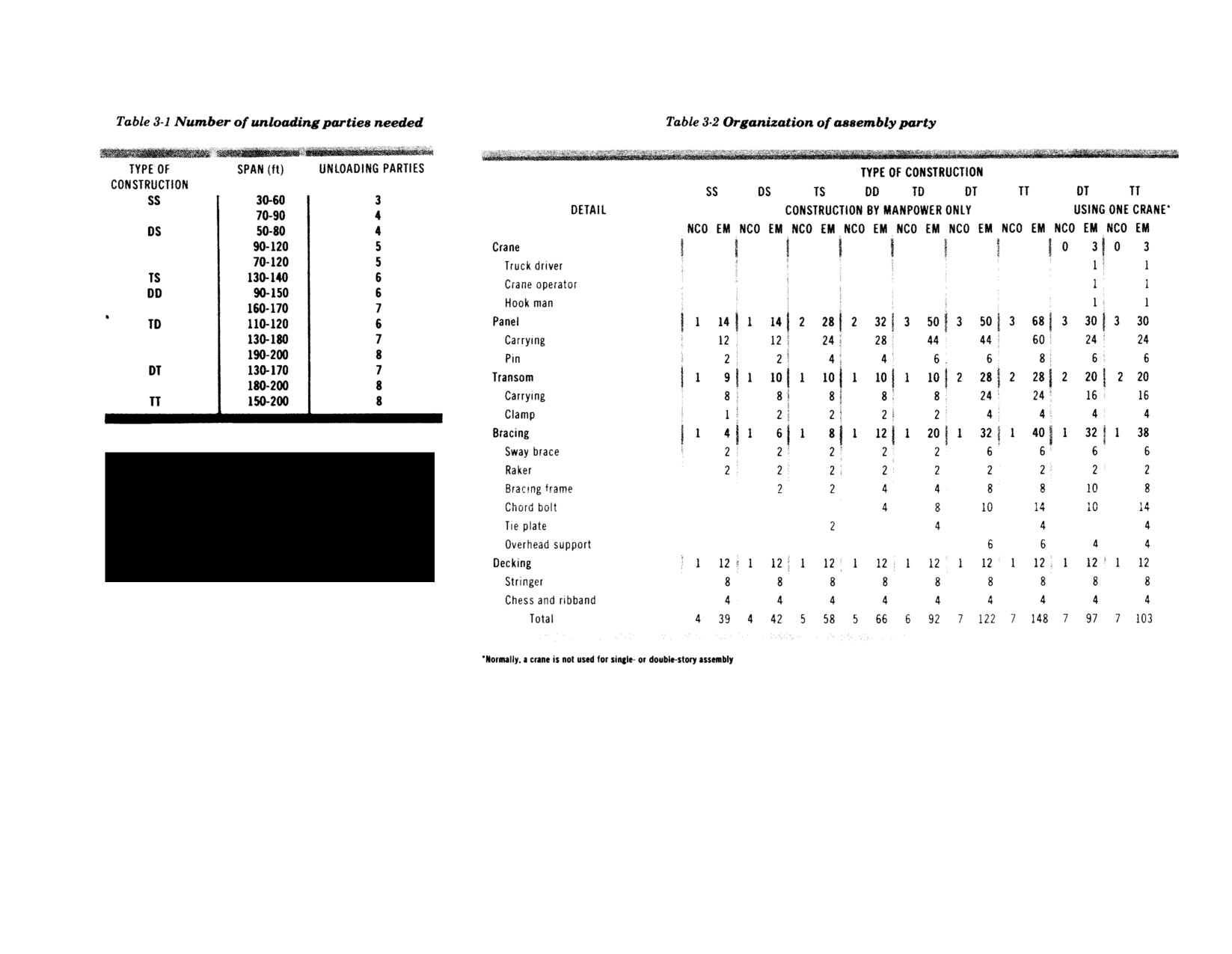
Each unloading party consists of one non-
commissioned officer and eight soldiers. The
number of unloading parties depends on the
length and type of the bridge (Table 3-l).
Unless an unusually large cleared area exists
at the site, no more than three or four un-
loading parties will be able to work efficiently
at one time.
32
FM 5-277
WARNING: The left rear soldier calls the
lift commands after ensuring that all crew
members are prepared to lift to prevent
injury.
The various details in the assembly party are
shown in Table 3-2. In most cases, this in-
cludes the panel, transom, bracing, and
decking details. The duties of the panel detail
are as follows:
of the end of bridge and installation of the
5.
It jacks down far end of bridge.
1 It carries, places, and pins together panels
ramp.
in the launching nose and bridge.
6
It installs far-bank ramp, placing chess and
3
It reforms as a single detail and completes
ribbands.
2 As soon as all panels are in place, it
dismantling of the launching nose.
divides into two crews. One crew crosses
to far bank and begins dismantling the
4
It installs far-bank end posts.
launching nose. The other carries neces-
sary parts to the far bank for completion
33
FM 5-277
Duties of the transom detail areas follows:
2
It lays stringers, chess, and ribbands on
available, equipment is stacked at the site,
bridge.
and footwalks are omitted. Use of untrained
1
It carries, places, and clamps down tran-
troops, poor weather, various terrain condi-
soms.
3
It jacks down near end of bridge.
tions, and enemy activity will lengthen
assembly time by 30 percent. Added time
2
It removes plain rollers on near bank.
4
It lays chess and ribbands on near-bank
must also be allowed for placing wear treads.
ramp.
Add ½ to 4 or more hours for preparation of
3
It installs end posts on near bank.
site and layout and placing of rollers (de-
ASSEMBLY TIME
pending upon the amount of work required to
4
It helps decking detail in jacking down
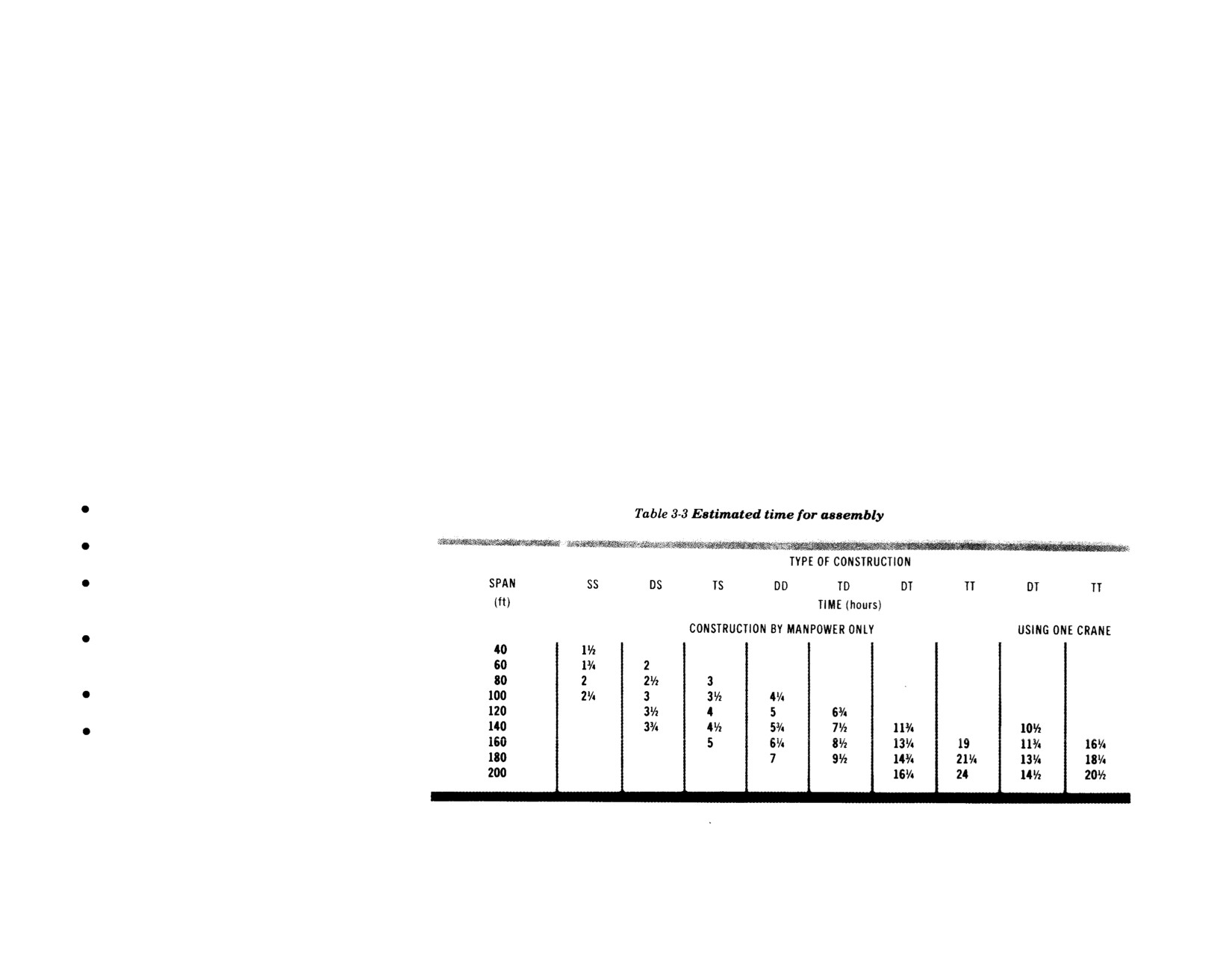
Time for assembly and installation of a
level site, install grillages, and crib up rollers).
near end of bridge.
normal bridge is given in Table 3-3. Table 3-3
Add ½ hour for unloading from trucks if
shows estimated times for daylight assembly
separate unloading parties are available. If
5
It installs near-bank ramp and helps
and launching of various lengths of different
not available, add 1 to 2½ hours according to
decking detail in placing chess and rib-
types of bridges when built by manpower
type of bridge. For blackout conditions,
bands on it.
alone and when using one crane. Times do
increase daylight times by 50 percent. For
not include preparation of site and layout of
mission-oriented protection posture (MOPP)
Duties of the bracing detail are to obtain,
rollers. These times assume there is a favor-
conditions, increase final construction (all
install, and adjust the following parts:
able assembly site, trained personnel are
other conditions considered) by 50 percent.
Sway braces.
Rakers.
Bracing frames, on all but
single-single
bridges.
Chord bolts, on double- and triple-story
bridges only.
Tie plates, on triple-truss bridges only.
Overhead-bracing supports, on triple-
story bridges only.
Duties of the decking detail areas follows:
1
It assists panel detail in starting assembly
of the launching nose.
34
FM 5-277
INSTALLATION PROCEDURE
Installation procedure begins with site prep-
aration (clearing mines, removing obstacles,
constructing a turnaround for trucks). Instal-
lation then includes the following steps: roller
layout (including baseplates), unloading of
bridge equipment, bridge assembly and
launching, bridge jackdown and ramp assem-
bly, and installation of wear treads and
footwalks.
MOVEMENT CONTROL
Proper planning for the movement of bridge
trucks is important in providing, without
confusion, the bridge equipment when it is
needed. If the equipment is to be stacked at
the site, time the transportation to arrive as
soon as the stacking site is ready.
35
FM 5-277
CHAPTER 4
FIELD DESIGN AND CLASSIFICATION
LENGTH, TRUSS TYPE, AND GRILLAGE TYPE 36
LAUNCHING NOSE 49
ROLLERS AND JACKS 51
RAMP REQUIREMENTS 52
EXAMPLE FIELD DESIGN PROBLEM 54
BRIDGE CLASSIFICATION 56
The Bailey bridge may be adapted to fit mined. Finally, the required grillage is
the new bridge length. To complete the field
almost any gap. The field design procedure determined. However, the grillage type may
design, the number of rollers and jacks needed
first determines the initial length of bridge
cause a change to the initially determined
must also be determined.
required, and then the truss type needed to
bridge length. If so, the truss type will have to
carry the required class of traffic is deter-
be rechecked, as well as the grillage type, for
LENGTH, TRUSS TYPE, AND GRILLAGE
TYPE
DETERMINING INITIAL
and headwall with footers and deadman.
If both prepared and unprepared abutments
BRIDGE LENGTH
Technical Manual (TM) 5-312 gives more
exist on one bridge site, the gap is measured
The initial bridge length is determined by
detailed information on prepared abutments.
from the face of the prepared abutment to the
adding the width of the gap, the safety
The gap is measured between the faces of two
toe of the slope of the unprepared abutment.
setbacks, and the roller clearances.
prepared abutments.
Caution:
Care must be taken when
Gap
An unprepared abutment is one which would
completing the design process or the
The measurement of the gap depends on the
probably fail if the bridge load were applied
bridge will fail. Abutment types and
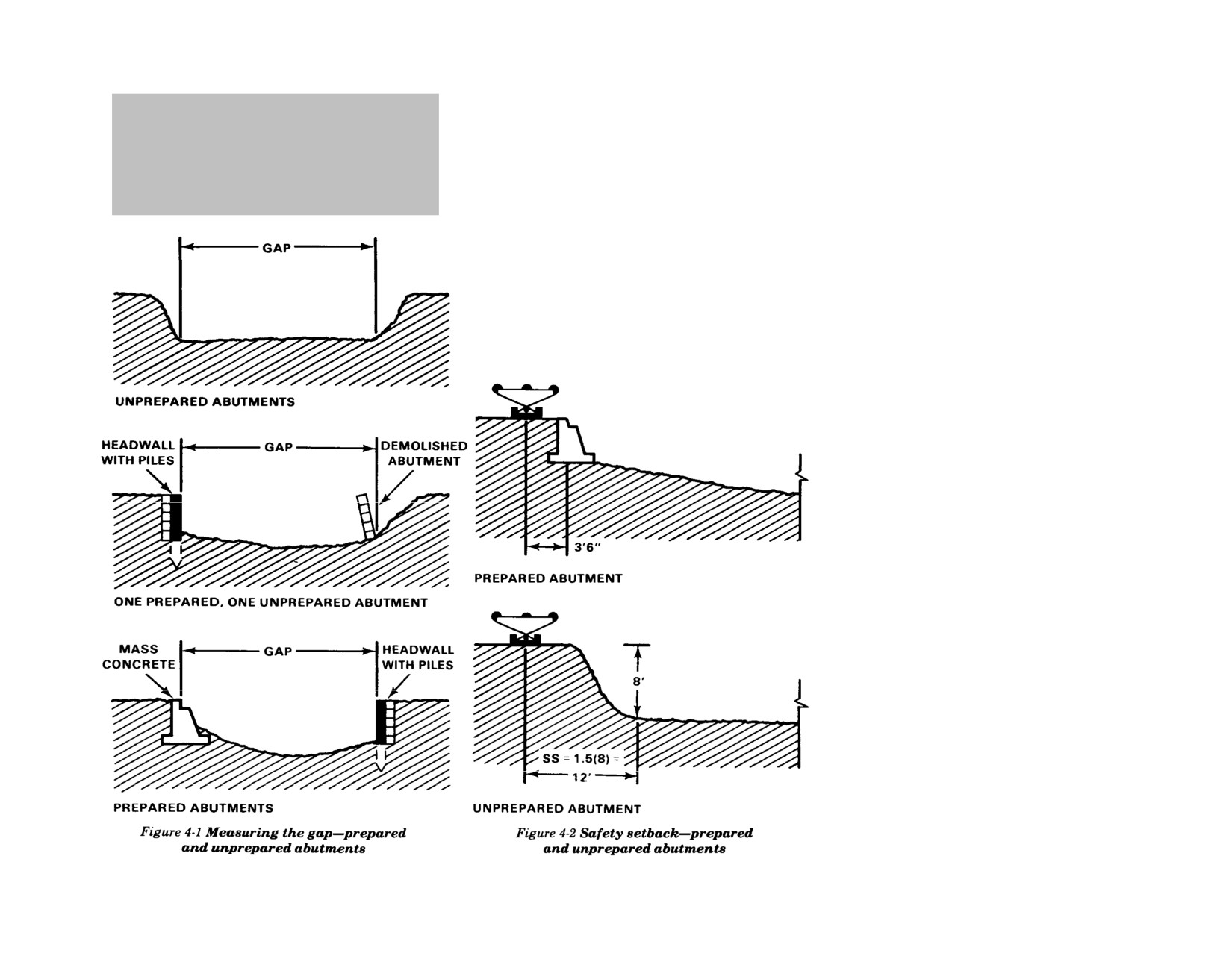
condition of the abutments (Figure 4-1). These
close to its edge. Examples of unprepared
location of the toe of the slope for
are usually classified as prepared, unpre-
abutments are natural slopes, demolished
unprepared abutments should be done
pared, or a combination of the two.
abutments, or abutments with headwalls that
carefully. Incorrectly classifying
are not strong enough to hold the load. The
abutment types or locating the toe of
Prepared abutments are abutments which
gap is measured from the toe of the slope of
the slope is the most common and
can hold the bridge load close to the face
one unprepared abutment to the toe of the
dangerous design mistake. When in
without failing. Examples of prepared abut-
slope of the other.
doubt, always classify the abutment
ments are mass concrete, headwall with piles,
as unprepared. If an abutment is par-
36
FM 5-277
tially prepared, determine the toe of
the slope at the base of the prepared
face. If the face is in poor condition,
Safety setback
determine the "real" toe of slope. Be
Safety setback is the minimum distance that
placed too close to the edge of the gap, the soil
sure to remember to measure bank
each rocking roller must be behind the bank
may fail during launching. Therefore, place
height at the toe of the slope.
of the gap. This distance depends on the
the rocking rollers at a location behind the
condition of the abutments on each bank
toe of slope of the soil. For field design, the toe
(Figure 4-2). If the bridge site has prepared
of slope is where the bank’s surface is 45
abutments, the rocking rollers are set back a
degrees (an average value) from the hori-
minimum of 3 feet 6 inches (1.1 meters) from
zontal direction. This would mean that the
the edge of the abutment.
rocking roller should be set back a distance
equal to the height of the bank. However, an
When unprepared abutments exist, the safety
additional safety factor of 50 percent is added.
setback must be calculated. If the rollers are
Therefore, the safety setback is 1.5 times the
bank height. The bank height is measured
from the toe of the slope to the ground level at
the abutment. The safety setback is measured
back from the toe of the slope.
EXAMPLE:
Given:
Unprepared abutment
Bank height 8 feet (2.44 meters)
Required:
Determine the safety setback (SS)
Solution:
Safety setback = 1.5x bank height
or 1.5 x 8 feet = 12 feet (3.66 meters)
Roller clearance
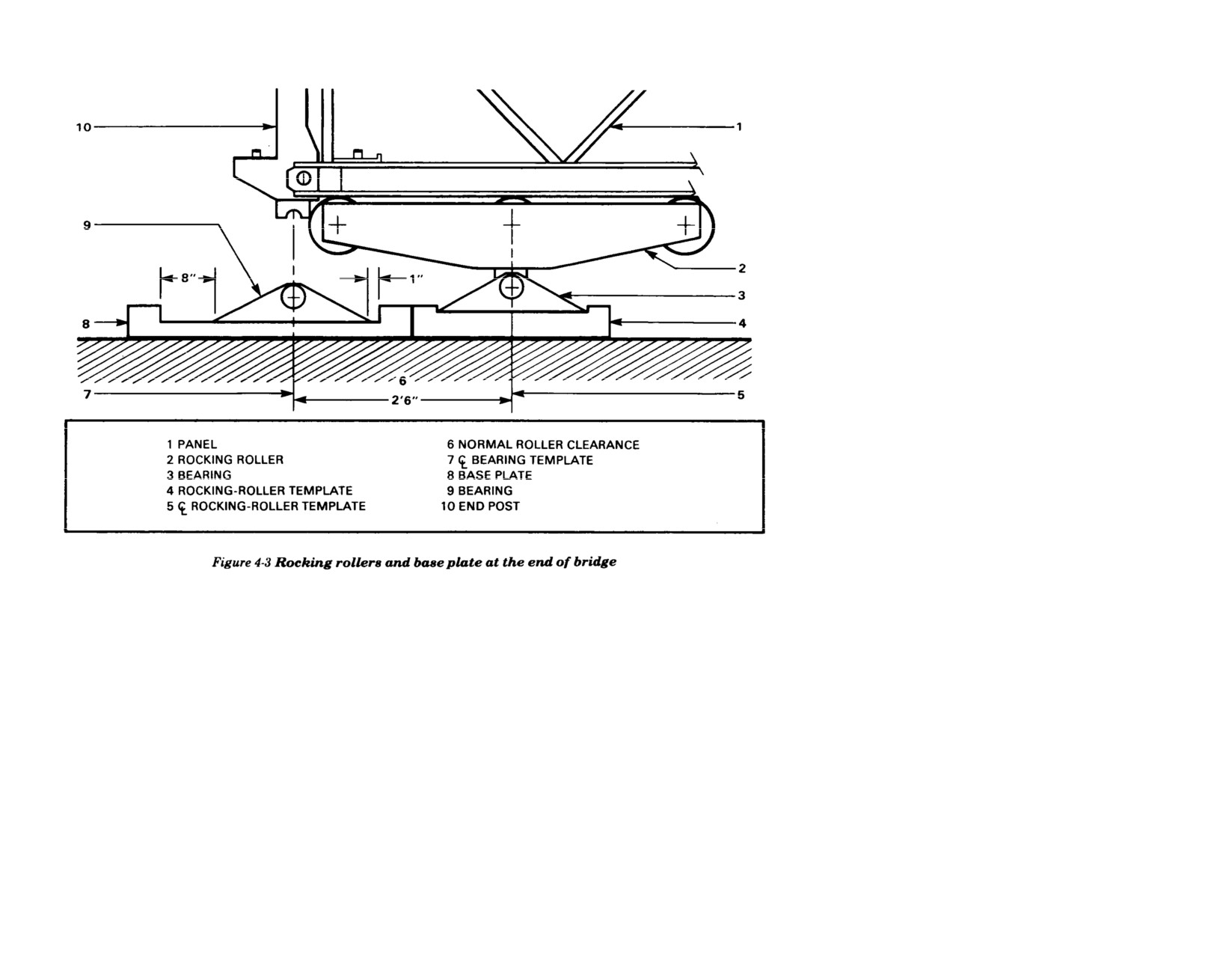
Roller clearance is the distance from the
center of the rocking roller to the center of the
bearing on which the bridge end posts will
rest (Figure 4-3, page 38). The normal roller
clearance, about 2 feet 6 inches (0.76 meters),
is always used when determining the initial
bridge length. The actual roller clearance will
be determined by the type of grillage used.
37
FM 5-277
Bank height—Near shore: 9 feet
(2.74 meters)
Far shore: 12 feet
(3.66 meters)
Required:
Determine initial bridge length
Solution:
bL
i
= gap + safety setbacks + roller
clearances
bL= 57 feet + [1.5(9 feet) +
i
1.5 (12 feet)] + (2.5 feet+ 2.5 feet)
= 93.5 feet (28.5 meters)
bL
i
= 95.5 (29.11 meters)
Round up to the next 10 feet (3.05 meters)
to equal 100 feet (30.48 meters)
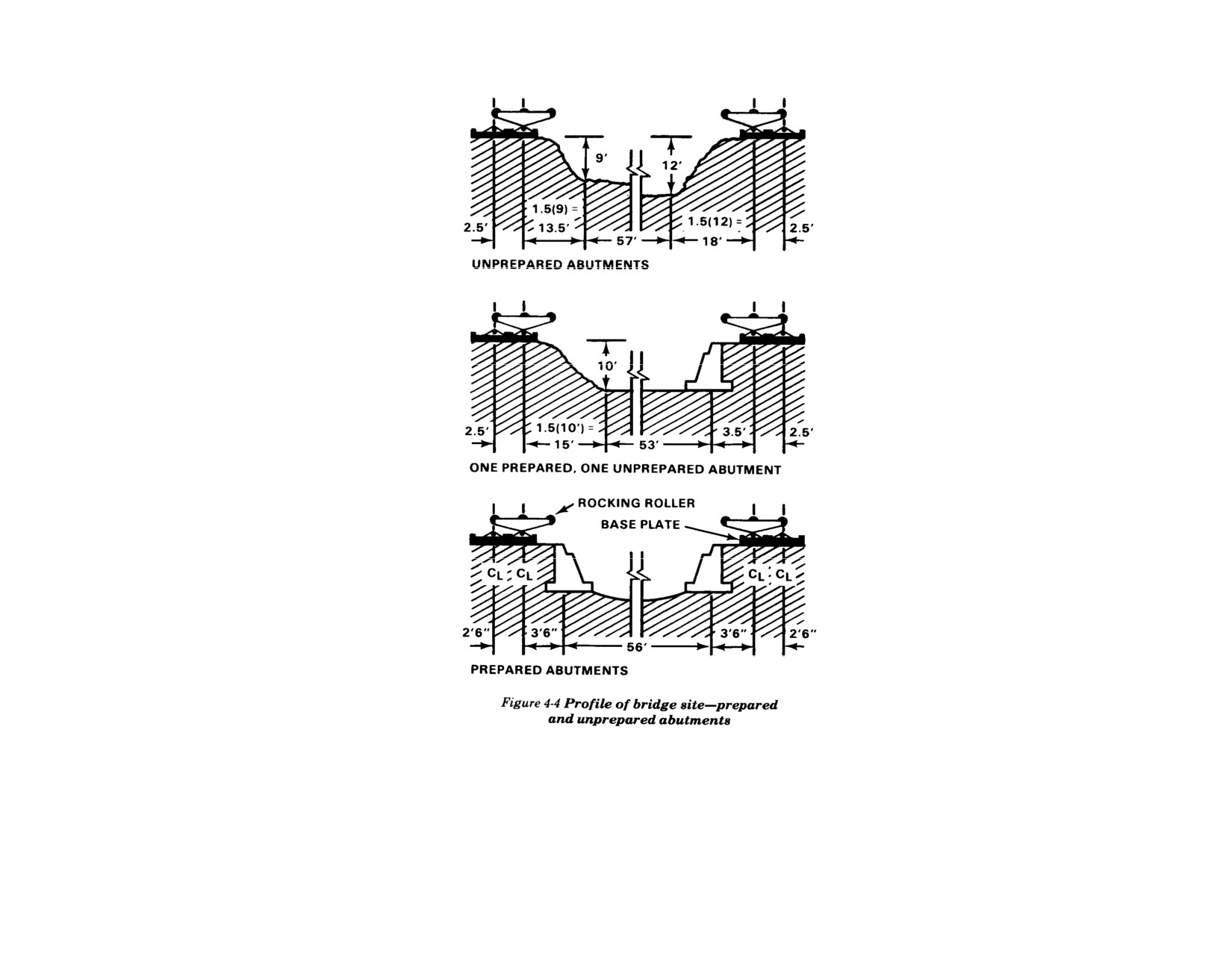
An example of computing bridge length with
one prepared and one unprepared abutment
(Figure 4-4) is as follows:
An example of computing bridge length with
bL
i
= 56 feet+ (3.5 feet+ 3.5 feet) +
Given:
both abutments prepared (Figure 4-4) is as
(2.5 feet + 2.5 feet)
Gap measurement (toe to toe)—
follows:
bL= 68 feet (20.73 meters)
i
53 feet (16.15 meters)
Given:
Round up to the next 10-foot (3.05 meters)
Bank height unprepared shore—
Gap is 56 feet (17.07 meters)
length to equal 70 feet (21.37 meters)
10 feet (3.05 meters)
(abutment to abutment)
An example of computing bridge length with
Required:
Required:
both abutments unprepared (Figure 4-4) is as
Determine initial bridge length
Determine initial bridge length
follows:
Solution:
Given:
Initial bridge length (bL) = gap +
Gap measurement (toe to toe)—
i
safety setbacks + roller clearances
57 feet (17.37 meters)
38
FM 5-277
Solution:
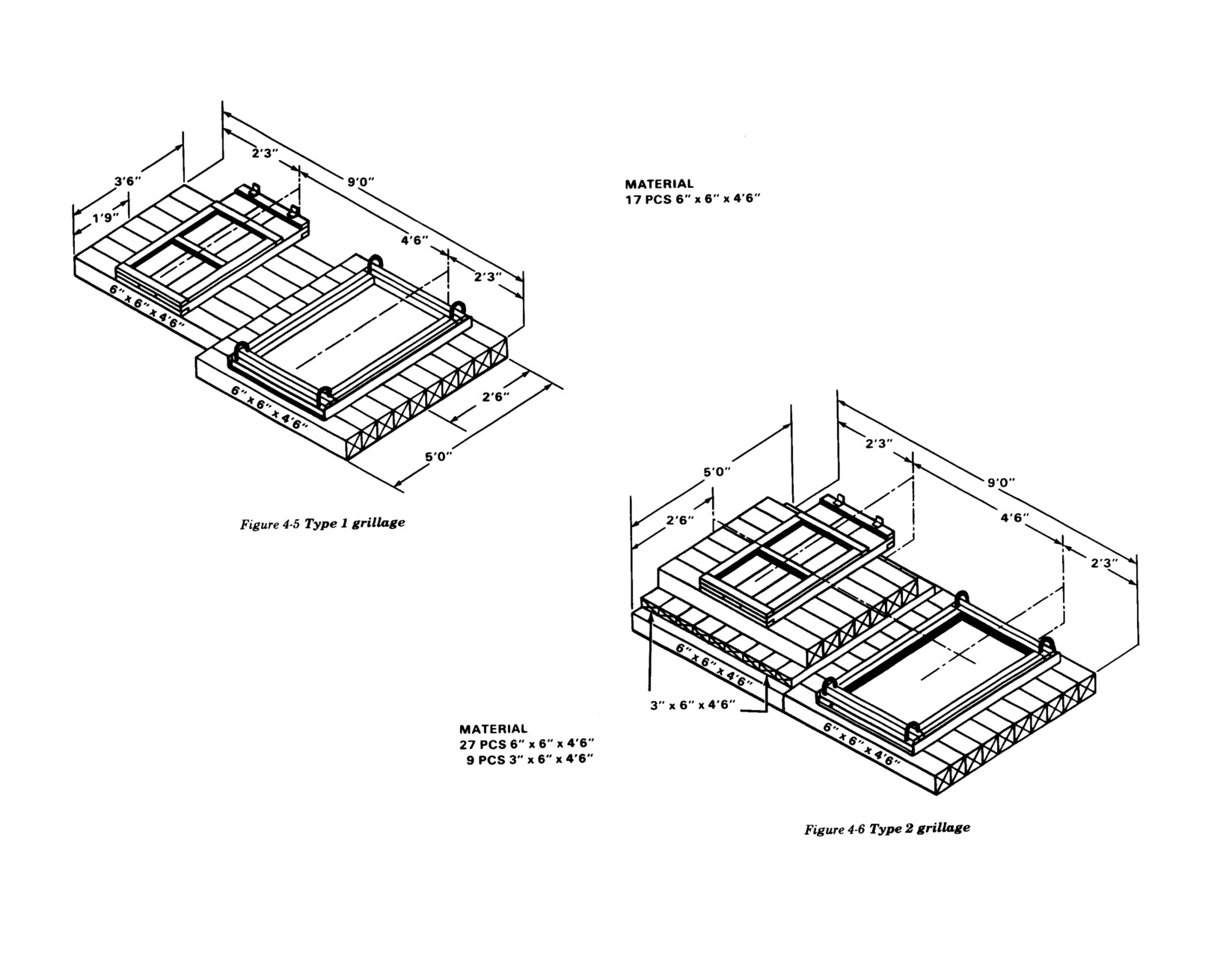
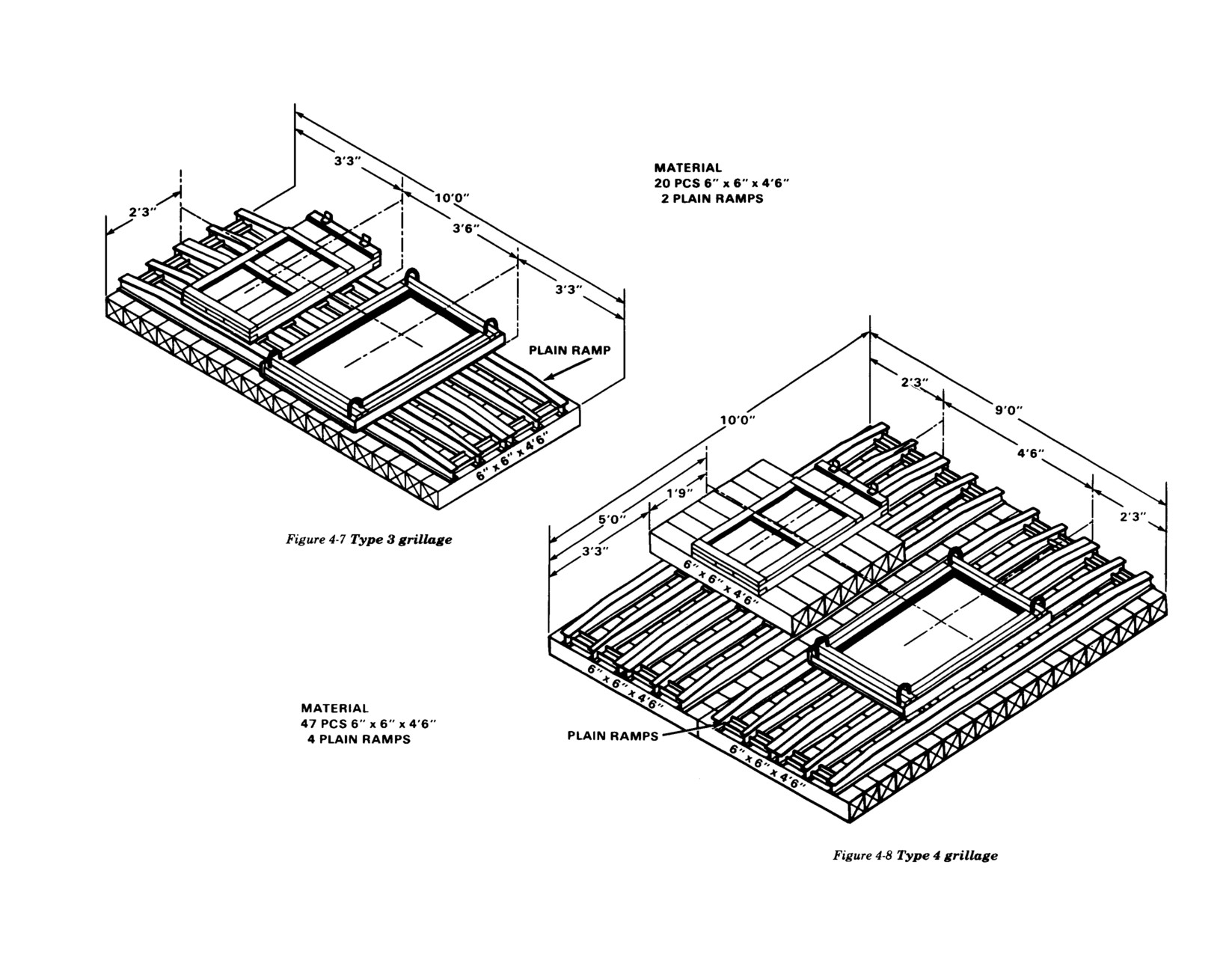
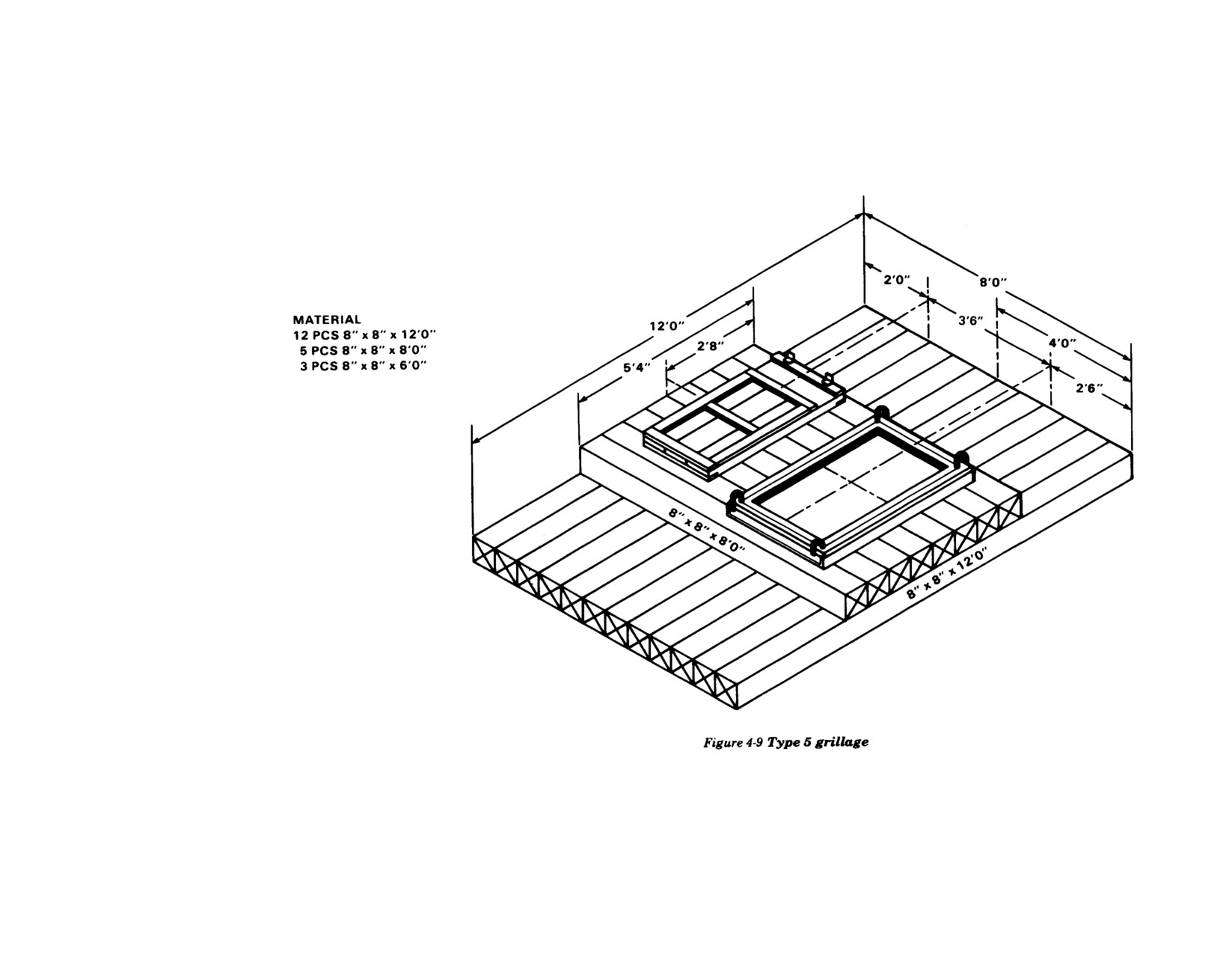
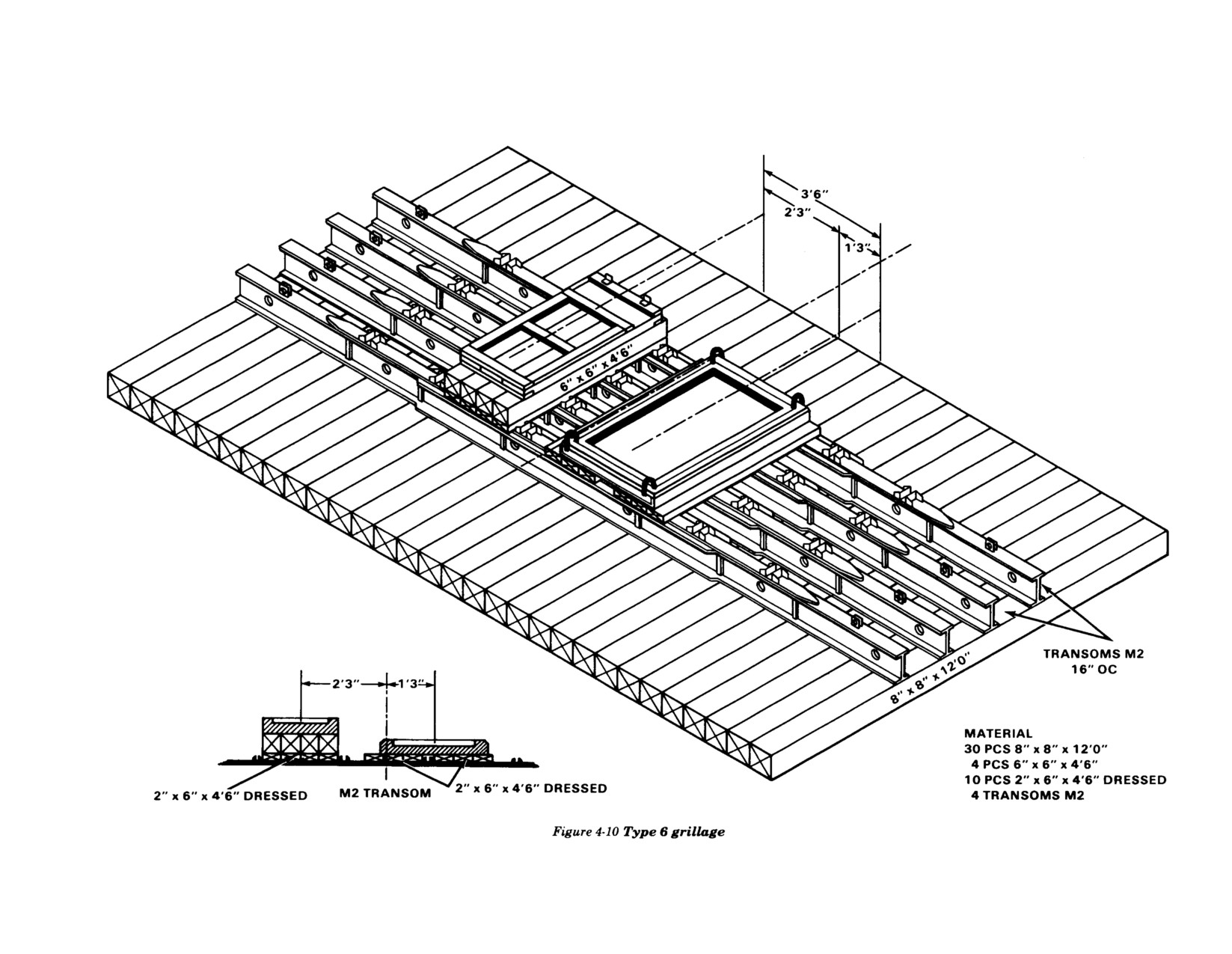
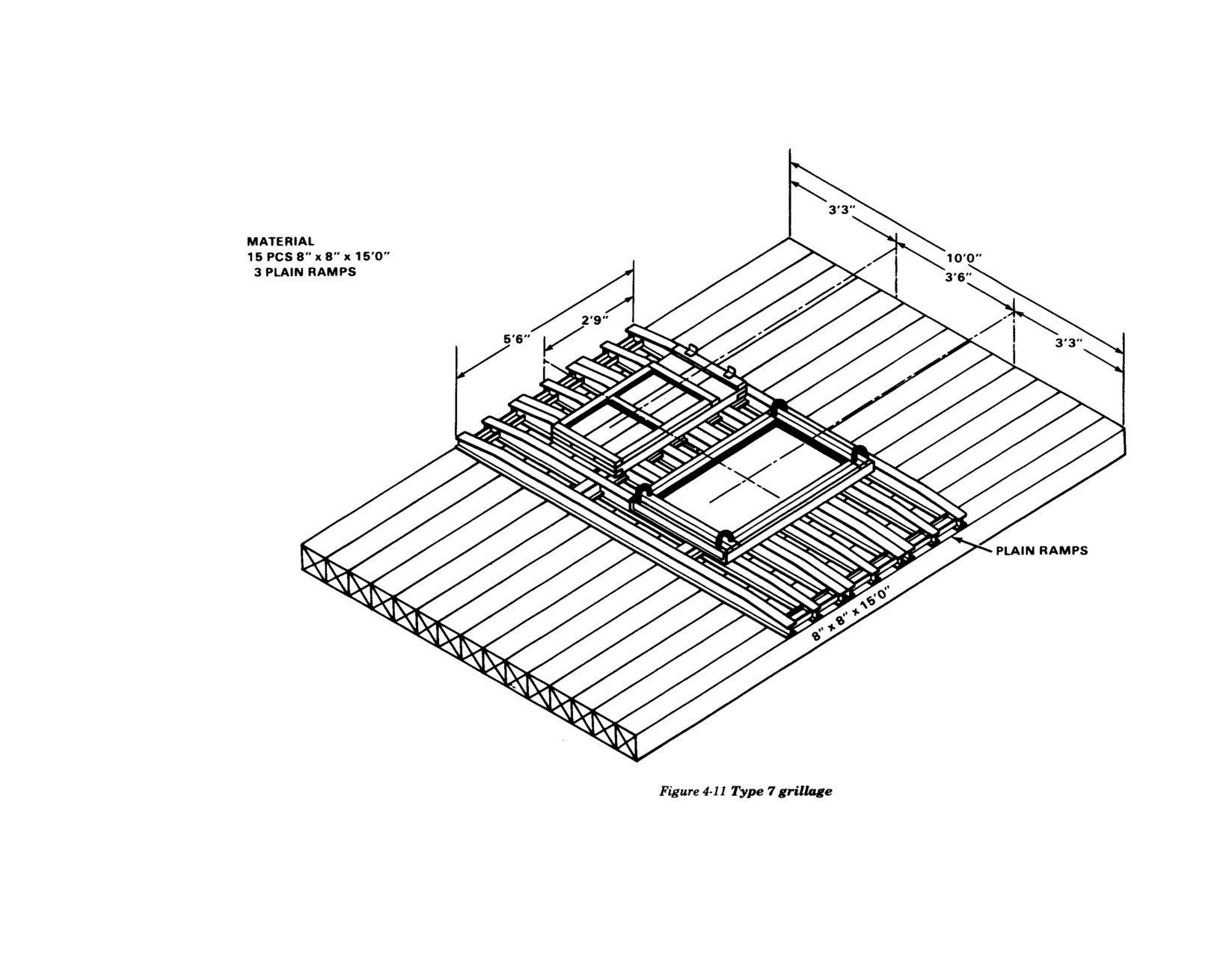
plates. Grillages are used to spread the load
bL= gap + safety setbacks +
over a larger area (Figures 4-5 through 4-11,
i
roller clearances
pages 40 through 44) when the soil-bearing
capacity is exceeded. Grillages also serve as
bL
i
= 53 feet+ [3.5 feet+
cribbing to raise base plates or rollers to the
1.5(10 feet)] + (2.5 feet + 2.5 feet)
desired level.
bL
i
= 76.5 feet (23.32 meters)
Description
Round up to 80 feet (24.38 meters)
Grillages are made of squared timbers laid
under the base plate or roller template. These
TRUSS TYPE
must be carefully leveled transversely; grill-
The required truss type for a given length of
ages on each side of the bridge must be level
Bailey bridge to carry a specified class of
with each other so that all trusses will rest on
traffic is found in Table A-7 in Appendix A.
bearing plates. If bearing plates are not level
The actual class of the bridge maybe greater
transversely, only one truss will carry the
than required, but not less.
load at first, until deflection under load brings
the other trusses to bear. The first truss to
Note:
The truss type required for a normal
bear will then be overstressed before the last
crossing is always used unless otherwise
truss can be fully utilized. This can result in
directed by the field commander.
failure under less than the rated load of the
bridge.
EXAMPLE:
Given:
Timbers for use as standard grillages are
Bridge length — 80 feet
supplied in panel bridge sets. The panel
(25.97 meters)
bridge set supplies 144 each 6-by 6-inch (15.2
by 15.2 centimeters) timbers 4½ feet (1.4 meters)
Required class — 60 wheel/60 track
long, and 48 each 3- by 6-inch (7.6 by 15.2
centimeters) timbers 4½ feet (1.4 meters) long
Required:
for grillage. Standard grillages using these
Determine the truss type required
timbers and panel bridge parts are illustrated
in Figures 4-5 through 4-8.
Solution:
From Table A-6 in Appendix A
TYPE OF GRILLAGE NEEDED
On soft soils, some of the heavier bridges will
Truss type:
triple-single
The end posts at each end of the bridge are
require larger grillages than can be built
Design class — 85 wheel/80 track
supported by bearings set on base plates.
from the timbers supplied in the set. For these
During launching, the entire weight of the
bridges, grillages built from 8- by 8-inch (20.3
bridge is carried by the near-bank rocking
by 20.3 centimeters) timbers are shown in
rollers, which rest on rocking-roller tem-
Figures 4-9 through 4-11.
39
FM 5-277
40
FM 5-277
41
This change supersedes page 42.
4 2
FM 5-277
43
FM 5-277
44
This change supersedes page 45.
FM 5-277
Nonstandard grillages, made of other size
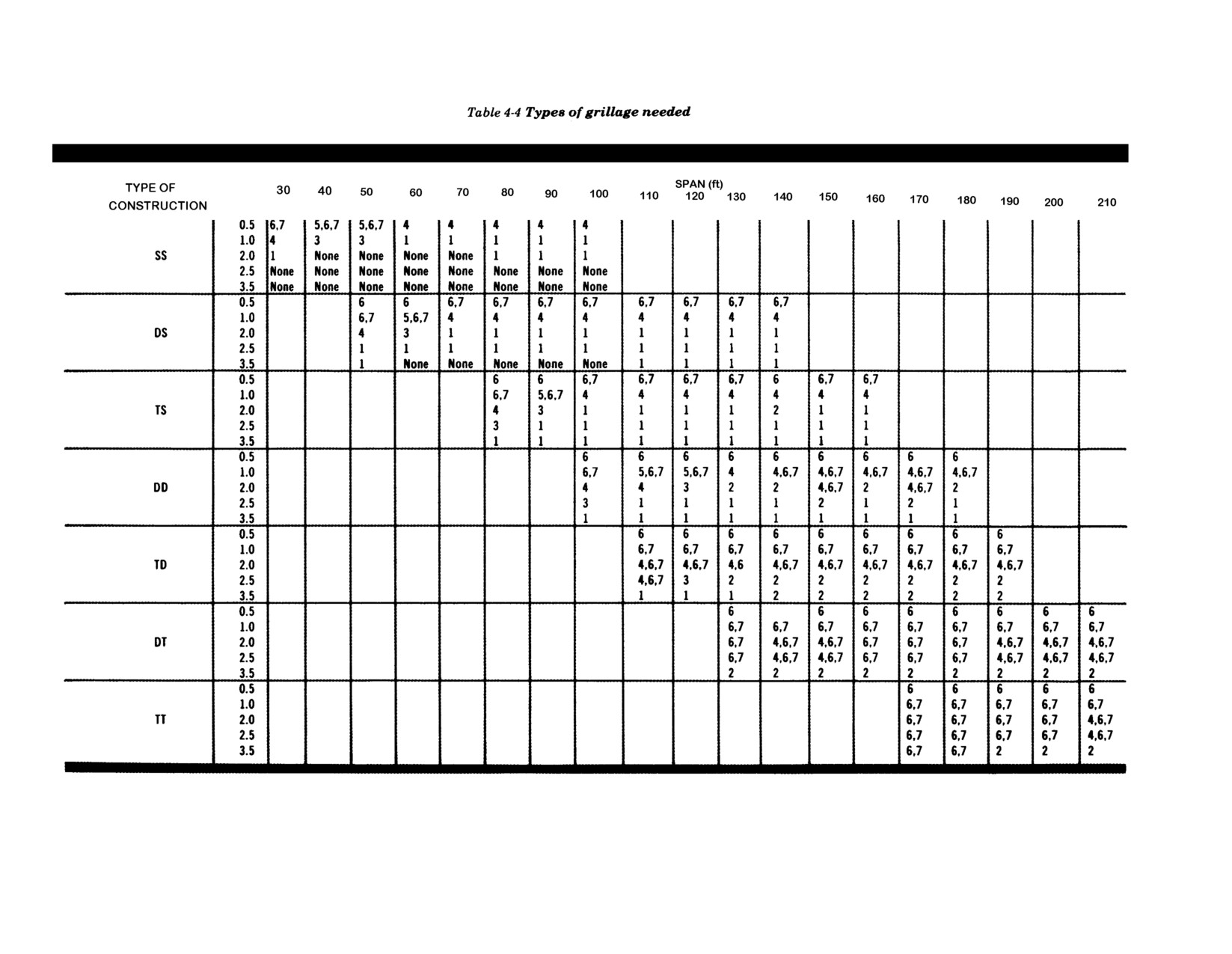
From Table 4-4, grillage type required is
timbers, can be used if each layer is at least as
type 4
thick and wide as the corresponding standard
grillage. Squared timbers should be used,
Detailed analysis:
since rough cut timbers often result in uneven,
From Table 4-2, corner reactions are 59
wobbly cribs.
tons (54 metric tons)—base plate, 19.0 tons
(17.2 metric tons)—rocking rollers
Selection of grillage
From Table 4-3, type 4 grillage provides the
The selection of grillage is determined by the
necessary capacities. Type 4 provides 71
bridge length, the truss type, and the soil-
tons (64 metric tons)—base plate, 57 tons
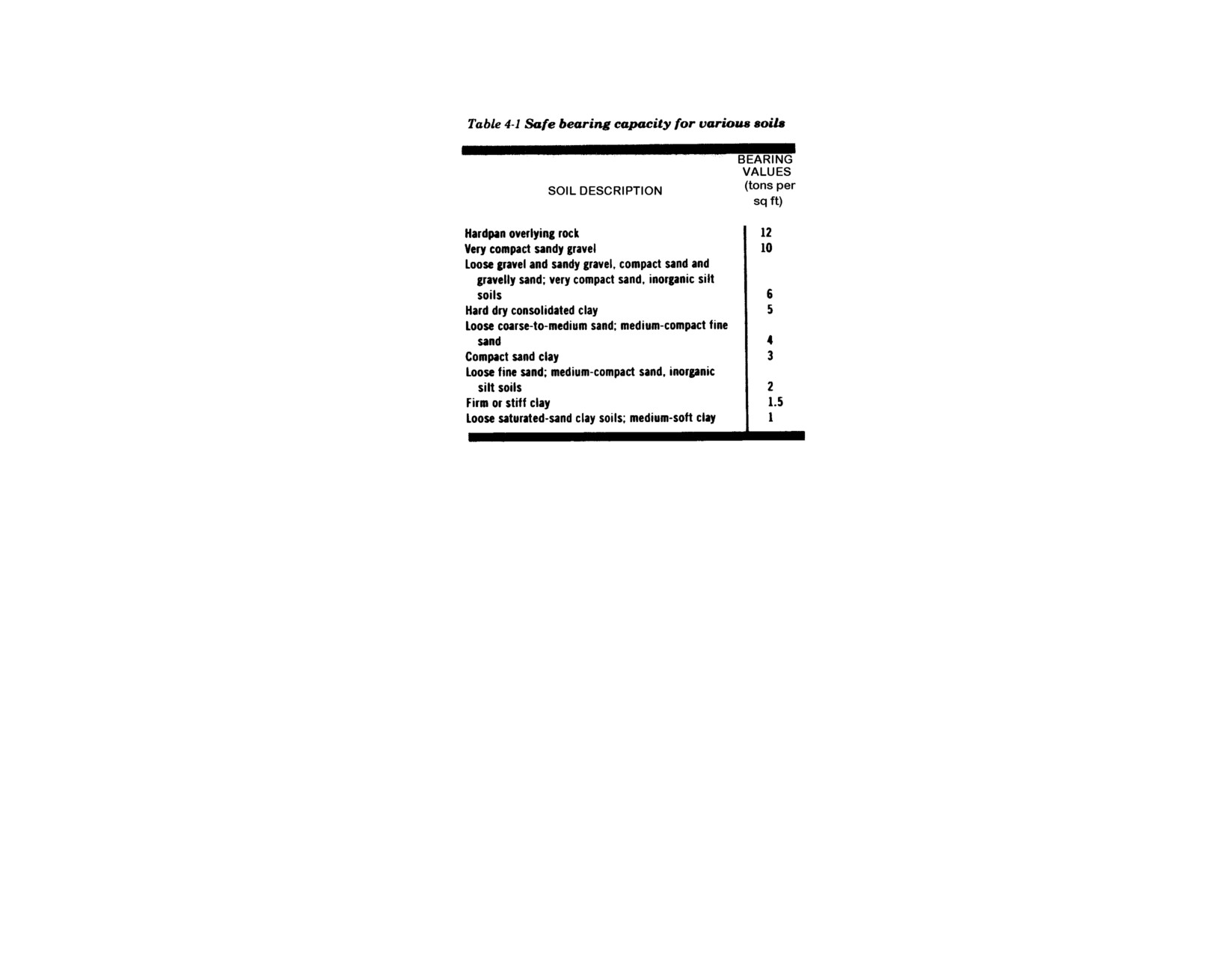
bearing capacity. Table 4-1 give the safe
(52 metric tons)—rocking roller.
bearing pressure in tons per square foot (t/sf)
on various soils. A careful evaluation of the
It is unlikely that the near and far banks
soil character is essential to prevent grillage
would have different soil-bearing capacities
failures. Note that in sandy or gravelly soils,
but, if so, grillage is determined separately
the bearing power of the soil is increased
for each bank. The maximum allowable slope
when the grillage is dug in so that it bears on
for a Bailey bridge is 1 to 30. If bank heights
the soil 1½ feet (.46 meter) or more below the
grillage types for various soils and bridge
differ enough to cause a greater slope, the low
surrounding surface.
types are also given in Table 4-4 (page 48).
end may be cribbed up to decrease the slope.
The cribbing must have at least the same
Note:
If soil-bearing capacity value from
EXAMPLE:
bearing area as the required grillage. If
Table 4-1 is not listed on Table 4-4, the
Given:
cribbing is impractical, the high end may be
number must be rounded down to obtain
Bridge length—80 feet
excavated to reduce the slope. Figures 4-5
the proper grillage type.
(25.97 meters)
through 4-11 show the dimensions and neces-
sary materials for the grillage types.
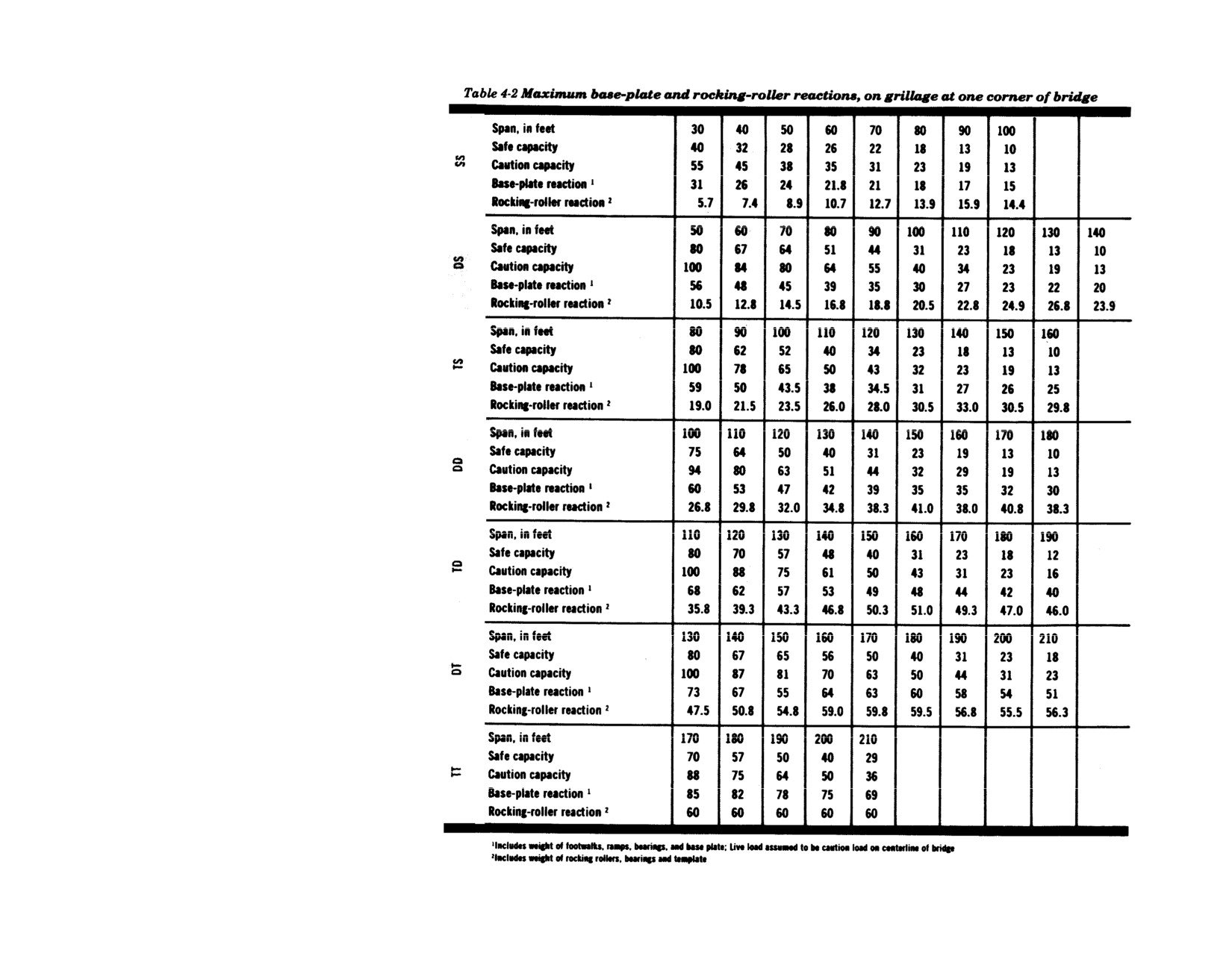
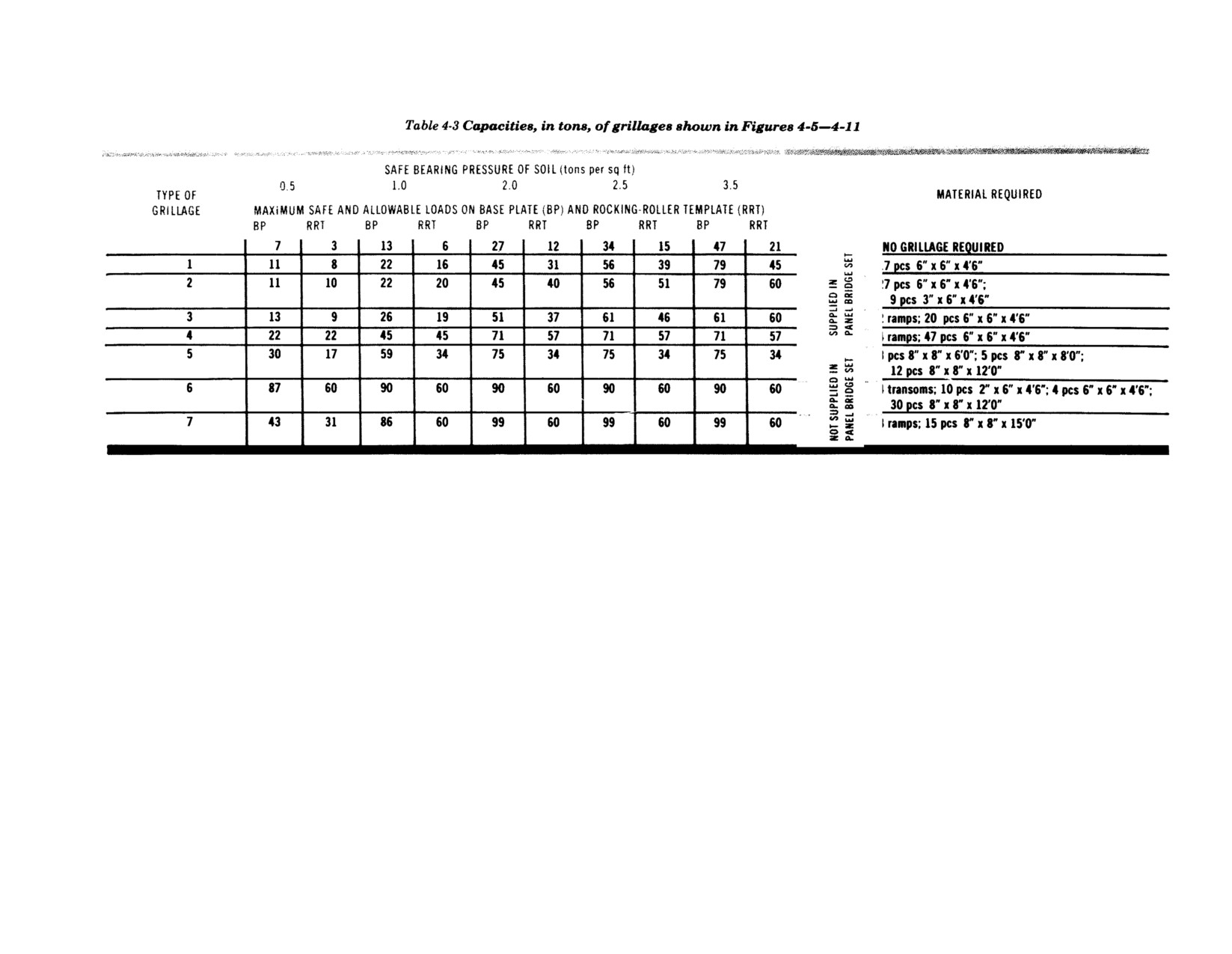
Table 4-2 (page 46) gives the load on grillage
Truss type—triple-single
at one comer of the bridge. Note that in some
Note:
Types 5, 6, and 7 are made from
bridges the rocking-roller reaction is greater
Soil type—loose fine sand
materials not issued with the bridge set.
than the base-plate reaction. Table 4-3 (page
47) gives the load capacities for the grillage in
Required:
DETERMINING FINAL
varying soils. The type of grillage required
Determine the grillage type
BRIDGE LENGTH
may be found by determining the bridge
required
The grillage type required may increase the
reaction from Table 4-2 and then selecting a
roller clearance. This may affect the required
grillage type from Table 4-3 which has the
Field solution:
bridge length. If so, the truss and grillage
required capacity for the proper soil type. The
From Table 4-1, soil-bearing capacity is
type must be rechecked for the new bridge
2 t/sf
length. The required roller clearances for
45
FM 5-277
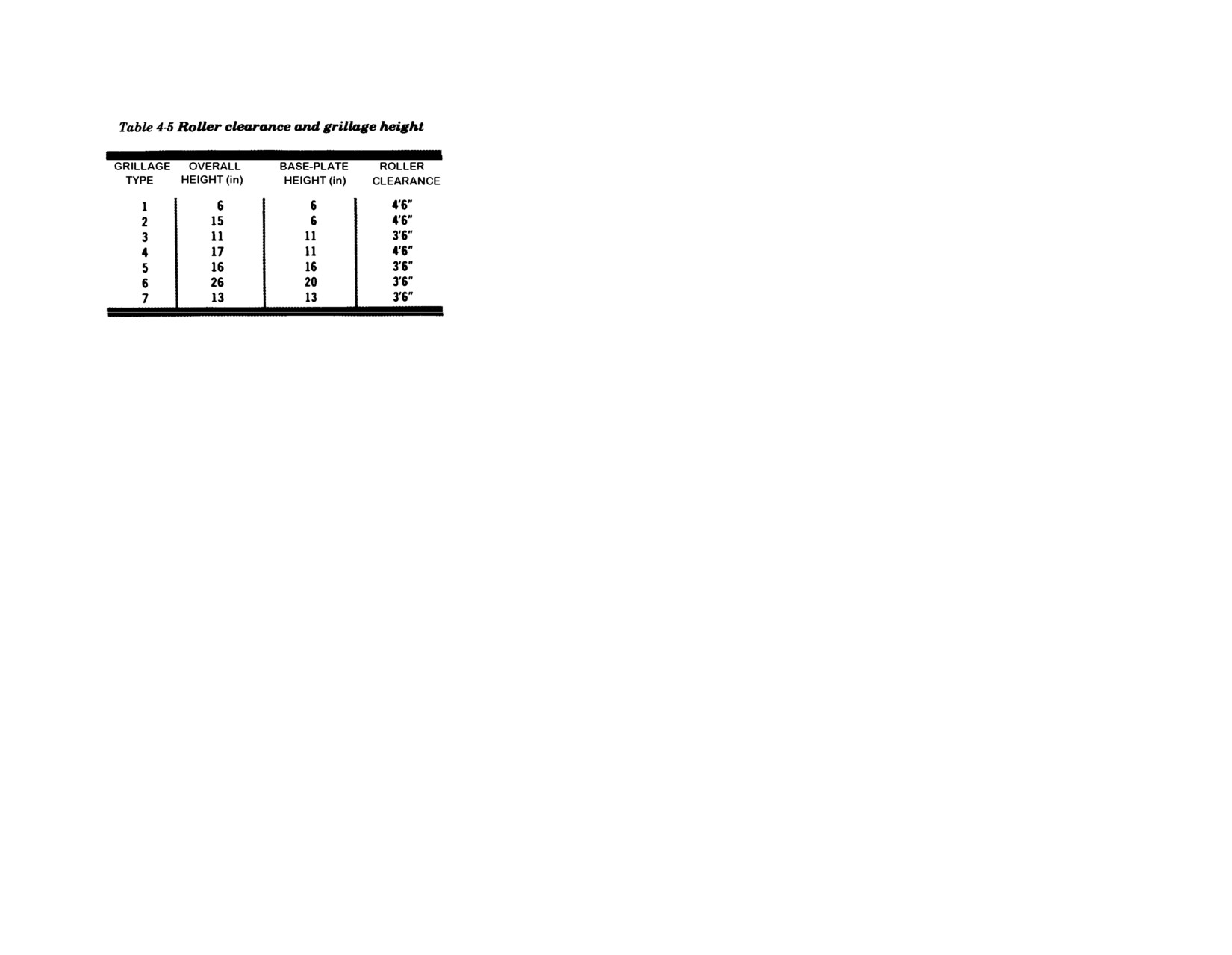
each type of grillage are shown in Figures 4-5
through 4-11. The roller clearance and total
grillage height are given in Table 4-5 (page
49).
EXAMPLE:
Given:
Initial bridge length—76.5 or 80 feet (23.9
or 24.4 meters)
Required class—50 wheel/55 track
Initial truss type—double-single
Soil-bearing capacity—2 t/sf
Required:
Determine the final bridge length, truss,
and grillage type
Solution:
Use the following steps:
1
Grillage from Table 4-4
—type 1 required
2
Roller clearance from Table 4-5 or
Figure 4-5—4 feet 6 inches (1.4 meters)
3 Initial roller clearance was 2 feet 6 inches
(.76 meter); therefore, 2 more feet (.6
meter) must be added to each end of
bridge:
New bridge length
= 76.5 feet + 2 feet + 2 feet
= 82.5 or 90 feet (27.43 meters)
46
FM 5-277
4
Recheck truss type, Table A-6 in
7
Final design—
Appendix A—90 feet
90 feet (27.43 meters)
—triple-single
required
triple-single,
type 3 grillage
5
Recheck grillage, Table 4-4
—type 3 required
6
Recheck roller clearance, Table 4-5,
Figure 4-7—3 feet 6 inches (1.07 meters)
This will not increase the bridge length
47
FM 5-277
48
FM 5-277
LAUNCHING NOSE
COMPOSITION
Chapter 8, Tables 8-1, 8-2. These tables must
of links. The maximum lift obtainable using
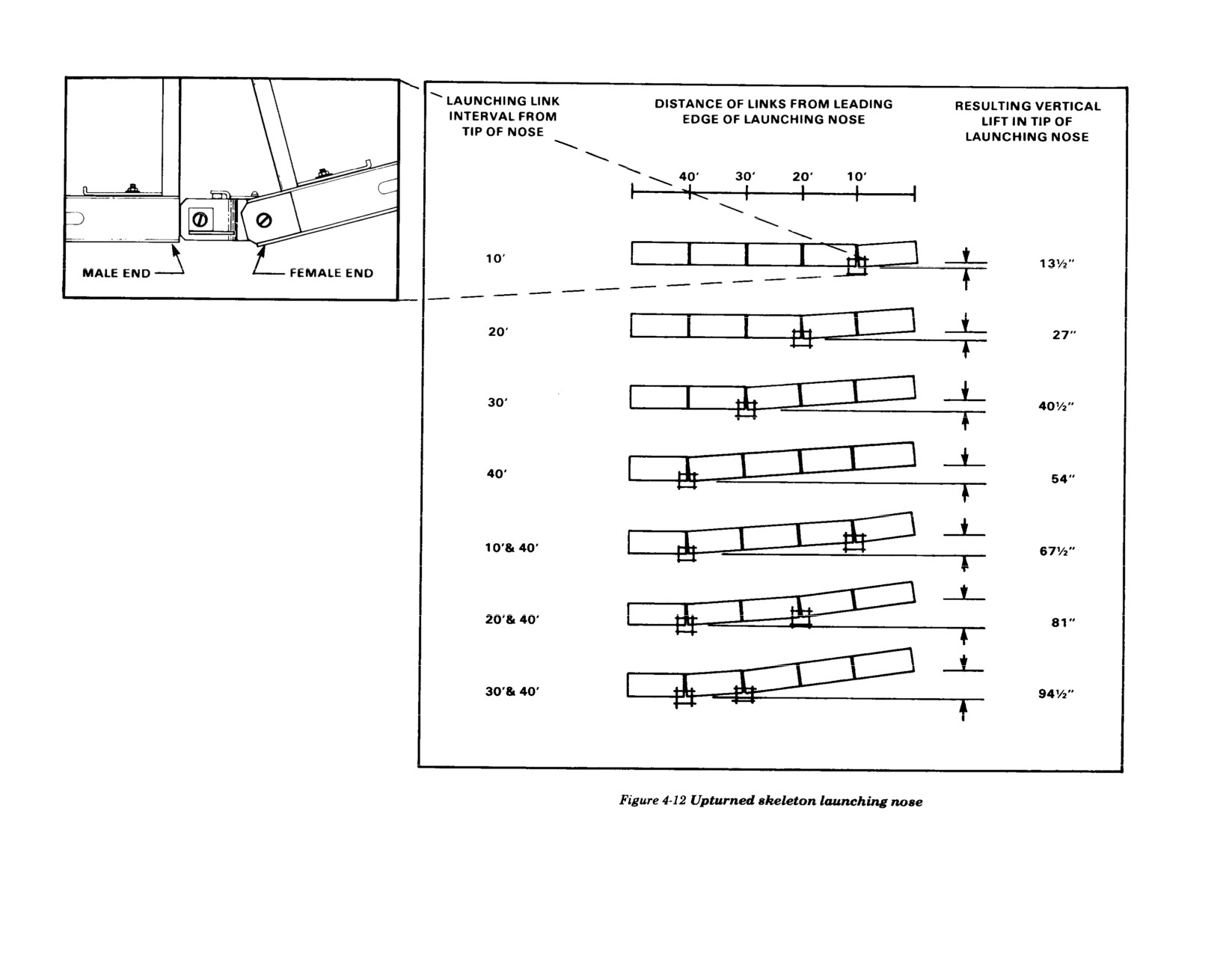
The launching nose (Figure 4-12, page 50) is a
be followed exactly.
launching-nose links is 94½ inches (239.8
skeleton framework consisting of panels,
centimeters). When calculating the position
transoms, rakers, sway braces, and, when
USE OF LAUNCHING-NOSE
LINKS
of the links, add 6 inches (15.2 centimeters) to
necessary, launching-nose links. It does not
The launching nose tends to sag as it is
sag values shown for safety.
have stringers or decking. One transom with
cantilevered over the gap. The approximate
transom clamps and rakers is used behind
sag at the end of the nose just before it
When the far-bank seat is higher than or level
the leading upright of each panel. Sway
reaches the far bank is shown in the above
with the near-bank seat, launching-nose links
bracing is used in all but the first bay at the
mentioned tables. To overcome this sag,
must be used to compensate for sag, and the
front of the launching nose. Footwalks are
launching-nose links are used. Using one
tops of all rollers must be in the same plane. If
not assembled on the nose.
launching-nose link in each truss increases
necessary, block and tackle should be used to
the length of the bottom chords of the nose by
prevent the bridge from sliding backwards.
USE OF LAUNCHING NOSE
7½ inches (19.0 centimeters); thus, the end of
The panel bridge is normally launched by
the launching nose is raised by 13½ inches
Launching-nose links are necessary if the
cantilevering the launching nose over the
(34.3 centimeters) for each bay ahead of the
far-bank seat is low enough to require the use
gap. The weight of the bridge acts as the
links. Because links must not be inserted
of block and tackle on the near bank to
counterweight. When the launching nose
with more than four bays of the launching
prevent the bridge from running away when
reaches the far shore, it rests on the rocking
nose ahead of them, the maximum amount of
the balance point passes the rocking rollers.
rollers and supports the bridge as it is pushed
lift that can be obtained from one pair of links
across the gap. The composition of the nose
is about 54 inches (137 centimeters). If a
Use the following steps to determine the
depends on the length of the bridge and the
greater amount of lift is required, an added
position of launching-nose links:
type of assembly. The composition of the
pair of links can be used in one of the joints
launching nose for the various combinations
between the original pair and the end of the
1
Determine sag from Tables 6-1 through
of span and bridge assembly is shown in
nose. Its position depends on how much lift is
6-3, 7-1 and 7-2, or 8-1 and 8-2
Figure 4-12 and given in Chapter 6, Tables 6-1
required. Figure 4-12 shows the vertical lifts
through 6-3; Chapter 7, Tables 7-1, 7-2; and
that can be obtained using one or more pairs
2
Safety sag of 6 inches (15.27 centimeters)
49
FM 5-277
3 Lift required (LR):
LR = steps 1 + 2
4 Position of launching-nose link (Figure
4-12)
EXAMPLE:
Given a 160-foot (48.8 meters)
triple-single
bridge with grillage type 1 on both the near
shore (NS) and far shore (FS). The far-bank
seat is level with the near-bank seat.
Problem:
Are launching-nose links required? If
links are required, at what distance are
they placed from tip of launching nose?
Solution:
Launching-nose links are required. There-
fore the following steps are used:
1 Determine sag for 160-foot
triple-single
(Table 6-3)
77 inches (195.58 centimeters)
2 Safety factor of
6 inches (15.24 centimeters)
50
FM 5-277
3 Lift required (LR):
Table A-1 in Appendix A gives the number
and position of launching-nose links required
LR = (steps 1 + 2)
for normal bridges. This table assumes that
LR = 77 inches + 6 inches
both near-and far-shore rocking rollers are at
LR = 83 inches (210.82 centimeters)
the same elevation.
4 Position of launching-nose link (Figure
4-12):
Two pairs of launching-nose links placed
at 30 feet (9.144 meters) and 40 feet
(12.192 meters) from the tip of the nose
ROLLERS AND JACKS
ROCKING ROLLERS
backspace needed. Place plain rollers only
Note:
Jacks must be positioned so that
Use rocking rollers on both banks during
every 25 feet (7.6 meters). More rollers are not
they carry no more than 7½ tons (6.8
launching. Normally, use two rocking rollers
required to support an overhang under 25 feet
metric tons) on the toe or 15 tons (13.6
on the near bank for
single-single
and
double-
(7.6 meters). In addition, two construction
metric tons) on the top.
single
truss bridges of 100 feet (30.5 meters)
rollers are used to aid in inserting the launching-
and shorter. Use four for all other assemblies.
nose links. These are plain rollers placed 12½
Two rocking rollers are normally required on
feet (3.8 meters) behind the rocking rollers
the far bank; however, use four if the skeleton
and 2 to 4 inches (5.0 to 10.1 centimeters)
launching nose is double-truss in any part.
below the plane of the other rollers. They may
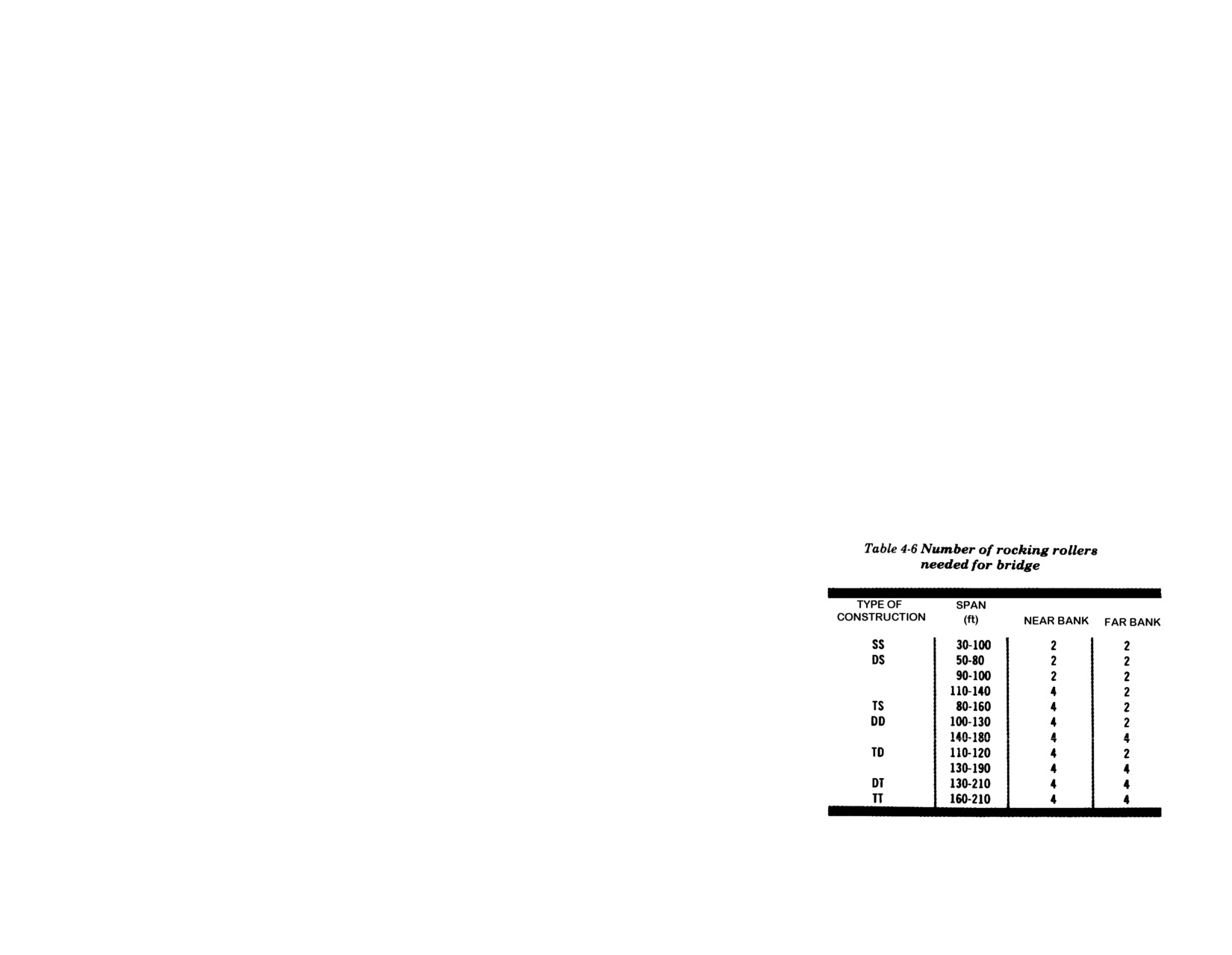
Table 4-6 shows the required number of
be removed once the construction extends
rocking rollers on near and far banks for
back to the first row of plain rollers. The
various bridge lengths and assemblies.
number of plain rollers needed for various
bridges is shown in Table 4-7 (page 52).
PLAIN ROLLERS
Place rows of plain rollers behind the rocking
JACKS
rollers at intervals of 25 feet (7.6 centimeters)
The number of jacks required to jack down a
to support the bridge during construction.
bridge depends on the span length and the
The number of rollers in each row depends on
type of the bridge. The number of jacks
the type of bridge.
Single-single
and
double-
needed to jack down the end of the bridge is
single
bridges need two plain rollers per row.
shown in Table 4-8 (page 52). Details on
All other types of construction need four
jacking procedures are given in Chapters 6, 7,
plain rollers per row (Chapter 5). The number
and 8.
of rows required depends on the construction
51
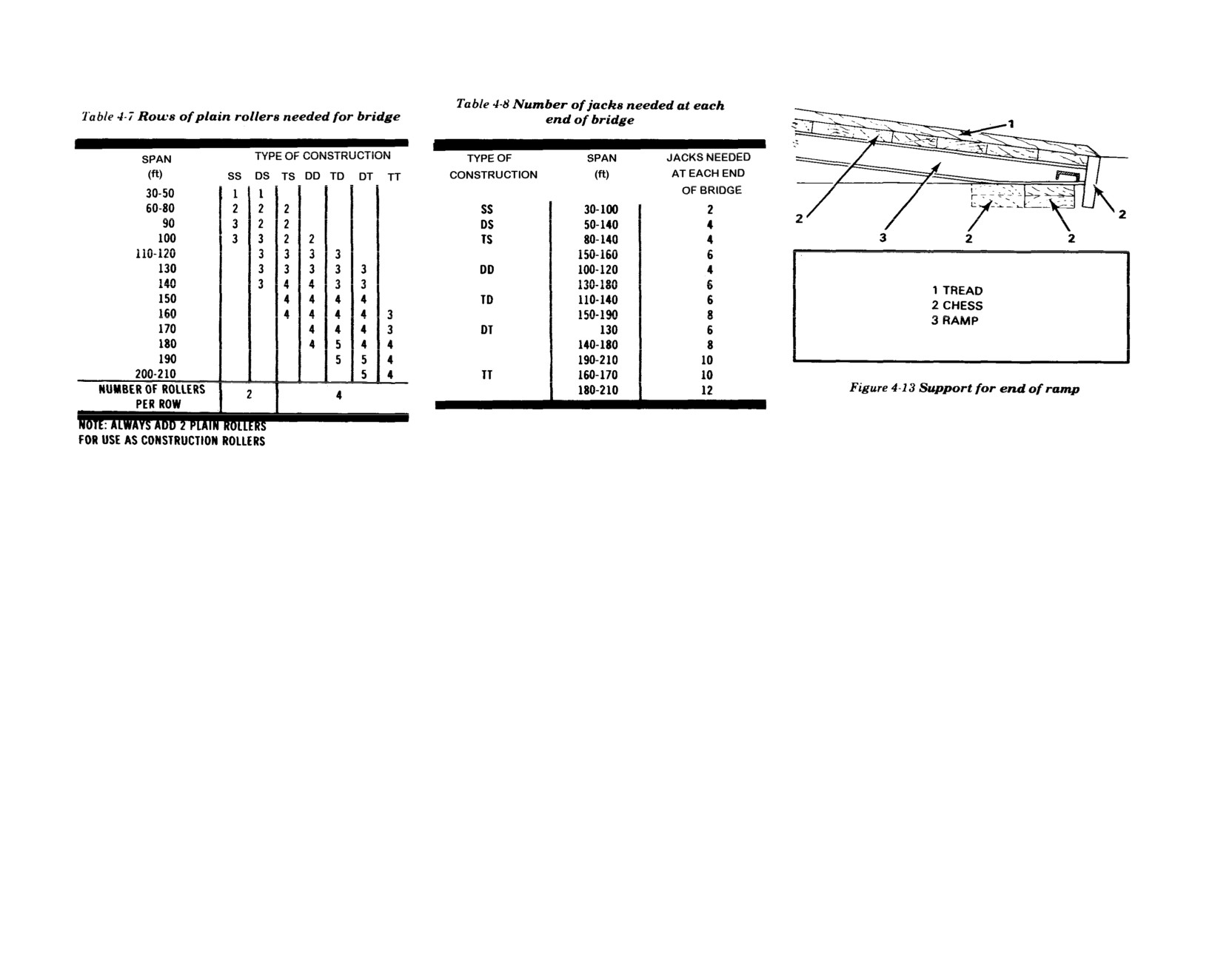
FM 5-277
This change supersedes page 52.
RAMP REQUIREMENTS
tapered end of the ramp are enough for
capable of supporting 2 tons per square foot,
Ramps are used at each end of the bridge. The
bridges up to class 67. For higher capacity
two chess side by side under the cribbing
slope of the ramp must not exceed 10 to 1 for
bridges, four chess are used (Figure 4-13). One
provide enough bearing area for all bridges.
loads up to and including 50 tons, and 20 to 1
chess on edge at the end of the ramp serves as
An alternative method for loads of 45 tons or
for loads over 50 tons.
an end dam, so the approach can be made
more is to make the ramp level with at least
SUPPORT FOR END OF RAMP
level with the ramp floor. An alternate
3½ feet (1.07 meters) of the ramp supported on
The end of the ramp will carry about one
method for supporting the ramps on the
the abutment (Figure 4-14).
quarter of the weight of the heaviest tracked
ground is to use a transom as a sill under the
vehicle to pass over it when the ramp is
ramp.
supported at midspan. If there is no midspan
support, the end of the ramp will carry about
MIDSPAN RAMP SUPPORTS
40 percent of the weight of the tracked vehicle.
For loads of 45 tons (40.8 metric tons) or over,
One or two stacks of chess, side by side, are
each ramp section must be supported at its
laid in two layers under the tapered end of the
midpoint by cribbing and wedges. This sup-
ramp to provide the necessary bearing area
port will carry one half of the class of the
on the soil. If greater area is needed for heavy
vehicle passing over, and the base of the
loads on very soft soil, footings are used
cribbing should be large enough to spread the
under the chess. On soil capable of supporting
load over the soil without exceeding the
2 tons per square foot, two chess under the
allowable bearing pressure of the soil. On soil
52
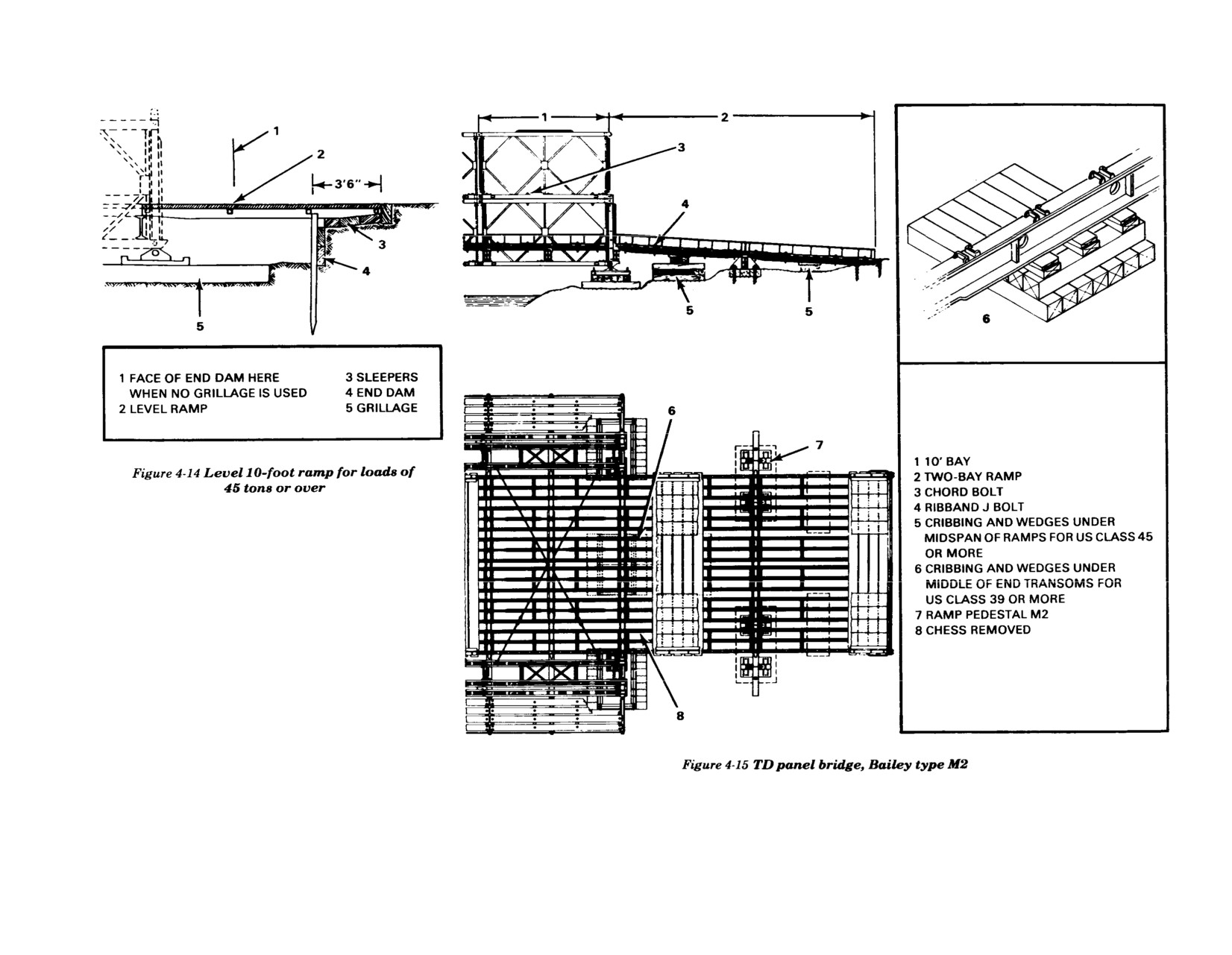
FM 5-277
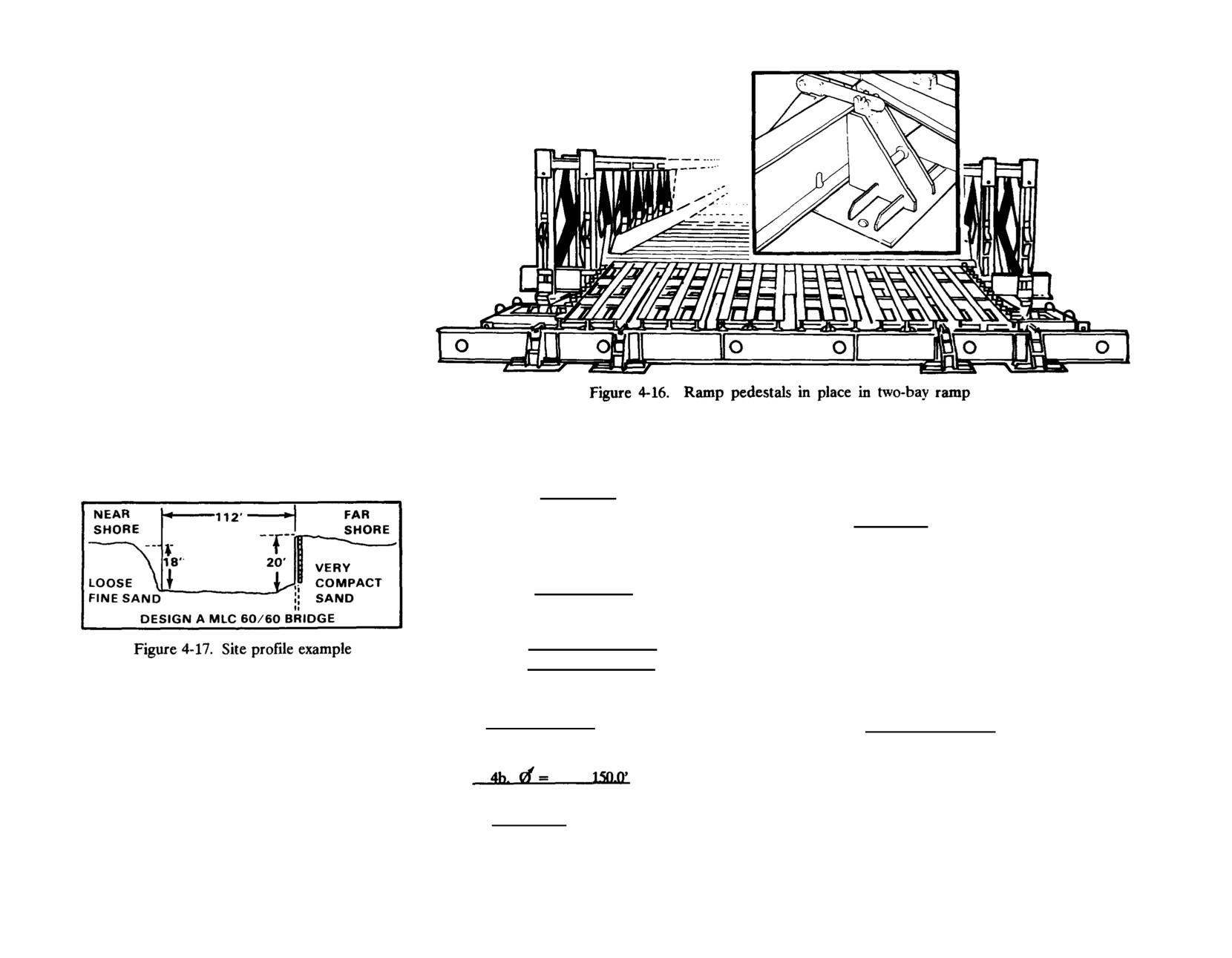
PEDESTAL SUPPORTS
Because the slope of the ramp should not
exceed 1 to 10, it may be necessary to use two
or more ramp bays. The junction of the ramp
bays rests on a transom supported by four
ramp pedestals spaced as shown in Figure
4-15. These pedestals (Figure 4-16, page 54)
take two thirds of the class of the vehicles
passing over and must be set on enough
grillage to spread the load over the soil. Three
6-by 6-inch (15.2 by 15.2 centimeters) timbers
4 feet 6 inches (1.4 meters) long under each
pair of pedestals provide enough area for 40-
ton loads on soil that will carry 2 tons per
square foot. For heavier loads, three chess are
placed side by side under the 6- by 6-inch (15.2
centimeters by 15.2 centimeters) timbers.
53
This change supersedes page 54.
FM 5-277
SUPPORTS FOR END TRANSOM
For loads of 40 tons (36.3 metric tons) or more, use
cribbing and wedges under the midpoint of the end
transom. This support will carry 40 percent of the
weight of the heaviest tracked vehicle to pass over,
and the area of the base of the cribbing should be
large enough to spread the load over the ground
without exceeding the allowable bearing pressure
on the soil. Seven 6- by 6-inch (15.2 centimeters by
15.2 centimeters) timbers 4-feet 6-inches (1.4
meters) long laid side by side provide enough area
for all the bridge loads on soil that will carry 2 tons
per square foot.
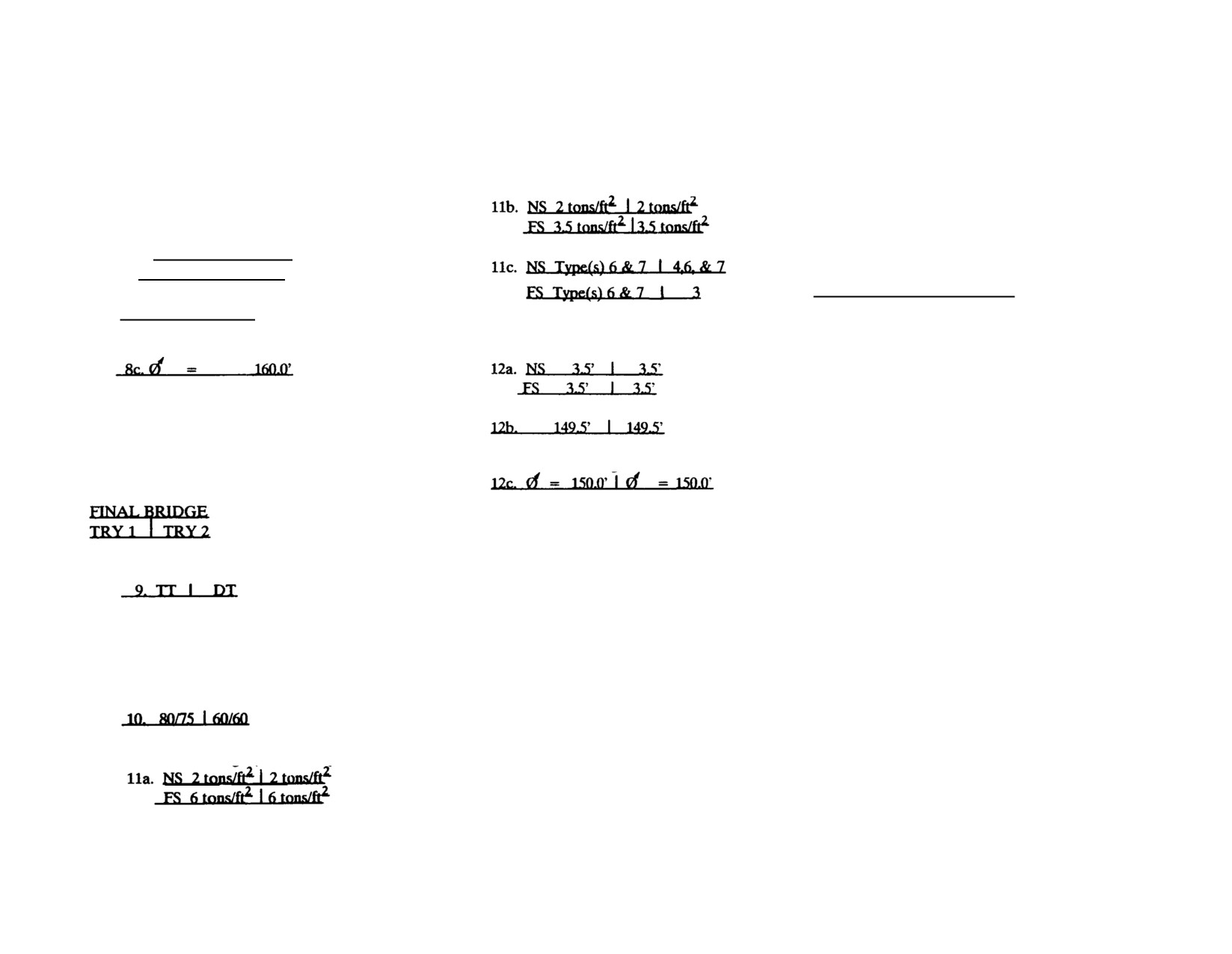
EXAMPLE FIELD
DESIGN PROBLEM
I. INITIAL BRIDGE DESIGN
6. Initial bridge class. (Table A-7, p 303)
MISSION GIVEN: Design a Bailey to span the
(Steps 1 through 6)
a. Class must meet or exceed the MLC given in
gap shown in Figure 4-17. Bridge must have
the mission.
Military Load Class (MLC) 60 wheeled/60 tracked.
b. The truss/story type selected is always based
1. Gap measured during reconnaissance (p 36)
All data required is given in Figure 4-17.
on a NORMAL CROSSING unless otherwise
1.
112'
directed by the TACTICAL COMMANDER.
2. Safety setback. (p 37)
6.
60/60
a. Prepared abutment = constant of 3.5’.
II. ADJUSTED/FINAL BRIDGE DESIGN
b. Unprepared abutment = 1.5x bank height.
7. Selection of grillage.
2.
NS 1.5 x 18' = 27'
a. Safe soil bearing. (Table 4-1, p 45)
FS
3.5'
7a.
NS 2 tons/ft²
3. Initial roller clearance. Always use a constant of
FS 6tons/ft²
2.5’.
b. Safe soil pressure. (Table 4-4, p 48). If the
3. NS
2.5’
soil bearing capacity values from step 7a are NOT
FS
2.5’
listed in Table 4-4, round DOWN to the closest
4. Initial bridge length.
value listed. Use these values for step 7c.
a. Add steps 1+2+3.
7b.
NS 2 tons/ft²
4a.
147.5'
FS
3.5 tons/ft²
b. If value in step 4a is NOT a multiple of 10,
round UP to the next highest 10.
5. Initial truss/story type. (Table A-7, p 303)
5.
DT
54
This change supersedes page 55.
FM 5-277
c. Grillage required.
b. Safe soil pressure. (Table 4-4, p 48). If the
exceed the BP and RRT capacities listed in Table
soil bearing capacity values from step 11a are NOT
4-2, p 46 and Table 4-3, p 47, FM 5-277. Make
7c.
NS Type(s) 4,6,& 7
listed in Table 4-4, round DOWN to the closest
your decision and go to step 13. In this example
FS Type(s) 2
listed. Use these values for step 11c.
problem, the designer chose to select Type 3 gril-
8. Determine adjusted bridge length.
lage for the FS. Since this was not an option within
a. Distance required for new roller clearance.
step 11c he had to look at Tables 4-2 and 4-3 under
(Table 4-5, p 49)
a 150' DT bridge with a safe soil pressure of 3.5
c. Grillage required.
8a. NS
4.5'
tons/ft2
to see if the BP and RRT capacities were
FS
4.5'
exceeded:
Table 4-2
Table 4-3
b. Add steps 1+2+8a.
BP Reaction
BP Allowable
8b.
151.5'
12. Determine final bridge length.
= 55 tons
= 61 tons OK
c. If value in step 8b is NOT a multiple of 10,
a. Distance required for new roller clearance.
round UP to the next highest 10.
(Table 4-5, p 49)
RR Reaction
RRT Allowable
= 54.8 tons
= 60 tons OK
NOTE: Compare the value in step 8C
to the value
Had the designer not accomplished this, he
in step 4b. If different, you must redesign the
b. Add steps 1+2+12a.
would have been forced to build the 160’ TT bridge
bridge as outlined in steps 9 through 12, using
shown under the "TRY 1" column and wasted a lot
length from step 8C
to find truss type in step 9. If
of assets.
c. If value in step 12b is NOT a multiple of 10,
not, use this as your final bridge length and go to
2. If these are different, you must redesign the
round UP to the next highest 10.
step 13.
bridge by entering the "TRY 2" column with the
bridge length from step 12c "TRY 1" to determine
NOTE: (1) FOR TRY 1: Compare the value in
the truss/story type in step 9.
step 12c to the value in step 8c.
NOTE: (2) FOR TRY 2 and HIGHER: Compare
a. If the same, go to step 13.
this value in step 12c to the value in step 12c of the
b. If different, compare this value (step 12c) to
previous "TRY" column. If the same, go to step 13.
9. Final truss/story type. (Table A-7, p 303)
the value in step 4b:
If different, use the same methodology and repeat
1. If these are the same, the designer is placed
the design sequence until the value obtained in a
10. Final bridge class. (Table A-7, p 303)
in a judgmental situation. Repeating the design se-
particular step 12c matches the value in step 12c of
a. Class must meet/exceed the MLC given in the
quence under the "TRY 2" column using the bridge
the previous design. Go to step 13.
mission.
length from step 12c of "TRY 1" column will place
you in an endless circle unless the final bridge
b. The Truss/Story Type selected is always
length can be reduced. In these cases, one will
based on a NORMAL CROSSING unless other-
have to use common sense and either overdesign a
wise directed by the TACTICAL COMMANDER.
longer final bridge as shown in the "TRY 1" column
or choose a higher number grillage than that
11. Final grillage selection.
originally selected in step 7c. The latter procedure
a. Safe soil bearing. (Table 4-1, p 45)
could reduce the roller clearance on one or both
banks so that the required bridge length/final truss-
story may be at the minimum to do the job. You
may choose a higher number grillage than allowed
within step 11c; however, you must be careful not to
55
This change supersedes page 56.
FM
5-277
13. Slope check. (p 45)
16. Placement of launching nose links.
b. Support for end ramp (check one)
a.-
The maximum allowable bank height dif-
a. Sag. (See tables as in step 15)
(1) Final bridge class
< 67 = 2 Chess (x).
ference is 1 in 30. Therefore, maximum allowable
16a.
34"
(2) Final bridge class > 67 = 4 Chess ( )
bank height difference = final bridge length + 30.
c. Midspan ramp supports (check one)
b. Safety sag. (Constant of 6")
13a. 150+30 = 5 2
(1) Final bridge class
< 44 = Not needed ( ).
16b.
+ 6"
b. If:
(2) Final bridge class > 44 = Needed (x)
c. Lift required. (Add steps 16a + 16b)
(1) The step 13a value
> actual bank height
16c.
= 40"
d. Pedestal supports (check one)
difference the slope is all right.
d. Position of launching nose links (Figure 4-12,
(1) Not needed ( )
(2) The step 13a value < bank height dif-
pg 50)
(2) Needed (x)
ference
16d.
30' from tip of nose
NOTE: See Page 53 for criteria and drawings.
(a) Choose another site,
17. Rocking rollers needed. (Table 4-6, pg 51)
Ramp length must be estimated from the site sketch.
OR
17. NS
4
e. Support for end transoms (check one)
(b) Crib up/excavate the FS or NS until the
FS
4
(1) Final bridge class
< Class 39 = Not
bridge slope is within limits.
needed ( ).
18. Plain rollers needed.
13b.
(GO)/NO GO(circle one)
(2) Final bridge class > Class 39 = Needed
a. SS and DS bridges ONLY have two rollers per
REMARKS:
(x)
row. All others have four rollers per row. Use
14. Final bridge requirements:
21. Personnel required. (Table 3-2, p 33)
Table 4-7 to determine the number of rows then
Length
150'
multiply.
21.
7/122 w/o Crane 7/97 with Crane
Truss/Story Type DT
18a.
4x4= 16 rollers
NOTE: Check the difference between manpower
Class
60/60
b. Add two more plain rollers to allow for your
only and crane construction.
Grillage:
NS Type 6
construction rollers.
22. Assembly time. (Table 3-3, p 34)
FS Type 3
18b.
+ 2
22.
13 1/4 hrs w/o Crane/ 11 3/4 w/Crane
15. Launching nose composition. (Tables 6-1
c. Add steps 18a to 18b.
through 6-3, p 64/65, Tables 7-17-2, p 95, or Tables
18c.
= 18 rollers
8-1/8-2, p 104, dependent upon truss type)
19. Jacks required. (Table 4-8)
15.
9 Bays (5 Sgl Truss/4 Dbl Truss)
19.
8 jacks
NOTE: Only one end of the bridge will be jacked
down at any onetime.
20. Ramp requirements.
a. Slope requirements (check one)
(1) Final bridge class
< 50= 1 to 10 ( ).
(2) Final bridge class > 50 = 1 to 20 (x)
56
This change is inserted.
FM 5-277
BRIDGE CLASSIFICATION
CLASSIFICATION OF
EXISTING BRIDGES
Bailey bridge classifications may be deter-
mined by entering Table A-6 in Appendix A
with the span length and truss type. This will
give the classification of the bridge for nor-
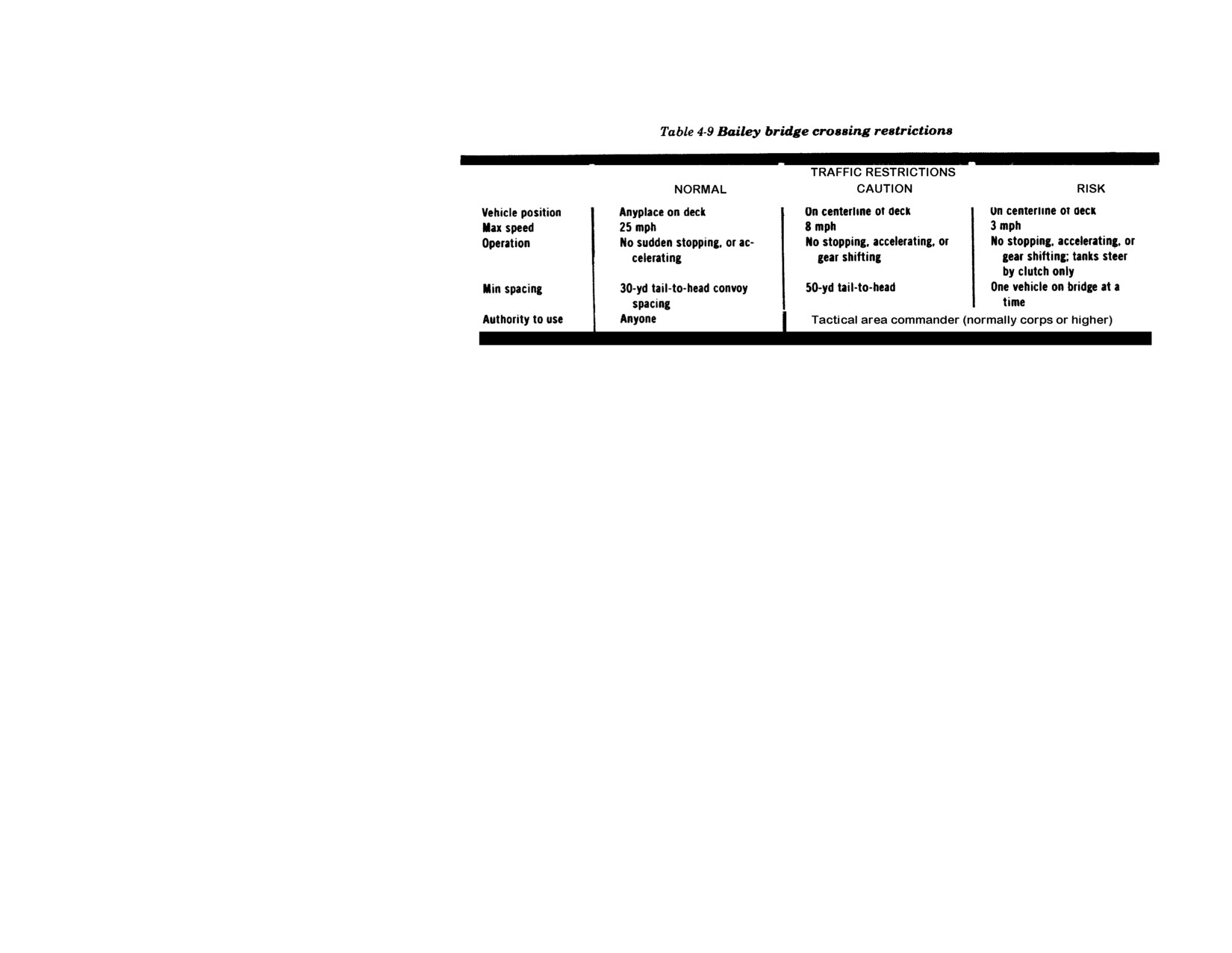
mal, caution, and risk crossings. Table 4-9
gives restrictions for the types of crossing.
Notes:
The caution class number is found
by test and is normally 25 percent greater
than the normal class. Risk loads will
probably cause permanent deformation of
bridge parts and may result in failure if
repeated. Therefore, the engineer officer
must thoroughly check the condition of the
bridge before and after such a crossing.
Cribbing—none
3
Cribbing
The grillage, cribbing, and number of tran-
soms per bay must also be checked and the
Condition—excellent
Midspan ramp supports
bridge class reduced or upgraded to obtain
None—limits class to 44 tons
the required classification. The condition
Required:
(39.9 metric tons)
of the bridge and its supports must also be
Determine the normal track
considered in its classification. If the
classification of the bridge
End transoms
bridge is deformed or damaged, the grillage
without upgrading
None—limits class to 39 tons
has rotted, or the abutment has failed, the
(35.4 metric tons)
bridge classification must be drastically
Solution:
lowered.
Take the following steps:
4
Condition—excellent,
no reduction
EXAMPLE:
1 Class—55 track
Given:
(from Table A-6 in Appendix A)
5
Final classification—39 track. The over-
Bridge length—80 feet
all classification is determined by the
(24.4 meters)
2 Grillage—install type 1 as a
lowest classification of steps 1 and 3.
minimum (Table 4-4)
Truss type—double-single
Grillage—none
Soil-bearing capacity—10 t/sf
56-1
FM 5-277
This page is inserted.
56-2
FM 5-277
CHAPTER 5
ROLLER LAYOUT
This chapter describes the longitudinal and
center web and two dowel holes toward each
For all other assembly types use four plain
lateral spacing of rocking rollers and plain
end. These holes can be used to properly
rollers every 25 feet (7.6 meters), two on each
rollers. The elevation of rollers and base
space the rocking rollers, as shown in Figure
side of the centerline. Each plain roller con-
plates, as well as a simple method of leveling
5-5 (page 60).
sists of two small independent rollers. For
and placing rollers, is discussed.
triple-truss or multistory bridges, place the
LAYOUT OF PLAIN ROLLERS
inside plain rollers so that the inside truss
LAYOUT OF ROCKING ROLLERS
To determine longitudinal spacing, place two
will rest upon the second small roller (Figure
Establish the longitudinal location of the
or more plain rollers every 25 feet (7.6 meters)
5-7, page 60). The spacing between the centers
rocking rollers by the safety setback deter-
behind the rocking rollers to support the
of these small rollers, then, is 14 feet 10 inches
mined in the field design of the bridge. To
bridge during assembly and launching. Place
(4.52 meters). Place the other set of plain
determine the lateral spacing, place a rocking
temporarily an extra set of plain rollers
rollers so that the second truss will rest on the
roller (Figure 5-1, page 58) on each side of the
(called construction rollers) 12½ feet (3.8
first small rollers of this set (Figure 5-7). The
bridge 7 feet 5 inches (2.26 meters) from the
meters) behind the rocking rollers. The con-
distance between these trusses is 1 foot 6
centerline (Figure 5-2, page 58). This gives a
struction rollers aid in inserting the
inches (.46 meter). The third truss will rest on
constant value of 14 feet 10 inches (4.52
launching-nose links and provide clearance
the outermost small roller. Plain-roller tem-
meters) between the centers of the rocking
between the links and the ground. Remove
plates also aid in lateral spacing of the plain
rollers. Most bridges are double- or triple-
these construction rollers after the links have
rollers for the triple-truss or multistory
truss and need another set of rocking rollers
passed over the rocking rollers.
bridges. Use one template under each roller.
(Figure 5-3, page 59) placed 1 foot 6 inches (.46
Place two templates end to end on each side of
meter) out from each of the first set of rocking
To determine lateral spacing, for single-story,
the centerline, with the angle iron lugs of the
rollers (Figure 5-4, page 59).
single- and double-truss bridges, place two
inside templates facing center and the outside
plain rollers one on each side of the centerline
lugs facing away from center. When the
Rocking-roller templates have been made
every 25 feet (7.6 meters). The center-to-center
spacing between the inside lugs is 10 feet 10%
which help the proper 1-foot 6-inch (.46 meter)
roller spacing is 14 feet 10 inches (4.52 meters)
inches (3.31 meters), the plain rollers will be
center-to-center spacing of the rocking rollers.
or 7 feet 5 inches (2.26 meters) each side of the
at the proper spacing (Figure 5-7).
On the interior side of these templates, small-
centerline. Plain rollers are normally placed
angle iron lugs are attached to aid roller
on plain-roller templates which increase the
BASE PLATES
spacing. The edge-to-edge spacing of the
bearing area over the ground. These tem-
Establish, by the type of grillage required,
rocking-roller templates (lug to lug) is 11 feet
plates also aid in the lateral spacing of the
longitudinal spacing between the center of
6½ inches (3.51 meters) (Figure 5-4). The lugs
rollers. The templates are equipped with angle
the rocking rollers and the center of the base
are, however, frequently lost through use and
iron lugs, like the rocking-roller templates.
plate. The grillage type is determined as
the most accurate method of spacing the
Place the template so the lugs face the center-
described in Chapter 4. To establish lateral
rollers is to use the 14-foot 10-inch (4.52
line. The distance between lugs, then, is 11
spacing, place the base plates under the
meters) constant. The Bailey bridge transom
feet 6½ inches (3.51 meters) (Figure 5-6, page
trusses as shown in Figure 5-9 (page 61).
is manufactured with a small hole in its
60).
57