FM 5-277 BAILEY BRIDGE (May 1986) - page 6
FM 5-277
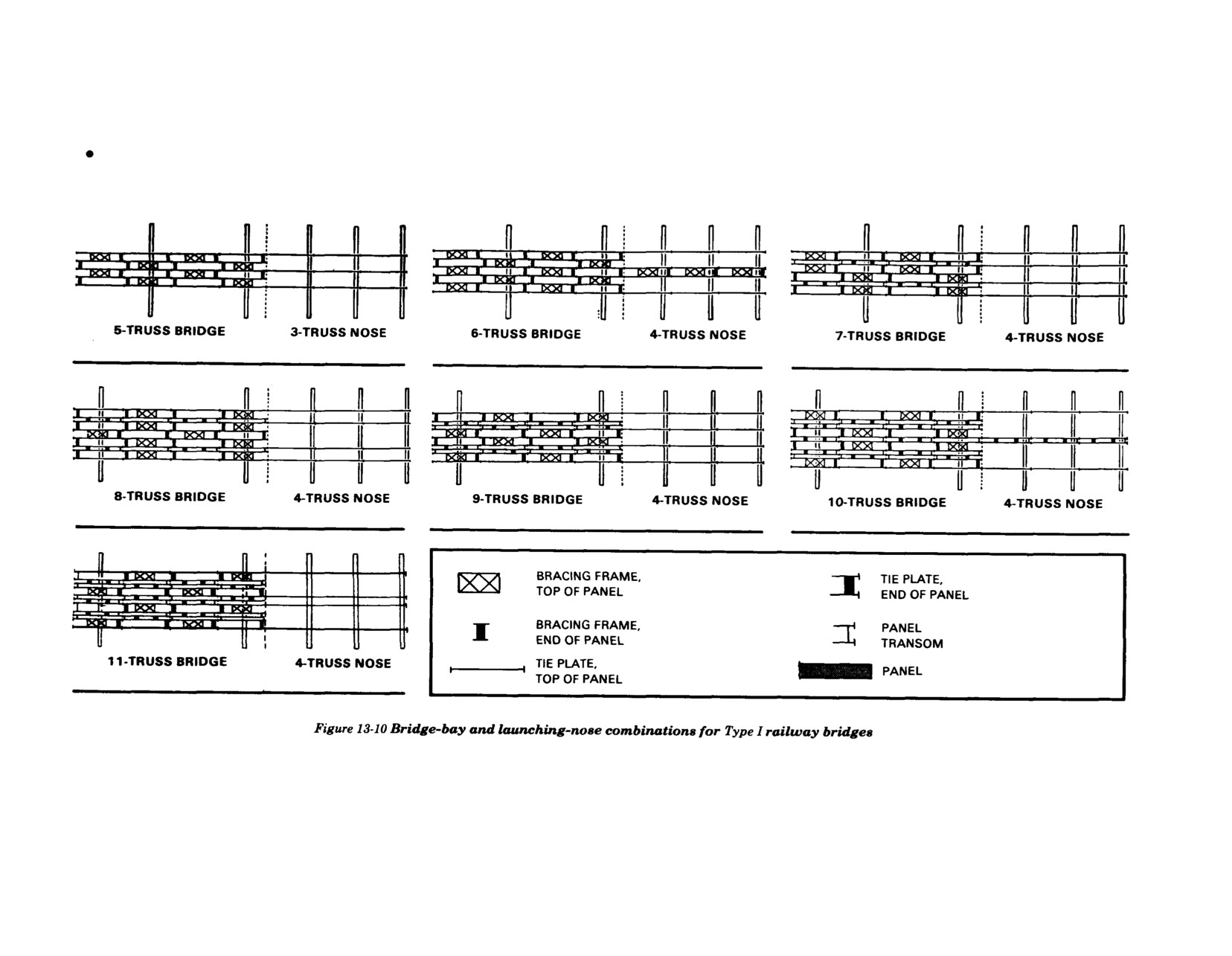
Each truss or two-truss girder can be
launched from a highline or lifted directly
into place by a crane.
152
FM 5-277
153
FM 5-277
154
FM 5-277
CHAPTER 14
REINFORCED BRIDGES
The critical design factor in most fixed-panel
Assembly and launching
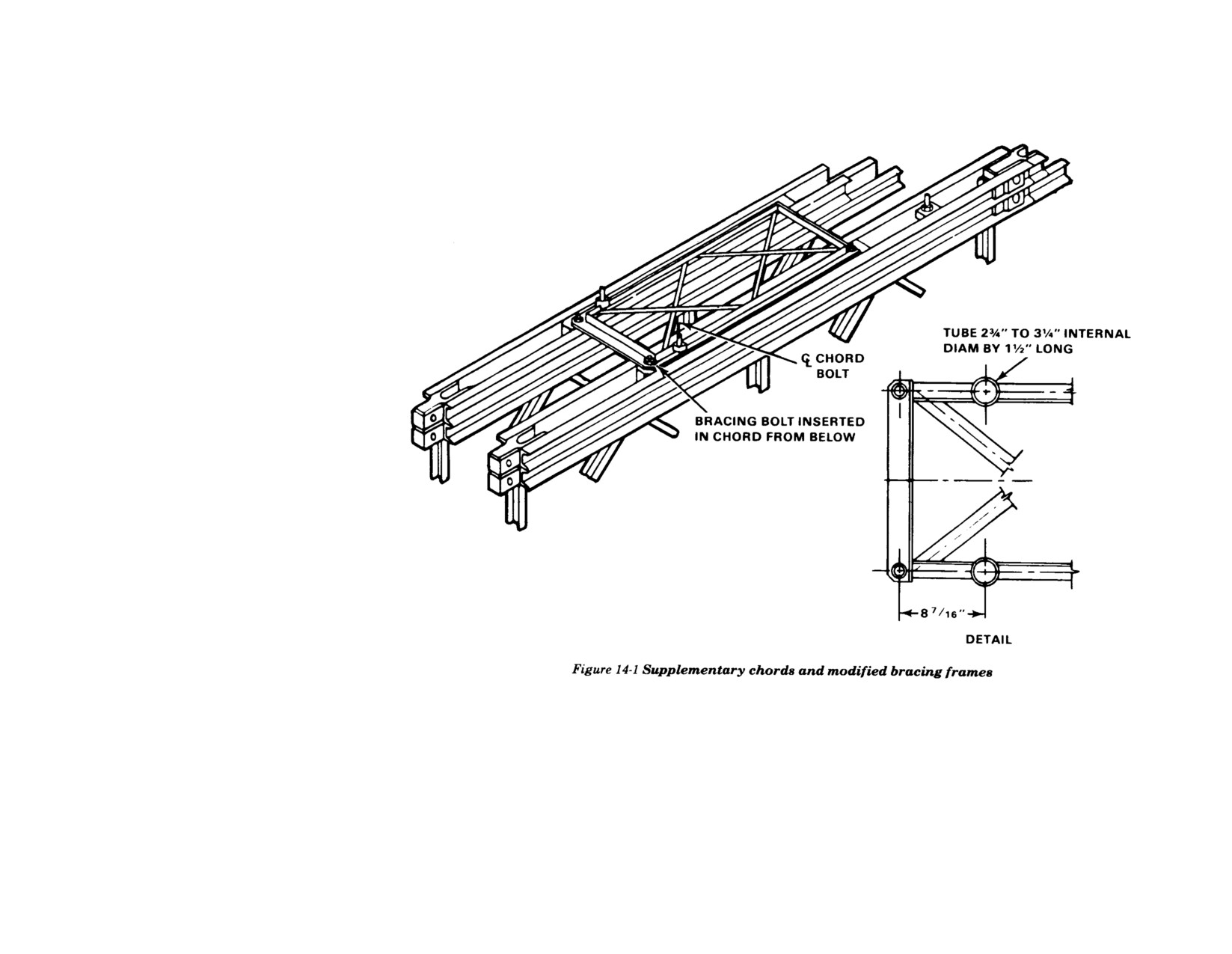
the chord bolts, must be used (Figure 14-1).
bridges is bending moment. This factor varies
Partial stories can be added before or after
Overhead bracing supports cannot be used
from a maximum at the center of the span to
launching. When added before launching,
with supplementary chords unless bolts 4
zero at the supports. Unit assembly of the
use standard launching nose for complete
inches (10.2 centimeters) longer than stand-
panel bridge, however, produces girders of
bridges of the heavier assembly if the length
ard chord bolts are used. If overhead bracing
uniform section and strength throughout
of reinforcement is more than half the “span.
supports are not used, overhead transoms
their entire length. Therefore, only center
If the length of reinforcement is half the span
can be clamped under the top chord or welded
bays of most spans are fully stressed. The
or less, use launching nose for standard
on top of the supplementary chords.
greater part of the capacity of end bays is not
bridge of the lighter assembly.
used. By reinforcing only the center bays
SPECIAL PARTS
where bending moment load is greatest, a
Class
Special parts for reinforced bridges are—
more uniform distribution of stress is ob-
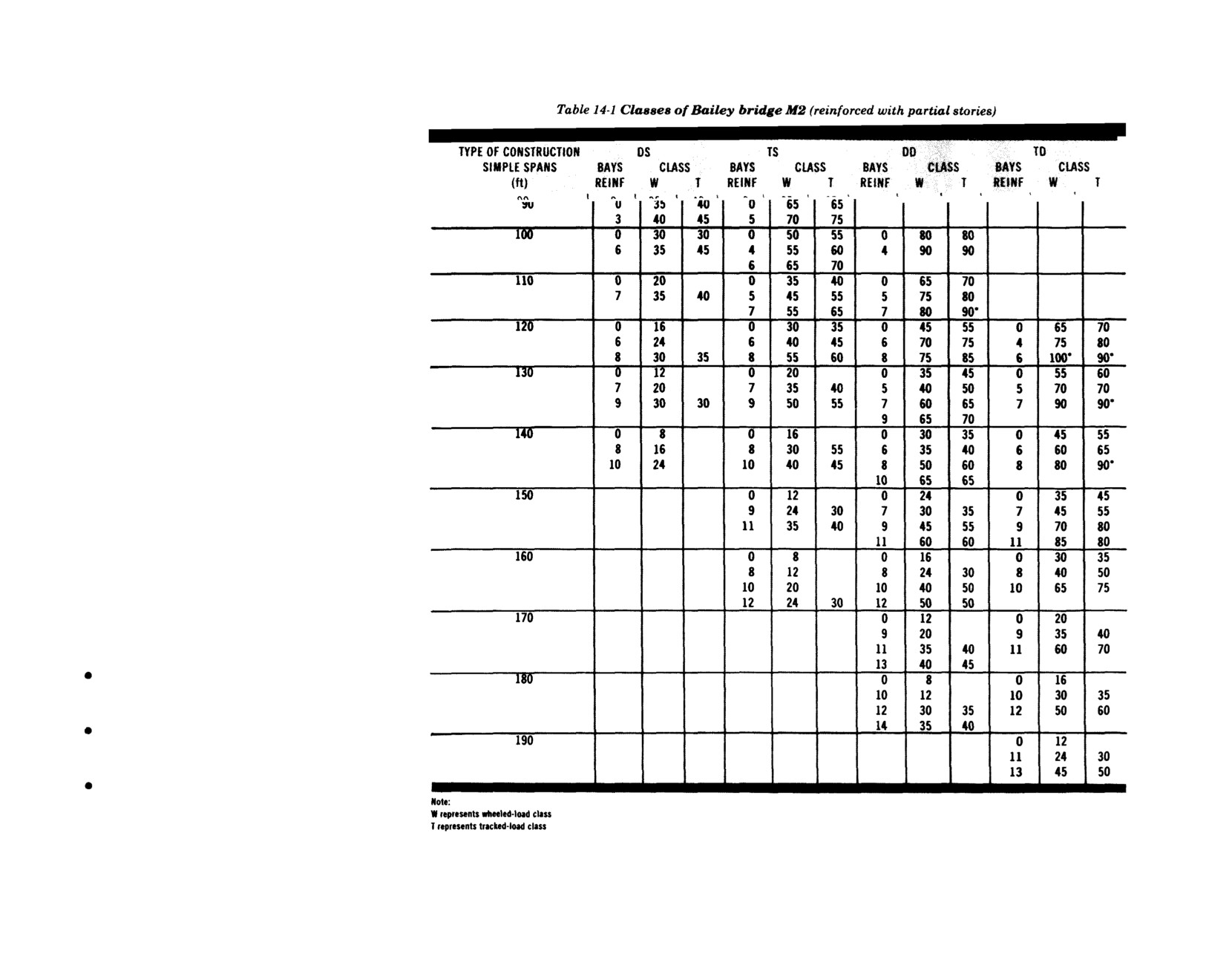
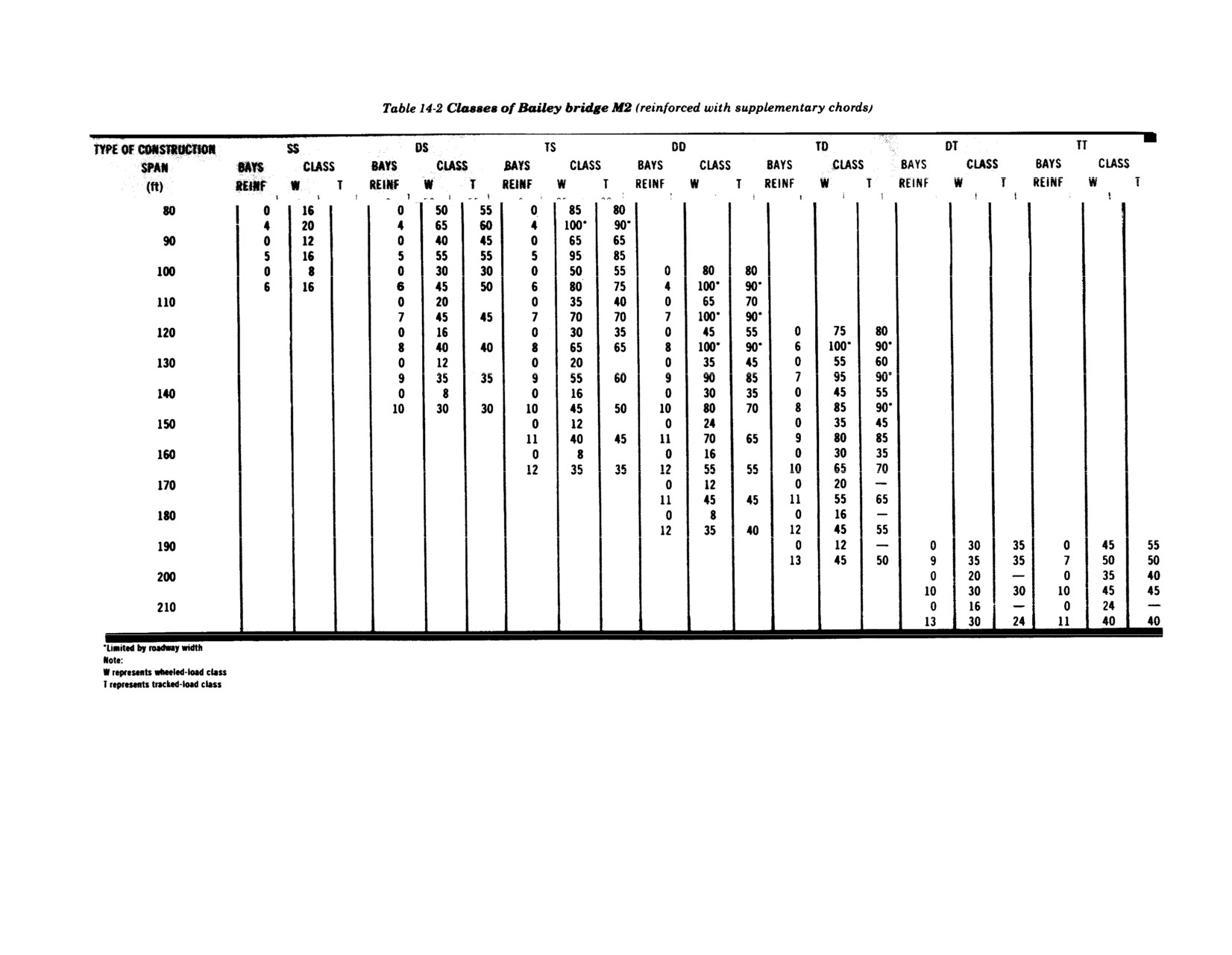
Table 14-1 gives safe classes of bridges rein-
tained. Reinforced bridges carry more load
forced with partial stories. Length of reinforce-
Supplementary chords (Figure 14-1, page
for bridge parts used in their assembly than
ment and the class of each is also shown.
158) cut from salvaged panels. These
do standard bridges. Short spans of
single-
chords must be straight and undamaged.
single, double-single, double-triple, and triple-
Note the following
The web channels must be burned off and
triple
are limited in capacity by shear in end
ground smooth without damaging the
bays. They cannot be strengthened by local
Caution classes are all 25 percent greater
chord channels. Both upper and lower
reinforcement of center bays and are not
than the safe values.
chords must always be reinforced. To use
included in capacity Tables 14-1 and 14-2
lower panel chords as top-chord reinforce-
(pages 156 and 157).
Check grillage to ensure it will carry
ment on all types of bridge, transom seats
increased load.
must also be carefully removed and
REINFORCEMENT WITH
ground smooth. A supplementary chord
PARTIAL STORY
Build bridges with a normal rating over
weighs about 200 pounds (90.9 kilos).
Double-single, triple-single, double-double,
class 70 with double transoms.
and
triple-double
bridges, not limited by end
Horizontal bracing frames on double-and
shear, can be strengthened by converting the
REINFORCEMENT WITH
triple-truss bridges reinforced with supple-
center portion to spans double-double, triple-
SUPPLEMENTARY CHORDS
mentary chords. These frames must be
double, double-triple, and triple-triple, re-
All types of bridges except spans limited by
modified to clear the projecting chord
spectively. The number of bays converted
end shear can be reinforced with supple-
bolts (Figure 14-1). Weld a tube, 1½ inch
depends on the increase in load class. Added
mentary chords cut from damaged panels.
(3.8 centimeters) long and between
panels must be complete with bracing frames
Pin the supplementary chords together and
2¾ inches (7 centimeters) and 3¼ inches
and tie plates; in triple-story assembly, over-
bolt to existing top and bottom chords with
(9.5 centimeters) in internal diameter,
head bracing is also necessary.
chord bolts. Bracing frames, modified to clear
into each longitudinal angle 8 7/16
inches
155
FM 5-277
(21.5 centimeters) from the bolt holes at
one end of the frame. Use an improvised
jig to hold the bracing frame during
cutting and welding to maintain align-
ment of the bolt holes. This modification
does not prevent normal use of the bracing
frame.
Assembly and launching
Supplementary chords cannot be added to
the lower chord before launching because
projecting chord bolts interfere with rollers.
They can be added to upper chords, however,
with no change in standard launching noses.
Bracing bolts for fastening horizontal
bracing frames must be inserted in supple-
mentary chords before the chords are bolted
to the truss. When chord bolts are tight,
remove nuts from the bracing bolts, and add
bracing frames (Figure 14-1).
Class
Table 14-2 gives the maximum safe class of
bridges reinforced with supplementary
chords and the corresponding length of rein-
forcement required.
Note the following:
Caution classes are 25 percent greater
than the safe values.
Check grillage to ensure it will carry
increased load.
Build bridges with a normal rating over
class 70 with double transoms.
156
FM 5-277
This change supersedes page 157.
157
FM 5-277
158
FM 5-277
CHAPTER 15
CABLE REINFORCEMENT SET
DESCRIPTION AND USE
159
COMPONENTS
167
INSTALLATION AND DISMANTLING
177
OPERATION UNDER UNUSUAL CONDITIONS
187
OPERATOR’S AND ORGANIZATIONAL MAINTENANCE
187
SHIPMENT AND LIMITED STORAGE 189
The cable reinforcement set for panel bridge
to 170 feet (30.8 to 52.3 meters). For a span of
the assembly time and equipment necessary
M2 (Bailey type) increases to class 60 wheel
180 feet (55.4 meters) the class is 50 wheel and
to cross class 60 traffic over spans of between
and track the classification of
triple-single
60 track. This system significantly reduces
100 and 180 feet (30.8 and 55.4 meters).
Bailey bridge for span lengths from 100 feet
DESCRIPTION AND USE
PRINCIPLE OF OPERATION
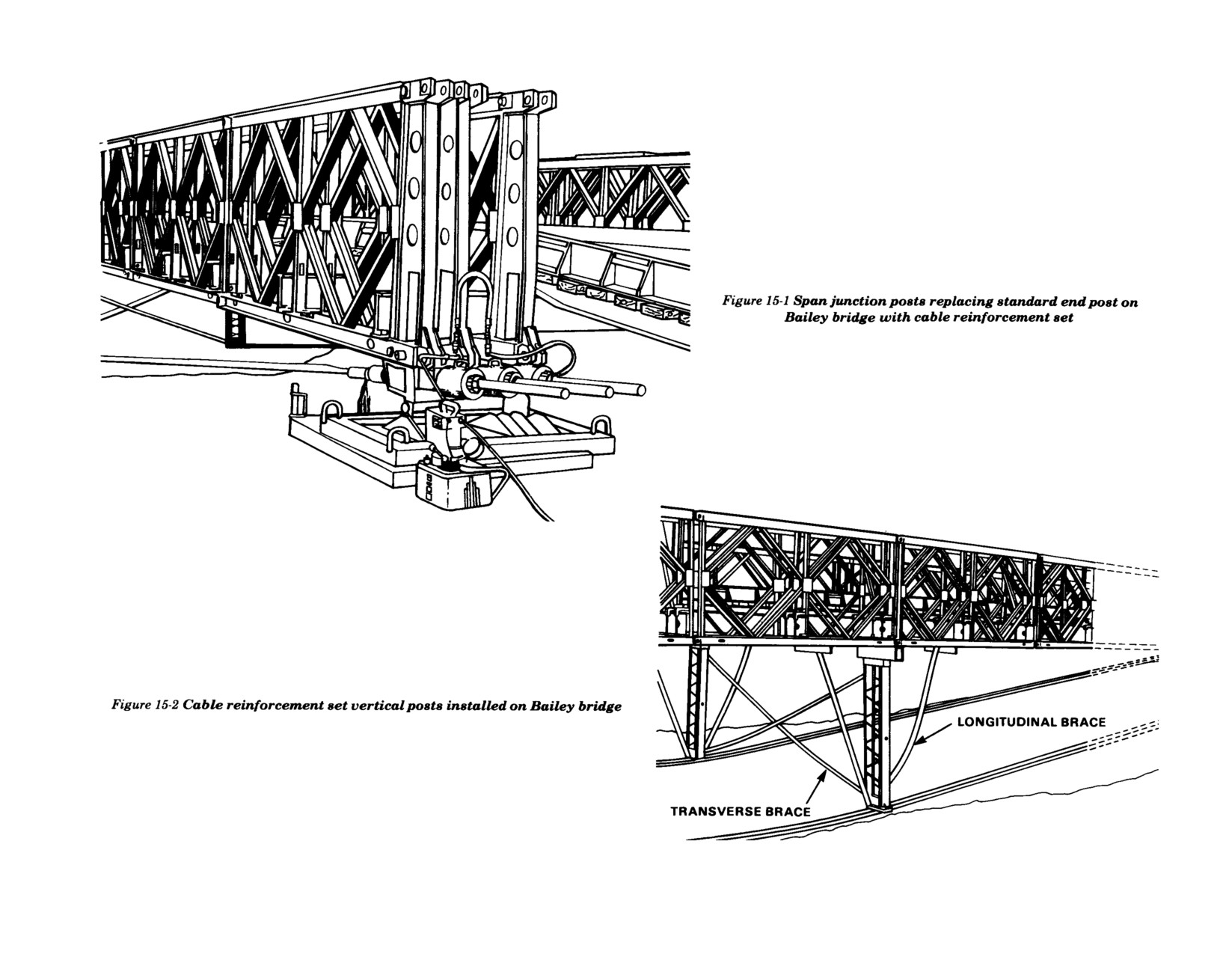
The standard Bailey end posts on each
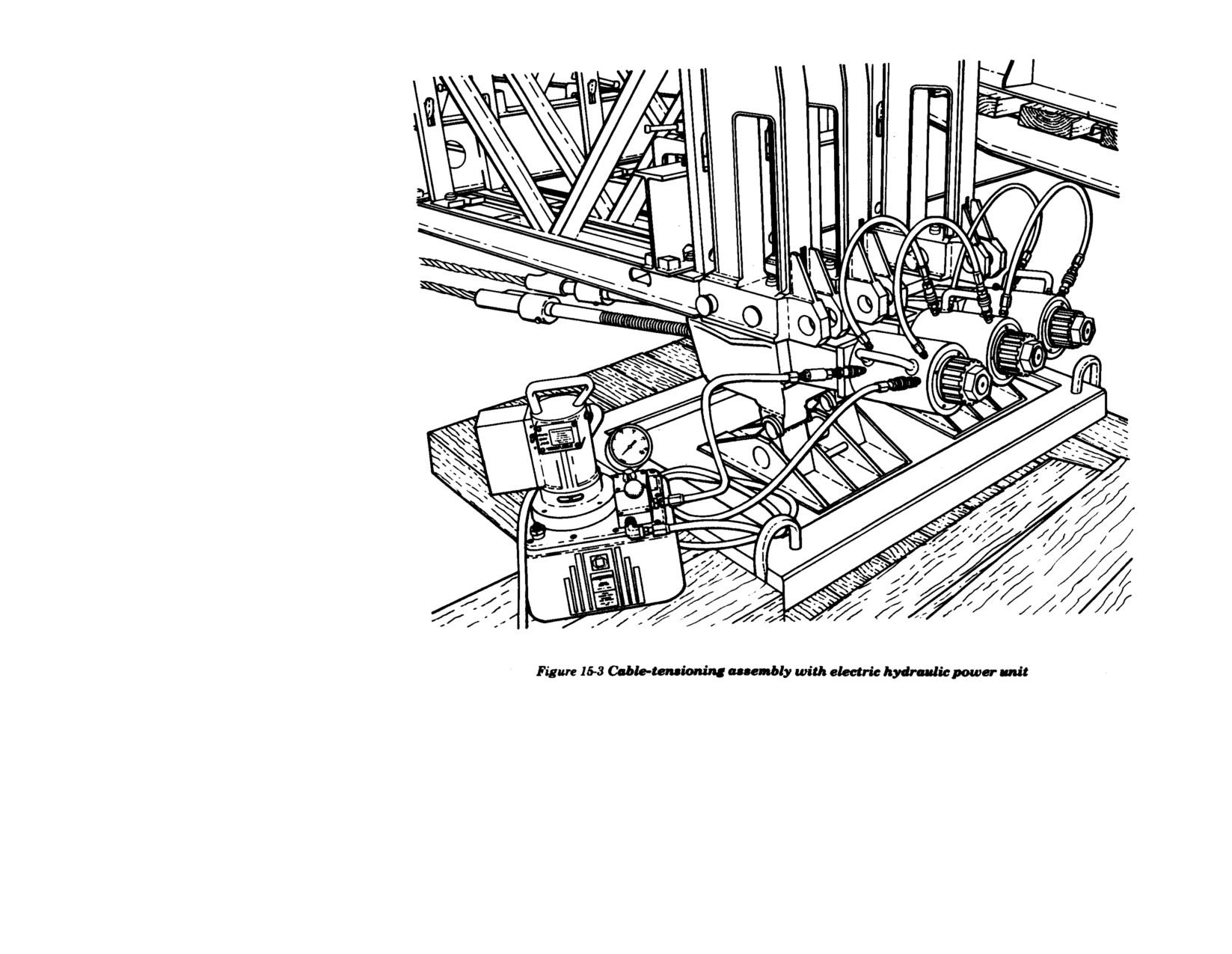
and hand. The electric unit (Figure 15-3,
The cable reinforcement set consists of a
truss must be replaced by standard span
page 162) is normally used for installation
system of cables attached to each end of the
junction posts in order to install the cable-
of the system. Two are needed and require
bridge and offset from under the bridge by
connection beams (Figure 15-1, page 161).
one 10-kilowatt or two 5-kilowatt electric
posts. The cables are tensioned, causing the
Hold cables away from bottom of bridge
generators.
bridge to deflect upward. When a vehicle
by two or four, approximately 8-foot (2.5
crosses the bridge, the bridge deflects down-
meters) vertical posts (Figure 15-2, page
3
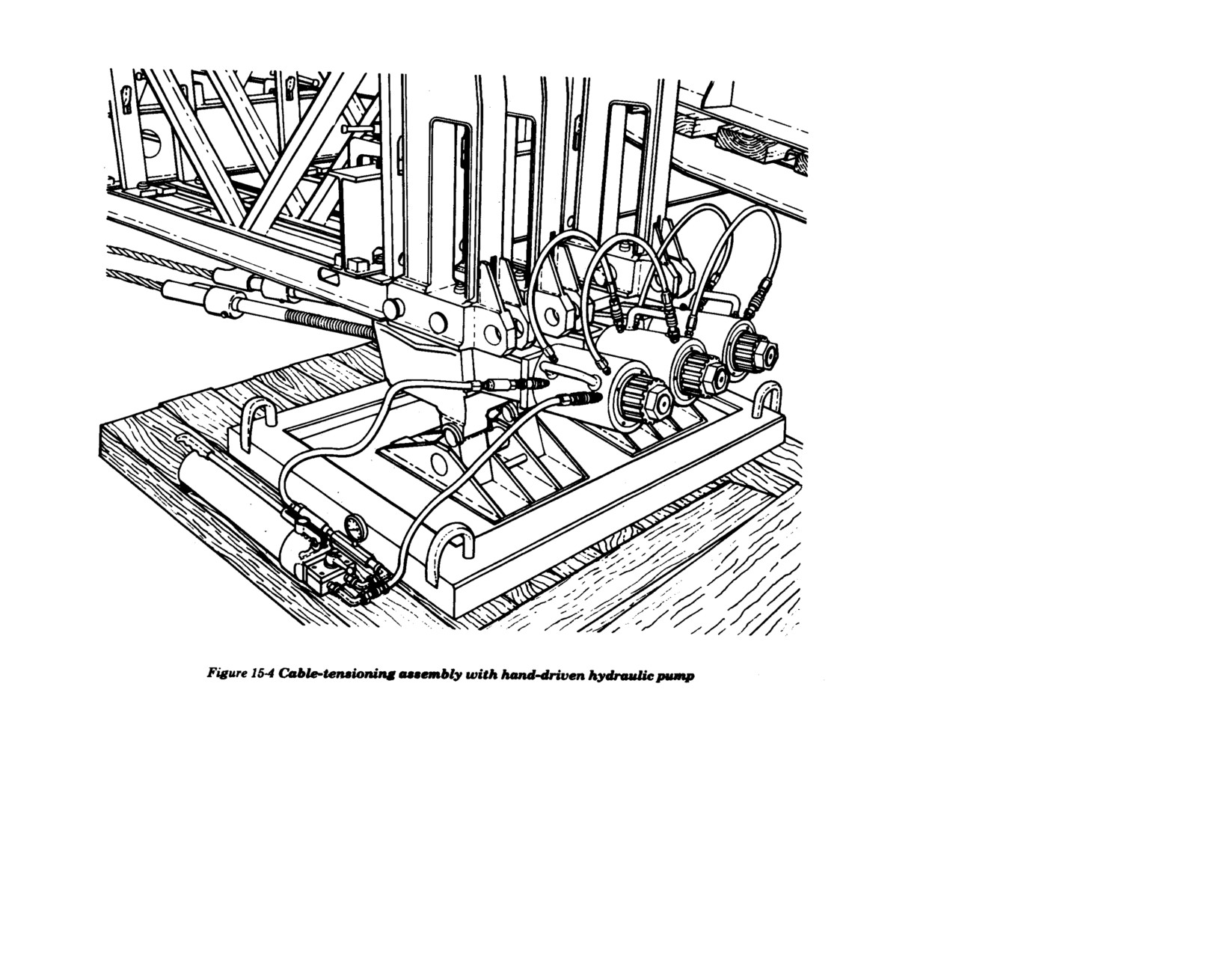
Check cable tension, using a hand-driven
ward, transferring most of the load into the
161). The number and placement of these
hydraulic pump (Figure 15-4, page 163).
cables.
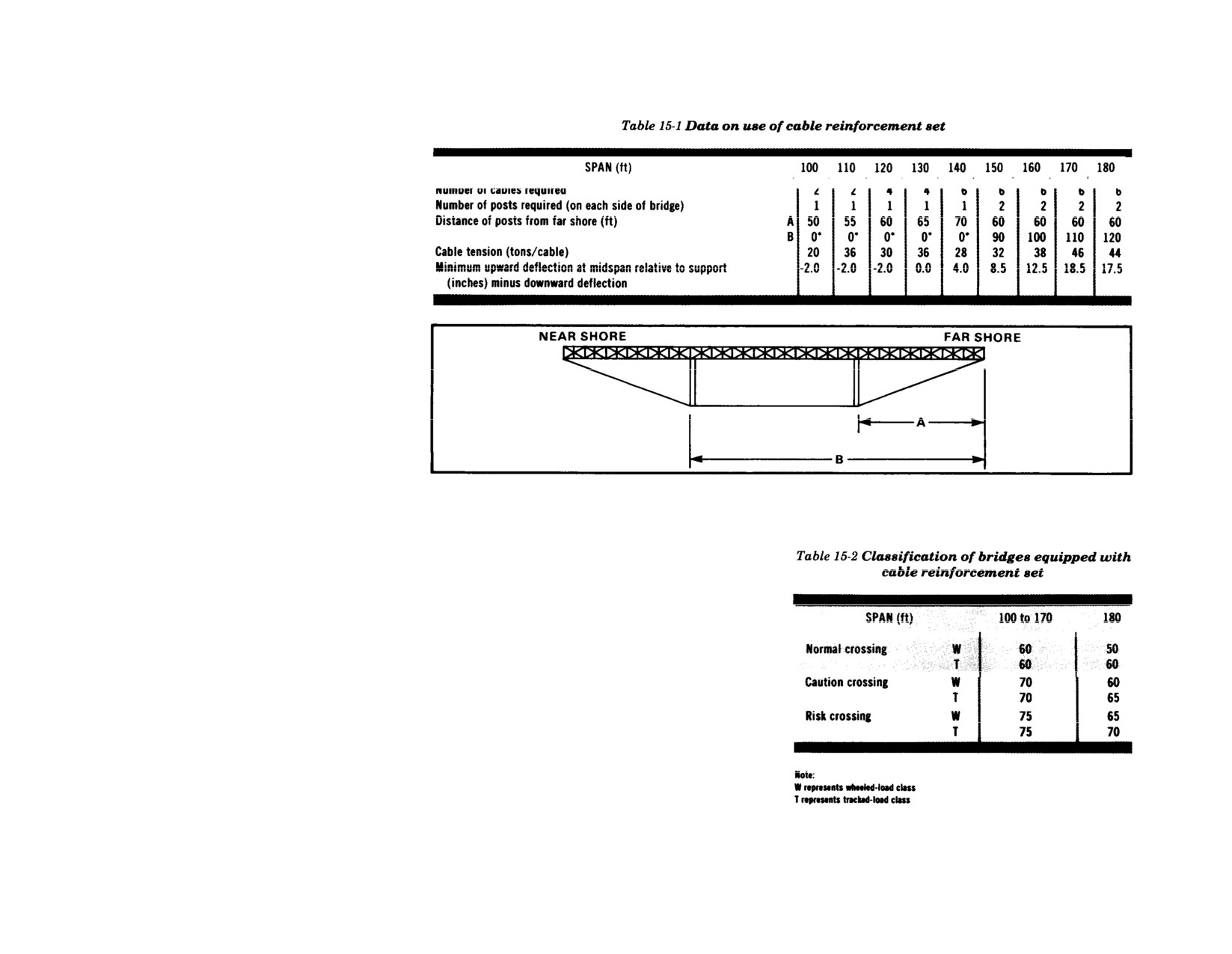
posts depend on bridge span length (Table
Read cable tensions directly from a cable-
15-1).
tension gage mounted on either hydraulic
USE
power unit. Tension cables from near
To install the cable reinforcement set with a
2
Pretension cables to cable tension given
bank only. The near-bank end of the
panel bridge use the following procedure:
in Table 15-1. The cables are tensioned by
bridge is called the tensioning end. The
the cable-tensioning assembly, consisting
far end is called the dead end.
1 Sling from two to six cables under the
of double-action hydraulic cylinders and
bridge (Table 15-1). Connect them to ends
a hydraulic power unit. Two types of
Six cables are provided with the set. Each
of the bridge by cable-connection beams.
hydraulic power units are used: electric
cable is 179 feet 6 inches (55.2 meters) long.
159
FM 5-277
On the tensioning end of the cable is a
threaded stud. On the dead end of the cable
are nine buttons spaced about 10 feet (3.1
meters) apart starting 100 (30.8 meters) feet
from the stud end. This provides a connection
of the cable at the dead end, according to the
bridge span length.
TRANSPORTATION
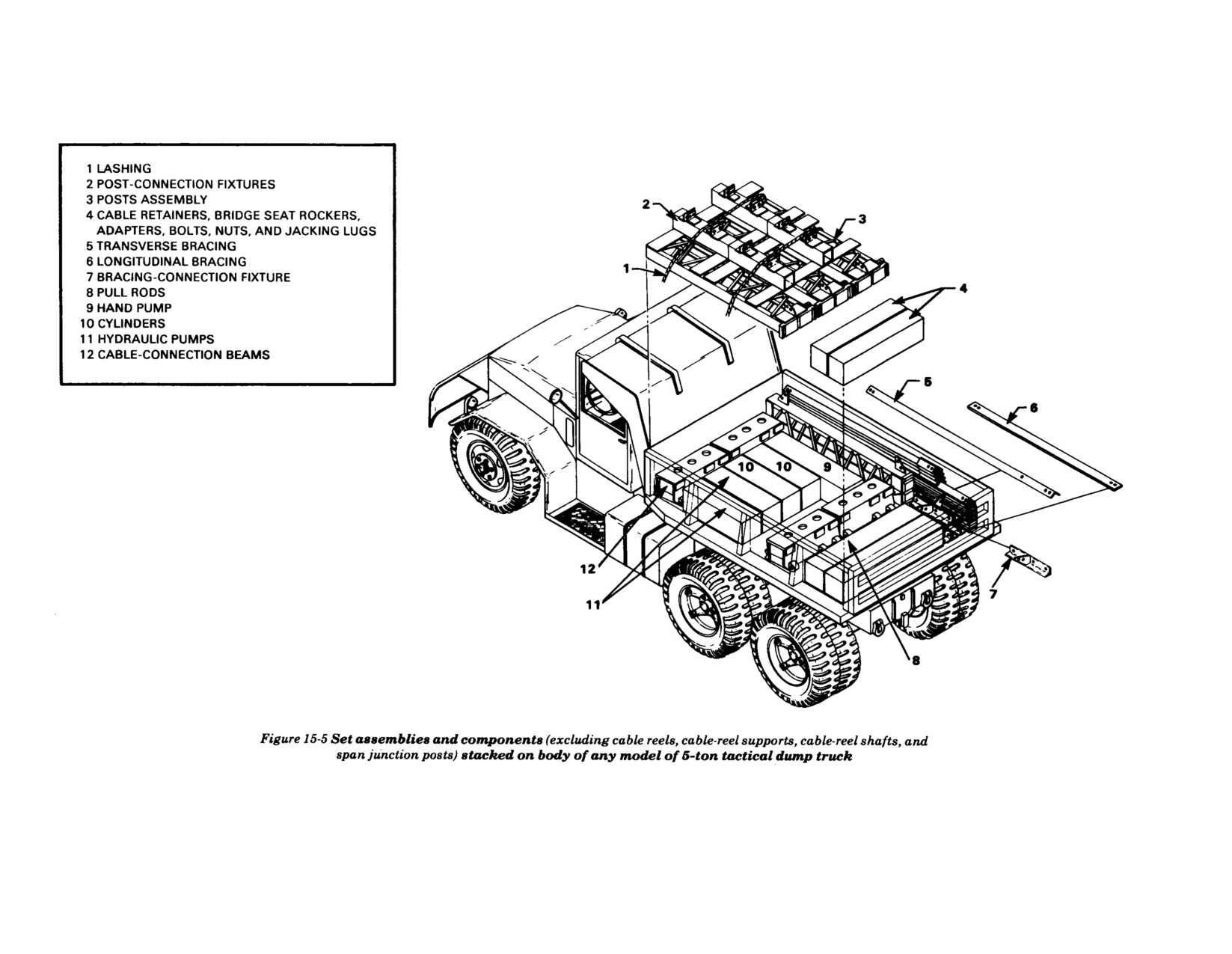
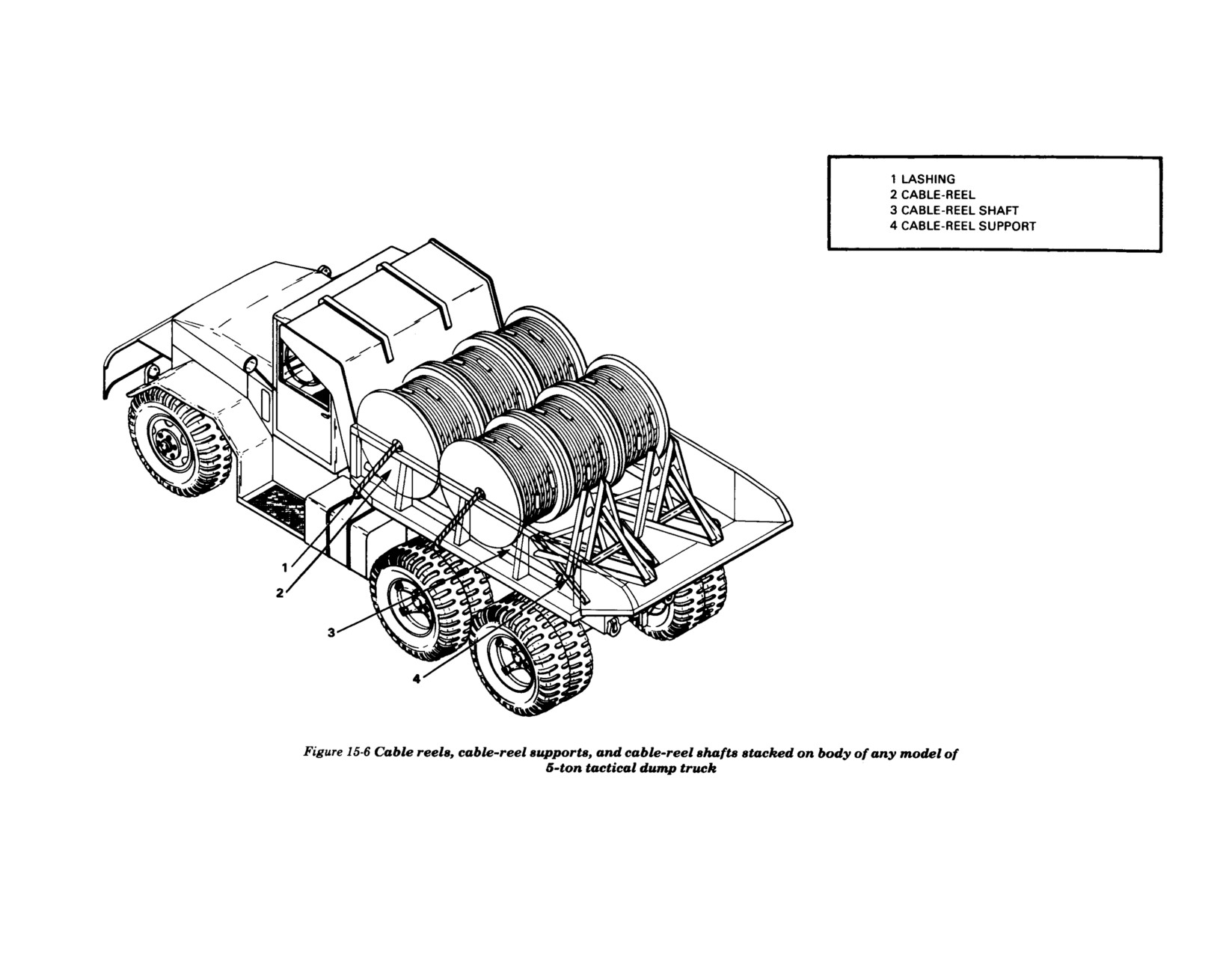
The cable reinforcement set is transported in
three 5-ton dump trucks. One truck carries
the set assemblies and components (Figure
15-5), the second carries the cables (Figure
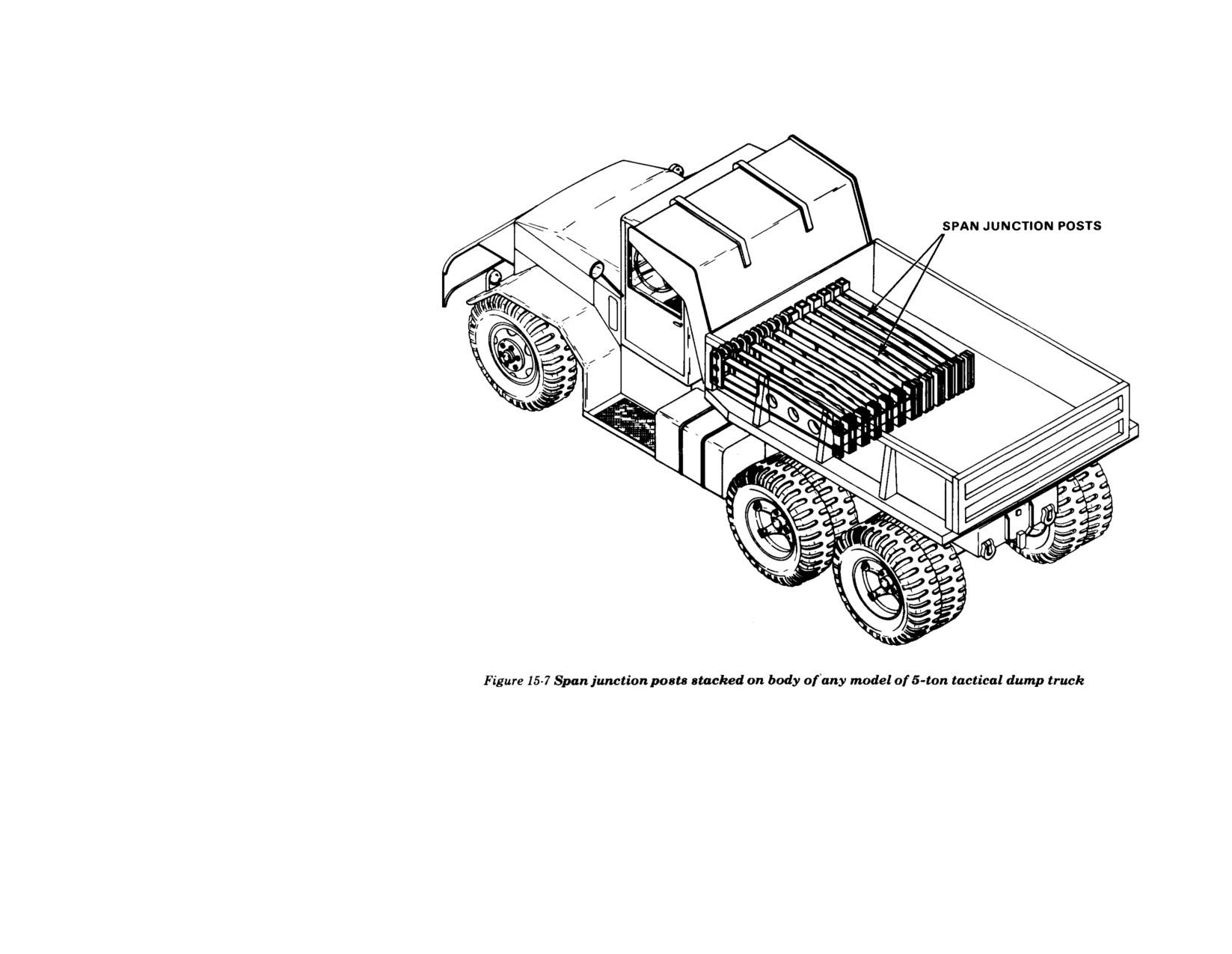
15-6), and the third carries the span junction
posts (Figure 15-7).
CLASSIFICATION
The classifications in Table 15-2 are obtained
with the cable reinforcement set.
160
FM 5-277
161
FM 5-277
162
FM
5-277
163
FM 5-277
164
FM 5-277
165
FM 5-277
166
FM 5-277
COMPONENTS
DESCRIPTION
The following assemblies and components
comprise the cable reinforcement set. Descrip-
tion of these parts includes function and
location.
POST ASSEMBLY
The vertical-post assembly is a fabricated
structural steel member suspended directly
below a vertical member of the bridge panel.
A saddle welded on the lower end of the
vertical post provides a seat for the cables,
and a cable retainer is bolted to the base to
support the cables before they are tensioned.
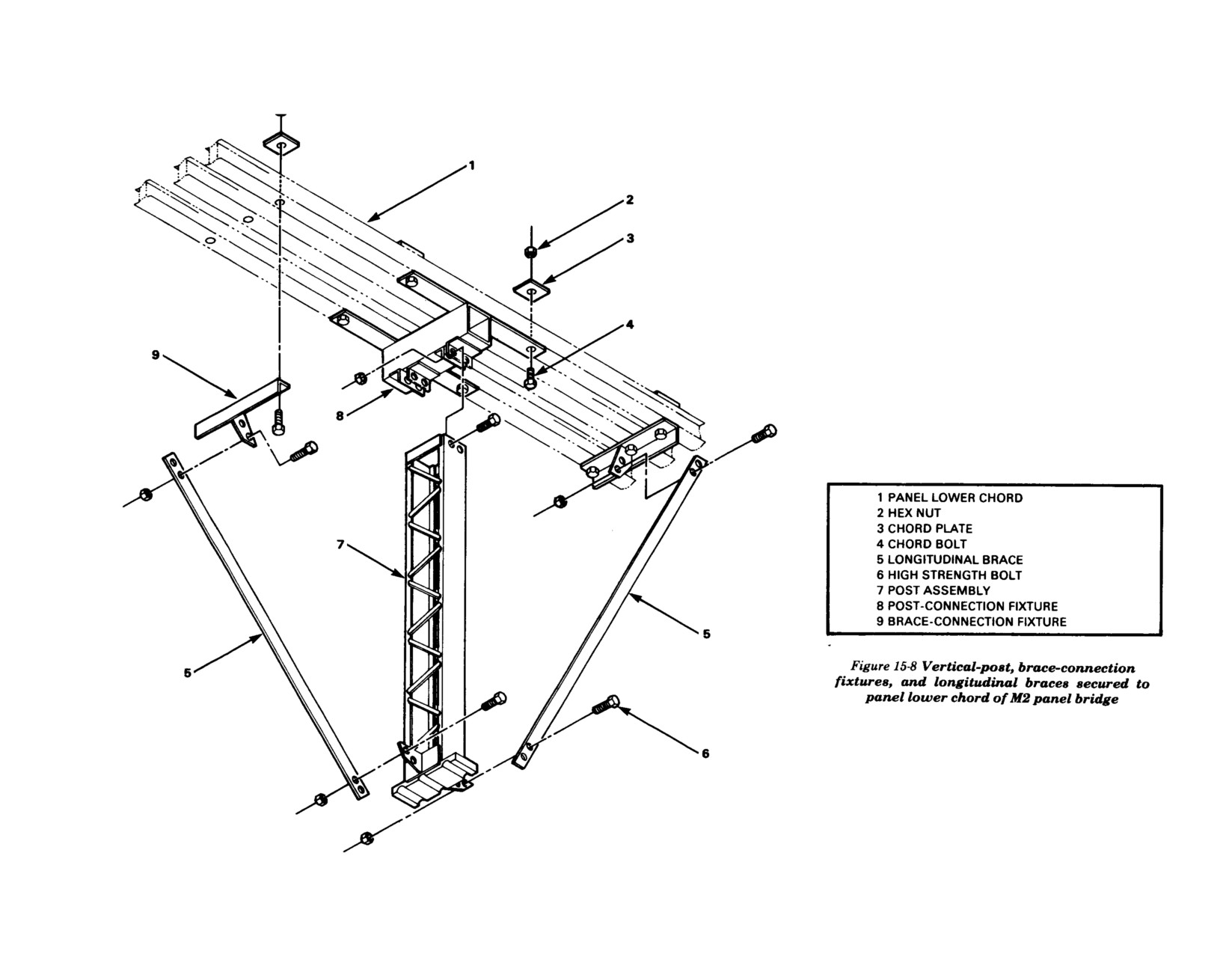
The post assembly is secured to the lower
panel chord of the M2 Bailey bridge by the
post-connection fixture (Figure 15-8). The post
assembly weighs 269 pounds (122.3 kilos).
167
FM 6-277
POST-CONNECTION FIXTURE
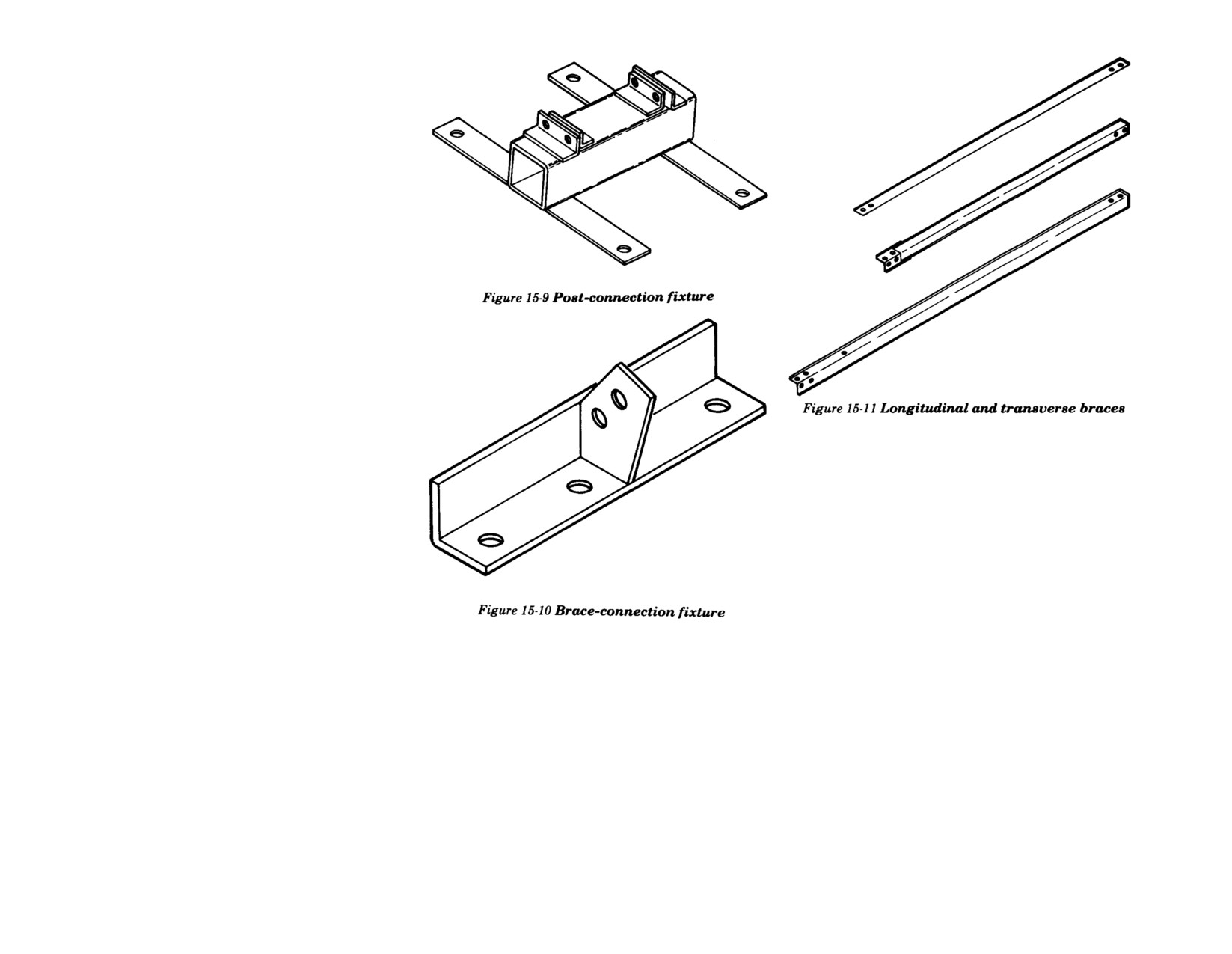
The post-connection fixture (Figure 15-9) con-
nects the post assembly with the bridge panel
lower chord (Figure 15-8). Secure this fixture
to panel lower chord by four bolts and hex
nuts. Use two chord plates on one side of
connection fixture to adapt bridge panel for
securing fixture. The fixture weighs 178
pounds (80.9 kilos).
BRACE-CONNECTION FIXTURE
Left-hand and right-hand brace-connection
fixtures (Figure 15-10) secure braces, which
support the post assembly, to lower chord of
bridge panel. Secure one brace-connection
fixture to panel lower chord by three bolts
and hex nuts. Secure the opposite brace
connection by the same hardware plus add-
securing the brace-connection fixture and
ition of chord for securing this brace-
post-connection fixture to the panel lower
connection fixture. The fixture weighs 32
chord.
pounds (14.5 kilos).
CABLE ASSEMBLY
BRACES
The cables are 1¼-inch (3.2 centimeters)
There are two types of post braces, longitu-
diameter high-strength wire ropes with
dinal and transverse (Figure 15-11). The longi-
threaded stud on one end and nine buttons at
tudinal braces are flat steel bars bolted to the
specific intervals along the cable length. The
brace-connection fixtures and the lower end
first button is about 100 feet (30.8 meters)
of the post assembly (Figure 15-8). They are 8
from the stud end of the cable and the re-
feet ¼ inch (2.5 meters) long, 3 inches (7.6
10-foot (3.1 meters) brace angle bolted to the
maining eight buttons are spaced at approx-
centimeters) wide, 3/8 inch (1 centimeter) thick,
splice plate of the shorter bracing. A high-
imately 10-foot (3. 1 meters) intervals toward
and weigh 32 pounds (14.5 kilos) each. Trans-
strength bolt and hex nut secure the two
the opposite end. Each button is marked with
verse braces are steel angles which are placed
transverse braces together where they cross
the applicable length of the M2 panel bridge.
between posts on each side of the bridge
between post assemblies (Figure 15-12). The
Screw stud end of cable into a rod-to-cable
(Figure 15-12). These braces are bolted to
total weight of one transverse brace is 88
coupling (Figure 15-14, page 170) and secure
welded plates on each end of the vertical post.
pounds (40 kilos).
by a bolt-type setscrew. The rod-to-cable
For convenience of storage and transpor-
coupling also has internal threads to retain
tation, each transverse brace consists of two
CHORD PLATE
the pull rod. The cables are 179 feet 6 inches
parts: a 7-foot 4-inch (2.3 meters) brace angle
The chord plate (Figure 15-13) is used to
(55.2 meters) long and weigh 595 pounds
with a welded splice plate on one end, and a
adapt the bridge panel lower chord for
(270.5 kilos). They are wound on wooden
168
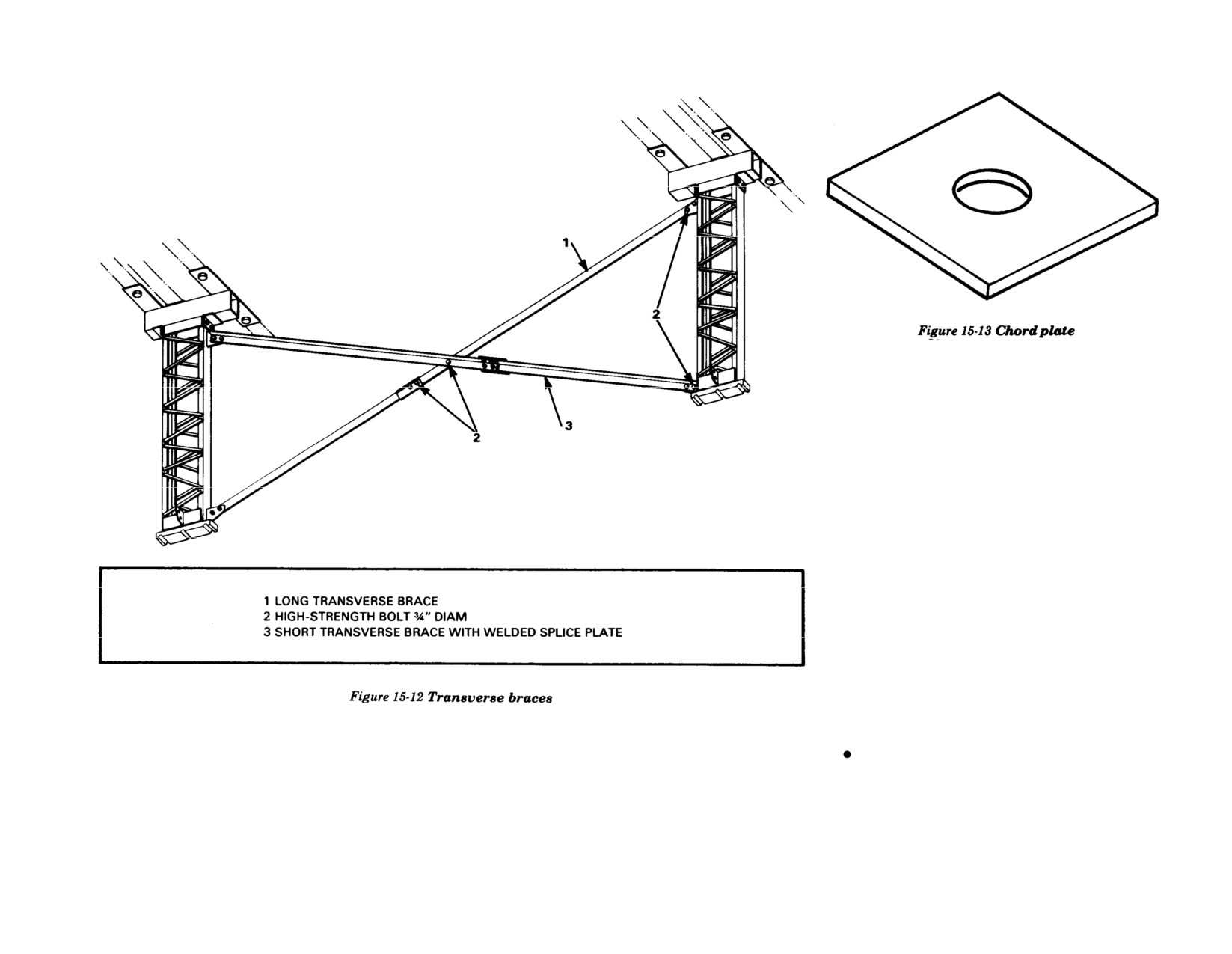
FM 5-277
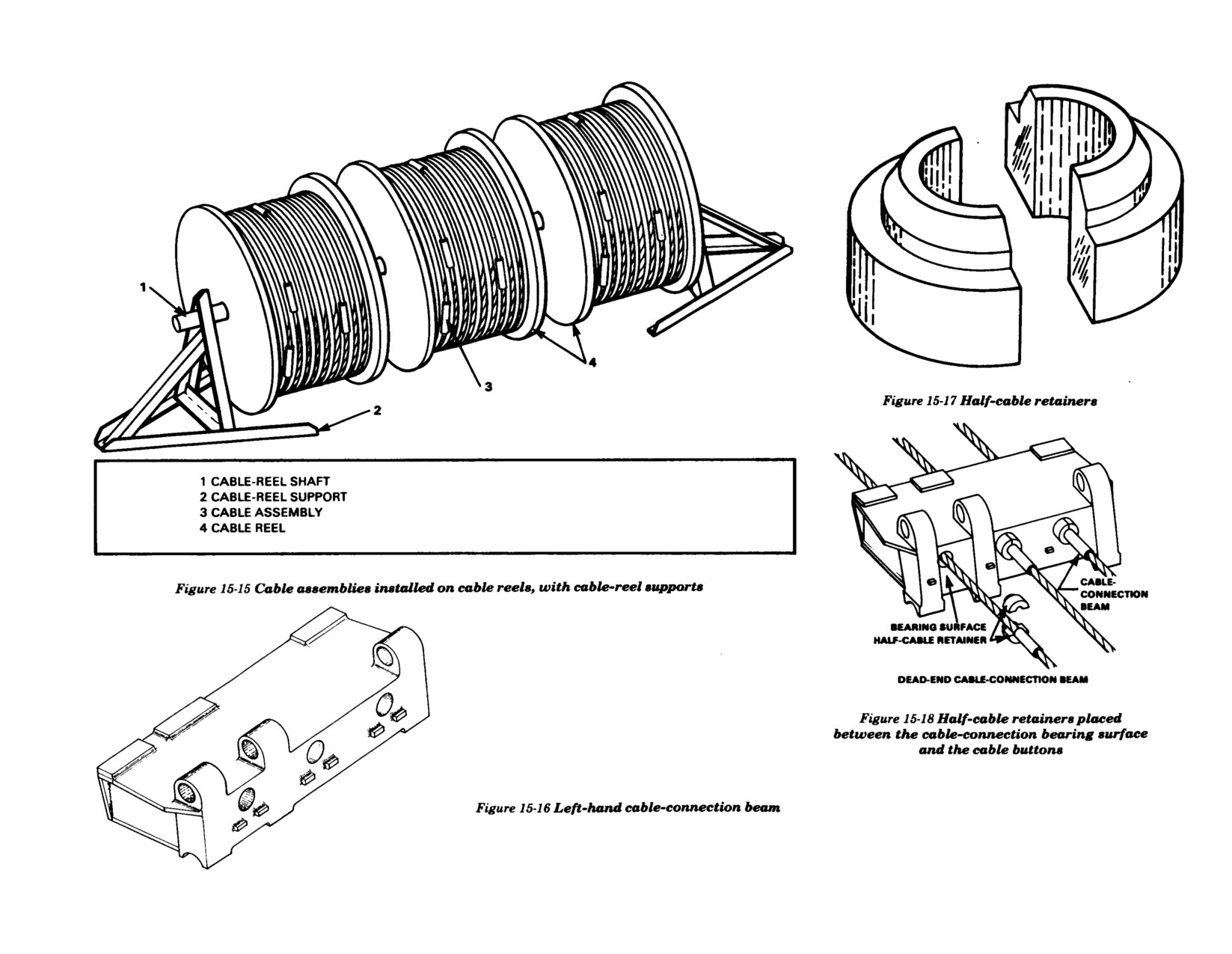
Secure cable reel shaft to each cable reel
support by a bolt inserted through each end
of the pipe shaft and secure bolt by a nut. The
cable reel support and cable reel shaft to-
gether weigh 287 pounds (130.5 kilos). The
shaft is 10 feet (3.1 meters) long.
CABLE-CONNECTION BEAM
Left-hand and right-hand cable-connection
beams (Figure 15-16, page 171) are steel
frames secured to each corner of the M2 panel
bridge for connection and tensioning of
cables. Pin these components to bottom of
span junction posts which replace end posts
of M2 panel bridge. Each cable-connection
beam is a frame, with provisions for three
cables with buttons or pull rods to pass
through it. The cable-connection beam weighs
315 pounds (143.2 kilos). These beams serve
two purposes:
cable reels for convenience of storage and
CABLE REEL SUPPORTS
shipping. The reels weigh 180 pounds (81.8
The cable reel supports (Figure 15-15, page
They serve as a dead-end cable-connection
kilos) each. Six cables come with the reinforce-
171) are steel frames that support a cable reel
beam. After inserting the cables, with
ment set.
shaft on which three cable reels are retained.
buttons, through the holes provided in the
169
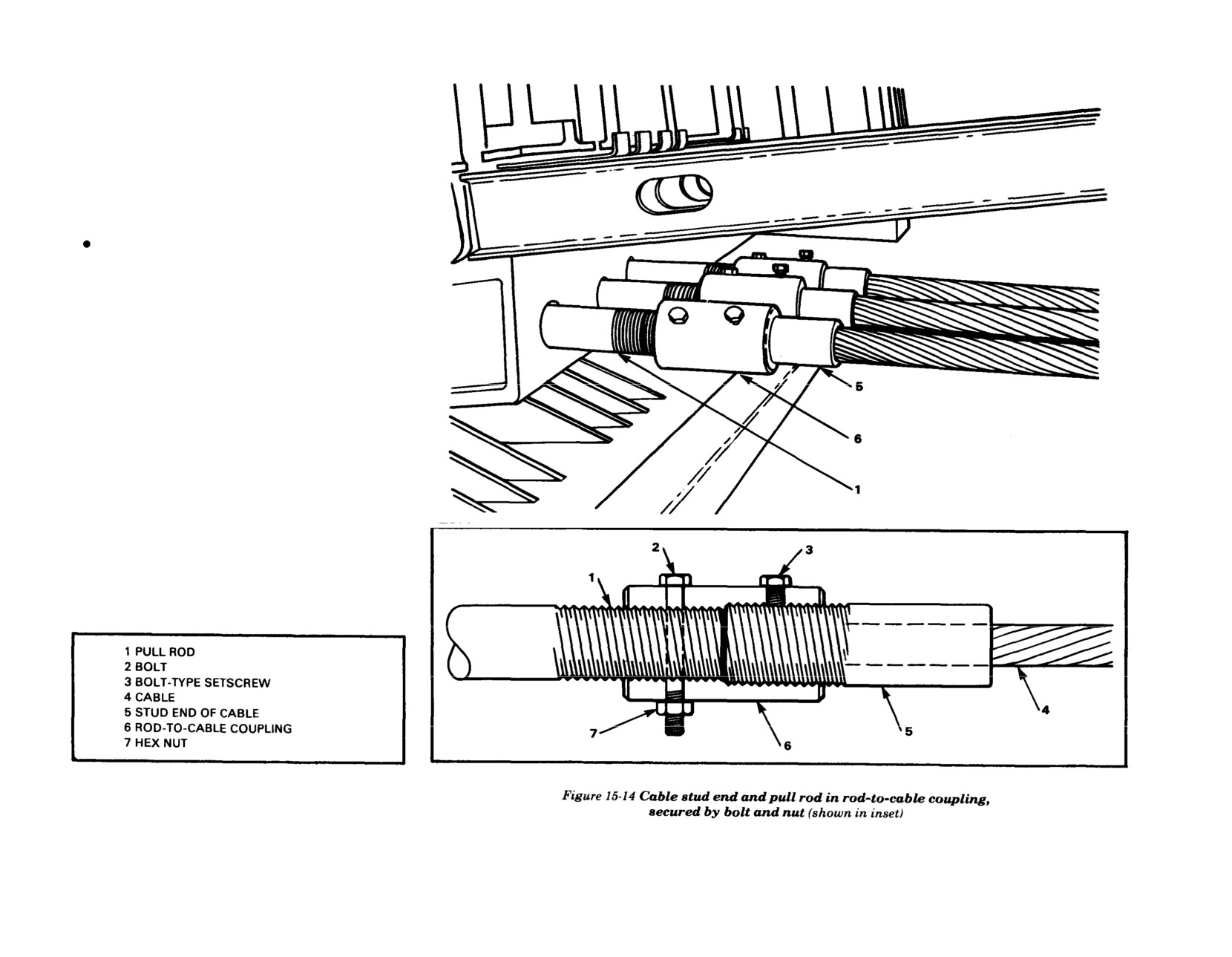
FM 5-277
cable-connection beam, place half-cable
retainers (Figure 15-17) between the
bearing surface and the button to anchor
the cable (Figure 15-18).
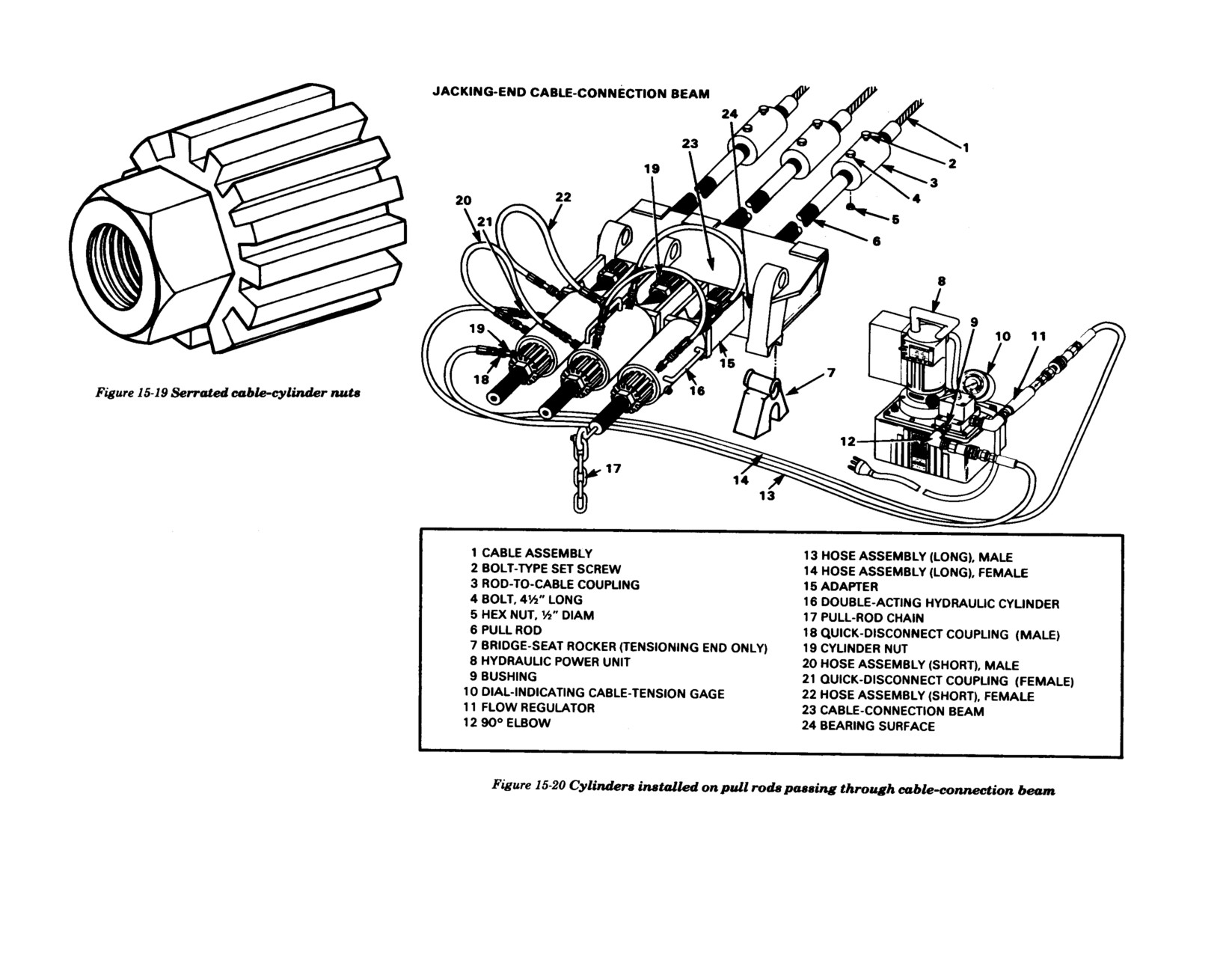
They serve as a tensioning-end cable-
connection beam. After connection to the
rod-to-cable couplings, feed pull rods
through the cable-connection beam and
retain them by serrated nuts (Figure 15-
19, page 172).
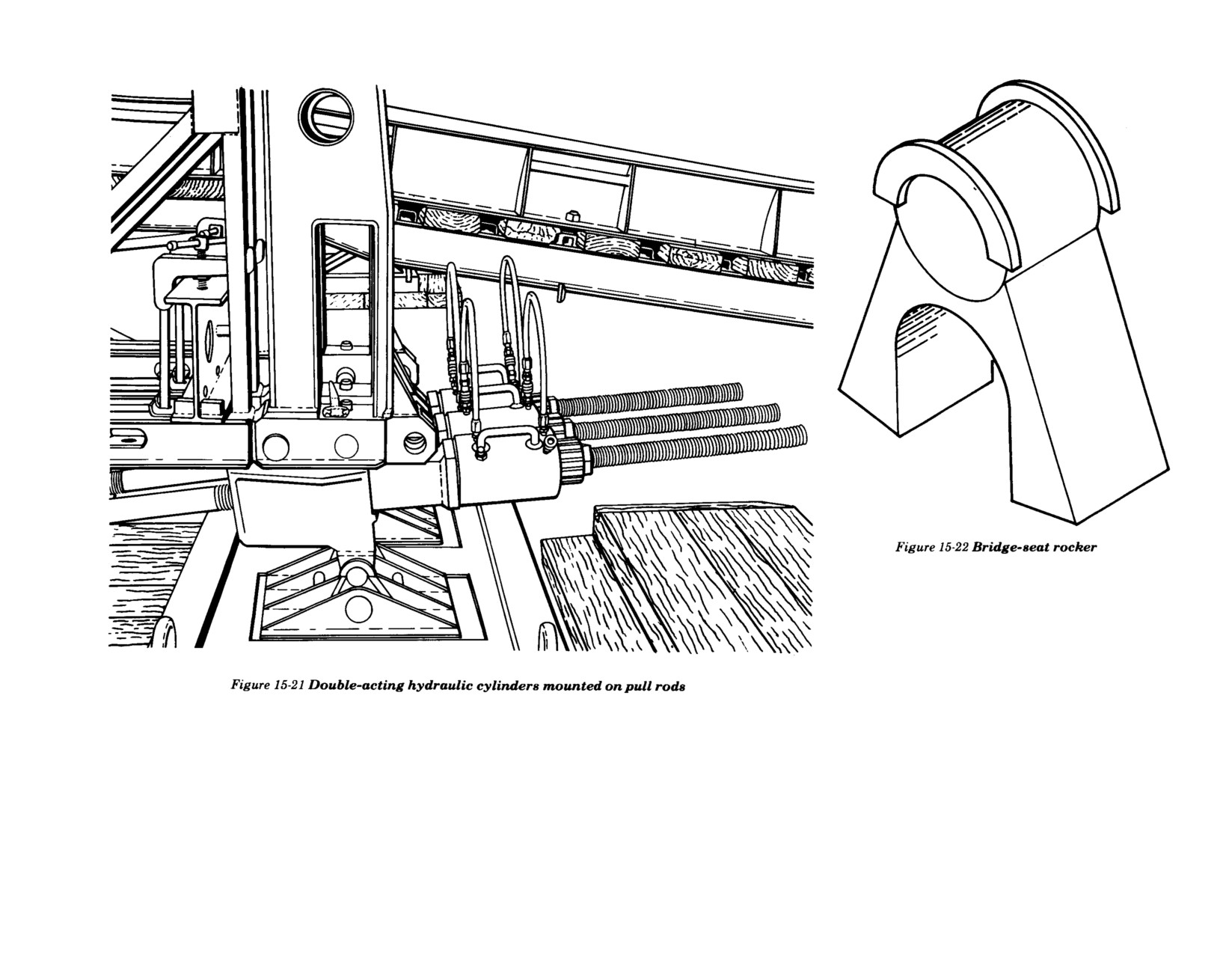
A double-acting hydraulic cylinder, when
installed on each pull rod, bears against the
front surface of the cable-connection beam
through the use of an adapter (Figure 15-20).
Use the double-acting hydraulic cylinders to
tension cables (Figure 15-21).
170
FM 5-277
171
FM 5-277
172
FM
5-277
tension the cables. Thread one end of pull rod
into one end of rod-to-cable coupling. Secure
pull rod and rod-to-cable coupling by bolt and
nut (Figure 15-14). When the cable is ten-
sioned, a serrated nut bears against the
bearing surface of the cable-connection beam
to take cable-tensioning loads. The second
serrated nut retains the double-acting hy-
BRIDGE SEAT ROCKERS
PULL-ROD ASSEMBLY
draulic cylinder when it is installed on the
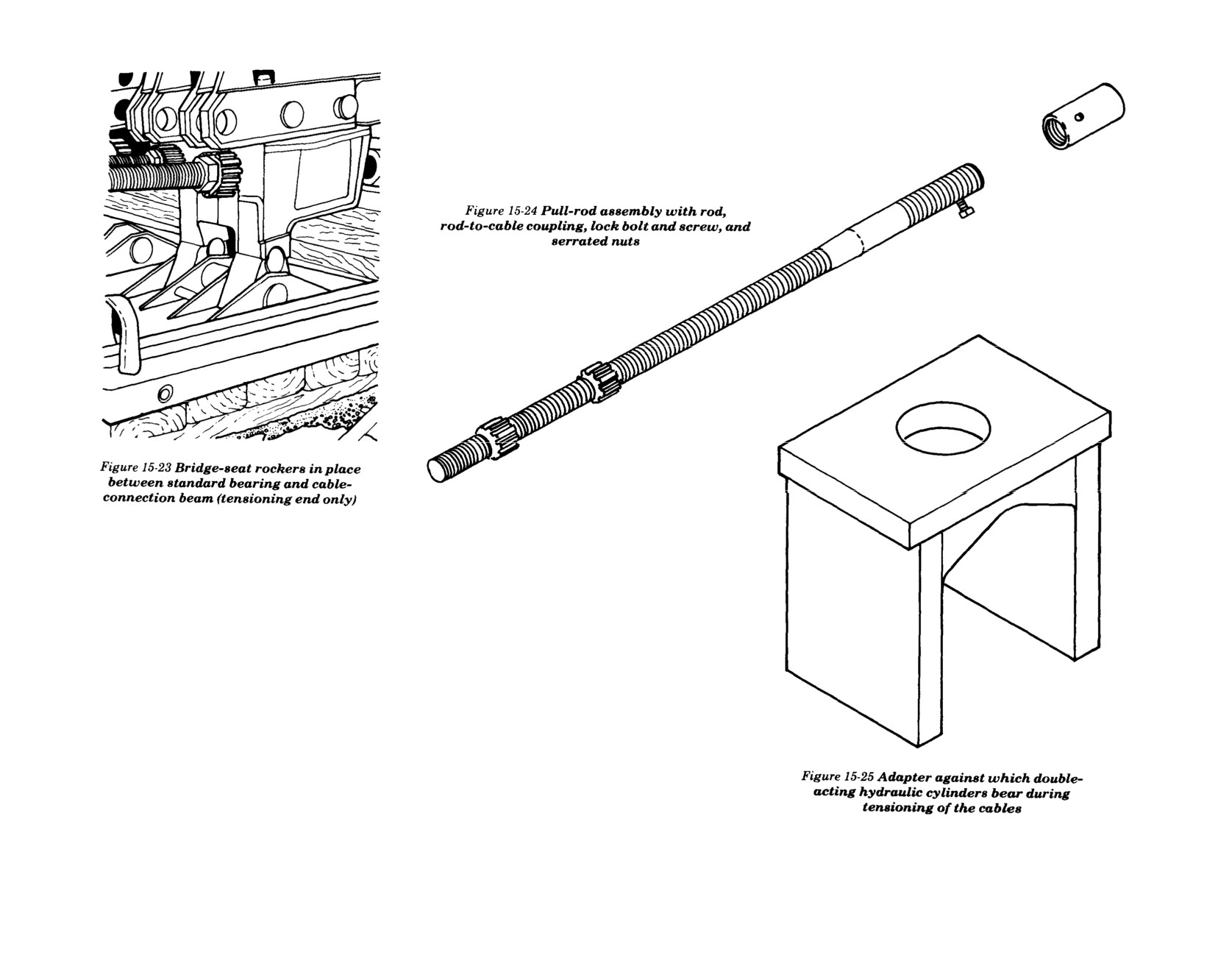
Bridge seat rockers (Figure 15-22) are placed
The pull-rod assembly (Figure 15-24, page
pull rod. The two serrated nuts are identical.
between the bridge bearing and the cable-
174) consists of a 2¼-inch (5.7 centimeters)
The nut used to retain the cable is called the
connection beam at the tensioning end only
high-strength threaded rod, a rod-to-cable
cable nut and the nut used to retain the
(Figure 15-23, page 174). These rockers pro-
coupling, and two serrated nuts. The as-
double-acting hydraulic cylinder is called the
vide for longitudinal displacement that oc-
sembly provides for the connection of the
cylinder nut. The pull-rod assembly is 5 feet
curs while heavy traffic is crossing the bridge.
cable to the cable-connection beam on the
10 inches (1.8 meters) long and weighs 60
Each rocker weighs 15 pounds (6.8 kilos).
tensioning end and serves as a means to
pounds (27.3 kilos).
173
FM 5-277
PULL-ROD CHAIN
CABLE-TENSIONING ASSEMBLY
The pull-rod chain (Figure 15-20) is 12 feet (3.7
The cable-tensioning assembly is used to
meters) long and is screwed into the end of
tension the cables. It has two basic com-
the pull-rod assembly after installation of
ponents: a hydraulic power unit asembly,
pull rods in the cable-connection beam. This
and double-acting hydraulic cylinders.
pull-rod chain helps to advance the cable nut
before installation of hydraulic cylinders.
The hydraulic power unit assembly consists
of a hydraulic power unit gage, hose assem-
ADAPTER
blies, quick-disconnect couplings, and a flow
An adapter (Figure 15-25) is used during the
regulator. The hydraulic power unit has a
cable-tensioning procedure to take the cable-
filler/vent plug for adding or removing
tensioning load from the hydraulic cylinder
hydraulic oil, an electric switch for con-
until the cable nut is tightened. Use one
trolling the amount of fluid flow, and a valve
adapter for each cable. The adapter weighs
for controlling the direction of fluid flow. Two
20 pounds (9.1 kilos).
hydraulic power units are required for a
174
FM 5-277
HYDRAULIC RAM PUMP
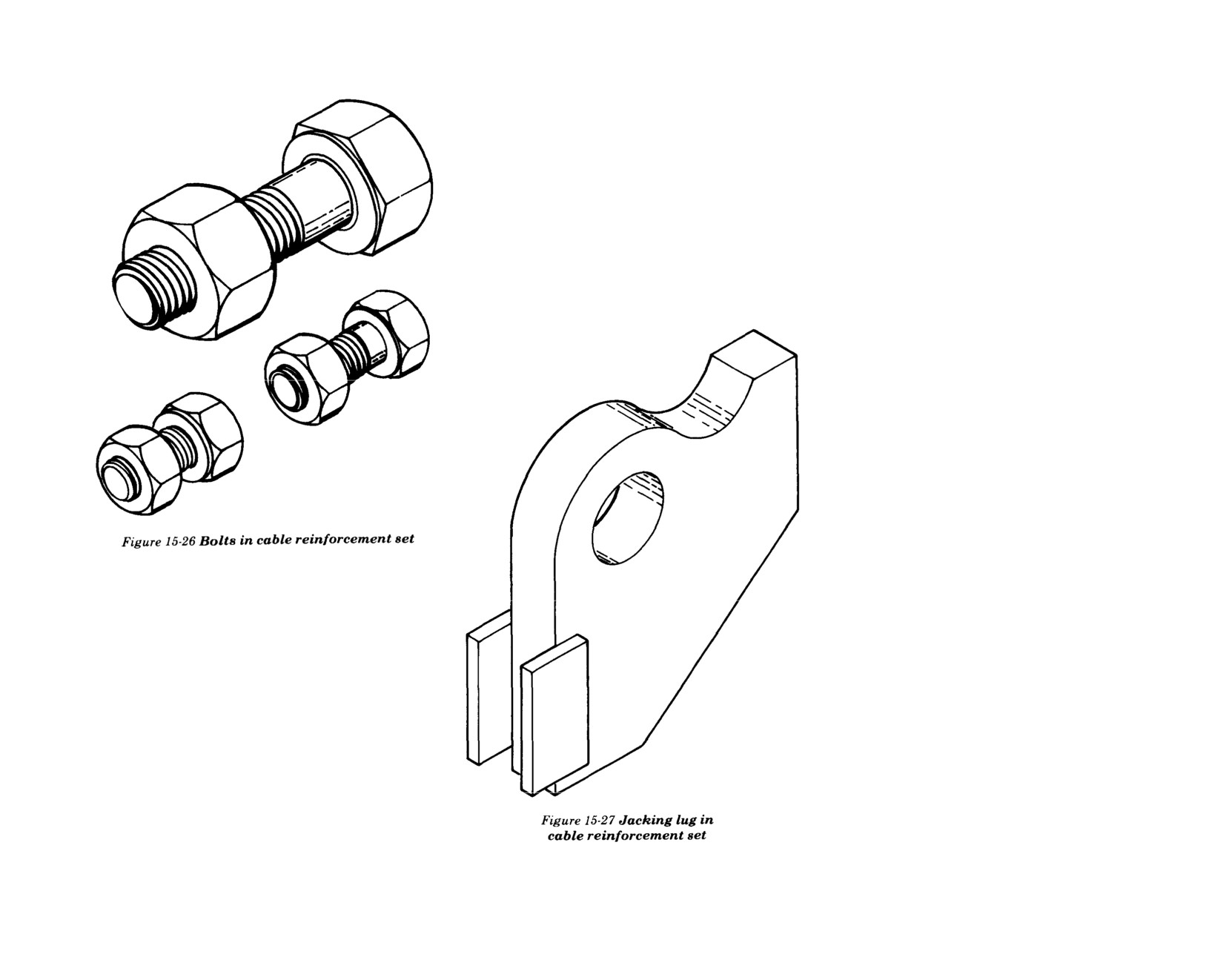
BOLTS
The hand-driven hydraulic ram pump (Figure
Three types of bolts (Figure 15-26) are used to
15-4) is included in the kit to provide a means
secure major parts of the cable reinforcement
for periodic checking and adjusting of cable
set together and to the M2 panel bridge:
tension. It has an end dipstick/plug for
machine, chord, and high-strength bolts.
checking and adjusting fluid level, a gage
Machine bolts secure parts in assemblies
adapter, gage, hose assemblies with quick-
such as the cable reel shaft. Chord bolts
disconnect couplings, flow regulator, and a
secure fixtures to the panel lower chord.
control valve to direct fluid flow to and from
High-strength bolts secure bracings to the
the cylinders.
post assemblies. High-strength bolts are
identified by radial lines embossed on the
head.
JACKING LUG
Jacking lugs (Figure 15-27), when pinned to
end holes of the span junction posts, provide
a lifting surface for jacking up bridge.
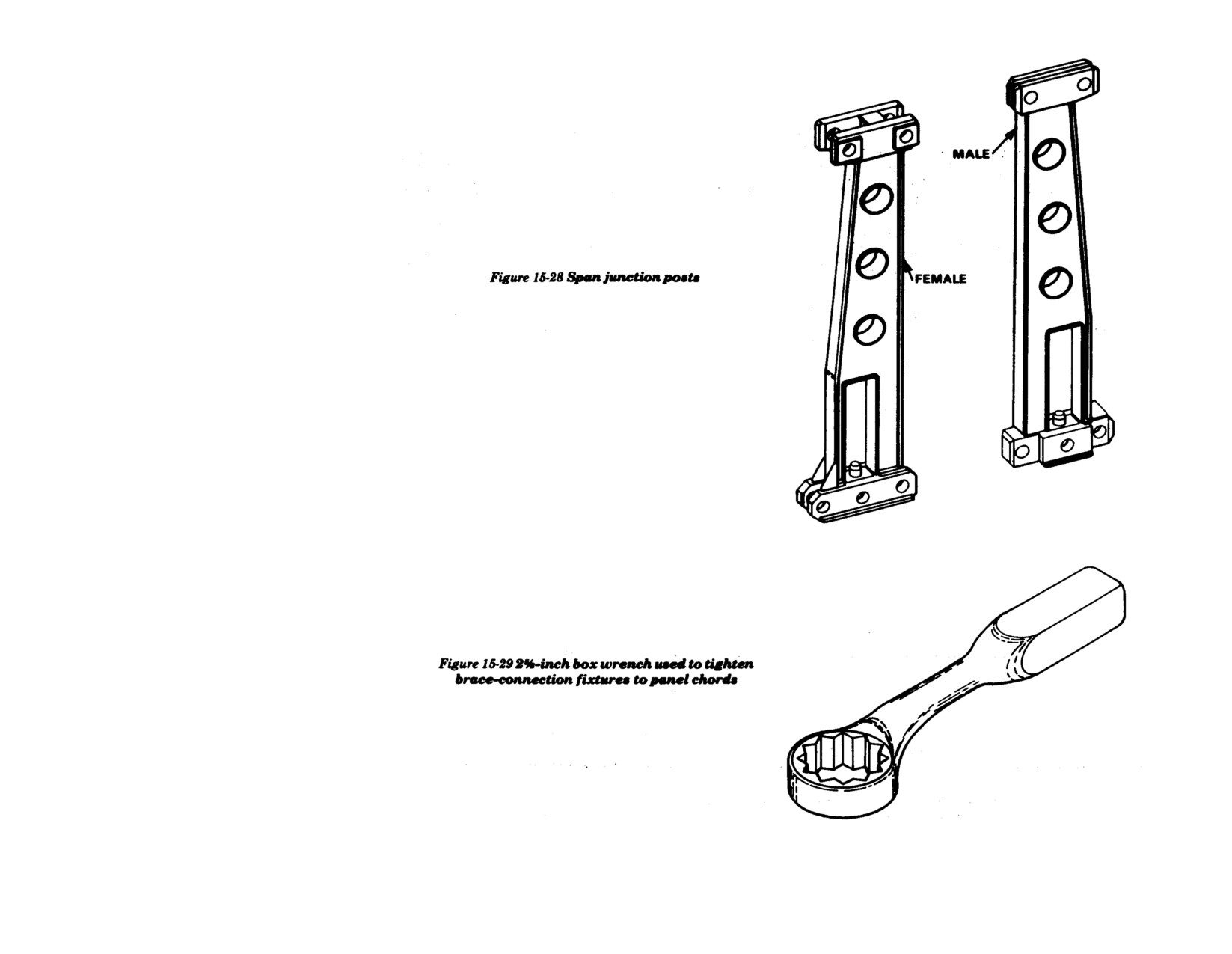
SPAN JUNCTION POSTS
Male and female span junction posts (Figure
15-28, page 176) from bridge conversion set
No. 3, Bailey type, panel crib pier, fixed M2
are used in place of the standard end post.
The male post weighs 194 pounds (88.2 kilos)
bridge. Each weighs 65 pounds (29.5 kilos).
and the female post weighs 202 pounds (91.8
They are powered by either one 10-kilowatt
kilos).
generator or two 5-kilowatt generators.
BOX WRENCH
One double-acting hydraulic cylinder (Figure
A special 2
5/8-inch (14.3 centimeters) box
15-21) is required for each cable. A hole
wrench (Figure 15-29, page 176) with offset
through the center of the cylinder allows
head is used to tighten the chord bolts inserted
installation of the cylinder on the pull rod.
through chord plates. After the nut is tight-
The power unit is used to expand and retract
ened as much as possible by normal means,
the cylinders. When the cylinder is pres-
use this wrench to tighten it another one-
fourth turn by striking the end of the wrench
surized to expand, it advances the pull rod
with a sledgehammer.
through the cable-connection beam, in-
creasing cable tension. Each cylinder weighs
65 pounds (29.5 kilos).
175
FM 5-277
176
FM 5-277
INSTALLATION AND DISMANTLING
SERVICE UPON RECEIPT
When new, used, or reconditioned material is
2
Place three cable reels with cables, which
on top of lower chords, using two 1¾-inch
first received by the using organization, make
are retained on the cable reel supports, on
(4.5 centimeters) bolts and hex nuts.
sure this material has been properly serviced
each side of the roadway at rear of bridge
by the supplying organization, and that it is
erection site. Remove cable reels from bed
3
When a point approximately 4 feet (1.2
in proper working condition. Keep records on
of truck by using crane or gin poles.
meters) behind the panel point has cleared
any missing assemblies or component parts
the rocking rollers, install brace-connec-
and equipment. Perform the following inspec-
To erect cable reel supports, place three un-
tion fixtures. Position large holes in
tions and services for the cable reinforcement
loaded cable reels side by side; insert cable
brace-connection fixtures about 3 feet 9
set before any installation procedures:
reel shaft through center hole of cable reels;
inches (1.2 meters) ahead of and behind
lift one end of cable reel shaft, close to cable
panel point. On one side, holes will lineup
Remove any cushioning material or pro-
reel; and slide cable reel support on cable reel
with holes in lower chord used for multi-
tective covers from packaged cable-
shaft. Repeat for other end of cable reel shaft.
story construction. Secure brace-connec-
tensioning assemblies and pull-rod
tion fixture by placing chord bolts through
assemblies.
Post assembly
these holes and tightening hex nuts. On
Attach post assemblies to the lower panel
the other side, use two chord plates and
Perform preventive maintenance checks
chords of the bridge according to Table 15-1.
bolt through the panel lower chords. Place
and services as required, in accordance
To install each vertical post, proceed as
bolt with nut on top of chord plate. Tighten
with Table B-3, Appendix B.
follows:
nut enough to secure brace-connection
fixture but to allow for adjustment later.
Caution:
In order to install a post
Inspect cable-tensioning assembly for any
assembly correctly, the post-connec-
leakage or damage which would limit
4
When at least 8 feet (2.5 meters) of
tion fixture must be installed directly
effective operation.
clearance is available below panel point,
beneath the vertical member between
install vertical post. Remove cable re-
two panels (from now on referred to
USE WITH NEW BRIDGE
tainer from vertical post and lower post
as the panel point).
The cable reinforcement set can be used with
over side of bridge using ¾-inch (1.9 centi-
both new and existing panel bridges. When
meters) hemp rope. Secure vertical post to
used with a new bridge, it should be installed
1 When panel point has sufficiently cleared
post-connection fixture, using four ¾-inch
concurrently with assembly of the new bridge.
rocking roller, position post-connection
(1.9 centimeters) diameter high-strength
fixture directly beneath panel point.
bolts and hex nuts.
Placement of material
Install material before assembly of the bridge
2 Secure post-connection fixture to bridge-
WARNING: All personnel who are lowered
as follows:
panel lower chord using four l¾-inch (4.5
over the side of the bridge in a boatwain's
centimeters) diameter chord bolts and
chair must also wear a safety belt connected
1
Unload contents of trucks which carry all
hex nuts. Tighten bolts firmly. Place bolts
assemblies and component parts (except
on one end of the post-connection fixture
to a lashing which, in turn, is secured to the
the cables and cable reels) and stack them
in holes normally used for adding second-
side of the bridge.
in the vicinity of the end posts in the M2
or third-story tiers to Bailey bridge. Secure
panel bridge standard layout.
the other end by placing two chord plates
177
FM 5-277
5
Secure one longitudinal brace to plate
weldment of brace-connection fixture with
two ¾-inch (1.9 centimeters) diameter
high-strength bolts and hex nuts. Bolt
opposite end of longitudinal brace to plate
weldment on bottom end of vertical post,
using two high-strength bolts and hex
nuts (Figure 15-8).
6
Secure second longitudinal brace to plate
on brace-connection fixture which is
secured with chord plates, with two ¾-
inch (1.9 centimeters) diameter high-
strength bolts and hex nuts. Attach
opposite end of brace to plate weldment
on lower end of vertical post using the
same hardware. A small adjustment in
position of this longitudinal brace-
connection fixture may be necessary to
complete installation of the second longi-
tudinal brace. Once brace-connection
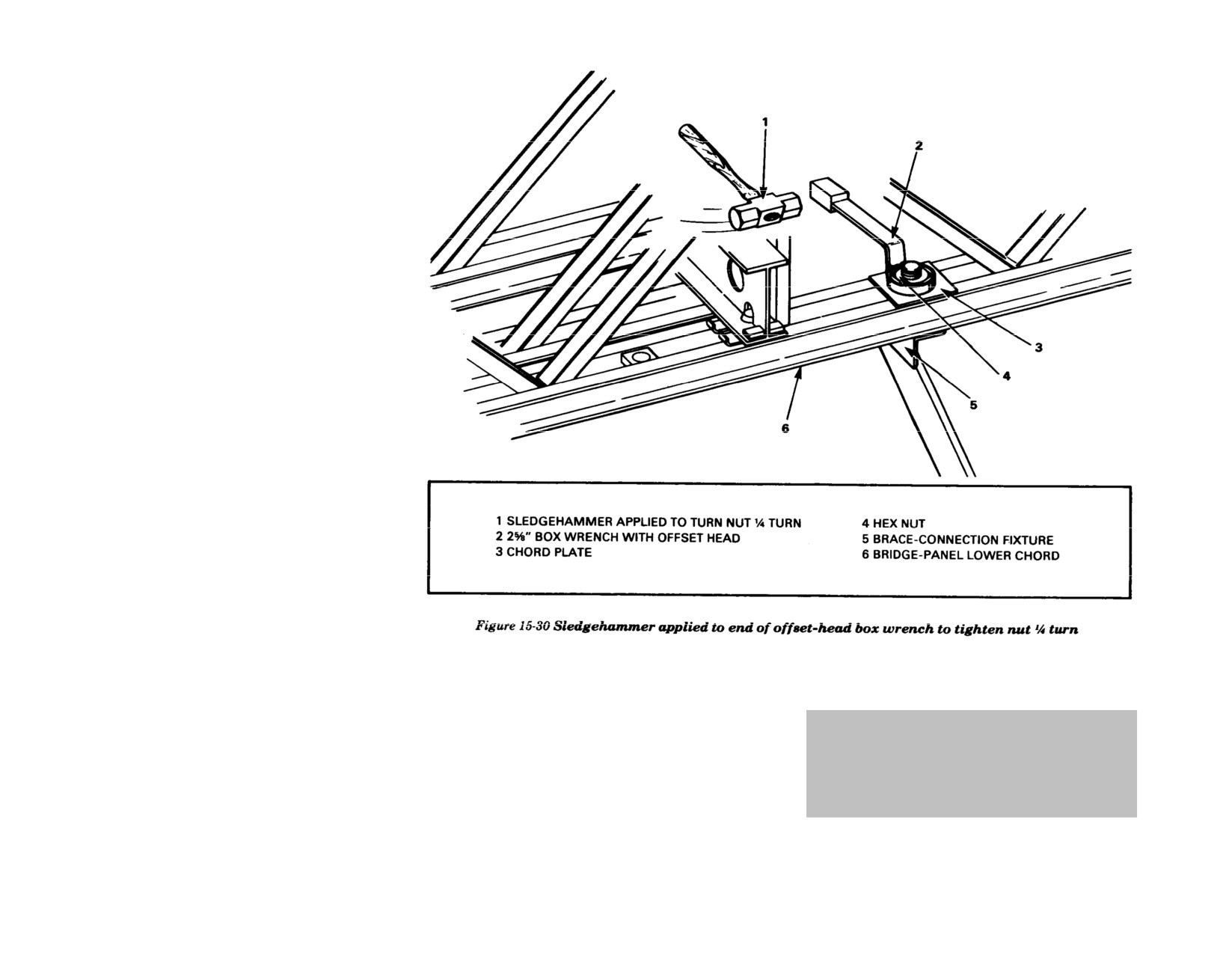
fixture is positioned, tighten chord bolts
through chord plates using 2
5/8-inch (6.7
centimeters) box wrench having offset
head. Turn nut on bolt threads one-fourth
turn, from point where a person can no
longer tighten bolt by applying hand
pressure to wrench, by striking wrench
with sledgehammer (Figure 15-30) to
full-length transverse braces. Connect two
through the hole provided in the braces
complete installation of longitudinal
transverse braces to plates on each end of
(Figure 15-12).
braces.
vertical posts to form X-type bracing.
Secure each end of transverse braces to
Caution:
This bolt provides a stabi-
7
Connect long transverse brace to short
vertical post weldment plates by two
lizing function for the transverse
transverse brace, which has a welded
¾-inch (1.9 centimeters) high-strength
braces. Do not forget to install it.
splice plate, with four ¾-inch (1.9 centi-
bolts and hex nuts. Bolt the two transverse
Omission of this bolt could result in
meters) diameter high-strength bolts and
braces together where they cross by
damage to the equipment.
hex nuts to form full-length transverse
installing a ¾-inch (1.9 centimeters)
brace. Repeat this procedure to form all
diameter high-strength bolt and hex nut
178
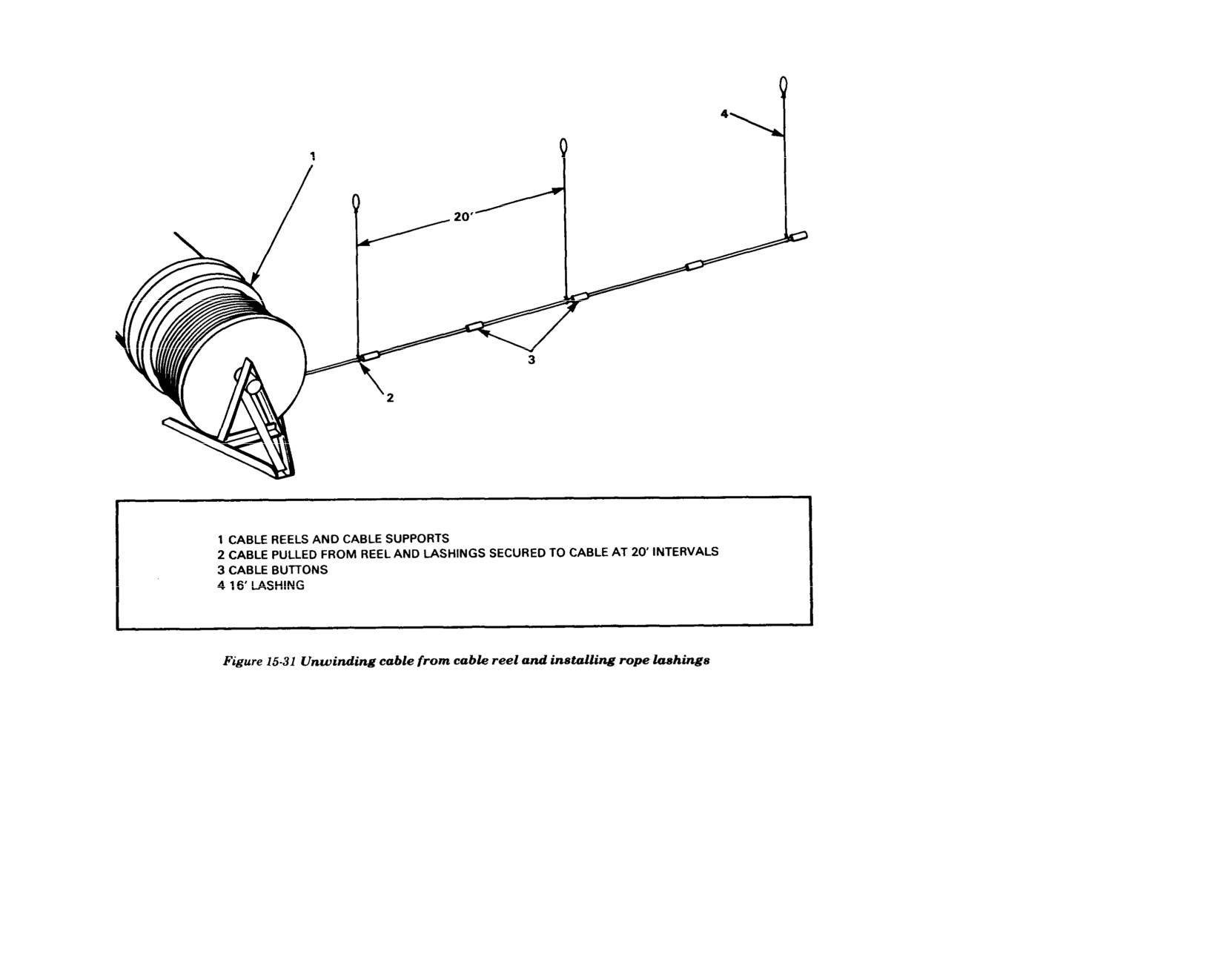
FM 5-277
tate carrying and lashing of cable (Figure
15-31). Using these ropes to support cable,
carry cable onto bridge.
3
When cable button number 180 is at the
panel which will be the end panel on far
shore, lash cable to panels.
4
Repeat the three steps above for each
cable on each side of bridge. If three
cables are installed on each side of bridge,
lash cable to be installed in inner slot of
vertical-post saddle to lower part of bridge
panels. Lash cable for center saddle slot
to middle of panels and lash outside cable
to top part of panels.
Span junction posts
Just before final positioning of the bridge,
install female span junction posts on one side
of the bridge. Then do as follows:
1
Insert a transom through holes in female
span junction posts and push through
hole until flange of transom hits side of
female span junction posts.
2
Install female span junction posts on the
other side.
Position of cables
1
Unwind one cable at a time from cable
3
Position the transom properly on studs of
The total number of cables used depends on
reels, button end first.
the six female span junction posts.
the bridge span; Table 15-1 gives the number
needed for various spans. Place the required
2
Loop 16-foot (4.9 meters) length of ¾-inch
cables in a preliminary position on the bridge
(1.9 centimeters) diameter hemp rope to
structure before launching the bridge, using
cable at 2-foot (61.1 centimeters) intervals.
the following procedure:
Make a loop at each end of rope to facili-
179
FM 6-277
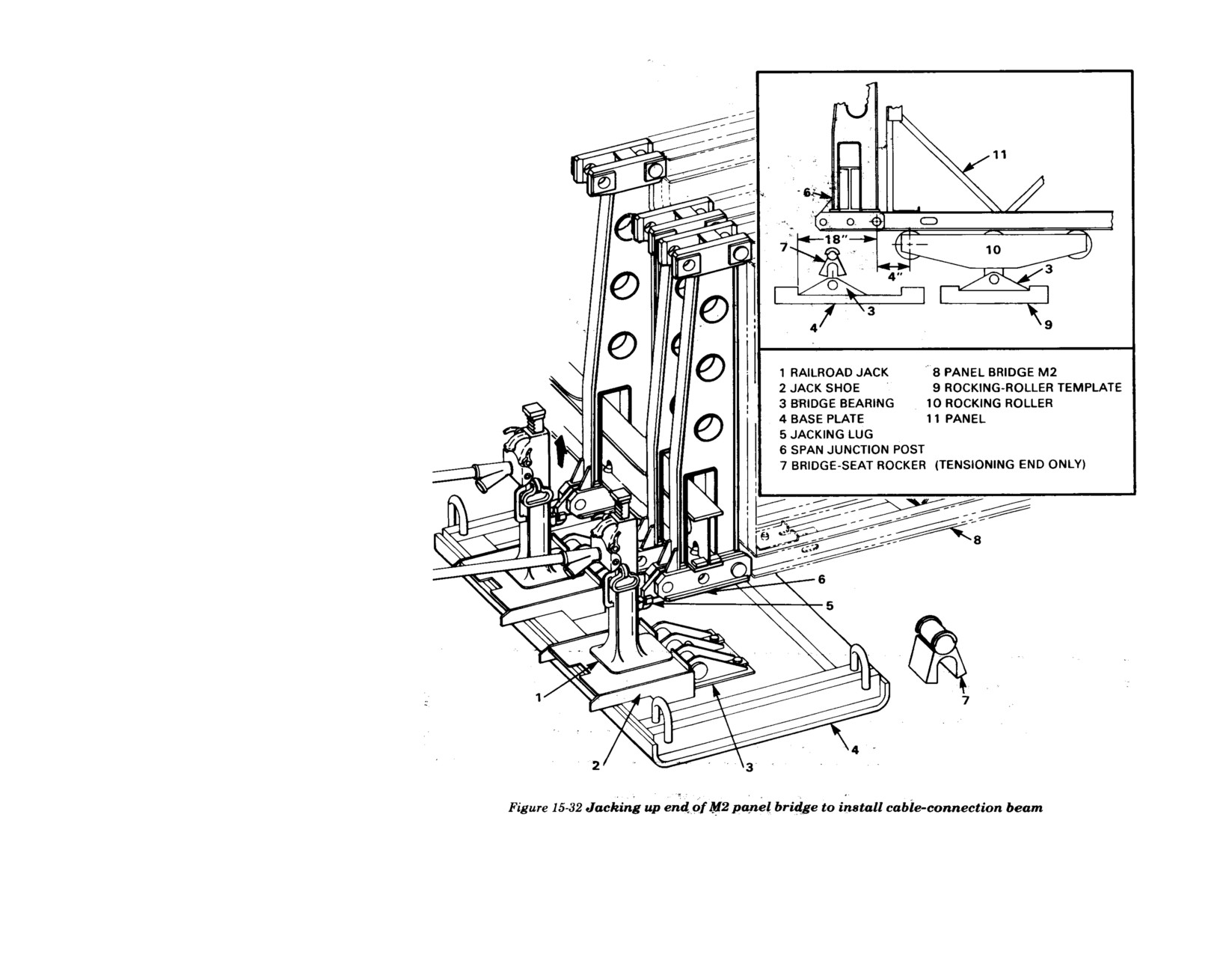
Bridge bearing plate
To position the bridge bearing plate, do as
follows:
1
Position bridge so that centerline of first
panel pin, through bottom of span junc-
tion post, measures 4 inches (10.2 centi-
meters) to centerline of outer rocking
roller.
2
Place the back inside edge of the base
plate about 18 inches (45.8 centimeters)
behind centerline of first panel pin.
3
On tensioning end of bridge, place special
bridge seat rocker (Figure 15-22) over
each bearing to allow longitudinal dis-
placement of bridge under load.
Note:
When bridge is jacked down, bearing
shoe on bottom of installed cable-connec-
tion beam will mate bearings on baseplate
or rockers on bearings.
Jacking up of bridge
Jack up the bridge as follows:
1
Install two jacking lugs (Figure 15-27) at
each bridge corner, one on end hole of
outside span junction post and one on the
end hole of inside span junction post,
using panel pins (Figure 15-32).
2
Install railroad jacks and jack up end of
bridge to ease installation of cable-
connection beams.
180
FM 5-277
3
Use normal bridge installation procedure
for removal of rocking rollers and tem-
plates, and we cribbing under the lower
chord for safety in case bridge slips off
jacks.
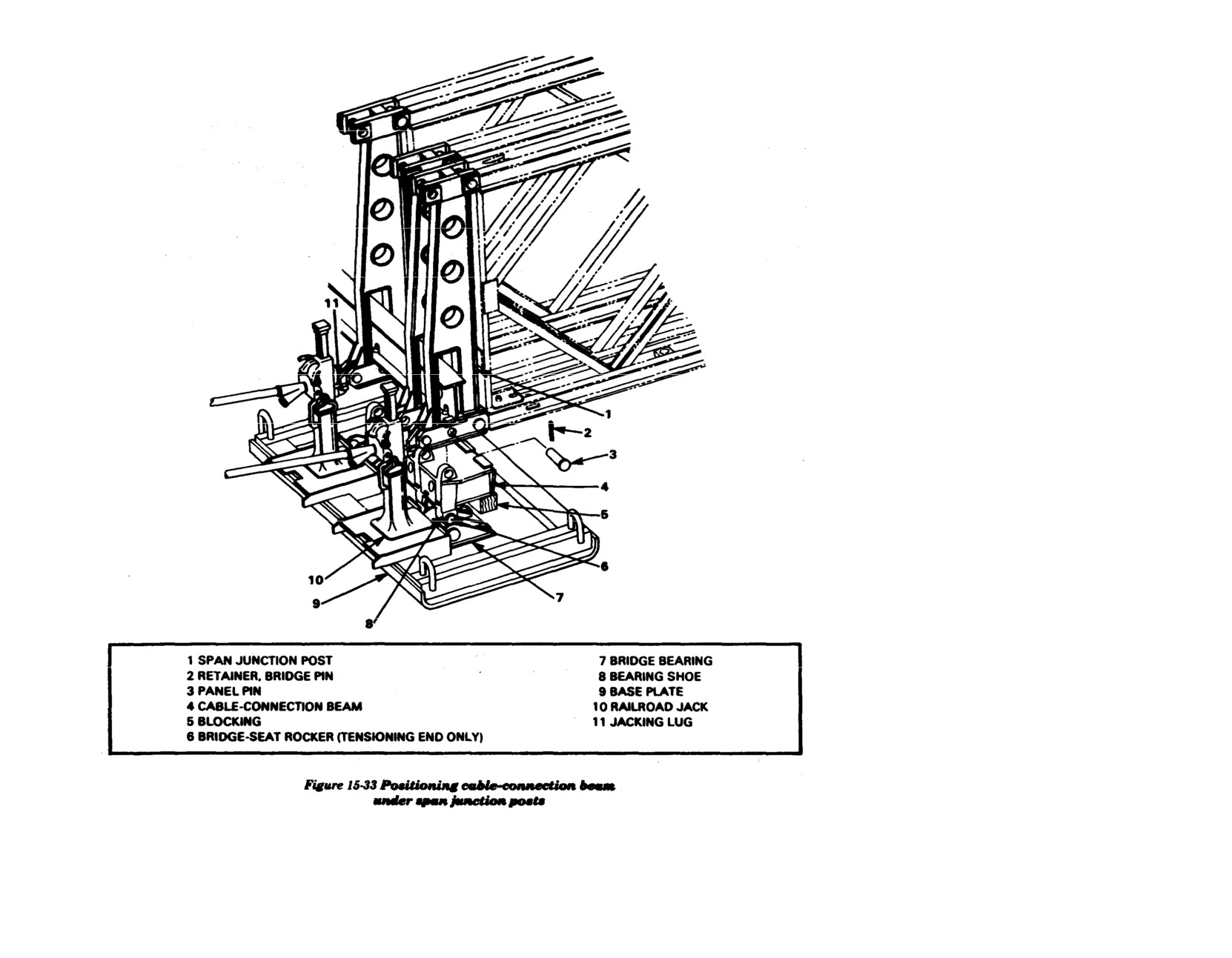
Cable-connection beam
To install cable-connection beam, do as
follows:
1
Position cable-connection beams on
bridge seat rockers (tensioning end only)
or bearings (dead end) under raised span
junction posts.
2
Using normal jacking procedure, lower
bridge onto cable-connection beams until
holes in beam lugs align with lower center
holes in span junction posts (Figure 15-33).
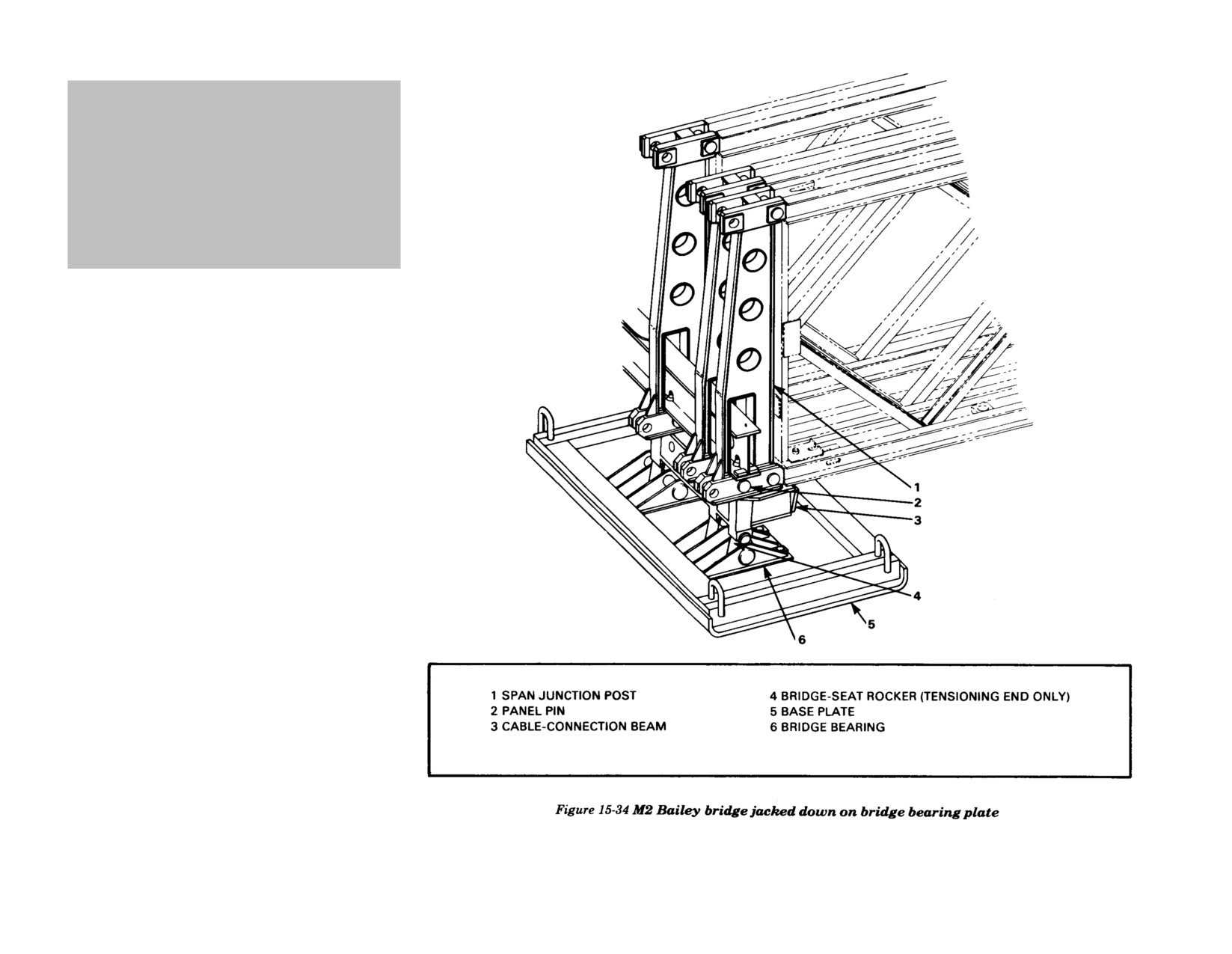
3
Secure the cable-connection beams to
span junction posts using a set of standard
panel pins, and secure panel pins with
retainer clips.
4
Complete jacking bridge down onto the
bearings (Figure 15-34, page 182) and
continue with normal procedure for stand-
ard installation of the bridge.
181
FM 5-277
Caution:
It is essential that both near-
and far-shore abutment cribbings be
level transversely with each other in
order to eliminate eccentric loading
causing bridge elements to be stressed
beyond their capacity. It should also
be noted that the bridge seat rockers
will cause the tensioning end to be
higher by the installed height of the
rockers.
Installation of cable
After the bridge has been decked, install all
cables. Use the following procedure for each
cable
1
Remove lashing ropes from side panels of
bridge but not from cable.
2
Using the ropes to support the cable,
thread button number 180 and the fol-
lowing cable through dead-end cable-
connection beam. If only two cables are
used, one on each side, thread each cable
through center hole of cable-connection
beam. If four cables are used, two on each
side, no cable is threaded through center
hole. Continue threading operation until
cable button stamped with number cor-
responding to span length in feet has
passed through cable-connection beam.
3
Place two half-cable retainers between
button and cable-connection beam
bearing surface (Figure 15-18) to prevent
button from being pulled through cable-
connection beam during cable tensioning.
4
At tensioning end of the bridge, remove
cable and cylinder nuts from pull rod and
thread pull rod into rod-to-cable coupling.
182