FM 5-277 BAILEY BRIDGE (May 1986) - page 8
FM 5-277
214
FM 5-277
During launching, connect the top lugs of the
The female span junction post weighs 202
posts by a launching-nose link Mk II. The
pounds (91.8 kilos) and the male span junction
link will fit only between one female span
post weighs 194 pounds (88.2 kilos).
junction post and one male span junction
post, so take care when constructing the two
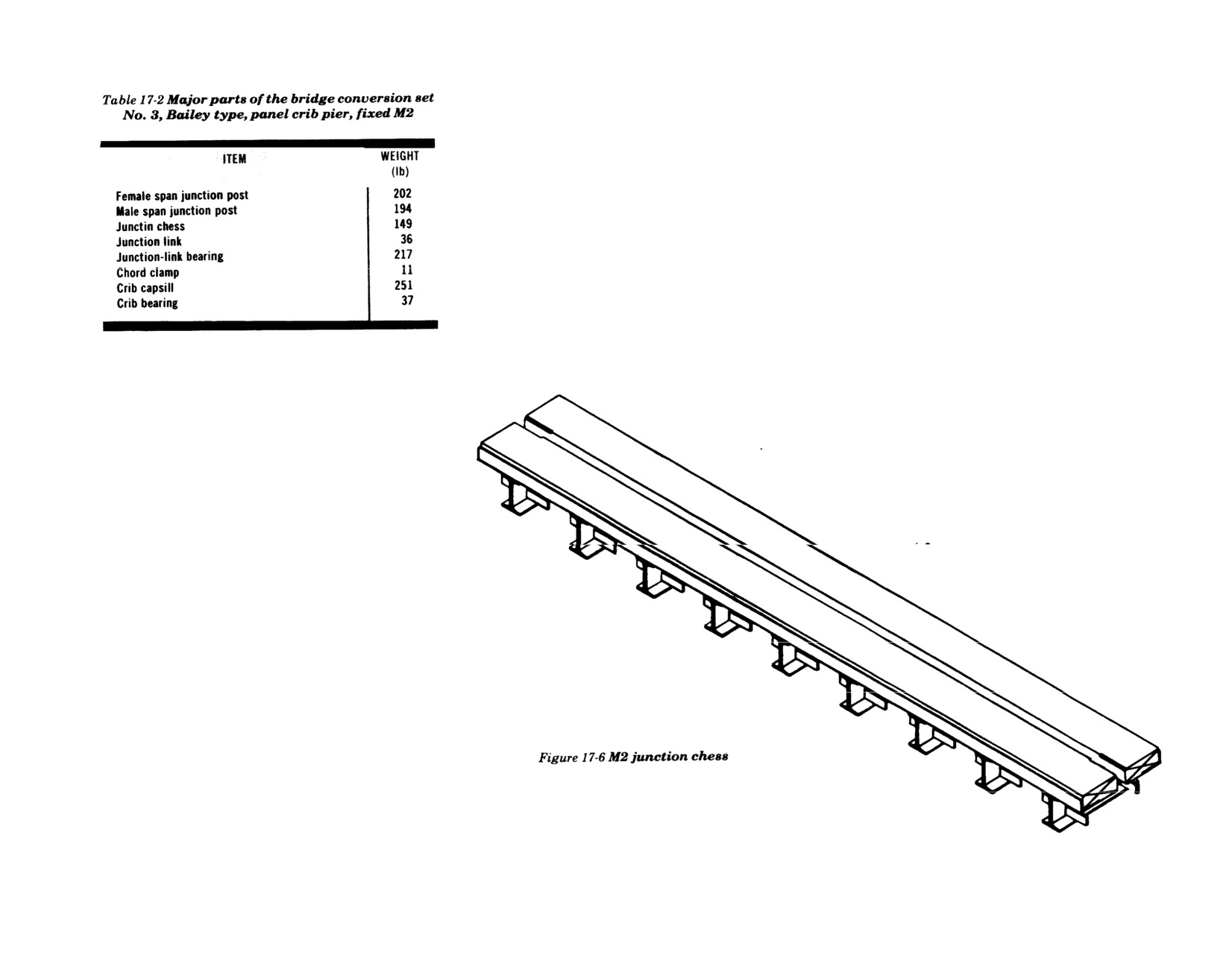
M2 JUNCTION CHESS
spans to keep all the male lugs on the panels
Junction chess (Figure 17-6) span the gap in
faced the same way. After the bridge is jacked
the bridge deck between the ends of the two
down and posts are pinned to the junction
spans connected by span junction posts. Four
link, remove the link; leave in the pin joining
junction chess are used at each span junction.
the two posts at their base. Then the gap
between the two lugs of the posts allows an
The junction chess consists of two 6-foot 10 ½-
upward slope of 1 to 6.7 or a downward slope
inch (2.1 meters) timbers fastened to nine
SPECIAL PARTS FOR
of 1 to 5 in one span when the other is level.
steel I-beams 11½ inches (29.3 centimeters)
PANEL CRIB PIERS
long. The junction chess weighs 149 pounds
The bridge conversion set No. 3, Bailey type,
(67.7 kilos).
panel crib pier, contains parts that are used
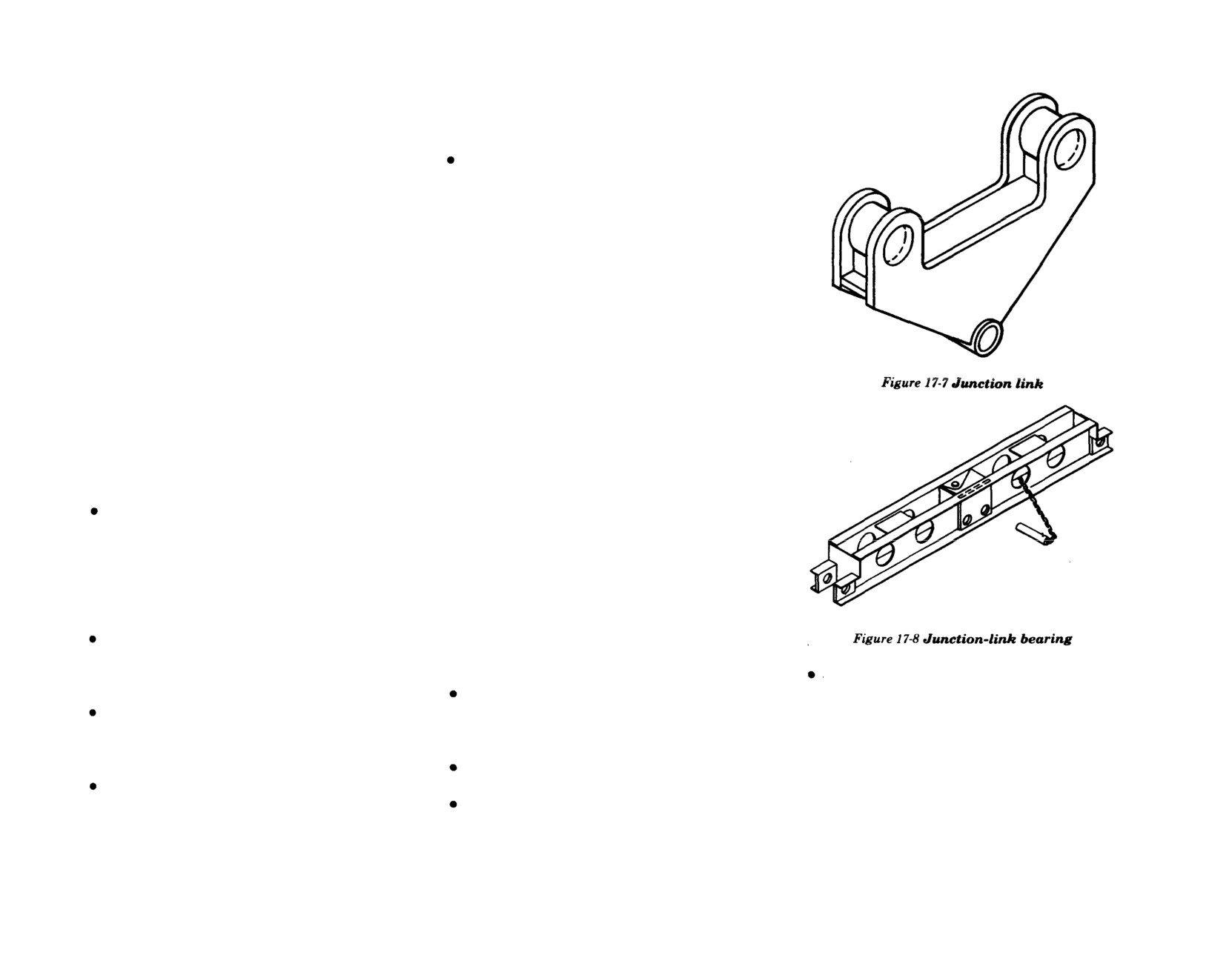
JUNCTION LINK
with equipment from the basic bridge set to
The junction link (Figure 17-7 page 216)
build panel crib piers. The major items in the
transfers the end reaction from two-span
conversion set are listed in Table 17-2.
junction posts to a junction-link bearing. Its
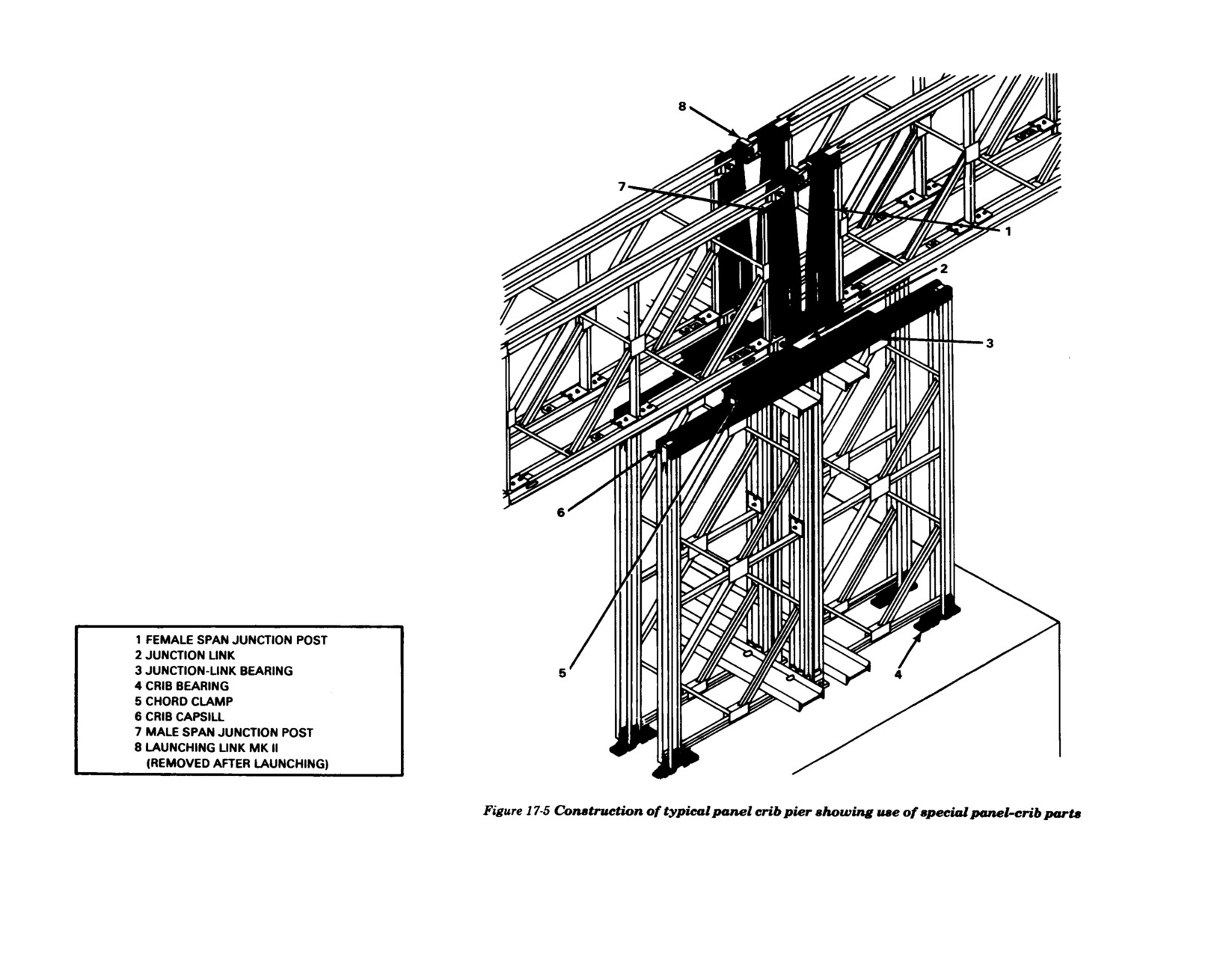
SPAN JUNCTION POSTS
use limits truss reaction to 25 tons (22.8
Span junction posts are special end posts for
connecting adjacent ends of two spans and
supporting them on the same bearing.
There are two types of span junction posts,
male and female, which have lugs that are
pinned to female and male ends, respectively,
of standard panels. At the junction, each post
has two other connecting lugs, a male and
female lug at the top according to type, and a
universal jaw at the base. Irrespective of
type, two posts can be connected at the base
by a normal panel pin. Always use a bridge
pin retainer on the panel pin at this joint. An
intermediate pin hole and recess in the base
of each post is for the junction link.
215
FM 5-277
The junction link is a triangular-shaped steel
When supported by timber, lay junction-
assembly with two projecting male lugs on its
link bearing directly on a timber support.
top side spaced to pin with panel pins to the
two-span junction posts. Both holes are
The junction-link bearing is made of two 8-
elongated to permit some play in the joint. A
inch (20.4 centimeters) channels welded back
bridge pin retainer must always be used on
to back with the same spacing as between
the panel pins at this joint. The bottom of the
channels in the chords of the panel. It is 5 feet
junction link tapers down to a nose with a
1 inch (1.6 meters) long and has female jaws
tubular bearing which seats in the curved
at each end. The distance between panel-pin
bearing plate of the junction-link bearing.
holes in the female jaws is 4 feet 9 inches (1.5
The junction link weighs 36 pounds (16.4
meters), the same as vertical distance between
kilos).
pin holes in the pane). Between the webs of
the channels in the center of the junction-link
JUNCTION-LINK BEARING
bearing is a curved bearing plate on which
The junction-link bearing (Figure 17-8) is
the junction link bears. There is a hole
used under the junction link which supports
through the webs of the channels just above
the ends of the bridge. It can be used in the
the curved bearing plate for a captive pin
following ways:
which locks the junction link in place. There
are two panel-pin holes in the webs of the
When supported by a vertical panel, if
channels beneath the curved bearing plate.
male lugs of panel are uppermost, pin
They are used to pin the crib bearing which
jaws of the junction-link bearings to the
fits in the recess between the channels. A
panel lugs. If female lugs are uppermost,
junction-link bearing weighs 217 pounds (99.3
rest jaws of junction-link bearing on top
kilos). Its maximum capacity is 25 tons (22.8
of lugs and fasten them by chord clamps.
metric tons) (Table A-14, Appendix A).
When supported by a crib capsill (Figure
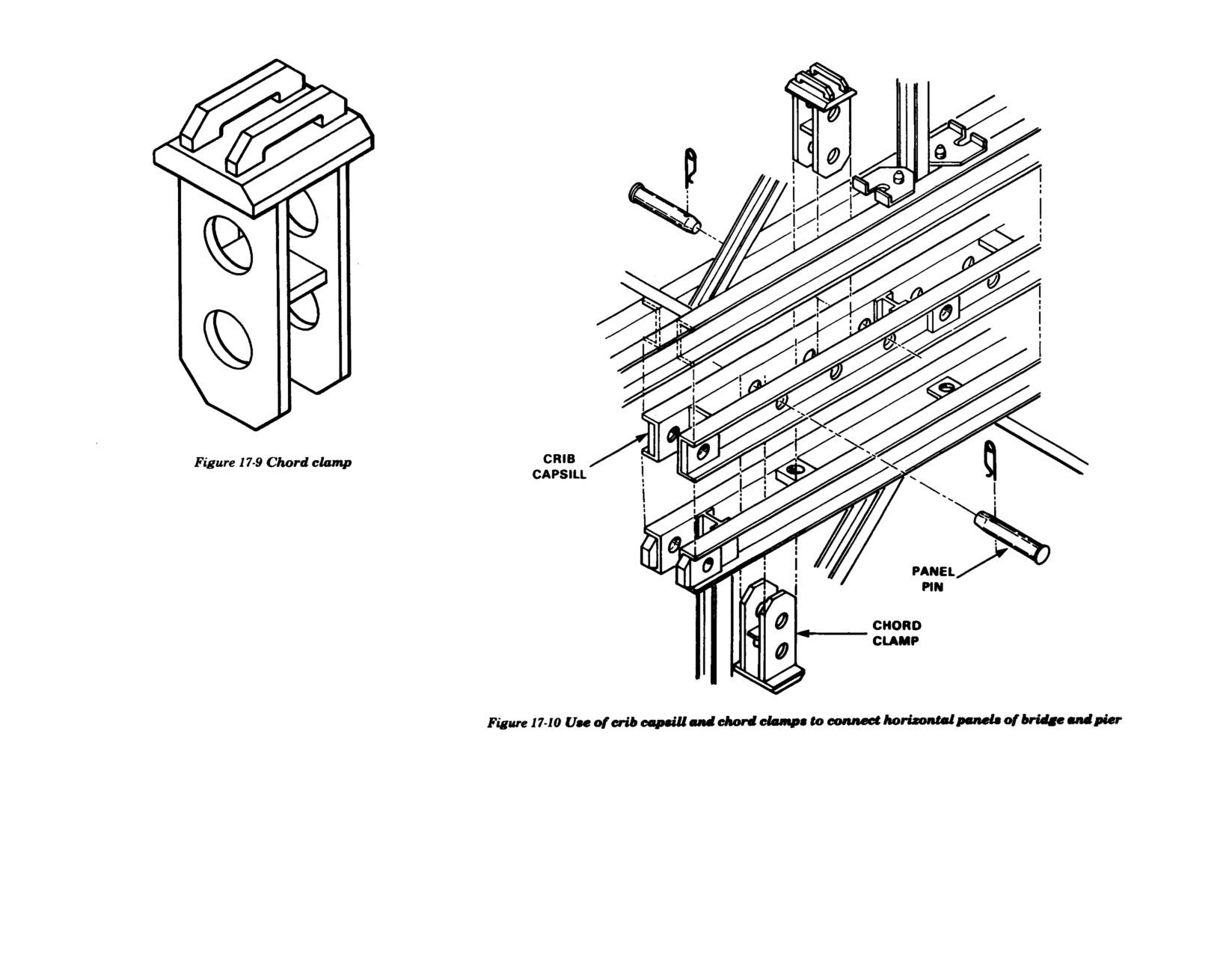
CHORD CLAMP
17-5), secure it to the capsill with chord
The chord clamp (Figure 17-9) is used to pin—
clamps.
Junction-link bearing to female jaw of
Crib capsill to panel chord (Figure 17-10).
panel.
When supported by a crib bearing, pin
Chord clamps are pinned to any of the
bearing to two center holes of junction-
holes in the capsill.
The chord clamp is in effect a double-length
link bearing with panel pins.
male lug with two panel-pin holes and a T-
Crib capsill to female jaw of panel.
head. Slip the clamp between chord channels
When used under female end of vertical
of a panel until the head bears on the channel
panel, rest female lugs of panel on jaws of
Crib capsill to junction-link bearing
flanges; then pin the clamp to a crib capsill or
junction-link bearing and secure them by
(Figure 17-5).
other female joint with a panel pin. If the
chord clamps.
216
FM 5-277
chord clamp is slipped through two adjacent
female jaws, pin it to each by panel pins
through both holes in the chord clamp. The
chord clamp weighs 11 pounds (5 kilos).
217
FM 5-277
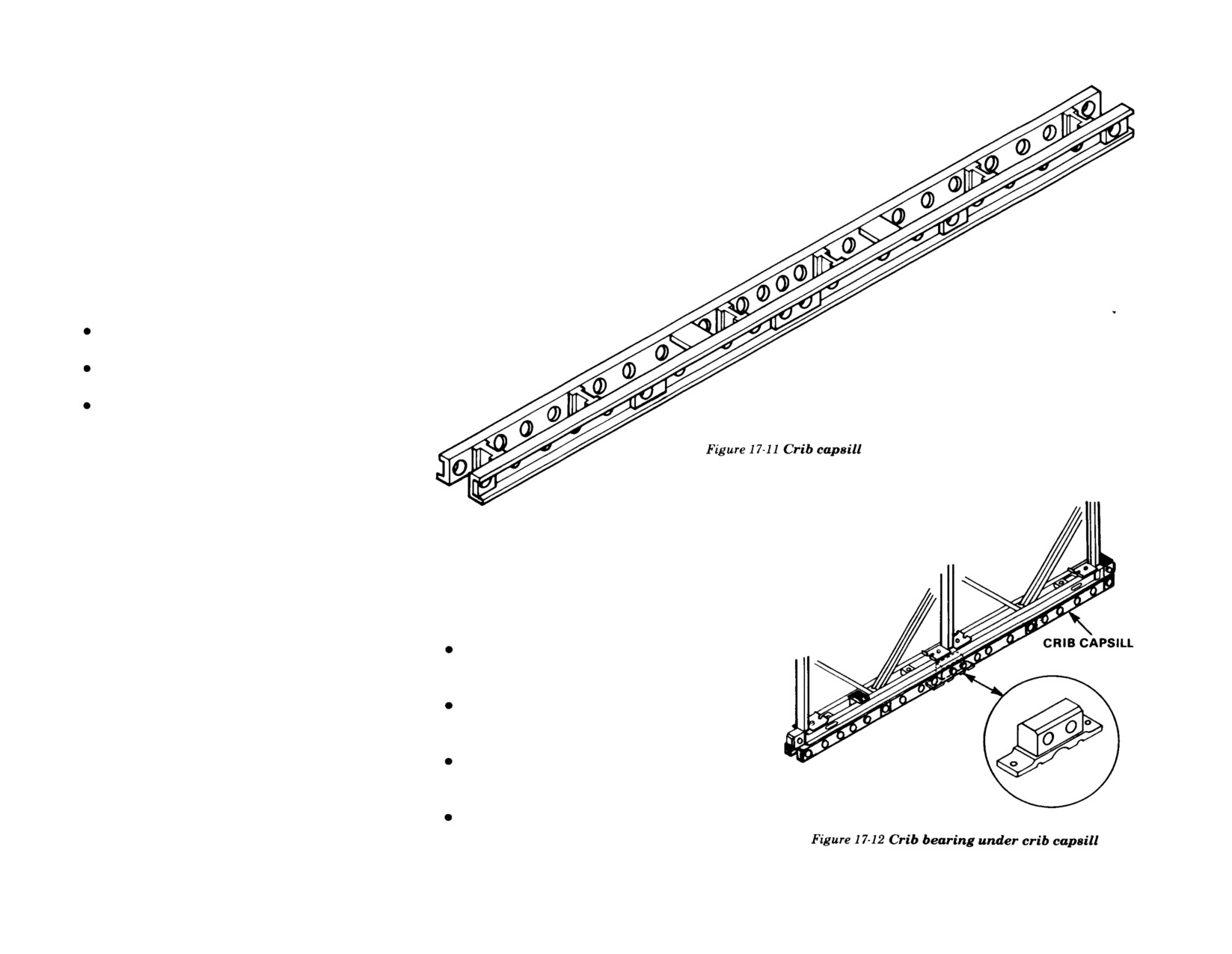
CRIB CAPSILL
The crib capsill (Figure 17-11) distributes the
load from the bridge to the main chords of
vertical panels or to the three verticals of
horizontal panels in a crib. It has unrein-
forced holes used to take the vertical load.
Before panel pins can be inserted in reinforced
holes, the holes must be reamed or filed
slightly. The reinforced holes are used to pin
the capsill to the following:
Male lugs of single vertical panels.
Male lugs of two adjacent vertical panels.
Crib bearing (Figure 17-12).
The crib capsill is made of two 4-inch (10.2
centimeters) channels welded back to back to
spacer lugs with the same spacing between
channels as in the chord of the standard
panel. It is 10 feet 2 inches (3.1 meters) long,
and has female jaws at each end. Holes are
spaced along the webs of the channels. Six
CRIB BEARING
pairs of panel-pin holes are reinforced with
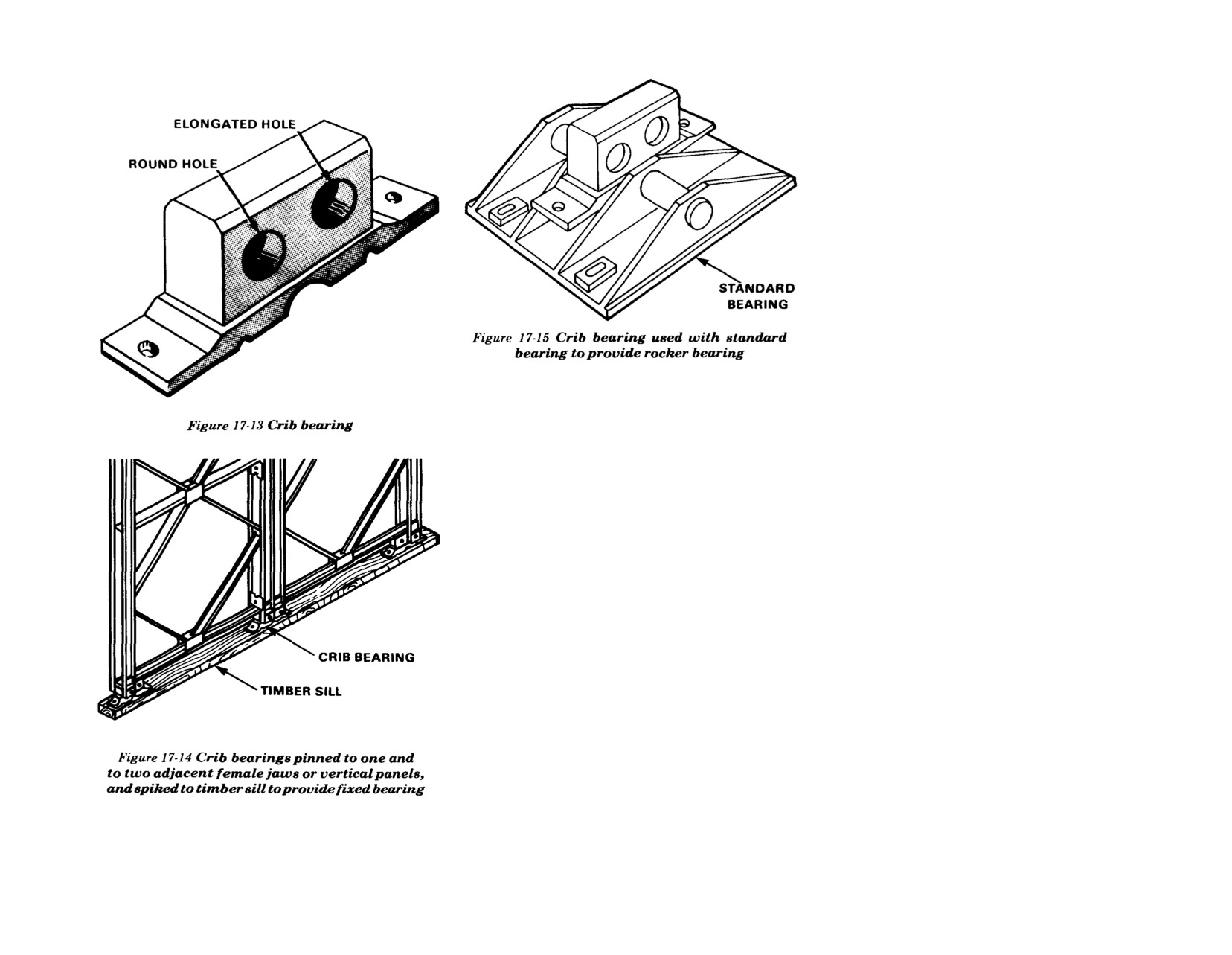
The crib bearing (Figure 17-13) is used as a
steel blocks and spaced so male lugs of two
base of panel cribs and can be pinned with
adjacent panels or of a single panel can be
panel pins to the following:
connected to the crib capsill with panel pins.
Additional unreinforced holes for chord
One female jaw of vertical panel (Figure
clamps are spaced generally at 6-inch (15.3
17-14).
centimeters) centers between reinforced holes.
Before panel pins can be inserted through the
Two female jaws of adjacent vertical
holes they must be reamed or filed slightly.
panels (Figure 17-14).
The crib capsill weighs 251 pounds (114.1
kilos).
Two central holes of a crib capsill (Figure
17-12).
Two central holes of a junction-link
bearing.
218
FM 5-277
load transmitted to the crib by the ends of two
independent spans. Continuous-span
assembly over the pier transmits greater load
to the pier. These reactions are listed in Table
16-4.
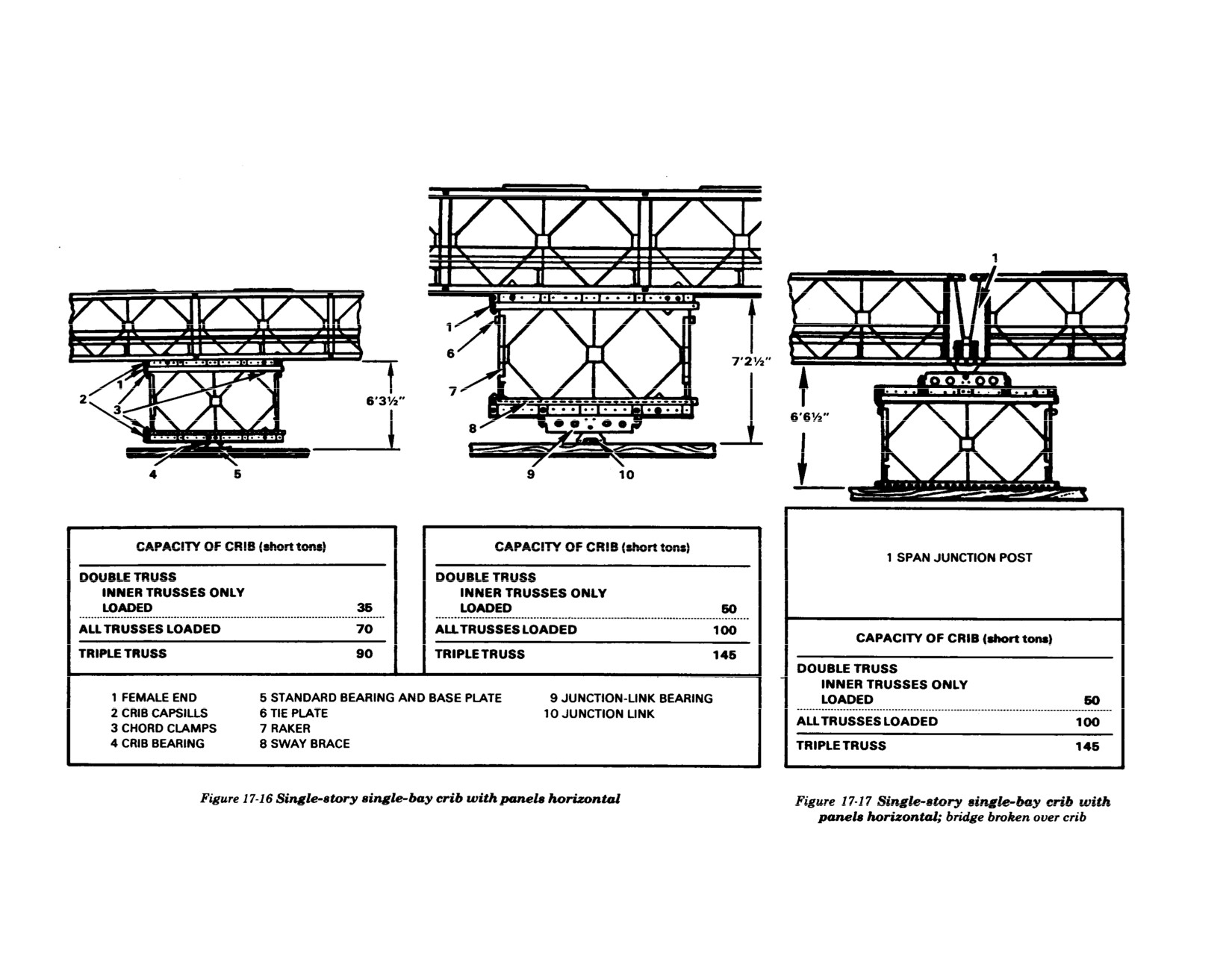
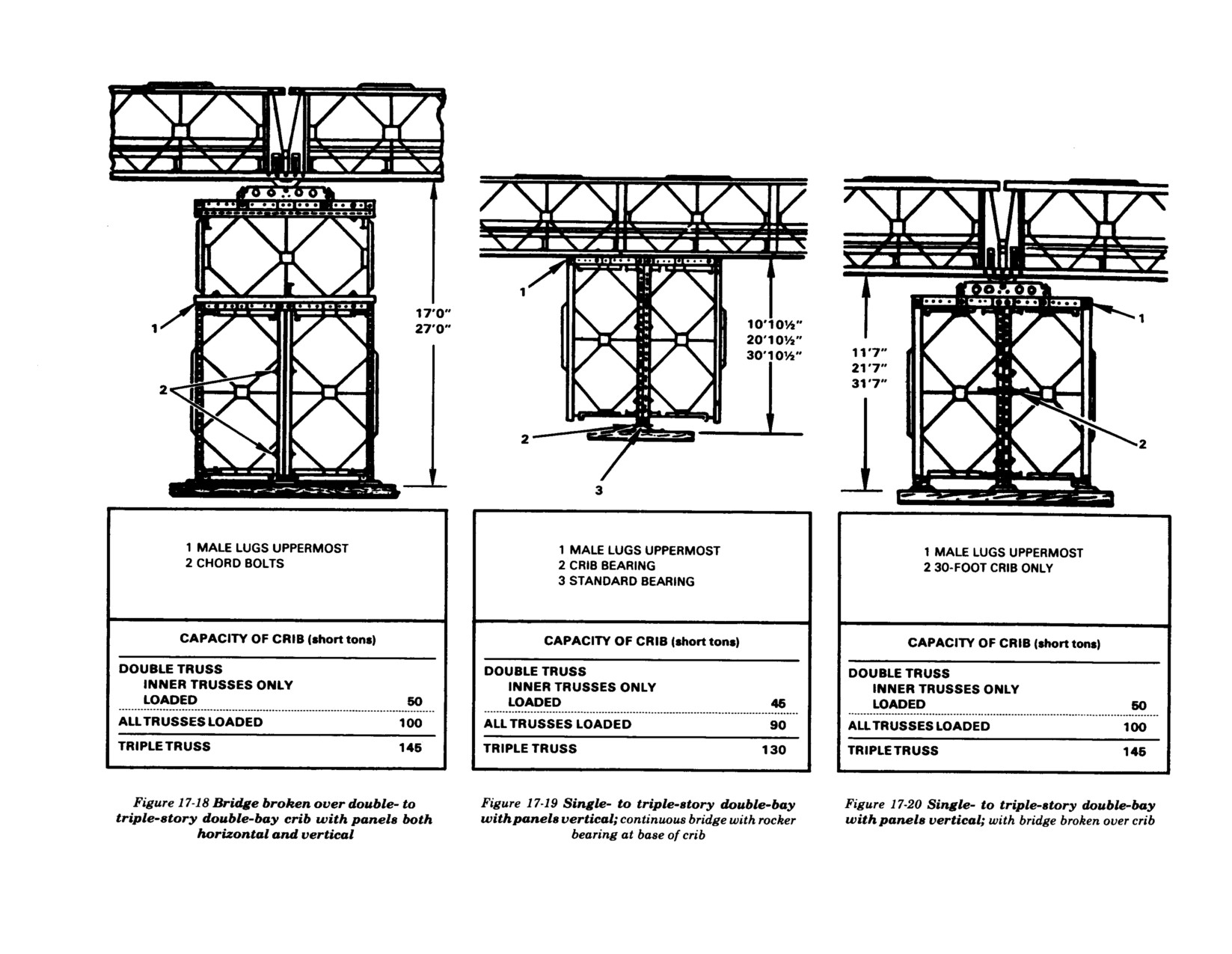
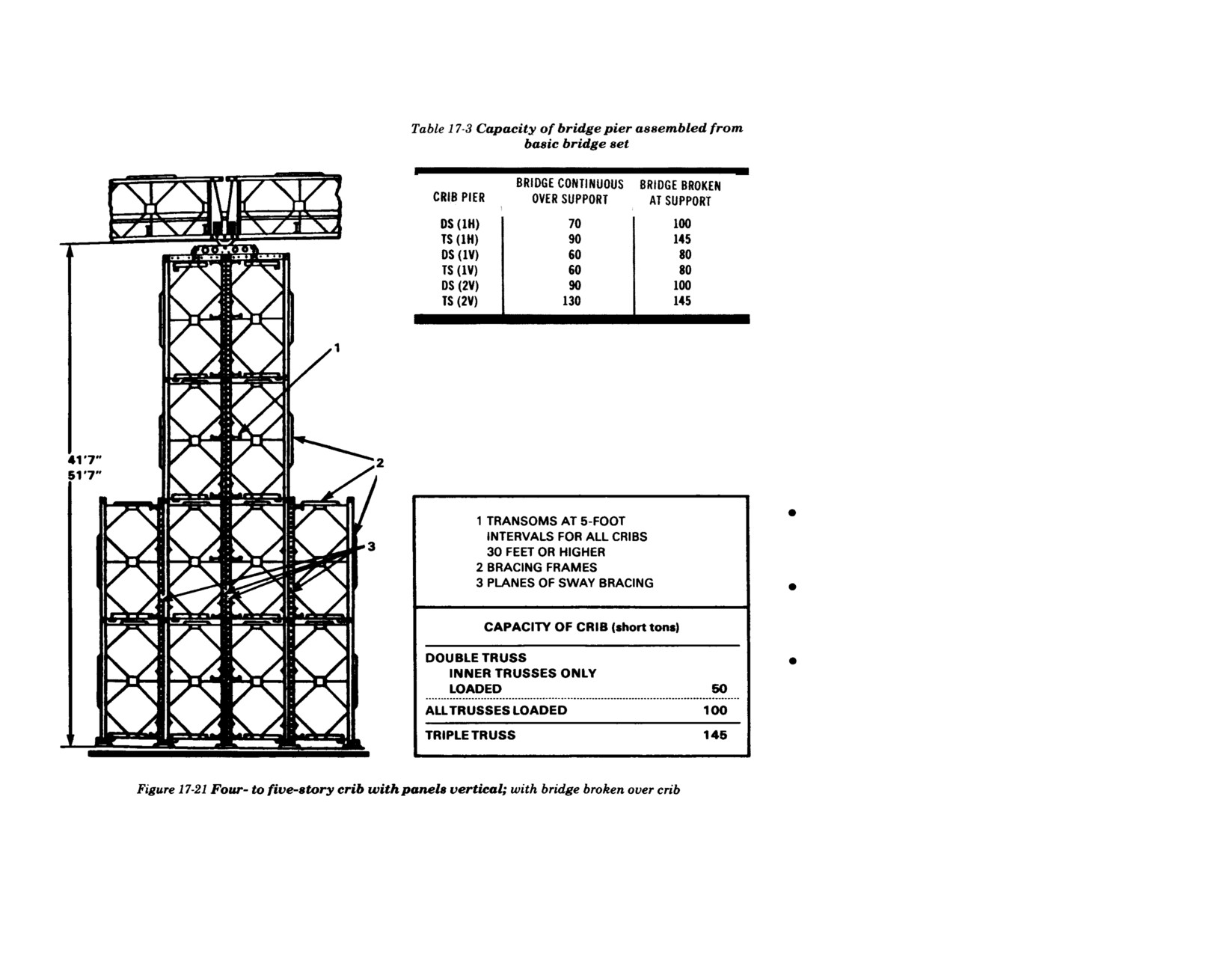
Figures 17-16 and 17-21 (pages 220 and 222)
show standard assembly of piers built with
special panel-crib parts. Capacities are given
in all cases. Single-truss cribs can take 50
percent of the loads given for double-truss
cribs with only the inner truss loaded. Use
single-truss cribs only for light loads on low
The crib bearing can be spiked to a timber sill
cribs. The capacity of panel crib piers is
(Figure 17-14) to provide a rigid base or set on
usually limited by the strength of the junction
a standard bearing (Figure 17-15) to provide a
link, junction-link bearing, and crib capsill
rocker bearing. The bearing area of the pin is
(Table A-14, Appendix A).
1.875 inches by 3 inches, or 5.625 square
inches (36.4 square centimeters).
If special panel-crib parts are not used, the
load is carried by the top members of vertical
The crib bearing is in effect a double-length
panels in the crib. Lay timber on top members
male lug welded horizontally to a base block.
of each panel to concentrate load at three
One of the pin holes is elongated to make
points: at the center, and near each end
pinning easier when both holes are used. If
adjacent to the panel chords. With the load
only one hole is needed, the circular one is
applied in this manner, the top member of
used. Holes are provided in the base block of
one vertical panel will carry about 14 tons
the crib bearing for spiking to a timber sill.
(12.7 metric tons), and piers with this type of
The underside of the base block has a semi-
bearing will have the same capacity as piers
circular bearing to seat on a standard
of corresponding assembly built with special
bearing. The crib bearing weighs 37 pounds
parts (Table 17-3, page 222).
(16.8 kilos).
Table A-14, Appendix A gives the strength of
CRIB LOAD AND CAPACITY
the individual panel-crib parts for use in
The amount of load on and the capacity of a
estimating the capacity of expedient panel
crib must be determined. Chapter 16 describes
cribs.
a method for determining the approximate
219
FM 5-277
220
FM 5-277
221
FM 5-277
BILLS OF MATERIAL
Table A-15, Appendix A lists the number of
parts required to build the standard crib piers
illustrated in Figures 17-16 through 17-21,
and the number of unit truck loads required
to supply these parts. Panel-bridge conver-
sion set No. 3, panel crib pier, supplies the
special panel-crib parts to build a 31-foot 7-
inch
triple-triple
pier with the addition of
standard panel-bridge parts. The parts in
conversion set No. 3 are listed in Table A-4,
Appendix A. The conversion set No. 3 makes
two crib-pier loads, each carried by a 5-ton
dump truck. These truck loads are described
in Chapter 2. The number of crib-pier loads
and standard unit truck loads required to
build each pier are given in Table A-15,
Appendix A.
When using this table, note the following
Plain bearings and base plates are not
supplied in loads needed to build a pier.
(Use extras from bridge construction.)
Launching links Mk II are used for
launching only. Remove them after bridge
is in place.
Panel pins listed do not include pins for
launching links Mk II.
STANDARD ASSEMBLY OF
TRUSSES AND BRACES
The trusses in standard panel crib piers are
parallel to trusses in the bridge. The crib
must have at least the same number of
trusses as the bridge it is to carry. More
222
FM 5-277
BRIDGE SEATING
In cribs with vertical panels, space transoms
If the bridge is broken over the pier so the two
at 10-feet (3.1 meters) intervals in piers up to
spans act independently, use span junction
30 feet (9.2 meters). In cribs only one bay
posts, junction links, and junction-link
long, invert panels of inner trusses with
bearings to seat it (Figure 17-5). If the crib is
respect to panels in outer trusses so transoms
pivoted at its base so the bridge is fastened
can be attached to both chords. Sway bracing
directly to the crib, slip chord clamps between
is on the same side of the crib throughout its
the channels of the bridge chord and pin
height. In cribs with two bays of vertical
them to the crib capsill (Figure 17-16).
panels, place panels so transoms and sway
bracing are either at the center of the crib or
Figure 17-15 illustrates rocker bearings using
at its sides. In cribs with four bays of vertical
panel-crib parts. This type of rocker bearing
panels, add extra sway bracing in the outer
rests on abase plate on top of the pier. A wide
bays (Figure 17-21).
platform on the top of the pier, to allow some
leeway in positioning the baseplates, may be
In cribs with horizontal panels, half the
built from transoms and ramps welded in
panels may be right side up, and the other
place (as described in the following para-
half inverted so transoms are at both top and
graphs). An expedient rocker bearing may be
bottom. Vertical-plane cross bracing may be
made from one or two tranverse beams set on
provided by sway braces pinned to the sway-
the top of the pier. The bearing must be under
brace slot of the inverted second truss and
a panel vertical or the junction of panel
fastened to the transom at the other end, or
diagonals. Figure 16-15 illustrates another
the sway bracing may be used as described
expedient bearing.
later in this chapter.
CRIB BASE
trusses can be added for increased strength
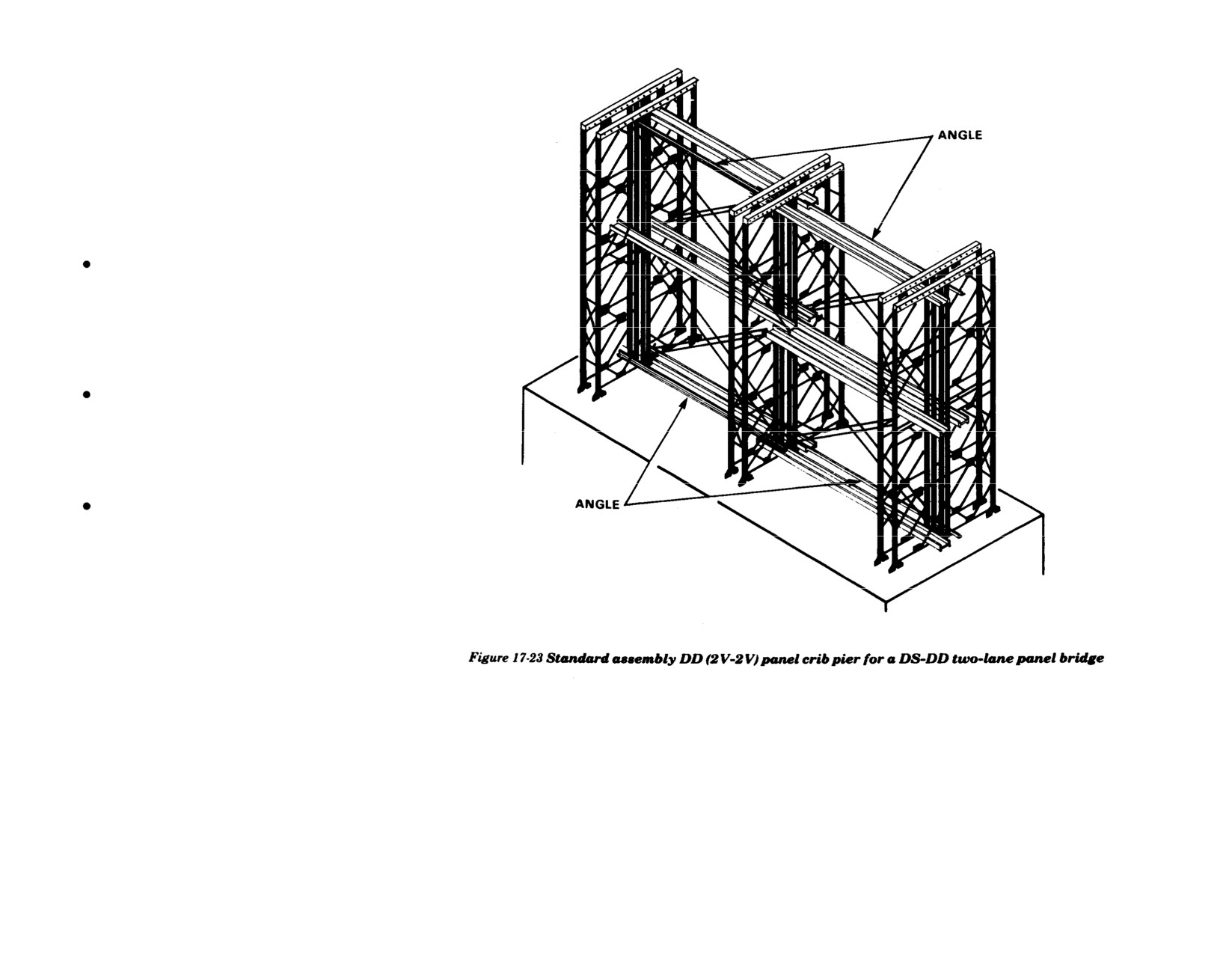
In cribs under two-lane panel bridges, stagger
There are several ways of setting panels onto
(Figures 17-16 through 17-21). Single-truss
transoms at the center panels (Figure 17-23).
a crib. With a fixed base, if panels in the first
assembly can be used only for low cribs
When panels are vertical, transoms in one
story of the pier are horizontal they may be
carrying light loads. The number of bays in
half under one lane are all on top of panel
set directly on a timber or masonry pier
the pier will normally be enough to make the
verticals; in the other half, under panel
foundation (Figure 17-17). If panels in the
length of the base one third or more as much
verticals. At the top and bottom of the crib,
first story are vertical, pin the female jaws of
as the height of the pier (Figure 17-21). All
transoms can be placed only on the side of
the panels to crib bearings which are set on
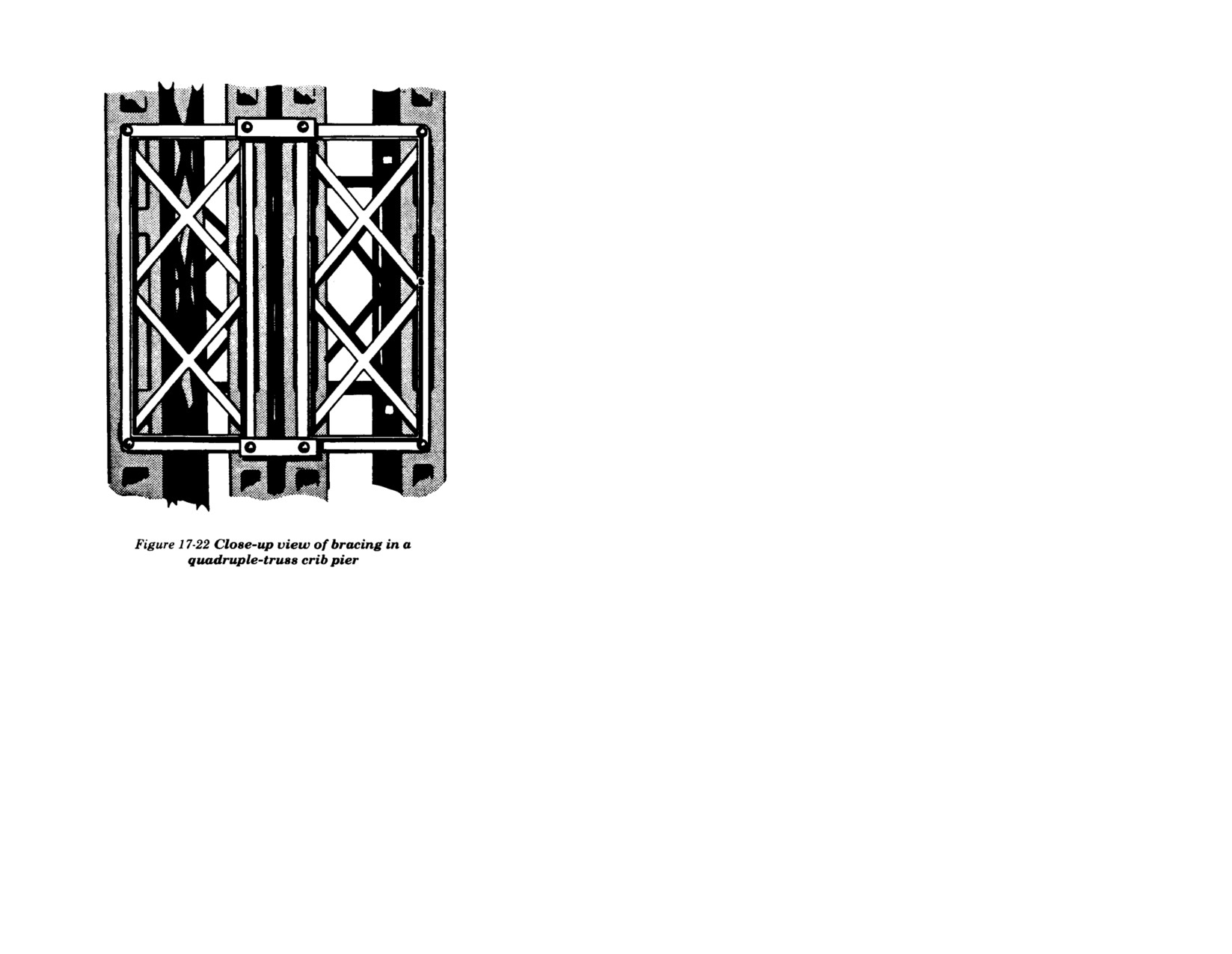
possible bracing frames and tie plates tie
panel verticals. Therefore, angles must be
timber or steel footings (Figure 17-20).
trusses together at each side of the crib. In a
welded to the panel chords to take the place of
quadruple-truss pier, bracing frames and tie
alternate transoms (Figure 17-23, page 224).
plates overlap. Brace the entire crib by tran-
When the panels are horizontal, angles are
soms and sway bracing (Figure 17-22).
also used to replace alternate transoms. Guy
high piers to provide greater lateral stability.
223
FM 5-277
With a rocker base, the rocker may consist of
a crib bearing seated on a standard bearing
(Figures 17-15 and 17-16) or an inverted
junction-link bearing set on an inverted
junction link (Figure 17-16). The procedure is
as follows:
If panels in lower story of pier are hori-
zontal, fasten crib capsill by chord clamps
to bottom chord. Then pin this crib capsill
directly to crib bearing (Figure 17-16), or
by chord clamps to inverted junction-link
bearing (Figure 17-16).
If there is one bay of vertical panels with
female ends down in the pier, connect
female jaws by chord clamps to top of a
junction-link bearing pinned to a crib
bearing.
If there are two bays of vertical panels,
pin the two adjacent center female jaws to
a crib bearing which is on a standard
bearing (Figure 17-19).
224
FM 5-277
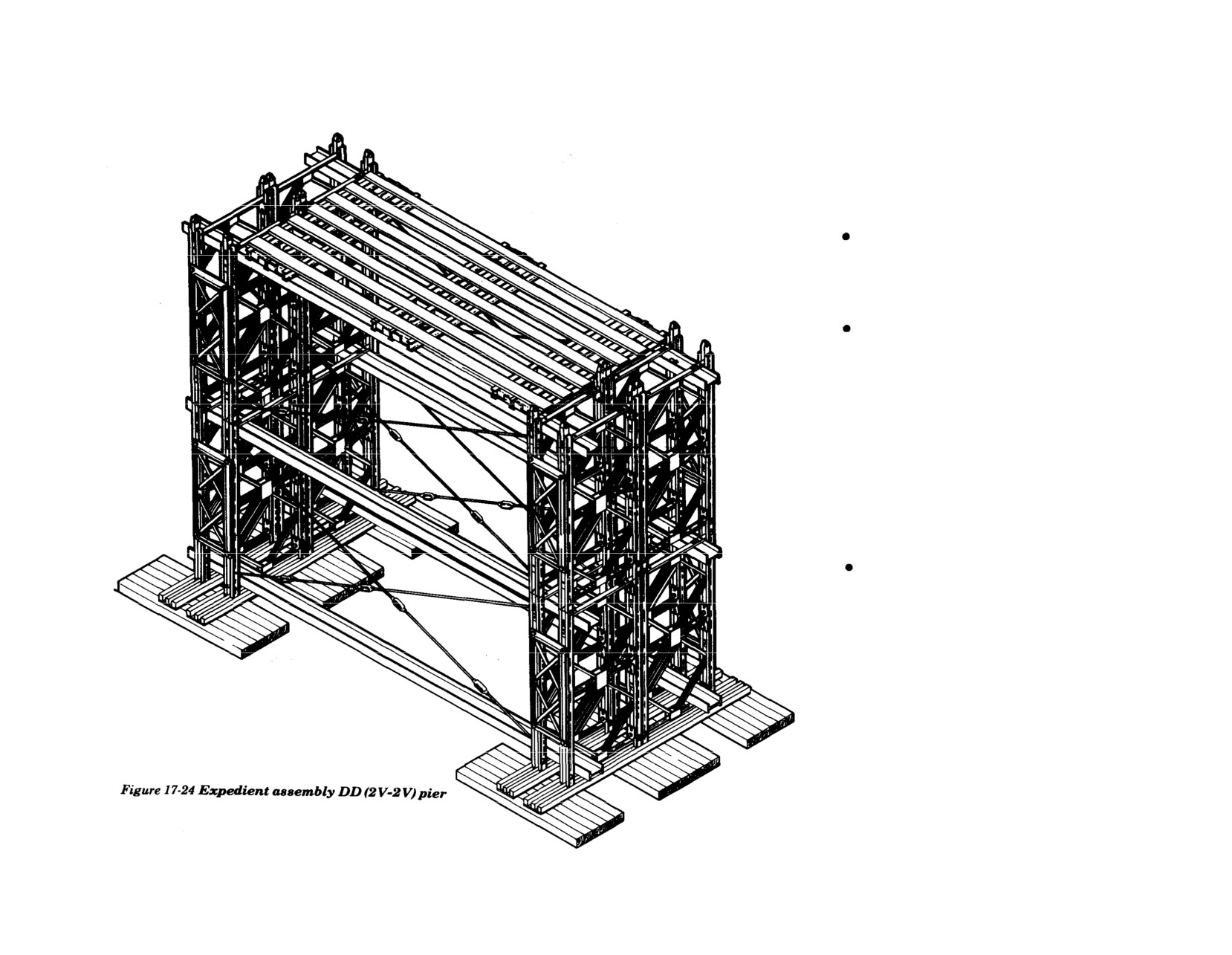
EXPEDIENT ASSEMBLY
(STANDARD TRUSSES)
If no special panel-crib parts are available,
the following expedient parts can be impro-
vised for standard truss arrangement:
Panel chords or any pair of 4-inch (10.2
centimeters) or larger channels with holes
drilled at the desired spacing can be used
for improvised crib capsills.
Angles or lugs with pin holes in their
upright parts can be fastened to the crib
foundation and panels pinned to them.
Another expedient is to have panel pins
in female jaws of vertical panel bear on
top of an I-beam or rail (Figure 17-24). A
load of 7½ tons (6.8 metric tons) per panel
pin is allowed on unstiffened beams
having a web thickness of ¼ to
5/16
inch (.6
to .8 centimeters). Greater loads are per-
mitted if web is stiffened or if web thick-
ness exceeds
3/8
inch (.1 centimeter).
Other special panel-crib parts are not
readily improvised.
225
FM 5-277
Bridge seating
centimeters) movement of the bearings
but it is allowed a slight longitudinal
Bridge seating assembly without panel-crib
on the base plate and a 2-inch (5.1 centi-
movement.
parts can be done as follows:
meters) movement of the baseplate on the
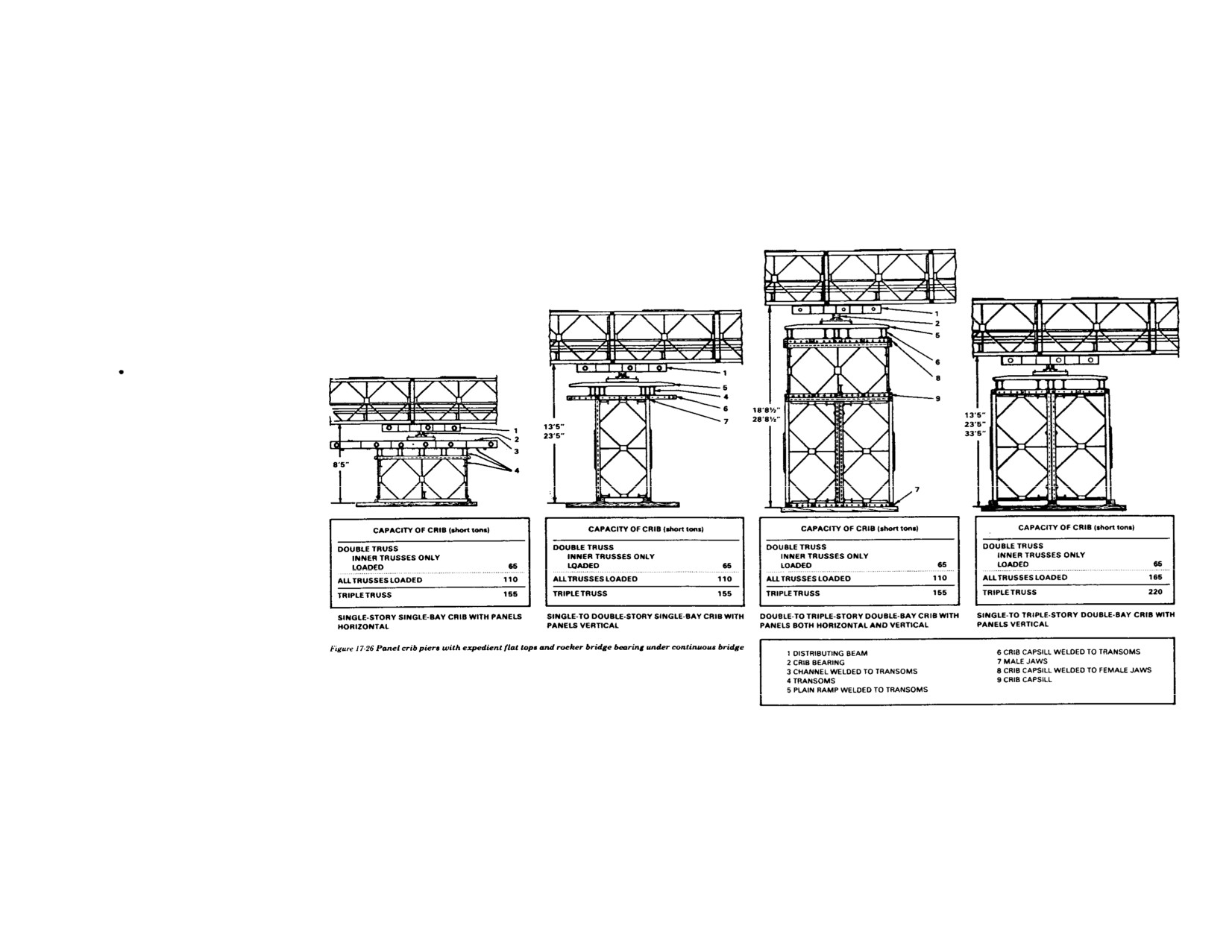
pier top. Figure 17-26 (page 227) illustrates
The pier can also be pinned to the bridge
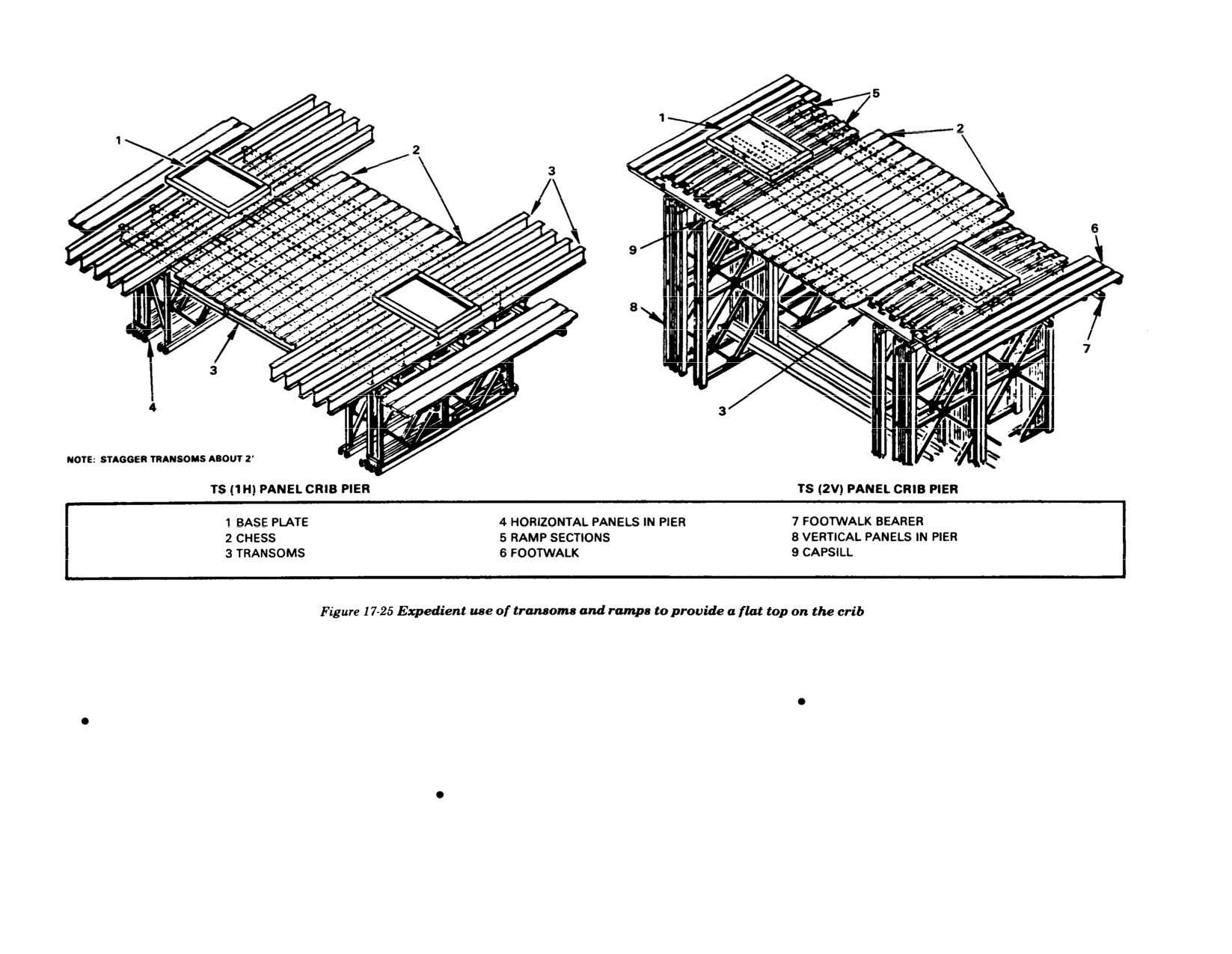
Figure 17-25 shows the use of transoms
the vertical dimensions and capacities of
by pinning male lugs of the two inside
and ramp sections to provide a flat top on
piers with flat top and rocker ridge
posts of the pier to the lower bridge chord
the crib for the base plates under the
bearing.
and inserting the outer posts in the space
rocker bearing. With this type of pier cap,
between channels of the lower chord.
the bridge may be as much as 6½ inches
The bridge seating may consist of timber
These outer posts just miss the center
(16.5 centimeters) off the center of the
laid laterally on the end-panel member,
vertical in the bridge panels. If the outer
pier. This is made up from a 4½-inch (11.5
226
FM 5-277
post shoulders are cut down enough to
permit deflection in the span, this con-
nection can be used with a rigid pier base.
The top chord of the bridge is left un-
pinned so the two spans act independ-
ently.
Another method of bridge seating is to
insert the male lugs of the pier posts into
recesses in the lower bridge chords.
Clamps made from two tie plates and
ribband bolts anchor the bridge to the
pier. This and the last two methods are
limited because there is only one pier
position in which the lugs fit without
interfering with the bridge chord spacers.
Crib base
To make a crib base without special panel-
crib parts, set the crib on timber and have the
cribbing bear on the bottom panel member.
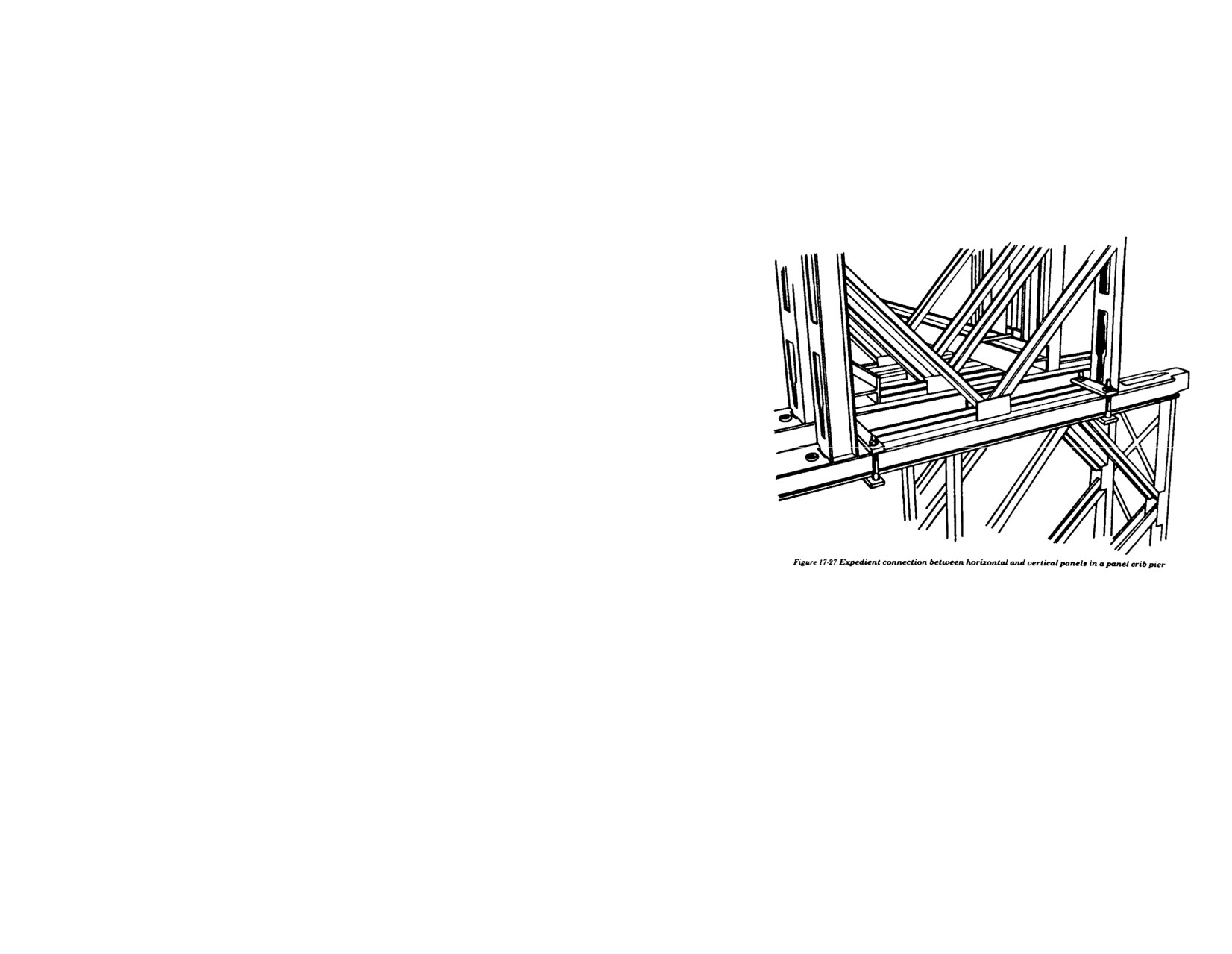
Panel connections
To connect horizontal and vertical panels,
cut away the reinforcing plate at the bracing-
bolt hole and slip the male lugs of the vertical
panel between the channels of the horizontal
chord. Tie panels together by an expedient
clamp made from tie plates and ribband bolts
(Figure 17-27, page 228).
227
FM 5-277
EXPEDIENT ASSEMBLY
(NONSTANDARD TRUSSES)
Expedient assembly of trusses and bracing
can also be built for nonstandard truss
arrangements.
Trusses
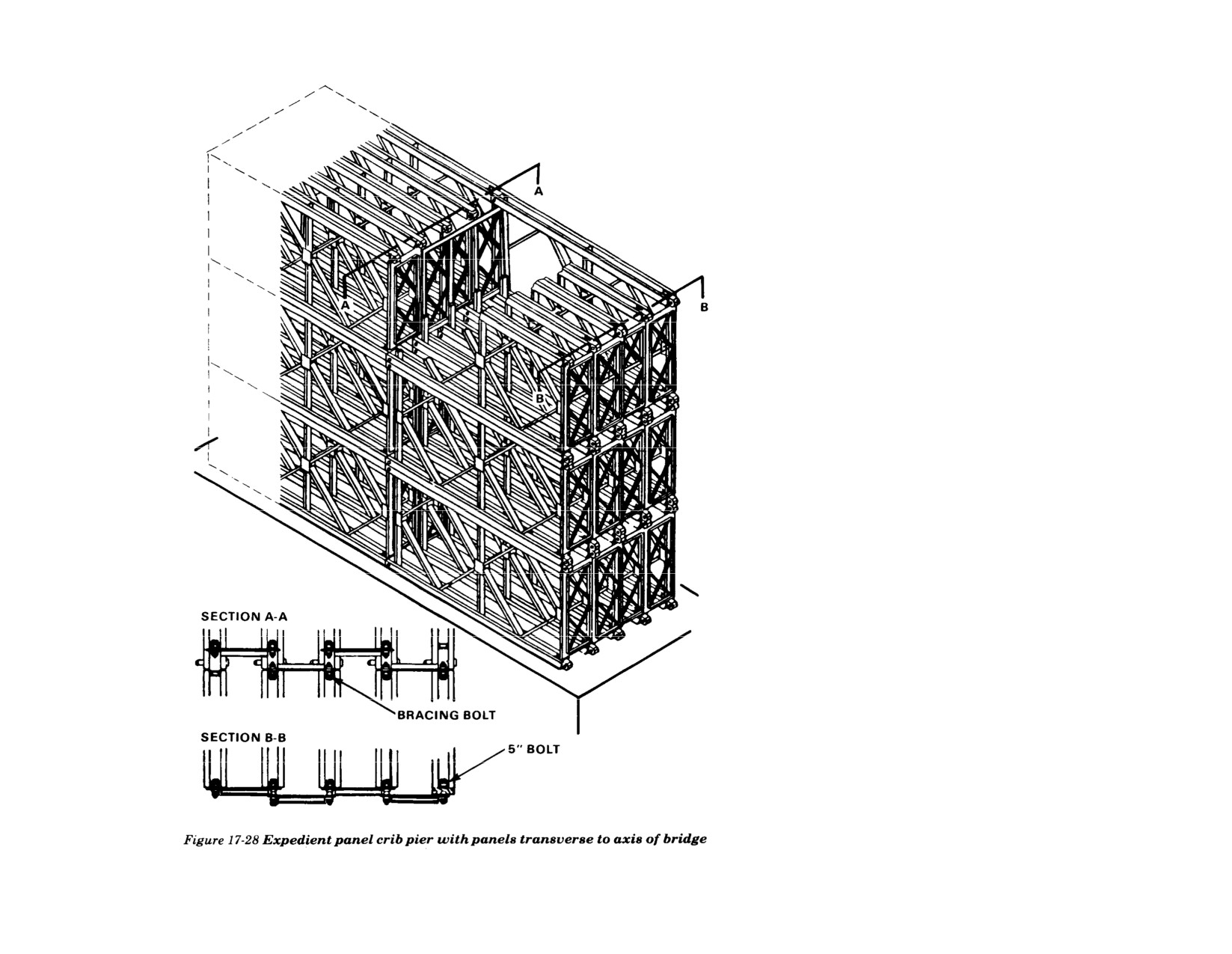
Expedient panel cribs can be built with panels
transverse to the bridge axis, as in Figure
17-28. This type of construction is useful
when the pier is skewed or when the pier
foundations are restricted. Two panels pinned
end to end give a 20-foot (6.2 centimeters) pier
width. In Figure 17--28 trusses are braced
together by bracing frames in every possible
position, Bracing frames are overlapped at
each end and 5-inch- (12.7 centimeters) long
bolts replace standard bracing bolts. In
lighter one-story piers, the two panels are
connected by tie plates.
The crib may be built in the form of two
cellular columns, one under each side of the
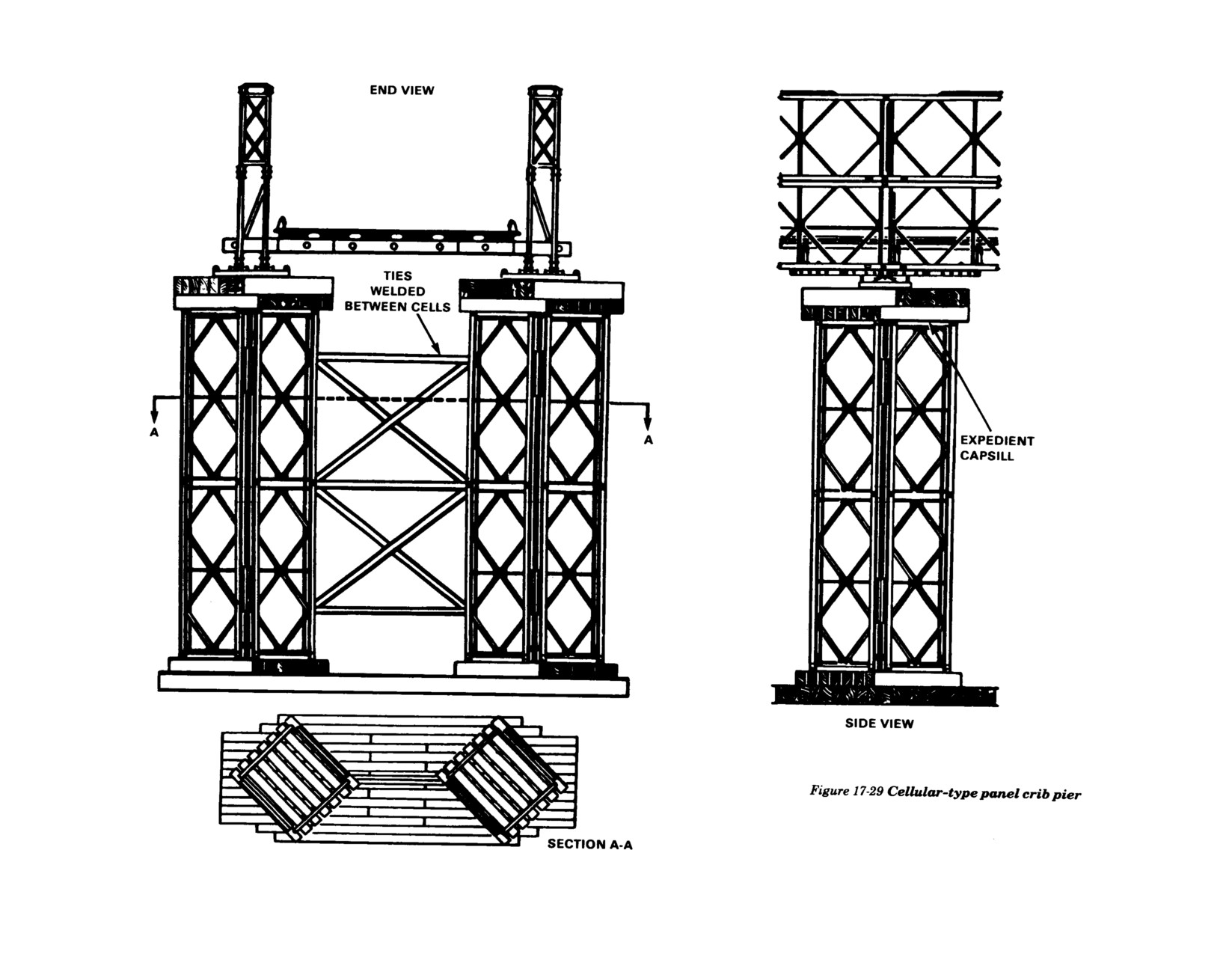
bridge, as in Figure 17-29 (page 230). Each
column is made of four vertical panels
arranged in a square offset 45 degrees from
the axis of the bridge. Weld chords of adjacent
panels to angles. Cap panels with improvised
capsills, and lay timber cribbing across
capsills. The crib base is similarly con-
structed. Tie the two columns together by tie
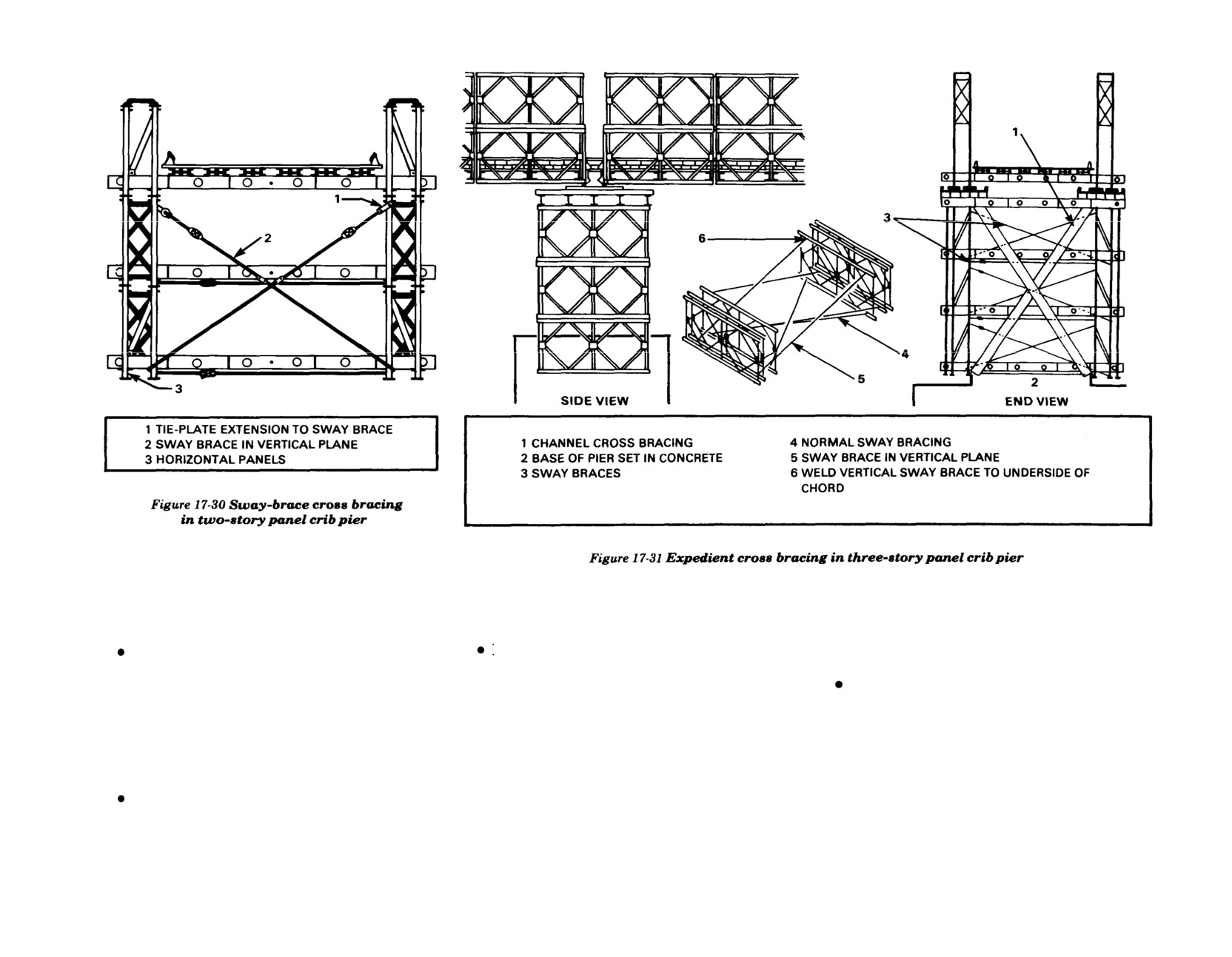
braces on an extension. Bolt lengthened sway
to the underside of the top chord in the
reds welded between them.
braces diagonally between the lower bracing.
opposite inner truss (Figure 17-31, page 231).
frame hole in the end vertical of one truss and
Bracing
the upper bracing frame hole of the end
For heavier loads, channel sections welded
More than one story of horizontal panels can
vertical on the opposite truss. As an alter-
across each end of the crib give a more rigid
be used if more expedient vertical cross
native, vertical sway braces can be used in
cross brace (Figure 17-31).
bracing is added. Figure 17-30 (page 231)
each story.
shows sway braces in the vertical plane
bracing a double-story pier to carry light
Pin the braces to the bottom chord of the
loads. Bolt tie plates to one end of the sway
second panel, bend them up, and weld them
228
FM 5-277
ASSEMBLY OF CRIB PIER
Use the following sequence of procedures
when building crib piers by manpower alone:
1
Lay out and accurately level pier foun-
dation. Mark panel positions accurately.
Position crib bearings where these are
used.
2
Carry up panels for trusses on each side of
crib and lay flat on base with female jaws
pointing to bearings. Lift up panels and
pin to bearings.
3
Fasten transoms, rakers, bracing frames,
and sway braces in the first story. Check
that panels are vertical and square to the
centerline.
4
Construct a working platform of transoms
and chess in the first story. Haul panels
up singly and lay them flat on the plat-
form with the female jaws opposite the
top lugs of the first story. Lift each panel
in turn and pin it into position.
5
Fasten transoms and bracing in the
second story and again check that the
crib is vertical and square to the
centerline.
6
Repeat for the number of stories required.
An improvised gin pole or davit may be
used to lift panels and transoms to upper
stones.
229
FM 5-277
230
FM 5-277
Use the following procedures when building
lines with winches on banks or existing
abutment until after the pier is completed.
piers with mechanical equipment:
piers to lift panels into place.
Rollers must be blocked up enough to keep
the bottom chord above the level of the top
If the bridge without the pier will carry
of the finished pier.
If site conditions permit, a truck-mounted
crane can be used to erect 20-foot- (6.2
the erection equipment, the pier can be
meters) high crib piers and the two lower
constructed from the bridge. Use a truck
For a continuous-span bridge, the pier
stories of high piers. Assemble bays on
crane or rope tackle to lower the panel
can be built by working from the end of a
the ground nearby, and lift the assembly
over the side of the bridge into place on
cantilever span.
into place by crane. For erecting higher
the pier. When all panels in the pier are in
piers, use a long-boomed crane.
place, jack up the bridge over the pier to
eliminate sag and allow placing of bridge
If pier construction is between existing
seating. This last step can be eliminated
high banks or piers, use cranes and high
by leaving the bridge on rollers at each
231
FM 5-277
LAUNCHING OF BRIDGE
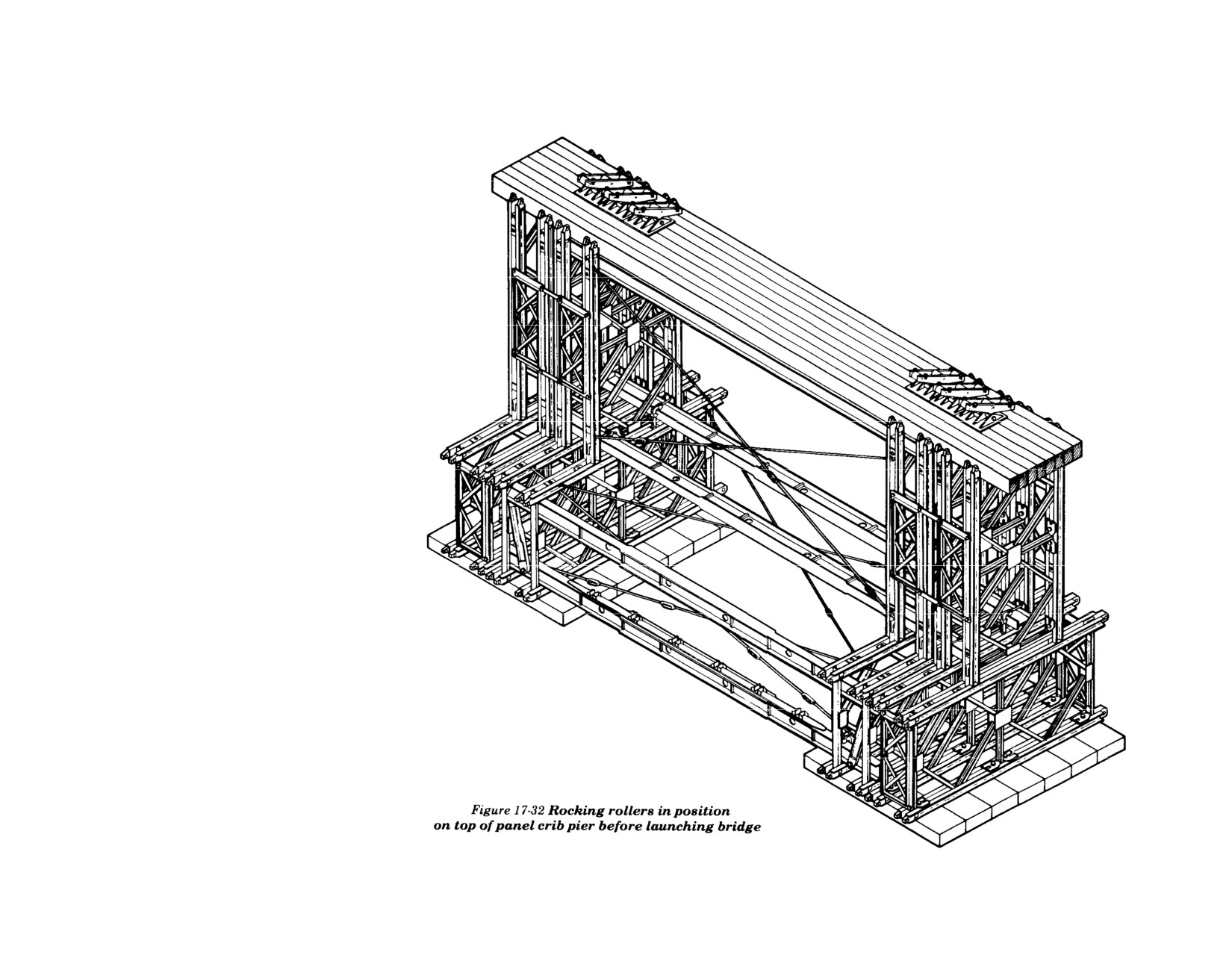
Place rocking rollers on cribbing on top of the
piers before launching the bridge (Figure 17-
32). Push the bridge out over these rollers
until the entire bridge is over all the spans.
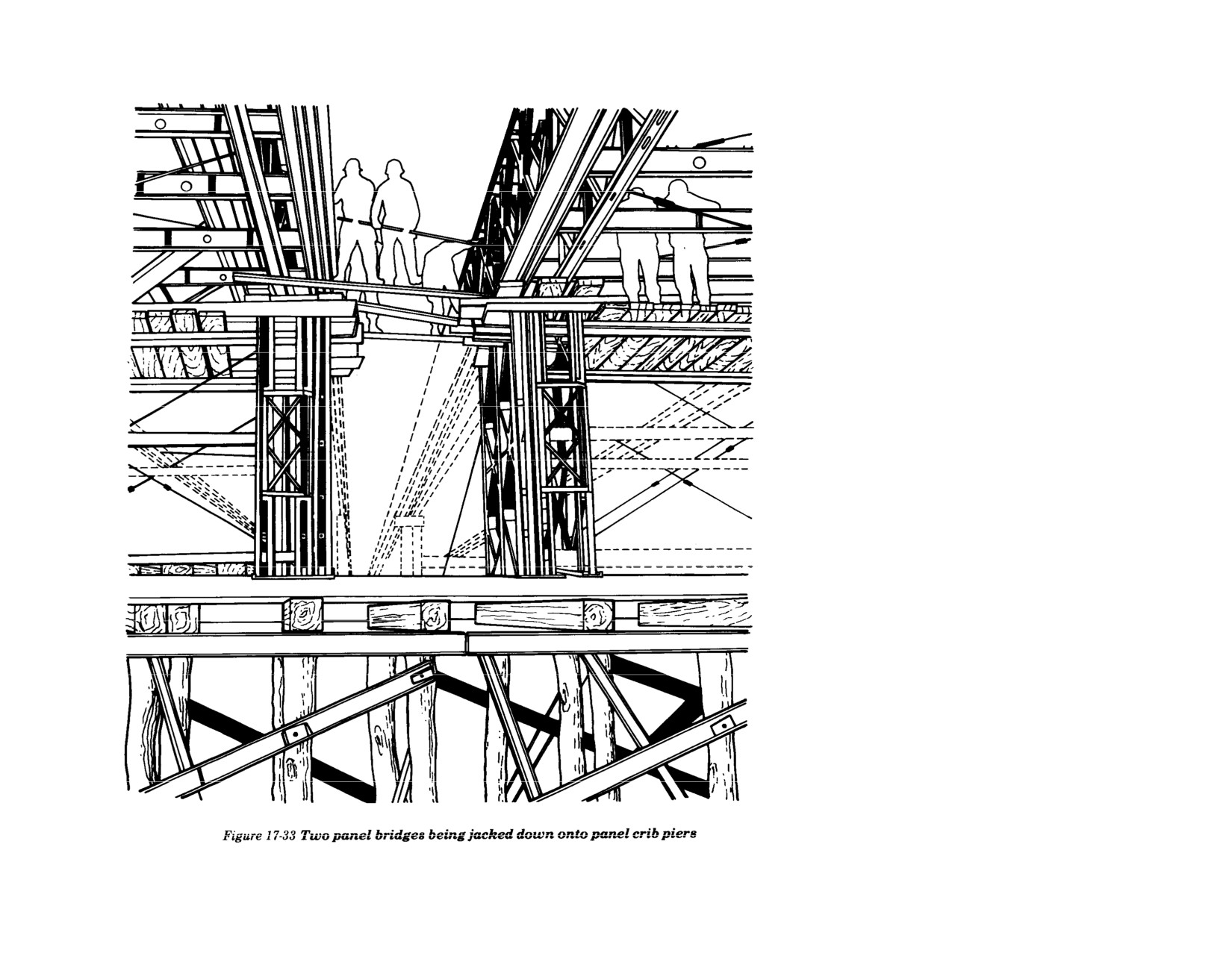
Jack up the bridge, remove rollers and
cribbing, and then jack down the bridge onto
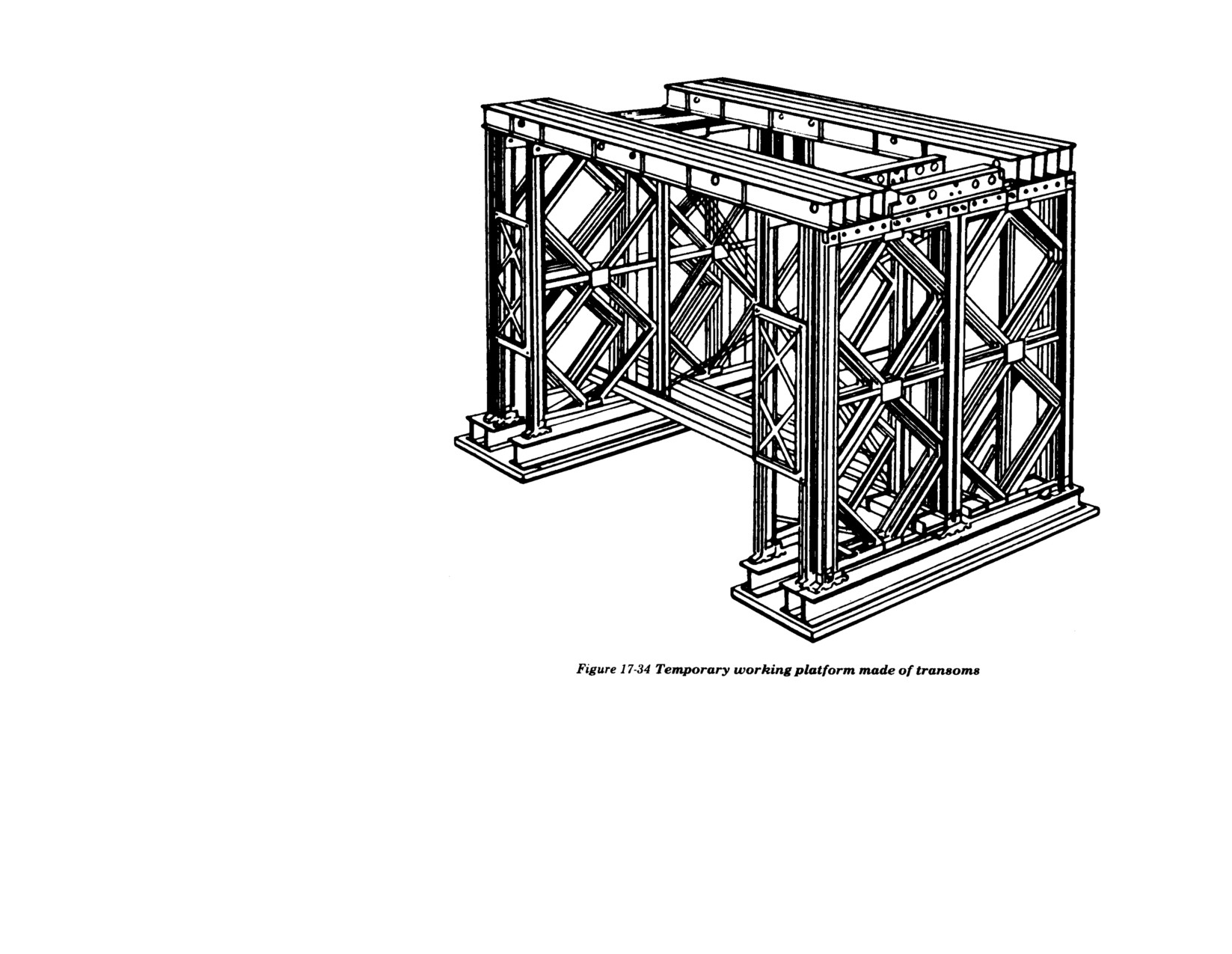
its seatings on piers (Figure 17-33). A tem-
porary working platform may have to be
built for operating the jacks (Figure 17-34,
page 234). If the bridge is to have independent
spans, disconnect the girders at each pier.
JACKING DOWN OF
CONTINUOUS SPANS
Where the distance through which the bridge
has to be raised or lowered is more than a few
inches, jacking has to take place on more
than one pier at the same time. Since in this
type of construction the whole girder is con-
tinuous, lifting through any distance pro-
gressively increases the length of bridge lifted
and, thereby, increases the weight to be
raised. This soon exceeds the capabilities of
the jacks that can be brought into use on one
pier. Where these conditions apply, a se-
quence of jacking on three piers at the same
time, as described below, is the easiest
method. This consists of raising the bridge
through a smaller distance on each of the
piers adjacent to the one on which the dis-
tributing beams are being fitted.
232
FM 5-277
The ends of the bridge are first jacked up and
lowered onto suitable cribbing slightly above
final level. Three complete jacking parties
are then required for the intermediate piers,
working from the near bank and in the
following steps:
1
The first party, working on the first pier,
lifts the bridge clear, removes the rollers
and lowers the bridge onto the cribbing,
the height of cribbing being the same as
that used at the end of the bridge.
2
The second party does the same on the
second pier while the first party jacks up
on the first pier, fits distributing beams,
and lowers the bridge to the original level
(level of top of cribbing).
3
The third party completes step 1 on the
third pier and the second party then fits
distributing beams on the second pier.
The first party then lowers the bridge
onto the bearings of the first pier.
4
The first party completes step 1 on the
fourth pier, the third party then fits dis-
tributing beams on the third pier, after
which the second party lowers the bridge
onto the bearings on the second pier.
233
FM 5-277
This sequence of steps is continued through-
out the length of the bridge. By this means,
the bridge is raised by a slightly smaller
amount on the two piers adjacent to the one
on which the distributing beams are being
fitted. Strict control of the jacking parties is
essential, however, to enable the distributing
beams to be fitted on the center pier.
In the case of long bridges, it may be expe-
dient to begin jacking on the center pier and
work outwards toward the ends of the bridge.
For this method, it is best to employ six
jacking parties, three working toward each
bank in the sequence of steps described above.
Where the distance through which the bridge
has to be lowered is such that it cannot be
achieved in three stages, increase the number
of jacking parties.
234
FM 5-277
CHAPTER 18
SPECIAL LAUNCHING METHODS
Special launching methods are needed when
These counterweights can also be used with
Add more counterweight in the form of spare
a restricted site prevents normal roller layout
launching-tail assembly for sites with far-
bridge parts, sandbags, or any available
and launching by the standard skeleton launching-
bank limitations preventing use of launching
material of known weight. Platforms can be
nose method. Space on either bank may be
nose or far-bank rollers. Use counterweight
used singly or together with either a skeleton
restricted in length or width by obstructions
tail instead of standard skeleton nose to keep
launching nose or launching tail. Special
such as buildings, existing bridge girders,
balance point behind near-bank rocking
details in assembly and launching are as
trees, and earthwork or by sloping banks and
rollers during launching. Launch bridge with
follows:
canal dikes. Limited backspace or length of
end posts mounted on leading end and land it
assembly area on the near bank is the most
directly on far-bank bearings.
Four plain rollers are required for all
common restriction. Backspace is measured
lower platforms and for all upper plat-
from the near-bank rocking rollers to the
Types of counterweights
forms on
single-single
bridges. Upper
limiting obstruction. Far-bank conditions are
Any available material of known weight,
platforms on double-and triple-truss
a less common restriction because standard
such as spare bridge parts, sandbags, or
bridges require eight rollers. In triple-
launching tables allow progressive dis-
vehicles can be used as a fixed counterweight.
truss assembly, upper-platform rollers
mantling of all launching noses and this
Add this counterweight to the end bay of the
must not bear on the outer trusses. Rollers
requires a minimum clear distance of only 12
bridge or tail just before final launching to
need not be fastened to the stringer
feet (3.7 meters) beyond the far-bank rollers.
the far bank. When launching with a movable
framework.
Several methods included in this chapter,
counterweight, add it earlier in the bridge
however, reduce far-bank requirements even
assembly and roll it back onto successive end
Platforms are moved by block and tackle
more by landing directly on bearings and by
bays to counterbalance progressive
on both trusses.
inverting the nose assembly to clear low
launching stages. The two types of rolling
obstructions such as existing girders.
counterweights are vehicles and rolling plat-
Horizontal bracing frames on the top
forms. Trucks, trailers, tanks, tractors, and
bridge chord are added after the bays
USE OF COUNTERWEIGHTS
bulldozers mounted on the bridge deck are
have passed under upper platform rollers.
Restricted sites require the launching of
pushed, or moved back under their own power,
Bailey bridges using fixed and movable
as assembly progresses. Vehicles can be
Backspace and limitations
counterweights. These can be used with
loaded to weights shown in launching tables
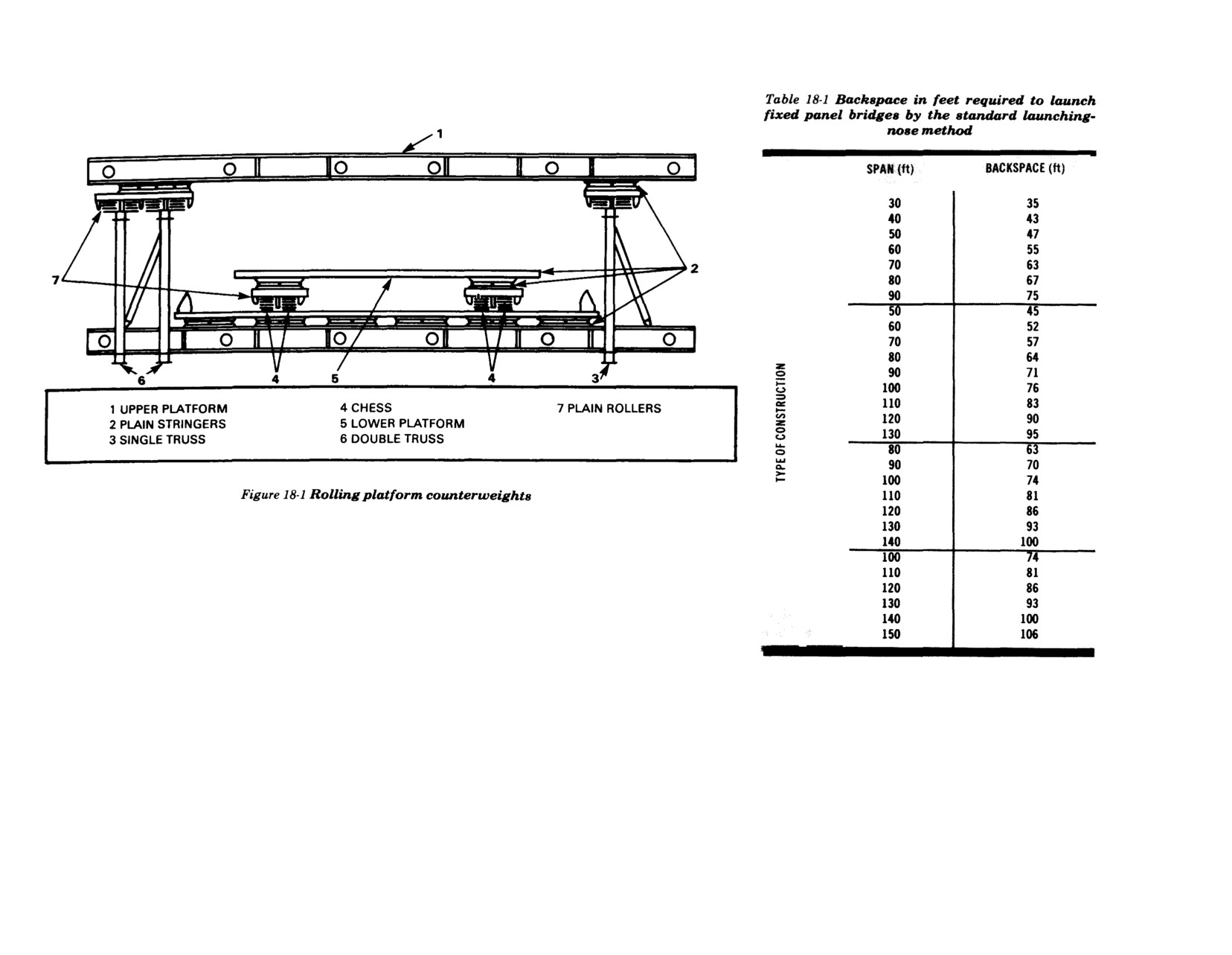
Table 18-1 (page 236) shows the backspace
standard launching-nose assembly for a site
or shifted slightly in position on the deck of
required to launch fixed-panel bridges by the
with limited backspace on the near bank.
the end bay to provide correct counterbalance.
standard launching-nose method without the
Several bridge bays are omitted during
Backspace is often increased by requirements
use of counterweights. The center of gravity
launching. Counterbalance of the span is
for ramps and space to maneuver and mount
or balance point of the bridge is always kept
maintained by placing a counterweight in
the vehicle on the deck.
at least 2 feet (61.1 centimeters) behind the
the last bridge bay equivalent to the missing
near-bank rocking rollers. Distances in the
bays.
Figure 18-1 (page 236) shows two movable
table include 12 feet (3.73 meters) to add the
platforms rolling on inverted plain rollers.
last bay of bridge or tail. All backspaces
235
FM 5-277
include 2 feet between the center of gravity of
working parties are the same as in standard-
the bridge and near-bank rocking rollers and
launching method (Chapter 6). However, use
12 feet to build the last bay of the bridge or
of a counterweight instead of end bays as
tail.
counterbalance for cantilever launch to far
bank requires several changes. On
double-
All counterweight methods increase
single
assembly, use plain rollers in pairs
launching weights. Maximum spans
(one under each truss) instead of singly as in
launched by these methods are therefore
the standard method. All launching noses
shorter than those launched by the standard
can be moved forward from 12 to 17 feet, after
double-single
assembly in end bay. To speed
launching-nose method because of the re-
the assembly of the first bridge bay, to allow
assembly after landing on far bank, add
sulting increase in combined stress in the
mounting of rolling counterweight on deck. If
remaining bridge bays, complete launch, and
lower chord over the launching rollers.
more space is needed, add temporary fixed
remove nose. Install far-bank end posts, jack
counterweight to the bridge or adjacent nose
down, and install ramps. Move rolling counter-
LAUNCHING NOSE AND
bay and launch nose further over gap.
weight to far-bank end of bridge, install near-
COUNTERWEIGHT (ROLLING)
Assemble all bridge bays complete for final
bank end posts, and jack down. Position
The length of launching nose, composition of
launch to far-bank rollers except for
triple-
near-bank ramps and remove counterweights.
nose and bridge bays, and organization of
single
and
double-double
bridges, which are
236
FM 5-277
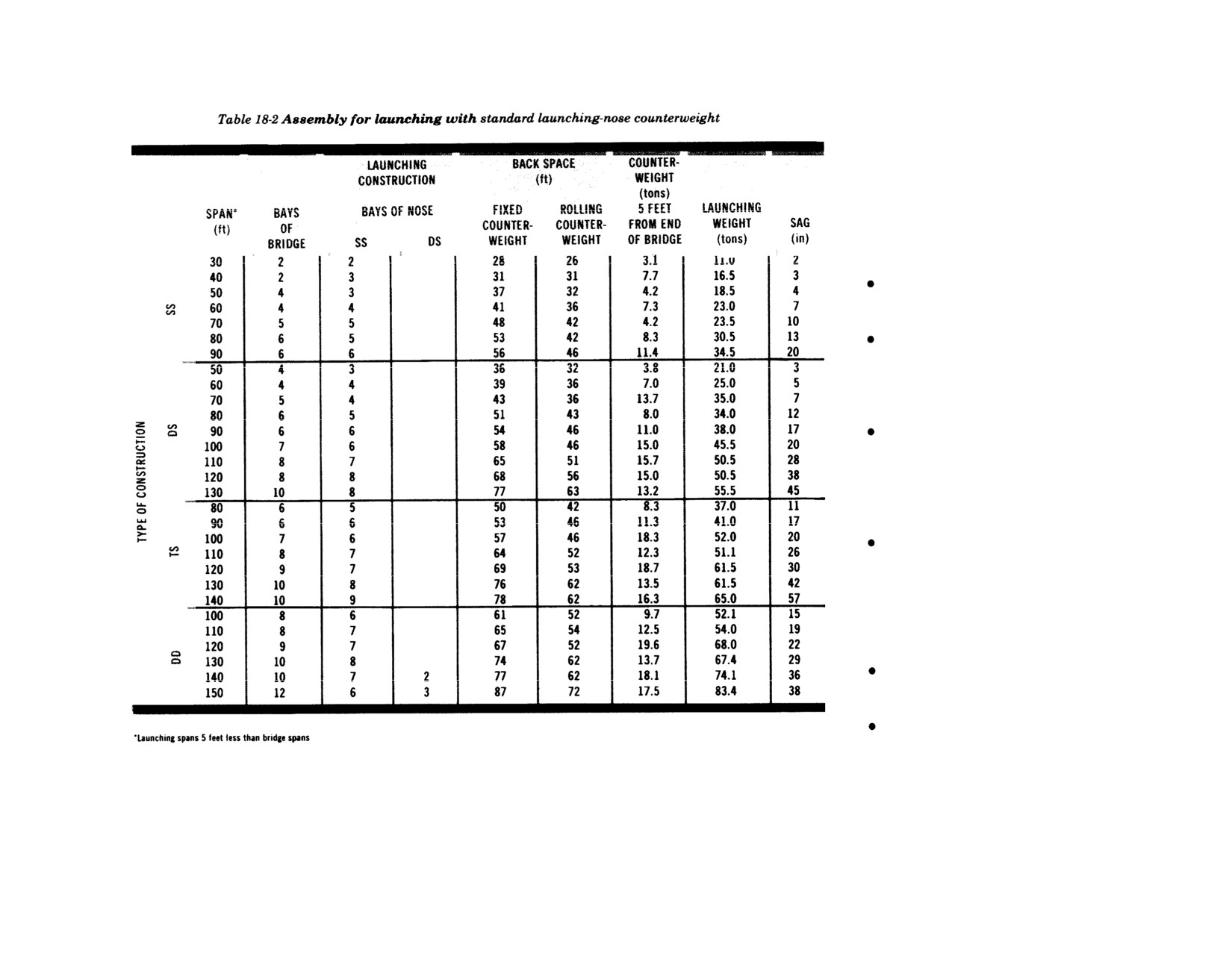
Table 18-2 gives assembly for all bridges that
can be launched with an appreciable re-
duction in backspace over the standard
method using either fixed or rolling counter-
weights of the amount shown. Data are based
on the following assumptions:
All counterweight is centered in end bay
of bridge.
Minimum backspace for any bridge is
that required to assemble the launching
nose and first bay of bridge without
counterweight.
Length of bridge for launching with
rolling counterweight of amount shown
in Table 18-2 requires about the same
backspace as required to assemble nose
and first bay.
All bridge bays are decked and complete
at critical launching stage except that
end bays of
triple-single
and
double-
double
bridges are
double-single
con-
struction. Bridges are launched without
footwalks.
Fixed counterweight is added to end bay
for final launching only.
Rolling counterweight is added on first
bridge bays and rolled back onto suc-
cessive end bays.
237
FM 5-277
LAUNCHING TAIL AND
COUNTERWEIGHT (FIXED)
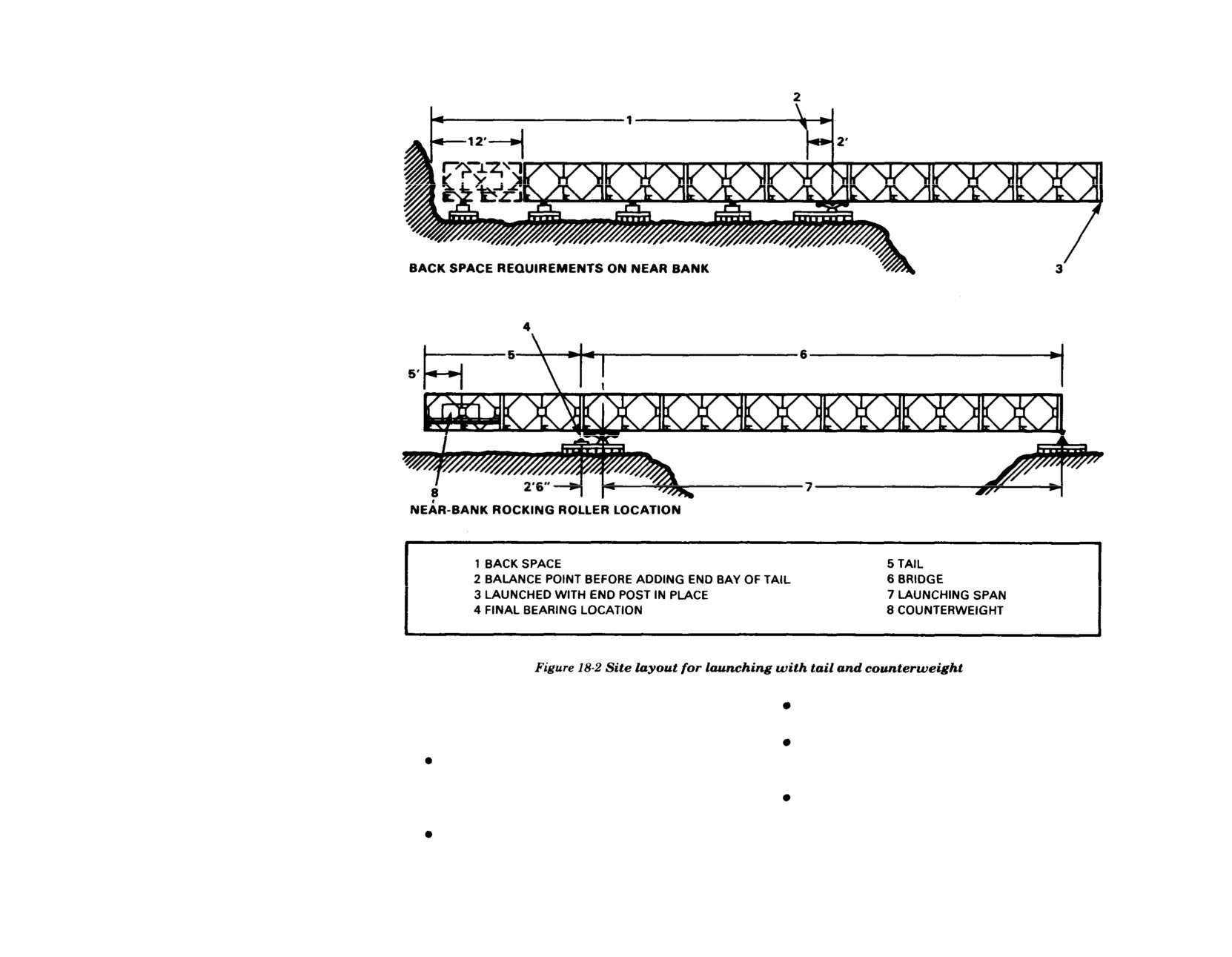
The launching-tail method differs from the
standard nose and counterweight method in
several ways. The tail is of exactly the same
assembly as bridge bays (Figure 18-2). All
bridges are launched without deck and
stringers, except the end bay of the tail when
using fixed counterweight. End posts
mounted on leading end of the bridge and
landing directly on bearings eliminate rollers
and jacking down on far bank. The length of
bridge required is 2 feet 6 inches (76.4
centimeters) longer than launching span or
gap, instead of 5 feet (1.5 meters) as for the
launching-nose method (Figure 18-2). Since
there is no nose into which launching links
can be inserted, allow for sag made by
difference in elevation between near-bank
rocking rollers and far-bank bearings, unless
site conditions allow cantilever end of a
manually launched bridge to be raised by
bearing down on tail at end posts near
bearings.
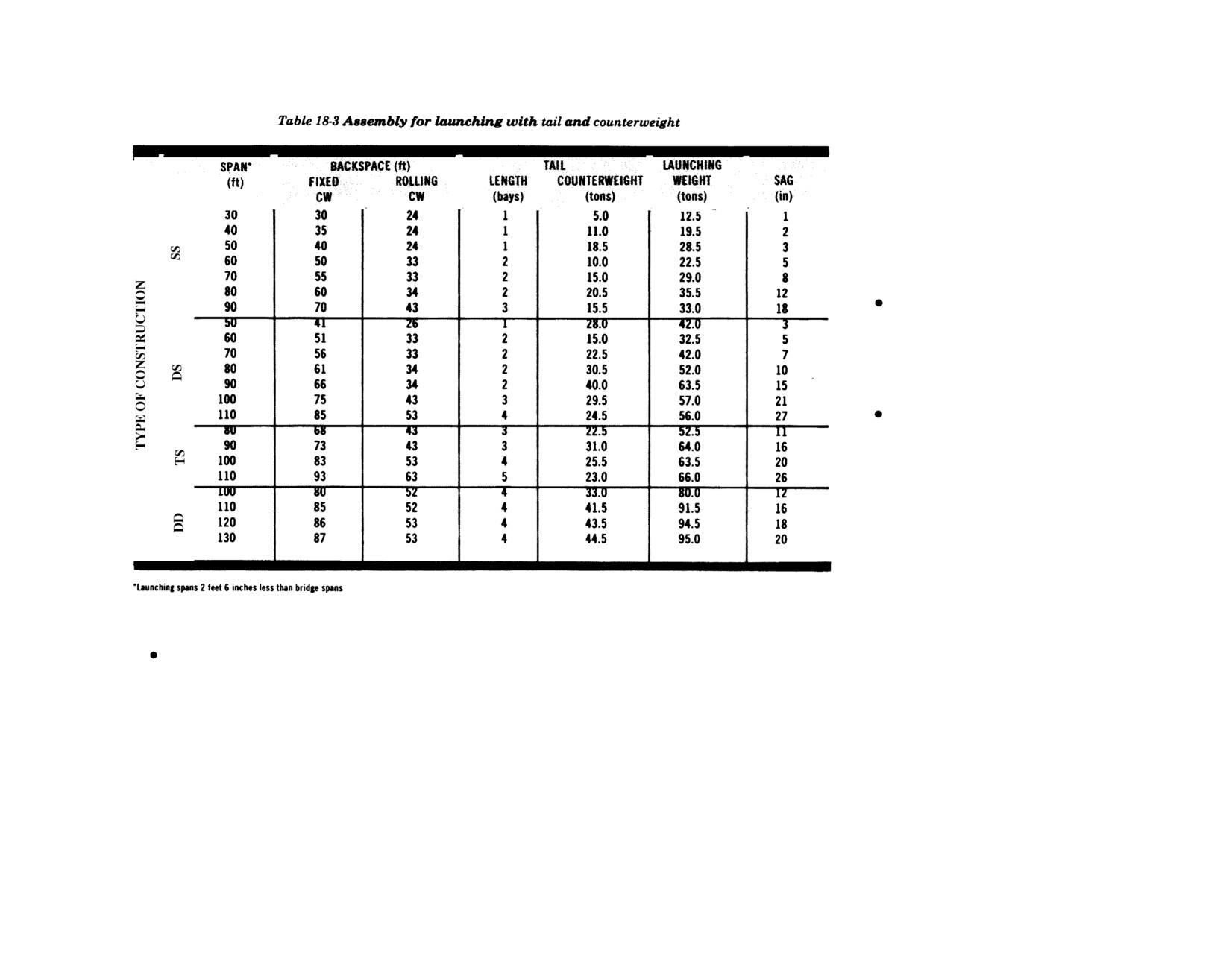
Table 18-3 gives necessary data for launching
with tail and counterweight. Tails shown are
of minimum allowable length to maintain
chord stresses over rocking rollers within
allowable limits. Where the site permits the
use of longer tails, corresponding lighter
counterweights can be calculated by taking
moments about the near-bank rocking rollers.
Data in Table 18-3 are based on the following
Counterweight is 5 feet from end of bridge.
When using rolling counterweight (upper
assumptions:
platform, Figure 18-1), values shown in the
Sags are approximate (add 6 inches for
table must be increased 1.5 tons (1.4 metric
The bridge is launched without footwalks,
end-post projection).
tons) in place of end-bay deck and stringers.
deck, and stringers, but with far-bank end
posts.
Two bays of the second story are omitted
at leading end of bridge.
Tail construction is same as bridge.
238
FM 5-277
transoms is increased 3 feet 6 inches (1.1
meters). Launching links are placed in the
lower chord as in the standard nose.
LAUNCHING PLATFORMS
When a launching site is sharply sloped,
launching platforms may be built as follows:
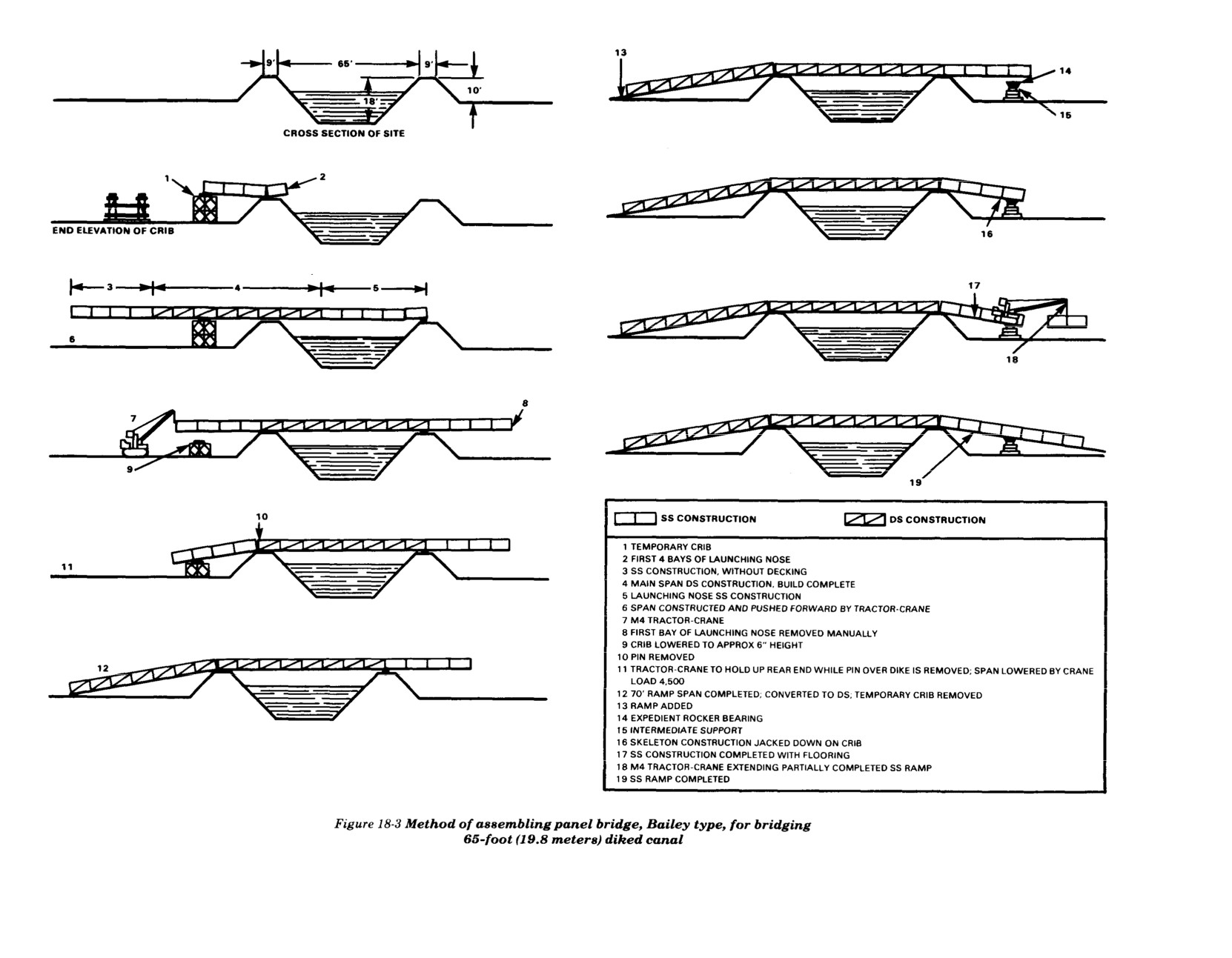
In launching from sloping banks or over
canal dikes (Figure 18-3, page 240), rollers
can be supported on panel crib piers
(Chapter 17) to provide a level launching
site.
Panel bridges can be assembled in place
or launched without nose or tail over
continuous timber or panel falsework or
cribs 25 feet (7.6 meters) on centers across
the gap. With rollers spaced 25 feet (7.6
meters) apart, sag requires jacking of
leading end as it reaches roller position.
For a double-single bridge, the sag of the
leading end will be 2 to 3 inches (5.1 to 7.6
centimeters) with a 25-foot (7.6 meters)
overhang.
END-ON ASSEMBLY
Five bays of the second story are omitted
INVERTED LAUNCHING NOSE
End-on assembly of a panel bridge is the
at leading end of bridge.
Far-bank sites with low obstructions and
successive addition of bays on the cantilever
limited clearance widths, such as low side-
end over the gap. Use no rollers. Support the
walls or existing girders on narrow piers,
bridge during assembly on a packing of
which interfere with launching-nose tran-
timber and transoms under the bottom chord.
soms, can often be cleared with inverted
Provide counterbalance either by the simul-
launching noses. Assembly is the same as in
taneous addition of tail of the same length
standard launching tables except that nose
and assembly as the bridge or by a shorter
panels are inverted and transoms, rakers,
tail and heavy counterweight. Position panels
and sway braces are in the upper instead of
with improvised davits and rope tackle or
the lower chord. Vertical clearance beneath
cranes.
239
FM 5-277
240
FM 5-277
This method can be used on all types of
the near-shore dike, and pivoting the bridge
ver the rafts. This method also takes longer
restricted sites, being particularly adapted to
about its balance point on improvised pipe
than normal launching procedures.
building from the top of canal dikes. Using
rollers.
the short tail and counterweight, it requires
Multiple spans
the least backspace of any launching method.
LAUNCHING WITHOUT ROLLERS
For launching intermediate spans by flo-
Single-single
bridges up to 40 feet (12.2
tation, use pontons of suitable capacity under
Forward packing at the edge of the gap must
meters) long can be launched by soldiers
each end of the span to float it into position.
distribute the weight of the bridge over at
without rollers by skidding on greased beams.
Place cribbing on pontons to raise the bridge
least 3 feet (91.4 centimeters) of the bottom
Place greased timbers or greased stringers at
so the lower chord clears the top of the piers.
chord to prevent buckling. Rear packing
the edge of the gap and 20 feet (6.1 meters)
Make sure the bridge overhangs pontons at
supporting the tail must be low enough to
back under each line of trusses. Assemble the
each end; this provides clearance for ma-
give sufficient initial slope to counteract sag
bridge on the skids with one transom per bay
neuvering between piers when floating the
and bring the end posts over the far-bank
and no stringers or chess. Add three bays of
span into position. Normally, launch the
bearings.
tail with two transoms per bay and stringers
span on ponton rafts just downstream from
in the last bay as a counterweight. Then push
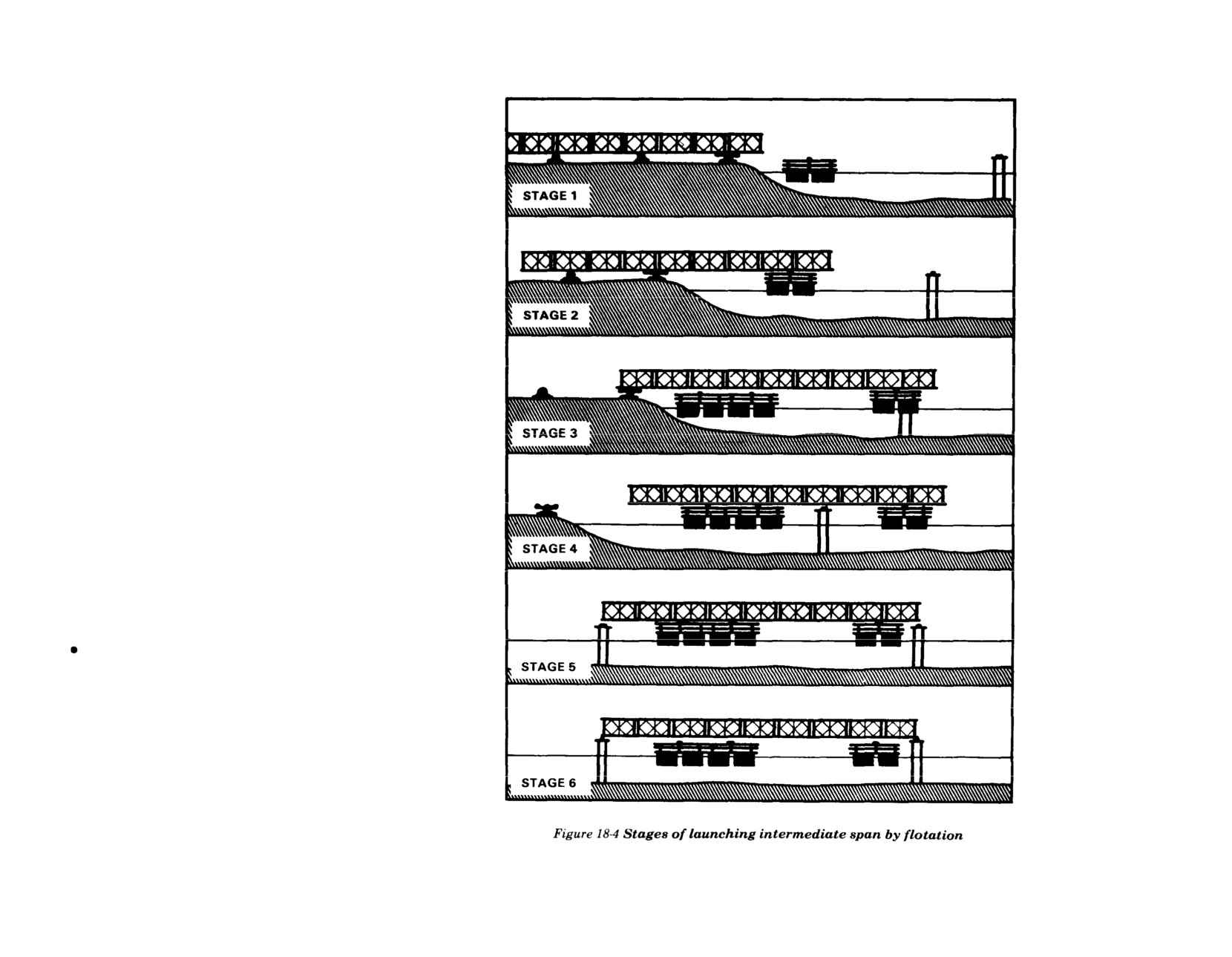
the bridge site. The launching sequence for a
A timber 8 inches by 8 inches by 20 feet (20.4
the bridge out over the gap with the aid of
typical 90-foot
triple-single
span on pontons
centimeters by 20.4 centimeters by 6.1 meters)
pinchbars and levers. Soldiers on the far
(Figure 18-4, page 242) is as follows:
and a four-way block and tackle with ¾-inch
bank lift the front end onto blocking. Remove
(1.9 centimeters) diameter rope can be used as
the tail, add end posts, and jack down the
1
Assemble far-shore raft with two pontons
an improvised davit. Braced at a 45-degree
bridge onto bearings. Complete the bridge by
and enough cribbing to keep end of bridge
angle (in double-story and triple-story as-
adding a second transom in each bay and
above pier. Assemble bridge on rollers on
sembly, against a transom at the lower end)
laying decking and ramps. If end posts and
shore. Place launching rollers slightly
so the upper end of the timber extends about 5
bearings are not available, support the ends
higher than cribbing on raft.
feet (1.5 meters) above and beyond the end of
of the bridge as described in Chapter 22.
the trusses, each new panel can be accurately
2
Push bridge on rollers until it rests on
placed with the block and tackle suspended
LAUNCHING BY FLOTATION
far-shore raft with enough overhang to
from the upper end of the timber.
There are several advantages of launching
ensure clearance between raft and pier
by flotation. With this method a large as-
when span is in position over pier. Con-
Tail and counterweight are kept to a mini-
sembly site is not needed and it can be away
tinue to push bridge and far-shore raft
mum by installing only such decking on the
from the centerline of the bridge. Also, a
until end of bridge is near rocking rollers.
cantilever over the gap as required to operate
launching nose or cantilever tail is not
the davits.
needed.
3
Assemble near-shore raft with four pon-
tons and cribbing. Pump water into near-
SWINGING ACROSS CANALS
The disadvantages of launching by flotation
shore raft until it can be floated under
Panel bridges can be swung across diked
are that the gap must be water-filled with
shore end of bridge. If near-shore raft
canals by assembling complete with
sufficient unobstructed depth to float a loaded
cannot be brought close inshore, place
launching nose or tail on top and parallel to
ponton. In a stream current over 3 feet (91.4
rocking rollers on cribbing on near-shore
centimeters) per second, it is hard to maneu-
raft.
241
FM 5-277
4
When raft is in position under bridge,
pump water out until lower chord of span
is supported by cribbing or rocking rollers
(whichever is used) on raft. Continue
pumping until span is raised clear of
launching rollers on shore. If rocking
rollers are used on raft cribbing, roll span
into position and insert picket through
lower chord of span and rocking roller to
hold span in position.
5
Maneuver raft into position between piers.
6
Pump water into pontons until span is
supported on piers. Remove rafts.
Note:
Instead of pumping water into and
out of the pontons to raise and lower the
bridge, use jacks on top of each raft. To
raise the bridge, jack it up and insert more
cribbing. To lower the bridge, jack it up,
remove cribbing, and jack the bridge down.
For a shore span with assembly on and off
centerline, the launching sequences are as
follows:
For assembly on centerline, launch the
shore span from rollers on the abutment
along the bridge centerline. Place the
front of the bridge on a raft and float out
to seating on bent. Then jack up tail end,
remove rollers, and jack bridge down on
bearings. If end posts are not used and
end panels of adjacent spans are con-
nected by panel pins over the bent,
cribbing may raise shore end of span too
high and only top panel pins can be
242
FM 5-277
inserted. Then remove top pins and jack
down shore span to bearings on abutment.
For assembly off centerline, assemble
and launch the shore span in the same
manner as the intermediate span, floating
it into position between the abutment and
first pier.
Single spans
For single spans launched by flotation with
the assembly either on or off centerline, the
launching sequences are as follows:
For assembly on centerline, float front
end of bridge on raft across gap as bays of
bridge are added at tail which is on rollers
on near shore. Use enough cribbing on
raft to keep front end of bridge above far-
bank abutment. Launching links and a
short upturned nose ahead of raft can be
used to raise the end high enough to clear
the far-bank abutment.
For assembly off centerline, assemble
span off centerline of bridge and launch
on rafts. Float span into position between
abutments and lower into place. Cribbing
on rafts must keep bridge above abut-
ments and overhang must be enough to
prevent grounding of rafts.
243
FM 5-277
CHAPTER 19
LAUNCHING BY SINGLE GIRDERS
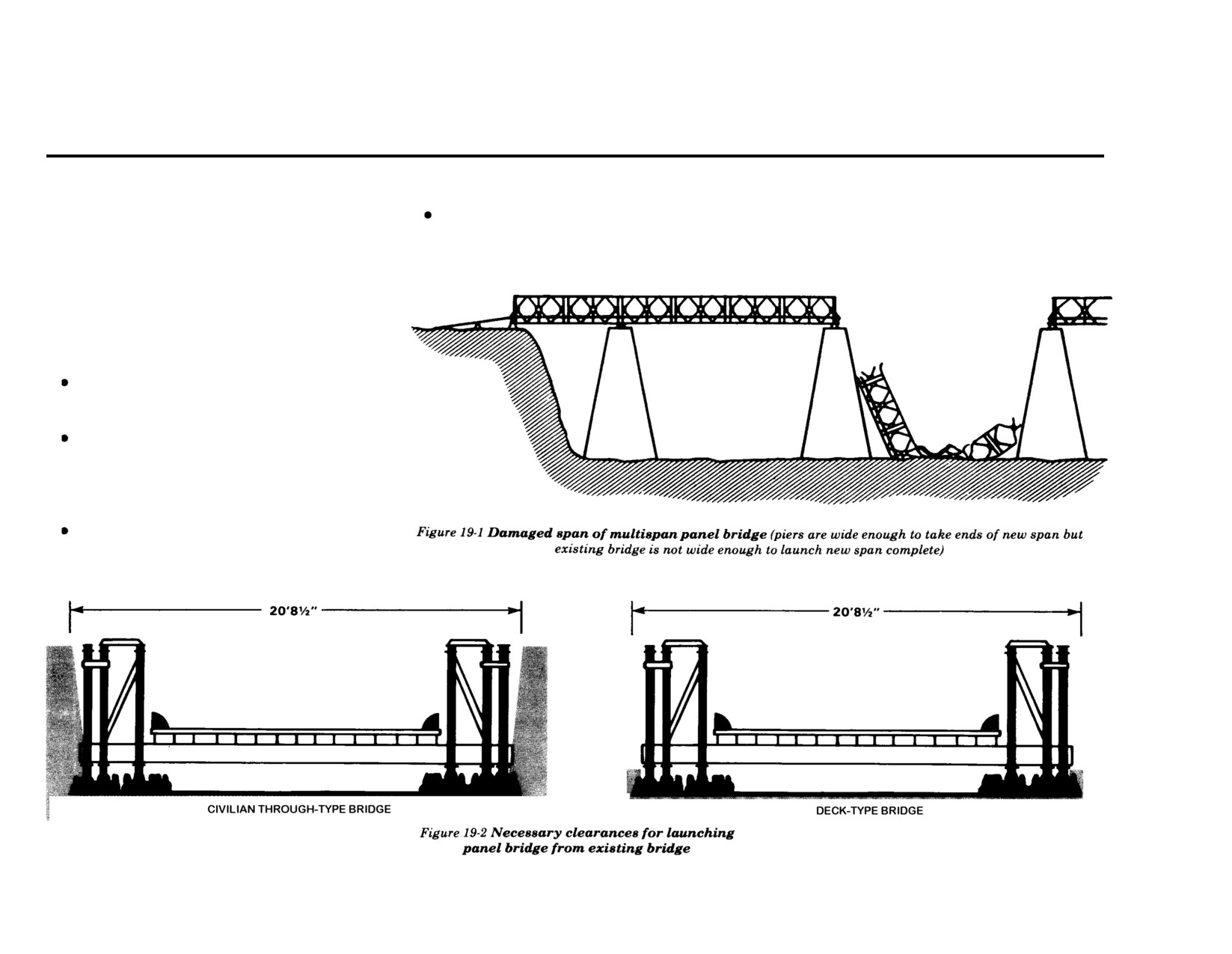
It may be advisable to launch a panel bridge
A launching of span of panel bridge to a
to intermediate landing bay of a floating
one girder at a time. This method is advan-
point much lower or of varying height, as
bridge in tidal water (Figure 19-3).
tageous when launching from an existing
bridge where piers are wide enough to take
the ends of a new span, but the existing
bridge is not wide enough to launch the new
span complete. Such launching is recom-
mended when there is—
An existing through-type panel bridge
(Figure 19-1).
An existing through-type civilian bridge
where the width between side walls or
trusses is less than 20 feet 8 ½ inches (6.32
meters) (Figure 19-2).
An existing deck-type bridge where width
of deck is less than 20 feet 8 ½ inches (6.32
meters) (Figure 19-2).
244