FM 7-15 THE ARMY UNIVERSAL TASK LIST (AUGUST 2003) - page 10

FM 7-15__________________________________________________________________________
No.
Scale
Measure
10
Percent
Of targets unnecessarily reattacked.
ART 7.3.3.3
PROVIDE REATTACK RECOMMENDATION
7-32. Make recommendations to the commander, considering the level to
which operational objectives have been achieved, regarding reattack, and
other recommendations that address operational objectives relative to target,
target critical elements, target systems, and enemy combat strengths. (FM 6-
20-10) (USAFAS)
No.
Scale
Measure
01
Yes/No
Reattack recommendations were effective and efficient.
02
Time
To commence follow-on operations or execute other options.
03
Time
To provide full assessment of attacks to joint force commander.
04
Time
To assess reattack requirement (after attack).
05
Time
To provide initial reattack assessment of attacks to force commander.
06
Percent
Of HPT attacks unsuccessful.
07
Percent
Of HPTs assessed as killed later assessed as being mission capable.
08
Percent
Of HPTs that require reattack.
09
Percent
Of HPTs successfully attacked.
Difference between higher level and force assessment of reattack
10
Percent
requirement.
11
Percent
Of targets unnecessarily reattacked.
7-18
_________________________________
ART 7.0: The Command and Control Battlefield Operating System
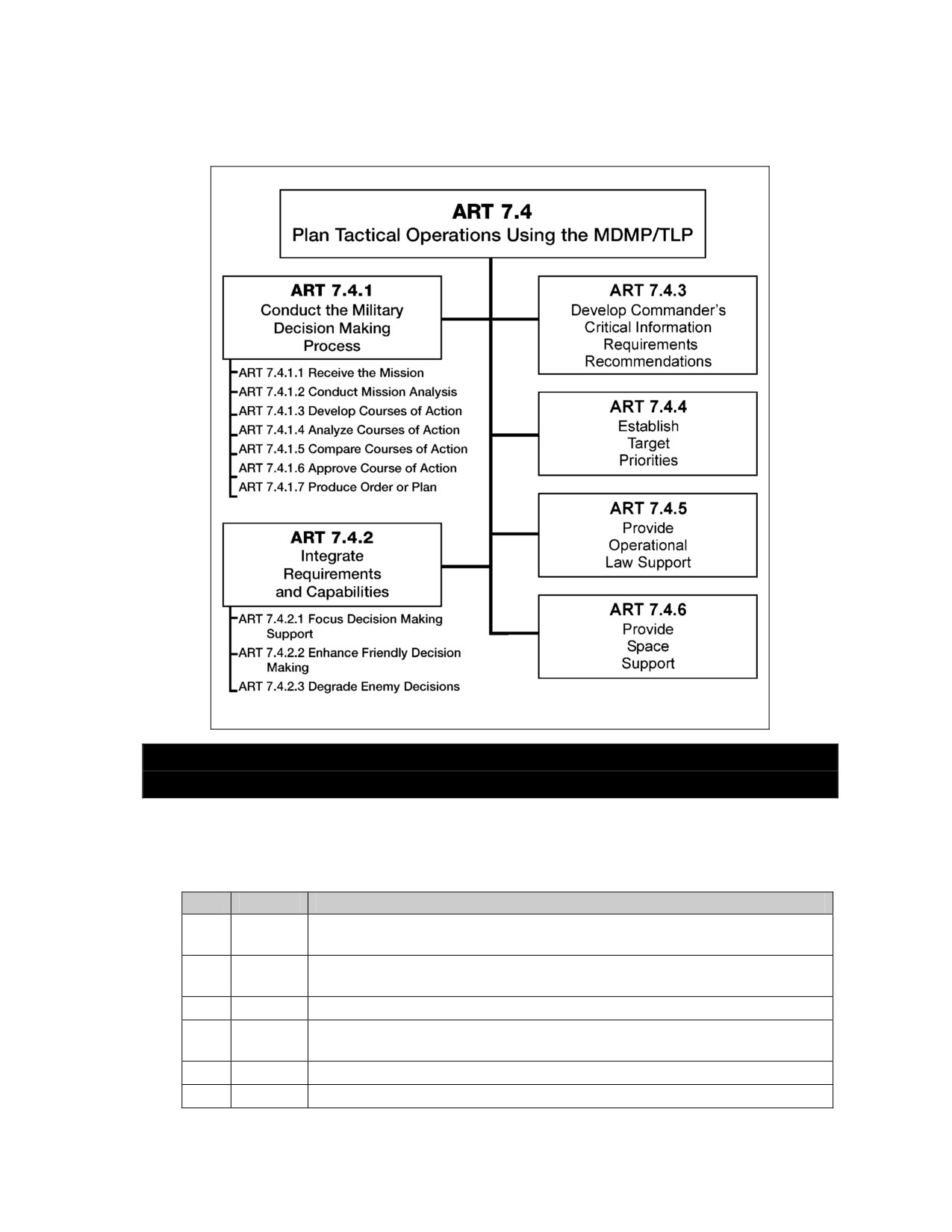
SECTION IV - ART 7.4: PLAN TACTICAL OPERATIONS USING THE
MILITARY DECISION MAKING PROCESS/TROOP LEADING PROCEDURES
7-33. Translate the commander’s visualization into a specific COA for
preparation and execution. Produce orders and plans that communicate the
selected COA, intent, and decisions to subordinates, focusing on the expected
results. (FM 101-5) (USACAC)
No.
Scale
Measure
Tactical planning produces a commander’s decision, communicates an
01
Yes/No
effective methodology, that facilitates mission accomplishment.
Subordinate unit staffs are able to digest the order produced by the
02
Yes/No
military decision making process (MDMP).
03
Yes/No
Time is available for plan rehearsal and refinement.
Time management principals, such as maintaining established time line,
04
Yes/No
were effectively used.
05
Time
Prior to execution, plan published and delivered.
06
Time
To complete an iteration of the MDMP/troop leading procedures (TLP).
7-19
FM 7-15__________________________________________________________________________
No.
Scale
Measure
Of subordinate units that receive orders in time to plan, prepare, and
07
Percent
execute.
08
Percent
Of time used to provide commander’s intent.
Of available planning time allowed for subordinate planning and
09
Percent
preparation.
10
Percent
Of subordinate commands clear about their immediate objectives.
Of times a staff digresses to earlier MDMP steps, such as going back to
11
Number
mission analysis issues while developing courses of action.
ART 7.4.1 CONDUCT THE MILITARY DECISION MAKING PROCESS
7-34. Employ the logic and techniques of a prescribed analytical process, TLP
or MDMP, to determine a unit’s restated mission. Develop COAs to
accomplish the mission. Recommend the most effective COA. Prepare orders
and plans to communicate the selected COA, intent, and decisions to
subordinates, focusing on the expected results. (FM 101-5) (USACAC)
Note: See FM 101-5 for a complete discussion of MDMP.
No.
Scale
Measure
Prescribed analytic process produces effective decision and order to
01
Yes/No
guide execution.
02
Yes/No
Milestone criteria for plan development met.
Of completed planning documents passed to subordinates to allow
03
Percent
parallel planning.
04
Percent
Of TLP/MDMP completed correctly.
ART 7.4.1.1
RECEIVE THE MISSION
7-35. To be given a mission by higher headquarters or deduce a need for a
change in the current mission. This task involves preparing for mission
analysis, to include collecting materials for analysis, receiving the
commander’s preliminary guidance, determining requirements and time
available, and sending warning orders to subordinates.
(FM
101-5)
(USACAC)
No.
Scale
Measure
Commander and staff understand all of the specified and implied tasks
01
Yes/No
contained within their mission.
02
Yes/No
Commander provided adequate initial guidance.
03
Time
After receipt of mission, to issued initial planning guidance.
04
Time
To alert staff of receipt of new mission.
05
Time
To issue warning order.
ART 7.4.1.2
CONDUCT MISSION ANALYSIS
7-36. Analyze the received mission to define the tactical problem and begin
to determine solutions. It results in a restated mission, the commander’s
7-20

_________________________________
ART 7.0: The Command and Control Battlefield Operating System
guidance, intent, initial CCIR, planned use of available time, and a warning
order. (FM 101-5) (USACAC)
No.
Scale
Measure
Develop and approve restated mission, commander’s guidance, intent,
01
Yes/No
CCIR, use of available time, and warning order.
Mission statement includes who, what, when, where, and why of the
02
Yes/No
mission.
03
Yes/No
Time/distance analysis conducted.
Develop assumptions to replace missing or unknown facts that are
04
Yes/No
necessary for continued planning.
05
Time
Planning guidance issued to staff and subordinate commands.
06
Time
To initiate preliminary movement.
Of critical information and staff estimates reviewed prior to mission
07
Percent
analysis.
08
Percent
Of major topics within the IPB for which assessments are conducted.
Of assumptions proved to be either invalid or unrealistic and significantly
09
Percent
affect the operation.
10
Percent
Of constraints identified that significantly affect the operation.
11
Percent
Of specified tasks derived in mission analysis and carried into planning.
12
Percent
Of implied tasks derived in mission analysis and carried into planning.
13
Percent
Of essential tasks derived in mission analysis and carried into planning.
Of specified and implied tasks that are identified as essential tasks and
14
Percent
included in either the mission statement, commander’s intent or concept
of operations paragraphs of the operation order.
15
Percent
Of forces identified as required to accomplish the essential tasks.
16
Percent
Completeness of commander’s guidance (coverage of functional areas).
17
Percent
Of planning time used to issue guidance.
18
Percent
Of ROE clearly understood.
Of subordinates accepting commander’s intent without requests for
19
Percent
clarification.
Of amendments issued to planning guidance (due to requests for
20
Number
clarification).
Of requests for clarification of planning guidance received from
21
Number
subordinate headquarters.
22
Number
Of misunderstood ROE.
23
Number
Of revisions to commander’s intent.
ART 7.4.1.3
DEVELOP COURSES OF ACTION
7-37. Design COA for analysis, evaluation, and selection as the one
to
accomplish the mission most effectively. It includes analyzing relative
combat power, generating options, arraying initial forces, developing schemes
of maneuver, assigning headquarters, and preparing COA statements and
sketches. The commander has the option of directing a specific course of
7-21

FM 7-15__________________________________________________________________________
action because of time available, staff proficiency, or other reasons. (FM 101-
5) (USACAC)
No.
Scale
Measure
COAs developed adequately in terms of feasibility, suitability, and
01
Yes/No
acceptability for mission accomplishment if executed.
To provide the commander with suitable, feasible, and acceptable COAs
02
Time
after receipt of operation order/warning order.
03
Time
To prepare complete COA statements and sketches.
04
Percent
Of non-selected COAs considered for deception.
05
Percent
Of COAs suitable.
06
Percent
Of COAs feasible.
07
Percent
Of COAs acceptable.
08
Percent
Of COAs distinguishable.
Of COAs presented to commander that were suitable, feasible,
09
Percent
acceptable and distinct from one another.
10
Number
Of COAs developed.
ART 7.4.1.4
ANALYZE COURSES OF ACTION
7-38. Develop criteria for success and examine each COA for its advantages
and disadvantages with respect to those criteria. This task normally includes
the technique of wargaming as described in FM 101-5. Visualize each COA
objectively, assess suitability, feasibility, and acceptability of the COA, focus
IPB requirements, identify coordination requirements, anticipate critical
operational events, and determine conditions and resources required for
success. (FM 101-5) (USACAC)
No.
Scale
Measure
Identify advantages/disadvantages of COAs and criteria of success for
01
Yes/No
evaluation.
02
Time
To complete COA analysis (wargame).
03
Percent
Completeness of COAs (wargame).
04
Percent
Conformance of analysis (wargame) to doctrine.
05
Percent
Of branches and sequels experienced identified in COAs.
06
Percent
Of capabilities ultimately required identified in COA analysis (wargame).
07
Percent
Of COAs analyzed against potential enemy COAs.
Of limitations (ultimately identified during execution) identified during
08
Number
analysis.
Of criteria of comparison and success identified during COA analysis
09
Number
(wargame).
ART 7.4.1.5
COMPARE COURSES OF ACTION
7-39. Evaluate COAs against each other and against criteria of success to
determine the most effective one for mission accomplishment. Recommend it
for selection. This comparison also considers risk, positioning for future
operations, flexibility, and subordinate exercise of initiative.
(FM 101-5)
(USACAC)
7-22

_________________________________
ART 7.0: The Command and Control Battlefield Operating System
No.
Scale
Measure
01
Yes/No
Selected comparison criteria allows for definitive comparison of COAs.
02
Percent
Of comparison criteria eliminated before comparison.
Of comparison criteria eventually used, defined and weighted before
03
Percent
comparison began.
ART 7.4.1.6
APPROVE COURSE OF ACTION
7-40. Decide and approve a COA that is most advantageous to mission
accomplishment and is within the higher commander’s intent. Refine
commander’s intent and CCIR to support selected COA. Issue any additional
guidance to subordinate commanders and staff. Prepare and issue warning
order. (FM 101-5) (USACAC)
No.
Scale
Measure
Commander evaluates COAs and selects a COA, modifies COA or
01
Yes/No
rejects all presented COAs.
Modified COA or new COA generates a new war game to consider
02
Yes/No
products deriving from that COA.
Revised commander’s intent adequately addresses key tasks for force as
03
Yes/No
whole, wider purpose. It is expressed in four to five sentences or bullets.
Commander decides level of risk to accomplish mission and approves
04
Yes/No
control measures.
05
Time
To issue warning orders.
ART 7.4.1.7
PRODUCE ORDER OR PLAN
7-41. Prepare a plan or order to implement the selected COA IAW the
commander’s decision by turning it into a clear, concise concept of operations,
scheme of maneuver, and required support. The plan includes annexes and
overlays as necessary to implement the plan. The plan or order accurately
conveys information governing actions to be taken and is completed in the
correct format. The order or plan includes supporting annexes and overlays.
This includes the establishment of graphic control measures, including fire
support coordination measures. (FM 101-5) (USACAC)
No.
Scale
Measure
Orders or plans will accomplish the mission and commander’s intent.
They will be completed with sufficient time for the force to complete
01
Yes/No
required preparatory actions before execution, and communicated
effectively.
Commander’s intent refined and adequately addresses key tasks for
02
Yes/No
force as whole, wider purpose, and expressed in four to five sentences.
03
Time
To issue warning orders.
04
Time
Before execution, commander’s concept and intent re-issued.
To prepare plans and orders (after deciding on mission concept and
05
Time
intent).
06
Time
To obtain approval of plans and orders.
07
Time
To issue plan or order (after approved).
7-23
FM 7-15__________________________________________________________________________
No.
Scale
Measure
08
Percent
Of functional areas covered in operation plan.
Accuracy of information in plans and orders issued and disseminated to
09
Percent
subordinate units.
Accuracy of information in operation order/operation plan to meet
10
Percent
established objectives.
Of instances where the operation plan/operation order conflicts with
11
Number
standards under conduct of war and international convention.
ART 7.4.2 INTEGRATE REQUIREMENTS AND CAPABILITIES
7-42. Combine and coordinate forces’ and operating systems’ capabilities in
the most effective combinations to meet the requirements for mission
accomplishment established by planning. (FM 101-5) (USACAC)
No.
Scale
Measure
Combinations and timings of forces and operating systems contribute to
01
Yes/No
mission accomplishment.
02
Time
Delay in initiating phase of operation.
Prior to execution, force has execution matrix with sequence and timing
03
Time
of each subordinate task throughout operation.
04
Time
To modify plans and actions due to operational contingencies.
Of assigned and supporting forces coordinated to synchronize operation
05
Percent
in right place at right time.
Of potential cross boundary fratricide incidents identified and eliminated
06
Number
by force headquarters.
Of uncoordinated element or activity actions causing disruption or delay
07
Number
of US or allied plans and objectives.
ART 7.4.2.1
FOCUS DECISION MAKING SUPPORT
7-43. Integrate IO and information management activities that enhance
situational understanding rapidly and accurately, achieving information
superiority and yielding decisions that initiate or govern actions to
accomplish tactical missions. (FM 3-13) (USACAC)
No.
Scale
Measure
Integration of information operations and information management
01
Yes/No
activities enhances the commander’s situational understanding and
supports making superior and timelier decisions.
02
Percent
Of identified friendly vulnerabilities exploited by enemy action.
Of uncoordinated IO element or activity actions causing disruption or
03
Number
delay of US or allied plans and objectives.
Of force plans or objectives being delayed, defeated, or disrupted due to
04
Number
adversary IO actions.
Of times that the commander has to request further information for
05
Number
decision making.
Of instances where force IO and information management actions delay,
06
Number
defeat, or disrupt adversary plans or objectives.
7-24
_________________________________
ART 7.0: The Command and Control Battlefield Operating System
ART 7.4.2.2
ENHANCE FRIENDLY DECISION MAKING
7-44. Leverage information management that supports making more precise
and timely decisions than the enemy. (FM 6-0) (USACAC)
No.
Scale
Measure
01
Time
Before force knows of possible compromise of EEFI.
02
Time
To make effective decisions relative to enemy.
Of decisions made more precisely and before enemy could effectively
03
Percent
react.
04
Percent
Adequacy of friendly decisions.
05
Percent
Of EEFI successfully protected during operation.
06
Percent
Of enemy attacks on previously identified EEFI force vulnerability.
ART 7.4.2.3
DEGRADE ENEMY DECISIONS
7-45. To integrate IO that cause the enemy to make inappropriate, untimely,
and irrelevant decisions that give friendly forces a decision-making
advantage. (FM 3-13) (USACAC)
No.
Scale
Measure
Enemy decision making was degraded as a result of friendly information
01
Yes/No
operations sufficient to constitute a friendly decision making advantage.
02
Time
Lost by enemy in making decisions due to lack of information.
To identify required tactical IO information necessary for IO planning after
03
Time
onset of planning.
To task intelligence community and other tactical support organizations
04
Time
and agencies to fill information requirements for IO planning.
05
Percent
Of enemy information degraded by friendly actions.
06
Percent
Of tactical IO objectives verifiably achieved.
Of identified operational IO information requirements unfilled at time-
07
Percent
critical points in the planning process.
Of IO cell nominated targets struck with lethal or nonlethal means during
08
Percent
the timeframe planned for in the IO appendix or other planning document.
Of IO cell nominated targets restruck when called for after combat
09
Percent
assessment of initial strike.
10
Percent
Of IO objectives executed actually degrading enemy decision making.
ART 7.4.3 DEVELOP COMMANDER’S CRITICAL INFORMATION
REQUIREMENTS RECOMMENDATIONS
7-46. Analyze information requirements against a mission and commander’s
intent. Identify, prepare, and recommend for designation by the commander
those information requirements that directly affect decision making and
dictate the successful execution of operational or tactical operations. (FM 6-0)
(USACAC)
7-25
FM 7-15__________________________________________________________________________
No.
Scale
Measure
Answering the developed CCIR provides the commander with the
01
Yes/No
information needed to make decisions.
02
Time
Since last CCIR update.
03
Time
To promulgate CCIR for collection.
To look at future CCIR (depends on scale of operation and level of
04
Time
headquarters).
05
Percent
Of answered CCIR.
06
Percent
Of CCIR initiated by commander.
07
Percent
Of CCIR initiated by staff.
Of information (pieces or types) commander needs to make decision
08
Percent
listed as CCIR.
09
Number
Of active CCIR.
ART 7.4.4 ESTABLISH TARGET PRIORITIES
7-47. Identify, and recommend for selection, targets by categories in
precedence to mission accomplishment, or individual targets for attack by,
any and all BOS during the operation. (FM 6-20) (USACAC)
No.
Scale
Measure
01
Yes/No
Target priorities support the accomplishment of the mission.
02
Time
To establish target priorities.
03
Percent
Of targets attacked in priority prescribed.
04
Percent
Of required priority targets correctly identified.
05
Percent
Of unknown targets that would have been priority if correctly identified.
ART 7.4.5 PROVIDE OPERATIONAL LAW SUPPORT
7-48. Support the command and control of military operations (the MDMP
and conduct of operations) by performing mission analysis, preparing legal
estimates, designing the operational legal support structure, writing legal
annexes, assisting in the development and training of ROE, reviewing all
operational plans and orders, maintaining situational understanding, and
advising on the legal aspects of targeting, application of the ROE, civil-
military operations, and IO. ( FM 27-100) (TJAGSA)
No.
Scale
Measure
Operational law support enhances the chances of accomplishing the
01
Yes/No
mission without violating the laws of war or rules of engagement.
02
Time
To assist drafting and reviewing of the ROE for the operation.
Between commander’s requests for and receipt of legal advice or
03
Time
support.
04
Time
To prepare legal estimates.
05
Time
To draft legal annexes.
Between requests for briefings on ROE/law of war and actual
06
Time
presentation of the briefings.
07
Time
To review existing international and interagency agreements.
7-26

_________________________________
ART 7.0: The Command and Control Battlefield Operating System
No.
Scale
Measure
08
Time
To review operation plans.
09
Percent
Unit personnel who receive ROE briefings prior to deployment.
Operational law judge advocates and support personnel with working
10
Percent
knowledge of available Army information systems.
Operational law judge advocates and support personnel with access to
11
Percent
Army information systems.
Operational law judge advocates and support personnel with access to
12
Percent
LAAWS.
13
Percent
Judge advocates who deploy with radio data link and radio.
14
Percent
Judge advocates with access to a global positioning device.
15
Percent
Judge advocates proficiently trained to use a global positioning device.
Units/soldiers that receive legal briefings on ROE/law of war, status of
16
Percent
forces agreements, and host-nation law prior to deployment.
17
Percent
Operational cells with a judge advocate detailed.
18
Percent
Missions where a judge advocate participates in mission analysis.
19
Percent
Targets reviewed by a judge advocate.
Entities requiring legal liaison that have a designated judge advocate
20
Percent
liaison.
21
Percent
Crisis management team meetings attended by a judge advocate.
Issues correctly identified, analyzed, and resolved to support the C2
22
Percent
mission.
23
Percent
Legal opinions that reflect an accurate view of the law.
24
Percent
Legal opinions that answer the client’s questions clearly and concisely.
25
Percent
Legal opinions in a form that is useful to the client.
26
Percent
Of opinions reviewed by a supervisor before release.
ART 7.4.6 PROVIDE SPACE SUPPORT
7-49. Coordinate and combine space-based capabilities and products
(national, military, and commercial) to support the command and control of
tactical operations (the MDMP and conduct of operations) in a manner that
most effectively meets the requirements established for mission
accomplishment. Determine essential, specified and implied tasks from a
space perspective in mission analysis; develop space input to IPB; provide
space support options, space-based products that support scheme of
maneuver development, and space-based products that support COA
statements in COA development; develop space staff estimate; coordinate
space-based input to event templates, synchronization matrix and decision
support template, communications and CSS estimates.
(FM
100-18)
(USASMDC)
No.
Scale
Measure
01
Yes/No
Space support enhances the unit’s ability to accomplish the mission.
Coordinate with the unit operations officer for space input to warning
02
Yes/No
order.
7-27
FM 7-15__________________________________________________________________________
No.
Scale
Measure
03
Yes/No
Provide space input to mission analysis.
04
Yes/No
Provide initial space input to IPB.
05
Yes/No
Determine space support requirements.
Coordinate with the unit intelligence officer to identify available space
06
Yes/No
reconnaissance assets.
07
Yes/No
Identify space support that can assist the staff elements.
08
Yes/No
Provide space input to unit COA development process.
09
Yes/No
Develop space staff estimate.
10
Yes/No
Finalize space input to the warning order and operation order.
Coordinate with staff elements to ensure space-related activities are
11
Yes/No
included in their portions of the operation order.
12
Yes/No
Participate as a member of special boards as necessary.
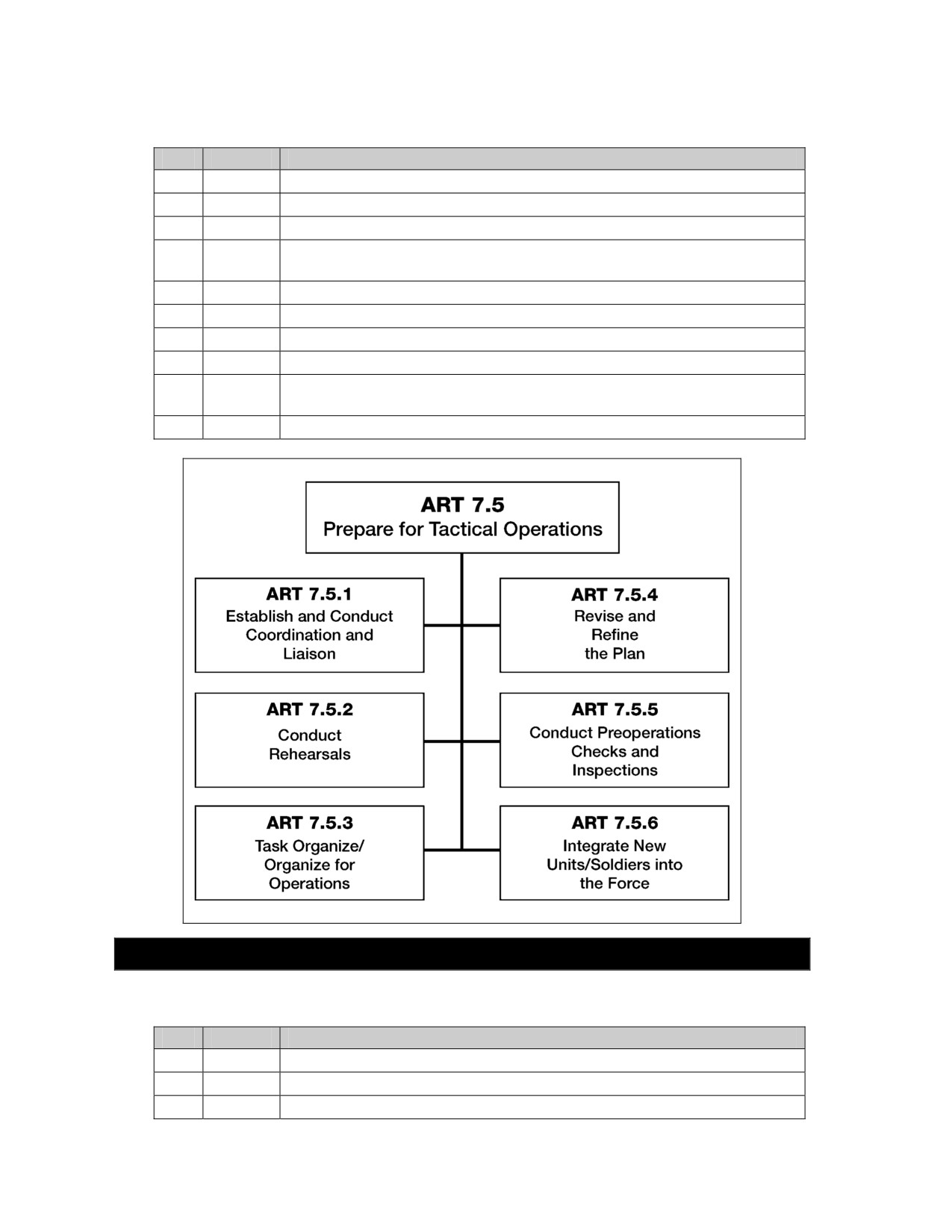
SECTION V - ART 7.5: PREPARE FOR TACTICAL OPERATIONS
7-50. To initiate and conduct activities by the unit prior to execution to
improve its ability to conduct the operation. (FM 6-0) (USACAC)
No.
Scale
Measure
01
Yes/No
Preparatory activities raise the unit’s ability to accomplish its mission.
02
Time
For subordinate forces to complete required preparations.
03
Time
For force to complete required staff, unit, and individual preparations.
7-28

_________________________________
ART 7.0: The Command and Control Battlefield Operating System
No.
Scale
Measure
04
Time
Available for preparation before execution.
05
Percent
Of required preparations completed by execution time.
Of completed preparations that improved force capability to execute
06
Percent
mission.
ART 7.5.1 ESTABLISH AND CONDUCT COORDINATION AND
LIAISON
7-51. Exchange information to inform, integrate, and deconflict actions by
forces and BOS during operations to reduce duplication, confusion, and
problems. Liaison, included in coordination, involves maintaining physical
contact and communication between elements of military forces to ensure
mutual understanding and unity of purpose and action. (FM 6-0) (USACAC)
No.
Scale
Measure
Coordination of plans and synchronization of actions between
01
Yes/No
organizations contributes to mission accomplishment.
02
Time
Until liaison structure established (from alert order).
For liaison officers (LNOs) to communicate new orders or information to
03
Time
allies and friendly elements of force.
Since LNOs attached to force headquarters last received situation update
04
Time
from own unit.
For force headquarters LNOs to contact force headquarters on behalf of
05
Time
unit to which sent.
06
Time
For force staff sections to contact LNO attached to force headquarters.
07
Time
For parent unit to contact their LNO.
08
Percent
Of adjacent units or agencies with liaison to force.
Of liaison personnel with required security clearances and identification
09
Percent
credentials.
10
Percent
Of unit or agency information missing or late.
Of instances when friendly forces orders/taskings were significantly
11
Number
delayed.
ART 7.5.2 CONDUCT REHEARSALS
7-52. Practice an action or operation prior to actual performance of that
action. Rehearsals allow participants to become familiar with and translate
the tactical plan into a visual impression that orients them to both their
environment and other units during execution of the operation. They also
imprint a mental picture of the sequence of key actions within the operation
and provide a forum for subordinate leaders and units to coordinate. (FM 6-0)
(USACAC)
No.
Scale
Measure
Rehearsal improves all participants’ familiarity with the tactical plan, their
01
Yes/No
roles within that plan, and coordination.
02
Yes/No
Specify type of rehearsal.
7-29

FM 7-15__________________________________________________________________________
No.
Scale
Measure
03
Yes/No
Specify technique of rehearsal.
04
Yes/No
Specify roles and responsibilities of participants.
05
Yes/No
Identify and prioritize events to be rehearsed.
Subordinates review their mission, commander’s intent, and concept of
06
Yes/No
operations in relationship to time (such as by timelines or phases).
07
Yes/No
Discuss and resolve BOS coordination issues.
08
Yes/No
Major changes are made to the existing plan.
09
Time
To document and distribute results of the rehearsal.
10
Percent
Of the operation’s phases/objectives are rehearsed.
11
Percent
Of developed branch (or contingency) plans reviewed.
ART 7.5.3 TASK ORGANIZE/ORGANIZE FOR OPERATIONS
7-53. Transfer available resources and establish command and support
relationships according to the plan or order to carry out the operation.
Organizing for operations includes moving the unit’s location as required,
exchanging SOPs, establishing communications and liaison, and conducting
briefings and rehearsals. (FM 6-0) (USACAC)
No.
Scale
Measure
Units conducting operations properly transfer necessary resources IAW
01
Yes/No
established command and support relationships to accomplish their
mission.
02
Time
For force to transition to or from tactical battle formation.
From planned execution time force transitions to or from tactical battle
03
Time
formation.
To move forces into locations to facilitate tactical commanders’ plans for
04
Time
implementing subordinate plan.
To complete force movement to new assembly areas (from which to
05
Time
maneuver).
06
Time
To assign subordinate forces to new tactical formations.
Until subordinate units are prepared to send and receive data and do
07
Time
parallel planning with new headquarters.
08
Percent
Of force moved into position to facilitate tactical commander’s plans.
09
Percent
Of required logistics in place on-schedule.
10
Percent
Of allocated forces in place at operation execution.
Of required logistics stockpiled/positioned (prior to operation D-day, H-
11
Percent
hour).
Of designated forces massed in designated assembly area according to
12
Percent
planned times.
13
Percent
Units closed on new assembly areas before execution.
14
Percent
Of force postured physically to execute plan’s tactical maneuver.
7-30
_________________________________
ART 7.0: The Command and Control Battlefield Operating System
ART 7.5.4 REVISE AND REFINE THE PLAN
7-54. Adjust the plan based upon updated relevant information or further
analysis of the plan, if necessary. (FM 6-0) (USACAC)
No.
Scale
Measure
01
Yes/No
Revision and refinements of plan contribute to accomplishing the mission.
Plan is revised and refined after receipt of updated relevant information,
02
Yes/No
such as answered CCIR.
03
Time
To adjust plan after receipt of updated relevant information.
To revise original plan after recognizing planning assumptions invalid or
04
Time
information updated.
05
Percent
Of plan adjusted with each adjustment.
06
Percent
Accuracy of adjustments by execution.
ART 7.5.5 CONDUCT PREOPERATIONS CHECKS AND INSPECTIONS
7-55. Inspect and check unit and individual preparations for operations to
ensure units, soldiers, and systems are fully capable and ready to execute the
mission. (FM 6-0) (USACAC)
No.
Scale
Measure
The inspections and corrections of deficiencies found of unit, soldiers,
01
Yes/No
and systems improve their capability and readiness to execute the
mission.
02
Time
To conduct checks and inspections.
03
Time
To correct deficiencies found during inspection.
04
Percent
Of units, individuals, and materiel not ready for operation.
05
Percent
Of deficiencies corrected before operation.
ART 7.5.6 INTEGRATE NEW UNITS/SOLDIERS INTO THE FORCE
7-56. Assimilate new units and soldiers into the force in a posture that
allows them to contribute effectively to mission accomplishment during an
operation. This includes receiving and introducing them to the force and the
environment, orienting them on their place and role in the force and the
operation, establishing C2, sustainment, and communications within the
force, and training them in the unit SOP and METL for the operation. (FM 6-
0) (USACAC)
No.
Scale
Measure
Integration of new units and soldiers made them contribute more
01
Yes/No
effectively to mission accomplishment.
02
Time
To receive individuals into new organizations.
03
Time
To introduce individuals to the environment and the operation.
04
Time
To receive new organizations into the force.
05
Time
To introduce new organizations to the environment and the operation.
06
Time
To train new organizations and individuals for the operation.
7-31
FM 7-15__________________________________________________________________________
No.
Scale
Measure
07
Percent
Of individuals successfully integrated into new organizations.
08
Percent
Of organizations successfully integrated into force.
09
Percent
Of new soldiers within the unit who must be assimilated.
10
Number
Of new soldiers within the unit who must be assimilated.
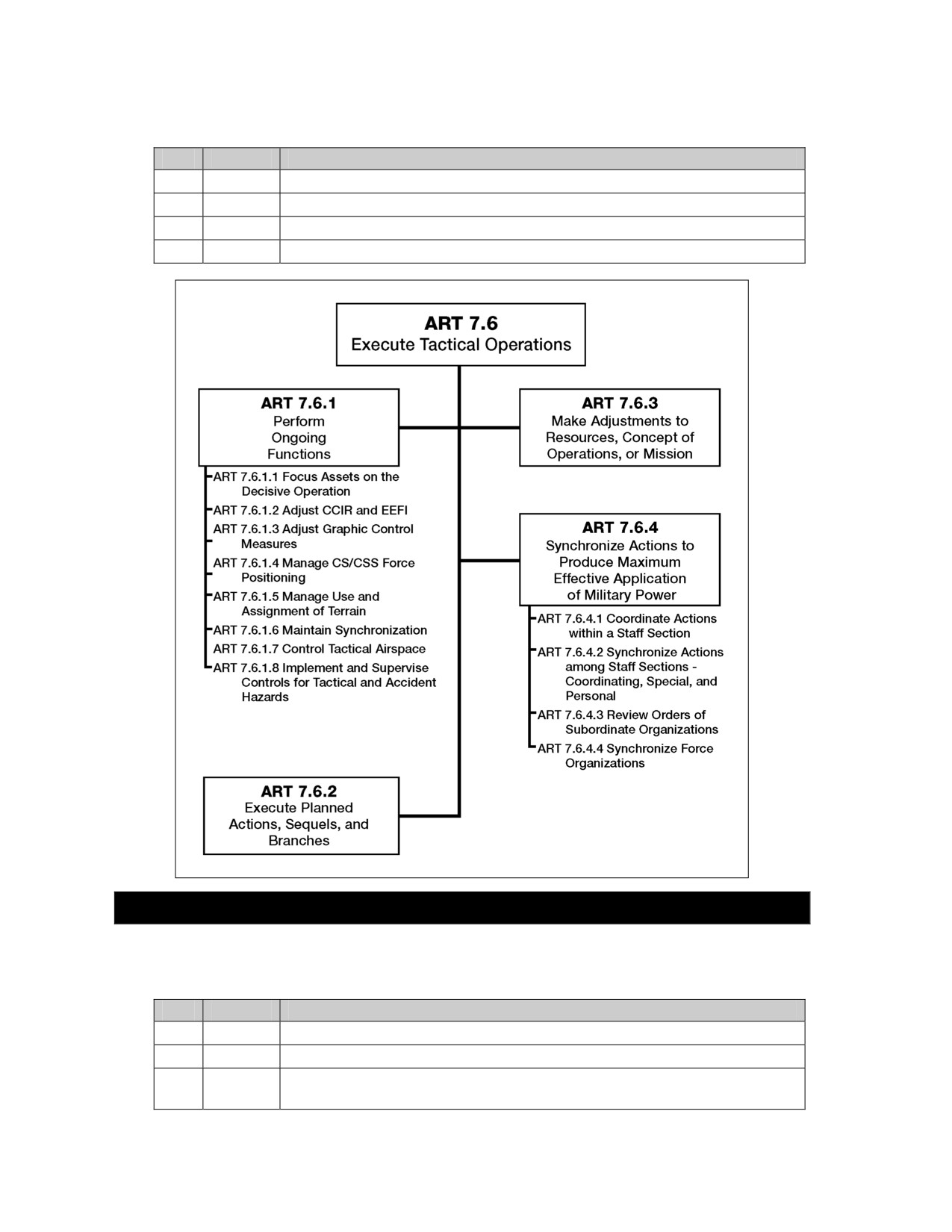
SECTION VI - ART 7.6: EXECUTE TACTICAL OPERATIONS
7-57. Put a plan into action by applying military power against an adversary
to accomplish the mission. Use situational understanding to assess progress
and make execution and adjustment decisions. (FM 6-0) (USACAC)
No.
Scale
Measure
01
Yes/No
Mission accomplished in accordance with higher commander’s intent.
02
Yes/No
Mission accomplished in accordance with specified timeline.
Mission accomplishment does not detract from unit’s capability of
03
Yes/No
continuing or being assigned future missions and operations.
7-32
_________________________________
ART 7.0: The Command and Control Battlefield Operating System
No.
Scale
Measure
04
Yes/No
Mission accomplished without excessive expenditure of resources.
05
Time
To accomplish mission.
06
Percent
Of enemy actions successfully countered.
07
Number
Of opportunities for success exploited.
Of friendly versus enemy casualties (soldiers/weapons systems) to
08
Ratio
accomplish mission.
ART 7.6.1 PERFORM ONGOING FUNCTIONS
7-58. Accomplish routine tasks during execution essential to satisfactory
mission accomplishment. (FM 6-0) (USACAC)
No.
Scale
Measure
Perform routine management tasks as necessary to accomplish the
01
Yes/No
mission without the need to take extraordinary efforts to ensure their
correct performance.
02
Percent
Of all functions performed adequately during operations.
03
Percent
Of individual functions performed adequately during operations.
04
Number
Of friendly missions affected by failure to perform one or more functions.
ART 7.6.1.1
FOCUS ASSETS ON DECISIVE OPERATION
7-59. Continuously survey all assets and ensure that they are in position and
tasked to support the decisive operation or main effort for a phase of an
operation, or that they are moving to a position where they can provide that
support. (FM 6-0) (USACAC)
No.
Scale
Measure
Unit allocation of combat power regularly supports the decisive operation
01
Yes/No
necessary to accomplish the mission.
02
Percent
Of combat power assets directed to decisive operation.
Of incidents of excessive combat power used to execute shaping
03
Number
operations.
Of incidents of combat power resources improperly positioned to support
04
Number
decisive operation.
ART 7.6.1.2
ADJUST CCIR AND EEFI
7-60. Continuously update CCIR and EEFI during operations with routine
review by the commander and staff. Analyze IR against changing operational
circumstances and designate IR that affect decision making and the success
of the mission and decisive operation. (FM 6-0) (USACAC)
No.
Scale
Measure
Continuously adjust CCIR and EEFI during operations with review by
01
Yes/No
commander and staff.
02
Time
Lag between changing information and update of CCIR and EEFI.
03
Number
Of CCIR and EEFI requirements not updated or changed.
7-33
FM 7-15__________________________________________________________________________
ART 7.6.1.3
ADJUST GRAPHIC CONTROL MEASURES
7-61. Change graphic control measures, including fire support coordination
measures, any time there is significant movement of forces or special
operations force activity in the AO. (FM 6-0) (USACAC)
No.
Scale
Measure
Adjustment of graphic control measures reflects changes in the factors of
01
Yes/No
METT-TC and is timely and effective.
02
Time
Lag between operations and update of graphic control measures.
03
Percent
Of graphic control measures requiring amendment to facilitate operations.
04
Number
Of graphic control measures not updated.
Of significant movement of forces compared to the number and
05
Number
timeliness of graphic changes.
ART 7.6.1.4
MANAGE CS/CSS FORCE POSITIONING
7-62. Move or cause CS and CSS forces to be moved and positioned where
they can contribute the maximum support to the operation. Determine where
the CS and CSS forces are and where they must be to continuously provide
effective support. Ensure that movement is planned and executed in time to
position them there. (FM 6-0) (USACAC)
No.
Scale
Measure
Reposition CS/CSS units and activities as necessary to respond to
01
Yes/No
tactical operations without negative effects on friendly operations.
To effect essential CS/CSS repositioning without negative effects on
02
Time
friendly operations.
Lag between identification of need for repositioning and commencement
03
Time
of repositioning.
04
Percent
To which friendly operations affected by failures in CS/CSS positioning.
05
Number
Of friendly operations adversely affected by failure in positioning.
ART 7.6.1.5
MANAGE USE AND ASSIGNMENT OF TERRAIN
7-63. Ensure that adequate space, including the use of routes, is available at
the right time to support critical activities, especially the decisive operation
within the AO. (FM 6-0) (USACAC)
No.
Scale
Measure
01
Yes/No
Adequate maneuver space and routes support the decisive operation.
02
Time
Since last check of terrain management status.
03
Number
Of friendly units’ operations affected by lack of terrain management.
04
Number
Of incidents where friendly units dispute assignment of terrain or routes.
ART 7.6.1.6
MAINTAIN SYNCHRONIZATION
7-64. Take actions to preserve the arrangement of military actions in time,
space, and purpose to produce maximum relative military power at a decisive
place and time. (FM 6-0) (USACAC)
7-34
_________________________________
ART 7.0: The Command and Control Battlefield Operating System
No.
Scale
Measure
Combat power available at the decisive place and time to accomplish the
01
Yes/No
mission.
Of assigned and supporting forces execute operation on time (right
02
Percent
people, right place, right time).
03
Percent
Of force or subordinate missions and support carried out as planned.
04
Percent
Of friendly forces actively contributing to conduct of operation.
05
Percent
Of support requirements met at time and as required.
Of policies and procedures for establishment and coordination of
06
Percent
logistics, maintenance, transportation, and other support completed.
Of missions (for example, special operations force, psychological
07
Number
operation, military deception) executed without coordinating with other
forces in target area.
ART 7.6.1.7
CONTROL TACTICAL AIRSPACE
7-65. Maximize the combat effectiveness of all tactical airspace users in
support of the operation. Prevent fratricide, enhance air defense operations,
and permit greater flexibility of tactical operations. Prepare and implement
the tactical airspace control plan and associated airspace control measures.
(FM 3-52) (USACAC)
No.
Scale
Measure
The control of tactical airspace allows airspace users to support tactical
01
Yes/No
operations while preventing fratricide.
02
Yes/No
The control of tactical airspace enhances the conduct of air operations.
The control of tactical airspace enhances the conduct of air defense
03
Yes/No
operations.
04
Time
To confirm identity of unidentified friendly target.
05
Time
Since last publication of air control orders.
06
Percent
Of friendly aircraft destroyed by friendly air defense.
07
Percent
Of friendly aircraft destroyed by friendly fire.
08
Percent
Of positive identification false negatives (friendly identified as enemy).
09
Percent
Of positive identification false positives (enemy identified as friendly).
10
Percent
Of fixed wing sorties receive clearances needed to complete mission.
11
Percent
Of rotary wing sorties receive clearances needed to complete mission.
12
Percent
Of air defense operations did not interfere with other operations.
13
Number
Of attacks by enemy air forces and the time that they occur.
14
Number
Of air-to-air mishaps in the AO.
ART 7.6.1.8
IMPLEMENT AND SUPERVISE CONTROLS FOR TACTICAL AND
ACCIDENT HAZARDS
7-66. Establish, communicate, and enforce controls that reduce the risk of
tactical and accident hazards. (FM 100-14) (USASC)
7-35

FM 7-15__________________________________________________________________________
No.
Scale
Measure
Establish, communicate and enforce tactical and accident hazard
01
Yes/No
controls.
02
Time
To communicate controls or changes to force.
03
Percent
Of force affected by identified accident hazards.
04
Percent
Of force affected by unidentified accident hazards.
05
Number
Of controls averting identified accident hazards.
06
Number
Of controls averting unidentified accident hazards.
ART 7.6.2 EXECUTE PLANNED ACTIONS, SEQUELS, AND BRANCHES
7-67. Implement actions anticipated by and outlined in the plan of
operations based upon evaluation of progress as within the criteria of success
in the plan. (FM 6-0) (USACAC)
No.
Scale
Measure
Execute planned actions, sequels, and branches based upon the
01
Yes/No
evaluation of progress.
02
Time
To refine planned branch or sequel for use by force.
Of planned branches and sequels meeting requirements of current
03
Percent
operation.
ART 7.6.3 MAKE ADJUSTMENTS TO RESOURCES, CONCEPT OF
OPERATIONS, OR MISSION
7-68. Take actions to modify the operation (or major activities) to exploit
opportunities or resolve progress problems as a result of evaluation of the
progress of the operation against the criteria of success. (FM 6-0) (USACAC)
No.
Scale
Measure
Adjust unit plan to exploit opportunities or resolve problems occurring
01
Yes/No
during execution.
To adjust original plan after assessing progress and recognizing threat or
02
Time
opportunity.
03
Number
Of adjustments effective in seizing opportunity or countering threat.
ART 7.6.4 SYNCHRONIZE ACTIONS TO PRODUCE MAXIMUM
EFFECTIVE APPLICATION OF MILITARY POWER
7-69. Arrange military actions by forces and BOS in time, space, and purpose
to produce maximum relative military power at a decisive place and time.
(FM 6-0) (USACAC)
No.
Scale
Measure
01
Yes/No
Synchronize unit actions to accomplish the mission.
02
Time
To resynchronize BOS after execution or adjustment decision.
03
Percent
Of required resynchronization accomplished in time available.
7-36
_________________________________
ART 7.0: The Command and Control Battlefield Operating System
No.
Scale
Measure
Of assigned and supporting forces coordinated to synchronize operation
04
Percent
in right place at right time.
05
Number
Of friendly actions.
Of uncoordinated element or activity actions causing disruption or delay
06
Number
of US or allied plans and objectives.
ART 7.6.4.1 COORDINATE ACTIONS WITHIN A STAFF SECTION
7-70. Exchange information and arrange actions to inform, integrate, and
deconflict actions within a staff section during operations to reduce
duplication, confusion, and problems. (FM 6-0) (USACAC)
No.
Scale
Measure
01
Yes/No
Deconflict actions within a staff section.
02
Time
Spent in coordinating within staff section.
03
Percent
Of actions coordinated within staff section before disseminating further.
Of actions uncoordinated within staff section causing disruption or delay
04
Incidents
of operation.
05
Incidents
Of actions uncoordinated within staff section affecting others’ actions.
ART 7.6.4.2 SYNCHRONIZE ACTIONS AMONG STAFF SECTIONS (COORDINATING,
SPECIAL, AND PERSONAL)
7-71. Coordinate actions among staff sections in arranging military actions
in time, space, and purpose by BOS to produce the maximum relative
military power at a decisive place and time. This includes informing of,
integrating, and deconflicting actions undertaken by or directed by staff
sections during operations to reduce duplication, confusion, and problems
among the staff sections. (FM 6-0) (USACAC)
Note: ART 7.6.4.2 includes the targeting process outlined in JP 3-60 and FM
6-20-10.
No.
Scale
Measure
Staff section cooperates in arranging military actions in time, space, and
01
Yes/No
purpose.
02
Time
Spent in coordinating among staff sections.
03
Percent
Of actions coordinated among staff sections before disseminating further.
Of uncoordinated actions between staff sections causing disruption or
04
Number
delay of unit operations.
05
Number
Of actions uncoordinated among staff section affecting others’ actions.
ART 7.6.4.3
REVIEW ORDERS OF SUBORDINATE ORGANIZATIONS
7-72. Ensure that all relevant information and factors issued in subordinate
orders contribute to vertical BOS synchronization. ART 7.6.4.3 informs the
staff about whom they will have to coordinate. It reveals potential conflicts
and problems among subordinate forces, higher headquarters, adjacent, and
7-37
FM 7-15__________________________________________________________________________
other units that might affect or be affected by the subordinate plan and the
headquarters’ plan. It resolves conflicts and problems among forces and BOS
before they affect preparations or operations, or resolves the damage. (FM 6-
0) (USACAC)
No.
Scale
Measure
Resolve conflicts and problems between subordinates before they affect
01
Yes/No
preparations or operations.
02
Percent
Of subordinate organization orders reviewed.
Of discrepancies between subordinates organizations’ orders and force
03
Number
order that could have affected operation.
Of discrepancies between subordinates organizations’ orders and force
04
Number
order that negatively affected operation.
ART 7.6.4.4
SYNCHRONIZE FORCE OPERATIONS
7-73. Arrange military actions by subordinate forces and the force as a whole
in time, space, and purpose to produce maximum relative military power at a
decisive place and time. (FM 6-0) (USACAC)
No.
Scale
Measure
01
Yes/No
Synchronize force operations to allow the unit to accomplish the mission.
Of assigned and supporting forces participating in operation in right place
02
Percent
at right time.
Of uncoordinated element or activity actions causing disruption or delay
03
Number
of operation.
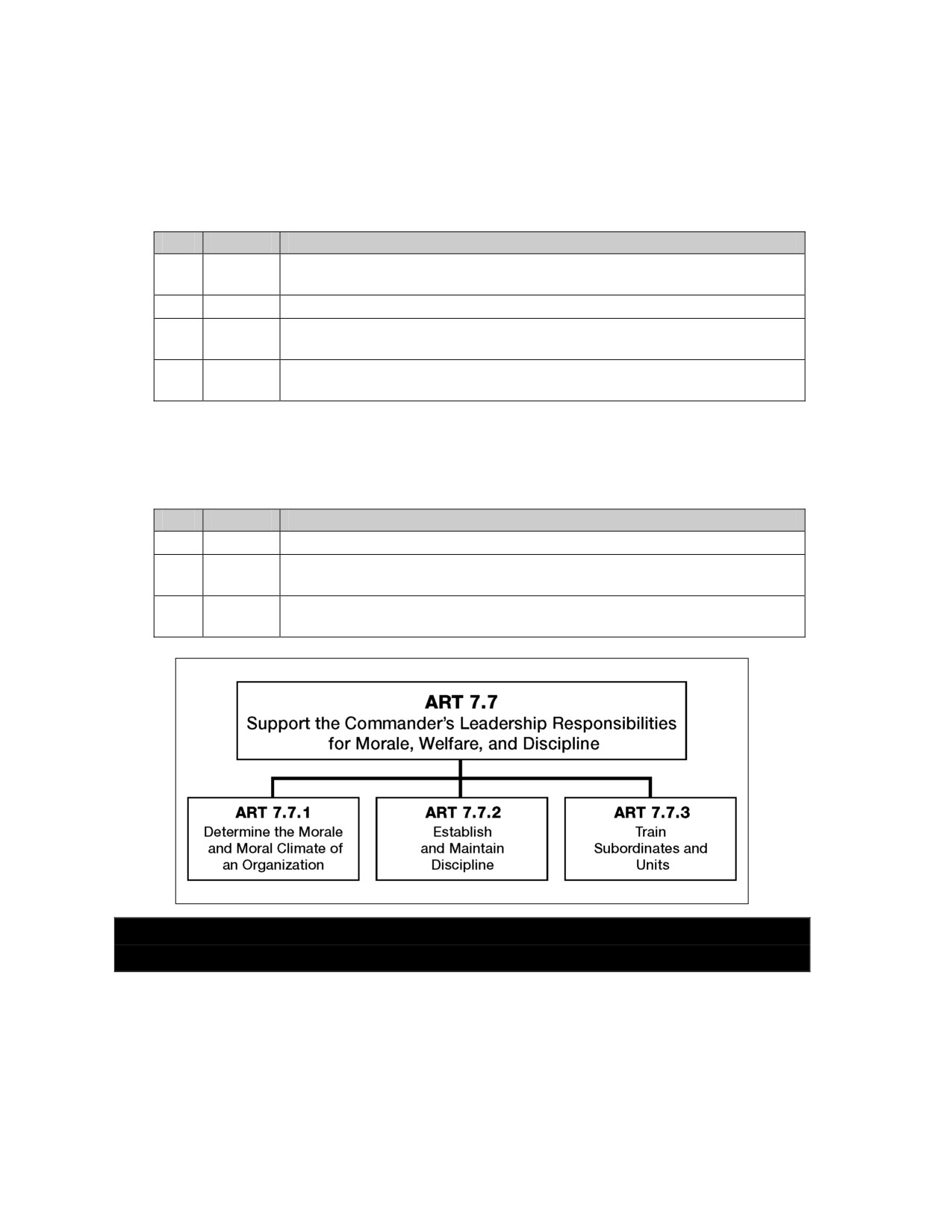
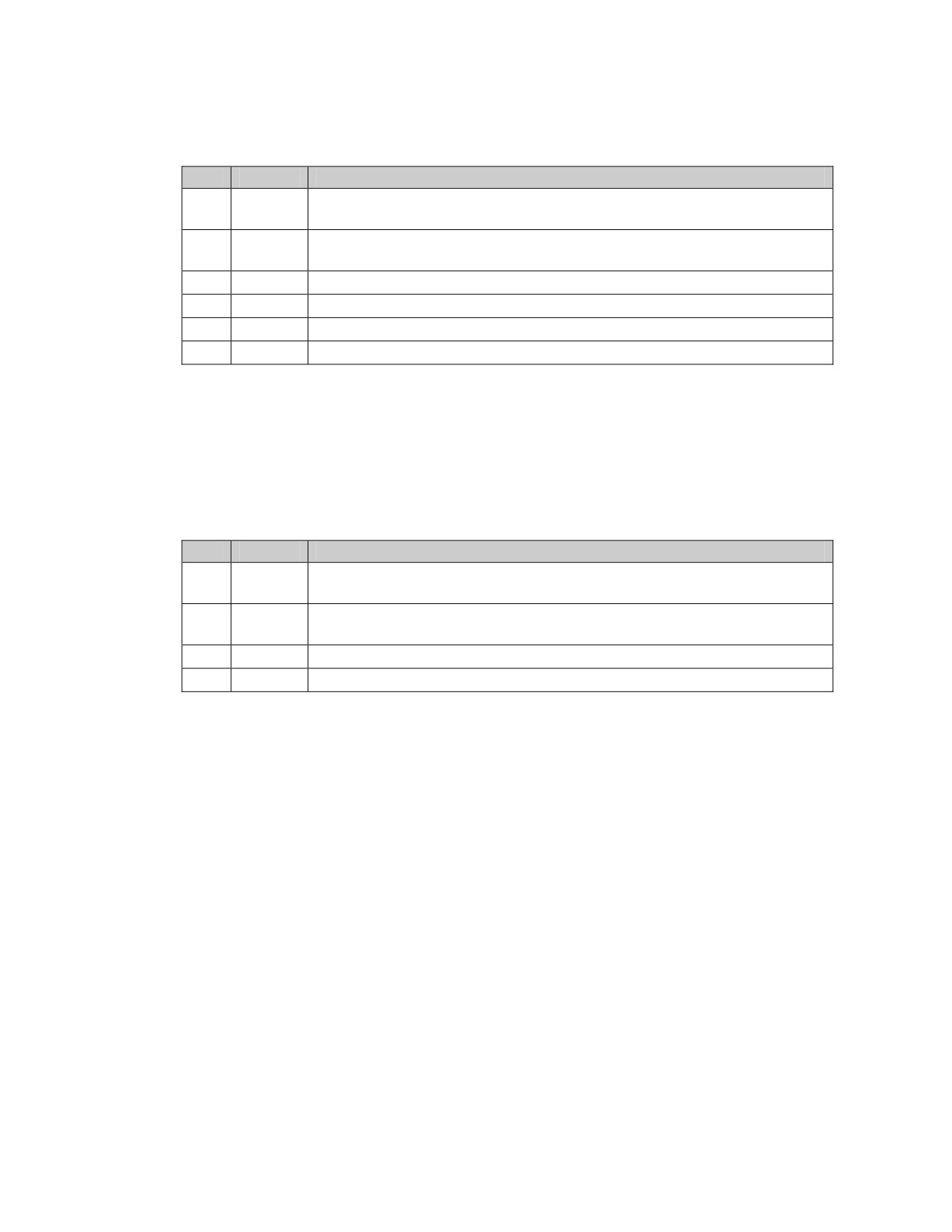
SECTION VII - ART 7.7: SUPPORT THE COMMANDER’S LEADERSHIP
RESPONSIBILITIES FOR MORALE, WELFARE, AND DISCIPLINE
7-74. Support the commander’s leadership influencing, operating, and
improving activities that fulfill his responsibilities for the morale, welfare,
and discipline of the soldiers and Department of the Army civilians in his
command. (FM 22-100) (USACAC)
7-38
_________________________________
ART 7.0: The Command and Control Battlefield Operating System
No.
Scale
Measure
Commander fulfills his responsibilities for the morale, welfare, and
01
Yes/No
discipline of his soldiers and civilians.
Units mission is degraded, delayed, or disrupted due to stress-related
02
Yes/No
illness or injury.
03
Percent
Of disciplinary cases throughout command.
04
Number
Of unit and personal commendations for achievement and bravery.
05
Number
Of incidents of disrespect to authorities or unit.
06
Percent
Of leaders trained or educated appropriate to rank.
ART 7.7.1 DETERMINE MORALE AND MORAL CLIMATE OF
ORGANIZATION
7-75. Morale, the human dimension’s most important intangible element, is
an emotional bond that impacts the quality of organizational cohesion in the
accomplishment of missions. Moral climate deals with the ability of a unit to
do what is right even when there is pressure to do something else. (FM 22-
100) (USACAC)
No.
Scale
Measure
The morale of the soldiers and civilians and moral climate of organization
01
Yes/No
accurately and regularly determined.
Of crimes reported involving military behavior in violation of statutes of
02
Percent
the Uniform Code of Military Justice (UCMJ).
03
Number
Of reports from chaplain ministry team on level of morale.
04
Number
Of morale incidents reported through medical channels.
7-39
FM 7-15__________________________________________________________________________
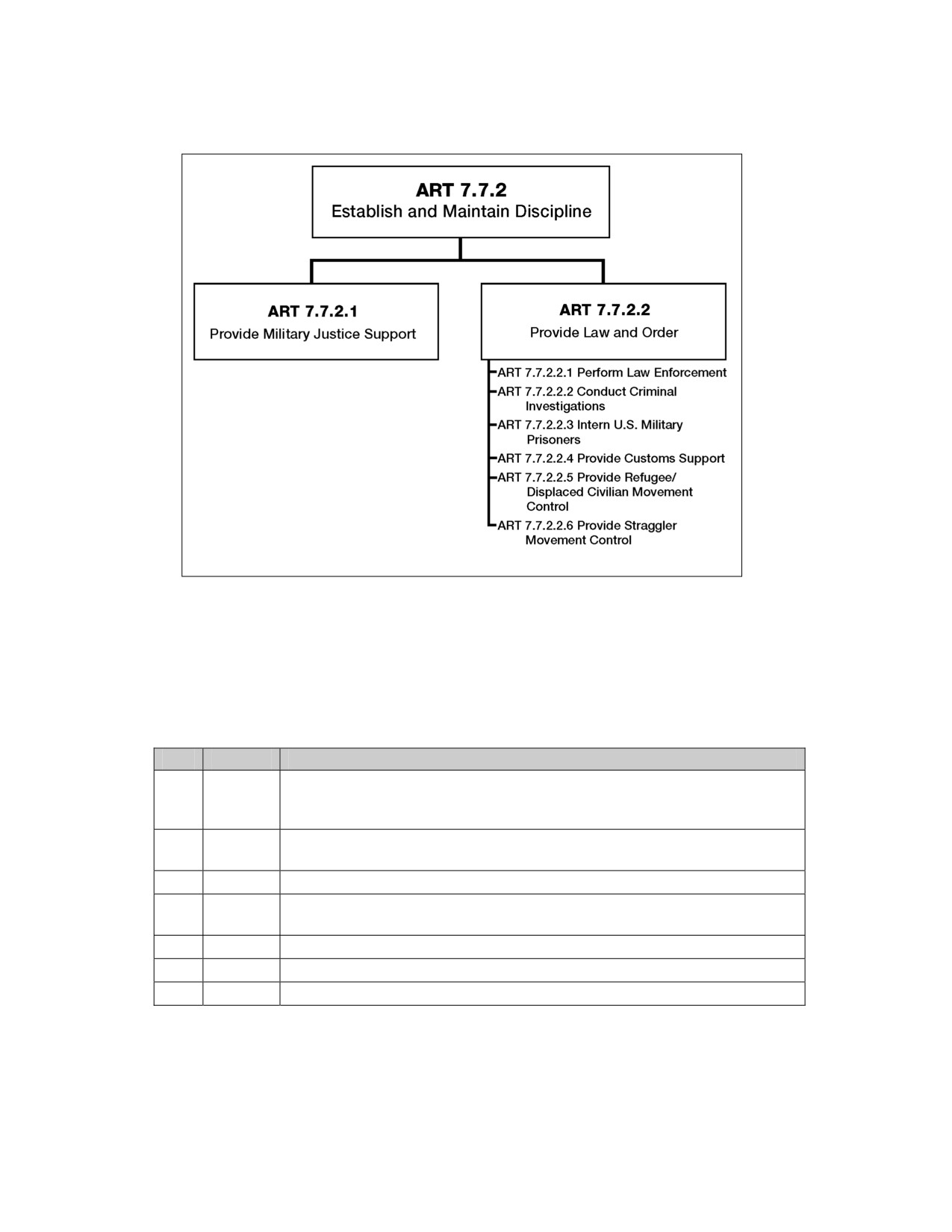
ART 7.7.2 ESTABLISH AND MAINTAIN DISCIPLINE
7-76. Establish and maintain discipline through military law enforcement,
OPM regulations, justice, and confinement activities that regulate the force
to comply with command policies and directives, ensure a lawful and orderly
environment, and suppress criminal behavior. Conduct the programs in such
manner as to promote self-discipline and respect for authority. Internalize
and practice Army values with minimum coercion. (FM 22-100) (USACAC)
No.
Scale
Measure
Soldiers and Department of the Army civilians exhibit respect for authority
01
Yes/No
and internalize and practice Army values. Organization has lawful and
orderly environment.
Of law enforcement personnel committed to disciplinary matters versus
02
Percent
combat support.
03
Number
Of reported disciplinary events.
Of incidents involving off-duty US military personnel that involve alcohol
04
Number
or drugs within a given time.
05
Number
Of accidents involving military vehicles within a given time.
06
Number
Of crimes reported within a given time.
07
Number
Of law and order incidents not covered by existing policy/SOP.
ART 7.7.2.1
PROVIDE MILITARY JUSTICE SUPPORT
7-77. Advise and assist the commander in the administration of the UCMJ,
to include the disposition of alleged offenses by courts-martial or nonjudicial
punishment, appeals of nonjudicial punishment, and action on courts-martial
7-40

_________________________________
ART 7.0: The Command and Control Battlefield Operating System
findings and sentences. Supervise the administration and prosecution of
courts-martial, preparation of records of trial, the victim-witness assistance
program, and military justice training for all Army personnel. (FM 27-100)
(TJAGSA)
No.
Scale
Measure
Military justice administration supports the commander’s leadership and
01
Yes/No
discipline responsibilities.
02
Time
To prepare an Article 15, UCMJ, DA Form 2627.
03
Time
To prepare a record of trial by court-martial.
04
Time
To conduct Article 32 proceedings.
05
Time
Between requests for military justice briefings and actual presentations.
06
Time
Between preferral to referral of a case.
07
Time
Between referral to trial of a case.
08
Percent
Of felony cases cleared within first month.
09
Percent
Of cases in which unlawful command influence occurs.
Of cases in which the commander recommended or directed the
10
Percent
appropriate level of court-martial.
11
Percent
Of cases overturned on appeal.
12
Percent
Of cases requiring the detail of outside counsel.
13
Percent
Of victims and witnesses having an appointed victim-witness liaison.
Of victims and witnesses who receive a victim-witness information
14
Percent
packet.
15
Percent
Of unit personnel who receive military justice training.
16
Percent
Of soldiers who understand General Order #1 prior to deployment.
17
Percent
Of drafted specifications that properly state an offense.
18
Percent
Of drafted specifications that are supported by probable cause.
19
Percent
Of court-martial cases co-chaired by a senior judge advocate.
ART 7.7.2.2
PROVIDE LAW AND ORDER
7-78. Ensure lawful and orderly environment and suppress criminal
behavior. (FM 19-10) (USAMPS)
No.
Scale
Measure
01
Yes/No
Suppress criminal behavior within the unit AO.
Coordinate with the appropriate US and host nation authorities for law
02
Yes/No
and order operational support.
03
Yes/No
Coordinate actions to remove conditions promoting crime.
04
Yes/No
Provide guidance on rules of engagement and rules of interaction.
Perform physical security measures to include vulnerability assessments
05
Yes/No
on designated critical assets and special ammunition.
06
Yes/No
Develop plans and SOP concerning law enforcement operations.
07
Yes/No
Conduct installation vulnerability assessments.
7-41

FM 7-15__________________________________________________________________________
No.
Scale
Measure
Of time military police subordinate elements conduct law and order
08
Percent
missions.
09
Percent
Of criminal behavior suppressed in the AO.
Of military police assets distributed to conduct law and order operations
10
Percent
in accordance with the plan.
Of serious crimes, such as crimes against the United States, political
11
Number
crimes, and war crimes referred to the US Army Criminal Investigation
Command (USACIDC) for investigation within a given time.
Of vulnerability assessments conducted for designated critical assets and
12
Number
special ammunition within the AO.
13
Number
Of crimes reported within a given time.
Of law and order incidents not covered by existing/established
14
Number
policy/SOP.
ART 7.7.2.2.1 Perform Law Enforcement
7-79. Assist commanders as they maintain the efficiency of their combat
commands through conducting law enforcement operations. ART 7.7.2.2.1
includes the maintenance of liaison activities and support of the training of
other DOD police organizations, host-nation police authorities, and
multinational police agencies. Other activities conducted at the direction of
the commander or in the absence of host-nation agreements may include
investigations, crime prevention measures, selective enforcement measures,
and courtesy patrols. ART 7.7.2.2.1 includes the conduct of drug suppression
programs, and law enforcement raids. (FM 19-10) (USAMPS)
No.
Scale
Measure
The conduct of law enforcement operations helps the commander
01
Yes/No
maintain the efficiency of his command.
02
Yes/No
Brief and monitor military police sections.
03
Percent
Of crimes/incidents resolved within 30 days.
Of actions conducted in compliance with SOP and appropriate
04
Percent
regulations.
05
Percent
Of requests for rail and road movement escorts met.
06
Percent
Of security force requirement available to meet operational needs.
Of serious crimes, such as crimes against the United States, political
07
Number
crimes, and war crimes, referred to the USACIDC for investigation.
ART 7.7.2.2.2 Conduct Criminal Investigations
7-80. Investigate offenses against US forces or property committed by
persons subject to military law. This includes minor crimes and major
incidents involving death, serious bodily injury, and war crimes. (FM 3-19.1)
(USAMPS)
No.
Scale
Measure
Investigate and refer offenses against US forces or property committed
01
Yes/No
by persons subject to military law.
Monitor all ongoing investigations in the theater of operation and receive
02
Yes/No
final reports from subordinate elements.
7-42

_________________________________
ART 7.0: The Command and Control Battlefield Operating System
No.
Scale
Measure
Coordinate with USACIDC for investigation of all major incidents (deaths,
03
Yes/No
serious bodily injury, and war crimes).
04
Yes/No
Law enforcement agency personnel take control of crime scene.
Law enforcement agency personnel identify personnel involved in the
05
Yes/No
crime.
06
Yes/No
Senior law enforcement agency individual formulates investigative plan.
Law enforcement agency personnel process crime scene by recording
07
Yes/No
investigative notes and sketches, photographing crime scene as
necessary, and collecting physical evidence for evaluation.
Law enforcement agency personnel release crime scene to appropriate
08
Yes/No
individual.
Law enforcement agency personnel pursue immediate leads by
interviewing victim and witnesses, obtaining written statements (if
appropriate), advising suspects of legal rights, obtaining written
09
Yes/No
statements from suspects, collecting related documents necessary to
support specific investigations, and coordinating with the judge advocate
office as necessary.
Standard interview techniques modified to overcome any language
10
Yes/No
barriers and cultural differences.
Investigators maintain a disciplined and systematic approach in their
11
Yes/No
questioning when doing a long series of interviews on the same basic
topic.
Law enforcement agency personnel continue investigation as necessary,
to include completing evidence documentation, releasing evidence to
evidence custodian, identifying need for crime lab analysis of evidence,
obtaining other needed specialized investigative support (polygraph or
12
Yes/No
technical listening equipment), gathering related criminal intelligence from
other sources, conducting surveillance, submitting status reports, and
coordinating investigative efforts and findings with supporting staff judge
advocate office.
13
Yes/No
Law enforcement agency personnel close case by preparing final report.
14
Time
To conduct crime analysis.
15
Percent
Of investigations of minor reported incidents.
Of investigations conducted and reported IAW CID Regulation 195-1, AR
16
Percent
195-2, and FM 3-19.20.
Of returns on deficient reports of investigations for corrective action or for
17
Percent
further investigative activity.
18
Percent
Of crime analysis performed correctly.
Of case documents and required report prepared in accordance with
19
Percent
legal, regulatory, and SOP guidance.
20
Number
Of hotline complaints referred to CID/MPI.
7-43

FM 7-15__________________________________________________________________________
ART 7.7.2.2.3 Intern US Military Prisoners
7-81. Detain, sustain, protect, and evacuate US military prisoners. ART
7.7.2.2.3 includes the establishment of temporary detention facilities. It also
includes the operation of long-term confinement facilities.
(FM 3-19.1)
(USAMPS)
No.
Scale
Measure
Detain, sustain and protect US military until their trials are completed and
01
Yes/No
their sentences served.
Retain US military prisoners in custody until trial or until transferred to a
02
Yes/No
field confinement facility.
03
Yes/No
Evacuate convicted prisoners from the AO IAW policy/law.
Evaluate the operation to include identifying the location of temporary
04
Yes/No
detention facilities for US military prisoners.
Maintain a confinement facility only if distance or lack of transportation
05
Yes/No
demands it.
Evacuate US military prisoners from the forward battle area confinement
06
Yes/No
facility to the rear confinement facility as conditions warrant.
07
Yes/No
Establish a field detention facility within the AO.
The staff of the confinement facility protects and sustains US military
08
Yes/No
prisoners.
The confinement facility staff prevents the disruption of facility operations
09
Yes/No
by enemy attack.
10
Percent
Of US military prisoners detained or evacuated from AO.
Of cases where confinement facility medical section provided immediate
11
Percent
problem solving and crisis intervention to US military prisoners interned at
the facility.
12
Percent
Of prisoner movements/transfers following specified routes.
Of US military prisoners picked up and transported with proper written
13
Percent
authorization.
Of US military prisoners sent to higher headquarter confinement facilities
14
Percent
within 72 hours of arrival.
Of those US military prisoners requiring special billeting and
15
Percent
accountability provided health and welfare items while still retaining
proper custody and control.
Of US military prisoners escaping from confinement facilities within the
16
Number
AO.
ART 7.7.2.2.4 Provide Customs Support
7-82. Perform tactical actions that enforce restrictions on controlled
substances and other contraband violations that enter/exit an AO. (FM 3-
19.1) (USAMPS)
No.
Scale
Measure
Prevent controlled substances and other contraband items prohibited by
01
Yes/No
law, regulation, or command policy from entering or exiting an AO subject
to customs restrictions, policies, and/or laws.
02
Yes/No
Unit given military customs pre-clearance.
7-44
_________________________________
ART 7.0: The Command and Control Battlefield Operating System
No.
Scale
Measure
To report custom inspection results to the US border entry point and to
03
Time
the military customs staff advisor.
04
Time
To conduct desired level of customs inspections.
05
Percent
Of redeploying unit personnel and equipment examined or inspected.
Of restricted items identified for US Customs Service or US Department
06
Percent
of Agriculture review.
07
Percent
Of key customs concerns for the AO identified.
Of violations of border crossing laws and regulations reported to
08
Percent
supported commander and appropriate law enforcement agencies.
Of shipments identified for inspection for the presence of US Customs
09
Percent
Service and US Department of Agriculture restricted items.
10
Number
Of prohibited items barred from shipment within a given time.
ART 7.7.2.2.5 Provide Refugee/Displaced Civilian Movement Control
7-83. Assist, direct, or deny the movement of civilians whose location,
direction of movement, or actions may hinder operations. US military forces
do not assume control of refugee/displaced civilian movement unless
requested to do so by the host nation or unless operating in an environment
with a hostile government. (FM 3-19.1) (USAMPS)
No.
Scale
Measure
Refugees/displaced civilians do not interfere with the conduct of unit
01
Yes/No
operations.
Develop plans to handle the movement of refugees and displaced
02
Yes/No
civilians within the AO.
03
Yes/No
Update higher headquarters on the progress of the operation.
Treat dislocated civilians IAW the Geneva Convention and agreements
04
Yes/No
between the United States and host nations.
Of subordinate elements assisting civil affairs, psychological operation
05
Percent
and host nation agencies in conducting populace and resources control
operations.
Of identified populace resources that must be denied contact with the
06
Number
enemy.
Of dislocated civilians diverted from routes and areas when they might
07
Number
interfere with US and/or allied military operations.
And location of refugee/displaced civilian collection points and assembly
08
Number
areas.
ART 7.7.2.2.6 Provide Straggler Movement Control
7-84. Straggler control involves the direction of uninjured stragglers to their
parent unit or to a replacement unit as command policies dictate. Most
stragglers are military personnel who have become separated from their
command by events on the battlefield. If stragglers are ill, wounded, or in
shock, they are moved to the nearest medical facility. (FM 3-19.1) (USAMPS)
7-45
FM 7-15__________________________________________________________________________
No.
Scale
Measure
Return stragglers to military/unit control or provide medical assistance as
01
Yes/No
soon as possible.
Locate straggler control posts and collecting points on likely routes of
02
Yes/No
straggler flow.
Confiscate and dispose of equipment, property, and documents on
03
Yes/No
stragglers IAW the straggler control plan.
Divert stragglers from main supply routes (MSRs) onto alternate routes or
04
Yes/No
collecting points to alleviate congestion of the MSRs.
05
Percent
Of unit becomes stragglers.
06
Number
Of deliberate stragglers escorted back to their unit.
Of instances in which deliberate stragglers are detained until they can be
07
Number
transported to a set location as designated by the straggler control plan.
Of stragglers assisted, detained, or apprehended when they become
08
Number
separated from their units without authority.
Of stragglers returned to military/unit control or provided medical
09
Number
assistance as soon as possible.
Of stragglers diverted from MSRs onto alternate routes or collecting
10
Number
points to alleviate congestion of the MSRs.
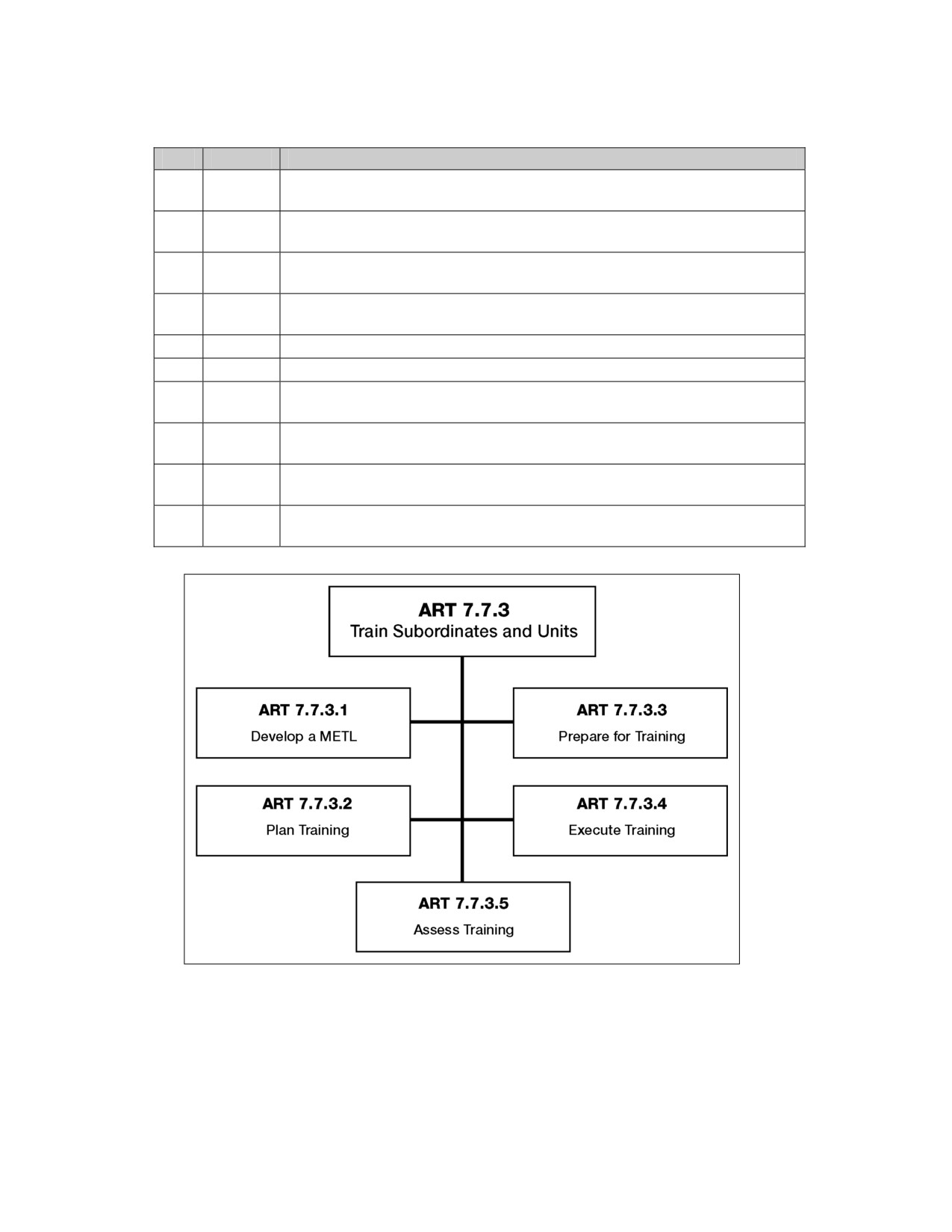
ART 7.7.3 TRAIN SUBORDINATES AND UNITS
7-85. Instruct military personnel to individually and collectively improve
their capacity to perform specific military functions and tasks. Training
prepares soldiers, leaders, and units to conduct tactical operations and win.
(FM 7-0) (USACAC)
7-46
_________________________________
ART 7.0: The Command and Control Battlefield Operating System
No.
Scale
Measure
Training prepares soldiers, leaders, and units to accomplish their
01
Yes/No
assigned actions and missions.
02
Time
For unit and personnel to accomplish training to standard.
03
Percent
Of units able to perform assigned missions.
04
Percent
Of personnel able to perform assigned duties in assigned missions.
05
Percent
Of METL tasks trained to standard under prescribed conditions.
06
Percent
Of METL tasks performed to standard in operations.
ART 7.7.3.1
DEVELOP MISSION ESSENTIAL TASK LIST
7-86. Compile collective mission essential tasks that must be successfully
performed if an organization is to accomplish its operational missions. (FM 7-
0) (USACAC)
No.
Scale
Measure
Unit develops a METL that reflects the higher command METL and
01
Yes/No
guidance.
02
Percent
Of METL tasks selected corresponding to assigned missions.
Increase in effectiveness of unit and individuals on METL tasks relative to
03
Percent
before training.
04
Number
Of missions that a unit receives that are not on its METL.
ART 7.7.3.2
PLAN TRAINING
7-87. Identify a desired outcome, develop effective ways of achieving it,
recommend the most effective one, and produce a sequence of activities that
achieve expected results. ART 7.7.3.2 includes assessing training proficiency,
articulating a training vision, issuing training guidance, managing time,
establishing training events, and allocating training resources to activities
and events. (FM 7-0) (USACAC)
No.
Scale
Measure
Training plan reflects command and doctrinal guidance and the existing
01
Yes/No
factors of METT-TC that, if executed will achieve the desired
performance in operations.
02
Time
To establish required training program (from mission change).
03
Time
To prepare training plan.
04
Percent
Of METL tasks on which unit is already proficient.
ART 7.7.3.3
PREPARE FOR TRAINING
7-88. Initiate and conduct activities by the unit prior to execution to improve
its ability to train successfully. ART 7.7.3.3 includes rehearsals of trainers;
pre-execution checks of individuals and units to be trained, trainers to
execute and evaluate training, and training support required; assembly of
allocated training resources; and elimination of potential training distracters.
(FM 7-0) (USACAC)
7-47

FM 7-15__________________________________________________________________________
No.
Scale
Measure
Trainers and training resources available and ready for the training
01
Yes/No
audience when they arrive.
02
Time
For units and personnel to begin training.
03
Time
For rehearsals of trainers.
04
Time
To assemble and position training resources.
05
Percent
Of required training resources provided and assembled.
ART 7.7.3.4
EXECUTE TRAINING
7-89. Put a plan into action by applying training resources to accomplish the
training mission or objective. ART 7.7.3.4 includes effective presentation, and
practice during execution that is accurate, well structured, efficient, realistic,
safe, and effective. (FM 7-0) (USACAC)
No.
Scale
Measure
Training conducted to established standards accomplishes training
01
Yes/No
mission.
02
Time
To accomplish required training.
03
Percent
Of units and assigned personnel attending and participating in training.
04
Number
Of accidents during training.
Of times that planned training activities are modified for safety
05
Number
considerations.
ART 7.7.3.5
ASSESS TRAINING
7-90. Evaluate the demonstrated ability of individuals, leaders, and units
against specified training standards. Training may be evaluated against the
training objectives or against the performance standards of the tasks for
which being trained. (FM 7-0) (USACAC)
No.
Scale
Measure
Commander knows what tasks were accomplished at or above standard
01
Yes/No
and which tasks for which standards were not met.
02
Yes/No
Training evaluated against training objectives or performance standards.
The opposing force, training conditions, and observers and controllers
03
Yes/No
are sufficient to trigger realistic training events.
04
Yes/No
At least one AAR conducted per major training event.
05
Time
To devise and conduct training assessments.
06
Percent
Of personnel and units meeting standard.
07
Percent
Of METL trained to standard.
08
Percent
Of METL tasks meeting mission requirements.
7-48
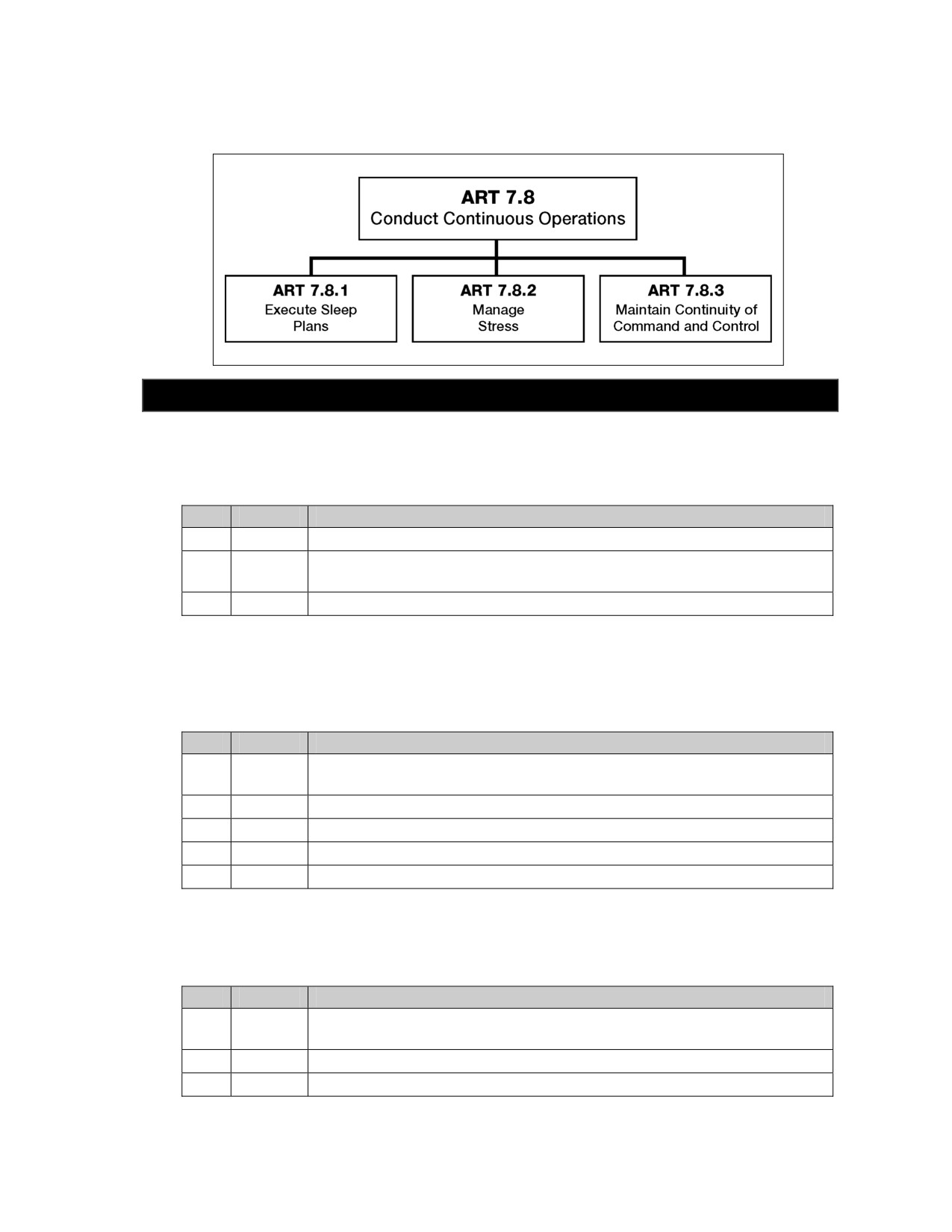
_________________________________
ART 7.0: The Command and Control Battlefield Operating System
SECTION VIII - ART 7.8: CONDUCT CONTINUOUS OPERATIONS
7-91. Execute operations without interruption due to enemy or
environmental conditions or actions, and maintain exercise of C2. Sustain
effective performance under conditions of uninterrupted operations. (FM 6-0)
(USACAC)
No.
Scale
Measure
01
Yes/No
Unit successfully maintains performance during continuous operations.
Of degradation of unit capability to conduct operations effectively over
02
Percent
time.
03
Number
Of incidents where a lack of continuity of C2 occurred during operations.
ART 7.8.1 EXECUTE SLEEP PLANS
7-92. Identify, counter, and minimize the degrading effects of night
operations and sleep loss on units as they execute continuous operations.
(FM 6-22.5) (USACAC)
No.
Scale
Measure
Unit sleep plan provides adequate rest for effective performance over
01
Yes/No
time.
02
Yes/No
Unit prepares sleep plan.
03
Yes/No
Unit complies with sleep plan during operations.
04
Percent
Of individuals obtaining sleep within the parameters of FM 6-22.5.
05
Number
Of soldiers unable to perform due to lack of sleep.
ART 7.8.2 MANAGE STRESS
7-93. Identify, counter, and minimize the degrading effects of stress on units
as they execute continuous operations. (FM 6-22.5) (USACAC)
No.
Scale
Measure
Identify, counter and minimize effects of stress on unit personnel so as to
01
Yes/No
avoid degrading unit performance and mission accomplishment.
02
Incidents
Of misbehavior due to effects of stress.
03
Incidents
Of decisions degraded by stress.
7-49

FM 7-15__________________________________________________________________________
ART 7.8.3 MAINTAIN CONTINUITY OF COMMAND AND CONTROL
7-94. Ensure—through succession of command and the ability of the
commander to exercise C2 continuously from any point in the AO—continuity
in the exercise of the authority of command and continuity in the conduct of
functions, tasks, or duties necessary to accomplish a military operation or
mission. ART 7.8.3 includes maintaining the functions and duties of the
commander, as well as the supporting functions and duties performed by the
staff and others acting under the authority and direction of the commander.
(FM 6-0) (USACAC)
No.
Scale
Measure
01
Yes/No
Maintain continuity of C2 throughout the mission.
02
Time
Commander not available for command functions.
03
Time
Loss of communications with subordinates.
04
Time
To restore commander’s understanding of current situation.
05
Time
To effect succession of command from one commander to another.
06
Number
Of times communications with the commander were lost.
07
Number
Of times the commander lost communications with his subordinates.
SECTION IX - ART 7.9: DEVELOP AND IMPLEMENT COMMAND SAFETY
PROGRAM
7-95. Develop and implement command safety and occupational health, risk
management, and accident prevention programs. (FM 100-14) (USASC)
No.
Scale
Measure
01
Yes/No
Command safety program prevents accidents to/by unit personnel.
02
Time
To modify command safety program to include new safety hazards.
Of measures introduced to mitigate risk as a result of the risk
03
Number
assessment.
04
Number
Of violations of command safety program occurring within a given time.
05
Number
Of safety hazards not covered initially by command safety program.
7-50
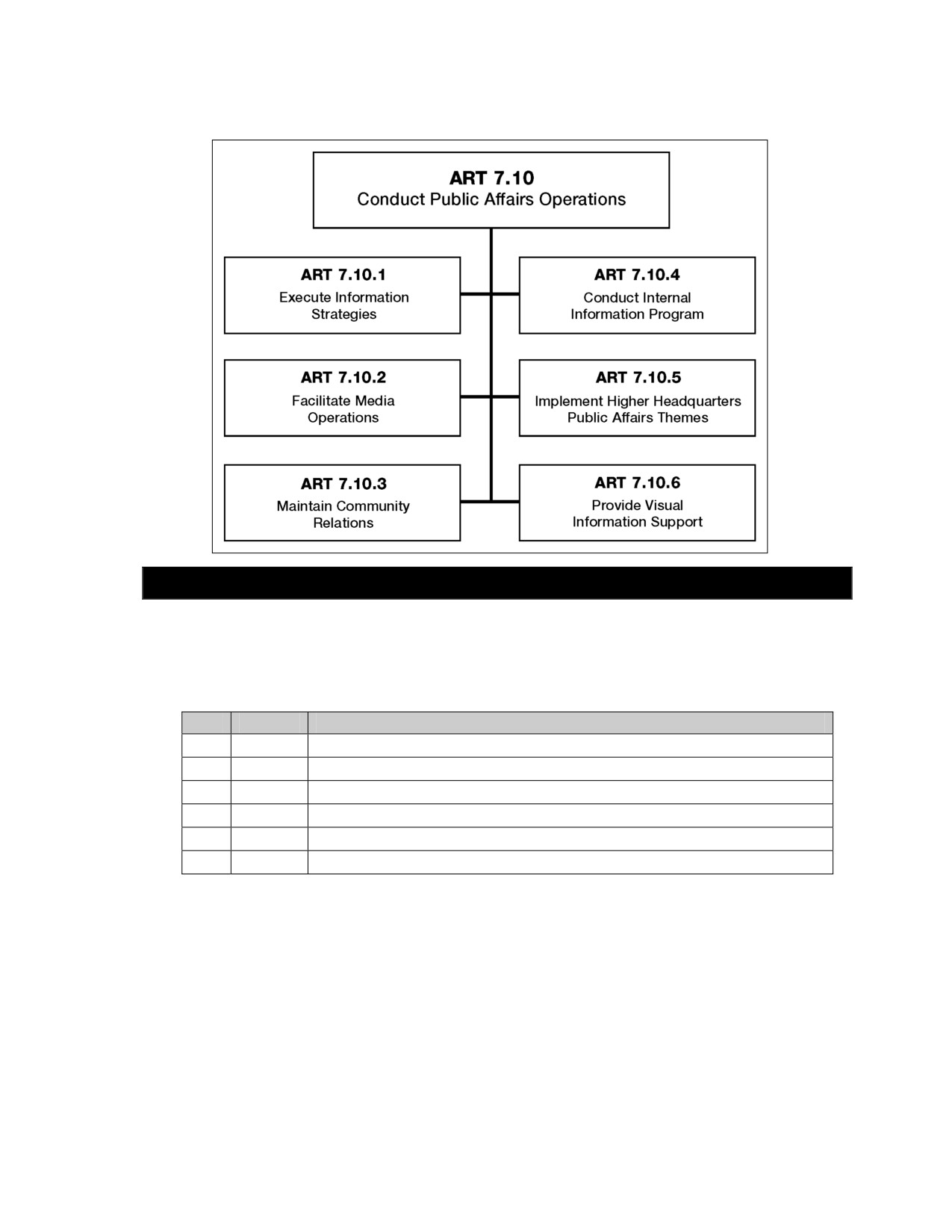
_________________________________
ART 7.0: The Command and Control Battlefield Operating System
SECTION X - ART 7.10: CONDUCT PUBLIC AFFAIRS OPERATIONS
7-96. Advise and assist the commander and command (or host nation in
military operations other than war) in public affairs planning. This includes,
developing information strategies and program, facilitating media
operations, and conducting community relations programs.
(FM
46-1)
(USAOCPA)
No.
Scale
Measure
01
Yes/No
Public affairs program within the AO supports mission accomplishment.
02
Time
In advance to provide public affairs group for scheduled events.
03
Time
After event to release news.
04
Time
To provide an initial position on breaking news story.
05
Percent
Of plan phases have incorporated public affairs strategy.
06
Percent
Of PA guidance coordinated with operations, plans and policy as needed.
ART 7.10.1 EXECUTE INFORMATION STRATEGIES
7-97. Identify affected internal and external audiences and their information
requirements. Determine available communications channels to all
audiences. Develop key command messages derived from the overall public
affairs strategy. Acquire information to support messages. Process
information for delivery through appropriate means. Protect information to
meet OPSEC requirements and distribute information to audiences. (FM 46-
1) (USAOCPA)
7-51

FM 7-15__________________________________________________________________________
No.
Scale
Measure
Information strategies support accomplishment of the unit mission within
01
Yes/No
the AO.
To prepare for and conduct first news conference on crisis or major
02
Time
event.
03
Time
Since last national media pool classified briefing.
04
Time
In advance of deployment, to develop and distribute media guidance.
05
Time
Prior to deployment, to establish and disseminate media policy.
06
Time
To develop public affairs mission analysis.
Of press operational access rules and security procedures incorporated
07
Percent
in operation plan.
08
Percent
Of releases error free.
09
Number
Of press releases per week.
And types of information that is classified or withheld from press to avoid
10
Number
embarrassment.
ART 7.10.2 FACILITATE MEDIA OPERATIONS
7-98. Provide assistance to media that are covering operations. This includes
assisting media on coverage ground rules; arranging interviews and
briefings; coordinating unit visits and escorts; and providing assistance in
arranging transportation, messing, billeting, communications support,
protective equipment, and medical care. (FM 46-1) (USAOCPA)
No.
Scale
Measure
01
Yes/No
Unit conduct of media operations supports public affairs operations.
02
Time
To establish information bureau (following execute order).
03
Time
To provide public affairs guidance (after crisis event).
04
Time
To transmit print journalist stories during crisis or combat (from receipt).
To close required media equipment (such as commercial television
05
Time
ground stations) to AO.
06
Time
To get DOD media pool into AO.
07
Percent
Of media requests for access to key senior officials accepted.
08
Percent
Of media support requests answered.
ART 7.10.3 MAINTAIN COMMUNITY RELATIONS
7-99. Assist civil affairs personnel in conducting
(planning, preparing,
executing, and assessing) community relations programs as resources permit.
ART 7.10.3 can occur in an AO or in the sustaining base (CONUS or forward
presence). It includes the conduct of programs to establish and sustain
mutually beneficial relationships with the public, focusing on communities
neighboring or directly affected by Army activities. (FM 46-1) (USAOCPA)
No.
Scale
Measure
Community relations program supports unit mission accomplishment
01
Yes/No
within the AO and at home base.
7-52
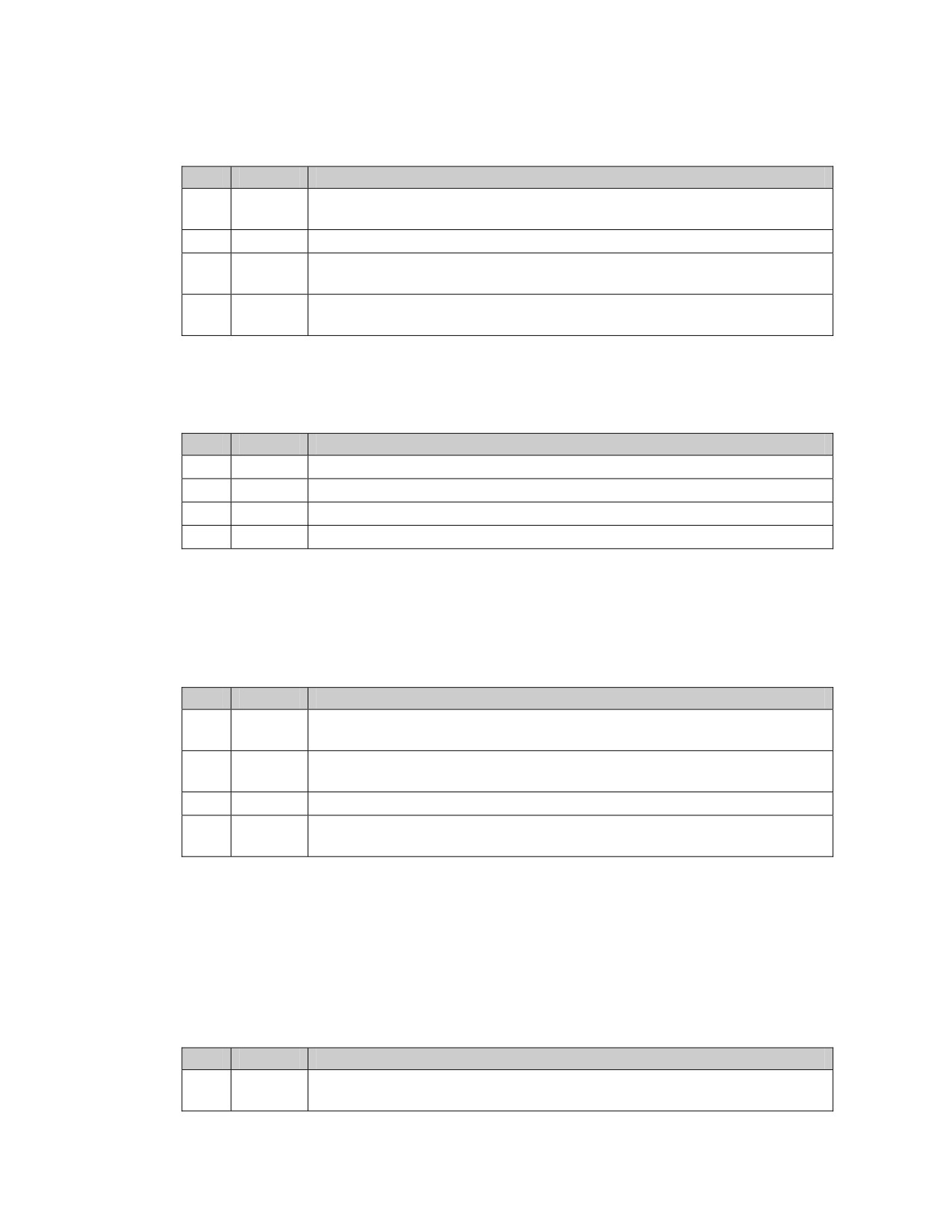
_________________________________
ART 7.0: The Command and Control Battlefield Operating System
No.
Scale
Measure
To set up hometown news release program to publicize troops’
02
Time
accomplishments.
03
Time
To develop public opinion baseline.
Of local customs, laws, and policies concerning presence of media
04
Percent
researched and included in planning.
Of requests for information from organizations and private citizens
05
Percent
answered.
ART 7.10.4 CONDUCT INTERNAL INFORMATION PROGRAM
7-100. Provide information of interest to US military forces, to include data
that the commander wants his soldiers to know. (FM 46-1) (USAOCPA)
No.
Scale
Measure
01
Yes/No
Soldiers know the information that their commander wants them to know.
02
Time
To establish newsletter or newspaper for deployed troops.
03
Percent
Of forces consuming internally prepared information.
04
Number
Of internal news releases per week.
ART 7.10.5 IMPLEMENT HIGHER HEADQUARTERS PUBLIC AFFAIRS
THEMES
7-101. Transmit themes and information from higher headquarters to the
US military audience as part of an echelon’s internal information program.
(FM 46-1) (USAOCPA)
No.
Scale
Measure
Implement higher headquarters public affairs themes to support mission
01
Yes/No
accomplishment within the AO.
To prepare higher headquarters public affairs themes for dissemination to
02
Time
forces.
03
Percent
Of higher headquarters public affairs themes disseminated to forces.
Of favorable response in forces to higher headquarters public affairs
04
Percent
themes.
ART 7.10.6 PROVIDE VISUAL INFORMATION SUPPORT
7-102. Create a record of unit activities. Still and motion video recordings
include friendly forces, equipment, and positions before, during, and after
engagements; terrain features in current or projected operational areas;
battle damage to friendly, enemy, or indigenous property; any essential
element of friendly information that assists a commander in conducting
(planning, preparing executing, and assessing) operations.
(FM 6-02.40)
(USASC&FG)
No.
Scale
Measure
Visual information support assists the commander with the operations
01
Yes/No
process.
7-53
FM 7-15__________________________________________________________________________
No.
Scale
Measure
To provide combat camera detachment commander when determined
02
Time
necessary.
03
Time
To process media and produce imagery for short notice tasking.
04
Time
To provide finished imagery products to customers.
05
Time
To provide finished imagery products to customers in United States.
06
Time
To respond to and be on scene for short notice tasking.
To review selected combat camera materials (for release, until release,
07
Time
including products to be released by public affairs representatives, prior
to delivery to the releasing agency).
08
Percent
Of photographic images and electronic documentation available.
Of presented coverage deemed suitable by customer (such as audience
09
Percent
attention and share).
10
Percent
Of subject coverage requests filled.
7-54
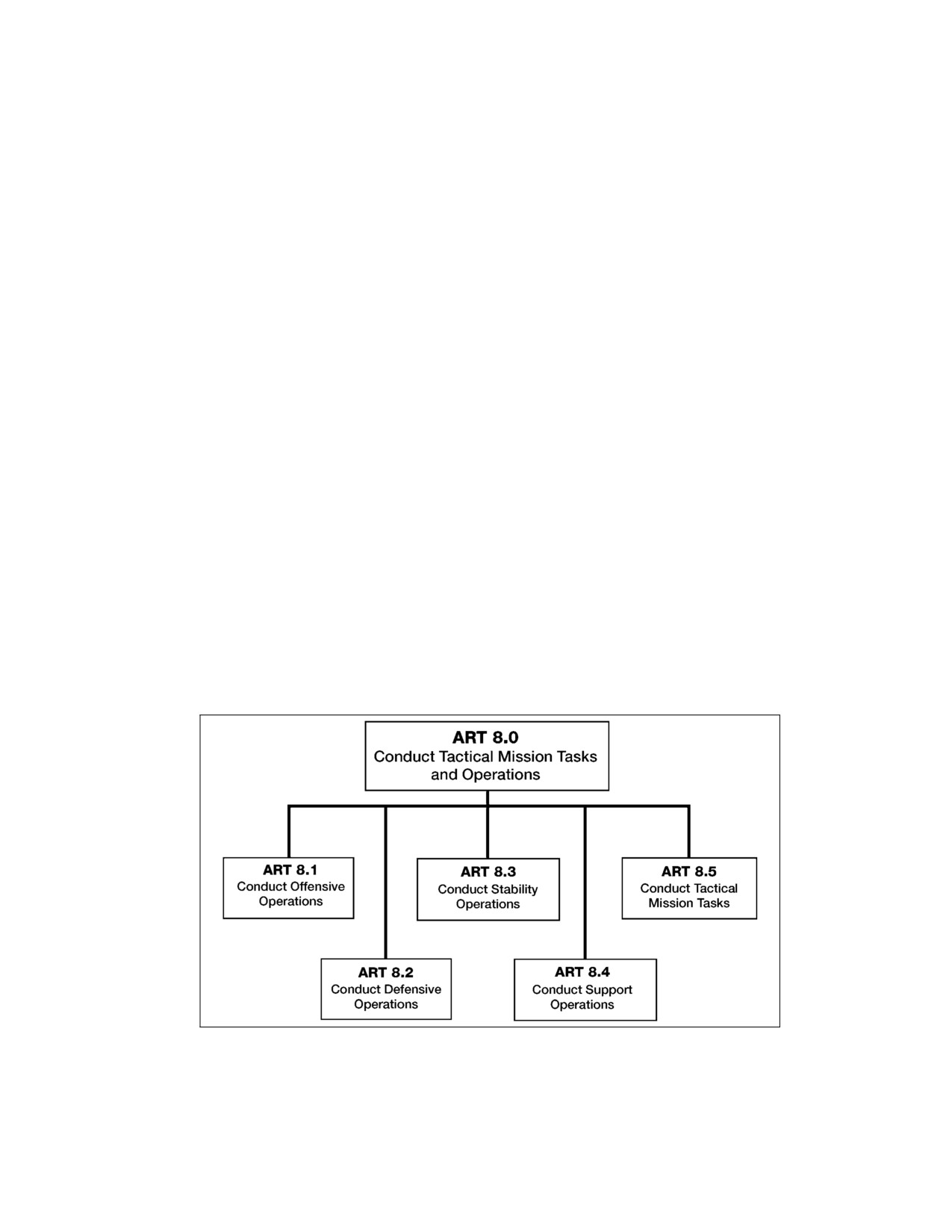
Chapter 8
ART 8.0: Conduct Tactical Mission
Tasks and Operations
Tactical proficiency is not defined by mastery of written doctrine, but by
the ability to employ available means to win battles and engagements. A
tactical solution may not match any previous example; however, the
language used to communicate that concept must be technically precise
and doctrinally consistent, using commonly understood and accepted
terms and concepts. The chapter sustains this doctrinal consistency by
delineating the tactical missions and operations conducted by Army
tactical forces. A tactical mission task is a specific activity
performed by a unit while executing a form of tactical operation
or form of maneuver. It may be expressed in terms of either
actions by a friendly force or effects on an enemy force. The
tactical mission tasks provide commanders, their staffs, combat
developers, training developers and doctrine analysts a resource to assist
in identifying missions units are to accomplish. Training developers use
this chapter to base collective training plans on one or more of these
missions.
MEASURES OF ACCOMPLISHMENT
8-1. Measures of any mission accomplishment are both objective and
subjective in their evaluation by commanders. The most critical measure for
8-1
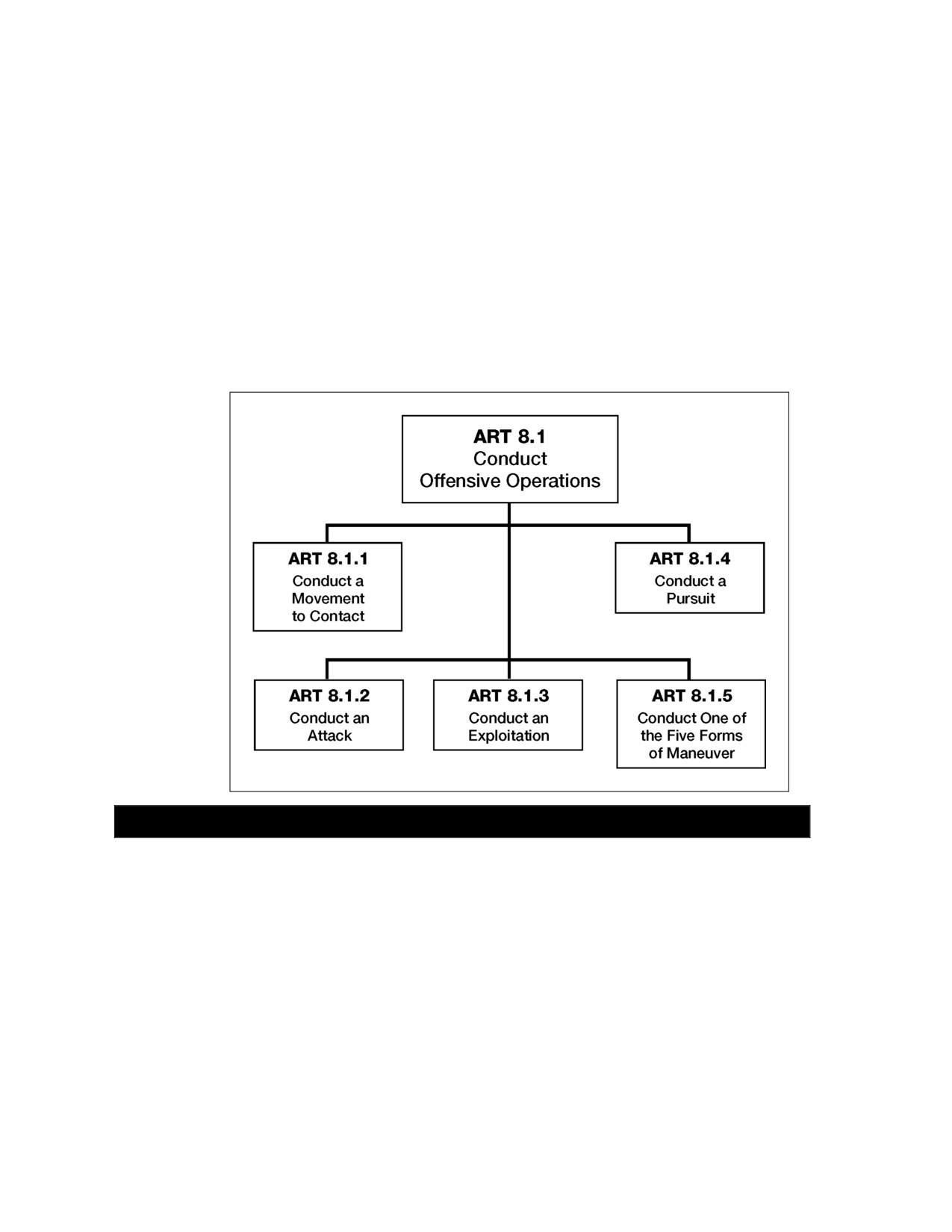
FM 7-15__________________________________________________________________________
all Army tactical missions and tasks is if the mission is accomplished. There
is no other measure above this one. To measure mission accomplishment
commanders must also consider if mission accomplishment was within:
z Higher commander’s intent statement of what the force must do and
the conditions,
z Specified timeline,
z Commander’s risk assessment for fratricide avoidance and collateral
damage,
z Minimum expenditure of resources,
z Unit’s capability of continuing or being assigned future missions and
operations.
SECTION I - ART 8.1: CONDUCT OFFENSIVE OPERATIONS
8-2. Offensive operations aim at destroying or defeating an enemy. Their
purpose is to impose the commander’s will on the enemy and achieve decisive
victory. Offensive operations seek to seize, retain, and exploit the initiative.
Army force commanders attack enemies simultaneously throughout the AO
to throw them off balance, overwhelm their capabilities, disrupt their
defenses, and ensure their defeat or destruction. The offense ends when the
force achieves the purpose of the operation, reaches a limit of advance, or
approaches culmination. Army forces conclude a phase of an offensive by
consolidating gains, resuming the attack, or preparing for future operations.
Additional tasks that offensive operations accomplish include disrupting
enemy coherence, securing or seizing terrain, denying the enemy resources,
fixing the enemy, and gaining information. Types of offensive operations
include movement to contact, attack, exploitation, and pursuit. The forms of
8-2
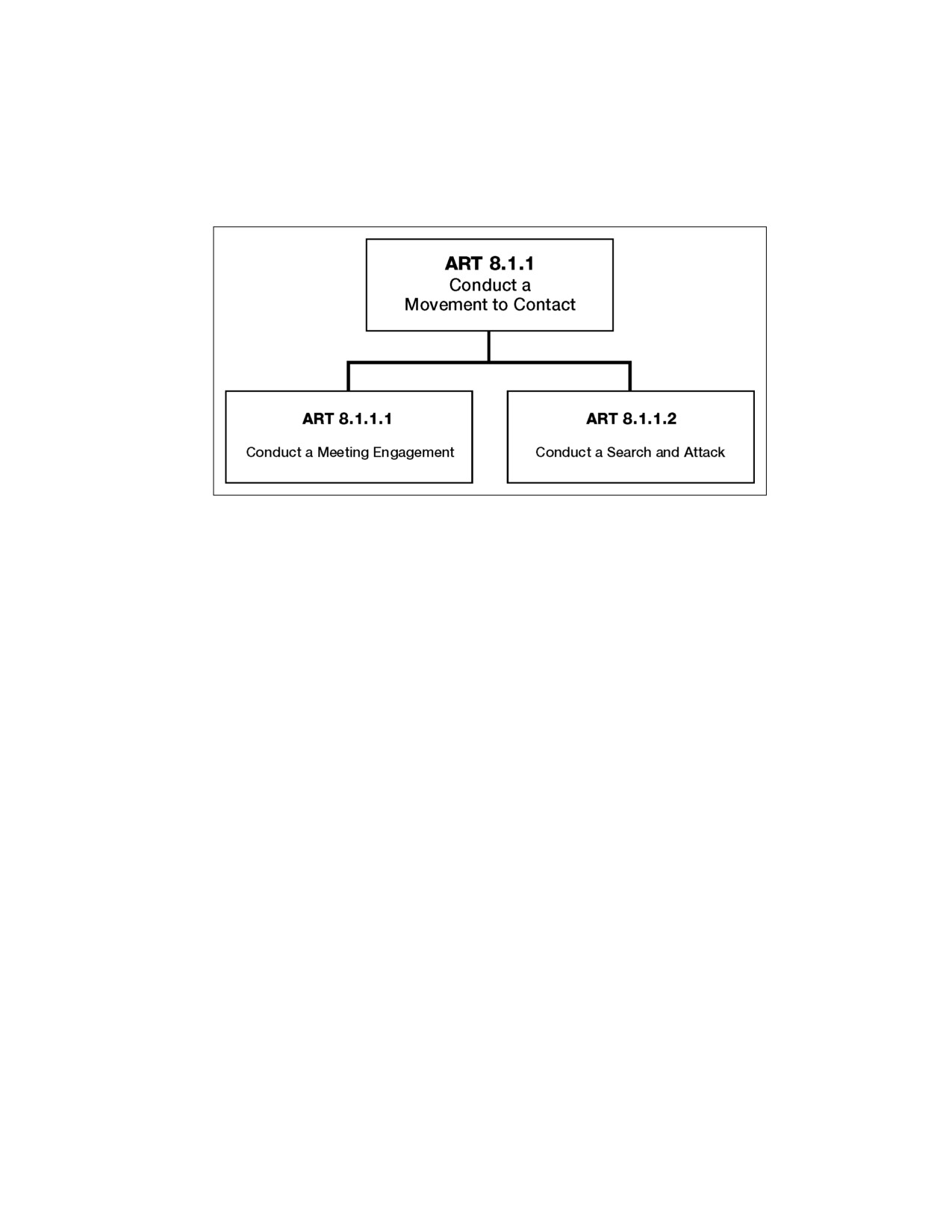
________________________________________
ART 8.0: Conduct Tactical Mission Tasks and Operations
maneuver are envelopment, turning movement, frontal attack, penetration,
and infiltration. (FM 3-0) (USACAC)
ART 8.1.1 CONDUCT A MOVEMENT TO CONTACT
8-3. The movement to contact is an offensive action designed to develop the
situation and establish or regain contact. Forces conducting a movement to
contact seek to make contact with the smallest forces feasible. A movement to
contact may result in a meeting engagement. (FM 3-90) (USACAC)
ART 8.1.1.1 CONDUCT A MEETING ENGAGEMENT
8-4. A meeting engagement is a combat action that occurs when a moving
force engages an enemy at an unexpected time and place. Such encounters
normally occur by chance in small unit operations, typically when two
moving forces collide. They may result in brigade or larger unit operations
when intelligence, surveillance, and reconnaissance operations have been
ineffective. Meeting engagements can also occur when opposing forces are
aware of the general presence, but not the exact location, of each other, and
both decide to attack immediately. (FM 3-90) (USACAC)
ART 8.1.1.2 CONDUCT A SEARCH AND ATTACK
8-5. Search and attack is a technique for conducting a movement to contact
that shares many of the characteristics of an area security mission. (FM 3-90)
(USACAC)
8-3