FM 7-15 THE ARMY UNIVERSAL TASK LIST (AUGUST 2003) - page 9
FM 7-15__________________________________________________________________________
No.
Scale
Measure
Of planned refugee/displaced civilian support capabilities currently
13
Percent
available within the AO.
Of US forces within the AO involved in the conduct of refugee/displaced
14
Percent
civilian operations.
15
Number
Of refugees/displaced civilians within the AO.
And types of forces involved in the conduct of refugee/displaced civilian
16
Number
operations within the AO.
And capacity of refugee/displaced civilian camps and centers established
17
Number
within the AO.
18
Cost
Of refugee and displaced civilian operations within the AO.
ART 6.14.6 ESTABLISH TEMPORARY CIVIL ADMINISTRATION
(FRIENDLY, ALLIED, AND OCCUPIED ENEMY TERRITORY)
6-158. Establish a temporary civil administration (at the direction of the
National Command Authorities) until existing political, economic, and social
conditions stabilize in enemy territory, or in friendly territory where there is
a weak or ineffective civil government. (FM 41-10) (USAJFKSWCS)
No.
Scale
Measure
Actions of temporary civil administration support accomplishment of the
01
Yes/No
mission of US forces within the AO.
To receive direction or approval from appropriate authority to conduct
02
Time
executive, legislative, or judiciary functions within a foreign country within
the AO.
To coordinate transition between US forces and local government/U.N.
03
Time
administration within the AO.
04
Time
To determine US post-conflict policy objectives within the AO.
To account for funds and equipment expended during military
05
Time
administration in AO.
06
Time
To close outstanding claims against military administration in AO.
To establish liaison with necessary host-nation executive, legislative,
07
Time
judiciary, and civil agencies within the AO.
08
Time
To conduct legal review of plans and policies for civil administration.
To identify threats to civil administration within the AO and develop
09
Time
security plans. This includes the review of intelligence holdings, area
studies, and assessments.
10
Time
To implement force protection measures.
To determine minimum standards of care—public works, health,
11
Time
communications, safety, and transportation—for the civilian population
IAW international law and treaties.
To develop and issue proclamations, ordinances, orders, and instructions
12
Time
intended to be binding on the local populations of the AO.
6-120
_______________________________
ART 6.0: The Combat Service Support Battlefield Operating System
No.
Scale
Measure
To determine the degree of influence, supervision, and control to be used
13
Time
by those elements responsible for conducting civil administration.
To conduct public administration training of US forces committed to the
14
Time
civil administration mission.
15
Percent
Of US forces in an AO required to conduct temporary civil administration.
Of US support requirements within an AO that can be provided from
16
Percent
civilian sources.
Of required civilian and military labor requirements that can be supplied
17
Percent
by indigenous sources.
Of required civilian supplies and services that must be provided from
18
Percent
military assets.
Of civil affairs assets required to remain in AO to conduct civil
19
Number
administration.
And types of US forces, other than civil affairs, required to remain in AO
20
Number
to support a military civil administration.
To establish temporary civil administration over friendly, allied, and
21
Cost
occupied enemy territory.
ART 6.14.6.1 PROVIDE ARTS, MONUMENTS, AND ARCHIVES SUPPORT
6-159. Prepare a list and map overlay showing the location of significant
cultural properties requiring special protection. Include the name and
significance of the persons or organizations having custody. Provide
information for use in public affairs command information programs to
inform all military personnel of directed actions concerning arts, monuments,
and archives. Prepare plans and directives for the protection of arts,
monuments, archives, and other cultural properties. Coordinate military
support for the NBC decontamination of cultural properties. Advise, assist, or
direct the restoration of cultural properties that have been damaged. Help in
locating, identifying, determining ownership, and safeguarding arts,
monuments, and archives. (FM 41-10) (USAJFKSWCS)
No.
Scale
Measure
The arts, monuments, and archives program supports US force mission
01
Yes/No
accomplishment.
The unit establishes liaison, coordinates activities, and develops plans for
02
Yes/No
arts, monuments, and archives support IAW international law, treaties,
and agreements.
The supporting civil affairs staff finalizes the courses of action and briefs
03
Yes/No
the supported commander and staff.
To review or formulate arts, monuments, and archives policies and
04
Time
ensure these policies comply with US goals and objectives.
To conduct census of art, monument, and archive objects located within
05
Time
the AO and determine their condition. This includes marking these
objectives to ensure their identification in case of theft.
6-121
FM 7-15__________________________________________________________________________
No.
Scale
Measure
To identify the facilities and security procedures available for the
protection of arts, monuments, and archives within the AO. This may
06
Time
involve the designation of collection points for art, monument, and archive
objects.
07
Time
To establish liaison with local arts, monuments, and archives agencies.
To advise local custodian in restoring, inventorying, and safeguarding
08
Time
arts.
To review art, monument, and archive plans for compliance with
09
Time
international laws, treaties, and agreements.
Of art, monument, and archive objects within the AO that are
10
Percent
destroyed/damaged by military operations, lost to theft, or
destroyed/damaged by natural disaster.
And types of US forces involved in the protection of art, monument, and
11
Number
archive objects within the AO.
And types of art, monument, and archive objects within the AO that are
12
Number
destroyed/damaged by military operations, lost to theft, or
destroyed/damaged by natural disaster.
13
Cost
To provide arts, monuments, and archives support within the AO.
ART 6.14.6.2 PROVIDE PUBLIC ADMINISTRATION SUPPORT
6-160. Provide liaison to the military forces. Survey and analyze the
operation of local governmental agencies: their structure, centers of
influence, and effectiveness. Advise, assist, supervise, or direct governmental
agencies. Recommend and, within the limits of authority, implement
governmental functions, policies, and procedures for the conduct of
government. Identify officials whose continued service would be adverse to
US interests and remove them from office. Recommend for appointment to
key offices, individuals who are respected civilians of the area and who would
best serve the interests of the United States. Individuals must be cleared by
military intelligence prior to nomination. (FM 41-10) (USAJFKSWCS)
No.
Scale
Measure
01
Yes/No
Public administration within the AO supports the mission of US forces.
The unit establishes liaison, evaluates the current public administration
system, and develops plans that will improve the existing public
02
Yes/No
administration system of the foreign nation IAW international law, treaties,
and agreements.
The supporting civil affairs staff finalizes the courses of action and briefs
03
Yes/No
the supported commander and staff.
To establish liaison with civilian public administration agency officials
04
Time
within the AO.
To evaluate the operations of civilian public administration agency within
the AO. This includes the determination of the availability and scope of
05
Time
public administration resources, a review of public administration policies
and regulations, and determination of their effectiveness.
To plan the use of public administration agencies resources to support
06
Time
US operations.
6-122
_______________________________
ART 6.0: The Combat Service Support Battlefield Operating System
No.
Scale
Measure
To develop plans for providing public administration assistance. This
includes analyzing the areas and degree of need for public administration
07
Time
assistance and looking at existing public administration agencies to
determine if they require restructuring.
To develop plans to restore civilian authority during and after military
operations. This includes identifying institutions requiring restoration of
08
Time
their authority, evaluating local personnel to determine their loyalty and
values and identifying individuals to be placed in authority positions, and
removing individuals presumed subversive to US objectives in the AO.
To conduct legal review of planned changes to public administration
09
Time
system and regulations.
10
Percent
Of local control of public administration within the AO.
11
Percent
Of US forces in AO providing support to public administration.
Of local population satisfied with public administration services provided
12
Percent
them within the AO.
Of local population complying with public administration registration,
13
Percent
licensing, regulation, and fee/taxation requirements imposed on them.
Of public service administrators within the AO who have been cleared by
14
Percent
US forces to perform their functions.
15
Number
Of public administration offices/facilities operating within the AO.
16
Number
Of civilian inhabitants of the AO affected by public administration support.
17
Number
And types of units provided public administration support within the AO.
Of individuals removed/prevented from assuming public office because
18
Number
their presumed beliefs are subversive to US objectives within the AO.
19
Cost
To provide public administration support within the AO.
ART 6.14.6.3 PROVIDE PUBLIC ELECTRONIC COMMUNICATIONS SUPPORT
6-161. Manage communication resources, public and private: to include,
postal services, telephone, telegraph, radio, television, and public warning
systems. Coordinate the use of government and private communication
resources for the military. Provide technical advice and assistance on
communication systems. Recommend the allocation of civilian
communication resources for civilian and military use. Direct civil
communication agencies and provide advice, assistance, and supervision as
required. (FM 41-10) (USAJFKSWCS)
No.
Scale
Measure
Public electronic communication system within the AO supports the
01
Yes/No
mission of US forces.
The supporting civil affairs staff finalizes the courses of action and briefs
02
Yes/No
the supported commander and staff.
The unit establishes liaison, evaluates the current public communication
system, and develops plans that will improve the existing public
03
Yes/No
communications system of the foreign nation IAW international law,
treaties, and agreements.
04
Time
To establish liaison with local public electronic communications agencies.
6-123
FM 7-15__________________________________________________________________________
No.
Scale
Measure
To identify available civilian mass communications resources and
05
Time
determine their conditions and capabilities.
To plan the use and supervision of government and public
06
Time
communications systems within the AO.
To conduct legal review of proposed changes to public electronic
07
Time
communications system and regulations.
From making changes to existing laws and ordinances to when the
08
Time
population is informed of the changes.
09
Time
To conduct civilian censorship program.
To screen broadcast personalities and mass communications support
10
Time
personnel for political beliefs.
11
Percent
Of civilian mass communications resources in AO under US control.
Of civilian population with access to electronic communications systems
12
Percent
by type (am/fm radio, broadcast television, cable television, satellite
broadcasts, short-wave, and Internet).
Of civilian population whose only source of electronic communications
13
Percent
information is under US control.
14
Number
And types of mass communications systems operable within the AO.
Of broadcast personalities and mass communications support personnel
15
Number
removed from their positions because of possible disagreements with US
policy within the AO.
16
Cost
To provide public electronic communications support within the AO.
ART 6.14.6.4 PROVIDE PUBLIC EDUCATION SUPPORT
6-162. Provide technical advice and help in planning and implementing
needed education programs. Supervise schools and screen personnel and
materials in the education system for compatibility with US objectives and
interests. (FM 41-10) (USAJFKSWCS)
No.
Scale
Measure
01
Yes/No
Public education system within the AO supports the mission of US forces.
The unit establishes liaison, evaluates the current public education
02
Yes/No
system, and develops plans that will improve the existing public
education system of the foreign nation.
The supporting civil affairs staff finalizes the courses of action and briefs
03
Yes/No
the supported commander and staff.
04
Yes/No
Products of public education system are productive citizens.
05
Time
To establish liaison with local education officials.
To evaluate the local education system within the AO. This includes
determining the availability, size, and quantity of education resources, the
06
Time
effectiveness of the education system, and extent of damage to
educational facilities resulting from military operations or natural disaster.
6-124

_______________________________
ART 6.0: The Combat Service Support Battlefield Operating System
No.
Scale
Measure
To develop plans to provide education assistance. This includes
determining the need for public education assistance, reviewing school
curriculums and aligning them with desired outcomes, testing cycle,
07
Time
restoring/reopening existing schools, determining security requirements
for educational facilities, determining legal considerations regarding
education, and plans to administer schools.
To conduct staff development of administrators, certified, and classified
08
Time
personnel.
To acquire required educational supplies, such as textbooks, paper,
09
Time
pencils, laboratory equipment, and technology, such as computers,
educational programs, test item databanks.
To acquire vocational educational supplies, such as power tools,
10
Time
woodworking supplies, welding supplies, and automotive diagnostic
equipment.
11
Percent
Alignment between desired/tested outcomes and curriculums.
Of population that can access the public education facilities on a regular
12
Percent
basis.
Of student population performing at or above established educational
13
Percent
goals.
14
Percent
Of student population with special educational or occupational needs.
Of educational facilities within the AO that meet the educational needs of
15
Percent
the students.
16
Percent
Of required educational supplies and technology in the hands of students.
17
Percent
Of students attending class on a given day.
18
Percent
Graduation rate.
19
Percent
Of students obtaining post secondary education.
20
Number
Of students, staff, faculty, and administrators within the AO.
21
Number
Of educational facilities within the AO.
Of educational facilities closed because of military operations or natural
22
Number
disaster.
Of administrative, certified, and classified personnel within the public
23
Number
education system removed because of presumed/proven subversive
beliefs.
Of administrative, certified, and classified personnel within the public
24
Number
education system removed because of incompetence.
Of acts of violence against students, administrative, certified, and
25
Number
classified staff within a given time.
26
Ratio
Of instructors to students.
27
Cost
To provide public education support within the AO.
ART 6.14.6.5 PROVIDE PUBLIC FINANCE SUPPORT
6-163. Provide technical advice and assistance regarding budgetary systems,
monetary and fiscal policies, revenue-producing systems, and treasury
operations. Control assets of the treasury and financial institutions and
prescribe monetary and fiscal policies and other regulatory measures. Assist
6-125

FM 7-15__________________________________________________________________________
local officials in preventing the unauthorized acquisition of public funds. (FM
41-10) (USAJFKSWCS)
No.
Scale
Measure
01
Yes/No
Public finance system within the AO supports the mission of US forces.
The unit establishes liaison, evaluates the current public finance system,
02
Yes/No
and develops plans that will improve the existing public finance system of
the foreign nation.
The supporting civil affairs staff finalizes the courses of action and briefs
03
Yes/No
the supported commander and staff.
To evaluate the public financial system within the AO. This includes
reviewing the public budgets and revenue sources such as taxes,
determining the amount of existing financial resources, types and status
04
Time
of financial institutions, their availability to individuals within the AO. It
includes determining if public finance resources can support the conduct
of US operations. It includes determining under which laws, customs, and
operational procedures the financial system operates.
To prepare plans to provide financial assistance. This requires a
determination of the capability of civilian financial agencies to function
effectively, preparing necessary restrictions and enforcement provisions
05
Time
regarding the exportation of US currency, establishing/revising public
fund controls over budget, taxation, expenditures, and accounting
procedures.
06
Time
To establish liaison with public finance officials within the AO.
07
Time
To conduct legal review of proposed public finance plans.
08
Percent
Of public funds over which the United States exercises controls.
09
Percent
Of civilian economy within the AO represented by public funds.
10
Percent
Taxation rates within the AO.
11
Percent
Of economy conducted on the black market.
And types of public institutions within the AO over which the United
12
Number
States must impost public fund controls.
Of local laws and regulations that must be changed to establish adequate
13
Number
public fund controls over budget, taxation, expenditures, and accounting
procedures.
14
Number
Of audits conducted of public fund accounts within a given time.
15
Number
Of individuals indicted for stealing public funds.
In dollars/local currency of public funds controlled by military agencies
16
Number
within the AO.
Of violations of public fund controls found by audits that result in the loss
17
Number
of public funds.
Of US individuals necessary to provide public finance support within the
18
Number
AO.
19
Cost
To subsidize public governmental activities within the AO.
20
Cost
To provide public finance support within the AO.
ART 6.14.6.6 PROVIDE PUBLIC HEALTH SUPPORT
6-164. Estimate needs for additional medical support required by the
civilian sector. Coordinate acquisition of medical support from voluntary
6-126

_______________________________
ART 6.0: The Combat Service Support Battlefield Operating System
agencies or US military sources. Coordinate the use of civilian medical
facilities and supplies by US military forces. Aid in the prevention, control,
and treatment of endemic and epidemic diseases of the civilian populace.
Survey and provide assistance with civilian health care (medical personnel,
facilities, training programs), and provide guidance for provision of
emergency services by US personnel. Analyze, survey, supervise, and/or
direct civilian public health and sanitation services, personnel, organizations,
and facilities. (FM 41-10) (USAJFKSWCS)
No.
Scale
Measure
01
Yes/No
Public health system within the AO supports the mission of US forces.
02
Yes/No
Civilian medical conditions pose a threat to US forces within the AO.
The unit establishes liaison, evaluates the current public health system,
03
Yes/No
and develops plans that will improve the existing public health system of
the foreign nation.
The supporting civil affairs staff finalizes the courses of action and briefs
04
Yes/No
the supported commander and staff.
05
Time
To establish liaison with public health agencies within the AO.
To evaluate the public health system. This includes determining public
health resources available—personnel, facilities, and supplies—their
condition and their capability to meet the medical requirements of military
06
Time
forces and civilians within the AO. It also includes the availability of these
resources to the civilian population and evaluating the effectiveness of
existing public health programs.
To prepare plans to prevent and control communicable diseases. Plans
require educating indigenous personnel on personal hygiene and
sexually transmitted diseases, ensuring local ordinances informing
civilians of medical and sanitary measures are made public and enforced,
07
Time
coordinating with public works to ensure that human and other hazardous
wastes are safely disposed, protecting food consumed in their raw states,
reducing breeding places for disease-carrying insects and animal vectors,
preventing hazards to animal and marine life, and containing diseases
endemic to the AO.
To provide public health assistance. This requires analyzing the
organization and functions of existing public health and sanitation
08
Time
agencies, controlling, treating, and preventing communicable diseases,
protecting food and water supplies, and supervising the maintenance of
public health facilities and records.
09
Time
To establish preventive medicine inoculation plan on activation of the AO.
Difference between planned public health requirements and actual
10
Percent
requirements in AO.
11
Percent
Of planned public health preventive medicine support achieved in AO.
12
Percent
Of civilians inoculated for disease prevention in AO.
13
Percent
Of civilian population in AO provided health education and training.
Of civilian population with access to doctors, dentists, and
14
Percent
ophthalmologists.
Of doctors, dentists, and ophthalmologists to civilian population within the
15
Percent
AO.
6-127
FM 7-15__________________________________________________________________________
No.
Scale
Measure
Of individuals providing public health services within AO currently
16
Percent
licensed or certified to perform those services.
Of civilians living within the AO that must be provided public health
17
Number
support.
And types of public health facilities available within the AO to include their
18
Number
bed capacity.
Of currently licensed/certified doctors, physician assistants, nurses,
19
Number
midwives, paramedics, emergency medical technicians, etc. providing
public health services within the AO.
And types of communicable and sexually transmitted disease cases in
20
Number
AO.
21
Number
Of sanitary inspections conducted within the AO within a given time.
Of instances of civilian restaurants and food service facilities shut down
22
Number
for sanitation violations.
23
Cost
To provide public health support within the AO.
ART 6.14.6.7 PROVIDE PUBLIC SAFETY SUPPORT
6-165. Coordinate public safety activities for the military force. Provide
liaison between the military forces and public safety agencies and coordinate
the control of civilian movement. Advise, assist, or supervise local police, fire
fighting, rescue agencies, and penal institutions. Supervise the enforcement
of all laws and ordinances after the populace has been duly informed. Take
into custody all arms, ammunition, implements of war, and contraband
items. (FM 41-10) (USAJFKSWCS)
No.
Scale
Measure
The supporting civil affairs staff finalizes the courses of action and briefs
01
Yes/No
the supported commander and staff.
02
Yes/No
Public safety system within the AO supports the mission of US forces.
The unit establishes liaison, evaluates the current public safety system,
03
Yes/No
and develops plans that will improve the existing public safety system of
the foreign nation.
04
Time
To establish liaison with public safety agencies operating within the AO.
To evaluate public safety system within the AO. This includes
determining availability, capabilities, effectiveness, and resources of
05
Time
existing public safety agencies, such as police, fire fighting, prison, and
emergency rescue agencies.
To develop plans to provide public safety assistance. This requires the
review of existing civilian public safety plans, informing the civilian
06
Time
population of new/revised laws and ordinances, and integrating and
supervising the enforcement of laws and ordinances to include civilian
movement control restrictions.
To review public safety plans for compliance with international laws,
07
Time
treaties, and agreements.
Difference between planned public safety requirements and actual
08
Percent
requirements in AO.
09
Percent
Of planned public safety support achieved in AO.
6-128
_______________________________
ART 6.0: The Combat Service Support Battlefield Operating System
No.
Scale
Measure
Of civilian population in AO provided protection by public safety agencies
10
Percent
and organizations.
Of public safety personnel who have passed screening tests for human
11
Percent
rights abuses, criminal activities, and political views.
12
Percent
Of public safety personnel licensed/trained to perform their jobs.
13
Percent
Of public safety effort within the AO provided by US forces.
14
Number
And types of public safety facilities located within the AO.
15
Number
And types of US forces used to provide public safety within AO.
And types of criminal activities occurring within the AO within a given
16
Number
time.
And types of fires and hazardous material incidents within the AO within a
17
Number
given time.
18
Number
And types of civilian public safety personnel within the AO.
Of civilian personnel detained in prisons and jails within the AO for civil
19
Number
offenses.
20
Cost
To support public safety within the AO.
ART 6.14.6.8 PROVIDE PUBLIC TRANSPORTATION SUPPORT
6-166. Identify the modes and capabilities of transportation systems
available in the civilian sector. Coordinate the use of locally available
assets—to include, railroads, highways, ports, airfields, and motor vehicles—
to support military operations. Prepare plans for the use of available civilian
and military transportation assets for emergency civilian evacuation from
combat areas or transportation of relief supplies. Provide advice and
assistance in establishing and operating transportation facilities. Direct
civilian transport agencies and functions. (FM 41-10) (USAJFKSWCS)
No.
Scale
Measure
Public transportation system within the AO supports the mission of US
01
Yes/No
forces.
The unit establishes liaison, evaluates the current public transportation
02
Yes/No
system, and develops plans that will improve the existing public
transportation system of the foreign nation.
The supporting civil affairs staff finalizes the courses of action and briefs
03
Yes/No
the supported commander and staff.
04
Time
To establish liaison with transportation agencies.
To evaluate existing public transportation system capabilities within the
05
Time
AO. This includes the number and operating conditions of mass
transportation assets, bulk carriers, and specialty transportation assets.
To identify civilian and military transportation needs and capabilities
06
Time
within the AO.
To review public transportation plans for compliance with international
07
Time
laws, treaties, and agreements.
Difference between planned and actual public transportation
08
Percent
requirements within the AO.
6-129
FM 7-15__________________________________________________________________________
No.
Scale
Measure
09
Percent
Of civilian population that has access to public transportation in the AO.
10
Percent
Of AO covered by public transportation systems.
Of US forces within the AO involved in the provision of public
11
Percent
transportation support.
Of US military transportation requirements that can be met by public
12
Percent
transportation assets within the AO.
13
Number
And types of US forces needed to provide public transportation support.
14
Number
And types of mass transportation assets available within the AO.
15
Number
Of metric tons/day that can be moved by public transportation assets.
Of passengers per day that can be moved by public transportation
16
Number
assets.
17
Cost
To provide public transportation support within the AO.
ART 6.14.6.9 PROVIDE PUBLIC WELFARE SUPPORT
6-167. Determine the type and amount of welfare supplies needed for
emergency relief. Plan and coordinate for the use of welfare supplies from all
sources. Advise and assist the host government. Establish and supervise
emergency centers for distributing supplies and for housing and feeding
civilians. (FM 41-10) (USAJFKSWCS)
No.
Scale
Measure
01
Yes/No
Public welfare system within the AO supports the mission of US forces.
The unit establishes liaison, evaluates the current public welfare system,
02
Yes/No
and develops plans that will improve the existing public welfare system of
the foreign nation.
The supporting civil affairs staff finalizes the courses of action and briefs
03
Yes/No
the supported commander and staff.
04
Time
To establish liaison with public welfare agencies within the AO.
To evaluate the public welfare system. This requires determining the
extent of the welfare problem, number and location of civilian welfare
05
Time
organizations available, the resources that they have available, and their
effectiveness in providing services to those who need them.
To plan public welfare assistance. This includes the review of existing
public welfare laws and programs, determining the numbers of needy
civilians to be serviced and the types of assistance they need—food and
clothing—and their availability within the AO. It includes planning for the
06
Time
supervision of emergency shelters and feeding centers to include the
recruitment and screening of public welfare personnel, the protection and
evacuation of welfare storage and operating facilities, and the distribution
of welfare supplies.
To procure and transport public welfare supplies to storage/distribution
07
Time
centers.
08
Time
To conduct public welfare assistance.
To educate civilian population within the AO on public welfare support
09
Time
available to them.
6-130
_______________________________
ART 6.0: The Combat Service Support Battlefield Operating System
No.
Scale
Measure
Difference between planned public welfare requirements and actual
10
Percent
requirements in AO.
11
Percent
Of planned public welfare support achieved in AO.
12
Percent
Of US forces in AO involved in the conduct of public welfare.
13
Percent
Of public welfare support within the AO provided by civilian organizations.
14
Percent
Of civilian population in AO that has access to public welfare facilities.
15
Number
And types of US forces providing public welfare support.
Of civilian deaths resulting from an inability to access public welfare
16
Number
within a given time.
17
Number
Of civilians within the AO provided public welfare.
And types of other governmental agencies and nongovernmental
18
Number
agencies providing public welfare within the AO.
19
Cost
To provide public welfare support within the AO.
ART 6.14.6.10 PROVIDE PUBLIC WORKS AND FACILITIES SUPPORT
6-168. Coordinate public works and utilities support for military operations.
Advise and assist in the construction, operation, and maintenance of public
works and utilities. Direct public works and utilities operations. (FM 41-10)
(USAJFKSWCS)
No.
Scale
Measure
Public works and facilities within the AO support the mission of US
01
Yes/No
forces.
The unit establishes liaison, evaluates the current public works and
02
Yes/No
facilities system, and develops plans that will improve the existing public
works and facilities system of the foreign nation.
The supporting civil affairs staff finalizes the courses of action and briefs
03
Yes/No
the supported commander and staff.
Public works systems constructed to plan specifications within allotted
04
Yes/No
time.
Public works systems safeguard the health of noncombatants within the
05
Yes/No
AO.
To establish liaison with public works and facilities agencies within the
06
Time
AO.
To review public works and facilities within the AO. This includes
07
Time
determining the functions and authority of existing public works and
facilities regulatory agencies.
To develop public works program within AO. This includes determining
the type of support needed, the concerned civil agencies, the
08
Time
dependability of local agencies and area residents, and developing
security plans to protect public works facilities.
To perform reconnaissance of selected sites for new public works
facilities to evaluate the sites for suitability and conditions, identify
09
Time
construction problems and possible courses of action, and update/revise
the engineer estimate.
6-131

FM 7-15__________________________________________________________________________
No.
Scale
Measure
To prepare construction directives for public work facilities and issue it to
10
Time
the construction unit/company.
To coordinate for and receive additional assets to perform public works
11
Time
functions.
12
Time
To monitor construction and conduct quality assurance inspections.
To verify accuracy of public work construction plans and specifications to
13
Time
include ensuring that the bill of materials includes all required materials to
complete construction.
14
Time
To design new construction requirements.
15
Time
To manage and administer public works program within AO.
To conduct environmental baseline surveys on real estate being
16
Time
considered for acquisition or use by public works facilities.
To inventory equipment located within and supporting public work
17
Time
facilities.
18
Time
To maintain public works records.
Difference between planned and actual requirements for public works
19
Percent
within the AO.
20
Percent
Of planned public works facilities acquired or constructed in AO.
21
Percent
Of existing public works facilities modernized within the AO.
Of existing public works facilities that can be used in their current
22
Percent
condition.
Of existing public works facilities damaged by combat actions or natural
23
Percent
disaster.
Of civilian nonbattle injuries and disease within AO attributable to
24
Percent
inadequate public works support.
25
Percent
Of US effort within the AO used to provide public works support.
Of metric tons/liters and types of waste, refuse, and hazardous material
26
Number
produced per day within the AO.
27
Number
And types of public works facilities constructed/acquired.
And types of US forces used to provide public works support within the
28
Number
AO.
29
Cost
Of providing public works support within the AO.
ART 6.14.6.11 PROVIDE CIVIL DEFENSE SUPPORT
6-169. Ensure an adequate civil defense structure exists. Advise, assist, or
supervise local civil defense officials. Assess civil defense planning for
emergency welfare services and emergency food, water, sanitation, and
medical supplies. Coordinate civil defense activities of fire, police, and rescue
personnel with those of the military. Integrate local civil defense agencies
into the military NBC warning system. Coordinate EOD activities in the civil
sector. Issue instruction on defense measures for NBC and other attacks and
monitor the control of mass civilian casualties resulting from NBC warfare.
Identify civilian NBC and other protective shelters and assess their
suitability. Identify civilian evacuation routes and assess their adequacy.
Ensure that NBC protective measures are included in civil defense plans and
6-132

_______________________________
ART 6.0: The Combat Service Support Battlefield Operating System
that available NBC protective equipment is acquired.
(FM
41-10)
(USAJFKSWCS)
No.
Scale
Measure
The civil defense program within the AO protects the civilian inhabitants
01
Yes/No
from the hazards associated with military operations and natural disasters
and supports the mission of US forces.
The unit establishes liaison, evaluates the current civil defense system,
02
Yes/No
and develops plans improving the existing civil defense system of the
foreign nation.
The supporting civil affairs staff finalizes the courses of action and briefs
03
Yes/No
the supported commander and staff.
To plan and establish an effective civil defense program within the AO.
This includes the evaluation of existing civil defense programs, such as
the emergency warning system, emergency communications systems,
04
Time
radiological monitoring systems, air raid and fallout shelters, emergency
operations centers, and area damage control plans to determine
efficiency and effectiveness.
To evaluate the local civil defense system to determine its efficiency, the
05
Time
resources available to it, and the availability of additional resources that
may provide civil defense.
06
Time
To establish liaison with local civil defense agencies.
From the detection of a hazard to when the population is warned to take
07
Time
shelter.
08
Percent
Of population protected by an effective civil defense program..
09
Percent
Of population serviced by an effective civil defense warning system.
10
Percent
Of AO served by an effective civil defense warning system.
11
Percent
Of AO protected by an effective civil defense program.
Of identified high-value civilian assets/facilities protected by an effective
12
Percent
civil defense program.
13
Percent
Of US forces within the AO providing civil defense support.
14
Number
Of air raid and fallout shelters within the AO.
And types of fire fighting, emergency medical response, HAZMAT, and
15
Number
public safety/law enforcement teams operating within the AO.
16
Number
Of weather and aircraft observers operating within the AO.
17
Number
And types of US forces providing civil defense support within the AO.
18
Cost
To provide civil defense support within the AO.
ART 6.14.6.12 PROVIDE PUBLIC LEGAL SUPPORT
6-170. Establish supervision over local judiciary system, establish civil
administration courts, and help in preparing or enacting necessary laws for
the enforcement of US policy and international law.
(FM
41-10)
(USAJFKSWCS)
6-133

FM 7-15__________________________________________________________________________
No.
Scale
Measure
The civilian public legal system operating within the AO provides for the
01
Yes/No
rule of law and justice to the civilian population and supports the mission
of the US force.
The unit establishes liaison, evaluates the current judicial system, and
02
Yes/No
develops plans that will improve the existing judicial system of the foreign
nation.
The supporting civil affairs staff finalizes the courses of action and briefs
03
Yes/No
the supported commander and staff.
04
Time
To establish liaison with local judicial officials.
To evaluate the judicial system within the AO. This includes determining
effectiveness of the civilian court system, judiciary reliability, quantity and
quality of legal resources available to the civilian population, finding out
05
Time
which areas need legal assistance, range of criminal and civil legislation
and statutes, methods used to record, report, and publish laws and
decisions, and deficiencies on government operations.
06
Time
To determine to reopen local civilian tribunals.
To develop plans for providing legal support, such as establishing
tribunals and other judicial and administrative agencies and determining
07
Time
the number, types, jurisdiction, procedures, and delegation of appointing
authority of the tribunals and other judicial and administrative agencies.
08
Time
To establish a prison and institution administration review system.
To develop an advisory program to upgrade the judiciary and other legal
09
Time
agencies.
10
Time
On average that individuals wait to settle civil and criminal charges.
Of available legal support within the AO devoted to supporting public
11
Percent
legal support.
Of legal actions occurring within the AO conducted solely by local
12
Percent
civilians.
Of judge advocate general personnel supporting the conduct of public
13
Number
legal support.
Of other US Army personnel supporting the conduct of public legal
14
Number
support.
Of local civilian lawyers, judges, and legal assistants cleared to conduct
15
Number
public legal support.
16
Number
Of criminal and administrative legal cases within the AO.
17
Cost
To provide public legal support within the AO.
ART 6.14.6.13 PROVIDE CIVILIAN SUPPLY SUPPORT
6-171. Determine the availability of local supplies for civil and military use.
Coordinate military needs for local resources and coordinate their
acquisition. Determine the needs of the populace for emergency supplies and
arrange for distribution IAW policy. Coordinate the movement of essential
civilian supplies. Plan and supervise rationing programs. Arrange salvage of
captured supplies that can be used by the civilian populace. Advise and assist
allied governments in these activities, when appropriate. Direct
governmental and commercial supply activities. (FM 41-10) (USAJFKSWCS)
6-134

_______________________________
ART 6.0: The Combat Service Support Battlefield Operating System
No.
Scale
Measure
01
Yes/No
Public supply system within the AO supports the mission of US forces.
The unit establishes liaison, evaluates the current civilian supply system,
02
Yes/No
and develops plans that will improve the existing civilian supply system of
the foreign nation.
The supporting civil affairs staff finalizes the courses of action and briefs
03
Yes/No
the supported commander and staff.
Civilian supply plan reviewed by authority for compliance with
04
Yes/No
international laws, treaties, and agreements.
To review civilian supply plan for compliance with international laws,
05
Time
treaties, and agreements.
To plan, coordinate, and move supplies from current locations to
06
Time
distribution points.
To identify the resources to support civilian and military operations.
Includes the establishment of procedures to survey civilian supply and
07
Time
associated accounting procedures. It also includes the determination of
the adequacy of civilian supplies, agricultural and industrial patterns, and
the effect redistributing resources would have on the populace.
To develop plan to prevent black market activities. Includes establishing
procedures to determine critical commodities in short supply or in danger
of being in short supply; establishing a system to inventory available
resources, requiring holders of excess resources to declare those stocks
and surrender them against a receipt; determining if rationing or price
08
Time
control programs exist or need to exist; developing methods of
distribution; issuing guidance on preparing and posting ordinances, laws,
and proclamations for distribution to the local population; establishing
program to educate inhabitants on violations and resulting punishment;
and establishing security measures to protect storage facilities and
distribution points.
09
Percent
Of required civilian supplies provided internal to the AO.
Of required civilian supplies provided by salvaging captured enemy
10
Percent
supplies.
Of required civilian supplies that must be provided by US forces or other
11
Percent
agencies.
12
Percent
Of US military supplies that can be provided from sources within the AO.
Of available US military resources to conduct civilian supply support
13
Percent
within the AO.
Of black market activity detected and suppressed by law enforcement
14
Percent
operations.
Of tons per day and types of emergency supplies provided to the
15
Number
populace.
16
Number
Of individuals per day provided emergency supplies.
Of tons and types of enemy supplies salvaged for use by the civilian
17
Number
population of the AO within a given time.
Of metric tons per day of each type of critical commodity diverted to the
18
Number
black market.
19
Number
Of cases per day of individuals arrested for black market activities.
6-135

FM 7-15__________________________________________________________________________
No.
Scale
Measure
20
Cost
Of civilian supply support.
ART 6.14.6.14 PROVIDE ECONOMIC AND COMMERCE SUPPORT
6-172. Determine the availability of local resources for military and civilian
use. Determine the economic controls and the governmental structure related
to economics and commerce. Help in developing and executing price control
and rationing programs. Direct support to keep key industries operating.
Advise, assist, or direct governmental economic and commercial agencies.
Develop and implement plans to prevent black-market activities. (FM 41-10)
(USAJFKSWCS)
No.
Scale
Measure
The public economic and commercial system supports the mission of US
01
Yes/No
forces within the AO.
The unit establishes liaison, evaluates the current economic and
02
Yes/No
commerce system, and develops plans that will improve the existing
economic and commerce system of the foreign nation.
The supporting civil affairs staff finalizes the courses of action and briefs
03
Yes/No
the supported commander and staff.
To assess the operation of economic and commercial agencies within the
AO. Includes developing a census of key economic and commercial
industries, establishing communications links between civilian
governmental agencies, university, and industry personnel, preparing
04
Time
survey to determine means of production, distribution channels,
marketing methods, locations of raw materials, assistance programs
available, food and fiber production and requirements, food and
agricultural processing and storage facilities, and types and volumes of
commodities entering trade.
05
Time
To determine the feasibility of establishing new industries.
To evaluate the effectiveness of monetary and fiscal systems and policies
and make recommendations. This includes reviewing revenue producing
06
Time
systems, budgetary systems, treasury operations, central banking
operations, and commercial banking operations.
To prepare and coordinate plans to assist the country’s economic and
07
Time
commercial agencies.
08
Time
To assess the availability of civilian resources for civilian and military use.
To review economic and commerce support plans for compliance with
09
Time
international laws, treaties, and agreements.
To develop plans to prevent or limit black market activities to include
rationing and price control programs, controlling methods of distribution of
10
Time
critical commodities, and providing security measures to protect storage
facilities and distribution points.
11
Percent
Of economy operating on a cash or credit basis versus barter.
12
Percent
Of stocks of critical supplies diverted to black market.
13
Percent
Of economy dependent on foreign investment and aid.
14
Percent
Inflation rate within the AO.
15
Percent
Individual civilian savings rate within the AO.
6-136
_______________________________
ART 6.0: The Combat Service Support Battlefield Operating System
No.
Scale
Measure
16
Percent
Unemployment or underemployment within the AO.
And types of commercial facilities restored to operating
17
Number
condition/improved within the AO.
18
Number
And types of new industries/services located within the AO.
And types of critical commodities available primarily through the black
19
Number
market.
Of metric tons/per day of each type of critical commodity diverted to the
20
Number
black market.
21
Number
Of cases per day of individuals arrested for black market activities.
22
Cost
Of direct support/subsidies to keep key industries operating.
ART 6.14.6.15 PROVIDE FOOD AND AGRICULTURE SUPPORT
6-173. Provide advice and assistance in establishing and managing crop
improvement programs, agricultural training, use of fertilizers and
irrigation, livestock improvement, and food processing, storage, and
marketing. Direct the governmental food and agricultural agencies. Identify
areas of staple crops and areas of surplus and deficit foodstuffs, and devise a
means to distribute the surplus and eliminate the deficit. Identify locations
and capacities of livestock, food processing, storage, and marketing areas.
(FM 41-10) (USAJFKSWCS)
No.
Scale
Measure
The food and agricultural support system within the AO supports the
01
Yes/No
mission of US forces within the AO.
AO becomes self-sufficient in food and agricultural products or because
02
Yes/No
of productivity of its economy and commerce can afford to import the
shortfall in its required food and agricultural products.
The unit establishes liaison, evaluates the current food and agriculture
03
Yes/No
system, and develops plans that will improve the existing food and
agriculture system of the foreign nation.
The supporting civil affairs staff finalizes the courses of action and briefs
04
Yes/No
the supported commander and staff.
To identify food processing and distribution requirements. This includes
surveys to determine food production capability, determine limiting factors
affecting the production, processing, and storage of food supplies,
05
Time
determine the transportation needs to complete the mission, and the
development of regulatory measures or incentives that encourage the
production, safeguard, and orderly distribution of agricultural products.
6-137

FM 7-15__________________________________________________________________________
No.
Scale
Measure
To develop plans for government food and agricultural programs. This
requires determining the key personnel involved in agriculture and food
production within the AO; providing interface with technical specialists
working in food and agriculture; and conducting surveys of food and fiber
requirements, processing and storage facilities and capabilities,
06
Time
marketing systems, credit availability, agricultural education, and land
tenure. It also requires determining the location of food supplies, existing
and projected shortages in food and agricultural products, and preparing
studies on the civilian population’s dietary habits and nutritional
requirements.
To develop plan to prevent black market activities. Includes establishing
procedures to determine critical commodities in short supply or in danger
of being in short supply; establishing a system to inventory available
resources, requiring holders of excess resources to declare those stocks
and surrender them against a receipt; determining if rationing or price
07
Time
control programs exist or need to exist; developing methods of
distribution; issuing guidance on preparing and posting ordinances, laws,
and proclamations for distribution to the local population; establishing
program to educate inhabitants on violations and resulting punishment,
and establishing security measure to protect food storage facilities and
distribution points.
To assess the availability of food and agricultural resources from the AO
08
Time
for use by US military forces.
To survey and supervise civilian farming methods within the AO. This
includes the establishment of a farm credit system and technical and
engineering advice programs. It also includes coordinating the
09
Time
procurement of farm labor during critical planting and harvesting seasons
and estimating requirements for food, fertilizer, farm machinery, and other
resources.
To develop plans for the use and conservation of land, food, and marine
resources to include setting procedures for seizing and maintaining all
10
Time
agricultural, fishing, and forestry records, and recommending plans for
restoring, using, and conserving land, forests, and marine resources.
To review food and agriculture support plans for compliance with
11
Time
international laws, treaties, and agreements.
12
Percent
That the AO is self-sufficient in food and agricultural products.
Of US force requirements for food and agricultural products that can be
13
Percent
provided by the AO from its surplus stocks.
14
Percent
Of US force committed to food and agricultural support.
15
Percent
Of population in AO involved in food and agricultural production.
Of individuals within the AO involved in food production who own their
16
Percent
farms.
And types of agricultural exhibition projects conducted within the AO to
17
Number
introduce new farming equipment, techniques of farming, agricultural
crops, and livestock.
Of civilians within the AO involved in educational programs designed to
18
Number
improve their capability to farm and manage farm-related businesses.
6-138
_______________________________
ART 6.0: The Combat Service Support Battlefield Operating System
No.
Scale
Measure
Of metric tons per day and types of food and agriculture products
19
Number
imported into the AO to meet the needs of its civilian inhabitants.
Of metric tons per day and types of food and agriculture products
20
Number
exported from the AO that are surplus to its requirements.
Of direct support/subsidies to provide necessary food and agriculture
21
Cost
support to sustain the civilian population of an AO.
ART 6.14.6.16 PROVIDE PROPERTY CONTROL SUPPORT
6-174. Identify private and public property, and facilities available for
military use, and recommend policy and procedures to obtain them.
Coordinate military acquisition of civilian property and facilities needed by
military forces. Establish policies and procedures concerning custody and
administration of private and public property. Control negotiable assets and
resources of potential military use that are not otherwise under the
supervision of other agencies. (FM 41-10) (USAJFKSWCS)
No.
Scale
Measure
The property control system within the AO supports the mission of US
01
Yes/No
forces within the AO.
The unit establishes liaison with civilian and military/Corps of Engineers
property control agencies, evaluates the current property control system,
02
Yes/No
and develops plans that will improve the existing property control system
of the foreign nation.
The supporting civil affairs staff finalizes the courses of action and briefs
03
Yes/No
the supported commander and staff.
To prepare property acquisition plans. Property acquisition plans classify
the property to be acquired, identifies and coordinates the acquisition of
property for military use; prescribes a recording system for property
acquired by the military from civilian sources; prescribes measures to
04
Time
protect and preserve civilian ownership records, prescribes measures to
safeguard and properly manage the acquired property, plans for
scheduling the acquisition of property, and plans for controlling negotiable
assets and resources of potential military use that are not under the
supervision of other agencies.
To review property control support plans for compliance with international
05
Time
laws, treaties, and agreements.
Difference between planned and actual requirements for property
06
Percent
acquisition and control within the AO.
07
Percent
Of planned property acquisitions within the AO completed.
08
Percent
Of AO acquired for US military use.
09
Number
Of US property control teams operational within the AO.
10
Number
Size, and types of property used to support military operations in AO.
Of instances when United States is not able to establish property control
11
Number
over civilian property acquired within the AO.
To establish and maintain property controls over civilian property
12
Cost
acquired within the AO.
6-139

FM 7-15__________________________________________________________________________
ART 6.14.6.17 PROVIDE CIVIL PRINT INFORMATION SUPPORT
6-175. Advise, assist, supervise, control, or operate civil print information
agencies. Disseminate proclamations, ordinances, and notices. Advise and
assist allied governments, when required. Implement civil censorship
policies. (FM 41-10) (USAJFKSWCS)
No.
Scale
Measure
The civil print information system within the AO supports the mission of
01
Yes/No
US forces within the AO.
The unit establishes liaison, evaluates the current civil print information
02
Yes/No
systems, and develops plans that will improve the existing civil print
information systems of the foreign nation.
The supporting civil affairs staff finalizes the courses of action and briefs
03
Yes/No
the supported commander and staff.
04
Time
To establish liaison with civilian print media agencies within the AO.
To identify available civilian print media resources and determine their
05
Time
conditions and capabilities.
To plan the use and supervision of government and public print media
06
Time
systems within the AO.
To conduct legal review of proposed changes to print media controls and
07
Time
regulations.
From making changes to existing laws and ordinances to when the
08
Time
population is informed of the changes.
09
Time
To conduct civilian censorship program of print media.
To screen print media reporters, editors, columnists, and print support
10
Time
staff personnel for political beliefs.
Of civilian print media production resources within the AO under US
11
Percent
control.
Of civilian population with access to print media by type (road signs,
12
Percent
posters, newspapers, magazines, and leaflets).
Of civilian population whose only source of print media is under US
13
Percent
control.
14
Percent
Of civilian population that is literate.
And types of civilian print media production means operable within the
15
Number
AO.
Of print media writers and print support personnel removed from their
16
Number
positions because of possible disagreements with US policy within the
AO.
Of US personnel used to provide civil print information support within the
17
Number
AO.
18
Cost
To provide civil print formation support within the AO.
ART 6.14.6.18 PROVIDE CULTURAL AFFAIRS SUPPORT
6-176. Provide information to military forces on the social, cultural,
religious, and ethnic characteristics of the local populace. Develop codes of
behavior to educate US forces in order to reduce acts contrary to local
customs and practice. Locate and identify religious buildings, shrines, and
consecrated places, and recommend restrictions on their use. Act as a
6-140
_______________________________
ART 6.0: The Combat Service Support Battlefield Operating System
disinterested third party in negotiations between opposing ethnic, cultural,
religious, and social groups in the AO. Function in a liaison capacity between
US commanders and leaders of local social, cultural, religious, and ethnic
groups. Consistent with mission requirements, recommend methods and
techniques of operation that will be most acceptable to the local population.
(FM 41-10) (USAJFKSWCS)
No.
Scale
Measure
01
Yes/No
The cultural affairs support system in AO supports mission of US forces.
The unit establishes liaison, assesses the foreign nation’s social, cultural,
02
Yes/No
religious, and ethnic characteristics, and develops plans that will improve
the existing civil print information systems of the foreign nation.
The supporting civil affairs staff finalizes the courses of action and briefs
03
Yes/No
the supported commander and staff.
US forces act as the disinterested party in negotiations between opposing
04
Yes/No
ethnic, cultural, religious, and social groups in the AO.
To educate US forces to reduce acts contrary to local customs and
05
Time
practice.
To develop, coordinate, and enforce codes of behavior that complement
06
Time
local customs.
07
Time
To conduct liaison with local social, cultural, religious, and ethnic leaders.
And types of restrictions placed on the use of religious buildings, shrines,
08
Number
consecrated places, and property by the civilian population and military
forces.
And types of restrictions placed on the use of historical buildings and
09
Number
property by the civilian population and military forces.
And types of restrictions placed on the use of social gathering places by
10
Number
the civilian population and military forces.
11
Cost
To provide cultural affairs support within the AO.
ART 6.14.7 CONDUCT NEGOTIATIONS WITH AND BETWEEN OTHER
GOVERNMENTAL AND NONGOVERNMENTAL ORGANIZATIONS
6-177. Conduct negotiations between the Army and other US governmental
agencies and nongovernmental organizations. These negotiations can range
widely in size and scope. (FM 3-07) (USACAC)
No.
Scale
Measure
The outcome of the negotiation process supports accomplishing the
01
Yes/No
mission of US forces in the AO.
US forces act as the disinterested party in negotiations between opposing
02
Yes/No
ethnic, cultural, environmental, commercial, religious, and social groups
in the AO.
Outcome of the negotiations conditionally agreed on before the start of
03
Yes/No
negotiations.
04
Yes/No
Negotiating team avoided making the initial offer in the negotiations.
Negotiating team kept the objective of the negotiations in mind and
05
Yes/No
avoided the big picture because of focusing on single issues.
6-141

FM 7-15__________________________________________________________________________
No.
Scale
Measure
Negotiating team discovered additional variables/concessions/bargaining
06
Yes/No
chips during the conduct of the negotiations.
07
Yes/No
US negotiator walked away from the negotiations.
Negotiating team kept accurate notes on progress of negotiations that
08
Yes/No
may be referred to if the other party forgets, misunderstands, or attempts
to distort interpretations of what has been discussed and agreed.
Negotiating team summarized and confirmed the understandings of all
09
Yes/No
parties continually.
Negotiating team has the skills to conduct negotiations. This includes
good communications skills, ability to use the dynamics of conflict, and
knowledge of the area, culture, economies, political philosophy,
10
Yes/No
language, customs, history, wants, needs, goals, probable assumptions,
and communications/negotiation styles of the other parties to the
negotiations. The negotiating team must also have a thorough
understanding of US interests and goals for the negotiations.
Negotiating team’s higher headquarters approved the negotiating team’s
11
Yes/No
concessions and positions.
To conduct background information on the parties involved in the
12
Time
negotiations to identify needs and interests to include personal and
emotional aspects.
To establish the conditions necessary for the conduct of successful
13
Time
negotiations. This includes building trust, rapport, and empathy with the
other individuals involved in the negotiations.
To determine negotiating concessions and bargaining chips that can be
14
Time
exploited during the conduct of negotiations.
15
Time
To conduct legal review of agreements reached during negotiations.
16
Percent
Of desired objectives obtained during negotiations.
Of time that the US side gets something in exchange for some type of
17
Percent
concession in its negotiating position.
18
Number
Of negotiations currently ongoing within the AO and their topics.
Of conducting negotiations with and between other governmental and
19
Cost
nongovernmental organizations.
6-142
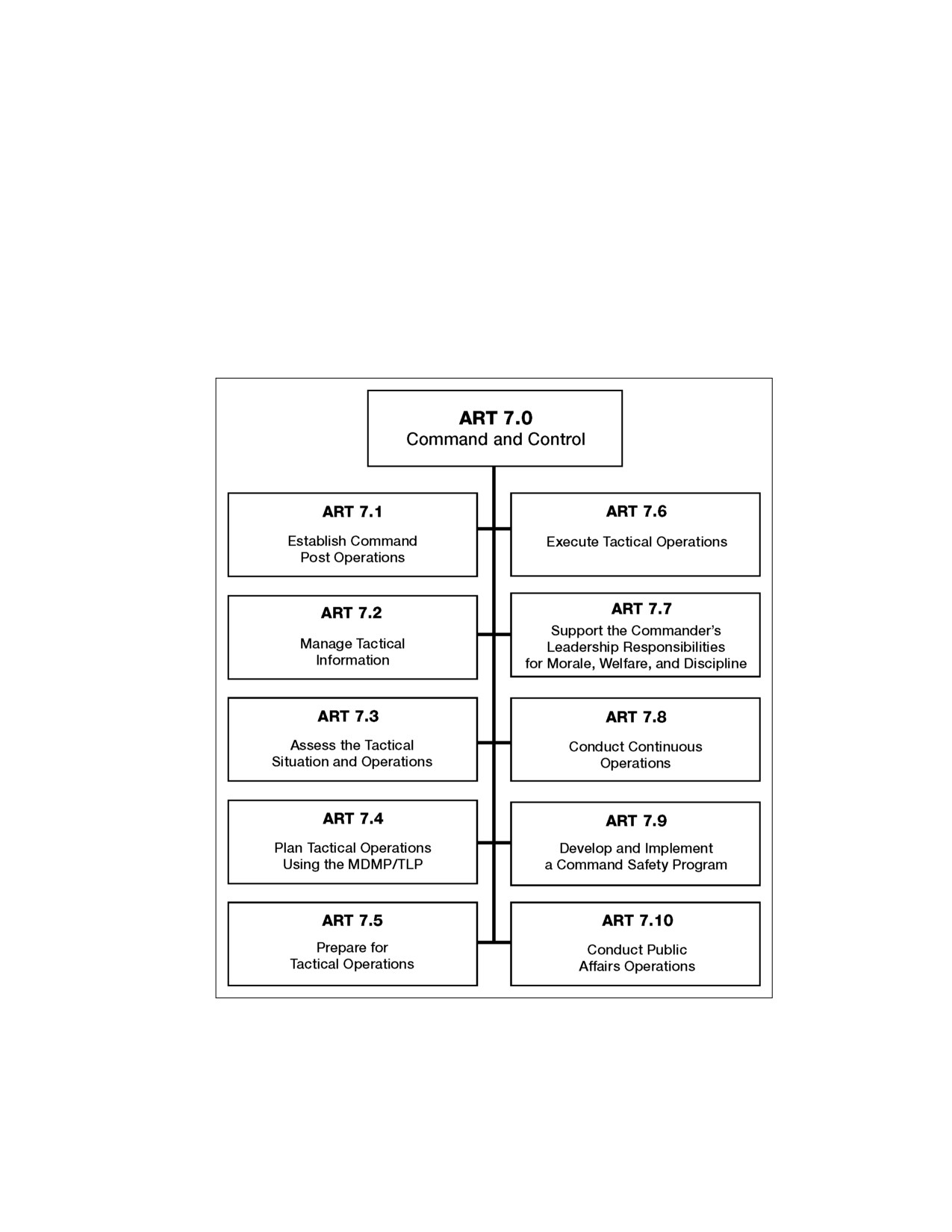
Chapter 7
ART 7.0: The Command and Control
Battlefield Operating System
The command and control BOS includes collective tasks associated with
supporting the exercise of authority and direction by a properly
designated commander over assigned and available forces in the
accomplishment of the mission. Command and control has two
components: the commander and the C2 system. The C2 system is the
7-1
FM 7-15__________________________________________________________________________
arrangement of personnel, information management, procedures, and
equipment and facilities essential to the commander to conduct (plan,
prepare for, execute, and continuously assess) operations. The C2 system
supports the commander’s ability to make informed decisions, delegate
authority, and synchronize the BOS toward achieving a common goal. It
includes acquiring and managing information, maintaining situational
understanding, supporting commander’s visualization and maintaining
staff estimates, applying risk management, and directing and leading
subordinates. Moreover, the C2 system supports the ability of
commanders to adjust plans for future operations, even while focusing on
the current operation. Staffs work within the commander’s intent to direct
units and control resource allocations. They also are alert to spotting
enemy or friendly situations that require command decisions and advise
commanders concerning them.
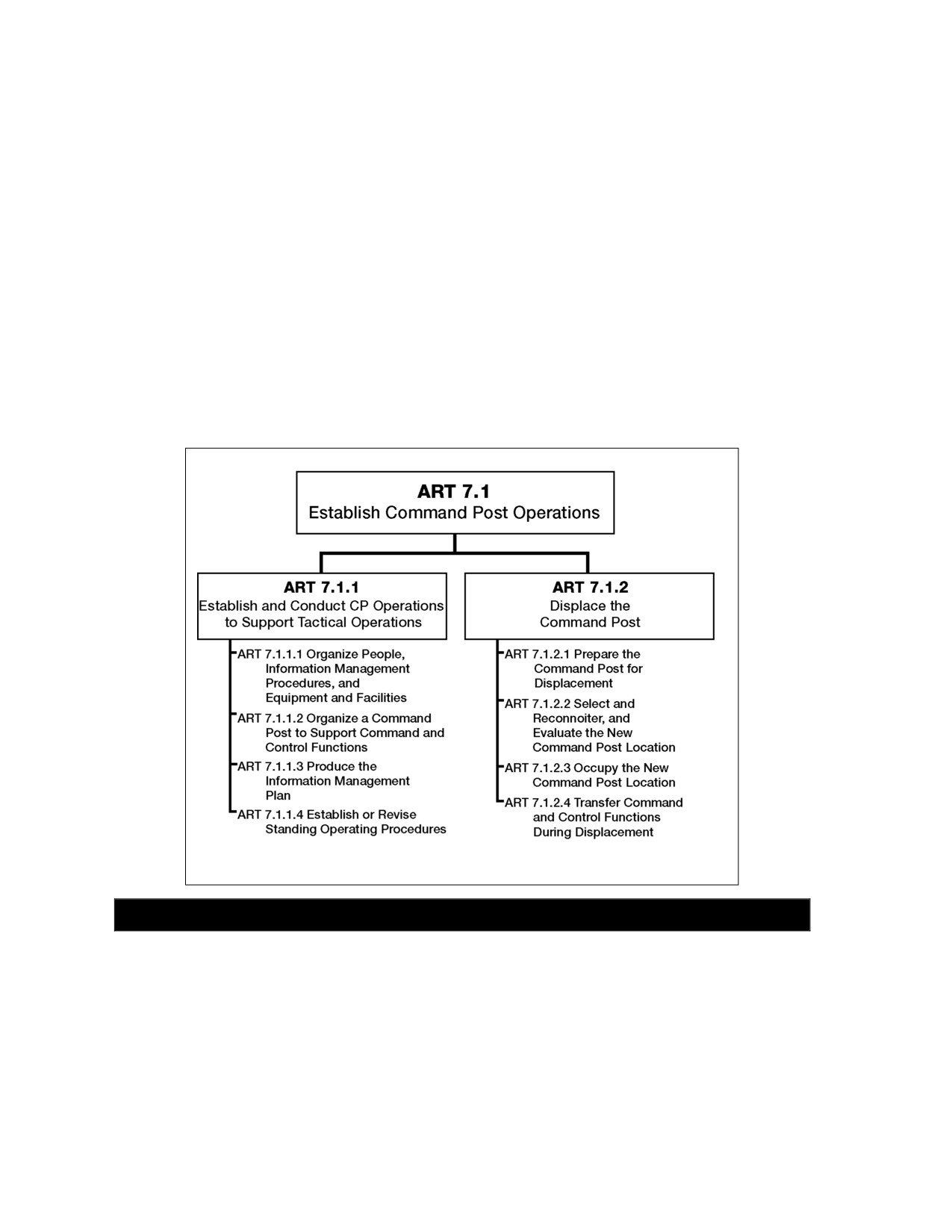
SECTION I - ART 7.1: ESTABLISH COMMAND POST OPERATIONS
7-1. Organize, create/erect, operate, and move the principal facility used by
the commander to exercise command and control of tactical operations. The
command post performs the C2 functions discussed in succeeding subtasks.
(FM 6-0) (USACAC)
7-2
_________________________________
ART 7.0: The Command and Control Battlefield Operating System
Note: ART 5.3.5.5 (Conduct Local Security Operations) and ART 5.3.5.6
(Employ Operations Security) address tasks inherently associated with
conduct of command post operations. The measures of performance for those
tasks are not included with the measures of performance of any of the tasks
in this chapter since they are separate tasks.
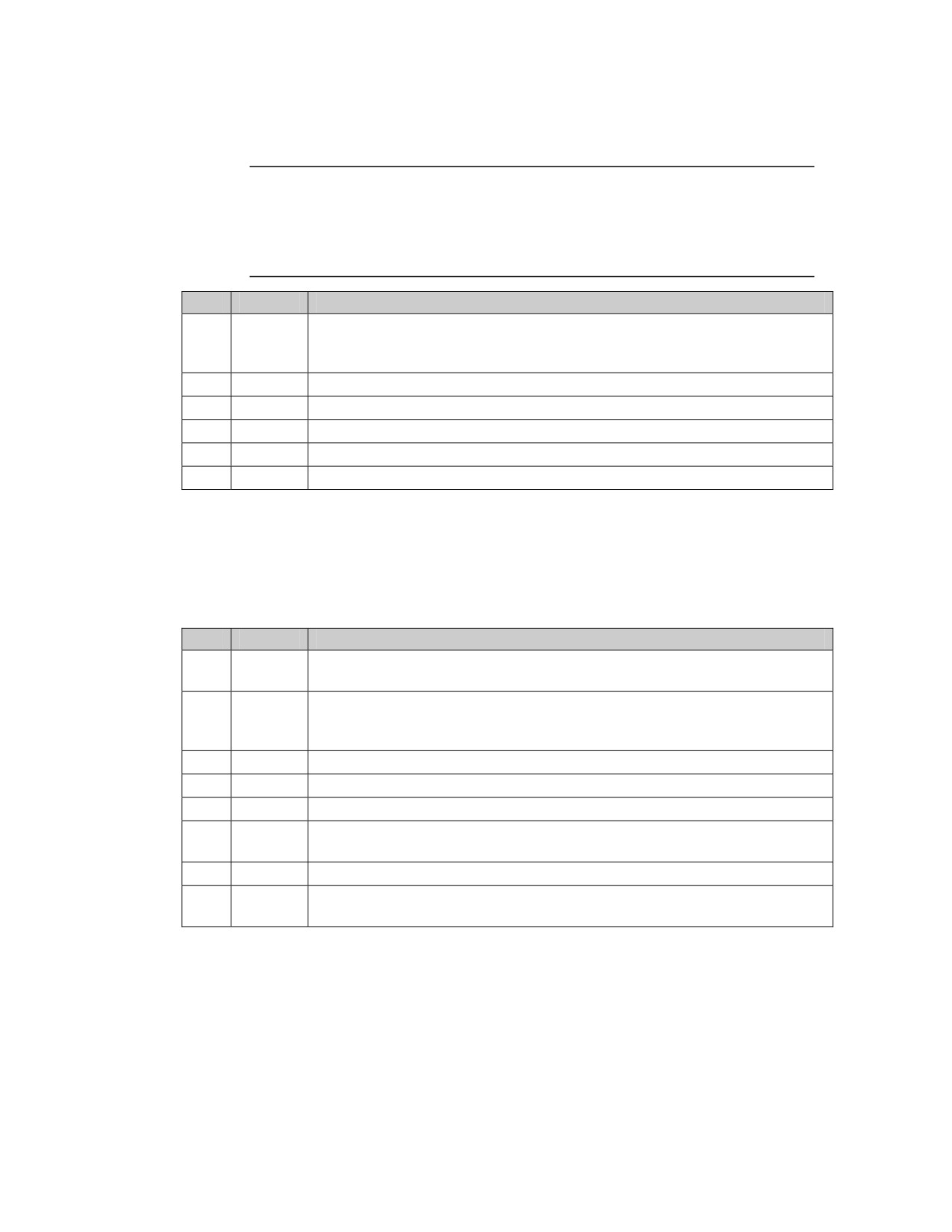
No.
Scale
Measure
CP supports the commander in exercising C2 of his unit to accomplish
01
Yes/No
the mission within the time and parameters specified by the higher
commander and as stated in the operations order.
02
Time
To form CP from fully operational headquarters.
03
Time
To determine CP structure.
04
Time
To accomplish missions.
05
Percent
Of tactical actions or operations able to be executed.
06
Percent
Of missions accomplished.
ART 7.1.1 ESTABLISH AND CONDUCT COMMAND POST
OPERATIONS TO SUPPORT TACTICAL OPERATIONS
7-2. Organize, create/erect, and operate the command post in a manner that
allows it to perform C2 functions most effectively for a particular operation.
(FM 6-0) (USACAC)
No.
Scale
Measure
CP supports the commander in exercising C2 of his unit to accomplish
01
Yes/No
the assigned mission within the time the operations order specifies.
CP can communicate critical information with higher and subordinate
02
Yes/No
headquarters, adjacent headquarters, and supported headquarters in
near-real time.
03
Time
To establish CP for operations.
04
Percent
Of C2 functions performed to standard.
05
Percent
Of C2 nodes that possess required communications capabilities.
Of essential C2, communications, and computer systems accessible from
06
Percent
all subordinate locations.
07
Percent
Of required staff positions and materiel filled.
Of times that subordinate commanders are unable to communicate with
08
Number
force headquarters.
ART 7.1.1.1 ORGANIZE PEOPLE, INFORMATION MANAGEMENT PROCEDURES,
AND EQUIPMENT AND FACILITIES
7-3. Establish relationships among the personnel, information management
procedures, and equipment and facilities essential for using and
communicating the COP and execution information to achieve situational
understanding and to direct the conduct (planning, preparing for, executing,
and assessing) of operations. (FM 6-0) (USACAC)
7-3
FM 7-15__________________________________________________________________________
No.
Scale
Measure
Organization and level of resources meet C2 system requirements in
01
Yes/No
supporting effective C2.
02
Time
To submit host-nation supportability requests.
03
Time
To obtain host-nation supportability approval.
04
Time
To form force staff (from activation order).
05
Time
To staff and equip C2 system.
06
Time
To establish and approve C2 system architecture.
07
Percent
Of required C2 system resources identified.
08
Percent
Of required C2 system resources provided.
ART 7.1.1.2 ORGANIZE COMMAND POST TO SUPPORT COMMAND AND CONTROL
FUNCTIONS
7-4. Arrange command post equipment and facilities in a manner that
effectively supports the personnel performing C2 functions for a specific
operation or situation. (FM 6-0) (USACAC)
No.
Scale
Measure
CP organization facilitates performing C2 functions for a specific
01
Yes/No
operation.
02
Time
After constitution of CP to establish “daily battle rhythm.”
03
Percent
Of normal operations covered by procedures.
Of incidents of friendly forces orders/taskings significantly delayed
04
Number
because of unclear relationships within headquarters.
05
Number
Of incidents of friendly forces orders/taskings significantly delayed.
ART 7.1.1.3
PRODUCE THE INFORMATION MANAGEMENT PLAN
7-5. Prepare the sequence of activities that provides relevant information to
the right person at the right time in a usable form for exercising C2 in a
specific operation. The plan includes procedures and information systems
used in information management. (FM 6-0) (USACAC)
No.
Scale
Measure
Information management plan supports the unit’s mission
01
Yes/No
accomplishment.
02
Time
To produce information management plan for operation.
03
Percent
Of information management requirements covered by plan.
Of instances of foreseeable information management requirements not
04
Number
covered.
05
Number
Of instances of excessive requests from sources for information.
Of instances of relevant information not provided either to the right
06
Number
person, at the right time, or in a usable form due to deficiencies in
information management plan.
ART 7.1.1.4
ESTABLISH OR REVISE STANDING OPERATING PROCEDURES
7-6. Create or modify a set of instructions covering those tasks and functions
that lend themselves to a definite or standardized procedure without a loss of
7-4
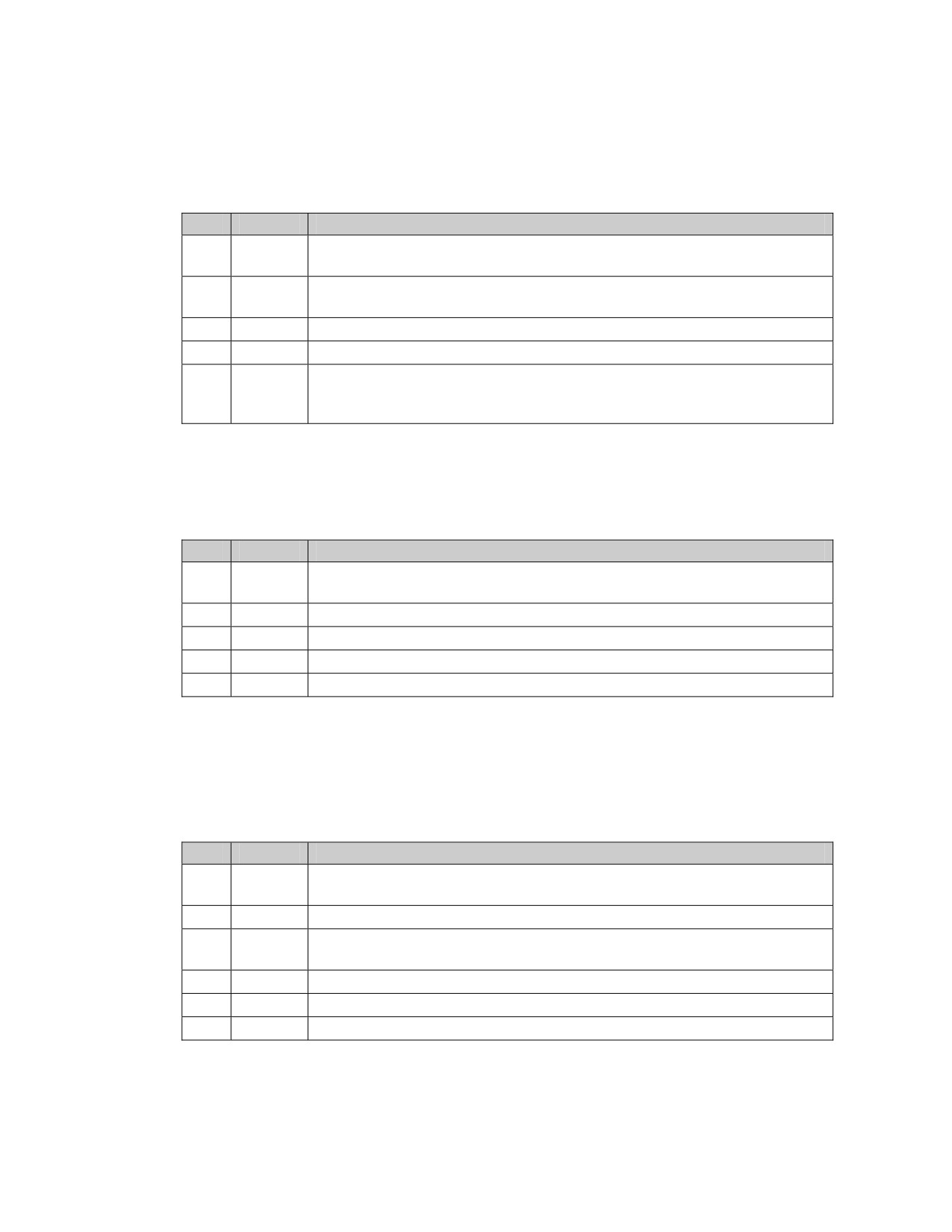
_________________________________
ART 7.0: The Command and Control Battlefield Operating System
effectiveness; the SOP is effective unless ordered otherwise to meet altered
conditions. (FM 6-0) (USACAC)
No.
Scale
Measure
Unit’s SOP or its revisions facilitate mission accomplishment and BOS
01
Yes/No
integration.
Commands have policies and procedures for operation and maintenance
02
Yes/No
of C2 systems.
03
Yes/No
Commands have restoration plans for critical failures.
04
Percent
Of procedures revised during operations.
Of total “down” time for operational C2, communications, and computer
05
Percent
systems attributed to failure to follow established policies and
procedures.
ART 7.1.2 DISPLACE THE COMMAND POST
7-7. Move or transfer the principal facility used by the commander to
exercise command and control of tactical operations in order to support C2 of
a specific operation. (FM 6-0) (USACAC)
No.
Scale
Measure
CP displaces when necessary and resumes supporting the commander
01
Yes/No
within the time the operations order specifies.
02
Time
To displace and establish CP in new location.
03
Time
To resume full operations in new location.
04
Number
Of incidents of degraded C2 effectiveness during displacement.
05
Number
Of incidents of operations affected negatively by displacement
ART 7.1.2.1
PREPARE THE COMMAND POST FOR DISPLACEMENT
7-8. Execute activities before movement to make the command post more
ready to move. These activities include, but are not limited to, dismantling
information systems and associated networks, dismantling the facilities and
equipment, and packing elements of the command post according to load
plans. (FM 6-0) (USACAC)
No.
Scale
Measure
CP prepares for displacement within the time either the unit SOP or
01
Yes/No
operations order specifies.
02
Time
Before displacement to publish plan.
To dismantle information systems and networks and facilities and
03
Time
equipment.
04
Time
To pack for displacement.
05
Percent
Of CP packed according to loading plans/SOP.
06
Number
Of incidents of lost equipment.
7-5

FM 7-15__________________________________________________________________________
ART 7.1.2.2 SELECT, RECONNOITER, AND EVALUATE THE NEW COMMAND POST
LOCATION
7-9. Decide and confirm the suitability of the location to which the command
post should displace, including the time of/for movement.
(FM
6-0)
(USACAC)
Note: ART 2.3 (Conduct Tactical Troop Movements) covers movement of
command posts.
No.
Scale
Measure
Selection, reconnoitering, and evaluation of the new command post
01
Yes/No
location produces a new CP location that effectively supports the
exercise of C2.
02
Time
To form reconnaissance party.
For reconnaissance party to decide and confirm suitability of new
03
Time
location.
04
Time
For reconnaissance party to communicate findings to CP.
05
Percent
Of decisions of reconnaissance party valid for CP functions.
ART 7.1.2.3
OCCUPY THE NEW COMMAND POST LOCATION
7-10. Execute activities following a tactical or administrative movement to
establish and conduct command post operations. (FM 6-0) (USACAC)
No.
Scale
Measure
Occupation of the new CP location allows the command post to support
01
Yes/No
the commander effectively in his exercise of C2 and within the time the
unit SOP or operations order specifies.
02
Yes/No
Location of new CP identified in accordance with security requirements.
To account for 100 percent of personnel and equipment after last arrival
03
Time
at final destination.
04
Time
To unpack equipment from transport.
05
Time
To set up facilities and information systems and networks for operation.
06
Time
To reestablish communications links after arrival.
07
Percent
Of C2 functions performed effectively after arrival.
ART 7.1.2.4
TRANSFER COMMAND AND CONTROL FUNCTIONS DURING
DISPLACEMENT
7-11. Reassign C2 functions from the old location to the new location.
Maintain C2 functions during the move without disrupting performance of
C2 functions for the force. (FM 6-0) (USACAC)
No.
Scale
Measure
C2 functions transfer allows the unit’s command and control system to
01
Yes/No
maintain C2 functions without disruption.
02
Time
To transfer C2 to alternate CP.
03
Percent
Of effectiveness of alternate CP.
04
Percent
Of communication with subordinate headquarters during displacement.
7-6
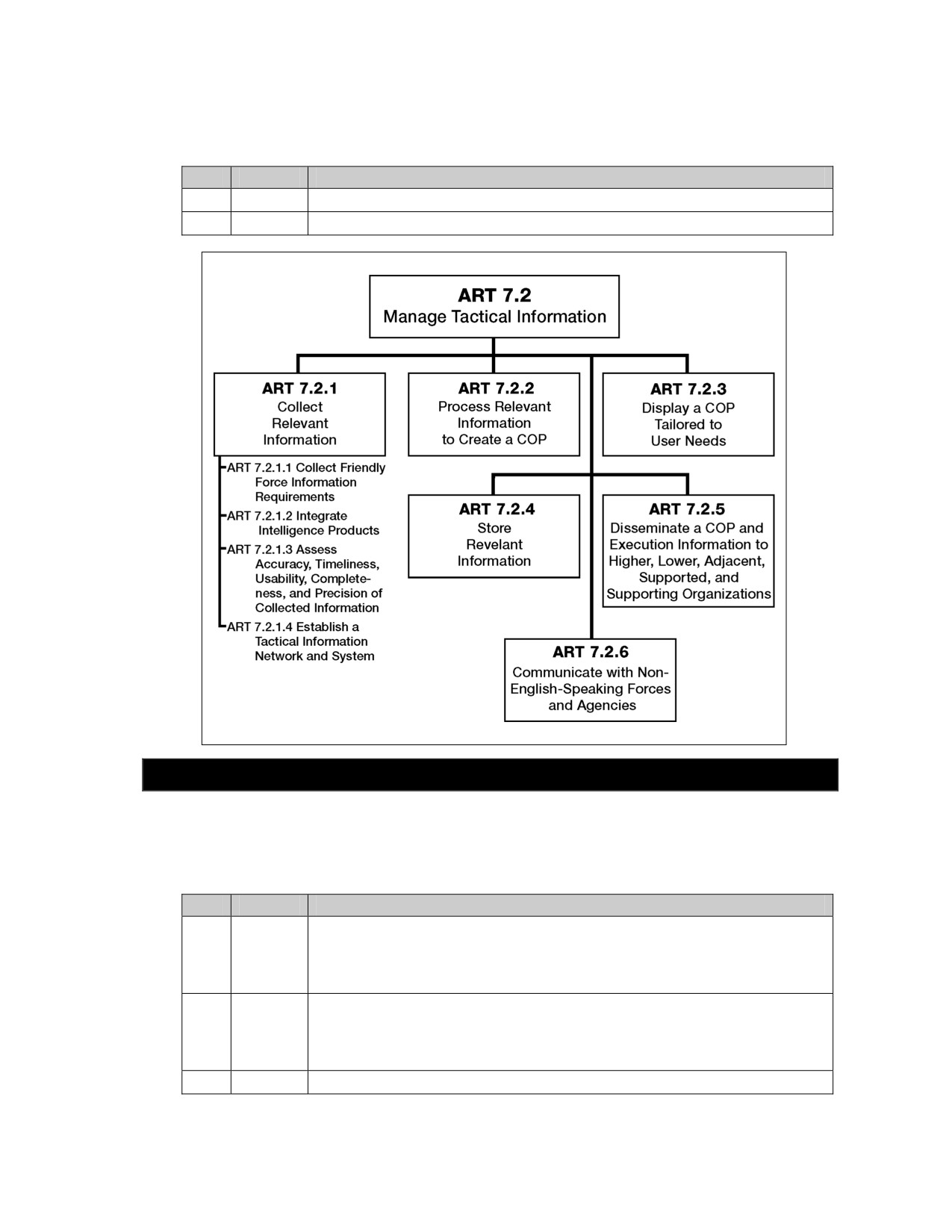
_________________________________
ART 7.0: The Command and Control Battlefield Operating System
No.
Scale
Measure
05
Percent
Of effectiveness of C2 functions during displacement.
06
Percent
Of C2 functions not performed during displacement.
SECTION II - ART 7.2: MANAGE TACTICAL INFORMATION
7-12. Direct relevant information to the right person at the right time in a
usable format to facilitate situational understanding and decision making.
Use procedures and information systems to collect, process, display, store,
and disseminate data and information. (FM 6-0) (USACAC)
No.
Scale
Measure
Tactical information and data collected, processed, displayed, stored, and
disseminated directs relevant information to the right persons at the right
01
Yes/No
time in a usable format to facilitate situational understanding and decision
making.
To direct, establish, and control the means by which the various staffs
and forces send and receive operationally significant data/information, in
02
Time
order to minimize operations delayed/affected because of lack of
information.
03
Time
For force COP to reflect real-world situation.
7-7

FM 7-15__________________________________________________________________________
No.
Scale
Measure
Of critical information acquired and disseminated to subordinate
04
Percent
commanders and appropriate members of subordinate staffs.
05
Percent
Of time, data presented to decision maker in suitable format.
Of incidents of critical information not reaching person responsible for
06
Number
action in a timely manner.
ART 7.2.1 COLLECT RELEVANT INFORMATION
7-13. Continually collect relevant information about METT-TC from the
information environment by any means for processing, displaying, storing,
and disseminating to support conducting (planning, preparing for, executing,
and assessing) current and future operations. (FM 6-0) (USACAC)
Note. The distinction between ART 7.2.1 and ART 1.3 (Collect Intelligence,
Surveillance, and Reconnaissance) is that ART
1.2 involves collecting
information from the operational environment while ART 7.2.1 involves
integrating intelligence information and products that exist within the C2
system.
No.
Scale
Measure
Information collected supports the commander’s decision-making
01
Yes/No
process.
02
Time
Since latest relevant information collected.
03
Percent
Of decisions delayed awaiting collection of appropriate data.
04
Percent
Of requested information collected within time desired.
05
Percent
Quality of collected information.
ART 7.2.1.1
COLLECT FRIENDLY FORCE INFORMATION REQUIREMENTS
7-14. Collect data about friendly forces from the information environment for
processing, displaying, storing, and disseminating to support C2 functions.
(FM 6-0) (USACAC)
No.
Scale
Measure
Information collected about friendly forces supports the commander’s
01
Yes/No
decision-making process.
02
Yes/No
Information collected is current.
Accuracy of information on essential logistics, maintenance, and
03
Percent
personnel requirements and reports.
04
Percent
Accuracy of information regarding subordinate unit deployments.
05
Percent
Accuracy of data used by operations staff.
06
Percent
Accuracy of subordinate unit status.
07
Percent
Of friendly units/organizations and personnel with current status known.
ART 7.2.1.2
INTEGRATE INTELLIGENCE PRODUCTS
7-15. Collect intelligence products from intelligence sources and combine
them with FFIR for use in C2 functions. (FM 6-0) (USACAC)
7-8
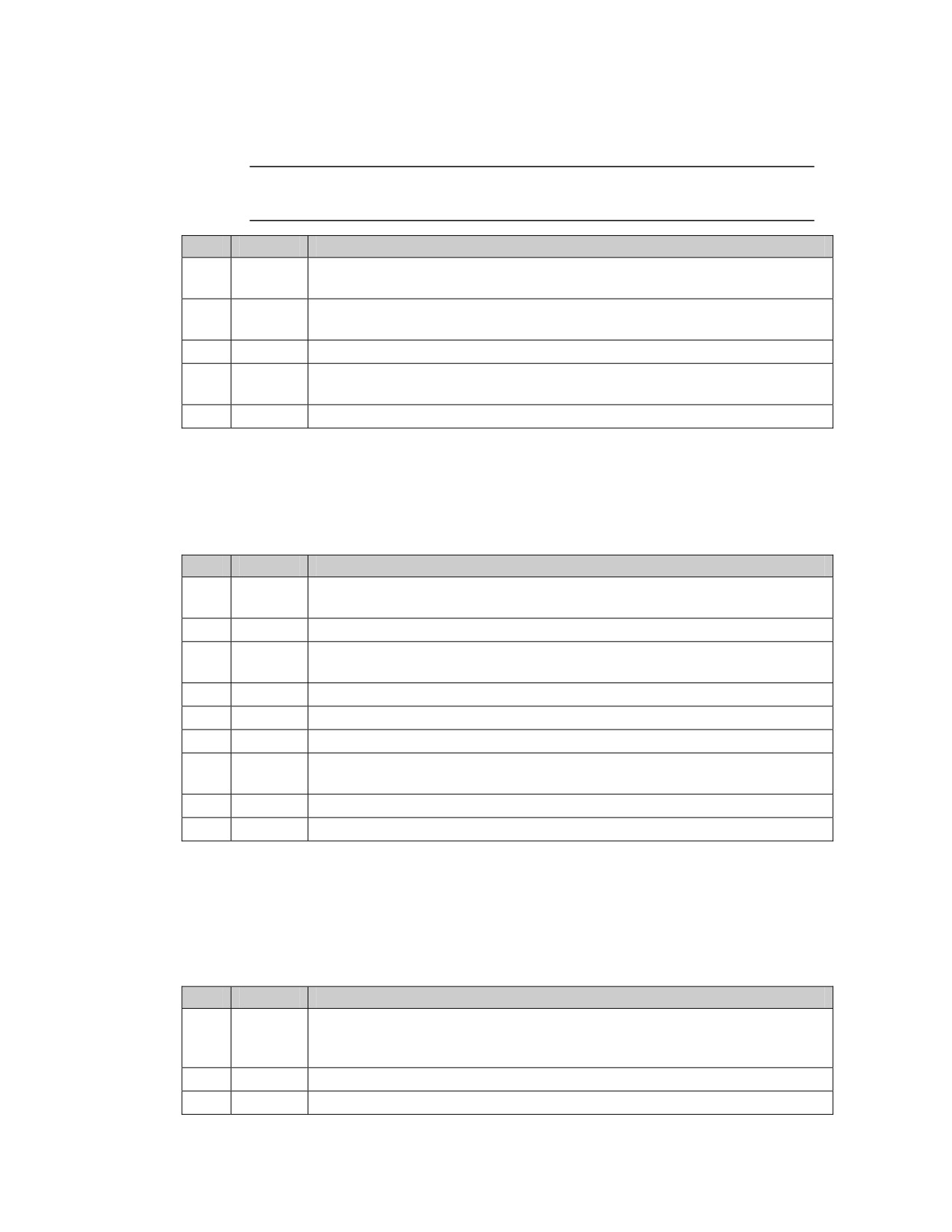
_________________________________
ART 7.0: The Command and Control Battlefield Operating System
ART 1.3 (Collect Intelligence, Surveillance, and Reconnaissance) involves
collecting information about the enemy/adversary and environment.
No.
Scale
Measure
Intelligence products integrated by information management support the
01
Yes/No
commander’s decision-making process.
To establish connectivity with component intelligence agencies, unified
02
Time
command and national intelligence agencies (after arrival).
03
Time
To integrate intelligence products by users or COP.
Accuracy of intelligence situation displays integrated with other mission-
04
Percent
essential information.
05
Percent
Of intelligence products properly integrated with other information.
ART 7.2.1.3 ASSESS ACCURACY, TIMELINESS, USABILITY, COMPLETENESS, AND
PRECISION OF COLLECTED INFORMATION
7-16. Apply the criteria of accuracy, timeliness, usability, completeness, and
precision to evaluate the quality of relevant information collected. (FM 6-0)
(USACAC)
No.
Scale
Measure
Relevant information that meets the quality criteria serves the
01
Yes/No
commander’s needs.
02
Time
To conduct assessment of collected relevant data.
Of available information examined and considered in latest status
03
Percent
reporting.
04
Percent
Accuracy of data transmitted/disseminated.
05
Percent
Of time information passed within established time criteria.
06
Percent
Of time information on CCIR passed within established time criteria.
Of time mission-essential intelligence and threat assessments passed
07
Percent
within established time criteria.
08
Percent
Of reinforcing or supporting forces, commander has accurate information.
09
Percent
Of reports with no significant errors.
ART 7.2.1.4
ESTABLISH A TACTICAL INFORMATION NETWORK AND SYSTEM
7-17. Install, operate, and maintain networks that ensure information
systems can perform information management activities. ART
7.2.1.4
includes repositioning information systems (such as communications nodes)
and managing the electromagnetic spectrum as necessary to maintain
continuity of C2. (FM 6-0) (USACAC)
No.
Scale
Measure
Operations of the tactical information network and system perform
01
Yes/No
information management activities effectively in support of the
commander’s decision making.
02
Time
To queue high precedence messages.
03
Time
To integrate new headquarters into existing SIPRNET.
7-9

FM 7-15__________________________________________________________________________
No.
Scale
Measure
04
Time
To establish integrated communications system.
To establish both data and voice communication with unified command
05
Time
and its components.
06
Time
To submit frequency requests.
07
Time
To obtain frequency approval.
Of subordinate commanders and supporting staffs in communication with
08
Percent
force headquarters.
09
Percent
Of C2, communications, and computer support systems, operational.
Of C2, communications, and computer support systems that meet
10
Percent
command reliability standards.
Of C2, communications, and computer support systems equipment down
11
Percent
for unscheduled maintenance.
12
Percent
Of traffic, sent on non-dedicated or non-DOD lines or circuits.
Of communications equipment, circuits, and connectivity with status
13
Percent
accurately displayed.
Of communications outages with adequate backup communications
14
Percent
paths.
Of time, essential C2, communications, and computer systems
15
Percent
accessible from all locations.
16
Percent
Of force headquarters local area networks capable of interoperating.
17
Percent
Of time communications connectivity maintained with all units.
18
Percent
Of time communications networks fully operational.
Of time voice and data communications (unsecure and secure)
19
Percent
maintained.
20
Percent
Of equipment interoperability problems that result in late or lost data.
21
Percent
Of resources requested to fill all shortfalls.
Of critical C2, communications, computer, and intelligence architecture
22
Percent
nodes identified in the operation plan.
Of instances of delay, disruption, or corruption of operational C2,
23
Number
communications, and computer systems due to failure to follow
established policies and procedures.
ART 7.2.2 PROCESS RELEVANT INFORMATION TO CREATE A
COMMON OPERATIONAL PICTURE
7-18. Add meaning to relevant information by formatting, plotting,
translating, correlating, aggregating, organizing, categorizing, analyzing, and
evaluating it to create the COP. (FM 6-0) (USACAC)
Note. The COP is an operational picture tailored to the user’s requirements,
based on common data and information shared by more than one command.
The COP facilitates collaborative planning and helps all echelons to achieve
situational understanding.
7-10
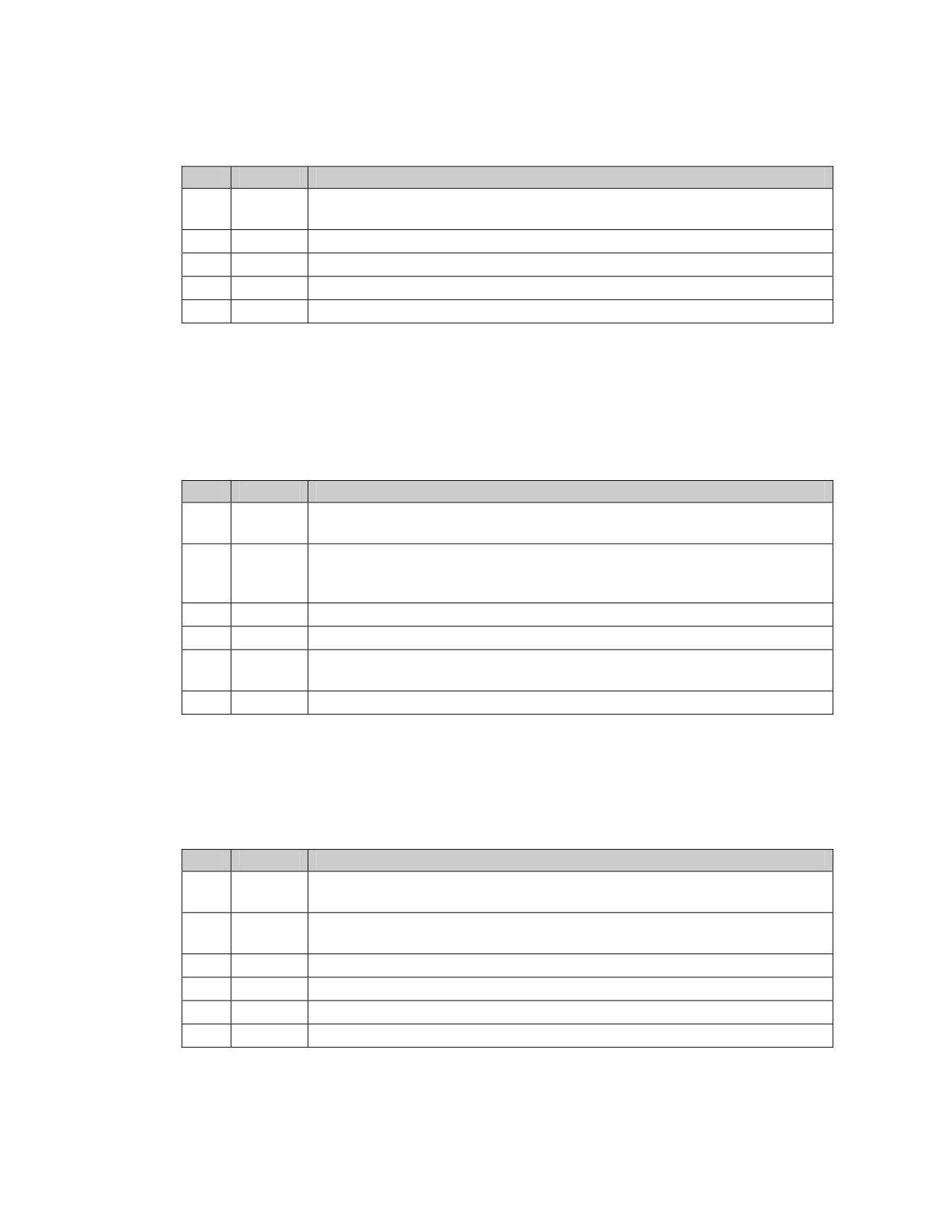
_________________________________
ART 7.0: The Command and Control Battlefield Operating System
No.
Scale
Measure
Meaning added to relevant information to create the COP supports the
01
Yes/No
commander’s decision-making process.
02
Time
To compile appropriate reports.
03
Time
To provide analysis and evaluation to information.
04
Percent
Of time, accurate and current COP maintained within area of operation.
05
Percent
Of reports processed within time limits.
ART 7.2.3 DISPLAY A COMMON OPERATIONAL PICTURE (COP)
TAILORED TO USER NEEDS
7-19. Present relevant information in audio or visual formats that convey the
COP for decision making and exercising other C2 functions. The COP format
should be easily understandable to the user and tailored to the needs of the
user and the situation. (FM 6-0) (USACAC)
No.
Scale
Measure
COP is tailored to the user’s needs and the situation is easily
01
Yes/No
understandable.
Between the force COP and the real-world situation, in order to maintain
02
Time
operational information, force status, and the capability to respond to an
emerging situation and/or project branches/sequels.
03
Time
To display shared local databases.
04
Time
For decision maker to understand display in decision making.
Accuracy of mission-essential information maintained on situation
05
Percent
displays.
06
Percent
Of current operational data displays.
ART 7.2.4 STORE RELEVANT INFORMATION
7-20. Retain relevant information in any form that allows processing,
displaying, or disseminating to authorized users when and as required to
exercise C2. ART
7.2.4 includes maintaining distributed or common
databases. (FM 6-0) (USACAC)
No.
Scale
Measure
Stored relevant information is readily available for processing, displaying,
01
Yes/No
or disseminating when and as required to support exercise of C2.
To post unit reports to appropriate databases or pass to work centers
02
Time
(from receipt).
03
Time
To access and display shared remote databases.
04
Time
To enter most current information on force status.
05
Time
To access shared local databases.
06
Percent
Of relevant information required already in databases.
7-11

FM 7-15__________________________________________________________________________
ART 7.2.5 DISSEMINATE COMMON OPERATIONAL PICTURE AND
EXECUTION INFORMATION TO HIGHER, LOWER, ADJACENT,
SUPPORTED, AND SUPPORTING ORGANIZATIONS
7-21. Convey relevant information of any kind from one person or place to
another by any means to improve understanding or to initiate or govern
action, conduct, or procedure. (FM 6-0) (USACAC)
No.
Scale
Measure
COP and execution information disseminated between headquarters in
01
Yes/No
time and with sufficient quality and quantity to allow those headquarters
to initiate actions that accomplish the commander’s intent.
02
Time
To process and disseminate status information (to subordinate units).
To communicate all approved orders and plans to subordinate and
03
Time
adjacent units.
After approval, all orders and plans received by components and
04
Time
adjacent units.
05
Time
To generate and forward situation reports.
06
Percent
Of organizations or units receiving latest information.
07
Percent
Of command plans, reports, and other information, passed error free.
08
Percent
Of addressees that received message.
Of addressees that received critical planning messages (such as warning
09
Percent
orders).
10
Percent
Of messages sent outside normal communications channels.
Accuracy of orders and requirements transmitted/disseminated within
11
Percent
reporting criteria.
12
Percent
Of information that gets to appropriate people.
13
Percent
Of reports disseminated to all agencies within time limits.
14
Percent
Of time mission-essential information passed within established criteria.
Of instances where incoming information (which could affect outcome of
15
Number
operation) is not received by the person responsible for action.
ART 7.2.6 COMMUNICATE WITH NON-ENGLISH SPEAKING FORCES
AND AGENCIES
7-22. Communicate verbally, non-verbally, in writing, or electronically in the
appropriate language of allied, host-nation, nongovernmental, and
indigenous forces and agencies in order to accomplish all C2 requirements.
This task requires U.S personnel to establish and maintain effective rapport
with the leaders and staff of allied, host-nation, or indigenous forces. (FM 6-
0) (USACAC)
Note: Classified and sensitive information is not passed to allies and
coalition partners in violation of policy guidance.
7-12
_________________________________
ART 7.0: The Command and Control Battlefield Operating System
No.
Scale
Measure
Communications with non-English speaking personnel sufficient to
01
Yes/No
accomplish all C2 requirements to allow mission accomplishment
effectively by force as a whole.
Classified and sensitive information protected when communicating with
02
Yes/No
allies and coalition partners.
To communicate information or orders from one language to another
03
Time
orally or in writing.
04
Time
To develop interpersonal relationships.
Of needed information, not passed to or received by allies (due to lack of
05
Percent
equipment interoperability).
06
Percent
Of needed information not passed to allies due to classification restraints.
Accuracy of communication with non-English-speaking forces and
07
Percent
agencies.
08
Percent
Of required linguist support provided.
Of missions not fulfilled/commitments not met due to faulty/lacking
09
Number
language support.
Of cultural mistakes occurring while dealing with non-English-speaking
10
Number
forces or agencies.
SECTION III - ART 7.3: ASSESS TACTICAL SITUATION AND OPERATIONS
7-23. Continuously monitor the situation and progress of the operation.
Evaluate the situation or operation against criteria of success in order to
make decisions and adjustments throughout the operations process
(planning, preparing, executing and assessing). (FM 6-0) (USACAC)
7-13
FM 7-15__________________________________________________________________________
No.
Scale
Measure
Assessment supports decision making and adjustments during the
01
Yes/No
operations process.
02
Time
To compare situation against criteria of success.
03
Time
For commander to assess progress.
04
Percent
Of enemy actions or operations forecast.
05
Percent
Of time event of interest occurs without options available.
06
Percent
Accuracy of commander’s assessment of progress.
ART 7.3.1 MONITOR SITUATION OR PROGRESS OF OPERATIONS
7-24. Collect relevant information on the situation or operation in order to
evaluate the actual situation or progress of the operation and support
decision making. (FM 6-0) (USACAC)
No.
Scale
Measure
Relevant information collected accurately reflects the situation or
01
Yes/No
progress of the operation and supports decision making.
Lag in currency of information on adjacent military forces or non-DOD
02
Time
agencies.
03
Time
To obtain information on changes to tactical situation.
04
Time
Since update of force situation.
05
Time
To access current situation.
06
Percent
Of time, commander learns of emerging tactical event from staff.
Of incidents where the commander was surprised by critical/emerging
07
Number
event (METT-TC) (not briefed).
Of instances when the commander learns of emerging events from
08
Number
sources outside his staff.
ART 7.3.2 EVALUATE SITUATION OR OPERATION
7-25. Analyze and compare the actual situation or progress of the operation
against criteria of success. Highlight variances between the planned
situation at that time in the operation and the current situation, and forecast
the degree of mission accomplishment. (FM 6-0) (USACAC)
No.
Scale
Measure
Evaluation reflects reality of the degree of mission accomplishment and
01
Yes/No
forecasts the degree of mission accomplishment.
02
Time
To evaluate progress or situation and determine type of decision.
03
Time
To complete evaluation of situation or progress.
04
Percent
Accuracy of evaluation of situation or progress.
05
Percent
Of accurate friendly evaluations.
06
Number
Of opportunities or threats recognized.
7-14

_________________________________
ART 7.0: The Command and Control Battlefield Operating System
ART 7.3.2.1
DEVELOP STAFF ESTIMATES
7-26. Use the staff estimate procedure—consisting of significant facts,
events, and conclusions based on analysis—as the staff element’s means of
assessing within their functional field. Staff estimates consider both
quantifiable and intangible aspects of military operations. They are as
thorough as time permits, and updated regularly as part of an ongoing
process. They support assessing throughout the operations process. Staff
estimates also support the commander’s visualization of the operation. (FM
6-0) (USACAC)
Note: The intelligence staff estimate is the product of IPB. See ART 1.1.1
(Perform Intelligence Preparation of the Battlefield).
No.
Scale
Measure
Staff estimates are accurate and support the commander’s visualization
01
Yes/No
of the operation.
02
Time
Into future, planning branches have been developed.
03
Time
From receipt of information to complete or update staff estimate.
04
Percent
Of decision points that have branches.
05
Percent
Of enemy actions or operations affected course of battle, but not forecast.
06
Percent
Of forecast branches appeared at execution.
ART 7.3.2.2
EVALUATE PROGRESS
7-27. Conclude whether the variances from the criteria of success of the
current situation or progress of the operation are significant enough to affect
accomplishing the mission or meeting the commander’s intent and warrant
adjustment. (FM 6-0) (USACAC)
No.
Scale
Measure
C2 system effectively concluded when the force accomplished the
01
Yes/No
commander’s intent or needed to adjust its course of action.
For commander/staff to forecast degree of mission accomplishment
02
Time
based on variance.
03
Time
From receipt of information to complete evaluation of progress.
04
Percent
Accuracy of evaluation of variances.
05
Percent
Accuracy of forecast of progress and meaning of forecast.
ART 7.3.2.3
CONDUCT RISK MANAGEMENT
7-28. Identify and control hazards to protect the force and increase the
chance of mission accomplishment. Use the risk management process
throughout the conduct (planning, preparing, executing and assessing) of
missions to recommend how to reduce tactical and accident risk. (FM 100-14)
(USASC)
No.
Scale
Measure
Probability of successful mission accomplishment increased as a result of
01
Yes/No
risk management process.
7-15

FM 7-15__________________________________________________________________________
No.
Scale
Measure
Casualties and vehicle/building damage reduced because of the use of
02
Yes/No
risk management techniques.
03
Time
To employ the risk management process.
Of identified significant risks to mission accomplishment and force
04
Percent
protection.
Of identified risks that are determined to be acceptable by the
05
Percent
commander.
06
Percent
Of hazards identified and mitigated.
07
Percent
Of residual risk accepted.
08
Percent
Of effect of risk on operation or casualties.
09
Number
And types of hazards not identified affecting operation or casualties.
ART 7.3.3 PROVIDE COMBAT ASSESSMENT
7-29. Determine the overall effectiveness of firepower employment during
military operations. Firepower employed can be lethal and nonlethal in
nature and delivered by direct and indirect fire systems. The objective of
combat assessment is to identify recommendations for maneuver operations.
Combat assessment is the overarching concept that consists of the conduct of
battle damage and munitions effects assessments while providing reattack
recommendations. (FM 34-1) (USAIC&FH)
No.
Scale
Measure
The commander determines the overall damage inflicted on the enemy
01
Yes/No
by those direct and indirect fires employed during the conduct of a
military operation.
To commence follow-on operations or restrike, awaiting combat
02
Time
assessment.
03
Time
To complete combat assessment.
04
Time
To provide full assessment of attacks to force commander.
05
Time
To provide initial combat assessment of attacks to force commander.
To perform the combat assessment functions of battle damage
06
Time
assessment, mission assessment, and munitions effectiveness
assessment based on commander’s guidance/ objectives.
07
Percent
Of HPTs assessed as killed later assessed as being mission capable.
08
Percent
Difference between higher level and force assessment of effectiveness.
09
Percent
Of targets with combat assessment data available.
10
Percent
Of targets unnecessarily reattacked.
ART 7.3.3.1
CONDUCT BATTLE DAMAGE ASSESSMENT
7-30. Provide a timely and accurate estimate of damage resulting from the
application of military force, either lethal or nonlethal, against a target.
Battle damage assessment provides commanders with a timely and accurate
snapshot of their effect on the enemy. This helps commanders determine
when or if their targeting effort is accomplishing their objectives. This task
also includes determining if the application of military force results in the
release of hazardous material. (FM 6-20) (USAFAS)
7-16
_________________________________
ART 7.0: The Command and Control Battlefield Operating System
Note: This task is supported by the ART 1.4.3, Provide Intelligence Support
to Combat Assessment, task branch. It is also associated with the decide,
detect, deliver, and assess (D3A) process.
No.
Scale
Measure
The commander accurately determines the damage to the enemy from
01
Yes/No
the overall effects of firepower employed during the conduct of military
operations.
To commence follow-on operations or reattack (following receipt of
02
Time
assessment).
03
Time
To complete full assessment of attacks after time on target.
04
Time
To make initial assessment of attacks after time on target.
05
Time
To provide full assessment of attacks to force commander.
To provide initial battle damage assessment of attacks to force
06
Time
commander.
07
Percent
Of HPTs assessed as killed later assessed as being mission capable.
08
Percent
Of targets have BDA based on more than one type of system.
09
Percent
Of targets unnecessarily reattacked.
10
Percent
Difference between higher level and force assessment of effectiveness.
ART 7.3.3.2
CONDUCT MUNITIONS EFFECTS ASSESSMENT
7-31. Assess the military force in terms of the weapons systems and
munitions effectiveness. This assessment is used as the basis of
recommendation for changes to increase the effectiveness of methodology,
tactics, weapon system, munitions, and weapon delivery parameters. The
munitions effects assessment takes place concurrently and interactively with
BDA. This assessment is primarily the responsibility of operations and fire
support personnel, with input from the intelligence BOS.
(FM 6-20-10)
(USAFAS)
No.
Scale
Measure
The commander accurately determines the overall effects of munitions
01
Yes/No
and weapon systems employed against specific types of targets during
the conduct of military operations.
To commence follow-on operations or reattack (following receipt of
02
Time
munitions effects assessment).
03
Time
To complete munitions effects assessment after attack.
04
Time
To provide full assessment of attacks to force commander.
To provide initial munitions effects assessment of attacks to force
05
Time
commander.
06
Percent
Of HPTs assessed as killed later assessed as being mission capable.
07
Percent
Of HPTs require reattack.
08
Percent
Of HPTs successfully attacked.
Difference between higher level and force assessment of munitions
09
Percent
effectiveness.
7-17