FM 7-15 THE ARMY UNIVERSAL TASK LIST (AUGUST 2003) - page 8

FM 7-15__________________________________________________________________________
No.
Scale
Measure
Military judges support the accomplishment of the supported unit’s
01
Yes/No
mission.
Between referral of a case for trial by court-martial and detailing of the
02
Time
military judge.
03
Time
Between referral of a case for trial by court-martial and the arraignment.
04
Time
From pretrial confinement to military magistrate review.
Between completion of the record of trial and the military judge’s
05
Time
authentication.
Of trials in which the military judge conducts “bridging the gap” mentoring
06
Percent
sessions.
07
Percent
Of pretrial confinement cases overruled by the military judge.
08
Percent
Of court decisions overruled by appellate courts.
Of search and seizure authorization later suppressed by the military
09
Percent
judge.
10
Percent
Of unit covered by military judge support.
11
Number
Of incidents of noncompliance with rules of court.
12
Number
Of counsel having a copy of the rules of court.
ART 6.9.2 PROVIDE TRIAL DEFENSE SUPPORT
6-124. Provide personal legal advice to soldiers related to criminal
allegations; represent soldiers in courts-martial and adverse administrative
proceedings. (FM 27-100) (TJAGSA)
No.
Scale
Measure
01
Yes/No
Accused soldiers’ legal rights are protected.
Between a soldier’s request for and the scheduling of an appointment for
02
Time
legal advice.
Between the scheduling of an appointment and the actual appointment
03
Time
date.
Of soldiers electing to retain their detailed or individually requested
04
Percent
military counsel.
Of soldiers appearing before administrative boards represented by
05
Percent
military counsel.
Of soldiers offered Article 15s who seek advice from the Trial Defense
06
Percent
Service.
07
Percent
Of legal issues correctly identified and analyzed.
08
Percent
Of legal opinions that answer clients’ questions clearly and concisely.
Of soldiers receiving advice on adverse administrative actions from the
09
Percent
Trial Defense Service versus from legal assistance.
10
Percent
Of units covered by Trial Defense Service support.
ART 6.9.3 PROVIDE INTERNATIONAL LAW SUPPORT
6-125. Implement the DOD law of war (LOW) program, including LOW
training, advice concerning the application of the LOW
(or other
humanitarian law) to military operations, the determination of enemy
6-80

_______________________________
ART 6.0: The Combat Service Support Battlefield Operating System
prisoner of war (EPW) status, and supervision of war crime investigations
and trials; assistance with international legal issues relating to U. S. forces
overseas, including the legal basis for conducting operations, status of forces
agreements, and impact of foreign law on Army activities and personnel.
Advise concerning the legal basis for conducting operations and the use of
force, advise concerning the legal status of forces, monitor foreign trials and
confinement of Army personnel and their family members, perform legal
liaison with the International Committee of the Red Cross and host-nation
legal authorities, advise concerning legal issues in intelligence operations,
security assistance, counterdrug operations, and civil assistance activities.
(FM 27-100) (TJAGSA)
No.
Scale
Measure
International law support services enhance the supported unit’s ability to
01
Yes/No
accomplish its mission.
Between discovery of possible law of war (LOW) violations and reporting
02
Time
to higher headquarters.
Between foreign confinement of Army personnel and notification to the
03
Time
US legal liaison.
Between reporting of a potential LOW violation and the decision whether
04
Time
to investigate.
Between capture of an individual and determination of status under
05
Time
Article 5, GPW.
06
Percent
Of required international agreements on hand.
Of commanders/soldiers who receive legal briefings on ROE/LOW,
07
Percent
SOFA, and host-nation law prior to deployment.
08
Percent
Of targets reviewed by a judge advocate.
09
Percent
Of LOW allegations that are reported.
Of foreign trials and confinement of Army personnel and family members
10
Percent
that comply with SOFA requirements.
11
Percent
Of international law issues correctly identified, analyzed, and resolved.
12
Percent
Of legal opinions that reflect an accurate view of the law.
13
Percent
Of legal opinions that answer the client’s questions clearly and concisely.
14
Percent
Of legal opinions that are reviewed by a supervisor before release.
Of entities requiring legal liaison having a designated judge advocate
15
Percent
liaison.
Of orders, plans, and policies reviewed for compliance with international
16
Percent
legal obligations.
17
Percent
Of foreign trials observed by a qualified US trial observer.
18
Number
Of US LOW violations.
ART 6.9.4 PROVIDE ADMINISTRATIVE LAW SUPPORT
6-126. Advise commanders and litigate on behalf of the Army concerning
military personnel law, government information practices, investigations,
relationships with private organizations, labor relations, civilian employment
law, military installation, and government ethics. (FM 27-100) (TJAGSA)
6-81
FM 7-15__________________________________________________________________________
No.
Scale
Measure
Administrative law support services enhance the supported unit’s ability
01
Yes/No
to accomplish its mission.
02
Time
Between a request for legal review and completion of the review.
03
Percent
Of financial disclosure forms completed and filed on time.
Of request for opinions that are received prior to the legally significant
04
Percent
decisions.
05
Percent
Of reports of survey that are not legally sufficient at the second review.
06
Percent
Of potential issues identified prior to mobilization.
07
Percent
Of conscientious objection issues identified prior to deployment.
08
Percent
Of family care plan failure issues identified prior to deployment.
09
Percent
Of personnel requiring ethics training who receive the training.
Of family advocacy case review committee meetings attended by a judge
10
Percent
advocate.
11
Percent
Of issues correctly identified, analyzed, and resolved.
12
Percent
Of legal opinions that reflect an accurate view of the law.
13
Percent
Of legal opinions that answer the client’s questions clearly and concisely.
14
Percent
Of legal opinions in a form that is useful to the client.
15
Percent
Of opinions formatted in compliance with regulatory requirements.
16
Percent
Of legal opinions that are reviewed by a supervisor before release.
Of litigation cases arising from employee grievances, discrimination
17
Number
complaints, and unfair labor practices.
ART 6.9.5 PROVIDE CIVIL LAW SUPPORT
6-127. Provide legal advice and representation for the command concerning
the statutes, regulations, and judicial decisions that govern the rights and
duties of military organizations and installations with regard to civil
authorities. The practice of civil law includes contract law, fiscal law,
environmental law, military installations law, regulatory law, intellectual
property law, government ethics, and cases within the US Magistrate
program and felony prosecution program, as applicable.
(FM 27-100)
(TJAGSA)
No.
Scale
Measure
Civil law support services enhance the supported unit’s ability to
01
Yes/No
accomplish its mission.
Between request for procurement legal advice and actual opinion
02
Time
rendered.
03
Time
To review international acquisition agreements.
04
Time
To draft legal opinions on foreign military sales cases.
05
Time
To provide legal opinions on proper use and expenditure of funds.
Between requests for briefings on environmental law and actual
06
Time
presentation of the briefings.
07
Time
To review environmental orders.
6-82
_______________________________
ART 6.0: The Combat Service Support Battlefield Operating System
No.
Scale
Measure
To review environmental consent agreements and settlements with
08
Time
federal, state, and local officials.
09
Time
To review contract for legal sufficiency.
10
Percent
Of issues correctly identified, analyzed, and resolved.
11
Percent
Of legal opinions that reflect an accurate view of the law.
12
Percent
Of legal opinions that answer the client’s questions clearly and concisely.
13
Percent
Of legal opinions in a form that is useful to the client.
14
Percent
Of opinions formatted in compliance with regulatory requirements.
15
Percent
Of legal opinions that are reviewed by a supervisor before release.
16
Percent
Of plans reviewed to ensure environmental laws are followed.
17
Percent
Of environmental surveys completed within first day of deployment.
Of civil law judge advocates with immediate access to fiscal law codes
18
Percent
and regulations.
Of units coordinating with the staff judge advocate on environmental
19
Percent
enforcement activities.
20
Percent
Of contracts reviewed by a judge advocate.
21
Number
Of contracts reviewed by a judge advocate.
ART 6.9.6 PROVIDE CLAIMS SUPPORT
6-128. Investigate, process, adjudicate, and settle claims on behalf of and
against the United States, IAW statute, regulation, DOD directives, and
international or interagency agreements. Categories of claims include claims
for property damage of soldiers and employees arising incident to service,
torts alleged against Army or DOD personnel acting within the scope of
employment, and claims by the United States against individuals who injure
Army personnel or damage Army property. (FM 27-100) (TJAGSA)
No.
Scale
Measure
Claims services enhance the supported unit’s ability to accomplish its
01
Yes/No
mission.
02
Time
To adjudicate a small claim.
03
Time
To adjudicate a large claim.
04
Time
Between a claimant’s request for forms and actual receipt of forms.
05
Time
To investigate personal property claims.
06
Time
To investigate medical malpractice claims.
07
Time
To investigate federal tort claims.
08
Time
Between identification of and approval for payment of ex gratia claims.
Between requests for briefings on claims procedures and actual
09
Time
presentations.
Between entry into a foreign area and obtaining translation service and
10
Time
local legal advice.
11
Percent
Of claims received with all substantiation included.
12
Percent
Of claims investigated and paid in AO.
6-83

FM 7-15__________________________________________________________________________
No.
Scale
Measure
13
Percent
Of claims offices with digital cameras.
14
Percent
Of personnel in claims office proficient in the use of a digital camera.
15
Percent
Of claims received for reconsideration.
Of claims adjudicated consistent with law, regulation, and US Army
16
Percent
Claims Service policies.
17
Percent
Of units that have appointed unit claims officers.
18
Percent
Of base camps with documentation of preexisting conditions.
19
Percent
Of filed claims paid or transferred prior to redeployment.
20
Percent
Of large personal property claims that are inspected by claims personnel.
Of judge advocates in staff judge advocate offices on orders as claims
21
Number
officers.
22
Number
Of claims briefings given prior to deployment.
23
Cost
Of claims resolved in AO within a given time.
ART 6.9.7 PROVIDE LEGAL ASSISTANCE
6-129. Provide personal civil legal services to soldiers, their family members,
and other eligible personnel. Provide support to combat readiness exercises,
premobilization legal preparation, soldier readiness program processing,
demobilization briefings, and noncombatant evacuation operations. Provide
federal and state income tax assistance, ministerial and notary services, legal
counseling, legal correspondence, negotiation, legal document preparation
and filing, limited in-court representation, legal referrals, and mediation.
Operate preventive law programs. (FM 27-100) (TJAGSA)
No.
Scale
Measure
Legal assistance services make personnel feel they are appreciated by
01
Yes/No
the Army.
02
Time
Between a request for an appointment and the actual appointment.
Between submitting a completed will worksheet and the client’s review of
03
Time
the will.
04
Time
Between the client’s review of the draft will and the final will signing.
05
Time
Between requests for briefings and actual presentations.
Prior to deployment that soldiers receive soldier readiness program
06
Time
packets.
07
Time
Clients wait for notary services.
08
Percent
Of clients whose problems are resolved in one visit.
Of soldiers who use the tax assistance program, versus commercial tax
09
Percent
preparation services.
10
Percent
Of attorneys trained to provide trust and estate planning.
Of non-attorneys in staff judge advocate offices authorized to perform
11
Percent
notary duties.
12
Percent
Of attorneys authorized to represent clients in civilian court.
13
Percent
Of legal assistance personnel trained on drafting library will programs.
14
Percent
Of units having income tax assistance available.
6-84
_______________________________
ART 6.0: The Combat Service Support Battlefield Operating System
No.
Scale
Measure
15
Percent
Of wills prepared that include trust and estate planning.
Of legal assistance services that are provided to family members and
16
Percent
retirees.
17
Percent
Of client issues correctly identified and resolved.
Of documents written in simple format so that the client can readily
18
Percent
understand.
SECTION X - ART 6.10: PROVIDE GENERAL ENGINEER SUPPORT
6-130. Provide construction and acquisition of facilities and transportation
routes. (FM 5-100) (USAES)
No.
Scale
Measure
Quantity or quality of general engineering support within the AO does not
01
Yes/No
degrade or delay unit operations.
02
Time
To construct/restore damaged utilities in AO.
To refine general engineer support program for AO after receipt of
03
Time
warning order.
To identify and marshal forces, equipment, and material to
04
Time
construct/repair facilities in the AO.
6-85
FM 7-15__________________________________________________________________________
No.
Scale
Measure
To construct/repair damaged lines of communications in AO to include
05
Time
aerial ports of debarkation (APODs) and seaports of debarkation
(SPODs).
Between arrival of building supplies and equipment and construction of
06
Time
sustainment facilities.
07
Time
To complete construction of sustaining base facilities within AO.
To initiate construction of facilities (after final project approval and
08
Time
authorization).
09
Time
To have bases identified in operations plan/order operational.
10
Time
To validate asset requests.
11
Time
To have assets at requesting location.
12
Percent
Of facilities adequately maintained.
Difference between planned general engineer support requirements and
13
Percent
actual requirements in AO.
14
Percent
Of planned general engineering capability achieved in AO.
15
Percent
Of supplies protected from the elements by weatherproof covers.
16
Percent
Of maintenance facilities protected from the elements.
Of overall cargo and equipment deliveries accommodated by sustaining
17
Percent
base.
18
Percent
Of required installation throughput capacity available at execution.
19
Percent
Of tasks correctly assigned (correct engineers/location/time).
20
Percent
Of general engineering support provided by host nation.
21
Number
In square meters of temporary facilities emplaced or constructed per day.
In square meters of permanent facilities emplaced or constructed per
22
Number
day.
ART 6.10.1 RESTORE DAMAGED AREAS
6-131. Inspect and repair surface and underwater facilities or restore
terrain damaged by combat (e.g., clear rubble and restore electrical power),
natural disaster, environmental accidents, or other causes.
(FM 5-100)
(USAES)
No.
Scale
Measure
Restoration accomplished IAW the schedule the operations order
01
Yes/No
specifies.
Commander of the unit restoring a damaged area plans operations,
02
Yes/No
establishes priorities, and allocates assets.
03
Yes/No
Restoration is according to the standards the operations order specifies.
04
Time
To locate and stockpile repair material.
05
Time
To refine area damage control plan for AO after receipt of warning order.
To establish communications between the unit restoring the damaged
06
Time
areas and the unit/organization controlling the AO where the area to be
restored is located.
6-86

_______________________________
ART 6.0: The Combat Service Support Battlefield Operating System
No.
Scale
Measure
To perform engineer estimate to identify and prioritize potential tasks and
determine required specialized support from engineers, EOD, and other
07
Time
units, bill for needed materials, locate routes, identify replacement
facilities, identify available host-nation assets, and perform other tasks as
appropriate.
To construct an expedient/alternate facility/bypass while restoration/repair
08
Time
is being accomplished if required to maintain operations.
09
Time
To repair facilities damaged by combat or natural disaster.
10
Time
To restore damaged utilities in AO.
Difference between planned area damage control requirements and
11
Percent
actual requirements in AO.
12
Percent
Of planned general engineering capability achieved in AO.
13
Percent
Of facilities damaged beyond repair.
Of operations in AO degraded, delayed, or modified due to combat or
14
Percent
natural disaster damage.
15
Percent
Of general restoration support provided by host nation.
16
Percent
Of restoration effort completed.
Of soldiers and civilians impacted by combat or natural disaster within
17
Number
AO.
18
Number
And type of facilities damaged by combat or natural disaster within AO.
ART 6.10.2 CONSTRUCT AND MAINTAIN SUSTAINMENT LINES OF
COMMUNICATIONS
6-132. Construct and maintain land, water, and air routes that connect an
operating military force with one or more bases of operations and along
which supplies and reinforcements move. Sustainment lines of
communications include main and alternate supply routes.
(FM 5-104)
(USAES)
No.
Scale
Measure
An inability to use lines of communications located within the AO does
01
Yes/No
not degrade or delay unit operations.
02
Yes/No
Unit develops detailed plans for project.
Unit inspects project for quality control and ensures that the project is
03
Yes/No
completed on time.
To conduct reconnaissance to determine how the local environment will
affect construction and determine if there are existing facilities or natural
resources available near the construction/maintenance site. This includes
04
Time
determination of: terrain features and their effect on the project, problems
involved in traveling to and from work site, what will be needed to keep
the job site drained before, during, and after construction, and soil type
and effort required to allow vehicle traffic and construction.
05
Time
To coordinate additional personnel, equipment, and critical items.
To review available information in construction directive, intelligence
06
Time
reports, and site investigation to develop an operations plan/order.
6-87

FM 7-15__________________________________________________________________________
No.
Scale
Measure
To plan the project—includes construction estimate, construction
07
Time
directive, and quality control.
To prepare construction estimate—includes preparing a project activity
08
Time
list and a construction sequencing network, material/equipment/personnel
estimates, determining activity work rates, and preparing critical path.
To prepare construction directive and issue it to construction unit.
Directive states the exact assignment, project location, start and
completion times; specifies additional personnel, equipment, and/or
09
Time
materials available, priority for the entire project, type and frequency of
construction reports, time needed for special procurement, and
coordination instructions with user agency.
10
Time
To monitor construction and conduct quality assurance inspections.
To perform final inspection of finished construction and turn it over to the
11
Time
user.
To conduct construction/maintenance of sustainment lines of
12
Time
communications.
That scheduled arrivals in AO are delayed due to interruption in lines of
13
Time
communication (on average).
Difference between planned and actual requirements for lines of
14
Percent
communications construction and maintenance requirements.
Of force becoming casualties due to enemy action or accidents during
15
Percent
construction/repair.
Increase in the carrying capability of the line of communication due to
16
Percent
construction/maintenance of the line of communication.
17
Percent
Of planned general engineering capability achieved in AO.
Of personnel in AO required to construct and maintain lines of
18
Percent
communication.
19
Percent
Of general engineering support provided by host nation.
20
Number
Of lines of communications requiring construction/maintenance in AO.
Of instances of delays in scheduled arrivals due to interruption of lines of
21
Number
communication.
ART 6.10.2.1 CONSTRUCT AND MAINTAIN ROADS AND HIGHWAYS
6-133. Determine road network requirements (for example, classify roads in
the AO according to location, trafficability, and degree of permanence, traffic-
bearing capabilities, improvements needed, etc.). Maintain and repair
existing roads (for example, inspect and supervise, stockpile materials, keep
road surfaces in usable and safe condition, prompt repair, correct basic cause
of surface failure, conduct maintenance inspections, etc.), construct new
roads (for example, route reconnaissance, site selection, surveys, drainage,
construction, paving
(if required), soil stabilization, etc.).
(FM
5-104)
(USAES)
Note: For construction of combat roads and trails to support maneuver of
tactical forces, see ART
5.1.2.1
(Construct/Maintain Combat Roads and
Trails).
6-88

_______________________________
ART 6.0: The Combat Service Support Battlefield Operating System
No.
Scale
Measure
An inability to construct or maintain highways and roads within the AO
01
Yes/No
within the time the construction directive specifies does not degrade or
delay unit operations.
02
Yes/No
Unit develops detailed plans for project.
Unit inspects project for quality control and ensures that the road or
03
Yes/No
highway construction project is completed on time.
To conduct reconnaissance to determine how the local environment will
affect roads and highway construction and determine if there are existing
facilities or natural resources available near the construction/maintenance
site. This includes determination of: terrain features and their effect on
04
Time
the project, problems involved in traveling to and from work site, what will
be needed to keep the job site drained before, during, and after
construction, and soil type and effort required to allow vehicle traffic and
construction.
To review available information in construction directive, intelligence
05
Time
reports, and site investigation to develop an operations plan/order.
To plan the road or highway project. This includes construction estimate,
06
Time
construction directive, and quality control.
To prepare a road or highway construction estimate. This includes
preparing a project activity list and a construction sequencing network,
07
Time
material/equipment/personnel estimates, determining work rates for
activities, and preparing critical path.
To prepare road or highway construction directive and issue it to
construction unit. Directive states the exact assignment, project location,
start and completion times, specifies additional personnel, equipment,
08
Time
and/or materials available, priority for the entire project, type and
frequency of construction reports, time needed for special procurement,
and coordination instructions with user agency.
09
Time
To coordinate additional personnel, equipment, and critical items.
10
Time
To monitor construction and conduct quality assurance inspections.
To perform final inspection of finished road or highway and turn it over to
11
Time
the user.
12
Time
To conduct construction/maintenance of roads and highways.
That scheduled arrivals in AO are delayed on the average due to
13
Time
interruptions in roads and highways by combat actions or natural
disasters.
Difference between planned and actual requirements for road and
14
Percent
highway construction and maintenance requirements.
Of force becoming casualties due to enemy action or accidents during
15
Percent
road and highway construction/repair.
Increase in the carrying capability of a road or highway due to
16
Percent
construction/maintenance.
Of planned road/highway construction/maintenance capability achieved in
17
Percent
AO.
Of personnel in AO required to construct and maintain roads and
18
Percent
highways.
6-89

FM 7-15__________________________________________________________________________
No.
Scale
Measure
19
Percent
Of road/highway construction/repair capability provided by host nation.
20
Percent
Of existing roads and highways in AO improved.
Of roads and highways in AO that can be used in their current condition
21
Percent
by unit combat and tactical vehicles.
Of unit operations degraded, delayed, or modified in AO due to road/
22
Percent
highway impassability.
Of roads/highways within the AO damaged by enemy fire or natural
23
Percent
disaster.
Of roads and highways within the AO requiring construction/maintenance
24
Number
in AO.
25
Number
Of roads and highways constructed/improved within the AO.
Of kilometers of roads and highways constructed/improved within the AO
26
Number
within a given time.
Of instances of delays in scheduled arrivals due to interruption of roads
27
Number
and highways within the AO by combat actions or natural disaster.
Of instances in which troop movement or sustaining operations were
28
Number
prevented due to road/highway impassability.
Of road/highway maintenance inspections conducted per month within
29
Number
the AO.
ART 6.10.2.2 CONSTRUCT AND MAINTAIN OVER-THE-SHORE FACILITIES
6-134. Give construction, repair, and maintenance support to logistics over-
the-shore operations. Construct piers and causeways. Prepare and stabilize
beaches. Construct access and egress routes. Provide access to marshalling
and storage areas and adjoining logistics over-the-shore sites, which may also
need constructing. Provide road and rail links to existing lines of
communications. Construct utility systems and petroleum, oil, and lubricants
(POL) storage and distribution systems. (FM 5-104) (USAES)
No.
Scale
Measure
An inability to construct or maintain over-the-shore facilities within the
01
Yes/No
time the construction directive specifies does not degrade or delay unit
operations.
02
Yes/No
Unit develops detailed plans for project.
Unit inspects over-the-shore facility projects for quality control and
03
Yes/No
ensures that the project is completed on time.
To conduct reconnaissance to determine how the local environment will
affect over-the-shore facilities construction and determine if there are
existing facilities or natural resources available near the
construction/maintenance site. This includes determination of: terrain
04
Time
features and their effect on the project, problems involved in traveling to
and from work site, what will be needed to keep the job site drained
before, during, and after construction, and soil type and effort required to
allow vehicle traffic and construction.
To review available information in construction directive, intelligence
05
Time
reports, and site investigation to develop an operations plan/order.
6-90
_______________________________
ART 6.0: The Combat Service Support Battlefield Operating System
No.
Scale
Measure
To plan the over-the-shore facility project. This includes construction
06
Time
estimate, construction directive, and quality control.
To prepare a construction estimate for the over-the-shore facility. This
includes preparing a project activity list and a construction sequencing
07
Time
network, material/equipment/personnel estimates, determining work rates
for activities, and preparing critical path.
To prepare construction directive for the over-the-shore facility and issue
it to the construction unit. Directive states the exact assignment, project
location, start and completion times, specifies additional personnel,
08
Time
equipment, and/or materials available, priority for the entire project, type
and frequency of construction reports, time needed for special
procurement, and coordination instructions with user agency.
09
Time
To coordinate additional personnel, equipment, and critical items.
10
Time
To monitor construction and conduct quality assurance inspections.
To perform final inspection of finished over-the-shore facility and turn it
11
Time
over to the user.
12
Time
To construct/maintain over-the-shore facilities.
That scheduled arrivals in AO are delayed (on average) due to
13
Time
interruptions in the construction/maintenance of over-the-shore facilities
by combat actions or natural disasters.
Difference between planned and actual requirements for the construction
14
Percent
or maintenance of over-the-shore facilities within the AO.
Of force that becomes casualties due to enemy action or accidents during
15
Percent
the construction or maintenance of over-the-shore facilities.
Increase in the throughput capability of a surface port due to the
16
Percent
construction or maintenance of over-the-shore facilities.
Of planned construction/maintenance capability for over-the-shore
17
Percent
facilities achieved in AO.
Of personnel in AO required to construct and maintain over-the-shore
18
Percent
facilities.
Of over-the-shore facilities within the AO damaged by enemy fire or
19
Percent
natural disaster.
Of over-the-shore facilities in AO that can be used in their current
20
Percent
condition.
Of unit operations degraded, delayed, or modified in AO due to an
21
Percent
inability to use existing over-the-shore facilities.
22
Percent
Of over-the-shore construction/repair capability provided by host nation.
23
Percent
Of existing over-the-shore facilities improved in AO.
Of existing logistics over-the-shore facilities connected to existing
24
Percent
roads/pipelines/railroads.
Of supplies lost or destroyed during logistics over-the-shore offload
25
Percent
activities within the AO.
Of over-the-shore facilities within the AO requiring construction/
26
Number
maintenance.
6-91

FM 7-15__________________________________________________________________________
No.
Scale
Measure
And types of over-the-shore facilities, such as piers, causeways, and
27
Number
marshaling/storage sites, constructed/improved within the AO.
And types of over-the-shore facilities within the AO damaged by enemy
28
Number
fire or natural disaster.
Of meters of piers, causeways, and beaches
29
Number
constructed/improved/stabilized within the AO within a given time.
Of instances of delays in scheduled arrivals due to the destruction or
30
Number
damage of over-the-shore facilities within the AO by combat actions or
natural disaster.
Of instances troop movement or sustaining operations were prevented
31
Number
due to an inability to use over-the-shore facilities.
32
Number
Of port facility inspections conducted per month within the AO.
ART 6.10.2.3 CONSTRUCT AND MAINTAIN PORTS
6-135. Construct and rehabilitate ship unloading and cargo handling
facilities in the AO. Repair and maintenance can include emergency repair,
major repair, rehabilitation of breakwater structures, and expedients. (FM 5-
104) (USAES)
No.
Scale
Measure
An inability to construct or maintain seaport facilities within the time the
01
Yes/No
construction directive specifies does not degrade or delay unit operations.
02
Yes/No
Unit develops detailed plans for project.
Unit inspects seaport projects for quality control and ensures that the
03
Yes/No
project is completed on time.
To review available information in construction directive, intelligence
04
Time
reports, and site investigation to develop an operations plan/order.
To plan the seaport construction project. This includes construction
05
Time
estimate, construction directive, and quality control.
To conduct reconnaissance to determine how the local environment will
affect the construction and maintenance of seaports. This includes
determining if there are existing facilities or natural resources available
06
Time
near the work site, terrain features and their effect on the project,
problems involved in traveling to and from work site, what will be needed
to keep the job site drained before, during, and after construction, and
soil type and effort required to allow vehicle traffic/construction.
07
Time
To coordinate additional personnel, equipment, and critical items.
08
Time
To monitor construction and conduct quality assurance inspections.
09
Time
To perform final inspection of finished seaport and turn it over to the user.
10
Time
To construct/maintain port facilities.
To prepare a construction estimate for the seaport. This includes
preparing a project activity list and a construction sequencing network,
11
Time
material/equipment/personnel estimates, determining work rates for
activities, and preparing critical path.
6-92

_______________________________
ART 6.0: The Combat Service Support Battlefield Operating System
No.
Scale
Measure
To prepare construction directive for the seaport and issue it to the
construction unit. This directive states the exact assignment, project
location, start and completion times, specifies additional personnel,
12
Time
equipment, and/or materials available, priority for the entire project, type
and frequency of construction reports, time needed for special
procurement, and coordination instructions with user agency.
Difference between planned and actual requirements for the construction
13
Percent
or maintenance of port facilities within the AO.
Of force that become casualties due to enemy action or accidents during
14
Percent
the construction or maintenance of port facilities.
Increase in the throughput capability of a surface port due to the
15
Percent
construction or maintenance of port facilities.
Of planned construction/maintenance capability for port facilities achieved
16
Percent
in AO.
17
Percent
Of personnel in AO required to construct and maintain port facilities.
18
Percent
Of port construction/repair capability provided by host nation.
19
Percent
Of existing port facilities improved in AO.
20
Percent
Of port facilities in AO that can be used in their current condition.
Of unit operations degraded, delayed, or modified in AO due to an
21
Percent
inability to use existing port facilities.
22
Percent
Of port facilities within the AO damaged by enemy fire or natural disaster.
Of existing logistic port facilities connected to existing
23
Percent
roads/pipelines/railroads.
Of supplies lost or destroyed during logistic offload activities within the
24
Percent
AO.
25
Number
Of port facilities within the AO requiring construction/maintenance.
And types of port facilities, such as piers, causeways, cranes, and
26
Number
marshaling/storage sites, constructed/improved within the AO.
And types of port facilities within the AO damaged by enemy fire or
27
Number
natural disaster.
Of meters of breakwater, piers, and causeways, constructed/improved
28
Number
within the AO within a given time.
29
Number
Of port facility inspections conducted per month within the AO.
Of instances of delays in scheduled arrivals due to the destruction or
30
Number
damage of port facilities within the AO by combat actions or natural
disaster.
Of instances in which troop movement or sustaining operations were
31
Number
prevented due to an inability to use port facilities.
ART 6.10.2.4 CONSTRUCT AND MAINTAIN RAILROAD FACILITIES
6-136. Provide construction, major rehabilitation, and major repair of
railroads. ART
6.10.2.4 includes all design, new construction, and
modification of existing railroads to meet military traffic needs. (FM 5-104)
(USAES)
6-93

FM 7-15__________________________________________________________________________
No.
Scale
Measure
An inability to construct or maintain railroad facilities within the time the
01
Yes/No
construction directive specifies does not degrade or delay unit operations.
02
Yes/No
Unit develops detailed plans for project.
Unit inspects railroad projects for quality control and ensures that the
03
Yes/No
project is completed on time.
To conduct reconnaissance to determine how the local environment will
affect the construction and maintenance of railroad facilities. This
includes determining if there are existing facilities or natural resources
04
Time
available near the work site, terrain features and their effect on the
project, problems involved in traveling to and from work site, what will be
needed to keep the job site drained before, during, and after construction,
and soil type and effort required to allow vehicle traffic/construction.
To review available information in construction directive, intelligence
05
Time
reports, and site investigation to develop an operations plan/order.
To plan the railroad facility construction project—includes construction
06
Time
estimate, construction directive, and quality control.
To prepare a construction estimate for railroad facilities. This includes
preparing a project activity list and a construction sequencing network,
07
Time
material/equipment/personnel estimates, determining work rates for
activities, and preparing critical path.
To prepare construction directive for the railroad facility and issue it to the
construction unit. This directive states the exact assignment, project
location, start and completion times, specifies additional personnel,
08
Time
equipment, and/or materials available, priority for the entire project, type
and frequency of construction reports, time needed for special
procurement, and coordination instructions with user agency.
09
Time
To coordinate additional personnel, equipment, and critical items.
10
Time
To monitor construction and conduct quality assurance inspections.
To perform final inspection of finished railroad facilities and turn it over to
11
Time
the user.
12
Time
To construct/maintain railroad facilities.
That scheduled arrivals in AO are delayed (on average) due to
13
Time
interruptions in the construction/maintenance of railroad facilities by
combat actions or natural disasters.
Difference between planned and actual requirements for the construction
14
Percent
or maintenance of railroad facilities within the AO.
Of force that become casualties due to enemy action or accidents during
15
Percent
the construction or maintenance of railroad facilities.
Increase in the throughput capability of a railroad port due to the
16
Percent
construction or maintenance of railroad facilities.
Of planned construction/maintenance capability for railroad facilities
17
Percent
achieved in AO.
18
Percent
Of personnel in AO required to construct and maintain railroad facilities.
19
Percent
Of railroad construction/repair capability provided by host nation.
20
Percent
Of existing railroad facilities improved in AO.
21
Percent
Of railroad facilities in AO that can be used in current condition.
6-94
_______________________________
ART 6.0: The Combat Service Support Battlefield Operating System
No.
Scale
Measure
Of unit operations degraded, delayed, or modified in AO due to an
22
Percent
inability to use existing railroad facilities.
23
Percent
Of railroad facilities within the AO damaged by enemy fire or natural
disaster.
24
Percent
Of existing logistic facilities connected to existing railroads.
25
Number
Of railroad facilities within the AO requiring construction/maintenance.
26
Number
And types of railroad facilities constructed/improved within the AO.
And types of railroad facilities within the AO damaged by enemy fire or
27
Number
natural disaster.
Of kilometers of rail lines constructed/improved within the AO within a
28
Number
given time.
Of instances of delays in scheduled arrivals due to the destruction or
29
Number
damage of railroad facilities within the AO by combat actions or natural
disaster.
Of instances in which troop movement or sustaining operations were
30
Number
prevented due to an inability to use rail facilities.
31
Number
Of tons per day of supplies transported.
32
Number
Of railroad facility inspections conducted per month within the AO.
ART 6.10.2.5 CONSTRUCT AND EXPAND AIRFIELD FACILITIES
6-137. Provide for planning military airfields; new airfield and heliport
construction, expansion and rehabilitation; and maintenance and repair of
airfields and heliports in the AO. (FM 5-104) (USAES)
No.
Scale
Measure
An inability to construct or expand airfield facilities within the time the
01
Yes/No
construction directive specifies does not degrade or delay unit operations.
Airfield facilities constructed can support the aircraft for which they were
02
Yes/No
designed.
03
Yes/No
Unit inspects airfield/helipad projects for quality control.
04
Yes/No
Airfield/helipad project completed on time.
To prepare engineer construction estimate that determines the effort to
meet the requirements, assign operational and construction
05
Time
responsibilities, and determine additional personnel and equipment
requirements.
To prepare construction directive for the airfield/helipad and issue it to the
construction unit. This directive states the exact assignment, project
location, start and completion times, specifies additional personnel,
06
Time
equipment, and/or materials available, priority for the entire project, type
and frequency of construction reports, time needed for special
procurement, and coordination instructions with user agency.
To perform reconnaissance and evaluate the site for suitability and
07
Time
conditions, identify construction problems and possible courses of action,
and update/revise the engineer estimate.
08
Time
To coordinate for and receive engineer assets to perform task.
6-95

FM 7-15__________________________________________________________________________
No.
Scale
Measure
09
Time
To monitor construction and conduct quality assurance inspections.
To perform location survey to establish permanent benchmarks for
10
Time
vertical control and well-marked points for horizontal control.
11
Time
To perform construction layout survey.
To perform earthwork estimation that calculates the earthwork volume or
12
Time
quantity, determine final grade, balancing of cuts and fills, and determine
most economical haul of material.
13
Time
To design a storm-drainage system.
14
Time
To conduct clearing, grubbing, and stripping operations.
15
Time
To conduct subgrade and base-course operations.
16
Time
To stabilize soil and provide dust control if required.
17
Time
To install surface matting, if required.
18
Time
To conduct airfield marking operations.
19
Time
To install airfield lighting.
20
Time
To mark all obstructions.
To prepare and submit status/progress/completion reports to higher
21
Time
headquarters.
22
Time
To establish job site security.
That scheduled arrivals in AO are delayed on the average due to
23
Time
interruptions in the construction/expansion/maintenance of airfield/helipad
facilities by combat actions or natural disasters.
Difference between planned and actual requirements for the construction
24
Percent
or maintenance of airfields/helipads and their associated support facilities
within the AO.
Of force becoming casualties due to enemy action or accidents during the
25
Percent
construction or maintenance of airfields/helipads.
Increase in the throughput capability of an airfield/heliport due to the
26
Percent
construction or maintenance of aviation support facilities.
27
Percent
Of planned airfield/helipad construction/maintenance capability achieved.
Of personnel in AO required to construct and maintain airfields, heliports,
28
Percent
and their associated aviation support facilities.
29
Percent
Of airfield/helipad construction/repair capability provided by host nation.
Of existing airfields/helipads and their associated aviation support
30
Percent
facilities improved in AO.
Of existing airfields/helipads and their associated aviation support
31
Percent
facilities in AO that can be used in their current condition.
Of unit operations degraded, delayed, or modified in AO due to an
32
Percent
inability to use existing airfields/helipads.
Of airfield/helipad and aviation support facilities within the AO damaged
33
Percent
by enemy fire or natural disaster.
34
Percent
Of existing logistic facilities with access to existing airfields/helipads.
35
Number
Of airfields constructed, expanded, or rehabilitated within the AO.
36
Number
Of heliports constructed/rehabilitated in AO.
6-96
_______________________________
ART 6.0: The Combat Service Support Battlefield Operating System
No.
Scale
Measure
Of airfields/helipads and aviation support facilities within the AO requiring
37
Number
construction/maintenance.
And types of airfields/helipads and associated aviation support facilities
38
Number
within the AO damaged by enemy fire or natural disaster.
Of meters of airfield runway constructed/improved/repaired within the AO
39
Number
within a given time.
Of instances of delays in scheduled arrivals due to the destruction or
40
Number
damage of airfields and helipads within the AO by combat actions or
natural disaster.
Of instances in which troop movement or sustaining operations were
41
Number
prevented due to an inability to use airfields/helipads and associated
aviation support facilities.
Of tons per day of supplies transported by aviation platforms within the
42
Number
AO.
43
Number
Of passengers per day transported by aviation within the AO.
Of inspections of aviation support infrastructure conducted per month
44
Number
within the AO.
ART 6.10.2.6 CONSTRUCT AND MAINTAIN PIPELINES AND TANK FARMS
6-138. Provide construction, major rehabilitation, and major repair of water
and petroleum pipelines and tank farms. ART 6.10.2.6 includes all design,
new construction, and modification of existing pipelines and tank farms to
meet military traffic needs. (FM 5-104) (USAES)
No.
Scale
Measure
An inability to construct and maintain pipelines and tank farms within the
01
Yes/No
time the construction directive specifies does not degrade or delay unit
operations.
02
Yes/No
Size of storage tanks/tank farm is adequate for anticipated demand.
03
Yes/No
The system constructed according to plans and specifications.
04
Yes/No
The system operational and leakproof.
Buried pipes are below frost line and sufficiently deep that vehicle
05
Yes/No
movement will not damage system.
Environmental regulations observed during construction/repair of
06
Yes/No
petroleum distribution systems.
To perform reconnaissance to evaluate the site for suitability and
07
Time
conditions, identify construction problems and possible courses of action,
and update/revise the engineer estimate.
To prepare engineer construction estimate that determines the effort
needed to meet the requirements, assign operational and construction
08
Time
responsibilities, and determine additional personnel and equipment
requirements.
6-97

FM 7-15__________________________________________________________________________
No.
Scale
Measure
To prepare construction directive for the pipeline or tank farm and issue it
to the construction unit. This directive states the exact assignment,
project location, start and completion times, specifies additional
09
Time
personnel, equipment, and/or materials available, priority for the entire
project, type and frequency of construction reports, time needed for
special procurement, and coordination instructions with user agency.
10
Time
To coordinate for and receive engineer assets to perform task.
11
Time
To monitor construction and conduct quality assurance inspections.
To perform location survey to establish permanent benchmarks for
12
Time
vertical control and well-marked points for horizontal control.
13
Time
To perform construction layout survey.
To perform earthwork estimation that calculates the earthwork volume or
14
Time
quantity, determine final grade, balancing of cuts and fills, and determine
most economical haul of material.
15
Time
To excavate trenches IAW construction/repair plans.
16
Time
To lay pipe, make connections, install valves, and conduct pressure tests.
17
Time
To conduct backfill and tamping operations.
To construct pipeline supports and bracing for locations where the
18
Time
pipeline must be above ground.
To construct pipeline suspension bridges for locations where the pipeline
19
Time
must be above ground.
20
Time
To install pipeline pumping stations.
21
Time
To ensure water distribution system functions properly.
22
Time
To install storage tanks/liquid storage facilities.
23
Time
To install underwater pipeline.
Difference between planned and actual requirements for water and
24
Percent
petroleum pipelines and tank farms within an AO.
25
Percent
Of planned construction/repair program completed.
26
Number
Of pipelines constructed, expanded, or rehabilitated within the AO.
27
Number
Of tank farms constructed/rehabilitated in AO.
Of kilometers of pipelines and tank farms within the AO required to
28
Number
support unit operations.
Of pipelines and tank farms and associated support facilities within the
29
Number
AO damaged by enemy fire or natural disaster.
Of meters of pipeline constructed/improved/repaired within the AO within
30
Number
a given time.
Of liters/metric tons of water/bulk petroleum products currently stored in
31
Number
tank farms within the AO.
Of instances in which troop movement or sustaining operations were
32
Number
prevented due to lack of water/bulk petroleum products.
Of liters/metric tons of supplies transported per day by pipelines within
33
Number
the AO.
Of pipeline/tank/pumping station inspections conducted per month within
34
Number
the AO.
6-98
_______________________________
ART 6.0: The Combat Service Support Battlefield Operating System
No.
Scale
Measure
Of casualties as a result of accidents during the construction/repair/main-
35
Number
tenance of pipelines and tank farms.
Of incidents that result in the release of hazardous material as a result of
36
Number
accidents/spills resulting from combat actions.
37
Number
Of liters/metric tons of hazardous material released.
38
Number
Of water wells drilled within AO.
ART 6.10.2.7 CONSTRUCT AND MAINTAIN STANDARD AND NONSTANDARD
FIXED BRIDGES
6-139. Provide construction and repair of bridges. ART 6.10.2.7 includes all
design, new construction, and modification of existing bridges to meet
military traffic needs. (FM 5-100) (USAES)
No.
Scale
Measure
An inability to construct and maintain standard and nonstandard fixed
01
Yes/No
bridges within the time the construction directive specifies does not
degrade or delay unit operations.
02
Yes/No
Fixed bridges can support the traffic loads for which they were designed.
03
Yes/No
Unit inspects fixed bridge projects for quality control.
04
Yes/No
Bridge construction projects completed on time.
To prepare engineer construction estimate that determines the effort
needed to meet gap crossing requirements, assign operational and
05
Time
construction responsibilities, and determine additional personnel and
equipment requirements.
To perform reconnaissance to evaluate proposed bridge site for suitability
06
Time
and conditions, identify construction problems and possible courses of
action, and update/revise the engineer estimate.
07
Time
To adapt standard fixed bridge construction designs to specific situation.
08
Time
To coordinate for and receive engineer assets to perform task.
To prepare construction directive/operation order for the
construction/maintenance of a fixed bridge. This directive states exact
assignment, project location, start/completion times, specifies additional
09
Time
personnel, equipment, and/or materials available, project priority, type
and frequency of construction reports, time needed for special
procurement, and required coordination with user agency.
To perform location survey to establish permanent benchmarks for
10
Time
vertical control and well-marked points for horizontal control.
11
Time
To monitor construction and conduct quality assurance inspections.
12
Time
To perform construction layout survey.
Difference between planned and actual requirements for fixed bridge
13
Percent
construction or maintenance within the AO.
Of force becoming casualties due to enemy action or accidents during the
14
Percent
construction or maintenance of fixed bridges.
Increase in the throughput capability of a line of communication/main
15
Percent
supply route because of the replacement of tactical assault bridges with
fixed bridges.
6-99

FM 7-15__________________________________________________________________________
No.
Scale
Measure
Of planned fixed bridge construction/maintenance capability achieved in
16
Percent
AO.
17
Percent
Of personnel in AO required to construct and maintain fixed bridges.
18
Percent
Of fixed bridge construction/repair capability provided by host nation.
19
Percent
Of existing fixed bridges repaired or improved in AO.
20
Percent
Of existing fixed bridges in AO that can be used in current condition.
Of unit operations degraded, delayed, or modified in AO due to an
21
Percent
inability to use existing fixed bridges.
22
Percent
Of fixed bridges within the AO damaged by enemy fire or natural disaster.
23
Percent
Of tactical assault bridging within AO replaced by fixed bridges.
24
Number
Of fixed bridge kits available for employment within the AO.
25
Number
Of fixed bridges constructed, improved, or rehabilitated within the AO.
26
Number
Of existing fixed bridges within the AO requiring maintenance/repair.
And types of fixed bridges within the AO damaged by enemy fire or
27
Number
natural disaster.
Of meters of gaps crossed by fixed bridges
28
Number
constructed/improved/repaired within the AO within a given time.
Of instances of delays in scheduled arrivals due to the destruction or
29
Number
damage of fixed bridges within the AO by combat actions or natural
disaster.
Of instances in which troop movement or sustaining operations were
30
Number
prevented due to an inability to use a fixed bridge.
31
Number
Of tons per day of bridge construction supplies required within the AO.
32
Number
Of inspections of fixed bridges conducted per month within the AO.
ART 6.10.3 PROVIDE ENGINEER CONSTRUCTION SUPPORT
6-140. Construct or renovate facilities. ART 6.10.3 includes construction of
marshalling, distribution, and storage facilities; construction/renovation of
fixed facilities; construction, repair, maintenance, and operation of
permanent and semi-permanent water facilities, such as wells for water; and
dismantling fortifications. (FM 5-100) (USAES)
No.
Scale
Measure
Engineer construction support provided assists the supported unit in
01
Yes/No
accomplishing its mission within the AO.
To refine general engineering service program for AO after receipt of
02
Time
warning order.
To prepare engineer construction estimate that determines the effort
needed to meet the requirements, assign operational and construction
03
Time
responsibilities, and determine additional personnel and equipment
requirements.
To perform reconnaissance to evaluate the site for suitability and
04
Time
conditions, identify construction problems and possible courses of action,
and update/revise the engineer estimate.
6-100

_______________________________
ART 6.0: The Combat Service Support Battlefield Operating System
No.
Scale
Measure
To prepare construction directive for the construction or renovation of
fixed facilities and issue it to the construction unit. This directive states
the exact assignment, project location, start and completion times,
05
Time
specifies additional personnel, equipment, and/or materials available,
priority for the entire project, type and frequency of construction reports,
time needed for special procurement, and coordination instructions with
user agency.
06
Time
To coordinate for and receive engineer assets to perform task.
07
Time
To monitor construction and conduct quality assurance inspections.
To perform location survey to establish permanent benchmarks for
08
Time
vertical control and well-marked points for horizontal control.
09
Time
To perform construction layout survey.
To develop concept of engineer construction support after receipt of
10
Time
warning order.
Between arrival of building supplies and equipment and construction of
11
Time
sustainment facilities within the AO.
Difference between planned construction report requirements and actual
12
Percent
requirements within the AO.
13
Percent
Of planned engineer construction support capability achieved in AO.
14
Percent
Of engineer construction support provided by host nation.
Of engineer construction projects damaged by combat action or natural
15
Percent
disaster.
16
Percent
Of facilities adequately maintained.
17
Percent
Of permanent facilities emplaced or constructed.
18
Number
Of water wells drilled in AO.
19
Number
Of storage facilities constructed in AO.
20
Number
Of pipelines constructed in AO.
21
Number
Of fixed facilities constructed/renovated in AO.
Of square meters of temporary storage facilities emplaced or constructed
22
Number
per day.
ART 6.10.4 SUPPLY MOBILE ELECTRIC POWER
6-141. Supply electric power generation and distribution to military units
through mobile generation and a tactical distribution grid system. ART
6.10.4 includes power production, power distribution, and power
management. (FM 5-422) (USAES)
No.
Scale
Measure
01
Yes/No
Mobile electric power meets users’ needs.
Electrical system constructed and power generation and regulation
02
Yes/No
devices installed IAW operation order specifications and within the time
the directive states.
Mobile electric power systems adhere to local and national electric code
03
Yes/No
specifications.
6-101

FM 7-15__________________________________________________________________________
No.
Scale
Measure
To refine mobile electric power service program for AO after receipt of
04
Time
warning order.
To prepare engineer construction estimate that determines the effort
needed to meet the requirements, assign operational and construction
05
Time
responsibilities, and determine additional personnel and equipment
requirements.
To perform reconnaissance to evaluate the site for suitability and
06
Time
conditions, identify construction problems and possible courses of action,
and update/revise the engineer estimate.
To prepare construction directive for a facility to house mobile electric
power generators, power grid substations/transformers, and/or electric
power lines and issue it to the construction unit. This directive states the
exact assignment, project location, start and completion times, specifies
07
Time
additional personnel, equipment, and/or materials available, priority for
the entire project, type and frequency of construction reports, time
needed for special procurement, and coordination instructions with user
agency.
08
Time
To coordinate for and receive engineer assets to perform task.
09
Time
To monitor construction and conduct quality assurance inspections.
To perform location survey to establish permanent benchmarks for
10
Time
vertical control and well-marked points for horizontal control.
11
Time
To perform construction layout survey.
To verify accuracy of construction plans and specifications to include
12
Time
ensuring that the bill of materials includes all required materials to
complete construction.
13
Time
To rough in the structure to accommodate electrical service.
14
Time
To install cable and/or conduit.
To complete installation by connecting joints, grounding system at service
entrance, connecting bonding circuit, attaching wire to switch terminal,
15
Time
ceiling and wall outlets, fixtures, and devices, and connecting service
entrance cable and fusing or circuit breaker panels.
16
Time
To test and repair the system.
Difference between planned mobile electric power requirements and
17
Percent
actual requirements within the AO.
Of planned mobile electric power generation and distribution capability
18
Percent
achieved within the AO.
19
Percent
Of units in AO that require mobile power generation.
Of electrical power in AO generated by mobile generation units and
20
Percent
distributed through a tactical grid.
Of electrical power in AO provided by existing power generation facilities
21
Percent
and distributed through a commercial grid.
22
Percent
Of power generation systems operational.
23
Percent
Of required kilowatt hours provided by mobile generation units.
Of power provided within AO that meets voltage, frequency, and
24
Percent
amperage standards.
6-102
_______________________________
ART 6.0: The Combat Service Support Battlefield Operating System
No.
Scale
Measure
And types of mobile generation systems required to meet user
25
Number
requirements.
Of kilometers of electric power lines that form the tactical grid within the
26
Number
AO.
27
Number
Of substations and transformers required by the tactical grid.
ART 6.10.5 PROVIDE FACILITIES ENGINEERING SUPPORT
6-142. Sustain military forces in the theater through the provision of waste
management; acquisition, maintenance, and disposal of real property;
provision of fire fighting support; and construction, management, and
maintenance of bases and installations. ART 6.10.5 includes the design of
facilities. (FM 5-104) (USAES)
No.
Scale
Measure
The provision of facilities engineering support does not cause the
01
Yes/No
abandonment, modification, or delay in execution of the unit’s chosen
course of action.
02
Yes/No
Facility systems constructed to plan specifications within allotted time.
Facility engineering systems safeguard the health of soldiers and
03
Yes/No
noncombatants within the AO.
04
Time
To refine facilities engineering support program within AO.
To perform reconnaissance to evaluate the site for suitability and
05
Time
conditions, identify construction problems and possible courses of action,
and update/revise the engineer estimate.
To prepare construction directive for facility engineering support facilities
and issue it to the construction unit. This directive states the exact
assignment, project location, start and completion times, specifies
06
Time
additional personnel, equipment, and/or materials available, priority for
the entire project, type and frequency of construction reports, time
needed for special procurement, and coordination instructions with user
agency.
To coordinate for and receive engineer assets to perform facility engineer
07
Time
task.
08
Time
To monitor construction and conduct quality assurance inspections.
To verify accuracy of construction plans and specifications to include
09
Time
ensuring that the bill of materials includes all required materials to
complete construction.
10
Time
To design new construction requirements.
11
Time
To manage and administer facilities engineering program within AO.
To develop guidance for the acquisition, management, and disposition of
12
Time
real estate within the AO.
To conduct environmental baseline surveys on real estate being
13
Time
considered for acquisition or use by US forces.
14
Time
To inventory installed and personal property located on installations.
15
Time
To maintain facility engineering records.
6-103

FM 7-15__________________________________________________________________________
No.
Scale
Measure
To conduct legal and environmental reviews of real estate transactions
16
Time
within the AO.
17
Time
To develop a system for submitting real estate claims within the AO.
18
Percent
Of real estate required to conduct and support unit operations acquired.
19
Percent
Of required real estate and facilities provided by host nation.
Difference between planned and actual requirements for facilities
20
Percent
engineering within the AO.
21
Percent
Of planned facilities acquired or constructed in AO.
22
Percent
Of required facilities provided by host nation.
23
Percent
Of existing facilities modernized within the AO.
24
Percent
Of existing facilities that can be used in current condition.
25
Percent
Of existing facilities damaged by combat actions or natural disaster.
Of nonbattle injuries and disease within AO attributable to inadequate
26
Percent
facility engineering support.
Of kilograms/liters and types of waste, refuse, and hazardous material
27
Number
produced per day within the AO.
28
Number
And types of facilities constructed/acquired to support unit operations.
ART 6.10.5.1 PROVIDE WASTE MANAGEMENT
6-143. Operate, maintain, or upgrade existing utilities. Construct, operate,
and maintain new utilities systems for the purpose of waste management.
ART 6.10.5.1 includes wastewater collection and treatment systems, refuse
collection and disposal. Special consideration is given to the disposal of
hazardous waste. (FM 5-104) (USAES)
No.
Scale
Measure
The supported unit is not delayed, disrupted, or prevented from
accomplishing its mission. Soldiers and civilians residing within the AO
01
Yes/No
are not placed at risk of injury or disease because of the improper
collection, treatment, and disposal of sewage, refuse, and hazardous
waste.
02
Yes/No
Sewer system constructed to plan specifications within allotted time.
Waste management facilities safeguard the health of soldiers and
03
Yes/No
noncombatants within the AO.
Sewage within AO stabilized so that it does not overload the disposal
04
Yes/No
media in lake, stream, or drain field.
05
Time
To refine waste management program after receipt of warning order.
To prepare engineer construction estimate that determines the effort
needed to meet the waste management requirements within the AO,
06
Time
assign operational and construction responsibilities, and determine
additional personnel and equipment requirements.
To perform reconnaissance to evaluate the site for suitability and
07
Time
conditions, identify construction problems and possible courses of action,
and update/revise the engineer estimate.
6-104

_______________________________
ART 6.0: The Combat Service Support Battlefield Operating System
No.
Scale
Measure
To prepare construction directive for a sewage/hazardous treatment
facility and issue it to the construction unit. This directive states the exact
assignment, project location, start and completion times, specifies
08
Time
additional personnel, equipment, and/or materials available, priority for
the entire project, type and frequency of construction reports, time
needed for special procurement, and coordination instructions with user
agency.
09
Time
To coordinate for and receive engineer assets to perform task.
10
Time
To monitor construction and conduct quality assurance inspections.
To perform location survey to establish permanent benchmarks for
11
Time
vertical control and well-marked points for horizontal control.
12
Time
To perform construction layout survey.
13
Time
To install sheeting and bracing on sewer trenches.
To verify accuracy of construction plans and specifications to include
14
Time
ensuring that the bill of materials includes all required materials to
complete construction.
15
Time
To install/repair plumbing and sewage pipes in facilities.
16
Time
To install lavatories/sinks, water closet, urinals, etc.
Of sewage/hazardous material produced per day within the AO that are
17
Percent
disposed of in a manner that safeguards the health of soldiers and
noncombatants within the AO and the environment.
Difference between planned and actual requirements for waste
18
Percent
management within the AO.
19
Percent
Of planned waste management capabilities achieved in AO.
20
Percent
Of required waste management capabilities provided by host nation.
21
Percent
Of existing waste management capabilities modernized within the AO.
Of existing waste management capabilities that can be used in their
22
Percent
current condition.
Of existing waste management capabilities in AO damaged by combat
23
Percent
actions or natural disaster.
Of nonbattle injuries and disease within AO attributable to inadequate
24
Percent
waste management.
Of kilograms and types of hazardous material produced per day within
25
Number
the AO.
26
Number
Of liters of sanitary sewage produced per day within the AO.
27
Number
Of liters of industrial sewage produced per day within the AO.
28
Number
Of liters of storm sewage produced by individual storms within the AO.
29
Number
Of liters of ground water that enters the sewage system per day.
30
Number
Of cesspools constructed within the AO.
31
Number
And capacity of septic tanks constructed within the AO.
32
Number
And capacity of sewage treatment plants constructed within the AO.
Of kilograms/day of disinfectants added to chemically treat sewage within
33
Number
the AO.
6-105
FM 7-15__________________________________________________________________________
No.
Scale
Measure
34
Number
And capacity of sewage lagoons constructed within the AO.
35
Number
Of meters of sewer systems constructed per day within the AO.
ART 6.10.5.2 ACQUIRE, MANAGE, AND DISPOSE OF REAL ESTATE
6-144. Furnish technical real estate guidance and perform additional real
estate duties as assigned. (FM 5-100) (USAES)
No.
Scale
Measure
The acquisition, management, and disposition of real estate within the
01
Yes/No
AO does not cause the abandonment, modification, or delay in execution
of the unit’s chosen course of action.
02
Time
To acquire, manage, administer, and dispose of real estate within AO.
To develop guidance for the acquisition, management, and disposition of
03
Time
real estate within the AO.
To conduct environmental baseline surveys on real estate being
04
Time
considered for acquisition or use by US forces.
05
Time
To inventory installed and personal property located on installations.
06
Time
To maintain real estate records.
To conduct legal and environmental reviews of real estate transactions
07
Time
within the AO.
08
Time
To develop a system for submitting real estate claims within the AO.
09
Percent
Of real estate required to conduct and support unit operations acquired.
10
Percent
Of required real estate and facilities provided by host nation.
11
Number
Of real estate teams operational within the AO.
Of hectares of real estate acquired, managed, or disposed of within an
12
Number
AO within a given time.
13
Number
Of property claims submitted within AO within a given time.
Of real estate restoration activities necessary to dispose of real estate
14
Cost
within the AO.
15
Cost
Of claims for damages to real estate within AO.
16
Cost
Of rent for the use of real estate within AO.
ART 6.10.5.3 PROVIDE FIRE-FIGHTING SUPPORT
6-145. Provide heavy and light equipment to help contain fires. Build
firebreaks using engineer equipment and explosives. When available,
engineer fire-fighting teams provide fire protection to facilities and airfields.
(FM 5-415) (USAES)
No.
Scale
Measure
Fire-fighting support limits the damage caused by fires within the AO so
01
Yes/No
that fires do not disrupt, cancel, or require the modification of the unit’s
course of action.
Fire-fighting team can provide first-responder level medical response and
02
Yes/No
assistance to victims.
Fire-fighting team can provide an initial response to hazardous material
03
Yes/No
(HAZMAT) incidents.
6-106

_______________________________
ART 6.0: The Combat Service Support Battlefield Operating System
No.
Scale
Measure
Provides C2 of non-firefighting assets used when supporting brush fire-
04
Yes/No
fighting operations.
05
Time
To develop a fire-fighting plan for the AO.
06
Time
To develop mutual aid agreements.
To respond to reports of fires, medical emergencies, and HAZMAT
07
Time
incidents.
08
Time
To establish and maintain 24/7 fire department communications network.
09
Time
To conduct reconnaissance of water-supply points.
10
Time
To provide water resupply to fire-fighting teams.
To establish local security from external assets for fire-fighting
11
Time
operations.
To provide additional manpower support to fire-fighting teams from
12
Time
supported units.
To train personnel so they remain qualified to fight fires and respond to
13
Time
medical emergencies and hazardous material incidents.
14
Time
To conduct fire drills by units within the AO.
To conduct fire prevention measures, such as inspections, fire
15
Time
extinguisher checks and services, and perform PMCS on fire-fighting
equipment.
To procure necessary personal protective equipment, fire-fighting
16
Time
equipment, and fire trucks to protect AO.
17
Time
To conduct fire investigations.
18
Percent
Of fire-fighting operations that are POL fires.
19
Percent
Of high value assets protected by fire-fighting teams.
Difference between planned level of fire-fighting support and the required
20
Percent
level.
21
Percent
Of qualified personnel assigned to fire-fighting teams in AO.
22
Percent
Of fire-fighting support provided by host nation.
23
Number
Of fire-fighting teams found within the AO.
24
Number
And types of mission capable fire trucks within the AO.
25
Number
Of crash/rescue operations conducted within a given time.
Of normal flight and maintenance operations supported within a given
26
Number
time.
27
Number
Of medical evacuation operations supported within a given time.
28
Number
Of fire prevention inspections performed in a given time.
29
Number
Of emergency water-supply points maintained.
ART 6.10.5.4 CONSTRUCT, MANAGE, MAINTAIN BASES AND INSTALLATIONS
6-146. Manage and maintain or upgrade existing facilities and utilities.
Construct, manage, and maintain new facilities and utility systems for bases
and installations. (FM 5-104) (USAES)
6-107
FM 7-15__________________________________________________________________________
No.
Scale
Measure
The construction, management, and maintenance of bases and
01
Yes/No
installations within the AO contribute toward unit mission
accomplishment.
Construction requirements determined IAW existing doctrine and
02
Yes/No
regulations.
03
Time
To plan maintenance and repair of fixed facilities.
To determine potential requirements for repairing damage resulting from
04
Time
combat actions and natural disasters.
To plan the operation and maintenance or upgrade of existing utilities,
such as electrical generating and distribution systems, waste water
05
Time
collection and treatment systems, and other special utilities systems
including cooling and refrigeration, compressed air, and heating systems.
To plan and conduct fire prevention and protection programs within the
06
Time
AO.
07
Time
To plan refuse collection and disposal.
Of maintenance and repair of facilities that can be performed by unit self-
08
Percent
help teams.
09
Percent
Of facilities within the AO meeting initial and temporary standards.
10
Number
Of incinerators and landfills operating within the AO.
11
Number
Of metric tons of refuse per day that are recycled within the AO.
Of metric tons of hazardous waste per day disposed of IAW appropriate
12
Number
laws and regulations.
13
Number
And types of ports, bases, and installations within the AO.
14
Number
Of soldiers supported by bases and installations located within the AO.
And types of engineer units used to construct and maintain bases and
15
Number
installations located within the AO.
16
Cost
Of base and installation construction, management, and maintenance.
SECTION XI - ART 6.11: PROVIDE CONTRACTING SUPPORT
6-147. Provide contracting support to obtain/provide supplies, services, and
construction in support of operations. Contracting provides a responsive
alternative method to increasing support force capability to perform a
mission and support all phases of an operation. (FM 100-10-2) (CASCOM)
No.
Scale
Measure
Contracting support services assist the supported unit in accomplishing
01
Yes/No
its mission.
02
Time
To develop contracting plans and policies.
03
Time
To establish contract office within the AO.
04
Time
To prepare and forward contracting reports.
To coordinate legal, resource management, and finance aspects of
05
Time
contracts.
06
Time
To coordinate inspection and quality control of contracted services.
07
Time
To coordinate delivery of contracted service and supplies.
6-108
_______________________________
ART 6.0: The Combat Service Support Battlefield Operating System
No.
Scale
Measure
To provide contract status updates to the principal assistant responsible
08
Time
for contracting and the commander.
To cross level contracting assets to meet changes in contracting
09
Time
requirements.
10
Time
To monitor contractor performance.
To provide technical advice and assistance to staffs, subordinate units,
11
Time
and contracting officer’s representatives.
12
Time
To establish working relationship with contractors and vendors in AO.
13
Percent
Of available time spent monitoring contract administration.
Of contracts that must be coordinated with other agencies, such as staff
14
Percent
judge advocate and host nation.
15
Percent
Of contracts executed in time to meet commander’s intent.
16
Percent
Of contracted services and supplies provided on time and to standard.
17
Number
Of contracts issued within a given time.
Of contracting officers located within the AO and the size of their
18
Number
individual warrants.
SECTION XII - ART 6.12: PROVIDE DISTRIBUTION MANAGEMENT
6-148. Plan and synchronize the time-definite delivery of materiel,
equipment, units, personnel, and services to and within the AO. (FM 100-10-
1) (CASCOM)
No.
Scale
Measure
Inability of the distribution system to get the right supplies to the right unit
01
Yes/No
at the right time does not delay, degrade or prevent unit operations.
02
Time
To set up transportation modes within theater.
03
Percent
Of required items of supply transiting the distribution pipeline.
Of visibility and control maintained over the distribution pipeline within
04
Percent
and external to the AO.
Of unit operations delayed, degraded, or modified due to lack of any or all
05
Percent
classes of supply.
06
Percent
Flexibility to provide resources from host nation or other agencies.
Retrograde of containers, flat racks, container roll out platforms (CROP)
07
Percent
to distribution point.
Of tie down straps, cargo nets, pallets returned with flat racks, CROP,
08
Percent
and trailers.
Able to maintain ITV of distribution pipeline, and assets flowing through
09
Percent
pipeline.
6-109
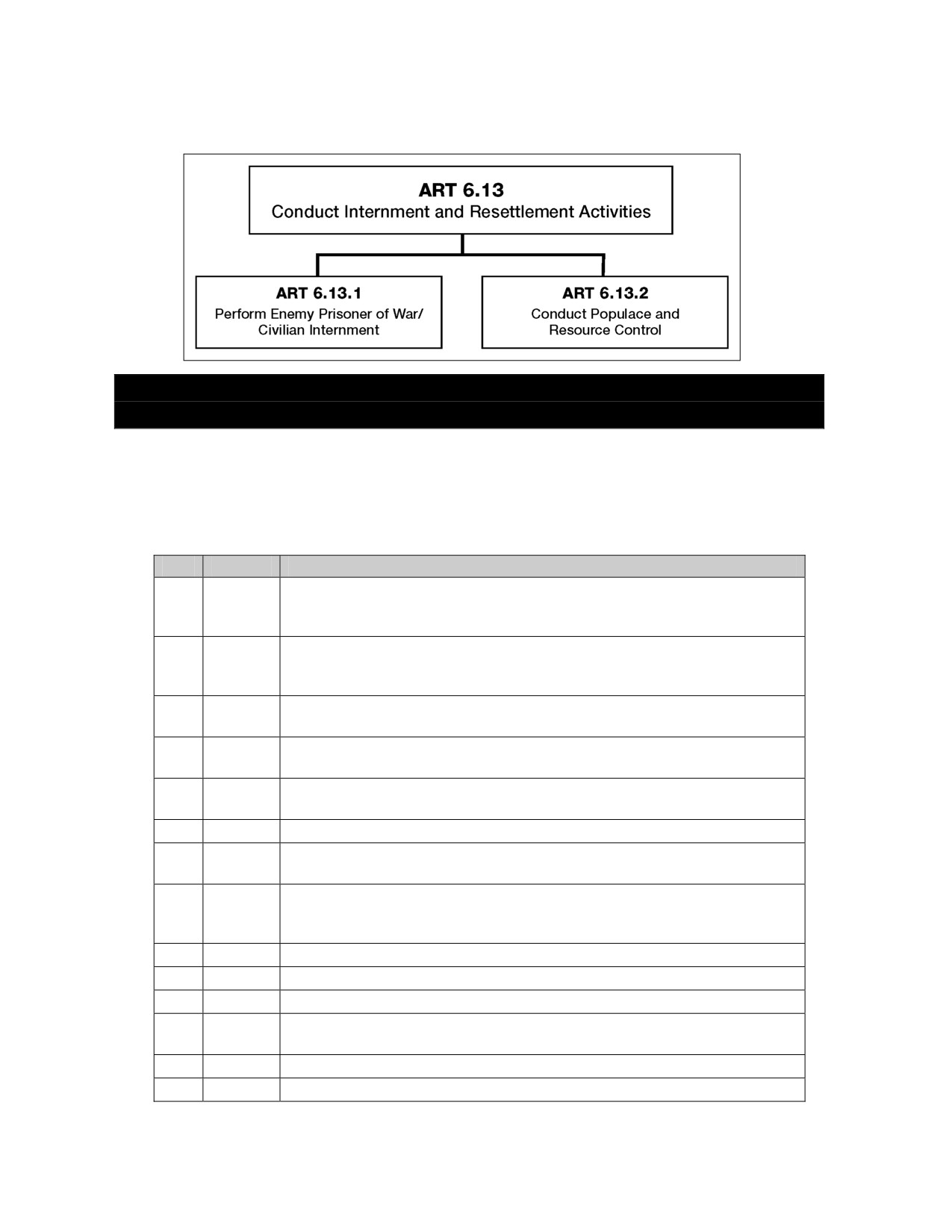
FM 7-15__________________________________________________________________________
SECTION XIII - ART 6.13: CONDUCT INTERNMENT AND RESETTLEMENT
ACTIVITIES
6-149. ART 6.13 includes activities performed by units when they are
responsible for interning enemy prisoners of war and civilian detainees. It
ensures the safety and humane treatment of the incarcerated individuals, the
maintenance of law and order within the facilities, as well as the safety of the
guards and the surrounding civilian and military facilities and installations.
(FM 3-19.40) (USAMPS)
No.
Scale
Measure
Conduct of internment and resettlement activities does not prevent or
01
Yes/No
seriously interfere with accomplishment of the unit’s primary tactical
mission.
Operations of US forces conducting internment and resettlement
02
Yes/No
activities observe international laws of war, US laws and regulations,
rules of engagement, US-host nation agreements.
Operations of US forces conducting internment and resettlement
03
Yes/No
activities observe local customs, mores, and taboos where possible.
Enemy prisoners of war and civilian detainees receive necessary food,
04
Yes/No
water, clothing, housing, and medical care.
To refine plans for the collection and internment of enemy prisoners of
05
Time
war and civilian detainees.
06
Time
To establish dislocated civilian collection points.
To construct camps to house enemy prisoners of war and civilian
07
Time
detainees.
To develop and enforce internment and resettlement control measures,
08
Time
such as curfew, travel permits, and lists of controlled supplies and
contraband.
09
Time
To plan and prepare resettlement sites.
10
Time
To forward intelligence information collected to unit intelligence staff.
11
Percent
Of interned enemy prisoners of war requiring medical treatment.
Of friendly force personnel in AO involved in maintaining enemy prisoner
12
Percent
of war camps and civilian detainment facilities.
13
Percent
Of civilian detainees released after interrogation.
14
Percent
Of unit CSS requirements provided by prisoners of war.
6-110
_______________________________
ART 6.0: The Combat Service Support Battlefield Operating System
No.
Scale
Measure
Of unit sustainment capabilities needed to support internment and
15
Percent
resettlement program.
Of civilian detainees/displaced civilians who can be resettled within a
16
Number
given time.
17
Number
Of civilian detainees.
And types of class X and other supplies needed to support internment
18
Number
and resettlement program.
19
Number
Of enemy prisoners of war housed.
20
Number
Of facilities to house civilian detainees established.
21
Number
Of enemy prisoners of war camps established.
22
Number
Of resettlement sites established.
23
Ratio
Of guards to enemy prisoners of war.
ART 6.13.1 PERFORM ENEMY PRISONERS OF WAR/CIVILIAN
INTERNMENT
6-150. Provide safe and humane treatment for enemy prisoners of war and
detained civilians. This task includes the collection, screening, processing,
evacuation, internment, safeguarding, and release of enemy prisoners of war
and civilian detainees. ART 6.13.1 takes place in temporary and long-term
facilities/points. (FM 3-19.40) (USAMPS)
No.
Scale
Measure
Conduct of internment activities does not prevent or seriously interfere
01
Yes/No
with accomplishment of the unit’s primary tactical mission.
Operations of US forces conducting internment activities observe
02
Yes/No
international laws of war, US laws and regulations, rules of engagement,
and US-host nation agreements.
Operations of US forces conducting internment activities observe local
03
Yes/No
customs, mores, and taboos where possible.
Enemy prisoners of war and civilian detainees receive necessary food,
04
Yes/No
water, pay, clothing, housing, and medical care.
To refine plans for the internment of enemy prisoners of war and civilian
05
Time
detainees.
To construct camps to house enemy prisoners of war and civilian
06
Time
detainees.
To develop and enforce internment control measures, such as curfew,
07
Time
travel permits, and lists of controlled supplies and contraband.
08
Time
To forward intelligence information collected to unit intelligence staff.
To move enemy prisoners of war and civilian detainees to their respective
09
Time
internment facilities from their initial collection points.
Of interned enemy prisoners of war/civilians who require medical
10
Percent
treatment.
Of friendly force personnel in AO involved in maintaining enemy prisoner
11
Percent
of war camps and civilian internment facilities.
6-111
FM 7-15__________________________________________________________________________
No.
Scale
Measure
12
Percent
Of civilian detainees released after interrogation.
13
Percent
Of unit CSS requirements provided by prisoners of war.
Of unit sustainment capabilities needed to support internment and
14
Percent
resettlement program.
15
Number
And types of supplies needed to support internment program.
16
Number
Of enemy prisoners of war and civilian detainees.
17
Number
Of facilities to house civilian detainees established.
18
Number
Of enemy prisoners of war camps established.
19
Ratio
Of guards to enemy prisoners of war.
ART 6.13.2 CONDUCT POPULACE AND RESOURCE CONTROL
6-151. Provide security for a populace, denying personnel and material to
the enemy, mobilize population and material resources, and detect and
reduce the effectiveness of enemy agents. Populace controls also include the
maintenance of curfews, movement restrictions, travel permits, registration
cards, and resettlement of villagers. Resource control measures include
licensing, regulations or guidelines, checkpoints (for example, roadblocks),
reaction controls, amnesty programs, and inspection of facilities. Two
subdivisions of populace and resource control operations are dislocated
civilian operations and evacuation of host-nation noncombatants. (FM 3-19.1)
(USAMPS)
No.
Scale
Measure
The imposition of population and resource control measures
01
Yes/No
accomplishes commander’s intent of establishing control measures.
Collected contraband accounted for and disposed of IAW international
02
Yes/No
and US law, applicable regulations, and SOFA.
Chain of custody for contraband maintained if possession of contraband
03
Yes/No
would result in criminal/administrative trial.
Time required to gain approval for adjustments in population and
04
Yes/No
resource control measures does not detract from effectiveness of
program.
To coordinate with host-nation agencies for implementation of population
05
Time
and resource control measures.
To develop plans for imposing populace control by the enforcement of
06
Time
curfews, movement restrictions, travel permits and registration cards, and
assisting in the evacuation of noncombatants.
To develop plans for resource control, such as establishing roadblocks
07
Time
and checkpoints, inspecting facilities, enforcing local regulations and
guidelines, controlling rations, and assisting with amnesty program.
To inform local population of new/revised population and resource control
08
Time
measures imposed on them.
09
Time
To determine required population and resource control measures.
10
Time
Restrictions imposed on local civilian population.
11
Percent
Of local population supporting population and resource control measures.
6-112
_______________________________
ART 6.0: The Combat Service Support Battlefield Operating System
No.
Scale
Measure
Of contraband detected during the conduct of resource control
12
Percent
operations.
13
Percent
Of available effort devoted to population and resource control measures.
Of AO/local population affected by population and resource control
14
Percent
measures.
And types of units involved in populations and resource control
15
Number
operations.
Of instances that violations of population and resource control measures
16
Number
are detected.
Of tons and types of contraband detected during resource control
17
Number
operations.
18
Cost
To establish and administer population and resource control operation.
6-113
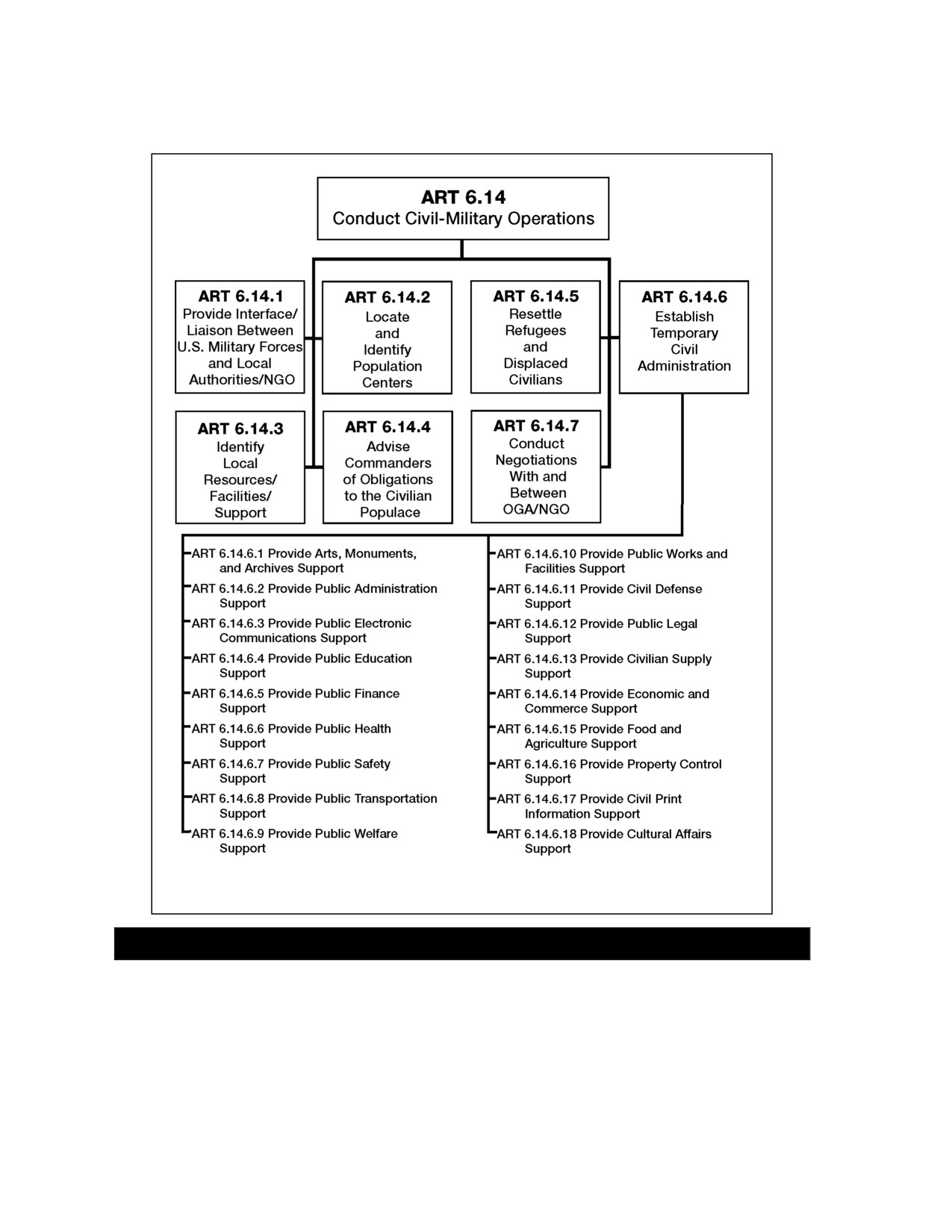
FM 7-15__________________________________________________________________________
SECTION XIV - ART 6.14: CONDUCT CIVIL-MILITARY OPERATIONS
6-152. Conduct phases of the activities of a tactical commander that
embrace the relationship between the military forces located in a country or
area and the civil authorities and people of that country or area. ART 6.14
usually occurs during hostilities or in an emergency situation. A treaty or
other expressed or implied agreement normally covers the specific activities
performed. (FM 41-10) (USAJFKSWCS)
6-114

_______________________________
ART 6.0: The Combat Service Support Battlefield Operating System
No.
Scale
Measure
The conduct of civil-military operations (CMO) in AO supports mission
01
Yes/No
accomplishment by US forces.
US forces act as the disinterested party in negotiations between opposing
02
Yes/No
ethnic, cultural, religious, and social groups in the AO.
To refine civil affairs program/produce CMO annex to operations order
03
Time
after receipt of warning order.
04
Time
To establish civil-military operations center.
05
Time
For legal authority to review civil affairs plan.
06
Time
To deploy civil affairs personnel to support civil affairs mission.
To achieve agreement with local authorities on local population control
07
Time
measures.
08
Time
To assess situation and define needed assistance.
To coordinate and conduct liaison with nongovernmental organizations
09
Time
represented within the AO.
To establish liaison with allied and coalition military forces concerning
10
Time
civil affairs matters.
To identify and integrate civil affairs support and appropriate civil affairs
11
Time
essential elements of information into command intelligence programs in
AO.
12
Time
To submit civil affairs plan to country team for their review and approval.
To identify cultural, ethnic, social, and religious characteristics of the local
13
Time
populace.
To educate US military forces to reduce acts contrary to local customs
14
Time
and practice.
15
Percent
Of local population able to maintain normal day-to-day activities.
16
Percent
Of local population able to remain in their homes.
Of US military supplies and resources in AO used to conduct civil affairs
17
Percent
activities.
Of instances of supportive and hostile actions directed toward civilians in
18
Number
AO.
19
Number
And types of restrictions imposed on the use of cultural property.
ART 6.14.1 PROVIDE INTERFACE/LIAISON BETWEEN US MILITARY
FORCES AND LOCAL AUTHORITIES/NONGOVERNMENTAL
ORGANIZATIONS
6-153. Facilitate CMO by providing interface between US military forces
and host nation, foreign authorities or military forces, and non-governmental
organizations (NGOs). Provide interface between US military forces and
host-national as well as international police forces with US Military Police
forces. Minimize the likelihood and/or effects of civil interference with
military operations. Locate and identify significant arts, monuments, and
archives throughout the AO and prepare directives to safeguard these
cultural properties. Help the commander meet his moral and legal
obligations. (FM 41-10) (USAJFKSWCS)
6-115
FM 7-15__________________________________________________________________________
No.
Scale
Measure
Liaison conducted within the AO contributes to accomplishment of the
01
Yes/No
mission of US forces.
02
Time
To refine the CMO program for AO after receipt of warning order.
03
Time
To identify key civilian agencies and officials within the AO.
To establish liaison with appropriate foreign national civilian government
04
Time
officials in AO after receipt of mission.
To establish liaison with US country team and other US governmental
05
Time
agencies and host-nation, nongovernmental, and allied/coalition
organizations and forces.
To establish information system interconnectivity between organizations
06
Time
within the AO.
07
Percent
Of nongovernmental organizations in AO receiving US military support.
08
Percent
Of interagency requests for assistance met within the AO.
Of civil-military operations relevant information, such as population
09
Percent
centers and the location of significant arts, monuments, and archives,
that is included in the unit’s database.
Of different organizations cooperating on the same or different projects
10
Number
within the AO.
Of instances of insufficient support provided to and from other nations,
11
Number
groups, and agencies.
12
Number
Of liaison teams provided by a unit.
13
Number
Of liaison teams provided to a unit from other organizations.
And types of information systems used to maintain information flow
14
Number
between liaison teams and supported/supporting organizations.
15
Cost
Of establishing and maintaining effective liaison activities within the AO.
ART 6.14.2 LOCATE AND IDENTIFY POPULATION CENTERS
6-154. Locate and identify population centers in the area of interest and
anticipate population movements that may occur in response to future
combat operations. Cooperate with local authorities to plan the movement of
displaced civilians and minimize interference with close combat operations.
(FM 41-10) (USAJFKSWCS)
No.
Scale
Measure
The location and identification of population centers within the AO
01
Yes/No
supports mission accomplishment by US forces.
Civil affairs unit conducts area assessment IAW command guidance and
02
Yes/No
mission requirements.
To establish liaison with appropriate foreign nation civilian government
03
Time
officials in AO after receipt of mission.
To establish liaison with US country team and other US governmental
04
Time
agencies and host-nation, nongovernmental, and allied/coalition
organizations and forces.
To identify population centers that might interfere with combat operations
05
Time
in the AO.
6-116
_______________________________
ART 6.0: The Combat Service Support Battlefield Operating System
No.
Scale
Measure
To plan with local authorities for the orderly movement of displaced local
06
Time
civilians during the conduct of combat operations within the AO.
Of combat operations degraded, delayed, or modified due to displaced
07
Percent
civilians within the AO.
Of resources within the AO required to control the movement of displaced
08
Percent
civilians.
09
Percent
Of displaced civilian control provided by host nation.
Of civilian casualties sustained during the conduct of military operations
10
Number
within the AO.
11
Number
Of displaced civilian centers established in AO.
ART 6.14.3 IDENTIFY LOCAL RESOURCES/FACILITIES/SUPPORT
6-155. Identify, locate, and assist in the acquisition of local resources,
civilian labor, facilities, and other support that tactical organizations require
to accomplish their missions. Coordinate and administer host-nation
agreements and other forms of foreign nation support.
(FM
41-10)
(USAJFKSWCS)
No.
Scale
Measure
The identification of local resources, facilities, and other support will
01
Yes/No
assist in accomplishing the mission of US forces within the AO.
Civil affairs unit conducts area assessment IAW command guidance and
02
Yes/No
mission requirements.
The diversion of local resources, facilities, and other support from civil to
03
Yes/No
military units will not affect the local economy and civilian community in
an unacceptable manner.
To establish liaison with appropriate foreign nation civilian government
04
Time
officials in AO after receipt of mission.
To coordinate host-nation support agreements before or after unit arrival
05
Time
within an AO.
To identify sources of dietary items necessary to support indigenous and
06
Time
US personnel operating within the AO.
To identify sources of non-dietary items necessary to support indigenous
07
Time
and US personnel operating within the AO.
To identify sources of transportation assets that can be used to support
08
Time
the mission of US forces.
To identify housing facilities that can be used to support the mission of
09
Time
US forces.
To identify indigenous human resources—translators, skilled craftsmen,
10
Time
professionals, and laborers—that can be used to support the mission.
Of supplies and services used by US units procured from host-nation
11
Percent
sources.
12
Percent
Of CSS and logistic effort within the AO provided by host nation.
Of local economy that will be affected by the acquisition of local
13
Percent
resources, facilities, and other support.
6-117

FM 7-15__________________________________________________________________________
No.
Scale
Measure
14
Number
And types of facilities used by US units provided by host nation.
15
Number
And types of host-nation support agreements in effect in AO.
16
Number
Of US units within the AO that have host-nation liaison officers assigned.
17
Cost
Of identifying local resources/facilities/support within the AO.
ART 6.14.4 ADVISE COMMANDERS OF OBLIGATIONS TO CIVILIAN
POPULATION
6-156. Develop, in conjunction with the staff judge advocate, requirements
and guidance for military personnel concerning the treatment of the civilian
population. Provide authoritative guidance to military personnel on the
customary and treaty law applicable to the conduct of land warfare as it
applies to civilian populations. (FM 27-100) (TJAGSA)
No.
Scale
Measure
Unit staff judge advocate international law specialist advises commander
01
Yes/No
on civil laws, actions, and local customs that violate U.S law, international
agreements, or individual human rights.
Prior to mission start, the supporting civil affairs staff analyzes, formulates
and presents information about the civil affairs aspects of the AO. The
02
Yes/No
format for this briefing package is IAW the supported command’s
standing operating procedures and is modified throughout the conduct of
the operation as conditions change.
Unit civil affairs staff advises the commander on essential goods and
03
Yes/No
services—food, shelter, health support—necessary to sustain life for the
civilian population of the AO.
Commander advised of US military operations that are planned or that
04
Yes/No
have occurred that violate local customs, US law, or international
agreements.
For the unit civil affairs staff to establish coordination with appropriate
05
Time
agencies within the AO, such as the staff judge advocate, US country
team, and host-nation government legal officials.
For the unit civil affairs staff to analyze the impact of the mission on the
06
Time
civilian population and predict civilian casualties, property destruction,
and infrastructure dislocation, and the impact on the civilian population.
For the unit civil affairs staff to consider religious aspects, customs, and
07
Time
cultures in the AO and their effect on operations.
For staff judge advocate international law specialist to review host-nation
agreements, international law, and applicable treaties, and US policies to
08
Time
identify restrictions and/or requirements for humanitarian assistance and
identify legal and moral limits on military operations.
For staff judge advocate operational law specialist to conduct a legal
09
Time
review of operations and coordinate jurisdiction requirements.
Difference between planned and actual requirements to support civilians
10
Percent
within AO.
Of violations of legal obligations and moral considerations by US forces
11
Number
within the AO within a given time.
12
Cost
Of meeting the commander’s obligations toward the civilian population.
6-118
_______________________________
ART 6.0: The Combat Service Support Battlefield Operating System
ART 6.14.5 RESETTLE REFUGEES AND DISPLACED CIVILIANS
6-157. Estimate the number of dislocated civilians, their points of origin,
and anticipated direction of movement. Plan movement control measures,
emergency care, and evacuation of dislocated civilians so that they do not
interfere with US military operations. Coordinate with military forces for
transportation,
military
police
support,
military
intelligence
screening/interrogation, and medical activities, as needed. Advise on or
establish and supervise the operation of temporary or semi-permanent camps
for dislocated civilians. Resettle or return dislocated civilians to their home
IAW US policy and objectives. Advise and assist host country and US
agencies on camps and relief measures for dislocated civilians. Supervise the
conduct of movement plans for dislocated civilians.
(FM
41-10)
(USAJFKSWCS)
No.
Scale
Measure
The refugee/displaced civilian program within the AO supports
01
Yes/No
accomplishment of the mission of US forces.
The unit establishes liaison, coordinates activities, and develops plans
02
Yes/No
IAW international law, treaties, and agreements.
The unit operations staff, with help from special functions teams,
establishes care and control policies for refugees and displaced civilians
03
Yes/No
that minimize civilian interference with military operations and provides
the assistance IAW international law.
To review current situation and identify refugee/displaced civilian
04
Time
requirements.
To establish liaison with national authorities, relief agencies, and
05
Time
voluntary agencies involved with refugees and displaced civilians.
06
Time
To determine impact of refugee/displaced civilians on military operations.
To develop, coordinate, and implement control measures for
07
Time
refugees/displaced civilians to include movement control policy, collection
points and assembly areas for refugees/displaced civilians.
To develop policy for providing minimum essential support requirements
08
Time
to refugees/displaced civilians.
To prepare plans for the establishment of refugee/displaced civilian
assembly points and camps. This includes determining transportation
09
Time
requirements, availability of local and military resources that can be used
to support refugee/displaced civilians, developing camp in-processing,
administration, and security procedures.
To establish policy for final disposition of refugees/displaced civilians to
include guidelines for their release to return to their homes, transition of
10
Time
US control over their camps to host-nation, coalition, allied, and
nongovernmental organizations.
To review refugee and displaced civilian plans for compliance with
11
Time
international laws, treaties, and agreements.
Difference between planned refugee/displaced civilian support
12
Percent
requirements and actual requirements.
6-119