FM 7-15 THE ARMY UNIVERSAL TASK LIST (AUGUST 2003) - page 11
FM 7-15__________________________________________________________________________
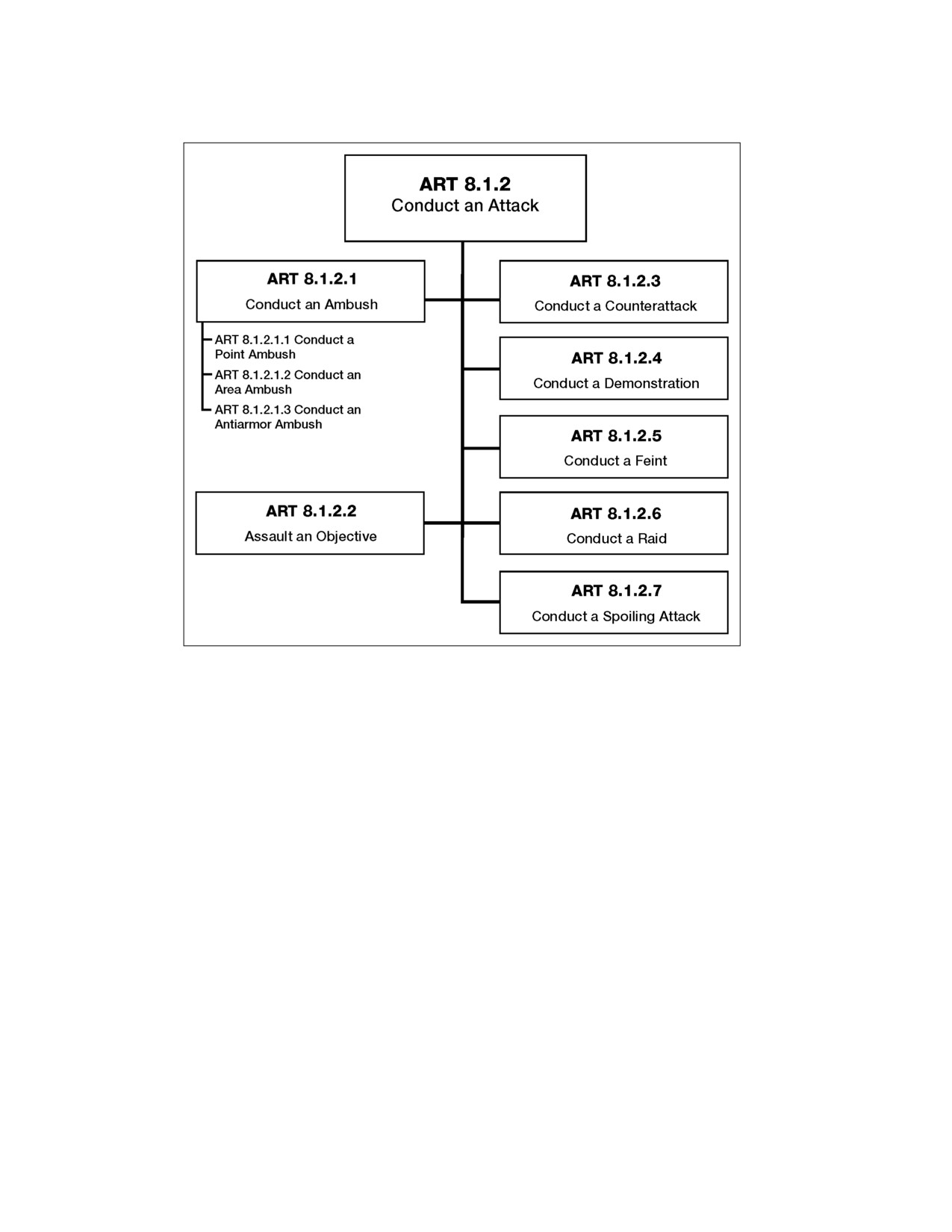
ART 8.1.2 CONDUCT AN ATTACK
8-6. An attack is an offensive operation that destroys or defeats enemy
forces, seizes and secures terrain, or both. Attacks incorporate coordinated
movement supported by direct and indirect fires. They may be either decisive
or shaping operations. Attacks may be hasty or deliberate, depending on the
time available for assessing the situation, planning, and preparing. (FM 3-
90) (USACAC)
ART 8.1.2.1 Conduct an Ambush
8-7. An ambush is an attack by fire or other destructive means from
concealed positions on a moving or temporarily halted enemy. An ambush
destroys enemy forces by maximizing the element of surprise. Ambushes can
employ direct fire systems as well as other destructive means, such as
command-detonated mines, nonlethal fires, and indirect fires. They may
include an assault to close with and destroy the enemy force. (FM 3-90)
(USACAC)
ART 8.1.2.1.1 Conduct a Point Ambush
8-8. A point ambush is a surprise attack by fire or other destructive means
from concealed positions on a moving or temporarily halted enemy in the
vicinity of a given point. It may include an assault to close with and destroy
the enemy force. (FM 7-10) (USAIS)
8-4
________________________________________
ART 8.0: Conduct Tactical Mission Tasks and Operations
ART 8.1.2.1.2 Conduct an Area Ambush
8-9. An area ambush consists of a series of surprise attacks by fire or other
destructive means from concealed positions on a moving or temporarily
halted enemy within a specific area. It may include an assault to close with
and destroy the enemy force. (FM 7-20) (USAIS)
ART 8.1.2.1.3 Conduct an Antiarmor Ambush
8-10. An antiarmor ambush is a surprise attack by fire or other destructive
means from concealed positions on moving or temporarily halted enemy
armored vehicles. The ambush ends with the displacement of the antiarmor
system to preclude its destruction by enemy counterambush actions. (FM 3-
21.91) (USAIS)
ART 8.1.2.2
ASSAULT AN OBJECTIVE
8-11. The assault on an objective is a short, violent, but well ordered attack
against an objective. It is the climax of an attack and involves the act of
closing with the enemy, including the possible conduct of hand-to-hand
fighting. (FM 3-90) (USACAC)
ART 8.1.2.3
CONDUCT A COUNTERATTACK
8-12. A counterattack is an attack by part or all of a defending force against
an attacking force with the general objective of denying the attackers their
goals. Commanders normally conduct counterattacks from a defensive
posture. They direct them to defeat or destroy enemy forces, or to regain
control of terrain and facilities after enemy successes. They counterattack
after enemies launch an attack, reveal their main effort, or offer an
assailable flank. (FM 3-90) (USACAC)
ART 8.1.2.4
CONDUCT A DEMONSTRATION
8-13. A demonstration is an attack designed to deceive enemies as to the
location or time of the decisive operation by a display of force. Forces
conducting a demonstration do not seek contact. Demonstrations are shaping
operations. They seek to mislead enemies concerning the attacker’s true
intentions. They facilitate decisive operations by fixing enemies or diverting
their attention from the decisive operation. Commanders allow enemies to
detect a demonstration. (FM 3-90) (USACAC)
ART 8.1.2.5
CONDUCT A FEINT
8-14. A feint is an attack used to deceive enemies as to the location or time of
the actual decisive operation. Forces conducting a feint seek direct fire
contact but avoid decisive engagement. Feints divert attention from the
decisive operation and prevent the enemy from focusing combat power
against it. They are usually shallow, limited-objective attacks conducted
before or during the decisive operation. (FM 3-90) (USACAC)
ART 8.1.2.6
CONDUCT A RAID
8-15. A raid is an attack, usually small scale, involving a swift entry into
hostile territory to secure information, confuse the enemy, or destroy
installations. It usually ends with a planned withdrawal from the objective
8-5
FM 7-15__________________________________________________________________________
area upon mission completion. Raids have narrowly defined purposes. They
require both detailed intelligence and deliberate planning. Raids may destroy
key enemy installations and facilities, capture or free prisoners, or disrupt
enemy C2 or other important systems. (FM 3-90) (USACAC)
ART 8.1.2.7
CONDUCT A SPOILING ATTACK
8-16. A spoiling attack is an attack that preempts or seriously impairs an
enemy attack while the enemy is in the process of planning or preparing for
it. Normally conducted from a defensive posture, spoiling attacks strike
where and when enemies are most vulnerable—during preparations for
attack in assembly areas and attack positions or while they are moving
toward their line of departure. Therefore, proper timing and coordination
with higher headquarters are critical requirements for spoiling attacks. A
spoiling attack is highly dependent on accurate information on enemy
dispositions. (FM 3-90) (USACAC)
ART 8.1.3
CONDUCT AN EXPLOITATION
8-17. Exploitation is an offensive operation that usually follows a successful
attack designed to disorganize the enemy in depth. Exploitations seek to
disintegrate enemy forces to the point where they have no alternative but
surrender or take flight. Exploitations take advantage of tactical
opportunities, foreseen or unforeseen. Division and higher headquarters
normally plan exploitations as branches or sequels. (FM 3-90) (USACAC)
ART 8.1.4
CONDUCT A PURSUIT
8-18. A pursuit is an offensive operation designed to catch or cut off an
enemy force attempting to escape with the aim of destroying it (JP 1-02).
Pursuits are decisive operations that follow successful attacks or
exploitations. They occur when enemies fail to organize a defense and
attempt to disengage. If it becomes apparent that resistance has broken
down entirely and the enemy is fleeing, a force can transition to a pursuit
from any type of offensive operation. Pursuits entail rapid movement and
decentralized control. (FM 3-90) (USACAC)
8-6
________________________________________
ART 8.0: Conduct Tactical Mission Tasks and Operations
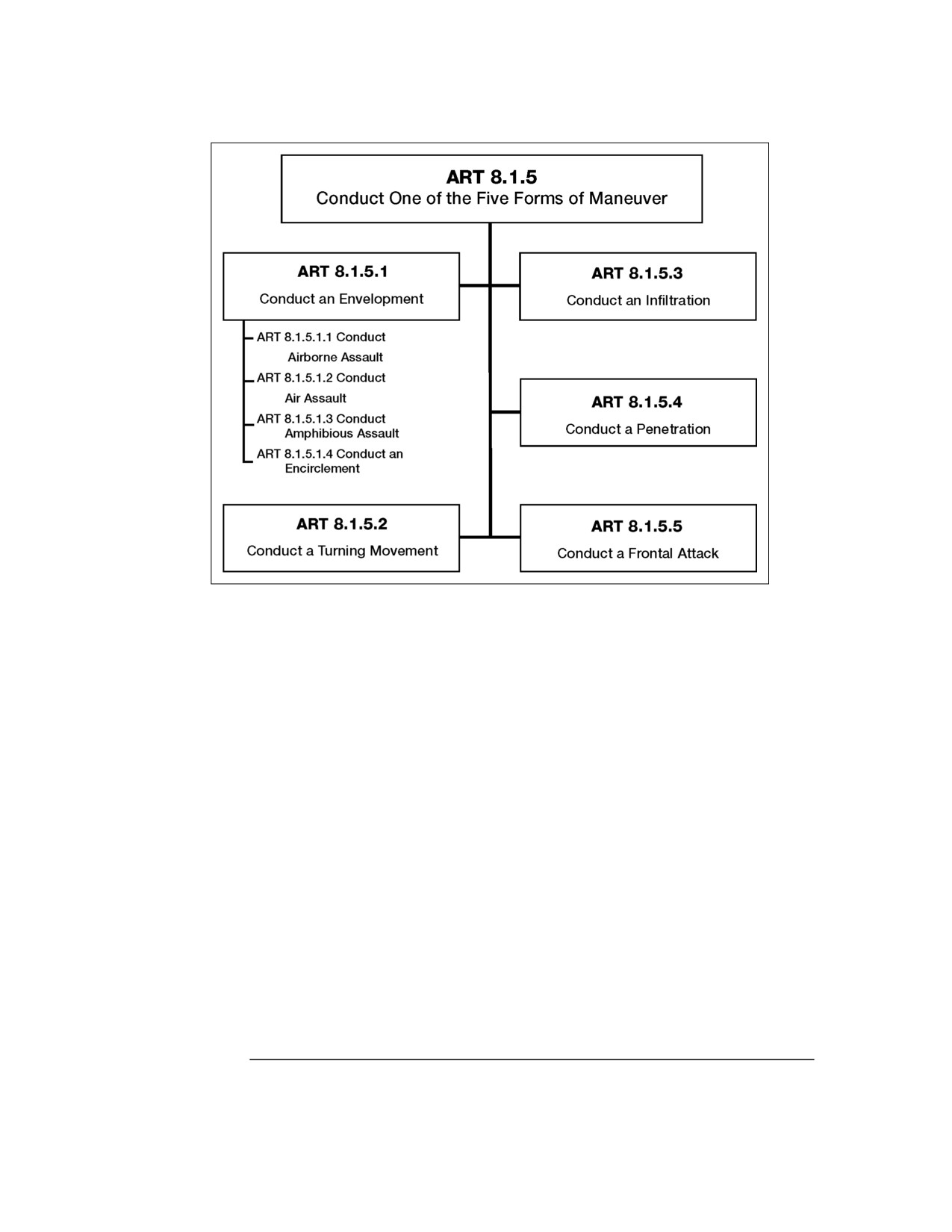
ART 8.1.5
CONDUCT ONE OF THE FIVE FORMS OF MANEUVER
8-19. The forms of maneuver are envelopment, turning movement,
infiltration, penetration, and frontal attack. While normally combined, each
form of maneuver attacks the enemy differently. A single operation may
contain several forms of offensive maneuver; for example, a frontal attack to
clear a security area may be followed by a penetration to create a gap in the
defenses. This could be followed by an envelopment to destroy the first line of
defense. Each form of maneuver poses different challenges for attackers and
different dangers for defenders. Commanders determine the form of
maneuver to use by analyzing the factors of METT-TC. (FM 3-90) (USACAC)
ART 8.1.5.1
CONDUCT AN ENVELOPMENT
8-20. An envelopment is a maneuver in which an attacking force seeks to
avoid the principal enemy defenses by seizing objectives to the enemy rear
and destroying enemy forces in their current positions. At the tactical level,
envelopments focus on seizing terrain, destroying specific enemy forces, and
interdicting enemy withdrawal routes. Envelopments avoid the enemy front,
where enemy forces are protected and can easily concentrate fires. Single
envelopments maneuver against one enemy flank; double envelopments
maneuver against both. A vertical envelopment (an air assault or airborne
operation) creates an assailable flank by arriving from an unexpected
direction. An envelopment may result in an encirclement.
(FM 3-90)
(USACAC)
Note: Airborne, air assault, and amphibious operations are tactical aspects of
forcible entry operations. Joint force commanders conduct forcible entry
8-7
FM 7-15__________________________________________________________________________
operations at the operational level. (See JP 3-18.) Forcible entry operation
tasks are addressed in the UJTL.
ART 8.1.5.1.1
Conduct an Airborne Assault into Area of Operations
8-21. An airborne assault secures a defendable airhead from which to
conduct lodgment activities. This mission begins when paratroopers and
equipment exit the aircraft by parachute or are air landed. It includes the
actions of pathfinders. The mission ends when all elements of the relevant
airborne echelon are delivered to the objective area and the assault objective
has been seized. (FM 3-90) (USACAC)
Notes:
Marshalling of forces for airborne operations is addressed as ART 2.3.1.3
(Marshal Forces to Conduct an Airborne Assault).
The air movement phase of airborne operations is addressed as ART 6.3.3.2
(Move by Air).
Tasks for the ground tactical-phase of airborne operations duplicate missions
contained elsewhere in this chapter.
ART 8.1.5.1.2
Conduct an Air Assault
8-22. An air assault secures a defendable airhead or other key terrain from
which to conduct lodgment activities or follow-on tactical operations. The
mission ends when all elements of the relevant air assault echelon are
delivered to the objective area and the assault objective has been seized. (FM
90-4) (USAIS)
Notes:
ART 8.1.5.1.2 does not include air traffic control. Air traffic control is
addressed under ART 7.6.1.7 (Control Tactical Airspace).
ART 8.1.5.1.2 does not include efforts to improve the landing zone. Landing
zone improvement is addressed under ART 5.0 (Mobility/Countermobility/
Survivability Battlefield Operating System).
Pickup zone operations are addressed as ART 2.3.1.4 (Conduct Pickup Zone
Operations).
The air movement phase of air assault operations is addressed as ART 6.3.3.2
(Move by Air).
Tasks for the ground tactical phase of air assault operations duplicate
missions contained elsewhere in this chapter.
ART 8.1.5.1.3
Conduct an Amphibious Assault
8-23. An amphibious assault secures a defendable beachhead from which to
conduct lodgment activities. This mission begins when soldiers and
equipment leave the ships that bring them to the amphibious objective area
and transfer to the landing craft that will deliver them to the beach. The
8-8
________________________________________
ART 8.0: Conduct Tactical Mission Tasks and Operations
mission ends when all elements of the amphibious force are delivered into
the beachhead and the assault objective has been seized (JP 3-18.). (USMC-
CDC)
Note: Army forces follow joint doctrine and Marine Corps doctrinal
publications when tasked to conduct amphibious operations.
ART 8.1.5.1.4 Conduct an Encirclement
8-24. Encirclements are operations where one force loses its freedom of
maneuver because an opposing force is able to isolate it by controlling all
ground lines of communications. (FM 3-90)(USACAC)
ART 8.1.5.2
CONDUCT A TURNING MOVEMENT
8-25. A turning movement is a maneuver in which an attacking force seeks
to avoid the enemy’s principal defensive positions by seizing objectives to the
enemy rear and causing enemy forces to move out of their positions or divert
major forces to meet the threat. (FM 3-90) (USACAC)
ART 8.1.5.3
CONDUCT AN INFILTRATION
8-26. An infiltration is a maneuver in which an attacking force conducts
undetected movement through or into an area occupied by enemy forces to
occupy a position of advantage while exposing only small elements to enemy
defensive fires. (FM 3-90) (USACAC)
Note: Infiltration is also a tactical march technique used within friendly
territory to move forces in small groups at extended or irregular intervals.
(See FM 3-90.)
ART 8.1.5.4
CONDUCT A PENETRATION
8-27. A penetration is a maneuver in which an attacking force seeks to
rupture enemy defenses on a narrow front to disrupt the defensive system.
Commanders direct penetrations when enemy flanks are not assailable or
time does not permit another form of maneuver. Successful penetrations
create assailable flanks and provide access to enemy rear areas. (FM 3-90)
(USACAC)
ART 8.1.5.5
CONDUCT A FRONTAL ATTACK
8-28. A frontal attack is a maneuver in which an attacking force seeks to
destroy a weaker enemy force or fix a larger enemy force in place over a
broad front. At the tactical level, an attacking force can use a frontal attack
to rapidly overrun a weaker enemy force. A frontal attack strikes the enemy
across a wide front and over the most direct approaches. Commanders
normally use it when they possess overwhelming combat power and the
enemy is at a clear disadvantage. (FM 3-90) (USACAC)
8-9
FM 7-15__________________________________________________________________________
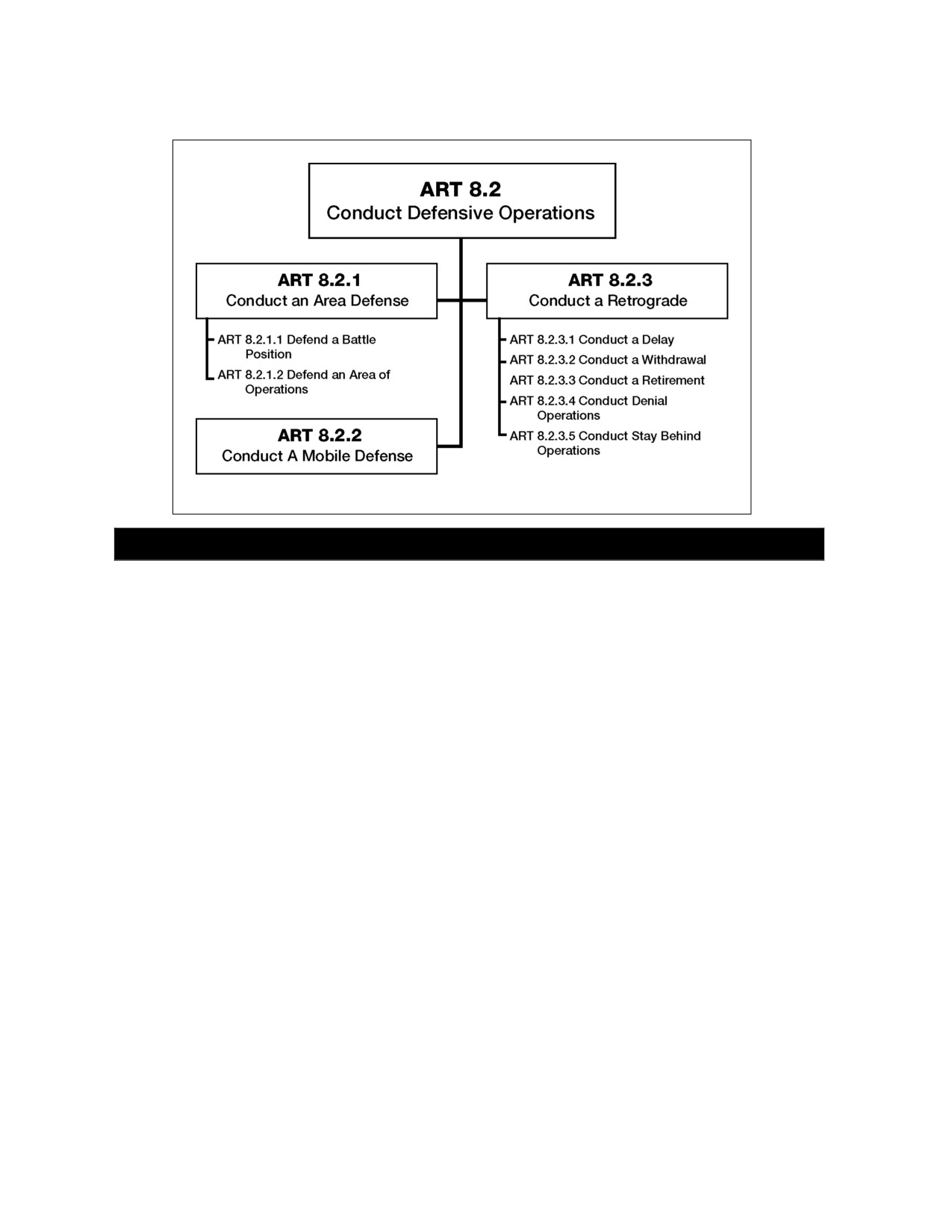
SECTION II - ART 8.2: CONDUCT DEFENSIVE OPERATIONS
8-29. Defensive operations defeat an enemy attack, buy time, economize
forces, or develop conditions favorable for offensive operations. Defensive
operations alone normally cannot achieve a decision. Their purpose is to
create conditions for a counteroffensive that allows Army forces to regain the
initiative. Although offensive operations are usually required to achieve
decisive results, it is often necessary, even advisable at times, to defend. (FM
3-90)
ART 8.2.1
CONDUCT AN AREA DEFENSE
8-30. The area defense concentrates on denying an enemy force access to
designated terrain for a specific time rather than destroying the enemy
outright. The bulk of the defending force combine static defensive positions,
engagement areas, and small, mobile reserves to retain ground. Keys to
successful area defenses include effective and flexible control,
synchronization and distribution of fires. Area defenses can also be part of a
larger mobile defense. (FM 3-90) (USACAC)
ART 8.2.1.1
DEFEND A BATTLE POSITION
8-31. This task involves denying an enemy force access to the terrain
encompassed by a specific battle position. The battle position is a tactical
control graphic that depicts the location and general orientation of the
majority of the defending forces. There are five kinds of battle positions, to
include the strongpoint. (FM 3-90) (USACAC)
ART 8.2.1.2
DEFEND AN AREA OF OPERATIONS
8-32. This task involves denying an enemy force access across a designated
area of operations. (FM 3-90) (USACAC)
8-10
________________________________________
ART 8.0: Conduct Tactical Mission Tasks and Operations
ART 8.2.2
CONDUCT A MOBILE DEFENSE
8-33. The mobile defense concentrates on the destruction or defeat of the
enemy through a decisive attack by a striking force. A mobile defense
requires defenders to have greater mobility than attackers. Defenders
combine offensive, defensive, and delaying actions to lure attackers into
positions where they are vulnerable to counterattack. (FM 3-90) (USACAC)
ART 8.2.3
CONDUCT A RETROGRADE
8-34. The retrograde is a defensive operation that involves organized
movement away from the enemy. The three forms of retrograde operations
are delays, withdrawals, and retirements. A commander can direct the
conduct of denial operations and stay-behind operations as subordinate
activities within the context of a retrograde operation. Commanders use
retrogrades as part of a larger scheme of maneuver to create conditions to
regain the initiative and defeat the enemy. Retrogrades improve the current
situation or prevent a worse situation from occurring. (FM 3-90) (USACAC)
ART 8.2.3.1
CONDUCT A DELAY
8-35. A delay is a retrograde in which a force under pressure trades space for
time by slowing the enemy’s momentum and inflicting maximum damage on
the enemy without, in principle, becoming decisively engaged. Delays gain
time for friendly forces to establish defenses, cover defending or withdrawing
units, protect friendly unit flanks, contribute to economy of force, draw the
enemy into unfavorable positions, and determine the enemy main effort. (FM
3-90) (USACAC)
ART 8.2.3.2
CONDUCT A WITHDRAWAL
8-36. A withdrawal is a planned operation in which a force in contact
disengages from an enemy force. Withdrawals may involve all or part of a
committed force. Commanders conduct withdrawals to preserve the force,
release it for a new mission, avoid combat under undesirable conditions, or
reposition forces. Enemy pressure may or may not be present during
withdrawals. Withdrawing forces may be unassisted or assisted by another
friendly force. (FM 3-90) (USACAC)
ART 8.2.3.3
CONDUCT A RETIREMENT
8-37. A retirement is a retrograde in which a force not in contact with the
enemy moves away from the enemy. (FM 3-90) (USACAC)
ART 8.2.3.4
CONDUCT DENIAL OPERATIONS
8-38. Denial operations hinder or deny the enemy the use of space,
personnel, supplies, or facilities. It may include destroying, removing, or
contaminating those supplies and facilities, or erecting obstacles. (FM 3-90)
(USACAC)
8-11
FM 7-15__________________________________________________________________________
ART 8.2.3.5 CONDUCT STAY-BEHIND OPERATIONS
8-39. A stay-behind operation occurs when a commander leaves a unit in
position to conduct a specified mission while the remainder of the force
withdraws or retires from an area. (FM 3-90) (USACAC)
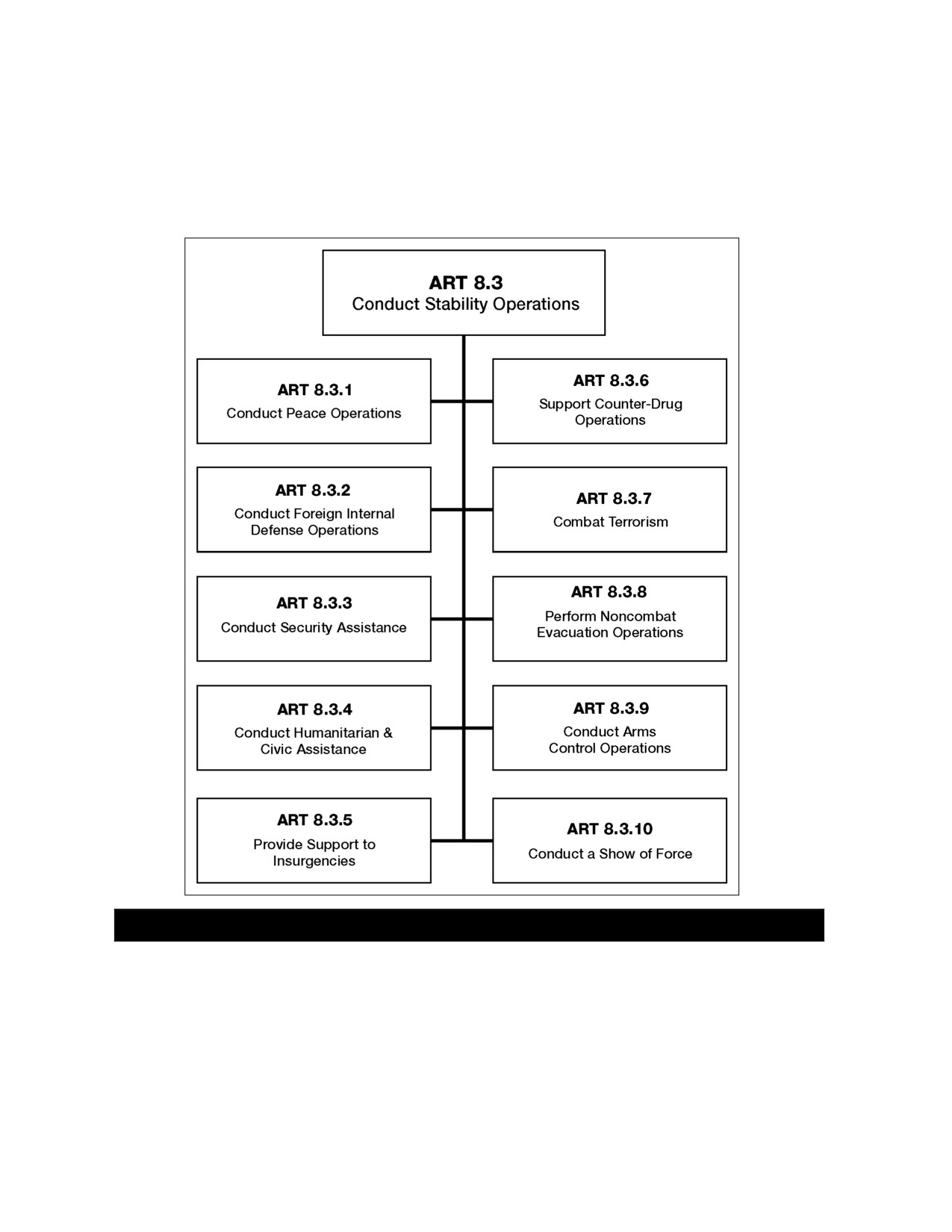
SECTION III - ART 8.3: CONDUCT STABILITY OPERATIONS
8-40. Stability operations employ Army forces outside the United States and
US territories to promote and protect US national interests by influencing
the threat, political, and information dimensions of the operational
environment. This is done through a combination of peacetime
developmental, cooperative activities and coercive actions in response to
crisis. Army forces accomplish stability goals through engagement and
response. The military activities that support stability operations are diverse,
continuous, and often long-term. Their overarching purpose is to promote and
sustain regional and global stability. (FM 3-0) (USACAC)
8-12
________________________________________
ART 8.0: Conduct Tactical Mission Tasks and Operations
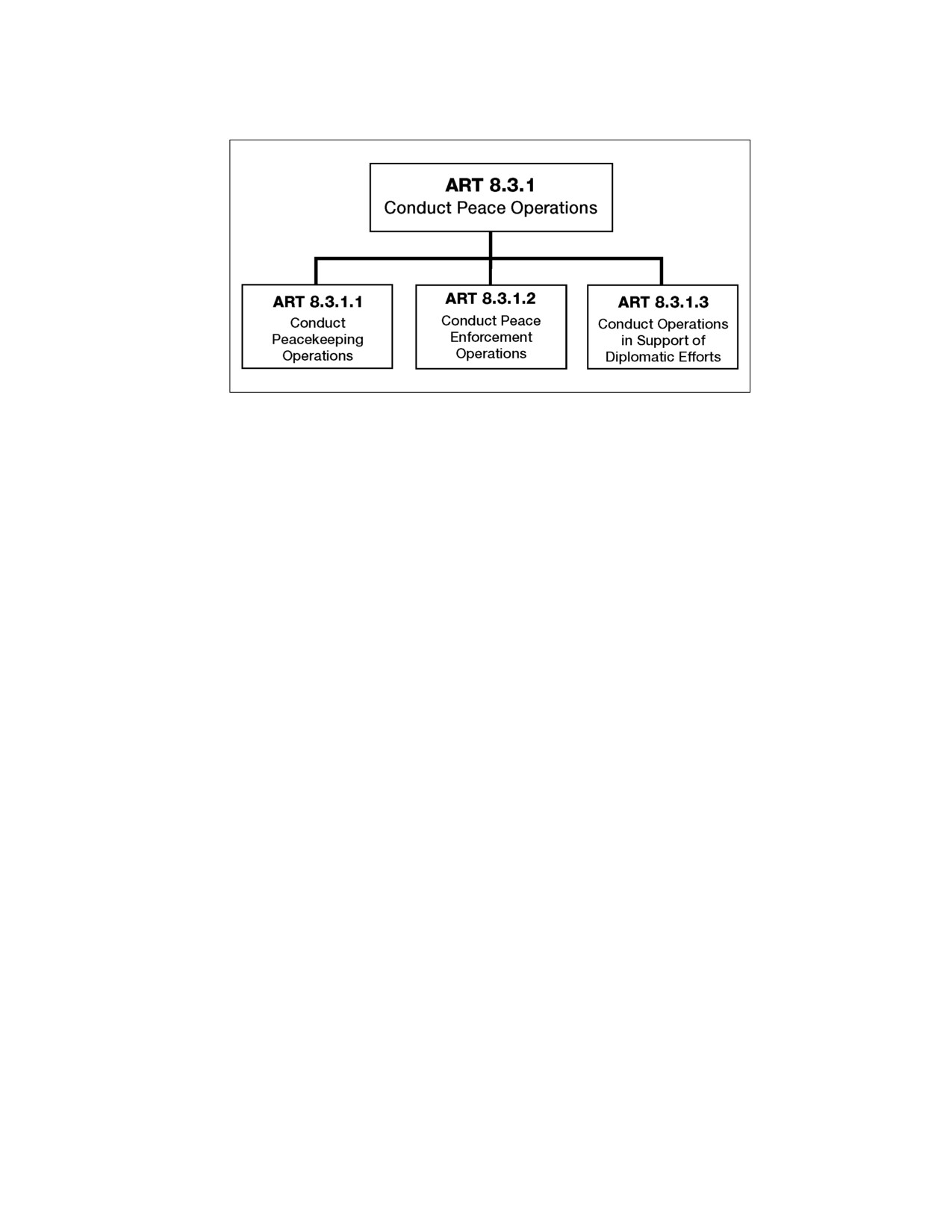
ART 8.3.1
CONDUCT PEACE OPERATIONS
8-41. Army forces conduct peace operations to support strategic and policy
objectives and their implementing diplomatic activities. Peace operations
encompass peacekeeping operations and peace enforcement operations
conducted to support diplomatic efforts to establish and maintain peace.
Although the United States reserves the right to conduct peace operations
unilaterally, it will normally participate in peace operations under the
sponsorship of the United Nations or another multinational organization.
(FM 3-0) (USACAC)
ART 8.3.1.1
CONDUCT PEACEKEEPING OPERATIONS
8-42. Peacekeeping operations are military operations undertaken with the
consent of all major parties to a dispute. They are designed to monitor and
facilitate implementation of agreements (cease fire, truce, or other such
agreements), and support diplomatic efforts to reach a long-term political
settlement. Peacekeeping operations usually involve observing, monitoring,
or supervising and assisting parties to a dispute. To achieve their objectives,
Army forces conducting peacekeeping operations rely on the legitimacy
acknowledged by all major belligerents and international or regional
organizations. They use or threaten the use of force only in self-defense or as
a last resort. (FM 3-0) (USACAC)
ART 8.3.1.2
CONDUCT PEACE ENFORCEMENT OPERATIONS
8-43. Peace enforcement operations are the application of military force, or
the threat of its use, normally pursuant to international authorization, to
compel compliance with resolutions or sanctions designed to maintain or
restore peace and order. Unlike peacekeeping operations, peace enforcement
operations do not require the consent of all parties. Peace enforcement
operations maintain or restore peace and support diplomatic efforts to reach
a long-term political settlement. Army forces assigned a peace enforcement
mission must be able to apply sufficient combat power for self-defense and to
forcibly accomplish assigned tasks. Units must also be prepared to transition
to peacekeeping operations. Peace enforcement operations normally include
one or more of six subordinate operations: forcible separation of belligerents,
establishment and supervision of protected areas, sanction and exclusion
zone enforcement, movement denial and guarantee, restoration and
8-13
FM 7-15__________________________________________________________________________
maintenance of order, and protection of humanitarian assistance. (FM 3-07)
(USACAC)
ART 8.3.1.3 CONDUCT OPERATIONS IN SUPPORT OF DIPLOMATIC EFFORTS
8-44. Army forces support diplomatic efforts to establish peace and order
before, during, and after conflicts. These operations include preventive
diplomacy, peacemaking, and peace building. Army forces support preventive
diplomacy by conducting preventive deployments or shows of force as part of
efforts to deter conflict. Support to peacemaking operations often includes
military-to-military contacts, exercises, peacetime deployments, and security
assistance. Support to peace building involves the same activities as longer-
term foreign internal defense operations (See ART 8. 3.2, Conduct Foreign
Internal Defense Operations) (FM 3-07) (USACAC)
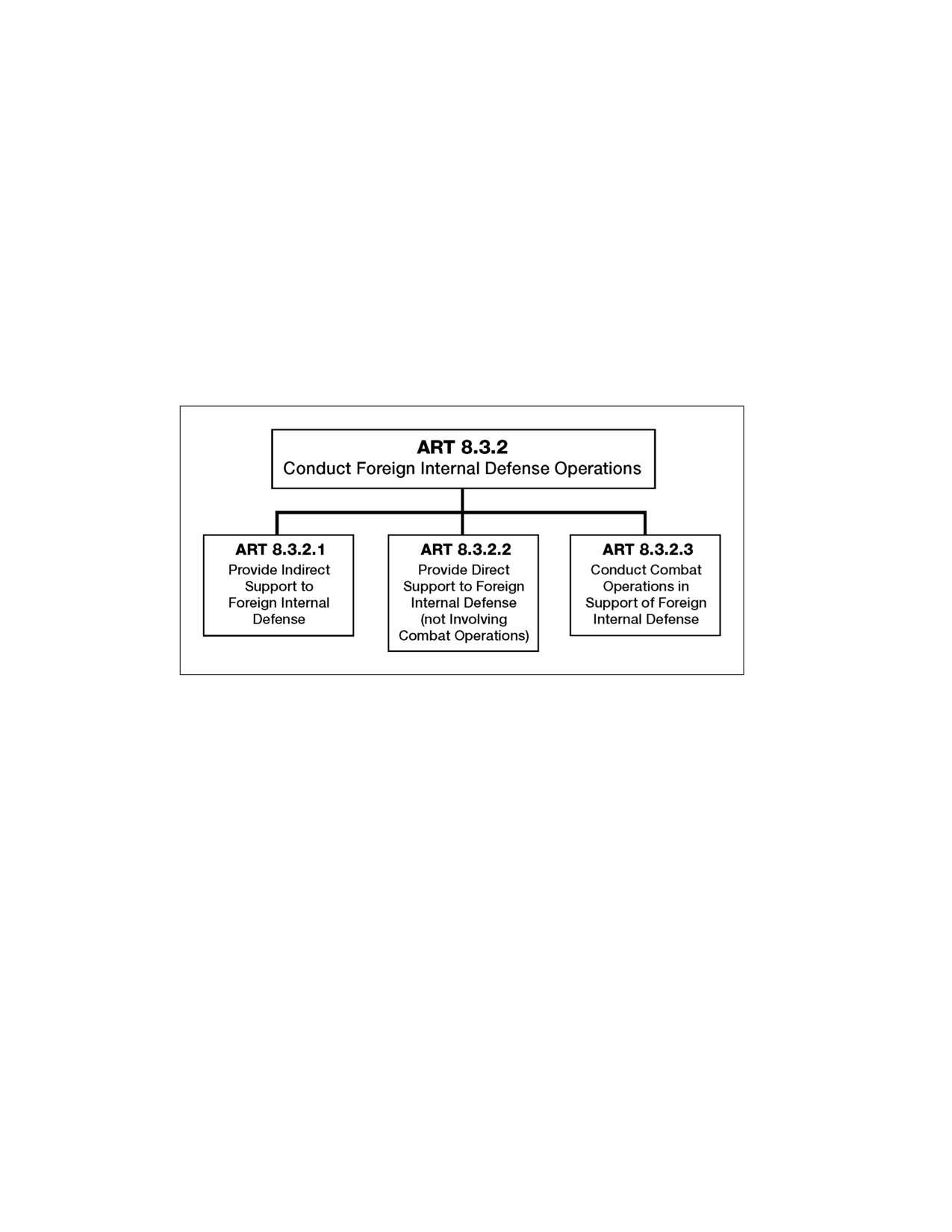
ART 8.3.2 CONDUCT FOREIGN INTERNAL DEFENSE OPERATIONS
8-45. Foreign internal defense is participation by civilian and military
agencies of one government in programs taken by another government to free
and protect its society from subversion, lawlessness, and insurgency. It
involves all elements of national power and can occur across the range of
military operations. Foreign internal defense is a primary program that
supports friendly nations operating against or threatened by hostile
elements. It promotes stability by helping a host nation establish and
preserve institutions and facilities responsive to its people’s needs. Army
forces participating in foreign internal defense normally advise and assist
host-nation forces conducting operations. Foreign internal defense is also a
specified and significant mission for selected Army special operations forces.
However, it requires joint planning, preparation, and execution to ensure the
efforts of all service and functional components are mutually supportive and
focused. (FM 3-07) (USACAC)
ART 8.3.2.1 PROVIDE INDIRECT SUPPORT TO FOREIGN INTERNAL DEFENSE
8-46. Indirect support emphasizes the principles of host-nation self-
sufficiency and builds strong national infrastructures through economic and
military capabilities. Examples include security assistance programs,
multinational exercises, and exchange programs. Indirect support reinforces
8-14
________________________________________
ART 8.0: Conduct Tactical Mission Tasks and Operations
the legitimacy and primacy of the host-nation government in addressing
internal problems. (See ART 8. 3.3, Conduct Security Assistance) (FM 3-07)
(USACAC)
ART 8.3.2.2 PROVIDE DIRECT SUPPORT TO FOREIGN INTERNAL DEFENSE (NOT
INVOLVING COMBAT OPERATIONS)
8-47. Direct support (not involving combat operations) involves the use of US
forces providing direct assistance to the host-nation civilian populace or
military. Direct support includes civil-military operations, intelligence,
communications sharing, and logistics. Direct support does not usually
involve transferring arms and equipment or training local military forces.
(FM 3-07) (USACAC)
ART 8.3.2.3 CONDUCT COMBAT OPERATIONS IN SUPPORT OF FOREIGN
INTERNAL DEFENSE
8-48. Combat operations include offensive and defensive operations
conducted by US forces to support a host-nation fight against insurgents or
terrorists. Most foreign internal defense activities focus on helping a host
nation prevent the development of an active insurgency. If an insurgency
already exists or preventive measures fail, foreign internal defense focuses
on eliminating, marginalizing, or reassimilating the insurgent element into
society. The United States provides military support to counterinsurgency
efforts, recognizing that military power alone cannot achieve lasting success.
US military power cannot, and will not, ensure the survival of regimes that
fail to meet their people’s basic needs. Military programs and US actions
promote a secure environment in which to implement programs that
eliminate causes of insurgency and encourage insurgents to rejoin civil
society. As with other foreign internal defense actions, combat operations in
support of foreign internal defense must continue to balance security with
economic development to enhance or reestablish stability. Such actions are
generally accompanied by indirect and direct support to foreign internal
defense (See ART 8.3.5.1, Provide Operational, Logistic and Training Support
to Insurgencies, and ART 8.3.5.2, Conduct Unconventional Warfare) (FM 3-
07) (USACAC)
ART 8.3.3
CONDUCT SECURITY ASSISTANCE
8-49. Security assistance refers to a group of programs that support US
national policies and objectives by providing defense articles, military
training, and other defense-related services to foreign nations by grant, loan,
credit, or cash sales. Examples of US security assistance programs are
Foreign Military Sales, Foreign Military Financing, International Military
Education and Training, the Economic Support Fund, and Arms Export
Control Act-licensed commercial sales. Army forces support security
assistance efforts through military training teams, maintenance support
personnel and training, and related activities, such as humanitarian mine
removal operations. (FM 3-07) (USACAC)
8-15
FM 7-15__________________________________________________________________________
ART 8.3.4 CONDUCT HUMANITARIAN AND CIVIC ASSISTANCE
8-50. Humanitarian and civic assistance programs consist of assistance
provided in conjunction with military operations and exercises. By law,
humanitarian and civic assistance are authorized by the secretary of state,
and planned and appropriated in the Army budget. Humanitarian and civic
assistance must enhance the security interests of both the United States and
host nation and increase the operational readiness of the units and soldiers
performing the mission. In contrast to humanitarian and disaster relief
conducted under foreign humanitarian assistance operations (see ART 8.4.2,
Conduct Foreign Humanitarian Assistance Operations), humanitarian and
civic assistance are planned activities with specific budget limitations.
Humanitarian and civic assistance are limited to the following categories:
medical, dental and veterinary care for rural areas of a country; construction
of rudimentary surface transportation systems; well drilling and construction
of basic sanitation facilities, rudimentary construction and repair of public
facilities, and specified activities related to mine detection and clearance,
including education, training, and technical assistance. (FM 3-07) (USACAC)
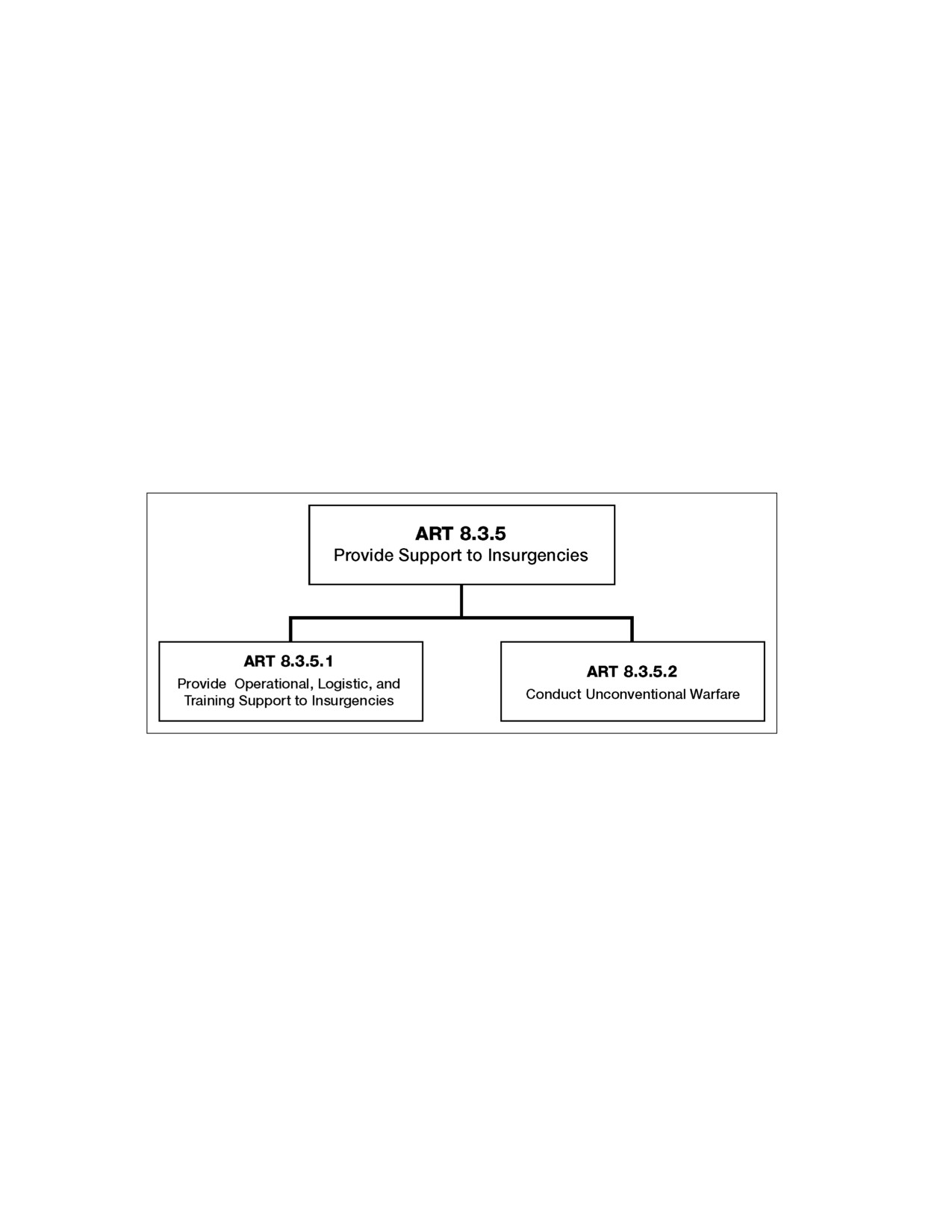
ART 8.3.5 PROVIDE SUPPORT TO INSURGENCIES
8-51. Insurgencies are movements organized to overthrow a constituted
government through the use of subversion and armed conflict. On order of
the National Command Authorities, Army forces support insurgencies that
oppose regimes that threaten US interests or regional stability. While any
Army force can be tasked to support an insurgency, Army special operations
forces usually receive these missions. The training, organization, and
regional focus of Army special operations forces make them well suited for
these operations. Army forces supporting insurgencies may provide
operational, logistic and training support. They may also support an
insurgency by conducting conventional and unconventional warfare. (FM 3-
07) (USACAC)
ART 8.3.5.1 PROVIDE OPERATIONAL, LOGISTIC AND TRAINING SUPPORT TO
INSURGENCIES
8-52. Provide support to insurgencies in the form of equipment, training, and
services. Services can include command and control, communications,
computers and intelligence support; support for planning, organization,
8-16
________________________________________
ART 8.0: Conduct Tactical Mission Tasks and Operations
recruitment; logistics; psychological operations; facilities usage; equipment
loans; and covert operational support and special activities.
(FM 3-07)
(USACAC)
ART 8.3.5.2 CONDUCT UNCONVENTIONAL WARFARE
8-53. Unconventional warfare is a broad spectrum of military and
paramilitary operations. They are normally of long duration and
predominately conducted by indigenous or surrogate forces organized,
trained, equipped, supported, and directed in varying degrees by an external
source. It includes offensive low visibility, covert, or clandestine operations,
such as guerrilla warfare and the related activities of subversion, sabotage,
intelligence activities, and unconventional assisted recovery.
(FM 3-07)
(USACAC)
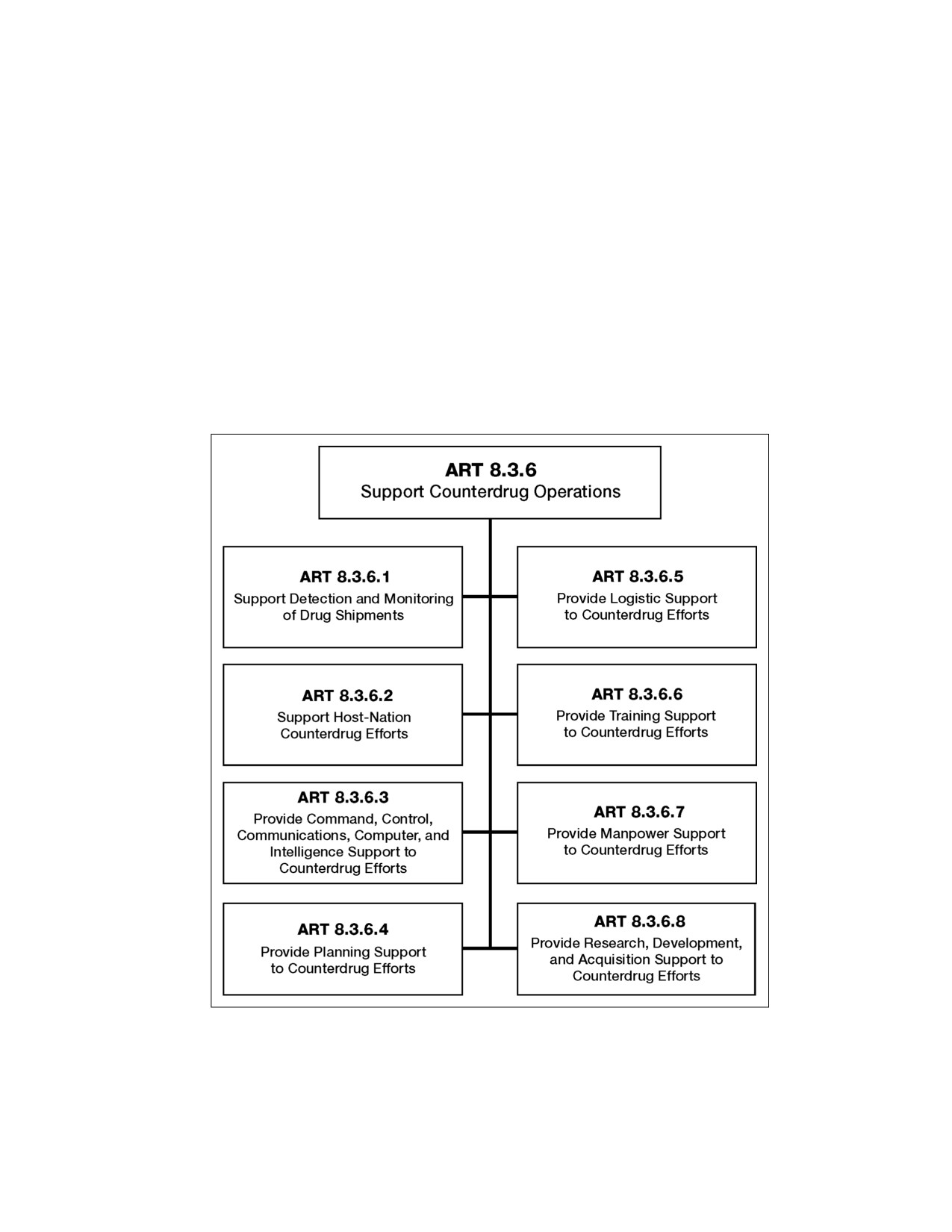
ART 8.3.6 SUPPORT COUNTERDRUG OPERATIONS
8-54. The Army participates in counterdrug operations under provisions of
the national drug control strategy. Army forces may be employed in a variety
of operations to support other agencies responsible for detecting, disrupting,
8-17
FM 7-15__________________________________________________________________________
interdicting, and destroying illicit drugs and the infrastructure (personnel,
materiel, and distribution systems) of illicit drug-trafficking entities. When
conducted inside the United States and its territories, they are domestic
support operations. When conducted outside the United States and its
territories, counterdrug operations are considered stability operations. Army
forces do not engage in direct action in counterdrug operations. Units that
support counterdrug operations comply with US and foreign legal limitations
concerning the acquisition of information on civilians and the conduct of law
enforcement activities. (FM 3-07) (USACAC)
ART 8.3.6.1
SUPPORT DETECTION AND MONITORING OF DRUG SHIPMENTS
8-55. Provide aerial and ground reconnaissance to support counterdrug
operations by law enforcement agencies. The goal is to provide early
notification to—and, as necessary, prolonged tracking of—aerial and surface
targets for appropriate law enforcement agencies. This support enables law
enforcement agencies to conduct interceptions, searches, arrests of
traffickers, and seizures of illegal drugs and illegally obtained property.
Aerial reconnaissance may be conducted with fixed or rotary wing aircraft,
unmanned aerial vehicles, or ground-based radars. Land reconnaissance may
be conducted by observation posts, patrols, ground surveillance radars, and
remote ground sensors. (FM 3-07) (USACAC)
ART 8.3.6.2
SUPPORT HOST-NATION COUNTERDRUG EFFORTS
8-56. Army forces support counterdrug efforts indirectly through civilian
agencies of the US government and the civilian or military organizations of
the host country. Overseas, Army forces may engage in two kinds of support
to foreign countries: security assistance and civil-military operations. Most
counterdrug efforts support US foreign internal defense initiatives. Security
assistance support for counterdrug operations includes equipment, services,
and training. Civil-military operations can enhance US counterdrug
operations in foreign countries, primarily through civil affairs and
psychological operations activities. (FM 3-07) (USACAC)
ART 8.3.6.3
PROVIDE COMMAND, CONTROL, COMMUNICATION, COMPUTER,
AND INTELLIGENCE SUPPORT TO COUNTERDRUG EFFORTS
8-57. Army personnel and equipment may assist law enforcement agencies
and host nations in designing, implementing, and integrating command,
control, communication, computer, and intelligence systems. Army personnel
support national and departmental drug operations and law enforcement
agency analytical centers. In addition, Army forces provide liaison to law
enforcement agencies and host nations to facilitate smooth and successful
integration of military support. Army units and personnel provide
intelligence support targeted at the full range of narcotics traffickers’
operations. The principal means of providing this support is through tactical
analysis teams. These teams co-locate with the US country team, support law
enforcement agencies, and provide focused detection and monitoring of
narcotics trafficking activities. (FM 3-07) (USACAC)
ART 8.3.6.4 PROVIDE PLANNING SUPPORT TO COUNTERDRUG EFFORTS
8-58. Army personnel support counterdrug planning of both law enforcement
agencies and host nations. Understanding the supported agency or host
8-18
________________________________________
ART 8.0: Conduct Tactical Mission Tasks and Operations
nation, including its culture and people, is critical. Planning support
provided to law enforcement agencies must take into account the
organization’s mission, current goals, structure or chain of command,
measures of success, and relationships with other governmental agencies or
countries. Planning support provided to host nations is similar to that
provided to domestic law enforcement agencies. However, the host nation’s
culture, historical perspectives, political climate, and the economic conditions
are also considered. (FM 3-07) (USACAC)
ART 8.3.6.5
PROVIDE LOGISTIC SUPPORT TO COUNTERDRUG EFFORTS
8-59. Army forces can assist law enforcement agencies or host nations during
their conduct of counterdrug operations with logistic management and
execution. This includes transportation, maintenance, engineer design and
construction, use of facilities, equipment loans, or military working dog
support. Army forces can provide supplies and field services directly, if
authorized, or assist other agencies in procuring and managing them from
other sources. Commanders who assist law enforcement with transportation
of evidence, seized property, or contraband must be aware that a law
enforcement officer must accompany the shipment to ensure continuity of the
chain of custody. (FM 3-07) (USACAC)
ART 8.3.6.6
PROVIDE TRAINING SUPPORT TO COUNTERDRUG EFFORTS
8-60. Training support to law enforcement agencies and host nations
includes basic military skills, such as basic marksmanship, patrolling,
mission planning, medical, and survival skills. Commanders provide support
using a mix of mobile training teams; participation in operations planning
groups, joint and/or combined exercises, institutional training, non-
institutional training, and training simulations; and by providing extended
training service specialists. (FM 3-07) (USACAC)
ART 8.3.6.7
PROVIDE MANPOWER SUPPORT TO COUNTERDRUG EFFORTS
8-61. Army forces may provide a variety of individuals or units to support
host-nation and interagency counterdrug efforts. Categories of manpower
support are eradication, administrative—including staff judge advocate
officers, legal specialists, and accounting specialists— linguist, liaison officer,
inspection, military police, and intelligence analyst. (FM 3-07) (USACAC)
ART 8.3.6.8.
PROVIDE RESEARCH, DEVELOPMENT, AND ACQUISITION SUPPORT
TO COUNTERDRUG EFFORTS
8-62. The Army Counterdrug Research, Development, and Acquisition Office
makes military research, development, and acquisition efforts available to
law enforcement agencies. It informs them of new technical capabilities that
have possible law enforcement application. It can also assist them in
contracting and procuring technical equipment. (FM 3-07) (USACAC)
8-19
FM 7-15__________________________________________________________________________
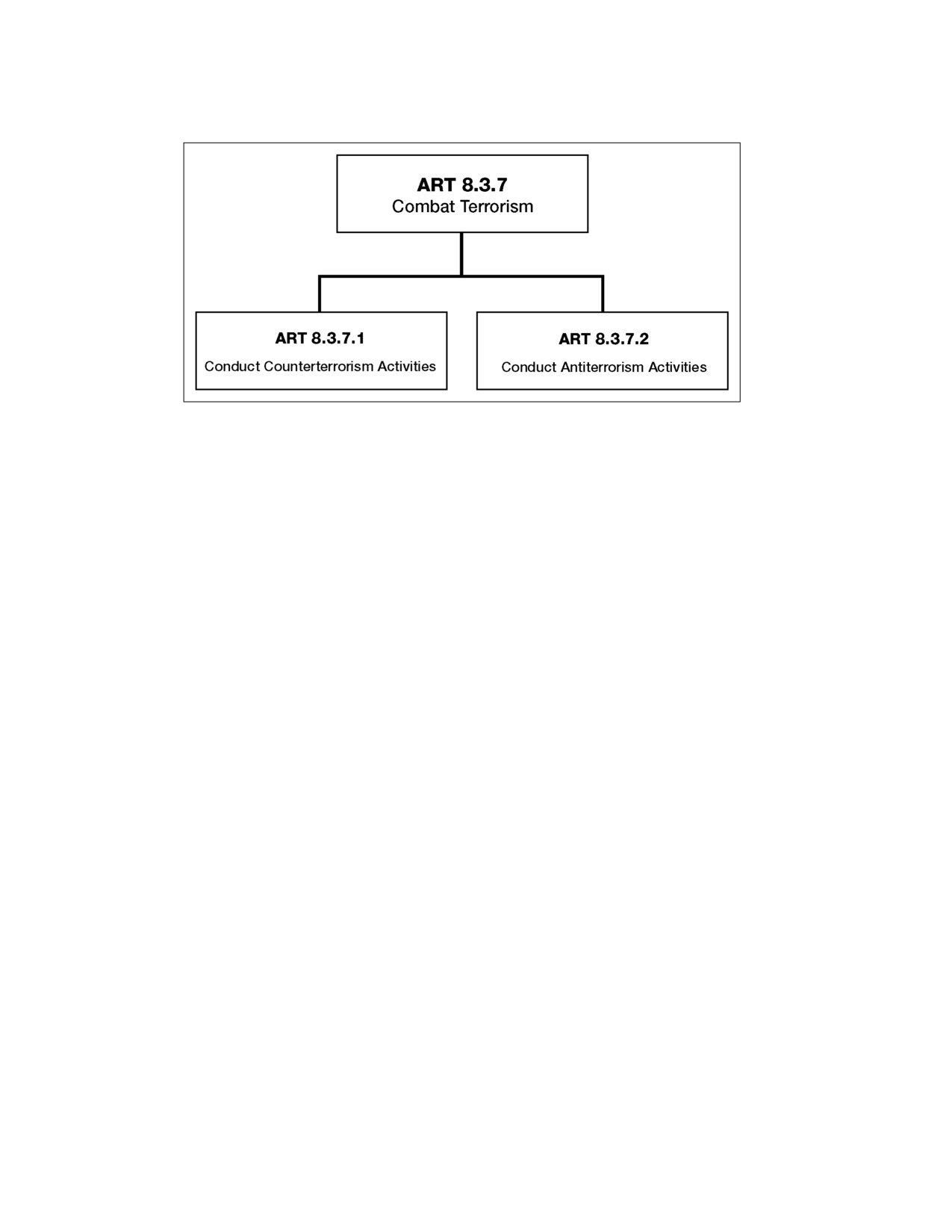
ART 8.3.7
COMBAT TERRORISM
8-63. Terrorism is the calculated use of unlawful violence or threat of
unlawful violence to inculcate fear. It is intended to coerce or intimidate
governments or societies in pursuit of goals that are generally political,
religious, or ideological. Enemies who cannot compete with Army forces
conventionally often turn to terrorist tactics. Terrorist attacks often create a
disproportionate effect on even the most capable conventional forces. The
tactics used by terrorists range from arson to the use of weapons of mass
destruction. Army forces routinely conduct operations to deter or defeat these
attacks. Offensively oriented operations are categorized as counterterrorism;
defensively oriented operations are antiterrorism. (FM 3-07) (USACAC)
ART 8.3.7.1
CONDUCT COUNTERTERRORISM ACTIVITIES
8-64. Counterterrorism is offensive measures taken to prevent, deter, and
respond to terrorism. Army forces participate in the full array of
counterterrorism actions, including strikes and raids against terrorist
organizations and facilities outside the United States and its territories.
Counterterrorism is a specified mission for selected special operations forces
that operate under direct control of the president or secretary of defense or
under a combatant command arrangement. Public law assigns the lead for
counterterrorism within the United States to the FBI and outside the United
States to the Department of State. Commanders who employ conventional
forces against organized terrorist forces operating within their areas of
operations are conducting conventional offensive operations, not
counterterrorism operations. (FM 3-07) (USACAC)
ART 8.3.7.2
CONDUCT ANTITERRORISM ACTIVITIES
8-65. Antiterrorism reduces the vulnerability of individuals and property to
terrorist attacks, including limited response and containment by local
military forces. Antiterrorism is a consideration for all forces during all types
of military operations. These actions occur throughout the world and are
closely linked to ART 6.0 (Combat Service Support Battlefield Operating
System). (FM 3-07) (USACAC)
8-20
________________________________________
ART 8.0: Conduct Tactical Mission Tasks and Operations
ART 8.3.8
PERFORM NONCOMBATANT EVACUATION OPERATIONS
8-66. NEOs relocate threatened civilian noncombatants from locations in a
foreign nation to secure areas. Normally, these operations involve US citizens
whose lives are in danger, either from the threat of hostilities or from a
natural disaster. They may also include host-nation citizens and third
country nationals. Army forces, normally as part of a joint task force, conduct
NEOs to assist and support the Department of State. NEOs usually involve
swift insertions of a force, temporary occupation of an objective, and a
planned withdrawal upon completion of the mission. A NEO can take place in
three environments (permissive, uncertain, or hostile). The environment in
which a NEO occurs can quickly change from one to another with little
warning. The commander conducting a NEO must prepare to operate in all
three environments. This task includes combat service support functions
involving emergency medical treatment, transportation, administrative
processing, and coordination with the Department of State and other
agencies involved in the evacuation. Task organization for NEO is based on
the operational environment in which the action is conducted. However, since
the environment can change rapidly, the permissive form of NEO can become
uncertain or hostile. (FM 3-07) (USACAC)
ART 8.3.9
CONDUCT ARMS CONTROL OPERATIONS
8-67. Army forces normally conduct arms control operations to support arms
control treaties and enforcement agencies. Army forces can assist in locating,
seizing, and destroying weapons of mass destruction after hostilities. Other
actions include escorting deliveries of weapons and material
(such as
enriched uranium) to preclude loss or unauthorized use, inspecting and
monitoring production and storage facilities, and training foreign forces to
secure weapons and facilities. Army forces may conduct arms control
operations to prevent escalation of a conflict and reduce instability. This
could include the mandated disarming of belligerents as part of a peace
operation. (FM 3-07) (USACAC)
ART 8.3.10
CONDUCT A SHOW OF FORCE
8-68. Shows of force are flexible deterrence options designed to demonstrate
US resolve. They involve increasing the visibility of US deployed forces to
defuse a situation that, if allowed to continue, may be detrimental to national
interests or objectives. The United States conducts shows of force for three
reasons: to bolster or reassure allies, deter potential aggressors, and gain or
increase influence. Shows of force demonstrate a credible and specific threat
to an aggressor or potential aggressor. They involve increasing the visibility
of US forces in the eyes of the target audience through establishing an area
presence and conducting exercises and demonstrations. Presence patrols
conducted by small tactical units are one technique of conducting shows of
force. Although actual combat is not desired, shows of force can rapidly and
unexpectedly escalate. Therefore, units assigned a show of force mission
assume that combat is probable and prepare accordingly. All actions
ordinarily associated with the projection of a force to conduct combat
operations pertain to show of force deployments. (FM 3-07) (USACAC)
8-21
FM 7-15__________________________________________________________________________
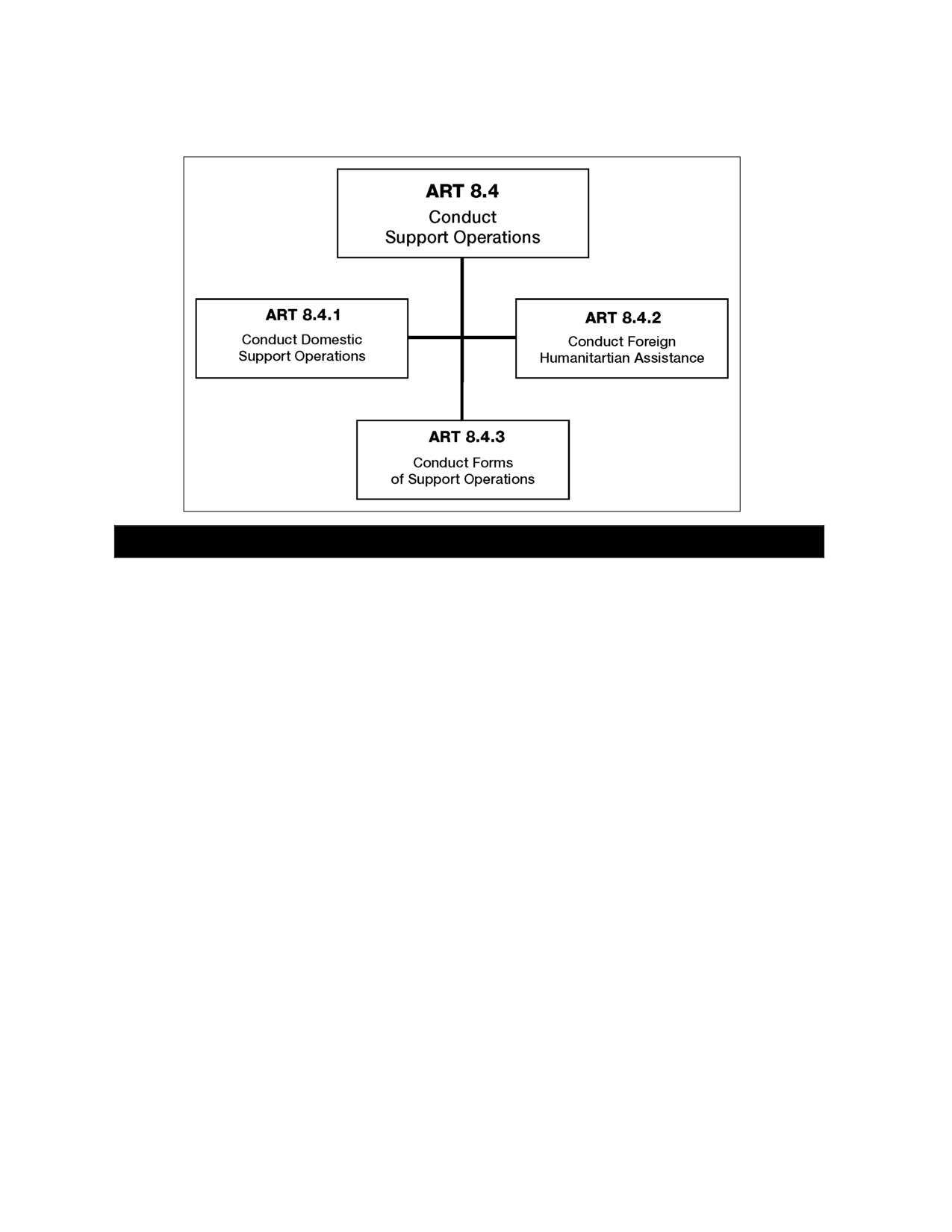
SECTION IV - ART 8.4: CONDUCT SUPPORT OPERATIONS
8-69. Army forces conduct support operations to assist civil authorities,
foreign or domestic, as they prepare for or respond to crises and relieve
suffering. In support operations, Army forces provide essential support,
services, and assets, or specialized resources, to help civil authorities deal
with situations beyond their capabilities. The purpose of support operations
is to meet the immediate needs of designated groups for a limited time, until
civil authorities are able to do so without Army assistance. In extreme or
exceptional cases, Army forces may provide relief or assistance directly to
those in need. More commonly, Army forces help civil authorities or
nongovernmental organizations provide the required support. Army forces
often conduct support operations as stand-alone missions. However, most
offensive, defensive, and stability operations require complementary support
operations before, during, and after execution. There are two types of support
operations: domestic support operations and foreign humanitarian
assistance. (FM 3-0) (USACAC)
ART 8.4.1 CONDUCT DOMESTIC SUPPORT OPERATIONS
8-70. Domestic support operations provide DOD support to civil authorities
in domestic emergencies, as well as for designated law enforcement and other
activities. They include activities and measures taken by DOD to foster
mutual assistance and support between DOD and any civil government
agency in planning or preparedness for, or in the application of resources for
response to, the consequences of civil emergencies or attacks, including
national security emergencies. Domestic support operations only occur within
the United States and its territories. Army support to domestic support
operations supplements the efforts and resources of state and local
governments and organizations. A presidential declaration of a major
8-22
________________________________________
ART 8.0: Conduct Tactical Mission Tasks and Operations
disaster or emergency usually precedes domestic support operations.
Domestic support operations require extensive coordination and liaison
among many organizations—interagency, joint, active component, and
reserve component—as well as with state and local governments. (FM 3-07)
(USACAC)
ART 8.4.2
CONDUCT FOREIGN HUMANITARIAN ASSISTANCE
8-71. Foreign humanitarian assistance operations occur outside the United
States and its territories. Army forces usually conduct them to relieve or
reduce the results of natural or manmade disasters. They also relieve
conditions—such as pain, disease, hunger, or privation—that present a
serious threat to life or loss of property. Army forces supplement or
complement efforts of host-nation civil authorities or other agencies that
provide assistance. Army forces participate in foreign humanitarian
assistance operations that may be unilateral, multinational, or United
Nations-coordinated responses. Foreign humanitarian assistance is limited
in scope and duration. It focuses exclusively on prompt aid to resolve an
immediate crisis. Longer-term activities designed to support full recovery
and a return to predisaster conditions will normally become part of a
combatant commander’s theater engagement plan. In such cases, a foreign
humanitarian assistance operation transitions to a stability operation. (FM
3-07) (USACAC)
8-23
FM 7-15__________________________________________________________________________
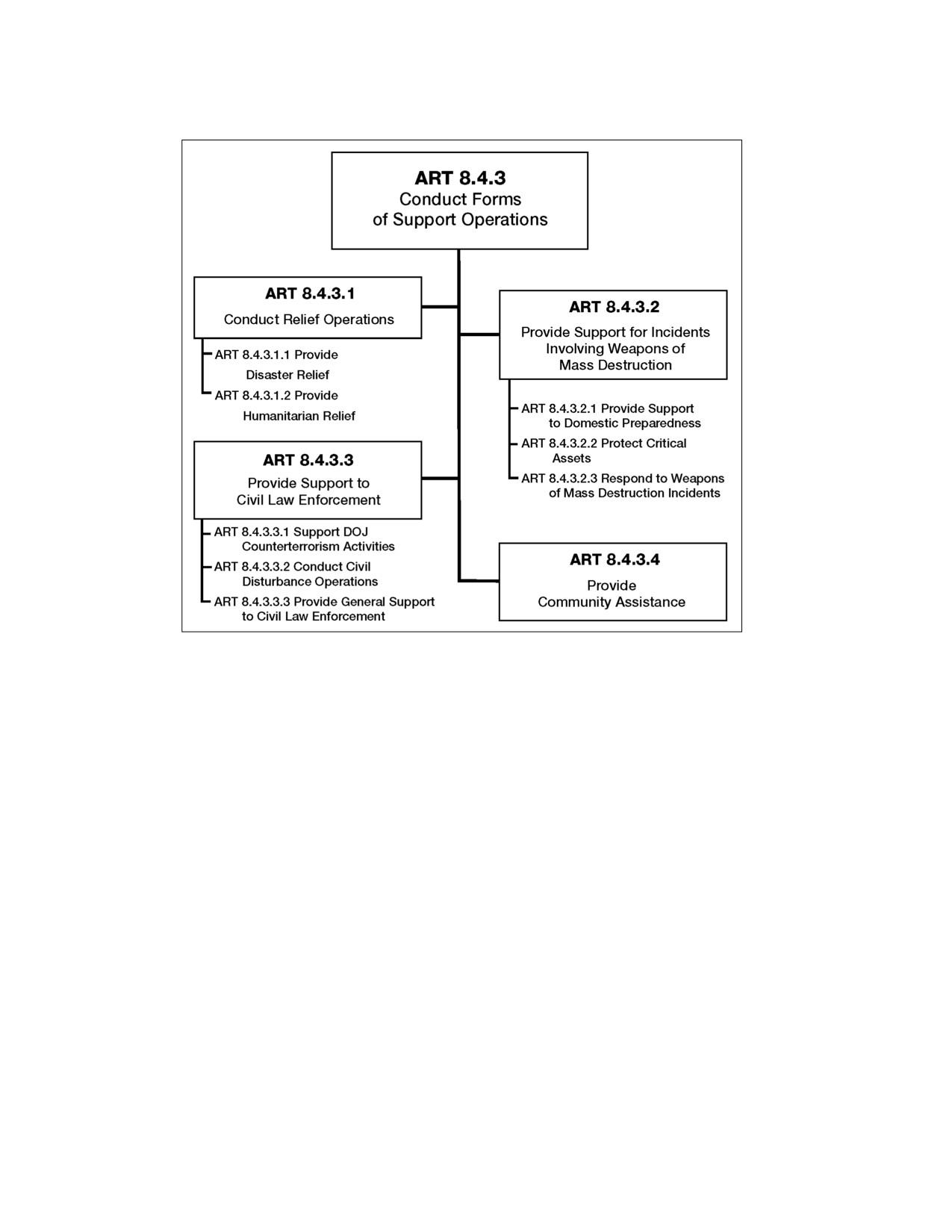
ART 8.4.3 CONDUCT FORMS OF SUPPORT OPERATIONS
8-72. Army forces involved in support operations execute overlapping forms
of support operations. The forms of support operations are relief operations,
support for incidents involving weapons of mass destruction, support to civil
law enforcement, and community assistance. (FM 3-07) (USACAC)
ART 8.4.3.1 CONDUCT RELIEF OPERATIONS
8-73. Disaster relief operations focus on recovery of critical infrastructure
after natural or manmade disasters. Humanitarian relief focuses on the well-
being of supported populations. Both normally occur simultaneously. In the
case of a disaster, state, local, and host-nation authorities are responsible for
restoring essential services. (FM 3-07) (USACAC)
ART 8.4.3.1.1 Provide Disaster Relief
8-74. Disaster relief restores or recreates essential infrastructure. It includes
establishing and maintaining the minimum safe working conditions, less
security measures, necessary to protect relief workers and the affected
population. (Overseas, Army forces may provide security as part of a stability
operation.) Disaster relief allows effective humanitarian relief and creates
the conditions for long-term recovery. It may involve consultation on and
provision of emergency medical treatment and evacuation; repairing or
demolishing damaged structures; restoring or building bridges, roads, and
airfields; and removing debris from supply routes and relief sites. (FM 3-07)
(USACAC)
8-24
________________________________________
ART 8.0: Conduct Tactical Mission Tasks and Operations
ART 8.4.3.1.2 Provide Humanitarian Relief
8-75. Humanitarian relief focuses on lifesaving measures that alleviate the
immediate needs of a population in crisis. It often includes providing medical
support, food, water, medicine, clothing, blankets, shelter, and heating or
cooking fuels. In some cases, it involves transporting affected people from a
disaster area. Civilian relief agencies, governmental and nongovernmental,
are best suited to provide this type of relief. Army forces conducting
humanitarian relief usually facilitate civil relief efforts. (FM 3-07) (USACAC)
ART 8.4.3.2 PROVIDE SUPPORT FOR INCIDENTS INVOLVING WEAPONS OF MASS
DESTRUCTION
8-76. Weapons of mass destruction incidents involve a nuclear, biological,
chemical, or radiological weapon or device, or a large conventional explosive,
that produces catastrophic loss of life or property. They are deliberate or
unintentional. Until it is determined that the damaged site does not contain
a radiological, biological or chemical agent, a large explosive event may be
handled as a weapons of mass destruction incident. Army forces assist civil
authorities in protecting US territory, population, and infrastructure before
an attack by supporting domestic preparedness and protection of critical
assets. When directed by DOD, Army forces can respond to a weapons of
mass destruction incident and deal with the consequences of the event. (FM
3-07) (USACAC)
ART 8.4.3.2.1
Provide Support to Domestic Preparedness
8-77. The National Domestic Preparedness Office, under the Federal
Emergency Management Agency (FEMA), orchestrates the national domestic
preparedness effort. Army forces have an important role in aiding domestic
preparedness efforts at the local, state, and federal level. These efforts
strengthen the existing expertise of civil authorities through training. They
also provide the expert assistance necessary to respond to nuclear, biological,
or chemical incidents. Army forces provide training to enhance state and
local emergency response capabilities so they can respond to incidents. An
interagency agreement establishes the Department of Justice as domestic
preparedness coordinator. (FM 3-07) (USACAC)
ART 8.4.3.2.2
Protect Critical Assets
8-78. Hostile forces may attack facilities essential to society, the government,
and the military. These assaults can disrupt civilian commerce, government
operations,
and military capabilities. Critical assets include
telecommunications, electric power, public health services and facilities, gas
and oil, banking and finance, transportation, water, emergency services, and
government continuity. DODD 5160.54 identifies specific civil infrastructure
assets necessary to conduct military operations. The integrity, availability,
survivability, and capability of these assets are vital for conducting full
spectrum operations. In conjunction with civil law enforcement, Army forces
may protect these assets or temporarily restore lost capability. Army
involvement complements and leverages related interagency programs and
activities. (FM 3-07) (USACAC)
8-25
FM 7-15__________________________________________________________________________
ART 8.4.3.2.3 Respond to Weapons of Mass Destruction Incidents
8-79. Other government agencies have primary responsibility for responding
to domestic terrorist and weapons of mass destruction incidents. Local
authorities will be the first to respond to a weapons of mass destruction
incident. However, Army forces have a key supporting role and can quickly
respond when authorized. For example, the Army National Guard has
specialized weapons of mass destruction response teams that act as advance
parties to facilitate follow-on deployment of other DOD assets. In a
permissive overseas environment, the National Command Authorities may
make Army assets available to assist a foreign government after a weapons
of mass destruction incident. Such assistance may be linked to concurrent
relief operations. The different responsibilities of DOD and other agencies
are established in federal law, the Federal Response Plan (to include its
terrorist incident annex), other federal plans, and joint doctrine and
directives. The resources required for dealing with weapons of mass
destruction incidents differ from those needed during conventional disasters.
(FM 3-07) (USACAC)
ART 8.4.3.3
PROVIDE SUPPORT TO CIVIL LAW ENFORCEMENT
8-80. Support to domestic civil law enforcement involves activities related to
the Department of Justice’s counterterrorism activities, counterdrug,
military assistance during civil disturbances, and general support. Army
support involves providing resources, training, or augmentation. Federal
military forces remain under the military chain of command while supporting
civil law enforcement. The supported law enforcement agency coordinates
Army force activities in accordance with appropriate civil laws and
interagency agreements. Army National Guard units in state status can be a
particularly useful military resource. They may be able to provide assistance
to civil authorities when federal units cannot due to the Posse Comitatus Act.
Title 10 USC prohibits the military from directly participating in arrests,
searches, seizures, or other similar activities unless authorized by law. (FM
3-07) (USACAC)
Note. Army missions related to supporting civil law enforcement in
counterdrug operations are discussed under ART
8.
3.6, Support
Counterdrug Operations.
ART 8.4.3.3.1
Support Department of Justice Counterterrorism Activities
8-81. When directed by the National Command Authorities, Army forces may
provide assistance to the Department of Justice in the areas of
transportation, equipment, training, and personnel. When terrorists pose an
imminent threat, Army forces may be used to counter these threats. Army
forces may also support crisis management. Crisis management of a terrorist
incident includes measures to resolve a situation and investigate a criminal
case for prosecution under federal law. The FBI is the lead agency and has
responsibility for crisis management within the United States. Army forces
may provide specialized or technical capabilities to assist in defusing or
resolving a terrorist crisis. Support of crisis management includes opening
lines of communication for military assistance, evacuating casualties,
reconnaissance, and decontaminating or assessing the effects of weapons of
8-26
________________________________________
ART 8.0: Conduct Tactical Mission Tasks and Operations
mass destruction. In the aftermath of a terrorist incident, Army forces may
be involved in consequence management activities. These activities include
casualty and medical assistance, evaluation and repair of damage to
structures and utilities, explosive ordnance disposal, and mortuary affairs.
(FM 3-07) (USACAC)
ART 8.4.3.3.2
Conduct Civil Disturbance Operations
8-82. The Army assists civil authorities in restoring law and order when
state and local law enforcement agencies are unable to control civil
disturbances. The Army National Guard is the first military responder
during most civil disturbance situations. It usually remains on state active-
duty status throughout the operation. When the conditions of domestic
violence and disorder endanger life and property to the extent that state law
enforcement agencies, to include the Army National Guard, cannot suppress
violence and restore law and order, the president may federalize Army
National Guard units under Title 10 USC, Chapter 15. The president may
use federalized Army National Guard and federal forces to restore law and
order. Restrictions may be placed on federal military forces, either in the
presidential executive order directing their use or through the rules for the
use of force outlined in the DOD Civil Disturbance Plan (Garden Plot). (FM
3-07) (USACAC)
ART 8.4.3.3.3
Provide General Support to Civil Law Enforcement
8-83. Provide limited military support to law enforcement agencies. DOD
may direct Army forces to provide training to federal, state, and local civilian
law enforcement agencies. Such assistance may include training in the
operation and maintenance of military equipment. (FM 3-07) (USACAC)
ART 8.4.3.4 PROVIDE COMMUNITY ASSISTANCE
8-84. Community assistance is a broad range of activities that provide
support and maintain a strong connection between the military and civilian
communities. Community assistance activities provide effective means of
projecting a positive military image, providing training opportunities, and
enhancing the relationship between the Army and the American public. They
should fulfill community needs that would not otherwise be met. Community
assistance activities can enhance individual and unit combat readiness.
Army assistance to the community can include the following services: air
ambulance support, search and rescue, firefighting capability, explosive
ordnance disposal, emergency or broad-based medical care, wildlife and
domestic animal management, assistance in safety and traffic control,
emergency snow removal, temporary supplemental housing for the displaced
or disadvantaged, postal augmentation. (FM 3-0) (USACAC)
8-27
FM 7-15__________________________________________________________________________
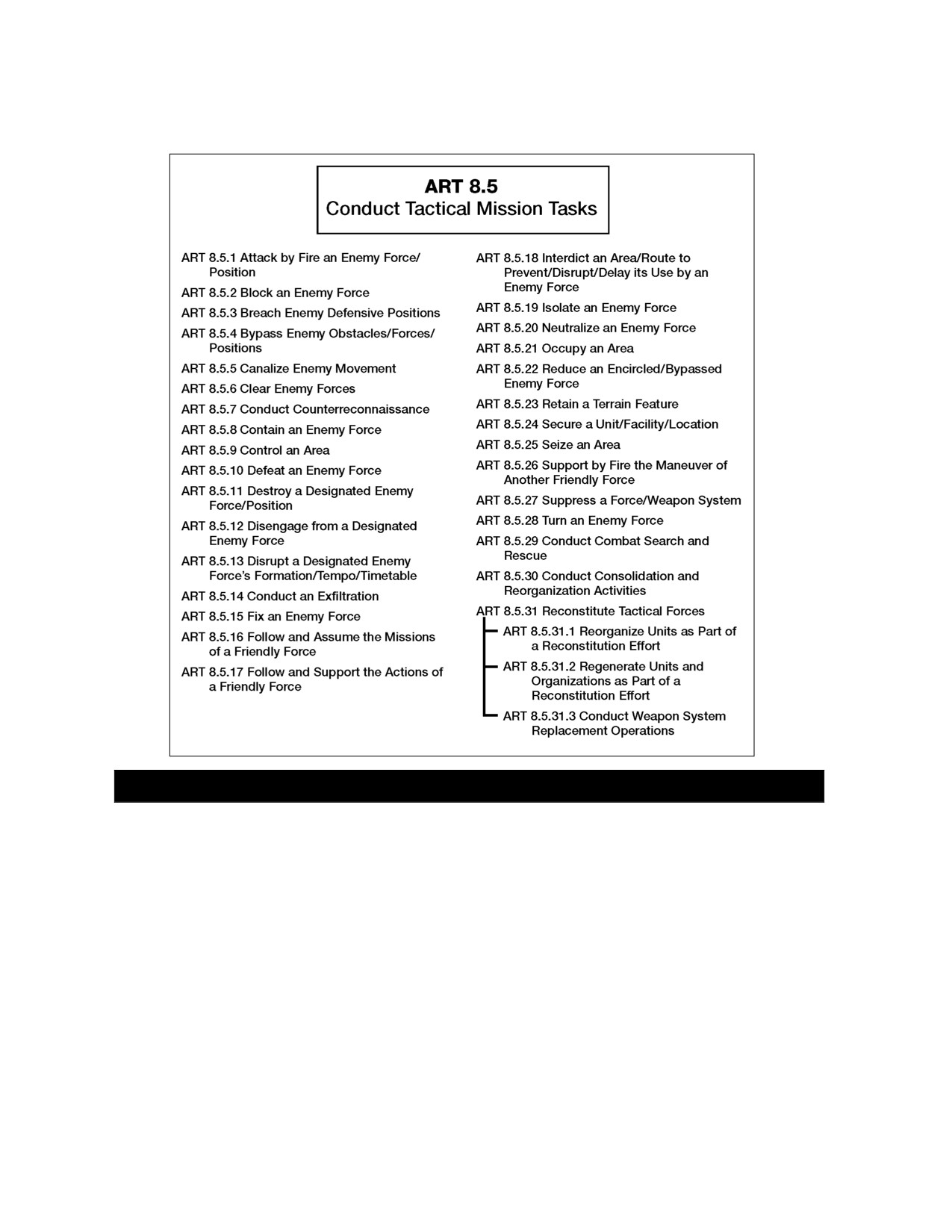
SECTION V - ART 8.5: CONDUCT TACTICAL MISSION TASKS
8-85. Tactical mission tasks describe the results or effects the commander
wants to achieve—the what or why of a mission statement. These tasks have
specific military definitions that are different from those found in a
dictionary. The tasks in this section are often given to small units as the
tasks or purpose parts of their mission statement. (FM 3-90) (USACAC)
ART 8.5.1 ATTACK BY FIRE AN ENEMY FORCE/POSITION
8-86. Attack by fire uses direct fires, supported by indirect fires, to engage an
enemy without closing with him to destroy, suppress, fix, or deceive him. (FM
3-90) (USACAC)
ART 8.5.2 BLOCK AN ENEMY FORCE
8-87. Block denies the enemy access to an area or prevents his advance in a
direction or along an avenue of approach. (FM 3-90) (USACAC)
8-28
________________________________________
ART 8.0: Conduct Tactical Mission Tasks and Operations
ART 8.5.3
BREACH ENEMY DEFENSIVE POSITIONS
8-88. Breach employs all available means to break through or secure a
passage through a defense, obstacle, minefield, or fortification. (FM 3-90)
(USACAC)
ART 8.5.4
BYPASS ENEMY OBSTACLES/FORCES/POSITIONS
8-89. Bypass is when the commander directs his unit to maneuver around an
obstacle, position, or enemy force to maintain the momentum of the
operation, while deliberately avoiding combat with the enemy force. (FM 3-
90) (USACAC)
ART 8.5.5
CANALIZE ENEMY MOVEMENT
8-90. Canalize is when the commander restricts enemy movement to a
narrow area by exploiting terrain, obstacles, fires, or friendly maneuver. (FM
3-90) (USACAC)
ART 8.5.6
CLEAR ENEMY FORCES
8-91. Clear requires the commander to remove all enemy forces and
eliminate organized resistance within an assigned area. The physical
conditions of the area will affect the specific tactics, techniques, and
procedures employed. (FM 3-90) (USACAC)
ART 8.5.7
CONDUCT COUNTERRECONNAISSANCE
8-92. Counterreconnaissance encompasses all measures taken by a
commander to counter enemy reconnaissance and surveillance efforts.
Counterreconnaissance is not a distinct mission, but a component of all forms
of security operations. (See ART 5.3.5, Conduct Security Operations) (FM 3-
90) (USACAC)
ART 8.5.8
CONTAIN AN ENEMY FORCE
8-93. Contain requires the commander stop, hold, or surround enemy forces;
or cause them to focus their activity on a given front and prevent them from
withdrawing any element for use elsewhere. (FM 3-90) (USACAC)
ART 8.5.9
CONTROL AN AREA
8-94. Control requires the commander to maintain physical influence over a
specified area to prevent its use by an enemy. (FM 3-90) (USACAC)
ART 8.5.10 DEFEAT AN ENEMY FORCE
8-95. Defeat occurs when an enemy force has temporarily or permanently
lost the physical means or will to fight. The defeated force’s commander is
unwilling or unable to pursue his adopted course of action, thereby yielding
to the friendly commander’s will and can no longer interfere to a significant
degree with the actions of friendly forces. Defeat can result from the use of
force or the threat of its use. (FM 3-90) (USACAC)
8-29
FM 7-15__________________________________________________________________________
ART 8.5.11 DESTROY A DESIGNATED ENEMY FORCE/POSITION
8-96. Destroy involves the physical rendering of an enemy force to combat
ineffectiveness until it is reconstituted. Alternatively, to destroy a combat
system is to damage it so badly that it cannot perform its function or be
restored to a usable condition without being entirely rebuilt. (FM 3-90)
(USACAC)
ART 8.5.12 DISENGAGE FROM A DESIGNATED ENEMY FORCE
8-97. Disengagement is when a commander has his unit break contact with
the enemy to allow the conduct of another mission or to avoid decisive
engagement. (FM 3-90) (USACAC)
ART 8.5.13 DISRUPT A DESIGNATED ENEMY FORCE’S FORMATION/
TEMPO/TIMETABLE
8-98. Disrupt is when a commander integrates direct and indirect fires,
terrain, and obstacles to upset an enemy formation or tempo, interrupt his
timetable, or cause his forces to commit prematurely or attack in a piecemeal
fashion. (FM 3-90) (USACAC)
ART 8.5.14 CONDUCT AN EXFILTRATION
8-99. Exfiltrate is where a commander removes personnel or units from
areas under enemy control by stealth, deception, surprise, or clandestine
means. (FM 3-90) (USACAC)
ART 8.5.15 FIX AN ENEMY FORCE
8-100. Fix is where a commander prevents the enemy from moving any part
of his force from a specific location for a specific period of time. (FM 3-90)
(USACAC)
ART 8.5.16 FOLLOW AND ASSUME THE MISSIONS OF A FRIENDLY
FORCE
8-101. Follow and assume is when a second committed force follows a force
conducting an offensive operation and is prepared to continue the mission of
that force when it becomes fixed, attritted, or otherwise unable to continue.
(FM 3-90) (USACAC)
ART 8.5.17 FOLLOW AND SUPPORT THE ACTIONS OF A FRIENDLY
FORCE
8-102. Follow and support is when a committed force follows and supports
the mission accomplishment of a leading force conducting an offensive
operation. (FM 3-90) (USACAC)
8-30
________________________________________
ART 8.0: Conduct Tactical Mission Tasks and Operations
ART 8.5.18 INTERDICT AN AREA/ROUTE TO PREVENT/DISRUPT/
DELAY ITS USE BY AN ENEMY FORCE
8-103. Interdict is where the commander prevents, disrupts, or delays
enemy use of an area or route. (FM 3-90) (USACAC)
ART 8.5.19 ISOLATE AN ENEMY FORCE
8-104. Isolate requires a unit to seal off—physically and psychologically—an
enemy force from its sources of support, deny it freedom of movement, and
prevent it from contacting other enemy forces. (FM 3-90) (USACAC)
ART 8.5.20 NEUTRALIZE AN ENEMY FORCE
8-105. Neutralize results in rendering enemy personnel or materiel
incapable of interfering with friendly operations. (FM 3-90) (USACAC)
ART 8.5.21 OCCUPY AN AREA
8-106. Occupy involves moving a force into an area so that it can control the
entire area. Both the movement to and occupation of the area occurs without
opposition. (FM 3-90) (USACAC)
ART 8.5.22 REDUCE AN ENCIRCLED/BYPASSED ENEMY FORCE
8-107. Reduce involves the destruction of an encircled or bypassed enemy
force. (FM 3-90) (USACAC)
ART 8.5.23 RETAIN A TERRAIN FEATURE
8-108. Retain is when the commander ensures a terrain feature already
controlled by a friendly force remains free of enemy occupation or use. (FM 3-
90) (USACAC)
ART 8.5.24 SECURE A UNIT/FACILITY/LOCATION
8-109. Secure involves preventing the enemy from damaging or destroying a
unit, facility, or geographical location. (FM 3-90) (USACAC)
ART 8.5.25 SEIZE AN AREA
8-110. Seize involves taking possession of an area using overwhelming force.
(FM 3-90) (USACAC)
ART 8.5.26 SUPPORT BY FIRE THE MANEUVER OF ANOTHER
FRIENDLY FORCE
8-111. Support by fire is when a maneuver force moves to a position where it
can engage the enemy by direct fire to support another maneuvering force.
(FM 3-90) (USACAC)
8-31
FM 7-15__________________________________________________________________________
ART 8.5.27 SUPPRESS A FORCE/WEAPON SYSTEM
8-112. Suppression results in the temporary degradation of the performance
of a force or weapon system below the level needed to accomplish its mission.
(FM 3-90) (USACAC)
ART 8.5.28 TURN AN ENEMY FORCE
8-113. Turn involves forcing an enemy force to move from one avenue of
approach or movement corridor to another. (FM 3-90) (USACAC)
ART 8.5.29 CONDUCT COMBAT SEARCH AND RESCUE
8-114. Locate and extract distressed personnel (military, civilian, or foreign
nationals) and sensitive equipment from enemy controlled or contested areas
during wartime or contingency operations to prevent capture. This task
includes peacetime search and rescue and the conduct of unconventional
assisted recovery. (FM 100-25) (USAJFKSWCS)
ART 8.5.30 CONDUCT CONSOLIDATION AND REORGANIZATION
ACTIVITIES
8-115. After the end of a tactical mission, the unit involved reorganizes
itself. It determines the extent of losses; redistributes personnel, supplies,
and equipment; reestablishes an effective chain of command; and establishes
tactically viable defensive positions. (FM 3-90) (USACAC)
ART 8.5.31 RECONSTITUTE TACTICAL FORCES
8-116. Take action to return a unit to an acceptable level of combat power
based on the unit mission and available resources. Reconstitution transcends
normal day-to-day sustainment activities and consists of two categories—
reorganization and regeneration. (FM 100-9) (CASCOM)
ART 8.5.31.1
Reorganize Units as Part of a Reconstitution Effort
8-117. Shift internal resources within a degraded unit to increase its overall
level of combat effectiveness. Cross-level equipment and personnel, match
operational weapons systems with crews, and form composite units (by
joining two or more attrited units to form a single full-strength or
overstrength unit) as necessary. (FM 100-9) (CASCOM)
ART 8.5.31.2
Regenerate Units and Organizations as Part of a Reconstitution Effort
8-118. Rebuild a subordinate unit through replacement of small units (crew
to company), including leaders and equipment; large-scale replacement of
personnel, equipment, and supplies; reestablishment or replacement of
essential C2; and conducting mission essential training for the newly rebuilt
unit. Regeneration usually requires moving the unit to a secure area. (FM
100-9) (CASCOM)
ART 8.5.31.3
Conduct Weapon System Replacement Operations
8-119. Provide fully operational replacement weapons systems. Weapon
system replacement operations include producing a ready-to-fight weapon
system by linking up a ready-for-issue weapon system with the necessary
8-32
________________________________________
ART 8.0: Conduct Tactical Mission Tasks and Operations
ammunition, crew, ranges, and time. It also includes moving and integrating
ready-to-fight weapons systems into new organizations.
(FM
100-9)
(CASCOM)
8-33
Glossary
AAFES
Army and Air Force Exchange Service
AAR
after action review
ABCS
Army Battle Command System
A/DACG
Arrival/Departure Airfield Control Group
AO
area of operations
AOI
area of interest
APOD
aerial port of debarkation
APOE
aerial port of embarkation
ART
Army tactical task
ARTEP
Army Training and Evaluation Program
AUEL
Automated United Equipment List
AUTL
Army Universal Task List
BDA
battle damage assessment
BOS
Battlefield Operating System
CADD
Combined Arms Doctrine Directorate
CASCOM-DPMO
Combined Arms Support Command—Deployment Process
Modernization Office
C2
Command and Control
CBRNE
chemical, biological, radiological, nuclear, and enhanced high
explosives
CCIR
Commander’s Critical Information Requirement
CI
counterintelligence
CID
Criminal Investigation Command
CJCSM
Chairman, Joint Chiefs of Staff Memorandum
CMO
civil-military operations
CNA
computer network attack
COA
course of action
COMSEC
communications security
CONUS
Continental United States
COP
common operational picture
COSC
Combat Operational Stress Control
CP
command post
Glossary-1
FM 7-15__________________________________________________________________________
CROP
container roll-out platform
CSS
Combat Service Support
DA
Department of the Army
DNBI
disease and non-battle injury
DOD
Department of Defense
DOJ
Department of Justice
ECU
environmental conditioning/control units
EEFI
essential elements of friendly information
EMCON
Emission Control
EOD
Explosive Ordnance Disposal
EPW
Enemy Prisoner of War
FARP
forward arming and refueling point
FEMA
Federal Emergency Management Agency
FFIR
Friendly Force Information Requirements
FHPGE
force health protection in a global environment
FM
field manual
FOD
foreign object damage
FRAGO
fragmentary order
GCCS-A
Global Command and Control System—Army
GPW
Geneva Convention Relative to the Treatment of Prisoners of War
HAZMAT
hazardous material
HPT
high-priority target
HR
human relations
HRC
high risk of capture
HSS
health service support
HUMINT
human intelligence
HVT
high-value target
I&W
indications and warnings
IAW
in accordance with
ID
identification
IFF
identification friend or foe
IMINT
image intelligence
INFOCON
information control
Intel
intelligence
IO
information operations
Glossary-2
________________________________________________________________________Glossary
IPB
Intelligence Preparation of the Battlefield
IR
information requirements
ISR
Intelligence, Surveillance, and Reconnaissance
ITV
in-transit visibility
JBPO
Joint Blood Program Office
JFC
Joint Force Commander
JLOTS
Joint Logistics Over the Shore
JOA
Joint Operations Area
JOPES
Joint Operation Planning and Execution System
JSROI
Joint Reception, Staging, Onward Movement, and Integration
kph
kilometers per hour
KS
Kansas
LAAWS
Legal Automation Army-Wide System
LNO
liaison officer
LOADEX
loadout exercise
LOC
line of communication
LOGPAC
logistics package
LOW
law of war
LTIOV
latest time information is of value
MASINT
Measurement and Signals Intelligence
M/CM/S
mobility/countermobility/survivability
MCWP
United States Marine Corps Warfighting Publication
MDMP
Military Decision Making Process
METL
mission essential task list
METT-TC
mission, enemy, terrain and weather, troops and support
available, time available, and civil considerations
MH
mental health
MHE
materiel handling equipment
MOPP
mission oriented protective posture
MPI
military police investigation
MSD
minimum safe distance
MSR
main supply route
MTF
medical treatment facility
MTMC
Military Traffic Management Command
Glossary-3
FM 7-15__________________________________________________________________________
MTP
mission training plan
MWD
military working dog
MWR
Morale, Welfare, and Recreational
NBC
nuclear, biological, and chemical
NGO
nongovernmental organization
OEH
occupational and environmental health
OGA
other government agencies
OPLAN
operations plan
OPM
Office of Personnel Management
OPORD
operations order
OPSEC
operations security
OTS
over the shore
PA
public affairs
PEW
product explanation worksheet
PIR
priority information requirements
PMCS
Preventative Maintenance Checks and Services
PMI
patient movement items
POD
port of debarkation
POE
port of embarkation
POL
petroleum, oil, and lubricants
PSYOPS
psychological operations
QA
quality assurance
QS
quality surveillance
RDD
required delivery date
RFI
request for information
RFID
radio-frequency identification
ROE
rules of engagement
RP
release point
RSO&I
reception, staging, onward movement, and integration
SAEDA
subversion and espionage directed against the Army
SEAD
suppression of enemy air defense
SERE
survival, evasion, resistance, and escape
SIGINT
signals intelligence
SIGSEC
signal security
SIPRNET
Secret Internet Protocol Router Network
Glossary-4
________________________________________________________________________Glossary
SIR
specific information requirements
SOF
special operating forces
SOFA
Status of Forces Agreements
SOI
signal operating instruction
SOP
standing operating procedures
SOR
specific orders and requests
SP
start point
SPOD
seaport of debarkation
STAMIS
Standard Army Maintenance Information System
STANAG
NATO Standardization Agreement
STARC
state area command
STRIKWARN
Strike Warning
TC-ACCIS
Transportation Coordinator’s Automated Command and Control
Information System
TC-AIMS II
Transportation Coordinator’s Automated Information for
Movement System II
T&EO
training and evaluation outline
TJAGSA
The Judge Advocate General’s School United States Army
TLP
troop leading procedures
TOE
table of organization and equipment
TOT
time on target
TPFDD
time phased force deployment data
TPFDL
time phased force deployment list
TRADOC
US Army Training and Doctrine Command
TTP
tactics, techniques, and procedures
UCMJ
Uniform Code of Military Justice
UJTL
Universal Joint Task List
UMT
unit ministry team
US
United States
USAADASCH
United States Army Air Defense Artillery School
USAAGS
United States Army Adjutant General School
USAARMS
United States Army Armor School
USAAVNC
United States Army Aviation Center
USACAC
United States Army Combined Arms Center
USACHCS
United States Army Chaplain Center and School
Glossary-5
FM 7-15__________________________________________________________________________
USACIDC
United States Army Criminal Investigation Command
USACMLS
United States Army Chemical School
USAES
United States Army Engineer School
USAF
United States Air Force
USAFAS
United States Army Field Artillery School
USAFIS
United States Army Finance School
USAIC&FH
United States Army Intelligence Center and Fort Huachuca
USAIS
United States Army Infantry School
USAJFKSWC
United States Army John Fitzgerald Kennedy Special Warfare
Center
USAMEDDC&S
United States Army Medical Department Center and School
USAMPS
United States Army Military Police School
USAOC&S
United States Army Ordnance Centers and School
USAOCPA
United States Army Office of the Chief of Public Affairs
USAPC
United States Army Petroleum Center
USASC
United States Army Safety Center
USASC&FG
United States Army Signal Center and Fort Gordon
USASMDC
United States Army Space and Missile Defense Command
USATRADOC DCS-DOC/ALSA
United States Army Training and Doctrine Command
Deputy Chief of Staff for Doctrine, Concepts and Strategy /Air,
Land, and Sea Application Center
USC United States Code
USCG United States Coast Guard
USMC United States Marine Corps
USMC-CDC United State Marine Corps-Combat Developments Command
USMTF United States Message Text Format
USN United States Navy
WMD weapons of mass destruction
Glossary-6
Bibliography
REQUIRED PUBLICATIONS
Joint Publications
Most joint publications are online at http://www.dtic.mil/doctrine/jel/
CJCSM 3500.04C. Universal Joint Task List. 1 July 2002.
RELATED PUBLICATIONS
Joint Publications
Most joint publications are online at http://www.dtic.mil/doctrine/jel/
JP 1-02. DOD Dictionary of Military and Associated Terms. 12 April 2001.
JP 3-0. Doctrine for Joint Operations. 10 September 2001.
JP 3-18. Joint Doctrine for Forcible Entry Operations. 16 July 2001.
JP 3-35. Joint Deployment and Redeployment Operations. 7 September 1999.
JP 3-60. Joint Doctrine for Targeting. 17 January 2002.
Army Publications
Most Army regulations and DA Pamphlets are online at http://155.217.58.58/atdls.htm
AR 195-2. Criminal Investigation Activities. 30 October 1985.
AR 200-1. Environmental Protection and Enhancement. 21 February 1997.
AR 380-5. Department of the Army Information Security Program. 29 September
2000.
DA Form 2627. Record of Proceedings Under Article 15, UCMJ. August 1984.
DA Pam 710-2-1. Using Unit Supply System (Manual Procedures). 31 December
1997.
FM 1-05 (FM 16-1). Religious Support: The Chaplain and Chaplain Assistant. 18
April 2003.
FM 1-100. Army Aviation Operations. 21 February 1997. Will be revised as FM 3-
04.100.
Bibliography-1
FM 7-15__________________________________________________________________________
FM 1-108. Army Special Operations Forces Aviation. 16 October 2000. Will be
revised as FM 3-05.60.
FM 3-0. Operations. 14 June 2001.
FM 3-3. NBC Contamination Avoidance. 16 November 1992. Will be revised as
FM 3-11.3.
FM 3-4. NBC Protection. 29 May 1992. Will be revised as FM 3-11.4.
FM 3-5. NBC Decontamination. 28 July 2000. Will be revised as FM 3-11.5.
FM 3-05.30. Psychological Operations. 19 June 2000.
FM 3-07. Stability Operations and Support Operations. 20 February 2003.
FM 3-09.32 (FM 90-20). Multiservice Procedures for the Joint Application of
Firepower. 15 November 2002.
FM 3-13. (FM 100-6). Information Operations. (FM 3-13 supersedes FM 100-6, 27
August 1996. It has been approved and will be published in the summer of
2003).
FM 3-19. NBC Reconnaissance and Surveillance. 19 November 1993. Will be
revised as FM 3-11.19.
FM 3-19.1. Military Police Operations. 22 March 2001.
FM 3-19.4. Military Police Leaders' Handbook. 4 March 2002.
FM 3-19.30. Physical Security. 8 January 2001.
FM 3-19.40. Military Police Internment and Resettlement Operations. 1 August
2001.
FM 3-21.91 (FM 7-91). Tactical Employment of Antiarmor Platoons, Companies,
and Battalions. 23 December 2002.
FM 3-25.26. Map Reading and Land Navigation. 20 July 2001.
FM 3-34.2. Combined Arms Breaching Operations. 31 August 2000.
FM 3-34.230. Topographic Operations. 3 August 2000.
FM 3-50. Smoke Operations. 4 December 1990. Will be revised as FM 3-11.50.
FM 3-52. (FM 100-103) Army Airspace Command and Control. 1 August 2002.
FM 3-90. Tactics. 4 July 2001.
FM 3-90.1 (FM 71-1). Tank and Mechanized Infantry Company Team.
9
December 2002.
FM 3-100. Chemical Operations, Principles, and Fundamentals. 8 May 1996. Will
be revised as FM 3-11.
FM 4-02. Force Health Protection in a Global Environment. 13 February 2003.
Bibliography-2
______________________________________________________________________________
Bibliography
FM 4-02.1. Combat Health Logistics. 28 September 2001.
FM 4-02.7 (FM 8-10-7) Health Service Support in a Nuclear, Biological, and
Chemical Environment. 1 October 2002.
FM 4-02.10. Theater Hospitalization. 29 December 2000.
FM 4-02.17. Preventive Medicine Services. 28 August 2000.
FM 4-02.19 (FM 8-10-19). Dental Service Support in a Theater of Operations. 1
March 2001.
FM 4-30.3 (FM 9-43.1). Maintenance Operations and Procedures. 1 September
2000.
FM 5-34. Engineer Field Data. 30 August 1999. Will be revised as FM 3-34.310.
FM 5-100. Engineer Operations. 27 February 1996. Will be revised as FM 3-34.
FM 5-103. Survivability. 10 June 1985. Will be revised as FM 3-34.112.
FM 5-104. General Engineering. 12 November 1986. Will be revised as FM 3-
34.250.
FM 5-415. Firefighting Operations. 9 February 1999. Will be revised as FM 3-
34.480.
FM 5-422. Engineer Prime Power Operations. 7 May 1993. Will be revised as FM
3-34.483.
FM 6-0. Command and Control. (to be published).
FM 6-2. Field Artillery Survey. 23 September 1993. Will be revised as FM 3-
09.02.
FM 6-02.40 (FM 24-40). Visual Information Operations. 24 January 2002.
FM 6-20. Fire Support in the AirLand Battle. 17 May 1988. Will be revised as FM
3-09, Doctrine for Fire Support.
FM 6-20-10. Tactics, Techniques, and Procedures for the Targeting Process. 8 May
1996. Will be revised as FM 3-60.
FM 6-22.5 (FM 22-9). Combat Stress. 23 June 2000.
FM 7-0 (FM 25-100). Training the Force. 22 October 2002.
FM 7-10. The Infantry Rifle Company. 14 December 1990. Will be revised as FM
3-21.10.
FM 7-20. The Infantry Battalion. 6 April 1992. Will be revised as FM 3-21.20.
FM 7-85. Ranger Unit Operations. 9 June 1987. Will be revised as FM 3-21.85.
FM 8-10-6 . Medical Evacuation in a Theater of Operations. 14 April 2000. Will
be revised as FM 4-02.2.
Bibliography-3
FM 7-15__________________________________________________________________________
FM 8-10-9. Combat Health Logistics in a Theater of Operations. 3 October 1995.
Will be revised as FM 4-02.9.
FM 8-10-18. Veterinary Services. 22 August 1997. Will be revised as FM 4-02.18.
FM 8-51. Combat Stress Control in a Theater of Operations. 29 September 1994.
Will be revised as FM 4-02.51.
FM 9-6. Munitions Support in Theater of Operations. 20 March 1998. Will be
revised as FM 4-30.1, Munitions Operations and Procedures.
FM 9-15. Explosive Ordnance Disposal (EOD). 8 May 1996. Will be revised as FM
4-30.5.
FM 10-1. Quartermaster Principles. 11 August 1994. Will be revised as FM 4-20.
FM 10-16. General Fabric Repair. 24 May 2000. Will be revised as FM 4-20.31.
FM 10-23. Basic Doctrine for Army Field Feeding and Class I Operations
Management. 18 April 1996. Will be revised as FM 4-20.2.
FM 10-27. General Supply in a Theater of Operations. 20 April 1993. Will be
revised as FM 4-20.1.
FM 10-52. Water Supply in Theater of Operations. 11 July 1990. Will be revised
as FM 4-20.21.
FM 10-64. Mortuary Affairs Operations. 16 February 1999. Will be revised as FM
4-20.64.
FM 10-67. Petroleum Supply in Theater of Operations. 18 February 1983. Will be
revised as FM 4-03.
FM 10-67-2. Petroleum Laboratory Testing and Operations. 2 April 1997. Will be
revised as FM 4-20.13.
FM 10-500-9. Tactics, Techniques, and Procedures for Quartermaster Airdrop and
Airdrop Support Units. 3 October 1995. Will be revised as FM 4-20.42.
FM 12-6 . Personnel Doctrine. 9 September 1994. Will be revised as FM 1-0.
FM 14-100. Financial Management Operations. 7 May 1997. Will be revised as
FM 1-06.
FM 19-10. Military Police Law and Order Operations. 30 September 1987. Will
be revised as FM 3-19.10.
FM 19-20. Law Enforcement Investigations. 25 November 1985. Will be revised
as FM 3-19.20.
FM 20-3. Camouflage, Concealment and Decoys. 30 August 1999. Will be revised
as FM 3-58.1.
FM 20-32. Mine/Countermine Operations. 29 May 2002. Will be revised as FM 3-
34.32.
Bibliography-4