FM 7-15 THE ARMY UNIVERSAL TASK LIST (AUGUST 2003) - page 5

FM 7-15__________________________________________________________________________
No.
Scale
Measure
The operations of the security force provide the protected
01
Yes/No
force/installation with sufficient reaction time and maneuver space to
conduct defensive operations.
02
Yes/No
Security force in place not later than time specified in operation order.
Security force prevents enemy ground observation of protected
03
Yes/No
force/installation.
04
Yes/No
Collateral damage from security operation within acceptable limits.
05
Yes/No
Security force provides early and accurate warning of enemy approach.
The security force orients its operations of the force or facility to be
06
Yes/No
secured.
07
Yes/No
The security force performs continuous reconnaissance.
08
Yes/No
The security force maintains contact with enemy forces.
09
Yes/No
The commander develops criteria for ending the security operation.
To conduct reconnaissance of the area surrounding the secured
10
Time
force/installation.
11
Time
To plan security operation.
To prepare for the security operation including movement into security
12
Time
area.
13
Time
To execute the security operation.
14
Time
To report enemy activities to appropriate headquarters.
That the secured force/installation has to prepare prior to its encounter
15
Time
with the enemy.
To integrate host/third nation security forces and means into friendly
16
Time
security operations.
17
Percent
Of security force casualties during the security operation.
18
Percent
Of secured force/installation casualties during the security operation.
19
Percent
Of unit combat power used to provide desired degree of security.
Decrease in the support capability of combat support and combat service
20
Percent
support units due to the requirement to provide security forces from
internal assets.
Increase in availability of combat forces through use of host/third nation
21
Percent
security forces.
Of enemy reconnaissance elements within security force capabilities
22
Percent
destroyed or repelled.
Of friendly operations judged as not compromised prior to or during
23
Percent
execution.
Of operations not compromised (based on enemy prisoner of war (EPW)
24
Percent
interrogations or captured documents).
25
Percent
Of critical facilities hardened or protected by security forces.
Of the AO/security area that can be observed by visual observation or
26
Percent
covered by sensors at any given time.
Of incidents where enemy forces affect the security of friendly units and
27
Number
facilities.
5-48

____________________
ART 5.0: The Mobility/Countermobility/Survivability Battlefield Operating System
No.
Scale
Measure
Of incidents where enemy reconnaissance forces compromise friendly
28
Number
course of action causing them to be delayed, disrupted, canceled, or
modified.
29
Number
Of security force casualties during the security operation.
30
Number
Of secured force/installation casualties during the security operation.
Of mobility corridors/avenues of approach that can be observed by the
31
Number
security force.
32
Number
Of observation posts that can be established by the security force.
33
Number
Of enemy reconnaissance elements destroyed during security operation.
Square
34
Size of security area/AO.
km
ART 5.3.5.1
PROVIDE A SCREEN
5-55. A screen is a security operation that primarily provides early warning
to the protected force. The unit executing a screen observes, identifies, and
reports enemy actions. Generally, a screening force, augmented by indirect
fires, engages and destroys enemy reconnaissance elements within its
capabilities, but otherwise fights only in self-defense. (FM 3-90) (USACAC)
No.
Scale
Measure
The screening force’s operations provide the protected force/installation
01
Yes/No
with sufficient reaction time and maneuver space to conduct defensive
operations.
02
Yes/No
Screening force in place not later than time specified in operation order.
Screening force prevents enemy ground observation of protected
03
Yes/No
force/installation.
Collateral damage from the screening force’s activities are within
04
Yes/No
acceptable limits.
05
Yes/No
Screening force provides early and accurate warning of enemy approach.
The screening force orients its operations of the force or facility to be
06
Yes/No
secured.
07
Yes/No
The screening force performs continuous reconnaissance.
08
Yes/No
The screening force maintains contact with enemy forces.
09
Yes/No
The commander develops criteria for ending the screening operation.
To conduct reconnaissance of the area surrounding the secured
10
Time
force/installation.
11
Time
To plan the screen.
12
Time
To prepare for the screen including movement into security area.
13
Time
To execute the screen.
14
Time
To report enemy activities to appropriate headquarters.
Amount of warning that the screening force gives to the secured
15
Time
unit/installation before the secured unit/installation makes contact with the
enemy.
16
Percent
Of screening force casualties during the screen.
5-49

FM 7-15__________________________________________________________________________
No.
Scale
Measure
17
Percent
Of secured force/installation casualties during the conduct of the screen.
18
Percent
Of unit combat power used to provide a screen.
Of enemy reconnaissance elements destroyed or repelled by the
19
Percent
screening force.
Of friendly operations judged as not compromised prior to or during
20
Percent
execution.
Of operations not compromised (based on EPW interrogations or
21
Percent
captured documents).
Of the AO/security area that can be observed by the screen force using a
22
Percent
combination of visual observation and sensors at any given time.
Of incidents where enemy forces affect the security of friendly units and
23
Number
facilities.
Of incidents where enemy reconnaissance forces compromise friendly
24
Number
course of action causing them to be delayed, disrupted, canceled, or
modified.
25
Number
Of screening force casualties during the security operation.
Of secured force/installation casualties during the conduct of the security
26
Number
operation.
27
Number
Of enemy reconnaissance elements destroyed during security operation.
Of mobility corridors/avenues of approach that can be observed by the
28
Number
screening force.
29
Number
Of observation posts that can be established by the screening force.
Square
30
Size of security area/AO.
km
ART 5.3.5.2
CONDUCT GUARD OPERATIONS
5-56. Guard is a security operation. Its primary task is to protect the main
body. It gains time by fighting. It also observes and reports information while
preventing enemy ground observation of and direct fire against the main
body. A guard differs from a screen in that a guard force contains sufficient
combat power to defeat, repel, or fix the lead elements of an enemy ground
force before it can engage the main body with direct fires. The guard force
operates within the range of the main body’s fire support weapons, deploying
over a narrower front than a comparable-size screening force to permit
concentrating combat power. (FM 3-90) (USACAC)
No.
Scale
Measure
The guard force’s operations provide the protected force/installation with
01
Yes/No
sufficient reaction time and maneuver space to conduct defensive
operations.
02
Yes/No
Guard force in place not later than time specified in operation order.
Guard force prevents enemy ground observation of protected
03
Yes/No
force/installation.
Collateral damage from the guard force’s activities are within acceptable
04
Yes/No
limits.
05
Yes/No
Guard force provides early and accurate warning of enemy approach.
5-50

____________________
ART 5.0: The Mobility/Countermobility/Survivability Battlefield Operating System
No.
Scale
Measure
The guard force orients its operations of the force or facility to be
06
Yes/No
secured.
07
Yes/No
The guard force performs continuous reconnaissance.
08
Yes/No
The guard force maintains contact with enemy forces.
09
Yes/No
The commander develops criteria for ending the guard operation.
10
Yes/No
Guard force causes the enemy main body to deploy.
Guard force impedes and harasses the enemy within its capabilities while
11
Yes/No
displacing.
To conduct reconnaissance of the area surrounding the secured
12
Time
force/installation.
13
Time
To plan the guard operation.
To prepare for the guard operation to include movement into security
14
Time
area.
15
Time
To execute the guard operation.
16
Time
To report enemy activities to appropriate headquarters.
Amount of warning that the guard force gives to the secured
17
Time
unit/installation before the secured unit/installation makes contact with the
enemy.
18
Percent
Of guard force casualties during the guard operation.
19
Percent
Of secured force/installation casualties during the guard operation.
20
Percent
Of unit combat power used to provide the guard force.
Of enemy reconnaissance elements destroyed or repelled by the guard
21
Percent
force.
Of friendly operations judged as not compromised prior to or during
22
Percent
execution.
Of operations not compromised (based on EPW interrogations or
23
Percent
captured documents).
Of the AO/security area that can be observed by the guard force using a
24
Percent
combination of visual observation and sensors at any given time.
Of incidents where enemy forces affect the security of the secured
25
Number
force/facilities.
Of incidents where enemy reconnaissance or advance guard forces
26
Number
compromise friendly courses of action.
27
Number
Of guard force casualties during the guard operation.
28
Number
Of secured force/installation casualties during the guard operation.
Of enemy reconnaissance and advance guard elements destroyed during
29
Number
the guard operation.
Of mobility corridors/avenues of approach that can be observed by the
30
Number
guard force.
31
Number
Of observation posts that can be established by the guard force.
Square
32
Size of security area/AO.
km
5-51

FM 7-15__________________________________________________________________________
ART 5.3.5.3
CONDUCT COVER OPERATIONS
5-57. Cover is a security operation. Its primary task is to protect the main
body. It gains time by fighting. It also observes and reports information while
preventing enemy ground observation of and direct fire against the main
body. A covering force operates outside supporting range of the main body. It
promotes early situational development as it deceives the enemy about the
location of the main battle area while disrupting and destroying enemy
forces. Cover operations provide the main body with the maximum early
warning and reaction time. (FM 3-90) (USACAC)
No.
Scale
Measure
The covering force’s operations provide the protected force with sufficient
01
Yes/No
reaction time and maneuver space.
02
Yes/No
Covering force in place not later than time specified in operation order.
Covering force prevents enemy ground observation of protected
03
Yes/No
force/installation.
Collateral damage from the covering force’s activities are within
04
Yes/No
acceptable limits.
05
Yes/No
Covering force provides early and accurate warning of enemy approach.
06
Yes/No
The covering force orients its operations on the secured force.
07
Yes/No
The covering force performs continuous reconnaissance.
08
Yes/No
The covering force maintains contact with enemy forces.
09
Yes/No
The commander develops criteria for ending the covering operation.
10
Yes/No
Covering force causes the enemy main body to deploy.
Covering force defeats or repels enemy forces as directed by the higher
11
Yes/No
commander.
During an offensive cover operation the covering force penetrates the
12
Yes/No
enemy’s security area and locates the enemy’s main defensive positions.
During an offensive cover operation the covering force determines enemy
13
Yes/No
strengths and dispositions and locates gaps or weak points within the
enemy’s defensive scheme.
During an offensive cover operation the covering force deceives the
14
Yes/No
enemy into thinking the main body has been committed.
During an offensive cover operation the covering force fixes enemy
15
Yes/No
forces in current positions to allow the main body to maneuver against
them.
During a defensive cover operation the covering force avoids being
16
Yes/No
bypassed by attacking enemy forces.
To conduct zone reconnaissance of the area surrounding the secured
17
Time
force.
18
Time
To plan the cover operation.
19
Time
To prepare for the cover operation to include movement to security area.
20
Time
To execute the cover operation.
21
Time
To report enemy activities to appropriate headquarters.
5-52

____________________
ART 5.0: The Mobility/Countermobility/Survivability Battlefield Operating System
No.
Scale
Measure
Amount of warning that the covering force gives to the secured
22
Time
unit/installation before the secured unit/installation makes contact with the
enemy.
23
Percent
Of covering force casualties during the cover operation.
24
Percent
Of secured force casualties during the cover operation.
25
Percent
Of unit combat power used to provide the covering force.
Of enemy reconnaissance, advance guard, and main body elements
26
Percent
destroyed or repelled by the covering force.
Of friendly operations judged as not compromised prior to or during
27
Percent
execution.
Of operations not compromised (based on EPW interrogations or
28
Percent
captured documents).
Of the security area that can be observed by the covering force using a
29
Percent
combination of visual observation and sensors at any given time.
30
Percent
Of AO cleared of enemy forces by an offensive covering force.
31
Percent
Of enemy forces in an AO bypassed by an offensive covering force.
32
Number
Of incidents where enemy forces affect the security of the secured force.
Of incidents where enemy reconnaissance, advance guard, or first
33
Number
echelon forces compromise friendly courses of action.
34
Number
Of covering force casualties during the cover operation.
35
Number
Of secured force casualties during the cover operation.
Of enemy reconnaissance, advance guard, and main body first echelon
36
Number
elements destroyed during security operation.
Of mobility corridors/avenues of approach that can be observed by the
37
Number
covering force.
38
Number
Of observation posts that can be established by the covering force.
Square
39
Size of security area/AO.
km
ART 5.3.5.4
CONDUCT AREA SECURITY OPERATIONS
5-58. Area security is a security operation conducted to protect friendly
forces, installations, routes, and actions within a specific area. Area security
operations may be offensive or defensive in nature. They focus on the
protected force, installation, route, or area. (FM 3-90) (USACAC)
No.
Scale
Measure
The operations of the area security force provide the protected
01
Yes/No
force/installation with sufficient reaction time and maneuver space.
Area security forces in place not later than time specified in operation
02
Yes/No
order.
Area security force prevents enemy ground observation of protected
03
Yes/No
force/ installation.
Collateral damage due to the conduct of area security operations within
04
Yes/No
acceptable limits.
5-53

FM 7-15__________________________________________________________________________
No.
Scale
Measure
Area security force provides early and accurate warning of enemy
05
Yes/No
approach.
The area security force orients its operations on the protected forces and
06
Yes/No
facilities.
07
Yes/No
The area security force performs continuous reconnaissance.
08
Yes/No
The area security force maintains contact with enemy forces.
09
Yes/No
The commander develops criteria for ending the area security operation.
The area commander establishes useful intelligence links with local
10
Yes/No
authorities.
11
Time
To conduct reconnaissance of the area.
12
Time
To plan area security operation.
To prepare for the area security operation including the conduct of troop
13
Time
movement.
14
Time
To execute the area security operation.
15
Time
To report enemy activities to appropriate headquarters.
Warning time before the secured force/installation/route encounters
16
Time
enemy forces.
To integrate host/third nation security forces and means into friendly area
17
Time
security operations.
Between observation or surveillance of named areas of interest within
18
Time
secured area.
For a reaction force/tactical combat force to respond and reach an
19
Time
installation or facility under attack.
Increase required to transit an area due to enemy attacks on
20
Time
transportation facilities and road networks.
21
Percent
Of security force casualties during the area security operation.
Of casualties(secured force/installation and people using secured routes)
22
Percent
during the area security operation.
23
Percent
Of unit combat power needed to provide desired degree of security.
Decrease in the support capability of combat support and combat service
24
Percent
support units due to enemy attacks.
Decrease in the support capability of combat support and combat service
25
Percent
support units due to the requirement to provide security forces from
internal assets.
Decrease in the transport capability of a line of communication or main
26
Percent
supply route due to enemy attacks.
Increase in availability of area security forces through use of host/third
27
Percent
nation security forces.
Of enemy reconnaissance and other forces destroyed or repelled by the
28
Percent
area security force.
Of friendly operations judged as not compromised prior to or during
29
Percent
execution.
Of operations not compromised (based on EPW interrogations or
30
Percent
captured documents).
5-54

____________________
ART 5.0: The Mobility/Countermobility/Survivability Battlefield Operating System
No.
Scale
Measure
Of critical facilities in the AO hardened or protected by area security
31
Percent
forces.
Of security measures completed for a given facility within the secure
32
Percent
area.
Of the secured area that can be observed by visual observation or
33
Percent
covered by sensors at any given time.
Of lines of communications and main supply routes within the area
34
Percent
secured.
Of available military police effort in area used to provide area security,
35
Percent
such as command post guards and reaction forces.
Of information system networks that have multiple paths over which to
36
Percent
transmit data.
Of attempted enemy attacks—including terrorist attacks—that penetrate
37
Percent
area security.
38
Number
And types of maneuver forces used to provide area security.
39
Number
And types of enemy forces operating within the area being secured.
Of incidents where enemy forces affect the security of friendly units and
40
Number
facilities, such as terrorist attacks, snipping, and isolated mortar/rocket
attacks.
Of incidents where enemy forces compromise friendly COAs/level II and
41
Number
level III attacks/terrorist attacks that penetrate into target area.
Of casualties incurred by the security force during the conduct of the area
42
Number
security operation.
Of casualties incurred by the secured force/installation during the conduct
43
Number
of the area security operation.
Of mobility corridors/avenues of approach that can be observed by the
44
Number
area security force.
Of observation/guard posts that can be established by the area security
45
Number
force.
Of enemy reconnaissance and other forces destroyed during security
46
Number
operation.
Square
47
Size of area being secured.
km
ART 5.3.5.4.1 Conduct Rear Area and Base Security Operations
5-59. Rear area and base security operations are a specialized area security
operation. It protects friendly forces, installations, and actions in the rear
area. It includes measures taken by military units, activities, and
installations to protect themselves from acts designed to impair their
effectiveness. (FM 3-90) (USACAC)
No.
Scale
Measure
The operations of the security forces provide the protected
01
Yes/No
force/installation with sufficient reaction time and maneuver space.
Rear area and base security forces in place not later than time specified
02
Yes/No
in operation order.
5-55

FM 7-15__________________________________________________________________________
No.
Scale
Measure
Rear area and base security forces prevent enemy ground observation of
03
Yes/No
protected force/installation.
Collateral damage due to the conduct of rear area and base security
04
Yes/No
operations is within acceptable limits.
Security force provides early and accurate warning of enemy approach
05
Yes/No
toward base perimeter.
06
Yes/No
The security force orients its operations on the protected facilities.
07
Yes/No
The security force performs continuous reconnaissance.
08
Yes/No
The security force maintains contact with enemy forces.
The area commander has established useful intelligence links with local
09
Yes/No
authorities.
Commander prioritizes rear area and base security efforts to protect his
10
Yes/No
most critical resources.
11
Time
To conduct reconnaissance of the rear area.
12
Time
To plan rear area and base security operation.
To prepare for the rear area and base security operation including the
13
Time
conduct of troop movement.
14
Time
To execute the rear area and base security operation.
15
Time
To report enemy activities to appropriate headquarters.
Warning time before the secured force/installation/route encounters
16
Time
enemy forces.
To integrate host/third nation security forces and means into friendly rear
17
Time
area and base security operations.
Between observation or surveillance of named areas of interest within
18
Time
secured area.
For a reaction force/tactical combat force to respond and reach an
19
Time
installation or facility under attack.
Of security forces casualties during the rear area and base security
20
Percent
operations.
Of casualties (secured force/installation and people using secured routes)
21
Percent
during the rear area and base security operations.
Of unit combat power to provide desired degree of rear area and base
22
Percent
security.
Decrease in the support capability of combat support and combat service
23
Percent
support units due to the requirement to provide security forces from
internal assets.
Decrease in the support capability of combat support and combat service
24
Percent
support units due to enemy attacks.
Decrease in the transport capability of a line of communication or main
25
Percent
supply route due to enemy attacks.
Increase in availability of rear area and base security forces through use
26
Percent
of host/third nation security forces.
Of enemy reconnaissance and other forces destroyed or repelled by the
27
Percent
base security forces.
5-56

____________________
ART 5.0: The Mobility/Countermobility/Survivability Battlefield Operating System
No.
Scale
Measure
Of friendly sustaining operations judged as not compromised prior to or
28
Percent
during execution.
29
Percent
Of critical facilities in the AO hardened and protected by security forces.
Of security measures, such as perimeter fences, cleared fields of fire,
30
Percent
and anti-intrusion detection devices completed for a given facility within
the rear area.
Of the rear area that can be observed by visual observation or covered
31
Percent
by sensors at any given time.
Of lines of communications and main supply routes secured within the
32
Percent
rear area.
Of available military police effort in area used to provide rear area
33
Percent
security, such as reaction forces.
Of attempted enemy attacks—including terrorist attacks—that penetrate a
34
Percent
base’s perimeter security.
And types of maneuver forces used to provide rear area and base
35
Number
security.
36
Number
And types of enemy forces operating within the echelon rear area.
Of incidents where enemy forces affect the security of friendly bases,
37
Number
such as terrorist attacks, snipping, and isolated mortar/rocket attacks.
Of incidents where enemy forces compromise friendly courses of
38
Number
action/level II and level III attacks/terrorist attacks that penetrate into their
target area.
Of security force casualties during the rear area and base security
39
Number
operations.
Of secured force/installation casualties during the rear area and base
40
Number
security operations.
Of mobility corridors/avenues of approach that can be observed by the
41
Number
area security force.
Of observation/guard posts/checkpoints that can be established by the
42
Number
rear area security force.
Of enemy reconnaissance and other forces destroyed during the conduct
43
Number
of rear area security operations.
Square
44
Size of the echelon’s rear area.
km
ART 5.3.5.4.2 Conduct Convoy Security Operations
5-60. Convoy security operations protect convoys. Units conduct convoy
security operations any time there are not enough friendly forces to
continuously secure lines of communications in an AO and there is a danger
of enemy ground action against the convoy. Convoy security operations are
defensive in nature and orient on the protected force. (FM 3-90) (USACAC)
No.
Scale
Measure
The operations of the convoy security forces provide the protected
01
Yes/No
convoy with sufficient reaction time and maneuver space to avoid contact
with significant enemy forces.
5-57

FM 7-15__________________________________________________________________________
No.
Scale
Measure
Convoy crosses start point and release point at the times indicated in the
02
Yes/No
operation order.
03
Yes/No
Fratricide did not occur.
The convoy escort orients its operations on the movement of the
04
Yes/No
protected convoy.
Collateral damage due to the convoy escort operations is within
05
Yes/No
acceptable limits.
Convoy screening elements provide early and accurate warning of enemy
06
Yes/No
forces located along the route used by the convoy or moving toward the
convoy’s route.
To conduct coordination with escorted unit and conduct troop leading
07
Time
procedures.
08
Time
To obtain route information.
To designate reconnaissance, screen, escort, reaction force elements
09
Time
and move these elements into position.
10
Time
To conduct convoy security operation.
11
Time
For reaction force elements to respond.
12
Percent
Of convoy element casualties.
13
Percent
Of convoy escort casualties.
14
Percent
Of convoys provided convoy escorts.
Of available combat power in area used to provide convoy escorts
15
Percent
including reaction forces.
Decrease in the support capability of combat support and combat service
16
Percent
support units due to the requirement to provide convoy escort forces from
internal assets.
Increase in supply amounts transported along a line of communications
17
Percent
or main supply route due to the presence of convoy escorts.
18
Number
And types of forces used to provide convoy escorts.
19
Number
And types of enemy forces operating within the echelon rear area.
20
Number
Of convoy escort casualties during the operation.
Of obstacles encountered, bypassed, and breached during the conduct of
21
Number
convoy security operations.
And types of enemy forces destroyed during the conduct of convoy
22
Number
security operations.
23
km
Length of the route traveled by the escorted convoy.
ART 5.3.5.4.3 Conduct Route Security Operations
5-61. Route (including highway, pipeline, rail, and water) security operations
protect lines of communications and friendly forces moving along them. Units
conduct route security missions to prevent enemy ground forces from moving
into direct fire range of the protected route. Route security operations are
defensive in nature and terrain-oriented. (FM 3-90) (USACAC)
No.
Scale
Measure
Route security elements provide early and accurate warning of enemy
01
Yes/No
forces located along the route or moving toward the secured route.
5-58

____________________
ART 5.0: The Mobility/Countermobility/Survivability Battlefield Operating System
No.
Scale
Measure
Route security established not later than the time indicated in the
02
Yes/No
operation order.
03
Yes/No
Fratricide does not occur.
04
Yes/No
The route security force orients its operations on the secured route.
Collateral damage due to providing route security is within acceptable
05
Yes/No
limits.
06
Time
To plan route security operations.
07
Time
To prepare to conduct route security operations.
To designate reconnaissance, screen, escort, reaction force elements
08
Time
and move these elements into position.
09
Time
That security force route provides route security.
10
Time
For reaction force elements to respond to incidents along the route.
That the protected route is not available for use by friendly forces
11
Time
because of enemy activities.
12
Percent
Of enemy attacks that succeed in closing the protected route.
13
Percent
Of casualties incurred by elements using the protected route.
14
Percent
Of security force casualties.
15
Percent
Of lines of communication or main supply routes with AO secured.
Of available combat power used to provide route security including
16
Percent
reaction forces.
Increase in amount of supplies successfully transported along a line of
17
Percent
communication or main supply route due to the provision of route
security.
18
Number
And types of forces used to provide route security.
19
Number
And types of enemy forces operating near the secured route.
20
Number
Of route security force casualties during the operation.
Of obstacles encountered, bypassed, and breached during the conduct of
21
Number
route security operations.
22
Number
Of attacks that succeed in closing the protected route.
23
Number
And types of enemy forces destroyed during route security operations.
24
km
Distance of the route secured.
ART 5.3.5.4.4 Conduct Battle Handover From Base/Base Cluster Security Forces to
Response Forces
5-62. Transfer responsibility for fighting an enemy from the base/base
cluster commander to the commander of the response force. (FM 3-90)
(USACAC)
No.
Scale
Measure
Battle handover occurs before the enemy can penetrate base
01
Yes/No
perimeter/base cluster security area.
Main bodies of units conducting battle handover are not surprised by the
02
Yes/No
enemy.
03
Time
To prepare and exchange plans.
5-59

FM 7-15__________________________________________________________________________
No.
Scale
Measure
04
Time
To provide supporting fires.
05
Time
To establish conditions allowing battle handover.
Difference between when contact at contact point was planned and when
06
Time
actually made.
07
Percent
Of time that participating forces are in contact with each other.
08
Percent
Of previous plans still applicable at time of battle handover.
09
Percent
Of casualties incurred by either force due to fratricide.
10
Number
Of fratricide incidents.
11
Number
Of casualties due to fratricide.
Distance between planned and actual unit contact points where linkup
12
km
occurs.
ART 5.3.5.4.5 Conduct Battle Handover From Response Forces to Tactical Combat
Forces
5-63. Transfer responsibility for fighting an enemy from the commander of
the response force to the commander of a tactical combat force. A tactical
combat force is a combat unit, with appropriate combat support and combat
service support assets, that is assigned the mission of defeating level III
threats. (FM 3-90) (USACAC)
No.
Scale
Measure
Battle handover occurs before the enemy can penetrate base
01
Yes/No
perimeter/base cluster security area.
Main bodies of units conducting battle handover are not surprised by the
02
Yes/No
enemy.
03
Time
To prepare and exchange plans.
04
Time
To provide supporting fires.
05
Time
To establish conditions allowing battle handover.
Difference between when contact at contact point was planned and when
06
Time
actually made.
07
Percent
Of time that participating forces are in contact with each other.
08
Percent
Of previous plans still applicable at time of battle handover.
09
Percent
Of casualties incurred by either force due to fratricide.
10
Number
Of fratricide incidents.
11
Number
Of casualties due to fratricide.
Distance between planned and actual unit contact points where linkup
12
km
occurs.
ART 5.3.5.5
CONDUCT LOCAL SECURITY OPERATIONS
5-64. Take measures to protect friendly forces from attack, surprise,
observation, detection, interference, espionage, terrorism, and sabotage. ART
5.3.5.5 enhances the freedom of action of tactical units in an AO by
identifying and reducing friendly vulnerability to hostile acts, influence, or
surprise. (FM 3-90) (USACAC)
5-60

____________________
ART 5.0: The Mobility/Countermobility/Survivability Battlefield Operating System
No.
Scale
Measure
01
Yes/No
Effective local security exists in a 360-degree arc around the unit.
02
Yes/No
Commander adjusts unit levels of alert based on the factors of METT-TC.
03
Time
To plan local security operations.
04
Time
To prepare for the conduct of local security operations.
05
Time
That local security will be maintained.
06
Time
To establish observation and guard posts.
07
Time
To conduct patrols of the local area.
08
Time
To emplace camouflage.
Between observation and surveillance of dead space within direct fire
09
Time
range of the unit’s perimeter.
For all unit personnel to occupy fighting and survivability positions on
10
Time
receipt of warning of enemy attack/order.
To site and emplace protective obstacles, such as concertina wire and
11
Time
command detonated anti-personnel mines.
To adjust local security measures in reaction to changes in environmental
12
Time
conditions, such as fog, rain, and nightfall.
13
Time
For unit reaction force to respond to enemy penetration of unit perimeter.
To establish ambushes to provide local protection under limited visibility
14
Time
conditions.
15
Percent
Of unit observing stand-to time and procedures as outlined in unit SOPs.
16
Percent
Of unit observing movement control restrictions.
17
Percent
Of unit observing unit noise and light discipline protocols.
Of available ground sensors, night vision devices, and daylight sights in
18
Percent
operating condition.
Of local area around the unit under continuous observation or
19
Percent
surveillance.
20
Percent
Of unit to provide local security.
Decrease in combat support and combat service support unit functional
21
Percent
capabilities due to the requirement for those units to provide their own
local security.
And types of ground sensors, night vision devices, and daylight sights in
22
Number
operating condition.
23
Number
Of observation and guard posts established.
24
Number
Of patrols operating at any given time.
25
Number
Of ambushes operating at any given time.
Of instances of enemy reconnaissance and surveillance attempts
26
Number
disrupted by friendly local security activities.
27
Number
Of level I and terrorist attacks directed against the unit.
ART 5.3.5.5.1 Establish Guard Posts
5-65. Delineate the organization and functions of interior and exterior
guards to include orders, countersigns, parole words, and responsibility of the
5-61

FM 7-15__________________________________________________________________________
main guard; the duties of personnel; and methods of mounting the guard.
(FM 22-6) (USAIS)
No.
Scale
Measure
Personnel manning guard posts take appropriate action in accordance
01
Yes/No
with ROE and special orders to prevent unauthorized entry or exit from
protected facility.
02
Yes/No
Guard posts hardened against terrorist/level I attack.
Personnel manning guard posts allow only authorized persons and
03
Yes/No
vehicles access to the protected site.
Guard posts allow adequate observation of mobility corridors and access
04
Yes/No
routes leading into and out of the protected site.
Guard posts communicate with guard house/base defense operations
05
Yes/No
center/unit command post.
Method of mounting guard is in accordance with doctrine, regulations,
06
Yes/No
and unit SOPs.
To assess the site—identify threat and vulnerabilities, review existing
07
Time
security arrangements, coordinate with facility commander, and conduct
reconnaissance of the area.
08
Time
To develop guard post orders.
To establish communication with guard house/base defense operations
09
Time
center/unit command post.
10
Time
To establish barrier control measure using available materials.
To implement access controls, such as access rosters, badge systems,
11
Time
and duress codes.
12
Time
To establish challenge and password system.
To emplace perimeter control measures to include concertina wire,
13
Time
mines, trenches, barricades, and fences.
To obtain additional resources to improve existing perimeter control
14
Time
measures.
15
Time
To pass personnel and vehicles through the guard post.
16
Percent
Of perimeter penetrations detected and reported.
17
Percent
Of mission-capable perimeter control measures.
18
Percent
Of unit personnel to man existing guard posts.
Of protected site perimeter covered by observation from existing guard
19
Percent
posts.
20
Number
Of guard posts established.
21
Number
Of personnel to man existing guard posts.
Of surface and subsurface (tunnels) perimeter penetrations taking
22
Number
place/attempted.
ART 5.3.5.5.2 Establish Checkpoints
5-66. Establish checkpoints to monitor and control movement, inspect cargo,
enforce rules and regulations, and provide information.
(FM
3-19.4)
(USAMPS)
5-62

____________________
ART 5.0: The Mobility/Countermobility/Survivability Battlefield Operating System
No.
Scale
Measure
Personnel manning checkpoints take appropriate action in accordance
01
Yes/No
with ROE and special orders to control movement, inspect cargo, enforce
rules and regulations.
02
Yes/No
Checkpoint hardened against terrorist/level I attack.
Personnel manning checkpoint allow only authorized persons and
03
Yes/No
vehicles to pass through the checkpoint.
Checkpoints placed at unanticipated locations and located so the
04
Yes/No
checkpoint cannot be seen more than a short distance away to prevent
drivers from avoiding it.
Checkpoints communicate with response forces/base defense operations
05
Yes/No
center/unit command post.
Method of operating checkpoint is in accordance with doctrine,
06
Yes/No
regulations, status of forces agreements, and unit SOPs.
07
Yes/No
Male and female search teams are available.
To assess the checkpoint site—identify threat and vulnerabilities, review
08
Time
existing security arrangements, coordinate with facility commander, and
conduct reconnaissance of the area.
09
Time
To develop special instructions for checkpoints.
To establish communication with response forces, base defense
10
Time
operations center, and unit command post.
To emplace checkpoint control measures to include concertina wire,
11
Time
mines, trenches, barricades, and fences.
12
Time
To establish barriers around checkpoint using available materials.
To obtain additional resources to improve existing perimeter control
13
Time
measures.
14
Time
To pass personnel and vehicles through the checkpoint.
15
Percent
Of contraband detected and reported.
16
Percent
Of mission-capable checkpoint control measures.
17
Percent
Of unit personnel to man existing checkpoint.
Of personnel and vehicles that initiate fires against the checkpoint killed,
18
Percent
destroyed, or captured.
Of personnel are aware of the ROE and the limitations regarding search,
19
Percent
arrest, and use of force.
20
Number
Of checkpoints established.
21
Number
Of personnel to man existing checkpoints.
22
Number
Of personnel/vehicles attempting to flee/breach the checkpoint.
23
Number
And types of contraband seized at checkpoints.
ART 5.3.5.5.3 Establish Perimeter Security
5-67. Employ defensive measures to protect a unit, facility, or location from
attack, unauthorized access, theft, or sabotage. Measures may include
physical barriers, clear zones, lighting, guards or sentries, reaction forces,
intrusion detection devices, and defensive positions. (FM 3-90) (USACAC)
5-63
FM 7-15__________________________________________________________________________
No.
Scale
Measure
01
Yes/No
Effective perimeter security exists in a 360-degree arc around the unit.
02
Yes/No
Commander adjusts unit levels of alert based on the factors of METT-TC.
The perimeter takes advantage of the natural defensive characteristics of
03
Yes/No
the terrain.
The unit controls the area surrounding the perimeter to a range beyond
04
Yes/No
that of enemy mortars and rockets.
05
Yes/No
Unit uses smoke and deception during the conduct of perimeter security.
06
Time
To plan for perimeter security.
07
Time
To prepare for the conduct of perimeter security.
08
Time
That perimeter security will be maintained.
09
Time
To establish observation and guard posts.
10
Time
To conduct patrols of the local area.
11
Time
To emplace camouflage.
Between observation and surveillance of dead space within direct fire
12
Time
range of the unit’s perimeter.
For all unit personnel to occupy fighting and survivability positions on
13
Time
receipt of warning of enemy attack/order.
14
Time
For unit reaction force to respond to enemy penetration of unit perimeter.
To site and emplace protective obstacles, such as concertina wire and
15
Time
command detonated antipersonnel mines.
To adjust local security measures in reaction to changes in environmental
16
Time
conditions, such as fog, rain, and nightfall.
To establish ambushes to provide local protection under limited visibility
17
Time
conditions.
To emplace security measures that are not protective obstacles, such as
18
Time
sally ports, guard towers, intrusion detector sensors, and exterior lights.
19
Percent
Of unit observing stand-to time and procedures as outlined in unit SOPs.
20
Percent
Of unit observing movement control restrictions.
21
Percent
Of unit observing unit noise and light discipline protocols.
Of available ground sensors, night vision devices, and daylight sights in
22
Percent
operating condition.
Of area around the unit perimeter under continuous observation or
23
Percent
surveillance.
24
Percent
Of unit to provide perimeter security.
Decrease in combat support and combat service support unit functional
25
Percent
capabilities due to the requirement for those units to provide their own
perimeter security.
And types of ground sensors, night vision devices, and daylight sights in
26
Number
operating condition.
27
Number
Of observation and guard posts established.
28
Number
Of patrols operating at any given time.
29
Number
Of ambushes operating at any given time.
5-64

____________________
ART 5.0: The Mobility/Countermobility/Survivability Battlefield Operating System
No.
Scale
Measure
Of instances enemy reconnaissance and surveillance attempts disrupted
30
Number
by friendly security activities.
31
Number
Of level I and terrorist attacks directed against the unit perimeter.
32
Number
Of level II attacks directed against the unit perimeter.
ART 5.3.5.5.4 Establish Observation Posts
5-68. Establish and maintain observation posts to prevent surprise to a
protected force or to ensure observation of a designated area. (FM 3-90)
(USACAC)
No.
Scale
Measure
Observation post position allows personnel to observe assigned area,
01
Yes/No
such as likely enemy avenues of approach and named areas of interest.
Observation post personnel provide early warning in event of enemy
02
Yes/No
activity.
Personnel manning observation post engage and destroy enemy
03
Yes/No
reconnaissance elements within organic and available supporting
capabilities.
Observation post operational not later than the time the operation order
04
Yes/No
specifies.
05
Yes/No
Observation posts communicate with higher headquarters.
Minimum of two personnel in observation post. Observation duties rotate
06
Yes/No
on a given schedule.
07
Time
To plan and prepare to establish the observation post.
08
Time
To move from current position to proposed site of the observation point.
To assess the proposed site for the observation post and move it to a
09
Time
more suitable location as necessary.
10
Time
To establish communication with higher headquarters.
To establish local security including the selection of fighting and hide
positions for combat vehicles, preparation of range cards, emplacing
11
Time
chemical agent alarms, and installing camouflage, concertina wire and
protective mines.
To orient personnel manning observation posts to terrain and mission
12
Time
control graphics, such as target reference points and trigger points.
13
Percent
Of enemy/civilian activity detected and reported.
Of serviceable, on-hand equipment (such as map with control graphics,
14
Percent
compass, communications equipment, and observation devices) to
conduct observation mission.
15
Percent
Of unit personnel to man existing observation posts.
16
Percent
Of named AO covered by observation from existing observation posts.
17
Number
Of observation posts established.
18
Number
Of personnel to man existing observation posts.
19
Number
Of observation posts detected by enemy reconnaissance assets.
5-65

FM 7-15__________________________________________________________________________
ART 5.3.5.5.5 Conduct Critical Installations and Facilities Security
5-69. Secure and protect installations and facilities from hostile action. (FM
3-90) (USACAC)
No.
Scale
Measure
01
Yes/No
Security force protects installation or facility from damage.
02
Time
To refine base/base cluster defense plan.
For a higher headquarters to assess base and base cluster defense
03
Time
plans.
For reaction forces and response forces to respond to enemy threats to
04
Time
critical installations or facilities.
05
Time
To review counterintelligence plans for major tactical units in the AO.
06
Percent
Of unit to secure critical installations and provide facility security.
07
Percent
Of successful level I, level II, and terrorist attacks in echelon rear area.
Decrease in friendly installations and facilities capabilities due to
08
Percent
successful attacks.
09
Percent
Of critical installations and facilities hardened against attack.
Of friendly installations and unit having current counterterrorism or
10
Percent
antiterrorism training programs in effect.
11
Percent
Of tactical units in AO that have counterintelligence plans in effect.
Of level I, level II, and terrorist attacks attempted against critical
12
Number
installations and facilities in the unit rear area.
13
Number
Of friendly force actions that disrupt enemy intelligence collection efforts.
Of instances of operations degraded, disrupted, delayed, or modified due
14
Number
to successful enemy penetration of critical installations and facilities.
ART 5.3.5.5.6 Provide Physical Security Guidance
5-70. Protect personnel, information, and critical resources in all locations
and situations against a wide spectrum of threats through the development
and implementation of effective security policies and procedures. This total
system approach is based on the continuing analysis and employment of
protective measures, to include physical barriers, clear zones, lighting, access
and key control, intrusion detection devices, and defensive positions. (FM 3-
19.30) (USAMPS)
No.
Scale
Measure
Unit/base/installation physical security program protects personnel,
01
Yes/No
information, and critical resources from unauthorized access.
To review and refine unit physical security SOPs in accordance with the
02
Time
factors of METT-TC.
To refine physical security regulations for installations and major combat
03
Time
formation in an AO.
04
Time
To complete a threat analysis.
To design, procure, emplace and activate protective measures, such as
05
Time
physical barriers, clear zones, exterior lighting, access and key control,
intrusion detection devices, and defensive positions.
5-66

____________________
ART 5.0: The Mobility/Countermobility/Survivability Battlefield Operating System
No.
Scale
Measure
Of units/bases/installations in the AO that have active integrated physical
06
Percent
security programs.
Of guidance in unit and base physical security programs actually
07
Percent
followed.
08
Percent
Decrease in crime rate.
09
Percent
Increase in reported crimes cleared.
10
Percent
Of perpetrators arrested or killed.
11
Percent
Decrease in serious crimes reported.
12
Percent
Decrease in the fear of crime by unit personnel.
Of planned physical barriers, clear zones, exterior lighting, access and
13
Percent
key control, intrusion detection devices, and defensive positions
operational.
Of successful attempts to gain unauthorized access to friendly forces,
14
Number
installations, information, equipment, and supplies.
ART 5.3.5.5.7 Control Access to Equipment, Installations, Materiel, and Documents
5-71. Establish a system of complementary, overlapping security measures to
control access to critical resources and information. Measures may include
physical barriers, clear zones, lighting, access and key control, the use of
security badges, intrusion detection devices, and defensive positions. (FM 3-
19.30) (USAMPS)
No.
Scale
Measure
Unit/base/installation physical security program protects personnel,
01
Yes/No
information, and critical resources from unauthorized access.
To review and refine unit physical security SOPs in accordance with the
02
Time
factors of METT-TC.
To refine physical security regulations for installations and major combat
03
Time
formation in an AO.
04
Time
To complete a threat analysis.
To design, procure, emplace and activate protective measures, such as
05
Time
physical barriers, clear zones, exterior lighting, access and key control,
intrusion detection devices, and defensive positions.
Of units/bases/installations in the AO that have active integrated physical
06
Percent
security programs.
Of guidance in unit and base physical security programs actually
07
Percent
followed.
Of planned physical barriers, clear zones, exterior lighting, access and
08
Percent
key control, intrusion detection devices, and defensive positions
operational.
Of successful attempts to gain unauthorized access to friendly forces,
09
Number
installations, information, equipment, and supplies.
5-67

FM 7-15__________________________________________________________________________
ART 5.3.5.5.8 Employ Intrusion Detection Devices
5-72. Conduct site surveys. Install and operate intrusion detection systems
to protect Army installations, personnel, operations, and critical resources in
both tactical and non-tactical situations. (FM 3-19.30) (USAMPS)
No.
Scale
Measure
Unit/base/installation intrusion detection devices detect protected sites
01
Yes/No
from unauthorized access.
Intrusion detection device is an integrated system that encompasses
interior and exterior sensors, close-circuit television systems for
02
Yes/No
assessing alarm conditions, electronic entry-control systems, data-
transmission media, and alarm reporting systems for monitoring,
controlling, and displaying various alarm and system information.
The intrusion detection device deployed in and around barriers serves as
03
Yes/No
a boundary demarcation and means to keep animals and people from
causing nuisance alarms by inadvertently straying into controlled area.
Voice communication links (radio, intercom, and telephone) with the
04
Yes/No
response force are located in the security center.
05
Time
To complete a threat analysis.
06
Time
To design, obtain, emplace and activate intrusion detection device.
For response force to respond to report of activity by the intrusion
07
Time
detection device.
08
Percent
Of alerts by intrusion detection device that are incorrect.
Of intrusions into protected site that the intrusion detection device does
09
Number
not detect.
ART 5.3.5.5.9 Conduct Command Post Security
5-73. Prevent C2 disruption due to enemy forces penetrating the perimeter
around a command post or the rapid forced displacement of the command
post due to the presence of enemy forces. Security of command posts at all
levels is essential to the continuity and successful exercise of C2. Security is
achieved through the employment of security forces, air defense, camouflage,
traffic control, electronic countermeasures, and frequent displacements. (FM
3-19.4) (USAMPS)
No.
Scale
Measure
Command post secured without degradation of command post
01
Yes/No
operations.
Traffic control points are near the intersection of main supply routes and
02
Yes/No
access roads to the command post. They ensure traffic flows freely,
congestion is avoided and they screen traffic entering access roads.
03
Yes/No
Provide personal security for the commander.
04
Yes/No
Establish dismount point near the command post entrance.
05
Yes/No
Enforce noise, light, and litter discipline.
06
Yes/No
Control entrance to command post by access rosters.
07
Yes/No
Security force communicates with headquarters commandant.
To conduct reconnaissance of routes to the command post and areas
08
Time
around the command post.
5-68

____________________
ART 5.0: The Mobility/Countermobility/Survivability Battlefield Operating System
No.
Scale
Measure
09
Time
To conduct troop leading procedures.
10
Time
To establish a screen line around the command post.
11
Time
To conduct patrols around the command post.
To establish defensive positions, deploy camouflage and concealment
12
Time
systems, and protective obstacles around the command post.
13
Time
To establish a challenge and password/duress system.
14
Time
To establish communications with headquarters commandant.
15
Time
Between movements/command post displacements/jumps.
16
Percent
Of available forces to provide command post security.
Of personnel who become casualties due to a level I, level II, or terrorist
17
Percent
attack on the command post.
18
Number
Of level I, level II, and terrorist attacks against the command post.
19
Number
Of friendly force actions that disrupt enemy intelligence collection efforts.
ART 5.3.5.6
EMPLOY OPERATIONS SECURITY (OPSEC)
5-74. Identify EEFI and subsequently analyze friendly actions attendant to
military operations and other activities. ART 5.3.5.6 identifies actions that
can be observed by adversary intelligence systems and determines indicators
adversary intelligence systems might obtain that could be interpreted or
pieced together to derive EEFI in time to be useful to adversaries. ART
5.3.5.6 also involves selecting and executing measures that eliminate
or
reduce to an acceptable level the vulnerabilities of friendly actions
to
adversary exploitation. (FM 3-13) (USACAC)
No.
Scale
Measure
01
Yes/No
OPSEC compromises degrade, delay or modify unit operation.
02
Time
To refine information operations annex to operation order.
03
Time
To complete OPSEC assessment in AO.
To identify possible compromises of essential elements of friendly
04
Time
information (EEFI) in AO.
05
Time
To identify EEFI for an operation.
Increase or decrease in number of security violations on combat net
06
Percent
radios in the AO within a given period.
07
Percent
Of enemy sensor coverage in AO known to friendly force.
Of successful enemy attempted penetration of friendly information
08
Percent
systems.
Of information system administrators and operators who have current
09
Percent
OPSEC training.
10
Percent
Of identified friendly vulnerabilities in AO exploited by enemy actions.
Of friendly troop movements conducted without the possibility of enemy
11
Percent
overhead surveillance (satellite and manned and unmanned aerial
reconnaissance platforms).
Of units/facilities/installations protected from enemy
12
Percent
observation/surveillance.
5-69

FM 7-15__________________________________________________________________________
No.
Scale
Measure
13
Percent
Of electronic communications in AO encrypted or secured.
14
Percent
Of message traffic in AO exploited by enemy.
15
Percent
Of friendly emitters in AO exploited by enemy.
16
Percent
Of EEFI items covered by two or more measures.
Of enemy capabilities not covered by OPSEC measures that are covered
17
Percent
by other elements: such as, PSYOP, deception, and electronic warfare.
18
Percent
Of friendly plan determined from self-monitoring of EEFI.
Of OPSEC measures previously assessed unsatisfactory that have
19
Percent
improved based on assessment.
20
Percent
Of OPSEC measures selected tied to vulnerability analysis.
Of OPEC planners who accommodate measures required to protect
21
Percent
trusted agent planning (e.g., given access).
Of OPSEC planners who have access to compartmented planning
22
Percent
efforts.
Of OPSEC planners who have input to and receive guidance and results
23
Percent
from higher headquarters OPSEC plans and surveys.
24
Percent
Of OPSEC surveys reflected in OPSEC plans.
25
Percent
Of routine actions with timing or location changed at least weekly.
Of units equipped with anti-surveillance sensor and sensor jamming
26
Percent
devices.
27
Percent
Of vulnerabilities tied to specific enemy capabilities by planners.
And types of information needed by the commander to make decisions
28
Number
listed as EEFI.
29
Number
Of security violations on combat net radios in the AO.
30
Number
Of instances of friendly force operational patterns repeated within the AO.
ART 5.3.5.6.1 Identify Essential Elements of Friendly Information (EEFI)
5-75. Identify friendly vulnerabilities that are exploitable by enemies and
potential adversaries. Include recommendations concerning countermeasures
and corrective action. (FM 3-13) (USACAC)
No.
Scale
Measure
Commander and staff identify friendly vulnerabilities that can be exploited
01
Yes/No
by an enemy.
02
Time
To develop EEFI.
To disseminate initial and subsequent EEFI requirements to subordinate
03
Time
elements of the force.
04
Time
Between updates of priority information requirements.
To disseminate to all force elements and agencies information obtained
05
Time
due to the answering of EEFI.
06
Time
In advance of collection that EEFI are identified.
07
Time
Since most current information regarding EEFI was last collected.
08
Time
Turnaround time to process new EEFI data.
5-70

____________________
ART 5.0: The Mobility/Countermobility/Survivability Battlefield Operating System
No.
Scale
Measure
Of friendly activities and resource expenditures accurately predicted by
09
Percent
friendly reference materials, checklists, and other previously prepared
documents and databases.
10
Percent
Of total EEFI identified only during execution.
11
Percent
Of EEFI collected in time to meet current operational needs.
12
Percent
Of EEFI included in collection plan.
13
Number
Of EEFI not identified during planning.
ART 5.3.5.6.2 Apply Appropriate Operations Security (OPSEC) Measures
5-76. Deny adversaries information about friendly capabilities and
intentions by identifying, controlling, and protecting indicators associated
with planning and conducting military operations. (FM 3-13) (USACAC)
No.
Scale
Measure
Unit application of OPSEC measures prevents the enemy from detecting
01
Yes/No
the correct indicators of friendly operations until it is too late for the
enemy to react.
02
Yes/No
Units change patterns of operation on an irregular basis.
03
Time
To apply appropriate OPSEC measures.
To brief unit information operations cell and unit plans cell on OPSEC
04
Time
requirements.
05
Time
To identify target sets and desired effect, by priority.
06
Percent
Of OPSEC surveys reflected in OPSEC plans.
07
Percent
Of routine actions with timing or location changed at least weekly.
08
Percent
Of favorable signal security (SIGSEC) assessments.
09
Number
Of public media disclosures.
10
Number
Of critical EEFI that must be concealed from the enemy.
ART 5.3.5.6.3 Employ Camouflage, Concealment, and Decoy Techniques
5-77. Protect friendly forces, personnel, materiel, equipment, and
information system nodes from observation and surveillance through the use
of natural or artificial material. Employ an imitation in any sense of a
person, object, or phenomenon with the intentions of deceiving enemy
surveillance devices or misleading enemy evaluation. (FM 20-3) (USAES)
No.
Scale
Measure
The unit’s use of camouflage, concealment, and decoy techniques
01
Yes/No
enhance unit survivability.
02
Time
To employ camouflage, concealment, and decoy techniques.
To conduct a preliminary assessment of camouflage, concealment, and
03
Time
decoy effort in the AO.
To obtain additional operational camouflage and decoy systems as
04
Time
required by the METT-TC.
05
Percent
Of unit concealed from enemy observation and sensor detection.
5-71

FM 7-15__________________________________________________________________________
No.
Scale
Measure
Of unit personnel trained to correctly employ camouflage and
06
Percent
concealment and to use decoys.
Of casualties due to improper use of camouflage and concealment and
07
Percent
decoys.
Of on-hand camouflage and decoy systems that are serviceable against
08
Percent
enemy observation and sensors.
09
Number
And types of on-hand, serviceable camouflage and decoy systems.
ART 5.3.5.6.4 Employ Noise, Light, Thermal, and Physical Evidence Controls
5-78. Reduce friendly indicators by controlling personnel and equipment
sounds, light emissions, and physical evidence of occupying a position. (FM
21-75) (USAIS)
No.
Scale
Measure
Unit COA is not compromised by violations of noise, light, thermal, and
01
Yes/No
physical evidence controls by unit personnel.
02
Time
To assess unit noise, light, thermal, and physical evidence controls.
03
Time
To employ noise, light, thermal, and physical evidence controls.
Increase in time to conduct operations required by the need to maintain
04
Percent
noise, light, thermal, and physical evidence controls.
05
Percent
Of unit maintaining noise, light, thermal, and physical evidence controls.
Of unit personnel trained in noise, light, thermal, and physical evidence
06
Percent
controls.
Of units/installations/facilities that have recorded violations of noise, light,
07
Percent
thermal, and physical evidence controls.
Of friendly casualties due to violations of unit noise, light, thermal, and
08
Number
physical evidence controls.
ART 5.3.5.7
EMPLOY OBSCURANTS
5-79. Use obscurants to conceal friendly positions and screen maneuvering
forces from enemy observation. ART 5.3.5.7 includes obscuring/screening in
the full spectrum of Army operations in the AO. (FM 3-50) (USACMLS)
No.
Scale
Measure
01
Yes/No
Use of obscurants improves the unit’s survivability and maneuverability.
02
Yes/No
Use of obscurants compromises unit COA.
To assess unit concealment requirements beyond that provided by
03
Time
camouflage systems.
To employ obscurants to screen personnel, major combat equipment,
04
Time
bridge sites, and/or obstacles in AO.
Of unit commanders and planners able to effectively plan the use of
obscurants to protect friendly personnel, unit equipment, and positions
05
Percent
from enemy direct fire, observation and surveillance and for deception
operations.
06
Percent
Of units/installations/facilities in the AO employing obscurants.
5-72
____________________
ART 5.0: The Mobility/Countermobility/Survivability Battlefield Operating System
No.
Scale
Measure
Increase in time to conduct operations in limited visibility conditions due
07
Percent
to the use of obscurants.
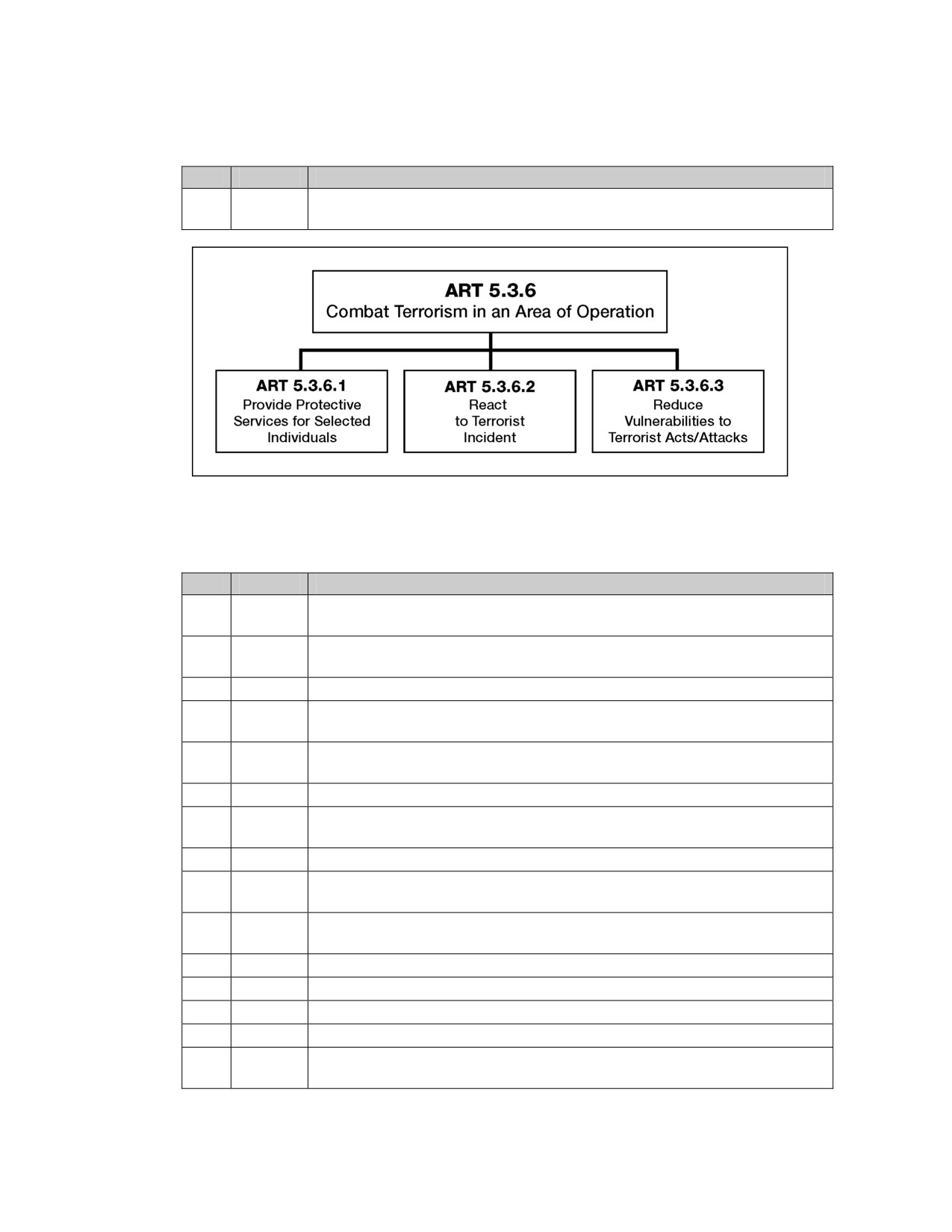
ART 5.3.6 COMBAT TERRORISM IN AN AREA OF OPERATIONS (AO)
5-80. Take actions to oppose terrorism throughout the entire AO. Actions
include antiterrorism and counterterrorism measures. (FM 3-07) (USACAC)
No.
Scale
Measure
Unit/installation continues its mission while taking actions to combat
01
Yes/No
terrorism in the AO.
Unit/installation receives useable antiterrorism intelligence information
02
Yes/No
from host-nation agencies.
03
Yes/No
Local population supports unit/installation presence in AO.
Effective response/reaction forces exist in the event of an
04
Yes/No
attempted/successful terrorist penetration of unit/installation perimeter.
Unit/installation measures designed to combat terrorism—OPSEC—are
05
Yes/No
not deliberately or accidentally disclosed to terrorist organizations.
06
Time
To refine installation/unit security plans/SOPs.
For internal/external reaction and response forces to reach
07
Time
individual/installation/facility under attack.
08
Time
To identify critical facilities and key terrain and prioritize protection.
To identify mission essential activities vulnerable to terrorist acts and
09
Time
inspect to determine if safeguards are adequate.
Of terrorist attacks that degrade, delay or modify friendly force
10
Percent
operations.
11
Percent
Of units that have active counterterrorism protocols.
12
Percent
Of successful terrorist attacks.
13
Percent
Of friendly force and noncombatant casualties due to terrorist actions.
14
Percent
Of information systems in AO hardened against unauthorized access.
Of information systems in AO with multiple pathways over which to
15
Percent
transmit data.
5-73

FM 7-15__________________________________________________________________________
No.
Scale
Measure
Of critical installations and facilities hardened or protected against
16
Percent
terrorist acts.
Reduction in unit mission capabilities/installation support capabilities due
17
Percent
to security measures designed to combat terrorism in AO.
Reduction in line of communication/main supply route through capabilities
18
Percent
due to security measures designed to combat terrorism in AO.
And types of terrorists groups operating in unit AO or in the vicinity of
19
Number
friendly installations.
20
Number
Of counterterrorism activities unit supports in AO.
21
Number
Of terrorist attacks attempted in unit AO.
22
Number
Of successful terrorist attacks.
23
Number
Of friendly force actions to disrupt enemy terrorist activities.
24
Number
Of friendly force and noncombatant casualties due to terrorist actions.
25
Cost
To implement protective measures against terrorism in AO.
ART 5.3.6.1
PROVIDE PROTECTIVE SERVICES FOR SELECTED INDIVIDUALS
5-81. Protect designated high-risk individuals from assassination,
kidnapping, injury, or embarrassment. ART
5.3.6.1 includes planning,
preparing executing, and assessing close-in protection, coordinating external
security with supporting law enforcement and security agencies, and
providing technical advice on protective service operations to commanders, to
include conducting vulnerability assessments. (FM 19-20) (USAMPS)
No.
Scale
Measure
Protected principal accomplishes mission while receiving protective
01
Yes/No
services.
Protected principal was not injured/killed/captured during time in the
02
Yes/No
unit/installation AO.
Forces providing protective services receive useable antiterrorism
03
Yes/No
intelligence information from host-nation agencies.
Unit/installation OPSEC concerning measures taken to protect the
04
Yes/No
principal are not deliberately or accidentally disclosed to terrorist
organizations.
05
Yes/No
Local population supports principal’s presence in AO.
Effective response/reaction forces exist in the event of an
06
Yes/No
attempted/successful attack on the principal.
To refine security plans to reflect changes in protected individual’s
07
Time
itinerary.
For internal/external reaction and response forces to respond to an attack
08
Time
on the protected individual.
To identify facilities scheduled for visit by the protected individual, inspect
09
Time
to determine if safeguards are adequate, and prioritize protection.
To identify activities by the protected individual that increase his
10
Time
vulnerability to terrorist acts.
To collect critical personal data (medical history, likes and dislikes) on
11
Time
protected individual.
5-74

____________________
ART 5.0: The Mobility/Countermobility/Survivability Battlefield Operating System
No.
Scale
Measure
To conduct a threat assessment to include protected individual’s history
12
Time
to determine previous threats targeted at him, threat level in AO, and
conduct site visits.
To determine and obtain any special equipment, such as military working
13
Time
dogs and devices for detecting the presence of unauthorized listening
devices.
Of friendly force and noncombatant casualties due to terrorist actions
14
Percent
directed against the principal.
Reduction in unit mission capabilities/installation support capabilities due
15
Percent
to security measures designed to provide protection to the protected
principal.
And types of groups and enemy forces operating in unit AO or in the
16
Number
vicinity of friendly installations likely to attack the protected individual.
And types of individuals and units needed to provide protective services
17
Number
in AO.
And types of counterterrorism and anti-terrorism activities conducted to
18
Number
protect the principal in AO.
19
Number
Of terrorist attacks attempted against the protected individual in unit AO.
Of friendly force and noncombatant casualties due to terrorist actions
20
Number
directed against the protected principal.
21
Cost
To provide protective services within AO.
ART 5.3.6.2
REACT TO A TERRORIST INCIDENT
5-82. Implement measures to treat casualties, minimize property damage,
restore operations, and expedite the criminal investigation and collection of
lessons learned from a terrorist incident. (FM 19-10) (USAMPS)
Note: ART 7.7.2.2.2 (Conduct Criminal Investigation) addresses the conduct
of crime analysis. ART 7.2.1 (Collect Relevant Information) addresses the
collection of lessons learned.
No.
Scale
Measure
Response to terrorist incident does not prevent unit/installation from
01
Yes/No
accomplishing assigned missions.
To conduct reconnaissance/criminal investigation of site where terrorist
02
Time
incident occurred.
03
Time
To establish/restore security around site where terrorist incident occurred.
To conduct area damage control activities, such as firefighting, power
04
Time
restoration and production, rubble clearance, removal of downed trees,
and repair of critical damaged facilities and installations.
To report the occurrence of terrorist incident to appropriate headquarters
05
Time
and agencies.
06
Time
For response forces/teams to arrive at site of terrorist incident.
To search for, collect, identify, and treat injured survivors of terrorist
07
Time
incident.
5-75

FM 7-15__________________________________________________________________________
No.
Scale
Measure
To search for, collect, identify, and process the remains of individuals
08
Time
killed in terrorist incident.
09
Time
To restore damaged facilities to desired level of functionality.
10
Percent
Decrease in attacked facilities capabilities to perform designed function.
Of response forces/teams arriving at terrorist incident site within desired
11
Percent
response times.
12
Number
Of friendly force and noncombatant casualties due to terrorist incident.
To provide forces and supplies to provide local security and humanitarian
13
Cost
aid and comfort, conduct area damage control, and restore damaged
facility in response to a given terrorist incident.
ART 5.3.6.3
REDUCE VULNERABILITIES TO TERRORIST ACTS/ATTACKS
5-83. Reduce personnel vulnerability to terrorism by understanding the
nature of terrorism, knowing current threats, identifying vulnerabilities to
terrorist acts, and by implementing protective measures against terrorist
acts/attack. (FM 3-19.1) (USAMPS)
No.
Scale
Measure
Actions deter hostile actions against service members, civilian
employees, family members, facilities, information, and equipment; or,
01
Yes/No
when deterrence fails, mitigate the consequences of terrorist attacks
against these potential targets.
Commander applies judgment to every situation and combines it with
02
Yes/No
available technologies to manage risk.
Commander retains freedom of action by reducing friendly force
03
Yes/No
vulnerability to terrorist actions.
Unit/installation antiterrorism program includes planned and integrated
antiterrorism measures, counterterrorism, physical security, OPSEC, and
04
Yes/No
personal protective services, supported by counterintelligence and other
security programs.
05
Yes/No
Force protection planning is a continuous process.
06
Yes/No
Force protection assets focused on protecting the most critical assets.
07
Time
To understand how potential terrorists operate.
To prioritize unit force protection efforts based upon criticality and
08
Time
vulnerability assessments.
09
Time
In advance that a force is warned of attack.
Of unit force protection activities integrated with those of other services
10
Percent
and nations.
Reduction in enemy targeting effectiveness due to the implementation of
11
Percent
force protection measures.
Reduction in the effectiveness of enemy action due to friendly measures
12
Percent
to harden units and facilities from enemy attack.
Enhancement in personnel, equipment, and facility survivability because
13
Percent
of measures taken to harden them from enemy attack.
14
Number
Of friendly and noncombatant casualties due to terrorist attack.
15
Cost
Of measures to protect the unit/installation from terrorist attack.
5-76
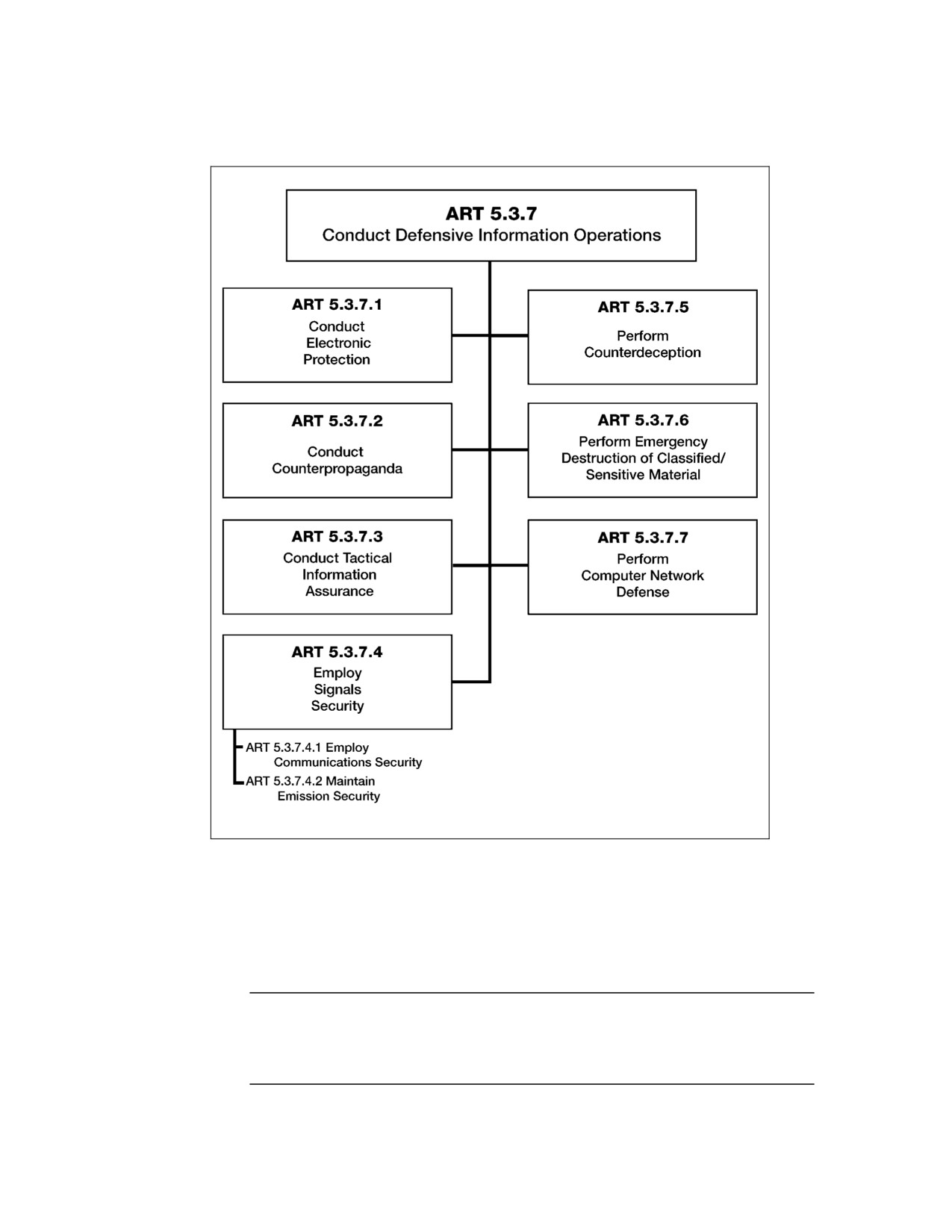
____________________
ART 5.0: The Mobility/Countermobility/Survivability Battlefield Operating System
ART 5.3.7 CONDUCT DEFENSIVE INFORMATION OPERATIONS
5-84. Plan, coordinate, and integrate policies and procedures, operations,
personnel, and technology to protect and defend information and information
systems. Primary elements of defensive IO include information assurance,
physical security, operations security, counterdeception, counterpropaganda,
counterintelligence, electronic warfare, and special IO. (FM 3-13) (USACAC)
Note: While counterintelligence is doctrinally an element of defensive IO, it
has its own task branch
(ART
5.3.8) within the AUTL because its
contributions to force protection and survivability extend well beyond the
limits of defensive information operations.
5-77

FM 7-15__________________________________________________________________________
No.
Scale
Measure
01
Yes/No
Unit course of action not compromised by enemy offensive IO.
02
Time
To develop and refine IO annex to operation order.
To identify, determine appropriate response, and implement changes in
03
Time
response to a possible threat to friendly information systems.
For friendly information and intelligence collection sensor system
managers, operators, and emergency response teams/contact teams to
04
Time
respond, identify, and correct system failures attributed to enemy
offensive IO.
05
Percent
Of time units in AO are in restrictive (INFOCON) condition.
06
Percent
Of friendly emitters in AO known to have been exploited by an enemy.
Of information systems hardware, software components, and databases
07
Percent
backed up by replacement components or backup files in case of failure
or compromise.
Of information system software components and databases protected by
08
Percent
firewalls and virus detection software.
Of times to reprogram information system software in response to
09
Number
identified threats.
Of instances of enemy offensive IO disabling, corrupting, or
10
Number
compromising friendly information systems and intelligence collection
sensors.
11
Number
Of instances of electronic fratricide in AO.
ART 5.3.7.1
CONDUCT ELECTRONIC PROTECTION
5-85. Plan and implement actions such as communications avoidance or
communication anti-jamming measures to protect personnel, facilities, and
equipment from friendly and enemy employment of electronic warfare (EW)
that degrade, neutralize, or destroy friendly combat capability. (FM 3-13)
(USACAC)
No.
Scale
Measure
01
Yes/No
Unit course of action not compromised by enemy offensive IO.
02
Time
To develop and refine IO annex to operation order.
For friendly information and intelligence collection sensor system
managers, operators, and emergency response teams/contact teams to
03
Time
respond, identify, and correct system failures attributed to enemy
offensive IO.
To identify, determine appropriate response, and implement changes in
04
Time
response to a possible threat to information systems.
05
Percent
Of time units in AO are in restrictive INFOCON condition.
06
Percent
Of friendly emitters in AO known to have been exploited by an enemy.
Of information systems hardware, software components, and databases
07
Percent
backed up by replacement components or backup files in case of failure
or compromise.
Of times to reprogram information system software in response to
08
Number
identified threats.
5-78

____________________
ART 5.0: The Mobility/Countermobility/Survivability Battlefield Operating System
No.
Scale
Measure
Of instances of enemy offensive IO disabling, corrupting, or
09
Number
compromising friendly information systems and intelligence collection
sensors.
10
Number
Of instances of electronic fratricide in AO.
ART 5.3.7.2
CONDUCT COUNTERPROPAGANDA
5-86. Establish plans and procedures to counter enemy PSYOP based on an
effective public affairs and education program to expose, discount, and inform
targeted audiences of threat propaganda initiatives. (FM 3-13) (USACAC)
No.
Scale
Measure
Enemy propaganda activities do not cause the abandonment of friendly
01
Yes/No
courses of action.
02
Time
To identify enemy psychological warfare operations.
To expose enemy attempts to influence friendly population and military
03
Time
forces.
To design, produce, obtain approval, and disseminate accurate
04
Time
information to friendly force as a counter to enemy propaganda.
To identify enemy propaganda design, production, and dissemination
05
Time
assets and nominate them as targets for lethal or nonlethal attack.
06
Percent
Of enemy propaganda activities detected and countered.
Of enemy potential themes identified and accounted for in the conduct of
07
Percent
the unit’s military decision making process, to including wargaming.
Of friendly public affairs and PSYOP efforts to conduct
08
Percent
counterpropaganda activities.
Reduction in American civilian, host-nation, and third country support for
09
Percent
friendly operations due to enemy psychological warfare operations.
Of instances in which audiences targeted by enemy psychological
10
Number
warfare operations act in accordance with enemy instructions, such as
desert their post and surrender to the enemy.
11
Number
Of enemy propaganda activities detected and countered.
ART 5.3.7.3
CONDUCT TACTICAL INFORMATION ASSURANCE
5-87. Plan, establish, and conduct programs and procedures to protect
information and information systems. Implement safeguards and controls on
data networks and computer systems. Ensure availability, integrity,
authenticity, and security of information networks, systems, and data. Detect
and react to compromises. Restore networks, systems, and data. (FM 3-13)
(USACAC)
No.
Scale
Measure
Systems administrators and operators perform risk assessment of
01
Yes/No
potential threats to friendly information systems and take appropriate
action to respond to those risks.
5-79

FM 7-15__________________________________________________________________________
No.
Scale
Measure
For information system emergency response teams to respond, identify
02
Time
and correct information system failures attributed to adversary offensive
IO or criminal mischief.
Of information systems not protected by firewalls, virus detection
03
Percent
software, and other appropriate defensive IO measures.
Of information systems hardware components, software programs, and
04
Percent
databases that have backups to replace/duplicate them in case of failure
or corruption.
Of enemy/criminal attempts to disable, corrupt, or compromise friendly
05
Percent
information system components, software, and databases that are
successful.
Of enemy/criminal attempts to disable, corrupt, or compromise friendly
information system components, software, and databases detected by
06
Percent
system administrators/operators and automated protective systems, such
as firewalls.
07
Percent
Of friendly information systems linked to the internet.
Of redundant communications paths available to connect information
08
Number
systems.
Of attempts to disable, corrupt, or compromise friendly information
09
Number
system components, software, and databases.
And types of friendly information systems linked to unsecured/secured
10
Number
internet.
ART 5.3.7.4
EMPLOY SIGNALS SECURITY
5-88. Deny the enemy access to electronic information (both communications
and non-communications) that could be used to identify friendly capabilities
and intentions. (FM 3-13) (USACAC)
No.
Scale
Measure
01
Yes/No
Signals security compromises degrade, delay or modify unit operations.
Firewalls, virus protection software, or other defensive information
02
Yes/No
operations measures protect unit information systems.
To refine and synchronize signal and information operations annexes to
03
Time
operation order.
04
Time
To complete OPSEC assessment in AO.
05
Time
To identify improper occurrence of signals security.
For appropriate information response teams to respond, identify, and
06
Time
correct information system failures attributed to enemy offensive
information operations or criminal activity.
Increase or decrease in number of security violations on combat net
07
Percent
radios in the AO within a given time.
Of successful enemy attempted penetration of friendly information
08
Percent
systems.
Of emitter system administrators and operators who have current OPSEC
09
Percent
training.
10
Percent
Of enemy sensor coverage in AO known to friendly force.
5-80

____________________
ART 5.0: The Mobility/Countermobility/Survivability Battlefield Operating System
No.
Scale
Measure
11
Percent
Of identified friendly vulnerabilities in AO exploited by enemy actions.
12
Percent
Of electronic communications in AO encrypted or secured.
13
Percent
Of message traffic in AO exploited by enemy.
14
Percent
Of friendly emitters in AO exploited by enemy.
Of signals security measures previously assessed unsatisfactory that
15
Percent
have improved based on assessment.
Of friendly operations conducted in a restrictive emission control
16
Percent
(EMCON) environment.
Of units/installations/agencies in AO operating from a common signal
17
Percent
operating instruction (SOI).
Of unit communications systems required to maintain more than one
18
Percent
encryption system.
19
Number
Of security violations on combat net radios in the AO.
20
Number
Of teams fielded to monitor friendly emitters.
Of interceptions of friendly communications during planning and
21
Number
execution.
Of instances when frequency allocation or frequency management fails to
22
Number
prevent signal fratricide.
ART 5.3.7.4.1 Employ Communication Security
5-89. Deny the enemy information of value that might be derived from the
possession and study of telecommunications. (FM 24-1) (USASC&FG)
No.
Scale
Measure
Communications security compromises degrade, delay or modify unit
01
Yes/No
operations.
02
Time
To refine and synchronize signal annex to operation order.
03
Time
To complete COMSEC assessment in AO.
04
Time
To identify improper occurrences of COMSEC.
Increase or decrease in number of security violations on combat net
05
Percent
radios in the AO within a given time.
06
Percent
Of enemy sensor coverage in AO known to friendly force.
Of successful enemy attempted penetration of friendly information
07
Percent
systems.
Of information system administrators and operators who have current
08
Percent
OPSEC training.
Of identified friendly communications vulnerabilities in AO exploited by
09
Percent
enemy actions.
10
Percent
Of electronic communications in AO encrypted or secured.
11
Percent
Of message traffic in AO exploited by enemy.
12
Percent
Of friendly information systems in AO exploited by enemy.
Of communications security measures previously assessed
13
Percent
unsatisfactory that have improved based on assessment.
14
Percent
Of friendly operations conducted in a restrictive EMCON environment.
5-81

FM 7-15__________________________________________________________________________
No.
Scale
Measure
15
Percent
Of units/installations/agencies in AO operating from a common SOI.
Of unit communications systems requiring more than one encryption
16
Percent
system.
17
Number
Of security violations on combat net radios in the AO.
18
Number
Of teams fielded to monitor friendly communication systems.
Of interceptions of friendly communications during planning and
19
Number
execution.
Of redundant communications paths available to connect operational
20
Number
information systems.
ART 5.3.7.4.2 Maintain Emission Security
5-90. Plan and implement measures to deny unauthorized persons
information of value that might be derived from their interception and study
of electromagnetic radiation. Select and control the use of electromagnetic,
acoustic, or other emitters to optimize friendly operations and capabilities
while minimizing detection by enemy sensors and mutual interference among
friendly systems. (FM 6-02) (USASC&FG)
No.
Scale
Measure
Signals emission security compromises degrade, delay or modify unit
01
Yes/No
operations.
To refine and synchronize signal and information operations annexes to
02
Time
operation order.
03
Time
To complete OPSEC assessment in AO.
04
Time
To identify improper maintenance of emission security.
Of emitter system administrators and operators who have current OPSEC
05
Percent
training.
06
Percent
Of enemy sensor coverage in AO known to friendly force.
07
Percent
Of identified friendly vulnerabilities in AO exploited by enemy actions.
08
Percent
Of electronic communications in AO encrypted or secured.
09
Percent
Of friendly emitters in AO exploited by enemy.
Of emission security measures previously assessed unsatisfactory that
10
Percent
have improved based on new assessment.
11
Percent
Of friendly operations conducted in a restrictive EMCON environment.
Of friendly COAs that the enemy can determine based on his observation
12
Percent
of friendly emitters.
13
Number
Of emission security violations in the AO in a given time.
14
Number
Of teams fielded to monitor friendly emitters.
15
Number
Of interceptions of friendly emitters during planning and execution.
Of instances when frequency allocation or frequency management fails to
16
Number
prevent signal fratricide.
ART 5.3.7.5
PERFORM COUNTERDECEPTION
5-91. Conduct activities that preclude the commander from being deceived by
enemy deception operations. (FM 3-13) (USACAC)
5-82

____________________
ART 5.0: The Mobility/Countermobility/Survivability Battlefield Operating System
No.
Scale
Measure
Friendly course of action is not affected by enemy deception except as
01
Yes/No
desired to deceive the enemy when the friendly force accepts the enemy
deception story.
02
Time
To identify adversary attempts to deceive friendly forces.
03
Time
To develop counterdeception operations options as required.
04
Percent
Of enemy deception activities detected.
Of enemy deception activities using multiple sources to transmit
05
Percent
deception story.
ART 5.3.7.6 PERFORM EMERGENCY DESTRUCTION OF CLASSIFIED/SENSITIVE
MATERIAL
5-92. Establish and execute procedures for the emergency destruction of
classified materials. (AR 380-5) (USAIC&FH)
No.
Scale
Measure
Emergency destruction of classified/sensitive documents and other
01
Yes/No
material accomplished without compromise of classified/sensitive
information.
02
Time
To identify classified/sensitive material for destruction.
03
Time
To destroy classified/sensitive material.
04
Time
To develop and rehearse emergency destruction procedures.
Of identified classified/sensitive material identified for destruction that is
05
Percent
actually destroyed.
Of classified/sensitive material accountability procedures followed during
06
Percent
the emergency destruction process.
Of mission-capable, on-hand equipment to perform emergency
07
Percent
destruction of classified/sensitive material.
And types of paper shredders, thermal grenades, burn barrels, magnets,
08
Number
etc. used to perform emergency destruction of classified/sensitive
material.
09
Number
And types of classified/sensitive documents and other material destroyed.
ART 5.3.7.7
PERFORM COMPUTER NETWORK DEFENSE
5-93. Computer network defense is actions to defend against unauthorized
activity within computer networks. Computer network defense includes
monitoring, detection, analysis, response, and restoration activities. These
activities are performed by multiple disciplines, such as operations, network
administrators, intelligence, counterintelligence, and law enforcement. (FM
3-13) (USACAC)
No.
Scale
Measure
01
Yes/No
Enemy offensive information operations compromises unit COA.
02
Time
To develop and refine IO annex to operation order.
To identify, determine appropriate response, and implement changes in
03
Time
response to a possible threat to information systems.
5-83
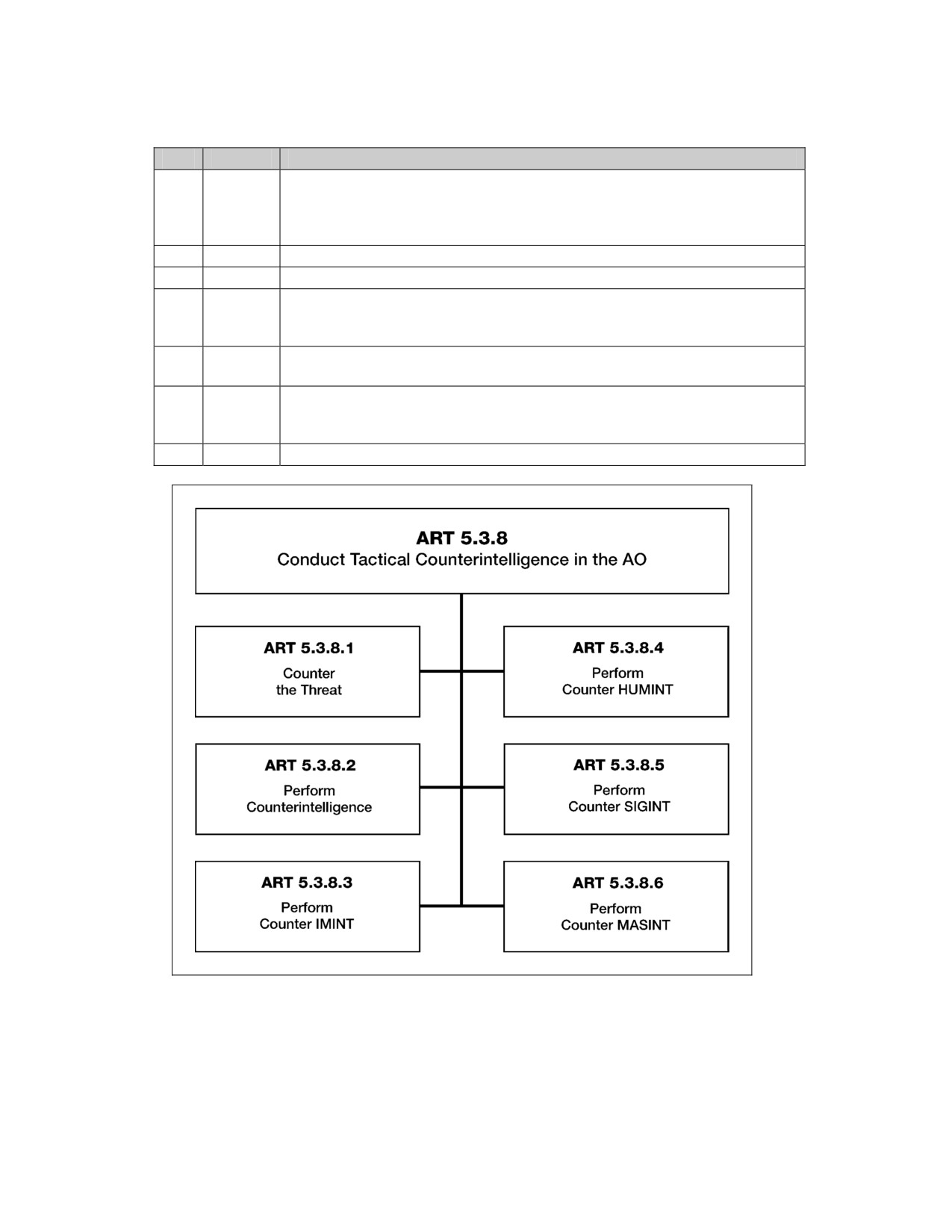
FM 7-15__________________________________________________________________________
No.
Scale
Measure
For friendly information and intelligence collection sensor system
managers, operators, and emergency response teams/contact teams to
04
Time
respond, identify, and correct system failures attributed to enemy
offensive IO.
05
Percent
Of time units in AO are in restrictive EMCON condition.
06
Percent
Of friendly emitters in AO known to have been exploited by an enemy.
Of information systems hardware, software components, and databases
07
Percent
backed up by replacement components or backup files in case of failure
or compromise.
Of times to reprogram information system software in response to
08
Number
identified threats.
Of instances of enemy offensive IO disabling, corrupting, or
09
Number
compromising friendly information systems and intelligence collection
sensors.
10
Number
Of instances of electronic fratricide in AO.
ART 5.3.8 CONDUCT TACTICAL COUNTERINTELLIGENCE IN THE
AREA OF OPERATIONS
5-94. Counterintelligence is designed to defeat or degrade threat intelligence
collection capabilities. The intelligence staff will provide counterintelligence
to the commander outlining the capabilities and limitations of threat
5-84

____________________
ART 5.0: The Mobility/Countermobility/Survivability Battlefield Operating System
intelligence services, and develop TTP to limit or eliminate these capabilities.
(FM 34-1) (USAIC&FH)
No.
Scale
Measure
Enemy intelligence operations directed against the unit and its personnel
01
Yes/No
degrade, delay or modify unit operations.
02
Yes/No
Control element provides counterintelligence (CI) guidance.
03
Time
To conduct an area reconnaissance to identify hazards.
04
Time
To review CI plans for major tactical formations in AO.
To conduct CI collection, operations, and investigations, create and
maintain counterintelligence databases, analyze, assess CI information,
05
Time
and publish and disseminate, CI products and reports and provide
technical support.
To conduct CI screening and collection at EPW collection points or
06
Time
displaced civilian checkpoints.
07
Time
To conduct CI liaison with host-nation agencies and allied forces.
To conduct the CI portion of a vulnerability assessment and recommend
08
Time
countermeasures.
Of friendly force operations in AO degraded, delayed, or modified due to
09
Percent
successful enemy intelligence activities.
Of friendly force units in AO that have current counterintelligence
10
Percent
training, such as SAEDA.
Of friendly force action designed to mislead/prevent enemy intelligence
11
Percent
efforts.
12
Percent
Of units in AO that have active counterintelligence plans.
13
Number
Of enemy intelligence efforts detected by CI activities.
14
Number
Of CI teams available for use in AO.
15
Number
And quality of sources developed in AO.
ART 5.3.8.1
COUNTER THE THREAT
5-95. The task of providing the commander information and intelligence
support for targeting the threat forces through lethal and nonlethal fires
including electronic and information operations. Intelligence support to force
protection and counterintelligence (CI) including the tactics, techniques and
procedures to deny or degrade threat ISR capabilities to access and collect
information and intelligence on friendly forces (FM 34-1). (USAIC&FH)
No.
Scale
Measure
01
Yes/No
Identify threat capabilities and limitations.
02
Yes/No
Identify friendly force vulnerabilities to threat forces.
03
Yes/No
Develop countermeasures to deny or degrade threat capabilities.
04
Yes/No
Develop countermeasures to mitigate friendly force vulnerability.
Threat capabilities and friendly forces countermeasures identified in
05
Yes/No
sufficient time to integrate into the plan, prepare, execute, and assess
operations process.
5-85

FM 7-15__________________________________________________________________________
No.
Scale
Measure
06
Yes/No
Countermeasures disseminated to friendly forces.
07
Time
To develop threat databases and templates.
08
Time
To develop countermeasures.
09
Percent
Of threat capabilities correctly identified.
10
Percent
Of countermeasures that effectively denied or degraded threat’s ability.
ART 5.3.8.2
PERFORM COUNTERINTELLIGENCE
5-96. Gather information and conduct activities to protect against espionage,
other intelligence activities, sabotage, or assassinations conducted by or on
behalf of foreign governments or elements thereof, foreign organizations, or
foreign persons, or international terrorist activities. (FM 34-1) (USAIC&FH)
No.
Scale
Measure
01
Yes/No
Identify threat intelligence collection capabilities and limitations.
02
Yes/No
Identify friendly forces vulnerabilities to threat intelligence collection.
Developed countermeasures to deny or degrade threat’s ability to collect
03
Yes/No
on friendly forces.
Develop countermeasures to mitigate friendly forces vulnerability to
04
Yes/No
threat collection.
Threat capabilities and friendly forces countermeasures identified in
05
Yes/No
sufficient time for implementation.
06
Time
To develop threat databases and templates.
07
Time
To develop countermeasures.
08
Percent
Of threat intelligence collection capabilities correctly identified.
Of countermeasures that effectively denied or degraded threat’s ability
09
Percent
to collect on friendly forces.
ART 5.3.8.3
PERFORM COUNTER-IMAGERY INTELLIGENCE
5-97. Counter imagery intelligence is designed to defeat or degrade threat
imagery intelligence collection capabilities. The intelligence staff will provide
counterintelligence to the commander outlining the capabilities and limita-
tion of threat imagery intelligence services, and develop TTP to limit or
eliminate these imagery capabilities. (FM 34-1) (USAIC&FH)
No.
Scale
Measure
01
Yes/No
Identify threat imagery intelligence collection capabilities and limitations.
Identify friendly forces vulnerabilities to threat imagery intelligence
02
Yes/No
collection.
Developed countermeasures to deny or degrade threat’s ability to collect
03
Yes/No
on friendly forces with imagery assets.
Develop countermeasures to mitigate friendly forces vulnerability to
04
Yes/No
threat collection.
Threat capabilities and friendly forces countermeasures identified in
05
Yes/No
sufficient time for implementation.
06
Time
To develop threat databases and templates.
07
Time
To develop countermeasures.
5-86

____________________
ART 5.0: The Mobility/Countermobility/Survivability Battlefield Operating System
No.
Scale
Measure
08
Percent
Of threat imagery intelligence collection capabilities correctly identified.
Of countermeasures that effectively denied or degraded threat’s ability
09
Percent
to collect on friendly forces with imagery assets.
ART 5.3.8.4
PERFORM COUNTER-HUMAN INTELLIGENCE
5-98. Counter human intelligence is designed to defeat or degrade threat
human intelligence collection capabilities. The intelligence staff will provide
counterintelligence to the commander outlining the capabilities and
limitation of threat human intelligence services, and develop TTP to limit or
eliminate these human intelligence capabilities. (FM 34-1) (USAIC&FH)
No.
Scale
Measure
01
Yes/No
Identify threat human intelligence collection capabilities and limitations.
Identify friendly force vulnerabilities to threat human intelligence
02
Yes/No
collection.
Develop countermeasures to deny or degrade threat’s ability to collect
03
Yes/No
on friendly forces.
Develop countermeasures to mitigate friendly forces vulnerability to
04
Yes/No
threat human collection.
Threat capabilities and friendly forces countermeasures identified in
05
Yes/No
sufficient time for implementation.
06
Time
To develop threat databases and templates.
07
Time
To develop countermeasures.
08
Percent
Of threat HUMINT collection capabilities correctly identified.
Of countermeasures that effectively denied or degraded threat’s ability
09
Percent
to collect on friendly forces using HUMINT.
ART 5.3.8.5
PERFORM COUNTER-SIGNALS INTELLIGENCE
5-99. Counter signals intelligence is designed to defeat or degrade threat
signal intelligence collection capabilities. The intelligence staff will provide
counterintelligence to the commander outlining the capabilities and
limitation of threat signal intelligence services, and develop TTP to limit or
eliminate these signal intelligence capabilities. (FM 34-1) (USAIC&FH)
No.
Scale
Measure
01
Yes/No
Identify threat signal intelligence collection capabilities and limitations.
Identify friendly forces vulnerabilities to threat signal intelligence
02
Yes/No
collection.
Develop countermeasures to deny or degrade threat’s ability to collect
03
Yes/No
on friendly force use of the electromagnetic spectrum.
Develop countermeasures to mitigate friendly force vulnerability to threat
04
Yes/No
signal collection.
Threat capabilities and friendly force countermeasures identified in
05
Yes/No
sufficient time for implementation.
06
Time
To develop threat databases and templates.
5-87