FM 7-15 THE ARMY UNIVERSAL TASK LIST (AUGUST 2003) - page 4

FM 7-15__________________________________________________________________________
No.
Scale
Measure
Of movement between given points reduced due to the mobility
10
Time
enhancing activity.
11
Percent
Of mobility enhancing activity completed.
Of mobility enhancing systems available to the commander that are
12
Percent
committed to the task.
Increase in unit mobility and maneuver due to completion of the mobility
13
Percent
enhancing activity.
14
Number
Of mobility enhancing systems that are mission capable.
Of necessary and unnecessary environmentally harmful incidents, such
15
Number
as petroleum spills in watersheds and soil spills into fish habitats.
16
Number
Of friendly/neutral casualties during the mobility enhancing activity.
ART 5.1.2.1
CONSTRUCT/MAINTAIN COMBAT ROADS AND TRAILS
5-9. Prepare and maintain routes for equipment and personnel. ART 5.1.2.1
includes delineating routes, conducting reconnaissance, clearing ground
cover, performing earthwork, providing drainage, stabilizing soil, and
preparing the road surface for transit by Army combat and tactical vehicles.
(FM 5-100) (USAES)
No.
Scale
Measure
Complete combat road and trail construction/maintenance operation
01
Yes/No
within the period the order specifies.
To respond to an event (natural disaster or combat activity) that impacts
02
Time
existing combat roads and trails.
That the preparation and execution of unit operations are delayed due to
03
Time
a natural disaster or combat activity that impacts the unit’s capability to
use a combat road or trail.
To conduct area reconnaissance of location where the construction/repair
04
Time
of combat roads and trails will take place.
For staff to disseminate reconnaissance results to subordinate units,
05
Time
higher headquarters, and laterally.
06
Time
To plan the construction/maintenance of combat roads and trails.
To establish the conditions necessary for success of the
construction/maintenance effort, such as establishing security, gaining
07
Time
permission from local authorities for construction, and obtaining supplies,
such as gravel, sand, and soil stabilization systems.
08
Time
To move mobility enhancing systems to the work site.
09
Time
To construct/improve/repair the required combat roads and trails.
Of movement between given points reduced due to the
10
Time
construction/maintenance of combat roads and trails.
Of combat roads and trails construction/maintenance operation
11
Percent
completed.
Reduction in speed of vehicles traversing existing combat roads and trails
12
Percent
due to existing environmental conditions, such as snow, ice, and grade.
Of mobility enhancing systems available to the tactical force commander
13
Percent
that are committed to the task.
Increase in movement time during the actual repair of combat roads and
14
Percent
trails.
5-8

____________________
ART 5.0: The Mobility/Countermobility/Survivability Battlefield Operating System
No.
Scale
Measure
15
Percent
Decrease in movement time due to construction of combat roads & trails.
16
Number
Of mobility enhancing systems that are mission capable.
Of friendly/neutral casualties during the combat roads and trails
17
Number
construction/maintenance operation.
And type of vehicles unable to traverse existing terrain, combat roads,
18
Number
and trails.
And type of vehicles able to traverse combat roads and trails after their
19
Number
construction/maintenance.
Of necessary and unnecessary environmentally harmful incidents such
20
Number
as petroleum spills in watersheds and soil spills into fish habitats.
ART 5.1.2.2
CONSTRUCT/MAINTAIN FORWARD AIRFIELDS AND LANDING ZONES
5-10. Prepare and maintain landing zones and landing strips to support
Army and joint aviation ground facility requirements. (FM 5-100) (USAES)
No.
Scale
Measure
Complete forward airfield/landing zone construction/maintenance effort
01
Yes/No
within the period the order specifies.
To respond to an event (natural disaster or combat activity) that
02
Time
negatively impacts the capability of existing forward airfields and landing
zones.
That the preparation and execution of unit operations are delayed due to
03
Time
a natural disaster or combat activity that negatively impacts a unit’s use
of existing forward airfields and landing zones.
To conduct an area reconnaissance of the current location of forward
airfields and landing zones that have been negatively impacted due to
04
Time
an event, or of proposed locations for forward airfields and landing
zones.
For the staff to format and disseminate information obtained by the area
05
Time
reconnaissance to subordinate units, higher headquarters, and laterally.
06
Time
To plan for the construction/repair of forward airfields and landing zones.
To establish the conditions necessary for success of the
construction/repair effort, such as establishing security, gaining
07
Time
permission from local authorities, and obtaining supplies, such as gravel,
sand, airfield mats, and soil stabilization systems.
08
Time
To move mobility enhancing systems to the work site.
09
Time
To complete construction/repair of the forward airfield or landing zone.
Reduction in forward airfield/landing zone capacity due to existing
10
Percent
environmental conditions, such as snow, ice, and fog.
11
Percent
Of forward airfield/landing zone construction/repair completed.
Of mobility enhancing systems available to the tactical force commander
12
Percent
that are committed to the task.
Increase in capacity of unit forward airfields and landing zones due to
13
Percent
completion of the construction/repair effort.
Of forward airfields and landing zones in the AO with approaches
14
Percent
compatible with Army fixed-wing operational support aircraft.
5-9
FM 7-15__________________________________________________________________________
No.
Scale
Measure
Of forward airfields and landing zones in the AO with navigational aids
15
Percent
allowing for landings in bad weather.
16
Distance
Between existing/proposed forward airfields and landing zones.
17
Number
Of mobility enhancing systems that are mission capable.
And types of aircraft unable to use existing forward airfields and landing
18
Number
zones.
And types of aircraft able to use forward airfields and landing zones after
19
Number
their construction/maintenance.
And types of aircraft able to use forward airfields and landing zones
20
Number
simultaneously—maximum on ground—after their construction/repair.
Of friendly/neutral casualties during the construction/repair of forward
21
Number
airfields and landing zones due to accidents/enemy action.
Of necessary and unnecessary environmentally harmful incidents, such
22
Number
as petroleum spills in watersheds and soil spills into fish habitats.
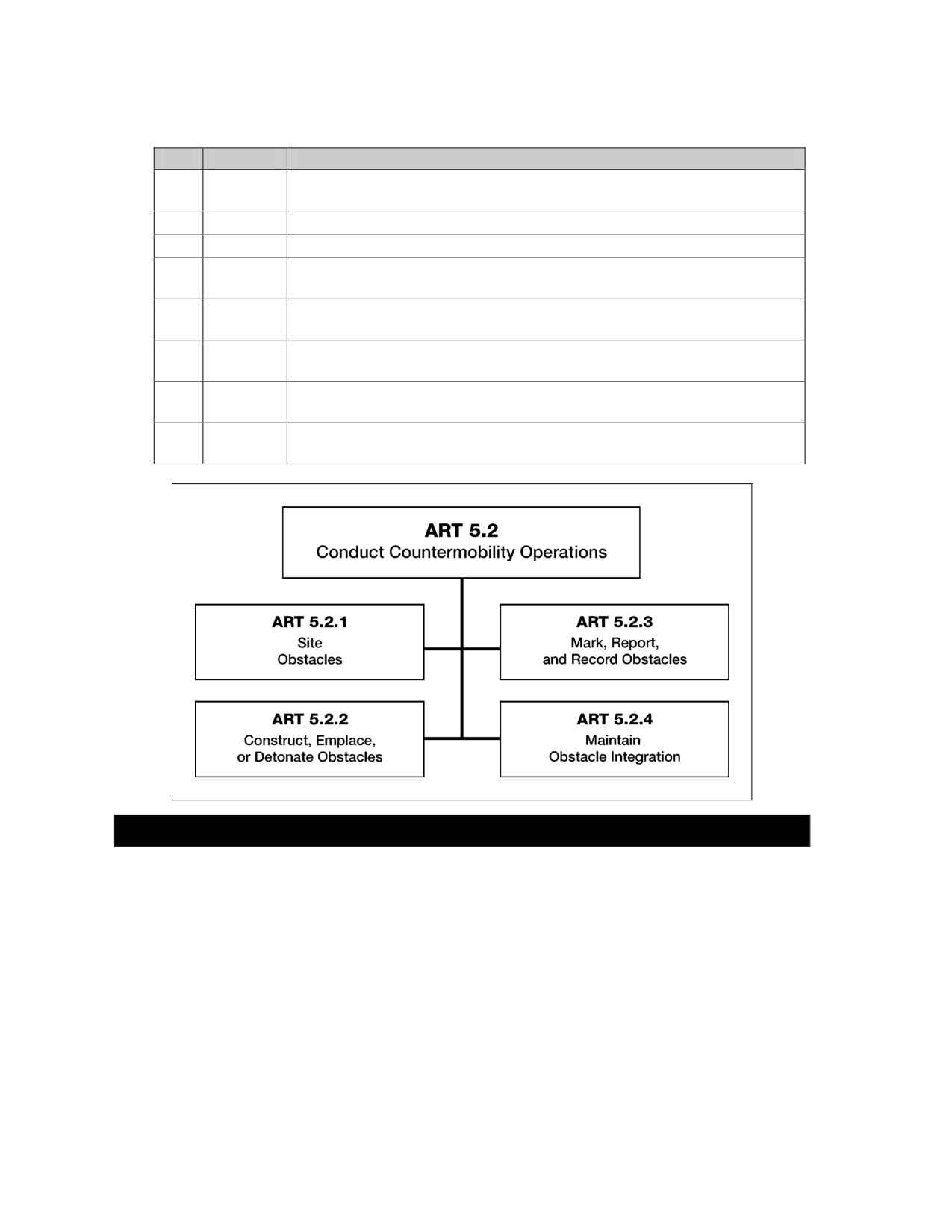
SECTION II - ART 5.2: CONDUCT COUNTERMOBILITY OPERATIONS
5-11. Countermobility operations involve constructing reinforcing obstacles
integrated with fires to inhibit the maneuver of an enemy force, increase
time for target acquisition, and increase weapon effectiveness. Commanders
integrate obstacle planning into the military decision making process
(MDMP) (see FM 101-5), integrate obstacles into the concept of operations
(primarily through proper siting), and maintain integration through obstacle
turnover, protection, and tracking. The force constructs, emplaces, or
detonates tactical and protective obstacles to reinforce existing obstacles.
Tactical obstacles are designed and integrated with fires to achieve a tactical
effect—disrupt, fix, turn, or block. The three types of tactical obstacles are
directed obstacles, situational obstacles, and reserve obstacles. They are
distinguished by the differences in execution criteria. Protective obstacles are
a key component of survivability operations.
(See ART
5.3, Conduct
5-10

____________________
ART 5.0: The Mobility/Countermobility/Survivability Battlefield Operating System
Survivability Operations.) The force may employ any type of individual
obstacle as a tactical obstacle. (FM 90-7) (USAES)
Note: The term “countermobility systems” used in this section is generic in
nature and includes both manual and mechanical means, such as sapper
units, cratering demolition kits, and mine dispensing systems.
No.
Scale
Measure
Friendly obstacle effect accomplishes commander’s guidance (block,
01
Yes/No
disrupt, fix, or turn).
Emplace obstacles in accordance with restrictions established by higher
02
Yes/No
headquarters, to include obstacle control measure graphics and ROE.
Fires (direct and indirect) are integrated in the obstacle plan and are
03
Yes/No
effective when required.
Enemy forces delayed in the conduct of their movement and maneuver
04
Time
due to friendly obstacles. (Delay time dependent upon type of effect.)
Required by the enemy to repair/replace facilities (such as bridges,
05
Time
railroad switching yards, dockyard cranes, and airfield runways)
damaged/destroyed by friendly countermobility efforts.
To conduct area reconnaissance of proposed locations of obstacle
06
Time
complexes.
For staff to format and disseminate information obtained by the area
07
Time
reconnaissance to subordinate units, higher headquarters, and laterally.
08
Time
To conduct terrain analysis to assist in selecting obstacle locations.
09
Time
To plan construction of the obstacle effort.
To establish conditions necessary for construction of obstacles, such as
10
Time
establishing security and moving Class IV and Class V material to
obstacle locations.
11
Time
To move countermobility systems to work site.
12
Time
To emplace obstacles.
13
Time
To employ fires when enemy is engaged in friendly obstacles.
14
Percent
Of countermobility effort completed.
Of total available countermobility effort in a given time not used because
15
Percent
of poor management.
16
Percent
Of enemy forces unable to reach their objective due to obstacles.
Of mobility corridors and avenues of approach closed to enemy
17
Percent
maneuver by friendly obstacles.
18
Percent
Casualties inflicted on the enemy by friendly obstacles.
19
Percent
Of available countermobility assets that are mission capable.
20
Percent
Of enemy sustainment capability interdicted by friendly obstacle efforts.
Of enemy engineering capability devoted toward enhancing enemy
21
Percent
mobility and maneuver.
22
Percent
Of friendly capability devoted to conducting countermobility operations.
Of friendly fire support systems used to emplace field artillery- and air-
23
Percent
delivered obstacles.
5-11

FM 7-15__________________________________________________________________________
No.
Scale
Measure
Of enemy main supply routes and lines of communication interdicted by
24
Number
friendly obstacles.
Of friendly and civilian casualties during the conduct of countermobility
25
Number
operations.
26
Number
Of available countermobility assets that are mission capable.
Of enemy potential courses of action no longer feasible due to friendly
27
Number
countermobility efforts.
ART 5.2.1 SITE OBSTACLES
5-12. Determine the location of individual obstacles based on the enemy
force
(target), desired location of massed fires, tentative weapon system
positions, and the intended effect (disrupt, fix, turn, or block). ART 5.2.1
includes verifying that the obstacle is covered by fires, noting locations of fire
control measures and obstacles, and recording the appropriate data on range
cards. (FM 90-7) (USAES)
No.
Scale
Measure
Obstacle location accomplishes intended effect when integrated with
01
Yes/No
available fires.
Emplace planned obstacles in accordance with restrictions established by
02
Yes/No
higher headquarters, to include obstacle control measure graphics and
ROE.
Planned obstacles have a reasonable probability of being emplaced,
03
Yes/No
given protected availability of countermobility systems, supplies,
manpower, and time.
Coordination takes place between organization designing and
04
Yes/No
designating the obstacles and the supported unit to ensure obstacle
coverage by fires.
05
Time
To conduct terrain analysis to support selecting locations for obstacles.
06
Time
To conduct area reconnaissance of proposed obstacle locations.
For the staff to format and disseminate information obtained by the area
07
Time
reconnaissance to subordinate units, higher headquarters, and laterally.
08
Time
To plan the countermobility effort.
Of mobility corridors and avenues of approach that will be closed to
09
Percent
enemy maneuver by friendly obstacles once they are emplaced.
Of enemy main supply routes and lines of communication that will be
10
Number
interdicted by friendly obstacles.
Of enemy potential courses of action that are no longer feasible due to
11
Number
friendly countermobility efforts.
ART 5.2.2 CONSTRUCT, EMPLACE, OR DETONATE OBSTACLES
5-13. Reinforce the terrain and combine obstacles with fires to disrupt, fix,
turn, or block an enemy force. ART 5.2.2 includes emplacing landmines and
special purpose munitions; constructing wire obstacles, antitank ditches,
tetrahedrons and log obstacles; and detonating explosives to create road
craters, destroy bridges, and construct abatises. (FM 90-7) (USAES)
5-12

____________________
ART 5.0: The Mobility/Countermobility/Survivability Battlefield Operating System
No.
Scale
Measure
Friendly obstacle effect accomplishes the commander’s intent (block,
01
Yes/No
disrupt, fix, and turn).
Emplace obstacles in accordance with restrictions established by higher
02
Yes/No
headquarters, to include obstacle control measure graphics and ROE.
Required to conduct area reconnaissance of proposed location of
03
Time
obstacles.
For the staff to format and disseminate information from the area
04
Time
reconnaissance to subordinate units, higher headquarters, and laterally.
05
Time
To plan the design of individual obstacles and obstacle complexes.
To establish the conditions necessary for obstacle construction, such as
06
Time
establishing security and moving Class IV and V material to obstacle
locations.
That the obstacle construction effort is delayed due to insufficient
07
Time
engineer support.
08
Time
To move countermobility systems to the work site.
09
Time
To construct, emplace, or detonate obstacles.
10
Percent
Of obstacle effort completed.
Of total available countermobility effort in a given time not used because
11
Percent
of poor management.
12
Percent
Of available countermobility assets that are mission capable.
Of friendly fire support systems used to emplace field artillery and air
13
Percent
delivered obstacles.
14
Number
Of available countermobility assets that are mission capable.
Of friendly and civilian casualties during the construction, emplacement,
15
Number
or detonation of obstacles.
ART 5.2.3 MARK, REPORT, AND RECORD OBSTACLES
5-14. Mark inherently dangerous obstacles to aid in fratricide prevention.
Report the intention to emplace obstacles
(if required), initiation of
construction/emplacement, and completion/execution of obstacles. As a
minimum, record the obstacle location, type, and (if applicable) number and
types of mines, placement of mines, use of antihandling devices, location of
lanes and gaps, and description of marking. (FM 90-7) (USAES)
No.
Scale
Measure
01
Yes/No
Mark, report and record all obstacles in accordance with unit SOPs.
02
Time
To identify and determine the limits of minefields and other obstacles.
To mark obstacle limits in accordance with US doctrine and international
03
Time
agreements.
To transmit obstacle information to higher, subordinate, adjacent,
04
Time
supporting, and supported organizations, and to appropriate host-nation
and nongovernmental agencies operating in the AO.
Of obstacle location and composition information correctly recorded in the
05
Percent
unit database.
5-13

FM 7-15__________________________________________________________________________
No.
Scale
Measure
Of obstacle location and composition information correctly transmitted to
higher, subordinate, adjacent, supporting, and supported organizations,
06
Percent
and to appropriate host-nation and nongovernmental agencies operating
in the AO.
Of friendly and neutral casualties resulting from improperly marked
07
Number
obstacles.
ART 5.2.4 MAINTAIN OBSTACLE INTEGRATION
5-15. Ensure emplaced obstacles remain integrated into the scheme of
maneuver. ART 5.2.4 includes turnover and transfer, protection, repair, and
tracking of obstacles. Obstacle protection focuses on two tasks:
counterreconnaissance to prevent the enemy from gathering obstacle
intelligence, and enemy mobility asset destruction to ensure maximum
effectiveness of obstacles. Obstacle tracking includes supervising
achievement of key milestones as part of the unit’s timeline (Class IV/V
forward, initiate engagement area development, siting complete), collation
and dissemination of obstacle information, and maintenance of records. (FM
90-7) (USAES)
No.
Scale
Measure
Obstacle turnover and transfer occur in accordance with doctrinal
01
Yes/No
guidance and international standardization agreements.
Friendly unit was able to prevent enemy reconnaissance elements from
02
Yes/No
gaining information on the obstacle.
Obstacle tracking occurred within an acceptable level of accuracy, as
03
Yes/No
determined by the unit commander.
04
Time
To plan and coordinate obstacle turnover and transfer.
05
Time
To restore a partially reduced obstacle.
06
Time
To conduct obstacle tracking.
Of enemy reconnaissance assets destroyed while maintaining obstacle
07
Percent
integration.
Of enemy mobility assets destroyed before they could reduce friendly
08
Percent
obstacles.
Of enemy reconnaissance assets destroyed while maintaining obstacle
09
Number
integration.
Of enemy mobility assets destroyed before they could reduce friendly
10
Number
obstacles.
Of friendly and civilian casualties during the maintenance of obstacle
11
Number
integration.
5-14
____________________
ART 5.0: The Mobility/Countermobility/Survivability Battlefield Operating System
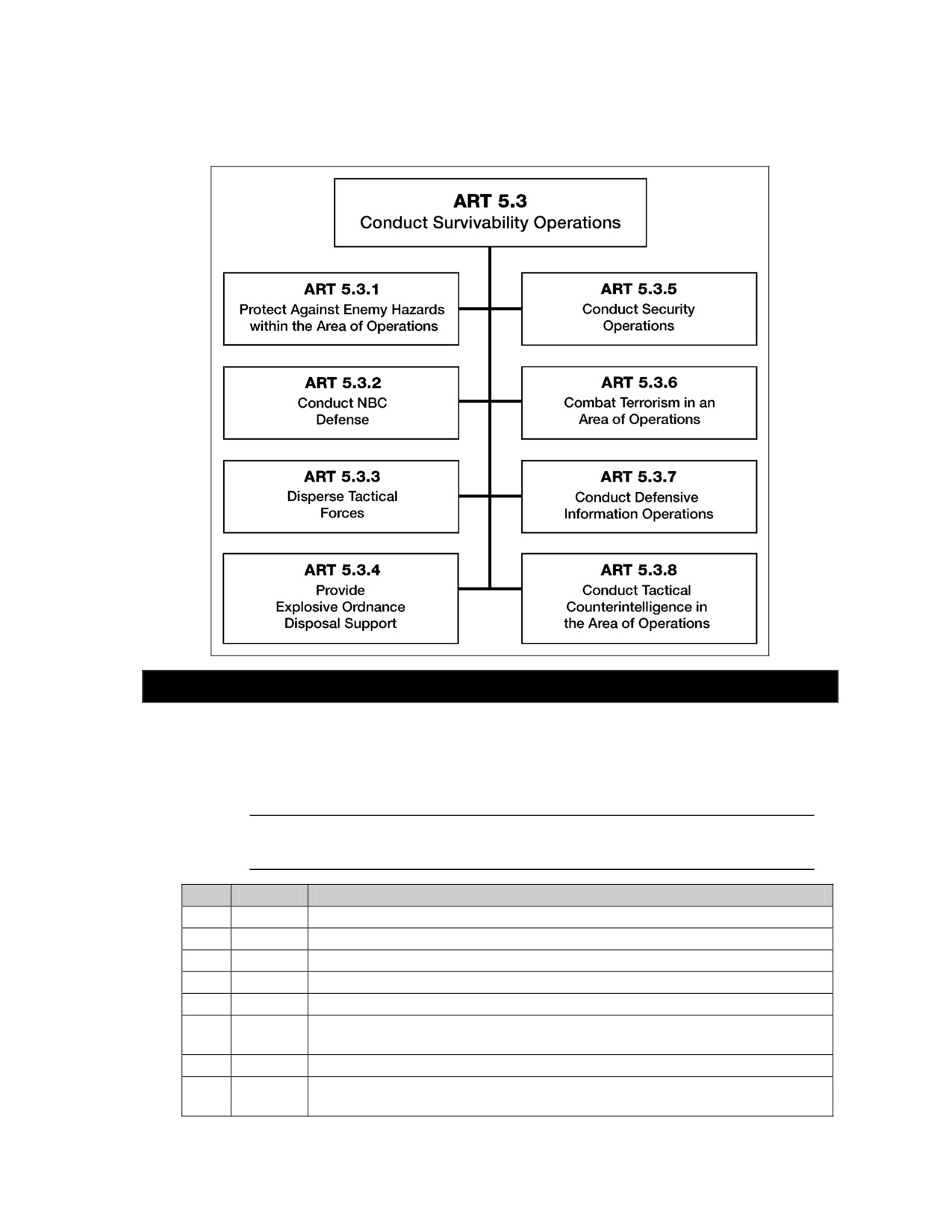
SECTION III - ART 5.3: CONDUCT SURVIVABILITY OPERATIONS
5-16. ART 5.3 is the protection of the tactical force’s fighting potential so it
can be applied at the appropriate time and place. It includes active and
passive measures that the force takes to remain viable and functional by
protecting itself from the effects of (or recovering from) enemy attacks. (FM
3-0) (USACAC)
Note: This task branch is supported by ART 1.1.3, Provide Intelligence
Support to Force Protection.
No.
Scale
Measure
01
Yes/No
Unit can continue to conduct operations.
02
Yes/No
Unit losses from hazards are at acceptable levels.
03
Time
Required to conduct an area reconnaissance.
04
Time
To determine that unit has been attacked by NBC weapons.
05
Time
To predict downwind hazard from the use of NBC weapons.
To disseminate hazard information to all units in the AO and appropriate
06
Time
headquarters and agencies outside the AO.
07
Time
To harden unit equipment, facilities, and positions.
To acquire equipment and supplies necessary to harden a
08
Time
unit/installation.
5-15

FM 7-15__________________________________________________________________________
No.
Scale
Measure
Increase in the time it takes the unit to conduct its operations due to the
09
Percent
need to protect against identified hazards.
10
Percent
Of unit that has completed risk management and safety training.
11
Percent
Of friendly casualties due to failure to report the existence of hazards.
Of on-hand, mission-capable equipment necessary to protect the unit
12
Percent
against hazards.
13
Percent
Of on-hand supplies necessary to protect the unit against hazards.
14
Percent
Of planned fighting positions completed.
15
Percent
Of planned protective positions completed.
16
Number
Of planned fighting positions completed.
17
Number
Of planned protective positions completed.
And types of on-hand equipment necessary to protect the unit against
18
Number
hazards.
19
Number
And types of friendly equipment destroyed or damaged by enemy action.
Of incidents of damage to units and facilities in the AO that impact the
20
Number
commander’s scheme of maneuver.
21
Number
Of US military/civilian casualties.
5-16
____________________
ART 5.0: The Mobility/Countermobility/Survivability Battlefield Operating System
5-17

FM 7-15__________________________________________________________________________
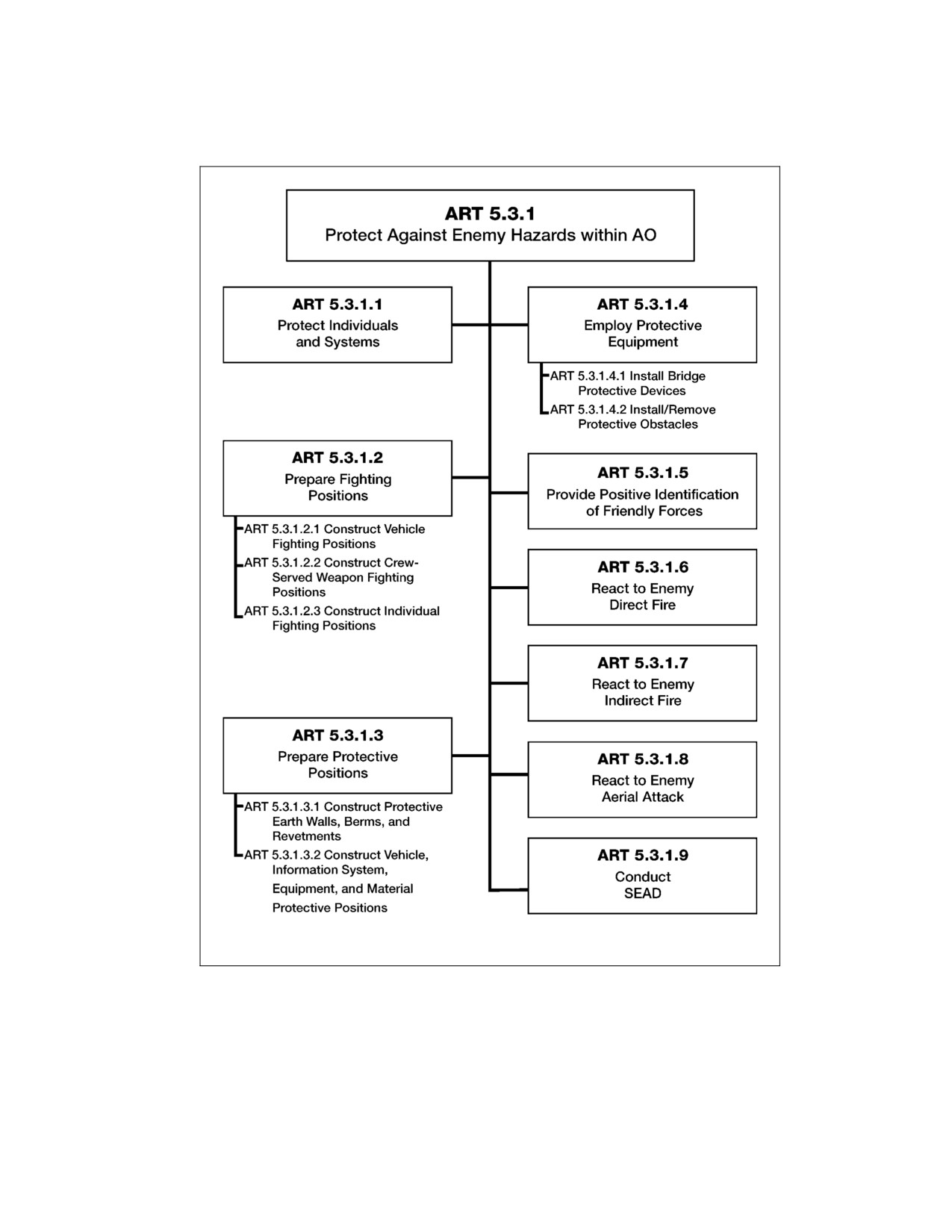
ART 5.3.1 PROTECT AGAINST ENEMY HAZARDS WITHIN THE AO
5-17. Protect the friendly force in an AO by reducing or avoiding the effects
of enemy weapons systems. (FM 3-0) (USACAC)
No.
Scale
Measure
01
Yes/No
Unit can continue to conduct operations.
02
Yes/No
Unit losses from hazards are at acceptable levels.
03
Time
To conduct an area reconnaissance to identify hazards.
04
Time
To disseminate hazard data to all elements operating in the AO.
05
Time
To analyze the impact of identified hazards.
06
Time
To obtain necessary equipment and supplies to protect against hazards.
07
Time
To protect the unit, its facilities, equipment, and supplies against hazards.
Increase in the time it takes the unit to conduct its operations because of
08
Percent
the need to protect against identified hazards.
09
Percent
Of unit that has completed risk management and safety training.
10
Percent
Of friendly casualties due to failure to report existence of hazards.
Of on-hand, mission-capable equipment that is necessary to protect the
11
Percent
unit against hazards.
12
Percent
Of on-hand supplies necessary to protect the unit against hazards.
13
Percent
Of planned protective positions completed.
14
Number
Of planned protective positions completed.
15
Number
And types of on-hand equipment necessary to protect against hazards.
16
Number
And types of friendly equipment destroyed or damaged by enemy action.
Of incidents of damage to units and facilities in the AO that impact the
17
Number
scheme of maneuver.
18
Number
Of US military/civilian casualties due to enemy hazards.
ART 5.3.1.1
PROTECT INDIVIDUALS AND SYSTEMS
5-18. Use protective positions
(natural or artificial), measures, or
equipment—such as armor, detection equipment, MOPP gear, and collective
protective equipment—to reduce the effects of enemy weapons systems. ART
5.3.1.1 includes construction of fighting and survivability positions, conduct
of NBC defense, and responding to enemy fires. (FM 3-0) (USACAC)
No.
Scale
Measure
Unit losses from the effects of enemy weapons systems do not keep the
01
Yes/No
unit from accomplishing its mission.
Unit losses from enemy weapons systems effects are at acceptable
02
Yes/No
levels.
03
Yes/No
Unit uses the terrain to protect itself from the effects of enemy weapons.
To conduct an area reconnaissance to identify areas where risk of enemy
04
Time
attack exists.
05
Time
To analyze the impact of identified hazards in the AO.
06
Time
To revise the plan based on results of the area reconnaissance.
5-18

____________________
ART 5.0: The Mobility/Countermobility/Survivability Battlefield Operating System
No.
Scale
Measure
To disseminate area reconnaissance data and revised execution
07
Time
instructions to all elements operating in the AO.
To establish the necessary degree of local security for construction
08
Time
efforts.
To obtain the equipment and supplies necessary to protect the unit from
09
Time
the effects of enemy weapon systems.
To protect the unit, its facilities, equipment, and supplies from the effects
10
Time
of enemy weapons systems.
Increase in the time it takes the unit to conduct operations because of the
11
Percent
need to protect itself from the effects of identified enemy weapons
systems.
Of unit personnel trained to use available detection and protection
12
Percent
equipment.
Of friendly casualties due to failure to use existing protective equipment
13
Percent
and structures.
Of on-hand, mission-capable equipment, such as MOPP gear, necessary
14
Percent
to protect the unit from the effects of enemy weapons systems.
Of on-hand supplies necessary to protect the unit from the effects of
15
Percent
enemy weapons systems.
Of unit personnel who become casualties due to the faulty use of terrain
16
Percent
to protect themselves from the effects of enemy weapons systems.
Of unit personnel who become casualties of the effects of enemy
17
Percent
weapons systems due to the faulty employment and use of detection
equipment.
18
Percent
Of planned protective positions completed.
19
Number
Of planned protective positions completed.
And types of on-hand equipment necessary to protect the unit against the
20
Number
effects of enemy weapons systems.
21
Number
And types of friendly equipment destroyed or damaged by enemy action.
Of incidents of damage to units and facilities in the AO that impact the
22
Number
scheme of maneuver.
23
Number
Of US military/civilian casualties from the effects of enemy weapons.
ART 5.3.1.2
PREPARE FIGHTING POSITIONS
5-19. Prepare primary, alternate, and supplementary fighting positions that
provide cover, concealment, and protection from the effects of enemy fires for
occupants and systems, and allow for fields of fire and maneuver space for
combat systems and units engaging the enemy. (FM 5-103) (USAES)
No.
Scale
Measure
01
Yes/No
Unit can accomplish its mission using its fighting positions.
02
Time
To conduct an area reconnaissance.
To design primary, alternate, and supplementary fighting positions, and
03
Time
decide correct placement to maximize terrain effectiveness.
5-19

FM 7-15__________________________________________________________________________
No.
Scale
Measure
To establish the degree of local security necessary for the construction
04
Time
effort.
To obtain the equipment and supplies necessary to construct fighting
05
Time
positions.
To construct primary, alternate, and supplementary fighting positions with
06
Time
engineer support.
To construct primary, alternate, and supplementary fighting positions
07
Time
without engineer support.
Of on-hand equipment and supplies needed to construct fighting
08
Percent
positions.
09
Percent
Of personnel trained to properly construct fighting positions.
10
Percent
Of planned fighting positions completed.
11
Percent
Of completed fighting positions constructed to standard.
Of friendly casualties due to improperly constructed or sited fighting
12
Percent
positions.
13
Percent
Of planned fighting positions completed.
14
Number
And types of fighting positions completed.
Of friendly casualties due to improperly constructed or sited fighting
15
Number
positions.
ART 5.3.1.2.1 Construct Vehicle Fighting Positions
5-20. Construct fighting positions that provide cover, concealment, and
protection from direct and indirect fires for combat vehicles, yet allow direct
or indirect engagement of enemy forces. (FM 5-103) (USAES)
No.
Scale
Measure
01
Yes/No
Unit can accomplish its mission using its vehicle fighting positions.
02
Time
To conduct area reconnaissance.
To design primary, alternate, and supplementary vehicle fighting
03
Time
positions, and decide correct placement to maximize terrain
effectiveness.
04
Time
To establish the local security necessary for the construction effort.
To obtain the equipment and supplies necessary to construct vehicle
05
Time
fighting positions.
To construct primary, alternate, and supplementary vehicle fighting
06
Time
positions with engineer support.
To construct primary, alternate, and supplementary vehicle fighting
07
Time
positions without engineer support.
Of on-hand equipment and supplies necessary to construct vehicle
08
Percent
fighting positions.
09
Percent
Of personnel trained to properly construct vehicle-fighting positions.
10
Percent
Of planned vehicle fighting positions completed.
11
Percent
Of completed vehicle fighting positions constructed to standard.
Of friendly casualties due to improperly constructed or sited vehicle
12
Percent
fighting positions.
5-20

____________________
ART 5.0: The Mobility/Countermobility/Survivability Battlefield Operating System
No.
Scale
Measure
13
Number
Of planning vehicle fighting positions completed.
Of friendly casualties due to improperly constructed or sited vehicle
14
Number
fighting positions.
ART 5.3.1.2.2 Construct Crew-Served Weapon Fighting Positions
5-21. Construct fighting positions and or bunkers for crew-served weapons
remaining in defensive positions for extended times. Fighting positions
provide cover and concealment from direct and indirect fire while allowing
coverage of primary and secondary sectors of fire. (FM 5-103) (USAES)
No.
Scale
Measure
Unit can accomplish its mission using crew-served weapon fighting
01
Yes/No
positions.
02
Time
To conduct area reconnaissance.
To design primary, alternate, and supplementary crew-served weapon
03
Time
fighting positions, and decide correct placement to maximize terrain
effectiveness.
To establish the degree of local security necessary for the construction
04
Time
effort.
To obtain the necessary equipment and supplies to construct fighting
05
Time
positions.
To construct primary, alternate, and supplementary crew-served weapon
06
Time
fighting positions with engineer support.
To construct primary, alternate, and supplementary crew-served weapon
07
Time
fighting positions without engineer support.
Of on-hand equipment and supplies needed to construct crew-served
08
Percent
weapon fighting positions.
Of personnel trained to properly construct crew-served weapon fighting
09
Percent
positions.
10
Percent
Of planned crew-served weapon fighting positions completed.
Of completed crew-served weapon fighting positions constructed to
11
Percent
standard.
Of friendly casualties due to improperly constructed or sited crew-served
12
Percent
weapon fighting positions.
13
Number
And types of planned crew-served weapon fighting positions completed.
Of friendly casualties due to improperly constructed or sited crew-served
14
Number
weapon fighting positions.
ART 5.3.1.2.3 Construct Individual Fighting Positions
5-22. Construct individual fighting positions that provide cover and
concealment from observation and direct and indirect fires. Properly sited
individual fighting positions allow soldiers to engage the enemy with their
assigned weapons while providing observation and fields of fire that overlap
those of other positions. (FM 21-75) (USAIS)
5-21

FM 7-15__________________________________________________________________________
No.
Scale
Measure
01
Yes/No
Unit can accomplish its mission using individual fighting positions.
02
Time
To conduct an area reconnaissance.
To design primary, alternate, and supplementary individual fighting
03
Time
positions, and decide correct placement to maximize terrain
effectiveness.
04
Time
To establish the degree of local security for the construction effort.
05
Time
To obtain the equipment and supplies to construct fighting positions.
To construct primary, alternate, and supplementary individual fighting
06
Time
positions with engineer support.
To construct primary, alternate, and supplementary individual fighting
07
Time
positions without engineer support.
Of on-hand equipment and supplies available to construct individual
08
Percent
fighting positions.
09
Percent
Of personnel trained to properly construct individual fighting positions.
10
Percent
Of planned individual fighting positions completed.
11
Percent
Of completed individual fighting positions constructed to standard.
Of completed individual fighting positions that can support unit defensive
12
Percent
positions, such as vehicle fighting positions and crew-served weapon
fighting positions.
Of friendly casualties due to improperly constructed or sited individual
13
Percent
fighting positions.
14
Number
Of planned individual fighting positions completed.
Of friendly casualties due to improperly constructed or sited individual
15
Number
fighting positions.
ART 5.3.1.3
PREPARE PROTECTIVE POSITIONS
5-23. Provide cover and concealment for personnel, systems, equipment,
supplies, and other materiel not directly involved in fighting. This includes
medical patients. These positions reduce the risks associated with all forms
of enemy contact, such as direct and indirect fires, enemy observations,
employment of NBC weapons, etc. (FM 5-103) (USAES)
No.
Scale
Measure
The use of protective positions preserves the unit’s personnel,
01
Yes/No
equipment, and supplies for future missions.
02
Time
To conduct an area reconnaissance.
To design protective positions for personnel, systems, equipment,
03
Time
supplies, and other materiel not directly involved in fighting, and decide
correct placement to maximize terrain effectiveness.
04
Time
To establish the degree of local security for the construction effort.
05
Time
To obtain the equipment and supplies to construct protective positions.
06
Time
To construct protective positions with engineer support.
07
Time
To construct protective positions without engineer support.
08
Percent
Of on-hand equipment and supplies to construct protective positions.
09
Percent
Of personnel trained to properly construct protective positions.
5-22

____________________
ART 5.0: The Mobility/Countermobility/Survivability Battlefield Operating System
No.
Scale
Measure
10
Percent
Of planned protective positions completed.
11
Percent
Of completed protective positions constructed to standard.
12
Percent
Of unit facilities not hardened.
Of friendly casualties due to improperly constructed or sited protective
13
Percent
positions.
Of personnel casualties or equipment and supplies lost due to the
14
Percent
nonavailability of protective positions.
15
Number
And types of planned protective positions completed.
Of friendly casualties due to improperly constructed or sited protective
16
Number
positions.
Of personnel casualties or equipment and supplies lost due to the
17
Number
nonavailability of protective positions.
ART 5.3.1.3.1 Construct Protective Earth Walls, Berms, and Revetments
5-24. Provide cover, concealment, and protection against direct and indirect
fire without restricting the operational capability of systems. (FM 5-103)
(USAES)
No.
Scale
Measure
The use of protective earth walls, berms, and revetments preserves unit
01
Yes/No
personnel, equipment, and supplies for future missions.
02
Time
To conduct an area reconnaissance.
To design protective earth walls, berms, and revetments for personnel,
systems, equipment, supplies, and other materiel not directly involved in
03
Time
fighting, and to decide correct placement to maximize terrain
effectiveness.
To obtain the equipment and supplies to construct protective earth walls,
04
Time
berms, and revetments.
05
Time
To establish degree of local security for the construction effort.
To construct protective earth walls, berms, and revetments with engineer
06
Time
support.
To construct protective earth walls, berms, and revetments without
07
Time
engineer support.
Of on-hand equipment and supplies to construct protective earth walls,
08
Percent
berms, and revetments.
Of personnel trained to construct protective earth walls, berms, and
09
Percent
revetments.
10
Percent
Of planned protective earth walls, berms, and revetments completed.
Of completed protective earth walls, berms, and revetments constructed
11
Percent
to standard.
12
Percent
Of unit facilities not hardened.
Of friendly casualties due to improperly constructed or sited protective
13
Percent
earth walls, berms, and revetments.
5-23

FM 7-15__________________________________________________________________________
No.
Scale
Measure
Of personnel casualties or equipment and supplies lost to enemy attack
14
Percent
due to the nonavailability of protective earth walls, berms, and
revetments.
15
Number
Of planned protective earth walls, berms, and revetments completed.
Of friendly casualties due to improperly constructed or sited protective
16
Number
earth walls, berms, and revetments.
Of friendly casualties or equipment and supplies lost due to the
17
Number
nonavailability of protective earth walls, berms, and revetments.
ART 5.3.1.3.2 Construct Vehicle, Information System, Equipment, and Material
Protective Positions
5-25. Provide cover and concealment for vehicles, information system nodes,
equipment, supplies, and other material that do not provide/conduct direct
fire. (FM 5-103) (USAES)
No.
Scale
Measure
The use of vehicle, information systems, equipment, and material
01
Yes/No
protective positions preserves unit personnel, equipment, and supplies
for future missions.
02
Time
To conduct an area reconnaissance.
To design protective positions for vehicle, information systems,
03
Time
equipment, and material not directly involved in fighting, and decide
correct placement to maximize terrain effectiveness.
04
Time
To establish the degree of local security for the construction effort.
To obtain the equipment and supplies to construct vehicle, information
05
Time
systems, equipment, and material protective positions.
To construct vehicle, information systems, equipment, and material
06
Time
protective positions with engineer support.
To construct vehicle, information systems, equipment, and material
07
Time
protective positions without engineer support.
Of on-hand equipment and supplies available to construct vehicle,
08
Percent
information systems, equipment, and material protective positions.
Of personnel trained to construct vehicle, information systems,
09
Percent
equipment, and material protective positions.
Of planned vehicle, information systems, equipment, and material
10
Percent
protective positions completed.
Of completed vehicle, information systems, equipment, and material
11
Percent
protective positions constructed to standard.
Of unit vehicles, information systems, equipment, and material supplies
12
Percent
not protected by protective positions.
Of friendly casualties due to improperly constructed or sited vehicle,
13
Percent
information systems, equipment, and or material protective positions.
Of casualties or equipment and supplies lost due to the nonavailability of
14
Percent
vehicle, information systems, equipment, and or material protective
positions.
Of planned vehicle, information systems, equipment, and material
15
Number
protective positions completed.
5-24

____________________
ART 5.0: The Mobility/Countermobility/Survivability Battlefield Operating System
No.
Scale
Measure
Of friendly casualties due to improperly constructed or sited vehicle,
16
Number
information systems, equipment, and material protective positions.
Of casualties or equipment and supplies lost due to the nonavailability of
17
Number
vehicle, information systems, equipment, and material protective
positions.
ART 5.3.1.4
EMPLOY PROTECTIVE EQUIPMENT
5-26. Employ individual and collective equipment to protect personnel,
systems, and facilities against hazards caused by enemy action. Protective
equipment includes individual and collective NBC detection and protective
systems. ART 5.3.1.4 includes using other items: such as, bullet-resistant
glazing, hydraulically or manually operated vehicle crash barriers, personnel
gates designed to limit the number of personnel passing through at one time,
intrusion detection systems, security lighting, and security fences. (FM 5-
103) (USAES)
No.
Scale
Measure
The use of protective equipment preserves unit personnel, equipment,
01
Yes/No
and supplies for future missions.
02
Time
To conduct an area reconnaissance.
To plan/revise the plan for employing protective equipment to account for
03
Time
the existing factors of METT-TC.
To establish the degree of local security necessary for
04
Time
installing/constructing the protective equipment.
05
Time
To employ protective equipment to harden individuals and facilities.
To assume the necessary MOPP level in response to enemy action,
06
Time
given previous MOPP level.
To employ protective equipment to harden supply stocks with engineer
07
Time
support.
To employ protective equipment to harden supply stocks without
08
Time
engineer support.
To emplace warning signs marking the edges of areas contaminated by
09
Time
enemy action, such as the use of NBC weapons.
To obtain the protective equipment and systems needed to complete the
10
Time
hardening process.
Of personnel, systems, and facilities hardened by protective equipment
11
Percent
and systems.
12
Percent
Of personnel trained to use protective equipment.
13
Percent
Of necessary protective equipment and supplies on hand.
14
Percent
Of protective equipment employed to standard.
15
Percent
Of protective equipment system that is mission capable.
16
Percent
Of friendly casualties due to improperly used protective equipment.
Of casualties or equipment and supplies lost due to the nonavailability of
17
Percent
protective equipment.
18
Number
Of mission capable protective equipment systems.
5-25

FM 7-15__________________________________________________________________________
No.
Scale
Measure
19
Number
Of friendly casualties due to improperly used protective equipment.
Of personnel casualties or equipment and supplies lost due to the
20
Number
nonavailability of protective equipment.
ART 5.3.1.4.1 Install Bridge Protective Devices
5-27. Provide protective systems for an existing floating bridge or river
crossing site. Protect the bridge/site from waterborne demolition teams,
floating mines, or floating debris. The three types of floating protective
systems are antimine booms, impact booms, and antiswimmer nets. (FM 5-
34) (USAES)
No.
Scale
Measure
The use of bridge protective equipment preserves the functionality of the
01
Yes/No
bridge for current and future missions.
02
Time
To conduct an area reconnaissance of the river approaches to the bridge.
To plan/revise the plan to employ bridge protective equipment to account
03
Time
for the existing factors of METT-TC.
To establish the degree of local security for installation/construction of the
04
Time
bridge protective equipment.
05
Time
To employ bridge protective equipment.
To widen the bridge or remove interior bridge bays to account for flood
06
Time
condition or heavy debris (for floating bridges).
To obtain the bridge protective equipment and systems through the
07
Time
supply system or by local procurement.
08
Percent
Of personnel trained to use bridge protective equipment.
09
Percent
Of on-hand bridge protective equipment and supplies.
10
Percent
Of bridge protective equipment employed to standard.
11
Percent
Of mission-capable bridge protective equipment/systems.
12
Percent
Of bridges damaged due to improperly used bridge protective equipment.
13
Number
Of bridges protected by the proper protective device(s) for the situation.
14
Number
Of mission-capable bridge protective equipment systems.
15
Number
Of friendly casualties due to improperly used protective equipment.
Of personnel casualties due to accidents during the installation of bridge
16
Number
protective equipment.
ART 5.3.1.4.2 Install/Remove Protective Obstacles
5-28. Provide friendly forces close-in protection with protective obstacles as
part of their force protection plan. ART
5.3.1.4.2 includes employing
temporary or permanent protective obstacles and removal or turnover of
obstacles to relieving units. (FM 20-32) (USAES)
5-26

____________________
ART 5.0: The Mobility/Countermobility/Survivability Battlefield Operating System
No.
Scale
Measure
The use of protective obstacles preserves unit personnel, equipment, and
01
Yes/No
supplies for future missions.
The protective obstacles were properly turned over to the relieving unit.
This includes transfer of intelligence, maneuver, fire support, and
02
Yes/No
mobility/countermobility/ survivability information: such as, local enemy,
friendly, and civilian situations; direct and indirect fire control measures;
minefield composition; marking; and layout.
03
Time
To conduct an area reconnaissance.
To plan/revise the plan to employ protective obstacles to account for
04
Time
existing factors of METT-TC.
To establish the degree of local security necessary for
05
Time
installation/construction of the protective obstacles.
To install/remove protective obstacles, to include proper marking, with
06
Time
engineer support.
To install/remove protective obstacles, to include proper marking, without
07
Time
engineer support.
08
Time
To turn over protective obstacles.
09
Time
To properly record and report protective obstacles.
To obtain obstacle emplacing equipment and Class IV and V to install
10
Time
protective obstacles.
Of personnel, systems, unit positions, and facilities protected by
11
Percent
protective obstacles.
12
Percent
Of personnel trained to install, maintain, and remove protective obstacles.
Of on-hand protective obstacle installation/removal equipment and Class
13
Percent
IV and V.
14
Percent
Of protective obstacles installed/removed to standard.
15
Percent
Of protective obstacles properly turned over.
Of friendly casualties due to improperly installed/marked/removed
16
Percent
protective obstacles.
17
Number
Of mission-capable protective obstacle installation/removal systems.
Of friendly casualties due to improperly installed/marked/removed
18
Number
protective obstacles.
ART 5.3.1.5
PROVIDE POSITIVE IDENTIFICATION OF FRIENDLY FORCES
5-29. Discretely and positively determine, by any means, the identity of
tactical units, their equipment and personnel; or of phenomena, such as
communications-electronic patterns. Distinguish these forces from hostile or
unknown forces and means, one from the other. (FM 100-14) (USASC)
No.
Scale
Measure
Unit is able to correctly identify other forces, equipment, and personnel
01
Yes/No
within the area of operations.
02
Time
To refine the force protection plan.
Elapsed before enemy begins to mimic identification or recognition
03
Time
procedures.
5-27

FM 7-15__________________________________________________________________________
No.
Scale
Measure
04
Time
To confirm the identified or unidentified friendly unit or system.
05
Time
To confirm the identity of an unidentified target.
06
Time
To pass a target identity to the decision maker.
07
Time
To change codes in IFF systems.
08
Percent
Of force in the AO that has passive identification interrogation capability.
09
Percent
Of IFF systems operating correctly.
10
Percent
Of force in AO using their IFF systems.
11
Percent
Of friendly systems in the AO destroyed by friendly fire.
12
Percent
Of casualties in the AO from friendly fire.
Of positive identification false negatives (friendly identified as enemy) in
13
Percent
the AO.
Of positive identification false positives (enemy identified as friendly) in
14
Percent
the AO.
15
Percent
Of units accurately reporting their locations.
16
Number
Of penetrations within the AO by unknown targets.
17
Number
Of IFF systems operating correctly in the AO.
ART 5.3.1.6
REACT TO ENEMY DIRECT FIRE
5-30. Return fire at known or suspected enemy positions and take evasive
action upon detecting enemy direct fire. (FM 21-75) (USAIS)
No.
Scale
Measure
01
Yes/No
Unit reaction to enemy direct fire allows the unit to complete its mission.
02
Yes/No
Unit retains its cohesion.
Collateral damage due to friendly response to enemy direct fire does not
03
Yes/No
result from violations of the law of war or ROE in effect.
That unit is delayed from accomplishing its mission due to enemy direct
04
Time
fire.
That unit stays within the enemy’s engagement area before it can
05
Time
suppress the enemy’s weapon systems, find cover from which to engage
the enemy, or extract itself from the engagement area.
06
Percent
Of enemy casualties inflicted.
07
Percent
Of friendly casualties.
08
Number
Of friendly and noncombatant casualties.
And types of friendly systems rendered nonmission capable by enemy
09
Number
direct fire.
ART 5.3.1.7
REACT TO ENEMY INDIRECT FIRE
5-31. Seek protection under the overhead cover of fighting/protective
positions or move rapidly out of the impact area in the direction the unit
commander orders. If armored vehicles are available, personnel mount, and
the vehicles move out of the impact area in the direction and designated
distance ordered by the unit commander. (FM 21-75) (USAIS)
5-28

____________________
ART 5.0: The Mobility/Countermobility/Survivability Battlefield Operating System
No.
Scale
Measure
01
Yes/No
Unit reaction to enemy indirect fire allows the unit to complete its mission.
02
Yes/No
Unit retains its cohesion.
Collateral damage due to the friendly response to enemy direct fire does
03
Yes/No
not result from violations of the law of war or ROE in effect.
04
Time
To report contact to the higher commander.
For personnel to either close the hatches on the combat vehicles they are
05
Time
riding in, seek shelter in positions with suitable overhead cover, or seek
shelter offered by the terrain immediately around them.
06
Time
For vehicles to move out of the impact area.
For dismounted individuals caught without suitable shelter in the impact
07
Time
area to improve their chances of surviving by digging in using resources
immediately available to them.
08
Time
To conduct counterbattery/countermortar fires.
09
Percent
Of unit soldiers performing immediate action drill correctly.
10
Percent
Of enemy casualties due to friendly counterbattery/countermortar fires.
11
Percent
Of friendly casualties.
12
Number
Of friendly and noncombatant casualties.
And types of friendly systems rendered nonmission capable by enemy
13
Number
indirect fire.
ART 5.3.1.8
REACT TO ENEMY AERIAL ATTACK
5-32. Take passive air defense measures to prevent aircraft from effectively
engaging the unit. Passive air defense measures, when the unit is not in the
path or target of the enemy aircraft, include moving to cover and
concealment and preparing to engage the attacking or any follow-on aircraft.
(FM 21-75) (USAIS)
Note: ART 4.3.4 (Employ Combined Arms for Air Defense) addresses active
self-defense measures taken against aerial attack by nonair defense units.
No.
Scale
Measure
Commander must modify his course of action because of enemy air
01
Yes/No
attack.
To warn nonair defense units after identification of inbound enemy aerial
02
Time
platforms.
03
Time
To move to covered and concealed positions.
Of enemy aerial platforms able to penetrate the air defense network to
04
Percent
deliver ordnance/accomplish mission.
Of friendly courses of action that must be changed due to enemy air
05
Percent
attack.
Of enemy aerial platforms unable to acquire friendly personnel and
06
Percent
equipment to attack.
07
Percent
Of friendly casualties attributed to enemy aerial platforms.
08
Number
Of friendly casualties attributed to enemy aerial attack.
5-29

FM 7-15__________________________________________________________________________
ART 5.3.1.9
CONDUCT SUPPRESSION OF ENEMY AIR DEFENSES
5-33. Neutralize, destroy, or temporarily degrade surface-based enemy
tactical air defenses by destructive and/or disruptive means. Lethal SEAD
seeks the destruction of surface-based enemy tactical air defenses, such as
target systems or operating personnel, by destructive means. Examples of
destructive SEAD capabilities are bombs, air- and surface-to-surface
missiles, air-scatterable mines, and field artillery. Nonlethal SEAD seeks to
temporarily deny, degrade, deceive, delay, or neutralize surface-based enemy
tactical air defense systems by disruptive means to increase aircraft
survivability. Disruptive means may be either active or passive. Active
means include: electronic attack by means such as anti-radiation missiles,
directed energy, electromagnetic jamming, and electromagnetic deception;
expendables, such as chaff, flares, and decoys; tactics, such as deception,
avoidance, or evasive flight profiles; and unmanned aerial vehicles. Passive
means include emission control, camouflage, infrared shielding, warning
receivers, and material design features. (FM 6-20) (USAFAS)
No.
Scale
Measure
Friendly aerial platforms accomplish mission without unacceptable losses
01
Yes/No
to enemy air defense systems.
02
Time
To plan for the suppression of enemy air defense system.
03
Time
To respond to new requirements to suppress enemy air defense systems.
To complete execution of all phases of the plan to suppress enemy air
04
Time
defenses.
To prepare weapon systems and obtain the munitions used in the
05
Time
suppression of enemy air defense systems.
Of available combat power dedicated toward the suppression of enemy
06
Percent
air defenses.
07
Percent
Of enemy air defense systems destroyed.
Of enemy air defense systems temporarily neutralized by nonlethal
08
Percent
means.
09
Percent
Of friendly air sorties attacked by enemy air defense.
10
Percent
Of enemy air defense that required reattack.
11
Percent
Of friendly air losses due to enemy air defense.
12
Percent
Probability of hitting the targeted enemy air defense system.
13
Percent
Probability of killing the targeted enemy air defense system, given a hit.
Of friendly suppression of enemy air defense system missions that
14
Percent
accomplished their destruction or suppression mission.
And types of weapon systems and munitions used to suppress enemy air
15
Number
defenses.
And types of enemy air defense systems that are permanently or
16
Number
temporarily suppressed.
Of friendly casualties while conducting the suppression of enemy air
17
Number
defenses.
Of instances of fratricide while attacking enemy air defense system
18
Number
targets.
5-30
____________________
ART 5.0: The Mobility/Countermobility/Survivability Battlefield Operating System
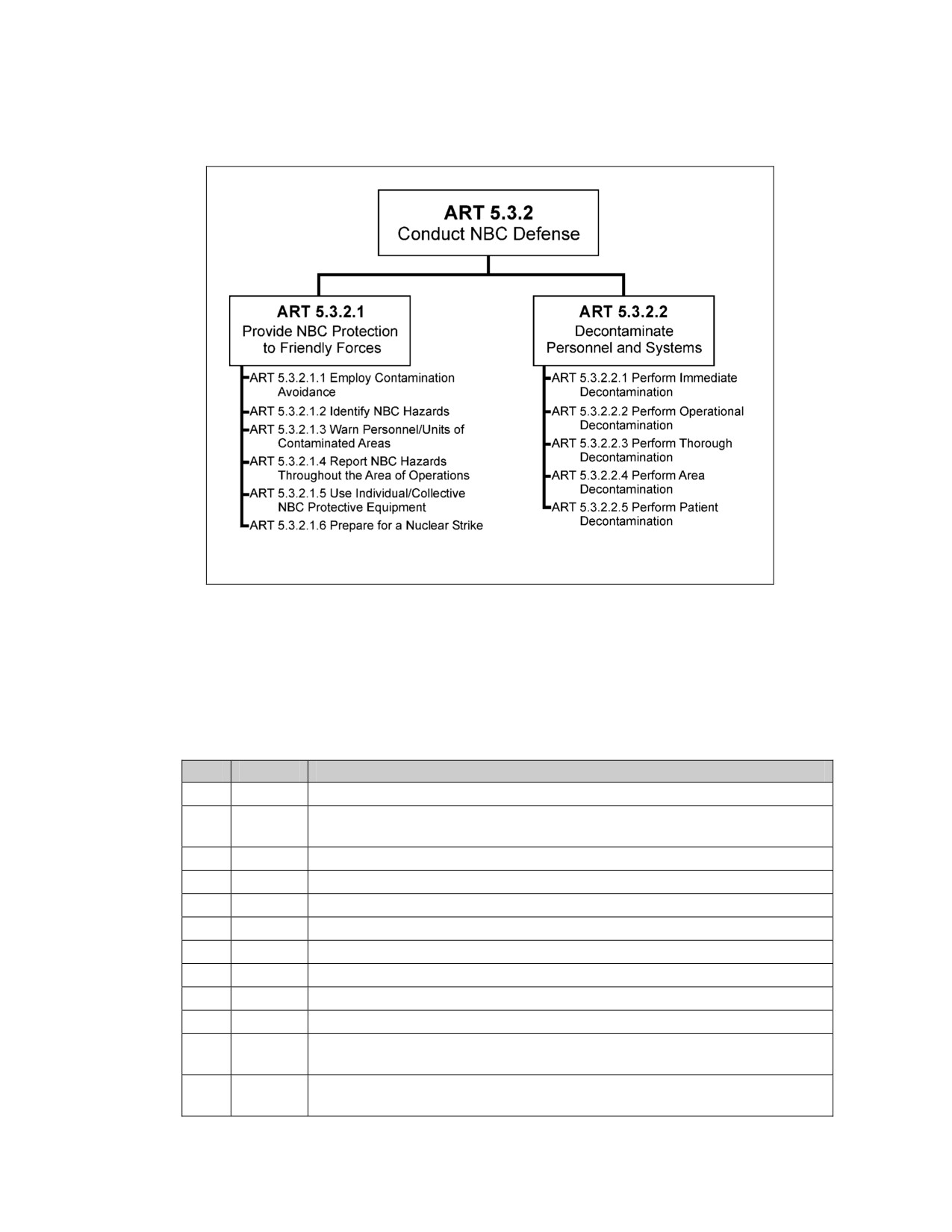
ART 5.3.2 CONDUCT NUCLEAR, BIOLOGICAL, AND CHEMICAL
(NBC) DEFENSE
5-34. Defend against nuclear, biological, and chemical (NBC) weapons using
the principles of avoidance, protection, and decontamination. ART
5.3.2
includes protection from agents deliberately or accidentally released. An
example of an accidentally released agent is toxic chemicals leaking from
factory storage containers due to collateral damage. (FM 3-100) (USACMLS)
No.
Scale
Measure
01
Yes/No
Unit can continue its mission when attacked by enemy NBC weapons.
To conduct area/route reconnaissance to identify the limits of NBC
02
Time
weapons effects.
03
Time
To refine Annex J (NBC) to the operation order.
04
Time
To deploy and employ NBC monitoring equipment.
05
Time
To identify the NBC hazard.
06
Time
To detect the use of NBC weapons within the AO.
07
Time
To issue downwind hazard warnings of an NBC attack in the AO.
08
Time
To conduct area damage control after the use of NBC weapons.
09
Time
To recover unit operational capability after an NBC attack.
10
Time
To give and understand NBC contamination alarms and signals.
To assume appropriate MOPP after warning of the use of NBC weapons
11
Time
in the AO.
To reconstitute unit to designated level of combat power after exposure to
12
Time
the effects of NBC weapons.
5-31

FM 7-15__________________________________________________________________________
No.
Scale
Measure
To coordinate for additional NBC reconnaissance, monitoring, and
13
Time
decontamination assets.
To administer chemoprophylaxis, immunizations, pretreatments, and
14
Time
barrier creams for protection against NBC warfare agents.
15
Percent
Of incidents of the use of NBC weapons detected.
Of enemy delivery systems for NBC weapons in AO identified, targeted,
16
Percent
and destroyed.
Of NBC contaminated sites in the AO that have decontamination
17
Percent
operations initiated or completed.
Of friendly units in the AO that have NBC monitoring, protective, and
18
Percent
decontamination equipment.
Of mission-capable, on-hand NBC monitoring, protective, and
19
Percent
decontamination equipment.
Of NBC monitoring, protective, and decontamination equipment
20
Percent
positioned and operated correctly.
21
Percent
Of NBC hazards correctly identified.
Of friendly units in the AO without adequate supplies of individual and
22
Percent
collective monitoring and protective equipment, and decontamination
material.
Reduction in unit combat power from the need to defend against the use
23
Percent
of NBC weapons.
24
Percent
Of friendly/civilian casualties in AO from the use of NBC weapons.
25
Number
Of instances where NBC weapons are employed.
And types of on-hand NBC monitoring, protective, and decontamination
26
Number
equipment.
And types of friendly systems destroyed, damaged, or rendered
27
Number
inoperable resulting from the use of NBC weapons.
Of instances where units and facilities are affected by the employment of
28
Number
NBC weapons without prior warning of their use.
29
Number
Of false alarms relating to the employment of NBC weapons.
ART 5.3.2.1
PROVIDE NBC PROTECTION TO FRIENDLY FORCES
5-35. Employ detecting, identifying, marking, warning, and reporting
methods and equipment to protect personnel, units, and equipment from
nuclear, biological, or chemical hazards. (FM 3-4) (USACMLS)
No.
Scale
Measure
01
Yes/No
Unit can continue its mission when attacked by enemy NBC weapons.
To conduct area reconnaissance to determine the limits of the effects of
02
Time
NBC weapon employment.
03
Time
To refine Annex J (NBC) to the operation order.
04
Time
To detect the use of NBC weapons within the AO.
05
Time
To issue downwind hazard warnings of an NBC attack in the AO.
06
Time
To conduct area damage control after the use of NBC weapons.
07
Time
To recover unit operational capability after an NBC attack.
5-32

____________________
ART 5.0: The Mobility/Countermobility/Survivability Battlefield Operating System
No.
Scale
Measure
To assume appropriate MOPP after warning of use of NBC weapons in
08
Time
the AO.
Of enemy delivery systems for NBC weapons in AO identified, targeted,
09
Percent
and destroyed.
Of NBC contaminated sites in the AO that have decontamination
10
Percent
operations initiated or completed.
11
Percent
Of units in the AO that have NBC monitoring equipment.
12
Percent
Of mission-capable, on-hand NBC monitoring equipment.
13
Percent
Of NBC monitoring equipment positioned and operated correctly.
Of friendly units in the AO without adequate supplies of individual and
14
Percent
collective protective equipment and decontamination material.
Of friendly/civilian casualties in AO as a result of the use of NBC
15
Percent
weapons.
And types of friendly systems destroyed, damaged, or rendered
16
Number
inoperable as a result of the use of NBC weapons.
ART 5.3.2.1.1 Employ Contamination Avoidance
5-36. Take measures to avoid or minimize the effects of NBC attacks and
reduce the effects of NBC hazards. By taking measures to avoid the effects of
NBC attacks, units can reduce their protective posture and decrease the
likelihood and extent of decontamination required. (FM 3-3) (USACMLS)
No.
Scale
Measure
01
Yes/No
Unit can continue its mission when attacked by enemy NBC weapons.
02
Time
To detect the use of NBC weapons within the AO.
To conduct route reconnaissance to determine locations where the effect
03
Time
of NBC weapons are present and the degree of contamination along
selected routes.
To conduct area reconnaissance to determine the limits of the effects of
04
Time
NBC weapons.
To refine the operation order to avoid/limit contact with contaminated
05
Time
areas.
To use the NBC warning and reporting system to send reports of NBC
06
Time
attacks, such as to issue downwind hazard warnings.
07
Time
To employ NBC monitoring equipment.
08
Time
To identify NBC hazards.
09
Time
To mark likely entry points into contaminated areas.
To conduct contamination control—bypassing, exposing only the
absolute minimum number of personnel and equipment, encapsulating
10
Time
personnel and equipment, covering equipment and supplies, and
relocation.
11
Percent
Of NBC contamination in the AO detected and correctly identified.
12
Percent
Of friendly units in the AO that have NBC monitoring equipment.
13
Percent
Of mission-capable, on-hand NBC monitoring equipment.
14
Percent
Of NBC monitoring equipment positioned and operated correctly.
5-33

FM 7-15__________________________________________________________________________
No.
Scale
Measure
Of unit courses of action modified due to the presence of NBC
15
Percent
contamination.
16
Number
And types of on-hand NBC monitoring equipment.
And types of friendly systems destroyed, damaged, or rendered
17
Number
inoperable resulting from contact with NBC contamination.
Of friendly/civilian casualties in AO resulting from contact with NBC
18
Number
contamination.
ART 5.3.2.1.2 Identify Nuclear, Biological, and Chemical Hazards
5-37. Obtain information about the NBC activities and resources of an
enemy by visual observation or other detection methods. Detect and identify
NBC hazards, to include finding gaps and detours around NBC-contaminated
areas. NBC reconnaissance, which provides the information for identifying
NBC hazards, is part of the overall intelligence collection effort. (See ART
1.3.3, Conduct Tactical Reconnaissance.) (FM 3-19) (USACMLS)
No.
Scale
Measure
01
Yes/No
Unit continues its mission when attacked by enemy NBC weapons.
02
Time
To collect NBC hazard samples.
03
Time
To identify NBC hazard samples.
Required to obtain medical specimens for suspected biological or
04
Time
chemical hazards.
05
Time
Required to identify NBC warfare agents from medical specimens.
06
Percent
Of instances in which an NBC hazard is correctly identified.
Of instances in which an NBC hazard is incorrectly identified as
07
Percent
harmless.
Of instances in which a harmless sample is incorrectly identified as an
08
Percent
NBC hazard.
09
Number
Of casualties due to incorrect identification of NBC hazards.
ART 5.3.2.1.3 Warn Personnel/Units of Contaminated Areas
5-38. Alert units and personnel concerning contaminated areas so they can
retain freedom of maneuver, orient on the threat, report all information
rapidly and accurately, and develop the situation rapidly.
(FM
3-4)
(USACMLS)
No.
Scale
Measure
Personnel/units warned of the presence and limits of contaminated areas
01
Yes/No
within their area of operations so they can retain freedom of maneuver.
02
Time
To detect the use of NBC weapons within the AO.
To conduct area reconnaissance to determine the limits of the effects of
03
Time
NBC weapons.
To conduct route reconnaissance to determine locations where the
04
Time
effects of NBC weapons are and the degree of contamination.
05
Time
To refine operation order to avoid/limit contact with contaminated areas.
To use the NBC warning and reporting system to send reports of NBC
06
Time
attacks, such as to issue downwind hazard warnings.
5-34

____________________
ART 5.0: The Mobility/Countermobility/Survivability Battlefield Operating System
No.
Scale
Measure
07
Time
To employ NBC monitoring equipment.
08
Time
To identify NBC hazards.
09
Time
To mark likely entry points into contaminated areas.
10
Time
To give and understand NBC contamination alarms and signals.
11
Percent
Of NBC contamination in the AO detected and correctly identified.
12
Percent
Of friendly units in the AO that have NBC monitoring equipment.
13
Percent
Of mission-capable, on-hand NBC monitoring equipment.
14
Percent
Of NBC monitoring equipment positioned and operated correctly.
15
Percent
Of unit personnel trained to operate in an NBC environment.
16
Number
And types of on-hand NBC monitoring equipment.
And types of friendly systems destroyed, damaged, or rendered
17
Number
inoperable due to unanticipated contact with NBC contamination.
Of friendly/civilian casualties in the AO due to unanticipated contact with
18
Number
NBC contamination.
ART 5.3.2.1.4 Report NBC Hazards Throughout the Area of Operations
5-39. Provide NBC hazards information to support decision making
and
permit units and individuals to avoid contaminated areas.
(FM
3-4)
(USACMLS)
No.
Scale
Measure
01
Yes/No
Unit accomplishes its mission.
02
Time
To detect the use of NBC weapons within the AO.
To conduct area reconnaissance to determine the locations that are
03
Time
contaminated and the degree of that contamination resulting from the
employment of NBC weapons.
To conduct route reconnaissance to determine the locations that are
04
Time
contaminated and the degree of that contamination resulting from the
employment of NBC weapons.
To refine the operation order to avoid /limit contact with contaminated
05
Time
areas.
To use the NBC warning and reporting system to send reports of NBC
06
Time
attacks, such as to issue downwind hazard warnings.
07
Time
To identify NBC hazards.
08
Time
To give and understand NBC contamination alarms and signals.
Of NBC contamination in the AO detected, correctly identified, and
09
Percent
reported.
Of friendly units in the AO that have information systems capable of
10
Percent
receiving NBC warnings.
Of unit COAs that must be abandoned/changed/modified due to the
11
Percent
warning of the presence of contaminated areas.
And types of friendly systems destroyed, damaged, or rendered
12
Number
inoperable due to contact with NBC contamination.
5-35

FM 7-15__________________________________________________________________________
No.
Scale
Measure
Of friendly/civilian casualties in the AO due to contact with NBC
13
Number
contamination.
ART 5.3.2.1.5 Use Individual/Collective Nuclear, Biological, and Chemical Protective
Equipment
5-40. Take action that allows soldiers to survive and continue the mission
under NBC conditions. (FM 3-4) (USACMLS)
No.
Scale
Measure
The use of NBC protective equipment preserves unit personnel,
01
Yes/No
equipment, and supplies, for future missions.
02
Time
To conduct area reconnaissance to detect the use of NBC weapons.
To plan/revise the plan to employ protective equipment to take into
03
Time
account existing factors of METT-TC.
To establish the degree of local security for installing collective NBC
04
Time
protective equipment.
To employ additional NBC protective equipment to harden individuals and
05
Time
facilities from the effects of NBC weapons.
To assume MOPP in response to the employment of NBC weapons given
06
Time
previous MOPP.
To employ NBC protective equipment to harden supply stocks, with
07
Time
engineer support.
To employ NBC protective equipment to harden supply stocks, without
08
Time
engineer support.
To emplace warning signs marking the edges of areas contaminated by
09
Time
NBC weapons.
To obtain the NBC protective equipment and systems needed to
10
Time
complete hardening process.
Of personnel, systems, and facilities hardened with NBC protective
11
Percent
equipment and systems.
12
Percent
Of personnel trained to use NBC protective equipment.
13
Percent
Of on-hand NBC protective equipment and supplies.
Of NBC individual and collective protective equipment employed to
14
Percent
standard.
Of mission-capable NBC individual and collective protective equipment
15
Percent
systems.
16
Percent
Of friendly casualties due to improperly used NBC protective equipment.
Of casualties or equipment and supplies lost to enemy attack due to the
17
Percent
nonavailability of NBC protective equipment.
Of mission-capable individual and collective NBC protective equipment
18
Number
systems.
Of friendly casualties due to improperly used NBC protective equipment
19
Number
or slow reaction to the use of NBC weapons.
Of casualties or equipment and supplies lost due to the nonavailability of
20
Number
NBC protective equipment.
5-36

____________________
ART 5.0: The Mobility/Countermobility/Survivability Battlefield Operating System
ART 5.3.2.1.6 Prepare for a Nuclear Strike
5-41. Take preparatory actions to warn personnel, harden positions, protect
equipment, and conduct periodic monitoring when warned that a nuclear
strike is imminent. (FM 3-3) (USACMLS)
No.
Scale
Measure
01
Yes/No
Unit continues its mission after the nuclear strike.
To prepare for the nuclear strike. This includes the time it takes to cover
and secure loose, flammable, and explosive items, zero radiation-
monitoring equipment, close sights and optics, shut down information
02
Time
systems and disconnect power and antenna leads, and take protective
measures to prevent dazzle. The time will also vary with the need to take
additional preparatory measures, depending on the unit/installation/
facility’s closeness to the predicted detonation point.
To move the unit/system to the minimum safe distance (MSD) from the
03
Time
predicted ground zero.
04
Time
To prepare and transmit effective downwind messages (USMTF #C503).
To transmit, receive, and understand a nuclear strike warning
05
Time
(STRIKWARN, USMTF #C505).
To conduct reconnaissance and surveillance to detect a nuclear strike
06
Time
and determine ground zero.
Of unit casualties due to the effects—blast, thermal radiation, residual
07
Percent
radiation, and electromagnetic pulse—of a nuclear strike.
08
Percent
Of nuclear strike preparatory measures completed before a nuclear
strike.
09
Percent
Of unit caught within MSD 1, MSD 2, and MSD 3 of ground zero.
10
Percent
Of systems redundancy existing before a nuclear strike.
Of systems in the unit designed to survive the thermal, radiation, and
11
Percent
electromagnetic effects of a nuclear strike.
12
Percent
Of unit personnel and equipment not prepared for the nuclear strike.
Reduction in unit combat power due to the need to prepare for a nuclear
13
Percent
strike.
14
Percent
Of unit personnel trained to prepare for a nuclear strike.
15
Number
And types of systems inoperable due to the effects of the nuclear strike.
16
Number
Of casualties due to the effects of the nuclear strike.
17
Number
Of casualties due to improperly used NBC protective equipment.
Of casualties or equipment and supplies lost due to the nonavailability of
18
Number
NBC protective equipment.
Of casualties attributed to slow reaction to the effects of the nuclear
19
Number
strike.
ART 5.3.2.2
DECONTAMINATE PERSONNEL AND SYSTEMS
5-42. Make any person (US military, coalition military, civilians, and enemy
prisoners of war), object, or area safe by absorbing, destroying, neutralizing,
making harmless, or removing nuclear, biological, or chemical
material/agents clinging to or around it. (FM 3-5) (USACMLS)
5-37

FM 7-15__________________________________________________________________________
No.
Scale
Measure
Unit continues its mission after decontaminating its personnel and
01
Yes/No
systems.
That execution of the unit scheme of maneuver delayed by
02
Time
decontamination procedures.
03
Time
To determine an appropriate decontamination site.
04
Time
To determine the extent of contamination.
To move the required decontamination equipment to the decontamination
05
Time
site and obtain the necessary decontamination supplies.
06
Time
To decontaminate individuals.
07
Time
To decontaminate vehicles and systems.
08
Percent
Of unit personnel and equipment requiring decontamination.
09
Percent
Of unit personnel proficient in conducting decontamination operations.
10
Percent
Of on-hand decontamination equipment and supplies.
11
Percent
Of mission-capable, on-hand decontamination equipment.
12
Number
Of personnel and equipment requiring decontamination.
13
Number
And types of mission-capable, on-hand decontamination equipment.
14
Number
Of casualties due to improper/incomplete decontamination.
ART 5.3.2.2.1 Perform Immediate Decontamination
5-43. Minimize casualties, save lives, and limit the spread of contamination
by contaminated individuals. Individuals or crews conduct immediate
decontamination by skin decontamination, personal wipe down, and opera-
tor’s spray down to stop agent from penetrating into the equipment. (FM 3-5)
(USACMLS)
No.
Scale
Measure
01
Yes/No
Unit continues its mission after conducting immediate decontamination.
02
Time
To complete skin decontamination.
03
Time
To conduct personal equipment wipe down.
04
Time
For equipment spray down.
05
Time
For unit personnel to exchange MOPP gear.
06
Time
To conduct unmasking procedures.
07
Time
To discard contaminated articles.
08
Percent
Of unit personnel and equipment requiring immediate decontamination.
Of unit personnel proficient in conducting immediate decontamination
09
Percent
operations.
10
Percent
Of on-hand immediate decontamination equipment and supplies.
11
Percent
Of mission-capable, on-hand immediate decontamination equipment.
12
Number
Of personnel and equipment requiring immediate decontamination.
And types of mission-capable, on-hand immediate decontamination
13
Number
equipment and supplies.
14
Number
Of casualties due to improper/incomplete immediate decontamination.
5-38

____________________
ART 5.0: The Mobility/Countermobility/Survivability Battlefield Operating System
ART 5.3.2.2.2 Perform Operational Decontamination
5-44. Sustain operations, reduce the contact hazard, and limit the spread of
contamination to eliminate the necessity for, or reduce the duration of,
wearing MOPP gear. Affected units and battalion, crew, or chemical corps
decontamination platoons perform operational decontamination. (FM 3-5)
(USACMLS)
No.
Scale
Measure
01
Yes/No
Unit continues its mission after conducting operational decontamination.
02
Time
To find a site to perform operational decontamination.
03
Time
To initiate operational decontamination after exposure.
To obtain equipment and supplies to conduct operational
04
Time
decontamination.
05
Time
To complete operational decontamination of unit equipment.
06
Time
For unit personnel to exchange MOPP gear.
07
Time
To conduct unmasking procedures.
08
Time
To discard contaminated articles.
09
Percent
Of unit equipment requiring operational decontamination.
Of unit personnel proficient in conducting operational decontamination
10
Percent
operations.
11
Percent
Of on-hand operational decontamination equipment and supplies.
12
Percent
Of mission-capable, on-hand operational decontamination equipment.
Of operations degraded, delayed, or modified due to the inability to
13
Percent
perform operational decontamination.
14
Number
And types of equipment requiring operational decontamination.
And types of mission-capable, on-hand operational decontamination
15
Number
equipment and supplies.
16
Number
Of casualties due to improper/incomplete operational decontamination.
ART 5.3.2.2.3 Perform Thorough Decontamination
5-45. Reduce contamination on personnel, equipment/materiel, and/or
working areas to the lowest possible level (negligible risk) to permit the
reduction or removal of individual protective equipment and to maintain
operations with minimal degradation. There are three thorough decontam-
ination techniques: detailed troop decontamination, detailed equipment
decontamination, and detailed aircraft decontamination. To reduce or elimin-
ate the need of individual protective clothing, units can carry out
decontamination with assistance from chemical units. (FM 3-5) (USACMLS)
No.
Scale
Measure
01
Yes/No
Unit continues its mission after conducting a thorough decontamination.
02
Time
To find a site to perform thorough decontamination.
To plan and coordinate a thorough decontamination operation, including
03
Time
the time to prioritize decontamination efforts.
To obtain equipment and supplies to conduct a thorough
04
Time
decontamination.
5-39

FM 7-15__________________________________________________________________________
No.
Scale
Measure
05
Time
To move to the decontamination site.
06
Time
To initiate a thorough decontamination.
07
Time
To complete thorough decontamination of unit equipment.
08
Time
For unit personnel to exchange MOPP gear.
09
Time
To conduct unmasking procedures.
10
Time
To discard contaminated articles.
11
Percent
Of unit equipment requiring thorough decontamination.
Of unit personnel proficient in conducting thorough decontamination
12
Percent
operations.
Of personnel and equipment completing immediate decontamination
13
Percent
before leaving the site of initial contamination.
Of on-hand necessary thorough decontamination equipment and
14
Percent
supplies.
15
Percent
Of mission-capable, on-hand thorough decontamination equipment.
Of operations degraded, delayed, or modified due to the inability to
16
Percent
perform thorough decontamination.
17
Number
And types of equipment requiring thorough decontamination.
And types of mission-capable, on-hand thorough decontamination
18
Number
equipment and supplies.
19
Number
Of casualties due to improper/incomplete thorough decontamination.
ART 5.3.2.2.4 Perform Area Decontamination
5-46. Decontaminate fixed sites and terrain to restore the area
to
an
acceptable level of readiness and effectiveness, while conducting the mission.
Limit the spread and transfer of contamination, restore mission essential
functioning, and open accessibility for entry and exit to key facilities. Fixed
sites include command posts, signal facilities, supply installations and points,
depots, pre-positioned materiel, airfields, and port facilities.
(FM 3-5)
(USACMLS)
No.
Scale
Measure
Units and unprotected personnel maneuver through or use the
01
Yes/No
decontaminated area without hindrance from contamination after area
decontamination procedures are completed.
02
Time
To perform reconnaissance of the area designated for decontamination.
To plan and coordinate the area decontamination, including the time to
03
Time
prioritize decontamination efforts.
04
Time
To obtain equipment and supplies to conduct area decontamination.
05
Time
To move to the decontamination area.
06
Time
To initiate the area decontamination after exposure to contaminates.
07
Time
To complete area decontamination of fixed sites and key terrain.
To move contaminated soil and hazardous waste generated by the area
08
Time
decontamination to hazardous waste dumps.
09
Percent
Of fixed sites and key terrain requiring area decontamination.
10
Percent
Of unit personnel proficient in conducting area decontamination opns.
5-40

____________________
ART 5.0: The Mobility/Countermobility/Survivability Battlefield Operating System
No.
Scale
Measure
11
Percent
Of on-hand area decontamination equipment and supplies.
12
Percent
Of mission-capable, on-hand area decontamination equipment.
Of operations degraded, delayed, or modified due to the inability to
13
Percent
perform area decontamination of fixed sites and key terrain.
14
Number
Of fixed sites requiring area decontamination.
And types of mission-capable, on-hand area decontamination equipment
15
Number
and supplies.
16
Number
Of casualties due to improper/incomplete area decontamination.
ART 5.3.2.2.5 Perform Patient Decontamination
5-47. Decontaminate patients who are unable to decontaminate themselves
through the systematic removal of clothing and contaminants. A patient
decontamination team consisting of nonmedical personnel from the
supported unit performs patient decontamination. The patient
decontamination team operates under the supervision of medical personnel
to ensure the decontamination process causes no further injury to the
patient. (FM 4-02.7) (USAMEDDC&S)
No.
Scale
Measure
Patient decontamination does not result in detrimental effects on the
01
Yes/No
patient.
02
Time
To prepare patient NBC decontamination equipment and supplies.
To decontaminate a litter patient. This includes decontaminating the
patient’s mask and hood; removing the field medical card, removing
gross contamination; removing the patient’s protective overgarment,
03
Time
uniform, and personal effects; transferring the patient to a
decontamination litter; conducting spot skin decontamination; and
transferring the patient through the shuffle pit to the clean treatment area.
To decontaminate an ambulatory patient. This includes removing load
bearing equipment, decontaminating the patient’s mask and hood,
removing the field medical card, removing all gross contamination,
removing the patient’s protective overgarment and personal effects,
04
Time
checking the patient for contamination, conducting spot skin
decontamination, removing bandages and tourniquets (medical personnel
perform this action), and moving the patient through the shuffle pit to the
clean treatment area.
05
Time
To train the patient decontamination team.
06
Time
To establish clean and dirty patient treatment facilities.
To obtain equipment and supplies needed to conduct patient
07
Time
decontamination.
08
Time
To initiate patient decontamination.
09
Time
To discard contaminated articles.
10
Percent
Of patients requiring decontamination before receiving medical treatment.
11
Percent
Of on-hand patient decontamination equipment and supplies.
12
Percent
Of mission-capable, on-hand patient decontamination equipment.
5-41
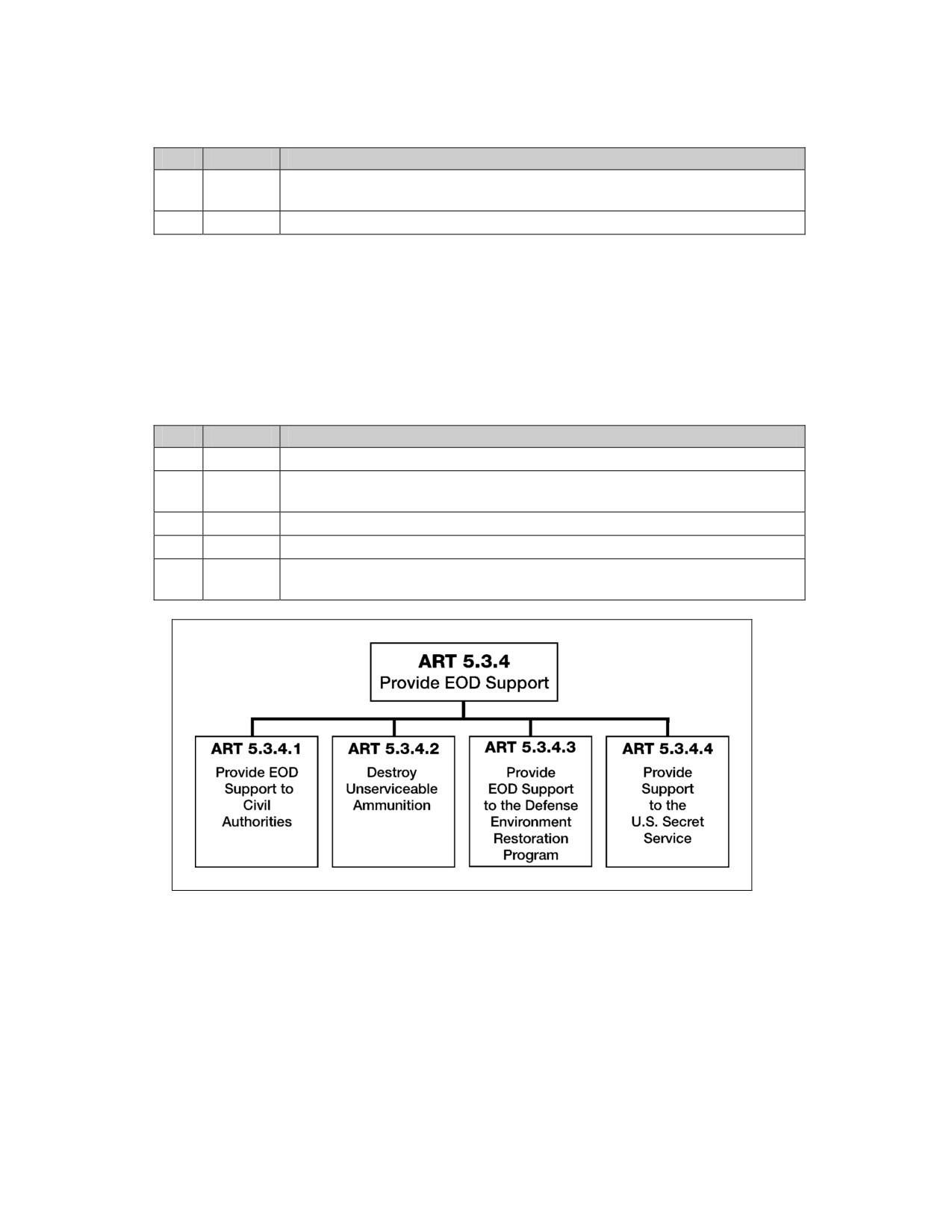
FM 7-15__________________________________________________________________________
No.
Scale
Measure
Of medical treatments degraded, delayed, or modified due to the inability
13
Percent
to perform patient decontamination.
14
Number
Of patients decontaminated.
ART 5.3.3 DISPERSE TACTICAL FORCES
5-48. Relocate forces and spread or separate troops, materiel, or activities
following concentration and maneuver to enhance survivability. The lethality
of modern weaponry significantly increases the threat to concentrated
formations. Attacking commanders manipulate their own and the enemy’s
concentration of forces by a combination of dispersion, concentration,
deception, and attack. Dispersion stretches the enemy’s defenses and denies
lucrative targets to enemy long-range fires. (FM 3-90) (USACAC)
No.
Scale
Measure
01
Yes/No
Unit accomplishes assigned mission while tactically dispersed.
To refine operations plan or order to reflect risk management
02
Time
assessment.
03
Time
To relocate friendly forces to minimize risks from battlefield hazards.
04
Percent
Of friendly casualties due to failure to disperse.
Of friendly casualties due to an inability to mass the effects of combat
05
Percent
power because assets are too dispersed.
ART 5.3.4 PROVIDE EXPLOSIVE ORDNANCE DISPOSAL SUPPORT
5-49. Neutralize domestic or foreign conventional, nuclear, chemical, and
biological munitions, and improvised devices that present a threat to military
operations and military and civilian facilities, materiel, and personnel,
regardless of location. The departments of Justice, State, and Energy may
receive this support in accordance with current agreements and directives.
ART 5.3.4 includes providing EOD support to the US Secret Service,
Department of State, and the Department of Defense to protect the president
and other designated persons. ART 5.3.4 also includes conducting bomb and
5-42

____________________
ART 5.0: The Mobility/Countermobility/Survivability Battlefield Operating System
sabotage device recognition and safety precaution training.
(FM 9-15)
(USAOC&S)
No.
Scale
Measure
01
Yes/No
EOD support allows the unit to accomplish its mission.
Collateral damage incurred during the EOD operation is within acceptable
02
Yes/No
limits.
Safeguard classified materials and publications during the EOD
03
Yes/No
operation.
Forward items and components of technical intelligence value to
04
Yes/No
appropriate headquarters/agency.
05
Time
To provide EOD input to Annex I (CSS) to the operation plan/order.
06
Time
To respond to a request for EOD support.
Delay in executing the scheme of maneuver due to the presence of
07
Time
unexploded ordnance and improvised devices.
To gather intelligence information (what, when, where, how delivered,
08
Time
and type) regarding munitions.
09
Time
To identify safety requirements and considerations.
To identify personnel, equipment, procedures, and additional support
10
Time
requirements.
To coordinate with reporting agency for site support assistance, such as
11
Time
engineer, medical, security, and transportation.
12
Time
To clear munitions and improvised devices.
To document render safe procedures, as conducted, for unknown
13
Time
ordnance, if technical intelligence data does not exist.
14
Percent
Of safety precautions enforced during EOD operation.
15
Percent
Of reported munitions and improvised devices rendered harmless.
Of reported munitions and improvised devices cleared in accordance with
16
Percent
commander’s priorities.
Of available EOD support expended on conducting bomb and sabotage
17
Percent
device recognition and safety training.
Of patients received at medical treatment facilities who have unexploded
18
Percent
ordnance in the wound.
19
Number
Of casualties during the EOD operation.
20
Number
And types of ordnance located and destroyed by EOD personnel.
Of NBC and conventional ordnance incidents responded to within a given
21
Number
period.
ART 5.3.4.1
PROVIDE EXPLOSIVE ORDNANCE DISPOSAL SUPPORT TO CIVIL
AUTHORITIES
5-50. Provide assistance, to include training, to public safety and law
enforcement agencies to deal with improvised explosive devices. Provide EOD
service when requested by local, state, or federal authorities in the interest of
public safety. ART 5.3.4.1 includes assisting law enforcement personnel with
war souvenir collection campaigns and the disposition of the explosive
ordnance collected. (FM 9-15) (USAOC&S)
5-43

FM 7-15__________________________________________________________________________
No.
Scale
Measure
The EOD support accomplishes the intent of the requesting civil
01
Yes/No
authorities.
02
Yes/No
Collateral damage during the EOD operation is within acceptable limits.
Safeguard classified materials and publications during the EOD
03
Yes/No
operation.
Forward items and components of technical intelligence value to the
04
Yes/No
appropriate headquarters/agency.
To determine whether the EOD support requested by a civil authority is
05
Time
authorized under current laws and regulations.
06
Time
To move from the current location to the work site.
To gather information about the munitions (what, when, where, how
07
Time
delivered, and type).
08
Time
To identify safety requirements and considerations.
To identify personnel, equipment, procedures, and additional support
09
Time
requirements.
To coordinate with the reporting agency for site support assistance, such
10
Time
as engineer, medical, security, and transportation.
11
Time
To clear munitions and improvised devices.
To document render safe procedures, as conducted, for unknown
12
Time
ordnance, if technical intelligence data does not exist.
Spent in developing and coordinating public awareness campaigns on
13
Time
the dangers that war souvenirs pose to the civilian population.
14
Percent
Of safety precautions enforced during the EOD operation.
15
Percent
Of reported munitions and improvised devices rendered harmless.
Of reported munitions and improvised devices cleared in accordance with
16
Percent
the requesting agency’s priorities.
Of available EOD support expended on public safety training, including
17
Percent
mine recognition training.
18
Number
Of casualties during the EOD operation.
19
Number
And types of ordnance located and destroyed by EOD personnel.
Of requests for assistance from civil authorities responded to within a
20
Number
given period.
ART 5.3.4.2
DESTROY UNSERVICEABLE AMMUNITION
5-51. Supervise or assist in the routine destruction of unserviceable/surplus
ammunition, upon the request of an accountable agency.
(FM
9-15)
(USAOC&S)
No.
Scale
Measure
01
Yes/No
EOD support accomplishes the intent of the requesting agency.
Collateral damage incurred during the conduct of the EOD operation is in
02
Yes/No
acceptable limits.
03
Yes/No
Safeguard classified materials and publications during EOD operation.
To identify safety requirements and considerations that concern
04
Time
destruction of the unserviceable/surplus ordnance.
5-44

____________________
ART 5.0: The Mobility/Countermobility/Survivability Battlefield Operating System
No.
Scale
Measure
To identify personnel, equipment, procedures, and additional support
05
Time
requirements.
06
Time
To move from the current location to the work site.
To coordinate with the reporting agency for site support assistance, in
07
Time
areas such as engineer, medical, security, and transportation.
08
Time
To destroy the unserviceable/surplus ordnance.
09
Percent
Of safety precautions enforced during the EOD operation.
10
Percent
Of nominated ordnance destroyed or rendered harmless.
Of nominated ordnance destroyed/rendered inert in accordance with the
11
Percent
requesting agencies priorities.
12
Number
Of casualties during the conduct of the EOD operation.
13
Number
And types of ordnance destroyed by EOD personnel.
ART 5.3.4.3 PROVIDE EXPLOSIVE ORDNANCE DISPOSAL SUPPORT TO THE
DEFENSE ENVIRONMENT RESTORATION PROGRAM
5-52. Provide EOD support to agencies restoring the environment at military
installations. (FM 9-15) (USAOC&S)
No.
Scale
Measure
01
Yes/No
EOD support accomplishes the intent of the requesting authorities.
Collateral damage incurred during the conduct of the EOD operation is in
02
Yes/No
acceptable limits.
03
Yes/No
Safeguard classified materials and publications during EOD operation.
Forward items and components of technical intelligence value to
04
Yes/No
appropriate headquarters/agency.
05
Time
To move from the current location to the work site.
To identify safety requirements and considerations that concern the
06
Time
ordnance found during environment restoration projects.
To identify personnel, equipment, procedures, and additional support
07
Time
requirements.
08
Time
To clear ordnance from the environmental restoration project site.
To coordinate with the reporting agency for site support assistance, such
09
Time
as engineer, medical, security, and transportation.
To document render safe procedures, as conducted, for unknown
10
Time
ordnance, if technical intelligence data does not exist.
11
Percent
Of safety precautions enforced during the EOD operation.
12
Percent
Of reported munitions rendered harmless.
Of reported munitions cleared in accordance with the requesting agency’s
13
Percent
priorities.
14
Number
Of casualties during the conduct of the EOD operation.
15
Number
And types of ordnance located and destroyed by EOD personnel.
16
Number
Of requests for assistance responded to in a given period.
5-45

FM 7-15__________________________________________________________________________
ART 5.3.4.4
PROVIDE SUPPORT TO THE SECRET SERVICE
5-53. Provide support to the U. S. Secret Service, the Department of State,
and the Department of Defense for the protection of the president and other
designated high-risk personnel. (FM 9-15) (USAOC&S)
No.
Scale
Measure
EOD support accomplishes the intent of protecting the executive from
01
Yes/No
death or injury from ordnance and improvised explosive devices.
Collateral damage incurred during the conduct of the EOD operation is in
02
Yes/No
acceptable limits.
03
Yes/No
Safeguard classified materials and publications during EOD operation.
Forward items and components of technical intelligence value to
04
Yes/No
appropriate headquarters/agency.
To determine if current laws and regulations authorize the provision of the
05
Time
requested EOD support.
06
Time
To move from current location to work site.
To gather intelligence information (what, when, where, how delivered,
07
Time
and type) regarding munitions and improvised explosive devices.
08
Time
To identify safety requirements and considerations.
To identify personnel, equipment, procedures, and additional support
09
Time
requirements.
To coordinate with reporting and other agencies for additional site
10
Time
support assistance, such as engineer, medical, security, and
transportation.
11
Time
To clear munitions and improvised explosive devices.
To document render safe procedures, as conducted, for unknown
12
Time
ordnance, if technical intelligence data does not exist.
Spent in training personnel providing executive protection services on
13
Time
recognizing and conducting immediate action drills when confronted by
conventional or improvised explosive devices.
14
Percent
Of safety precautions enforced during EOD operation.
Of reported munitions and improvised explosive devices rendered
15
Percent
harmless.
Of reported munitions and improvised explosive devices cleared in
16
Percent
accordance with the requesting agencies priorities.
Of available EOD support expended on training executive protection
17
Percent
services personnel.
Of available EOD support expended on assisting the Secret Service and
18
Percent
other governmental agencies that provide executive protection services.
19
Number
Of casualties during the conduct of the EOD operation.
20
Number
And types of ordnance located and destroyed by EOD personnel.
Of requests for assistance from civil authorities responded to within a
21
Number
given period.
5-46
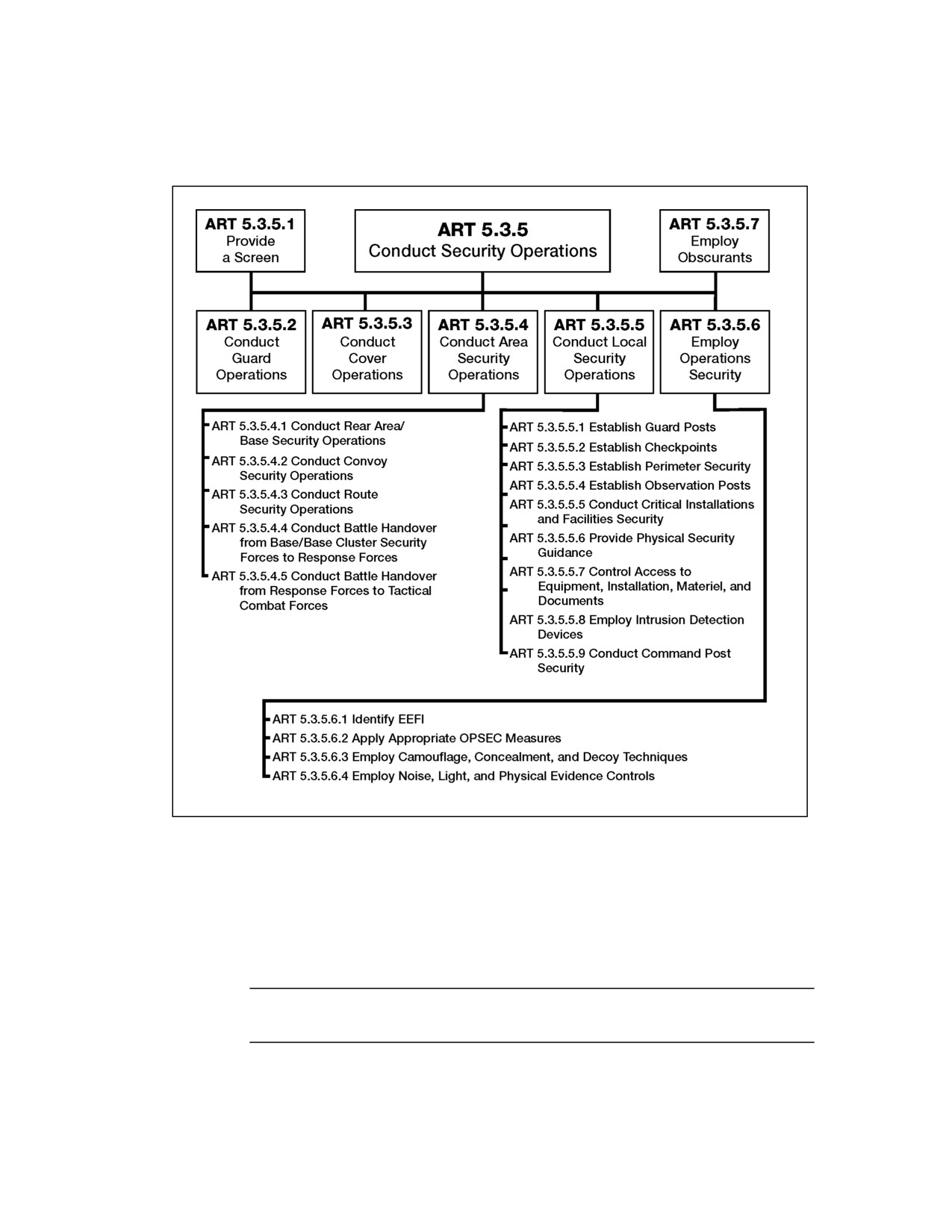
____________________
ART 5.0: The Mobility/Countermobility/Survivability Battlefield Operating System
ART 5.3.5 CONDUCT SECURITY OPERATIONS
5-54. Security operations are those operations undertaken by a commander
to provide early and accurate warning of enemy operations, to provide the
force being protected with time and maneuver space within which to react to
the enemy, and to develop the situation to allow the commander to effectively
use the protected forces. Commanders continually conduct some form of
security operations. (FM 3-90) (USACAC)
Note: The information obtained on the enemy in conducting this task also
pertains to ART 1.0 (Intelligence Battlefield Operating System).
5-47