FM 7-15 THE ARMY UNIVERSAL TASK LIST (AUGUST 2003) - page 3

FM 7-15__________________________________________________________________________
No.
Scale
Measure
Of airborne unit personnel and cargo drops landing within the limits of
12
Percent
the drop zone.
13
Number
Of personnel landing within the limits of the drop zone.
Of tons and types of cargo landing within the limits of the drop zone or
14
Number
that can be recovered by the airborne unit.
Of casualties from accidents caused by conditions on the drop zone,
15
Number
such as wind speed, obstacles, and surface conditions.
ART 2.5.5
CONDUCT LANDING ZONE OPERATIONS
2-47. ART 2.5.5 begins when soldiers and equipment exit the helicopters. It
does not include air traffic control or efforts to improve the landing zone.
ART 2.5.5 ends when all elements of the relevant air assault echelon arrive
in the objective area. (FM 90-4) (USAIS)
No.
Scale
Measure
Unit assembles according to its landing plan (on the objective, on the
landing zone, or in an assembly area adjacent the landing zone) and
01
Yes/No
begins to execute the ground tactical plan not later than the time the
operation order specifies.
Security positions around landing zone occupied until completion of
02
Yes/No
the vertical envelopment process.
Landing zone cleared of equipment and debris for use by follow-on
03
Yes/No
forces or future airland operations.
To conduct map or physical reconnaissance of site to ensure that
landing zone supports operational requirements, such as degree of
04
Time
slope and surface conditions, appropriate size to accommodate the
helicopters delivering the force, and free of obstacles.
To clear or mark obstacles, such as stumps and fences located on the
05
Time
landing zone.
To ensure landing zone approach and exit paths are free of
06
Time
obstructions.
07
Time
To mark the landing zone.
Of air assault unit personnel and cargo landing within the limits of the
08
Percent
landing zone.
09
Number
Of personnel landing on the landing zone.
10
Number
Of tons and types of cargo landing on the landing zone.
Of casualties from accidents caused by landing zone conditions, such
11
Number
as foreign object damage (FOD), and hidden obstacles.
SECTION VI - ART 2.6: EMPLOY SERE TECHNIQUES
2-48. Employ techniques to support unit or collective efforts directed toward
survival, evasion, resistance, and escape (SERE). This task includes the
conduct of unit training that supports theater standards for SERE training
for all personnel, inclusive of, but not limited to, high risk of capture
personnel. (FM 100-25) (USAJFKSWC)
2-30
____________________________________________
ART 2.0: The Maneuver Battlefield Operating System
No.
Scale
Measure
Tactical safe areas or evasion and recovery areas designated and
01
Yes/No
maintained by tactical units.
To report isolated personnel (from time of isolating incident, such as
encirclement, shoot-down of aircraft, etc.) to appropriate headquarters,
02
Time
Army Rescue Coordination Center, or theater Joint Search and
Rescue Center.
Of high risk of capture (HRC) personnel trained to theater SERE or
03
Percent
unit standards.
Of tactical evader caches, compromised within three months of
04
Percent
emplacement.
Of evaders, beyond capability or availability of rescue platform,
05
Percent
provide resupply by cache or air-delivered package.
06
Percent
Of escapees, recovered.
07
Number
Of HRC personnel trained to theater SERE or unit standards.
Of evaders, beyond capability or availability of rescue platform,
08
Number
provide resupply by cache or air-delivered package.
09
Number
Of escapees, recovered.
2-31
Chapter 3
ART 3.0: The Fire Support
Battlefield Operating System
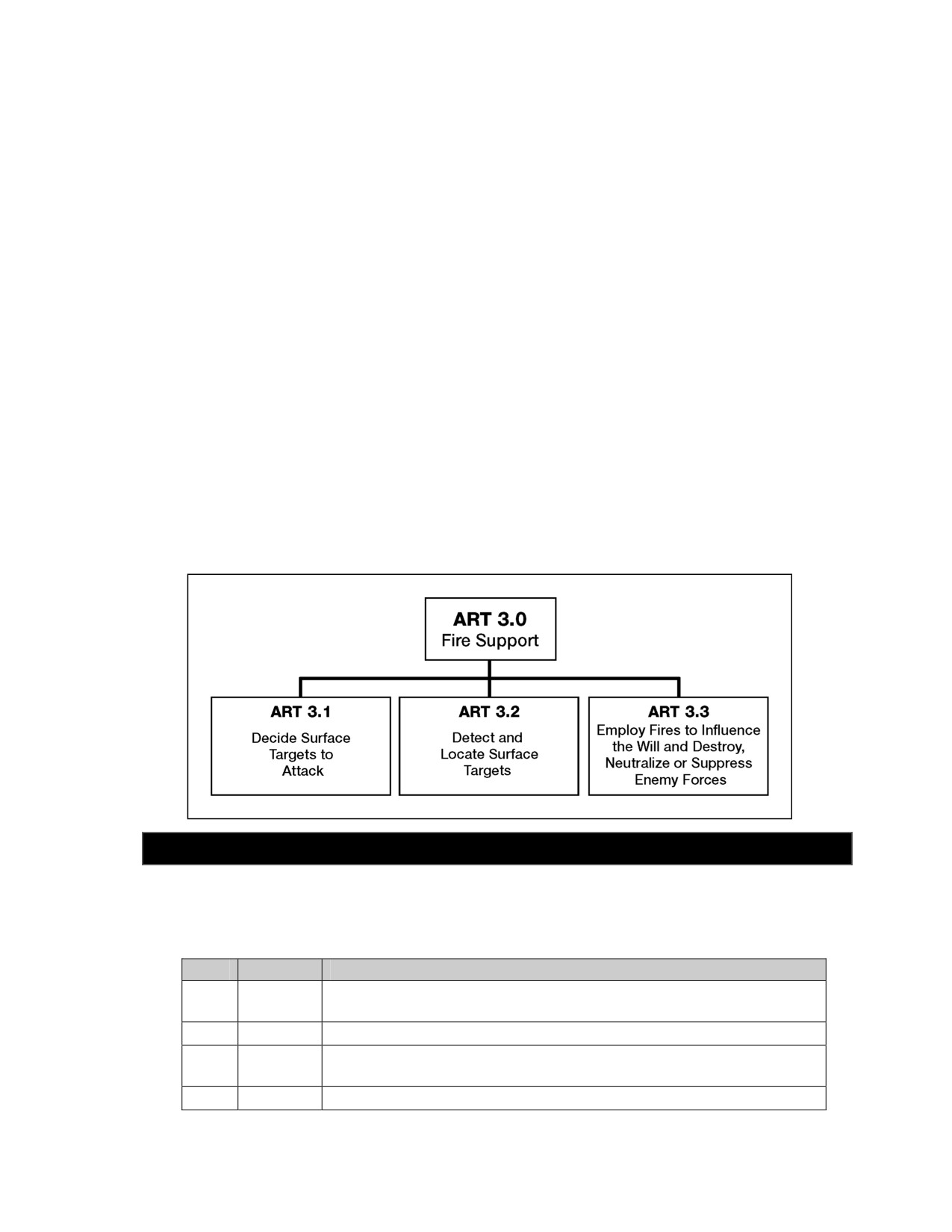
The fire support battlefield operating system encompasses the collective
and coordinated use of target-acquisition data, indirect-fire weapons,
fixed-wing aircraft, offensive information operations, and other lethal and
nonlethal means against targets located throughout an AO. The essential
features of the fire support battlefield operating system are acquiring and
processing tactical targets and employing fire support. ART
4.0 Air
Defense Battlefield Operating System addresses acquiring and attacking
aerial targets.
SECTION I - ART 3.1: DECIDE SURFACE TARGETS TO ATTACK
3-1. Analyze the situation relative to the mission, objectives, and
capabilities. Identify and nominate specific vulnerabilities and/or high-payoff
targets that if influenced, degraded, delayed, disrupted, disabled, or
destroyed will accomplish the commander’s intent. (FM 6-20) (USAFAS)
No.
Scale
Measure
Targets selected allow for accomplishing the unit mission and
01
Yes/No
commander’s intent.
02
Yes/No
Selected targets reviewed for compliance with rules of engagement.
To select and decide on attacking a high priority target once inside the
03
Time
execution cycle.
04
Time
To create a target nomination list.
3-1

FM 7-15__________________________________________________________________________
No.
Scale
Measure
05
Time
To complete target prioritization.
06
Time
To determine moving target intercept points.
07
Time
To issue prohibited target guidance.
08
Time
To pass commander’s guidance to targeting agencies.
09
Percent
Of high-priority targets discovered resulting in a reprioritized target list.
10
Percent
Of potential targets subjected to systematic analysis.
11
Percent
Of potential targets analyzed within established time parameters.
12
Percent
Of selected targets that completed duplication checks.
13
Percent
Of selected high-priority targets accurately identified.
SECTION II - ART 3.2: DETECT AND LOCATE SURFACE TARGETS
3-2. Perceive an object of possible military interest without confirming it by
recognition (detect). Determine the placement of a target on the battlefield
(locate). Target location can be expressed, for example, as a six-digit grid
coordinate. (FM 6-20) (USAFAS)
Note: The contributions made by the intelligence BOS toward this task can
be found in the ART 1.4.1, Provide Intelligence Support to Targeting, task
branch.
No.
Scale
Measure
Detect and locate all high-priority and high-payoff targets within the
01
Yes/No
AO.
To locate targets during reconnaissance and surveillance of defined
02
Time
target area of interest.
Of potential targets detected to targeting accuracy during
03
Percent
reconnaissance and surveillance.
Of potential targets not detected during reconnaissance and
04
Percent
surveillance.
05
Percent
Of target locations verified before next targeting cycle.
06
Percent
Of designated HPTs that have correct location data.
Of potential targets not detected per given period during
07
Number
reconnaissance and surveillance.
Of potential targets detected per given period during reconnaissance
08
Number
and surveillance.
3-2
_________________________________________
ART 3.0: The Fire Support Battlefield Operating System
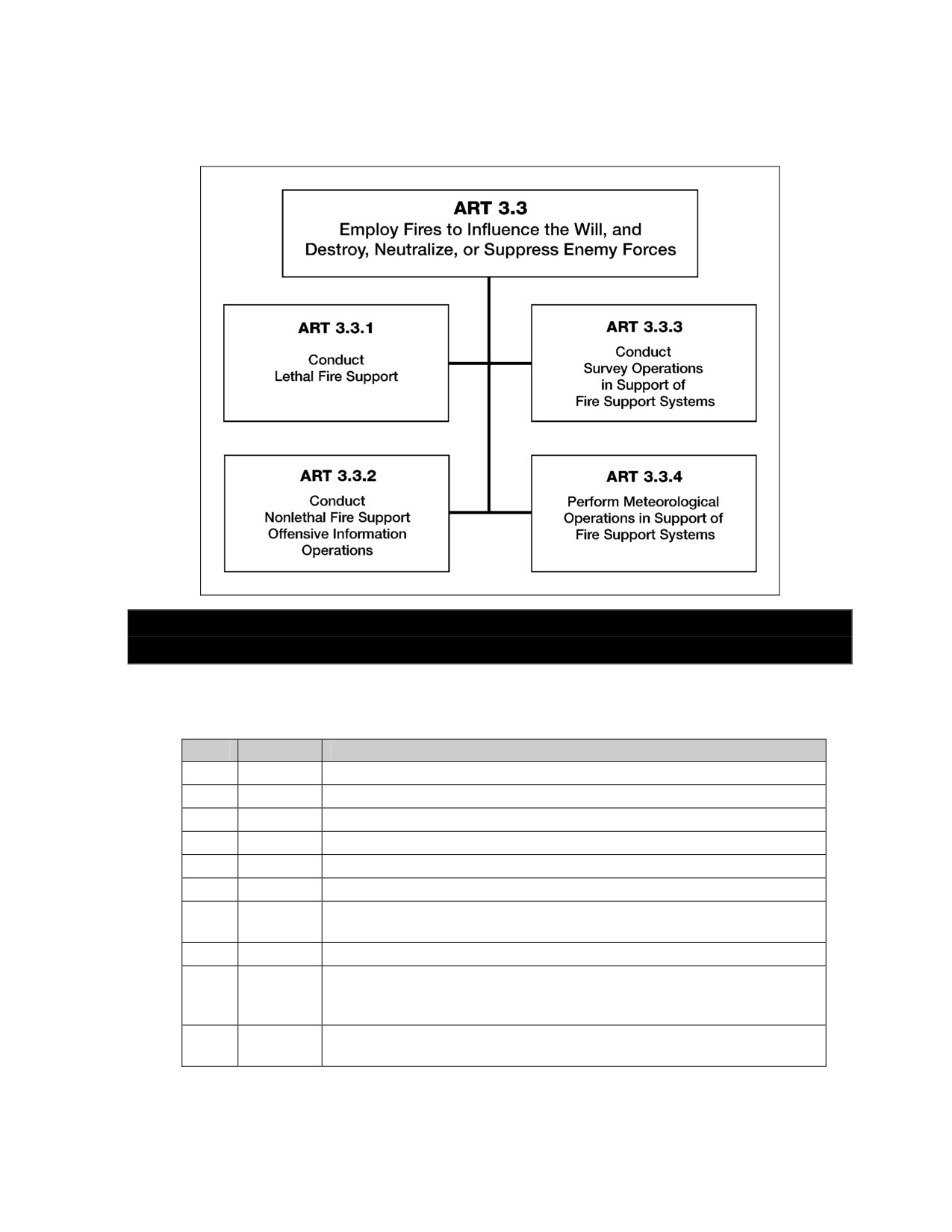
SECTION III - ART 3.3. EMPLOY FIRES TO INFLUENCE THE WILL, AND
DESTROY, NEUTRALIZE, OR SUPPRESS ENEMY FORCES
3-3. Conduct coordinated fires of fixed-wing aircraft, land- and sea-based
indirect fire systems, and offensive information operations to support land
tactical-level operations against surface targets. (FM 6-20) (USACAC)
No.
Scale
Measure
01
Yes/No
Fires achieve the commander’s fire support guidance.
02
Time
For a given fire support weapon system to respond.
03
Time
To reattack target after battle damage assessment.
04
Percent
Of target attacks that achieve desired results.
05
Percent
Of enemy targets engaged.
06
Percent
Of friendly AO within the range of supporting fire support systems.
Of fire support missions synchronized with the maneuver of friendly
07
Percent
units.
08
Number
Of instances where friendly fire support results in friendly casualties.
Of COA denied to an enemy or friendly force due to friendly fire
09
Number
support efforts as determined from interrogations and after action
reviews.
Of instances of collateral damage beyond the scope of the rules of
10
Number
engagement (ROE).
3-3
FM 7-15__________________________________________________________________________
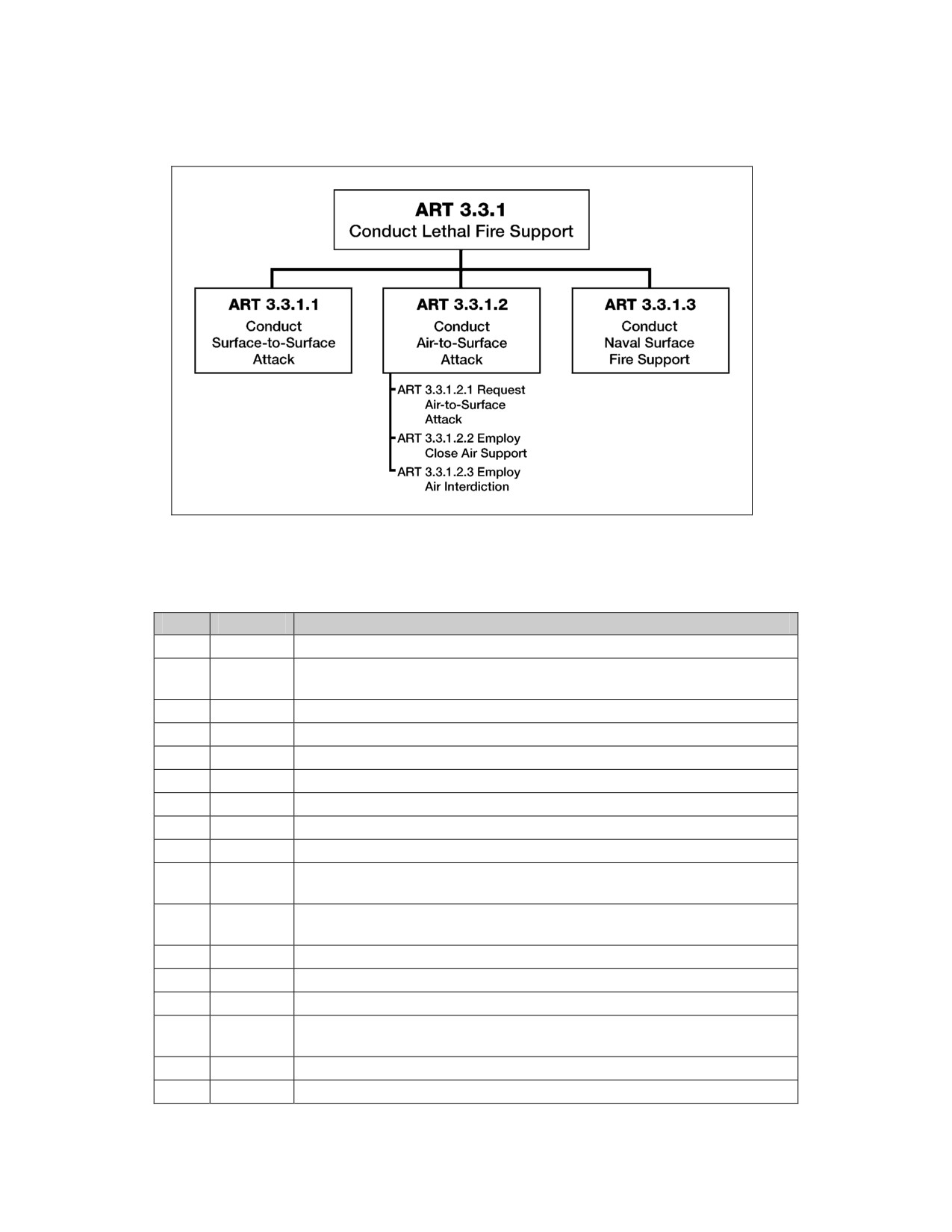
ART 3.3.1
CONDUCT LETHAL FIRE SUPPORT
3-4. Use fire support weapons systems against troops, fortifications,
materiel, or facilities. (FM 6-20) (USAFAS)
No.
Scale
Measure
01
Yes/No
Lethal fire support achieves desired result.
Was lethal fire support conducted in accordance with established rules
02
Yes/No
of engagement?
03
Time
To get ordnance on target after initiating task.
04
Time
To complete attack after identifying target.
05
Time
To provide adjustment data after observing first rounds.
06
Time
To select targets for attack.
07
Time
To plan and coordinate naval surface fire support attack.
08
Time
To prepare to conduct a surface-to-surface attack.
09
Percent
Of total fire support missions requested by units executed.
Of the probability of a hit when selecting the correct munitions under
10
Percent
existing conditions.
Of the probability of catastrophic, mobility, or firepower kill when
11
Percent
selecting the correct munitions under existing conditions.
12
Percent
Of high-priority missions executed within specified time.
13
Percent
Of missions flown/fired achieve desired target damage.
14
Percent
Of preplanned targets successfully attacked during operations.
Of desired results achieved by expected conclusion of a phase of the
15
Percent
operation.
16
Percent
Of time on target mission completed on time.
17
Percent
Of enemy HPT delivery systems engaged/destroyed by friendly forces.
3-4

_________________________________________
ART 3.0: The Fire Support Battlefield Operating System
No.
Scale
Measure
18
Percent
Of friendly fire support systems available to deliver ordnance.
Of enemy forces destroyed, delayed, disrupted, or degraded in
19
Percent
accordance with FM 3-90 definitions.
20
Percent
Of total target list successfully engaged.
21
Percent
Of unplanned enemy targets successfully engaged.
22
Percent
Of unit basic load of ordnance available for use in lethal attack.
Of enemy high-priority targets requiring more than one type of weapon
23
Percent
system to ensure successful attack.
Of lethal fire support effort diverted by higher commanders to support
24
Percent
their targeting priorities.
25
Number
Of fire support systems available.
ART 3.3.1.1
CONDUCT SURFACE-TO-SURFACE ATTACK
3-5. Use ground-based, indirect-fire weapons systems to destroy, suppress, or
neutralize enemy equipment (including aircraft on the ground), materiel,
personnel, fortifications, and facilities. (FM 6-20) (USAFAS)
No.
Scale
Measure
01
Yes/No
Surface-to-surface attack achieves desired result.
Was surface-to-surface attack conducted in accordance with
02
Yes/No
established rules of engagement?
03
Time
To get ordnance on target after initiating task.
04
Time
To complete attack after identifying target.
05
Time
To provide adjustment data after observing first rounds.
06
Time
To plan and coordinate surface-to-surface attack.
07
Time
To prepare for surface-to-surface attack.
08
Percent
Of total fire support missions requested by units executed.
Of the probability of a hit when selecting the correct munitions under
09
Percent
sufficient conditions.
Of the probability of catastrophic, mobility, or firepower kill given a hit
10
Percent
when selecting correct munitions under sufficient conditions.
11
Percent
Of high-priority missions executed within specified time.
12
Percent
Of missions fired that achieve desired target damage.
13
Percent
Of preplanned targets successfully attacked during operation.
14
Percent
Of time on target mission completed on time.
15
Percent
Of enemy HPT delivery systems engaged/destroyed by friendly forces.
16
Percent
Of friendly fire support systems available to deliver ordnance.
Of enemy forces destroyed, delayed, disrupted, or degraded
17
Percent
according to FM 3-90 definitions.
18
Percent
Of total target list successfully engaged.
19
Percent
Of unplanned enemy targets successfully engaged.
20
Percent
Of unit basic load of ordnance available for use in lethal attack.
3-5

FM 7-15__________________________________________________________________________
No.
Scale
Measure
21
Percent
Of selected targets for which accurate coordinates are available.
22
Number
Of fire support systems available.
ART 3.3.1.2
CONDUCT AIR-TO-SURFACE ATTACK
3-6. Use fixed-wing and rotary-wing aircraft-mounted weapon systems to
destroy, suppress, or neutralize equipment (including aircraft on the ground),
materiel, personnel, fortifications, and facilities. ART 3.3.1.2 includes the
integration of fires from aerial platforms with other fire support systems.
(FM 90-21) (USATRADOC DCS-DOC/ALSA)
No.
Scale
Measure
Air-to-surface attacks allow the commander to accomplish his mission
01
Yes/No
within identified time and resource constraints.
Was air-to-surface attack conducted in accordance with established
02
Yes/No
rules of engagement?
To process air-to-surface attack requests through fire support (fixed-
03
Time
wing) or maneuver (rotary-wing) channels as appropriate.
04
Time
For aerial systems to respond to mission request.
05
Time
For aircraft to identify target.
06
Time
To get ordnance on target after initiating air-to-surface attack request.
07
Percent
Of requested missions executed.
08
Percent
Of availability of aerial weapon systems (fixed-wing and rotary-wing).
Of missions where the ordnance carried by aerial weapon systems is
09
Percent
appropriate for the target attacked.
10
Percent
Of missions requested directed to appropriate agency.
Of targets engaged by friendly aerial weapon systems (fixed wing and
11
Percent
rotary wing).
Of friendly force operations delayed, disrupted, or modified due to lack
12
Percent
of requested air support according to FM 3-90 definitions.
13
Percent
Of targets attacked achieve desired results.
Of maneuver forces having aerial weapon systems available for
14
Percent
employment.
Of air-to-surface attack missions conducted without incidents of
15
Percent
fratricide.
Of aerial weapon systems having functioning identification friend or
16
Percent
foe (IFF) systems.
17
Percent
Of air-to-surface missions cancelled because of weather restrictions.
18
Number
Of aerial weapon systems available to support the commander.
3-6

_________________________________________
ART 3.0: The Fire Support Battlefield Operating System
ART 3.3.1.2.1 Request Air-to-Surface Attack
3-7. Request employment of Army special operations forces; Navy, Marine,
and Air Force aircraft; and other systems to deliver rocket, cannon, missile
fires, and bombs on surface targets.
(FM 90-21)
(USATRADOC DCS-
DOC/ALSA)
No.
Scale
Measure
Respond to requests for an air-to-surface attack in a timely manner to
01
Yes/No
provide support at the appropriate time.
02
Time
To process air support request.
03
Time
To get ordnance on target after initiating air request.
04
Percent
Of missions requested by Army commanders executed.
05
Percent
Of availability of supporting air agencies for maneuver forces.
06
Percent
Of missions requested directed to appropriate agency.
ART 3.3.1.2.2 Employ Close Air Support
3-8. Employ aircraft in preplanned and immediate close air support missions
and joint air attack team operations to destroy, delay, disrupt, or suppress
targets to support land operations. Close air support requires positive IFF
and positive or procedural control of aircraft. (FM 6-20) (USAFAS)
No.
Scale
Measure
Close air support destroys, delays, disrupts, or suppresses targets to
01
Yes/No
support land operations.
Was the employment of close air support in accordance with
02
Yes/No
established rules of engagement?
03
Time
To process close air support requests through fire support channels.
04
Time
For close air support aircraft to respond to mission request.
05
Time
For close air support aircraft to identify target.
06
Time
To get ordnance on target after initiating close air support request.
07
Percent
Of missions requested by Army commands executed.
08
Percent
Availability of supporting air agencies for maneuver forces.
09
Percent
Of missions requested directed to appropriate agency.
10
Percent
Of enemy units engaged with friendly air support.
Of friendly force operations delayed, disrupted, or modified due to lack
11
Percent
of requested close air support.
12
Percent
Of targets attacked achieving desired results.
13
Percent
Of close air support missions conducted without incidents of fratricide.
14
Percent
Of close air support missions cancelled by weather.
Of close air support missions flown with IFF systems functioning and
15
Percent
positive control of aircraft.
ART 3.3.1.2.3 Employ Air Interdiction
3-9. Employ aircraft to destroy, disable, disrupt, or delay enemy military
potential before it can be used effectively against friendly ground forces far
3-7

FM 7-15__________________________________________________________________________
enough from friendly forces that detailed integration of each air mission with
friendly ground maneuver is not required. (FM 6-20) (USAFAS)
No.
Scale
Measure
Air interdiction destroys, delays, disrupts, or suppresses targets to
01
Yes/No
support land operations.
Was the employment of air interdiction in accordance with established
02
Yes/No
rules of engagement?
03
Time
To process air interdiction requests through fire support channels.
04
Time
For air interdiction aircraft to respond to mission request.
05
Time
For air interdiction aircraft to identify target.
06
Time
To get ordnance on target after initiating air interdiction request.
07
Percent
Of missions requested by Army commands executed.
08
Percent
Of mission requests directed to appropriate agency.
Of air interdiction enemy systems and targets engaged with friendly air
09
Percent
support.
Of friendly force operations delayed, disrupted, or modified due to lack
10
Percent
of requested air interdiction.
11
Percent
Of targets attacked achieving desired results.
12
Percent
Of air interdiction missions conducted without incidents of fratricide.
13
Percent
Of air interdiction missions cancelled by weather.
Of air interdiction missions flown with IFF systems functioning and
14
Percent
positive control of aircraft.
ART 3.3.1.3
CONDUCT NAVAL SURFACE FIRE SUPPORT
3-10. Apply fires provided by Navy surface gun, missile, and electronic
warfare systems to support a unit or units tasked with achieving the
commander’s objectives. (FM 3-09.32) (USATRADOC DCS-DOC/ALSA)
No.
Scale
Measure
01
Yes/No
Naval surface fire support achieves desired result.
02
Yes/No
Naval surface fire support platform is available and within range.
Was the conduct of naval surface fire support accomplished in
03
Yes/No
accordance with established rules of engagement?
04
Time
To get ordnance on target after initiating task.
05
Time
To provide adjustment data after observing first rounds.
06
Time
To accomplish targeting process for fires.
07
Time
To plan and coordinate for naval surface fire support.
08
Percent
Of total fire support missions requested by units executed.
Of the probability of a hit when selecting the correct munitions under
09
Percent
sufficient conditions.
Of the probability of catastrophic, mobility, or firepower kill when
10
Percent
selecting the correct munitions under existing conditions.
11
Percent
Of high-priority missions executed within specified time.
12
Percent
Of missions fired achieving desired target damage.
3-8
_________________________________________
ART 3.0: The Fire Support Battlefield Operating System
No.
Scale
Measure
13
Percent
Of preplanned targets successfully attacked during operations.
Of desired results achieved by the expected conclusion of a given
14
Percent
phase of the operation.
15
Percent
Of naval cannon and missile systems available to deliver ordnance.
16
Percent
Of enemy forces destroyed, delayed, disrupted, or degraded.
17
Percent
Of total target list successfully engaged.
18
Percent
Of unplanned enemy targets successfully engaged.
19
Percent
Of the ship’s basic load of ordnance available for use in lethal attack.
20
Number
Of naval surface fire support systems available.
3-9

FM 7-15__________________________________________________________________________
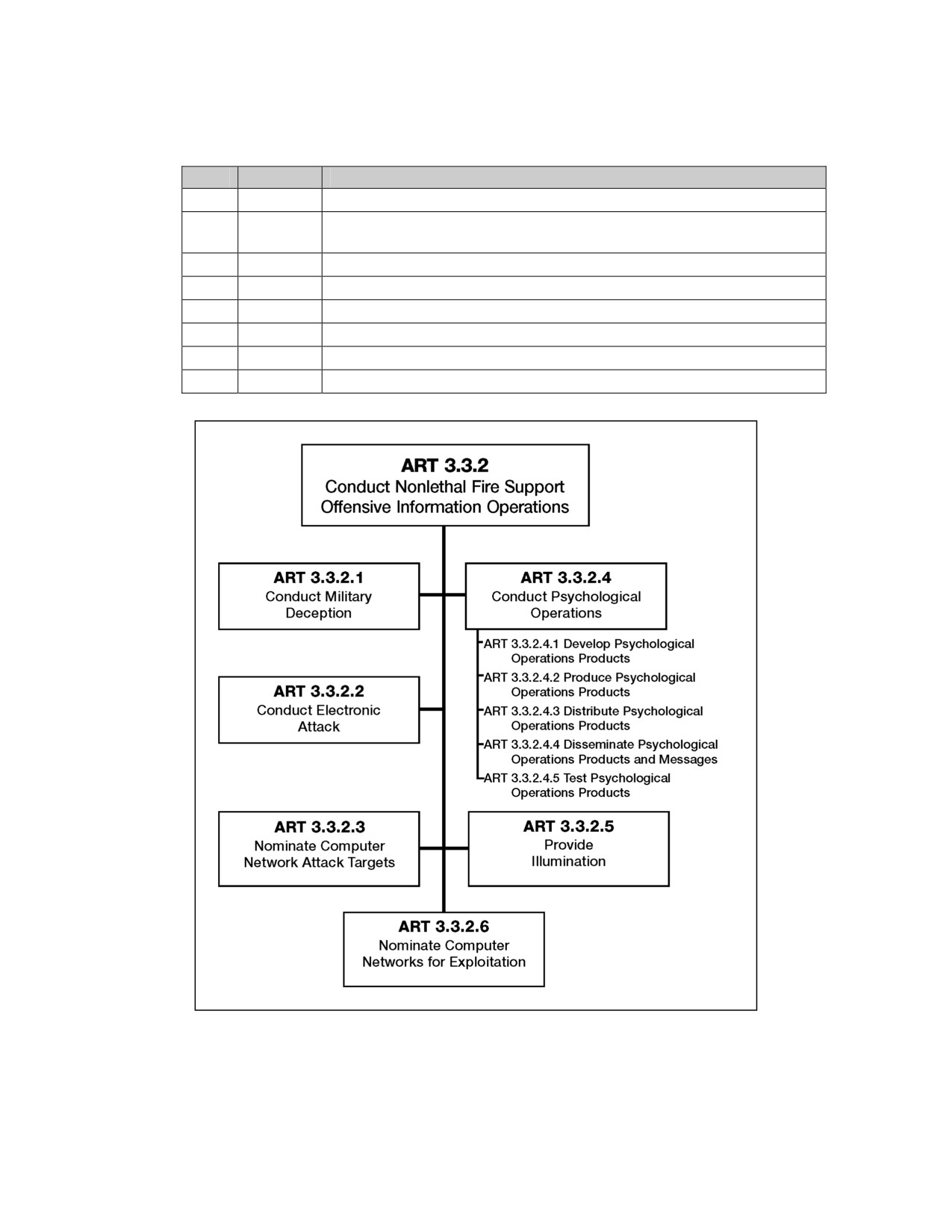
ART 3.3.2 CONDUCT NONLETHAL FIRE SUPPORT—OFFENSIVE
INFORMATION OPERATIONS
3-11. Employ nonlethal assets to impair the performance of enemy personnel
and equipment. (FM 3-13) (USACAC).
No.
Scale
Measure
01
Yes/No
Offensive IO achieves desired result.
Was the conduct of nonlethal fire support/offensive information
02
Yes/No
operations accomplished in accordance with established rules of
engagement?
03
Time
To initiate offensive IO.
04
Time
To achieve desired damage levels on enemy information systems.
05
Time
To observe results of attacks on enemy information systems.
Of operations plans and operations orders that integrate offensive IO
06
Percent
with lethal fire support.
07
Percent
Of tactical plans that include an offensive IO plan.
08
Percent
Of all enemy information systems evaluated as candidates for attack.
Of attacks on enemy information systems that occur without also
09
Percent
resulting in damage to friendly information systems.
Of offensive information operations missions that achieve desired
10
Percent
effects on enemy.
11
Percent
Of tasked offensive information operations missions conducted.
12
Percent
Of enemy information systems included on high-priority target list.
Of enemy backup and alternate information systems attacked
13
Percent
concurrent with attacks on primary systems.
Of reduction in enemy communications emissions after attack by
14
Percent
offensive IO systems.
15
Percent
Of enemy force degradation due to offensive IO.
ART 3.3.2.1
CONDUCT MILITARY DECEPTION
3-12. Execute actions to deliberately mislead enemy/adversary military
decision makers as to friendly military capabilities, intentions, and
operations, thereby causing the enemy/adversary to take specific actions (or
inactions) that contribute to accomplishing the friendly mission. Military
deception includes simulative deception, simulative electronic deception,
imitative electronic deception, and manipulative electronic deception. (FM 3-
13) (USACAC)
No.
Scale
Measure
01
Yes/No
Achieve deception objective.
02
Yes/No
Integrate military deception effort with other operations.
Deception effort conforms to instructions from higher headquarters,
03
Yes/No
statutory requirements, and international agreements.
04
Yes/No
Deception effort supports the commander’s intent.
05
Yes/No
Identify, then exploit target biases.
06
Yes/No
Maintain OPSEC throughout the process.
3-10

_________________________________________
ART 3.0: The Fire Support Battlefield Operating System
No.
Scale
Measure
Use a variety of sources—physical, electronic, imitative, simulative,
07
Yes/No
and manipulative—to transmit the deception story to the enemy.
08
Time
To provide a deception plan to support a branch or sequel.
09
Time
For enemy to identify deception after commencing operations.
10
Time
To implement preplanned deception plan.
11
Time
To identify key enemy decision makers.
12
Time
To identify enemy critical intelligence indicators.
To assess OPSEC measures protecting military deception operation
13
Time
from hostile detection and unwitting disclosure to friendly elements.
Of enemy force decoyed away from the area of the unit’s decisive
14
Percent
operation.
Of operations plans and orders that contain a military deception
15
Percent
appendix to the IO annex.
Of friendly deception operations resulting in enemy reallocating its
16
Percent
resources.
Of enemy critical intelligence indicators successfully supplied with
17
Percent
false or misleading information.
18
Percent
Of deception events executed at the time and location specified.
Of physical and operational environment effectively used to support
19
Percent
deception effort.
20
Percent
Of false information contained in the deception story.
Of physical, technical, and administrative means available to convey
21
Number
information to the deception target.
ART 3.3.2.2
CONDUCT ELECTRONIC ATTACK
3-13. Employ jamming, electromagnetic energy, or directed energy against
personnel, facilities, or equipment. Use deliberate radiation, reradiation, or
reflection of electromagnetic energy to degrade, neutralize, or destroy enemy
combat capability. ART 3.3.2.2 includes determining the signal to jam (or
target with electromagnetic or directed energy) and the desired result,
selecting the jamming method, initiating jamming, determining the jamming
effects on the target, and adjusting jamming. (FM 34-40) (USAIC&FH)
No.
Scale
Measure
01
Yes/No
Achieve electronic attack objective.
Was the conduct of electronic attack in accordance with established
02
Yes/No
rules of engagement?
03
Time
To initiate electronic attack.
04
Time
To create a frequency deconfliction plan.
05
Time
To plan electronic attack.
To prepare to conduct electronic attack including moving systems into
06
Time
place and conducting rehearsals and precombat inspections.
Of operations plans and operations orders that integrate electronic
07
Percent
attack with lethal fire support.
3-11

FM 7-15__________________________________________________________________________
No.
Scale
Measure
08
Percent
Of electronic attacks that achieve desired results on enemy.
09
Percent
Of tasked electronic attacks conducted.
Of reduction in enemy communications emissions after electronic
10
Percent
attack.
11
Percent
Of enemy force degradation due to electronic attack.
12
Percent
Of available electronic attack systems that are mission capable.
13
Number
Of available electronic attack systems.
ART 3.3.2.3
NOMINATE COMPUTER NETWORK ATTACK TARGETS
3-14. Nominate targets to disrupt, deny, degrade, or destroy information in
computers and computer networks, or the computers and networks
themselves. This is a corps-level task. (FM 3-13) (USACAC)
No.
Scale
Measure
01
Yes/No
Identify computer network attack targets.
Were CNA targets nominated in accordance with established rules of
02
Yes/No
engagement?
03
Time
To submit computer network attack targets to operational echelons.
04
Time
To receive results of computer network attack.
Of enemy information system not engaged by computer network
05
Percent
attack that is targeted for attack by lethal systems.
ART 3.3.2.4
CONDUCT PSYCHOLOGICAL OPERATIONS (PSYOP)
3-15. Integrate planned psychological messages, products, and actions into
combat operations or in support of military operations other than war.
Psychological operations influence foreign target audiences in the AO to
support achieving national objectives and military operations. (FM 3-05.30)
(USAJFKSWCS)
No.
Scale
Measure
Commander controls the flow of information to the target audience to
01
Yes/No
influence its behavior in accordance with national/joint force
commander objectives.
Was the conduct of PSYOP done in accordance with established rules
02
Yes/No
of engagement?
03
Time
To initiate PSYOP plan after receiving warning order.
04
Time
To modify PSYOP plan to incorporate battlefield and other events.
05
Percent
Of AO covered by friendly force mass media.
Of PSYOP effort focused on stabilizing and reinforcing allied forces
06
Percent
and host nation.
Of selected targets for which both lethal attack systems and PSYOP
07
Percent
were integrated.
08
Percent
Of target audience reached in PSYOP plan.
09
Percent
Of target audience reached by more than one media in PSYOP plan.
10
Percent
Of PSYOP targets attacked achieving desired results.
3-12

_________________________________________
ART 3.0: The Fire Support Battlefield Operating System
No.
Scale
Measure
11
Percent
Of PSYOP themes that have unanticipated results.
ART 3.3.2.4.1 Develop Psychological Operations (PSYOP) Products
3-16. Develop products to support offensive, defensive, stability, and support
operations. (FM 3-05.30) (USAJFKSWCS)
No.
Scale
Measure
Unit prepares a prototype supported by pertinent product explanation
worksheet (PEW) and developed within pre-approved parameters set
01
Yes/No
forth in operation plan/operation order (OPLAN/OPORD) and current
ROE.
02
Time
To review product request form.
03
Time
To create product prototype through development process.
04
Time
To track product prototype through development process.
05
Time
To identify criteria used to select PSYOP theme and symbols.
06
Time
To develop product concept.
07
Time
To program the product into the PSYOP plan.
08
Time
To determine media availability.
09
Time
To perform media selection and criteria test.
10
Time
To verify translations.
11
Time
To compare product to cultural standards.
For unit requesting target audience information to receive that
12
Time
information from the intelligence community.
To develop pertinent target audience analysis worksheet once alerted
13
Time
to requirement.
To develop psychological operations products once alerted to
14
Time
requirement.
15
Time
To determine format and content of message.
16
Time
To prepare message outline.
To write and edit PSYOP script for radio, loudspeaker, and television
17
Time
message.
18
Time
To complete artwork and paste-up for a poster and leaflet message.
19
Time
To attach prototypes to product folder.
20
Time
To develop a product draft.
ART 3.3.2.4.2 Produce Psychological Operations Products
3-17. Prepare psychological operations products for distribution and
dissemination to a target audience. (FM 3-05.30) (USAJFKSWCS)
No.
Scale
Measure
Produce products in the target language, in proper format and media,
01
Yes/No
and in the appropriate number of copies in accordance with work
order and the product/explanation worksheet.
02
Time
To produce PSYOP products (audio, visual, and audiovisual).
3-13

FM 7-15__________________________________________________________________________
No.
Scale
Measure
03
Time
To request additional production resources from outside agencies.
For supporting production resources to produce required PSYOP
04
Time
product.
05
Time
To coordinate printing and audiovisual support.
To correctly package and prepare PSYOP products for long-term
06
Time
storage.
07
Percent
Of organic PSYOP production resources mission capable.
08
Percent
Of organic PSYOP production resources committed to other missions.
Of organic PSYOP production resources available for commitment to
09
Percent
this mission.
Of accuracy of produced PSYOP products when compared with
10
Percent
prototypes.
ART 3.3.2.4.3 Distribute Psychological Operations Products
3-18. Transport psychological operations products to a release point or
platform for dissemination to a target audience.
(FM
3-05.30)
(USAJFKSWCS)
No.
Scale
Measure
Transport PSYOP products to the release point or platform for
01
Yes/No
dissemination in accordance with appropriate guidance.
To transport produced PSYOP products from the production site to the
02
Time
release point or release platform.
To coordinate the transport of produced PSYOP products from the
03
Time
production site to the release point or release platform.
Of produced PSYOP products transported to the correct release point
04
Percent
or release platform.
ART 3.3.2.4.4 Disseminate Psychological Operations Products and Messages
3-19. Provide a psychological operations product to a target audience. (FM 3-
05.30) (USAJFKSWCS)
No.
Scale
Measure
01
Yes/No
Disseminate PSYOP products in accordance with dissemination order.
02
Yes/No
Employ cross-cultural communication techniques.
Was the dissemination of PSYOP products done in accordance with
03
Yes/No
established rules of engagement?
04
Time
To coordinate for dissemination support.
05
Time
To establish dissemination priorities.
06
Time
To integrate dissemination into PSYOP plan.
To conduct PSYOP dissemination mission preparations including
preparing dissemination platform/system for dissemination mission by
07
Time
mounting loudspeakers, rehearsals, and precombat inspection of
dissemination platform/system.
To conduct PSYOP dissemination mission planning including
08
Time
determining the appropriate times and locations to disseminate
PSYOP product.
3-14

_________________________________________
ART 3.0: The Fire Support Battlefield Operating System
No.
Scale
Measure
To move to area where PSYOP product and messages are to be
09
Time
disseminated.
10
Time
To disseminate PSYOP products and messages.
11
Time
To establish local security around the dissemination site.
12
Time
To identify key communicators.
13
Percent
Of desired area covered by disseminated PSYOP product.
14
Percent
Of PSYOP products on target area.
Of target audience questions answered within limits of PSYOP
15
Percent
mission.
16
Number
Of dissemination resources available.
Of dissemination resources available for each type of PSYOP product
17
Number
media group, such as loudspeaker, leaflet, videocassette recorder
tape, and television/radio broadcast.
ART 3.3.2.4.5 Test Psychological Operations Products
3-20. Develop and use measures of effectiveness to review psychological
operations products. ART 3.3.2.4 includes developing pre and post tests to
evaluate the effect of PSYOP on the target audience.
(FM
33-1-1)
(USAJFKSWCS)
No.
Scale
Measure
01
Yes/No
Revise PSYOP campaign based on post test results.
02
Yes/No
Test disseminated products.
03
Time
To analyze results of pre-/post-testing.
04
Time
To monitor audience reaction.
05
Time
To report effectiveness of the PSYOP plan.
To revise the PSYOP plan based on post test results (only required if
06
Time
changes warrant a fragmentary order, FRAGO, to the OPORD).
To obtain approval for plan changes and additional products based on
07
Time
results of pre-/post-tests.
Of dissemination missions that monitor the response of the target
08
Percent
audience.
09
Percent
Of response of target audience consistent with impact indicators.
ART 3.3.2.5
PROVIDE ILLUMINATION
3-21. Provide friendly forces scheduled or on-call light to support night
operations or harass the enemy. (FM 6-20) (USAFAS)
No.
Scale
Measure
01
Yes/No
Illumination support achieves desired result.
02
Yes/No
Weather allows the illumination mission.
03
Time
To get illumination rounds on target after initiating task.
04
Time
To provide adjustment data after observing first rounds.
05
Time
To plan and coordinate for illumination.
3-15

FM 7-15__________________________________________________________________________
No.
Scale
Measure
06
Time
To prepare for firing unit for illumination mission.
07
Percent
Of total illumination missions requested by units executed.
08
Percent
Of friendly fire support systems available to deliver illumination.
09
Percent
Of unplanned illumination missions performed.
10
Percent
Of unit basic load of illumination rounds available.
11
Number
Of fire support systems available to conduct illumination mission.
ART 3.3.2.6
NOMINATE COMPUTER NETWORKS FOR EXPLOITATION
3-22. Nominate targets to disrupt, deny, degrade, or destroy information in
computers and computer networks, or the computers and networks
themselves. This is a corps-level task. (FM 3-13) (USACAC)
No.
Scale
Measure
01
Yes/No
Identify computer network targets for exploitation.
Were computer network exploitation targets nominated in accordance
02
Yes/No
with established rules of engagement?
To submit computer network exploitation targets to operational
03
Time
echelons.
To receive results of computer network exploitation from operational
04
Time
echelons.
Of enemy information system not exploited that is targeted for attack
05
Percent
by lethal systems.
ART 3.3.3
CONDUCT SURVEY OPERATIONS IN SUPPORT OF FIRE
SUPPORT SYSTEMS
3-23. Use mechanical or electronic systems to determine dimensional
relationships—such as locations, horizontal distances, elevations, directions,
and angles—on the earth’s surface. (FM 6-2) (USAFAS)
No.
Scale
Measure
01
Yes/No
Complete survey within the time allocated in the operations order.
Survey order details priorities and accuracies for primary, alternate,
02
Yes/No
and supplementary positions for firing units and target-locating
element.
To plan survey operation to include traverse, triangulation, and three-
03
Time
point resection.
04
Time
To prepare for survey operation.
05
Time
To execute survey operation.
06
Time
To enter a new survey control point into the database.
07
Time
To update survey control point in the database.
From requesting information to providing desired survey information to
08
Time
firing units.
09
Percent
Of accuracy of survey operation.
10
Percent
Of accuracy of survey control available.
11
Percent
Of positioning and azimuth determining systems operational.
3-16
_________________________________________
ART 3.0: The Fire Support Battlefield Operating System
No.
Scale
Measure
12
Number
Of positioning and azimuth determining systems available.
ART 3.3.4 PERFORM METEOROLOGICAL OPERATIONS IN
SUPPORT OF FIRE SUPPORT SYSTEMS
3-24. This task includes the use of meteorological measuring instruments to
determine necessary adjustments to individual weapon firing tables to
increase the chances for first round hits, conserve ammunition, achieve
surprise, and reduce the chances for fratricide. Field artillery meteorological
operations involve the determination of current atmospheric conditions.
Atmospheric conditions along the trajectory of a projectile or rocket directly
affect its accuracy and may cause the projectile or rocket to miss the desired
point of impact. A 5 percent to 10 percent effect on the firing tables is
possible even with stable atmospheric conditions. (FM 6-2) (USAFAS)
No.
Scale
Measure
Complete meteorological operations within the time allocated in the
01
Yes/No
operations order.
02
Yes/No
Meteorological order details frequency of meteorological observations.
03
Time
To prepare for meteorological operations.
04
Time
To execute meteorological operations.
From requesting information to providing desired meteorological
05
Time
information to firing units.
06
Percent
Of meteorological measurement systems operational.
07
Number
Of meteorological measurement systems operational.
3-17
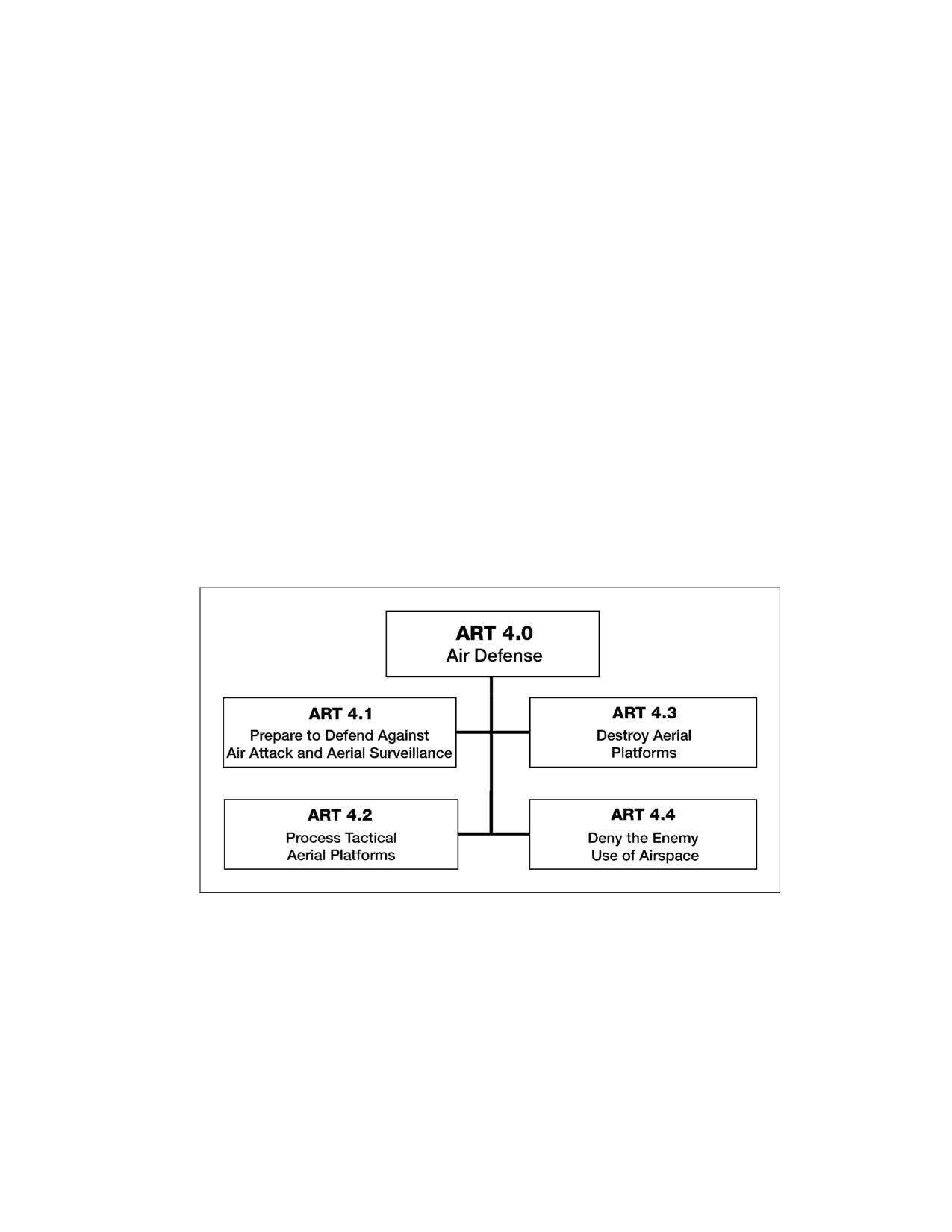
Chapter 4
ART 4.0: The Air Defense Battlefield Operating System
The air defense battlefield operating system protects the force from
missile attack, air attack and aerial surveillance by any of the following,
ballistic missiles, cruise missiles, conventional fixed- and rotary-wing
aircraft, and unmanned aerial vehicles. It prevents enemies from
interdicting friendly forces, while freeing commanders to synchronize
movement and firepower. All members of the combined arms team
perform air defense tasks; however, ground-based air defense artillery
units execute most Army air defense operations. ART 4.0 includes fires at
aerial platforms by both dedicated air defense systems and non-dedicated
weapons systems.
4-1

FM 7-15__________________________________________________________________________
Notes: The use of offensive information operations
(IO) against enemy
aircraft navigational aids and guidance means is addressed in ART 3.3.2.2
(Conduct Electronic Attack).
Passive defensive measures are covered in ART 5.3.1.8 (React to Enemy
Aerial Attack) and ART 5.3.7.5 (Perform Counterdeception).
Offensive counterair actions by Army forces against enemy aircraft and
missiles before launch are addressed in ART 2.0 (Maneuver Battlefield
Operating System) and ART 3.0 (Fire Support Battlefield Operating System).
SECTION I - ART 4.1: PREPARE TO DEFEND AGAINST AIR ATTACK AND
AERIAL SURVEILLANCE
4-1. ART 4.1 includes tactical movement and emplacement of air defense
systems to protect friendly forces, critical assets, or locations. It also includes
displacing air defense assets in reaction to or anticipation of changing
requirements for air defense coverage as the operation unfolds. (FM 44-100)
(USAADASCH)
No.
Scale
Measure
Air defense system mission capable not later than the time specified in
01
Yes/No
the operations order.
02
Time
To develop/refine air defense plan.
03
Time
To conduct troop leading procedures.
04
Time
To conduct/refine air intelligence preparation of the battlefield.
To move air defense weapons and sensors into positions where they
05
Time
can be effectively employed.
For air defense units to establish necessary sensor to shooter
06
Time
communications linkages.
07
Time
For air defense units to conduct pre-operations checks.
08
Time
To determine weapons control status.
09
Percent
Of friendly air defense weapons and sensors mission capable.
10
Percent
Of losses caused by hostile air attack and surveillance.
Of friendly combined arms systems capable of engaging aerial
11
Percent
platforms that are mission capable.
Of combined arms systems within AO capable of engaging aerial
12
Number
targets.
Of friendly air defense weapons and sensors within (AO) that are
13
Number
mission capable.
4-2
__________________________________________
ART 4.0: The Air Defense Battlefield Operating System
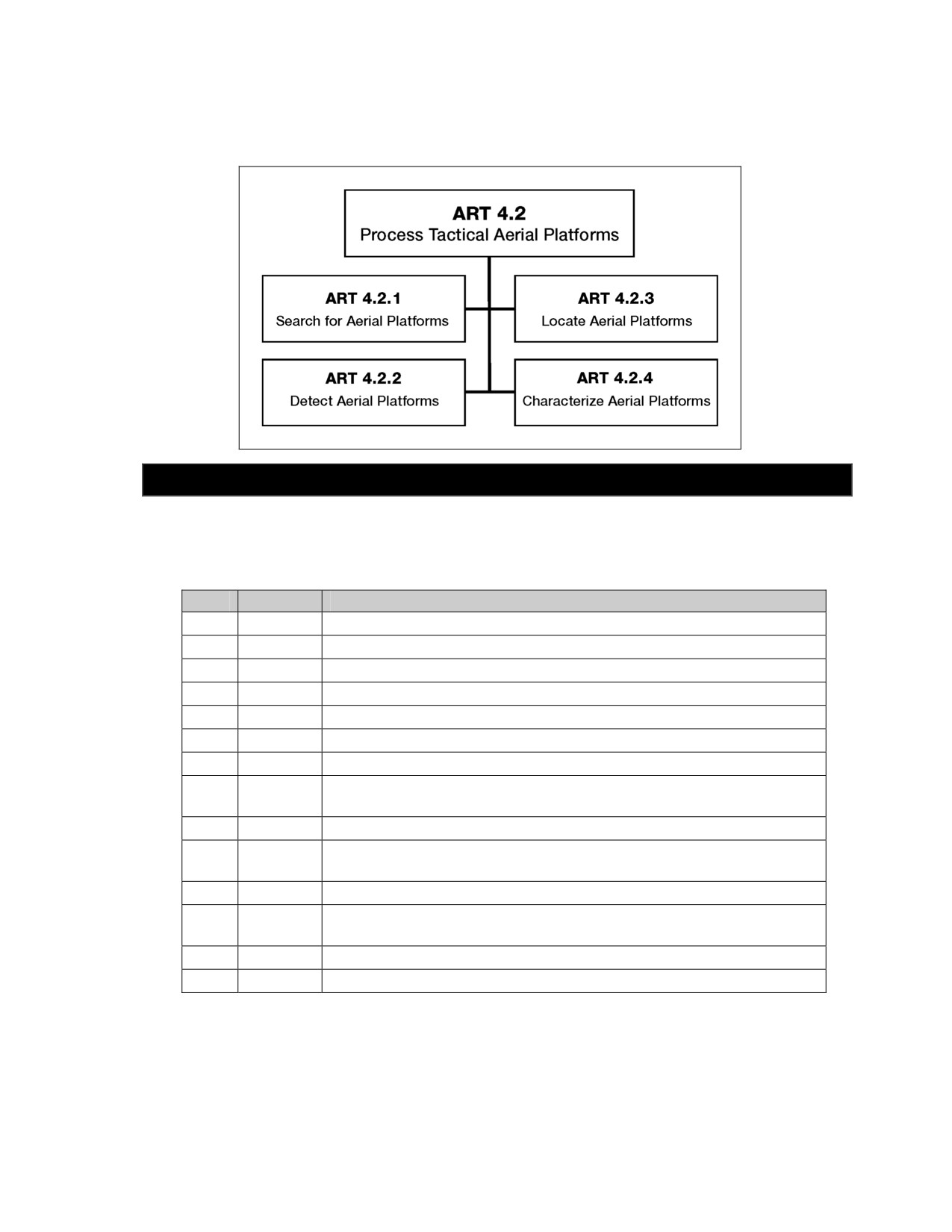
SECTION II - ART 4.2: PROCESS TACTICAL AERIAL PLATFORMS
4-2. Provide advanced warning for all aerial platforms, select targets and
match the appropriate response to tactical aerial platforms including tactical
ballistic missile, taking into account operational requirements and
capabilities of systems and units. (FM 44-100) (USAADASCH)
No.
Scale
Measure
01
Yes/No
Detect, locate and identify all tactical aerial platforms within the AO.
02
Yes/No
Develop and refine early warning plan.
03
Yes/No
Employ all available means to detect tactical aerial platforms.
04
Yes/No
Receive advanced warning of aerial platforms.
05
Yes/No
Process advanced warning of aerial platforms.
06
Yes/No
Transmit advanced warning of aerial platforms.
07
Time
In advance of air attack that advanced warning provided in AO.
Of enemy offensive air sorties against which friendly air defense
08
Percent
assets are assigned.
09
Percent
Of enemy air attacks in AO for which early warning provided.
Of force within AO provided early warning of incoming air threat in
10
Percent
time to allow them to initiate passive air defense.
11
Percent
Of time that early warning system is operational.
Of air threat warning estimates concerning attack timing and numbers
12
Percent
considered accurate by maneuver units.
13
Percent
Of losses caused by hostile air attack and surveillance.
14
Percent
Of AO covered by early warning system.
ART 4.2.1
SEARCH FOR AERIAL PLATFORMS
4-3. Systematically conduct surveillance of a defined area so that all parts of
a designated airspace are visually inspected or searched by sensors. (FM 44-
100) (USAADASCH)
4-3

FM 7-15__________________________________________________________________________
No.
Scale
Measure
Sensor system used to conduct surveillance detects aerial platforms in
01
Yes/No
its current mode of operations from its current location.
02
Time
To refine air defense plan.
To revisit each part of the airspace over the AO—how long does it
03
Time
take for the sensor to conduct a 6400-mil sweep.
Of AO covered by air defense sensors that can detect projected
04
Percent
enemy aerial platforms.
05
Percent
Of air defense sensors functioning in AO.
Of air threat warning estimates concerning attack timing and numbers
06
Percent
considered accurate by maneuver units.
Of effectiveness of the system conducting the aerial surveillance given
current environmental conditions, such as weather and the
07
Percent
characteristics of the surrounding terrain to include interference or
restrictions placed on its operations resulting from its proximity to other
military or civilian equipment.
08
Number
Of air defense sensors functioning in AO.
ART 4.2.2
DETECT AERIAL PLATFORMS
4-4. Determine or detect an aerial platform of possible military significance
but cannot confirm it by recognition. (FM 44-100) (USAADASCH)
No.
Scale
Measure
01
Yes/No
Detect all aerial platforms within the AO.
02
Time
To refine air defense plan.
03
Time
To report the direction of movement, altitude, rate of movement, and to
estimate if platform is a possible enemy aerial platform and target.
04
Percent
Of potential aerial platforms determined to be friendly aircraft by an
IFF system.
05
Percent
Of potential aerial platforms determined to be friendly aircraft by other
than an IFF system.
06
Percent
Of potential aerial platforms in AO detected by air defense sensors.
07
Percent
Of enemy aircraft in AO that are not detected by friendly air defense
sensors.
08
Percent
Of air threat warning estimates concerning attack timing and numbers
considered accurate by maneuver units.
09
Number
Of potential aerial platforms in AO detected by air defense sensors.
10
Number
Of potential aerial platforms in AO detected by ground observers.
11
Number
Of enemy aircraft in AO that are not detected by air defense sensors.
ART 4.2.3
LOCATE AERIAL PLATFORMS
4-5. Confirm the track of an aircraft or missile platform in flight. (FM 44-
100) (USAADASCH)
4-4

__________________________________________
ART 4.0: The Air Defense Battlefield Operating System
No.
Scale
Measure
01
Yes/No
Locate all detected aerial platforms within the AO.
02
Time
To refine air defense plan.
Of aerial platforms in AO correctly located with targetable accuracy by
03
Percent
air defense sensors.
Of aerial platforms in AO not located with targetable accuracy by air
04
Percent
defense sensors.
05
Percent
Of air defense sensors mission capable within the AO.
06
Percent
Of AO covered by air defense sensors.
Of air threat warning estimates concerning attack timing and numbers
07
Percent
considered accurate by maneuver units.
Of aerial platforms in AO correctly located with targetable accuracy by
08
Number
air defense sensors.
Of aerial platforms in AO not located with targetable accuracy by air
09
Number
defense sensors.
10
Number
Of air defense sensors available within the AO.
ART 4.2.4
CHARACTERIZE AERIAL PLATFORMS
4-6. Classifies, types, and identifies tracks and evaluates engageable tracks
to determine the threat they pose to friendly assets and areas. (FM 44-100)
(USAADASCH)
No.
Scale
Measure
01
Yes/No
Identify all detected and located tactical aerial platforms within the AO.
02
Time
To refine air defense plan.
To identify aerial platform as friendly, hostile, or unknown once it has
03
Time
been detected and located.
04
Percent
Of aerial platforms in AO correctly identified.
Of enemy aircraft in AO that penetrate the air defense sensor network
05
Percent
undetected.
Of air threat warning estimates concerning attack timing and numbers
06
Percent
considered accurate by maneuver units.
07
Number
Of aerial platforms in AO correctly identified.
Of enemy aerial platforms in AO that penetrate the air defense sensor
08
Number
network undetected.
4-5
FM 7-15__________________________________________________________________________
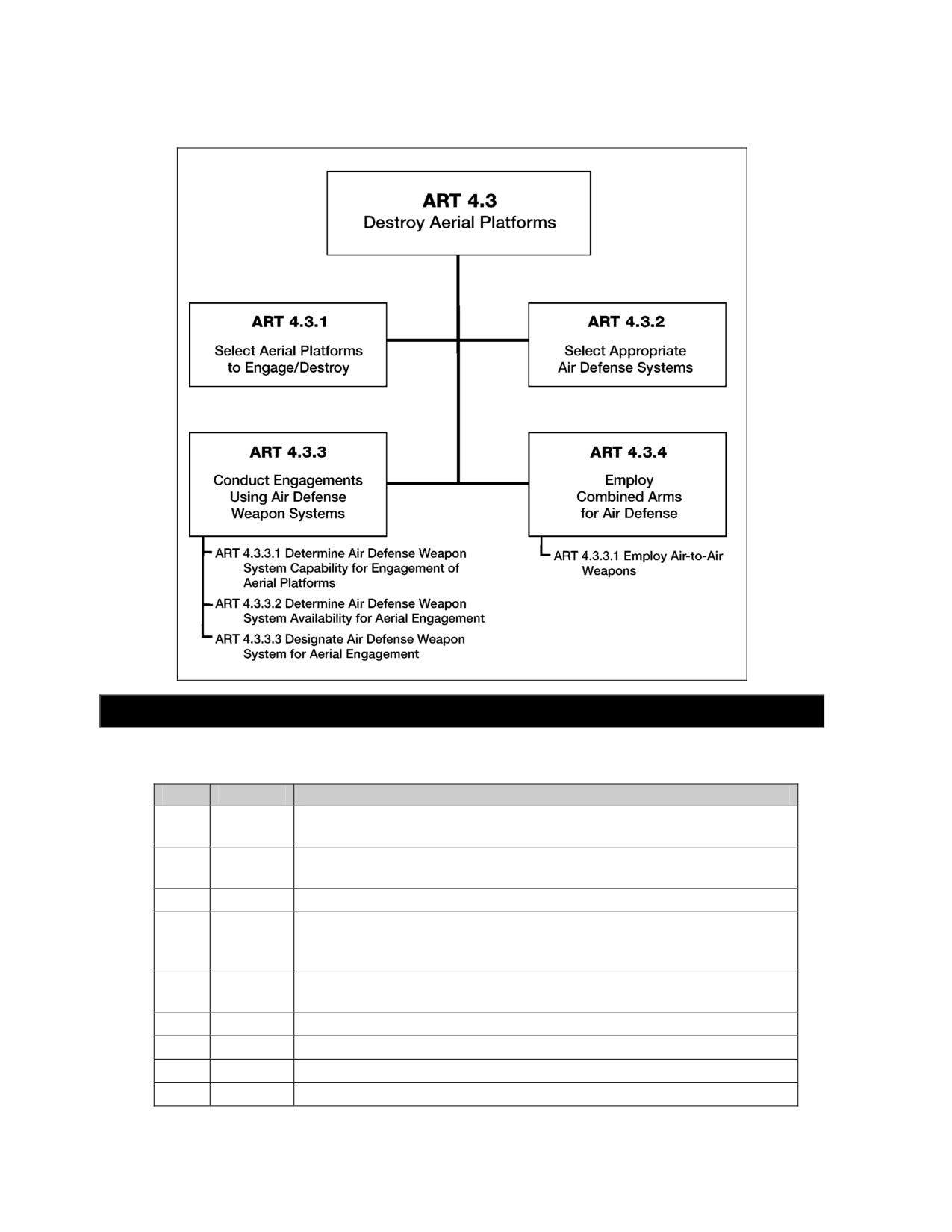
SECTION III - ART 4.3: DESTROY AERIAL PLATFORMS
4-7. Destroy all types of enemy aerial platforms in flight within the AO. (FM
44-100) (USAADASCH)
No.
Scale
Measure
Unit changes its objectives, plan, or operational timetable due to
01
Yes/No
enemy air attack.
Was the destruction of an aerial platform done in accordance with
02
Yes/No
established rules of engagement?
03
Time
To assign a specific air defense weapon system to a specific target.
For air defense weapon system to acquire, track, and engage as
04
Time
necessary a specific aerial target once assigned responsibility for the
engagement of that specific aerial platform.
For air defense weapon system to recycle/reload so that it is capable
05
Time
of engaging another aerial platform.
06
Time
To determine weapons control status.
07
Percent
Of losses caused by hostile air attack and surveillance.
08
Percent
Of available systems directed against declared hostile aerial platforms.
09
Percent
Of enemy aerial platforms destroyed.
4-6

__________________________________________
ART 4.0: The Air Defense Battlefield Operating System
No.
Scale
Measure
Of detected enemy aerial platforms against which air defense
10
Percent
weapons are assigned.
11
Percent
Of target cueing information received by air defense weapon systems.
12
Number
Of enemy aerial platforms destroyed.
Of different enemy aerial platforms that can be engaged
13
Number
simultaneously.
ART 4.3.1
SELECT AERIAL PLATFORMS TO ENGAGE/DESTROY
4-8. Analyze each aerial platform to determine if and when it should be
destroyed or engaged according to the threat posed, the tactical benefit, and
the commander’s guidance. ART 4.3.1 requires building and maintaining a
complete, accurate, and relevant integrated air picture, and having current
control information. (FM 44-100) (USAADASCH)
No.
Scale
Measure
Select aerial platforms that meet the commander’s guidance for
01
Yes/No
engagement and destruction.
02
Time
To select aerial platforms to engage/destroy.
To determine targeting solution after making decision to engage
03
Time
selected aerial platform.
Of enemy aerial platforms in AO correctly identified and attacked by
04
Percent
air defense systems.
05
Percent
Of mission capable air defense systems in AO.
06
Percent
Of available systems directed against declared hostile aerial platforms.
Of aerial targets within the AO that meet the commander’s guidance
07
Percent
for engagement and destruction.
Of enemy aircraft in AO correctly identified and attacked by air
08
Number
defense systems.
09
Number
Of air defense systems in AO.
10
Number
Of fratricide incidents.
ART 4.3.2
SELECT APPROPRIATE AIR DEFENSE SYSTEMS
4-9. Determine the appropriate air defense systems for engaging a particular
aerial platform. (FM 4-100) (USAADASCH)
No.
Scale
Measure
Selected system capable of engaging/destroying targeted aerial
01
Yes/No
platform.
To select and assign attack system once an enemy aerial platform is
02
Time
identified and located with targeting accuracy.
Probability of selected air defense system hitting targeted aerial
03
Percent
platform.
Of enemy aerial platforms selected for attack by dedicated air defense
04
Percent
systems.
4-7

FM 7-15__________________________________________________________________________
No.
Scale
Measure
05
Percent
Of enemy aerial platforms engaged by unit small-arms air defense.
Of enemy aerial platforms not selected for attack by dedicated air
06
Percent
defense systems.
Of enemy aerial platforms engaged by more than one air defense
07
Percent
system.
Of available dedicated air defense systems directed against declared
08
Percent
hostile aerial platforms.
Of available dedicated air defense systems directed against declared
09
Number
hostile aerial platforms.
ART 4.3.3 CONDUCT ENGAGEMENTS USING AIR DEFENSE
WEAPON SYSTEMS
4-10. Use air defense weapon systems to destroy aerial platforms and protect
the force. (FM 44-100) (USAADASCH)
No.
Scale
Measure
01
Yes/No
Friendly course of action must change as a result of enemy air attack.
Were air defense weapons used in accordance with established rules
02
Yes/No
of engagement?
To warn dedicated air defense units after identification of inbound
03
Time
enemy aerial platforms.
For air defense weapon system to acquire, track, and engage as
04
Time
necessary a specific aerial platform once assigned responsibility for
the engagement of that specific aerial platform.
05
Time
To determine weapons control status.
For air defense weapon system to recycle/reload so that it is capable
06
Time
of engaging another aerial platform.
Of enemy aerial platforms able to penetrate air defense network to
07
Percent
deliver ordnance/accomplish mission.
Of all air defense systems positioned to engage the enemy aerial
08
Percent
platforms.
Of friendly courses of action that must be changed because of enemy
09
Percent
air attack.
Of enemy aerial platforms engaged that are destroyed by each air
10
Percent
defense weapon system.
11
Percent
Of friendly casualties attributed to enemy aerial platforms.
Of enemy engaged aerial platforms deterred from delivering their
12
Percent
ordnance on target.
Of available air defense systems directed against declared hostile
13
Percent
aerial platforms.
14
Number
Of destroyed enemy aerial platforms by air defense weapon system.
4-8

__________________________________________
ART 4.0: The Air Defense Battlefield Operating System
ART 4.3.3.1 DETERMINE AIR DEFENSE WEAPON SYSTEM CAPABILITY FOR
ENGAGEMENT OF AERIAL PLATFORMS
4-11. Determine the air defense weapon system that can provide the
required results. Includes consideration of weapons engagement zones and
system characteristics and capability to defeat target.
(FM
44-100)
(USAADASCH)
No.
Scale
Measure
01
Yes/No
Available air defense weapons can engage their intended targets.
To determine system capability for engaging an identified enemy
02
Time
aerial platform.
Of enemy aerial platforms allocated to each air defense weapon
03
Percent
system.
Of aerial platforms engaged within the effective range of the selected
04
Percent
weapon system.
05
Number
Of enemy aerial platforms allocated to each weapon system.
ART 4.3.3.2 DETERMINE AIR DEFENSE WEAPON SYSTEM AVAILABILITY FOR
AERIAL ENGAGEMENT
4-12. Determine the air defense weapon system available for executing
operation. ART 4.3.3.2 includes consideration of weapons control status and
determination of physical environment restrictions and engagement
criticality. (FM 44-100) (USAADASCH)
No.
Scale
Measure
Selected air defense weapon system is mission capable. Rules of
01
Yes/No
engagement allow it to be used, and it can be brought to a position
where it can engage the intended target.
02
Yes/No
Enemy aerial platform must be engaged to accomplish mission.
03
Time
To determine weapons control status.
04
Time
To analyze any restriction caused by physical environment.
To determine engagement criticality, the enemy aerial platform must
05
Time
be engaged to accomplish mission.
Of available air defense systems in AO that have the capability to
06
Percent
engage a specific hostile aerial platform.
Of targets not attacked in a timely manner due to non-availability of
07
Percent
appropriate air defense weapon system.
ART 4.3.3.3 DESIGNATE AIR DEFENSE WEAPON SYSTEM FOR AERIAL
ENGAGEMENT
4-13. Designate air defense weapon system to perform an engagement. (FM
4-100) (USAADASCH)
No.
Scale
Measure
01
Yes/No
Selected system accomplishes the desired task.
To determine available systems for engaging target on ID of enemy
02
Time
aerial platform.
4-9

FM 7-15__________________________________________________________________________
No.
Scale
Measure
03
Time
To select appropriate weapon system.
04
Percent
Of available air defense weapon systems.
Of aerial targets not attacked in a timely manner due to non-availability
05
Percent
of appropriate air defense weapon systems.
06
Percent
Reliability of air defense weapon system.
Of air defense weapon systems used in engagement of aerial
07
Number
platform.
For air defense weapon system to acquire, track, and engage as
08
Time
necessary a specific aerial target once assigned responsibility for the
engagement of that specific aerial target.
For air defense weapon system to recycle/reload so that it is capable
09
Time
of engaging another aerial platform.
Of enemy aerial platforms able to penetrate air defense network to
10
Percent
deliver ordnance/accomplish mission.
Of all air defense systems positioned to engage the enemy aerial
11
Percent
platforms that engage the enemy aerial platforms.
Of friendly courses of action that must be changed because of enemy
12
Percent
air attack.
ART 4.3.4
EMPLOY COMBINED ARMS FOR AIR DEFENSE
4-14. Use weapons systems other than dedicated ground based air defense
systems—such as small arms, tank cannons, and antiarmor missiles—to
destroy aerial targets. (FM 44-8) (USAADASCH)
No.
Scale
Measure
Commander must modify his course of action as a result of enemy air
01
Yes/No
attack.
Was the employment of combined arms for air defense done in
02
Yes/No
accordance with established rules of engagement?
To warn non-air defense units after identification of inbound enemy
03
Time
aerial platforms.
04
Time
To determine weapons control status.
For unit weapon systems to acquire, track, and engage as necessary
05
Time
a specific aerial target once assigned responsibility for the
engagement of that specific aerial target.
For unit weapon systems conducting self-defense against air attack to
06
Time
recycle/reload so that they are capable of engaging another aerial
target.
Of enemy aerial platforms able to penetrate air defense network to
07
Percent
deliver ordnance/accomplish mission.
Of all unit weapon systems positioned to engage enemy aerial
08
Percent
platforms that engage the enemy aerial platforms.
Of friendly courses of action that must be changed because of enemy
09
Percent
air attack.
Of enemy aerial platforms engaged that are destroyed by each
10
Percent
weapon system.
4-10

__________________________________________
ART 4.0: The Air Defense Battlefield Operating System
No.
Scale
Measure
11
Percent
Of friendly casualties attributed to enemy aerial platforms.
Of enemy engaged aerial platforms deterred from delivering their
12
Percent
ordnance on target.
Of weapon system operators using correct aerial engagement aiming
13
Percent
techniques.
Reduction in the effectiveness of the enemy’s attack as a result of the
14
Percent
unit conducting self defense against air attack.
15
Number
Of destroyed enemy aerial platforms by unit weapon system.
16
Number
Of friendly casualties attributed to enemy aerial attack.
ART 4.3.4.1
EMPLOY AIR-TO-AIR WEAPONS
4-15. Use weapons systems carried on aircraft to destroy aerial targets.
Army aircraft normally do this in self-defense. (FM 44-100) (USAADASCH)
No.
Scale
Measure
01
Yes/No
Air-to-air weapons destroy intended targets.
Maintain mutual support between friendly aircraft throughout
02
Yes/No
engagement.
Was the employment of air-to-air weapons accomplished in
03
Yes/No
accordance with established rules of engagement?
To warn friendly aerial platforms of inbound enemy aircraft after
04
Time
identification as hostile.
That friendly aerial platforms have to prepare to engage inbound
05
Time
enemy aircraft.
06
Time
To designate and initiate selected air-to-air combat drill.
07
Time
To get ordnance on target after initiation of task.
08
Time
To complete air-to-air combat after target identification.
Of total number of air-to-air combat engagements within a given time
09
Percent
where friendly system remains undetected while maneuvering into
position where it can effectively engage the enemy aerial platform.
10
Percent
Probability of a hit.
11
Percent
Probability of a kill given a hit.
12
Percent
Of enemy air attacks detected early enough to allow engagement.
13
Percent
Casualties of friendly aerial platforms conducting air-to-air combat.
Of engaged enemy aerial platforms destroyed by friendly aerial
14
Percent
platforms.
Of enemy aerial platforms not engaged by available friendly aerial
15
Percent
platforms.
16
Percent
Of available systems directed against declared hostile aerial platforms.
17
Number
Of enemy aerial platforms destroyed by friendly aerial platforms.
4-11
FM 7-15__________________________________________________________________________
SECTION IV - ART 4.4: DENY THE ENEMY USE OF AIRSPACE
4-16. Prevent or degrade enemy use of airspace through fire potential or
other means, such as smoke, not involving directly attacking aerial
platforms. (FM 44-100) (USAADASCH)
No.
Scale
Measure
The enemy does not attempt to use designated portions of the
01
Yes/No
airspace.
Was the denial of enemy use of airspace done in accordance with
02
Yes/No
established rules of engagement?
03
Time
To refine air defense plan.
04
Time
Since last enemy aerial attack.
To warn all units within the area of operation after identification of
05
Time
inbound enemy aerial platforms.
To report the direction of movement, altitude, rate of movement, and
06
Time
estimated target of enemy aerial platforms.
Of enemy aerial platforms attempting to penetrate into friendly
07
Percent
airspace deterred from doing so by friendly fire potential.
08
Percent
Of potential target areas obscured by smoke.
09
Percent
Of losses caused by hostile air attack and surveillance.
Of low level flight corridors rendered unusable by the friendly fire
10
Percent
potential.
Of errors in the performance of the air defense sensor network in a
11
Number
given time.
Of enemy aerial platforms attempting to penetrate into the airspace
12
Number
over friendly ground forces.
4-12
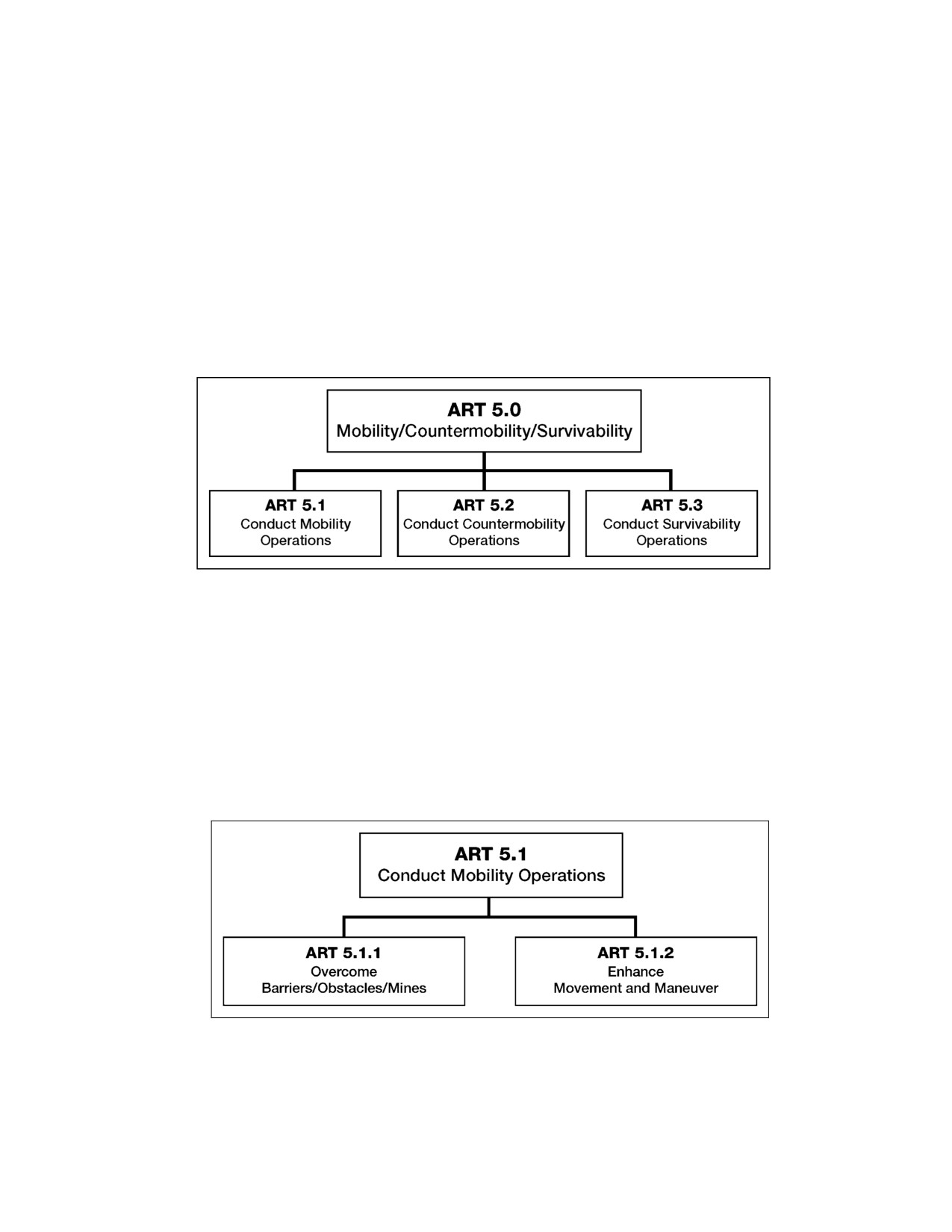
Chapter 5
ART 5.0: The Mobility/Countermobility/Survivability
Battlefield Operating System
Mobility operations preserve the freedom of maneuver of friendly forces.
Mobility tasks include breaching obstacles, increasing battlefield
circulation, improving or building roads, providing bridge and raft
support, and identifying routes around contaminated areas.
Countermobility denies mobility to enemy forces. It limits the maneuver
of enemy forces and enhances the effectiveness of fires. Survivability
operations protect friendly forces from the effects of enemy weapons
systems. They include security operations, hardening facilities, fortifying
battle positions, defensive information operations, NBC defense
measures, and dispersion.
5-1

FM 7-15__________________________________________________________________________
SECTION I - ART 5.1: CONDUCT MOBILITY OPERATIONS
5-1. Maintain freedom of movement for personnel and equipment within an
AO without delays due to terrain or barriers, obstacles, and mines. (FM 5-
100) (USAES)
Note: The term “breaching system” used in this section includes both manual
and mechanical means.
No.
Scale
Measure
01
Yes/No
Terrain/obstacles/barriers overcome within the period the order specifies.
That terrain, barriers, obstacles, and mines delay movement of friendly
02
Time
forces.
To conduct route/zone/area reconnaissance to determine terrain
03
Time
trafficability and the location and boundaries of barriers, obstacles, and
minefields.
For staff to disseminate terrain trafficability and barrier, obstacles, and
04
Time
mine data to subordinate units, after discovery.
To conduct successful execution of breach fundamentals—suppress,
05
Time
obscure, secure, reduce, and assault—at the obstacle.
To complete mobility activities that improve the unit’s capability to cross
06
Time
the terrain, such as applying a rock layer to a combat road and cutting
down trees to make a trail.
07
Time
To reduce lanes through obstacles.
08
Time
To complete minefield reduction.
09
Time
To move breaching equipment to breach site.
10
Percent
Of obstacles in the AO that have been breached.
11
Percent
Of breaching systems that are mission capable.
Of engineer effort designed to enhance the unit’s capability to cross
12
Percent
terrain completed.
13
Number
Of breaching systems that are mission capable.
14
Number
Of friendly/neutral casualties during mobility enhancing activities.
5-2
____________________
ART 5.0: The Mobility/Countermobility/Survivability Battlefield Operating System
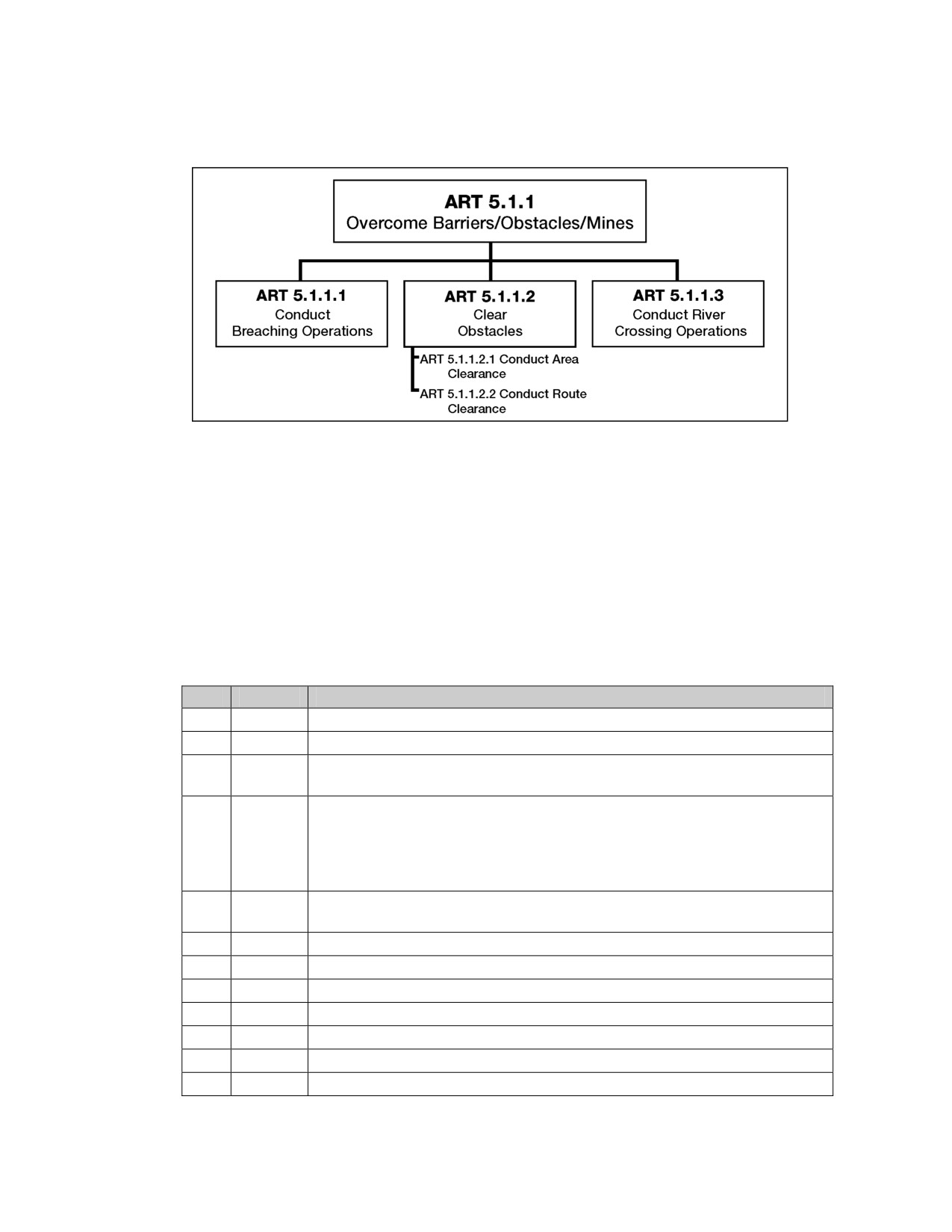
ART 5.1.1 OVERCOME BARRIERS/OBSTACLES/MINES
5-2. Enable a force to maintain its mobility by reducing and/or clearing
obstacles. An obstacle is any obstruction that is designed or employed to
disrupt, fix, turn, or block the movement of an opposing force and to impose
additional losses in personnel, time, and equipment on the opposing force.
Obstacles can exist naturally (existing)—such as rivers, mountains, barrier
reefs, and cities, be man-made (reinforcing)—such as minefields and antitank
ditches, or be a combination of both. A complex obstacle is a combination of
different types of individual obstacles that requires more than one reduction
technique (explosive, mechanical, or manual) to create a lane through the
obstacle. A reinforcing obstacle is an obstacle that is specifically constructed,
emplaced, or detonated through military effort. (FM 3-34.2) (USAES)
No.
Scale
Measure
01
Yes/No
Obstacles/barriers overcome within period the order specifies.
02
Time
That enemy-emplaced obstacles delay friendly force movement.
For staff to disseminate barrier, obstacle, and mine data to subordinate
03
Time
units, higher headquarters, and laterally after discovery.
To conduct reconnaissance of obstacle focused on answering obstacle
intelligence information requirements—obstacle location, length, width,
04
Time
and depth; obstacle composition (wire, mines by type, etc.); soil
conditions; locations of lanes and bypasses; and the location of enemy
direct fire systems.
To conduct successful execution of breach fundamentals—suppress,
05
Time
obscure, secure, reduce, and assault—at the obstacle.
06
Time
To reduce lane through obstacles.
07
Time
To complete mine clearing.
08
Time
To move breaching equipment to breach site.
09
Percent
Of obstacles in the AO that have been breached.
10
Percent
Of breaching systems that are mission capable.
11
Number
Of breaching systems that are mission capable.
12
Number
Of friendly/neutral casualties caused by detonation of mines/explosives.
5-3

FM 7-15__________________________________________________________________________
ART 5.1.1.1
CONDUCT BREACHING OPERATIONS
5-3. Conduct a combined arms operation to project combat power to the far
side of an obstacle. Breaching tenets include intelligence, synchronization,
mass, breach fundamentals (suppress, obscure, reduce, and assault), and
breach organization
(support, assault, and breach forces). ART
5.1.1.1
includes the reduction of minefields and other obstacles. Reduction is the
creation of lanes through or over an obstacle to allow an attacking force to
pass. The number and width of lanes created varies with the enemy
situation, the assault force's size and composition, and the scheme of
maneuver. The lanes must allow the assault force to rapidly pass through the
obstacle. The breach force will reduce, proof (if required), mark, and report
lane locations and the land-marking method to higher headquarters. Follow-
on units will further reduce or clear the obstacle when required. (FM 3-34.2)
(USAES)
No.
Scale
Measure
01
Yes/No
Complete breaching operation within the period the order specifies.
For staff to disseminate barrier, obstacle, and mine data to subordinate
02
Time
units, higher headquarters, and laterally after discovery.
03
Time
That enemy-emplaced obstacles delay friendly force movement.
04
Time
To conduct reconnaissance of barrier/obstacle/minefield.
To conduct successful execution of breach fundamentals—suppress,
05
Time
obscure, secure, reduce, and assault—at the obstacle.
To reduce lane through obstacles (one lane per assault company, two
06
Time
lanes per task force).
07
Time
To move breaching equipment to breach site.
08
Percent
Of obstacles in the AO that have been breached.
09
Percent
Of breaching systems that are mission capable.
10
Number
Of lanes opened by the breaching operation.
11
Number
Of breaching systems that are mission capable.
12
Number
Of friendly/neutral casualties caused by detonation of mines/explosives.
ART 5.1.1.2
CLEAR OBSTACLES
5-4. Clearing is the total elimination or neutralization of an obstacle or
portions of an obstacle. Clearing operations are not conducted under fire and
are normally performed after a breaching operation in a friendly AO where
an obstacle is a hazard or hinders friendly movement. (FM 3-34.2) (USAES)
No.
Scale
Measure
Complete obstacle clearance mission within the period the order
01
Yes/No
specifies.
For staff to disseminate obstacle data to subordinate units, higher
02
Time
headquarters, and laterally after discovery.
To conduct reconnaissance of obstacle focused on answering obstacle
intelligence information requirements—obstacle location, length, width,
03
Time
and depth; obstacle composition (wire, mines by type, etc.); soil
conditions; locations of lanes and bypasses; and the location of enemy
direct fire systems.
5-4

____________________
ART 5.0: The Mobility/Countermobility/Survivability Battlefield Operating System
No.
Scale
Measure
04
Time
To plan how to clear the obstacle.
05
Time
To clear the obstacles.
06
Time
To move equipment to the area where the clearance mission takes place.
07
Percent
Of obstacle that has been removed or neutralized.
08
Percent
Of systems committed to the clearance mission that are mission capable.
09
Number
Of lanes opened by the reducing operation.
10
Number
Of systems that are mission capable.
11
Number
Of friendly/neutral casualties during the clearance mission.
ART 5.1.1.2.1 Conduct Area Clearance
5-5. Area clearance is the total elimination or neutralization of an obstacle or
portions of an obstacle in a designated area. (FM 3-34.2) (USAES)
No.
Scale
Measure
01
Yes/No
Complete area clearance mission within the period the order specifies.
02
Time
That obstacles delay friendly force movement.
For staff to disseminate obstacle data to subordinate units, higher
03
Time
headquarters, and laterally after discovery.
04
Time
To conduct area reconnaissance.
05
Time
To plan how to clear the area.
06
Time
To clear the area.
07
Time
To move equipment to the area where the clearance mission takes place.
08
Percent
Of area that has been cleared.
09
Percent
Of systems committed to the clearance mission that are mission capable.
10
Number
Of area clearance systems that are mission capable.
11
Number
Of friendly/neutral casualties during the area clearance mission.
ART 5.1.1.2.2 Conduct Route Clearance
5-6. A route clearance is a combined arms operation conducted to remove
mines and other obstacles along preexisting roads and trails. (FM 3-34.2)
(USAES)
No.
Scale
Measure
01
Yes/No
Accomplish route clearance within the period the order specifies.
02
Time
That obstacles along the route delay the friendly force movement.
For staff to disseminate obstacle data to subordinate units, higher
03
Time
headquarters, and laterally after discovery.
04
Time
To conduct route reconnaissance.
05
Time
To plan how to clear the route.
06
Time
To clear the route.
To move equipment from its current location to the route where the
07
Time
clearance mission takes place.
08
Time
To establish security along portion of the route being cleared.
5-5

FM 7-15__________________________________________________________________________
No.
Scale
Measure
09
Percent
Of route cleared within the period the order specifies.
10
Percent
Of systems committed to route clearance that are mission capable.
Of increase in transportation/maneuver efficiency due to the completion
11
Percent
of route clearance mission.
12
Number
Of obstacles along the route that have been cleared.
13
Number
Of breaching systems that are mission capable.
14
Number
Of friendly/neutral casualties during the route clearance mission.
ART 5.1.1.3
CONDUCT RIVER CROSSING OPERATIONS
5-7. A river crossing operation is a combined arms operation to project
combat power across a terrain feature, wet or dry, that is too wide to
overcome by self-bridging. A river crossing requires special planning and
support. METT-TC factors dictate the type of crossing (hasty, deliberate, or
retrograde). ART
5.1.1.3 includes preparing access and egress routes,
employing crossing means (bridging and rafts), and operating an engineer
regulating point. Crossing fundamentals include surprise, extensive
preparation, flexible plan, traffic control, organization, and speed. (FM 90-13)
(USAES)
Note: The engineer bridge/raft/assault boat systems percentages in this task
apply to the individual ribbon bridge bays and rafts, and to individual
assault boats and not to a ribbon or assault bridge set as a whole.
No.
Scale
Measure
01
Yes/No
Accomplish river crossing within the period the order specifies.
02
Time
That river obstacle delays friendly force movement.
03
Time
To conduct area reconnaissance of the terrain surrounding the river.
04
Time
To plan the river crossing.
For staff to disseminate data concerning the river to subordinate units,
05
Time
higher headquarters, and laterally after determination.
06
Time
To move engineer bridging equipment to the crossing site.
To establish conditions necessary for success, such as suppressing
enemy systems overwatching the river, breaching minefields and other
07
Time
obstacles barring access to the river banks, and preparing access and
egress routes.
08
Time
To emplace/construct crossing assets.
09
Time
To complete river crossing.
10
Percent
Of crossing unit that has moved to the far shore of the river.
11
Percent
Of engineer bridge/raft/assault boat systems that are mission capable.
Of crossing area seeded with obstacles, if conducting a retrograde
12
Percent
crossing.
13
Number
Of bridges/crossing sites established.
14
Number
Of engineer bridge/raft/assault boat systems that are mission capable.
Of friendly casualties due to accidents/enemy action during the river
15
Number
crossing.
5-6
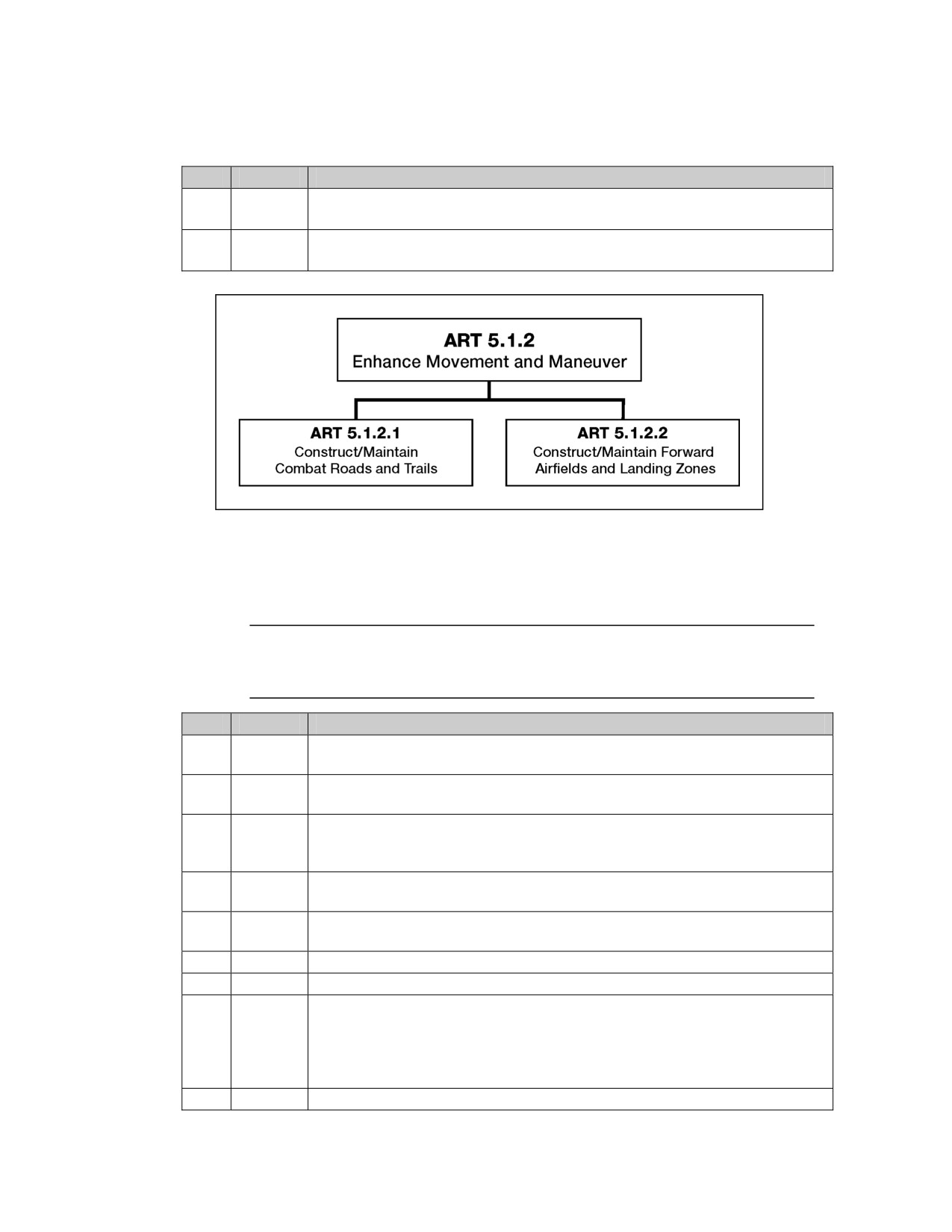
____________________
ART 5.0: The Mobility/Countermobility/Survivability Battlefield Operating System
No.
Scale
Measure
Of obstacles emplaced within the crossing area, if conducting a
16
Number
retrograde crossing.
Per hour that personnel/tactical vehicles/combat vehicles can cross the
17
Rate
river.
ART 5.1.2 ENHANCE MOVEMENT AND MANEUVER
5-8. Enhance force mobility in the forward area by constructing or repairing
combat roads, trails, and forward airfields and landing zones to facilitate the
movement of personnel, equipment, and supplies. (FM 5-100)(USAES)
Note: Mobility enhancing systems referred to in this task include, but are not
limited to: bulldozers, road graders, armored combat earthmovers, dump
trucks, cranes, scoop loaders, and explosives used to remove obstacles.
No.
Scale
Measure
Mobility enhancing activity was completed within the period specified in
01
Yes/No
the order.
To respond to an event (natural disaster or combat activity) that impacts
02
Time
the unit’s movement and maneuver.
That the preparation and execution of unit operations are delayed due to
03
Time
a natural disaster or combat activity that impacts the unit’s movement and
maneuver.
To conduct a route/area reconnaissance of location where mobility
04
Time
enhancing activity is required.
For staff to disseminate event data to subordinate units, higher
05
Time
headquarters, and laterally after discovery.
06
Time
To plan for the mobility enhancement effort.
07
Time
To move mobility enhancing systems to work site.
To establish conditions necessary for the success of the mobility
enhancement effort, such as establishing security, gaining permission
08
Time
from local authorities for construction, and obtaining supplies—gravel,
sand, airfield mats, soil stabilization systems, etc.—necessary for
construction.
09
Time
To complete mobility enhancing activity.
5-7