FM 7-15 THE ARMY UNIVERSAL TASK LIST (AUGUST 2003) - page 1
FM 7-15
Field Manual
Headquarters
Department of the Army
No. 7-15
Washington, DC, 31 August 2003
The Army Universal Task List
Contents
Page
PREFACE
VIII
INTRODUCTION
XI
CHAPTER 1
ART 1.0: THE INTELLIGENCE BATTLEFIELD OPERATING SYSTEM
1-1
Section I - ART 1.1: Support to Situational Understanding
1-2
ART 1.1.1 Perform Intelligence Preparation of the Battlefield (IPB)
1-3
ART 1.1.2 Perform Situation Development
1-7
ART 1.1.3 Provide Intelligence Support to Force Protection
1-8
ART 1.1.4 Conduct Police Intelligence Operations
1-8
Section II - ART 1.2: Support to Strategic Responsiveness
1-13
ART 1.2.1 Perform Indications and Warnings
1-14
ART 1.2.2 Ensure Intelligence Readiness
1-14
ART 1.2.3 Conduct Area Studies of Foreign Countries
1-15
ART 1.2.4 Support Sensitive Site Exploitation
1-16
Section III - ART 1.3: Conduct Intelligence, Surveillance, and
Reconnaissance (ISR)
1-17
ART 1.3.1 Perform Intelligence Synchronization
1-18
ART 1.3.2 Perform ISR Integration
1-20
ART 1.3.3 Conduct Tactical Reconnaissance
1-22
ART 1.3.4 Conduct Surveillance
1-27
Section IV - ART 1.4: Provide Intelligence Support to Effects
1-28
ART 1.4.1 Provide Intelligence Support to Targeting
1-28
ART 1.4.2 Provide Intelligence Support to Information Operations
1-30
ART 1.4.3 Provide Intelligence Support to Combat Assessment
1-35
CHAPTER 2
ART 2.0: THE MANEUVER BATTLEFIELD OPERATING SYSTEM
2-1
Section I - ART 2.1: Perform Tactical Actions Associated with Force
Projection and Deployment
2-2
ART 2.1.1 Conduct Mobilization of Tactical Units
2-3
ART 2.1.2 Conduct Tactical Deployment/Redeployment Activities
2-5
ART 2.1.3 Conduct Demobilization of Tactical Units
2-8
ART 2.1.4 Conduct Rear Detachment Activities
2-9
Section II - ART 2.2: Conduct Tactical Maneuver
2-9
ART 2.2.1 Employ Combat Formations
2-11
Distribution Restriction: Approved for public release; distribution is unlimited.
i
FM 7-15__________________________________________________________________________
ART 2.2.2 Conduct Actions on Contact
2-13
ART 2.2.3 Employ Combat Patrols
2-14
ART 2.2.4 Conduct Counterambush Actions
2-14
ART 2.2.5 Exploit Terrain to Expedite Tactical Movements
2-14
ART 2.2.6 Cross a Danger Area
2-15
ART 2.2.7 Linkup with Other Tactical Forces
2-15
ART 2.2.8 Conduct Passage of Lines
2-16
ART 2.2.9 Conduct a Relief in Place
2-18
ART 2.2.10 Navigate from One Point to Another
2-18
ART 2.2.11 Conduct a Survivability Move
2-19
ART 2.2.12 Negotiate a Tactical Area of Operations
2-19
Section III - ART 2.3: Conduct Tactical Troop Movements
2-20
ART 2.3.1 Prepare Forces for Movement
2-21
ART 2.3.2 Conduct Administrative Movement
2-23
ART 2.3.3 Conduct Tactical Road March
2-23
ART 2.3.4 Conduct an Approach March
2-24
Section IV - ART 2.4: Conduct Direct Fires
2-25
ART 2.4.1 Conduct Lethal Direct Fire Against a Surface Target
2-26
ART 2.4.2 Conduct Nonlethal Direct Fire Against a Surface Target
2-26
Section V - ART 2.5: Occupy an Area
2-27
ART 2.5.1 Occupy an Assembly Area
2-28
ART 2.5.2 Occupy an Attack/Assault Position
2-28
ART 2.5.3 Occupy/Establish a Battle/Defensive Position
2-28
ART 2.5.4 Conduct Drop Zone Operations
2-29
ART 2.5.5 Conduct Landing Zone Operations
2-30
Section VI - ART 2.6: Employ SERE Techniques
2-30
CHAPTER 3
ART 3.0: THE FIRE SUPPORT BATTLEFIELD OPERATING SYSTEM
3-1
Section I - ART 3.1: Decide Surface Targets to Attack
3-1
Section II - ART 3.2: Detect and Locate Surface Targets
3-2
Section III - ART 3.3. Employ Fires to Influence the Will, and Destroy,
Neutralize, or Suppress Enemy Forces
3-3
ART 3.3.1 Conduct Lethal Fire Support
3-4
ART 3.3.2 Conduct Nonlethal Fire Support—Offensive Information
Operations
3-10
ART 3.3.3 Conduct Survey Operations in Support of Fire Support Systems.3-16
ART 3.3.4 Perform Meteorological Operations in Support of Fire Support
Systems
3-17
CHAPTER 4
ART 4.0: THE AIR DEFENSE BATTLEFIELD OPERATING SYSTEM
4-1
Section I - ART 4.1: Prepare to Defend Against Air Attack and Aerial
Surveillance
4-2
Section II - ART 4.2: Process Tactical Aerial Platforms
4-3
ART 4.2.1 Search for Aerial Platforms
4-3
ART 4.2.2 Detect Aerial Platforms
4-4
ART 4.2.3 Locate Aerial Platforms
4-4
ART 4.2.4 Characterize Aerial Platforms
4-5
Section III - ART 4.3: Destroy Aerial Platforms
4-6
ART 4.3.1 Select Aerial Platforms to Engage/Destroy
4-7
ART 4.3.2 Select Appropriate Air Defense Systems
4-7
ART 4.3.3 Conduct Engagements Using Air Defense Weapon Systems
4-8
ART 4.3.4 Employ Combined Arms for Air Defense
4-10
ii
________________________________________________________________________Contents
Section IV - ART 4.4: Deny the Enemy Use of Airspace
4-12
CHAPTER 5
ART 5.0: THE MOBILITY/COUNTERMOBILITY/SURVIVABILITY BATTLEFIELD
OPERATING SYSTEM
5-1
Section I - ART 5.1: Conduct Mobility Operations
5-2
ART 5.1.1 Overcome Barriers/Obstacles/Mines
5-3
ART 5.1.2 Enhance Movement and Maneuver
5-7
Section II - ART 5.2: Conduct Countermobility Operations
5-10
ART 5.2.1 Site Obstacles
5-12
ART 5.2.2 Construct, Emplace, or Detonate Obstacles
5-12
ART 5.2.3 Mark, Report, and Record Obstacles
5-13
ART 5.2.4 Maintain Obstacle Integration
5-14
Section III - ART 5.3: Conduct Survivability Operations
5-15
ART 5.3.1 Protect Against Enemy Hazards within the AO
5-18
ART 5.3.2 Conduct Nuclear, Biological, and Chemical (NBC) Defense
5-31
ART 5.3.3 Disperse Tactical Forces
5-42
ART 5.3.4 Provide Explosive Ordnance Disposal Support
5-42
ART 5.3.5 Conduct Security Operations
5-47
ART 5.3.6 Combat Terrorism in an Area of Operations (AO)
5-73
ART 5.3.7 Conduct Defensive Information Operations
5-77
ART 5.3.8 Conduct Tactical Counterintelligence in the Area of Operations.. 5-84
CHAPTER 6
ART 6.0: THE COMBAT SERVICE SUPPORT BATTLEFIELD OPERATING
SYSTEM
6-1
Section I - ART 6.1: Provide Supplies
6-2
ART 6.1.1 Provide Subsistence (Class I)
6-3
ART 6.1.2 Provide Clothing, Individual Equipment, Tools, and
Administrative Supplies (Class II)
6-4
ART 6.1.3 Provide Petroleum, Oil, and Lubricants (Class III B/P)
6-5
ART 6.1.4 Provide Barrier and Construction Material (Class IV)
6-8
ART 6.1.5 Provide Ammunition (Class V)
6-9
ART 6.1.6 Provide Personal Demand Items (Class VI)
6-11
ART 6.1.7 Provide Major End Items (Class VII)
6-11
ART 6.1.8 Provide Medical Material and Repair Parts (Class VIII)
6-12
ART 6.1.9 Provide Repair Parts (Class IX)
6-13
ART 6.1.10 Provide Supplies for Civilian Use (Class X)
6-13
ART 6.1.11 Provide Water Support
6-14
ART 6.1.12 Provide Miscellaneous Supplies
6-15
ART 6.1.13 Conduct Forward Arming and Refueling Point Activities
6-16
ART 6.1.14 Conduct Unit Logistics Package Operations
6-17
ART 6.1.15 Employ Caches
6-18
ART 6.1.16 Provide Supply Management
6-18
ART 6.1.17 Salvage and Retrograde Equipment and Materiel
6-22
ART 6.1.18 Prepare Configured Loads
6-23
Section II - ART 6.2: Provide Maintenance
6-23
ART 6.2.1 Perform Preventative Maintenance Checks and Services
6-25
ART 6.2.2 Recover/Evacuate Disabled Equipment
6-25
ART 6.2.3 Diagnose Equipment Faults
6-26
ART 6.2.4 Substitute Parts
6-26
ART 6.2.5 Exchange Parts
6-26
ART 6.2.6 Repair Equipment
6-27
ART 6.2.7 Return Repaired Equipment to the User
6-27
ART 6.2.8 Provide Maintenance Management
6-28
iii
FM 7-15__________________________________________________________________________
Section III - ART 6.3: Provide Transportation Support
6-29
ART 6.3.1 Provide Movement Control
6-30
ART 6.3.2 Conduct Terminal Operations
6-33
ART 6.3.3 Conduct Mode Operations
6-36
Section IV - ART 6.4: Provide Sustainment Support
6-39
ART 6.4.1 Provide Base Camp Sustainment
6-40
ART 6.4.2 Conduct Mortuary Affairs
6-43
ART 6.4.3 Conduct Aerial Delivery Support
6-44
Section V - ART 6.5: Provide Force Health Protection in a Global
Environment
6-45
ART 6.5.1 Provide Combat Casualty Care
6-47
ART 6.5.2 Provide Medical Evacuation (Air/Ground)
6-51
ART 6.5.3 Provide Medical Logistics
6-52
ART 6.5.4 Provide Casualty Prevention
6-56
Section VI - ART 6.6: Provide Human Resource Support
6-61
ART 6.6.1 Man the Force
6-62
ART 6.6.2 Provide Personnel Services
6-65
ART 6.6.3 Provide Personnel Support
6-68
Section VII - ART 6.7: Provide Finance and Resource Management
Services
6-71
ART 6.7.1 Provide Vendor Pay
6-72
ART 6.7.2 Perform Pay Services
6-72
ART 6.7.3 Perform Disbursement Services
6-73
ART 6.7.4 Perform Accounting Services
6-73
ART 6.7.5 Perform Central Funding
6-74
ART 6.7.6 Perform Resources Management
6-74
Section VIII - ART 6.8: Provide Religious Support
6-75
ART 6.8.1 Conduct Religious Services
6-76
ART 6.8.2 Provide Religious Care and Counseling
6-76
ART 6.8.3 Advise on Religious, Moral, and Ethical Issues
6-77
ART 6.8.4 Conduct Religious Support Activity Training
6-77
Section IX - ART 6.9: Provide Legal Support
6-78
ART 6.9.1 Provide Military Justice Support
6-79
ART 6.9.2 Provide Trial Defense Support
6-80
ART 6.9.3 Provide International Law Support
6-80
ART 6.9.4 Provide Administrative Law Support
6-81
ART 6.9.5 Provide Civil Law Support
6-82
ART 6.9.6 Provide Claims Support
6-83
ART 6.9.7 Provide Legal Assistance
6-84
Section X - ART 6.10: Provide General Engineer Support
6-85
ART 6.10.1 Restore Damaged Areas
6-86
ART 6.10.2 Construct and Maintain Sustainment Lines of Communications ..6-87
ART 6.10.3 Provide Engineer Construction Support
6-100
ART 6.10.4 Supply Mobile Electric Power
6-101
ART 6.10.5 Provide Facilities Engineering Support
6-103
Section XI - ART 6.11: Provide Contracting Support
6-108
Section XII - ART 6.12: Provide Distribution Management
6-109
Section XIII - ART 6.13: Conduct Internment and Resettlement
Activities
6-110
ART 6.13.1 Perform Enemy Prisoners of War/Civilian Internment
6-111
ART 6.13.2 Conduct Populace and Resource Control
6-112
iv
________________________________________________________________________Contents
Section XIV - ART 6.14: Conduct Civil-Military Operations
6-114
ART 6.14.1 Provide Interface/Liaison between US Military Forces and Local
Authorities/Nongovernmental Organizations
6-115
ART 6.14.2 Locate and Identify Population Centers
6-116
ART 6.14.3 Identify Local Resources/Facilities/Support
6-117
ART 6.14.4 Advise Commanders of Obligations to Civilian Population
6-118
ART 6.14.5 Resettle Refugees and Displaced Civilians
6-119
ART 6.14.6 Establish Temporary Civil Administration (Friendly, Allied, and
Occupied Enemy Territory)
6-120
ART 6.14.7 Conduct Negotiations with and between Other Governmental
and Nongovernmental Organizations
6-141
CHAPTER 7
ART 7.0: THE COMMAND AND CONTROL BATTLEFIELD OPERATING
SYSTEM
7-1
Section I - ART 7.1: Establish Command Post Operations
7-2
ART 7.1.1 Establish and Conduct Command Post Operations to Support
Tactical Operations
7-3
ART 7.1.2 Displace the Command Post
7-5
Section II - ART 7.2: Manage Tactical Information
7-7
ART 7.2.1 Collect Relevant Information
7-8
ART 7.2.2 Process Relevant Information to Create a Common Operational
Picture
7-10
ART 7.2.3 Display a Common Operational Picture (COP) Tailored to User
Needs
7-11
ART 7.2.4 Store Relevant Information
7-11
ART 7.2.5 Disseminate Common Operational Picture and Execution
Information to Higher, Lower, Adjacent, Supported, and
Supporting Organizations
7-12
ART 7.2.6 Communicate with Non-English Speaking Forces and Agencies 7-12
Section III - ART 7.3: Assess Tactical Situation and Operations
7-13
ART 7.3.1 Monitor Situation or Progress of Operations
7-14
ART 7.3.2 Evaluate Situation or Operation
7-14
ART 7.3.3 Provide Combat Assessment
7-16
Section IV - ART 7.4: Plan Tactical Operations Using the Military
Decision Making Process/Troop Leading Procedures
7-19
ART 7.4.1 Conduct the Military Decision Making Process
7-20
ART 7.4.2 Integrate Requirements and Capabilities
7-24
ART 7.4.3 Develop Commander’s Critical Information Requirements
Recommendations
7-25
ART 7.4.4 Establish Target Priorities
7-26
ART 7.4.5 Provide Operational Law Support
7-26
ART 7.4.6 Provide Space Support
7-27
Section V - ART 7.5: Prepare for Tactical Operations
7-28
ART 7.5.1 Establish and Conduct Coordination and Liaison
7-29
ART 7.5.2 Conduct Rehearsals
7-29
ART 7.5.3 Task Organize/Organize for Operations
7-30
ART 7.5.4 Revise and Refine the Plan
7-31
ART 7.5.5 Conduct Preoperations Checks and Inspections
7-31
ART 7.5.6 Integrate New Units/Soldiers into the Force
7-31
Section VI - ART 7.6: Execute Tactical Operations
7-32
ART 7.6.1 Perform Ongoing Functions
7-33
ART 7.6.2 Execute Planned Actions, Sequels, and Branches
7-36
v
FM 7-15__________________________________________________________________________
ART 7.6.3 Make Adjustments to Resources, Concept of Operations, or
Mission
7-36
ART 7.6.4 Synchronize Actions to Produce Maximum Effective Application
of Military Power
7-36
Section VII - ART 7.7: Support the Commander’s Leadership
Responsibilities for Morale, Welfare, and Discipline
7-38
ART 7.7.1 Determine Morale and Moral Climate of Organization
7-39
ART 7.7.2 Establish and Maintain Discipline
7-40
ART 7.7.3 Train Subordinates and Units
7-46
Section VIII - ART 7.8: Conduct Continuous Operations
7-49
ART 7.8.1 Execute Sleep Plans
7-49
ART 7.8.2 Manage Stress
7-49
ART 7.8.3 Maintain Continuity of Command and Control
7-50
Section IX - ART 7.9: Develop and Implement Command Safety
Program
7-50
Section X - ART 7.10: Conduct Public Affairs Operations
7-51
ART 7.10.1 Execute Information Strategies
7-51
ART 7.10.2 Facilitate Media Operations
7-52
ART 7.10.3 Maintain Community Relations
7-52
ART 7.10.4 Conduct Internal Information Program
7-53
ART 7.10.5 Implement Higher Headquarters Public Affairs Themes
7-53
ART 7.10.6 Provide Visual Information Support
7-53
CHAPTER 8
ART 8.0: CONDUCT TACTICAL MISSION TASKS AND OPERATIONS
8-1
Measures of Accomplishment
8-1
Section I - ART 8.1: Conduct Offensive Operations
8-2
ART 8.1.1 Conduct a Movement to Contact
8-3
ART 8.1.2 Conduct an Attack
8-4
ART 8.1.3 Conduct an Exploitation
8-6
ART 8.1.4 Conduct a Pursuit
8-6
ART 8.1.5 Conduct One of the Five Forms of Maneuver
8-7
Section II - ART 8.2: Conduct Defensive Operations
8-10
ART 8.2.1 Conduct an Area Defense
8-10
ART 8.2.2 Conduct a Mobile Defense
8-11
ART 8.2.3 Conduct a Retrograde
8-11
Section III - ART 8.3: Conduct Stability Operations
8-12
ART 8.3.1 Conduct Peace Operations
8-13
ART 8.3.2 Conduct Foreign Internal Defense Operations
8-14
ART 8.3.3 Conduct Security Assistance
8-15
ART 8.3.4 Conduct Humanitarian and Civic Assistance
8-16
ART 8.3.5 Provide Support to Insurgencies
8-16
ART 8.3.6 Support Counterdrug Operations
8-17
ART 8.3.7 Combat Terrorism
8-20
ART 8.3.8 Perform Noncombatant Evacuation Operations
8-21
ART 8.3.9 Conduct Arms Control Operations
8-21
ART 8.3.10 Conduct a Show of Force
8-21
Section IV - ART 8.4: Conduct Support Operations
8-22
ART 8.4.1 Conduct Domestic Support Operations
8-22
ART 8.4.2 Conduct Foreign Humanitarian Assistance
8-23
ART 8.4.3 Conduct Forms of Support Operations
8-24
Section V - ART 8.5: Conduct Tactical Mission Tasks
8-28
ART 8.5.1 Attack by Fire an Enemy Force/Position
8-28
vi
________________________________________________________________________Contents
ART 8.5.2 Block an Enemy Force
8-28
ART 8.5.3 Breach Enemy Defensive Positions
8-29
ART 8.5.4 Bypass Enemy Obstacles/Forces/Positions
8-29
ART 8.5.5 Canalize Enemy Movement
8-29
ART 8.5.6 Clear Enemy Forces
8-29
ART 8.5.7 Conduct Counterreconnaissance
8-29
ART 8.5.8 Contain an Enemy Force
8-29
ART 8.5.9 Control an Area
8-29
ART 8.5.10 Defeat an Enemy Force
8-29
ART 8.5.11 Destroy a Designated Enemy Force/Position
8-30
ART 8.5.12 Disengage from a Designated Enemy Force
8-30
ART 8.5.13 Disrupt a Designated Enemy Force’s Formation/
Tempo/Timetable
8-30
ART 8.5.14 Conduct an Exfiltration
8-30
ART 8.5.15 Fix an Enemy Force
8-30
ART 8.5.16 Follow and Assume the Missions of a Friendly Force
8-30
ART 8.5.17 Follow and Support the Actions of a Friendly Force
8-30
ART 8.5.18 Interdict an Area/Route to Prevent/Disrupt/ Delay its Use by an
Enemy Force
8-31
ART 8.5.19 Isolate an Enemy Force
8-31
ART 8.5.20 Neutralize an Enemy Force
8-31
ART 8.5.21 Occupy an Area
8-31
ART 8.5.22 Reduce an Encircled/Bypassed Enemy Force
8-31
ART 8.5.23 Retain a Terrain Feature
8-31
ART 8.5.24 Secure a Unit/Facility/Location
8-31
ART 8.5.25 Seize an Area
8-31
ART 8.5.26 Support By Fire the Maneuver of Another Friendly Force
8-31
ART 8.5.27 Suppress a Force/Weapon System
8-32
ART 8.5.28 Turn an Enemy Force
8-32
ART 8.5.29 Conduct Combat Search and Rescue
8-32
ART 8.5.30 Conduct Consolidation and Reorganization Activities
8-32
ART 8.5.31 Reconstitute Tactical Forces
8-32
GLOSSARY
Glossary-1
BIBLIOGRAPHY
Bibliography-1
vii
Preface
FM 7-15 describes the structure and content of the Army Universal Task List (AUTL). It
provides a standard, doctrinal foundation and catalogue of the Army’s tactical collective tasks.
Units and staffs perform these tactical collective tasks at corps level and below. For each task,
the AUTL provides a definition, a numeric reference hierarchy, and the measures of performance
for evaluating the task. As a catalogue, it captures doctrine as it existed on the date of its
publication.
As a catalogue, the AUTL can assist a commander in his mission essential task list (METL)
development process by providing all the collective tasks possible for a tactical unit of company-
size and above and staff sections. Commanders should use the AUTL as a cross-reference for
tactical tasks. They use it to extract METL tasks only when there is no current mission training
plan (MTP) for that echeloned organization, there is an unrevised MTP to delineate tasks, or the
current MTP is incomplete. FM 7-0 and FM 25-101 discuss and detail METL development and
requirements.
The AUTL will serve as the basis for mission analysis during tactical collective task development
by proponents and centers. This manual will be updated on a regular basis. If a new ATUL task
requirement is identified or developed by the proponent, the new task will be provided to the
Combined Arms Doctrine Directorate (CADD) for approval and input. The AUTL provides the
list of Army tactical tasks. Proponents and schools are responsible for writing and defining the
conditions and standards for supporting collective tasks.
The AUTL does not include tasks Army forces perform as part of joint and multinational forces
at the operational and strategic levels. Those tasks are included in the Universal Joint Task List
(UJTL) (CJCSM 3500.04C). The UJTL defines tasks and functions performed by Army elements
operating at the operational and strategic levels of war. The UJTL provides an overall
description of joint tasks to apply at the strategic-national, strategic-theater, and operational
levels of command. The UJTL also provides a standard reference system that TRADOC combat
developers use in objective force combat developments, such as front end analysis concerning the
capabilities of an objective force element. Each military service is required to publish its own
tactical task list to supplement the UJTL. (The Bibliography includes the other services’ task
lists.) The AUTL is subordinate to the UJTL.
PURPOSE
The AUTL is the comprehensive listing of Army tactical-level collective tasks. The AUTL
complements the UJTL by providing tactical-level Army-specific tasks. The AUTL—
z
Provides a common, doctrinal structure for collective tasks that support Army tactical
missions and operations performed by Army units and staffs.
z
Articulates what tasks the Army performs to accomplish missions, but does not describe
how success occurs.
z
Applies to all four types of military operations (offense, defense, stability, and support).
z
Provides standard definitions and helps establish a common language and reference
system for all tactical echelons (from company to corps) and tactical staff sections.
viii
_________________________________________________________________________ Preface
z
Uses approved definitions or derived definitions from evolving doctrine.
z
Addresses each Army tactical task (ART) in only one location.
z
Lists ARTs subordinate to each of the seven Battlefield Operating Systems (BOS)
(Chapters 1-7) and the tasks that support execution of the Army’s tactical missions
(Chapter 8).
z
Provides a table with measures of performance that can be used to develop standards for
each task in Chapters 1-7 and generic measures of performance for tasks in Chapter 8.
At the upper levels, the AUTL provides a concise picture of the major activities of a force. At
lower levels, it provides increased detail on what the force must do to accomplish its mission.
SCOPE
Army tactical tasks apply at the tactical level of war. Although the AUTL emphasizes tasks
performed by Army units, the Army does not go to war alone. Therefore, the AUTL includes
tactical tasks typically performed by other services to support Army forces. Chapters 1-7 detail
the tactical tasks within each of the seven BOS: intelligence, maneuver, fire support, air defense,
mobility/countermobility/survivability, combat service support, and command and control. The
BOS group related tasks according to battlefield use. In addition, Chapters 1-7 include a menu of
measures of performance associated with each BOS task.
Chapter 8 captures the tactical tasks that support execution of Army doctrinal tactical missions
and operations. Chapter 8 is not another battlefield operating system. The missions and
operations described in this chapter are combined arms in nature and do not fall under the
purview of any one BOS. Commanders, their staffs, combat developers, training developers, and
doctrine analysts can use this chapter to determine what missions and operations a given
tactical organization is designed or should be designed to accomplish. There are four measures of
performance for tasks in Chapter 8—
z
Mission accomplishment occurs within the higher commander’s intent statement of what
the force must do and the conditions.
z
Mission accomplishment occurs within the higher commander’s specified timeline and
his risk assessment for fratricide avoidance and collateral damage.
z
Mission accomplishment occurs with the minimum expenditure of resources.
z
After mission accomplishment the unit remains capable of executing assigned future
missions and operations.
Trainers—regardless of their status as unit commanders, unit operations officers, or uniformed
and civilian training developers within the US Army Training and Doctrine Command—will use
the definitions in these chapters to describe specified and implied tasks of missions in common
terms. However, ART definitions do not specify who or what type of unit performs the task, what
means to use, when the task will be performed, or how to perform a task. A complete mission
statement provides all those specifics. Trainers determine those specifics based on their unique
circumstances since ARTs are independent of conditions.
Trainers use the measures of performance provided in Chapters 1-7 as a basis from which to
develop standards of performance for a specific unit in specific conditions. Examples of such
standards are found in published Army Training and Evaluation Program (ARTEP) MTPs.
Those standards reflect the existing factors of mission, enemy, terrain and weather, troops and
support available, time available, and civil considerations (METT-TC). For example, time is a
measure of performance for the displacement of a command post (ART 7.1.2). However, a trainer
will use a standard measuring in minutes for the displacement of a battalion-level tactical
ix
FM 7-15__________________________________________________________________________
command post. He will use a standard measuring in days for the displacement of a corps main
command post. Measures of performance are neither directive nor all-inclusive. Trainers should
use them as a guide and modify or expand them based on their experience and needs.
Environmental conditions are factors affecting task performance. When linked to tactical tasks,
conditions help frame the differences or similarities between missions. Refer to enclosure C of
the UJTL for descriptions of joint conditions.
APPLICABILITY
FM 7-15 applies to commanders and trainers at all tactical echelons and to doctrine, combat, and
training developers who develop doctrine, tactics, techniques, and procedures for the tactical
level of war. It applies to the active and reserve components.
The AUTL provides a common language and reference system for doctrine, combat, and training
developers. The link between planners and trainers helps ensure that forces train the way they
will fight. The AUTL also provides a basis for establishing unit-specific ARTEP MTPs. It
provides a catalogue of tasks to assist in identifying those tasks that are essential to accomplish
the organization's operational mission. The AUTL’s linkage to the UJTL at the operational and
strategic level aids analysts and planners in understanding and integrating joint operations.
ADMINISTRATIVE INSTRUCTIONS
FM 7-15 supersedes TRADOC PAM 11-9, Blueprint of the Battlefield, 27 April 1990.
In this manual, the term “force” refers to Army combined arms organizations that apply the
synchronized or simultaneous combat power of several arms and services.
Unless this publication states otherwise, masculine nouns and pronouns do not refer exclusively
to men.
This manual lists a single reference for each task after the task definition. It also gives the
abbreviation for the proponent for the task after the manual reference.
The proponent for this manual is US Army Training and Doctrine Command (TRADOC). Send
comments and recommendations on DA Form 2028 to Commander, US Army Combined Arms
Center and Fort Leavenworth, Combined Arms Doctrine Directorate, ATTN: ATZL-FD-CD, 1
Reynolds Roads, Building 111, Fort Leavenworth, KS 66027-1352.
x
Introduction
Army forces integrate their efforts with other services to achieve the joint force commander’s
intent. The primary functions of The Army, as outlined in Department of Defense Directive
5100.1, are to organize, equip, and train forces for the conduct of prompt and sustained combat
operations on land. Accordingly, The Army possesses the capability to defeat enemy land forces
and to seize, occupy, and defend land areas. Additionally, it can conduct air and missile defense,
space and space control operations, and joint amphibious and airborne operations. These
capabilities require the support of special operations forces, the operation of landlines of
communications, and civil programs prescribed by law.
The Army’s mission essential tasks described in FM 3-0 derive from statutory requirements,
operational experience, strategies for employing military forces, and operations requirements of
the combatant commanders. They are the operational expression of the Army’s core
competencies contained in FM 1. Although these tasks are termed the Army METL, all Army
units develop their own battle focused METLs as described in FM 7-0.
The Army METL tasks in FM 3-0 describe
what well-trained, superbly led, and well-
Army Mission Essential Tasks
equipped soldiers do for the nation. They state
• Shape the security environment
what the Army does so the nation can use its
• Respond promptly to crisis
military power effectively across the full
• Mobilize the Army
spectrum of operations in war, conflict, and
• Conduct forcible entry operations
peace. While focused on the land dimension,
• Dominate land operations
Army forces complement other service forces in
• Provide support to civil authorities
unified action. The ability of Army forces to
perform tasks generates the credible land
power necessary for joint force commanders (JFCs) to preclude and deter enemy action, win
decisively if deterrence fails, and establish a rapid return to sustained postconflict stability.
Thus, Army forces expand a JFC’s range of military options in full spectrum operations.
Joint tasks describe the current and potential capabilities of the armed forces of the United
States in broad terms. They are tasks joint force commanders assign to joint staffs and
integrated service components. UJTL tasks, when associated with mission conditions and
standards, describe a required capability but do not describe the means necessary to fulfill a
requirement.
The seven UJTL tactical task areas do not reflect how the Army has traditionally organized its
physical means (soldiers, organizations, and equipment) to accomplish tactical missions. The
Army organizes the ARTs contained in this manual under the seven BOS. A BOS does not
represent an Army branch or proponent. Any Army organization, regardless of branch or
echelon, performs tasks related to one or more of the BOS. The following figure illustrates the
linkages between the seven BOS and six of the UJTL tactical task areas. (Note that the figure
does not link any BOS to the tactical task area of Operate in a chemical, biological, radiological
nuclear, and enhanced high explosives [CBRNE] environment. Outside TRADOC objective force
combat development related activities, the Army regards the presence of CBRNE effects as
another environment just as it regards the desert, jungle, mountain, and urban terrain as
environments. The environment forms part of the conditions under which tasks are performed.
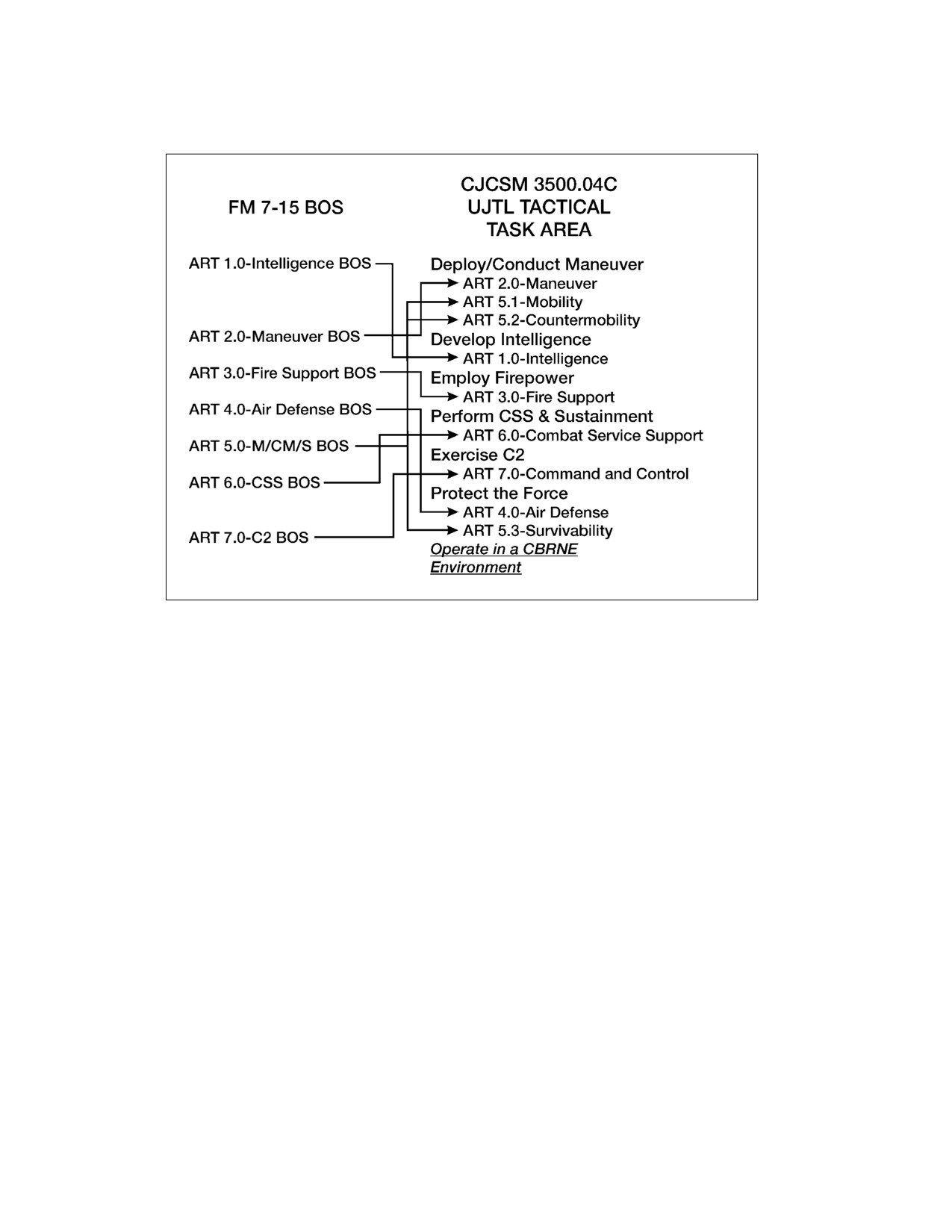
Different environments may require different standards. They do not require different tasks.)
xi
FM 7-15__________________________________________________________________________
The AUTL breaks the BOS into ARTs. Almost any ART can be the “what” of a unit mission
statement. Most ARTs can also be broken into subordinate ARTs. Subordinate ARTs can be
broken in a cascade fashion until they are no longer collective tasks. At that level, tasks become
individual tasks addressed in soldier’s manuals. Lower level ART definitions elaborate on
higher-level ART definitions.
The AUTL numbering system provides a standard reference for addressing and reporting
requirements, capabilities, or issues. Diagrams in each chapter illustrate the relationship of each
ART to the BOS that contains it and to the doctrinal mission hierarchy. The horizontal linkages
of ARTs from different BOS require synchronizing their performance in space and time based on
the concept of operations. The position of any Army tactical mission or task within the AUTL
structure has no relationship to its importance. That importance always depends on the mission.
Likewise, the position of an Army tactical mission or task does not imply either command or
staff oversight.
Each ART appears only once in the AUTL. Doctrine determines the subordination of ARTs. If
there are several logical locations for an ART, it appears at the location that depicts its most
common relationships. While some BOS functions resemble one another, their definitions clearly
distinguish them.
Many ARTs have parallel tasks at the other levels of war, which are addressed in the UJTL. For
example, ARTs associated with preparations for overseas movement are vertically linked to
operational-level force projection tasks. Vertical task linkages provide connectivity between
tactical, operational, and strategic activities. However, the contributions of tactical land power to
joint military power are unique in some cases and do not necessarily link directly to operational-
and strategic-level UJTL tasks.
In applying the AUTL to the Army training process, a number of basic terms apply. The
following table shows their definitions. Understanding the relationship of Army tactical mission
xii
_____________________________________________________________________
Introduction
tasks, operations, and missions is important to successfully using the AUTL to establish training
requirements.
TERM
DEFINITION
Battlefield
The BOS are the physical means (soldiers, organizations, and equipment)
Operating Systems
that commanders use to accomplish missions.
(BOS)
A discrete event or action, not specific to a single unit, weapon system, or
Task
individual that enables accomplishing a mission or function.
The factors of METT-TC that produce the operational environment/specific
Condition
situation in which an organization is expected to conduct operations. These
affect task performance.
The minimum acceptable proficiency required in the performance of a
particular task under a specified set of conditions. Commanders establish
Standard
their standards as they modify published tactics, techniques, and
procedures.
The essential activities assigned to an individual, unit, or force. It contains
Mission
the elements of who, what, when, where, and the why (reasons therefore),
but seldom specifies how.
Conducting service, training, or administrative military missions. The
Operation
process of carrying out the four types of military operations (offensive,
defensive, stability, and support) and their subordinate types and forms.
The specific activity a unit performs while conducting a form of tactical
Tactical Mission
operation or form of maneuver. It is the minimum essential effects to
Task
accomplish the purpose.
Mission Essential
The list of collective tasks in which an organization must be proficient to
Task List
accomplish its wartime or other assigned mission.
Chapters 1
through 7 define the seven Army BOS. They define and
provide measures of performance for the subordinate ARTs of each BOS.
Each BOS has its own chapter. Chapter 8 defines the tasks that support
execution of the Army’s tactical missions and operations.
The primary source for standards for most Army tactical units is their
published ARTEP MTP. It is the responsibility of commanders to
establish new standards when they face significant differences in the
factors of METT-TC from those associated with a task identified in a MTP
training and evaluation outline (T&EO). Significant differences in the
factors of METT-TC include such things as the unit being equipped with
new equipment or having a modified table of organization from that
documented in the MTP, such as what often occurs as a result of force
packaging decisions during the deployment process. It also occurs when
the unit conducts tasks not contemplated by the writer of their MTP, such
as a cannon equipped field artillery battery providing installation
security.
xiii
Chapter 1
ART 1.0: The Intelligence Battlefield Operating System
The intelligence battlefield operating system
(BOS) is the activity to
generate knowledge of and products portraying the enemy and the
environmental features required by a command planning, preparing,
executing, and assessing operations. The intelligence BOS is a flexible
and adjustable architecture of procedures, personnel, organizations and
equipment that provides relevant information and products relating to
the threat and the environment to commanders. The personnel and
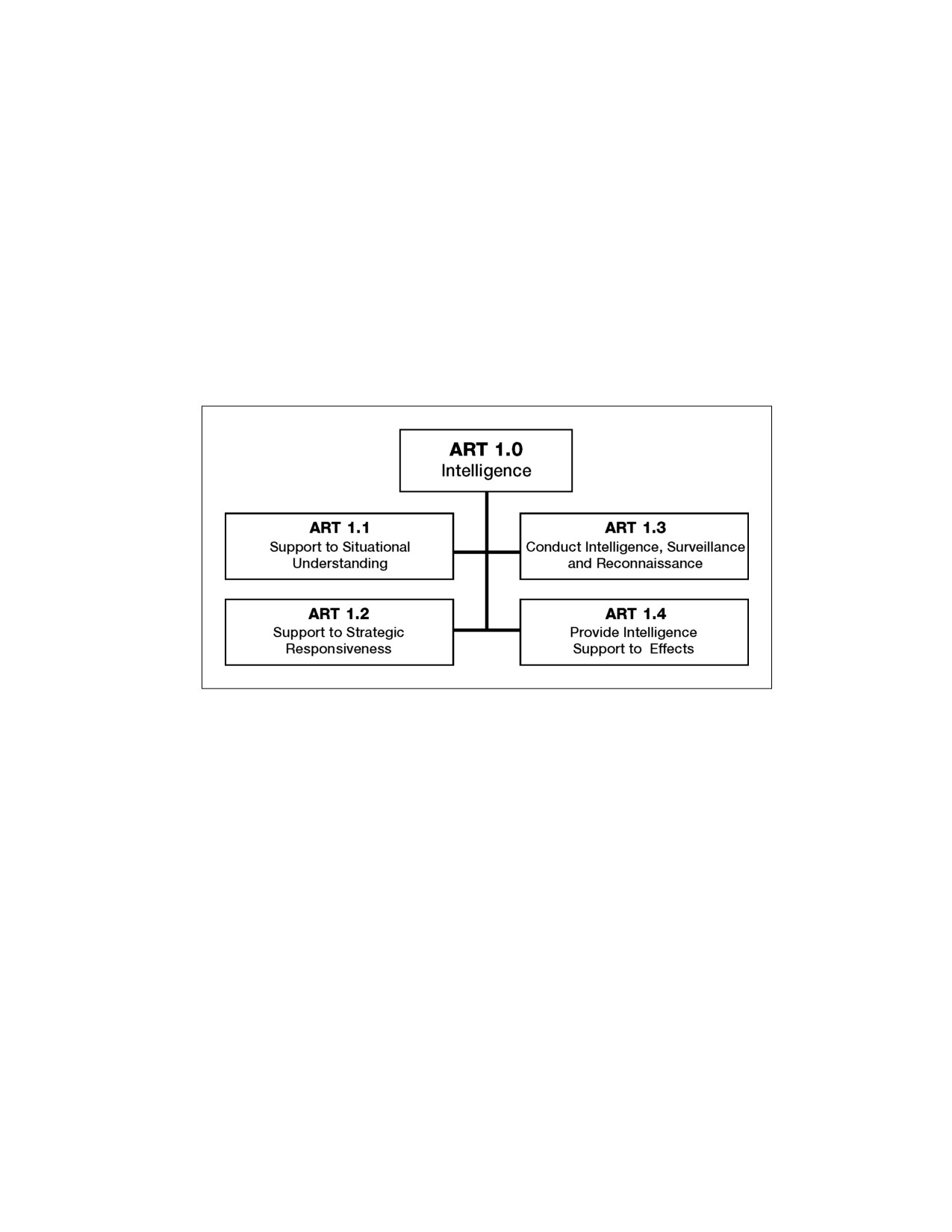
organizations within the intelligence BOS conduct four primary tasks
that facilitate the commander’s visualization and understanding of the
threat and the environment. These tasks are interactive and often take
place simultaneously throughout the intelligence process. The tasks are—
• Support to situational understanding.
• Support to strategic responsiveness.
• Intelligence, surveillance and reconnaissance.
• Support to effects.
Under these tasks are the intelligence sub-tasks which follow the
intelligence process of plan, prepare, collect, process, and produce.
(Disseminate, analyze, and assess are inclusive within ART 7.0.) The
1-1
FM 7-15__________________________________________________________________________
development of intelligence is a continuous process that is fundamental to
all Army operations and integrated into battle command.
SECTION I - ART 1.1: SUPPORT TO SITUATIONAL UNDERSTANDING
1-1. The task centers on providing information and intelligence to the
commander which assists him in achieving a clear understanding of the
force’s current state with relation to the enemy and the environment. It
supports the commander’s ability to make sound decisions. Support to
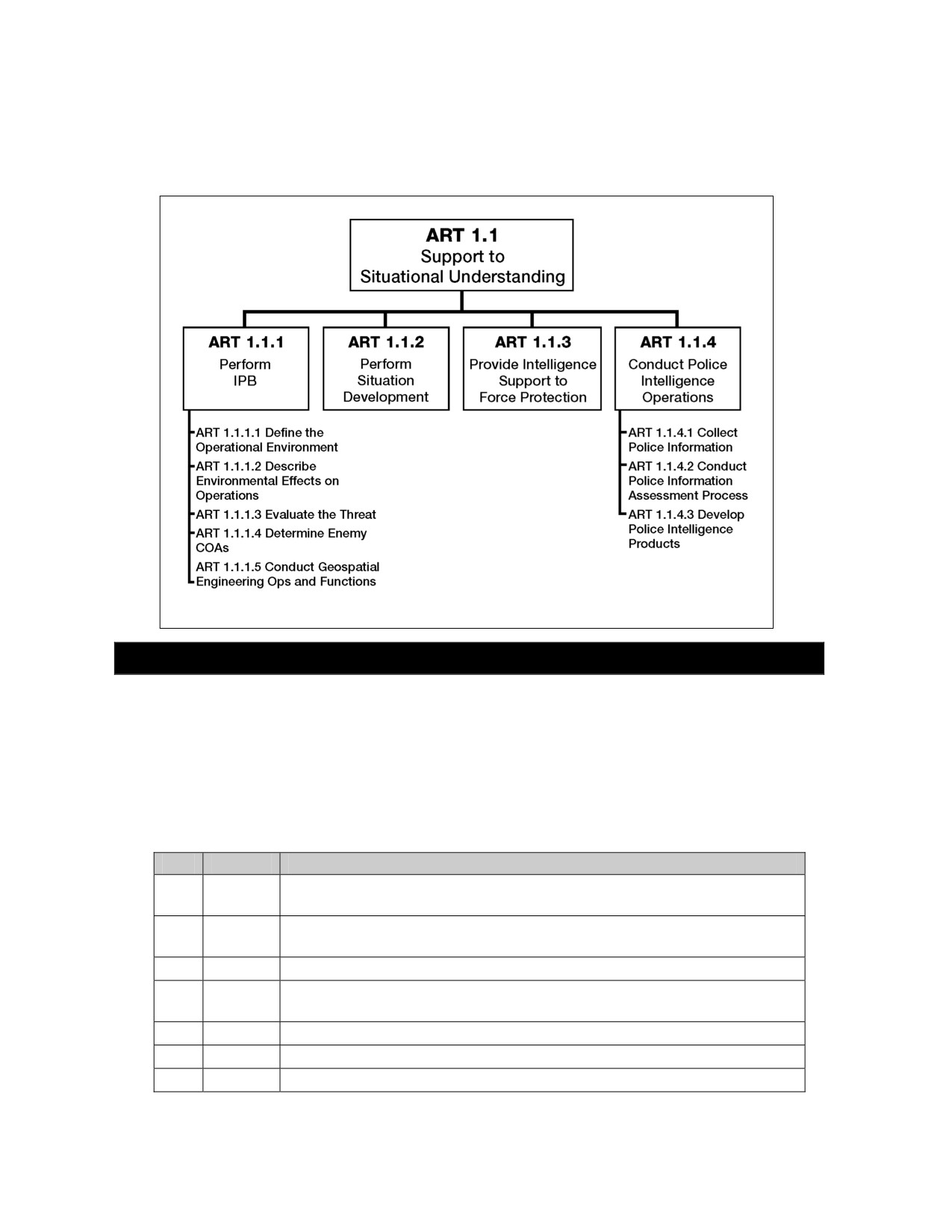
situational understanding is comprised of four subtasks: perform intelligence
preparation of the battlefield (IPB), perform situation development, provide
intelligence support to force protection, and conduct police intelligence
operations. (FM 34-1) (USAIC&FH)
No.
Scale
Measure
Support the commander’s visualization of the battlefield and situational
01
Yes/No
understanding of the threat.
Required to provide intelligence products that facilitate the commander’s
02
Time
visualization and situational understanding of the threat.
03
Percent
Of information and intelligence accurate in light of events.
Of information and intelligence requested by commander completed by
04
Percent
latest time of value.
05
Percent
Of produced intelligence judged relevant to military situations.
06
Percent
Of produced intelligence judged timely by users.
07
Percent
Of produced intelligence judged useable by users.
1-2

______________________________________ART 1.0: The Intelligence Battlefield Operating System
ART 1.1.1 PERFORM INTELLIGENCE PREPARATION OF THE
BATTLEFIELD (IPB)
1-2. IPB is the staff planning activity undertaken by the entire staff to
understand the battlefield and the options it presents to friendly and threat
forces. It is a systematic process of analyzing and visualizing the threat and
environment in a specific geographic area for a specific mission. By applying
IPB, the commander gains the information necessary to selectively apply and
maximize his combat power at critical points in time and space. (FM 34-130)
(USAIC&FH)
No.
Scale
Measure
The products of the IPB process support the preparation of staff
01
Yes/No
estimates and the MDMP by the supported commander and his entire
staff.
The unit intelligence staff, with the support of the entire staff identifies
characteristics of the area of operation that will influence friendly and
02
Yes/No
threat operations including terrain, weather, medical threat, infrastructure,
and civilian demographics.
The entire staff, led by the intelligence staff, establishes the limits of the
03
Yes/No
area of interest following the commander’s guidance.
Unit intelligence staff identifies gaps in current intelligence holdings and
04
Yes/No
identifies information requirements, and recommends CCIR.
The unit intelligence staff, with the support of the entire staff, defines the
05
Yes/No
battlefield environment.
The unit intelligence staff, with the support of the entire staff, describes
06
Yes/No
the effects that military actions will have on future operations within the
AO.
The unit intelligence staff, with the support of the entire staff, evaluates
07
Yes/No
the threat.
08
Yes/No
Unit intelligence staff determines the threat’s COA.
09
Yes/No
Unit intelligence staff validates templates with updated information.
Commander and other unit staff elements in addition to the intelligence
10
Yes/No
staff participate in the process.
11
Time
Since products of the IPB process have been updated.
Of produced intelligence judged to be timely (latest time information is of
12
Percent
value) by users.
13
Percent
Of produced intelligence judged to be accurate in light of events.
14
Percent
Of produced intelligence judged to be useable by users.
Of produced intelligence judged to be complete, based upon request for
15
Percent
clarification or expansion.
16
Percent
Of produced intelligence judged to be relevant to the military situation.
ART 1.1.1.1
DEFINE THE OPERATIONAL ENVIRONMENT
1-3. Initially examine the operational environment in terms of the area of
operations, define the area of interest, identify other characteristics, such as
the role of nongovernmental and international organizations, of the
1-3

FM 7-15__________________________________________________________________________
environment that influence friendly and threat operations, and identify gaps
in current intelligence holdings. (FM 34-130) (USAIC&FH)
Note: The term “operational” in the title of this task does not refer to the
operational level of war.
No.
Scale
Measure
Unit operations are not delayed, disrupted, or canceled, as a result of a
01
Yes/No
failure to identify environmental characteristics of the AO.
Commander with the assistance of his intelligence staff officer identifies
02
Yes/No
his area of interest.
03
Yes/No
Unit staff identifies gaps in current information data bases.
The entire staff identifies significant characteristics of the operational
04
Yes/No
environment, to include status of forces agreement, rules of engagement,
and other constraints on unit operations.
To establish or obtain a database that defines the operational
05
Time
environment.
Required to collect and refine medical threat, terrain, meteorological, and
06
Time
hydrological data.
Since IPB products addressing the operational environment have been
07
Time
updated.
Required to determine enemy order of battle and determine patterns of
08
Time
operations.
Of terrain, meteorological, and hydrological products produced and
09
Percent
issued on time to assigned/gained units.
Of medical threat, terrain, meteorological, and hydrological data received
10
Percent
from other organizations.
Accuracy of enemy order of battle and doctrine, tactics, techniques, and
11
Percent
procedures data.
Accuracy of operational forecasts and products, to include weather
12
Percent
effects and terrain trafficability matrices, tide forecasts, light data, and
tactical decision aids.
Of hazards within the AO identified and reported to appropriate
13
Percent
headquarters.
Of noncombatant population within the AO whose location is accurately
14
Percent
reported to appropriate headquarters.
Of press coverage and threat propaganda that addresses friendly
15
Percent
activities within an AO.
16
Percent
Of the local legal and illegal economy correctly identified in area studies.
Of local decision makers and centers of influence correctly identified in
17
Percent
area studies. This includes official and unofficial leaders.
ART 1.1.1.2
DESCRIBE ENVIRONMENTAL EFFECTS ON OPERATIONS
1-4. The activity to evaluate all aspects of the environment with which all
forces involved—enemy, friendly, and neutral—must contend with during the
conduct of full spectrum operations. This includes terrain, weather,
1-4

______________________________________ART 1.0: The Intelligence Battlefield Operating System
infrastructure, and demographics of the area of operations and the area of
interest. (FM 34-130) (USAIC&FH)
No.
Scale
Measure
Unit operations are not delayed, disrupted, or canceled, as a result of
01
Yes/No
failing to evaluate environmental aspects of the AO.
02
Yes/No
Unit staff identifies gaps in current data bases.
03
Yes/No
Staff identifies and evaluates the effect of terrain on military operations.
04
Yes/No
Staff identifies and evaluates the effect of weather on military operations.
05
Time
To establish or obtain initial battlefield database.
Required to evaluate the impact of combat operations and weather on
06
Time
trafficability of the terrain.
07
Time
Since IPB products have been updated.
Of analysis products produced and issued on time to assigned/task
08
Percent
organized units.
09
Percent
Of analysis products received from higher headquarters.
10
Percent
Accuracy of products provided to unit elements.
11
Percent
Of entire staff effort devoted to updating initial database.
Of restrictions on friendly operations resulting from the presence and
12
Number
movement of noncombatants within the AO.
ART 1.1.1.3
EVALUATE THE THREAT
1-5. The activity to analyze current intelligence to determine how the threat
normally organizes for combat and conducts operations—to include each
threat operating system. The main focus of this step is to create threat
models and templates that depict how the threat operates when
unconstrained by the effects of the environment. (FM 34-130) (USAIC&FH)
No.
Scale
Measure
The threat’s capabilities were stated in the IPB process and accounted
01
Yes/No
for in the military decision process.
Required to incorporate new intelligence data and products into ongoing
02
Time
threat evaluations.
03
Time
To update or create threat models or templates.
04
Time
To identify threat capabilities.
Of threat capabilities, high value targets (HVTs), and threat models
05
Percent
correctly identified.
06
Percent
Of new processed intelligence integrated to update broad COAs.
ART 1.1.1.4
DETERMINE ENEMY COURSES OF ACTION
1-6. The activity to determine possible enemy COAs, rank them in probable
order of adoption, and identify the most probable and the most dangerous.
(FM 34-130) (USAIC&FH)
1-5

FM 7-15__________________________________________________________________________
No.
Scale
Measure
Effects of friendly actions on enemy COAs were assessed by the entire
01
Yes/No
staff under the direction of the unit intelligence staff.
The enemy’s likely objectives and desired end state were identified,
02
Yes/No
beginning with the threat command level at one echelon above the
friendly unit and ending the process at two echelons below.
Unit staff identified the opportunities and constraints that the battlefield
03
Yes/No
environment offers to enemy and friendly forces.
04
Yes/No
Assess effects of friendly actions upon enemy COAs.
Unit considers what the enemy is capable of and what it prefers to do in
05
Yes/No
similar situations if unconstrained by the battlefield environment.
Determination of most probable and most dangerous to a micro-level of
06
Yes/No
detail and other threat COAs to a micro-level of detail as time permits.
07
Yes/No
Enemy COAs disseminated to lower, adjacent, and next higher echelon.
Enemy COA delivered in time to be of value for development of friendly
08
Yes/No
COAs.
Required to identify the enemy’s likely objective and desired end state at
09
Time
different threat echelons of command.
To identify and analyze the feasibility of each enemy COA in terms of
10
Time
time, space, resources, and force ratios required to accomplish its
objective.
11
Time
To evaluate and prioritize each identified enemy COA.
12
Percent
Of threat branches and sequels correctly identified during planning.
13
Percent
Of new intelligence integrated to update enemy COAs.
Of forecasted significant enemy actions correctly identified during
14
Percent
planning.
Of correctly identified enemy HVTs and tactical centers of mass (prior to
15
Percent
selection of COA).
ART 1.1.1.5
CONDUCT GEOSPATIAL ENGINEERING OPERATIONS AND
FUNCTIONS
1-7. Geospatial engineer operations includes the functions of terrain
analysis, data collection, data generation, database management, data
manipulation and exploitation, cartographic production and reproductions,
and geodetic survey. The focus of geospatial engineering operations is on
data generation, data management, terrain analysis, and the presentation of
its results to the commander. Each function is interdependent on each other
in order to prepare a geospatially accurate and timely enabled common
operational picture (COP) for the commander. (FM 3-34.230) (USAES)
1-6

______________________________________ART 1.0: The Intelligence Battlefield Operating System
Notes:
ART 7.2 (Manage Tactical Information) includes the processing of sensor
data, the interpretation of data into intelligent information, fusion and
integration of separate source data, management of the data to include
accuracy and data topology, and dissemination of tactical data information.
The inclusion of this task does not change the steps of the intelligence
preparation of the battlefield process described in FM 34-1.
No.
Scale
Measure
The availability of accurate geospatial products allows the commander to
01
Yes/No
deploy and employ his weapon systems effectively.
The availability of accurate geospatial products allows supported
02
Yes/No
commanders and staffs to visualize their areas of operations, interest,
and influence.
The availability of accurate geospatial products allows supported
03
Yes/No
commanders and staffs to target enemy systems effectively.
The availability of accurate geospatial products allows supported
04
Yes/No
commanders and staffs to efficiently plan air and ground missions.
The availability of accurate geospatial products allows supported
05
Yes/No
commanders and staffs to counter enemy weapons and intelligence-
collection capabilities.
To conduct terrain analysis of area of operations and prepare products
06
Time
supporting the intelligence preparation of the battlefield process.
07
Time
To conduct geodetic survey within area of operations.
To produce and reproduce geospatial information in sufficient quantities
08
Time
to meet supported unit demand.
And types of engineer topographic elements available to support unit
09
Number
operations.
ART 1.1.2 PERFORM SITUATION DEVELOPMENT
1-8. Situation development is a process for analyzing information and
producing current intelligence about the enemy and environment during
operations. The process helps the intelligence officer recognize and interpret
the indicators of enemy intentions, objectives, combat effectiveness, and
potential COA. Situation development confirms or denies threat COAs,
provides threat locations, explains what the threat is doing in relation to the
friendly force commander’s intent, and provides an estimate of threat combat
effectiveness. The locations and actions of non-combatant elements and non-
governmental organizations in the AO that may impact operations should
also be considered. Through situation development, the intelligence officer is
able to quickly identify information gaps, explain enemy activities in relation
to the unit’s operations, and assist the commander in gaining situational
understanding. Situation development helps the commander make decisions
and execute branches and sequels. (FM 34-1) (USAIC&FH)
1-7

FM 7-15__________________________________________________________________________
No.
Scale
Measure
The COA executed by threat forces was predicted in the IPB process and
01
Yes/No
accounted for in the military decision making process.
Threat situational development provides information that helps the
02
Yes/No
commander make decisions to execute branches and sequels.
03
Yes/No
Situational development intelligence disseminated to friendly forces.
04
Time
To produce an updated situational template.
To confirm or deny the existing estimate of the threat’s COA and update
05
Time
the estimate based on current intelligence, weather, and terrain data.
06
Percent
Of produced intelligence judged accurate in light of events.
Of produced intelligence judged complete based upon request for
07
Percent
clarification or expansion.
08
Percent
Of produced intelligence judged relevant to military situation.
09
Percent
Of produced intelligence judged timely by users.
10
Percent
Of produced intelligence judged useable by users.
ART 1.1.3 PROVIDE INTELLIGENCE SUPPORT TO FORCE
PROTECTION
1-9. Provide intelligence in support of protecting the tactical forces fighting
potential so that it can be applied at the appropriate time and place. This
task includes those measures the force takes to remain viable and functional
by protecting itself from the effects of or recovery from enemy activities. (FM
34-1) (USAIC&FH)
Note: This task branch supports ART 5.3, Conduct Survivability Operations.
No.
Scale
Measure
Provide information on incidents by enemy troops or partisans, affecting
01
Yes/No
security of force.
02
Percent
Intelligence relating to potential terrorists acts against US forces.
03
Percent
Intelligence relating to potential asymmetric attacks.
04
Percent
Intelligence relating to use of WMD.
05
Percent
Intelligence requirements to support SEAD operations.
Of requirements for priority intelligence assigned to
06
Percent
counterreconnaissance elements.
ART 1.1.4 CONDUCT POLICE INTELLIGENCE OPERATIONS
1-10. Police intelligence operations (PIO) are a military police function that
support, enhance, and contribute to the commander’s force protection
program, common operational picture, and situational understanding. The
PIO function ensures that information collected during the conduct of other
MP functions—maneuver and mobility support, area security, law and order,
and internment and resettlement—is provided as input to the intelligence
collection effort and turned into action or reports. PIO has three
components—
1-8

______________________________________ART 1.0: The Intelligence Battlefield Operating System
• Collect police information.
• Conduct Police Information Assessment Process (PIAP).
• Develop police intelligence products.
The dissemination of police information is included in ART
7.2.5
(Disseminate COP and Execution Information to Higher, Lower, Adjacent,
Supported, and Supporting Organizations). Joint, interagency, and
multination coordination is included in ART 7.5.1 (Establish and Conduct
Coordination and Liaison). (FM 3-19) (USAMPS)
Notes:
US Code, Executive Orders, DOD Directives, and Army regulations contain
specific guidelines that contain specific guidance regarding prohibition on the
collection of intelligence information on US citizens, US corporations, and
resident aliens. These laws and regulations include criminal penalties for
their violation. Any police intelligence operations directed against US
citizens should undergo competent legal review prior to their initiation.
The inclusion of the police intelligence operations task branch in the
intelligence battlefield operating system does not change the intelligence
process described in FM 34-1.
No.
Scale
Measure
The conduct of police intelligence operations does not violate US Code and
01
Yes/No
applicable DOD and Army regulations against collecting intelligence on US
citizens.
Police intelligence operations contribute to reducing criminal activity within
02
Yes/No
the AO.
Police intelligence products updated as additional criminal information and
03
Yes/No
related data is collected.
Legal coordination and authorization obtained prior to employing technical
04
Yes/No
listening equipment and technical surveillance equipment.
Commander provides list of critical assets to be protected to provost
05
Yes/No
marshal.
Patterns or trends relevant to proactive law and order operations are
06
Yes/No
identified.
07
Yes/No
Military Law Enforcement receives criminal information from the host nation.
Information on known or suspected criminals maintained IAW regulatory
08
Yes/No
and legal guidance.
09
Yes/No
Activity files established, when applicable.
10
Yes/No
Area files established, when applicable.
11
Yes/No
Juvenile records safeguarded from unauthorized disclosure.
Liaison established and maintained with host-nation authorities, military and
12
Yes/No
civilian law enforcement agencies, and other organizations as required by
the factors of METT-TC.
13
Yes/No
Tactical intelligence obtained provided to echelon intelligence staff.
14
Yes/No
Police information collected according with the ISR plan.
15
Yes/No
Police information disseminated to appropriate agencies.
1-9

FM 7-15__________________________________________________________________________
No.
Scale
Measure
16
Time
To develop police information requirements.
17
Time
To determine susceptibility of critical facilities to criminal threat.
18
Time
To identify military resources susceptible to theft and diversion.
To identify criminal trends and patterns based upon police intelligence
19
Time
operations.
To identify trends and patterns by continued association with identified
20
Time
offenders.
To develop methods of operation to assist in eliminating or reducing
21
Time
vulnerability to criminal threat activities.
22
Time
To coordinate with the host nation for police information.
23
Time
To prepare Annex K, Provost Marshal ,to operations plan.
24
Time
To update criminal database as police information and data is received.
To review internally generated police information to see if they can answer
25
Time
police information requirements.
26
Time
To coordinate police information collection by organic assets.
To coordinate with staff intelligence officer for required counterintelligence
27
Time
support.
28
Time
To recruit and develop police informants.
29
Percent
Of identified offenders linked to criminal trends.
Of available US criminal intelligence resources within the AO identified by
30
Percent
military law enforcement.
Of criminal-related activities reported by informants prior to their
31
Percent
occurrence.
Of terrorist-related activities reported by informants prior to their
32
Percent
occurrence.
Of criminal and other potentially disruptive elements within an AO identified
33
Percent
prior to their committing hostile acts against US interests and host-nation
elements.
ART 1.1.4.1 COLLECT POLICE INFORMATION
1-11. Collection of police information involves all available collection
capabilities. This includes HUMINT, MASINT, and open source information.
. The collection effort is not limited to criminal information. It also includes
information, which may not be of a criminal nature but could pose a threat to
law enforcement operations in the operating environment. Collection efforts
also assist in enhancing force protection and antiterrorism through
identifying potential criminal threats and other threat activities. (FM 3-19.1)
(USAMPS)
Note: This task is related to ART 1.3.3 (Conduct Tactical Reconnaissance)
and ART 1.3.4 (Conduct Surveillance) in that those two tasks are techniques
used to collect police information. Additionally, the collection of police
information must be considered when conducting ART
1.3.1
(Perform
Intelligence Synchronization) and ART
1.3.2
(Perform Intelligence,
Surveillance, and Reconnaissance Integration).
1-10

______________________________________ART 1.0: The Intelligence Battlefield Operating System
No.
Scale
Measure
The collection of police information does not violate US Code and applicable
01
Yes/No
DOD and Army regulations against collecting intelligence on US citizens.
Police information collected allows the unit to prevent or reduce criminal
02
Yes/No
activity within its AO.
Criminal intelligence products updated as additional criminal information and
03
Yes/No
data is collected.
Legal coordination and authorization obtained prior to employing technical
04
Yes/No
listening equipment and technical surveillance equipment.
05
Yes/No
Military law enforcement receives criminal information from the host nation.
Liaison maintained with host-nation authorities, military and civilian police
06
Yes/No
agencies, and other organizations as required by the factors of METT-TC.
07
Yes/No
Police information disseminated to appropriate headquarters and agencies.
08
Yes/No
Recruit and develop police informants in the AO.
09
Time
To coordinate with the host nation for police information.
10
Time
To coordinate police information collection by organic assets.
To coordinate with staff intelligence officer for required counterintelligence
11
Time
support.
12
Time
To develop police information requirements.
13
Time
To conduct law enforcement patrols designed to obtain police information.
Of terrorist or criminal-related activities reported by informants prior to their
14
Percent
occurrence.
Of individuals conducting terrorist or criminal-related activities reported by
15
Percent
informants after their occurrence.
Of criminal and other potentially disruptive elements within an AO identified
16
Percent
before they commit hostile acts against US interests and host-nation
elements.
Of criminal activity (such as smuggling, vice, counterfeiting, narcotics,
17
Percent
extortion, rape, murder, robbery) occurring in an AO identified/reported.
18
Percent
Of AO covered by law enforcement patrols (mounted and dismounted).
ART 1.1.4.2 CONDUCT THE POLICE INFORMATION ASSESSMENT PROCESS
1-12. The police information assessment process (PIAP) is a tool used
to
contribute to police intelligence operations. Information and intelligence
gained through the process contributes to all-source analysis and the IPB
process. The PIAP complements the IPB process and is not a substitute. MP
leaders use PIAP as a tool to continuously organize, analyze, interpret and
act upon police and criminal information. Criminal and operational threats
may also impact the tactical scenario and the PIAP is a method used to
consider this threat and its impact on friendly forces. Military police use
PIAP to identify trends and patterns of criminal activity.
(FM 3-19.1)
(USAMPS)
1-11

FM 7-15__________________________________________________________________________
No.
Scale
Measure
The conduct of the police information assessment process does not violate
01
Yes/No
US Code and applicable DOD and Army regulations against collecting
intelligence on US citizens.
The conduct of the Police Information Assessment Process allows the unit to
02
Yes/No
reduce criminal activity within its AO.
Coordination made for funds to establish and maintain a police informant
03
Yes/No
operation.
04
Yes/No
Identified patterns or trends relevant to proactive law and order operations.
05
Yes/No
Analyzed police Information and produced actionable criminal intelligence.
06
Yes/No
Recruit and develop police informants in the AO.
07
Time
To prepare Annex K for Provost Marshal operations plan/order as required.
08
Time
To identify and assess latest criminal information collected.
09
Time
To identify criminal information resources within the AO.
10
Time
To identify criminal trends and patterns developed within the AO.
11
Time
To analyze external criminal information reports.
12
Time
To assess internally generated police information.
13
Time
To produce criminal information bulletins and alert notices.
Of criminal intelligence PIR collection efforts directed toward subordinate
14
Percent
units.
15
Percent
Of available criminal intelligence resources within the AO.
Of terrorist and criminal-related activities reported by informants prior to their
16
Percent
occurrence.
Of individuals conducting terrorist and criminal-related activities reported by
17
Percent
informants after their occurrence.
18
Percent
Of accurate reported terrorist and criminal-related activity.
ART 1.1.4.3 DEVELOP POLICE INTELLIGENCE PRODUCTS
1-13. PIO uses the intelligence cycle to produce actionable police intelligence
products used by MP leaders in tactical and non-tactical environments.
Intelligence products include criminal threat assessments based on the PIAP;
strategic and operational plans to support local host nation law enforcement
in combating crime and/or neutralizing criminal threats to military
operations based on trend and pattern analysis; and disseminating police
intelligence information to law enforcement entities. Police intelligence
products serve to focus police operations, which, in turn contributes to force
protection and mission success. PIO provides the developed criminal
intelligence product to the MI community for incorporation and fusion, which
contributes to the overall intelligence picture. (FM 3-19.1) (USAMPS)
No.
Scale
Measure
The development of the police intelligence products does not violate US Code
01
Yes/No
and applicable DOD and Army regulations against collecting intelligence on
US citizens.
The Police Intelligence products developed allows the unit to reduce criminal
02
Yes/No
activity within its AO.
1-12
______________________________________ART 1.0: The Intelligence Battlefield Operating System
No.
Scale
Measure
Develop police intelligence products based on criminal information collected
03
Yes/No
from external sources.
04
Yes/No
Identified patterns or trends relevant to proactive law and order operations.
05
Yes/No
Actionable police intelligence products.
Relevant police intelligence disseminated through military law enforcement,
06
Yes/No
civilian and host nation network.
Criminal intelligence products received from civilian and host nation law
07
Yes/No
enforcement network.
08
Yes/No
Military intelligence related information provided to the MI community.
09
Yes/No
Support provided to the police intelligence fusion cell.
10
Time
To identify criminal information resources within the AO.
11
Time
To identify criminal trends and patterns developed within the AO.
12
Time
To analyze external criminal information reports.
13
Time
To assess internally generated police information.
14
Time
To produce criminal information bulletins and alert notices.
15
Percent
Of investigative matters solved or resolved as a result of police intelligence.
16
Percent
Of available criminal intelligence resources within the AO.
Of terrorist and criminal-related activities reduced or eliminated as a result of
17
Percent
police intelligence.
Of individuals identified conducting terrorist and criminal-related activities as a
18
Percent
result of police intelligence.
19
Percent
Cost/resource savings through the use of actionable police intelligence.
SECTION II - ART 1.2: SUPPORT TO STRATEGIC RESPONSIVENESS
1-14. Intelligence support to strategic responsiveness supports staff planning
and preparation by defining the full spectrum of threats, forecasting future
threats and forewarning the commander of enemy actions and intentions.
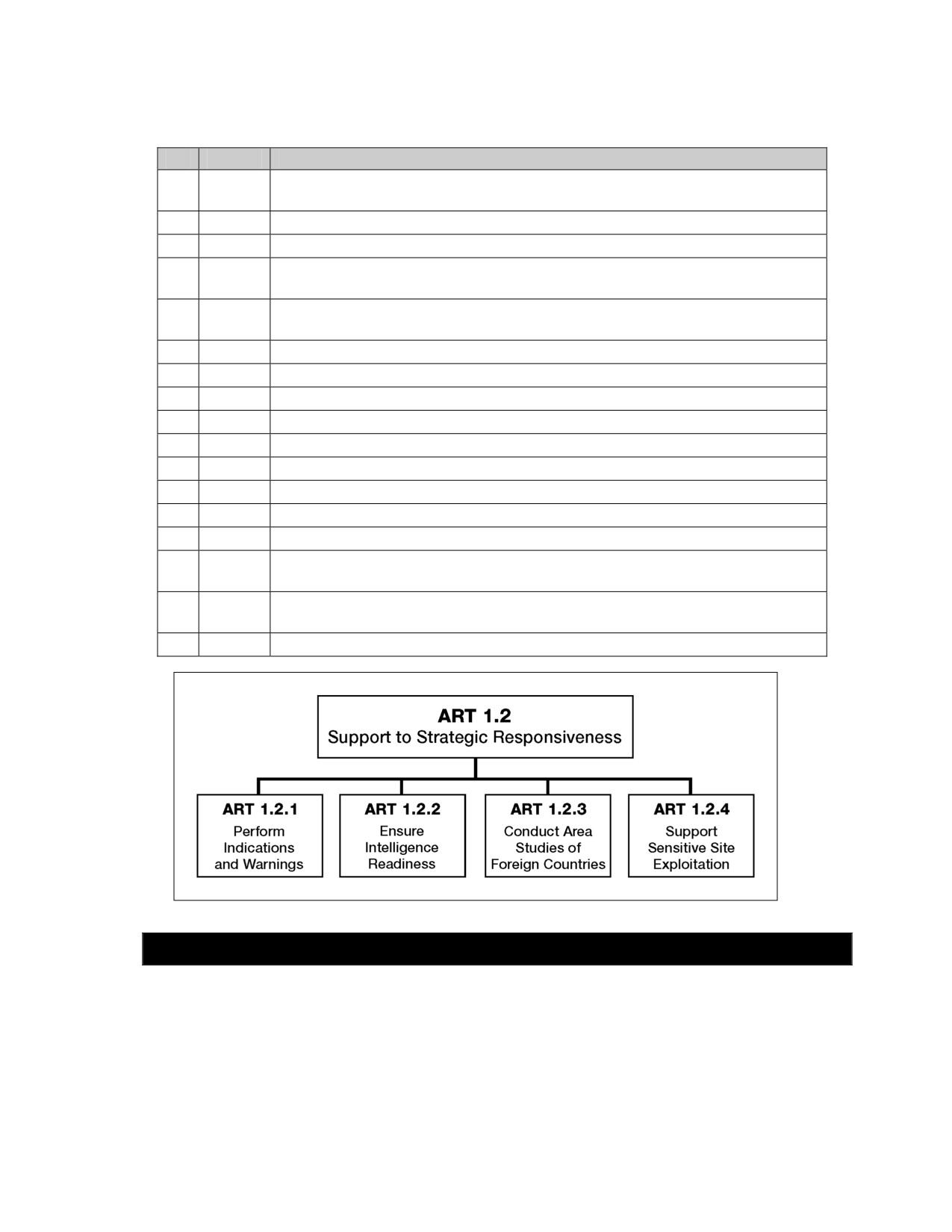
Support to strategic responsiveness consists of four subtasks: perform
indications and warnings (I&W), ensure intelligence readiness, conduct area
studies of foreign countries and support sensitive site exploitation. (FM 34-1)
(USAIC&FH)
1-13

FM 7-15__________________________________________________________________________
No.
Scale
Measure
01
Yes/No
Provides information to support staff planning and preparation.
02
Yes/No
Defines full spectrum of threats.
03
Yes/No
Provides forecast of future threats.
04
Yes/No
Forewarns commander of enemy actions/intentions.
ART 1.2.1 PERFORM INDICATIONS AND WARNINGS
1-15. This activity provides the commander with forewarning of enemy
actions or intentions; the imminence of threat actions. The intelligence officer
develops indications and warnings in order to rapidly alert the commander of
events or activities that would change the basic nature of the operations. It
enables the commander to quickly reorient the force to unexpected
contingencies and shape the battlefield. (FM 34-1) (USAIC&FH)
No.
Scale
Measure
Indications and warnings issued in sufficient time to prevent the targeted
01
Yes/No
friendly unit or installation from being surprised by the threat.
Indications and warnings disseminated after development and compared
02
Yes/No
to other information and intelligence to ensure accuracy.
Intelligence officer monitors event template/matrix to determine if enemy
03
Yes/No
is conducting predicted course of action.
Between receipt of significant information and intelligence and updates of
04
Time
indications and warnings conditions.
05
Time
Lead time in prediction of significant changes in threat activities.
Required to transmit indications and warnings to appropriate agencies
06
Time
and organizations.
07
Time
To submit intelligence portion of commander’s situation report.
Of indications and warnings of threat actions reported, which will impact
08
Percent
friendly forces operations.
Of commander’s threat conditions and attack warnings issued and
09
Percent
disseminated.
10
Percent
Of threat indicators maintained and evaluated.
ART 1.2.2 ENSURE INTELLIGENCE READINESS
1-16. Intelligence readiness operations support contingency planning and
preparation by developing baseline knowledge of multiple potential threats
and operational environments. These operations and related intelligence
training activities engage the intelligence BOS to respond effectively to the
commander’s contingency planning intelligence requirements.
(FM 34-1)
(USAIC&FH)
1-14

______________________________________ART 1.0: The Intelligence Battlefield Operating System
No.
Scale
Measure
Provides information on incidents by enemy troops or partisans, affecting
01
Yes/No
security of force
02
Percent
Of intelligence relating to potential terrorists acts against US forces.
03
Percent
Of intelligence relating to potential asymmetric attacks.
Of intelligence relating to using nuclear, biological, and chemical (NBC)
04
Percent
weapons.
Of requirements for priority intelligence assigned to counter-
05
Percent
reconnaissance elements.
06
Percent
Of intelligence requirements to support SEAD operations.
ART 1.2.3 CONDUCT AREA STUDIES OF FOREIGN COUNTRIES
1-17. Study and understand the cultural, social, political, religious, and
moral beliefs/attitudes of allied, host-nation, or indigenous forces to assist in
accomplishing goals and objectives. (FM 34-1) (USAJFKSWC)
Note: The inclusion of this task does not change the support to strategic
responsiveness provided by military intelligence organization described in
FM 34-1.
No.
Scale
Measure
Study provides commander/staff with necessary background information
01
Yes/No
for mission accomplishment.
02
Yes/No
Study completed in time to support mission requirements.
Study gives priority to information germane to the mission or projected
03
Yes/No
mission.
Study does not reproduce data contained in readily available
04
Yes/No
publications.
Study uses maps, charts, and tables to graphically portray data in easily
05
Yes/No
understandable and retrievable formats.
06
Time
From receipt of tasking until study is complete.
07
Time
To identify shortfalls in available data to complete study.
08
Time
To request required data not available from available resources.
Of information requested from outside sources provided by those
09
Percent
outside sources.
Accuracy of study information, to include the following areas: geography,
history, population, culture and social structure, languages, religion, US
interests, civil defense, labor, legal, public administration, public
education, public finance, public health, public safety, public welfare,
10
Percent
civilian supply, civilian economics and commerce, food and agriculture,
property control, public communications, public transportation, public
works and utilities, arts, monuments, archives, civil information, cultural
affairs, dislocated civilians, and host-nation support.
1-15

FM 7-15__________________________________________________________________________
ART 1.2.4 SUPPORT SENSITIVE SITE EXPLOITATION
1-18. Sensitive site exploitation consists of a related series of activities inside
a sensitive site captured from an adversary. A sensitive site is a designated,
geographically limited area with special military, diplomatic, economic, or
information sensitivity for the United States. This includes factories with
technical data on enemy weapon systems, war crimes sites, critical hostile
government facilities, areas suspected of containing persons of high rank in a
hostile government or organization, terrorist money laundering, and
document storage areas for secret police forces. These activities exploit
personnel, documents, electronic data, and material captured at the site,
while neutralizing any threat posed by the site or its contents. While the
physical process of exploiting the sensitive site begins at the site itself, full
exploitation may involve teams of experts located around the world. (FM 34-
54) (USACAC)
Note: The inclusion of this task does not change the support to strategic
responsiveness provided by military intelligence organization described in
FM 34-1.
No.
Scale
Measure
Exploitation of the sensitive site supports US operational or strategic
01
Yes/No
political, military, economic, and informational goals.
The unit supporting the exploitation of the sensitive site has isolated,
seized, secured, and cleared the site or has relieved a unit that
02
Yes/No
performed those tactical missions prior to exploiting the site under the
technical direction of a subject matter experts.
03
Yes/No
Enemy or adversary knows that the site has been exploited by US forces.
Tactical unit tasked organized itself appropriately to accomplish the
04
Yes/No
mission of supporting the exploitation of the sensitive site and
compensated for losses.
Enemy or adversary was not able to exfiltrate sensitive equipment or
05
Yes/No
material from the sensitive site.
Unit supporting the sensitive site exploitation did not suffer casualties as
06
Yes/No
a result of a failure to properly managed the risks associated with the site.
Enemy or adversary was not able to destroy sensitive equipment,
07
Yes/No
material, and documents or purge computers of sensitive information
prior to the site being secured.
Commander of the unit supporting the exploitation of the sensitive site
08
Yes/No
maintains his situational understanding throughout the operation.
Members of the unit supporting the exploitation have access to a high
09
Yes/No
fidelity common operational picture throughout the operation consistent
with operations security.
Leaders of the unit supporting the exploitation of the sensitive site use the
military decision making process or troop leading procedures correctly to
10
Yes/No
include the identification of search locations, security positions,
boundaries, and fire support coordinating measures. The battlefield
operating systems are coordinated and synchronized.
1-16
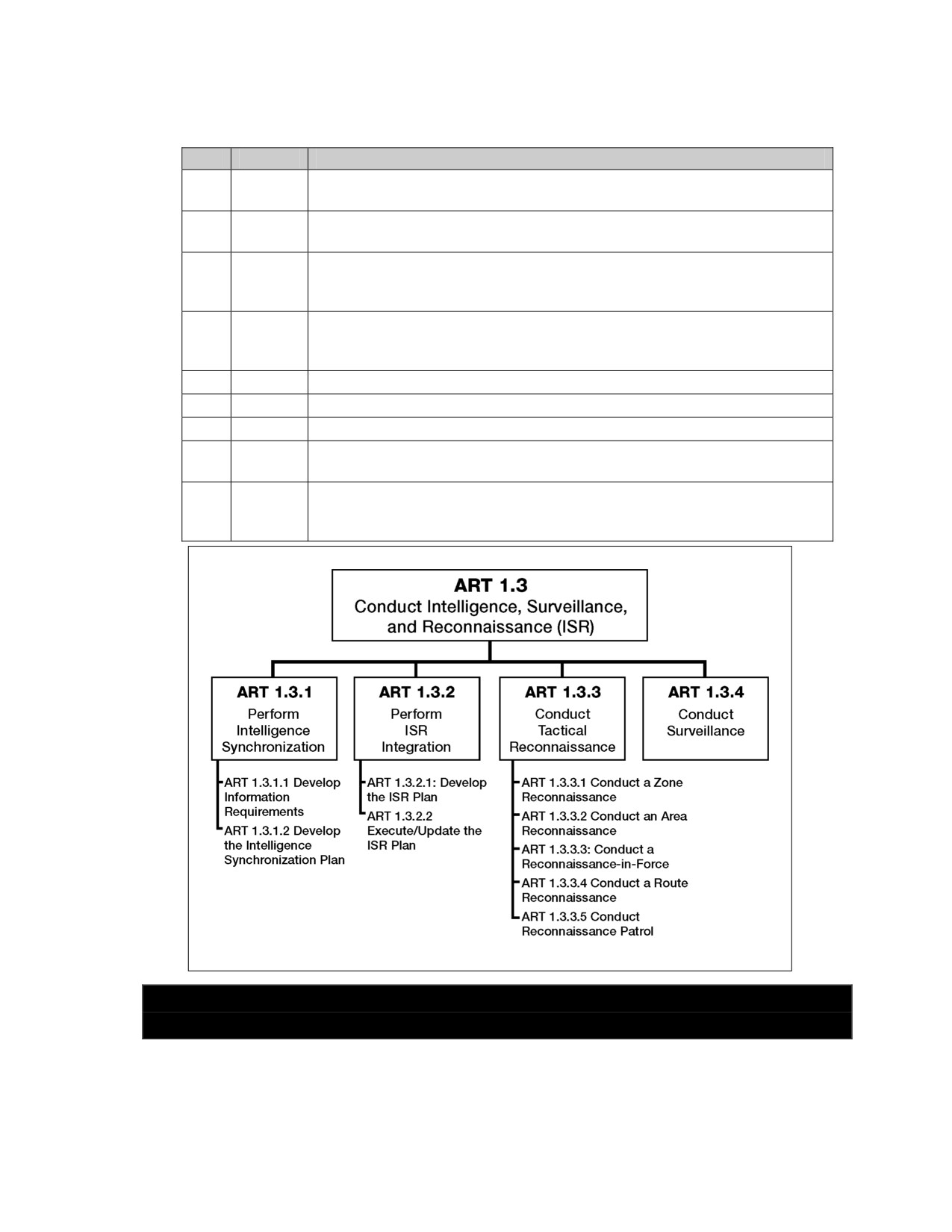
______________________________________ART 1.0: The Intelligence Battlefield Operating System
No.
Scale
Measure
Unit conducts operations in accordance with established rule of
11
Yes/No
engagement and consideration for the nature of the sensitive site.
Unit records the results of the search and appropriately disseminates the
12
Yes/No
results.
Unit supporting the exploitation of the site appropriately kills, captures, or
13
Yes/No
detains enemy soldiers, adversaries, sensitive individuals, and neutrals
within the site.
Necessary to isolate the sensitive site and the forces and individuals
14
Time
located inside the site from outside physical, informational, and
psychological support.
15
Time
Necessary to seize the sensitive site.
16
Time
Necessary to secure the sensitive site.
17
Time
Necessary to search the sensitive site.
Necessary to establish liaison with and deploy technical experts to the
18
Time
sensitive site.
Of potential sensitive personnel, equipment, material, documents, and
19
Percent
electronically stored files located within the site discovered during the
search of the sensitive site.
SECTION III - ART 1.3: CONDUCT INTELLIGENCE, SURVEILLANCE, AND
RECONNAISSANCE (ISR)
1-19. With staff participation, the intelligence officer synchronizes
intelligence support to the ISR effort by focusing the collection, processing,
analysis and intelligence products on the critical needs of the commander.
1-17

FM 7-15__________________________________________________________________________
The operations officer, in coordination with the intelligence officer, tasks and
directs the available ISR assets to answer the commander’s CCIR. Through
various detection methods and systematic observation, reconnaissance and
surveillance obtains the required information. A continuous process, this task
has four subtasks: perform intelligence synchronization, perform ISR
integration, conduct reconnaissance, and conduct surveillance. (FM 3-90)
(USACAC)
No.
Scale
Measure
01
Yes/No
Develop a strategy to answer each CCIR to accomplish ISR integration.
Determine unique support requirements for ISR assets to include
02
Yes/No
maintenance, crew training, and connectivity.
03
Yes/No
ISR assets task organized to accomplish assigned tasks and missions.
04
Yes/No
Develop a detailed ISR plan through a staff process.
05
Yes/No
Obtain intelligence using intelligence reach.
Received request from higher headquarters to collect, produce or
06
Yes/No
disseminate combat information or intelligence products.
Evaluate progress of answering each requirement based on reporting of
07
Yes/No
information.
08
Percent
Effectiveness of ISR effort assessed and evaluated.
ART 1.3.1 PERFORM INTELLIGENCE SYNCHRONIZATION
1-20. The intelligence officer, with staff participation, synchronizes the
entire collection effort to include all assets the commander controls, assets of
lateral units and higher echelon units and organizations, and intelligence
reach to answer the commander’s PIR and IR. (FM 34-1) (USAIC&FH)
No.
Scale
Measure
ISR synchronization is accomplished by developing a strategy to answer
01
Yes/No
each SIR
Determine unique support requirements for ISR assets to include
02
Yes/No
maintenance, crew training, and connectivity.
03
Yes/No
ISR task organization accomplished.
04
Yes/No
Intelligence is obtained utilizing Intelligence Reach.
Collection, production or dissemination is requested from higher
05
Yes/No
headquarters.
Progress of answering each requirement is evaluated based on reporting
06
Yes/No
of information
07
Percent
Effectiveness of ISR effort as evaluated and assessed.
ART 1.3.1.1
DEVELOP INFORMATION REQUIREMENTS
1-21. The intelligence staff develops a prioritized list of what information
needs to be collected and produced into intelligence. Additionally, the
intelligence staff dynamically updates and adjusts those requirements in
response to mission adjustments/changes. This list is placed against a latest
time intelligence is of value to ensure intelligence and information is
reported to meet operational requirements. (FM 34-1) (USAIC&FH)
1-18

______________________________________ART 1.0: The Intelligence Battlefield Operating System
No.
Scale
Measure
Staff analyzes CCIR, including RFI from lower echelons, and orders from
01
Yes/No
higher echelons.
02
Yes/No
Initial intelligence requirements identified during IPB
03
Yes/No
Mission specific PIR identified during MDMP COA development
All information and intelligence requirements prioritized and validated to
04
Yes/No
ensure they meet the commander and staff needs.
05
Yes/No
Identified intelligence gaps.
06
Yes/No
Conducted wargaming.
07
Yes/No
Developed specific information requirements (SIR) and indicators
08
Yes/No
Develop SIR for each PIR and FFIR.
09
Time
To validate and incorporate PIR from higher, lower and adjacent units.
Before next phase of an operation when the PIR are validated or
10
Time
updated.
Intelligence requirements identified and if necessary dynamically
11
Time
updated/revised in advance of collection.
12
Time
To prioritize information and intelligence collection requirements.
13
Percent
Of PIR addressed in intelligence update.
Of subordinate echelon PIR supported by the echelon’s information and
14
Percent
intelligence requirements.
15
Percent
Of unvalidated PIR resubmitted by originating agency/office.
Of validated PIR have ongoing collection efforts directed towards
16
Percent
answering the requirements.
17
Percent
Of PIR submitted by multiple organizations.
18
Percent
Of PIR linked to SIR.
19
Percent
Of SIR developed form PIR.
20
Number
Of open CCIR and PIR at any one time.
21
Number
Of PIR identified after collection begins.
ART 1.3.1.2
DEVELOP THE INTELLIGENCE SYNCHRONIZATION PLAN
1-22. The entire unit staff develops their information requirements and
determines how best to satisfy them. The staff uses reconnaissance and
surveillance assets to collect information. The intelligence synchronization
plan includes all assets that the operations officer can task or request and
coordination mechanisms to ensure adequate coverage of the areas of
interest. (FM 34-1) (USAIC&FH)
No.
Scale
Measure
Intelligence staff analyzes requirements and develops validated
01
Yes/No
prioritized requirements list.
02
Yes/No
All organic, adjacent and higher ISR assets identified.
Intelligence staff determines asset availability in coordination with the
03
Yes/No
operations staff.
Determine unique support requirements for ISR assets to include
04
Yes/No
maintenance, crew training, and connectivity.
1-19

FM 7-15__________________________________________________________________________
No.
Scale
Measure
Intelligence staff determines availability and capabilities of assets from
05
Yes/No
higher echelons.
Identify the reporting criteria and the capabilities and limitations of all ISR
06
Yes/No
assets.
Intelligence synchronization plan developed and linked to information and
07
Yes/No
intelligence requirements.
08
Yes/No
Intelligence synchronization plan linked to PIR and SIR.
Intelligence production supports the development of answers to
09
Yes/No
intelligence requirements (specifically PIR).
Intelligence synchronization plan disseminated to operations in sufficient
10
Yes/No
time for orders production and troop leading procedures.
11
Yes/No
Intelligence synchronization plan linked to dissemination plan.
Of available intelligence, reconnaissance, and surveillance assets
12
Percent
identified.
13
Percent
Of requirements analyzed, validated, and prioritized.
14
Time
To determine availability of ISR assets.
15
Time
To develop Intelligence synchronization plan.
ART 1.3.2 PERFORM ISR INTEGRATION
1-23. The operations officer, in coordination with the intelligence officer and
other staff members, orchestrates the tasking and directing of available ISR
assets to answer the CCIR. The operations office, with input from the
intelligence officer, develops tasks from the specific information
requirements (SIRs) which coincide with the capabilities and limitations of
the available ISR assets and the latest time information is of value (LTIOV).
Intelligence requirements are identified, prioritized, and validated and an
ISR plan is developed and synchronized with the scheme of maneuver. (FM 3-
90) (USACAC)
No.
Scale
Measure
01
Yes/No
ISR plan focused on the CCIR.
Determine unique support requirements for ISR assets to include
02
Yes/No
maintenance, crew training, and connectivity.
03
Yes/No
ISR plan does not ignore other types of information requirements.
ISR plan provides information and intelligence in sufficient time for the
04
Yes/No
commander to use in the planning, preparation, execution, and
assessment of operations.
ISR plan linked to a dissemination plan for passing of information and
05
Yes/No
intelligence to requesting organizations.
06
Time
To analyze requirements after receipt.
07
Time
To determine indicators.
08
Time
To determine specific information and intelligence requirements.
09
Time
To determine reporting criteria.
10
Time
To produce initial ISR plan.
11
Time
To review existing information on threat capabilities.
1-20

______________________________________ART 1.0: The Intelligence Battlefield Operating System
No.
Scale
Measure
12
Time
To consider threat doctrine.
To develop specific orders and requests (SOR) based on specific
13
Time
information requirements (SIR).
14
Percent
Of information requirements analyzed.
15
Percent
Of indicators correctly determined.
16
Percent
Of specific information and intelligence requirements correctly answered.
17
Percent
Of reporting requirements correctly answered.
ART 1.3.2.1
DEVELOP THE ISR PLAN
1-24. The operations officer is responsible for developing the ISR plan. The
entire unit staff analyzes each requirement to determine how best to satisfy
it. The staff will receive orders and RFIs from both subordinate and adjacent
units and higher headquarters. The ISR plan includes all assets that the
operations officer can task or request and coordination mechanisms to ensure
adequate coverage of the area of interest. (FM 3-90) (USACAC)
No.
Scale
Measure
Intelligence staff analyzes requirements and develops validated
01
Yes/No
prioritized requirements list.
02
Yes/No
All organic, adjacent and higher ISR assets identified.
Intelligence staff determines asset availability in coordination with the
03
Yes/No
operations staff.
Determine unique support requirements for ISR assets to include
04
Yes/No
maintenance, crew training, and connectivity.
Intelligence staff determines availability and capabilities of assets from
05
Yes/No
higher echelons.
Identify the reporting criteria and the capabilities and limitations of all ISR
06
Yes/No
assets.
ISR plan developed and links to information requirements (IR),
commander’s critical information requirements (CCIR), and specific
07
Yes/No
information requirements (SIR) to specific orders and requests (SOR)
and specific collection assets.
ISR plan provides information and intelligence in sufficient time for the
08
Yes/No
commander to use in planning, preparing, executing, and assessing his
operation.
Intelligence production supports the development of answers to
09
Yes/No
intelligence requirements (specifically PIR).
ISR plan disseminated by operations officer in sufficient time for orders
10
Yes/No
production and the conduct of troop leading procedures by subordinates.
11
Yes/No
ISR plan linked to dissemination plan.
ISR plan links SIRs to specific reporting criteria and latest time
12
Yes/No
information is of value (LTIOV).
13
Yes/No
Development of SOR based on SIR.
14
Percent
Of available ISR assets identified.
15
Percent
Of requirements analyzed, validated, and prioritized.
1-21

FM 7-15__________________________________________________________________________
No.
Scale
Measure
16
Time
To determine availability of ISR assets.
17
Time
To develop ISR plan.
ART 1.3.2.2
EXECUTE/UPDATE THE ISR PLAN
1-25. The operations officer updates the ISR plan based on information he
receives from the intelligence officer. The operations officer is the integrator
and manager of the ISR effort through an integrated staff process and
procedures. As PIRs are answered and new information requirements arise,
the intelligence officer updates intelligence synchronization requirements
and provides the new input to the operations officer who updates the ISR
plan. He works closely with all staff elements to ensure the unit’s organic
collectors receive appropriate taskings. This ISR reflects an integrated
collection strategy and employment, production and dissemination scheme
that will effectively answer the commander’s PIR. (FM 3-90) (USACAC)
No.
Scale
Measure
Staff analyzes all PIRs, to include RFI from lower echelons, and orders
01
Yes/No
from higher echelons.
ISR plan provides information and intelligence in sufficient time for the
02
Yes/No
commander to use in the planning, preparation, execution, and
assessment of his operation.
03
Yes/No
Develop SIR for each PIR.
04
Yes/No
SIRs are linked to specific reporting criteria, and latest time of value.
Determine unique support requirements for ISR assets to include
05
Yes/No
maintenance, crew training, and connectivity.
Reports are evaluated to identify which SIR have been answered and
06
Yes/No
identify which PIR/CCIR can be removed.
07
Yes/No
Reports evaluated to identify new PIR/CCIR.
08
Yes/No
New specific orders and requests (SOR) identified based on new SIRs.
09
Percent
Of PIR linked to SIR.
10
Percent
Of SIR developed from PIR.
ART 1.3.3 CONDUCT TACTICAL RECONNAISSANCE
1-26. To obtain, by visual observation or other detection methods, such as
signals, imagery, measurement of signature or other technical
characteristics, human interaction and other detection methods about the
activities and resources of an enemy or potential enemy, or to secure data
concerning the meteorological, hydrographic, or geographic characteristics
and the indigenous population of a particular area. This task includes the
conduct of NBC reconnaissance and the tactical aspects of SOF special
reconnaissance. (FM 3-90) (USACAC)
Note: This task branch includes techniques by which ART 1.1.4.1 (Collect
Police Information) may be performed.
1-22

______________________________________ART 1.0: The Intelligence Battlefield Operating System
No.
Scale
Measure
01
Yes/No
The SIR that prompted the conduct of reconnaissance was answered.
02
Yes/No
Reconnaissance system/force orients on the reconnaissance objective.
03
Yes/No
Recon system/force reports all information rapidly and accurately.
04
Yes/No
Recon mission completed no later than time specified in the order.
05
Yes/No
Support requirements for each reconnaissance asset are identified.
06
Yes/No
Unit maintains continuous reconnaissance by employing multiple means.
07
Time
From receipt of tasking until reconnaissance assets are in place.
08
Time
To provide answers to IR/PIR to requesting agency.
09
Time
To redirect reconnaissance assets to meet new collection requirements.
10
Percent
Of SIR developed from PIR.
11
Percent
Of collection requirements fulfilled by reconnaissance assets.
12
Percent
Accuracy of data provided.
13
Percent
Of collection requirements satisfied using Intelligence Reach.
14
Percent
Of reconnaissance assets mission capable.
15
Percent
Of reconnaissance assets becoming casualties during the mission.
ART 1.3.3.1
CONDUCT A ZONE RECONNAISSANCE
1-27. Conduct a directed effort to obtain detailed information about all
routes, obstacles (to include NBC contamination), terrain, and enemy forces
within an area defined by boundaries. The commander normally assigns a
zone reconnaissance when the enemy situation is vague or when information
concerning cross-country trafficability is desired. (FM 3-90) (USACAC)
No.
Scale
Measure
Zone reconnaissance accomplishes its task or mission, such as finding,
and reporting all enemy forces within the designation area, clearing all
01
Yes/No
enemy forces in the designated AO within the capability of the unit
conducting reconnaissance, etc.
02
Yes/No
Reconnaissance force orients on the reconnaissance objective.
03
Yes/No
Reconnaissance force reports all information rapidly and accurately.
04
Yes/No
Reconnaissance force retains its freedom to maneuver.
05
Yes/No
Reconnaissance force gains and maintains enemy contact.
06
Yes/No
Reconnaissance force rapidly develops the situation.
Report zone reconnaissance tasks not accomplished to higher
07
Yes/No
headquarters.
AO that defines the zone cleared of all enemy forces within the capability
08
Yes/No
of the unit conducting the zone reconnaissance.
Complete zone reconnaissance mission no later than time specified in
09
Yes/No
the order.
10
Time
From receiving task until unit reconnaissance assets are in place.
11
Time
To provide collected data to tasking agency analysts.
12
Time
To redirect reconnaissance assets to meet new collection requirements.
13
Time
From receiving task until completing zone reconnaissance.
1-23

FM 7-15__________________________________________________________________________
No.
Scale
Measure
Of assigned zone reconnaissance tasks fulfilled by reconnaissance
14
Percent
assets.
Of tactical-level collection requirements satisfied by piggybacking on
15
Percent
existing collection missions on a noninterference basis.
16
Percent
Of accuracy of data provided.
17
Percent
Of zone reconnaissance assets mission capable.
18
Percent
Of reconnaissance assets becoming casualties during the mission.
ART 1.3.3.2
CONDUCT AN AREA RECONNAISSANCE
1-28. Conduct a directed effort to obtain detailed information concerning the
terrain or enemy activity within a prescribed area not defined by boundaries,
such as a town, ridgeline, woods, or other feature critical to operations. (FM
3-90) (USACAC)
No.
Scale
Measure
Area reconnaissance accomplishes its task or mission, such as finding,
and reporting all enemy forces within the designation area, clearing all
01
Yes/No
enemy forces in the designated AO within the capability of the unit
conducting reconnaissance, etc.
02
Yes/No
Reconnaissance force orients on the reconnaissance objective.
03
Yes/No
Reconnaissance force reports all information rapidly and accurately.
04
Yes/No
Reconnaissance force retains its freedom to maneuver.
05
Yes/No
Reconnaissance force gains and maintains enemy contact.
06
Yes/No
Reconnaissance force rapidly develops the situation.
Report area reconnaissance tasks not accomplished to higher
07
Yes/No
headquarters.
AO that defines the area cleared of all enemy forces within the capability
08
Yes/No
of the unit conducting the area reconnaissance.
Complete area reconnaissance mission no later than time specified in the
09
Yes/No
order.
10
Time
From receiving task until placing unit reconnaissance assets.
11
Time
To provide collected data to tasking agency analysts.
12
Time
To redirect reconnaissance assets to meet new collection requirements.
13
Time
From receiving task until completing area reconnaissance.
Of assigned area reconnaissance tasks fulfilled by reconnaissance
14
Percent
assets.
Of tactical-level collection requirements satisfied by piggybacking on
15
Percent
existing collection missions on a noninterference basis.
16
Percent
Of accuracy of data provided.
17
Percent
Of area reconnaissance assets mission capable.
18
Percent
Of reconnaissance assets becoming casualties during the mission.
1-24

______________________________________ART 1.0: The Intelligence Battlefield Operating System
ART 1.3.3.3
CONDUCT A RECONNAISSANCE-IN-FORCE
1-29. A reconnaissance-in-force is a deliberate combat operation designed to
discover or test the enemy’s strength, dispositions, and reactions, or obtain
other information. (FM 3-90) (USACAC)
No.
Scale
Measure
Reconnaissance-in-force accomplishes its task or mission, such as
01
Yes/No
penetrating the enemy’s security area and determining its size and depth,
determining the location and disposition of enemy main positions, etc.
Unit conducting the reconnaissance-in-force remains oriented on the
02
Yes/No
reconnaissance objective.
Unit conducting the reconnaissance-in-force reports all information
03
Yes/No
rapidly and accurately to its higher headquarters.
Unit conducting the reconnaissance-in-force retains its freedom to
04
Yes/No
maneuver.
Unit conducting the reconnaissance-in-force gains and maintains enemy
05
Yes/No
contact.
Unit conducting the reconnaissance-in-force rapidly develops the
06
Yes/No
situation.
Report reconnaissance-in-force tasks not accomplished to higher
07
Yes/No
headquarters.
Unit completes the reconnaissance-in-force no later than time specified in
08
Yes/No
the order.
Collect desired information during the reconnaissance-in-force; make it
09
Yes/No
available to the commander.
10
Time
From receiving task until placing unit starts the reconnaissance-in-force.
11
Time
To provide collected data to tasking agency analysts.
12
Time
To redirect reconnaissance assets to meet new collection requirements.
13
Time
From receiving task until completing reconnaissance-in-force.
Of doctrinal reconnaissance-in-force tasks fulfilled by reconnaissance
14
Percent
assets.
Of tactical-level collection requirements satisfied by piggybacking on
15
Percent
existing collection missions on a noninterference basis.
16
Percent
Of accuracy of data provided.
Of unit assets mission capable at different points during the
17
Percent
reconnaissance-in-force mission—beginning, end, and critical times.
18
Percent
Of unit assets becoming casualties during the mission.
ART 1.3.3.4
CONDUCT A ROUTE RECONNAISSANCE
1-30. Conduct a reconnaissance operation focused along a specific line of
communication—such as a road, railway, or waterway—to provide new or
updated information on route conditions and activities. (FM 3-90) (USACAC)
1-25
///////////////////////////////////////