FM 7-15 THE ARMY UNIVERSAL TASK LIST (AUGUST 2003) - page 2

FM 7-15__________________________________________________________________________
No.
Scale
Measure
Route reconnaissance accomplishes its assigned task or mission, such
as finding, reporting, and clearing within force capabilities all enemy
01
Yes/No
forces that can influence movement along the route, determining the
trafficability of the route, etc.
02
Yes/No
Reconnaissance force orients on the reconnaissance objective.
03
Yes/No
Reconnaissance force reports all information rapidly and accurately.
04
Yes/No
Reconnaissance force retains its freedom to maneuver.
05
Yes/No
Reconnaissance force gains and maintains enemy contact.
06
Yes/No
Reconnaissance force rapidly develops the situation.
Report route reconnaissance critical tasks not accomplished to higher
07
Yes/No
headquarters.
Completed route reconnaissance mission no later than time specified in
08
Yes/No
the order.
Collect information during the route reconnaissance; make it available to
09
Yes/No
the commander.
From receiving task until placing unit reconnaissance assets to start the
10
Time
mission.
11
Time
To provide collected route data to tasking agency analysts.
12
Time
To redirect reconnaissance assets to meet new collection requirements.
13
Time
From receiving task until completing route reconnaissance.
14
Percent
Of route reconnaissance critical tasks fulfilled by reconnaissance assets.
Of route reconnaissance collection requirements satisfied by
15
Percent
piggybacking on other existing collection missions on a noninterference
basis.
16
Percent
Of accuracy of data provided.
17
Percent
Of operational assets committed to the route reconnaissance mission.
18
Percent
Of reconnaissance assets becoming casualties during the mission.
ART 1.3.3.5
CONDUCT A RECONNAISSANCE PATROL
1-31. Use a detachment of ground, sea, or air forces to gather information
about the enemy, terrain, or civil environment. (FM 3-90) (USACAC)
No.
Scale
Measure
01
Yes/No
Patrol collects the information required.
02
Yes/No
Prepare patrol plan within time allowed.
03
Yes/No
Conduct rehearsals to standard within the time allowed.
Patrol uses tactically appropriate reconnaissance method—fan,
04
Yes/No
converging route, or successive sector.
05
Yes/No
Enemy detects reconnaissance patrol.
To conduct the reconnaissance patrol within time allocated by higher
06
Time
headquarters.
07
Percent
Of assigned area covered during the patrol.
1-26

______________________________________ART 1.0: The Intelligence Battlefield Operating System
No.
Scale
Measure
Of reconnaissance patrol collection requirements satisfied by
08
Percent
piggybacking on other existing ongoing activities on a noninterference
basis.
09
Percent
Of accuracy of data provided.
10
Percent
Of friendly casualties received during the combat patrol.
11
Percent
Of information requirements achieved.
ART 1.3.4 CONDUCT SURVEILLANCE
1-32. To systematically observe the airspace, surface, or subsurface areas,
places, persons, or things in the AO by visual, aural (audio), electronic,
photographic, or other means. Other means may include but are not limited
to space-based systems, and using special NBC, artillery, engineer, SOF and
air defense equipment. (FM 3-90) (USACAC)
Note: This task is a technique by which ART 1.1.4.1 (Collect Police Informa-
tion) may be performed.
No.
Scale
Measure
01
Yes/No
Surveillance assets collected required information.
02
Yes/No
Surveillance asset support requirements are identified.
03
Yes/No
Enemy forces detect surveillance asset.
Fulfill the duration of the surveillance until the PIR is answered or the
04
Yes/No
information is no longer of value.
05
Time
From tasking until surveillance assets can begin surveillance mission.
06
Time
To respond to new taskings.
07
Time
To provide collected data to tasking agency analysts.
Required to provide answers to information requirements, PIR, and FFIR
08
Time
to requesting agency.
09
Percent
Of time able to respond to collection requirements.
10
Percent
Of collection requirements fulfilled by reconnaissance assets.
11
Percent
Of surveillance requirements satisfied using Intelligence Reach.
12
Percent
Of surveillance assets mission capable.
13
Percent
Of surveillance assets becoming casualties during the mission.
1-27
FM 7-15__________________________________________________________________________
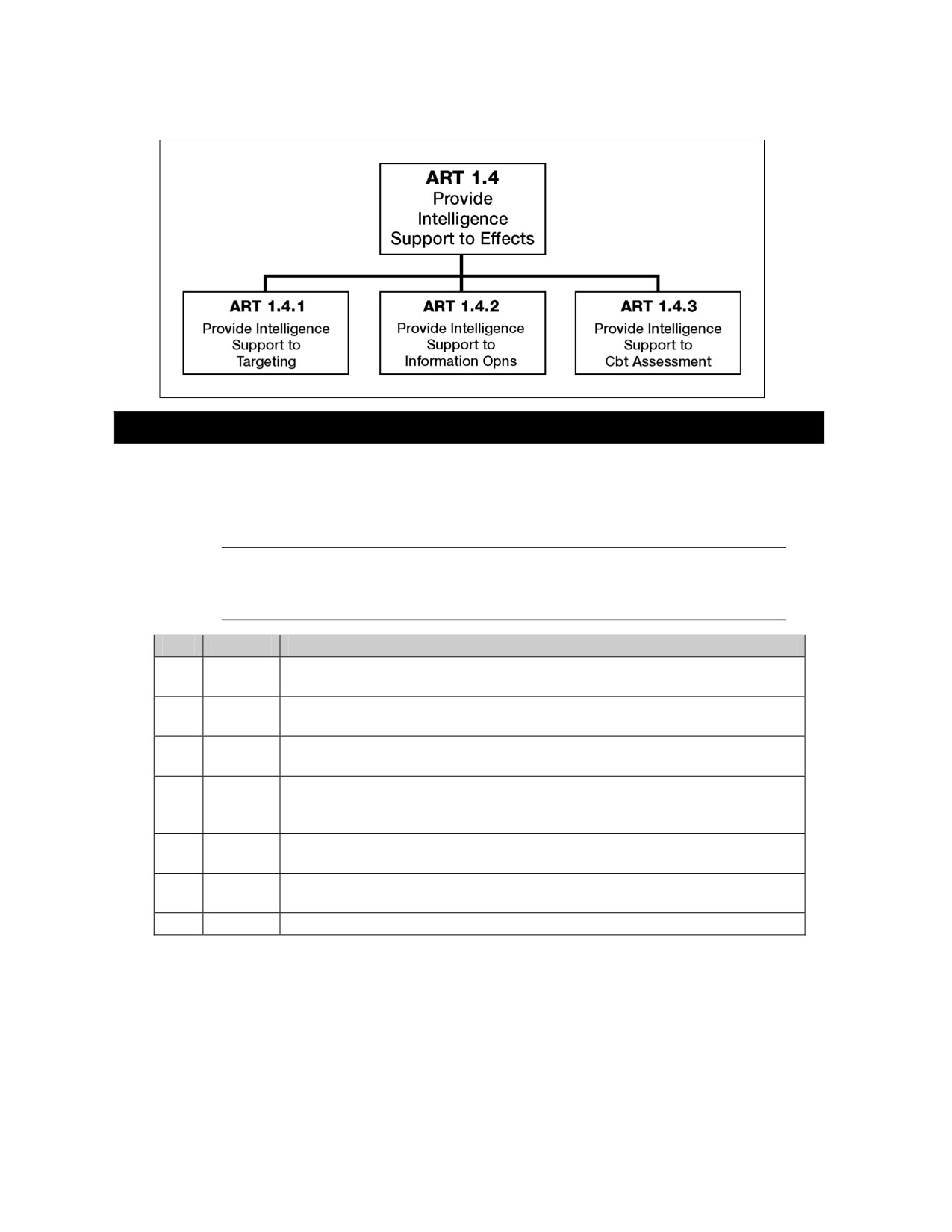
SECTION IV - ART 1.4: PROVIDE INTELLIGENCE SUPPORT TO EFFECTS
1-33. The task of providing the commander information and intelligence
support for targeting of the threat’s forces, threat organizations, units and
systems through lethal and non-lethal fires to include electronic attack and
information operations. (FM 34-1) (USAIC&FH)
Note: This task branch supports both direct (ART 2.4, Conduct Direct Fires)
and indirect (ART 3.3, Employ Fires to Influence the Will and Destroy,
Neutralize, or Suppress Enemy Forces) delivery of fires.
No.
Scale
Measure
Targets for lethal and nonlethal attack are identified, prioritized and
01
Yes/No
nominated.
Determined whether lethal, nonlethal, or a combination of lethal and non-
02
Yes/No
lethal fires will achieve the best effect.
Lethal and non-lethal targets linked to specific sensors and included in
03
Yes/No
the ISR plan.
Identification of ISR assets that can be retasked by the G3/S3 to acquire
04
Yes/No
new lethal or non-lethal targets in accordance with the commander’s
targeting priorities.
To identify and submit collection requirements for lethal and nonlethal
05
Time
effects and for battle damage assessment.
To perform BDA assessments to identify if targets achieved the desired
06
Time
effects or require reattack.
07
Time
To develop, maintain, and update databases.
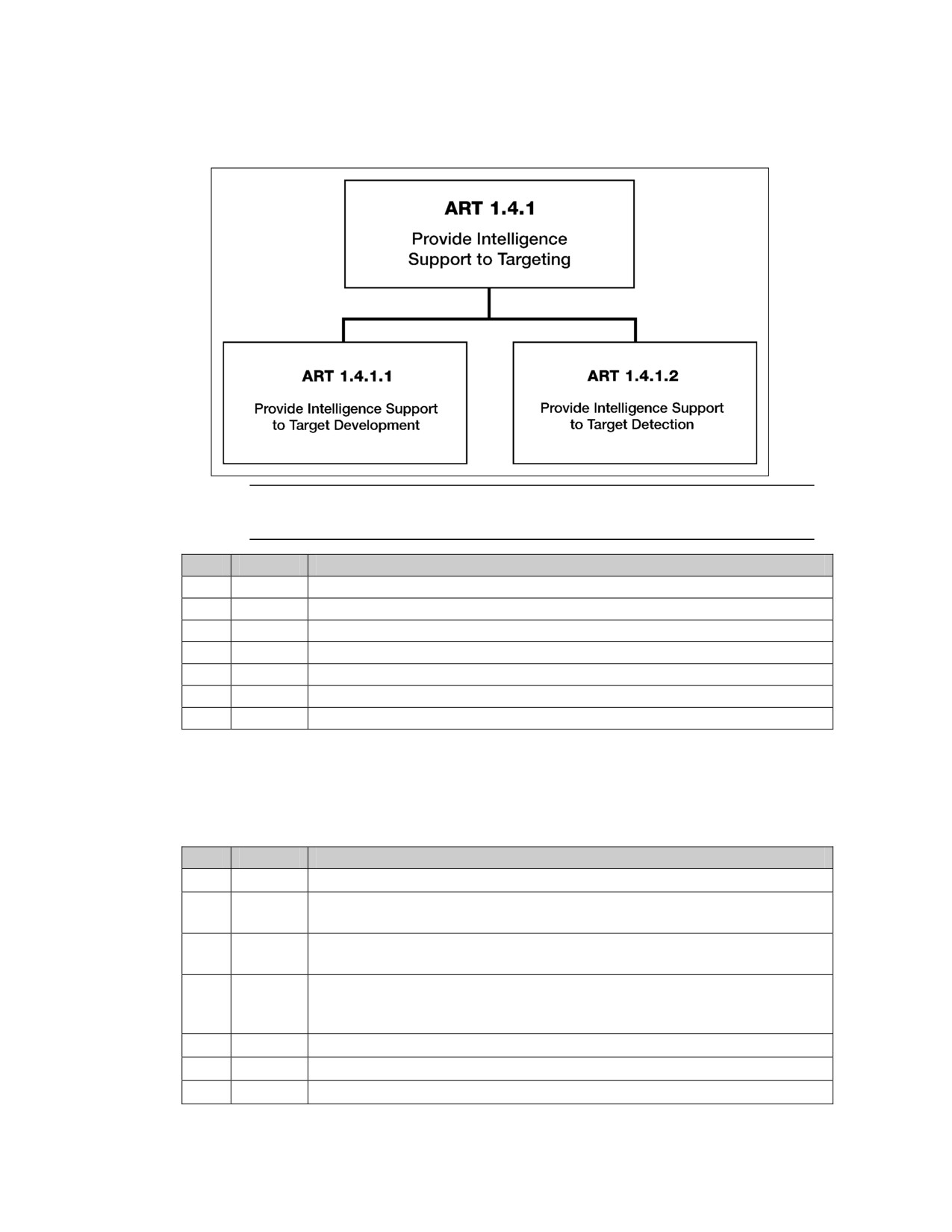
ART 1.4.1 PROVIDE INTELLIGENCE SUPPORT TO TARGETING
1-34. The intelligence officer, supported by the entire staff, provides the
commander information and intelligence support for targeting of the threat’s
forces and systems through the employment of direct and indirect lethal and
nonlethal fires. It includes identification of threat capabilities and limita-
tions. (FM 34-1) (USAIC&FH).
1-28
______________________________________ART 1.0: The Intelligence Battlefield Operating System
Note: This task branch supports ART 3.2, Detect and Locate Surface Targets,
and is a byproduct of the decide, detect, deliver, and assess (D3A) process.
No.
Scale
Measure
01
Yes/No
Identify enemy C2 nodes.
02
Yes/No
Identify enemy communications systems.
03
Yes/No
Identify enemy computer systems.
04
Percent
Of enemy C2 nodes vulnerable to electronic attack.
05
Percent
Of enemy computer systems vulnerable to computer network attack.
06
Percent
Of enemy C2 nodes disrupted/degraded.
07
Percent
Of enemy computer systems compromised.
ART 1.4.1.1
PROVIDE INTELLIGENCE SUPPORT TO TARGET DEVELOPMENT
1-35. The systematic analysis of enemy forces and operations to determine
high-value targets (HVT), systems, and system components for potential
attack through maneuver, fires, or information. (FM 34-1) (USAIC&FH)
No.
Scale
Measure
01
Yes/No
Target critical components developed on high payoff targets.
Critical components passed to commander in sufficient time to engage
02
Yes/No
targets.
Offensive IO requirements are integrated into the target development
03
Yes/No
process.
To develop target list and perform target system analysis, critical
04
Time
components, vulnerability assessment, and target validation based on
commander’s guidance.
05
Time
To identify, prioritize, and nominate targets for attack.
06
Percent
Of targeted system vulnerabilities identified correctly.
07
Number
Of correctly identified critical components in targeted system.
1-29
FM 7-15__________________________________________________________________________
ART 1.4.1.2 PROVIDE INTELLIGENCE SUPPORT TO TARGET DETECTION
1-36. The intelligence officer establishes procedures for dissemination of
targeting information. The targeting team develops the sensor/attack system
matrix to determine the sensor required to detect and locate targets. The
intelligence officer places these requirements into the integrated ISR plan.
(FM 34-1) (USAIC&FH)
No.
Scale
Measure
Targets linked to specific sensors for near real time targeting and
01
Yes/No
included in the integrated ISR plan.
02
Yes/No
Targets and sensors included in the sensor/attack system matrix.
03
Yes/No
Targeting information disseminated to attack systems.
04
Time
For sensor to pass targeting data to attack system.
05
Percent
Of targets linked to sensor/attack system.
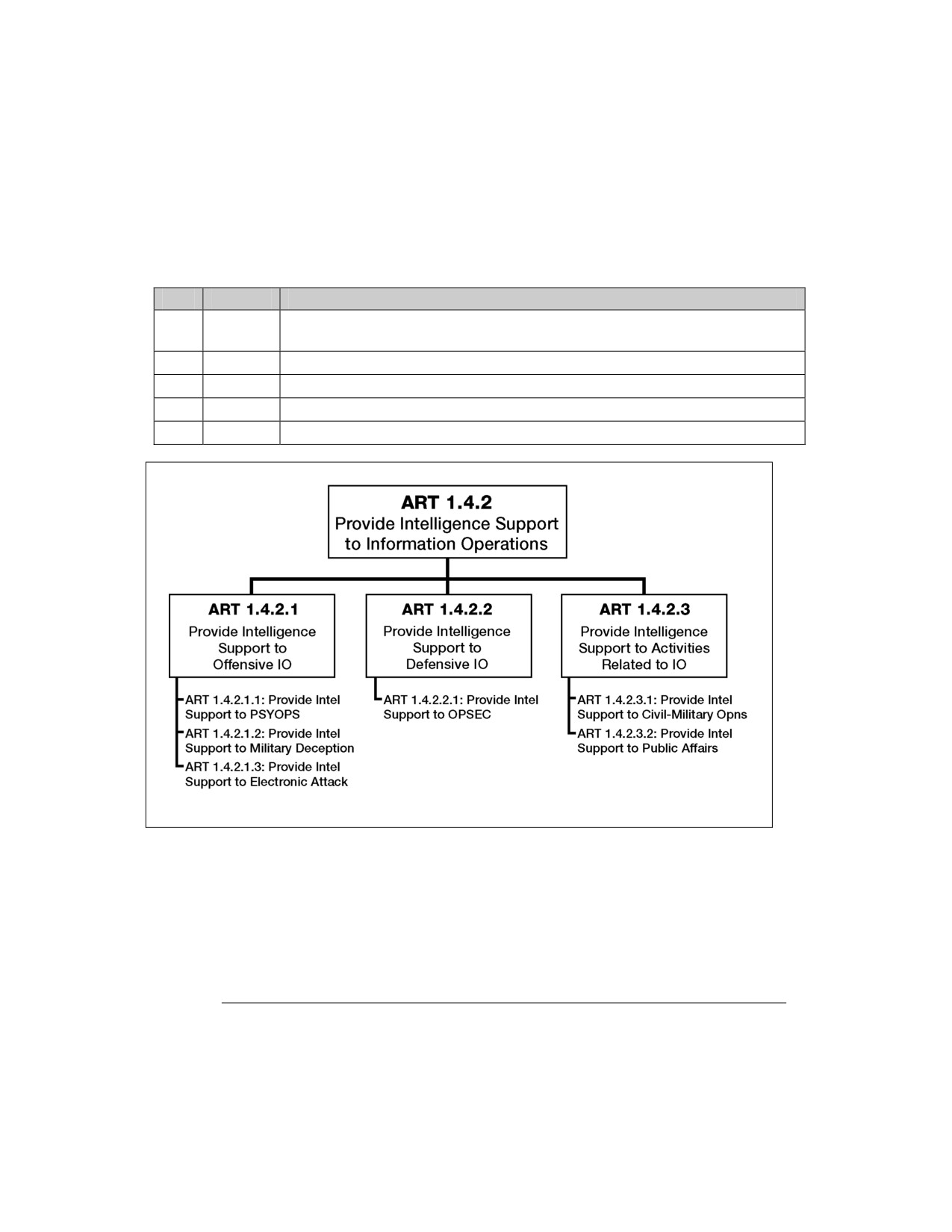
ART 1.4.2 PROVIDE INTELLIGENCE SUPPORT TO INFORMATION
OPERATIONS
1-37. Information operations
(IO) are actions taken to affect adversary
information, influence others’ decision making processes, and information
systems while protecting one’s own information and information systems.
(FM 34-1) (USAIC&FH)
Note: This task branch only address those intelligence tasks that support the
conduct of information operations. The actual conduct of Offensive
Information Operations, Defensive Information Operations, and Activities
Related to Information Operations are tasks addressed elsewhere in the
AUTL:
1-30

______________________________________ART 1.0: The Intelligence Battlefield Operating System
• ART
3.3.2, Conduct Nonlethal Fire Support/Offensive Information
Operations addresses the conduct of offensive information operations.
• ART 5.3.7, Conduct Defensive Information Operations addresses the
conduct of defensive information operations.
• ART 5.3.8, Conduct Tactical Counterintelligence addresses the conduct of
that particular task which also relates to ART 5.3.7, Conduct Defensive
Information Operations.
• ART 6.14, Conduct Civil-Military Operations in an AO, is one activity
related to information operations.
• ART 7.10, Conduct Public Affairs Operations, is the other activity related
to information operations.
No.
Scale
Measure
Intelligence support required for IO identified through IPB and support to
01
Yes/No
targeting.
02
Yes/No
Intelligence support linked to specific offensive and defensive IO.
Intelligence support identified for each element of IO involved in the
03
Yes/No
operation and integrated into the ISR plan.
04
Yes/No
BDA performed on IO targets and target systems.
05
Time
To determine support required for IO.
06
Time
To determine specific intelligence requirements for IO.
07
Percent
Of IO requirements answered.
ART 1.4.2.1
PROVIDE INTELLIGENCE SUPPORT TO OFFENSIVE INFORMATION
OPERATIONS
1-38. The intelligence BOS supports offensive IO by providing information to
identify critical enemy C2 nodes. Intelligence also helps identify enemy
systems and procedures that may be vulnerable to offensive IO. Additionally,
intelligence plays a key role in evaluating and assessing the effectiveness of
offensive information operations. (FM 34-1) (USAIC&FH)
No.
Scale
Measure
01
Yes/No
Identify enemy C2 nodes.
02
Yes/No
Identify enemy communications systems.
03
Yes/No
Identify enemy computer systems.
04
Percent
Of enemy C2 nodes vulnerable to electronic attack.
05
Percent
Of enemy C2 nodes vulnerable to electronic exploitation.
06
Percent
Of enemy computer systems vulnerable to computer network attack.
07
Percent
Of enemy C2 nodes disrupted/degraded.
08
Percent
Of enemy computer systems compromised.
ART 1.4.2.1.1 Provide Intelligence Support to PSYOPS
1-39. This task identifies the cultural, social, economic, and political
environment of the AO. It identifies target groups and subgroups and their
location, conditions, vulnerabilities, susceptibilities, cultures, attitudes, and
behaviors. Psychological operations influence foreign target audiences in the
1-31

FM 7-15__________________________________________________________________________
AO to support achieving the commander’s goals in the AO. (FM 34-1)
(USAIC&FH)
No.
Scale
Measure
Intelligence support required for psychological operations identified
01
Yes/No
through IPB.
02
Yes/No
Intelligence support linked to support the PSYOP plan.
03
Yes/No
Intelligence support provided to identify PSYOP target audience.
04
Yes/No
Intelligence support provided to assess the results of PSYOP.
ART 1.4.2.1.2 Provide Intelligence Support to Military Deception
1-40. This task identifies the capabilities and limitations of the adversary’s
intelligence gathering systems and identifies adversary biases and
perceptions. (FM 34-1) (USAIC&FH)
No.
Scale
Measure
01
Yes/No
Identify the profiles of key adversary leaders.
02
Yes/No
Outline the adversary decision-making processes, patterns and biases.
03
Yes/No
Identify the adversary perceptions of the military situation in the AO.
Identify the capabilities and limitations of adversary CI and security
04
Yes/No
services.
ART 1.4.2.1.3 Provide Intelligence Support to Electronic Attack
1-41. This task supports electronic attack employing jamming, electro-
magnetic energy, or directed energy against personnel, facilities, or
equipment. It identifies critical adversary information systems and command
and control nodes. (FM 2-0) (USAIC&FH)
No.
Scale
Measure
01
Yes/No
Provide intelligence support to identify targets for electronic attack.
Provide intelligence support to determine if desired effects were
02
Yes/No
achieved.
Provide intelligence information regarding target capabilities and
03
Yes/No
vulnerabilities.
Provide intelligence information regarding available systems to conduct
04
Yes/No
electronic attack.
ART 1.4.2.2 PROVIDE INTELLIGENCE SUPPORT TO DEFENSIVE INFORMATION
OPERATIONS
1-42. The intelligence BOS supports defensive IO by providing information to
identify threat IO capabilities and tactics. Intelligence provides information
relating to computer network defense, physical security, operations security,
counter-deception, and counterpropaganda. (FM 34-1) (USAIC&FH)
No.
Scale
Measure
01
Yes/No
Identify enemy offensive information capabilities.
02
Yes/No
Identify friendly emitters that could be exploited by an enemy.
1-32

______________________________________ART 1.0: The Intelligence Battlefield Operating System
No.
Scale
Measure
Of enemy attempted penetration of friendly information systems that are
03
Percent
successful.
04
Percent
Of known enemy sensor coverage in AO.
05
Percent
Of message traffic exploited by the enemy.
Of enemy IO capabilities not covered by operational security (OPSEC)
06
Percent
measures.
Of enemy offensive IO attempts that disrupt, degrade, or exploit friendly
07
Number
information systems.
That enemy offensive IO disrupts, degrades, or exploits friendly
08
Time
information systems.
ART 1.4.2.2.1 Provide Intelligence Support to Operations Security
1-43. This task identifies capabilities and limitations of the adversary’s
intelligence system to include adversary intelligence objectives and the
means, methods and facilities used by the enemy to collect, process, and
analyze information. Supports the identification of indicators that adversary
intelligence systems might obtain that could be interpreted or pieced
together to penetrate essential elements of friendly information (EEFI) in
time to be useful to adversaries. (FM 34-1) (USAIC&FH)
No.
Scale
Measure
01
Yes/No
Identify OPSEC compromises.
02
Time
To provide input to information operations annex of the operation order.
To identify potential compromises of essential elements of friendly
03
Time
information in AO.
04
Number
Of adversary sensor coverage in AO known to friendly force.
Of successful adversary attempted penetration of friendly information
05
Number
systems.
06
Number
Of encrypted communications in AO.
07
Number
Of OPSEC measures selected tied to vulnerability analysis.
08
Number
Of vulnerabilities tied to specific enemy capabilities by planners.
ART 1.4.2.3 PROVIDE INTELLIGENCE SUPPORT TO ACTIVITIES RELATED TO
INFORMATION OPERATIONS
1-44. The intelligence BOS when operating outside US territories supports
activities related to IO under some circumstances. (FM 34-1) (USAIC&FH)
No.
Scale
Measure
01
Yes/No
Provide intelligence information to identify population demographics.
Provide intelligence support to identify populace attitudes, alliances and
02
Yes/No
behaviors.
Provide intelligence support to identify NGOs/international organizations
03
Yes/No
in the AO
Provide support identification of resources and capabilities of
04
Yes/No
NGOs/international organizations in the AO.
1-33

FM 7-15__________________________________________________________________________
No.
Scale
Measure
Provide intelligence support to identify adversary propaganda and
05
Yes/No
misinformation capabilities.
Provide intelligence support to identify the location, biases and agenda of
06
Yes/No
national media representatives in the AO.
Provide intelligence support to identify the location, biases and agenda of
07
Yes/No
international media representatives in the AO.
Provide intelligence support to identify trends reflected by the national
08
Yes/No
and international media.
ART 1.4.2.3.1 Provide Intelligence Support to Civil-Military Operations
1-45. This task allows military intelligence organizations to collect and
provide information and intelligence products concerning foreign cultural,
social, economic, and political elements within an AO in support of civil-
military operations. (FM 34-1) (USAIC&FH)
No.
Scale
Measure
01
Yes/No
Provide intelligence information to identify population demographics.
Provide intelligence support to identify populace attitudes, alliances and
02
Yes/No
behaviors.
Provide intelligence support to identify NGOs/international organizations
03
Yes/No
in the AO.
Provide support identification of resources and capabilities of
04
Yes/No
NGOs/international organizations in the AO.
ART 1.4.2.3.2 Provide Intelligence Support to Public Affairs
1-46. This task identifies the coalition and foreign public physical and social
environment, as well as, world, host nation national, and host nation local
public opinion. (FM 34-1) (USAIC&FH)
No.
Scale
Measure
Provide intelligence support to identify adversary propaganda and
01
Yes/No
misinformation capabilities.
Provide intelligence support to identify the location, biases and agenda of
02
Yes/No
national media representatives in the AO.
Provide intelligence support to identify the location, biases and agenda of
03
Yes/No
international media representatives in the AO.
Provide intelligence support to identify trends reflected by the national
04
Yes/No
and international media.
1-34
______________________________________ART 1.0: The Intelligence Battlefield Operating System
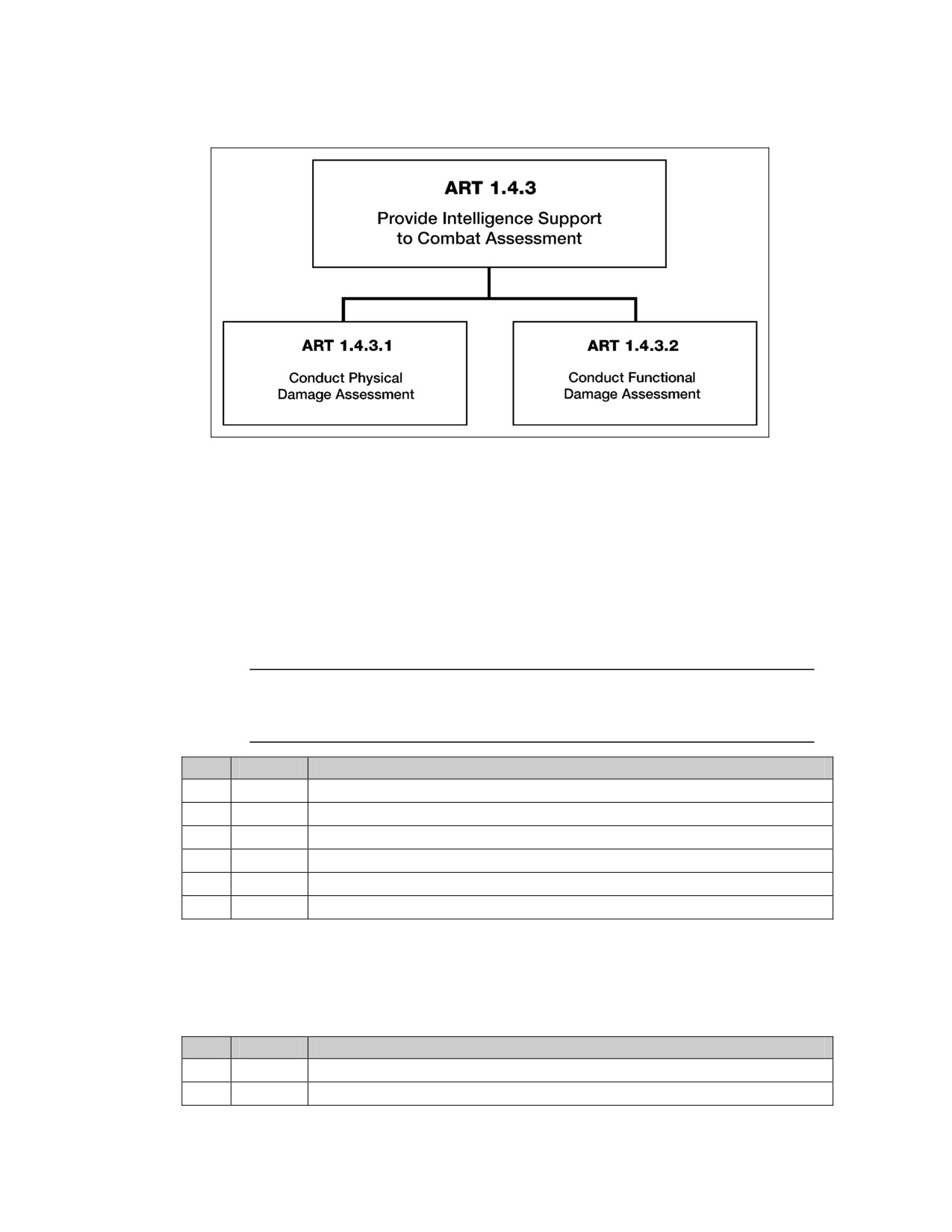
ART 1.4.3 PROVIDE INTELLIGENCE SUPPORT TO COMBAT
ASSESSMENT
1-47. Intelligence supports the assess phase of the operations process and
targeting methodology. The commander uses combat assessment to
determine if his targeting actions have met his attack guidance, and if re-
attack is necessary to achieve his essential fire support tasks and targeting
goals. The staff determines how combat assessment relates to a specific
target by conducting physical damage, functional damage and target system
assessments. (FM 34-1) (USAIC&FH)
Note: This task branch supports ART 7.3, Assess the Tactical Situation and
Operations, and ART 7.3.3.1, Conduct Battle Damage Assessment. It is also
associated with the decide, detect, deliver, and assess (D3A) process.
No.
Scale
Measure
01
Time
To commence follow-on operations or re-attack.
02
Time
To make initial assessment of attacks after TOT.
03
Time
To provide initial assessment of attack effects to force commander.
04
Time
To complete full assessment of attack effects after TOT.
05
Time
To provide full assessment of attacks to force commander.
06
Percent
Of HPTs correctly assessed to meet attack guidance.
ART 1.4.3.1
CONDUCT PHYSICAL DAMAGE ASSESSMENT
1-48. This task is an estimate of the extent of physical damage to a target
based upon observed or interpreted damage. It is a post-attack target
analysis that is a coordinated effort among all units. (FM 34-1) (USAIC&FH)
No.
Scale
Measure
01
Time
To identify target physical damage.
02
Time
To make initial physical assessment damage.
1-35

FM 7-15__________________________________________________________________________
No.
Scale
Measure
03
Time
To provide initial assessment of attack effects to force commander.
04
Time
To complete full assessment of attack effects after TOT.
05
Time
To provide full assessment of attacks to force commander.
06
Percent
Of targets unnecessarily reattacked.
07
Percent
Of HPTs correctly assessed as combat ineffective.
ART 1.4.3.2
CONDUCT FUNCTIONAL DAMAGE ASSESSMENT
1-49. The functional damage assessment estimates the remaining functional
or operational capability of a targeted facility or object. The staff bases the
assessment on observed physical damage and estimates the threat’s ability to
recuperate. The targeting or BDA cell integrates the initial target analyses
with other related sources and compares the original objective with the
current status of the target to determine if the objective has been met. (FM
34-1) (USAIC&FH)
No.
Scale
Measure
01
Time
To identify functional damage assessments.
02
Time
To make initial functional damage assessment of attacks after TOT.
To provide initial functional damage assessment of attack effects to force
03
Time
commander.
To complete full functional damage assessment of attack effects after
04
Time
TOT.
To provide full functional damage assessment of attacks to force
05
Time
commander.
06
Percent
Of targets unnecessarily reattacked.
07
Percent
Of HPTs correctly assessed as combat ineffective.
1-36
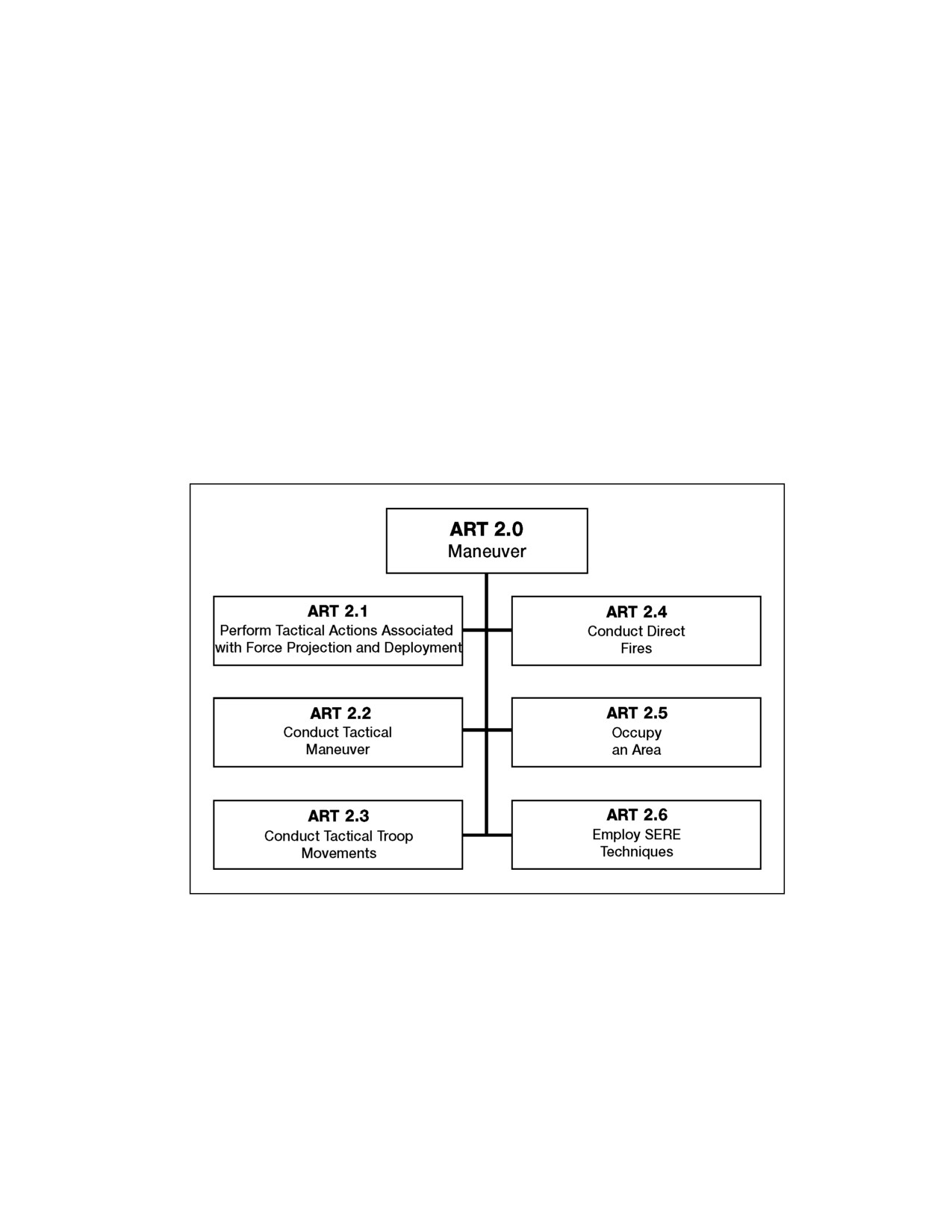
Chapter 2
ART 2.0: The Maneuver Battlefield Operating System
The maneuver BOS is the movement of forces to achieve a position of
advantage with respect to enemy forces. This system includes employing
forces in combination with direct fire or fire potential. This system also
includes the tactical tasks associated with force projection. It does not
include indirect fires, which ART 3.0 includes.
2-1
FM 7-15__________________________________________________________________________
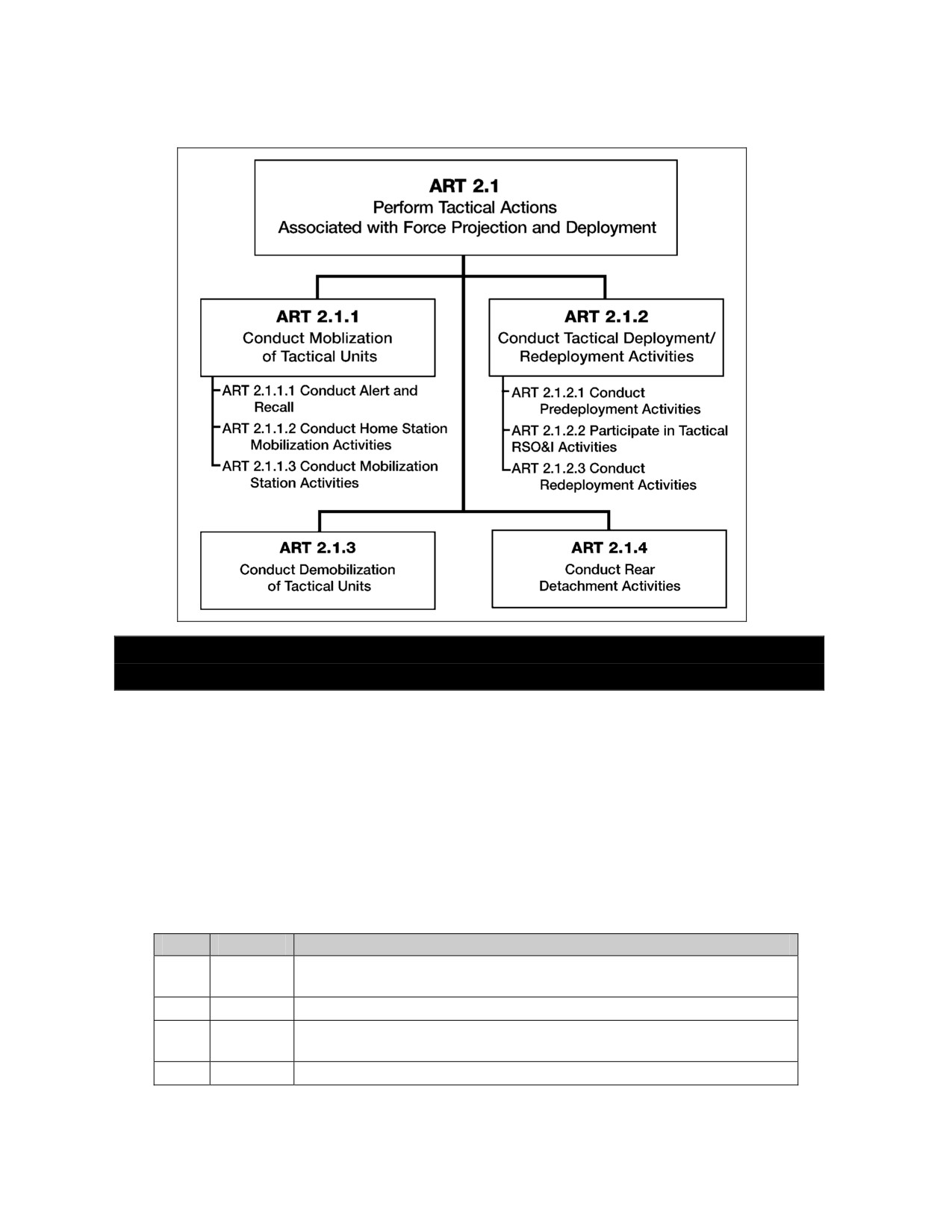
SECTION I - ART 2.1: PERFORM TACTICAL ACTIONS ASSOCIATED WITH
FORCE PROJECTION AND DEPLOYMENT
2-1. Force projection is the ability to project the military element of national
power from the continental United States (CONUS) or another theater, in
response to requirements for military operations. Force projection operations
extend from mobilization and deployment of forces to redeployment to
CONUS or home theater (JP 3-35). Force projection includes the following
five stages: mobilization; deployment; employment; sustainment, and
redeployment. Effective force projection retains the capability to (1) mobilize,
deploy, and sustain an employed force; (2) redeploy forces to the United
States or other locations for missions across the range of military operations;
(3) demobilize forces so as to retain the capability for later mobilization. (FM
100-17) (CASCOM-DPMO)
No.
Scale
Measure
The unit deploys from its current location to the AO in accordance with
01
Yes/No
the time-phased force deployment list (TPFDL).
02
Time
To complete unit mobilization.
03
Time
To complete required training before employment in theater of
operations.
04
Time
To determine available transportation infrastructure and resources.
2-2

____________________________________________
ART 2.0: The Maneuver Battlefield Operating System
No.
Scale
Measure
05
Time
To deploy unit from home or mobilization station to theater of
operations.
To redeploy unit from theater of operations to home station or another
06
Time
theater.
07
Percent
Of combat effectiveness of unit when employed in a theater of
operations.
ART 2.1.1
CONDUCT MOBILIZATION OF TACTICAL UNITS
2-2. Mobilization is the process by which Army tactical forces or part of them
are brought to a state of readiness for war or other national emergency. (See
JP 1-02 for a complete definition.) It includes activating all or part of the
reserve components as well as assembling and organizing personnel,
supplies, and materiel. (FM 100-17) (CASCOM-DPMO)
No.
Scale
Measure
Unit was brought to its planned state of readiness within the specified
01
Yes/No
time.
02
Yes/No
Unit mobilization progress monitored by higher headquarters.
03
Time
Between planned and actual unit arrival time at mobilization station.
To process reserve component unit through its mobilization station or
04
Time
CONUS replacement center.
05
Percent
Of key personnel reporting within planning timelines.
06
Percent
Of alert and activation messages, dispatched within timelines.
07
Percent
Of required initial mobilization reports submitted on time.
ART 2.1.1.1
CONDUCT ALERT AND RECALL
2-3. Units and individuals receive mobilization/alert orders, individuals
assigned to the unit are notified of the situation, and all individuals report to
the designated location at the designated time with designated personal
items. (FM 100-17) (CASCOM-DPMO)
No.
Scale
Measure
Unit musters its assigned personnel at the designated location within
01
Yes/No
the designated time.
Unit alert and recall progress reported to and monitored by higher
02
Yes/No
headquarters.
For notified units to identify and report preliminary list of deployable
03
Time
and nondeployable personnel.
04
Percent
Of key personnel reported within planning timelines.
05
Percent
Of alert message dispatched within timelines.
06
Percent
Of alert messages returned for incomplete or inaccurate addresses.
07
Percent
Of notified units able to alert all of their personnel within 24 hours.
2-3

FM 7-15__________________________________________________________________________
ART 2.1.1.2
CONDUCT HOME STATION MOBILIZATION ACTIVITIES
2-4. This task involves the activities of reserve component units at home
station after receiving a mobilization order followed by entry onto federal
active duty or other command and control changes. It includes taking action
to speed transition to active duty status, such as identifying shortages of
critical personnel and equipment. Task activities include inventorying unit
property, dispatching an advance party to the mobilization station, and
loading the unit on organic equipment or designated carriers. Movement is
coordinated with the state area command
(STARC) defense movement
coordinator, unit movement coordinator, installation transportation offices,
and Military Traffic Management Command
(MTMC).
(FM
100-17)
(CASCOM-DPMO)
No.
Scale
Measure
Unit deploys to its mobilization station according to its mobilization
01
Yes/No
timetable.
Unit home station mobilization activities reported to and monitored by
02
Yes/No
higher headquarters.
03
Time
To activate key unit personnel.
To conduct preparatory administrative, logistic, medical, and readiness
04
Time
activities.
05
Time
To submit initial mobilization reports.
06
Percent
Of key personnel reported within planning timelines.
07
Percent
Of initial mobilization reports, submitted on time.
ART 2.1.1.3
CONDUCT MOBILIZATION STATION ACTIVITIES
2-5. This task encompasses actions required to meet deployment or other
unit validation criteria. It results in assuring the unit’s mission capability.
Reserve component unit members transition to active duty. The commander
conducts necessary individual and collective training that may vary as
evaluations and circumstances dictate. Personnel complete preparation for
overseas movement. Soldiers prepare equipment for deployment.
Mobilization station commanders verify training and processing completed at
home station to preclude repeating it. Depending on the situation, units may
move through a mobilization site rather than a mobilization station. (FM
100-17) (CASCOM-DPMO)
No.
Scale
Measure
Unit meets deployment or other unit validation criteria within
01
Yes/No
established mobilization timetables.
Unit home station mobilization activities reported to and monitored by
02
Yes/No
higher headquarters.
03
Time
To assemble unit and report status.
04
Time
To conduct specified training.
05
Time
To requisition mobilization station training and support requirements.
To transfer home station property and prepare for movement to the
06
Time
mobilization station.
07
Percent
Of specified training completed.
2-4

____________________________________________
ART 2.0: The Maneuver Battlefield Operating System
No.
Scale
Measure
Of required mobilization station training and support requirements
08
Percent
requisitioned.
09
Percent
Of home station property transferred to the appropriate agency.
ART 2.1.2 CONDUCT TACTICAL DEPLOYMENT/REDEPLOYMENT
ACTIVITIES
2-6. Deployment is composed of activities required to prepare and move
forces, and sustainment equipment and supplies within a theater of
operations. This task involves the force as it task organizes, echelons, and
tailors itself for movement based on the mission, concept of operations,
available lift, and other resources. Redeployment is transferring forces and
materiel to support another joint force commander’s operational
requirements, or to return personnel, equipment, and materiel to the home
and/or demobilization stations for reintegration and/or out-processing.
Redeployment optimizes readiness of redeploying forces and materiel to meet
new contingencies or crises. (FM 100-17) (CASCOM-DPMO)
Notes: ART 2.3.1.1 (Conduct Advance Party Activities) and ART 2.3.1.2
(Conduct Quartering Party Activities) address tasks also associated with
deployments and redeployments.
z
Three phases of deployment/redeployment are tasks addressed elsewhere
in the AUTL:
z
ART 6.3.3.2 (Move by Air) addresses strategic lift.
z
ART 2.3.2 (Conduct Administrative Movement) addresses movement of
deploying/redeploying units to air/sea ports of embarkation.
z
ART
2.3
(Conduct Tactical Troop Movement) addresses onward
movement.
No.
Scale
Measure
Unit loads its designated operational/strategic lift systems in
01
Yes/No
accordance with the force deployment plans.
Unit conducted a LOADEX of its vehicles and equipment to include
containers, and garrison close out procedures (if applicable) prior to
02
Yes/No
developing and inputting data into automated deployment systems,
such as TC-ACCIS, AUEL, and TPFDD database of GCCS-A.
To task organize the unit based on mission, concept of operations,
03
Time
available lift, and other resources.
To echelon the unit based on mission, concept of operations, available
04
Time
lift, and other resources.
To tailor the unit based on mission, concept of operations, available
05
Time
lift, and other resources.
06
Percent
Of available lift resources lost awaiting arrival and loading of unit.
2-5

FM 7-15__________________________________________________________________________
No.
Scale
Measure
Of unit not closed on port of debarkation (POD) by scheduled date and
07
Percent
time.
Of available lift needed to move unit configured for tactical application
08
Percent
not required to move unit administratively.
ART 2.1.2.1
CONDUCT PREDEPLOYMENT ACTIVITIES
2-7. Predeployment activities include planning and preparing for
deployment. They include updating unit deployment information for input
into command and control
(C2) and Standard Army Maintenance
Information System (STAMIS) including Global Command and Control
System-Army (GCCS-A), the automated unit equipment list (AUEL), the
transportation coordinator’s automated command and control information
system
(TC-ACCIS), and the transportation coordinator’s automated
information for movement system II (TC-AIMS II). Units update and obtain
maps, update databases, organizational structures, and networks to support
the Army Battle Command System (ABCS). Updated information affects the
Joint Operation Planning and Execution System (JOPES), the time-phased
force and deployment data
(TPFDD), and the TPFDL. Tasks include
maintaining the AUEL; updating AUEL data to become the deployment
equipment list; and writing radio frequency tags for unit vehicles, containers,
and other critical pieces of equipment to achieve in transit visibility of these
items. (FM 100-17) (CASCOM-DPMO)
No.
Scale
Measure
Unit loads its designated operational/strategic lift systems in
01
Yes/No
accordance with the force deployment plans.
Unit conducted a LOADEX of its vehicles and equipment to include
containers, and garrison close out procedures (if applicable) prior to
02
Yes/No
developing and inputting data into automated deployment systems,
such as TC-ACCIS, AUEL, and TPFDD database of GCCS-A.
03
Time
To cross level and redistribute personnel and equipment.
04
Time
To train to minimum operationally ready status.
05
Time
To evaluate unit for deployment.
06
Time
To secure clearance for a non-validated unit prior to its deployment.
To integrate unit movement information into automated transportation
07
Time
information systems and other command and control systems such as
TC-AIMS II and JOPES.
Of required base and operations support, such as training areas,
08
Percent
ranges, and ammunition received by deploying unit.
09
Percent
Of mission essential and other required tasks performed to standard.
ART 2.1.2.2
PARTICIPATE IN TACTICAL RECEPTION, STAGING, ONWARD
MOVEMENT, AND INTEGRATION ACTIVITIES
2-8. This task involves unit reception at the POD. It includes drawing
equipment from pre-positioned stocks. This task begins when the first
strategic lift system of the main body arrives at the POD. It ends when
adequate equipment and supplies are discharged and issued, unit tactical
command and control systems are operational, units have moved from the
2-6

____________________________________________
ART 2.0: The Maneuver Battlefield Operating System
port to tactical assembly areas, and units are combat ready. (FM 100-17)
(CASCOM-DPMO)
Note: This task describes the Army’s contribution toward the UJTL task of
Conduct Joint Reception, Staging, Onward Movement, and Integration
(JSROI) in a Joint Operations Area (JOA) (OP 1.1.3).
No.
Scale
Measure
Unit is combat ready and in a tactical assembly area in accordance
01
Yes/No
with deployment plans.
PODs are efficiently and effectively used with no noticeable delay in
02
Yes/No
the throughput of forces into theater.
03
Time
To discharge cargo from ship in a logistics over-the-shore situation.
04
Time
To clear aerial port of debarkation (APOD) of aircraft cargo.
05
Time
To clear APOD of chalk’s personnel.
06
Time
To clear seaport of debarkation (SPOD) of ship’s cargo.
07
Time
To clear SPOD of personnel landing administratively.
08
Time
Ship remains in vicinity of port awaiting discharge of cargo.
09
Time
To clear frustrated cargo from POD.
10
Time
To match personnel arriving by air with equipment arriving by sea.
11
Time
To match personnel arriving by air with pre-positioned equipment.
12
Time
To begin unloading ships on arrival in theater.
13
Time
To accomplish linkup of personnel and equipment.
14
Time
For unit to be en route to final destination from staging area or POD.
15
Percent
Of throughput actually achieved.
16
Percent
Of POD capability within the theater used for the reception of forces.
Of transportation assets available for onward movement to staging
17
Percent
area or destination.
18
Percent
Of time airfield is in the maximum on ground category.
Of unit personnel and equipment assembled when transferred to
19
Percent
tactical commander.
Of personnel per day moved by host-nation support to marshaling
20
Number
areas.
ART 2.1.2.3
CONDUCT REDEPLOYMENT ACTIVITIES
2-9. This task involves the unit moving to assembly areas and beginning
recovery and reconstitution. The commander rebuilds unit integrity and
accounts for personnel, equipment, and supplies. The unit develops
movement data, washes equipment, goes through customs and Department
of Agriculture inspections, prepares documentation, and plans movement. At
the port, the unit processes personnel and equipment for strategic lift. (FM
100-17) (CASCOM-DPMO)
2-7

FM 7-15__________________________________________________________________________
No.
Scale
Measure
Unit loads its personnel and equipment on strategic/operational lift
01
Yes/No
systems in accordance with the redeployment plan.
02
Time
To determine lift and security requirements.
03
Time
To select routes and assembly areas.
04
Time
To deploy transportation and security forces.
05
Time
To prepare movement orders.
06
Time
To close unit into designated assembly areas.
To integrate unit movement information into automated transportation
07
Time
information systems and other command and control systems such as
TC-AIMS II and JOPES.
For unit to prepare equipment for shipment back to home station,
08
Time
depot, or future duty location.
09
Time
For unit to prepare personnel for return to home station or future duty
assignment to include the conduct of individual health assessments.
10
Time
To pass command authority of in-transit forces.
11
Percent
Of movement orders requiring revision.
Of unit personnel and equipment that move as scheduled to
12
Percent
designated ports of embarkation (POE).
Of unit equipment and supplies remaining in theater properly
13
Percent
accounted for within supply system.
14
Percent
Of available transportation systems used.
ART 2.1.3
CONDUCT DEMOBILIZATION OF TACTICAL UNITS
2-10. Demobilization is the act of returning the force and materiel to
a
premobilization or other approved posture. Demobilization actions occur in
the AO, between the POE and demobilization station or POE and CONUS
demobilization center, at the demobilization station and CONUS demobil-
ization center, and at home station or home of record.
(FM 100-17)
(CASCOM-DPMO)
No.
Scale
Measure
Demobilize unit personnel, equipment, and supplies in accordance
01
Yes/No
with plans.
02
Yes/No
Maintain accountability of property and personnel.
To prepare unit equipment and supplies for movement (includes
03
Time
cleaning, maintenance, and configuring vehicles for movement by
removing canvas tarps, folding down windows, etc.).
To move demobilizing organization from its current location to
04
Time
demobilization station.
Between planned and actual unit arrival time at home
05
Time
station/demobilization station.
06
Time
To process reserve component unit through the demobilization station.
To prepare for the transfer of table of organization & equipment (TOE)
07
Time
equipment and supplies to appropriate storage location.
2-8

____________________________________________
ART 2.0: The Maneuver Battlefield Operating System
No.
Scale
Measure
To conduct individual demobilization administrative, logistic, medical,
08
Time
and finance activities.
09
Time
To transfer home station property back to the unit.
10
Time
To terminate outstanding contracts.
Of TOE equipment and supplies transferred to temporary or
11
Percent
permanent storage locations.
12
Percent
Of home station property transferred back to the unit.
13
Percent
Of outstanding contracts to terminate.
Of individual demobilization administrative, logistic, medical, and
14
Percent
finance activities completed.
ART 2.1.4
CONDUCT REAR DETACHMENT ACTIVITIES
2-11. Rear detachment activities use nondeployable and other personnel to
maintain facilities and equipment at home station when the deployed force is
expected to return. It includes supporting families of deployed personnel.
This task includes turning over residual equipment/supplies and facilities to
appropriate authorities (for example, the mobilization station commander) if
the unit does not return to the mobilization station. (FM 100-17) (CASCOM-
DPMO)
No.
Scale
Measure
Unit family members continue to receive authorized support,
01
Yes/No
assistance, and counseling during operational deployments of service
members.
Maintain and account for unit installation property and equipment
02
Yes/No
throughout the unit’s deployment.
Establish rear detachment program prior to the beginning of
03
Yes/No
deployment activities.
To turn over residual equipment/supplies and facilities to appropriate
04
Time
authorities when the unit will not return to home or mobilization station.
05
Time
To conduct rear detachment administrative and logistical activities.
06
Time
To establish a functioning family support group.
Of rear detachment administrative and logistical reports, submitted on
07
Percent
time.
Of residual equipment/supplies and facilities turned over to
08
Percent
appropriate authorities when unit will not return to home or
mobilization station.
To provide quality and meaningful assistance to unit family members
09
Time
during times of need and support.
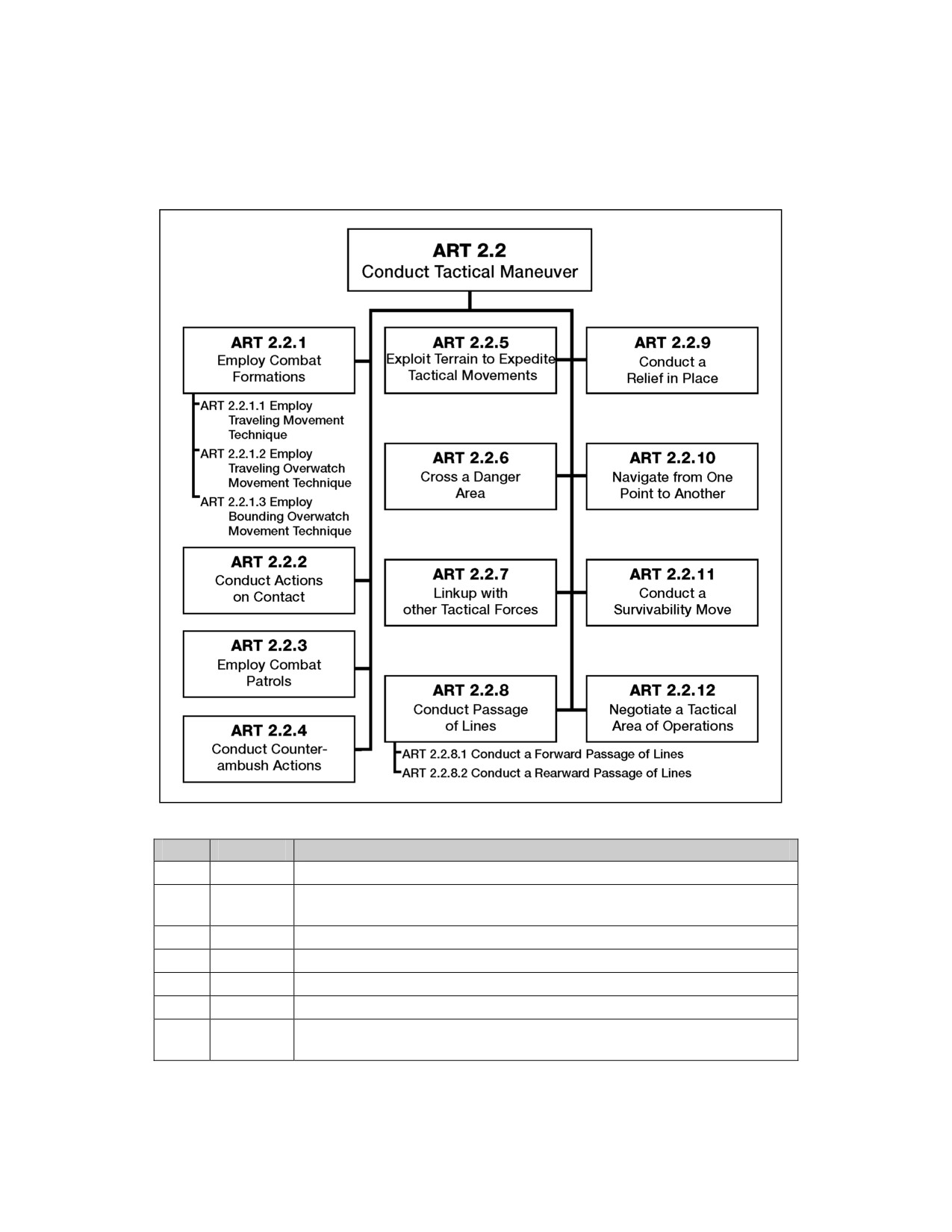
SECTION II - ART 2.2: CONDUCT TACTICAL MANEUVER
2-12. Maneuver is the employment of forces on the battlefield through
movement in combination with fire, or fire potential, to achieve a position of
advantage in respect to the enemy in order to accomplish the mission (JP 3-
2-9
FM 7-15__________________________________________________________________________
0). Commanders take full advantage of terrain and combat formations when
maneuvering their forces. (FM 3-90) (USACAC)
No.
Scale
Measure
01
Yes/No
Unit achieves a position of advantage with respect to the enemy.
Subordinate commanders use their initiative to achieve the
02
Yes/No
commander’s intent when the plan is no longer applicable.
03
Time
To initiate maneuver.
04
Time
To complete maneuver.
05
kph
Rate of movement across the battlefield.
06
Percent
Of forces achieving position of advantage after executing the plan.
Of enemy force destroyed/neutralized by the maneuver of the friendly
07
Percent
force.
2-10

____________________________________________
ART 2.0: The Maneuver Battlefield Operating System
ART 2.2.1
EMPLOY COMBAT FORMATIONS
2-13. Use an ordered arrangement of troops and vehicles for a specific
purpose. Commanders use one of seven different combat formations,
depending on the factors of METT-TC: column, line, echelon (left or right),
box, diamond, wedge, and vee. (FM 3-90) (USACAC)
No.
Scale
Measure
01
Yes/No
Combat formation reflects the existing factors of METT-TC.
02
Yes/No
Unit complies with all graphic control measures.
03
Yes/No
Unit employs the movement formation ordered by the leader.
04
Time
To plan and prepare operation order.
05
Time
To initiate movement.
06
Time
To complete movement.
Of AO observed during reconnaissance conducted prior to starting
07
Percent
operations.
08
Percent
Of allocated forces in place at the start of the plan.
09
Percent
Of unit in designated combat formation throughout the movement.
10
Percent
Of unit moving on the specified route or axis.
11
Percent
Of casualties to the force occurring during the operation.
12
kph
Rate of movement.
ART 2.2.1.1
EMPLOY TRAVELING MOVEMENT TECHNIQUE
2-14. All unit elements move simultaneously. (FM 3-90) (USACAC)
No.
Scale
Measure
01
Yes/No
Combat formation reflects the existing factors of METT-TC.
02
Yes/No
Unit complies with all graphic control measures.
03
Yes/No
Unit employs the movement formation ordered by the leader.
04
Yes/No
Unit commander does not expect to encounter the enemy.
All subordinate elements of the unit assigned areas of responsibility
05
Yes/No
for observation during the movement.
Unit leaders ensure all-round coverage of the unit for observation and
06
Yes/No
fire, to include air guard.
Route of movement offers concealment from enemy ground and air
observation, avoids skylining, avoids moving directly forward from
firing positions, crosses open areas quickly, avoids possible kill zones,
07
Yes/No
avoids wide open spaces (especially where high ground dominates or
where the terrain covers and conceals the enemy), and avoids
obvious avenues of approach.
08
Time
To plan and prepare operation order.
09
Time
To initiate movement.
10
Time
To complete movement.
11
Percent
Of allocated forces in place at the start of the plan.
12
Percent
Of unit in designated combat formation throughout the movement.
2-11

FM 7-15__________________________________________________________________________
No.
Scale
Measure
13
Percent
Of unit moving on the specified route or axis.
14
Percent
Of casualties to the force occurring during the operation.
ART 2.2.1.2
EMPLOY TRAVELING OVERWATCH MOVEMENT TECHNIQUE
2-15. The lead element moves continuously. Trailing elements move at
varying speeds, sometimes pausing to overwatch movement of the lead
element. (FM 3-90) (USACAC)
No.
Scale
Measure
01
Yes/No
Combat formation reflects the existing factors of METT-TC.
02
Yes/No
Unit complies with all graphic control measures.
03
Yes/No
Unit employs the movement formation the leader orders.
Unit commander determines that enemy contact is possible, but speed
04
Yes/No
is important.
All subordinate elements assigned areas of responsibility for
05
Yes/No
observation during the movement.
Unit leaders ensure that all-round coverage exists for observation and
06
Yes/No
fire, to include air guard.
Route of movement offers concealment from enemy ground and air
observation, avoids skylining, avoids moving directly forward from
firing positions, crosses open areas quickly, avoids possible kill zones,
07
Yes/No
avoids wide open spaces (especially where high ground dominates or
where the terrain covers and conceals the enemy), and avoids
obvious avenues of approach.
08
Time
To plan and prepare operation order.
09
Time
To initiate movement.
10
Time
To complete movement.
11
Percent
Of allocated forces in place at the start of the plan.
12
Percent
Of unit in designated combat formation throughout the movement.
13
Percent
Of unit moving on the specified route or axis.
14
Percent
Of casualties to the force occurring during the operation.
15
kph
Rate of movement.
ART 2.2.1.3
EMPLOY BOUNDING OVERWATCH MOVEMENT TECHNIQUE
2-16. Using successive or alternate bounds, overwatching elements cover
bounding elements from covered, concealed positions with good observation
of, and fields of fire against, possible enemy positions. (FM 3-90) (USACAC)
No.
Scale
Measure
01
Yes/No
Combat formation reflects the existing factors of METT-TC.
02
Yes/No
Unit complies with all graphic control measures.
03
Yes/No
Unit employs the movement formation ordered by the leader.
04
Yes/No
Unit commander expects to make enemy contact.
All subordinate elements of the unit assigned areas of responsibility
05
Yes/No
for observation during the movement.
2-12

____________________________________________
ART 2.0: The Maneuver Battlefield Operating System
No.
Scale
Measure
Unit leaders ensure all-round coverage exists for observation and fire,
06
Yes/No
to include air guard.
Length of bounds, overwatch positions selected, and variation of
07
Yes/No
techniques—use of alternate or successive bounds, reflects existing
factors of METT-TC.
Route of movement offers concealment from enemy ground and air
observation, avoids skylining, avoids moving directly forward from
firing positions, crosses open areas quickly, avoids possible kill zones,
08
Yes/No
avoids wide open spaces (especially where high ground dominates or
where the terrain covers and conceals the enemy), and avoids
obvious avenues of approach.
09
Time
To initiate movement.
10
Time
To complete movement.
11
Percent
Of allocated forces in place at the start of the execution of the plan.
12
Percent
Of unit in designated combat formation throughout the movement.
13
Percent
Of unit moving on the specified route or axis.
14
Percent
Of casualties to the force occurring during the operation.
15
kph
Rate of movement.
ART 2.2.2
CONDUCT ACTIONS ON CONTACT
2-17. Develop the situation once contact is made, concentrate the effects of
combat power, and transition to a hasty attack or defense. Whether attacking
or defending, commanders generate and sustain overwhelming combat power
at the point combat forces collide to rapidly defeat the enemy. (FM 3-90)
(USACAC)
No.
Scale
Measure
Unit generates and sustains overwhelming combat power at the point
01
Yes/No
of contact if the element that makes contact is able to defeat the
enemy unassisted.
The generation of overwhelming combat power is the product of the
02
Yes/No
recommended course of action to the higher commander.
ISR assets used to develop situation without main body being in
03
Yes/No
contact with the enemy.
04
Time
To deploy and report.
05
Time
To evaluate and develop the situation.
06
Time
To choose course of action (COA).
07
Time
To execute selected COA.
08
Time
To recommend a COA to the higher commander.
09
Time
To return to previous mission.
10
Percent
Of friendly forces available to continue previous mission.
11
Percent
Combat effectiveness of enemy force that made contact.
2-13

FM 7-15__________________________________________________________________________
ART 2.2.3
EMPLOY COMBAT PATROLS
2-18. Use ground and air detachments to provide security and harass,
destroy, or capture enemy troops, equipment, or installations. (FM 7-10)
(USAIS)
No.
Scale
Measure
Combat patrols provide security and harass, destroy, or capture
01
Yes/No
enemy troops, equipment, or installations in accordance with the
commander’s intent.
02
Time
To prepare patrol plan.
03
Time
To conduct rehearsals.
04
Time
To conduct the combat patrol within time higher headquarters
allocates.
05
Percent
Of assigned area covered during the patrol.
06
Percent
Of friendly casualties received during the combat patrol.
07
Percent
Of encountered enemy troops and equipment destroyed or captured.
08
Percent
Of information requirements achieved.
ART 2.2.4
CONDUCT COUNTERAMBUSH ACTIONS
2-19. Execute immediate action against near and far ambushes to minimize
casualties, exit the enemy engagement area, inflict casualties on the enemy
ambush force, and continue the mission. (FM 7-10) (USAIS)
No.
Scale
Measure
01
Yes/No
Unit continues its mission after exiting the enemy engagement area.
02
Yes/No
Unit security element detects the ambush.
03
Yes/No
Unit prevents the enemy from gaining intelligence.
Unit security element prevents the enemy from engaging the unit main
04
Yes/No
body.
Unit bypasses the ambush kill zone and the enemy’s associated
05
Yes/No
security positions.
Unit attacks and defeats the enemy ambush force before the enemy
06
Yes/No
initiates the ambush.
Unit disengages its elements in the kill zone before destroying all
07
Yes/No
elements in the kill zone.
08
Yes/No
Unit engages and fixes the enemy to prevent his withdrawal.
09
Percent
Of enemy casualties.
ART 2.2.5
EXPLOIT TERRAIN TO EXPEDITE TACTICAL
MOVEMENTS
2-20. Use terrain as a combat equalizer or multiplier by positioning or
maneuvering forces to outfight the enemy. Reinforce natural terrain
advantages through mining, barriers, and other obstacles.
(FM 3-90)
(USACAC)
2-14

____________________________________________
ART 2.0: The Maneuver Battlefield Operating System
No.
Scale
Measure
Unit uses terrain to provide concealment from enemy ground and air
01
Yes/No
observation.
Unit avoids skylining vehicles, soldiers, fighting positions, and
02
Yes/No
survivability positions.
Unit avoids moving directly forward from firing positions toward the
03
Yes/No
enemy.
04
Yes/No
Unit crosses open areas quickly.
05
Yes/No
Unit avoids possible enemy kill zones.
Unit avoids wide open spaces where the enemy can detect and
06
Yes/No
engage it at long ranges, especially where high ground dominates or
where the terrain covers and conceals the enemy.
07
Yes/No
Unit avoids obvious avenues of approach into enemy positions.
ART 2.2.6
CROSS A DANGER AREA
2-21. Move forces rapidly across potential enemy engagement areas without
detection by the enemy and without exposing the entire force. (FM 7-85)
(USAIS)
No.
Scale
Measure
01
Yes/No
Unit prevents decisive engagement by the enemy.
02
Yes/No
Unit prevents the enemy from surprising the main body.
To submit reports of the danger area to higher headquarters in
03
Time
accordance with unit standing operating procedures (SOP).
04
Time
For unit to cross danger area.
Of unit personnel and equipment that become casualties while
05
Percent
crossing the area.
06
Percent
Of unit personnel and equipment that crosses the danger area.
ART 2.2.7
LINKUP WITH OTHER TACTICAL FORCES
2-22. A linkup is a meeting of friendly ground forces, which occurs in a
variety of circumstances. It happens when an advancing force reaches an
objective area previously seized by an airborne or air assault force; when an
encircled element breaks out to rejoin friendly forces or a force comes to the
relief of an encircled force; and when converging maneuver forces meet.
Forces may be moving toward each other, or one may be stationary. (FM 3-
90) (USACAC)
No.
Scale
Measure
Units make physical contact with each other while accomplishing their
01
Yes/No
assigned missions.
02
Yes/No
Main bodies of units linking up are not surprised by the enemy.
Higher headquarters directing linkup establishes control measures
03
Yes/No
that protect both forces from fratricide and expedite execution of the
linkup.
04
Time
To complete linkup plan.
2-15

FM 7-15__________________________________________________________________________
No.
Scale
Measure
05
Time
Between planned and actual linkup time.
06
Time
For units linking up to establish a consolidated chain of command.
Distance in kilometers/meters between planned and actual linkup
07
Number
location.
08
Number
Of instances of fratricide occurring during the linkup.
ART 2.2.8
CONDUCT PASSAGE OF LINES
2-23. A passage of lines is a tactical enabling operation in which one unit
moves through another unit’s positions with the intent of moving into or out
of enemy contact. (FM 3-0) (USACAC)
No.
Scale
Measure
The unit moving in or out of contact accomplishes its mission after
01
Yes/No
passing through the stationary unit.
The enemy surprises neither the stationary nor the passing unit main
02
Yes/No
body.
Higher headquarters directing the passage designates subsequent
missions for both forces, when and under what conditions passage of
03
Yes/No
command takes place, start and finish times for the passage, contact
points between the units involved, common maneuver control
measures and graphics.
Stationary unit provides guides and other assistance to the passing
04
Yes/No
unit in accordance with the order directing the passage.
05
Time
To pass through the lines.
06
Time
Difference between planning contact and making contact.
That the unit moves all personnel and equipment through the
07
Time
stationary unit is not later than the time the order specifies.
Between planning the transfer of responsibility for the AO and when it
08
Time
actually occurs.
Of support (fires, maintenance, medical, etc.) the passing unit
09
Percent
requests and the stationary unit provides.
10
Distance
Between planned and actual location of contact points.
Between planned and actual locations where the passage of lines
11
Distance
takes place.
Of casualties from friendly fire or obstacles in either the stationary or
12
Number
the passing unit.
ART 2.2.8.1
CONDUCT A FORWARD PASSAGE OF LINES
2-24. A forward passage of lines occurs when a unit passes through another
unit’s position while moving toward the enemy. (FM 3-90) (USACAC)
No.
Scale
Measure
The unit conducting the forward passage of lines accomplishes its
01
Yes/No
mission after passing through the stationary unit.
The enemy surprises neither the stationary nor the passing unit main
02
Yes/No
body.
2-16

____________________________________________
ART 2.0: The Maneuver Battlefield Operating System
No.
Scale
Measure
Higher headquarters directing the passage designates subsequent
missions for both forces, when and under what conditions passage of
03
Yes/No
command takes place, start and finish times for the passage, contact
points between the units involved, common maneuver control
measures and graphics.
Stationary unit provides guides and other assistance to the passing
04
Yes/No
unit in accordance with the order directing the passage.
05
Time
To complete the forward passage of lines.
06
Time
Difference between planning the contact and making contact.
That the unit moves all personnel and equipment through the
07
Time
stationary unit is not later than the time the order specifies.
Between planning the transfer of responsibility and when it actually
08
Time
occurs.
Of support (fires, maintenance, medical, etc.) the passing unit
09
Percent
requests and the stationary unit provides.
10
Distance
Between planned and actual location of contact point.
Between planned and actual location(s) where the passage of lines
11
Distance
takes place.
Of casualties from friendly fire or obstacles in either the stationary or
12
Number
the passing unit.
ART 2.2.8.2
CONDUCT A REARWARD PASSAGE OF LINES
2-25. A rearward passage of lines occurs when a unit passes through another
unit’s positions while moving away from the enemy. (FM 3-90) (USACAC)
No.
Scale
Measure
The unit conducting the rearward passage of lines accomplishes its
01
Yes/No
mission after passing through the stationary unit.
The enemy surprises neither the stationary nor the passing unit main
02
Yes/No
body.
Higher headquarters directing the passage designates subsequent
missions for both forces, when and under what conditions passage of
03
Yes/No
command takes place, start and finish times for the passage, contact
points between the units involved, common maneuver control
measures and graphics.
Stationary unit provides guides and other assistance to the passing
04
Yes/No
unit in accordance with the order directing the passage.
05
Time
To complete the forward passage of lines.
06
Time
Difference between planning contact and making contact.
That the unit moves all personnel and equipment through the
07
Time
stationary unit is not later than the time the order specifies.
Between planning the transfer of responsibility for the AO and when it
08
Time
actually occurs.
Of support (fires, maintenance, medical, etc.) the passing unit
09
Percent
requests and the stationary unit provides.
2-17

FM 7-15__________________________________________________________________________
No.
Scale
Measure
10
Distance
Between planned and actual location of contact point.
Between planned and actual location(s) where the passage of lines
11
Distance
takes place.
Of casualties from friendly fire or obstacles in either the stationary or
12
Number
the passing unit.
ART 2.2.9
CONDUCT A RELIEF IN PLACE
2-26. A relief in place is a tactical enabling operation in which, by direction
of higher authority, all or part of a unit is replaced in an area by the
incoming unit. The responsibilities of the replaced elements for the mission
and the assigned AOs transfer to the incoming unit. The incoming unit
(relieving unit) usually assumes the same responsibilities and initially
deploys in the same configuration as the outgoing unit. Relief in place is
executed for a number of reasons including introducing a new unit into
combat, changing a unit’s mission, relieving a depleted unit in contact,
retaining a unit, relieving the stress of prolonged operations in adverse
conditions, resting a unit after long periods in a mission-oriented protection
posture, decontaminating a unit, and avoiding excessive radiation exposure.
Relief-in-place operations may be hasty or deliberate. (FM 3-90) (USACAC)
No.
Scale
Measure
The relieving unit assumes command of the AO after the previously
01
Yes/No
designate trigger event occurs.
Relieved unit starts its next mission in accordance with operations
02
Yes/No
order.
Higher headquarters directing the relief designates subsequent
missions for both forces, when and under what conditions passage of
03
Yes/No
command takes place, start and finish times for the relief, contact
points between the units involved, and common maneuver control
measures and graphics.
04
Yes/No
Enemy does not detect the relief.
05
Yes/No
Enemy attacks during the relief are defeated.
06
Time
To complete the plan for conducting the relief in place.
07
Time
Of starting the relief is not later than the time the order specifies.
08
Time
Of completing the relief is not later than the time the order specifies.
09
Percent
Of designated supplies and equipment left in position.
Of relieved unit’s fire, weapons plans, and range cards passing to
10
Percent
relieving unit.
11
Percent
Of lanes marked and guides in place prior to initiating the relief.
12
Percent
Of friendly casualties resulting from an enemy attack during the relief.
Of casualties from friendly fire or obstacles in either the relieving or the
13
Number
relieved unit.
ART 2.2.10 NAVIGATE FROM ONE POINT TO ANOTHER
2-27. Plan, record, and control the course of an individual, unit, vehicle, ship,
or aircraft on the ground, in the air, or on the sea from one point to another.
2-18

____________________________________________
ART 2.0: The Maneuver Battlefield Operating System
ART 2.2.10 includes using navigational aids such as, maps, compasses,
charts, stars, dead reckoning, and global positioning system receivers. It
includes determining distance; direction; location; elevation/altitude; route;
and data for navigational aids, orientation, and rate of movement. (FM 3-
25.26) (USAIS)
No.
Scale
Measure
01
Yes/No
The unit is in the correct position at the correct time.
02
Time
To plan the movement of the individual, unit, vehicle, ship, or aircraft.
03
Time
Force delays due to navigational error.
Of force no longer mission capable due to navigational error
04
Percent
accidents.
05
Percent
Of force that arrives at the correct destination at the planned time.
ART 2.2.11 CONDUCT A SURVIVABILITY MOVE
2-28. Rapidly displace a unit, command post, or facility in response to enemy
direct and indirect fires, the approach of an enemy unit, or as a proactive
measure based on IPB and risk analysis. (FM 3-90) (USACAC)
No.
Scale
Measure
01
Yes/No
Unit prevents the enemy from engaging the main body.
02
Yes/No
Unit prevents decisive engagement by the enemy.
To report survivability move to higher HQs in accordance with unit
03
Time
SOPs.
For unit to displace from area projected to be crossed by approaching
04
Time
enemy unit.
05
Time
For unit to become operational again after survivability move.
Of unit casualties—personnel and equipment—while displacing from
06
Percent
the area projected to be traversed by the approaching enemy unit.
Of unit personnel and equipment that displaces before the enemy unit
07
Percent
arrives.
ART 2.2.12 NEGOTIATE A TACTICAL AREA OF OPERATIONS
2-29. Overcome the challenges presented by the trafficability or
configuration of the ground, air, or sea environment through the inherent
characteristics of personnel or their equipment. This task involves
overcoming aspects of the physical environment such as, high winds; rain;
and the presence of NBC agents. It includes crossing or bypassing
contaminated areas. (FM 3-100) (USACMLS)
Note: ART 2.2.12 is distinguished from ART 2.3.3 (Conduct Tactical Road
March) and ART 2.3.4 (Conduct an Approach March) by the environment in
which it takes place. ARTs 2.3.3 and 2.3.4 involve only the act of moving
units. ART 2.2.12 includes crossing and bypassing contaminated areas.
2-19
FM 7-15__________________________________________________________________________
No.
Scale
Measure
01
Yes/No
The unit is in the correct position at the correct time.
02
Time
Force delays due to poor trafficability or environmental conditions.
Force delays to assume appropriate mission oriented protective
03
Time
posture (MOPP).
04
kph
Rate of movement.
Decrease in rate of movement resulting from actual terrain trafficability
05
Percent
being different than that in the plan.
Of force no longer fully mission capable resulting from terrain
06
Percent
accidents.
07
Percent
Of force delayed due to terrain conditions.
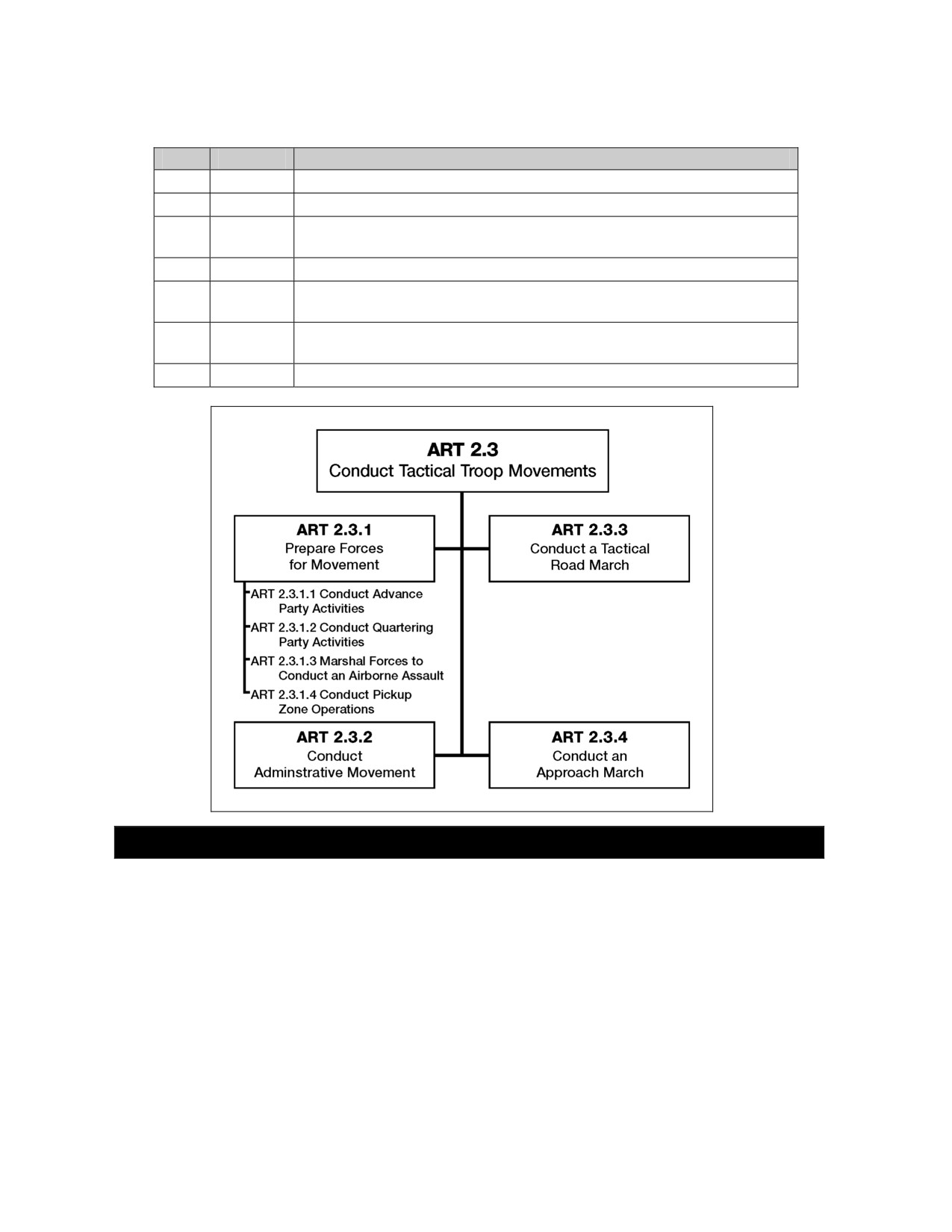
SECTION III - ART 2.3: CONDUCT TACTICAL TROOP MOVEMENTS
2-30. Relocate or move by any means or mode of transportation preparatory
to deploying into combat formations to support tactical commander and joint
force commander plans. Positioning/repositioning must support the
commander’s intent/concept of operation. ART 2.3 includes generating and
dispersing tactical forces. It also includes moving units by military, host-
nation, or contracted trucks or buses. (FM 3-90) (USACAC)
2-20

____________________________________________
ART 2.0: The Maneuver Battlefield Operating System
No.
Scale
Measure
Unit follows the prescribed route at the prescribed speed without
01
Yes/No
deviating unless required otherwise by enemy action or on orders from
higher headquarters.
Unit crosses and clears start point (SP) and release point (RP) at
02
Yes/No
designated time.
Enemy does not surprise the unit’s main body because of a failure to
03
Yes/No
conduct security operations.
04
Percent
Of casualties sustained during the movement.
05
kph
Rate of movement.
ART 2.3.1
PREPARE FORCES FOR MOVEMENT
2-31. Assemble, inspect, and load personnel, equipment, and supplies to
prepare for a tactical movement. (FM 3-90) (USACAC)
No.
Scale
Measure
01
Yes/No
Unit prepared to move at the appointed time and place.
02
Time
To load forces and equipment.
03
Time
To prepare movement orders.
04
Time
To deploy transportation and security forces.
05
Percent
Of forces and equipment loaded within established time requirements.
ART 2.3.1.1
CONDUCT ADVANCE PARTY ACTIVITIES
2-32. Send a detachment ahead of the main body to establish conditions for
the main body arrival. Conditions include administrative and logistic actions.
(FM 100-17) (CASCOM-DPMO)
No.
Scale
Measure
The advance party establishes necessary conditions for the unit main
01
Yes/No
body to conduct and complete the reception, staging, onward
movement and integration (RSO&I) within the established time.
02
Yes/No
Advance party arranges to receive the main body.
03
Yes/No
Advance party assists POD with discharge operations.
Advance party consists of battery teams, fuel handlers, drivers, and
04
Yes/No
property book and supply personnel.
Advance party deploys sufficiently in advance of the main body to
05
Yes/No
accomplish its assigned responsibilities.
ART 2.3.1.2
CONDUCT QUARTERING PARTY ACTIVITIES
2-33. Secure, reconnoiter, and organize an area for the main body’s arrival
and occupation. (FM 3-90) (USACAC)
2-21

FM 7-15__________________________________________________________________________
No.
Scale
Measure
Quartering party deploys sufficiently in advance of the main body to
01
Yes/No
accomplish its assigned responsibilities.
Quartering party guides unit main body into position from the release
02
Yes/No
point to precise locations within the assembly area.
03
Yes/No
Quartering party secures the designated assembly area.
Quartering party conducts an area reconnaissance of the designated
04
Yes/No
assembly area.
Assembly area and positions within it change from tentative locations
05
Distance
selected by unit commander based on a map reconnaissance.
ART 2.3.1.3
MARSHAL FORCES TO CONDUCT AN AIRBORNE ASSAULT
2-34. Marshalling airborne forces involves conducting the planning,
rehearsals, and briefbacks addressed in ART 7.0 (Command and Control
Battlefield Operating System). It involves assembling and preparing
paratroopers, equipment, and supplies for the jump. It includes conducting
airborne-specific briefings; prejump training; the actual moving of
paratroopers, equipment, and supplies to departure airfields; and loading
into the aircraft. (FM 90-26) (USAIS)
No.
Scale
Measure
Unit completes all preparations—such as assembling, organizing,
marking, and rigging unit equipment, rations, ammunition, water, and
other supplies—not later than the time the operations order specifies.
01
Yes/No
Preparations also include, but are not limited to, ensuring the cross
loading of personnel and key weapon systems, conducting prejump
refresher training and mission rehearsals, and moving to the departure
airfield not later than the time the operations order specifies.
02
Yes/No
Unit commander issues warning order and operation order.
03
Yes/No
The unit meets station time.
04
Yes/No
The unit meets load time.
From receiving warning order to completing preparations for airborne
05
Time
operation.
ART 2.3.1.4
CONDUCT PICKUP ZONE OPERATIONS
2-35. Pickup zone operations involve assembling and preparing soldiers,
equipment, and supplies for an air assault. ART 2.3.1.4 includes conducting
air assault-specific briefings and training; moving soldiers, equipment, and
supplies to pickup zones; and loading into rotary or variable-wing aircraft.
(FM 90-4) (USAIS)
2-22

____________________________________________
ART 2.0: The Maneuver Battlefield Operating System
No.
Scale
Measure
Unit completes all preparations—such as assembling, organizing,
marking, and rigging unit equipment, rations, ammunition, water, and
other supplies—not later than the time the operations order specifies.
Preparations also include, but are not limited to, ensuring the cross-
01
Yes/No
loading of personnel and key weapon systems, conducting air assault
refresher training and mission rehearsals, conducting an air mission
brief, and moving to the departure airfield not later than the time the
operations order specifies.
02
Yes/No
Unit commander issues warning order and operation order.
Unit adjusts load plan and ground tactical plan to account for less than
03
Yes/No
scheduled amount of aircraft.
04
Yes/No
Unit meets load time.
05
Yes/No
Unit maintains local security during loading.
Releases available attack/reconnaissance assets from pickup zone
06
Yes/No
security to perform air route reconnaissance and to establish mobile
flank screens for air movement to landing zones.
From receiving warning order to completing preparations for air
07
Time
assault operation.
08
Percent
Of changes in numbers and types of rotary-wing aircraft.
ART 2.3.2
CONDUCT ADMINISTRATIVE MOVEMENT
2-36. Execute a movement in which troops and vehicles are arranged to
expedite their movement and conserve time and resources when no enemy
interference, except by air, is anticipated. (FM 3-90) (USACAC)
No.
Scale
Measure
Complete unit movement not later than time the operation order
01
Yes/No
specifies and use transportation resources/assets efficiently.
02
Time
To initiate movement.
03
Time
To complete movement.
04
Percent
Of force completing the movement.
05
kph
Rate of movement.
ART 2.3.3
CONDUCT TACTICAL ROAD MARCH
2-37. A tactical road march is a rapid movement to relocate units within an
area of operations
(AO) in order to prepare for combat operations.
Commanders arrange troops and vehicles to expedite their movement and
conserve time, energy, and unit integrity. They anticipate no interference
except by enemy air, special operations forces, or sympathizers. Units
conducting tactical road marches employ three tactical march techniques:
open column, close column, and infiltration. (FM 3-90) (USACAC)
2-23

FM 7-15__________________________________________________________________________
No.
Scale
Measure
01
Yes/No
Unit crosses and clears SP and RP at designated times.
Unit follows the prescribed route without deviation unless required
02
Yes/No
otherwise by enemy action or on orders from higher headquarters.
Enemy does not surprise the unit main body through a failure to
03
Yes/No
conduct appropriate security operations.
Unit employs appropriate tactical march technique (open column,
04
Yes/No
close column, or infiltration).
05
Yes/No
Unit task organizes properly for tactical road march.
06
Time
To initiate movement.
07
Time
To complete movement.
08
Percent
Of force completing the movement.
09
Percent
Of unit casualties.
ART 2.3.4
CONDUCT AN APPROACH MARCH
2-38. Conduct an advance of a combat unit when direct contact with the
enemy is intended. An approach march emphasizes speed over tactical
deployment. It is used when the enemy’s approximate location is known and
allows the attacking force to move with greater speed and less physical
security or dispersion. An approach march ends in an attack position,
assembly area, or assault position; or it transitions to an attack. (FM 3-90)
(USACAC)
No.
Scale
Measure
Using the approach march allows the force to move quickly to the area
01
Yes/No
where it expects to make contact with the enemy and transition to an
appropriate combat formation.
02
Yes/No
Unit task organizes properly for approach march.
03
Yes/No
Unit uses established control measures and control graphics.
04
Time
To initiate the approach march.
05
Time
To complete the approach march.
06
Time
Between planned and actual unit arrival at checkpoints.
07
kph
Rate of movement.
08
Percent
Of force completing the approach march.
09
Percent
Of force maintaining correct interval between units.
Of force using correct movement techniques (traveling, traveling
10
Percent
overwatch, bounding overwatch).
2-24
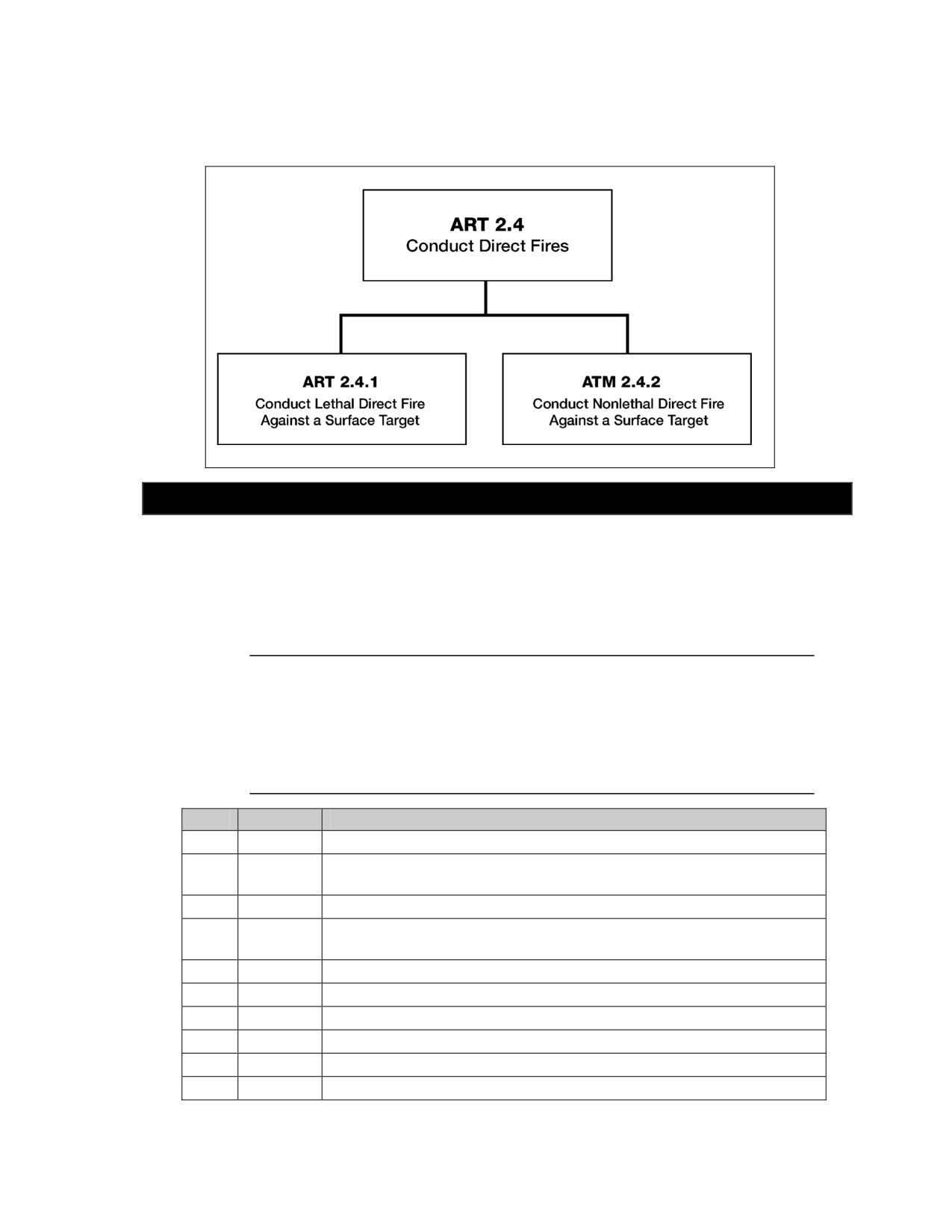
____________________________________________
ART 2.0: The Maneuver Battlefield Operating System
SECTION IV - ART 2.4: CONDUCT DIRECT FIRES
2-39. Take the enemy under fire with lethal and nonlethal direct fires
delivered on a target, using the target as the point of aim for either the gun
or the gunner. Examples of direct-fire systems include small arms, tanks,
antitank weapons, automatic weapons, and directed energy and acoustic
weapons. ART 2.4 includes attack helicopter fires and direct fire tied directly
to battlefield movement. (FM 3-90) (USACAC)
Note: ART 4.0 (Air Defense Battlefield Operating System) includes the
attack of aerial targets.
ART 7.4 (Plan Tactical Operations Using the MDMP/TLP) addresses the
elements of direct fire planning, such as the integration of indirect fires,
obstacles and terrain, and air and ground assets with control measures
designed to mass fires.
No.
Scale
Measure
01
Yes/No
Effects of unit direct fires contribute to accomplishing unit mission.
Was the conduct of direct fires done in accordance with established
02
Yes/No
rules of engagement?
03
Yes/No
Used correct weapon to engage target.
To get complete attack on direct fire target after detecting and
04
Time
identifying target.
05
Time
To suppress targets.
06
Percent
Of probability of suppressing a target.
07
Percent
Of probability of a hit.
08
Percent
Of probability of a kill given a hit.
09
Percent
Of missions flown/fired to achieve desired target damage.
10
Percent
Of available direct fire weapon systems engaging direct fire targets.
2-25

FM 7-15__________________________________________________________________________
No.
Scale
Measure
11
Percent
Of direct fire targets not engaged.
12
Percent
Of enemy performance degraded due to direct fire attack.
ART 2.4.1
CONDUCT LETHAL DIRECT FIRE AGAINST A SURFACE
TARGET
2-40. Engage enemy equipment and materiel, personnel, fortifications, and
facilities with direct fire designed to destroy the target. These direct fires
may be from ground or rotary-wing systems. ART 2.4.1 includes employing
fires from special operations rotary-wing platforms to support special
operations force elements. (FM 3-90) (USACAC)
No.
Scale
Measure
Effects of unit lethal direct fires contribute to accomplishing unit
01
Yes/No
mission.
Was direct fire attack conducted in accordance with established rules
02
Yes/No
of engagement?
03
Yes/No
Used correct weapon to engage target.
To get complete attack on direct fire target after detecting and
04
Time
identifying target.
05
Time
To suppress targets.
06
Percent
Of probability of suppressing a target.
07
Percent
Of probability of a hit.
08
Percent
Of probability of a kill given a hit.
09
Percent
Of missions flown/fired to achieve desired target damage.
10
Percent
Of available direct fire weapon systems engaging direct fire targets.
11
Percent
Of direct fire targets not engaged.
12
Percent
Of enemy performance degraded due to lethal direct fire attack.
ART 2.4.2
CONDUCT NONLETHAL DIRECT FIRE AGAINST A
SURFACE TARGET
2-41. Employ direct fire or other close combat means designed to impair the
performance of enemy/hostile personnel and equipment without destroying
them. ART 2.4.2 includes using such weapons and munitions as directed
energy and radio frequency weapons, rubber bullets, riot control agents, and
water cannons. (FM 34-40) (USAIC&FH)
No.
Scale
Measure
01
Yes/No
Effects of unit direct fires contribute to accomplishing the unit mission.
Was the conduct of nonlethal direct fires against surface target done in
02
Yes/No
accordance with rules of engagement, to include receipt of the
approval of weapons released from a competent authority?
03
Time
To develop nonlethal direct fire options after receiving warning order.
04
Time
To complete nonlethal direct fire attack on target (after initiation).
05
Percent
Of all targets evaluated as candidates for nonlethal direct fire attack.
2-26
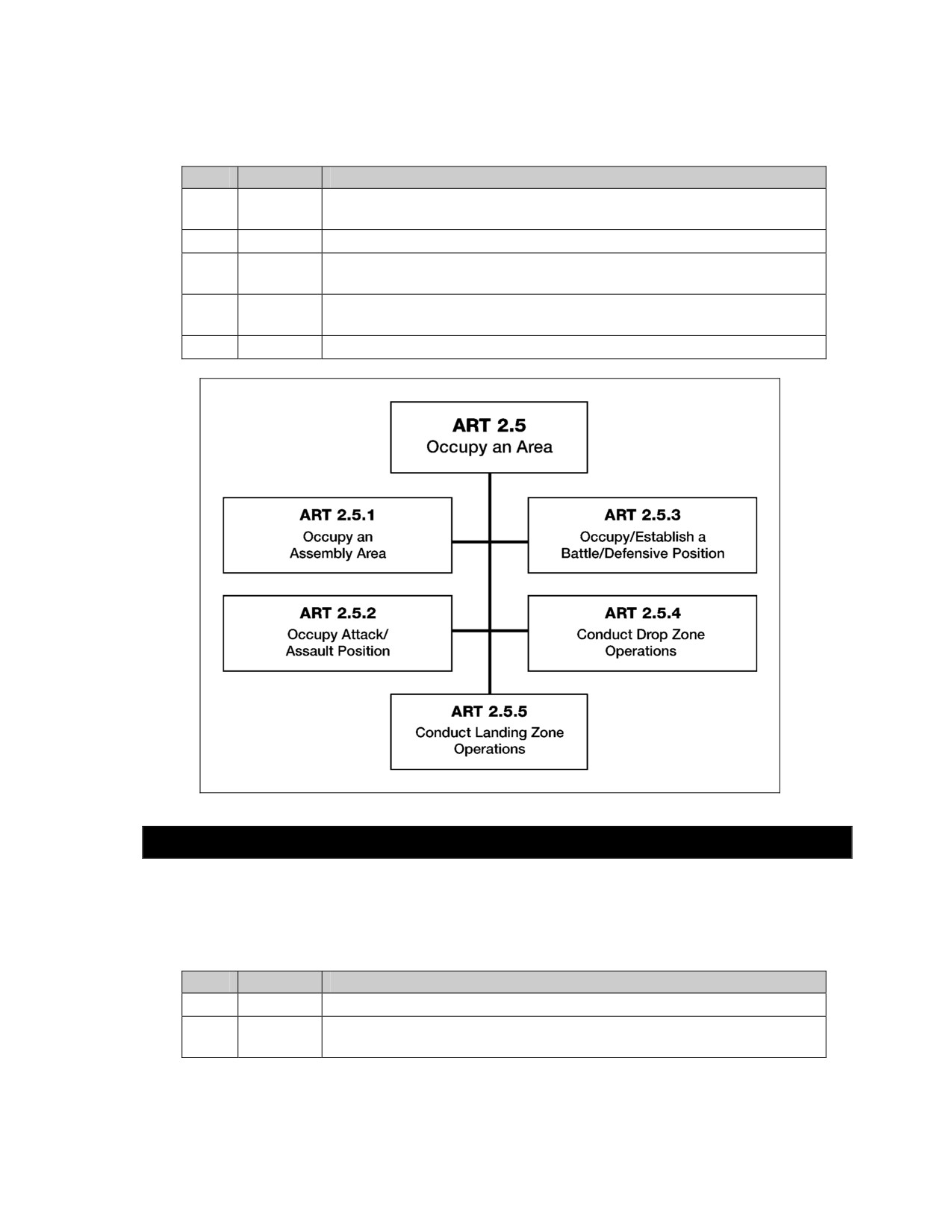
____________________________________________
ART 2.0: The Maneuver Battlefield Operating System
No.
Scale
Measure
Of nonlethal direct fire attacks on selected targets that achieve desired
06
Percent
damage criteria.
07
Percent
Of nonlethal direct fire attacks without lethal results.
Of nonlethal direct fire attacks that require lethal fire support to
08
Percent
achieve desired damage criteria.
Of nonlethal direct fire attacks that result in death or injury to friendly
09
Percent
employing forces and systems.
10
Percent
Of enemy performance degraded due to nonlethal direct fire attack.
SECTION V - ART 2.5: OCCUPY AN AREA
2-42. Move forces into and secure an area from which to conduct future
operations. This task includes occupying assembly areas; occupying attack or
assault positions; and establishing and occupying defensive positions,
including the five types of battle positions: primary, alternate,
supplementary, subsequent and strong point. (FM 3-90) (USACAC)
No.
Scale
Measure
01
Yes/No
Unit controls the area so the enemy cannot use the area.
Unit moves all personnel and essential equipment into its assigned
02
Time
positions not later than the time the order specifies.
2-27

FM 7-15__________________________________________________________________________
ART 2.5.1 OCCUPY AN ASSEMBLY AREA
2-43. Move forces into and occupy an assembly area in which to assemble
and prepare for further action. Actions include resupplying and organizing
forces for future operations. (FM 3-90) (USACAC)
No.
Scale
Measure
Unit moves into and occupies an assembly area in which it assembles
01
Yes/No
and prepares for further action within the time the operation order
specifies.
Unit forces enemy reconnaissance elements to withdraw without
02
Yes/No
allowing penetration of the assembly area perimeter.
The enemy does not surprise the unit main body through a failure to
03
Yes/No
conduct security operations.
Unit disperses its forces appropriately, uses cover and concealment,
04
Yes/No
designates entrances, exits, and internal routes in accordance with the
factors of METT-TC to include drainage and soil conditions.
Unit moves all personnel and essential equipment into assigned initial
05
Time
defensive positions not later than the time the order specifies.
Unit completes preparations for next operation in accordance with
06
Time
commander’s intent not later than the time the operation order
specifies.
ART 2.5.2 OCCUPY AN ATTACK/ASSAULT POSITION
2-44. As part of an offensive operation, move tactical forces into and through
these positions to prepare for further action or support the actions of another
force. Activities include making last-minute coordination and tactical
adjustments, preparing specialized equipment for immediate use, and
protecting the occupying force until supporting fire is lifted or shifted. This
task includes the use of attack-by-fire and support-by-fire positions and
holding areas by attack helicopters. (FM 3-90) (USACAC)
No.
Scale
Measure
Unit occupies attack/assault positions only as necessary to ensure the
01
Yes/No
attack’s success.
02
Yes/No
Unit clears these positions of enemy forces.
03
Yes/No
The enemy does not surprise the unit main body.
Unit moves all personnel and essential equipment into assigned
04
Time
positions not later than the time the order specifies.
Unit completes attack/assault preparations in accordance with
05
Time
commander’s intent and the factors of METT-TC.
ART 2.5.3 OCCUPY/ESTABLISH A BATTLE/DEFENSIVE POSITION
2-45. As part of a defensive operation, move tactical forces into positions to
prepare for further action. A battle position is a defensive location oriented
on a likely enemy avenue of approach. There are five kinds of battle
positions: primary, alternate, supplementary, subsequent, and strongpoint.
The positions may be located on any type of land and terrain, such as urban,
natural, mountainous, piedmont, steppe, delta, desert, jungle, and arctic.
2-28

____________________________________________
ART 2.0: The Maneuver Battlefield Operating System
(See UJTL condition C
1.0 for factors that describe the physical
environment.) (FM 3-90) (USACAC)
Note: ART 7.4 (Plan Tactical Operations Using the MDMP/TLP) addresses
defensive planning.
No.
Scale
Measure
01
Yes/No
Unit can conduct a coherent defense from its positions.
02
Yes/No
Clear enemy forces from the defended area.
03
Yes/No
The enemy does not surprise the unit main body.
Unit moves all personnel and essential equipment into assigned
04
Time
positions not later than the time the order specifies.
05
Time
The unit prepares to defend at the time the order prescribes.
06
Percent
Of acceptable friendly losses.
07
Number
Of casualties from friendly fire.
ART 2.5.4
CONDUCT DROP ZONE OPERATIONS
2-46. ART 2.5.4 begins when paratroopers and equipment exit the aircraft by
parachute or airland. It includes the actions of pathfinders. ART 2.5.4 ends
when all elements of the relevant airborne echelon arrive in the objective
area. (FM 90-26) (USAIS)
No.
Scale
Measure
Unit assembles according to its landing plan (on the objective, on the
drop zone, or in an assembly area adjacent to the drop zone) and
01
Yes/No
begins to execute the ground tactical plan not later than the time the
operation order specifies.
02
Yes/No
Enemy forces are unable to engage forces landing on the drop zone.
Security positions are positioned around drop zone until completion of
03
Yes/No
the vertical envelopment process.
Drop zone cleared of equipment and debris for use by follow-on forces
04
Yes/No
or future airland operations.
To conduct map or physical reconnaissance of site to ensure that drop
05
Time
zone supports operational requirements, such as degree of slope and
surface conditions, appropriate size, and free of obstacles.
To clear or mark obstacles, such as stumps, fences, and barbed wire
06
Time
located on the drop zone.
07
Time
To ensure drop zone approach and exit paths are free of obstructions.
08
Time
To mark the drop zone.
For pathfinder elements to establish communications with follow-on
09
Time
aircraft.
For pathfinder elements to confirm or determine drop heading with
10
Time
aircrew.
Of dropped and airlanded aircraft loads under control of a ground
11
Percent
station located on or near the drop zone.
2-29