FM 7-22 ARMY PHYSICAL READINESS TRAINING (OCTOBER 2012) - page 10
Posture and Body Mechanics
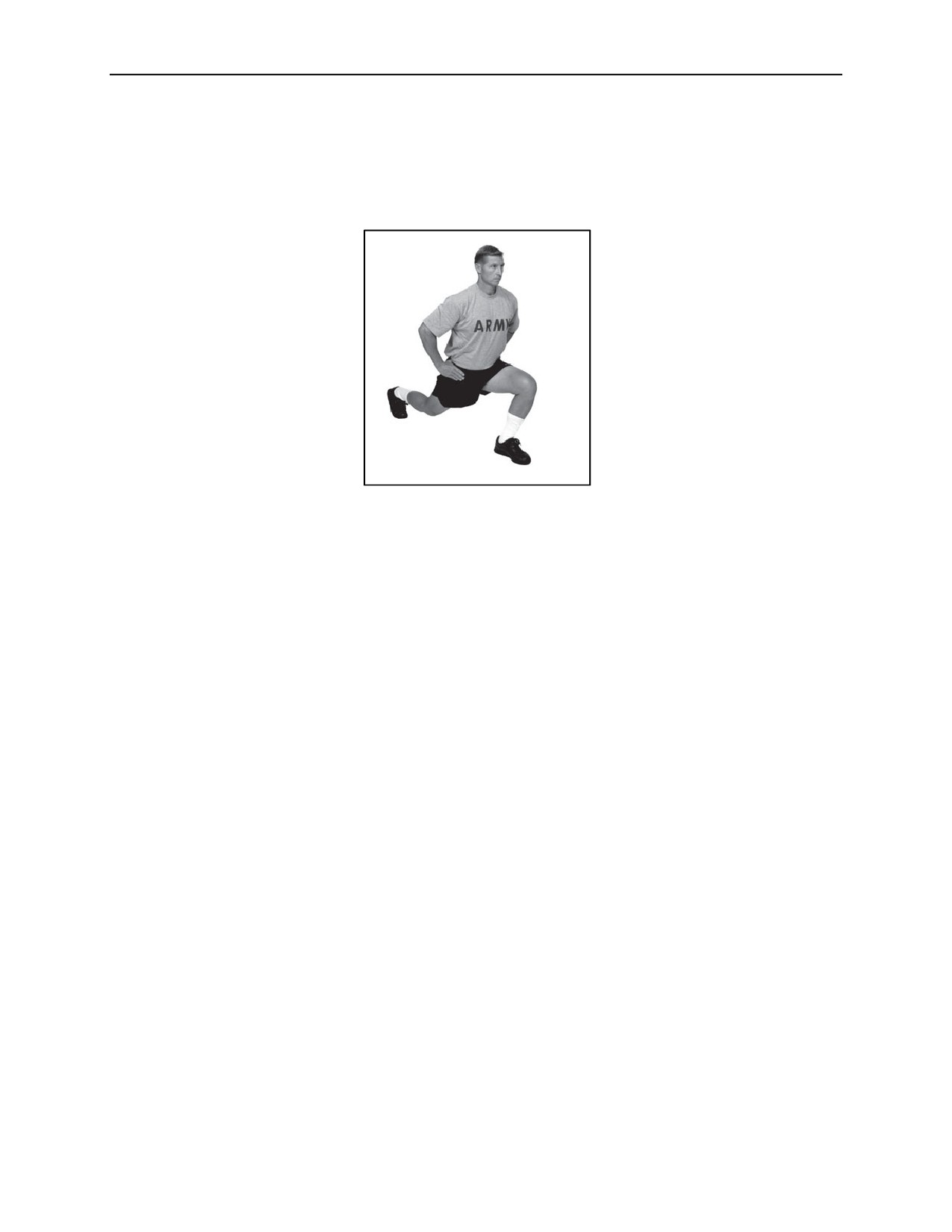
will enhance posture and improve body mechanics. For example, exercise 2 of preparation, rear lunge, provides
an excellent stretch of the hip flexors, a muscle group that is prone to tightness. This tightness tilts the pelvis
forward, creating an unbalanced base of support for the spine. (See Figure C-3.)
C-5. This exercise also extends the trunk and upper body, compensating for the many hours of flexion
throughout the course of the day.
Figure C-3. Rear lunge
“We are all sculptors and painters, and our material is our own flesh, blood, and bones.”
Henry David Thoreau
IMPROVING POSTURE
C-6. Improving posture must be built upon the desire to move correctly and efficiently at all times. Regardless
of the amount of instruction given and exercise performed, Soldiers will habitually assume good postures only
if they want to.
C-7. Good standing and sitting postures are characterized by vertical alignment of certain body segments.
However, posture is not improved by forcefully holding the body in a position of ideal alignment. In fact,
excessive effort to hold the body in a given posture will only serve to increase muscular tension and fatigue.
Assuming naturally balanced postures shifts the weight of the body onto the bones, relieving muscles of the
need to support weight bearing. Though the following recommendations are given in the form of a checklist,
don’t force the body to immediately conform to these ideals. Habits that have been reinforced over decades will
take time to correct. Regular and precise performance of the PRT activities in this FM will enhance posture and
body mechanics.
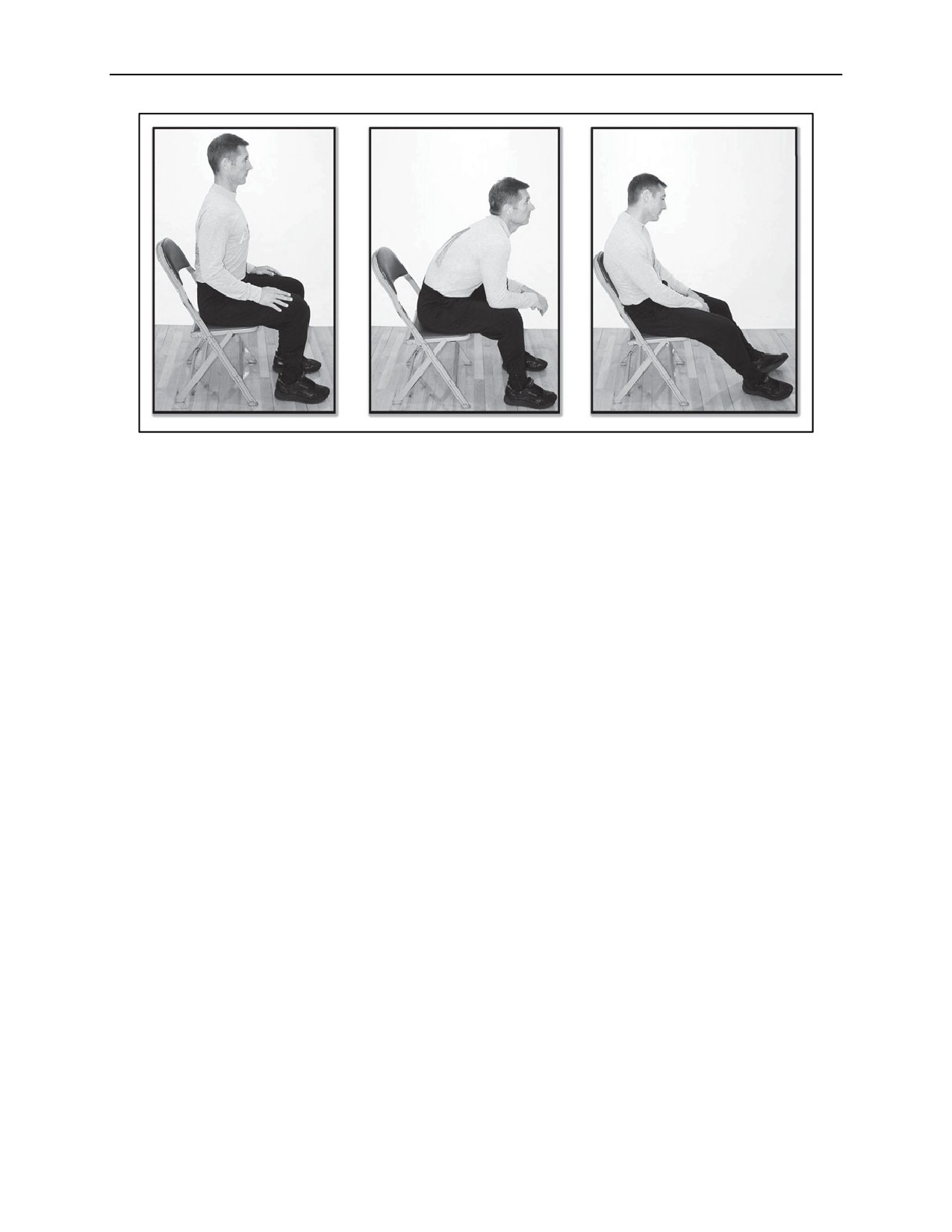
C-8. Checkpoints for sitting (Figure C-4):
z
Center the head between the shoulders and keep the chin level.
z
Draw the shoulders comfortably back; don’t allow them to round forward.
z
Carry the chest comfortably up and out.
z
Maintain the inward curve of the lower back; don’t allow it to roll outward or inward excessively.
z
Use a firm support between the lower spine and the backrest of the seat or chair to assist in
maintaining the proper position.
z
Maintain 90-degree angles at the hips and knees with the feet flat on the floor.
26 October 2012
FM 7-22
C-3
Appendix C
Figure C-4. Good (left) and poor (center and right) sitting posture
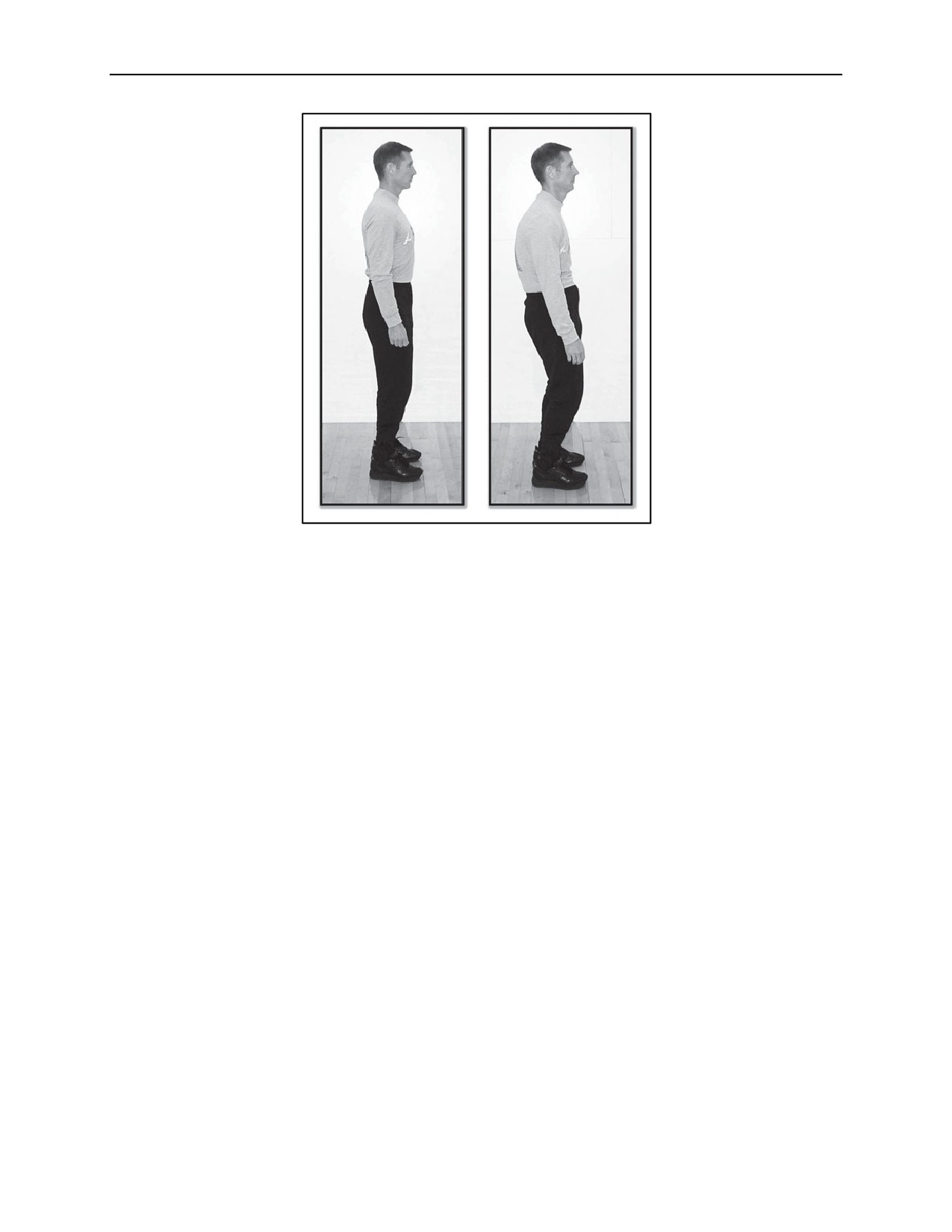
C-9. Checkpoints for standing (Figure C-5):
z
Stand as tall as possible. The head should not be tilted or the shoulders raised.
z
Center the head between the shoulders and keep the eyes and the chin level.
z
Slightly draw the chin inward by pressing the neck back toward the collar.
z
Moderately elevate the chest without strain. If the chest is raised properly, the abdomen flattens
normally. Don’t draw in the stomach to the extent that normal breathing is restricted.
z
Relax the shoulders and let them fall evenly. If the shoulders round forward, draw them back
slightly, without strain.
z
Set the pelvis and hips level (refer to Figure C-10c).
z
Keep the knees straight but not locked.
z
Direct the feet forward without strain. Variations in skeletal alignment will prevent some individuals
from assuming the feet-forward position.
z
Distribute the weight evenly between the heels and the balls of the feet.
C-4
FM 7-22
26 October 2012
Posture and Body Mechanics
Figure C-5. Good (left) and poor (right) standing posture
COMPENSATING FOR THE EFFECTS OF COMMON POSTURES
C-10. Given the broad definition of posture (any position in which the body resides), the number of postures
Soldiers may assume is infinite. However, Soldiers assume the same few postures throughout most of the duty
day. The postures can be categorized as the flexed posture (associated with sitting, bending forward, lifting, and
crouching); and the upright posture (associated with standing, walking, marching, and running). The body will
eventually conform to accommodate these postures. Some muscles will become over-stretched and weak, while
others will tighten and lose flexibility. The resulting muscle imbalances will hinder natural movement and
increase the likelihood of injury. It is important to regularly compensate for time spent in these prolonged
postures by performing exercises or activities that restore the optimal flexibility of muscles and joints:
z
Performing extension compensates for flexion. The most common posture for many individuals is
seated. This posture is associated with flexion of the spine. Unless great effort is made to sit straight
(or a roll is used to maintain the inward curve of the low back), the trunk tends to assume a C-shape.
The longer this flexed posture is assumed, the greater will be the effect on muscles around the trunk.
The back muscles and ligaments become over-stretched and weak, while muscles on the other side of
the trunk (for example, hip flexors) get tighter and pull the pelvis into an unbalanced position. The
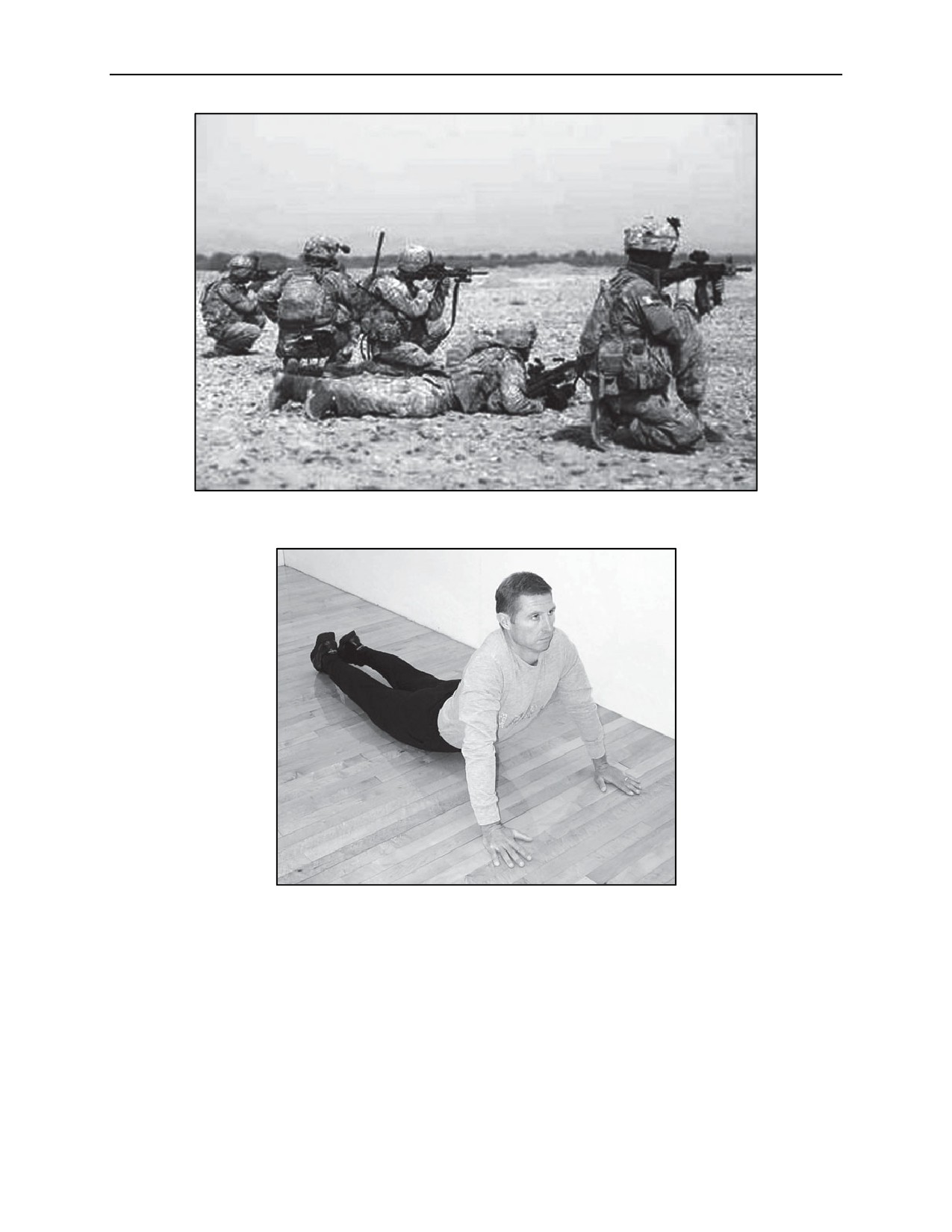
Soldier on the right in Figure C-6 is in a flexed position. Compensation for prolonged time in this
position would occur if the Soldier assumed the prone position of extension demonstrated by the
Soldier on the left. To prevent the imbalances associated with too much flexion, Soldiers should
regularly perform extension exercises and activities such as those shown in Figure C-7.
26 October 2012
FM 7-22
C-5
Appendix C
Figure C-6. Soldiers in the flexed (right) and extended (left) postures
Figure C-7. Performing extension to compensate for flexion
z
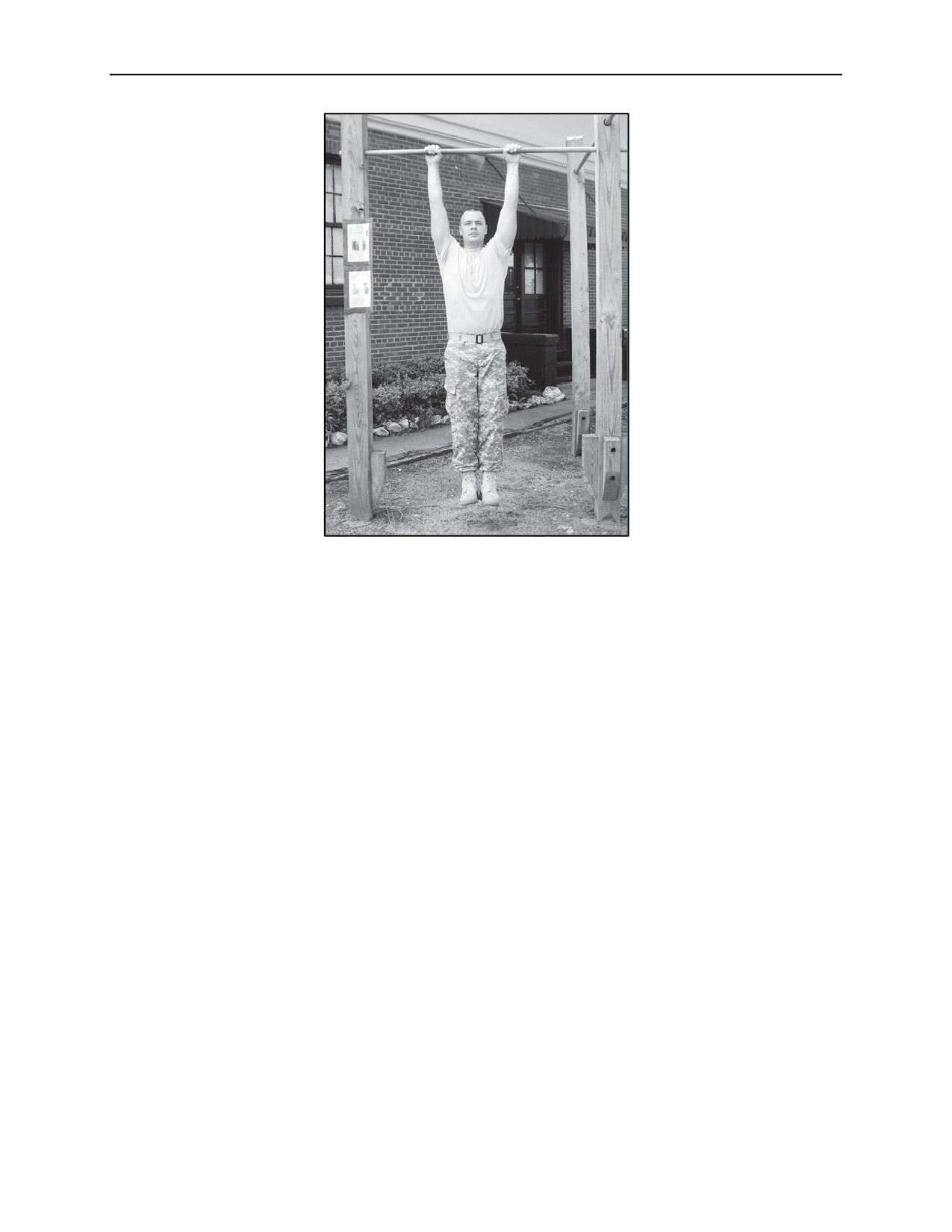
Performing decompression. This compensates for many of the compressive forces that act on the
body throughout the day. Many Soldiers spend the majority of their day on their feet. The weight of
the body and equipment creates a compressive effect on the spine and other weight-bearing joints. In
fact, at the end of the day enough fluid will have been compressed out of the spinal discs that height
measurements will usually indicate that Soldiers are noticeably shorter. Joints that are overly
compressed may eventually compromise mobility. To compensate for compressive forces on the
spine, it is useful to perform exercises or activities that decompress as shown in Figure C-8.
C-6
FM 7-22
26 October 2012
Posture and Body Mechanics
Figure C-8. Performing decompression to compensate for compression
BODY MECHANICS
C-11. Body mechanics (posture in motion) is the ability to control body movement. Many discussions of
posture are limited to static positions such as sitting and standing. Good posture during movement is imperative
for efficiency and injury control. Just as good posture requires balanced alignment of the body, so does exercise.
Many Soldiers use awkward movements as they struggle to perform one last repetition. When body mechanics
are poor, the exercise serves little purpose and may do more harm than good. The activities in the PRT
system were designed to reinforce proper body mechanics. Of special importance to PRT leaders are the
checkpoints given for each exercise. Adherence to these checkpoints ensures optimal execution of the exercise.
Over time, skillful movements become second nature to the Soldier. When this occurs, physical readiness is
enhanced and injury risk is minimized.
PREPARING THE BODY’S CORE
C-12. Muscles work to initiate and control movement. Because movement is more apparent than the lack of it,
the focus is most often on the movement muscles create. Less obvious is the "braking" force that muscles apply
to movement. Without this braking force, nearly all movement would be extremely sloppy and potentially
dangerous. Around the body’s core (trunk and pelvis), this braking action of the muscles becomes extremely
important for two reasons. First, the spine and pelvis are the base of attachment for many muscles that power
the arms and legs. Without a strong, stable base of support, using these muscles is like firing a cannon from a
canoe. Second, the body’s center of gravity is within the trunk area. Keeping it there leads to balanced, skillful
movement. This is the job of the trunk muscles that do this primarily by putting on the brakes. The ability to
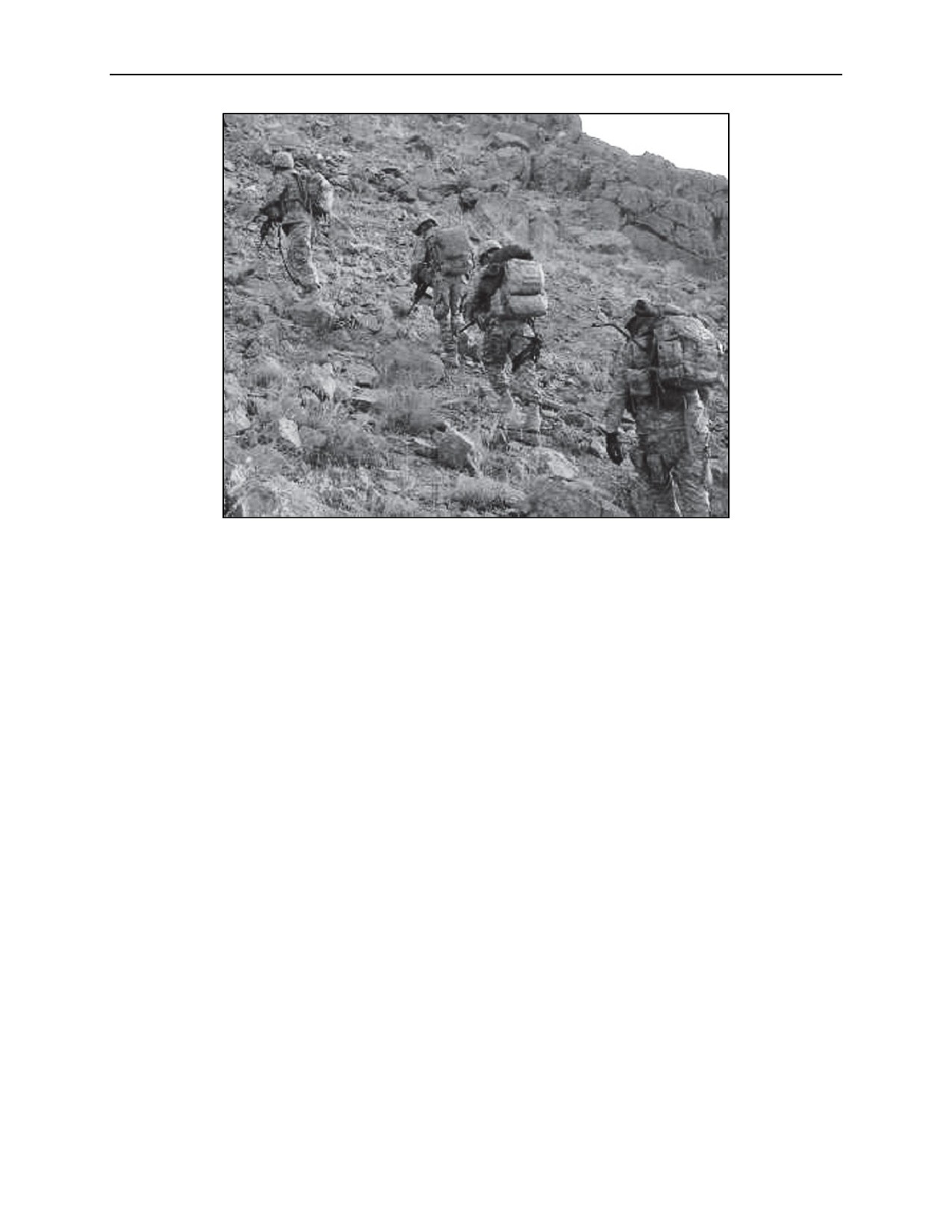
maintain balanced postures is often referred to as stabilization. The load on the Soldiers shown in Figure C-9
demands strength and stability from the body’s core.
26 October 2012
FM 7-22
C-7
Appendix C
Figure C-9. Soldiers moving under load
C-13. To promote stable postures during exercise, it is essential that Soldiers learn to prepare the trunk. A
simple, two-part action prepares the trunk for exercise:
z
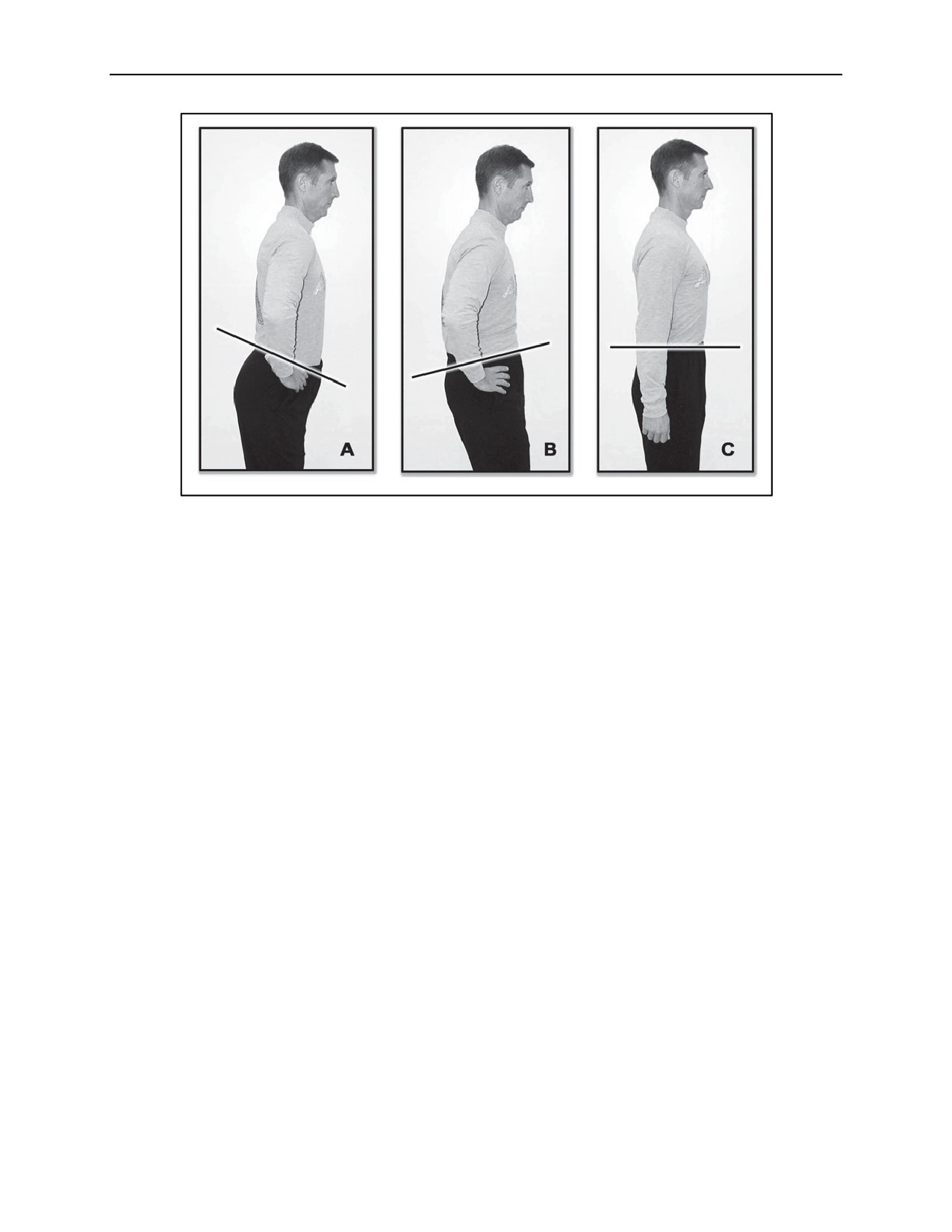
Set the hips. This is also referred to as the neutral position of the pelvis. This position is found by
first tilting the pelvis forward (buttocks goes back, belly goes forward, and the inward curve of the
low back is increased), Figure C-10a. Second, tilt the pelvis backward (the buttocks and belly draw
inward as far as possible, flattening the curve of the low back) (Figure C-10b). Then settle in
between these two extremes (Figure C-10c).
z
Tighten the abdominal muscles. Once the hips are set, tightening the abdominal muscles will ensure
readiness of the muscles that control and protect the trunk. To contract the correct muscles, imagine
drawing the gut straight inward as if preparing for a blow to the mid-section or trying to appear
slimmer. Keep the hips set as the abdominals are tightened (Figure C-10c).
C-14. After setting the hips and tightening the abdominal muscles, the Soldier’s posture should appear balanced
and ready for exercise. The Soldier should not associate these two actions with a stiff, awkward posture. The
goal is not to eliminate all movement from the trunk, but to simply control the natural motion that will occur.
C-8
FM 7-22
26 October 2012
Posture and Body Mechanics
Figure C-10. Set the hips and tighten the abdominal muscles
POWER POSITION
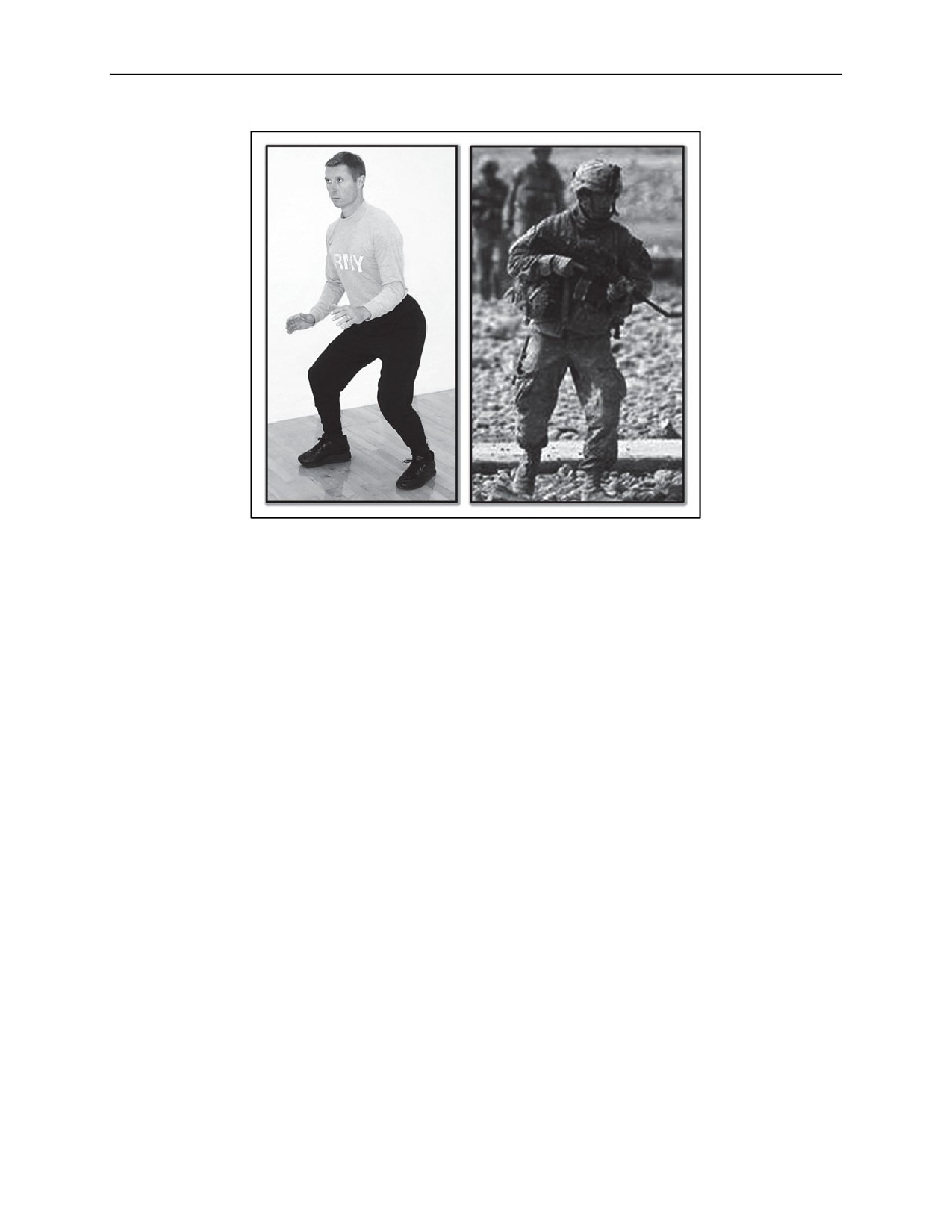
C-15. Proper body mechanics are essential for the powerful movements required of Soldiers. From the power
position (Figure C-11), the Soldier is ready to:
z
Respond to or deliver aggression.
z
Squat to lower or lift a heavy load.
z
Accept a heavy load being passed from another individual.
z
Sprint to cover.
26 October 2012
FM 7-22
C-9
Appendix C
Figure C-11. Power position
C-16. To assume the power position, first set the hips and tighten the abdominals as previously described. From
the straddle stance, place one leg 6 to 8 inches behind the other and crouch so the hips go rearward and the
trunk counterbalances by leaning slightly forward. The balls of the feet accept most of the body weight. The
shoulder blades are pulled slightly back, but not forced. The chest is high, head is level and elbows and knees
are comfortably bent (about 45-degrees).
LIFTING FROM THE GROUND
C-17. Power the lift with the legs, not the back (Figure C-12). Then continue to bend at the hips and knees to
lower the body. To protect the back, keep the hips set and the abdominal muscles tight throughout the lift. Keep
the load close to the body from start to finish. When Soldiers must turn under load, do so by pivoting the feet
rather than twisting the trunk.
C-10
FM 7-22
26 October 2012
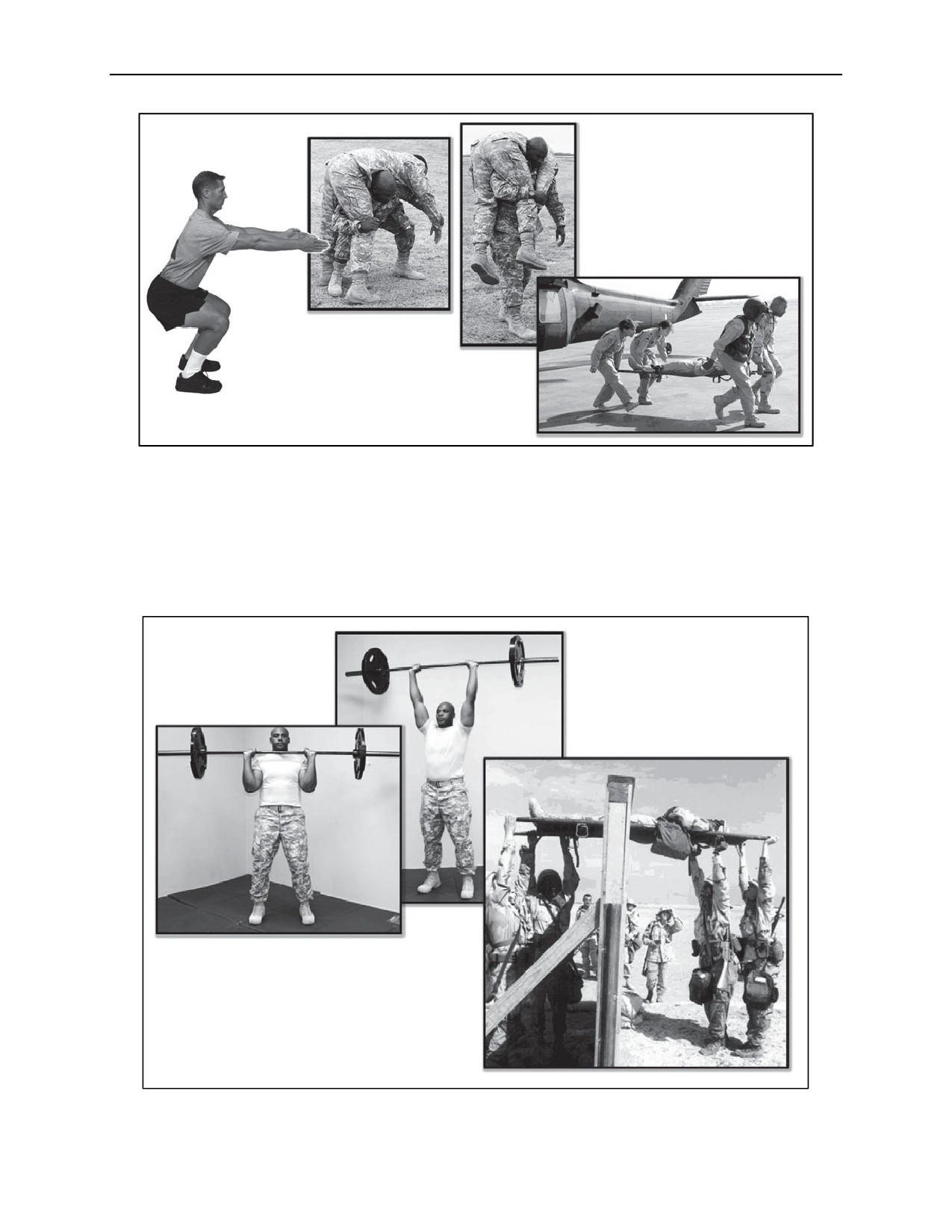
Posture and Body Mechanics
Figure C-12. Lifting from the ground
LIFTING OVERHEAD
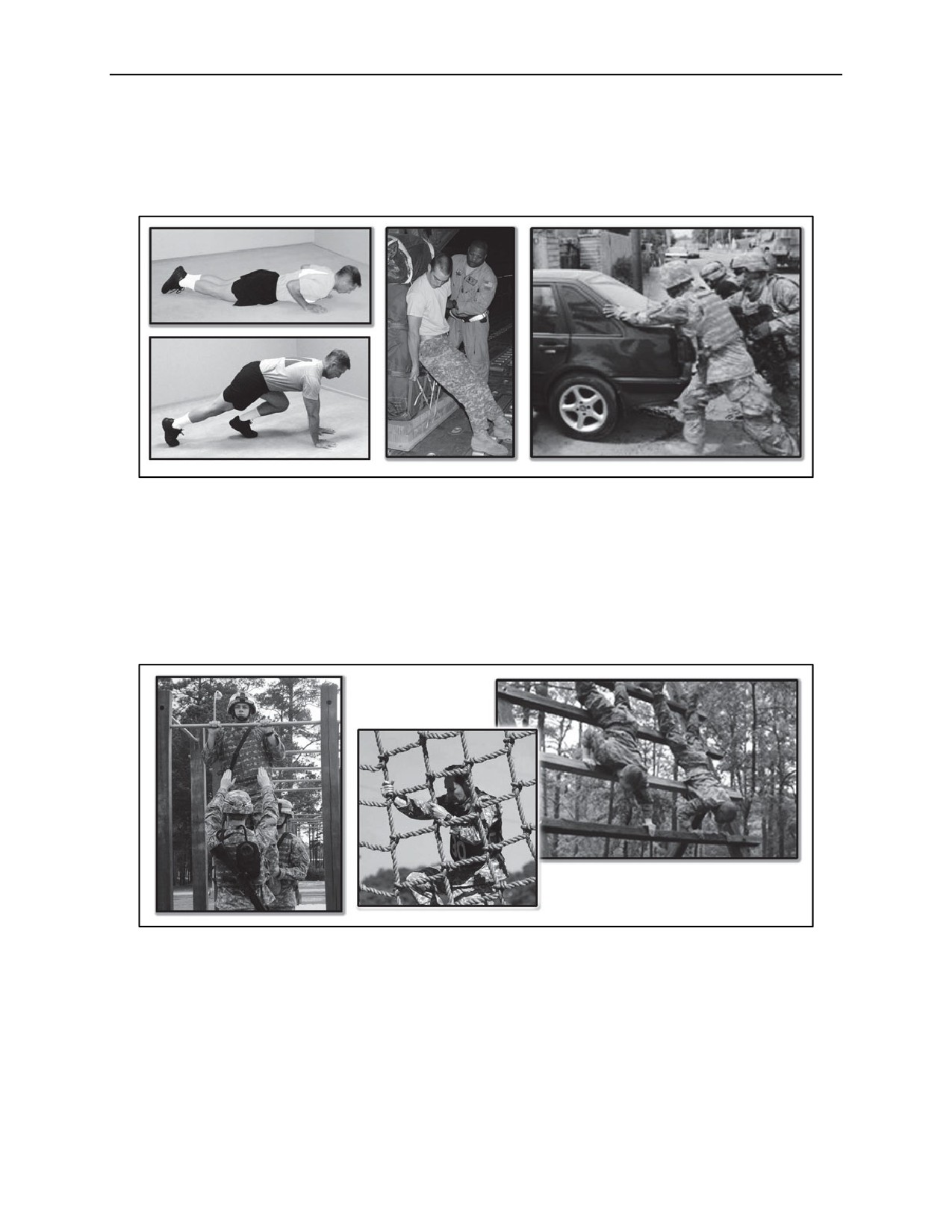
C-18. Most of the power for pushing an object overhead comes from the legs. To transmit leg strength through
the trunk and arms to the object being pushed, set the hips and tighten the abdominal muscles. Hands should be
placed shoulder width apart with the upper arms aligned with the trunk. Squat slightly, then forcefully straighten
the legs in a coordinated effort with the action of the arms (Figure C-13).
Figure C-13. Lifting overhead
26 October 2012
FM 7-22
C-11
Appendix C
PUSHING
C-19. Push with the hands in front of the shoulders and the upper arms close to the body. This technique creates
a mechanical advantage that is lost the farther the hands and arms are from this position. Because this method is
the most functional, push-ups performed in the CDs use this technique (Figure C-14).
Figure C-14. Pushing
PULLING/CLIMBING
C-20. When pulling an object that is on the ground or horizontal to it, Soldiers must first assume the power
position. Set the shoulder girdle by pulling the shoulder blades slightly to the rear. This is also important when
pulling the body upward from an overhead grasp. Climbing will often require the legs to power the accent or
gain leverage on support structures (Figure C-15). This will demand significant strength from the trunk muscles.
The exercises in the CLs prepare Soldiers for these demands.
Figure C-15. Pulling/climbing
ROTATION
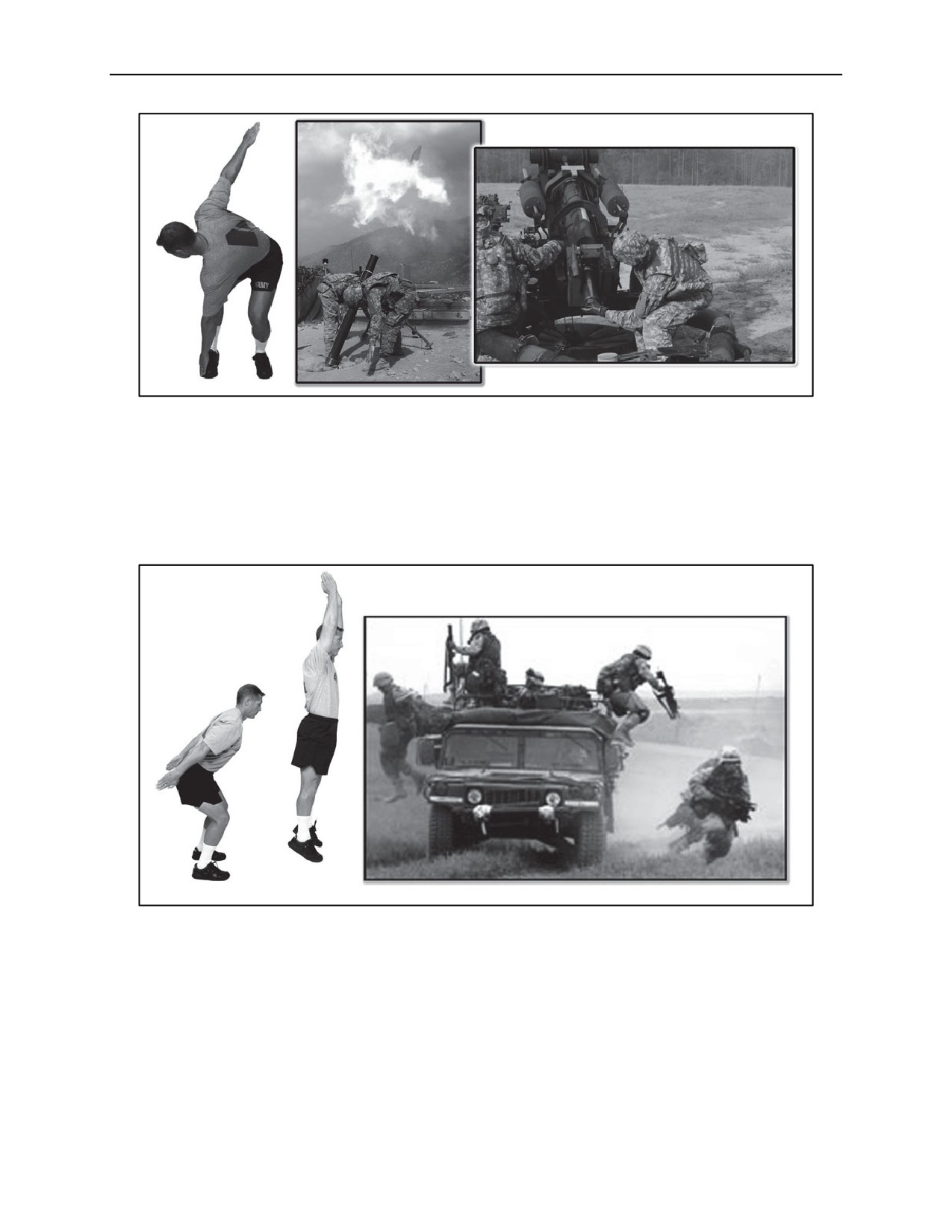
C-21. Prepare the body’s trunk to control rotation. Coiling (rotating) the body, then quickly uncoiling is the
primary source of power for many Soldier and athletic tasks such as throwing a punch or heaving an object onto
a platform (Figure C-16). Each of these activities produces a torque on the spine and other joints that may cause
injury if the forces are uncontrolled. Control comes from setting the hips, tightening the abdominals, and
allowing the hips and knees to bend so as to absorb some of the stress of rotation.
C-12
FM 7-22
26 October 2012
Posture and Body Mechanics
Figure C-16. Rotation
JUMPING AND LANDING
C-22. Land softly with alignment of the shoulders, knees, and the balls of the feet. Land first on the balls of the
feet with the heels touching down last. Bending of the hips and knees allows the legs to serve as coils that
absorb the impact of the landing. The trunk should be straight but leaning forward so when it is viewed from the
side, the shoulders, knees, and the balls of the feet are aligned (Figure C-17).
Figure C-17. Jumping and landing
LUNGING
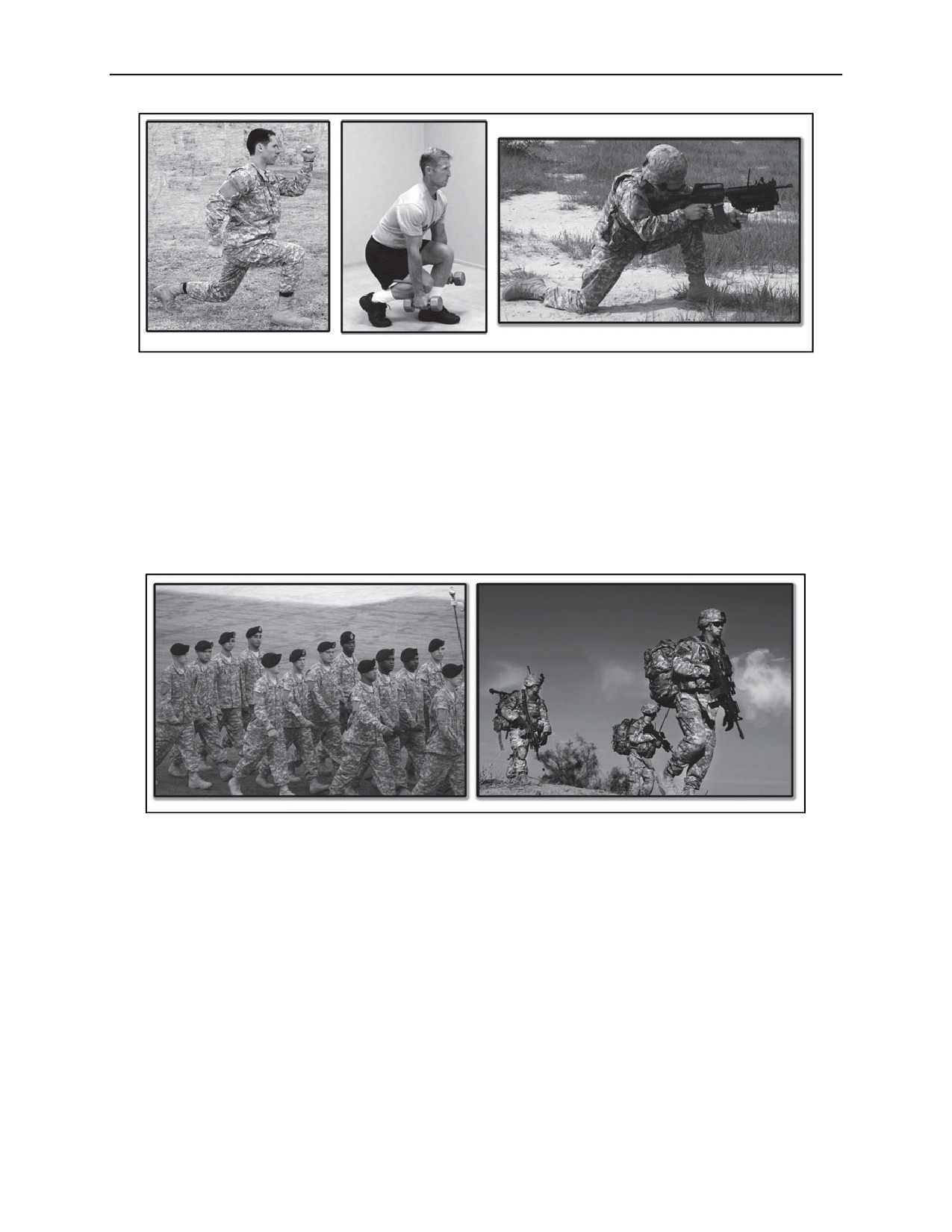
C-23. Maintain the knee of the forward leg in vertical alignment with the ball of the foot. Do not allow the knee
to go beyond the toes or to the right or left of the foot. Lunging is a component of many Soldier tasks.
Figure C-18 shows Soldiers performing a proper lunge. Conditioning and kettlebell or dumbbell exercises that
involve squat lunging prepare Soldiers for functional tasks such as this.
26 October 2012
FM 7-22
C-13
Appendix C
Figure C-18. Lunging
MARCHING
C-24. The head and trunk checkpoints for standing also apply to marching. Allow the arms to swing naturally,
though crossing the midline of the body is excessive. Allow the hips to naturally rotate forward with each stride.
Do not allow the knees to lock at any point in the walking cycle. Stride naturally, landing on the heel and
pushing off with most of the weight toward the big toe. The feet remain directed forward. Do not strain to keep
the feet directed forward, since variations in skeletal alignment will prevent some Soldiers from assuming the
feet-forward position. Foot marching with a load on the back will require some forward lean of the trunk. Do
not, however, allow the trunk and shoulders to round forward (Figure C-19).
Figure C-19. Marching and foot marching
RUNNING
C-25. Refer to Chapter 10, Endurance and Mobility Activities, for a discussion on running form.
CHANGING DIRECTION
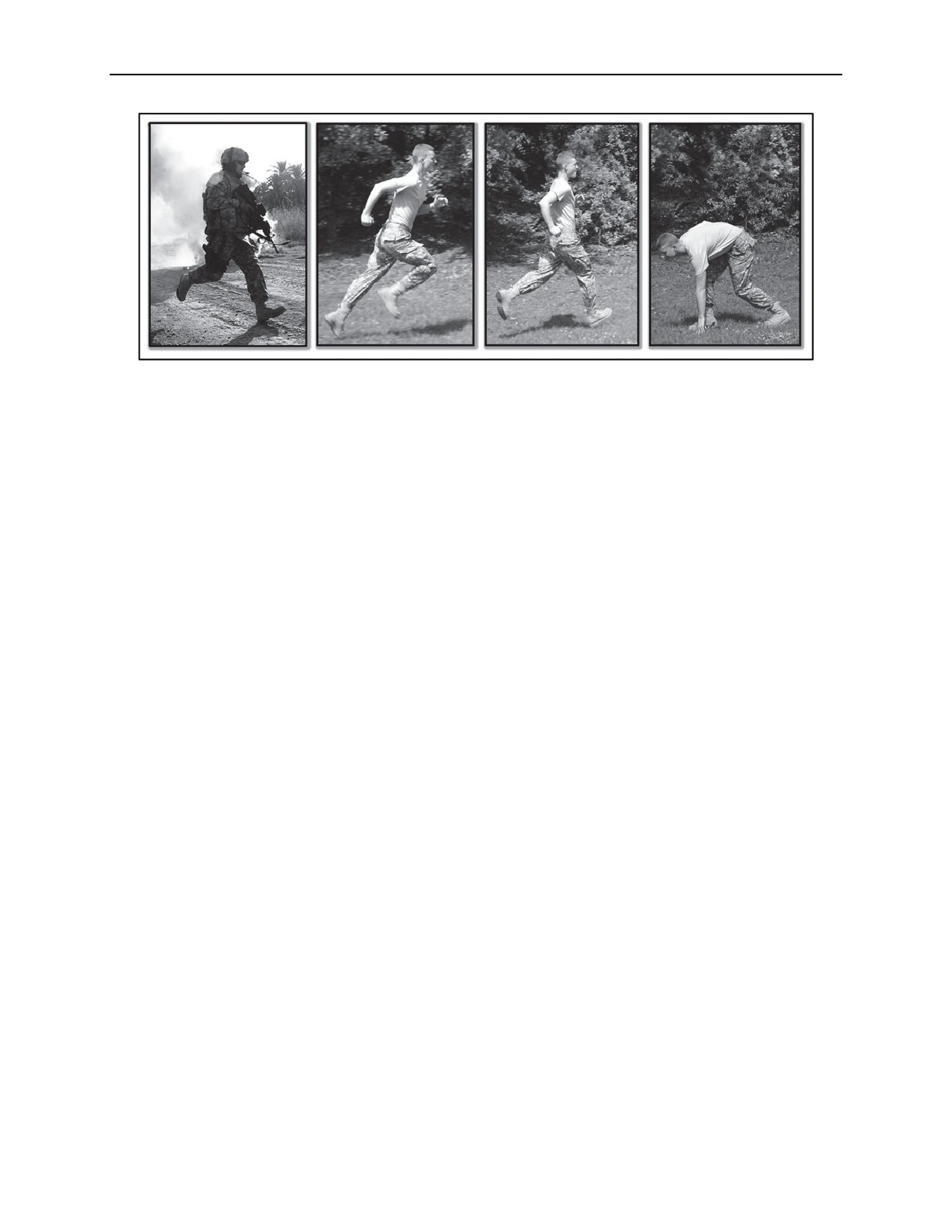
C-26. Soldiers may be required to quickly change direction, while maintaining forward movement or to quickly
reverse direction. To maintain forward movement, plant on the outside leg with plenty of bend in the hips and
knees. The foot should turn slightly inward toward the change of direction. To reverse direction, as in the SR,
reduce forward speed and crouch so the body is directed approximately 180 degrees from the forward direction.
At the lowest point of the crouch, body weight should rest primarily on the leg closest to the new direction of
travel, shifting momentum in that direction (Figure C-20).
C-14
FM 7-22
26 October 2012
Posture and Body Mechanics
Figure C-20. Changing direction
“If half of life is showing up and the other half is doing something when you get there, then
the key to success is doing it well.”
Stephen Van Camp, Chief of Doctrine, USAPFS
26 October 2012
FM 7-22
C-15
This page intentionally left blank.
Appendix D
Environmental Considerations
Soldiers must be ready to perform physically demanding tasks in hot, cold, and high
altitude environments. Acclimatization to these environments during the conduct of PRT
and other daily training activities is essential to safely preparing Soldiers for physical
success. When gradually exposed to these environments and the intensity and duration of
activities are adjusted, Soldiers can safely acclimatize over time.
HEAT ACCLIMATIZATION
D-1. Soldiers need to acclimatize properly prior to conducting PRT in extremely hot environments. Heat
acclimatization allows for those specific adaptations that aid in the reduction of physiological stress (heart rate,
core temperature, and sweat adaptation). It also improves physical work capability in the heat and builds Soldier
confidence. In hot environments Soldiers will safely acclimatize to the heat by conducting PRT sessions during
the heat of the day at a lower intensity and volume. For example, PRT can be moved from early morning to late
morning or from late morning to mid-afternoon. This allows for acclimatization by gradually progressing to a
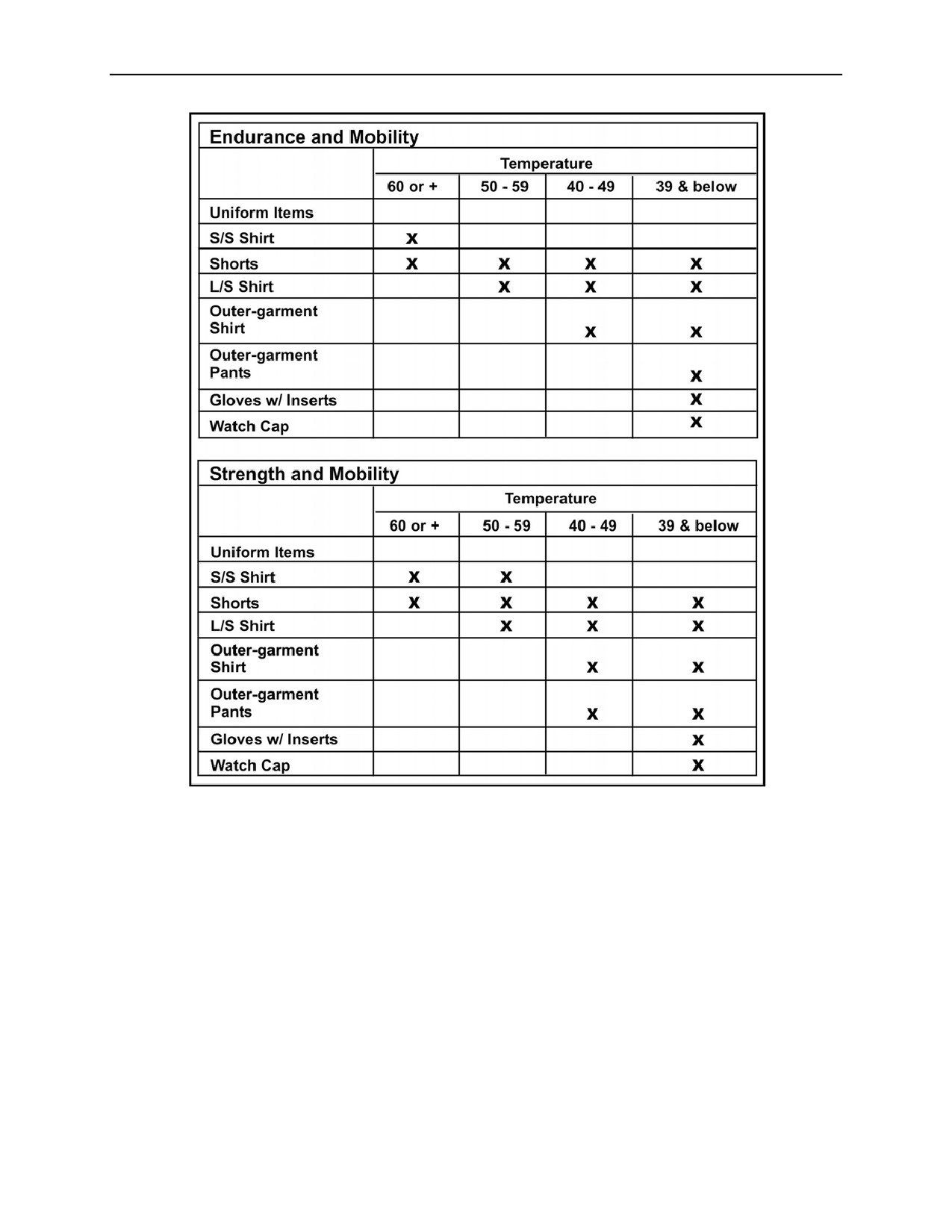
warmer/hotter environment. Consideration must also be given to wear of the IPFU ensemble (Figure D-2).
D-2. Heat acclimatization works on a principle of repeated bouts of heat exposure that are stressful enough to
safely elevate core temperature and provoke the sweating mechanism. Limited physical activity accompanied
by rest in hot environments will result in only partial acclimatization. Acclimatization requires a minimum daily
heat exposure of two hours when combined with endurance and mobility, and strength and mobility training.
Research has shown that repeated bouts of shorter duration exercise, like those found in speed running, allow
for acclimatization more safely than sustained activity in the heat. Initially, Soldiers will train at a lower
intensity and shorter duration, then safely progress, increasing physical exercise intensity, duration, and volume
to achieve optimal acclimatization in warm/hot environments. In most cases Soldiers can acclimatize in
approximately three weeks. Soldiers will maintain acclimatization for approximately one week with about 75
percent of acclimatization lost within three weeks once the Soldier no longer remains in that environment.
Soldiers of low fitness levels or those susceptible to heat injuries may require additional days/weeks to fully
acclimatize.
D-3. Soldiers must consume sufficient amounts of water to replace water lost due to sweat. Sweating rates
greater than one quart per hour are not uncommon. Acclimatization increases sweating rates, which in turn
increase water requirements. A risk to acclimatized Soldiers is dehydrating faster than their water intake.
Dehydration reduces thermal regulatory advantages achieved through acclimatization and high levels of
physical readiness.
HEAT INJURIES
D-4. Soldiers and PRT leaders must be aware of the signs and symptoms of heat injuries and their severities.
They must know how to assess Soldiers who may be at risk and be ready to provide appropriate treatment
immediately. If any of the below symptoms of heat cramps, heat exhaustion, or heatstroke are experienced,
immediately stop physical activity and seek treatment and/or medical attention.
26 October 2012
FM 7-22
D-1
Appendix D
HEAT CRAMPS
Symptoms:
Muscular twitching, cramping, muscular spasms in arms, legs, or abdomen.
Treatment:
Monitor Soldier in a cool, shaded area, and give water and/or electrolyte sports drink. Call for
medical attention if situation worsens.
HEAT EXHAUSTION (REQUIRES MEDICAL ATTENTION)
Symptoms:
Excessive thirst, fatigue, lack of coordination, increased sweating, cool/wet skin, dizziness, and/or
confusion.
Treatment:
Monitor Soldier in a cool, shaded area, attempt to cool Soldier’s head and body with cold water
and give water and/or electrolyte sports drink and await medical attention.
HEATSTROKE (MEDICAL EMERGENCY, DIAL 911)
Symptoms:
No sweating, hot/dry skin, rapid pulse, rapid breathing, seizure, dizziness and/or confusion, loss of
consciousness.
Treatment:
Monitor Soldier in a cool, shaded area, attempt to immediately cool Soldier’s head and body with
cold water or ice blanket and give water and/or electrolyte sports drink while awaiting medical
attention.
HYPONATREMIA OR OVERHYDRATION (MEDICAL EMERGENCY, DIAL 911)
Symptoms:
Confusion, weakness, nausea, and vomiting.
Treatment:
Typically misdiagnosed and treated as dehydration. Monitor Soldier and follow treatment for heat
exhaustion. If symptoms persist or become more severe with rehydration, replace salt loss and
transport immediately to medical facility. DO NOT continue to have Soldier drink more water.
HYDRATION AND NUTRITION
D-5. Ensuring that Soldiers are properly hydrated and receive regular, adequate nutrition is a good way to
prevent the onset of heat injuries. Water is the preferred hydration fluid before, during, and after physical
training activities. Drink
13 to 20 ounces of cool water at least
30 minutes before beginning exercise
(approximately 2 glasses of water). After exercise, drink to satisfy thirst, then drink a little more. Also avoid
alcoholic beverages and soft drinks because they are not suitable for proper hydration and recovery. Sports
drinks may be consumed, but are not required and contain a considerable number of additional calories. It is
also possible to drink too much water. Be sure to limit intake to NO MORE THAN 1 ½ quarts per hour (48 oz)
during heavy exertion. Remember, hydration is also important in the cold environment. Many times loss of
water is not as noticeable when it is cool or cold.
D-6. Good nutrition practices helps ensure Soldiers have the needed vitamins and minerals for safe
performance of exercise in hot environments. Sodium, potassium, and B complex vitamins are lost through
sweat and exertion in the heat. It is important to replenish calories lost during exercise with foods containing
these nutrients. Try to eat within an hour after exercise. This will assist in recovery as the body is still burning
calories at an elevated rate.
COLD ACCLIMATIZATION
D-7. During exercise in the cold, the body usually produces enough heat to maintain its normal temperature.
As Soldiers become fatigued, however, they slow down and their body produces less heat. Two types of cold
injury conditions may occur due to prolonged exposure and/or loss of core temperature. Soldiers and PRT
leaders must be aware of the signs and symptoms of cold injuries and their severities to assess Soldiers who
may be at risk and to provide appropriate treatment immediately. If any of the following symptoms (frostbite or
hypothermia) are experienced, immediately stop physical activity and seek treatment and/or medical attention.
D-2
FM 7-22
26 October 2012
Environmental Considerations
COLD INJURIES
D-8. Soldiers participating in military training or deployments will often encounter cold stress that can impact
successful mission accomplishment. Continued exposure in a cold environment degrades physical performance
capabilities, significantly impacts morale, and eventually causes cold weather injuries. Cold environments
include exposure to extremely low temperatures (Arctic regions), and cold-wet exposures (rain or water
immersion) in warmer ambient temperatures. Cold-weather conditions impair many aspects of normal military
functioning in the field, which in turn can influence Soldier health and performance.
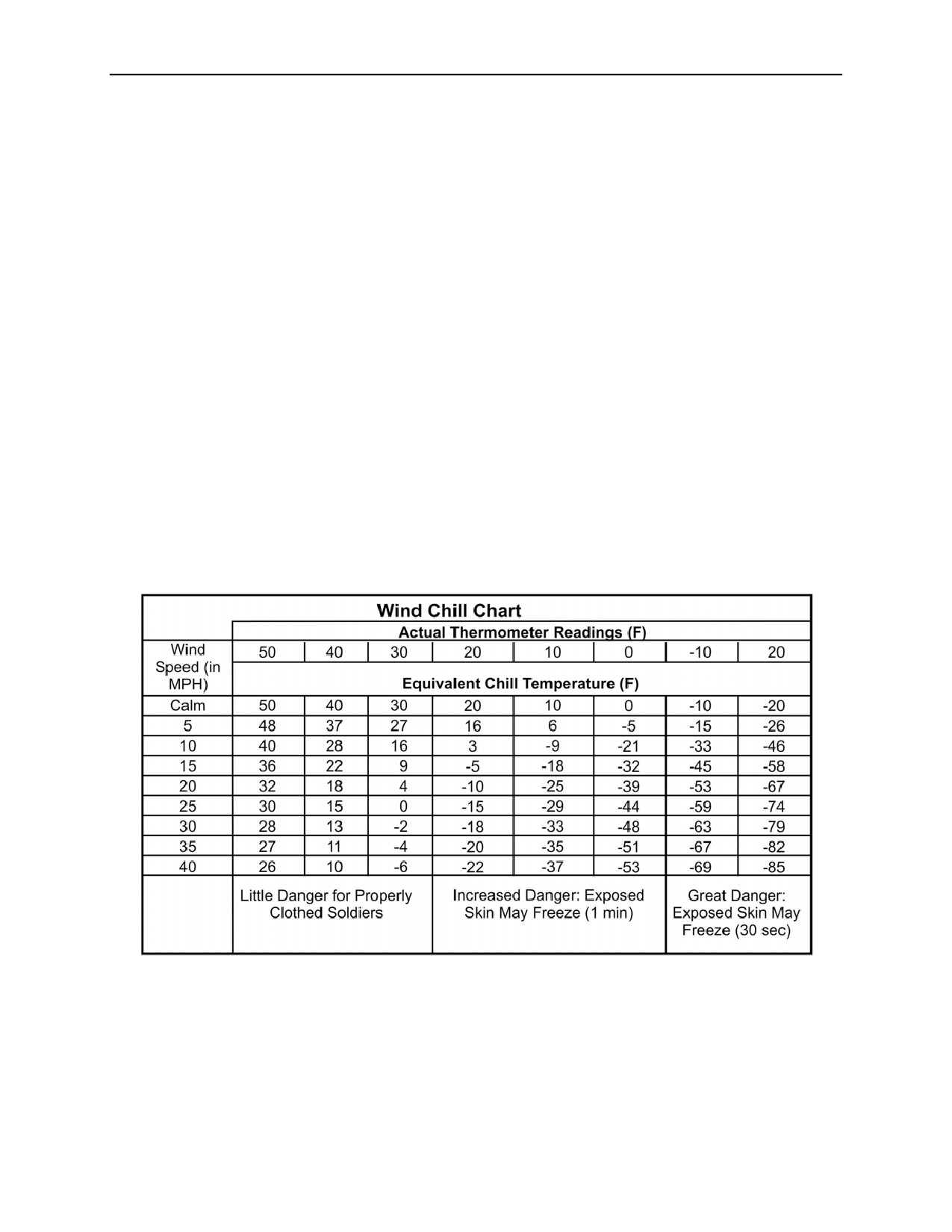
Frostbite. When skin is exposed to temperatures/wind chill of 20 degrees Fahrenheit or below there is potential for
freezing of skin tissue or frostbite (Figure D-1).
Symptoms:
A white or grayish-yellow skin area; skin that feels unusually firm or waxy; numbness in body
parts exposed to the cold such as the nose, ears, feet, hands, and skin.
Treatment:
Keeping susceptible areas covered is the easiest way to prevent frostbite from occurring
(Figure D-2). If any of the aforementioned symptoms are experienced, immediately stop physical
activity and seek treatment and/or medical attention.
Hypothermia. This condition develops when the body cannot produce heat as fast as it is losing it (Figure D-1).
When Soldiers experience prolonged exposure to cold temperatures or become wet or submerged in cool- water
temperatures, they are susceptible to hypothermia.
Symptoms:
Shivering, loss of judgment, slurred speech, drowsiness, and muscle weakness.
Treatment:
Dressing in layers and wearing breathable undergarments that wick away moisture are helpful in
preventing hypothermia. If a Soldier has the symptoms listed above, attempt to make him warmer
and request medical attention.
Figure D-1. Wind chill chart
26 October 2012
FM 7-22
D-3
Appendix D
Figure D-2. Clothing recommendations for PRT
ALTITUDE ACCLIMATIZATION
D-9. Soldiers may be deployed to theaters of operation that are at altitudes in excess of 3000 feet above sea
level. Altitude acclimatization allows Soldiers to decrease their susceptibility to altitude illness and achieve
optimal physical and cognitive performance for the altitude to which they are acclimatized. Altitude
acclimatization has no negative side effects and will not harm health or physical performance upon return to
low altitude. However, Soldiers with good aerobic endurance may acclimatize sooner and perform better than
those of low fitness levels. Refer to the following website for more detailed discussion on altitude
acclimatization.
D-4
FM 7-22
26 October 2012
Environmental Considerations
AIR POLLUTION
D-10. Avoid exercising near heavily traveled streets and highways during peak traffic hours. If possible, avoid
exposure to pollutants before and during exercise (including tobacco). In areas of high smog concentrations,
train early in the day or later in the evening.
SUNLIGHT/SUNBURN
D-11. Use a waterproof or sweat proof sun block (SPF 15 or higher) when exercising in warm weather to avoid
sunburn. Follow the instructions on the bottle for proper use.
D-12. For more information related to environmental considerations, see the following websites for more
detailed information.
U.S. Army Public Health Command
U.S. Army Research Institute of Environmental Medicine
26 October 2012
FM 7-22
D-5
This page intentionally left blank.
Appendix E
Obstacle Negotiations
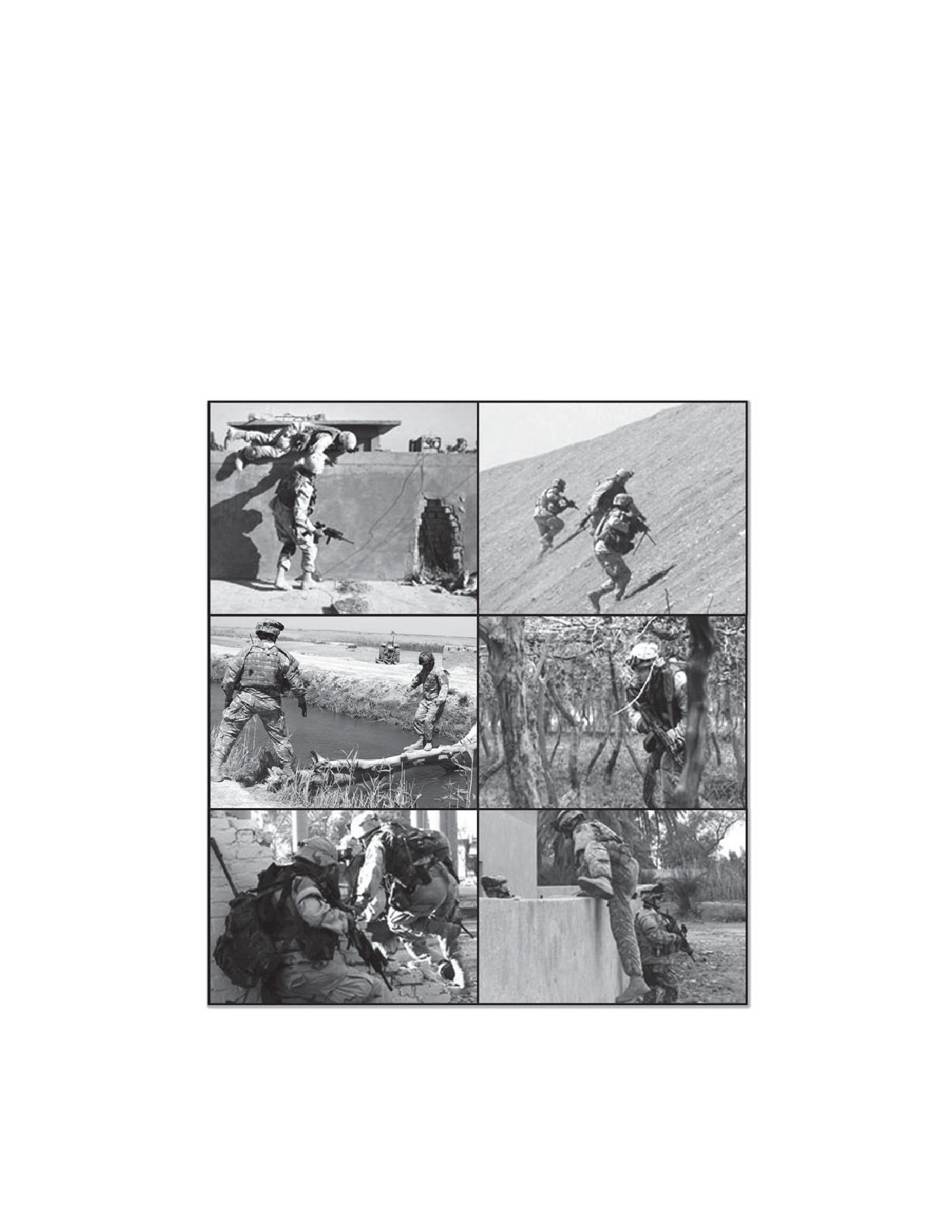
Obstacle course running develops physical capacities and fundamental skills and abilities
that are important to Soldiers in combat operations (Figure E-1). Soldiers must be able to
crawl, creep, climb, walk, run, and jump in order to accomplish certain missions. They
must be able to do all these things while carrying full field equipment for long periods of
time without exhaustion or injury, even after fatigue has set in. This chapter focuses on
obstacle negotiation and obstacle courses used in PRT.
Figure E-1. Obstacles in combat
26 October 2012
FM 7-22
E-1
Appendix E
OBSTACLE COURSES
E-1. Conditioning and CFOC confidence obstacle courses as prescribed in this chapter must comply with
installation safety requirements. Considerable time and effort must be expended to teach Soldiers how to
correctly negotiate conditioning and confidence obstacles. Soldiers are required to receive instruction for each
obstacle negotiated, have each obstacle demonstrated to standard by a PRT leader or AI, and be allowed to
practice obstacle negotiation prior to course negotiation. Soldiers will wear ACUs and boots. Conditioning
obstacle courses may be run for time. Confidence obstacle courses incorporate complex obstacles that involve
height and will not be run for time.
z
Conditioning obstacle course. The CDOC has low obstacles that must be negotiated quickly.
Running the course challenges the Soldier’s basic motor skills and physical condition. After Soldiers
receive instruction and practice negotiation skills, they may run the course against time.
z
Confidence obstacle course. The CFOC has higher and more difficult obstacles than the conditioning
course. It gives Soldiers confidence in their mental and physical abilities and cultivates their spirit
and daring. Soldiers are encouraged but not forced to negotiate each obstacle. Unlike conditioning
courses, confidence courses are not run against time.
E-2. Physical readiness training leaders will ensure that AIs are positioned at each conditioning and
confidence obstacle to ensure proper negotiation and Soldier safety. Physical readiness training leaders are
required to perform risk management procedures as specified by their installation. One of the objectives of PRT
is to develop Soldiers who are proficient in military physical skills (running, jumping, climbing, and carrying).
Fast and skillful execution of these skills may mean the difference between the success and failure of combat
missions.
RUNNING
E-3. Running is used to develop endurance. Soldiers should be exposed to running in the following situations:
z
On roads.
z
Over rough ground.
z
Up and down hills.
z
Across country.
z
Over low obstacles.
JUMPING
E-4. In vertical and long jumping, the takeoff foot is planted firmly. The spring comes from the extension of
the take-off foot leg as the other leg reaches for the high or far side of the obstacle (like a ditch). The arms are
forcibly raised forward and upward to assist in propelling the body. Landing may be on one or both feet,
depending upon the length of the jump. When jumping downward from a height, the jumper should aim his feet
at the desired landing spot and jump with the knees slightly bent, feet together, and the trunk inclined slightly
forward. As the feet strike the ground, the shock is absorbed by bending the knees into a full squatting position.
If the height is too great or the ground too hard to absorb the shock, the jumper should execute a forward or side
roll to absorb some of the shock.
DODGING
E-5. In combat situations it is often necessary to change directions quickly. To dodge while running, the lead
foot (the left foot if the direction is to the right; the right foot if the direction is to the left) is firmly planted on
the ground. The opposite foot is moved in the new direction. The knees are flexed slightly during the movement
and the center of gravity is low. The head and trunk are quickly turned in the new direction at the instant of
directional change.
CLIMBING AND SURMOUNTING
E-6. The Soldier should know how to effectively climb and surmount various types of obstacles.
E-2
FM 7-22
26 October 2012
Obstacle Negotiations
VERTICAL CLIMBING A ROPE OR POLE
E-7. Whether climbing a rope or pole, the techniques are similar. The hands grasp the rope or pole overhead
with the palms toward the face. The body is pulled upward with the arms and shoulders assisted by the feet
(which grip and assist by pushing downward). If shoulder-girdle strength and body coordination are not
adequate to permit alternating hands, the arms act together in pulling upward. For rope climbing technique,
refer to paragraph E-37.
CLIMBING OVER A WALL
E-8. When going over a wall, the body is as close to the top as possible to maintain a low silhouette. (In
combat operations, it is important to offer as small a target as possible. When preparing to go over a wall, the
rifle is slung across the back so the hands are free.) Chinning and creeping are the most common methods used
for surmounting a wall of moderate height.
CHINNING
E-9. Approach the wall at a walk or slow run. Jump upward and grasp the top of the wall and chin upward
until it is possible to change into a push-up. Place the chest on the wall and kick vigorously upward and over
with both legs. A creeping motion with the toes against the wall will help the upward progress of the chinning
and pushing up.
CREEPING
E-10. Approach the wall at either a walk or slow run. Jump upward and grasp the top of the wall. Make contact
with both knees and start a creeping motion upward. As the knees reach their limit of upward motion, place
both feet against the wall and continue with a walking-creeping motion until one leg can be thrown over the top
of the wall. Make sure a creeping walk is used.
RUN, JUMP, AND VAULT
E-11. Approach the wall at a run, jump forward and upward at it, and place one foot against it as high up as
possible. Use the foot in contact with the wall to help push the body upward while grasping the top of the wall
with the hands. Pull the body up with the arms, assisted by pressure from the foot against the wall, and swing
the legs over, propelling the body over the wall.
HOOK AND SWING
E-12. Approach the wall at a run and jump forward and upward. Hook one elbow over the wall, locking the arm
in place by pulling up until the top of the wall is underneath the armpit. Grasp the top of the wall with the other
hand. Draw the leg that is closer to the wall up toward the abdomen as far as possible. Then swing the outside
leg over the wall. The body is carried over with a rolling motion. Soldiers who are unable to draw up the leg as
described can use a variation of this leg action. While hanging with both legs fully extended, start a swinging
motion with the legs together. When the legs have enough momentum, swing the outside leg over the wall with
a vigorous kick; then follow with the body.
DROPPING
E-13. Execute all drops from the wall in the same manner. Place one hand against the far side of the wall while
the other hand grasps the top. From this position, roll over the wall and vault away from it with the legs
swinging clear. As the body passes over the wall and drops, face the wall. This keeps the rifle and other
equipment clear. Balance is maintained by retaining a grasp on the top of the wall as long as possible.
CLIMBING LADDERS AND CARGO NETS
E-14. Rope ladders, stationary vertical ladders, and cargo nets require the same general climbing technique.
Grasp the side supports firmly in the hands about shoulder height and place the feet on a rung, which will cause
26 October 2012
FM 7-22
E-3
Appendix E
the body to be extended. To move up, obtain a higher grasp and move the opposite leg up a rung. The body is
elevated as the knee straightens.
TRAVERSING HORIZONTAL OBJECTS BY HAND
E-15. Traversing horizontal objects puts stress on the arms and the shoulder-girdle area when the feet are
suspended in the air and the arms and shoulders support body weight.
TRAVERSING HORIZONTAL ROPES OR PIPES
E-16. The hands grasp the horizontal support overhead with the palms facing. To propel the body forward, one
hand is released and moved forward to secure a new grasp. At the same time, the opposite side of the body is
swung forward. The other hand is then released and moved forward as the Soldier continues to move.
TRAVERSING HORIZONTAL LADDERS
E-17. The movement is the same as used in traversing a rope or pipe. The hands, however, are placed on the
rungs palms forward. Otherwise, the technique is the same.
VAULTING
E-18. Vaulting is employed to overcome low barriers or fences. The object to be surmounted is approached at
an angle. The hand on the side next to the obstacle is placed on top of the obstacle, then with a straight-arm
movement the body weight is pushed upward. At the same time, the leg on the side next to the obstacle is
thrown upward and over the top, followed by the other leg. In landing, the weight comes down on the leading
leg first, followed by regaining the balance on both legs. The free arm serves as a balance. A direct (front)
approach can also be used, at which time both legs go over the object together.
BALANCING
E-19. Balancing the body while walking or running on a narrow object, as when crossing obstacles, is a skill
that requires practice and confidence. Balance is required in negotiating a log placed across a stream, or in
crossing any narrow beam or rail. To perform this skill, place the feet on the object to be crossed, hold the arms
to the side at shoulder level, then fix the eyes on the object approximately 5 yards in front of the feet. Walk the
object by placing first one foot and then the other in the center of the object, slowly moving forward using the
arms to aid in maintaining balance.
CRAWLING
E-20. Crawling in combat situations is a useful skill. Crawling may be in the high or low stance.
HIGH CRAWL
E-21. The Soldier moves on his hands and knees, moving one hand and the opposite knee and then continuing
to move the hands in alternation with the knees.
LOW CRAWL
E-22. The Soldier is in the prone position. Pulling with both arms and pushing with one leg, accomplish
forward movement. The other leg is dragged behind. The legs are alternated frequently to avoid fatigue.
THROWING
E-23. Throwing may be from the kneeling or standing position. The object to be thrown is held in the throwing
hand with the throwing arm is bent at the elbow. The hand is then moved to the rear until it is behind the ear.
The body is turned so that the lead foot and balance (other) arm point toward the target. The balance arm is used
to sight over and align the throwing hand with the target. When properly aligned, the elbow is move rapidly
forward until it is at a point just in front of the body where the arm is straightened and the wrist “snapped.” This
E-4
FM 7-22
26 October 2012
Obstacle Negotiations
whip motion propels the object to the target. Underhand throws get momentum by the thrower bending his
knees and swinging the throwing arm to the rear. As the knees are straightened, the arm is forcefully swung
forward from the shoulder and the object is released.
FALLING
E-24. Injuries may be avoided if Soldiers are taught to fall properly by using body momentum to their
advantage instead of resisting it. If enough momentum is present, as in falling while running or in jumping from
a height, the Soldier can extend his hands to catch his weight while ducking his head and forward rolling onto
his feet. The key to falling without injury from the standing position is relaxation and rolling the body to take
the momentum of the fall on the outside of one leg, hip, and buttock.
CONDITIONING OBSTACLE COURSES
E-25. Conditioning obstacle courses are typically not standardized because of varying topographical conditions;
however, individual obstacles within the conditioning course are standardized for both construction and
negotiation. Commanders should use ingenuity in constructing courses, making good use of streams, hills, trees,
rocks, and other natural obstacles. Since conditioning courses are run against time, they should not be made
dangerous.
E-26. Conditioning courses should be developed based on the following guidelines:
z
Courses should be horseshoe-shaped with route signs and the finish close to the start.
z
Total course distance ranges from 300 to 450 yards.
z
Courses contain 15 to 25 obstacles placed 20 to 30 yards apart.
z
Obstacles are arranged so that those that exercise the same muscle groups are separated and not
performed consecutively.
z
Obstacles must be solidly built with no sharp points or corners and landing pits filled with sawdust or
ground tires.
z
Lanes will be wide enough for 6 to 8 Soldiers to run the course at the same time and avoid
congestion.
z
Courses will be built and marked so Soldiers cannot sidestep the obstacles or detour around them.
z
To minimize the possibility of falls and injures due to fatigue, the last two or three obstacles should
not be too difficult or involve high climbing.
OBSTACLES FOR JUMPING
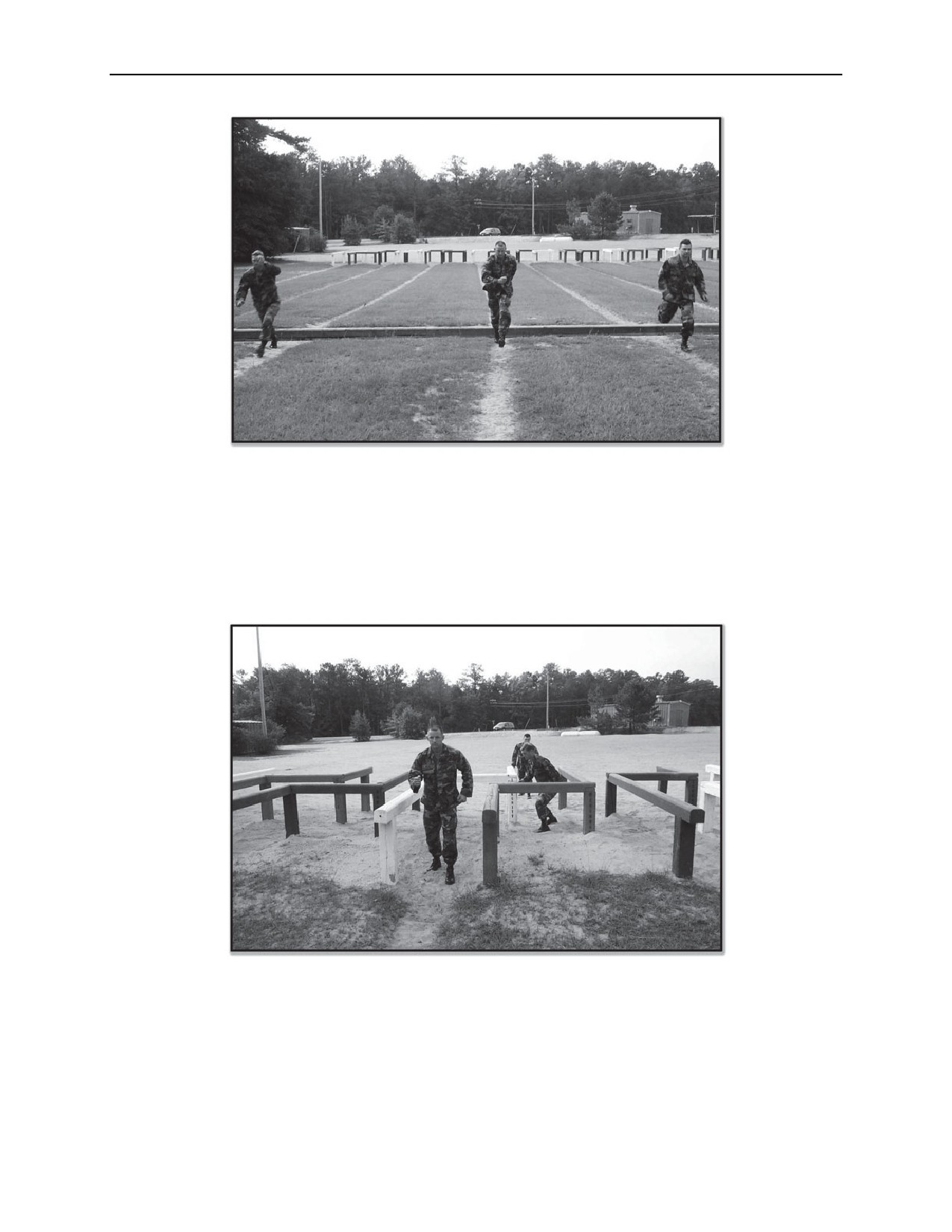
E-27. These types of obstacles include ditches Soldiers can clear with one leap, trenches they can jump in or out
of, and hurdles (Figure E-2).
26 October 2012
FM 7-22
E-5
Appendix E
Figure E-2. Jumping obstacles
OBSTACLES FOR DODGING
E-28. These obstacles include mazes or lanes for change of direction. The maze is constructed from posts set in
the ground at irregular intervals. The spaces between the posts are narrow so Soldiers must pick their way
carefully through and around them. Lane guides are built to guide Soldiers in dodging and change of direction
(Figure E-3).
Figure E-3. Dodging obstacles
OBSTACLES FOR VERTICAL CLIMBING AND SURMOUNTING
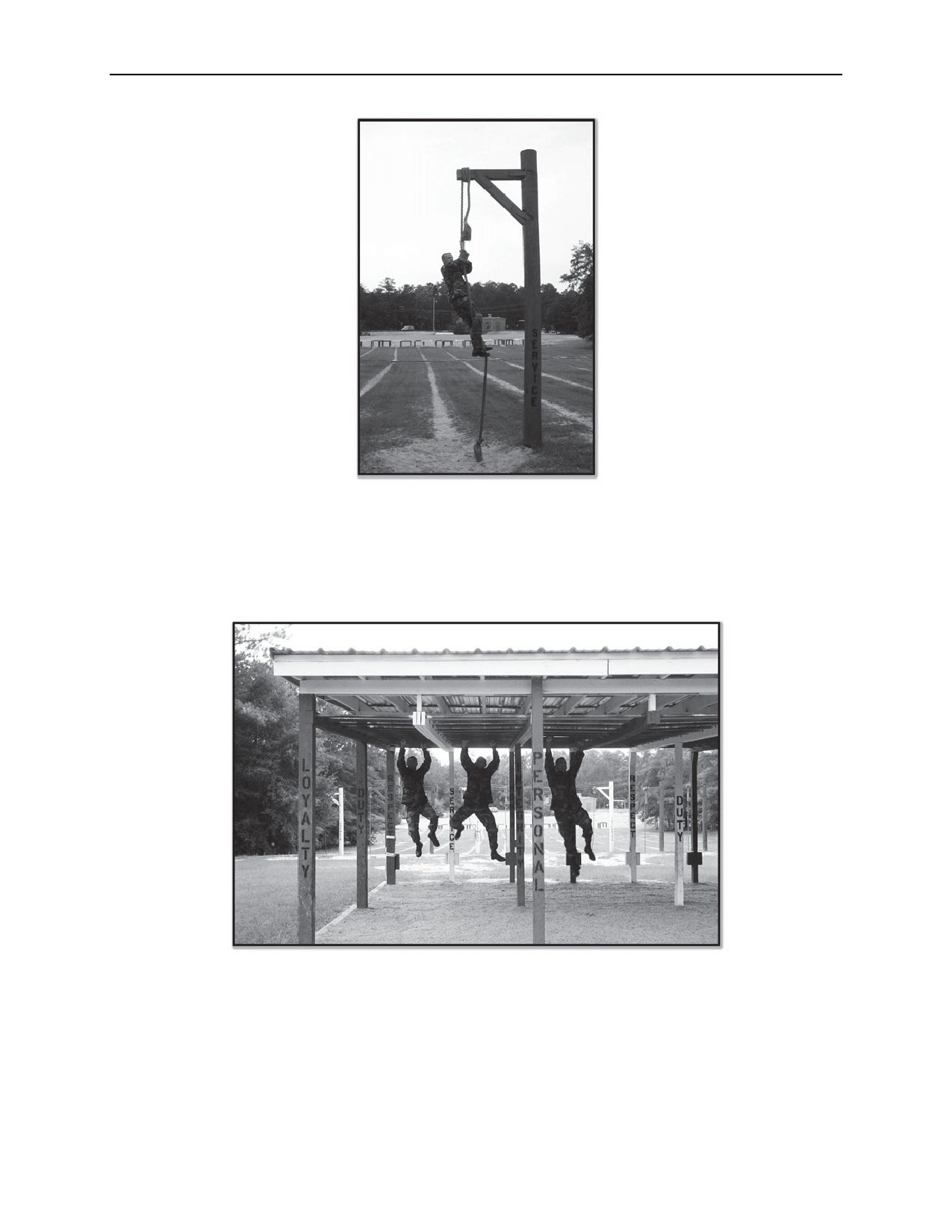
E-29. These obstacles (Figure E-4) include climbing ropes 1 ½-inches in diameter (plain or knotted), cargo nets,
walls (7 or 8 feet high) or vertical poles (6 to 8 inches in diameter and 15 feet high).
E-6
FM 7-22
26 October 2012
Obstacle Negotiations
Figure E-4. Climbing obstacles
OBSTACLES FOR HORIZONTAL TRAVERSING
E-30. These obstacles include ladders, ropes, pipes or beams positioned 8 to 10 feet off the ground. These
obstacles may be traversed using the arms only or a combination of arms and legs (Figure E-5).
Figure E-5. Horizontal traversing obstacles
OBSTACLES FOR CRAWLING
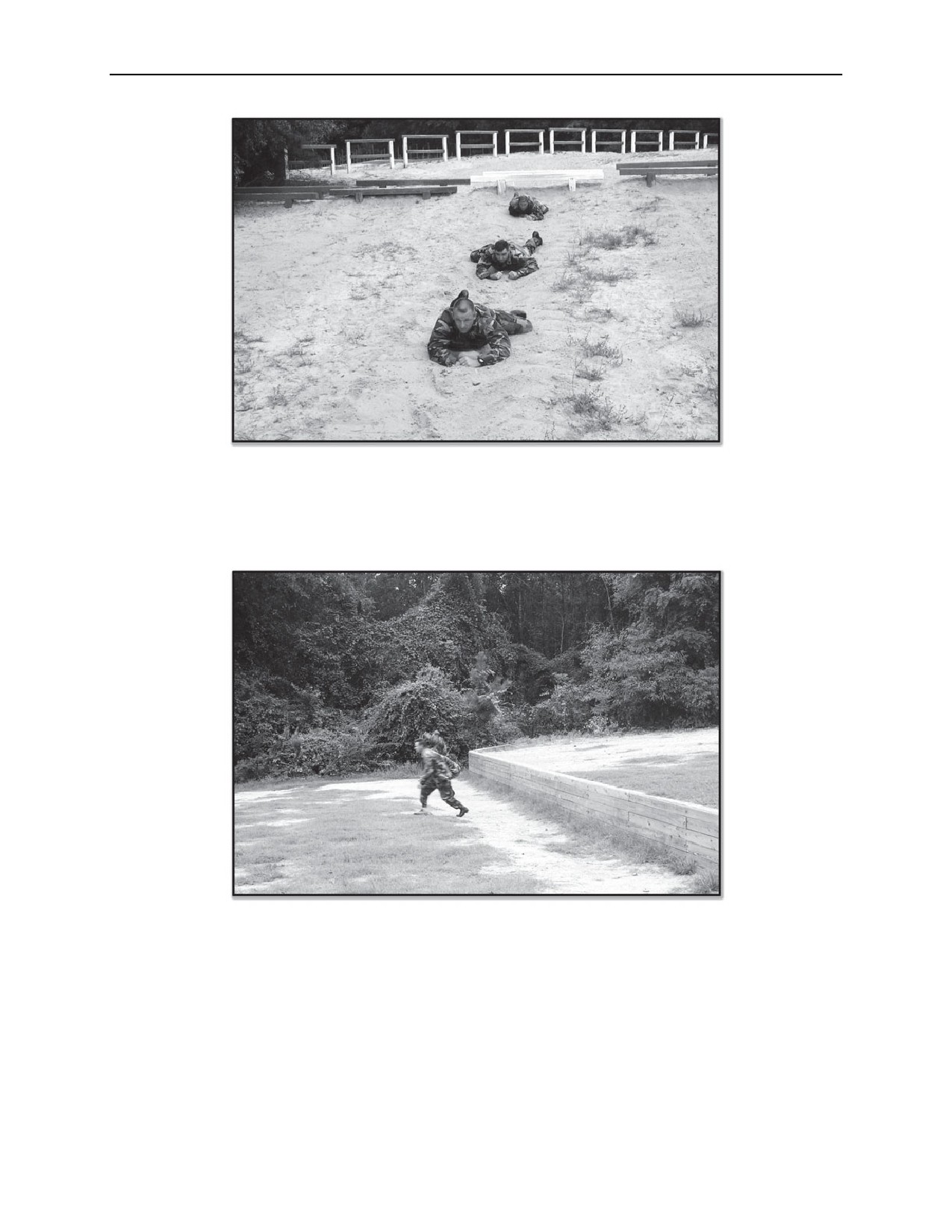
E-31. These obstacles (Figure E-6) include large pipe sections (tunnels 4 feet in diameter and 8 feet long); low
rails (8 inch diameter log, 8 feet long, and 2 feet off the ground); and wire (all wire lanes will be 10 feet wide,
30 feet long, and 2 feet off the ground).
26 October 2012
FM 7-22
E-7
Appendix E
Figure E-6. Crawling obstacles
OBSTACLES FOR VAULTING
E-32. These obstacles (Figure E-7) include fences or low walls (3 to 3 ½ feet high).
Figure E-7. Vaulting obstacles
OBSTACLES FOR BALANCING
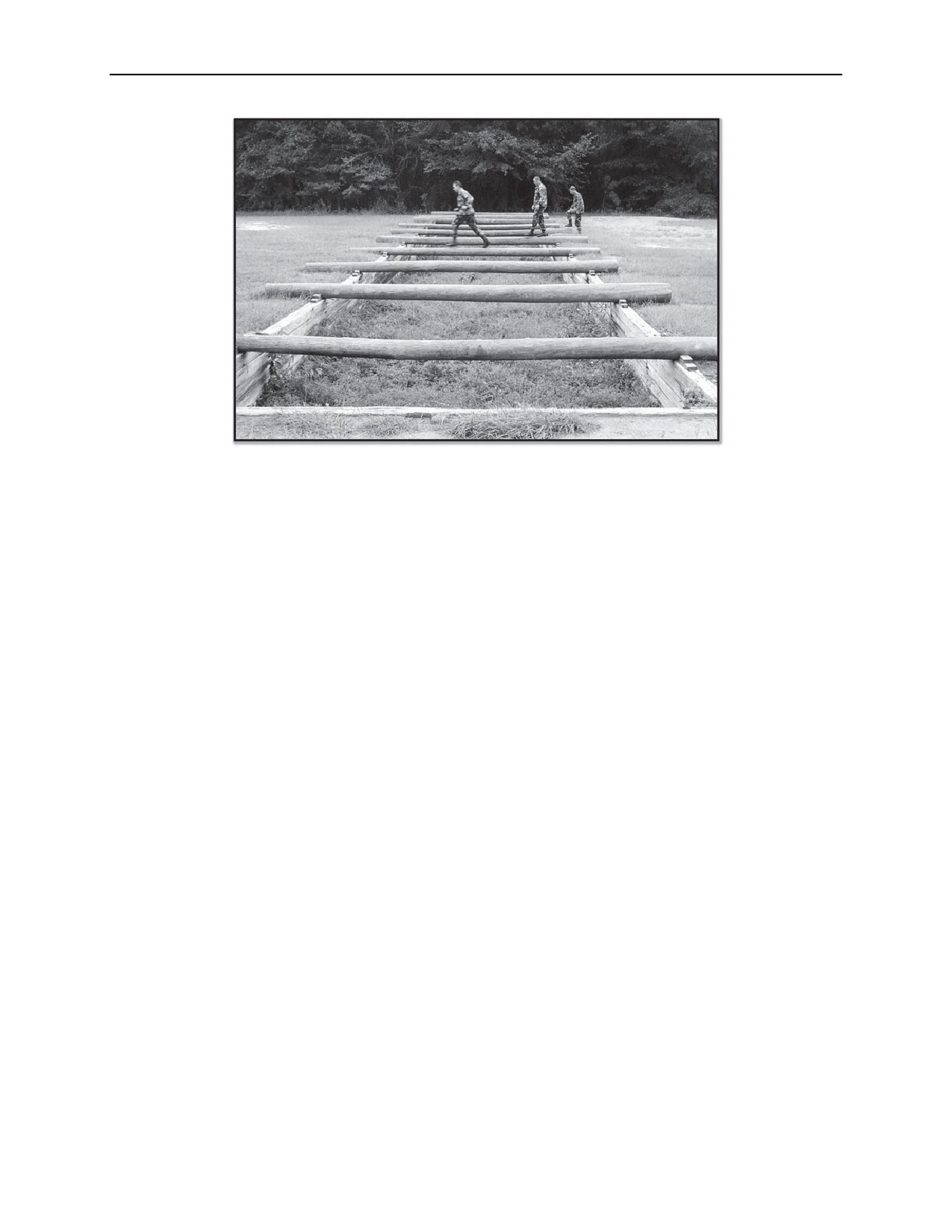
E-33. These obstacles (Figure E-8) include beams, logs, or planks that span water obstacles or dry ditches
(2 feet deep).
E-8
FM 7-22
26 October 2012
Obstacle Negotiations
Figure E-8. Balancing obstacles
NEGOTIATION STANDARDS FOR CONDITIONING COURSES
E-34. The following paragraphs describe a variety of negotiation standards for successful completion of
obstacle courses.
LANES TO GUIDE CHANGE OF DIRECTION
E-35. To successfully negotiate laned obstacles Soldiers must enter and exit the change of direction lanes while
running, using the following technique. To change direction while running, plant the lead foot (left foot if the
direction is to the right; right foot if the direction is to the left) firmly on the ground. Then, move the opposite
foot in the new direction. The knees are flexed slightly and the center of gravity is low. Turn the head and trunk
quickly in the new direction at the instant of the directional change.
DITCH
E-36. To successfully negotiate this obstacle the Soldier must jump over the ditch while running and use the
following technique. When jumping over a ditch, the takeoff foot is planted firmly and the spring comes from
the extension of this leg as the other leg reaches for the opposite side of the ditch. Raise the arms forcibly
forward and upward to assist in propelling the body. The landing may be on one or both feet, depending on the
length of the jump.
CLIMBING ROPE
E-37. The following technique is used to successfully negotiate this obstacle. To initiate the climbing action,
grasp the rope with the hands, palms toward the face. Grapevine the rope by wrapping it around the lower leg,
crossing the instep. With the opposite leg, anchor the rope by placing the bottom of the foot on the instep. Stand
up pushing down with the legs while reaching overhead grasping the rope at a higher point. Draw the knees
toward the chest while allowing the rope to slide between the knees and feet. Repeat the following sequence to
continue climbing:
z
Anchor the feet.
z
Stand up pushing down with the legs.
z
Reach overhead and re-grasp the rope.
z
Draw the knees toward the chest.
z
Re-anchor the feet on a higher point on the rope.
z
Repeat sequence until reaching the top of the rope.
26 October 2012
FM 7-22
E-9
Appendix E
LOGS
E-38. To successfully negotiate this obstacle, walk or run the log using the following technique. Place the feet
on the log, hold the arms at the sides at shoulder level, and fix the eyes on the log approximately five yards in
front of the feet. Walk or run the log by placing first one foot then the other in the center of the log, moving
forward using the arms to maintain balance.
HORIZONTAL LADDER
E-39. To successfully negotiate this obstacle, traverse the ladder using the following technique. Grasp the first
rung overhead with the palms facing forward and suspend the body. To propel the body forward, release one
hand and move forward to secure a new grasp. At the same time, swing the opposite side of the body forward.
Release the other hand and move it forward to re-grasp another rung. Continue this technique grasping each and
every rung until reaching the last rung. Suspend the body from the last rung, then drop to the ground.
ALTERNATE HIGH STEPPING
E-40. To successfully negotiate this obstacle, enter and exit the maze while running, using the following
technique. Run on the balls of the feet and raise the knees up high with each step while crossing over the
obstacles and placing each foot in adjacent grid squares.
HORIZONTAL ROPE
E-41. To successfully negotiate this obstacle, traverse the rope using the following technique. Reach up and
grasp the rope with both hands and swing the legs up to assume the position used when climbing a vertical rope.
Leading with the head, traverse the rope horizontally by pulling with the arms. The feet and legs are used to
secure the position on the rope and may also be used to assist in the movement as in the vertical rope climb. To
complete negotiation of this obstacle, one hand must touch the post securing the end anchor point.
WIRE
E-42. To successfully negotiate this obstacle, enter and exit using the low crawl technique. Start in the prone
position. To move forward, pull with both arms and push with one leg. The other leg is dragged behind. The
legs are alternated frequently to avoid fatigue. Continue this technique until the body has cleared the low wire.
CARGO NET
E-43. To successfully negotiate this obstacle, approach the net while running. Leap to grasp the rope rungs
overhead and step up on the lower rope rungs. The Soldier may use either of the following methods to climb the
cargo net: The first technique performs alternating arm and leg movements (reach up with the right arm to grasp
a higher rung while simultaneously stepping up with the left leg). The second technique would be to grasp and
step with the same side arm and leg, ascending the rope in a crawling fashion. Continue this technique to the top
of the net, then propel the body over the platform and descend the net on the other side using a similar
technique.
FENCE
E-44. To successfully negotiate this obstacle, use the vaulting technique. Approach the fence at an angle with
the hand on the side, next to the fence, placed on top of the fence. With a straight-arm movement, the Soldier
pushes his body weight upward. At the same time, his leg on the side next to the fence is thrown upward and
over the top, followed by his other leg. When landing, his weight comes down on his landing leg first, followed
by regaining his balance on both legs. His free arm serves to balance him. A direct front approach can also be
used, at which time both legs go over the fence together.
TRENCH
E-45. To successfully negotiate this obstacle, use the following technique. Jump downward into the trench,
aiming the feet at the desired landing spot with the knees slightly bent, feet slightly apart, and trunk inclined
E-10
FM 7-22
26 October 2012
Obstacle Negotiations
slightly forward. As the feet strike the ground, the Soldier absorbs the shock by bending his knees to a squatting
position. If the height is too great or the ground too hard to absorb the shock, he should land with his feet
together and execute a forward or side roll to absorb some of the shock. To exit the trench, he uses one of the
following techniques: Approach the trench wall at a run, jump forward and upward at it, and place one foot
against the trench wall as high as possible. He uses the foot that is in contact with the wall to help push his body
upward while grasping the top of the trench with his hands. He pulls his body up with his arms, assisted by the
pressure of his foot against the wall and swings his legs over to propel himself out of the trench. Using the
second technique, the Soldier approaches the trench wall at a run and jumps forward and upward. He hooks one
elbow over the top of the trench, locking his arm in place by pulling up until the top of the trench is under his
armpit. He grasps the top of the trench with his other hand. He draws his leg that is closest to the trench wall up
toward his abdomen as far as possible, then swings his outside legs over the top of the trench. His body is then
carried over with a rolling motion. Soldiers who are unable to draw up the leg as described can use a variation
of this leg action. While hanging with both legs fully extended, he starts a swinging motion with his legs
together. When his legs have enough momentum, he swings his outside leg over the trench wall with a vigorous
kick, then follows with his body to exit the trench.
LOW RAILS
E-46. To successfully negotiate this obstacle, use the low crawl technique to move under the low rails.
PLANKS AND BEAMS
E-47. To successfully negotiate this obstacle, use the same technique listed to traverse the logs.
WALL
E-48. To successfully negotiate this obstacle, use either of the following techniques to surmount the wall. Run,
jump, and vault. When using this method, the Soldier approaches the wall at a run, jumps forward and upward
at it, and places one foot against the wall as high as possible. He uses his foot in contact with the wall to help
push his body upward while grasping the top of the wall with his hands. He pulls his body up with his arms,
assisted by the pressure of his foot against the wall, and swings his legs over to propel himself over the wall.
The second technique is the hook and swing. The Soldier approaches the wall at a run and jumps forward and
upward. He hooks one elbow over the wall, locks his arm in place by pulling up until the top of the wall is
under his armpit. He grasps the top of the wall with his other hand. He draws his leg that is closest to the wall
up toward his abdomen as far as possible, then swings the outside leg over the wall. The body is then carried
over with a rolling motion. A variation of this leg action can be used by Soldiers who are unable to draw up the
leg as described. While hanging with both legs fully extended, he starts a swinging motion with his legs
together. When his legs have enough momentum, he swings the outside leg over the wall with a vigorous kick,
then follows with his body. To drop from the wall to the ground, he places one hand against the far side of the
wall while his other hand grasps the top. From this position, he rolls over the wall and vaults away from it with
his legs swinging clear. As his body passes over the wall and drops, he faces the wall. He maintains his balance
by retaining his grasp on the top of the wall as long as possible and then dropping to his feet.
LOW WALL
E-49. To successfully negotiate this obstacle, use the vaulting technique. The Soldier must approach the fence
at an angle, his hand on the side next to the fence is placed on top of the fence, then with a straight-arm
movement, he pushes his body weight upward. At the same time, his leg on the side next to the fence is thrown
upward and over the top, followed by his other leg. In landing, his weight comes down on his landing leg first,
followed by regaining his balance on both legs. His free arm also serves as a balance. A direct front approach
can also be used, at which time both legs go over the fence together.
HURDLE
E-50. To successfully negotiate this obstacle, leap over the hurdle one leg at a time or step on the hurdle with
one leg and leap down from the hurdle with the other or both legs to the ground.
26 October 2012
FM 7-22
E-11
Appendix E
PLATFORM
E-51. To successfully negotiate this obstacle, the Soldier surmounts the platform by using the support beams to
step up and pull himself to the top. When jumping down from the platform to the ground, perform the same
technique used for jumping downward from a height, as in negotiating a trench.
TUNNEL
E-52. To successfully negotiate this obstacle, two crawling methods may be used; the high crawl and low crawl.
The Soldier performs the high crawl technique on his hands and knees. He propels himself forward by moving
one hand forward while simultaneously moving his opposite knee forward. He continues moving on his hands
and knees in an alternating fashion. The low crawl technique starts in the prone position. To move forward, he
pulls with both arms and pushes with one leg. His other leg is dragged behind. Both legs are alternated
frequently to avoid fatigue. The Soldier continues this technique until he exits the tunnel.
CONDUCTING THE CONDITIONING OBSTACLE COURSE
E-53. Before Soldiers run the CDOC in its entirety, they should be taken to each obstacle and instructed in the
proper negotiation techniques previously mentioned. In each case the techniques should be explained in detail
with emphasis on avoidance of injury. All Soldiers should be given the opportunity to practice on each obstacle
until they become proficient at negotiation. Before the course is run against time, several practice runs should
be run at a slower pace. During such practice runs, PRT leaders and AIs observe their performance and make
appropriate corrections. Soldiers should never be permitted to run CDOCs for time until they have mastered all
obstacles thoroughly. The best method of timing Soldiers on the obstacle course is to have the timer stand at the
finish line and call out minutes and seconds as each Soldier crosses the finish line. If Soldiers fail to negotiate
an obstacle, a predetermined penalty (5 to 10 seconds) should be assessed.
CONFIDENCE OBSTACLE COURSES
E-54. Confidence obstacle courses challenge Soldiers’ strength, endurance, and mobility while instilling self-
confidence and promoting teamwork. Soldiers do not negotiate these obstacles at high speed or against time.
Obstacles vary in difficulty. Some stand very high. Safety nets and crash pads are provided for these high
obstacles. Soldiers may skip any obstacle they are unwilling to attempt. PRT leaders and AIs should encourage,
but not force Soldiers to attempt every obstacle. Fearful Soldiers should be encouraged to negotiate the easier
obstacles before attempting the higher more difficult ones. Some of the higher, more difficult obstacles may be
negotiated as a group effort, with stronger Soldiers assisting those unable to negotiate the obstacles by
themselves. Gradually, as their confidence and negotiation skills improve, the weaker Soldiers will be able to
successfully negotiate all obstacles individually. PRT leaders and AIs should be available to assist Soldiers in
proper obstacle negotiation throughout the course. At no time are PRT leaders or AIs to make obstacles more
difficult by shaking ropes, rolling logs, and so forth. This practice destroys confidence and greatly jeopardizes
safety. Confidence obstacle courses must be constructed according to Folio Number 1, “Training Facilities,”
Corps of Engineers, Drawing number 28-13-95. Contact the installation Directorate of Public Works for
blueprints. The Army’s standardized CFOC consists of 22 obstacles that are grouped into color-coded quadrants
with five or six obstacles in each. Negotiation becomes more difficult beginning with the black quadrant
followed by the blue quadrant, white quadrant, and red quadrant. All Soldiers begin CFOC negotiation in the
black quadrant. Soldiers progress to the more difficult quadrants (blue, white, and red) when they become
proficient and successfully negotiate obstacles in previous quadrants.
BLACK QUADRANT
E-55. The black quadrant consists of the following obstacles.
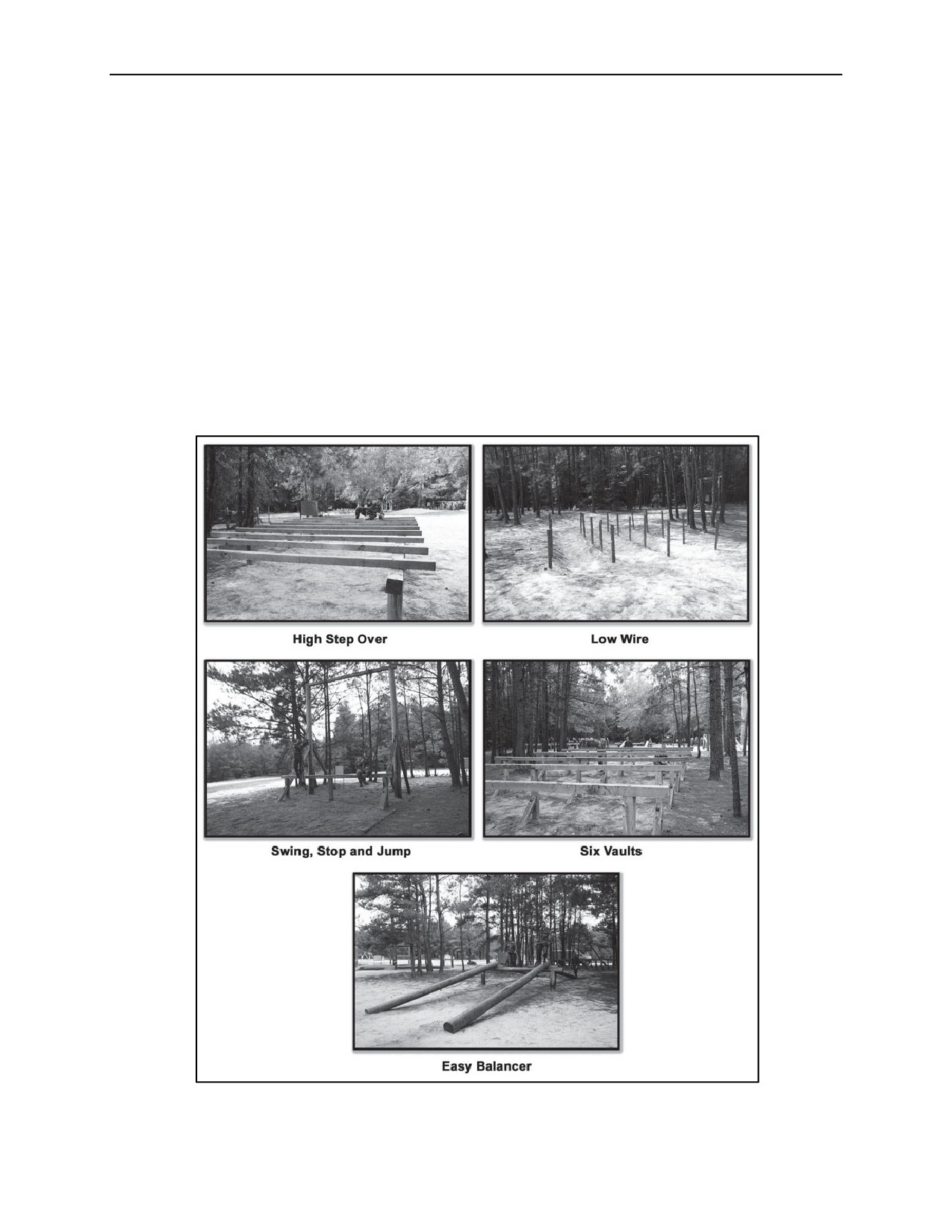
HIGH STEP OVER
E-56. Soldiers step over each bar: they either alternate legs or use the same leg each time while making an
effort not to use their hands. (Shorter Soldiers may be required to use hands). Soldiers must be spaced so as to
prevent kicking each other.
E-12
FM 7-22
26 October 2012
Obstacle Negotiations
LOW WIRE
E-57. Soldiers move forward on their backs while at the same time raising the wire with their hands so their
bodies will clear the wire. They continuing moving forward in this manner until they reach end of the obstacle.
SWING, STOP, AND JUMP
E-58. Soldiers gain momentum with a short run, grasp the rope, and swing their bodies forward to the top of the
wall. They release the rope while standing on the wall and jump to the ground.
SIX VAULTS
E-59. Soldiers vault over each log using one or both hands.
EASY BALANCER
E-60. Soldiers walk up one incline log and down the one on the other side to the ground. Running is not
encouraged (Figure E-9).
Figure E-9. Black quadrant CFOC
26 October 2012
FM 7-22
E-13
Appendix E
BLUE QUADRANT
E-61. The blue quadrant consists of the following obstacles.
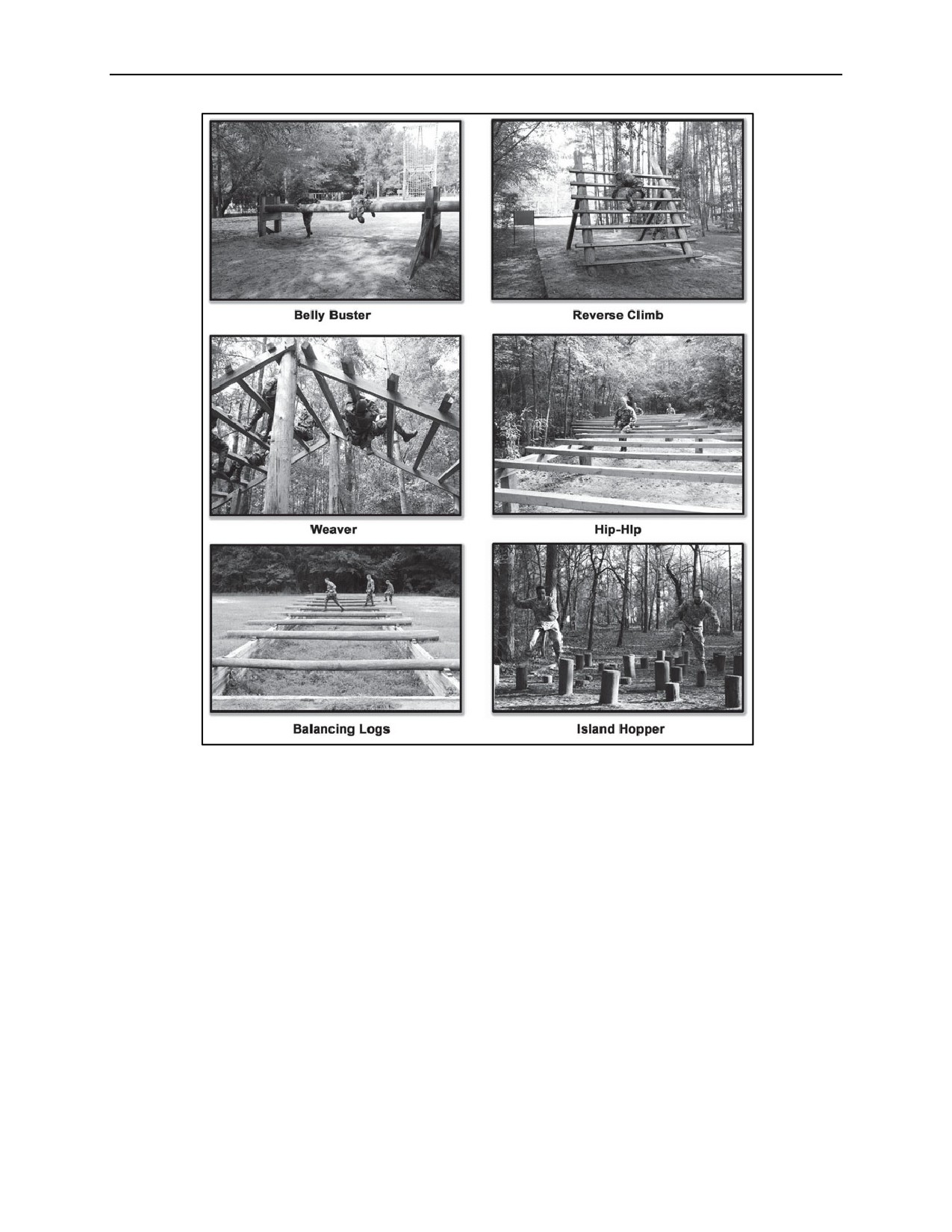
BELLY BUSTER
E-62. Soldiers vault, jump, or climb over a moving log.
REVERSE CLIMB
E-63. Soldiers approach the underside of the climbing ladder, climb up to and over the top of the ladder, then
climb down the opposite side.
WEAVER
E-64. Soldiers move from one end of the obstacle to the other by weaving their bodies under one bar and over
the next.
HIP-HIP
E-65. Soldiers step over each bar by either alternating legs or using the same leg each time while making an
effort not to use their hands.
BALANCING LOGS
E-66. Soldiers walk or run along logs while maintaining their balance.
ISLAND HOPPERS
E-67. Soldiers jump from one log to another until obstacle is negotiated from near to far side (Figure E-10).
E-14
FM 7-22
26 October 2012
Obstacle Negotiations
Figure E-10. Blue quadrant CFOC
26 October 2012
FM 7-22
E-15
Appendix E
WHITE QUADRANT
E-68. The white quadrant consists of the following obstacles.
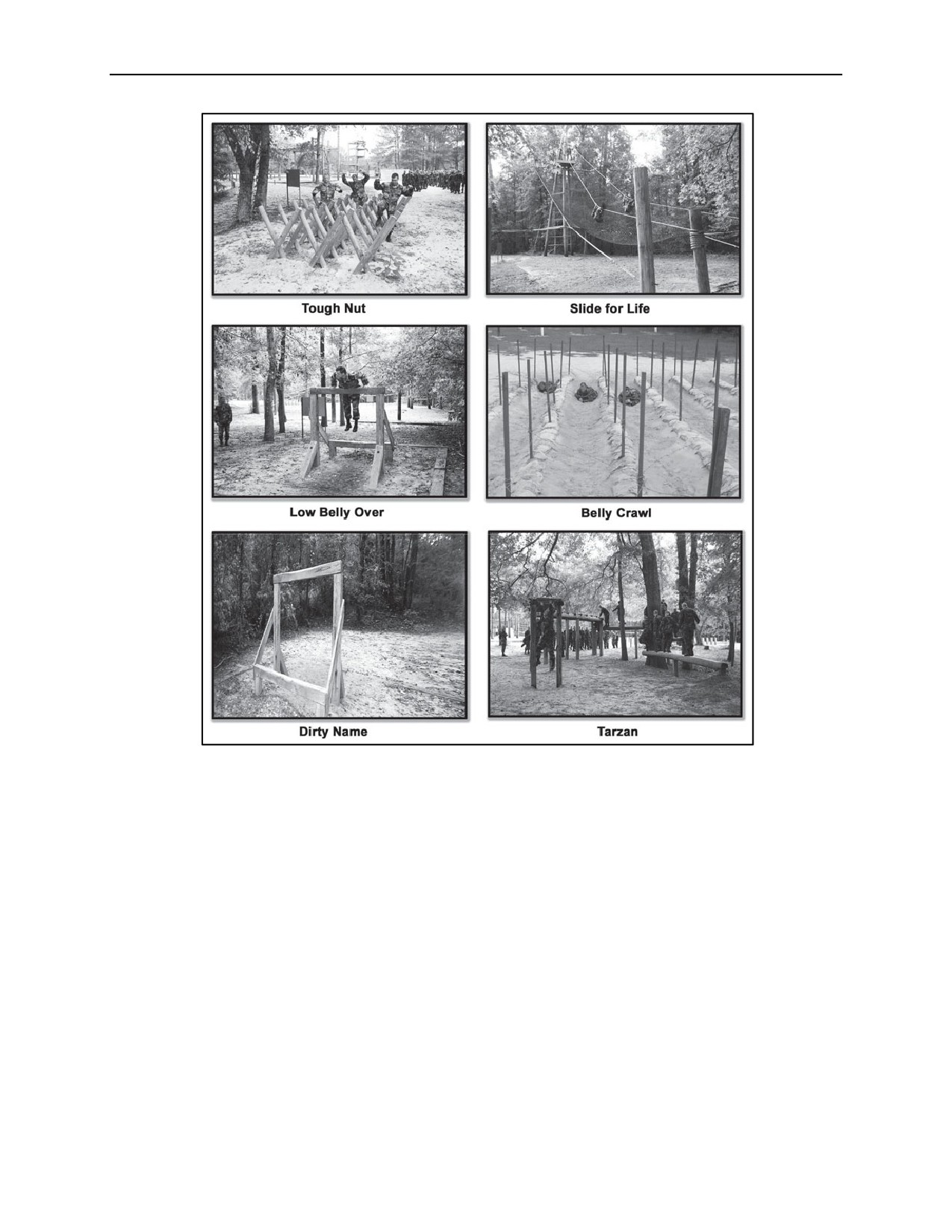
TOUGH NUT
E-69. Soldiers step over each “X” in each lane.
SLIDE FOR LIFE
E-70. Soldiers climb the tower, mount the center of the platform, grasp the rope firmly with their hands, and
perform a heel hook. Soldiers begin traversing down the rope by moving hand-over-hand and reaching with the
legs. Soldiers brake by use of the hands, legs, and feet. Soldiers traverse the rope to a marked release point.
Soldiers dismount the rope by removing their legs from the rope, hanging with their arms fully extended, then
drop to the ground landing on their feet. If during negotiation a Soldier’s legs come off the rope, he should
attempt to heel hook and lock his legs back on the rope. Soldiers must be instructed on proper technique for
landing in the net if they should fall from the obstacle. Soldiers need to draw their knees toward their chest, tuck
their chin, then attempt to land on their back or side. Only one Soldier is allowed on the rope at one time. This
obstacle is dangerous if the rope is wet. This obstacle requires one instructor on the platform and one instructor
at the release point. A safety net will extend from below the platform to the release point.
LOW BELLY OVER
E-71. Soldiers mount the low log and jump onto the high log, grasping with both hands the high log’s top,
keeping the belly area in contact with it. Soldiers swing their legs over the log, then lower themselves to the
ground.
BELLY CRAWL
E-72. Soldiers move forward under the wire on their stomachs to the end of the wire obstacle.
DIRTY NAME
E-73. Soldiers mount the low log and jump onto the high log. Soldiers swing their legs over the top log, then
lower themselves to the ground.
TARZAN
E-74. Soldiers mount the lowest log and maintain balance while walking the length of it. Soldiers then mount
the higher log and maintain balance until they reach the horizontal ladder. Soldiers then step onto the foot
blocks and grasp the first rung of the ladder. They begin traversing the ladder by releasing one hand at a time
and swinging forward, grasping a more distant rung each time. Upon reaching the last rung, Soldiers hang with
their arms fully extended and drop to the ground landing on their feet (Figure E-11).
E-16
FM 7-22
26 October 2012
Obstacle Negotiations
Figure E-11. White quadrant CFOC
RED QUADRANT
E-75. The red quadrant consists of the following obstacles.
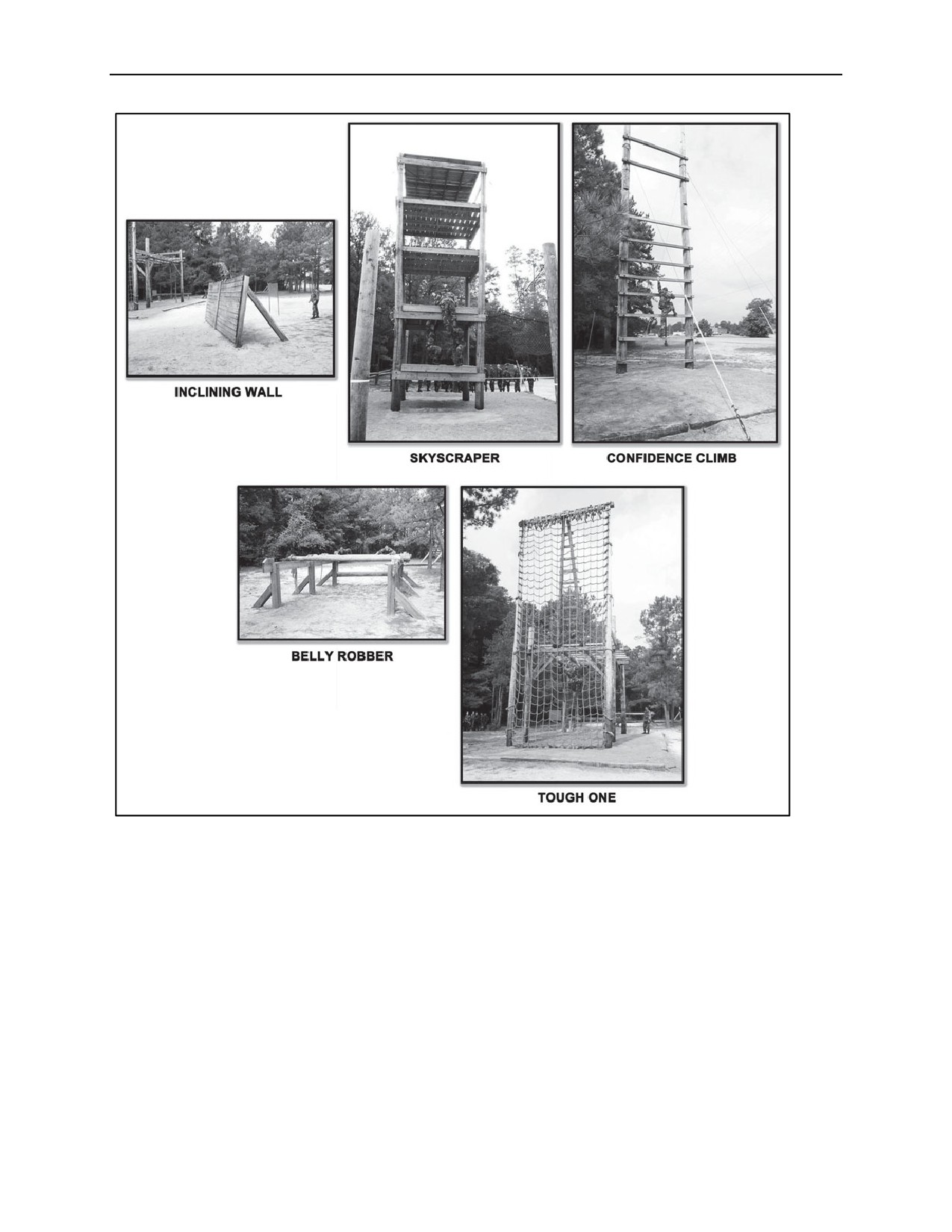
INCLINING WALL
E-76. Soldiers approach the underside of the wall, jump up and grasp the top, and pull themselves over the top.
Soldiers slide or jump down the incline to the ground.
SKYSCRAPER
E-77. A team of Soldiers (4+) jumps or climbs to the first floor and either climb the corner posts or help one
another to higher floors. All climbing from the second to the fourth floor is accomplished only on sides
containing safety nets. Crash pads are positioned on the non-climbing sides of the obstacle. The top of the
obstacle is off limits and will not be negotiated. Only one team should be on the obstacle at a given time.
Soldiers descend from floor to floor individually or as a team. They should not jump to the ground from above
the first floor and must be instructed on proper technique for landing in the net if they should fall from the
obstacle. Soldiers need to draw their knees towards their chest, tuck their chin, and attempt to land on their back
or side.
26 October 2012
FM 7-22
E-17
Appendix E
CONFIDENCE CLIMB
E-78. Soldiers climb the vertical ladder to the second rung from the top, climb over the rung, and descend the
other side. Only one Soldier is allowed on the obstacle at a time. An instructor is harnessed in at the top of the
obstacle to assist Soldiers with obstacle negotiation. Soldiers must be instructed on proper technique for landing
on the crash pad if they should fall from the obstacle. They must draw their knees toward their chest, tuck their
chin, and attempt to land on their back or side. Pads will be placed at the base of the obstacle on both climbing
sides.
BELLY ROBBER
E-79. Soldiers step on the lower log and assume a prone position on the horizontal logs. They crawl over the
logs to the opposite end of the obstacle. Rope gaskets must be attached to the ends of the logs to keep the hands
from being pinched and to ensure logs cannot fall from the perpendicular cradle.
TOUGH ONE
E-80. Soldiers climb the cargo net up and over at the low end of the obstacle (13 feet). They move across the
top of the logs, climb the ladder, and go over the log at the high end (33 feet). An instructor is harnessed in at
the high end of the obstacle to assist climbers with obstacle negotiation. Soldiers then climb down the cargo net
to the ground. The net will extend from below the log walk. Crash pads are positioned at the base of each cargo
net. Soldiers must be instructed on proper technique for landing in the net if they should fall from the obstacle.
They must draw their knees towards their chest, tuck their chin, and attempt to land on their back or side
(Figure E-12).
E-18
FM 7-22
26 October 2012
Obstacle Negotiations
Figure E-12. Red quadrant CFOC
CONFIDENCE OBSTACLE COURSE CONSTRUCTION AND SAFETY
E-81. The following paragraphs discuss course sketches that describe in detail CFOC construction and safety
requirements.
COURSE SKETCHES
E-82. The following course sketches supplement the Department of the Army Engineer Drawings 28-13-95,
Confidence Course Layout Plan. They serve as the minimum construction/safety standards for CFOCs.
E-83. Criteria for safety and structural inspections are specified in the obstacle risk assessment and according to
the material manufacturer’s directions. Re-inspection must include a review of the risk assessment, an analysis
and assessment of accidents/injuries sustained since the obstacle was put into (or back into) service, following
repairs, major renovations, or modifications.
26 October 2012
FM 7-22
E-19
Appendix E
E-84. CFOC safety precautions include:
z
Inspection of structural integrity and safety devices prior to use.
z
Current risk assessment updated prior to each day’s training and updated as conditions change.
z
Instructor training and certification on operation of obstacles prior to conduct of course.
z
Preparation exercises before commencing course and recovery exercises upon completion.
z
Muscular strength/muscle failure physical training that should not be conducted within 12 hours prior
to the CFOC.
z
Landing/fall areas under obstacles raked and refilled as needed before each use.
z
Puddles of water under obstacles filled to preclude a false sense of security.
z
Training that is postponed/modified when obstacles are slippery due to inclement weather.
z
Instructors who instruct and demonstrate obstacle negotiation before allowing Soldiers to negotiate
the CFOC.
z
A sign posted at each obstacle detailing exact procedures to be used for proper negotiation.
z
A maintenance and inspection log that is maintained for each CFOC. The log should include:
A detailed checklist for course and obstacle inspection.
A record of all course inspections and maintenance deficiencies.
A list of any uncorrected deficiencies remaining on the course and countermeasures in place.
E-85. Detailed obstacle illustrations are provided for:
z
Tough One.
z
Slide for Life.
z
Confidence Climb.
z
Skyscraper.
z
Belly Robber.
z
Tarzan.
z
Low Belly Over.
z
Dirty Name.
z
Tough Nut.
z
Belly Crawl.
z
Inclining Wall.
z
High Step Over.
z
Swing, Stop, and Jump.
z
Six Vaults.
z
Easy Balancer.
z
Belly Buster.
z
Low Wire.
z
Hip-Hip.
z
Reverse Climb.
z
Weaver.
z
Balancing Logs.
z
Island Hopper.
E-86. Safety equipment (nets, pads, ground covering) must be procured from reliable sources, inspected and
tested frequently, and replaced before failure/deterioration. Figures E-13 through E-34 display differing obstacle
constructions in use today.
E-20
FM 7-22
26 October 2012