FM 7-22 ARMY PHYSICAL READINESS TRAINING (OCTOBER 2012) - page 8
Strength and Mobility Activities
9-49. In the sustaining phase, Soldiers perform CL 2 while under load. Soldiers increase resistance by wearing
LBE/LBV, ACH, body armor (IOTV), and individual weapons. Spotters provide assistance until Soldiers can
complete all five exercises without help.
INTEGRATION
9-50. The primary emphasis of the CLs is functional strength development. The use of equipment in CL 2
develops the Soldiers’ ability to manipulate their body weights under load. The various exercises also involve
movements that require mobility. Climbing drills, when combined with CDs, the push-up sit-up drill, the GD,
and the strength training circuit comprise a well-balanced program of total body functional strength
development.
COMMANDS
9-51. Climbing drills 1 and 2 each consist of five 2-count exercises.
HAND POSITIONS
9-52. Throughout the drills, a variety of hand positions are used to thoroughly train the musculature of the
arms, forearms, and hands. Hands are placed shoulder-width apart with thumbs around the bar for the overhand
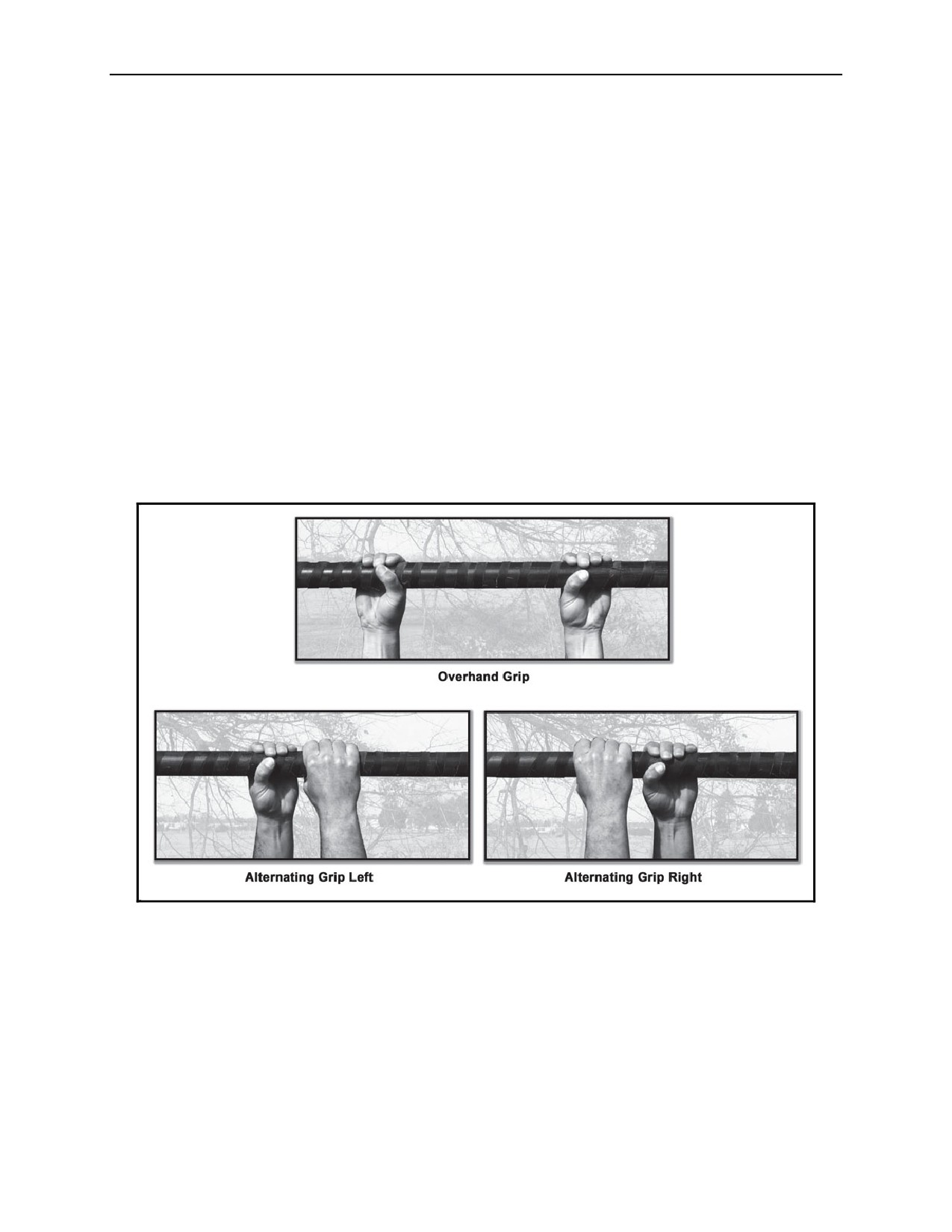
grip. Hands are placed next to each other with thumbs around the bar for the alternating grips (Figure 9-23).
Figure 9-23. Hand positions
CLIMBING DRILL 1
9-53. Climbing drill 1 (CL 1) improves upper body and core strength and the ability to climb and negotiate
obstacles. Climbing drill 1 is always performed in its entirety in the order listed. Soldiers perform 5 to 10
repetitions of each exercise in CL 1 with or without assistance, using only their body weight as resistance. The
goal is to perform 5 to 10 repetitions of all five exercises unassisted. If a second set is performed, the entire drill
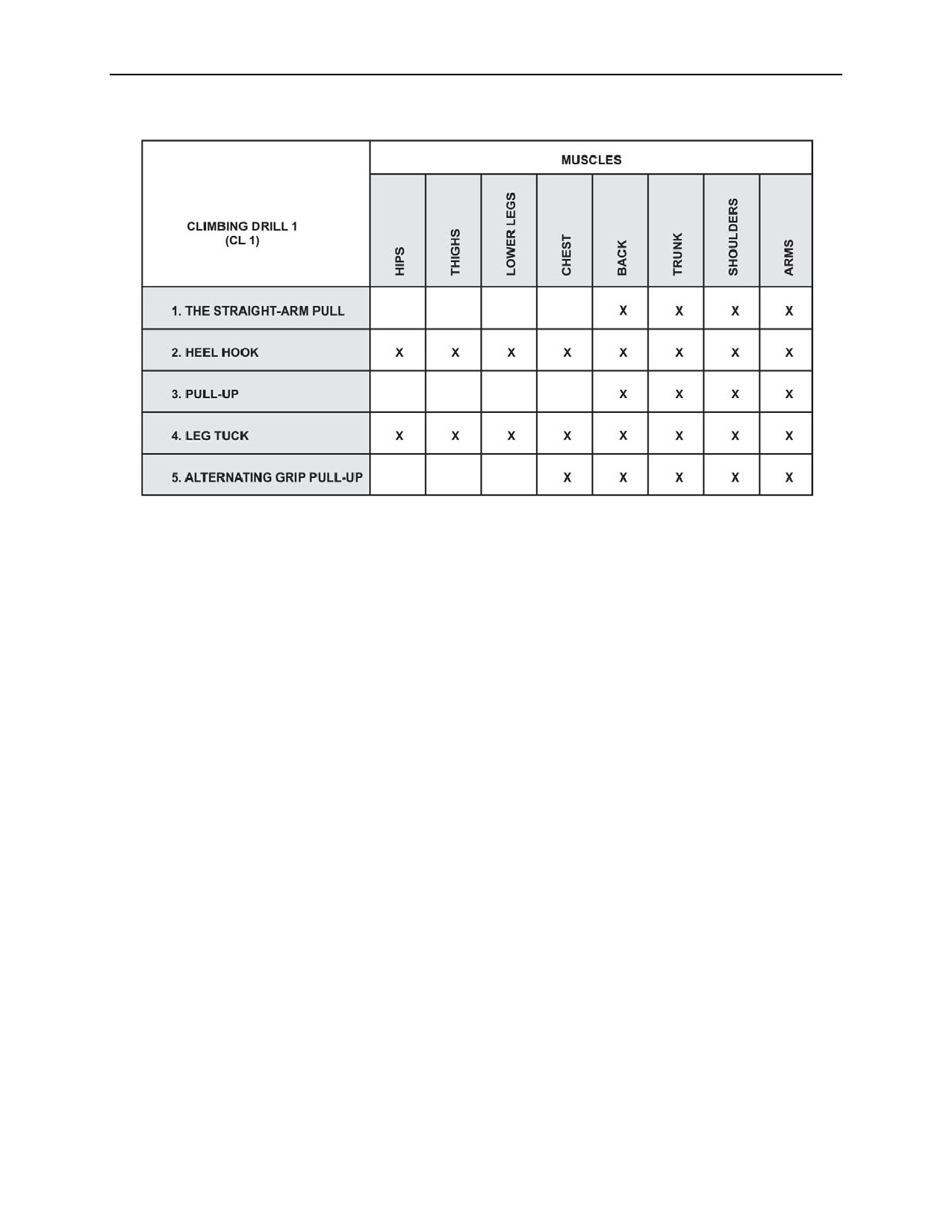
is repeated in the order listed. Table 9-7 lists the body segments trained in CL1.
26 October 2012
FM 7-22
9-41
Chapter 9
Table 9-7. Body segments trained in the conduct of CL1
9-42
FM 7-22
26 October 2012
Strength and Mobility Activities
CLIMBING DRILL 1
EXERCUSE 1: STRAIGHT-ARM PULL
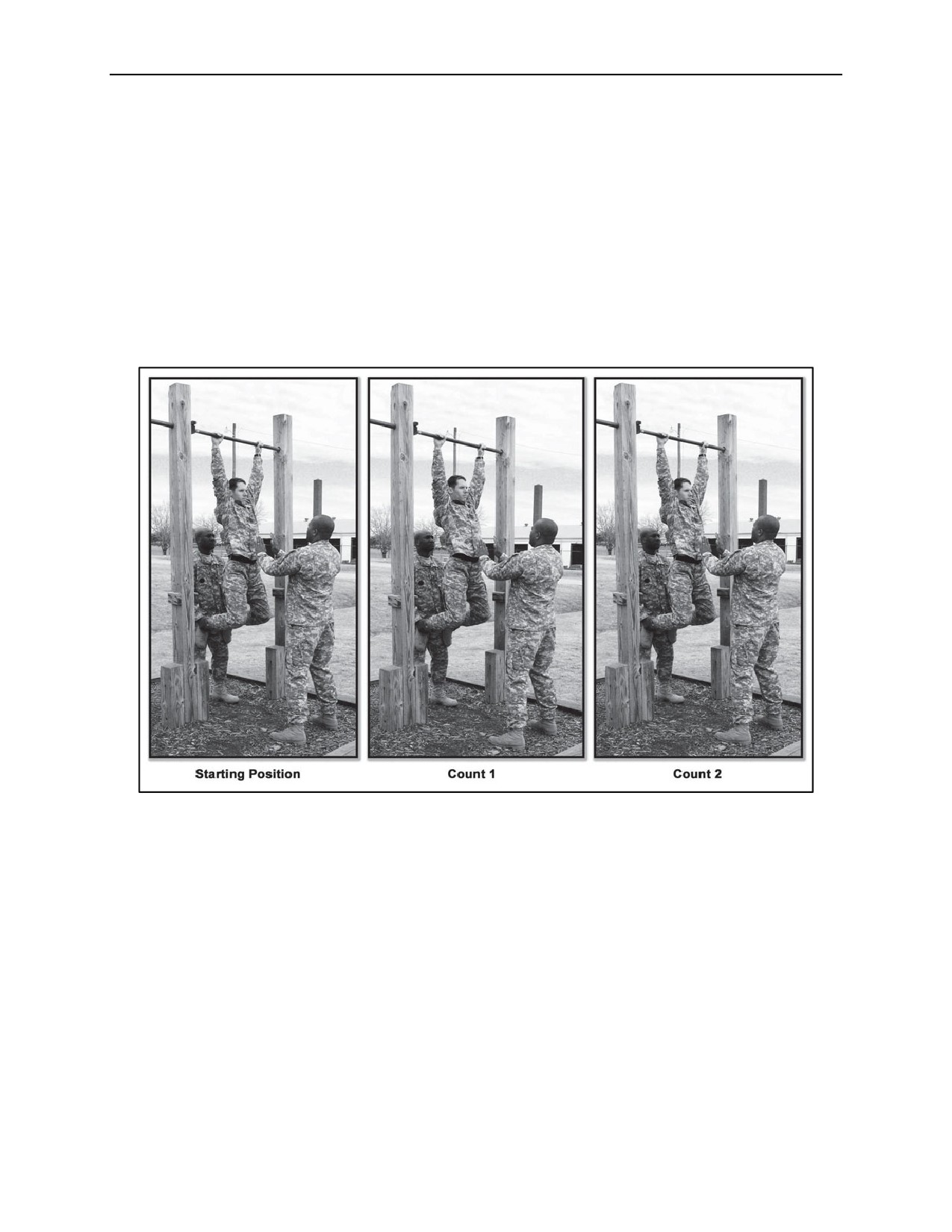
Purpose: This exercise develops the ability to initiate the pull-up motion and maintain a contraction in the
extended hang position (Figure 9-24).
Starting Position: Extended hang using the overhand grip.
Cadence: MODERATE
Count:
1. Keeping the arms straight, pull the body upward using the shoulders and upper back muscles only.
2. Return to the starting position.
Figure 9-24. Straight-arm pull
Check Points:
z
Throughout the exercise, keep the arms shoulder width, palms facing away from the body, with the
thumbs around the bar.
z
Throughout the exercise, keep the elbows straight, but not locked.
z
On count 1, pull the body up by engaging the shoulder muscles (squeeze the shoulder blades
together).
Precaution: Refer to paragraph 9-42 for spotting.
26 October 2012
FM 7-22
9-43
Chapter 9
CLIMBING DRILL 1
EXERCISE 2: HEEL HOOK
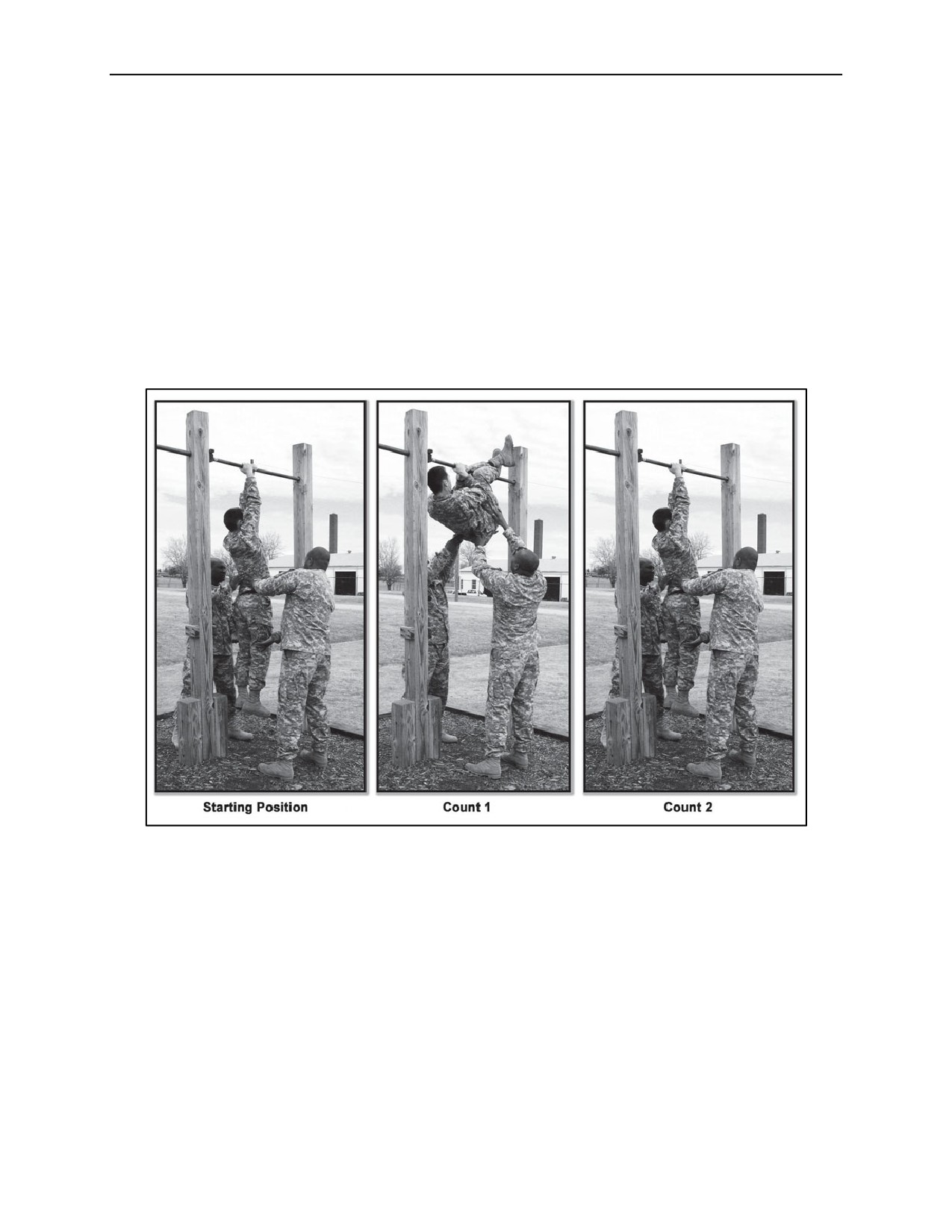
Purpose: This exercise develops the ability to raise the legs from a hanging position and hook the feet securely
on the bar (Figure 9-25).
Starting Position: Extended hang using the alternating grip, left or right.
Cadence: SLOW
Count:
1. Pull with the arms and curl the lower body toward the bar. Raise the feet above the bar and
interlock them securely around the bar.
2. Return to the starting position.
Figure 9-25. Heel hook
Check Points:
z
On count 1, initiate movement by first pulling with the arms.
z
Secure the feet over the bar by crossing one foot over the other at the ankles.
z
On count 2, fully extend the arms to return to the starting position.
Precaution: Refer to paragraph 9-43 for spotting.
9-44
FM 7-22
26 October 2012
Strength and Mobility Activities
CLIMBING DRILL 1
EXERCISE 3: PULL-UP
Purpose: This exercise develops the ability to pull the body upward while hanging (Figure 9-26).
Starting Position: Extended hang using the overhand grip.
Cadence: MODERATE
Count:
1. Keeping the body straight and pull upward with the arms until the chin is above the bar.
2. Return to the starting position.
Figure 9-26. Pull-up
Check Points:
z
Throughout the exercise, keep the feet together.
z
Throughout the exercise, the arms shoulder-width, palms facing away from the body, with the
thumbs around the bar.
Precaution: Refer to paragraph 9-42 for spotting.
26 October 2012
FM 7-22
9-45
Chapter 9
CLIMBING DRILL 1
EXERCISE 4: LEG TUCK
Purpose: This exercise develops the abdominal, hip flexor, and grip strength essential to climbing a rope
(Figure 9-27).
Starting Position: Extended hang using the alternating grip, left or right.
Cadence: SLOW
Count:
1. Pull up with the arms and raise the knees toward the chest until the elbows touch the thighs just
above the knees.
2. Return to the starting position.
Figure 9-27. Leg tuck
Check Points:
z
Throughout the exercise, keep the feet together.
z
On count 1, the thighs and elbows touch just above the knees.
Precaution: Refer to paragraph 9-43 for spotting.
9-46
FM 7-22
26 October 2012
Strength and Mobility Activities
CLIMBING DRILL 1
EXERCISE 5: ALTERNATING GRIP PULL-UP
Purpose: This exercise develops the muscles used to pull the body upward while using an alternating grip
(Figure 9-28).
Starting Position: Extended hang using the alternating grip, left or right.
Cadence: MODERATE
Count:
1. Keep the body straight, pull upward, allowing the head to move to the left or right side of the bar,
and touch the left or right shoulder to the bar.
2. Return to the starting position.
Figure 9-28. Alternating grip pull-up
Check Points:
z
When using the left alternating grip, Soldiers touch the left shoulder to the bar on count 1. If the right
alternating grip is used, Soldiers touch the right shoulder to the bar on count 1.
z
On count 2, the arms are fully extended to return to the starting position.
z
Keep the feet together, throughout the exercise.
Precaution: Refer to paragraph 9-42 for spotting.
26 October 2012
FM 7-22
9-47
Chapter 9
CLIMBING DRILL 2
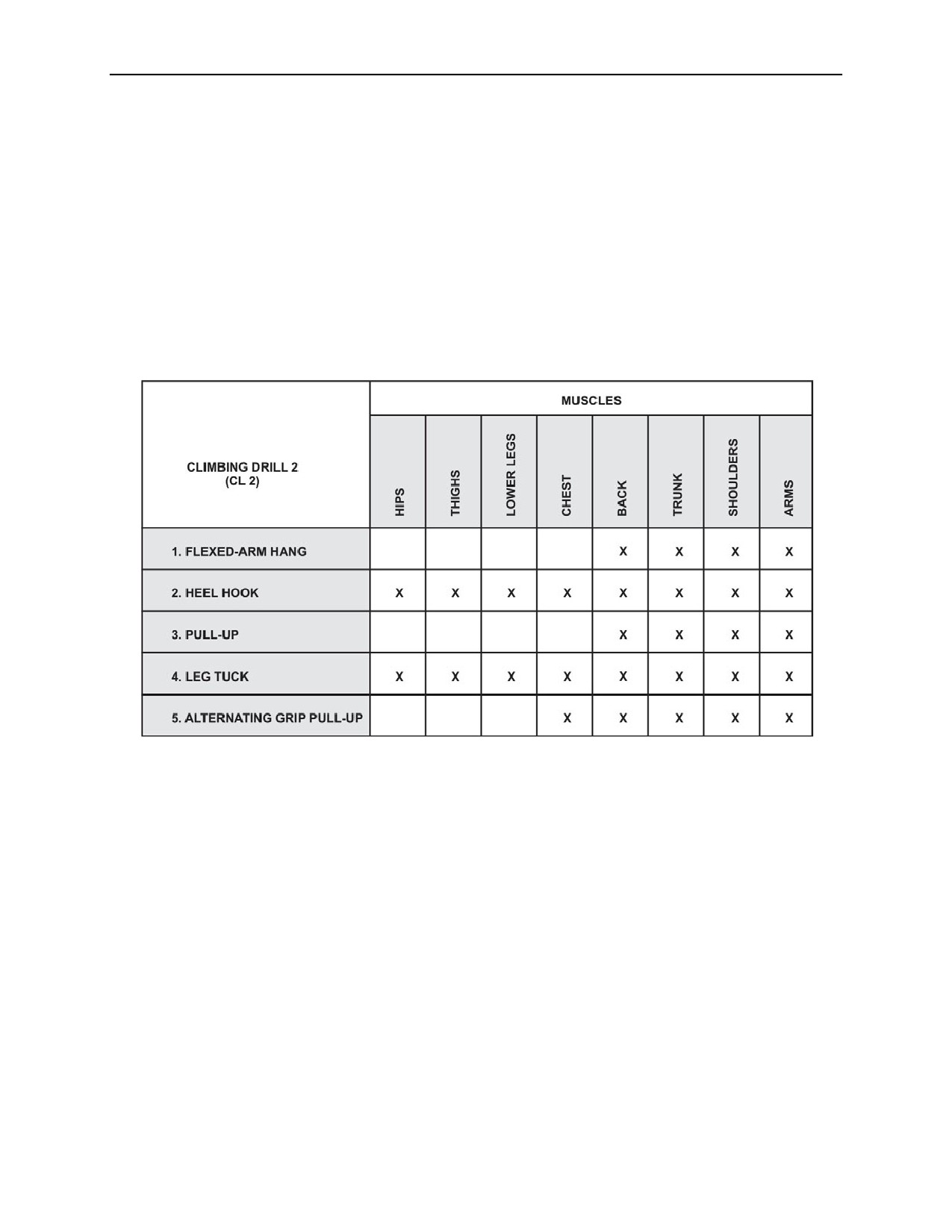
9-54. Climbing drill 2 (CL 2) is a performance-oriented drill conducted in the sustaining phase that prepares
Soldiers for critical tasks under fighting load such as climbing, traversing a rope, and pulling the body up on to
a ledge or through a window. Soldiers increase the resistance by performing CL 2 with their LBE/LBV, body
armor (IOTV), ACH, and individual weapon. They will hold the UP position of exercise 1, the flexed-arm hang,
for five seconds (one repetition, only) and perform five repetitions of each of the remaining four exercises: the
heel hook, the pull-up, the leg tuck, and the alternating grip pull-up. Spotters provide assistance until Soldiers
can complete all repetitions without assistance. Soldiers may progress from five to ten repetitions and one to
two sets of CL 2 once they are able to perform most of the drill unassisted. The goal is to perform 5 to 10
repetitions of all five exercises unassisted. If a second set is performed, the entire drill is repeated in the order
listed. Table 9-8 lists the body segments trained in CL 2.
Table 9-8. Body segments trained in CL 2
9-48
FM 7-22
26 October 2012
Strength and Mobility Activities
CLIMBING DRILL 2
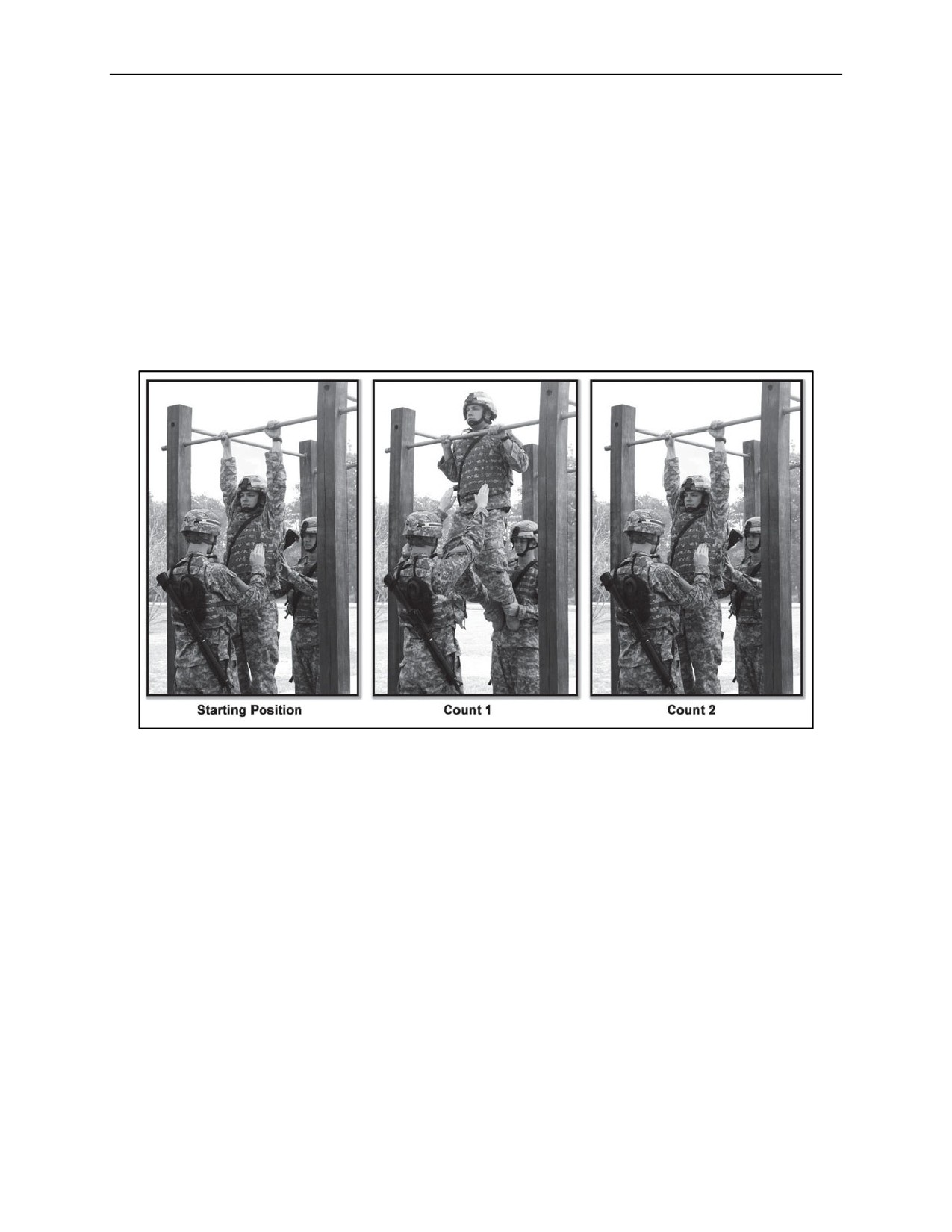
EXERCISE 1: FLEXED-ARM HANG
Purpose: This exercise develops the ability to hold the body in the flexed-arm hang position (Figure 9-29).
Starting Position: Extended hang using the overhand grip.
Cadence: N/A
Count: This exercise is performed for one repetition of five seconds.
1. On the command UP, keeping the body straight, pull upward with the arms until the chin is above
the bar and hold for five seconds.
2. On the command DOWN, return to the starting position.
Figure 9-29. Flexed-arm hang
Check Points:
z
Throughout the exercise, the palms are facing away from the body, with the thumbs around the bar.
z
Throughout the exercise, keep the feet close together.
Precaution: Refer to paragraph 9-42 for spotting.
26 October 2012
FM 7-22
9-49
Chapter 9
CLIMBING DRILL 2
EXERCISE 2: HEEL HOOK
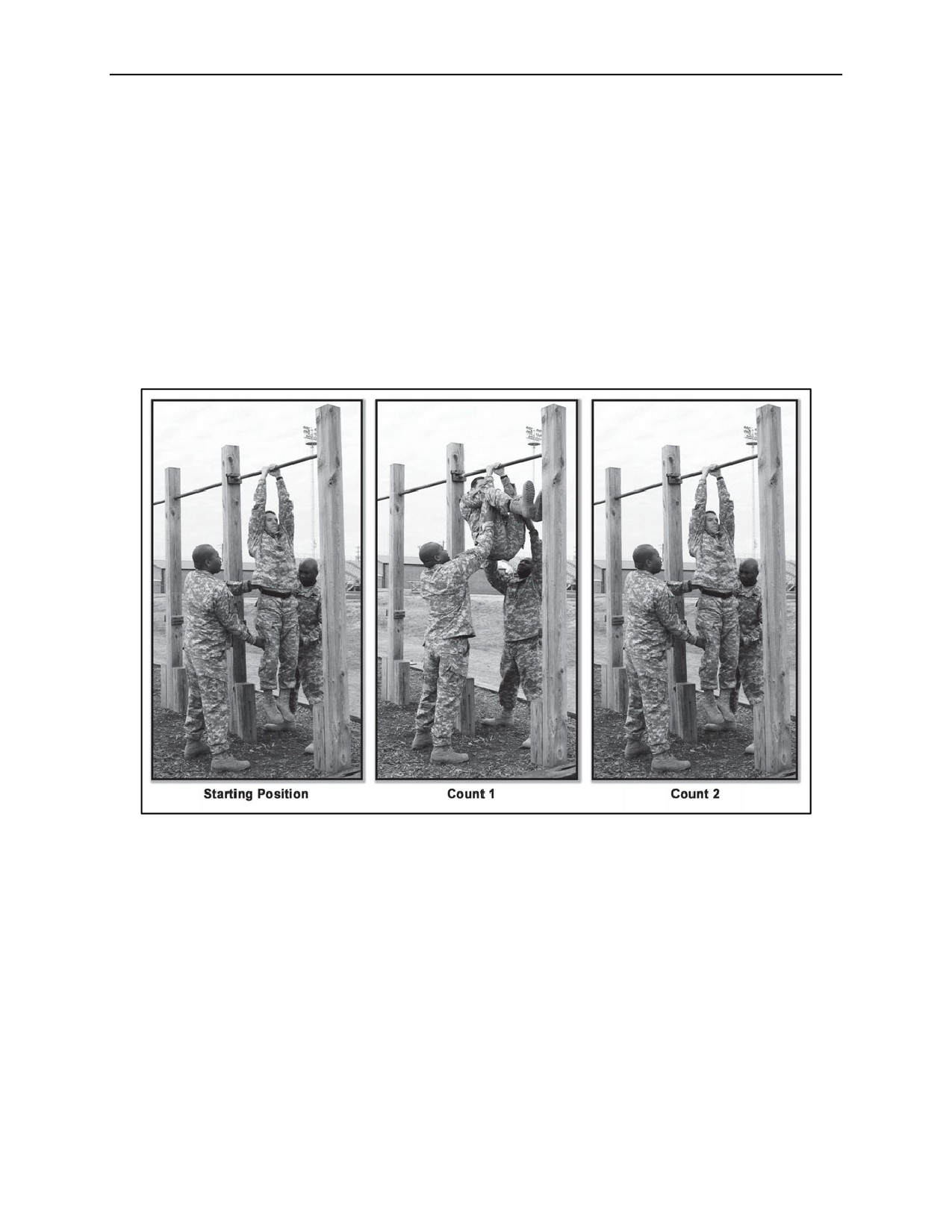
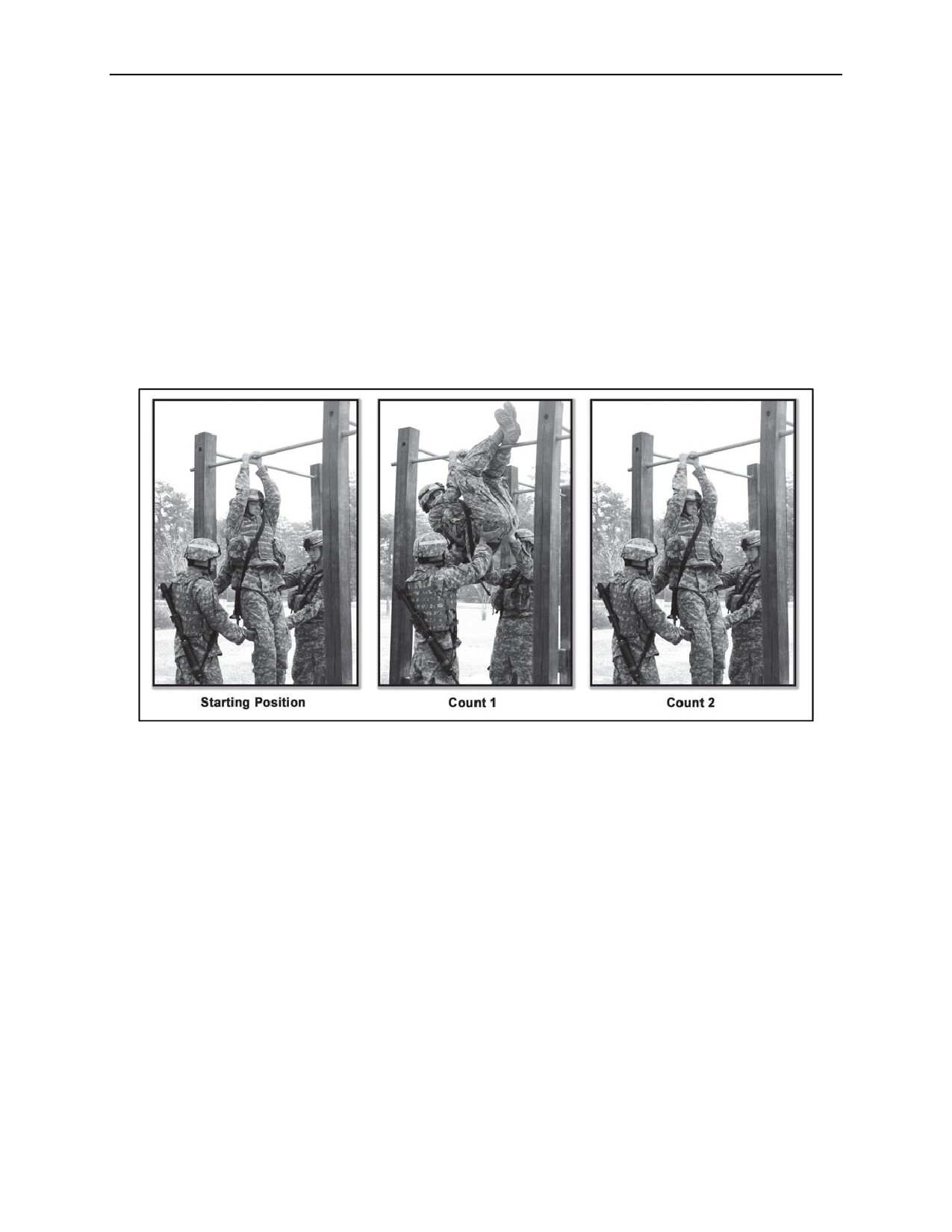
Purpose: This exercise develops the ability to raise the legs from a hanging position and hook the feet securely
on the bar (Figure 9-30).
Starting Position: Extended hang using the alternating grip, left or right.
Cadence: SLOW
Count:
1. Pull with the arms and the body toward the bar. Raise the feet above the bar and interlock them
securely around the bar.
2. Return to the starting position.
Figure 9-30. Heel hook
Check Points:
z
On count 1, initiate movement by first pulling with the arms.
z
Secure the feet over the bar by crossing one foot over the other at the ankles.
z
On count 2, fully extended the arms to return to the starting position.
Precaution: Refer to paragraph 9-43 for spotting.
9-50
FM 7-22
26 October 2012
Strength and Mobility Activities
CLIMBING DRILL 2
EXERCISE 3: PULL-UP
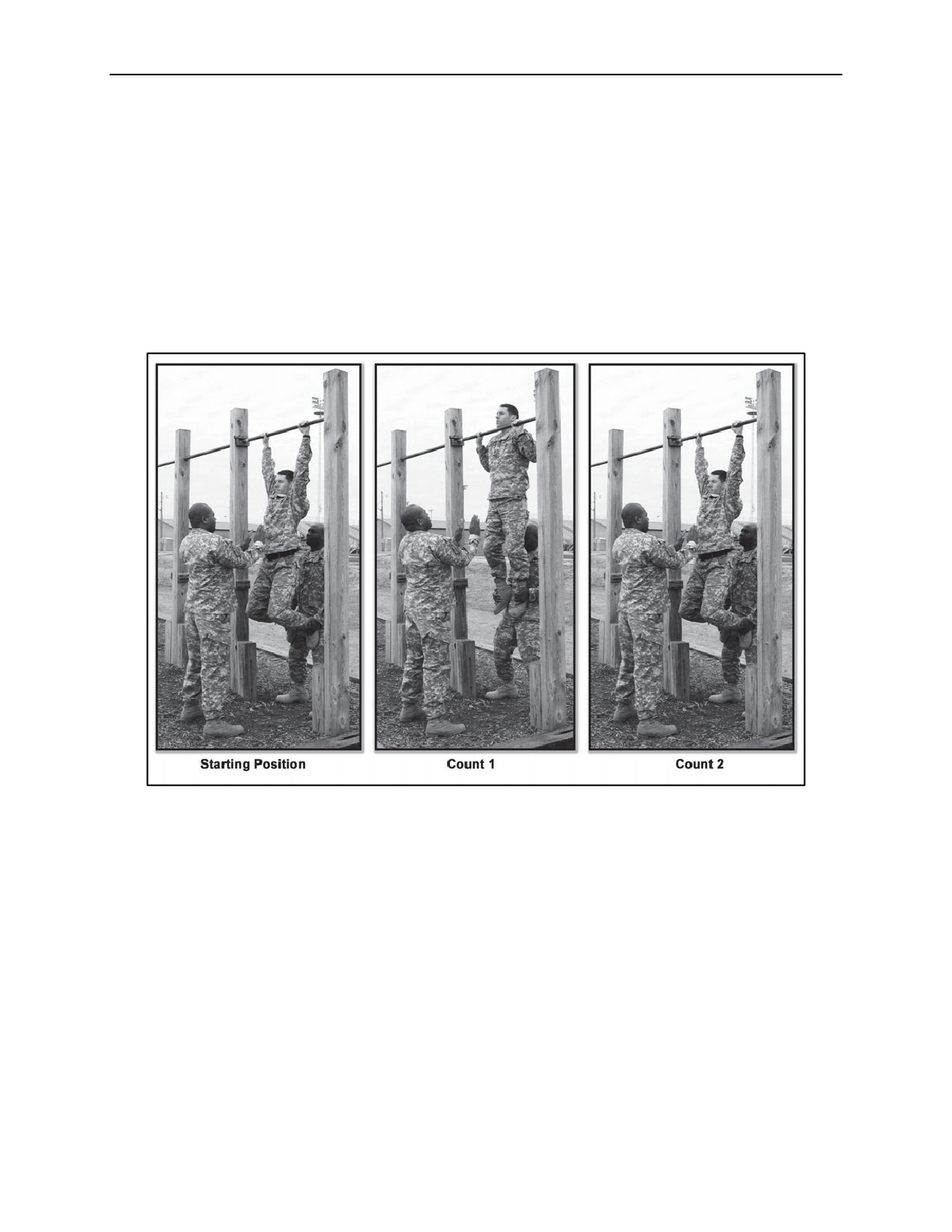
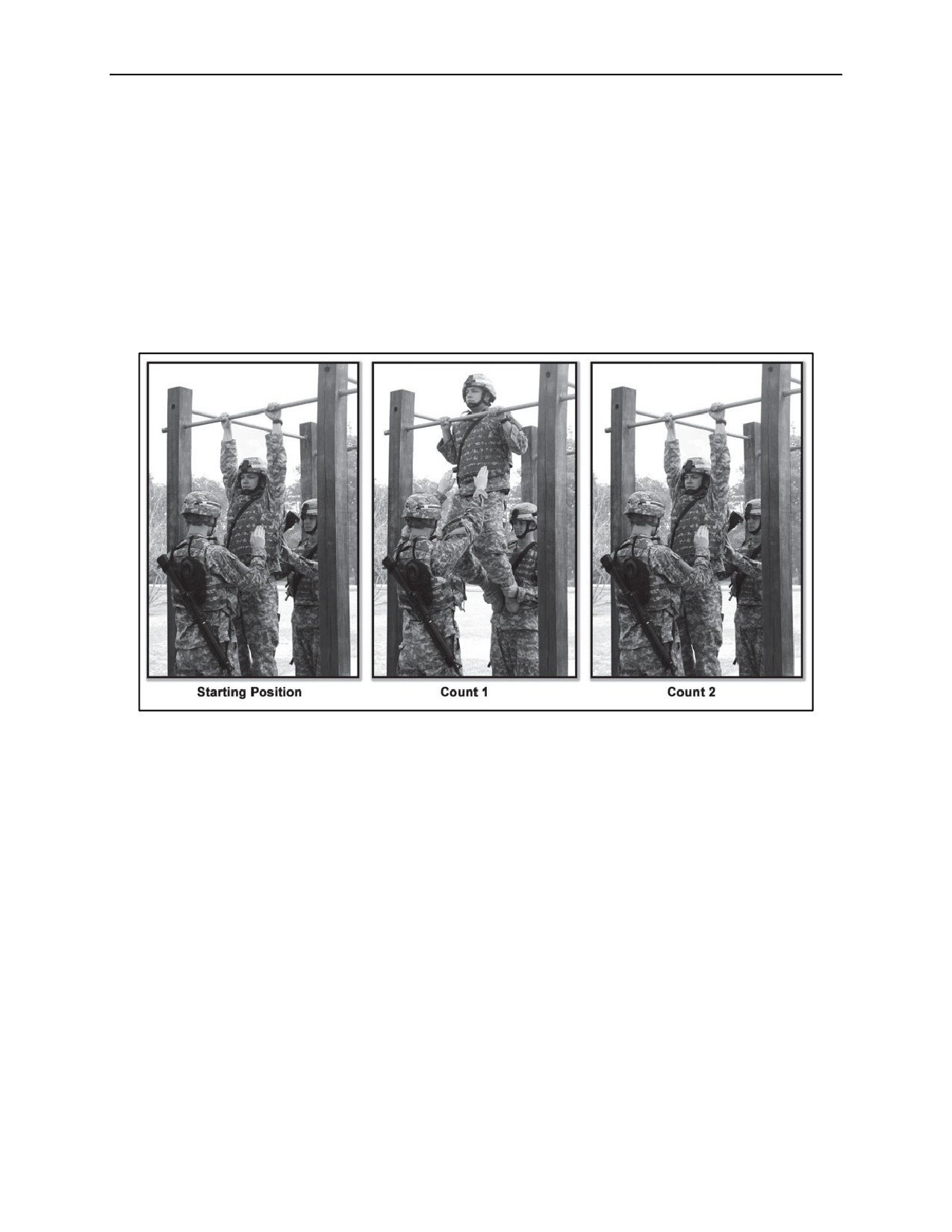
Purpose: This exercise develops the ability to pull the body upward while hanging (Figure 9-31).
Starting Position: Extended hang using the overhand grip.
Cadence: MODERATE
Count:
1. Keeping the body straight, pull upward with the arms until the chin is above the bar.
2. Return to the starting position.
Figure 9-31. Pull-up
Check Points:
z
Throughout the exercise, keep the feet together.
z
Throughout the exercise, arms are shoulder-width, palms facing away from the body, with thumbs
around the bar.
Precaution: Refer to paragraph 9-42 for spotting.
26 October 2012
FM 7-22
9-51
Chapter 9
CLIMBING DRILL 2
EXERCISE 4: LEG TUCK
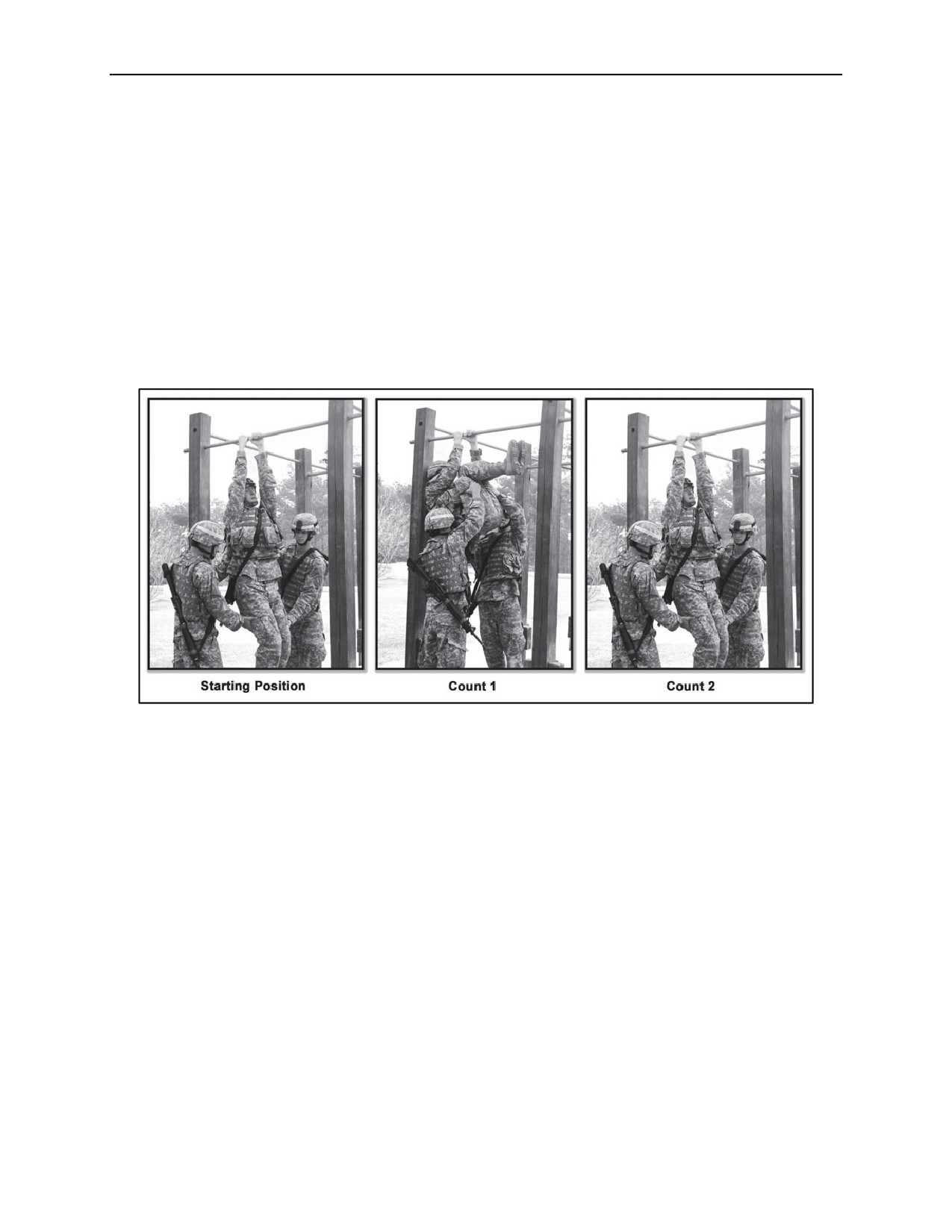
Purpose: This exercise develops the abdominal, hip flexor, and grip strength essential to climbing a rope
(Figure 9-32).
Starting Position: Extended hang using the alternating grip, left or right.
Cadence: SLOW
Count:
1. Pull up with the arms and raise the knees toward the chest until the elbows touch the thighs just
above the knees.
2. Return to the starting position.
Figure 9-32. Leg tuck
Check Points:
z
Throughout the exercise, keep the feet together.
z
On count 1, the thighs and elbows touch just above knees.
Precaution: Refer to paragraph 9-43 for spotting.
9-52
FM 7-22
26 October 2012
Strength and Mobility Activities
CLIMBING DRILL 2
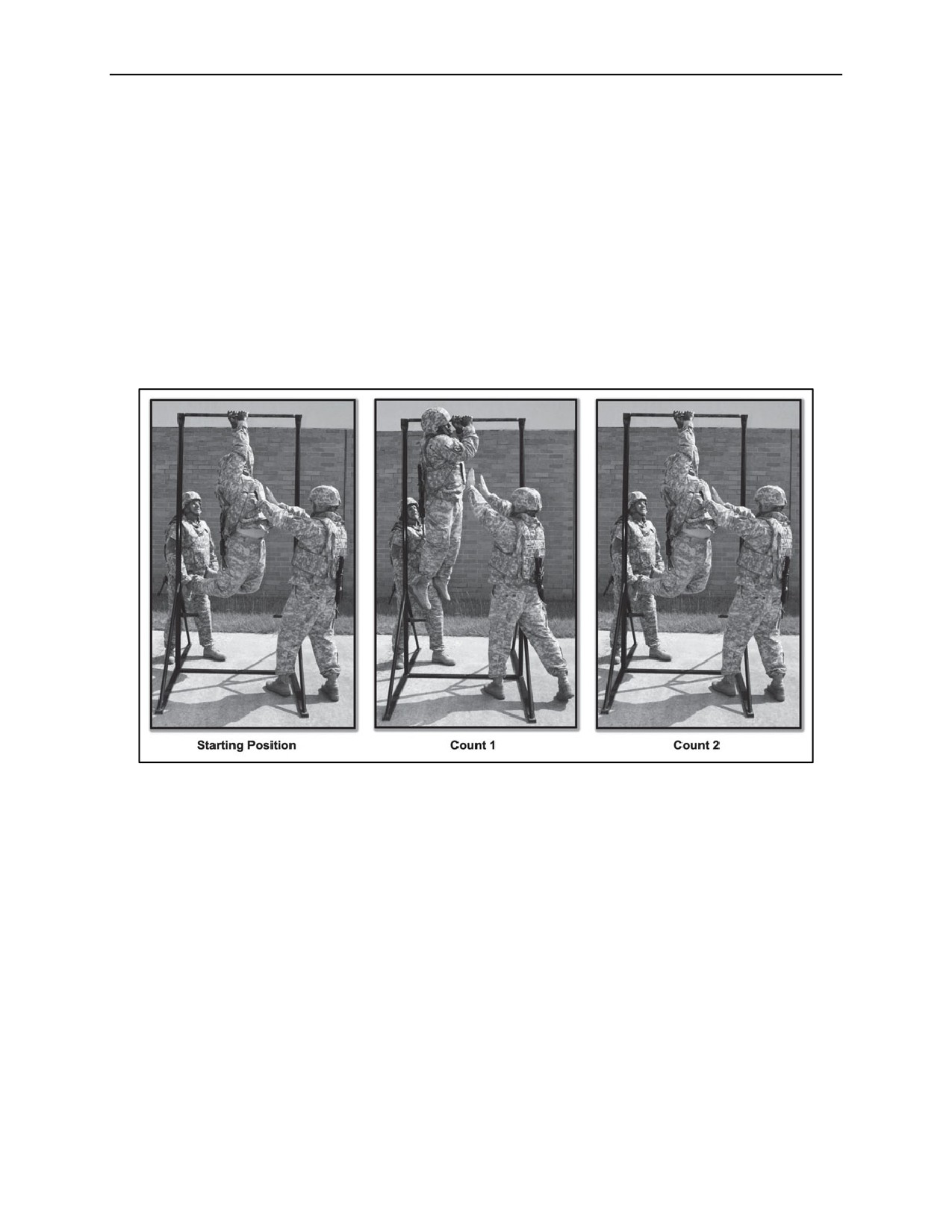
EXERCISE 5: ALTERNATING GRIP PULL-UP
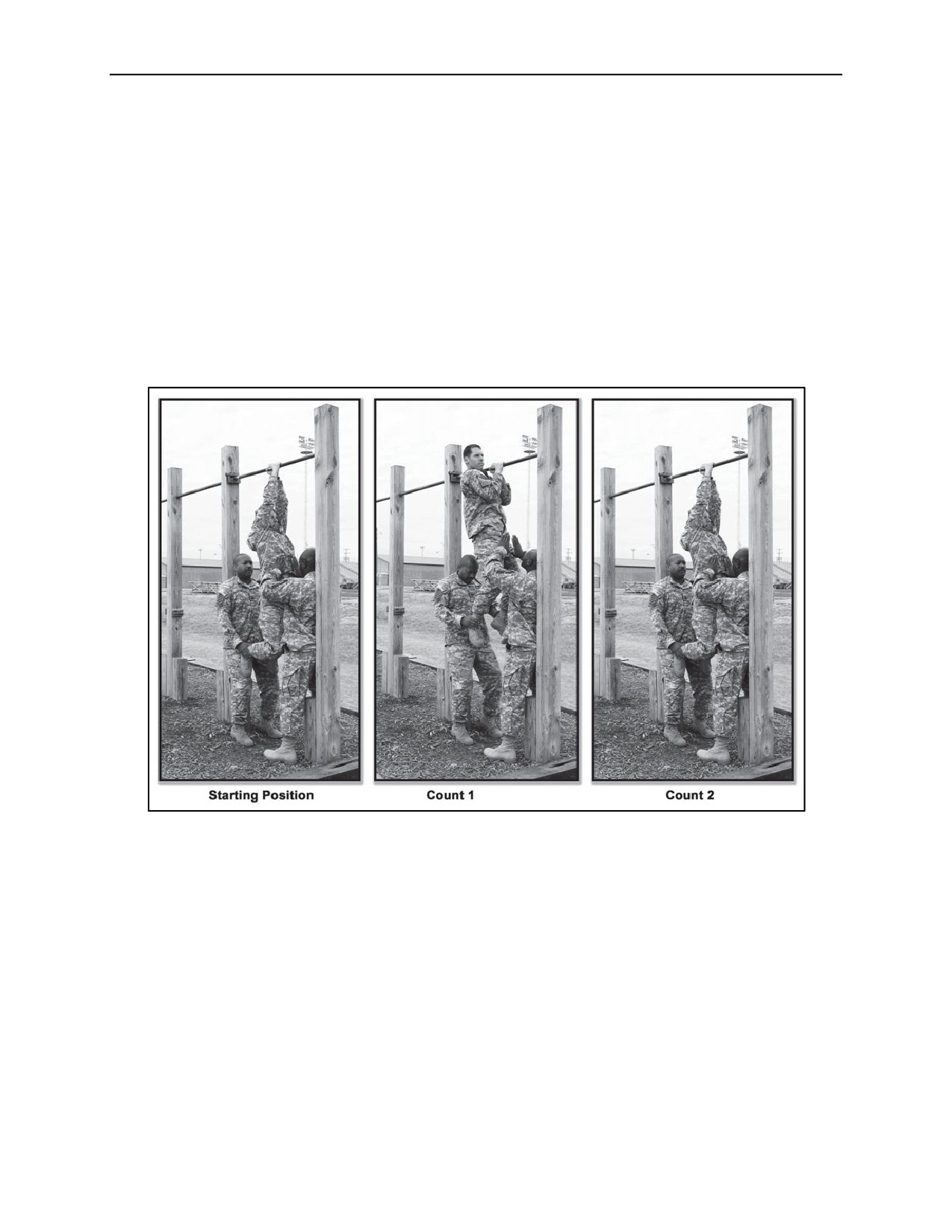
Purpose: This exercise develops the ability to pull the body upward while hanging with an alternating grip
(Figure 9-33).
Starting Position: Extended hang using the alternating grip, left or right.
Cadence: MODERATE
Count:
1. Keeping the body straight, pull upward, allowing the head to move to the left or right side of the
bar and touch the left or right shoulder to the bar.
2. Return to the starting position.
Figure 9-33. Alternating grip pull-up
Check Points:
z
If the alternating grip left is used, Soldiers should touch the left shoulder to the bar on count 1.
z
If the alternating grip right is used, Soldiers should touch the right shoulder to the bar on count 1.
z
On count 2, the arms are fully extended to return to the starting position.
z
Throughout the exercise, keep the feet together.
Precaution: Refer to paragraph 9-42 for spotting.
26 October 2012
FM 7-22
9-53
Chapter 9
STRENGTH TRAINING CIRCUIT
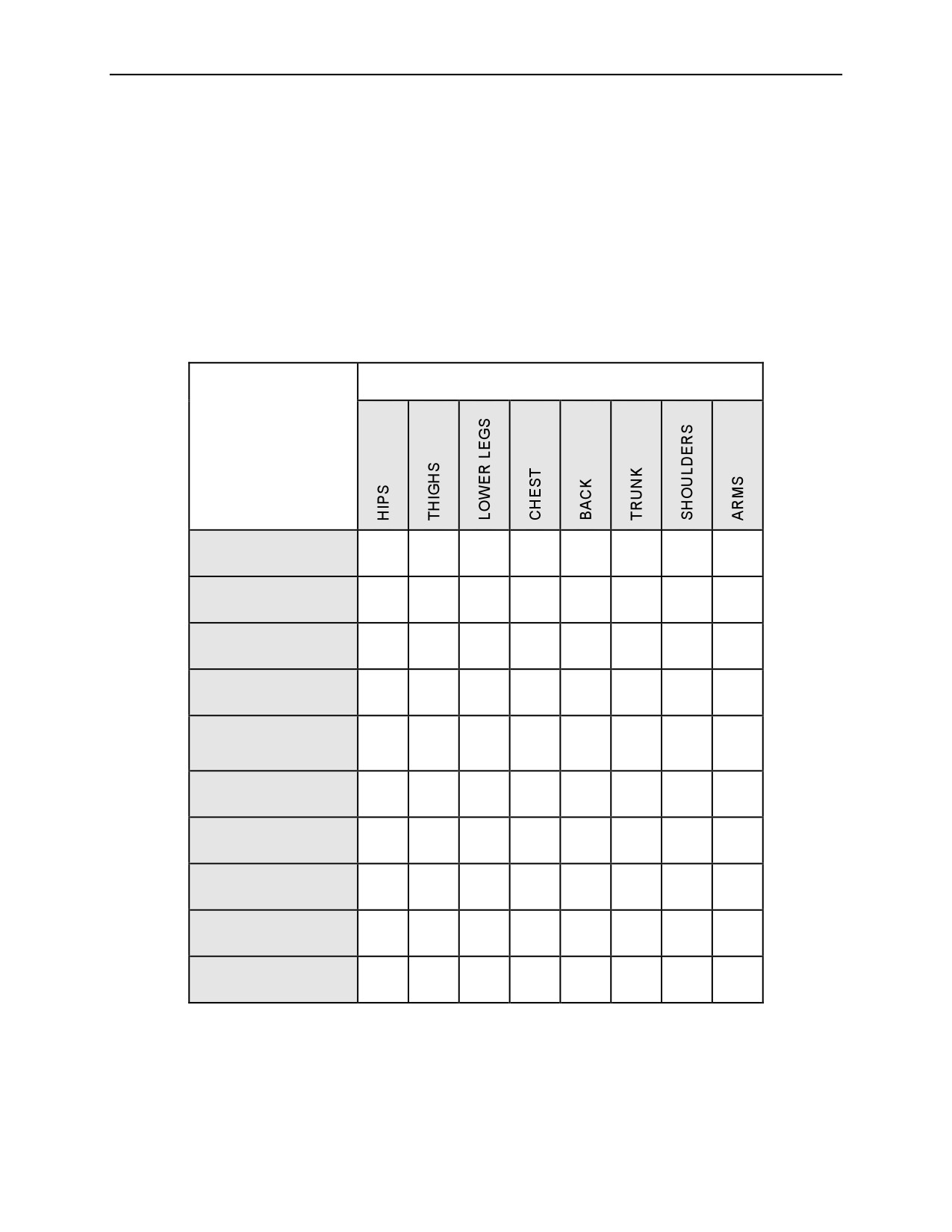
9-55. The strength training circuit (STC) produces a total-body training effect for the development of strength
and mobility. (See Table 9-9.) A sequence combining a CL, a military movement drill, and kettlebell exercises
works every muscle group with active recovery between stations of exercise. The STC is best conducted at
platoon level. The STC may be laid out around a running track, field, or any area of adequate size, and with
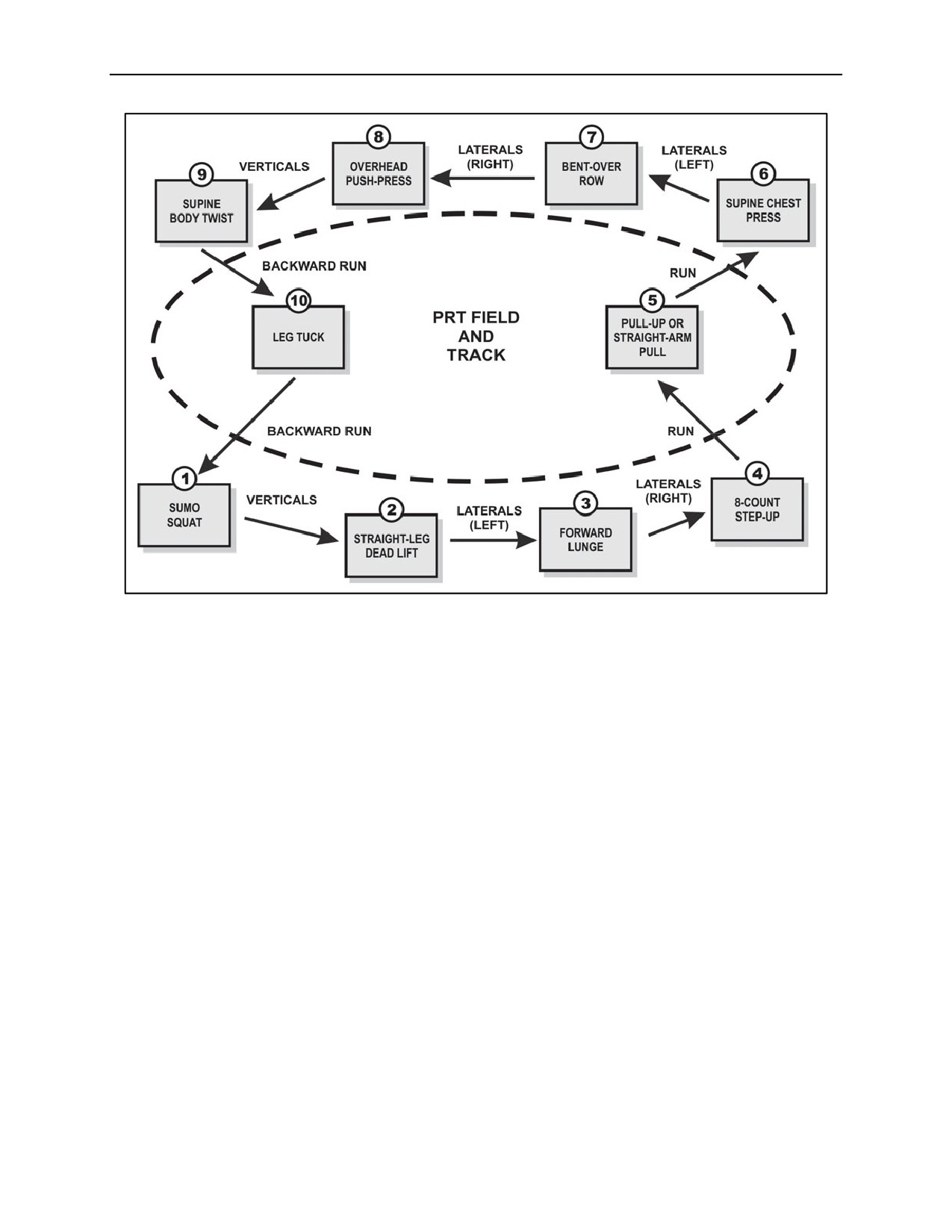
access to climbing bars and kettlebells. This paragraph provides a diagram of the STC, using a running track,
climbing bars, and kettlebells. (See Figure 9-34.) Conduct preparation according to Chapter 7 after a walk-
through and brief explanation of the STC exercise stations. (See Table 9-10.) The circuit may be completed in
three rotations. Soldiers spend
60 seconds at each station. The instructor controls exercise time using a
stopwatch and uses a whistle or horn to signal a change of station. At the end of all circuit rotations, recovery is
conducted according to instructions in Chapter 7.
Table 9-9. Body segments trained in the conduct of the STC
MUSCLES
STRENGTH
TRAINING CIRCUIT
(STC)
1.
SUMO SQUAT
X
X
X
X
X
X
X
X
2.
STRAIGHT-LEG
X
X
X
X
X
X
X
DEAD LIFT
3.
FORWARD
X
X
X
X
X
X
X
X
LUNGE
4.
8- COUNT
X
X
X
X
X
X
X
STEP-UP
5.
PULL-UP OR
STRAIGHT-
X
X
X
X
ARM PULL
6.
SUPINE CHEST
X
X
X
X
X
PRESS
7.
BENT-OVER
X
X
X
X
ROW
8.
OVER-HEAD
X
X
X
X
X
X
X
X
PUSH-PRESS
9.
SUPINE BODY
X
X
X
X
X
X
X
X
TWIST
10. LEG TUCK
X
X
X
X
X
X
X
X
9-54
FM 7-22
26 October 2012
Strength and Mobility Activities
Figure 9-34. Strength training circuit
26 October 2012
FM 7-22
9-55

Chapter 9
Table 9-10. Equipment required to conduct platoon-size STC
Exercise Station
Kettlebells/Weights
Climbing Bars
6 X 50 lbs
1. Sumo Squat
N/A
6 X 25 lbs
12 X 40 lbs
2. Straight-leg Deadlift
N/A
12 X 25 lbs
12 X 20 lbs
3. Forward Lunge
N/A
12 X 10 lbs
12 X 30 lbs
4. 8-Count Step-up
N/A
12 X 15 lbs
5. Pull-up or Straight-arm Pull
N/A
6
12 X 40 lbs
6. Supine Chest Press
N/A
12 X 15 lbs
12 X 20 lbs
7. Bent-over Row
N/A
12 X 10 lbs
12 X 30 lbs
8. Overhead Push Press
N/A
12 X 15 lbs
6 X 25 lbs
9. Supine Body Twist
N/A
6 X 10 lbs
10. Leg Tuck
N/A
6
To conduct the STC at platoon level, 12 climbing bars and 168 kettlebells are required. The following is a list of the
number of kettlebells required by weight:
6 @ 50 lbs, 24 @ 40 lbs, 24 @ 30 lbs, 24 @ 25 lbs, 24 @ 20 lbs, 36 @15 lbs and 30 @ 10 lbs.
STRENGTH TRAINING CIRCUIT
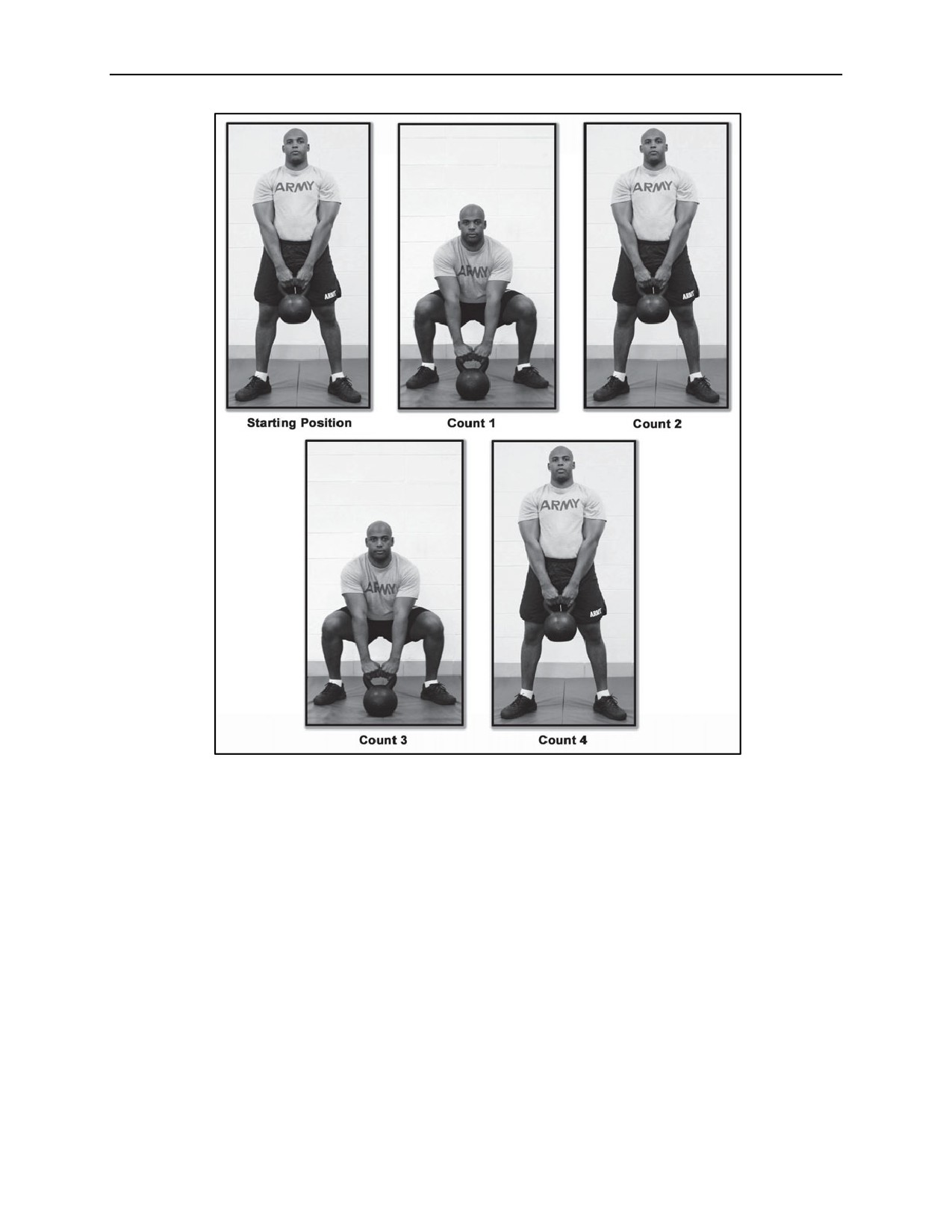
STATION 1: SUMO SQUAT
Purpose: This exercise develops strength and mobility of the hips, legs, and lower back muscles (Figure 9-35).
Starting Position: Straddle stance with the feet slightly wider than the shoulders and the toes pointing outward.
Hold a single kettlebell with both hands, in front of the body, using a pronated grip (palms facing the body).
Cadence: SLOW
Count:
1. Squat while leaning slightly forward from the waist with the head up. Move downward until the
upper legs parallel the ground.
2. Return to the starting position.
3. Repeat count 1.
4. Return to the starting position.
9-56
FM 7-22
26 October 2012
Strength and Mobility Activities
Figure 9-35. Sumo squat
Check Point:
z
At the end of count 1, the shoulders, knees, and balls of the feet should be aligned.
z
Keep heels on the ground and back straight throughout the exercise.
Precautions: Always perform this exercise at a slow cadence. Do not allow the legs to lower beyond parallel to
the ground on count 1. Doing so would increase the stress on the knees.
Movement to Station 2: Verticals (refer to Chapter 10, Endurance and Mobility Activities, Figure 10-4).
26 October 2012
FM 7-22
9-57
Chapter 9
STRENGTH TRAINING CIRCUIT
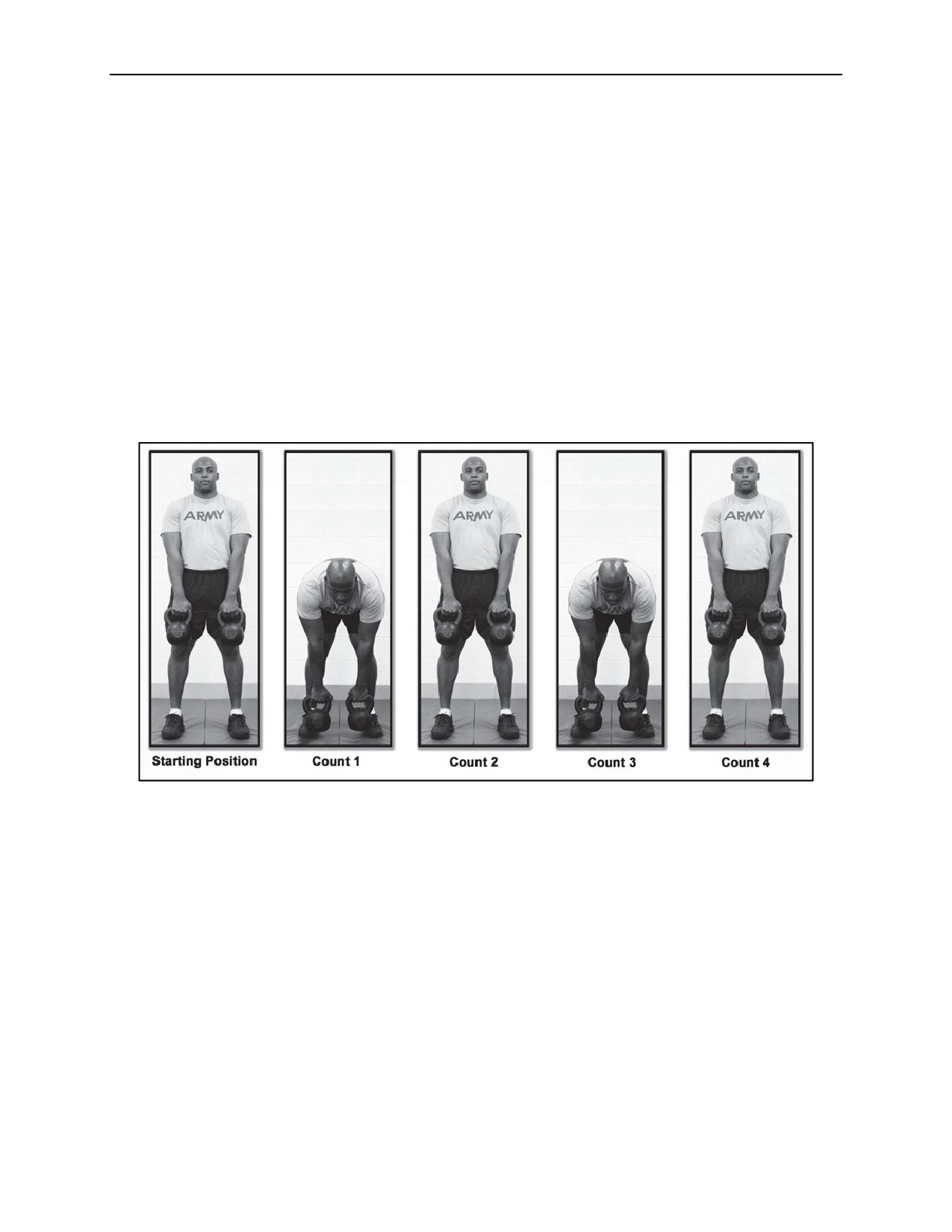
STATION 2: STRAIGHT-LEG DEAD LIFT
Purpose: This exercise develops strength, endurance, and mobility of the lower back and lower extremities
(Figure 9-36).
Starting Position: Straddle stance holding the kettlebells in the front of the legs using a pronated grip (hands
facing the thighs). Keep the legs straight, with the knees slightly bent throughout the exercise.
Cadence: SLOW
Count:
1. Lean forward from the waist with the head aligned with the spine. Move downward until the back
is flat and parallel to the ground.
2. Return to the starting position.
3. Repeat count 1.
4. Return to the starting position.
Figure 9-36. Straight-leg dead lift
Check Point:
z
At the end of count 1, the hips, knees, and the balls of the feet should be aligned.
z
Keep heels on the ground and back straight and parallel to the ground.
Precaution: Always perform this exercise at a slow cadence.
Movement to Station 3: Laterals (left). Refer to Chapter 10, Endurance and Mobility Activities, Figure 10-5.
9-58
FM 7-22
26 October 2012
Strength and Mobility Activities
STRENGTH TRAINING CIRCUIT
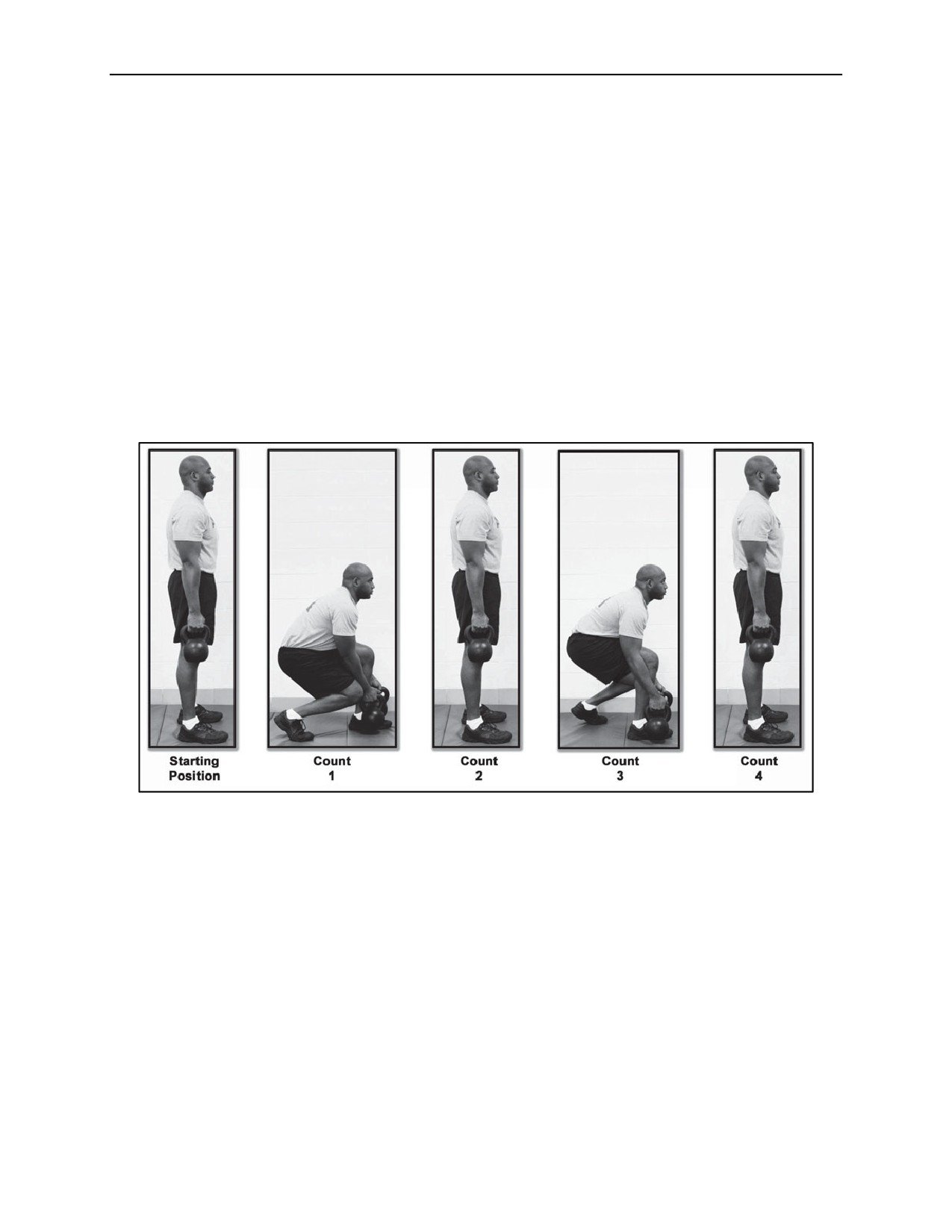
STATION 3: FORWARD LUNGE
Purpose: This exercise develops functional leg strength, promotes trunk stability and safely trains Soldiers to
lift objects off the ground in front of them (Figure 9-37).
Starting Position: Straddle stance holding the kettlebells at the sides using a neutral grip.
Cadence: SLOW
Count:
1. Step forward with the left leg as in the forward lunge as in the PD, allowing the left knee to bend
until the left thigh is parallel to the ground. Lean slightly forward from the waist and bring the
kettlebells to the left and right sides of the forward leg.
2. Return to the starting position.
3. Repeat count 1 with the right leg.
4. Return to the starting position.
Figure 9-37. Forward lunge
Check Points:
z
At the starting position, set the hips and keep the abdominals tight.
z
On counts 1 and 3, keep the forward heel flat on the ground and the rear heel up.
z
On counts 1 and 3, keep the forward knee directly over the ball of the foot.
z
On counts 1 and 3, lean the trunk slightly forward.
z
On counts 2 and 4, push off vigorously with the forward leg without jerking the trunk backward.
Precautions: Do not allow the forward knee to go beyond the forward toes or waiver from side to side. Do not
jerk the trunk rearward to return to the starting position.
Movement to Station 4: Laterals (right). Refer to Chapter 10, Endurance and Mobility Activities, Figure 10-5.
26 October 2012
FM 7-22
9-59
Chapter 9
STRENGTH TRAINING CIRCUIT
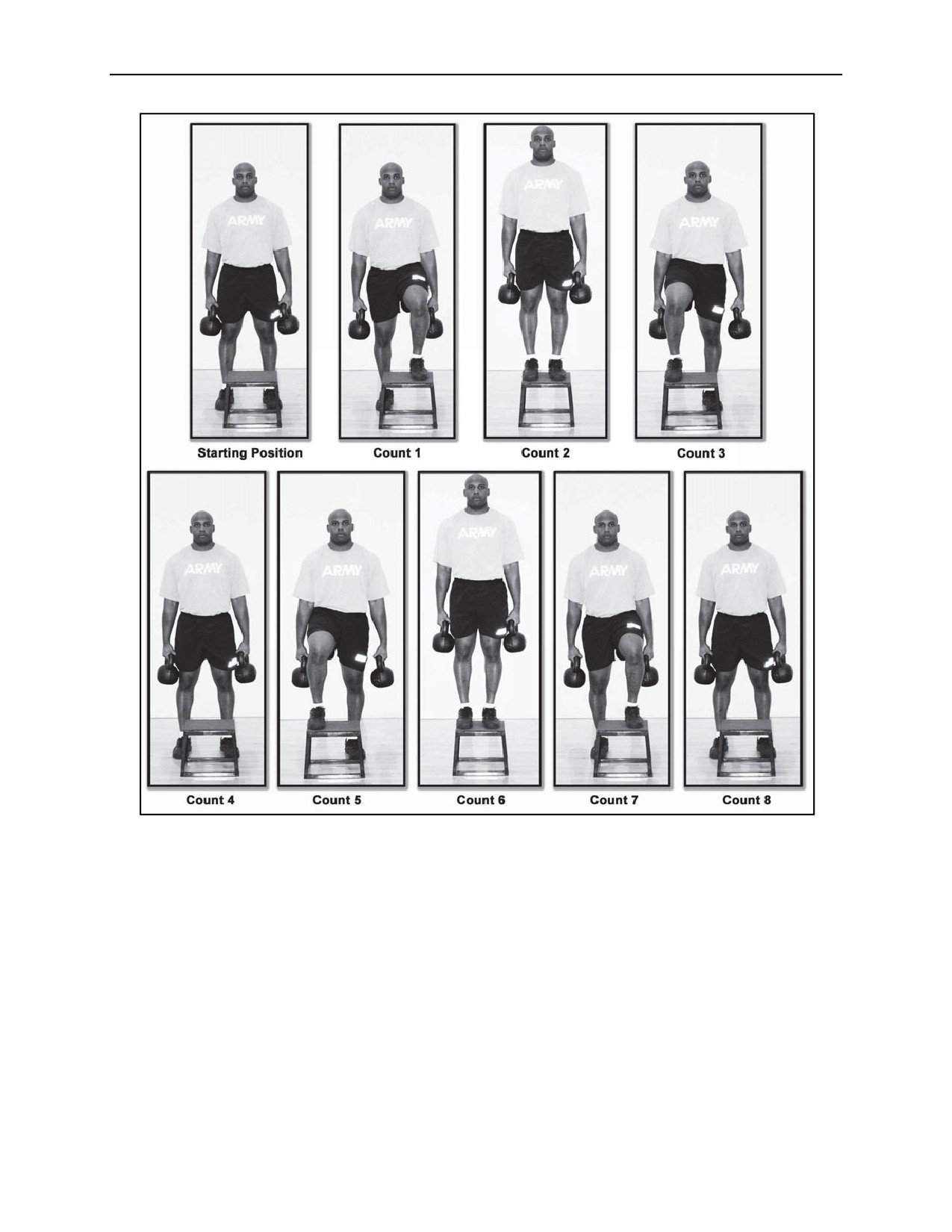
STATION 4: 8-COUNT STEP-UP
Purpose: This exercise develops strength in the hips and legs and promotes trunk stability (Figure 9-38).
Starting Position: Straddle stance holding the kettlebells at the sides using a neutral grip.
Cadence: SLOW
Count:
1. Step up on a 12 to 18 inch step with the left foot, keeping the kettlebells at the sides of the body.
2. Step up with the right foot.
3. Step down with the left foot.
4. Step down with the right foot.
5. Step up on a 12 to 18 inch step with the right foot, keeping the kettlebells at the sides of the body.
6. Step up with the left foot.
7. Step down with the right foot.
8. Step down with the left foot and return to the starting position.
9-60
FM 7-22
26 October 2012
Strength and Mobility Activities
Figure 9-38. 8-count step-up
Check Points:
z
On counts 1, 3, 5 and 7, keep the forward knee directly over the ball of the forward foot.
z
On counts 1, 3, 5 and 7, lean the trunk slightly forward.
z
On counts 1, 3, 5 and 7, push off vigorously with the forward leg without jerking the trunk backward.
Precautions: Do not allow the forward knee to go beyond the toes of the forward foot or waiver from side to
side. Do not jerk the trunk rearward to return to the starting position.
Movement to Station 5: Run.
26 October 2012
FM 7-22
9-61
Chapter 9
STRENGTH TRAINING CIRCUIT
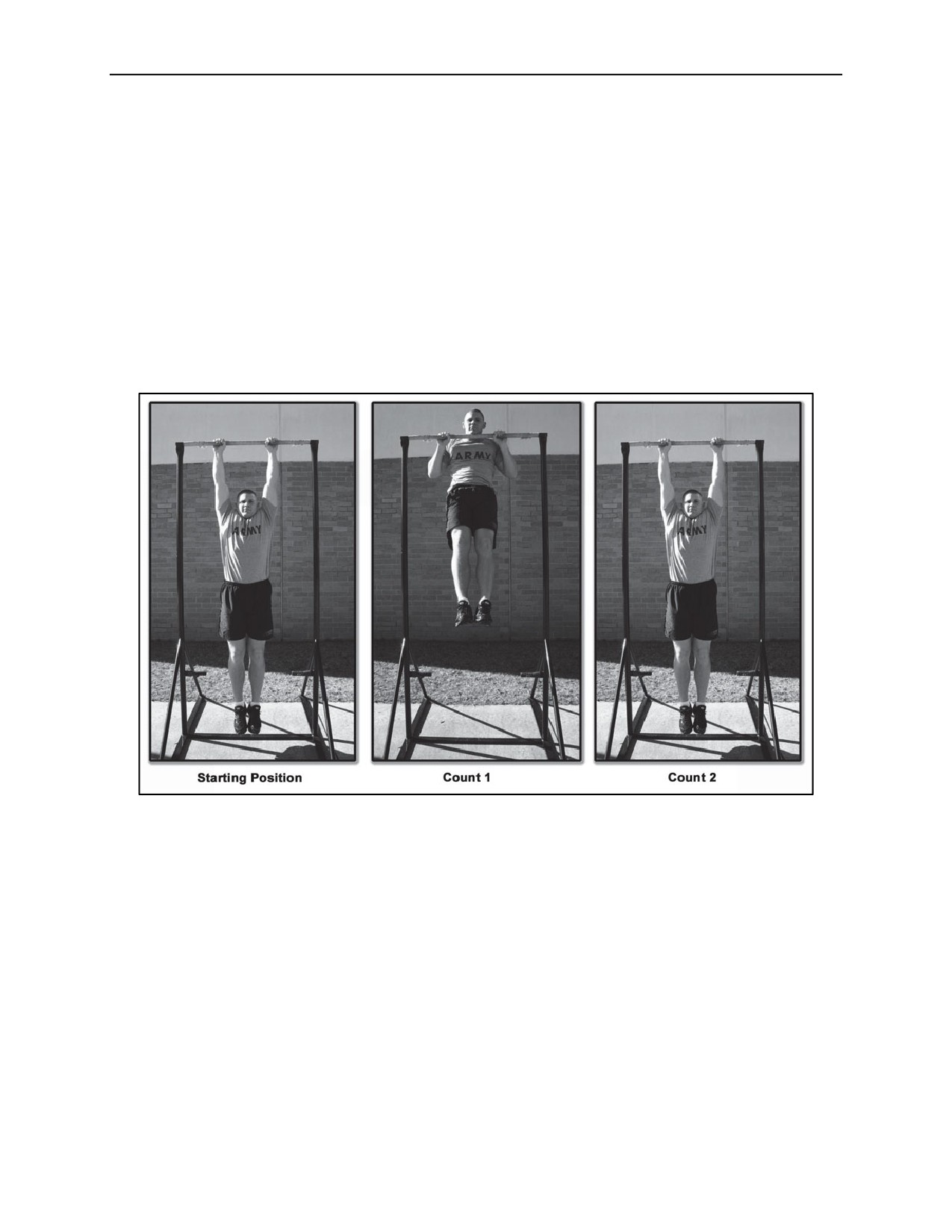
STATION 5: PULL-UP OR STRAIGHT-ARM PULL
PULL-UP
Purpose: This exercise develops the ability to pull the body upward while hanging (Figure 9-39).
Starting Position: Extended hang using the overhand grip.
Cadence: MODERATE
Count:
1. Keeping the body straight, pull upward with the arms until the chin is above the bar.
2. Return to the starting position.
Figure 9-39. Pull-up
Check Points:
z
Throughout the exercise, keep the feet together.
z
Throughout the exercise, keep the arms shoulder-width apart, palms facing away from the body, with
the thumbs around the bar.
Precaution: N/A
Movement to Station 6: Run.
9-62
FM 7-22
26 October 2012
Strength and Mobility Activities
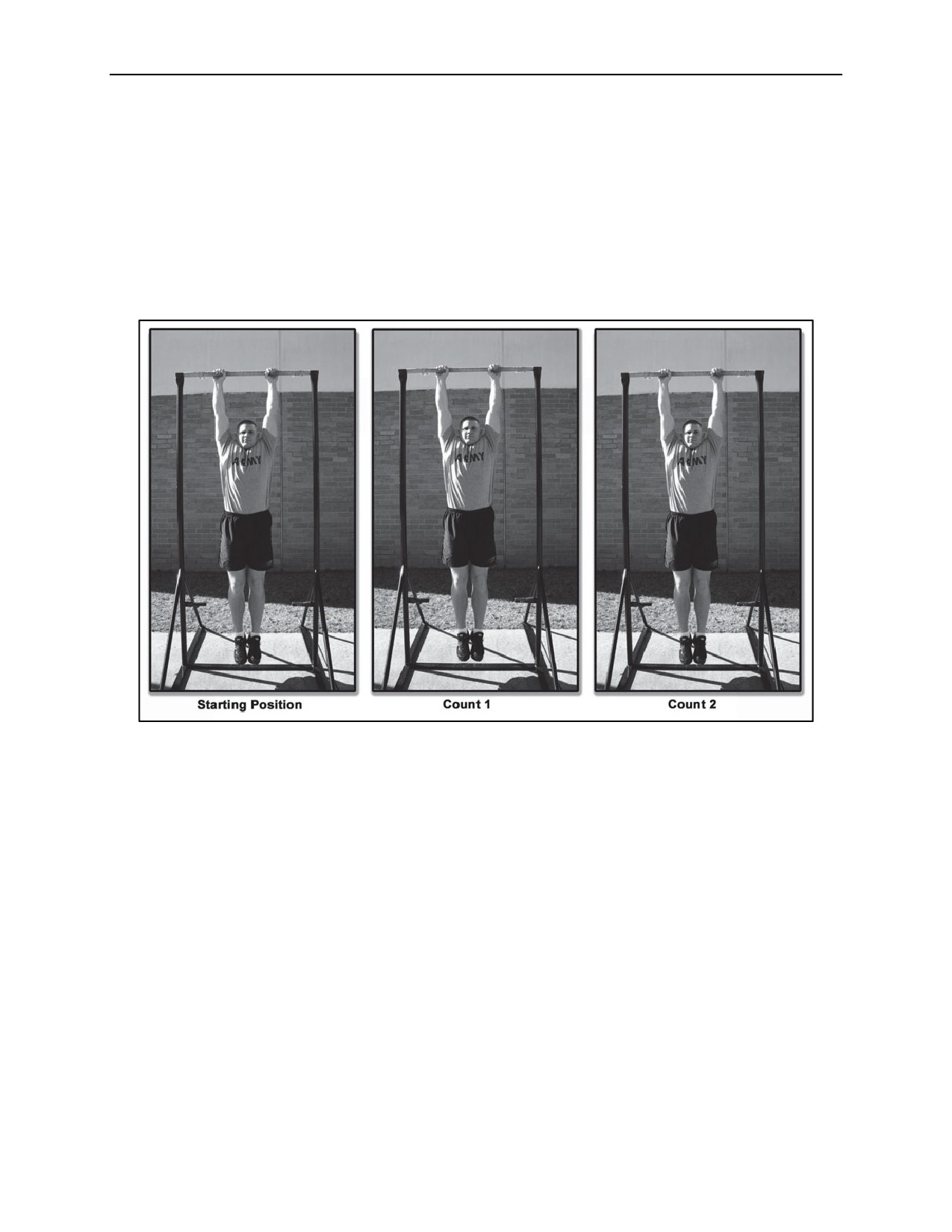
STRAIGHT-ARM PULL
Purpose: This exercise develops the ability to initiate the pull-up motion and maintain a contraction in the
extended hang position (Figure 9-40).
Starting Position: Extended hang using the overhand grip.
Cadence: MODERATE
Count:
1. Keeping the body straight, pull the body upward using the shoulders and back muscles only.
2. Return to the starting position.
Figure 9-40. Straight-arm pull
Check Points:
z
Throughout the exercise, keep the arms shoulder width, palms facing away from the body, with the
thumbs around the bar.
z
Throughout the exercise, keep the elbows straight, but not locked.
z
On count 1, pull the body up by engaging the shoulder muscles (squeeze the shoulder blades
together).
Precaution: N/A
Movement to Station 6: Run.
26 October 2012
FM 7-22
9-63
Chapter 9
STRENGTH TRAINING CIRCUIT
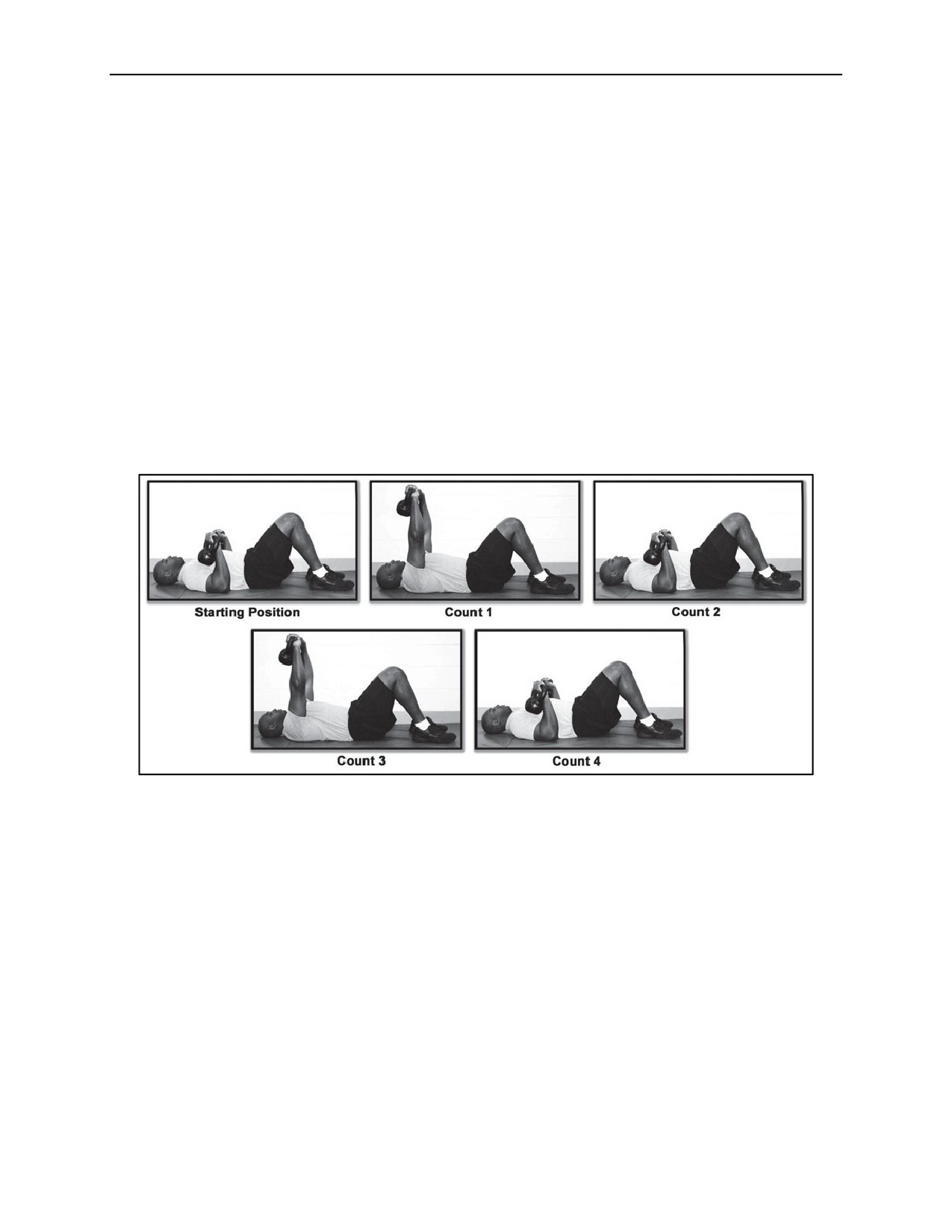
STATION 6: SUPINE CHEST PRESS
Purpose: This exercise strengthens the muscles of the chest, shoulders, and triceps muscles (Figure 9-41).
Starting Position: Supine position with the knees bent at 90 degrees and the feet 8 to 12 inches apart and flat
on the ground. Hold the kettlebells in front of the shoulders using a pronated grip (palms facing up). The back
of the upper arms should rest on the ground and the forearms should be perpendicular to the ground. The head is
on the ground.
Cadence: SLOW
Count:
1. Extend the elbows, raising the kettlebells until the upper arms are straight (not locked) and
perpendicular to the ground.
2. Return to the starting position.
3. Repeat count 1.
4. Return to the starting position.
Figure 9-41. Supine chest press
Check Points:
z
Keep the head on the ground throughout the exercise.
z
On counts 1 and 3, straighten, but do not lock the elbows.
Precaution: N/A
Movement to Station 7: Laterals (left). Refer to Chapter 10, Endurance and Mobility Activities, Figure 10-5.
9-64
FM 7-22
26 October 2012
Strength and Mobility Activities
STRENGTH TRAINING CIRCUIT
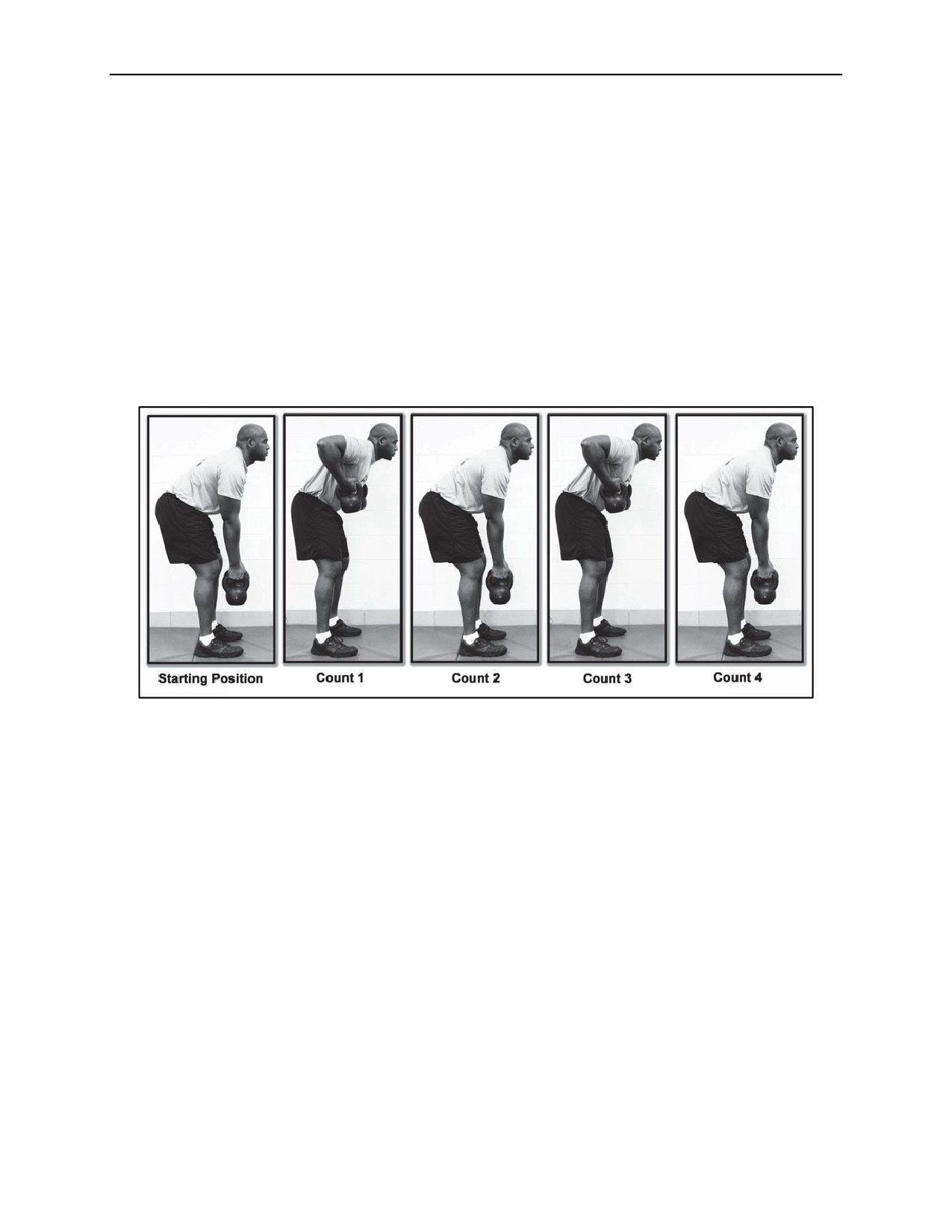
STATION 7: BENT-OVER ROW
Purpose: This exercise strengthens the shoulders, upper back, and biceps muscles (Figure 9-42).
Starting Position: Forward leaning stance with the arms hanging straight in front of the legs and the hands
holding the kettlebells using a neutral grip (palms facing inward).
Cadence: SLOW
Count:
1. Bend the elbows, raising the kettlebells to the chest.
2. Return to the starting position.
3. Repeat count 1.
4. Return to the starting position.
Figure 9-42. Bent-over row
Check Points:
z
On counts 2 and 4 the elbows straighten but do not lock.
z
To prevent the trunk from sagging, tighten the abdominal muscles while in the starting position and
hold this contraction throughout the exercise.
Precaution: N/A
Movement to Station 8: Laterals (right). Refer to Chapter 10, Endurance and Mobility Activities, Figure 10-5.
26 October 2012
FM 7-22
9-65
Chapter 9
STRENGTH TRAINING CIRCUIT
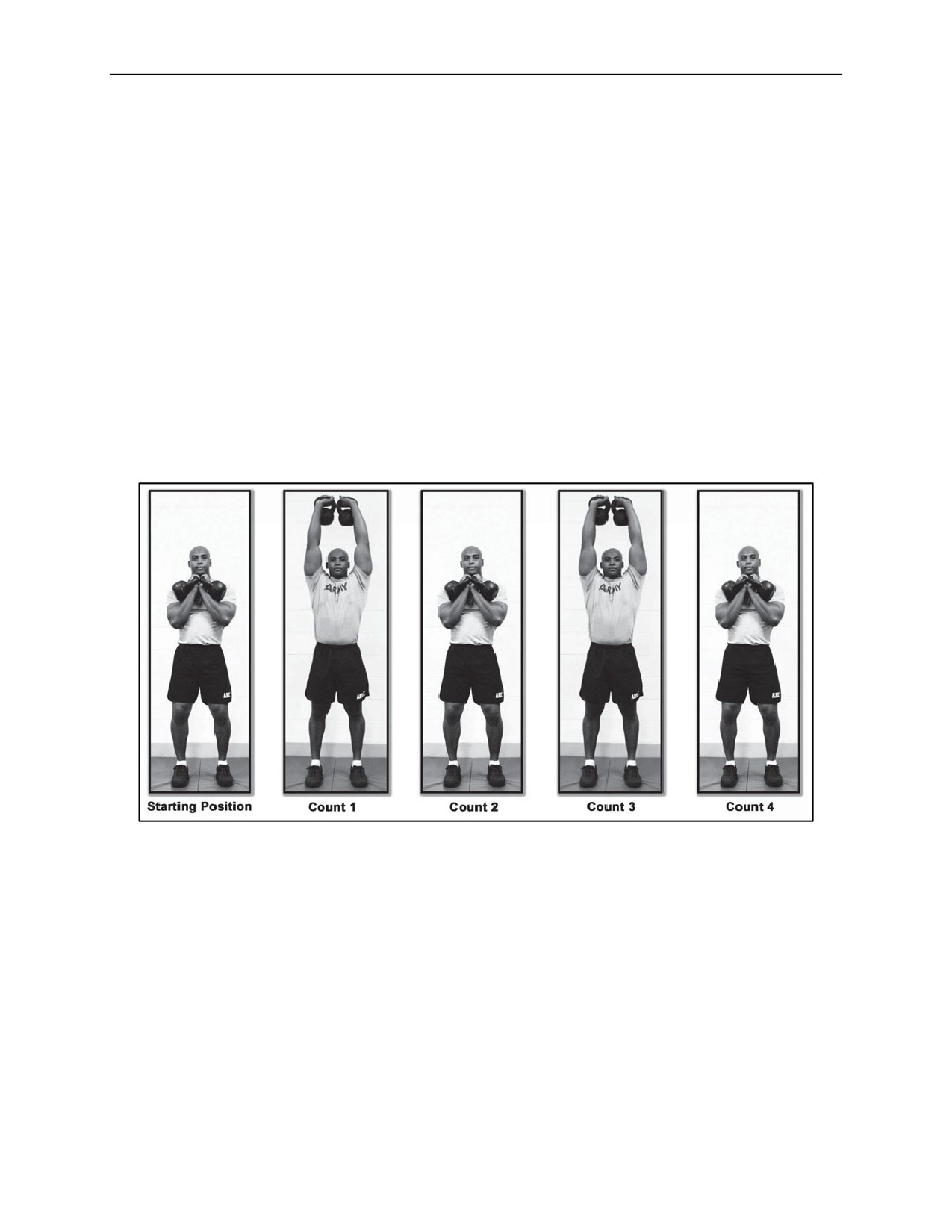
STATION 8: OVERHEAD PUSH PRESS
Purpose: This exercise strengthens the shoulders and triceps muscles (Figure 9-43).
Starting Position: Straddle stance holding the kettlebells at the collar bones using a neutral grip (palms
inward).
Cadence: SLOW
Count:
1. From the starting position slightly flex the hips and knees (slight squat) with feet flat on the floor,
keeping the upper body and upper arms parallel to the ground. Forcefully extend the hips, knees,
and ankles while simultaneously extending the elbows to raise the kettlebells overhead.
2. Return to the starting position by flexing the elbows, controlling the descent to the collar bones
and shoulders while simultaneously flexing the hips and knees to reduce the impact of the
kettlebells on the shoulders.
3. Repeat count 1.
4. Repeat count 2, returning to the starting position.
Figure 9-43. Overhead push press
Check Points:
z
Hold the head and neck in a neutral position, looking straight ahead or slightly upward.
z
Perform counts 1 and 3 in a fast, continuous motion.
z
Always control the descent of the kettlebells during counts 2 and 4 to avoid injury to the trunk and
back.
z
On counts 1 and 3, straighten the elbows but do not lock them.
z
Tighten the abdominal muscles while in the starting position and hold this contraction throughout the
exercise to ensure trunk stability.
Precaution: N/A
Movement to Station 9: Verticals. Refer to Chapter 10, Endurance and Mobility Activities, Figure 10-4.
9-66
FM 7-22
26 October 2012
Strength and Mobility Activities
STRENGTH TRAINING CIRCUIT
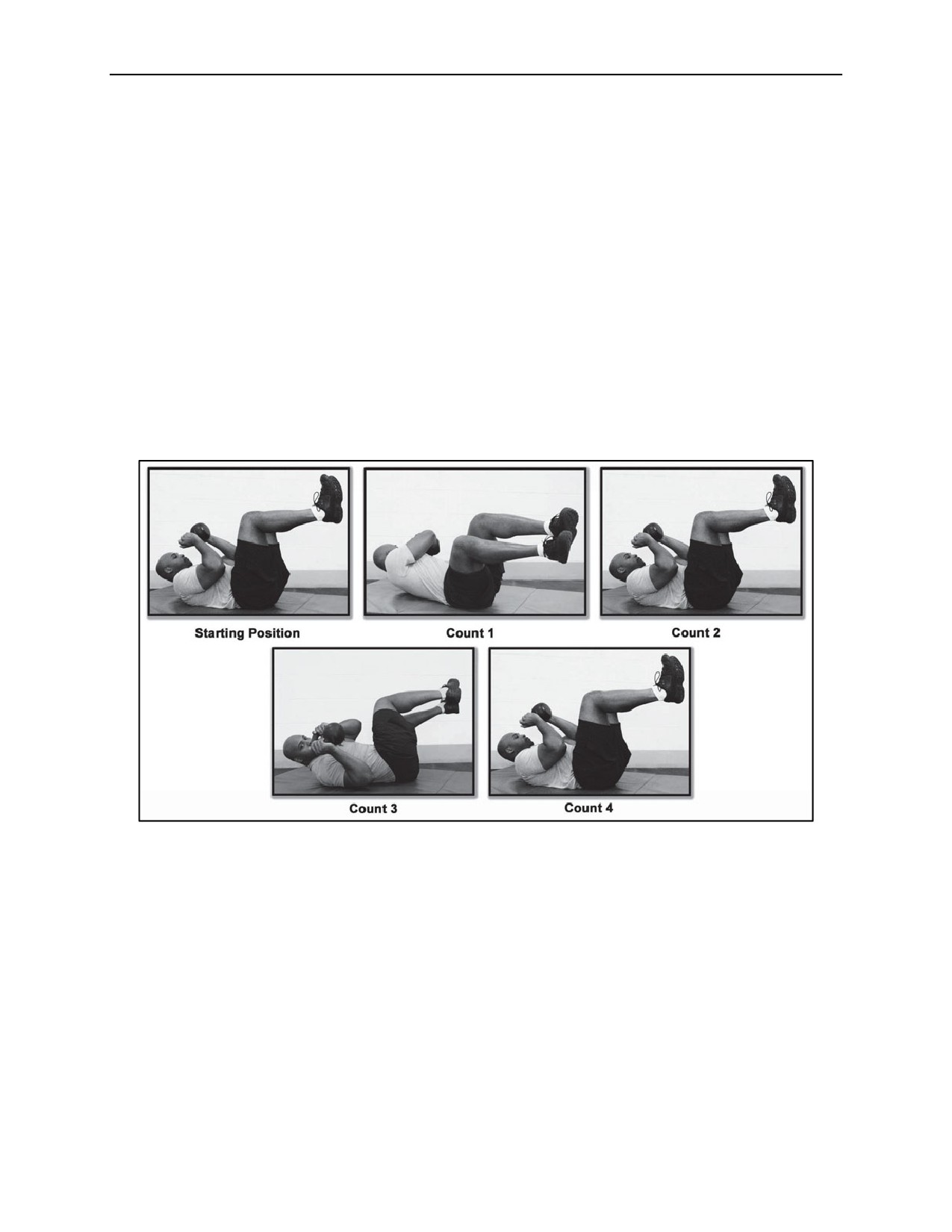
STATION 9: SUPINE BODY TWIST
Purpose: This exercise strengthens the trunk muscles and promotes trunk control (Figure 9-44).
Starting Position: Supine position with hips and knees bent at 90 degrees. Hold one kettlebell over the trunk
using a neutral grip with the upper arms off the ground and elbows bent 90 degrees. To assume the starting
position from the position of attention with the kettlebell on the ground, (1) assume the seated position and
grasp a single kettlebell at each side of the handle with palms facing inward, (2) assume the supine position,
(3) raise the kettlebell to the starting position over the trunk and raise the feet off the ground.
Cadence: SLOW
Count:
1. Rotate the kettlebell to the left and the legs to the right.
2. Return to the starting position.
3. Rotate the kettlebell to the right and the legs to the left.
4. Return to the starting position.
Figure 9-44. Supine body twist
Check Points:
z
On counts 1 and 3, the back is straight and the knees are bent at 90 degrees.
z
The head is off the ground and in line with the trunk and the chin is tucked throughout the exercise.
z
On counts 1 and 3, the upper arms remain off the ground.
Precaution: Do not swing the arms or arch the back to raise the kettlebell on counts 1 and 3.
Movement to Station 10: Backward run.
26 October 2012
FM 7-22
9-67
Chapter 9
STRENGTH TRAINING CIRCUIT
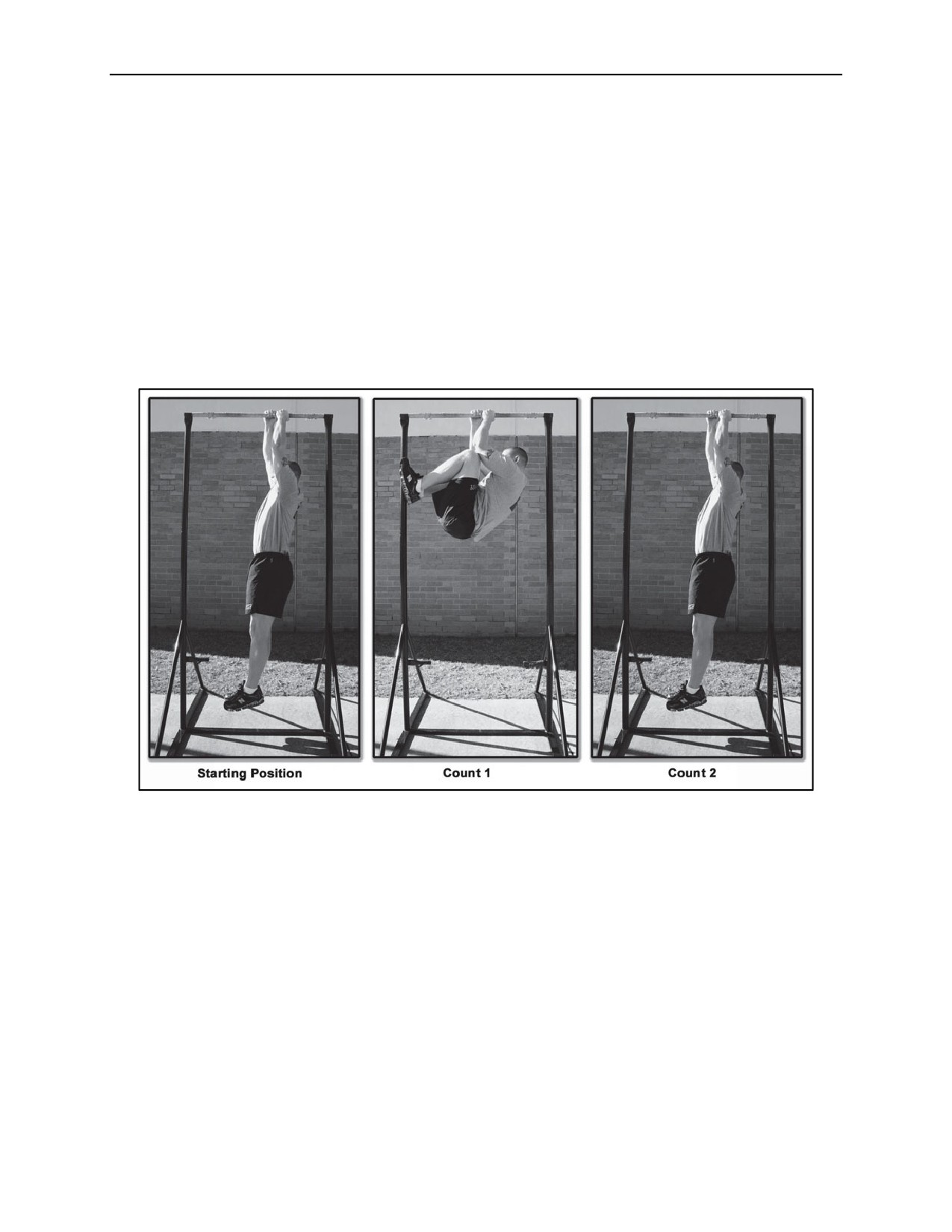
STATION 10: LEG TUCK
Purpose: This exercise develops the abdominal, hip flexor, and grip strength essential to climbing a rope
(Figure 9-45).
Starting Position: Extended hang using the alternating grip, left or right.
Cadence: SLOW
Count:
1. Pull up with the arms and raise the knees toward the chest until the elbows touch the thighs just
above the knees.
2. Return to the starting position.
Figure 9-45. Leg tuck
Check Points:
z
Throughout the exercise, keep the feet together.
z
On count 1, the thighs and elbows touch just above the knees.
Precaution: N/A
Movement to Station 1: Backward run.
9-68
FM 7-22
26 October 2012
Strength and Mobility Activities
GUERRILLA DRILL
9-56. The GD, performed in the sustaining phase, consists of three exercises that develop leg power,
coordination, and the ability to lift and carry another Soldier. When the Soldiers can precisely execute each
exercise and carry, the drill is performed continuously for 1-3 sets. All movement in the carry position is
performed at quick time. Each exercise and carry must be taught and demonstrated before Soldiers try to
perform the drill. When teaching and demonstrating the GD, use the extended rectangular formation (covered).
In the illustrations that follow, Soldier “A” refers to the Soldier performing the carry, and Soldier “B” refers to
the Soldier being carried. The drill is always performed in its entirety in the order listed.
TRAINING AREA
9-57. Any dry, level area of adequate size (same as MMD 1) and free from hazards (holes, debris) is satisfactory for
conduct of the GD.
UNIFORM
9-58. Soldiers will wear IPFU or ACUs.
EQUIPMENT
9-59. Mark GD area with cones.
FORMATION
9-60. For the most efficient instruction, the unit size should be limited to one platoon. Larger units up to a
battalion can successfully perform these drills if properly taught and mastered at the small unit level. The
extended rectangular formation (covered) is prescribed.
LEADERSHIP
9-61. A PRT leader and AI are required to instruct and lead the GD. The instructor must be familiar with the
method of teaching the exercises; the commands and counting cadence; formations; starting positions; and the
use of AIs as described in Chapter 7, Execution of Training. Soldiers should memorize the exercises by name
and movement. Considerable time and effort must be expended during the early stages to teach exercises
properly to all Soldiers.
PRECISION
9-62. GD exercises lose much of their value unless performed exactly as prescribed. Precision should never be
compromised for speed of movement. Moving too fast will not allow Soldiers to perform the exercises with
proper technique and may lead to injury. All movement in the carry position is performed at quick time.
PROGRESSION
9-63. Soldiers perform no more than one repetition of each exercise while learning and practicing the GD. The
GD is performed in the sustaining phase during the activity part of the PRT session. Soldiers will perform one
set of the entire drill, progressing to three sets.
INTEGRATION
9-64. The GD exercises integrate the components of strength, endurance, and mobility through functional
movements that relate directly to the performance of WTBDs.
26 October 2012
FM 7-22
9-69
Chapter 9
COMMANDS
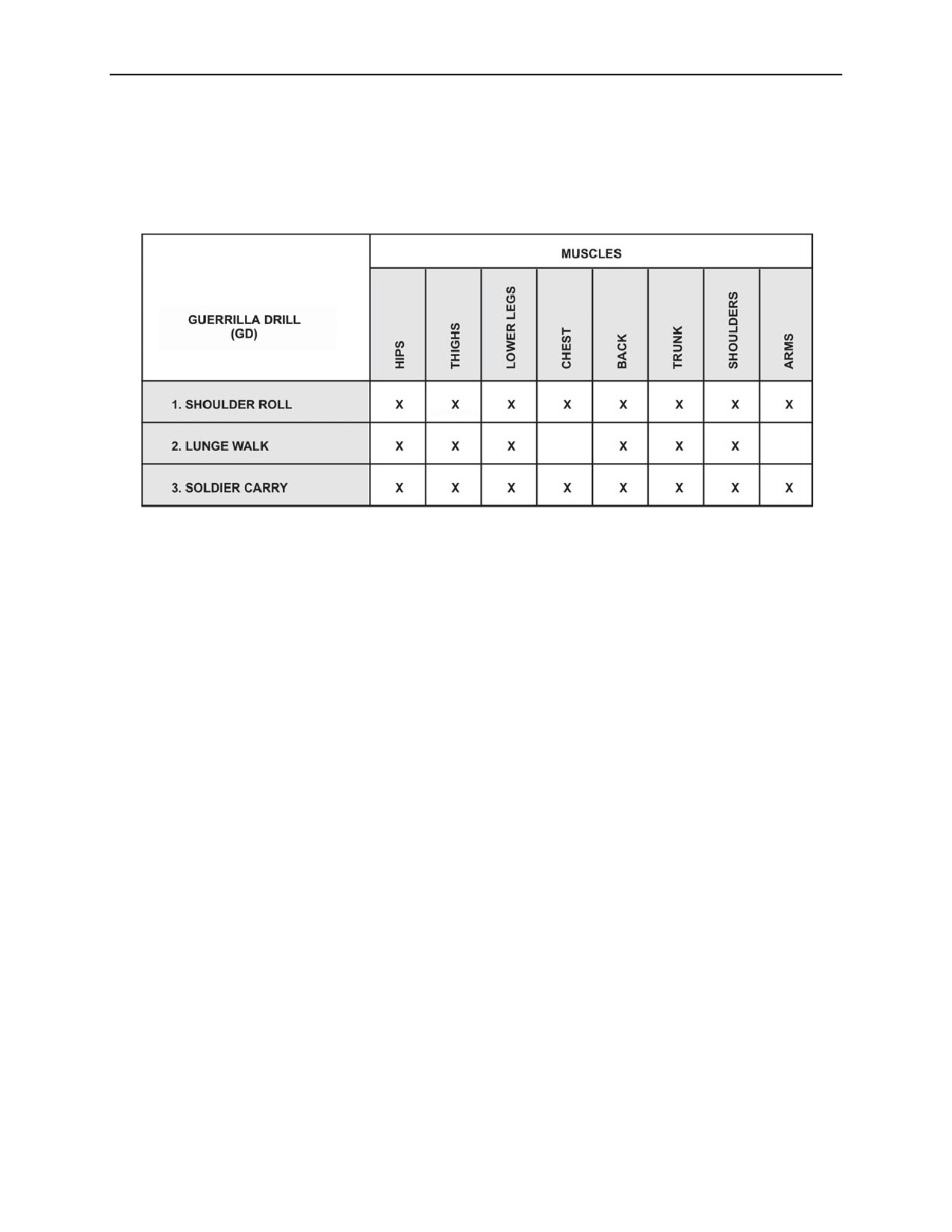
9-65. The GD consists of three exercises that are performed in the sequenced prescribed and trains the body
segments listed in Table 9-11. The commands for execution of the drill and starting positions for each exercise
are described in Chapter 7.
Table 9-11. Body segments trained in the guerrilla drill
9-70
FM 7-22
26 October 2012
Strength and Mobility Activities
GUERRILLA DRILL
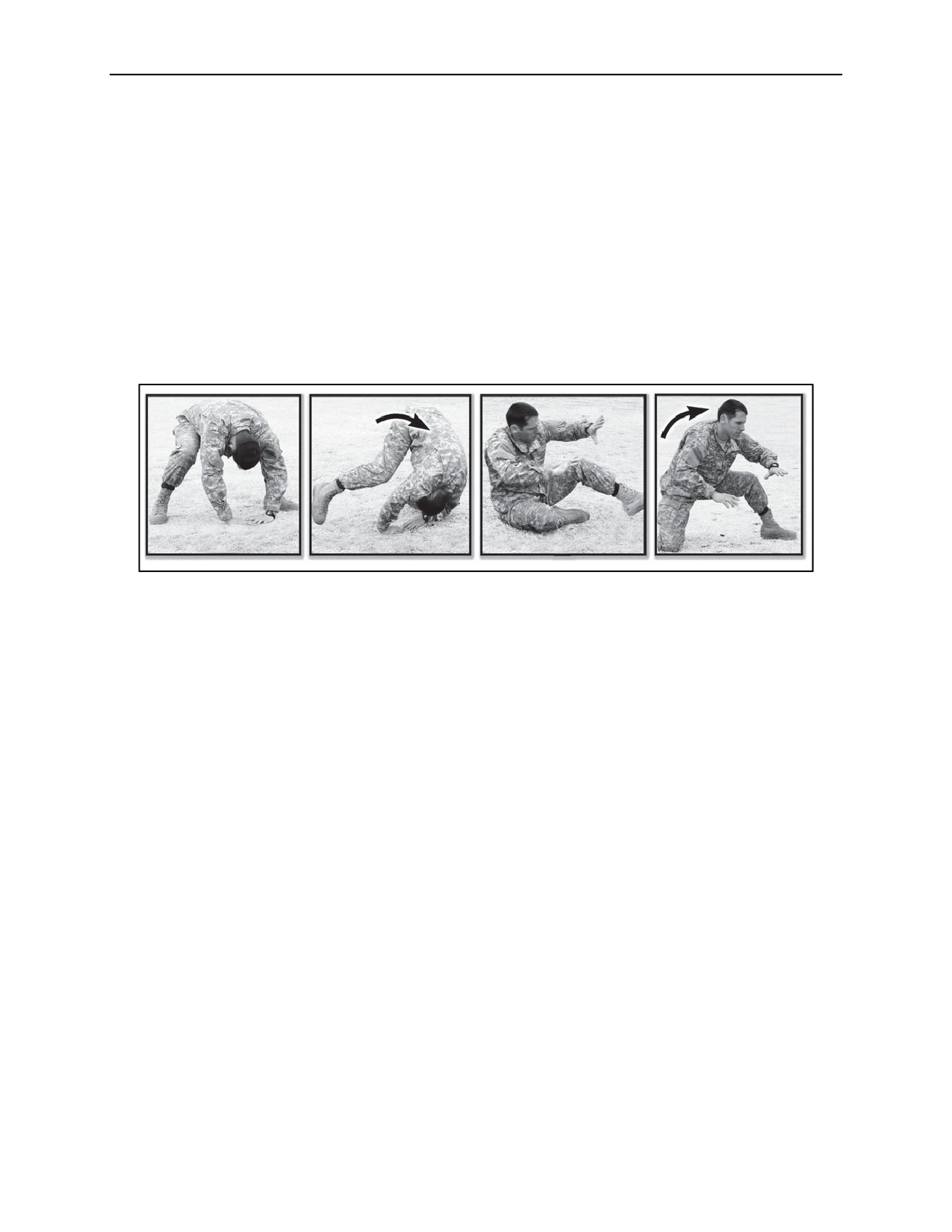
EXERCISE 1: SHOULDER ROLL
Purpose: This exercise develops the Soldier’s ability to safely fall and roll-up to a standing position
(Figure 9-46).
Starting Position: Straddle stance.
Movement: Step forward with the left foot, squat down, and make a wheel with the arms by placing the left
hand on the ground with the fingers facing to the rear; the right hand is also on the ground with the fingers
facing forward. Tuck the chin to avoid injury to the neck. Push off with the right leg and roll over the left
shoulder along the left side of the body. To roll to the opposite side, step forward and switch hand and leg
positions. Progress to continuously walking and alternating rolling on opposite sides.
Figure 9-46. Shoulder roll
Check Points:
z
Lead with the left foot when rolling on the left shoulder and the right foot when rolling on the right
shoulder.
z
Hands are placed on the ground, facing each other with the middle fingertips of each hand touching
at the tips so the arms form a wheel.
z
Rotate the upper body so the lead elbow is pointing straight to the front while maintaining a wheel
with the arms.
z
Tuck the chin so ground contact is made with the arms, shoulder blades, and back, but not with the
neck.
z
The momentum of the roll brings Soldiers up to their knees. Continue to the feet by pushing off with
the rear leg while standing up on the front leg.
Precautions: The PRT leader and an AI(s) must ensure that Soldiers are in the proper squatting position for the
roll by ensuring that their hands are on the ground and their chins are tucked before rolling.
26 October 2012
FM 7-22
9-71
Chapter 9
GUERRILLA DRILL
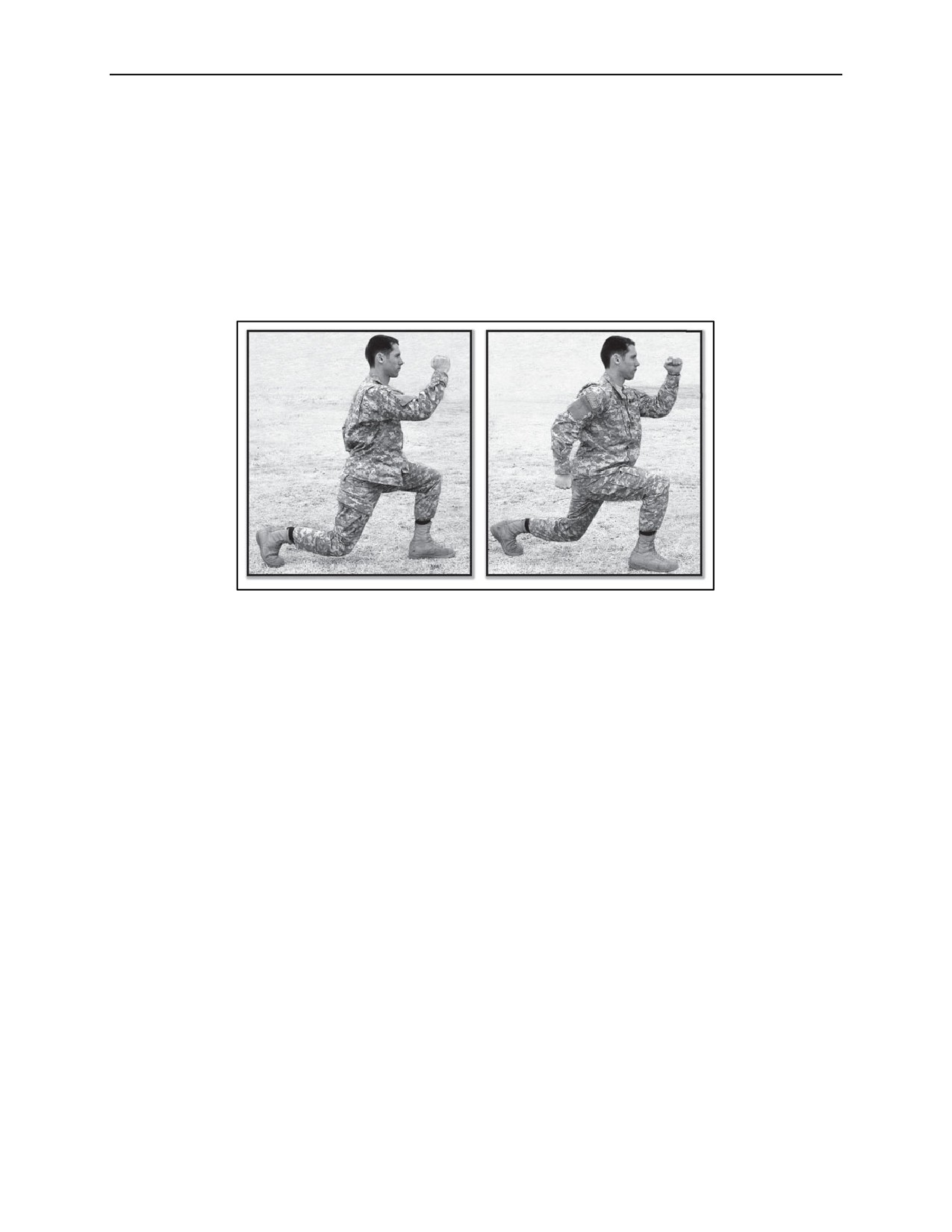
EXERCISE 2: LUNGE WALK
Purpose: This exercise develops the leg power needed to move both vertically and horizontally (Figure 9-47).
Starting Position: Straddle stance.
Movement: Walk forward, starting with the left foot, stepping as in the forward lunge. Lightly touch the knee
of the rear leg to the ground with each step. Without returning to the starting position, continue to lunge walk
to the 25-yard stop point by alternating legs.
Figure 9-47. Lunge walk
Check Points:
z
Incorporate arm swing with the arm opposite the forward leg raised parallel to the ground.
z
Keep the back straight and the head up.
z
Do not allow the knee of the lead leg to move forward of the toes of the forward foot.
Precaution: Do not allow the knee of the rear leg to forcefully contact the ground.
9-72
FM 7-22
26 October 2012
Strength and Mobility Activities
GUERRILLA DRILL
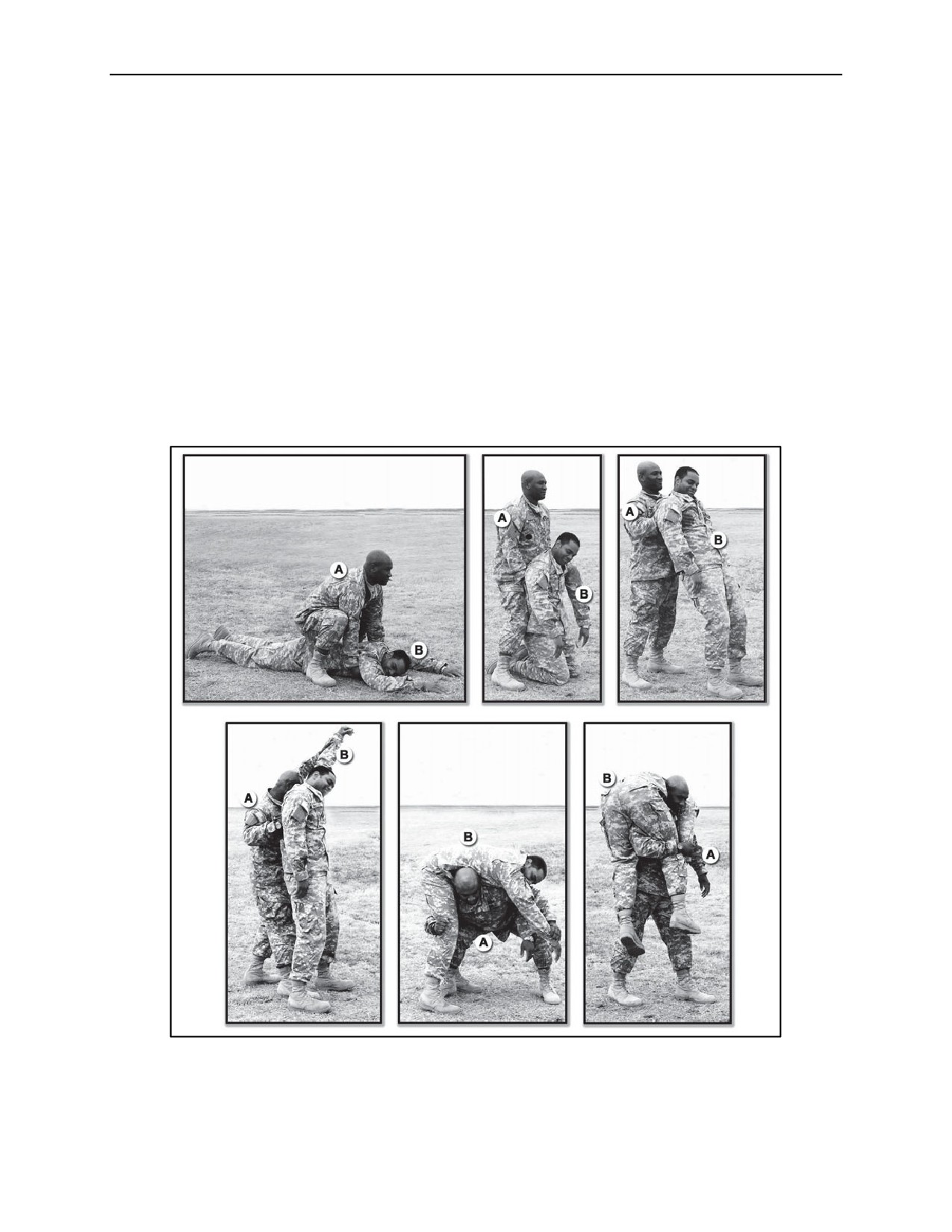
EXERCISE 3: SOLDIER CARRY
Purpose: This exercise develops the Soldier’s ability to carry a conscious or unconscious Soldier of comparable
size (Figure 9-48).
Starting Position: Soldier “B” assumes the prone position, arms overhead. Soldier “A” straddles Soldier “B”
and squats, reaching under Soldier “B’s” armpits. Soldier “A” stands lifting Soldier “B” to his knees. Soldier
“A” continues to lift Soldier “B” to his feet, leaning him back slightly to lock the legs. Soldier “A” raises one
of Soldier “B’s” arms overhead and walks under the arm to the front of Soldier “B,” oriented sideways to
Soldier “B.” Soldier “A” bends his knees and leans forward, placing one arm through Soldier “B’s” legs.
Soldier “A” leans Soldier “B” forward until he lies across Soldier “A’s” shoulders. Soldier “A” stands up,
lifting Soldier “B” off the ground. Soldier “A,” using the hand of his arm that is between Soldier “B’s” legs,
grasps the wrist of Soldier “B’s” arm that is hanging over Soldier “A’s” shoulder.
Movement: Soldier “A” moves 25-yards at quick time; then Soldier “B” dismounts; the Soldiers then change
positions and return to the starting point.
Figure 9-48. Soldier carry
26 October 2012
FM 7-22
9-73
Chapter 9
Check Points:
z
Soldier “A” should squat low and grasp Soldier “B” under the arms to lift him from the prone
position. Soldier “A” may clasp his hands in front of Soldier “B’s” chest to help him lift Soldier “B”
to his feet.
z
Position Soldier “B” over the shoulder during the carry. Secure the position with one hand, grasping
Soldier “B’s” forward arm.
Precautions: Keep back straight and use legs to lift Soldier to the carry position. All movement in the carry
position is performed at a quick time; no running.
Summary
The purpose of strength and mobility activities is to improve functional strength,
postural alignment, and body mechanics as they relate to the performance of
WTBDs. The regular and precise execution of the exercise drills listed in this
chapter will develop the body management competencies needed to successfully
accomplish these tasks.
9-74
FM 7-22
26 October 2012
Chapter 10
Endurance and Mobility Activities
“Each morning in Africa a gazelle wakes up. It knows it must outrun the fastest lion or it will
be killed. Every morning in Africa, a lion wakes up. It knows it must run faster than the
slowest gazelle or it will starve. It doesn’t matter whether you’re a lion or a gazelle, when the
sun comes up, you’d better be running.”
Roger Bannister, first person to run a mile in under four minutes (3:59.4)
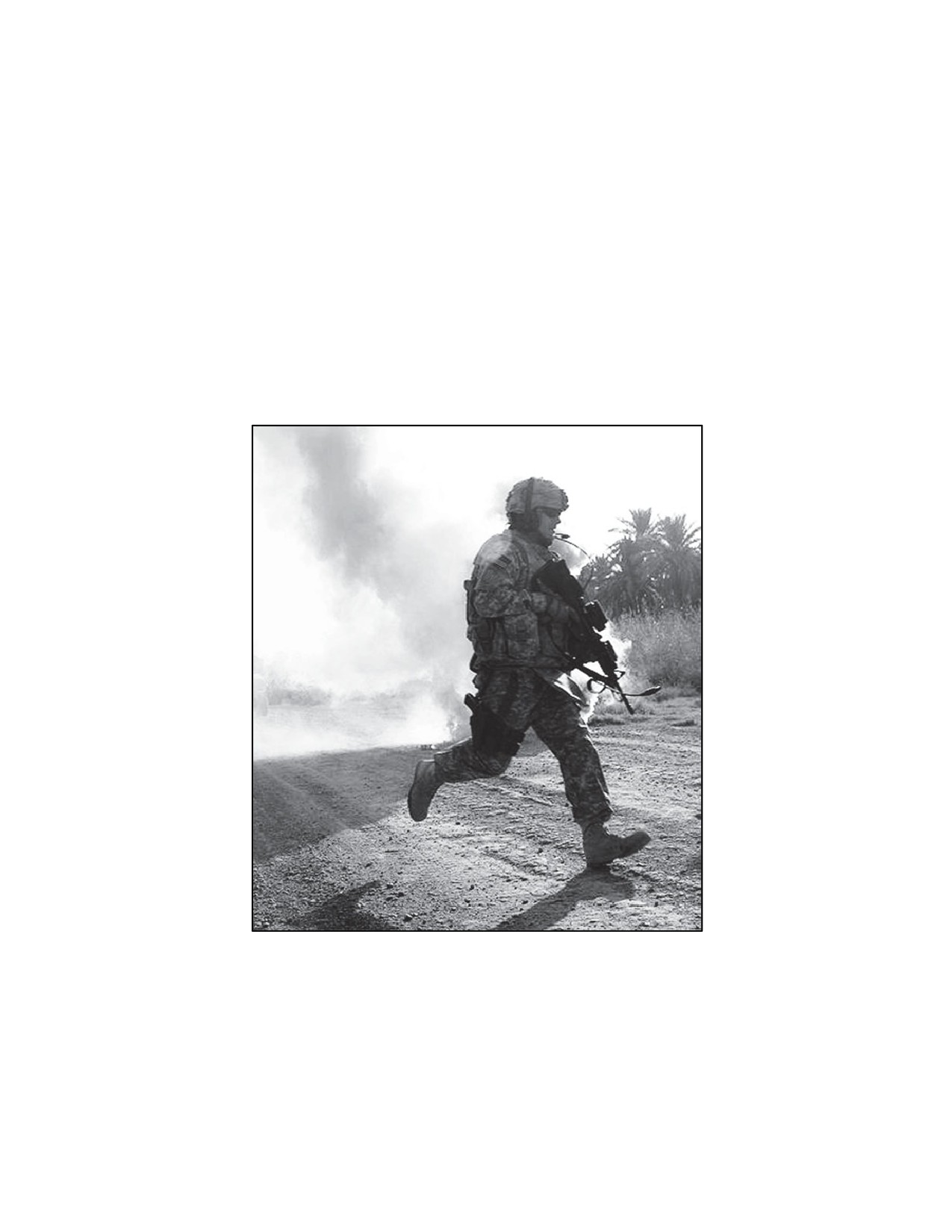
Warrior tasks and battle drills require the ability to move quickly on foot. Running short
distances at high speed is essential to moving under direct and indirect fire (Figure 10-1).
Figure 10-1. Moving under direct and indirect fire
RUNNING
10-1. The purpose of running is to improve the overall conditioning of the Soldier by developing endurance.
Endurance spans a continuum between aerobic and anaerobic systems. Aerobic endurance is developed by
performing low to moderate intensity activities for a long duration. Anaerobic endurance is developed by
performing high-intensity activities for a short duration, resting, and then repeating the sequence. Aerobic
training alone does not fully prepare Soldiers for the functional endurance and strength requirements of
WTBDs. The analysis of the physical demands needed to successfully accomplish WTBDs demonstrates a more
26 October 2012
FM 7-22
10-1

Chapter 10
significant requirement for anaerobic endurance. In order to train the complete spectrum of endurance, speed
running, sustained running, and foot movement under load must be performed. The running activities described
in this chapter may be performed individually or collectively. Table 10-1 describes endurance and mobility
activities used in PRT. Table 10-2 describes endurance and mobility activities and the prescription of intensity,
duration, and volume within the toughening and sustaining phases. In addition, Chapter 5, Planning
Considerations, provides the template for commanders and PRT leaders to implement endurance and mobility
activities into their PRT programs.
Table 10-1. Endurance and mobility activities
Endurance and Mobility Activities
Military Movement Drills 1
These drills dynamically prepare the body for more vigorous running activities and
and 2 (MMD 1&2)
develop motor efficiency.
30:60s and 60:120s improve the resistance to fatigue of the active muscles by repeatedly
exposing them to high intensity effort. As a result of their increased anaerobic and
30:60s and 60:120s
aerobic endurance, Soldiers will be able to sustain performance of physically demanding
tasks at a higher intensity for a longer duration.
The 300-yard Shuttle Run develops the ability to repeatedly sprint after changing
300-yard Shuttle Run (SR)
direction. It is an indicator of the Soldier’s anaerobic endurance, speed, and agility.
Hill repeats are an effective means of developing explosive leg strength, anaerobic
Hill Repeats (HR)
power, and speed.
Ability group runs train Soldiers in groups of near-equal ability to sustain running for
Ability Group Run (AGR)
improvement in aerobic endurance.
Unit formation runs are based on a time and distance that can be achieved with unit
Unit Formation Run (UFR)
integrity and a display of unit cohesion.
Release runs combine the benefits of formation running and individual performance at
Release Run (RR)
higher training intensities. Soldiers will run in formation to a specified time (no more than
15 minutes), then are released to run as fast as they can back to the starting point.
Terrain running applies the Train as you will fight principle to PRT. Running through local
Terrain Run (TR)
training areas, over hills, and around obstacles improves mobility, endurance, and the
ability to stop, start, and change direction.
Foot marching as a movement component of maneuver, is a critical Soldier physical
Foot March (FM)
requirement. Regular foot marching prepares Soldiers to successfully move under load.
Conditioning Obstacle
Running the conditioning obstacle course for time challenges Soldiers’ strength,
Course (CDOC)
endurance, and mobility, improving individual movement techniques.
Use of endurance training equipment may be based on environmental constraints, safety
Endurance Training
for Soldiers on physical profile, and isolation of specific muscle groups to be trained
Machines (ETM)
during rehabilitation and reconditioning.
10-2
FM 7-22
26 October 2012

Endurance and Mobility Activities
Table 10-2. Endurance and mobility activity prescription
Endurance and Mobility Activities
Toughening
Sustaining
Sustaining
Sustaining
Sustaining
Phase
Phase
Phase
Phase
Phase
Activities
(BCT & OSUT-R/W/B)
(AIT & OSUT-B/G)
ARFORGEN
ARFORGEN
ARFORGEN
(Reset)
(Train/Ready)
(Available)
MMD 1
1 rep
1 rep
1 rep
1 rep
1 rep
MMD 2
N/A
1 rep
1 rep
1 rep
1 rep
6-8 reps
6-10 reps
6-10 reps
10-15 reps
10-15 reps
30:60s
w/wo load
w/wo load
w/wo load
w/wo load
60:120s
6-10 reps
6-10 reps
6-10 reps
6-10 reps
6-10 reps
1 rep
1-2 reps
1-2 reps
1-2 reps
1-2 reps
300-yd SR
w/wo load
w/wo load
w/wo load
N/A
6-8 reps
6-10 reps
6-10 reps
6-10 reps
HR
uphill or downhill
uphill or downhill
uphill or downhill
uphill or downhill
AGR
10-30 min
20-30 min
20-30 min
20-30 min
20-30 min
UFR
20-30 min
20-30 min
30 min
30 min
30 min
RR
20-30 min
20-30 min
30 min
30 min
30 min
TR
N/A
20 min
20-30 min
20-30 min
20-30 min
FM
2-15 Km
2-15 Km
10 Km or less
10-30 Km
10-30 Km
CDOC
1 rep
1 rep
1 rep
1 rep
1 rep
ETM
N/A
N/A
20-30 min
20-30 min
20-30 min
MMD-Military Movement Drill
SR-Shuttle Run
HR-Hill Repeats
AGR-Ability Group Run
Abbreviations
UFR-Unit Formation Run
RR-Release Run
TR-Terrain Run
FM-Foot March (fl/aml/eaml)
CDOC-Conditioning Obstacle Course ETM-Endurance Training Machines
TRAINING AREA
10-2. Running is conducted over a variety of terrain:
z
Hardball (improved and unimproved roads).
z
Grassy fields.
z
Tracks.
z
Wooded areas.
z
Hills.
z
Tank trails.
UNIFORM
10-3. The commander will specify the appropriate uniform based on the type of running activity to be
performed. PRT uniforms appropriate for running include:
z
IPFU.
z
ACUs and running shoes.
z
ACUs and boots.
z
ACUs with boots and fighting load.
EQUIPMENT
10-4. Equipment used will be according to installation safety policy requirements
(flashlights, reflective
vests/bands, traffic cones, AGR route markers placed at ¼ mile intervals). The PRT leader and AI must monitor
run time and pace during the conduct of running activities.
26 October 2012
FM 7-22
10-3
Chapter 10
FORMATION
10-5. Formations used in unit running are squad, platoon, company, and battalion in column. Other types of
running such as terrain running or speed running will be conducted in one or more columns as determined by
the training area and installation safety standing operating procedures.
LEADERSHIP
10-6. The PRT leader and AIs must be able to demonstrate and lead all types of running activities. They must
also be familiar with formations, commands, cadence, and placement of Soldiers into ability groups for
sustained and speed running.
INSTRUCTION AND EXECUTION
10-7. Running may be performed individually or collectively. When conducting collective training, running is
optimized when Soldiers are grouped by near-equal ability. The best way to assign Soldiers to ability groups is
by their most recent 1-mile run time assessment. The optimal time and range between each group is 60 seconds.
When performing formation sustained running, the PRT leader should be on the left side of the formation and
toward the rear to have a full view of all Soldiers and maintain control. Speed running may be conducted
individually or collectively by ability group, on a track or designated running area. When conducting speed
running, the PRT leader will control running and recovery times from the center of the track or running area
using a whistle and stopwatch. Assistant instructors may run with the Soldiers to provide positive motivation
and running form corrections.
PRECISION
10-8. Soldiers should be instructed on the running form guidelines in this chapter. Running with optimal body
mechanics allows greater efficiency with less chance of injury. Soldiers should strive to demonstrate and
maintain proper running form during all running activities.
PROGRESSION
10-9. In the toughening phase, Soldiers perform speed running (30:60s, 60:120s, and the 300-yard SR) and
sustained running. Initially, Soldiers perform six repetitions of 30:60s and progress up to 8 repetitions, and then
begin performing 60:120s, 6 repetitions progressing to 10 repetitions. The intensity for speed running during the
30- and 60-second work intervals is 75 to 85 percent maximal effort. During the 60- and 120-second recovery
intervals, all Soldiers walk until the next work interval begins. At the completion of 30:60s or 60:120s, Soldiers
walk two to three minutes before engaging in other PRT activities or recovery. The SR is performed only one
time when performed as an activity during a PRT session, in conjunction with 60:120s. The PRT leader
designates the number of repetitions and signals the start of each group or individual. Formation running is
conducted for no longer than 30 minutes in the toughening phase. All running courses should be marked at ¼-
mile intervals so PRT leaders can monitor split times to ensure the maintenance of the appropriate running pace.
Sustained running progression is built into the PRT training schedules through the employment of release runs
and by moving Soldiers from lower ability groups to higher ability groups.
10-10. In the sustaining phase, Soldiers continue to perform the speed and sustained running activities from
the toughening phase. In addition, HR, terrain running, and speed running under load are performed. Hill
repeats start with 6 repetitions and add no more than 1 repetition every 2 weeks, not to exceed 10 repetitions.
The PRT leader designates the number of repetitions and signals the start of each group or individual. Sustained
running should not exceed 30 minutes in the sustaining phase. All running courses should be marked at ¼-mile
intervals so PRT leaders can monitor split times to ensure the maintenance of the appropriate running pace.
Sustained running progression is accomplished by moving the Soldier from a lower ability group to the next
higher ability group. Terrain running is only conducted in the sustaining phase. Distances should generally be 1
mile for densely wooded areas and up to 2 miles on tank trails and open fields. During the sustaining phase, the
300-yard SR may be performed in ACUs and boots, progressing to individual body armor (IOTV) without
plates, then with plates, then with fighting load. Caution must be used when determining appropriate
progression. Environmental considerations are important in the ramp of progression. Repetitions, pace, load,
10-4
FM 7-22
26 October 2012
Endurance and Mobility Activities
uniform, and total exercise time must be adjusted when exercising at high altitudes and in hot, humid
environments. Refer to Appendix D for environmental considerations.
INTEGRATION
10-11. The variety of running activities conducted during the toughening phase (30:60s, 60:120s, the 300-yd
shuttle run, release runs, AGR, and unit formation running) and sustaining phase (30:60s, 60:120s, the 300-yd
shuttle run, release runs, hill repeats, AGR, and unit formation running) integrate anaerobic and aerobic
training. The 300-yard SR, in both the toughening and sustaining phases, and sustaining phase terrain running
are also integrated to develop Soldier skills.
COMMANDS
10-12. Calling of cadence and commands is the responsibility of the PRT leader or ability group leader. The
command, “Double Time, MARCH” starts the formation running. The command “Quick Time, MARCH”
terminates formation running (see TC 3-21.5, Drill and Ceremonies). After performance of preparation and any
previous PRT activities (military movement drills 1 and/or 2), the Soldiers will jog for about ¼ mile before the
first repetition of 30:60s or 60:120s is performed. When conducting 30:60s, 60:120s, or HR en masse, the PRT
leader will control work (running phase) and recovery (walking phase) times from the center of the track or
running area. The PRT leader will initiate the work (run/hill) interval by signaling with one whistle blast. At the
conclusion of the work (run/hill) interval (30 or 60 seconds), the PRT leader will signal with two short whistle
blasts. At the conclusion of the recovery (walk) interval (60 or 120 seconds), the PRT leader will again signal
with one short whistle blast. This sequence is repeated until the desired number of repetitions is completed.
Soldiers of varied abilities run for different numbers of repetitions during the toughening phase. Soldiers who
finish early will continue to walk until all Soldiers have completed the activity. At the end of the activity, the
entire group will walk for 2 to 3 minutes before performing any subsequent activities or recovery.
FORM
10-13. Running form varies from Soldier to Soldier. Anatomical variations cause a variety of biomechanical
manifestations. Many individual variations may be successful. Attempts to force Soldiers to conform to one
standard may do more harm than good; however, there are some basic guidelines that may improve running
efficiency without overhauling the natural stride. Generally, the form and technique for all types of running is
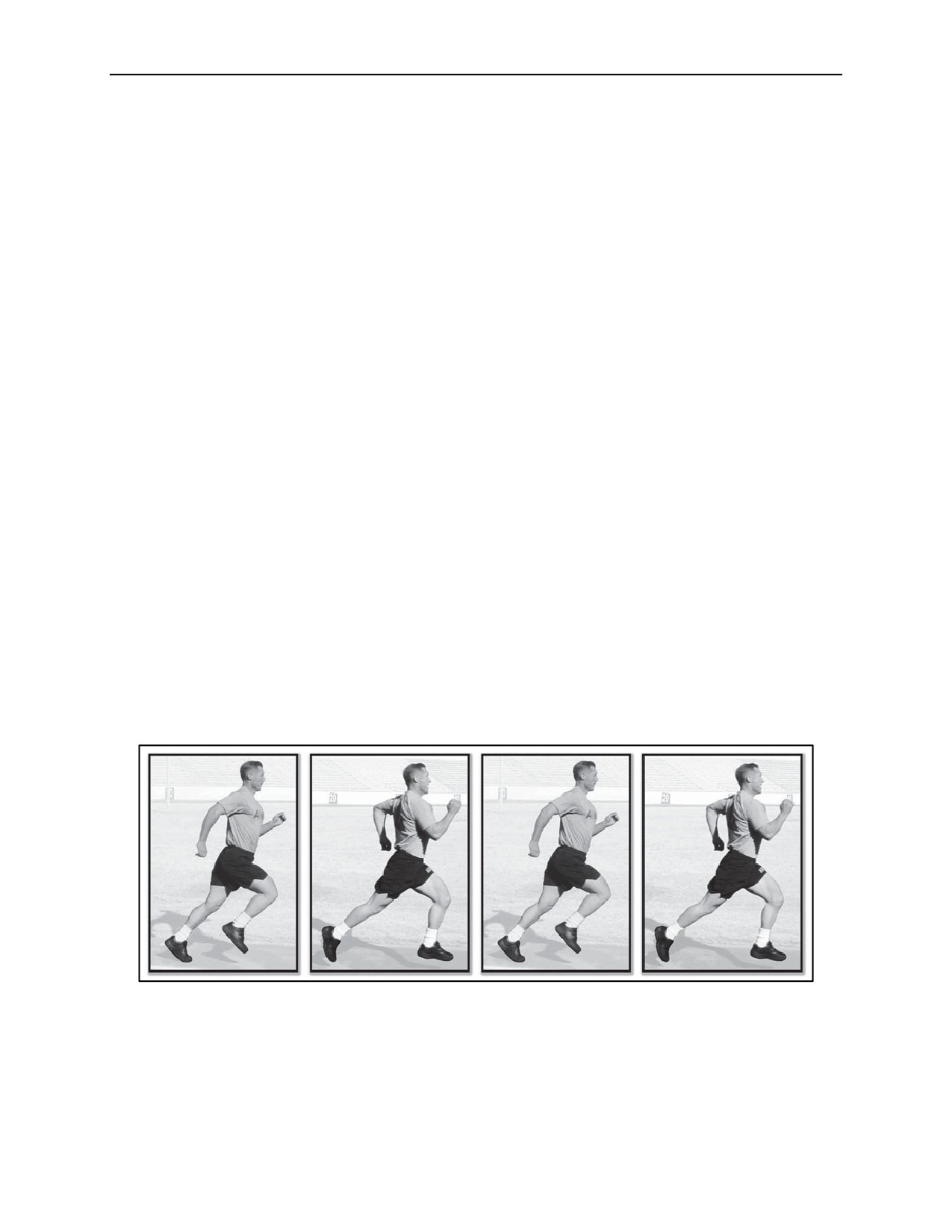
fairly constant. The following information addresses optimal running form for the major body segments (Figure
10-2).
Figure 10-2. Sustained running form
HEAD
10-14. The head should be held high, with the chin pointed forward, neither up nor down. Allowing the head
to ride forward puts undue strain on the muscles of the upper back.
26 October 2012
FM 7-22
10-5
Chapter 10
SHOULDERS
10-15. The shoulders should assume a neutral posture, neither rounded forward nor forcefully arched
backward. Rounding the shoulders forward is the most common fault in everyday posture while walking and
running. The problem is usually associated with tightness of the chest and shoulder muscles. Another problem
occurs when the shoulders start to rise with fatigue or increased effort. This position not only wastes energy, but
can also adversely affect breathing.
ARMS
10-16. Throughout the arm swing, the elbows should stay at roughly a 90-degree bend. The wrists stay straight
and the hands remain loosely cupped. The arm swing should be free of tension, but do not allow the hands to
cross the midline of the body.
TRUNK AND PELVIS
10-17. The trunk should remain over its base of support, the pelvis. A common problem with fatigue is
allowing the trunk to lean forward of the legs and pelvis. This forces the lower back muscles to expend too
much energy resisting further trunk lean to the front.
LEGS
10-18. For distance running, much of the power is generated from below the knee. Energy is wasted as the
knees come higher and the large muscles of the hips and thighs are engaged. Practice getting a strong push-off
from the ankle of the back leg. This helps to lengthen the stride naturally. Lengthening the stride by reaching
forward with the front leg will be counterproductive.
FEET
10-19. The feet should be pointed directly forward while running. With fatigue and certain muscle imbalances,
the legs and feet may start to rotate outward. This may hinder performance and create abnormal stresses that
contribute to injury.
BREATHING
10-20. Breathing should be rhythmic in nature and coordinated with the running stride.
MILITARY MOVEMENT DRILL 1
10-21. The purpose of MMD1 in the toughening phase (Figure 10-3) is to enhance running form, dynamically
prepare the body for more vigorous running activities, and develop motor efficiency. Military movement drill 1
is conducted following preparation and the HSD prior to running activities during the PRT session. Any level
area of adequate size is appropriate for conducting MMD1. Beware of hazards such as holes, uneven terrain and
rocks. Use caution when conducting MMD1 on wet terrain. This drill is conducted using the extended
rectangular formation (covered) and performed by rank. Military movement drill 1 consists of exercises
performed at 25-yard intervals: verticals, laterals, and the shuttle sprint. Refer to Table 10-2 for endurance and
mobility activities, prescriptions of intensity, duration, and volume within the toughening and sustaining phases.
In addition, Chapter 5, Planning Considerations, provides the template for commanders and PRT leaders to
implement endurance and mobility activities into their PRT programs.
10-6
FM 7-22
26 October 2012