FM 7-22 ARMY PHYSICAL READINESS TRAINING (OCTOBER 2012) - page 6
Chapter 6
RECOVERY DRILL
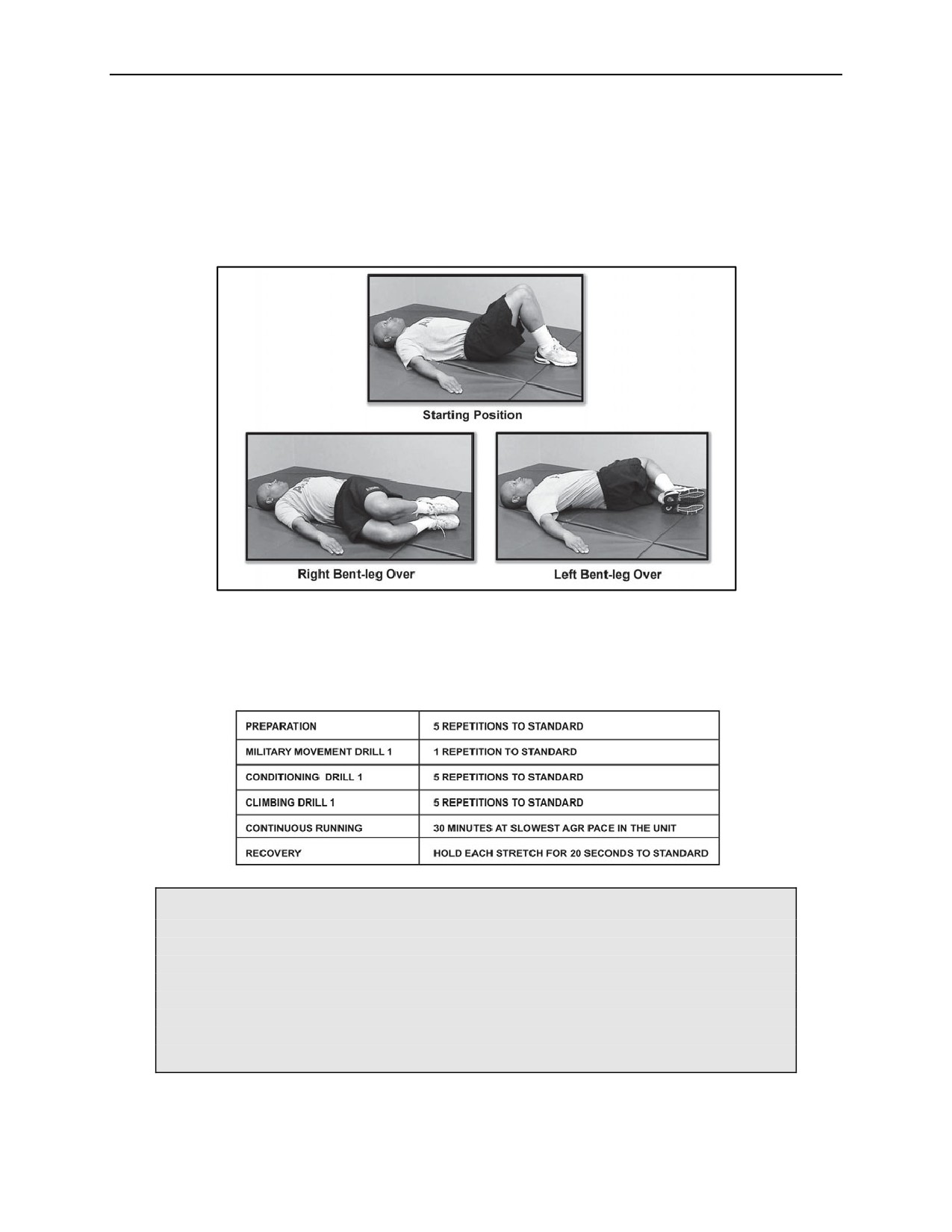
MODIFIED EXERCISE 5: MODIFIED SINGLE-LEG OVER
6-136. The starting position for this exercise is supine (Figure 6-106). The Soldier places the arms sideward at
45 degrees to the body, palms downward. The Soldier bends the knees to 90 degrees with the feet flat on the
ground. The Soldier rotates the hips and lowers the knees toward the ground.
Figure 6-106. Modified single-leg over
6-137. Before being discharged from level II and returning to unit PRT, Soldiers must meet the requirements
shown in Table 6-5.
Table 6-5. Reconditioning phase level II exit criteria
Summary
Unit readiness is greatly affected by injuries, illness, and other medical conditions. The
Army PRT program is safe and effective. Physical readiness training must challenge
Soldiers without breaking them. Some injuries inevitably occur, but units that take
measures to control injury risks will have fewer Soldiers on medical profile and more on
duty to perform mission requirements. For Soldiers who suffer injuries or are recovering
from illness or other medical conditions, effective reconditioning allows them to return to
duty at or above their pre-injury level of individual physical readiness. This is what special
conditioning programs are all about.
6-116
FM 7-22
26 October 2012
PART THREE
ACTIVITIES
This part discusses the conduct of PRT exercises, drills, and activities.
Chapter 7
Execution of Training
The key to success in PRT execution is skillful leadership with trained AIs who employ
command presence, command voice, and organized instruction in the extended
rectangular formation. This chapter describes in detail the PRT commands, formations,
positions, and counting cadence.
COMMANDS
7-1. This section discusses the importance of proper commands. This cannot be underestimated. Invariably,
PRT performance reflects the quality of its commands. Indifferent commands produce indifferent performance.
When a command is given distinctly, concisely, with energy, and with proper regard to rhythm, Soldier
performance will reflect it. See TC 3-21.5, Drill and Ceremonies, for detailed information of command voice,
posture, and presence.
TYPES
7-2. The two types of commands used in PRT are preparatory commands and commands of execution. The
preparatory command describes and specifies what is required. All preparatory commands are given with rising
voice inflection. The command of execution calls into action what has been prescribed. The interval between
the two commands should be long enough to permit the Soldier to understand the first one before the second
one is given.
COMMAND DELIVERY
7-3. When the PRT leader addresses the formation and is commanding movement or announcing the name of
an exercise, he does so from the position of attention. Exceptions are exercises that change position without
returning to the position of attention.
7-4. When exercises are performed, Soldiers assume the proper starting position of each exercise on the
command “Starting position, MOVE.” When conducting exercises, Soldiers are commanded to return to the
position of attention from the terminating position of the exercise before they are commanded to assume the
starting position for the next exercise. PRT leaders use the command “Position of Attention, MOVE”, to bring
Soldiers to the position of attention from an exercise terminating position.
7-5. For example, this is how the PRT leader would conduct exercise 4, thigh stretch in the RD.
z
From the position of attention, the PRT leader commands, “THE THIGH STRETCH.”
z
Soldiers respond, “THE THIGH STRETCH.”
z
From the position of attention, the PRT leader commands, “Starting Position, MOVE.”
26 October 2012
FM 7-22
7-1
Chapter 7
z
The PRT leader and Soldiers assume the starting position for the thigh stretch.
z
From the starting position, the PRT leader commands, “Ready, STRETCH.”
z
To change position, the PRT leader first commands, “Starting Position, MOVE.”
z
From the starting position, the PRT leader commands, “Change Position, Ready, STRETCH.”
z
Upon termination of the exercise, the PRT leader commands, “Starting Position, MOVE.”
z
The PRT leader assumes the position of attention and commands, “Position of Attention, MOVE.”
EXTENDED RECTANGULAR FORMATION
7-6. The Army’s traditional formation for PRT activities is the extended rectangular formation. It is best for
platoon- to company-size formations because it is simple and easy to assume.
PLATOON ASSEMBLY
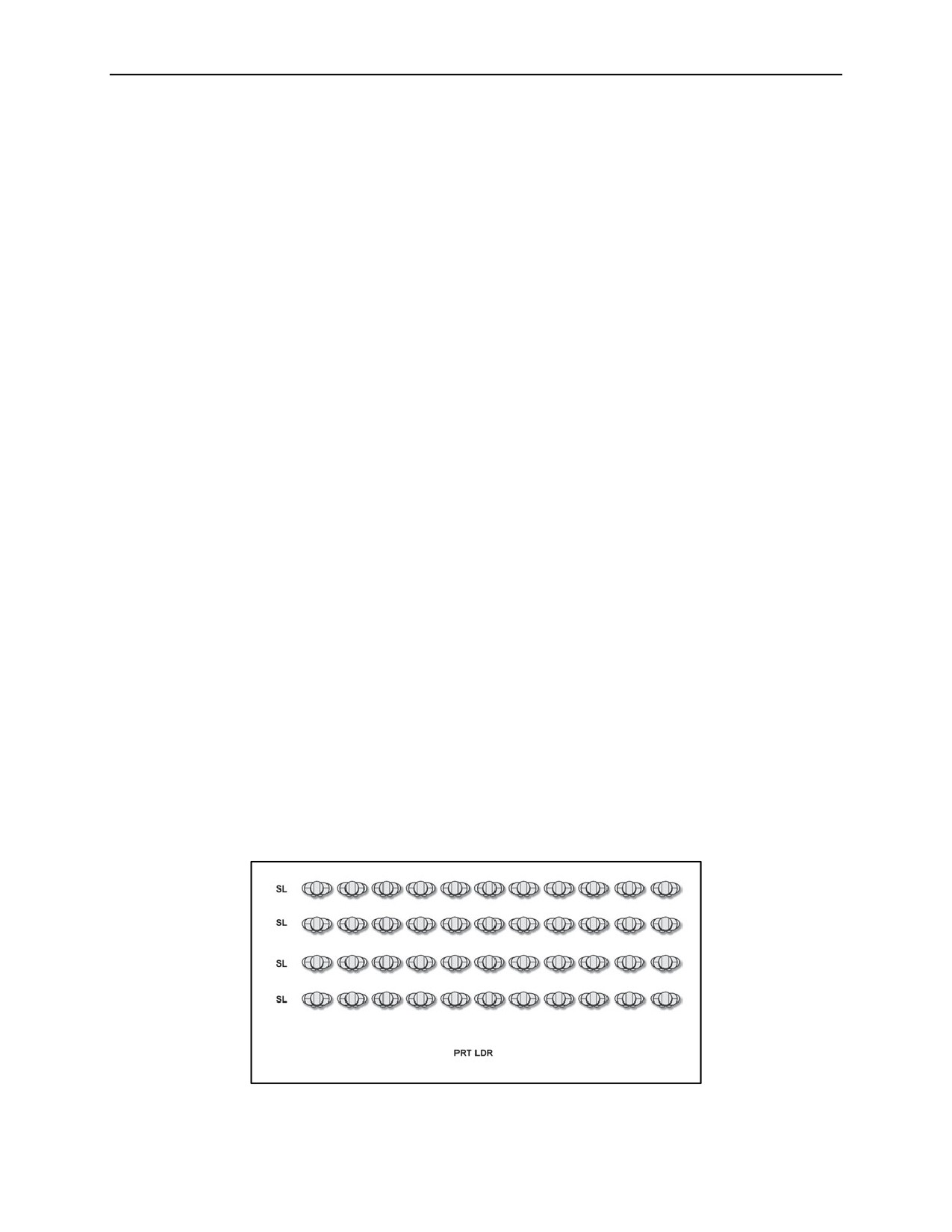
7-7. The PRT leader will position a platoon-size unit in a line formation so that the unit is centered and five
paces away from the PRT platform after they have assumed the rectangular formation. Refer to Figure 7-1. The
PRT leader gives the following commands:
z
“Extend to the left, MARCH.” Soldiers in the right flank file stand fast with their left arm extended
sideward with palm down, fingers and thumbs extended and joined. All other Soldiers turn to the left
and double-time forward. After taking the sufficient number of steps, all Soldiers face the front and
extend both arms sideward with palms down, fingers and thumbs extended and joined. The distance
between fingertips is about 12 inches and dress is to the right.
z
“Arms downward, MOVE.” The Soldiers lower their arms smartly to their sides. Soldiers in the right
flank file lower their left arms to their sides.
z
“Left, FACE.” Soldiers execute the left face.
z
“Extend to the left, MARCH.” Soldiers in the right flank file stand fast with their left arms extended
sideward with palm down, fingers and thumbs extended and joined. All other Soldiers turn to the left
and double-time forward. After taking the sufficient number of steps, all Soldiers face the front and
extend both arms sideward with palms down, fingers and thumbs extended and joined. The distance
between fingertips is about 12 inches and dress is to the right.
z
“Arms downward, MOVE.” Soldiers lower their arms smartly to their sides. Soldiers in the right
flank file lower their left arms to their sides.
z
“Right, FACE.” Soldiers execute the right face.
z
“From front to rear, COUNT OFF.” The front Soldier in each column turns his head to the right rear,
and then calls off, “ONE,” and faces the front. Successive Soldiers in each column call off in turn
“TWO,” “THREE,” “FOUR,” and so on. The last Soldier in each column will not turn his head and
eyes to the right while sounding off.
z
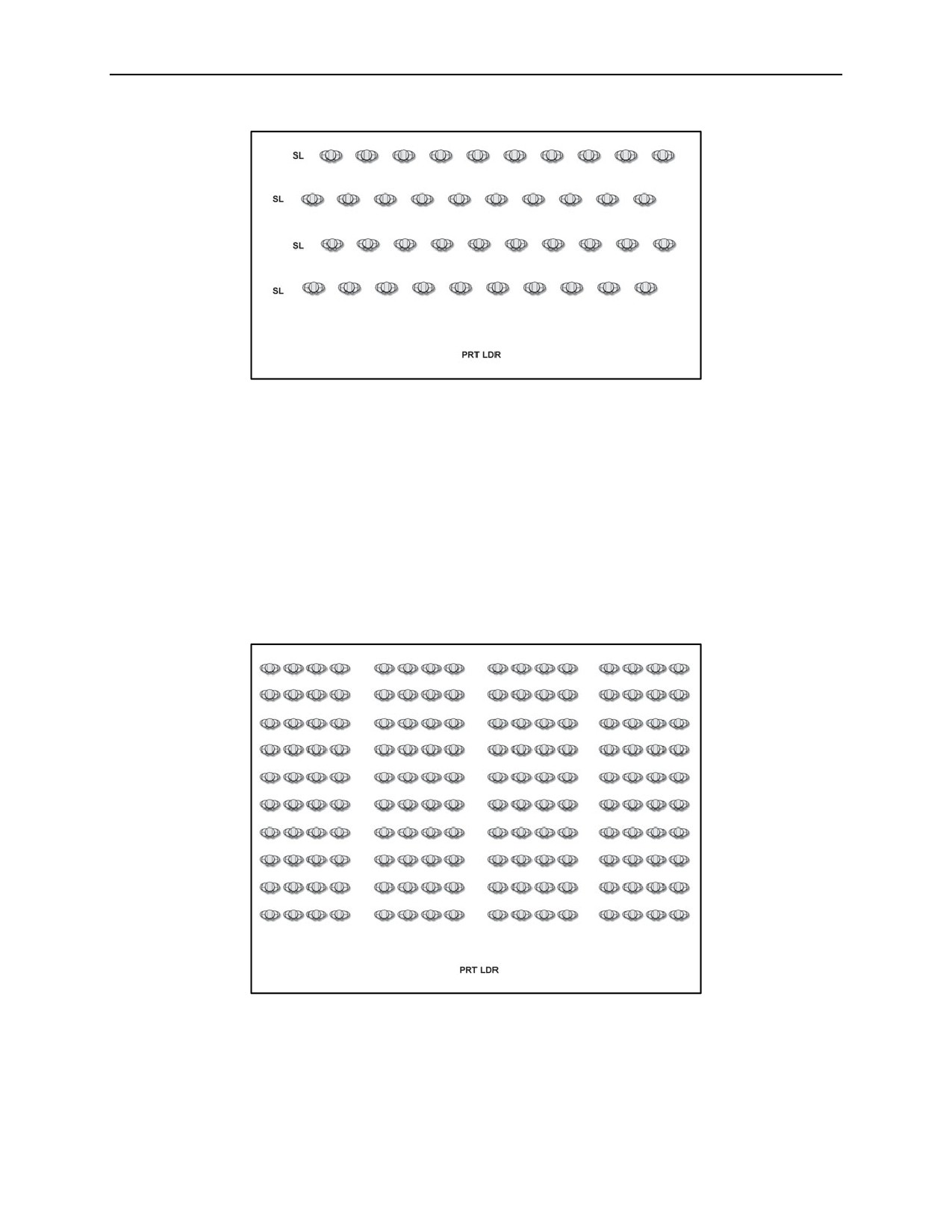
“Even number to the left, UNCOVER.” Even-numbered Soldiers side step to the left squarely in the
center of the interval, bringing their feet together. (See Figure 7-2.)
Figure 7-1. Platoon rectangular formation
7-2
FM 7-22
26 October 2012
Execution of Training
Figure 7-2. Platoon rectangular formation extended and uncovered
PLATOON REASSEMBLY
7-8. To reassemble the formation, the PRT leader commands:
“Assemble to the Right, MARCH.” All Soldiers double-time to their original positions in the
formation (Figure 7-1).
COMPANY IN LINE WITH PLATOONS IN COLUMN
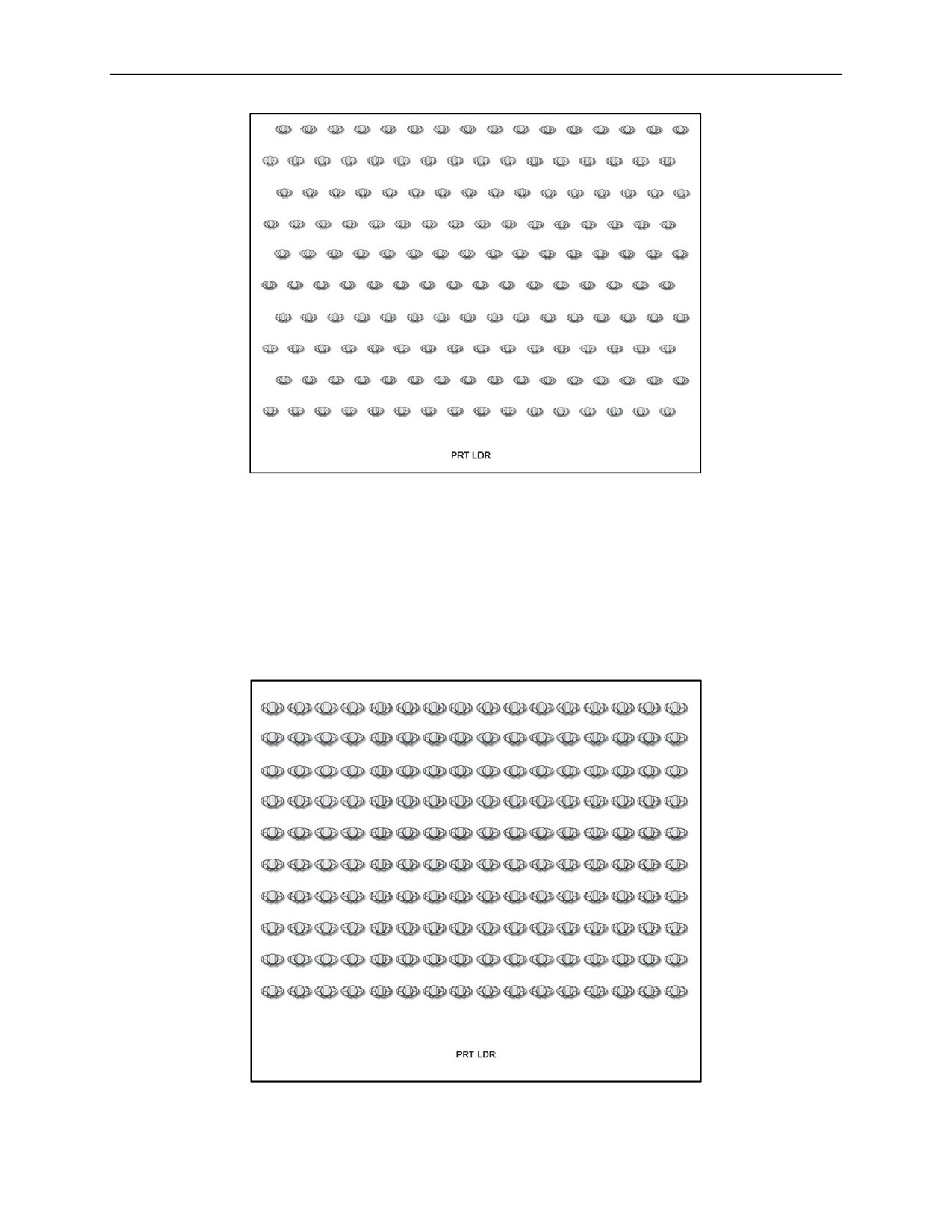
7-9. The PRT leader will position a company-size unit in the extended rectangular formation from a company
in line with platoons in column. He then adjusts the base platoon so that the company will be centered and five
paces away from the PRT platform after they have assumed the rectangular formation. Refer to Figure 7-3. The
PRT leader gives the commands specified in paragraph 7-7 to extend the formation (Figure 7-4).
Figure 7-3. Forming a company, company in line with platoons in column
26 October 2012
FM 7-22
7-3
Chapter 7
Figure 7-4. Company extended and uncovered, company in line with platoons in column
7-10. To reassemble the formation, the PRT leader commands:
“Assemble to the Right, MARCH.” All Soldiers double-time to their original positions in the
formation (Figure 7-3).
COMPANY FORMATION EN MASSE
7-11. The PRT leader will position a company-size unit in a rectangular formation. He first adjusts the base
platoon so that the company will be centered and five paces away from the PRT platform after they have
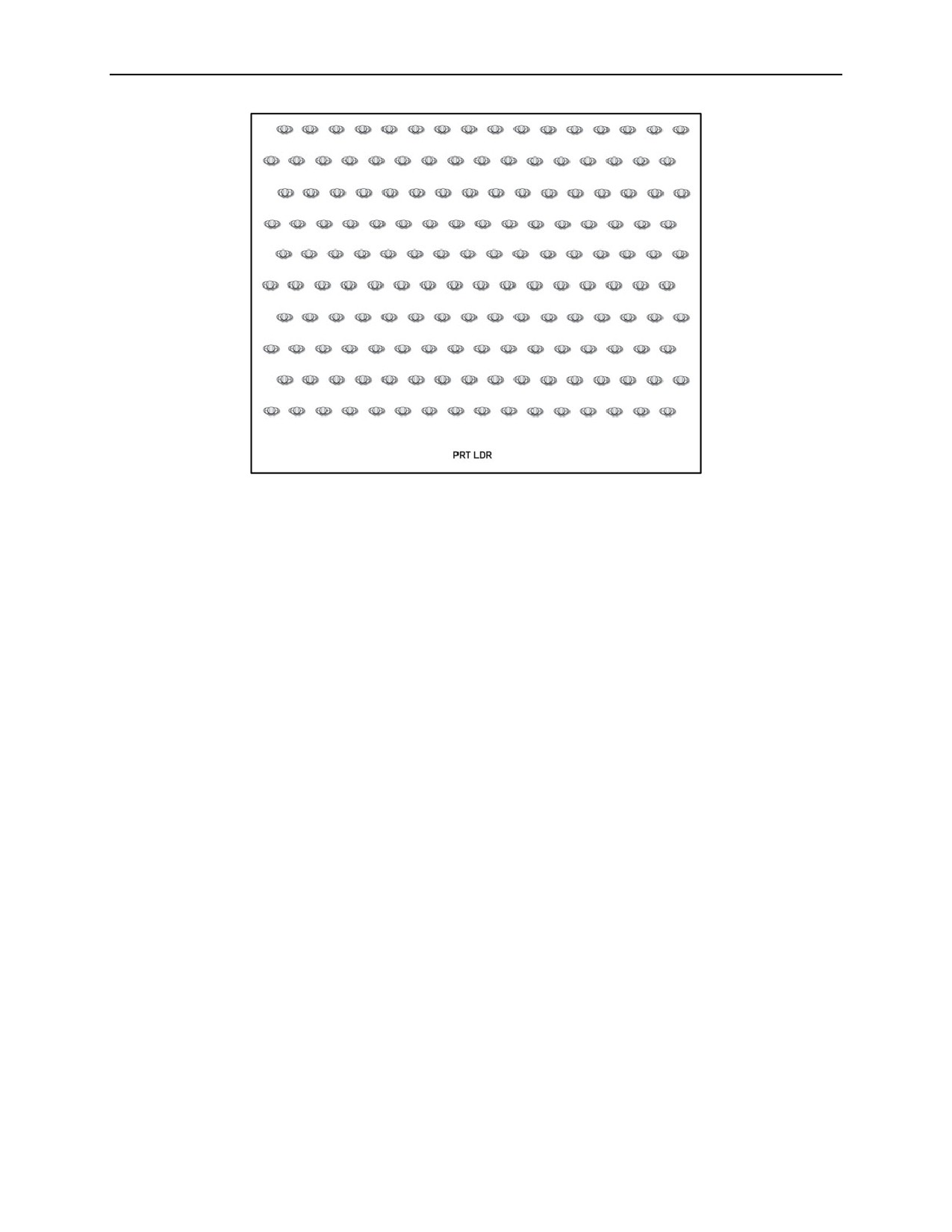
assumed the rectangular formation. Refer to Figure 7-5. The PRT leader gives the commands specified in
paragraph 7-7 to extend the formation (Figure 7-6).
Figure 7-5. Formation of company en masse
7-4
FM 7-22
26 October 2012
Execution of Training
Figure 7-6. Company en masse extended and uncovered
7-12. To reassemble the formation, the PRT leader commands:
“Assemble to the right, MARCH.” All Soldiers double-time to their original positions in the
formation (Figure 7-5).
PLATOON EXTENDED RECTANGULAR FORMATION, COVERED
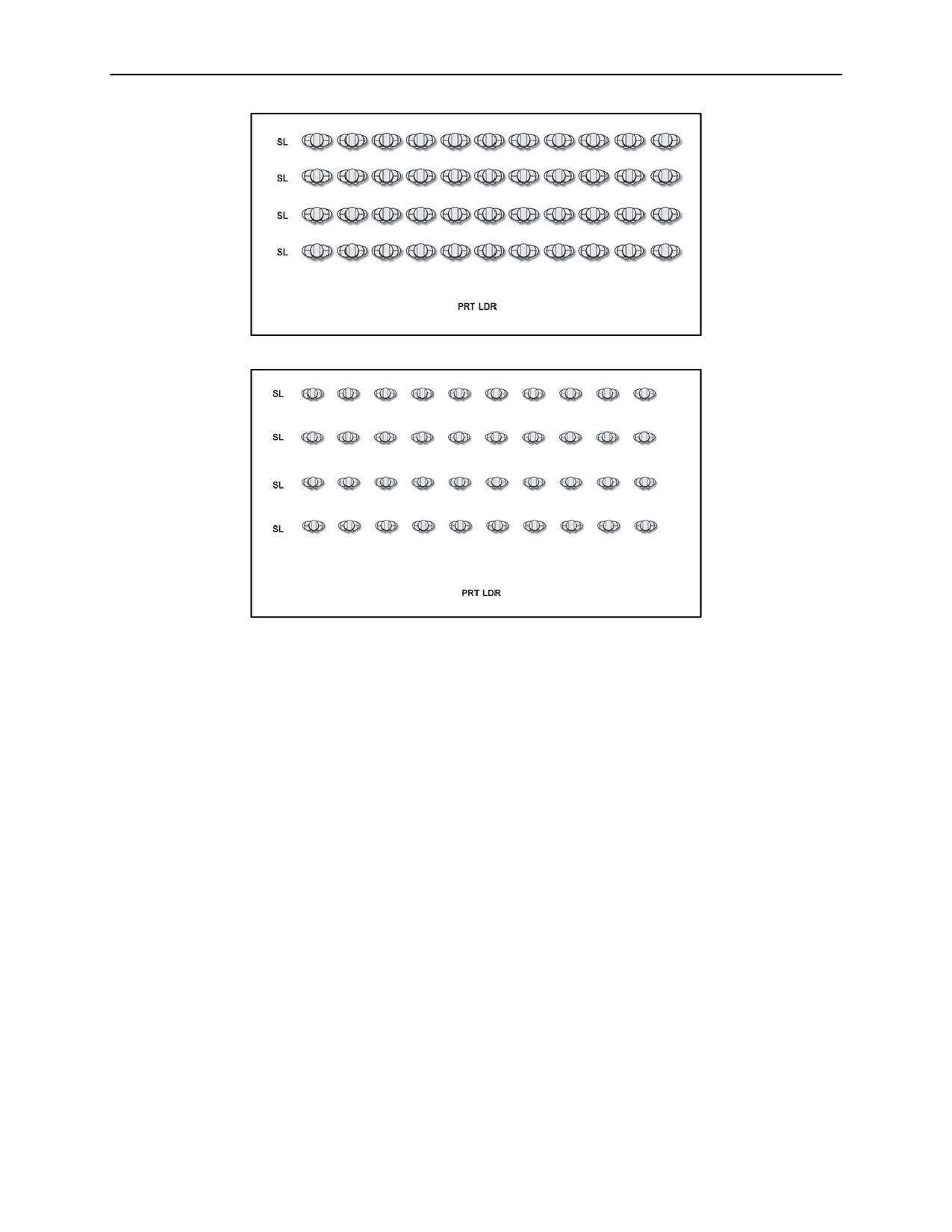
7-13. The formation for military movement and GDs is a platoon extended rectangular formation, covered
(Figure 7-8). The PRT leader positions the platoon in a line formation so the unit will be centered and five paces
away from the PRT platform after it assumes the extended rectangular formation. The PRT leader gives the
following commands to extend the platoon formation covered (Figures 7-7 and 7-8).
z
“Extend to the left, MARCH.” Soldiers in the right flank file stand fast with their left arm extended
sideward with palms down, fingers and thumbs extended and joined. All other Soldiers turn to the
left and double-time forward. After taking the sufficient number of steps, all Soldiers face the front
and extend both arms sideward with palms down, fingers and thumbs extended and joined. The
distance between fingertips is about 12 inches and dress is to the right.
z
“Arms downward, MOVE.” The Soldiers lower their arms smartly to their sides. Soldiers in the right
flank file lower their left arms to their sides.
z
“Left, FACE.” Soldiers execute the left face.
z
“Extend to the left, MARCH.” Soldiers in the right flank file stand fast with their left arms extended
sideward with palms down, fingers and thumbs extended and joined. All other Soldiers turn to the
left and double-time forward. After taking the sufficient number of steps, all Soldiers face the front
and extend both arms sideward with palms down, fingers and thumbs extended and joined. The
distance between fingertips is about 12 inches and dress is to the right.
z
“Arms downward, MOVE.” Soldiers lower their arms smartly to their sides. Soldiers in the right
flank file lower their left arms to their sides.
z
“Right, FACE.” Soldiers execute the right face.
26 October 2012
FM 7-22
7-5
Chapter 7
Figure 7-7. Platoon formation en masse
Figure 7-8. Platoon formation extended and covered
7-14. To reassemble the formation, the PRT leader commands:
“Assemble to the Right, MARCH.” All Soldiers double-time to their original positions in the
formation (Figure 7-7).
7-6
FM 7-22
26 October 2012
Execution of Training
POSITIONS
7-15. When a set of conditioning exercises is employed, Soldiers assume the proper starting position of each
exercise on the command “Starting Position, MOVE.” When conducting exercises, Soldiers are commanded to
return to the position of attention from the terminating position of the exercise, before commanded to assume
the starting position for the next exercise.
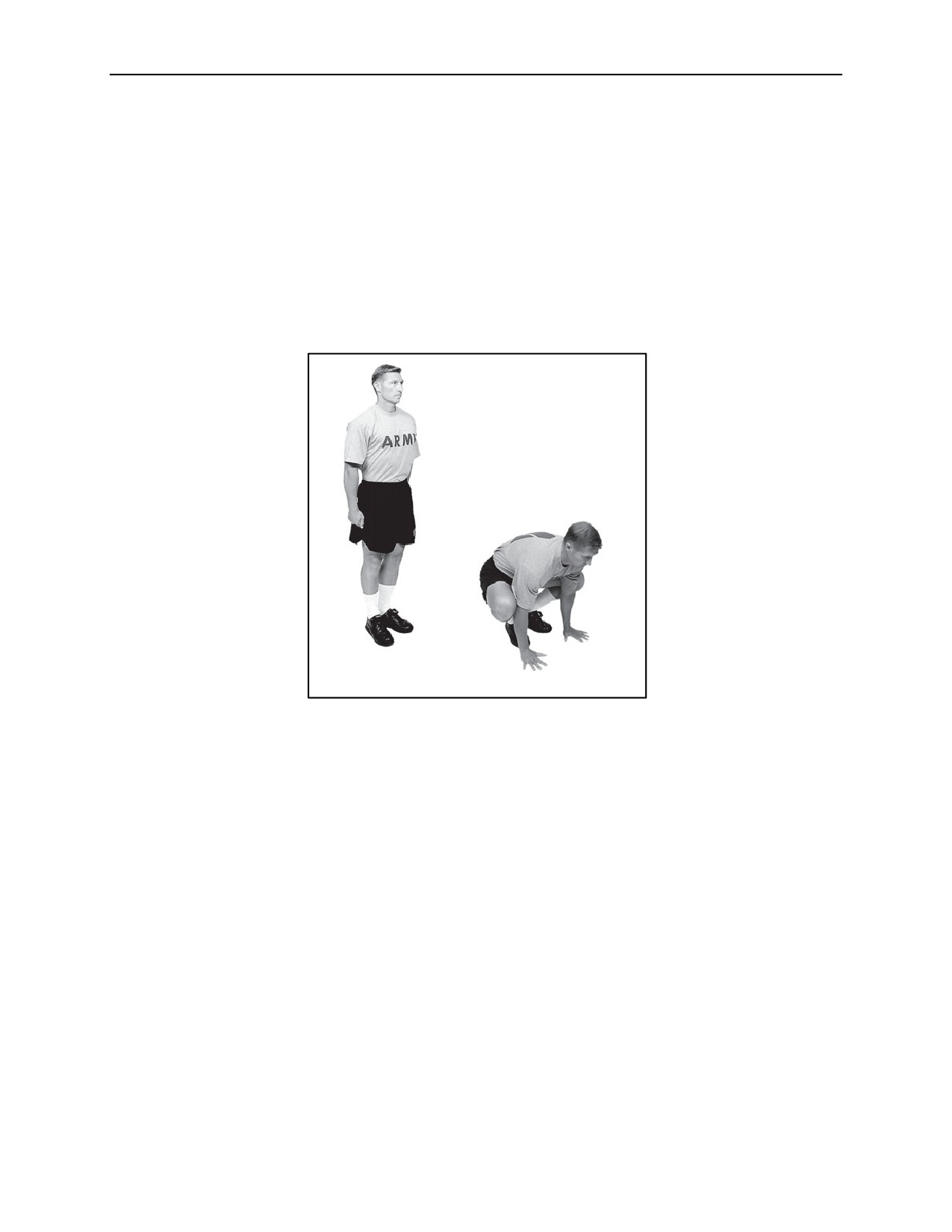
SQUAT POSITION
7-16. To assume the squat position from the position of attention, lower the body by bending the knees and
place the hands with palms down and fingers spread, shoulder width in front of the body, and in between the
bent legs. Raise the heels, supporting the body weight on the balls of the feet and hands. Direct the head and the
eyes to a point about three to four feet in front of the body (Figure 7-9).
Figure 7-9. Squat position
26 October 2012
FM 7-22
7-7
Chapter 7
FRONT LEANING REST POSITION
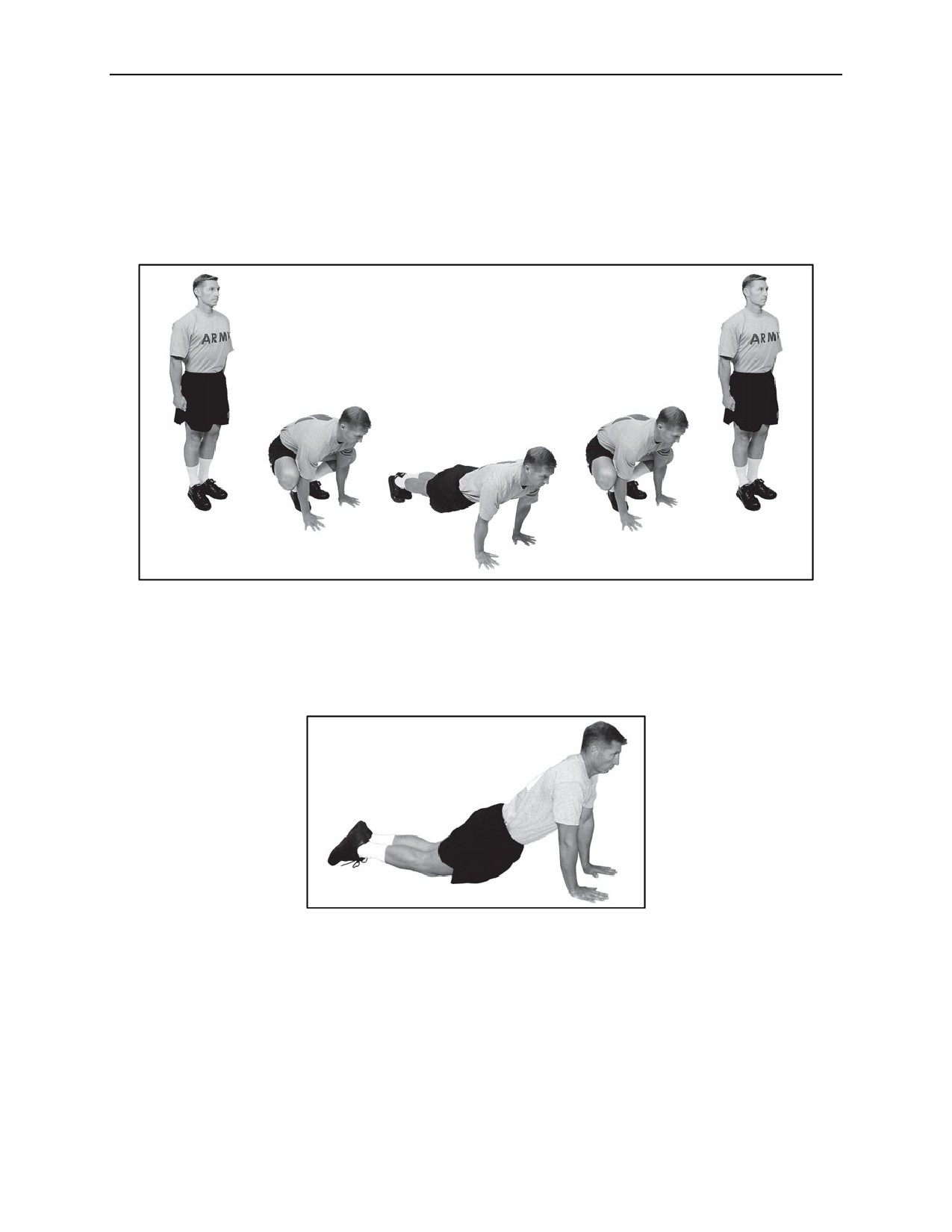
7-17. The Soldier assumes the front leaning rest position by performing two movements. First, the Soldier
moves from the position of attention to the squat position, then thrusts the feet backward to the front leaning rest
position. If he has trouble with the squat thrust, he can step back with his left leg—then with his right leg—to
get into the front leaning rest position. In the front leaning rest position, maintain straight body alignment from
his head to his heels. He supports his body weight on his hands (shoulder width) and on the balls of his feet. He
keeps his feet and legs together (Figure 7-10).
Figure 7-10. Front leaning rest position
SIX-POINT STANCE
7-18. Assume the six-point stance by dropping to the knees from the front leaning rest position. Maintain a
straight line from the head to the knees (Figure 7-11).
Figure 7-11. Six-point stance
7-8
FM 7-22
26 October 2012
Execution of Training
STRADDLE STANCE
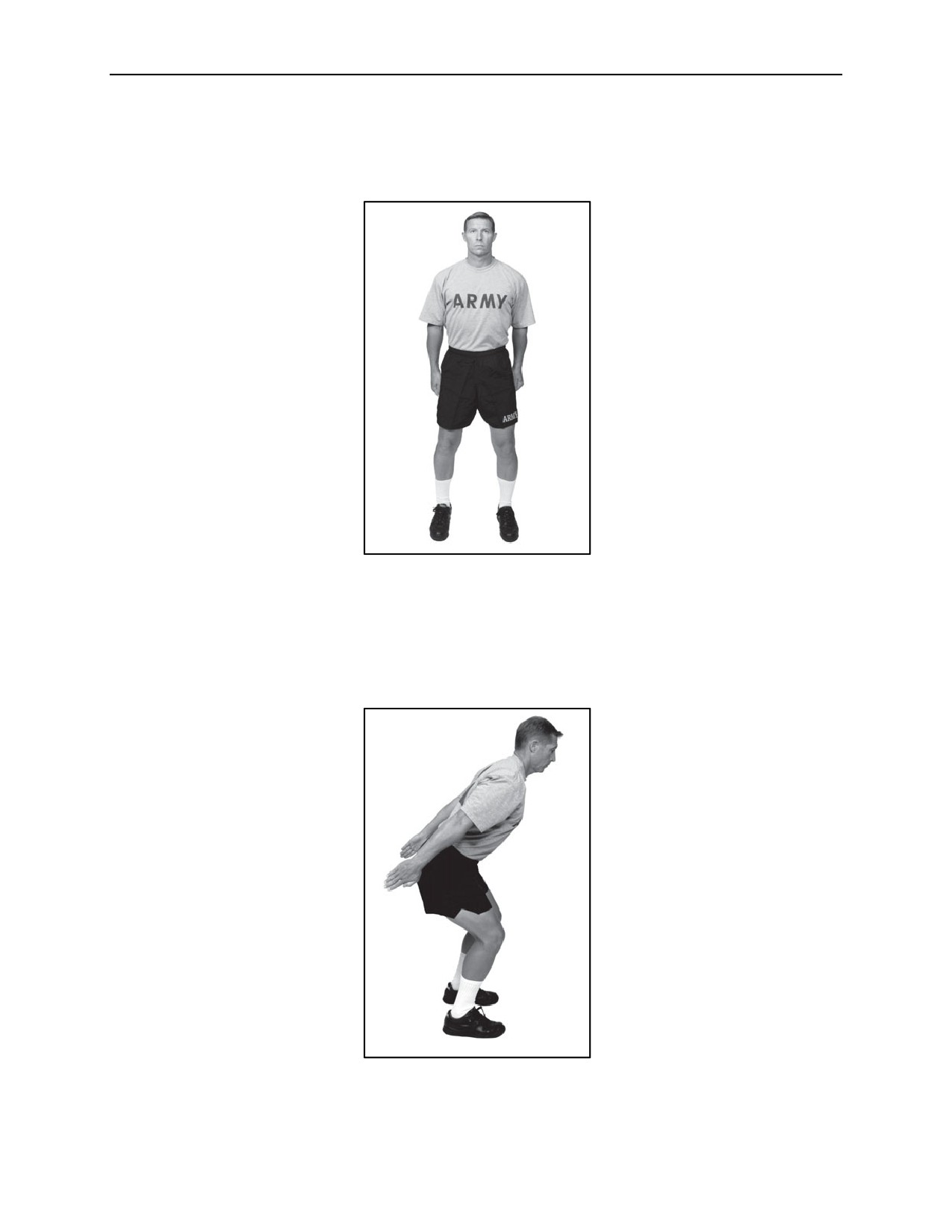
7-19. Assume the straddle stance position by standing with the feet straight ahead and aligned with the
shoulders (Figure 7-12).
Figure 7-12. Straddle stance
FORWARD LEANING STANCE
7-20. Assume the forward leaning stance by bending the trunk forward 45 degrees, knees bent 45 degrees, with
the heels flat on the ground, and the feet aligned with the shoulders. Keep the back straight, maintaining a
straight line from the head to the hips (Figure 7-13).
Figure 7-13. Forward leaning stance
26 October 2012
FM 7-22
7-9
Chapter 7
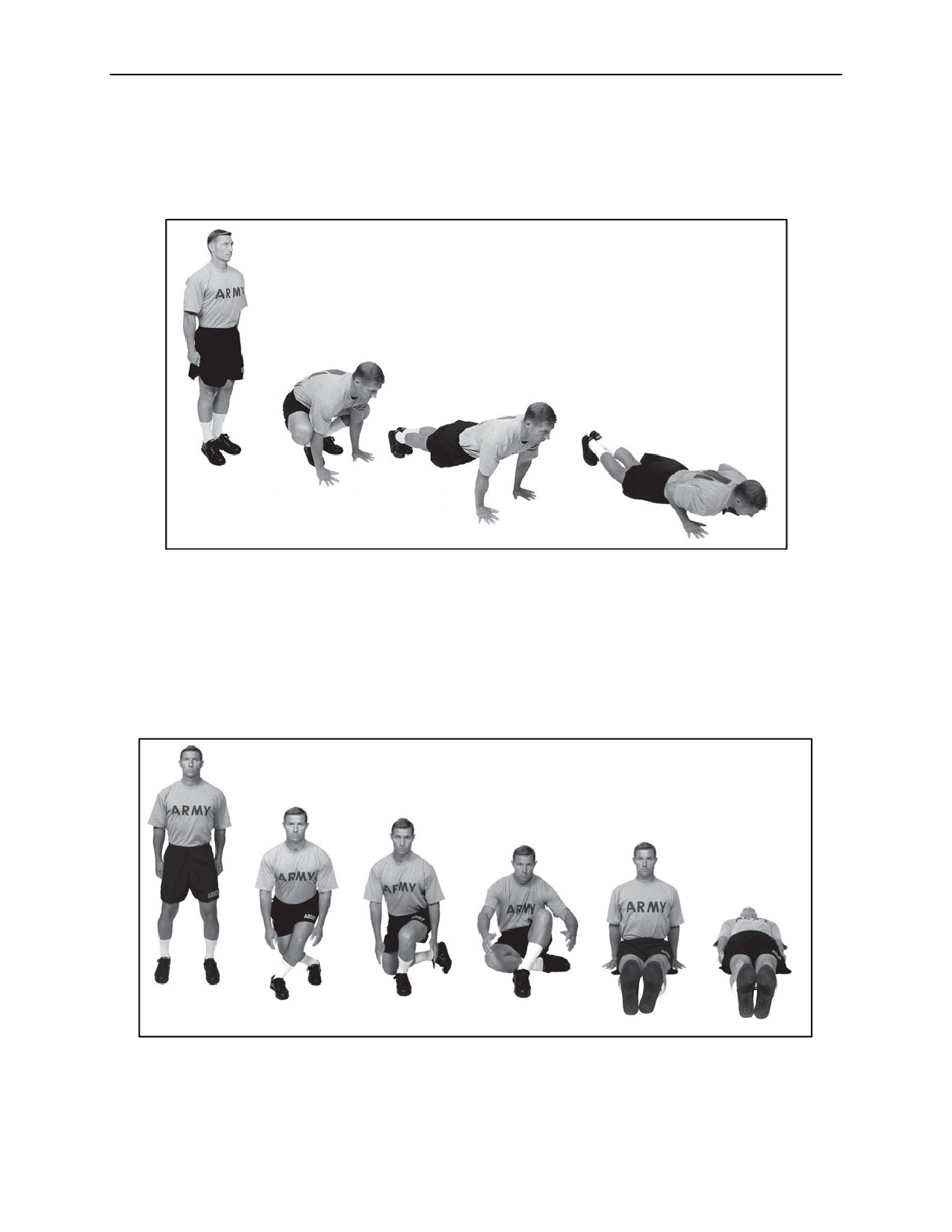
PRONE POSITION
7-21. Assume the prone position by performing three movements: 1) From the position of attention, move to
the squat position, 2) thrust the feet backward to the front leaning rest position, and then 3) lower the body
slowly to the ground. Keep the elbows close to the body and pointed directly to the rear (Figure 7-14).
Figure 7-14. Prone position
SUPINE POSITION
7-22. To assume the supine position without using the hands, from the standing position, place one foot behind
the other and slowly lower the body until the rear knee touches the ground. Sit back onto the buttocks and then
lay on the back with feet and legs together (Figure 7-15). When returning to the standing position, sit up and
rock forward on one knee. From this position, step up with the other leg and stand without using the hands for
assistance (Figure 7-16).
Figure 7-15. Supine position
7-10
FM 7-22
26 October 2012
Execution of Training
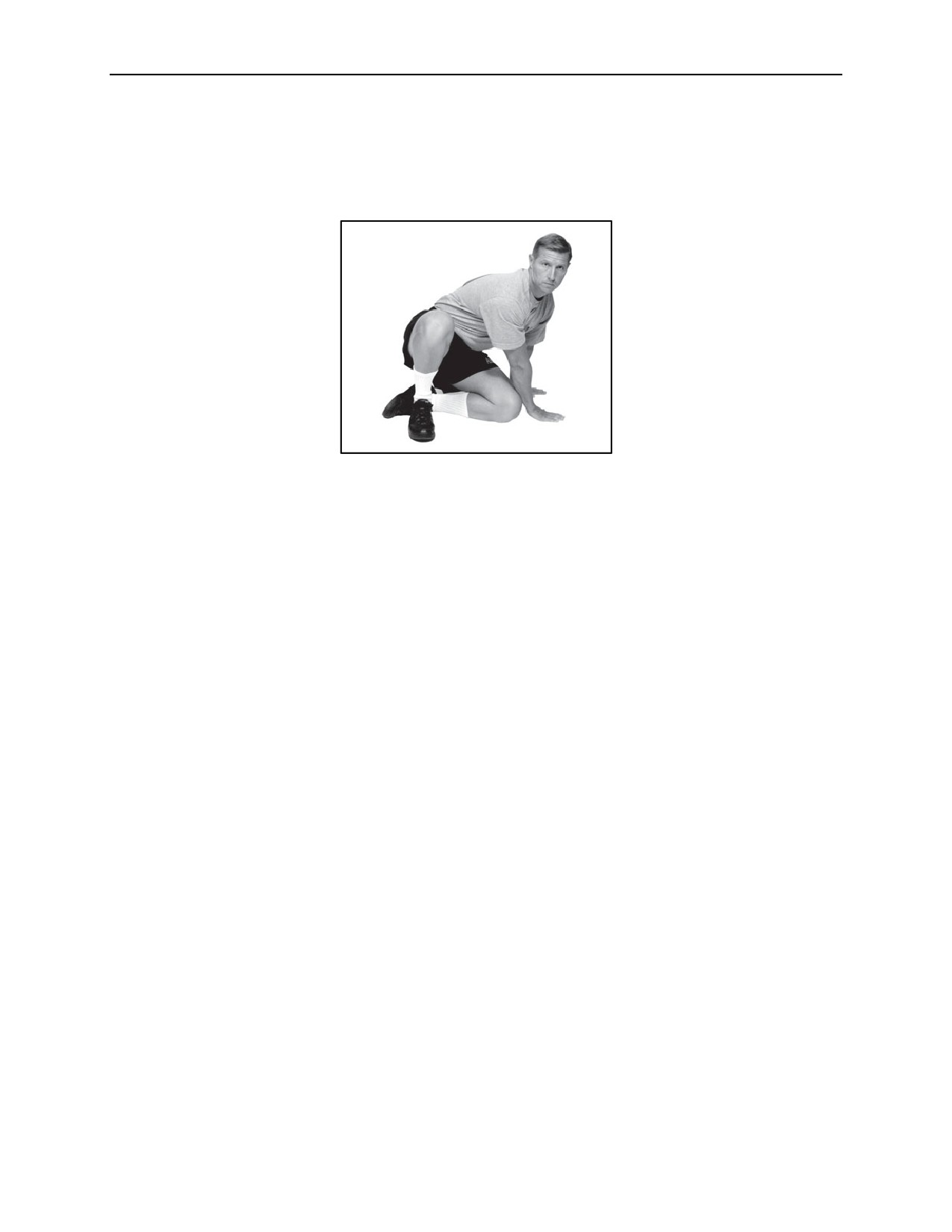
7-23. If the Soldier has difficulty assuming this position, he can place his hands on the ground as he slowly
lower his body to the seated position (Figure 7-16). If he cannot attain the standing position without using his
hands, he can place them on the ground to either side of his body and push up while standing from the seated
position. To return to a standing position from the supine position, he performs the actions in reverse order
(Figure 7-15).
Figure 7-16. Hands down assist to supine position
CADENCE
7-24. The following paragraphs discuss cadence speed and conduct of exercises.
SPEED
7-25. Cadence speed is described as SLOW or MODERATE. The speed of each cadence is listed below:
z
SLOW-50 counts per minute.
z
MODERATE-80 counts per minute.
EXERCISE NAME
7-26. Once Soldiers have learned the names of the exercises, the PRT leader merely needs to say the exercise
name, command the Soldiers to assume the starting position and start them exercising to cadence. For example,
this is how the PRT leader begins exercise 1 of preparation, bend, and reach to cadence:
z
The PRT leaders states, “the Bend and Reach.”
z
The Soldiers respond, “the Bend and Reach.”
z
The PRT leader commands, “Starting Position, MOVE” (Soldiers assume the starting position).
z
The PRT leader commands, “In Cadence (Soldiers respond, “In Cadence”), EXERCISE.”
z
The command, “EXERCISE” initiates movement to the position of count 1.
7-27. The previous command sequence is also used in the conduct of preparation, recovery, CD, and CL
exercises.
7-28. Counting cadence ensures that exercises are performed at the appropriate speed. The cadence count
indicates termination of movement to each position. The cumulative count is a method of indicating the number
of repetitions of an exercise on the fourth count of a 4-count exercise. The use of the cumulative count is
required for the following reasons:
z
It provides the PRT leader with an excellent method of counting the number of repetitions
performed.
z
It serves as motivation. Soldiers like to know the number of repetitions they are expected to perform.
z
It prescribes an exact amount of exercise for any group.
26 October 2012
FM 7-22
7-11
Chapter 7
COUNTS
7-29. This paragraph describes the conduct of cadence counts:
Two-Count Exercise
z
The PRT leader counts, “Up, down.”
z
The Soldiers respond, “One.”
z
The PRT leader counts, “Up, down.”
z
The Soldiers respond, “Two.”
z
The PRT leader counts, “Up, down.”
z
The Soldiers respond, “Three,” and so forth.
Four-Count Exercise
z
The PRT leader counts, “One, two, three.”
z
The Soldiers respond, “One.”
z
The PRT leader counts, “One, two, three.”
z
The Soldiers respond, “Two.”
z
The PRT leader counts, “One, two, three.”
z
The Soldiers respond, “Three,” and so forth.
Eight-Count Exercise
z
The PRT leader counts, “One, two, three, four, five, six, seven.”
z
The Soldiers respond, “One.”
z
The PRT leader counts, “One, two, three, four, five, six, seven.”
z
The Soldiers respond, “Two.”
z
The PRT leader counts, “One, two, three, four, five, six, seven.”
z
The Soldiers respond, “Three,” and so forth.
Termination
7-30. To terminate an exercise, the PRT leader will raise the inflection of his voice while counting out the
cadence of the last repetition. The Soldiers and PRT leader respond with “HALT” upon returning to the starting
position.
Two-Count Exercise
z
The PRT leader counts, “Up, down.”
z
The Soldiers respond, “Four.”
z
The PRT leader counts “Up, down” (with voice inflection).
z
The Soldiers and PRT leader respond, “HALT.”
z
The PRT leader commands “DISMOUNT.”
z
The Soldiers dismount the climbing bars.
z
The PRT leader commands “Position of attention, MOVE.”
z
The Soldiers assume the position of attention.
Four-Count Exercise
z
The PRT leader counts, “One, two, three.”
z
The Soldiers respond, “Nine.”
z
The PRT leader counts, “One, two, three” (with voice inflection).
z
The Soldiers and PRT leader respond, “HALT.”
z
The PRT leader commands “Position of attention, MOVE.”
z
The Soldiers assume the position of attention.
7-12
FM 7-22
26 October 2012
Execution of Training
Eight-Count Exercise
z
The PRT leader counts, “One, two, three, four, five, six, seven.”
z
The Soldiers respond, “Four.”
z
The PRT leader counts, “One, two, three, four, five, six, seven” (with voice inflection on counts five,
six, and seven).
z
The Soldiers and PRT leader respond, “HALT.”
z
The PRT leader commands, “Position of attention, MOVE.”
z
The Soldiers assume the position of attention.
COMMANDS
7-31. The PD consists of ten four-count calisthenic exercises. See paragraph 7-29 for the commands, counting,
and cadence instructions used to conduct preparation. Each strength and mobility drill has its own set of
commands.
GUERRILLA DRILL
7-32. The GD includes three exercises that are performed from the extended rectangular formation, covered.
The commands are followed when performing the shoulder roll, lunge walk, and Soldier carry. The difference
for the Soldier carry is that Soldiers change positions at the 25-yard mark and return to the start point. When the
PRT leader commands, “the Shoulder Roll,” the entire formation repeats, “Shoulder Roll.” After this, the leader
need not say or repeat the command. The first rank takes one step forward with their left foot, and resume the
position of attention:
z
On the command, “READY,” the first rank moves into the starting position.
z
On the command, “GO,” the first rank begins the movement.
7-33. In a typical formation with four ranks, the PRT leader directs the front rank remaining in the formation to
move forward. He does this immediately after the previous front rank start the movement. The other ranks
remain in place, awaiting further instructions. To do this, the PRT leader commands “Next Rank, MOVE
FORWARD.” Once the rank conducting the movement is about 12 yards into the exercise, the PRT leader
commands, “Ready,” and the rank moves into the starting position. Immediately after all Soldiers are in the
starting position, the leader commands, “GO.” He repeats this sequence of commands until all ranks have
performed the shoulder roll. Perform the GD in platoon-size or smaller formations (extended and covered). This
provides the appropriate work-to-rest ratio of 1:3. If he has less than four ranks for this drill, he enforces a 1:3
work-to-rest ratio.
CONDITIONING DRILLS
7-34. Conditioning drills have four-count and eight-count exercises.
CLIMBING DRILLS
7-35. Climbing drills have two-count exercises.
MILITARY MOVEMENT DRILLS
7-36. Military movement drills 1 and 2 each have three exercises that are performed from the extended
rectangular formation, covered. The commands listed below will be followed when performing verticals,
laterals, the shuttle sprint, the power skip, crossovers, and the crouch run. During the shuttle sprint, Soldiers will
run the first two 25-yard intervals at the pace of the squad leader, then sprint the last 25-yard interval at their
own pace. During the crouch run, on the command “Ready,” Soldiers move to the starting position of the
mountain climber. On the command “GO,” Soldiers perform counts 1, 2, and 3 of the mountain climber, then
upon finishing count four run forward in the crouch position to the 25-yard mark.
26 October 2012
FM 7-22
7-13
Chapter 7
7-37. For movement drills, the PRT leader states, “verticals” (and the entire formation repeats “verticals”).
After this, there is no need to say or repeat “verticals.” The first rank takes one step forward with their left foot,
and resumes the position of attention.
z
On the command, “Ready,” the first rank moves into the starting position.
z
On the command, “GO,” the first rank begins the movement.
7-38. In a typical formation with four ranks, the PRT leader will have the front rank remaining in the formation
move forward. He does this immediately after the previous front rank starts the movement. The other ranks
should remain in place, awaiting further instructions. To accomplish this, the PRT leader commands “Next
Rank, MOVE FORWARD.” Once the rank conducting the movement is about 12 yards into the exercise, the
PRT leader commands, “Ready,” and then the rank moves into the starting position. Immediately after all
Soldiers are in the starting position, the leader commands, “GO.” The PRT leader repeats this sequence of
commands until all ranks have performed verticals. Perform the military movement drill in platoon-size or
smaller formations (extended and covered). This provides the appropriate work-to-rest ration of 1:3. If there are
less than four ranks, the leader ensures that a 1:3 work-to-rest ratio is followed during military movement drills.
RUNNING ACTIVITIES
7-39. Running activities have different sets of commands. Sustained running begins when the PRT leader
states, “double time, MARCH,” and terminates the run with the commands, “Quick Time, MARCH.” The PRT
leader begins each repetition with the commands, “Ready, GO,” when conducting HR and the 300-yd SR.
7-40. When conducting 30:60s or 60:120s, the PRT leader begins the activity with slow jogging for ¼-mile on
the commands of “Double Time, MARCH,” and terminates the ¼-mile run with the commands, “Quick Time,
MARCH.” 30:60s and 60:120s begin with the PRT leader signaling the start of each work interval (30 or 60
seconds) with one short whistle blast. Two short whistle blasts are used to signal the end of each work interval
and the start of the rest intervals (60 or 120 seconds). Upon completion of the scheduled number of repetitions
of 30:60s or 60:120s, the PRT leader will command the formation to continue to walk for at least three minutes
before performing additional activities or the RD. The PRT leader will use the same commands specified for the
shuttle sprint in MMD1 when conducting the 300-yard SR. The only difference is that Soldiers will perform six
50-yard repetitions to complete 300 yards.
RECOVERY DRILL
7-41. The RD exercises require no verbal cadence. Soldiers move in and out of the starting position and each
exercise position on the PRT leader’s commands. Soldiers hold each exercise position for 20 seconds in the
toughening phase and 20-30 seconds in the sustaining phase during recovery. The leader does not count the
seconds aloud. This is how he conducts recovery exercise 1, overhead arm pull:
z
The PT leader commands, “THE OVERHEAD ARM PULL.” Each Soldier responds, “THE
OVERHEAD ARM PULL.”
z
The PRT leader commands, “Starting Position, MOVE.” Each Soldier moves into the starting
position, straddle stance with hands on hips.
z
The command to begin the stretch is, “Ready, STRETCH.” Each Soldier raises his left arm overhead
and places his left hand behind his head and grasps above his left elbow with his right hand. He then
pulls to the right, leaning his body to the right. He holds this position for 20-30 seconds.
z
The PRT leader commands, “Starting Position, MOVE.” Each Soldier moves into the starting
position.
z
The PRT leader gives the command to stretch the other side of the body: “Change Position, Ready,
STRETCH.” Each Soldier raises his right arm overhead and places his right hand behind his head
and grasps above his right elbow with his left hand. He then pulls to his left, leaning his body to the
left. He holds this position for 20-30 seconds.
z
The PRT leader commands, “Starting Position, MOVE.” Each Soldier assumes the starting position.
z
The PRT leader assumes the position of attention and commands, “Position of Attention, MOVE.”
Each Soldier assumes the position of attention.
7-14
FM 7-22
26 October 2012
Execution of Training
MIRROR EFFECT
7-42. When leading an exercise in front of the formation, the PRT leader begins the movements in count 1 to
the right. He continues to mirror the Soldier’s movements while facing them throughout the exercise.
Summary
Successful execution of PRT depends on the leadership of competent instructors and
AIs. PRT leaders must have more than the knowledge, skills, and abilities to execute a
PRT session. They must also present a positive image of physical fitness.
26 October 2012
FM 7-22
7-15
Chapter 8
Preparation and Recovery
PRT sessions always include the following elements: preparation, activity, and recovery.
Exercises performed during preparation ready Soldiers for more intense PRT activities.
Recovery exercises are performed at the end of every PRT session to gradually and safely
bring the body back to its pre-exercise state.
PREPARATION
8-1. The purpose of preparation is to ready the Soldier for PRT activities. The PD is performed at the
beginning of every PRT session. The PD consists of ten exercises performed for 5-10 repetitions at a slow
cadence, with the exception of the high jumper and push-up (which are performed at a moderate cadence).
When conducted to standard, preparation will last about 15 minutes. Since PRT sessions are generally limited to
one hour, preparation must be brief, yet thorough. The objectives of preparation are to:
z
Increase body temperature and heart rate.
z
Increase pliability of joints and muscles.
z
Increase responsiveness of nerves and muscles.
TRAINING AREA
8-2. Any dry, level area of adequate size is satisfactory for conducting the PD.
UNIFORM
8-3. Soldiers should wear ACUs with boots or the IPFU. The uniform should be appropriate for the activity
that will follow the PD. For example, when the activity is the CL 2 or the GD, ACUs with boots will be worn.
EQUIPMENT
8-4. N/A.
FORMATION
8-5. The extended rectangular formation is prescribed for the conduct of the PD.
LEADERSHIP
8-6. A PRT leader and AI are required to lead the PD.
INSTRUCTION AND EXECUTION
8-7. The PRT leader must be familiar with the method of teaching these exercises, the commands, the
formations, and the use of AIs as described in Chapter 7, Execution of Training. The calisthenic exercises that
comprise the PD are always given in cadence. Soldiers begin and terminate each exercise at the starting
position, then move to the position of attention. The goal is to complete the entire drill with only enough pauses
between exercises for the PRT leader to indicate the next one by name. This continuous method of conducting
the PD intensifies the workload and conserves time. Soldiers should memorize the exercises by name and
movement.
26 October 2012
FM 7-22
8-1
Chapter 8
PRECISION
8-8. Preparation loses much of its value unless performed exactly as prescribed. During preparation, the focus
is always on quality of movement, not quantity of repetitions or speed of movement. A calisthenic cadence that
is too fast will not allow Soldiers to achieve a full range of movement and may not adequately prepare them for
the activities that follow. Assistant instructors will help to maintain the ranks at the appropriate pace and offer
feedback on form.
PROGRESSION
8-9. Preparation is always performed in all phases of PRT. In the toughening phase, the PD consists of 5
repetitions of 10 exercises performed at a slow cadence, with the exception of the high jumper and the push-up,
which are performed at a moderate cadence. In the sustaining phase, Soldiers progress from performing 5
repetitions to 10 repetitions of each exercise in the PD.
INTEGRATION
8-10. Preparation not only prepares the body for activities that follow; it also integrates the components of
strength, endurance, and mobility.
COMMANDS
8-11. The commands used to conduct preparation are described in Chapter 7, Execution of Training.
PREPARATION DRILL
8-12. Table 8-1 lists the
10 calisthenic exercises that comprise the PD. These
10 exercises are always
performed in the order and at the cadence shown.
Table 8-1. Preparation drill
1. Bend and reach
5-10 repetitions, slow
2. Rear lunge
5-10 repetitions, slow
3. High jumper
5-10 repetitions, moderate
4. Rower
5-10 repetitions, slow
5. Squat bender
5-10 repetitions, slow
6. Windmill
5-10 repetitions, slow
7. Forward lunge
5-10 repetitions, slow
8. Prone row
5-10 repetitions, slow
9. Bent-leg body twist
5-10 repetitions, slow
10. Push-up
5-10 repetitions, moderate
8-2
FM 7-22
26 October 2012
Preparation and Recovery
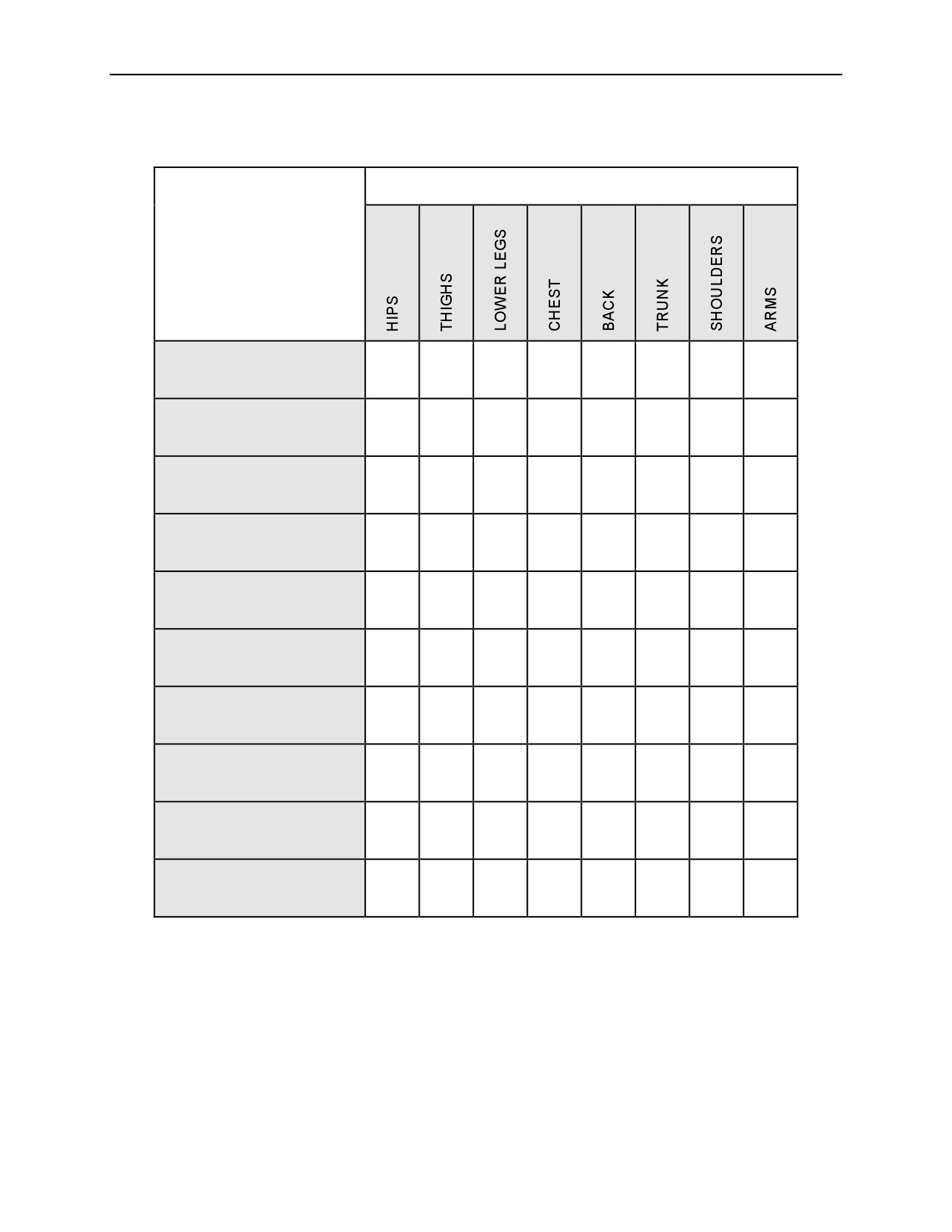
8-13. Table 8-2 shows the body segments trained during the PD.
Table 8-2. Body segments trained in the conduct of the preparation drill
MUSCLES
PREPARATION DRILL
(PD)
1.
BEND AND REACH
X
X
X
X
X
2.
REAR LUNGE
X
X
X
X
X
3.
HIGH JUMPER
X
X
X
X
X
X
4.
ROWER
X
X
X
X
X
X
X
5.
SQUAT BENDER
X
X
X
X
X
X
X
X
6.
WINDMILL
X
X
X
X
X
X
X
X
7
FORWARD LUNGE
X
X
X
X
X
8.
PRONE ROW
X
X
X
X
X
X
9
BENT-LEG BODY TWIST
X
X
X
X
10. PUSH-UP
X
X
X
X
X
X
X
X
26 October 2012
FM 7-22
8-3
Chapter 8
PREPARATION DRILL
EXERCISE 1: BEND AND REACH
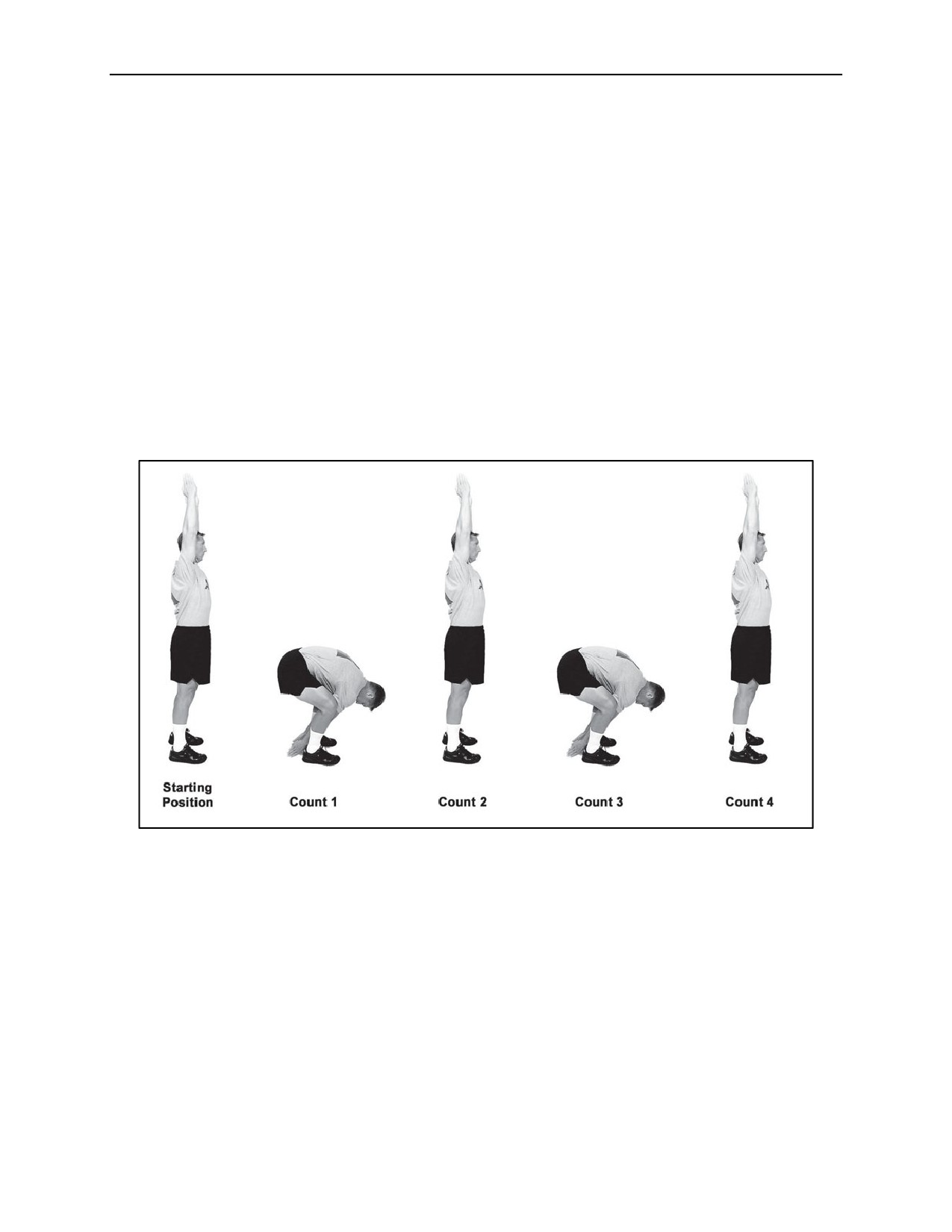
Purpose: This exercise develops the ability to squat and reach through the legs. It also serves to prepare the
spine and extremities for more vigorous movements, moving the hips and spine through full flexion
(Figure 8-1).
Starting Position: Straddle stance with arms overhead, palms facing inward, fingers and thumbs extended and
joined.
Cadence: SLOW
Count:
1. Squat with the heels flat as the spine rounds forward to allow the straight arms to reach as far as
possible between the legs.
2. Return to the starting position.
3. Repeat count one.
4. Return to the starting position.
Figure 8-1. Bend and reach
Check Points:
z
From the starting position, ensure that Soldiers have their hips set, their abdominals tight, and their
arms fully extended overhead.
z
The neck flexes to allow the gaze to the rear. This brings the head in line with the bend of the trunk.
z
The heels and feet remain flat on the ground.
z
On counts 2 and 4, do not go past the starting position.
Precautions: This exercise is always performed at a slow cadence. To protect the back, move into the count one
position in a slow, controlled manner. Do not bounce into or out of this position in a ballistic manner, as this
may place an excessive load on the back.
8-4
FM 7-22
26 October 2012
Preparation and Recovery
PREPARATION DRILL
EXERCISE 2: REAR LUNGE
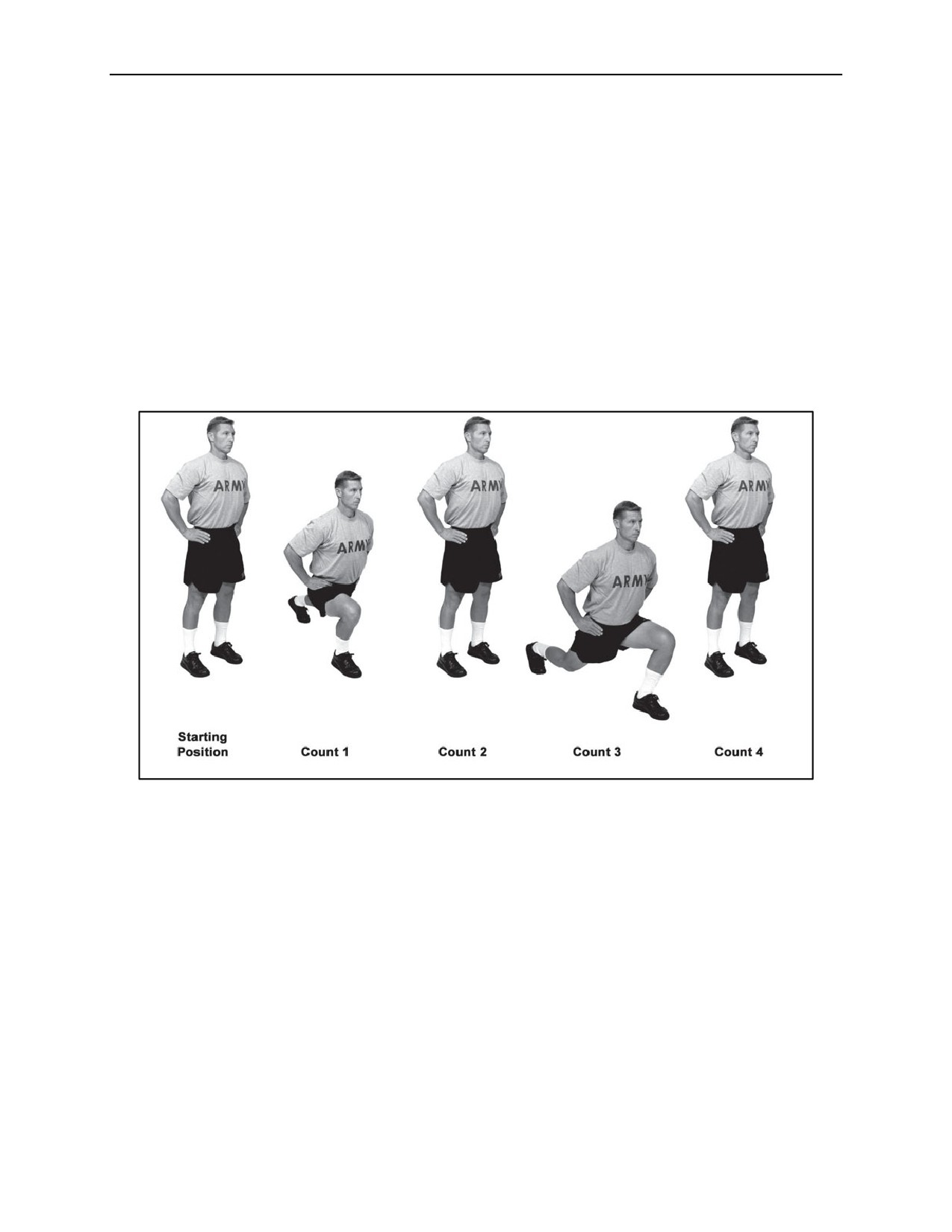
Purpose: This exercise promotes balance, opens up the hip and trunk on the side of the lunge, and develops leg
strength (Figure 8-2).
Starting Position: Straddle stance with hands on hips.
Cadence: SLOW
Count:
1. Take an exaggerated step backward with the left leg, touching down with the ball of the foot.
2. Return to the starting position.
3. Repeat count one with the right leg.
4. Return to the starting position.
Figure 8-2. Rear lunge
Check Points:
z
Maintain straightness of the back by keeping the abdominal muscles tight throughout the motion.
z
After the foot touches down, allow the body to continue to lower. This promotes flexibility of the hip
and trunk.
z
On counts 1 and 3, step straight to the rear, keeping the feet directed forward. When viewed from the
front, the feet maintain their distance apart both at the starting position and at the end of counts 1 and
3.
z
Keep the rear leg as straight as possible but not locked and the rear heel off the ground.
Precautions: This exercise is always performed at a slow cadence. On counts 1 and 3, move into position in a
slow, controlled manner. If the cadence is too fast, it will be difficult to go through a full range of motion.
26 October 2012
FM 7-22
8-5
Chapter 8
PREPARATION DRILL
EXERCISE 3: HIGH JUMPER
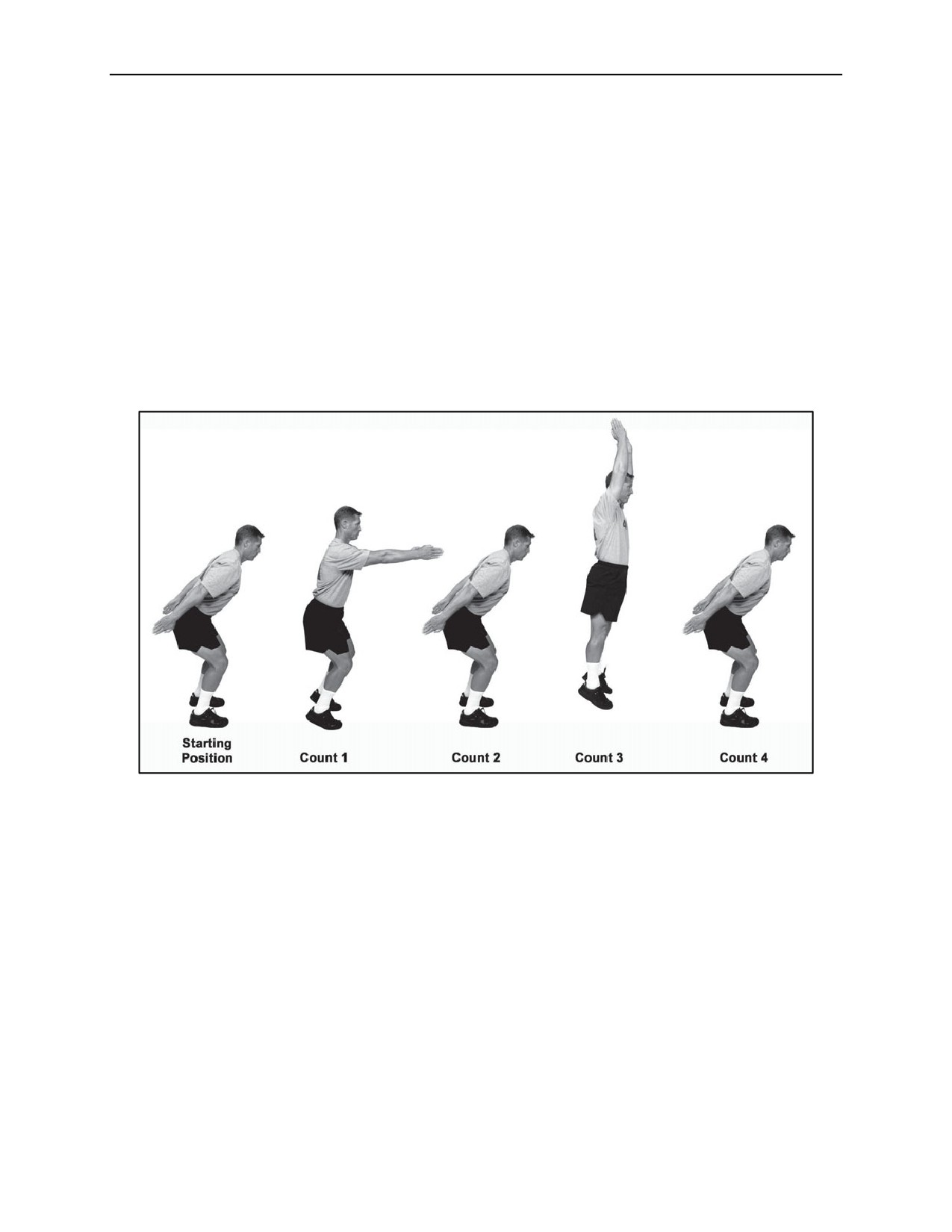
Purpose: This exercise reinforces correct jumping and landing, stimulates balance and coordination, and
develops explosive strength (Figure 8-3).
Starting Position: Forward leaning stance, palms facing inward, fingers and thumbs extended and joined.
Cadence: MODERATE
Count:
1. Swing arms forward and jump a few inches.
2. Swing arms backward and jump a few inches.
3. Swing arms forward and vigorously overhead while jumping forcefully.
4. Repeat count 2. On the last repetition, return to the starting position.
Figure 8-3. High jumper
Check Points:
z
At the starting position, the shoulders, the knees, and the balls of the feet should form a straight
vertical line.
z
On count 1, the arms are parallel to the ground.
z
On count 3, the arms should be extended fully overhead. The trunk and legs should also be aligned.
z
The Soldier is jumping on each count. On counts 1, 2, and 4, the jumps are only 4-6 inches off the
ground. On count 3, the Soldier jumps higher (6-10 inches) while maintaining the posture pictured in
Figure 8-3.
z
On each landing, the feet should be directed forward and maintained at shoulder distance apart. The
landing should be “soft” and proceed from the balls of the feet to the heels. The vertical line from the
shoulders through the knees to the balls of the feet should be demonstrated on each landing.
Precaution: N/A
8-6
FM 7-22
26 October 2012
Preparation and Recovery
PREPARATION DRILL
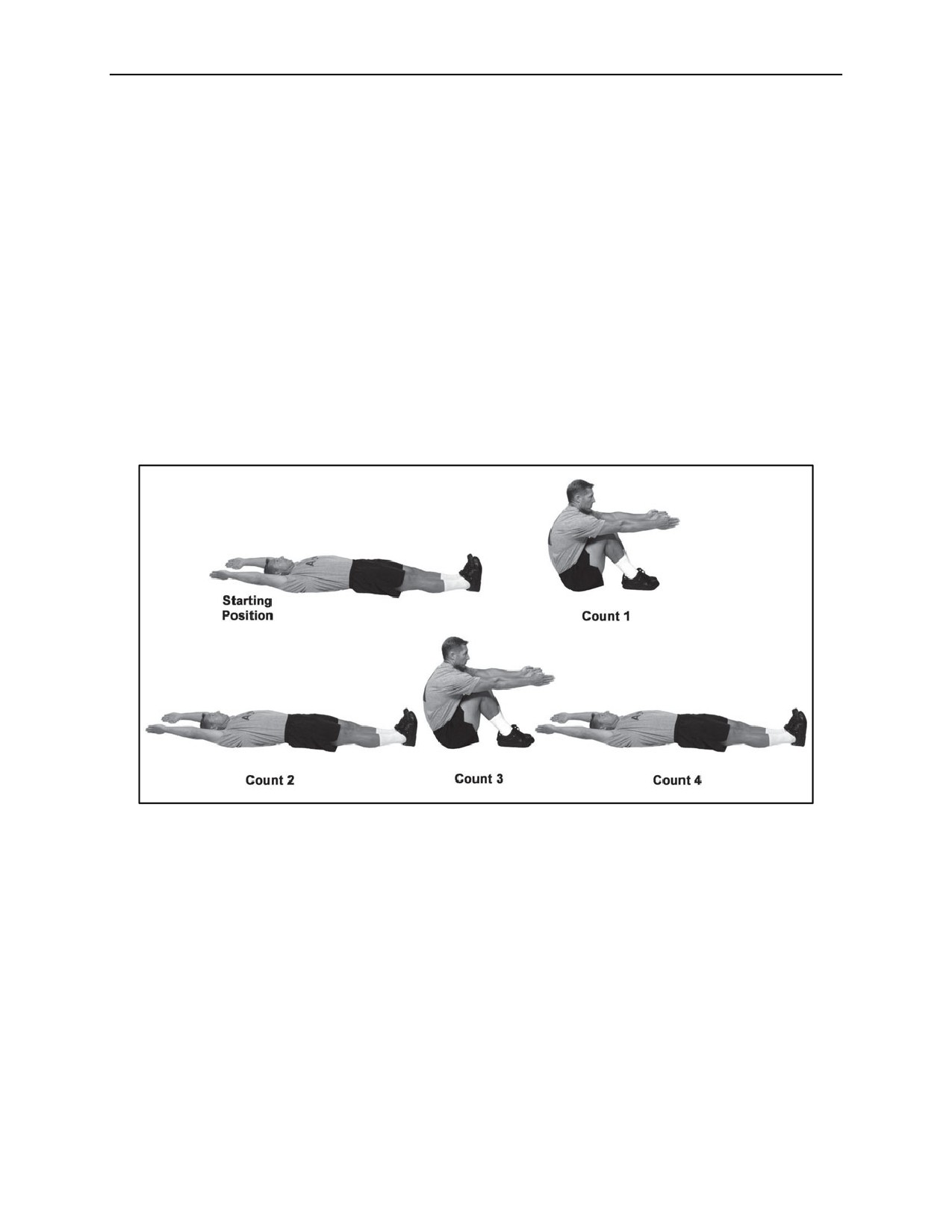
EXERCISE 4: ROWER
Purpose: This exercise improves the ability to move in and out of the supine position to a seated posture. It
coordinates the action of the trunk and extremities while challenging the abdominal muscles (Figure 8-4).
Starting Position: Supine position, arms overhead, feet together and pointing upward. The chin is tucked and
the head is 1-2 inches above the ground. Arms are shoulder-width, palms facing inward with fingers and thumbs
extended and joined.
Cadence: SLOW
Count:
1. Sit up while swinging arms forward and bending at the hip and knees. At the end of the motion,
the arms will be parallel to the ground with palms facing inward.
2. Return to the starting position.
3. Repeat count 1.
4. Return to the starting position.
Figure 8-4. Rower
Check Points:
z
At the starting position, the low back must not be arched excessively off the ground. To prevent this,
tighten the abdominal muscles to tilt the pelvis and low back toward the ground.
z
At the end of counts 1 and 3, the feet are flat and pulled near the buttocks. The legs stay together
throughout the exercise and the arms are parallel to the ground.
Precautions: This exercise is always performed at a slow cadence. Do not arch the back to assume counts 1
and 3.
26 October 2012
FM 7-22
8-7
Chapter 8
PREPARATION DRILL
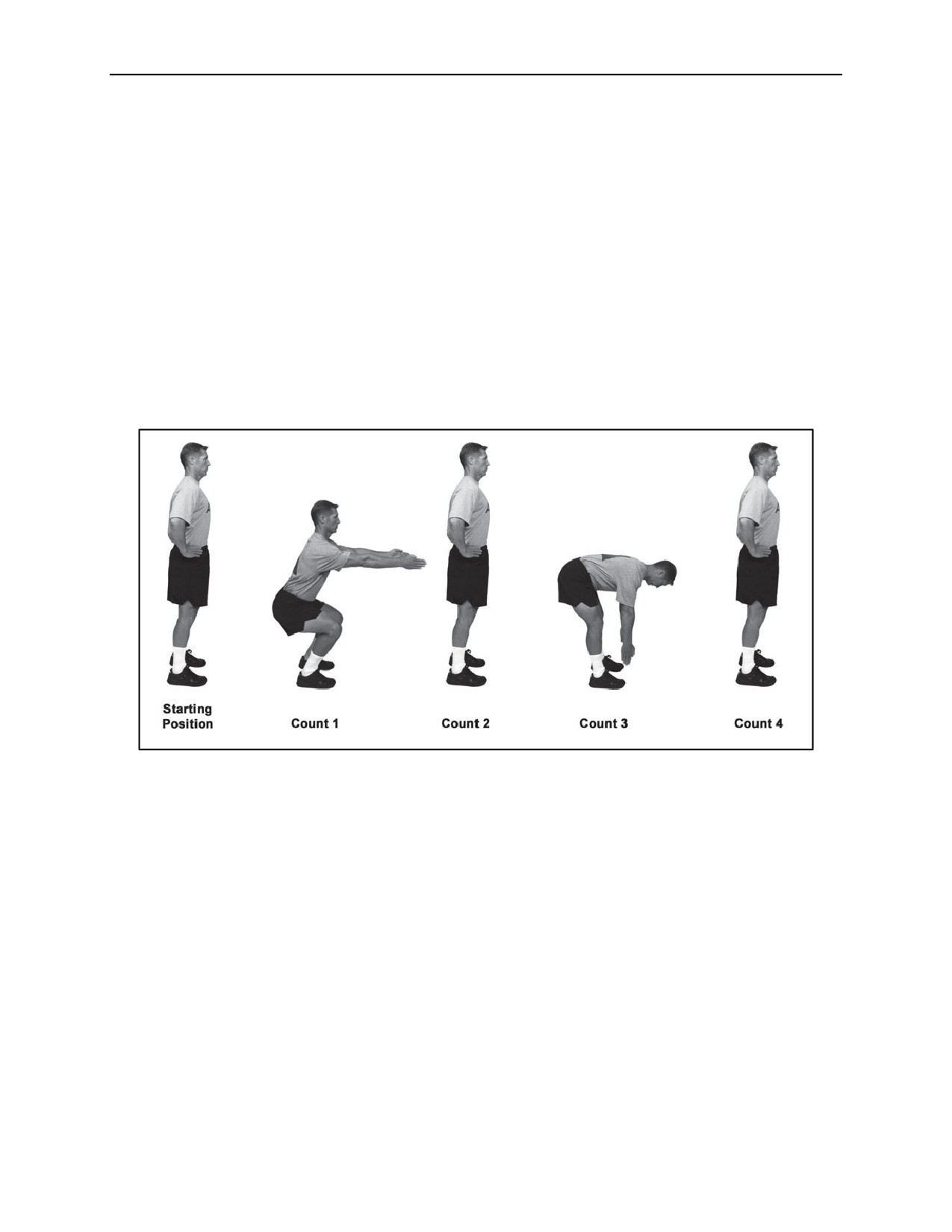
EXERCISE 5: SQUAT BENDER
Purpose: This exercise develops strength, endurance, and flexibility of the lower back and lower extremities
(Figure 8-5).
Starting Position: Straddle stance with hands on hips.
Cadence: SLOW
Count:
1. Squat while leaning slightly forward at the waist with the head up and extend the arms to the front,
with arms parallel to the ground and palms facing inward.
2. Return to the starting position.
3. Bend forward and reach toward the ground with both arms extended and palms inward.
4. Return to the starting position.
Figure 8-5. Squat bender
Check Points:
z
At the end of count 1, the shoulders, knees, and the balls of the feet should be aligned. The heels
remain on the ground and the back is straight.
z
On count 3, bend forward, keeping the head aligned with the spine and the knees slightly bent.
Attempt to keep the back flat and parallel to the ground.
Precaution: This exercise is always performed at a slow cadence. Allowing the knees to go beyond the toes on
count 1 increases stress to the knees.
8-8
FM 7-22
26 October 2012
Preparation and Recovery
PREPARATION DRILL
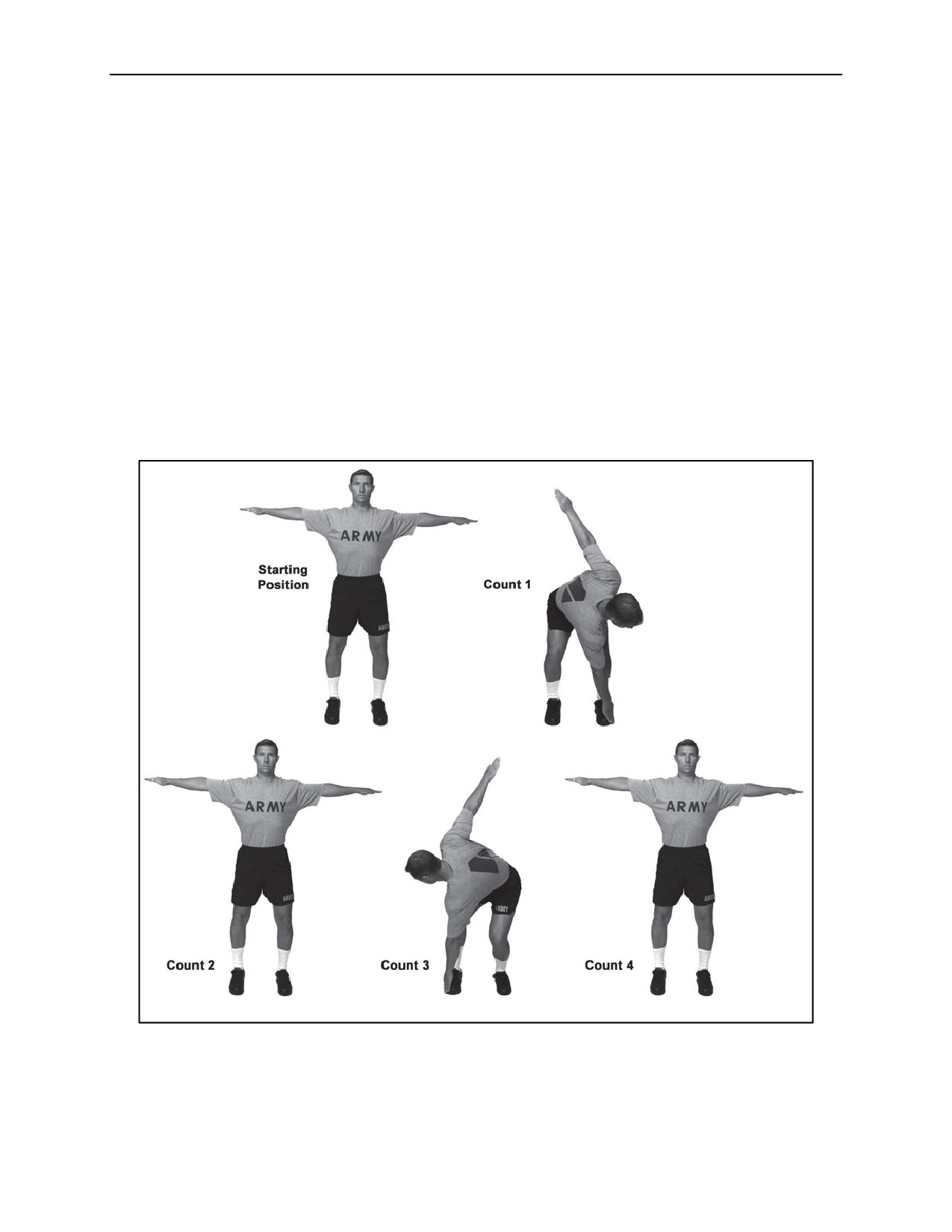
EXERCISE 6: WINDMILL
Purpose: This exercise develops the ability to safely bend and rotate the trunk. It conditions the muscles of the
trunk, legs, and shoulders (Figure 8-6).
Starting Position: Straddle stance with arms sideward, palms facing down, fingers and thumbs extended and
joined.
Cadence: SLOW
Count:
1. Bend the hips and knees while rotating to the left. Reach down and touch the outside of the left
foot with the right hand and look toward the rear. The left arm is pulled rearward to maintain a
straight line with the right arm.
2. Return to the starting position.
3. Repeat count 1 to the right.
4. Return to the starting position.
Figure 8-6. Windmill
26 October 2012
FM 7-22
8-9
Chapter 8
Check Points:
z
From the starting position, feet are straight ahead, arms parallel to the ground, hips set, and
abdominals tight.
z
On counts 1 and 3, ensure that both knees bend during the rotation. Head and eyes are directed to the
rear on counts 1 and 3.
Precaution: This exercise is always performed at a slow cadence.
8-10
FM 7-22
26 October 2012
Preparation and Recovery
PREPARATION DRILL
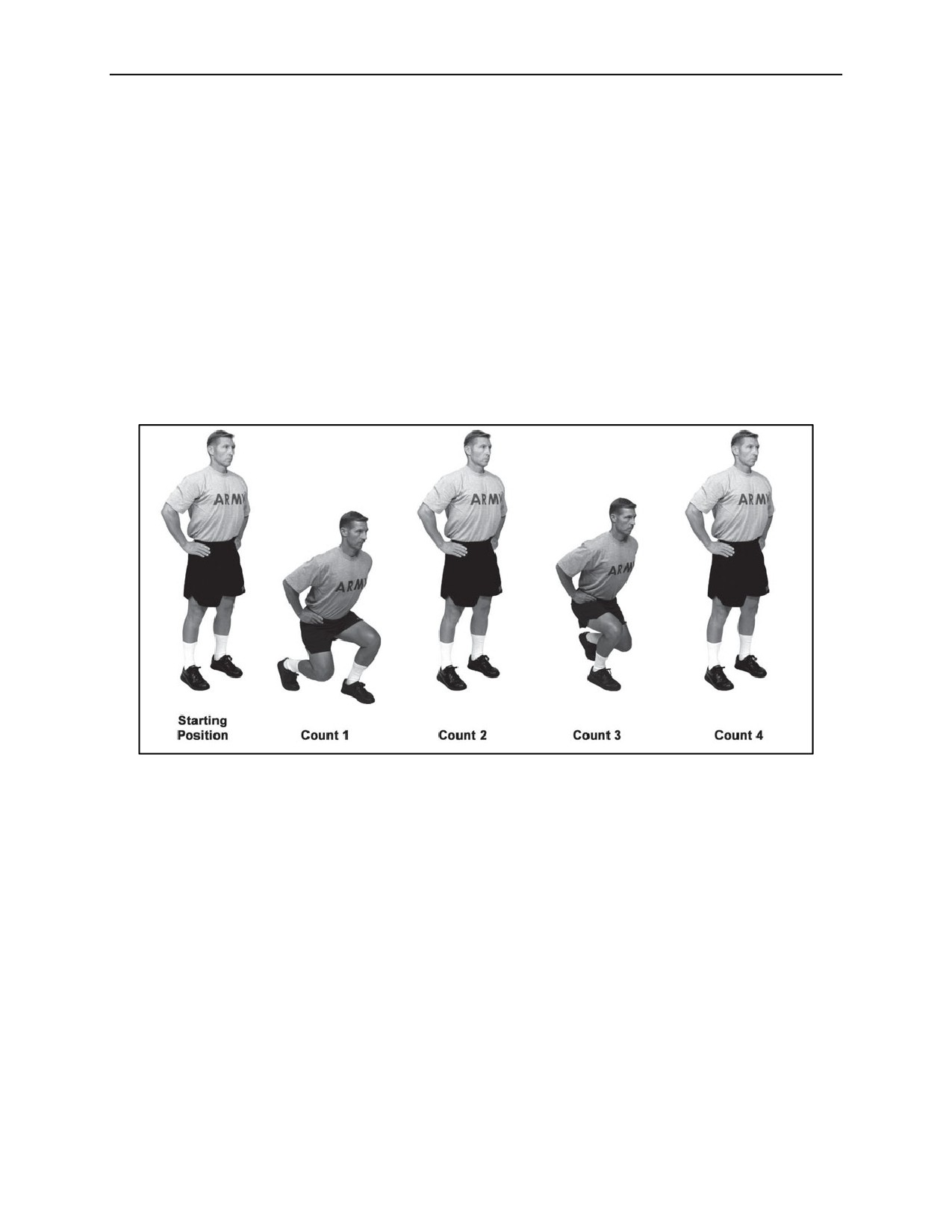
EXERCISE 7: FORWARD LUNGE
Purpose: This exercise promotes balance and develops leg strength (Figure 8-7).
Starting Position: Straddle stance with hands on hips.
Cadence: SLOW
Count:
1. Take a step forward with the left leg (the left heel should be 3 to 6 inches forward of the right
foot). Lunge forward, lowering the body and allow the left knee to bend until the thigh is parallel
to the ground. Lean slightly forward, keeping the back straight.
2. Return to the starting position.
3. Repeat count one with the right leg.
4. Return to the starting position.
Figure 8-7. Forward lunge
Check Points:
z
Keep the abdominal muscles tight throughout the motion.
z
On counts 1 and 3, step straight forward, keeping the feet directed forward. When viewed from the
front, the feet maintain their distance apart both at the starting position and at the end of counts 1
and 3.
z
On counts 1 and 3, the rear knee bends, but does not touch the ground. The heel of the rear foot
should be off the ground.
Precautions: This exercise is always performed at a slow cadence. On counts 1 and 3, move into position in a
controlled manner. Spring off of the forward leg to return to the starting position. This avoids jerking the trunk
to create momentum.
26 October 2012
FM 7-22
8-11
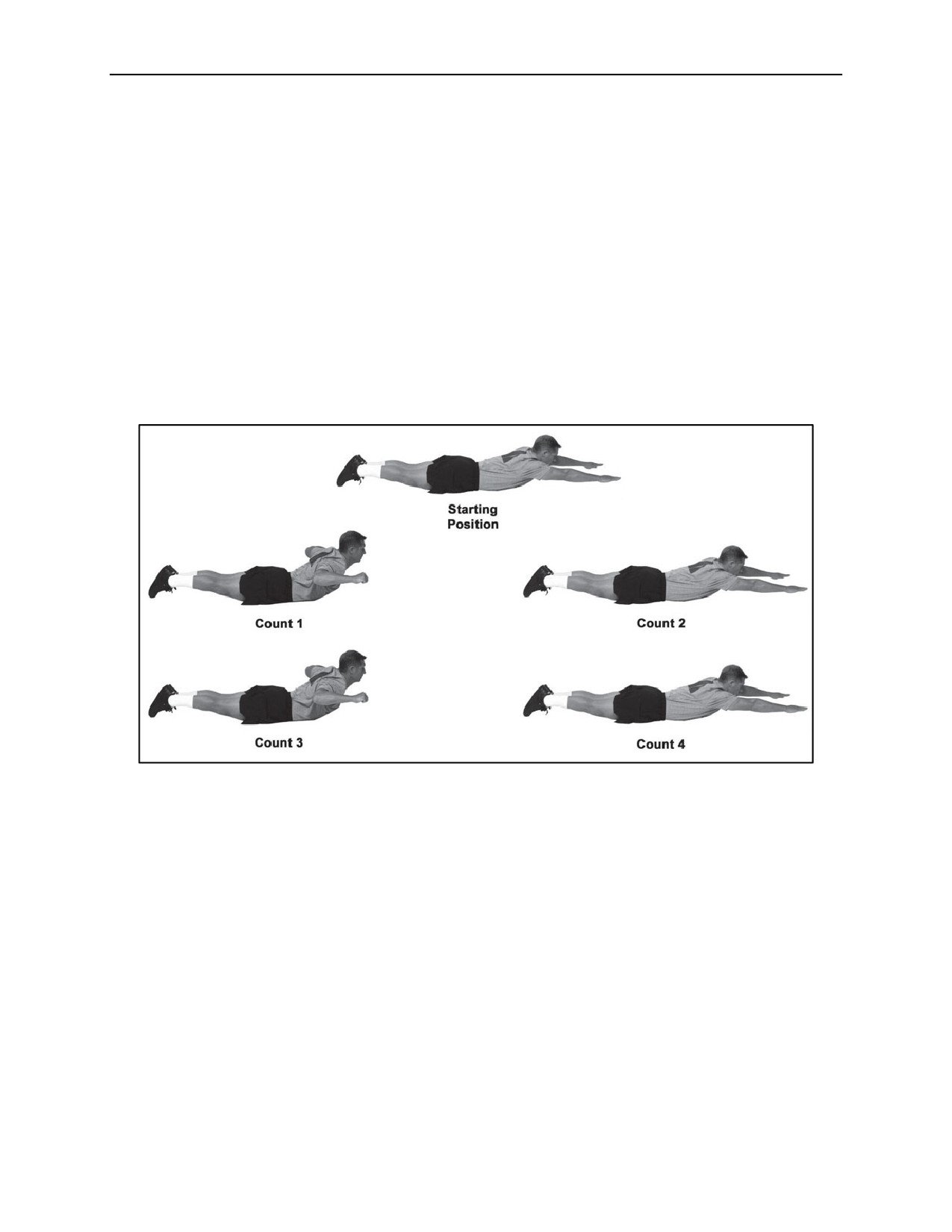
Chapter 8
PREPARATION DRILL
EXERCISE 8: PRONE ROW
Purpose: This exercise develops strength of the back and shoulders (Figure 8-8).
Starting Position: Prone position with the arms overhead, palms down, fingers and thumbs extended and
joined, 1 to 2 inches off the ground and toes pointed to the rear.
Cadence: SLOW
Count:
1. Raise the head and chest slightly while lifting the arms and pulling them rearward. Hands make
fists as they move toward the shoulders.
2. Return to the starting position.
3. Repeat count 1.
4. Return to the starting position.
Figure 8-8. Prone row
Check Points:
z
At the starting position, the abdominal muscles are tight and the head is aligned with the spine.
z
On counts 1 and 3, the forearms are parallel to the ground and slightly higher than the trunk.
z
On counts 1 and 3, the head is raised to look forward but not skyward.
z
Throughout the exercise, the legs and toes remain in contact with the ground.
Precautions: This exercise is always performed at a slow cadence. Prevent overarching of the back by
maintaining contractions of the abdominal and buttocks muscles throughout the exercise.
8-12
FM 7-22
26 October 2012
Preparation and Recovery
PREPARATION DRILL
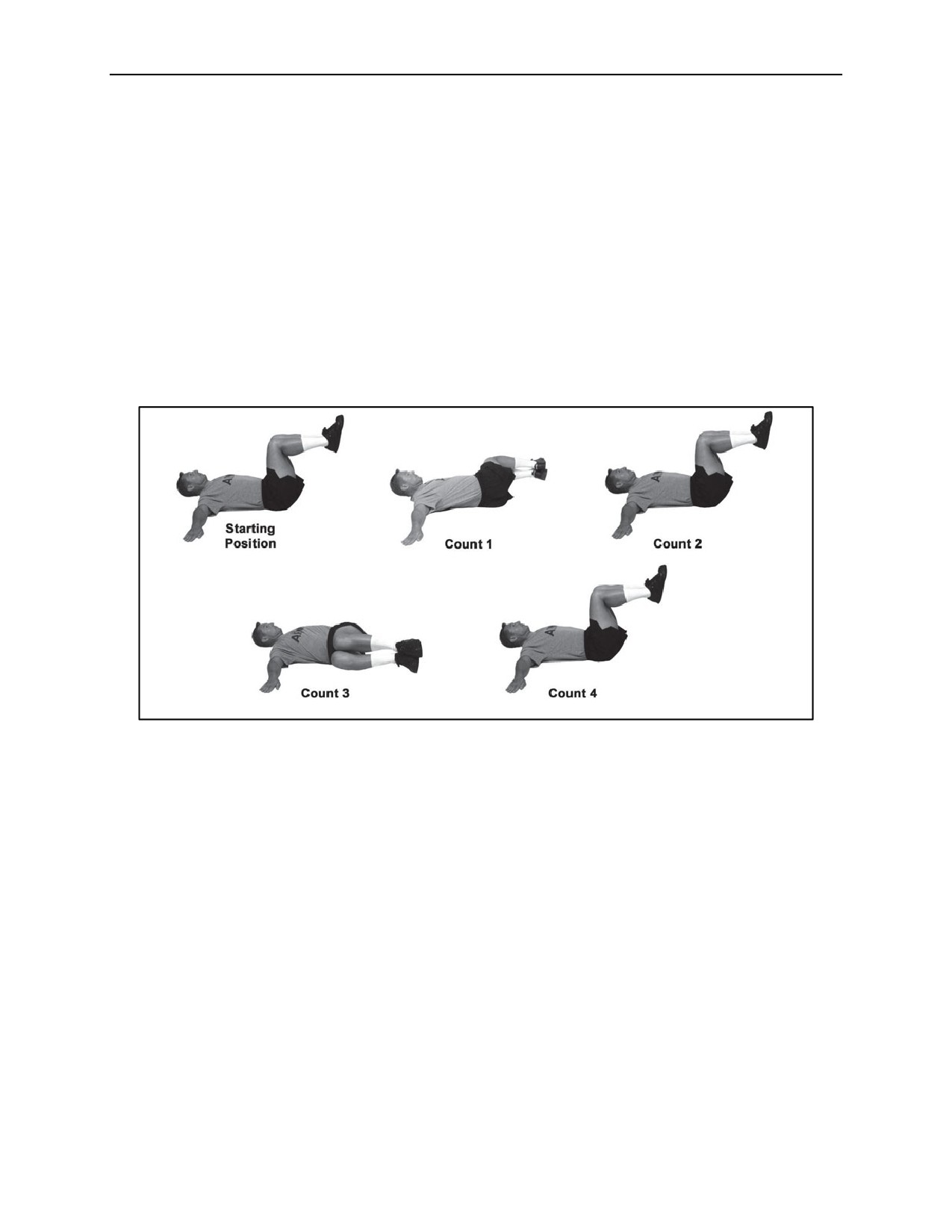
EXERCISE 9: BENT-LEG BODY TWIST
Purpose: This exercise strengthens trunk muscles and promotes control of trunk rotation (Figure 8-9).
Starting Position: Supine position with the hips and knees bent to 90-degrees, arms sideward and palms down.
The knees and feet are together.
Cadence: SLOW
Count:
1. Rotate the legs to the left while keeping the upper back and arms in place.
2. Return to the starting position.
3. Repeat count 1 to the right.
4. Return to the starting position.
Figure 8-9. Bent-leg body twist
Check Points:
z
Tighten the abdominal muscles in the starting position and maintain this contraction throughout the
exercise.
z
The head should be off the ground with the chin slightly tucked.
z
Ensure that the hips and knees maintain 90-degree angles.
z
Keep the feet and knees together throughout the exercise.
z
Attempt to rotate the legs to about 8 to 10 inches off the ground. The opposite shoulder must remain
in contact with the ground.
Precautions: This exercise is always performed at a slow cadence. Do not rotate the legs to a point beyond
which the opposite arm and shoulder can no longer maintain contact with the ground.
26 October 2012
FM 7-22
8-13
Chapter 8
PREPARATION DRILL
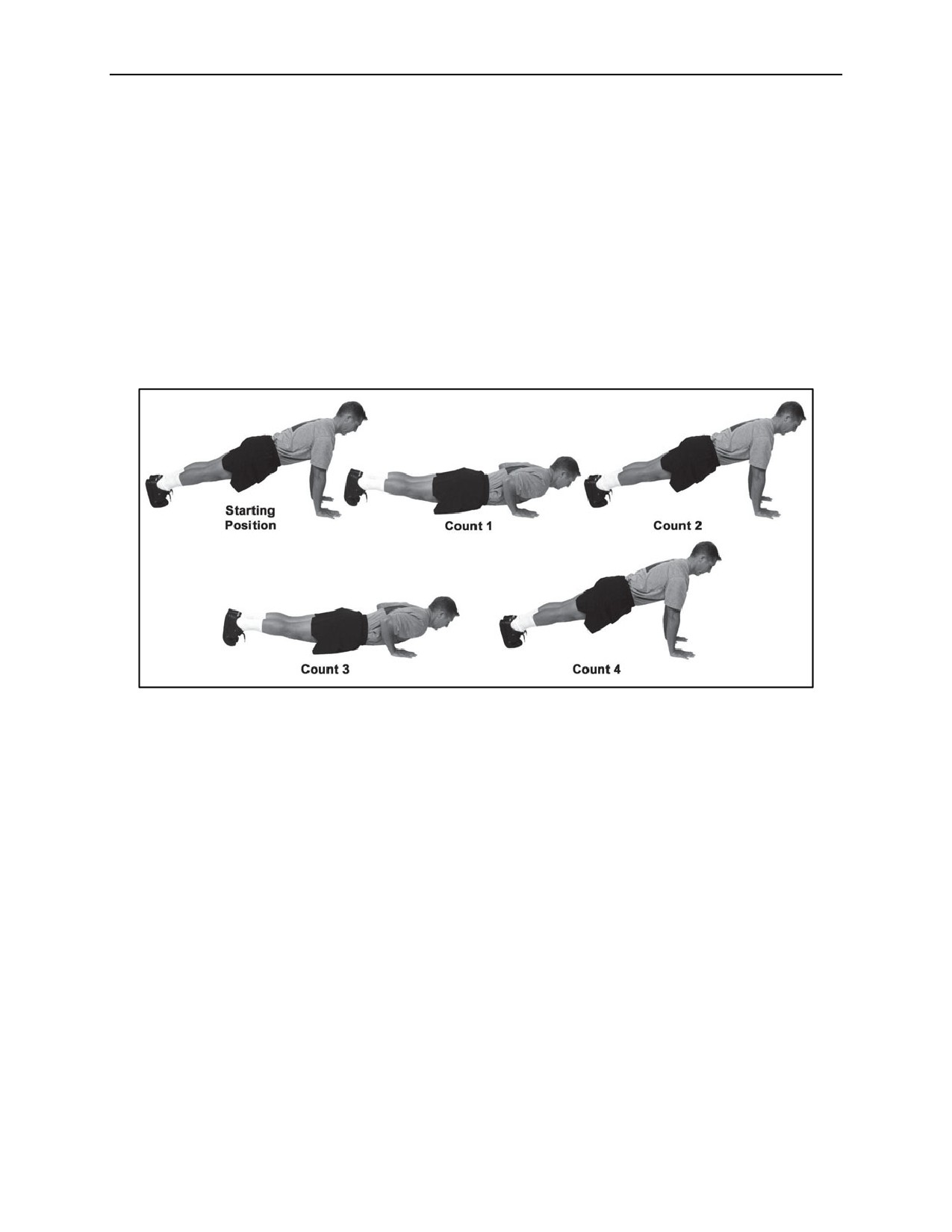
EXERCISE 10: PUSH-UP
Purpose: This exercise strengthens the muscles of the chest, shoulders, arms, and trunk (Figure 8-10).
Starting Position: Front leaning rest position.
Cadence: MODERATE
Count:
1. Bend the elbows, lowering the body until the upper arms are parallel with the ground.
2. Return to the starting position.
3. Repeat count 1.
4. Return to the starting position.
Figure 8-10. Push-up
Check Points:
z
The hands are directly below the shoulders with fingers spread (middle fingers point straight ahead).
z
On counts 1 and 3, the upper arms stay close to the trunk, elbows pointing rearward.
z
On counts 2 and 4, the elbows straighten but do not lock.
z
To prevent the trunk from sagging, tighten the abdominal muscles while in the starting position and
maintain this contraction throughout the exercise.
Precaution: N/A
8-14
FM 7-22
26 October 2012
Preparation and Recovery
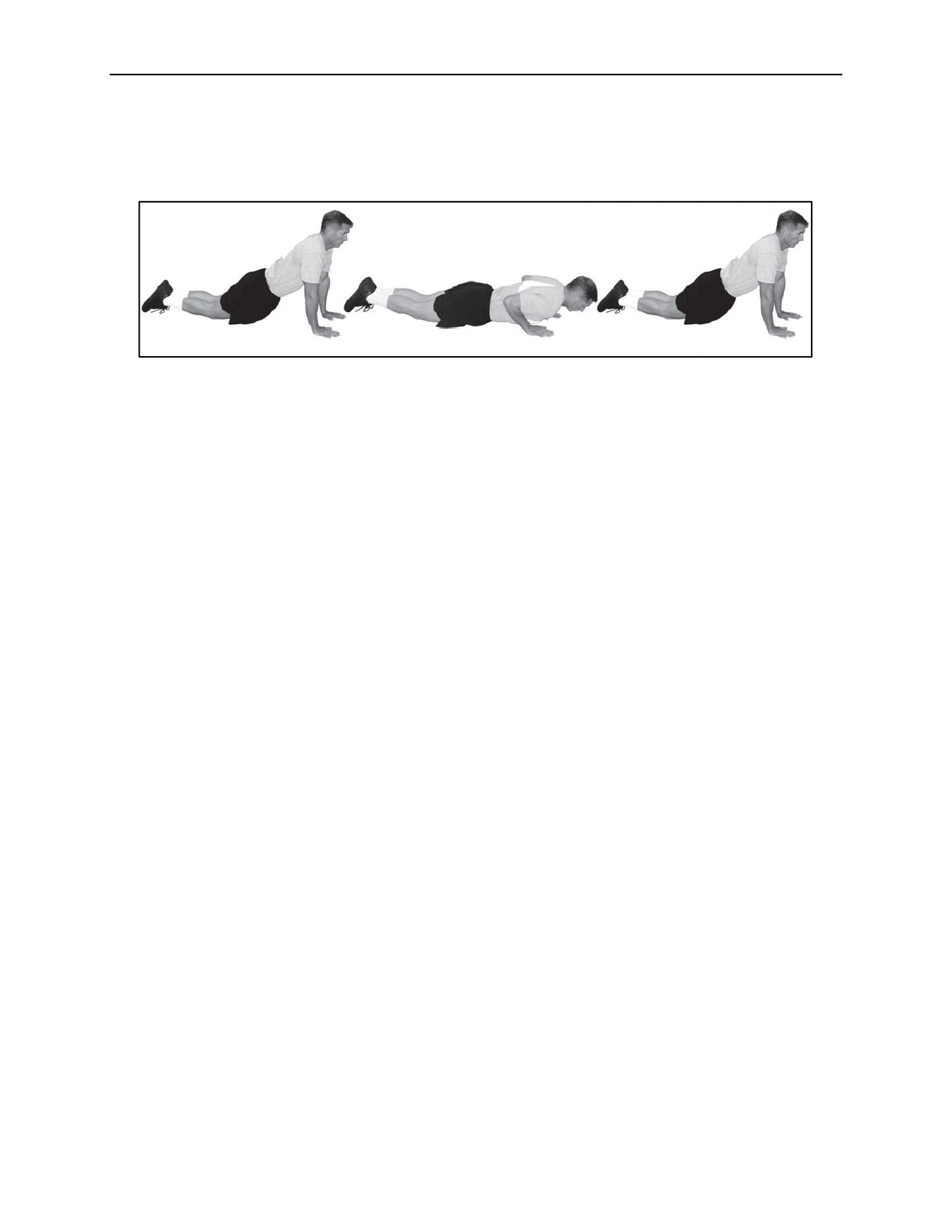
EXERCISE 10A: PUSH-UP USING THE SIX-POINT STANCE
Purpose: Soldiers should assume the six-point stance on their knees, when unable to perform repetitions
correctly to cadence (Figure 8-11).
Figure 8-11. Push-up using the six-point stance
RECOVERY
8-14. Recovery serves to gradually slow the heart rate and helps prevent pooling of the blood in the legs and
feet. The purpose of the RD is to develop range of motion and stability to enhance performance, control
injuries, and gradually bring the body back to its pre-exercise state. To adequately recover from one PRT
session to another on consecutive days, Soldiers must restore hydration and energy through proper fluid intake
and nutrition. This recovery period also includes receiving adequate rest and sleep to allow the body to
physiologically adapt to the physical stresses of PRT.
TRAINING AREA
8-15. Any dry, level area of adequate size is satisfactory for conduct of the RD.
UNIFORM
8-16. Soldiers should wear ACUs with boots or the IPFU. The uniform should be appropriate for the PRT
activity that precedes recovery. For example, when the activity is the CL 2 or the GD, ACUs with boots will be
worn.
EQUIPMENT
8-17. N/A.
FORMATION
8-18. The extended rectangular formation is prescribed for the conduct of the RD.
LEADERSHIP
8-19. Recovery should last about 15 minutes and occur immediately after the activities of the PRT session.
Soldiers should begin recovery after running activities by walking until their heart rates return to less than 100
beats per minute and heavy sweating stops. Walking also may be needed after the end of a strength training
circuit activity. Each recovery exercise position will be held for 20-30 seconds. The sequence of exercises listed
in Table 8-3 will be performed in its entirety. The RD will be conducted at the end of all PRT sessions,
especially after the conduct of the APFT, obstacle course, and foot marching. See Chapter 5, Planning
Considerations, for more information.
INSTRUCTION AND EXECUTION
8-20. A PRT leader and AI are required to lead the RD. The PRT leader and AI must be familiar with the
method of teaching these exercises, commands, formations, and the use of AIs as described in Chapter 7,
26 October 2012
FM 7-22
8-15
Chapter 8
Execution of Training. Soldiers should memorize the exercises by name and movement. The RD may be
conducted by platoon or en masse. Soldiers move in and out of the starting position and exercise positions on
the PRT leader’s command. Each exercise position is held for 20-30 seconds. Soldiers begin and terminate each
exercise at the starting position, then move to the position of attention. The RD is always performed in the order
listed. Considerable time and effort must be expended during the early stages to teach precise performance of
each exercise. The PRT leader should not execute the RD in cadence and should not count seconds aloud.
PRECISION
8-21. Recovery exercises lose much of their value unless performed exactly as prescribed. PRT leaders and AIs
must provide verbal feedback and make spot corrections to ensure that the Soldiers correctly assume the
exercise positions.
PROGRESSION
8-22. In the toughening phase Soldiers hold each exercise position for 20 seconds. In the sustaining phase, the
Soldier holds each exercise position for 20 seconds and progresses to 30 seconds. For either phase, if time
allows, a second set of the RD may be performed.
INTEGRATION
8-23. Recovery integrates the components of strength and mobility by developing stability and flexibility.
COMMANDS
8-24. The commands used to conduct the RD are described Chapter 7, Execution of Training.
RECOVERY DRILL
8-25. Table 8-3 lists the
5, two-position exercises that comprise the RD. These 5 exercises are always
performed in the order listed and held for 20 to 30 seconds. The recovery exercises are not given in cadence.
Soldiers move in and out of the starting position and exercise positions on the PRT leader’s command. The
seconds are not counted out loud.
Table 8-3. Recovery drill
1. OVERHEAD ARM PULL
HOLD 20-30 SECONDS
2. REAR LUNGE
HOLD 20-30 SECONDS
3. EXTEND AND FLEX
HOLD 20-30 SECONDS
4. THIGH STRETCH
HOLD 20-30 SECONDS
5. SINGLE-LEG OVER
HOLD 20-30 SECONDS
8-16
FM 7-22
26 October 2012
Preparation and Recovery
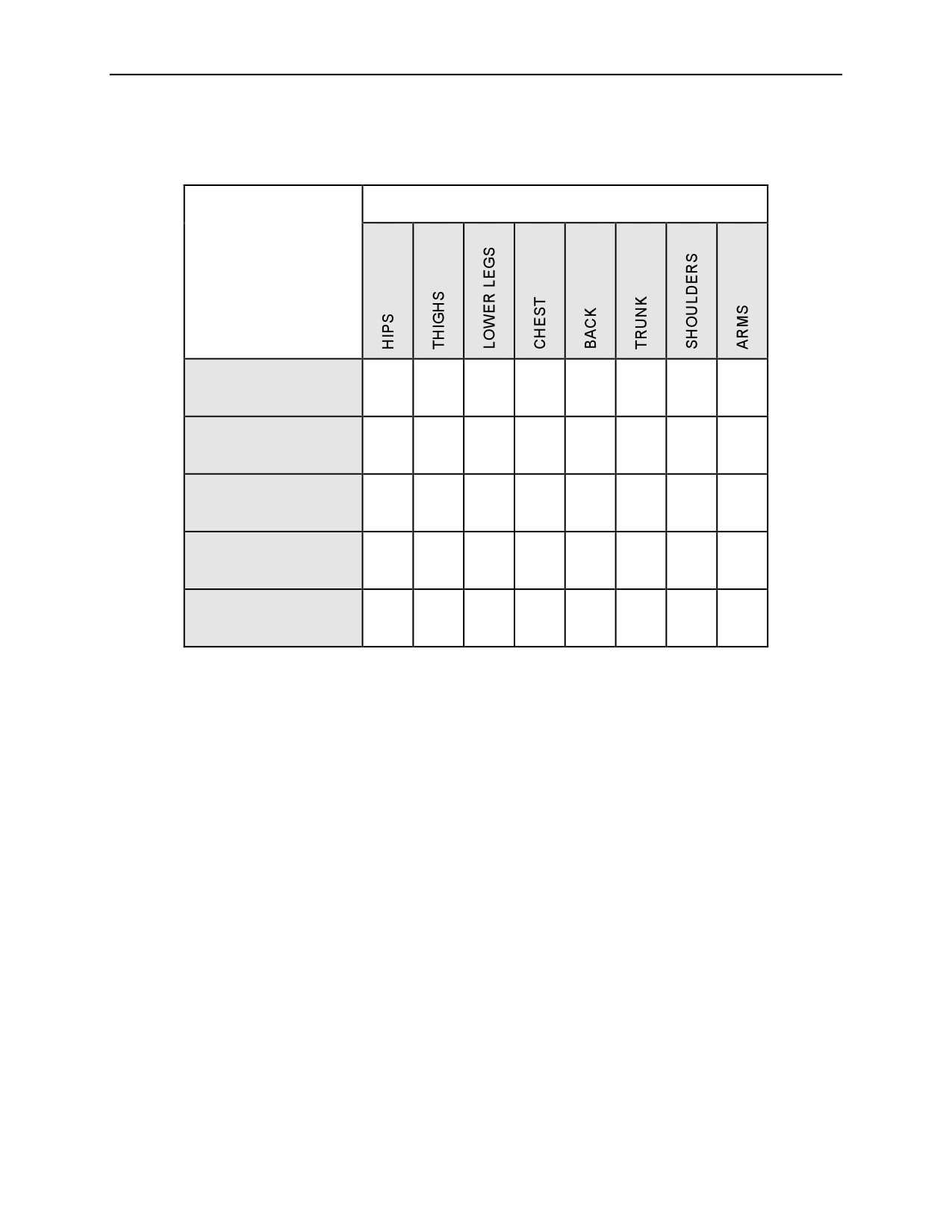
8-26. Table 8-4 lists the body segments trained in the conduct of RD.
Table 8-4. Body segments trained in the conduct of the recovery drill
MUSCLES
RECOVERY DRILL
(RD)
1.
OVERHEAD ARM
X
X
X
X
PULL
2.
REAR LUNGE
X
X
X
3.
EXTEND AND
X
X
X
X
X
X
X
X
FLEX
4.
THIGH STRETCH
X
X
X
X
X
X
5.
SINGLE-LEG
X
X
X
X
X
X
OVER
26 October 2012
FM 7-22
8-17
Chapter 8
RECOVERY DRILL
EXERCISE 1: OVERHEAD ARM PULL
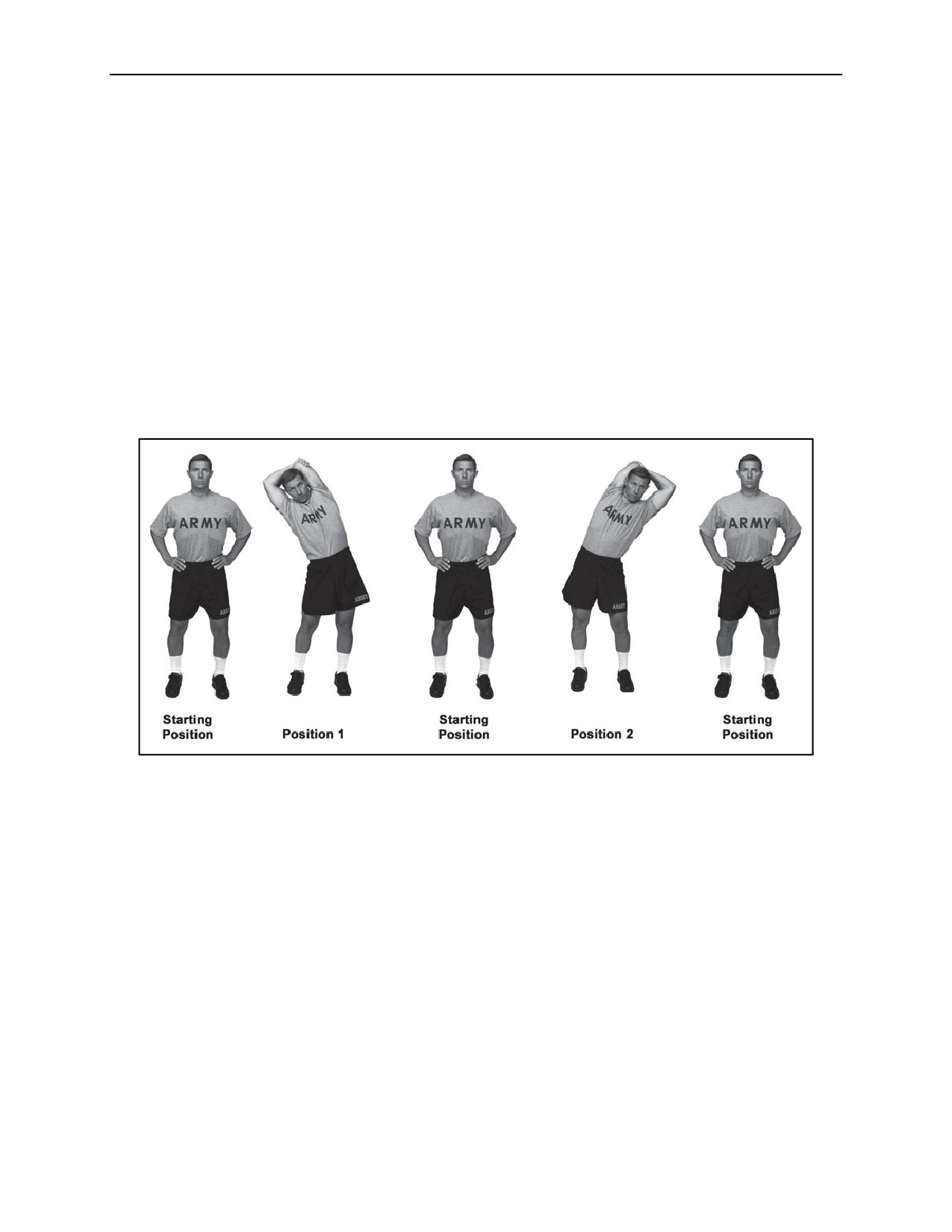
Purpose: This exercise develops flexibility of the arms, shoulders, and trunk muscles (Figure 8-12).
Starting Position: Straddle stance with hands on hips.
Position 1: On the command, “Ready, STRETCH,” raise the left arm overhead and place the left hand behind
the head. Grasp above the left elbow with the right hand and pull to the right, leaning the body to the right. Hold
this position for 20-30 seconds.
Starting Position: On the command “Starting Position, MOVE,” assume the starting position.
Position 2: On the command “Change Position, Ready, STRETCH,” raise the right arm overhead and place the
right hand behind the head. Grasp above the right elbow with the left hand and pull to the left, leaning the body
to the left. Hold this position for 20-30 seconds.
Starting Position: On the command “Starting Position, MOVE,” return to the starting position.
Figure 8-12. Overhead arm pull
Check Points:
z
Throughout the exercise, keep the hips set and the abdominals tight.
z
In positions 1 and 2, lean the body straight to the side, not to the front or back.
Precaution: N/A
8-18
FM 7-22
26 October 2012
Preparation and Recovery
RECOVERY DRILL
EXERCISE 2: REAR LUNGE
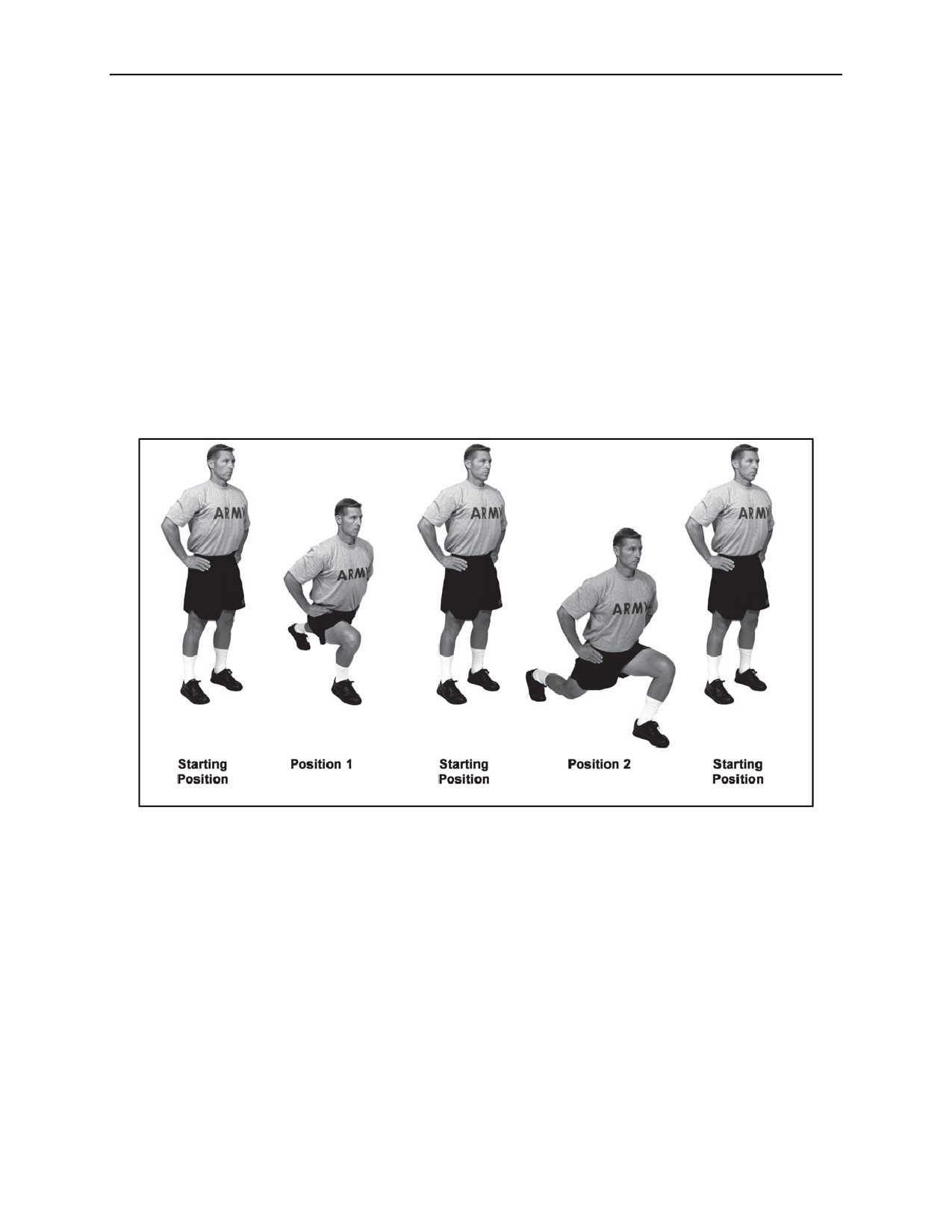
Purpose: This exercise develops flexibility of the hip flexors and trunk muscles (Figure 8-13).
Starting Position: Straddle stance, hands on hips.
Position 1: On the command “Ready, STRETCH,” take an exaggerated step backward with the left leg,
touching down with the ball of the foot. This is the same position as count 1 of the rear lunge in the PD. Hold
this position for 20-30 seconds.
Starting Position: On the command “Starting Position, MOVE,” assume the starting position.
Position 2: On the command “Change Position, Ready, STRETCH,” take an exaggerated step backward with
the right leg, touching down with the ball of the foot. This is the same position as count 3 of the rear lunge in
the PD. Hold this position for 20-30 seconds.
Starting Position: On the command “Starting Position, MOVE,” return to the starting position.
Figure 8-13. Rear lunge
Check Points:
z
Maintain straightness of the back by keeping the abdominal muscles tight throughout the motion.
z
After the foot touches down on positions 1 and 2, allow the body to continue to lower.
z
Lunge and step in a straight line, keeping the feet directed forward. Viewed from the front, the feet
are shoulder width apart, both at the starting position and at the end of positions 1and 2.
z
Keep the forward knee over the ball of the foot on positions 1 and 2.
z
Ensure the heal of the rear foot does not touch the ground.
Precaution: When lunging to the left or right, do not let the knee move forward of the toes.
26 October 2012
FM 7-22
8-19
Chapter 8
RECOVERY DRILL
EXERCISE 3: EXTEND AND FLEX
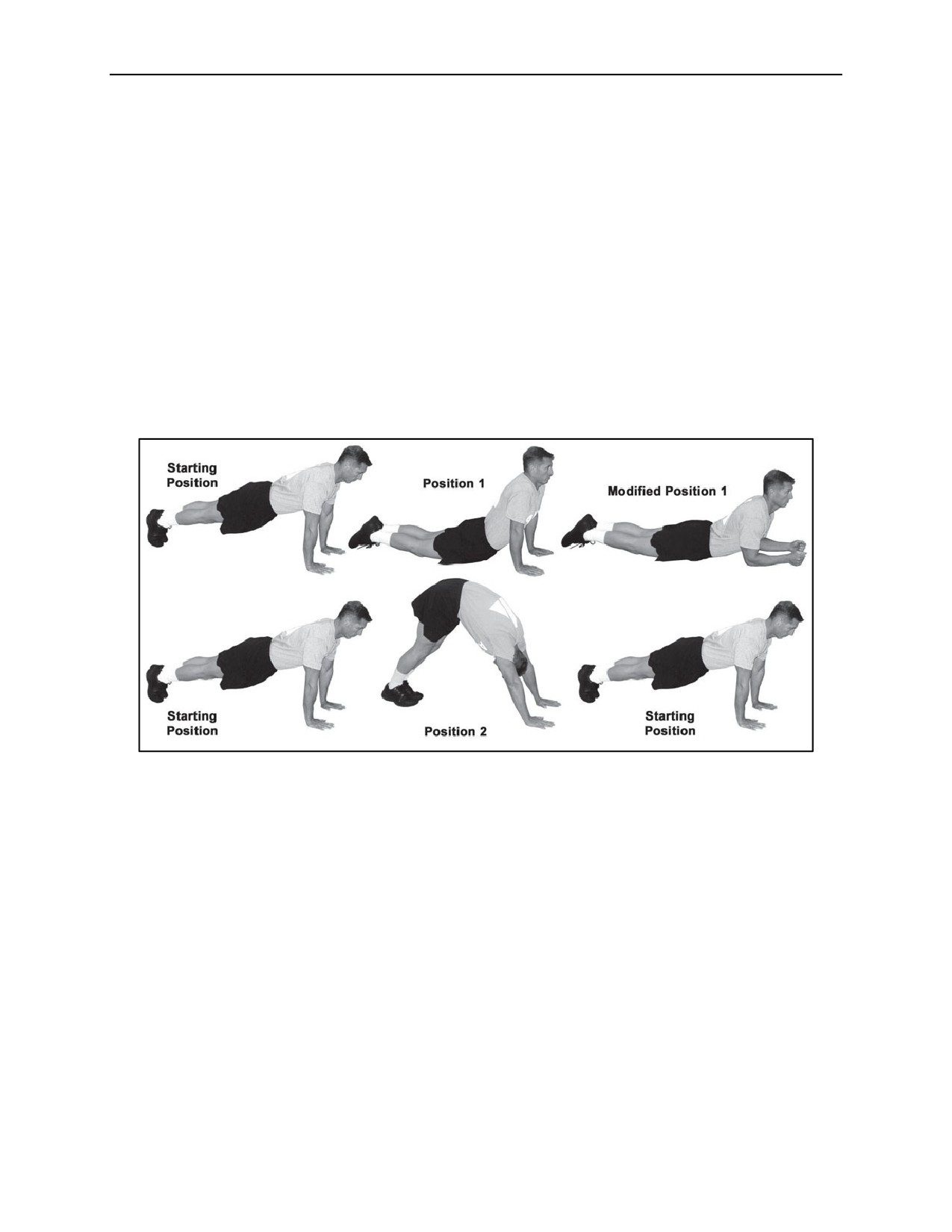
Purpose: This exercise develops flexibility of the hip flexors, abdominals, hip (position 1-extend, Figure 8-14),
and the low back, hamstrings, and calves (position 2-flex, Figure 8-14).
Starting Position: The front leaning rest position.
Position 1: On the command “Ready, STRETCH,” lower the body, sagging in the middle, keeping the arms
straight and look upward. Hold this position for 20-30 seconds.
Starting Position: On the command “Starting Position, MOVE,” assume the starting position.
Position 2: On the command “Change Position, Ready, STRETCH,” slightly bend the knees and raise the hips
upward. Straighten the legs and try to touch the ground with the heels. Move the head in line with the arms,
forming an “A” with the body. Keep the feet together and hold this position for 20-30 seconds.
Starting Position: On the command “Starting Position, MOVE,” return to the starting position.
Figure 8-14. Extend and flex
Check Points:
z
In position 1, the thighs and pelvis rest on the ground. Relax the back muscles while bearing the
bodyweight through the straight arms. Toes point to the rear.
z
In position 2, the legs are straight and the arms are shoulder width apart, palms down on the ground.
Relax the shoulders and push to the rear with the hands, forming an “A” with the body. Try not to
round the shoulders.
z
Feet are together throughout the exercise.
Precaution: N/A
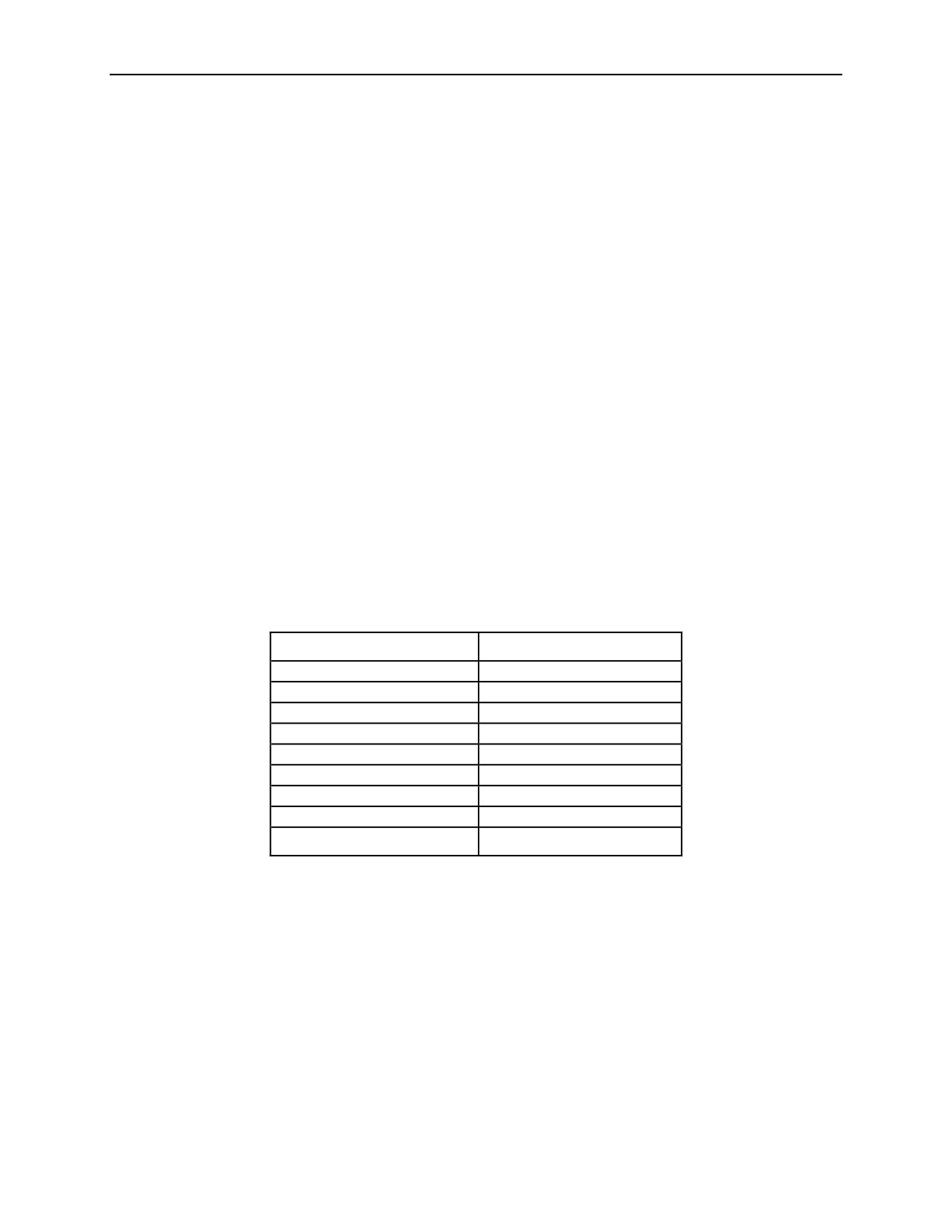
Variation: Soldiers, who are unable to extend the trunk in position 1 while keeping the arms straight and hips
on the ground, may assume the modified position 1 shown above.
8-20
FM 7-22
26 October 2012
Preparation and Recovery
RECOVERY DRILL
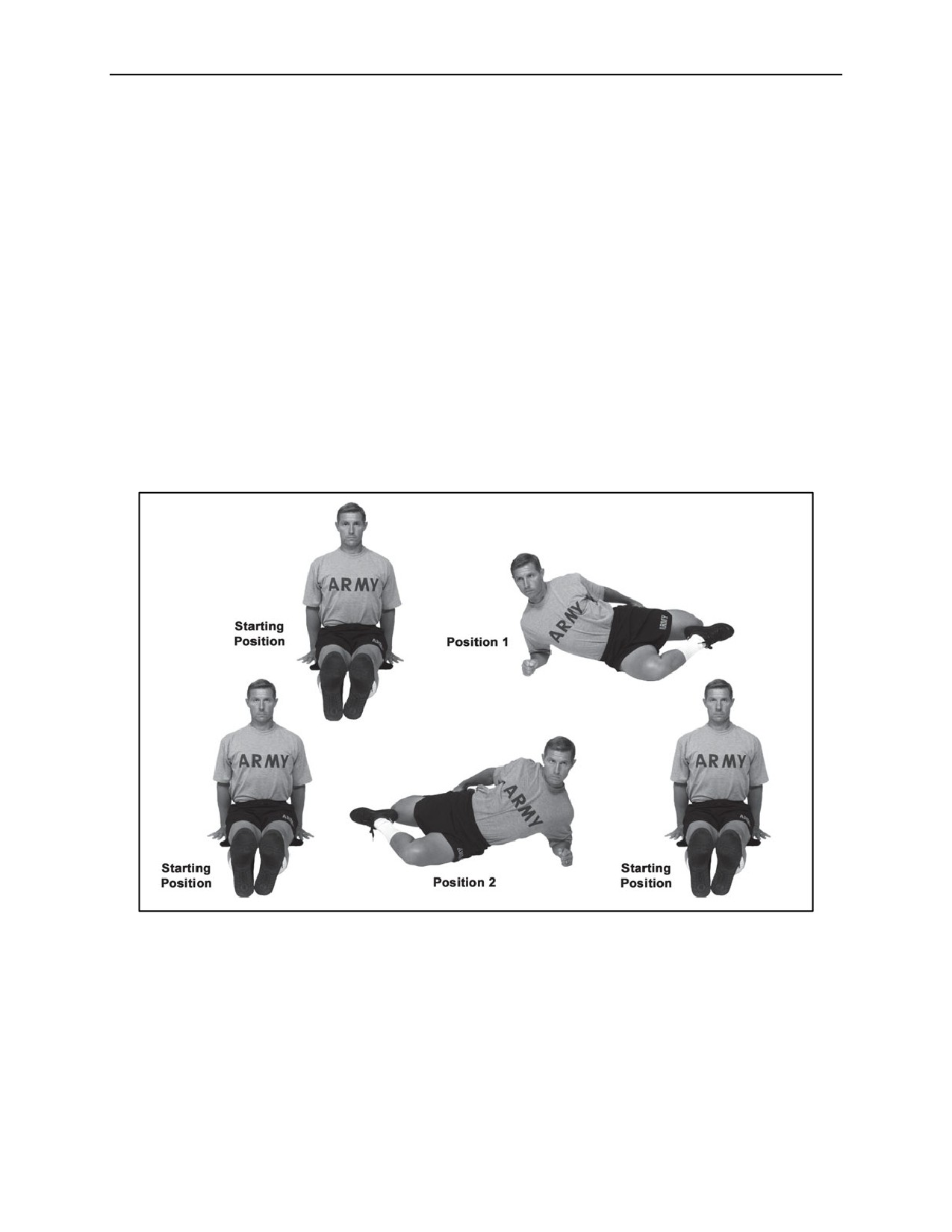
EXERCISE 4: THIGH STRETCH
Purpose: This exercise develops flexibility of the front of the thigh and the hip flexor muscles (Figure 8-15).
Starting Position: Seated position, arms at sides and palms on the floor.
Position 1: On the command “Ready, STRETCH,” roll onto the right side and place the right forearm on the
ground, perpendicular to the chest. The right hand makes a fist on the ground with the thumb side up. Grasp the
left ankle with the left hand and pull the left heel toward the buttocks and pull the entire leg rearward. Push the
left thigh further to the rear with the heel of the right foot. Hold this position for 20-30 seconds.
Starting Position: On the command, “Starting Position, MOVE,” assume the starting position.
Position 2: On the command “Change Position, Ready, STRETCH,” lie on the left side and place the left
forearm on the ground, perpendicular to the chest. The left hand makes a fist on the ground with the thumb side
up. Grasp the right ankle with the right hand and pull the right heel toward the buttocks pulling the entire leg
rearward. Push the right thigh further to the rear with the heel of the left foot. Hold this position for
20-30 seconds.
Starting Position: On the command, “Starting Position, MOVE,” return to the starting position.
Figure 8-15. Thigh stretch
Check Points:
z
Keep the abdominal muscles tight throughout this stretch in order to keep the trunk straight.
z
Do not pull the heel forcefully to the buttock if there is discomfort in the knee joint.
Precaution: N/A
26 October 2012
FM 7-22
8-21
Chapter 8
RECOVERY DRILL
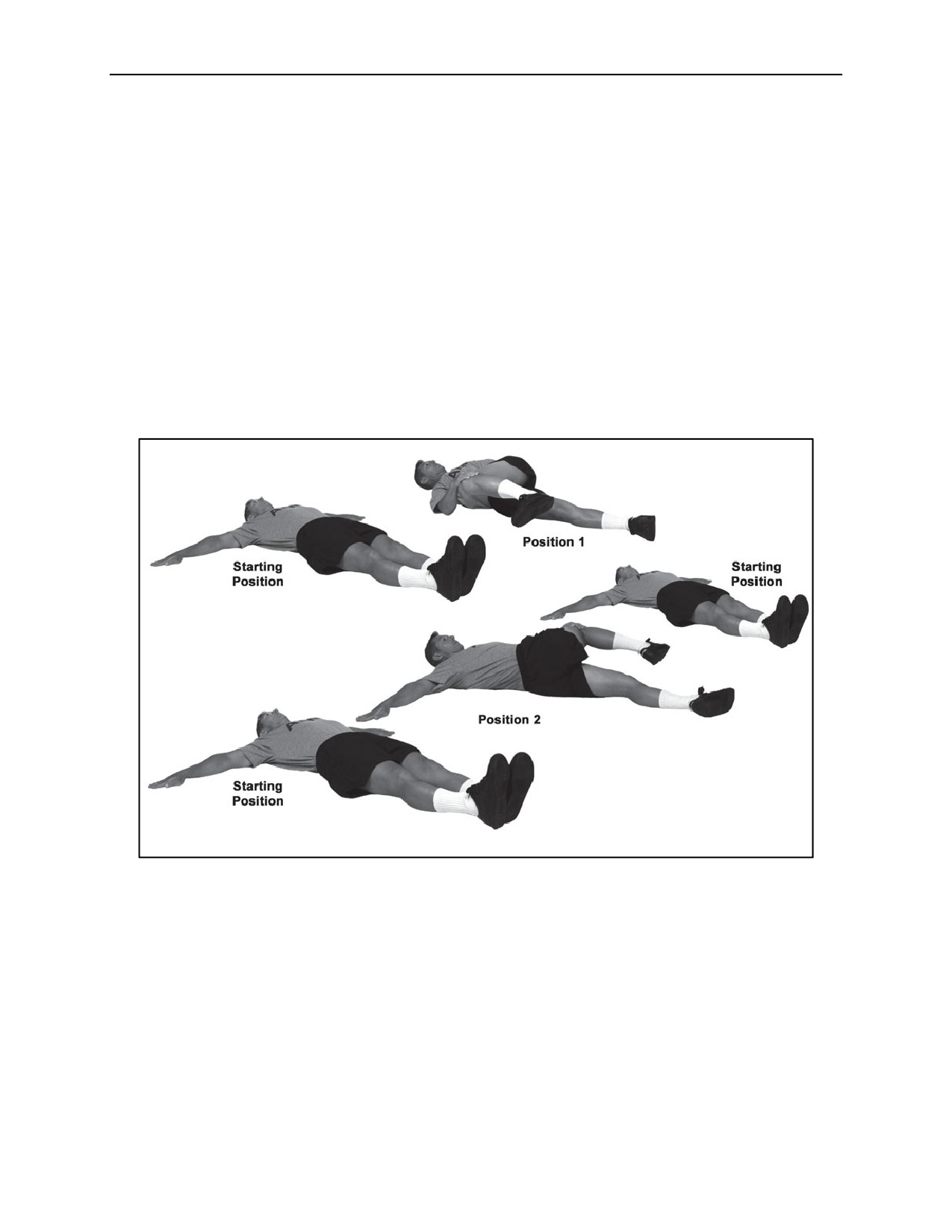
EXERCISE 5: SINGLE-LEG OVER
Purpose: This exercise develops flexibility of the hips and lower back muscles (Figure 8-16).
Starting Position: Supine position with arms sideward, palms down, and feet together and head on the ground.
Position 1: On the command, “Ready, STRETCH,” turn the body to the right, bend the left knee to 90-degrees
over the right leg, and grasp the outside of the left knee with the right hand and pull toward the right. Hold this
position for 20-30 seconds.
Starting Position: On the command, “Starting Position, MOVE,” assume the starting position.
Position 2: On the command, “Change Position, Ready, STRETCH,” turn the body to the left, bend the right
knee to 90-degrees over the left leg, and grasp the outside of the right knee with the left hand and pull toward
the left. Hold this position for 20-30 seconds.
Starting Position: On the command, “Starting Position, MOVE,” return to the starting position.
Figure 8-16. Single-leg over
Check Points:
z
At the starting position, the arms are directed to the sides at 90-degrees to the trunk; the fingers and
thumbs are extended and joined.
z
In position 1, keep the left shoulder, arm, and hand on the ground.
z
In position 2, keep the right shoulder, arm, and hand on the ground.
z
Head remains on the ground throughout the exercise.
Precaution: N/A
8-22
FM 7-22
26 October 2012
Preparation and Recovery
Summary
Preparation and recovery are essential elements of every PRT session. Conducting PRT
activities without preparation may adversely affect performance and increase the risk of
injury. Recovery enhances mobility and gradually brings the body back to its pre-exercise
state. Recovery should also carry over until the next PRT session is performed. Restoring
adequate hydration and energy through proper nutrition and getting adequate sleep allow
the body to refuel, rest, and adapt to the stresses of training.
26 October 2012
FM 7-22
8-23
This page intentionally left blank.