FM 7-22 ARMY PHYSICAL READINESS TRAINING (OCTOBER 2012) - page 5
Chapter 6
PREPARATION DRILL
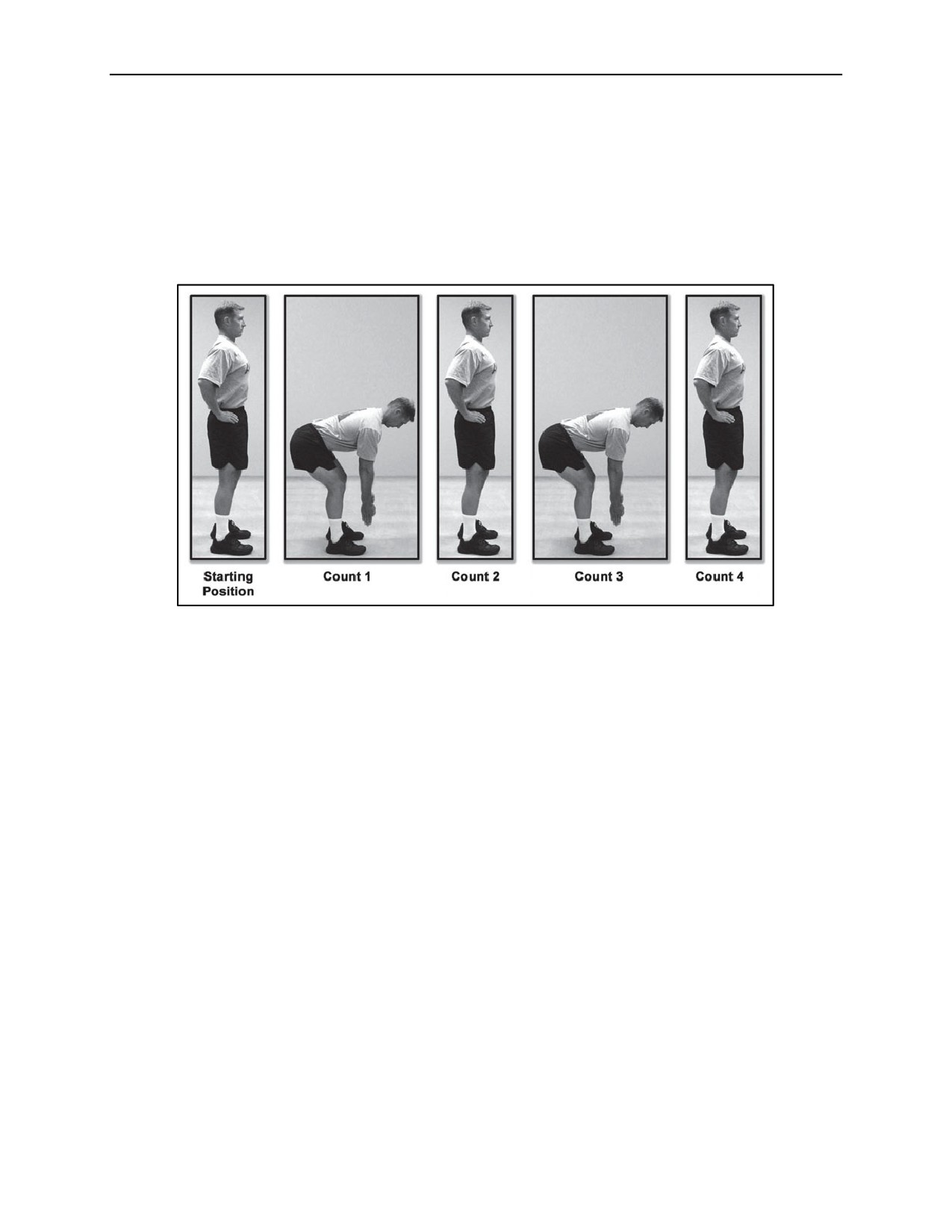
MODIFIED EXERCISE 1: MODIFIED BEND AND REACH
6-115. The instructor may modify the bend and reach by decreasing the range of motion and limiting the use
of the arms. The Soldier may use the modifications shown in Figure 6-57 to exercise within physical profile
limitations. The Soldier gradually increases the range of motion and works toward the standard execution of the
exercise, then progresses performance to standard.
Figure 6-57. Modified bend and reach
6-76
FM 7-22
26 October 2012
Special Conditioning Programs
PREPARATION DRILL
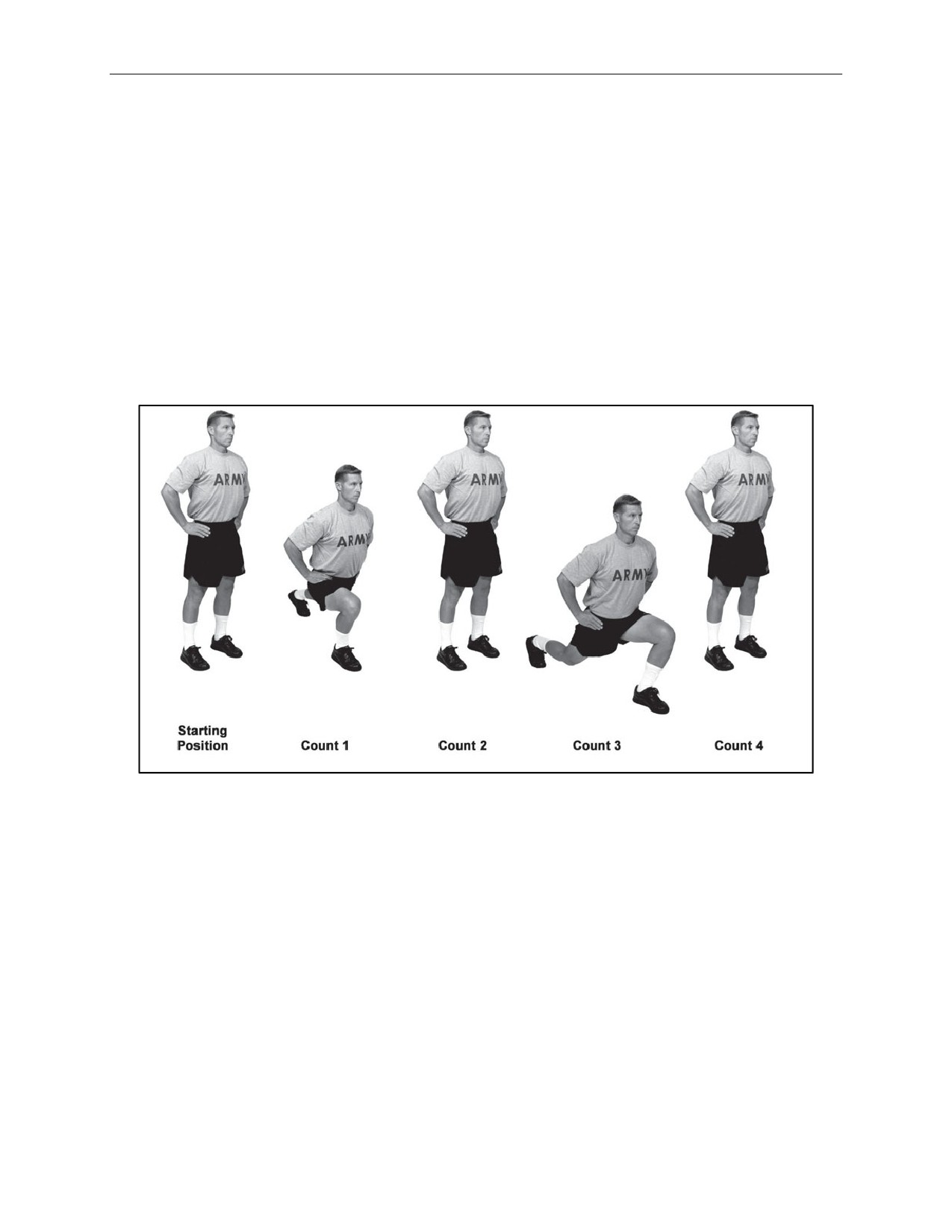
EXERCISE 2: REAR LUNGE
Purpose: This exercise promotes balance, opens up the hip and trunk on the side of the lunge, and develops leg
strength (Figure 6-58).
Starting Position: Straddle stance with hands on hips.
Cadence: SLOW
Count:
1. Take an exaggerated step backward with the left leg, touching down with the ball of the foot.
2. Return to the starting position.
3. Repeat count 1 with the right leg.
4. Return to the starting position.
Figure 6-58. Rear lunge
Check Points:
z
Maintain straightness of the back by keeping the abdominal muscles tight throughout the motion.
z
After the foot touches down, allow the body to continue to lower. This promotes flexibility of the hip
and trunk.
z
On counts 1 and 3, step straight to the rear, keeping the feet directed forward. When viewed from the
front, the feet maintain their distance apart both at the starting position and at the end of counts
1 and 3.
z
Keep the rear leg as straight as possible but not locked.
z
Ensure the heel of the rear foot does not touch the ground.
Precautions: This exercise is always performed at a slow cadence. On counts 1 and 3, move into position in a
slow, controlled manner. If the cadence is too fast, it will be difficult to go through a full range of motion.
26 October 2012
FM 7-22
6-77
Chapter 6
PREPARATION DRILL
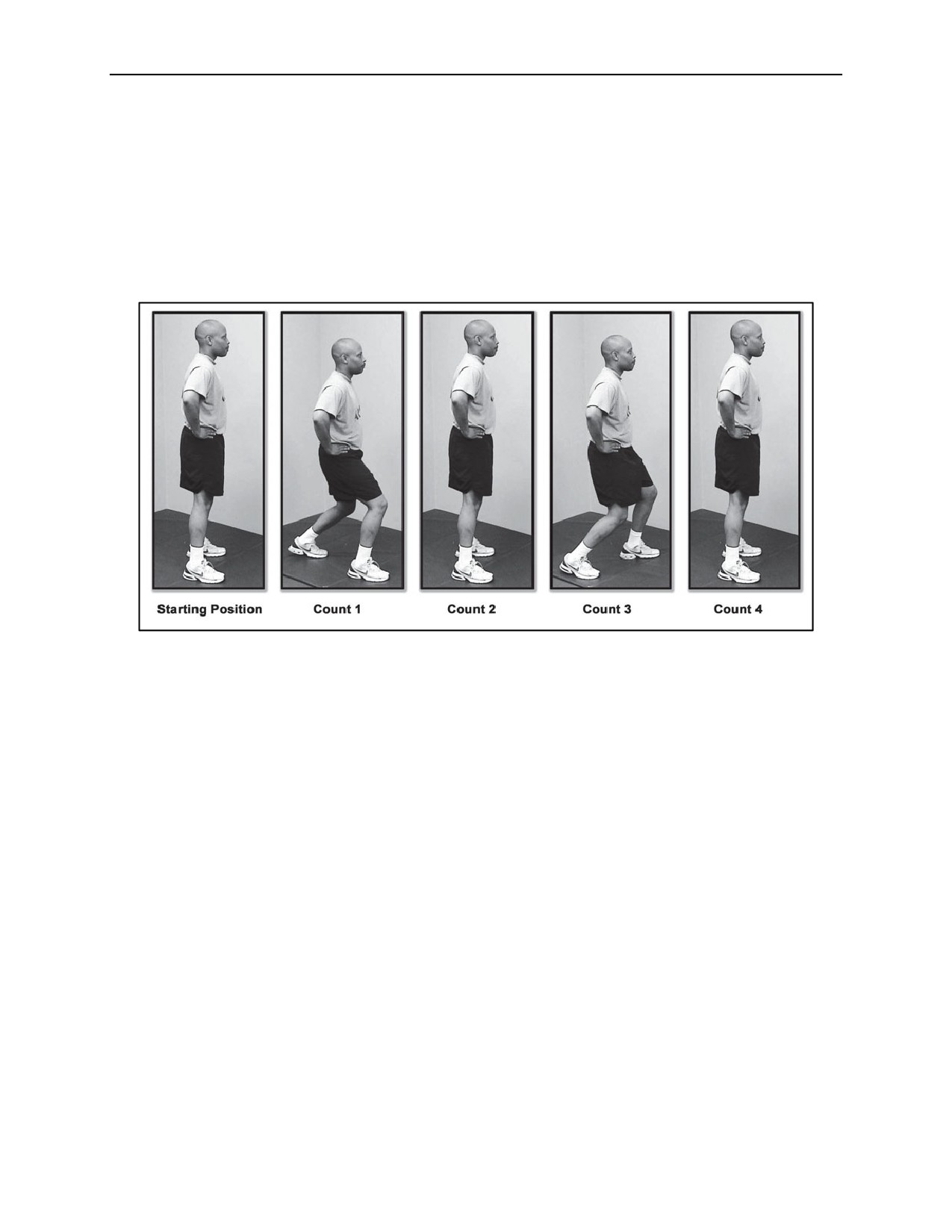
MODIFIED EXERCISE 2: MODIFIED REAR LUNGE
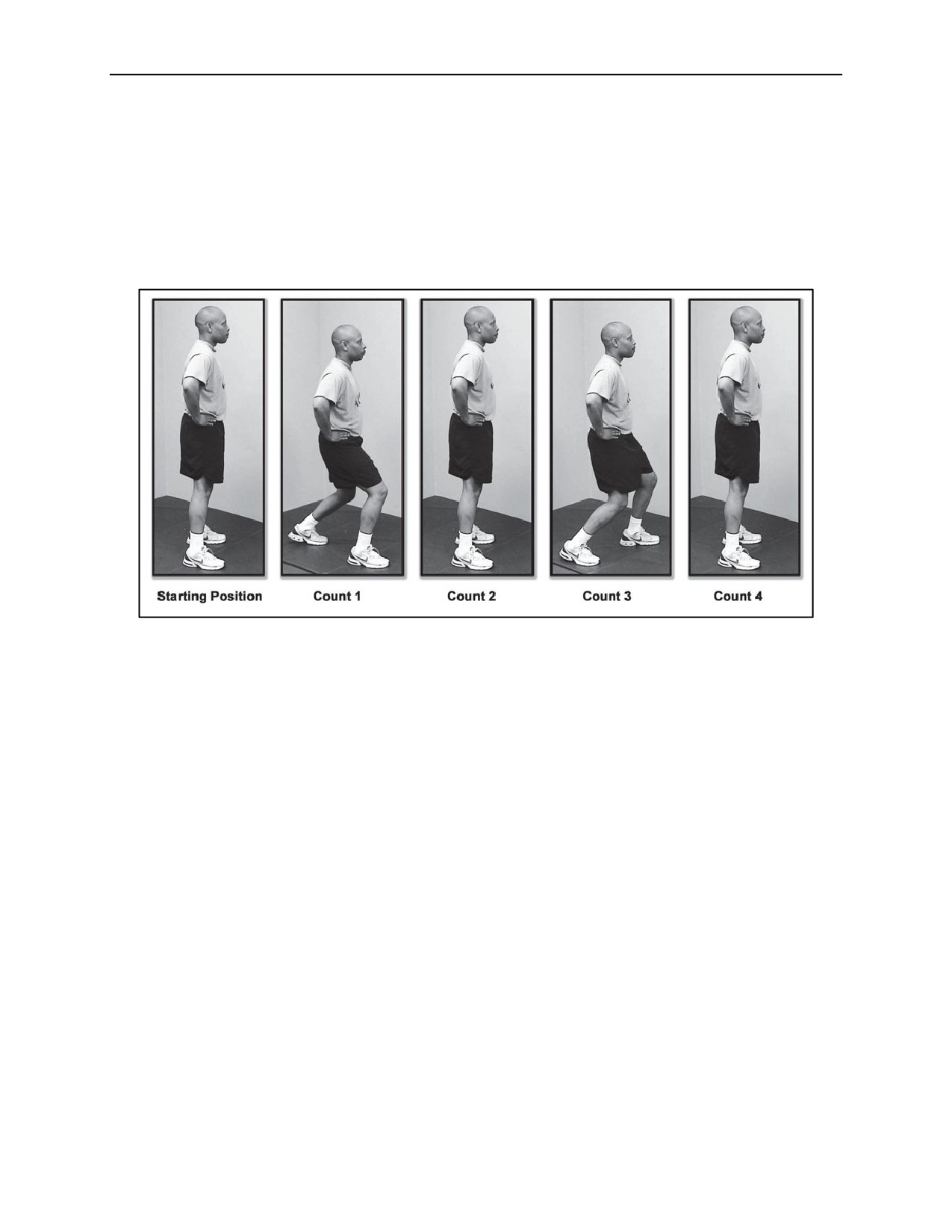
6-116. The rear lunge can be modified (Figure 6-59) by decreasing the range of motion at which it is
performed. As with all lunges, the amount of knee bend may be restricted for the rear lunge. The feet may be
closer together. Concentrate on trying to gradually lower the body in the lunge position. The Soldier gradually
increases the range of motion and works toward the standard execution of the exercise, then progresses
performance to standard.
Figure 6-59. Modified rear lunge
6-78
FM 7-22
26 October 2012
Special Conditioning Programs
PREPARATION DRILL
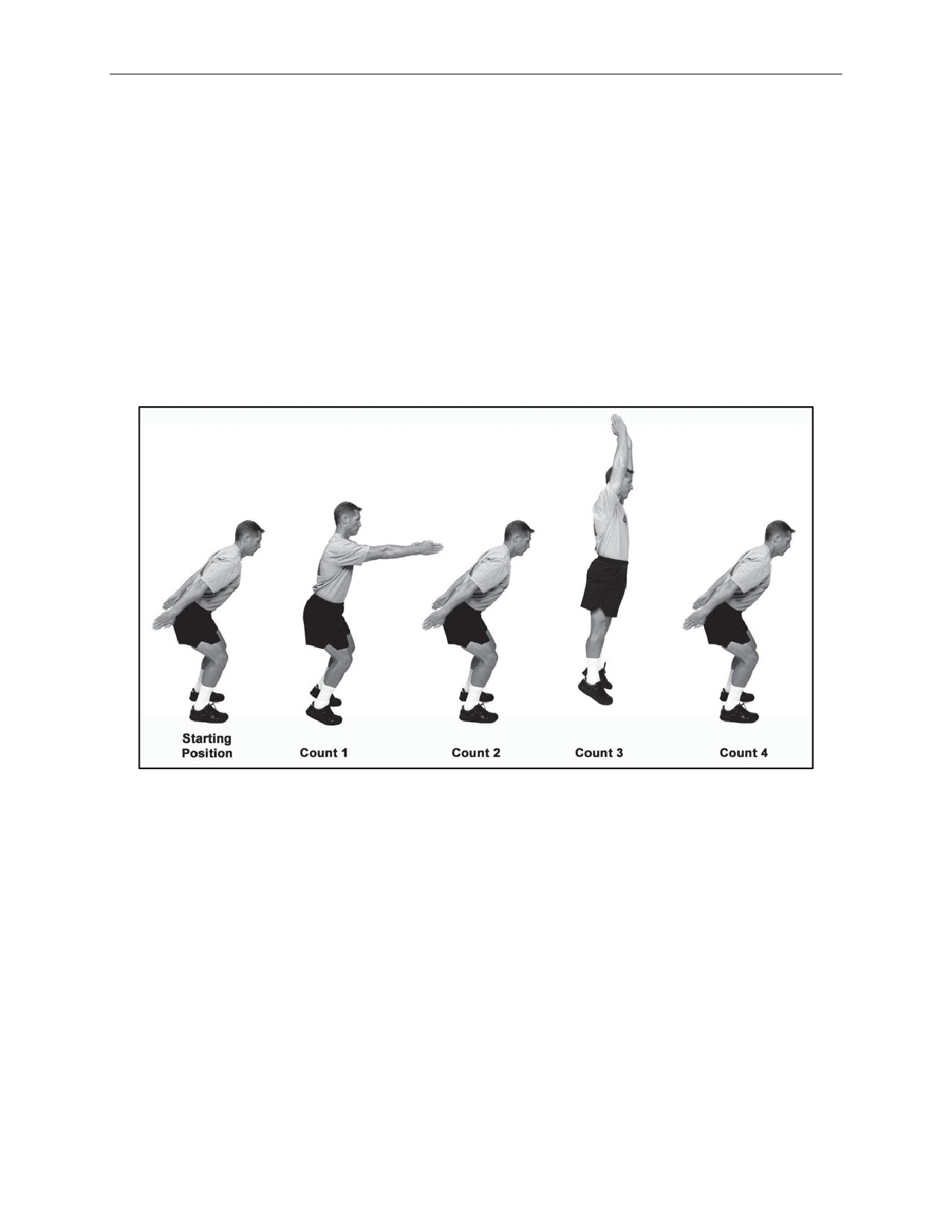
EXERCISE 3: HIGH JUMPER
Purpose: This exercise reinforces correct jumping and landing, stimulates balance and coordination, and
develops explosive strength (Figure 6-60).
Starting Position: Forward leaning stance.
Cadence: MODERATE
Count:
1. Swing arms forward and jump a few inches.
2. Swing arms backward and jump a few inches.
3. Swing arms forward vigorously overhead while jumping forcefully.
4. Repeat count 2. On the last repetition, return to the starting position.
Figure 6-60. High jumper
Check Points:
z
At the starting position, the shoulders, the knees, and the balls of the feet should form a straight
vertical line.
z
On count 1, the arms are parallel to the ground.
z
On count 3, the arms should be extended fully overhead. The trunk and legs should also be aligned.
z
On each count the Soldier is jumping. On counts 1, 2, and 4 the jumps are 4-6 inches off the ground.
On count 3, the Soldier jumps higher (6-10 inches) while maintaining the posture pictured in
Figure 6-60.
z
On each landing, the feet should be directed forward and maintained at shoulder distance apart. The
landing should be “soft” and proceed from the balls of the feet to the heels. The vertical line from the
shoulders through the knees to the balls of the feet should be demonstrated on each landing.
Precautions: N/A
26 October 2012
FM 7-22
6-79
Chapter 6
PREPARATION DRILL
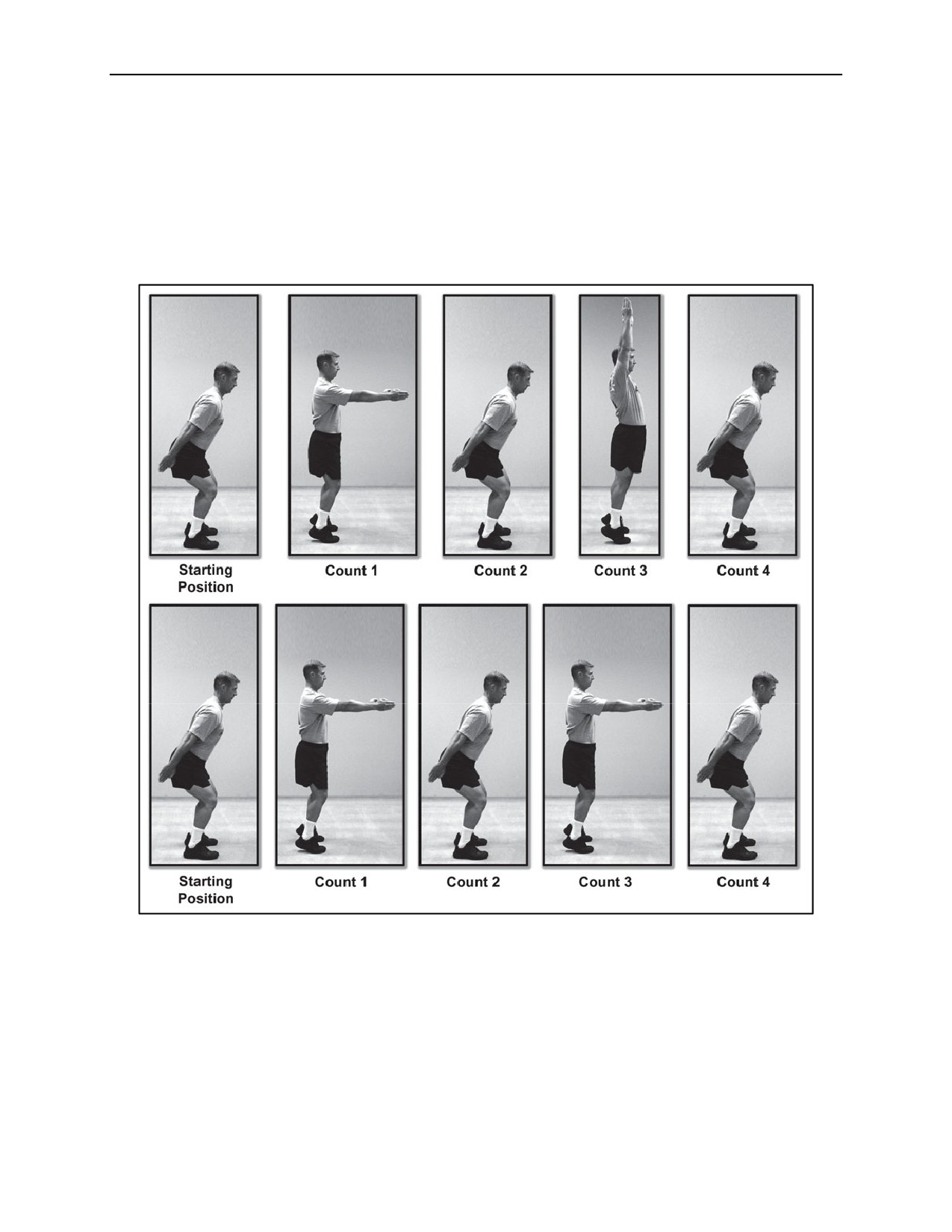
MODIFIED EXERCISE 3: MODIFIED HIGH JUMPER
6-117. The instructor may modify the high jumper by decreasing the range of motion and limiting the use of
the arms. The Soldier may use the modifications shown in Figure 6-61 to exercise within physical profile
limitations. The Soldier gradually increases the range of motion and works toward the standard execution of the
exercise, then progresses performance to standard.
Figure 6-61. Modified high jumper (remaining on the ground)
6-80
FM 7-22
26 October 2012
Special Conditioning Programs
PREPARATION DRILL
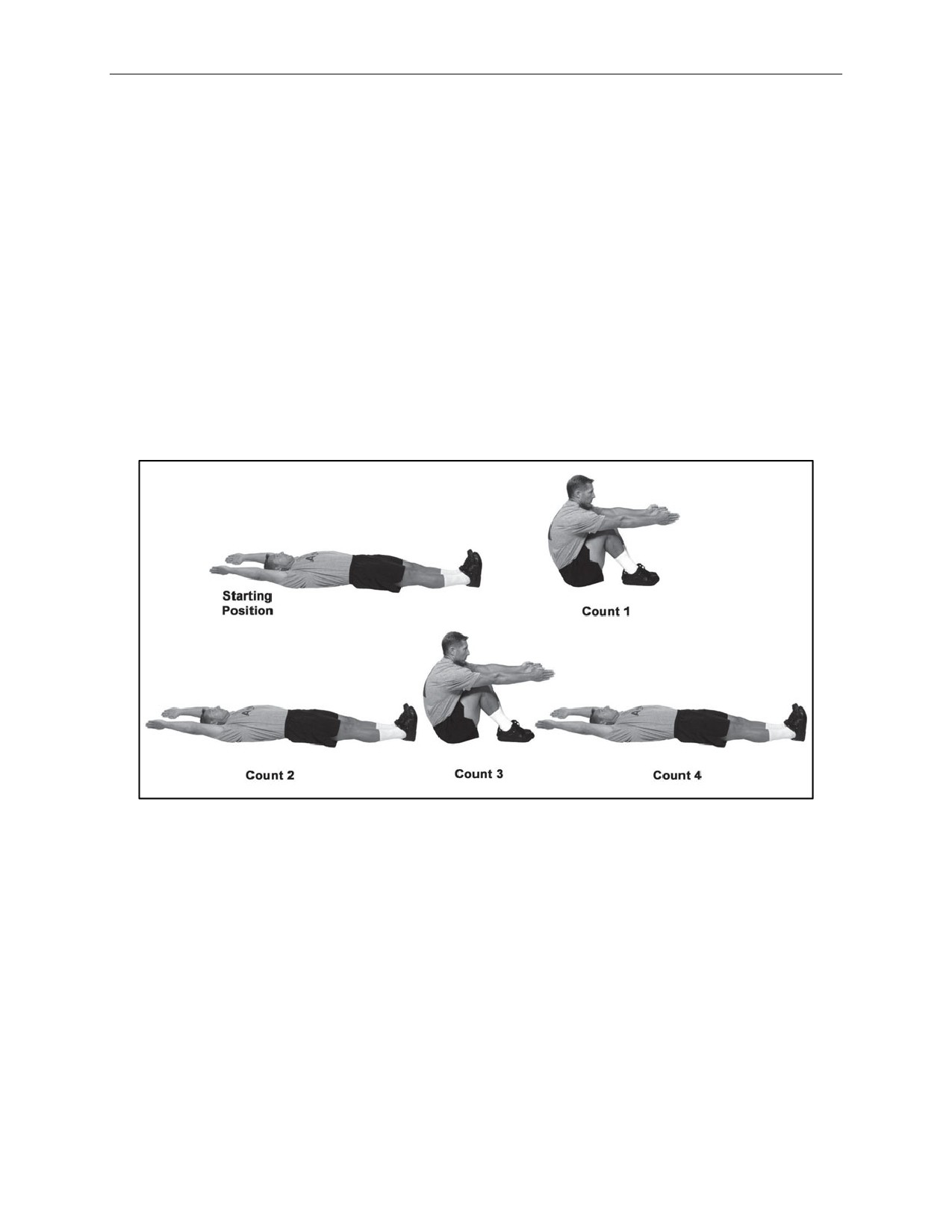
EXERCISE 4: ROWER
Purpose: This exercise improves the ability to move in and out of the supine position to a seated posture. It
coordinates the action of the trunk and extremities while challenging the abdominal muscles (Figure 6-62).
Starting Position: Supine position, arms overhead and feet together, and pointing upward. The chin is tucked
and the head is 1-2 inches above the ground. Arms are shoulder-width, palms facing inward, with fingers and
thumbs extended and joined.
Cadence: SLOW
Count:
1. Sit up while swinging arms forward and bending at the hip and knees. At the end of the motion,
the arms will be parallel to ground, palms facing inward.
2. Return to the starting position.
3. Repeat count 1.
4. Return to the starting position.
Figure 6-62. Rower
Check Points:
z
At the starting position, the low back must not be arched excessively off the ground. To prevent this,
tighten the abdominal muscles to tilt the pelvis and low back toward the ground.
z
At the end of counts 1 and 3, the feet are flat and pulled near the buttocks. The legs stay together
throughout the exercise and the arms are parallel to the ground.
Precautions: This exercise is always performed at a slow cadence. Do not arch the back to assume counts 1
and 3.
26 October 2012
FM 7-22
6-81
Chapter 6
PREPARATION DRILL
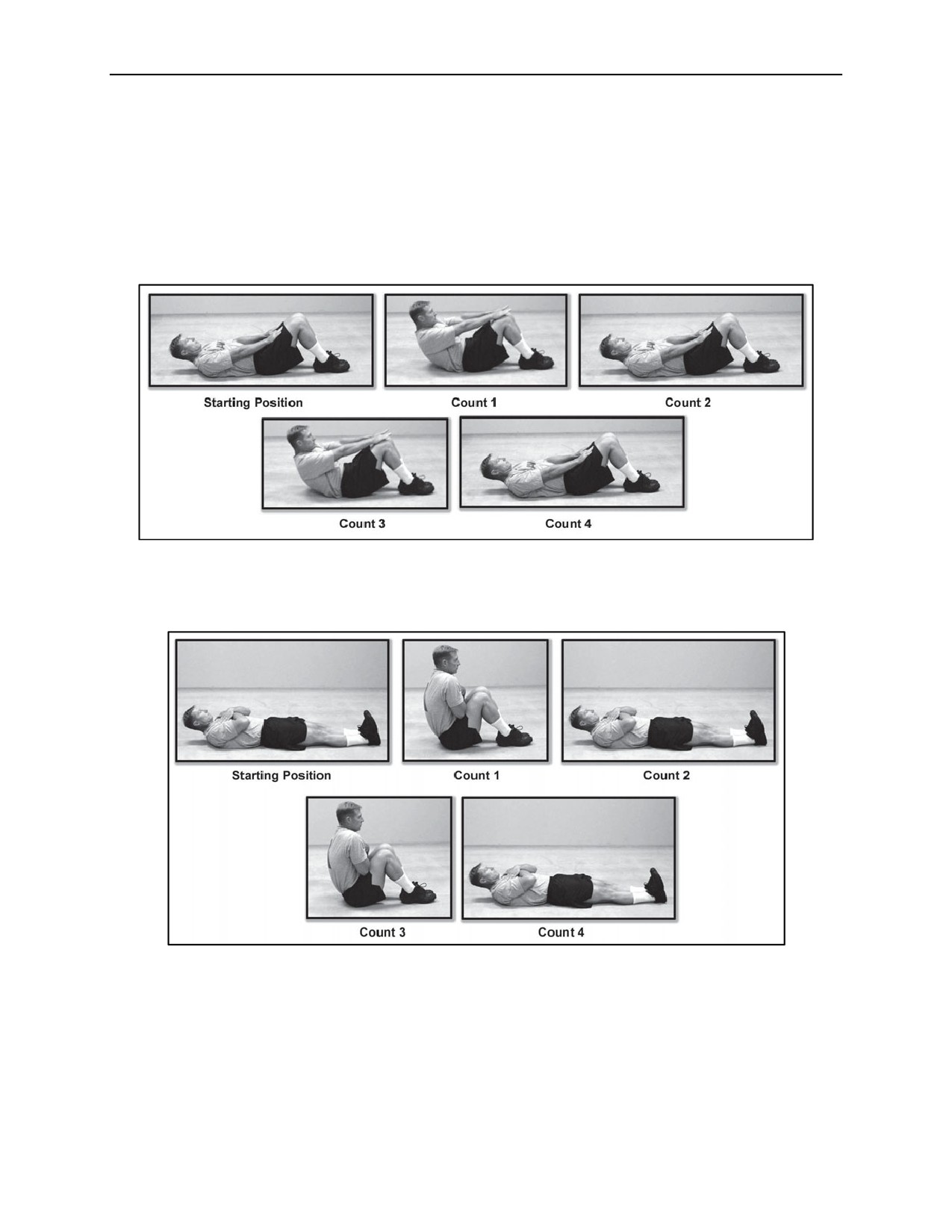
MODIFIED EXERCISE 4: MODIFIED ROWER
6-118. The instructor may modify the rower by decreasing the range of motion or limiting the use of the arms.
The Soldier may use the modifications shown in Figure 6-63 and Figure 6-64 to exercise within physical profile
limitations. The Soldier gradually increases the range of motion and works toward the standard execution of the
exercise, then progresses performance to standard.
Figure 6-63. Modified rower (limited range of movement)
Figure 6-64. Modified rower (without use of arms)
6-82
FM 7-22
26 October 2012
Special Conditioning Programs
PREPARATION DRILL
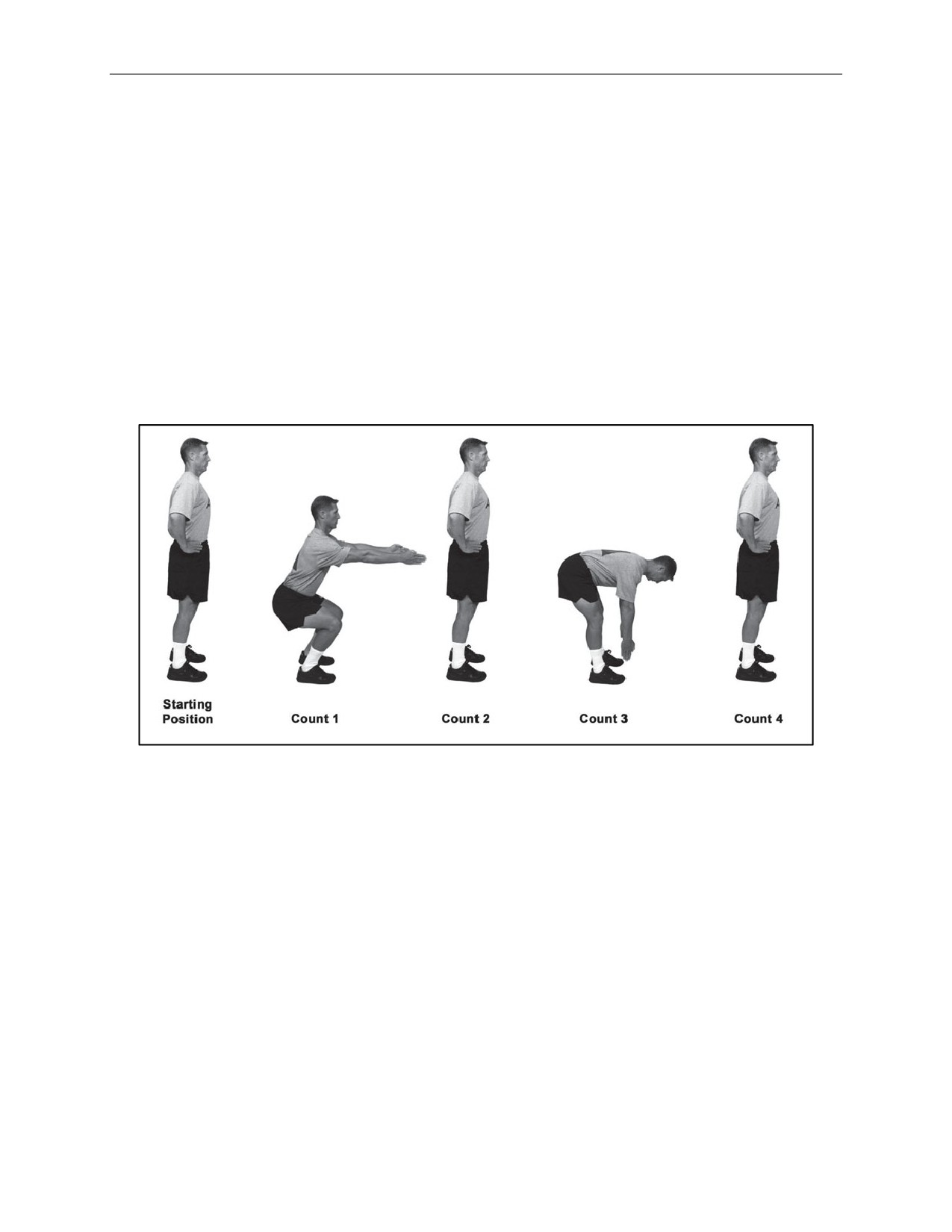
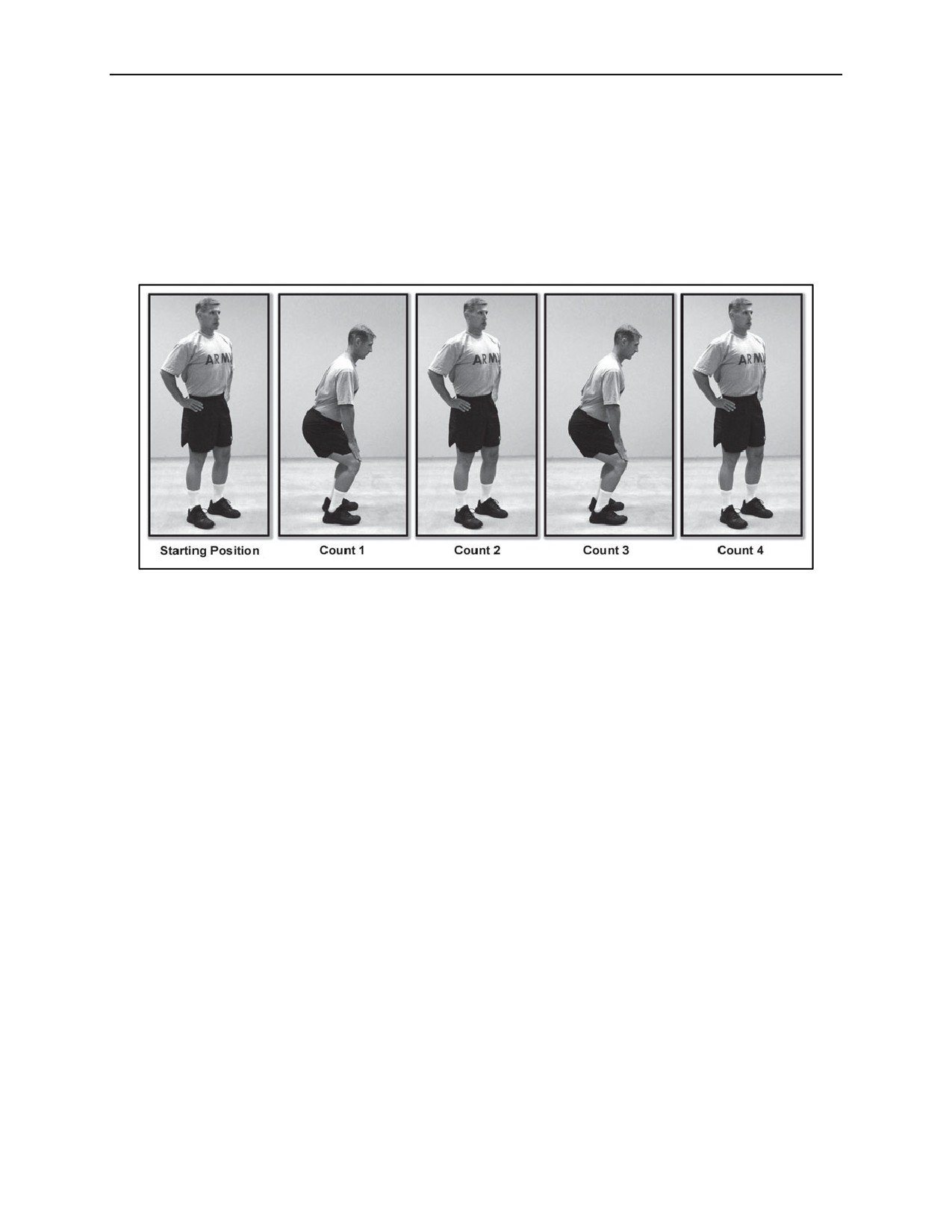
EXERCISE 5: SQUAT BENDER
Purpose: This exercise develops strength, endurance, and mobility of the lower back and lower extremities
(Figure 6-65).
Starting Position: Straddle stance with hands on hips.
Cadence: SLOW
Count:
1. Squat while leaning slightly forward at the waist with the head up and extend the arms to the front,
with arms parallel to the ground and palms facing inward.
2. Return to the starting position.
3. Bend forward and reach toward the ground with both arms extended and palms inward.
4. Return to the starting position.
Figure 6-65. Squat bender
Check Points:
z
At the end of count 1, the shoulders, knees and the balls of the feet should be aligned. The heels
remain on the ground and the back is straight.
z
On count 3, bend forward, keeping the head aligned with the spine and the knees slightly bent.
Attempt to keep the back flat and parallel to the ground.
Precautions: This exercise is always performed at a slow cadence. Allowing the knees to go beyond the toes on
count 1 increases stress to the knees.
26 October 2012
FM 7-22
6-83
Chapter 6
PREPARATION DRILL
MODIFIED EXERCISE 5: MODIFIED SQUAT BENDER
6-119. The instructor may modify the squat bender by decreasing the range of motion and limiting the use of
the arms. The Soldier may use the modifications shown in Figure 6-66 to exercise within physical profile
limitations. The Soldier gradually increases the range of motion and works toward the standard execution of the
exercise, then progresses performance to standard.
Figure 6-66. Modified squat bender
6-84
FM 7-22
26 October 2012
Special Conditioning Programs
PREPARATION DRILL
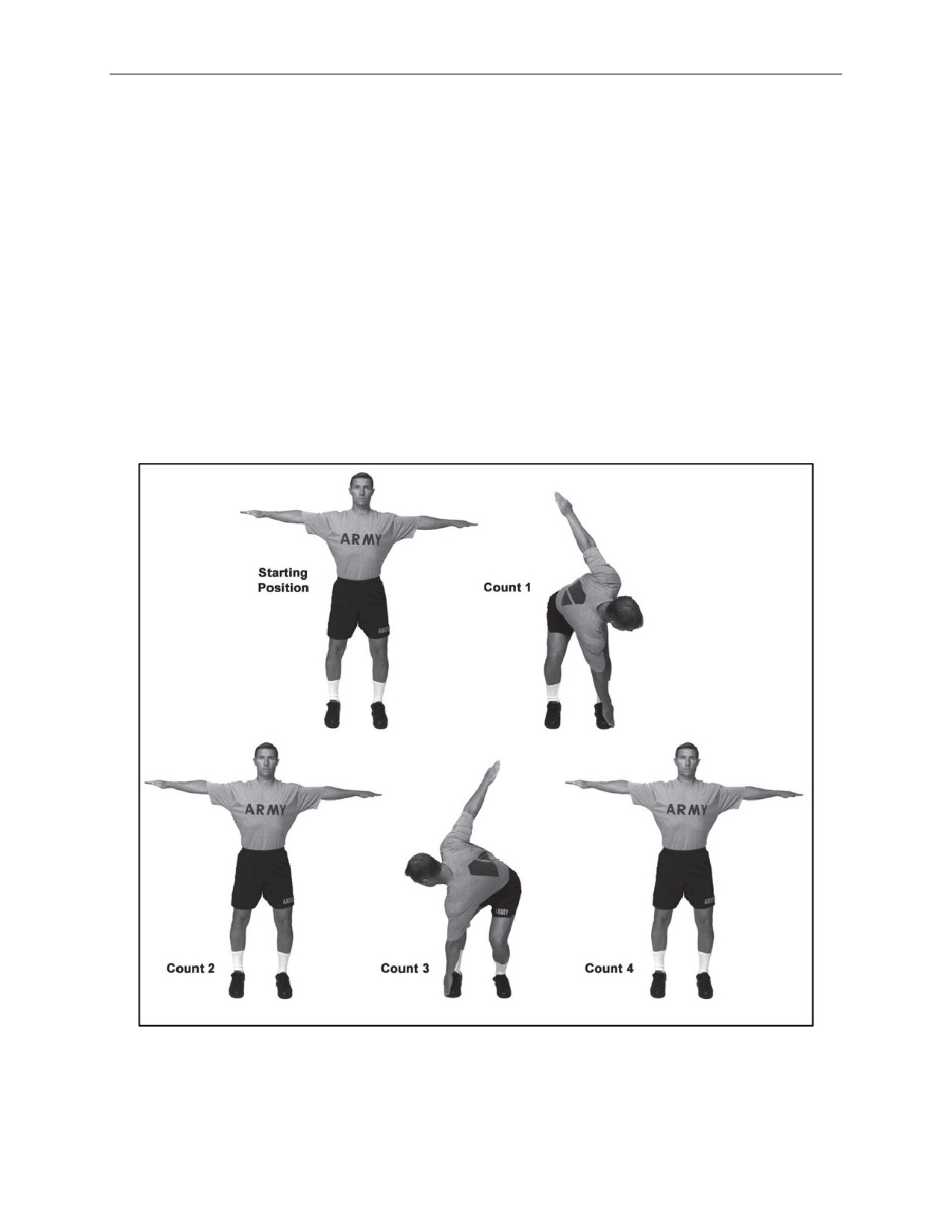
EXERCISE 6: WINDMILL
Purpose: This exercise develops the ability to safely bend and rotate the trunk. It conditions the muscles of the
trunk, legs, and shoulders (Figure 6-67).
Starting Position: Straddle stance with arms sideward, palms facing down, fingers and thumbs extended and
joined.
Cadence: SLOW
Count:
1. Bend the hips and knees while rotating to the left. Reach down and touch the outside of the left
foot with the right hand and look toward the rear. The left arm is pulled rearward to maintain a
straight line with the right arm.
2. Return to the starting position.
3. Repeat count 1 to the right.
4. Return to the starting position.
Figure 6-67. Windmill
26 October 2012
FM 7-22
6-85
Chapter 6
Check Points:
z
From the starting position, feet are straight ahead, arms are parallel to the ground, hips set, and
abdominals are tight.
z
On counts 1 and 3, ensure that the knees bend during the rotation. Head and eyes are directed to the
rear on counts 1 and 3.
Precautions: This exercise is always performed at a slow cadence.
6-86
FM 7-22
26 October 2012
Special Conditioning Programs
PREPARATION DRILL
MODIFIED EXERCISE 6: MODIFIED WINDMILL
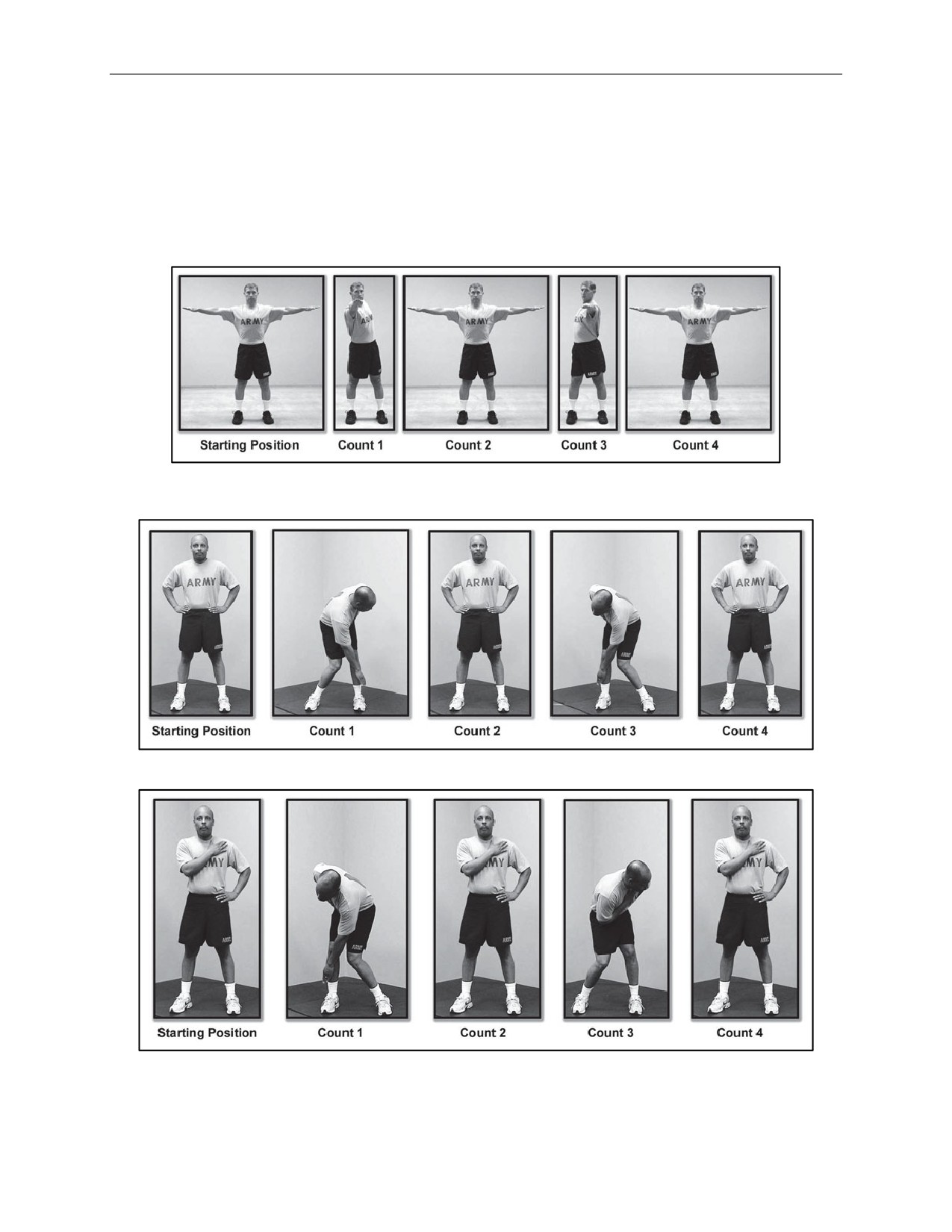
6-120. The instructor may modify the windmill by decreasing the range of motion and limiting the use of the
arms. The modifications to the windmill shown in Figures 6-68, 6-69, and 6-70 may be used to exercise within
physical profile limitations and gradually progress performance to standard.
Figure 6-68. Modified windmill (body twist)
Figure 6-69. Modified windmill (hands on hips)
Figure 6-70. Modified windmill (single arm)
26 October 2012
FM 7-22
6-87
Chapter 6
PREPARATION DRILL
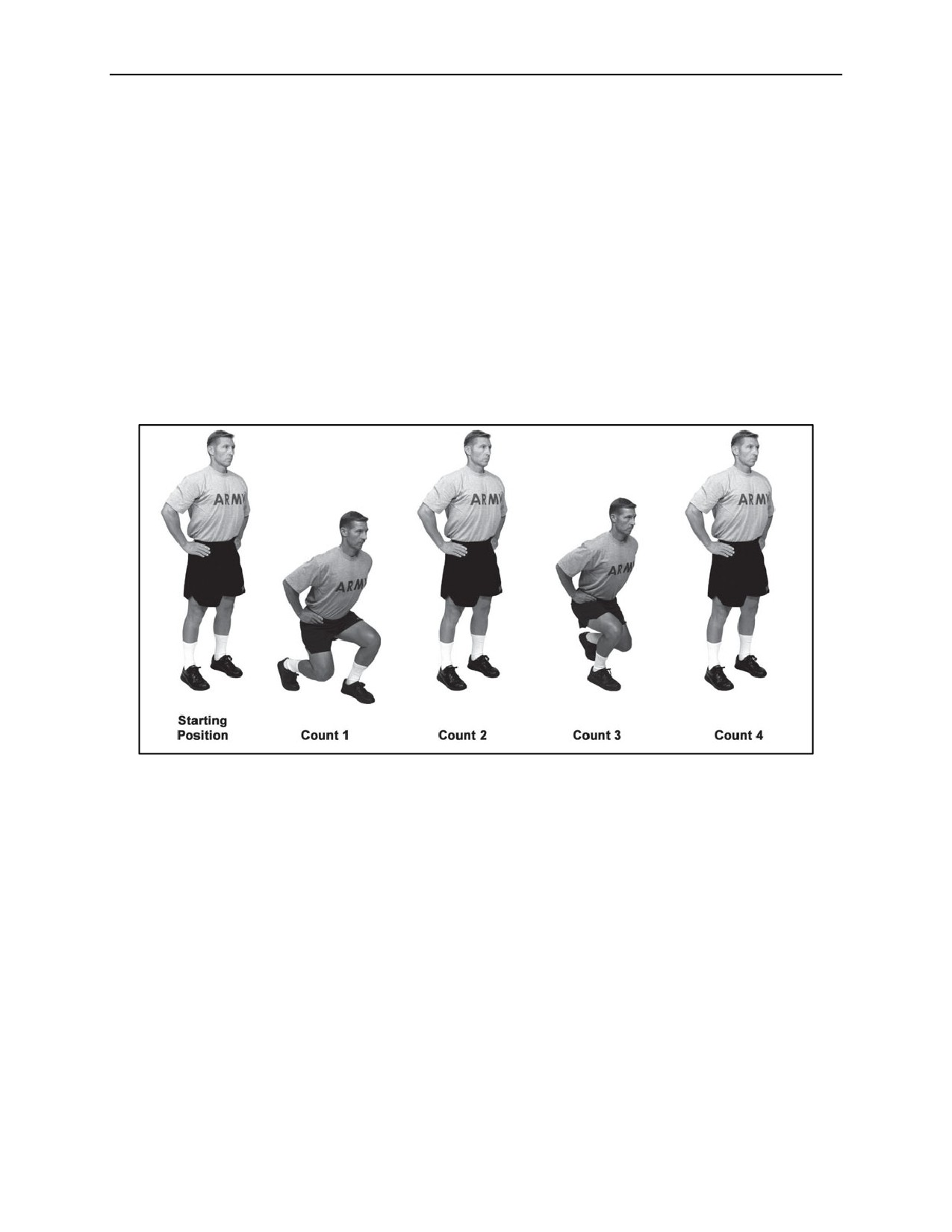
EXERCISE 7: FORWARD LUNGE
Purpose: This exercise promotes balance and develops leg strength (Figure 6-71).
Starting Position: Straddle stance with hands on hips.
Cadence: SLOW
Count:
1. Take a step forward with the left leg (the left heel should be 3-6 inches forward of the right foot).
Lunge forward, lowering the body and allow the left knee to bend until the thigh is parallel to the
ground. Lean slightly forward, keeping the back straight.
2. Return to the starting position.
3. Repeat count 1 with the right leg.
4. Return to the starting position.
Figure 6-71. Forward lunge
Check Points:
z
Keep the abdominal muscles tight throughout the motion.
z
On counts 1 and 3, step straight forward, keeping the feet directed forward. When viewed from the
front, the feet maintain their distance apart both at the starting position and at the end of counts 1
and 3.
z
On counts 1 and 3, the rear knee may bend naturally, but does not touch the ground. The heel of the
rear foot should be off the ground.
Precautions: This exercise is always performed at a slow cadence. On counts 1 and 3, move into position in a
controlled manner. Spring off of the forward leg to return to the starting position. This avoids jerking the trunk
to create momentum.
6-88
FM 7-22
26 October 2012
Special Conditioning Programs
PREPARATION DRILL
MODIFIED EXERCISE 7: MODIFIED FORWARD LUNGE
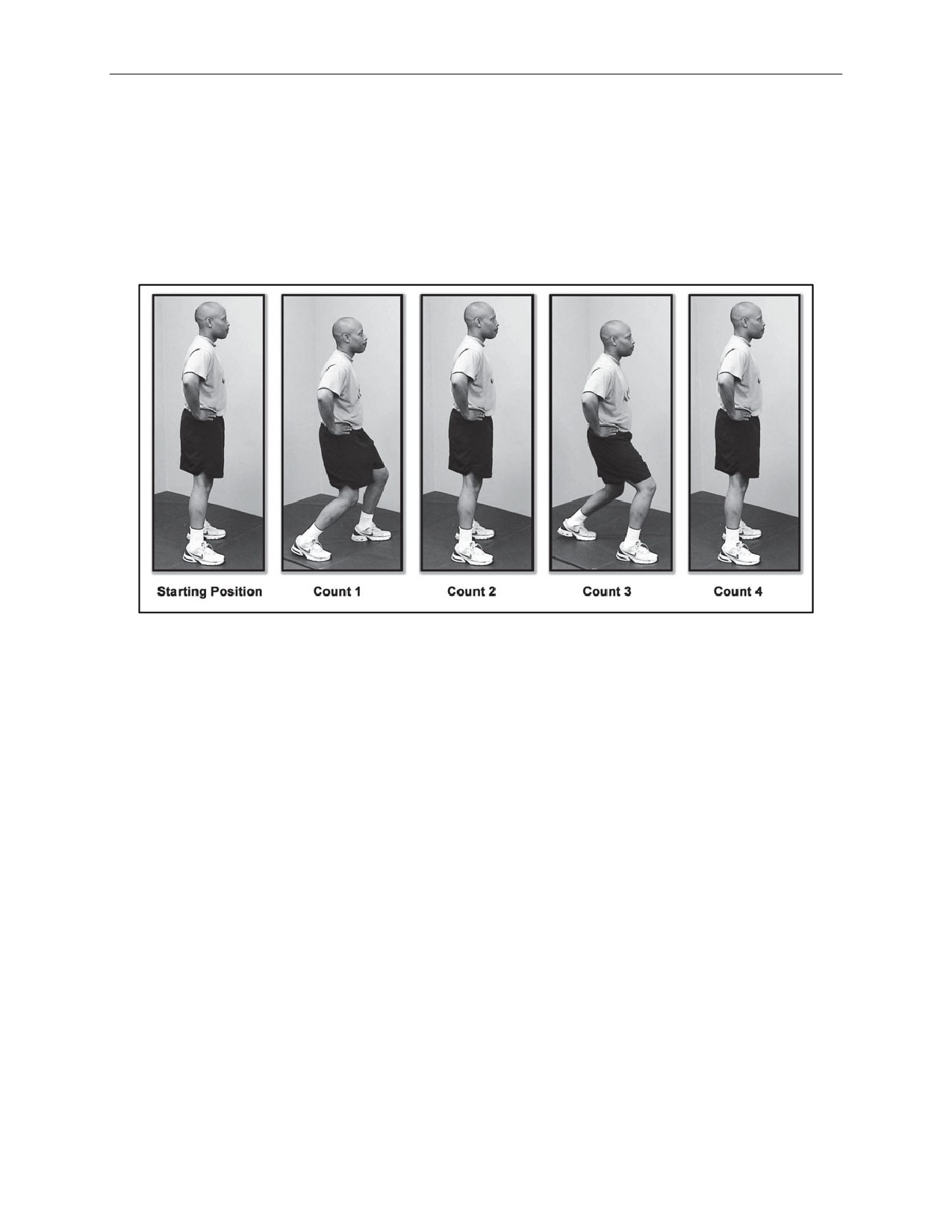
6-121. The instructor may modify the forward lunge by decreasing the range of motion. As with all lunges,
this one may restrict knee bend. The Soldier may keep the feet closer together than with the forward lunge. The
Soldier concentrates on trying to gradually lower the body in the lunge position (Figure 6-72). Over time, the
Soldier gradually increases his range of motion and works toward standard execution of the exercise.
Figure 6-72. Modified forward lunge
26 October 2012
FM 7-22
6-89
Chapter 6
PREPARATION DRILL
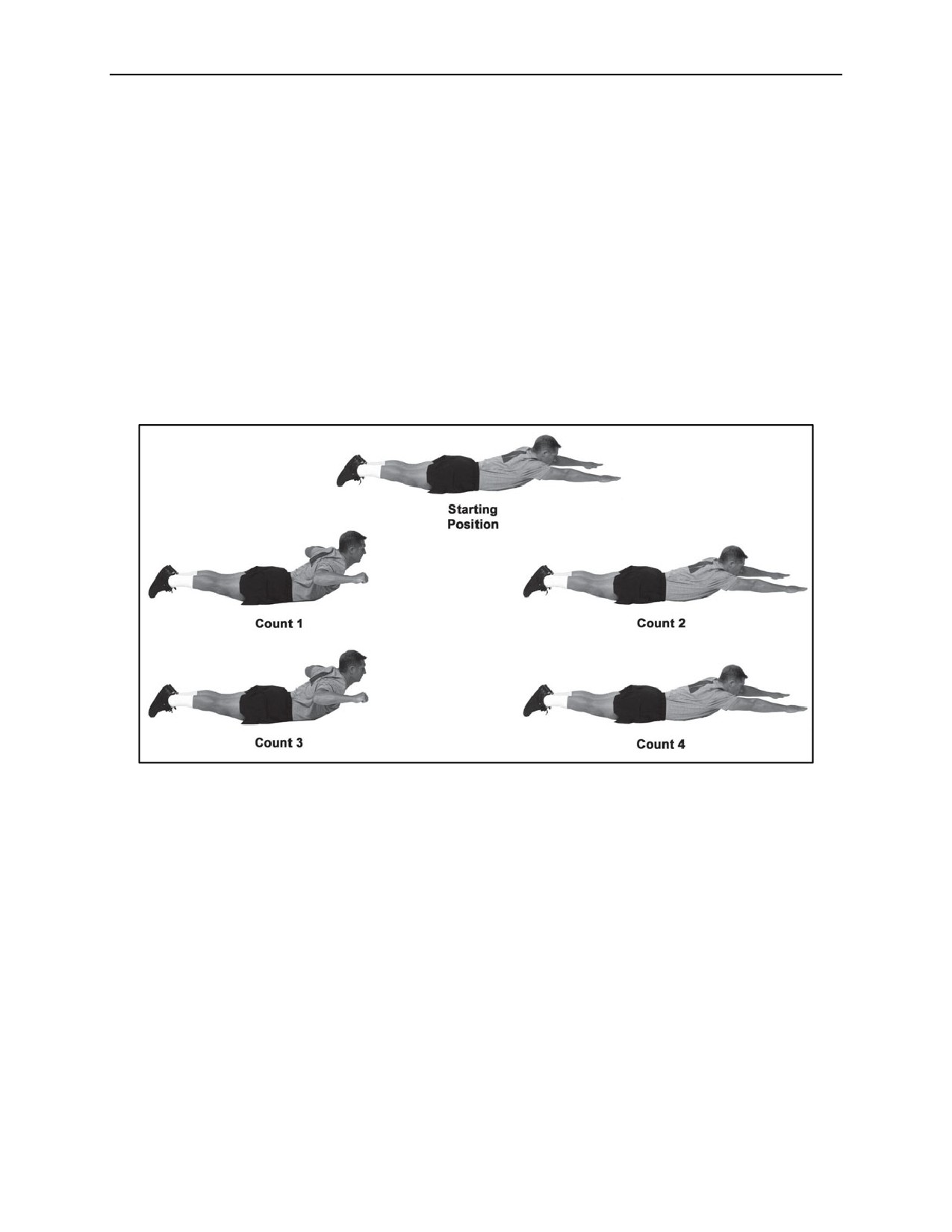
EXERCISE 8: PRONE ROW
Purpose: This exercise develops strength of the back and shoulders (Figure 6-73).
Starting Position: Prone position with the arms overhead, palms facing downward 1-2 inches off the ground,
and toes pointed to the rear.
Cadence: SLOW
Count:
1. Raise the head and chest slightly while lifting the arms and pulling them rearward. Hands make
fists as they move toward the shoulders.
2. Return to the starting position.
3. Repeat count 1.
4. Return to the starting position.
Figure 6-73. Prone row
Check Points:
z
At the starting position, the abdominal muscles are tight and the head is aligned with the spine.
z
On counts 1 and 3, the forearms are parallel to the ground and slightly higher than the trunk.
z
On counts 1 and 3, the head is raised to look forward but not skyward.
z
Throughout the exercise, the legs and toes remain in contact with the ground.
Precautions: This exercise is always performed at a slow cadence. Prevent overarching of the back by
maintaining contractions of the abdominal and buttocks muscles throughout the exercise.
6-90
FM 7-22
26 October 2012
Special Conditioning Programs
PREPARATION DRILL
MODIFIED EXERCISE 8: MODIFIED PRONE ROW
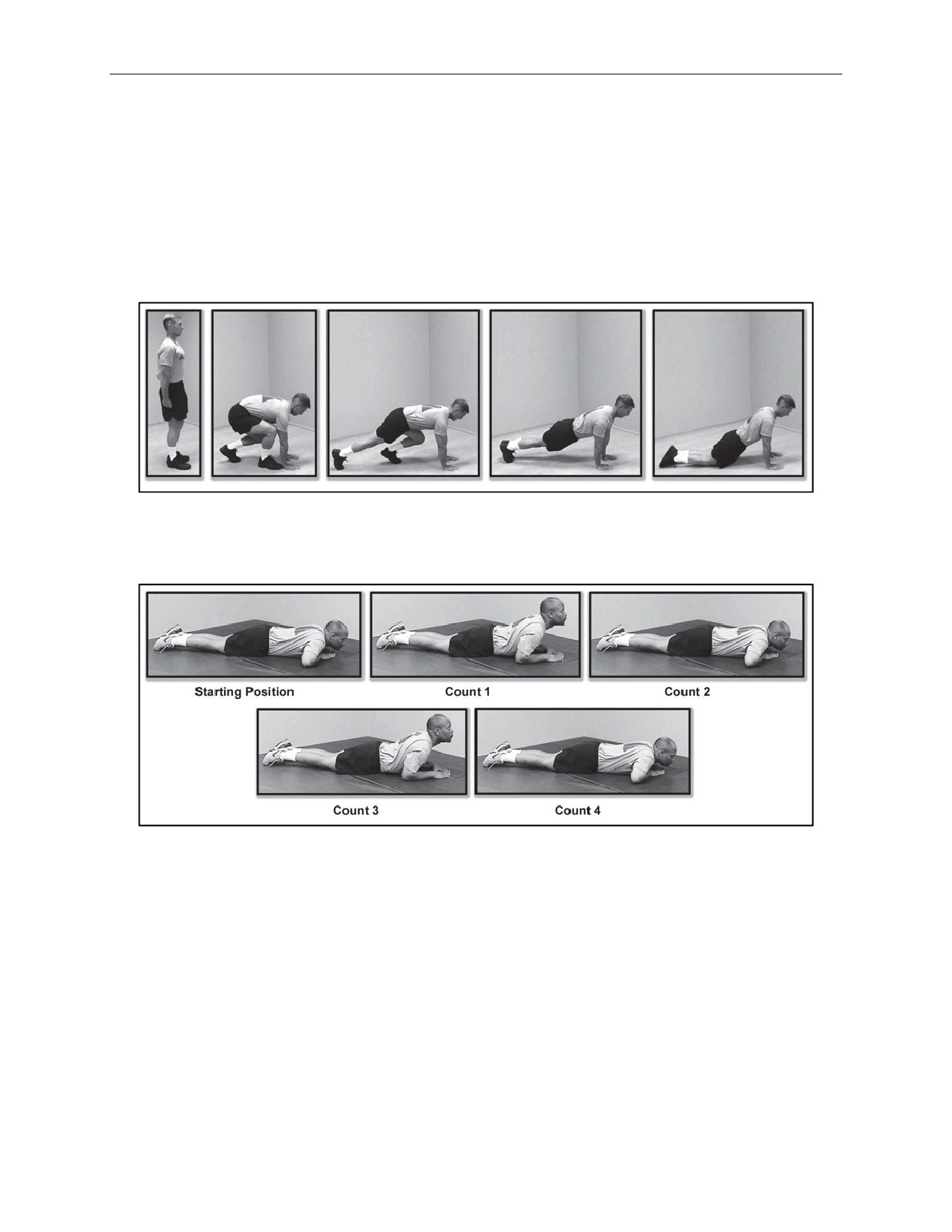
6-122. The instructor may modify the prone row by decreasing the range of motion and limiting the use of the
arms. The Soldier assumes the starting position using his hands to assist in lowering the body, and then steps
back into the six-point stance before lowering the body to the ground. He uses the modifications shown in
Figures 6-74 and 6-75 to exercise within physical profile limitations. The Soldier works toward standard
execution of the exercise.
Figure 6-74. Modified prone row (assuming starting position)
Figure 6-75. Modified prone row (using the arms)
26 October 2012
FM 7-22
6-91
Chapter 6
PREPARATION DRILL
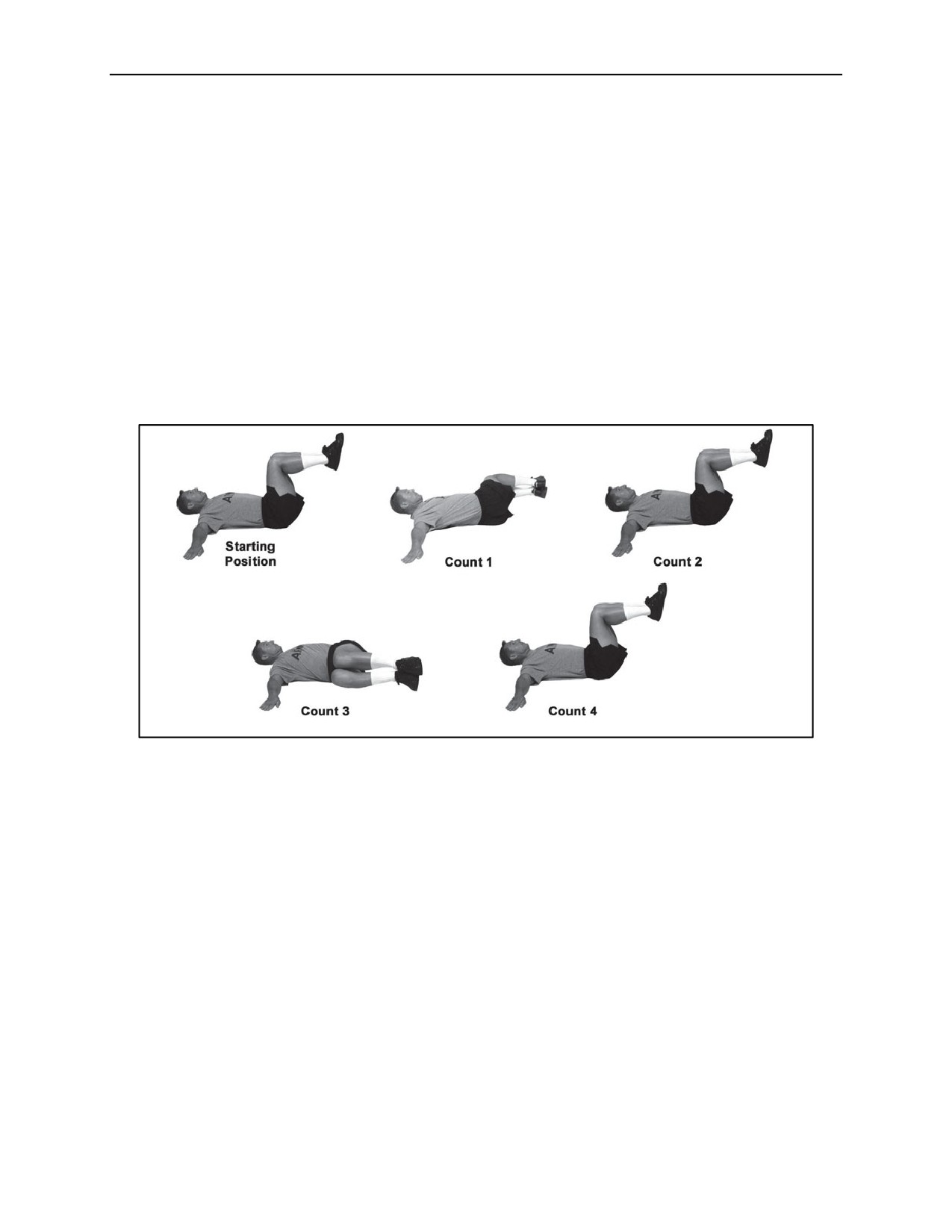
EXERCISE 9: BENT-LEG BODY TWIST
Purpose: This exercise strengthens trunk muscles and promotes control of trunk rotation (Figure 6-76).
Starting Position: Supine position with the hips and knees bent to 90 degrees, arms sideward, palms down with
fingers spread. Knees and feet are together, and head is raised two or three inches off the ground with the chin
slightly tucked.
Cadence: SLOW
Count:
1. Rotate the legs to the left while keeping the upper back and arms in place.
2. Return to the starting position.
3. Repeat count 1 to the right.
4. Return to the starting position.
Figure 6-76. Bent-leg body twist
Check Points:
z
Tighten the abdominal muscles in the starting position and maintain this contraction throughout the
exercise.
z
The head should be off the ground with the chin slightly tucked.
z
Ensure that the hips and knees maintain 90-degree angles.
z
Keep the feet and knees together throughout the exercise.
z
Attempt to rotate the legs to about 8-10 inches off the ground. The opposite shoulder must remain in
contact with the ground.
Precautions: This exercise is always performed at a slow cadence. Do not rotate the legs to a point beyond
which the arms and shoulders can no longer maintain contact with the ground.
6-92
FM 7-22
26 October 2012
Special Conditioning Programs
PREPARATION DRILL
MODIFIED EXERCISE 9: MODIFIED BENT-LEG BODY TWIST
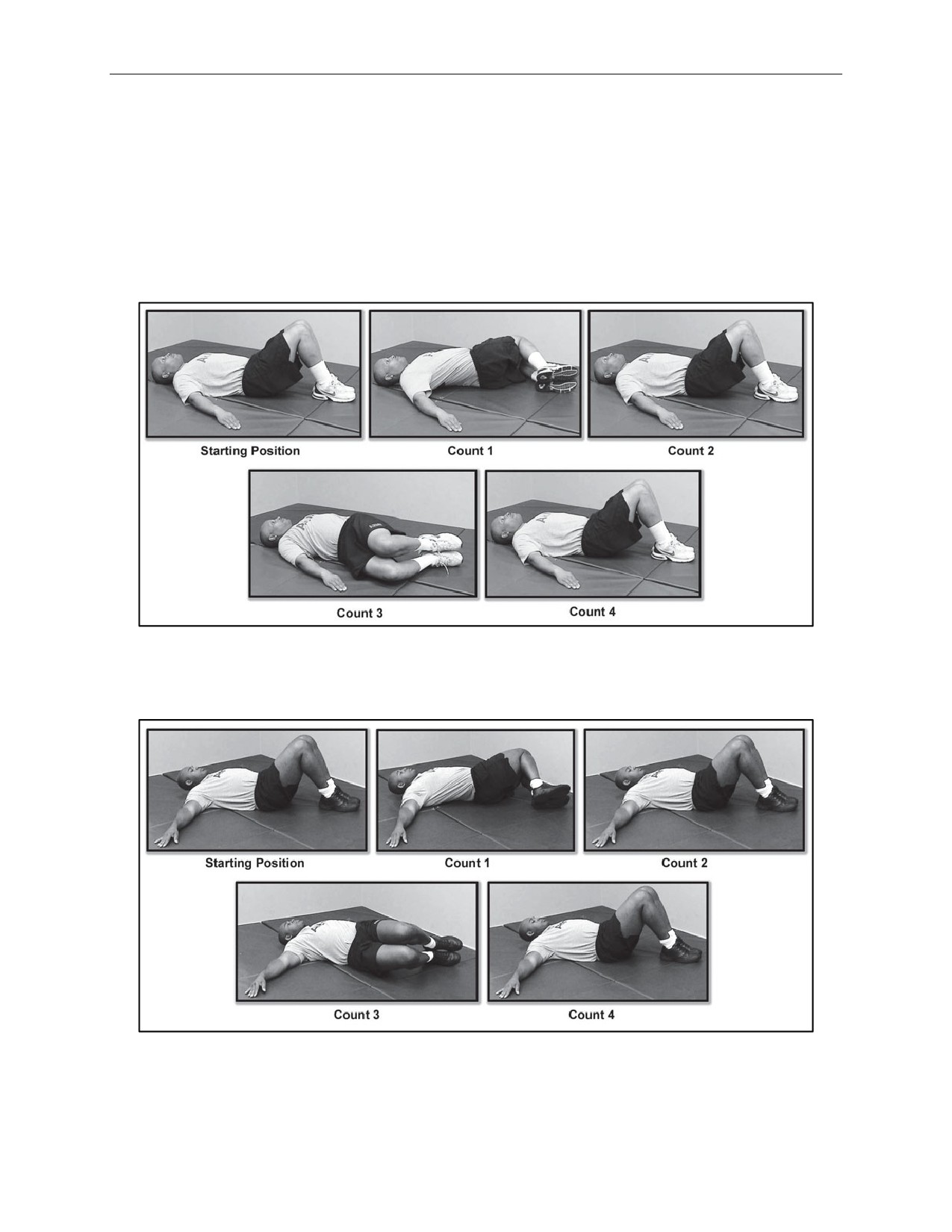
6-123. The starting position for this exercise is the supine position with the arms sideward or at 45 degrees to
the body (according to profile limitations). Palms should face downward and knees bent at 90 degrees, with the
feet flat on the floor. The head may be on the ground or elevated 1-2 inches depending on profile limitations.
The Soldier assumes the starting position as in the bent-leg body twist, leaving the feet flat on the ground.
(Figures 6-77 and 6-78).
Figure 6-77. Modified bent-leg body twist (head on the ground and arms at 45 degrees)
Figure 6-78. Modified bent-leg body twist (head elevated and arms at 90 degrees)
26 October 2012
FM 7-22
6-93
Chapter 6
PREPARATION DRILL
EXERCISE 10: PUSH-UP
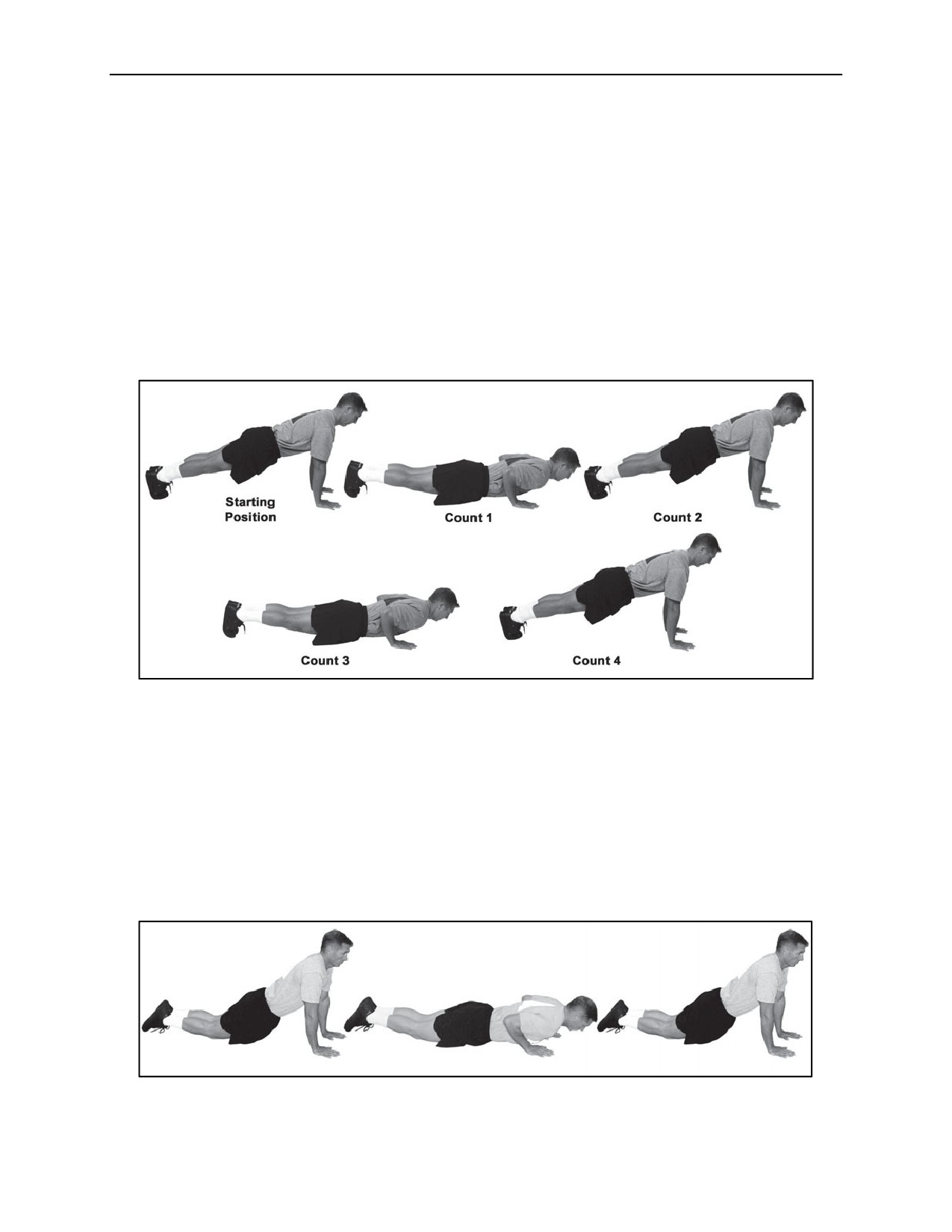
Purpose: This exercise strengthens the muscles of the chest, shoulders, arms, and trunk (Figure 6-79).
Starting Position: Front leaning rest position.
Cadence: MODERATE
Count:
1. Bend the elbows, lowering the body until the upper arms are parallel with the ground.
2. Return to the starting position.
3. Repeat count 1.
4. Return to the starting position.
Figure 6-79. Push-up
Check Points:
z
The hands are directly below the shoulders with fingers spread (middle fingers point straight ahead).
z
On counts 1 and 3 the upper arms stay close to the trunk, elbows pointing rearward.
z
On counts 2 and 4 the elbows straighten, but do not lock.
z
The trunk should not sag. To prevent this, tighten the abdominal muscles while in the starting
position and maintain this contraction throughout the exercise.
Precautions: N/A
Variation: Soldiers should assume the six-point stance on their knees when unable to perform repetitions
correctly to cadence (Figure 6-80).
Figure 6-80. Push-up in the 6-point stance
6-94
FM 7-22
26 October 2012
Special Conditioning Programs
PREPARATION DRILL
MODIFIED EXERCISE 10: MODIFIED PUSH-UP
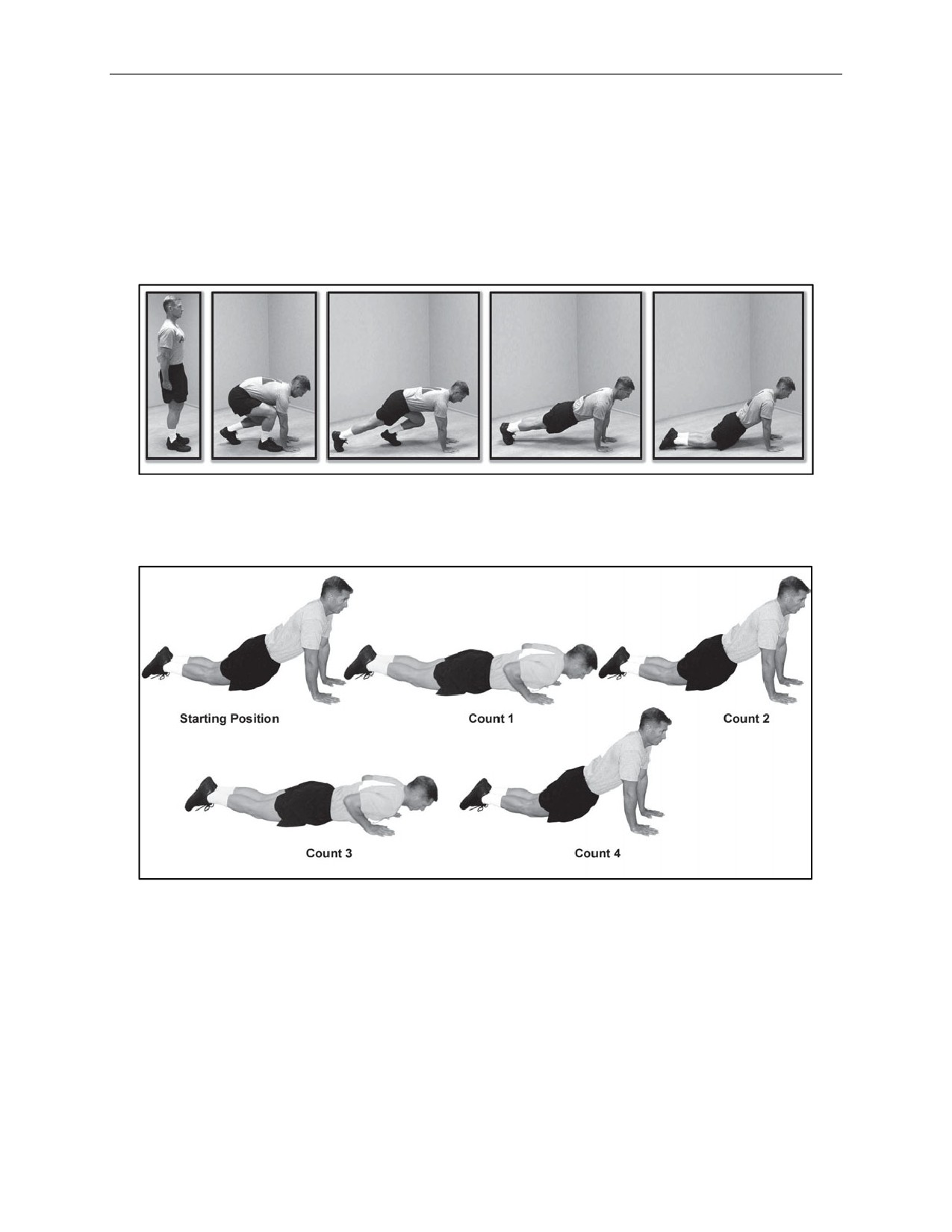
6-124. The Soldier performs the modified push-up in the six-point stance. The Soldier assumes the starting
position, using his hands to assist in lowering his body, and then steps back into the six-point stance. Range of
movement may be limited throughout the exercise. Over time, the Soldier gradually increases the range of
motion and works toward the standard execution of the push-up (Figures 6-81 and 6-82).
Figure 6-81. Modified push-up variation for assuming the 6-point stance
Figure 6-82. Modified push-up
26 October 2012
FM 7-22
6-95
Chapter 6
CONDITIONING DRILL 1
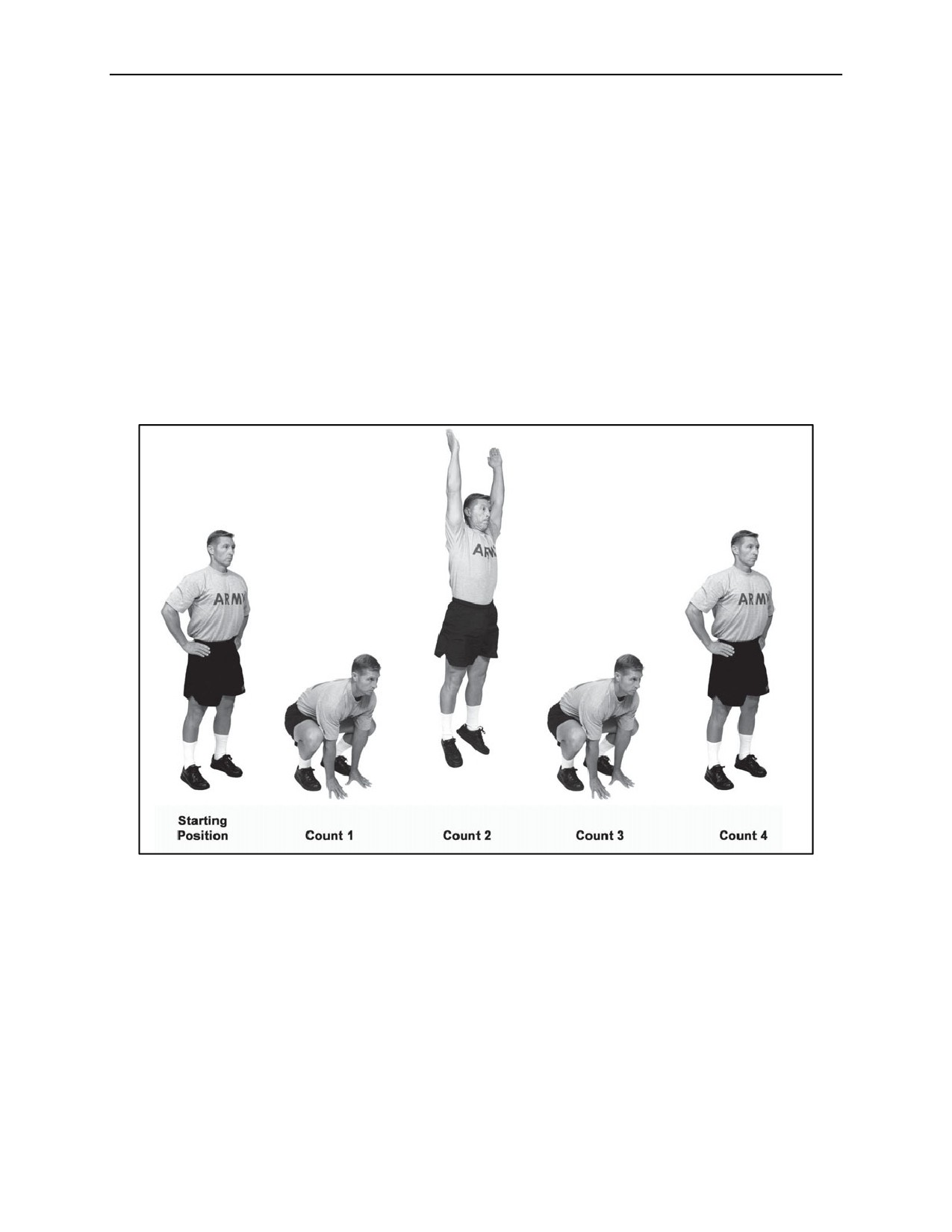
EXERCISE 1: POWER JUMP
Purpose: This exercise reinforces correct jumping and landing, stimulates balance and coordination, and
develops explosive strength (Figure 6-83).
Starting Position: Straddle stance with hands on hips.
Cadence: MODERATE
Count:
1. Squat with the heels flat as the spine rounds forward to allow the straight arms to reach to the
ground, touching with the palms of the hands.
2. Jump forcefully in the air, vigorously raising arms overhead with palms facing inward.
3. Control the landing and repeat count 1.
4. Return to the starting position.
Figure 6-83. Power jump
Check Points:
z
At the starting position, tighten the abdominals to stabilize the trunk.
z
On counts 1 and 3, keep the back generally straight with the head up and the eyes forward.
z
On count 2 the arms should be extended fully overhead. The trunk and legs should also be aligned.
z
On each landing, the feet should be directed forward and maintained at shoulder distance apart. The
landing should be “soft” and proceed from the balls of the feet to the heels. The vertical line from the
shoulders through the knees to the balls of the feet should be demonstrated on each landing.
Precaution: N/A
6-96
FM 7-22
26 October 2012
Special Conditioning Programs
CONDITIONING DRILL 1
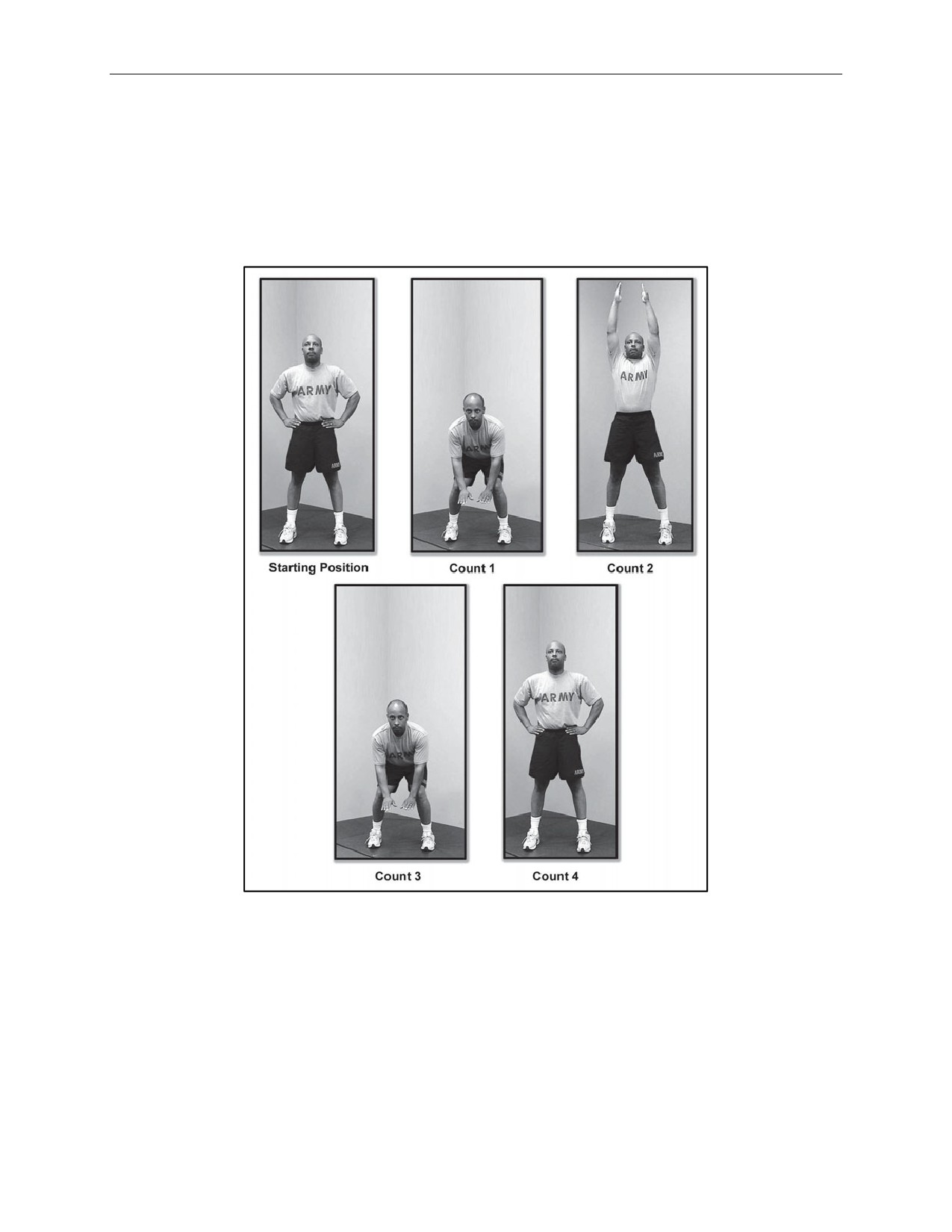
MODIFIED EXERCISE 1: MODIFIED POWER JUMP
6-125. The instructor may modify the power jump by decreasing the range of motion or limiting the use of the
arms. The Soldier may use the modifications shown in Figure 6-84 to exercise within physical profile
limitations. The Soldier works toward standard execution of the exercise.
Figure 6-84. Modified power jump
26 October 2012
FM 7-22
6-97
Chapter 6
CONDITIONING DRILL 1
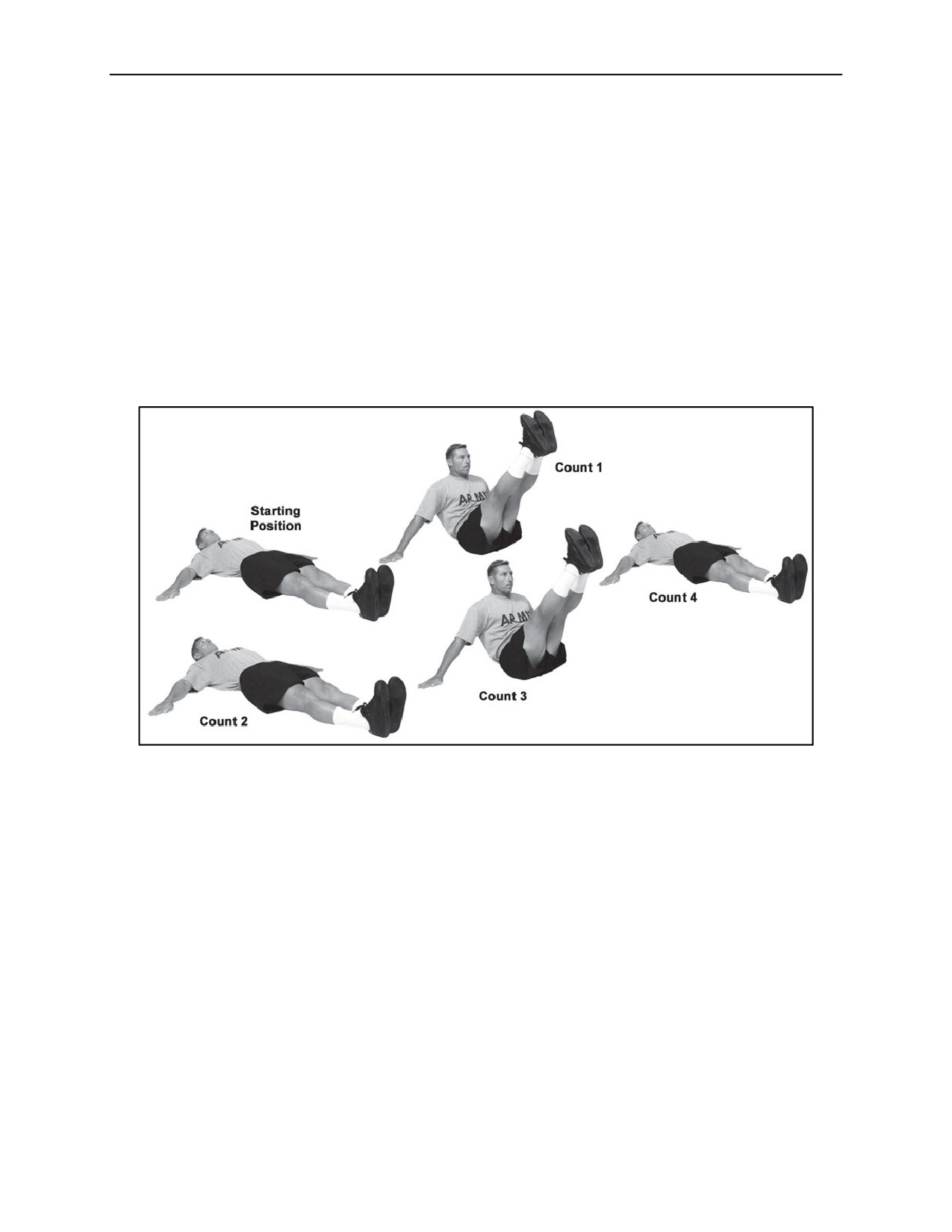
EXERCISE 2: V-UP
Purpose: This exercise develops the abdominal and hip flexor muscles while enhancing balance (Figure 6-85).
Starting Position: Supine, arms on ground 45-degrees to the side, palms down with fingers spread. The chin is
tucked and the head is 1-2 inches off the ground.
Cadence: MODERATE
Count:
1. Raise straight legs and trunk to form a V-position, using arms as needed.
2. Return to the starting position.
3. Repeat count 1.
4. Return to the starting position.
Figure 6-85. V-up
Check Points:
z
At the starting position, tighten the abdominal muscles to tilt the pelvis and the lower back toward
the ground.
z
On counts 1 and 3, the knees and trunk are straight with the head aligned with the trunk.
z
On counts 2 and 4, lower the legs to the ground in a controlled manner so as not to injure the feet.
Precautions: To protect the spine, do not jerk the legs and trunk to rise to the V-position.
6-98
FM 7-22
26 October 2012
Special Conditioning Programs
CONDITIONING DRILL 1
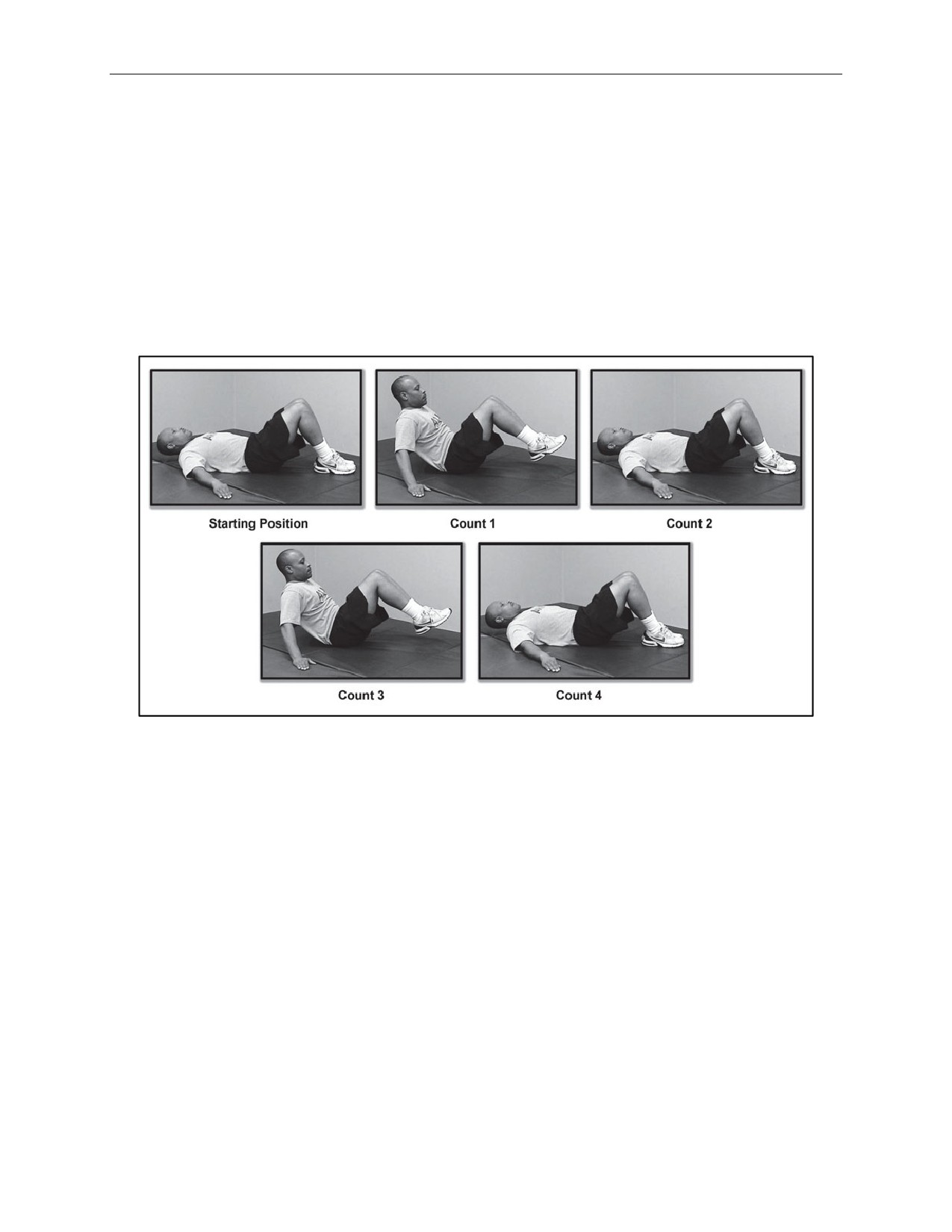
MODIFIED EXERCISE 2: MODIFIED V-UP
6-126. The starting position for this exercise is the supine position with the arms sideward or at 45 degrees to
the body (according to profile limitations). Palms are downward and knees are bent at 90 degrees with the feet
flat on the floor. The head may be on the ground or elevated 1-2 inches off the ground according to profile
limitations. The Soldier assumes the starting position as in the V-up, using the hands as needed to lower the
body to the ground. The head is elevated while the back and feet are flat on the ground. On counts 1 and 3, the
Soldier lifts the feet off the ground, pulling the knees toward the chest. Then the Soldier lowers the feet to the
ground, returning to the starting position on counts 2 and 4 (refer to Figure 6-86). Over time, the Soldier
gradually increases the range of motion and works to perform the V-up to standard.
Figure 6-86. Modified V-up
26 October 2012
FM 7-22
6-99
Chapter 6
CONDITIONING DRILL 1
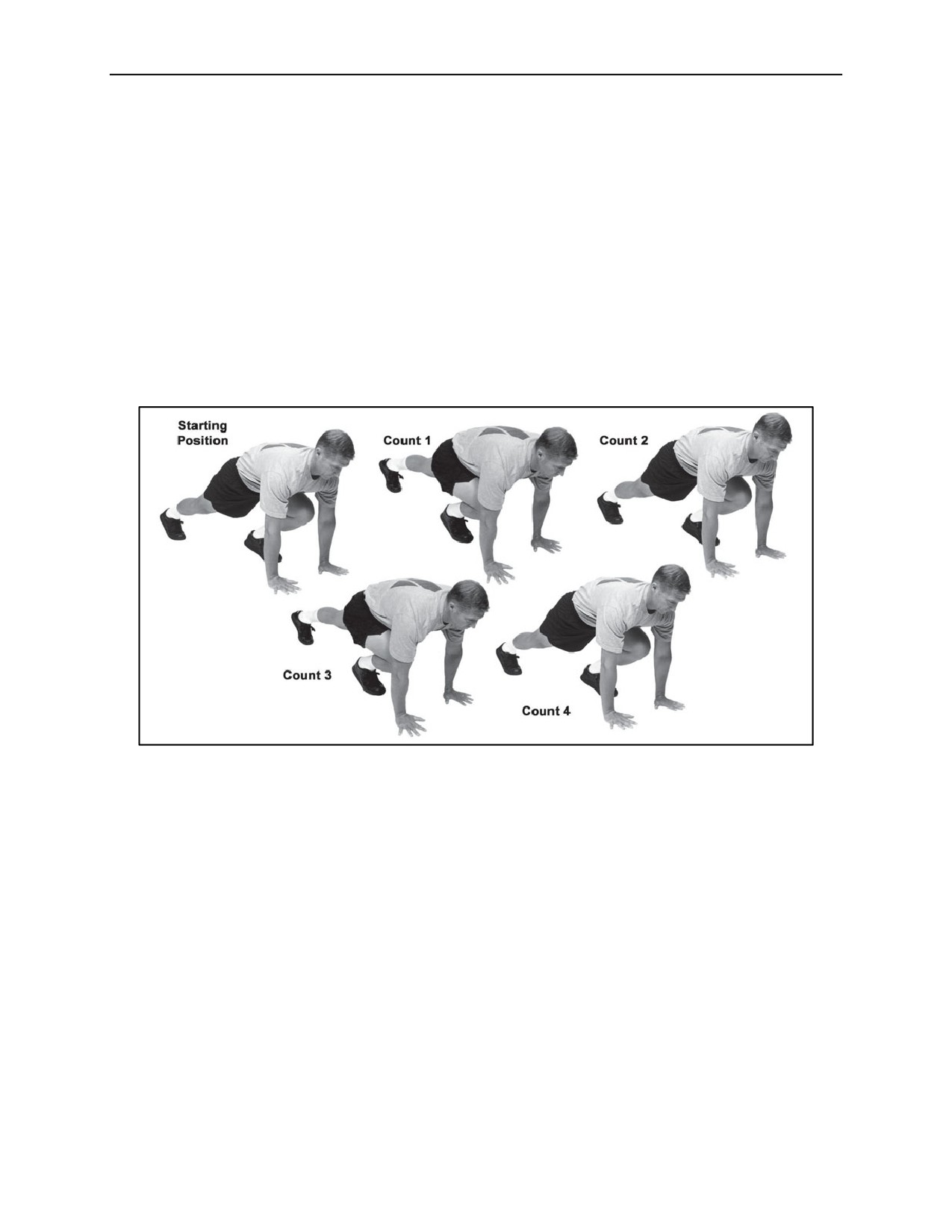
EXERCISE 3: MOUNTAIN CLIMBER
Purpose: This exercise develops the ability to quickly move the legs to power out of the front leaning rest
position (Figure 6-87).
Starting Position: Front leaning rest position with the left foot below the chest and between the arms.
Cadence: MODERATE
Count:
1. Push upward with the feet and quickly change positions of the legs.
2. Return to the starting position.
3. Repeat the movements in count 1.
4. Return to the starting position.
Figure 6-87. Mountain climber
Check Points:
z
Place the hands directly below the shoulders, fingers spread (middle fingers point straight ahead)
with the elbows straight, not locked.
z
To prevent the trunk from sagging, tighten the abdominal muscles and maintain this contraction
throughout the exercise. Do not raise the hips when moving throughout the exercise.
z
Align the head with the spine and keep the eyes directed to a point about two feet in front of the
body.
z
Throughout the exercise, stay on the balls of the feet.
z
Move the legs straight forward and backward, not at angles.
Precautions: N/A
6-100
FM 7-22
26 October 2012
Special Conditioning Programs
CONDITIONING DRILL 1
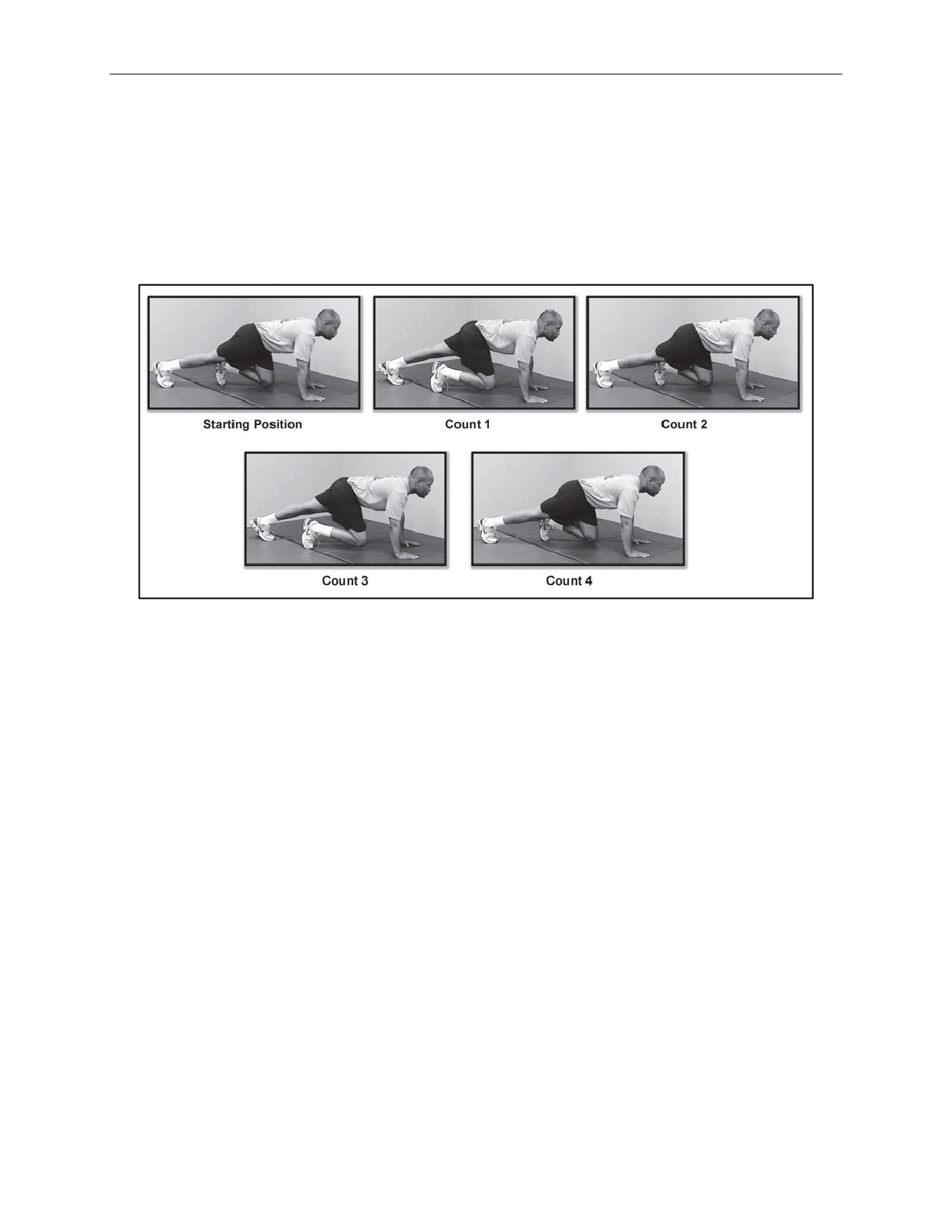
MODIFIED EXERCISE 3: MODIFIED MOUNTAIN CLIMBER
6-127. The instructor may modify the mountain climber by decreasing the range of motion. The Soldier
assumes the starting position, stepping back as in the modified push-up. The Soldier may use the modifications
shown in Figure 6-88 to exercise within physical profile limitations. The Soldier gradually increases the range
of motion and works toward the standard execution of the exercise, then progresses performance to standard.
Figure 6-88. Modified mountain climber
26 October 2012
FM 7-22
6-101
Chapter 6
CONDITIONING DRILL 1
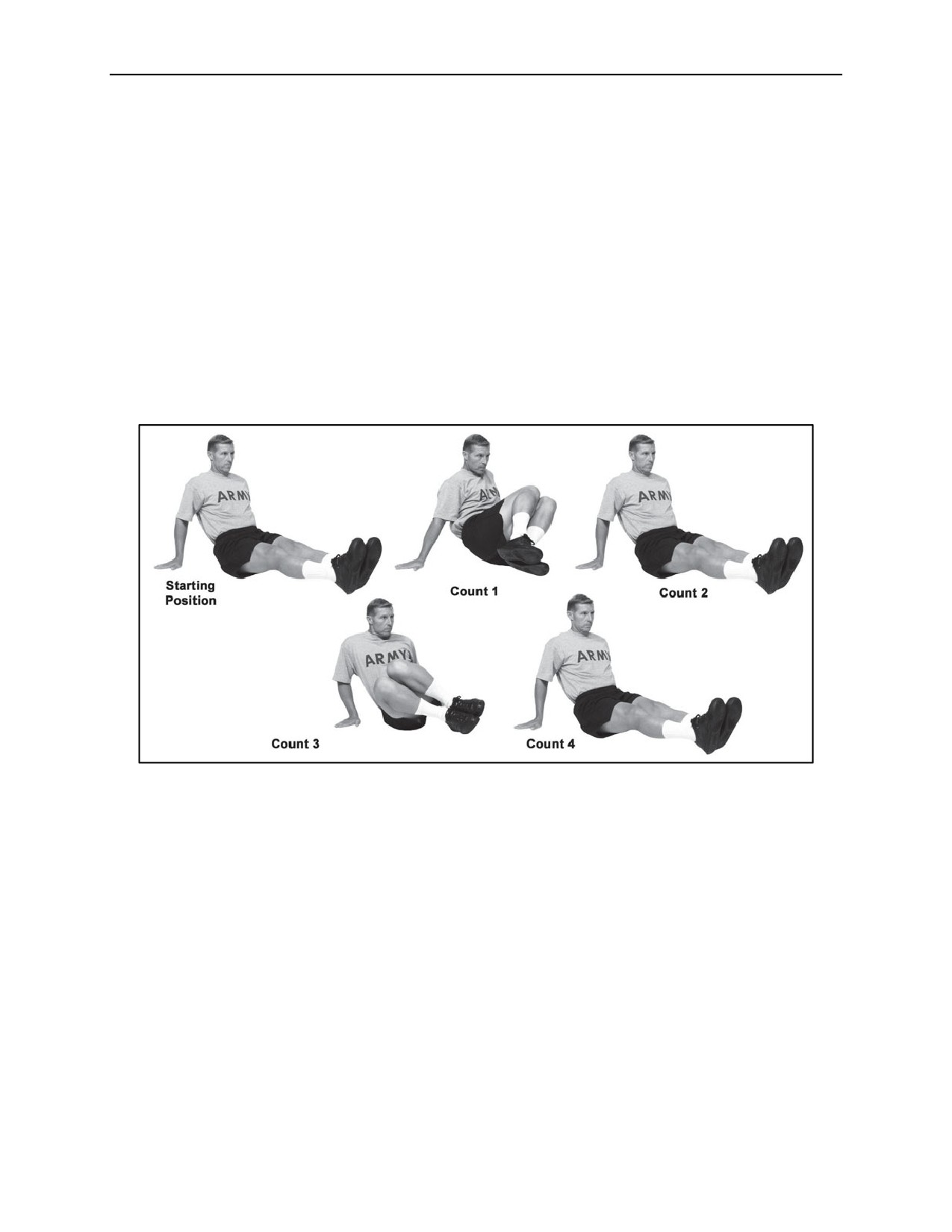
EXERCISE 4: LEG-TUCK AND TWIST
Purpose: This exercise develops trunk strength and mobility while enhancing balance (Figure 6-89).
Starting Position: Seated with trunk straight but leaning backward 45 degrees, arms straight and hands on
ground 45 degrees to the rear, palms down. Legs are straight, extended to the front and 8-12 inches off the
ground.
Cadence: MODERATE
Count:
1. Raise the legs while rotating on to the left buttock and draw the knees toward the left shoulder.
2. Return to the starting position.
3. Repeat count 1 in the opposite direction.
4. Return to the starting position.
Figure 6-89. Leg-tuck and twist
Check Points:
z
At the starting position, tighten the abdominals to stabilize the trunk.
z
On all counts, keep the feet and knees together.
z
On counts 1 and 3, keep the head and trunk still as the legs move.
z
On counts 1 and 3, tuck (bend) the legs and align them diagonal to the trunk.
Precautions: To protect the back on counts 1 and 3, do not jerk the legs and trunk to achieve the end position.
6-102
FM 7-22
26 October 2012
Special Conditioning Programs
CONDITIONING DRILL 1
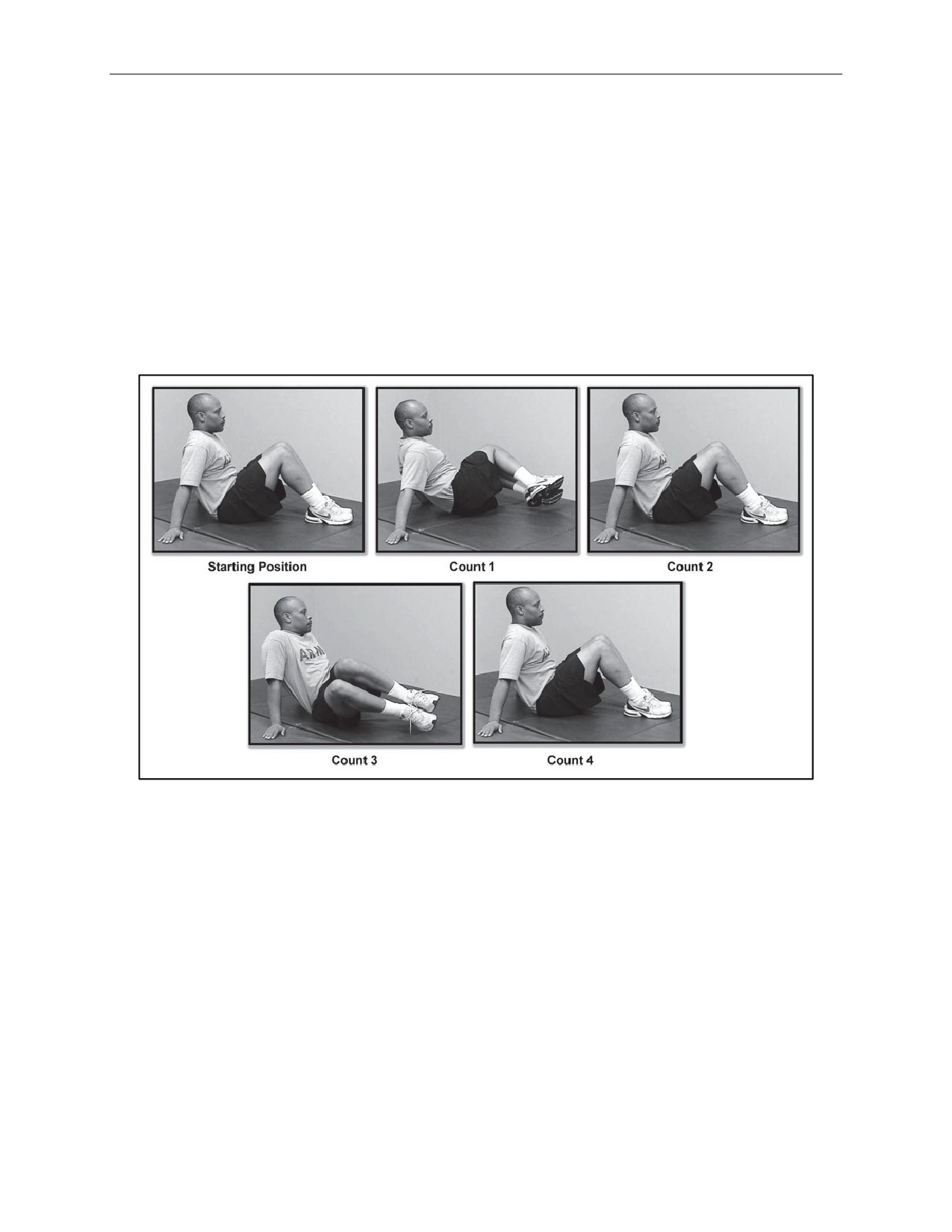
MODIFIED EXERCISE 4: MODIFIED LEG-TUCK AND TWIST
Starting Position: The starting position for this exercise is the seated position with the arms sideward or at 45
degrees to the body (according to profile limitations). Place the palms down and bend the knees 90 degrees.
Keep the feet flat on the floor. Assume the starting position as in the leg-tuck and twist, but with the feet flat on
the ground.
Count: On counts 1 and 3, lift the feet off the ground and rotate to the left or right side, pulling the knees
toward the chest. Lower the feet to the ground, returning to the starting position on counts 2 and 4
(Figure 6-90). Over time, gradually increase the range of motion and work toward the standard execution of
the leg-tuck and twist.
Figure 6-90. Modified leg-tuck and twist
26 October 2012
FM 7-22
6-103
Chapter 6
CONDITIONING DRILL 1
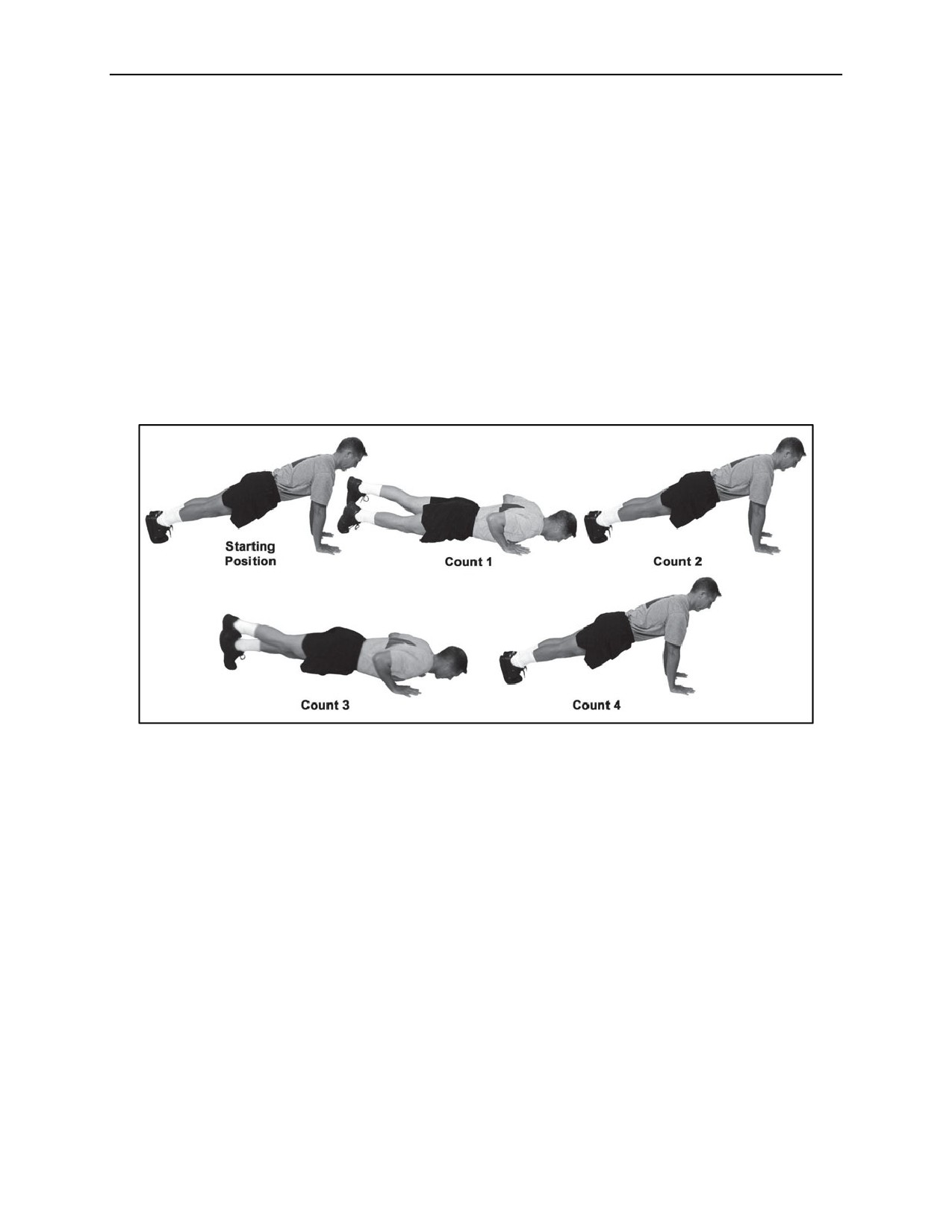
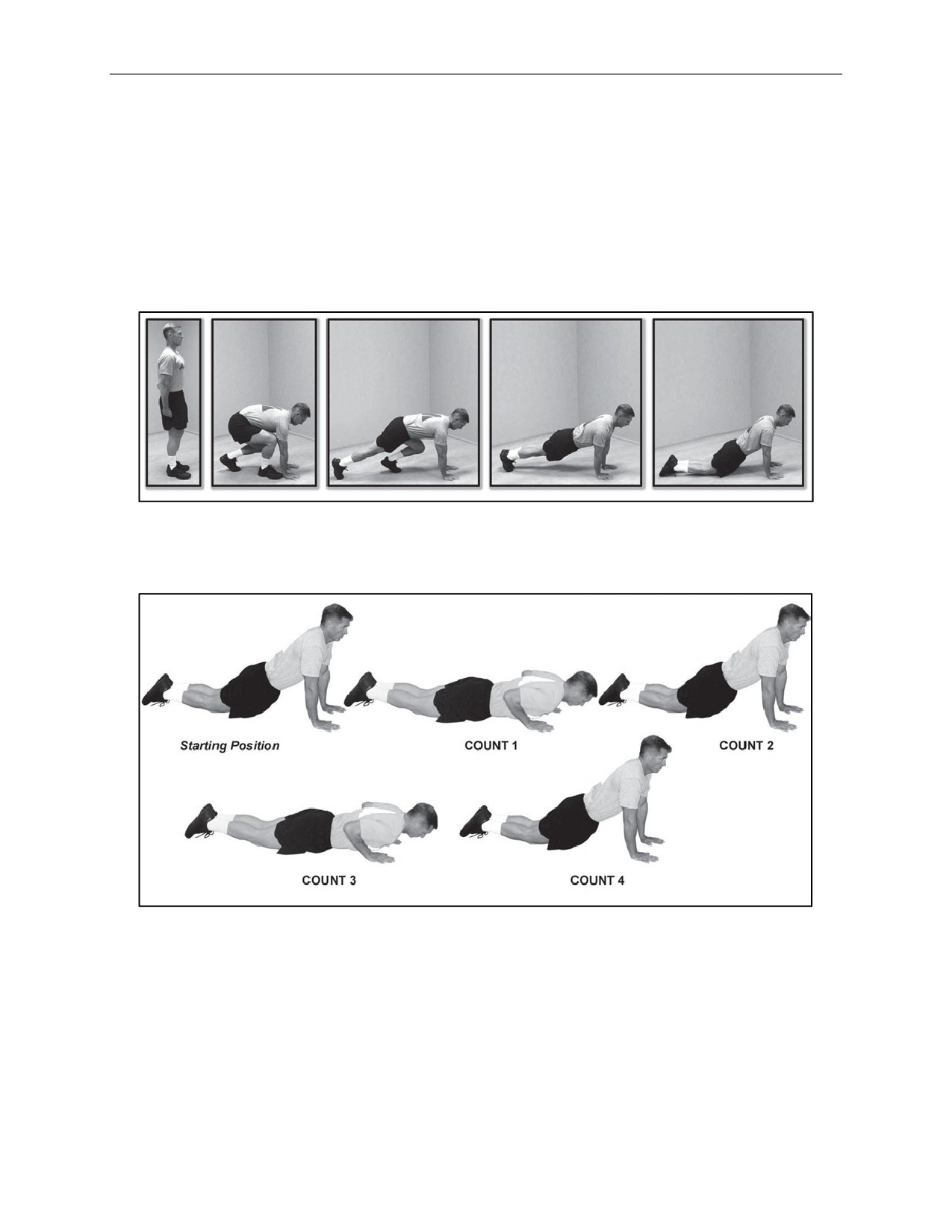
EXERCISE 5: SINGLE-LEG PUSH-UP
Purpose: This exercise strengthens muscles of the chest, shoulders, arms, and trunk. Raising one leg while
maintaining proper trunk position makes this an excellent trunk stabilizing exercise (Figure 6-91).
Starting Position: Front leaning rest position.
Cadence: MODERATE
Count:
1. Bend the elbows, lowering the body until the upper arms are parallel with the ground while raising
the left leg 8 to 10 inches off the ground.
2. Return to the starting position.
3. Repeat count 1, bringing the right leg to 8 to 10 inches off the ground.
4. Return to the starting position.
Figure 6-91. Single-leg push-up
Check Points:
z
Perform a squat thrust to move into the front leaning rest, and keep the body straight from head to
heels. Support the body weight on the hands and the balls of the feet.
z
Extend the fingers and spread them so the middle fingers point straight ahead and are directly aligned
with the shoulders.
z
On counts 1 and 3, the upper arms stay close to the trunk.
z
On counts 2 and 4, straighten, but do not lock, the elbows.
z
On counts 1 and 3, keep the raised leg straight and aligned with the trunk.
z
The trunk must not sag. To prevent this, tighten the abdominal muscles while in the starting position
and maintain this contraction throughout the exercise.
Precautions: Do not jerk the leg to be raised past straight alignment with the trunk, as this may place undue
stress on the back.
6-104
FM 7-22
26 October 2012
Special Conditioning Programs
CONDITIONING DRILL 1
MODIFIED EXERCISE 5: MODIFIED SINGLE-LEG PUSH-UP
6-128. The single-leg push-up is modified by performing the modified push-up in the six-point stance. The
Soldier assumes the starting position using the hands to assist in lowering the body, and then stepping back into
the six-point stance (Figure 6-92). Range of movement may be limited throughout the exercise. The Soldier
gradually increases the range of motion (Figure 6-93) and works toward the standard execution of the exercise,
then progresses performance to standard.
Figure 6-92. Variation for assuming the 6-point stance
Figure 6-93. Modified single-leg push-up
26 October 2012
FM 7-22
6-105
Chapter 6
MILITARY MOVEMENT DRILL 1 EXERCISE MODIFICATIONS
6-129. During level II resume MMD 1 by reducing the distance from 25 to 15 yards and ensure the Soldier
limits the speed and intensity of movement.
z
For verticals, start with minimal air time and gradually progress to more powerful movements.
z
For laterals this means decreasing the crouch and stepping movements instead of maintaining the
normal tempo.
z
The shuttle sprint is often restricted by profile. When conducting the shuttle sprint, ensure that the
Soldier is able to negotiate the turns at walking speed before allowing him to run. In the post-profile
period, resume the shuttle sprint without touching the hand to the ground on turns, and then gradually
work toward bending enough to touch the ground.
RECOVERY DRILL EXERCISE MODIFICATIONS
6-130. The five exercises that comprise recovery include a wide range of movements that require structural
strength, stability, flexibility, and mobility while using standing, seated, prone, and supine postures supported
by one or both upper or lower limbs. Allow Soldiers to use their hands as needed to move into and out of
starting and exercise positions on the ground. In the post-profile period, range of motion for some exercises may
still be limited. Each of the five exercises may be modified to accommodate various physical limitations and
gradually progress each exercise to standard.
6-106
FM 7-22
26 October 2012
Special Conditioning Programs
RECOVERY DRILL
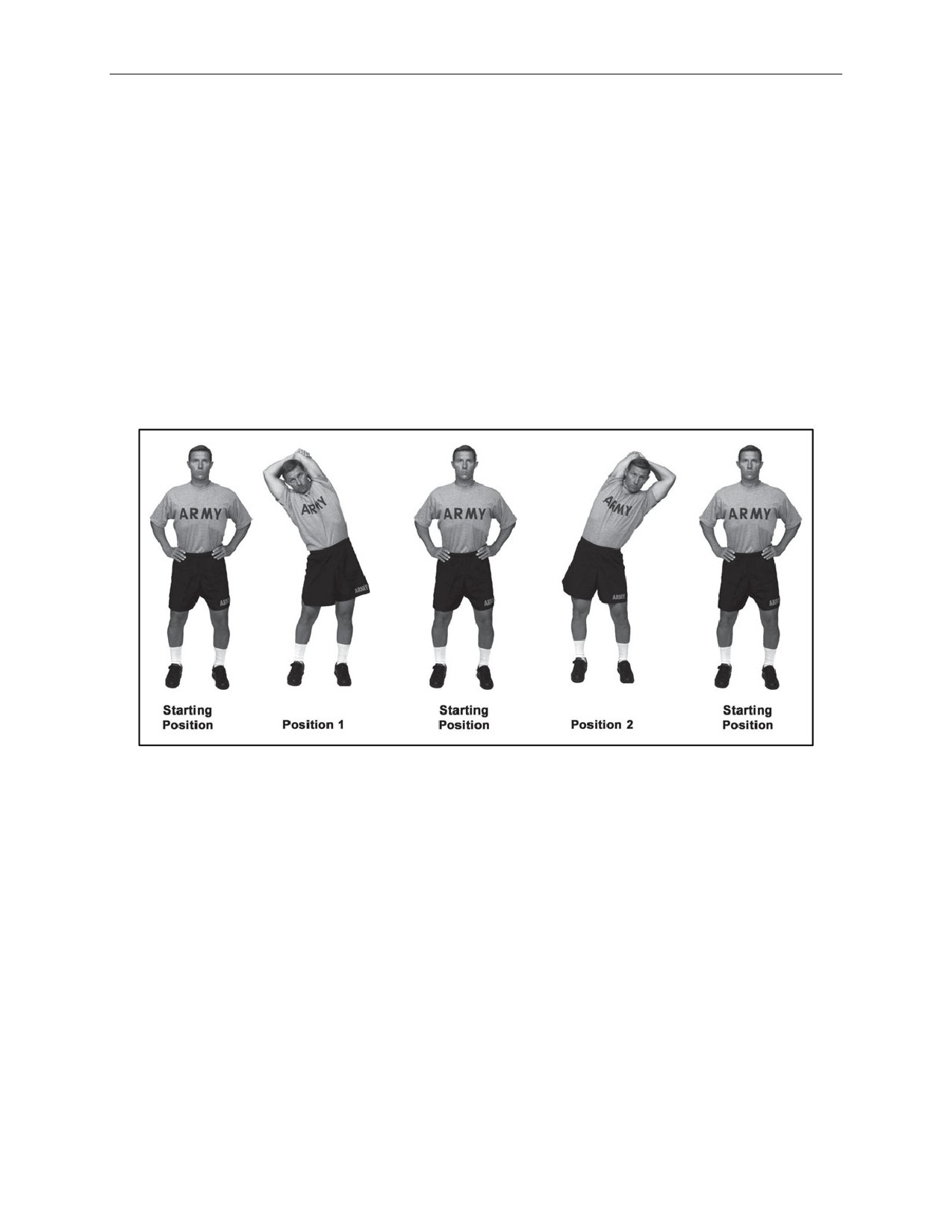
EXERCISE 1: OVERHEAD ARM PULL
Purpose: This exercise develops flexibility of the arms, shoulders, and trunk muscles (Figure 6-94).
Starting Position: Straddle stance with hands on hips.
Position 1: On the command, “Ready, STRETCH,” raise the left arm overhead and place the left hand behind
the head. Grasp above the left elbow with the right hand and pull to the right, leaning the body to the right.
Hold this position for 20-30 seconds.
Starting Position: On the command, “Starting Position, MOVE,” assume the starting position.
Position 2: On the command, “Change Position, Ready, STRETCH,” raise the right arm overhead and place the
right hand behind the head. Grasp above the right elbow with the left hand and pull to the left, leaning the
body to the left. Hold this position for 20-30 seconds. On the command, “Starting Position, MOVE,” return
to the starting position.
Figure 6-94. Overhead arm pull
Check Points:
z
Throughout the exercise, keep the hips set and the abdominals tight.
z
In positions 1 and 2, lean the body straight to the side, not to the front or back.
Precautions: N/A
26 October 2012
FM 7-22
6-107
Chapter 6
RECOVERY DRILL
MODIFIED EXERCISE 1: MODIFIED OVERHEAD ARM PULL
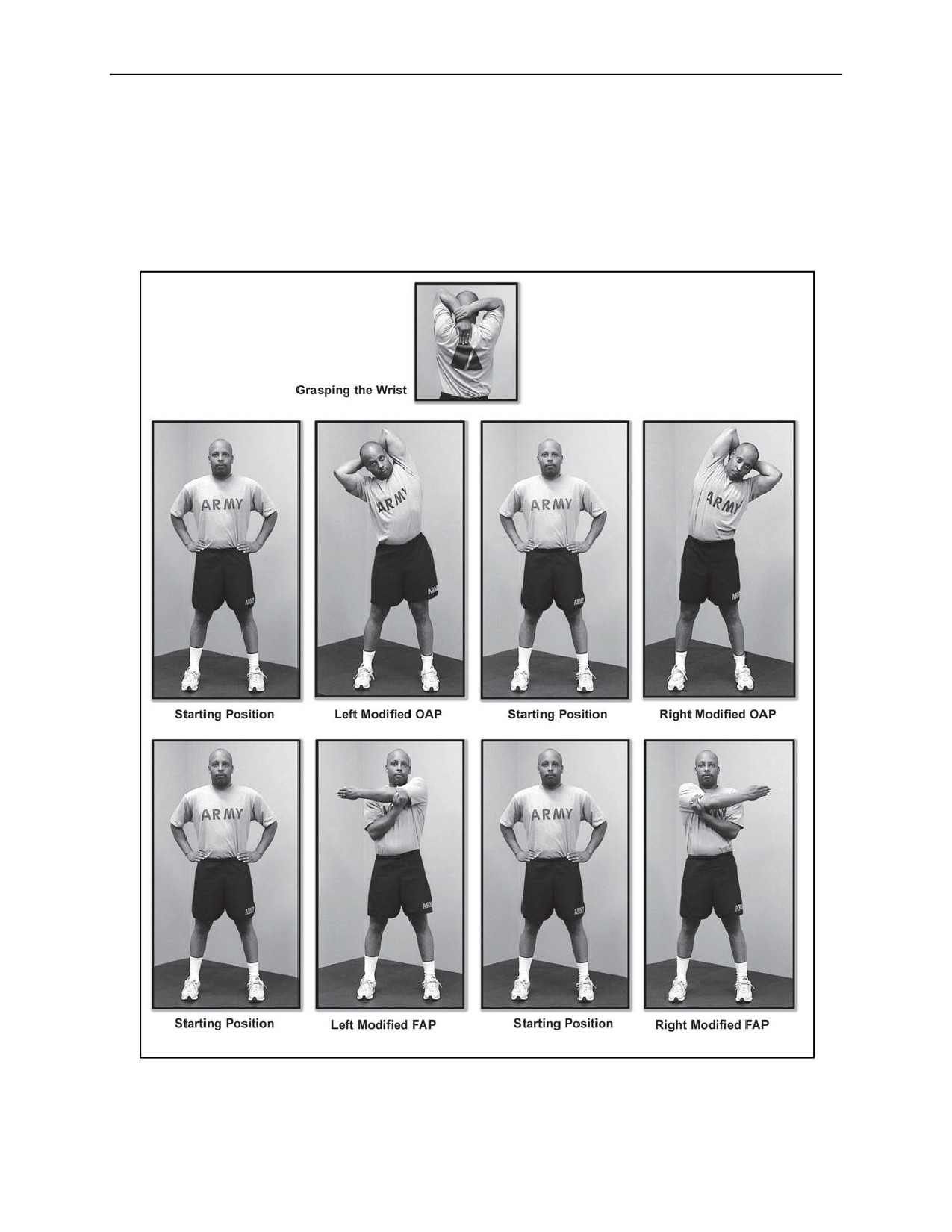
6-131. The instructor may modify this exercise by decreasing the range of motion. The Soldier reaches
overhead and then grasps the wrist with the opposite hand instead of the elbow (Figure 6-95). Another
modification is to pull the arm across the front of the chest.
Figure 6-95. Modified overhead arm pull and front arm pull
6-108
FM 7-22
26 October 2012
Special Conditioning Programs
RECOVERY DRILL
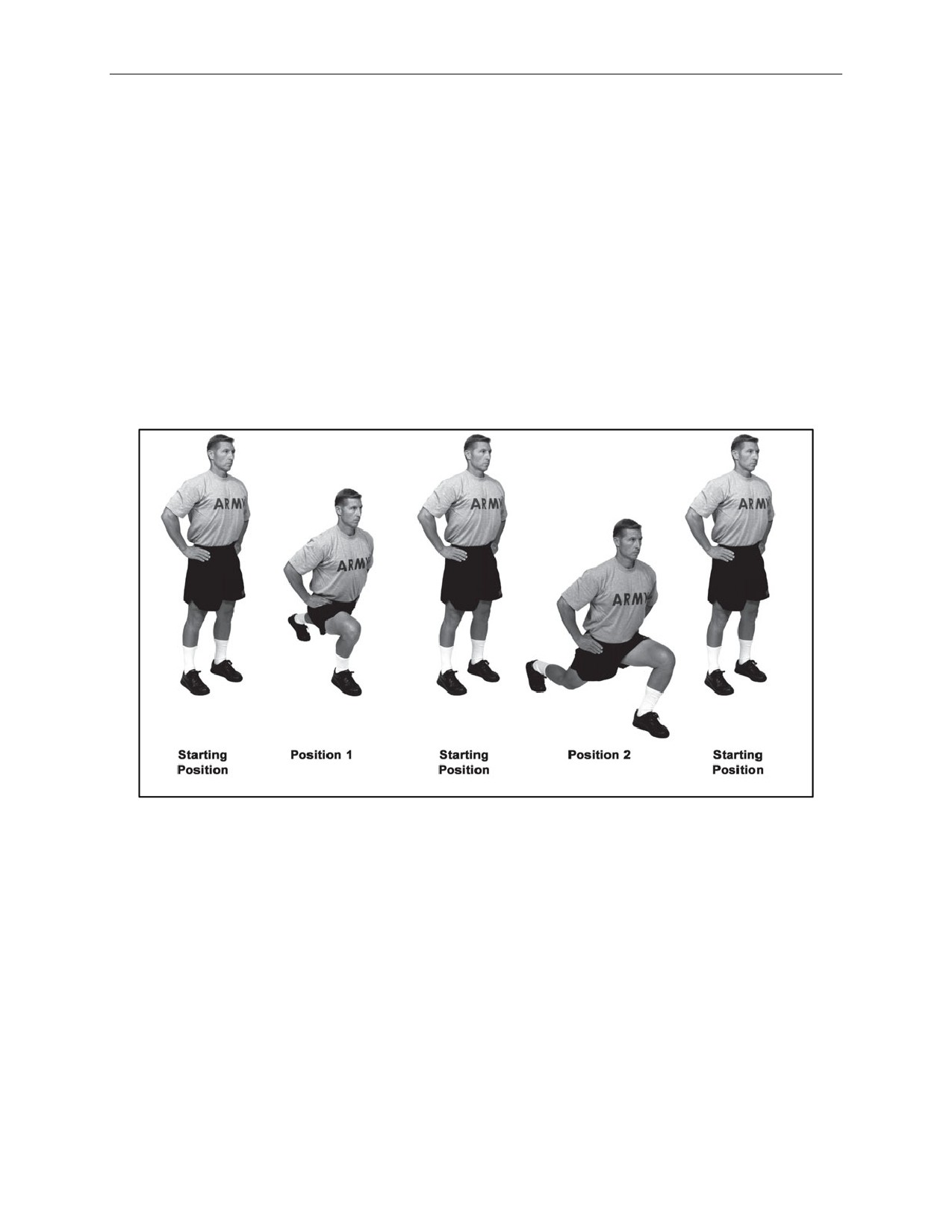
EXERCISE 2: REAR LUNGE
Purpose: This exercise develops mobility of the hip flexors and trunk muscles (Figure 6-96).
Starting Position: Straddle stance, hands on hips.
Position 1: On the command, “Ready, STRETCH,” take an exaggerated step backward with the left leg,
touching down with the ball of the foot. This is the same position as count 1 of the rear lunge in CD 1. Hold
this position for 20-30 seconds.
Starting Position: On the command, “Starting Position, MOVE,” assume the starting position.
Position 2: On the command, “Change Position, Ready, STRETCH,” take an exaggerated step backward with
the right leg, touching down with the ball of the foot. This is the same position as count 3 of the rear lunge in
CD 1. Hold this position for 20-30 seconds. On the command, “Starting Position, MOVE,” return to the
starting position.
Figure 6-96. Rear lunge
Check Points:
z
Maintain straightness of the back by keeping the abdominal muscles tight throughout the motion.
z
After the foot touches down on positions 1 and 2, allow the body to continue to lower.
z
Lunge and step in a straight line, keeping the feet directed forward. Viewed from the front, the feet
are shoulder width apart, both at the starting position and at the end of positions 1 and 2.
z
Keep the forward knee over the ball of the foot on positions 1 and 2.
z
Ensure the heal of the rear foot does not touch the ground.
Precautions: When lunging to the left or right, do not let the knee move forward of the toes.
26 October 2012
FM 7-22
6-109
Chapter 6
RECOVERY DRILL
MODIFIED EXERCISE 2: MODIFIED REAR LUNGE
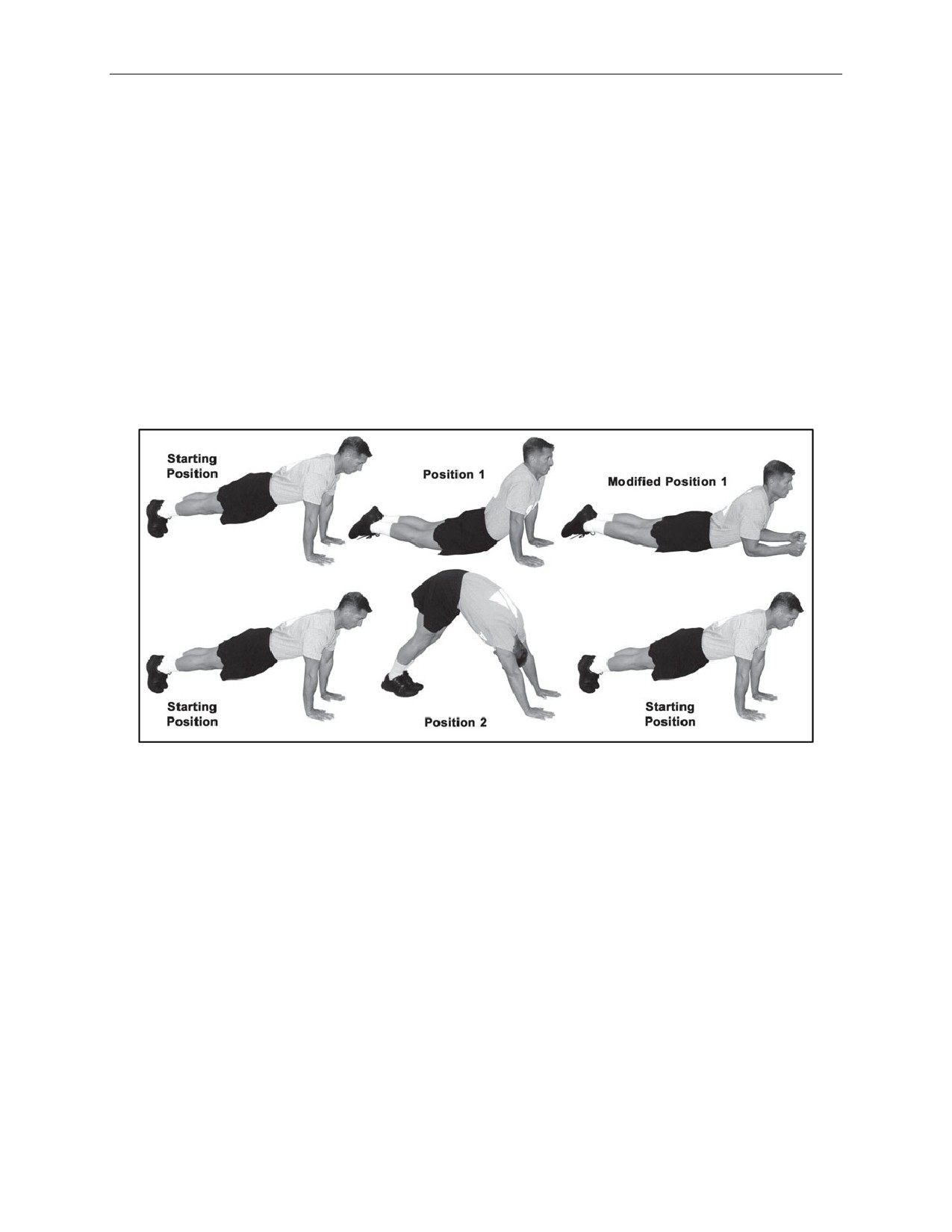
6-132. The instructor can modify the rear lunge by decreasing the range of motion (Figure 6-97). As with all
lunges, this one might restrict how far the knee can bend. The Soldier may place his feet closer together than
with the rear lunge. The Soldier gradually lowers the body into the lunge position. Over time, the Soldier
gradually increases the range of motion and works toward the standard execution of each exercise.
Figure 6-97. Modified rear lunge
6-110
FM 7-22
26 October 2012
Special Conditioning Programs
RECOVERY DRILL
EXERCISE 3: EXTEND AND FLEX
Purpose: This exercise develops mobility of the hip flexors, abdominals, hip (position 1-extend, Figure 6-98)
and the low back, hamstrings, and calves (position 2-flex, Figure 6-98).
Starting Position: The front leaning rest position.
Position 1: On the command, “Ready, STRETCH,” lower the body, sagging in the middle, keeping the arms
straight and looking upward. Hold this position for 20-30 seconds.
Starting Position: On the command, “Starting Position, MOVE,” assume the starting position.
Position 2: On the command, “Change Position, READY, STRETCH,” slightly bend the knees and raise the
hips upward. Straighten the legs and attempt to touch the ground with the heels. Move the head in line with
the arms, forming an A with the body. Keep the feet together and hold this position for 20-30 seconds. On the
command, “Starting Position, MOVE,” return to the starting position.
Figure 6-98. Extend and flex
Check Points:
z
In position 1, the thighs and pelvis rest on the ground. Relax the back muscles while bearing the body
weight through the straight arms. Toes point to the rear.
z
In position 2, the legs are straight and the arms are shoulder width apart, palms down on the ground.
Relax the shoulders and push to the rear with the hands, forming an “A” with the body. Try not to
round the shoulders.
z
Keep the feet together throughout the exercise.
Precaution: N/A
Variation: Soldiers who cannot extend the trunk in position 1 while keeping the arms straight and hips on the
ground may assume the modified position 1 shown above.
26 October 2012
FM 7-22
6-111
Chapter 6
RECOVERY DRILL
MODIFIED EXERCISE 3: MODIFIED EXTEND AND FLEX
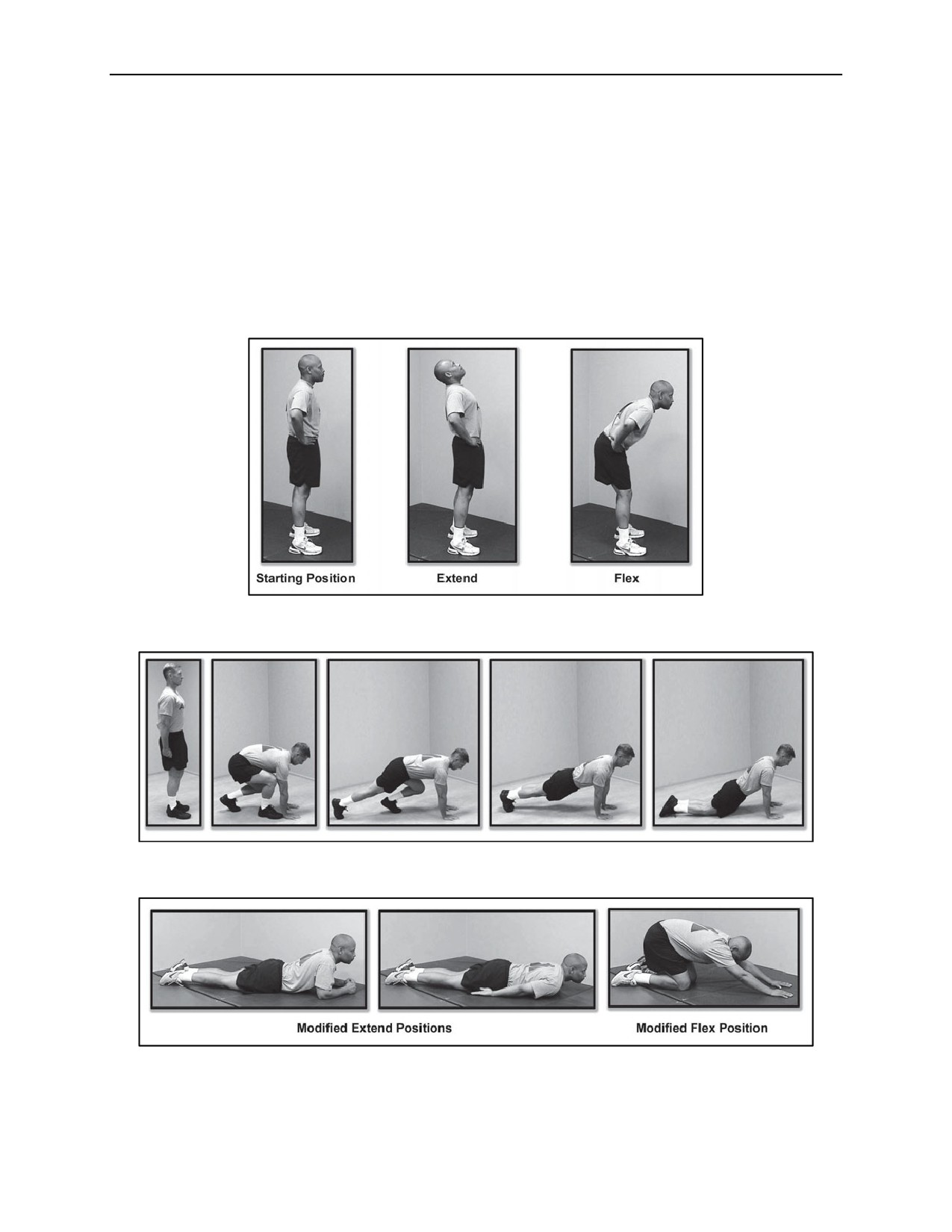
6-133. The instructor may modify this exercise by using a standing (Figure 6-99) or prone position. The
Soldier may assume the starting position for the extend and flex using the prone position. To do so, the Soldier
steps back into the front leaning rest position (Figure 6-100) instead of performing a squat thrust. In the post-
profile period, range of motion for some exercises may still be limited. Soldiers may modify the extend position
by raising up their forearms instead of their hands or by laying prone with the arms alongside the body, palms
up (Figure 6-101). Over time, the Soldier gradually increases the range of motion and works toward the
standard execution of each exercise.
Figure 6-99. Modified extend and flex (standing)
Figure 6-100. Stepping into the modified extend and flex (prone)
Figure 6-101. Modified extend and flex (prone) starting position
6-112
FM 7-22
26 October 2012
Special Conditioning Programs
RECOVERY DRILL
EXERCISE 4: THIGH STRETCH
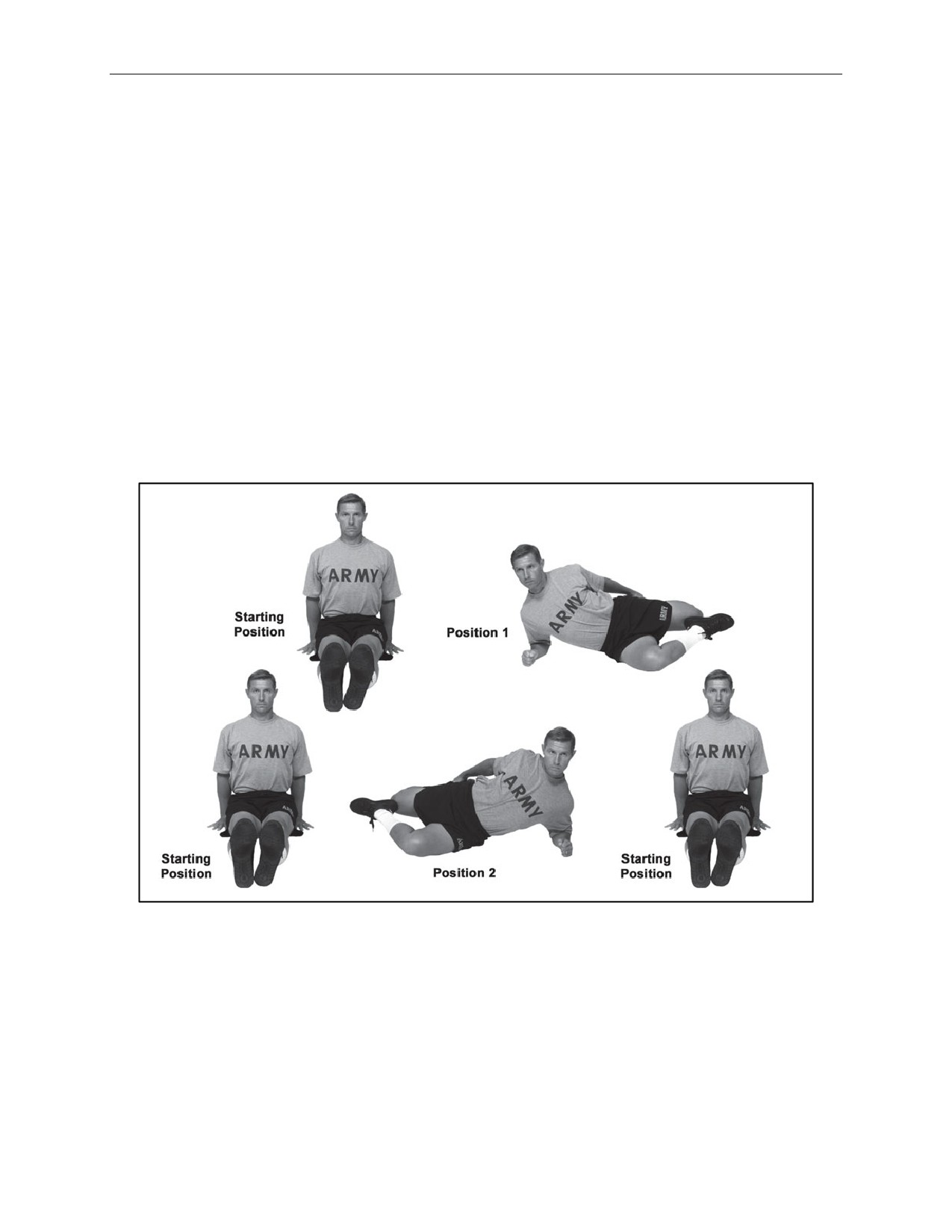
Purpose: This exercise develops flexibility of the front of the thigh and the hip flexor muscles (Figure 6-102).
Starting Position: Seated position, arms at sides and palms on the ground.
Position 1: On the command, “Ready, STRETCH,” roll onto the right side and place the right forearm on the
ground, perpendicular to the chest. With the right hand, make a fist on the ground with the thumb side up.
Grasp the left ankle with the left hand and pull the left heel toward the buttocks and pull the entire leg
rearward. Push the left thigh further to the rear with the heel of the right foot. Hold this position for 20-30
seconds.
Starting Position: On the command, “Starting Position, MOVE,” assume the starting position.
Position 2: On the command, “Change Position, Ready, STRETCH,” lay on the left side and place the left
forearm on the ground, perpendicular to the chest. The left hand makes a fist on the ground with the thumb
side up. Grasp the right ankle with the right hand and pull the right heel toward the buttocks and pull the
entire leg rearward. Push the right thigh further to the rear with the heel of the left foot. Hold this position for
20-30 seconds. On the command, “Starting Position, MOVE,” return to the starting position.
Figure 6-102. Thigh stretch
Check Points:
z
Keep the abdominal muscles tight throughout this stretch in order to keep the trunk straight.
z
Do not pull the heel forcefully to the buttock if there is discomfort in the knee joint.
Precaution: N/A
26 October 2012
FM 7-22
6-113
Chapter 6
RECOVERY DRILL
MODIFIED EXERCISE 4: MODIFIED THIGH STRETCH
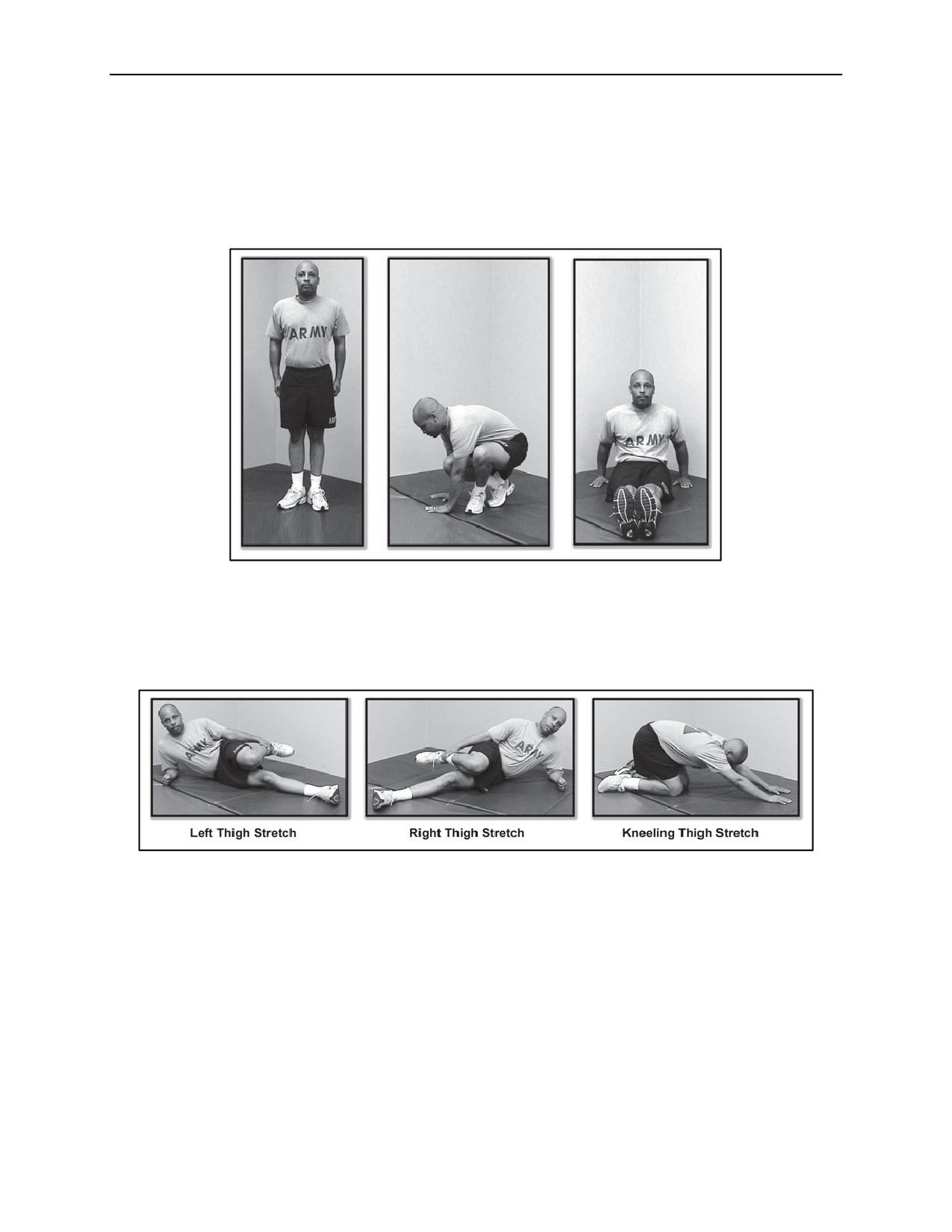
6-134. The instructor may modify the thigh stretch by decreasing the range of motion. The starting position
may be assumed using the hands (Figure 103).
Figure 6-103. Modified thigh stretch (assuming the seated position)
6-135. The knee bend may be restricted so pull the leg slightly toward the front. Over time, the Soldier
gradually increases the range of motion and works toward the standard execution of each exercise. The Soldier
may also perform this exercise in a kneeling position, assuming the starting position from the modified extend
and flex (Figure 6-104).
Figure 6-104. Modified thigh stretch starting positions
6-114
FM 7-22
26 October 2012
Special Conditioning Programs
RECOVERY DRILL
EXERCISE 5: SINGLE-LEG OVER
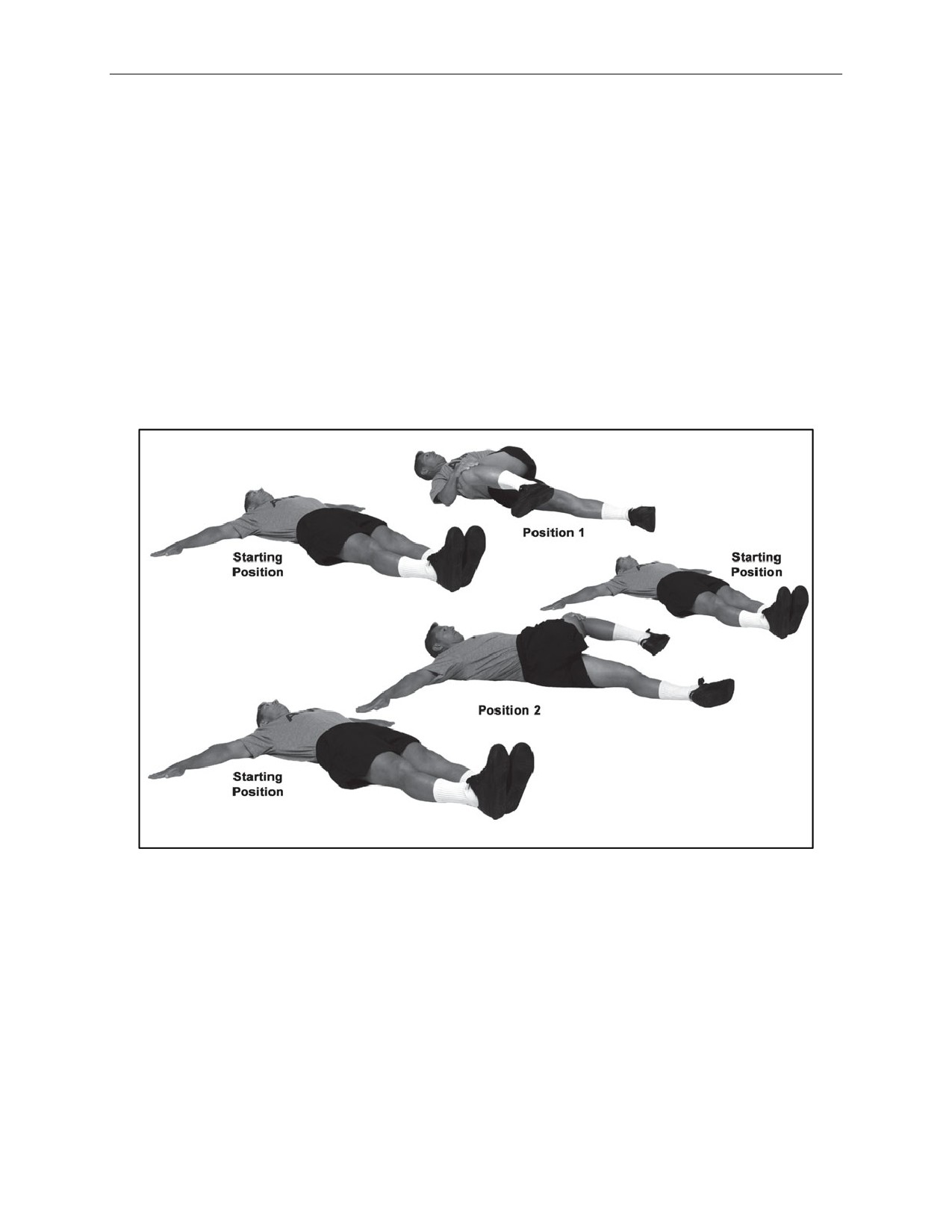
Purpose: This exercise develops flexibility of the hips and lower back muscles (Figure 6-105).
Starting Position: Supine position with arms sideward, palms down, feet together, and head on the ground.
Position 1: On the command, “Ready, STRETCH,” turn the body to the right, bend the left knee to 90 degrees
over the right leg, grasp the outside of the left knee with the right hand and pull toward the right. Hold this
position for 20-30 seconds.
Starting Position: On the command, “Starting Position, MOVE,” assume the starting position.
Position 2: On the command, “Change Position, Ready, STRETCH,” turn the body to the left, bend the right
knee to 90 degrees over the left leg, grasp the outside of the right knee with the left hand, and pull toward the
left. Hold this position for 20-30 seconds. On the command, “Starting Position, MOVE,” return to the
starting position.
Figure 6-105. Single-leg over
Check Points:
z
At the starting position, the arms are directed to the sides at 90 degrees to the trunk; the fingers and
thumbs are extended and joined.
z
In position 1, keep the left shoulder, arm, and hand on the ground.
z
In position 2, keep the right shoulder, arm, and hand on the ground.
z
Keep the head on the ground throughout the exercise.
Precaution: N/A
26 October 2012
FM 7-22
6-115