FM 7-22 ARMY PHYSICAL READINESS TRAINING (OCTOBER 2012) - page 3

Chapter 5
RESERVE COMPONENT
5-43. The sample schedules shown in Table 5-15 (quarterly collective training) and Table 5-16 (annual
collective training) show PRT instruction and training for an RC unit. Table 5-15 shows individual training.
Table 5-15. RC quarterly and annual PRT schedule
1st Main Support Battalion
1ST QTR
2ND QTR
Requirements
7-9 OCT
18-19 NOV
1-2 DEC
6-7 JAN
17-18 FEB
3-4 MAR
Higher HQ
Mandatory
FTX
CMD Inspection
MOBEX
IG
CPX
Briefings
SM Tasks
Unit Training
Company
NBC Proficiency
NBC Proficiency
SM Tasks
Plan Bn Defense
Collective Tasks
Preparation
Test
NBC Collective
Tasks
Preparation: PD
Preparation: PD
Preparation: PD
Preparation: PD
Preparation: PD
Preparation: PD
Sustaining
Activities: MMD
Activities:
Activities:
Activities:
Activities AGR,
Activities:
Phase
1&2
ACU/Boots
30:60s, 60:120s,
ACU/Boots
TR, HR, RR
ACU/Boots
PRT
Activities:
GD, CD 1&2,
300-yd SR
CD 3, CL 2,
Recovery: RD
STM, and other
Assessment
1-mile Run
CL 1, PSD
Recovery: RD
Recovery: RD
strength training
& Instruction
Assessment
Recovery: RD
modalities
Recovery: RD
Recovery: RD
1st Main Support Battalion
3RD QTR
4TH QTR
Requirements
15-16 APR
12-14 MAY
10-11 JUN
9-10 JUL
11-13 AUG
9-10 SEP
Prep for AT
Higher HQ
Weapons
Civil Disturbance
CMD Inspection
FTX
CMD Inspection
Qualification
Training
AT 11-25 JUL
Load Vehicles,
PMI
Equipment
Plan, Prepare
ARTEP
Unit Training
DECONEX
SM Tasks
Battalion
CSS Operations
Mission
ARTEP Missions
Operations order
Preparation
Weapons Fire in
Download
MOPP 4
Preparation: PD
Preparation: PD
Preparation: PD
Activities:
Sustaining
Activities:
Refer to AT
Preparation: PD
Activities:
STM 1or other
Preparation: PD
Phase PRT,
ACU/Boots
Collective PRT
Activities: APFT
FM-FL/AML
strength training
Activities: APFT
Assessment &
GD, CD 3, CL
Schedule
Recovery: RD
(Instruction)
modalities
Recovery: RD
Instruction
1&2, PSD
(Fig. 5-22)
Recovery: RD
(Instruction)
Recovery: RD
Recovery: RD
5-32
FM 7-22
26 October 2012

Planning Considerations
Table 5-16. RC annual collective PRT schedule
JULY - Annual Training
Monday
Tuesday
Wednesday
Thursday
Friday
11
12
13
14
15
Preparation:
Preparation:
Preparation:
Preparation:
Preparation:
PD (5 reps)
PD (5 reps)
PD (5 reps)
PD (5 reps)
PD (5 reps)
Activities:
Activities:
Activities:
Activities:
Activities:
CD 1&2 (5 reps ea),
MMD 1&2
ACU/Boots
MMD 1&2 (1 rep ea),
CD 1&2 (5 reps ea),
CL 1 (5 reps),
(1 rep ea),
GD (1 rep),
300-yd SR (1 rep),
CL 1 (5 reps),
PSD (4x30 sec)
AGR (A/B 30 min
CD 3 (5 reps),
60:120s (6 reps)
PSD (4x30 sec)
Recovery:
C/D 20 min)
CL 2 (5 reps)
Recovery:
Recovery:
RD (30 sec)
Recovery:
Recovery:
RD (30 sec)
RD (30 sec)
RD (30 sec)
RD (30 sec)
18
19
20
21
22
Preparation:
Preparation:
Preparation:
Preparation:
Preparation:
PD (5 reps)
PD (5 reps)
PD (5 reps)
PD (5 reps)
PD (5 reps)
Activities:
Activities: GD (1 rep),
Activities:
Activities: CD 1&2
Activities: MMD 1 & 2
FM-fl (10 K)
CD 1&2 (5 reps ea),
ACUs/Boots/IOTV
(5 reps ea), CL 1
(1 rep ea), Unit Run
(30 min)
Recovery:
CL 1 (5 reps)
MMD 1&2
(5 reps), PSD (4x30
Recovery:
RD (30 sec)
Recovery:
(1 rep ea),
sec)
Recovery:
RD (30 sec)
RD (30 sec)
300-yd SR (1 rep),
RD (30 sec)
30:60s (6 reps)
Recovery:
RD (30 sec)
26 October 2012
FM 7-22
5-33

Chapter 5
INDIVIDUAL
5-44. Table 5-17 shows the individual schedule. Figure 5-2 shows an example of a commander’s policy letter.
Table 5-17. RC individual PRT schedule
5 Days @ 60 Minutes per Day
Monday
Tuesday
Wednesday
Thursday
Friday
1
2
3
4
5
Preparation:
Preparation:
Preparation:
Preparation:
Preparation:
PD (5 reps)
PD (5 reps)
PD (5 reps)
PD (5 reps)
PD (5 reps)
Activities:
Activities:
Activities:
Activities:
Activities:
Sustained
STM (2x10 reps)
MD 1&2
STM (2x10reps) &
MMD 1&2
Running
&
(1 rep ea) &
PSD (4x30 sec) or
(1 rep ea) &
Or
PSD (4x30 sec) or
60:120s (8 reps)
other strength
Sustained
ETM (20-30 min)
other strength
Running
Recovery:
training modalities
Recovery:
training modalities
or ETM (20-30
RD (30 sec)
Recovery:
RD (30 sec)
Recovery:
min)
RD (30 sec)
RD (30 sec)
Recovery:
RD (30 sec)
8
9
10
11
12
Preparation:
Preparation:
Preparation:
Preparation:
Preparation:
PD (5 reps)
PD (5 reps)
PD (5 reps)
PD (5 reps)
PD (5 reps)
Activities:
Activities:
Activities:
Activities:
Activities:
STM (2x10 reps) &
Sustained
STM (2x10 reps) &
MMD 1&2
STM (2x10 reps) &
PSD (4x30 sec) or
Running
PSD (4x30 sec) or
(1 rep ea) &
PSD (4x30 sec) or
other strength
or ETM (20-30
other strength
60:120s (8 reps)
other strength
min)
training modalities
training modalities
Recovery:
training modalities
Recovery:
Recovery:
Recovery:
RD (30 sec)
Recovery:
RD (30 sec)
RD (30 sec)
RD (30 sec)
RD (30 sec)
SAMPLE COMMANDER’S POLICY LETTER
5-45. Refer to Figure 5-2. For an example of a unit PRT policy letter.
5-34
FM 7-22
26 October 2012
Planning Considerations
Physical Readiness Training
DEPARTMENT OF THE ARMY
Headquarters, XX Battalion, XX Infantry
XX Brigade, XX Division
Fort XXXX, XX State XX zip code
Office Symbol
Date
MEMORANDUM FOR All XX Infantry Leaders and Soldiers
SUBJECT: Commander’s Policy Letter # X: Physical Readiness Training
1. References.
FM 7-22, Army Physical Readiness Training, XX Date
AR 350-1, Army Training and Leader Development
Installation AR 350-1, XX Date
2. General. In accordance with AR 350-1, all Soldiers will participate in either collective or individual 60 to
90 minute daily PRT sessions four or five times per week.
a. All sessions will include the exercises, drills, and activities listed in the sustaining phase from TC 7-
22.
b. Normal PRT time is 0630 to 0800. Commanders will protect PRT time. Combatives training will be
scheduled separately from unit PRT.
c. Special Conditioning programs will be conducted according to Chapter 6, FM 7-22. Soldiers on
temporary or permanent physical profile will be evaluated and assigned to the battalion reconditioning program.
1SG will coordinate with the reconditioning program leader (RPL) for all matters concerning Soldiers in the
reconditioning program.
d. The APFT will be conducted according to FM 7-22, Appendix A.
e. AR 600-9 is the standard for conduct of the Army Weight Control Program (AWCP).
3. Schedules. Commanders will follow Chapter 5, FM 7-22, which contains a doctrinal template for the
conduct of collective and individual PRT exercises, drills, and activities.
a. The sustaining phase of PRT supports the Army Force Generation (ARFORGEN) model using reset,
train/ready, and available phases. The model is designed using a “structured progression of increased unit
readiness over time.”
b. This results in recurring periods of availability of trained, ready, and cohesive units prepared for
operational deployment as specified in the Army Campaign Plan. The recurring structured progression of
increasing unit readiness focuses on reset, train/ready, and available phases according to the operational
readiness cycles. The result is full mission readiness.
c. Structured progression also allows units time to prepare for an operational deployment cycle and surge
capability.
d. As shown in AR 350-1, active Army forces plan for one deployment every three years, while reserve
forces plan for one deployment every six years. Active and reserve forces can be called from the ready force
pool for a surge to meet strategic requirements.
e. Commanders must be prepared to move to any position along the ARFORGEN cycle. Core-METL (C-
METL) or Directed-METL (D-METL) paths for units must prepare them to operate anywhere or anytime within
the spectrum of conflict. With the potential to have shortened ARFORGEN cycles, commanders need to stay
vigilant in planning and programming PRT.
Figure 5-2. Sample, commander’s policy letter
26 October 2012
FM 7-22
5-35
Chapter 5
4. Uniforms. All Soldiers in a unit PRT formation will wear the same uniform. The Army physical fitness
uniform (PFU) and ACUs (as described in AR 670-1) with boots, ACH, IOTV, and weapon are appropriate
uniforms for the conduct of PRT. The high visibility reflective belt or reflective vest will be worn by all
Soldiers during the conduct of unit or individual PRT. The reflective belt will be worn diagonally over the right
shoulder to the hip. During the conduct of unit foot marches the reflective belt or reflective vest will be placed
horizontally around the rucksack.
5. Execution. Commanders will develop their PRT programs around mission and METL requirements.
a. PRT sessions are not solely devoted to preparation for the APFT.
b. Company, platoon, and squad level PRT is authorized. Individual PRT should be the exception and not
the rule.
c. The PRT formation is for accountability and the execution of PRT, not a platform for administrative
announcements.
d. Commanders must ensure that all PRT follows the Task, Conditions, Standards format.
e. Commanders will annotate “Preparation,” “PRT drills and activities,” and “Recovery” on their unit
training schedules.
f.
Organized athletics are not to be executed during PRT time.
g.
Foot marching will be conducted 2 to 3 times per month, replacing sustained running on the PRT
schedule. Speed running will always be conducted at least one time per week.
h. To ensure leaders conduct PRT training to standard, commanders require them to receive the training
themselves before they may conduct PRT sessions. (This training is described in Chapters 7 through 10, FM 7-
22.) This helps ensure that the PRT program is conducted to standard.
6. APFT. In accordance with AR 350-1, the APFT will be administered for record at least twice a year.
a. Ideally, testing dates should fall within the months of April and October.
b. Record testing, to include make-up testing, is annotated on the unit training schedule. Soldiers who
score 270 points or higher with at least 90 points in each APFT event are awarded the Army Physical Fitness
Excellence badge.
c. Height and weight screening to meet AR 600-9 standards may be conducted on the day of the record
APFT or up to 30 days before or after the record test.
7. Unit Goals. Commanders should establish goals based on the physical requirements of the unit’s
mission/METL. The following is an example battery of unit-level assessments used to measure individual and
collective unit readiness:
a. Collectively foot march
20 km with fighting load, under
5 hours (Chapter
10, FM 7-22, and
FM 21-18).
b. Perform five unassisted pull-ups using overhand grip.
c. Complete a 300-yard shuttle run in under 90 seconds.
d. Perform individual Soldier carry with a Soldier of equal weight for 50 yards.
e. Soldiers score 270 or higher.
f.
Soldiers meet AR 600-9 standards.
Figure 5-2. Sample, commander’s policy letter (continued)
Summary
The PRT schedules prescribed in this chapter are adaptable to unit missions, individual
capabilities, and unit OPTEMPO. The principles of train as you will fight, train to standard,
and train to develop agile leaders and organizations are fundamental in the construction
of PRT program development. Commanders must understand and apply the doctrinal
templates in this chapter to chart a clear and achievable direction for the physical
readiness of their units.
5-36
FM 7-22
26 October 2012
Chapter 6
Special Conditioning Programs
“When Soldiers become ill, injured, or have other medical conditions, leaders have the
responsibility to recondition these Soldiers and safely return them to duty at an equal or
higher physical fitness level.”
COL William R. Rieger, Commandant, U.S. Army Physical Fitness School, 1999 to 2006
AR 350-1 states special conditioning programs are appropriate for Soldiers who have
difficulty meeting unit goals or Army standards. These programs are not punitive; their
purpose is to improve the physical readiness of Soldiers. Special conditioning programs
designed to accommodate these needs will be conducted during normal duty hours.
Special conditioning programs include:
z
APFT or unit PRT goal failure.
z
Soldiers on the AWCP.
z
Reconditioning.
APFT OR UNIT PRT GOAL FAILURE
6-1. When Soldiers fail to meet APFT standards or unit goals, leaders should consider many factors that may
contribute to these failures, including:
z
Time in training.
z
Regular PRT participation.
z
Prolonged deployment.
z
Recovery from injury, illness or medical condition (physical profile).
TIME IN TRAINING
6-2. The Soldier who is fresh out of IMT may have a level of physical performance below the minimum
threshold of his gaining unit. He may be a borderline APFT performer or borderline overweight. Regardless of
the situation, he will not be accustomed to the demands placed on the lower extremities during a normal duty
day. These Soldiers will face new conditions relating to physical performance such as acclimatization to
altitude, temperature, and humidity. It can take up to four weeks to adapt to these unfamiliar conditions.
Although Soldiers leave IMT prepared for the transition to the sustaining phase, they may detrain due to leave,
transit, and in-processing at their new duty assignments. The same holds true for Soldiers reassigned to different
units throughout the Army.
REGULAR PARTICIPATION
6-3. Many factors may influence regular participation in PRT sessions. The most common factors include
OPTEMPO and related mission requirements. Leaders must anticipate and plan for these, and must make PRT
as important as any other programmed training. In accordance with AR 350-1, Soldiers are required to
participate in collective or individual PRT activities at least three times per week. Optimal participation in PRT
may be achieved through conducting training sessions anytime during the duty day; not necessarily only in the
early morning. Leaders must understand this and make it known. Soldiers should only be excused from regular
unit PRT when they have performed exhaustive duties with little or no rest, or have a temporary or permanent
physical profile according to AR 40-501, Standards of Medical Fitness.
26 October 2012
FM 7-22
6-1
Chapter 6
6-4. All Soldiers must understand that it is their personal responsibility to achieve and sustain a high level of
physical readiness. Many Soldiers are assigned to duty positions that restrict participation in collective unit PRT
programs. Commanders must therefore develop leadership environments that encourage and motivate Soldiers
to accept individual responsibility for their own physical readiness. Leaders and individual Soldiers need to use
the PRT system outlined in this FM to help achieve and sustain high levels of physical readiness.
PROLONGED DEPLOYMENT
6-5. It is well documented that detraining may occur during prolonged deployments. Significant losses in
strength, endurance, and mobility occur after a period of 14 days when little or no PRT is conducted. Every
effort should be made by leaders to conduct PRT activities as often as mission requirements allow during
deployment. Chapter 5, Planning Considerations, provides sample schedules of PRT activities that may be
conducted during deployment when both time and space are limited. During post-deployment, when fitness
levels may have declined, special considerations must be taken to ensure Soldiers meet or exceed their pre-
deployment physical readiness levels. Adequate rest and recovery are especially important to successfully bring
Soldiers back to a high level of readiness. Leaders must recognize the amount of time that is required to
condition these Soldiers. Furthermore, Soldiers need at least 90 days post-deployment to retrain and prepare for
the APFT or unit physical readiness goal.
RECOVERY FROM INJURY, ILLNESS, OR MEDICAL CONDITION
6-6. Soldiers recovering from injury, illness, or other medical conditions must train within the limits of their
medical profiles (DA Form 3349 [Physical Profile]) and be afforded a minimum train-up period of twice the
length of the profile. Prescribed train-up periods must not exceed 90 days before APFT administration or other
unit physical readiness goal requirements according to AR 350-1.
ARMY WEIGHT CONTROL PROGRAM
6-7. See AR 600-9 for the policy and procedures that apply to screening and enrollment in the AWCP.
AR 350-1 specifies that the AWCP will be kept separate and distinct from other special conditioning programs.
Soldiers recovering from injury, illness or other medical conditions will be in reconditioning. Soldiers who fail
the APFT or other unit physical readiness goals will continue participation in regular PRT sessions with the
unit. Soldiers who fail to meet AR 600-9 standards will be enrolled in the AWCP and continue participation in
regular unit PRT sessions. They should also participate in additional low impact, caloric expenditure activities.
RECONDITIONING
6-8. Injuries, illness, and other medical conditions impact readiness. Commanders are faced with the daily
challenge of controlling injuries in the conduct of rigorous military training. Leaders must be familiar with the
factors that influence injury risk. Adherence to the fundamental principles of PRT allows the commander to
manage injury risk effectively. When injuries, illness, or other medical conditions limit the Soldier’s ability to
participate in PRT, units should offer organized and effective reconditioning programs that expedite his return
to unit PRT.
INJURIES
6-9. Injuries are defined as any intentional or unintentional damage to the body resulting from acute or chronic
exposure to mechanical, thermal, electrical, or chemical energy, and from the absence of such essentials as heat
or oxygen. The information in this section will focus specifically on musculoskeletal (orthopedic) conditions,
since they represent the type of injury risk most responsive to sound PRT practices. Among the other
conclusions from the DoD Injury Work Group: In the Army alone, musculoskeletal conditions account for over
half of all disabilities creating compensation of about $125 million per year. Knee and back injuries constitute a
significant proportion of disability and limited duty. Training injuries treated on an outpatient basis and sports
injuries may have the biggest impact on readiness.
6-10. According to the Atlas of Injuries in the Armed Forces:
6-2
FM 7-22
26 October 2012
Special Conditioning Programs
“…injuries pose the single most significant medical impediment to readiness in the military.
Not only do injuries impact the strength and ability of our Armed Forces to effectively
respond to their mission, they levy staggering annual costs in the hundreds of millions of
dollars against the operating budgets of all the services.”
DoD Injury Surveillance and Prevention Work Group (Injury Work Group)
PREVENTION
6-11. The reconditioning program described in this FM responds to the DoD Injury Work Group
recommendation to “…implement programs designed to enhance fitness and reduce training injury rates.” By
enhancing the fitness level of Soldiers during the profile and post-profile recovery period, this program is
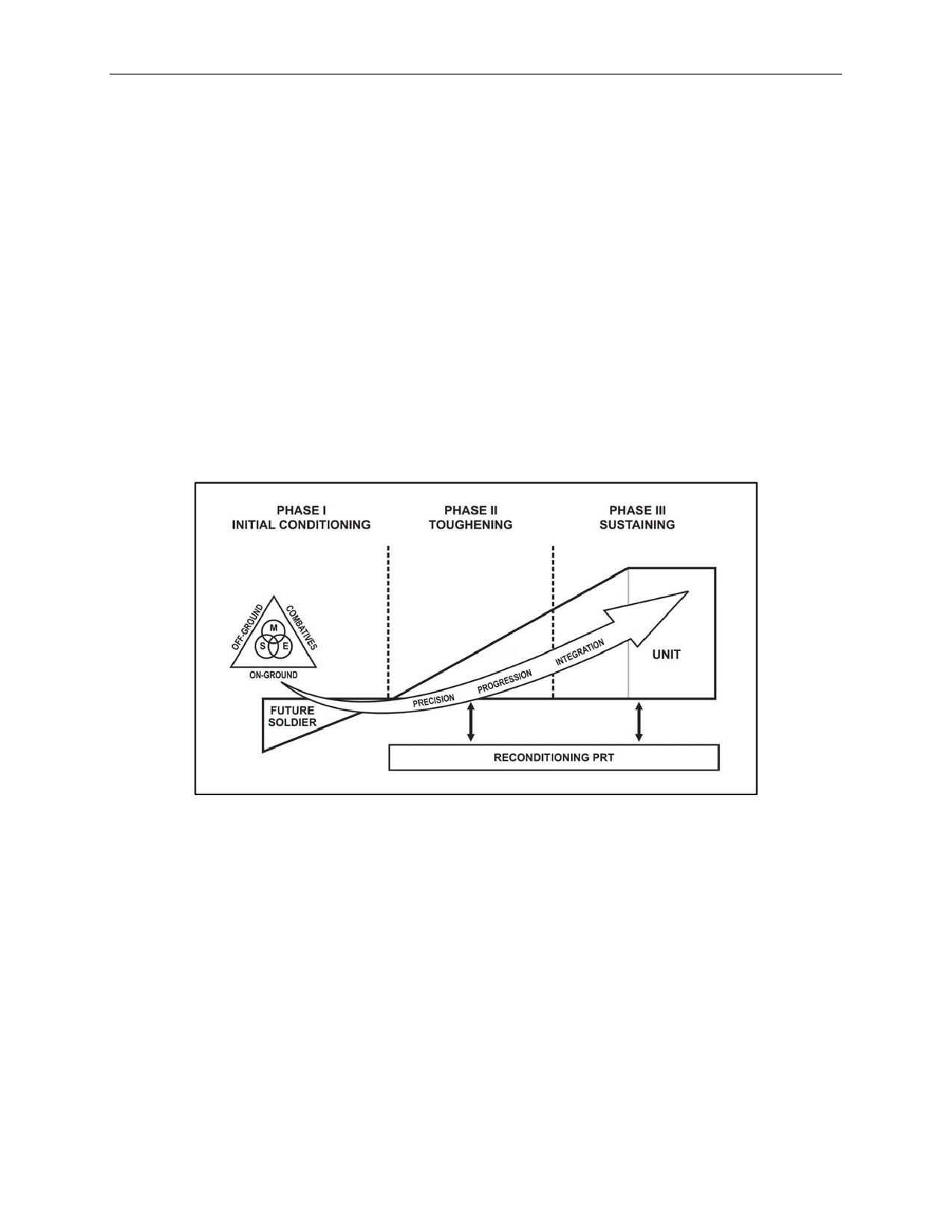
expected to reduce training injury rates. The Army Physical Readiness Training System, shown in Figure 6-1,
was developed with Soldier performance and injury control as its two primary objectives. Though these
objectives may seem to oppose one another at first glance, the principles of PRT that improve Soldier
performance also contribute to reducing injury risk. The DoD Injury Work Group recommends the following
measures for injury prevention:
z
Implement programs designed to enhance fitness and reduce training injury rates.
z
Target knee and back injuries for additional efforts toward prevention.
z
Place greater emphasis on prevention of training and sports injuries.
Figure 6-1. Army Physical Readiness Training System
6-12. The Army PRT System shown in Figure 6-1 includes reconditioning as part of the toughening and
sustaining phases for Soldiers to facilitate recovery from illness, injury, or other medical conditions. Soldiers in
need of recovery should return to unit PRT at a level equal to or higher than their physical state previous to the
condition that brought them to reconditioning. Commanders and NCOs must take an active role to control
avoidable injuries; however, in spite of every effort to limit injuries in the Army, Soldiers and situations will
continue to produce overuse, accidental, and/or traumatic injuries. Keeping this in mind, a plan to bridge the
gap between injury and physical readiness is essential. Reconditioning bridges this gap.
“Injuries are not random events; they are the predictable result of a complex set of risk
factors, many of which can and should be controlled.”
MG Patrick Scully, Deputy Surgeon General, U.S. Army (1998-2002)
26 October 2012
FM 7-22
6-3
Chapter 6
COMMANDER’S ROLE IN INJURY CONTROL
6-13. Precise execution of all PRT activities is essential to the injury control effort. Commanders must allow
trained PRT leaders and AIs the time to teach proper execution of PRT activities. PRT leaders and AIs must be
able to recognize and offer corrective guidance to Soldiers who are not executing drills to the standards
described in this FM. It is especially important for PRT leaders and AIs to maintain the standard since transition
from the toughening to the sustaining phase of training depends on execution of the drills to standard. For
example, to control back injuries, postural awareness should be stressed during execution of all drills and
activities. This is evident when the PRT leader or the AI prompts Soldiers to “set the hips and tighten the abs”
while performing the exercises.
6-14. Both military and civilian research has shown that reduced running volume is associated with lower
injury rates. Accordingly, PRT schedules prescribed in this FM involve less sustained running than is currently
performed in Army units. Several studies of military units have shown that reduced running volume does not
hinder performance on two- or three-mile run assessments as long as the quality (intensity) of running is
maintained.
6-15. In addition to using appropriate PRT schedules, units must also look for conflicts between the PRT
schedule and the unit training schedule. By considering the physical demands of tasks on the unit training
schedule, PRT leaders are better prepared to plan appropriate PRT sessions. For example, if a 10-km foot march
to a range is scheduled for Friday, speed work should not be scheduled for PRT on Thursday. Time should be
allotted for leg recovery. Monday and Wednesday’s PRT should not involve CLs 1 and 2 or the strength
training circuit if Tuesday’s unit training schedule takes the unit to an obstacle course where upper body
strength is heavily challenged.
EXECUTING UNIT RECONDITIONING PROGRAMS
6-16. The following paragraphs assist leaders as they plan and execute a reconditioning program within their
units. Army Reserve and National Guard units may tailor this program to meet their specific requirements. The
purpose of a reconditioning program is to safely restore a level of physical readiness that enables Soldiers to
successfully re-enter unit PRT after injury, illness or other medical condition. A physical profile defines, in
writing, limitations to physical activity due to injury, illness or medical condition. The authorized forms for
written profiles in the Army are the DD Form 689 and DA Form 3349. DA Form 3349 is better than DD Form
689, because it requires a much more detailed description of the Soldier’s injury and the activities and exercises
that the Soldier can perform with the injury. Soldiers assigned to the reconditioning program include:
z
Soldiers on temporary medical profile.
z
Soldiers in the recovery period after a temporary profile expires.
z
Soldiers on permanent medical profile with specific limitations and special fitness requirements.
Level 1
6-17. To address the needs of Soldiers who are on profile and those recovering from profile, reconditioning
employs a two-level system. Level I is a gym-based program designed to maximize the potential of a profiled
Soldier while protecting the injured area. Soldiers enter level I once cleared to begin limited activity by the
profiling health care provider. Activities in level I include the use of STMs and ETMs. Functional criteria are
used to determine whether a Soldier is able to begin reconditioning, at level I or level II.
Example
A Soldier with a permanent profile that prohibits sustained or speed running may be
assigned to the level I program. This allows him the use of aerobic training equipment on
unit endurance and mobility training days.
6-4
FM 7-22
26 October 2012
Special Conditioning Programs
Level II
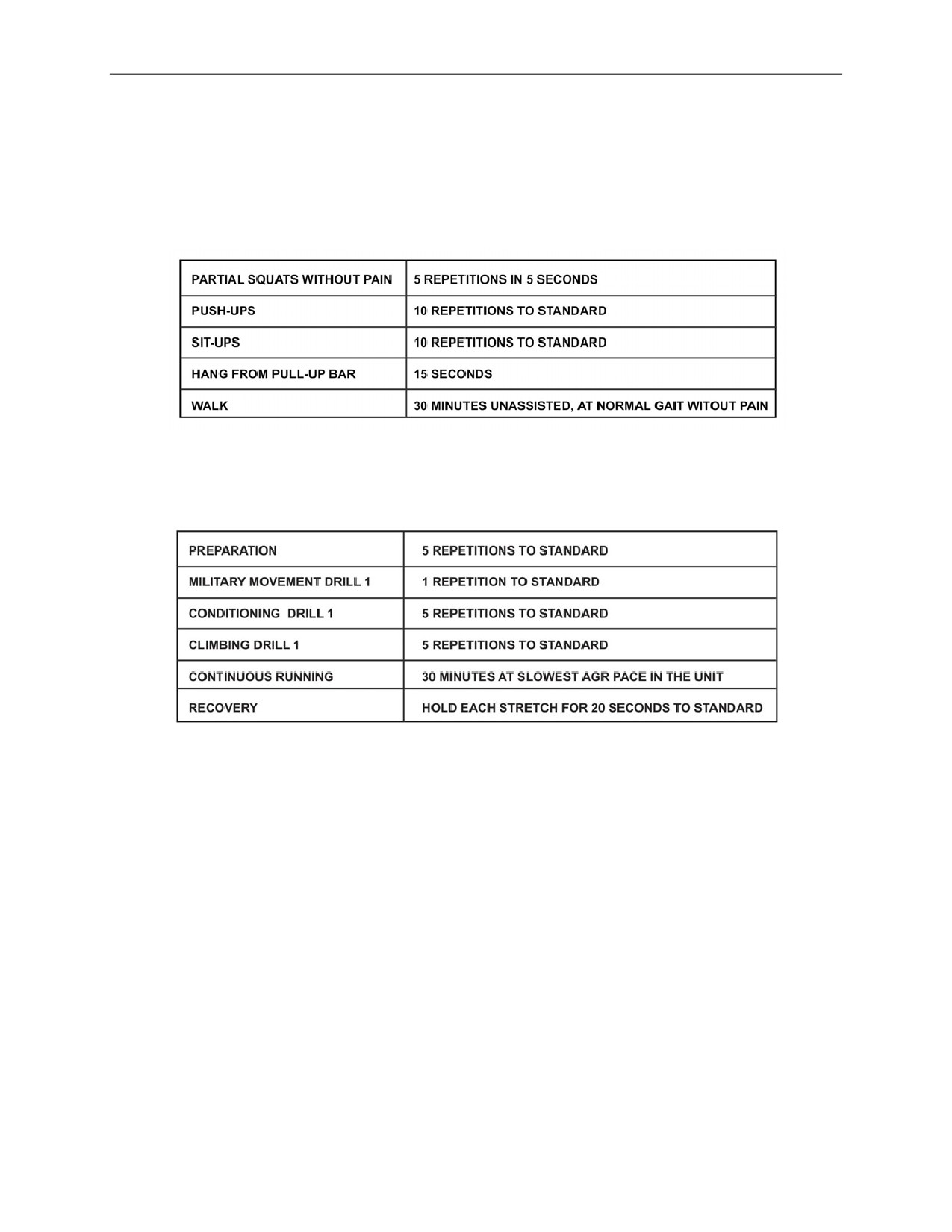
6-18. To begin at level II, the profile or recovery reconditioning program, Soldiers must meet the level II
reconditioning entry criteria requirements shown in Figure 6-2. Upon entering level II, Soldiers will begin to
perform the PRT program. In this level the Soldier is on profile, just off of profile, or cleared to begin level II
reconditioning. Preparation will be exactly the same as for unit PRT. The activity may be modified to follow a
safe exercise progression. Recovery will be exactly the same as unit PRT.
Figure 6-2. Level II reconditioning entry criteria
6-19. Before being discharged from level II and returning to unit PRT, Soldiers must meet the level II exit
criteria requirements shown in Figure 6-3.
Figure 6-3. Level II exit criteria
TOUGHENING PHASE RECONDITIONING
6-20. Rehabilitation and reconditioning programs within IMT are currently conducted at all Army Training
Centers as a part of the physical training and rehabilitation program (PTRP). The purpose of the PTRP is to
provide physical rehabilitation and physical conditioning for Soldiers who are injured during BCT or OSUT.
These programs usually fall under the training command and act independently under the supervision of a
physical therapist. Soldiers remain in the PTRP until they are capable of returning to the same phase of
BCT/OSUT that they left or as a “new start” at day one of IMT. If an injury is minor and only requires short-
term limitations (with minimal impact to training); it may not require assignment to the PTRP.
SUSTAINING PHASE RECONDITIONING
6-21. Reconditioning in the sustaining phase includes AIT and operational units. Consolidation of
reconditioning programs at the battalion (or equivalent) level minimizes the administrative and logistical strain
on operational unit assets. The brigade surgeon should have medical oversight of the unit reconditioning
program. Battalion medical officers are the liaisons between reconditioning program leaders (RPLs) and the
brigade surgeon. The first local military treatment facility with rehabilitation services may provide a physical
therapist and a physical therapy assistant as consultants to oversee the gym-based reconditioning program level
I. The physical therapist can assist/coordinate training efforts with the RPL.
26 October 2012
FM 7-22
6-5
Chapter 6
6-22. The medical platoon leader is the RPL, and the medical platoon sergeant is the assistant RPL or assistant
reconditioning program leader (ARPL). If this is not possible, the RPL and the ARPL should be chosen based
on the following criteria:
z
Thorough understanding of the Army’s PRT program.
z
Ability to instruct all activities.
z
Understanding of regulations that govern profiling (AR 40-501, Standards of Medical Fitness).
z
Ability to adapt activities to profiled Soldiers.
z
Ability to effectively interact with medical personnel to ensure that Soldiers are fully capable of
returning to the unit PRT program.
6-23. It is recommended that each company in the battalion should provide an NCO to assist the RPL on a daily
basis. These NCOs should meet criteria mentioned above for the ARPL. In addition, training sessions should be
provided on a quarterly basis by the physical therapist and/or physical therapy assistant to ensure proper
supervision and optimal safety practices are observed. Trained NCOs will provide supervision and group
instruction to Soldiers in the reconditioning program. To meet supervision requirements, at least two NCOs per
company should be trained in the conduct and supervision of the reconditioning program.
6-24. Units should ensure adequate space and equipment are provided for the reconditioning program to
accommodate STM and ETM drills. The reconditioning program is best executed at the brigade or installation
fitness facilities. Because lower extremity injuries prevent many Soldiers from running activities, it is essential
to have an adequate number of ETMs that offer cardio-respiratory conditioning while limiting weight-bearing
stress to the body. Examples are cycle ergometers, steppers, elliptical machines, rowing machines, and
treadmills. Treadmills are full weight bearing machines and are most appropriate for Soldiers cleared by
medical personnel to begin a walk-to-run progression. Of these machines, cycle ergometers offer the most body
weight support.
6-25. Pool activities such as swimming or deep-water running can eliminate weight-bearing stress. All Soldiers
who are recovering from surgery or have open wounds will receive a physician’s clearance before entering the
swimming pool. Swimming laps, aqua-jogging, and aquatic exercises are excellent ways to maintain or improve
cardio-respiratory fitness without putting undue stress on joints and bones. Limitations to one leg or one arm are
minimal deficits in a pool environment. Kick board workouts or upper body workouts allow for strenuous
activity with minimal risk of re-injury to an affected limb. If staffing is adequate, specialized aquatics programs
may be implemented to work on water aerobics or deep-water running programs for non-swimmers. It is
important to plan activities that keep everyone active during group pool sessions. Even if a regular pool
program is not practical, an occasional trip to the pool may be scheduled to break up the routine and provide
cross-training.
6-26. Units that must rely on installation or shared facilities should make arrangements to ensure that space and
STM/ETM equipment are available during the time dedicated to the reconditioning program. This may require
policies that restrict the use of these facilities to only reconditioning programs. Leaders might need to schedule
reconditioning outside typical PRT times such as after 0800 or before 1600 to best achieve dedicated access to
gym space and equipment.
COMMAND RESPONSIBILITIES
6-27. The reconditioning program is the battalion commander’s and command sergeant’s major program. A
well-run program will assist force reconstitution efforts. The success of the program is dependent on the priority
placed on it from the top down. Company commanders and first sergeants must care enough about the program
to ensure NCO support.
6-28. The brigade surgeon and battalion medical officers should maintain constant awareness of the program. A
medical officer with a background in rehabilitation should act as the installation medical consultant for
reconditioning programs. The primary responsibility of the medical consultant is to act as a liaison or advocate
for RPLs. The medical consultant should also provide training for the RPLs, ARPLs, and unit reconditioning
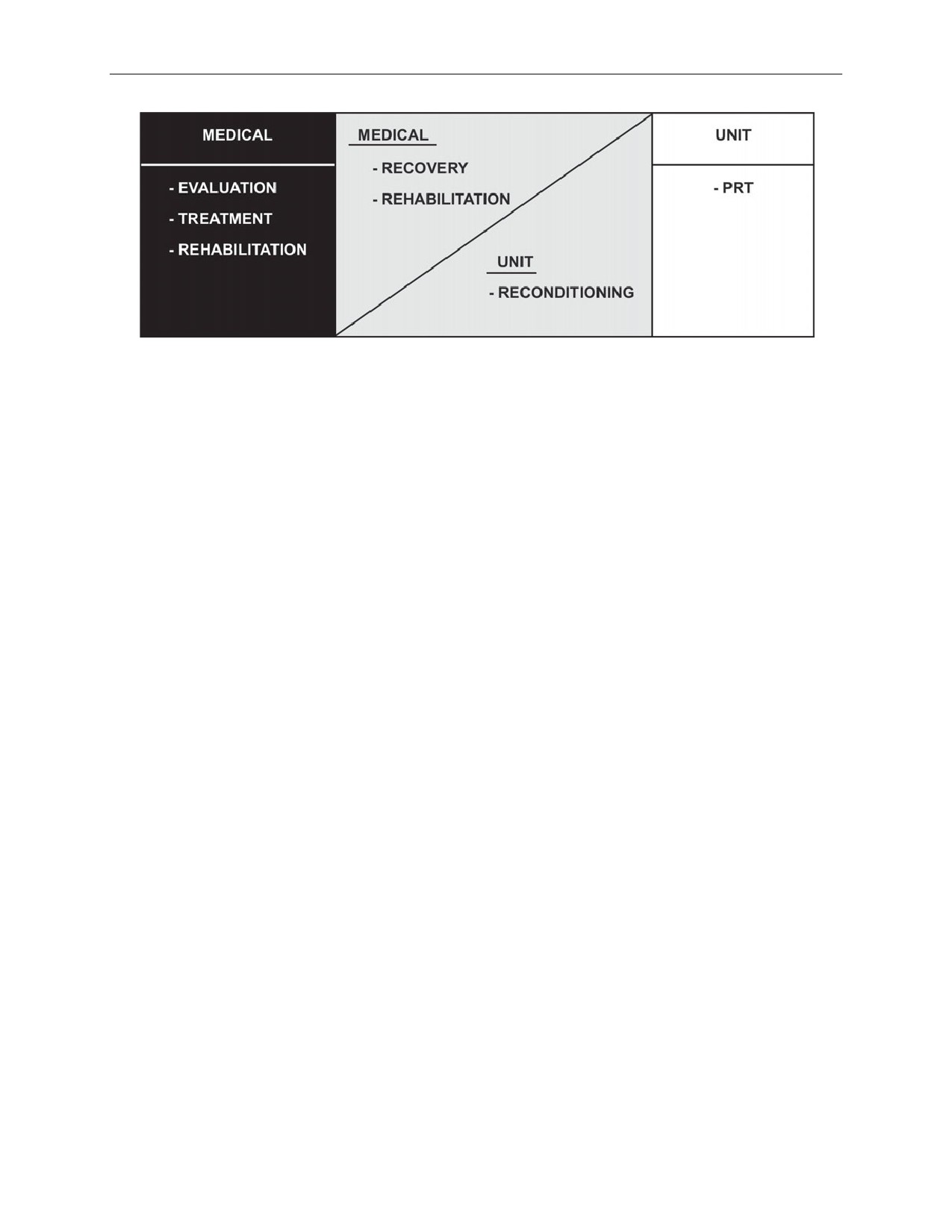
NCOs. Figure 6-4 shows rehabilitation and reconditioning responsibilities.
6-6
FM 7-22
26 October 2012
Special Conditioning Programs
Figure 6-4. Rehabilitation and reconditioning responsibilities
6-29. Trainers for the reconditioning program must possess the same knowledge of the program that the RPL
have and must have additional education in exercise science. For this reason a physical therapist or a physical
therapy assistant is well suited for the role. The following outline should be used when developing training for
this program:
z
STM Orientation
Equipment familiarization: purpose, technique, safety.
Etiquette: observe posted rules, replace all weights and equipment to original positions, and
wipe down all surfaces after use.
z
ETM Orientation
Equipment familiarization: purpose, technique, safety.
Etiquette: observe posted rules, replace equipment to original position, and wipe down all
surfaces after use.
z
Reconditioning Session Orientation
Preparation: increase heart rate, muscle temperature to prepare the body for more vigorous
activity.
Activity: provide neural adaptation and improve strength, endurance, and mobility.
Recovery: gradually return to resting heart rate (below 100 beats per minute) and bring body
safely back to pre-exercise state.
z
Level I (Gym-Based) Reconditioning Objectives
Prevent de-conditioning.
Work within profile limitations.
Restore functional strength, endurance, and mobility.
Avoid injury or re-injury.
Transition to level II reconditioning.
z
Level II Reconditioning Objectives
Progress to pre-injury level of fitness.
Avoid injury or re-injury.
Transition to unit PRT.
PROFILES AND RECOVERY PERIODS
6-30. Soldiers in the reconditioning program will be on a physical profile or in the authorized recovery period
from a temporary profile. Commanders may assign Soldiers with a permanent profile to the reconditioning
program or allow them to remain in unit PRT. Soldiers on convalescence leave may be exempted from
reconditioning at the discretion of the profiling medical officer. In no case can a Soldier carry a temporary
profile that has been extended for more than 12 months without positive action taken to correct the problem or
effect other appropriate disposition according to a military medical review board. Once a profile is lifted, the
Soldier must be given twice the time of the temporary profile (but not more than 90 days) to train for the APFT.
26 October 2012
FM 7-22
6-7
Chapter 6
It is not a requirement to take an APFT after the recovery period if a Soldier is not due to take the semi-annual
test. Refer to AR 350-1 and Appendix A of this FM for APFT policy and procedures. The RPL follows the
medical guidance on the profile for Soldiers on profile. If there are any questions about the limitations of the
profile, the RPL will contact the medical officer for clarification. Once a profile has expired, Soldiers will
remain in the reconditioning program until they have met transition criteria to return to unit PRT activities.
During this period, the RPL/ARPL, and unit reconditioning NCOs will reinforce the precise execution of PRT
activities with each Soldier in small groups or individually. See Figures 6-2 and 6-3 for transition criteria to
move from level I to level II or return to unit PRT.
6-31. Soldiers with permanent profiles that do not allow them to meet all reconditioning exit criteria may return
to unit PRT once they demonstrate proficiency at all non-profiled activities. For example, a Soldier whose
permanent profile only prohibits running would not be in the reconditioning program. Rather, he would do PRT
with the unit and perform all activities except running. The Soldier in this example would walk or use ETMs
when PRT activities call for sustained or speed running. When a permanent profile is so restrictive that the
Soldier is unable to perform several PRT activities, the commander may direct the Soldier to the reconditioning
program. This scenario is more likely to occur with Soldiers who are awaiting medical boarding procedures. For
less clearly defined cases, the commander can solicit input from the battalion medical officer or brigade
surgeon.
EXERCISE PROGRESSION
6-32. Progressing injured Soldiers to a “return-to-duty” level of fitness is the goal of any reconditioning
program. There are two possible pitfalls to exercise progression. First, if the exercise progression is too rapid it
may aggravate the injury, resulting in a further delay to recovery. Second, if the exercise progression is too slow
it risks general deconditioning and a loss of effectiveness when returned to duty. A gap between recovery
fitness and unit expectations may also cause undue physical and psychological stress. To assist the RPL/ARPL
in decisionmaking regarding exercise progression, the following recommendations are made:
z
Soldiers on profile will have specific limitations as defined by their DD Form 689 or DA Form 3349.
These limits will be strictly adhered to.
z
Communication with the profile writer is encouraged if a Soldier is clearly improving faster than
written limits allow. There may be a reason that is not obvious for the slow progression. If there is no
clear reason to limit the progression, instruct the Soldier to get a new profile that reflects
communication with the health care provider. A written request is preferable to relying on the
individual’s memory for this.
z
Limitations that are in place for a given injury may not affect other areas. A case of tendonitis in the
right shoulder should not affect the ability to do leg presses or ride a stationary cycle. Get a clear
understanding from the Soldier of what they can and cannot do. Do not read between the lines of the
profile. Once again, contact the profile writer if clarification is needed.
z
Maintain an exercise workout log to track progress of each individual who will require more than
two weeks of gym reconditioning. When a profile expires, work with unit leaders to ensure the
recovery period is used for reconditioning until the Soldier can meet the criteria to re-enter unit PRT.
LEVEL I RECONDITIONING DRILLS AND ACTIVITIES
6-33. The exercise schedule shown in Table 6-1 provides guidance for conducting level I reconditioning. This
schedule of activities will ensure safe reconditioning of Soldiers during the profile period. The physical profile
of a medical officer supersedes the following:
z
The RPL briefs the profiled Soldier concerning which exercises are restricted and which they are to
perform. The Soldier is also briefed on the use of ETMs (walking and swimming may also be
appropriate).
z
As the Soldier improves and profiling limitations are removed, the Soldier may be transitioned into
level II of the reconditioning program when transition criteria is met.
6-8
FM 7-22
26 October 2012
Special Conditioning Programs
Table 6-1. Reconditioning Level I training schedule
MON
TUE
WED
THU
FRI
PREPARATION: PD
PREPARATION: PD
PREPARATION: PD
PREPARATION: PD
PREPARATION: PD
ETM 5 MIN
ETM 5 MIN
ETM 5 MIN
ETM 5 MIN
ETM 5 MIN
ACTIVITIES:
ACTIVITIES:
ACTIVITIES:
ACTIVITIES
ACTIVITIES:
HIP STABILITY DRILL
HIP STABILITY DRILL
HIP STABILITY DRILL
HIP STABILITY DRILL
HIP STABILITY DRILL
4 FOR THE CORE
4 FOR THE CORE
4 FOR THE CORE
4 FOR THE CORE
4 FOR THE CORE
ETM 20-30 MIN
STM 1 (1-3 SETS@10
ETM 20-30 MIN
STM 1 (1-3 SETS@10
ETM 20-30 MIN
REPS)
REPS)
RECOVERY: RD
RECOVERY: RD
RECOVERY: RD
HOLD EACH
RECOVERY:RD
HOLD EACH
RECOVERY: RD
HOLD EACH
STRETCH
HOLD EACH
STRETCH FOR 20-30
HOLD EACH
STRETCH FOR 20-30
FOR 20-30 SECONDS
STRETCH FOR 20-30
SECONDS
STRETCH FOR 20-30
SECONDS
SECONDS
SECONDS
6-34. Before transition to level II, the RPL/ARPL ensures that the Soldier meets the criteria in Figure 6-2. If the
Soldier cannot meet the transition criteria, he should be directed to the medical officer for re-evaluation.
6-35. Before releasing the Soldier back to unit PRT, the RPL/ARPL ensures the Soldier meets the criteria in
Figure 6-3. If the Soldier does not meet these criteria before the recovery period ends, the RPL/ARPL will
consult with the battalion medical officer to determine a proper disposition.
EQUIPMENT
6-36. When using equipment, endurance training includes four primary variables: exercise mode, training
frequency, exercise duration, and training intensity. Exercise prescription specifies training frequency, exercise
duration, and training intensity. The mode of exercise (type of equipment) is determined by environmental
constraints and training according to physical profile limitations (temporary/permanent). Each ETM and STM
contains specific instructions for proper use and adjustments to obtain optimal posture and technique during
exercise (seat position on cycle ergometers, rowing machines, and STMs). If a piece of training equipment has
no visible list of operating instructions, the RPL, ARPL, or gym personnel should be consulted for assistance.
EXERCISE MODE
6-37. Exercise mode refers to the specific activity performed by a Soldier: running, cycling, swimming,
strength training, and endurance training equipment. Environmental constraints, safety for Soldiers on physical
profile, and isolation of specific muscle groups to be trained during rehabilitation and reconditioning are some
of the advantages of using STMs and ETMs. Consideration for use of specific types of equipment may be based
on a Soldier’s range of movement, limb limitation and/or the ability to participate in weight-bearing or non-
weight-bearing activities. Weight-bearing activities include walking or running on a treadmill and climbing on a
stair climbing or stepping machine. Non-weight bearing and limited weight-bearing activities include use of
cycle ergometers (upright/recumbent), elliptical trainers, rowers, climbing machines, and cross-country ski
machines. Use of limited or non-weight-bearing endurance training equipment is desirable for obtaining higher
caloric expenditure through additional training sessions by overweight Soldiers. Each of these modes typically
provide the Soldier with a variety of individual exercise routines that monitor and display exercise duration,
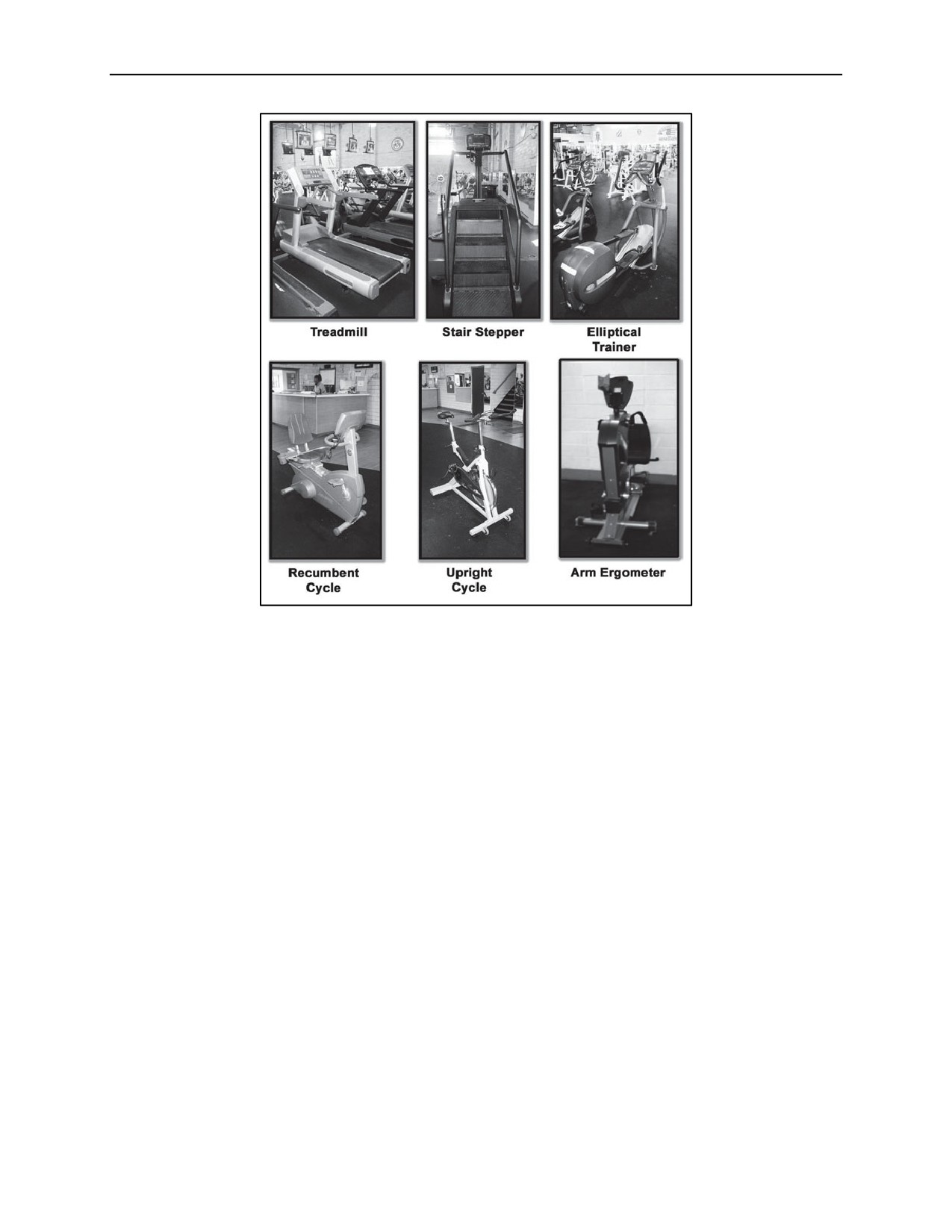
training intensity (heart rate/pace/watts, caloric expenditure, and distance completed miles/km). See Figure 6-5
for examples of various types of endurance training equipment. Use of STMs not only improves strength, but
also builds muscle mass for higher caloric expenditure and stability for rehabilitation and reconditioning of the
injured body part.
26 October 2012
FM 7-22
6-9
Chapter 6
Figure 6-5. Endurance training equipment
TRAINING FREQUENCY
6-38. Training frequency refers to the number of training sessions conducted per day or week. Training
frequency is determined by exercise duration and training intensity. Training sessions that involve high intensity
or longer duration may necessitate less frequent training to allow for adequate recovery. Endurance and
mobility, as well as strength and mobility training frequency, is three exercise sessions per week for each, for a
total of six reconditioning PRT sessions. If five days of training occur, then three days are dedicated to
endurance and mobility and two days are dedicated to strength and mobility for one week. The following week
will consist of three days of strength and mobility and two days of endurance and mobility training.
EXERCISE DURATION
6-39. Exercise duration is 20 minutes or longer and varies from machine to machine, depending on the intensity
of the exercise routine being performed (hill profile, speed, degree of incline, resistance). Most exercise
sessions of high or moderate intensity should last 20 to 30 minutes. Endurance exercise sessions that address
additional caloric expenditure for body fat reduction should be of low intensity and may last up to 60 minutes.
The duration for STM exercise is 1-3 sets of 10 repetitions of each exercise for each major muscle group. Refer
to the STM drill later in this chapter for specific instructions on the conduct of each exercise.
TRAINING INTENSITY
6-40. Training intensity is typically monitored and displayed on the exercise equipment control panel in terms
of heart rate, pace (mph/kph, step rate), watts, kiloponds, caloric expenditure (kcals), or resistance for ETMs
and weight lifted (number of plates, pin placement, pounds, or kilograms) for STMs.
6-10
FM 7-22
26 October 2012
Special Conditioning Programs
STABILITY TRAINING
6-41. Stability is dependent upon structural strength and body management. Regular precise performance of 4C
and the HSD form a foundation of good stability for physical performance. These drills are listed in detail
throughout the following pages in this chapter.
4 FOR THE CORE
6-42. The abdomen, lower spine, and pelvis comprise the trunk (core) of the body. This area must be stable so
the limbs have a fixed base from which to create powerful movements. The abdominal and back muscles form a
supportive ring around the spine. Soldiers are only as strong as their weakest link; so all these muscles must be
trained in a manner that mimics their function. In reconditioning, 4C and HSD are performed daily before
engaging in other PRT activities. During the toughening phase, 4C is performed after preparation and prior to
strength and mobility activities. Four for the core may also be performed outside regular PRT sessions as
supplemental training. Do not exceed 60 seconds for each 4C exercise. The following commands are used for
4C exercises.
6-43. Exercises 1 and 3 (bent leg raise and back bridge):
z
Starting Position, MOVE.
z
Ready, EXERCISE.
z
Starting Position, MOVE.
z
Position of Attention, MOVE.
6-44. Exercises 2 and 4 (side bridge and quadraplex) are both performed on the right and left sides. The
commands for execution for this exercise and changing sides are as follows:
z
Starting Position, MOVE.
z
Ready, EXERCISE.
z
Starting Position, MOVE.
z
Change Position, Ready EXERCISE.
z
Starting Position, MOVE.
z
Position of Attention, MOVE.
6-45. The goal is to hold each exercise position for 60 seconds. If the Soldier is unable to do this, he will follow
the instructions for each exercise to momentarily change position and return to the prescribed exercise position.
Detailed descriptions of each 4C exercise follows.
26 October 2012
FM 7-22
6-11
Chapter 6
4 FOR THE CORE
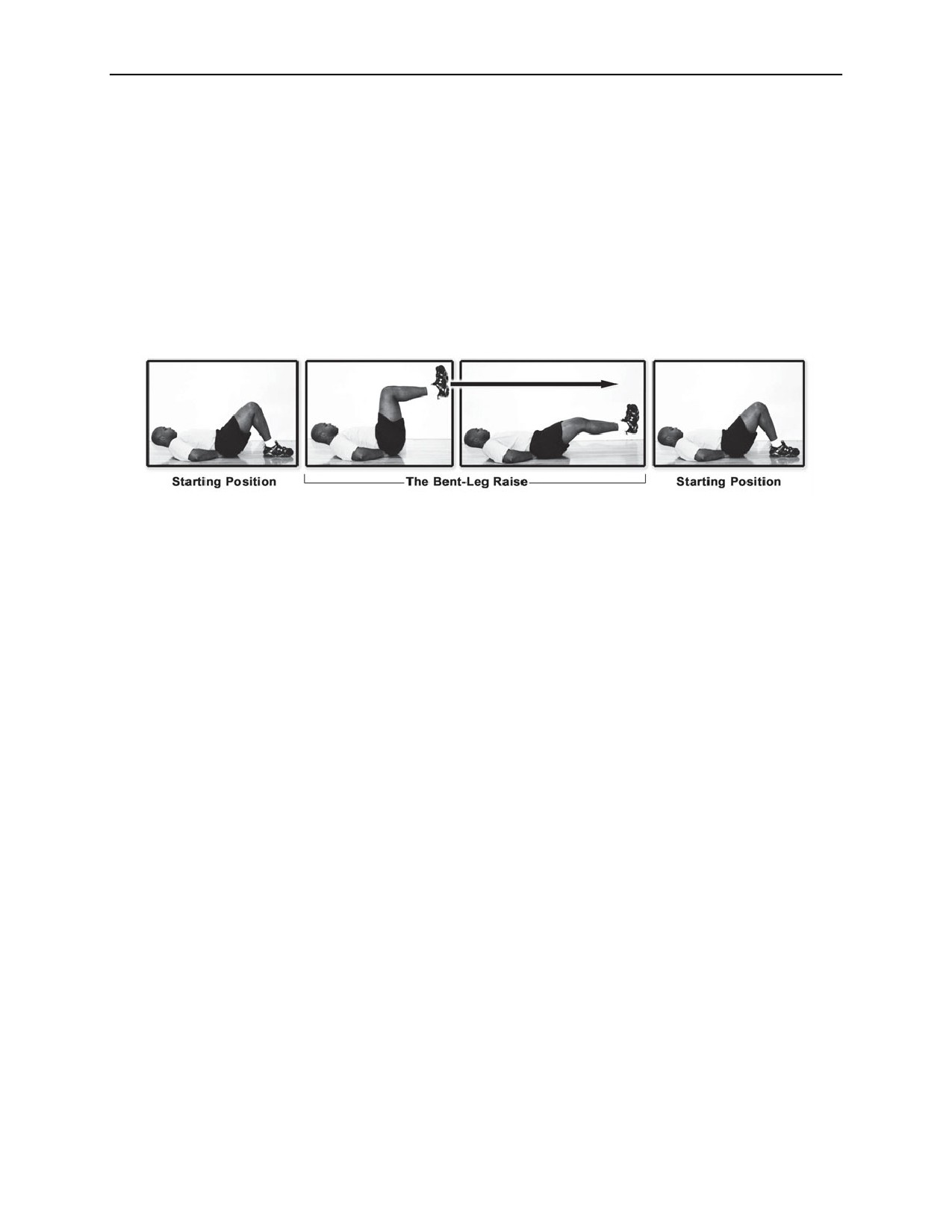
EXERCISE 1: BENT-LEG RAISE
6-46. Lying in the starting position for the sit-up, place the fingers of both hands underneath the small of the
back. Raise the feet off of the ground until both the hips and knees flex to 90 degrees. Holding the head two or
three inches off the ground, contract the abdominals as if preparing for a blow to the stomach. Another way to
perform this drawing in maneuver is to imagine pulling the navel toward the spine. Think about the amount of
pressure on the fingers created by the contraction of the abdominals. Maintain the same degree of pressure
while slowly straightening the legs. As soon as the Soldier can no longer maintain the same degree of pressure
on his fingers, he brings his legs back to the 90-degree position for three to five seconds, and repeats until one
minute has elapsed (Figure 6-6).
Figure 6-6. Bent-leg raise (4 for the core)
6-12
FM 7-22
26 October 2012
Special Conditioning Programs
4 FOR THE CORE
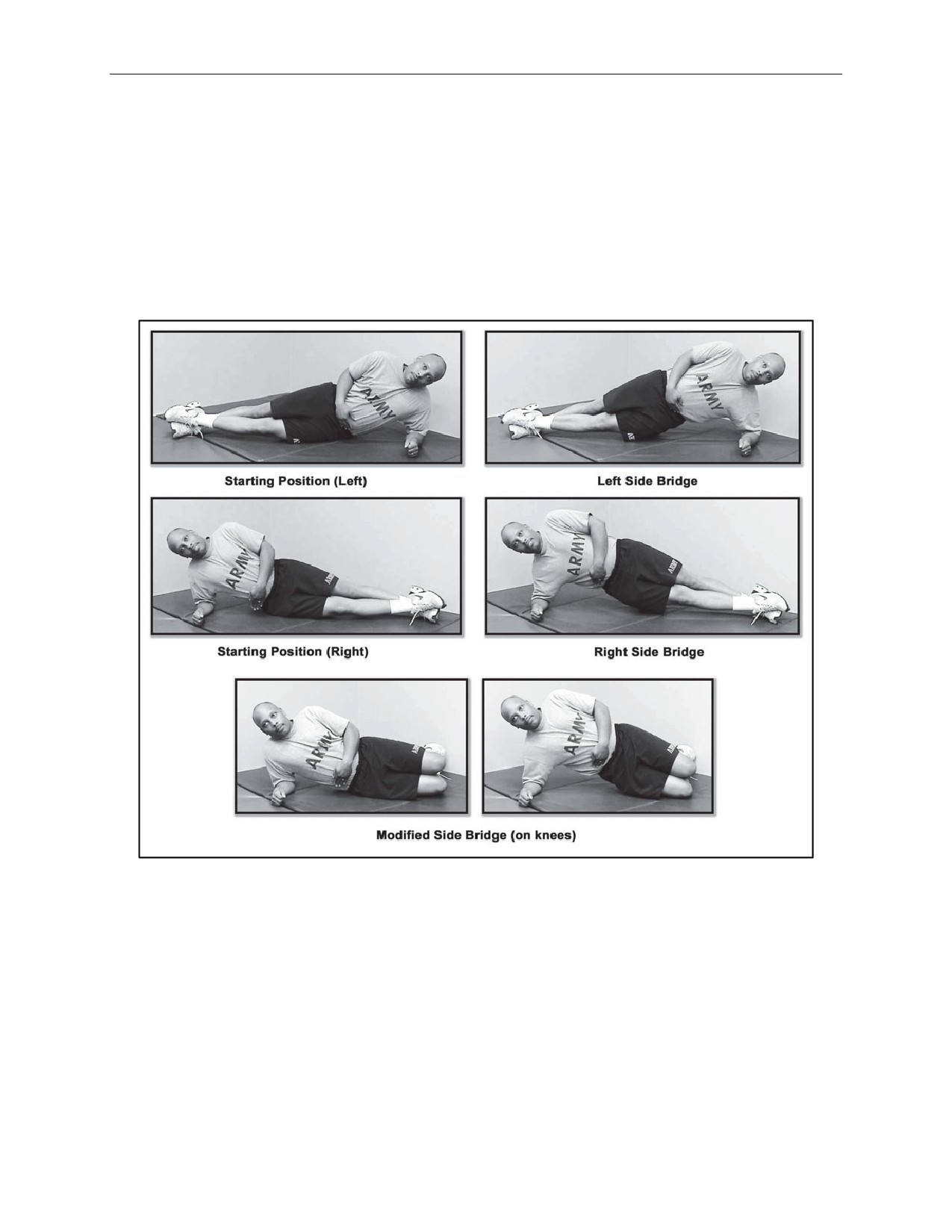
EXERCISE 2: SIDE BRIDGE
6-47. Lay on either side with the upper body off the ground, supported by the elbow, forearm, and fist. Cross
the bottom leg in front of the top leg, keeping the feet together. The legs may also be positioned with the knees
together and bent 90 degrees. Firmly press into the ground with the supporting arm, and then raise the trunk and
pelvis straight upward until they form a straight line with the legs and knees. Hold this position while
continuing to breathe. Switch to the other side after one minute. If he cannot hold for one minute, lower, rest
briefly, then repeat until one minute has elapsed (Figure 6-7).
Figure 6-7. Side bridge
26 October 2012
FM 7-22
6-13
Chapter 6
4 FOR THE CORE
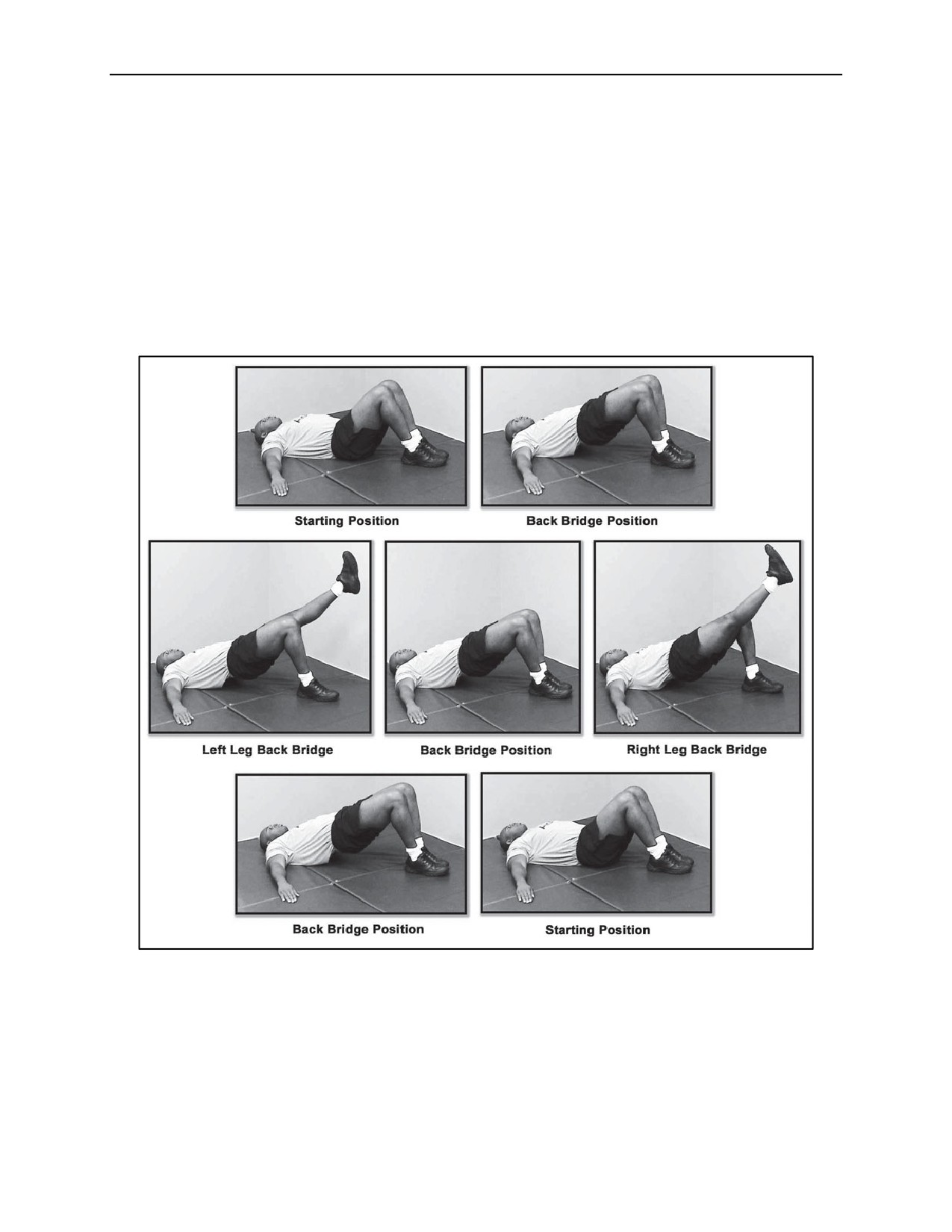
EXERCISE 3: BACK BRIDGE
6-48. Lying on the back with knees bent at 90 degrees, arms extended sideward at 45 degrees, with head and
feet on the marching surface, perform the drawing-in maneuver. Once the abdominal contraction is established,
raise the hips off of the ground until the trunk and thighs form a generally straight line. The spine must not arch
to achieve this position. With the buttocks still up, straighten the left leg until it aligns with the trunk and thigh.
Don’t let the trunk and pelvis sag on the unsupported side. Hold five seconds, and then switch to the other leg.
Repeat for one minute. If the spine begins to sag, arch, or tilt, lower to the starting position, rest for 3 to 5
seconds, then, try again (Figure 6-8). The goal is to maintain the back bridge position for 60 seconds alternating
leg raises as needed.
Figure 6-8. Back bridge
6-14
FM 7-22
26 October 2012
Special Conditioning Programs
4 FOR THE CORE
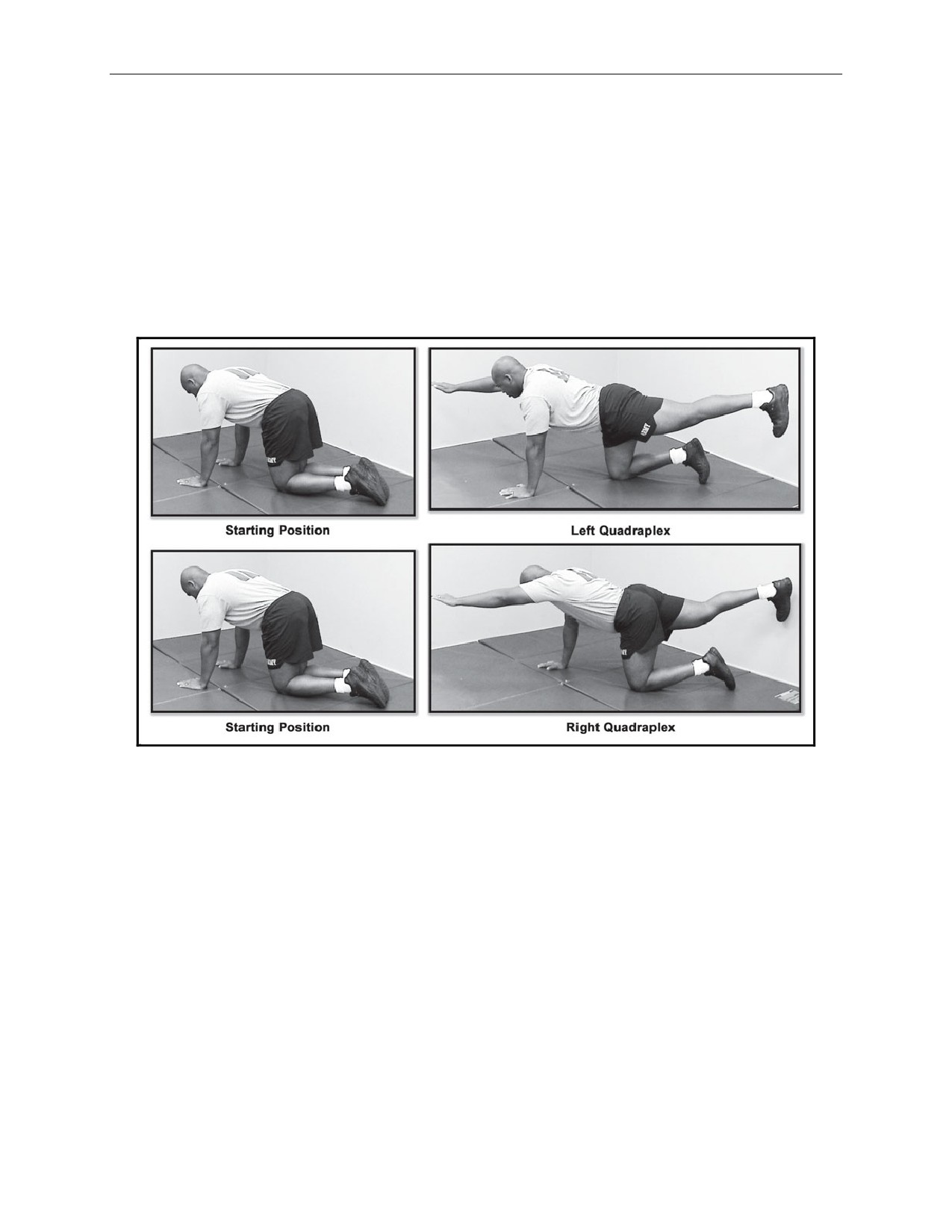
EXERCISE 4: QUADRAPLEX
6-49. The starting position is on the hands and knees with the back flat. Contract the abdominal muscles as
described in the bent-leg raise. Without rotating the trunk or sagging or arching the spine, straighten the left leg
to the rear and the right arm to the front. Hold for at least 5 seconds, recover to the starting position if needed,
then return to the quadraplex. The goal is to hold each quadraplex position (left and right) for 60 seconds each.
Alternate the arm and leg movements on subsequent repetitions, repeating for one minute. The key to this
exercise is controlled lowering and raising of the opposite arm and leg while keeping the rest of the body
aligned and still (Figure 6-9).
Figure 6-9. Quadraplex
26 October 2012
FM 7-22
6-15
Chapter 6
HIP STABILITY DRILL
6-50. The HSD, like 4C, trains the hip and upper thigh areas three-dimensionally, developing the basic strength
and mobility needed for stability to perform functional movements. In reconditioning, the HSD is performed
daily immediately after 4C and before engaging in other PRT activities. During the toughening phase, the HSD
is performed after preparation and prior to endurance and mobility activities. The HSD may also be performed
outside regular PRT sessions as supplemental training. In the HSD, perform no more than 10 repetitions of
exercises 1 through 4 and do not exceed 30 seconds for each exercise position in exercise 5. If more repetitions
are desired, repeat the entire drill.
HIP STABILITY DRILL
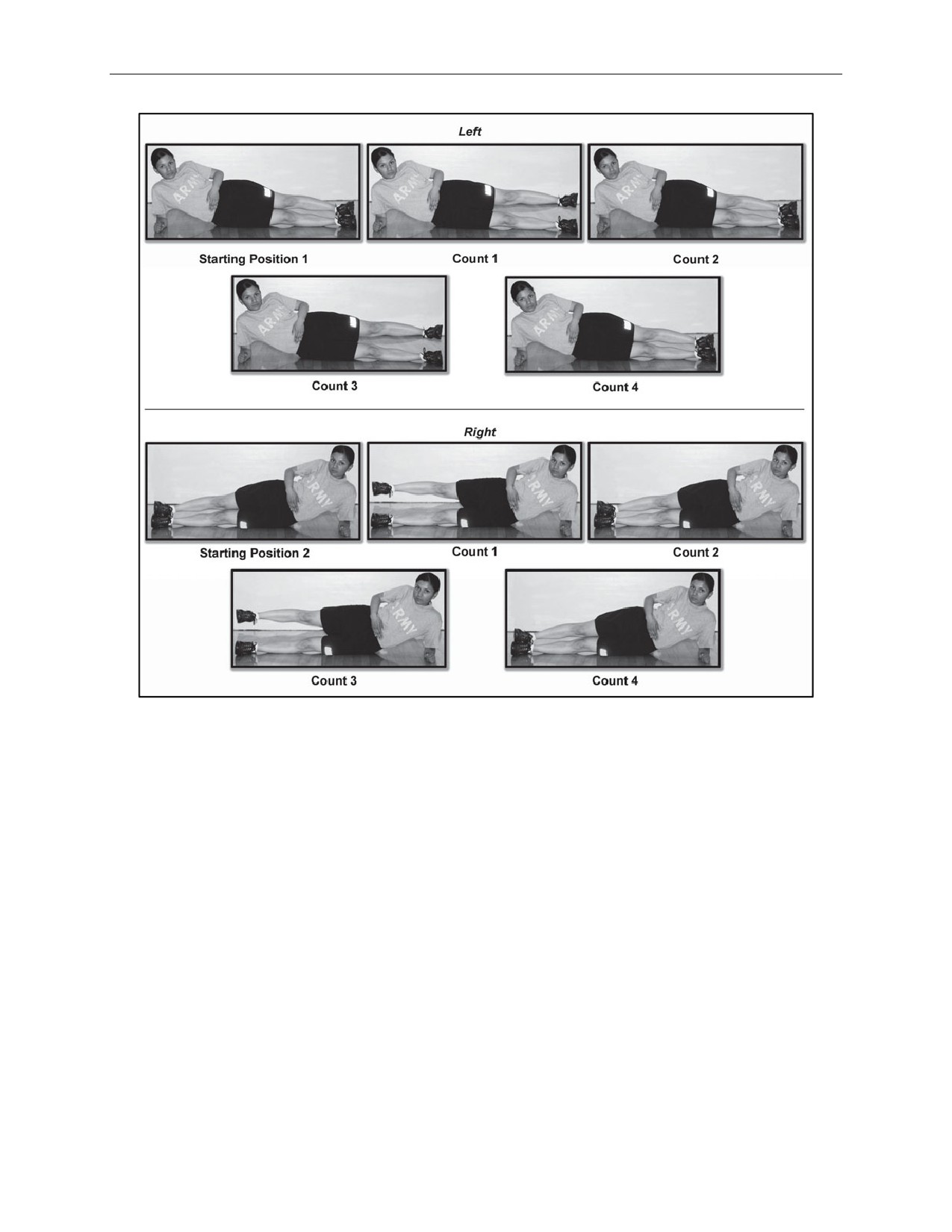
EXERCISE 1: LATERAL LEG RAISE
(5 repetitions on each side)
Purpose: This exercise strengthens lateral hip and upper leg muscles (Figure 6-10).
Starting Position 1: Lay on the right side with the legs extended straight to the side and feet together with toes
pointing straight ahead. Support the upper body with the right elbow. The elbow is bent at 90 degrees, the upper
arm is perpendicular to the ground and the right hand makes a fist vertical to the ground.
Starting Position 2: Lay on the left side with the legs extended straight to the side and feet together with toes
pointing straight ahead. Support the upper body with the left elbow. The elbow is bent at 90 degrees, the upper
arm is perpendicular to the ground and the left hand makes a fist vertical to the ground.
Commands: The commands for the lateral leg raise are as follows:
z
Starting Position, MOVE.
z
In Cadence, EXERCISE (count as a 4-count exercise according to Chapter 7, Execution of Training,
paragraph 7-29).
z
Change Position, MOVE.
z
In Cadence, EXERCISE (count as a 4-count exercise according to Chapter 7, Execution of Training,
paragraph 7-29).
z
Position of Attention, MOVE.
Cadence: SLOW
Count:
1. Raise the top leg so the top foot is 6 to 8 inches above the ground.
2. Return to the starting position.
3. Raise the top leg so the top foot is 6 to 8 inches above the ground.
4. Return to the starting position.
6-16
FM 7-22
26 October 2012
Special Conditioning Programs
Figure 6-10. Lateral leg raise
Check Points:
z
Face to the front of the formation, maintaining a generally straight line with the body.
z
On counts 1 and 3, keep the knee of the raised leg straight and the foot pointing forward. The top leg
raises no more than 6-8 inches above the ground.
z
Place the top hand over the stomach throughout the exercise.
Precaution: N/A
26 October 2012
FM 7-22
6-17
Chapter 6
HIP STABILITY DRILL
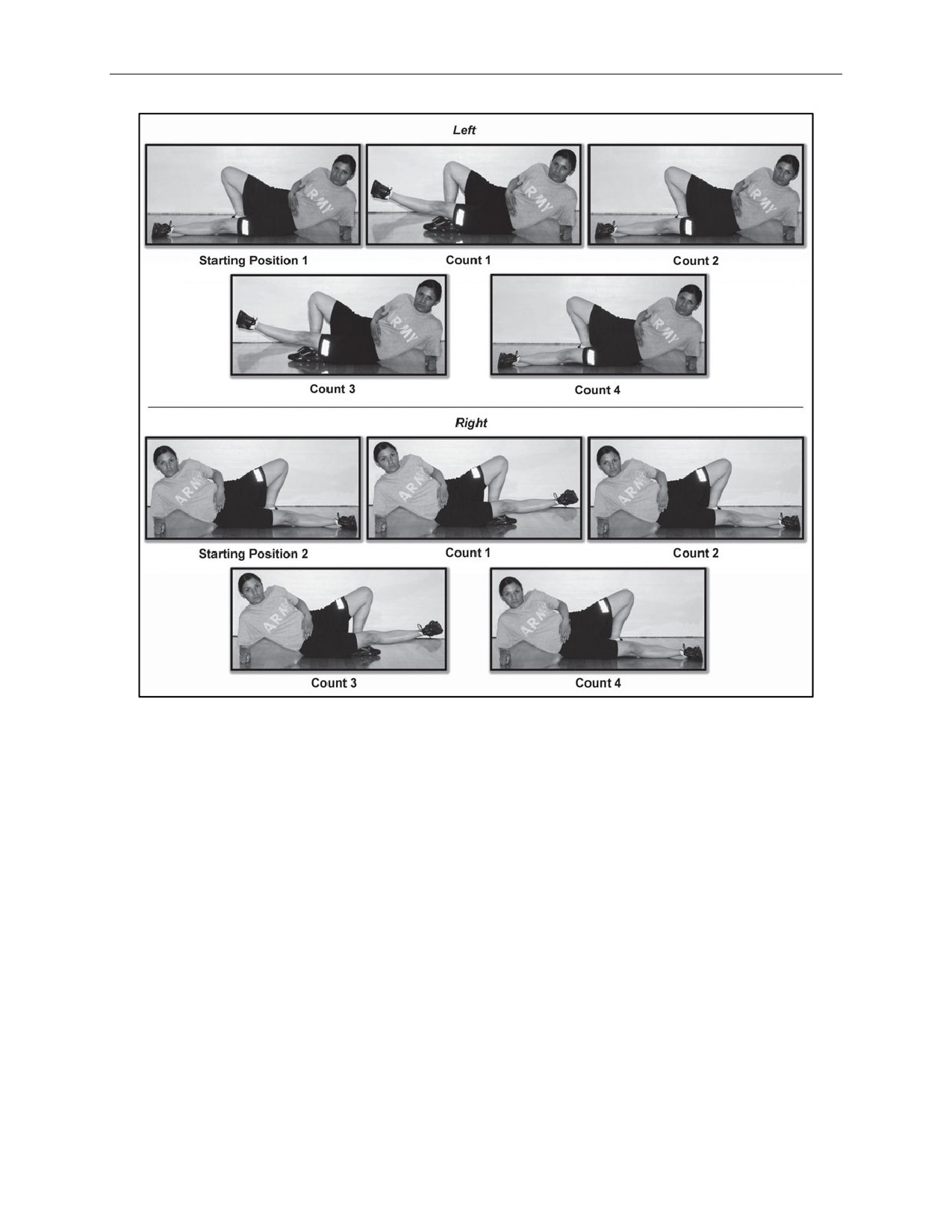
EXERCISE 2: MEDIAL LEG RAISE
(5 repetitions on each side)
Purpose: This exercise strengthens the inner thigh and hip muscles (Figure 6-11).
Starting Position 1: Lay on the left side with the left leg extended straight to the side and the right leg bent at 90
degrees with the right foot flat on the ground behind the left leg. Support the upper body with the left elbow. The
elbow is bent at 90 degrees, the upper arm is perpendicular to the ground and the left hand makes a fist vertical to
the ground.
Starting Position 2: Lay on the right side with the right leg extended straight to the side and the left leg bent at 90
degrees with the left foot flat on the ground behind the right leg. Support the upper body with the right elbow. The
elbow is bent at 90 degrees, the upper arm is perpendicular to the ground and the right hand makes a fist vertical to
the ground.
Commands: The commands for the lateral leg raise are as follows:
z
Starting Position, MOVE.
z
In Cadence, EXERCISE (count as a 4-count exercise according to Chapter 7, Execution of Training,
paragraph 7-29).
z
Change Position, MOVE.
z
In Cadence, EXERCISE (count as a 4-count exercise according to Chapter 7, Execution of Training,
paragraph 7-29).
z
Position of Attention, MOVE.
Cadence: SLOW
Count:
1. Raise the bottom leg so the bottom foot is 6-8 inches above the ground.
2. Return to the starting position.
3. Raise the bottom leg so the bottom foot is 6-8 inches above the ground.
4. Return to the starting position.
6-18
FM 7-22
26 October 2012
Special Conditioning Programs
Figure 6-11. Medial leg raise
Check Points:
z
Keep the hips facing forward and the body in a generally straight line.
z
Keep the toes facing forward on the bottom leg.
z
Place the top hand over the stomach throughout the exercise.
z
Do not raise the bottom foot higher than 6-8 inches above the ground.
Precaution: N/A
26 October 2012
FM 7-22
6-19
Chapter 6
HIP STABILITY DRILL
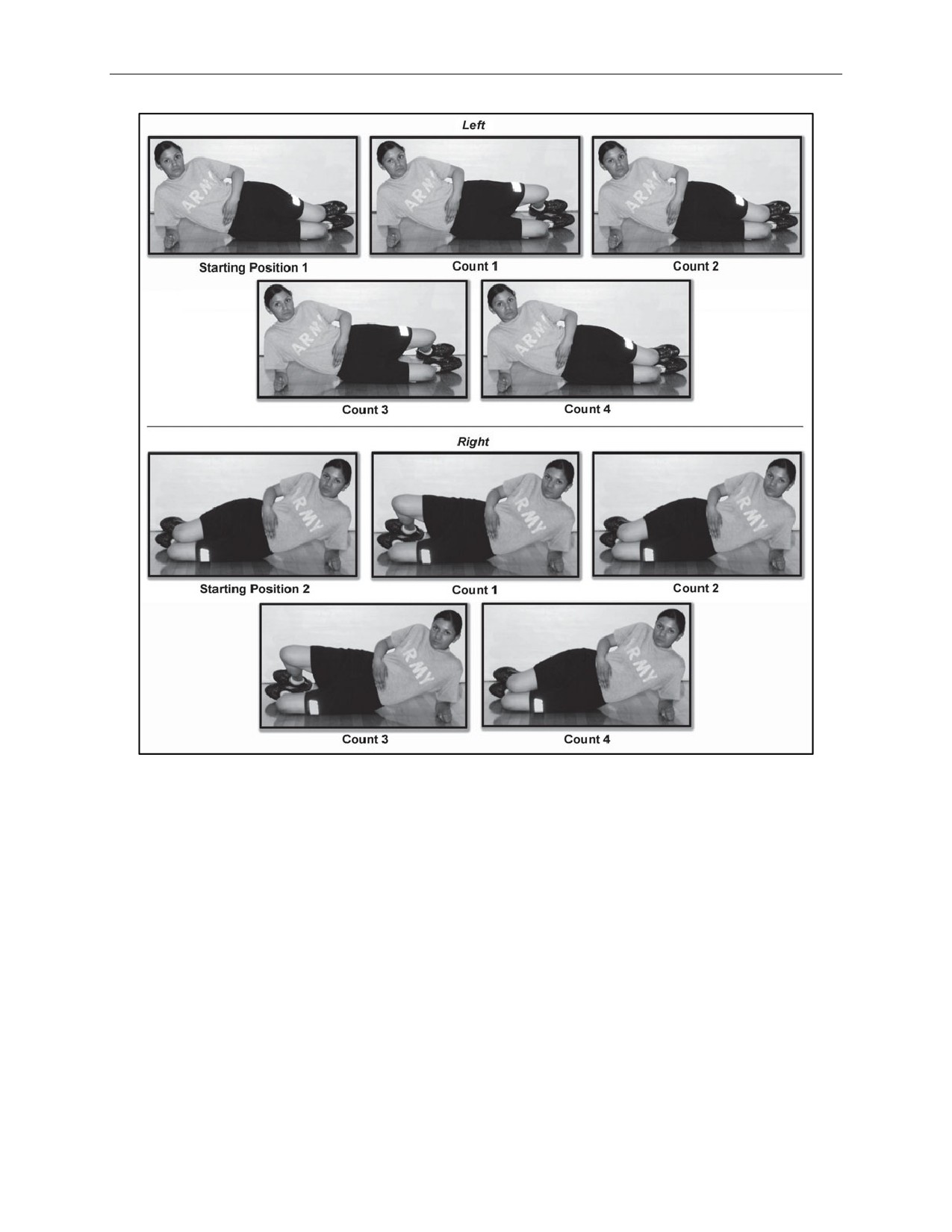
EXERCISE 3: BENT-LEG LATERAL RAISE
(5 repetitions on each side)
Purpose: This exercise strengthens hip rotator muscles (Figure 6-12).
Starting Position 1: Lay on the right side with the legs bent at 90 degrees and feet together with toes pointing
straight ahead. Support the upper body with the right elbow. The elbow is bent at 90 degrees, the upper arm is
perpendicular to the ground and the right hand makes a fist vertical to the ground.
Starting Position 2: Lay on the left side with the legs bent at 90 degrees and feet together with toes pointing straight
ahead. Support the upper body with the left elbow. The elbow is bent at 90 degrees, the upper arm is perpendicular
to the ground, and the left hand makes a fist vertical to the ground.
Commands: The commands for the lateral leg raise are as follows:
z
Starting Position, MOVE.
z
In Cadence, EXERCISE (count as a 4-count exercise according to Chapter 7, Execution of Training,
paragraph 7-29).
z
Change Position, MOVE.
z
In Cadence, EXERCISE (count as a 4-count exercise according to Chapter 7, Execution of Training,
paragraph 7-29).
z
Position of Attention, MOVE.
Cadence: SLOW
Count:
1. Raise the top leg about 12 inches above the ground, keeping the feet together.
2. Return to the starting position.
3. Raise the top leg about 12 inches above the ground, keeping the feet together.
4. Return to the starting position.
6-20
FM 7-22
26 October 2012
Special Conditioning Programs
Figure 6-12. Bent-leg lateral raise (hip stability drill)
Check Points:
z
Face to the front of the formation, maintaining a generally straight line with the body, from the knees
to the torso.
z
Keep the feet together throughout the exercise.
z
Place the top hand over the stomach throughout the exercise.
Precaution: N/A
26 October 2012
FM 7-22
6-21
Chapter 6
HIP STABILITY DRILL
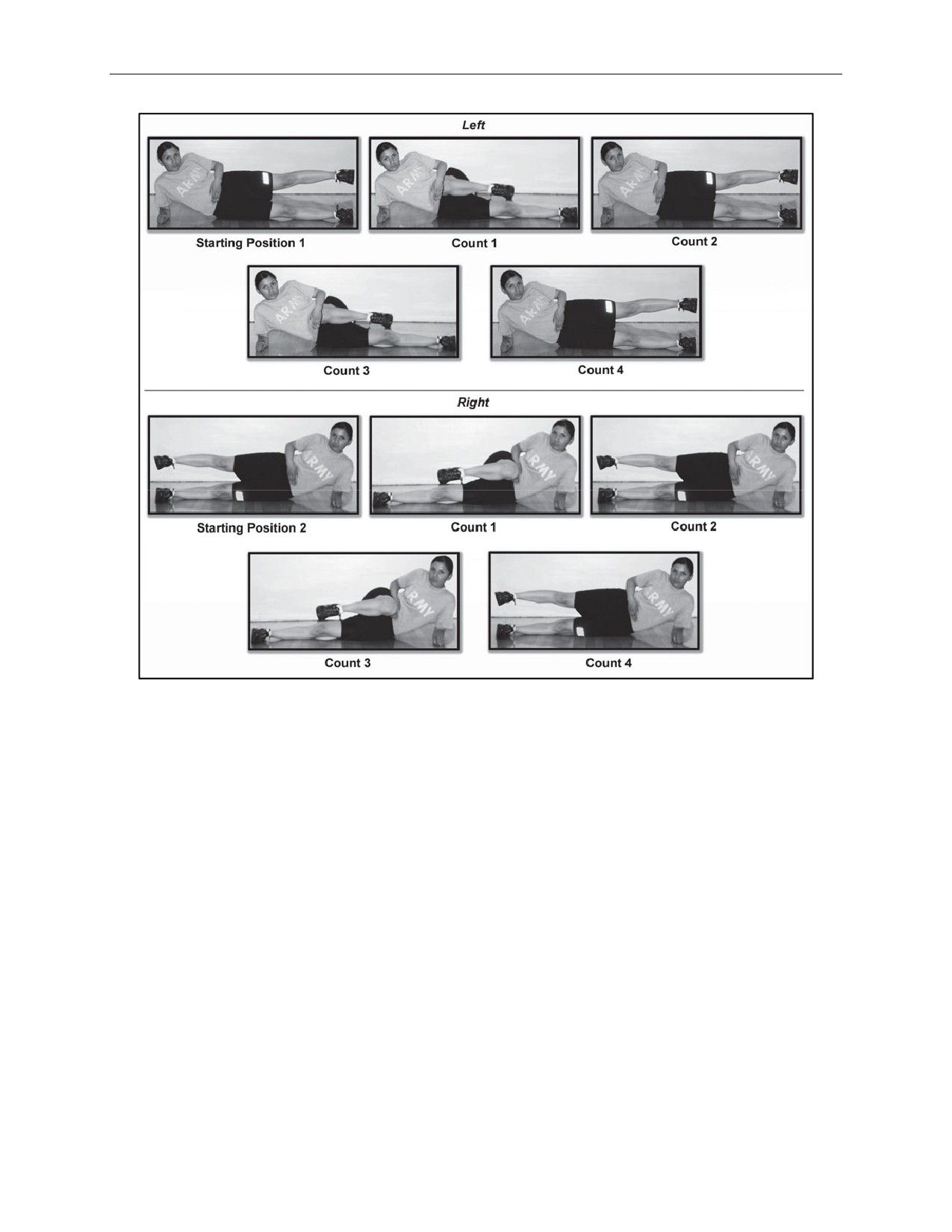
EXERCISE 4: SINGLE-LEG TUCK
(5 repetitions on each side)
Purpose: This exercise strengthens the hip flexors, lateral hip, and upper leg muscles (Figure 6-13).
Starting Position 1: Lay on the right side with the legs extended straight to the side, with the left leg 6 to 8 inches
above the ground, and toes pointing straight ahead. Support the upper body with the right elbow. The elbow is bent
at 90 degrees, the upper arm is perpendicular to the ground, and the right hand makes a fist vertical to the ground.
Starting Position 2: Lay on the left side with the legs extended straight to the side with the right leg 6 to 8 inches
above the ground and toes pointing straight ahead. Support the upper body with the left elbow. The elbow is bent at
90 degrees, the upper arm is perpendicular to the ground, and the left hand makes a fist vertical to the ground.
Commands: The commands for the lateral leg raise are as follows:
z
Starting Position, MOVE.
z
In Cadence, EXERCISE(count as a 4-count exercise according to Chapter 7, Execution of Training,
paragraph 7-29) .
z
Change Position, MOVE.
z
In Cadence, EXERCISE (count as a 4-count exercise according to Chapter 7, Execution of Training,
paragraph 7-29).
z
Position of Attention, MOVE.
Cadence: SLOW
Count:
1. Bring the thigh of the top leg toward the chest, bending the knee at 90-degrees.
2. Return to the starting position.
3. Bring the thigh of the top leg toward the chest, bending the knee at 90-degrees.
4. Return to the starting position.
6-22
FM 7-22
26 October 2012
Special Conditioning Programs
Figure 6-13. Single-leg tuck
Check Points:
z
Face to the front of the formation, maintaining a generally straight line with the body.
z
The top foot remains 6-8 inches above the ground throughout the exercise.
z
Place the top hand over the stomach throughout the exercise.
Precaution: N/A
26 October 2012
FM 7-22
6-23
Chapter 6
HIP STABILITY DRILL
EXERCISE 5: SINGLE-LEG OVER
(20-30 seconds on each side)
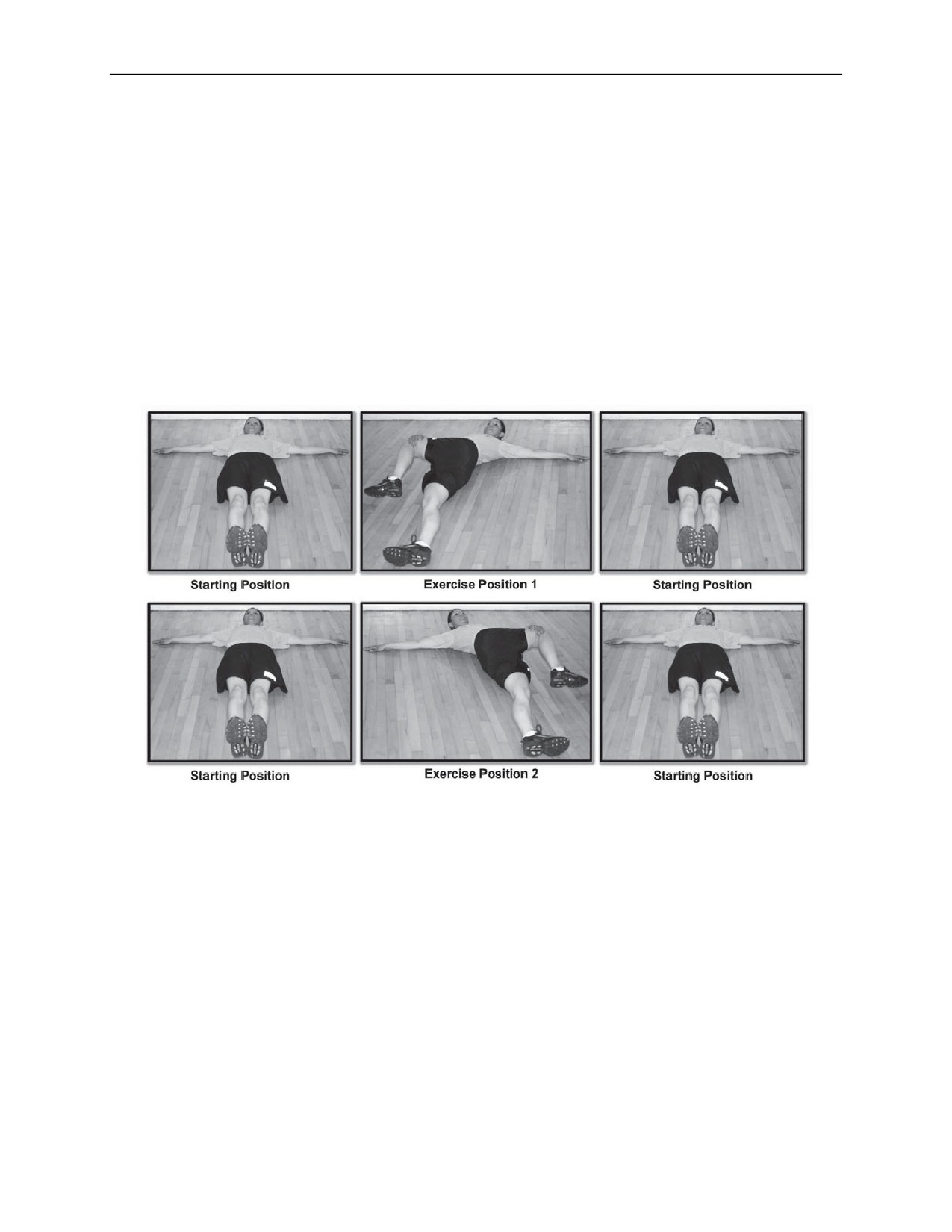
Purpose: This exercise develops flexibility of the hips and lower back muscles (Figure 6-14).
Starting Position 1: Supine position with arms sideward, palms down, and head on the ground.
Movement: On the command, “Ready, STRETCH,” turn the body to right, bend the left knee to 90 degrees over the
right leg, grasp the outside of the left knee with the right hand, and pull toward the right. Hold this position for 20-30
seconds. On the command, “Starting Position, MOVE,” assume the starting position. On the command, “Change
Position, Ready, STRETCH,” turn the body to left, bend the right knee to 90-degrees over the left leg and grasp the
outside of the right knee with the left hand and pull toward the left. Hold this position for 20-30 seconds. On the
command, “Starting Position, MOVE,” assume the starting position.
Figure 6-14. Single-leg over
Check Points:
z
At the starting position, the arms are directed to the sides at 90-degrees to the trunk; the fingers and
thumbs are extended and joined.
z
In Exercise Position 1, keep the left shoulder, arm, and hand on the ground.
z
In Exercise Position 2, keep the right shoulder, arm, and hand on the ground.
z
Head remains on the ground throughout the exercise.
Precaution: N/A
6-24
FM 7-22
26 October 2012
Special Conditioning Programs
SHOULDER STABILITY DRILL
6-51. The shoulder stability drill (SSD), Figure 6-2, is designed to develop strength and stability of the
shoulders. This drill consists of five, 4-count exercises performed at a SLOW cadence for five repetitions each.
The SSD may be performed between preparation, strength, and mobility activities along with 4C and the HSD
to better prepare Soldiers in the toughening phase for the rigors of conditioning, climbing, push-up and sit-up
drills, and the STC. Soldiers recovering from shoulder injuries may perform exercises in this drill as part of
rehabilitation and reconditioning according to their medical profile.
Table 6-2. Shoulder stability drill (SSD)
1. “I” raise
5 repetitions
SLOW cadence
2. “T” raise
5 repetitions
SLOW cadence
3: “Y” raise
5 repetitions
SLOW cadence
4. “L” raise
5 repetitions
SLOW cadence
5. “W” raise
5 repetitions
SLOW cadence
26 October 2012
FM 7-22
6-25
Chapter 6
SHOULDER STABILITY DRILL
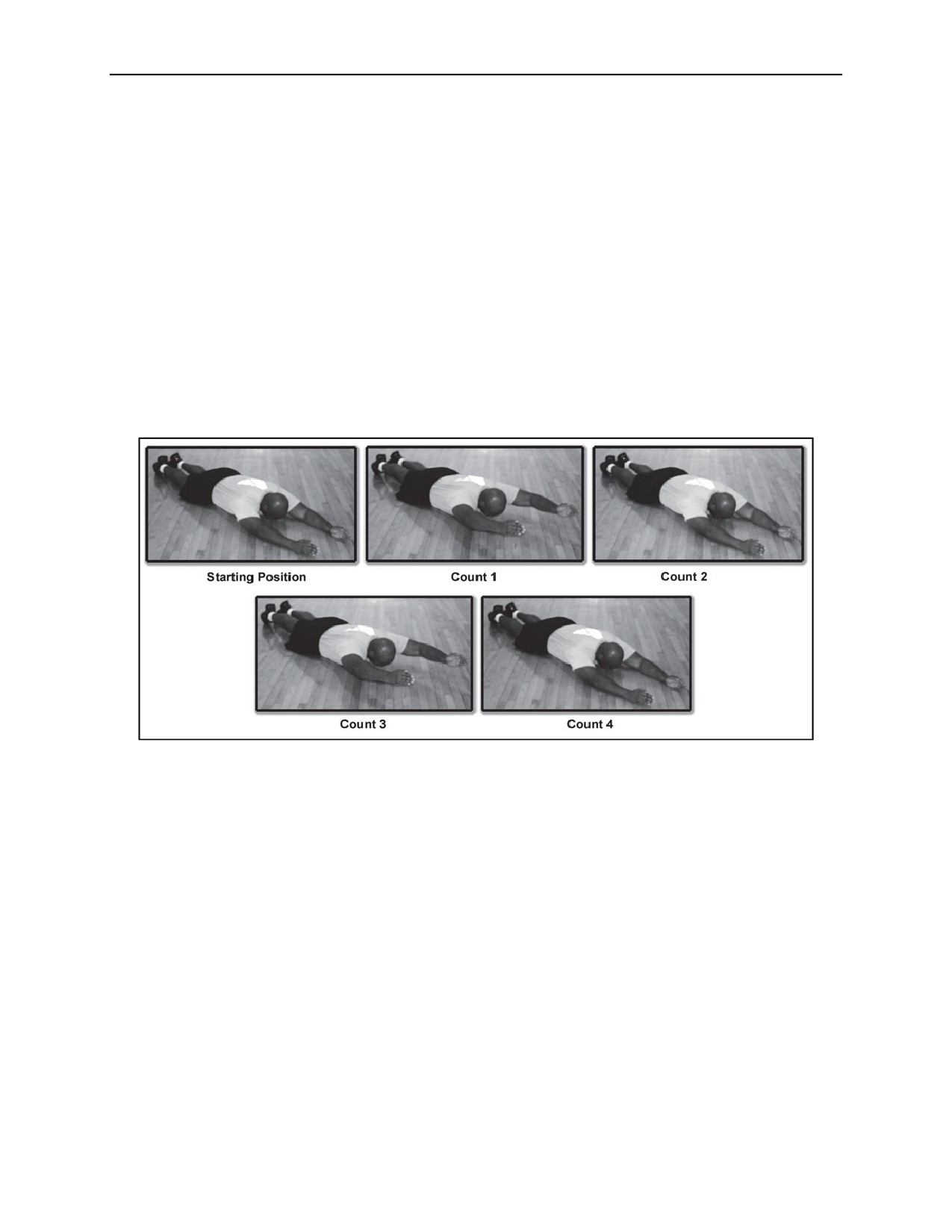
EXERCISE 1: “I” RAISE
Purpose: This exercise develops shoulder strength and stability (Figure 6-15).
Starting Position: Prone position with the head slightly elevated and aligned with the spine. Feet are together and
toes are pointed to the rear. The arms remain on the ground and are extended overhead, forming an “I” straight in
line with the body. The hands are in a neutral position (perpendicular to the ground) with the thumbs and fingers
extended and joined.
Cadence: SLOW
Count:
1. Raise both arms 3-6 inches off the ground.
2. Return to the starting position.
3. Repeat count 1.
4. Return to the starting position.
Figure 6-15. “I” raise
Check Points:
z
At the starting position, tighten the abdominals to stabilize the trunk. The head is slightly elevated
and aligned with the spine.
z
On counts 1 and 3, keep the back generally straight with the head up.
z
Throughout the exercise, the arms should be fully extended and the trunk and legs should also be
aligned.
Precaution: Keep the head slightly elevated throughout the exercise and do not jerk the body into the up positions
on counts 1 and 3.
6-26
FM 7-22
26 October 2012
Special Conditioning Programs
SHOULDER STABILITY DRILL
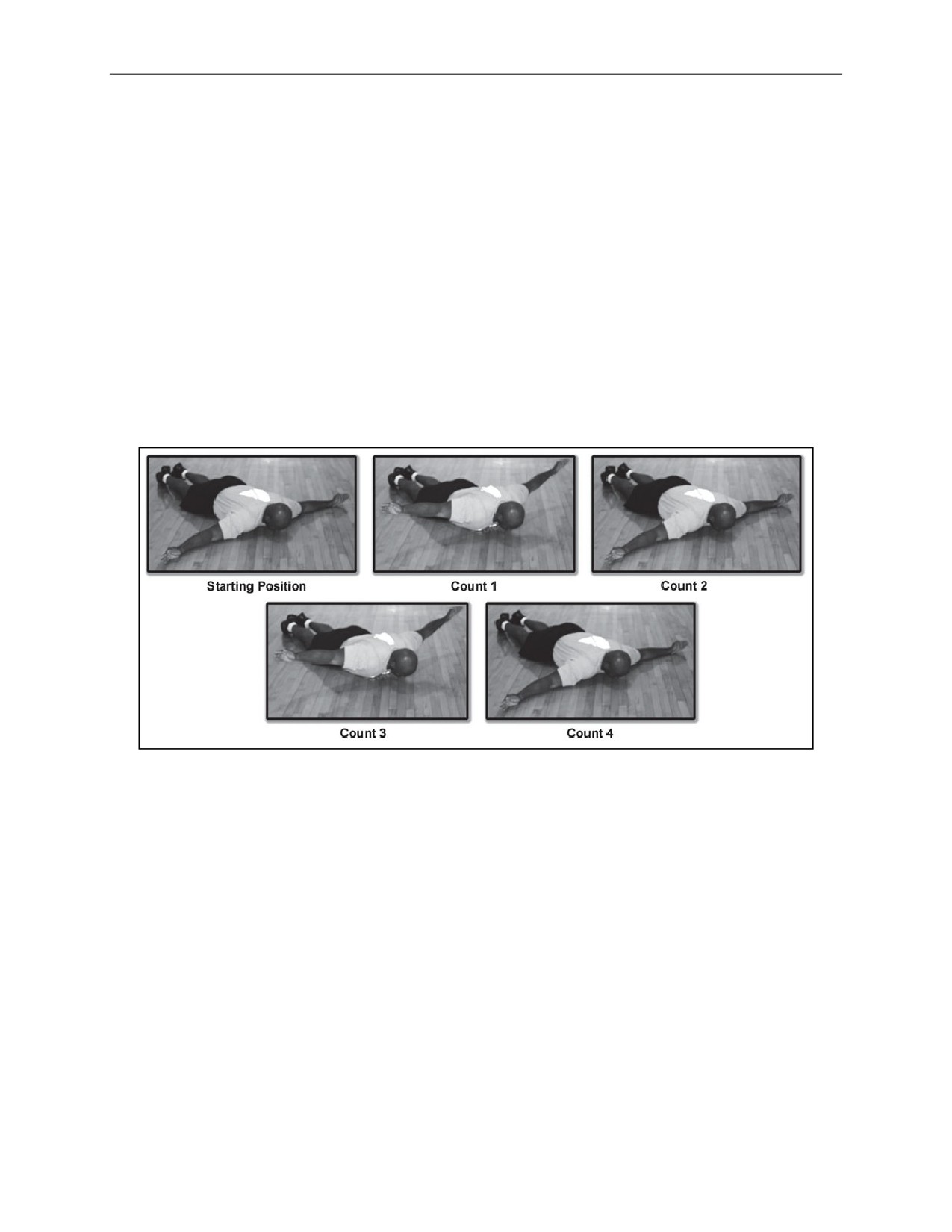
EXERCISE 2: “T” RAISE
Purpose: This exercise develops shoulder strength and stability (Figure 6-16).
Starting Position: Prone position with the head slightly elevated and aligned with the spine. Feet are together and
toes are pointed to the rear. The arms remain on the ground and are extended sideward at 90 degrees to the trunk,
forming a “T.” The hands are in a neutral position (perpendicular to the ground) with the thumbs and fingers
extended and joined.
Cadence: SLOW
Count:
1. Raise both arms 3-6 inches off the ground.
2. Return to the starting position.
3. Repeat count 1.
4. Return to the starting position.
Figure 6-16. “T” raise
Check Points:
z
At the starting position, tighten the abdominals to stabilize the trunk. The head is slightly elevated
and aligned with the spine.
z
On counts 1 and 3, keep the back generally straight with the head up.
z
Throughout the exercise, the arms should be fully extended and the trunk and legs should also be
aligned.
Precaution: Keep the head slightly elevated throughout the exercise and do not jerk the body into the up positions
on counts 1 and 3.
26 October 2012
FM 7-22
6-27
Chapter 6
SHOULDER STABILITY DRILL
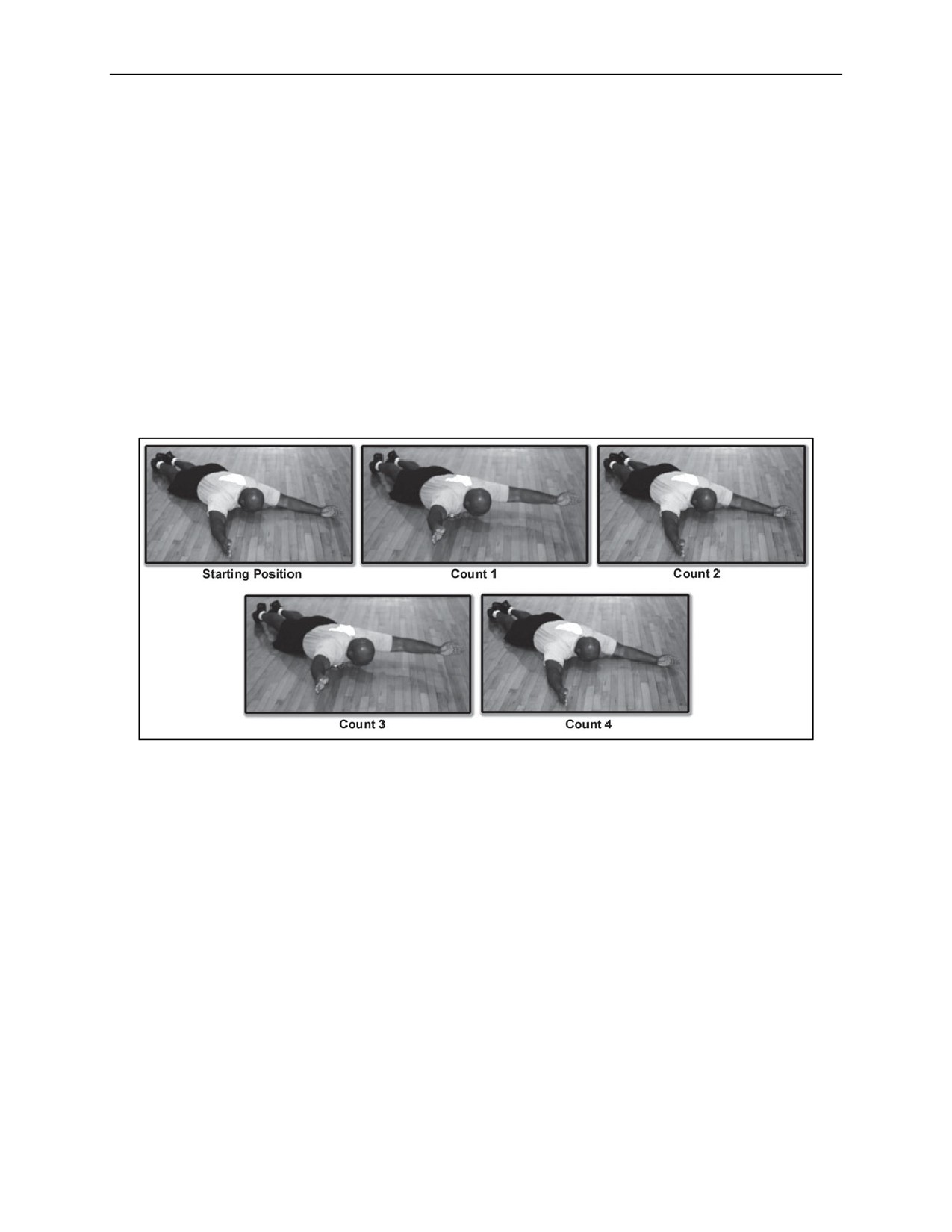
EXERCISE 3: “Y” RAISE
Purpose: This exercise develops shoulder strength and stability (Figure 6-17).
Starting Position: Prone position with the head slightly elevated and aligned with the spine. Feet are together and
toes are pointed to the rear. The arms remain on the ground and are extended overhead at 45 degrees to the trunk,
forming a “Y.” The hands are in a neutral position (perpendicular to the ground) with the thumbs and fingers
extended and joined.
Cadence: SLOW
Count:
1. Raise both arms 3-6 inches off the ground.
2. Return to the starting position.
3. Repeat count 1.
4. Return to the starting position.
Figure 6-17. “Y” raise
Check Points:
z
At the starting position, tighten the abdominals to stabilize the trunk. The head is slightly elevated
and aligned with the spine.
z
On counts 1 and 3, keep the back generally straight with the head up.
z
Throughout the exercise, the arms should be fully extended and the trunk and legs should also be
aligned.
Precaution: Keep the head slightly elevated throughout the exercise and do not jerk the body into the up positions
on counts 1 and 3.
6-28
FM 7-22
26 October 2012
Special Conditioning Programs
SHOULDER STABILITY DRILL
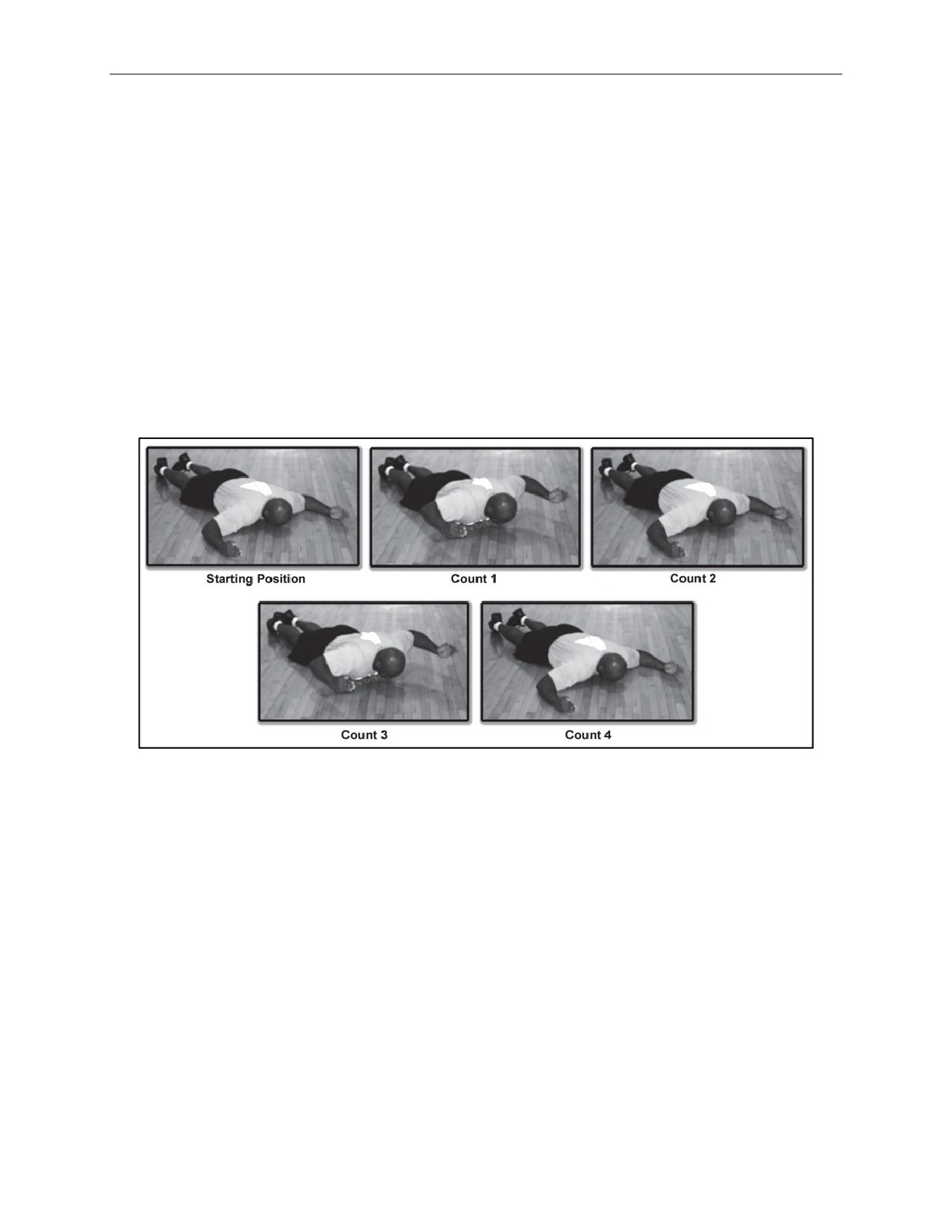
EXERCISE 4: “L” RAISE
Purpose: This exercise develops shoulder strength and stability (Figure 6-18).
Starting Position: Prone position with the head slightly elevated and aligned with the spine. Feet are together and
toes are pointed to the rear. The arms remain on the ground and are extended sideward and the elbows are bent at 90
degrees, forming an “L.” The hands are in a neutral position (perpendicular to the ground) with the thumbs and
fingers extended and joined.
Cadence: SLOW
Count:
1. Raise both arms 3-6 inches off the ground.
2. Return to the starting position.
3. Repeat count 1.
4. Return to the starting position.
Figure 6-18. “L” raise
Check Points:
z
At the starting position, tighten the abdominals to stabilize the trunk. The head is slightly elevated
and aligned with the spine.
z
On counts 1 and 3, keep the back generally straight with the head up.
z
Throughout the exercise, the arms maintain an “L” and the trunk and legs should also be aligned.
Precaution: Keep the head slightly elevated throughout the exercise and do not jerk the body into the up positions
on counts 1 and 3.
26 October 2012
FM 7-22
6-29
Chapter 6
SHOULDER STABILITY DRILL
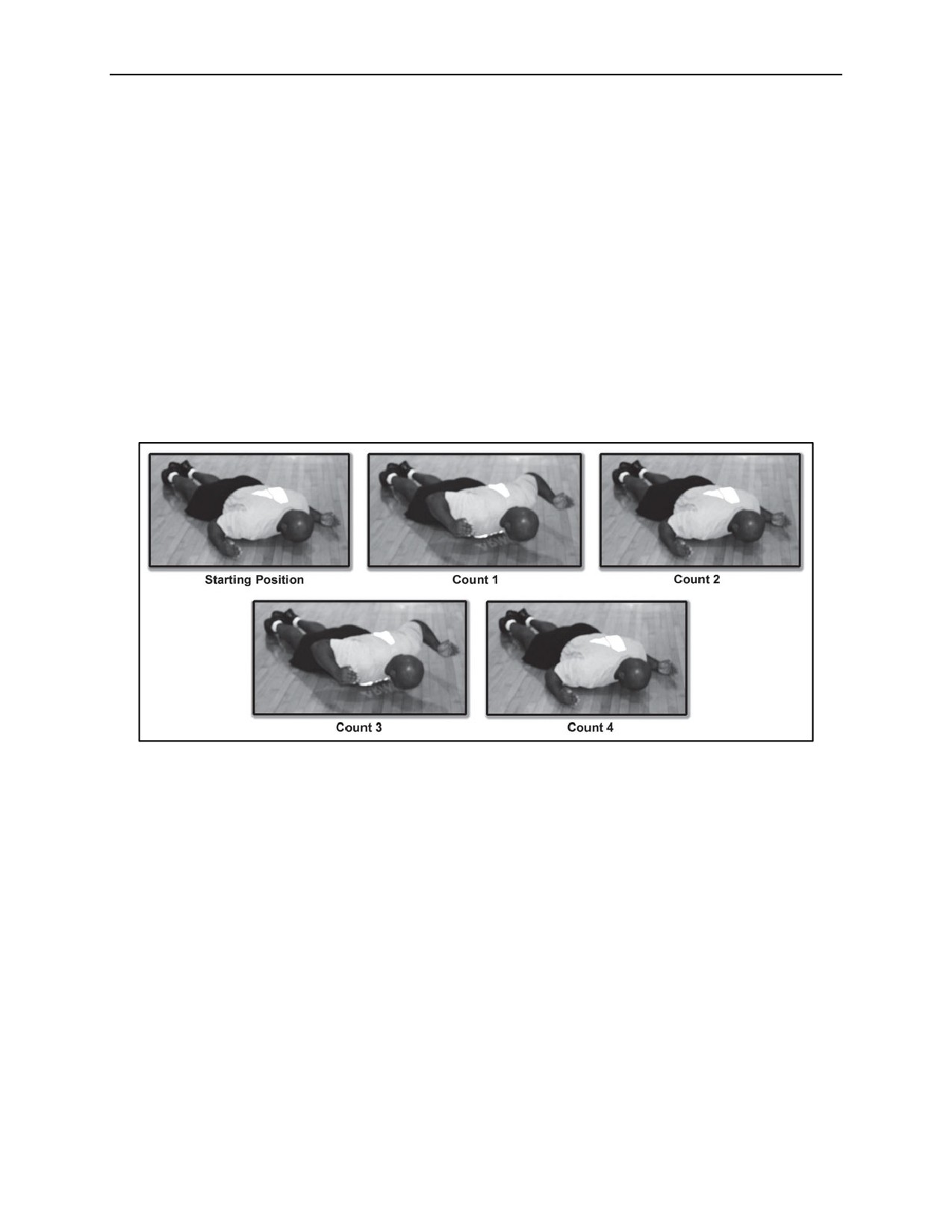
EXERCISE 5: “W” RAISE
Purpose: This exercise develops shoulder strength and stability (Figure 6-19).
Starting Position: Prone position with the head slightly elevated and aligned with the spine. Feet are together and
toes are pointed to the rear. The arms remain on the ground and are extended downward at 45 degrees to the trunk
and the elbow bent also at 45 degrees, forming a “W.” The hands are in a neutral position (perpendicular to the
ground) with the thumbs and fingers extended and joined.
Cadence: SLOW
Count:
1. Raise both arms 3-6 inches off the ground.
2. Return to the starting position.
3. Repeat count 1.
4. Return to the starting position.
Figure 6-19. “W” raise
Check Points:
z
At the starting position, tighten the abdominals to stabilize the trunk. The head is slightly elevated
and aligned with the spine.
z
On counts 1 and 3, keep the back generally straight with the head up.
z
Throughout the exercise, the arms maintain a “W” and the trunk and legs should also be aligned.
Precaution: Keep the head slightly elevated throughout the exercise and do not jerk the body into the up positions
on counts 1 and 3.
6-30
FM 7-22
26 October 2012
Special Conditioning Programs
STRENGTH AND MOBILITY TRAINING
6-52. Strength and mobility training in reconditioning consists of the STM drill for level I, CD 1 and 2, and the
PSD with modifications for level II. The following pages in this chapter describe in detail the conduct of these
drills and modifications.
STRENGTH TRAINING MACHINE DRILL
6-53. The STM drill is conducted on strength and mobility training days according to the Soldiers’ physical
profile. The exercises may be modified to meet the Soldiers’ capabilities. The following exercises are examples
of each exercise in the STM and modifications of these exercises that may be employed to accommodate
Soldiers’ specific profiles.
26 October 2012
FM 7-22
6-31
Chapter 6
STRENGTH TRAINING MACHINE DRILL
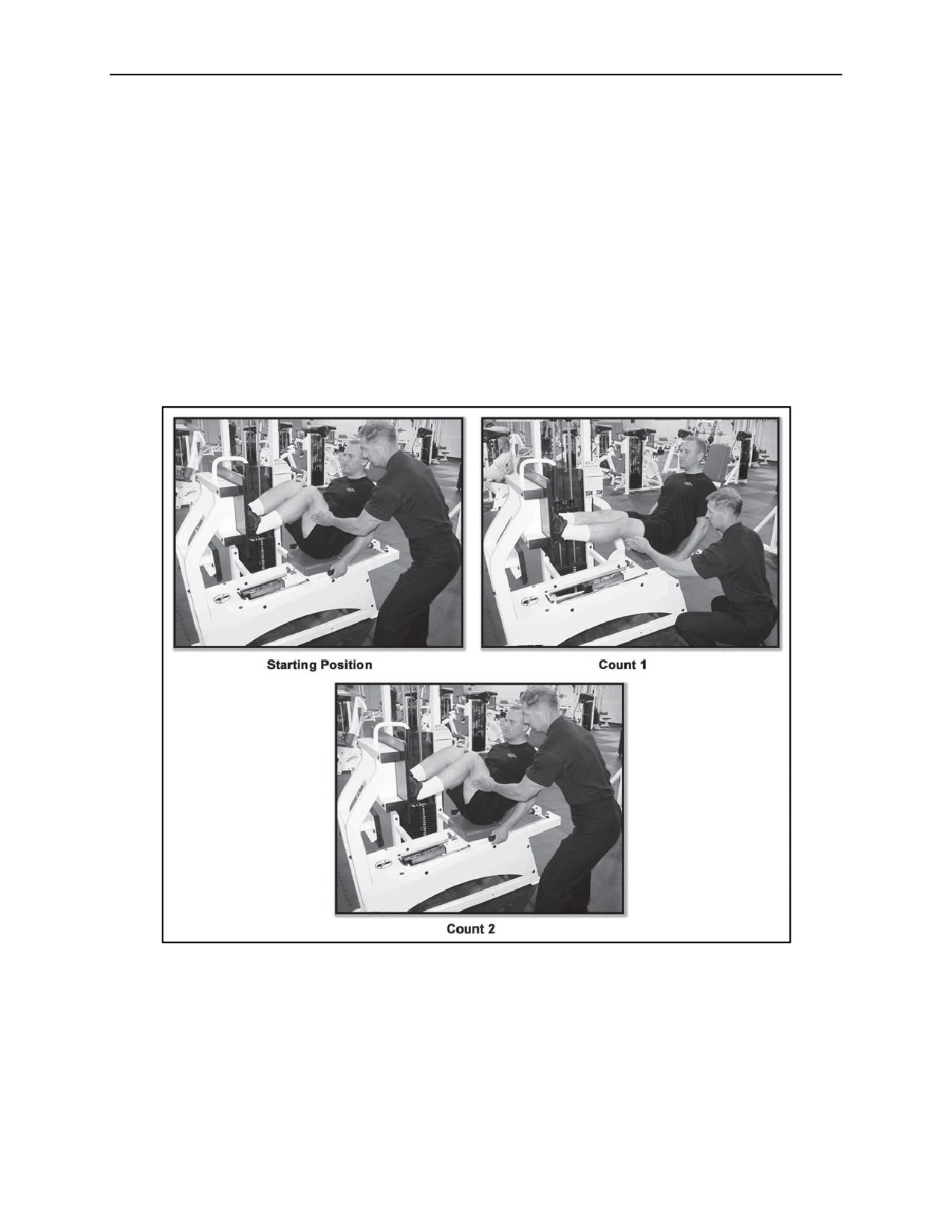
EXERCISE 1: LEG PRESS
Purpose: This exercise develops strength in the hip and thigh muscles (Figure 6-20).
Starting Position: Seated position with the knees bent at 90-degrees and feet flat on the foot platform. The hips, low
back, shoulders, and head are firmly against the seat back with the eyes looking straight ahead. A natural arch is
maintained in the lower back. Select the appropriate weight and ensure the pin is secure in the weight stack. Hands
are relaxed and placed on the handgrips.
Cadence: SLOW
Count:
1. Straighten the legs slowly until they are fully extended, not locked.
2. Return to the starting position in a slow, controlled motion.
Figure 6-20. Leg press
Check Points:
z
The hips, low back, shoulders, and head are firmly against the seat back.
z
Maintain a natural arch in the lower back.
z
Exhale on count 1 and inhale on count 2.
Precautions: Do not arch the back or allow the hips to rise off the seat. Do not grip the handgrips tightly.
6-32
FM 7-22
26 October 2012
Special Conditioning Programs
STRENGTH TRAINING MACHINE DRILL
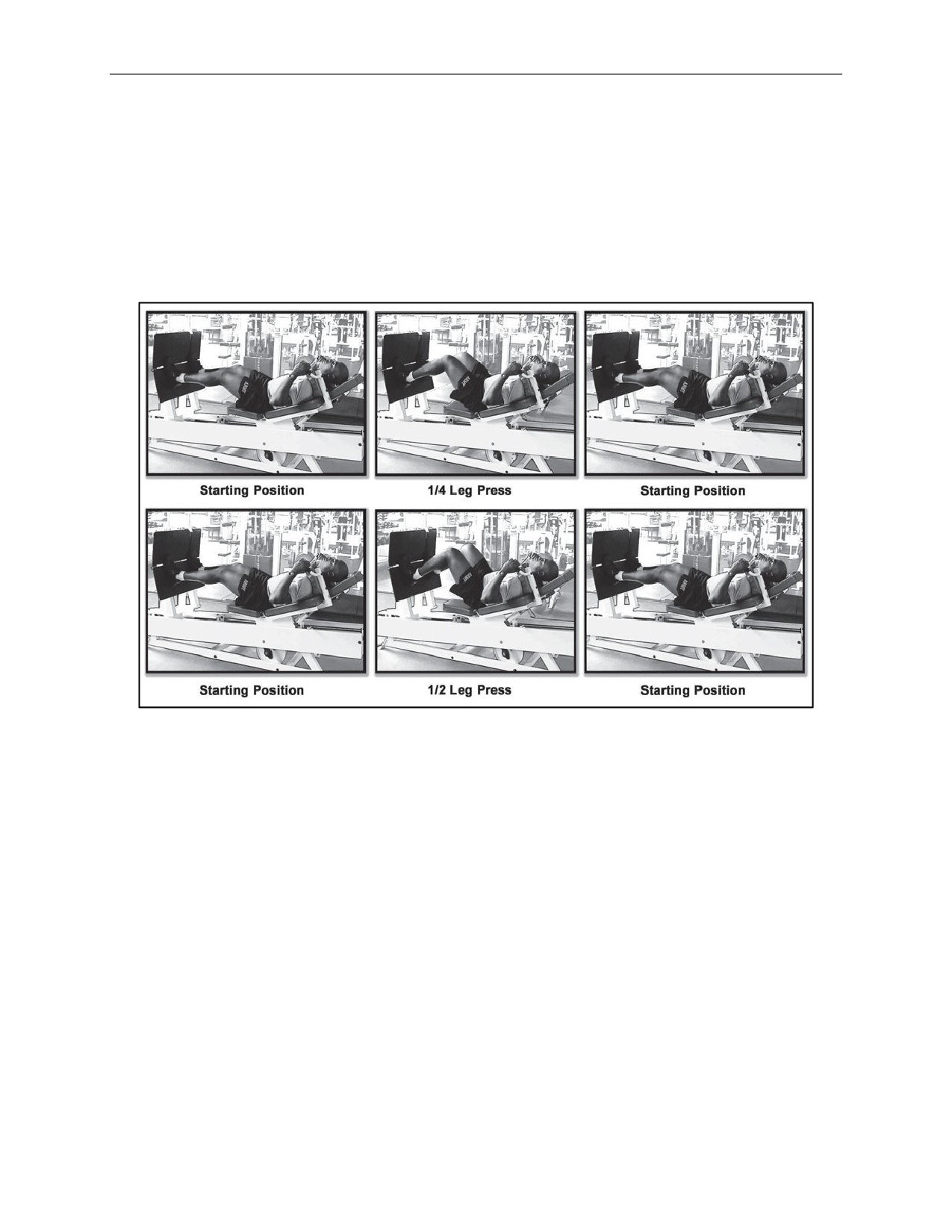
MODIFIED EXERCISE 1A: MODIFIED LEG PRESS
6-54. This exercise (Figure 6-21) is performed the same as the leg press. However, the range of motion is much
less. As the Soldier’s condition improves, the range of motion may gradually increase until the exercise is
performed to standard. The resistance should not be increased until the Soldier can move through the full range
of motion and perform the exercise to standard. The Soldier may also employ the single-leg press to maintain a
heavy resistance on the good leg and/or to reduce the resistance on the injured leg.
Figure 6-21. Modified leg press
26 October 2012
FM 7-22
6-33
Chapter 6
MODIFIED EXERCISE 1B: SINGLE-LEG PRESS
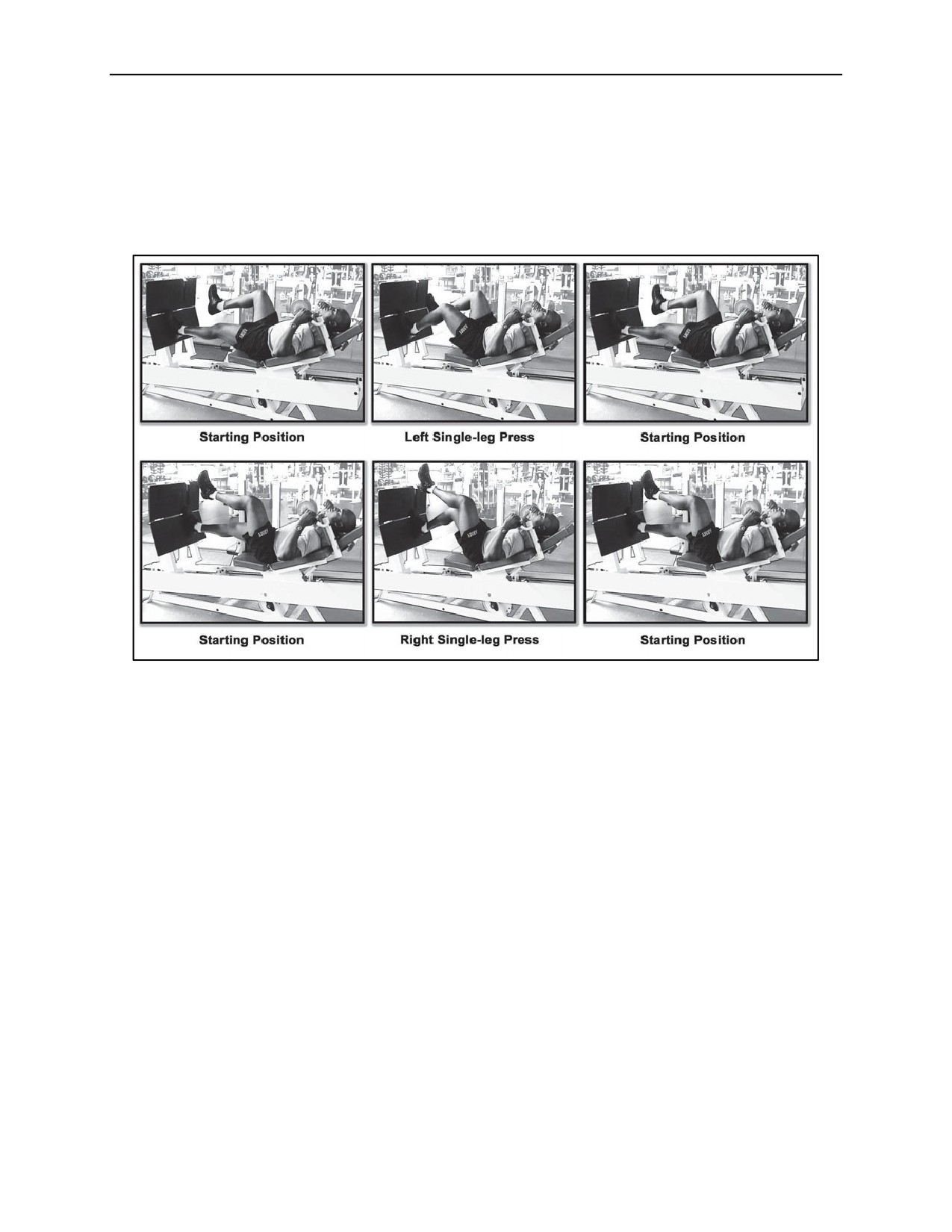
6-55. This exercise (Figure 6-22) is performed much like the leg press, using only one leg at a time. The range
of motion and resistance is decreased for the injured leg. As the Soldier’s condition improves, the range of
motion may gradually increase until the exercise is performed to standard. The resistance should not be
increased until the Soldier can move through the full range of motion. The single leg press is used to maintain a
heavy resistance on the good leg and/or to reduce the resistance on the injured leg.
Figure 6-22. Single-leg press
6-34
FM 7-22
26 October 2012
Special Conditioning Programs
STRENGTH TRAINING MACHINE DRILL
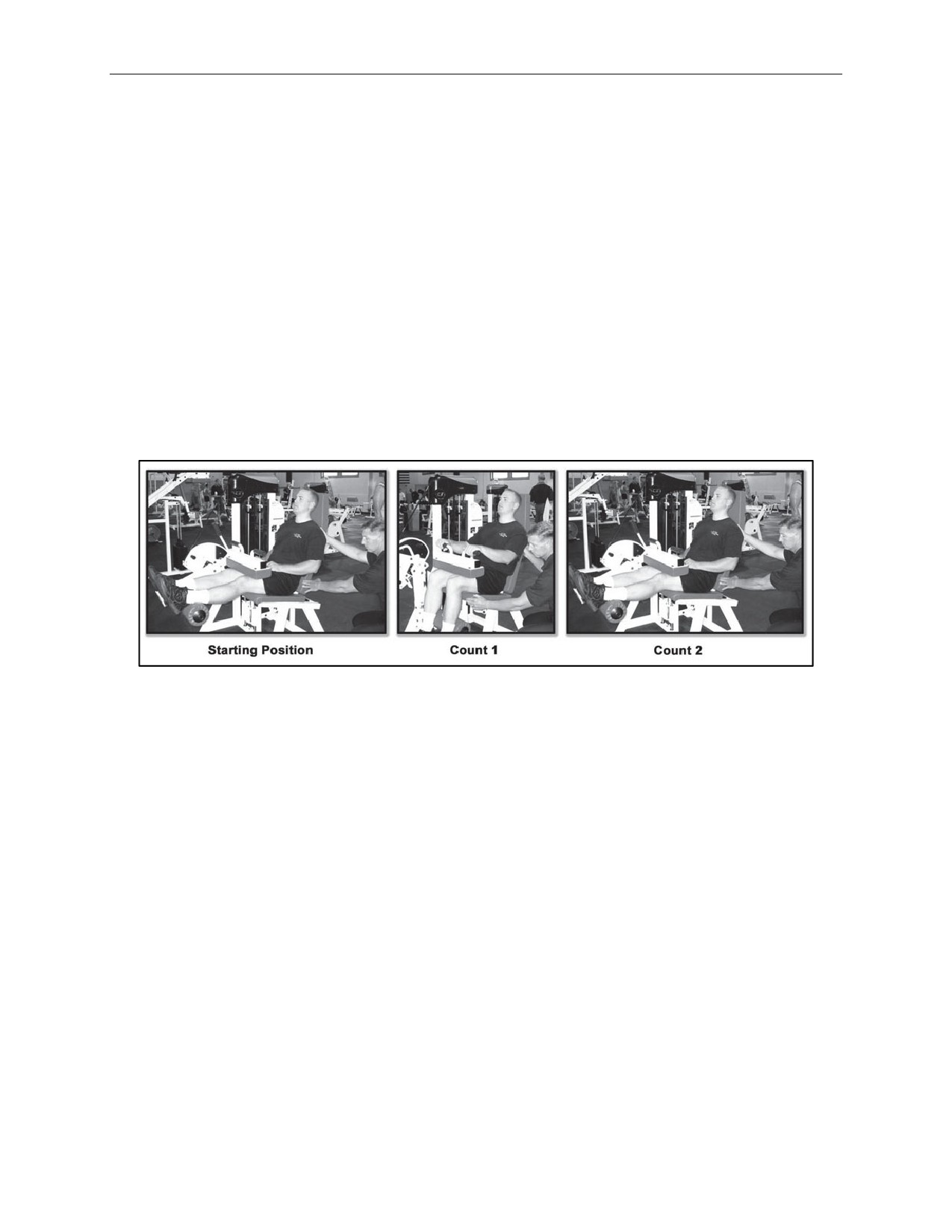
EXERCISE 2: LEG CURL
Purpose: This exercise develops strength in the back of the upper leg muscles (Figure 6-23).
Starting Position: Seated position, knees aligned with the center axis of the machine. The lower leg pad is adjusted
to contact the lower legs just above the ankle, allowing the lower leg to be fully extended, but not locked. The lower
legs and feet are relaxed. The thigh pad is positioned just above the knees. The hips, low back, shoulders, and head
are firmly against the seat back with the eyes looking straight ahead. A natural arch is maintained in the lower back.
Select the appropriate weight and ensure the pin is secure in the weight stack. Hands are relaxed and placed on the
handgrips on the top of the thigh pad.
Cadence: SLOW
Count:
1. Pull the lower legs to the rear slowly until the lower legs are flexed, forming a 90-degree angle
between the upper and lower legs.
2. Return to the starting position by slowly raising the lower legs.
Figure 6-23. Leg curl
Check Points:
z
Knees are aligned with the center axis of the machine.
z
The leg pad contacts the lower legs just behind the ankles.
z
The hips, low back, shoulders, and head are firmly against the seat back.
z
Maintain a natural arch in the lower back.
z
Exhale on count 1 and inhale on count 2.
Precautions: Do not arch the back or allow the hips to rise off the seat. Do not grip the handgrips tightly.
26 October 2012
FM 7-22
6-35