FM 7-22 ARMY PHYSICAL READINESS TRAINING (OCTOBER 2012) - page 1
*FM 7-22
Field Manual
Headquarters
Department of the Army
No. FM 7-22
Washington, DC, 26 October 2012
Army Physical Readiness Training
Contents
Page
PREFACE
xv
INTRODUCTION
xvi
PART ONE PHILOSOPHY
Chapter 1
APPROACH
1-1
Training Program
1-1
Principles of Training
1-2
Chapter 2
SYSTEM
2-1
Phases
2-1
Components
2-3
Types
2-5
Chapter 3
LEADERSHIP
3-1
Traits
3-1
Cooperation
3-2
PART TWO STRATEGY
Chapter 4
TYPES OF PROGRAMS
4-1
Initial Military Training
4-1
Advanced Individual Training
4-2
One Station Unit Training
4-2
Warrant Officer Candidate School
4-2
Basic Officer Leader Courses
4-2
Active and Reserve Components
4-2
Reserve
4-6
Unit
4-6
Individual
4-7
Scheduling Training
4-7
Command Responsibilities
4-7
Chapter 5
PLANNING CONSIDERATIONS
5-1
Goal
5-1
Session Elements
5-6
Toughening Phase PRT
5-6
Toughening Phase PRT Schedule
5-7
DISTRIBUTION RESTRICTION: Approved for public release; distribution is unlimited.
*This publication supersedes TC 3-22.20, dated 20 August 2010.
i
Contents
Condensed Time
5-13
Field Training
5-14
Sustaining Phase PRT
5-14
Initial Military Training Sustaining Phase PRT Schedules
5-14
Condensed Time
5-18
Field Training
5-18
PRT in Operational Units
5-18
Sustaining Phase PRT Schedules
5-20
Reserve Component
5-32
Sample Commander’s Policy Letter
5-34
Chapter 6
SPECIAL CONDITIONING PROGRAMS
6-1
APFT or Unit PRT Goal Failure
6-1
Army Weight Control Program
6-2
Reconditioning
6-2
4 for the Core
6-11
Exercise 1: Bent-Leg Raise
6-12
Exercise 2: Side Bridge
6-13
Exercise 3: Back Bridge
6-14
Exercise 4: Quadraplex
6-15
Hip Stability Drill
6-16
Exercise 1: Lateral Leg Raise
6-16
Exercise 2: Medial Leg Raise
6-18
Exercise 3: Bent-Leg Lateral Raise
6-20
Exercise 4: Single-Leg Tuck
6-22
Exercise 5: Single-Leg Over
6-24
Shoulder Stability Drill
6-25
Exercise 1: “I” Raise
6-26
Exercise 2: “T” Raise
6-27
Exercise 3: “Y” Raise
6-28
Exercise 4: “L” Raise
6-29
Exercise 5: “W” Raise
6-30
Strength and Mobility Training
6-31
Strength Training Machine Drill
6-31
Exercise 1: Leg Press
6-32
Modified Exercise 1A: Modified Leg Press
6-33
Modified Exercise 1B: Single-Leg Press
6-34
Exercise 2: Leg Curl
6-35
Modified Eexercise 2A: Modified Leg Curl (Seated)
6-36
Modified Exercise 2B: Single-Leg Curl (Seated)
6-37
Modified Exercise 2C: Modified Leg Curl (Prone)
6-38
Modified Exercise 2D: Single-Leg Curl (Prone)
6-38
Exercise 3: Heel Raise
6-39
Modified Exercise 3A: Single-Leg Heel Raise
6-40
Exercise 4: Chest Press
6-41
Modified Eexercise 4A: Modified Chest Press
6-42
Modified Exercise 4B: Single-Arm Chest Press
6-43
Exercise 5: Seated Row
6-44
ii
FM 7-22
26 October 2012
Contents
Modified Exercise 5A: Straight-Arm Seated Row
6-45
Modified Exercise 5B: Single-Arm Seated Row
6-46
Exercise 6: Overhead Press
6-47
Modified Exercise 6A: Modified Overhead Press
6-48
Modified Exercise 6B: Single-Arm Overhead Press
6-49
Exercise 7: LAT Pull-Down
6-50
Modified Exercise 7A: Straight-Arm LAT Pull-Down
6-51
Modified Exercise 7B: Single-Arm LAT Pull-Down
6-52
Exercise 8: Lateral Raise
6-54
Modified Exercise 8A: Single-Arm Lateral Raise
6-55
Exercise 9: Triceps Extension
6-56
Modified Exercise 9A: Modified Triceps Extension
6-58
Modified Exercise 9B: Single-Arm Triceps Extension
6-59
Exercise 10: Biceps Curl
6-62
Modified Exercise 10A: Modified Biceps Curl
6-63
Modified Exercise 10B: Single-Arm Biceps Curl
6-64
Exercise 11: Trunk Flexion
6-65
Modified Exercise 11: Modified Trunk Flexion
6-66
Exercise 12: Trunk Extension
6-67
Modified Exercise 12: Modified Trunk Extension
6-68
Preparation Drill
6-75
Exercise 1: Bend and Reach
6-75
Modified Exercise 1: Modified Bend and Reach
6-76
Exercise 2: Rear Lunge
6-77
Modified Exercise 2: Modified Rear Lunge
6-78
Exercise 3: High Jumper
6-79
Modified Exercise 3: Modified High Jumper
6-80
Exercise 4: Rower
6-81
Modified Exercise 4: Modified Rower
6-82
Exercise 5: Squat Bender
6-83
Modified Exercise 5: Modified Squat Bender
6-84
Exercise 6: Windmill
6-85
Modified Exercise 6: Modified Windmill
6-87
Exercise 7: Forward Lunge
6-88
Modified Exercise 7: Modified Forward Lunge
6-89
Exercise 8: Prone Row
6-90
Modified Exercise 8: Modified Prone Row
6-91
Exercise 9: Bent-Leg Body Twist
6-92
Modified Exercise 9: Modified Bent-Leg Body Twist
6-93
Exercise 10: Push-Up
6-94
Modified Exercise 10: Modified Push-Up
6-95
Conditioning Drill 1
6-96
Exercise 1: Power Jump
6-96
Modified Exercise 1: Modified Power Jump
6-97
Exercise 2: V-Up
6-98
Modified Exercise 2: Modified V-Up
6-99
Exercise 3: Mountain Climber
6-100
Modified Exercise 3: Modified Mountain Climber
6-101
26 October 2012
FM 7-22
iii
Contents
Exercise 4: Leg-Tuck and Twist
6-102
Modified Exercise 4: Modified Leg-Tuck and Twist
6-103
Exercise 5: Single-Leg Push-Up
6-104
Modified Exercise 5: Modified Single-Leg Push-Up
6-105
Recovery Drill
6-107
Exercise 1: Overhead Arm Pull
6-107
Modified Exercise 1: Modified Overhead Arm Pull
6-108
Exercise 2: Rear Lunge
6-109
Modified Exercise 2: Modified Rear Lunge
6-110
Exercise 3: Extend and Flex
6-111
Modified Exercise 3: Modified Extend and Flex
6-112
Exercise 4: Thigh Stretch
6-113
Modified Exercise 4: Modified Thigh Stretch
6-114
Exercise 5: Single-Leg Over
6-115
Modified Exercise 5: Modified Single-Leg Over
6-116
PART THREE ACTIVITIES
Chapter 7
EXECUTION OF TRAINING
7-1
Commands
7-1
Platoon Reassembly
7-3
Positions
7-7
Squat Position
7-7
Front Leaning Rest Position
7-8
Six-Point Stance
7-8
Straddle Stance
7-9
Forward Leaning Stance
7-9
Prone Position
7-10
Supine Position
7-10
Cadence
7-11
Commands
7-13
Running Activities
7-14
Recovery Drill
7-14
Mirror Effect
7-15
Chapter 8
PREPARATION AND RECOVERY
8-1
Preparation
8-1
Leadership
8-1
Preparation Drill
8-2
Exercise 1: Bend and Reach
8-4
Exercise 2: Rear Lunge
8-5
Exercise 3: High Jumper
8-6
Exercise 4: Rower
8-7
Exercise 5: Squat Bender
8-8
Exercise 6: Windmill
8-9
Exercise 7: Forward Lunge
8-11
Exercise 8: Prone Row
8-12
Exercise 9: Bent-Leg Body Twist
8-13
Exercise 10: Push-Up
8-14
iv
FM 7-22
26 October 2012
Contents
Exercise 10A: Push-Up Using the Six-Point Stance
8-15
Recovery
8-15
Leadership
8-15
Commands
8-16
Recovery Drill
8-16
Exercise 1: Overhead Arm Pull
8-18
Exercise 2: Rear Lunge
8-19
Exercise 3: Extend and Flex
8-20
Exercise 4: Thigh Stretch
8-21
Exercise 5: Single-Leg Over
8-22
Chapter 9
STRENGTH AND MOBILITY ACTIVITIES
9-1
Exercise Drills
9-1
Conditioning Drill 1
9-3
Exercise 1: Power Jump
9-6
Exercise 2: V-Up
9-7
Exercise 3: Mountain Climber
9-8
Exercise 4: Leg Tuck and Twist
9-9
Exercise 5: Single-Leg Push-Up
9-10
Conditioning Drill 2
9-11
Exercise 1: Turn and Lunge
9-13
Exercise 2: Supine Bicycle
9-14
Exercise 3: Half Jacks
9-15
Exercise 4: Swimmer
9-16
Exercise 5: 8-Count Push-Up
9-17
Conditioning Drill 3
9-20
Exercise 1: “Y” Squat
9-21
Exercise 2: Single-Leg Dead Lift
9-23
Exercise 3: Side-to-Side Knee Lifts
9-25
Exercise 4: Front Kick Alternate Toe Touch
9-27
Exercise 5: Tuck Jump
9-29
Exercise 6: Straddle-Run Forward and Backward
9-31
Exercise 7: Half-Squat Laterals
9-32
Exercise 8: Frog Jumps Forward and Backward
9-33
Exercise 9: Alternate ¼-Turn Jump
9-34
Exercise 10: Alternate-Staggered Squat Jump
9-35
Push-Up and Sit-Up Drill
9-37
Climbing Drills
9-38
Climbing Drill 1
9-43
Exercuse 1: Straight-Arm Pull
9-43
Exercise 2: Heel Hook
9-44
Exercise 3: Pull-Up
9-45
Exercise 4: Leg Tuck
9-46
Exercise 5: Alternating Grip Pull-Up
9-47
Climbing Drill 2
9-48
Exercise 1: Flexed-Arm Hang
9-49
Exercise 2: Heel Hook
9-50
Exercise 3: Pull-Up
9-51
26 October 2012
FM 7-22
v
Contents
Exercise 4: Leg Tuck
9-52
Exercise 5: Alternating Grip Pull-Up
9-53
Strength Training Circuit
9-54
Station 1: Sumo Squat
9-56
Station 2: Straight-Leg Dead Lift
9-58
Station 3: Forward Lunge
9-59
Station 4: 8-Count Step-Up
9-60
Station 5: Pull-Up or Straight-Arm Pull
9-62
Station 6: Supine Chest Press
9-64
Station 7: Bent-Over Row
9-65
Station 8: Overhead Push Press
9-66
Station 9: Supine Body Twist
9-67
Station 10: Leg Tuck
9-68
Guerrilla Drill
9-69
Exercise 1: Shoulder Roll
9-71
Exercise 2: Lunge Walk
9-72
Exercise 3: Soldier Carry
9-73
Chapter 10
ENDURANCE AND MOBILITY ACTIVITIES
10-1
Running
10-1
Leadership
10-4
Military Movement Drill 1
10-6
Exercise 1: Verticals
10-8
Exercise 2: Laterals
10-9
Exercise 3: Shuttle Sprint
10-10
Military Movement Drill 2
10-11
Exercise 1: Power Skip
10-12
Exercise 2: Crossovers
10-13
Exercise 3: Crouch Run
10-14
Speed Running
10-15
30:60s
10-15
60:120s
10-15
300-Yard Shuttle Run
10-16
Hill Repeats
10-18
Ability Group Run
10-18
Unit Formation Run
10-19
Release Run
10-19
Terrain Run
10-20
Foot Marches
10-20
Conditioning Obstacle Course
10-20
Endurance Training Machines
10-20
Appendix A
ARMY PHYSICAL FITNESS TEST (APFT)
A-1
Appendix B
CLIMBING BARS
B-1
Appendix C
POSTURE AND BODY MECHANICS
C-1
Appendix D
ENVIRONMENTAL CONSIDERATIONS
D-1
Appendix E
OBSTACLE NEGOTIATIONS
E-1
GLOSSARY
.............................................................................................................. Glossary-1
vi
FM 7-22
26 October 2012
Contents
REFERENCES
References-1
INDEX
.................................................................................................................... Index-1
Figures
Figure
1-1. Army PRT System and relationship to ARFORGEN
1-8
Figure
2-1. PRT System
2-2
Figure
2-2. Components of PRT
2-4
Figure
2-3. Types of PRT
2-6
Figure
5-1. Soldier response/adaptation to overreaching, overtraining, and overuse
5-4
Figure
5-2. Sample, commander’s policy letter
5-35
Figure
6-1. Army Physical Readiness Training System
6-3
Figure
6-2. Level II reconditioning entry criteria
6-5
Figure
6-3. Level II exit criteria
6-5
Figure
6-4. Rehabilitation and reconditioning responsibilities
6-7
Figure
6-5. Endurance training equipment
6-10
Figure
6-6. Bent-leg raise (4 for the core)
6-12
Figure
6-7. Side bridge
6-13
Figure
6-8. Back bridge
6-14
Figure
6-9. Quadraplex
6-15
Figure
6-10. Lateral leg raise
6-17
Figure
6-11. Medial leg raise
6-19
Figure
6-12. Bent-leg lateral raise (hip stability drill)
6-21
Figure
6-13. Single-leg tuck
6-23
Figure
6-14. Single-leg over
6-24
Figure
6-15. “I” raise
6-26
Figure
6-16. “T” raise
6-27
Figure
6-17. “Y” raise
6-28
Figure
6-18. “L” raise
6-29
Figure
6-19. “W” raise
6-30
Figure
6-20. Leg press
6-32
Figure
6-21. Modified leg press
6-33
Figure
6-22. Single-leg press
6-34
Figure
6-23. Leg curl
6-35
Figure
6-24. Modified leg curl
6-36
Figure
6-25. Single-leg curl
6-37
Figure
6-26. Modified leg curl (prone)
6-38
Figure
6-27. Single-leg curl (prone)
6-38
Figure
6-28. Heel raise
6-39
Figure
6-29. Single-leg heel raise
6-40
Figure
6-30. Chest press
6-41
26 October 2012
FM 7-22
vii
Contents
Figure
6-31. Modified chest press
6-42
Figure
6-32. Single-arm chest press
6-43
Figure
6-33. Seated row
6-44
Figure
6-34. Straight-arm seated row
6-45
Figure
6-35. Single-arm seated row
6-46
Figure
6-36. Overhead press
6-47
Figure
6-37. Modified overhead press
6-48
Figure
6-38. Single-arm overhead press
6-49
Figure
6-39. Lat pull-down
6-50
Figure
6-40. Straight-arm lat pull-down
6-51
Figure
6-41. Single-arm lat pull-down
6-53
Figure
6-42. Lateral raise
6-54
Figure
6-43. Single-arm lateral raise
6-55
Figure
6-44. Triceps extension
6-57
Figure
6-45. Modified triceps extension using a high pulley
6-58
Figure
6-46. Modified triceps extension using a triceps extension machine
6-58
Figure
6-47. Single-arm triceps extension using a high pulley
6-60
Figure
6-48. Single-arm triceps extension using a triceps extension machine
6-61
Figure
6-49. Biceps curl
6-62
Figure
6-50. Modified biceps curl
6-63
Figure
6-51. Single-arm biceps curl
6-64
Figure
6-52. Trunk flexion
6-65
Figure
6-53. Modified trunk flexion
6-66
Figure
6-54. Trunk extension
6-67
Figure
6-55. Modified trunk extension
6-68
Figure
6-56. Bend and reach
6-75
Figure
6-57. Modified bend and reach
6-76
Figure
6-58. Rear lunge
6-77
Figure
6-59. Modified rear lunge
6-78
Figure
6-60. High jumper
6-79
Figure
6-61. Modified high jumper (remaining on the ground)
6-80
Figure
6-62. Rower
6-81
Figure
6-63. Modified rower (limited range of movement)
6-82
Figure
6-64. Modified rower (without use of arms)
6-82
Figure
6-65. Squat bender
6-83
Figure
6-66. Modified squat bender
6-84
Figure
6-67. Windmill
6-85
Figure
6-68. Modified windmill (body twist)
6-87
Figure
6-69. Modified windmill (hands on hips)
6-87
Figure
6-70. Modified windmill (single arm)
6-87
Figure
6-71. Forward lunge
6-88
Figure
6-72. Modified forward lunge
6-89
viii
FM 7-22
26 October 2012
Contents
Figure
6-73. Prone row
6-90
Figure
6-74. Modified prone row (assuming starting position)
6-91
Figure
6-75. Modified prone row (using the arms)
6-91
Figure
6-76. Bent-leg body twist
6-92
Figure
6-77. Modified bent-leg body twist (head on the ground and arms at 45 degrees) .. 6-93
Figure
6-78. Modified bent-leg body twist (head elevated and arms at 90 degrees)
6-93
Figure
6-79. Push-up
6-94
Figure
6-80. Push-up in the 6-point stance
6-94
Figure
6-81. Modified push-up variation for assuming the 6-point stance
6-95
Figure
6-82. Modified push-up
6-95
Figure
6-83. Power jump
6-96
Figure
6-84. Modified power jump
6-97
Figure
6-85. V-up
6-98
Figure
6-86. Modified V-up
6-99
Figure
6-87. Mountain climber
6-100
Figure
6-88. Modified mountain climber
6-101
Figure
6-89. Leg-tuck and twist
6-102
Figure
6-90. Modified leg-tuck and twist
6-103
Figure
6-91. Single-leg push-up
6-104
Figure
6-92. Variation for assuming the 6-point stance
6-105
Figure
6-93. Modified single-leg push-up
6-105
Figure
6-94. Overhead arm pull
6-107
Figure
6-95. Modified overhead arm pull and front arm pull
6-108
Figure
6-96. Rear lunge
6-109
Figure
6-97. Modified rear lunge
6-110
Figure
6-98. Extend and flex
6-111
Figure
6-99. Modified extend and flex (standing)
6-112
Figure
6-100. Stepping into the modified extend and flex (prone)
6-112
Figure
6-101. Modified extend and flex (prone) starting position
6-112
Figure
6-102. Thigh stretch
6-113
Figure
6-103. Modified thigh stretch (assuming the seated position)
6-114
Figure
6-104. Modified thigh stretch starting positions
6-114
Figure
6-105. Single-leg over
6-115
Figure
6-106. Modified single-leg over
6-116
Figure
7-1. Platoon rectangular formation
7-2
Figure
7-2. Platoon rectangular formation extended and uncovered
7-3
Figure
7-3. Forming a company, company in line with platoons in column
7-3
Figure
7-4. Company extended and uncovered, company in line with platoons in column... 7-4
Figure
7-5. Formation of company en masse
7-4
Figure
7-6. Company en masse extended and uncovered
7-5
Figure
7-7. Platoon formation en masse
7-6
Figure
7-8. Platoon formation extended and covered
7-6
26 October 2012
FM 7-22
ix
Contents
Figure
7-9. Squat position
7-7
Figure
7-10. Front leaning rest position
7-8
Figure
7-11. Six-point stance
7-8
Figure
7-12. Straddle stance
7-9
Figure
7-13. Forward leaning stance
7-9
Figure
7-14. Prone position
7-10
Figure
7-15. Supine position
7-10
Figure
7-16. Hands down assist to supine position
7-11
Figure
8-1. Bend and reach
8-4
Figure
8-2. Rear lunge
8-5
Figure
8-3. High jumper
8-6
Figure
8-4. Rower
8-7
Figure
8-5. Squat bender
8-8
Figure
8-6. Windmill
8-9
Figure
8-7. Forward lunge
8-11
Figure
8-8. Prone row
8-12
Figure
8-9. Bent-leg body twist
8-13
Figure
8-10. Push-up
8-14
Figure
8-11. Push-up using the six-point stance
8-15
Figure
8-12. Overhead arm pull
8-18
Figure
8-13. Rear lunge
8-19
Figure
8-14. Extend and flex
8-20
Figure
8-15. Thigh stretch
8-21
Figure
8-16. Single-leg over
8-22
Figure
9-1. Strength and mobility-related WTBDs
9-1
Figure
9-2. Power jump
9-6
Figure
9-3. V-up
9-7
Figure
9-4. Mountain climber
9-8
Figure
9-5. Leg tuck and twist
9-9
Figure
9-6. Single-leg push-up
9-10
Figure
9-7. Turn and lunge
9-13
Figure
9-8. Supine bicycle
9-14
Figure
9-9. Half jacks
9-15
Figure
9-10. Swimmer
9-16
Figure
9-11. 8-count push-up
9-18
Figure
9-12. “Y” squat
9-21
Figure
9-13. Single-leg dead lift
9-24
Figure
9-14. Side-to-side knee lifts
9-26
Figure
9-15. Front kick alternate toe touch
9-28
Figure
9-16. Tuck jump
9-29
Figure
9-17. Straddle-run forward and backward
9-31
Figure
9-18. Half-squat laterals
9-32
x
FM 7-22
26 October 2012
Contents
Figure
9-19. Frog jumps forward and backward
9-33
Figure
9-20. Alternate ¼-turn jump
9-34
Figure
9-21. Alternate-staggered squat jump
9-35
Figure
9-22. Climbing pod
9-40
Figure
9-23. Hand positions
9-41
Figure
9-24. Straight-arm pull
9-43
Figure
9-25. Heel hook
9-44
Figure
9-26. Pull-up
9-45
Figure
9-27. Leg tuck
9-46
Figure
9-28. Alternating grip pull-up
9-47
Figure
9-29. Flexed-arm hang
9-49
Figure
9-30. Heel hook
9-50
Figure
9-31. Pull-up
9-51
Figure
9-32. Leg tuck
9-52
Figure
9-33. Alternating grip pull-up
9-53
Figure
9-34. Strength training circuit
9-55
Figure
9-35. Sumo squat
9-57
Figure
9-36. Straight-leg dead lift
9-58
Figure
9-37. Forward lunge
9-59
Figure
9-38.
8-count step-up
9-61
Figure
9-39. Pull-up
9-62
Figure
9-40. Straight-arm pull
9-63
Figure
9-41. Supine chest press
9-64
Figure
9-42. Bent-over row
9-65
Figure
9-43. Overhead push press
9-66
Figure
9-44. Supine body twist
9-67
Figure
9-45. Leg tuck
9-68
Figure
9-46. Shoulder roll
9-71
Figure
9-47. Lunge walk
9-72
Figure
9-48. Soldier carry
9-73
Figure
10-1. Moving under direct and indirect fire
10-1
Figure
10-2. Sustained running form
10-5
Figure
10-3. Military movement drill 1
10-7
Figure
10-4. Verticals
10-8
Figure
10-5. Laterals
10-9
Figure
10-6. Shuttle sprint
10-10
Figure
10-7. Power skip
10-12
Figure
10-8. Crossovers
10-13
Figure
10-9. Crouch run
10-14
Figure
10-10. Speed running on a straight course
10-16
Figure
10-11. 300-yard shuttle run
10-17
Figure
10-12. Endurance training machines
10-21
26 October 2012
FM 7-22
xi
Contents
Figure A-1. Push-up event narrative
A-6
Figure A-2. Push-up additional checkpoints
A-7
Figure A-3. Sit-up event narrative
A-8
Figure A-4. Sit-up additional checkpoints
A-9
Figure A-5. Sit-up hand and feet position
A-9
Figure A-6. 2-mile run event narrative
A-10
Figure A-7. 800-yard swim test narrative
A-13
Figure A-8. 6.2-mile stationary cycle ergometer test narrative
A-14
Figure A-9. 6.2-mile bicycle test narrative
A-16
Figure A-10. 2.5-mile walk narrative
A-17
Figure A-11A. DA Form 705 sample (page 1)
A-19
Figure A-11B. DA Form 705 sample (page 2)
A-20
Figure A-11C. DA Form 705 sample (page 3)
A-21
Figure A-11D. DA Form 705 sample (page 4)
A-22
Figure A-11E. DA Form 705 sample (page 5)
A-23
Figure A-11F. DA Form 705 sample (page 6)
A-24
Figure B-1. Climbing bars
B-1
Figure B-2. Climbing bars, dimensions, top view
B-2
Figure B-3. Climbing bar dimensions, side view
B-3
Figure B-4. Multiple climbing bar pods
B-4
Figure C-1. Poor posture limits range of motion
C-2
Figure C-2. Good posture allows better range of motion
C-2
Figure C-3. Rear lunge
C-3
Figure C-4. Good (left) and poor (center and right) sitting posture
C-4
Figure C-5. Good (left) and poor (right) standing posture
C-5
Figure C-6. Soldiers in the flexed (right) and extended (left) postures
C-6
Figure C-7. Performing extension to compensate for flexion
C-6
Figure C-8. Performing decompression to compensate for compression
C-7
Figure C-9. Soldiers moving under load
C-8
Figure C-10. Set the hips and tighten the abdominal muscles
C-9
Figure C-11. Power position
C-10
Figure C-12. Lifting from the ground
C-11
Figure C-13. Lifting overhead
C-11
Figure C-14. Pushing
C-12
Figure C-15. Pulling/climbing
C-12
Figure C-16. Rotation
C-13
Figure C-17. Jumping and landing
C-13
Figure C-18. Lunging
C-14
Figure C-19. Marching and foot marching
C-14
Figure C-20. Changing direction
C-15
Figure D-1. Wind chill chart
D-3
Figure D-2. Clothing recommendations for PRT
D-4
xii
FM 7-22
26 October 2012
Contents
Figure E-1. Obstacles in combat
E-1
Figure E-2. Jumping obstacles
E-6
Figure E-3. Dodging obstacles
E-6
Figure E-4. Climbing obstacles
E-7
Figure E-5. Horizontal traversing obstacles
E-7
Figure E-6. Crawling obstacles
E-8
Figure E-7. Vaulting obstacles
E-8
Figure E-8. Balancing obstacles
E-9
Figure E-9. Black quadrant CFOC
E-13
Figure E-10. Blue quadrant CFOC
E-15
Figure E-11. White quadrant CFOC
E-17
Figure E-12. Red quadrant CFOC
E-19
Figure E-13. Tough one (course sketch)
E-21
Figure E-14. Slide for life (course sketch)
E-22
Figure E-15. Confidence climb (course sketch)
E-23
Figure E-16. Skyscraper (course sketch)
E-24
Figure E-17. Belly robber (course sketch)
E-25
Figure E-18. Tarzan (course sketch)
E-25
Figure E-19. Low belly over (course sketch)
E-26
Figure E-20. Dirty name (course sketch)
E-27
Figure E-21. Tough nut (course sketch)
E-28
Figure E-22. Belly crawl (course sketch)
E-28
Figure E-23. Inclining wall (course sketch)
E-29
Figure E-24. High step over (course sketch)
E-29
Figure E-25. Swing, stop, and jump (course sketch)
E-30
Figure E-26. Six vaults (course sketch)
E-31
Figure E-27. Easy balancer (course sketch)
E-31
Figure E-28. Belly buster (course sketch)
E-32
Figure E-29. Low wire (course sketch)
E-32
Figure E-30. Hip-hip (course sketch)
E-33
Figure E-31. Reverse climb (course sketch)
E-34
Figure E-32. Weaver (course sketch)
E-35
Figure E-33. Balancing logs (course sketch)
E-35
Figure E-34. Island hopper (course sketch)
E-36
Tables
Table 1-1. Principles of training
1-2
Table 1-2. Warrior tasks and battle drills, physical requirements for performance
1-4
Table 1-3. Warrior tasks and battle drills to components matrix
1-5
Table 1-4. Warrior tasks and battle drills to activities matrix
1-6
Table 5-1. Symptoms of overtraining
5-2
26 October 2012
FM 7-22
xiii
Contents
Table 5-2. Toughening phase PRT daily session overview (BCT and OSUT-R/W/B
phases)
5-8
Table
5-3. Toughening phase PRT schedule (BCT and OSUT-R/W/B phases)
5-9
Table
5-4. Condensed sessions (toughening phase)
5-13
Table
5-5. Field training sessions (toughening phase)
5-14
Table
5-6. Sustaining phase PRT daily session overview (AIT and OSUT-B/G phases)
5-17
Table
5-7. Condensed sessions (sustaining phase)
5-18
Table
5-8. Field training sessions (sustaining phase)
5-18
Table
5-9. Sustaining phase PRT daily session overview (ARFORGEN)
5-21
Table
5-10. Unit PRT reset schedule, Month 1
5-22
Table
5-11. Unit PRT train/ready schedule, Month 1
5-28
Table
5-12. Unit PRT, available schedule
5-30
Table
5-13. Deployed PRT, collective schedule
5-31
Table
5-14. Deployed PRT, individual schedule
5-31
Table
5-15. RC quarterly and annual PRT schedule
5-32
Table
5-16. RC annual collective PRT schedule
5-33
Table
5-17. RC individual PRT schedule
5-34
Table
6-1. Reconditioning Level I training schedule
6-9
Table
6-2. Shoulder stability drill (SSD)
6-25
Table
6-3. Reconditioning Level II training schedule
6-69
Table
6-4. Reconditioning walk-to-run progression
6-69
Table
6-5. Reconditioning phase level II exit criteria
6-116
Table
8-1. Preparation drill
8-2
Table
8-2. Body segments trained in the conduct of the preparation drill
8-3
Table
8-3. Recovery drill
8-16
Table
8-4. Body segments trained in the conduct of the recovery drill
8-17
Table
9-1. Strength and mobility drills and activities
9-2
Table
9-2. Strength and mobility activity prescription
9-3
Table
9-3. Body segments trained in the conduct of CD 1
9-5
Table
9-4. Body segments trained in the conduct of CD 2
9-12
Table
9-5. Body segments trained in the conduct of CD 3
9-20
Table
9-6. Body segments trained in the conduct of PSD
9-38
Table
9-7. Body segments trained in the conduct of CL1
9-42
Table
9-8. Body segments trained in CL 2
9-48
Table
9-9. Body segments trained in the conduct of the STC
9-54
Table
9-10. Equipment required to conduct platoon-size STC
9-56
Table
9-11. Body segments trained in the guerrilla drill
9-70
Table
10-1. Endurance and mobility activities
10-2
Table
10-2. Endurance and mobility activity prescription
10-3
Table
10-3. Ability group assignment
10-18
Table
10-4. Quarter-mile split times based on AGR pace
10-19
Table A-1. Alternate aerobic event standards
A-12
xiv
FM 7-22
26 October 2012
Preface
Soldier physical readiness is acquired through the challenge of a precise, progressive, and integrated physical
training program. A well-conceived plan of military physical readiness training must be an integral part of every unit
training program. This field manual prescribes doctrine for the execution of the Army Physical Readiness Training
System.
This publication comprises the print portion of Army physical readiness training. Companion portions are available
on the internet.
Terms that have joint or Army definitions are identified in both the Glossary and the text.
This publication prescribes DA Form 705 (Army Physical Fitness Test Scorecard).
The proponent for this publication is the United States Army Training and Doctrine Command (TRADOC). The
preparing agency is the United States Army Physical Fitness School. Submit comments and recommendations for
improvement of this field manual on DA Form 2028 (Recommended Changes to Publications and Blank Forms). To
contact the United States Army Physical Fitness School, write—
DCG-IMT-TSSD
U.S. Army Physical Fitness School
ATTN: Director
4325 Jackson Blvd
Fort Jackson, SC 29207-5015
This regulation applies to the Active Army, the Army National Guard(ARNG)/Army National Guard of the United
States(ARNGUS), and the United States Army Reserve(USAR), unless otherwise stated.
Unless this publication states otherwise, masculine nouns and pronouns refer to both men and women.
26 October 2012
FM 7-22
xv
Introduction
The Army assesses, plans, prepares, and executes training and leader development through training based on tasks,
conditions, and standards. Knowing the task, assessing the level of proficiency against the standard and developing a
sustained or improved training plan is the essence of all Army training.
Army training overall prepares Soldiers, leaders, and units to fight in the full spectrum of operations. Combat
readiness is the Army’s primary focus as it transitions to a more agile, versatile, lethal, and survivable force.
Physical readiness training prepares Soldiers and units for the physical challenges of fulfilling the mission in the
face of a wide range of threats, in complex operational environments, and with emerging technologies.
z
Part I, Philosophy, covers approach, system, and leadership.
z
Part II, Strategy, covers types of programs, planning considerations, and special conditioning
programs.
z
Part III, Activities, covers execution of training, preparation and recovery, strength and mobility, and
endurance and mobility.
z
Appendix A is the Army Physical Fitness Test.
z
Appendix B discusses climbing bars.
z
Appendix C discusses posture and body mechanics.
z
Appendix D discusses environmental considerations.
z
Appendix E discusses obstacle negotiation.
This field manual—
z
Provides Soldiers and leaders with the doctrine of Army physical readiness training.
z
Reflects lessons learned in battles past and present, time-tested theories, and principles and emerging
trends in physical culture.
z
Helps ensure the continuity of our nation’s strength and security.
z
Prepares Soldiers physically for full spectrum operations.
z
Explains training requirements and objectives.
z
Provides instructions, required resources, and reasons why physical fitness is a directed mandatory
training requirement as specified in AR 350-1, Army Training and Leader Development.
z
Allows leaders to adapt physical readiness training to unit missions and individual capabilities.
z
Guides leaders in the progressive conditioning of Soldier strength, endurance, and mobility.
z
Provides a variety of physical readiness training activities that enhance military skills needed for
effective combat and duty performance.
xvi
FM 7-22
26 October 2012
PART ONE
Philosophy
This part discusses the philosophy of Army physical readiness training.
Chapter 1
Approach
Military leaders have always recognized that the effectiveness of Soldiers depends largely
on their physical condition. Full spectrum operations place a premium on the Soldier’s
strength, stamina, agility, resiliency, and coordination. Victory—and even the Soldier’s
life—so often depend upon these factors. To march long distances in fighting load
through rugged country and to fight effectively upon arriving at the area of combat; to
drive fast-moving tanks and motor vehicles over rough terrain; to assault; to run and
crawl for long distances; to jump in and out of craters and trenches; and to jump over
obstacles; to lift and carry heavy objects; to keep going for many hours without sleep or
rest—all these activities of warfare and many others require superb physical conditioning.
Accordingly, this chapter links Army physical readiness training (PRT) to Army Force
Generation (ARFORGEN).
TRAINING PROGRAM
1-1. This chapter introduces the elements and resources used in the Army Physical Readiness Training
Program.
AR 350-1, ARMY TRAINING AND LEADER DEVELOPMENT
1-2. This regulation prescribes policy and procedure for the conduct of the Army Physical Fitness Training
Program.
Who does AR 350-1 Apply to?
1-3. AR 350-1 applies to all Soldiers, functional branches, units, and operating agencies.
z
Physical readiness is the ability to meet the physical demands of any combat or duty position,
accomplish the mission, and continue to fight and win.
z
Physical readiness training provides the physical component that contributes to tactical and technical
competence, and forms the physical foundation for all training. Commanders and supervisors must
establish PRT programs consistent with the requirements in AR 350-1, with their unit missions, and
with this field manual (FM). Soldiers must meet the physical fitness standards set forth in AR 350-1
and in the Army Physical Fitness Test (APFT) provided in Appendix A.
z
AR 350-1 specifies that physical fitness training is one of the Army’s mandatory training
requirements.
26 October 2012
FM 7-22
1-1
Chapter 1
Why is PRT a mandatory training requirement?
1-4. Physical readiness training is a mandatory training requirement because it is—
z
Considered by senior leaders to be essential to individual, unit, and force readiness.
z
Required by law for all individuals and units.
ADP 7-0, TRAINING UNITS AND DEVELOPING LEADERS
1-5. This FM provides the training and leader development methodology that forms the foundation for
developing competent and confident Soldiers in the conduct of full spectrum operations. The tasks, conditions,
and standards of PRT activities derive from the mission analysis of the physical demands of unit mission, core
mission essential task list (C-METL) or directed mission essential task list (D-METL), and warrior tasks and
battle drills
(WTBDs). The Army PRT System is performance-based, incorporating physically demanding
activities that prepare Soldiers and units to accomplish the physical requirements of WTBDs. As Soldiers’
physical performance levels increase, standards remain constant, but conditions become more demanding. To
ensure the generation of superior combat power, the end state requires leaders to integrate the relative physical
performance capabilities of every Soldier. Soldiers and leaders must execute the planned training, assess
performance, and retrain until they meet Army Physical Fitness Training Program standards as specified in AR
350-1, Training and Leader Development. Conditions should replicate wartime conditions as nearly as possible.
PRINCIPLES OF TRAINING
1-6. The Army’s approach to PRT links directly to its seven principles of training (ADP 7-0). Leaders must
understand how these Army training principles (see Table 1-1) and PRT relate to improving war-fighting
capabilities.
Table 1-1. Principles of training
1
Commanders and Other Leaders are Responsible for Training
2
Noncommissioned Officers Train Individuals, Crews, and Small Teams
3
Train as You Will Fight
4
Train to Standard
5
Train to Sustain
6
Conduct Multiechelon and Concurrent Training
7
Train to Develop Agile Leaders and Organizations
COMMANDERS AND OTHER LEADERS ARE RESPONSIBLE FOR TRAINING
1-7. Physical readiness training is the commander’s program. Chapter 3, Leadership, discusses this principle
of training in detail. Commanders are the primary training managers and trainers for their organization. Senior
noncommissioned officers (NCOs) at every level of command are vital to helping commanders meet their
training responsibilities. Senior NCOs are often the most experienced trainers in the unit; they are, therefore,
essential to a successful PRT program. Leaders should emphasize the value of PRT by clearly explaining the
objectives and benefits of the program. They must also use the time allotted for PRT effectively.
1-8. Each PRT session has specific tasks, conditions, and standards that support the physical requirements
needed to accomplish the unit’s C- and D-METLs. As the unit’s primary training manager, commanders must
do the following to optimize the effect of PRT:
z
Incorporate mission command in PRT.
z
Supervise the planning, preparation, execution, and assessment of PRT.
z
Align PRT with mission/METL (mission-essential task list) requirements in support of full spectrum
operations.
z
Train to standard according to this FM.
1-2
FM 7-22
26 October 2012
Approach
z
Assess individual and unit physical readiness according to this FM.
z
Provide resources required to execute PRT.
z
Incorporate safety and composite risk management (CRM).
z
Ensure training is realistic and performance-oriented.
z
Ensure training replicates the operational environment as closely as possible.
NONCOMMISSIONED OFFICERS TRAIN INDIVIDUALS, CREWS, AND SMALL
TEAMS
1-9. Noncommissioned officers serve as the primary trainers for enlisted Soldiers, crews, and small teams.
Noncommissioned officers must conduct standards-based, performance-oriented, mission- and METL-focused
PRT. To accomplish the PRT mission, NCOs—
z
Identify specific tasks that PRT enhances in support of the unit’s C- or D-METL.
Individual.
Crew.
Small team.
z
Prepare, rehearse, and execute PRT.
z
Evaluate PRT and conduct AARs to provide feedback to the commander.
1-10. Senior NCOs train junior NCOs and aid in developing junior officers, ensuring mastery of PRT drills,
exercise activities, and assessments.
1-11. This FM discusses these tenets of training in—
z
Chapter 3, Leadership.
z
Chapter 5, Planning Considerations.
z
Chapter 7, Execution of Training.
z
Appendix A, Army Physical Fitness Test.
TRAIN AS YOU WILL FIGHT
1-12. All Army training is based on the principle “Train as you will fight;” therefore, the primary focus of PRT
goes far beyond preparation for the APFT. Soldiers improve their physical readiness capabilities through PRT.
For Soldiers to achieve the desired standard of physical readiness, every unit training program must include a
well-conceived plan of PRT. Training must be both realistic and performance-oriented to ensure physical
readiness to meet mission/METL requirements.
Train the Fundamentals First
1-13. Toughening phase training provides foundational fitness and fundamental motor skills, which lay the
foundation for all other activities in the sustaining phase. Once Soldiers are able to perform all of the exercises,
drills, and activities to standard in this FM, they should be prepared to perform most physical challenges and
advanced PRT.
Tenets
1-14. The eight tenets of train as you will fight, as they relate to PRT, are—
z
PRT must support full spectrum operations and promote quick transitions between missions.
z
PRT must support proficiency in combined arms operations and unified actions.
z
PRT focus is on training the fundamentals first.
z
PRT must be performance-oriented, conducted under realistic conditions, and mission focused.
z
PRT should incorporate challenging, complex, ambiguous, and uncomfortable situations.
z
PRT must incorporate safety and CRM.
z
PRT must be conducted under conditions that replicate the operational environment.
z
PRT must be conducted during deployments.
26 October 2012
FM 7-22
1-3

Chapter 1
Realism
1-15. Army PRT should be tough, realistic, and physically challenging, yet safe in its execution. The objective
is to develop Soldiers’ physical capabilities to perform their duty assignments and combat roles. Army PRT
incorporates those types of training activities that directly support war-fighting tasks within full spectrum
operations. Physical readiness training activities include such fundamental skills as climbing, crawling,
jumping, landing, and sprinting, because all contribute to success in the more complex skills of obstacle
negotiation, combatives, and military movement.
Performance-Oriented Training
1-16. Performance-oriented training involves performing tasks physically. The focus is on results, not process.
Soldiers and units need to be proficient in the WTBDs required to perform their missions during duty and
wartime conditions; therefore, Army PRT must be performance-based, incorporating physically demanding
exercises, drills, and activities that prepare Soldiers and units to accomplish the physical requirements
associated with the successful accomplishment of WTBDs. The tasks, conditions, and standards of PRT
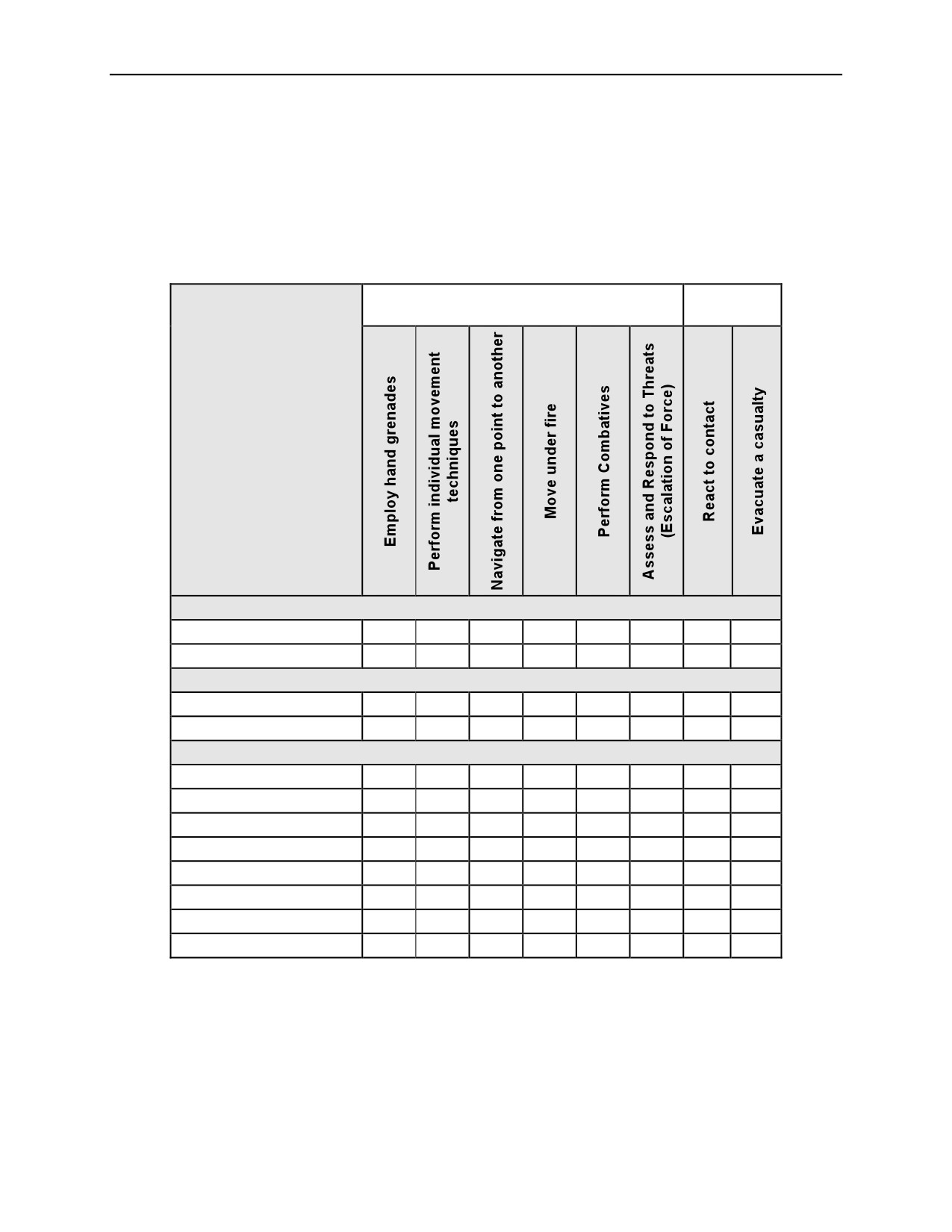
activities derive from the mission analysis of the physical demands of WTBDs. Table 1-2 shows examples of
physical requirements for the performance of WTBDs.
Table 1-2. Warrior tasks and battle drills, physical requirements for performance
Shoot
Physical Requirements
Run under load, jump, bound, high/low crawl, climb, push, pull, squat,
Employ hand grenades
lunge, roll, stop, start, change direction, get up/down, and throw.
Move
Physical Requirements
Perform individual movement
March/run under load, jump, bound, high/low crawl, climb, push, pull,
techniques
squat, lunge, roll, stop, start, change direction, and get up/down.
Navigate from one point to
March/run under load, jump, bound, high/low crawl, climb, push, pull,
another
squat, lunge, roll, stop, start, change direction, and get up/down.
Run fast under load, jump, bound, crawl, push, pull, squat, roll, stop,
Move under fire
start, change direction, and get up/down.
Survive
Physical Requirements
React to man-to-man contact: push, pull, run, roll, throw, land,
Perform Combatives
manipulate body weight, squat, lunge, rotate, bend, block, strike, kick,
stop, start, change direction, and get up/down.
Adapt
Physical Requirements
React to man-to-man contact: push, pull, run, roll, throw, land,
manipulate body weight, squat, lunge, rotate, bend, block, strike, kick,
Assess and Respond to
stop, start, change direction, and get up/down. Run under load, jump,
Threats (Escalation of Force)
bound, high/low crawl, climb, push, pull, squat, lunge, roll, stop, start,
change direction, get up/down, and throw.
Battle Drills
Physical Requirements
Run fast under load, jump, bound, crawl, push, pull, squat, roll, stop,
React to contact
start, change direction, and get up/down.
Evacuate a casualty
Squat, lunge, flex/extend/rotate trunk, walk/run, lift, and carry.
Integrated Approach
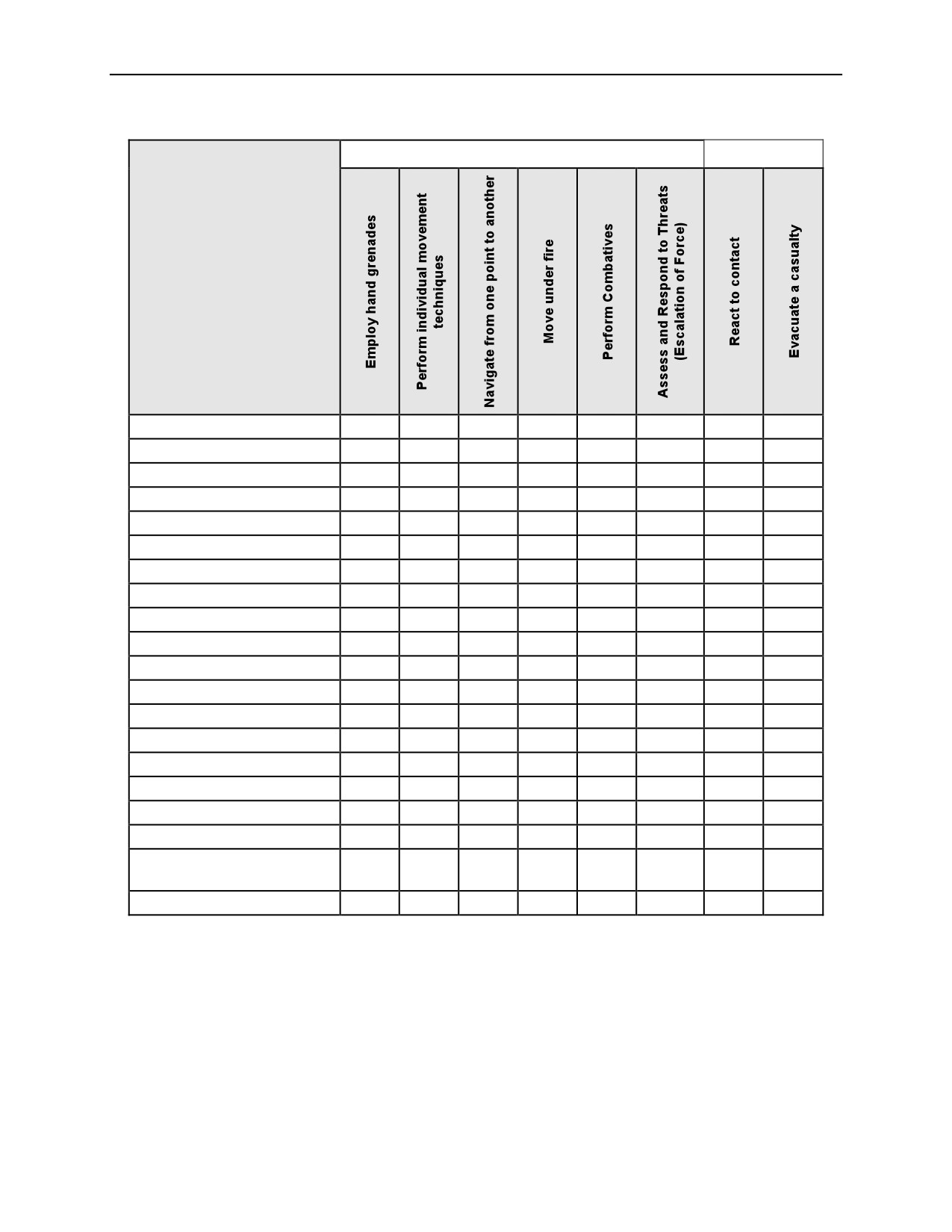
1-17. The Army PRT System employs an integrated approach to physical conditioning by training the critical
components of strength, endurance, and mobility. Table 1-3 and Table 1-4 show the correlation between
WTBDs and PRT components and activities. Standards remain constant as Soldier physical performance levels
increase, but conditions become more demanding. Soldiers and leaders execute the planned training, assess
performance, and retrain until they meet Army PRT System standards under conditions that try to replicate
wartime conditions. The end state requires leaders to integrate the relative physical performance capabilities of
1-4
FM 7-22
26 October 2012
Approach
every Soldier to generate superior combat power. Critical to successful individual and unit performance is the
ability to develop the physical potential of all Soldiers for maximum performance in the accomplishment of the
WTBDs. The tenets of this principle of training are discussed in detail in—
z
Chapter 2, System.
z
Chapter 4, Types of Programs.
z
Chapter 5, Planning Considerations.
Table 1-3. Warrior tasks and battle drills to components matrix
Battle
Warrior Tasks
Drills
PRT
Components
Strength
Muscular Strength
X
X
X
X
X
X
X
X
Muscular Endurance
X
X
X
X
X
X
X
Endurance
Anaerobic Endurance
X
X
X
X
X
X
X
X
Aerobic Endurance
X
X
X
X
Mobility
Agility
X
X
X
X
X
X
X
X
Balance
X
X
X
X
X
X
X
X
Coordination
X
X
X
X
X
X
X
X
Flexibility
X
X
X
X
X
X
X
X
Posture
X
X
X
X
X
X
X
X
Stability
X
X
X
X
X
X
X
X
Speed
X
X
X
X
X
X
X
X
Power
X
X
X
X
X
X
X
X
26 October 2012
FM 7-22
1-5
Chapter 1
Table 1-4. Warrior tasks and battle drills to activities matrix
Warrior Tasks
Battle Drills
PRT Activities
Conditioning Drill 1
X
X
X
X
X
X
X
X
Conditioning Drill 2
X
X
X
X
X
X
X
X
Conditioning Drill 3
X
X
X
X
X
X
X
X
Guerrilla Drill
X
X
X
X
X
X
X
X
Climbing Drill1
X
X
X
X
X
X
X
Climbing Drill 2
X
X
X
X
X
X
X
Strength Training Circuit
X
X
X
X
X
X
X
X
Military Movement Drill 1
X
X
X
X
X
X
X
X
Military Movement Drill 2
X
X
X
X
X
X
X
X
30:60s
X
X
X
X
X
X
X
60:120s
X
X
X
X
X
X
X
300-yd Shuttle Run
X
X
X
X
X
X
X
X
Ability Group Run
X
X
Unit Formation Run
X
X
Release Run
X
X
X
X
X
X
X
Terrain Run
X
X
X
X
X
X
X
X
Hill Repeats
X
X
X
X
X
X
X
X
Foot Marching
X
X
X
X
Obstacle Course
X
X
X
X
X
X
X
X
Negotiation
Combatives
X
X
X
X
X
X
X
X
TRAIN TO STANDARD
1-18. Training to standard using appropriate doctrine prepares Soldiers to fight and sustain in the fight during
full spectrum operations; therefore to be most effective, standards and doctrine must be uniformly known,
understood, replicable, and accepted. Doctrine represents a professional Army’s collective thinking about how it
intends to fight, train, equip, and modernize. It is the condensed expression of the Army’s approach to
warfighting. The tactics, techniques, procedures, organizations, support structures, equipment, and training must
all derive from it. In accordance with ADP 7-0, Training Units and Developing Leaders, mastery, not just
proficiency, should be the goal of all training. Leaders should continually challenge Soldiers and units by
1-6
FM 7-22
26 October 2012
Approach
varying the conditions to make successful achievement of the standard more challenging. The tenets of
standards-based training are—
z
Leaders know and enforce standards.
z
Leaders define success in the absence of standards.
z
Leaders train to standard, not time.
1-19. Physical readiness training doctrine applies Army-wide. It includes all Soldiers, functional branches,
units, and operating agencies. Physical readiness training provides a foundation for combat readiness and must
be an integral part of every Soldier’s life. Unit readiness begins with the physical fitness of Soldiers and the
NCOs and officers who lead them. Physical readiness training must be conducted according to the Army
Physical Fitness Training Program, as prescribed in AR 350-1, and conform to the Army doctrine prescribed in
this FM. Army doctrine continues to evolve to reflect lessons learned in major periods of armed conflict.
1-20. Commanders train and develop Soldiers and leaders to adapt, preparing their subordinates to operate in
positions of increased responsibility. Commanders intensify training experiences by varying training conditions.
Activities must impose both physical and metabolic demands on the Soldier. For example, requiring the Soldier
to surmount a ledge, climb stairs, sprint between covered and concealed positions, and evacuate casualties all
challenge the Soldier to overcome an ever changing set of physical demands. To prepare Soldiers to meet the
physical demands of their profession, a system of training must focus on the development of strength,
endurance and mobility, plus the enhancement of the body’s metabolic pathways. Developing the ability of
Soldiers to meet the changing physical demands that are placed upon them without undue fatigue or risk of
injury is woven into the fabric of the PRT System. Standards are achieved through precise control of the
following:
z
Prescribe appropriate intensity and duration to which Soldiers perform PRT.
z
Properly distribute external loads across the major joints of the body.
z
Integrate and balance the components of strength, endurance, and mobility.
z
Provide adequate rest, recovery, and nutrition.
1-21. Every PRT session emphasizes the performance-related factors for the successful accomplishment of
WTBDs. The systematic stress of each Soldier’s metabolic system substantially influences their ability to
perform physically at an optimum level. Competence in individual Soldier performance of all PRT activities
instills confidence in the ability to perform. It also gives personnel the confidence that all Soldiers in the unit
have similar physical capabilities and the mental and physical discipline needed to adapt to changing situations
and physical conditions. Commanders at every echelon integrate training events in their training plans to
develop and train imaginative, adaptive leaders, and units. Commanders should understand the fundamental
doctrinal training principles described in this FM and apply them accurately. This ensures Soldiers are
physically prepared to accomplish the unit mission/C- and/D-METLs.
TRAIN TO SUSTAIN
1-22. Units must be able to operate continuously while deployed. Physical readiness training provides a
foundation for combat readiness and must be an integral part of every Soldier’s life. Soldiers and leaders are
responsible for maintaining a high state of physical readiness to support training and operational missions. Units
need to be capable of fighting for sustained periods. Soldiers should therefore become experts in the conduct
and performance of PRT. This link between training and sustainment is vital to mission success. Once Soldiers
and units train to the required level of proficiency, leaders structure individual and collective training plans to
retrain critical tasks at the minimum frequency needed to sustain proficiency. Sustainment training is the key to
maintaining unit proficiency despite personnel turbulence and operational deployments. Army units train to
accomplish their missions by frequent sustainment training on critical tasks.
CONDUCT MULTIECHELON AND CONCURRENT TRAINING
1-23. Multi-echelon training is the simultaneous training of more than one echelon on different tasks. It is the
most effective and efficient way of sustaining proficiency on mission-essential tasks with limited time and
resources. All multi-echelon training techniques have these distinct characteristics:
z
They require detailed planning and coordination by commanders and leaders at each echelon.
26 October 2012
FM 7-22
1-7
Chapter 1
z
They maintain battle focus by linking individual and collective battle tasks with unit METL tasks and
within large-scale training event METL tasks.
z
They habitually train at least two echelons simultaneously on selected METL tasks and require
maximum use of allocated resources and available time.
1-24. Concurrent training occurs when a leader conducts training within another type of training. It
complements the execution of primary training objectives by allowing leaders to make the most efficient use of
available time. Similarly, while Soldiers are waiting their turn on the firing line at a range, their leaders can train
them on other tasks. Leaders look for ways to use all available training time. Concurrent training can occur
during multi echelon training. In PRT, for example, concurrent training occurs when part of the unit is
conducting climbing drills (CLs) while the others are performing conditioning drills (CDs). Upon completion,
the groups will change in order to optimize the use of limited equipment.
Army Force Generation Model
1-25. Prior to the conduct of multi-echelon training, commanders assess their units’ proficiency levels to
determine the appropriate tasks to be trained. The same is true for commanders in the execution of PRT. The
commander plans PRT based on the assessed level of physical readiness of his Soldiers. An example is the
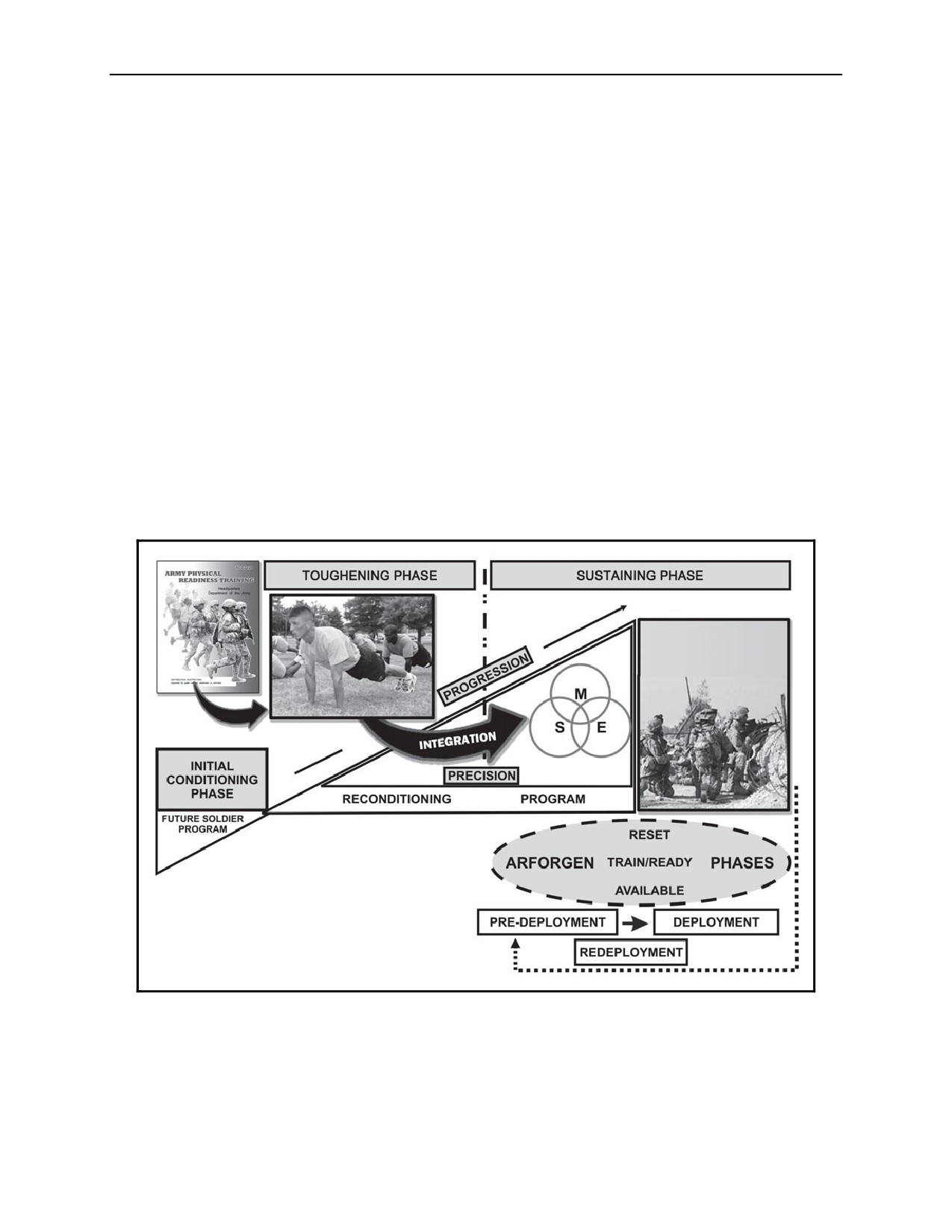
ARFORGEN model that utilizes the reset, train/ready, and available phases. (Figure 1-1, Army PRT System
and relationship to ARFORGEN.) The PRT System consists of three training phases: initial conditioning,
toughening, and sustaining. These three phases align with Soldiers’ current career paths (future Soldier, initial
military training [IMT], and unit PRT) within the operational, institutional, and self-development domains of
the Army training system.
Figure 1-1. Army PRT System and relationship to ARFORGEN
TRAIN TO DEVELOP AGILE LEADERS AND ORGANIZATIONS
1-26. In accordance with FM 7-0, the Army trains and educates its Soldiers to develop agile leaders and units to
be successful in any operational environment. Training and developing leaders is an embedded component of
1-8
FM 7-22
26 October 2012
Approach
every training event, especially in PRT. Noncommissioned officers are responsible for conducting standards-
based, performance-oriented, and realistic training. Senior NCOs train junior NCOs and assist in the
development of junior officers in their mastery of PRT drills, exercises, activities, and assessments.
Noncommissioned officers have an opportunity to lead everyday during PRT. Nothing is more important to the
Army than building confident, competent, adaptive leaders for tomorrow. See ADP 7-0, for the tenets that
underlie the development of agile and competent leaders and organizations.
1-27. Physical readiness is a mandatory training requirement that requires synchronization of the Army
Physical Fitness Training Program strategy across the training domains of the Army Training System: the
operational domain, the institutional domain, and the self-development domain. The objective of PRT is to
prepare Soldiers to meet the physical demands related to mission and C- or D-METL. This occurs through an
organized schedule of prescribed PRT drills and activities. These exercises, drills, and activities are
methodically sequenced to adequately challenge all Soldiers through progressive conditioning of the entire body
while controlling injuries. Commanders execute a vital role in PRT leader training and development in the
operational and self-development domains. They plan training in detail, prepare for training thoroughly, execute
training to standard and evaluate short-term training proficiency in terms of desired long-term results.
“Military physical training should build Soldiers up physically, wake Soldiers up mentally,
fill Soldiers with enthusiasm, and discipline them.”
Koehler’s West Point Manual of Disciplinary Physical Training (1919)
Summary
This FM provides Soldiers and leaders with the doctrine of Army PRT. It is a product of
our history, forged out of the great battles from the past to the present. Its doctrinal
concepts also reflect emerging trends in current physical culture. This FM will impact the
Army in a manner of importance toward the continuation of our national strength and
security. The purpose of Army PRT is not merely to make our Soldiers look fit, but to
actually make them physically ready for the conduct of full spectrum operations.
26 October 2012
FM 7-22
1-9
This page intentionally left blank.
Chapter 2
System
Army physical readiness is defined as the ability to meet the physical demands of any
combat or duty position, accomplish the mission, and continue to fight and win.
The goal of the Army Physical Fitness Training Program is to develop Soldiers who are
physically capable and ready to perform their duty assignments or combat roles. To reach
this goal, leaders use the PRT System to aim first at developing strength, endurance, and
mobility. Soldiers must be able to perform required duties and sustain activity during full
spectrum operations. Soldiers trained through PRT demonstrate the mobility to apply
strength and endurance to the performance of basic military skills such as marching,
speed running, jumping, vaulting, climbing, crawling, combatives, and water survival.
These skills are essential to personal safety and effective Soldier performance—not only
in training, but also, and more importantly, during combat operations.
Physical fitness and health form the basis of physical readiness. Physical readiness is in
turn essential to combat readiness. Physical readiness training prepares Soldiers and units
physically to be successful in the conduct of full spectrum operations. Secondary goals of
PRT are to instill confidence and the will to win; develop teamwork and unit cohesion;
and integrate aggressiveness, resourcefulness, and resilience. The PRT System brings
Soldiers to a state of physical readiness through a systematic program of drills and
activities specifically designed to enhance performance of WTBDs. Army PRT seeks to
attain the development of all Soldiers’ physical attributes to the fullest extent of their
given potential. This will instill confidence in their ability to perform their duties under
all circumstances.
“Soldiers should train to become stronger, faster, mobile, lethal, resilient, and smarter.”
Frank A. Palkoska, Director USAPFS
PHASES
2-1. Commanders face the continual challenge of training Soldiers with different physical capabilities.
Training to the level of the least fit removes rigor from the program, while excessive rigor places less fit
Soldiers at risk of injury. Most commanders recognize this dilemma and try to occupy a reasonable middle
ground. This chapter guides commanders in the implementation of safe and challenging PRT. It should be
applied according to Chapters 5 and 6.
2-2. The initial conditioning phase prepares future Soldiers to learn and adapt to Army PRT. Toughening
phase activities develop foundational fitness and fundamental movement skills that prepare Soldiers to
transition to the sustaining phase. Sustaining phase activities develop a higher level of physical readiness
required by duty position and C- or D-METL. Reconditioning restores Soldiers’ physical fitness levels that
enable them to safely re-enter the toughening or sustaining phase and progress to their previous level of
conditioning. See Chapter 6 for more information on reconditioning. Types of PRT training include on-ground,
off-ground, and combatives. Within these types of training are three fundamental components: strength,
endurance, and mobility. Phased training follows the principles of precision, progression, and integration.
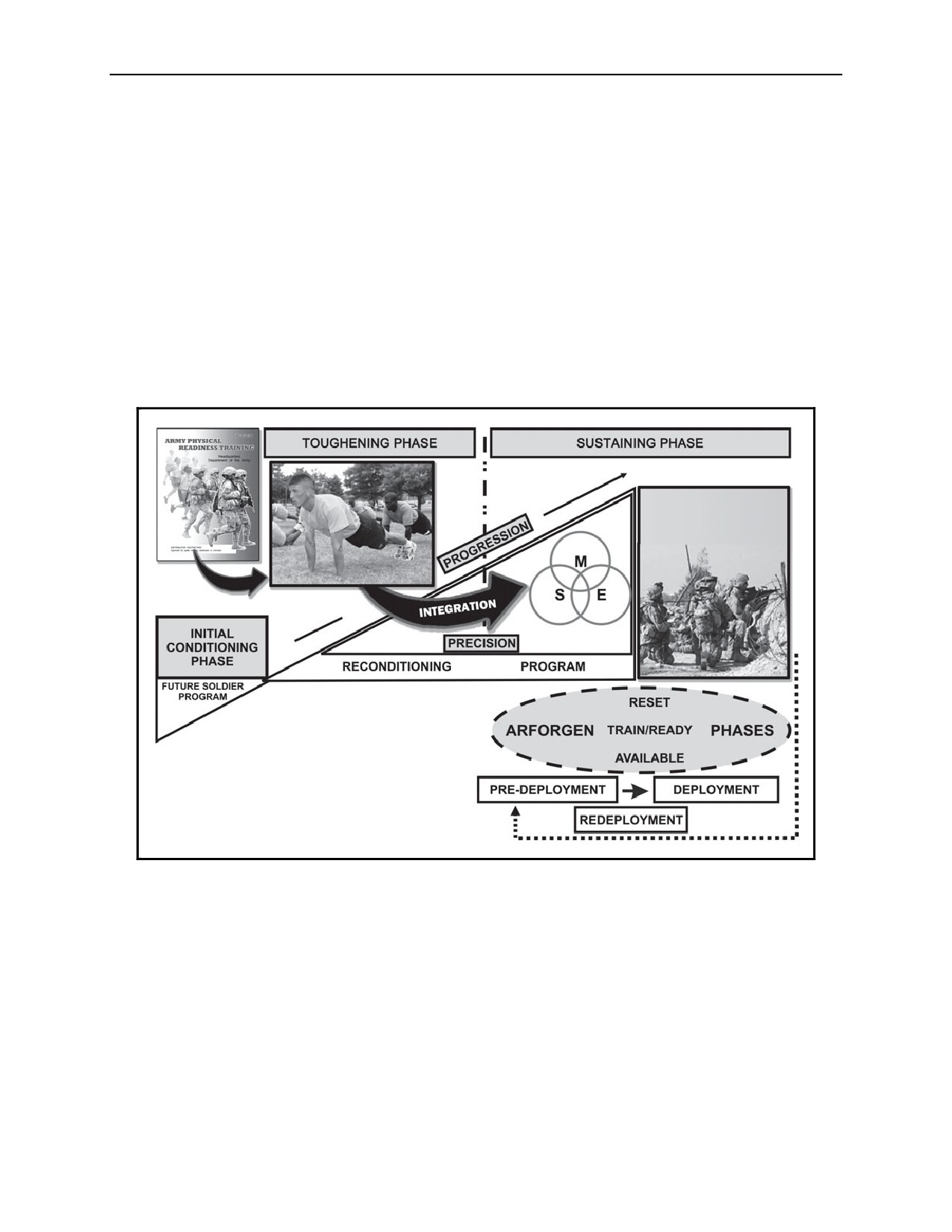
Finally, Army PRT optimizes physical performance within an environment of injury control. Figure 2-1 shows
the PRT System’s phases, types of training, components, principles, and reconditioning as they apply to
ARFORGEN.
26 October 2012
FM 7-22
2-1
Chapter 2
INITIAL CONDITIONING PHASE
2-3. The purpose of the initial conditioning phase is to establish a safe starting point for people considering
entering the Army. This includes those individuals enrolled in the Army’s Future Soldier Program and in the
Reserve Officer Training Corps. This phase of training is conducted before enlistment or pre-commissioning.
TOUGHENING PHASE
2-4. The purpose of the toughening phase is to develop foundational fitness and fundamental movement skills.
A variety of training activities with precise standards of execution ensures that bones, muscles, and connective
tissues gradually toughen, rather than break. In the toughening phase, Soldiers gradually become proficient at
managing their own body weight. Toughening phase activities develop essential skills associated with critical
Soldier tasks such as jumping, landing, climbing, lunging, bending, reaching, and lifting. Physical readiness
improves through progression in these activities. The toughening phase occurs during IMT, basic combat
training (BCT), one station unit training (OSUT) (red/white/blue phases), and Basic Officer Leader Course A
(BOLC A). The toughening phase prepares Soldiers to move to the sustaining phase.
Figure 2-1. PRT System
SUSTAINING PHASE
2-5. The purpose of the sustaining phase is to continue physical development and maintain a high level of
physical readiness appropriate to duty position and the requirements of the unit’s C- or D-METL as it applies to
ARFORGEN. See AR 350-1 to reference ARFORGEN. Sustaining phase activities are conducted in unit PRT
throughout the Army. In this phase, activities become more demanding. Exercises, drills, and activities such as
advanced calisthenics, military movement, kettlebell, and CLs are performed with increasing resistance.
Endurance and mobility activities such as foot marching, speed running, and sustained running increase in
intensity and duration. Activities that directly support unit mission and C- or D-METL, such as individual
movement techniques, casualty carries, obstacle courses, and combatives are integrated into PRT sessions.
2-2
FM 7-22
26 October 2012
System
RECONDITIONING
2-6. The objective of reconditioning is to restore physical fitness levels that enable Soldiers to reenter the
toughening or sustaining phase safely, and then progress to their previous levels of conditioning. See Chapter 6,
Special Conditioning Programs, for more information on rehabilitation and reconditioning PRT. Soldiers may
participate in reconditioning after rehabilitation and recovery from injury or illness, and then re-enter training in
the toughening or sustaining phases.
2-7. Factors such as extended deployment, field training, block leave, and recovery from illness or injury can
cause Soldiers to move from the toughening or sustaining phases to reconditioning. Once Soldiers meet the
transition criteria for re-entry into unit training, they may do so. Units usually conduct either reconditioning and
toughening or reconditioning and sustaining phases at the same time.
PRINCIPLES
2-8. The conduct of Army PRT follows the principles of precision, progression, and integration. These
principles ensure that Soldiers perform all PRT sessions, activities, drills, and exercises correctly, within the
appropriate intensity and duration for optimal conditioning and injury control.
PRECISION
2-9. Precision is the strict adherence to optimal execution standards for PRT activities. Precision is based on
the premise that the quality of the movement or form is just as important as the weight lifted, repetitions
performed or speed of running. It is important not only for improving physical skills and abilities, but to
decrease the likelihood of injury due to the development of faulty movement patterns. Adhering to precise
execution standards in the conduct of all PRT activities ensures the development of body management and
fundamental movement skills.
PROGRESSION
2-10. Progression is the systematic increase in the intensity, duration, volume, and difficulty of PRT activities.
The proper progression of PRT activities allows the body to positively adapt to the stresses of training. When
progression is violated by too rapid an increase in intensity, duration, volume or difficulty the Soldier is unable
to adapt to the demands of training. The Soldier is then unable to recover, which leads to overtraining or the
possibility of injury. Phased training ensures appropriate progression.
INTEGRATION
2-11. Integration uses multiple training activities to achieve balance and appropriate recovery between
activities in the PRT program. Because most WTBDs require a blend of strength, endurance, and mobility, PRT
activities are designed to challenge all three components in an integrated manner. The principle of integration is
evident when WTBDs and their component movements are incorporated in PRT. For example, CDs and CLs
develop the strength, mobility, and physical skills needed to negotiate obstacles. Military movement drills
(MMDs) improve running form and movement under direct or indirect fire. The guerrilla drill (GD) develops
the strength and skill associated with casualty evacuation and combatives. The drills, exercises, and activities in
this FM integrate essential Soldier tasks, making PRT a critical link in the chain of overall Soldier physical
readiness.
COMPONENTS
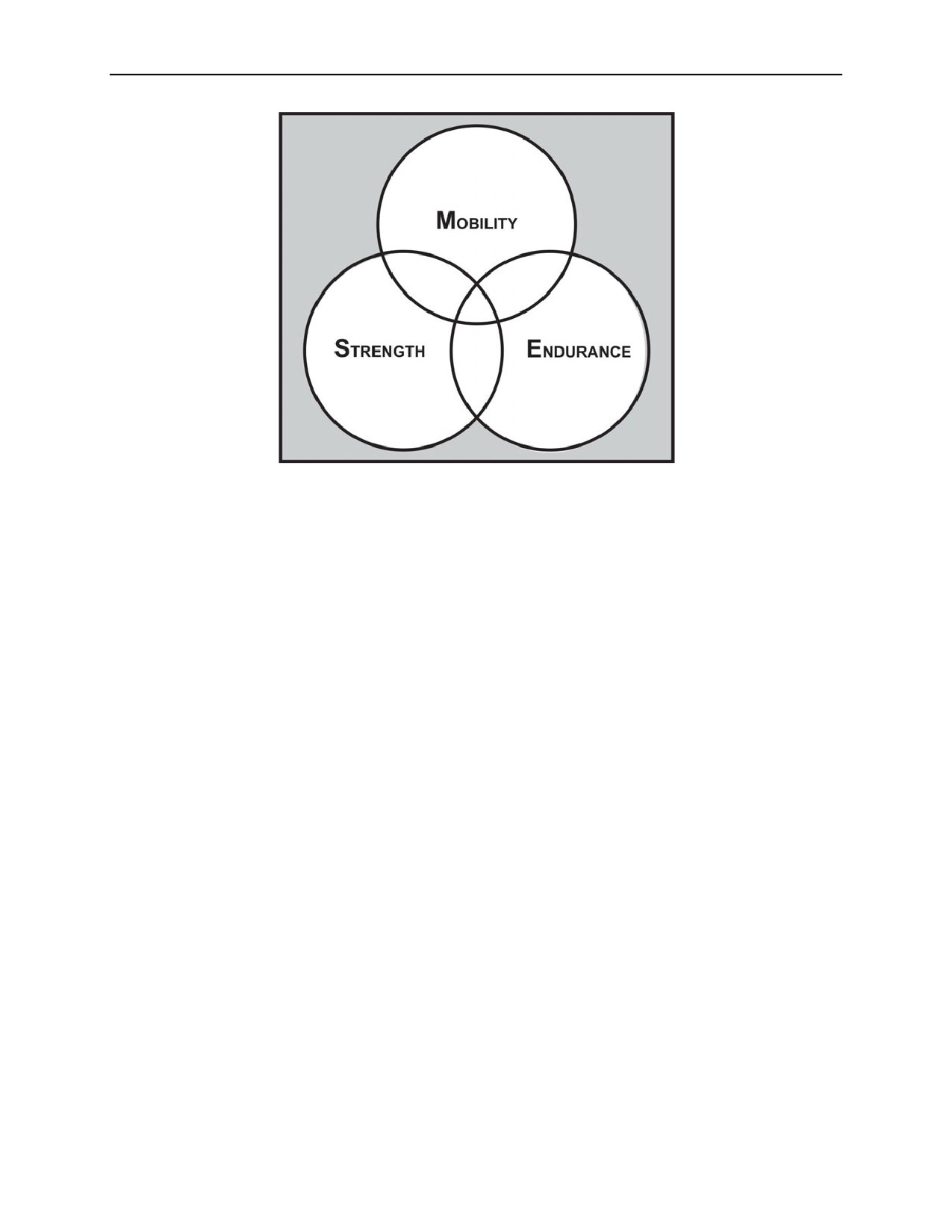
2-12. The PRT System incorporates the three components of training shown in Figure 2-2.
26 October 2012
FM 7-22
2-3
Chapter 2
Figure 2-2. Components of PRT
STRENGTH
2-13. Strength is the ability to overcome resistance. Strength runs a continuum between two subcomponents:
absolute muscular strength (the capacity of a muscle/muscle group to exert a force against a maximal resistance)
and muscular endurance (the capacity of a muscle/muscle group to exert a force repeatedly or to hold a fixed or
static contraction over a period time). Soldiers need strength to foot march under load; enter and clear a building
or trench line; repeatedly load heavy rounds; lift equipment; transport a wounded Soldier to the casualty
collection point; and most of all, to be able to withstand the rigors of continuous operations while under load. A
well-designed, strength-training program improves performance and appearance and controls injuries. The
Army’s approach to strength training is performance-oriented. The goal is to attain the muscular strength
required to perform functional movements against resistance. Calisthenics are the foundation of Army strength
training and body management. They develop the fundamental movement skills needed for Soldiers to
manipulate their own body weight and exert force against external resistance. Strength is further developed
through the performance of advanced calisthenics, resistance training, CL, and the GD.
ENDURANCE
2-14. This is the ability to sustain activity. The component of endurance, like strength, also runs a continuum
between the ability to sustain high-intensity activity of short duration (anaerobic), and low-intensity activity of
long duration (aerobic).
2-15. A properly planned and executed endurance training program balances anaerobic and aerobic training.
Analysis of the mission and C- or D-METL for nearly all units shows a significant need for anaerobic
endurance. Anaerobic training has a crossover value in improvement of aerobic capability. However, aerobic
training alone does little to improve anaerobic capacity. To enhance effectiveness and survivability, Soldiers
must train to perform activities of high intensity and short duration efficiently. Endurance programs based
solely on sustained running, while likely to improve aerobic endurance, fail to prepare units for the type of
anaerobic endurance they will need for the conduct of full spectrum operations.
z
Examples of anaerobic training are speed running, individual movement techniques, and negotiation
of obstacles.
z
Examples of aerobic training are foot marching, sustained running, cycling, and swimming.
2-4
FM 7-22
26 October 2012
System
MOBILITY
2-16. This is the functional application of strength and endurance. It is movement proficiency. Strength with
mobility allows a Soldier to squat and lift an injured Soldier. Without sufficient mobility, a strong Soldier may
have difficulty executing the same casualty transport technique. Endurance without mobility may be acceptable
to a distance runner, but for Soldiers performing individual movement techniques, both components are
essential for optimal performance.
“Movement, as such, may replace by its effect any remedy, but all the remedies in the world
cannot take the place of movement.”
Tissot, XVIII Century
QUALITATIVE PERFORMANCE FACTORS
2-17. Performing movements with correct posture and precision improves physical readiness while controlling
injuries. Qualitative performance factors for improved mobility include:
Agility is the ability to stop, start, change direction, and efficiently change body position. Performing the GD,
the shuttle run (SR), and negotiating obstacles all improve agility.
Balance is the ability to maintain equilibrium. The drills in this FM are designed to challenge and improve
balance. Balance is an essential component of movement. External forces such as gravity and momentum act
upon the body at any given time. Sensing these forces and responding appropriately leads to quality
movements.
Coordination is the ability to perform multiple tasks. Driving military vehicles and operating various
machinery and weaponry requires coordination. Coordination of arm, leg, and trunk movement is essential in
climbing and individual movement techniques.
Flexibility is the range of movement at a joint and its surrounding muscles. Flexibility is essential to performing
quality movements safely. Regular, progressive, and precise performance of calisthenics and resistance
exercises promote flexibility. Spending time on slow, sustained stretching exercises during the recovery drill
(RD) may also help to improve flexibility.
Posture is any position in which the body resides. Posture constantly changes as the body shifts to adapt to
forces of gravity and momentum. Good posture is important to military bearing and optimal body function.
Proper carriage of the body while standing, sitting, lifting, marching, and running is essential to movement
quality and performance.
Stability is the ability to maintain or restore equilibrium when acted on by forces trying to displace it. Stability
depends on structural strength and body management. It is developed through regular precise performance of
PRT drills. Quality movements through a full range of motion, such as lifting a heavy load from the ground to
an overhead position, require stability to ensure optimal performance without injury.
Speed is rate of movement. Many Soldier tasks require speed. Speed improves through better technique and
conditioning. Lengthening stride (technique) and increasing pace (conditioning) improve running speed.
Power is the product of strength and speed. Throwing, jumping, striking, and moving explosively from a
starting position require both speed and strength. Power is generated in the trunk (hips and torso). Developing
trunk strength, stability, and mobility is important to increasing power. Soldiers, as tactical athletes, are
power performers.
TYPES
2-18. The PRT System incorporates the three types of training shown in Figure 2-3.
26 October 2012
FM 7-22
2-5
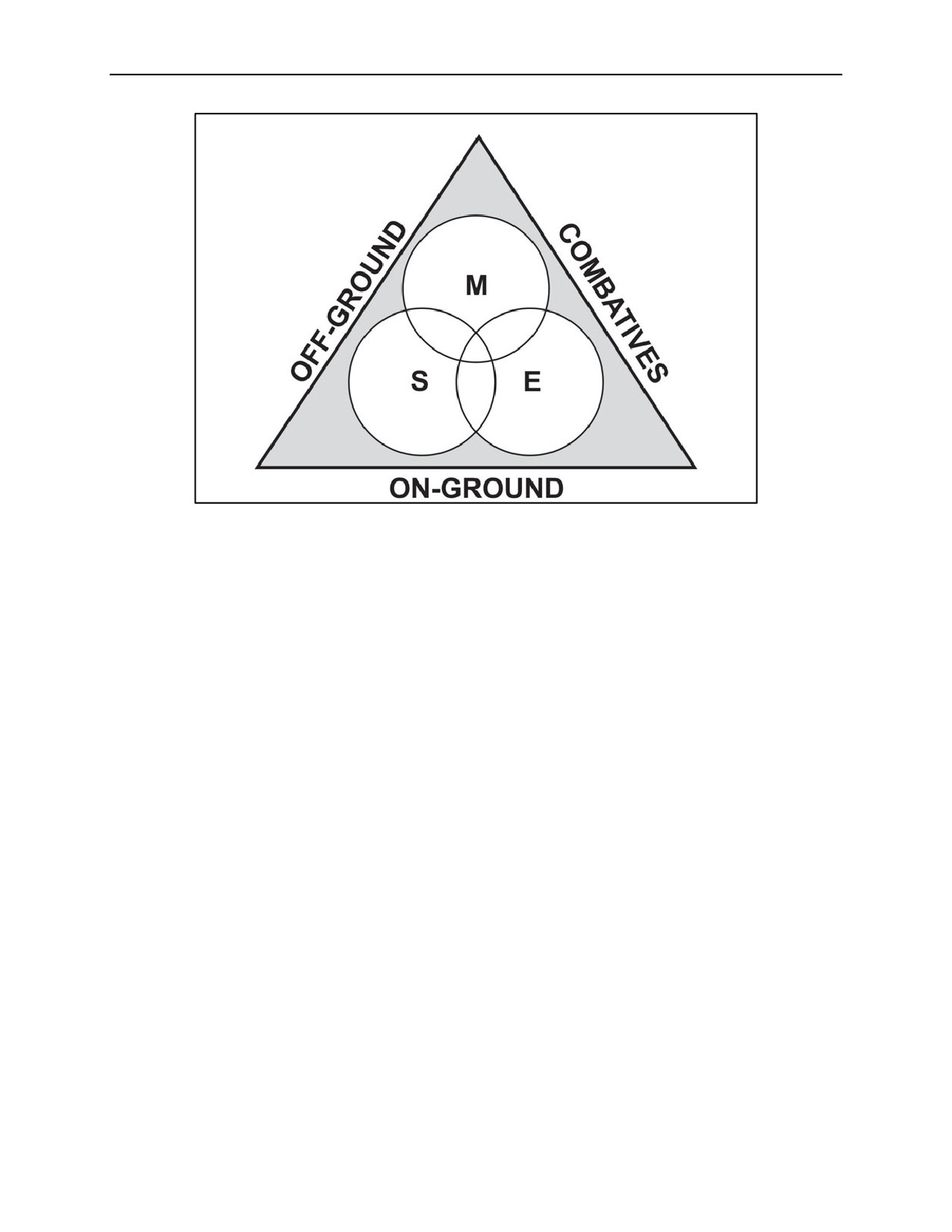
Chapter 2
Figure 2-3. Types of PRT
ON-GROUND TRAINING
2-19. On-ground training includes activities in which Soldiers maintain contact with the ground. Activities such
as marching, speed running, sustained running, calisthenics, and resistance training create a foundation for
physical fitness and movement skills.
OFF-GROUND TRAINING
2-20. Off-ground training includes activities that take place off the ground briefly (jumping and landing) or
while suspended above ground for longer periods (climbing bar and negotiation of high obstacles). Examples of
jumping and landing exercises are high jumper, power jump, and verticals. Negotiation of high obstacles
(reverse climb and cargo net) and exercises using the climbing pod (pull-up and leg tuck) require manipulation
of the body and specific movement skills while suspended above ground.
COMBATIVES TRAINING
2-21. This includes techniques that deter or defeat opponents using projectile (weapons), striking and/or close
range (grappling). (See FM 3-25.150.)
2-6
FM 7-22
26 October 2012
System
Summary
The Army’s PRT System consists of three phases: the initial conditioning phase, the
toughening phase, and the sustaining phase. The initial conditioning phase prepares
future Soldiers to learn and adapt to Army PRT. Toughening phase activities develop
foundational fitness and fundamental movement skills that prepare Soldiers to transition
to the sustaining phase. Activities in the sustaining phase develop a higher level of
physical readiness required by duty position and/or C- or D-METL. Reconditioning
restores Soldiers to physical readiness levels that allow them to safely re-enter the
toughening or sustaining phase. Types of PRT include on-ground, off-ground, and
combatives. Within these types of training are three fundamental components: strength,
endurance, and mobility. Phased training of these components is guided by the
overarching principles of precision, progression, and integration. Finally, Army PRT
optimizes physical performance within an environment of injury control. Figure
2-1
illustrates the PRT System’s phases, types of training, components, principles, and
reconditioning as they apply to ARFORGEN.
26 October 2012
FM 7-22
2-7
This page intentionally left blank.
Chapter 3
Leadership
“The American Soldier…demands professional competence in his leaders in battle; he wants
to know that the job is going to be done right, with no unnecessary casualties. The
noncommissioned officer wearing the chevron is supposed to be the best Soldier in the
platoon, and he is supposed to know how to perform all duties expected of him. The American
Soldier expects his sergeant to be able to teach him how to do his job, and expects even more
from his officers.”
General of the Army Omar N. Bradley
Throughout history, the Army has had confident leaders of character and competence.
Leaders develop through a dynamic process consisting of three equally important training
domains: operational, institutional, and self-development according to AR 350-1. The
process incorporating these domains provides the following key leadership elements:
fundamental military specialty experience; education that instills key competencies;
personal and professional development goals that enable leaders to develop the skills, the
knowledge, and the attitudes needed for success. Leaders at all levels should understand
that PRT improves Soldier resiliency, which is a vital component of a combat-ready
force. This chapter addresses the importance of leadership as it applies to PRT.
TRAITS
3-1. The success or failure of the PRT program depends upon the quality of its leadership. Leadership is the
process of influencing Soldiers by providing purpose, direction, and motivation. The best outcome results only
when Soldiers extend themselves completely in strenuous physical activities and perform all exercises in the
prescribed form. Officers and NCOs lead, train, motivate, and inspire their Soldiers. Only the best leadership
can inspire Soldiers to cooperate to this extent. For these reasons, only the best qualified NCOs in the unit
should lead PRT. The leader must exemplify the Army adage: Be, Know, Do.
COMPETENCE
3-2. All officers, NCOs, and PRT leaders must set and enforce standards through complete mastery of this
TFM. They must not only be able to explain and demonstrate all activities, but also must know the best methods
of presenting and conducting them. Leaders set the example. The PRT leader demonstrates tactical and
technical competence through a mastery of PRT subject matter. Mastery is the first step in developing
confidence, assurance, and poise. Thorough knowledge of this FM allows the PRT leader to apply the training
principles of precision, progression, and integration needed to attain Soldier physical readiness. Skill in
demonstrating and leading all PRT exercises, drills, and activities is essential to teaching technique and is
invaluable to the PRT leader. The unprepared, hesitant leader loses the confidence and respect of Soldiers
almost immediately. The well-prepared, confident leader gains the respect and cooperation of all Soldiers at the
outset.
PHYSICAL QUALIFICATIONS AND APPEARANCE
3-3. The personal appearance and physical qualifications of the PRT leader affect his effectiveness. He should
exemplify the things he is seeking to teach. It is a great advantage if the leader himself can do all and more than
he asks of his men. He must be physically fit because PRT leadership is so strenuous that considerable strength,
endurance, and mobility are essential prerequisites for success.
26 October 2012
FM 7-22
3-1
Chapter 3
KNOWLEDGE OF HUMAN BEHAVIOR
3-4. Successful leadership in PRT requires the leader to know and appreciate the individual physical and
mental differences of his Soldiers. He must get to know his Soldiers as individuals and be quick to recognize
signs indicating their reactions to his instruction. The successful PRT leader ensures that his subordinates
understand the critical importance of PRT to the successful accomplishment of WTBDs in support of the unit’s
C- or D-METL. This is accomplished by understanding Soldiers, knowing how to lead and motivate them,
understanding how they learn, and using this knowledge in PRT sessions. To succeed, PRT leaders must have
the confidence of the Soldiers. He gains their confidence by winning their respect. He wins their respect by his
sincerity, integrity, determination, sense of justice, energy, self-confidence, and force of character. A leader
who has the admiration and respect of his Soldiers easily secures their cooperation. The leader treats the
Soldiers with consideration and avoids imposing unreasonable physical demands on them. If Soldiers are
exercised too violently, they become so stiff and sore that they look upon the next PRT session with
apprehension. When this happens, Soldiers can develop an antagonistic attitude toward the leader and the
program. Instead of cooperating, they will malinger at every opportunity.
ENTHUSIASM
3-5. Another essential quality of the PRT leader is enthusiasm. Successful Army PRT activities must be
carried on in a continuous and vigorous manner. Soldiers reflect the attitude of the PRT leader. If the leader is
enthusiastic, his instructed Soldiers will be enthusiastic. If the leader is apathetic, his instructed Soldiers will be
apathetic. The enthusiasm of a leader springs from the realization of the importance of the mission. Leaders
must be inspired by the thought that what they do every minute of every day may mean the difference between
life and death. There is no more effective method of obtaining the energetic, wholehearted participation of
Soldiers in the PRT program than by providing skilled, enthusiastic leadership.
“The instructor must lose himself in his work, must demand precision, encourage here,
correct there, reprove one man, and boost another. In fact, he must so strive himself, that his
men will be proud of their leader in every way, proud of his appearance, proud of his ability,
proud of his fairness, and proud because their instructor is helping to make their organization
the best in the Army.”
LTC Herman J. Koehler, First Master of the Sword, United States Military Academy
COOPERATION
3-6. A successful PRT program requires the full cooperation of all Soldiers. Orderly movement of Soldiers
and units requires a precise and unified effort. A Soldier belongs to a team that works smoothly when every
Soldier plays his part. Each Soldier knows what to do in response to a command as well as what his fellow
Soldiers must do. The Soldier’s confidence in the team grows until he feels as sure of them as he does of
himself. The final result is teamwork, and teamwork is attained though the medium of drills.
3-7. A drill consists of certain movements that allow the unit to conduct an activity with order and precision.
Drills train Soldiers to do their parts exactly so that, on command, the unit moves instantly and smoothly. Drill
training starts the day a Soldier enters the Army. In the beginning, he is taught the movements of his feet and
arms used in PRT, marching, and handling the weapon. He is trained in all these activities until he reaches a
point where he does them automatically in response to a command. He is then placed in a unit and trained to do
all these activities with other Soldiers. Squads, platoons, and companies drill with the smoothness of machinery.
The result is cooperative, unified action—teamwork. Soldiers are at their best when inspired to have pride in
themselves and their organization. This pride finds expression in perfect response to command.
MOTIVATION
3-8. Commanders and leaders at all levels may provide one of the best incentives for their Soldiers when they
are visible and actively participate in PRT. When Soldiers feel their chain of command believes in PRT to the
extent that they themselves regularly engage in the activities, they are motivated to greater effort. Troops also
develop a greater esprit de corps and respect for their officers and NCOs when all actively participate. Finally,
3-2
FM 7-22
26 October 2012
Leadership
the frequent use of Soldiers as assistant instructors (AIs) also serves as an incentive. Soldiers will work hard for
this honor and positively respond to AI responsibilities.
RESPONSIBILITIES
3-9. Leaders must provide facilities and funds to support a PRT program that will develop physical readiness
in all Soldiers.
FACILITIES
3-10. Exercise drill activities require flat, grassy areas. The GD, speed, and sustained running require well
lighted running routes, tracks, and marked fields. Strength development requires kettlebells, step-up benches,
and climbing bars.
SPECIAL PROGRAMS
3-11. Leaders must follow training guidelines for individual, reconditioning, pregnancy, and post-partum
weight control, APFT failure, and new Soldier programs.
EXERCISE NAMES
3-12. Soldiers learn all exercises by name, sequence, and movement. This ensures efficient use of time and
precision of execution.
CORRECTIVE TRAINING
3-13. Assistant instructors must remove Soldiers who need corrective training from the formation. This applies
to Soldiers not performing exercises, drills or activities to standard. The AI corrects all mistakes and ensures
proper execution.
SCHEDULING AND SUPERVISING
3-14. Leaders responsible for scheduling and supervising PRT should take the following actions:
z
Make PRT as important as any other training activity.
z
Dedicate sufficient time for PRT (60 to 90 minutes).
z
Avoid substituting other training or routine duties during scheduled PRT.
z
Schedule and conduct PRT when it makes the most sense. Physical readiness training should not be
reserved only for the early morning hours and may run during or at the end of the duty day.
z
Prevent the misuse of allotted PRT time by using qualified personnel to supervise and lead.
z
Provide for mass participation regardless of rank, age or gender during every PRT session.
z
Adhere to PRT schedules for the toughening and the sustaining phases.
z
Use appropriate PRT formations.
z
Use preparatory commands and commands of execution.
z
Use cadence appropriate for planned activities.
z
Require PRT leaders to lead and conduct activities with the Soldiers to determine appropriate
intensity levels.
z
Require one AI for every 15 Soldiers.
z
Require AIs to supervise the execution of all PRT activities and make appropriate corrections.
3-15. Leaders have the latitude to adjust the PRT schedule to balance it with other training to avoid conflicts
with physically demanding events that can lead to overtraining. For example, if the confidence obstacle course
(CFOC) is the day’s main physical training event, leaders should not schedule strength training for PRT (unless
it is conducted later in the training day). If conflicts cannot be resolved, PRT should be performed after a
physically demanding event (later in the duty day), rather than before the event (in the morning) for safety
26 October 2012
FM 7-22
3-3
Chapter 3
reasons. It is also acceptable to not conduct the scheduled PRT session in order to provide adequate rest and
recovery.
Summary
Leaders are challenged with scheduling and executing PRT programs that ensure
Soldiers and units are prepared to successfully perform their wartime mission. Effective
leadership is essential to the success of any program. Successful leaders possess
qualities that gain the confidence and respect of their Soldiers.
3-4
FM 7-22
26 October 2012
PART TWO
Strategy
This part discusses the strategy of Army physical readiness training.
Chapter 4
Types of Programs
“The quality of the unit is determined by the overall picture of physical condition and total
military fitness of all its members. It is more important that all men in a unit receive the
benefits of a balanced and well-directed program of physical training than that a few
members achieve record performances. The physical training program, therefore, is directed
toward the total conditioning of all men.”
FM 21-20, Physical Training (1946)
Army PRT achieves other valuable outcomes in addition to developing and maintaining a
high level of individual and unit readiness. These outcomes include: basic military skills
and survivability along with their intangible benefits. The basic military skills associated
with PRT include foot marching, running, swimming, jumping, vaulting, climbing,
crawling, lifting, and load carrying. Survivability is often dependent upon
maneuverability and mental alertness. Intangible benefits include teamwork,
aggressiveness, confidence, resourcefulness, a will to win, discipline, and adaptability.
Physical resilience is also a gained attribute.
INITIAL MILITARY TRAINING
4-1. Initial military training has the following elements: BCT, advanced individual training (AIT), OSUT, and
Basic Officer Leader Courses A and B (BOLC A and B).
BASIC COMBAT TRAINING
4-2. The training program in BCT provides foundational fitness and fundamental motor skill development.
New Soldiers report to BCT at various levels of physical readiness and ability. During the first weeks of
training, the focus is on progressive training of the whole body. To minimize the risk of injury, Soldiers must
perform exercises precisely. Also, their intensity must progress gradually. The toughening phase BCT training
schedules in Chapter 5, Planning Considerations, when executed to standard, provide the proper training
intensity and exercise volume and gradual progression appropriate to improving physical fitness and controlling
injuries. Commanders should evaluate each new Soldier who falls below the BCT standard and give special
assistance to improve deficiencies. Supplemental training should not punish a new Soldier for the inability to
perform well. Commanders and PRT leaders need to realize that it takes at least six to eight weeks to begin
positive changes in physical fitness levels; therefore, some Soldiers may require additional time to make the
improvements required to meet Army standards.
26 October 2012
FM 7-22
4-1
///////////////////////////////////////