FM 7-22 ARMY PHYSICAL READINESS TRAINING (OCTOBER 2012) - page 4
Chapter 6
STRENGTH TRAINING MACHINE DRILL
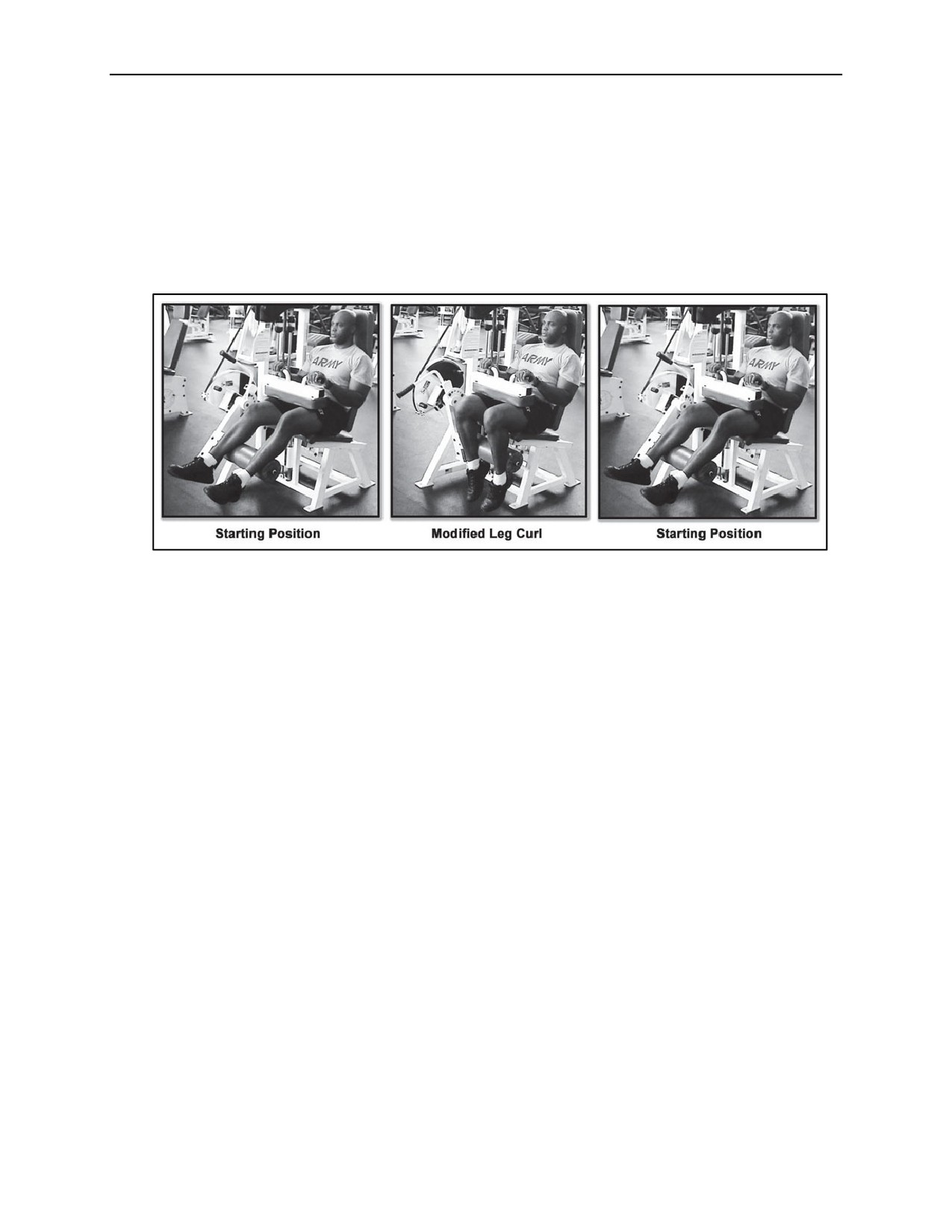
MODIFIED EXERCISE 2A: MODIFIED LEG CURL (SEATED)
6-56. This exercise (Figure 6-24) is performed the same as the leg curl; however, the range of motion is much
less. As the Soldier’s condition improves, the range of motion may gradually increase until the exercise is
performed to standard. The resistance should not be increased until the Soldier can move through the full range
of motion and perform the exercise to standard.
Figure 6-24. Modified leg curl
6-36
FM 7-22
26 October 2012
Special Conditioning Programs
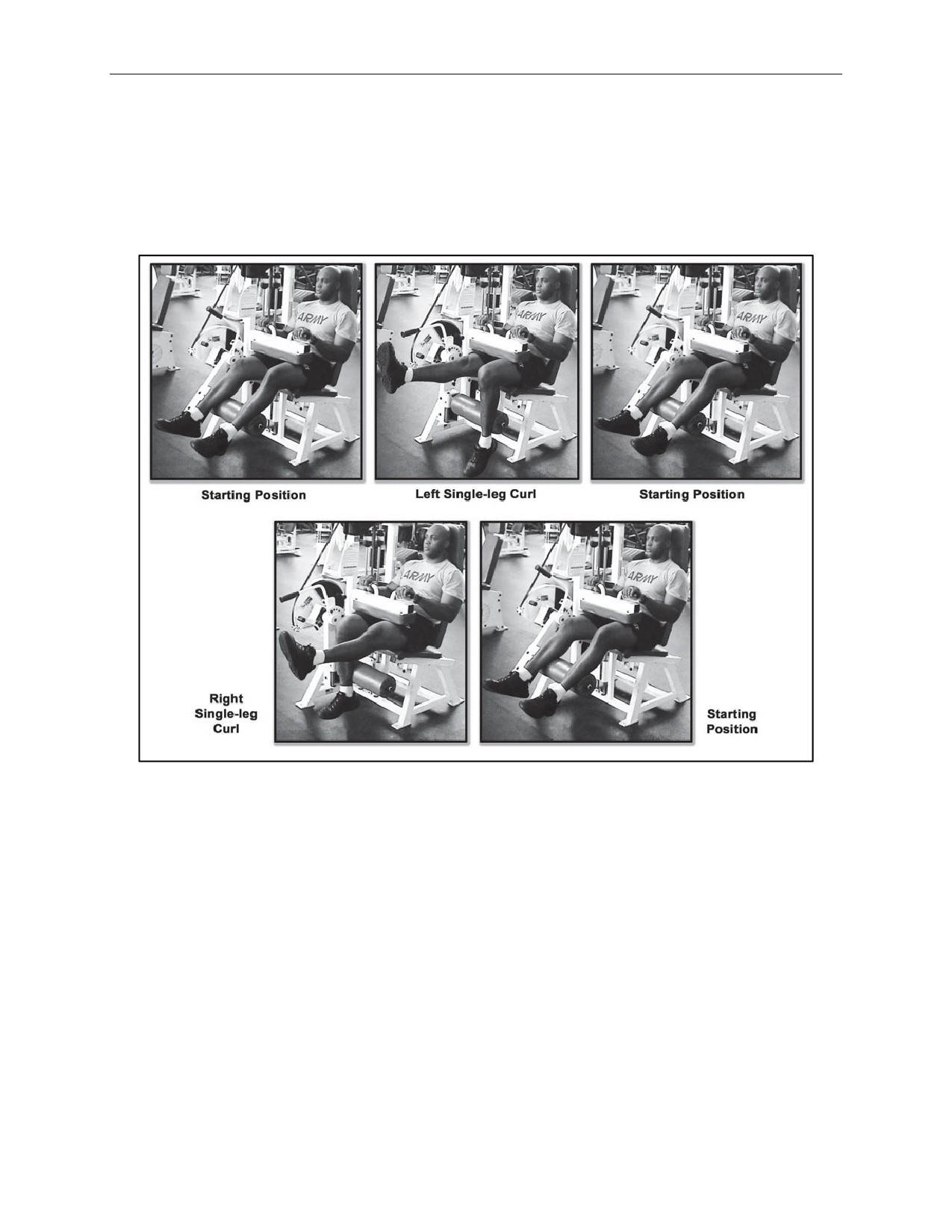
MODIFIED EXERCISE 2B: SINGLE-LEG CURL (SEATED)
6-57. This exercise (Figure 6-25) is performed much like the leg curl, using only one leg at a time. The range of
motion and resistance is decreased for the injured leg. As the Soldier’s condition improves, the range of motion
may gradually increase until the exercise is performed to standard. The resistance should not be increased until
the Soldier can move through the full range of motion. The single-leg curl is used to maintain a heavy resistance
on the good leg and/or to reduce the resistance on the injured leg.
Figure 6-25. Single-leg curl
26 October 2012
FM 7-22
6-37
Chapter 6
STRENGTH TRAINING MACHINE DRILL
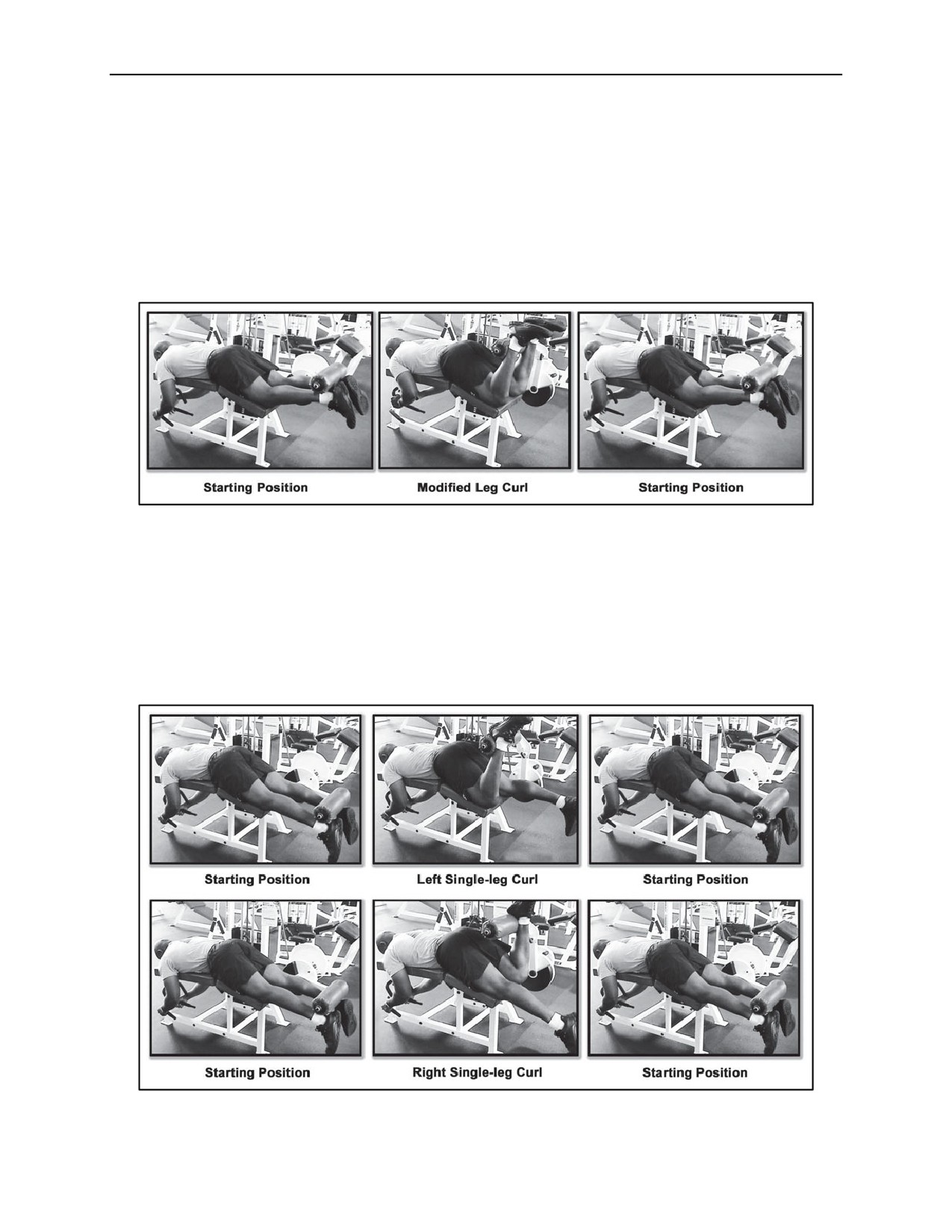
MODIFIED EXERCISE 2C: MODIFIED LEG CURL (PRONE)
6-58. This exercise (Figure 6-26) is performed in the prone position through a limited range of motion. Soldiers
with low back or hip injuries may prefer to use the seated leg curl if it is available. As the Soldier’s condition
improves, the range of motion may gradually increase until the exercise is performed through a full range of
motion (heels to the buttocks). The resistance should not be increased until the Soldier can move through the
full range of motion.
Figure 6-26. Modified leg curl (prone)
MODIFIED EXERCISE 2D: SINGLE-LEG CURL (PRONE)
6-59. This exercise (Figure 6-27) is performed using only one leg at a time. Soldiers with low back or hip
injuries may prefer to use the seated leg curl if it is available. The range of motion and resistance is decreased
for the injured leg. As the Soldier’s condition improves, the range of motion may gradually increase until the
exercise is performed to standard (heel to the buttocks). The resistance should not be increased until the Soldier
can move through the full range of motion. The single-leg curl is used to maintain a heavy resistance on the
good leg and to reduce the resistance on the injured leg.
Figure 6-27. Single-leg curl (prone)
6-38
FM 7-22
26 October 2012
Special Conditioning Programs
STRENGTH TRAINING MACHINE DRILL
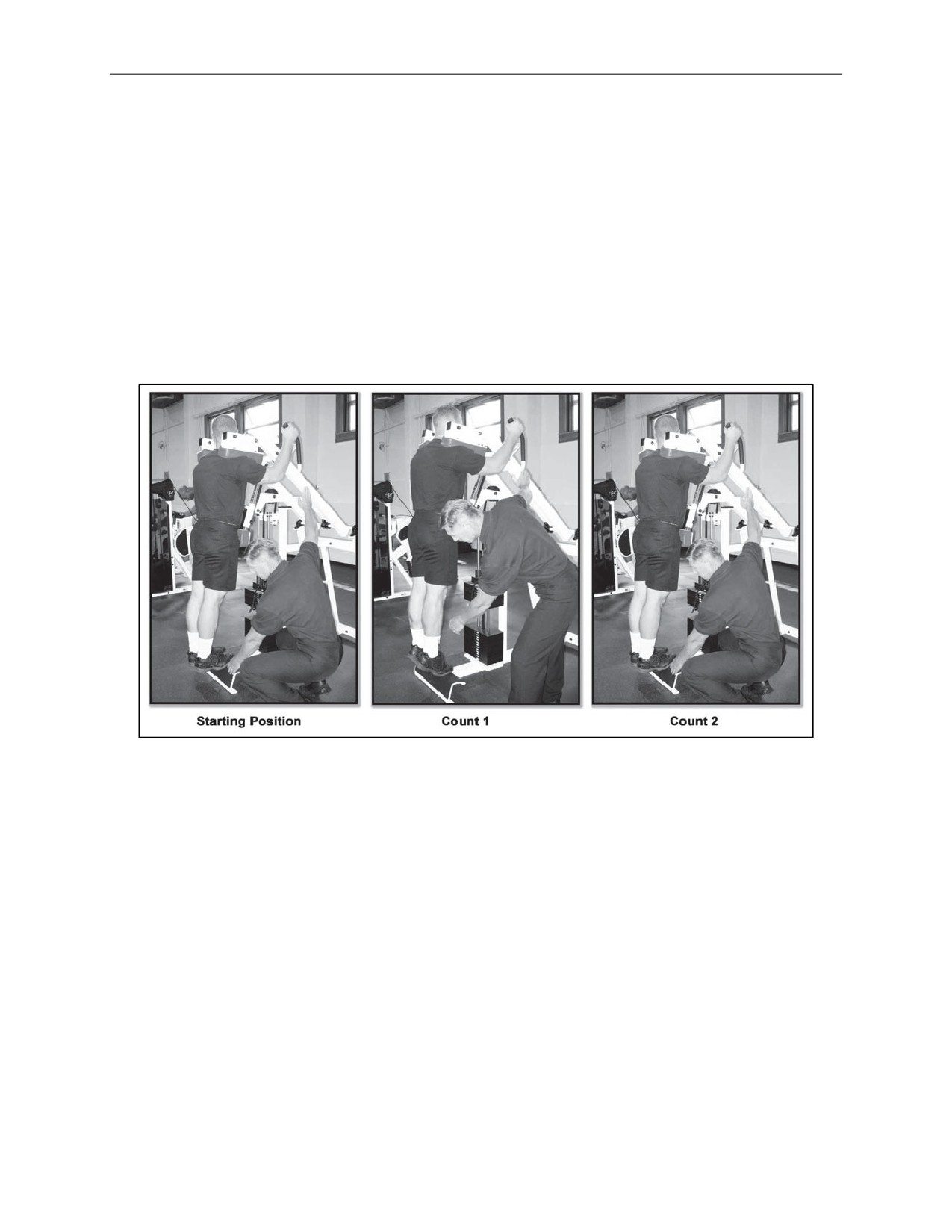
EXERCISE 3: HEEL RAISE
Purpose: This exercise develops strength in the back of the lower leg muscles (Figure 6-28).
Starting Position: Stand with the balls of the feet on the elevated platform, toes pointing straight ahead, feet aligned
directly below the hips, and the knees slightly flexed.
Cadence: SLOW
Count:
1. Raise the entire body slowly by pulling the heels up, maintaining a slight bend in the knees, and a
natural arch in the low back.
2. Return to the starting position.
Figure 6-28. Heel raise
Check Points:
z
Maintain a natural arch in the lower back.
z
Keep the knees slightly flexed throughout the exercise.
z
Keep the head and neck in a neutral position, looking straight ahead.
z
Keep the knees aligned over the feet.
z
Exhale on count 1 and inhale on count 2.
Precautions: Avoid flexing or extending the trunk. Do not allow the ankles to turn in or out.
26 October 2012
FM 7-22
6-39
Chapter 6
STRENGTH TRAINING MACHINE DRILL
MODIFIED EXERCISE 3A: SINGLE-LEG HEEL RAISE
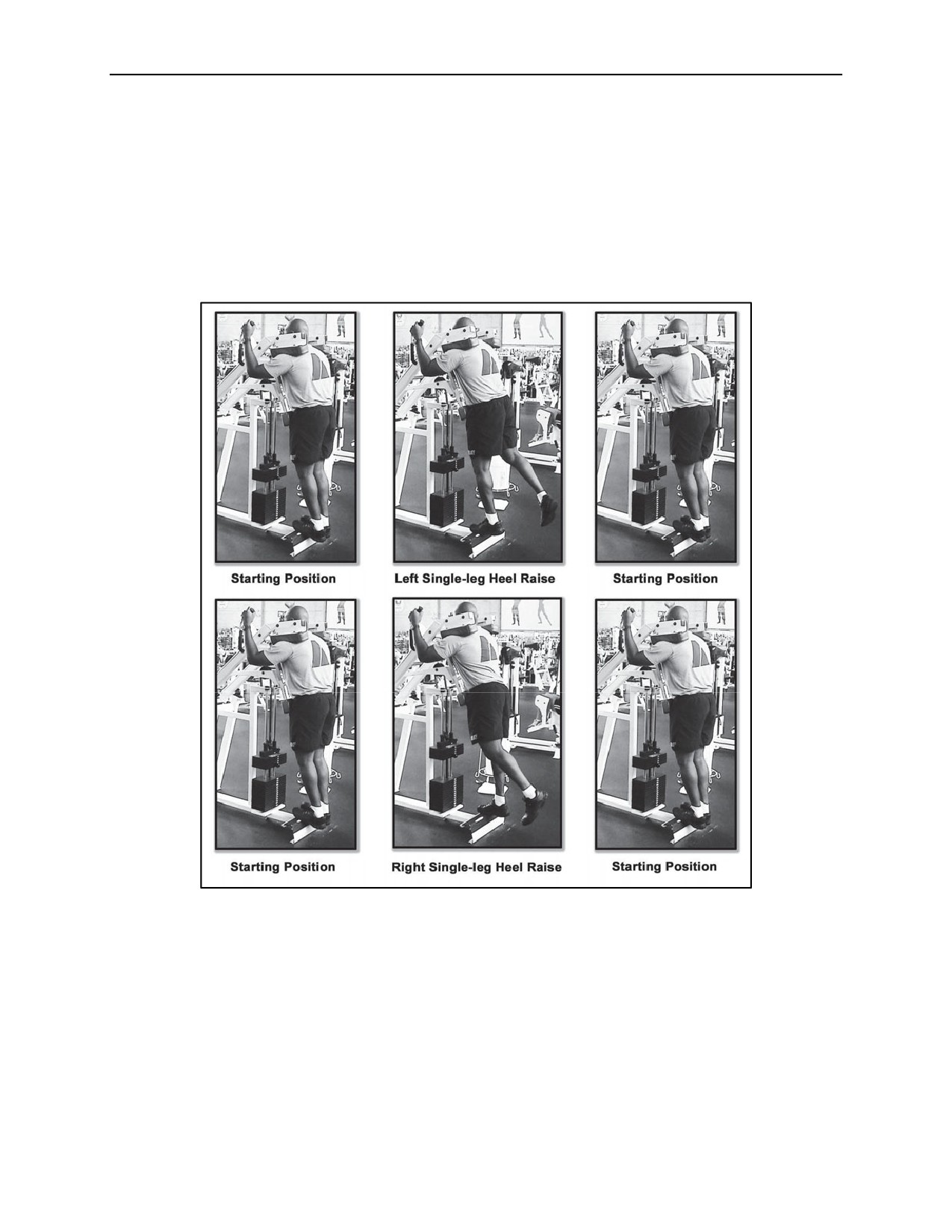
6-60. This exercise (Figure 6-29) is performed much like the heel raise, using only one leg at a time. The range
of motion and resistance is decreased for the injured leg. As the Soldier’s condition improves, the range of
motion may gradually increase until the exercise is performed to standard. The resistance should not be
increased until the Soldier can move through the full range of motion. The single leg is used to maintain a heavy
resistance on the good leg and/or to reduce the resistance on the injured leg.
Figure 6-29. Single-leg heel raise
6-40
FM 7-22
26 October 2012
Special Conditioning Programs
STRENGTH TRAINING MACHINE DRILL
EXERCISE 4: CHEST PRESS
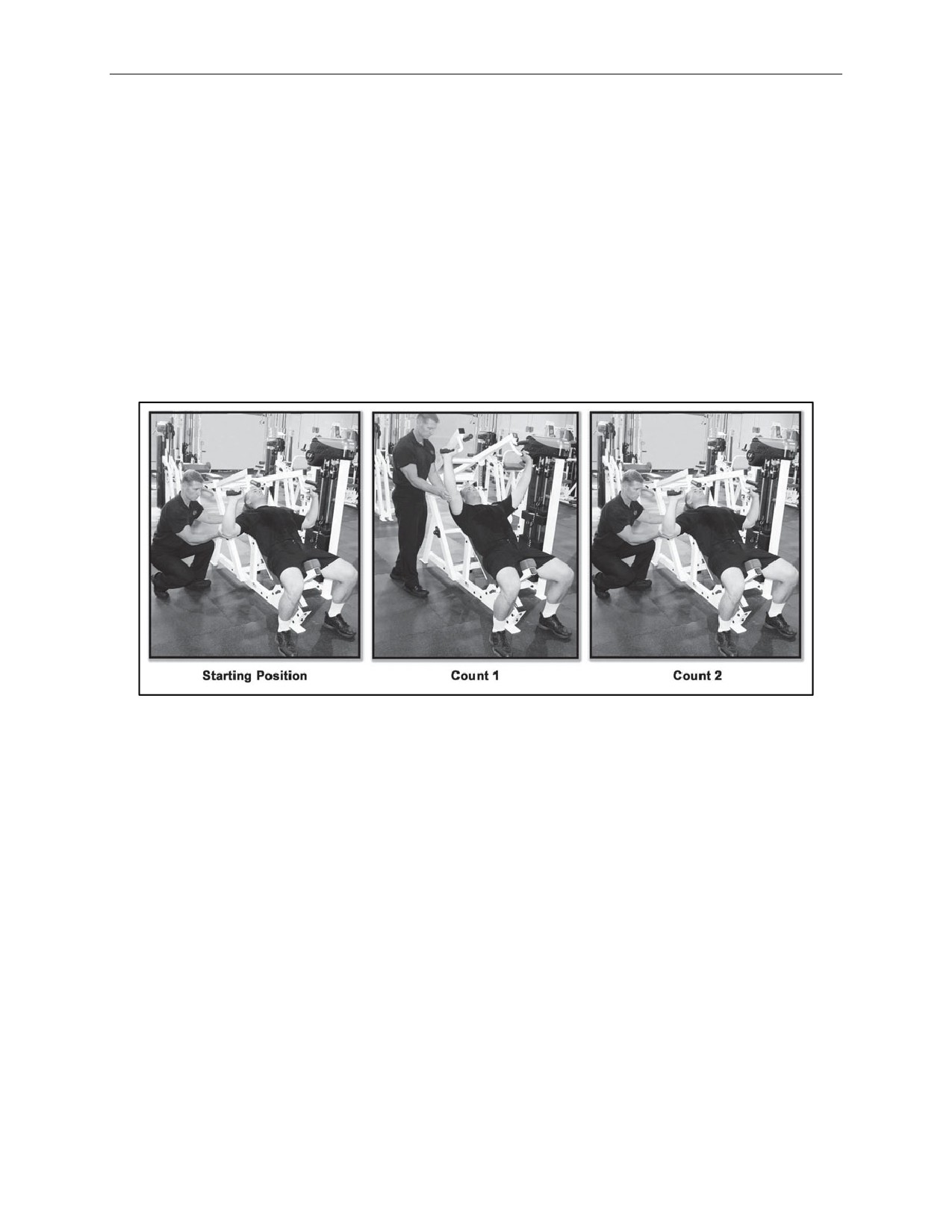
Purpose: This exercise develops strength in the arms, shoulders, and chest muscles (Figure 6-30).
Starting Position: Seated position with the feet firmly on the ground. The seat is adjusted so a 90-degree angle is
formed between the upper and lower arms with the shoulders directly below the handgrips. The hips, low back,
shoulders, and head are firmly against the seat back with the eyes looking straight ahead. A natural arch is
maintained in the lower back. Select the appropriate weight and ensure the pin is secure in the weight stack.
Cadence: SLOW
Count:
1. Push upward until both arms are fully extended, but not locked.
2. Return to the starting position.
Figure 6-30. Chest press
Check Points:
z
Feet remain on the ground, with hips, back, shoulders, and head firmly on the bench.
z
Keep the head and neck in a neutral position, looking straight ahead.
z
Exhale on count 1 and inhale on count 2.
Precaution: Do not arch the back or allow the hips to rise off the bench.
26 October 2012
FM 7-22
6-41
Chapter 6
STRENGTH TRAINING MACHINE DRILL
MODIFIED EXERCISE 4A: MODIFIED CHEST PRESS
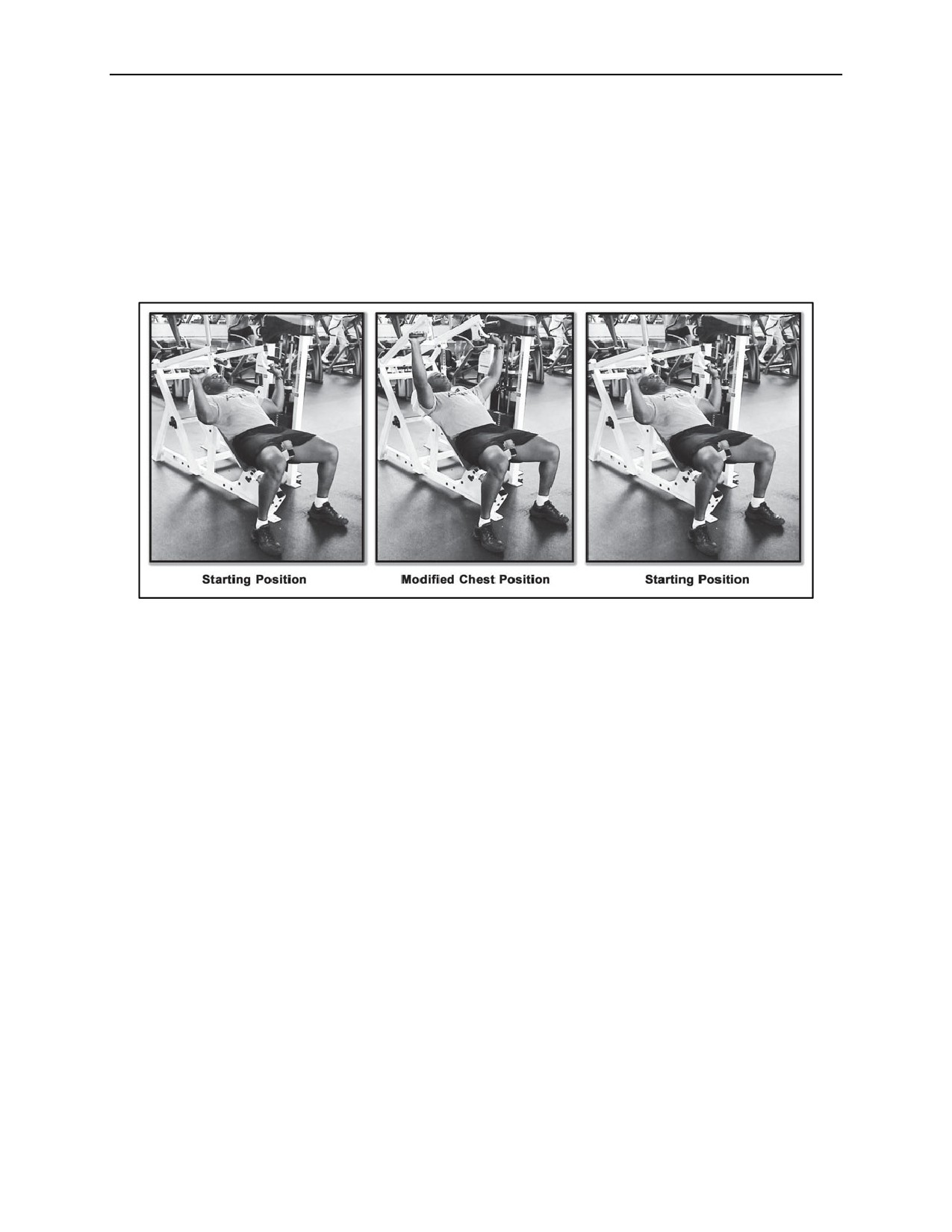
6-61. This exercise (Figure 6-31) is performed the same as the chest press, but with much less range of motion.
The elbows will not flex below 90 degrees as the resistance is lowered, nor will they fully straighten when the
resistance is raised. As the Soldier’s condition improves, the range of motion may gradually increase until the
exercise is performed to standard. The resistance should not be increased until the Soldier can move through the
full range of motion and perform the exercise to standard.
Figure 6-31. Modified chest press
6-42
FM 7-22
26 October 2012
Special Conditioning Programs
MODIFIED EXERCISE 4B: SINGLE-ARM CHEST PRESS
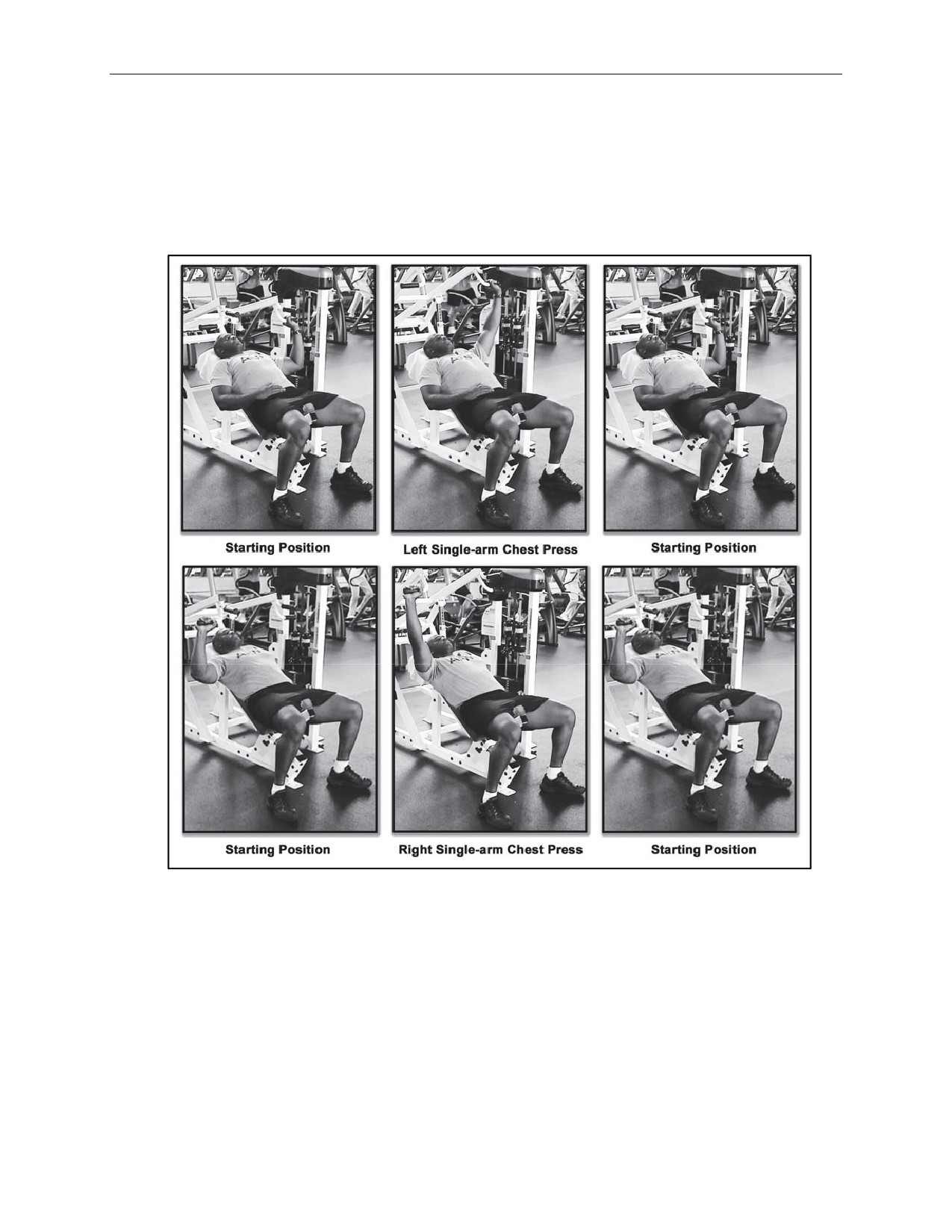
6-62. This exercise (Figure 6-32) is performed much like the chest press, using only one arm at a time. The
range of motion and resistance is decreased for the injured side. As the Soldier’s condition improves, the range
of motion may gradually increase until the exercise is performed to standard. The resistance should not be
increased until the Soldier can move through the full range of motion. The single-arm chest press is used to
maintain a heavy resistance on the good side and/or to reduce the resistance on the injured side.
Figure 6-32. Single-arm chest press
26 October 2012
FM 7-22
6-43
Chapter 6
STRENGTH TRAINING MACHINE DRILL
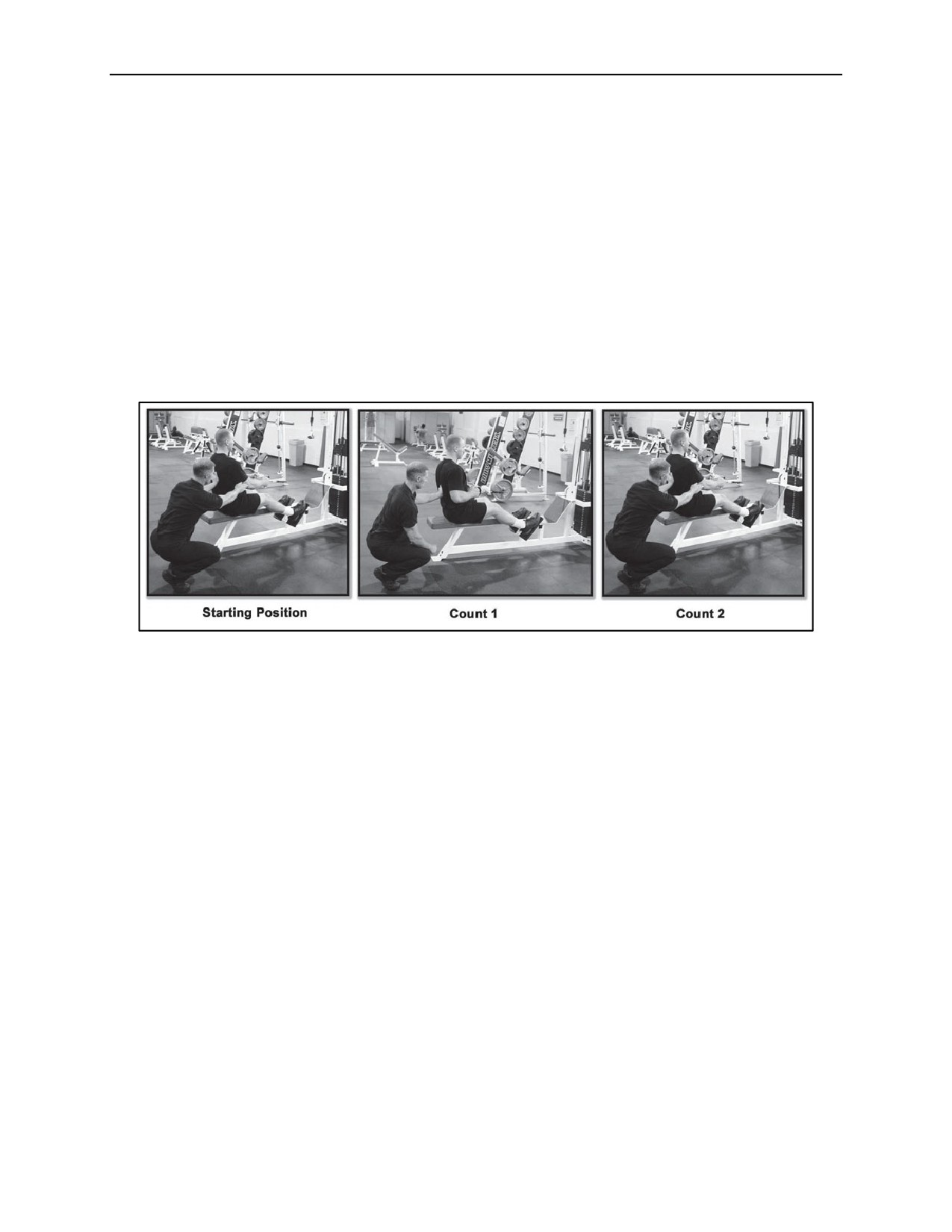
EXERCISE 5: SEATED ROW
Purpose: This exercise develops strength in the arm and back muscles (Figure 6-33).
Starting Position: Seated position with the feet firmly planted on the foot supports. Lean forward and grasp the
handgrips with the hands in a neutral closed grip. Sit erect so the upper body is perpendicular to the floor. Select the
appropriate weight and ensure the pin is secure in the weight stack.
Cadence: SLOW
Count:
1. Simultaneously, bend the elbows and pull the handgrips to the chest or upper abdomen while
keeping the trunk rigid and the back flat.
2. Return to the starting position by slowly extending the elbows.
Figure 6-33. Seated row
Check Points:
z
Feet remain flat on the ground or foot supports.
z
The trunk is erect and the back is flat.
z
Keep the head and neck in a neutral position, looking straight ahead or slightly downward.
z
The arms are about parallel to the ground.
z
On count 1 ensure the elbows point up and to the rear.
z
Exhale on count 1 and inhale on count 2.
Precautions: Do not jerk the trunk to move the handgrips towards the chest. Maintain a flat back.
6-44
FM 7-22
26 October 2012
Special Conditioning Programs
STRENGTH TRAINING MACHINE DRILL
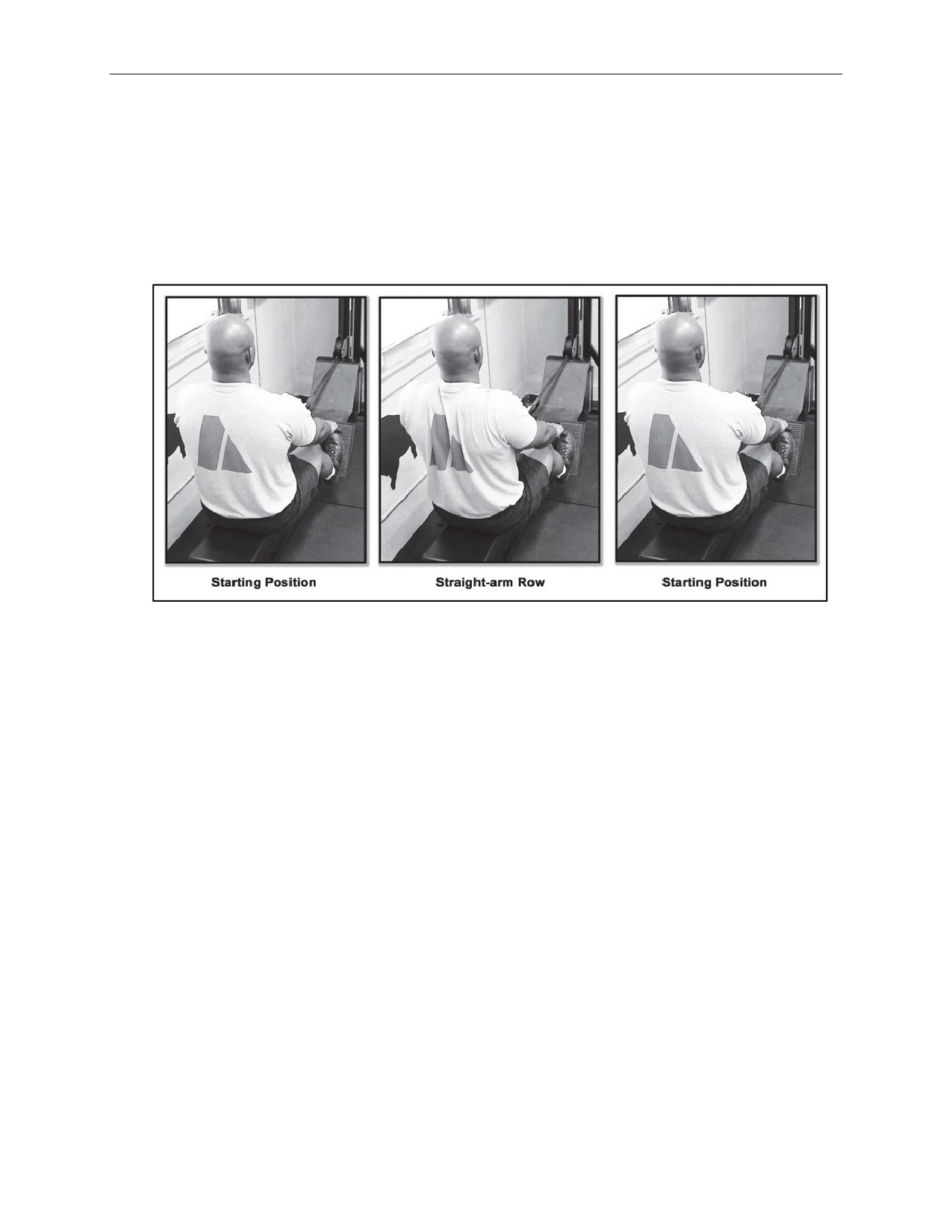
MODIFIED EXERCISE 5A: STRAIGHT-ARM SEATED ROW
6-63. This exercise (Figure 6-34) is performed the same as the seated row, however, the range of motion is
much less. The elbows remain fully extended and the arms straight, as the resistance is lowered and when the
resistance is raised. As the Soldier’s range of motion improves, he may employ the single-arm seated row to
maintain a heavy resistance on the good side and/or to reduce the resistance on the injured side.
Figure 6-34. Straight-arm seated row
26 October 2012
FM 7-22
6-45
Chapter 6
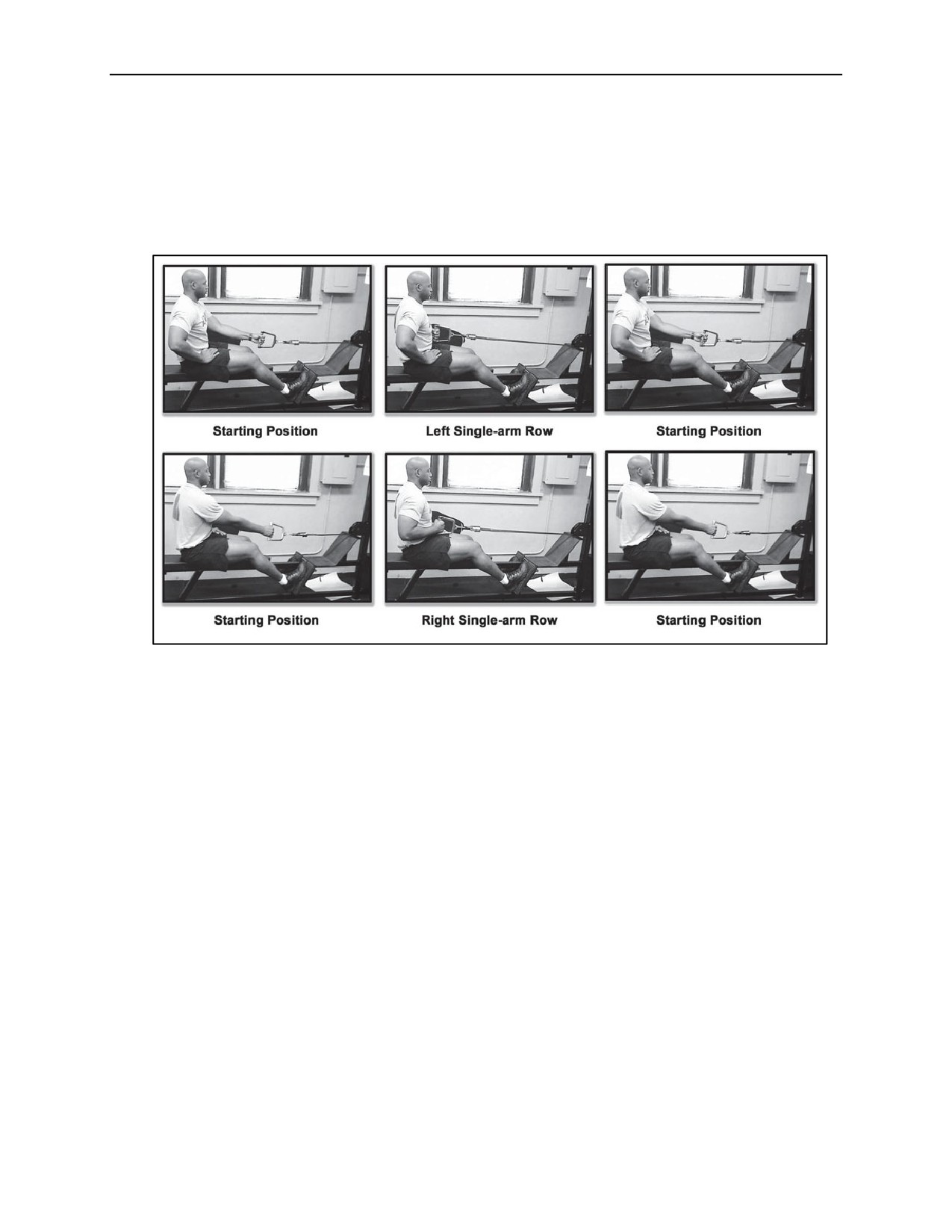
MODIFIED EXERCISE 5B: SINGLE-ARM SEATED ROW
This exercise (Figure 6-35) is performed much like the seated row, using only one arm at a time. The range of
motion and resistance is decreased for the injured side. As the Soldier’s condition improves, the range of motion
may gradually increase until the exercise is performed to standard. The resistance should not be increased until
the Soldier can move through the full range of motion. The single-arm seated row is used to maintain a heavy
resistance on the good side and/or to reduce the resistance on the injured side.
Figure 6-35. Single-arm seated row
6-46
FM 7-22
26 October 2012
Special Conditioning Programs
STRENGTH TRAINING MACHINE DRILL
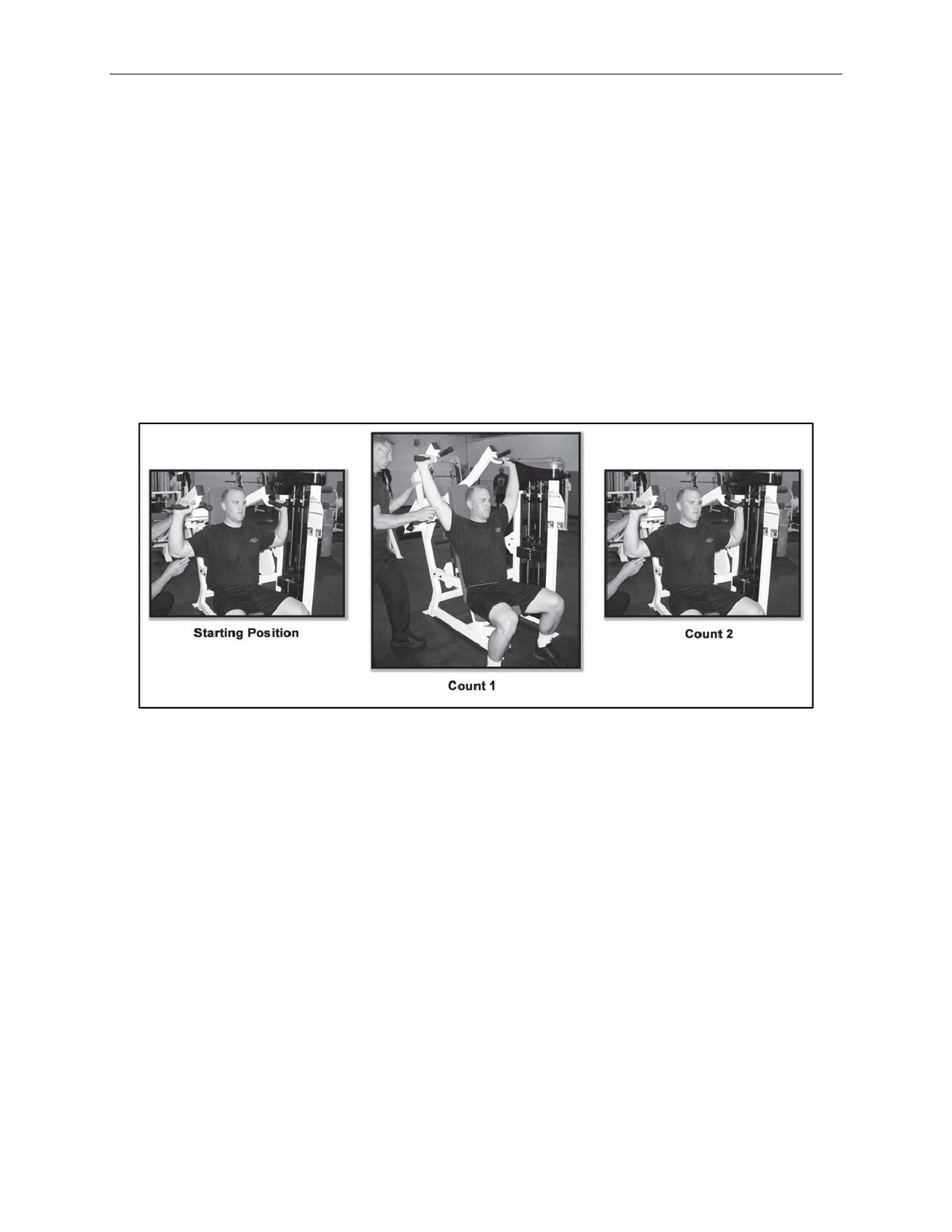
EXERCISE 6: OVERHEAD PRESS
Purpose: This exercise develops strength in the arm and shoulder muscles (Figure 6-36).
Starting Position: The Soldier assumes a seated position with the feet firmly on the ground. The Soldier adjusts the
seat to achieve a 90-degree angle between the Soldier’s upper and lower arms, with the shoulders directly below the
handgrips. The hips, low back, shoulders, and head rest firmly against the seat back. The Soldier looks straight
ahead, maintaining a natural arch in the lower back. The Soldier selects the appropriate weight and ensures the pin is
secure in the weight stack.
Cadence: SLOW
Count:
1. Push upward until both arms are fully extended, but not locked.
2. Return to the starting position.
Figure 6-36. Overhead press
Check Points:
z
Feet remain on the ground, with hips, back, shoulders, and head firmly on the bench.
z
Keep the head and neck in a neutral position, looking straight ahead.
z
Exhale on count 1 and inhale on count 2.
Precaution: Do not arch the back or allow the hips to rise off the bench.
26 October 2012
FM 7-22
6-47
Chapter 6
STRENGTH TRAINING MACHINE DRILL
MODIFIED EXERCISE 6A: MODIFIED OVERHEAD PRESS
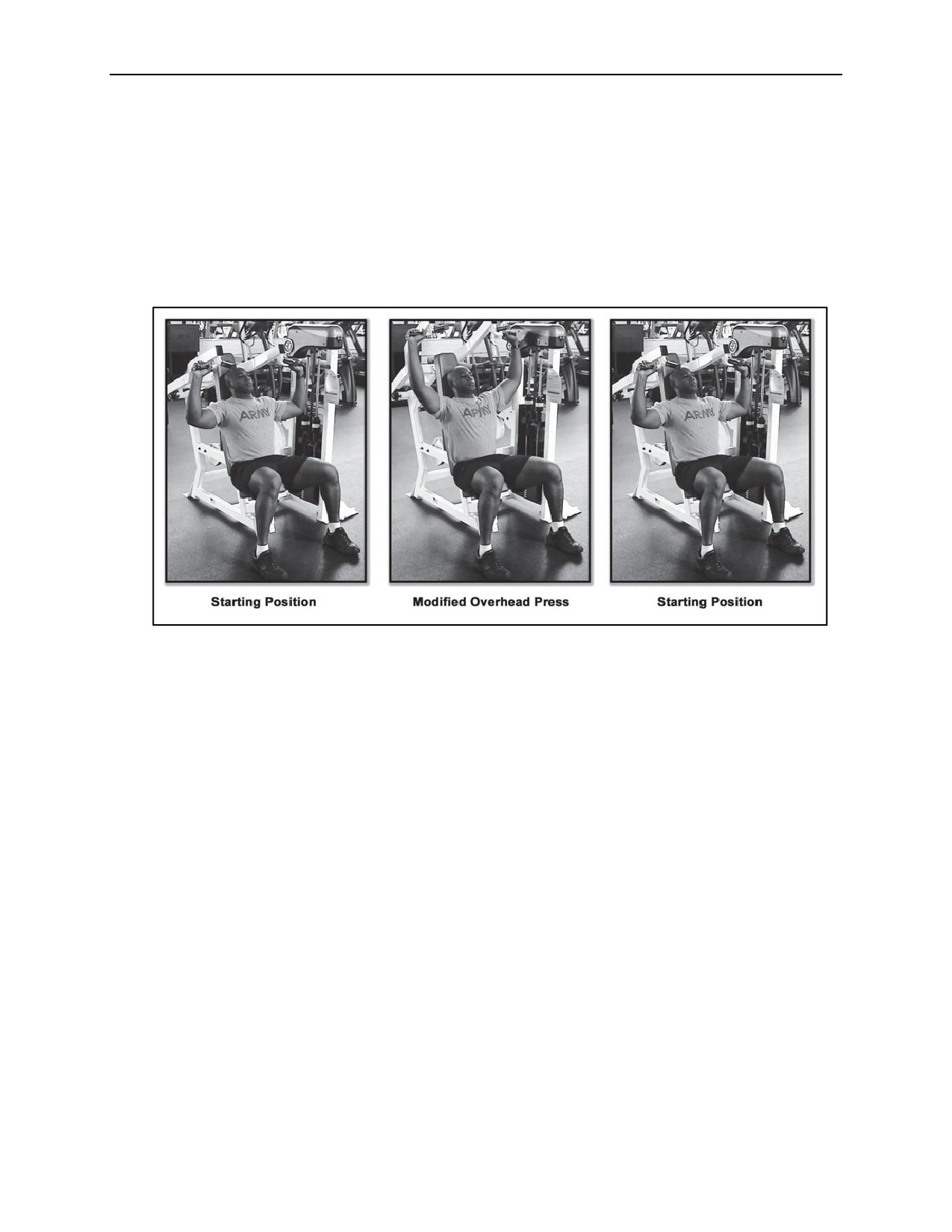
6-64. This exercise (Figure 6-37) is performed the same as the overhead press, but with much less range of
motion. The elbows will not flex below 90 degrees as the resistance is lowered, nor will they fully straighten
when the resistance is raised. As the Soldier’s condition improves, the range of motion may gradually increase
until the exercise is performed to standard. The resistance should not be increased until the Soldier can move
through the full range of motion and perform the exercise to standard.
Figure 6-37. Modified overhead press
6-48
FM 7-22
26 October 2012
Special Conditioning Programs
MODIFIED EXERCISE 6B: SINGLE-ARM OVERHEAD PRESS
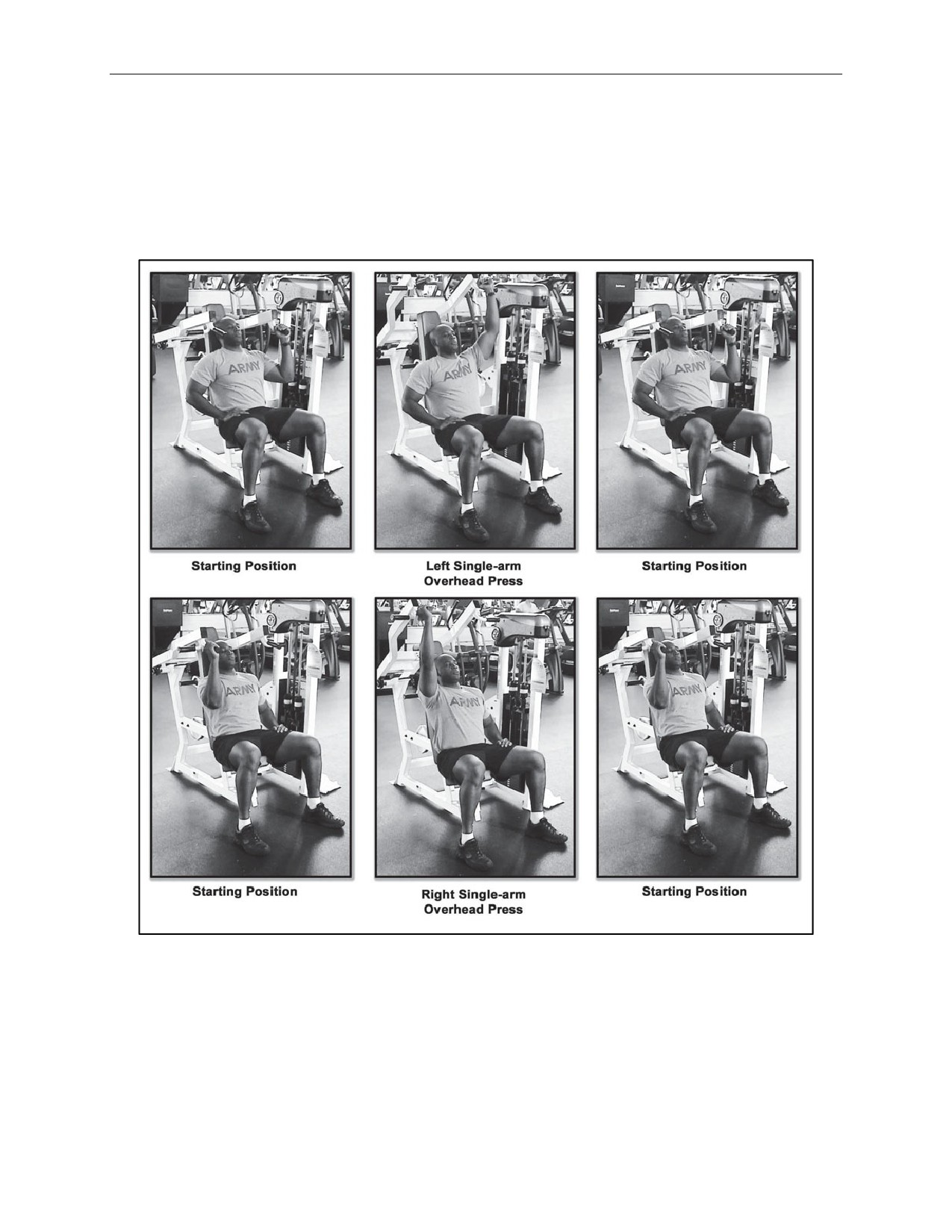
6-65. This exercise (Figure 6-38) is performed much like the overhead press, using only one arm at a time. The
range of motion and resistance is decreased for the injured side. As the Soldier’s condition improves, the range
of motion may gradually increase until the exercise is performed to standard. The resistance should not be
increased until the Soldier can move through the full range of motion. The single-arm overhead press is used to
maintain a heavy resistance on the good side and/or to reduce the resistance on the injured side.
Figure 6-38. Single-arm overhead press
26 October 2012
FM 7-22
6-49
Chapter 6
STRENGTH TRAINING MACHINE DRILL
EXERCISE 7: LAT PULL-DOWN
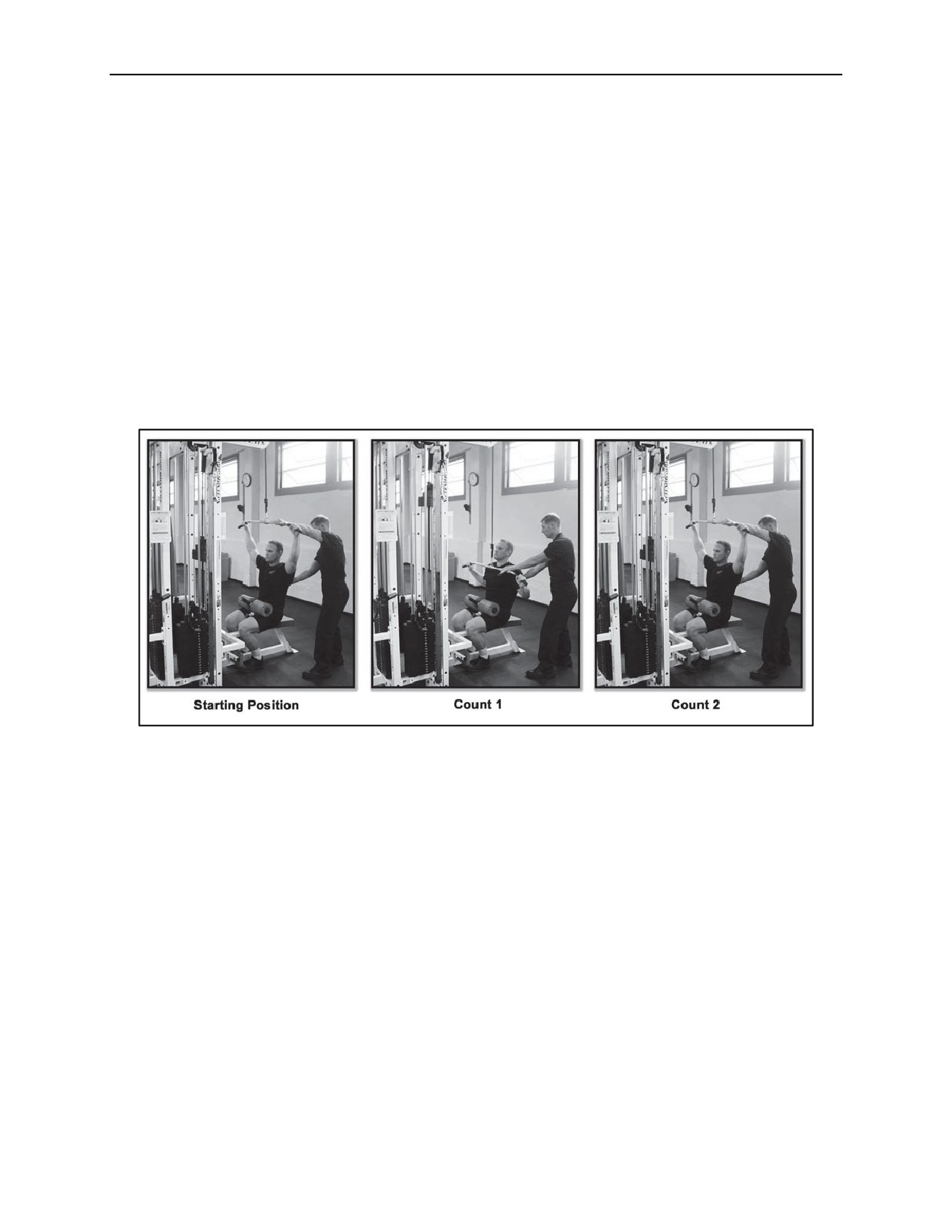
Purpose: This exercise develops strength in the arm and back muscles (Figure 6-39).
Starting Position: Select the appropriate weight and ensure the pin is secure in the weight stack before
assuming the starting position. Sit erect and adjust the roller pad so it is firm against the upper thigh and hip.
Grasp the bar with a closed, pronated grip and assume a seated position with the hips against the roller pad and
the feet flat on the ground. The upper body is perpendicular to the floor.
Cadence: SLOW
Count:
1. Keeping the arms straight and elbows rotated out to the side and slightly flexed, simultaneously
bend the elbows and pull bar toward the shoulders until the upper arms are parallel to the ground.
2. Return to the starting position by slowly extending the elbows.
Figure 6-39. Lat pull-down
Check Points:
z
Feet remain flat on the ground and the trunk is erect.
z
Maintain a natural arch in the lower back.
z
Keep the head and neck in a neutral position, looking straight ahead or slightly upward.
z
Arms are straight and elbows rotated out to the side and slightly flexed and in direct line with the
cable.
z
Exhale on count 1 and inhale on count 2.
Precaution: Do not jerk the trunk or lean back to move the bar toward the shoulders.
6-50
FM 7-22
26 October 2012
Special Conditioning Programs
STRENGTH TRAINING MACHINE DRILL
MODIFIED EXERCISE 7A: STRAIGHT-ARM LAT PULL-DOWN
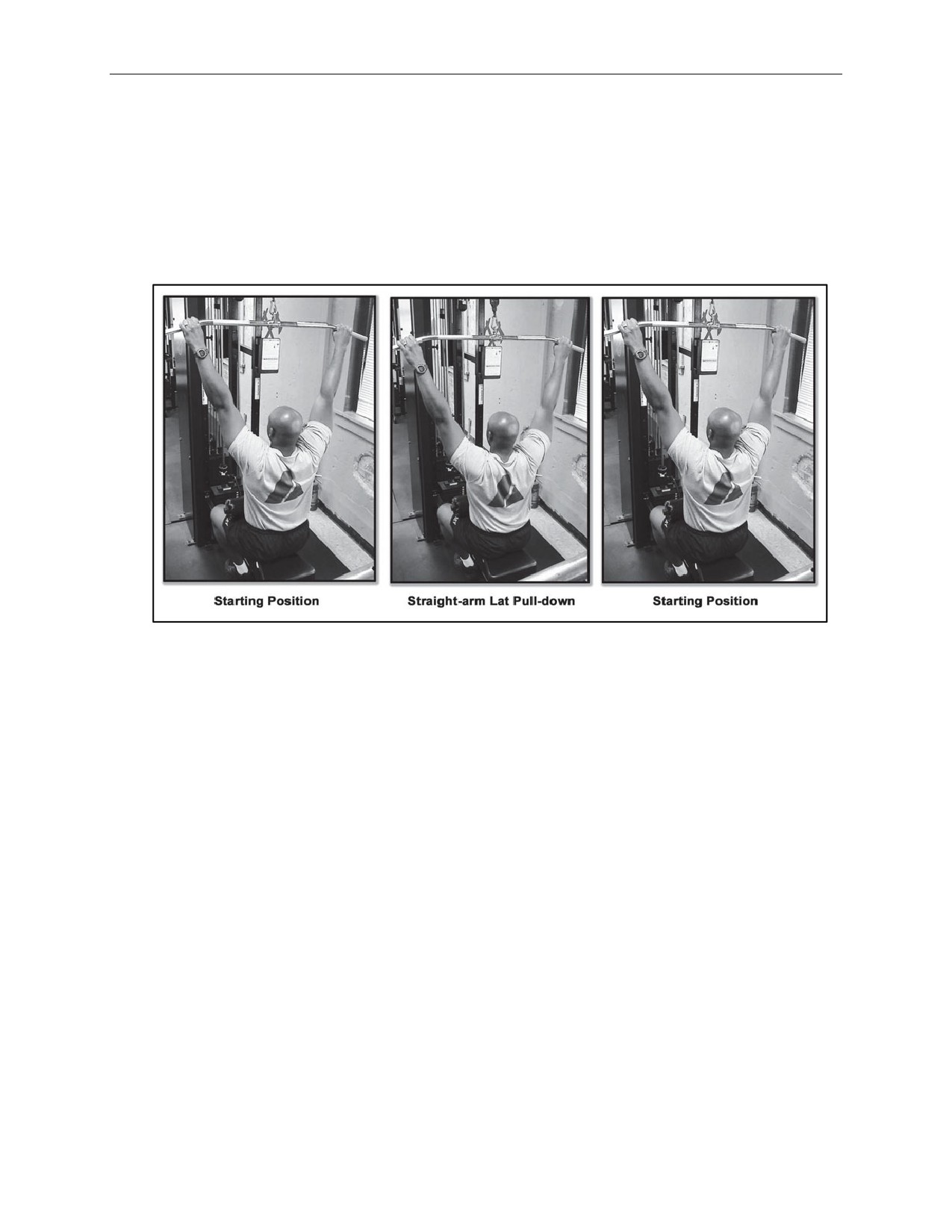
6-66. This exercise (Figure 6-40) is performed the same as the lat pull-down, however, the range of motion is
much less. The elbows remain fully extended and the arms straight, as the resistance is lowered and when the
resistance is raised. As the Soldier’s range of motion improves, he may employ the single-arm lat pull-down to
maintain a heavy resistance on the good side and/or to reduce the resistance on the injured side.
Figure 6-40. Straight-arm lat pull-down
26 October 2012
FM 7-22
6-51
Chapter 6
STRENGTH TRAINING MACHINE DRILL
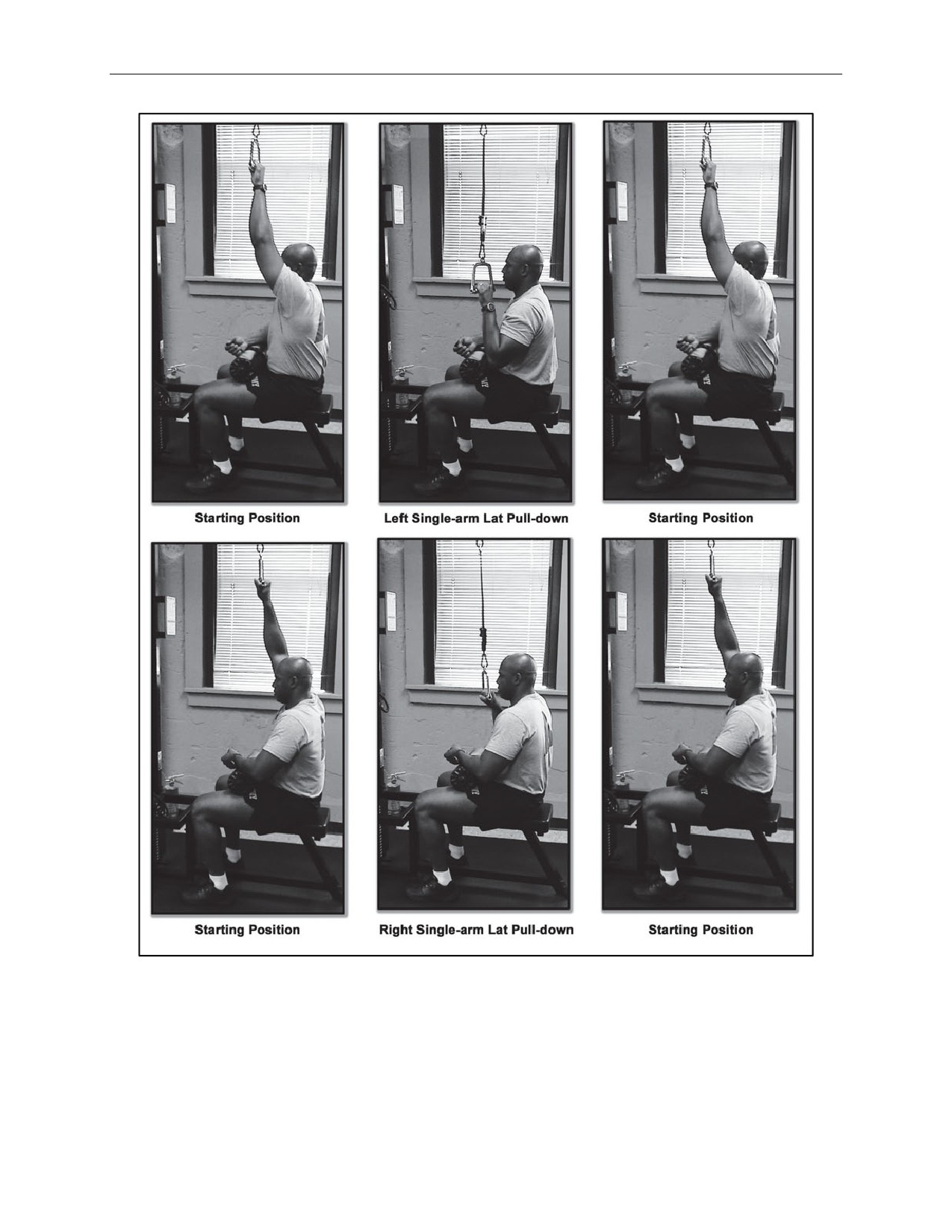
MODIFIED EXERCISE 7B: SINGLE-ARM LAT PULL-DOWN
6-67. This exercise (Figure 6-41) is performed much like the lat pull-down, using only one arm at a time. The
range of motion and resistance is decreased for the injured side. As the Soldier’s condition improves, the range
of motion may gradually increase until the exercise is performed to standard. The resistance should not be
increased until the Soldier can move through the full range of motion. The single-arm lat pull-down is used to
maintain a heavy resistance on the good side and/or to reduce the resistance on the injured side.
6-52
FM 7-22
26 October 2012
Special Conditioning Programs
Figure 6-41. Single-arm lat pull-down
26 October 2012
FM 7-22
6-53
Chapter 6
STRENGTH TRAINING MACHINE DRILL
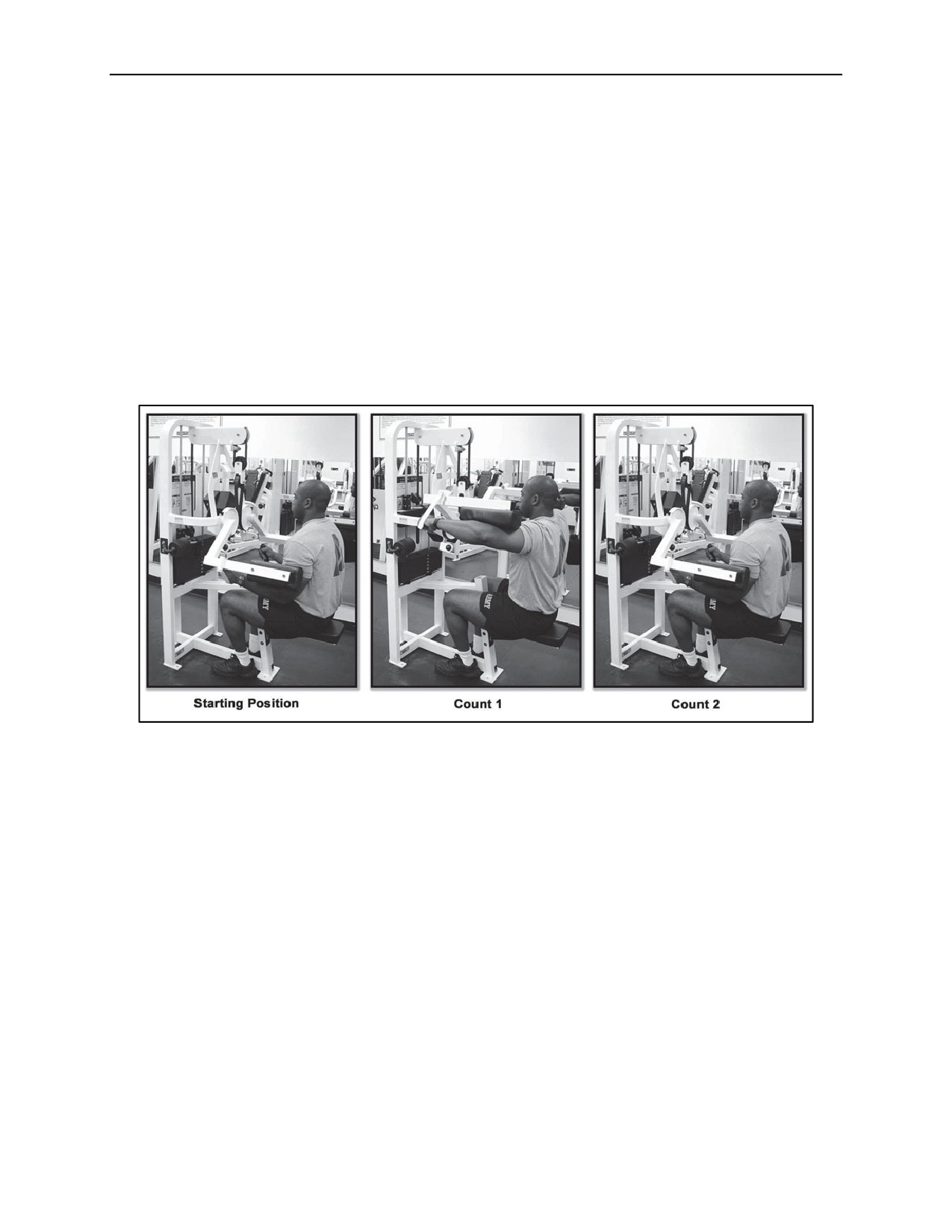
EXERCISE 8: LATERAL RAISE
Purpose: This exercise develops strength in the shoulder and neck muscles (Figure 6-42).
Starting Position: Seated position with the feet firmly on the ground. The seat is adjusted so a 90-degree angle
is formed between the upper and lower arms. The hips, lower back, shoulders, and head are firmly against the
seat back with the eyes looking straight ahead. A natural arch is maintained in the lower back. Select the
appropriate weight and ensure the pin is secure in the weight stack.
Cadence: SLOW
Count:
1. Raise both arms upward until they are parallel to the ground.
2. Return to the starting position.
Figure 6-42. Lateral raise
Check Points:
z
Feet remain on the ground, with hips, back, shoulders, and head firmly on the bench.
z
Keep the head and neck in a neutral position, looking straight ahead.
z
Exhale on count 1 and inhale on count 2.
Precautions: Do not arch the back or allow the hips to rise off the bench. Do not raise arms above parallel to
the ground.
6-54
FM 7-22
26 October 2012
Special Conditioning Programs
STRENGTH TRAINING MACHINE DRILL
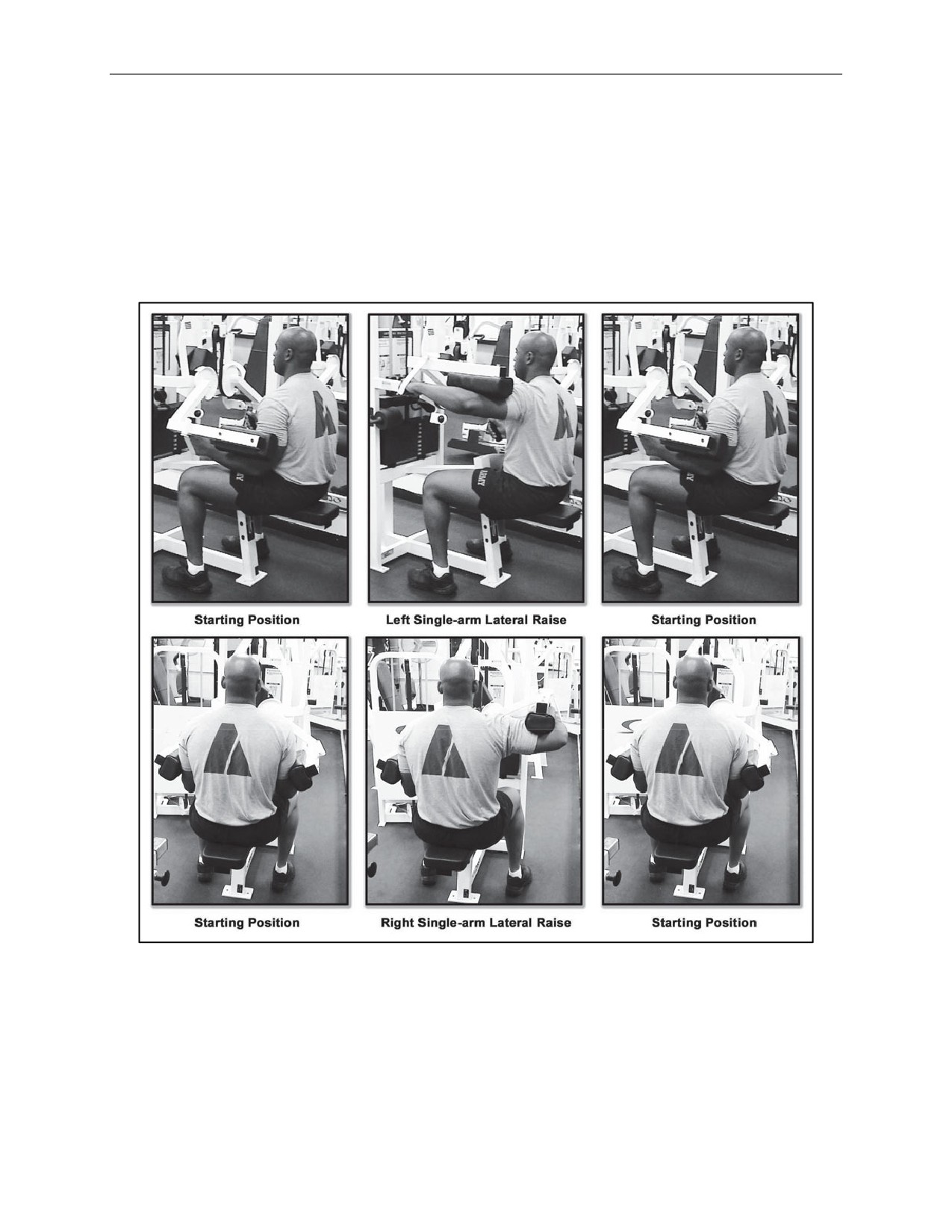
MODIFIED EXERCISE 8A: SINGLE-ARM LATERAL RAISE
6-68. This exercise (Figure 6-43) is performed much like the lateral raise, using only one arm at a time. The
range of motion and resistance is decreased for the injured side. As the Soldier’s condition improves, the range
of motion may gradually increase until the exercise is performed to standard. The resistance should not be
increased until the Soldier can move through the full range of motion. The single-arm lateral raise is used to
maintain a heavy resistance on the good side and/or to reduce the resistance on the injured side.
Figure 6-43. Single-arm lateral raise
26 October 2012
FM 7-22
6-55
Chapter 6
STRENGTH TRAINING MACHINE DRILL
EXERCISE 9: TRICEPS EXTENSION
Purpose: This exercise develops strength in the triceps muscles (Figure 6-44).
Starting Position (Standing): Straddle stance with a 90-degree angle formed at the upper and lower arms.
Select the appropriate weight and ensure the pin is secure in the weight stack. Maintain an erect position, eyes
looking straight ahead, grasping the bar with a closed, pronated grip.
Starting Position (Seated): Seated position with the feet firmly on the ground. The seat is adjusted so a
90-degree angle is formed between the upper and lower arms, with elbows shoulder-width apart on the
supporting pad, and hands in a closed-grip. The hips and low back are firmly against the seat back with the eyes
looking straight ahead. A natural arch is maintained in the lower back. Select the appropriate weight and ensure
the pin is secure in the weight stack.
Cadence: SLOW
Count:
1. Push downward until both arms are fully extended, but not locked.
2. Return to the starting position.
6-56
FM 7-22
26 October 2012
Special Conditioning Programs
Figure 6-44. Triceps extension
Check Points:
z
Feet remain on the ground, with hips and back firmly on the bench during seated triceps extension.
z
Keep the head and neck in a neutral position, looking straight ahead.
z
Exhale on count 1 and inhale on count 2.
Precautions: Do not lean forward while performing standing triceps extension. Do not arch the back or allow
the hips to rise off the bench during seated exercise.
26 October 2012
FM 7-22
6-57
Chapter 6
STRENGTH TRAINING MACHINE DRILL
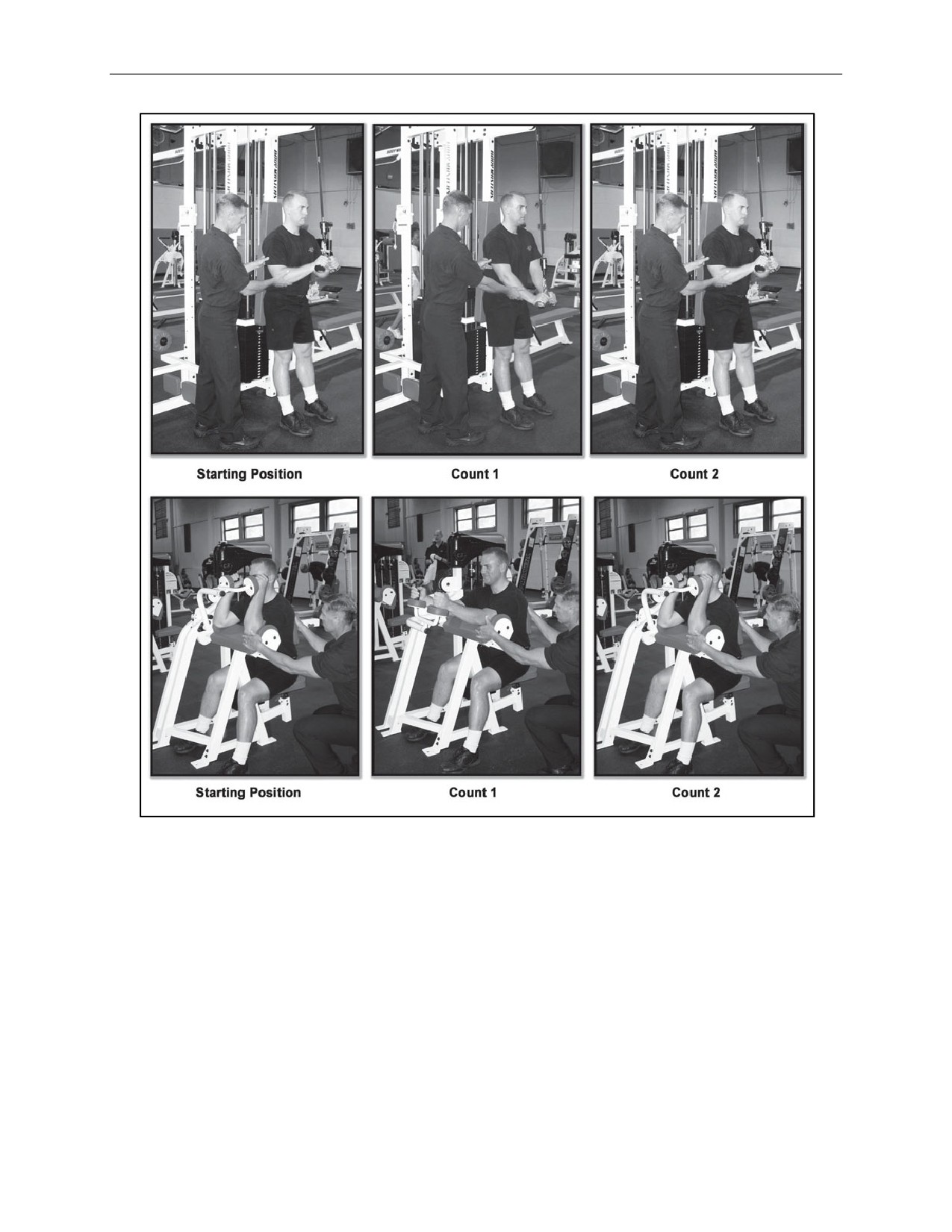
MODIFIED EXERCISE 9A: MODIFIED TRICEPS EXTENSION
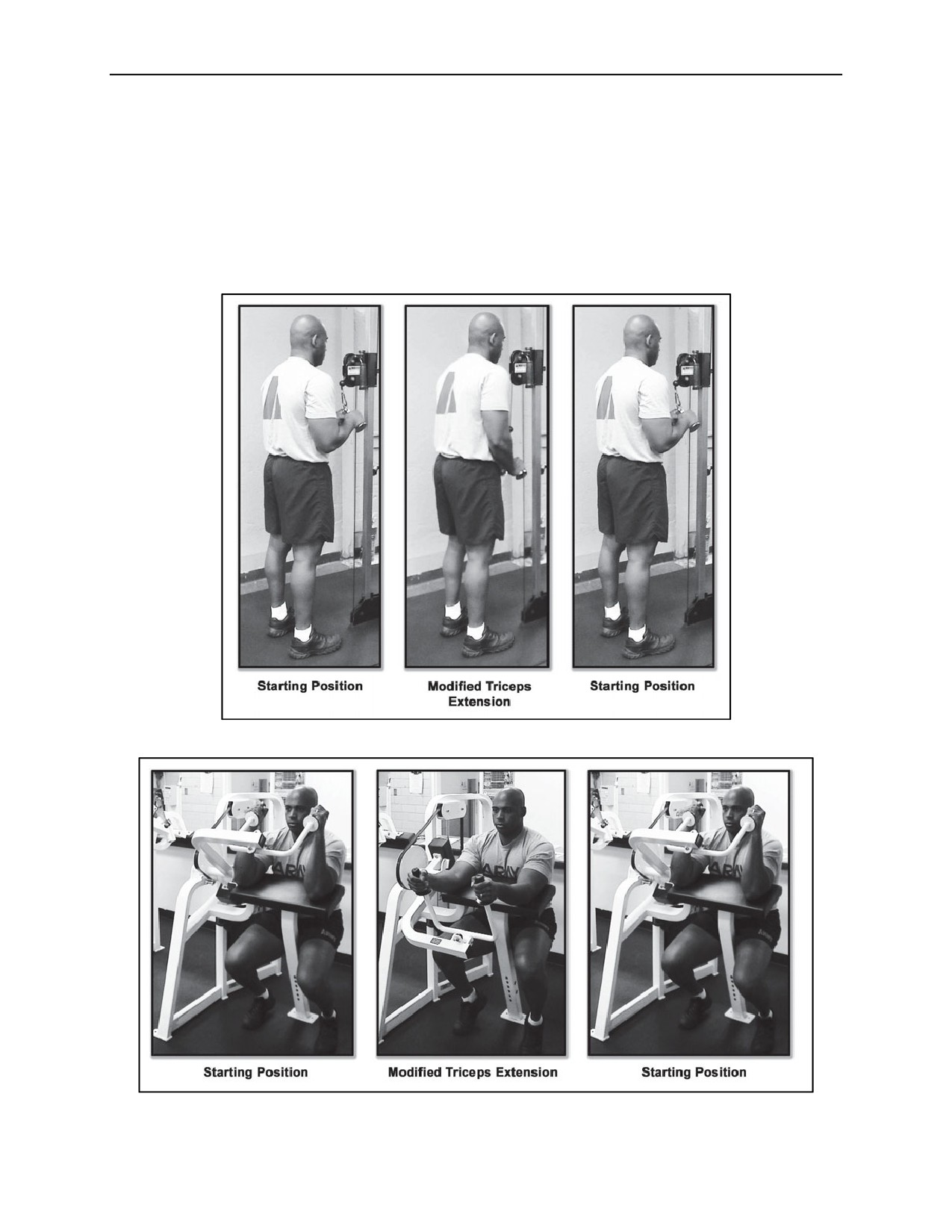
6-69. This exercise (Figures 6-45 and 6-46) is performed the same as the triceps extension, but the range of
motion is much less. The elbows will not fully flex as the resistance is lowered, nor will they fully straighten
when the resistance is raised. As the Soldier’s condition improves, the range of motion may gradually increase
until the exercise is performed to standard. The resistance should not be increased until the Soldier can move
through the full range of motion and perform the exercise to standard.
Figure 6-45. Modified triceps extension using a high pulley
Figure 6-46. Modified triceps extension using a triceps extension machine
6-58
FM 7-22
26 October 2012
Special Conditioning Programs
STRENGTH TRAINING MACHINE DRILL
MODIFIED EXERCISE 9B: SINGLE-ARM TRICEPS EXTENSION
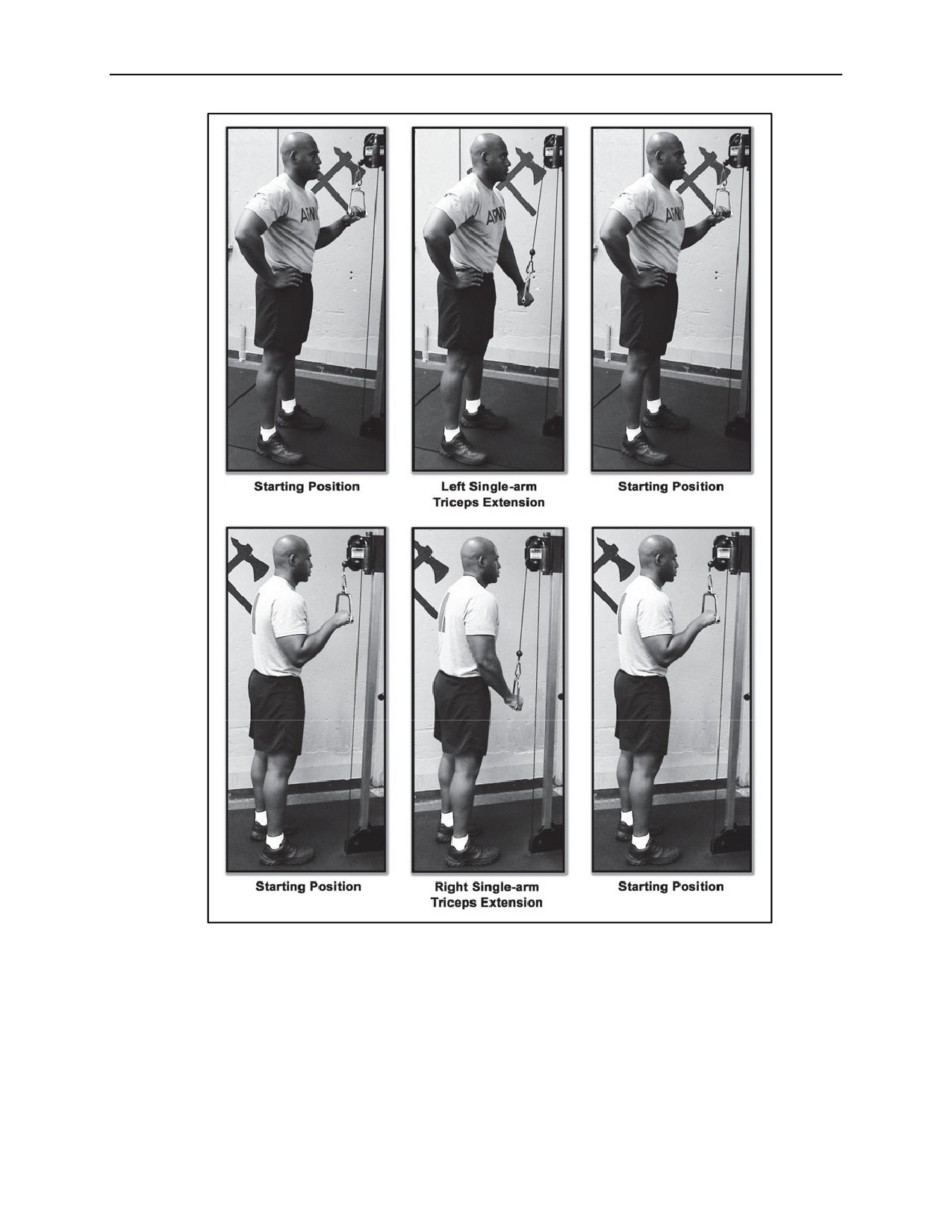
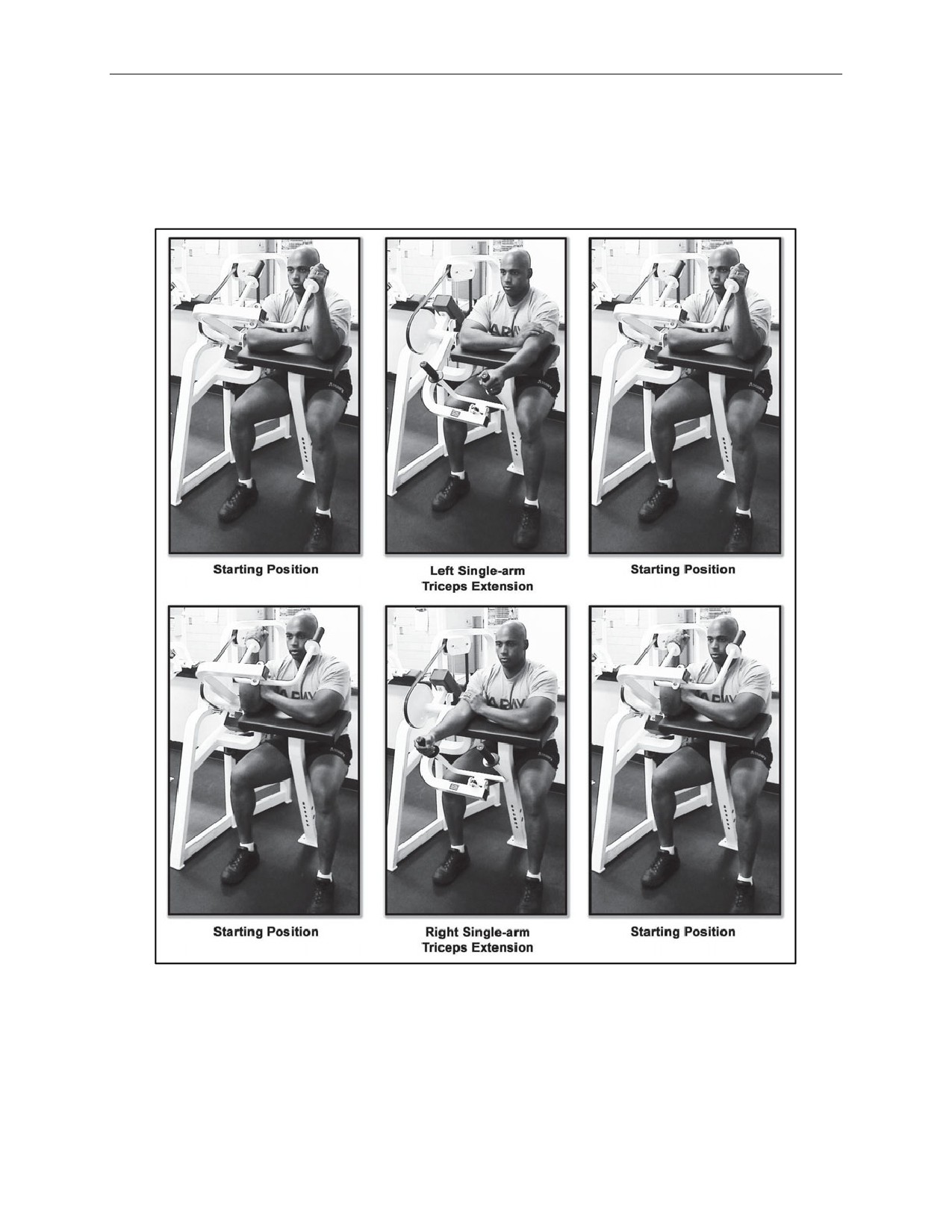
6-70. This exercise (Figures 6-47 and 6-48) is performed much like the triceps extension, using only one arm at
a time. The range of motion and resistance is decreased for the injured side. As the Soldier’s condition
improves, the range of motion may gradually increase until the exercise is performed to standard. The resistance
should not be increased until the Soldier can move through the full range of motion. The single-arm triceps
extension is used to maintain a heavy resistance on the good side and/or to reduce the resistance on the injured
side.
26 October 2012
FM 7-22
6-59
Chapter 6
Figure 6-47. Single-arm triceps extension using a high pulley
6-60
FM 7-22
26 October 2012
Special Conditioning Programs
STRENGTH TRAINING MACHINE DRILL
MODIFIED EXERCISE 9B: SINGLE-ARM TRICEPS EXTENSION
(CONTINUED)
Figure 6-48. Single-arm triceps extension using a triceps extension machine
26 October 2012
FM 7-22
6-61
Chapter 6
STRENGTH TRAINING MACHINE DRILL
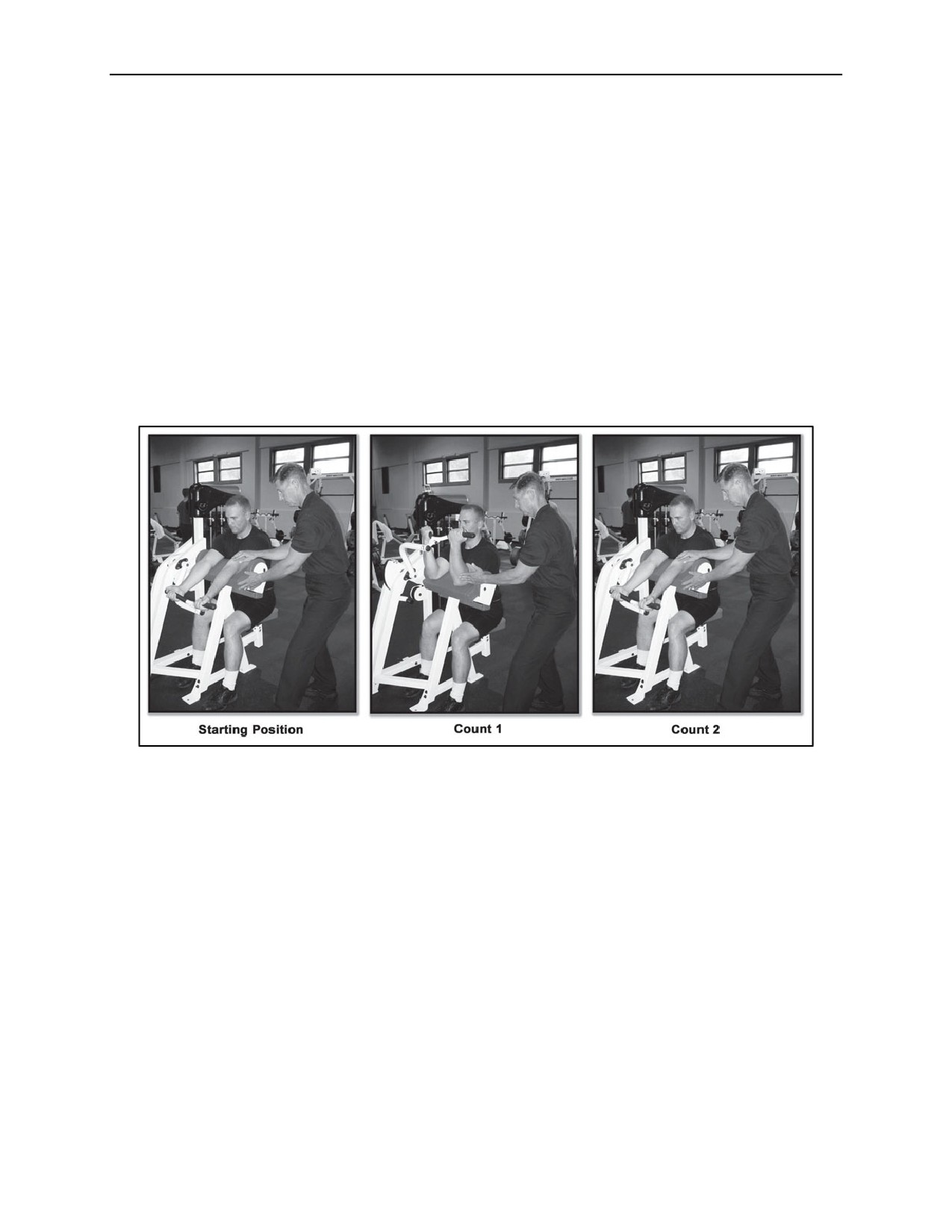
EXERCISE 10: BICEPS CURL
Purpose: This exercise develops strength in the upper biceps muscles (Figure 6-49).
Starting Position: Seated position with the feet firmly on the ground. The seat is adjusted so the arms are
straight, with elbows shoulder-width apart. The back of the upper arms are on the supporting pad with hands in
a closed-grip. The hips and low back are firmly against the seat back with the eyes looking straight ahead. A
natural arch is maintained in the lower back. Select the appropriate weight and ensure the pin is secure in the
weight stack.
Cadence: SLOW
Count:
1. Pull upward until both arms are fully flexed.
2. Return to the starting position.
Figure 6-49. Biceps curl
Check Points:
z
Feet remain on the ground, with hips and back firmly on the bench during seated triceps extension.
z
Keep the head and neck in a neutral position, looking straight ahead.
z
Exhale on count 1 and inhale on count 2.
Precautions: Do not arch the back or allow the hips to rise off the bench. Do not arch backward while
performing the biceps curl.
6-62
FM 7-22
26 October 2012
Special Conditioning Programs
STRENGTH TRAINING MACHINE DRILL
MODIFIED EXERCISE 10A: MODIFIED BICEPS CURL
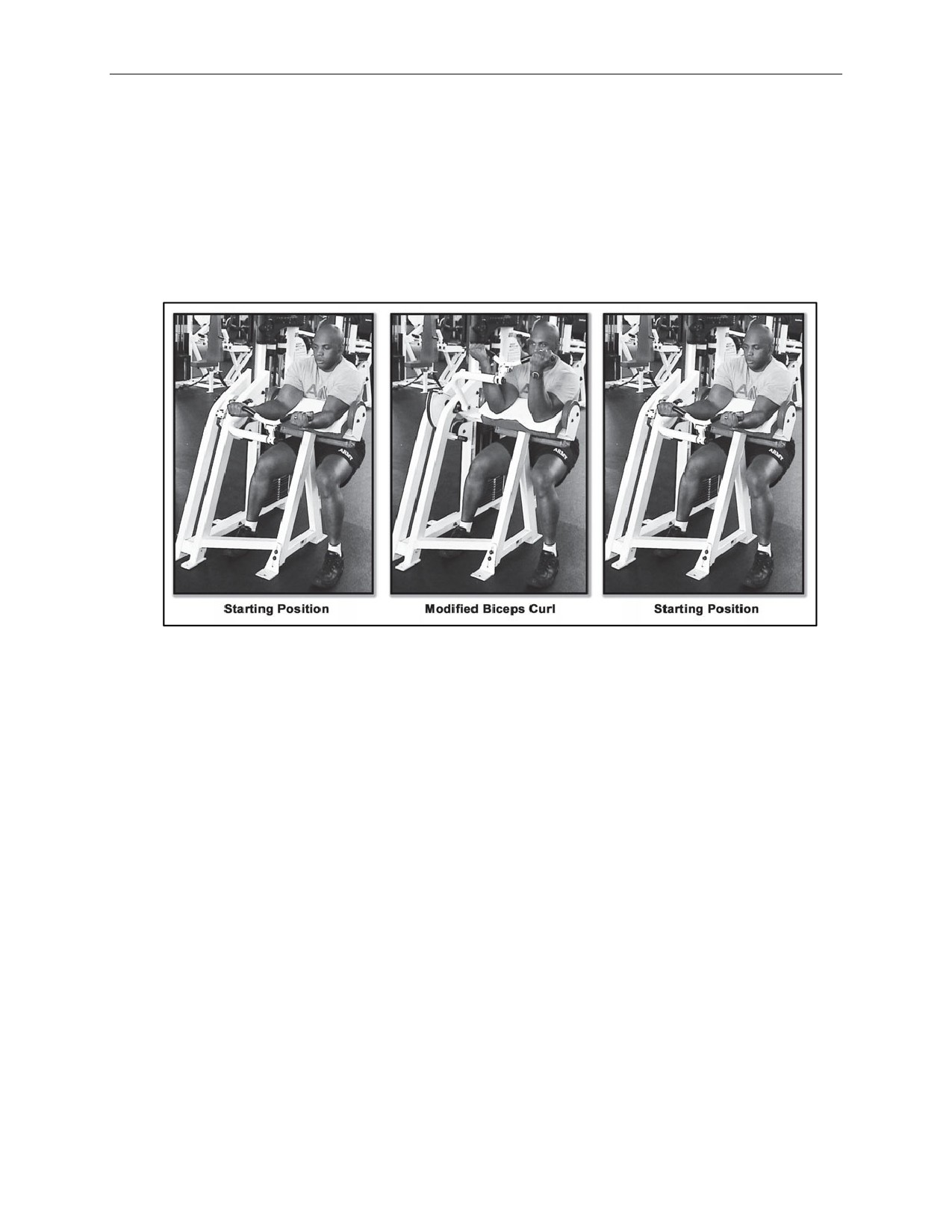
6-71. This exercise (Figure 6-50) is performed the same as the biceps curl, but the range of motion is much less.
The elbows will not fully flex as the resistance is raised, nor will they fully straighten when the resistance is
lowered. As the Soldier’s condition improves, the range of motion may gradually increase until the exercise is
performed to standard. The resistance should not be increased until the Soldier can move through the full range
of motion and perform the exercise to standard.
Figure 6-50. Modified biceps curl
26 October 2012
FM 7-22
6-63
Chapter 6
STRENGTH TRAINING MACHINE DRILL
MODIFIED EXERCISE 10B: SINGLE-ARM BICEPS CURL
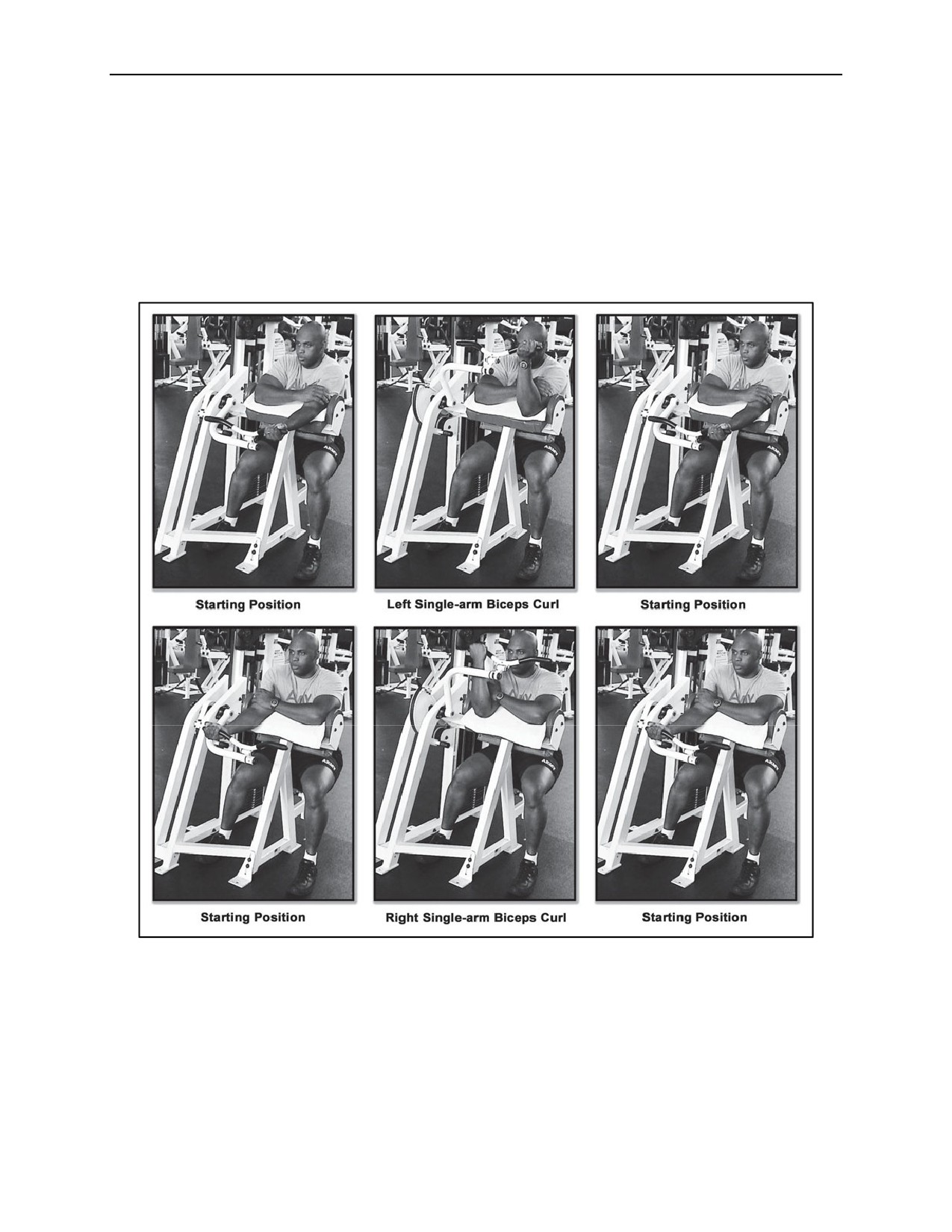
6-72. This exercise (Figure 6-51) is performed much like the biceps curl, using only one arm at a time. The
range of motion and resistance is decreased for the injured side. As the Soldier’s condition improves, the range
of motion may gradually increase until the exercise is performed to standard. The resistance should not be
increased until the Soldier can move through the full range of motion. The single-arm biceps curl is used to
maintain a heavy resistance on the good side and to reduce resistance on the injured side.
Figure 6-51. Single-arm biceps curl
6-64
FM 7-22
26 October 2012
Special Conditioning Programs
STRENGTH TRAINING MACHINE DRILL
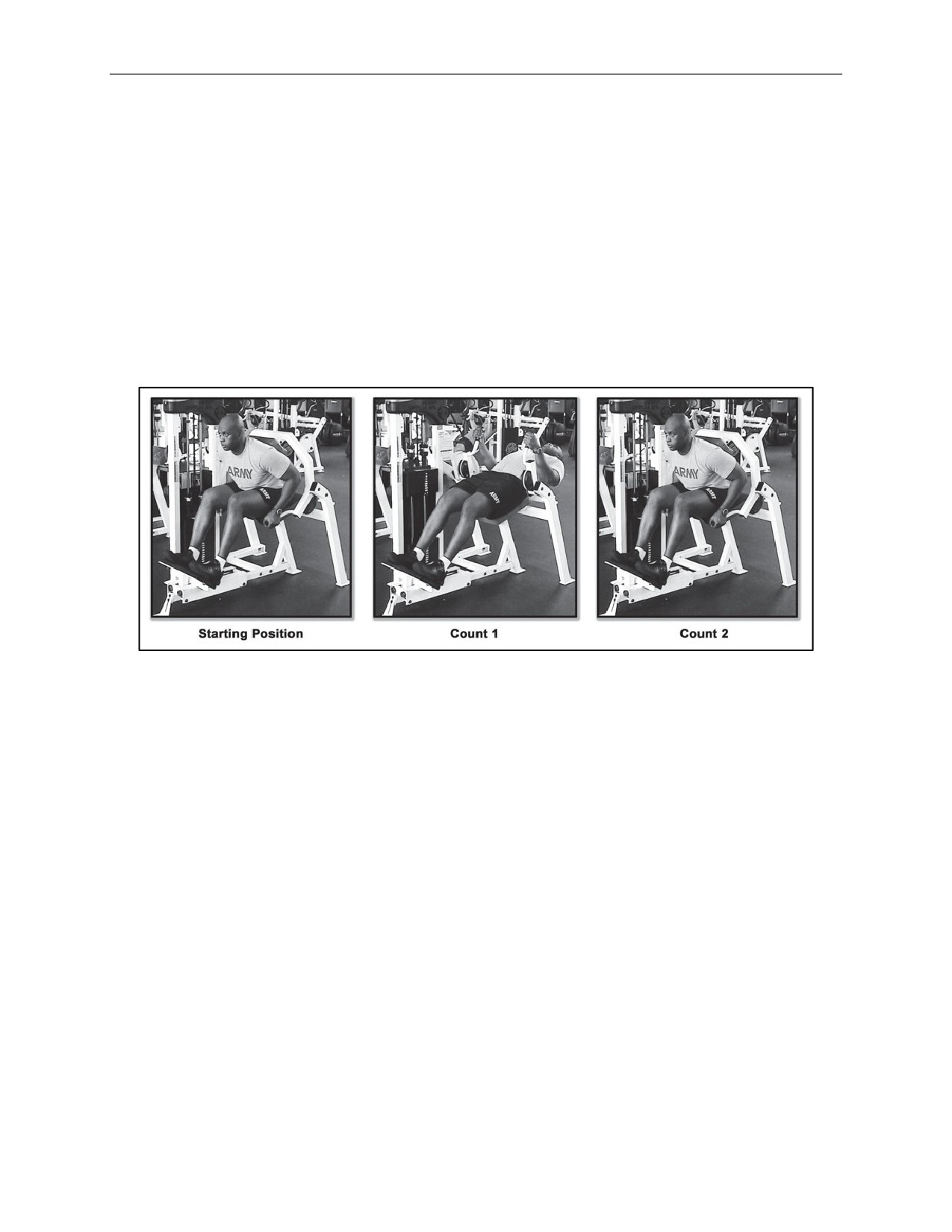
EXERCISE 11: TRUNK FLEXION
Purpose: This exercise develops strength in the abdominal muscles (Figure 6-52).
Starting Position: Seated position with the feet firmly on the ground. Select the appropriate weight and ensure
the pin is secure in the weight stack. The seat is adjusted so the chest pad is located on the upper chest, below
the collarbone. The elbows are shoulder-width apart and bent at 90 degrees, with hands in a closed-grip. The
hips and low back are firmly against the seat back with the eyes looking straight ahead.
Cadence: SLOW
Count:
1. Bend forward, flexing the trunk, and bringing the chest pad to the thighs.
2. Return to the starting position.
Figure 6-52. Trunk flexion
Check Points:
z
Feet remain on the ground, with hips and back firmly on the bench.
z
Keep the head and neck in a neutral position.
z
Exhale on count 1 and inhale on count 2.
Precautions: Do not jerk into position or allow the hips to rise off the seat.
26 October 2012
FM 7-22
6-65
Chapter 6
STRENGTH TRAINING MACHINE DRILL
MODIFIED EXERCISE 11: MODIFIED TRUNK FLEXION
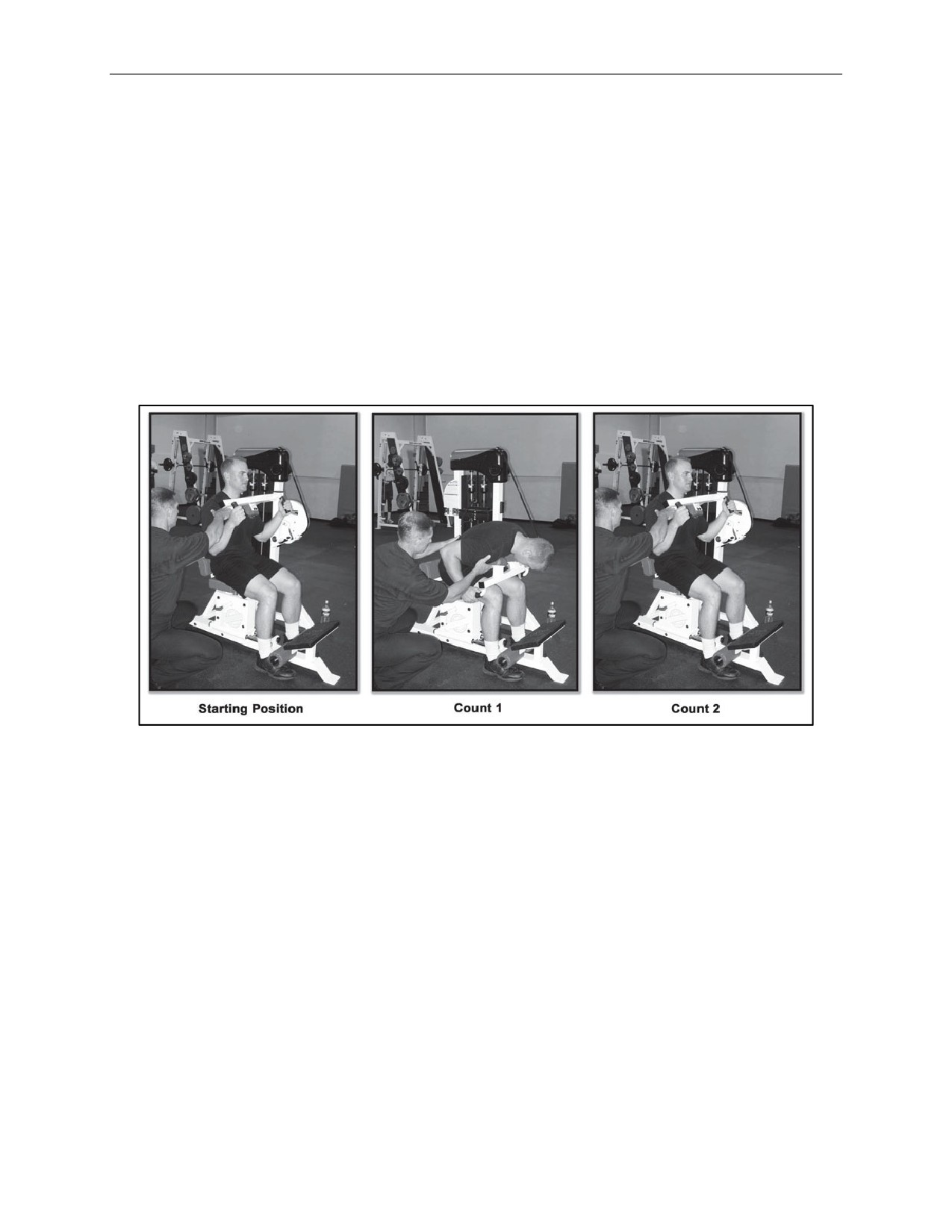
6-73. Physical profiles may limit the range of motion at which Soldiers are able to safely perform trunk flexion
exercises. The weight load should be low and the range of motion of the movements should be within the
comfort zone of the Soldier (Figure 6-53). Gradually increase the weight load and range of motion as tolerated
until the exercise can be performed to standard.
Figure 6-53. Modified trunk flexion
6-66
FM 7-22
26 October 2012
Special Conditioning Programs
STRENGTH TRAINING MACHINE DRILL
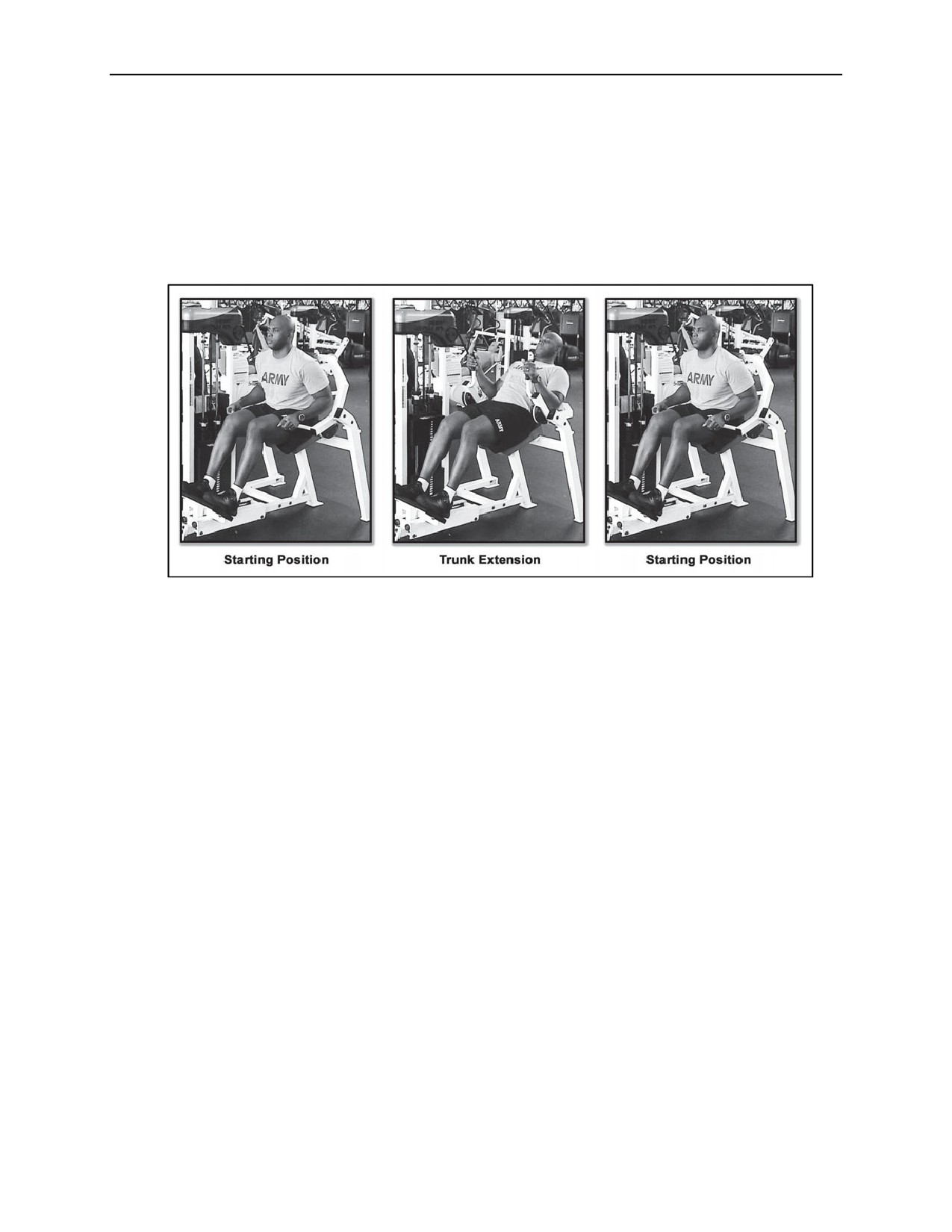
EXERCISE 12: TRUNK EXTENSION
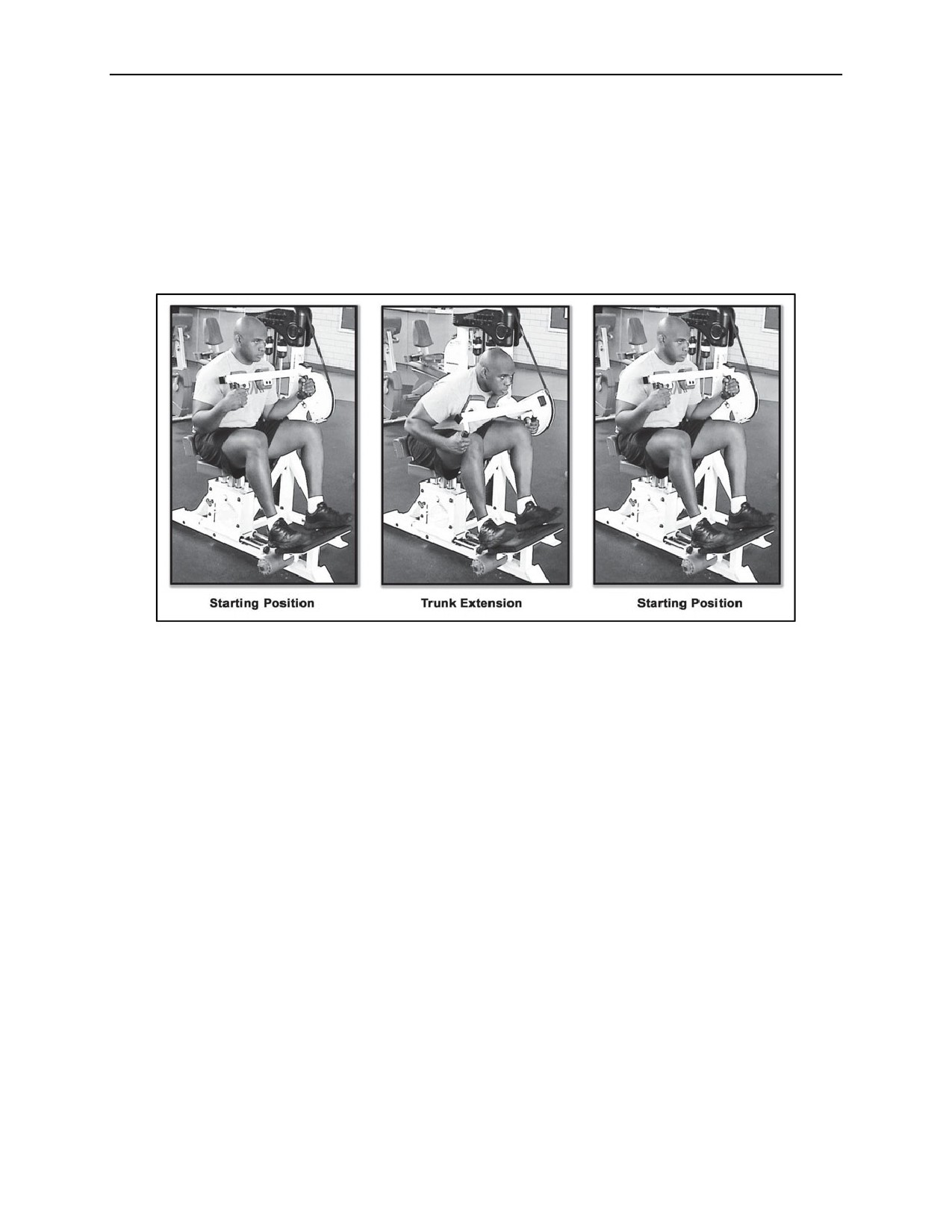
Purpose: This exercise develops strength in the low back muscles (Figure 6-54).
Starting Position: Sit in the machine, leaning slightly forward, with the back firmly against the padded lever
arm. Select the appropriate weight and ensure the pin is secure in the weight stack. The hands grip the support
bars using a neutral, closed-grip. The head is in a neutral position with the eyes looking straight ahead.
Cadence: SLOW
Count:
1. Raise the upper body and continue extending the trunk, moving to the supine position.
2. Return to the starting position.
Figure 6-54. Trunk extension
Check Points:
z
Keep the head and neck in a neutral position.
z
Exhale on count 1 and inhale on count 2.
Precautions: Do not jerk into position. Keep the hips and low back in contact with the pads throughout the
exercise.
26 October 2012
FM 7-22
6-67
Chapter 6
STRENGTH TRAINING MACHINE DRILL
MODIFIED EXERCISE 12: MODIFIED TRUNK EXTENSION
6-74. Physical profiles may limit the range of motion at which Soldiers are able to safely perform trunk
extension exercises. The weight load should be low and the range of motion of the movements should be within
the comfort zone of the Soldier (Figure 6-55). Gradually increase the weight load and range of motion as
tolerated until the exercise can be performed to standard.
Figure 6-55. Modified trunk extension
6-68
FM 7-22
26 October 2012
Special Conditioning Programs
LEVEL II RECONDITIONING DRILLS AND ACTIVITIES
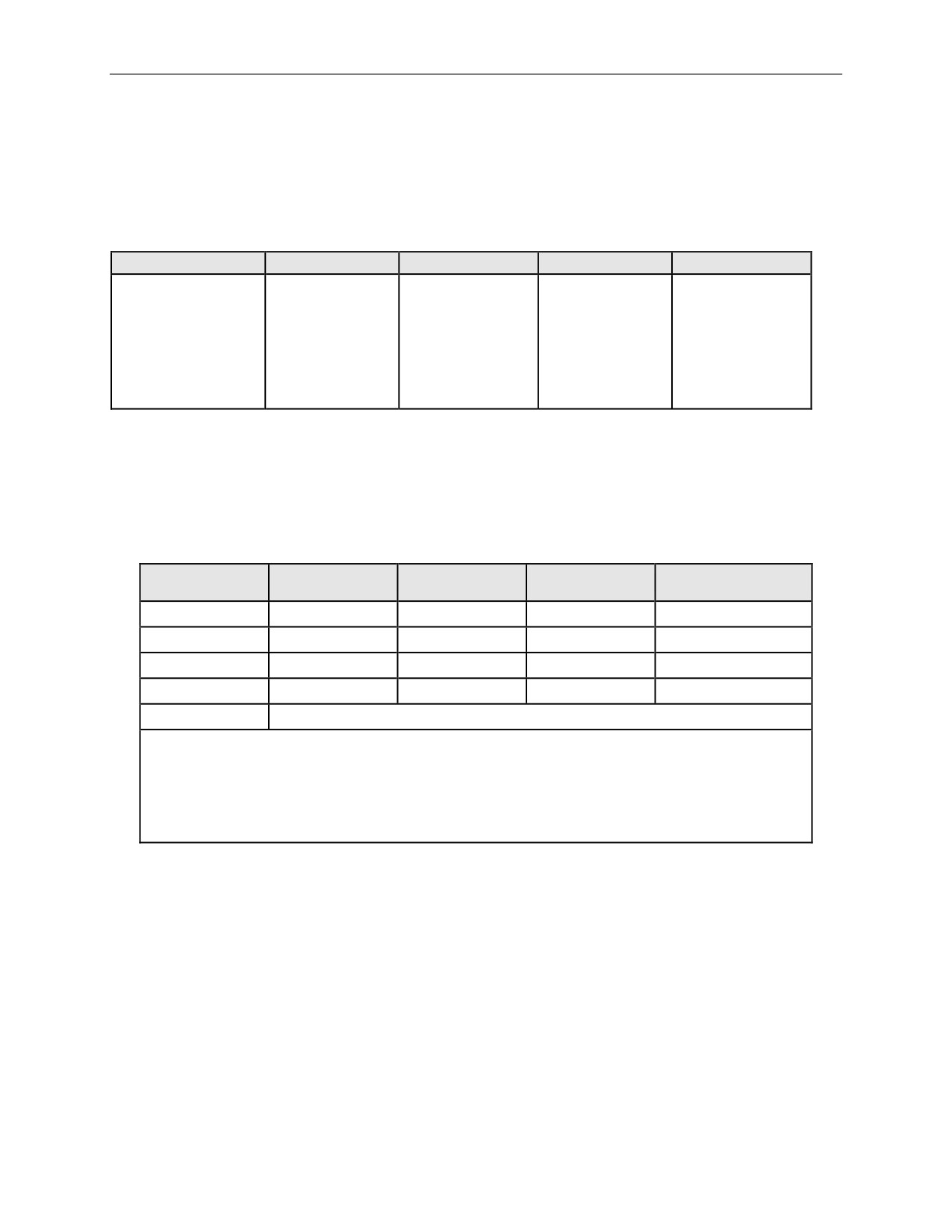
6-75. Soldiers in level II reconditioning are on profile, just off of profile, or cleared to begin level II
reconditioning. These Soldiers will perform PRT drills and activities, in some cases, modified to fit the
Soldier’s specific physical profile or level of injury. See Table 6-3 for the schedule of level II reconditioning
drills and activities.
Table 6-3. Reconditioning Level II training schedule
MON
TUE
WED
THU
FRI
PREPARATION: PD
PREPARATION: PD
PREPARATION: PD
PREPARATION: PD
PREPARATION: PD
ACTIVITIES:
ACTIVITIES:
ACTIVITIES:
ACTIVITIES
ACTIVITIES:
HSD (5 reps)
4C (60 secs)
HSD (5 reps)
4C (60 secs)
HSD (5 reps)
MMD1 (1 rep)
CD 1 (5 reps)
MMD1 (1 rep)
CD 1 (5 reps)
MMD1 (1 rep)
Walk to Run (30 min)
CL 1 (5 reps)
Walk to Run (30 min)
CL 1 (5 reps)
Walk to Run (30 min)
RECOVERY: RD
RECOVERY: RD
RECOVERY: RD
RECOVERY: RD
RECOVERY: RD
6-76. Preparation, military movement drill 1, CD 1, and recovery will be the same as for unit PRT or may be
modified to follow a safe exercise progression. The CL will be performed with spotters as in unit PRT. Spotters
must be especially aware of each Soldier’s physical limitation. The walk-to-run program safely progresses
Soldiers from bouts of walking to increased bouts of continuous running for 30 consecutive minutes. Each week
the walking time decreases as the running time increases to reach the 30-minute continuous running goal.
(Table 6-4 shows how to conduct the walk-to-run program.)
Table 6-4. Reconditioning walk-to-run progression
Week of
Walk
Jog
Repetitions
Total Time
Training
Week I
4 minutes
2 minutes
5 times
30 minutes
Week II
3 minutes
3 minutes
5 times
30 minutes
Week III
2 minutes
4 minutes
5 times
30 minutes
Week IV
1 minutes
5 minutes
5 times
30 minutes
Week V
Run every other day with a goal of reaching thirty consecutive minutes.
• Perform the activities for each level every other day.
• Spend at least one week at each level. Begin Week V runs with a duration of 15 minutes.
• Walk 5 minutes before and after each session. Progress to 30 consecutive minutes of
running over the next 2 to 4 weeks.
Exercise Guidance
6-77. The following exercise guidance is intended for RPLs/ARPLs in the level II reconditioning program.
Common sites of pain/injury are given, followed by a discussion of PRT progression. The information below
assumes that all profile restrictions have been removed. General exercise guidance is provided for knee
injury/pain, foot and ankle injury/pain; lower leg injury/pain, low back injury/pain, and shoulder injury/pain; as
well as modifications to exercises based on limitations of various physical profiles. In the pages to follow each
of these injury conditions are listed with specific guidance on the conduct of exercise drills and activities as they
apply to the knee, foot and ankle, lower leg, back and shoulder pain, and injuries.
26 October 2012
FM 7-22
6-69
Chapter 6
Knee Pain/Injury
6-78. Knee pain/injury may require restrictions. In the post-profile recovery period, progress as follows:
Preparation (PD)
6-79. Resume lunging and squatting movements (to include the high jumper) with a reduced range of motion
and fewer repetitions. The high jumper should not be resumed until the Soldier has demonstrated proficiency at
all other exercises. Resume the high jumper by only rising to the toes on counts one and three, then gradually
progress starting with minimal height and few repetitions. When performing the squat thrust, Soldiers should
assume the front leaning rest position by initially stepping into and out of the squat position while bearing most
of their body weight with their arms. Soldiers must gradually increase the range of motion and repetitions to
meet the standards. Allow Soldiers to use their hands as needed to move into and out of starting and exercise
positions on the ground.
Conditioning Drill 1 (CD 1)
6-80. When assuming the starting position for the single-leg push-up, Soldiers should initially step into and out
of the squat position to the front leaning rest position. This should be done while bearing most of the body
weight with the arms. Allow Soldiers to assume a six-point position if they are unable to maintain good form or
keep up with the cadence. Allow Soldiers to use their hands as needed to move into and out of starting and
exercise positions on the ground.
Military Movement Drill 1 (MMD1)
6-81. Resume MMD 1 by reducing the distance from 25 to 15 yards and ensure that the Soldier limits the speed
and intensity of movement. For laterals, this means decreasing the crouch and stepping the movements instead
of maintaining the normal tempo. For verticals, start with minimal air time and gradually progress to more
powerful movements. For the shuttle sprint, ensure that the Soldiers are able to negotiate the turns at walking
speed before allowing them to run.
Push-up and Sit-up Drill (PSD)
6-82. When performing the squat thrust, Soldiers assume the front leaning rest position by initially stepping
into and out of the squat position while bearing most of their body weight with their arms. Allow Soldiers to
assume a six-point position for the push-ups if they are unable to maintain good form or keep up with the
cadence. To modify the sit-up, allow Soldiers to initially use their hands to move into and out of the supine
position.
Climbing Drill 1 (CL 1)
6-83. Proper spotting is essential in the post-profile period. Soldiers performing CL 1 exercise modifications in
level II reconditioning depend greatly on their spotters to assist them through the movements of each exercise.
Gradually, they will need less help from the spotters. Eventually, they may complete many, if not all the
repetitions, with little or no assistance.
Sustained and Speed Running
6-84. If running is restricted, the Soldier will need to maintain conditioning through the use of ETM, the pool,
and walking. When the profile ends or allows a return to running, a systematic progression should be followed.
The Soldier must be able to walk for 30 minutes without increasing his symptoms before starting the running
progression.
Recovery (RD)
6-85. As with all lunges, the amount of knee bend may be restricted for the rear lunge. The starting position for
the extend and flex may be assumed as shown for the front leaning rest position. Allow Soldiers to use their
hands as needed to move into and out of starting and exercise positions on the ground. In the post-profile
6-70
FM 7-22
26 October 2012
Special Conditioning Programs
period, range of motion for some exercises may still be limited. Gradually increase the range of motion over
time and work toward the standard execution of each exercise.
Foot and Ankle Pain/Injury
6-86. PRT activities that involve jumping and landing, running, and single leg weight bearing should be
resumed with the most caution. During the post-profile recovery period, progress as follows:
Preparation (PD)
6-87. Resume this drill at a slow cadence with few repetitions. The Soldier should resume the high jumper only
after demonstrating proficiency in all other exercises. The Soldier resumes the high jumper by only rising to the
toes on counts one and three, and then gradually progressing, starting with minimal height and few repetitions.
The instructor monitors lunges closely, since they require most of the body weight to shift to a single leg. The
stress of lunges can be limited by reducing the stride and the depth of the lunge. Initially, Soldiers might need to
do push-ups by stepping back into the front-leaning rest rather than by performing a squat thrust. The instructor
allows the Soldiers to use their hands as needed to move into and out of starting and exercise positions on the
ground.
Military Movement Drill 1 (MMD 1)
6-88. Resume MMD 1 by reducing the distance from 25 to 15 yards and ensure that the Soldier limits the speed
and intensity of movement. For laterals, this means decreasing the crouch and stepping the movements instead
of maintaining the normal tempo. For verticals, start with minimal air time and gradually progress to more
powerful movements. For the shuttle sprint, ensure that Soldiers are able to negotiate the turns at walking speed
before allowing them to run.
Conditioning Drill 1 (CD 1)
6-89. When assuming the starting position for the single-leg push-up, Soldiers should initially step into and out
of the squat position to the front leaning rest position. This should be done while bearing most of the body
weight with the arms. Allow Soldiers to assume a six-point position if they are unable to maintain good form or
keep up with the cadence. Allow Soldiers to use their hands as needed to move into and out of starting and
exercise positions on the ground.
Climbing Drill 1 (CL 1)
6-90. Proper spotting is essential in the post-profile period. Encourage hands on spotting for all participants.
Sustained and Speed Running
6-91. While profiled for running, the Soldier will need to maintain conditioning through the use of ETMs, the
pool, and walking. When the profile ends or allows a return to running, a systematic progression must be
followed. The Soldier must be able to walk for 30 minutes without increasing his symptoms before starting the
running progression.
Recovery (RD)
6-92. The starting position for the extend and flex may be assumed as shown for the front leaning rest position.
Allow Soldiers to use their hands as needed to move into and out of starting and exercise positions on the
ground. In the post-profile period, range of motion for some exercises may be limited still. Over time, gradually
increase the range of motion and work toward the standard execution of each exercise.
26 October 2012
FM 7-22
6-71
Chapter 6
Lower Leg Pain/Injury
6-93. PRT activities that involve jumping, landing, and running should be resumed with the most caution. In
the post-profile recovery period, progress as follows:
Preparation (PD)
6-94. Resume this drill at a slow cadence with few repetitions. The high jumper should not be resumed until the
Soldier has demonstrated proficiency at all other exercises. Resume the high jumper by rising to the toes only
on counts one and three, then gradually progress starting with minimal height and few repetitions. Lunges
should be monitored closely since they require most of the body weight to shift to a single leg. The stress of
lunges can be limited by reducing the stride and the depth of the lunge. Allow Soldiers to use their hands as
needed to move into and out of starting and exercise positions on the ground.
Military Movement Drill 1 (MMD 1)
6-95. Resume MMD 1 by reducing the distance from 25 to 15 yards and ensure that the Soldier limits the speed
and intensity of movement. For laterals, this means decreasing the crouch and stepping through the movements
instead of maintaining the normal tempo. For verticals, start with minimal air time and gradually progress to
more powerful movements.
Conditioning Drill 1 (CD 1)
6-96. When assuming the starting position for the single-leg push-up, Soldiers should initially step into and out
of the squat position to the front leaning rest position while bearing most of the body weight with the arms.
Allow Soldiers to assume a six-point position if they are unable to maintain good form or keep up with the
cadence. Allow Soldiers to use their hands as needed to move into and out of starting and exercise positions on
the ground.
Climbing Drill 1 (CL 1)
6-97. Proper spotting is essential in the post-profile period. Encourage hands on spotting for all participants.
Sustained and Speed Running
6-98. While profiled for running, the Soldier will need to maintain conditioning through the use of ETMs, the
pool, and walking. When the profile ends or allows a return to running, a systematic progression should be
followed. Soldiers must be able to walk for 30 minutes without increasing their symptoms before starting the
running progression.
Recovery (RD)
6-99. These exercises are generally not restricted, though Soldiers may need to use their hands to move into and
out of starting and exercise positions on the ground. In the post-profile period, range of motion for some
exercises may still be limited. Over time, gradually increase the range of motion and work toward the standard
execution of each exercise.
6-72
FM 7-22
26 October 2012
Special Conditioning Programs
Back Pain or Back Injury
6-100. PRT activities that bend or twist the trunk must be resumed with caution. In the post-profile recovery
period, progress as follows:
Preparation (PD)
6-101. Exercises that bend or twist the trunk may have been restricted while on profile. Post-profile, the
Soldier starts with a limited range of movement and gradually progresses to the standard positions. Lunges and
the squat bender are generally well tolerated, because the trunk remains straight throughout the movement. Post
profile, the Soldier resumes the high jumper by rising only to the toes on counts one and three, then gradually
progress starting with minimal height and few repetitions. Allow Soldiers to use their hands as needed to move
into and out of starting and exercise positions on the ground.
Military Movement Drill 1 (MMD 1)
6-102. The shuttle sprint will normally be restricted by profile. In the post-profile period, resume the shuttle
sprint without touching the hand to the ground on turns, and then gradually work toward bending enough to
touch the ground. Resume the other MMD 1 exercises by reducing the distance from 25 to 15 yards and ensure
that the Soldier limits the speed and intensity of movement. For laterals, this means decreasing the crouch and
stepping through the movements instead of maintaining the normal tempo. For verticals, start with minimal air
time and gradually progress to more powerful movements.
Conditioning Drill 1 (CD 1)
6-103. When assuming the starting position for the single-leg push-up, Soldiers should initially step into and
out of the squat position to the front leaning rest position while bearing most of their body weight with their
arms. Allow Soldiers to assume a six-point position if they are unable to maintain good form or keep up with
the cadence. Allow Soldiers to use their hands as needed to move into and out of starting and exercise positions
on the ground.
Climbing Drill 1 (CL 1)
6-104. Proper spotting is essential in the post-profile period. Encourage hands on spotting for all participants.
Sustained and Speed Running
6-105. If profiled for running, the Soldier will need to maintain conditioning through the use of ETMs, the
pool, and walking. When the profile ends or allows a return to running, a systematic progression should be
followed. The Soldier must be able to walk for 30 minutes without increasing their symptoms before starting the
running progression.
Recovery (RD)
6-106. The extend and flex may be restricted by profile. Post-profile, Soldiers should go to the starting
position by stepping back into the front-leaning rest position rather than performing a squat thrust. The other
exercises should be tolerated in the post-profile period by starting with a reduced range of motion and gradually
working toward the standard. Allow Soldiers to use their hands as needed to move into and out of starting and
exercise positions on the ground.
26 October 2012
FM 7-22
6-73
Chapter 6
Shoulder Pain or Shoulder Injury
6-107. PRT activities that involve overhead motion or otherwise stress the shoulder must be resumed with
caution. In the post-profile recovery period, progress as follows:
Preparation (PD)
6-108. Exercises that include raising the arms overhead may be restricted by profile. These exercises, unless
otherwise restricted by the profile, can still be performed with hands on hips. The push-up will usually be
restricted while on profile. After profiling, the Soldier may need to resume the exercise with a modified hand
position. Push-up progression may start from the knees. Gradually work toward the standard exercise positions.
Military Movement Drill 1 (MMD 1)
6-109. If this drill is restricted by profile, resume the exercises in the post-profile period by reducing the
distance from 25 to 15 yards and ensure that the Soldier limits the speed and intensity of movement. For
laterals, this means decreasing the crouch and stepping the movements instead of maintaining the normal
tempo. For verticals, start with minimal air time and gradually progress to more powerful movements.
Conditioning Drill 1 (CD 1)
6-110. When assuming the starting position for the single-leg push-up, Soldiers should initially step into and
out of the squat position to the front leaning rest position while bearing most of the body weight with the arms.
Allow Soldiers to assume a six-point position if they are unable to maintain good form or keep up with the
cadence.
Sit-Up (SU)
6-111. Initially, allow Soldiers to use their hands to move into and out of the supine position. An alternate arm
position with arms at sides or across the chest may be used.
Climbing Drill 1 (CL1)
6-112. Proper spotting is essential in the post-profile period. Encourage hands-on spotting for all participants.
Recovery (RD)
6-113. The extend and flex is generally the most stressful on the shoulder. The other exercises should be
tolerated in the post-profile period by starting with a reduced range-of-motion and gradually working toward the
standard. Allow Soldiers to use their hands as needed to move into and out of starting and exercise positions on
the ground.
EXERCISE MODIFICATIONS
6-114. The PD, CD 1, military movement drill 1 (MMD 1), and the RD exercises include a wide range of
movements requiring strength, endurance, and mobility using standing, seated, prone, and supine postures. Each
exercise may be modified to accommodate various physical limitations. This allows Soldiers to work within
their physical profiles, gradually progressing to performing each exercise to standard. The following pages
describe each drill with exercise modifications to accommodate various physical profile limitations.
6-74
FM 7-22
26 October 2012
Special Conditioning Programs
PREPARATION DRILL
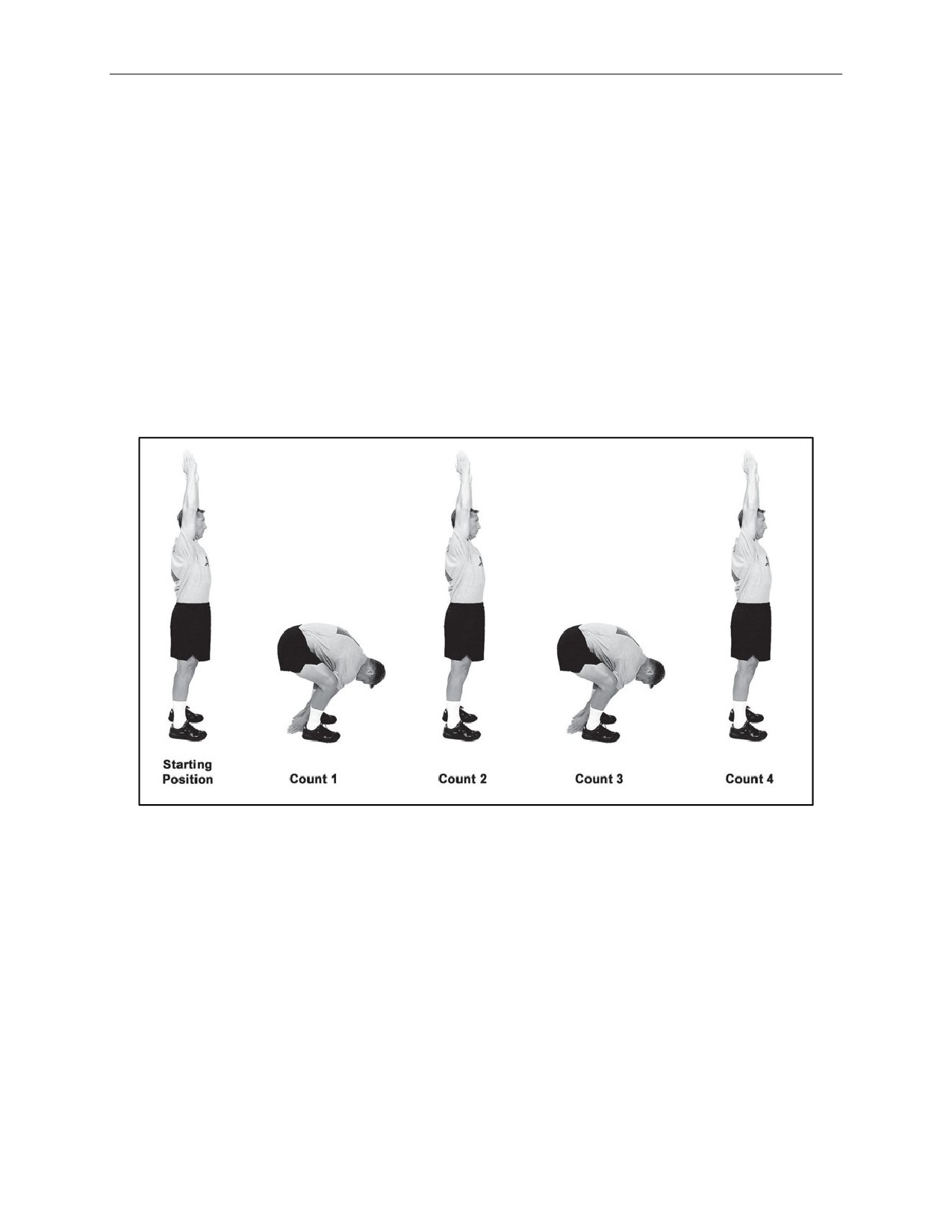
EXERCISE 1: BEND AND REACH
Purpose: This exercise develops the ability to squat and reach through the legs. It also serves to prepare the
spine and extremities for more vigorous movements by moving the hips and spine through full flexion
(Figure 6-56).
Starting Position: Straddle stance with arms overhead.
Cadence: SLOW
Count:
1. Squat with the heels flat as the spine rounds forward to allow the straight arms to reach as far as
possible between the legs.
2. Return to the starting position.
3. Repeat count 1.
4. Return to the starting position.
Figure 6-56. Bend and reach
Check Points:
z
From the starting position, ensure that Soldiers have their hips set, their abdominals tight, and their
arms fully extended overhead.
z
The neck flexes to allow the gaze to the rear; this brings the head in line with the bend of the trunk.
z
The heels and feet remain flat on the ground.
z
On counts 2 and 4, they do not go past the starting position.
Precautions: This exercise is always performed at a slow cadence. To protect the back, move into the count 1
position in a slow, controlled manner. Do not bounce into or out of this position, as this may place an excessive
load on the back.
26 October 2012
FM 7-22
6-75