FM 7-22 ARMY PHYSICAL READINESS TRAINING (OCTOBER 2012) - page 7
Chapter 9
Strength and Mobility Activities
“The race is to the swift; the battle to the strong.”
John Davidson, 19th Century Poet
This chapter describes strength and mobility exercises, drills, and activities designed for
Soldiers in the toughening and sustaining phases of PRT. The purpose of strength and
mobility activities is to improve functional strength, postural alignment, and body
mechanics as they relate to the performance of WTBDs.
EXERCISE DRILLS
9-1. The regular and precise execution of strategically organized and sequenced exercise drills will develop
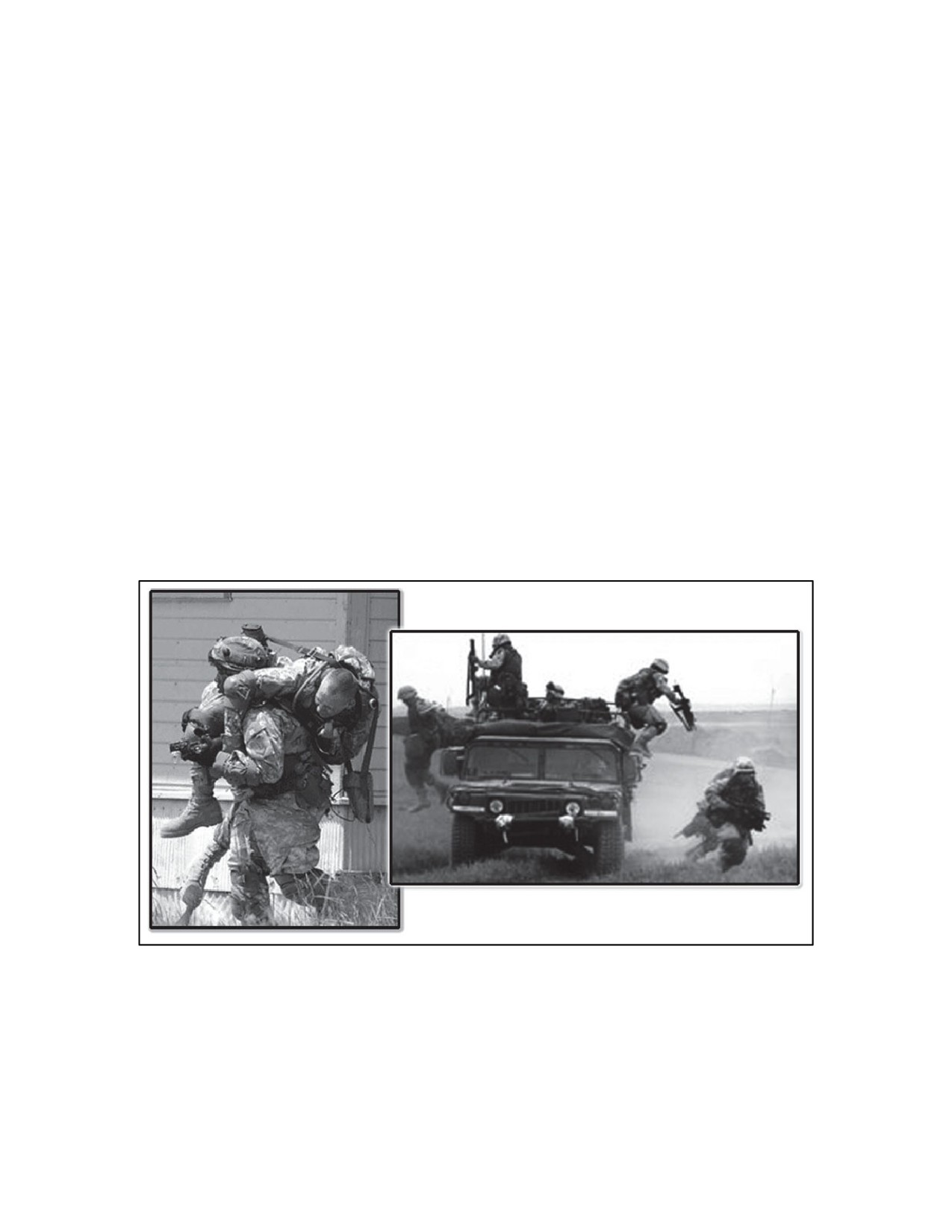
the body management competencies needed to successfully accomplish WTBDs (Figure 9-1). Table 9-1
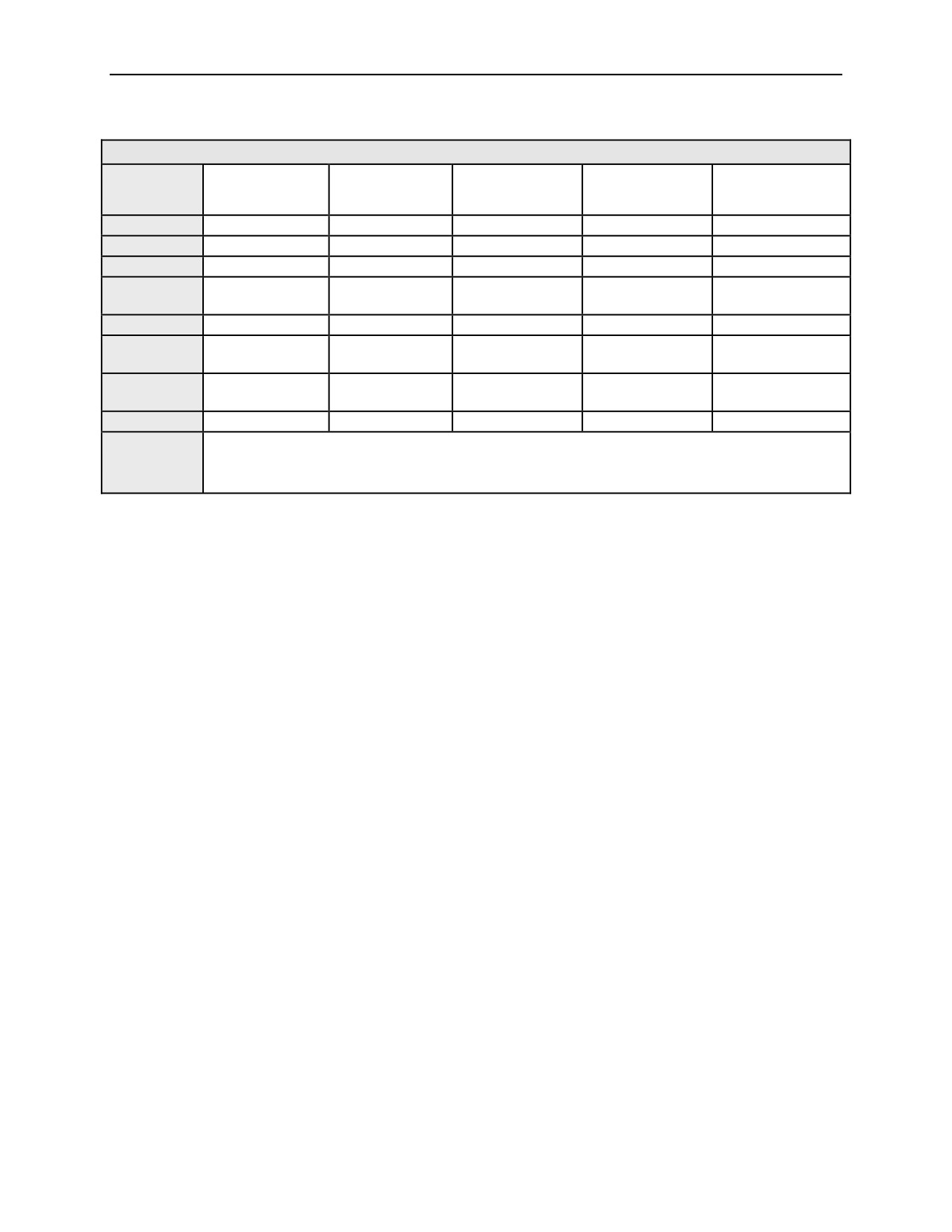
describes all strength and mobility drills and activities presented in this chapter. Table 9-2 describes strength
and mobility drills and activities and the prescription of intensity, duration, and volume within the toughening
and sustaining phases. In addition, Chapter 5, Planning Considerations, provides the template for commanders
and PRT leaders to implement strength and mobility activities into their PRT programs.
Figure 9-1. Strength and mobility-related WTBDs
26 October 2012
FM 7-22
9-1

Chapter 9
Table 9-1. Strength and mobility drills and activities
Conditioning Drill 1 consists of basic and intermediate
calisthenic exercises that develop foundational fitness and
Conditioning Drill 1 (CD 1)
body management by challenging strength, endurance, and
mobility through complex functional movement patterns.
Conditioning Drill 2 consists of intermediate and advanced
calisthenic exercises that are designed to functionally train
Conditioning Drill 2 (CD 2)
the total-body muscular strength and endurance needed to
successfully perform WTBDs.
Conditioning Drill 3 consists of advanced calisthenic and
plyometric exercises that are designed to functionally train
Conditioning Drill 3 (CD 3)
agility, coordination, and the lower-body muscular strength
and endurance needed to successfully perform WTBDs.
The Push-up and Sit-up Drill consists of push-up and sit-up
exercises performed in alternating timed sets (30 to 60
Push-up and Sit-up Drill (PSD)
seconds each) to enhance upper-body muscular strength
and endurance for improved APFT performance.
Climbing Drill 1 consists of exercises performed on a high
bar or climbing bars. This drill develops upper body and
Climbing Drill 1 (CL 1)
trunk strength and mobility while manipulating body weight
off the ground.
Climbing Drill 2 consists of exercises performed on a high
bar or climbing bars. This drill improves upper body and
Climbing Drill 2 (CL 2)
trunk strength and mobility needed for manipulating body
weight while under fighting load.
The Strength Training Circuit consists of sequenced
exercise stations using strength training equipment and
climbing exercises performed for a designated time until all
Strength Training Circuit (STC)
exercises have been performed. Movement and distance
between exercise stations may be varied. In the sustaining
phase, movement from station to station may include
exercises from both military movement drills 1 and/or 2.
The Guerrilla Drill consists of dynamic exercises that
develop leg power and functional mobility. The emphasis is
Guerrilla Drill (GD)
on improving combative techniques and the ability to
carry/evacuate another Soldier.
9-2
FM 7-22
26 October 2012
Strength and Mobility Activities
Table 9-2. Strength and mobility activity prescription
Strength and Mobility Activities
Toughening
Sustaining
Sustaining Phase
Sustaining Phase
Sustaining Phase
Activities
Phase
Phase
ARFORGEN
ARFORGEN
ARFORGEN
(BCT & OSUT-R/W/B)
(AIT & OSUT-B/G)
(Reset)
(Train/Ready)
(Available)
CD1
5 reps
5-10 reps
5-10 reps
5-10 reps
5-10 reps
CD2
5 reps
5-10 reps
5-10 reps
5-10 reps
5-10 reps
CD3
N/A
5-10 reps
5-10 reps
5-10 reps
5-10 reps
2 sets @
2-4 sets @
2-4 sets @
2-4 sets @
2-4 sets @
PSD
30-60 sec
30-60 sec
30-60 sec
30-60 sec
30-60 sec
CL1
5 reps
5-10 reps
5-10 reps
5-10 reps
5-10 reps
N/A
5-10 reps
5-10 reps
5-10 reps
5-10 reps
CL2
w/load
w/load
w/load
w/load
2-3 rotations@
2-3 rotations@
2-3 rotations@
2-3 rotations@
2-3 rotations@
STC
60 sec
60 sec
60 sec
60 sec
60 sec
GD
N/A
1-3 reps
1-3 reps
1-3 reps
1-3 reps
CD1-Conditioning Drill 1
CD2-Conditioning Drill 2
CD3-Conditioning Drill 3
Abbreviations
PSD- Push-up/Sit-up Drill
CL1-Climbing Drill 1
CL2-Climbing Drill 2
STC-Strength Training Circuit
GD- Guerrilla Drill
CONDITIONING DRILL 1
9-2. Conditioning drill 1 consists of five exercises that develop complex motor skills while challenging
strength, endurance, and mobility at a high intensity. All of the exercises in the drill are conducted to cadence,
and are always performed in the sequence listed. In the toughening phase, Soldiers should perform no more than
five repetitions of each exercise in CD 1. In the sustaining phase, Soldiers progress from 5 to 10 repetitions. If
more repetitions are desired, then perform an additional set of the entire drill. Precise execution should never be
sacrificed for speed.
TRAINING AREA
9-3. Any level area of adequate size is satisfactory for conduct of CDs.
UNIFORM
9-4. Soldiers will wear the IPFU or ACUs and boots.
EQUIPMENT
9-5. N/A.
FORMATION
9-6. For the most efficient instruction, the ideal unit size is one platoon. Larger units up to a battalion can
successfully perform these drills if properly taught and mastered at the small unit level. The extended
rectangular formation is prescribed.
LEADERSHIP
9-7. A PRT leader and AI are required to instruct and lead CD 1. The instructor must be familiar with the
method of teaching these exercises, commands, counting cadence, cumulative count, formations, starting
positions, and use of AIs as described in Chapter 7, Execution of Training. Soldiers should memorize the
exercises by name and movement. The exercises are always given in cadence. Soldiers begin and terminate each
exercise at the starting position and move to the position of attention before beginning the next exercise. The
26 October 2012
FM 7-22
9-3
Chapter 9
goal is to complete the entire drill with only enough pauses between exercises for the instructor to indicate the
next one by name. This continuous method of conducting CD 1 intensifies the workload and conserves time.
Considerable time and effort must be expended during the early stages to teach exercises properly to all
Soldiers. Teach and practice exercises using a slow cadence (50 counts per minute) until correct form in
executing each exercise is achieved.
PRECISION
9-8. Conditioning drill exercises lose much of their value unless performed exactly as prescribed. Precision
should never be compromised for quantity of repetitions or speed of movement. A cadence that is too fast will
not allow Soldiers to achieve a full range of movement.
PROGRESSION
9-9. Soldiers perform no more than five repetitions of each exercise while learning and practicing CDs. In the
toughening phase, CD 1 is performed for five repetitions of each exercise. In the sustaining phase, CD 1 is
performed for 5 to 10 repetitions of each exercise. Do not exceed ten repetitions of each exercise. Instead, if
more repetitions are desired, perform additional sets of the entire drill.
INTEGRATION
9-10. Conditioning drill 1 integrates the components of strength, endurance, and mobility. This drill builds
strength by challenging the control of body weight and promotes endurance without the repetitive motions that
often lead to overuse injuries. It also improves mobility by progressively moving the major joints through a full,
controlled range of motion.
COMMANDS
9-11. Chapter 7 provides the commands for CD 1.
BODY SEGMENTS TRAINED
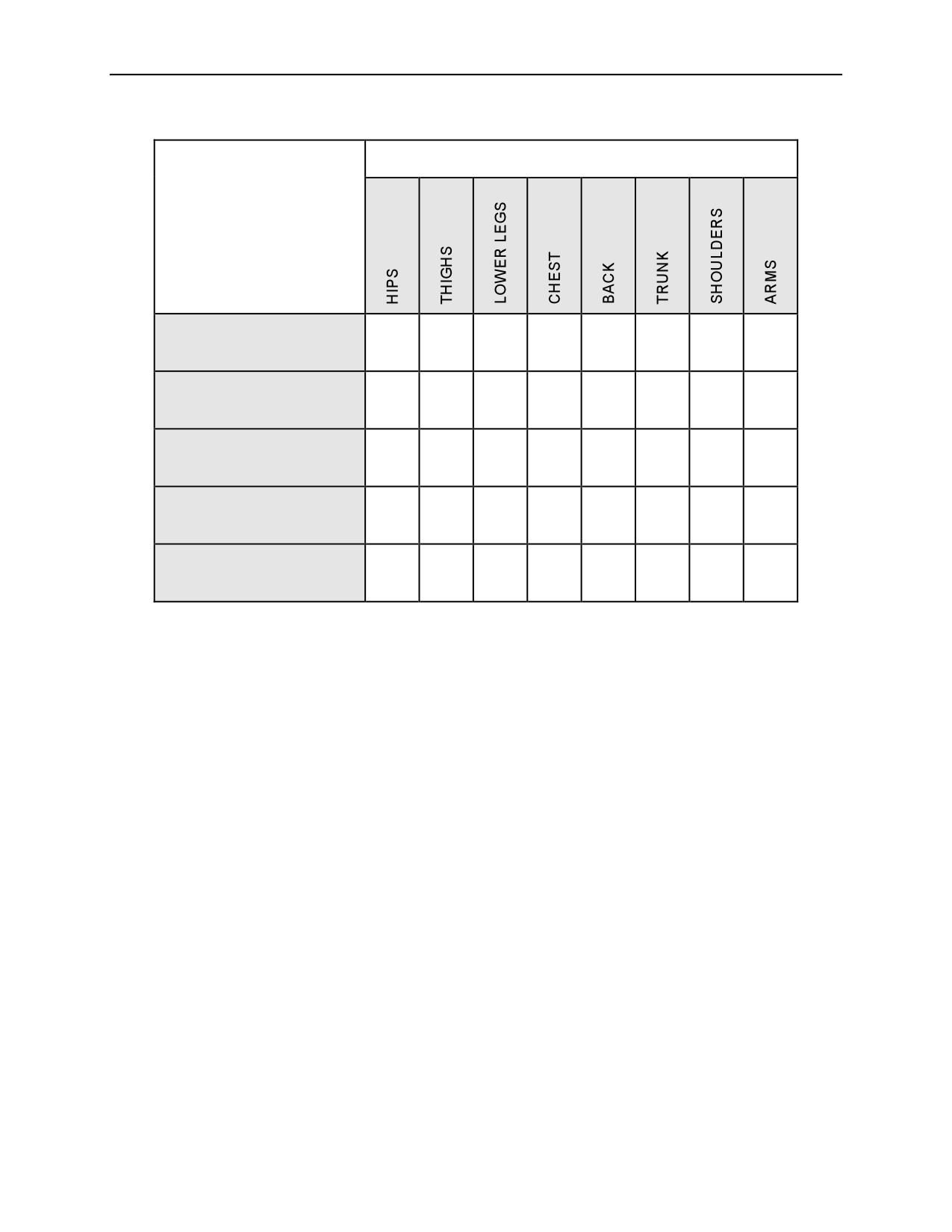
9-12. Conditioning drill 1 consists of five 4-count exercises that train the body segments listed in Table 9-3.
Instructions for giving commands are listed in Chapter 7, Execution of Training.
9-4
FM 7-22
26 October 2012
Strength and Mobility Activities
Table 9-3. Body segments trained in the conduct of CD 1
MUSCLES
CONDITIONING DRILL 1
(CD 1)
1.
POWER JUMP
X
X
X
X
X
X
2.
V-UP
X
X
X
X
X
X
X
3.
MOUNTAIN CLIMBER
X
X
X
X
X
X
X
X
4.
LEG TUCK AND TWIST
X
X
X
X
X
X
X
5.
SINGLE LEG PUSH-UP
X
X
X
X
X
X
X
X
26 October 2012
FM 7-22
9-5
Chapter 9
CONDITIONING DRILL 1
EXERCISE 1: POWER JUMP
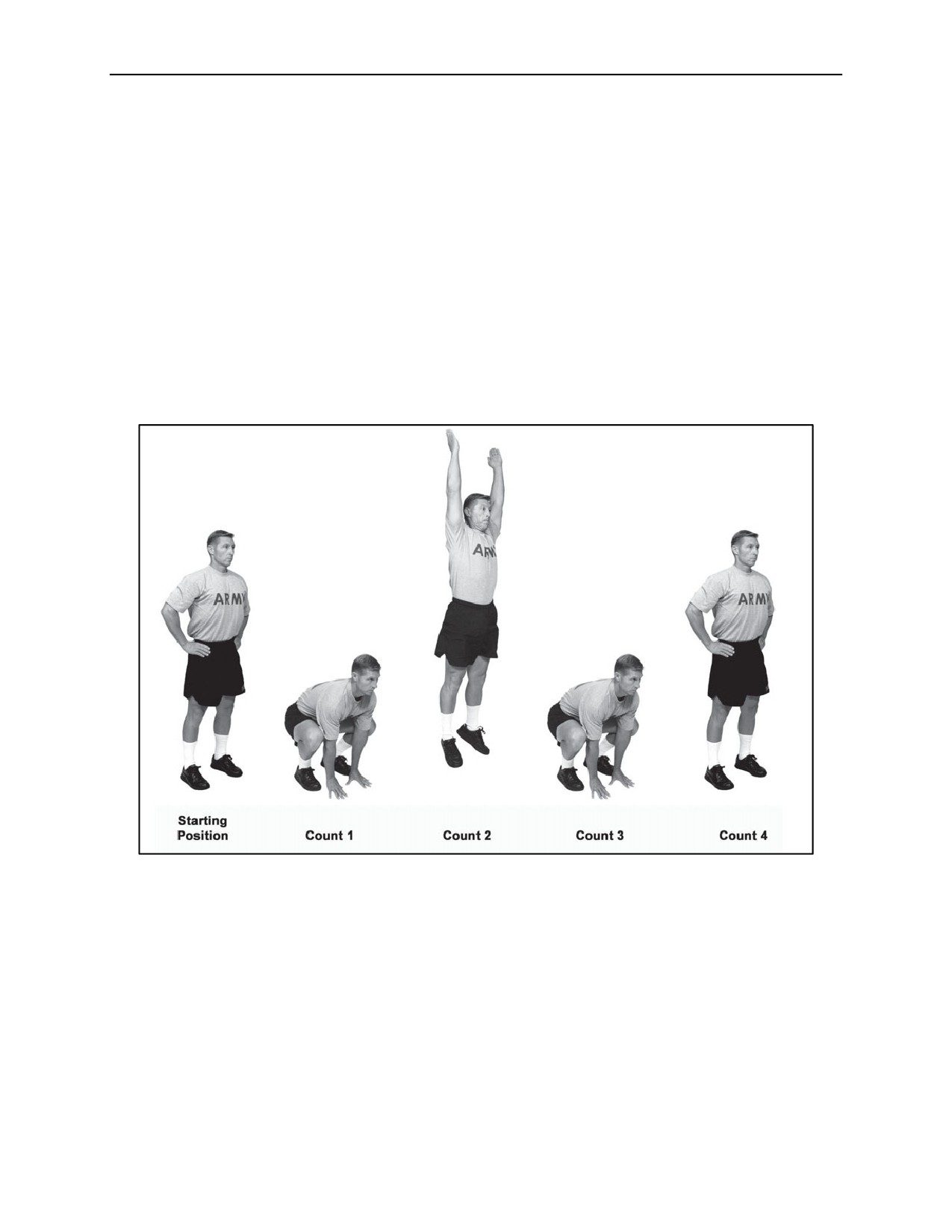
Purpose: This exercise reinforces correct jumping and landing, stimulates balance and coordination, and
develops explosive strength (Figure 9-2).
Starting Position: Straddle stance with hands on hips.
Cadence: MODERATE
Count:
1. Squat with the heels flat as the spine rounds forward to allow the straight arms to reach to the
ground, attempting to touch with the palms of the hands.
2. Jump forcefully in the air, vigorously raising arms overhead, with palms facing inward.
3. Control the landing and repeat count 1.
4. Return to the starting position.
Figure 9-2. Power jump
Check Points:
z
At the starting position, tighten the abdominals to stabilize the trunk.
z
On counts 1 and 3, keep the back generally straight with the head up and the eyes forward.
z
On count 2, the arms should be extended fully overhead. The trunk and legs should also be in line.
z
On each landing, the feet are directed forward and maintained at shoulder distance apart. The landing
should be “soft” and proceed from the balls of the feet to the heels. The vertical line from the
shoulders through the knees to the balls of the feet should be demonstrated on each landing.
Precaution: N/A
9-6
FM 7-22
26 October 2012
Strength and Mobility Activities
CONDITIONING DRILL 1
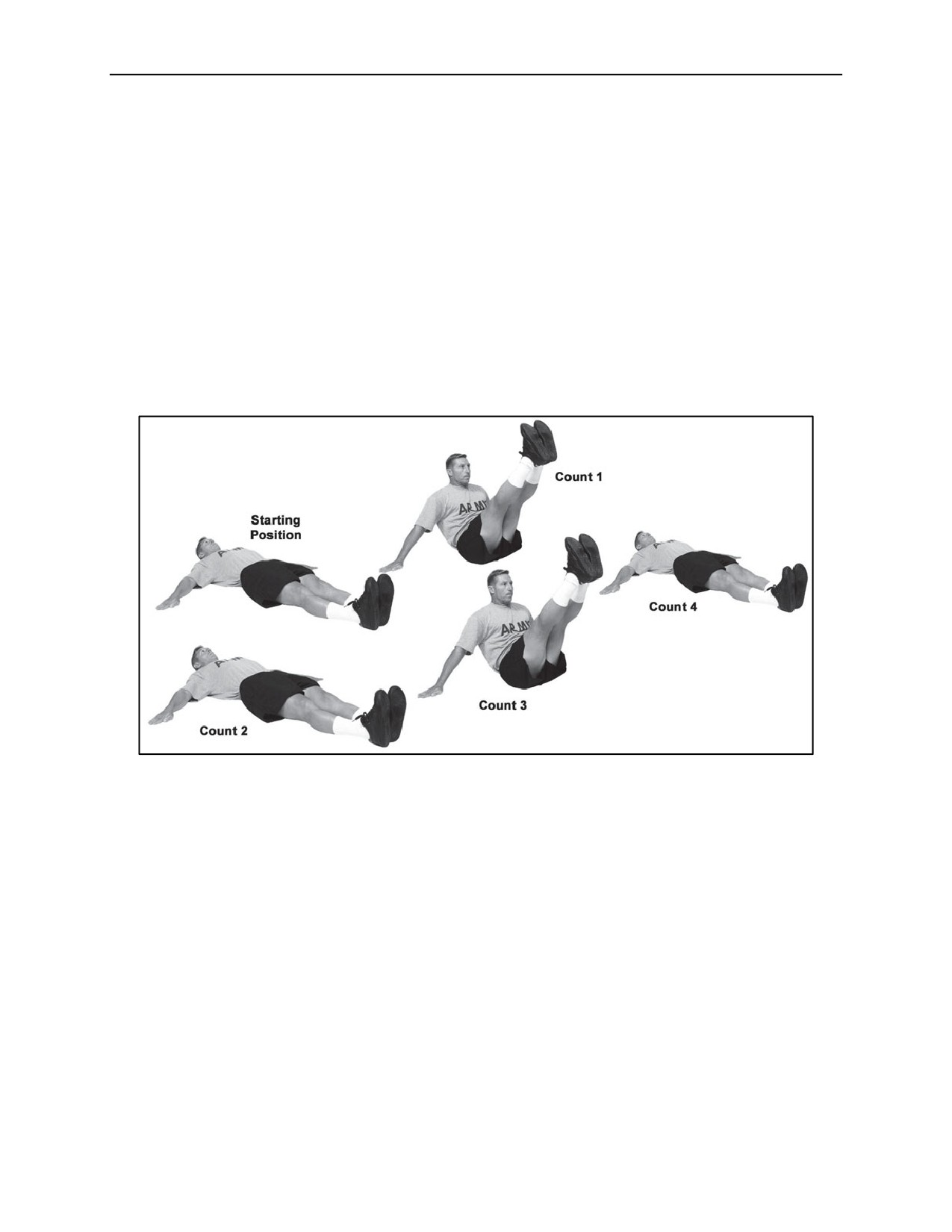
EXERCISE 2: V-UP
Purpose: This exercise develops the abdominal and hip flexor muscles while enhancing balance (Figure 9-3).
Starting Position: Supine, arms on ground 45 degrees to the side, palms down. The chin is tucked and the head
is 1 to 2 inches off the ground.
Cadence: MODERATE
Count:
1. Raise straight legs and trunk to form a V-position, using arms as needed.
2. Return to the starting position.
3. Repeat count 1.
4. Return to the starting position.
Figure 9-3. V-up
Check Points:
z
At the starting position, tighten the abdominal muscles to tilt the pelvis and the lower back toward
the ground.
z
On counts 1 and 3, straighten the knees and trunk and align the head with the trunk.
z
On counts 2 and 4, lower the legs to the ground in a controlled manner so as not to injure the feet.
Precaution: To protect the spine, do not jerk the legs and trunk to rise to the V-position.
26 October 2012
FM 7-22
9-7
Chapter 9
CONDITIONING DRILL 1
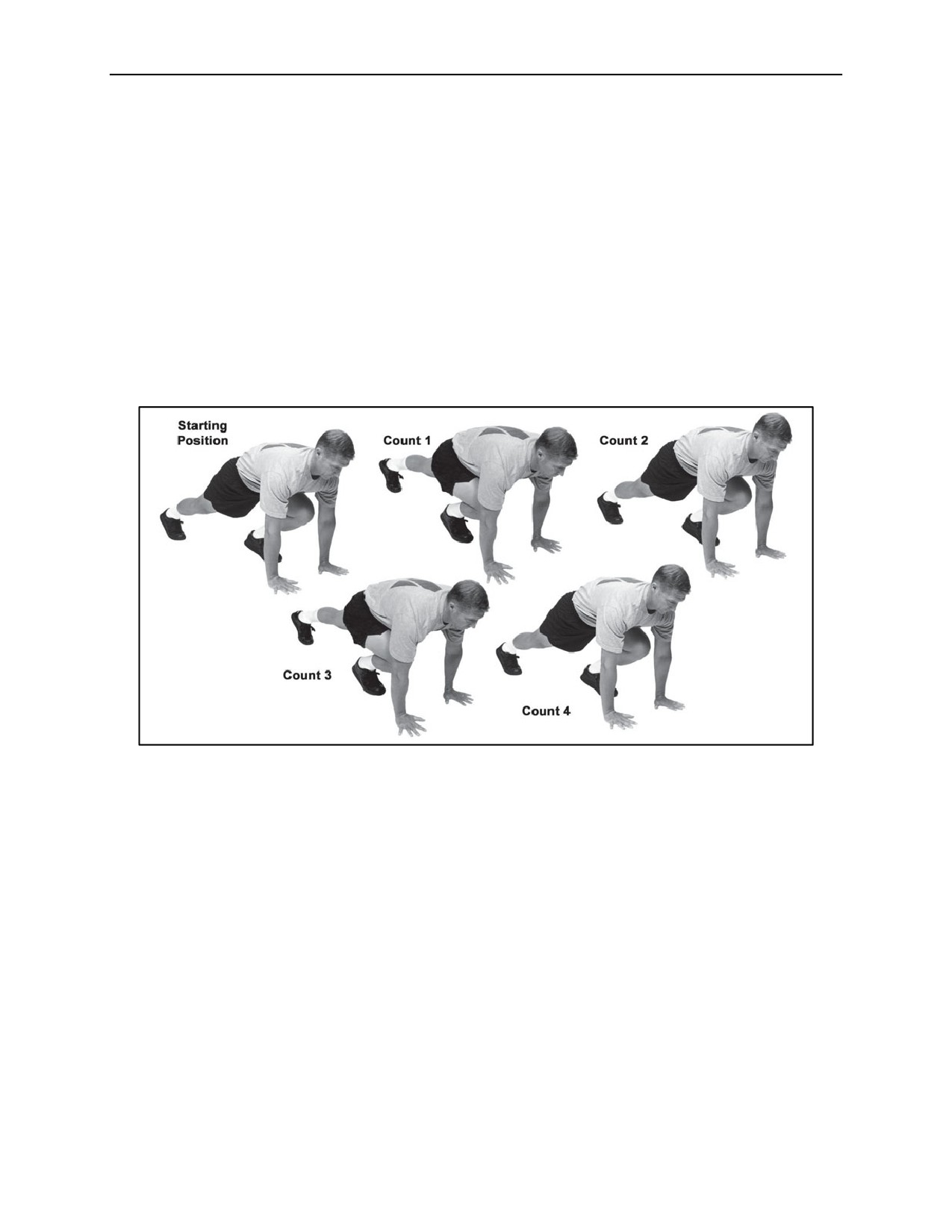
EXERCISE 3: MOUNTAIN CLIMBER
Purpose: This exercise develops the ability to quickly move the legs to power out of the front leaning rest
position (Figure 9-4).
Starting Position: Front leaning rest position with the left foot below the chest and between the arms.
Cadence: MODERATE
Count:
1. Push upward with the feet and quickly change the positions of the legs.
2. Return to the starting position.
3. Repeat the movements in count 1.
4. Return to the starting position.
Figure 9-4. Mountain climber
Check Points:
z
The hands are directly below the shoulders with the fingers spread (middle fingers pointing straight
ahead) with the elbows straight, not locked.
z
To prevent the trunk from sagging, contract and hold the abdominals throughout the exercise. Do not
raise the hips and buttocks when moving throughout the exercise.
z
Align the head with the spine and direct the eyes to a point about two feet in front of the body.
z
Throughout the exercise, remain on the balls of the feet.
z
Move the legs straight forward and backward, not at angles.
Precaution: N/A
9-8
FM 7-22
26 October 2012
Strength and Mobility Activities
CONDITIONING DRILL 1
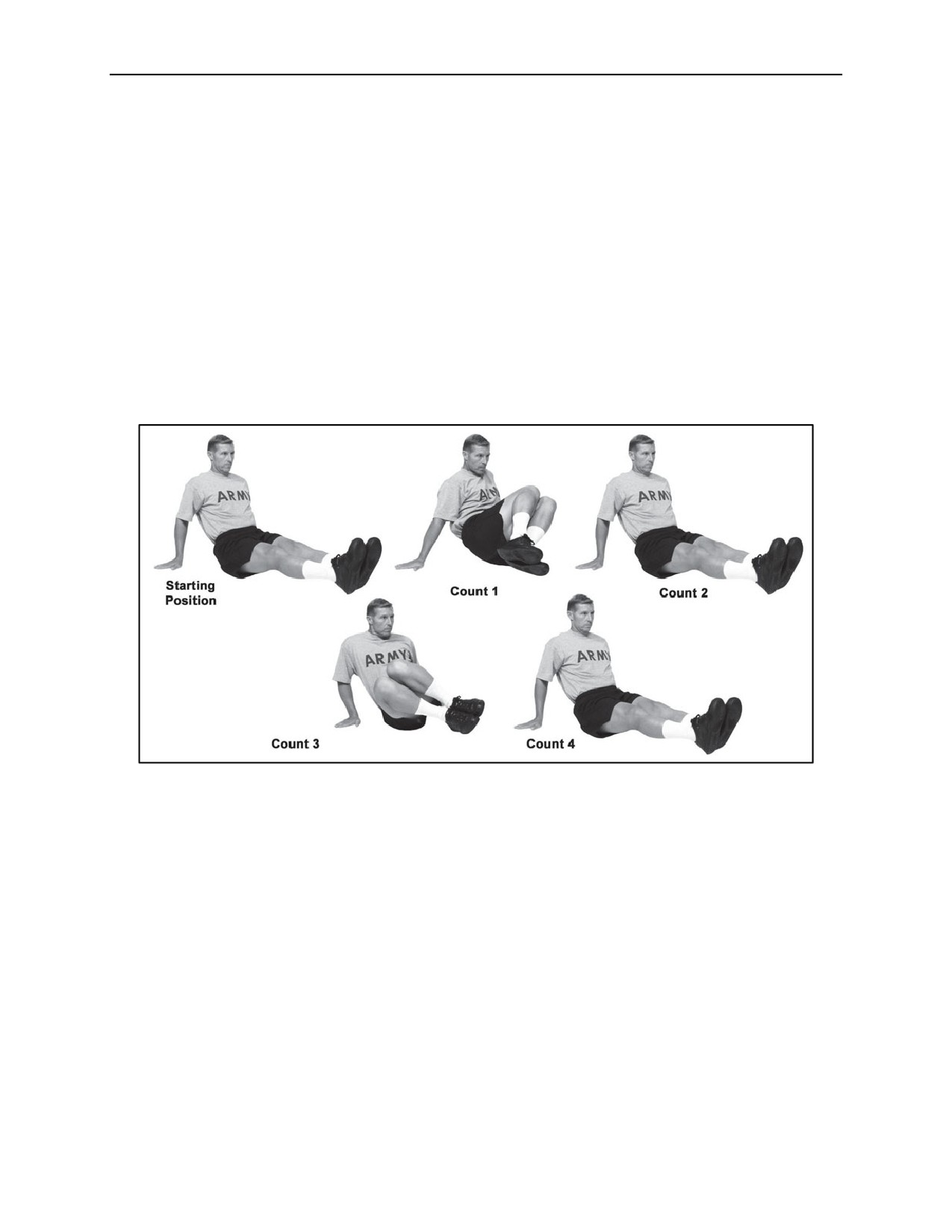
EXERCISE 4: LEG TUCK AND TWIST
Purpose: This exercise develops trunk strength and mobility while enhancing balance (Figure 9-5).
Starting Position: Seated with trunk straight but leaning backward 45 degrees, arms straight and hands on
ground 45 degrees to the rear with palms down. Legs are straight, extended to the front, and 8 to 12 inches off
the ground.
Cadence: MODERATE
Count:
1. Raise legs while rotating on to the left buttock and draw the knees toward the left shoulder.
2. Return to the starting position.
3. Repeat count 1 in the opposite direction.
4. Return to the starting position.
Figure 9-5. Leg tuck and twist
Check Points:
z
At the starting position, tighten the abdominals to stabilize the trunk.
z
On all counts, keep the legs and knees together.
z
On counts 1 and 3, the head and trunk remain still while the legs move.
z
On counts 1 and 3, the legs are tucked (bent) and aligned diagonal to the trunk.
Precaution: To protect the back on counts 1 and 3, avoid jerking the legs and trunk to achieve the end position.
26 October 2012
FM 7-22
9-9
Chapter 9
CONDITIONING DRILL 1
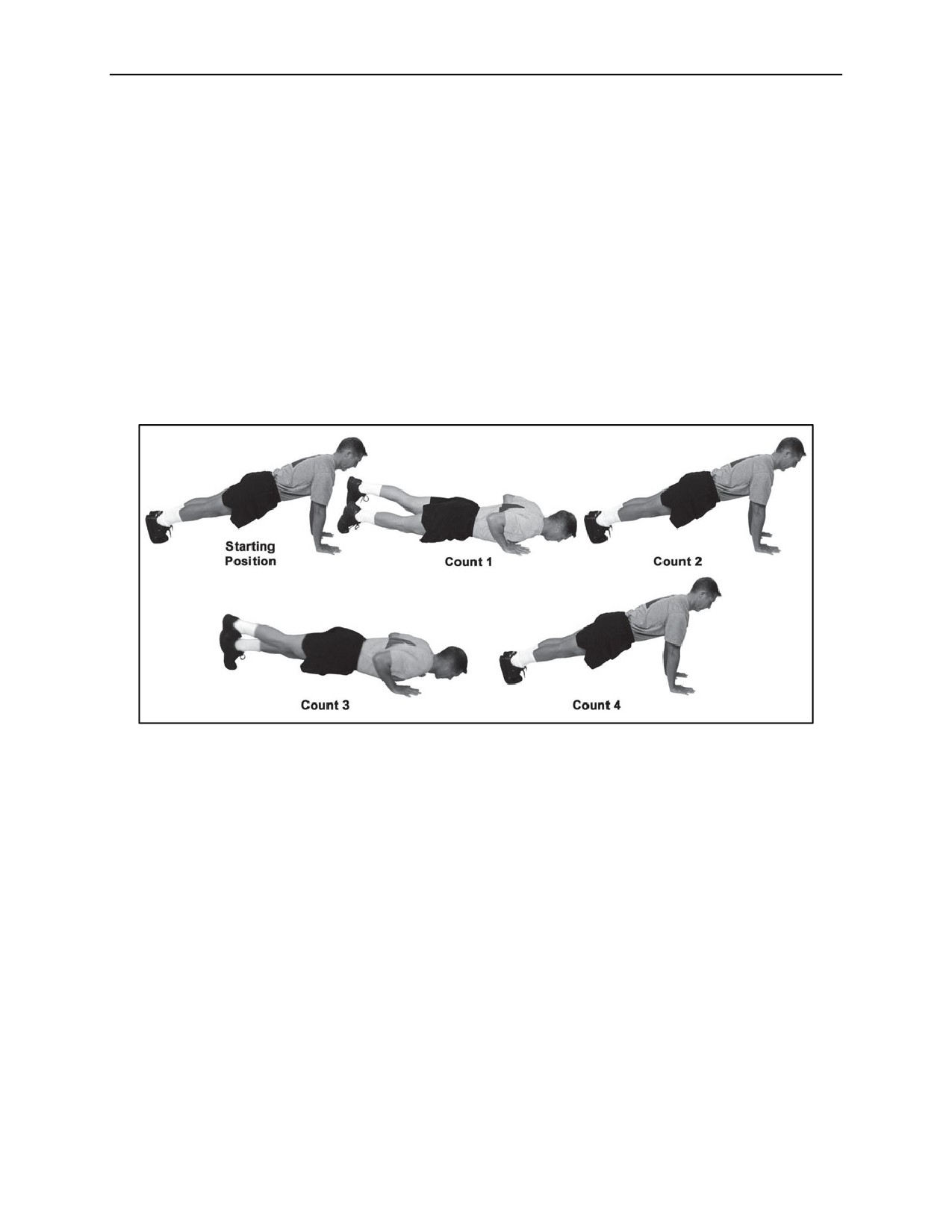
EXERCISE 5: SINGLE-LEG PUSH-UP
Purpose: This exercise strengthens muscles of the chest, shoulders, arms, and trunk. Raising one leg while
maintaining proper trunk position makes this an excellent trunk stabilizing exercise (Figure 9-6).
Starting Position: Front leaning rest position.
Cadence: MODERATE
Count:
1. Bend the elbows, lowering the body until the upper arms are parallel with the ground while raising
the left leg 8-10 inches off the ground.
2. Return to the starting position.
3. Repeat count 1, bringing the right leg to 8-10 inches off the ground.
4. Return to the starting position.
Figure 9-6. Single-leg push-up
Check Points:
z
Perform a squat thrust to move into the front leaning rest. Keep the body straight from head to heels.
Support the body weight on the hands and balls of the feet.
z
The fingers should be extended and spread so the middle fingers point straight ahead and are directly
in line with the shoulders.
z
On counts 1 and 3, the upper arms stay close to the trunk.
z
On counts 2 and 4, straighten but do not lock the elbows.
z
On counts 1 and 3, the raised leg is straight and aligned with the trunk.
z
To keep the trunk from sagging, tighten the abdominal muscles while in the starting position and
maintain this contraction throughout the exercise.
Precautions: Do not jerk the leg being raised on counts 1 and 3. Also do not raise the leg higher than straight
alignment with the trunk, as this may place undue stress on the back.
9-10
FM 7-22
26 October 2012
Strength and Mobility Activities
CONDITIONING DRILL 2
9-13. Conditioning drill 2 consists of five advanced exercises that require more complex plyometric and
bilateral movement skills, while challenging the components of strength, endurance, and mobility (Table 9-4).
Exercises are conducted at a slow (turn and lunge, supine bicycle, and swimmer) or moderate (half jacks and
8-count push-up) cadence. In the toughening phase, Soldiers should perform no more than five repetitions of
each exercise in CD 2. In the sustaining phase, Soldiers progress from 5 to 10 repetitions. If more repetitions are
desired, then perform an additional set of the entire drill. Precise execution should never be sacrificed for speed.
TRAINING AREA
9-14. Any level area of adequate size is satisfactory for conduct of CDs.
UNIFORM
9-15. Soldiers will wear IPFU or ACUs and boots.
EQUIPMENT
9-16. N/A.
FORMATION
9-17. For the most efficient instruction, the ideal unit size is one platoon. Larger units up to a battalion can
successfully perform these drills if properly taught and mastered at the small unit level. The extended
rectangular formation is prescribed.
LEADERSHIP
9-18. A PRT leader and an AI are required to instruct and lead CD 2. The instructor must be familiar with the
method of teaching the exercises; the commands and counting cadence; cumulative count; formations; starting
positions; and the use of AIs as described in Chapter 7. Soldiers should memorize the exercises by name and
movement. The exercises are always given in cadence. Soldiers begin and terminate each exercise at the starting
position and return to the position of attention before beginning the next exercise. The goal is to complete the
entire drill with only enough pauses between exercises for the instructor to indicate the next one by name. This
continuous method of conducting CD 2 intensifies the workload and conserves time. Considerable time and
effort must be expended during the early stages to teach exercises properly to all Soldiers. Teach and practice
exercises using a slow cadence (50 counts per minute) until correct form in executing each exercise is achieved.
PRECISION
9-19. Conditioning drill exercises lose much of their value unless performed exactly as prescribed. Precision
should never be compromised for quantity of repetitions or speed of movement. A cadence that is too fast will
not allow Soldiers to achieve a full range of movement.
PROGRESSION
9-20. Soldiers perform no more than five repetitions of each exercise while learning and practicing CDs. In the
toughening phase, CD 2 is performed for five repetitions of each exercise. In the sustaining phase, CD 2 is
performed for five to ten repetitions of each exercise. Do not exceed ten repetitions of each exercise. Instead,
perform additional sets of the entire drill if more repetitions are desired.
INTEGRATION
9-21. Conditioning drill 2 integrates the components of strength, endurance, and mobility. This drill builds
strength by challenging control of body weight and promotes endurance without the repetitive motions that
often lead to overuse injuries. It also improves mobility by progressively moving the major joints through a full,
controlled range of motion.
26 October 2012
FM 7-22
9-11
Chapter 9
COMMANDS
9-22. Conditioning drill 2 consists of four 4-count exercises and one 8-count exercise that train the body
segments listed in Table 9-4. Chapter 7 provides instructions for giving commands.
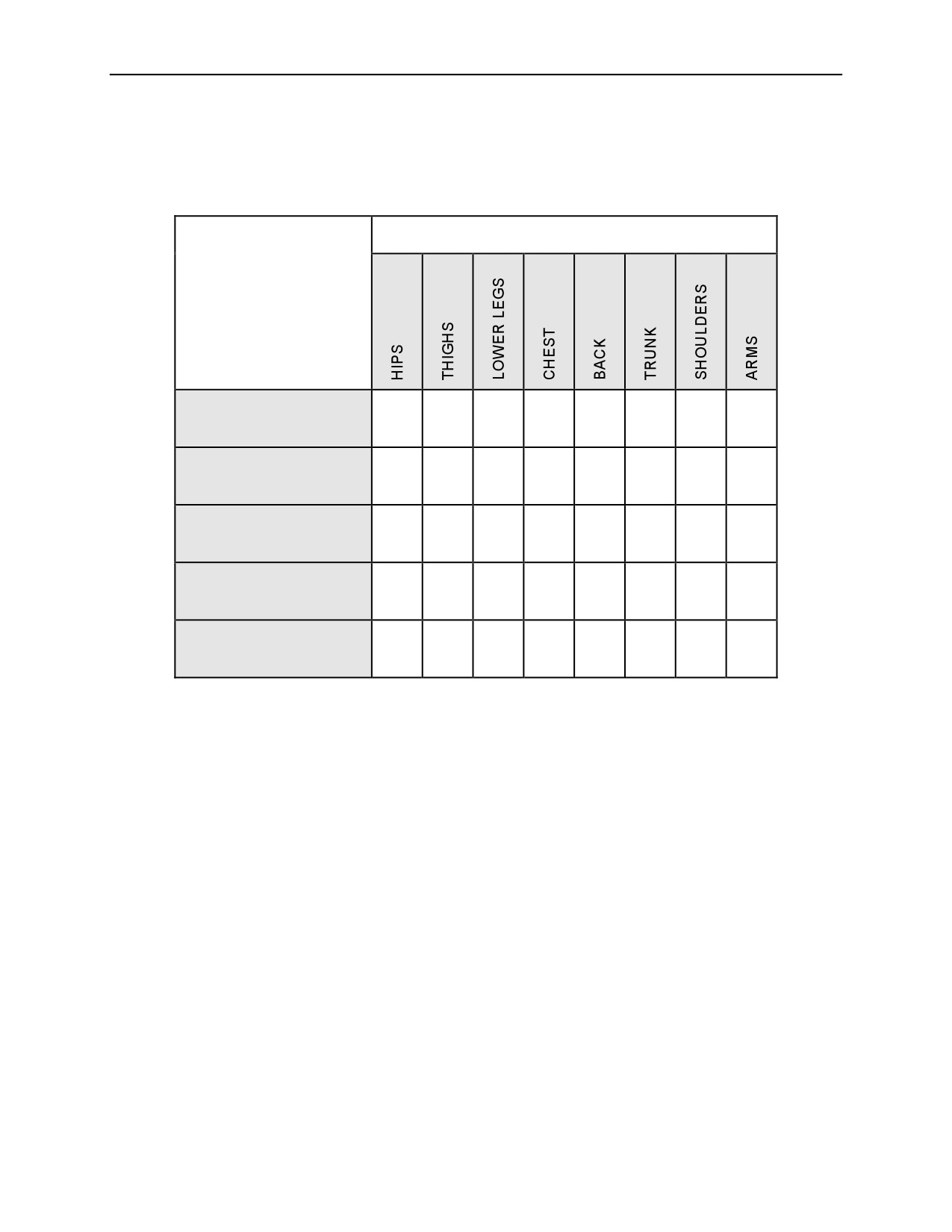
Table 9-4. Body segments trained in the conduct of CD 2
MUSCLES
CONDITIONING DRILL 2
(CD 2)
1.
TURN AND LUNGE
X
X
X
X
X
X
X
X
2.
SUPINE BICYCLE
X
X
X
X
X
X
X
X
3.
HALF JACKS
X
X
X
X
X
X
4.
SWIMMER
X
X
X
X
X
x
x
5.
8-COUNT PUSH-UP
X
X
X
X
X
X
X
X
9-12
FM 7-22
26 October 2012
Strength and Mobility Activities
CONDITIONING DRILL 2
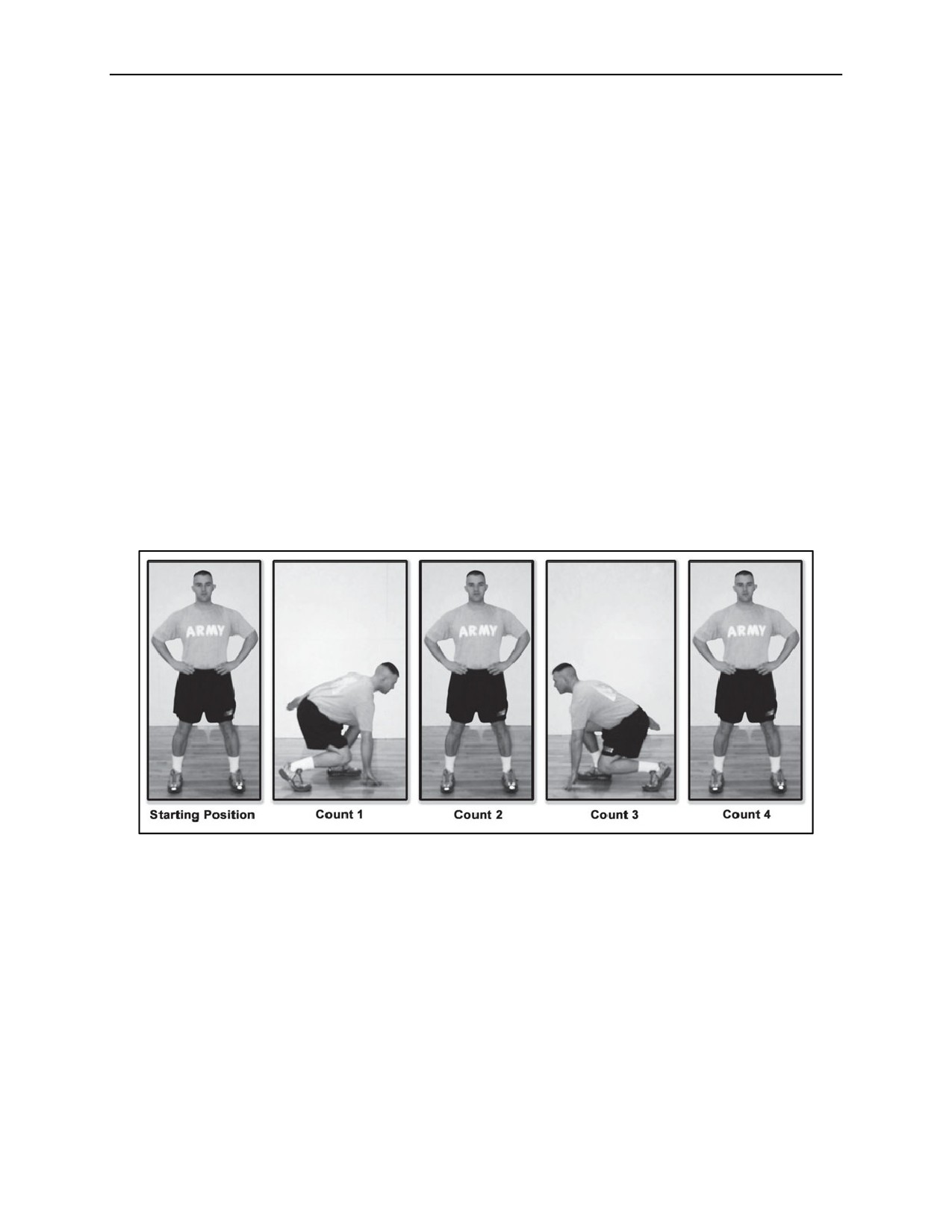
EXERCISE 1: TURN AND LUNGE
Purpose: This exercise develops the agility needed to rotate, lower, and raise the body for effective changes of
direction during military movement drill exercises, the
300-yd SR, and individual movement techniques
(Figure 9-7).
Starting Position: Straddle stance with hands on hips.
Cadence: SLOW
Count:
1. Turn 90-degrees to the left, stepping with the left foot, and pivoting on the ball of the right foot.
Perform a forward lunge (facing the left) while reaching toward the ground with the right hand. The
left arm swings rearward while the left hand reaches rearward at the left side of the body.
2. Stand up, rotate to the right, and return to the starting position, stepping with the right foot and pivoting
on the ball of the left foot.
3. Turn 90-degrees to the right, stepping with the right foot and pivoting on the ball of the left foot.
Perform a forward lunge (facing the right) while reaching toward the ground with the left hand. The
right arm swings rearward while the right arm reaches rearward at the right side of the body.
4. Stand up, rotate to the left, and return to the starting position, stepping with the left foot and pivoting
on the ball of the right foot.
Figure 9-7. Turn and lunge
Check Points:
z
When changing directions on all counts, the lead footsteps and the rear foot pivots.
z
Keep the head in line with the spine throughout the exercise.
z
Down positions on counts 1 and 3 are similar to the forward lunge, but with the hand down.
Precaution: N/A
26 October 2012
FM 7-22
9-13
Chapter 9
CONDITIONING DRILL 2
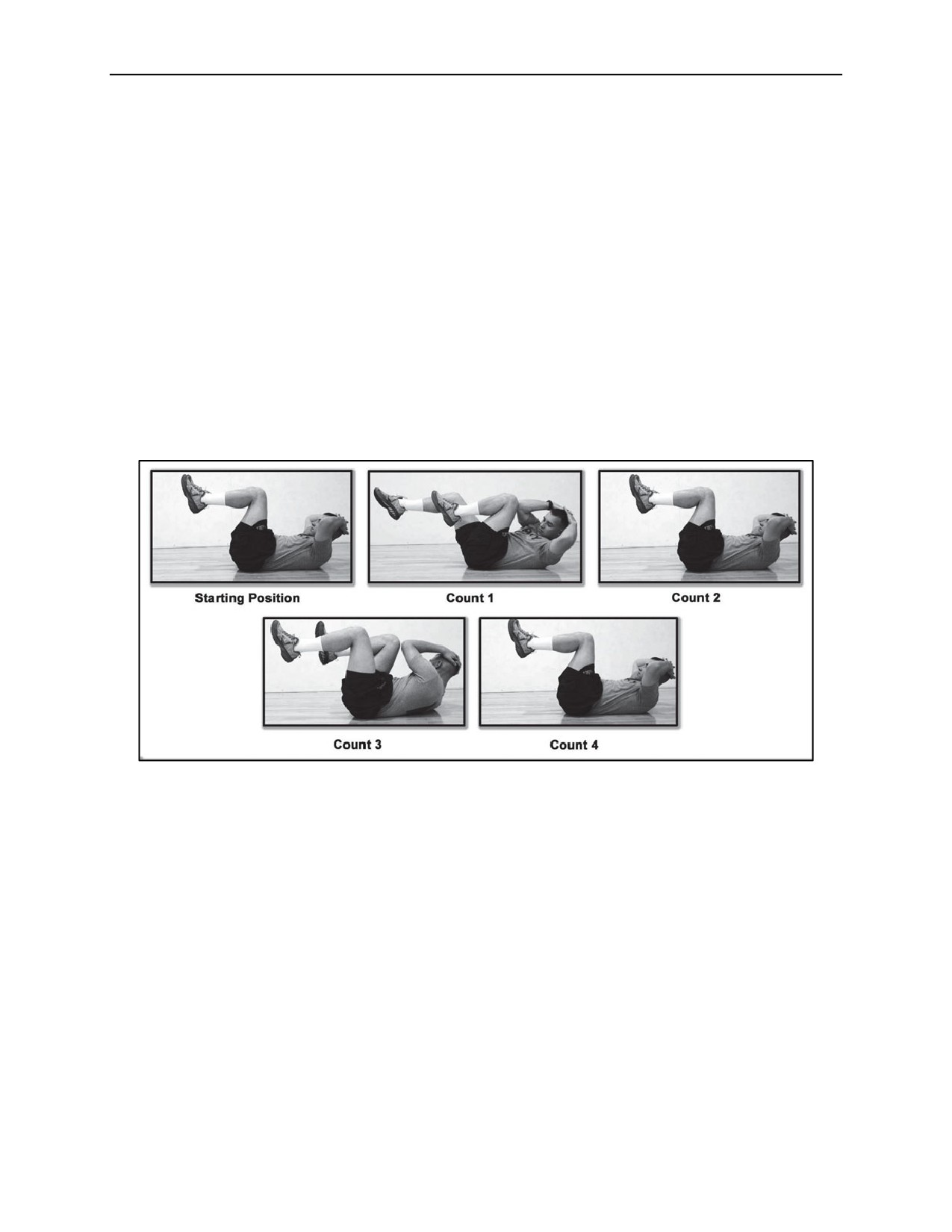
EXERCISE 2: SUPINE BICYCLE
Purpose: This exercise strengthens the muscles of the abdomen and controls the rotation of the trunk (Figure
9-8).
Starting Position: Supine position with the fingers interlaced, hands on top of the head. Hips, knees, and ankles
are flexed at 90 degrees and lower legs are parallel to the ground. The head is off the ground.
Cadence: SLOW
Count:
1. Bring the left knee toward the chest while flexing and rotating the trunk to the left, attempting to
touch the right elbow with the left thigh. As the left knee rises, the right leg extends.
2. Return to the starting position.
3. Bring the right knee toward the chest while flexing and rotating the trunk to the right, attempting
to touch the left elbow with the right thigh. As the right knee rises, the left leg extends.
4. Return to the starting position.
Figure 9-8. Supine bicycle
Check Points:
z
At the starting position ensure that the hands are on top of the head, not behind the neck.
z
Maintain tightness of the abdominals throughout the exercise.
z
On counts 1 and 3, attempt to fully extend one leg while bringing the knee of the other to
the elbow.
Precaution: On counts 1 and 3, do not jerk the neck or arch the back to assume the up position.
9-14
FM 7-22
26 October 2012
Strength and Mobility Activities
CONDITIONING DRILL 2
EXERCISE 3: HALF JACKS
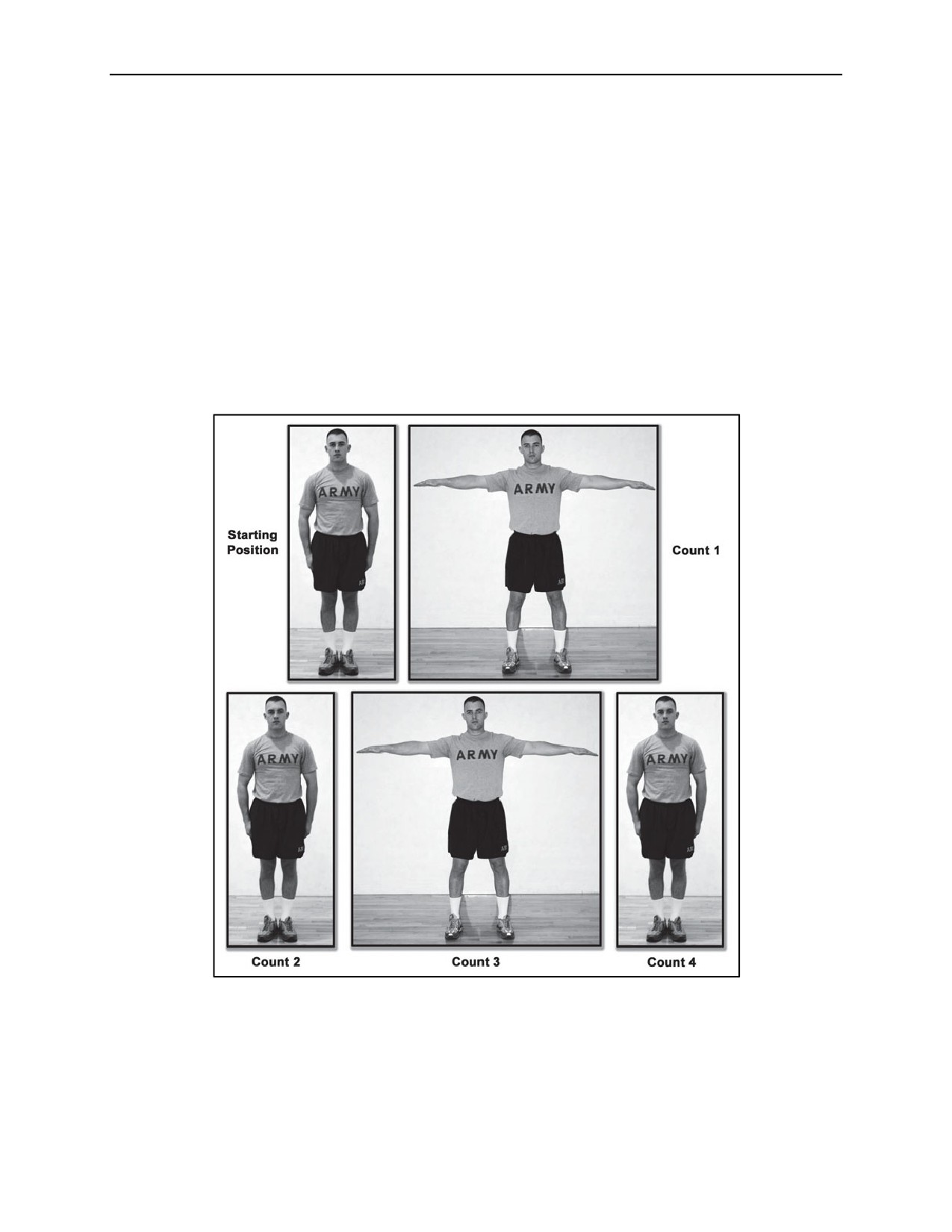
Purpose: The purpose of this exercise is to jump and land with the legs apart, controlling the landing by
laterally braking with the feet, ankles, and legs (Figure 9-9).
Starting Position: Position of attention.
Cadence: MODERATE
Count:
1. Jump and land with the feet shoulder-width apart and pointed straight ahead. The arms are
sideward with palms facing down, thumbs and fingers extended and joined.
2. Jump and return to the starting position.
3. Repeat count 1.
4. Repeat count 2, returning to the starting position.
Figure 9-9. Half jacks
Check Points:
z
On each landing, the balls of the feet should touch first.
z
On counts 1 and 3, do not raise the arms above parallel to the ground.
Precaution: N/A
26 October 2012
FM 7-22
9-15
Chapter 9
CONDITIONING DRILL 2
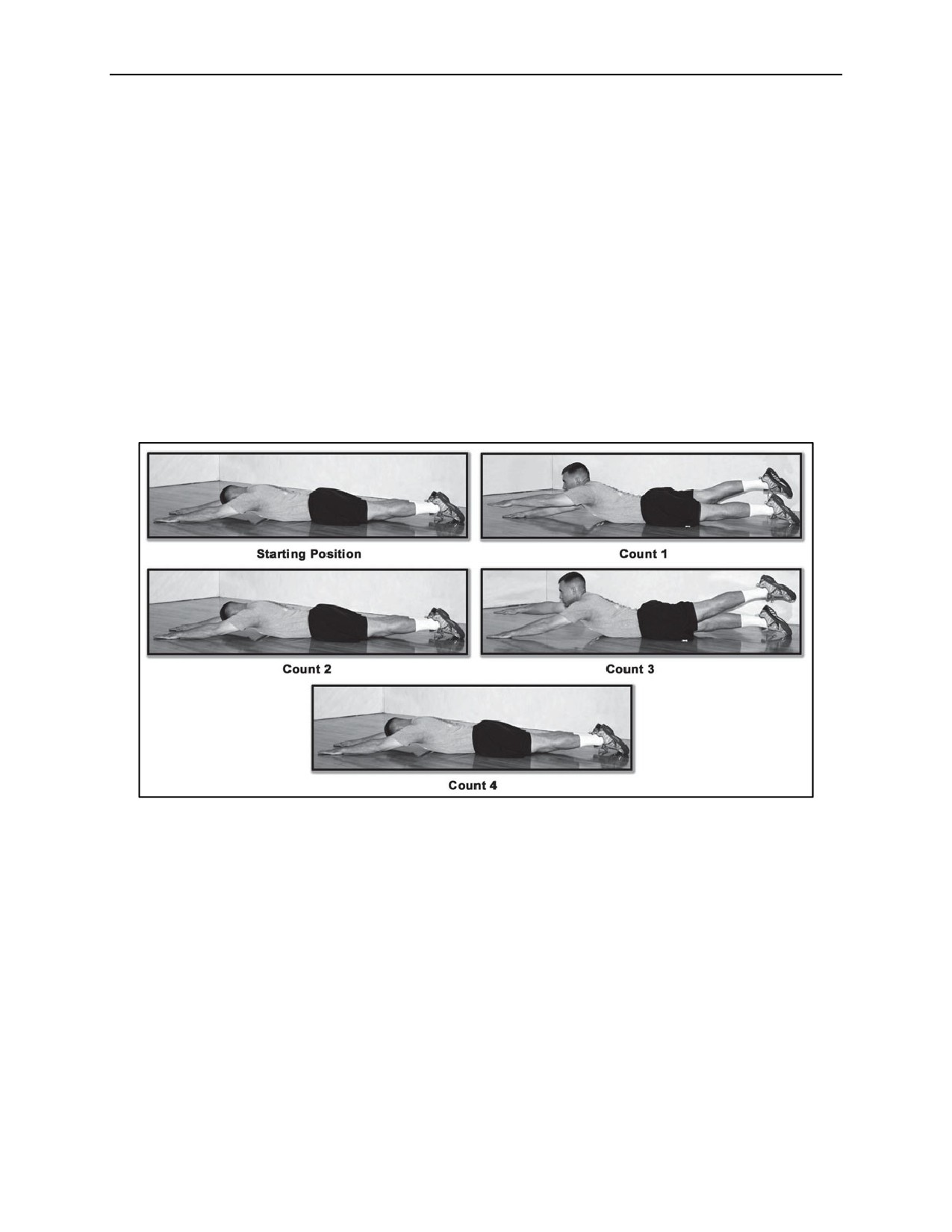
EXERCISE 4: SWIMMER
Purpose: This exercise strengthens the muscles of the low back and the shoulders while promoting
quadrilateral coordination of the arms and legs (Figure 9-10).
Starting Position: The prone position with the arms extended, palms facing down, and toes pointed to the rear.
Cadence: SLOW
Count:
1. Raise the left arm and right leg 4 to 6 inches off the ground while arching the back slightly and
looking upward.
2. Return to the starting position.
3. Raise the right arm and left leg 4 to 6 inches off the ground, while arching the back slightly and
looking upward.
4. Return to the starting position.
Figure 9-10. Swimmer
Check Points:
z
At the starting position and throughout the exercise, maintain tightness in the abdominal and hip
muscles.
z
On counts 1 and 3, raise the head slightly and look upward.
z
Keep the toes pointed throughout the exercise.
Precaution: Do not move into counts 1 and 3 with a jerking motion.
9-16
FM 7-22
26 October 2012
Strength and Mobility Activities
CONDITIONING DRILL 2
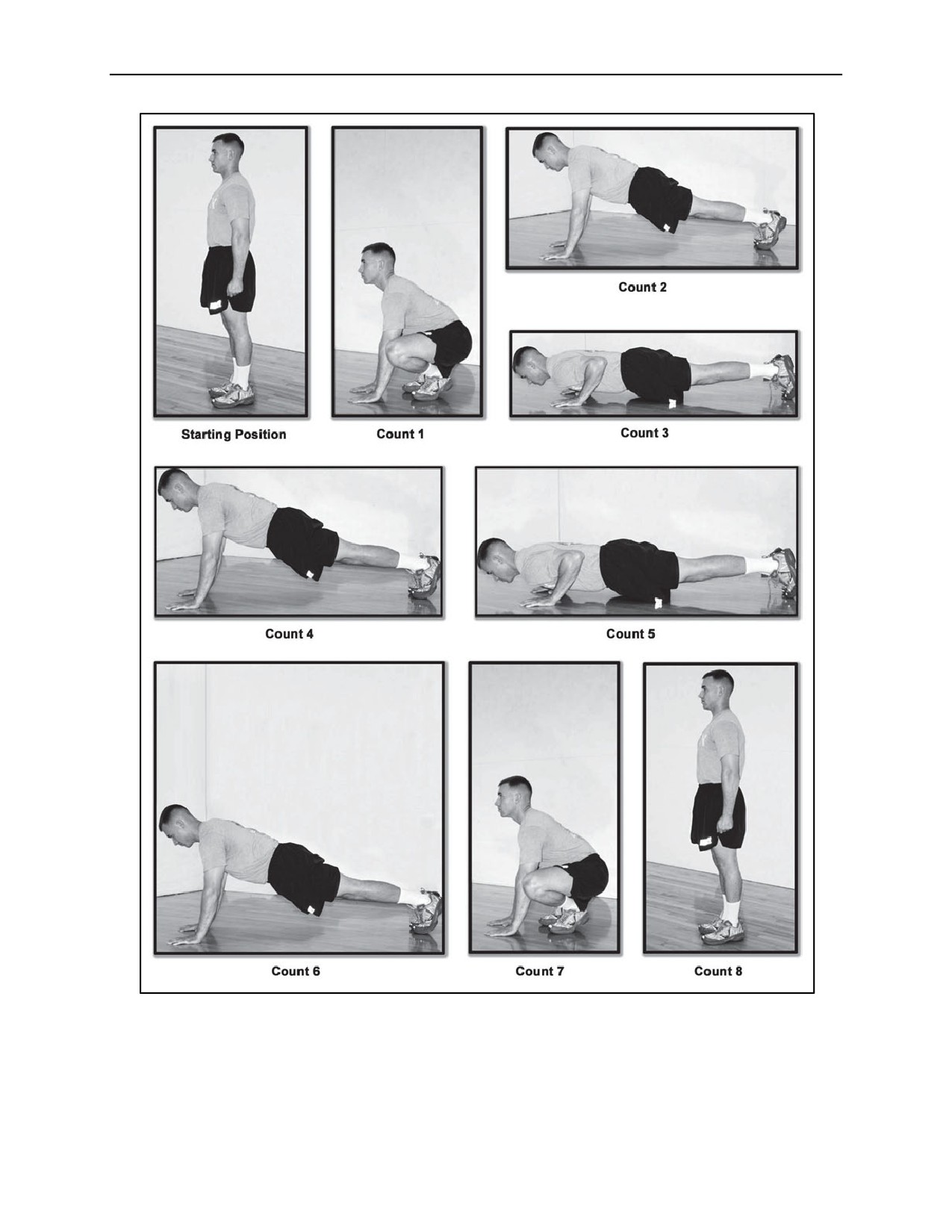
EXERCISE 5: 8-COUNT PUSH-UP
Purpose: This exercise combines the functional movements of the squat thrust and push-up to develop total
body strength, endurance, and mobility (Figure 9-11).
Starting Position: Position of attention.
Cadence: MODERATE
Count:
1. Assume the squat position.
2. Thrust the legs backward to the front leaning rest position.
3. Bend the elbows, lowering the body until the upper arms are parallel with the ground. Elbows
should point to the rear.
4. Return to the front leaning rest position.
5. Repeat count 3.
6. Repeat count 4.
7. Return to the squat position as in count 1.
8. Return to the starting position.
26 October 2012
FM 7-22
9-17
Chapter 9
Figure 9-11. 8-count push-up
9-18
FM 7-22
26 October 2012
Strength and Mobility Activities
Check Points:
z
To keep the trunk from sagging, tighten the abdominal muscles while in the starting position and
maintain this contraction throughout the exercise.
z
On counts 1 through 7, the hands are directly below the shoulders with fingers spread and the middle
fingers directed straight forward.
z
On counts 1 and 7, keep the heels together and raised.
z
On counts 4 and 6, straighten but do not lock the elbows.
Precautions: Allowing the trunk to sag, especially on count 2, strains the back. Avoid this by maintaining a
strong abdominal contraction throughout the exercise. If the pushup cannot be performed on counts 2-6
correctly to cadence, quickly assume the 6-point stance before count 3 and return to the front leaning rest
position just before performing count 7.
26 October 2012
FM 7-22
9-19
Chapter 9
CONDITIONING DRILL 3
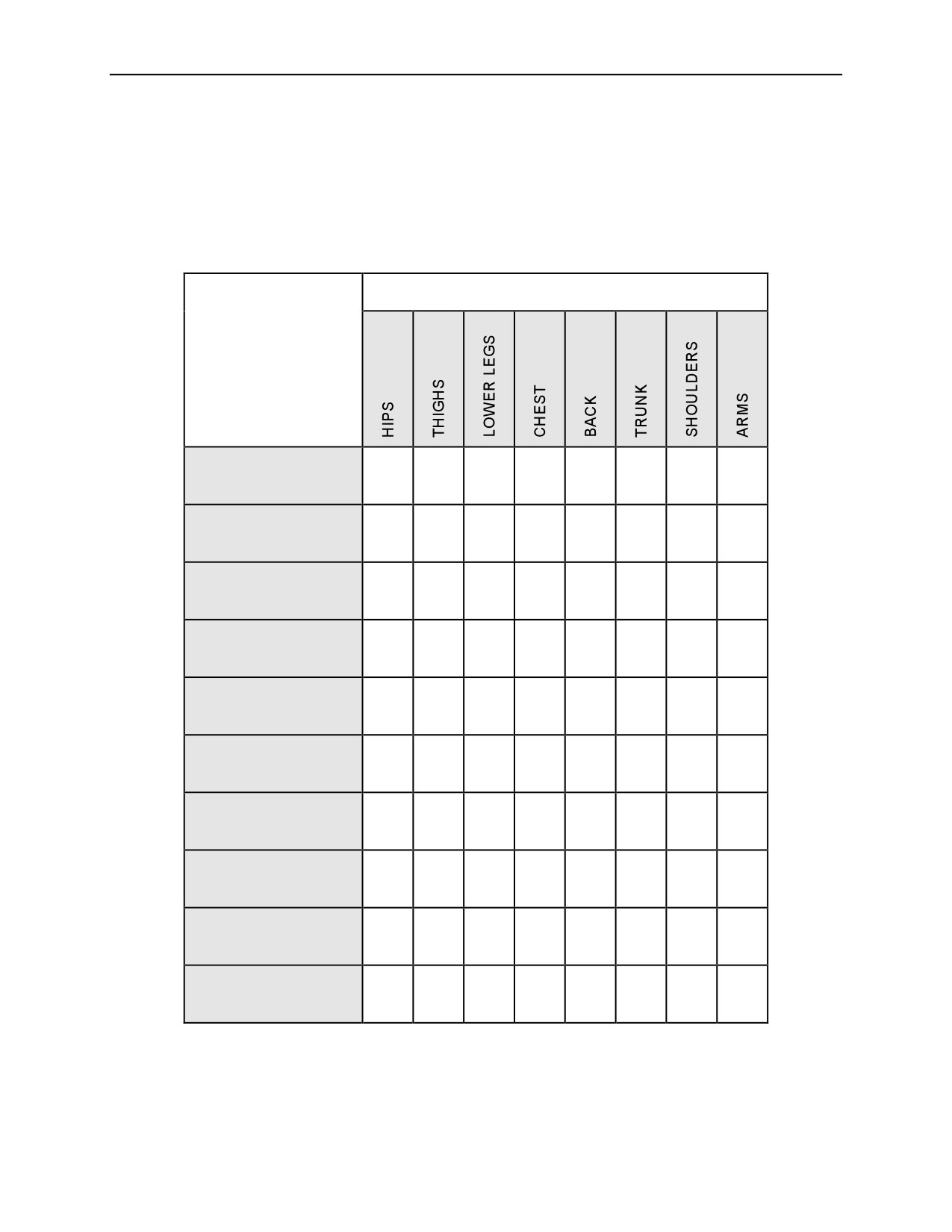
9-23. Conditioning drill 3 is conducted in a similar manner to CD 1 and 2; however, the exercises in CD 3 are
more difficult and complex. Repeated jumping, landing, and changing of body positions make this a more
advanced drill with greater demands placed on the lower extremities. In the toughening phase, Soldiers should
not perform CD 3. In the sustaining phase, Soldiers progress from 5 to 10 repetitions. If more repetitions are
desired, then perform an additional set of the entire drill. (See Table 9-5.)
Table 9-5. Body segments trained in the conduct of CD 3
MUSCLES
CONDITIONING
DRILL 3 (CD 3)
1.
“Y” SQUAT
X
X
X
X
X
X
X
2.
SINGLE-LEG
X
X
X
X
X
DEAD LIFT
3.
SIDE-TO-SIDE
X
X
X
X
X
X
X
KNEE LIFTS
4.
FRONT KICK
ALTERNATE TOE
X
X
X
X
X
X
X
X
TOUCH
5.
TUCK JUMP
X
X
X
X
X
X
X
X
6.
STRADDLE-RUN
FORWARD AND
X
X
X
X
BACKWARD
7.
HALF-SQUAT
X
X
X
X
X
X
X
X
LATERALS
8.
FROG JUMPS
FORWARD AND
X
X
X
X
X
X
X
X
BACKWARD
9.
ALTERNATE
X
X
X
X
X
X
X
X
¼-TURN JUMP
10.
ALTERNATE-
STAGGERED
X
X
X
X
X
X
SQUAT JUMP
9-20
FM 7-22
26 October 2012
Strength and Mobility Activities
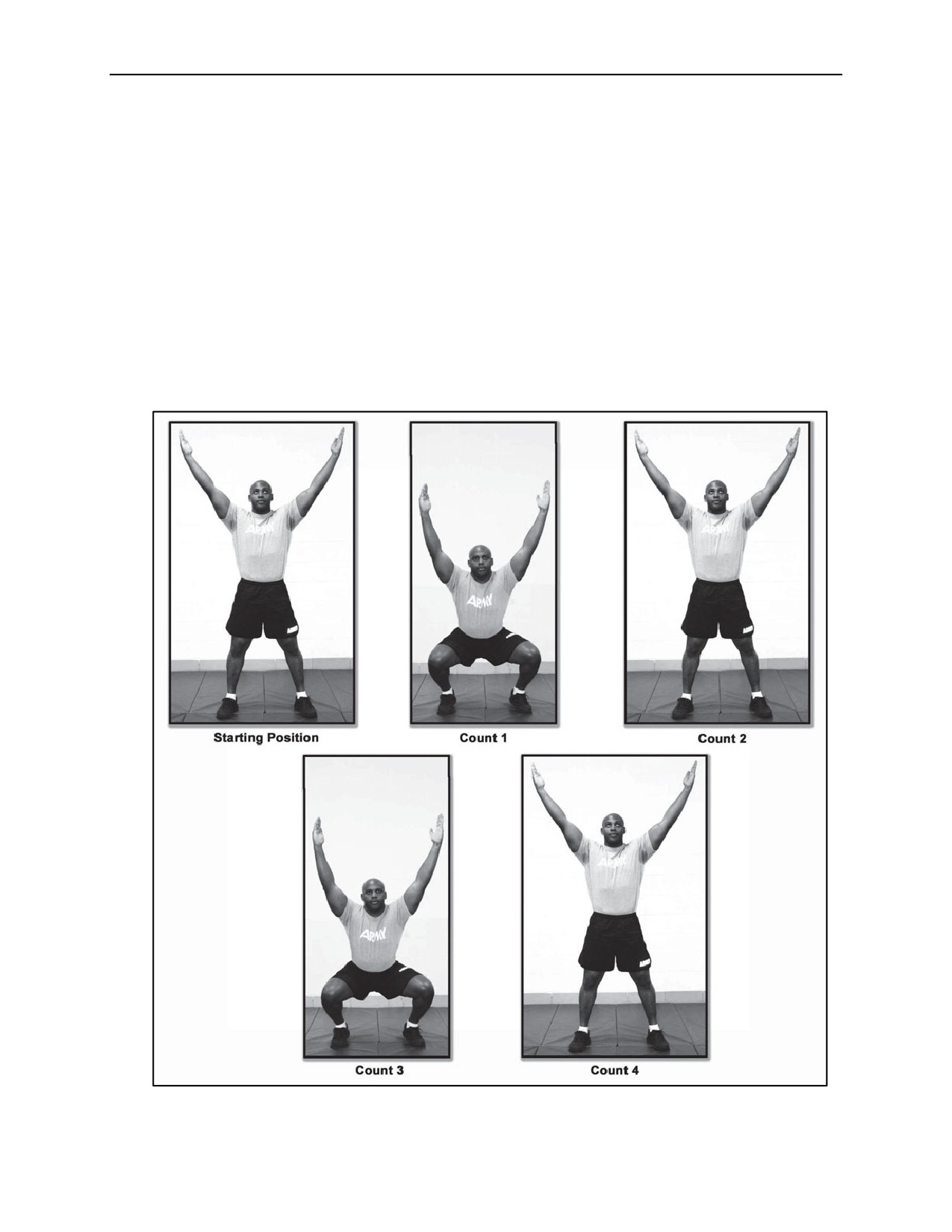
CONDITIONING DRILL 3
EXERCISE 1: “Y” SQUAT
Purpose: This exercise develops strength, endurance, and mobility of the lower back and lower extremities
(Figure 9-12).
Starting Position: Straddle stance with shoulder blades pulled rearward with arms overhead and palms inward.
Cadence: SLOW
Count:
1. Squat with arms overhead (forming a “Y”) without allowing the back to round.
2. Return to the starting position by tightening the buttocks and driving upward.
3. Repeat count 1.
4. Return to the starting position.
Figure 9-12. “Y” squat
26 October 2012
FM 7-22
9-21
Chapter 9
Check Points:
z
During count 1, lower the body as far as possible without rounding the back, keeping the shoulders
drawn rearward, arms forming a “Y” overhead.
z
Tighten the buttocks and drive the trunk upward to return to the starting position.
z
Heels remain on the ground throughout the exercise.
Precaution: N/A
9-22
FM 7-22
26 October 2012
Strength and Mobility Activities
CONDITIONING DRILL 3
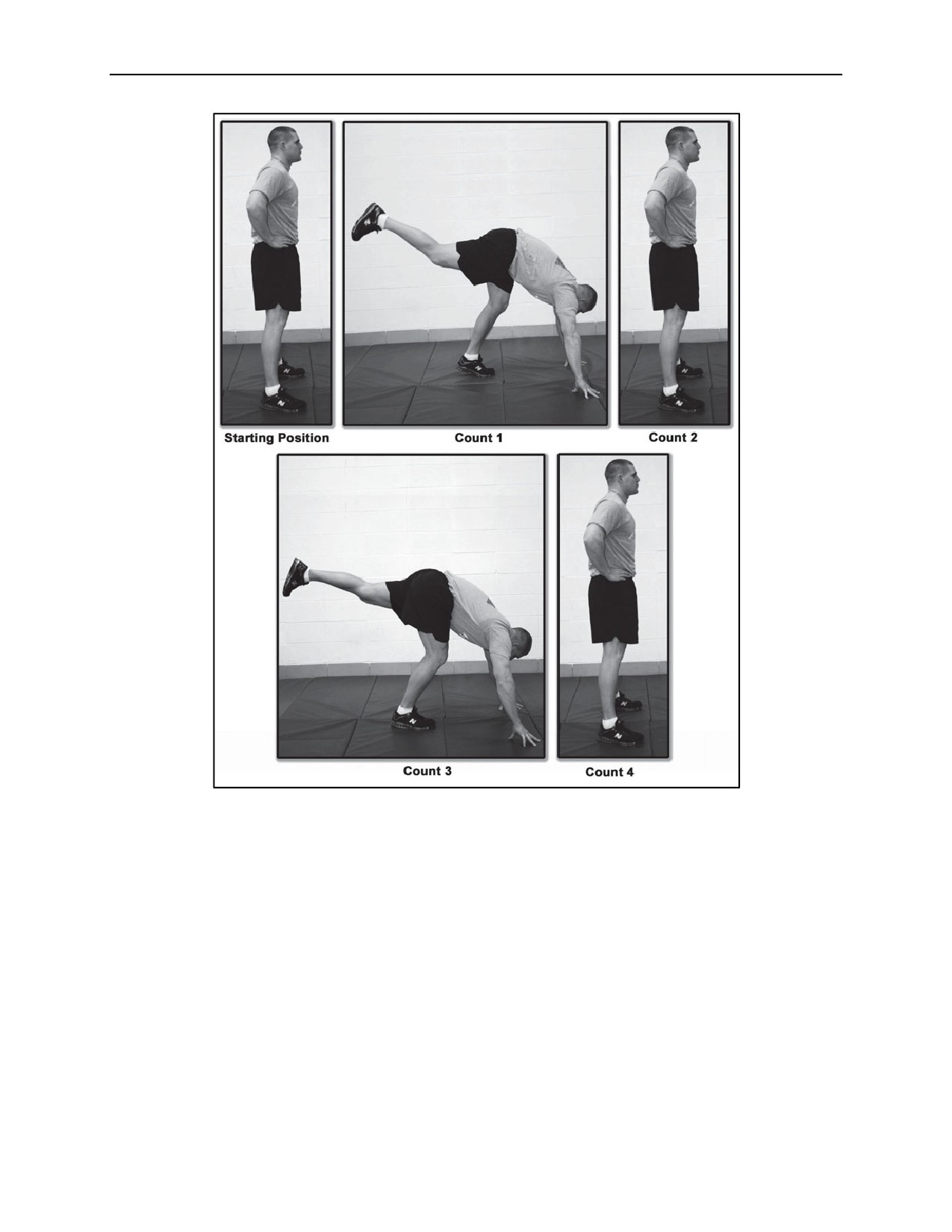
EXERCISE 2: SINGLE-LEG DEAD LIFT
Purpose: This exercise develops strength, endurance, and flexibility of the lower back and lower extremities
(Figure 9-13).
Starting Position: Straddle stance with hands on hips.
Cadence: SLOW
Count:
1. Stand maintaining balance on the left foot and bend forward at the waist. Reach straight down
toward the ground in front of the body while raising the right leg to the rear.
2. Return to the starting position by tightening the buttocks and driving upward.
3. Stand maintaining balance on the right foot and bend forward at the waist. Reach straight down
toward the ground in front of the body while raising the left leg to the rear.
4. Return to the starting position.
26 October 2012
FM 7-22
9-23
Chapter 9
Figure 9-13. Single-leg dead lift
Check Points:
z
On counts 1 and 3, the hands are slightly in front of and below the shoulders with fingers spread
(middle fingers point straight ahead) with the elbows straight, not locked.
z
Maintain a natural arch in the back and move the legs straight forward and backward, not at angles.
z
To prevent the trunk from sagging, tighten the abdominal muscles and maintain this contraction
throughout the exercise.
z
The head is aligned with the spine and the eyes are directed to a point about two feet in front of the
body.
z
On counts 1 and 3, attempt to keep the heal on the ground.
Precaution: N/A
9-24
FM 7-22
26 October 2012
Strength and Mobility Activities
CONDITIONING DRILL 3
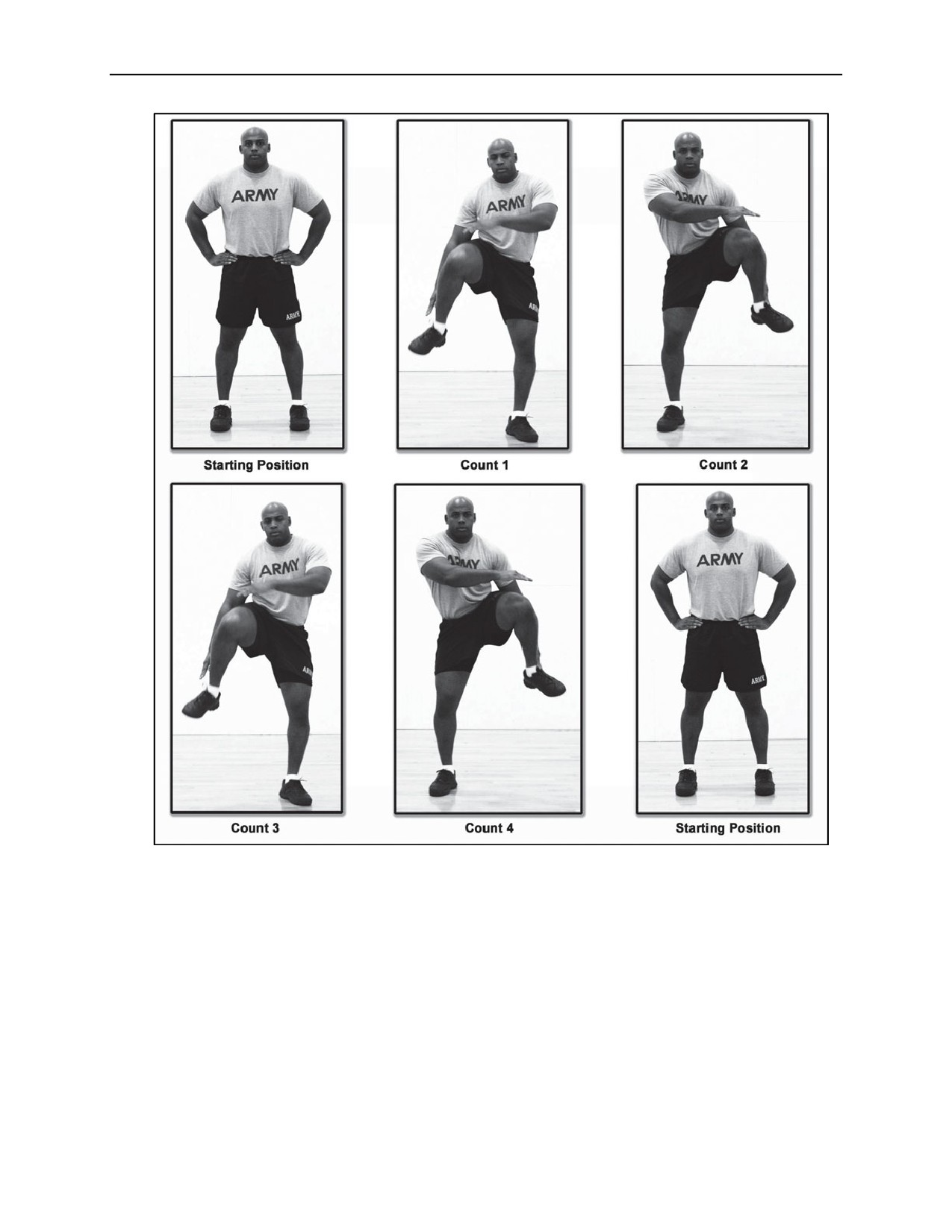
EXERCISE 3: SIDE-TO-SIDE KNEE LIFTS
Purpose: This exercise develops coordination, balance, and explosive strength in the legs (Figure 9-14).
Starting Position: Straddle stance with hands on hips.
Cadence: MODERATE
Count:
1. Hop to the left, landing on the left foot, while simultaneously drawing the right knee toward the
chest. The right hand moves comfortably down to the side toward the right ankle and the left hand
touches the right knee.
2. Hop to the right, landing on the right foot, while simultaneously drawing the left knee toward the
chest, the left hand moves comfortably down to the side toward the left ankle and the right hand
touches the left knee.
3. Repeat count 1.
4. Repeat count 2 and return to the starting position on the final repetition.
26 October 2012
FM 7-22
9-25
Chapter 9
Figure 9-14. Side-to-side knee lifts
Check Points:
z
At the starting position, tighten the abdominals to stabilize the trunk.
z
On all counts, do not allow the back to round; keep the head up and the eyes forward.
z
On each landing, the feet should be directed forward and maintained at shoulder distance apart. The
landing should be “soft” and proceed from the balls of the feet to the heels. The vertical line from the
shoulders through the knees to the balls of the feet should be demonstrated on each landing.
Precaution: N/A
9-26
FM 7-22
26 October 2012
Strength and Mobility Activities
CONDITIONING DRILL 3
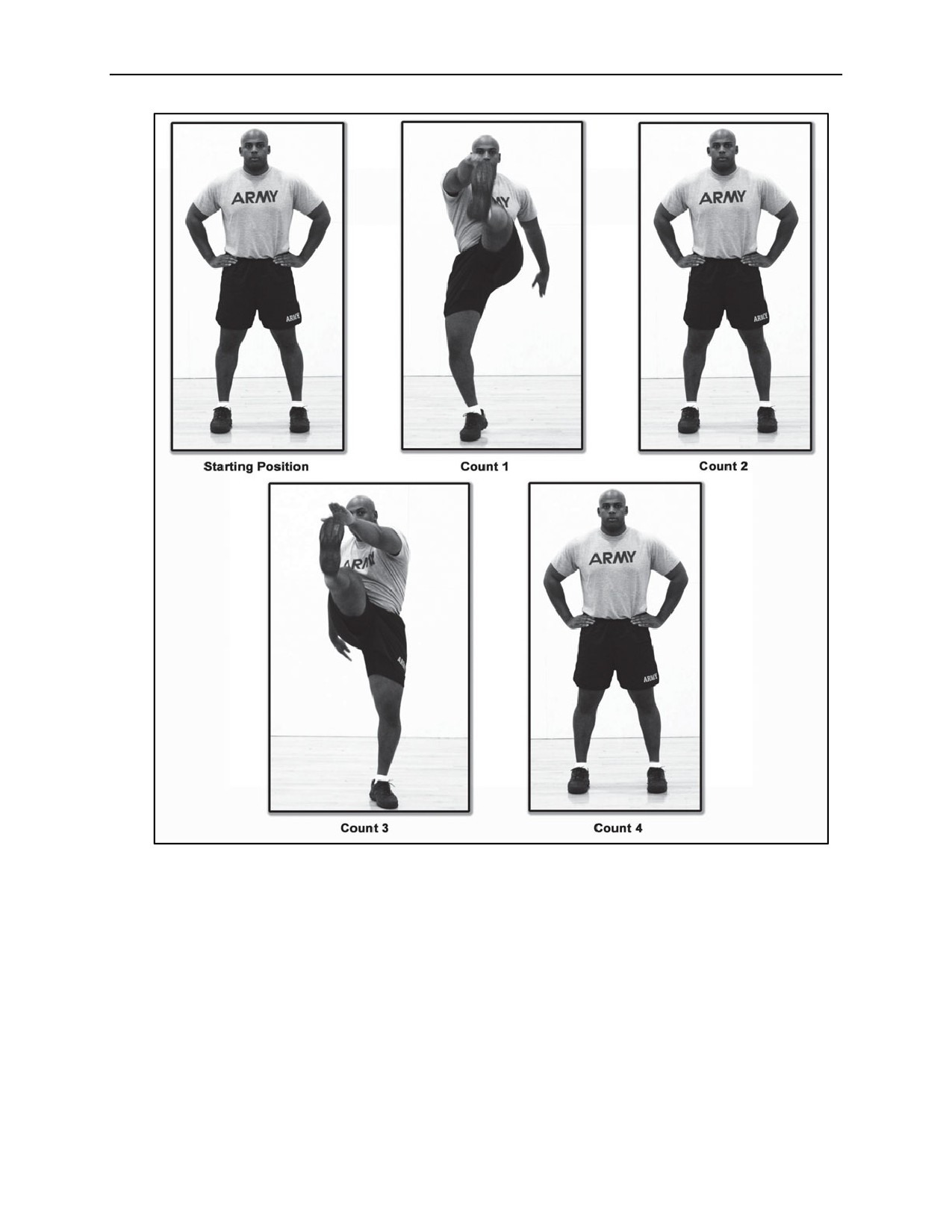
EXERCISE 4: FRONT KICK ALTERNATE TOE TOUCH
Purpose: This exercise develops balance, coordination, and flexibility of the legs and trunk (Figure 9-15).
Starting Position: Straddle stance with hands on hips.
Cadence: MODERATE
Count:
1. Raise the left leg to the front of the body until it is parallel to the ground while simultaneously
bending forward at the waist, extending the right arm forward, and reaching with the right hand
toward the left foot, while the left arm reaches rearward.
2. Return to the starting position.
3. Raise the right leg to the front of the body until it is parallel to the ground while simultaneously
bending forward at the waist, extending the left arm forward, and reaching with the left hand
toward the right foot, while the right arm reaches rearward.
4. Return to the starting position.
26 October 2012
FM 7-22
9-27
Chapter 9
Figure 9-15. Front kick alternate toe touch
Check Points:
z
At the starting position, tighten the abdominals to stabilize the trunk.
z
On counts 1 and 3, rotate the trunk to reach for the toes keeping the back generally straight.
z
Keep the head and the eyes forward throughout the exercise.
z
Maintain a slight bend in the knee as it moves parallel to the ground.
Precaution: N/A
9-28
FM 7-22
26 October 2012
Strength and Mobility Activities
CONDITIONING DRILL 3
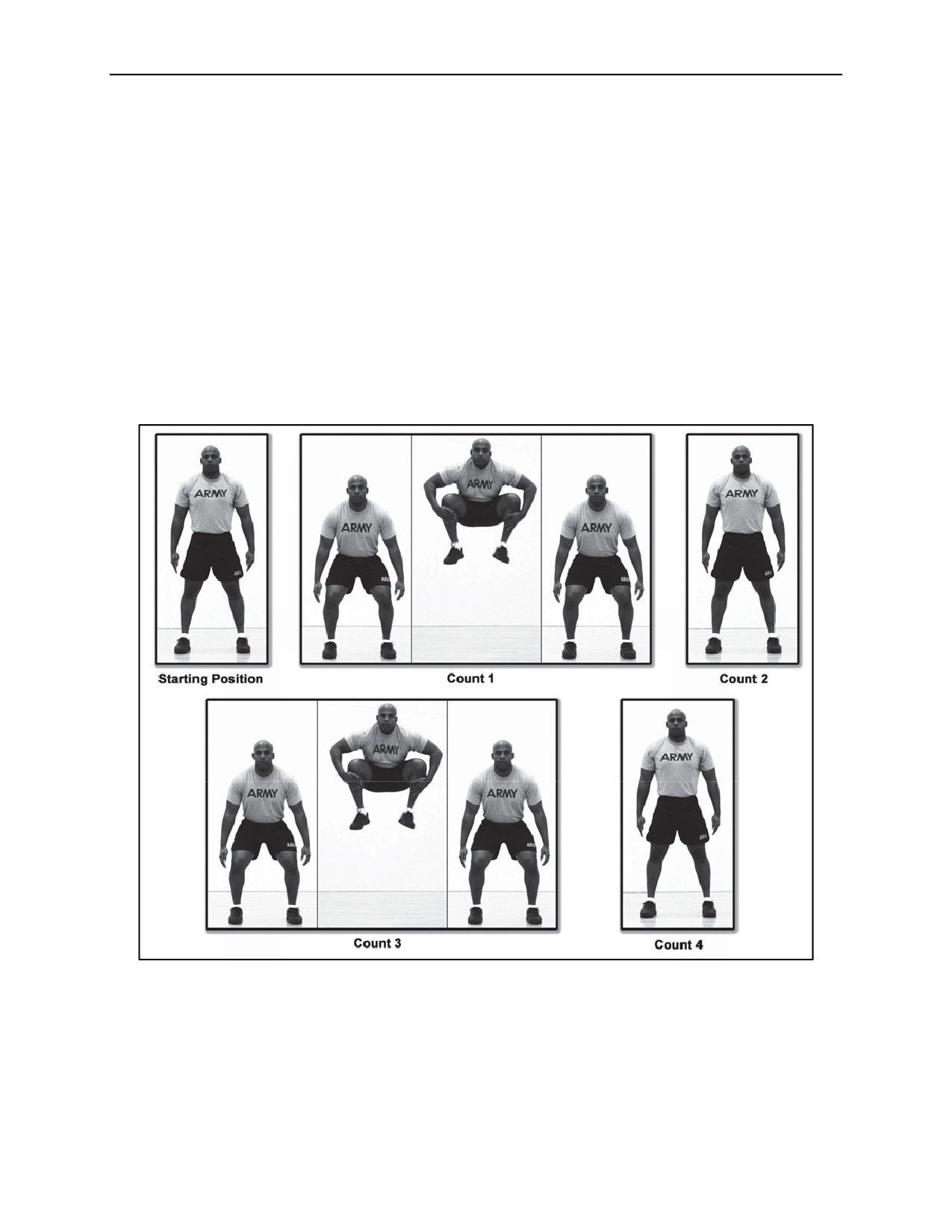
EXERCISE 5: TUCK JUMP
Purpose: This exercise develops coordination, balance, and explosive strength in the legs (Figure 9-16).
Starting Position: Straddle stance with arms at the sides.
Cadence: SLOW
Count:
1. Perform a half squat, while driving both arms rearward. Jump upward, driving both arms forward,
wrapping the hands around the knees, as the knees are drawn toward the chest. Then land in the
half-squat position.
2. Return to the starting position.
3. Repeat count 1.
4. Return to the starting position.
Figure 9-16. Tuck jump
26 October 2012
FM 7-22
9-29
Chapter 9
Check Points:
z
On counts 1 and 3, do not allow the back to round; keep the head up and the eyes forward.
z
Cadence is slow to allow for precision and adequate time to properly jump and land; however, each
jump on counts 1 and 3 should be performed quickly and explosively.
z
On each landing, the feet should be directed forward and maintained at shoulder distance apart. The
landing should be “soft” and proceed from the balls of the feet to the heels. The vertical line from the
shoulders through the knees to the balls of the feet should be demonstrated on each landing.
Precaution: N/A
9-30
FM 7-22
26 October 2012
Strength and Mobility Activities
CONDITIONING DRILL 3
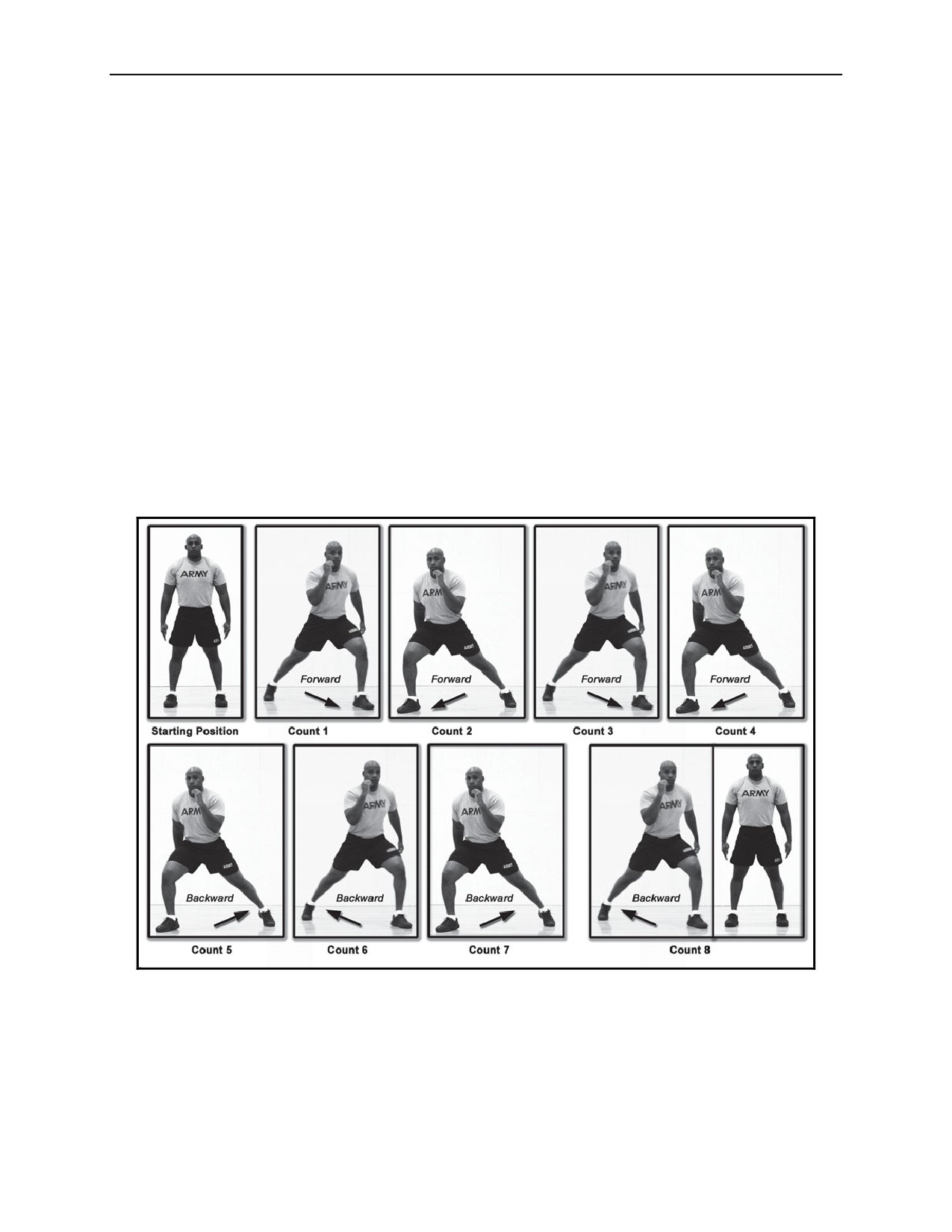
EXERCISE 6: STRADDLE-RUN FORWARD AND BACKWARD
Purpose: This exercise develops coordination, balance, and explosive strength in the legs (Figure 9-17).
Starting Position: Straddle stance with arms at the sides.
Cadence: MODERATE
Count:
1. Raise the left leg 4 to 6 inches off the ground and bound forward to the left at a 45-degree angle
while swinging the right arm forward and left arm rearward.
2. Raise the right leg 4 to 6 inches off the ground and bound forward to the right at a 45-degree angle
while swinging the left arm forward and right arm rearward.
3. Repeat count 1.
4. Repeat count 2.
5. Raise the left leg 4 to 6 inches off the ground and bound rearward to the left at a 45-degree angle
while swinging the left arm forward and right arm rearward.
6. Raise the right leg 4 to 6 inches off the ground and bound rearward to the right at a 45-degree
angle while swinging the right arm forward and left arm rearward.
7. Repeat count 5.
8. Repeat count 6 and assume the starting position.
Figure 9-17. Straddle-run forward and backward
Check Points:
z
On all counts, do not allow the back to round; keep the head up and the eyes forward.
z
On each landing, the feet should be directed forward and the trail foot moves toward the lead foot,
but does not make contact with the ground.
Precaution: N/A
26 October 2012
FM 7-22
9-31
Chapter 9
CONDITIONING DRILL 3
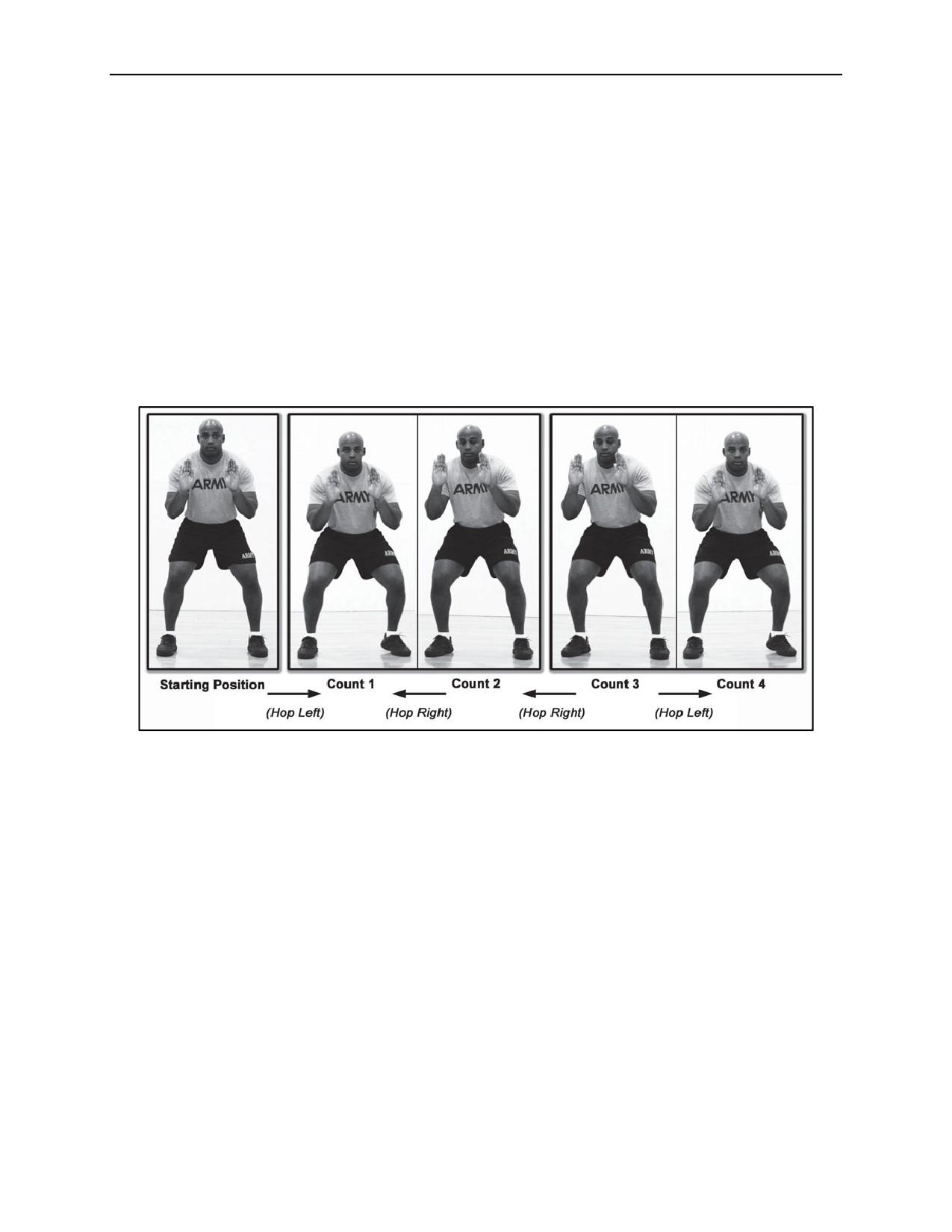
EXERCISE 7: HALF-SQUAT LATERALS
Purpose: This exercise develops coordination, balance, and explosive strength in the legs (Figure 9-18).
Starting Position: Straddle stance, slightly crouched, assuming a half-squat, with the back straight, arms at the
sides with elbows bent at 90-degrees, and palms facing forward.
Cadence: MODERATE
Count:
1. Maintaining a half-squat step/hop to the left.
2. Maintaining a half-squat step/hop to the right.
3. Maintaining a half-squat step/hop to the right.
4. Maintaining a half-squat step/hop to the left and return to the starting position.
Figure 9-18. Half-squat laterals
Check Points:
z
At the starting position, tighten the abdominals to stabilize the trunk.
z
On all counts, do not allow the back to round; keep the head up and the eyes forward.
z
On each landing, the feet should be directed forward and maintained at shoulder distance apart. The
landing should be “soft” and proceed from the balls of the feet to the heels.
Precaution: N/A
9-32
FM 7-22
26 October 2012
Strength and Mobility Activities
CONDITIONING DRILL 3
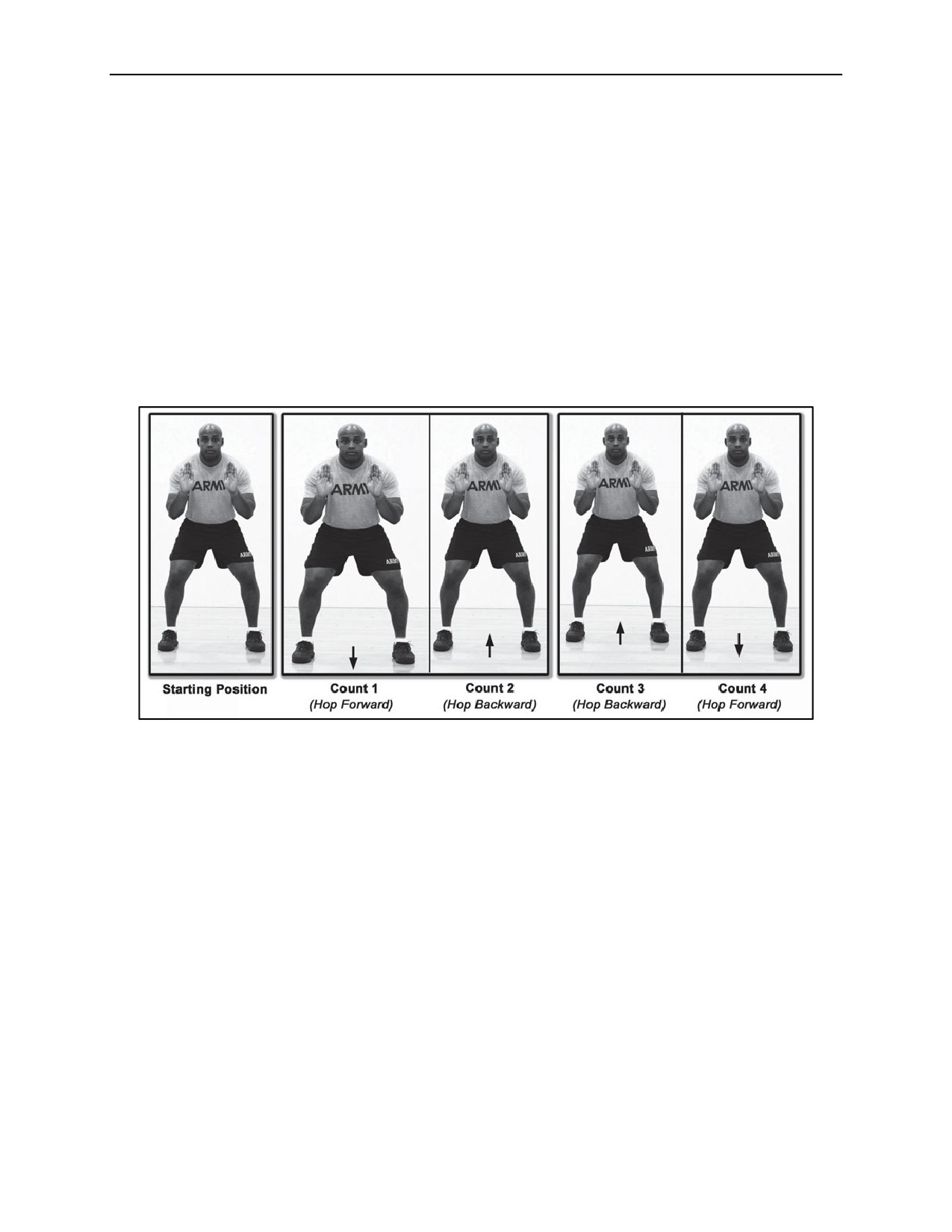
EXERCISE 8: FROG JUMPS FORWARD AND BACKWARD
Purpose: This exercise develops coordination, balance, and explosive strength in the legs (Figure 9-19).
Starting Position: Straddle stance, slightly crouched, assuming a half-squat, with the back straight, arms at the
sides with elbows bent at 90-degrees, and palms facing forward.
Cadence: MODERATE
Count:
1. Maintain a half-squat and hop forward.
2. Maintain a half-squat and hop backward.
3. Repeat count 2.
4. Maintain a half-squat and hop forward, returning to the starting position.
Figure 9-19. Frog jumps forward and backward
Check Points:
z
At the starting position, tighten the abdominals to stabilize the trunk.
z
On all counts, do not allow the back to round; keep the head up and the eyes forward.
z
On each landing, the feet should be directed forward and maintained at shoulder distance apart. The
landing should be “soft” and proceed from the balls of the feet to the heels.
Precaution: N/A
26 October 2012
FM 7-22
9-33
Chapter 9
CONDITIONING DRILL 3
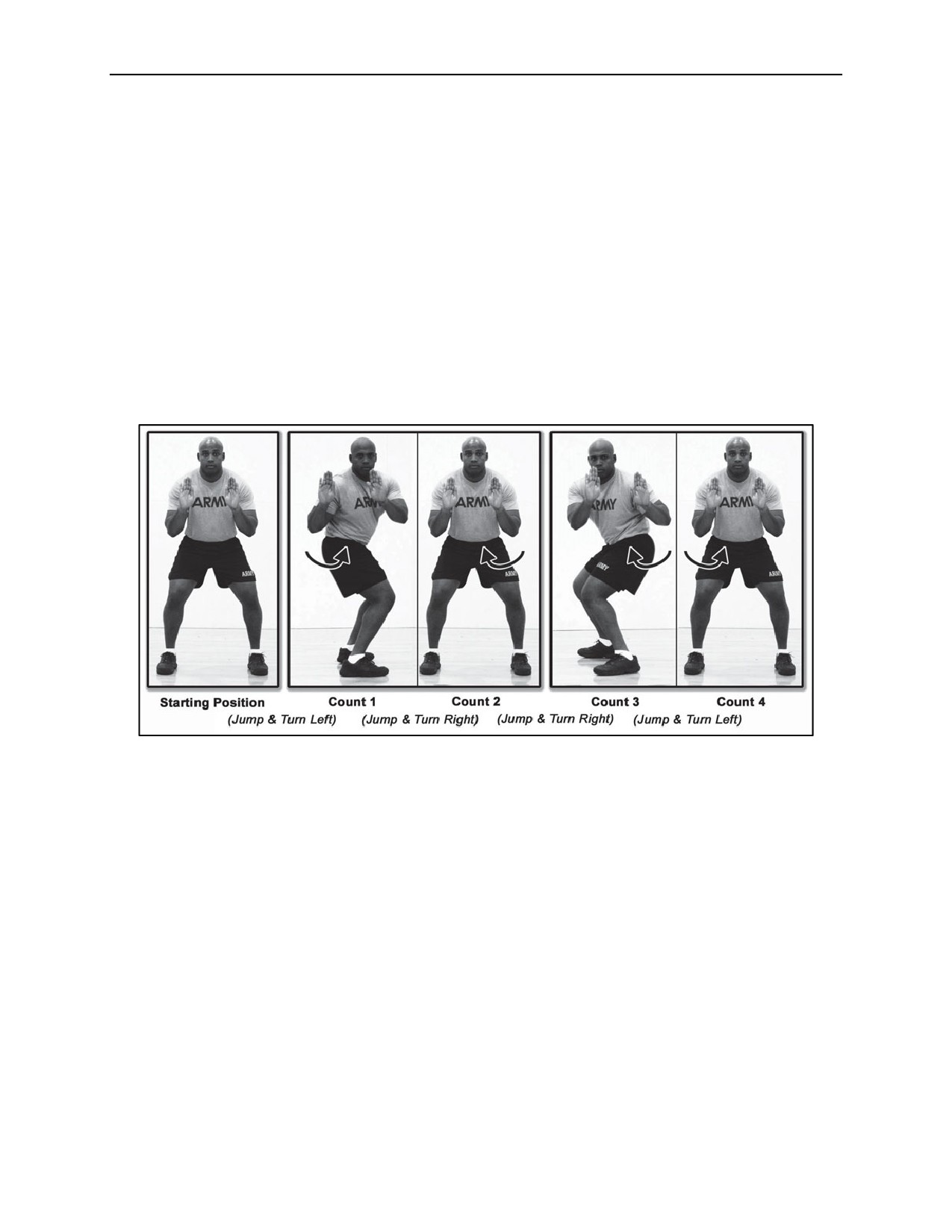
EXERCISE 9: ALTERNATE ¼-TURN JUMP
Purpose: This exercise develops balance, explosive strength in the legs, and control of trunk rotation
(Figure 9-20).
Starting Position: Straddle stance, slightly crouched, assuming a half-squat, with the back straight, arms at the
sides with elbows bent at 90-degrees, and palms facing forward.
Cadence: MODERATE
Count:
1. Jump upward and twist the hips, turning the legs 90-degrees to the left.
2. Return to the starting position.
3. Jump upward and twist the hips, turning the legs 90-degrees to the right.
4. Return to the starting position.
Figure 9-20. Alternate ¼-turn jump
Check Points:
z
At the starting position, tighten the abdominals to stabilize the trunk.
z
On counts 1 and 3, do not allow the back to round; keep the head up and the eyes forward.
z
The upper body does not turn; the movement involves only the hips and legs.
z
On each landing, the feet should be directed forward and maintained at shoulder distance apart. The
landing should be “soft” and proceed from the balls of the feet to the heels. The vertical line from the
shoulders through the knees to the balls of the feet should be demonstrated on each landing.
Precaution: N/A
9-34
FM 7-22
26 October 2012
Strength and Mobility Activities
CONDITIONING DRILL 3
EXERCISE 10: ALTERNATE-STAGGERED SQUAT JUMP
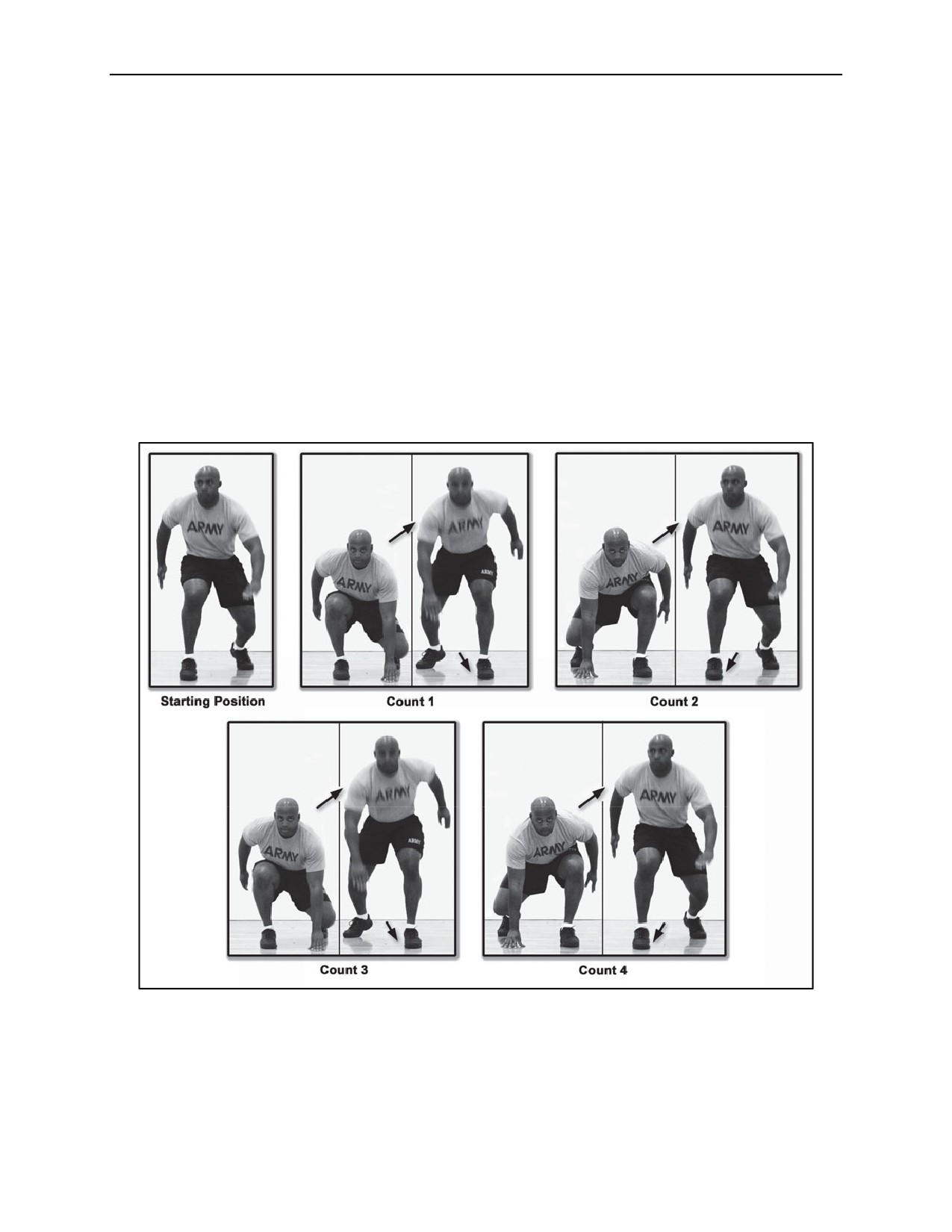
Purpose: This exercise develops balance and explosive strength of the legs (Figure 9-21).
Starting Position: Staggered stance with the left leg back and arms at sides; the trunk is generally straight, but
tilted slightly forward.
Cadence: SLOW
Count:
1. Squat and touch the ground, between the legs, with the fingertips of the left hand. Jump forcefully
into the air, switching legs in mid-air to land with the right leg back and arms at the sides.
2. Squat and touch the ground between the legs with the fingertips of the right hand. Jump forcefully
into the air, switching legs in mid-air to land with the left leg back and arms at the sides.
3. Repeat count 1.
4. Repeat count 2 and return to the starting position.
Figure 9-21. Alternate-staggered squat jump
26 October 2012
FM 7-22
9-35
Chapter 9
Check Points:
z
At the starting position, tighten the abdominals to stabilize the trunk.
z
Do not allow the back to round; keep the head up and the eyes forward.
z
Cadence is slow to allow for precision and adequate time to properly jump and land; however, each
jump should be performed quickly and explosively.
z
On each landing, the feet should be oriented to the front. The landing should be “soft” and proceed
from the balls of the feet to the heels.
Precaution: N/A
9-36
FM 7-22
26 October 2012
Strength and Mobility Activities
PUSH-UP AND SIT-UP DRILL
9-24. Push-ups and sit-ups develop upper body strength, endurance, and mobility, and specifically prepare
Soldiers for APFT performance. Push-ups and sit-ups build upper body and trunk muscular strength and
endurance by challenging control of body weight. The PSD promotes muscular endurance without the repetitive
motions that often lead to overuse injuries. They improve mobility by progressively moving the major joints
through a full, controlled range of motion.
TRAINING AREA
9-25. Any level area of adequate size is satisfactory for conduct of the PSD.
UNIFORM
9-26. Soldiers will wear IPFU or ACUs and boots.
EQUIPMENT
9-27. Stop watch.
FORMATION
9-28. For the most efficient instruction, the ideal unit size is one platoon. Larger units up to a battalion can
successfully perform these drills if properly taught and mastered at the small unit level. The extended
rectangular formation is prescribed.
LEADERSHIP
9-29. A PRT leader and AI are required to instruct and lead timed sets of push-ups and sit-ups. The leader must
know how to teach these exercises. He must know the commands, cadence counts, cumulative count,
formations, starting positions, and how to effectively use AIs (Chapter 7).
METHODOLOGY
9-30. The PSD enhances APFT performance in the push-up and sit-up events. The PSD is conducted as
follows:
z
The first and third ranks conduct the push-up first. The second and fourth ranks count repetitions out
loud and monitor technique to ensure the Soldiers perform the push-ups to Army standard (hand
placement is determined by the Soldier according to Appendix A) for 30 to 60 seconds. After the first
and third ranks complete the push-ups, the ranks swap places: the second and fourth ranks do push-
ups and the first and third ranks count and monitor proper technique. After all four ranks complete
the first timed set of push-ups; the same process is repeated for sit-ups.
z
The sit-up is conducted the same as the push-up: first and third perform, second and fourth count and
monitor technique, but also hold the feet of the first and third ranks. Again, when the first and third
ranks finish, the ranks swap out again, and the second and fourth ranks perform while the first and
third ranks count, monitor technique, and hold the feet.
z
Timed sets continue like this, alternating between push-ups and sit-ups and between paired ranks,
until all the desired number of timed sets have been completed. The Soldiers should not perform all
of their sets of timed push-ups and then perform all of their sets of timed sit-ups. Alternating allows
proper work to rest ratio to provide the required recovery. Avoid performing all of one exercise or
the other.
z
As with any activity, PRT leaders should perform the exercises with the Soldiers in order to
determine the appropriate intensity of the PRT session.
26 October 2012
FM 7-22
9-37
Chapter 9
PRECISION
9-31. Push-ups and sit-ups lose much of their value unless performed exactly as prescribed. Precision should
never be compromised for quantity of repetitions or speed of movement.
PROGRESSION
9-32. Soldiers perform no more than five repetitions of each exercise while learning and practicing the PSD.
They perform timed sets of push-ups and sit-ups during the activity part of the PRT session. They perform as
many correct repetitions of push-ups and sit-ups during the 30-second timed sets as they can, progressing to
60-second timed sets. Soldiers that fail with time remaining in the timed set of push-ups will go to their knees
and continue to perform the push-up in the six-point stance until time has expired within the timed set.
INTEGRATION
9-33. Performing timed sets of push-ups and sit-ups integrates the components of strength, endurance, and
mobility.
COMMANDS
9-34. Follow the procedures in paragraph 9-30.
BODY SEGMENTS TRAINED
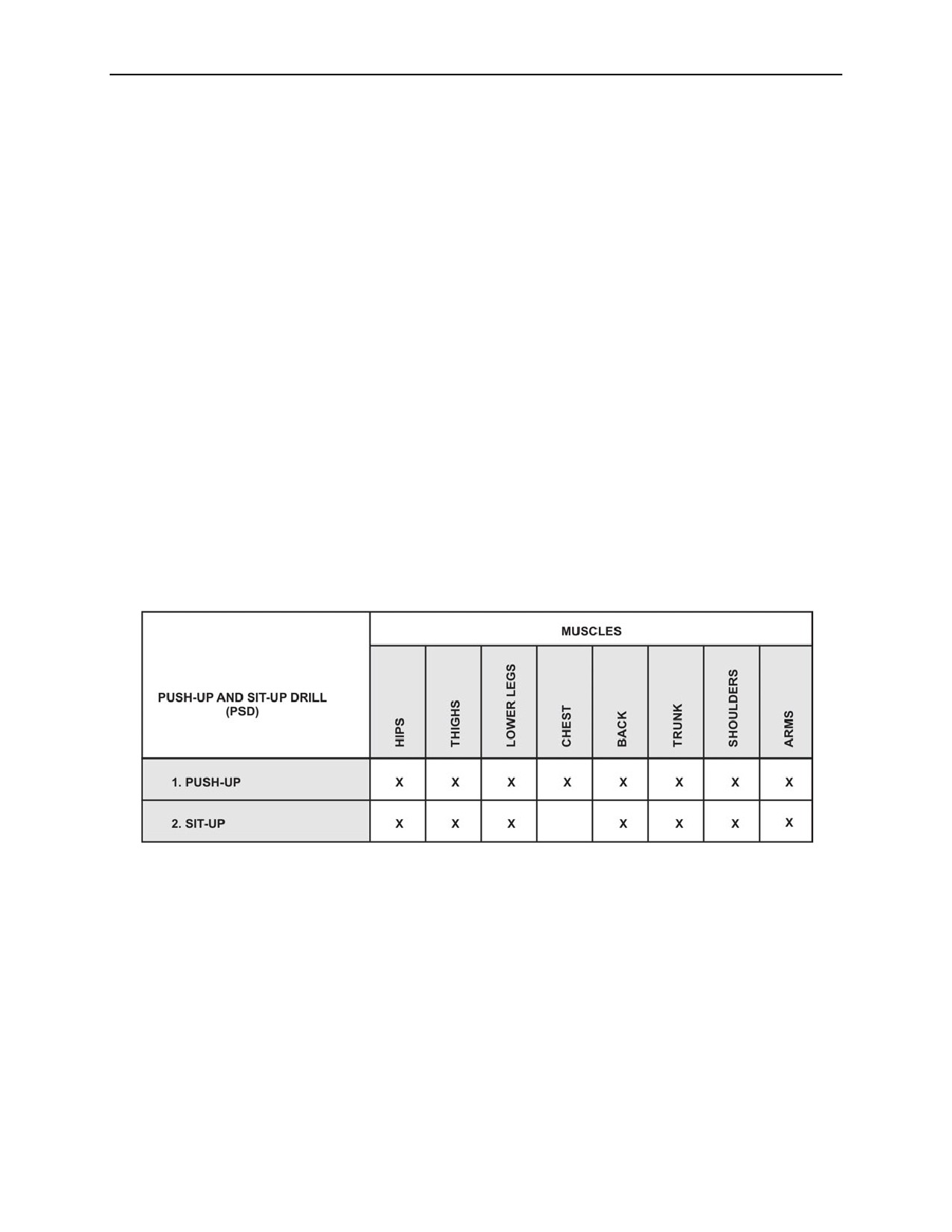
9-35. The PSD consists of two exercises that train the body segments listed in Table 9-6. Refer to Appendix A
for illustrations and descriptions of the push-up and sit-up according to the APFT.
Table 9-6. Body segments trained in the conduct of PSD
CLIMBING DRILLS
9-36. The purpose of the CL is to improve upper body and trunk strength, and the ability to climb and negotiate
obstacles. Success in climbing and surmounting obstacles depends on both conditioning and technique. These
drills include exercises that condition the muscles of the body that are predominant in climbing. The entire body
is involved during climbing by helping to change or stabilize position.
• The hands and feet act as anchor points and initiate movement to the next position.
• The abdominal and back muscles stabilize the body’s position.
• The arms push and pull upward with assistance from the much stronger legs.
9-37. Climbing drills, when combined with CDs, the push-up sit-up drill, the GD, and the strength training
circuit comprise a well-balanced program of functional strength development. Climbing drills are performed
during the activity part of a PRT session.
9-38
FM 7-22
26 October 2012
Strength and Mobility Activities
TRAINING AREA
9-38. The CLs are best performed on climbing bars (Appendix B). To conduct the CLs with multiple Soldiers
at one time, allow at least one bar for every three Soldiers. At least one bar is required for every six Soldiers
when the CLs are coupled with other strength and mobility drills.
UNIFORM
9-39. Soldiers will wear ACUs and boots or IPFU. Boots and ACUs will be worn when performing the CD in
combination with the GD. Additional equipment such as body armor (IOTV), ACH, and weapon will be used
when performing CD 2 in the sustaining phase.
EQUIPMENT
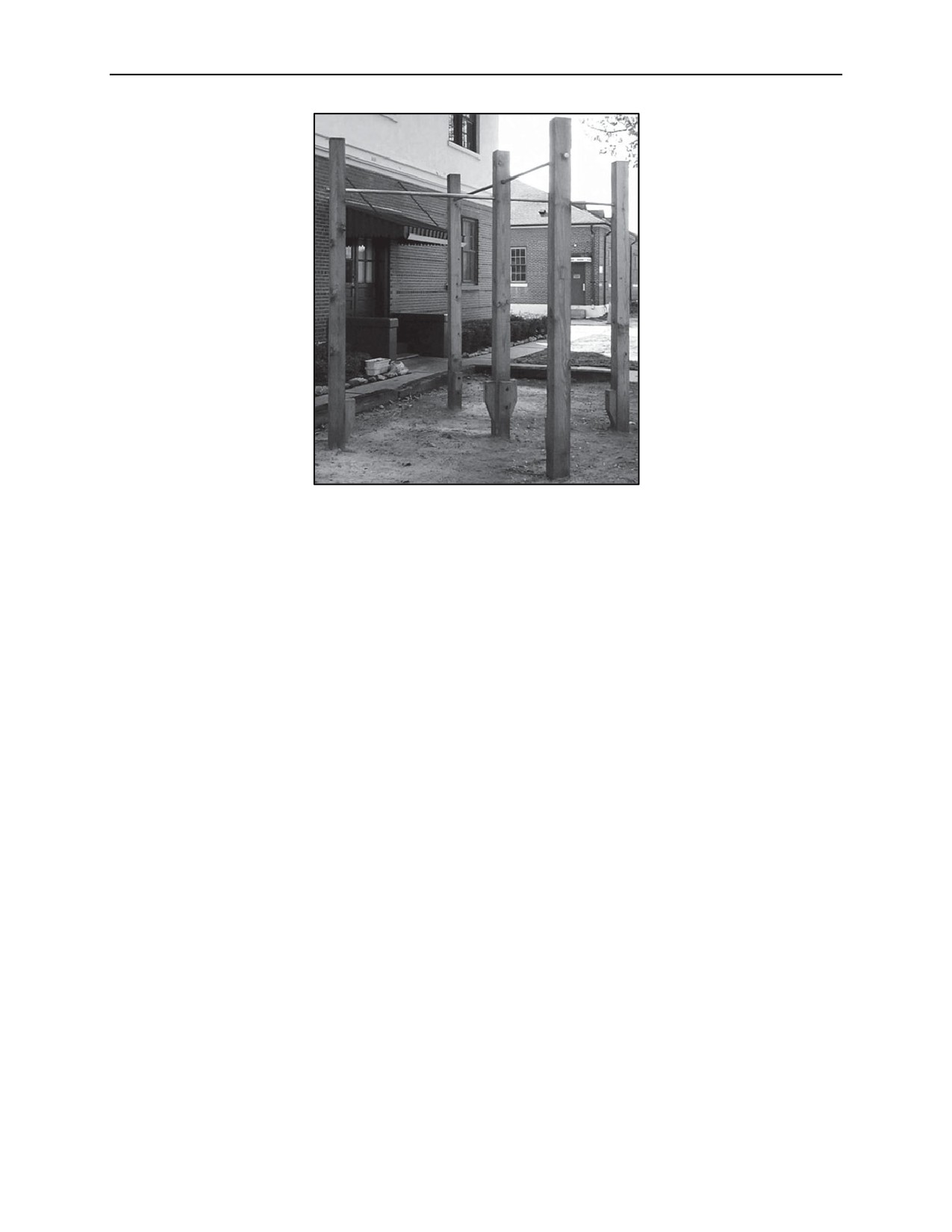
9-40. The CDs are best conducted on climbing bars. The thickness of the bars is no more than 1 ½-inch outside
diameter. The bars are supported by 6-by-6 inch pressure-treated posts sunk at least 3 feet into the ground and
secured with cement. The bar distance from inside post to inside post must be at least 5 feet. The bars should be
no more than 8 feet off the ground. A variety of heights or steps should be available to accommodate all
Soldiers. Figure 9-22 shows the recommended climbing bar apparatus and Soldier use. (Appendix B provides
detailed specifications for constructing climbing bars.)
SPOTTING
9-41. Two spotters are used during CL 1 and 2 to ensure precision, adherence to proper cadence, and safety by
assisting Soldiers who are unable to properly perform the desired number of repetitions. All Soldiers performing
CL 1 and 2 are required to use spotters, unless they demonstrate the ability to perform 5 repetitions of an
exercise unassisted. The Soldier then gives a verbal cue “no spot needed.” As Soldiers develop more strength,
they will require less assistance from the spotters.
Spotting the Straight-Arm Pull, Pull-Up, and Alternating Grip Pull-Up
9-42. The front spotter assumes a staggered stance with the palms toward the exerciser at approximately chest
level. The front spotter’s primary role is to support the exerciser if their grip fails. The rear spotter assumes a
staggered stance and holds the Soldiers feet on their thighs or abdomen. The hands are placed above the ankles
to hold them securely. The role of the rear spotter is to provide a stable base for the exerciser to push against
with his legs. When spotting is performed correctly, the rear spotter will neither have to lift nor go up and down
with the exerciser. The rear spotter must anticipate the last repetition and release the Soldier when the “down”
command is given before the “dismount” command. Soldiers are required to use the foot pegs when mounting
and dismounting the bar. This is done to ensure safety and to reduce injuries. Jumping from the mounted
position causes compression to the spine and other joints of the body, possibly resulting in injury.
Spotting Heel Hook and Leg Tuck
9-43. One spotter stands on each side of the exerciser in the straddle stance. The rear hand of each spotter is
placed in the small of the back and the forward hand is placed beneath the thigh above the back of the knee.
Both hands remain in contact with the exerciser throughout the exercise. The rear hand is used primarily to
prevent the exerciser from swaying, while the forward hand helps lift the legs into the ‘up’ position. Soldiers are
required to use the foot pegs when mounting and dismounting the bar. This is done to ensure safety and to
reduce injuries. Jumping from the mounted position causes compression to the spine and other joints of the
body, possibly resulting in injury.
26 October 2012
FM 7-22
9-39
Chapter 9
Figure 9-22. Climbing pod
FORMATION
9-44. Three Soldiers are assigned to each bar. One Soldier exercises and two Soldiers perform as spotters.
LEADERSHIP
9-45. Both a PRT leader and an AI are required in order to instruct and lead CLs. The PRT leader must be
familiar with the method of teaching the exercises; the commands and counting cadence; cumulative count;
formations; and the use of AIs as described in Chapter 7. The PRT leader must ensure that spotters are properly
trained and maintain positive control of the Soldier performing the CL at all times.
9-46. Soldiers should memorize the exercises by name and movement. The exercises are always given in
cadence. Soldiers rotate during each exercise until all three have completed the exercise. Only then may the
PRT leader move them to the next exercise. Considerable time and effort must be expended during the early
stages to teach precise performance of each exercise.
PRECISION
9-47. Climbing drills lose much of their value unless performed exactly as prescribed. Spotters ensure safety
and precise execution by helping Soldiers who are tired or unable to properly execute five repetitions on their
own. Two spotters help Soldiers though each exercise. As Soldiers become more proficient in each exercise,
they will need less assistance and should eventually be able to perform the drill unaided; however, spotters are
always present. Spotters help reduce swinging and stabilize body position. Precision should never be
compromised for quantity of repetitions or speed of movement. Soldiers should, therefore, perform all
movements in a controlled manner without jerking into or out of positions. They should avoid relaxing in the
extended hang position, as this can place excessive stress on the shoulder and elbow joints. Soldiers should
maintain a contraction in the muscles of the shoulders and upper back to avoid a relaxed, extended hang.
PROGRESSION
9-48. In the sustaining phase, Soldiers progress from 5 to 10 repetitions of each exercise in CL 1 with or
without assistance, using only their body weight as resistance. The goal is to perform all five exercises
unassisted.
9-40
FM 7-22
26 October 2012