FM 7-22 ARMY PHYSICAL READINESS TRAINING (OCTOBER 2012) - page 9
Endurance and Mobility Activities
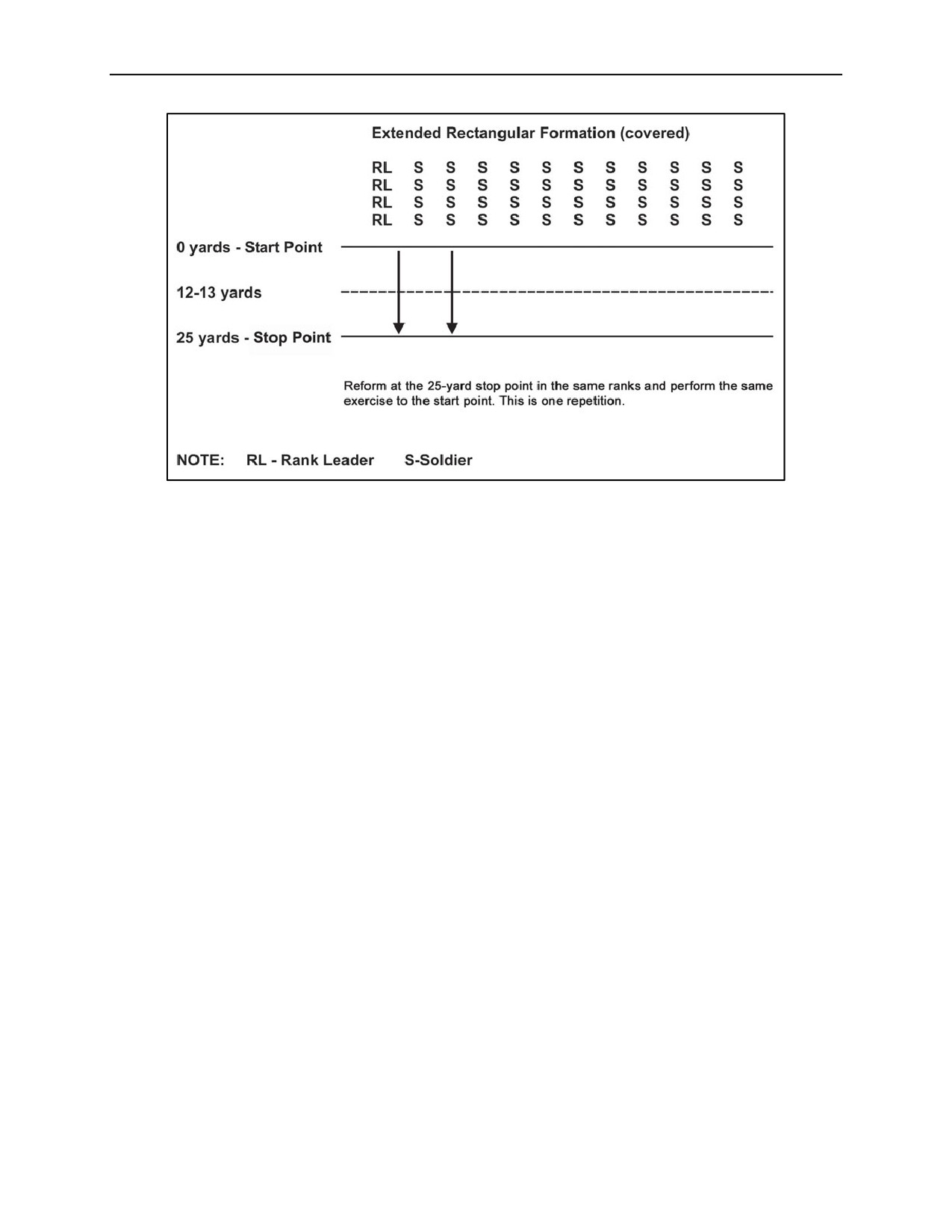
Figure 10-3. Military movement drill 1
26 October 2012
FM 7-22
10-7
Chapter 10
MILITARY MOVEMENT DRILL 1
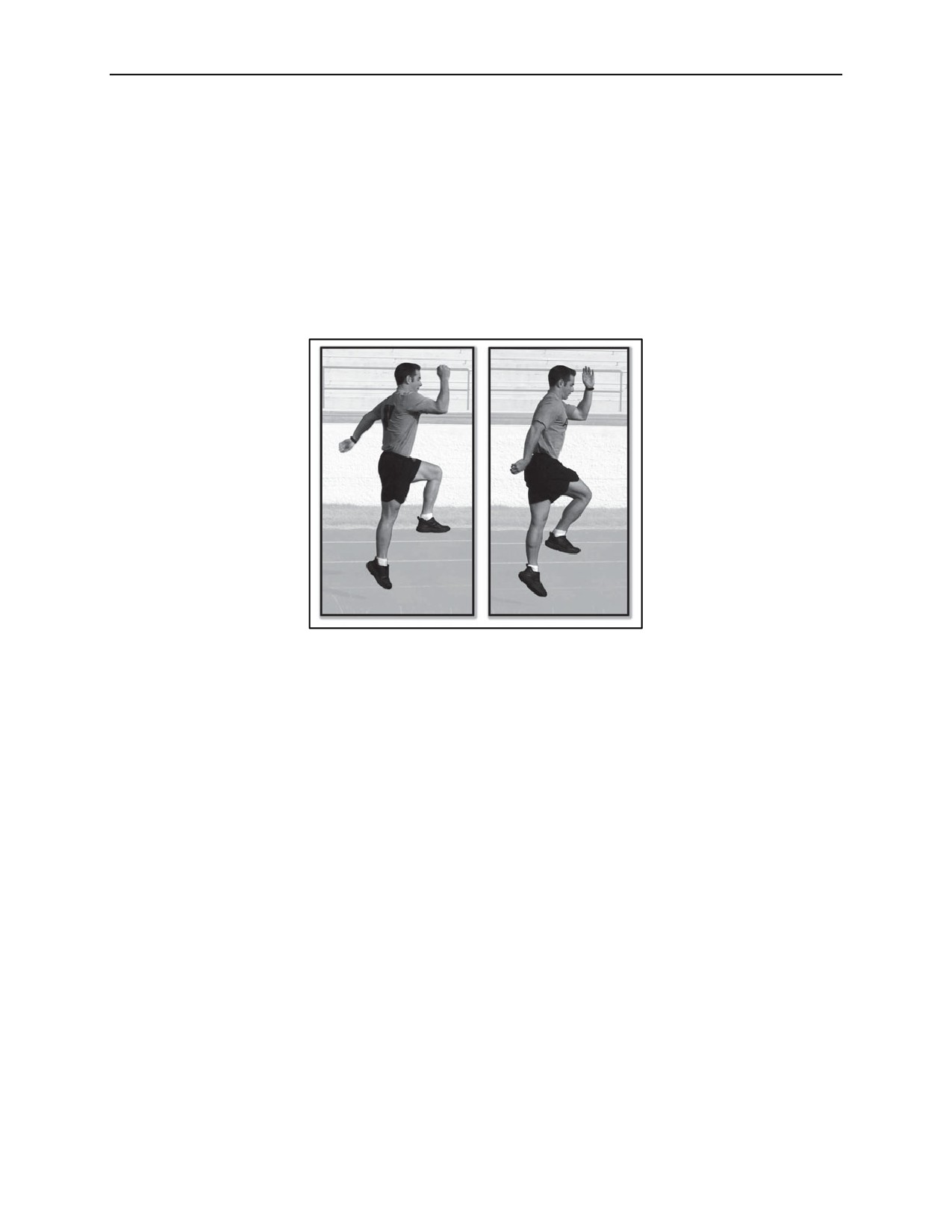
EXERCISE 1: VERTICALS
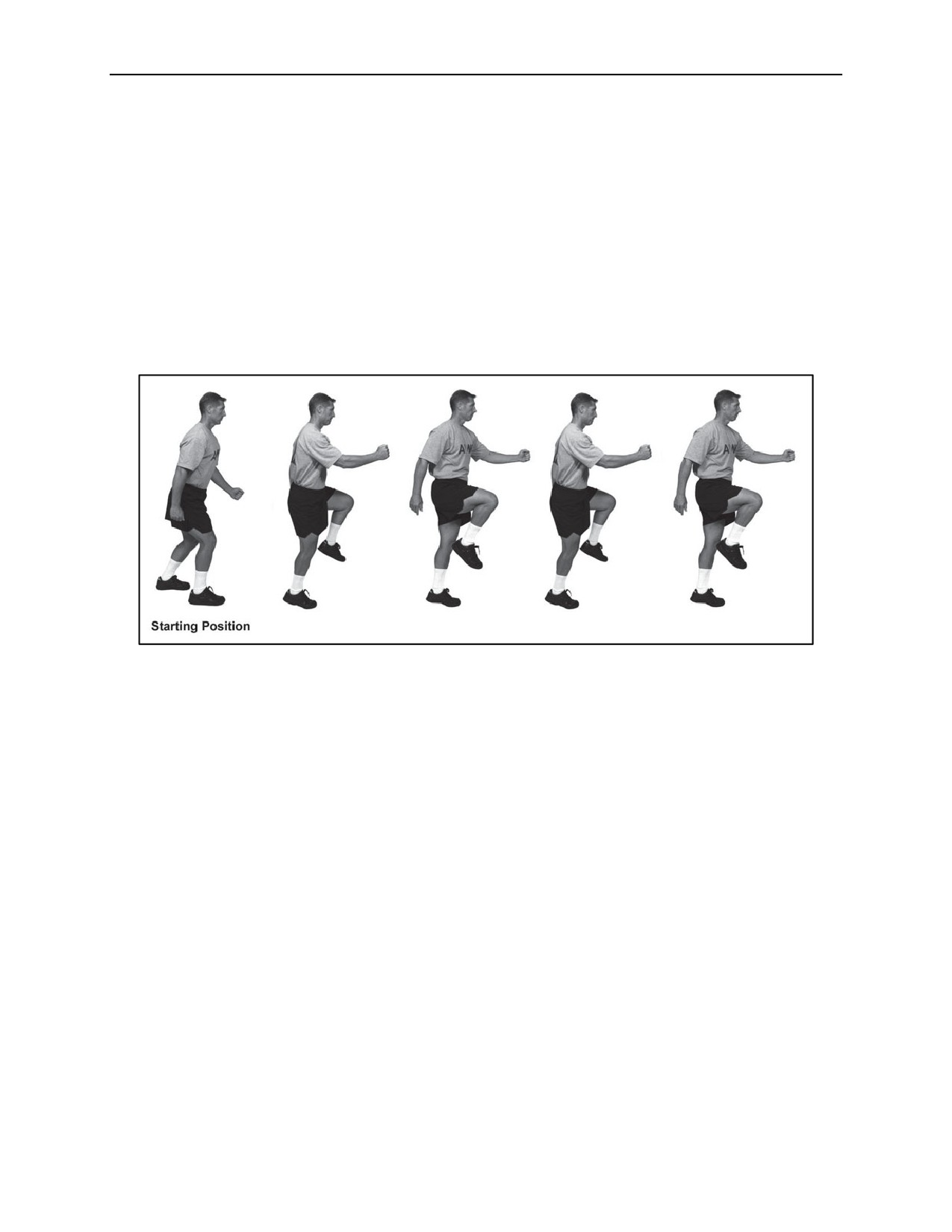
Purpose: This exercise helps to develop proper running form (Figure 10-4).
Starting Position: Staggered stance with the right foot forward. The right heel is even with the toes of the left foot.
The right arm is to the rear with the elbow slightly bent and the left arm is forward. The head is up, looking straight
ahead, and the knees are slightly bent.
Movement: Bring the hips quickly to 90-degrees of bend without raising the knees above waist level. Ground
contact should be primarily with the balls of the feet. When the left leg is forward, the right arm swings forward and
the left arm swings to the rear. When the right leg is forward, the left arm swings forward and the right arm swings
to the rear.
Figure 10-4. Verticals
Check Points:
z
Arm swing is strong and smooth with the forward arm slightly bent and 90-degrees to the ground and
the rearward arm relatively straight.
z
Arm swing is from front to rear, not side to side, with the upper part of the forward arm reaching
parallel to the ground as it swings to the front.
z
Keep a tall stance with a stable, upright trunk. The back remains perpendicular to the ground. There
should not be any back swing of the legs.
Precaution: N/A
10-8
FM 7-22
26 October 2012
Endurance and Mobility Activities
MILITARY MOVEMENT DRILL 1
EXERCISE 2: LATERALS
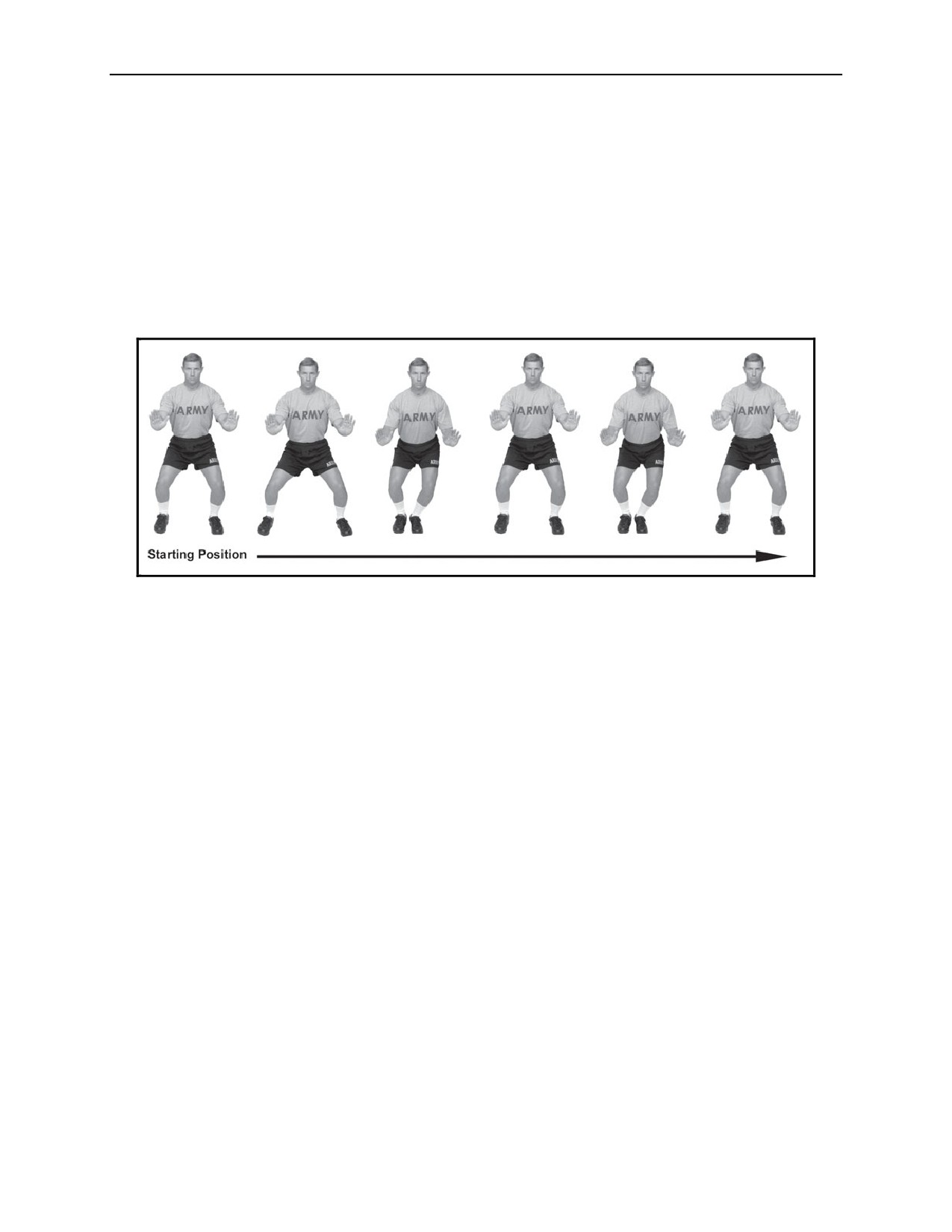
Purpose: This exercise develops the ability to move laterally (Figure 10-5).
Starting Position: Straddle stance, slightly crouched, with the back straight, arms at the side with elbows bent at
90-degrees and palms facing forward. Face perpendicular to the direction of movement.
Movement: Step out with the lead leg and then bring the trail leg up and toward the lead leg. The Soldier always
faces the same direction so that for the first 25-yards he is moving to the left and for the second 25-yards he is
moving to the right.
Figure 10-5. Laterals
Check Points:
z
Pick the feet up with each step. Avoid dragging the feet along the ground.
z
Crouch slightly while keeping the back straight.
z
Avoid hitting the feet and ankles together on each step.
z
Rank leaders will face their rank throughout the exercise.
Precaution: N/A
26 October 2012
FM 7-22
10-9
Chapter 10
MILITARY MOVEMENT DRILL 1
EXERCISE 3: SHUTTLE SPRINT
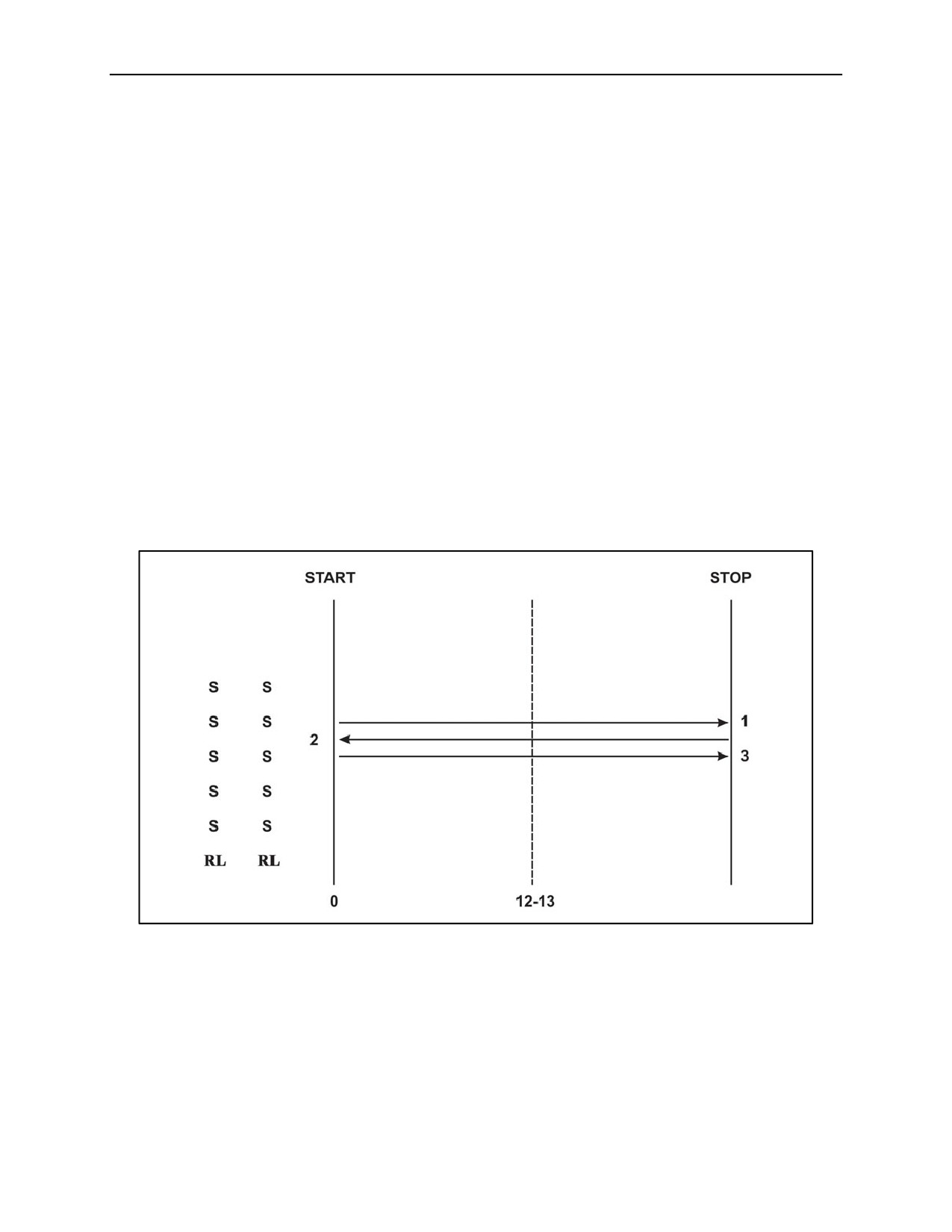
Purpose: This exercise develops anaerobic endurance, leg speed, and agility (Figure 10-6).
Starting Position: Staggered stance with the right foot forward. The right heel is even with the toes of the left foot.
The right arm is to the rear with the elbow slightly bent and the left arm is forward. The head is up looking straight
ahead and the knees are slightly bent.
Movement: Run quickly to the 25-yard mark (as arrow 1 in the following exercise illustration shows). Turn
clockwise while planting the left foot and bending and squatting to touch the ground with the left hand. Run quickly
back to the starting line (arrow 2) and plant the right foot, then turn counterclockwise and touch the ground with the
right hand. Run back to the 25-yard mark (arrow 3) accelerating to near maximum speed.
Check Points:
z
Soldiers should slow their movement before planting feet and changing direction.
z
Soldiers should squat while bending the trunk when reaching to touch the ground as they change
direction.
z
Soldiers touch the ground with their left hand on the first turn, then with their right hand on the
second turn.
z
Accelerate to near maximum speed during the last 25-yard interval.
Precaution: Soldiers should use caution when performing this exercise on wet terrain.
Figure 10-6. Shuttle sprint
10-10
FM 7-22
26 October 2012
Endurance and Mobility Activities
MILITARY MOVEMENT DRILL 2
10-22. The purpose of MMD2 in the sustaining phase is to enhance running form, dynamically prepare the
body for more vigorous running activities, and develop motor efficiency. Military movement drill
2 is
conducted following preparation and the HSD prior to running activities during the PRT session. Military
movement 2 contains three dynamic, plyometric exercises that are conducted in the same manner as MMD1. If
both drills are conducted, MMD1 should precede MMD2. DO NOT mix exercises between the two drills.
Perform the drills as prescribed in this FM. Refer to Table 10-2 for endurance and mobility activities,
prescriptions of intensity, and duration and volume within the toughening and sustaining phases. In addition,
Chapter 5, Planning Considerations, provides the template for commanders and PRT leaders to implement
endurance and mobility activities into their PRT programs.
26 October 2012
FM 7-22
10-11
Chapter 10
MILITARY MOVEMENT DRILL 2
EXERCISE 1: POWER SKIP
Purpose: This exercise develops leg power, coordination, and jumping ability from a single leg. It also promotes a
powerful extension from the ankle, knee, and hip. (Figure 10-7).
Starting Position: Staggered stance with right foot forward.
Movement: Step with the left foot, then hop and land on the left leg followed by the same action with the opposite
leg. When the right leg is forward, the left arm swings forward and the right arm is to the rear. When the left leg is
forward, the right arm swings forward and the left arm is to the rear.
Figure 10-7. Power skip
Check Points:
z
Start slowly and progress the speed and height of the skip throughout each 25-yard interval.
z
Soldiers should gradually incorporate larger arm swings as they jump to get higher elevation. Arm
swing is strong and smooth with the forward arm at 90-degrees and the rearward arm relatively
straight.
z
Arm swing is from front to rear, not side to side, with the upper part of the forward arm reaching
parallel to the ground as it swings to the front.
Precaution: N/A
10-12
FM 7-22
26 October 2012
Endurance and Mobility Activities
MILITARY MOVEMENT DRILL 2
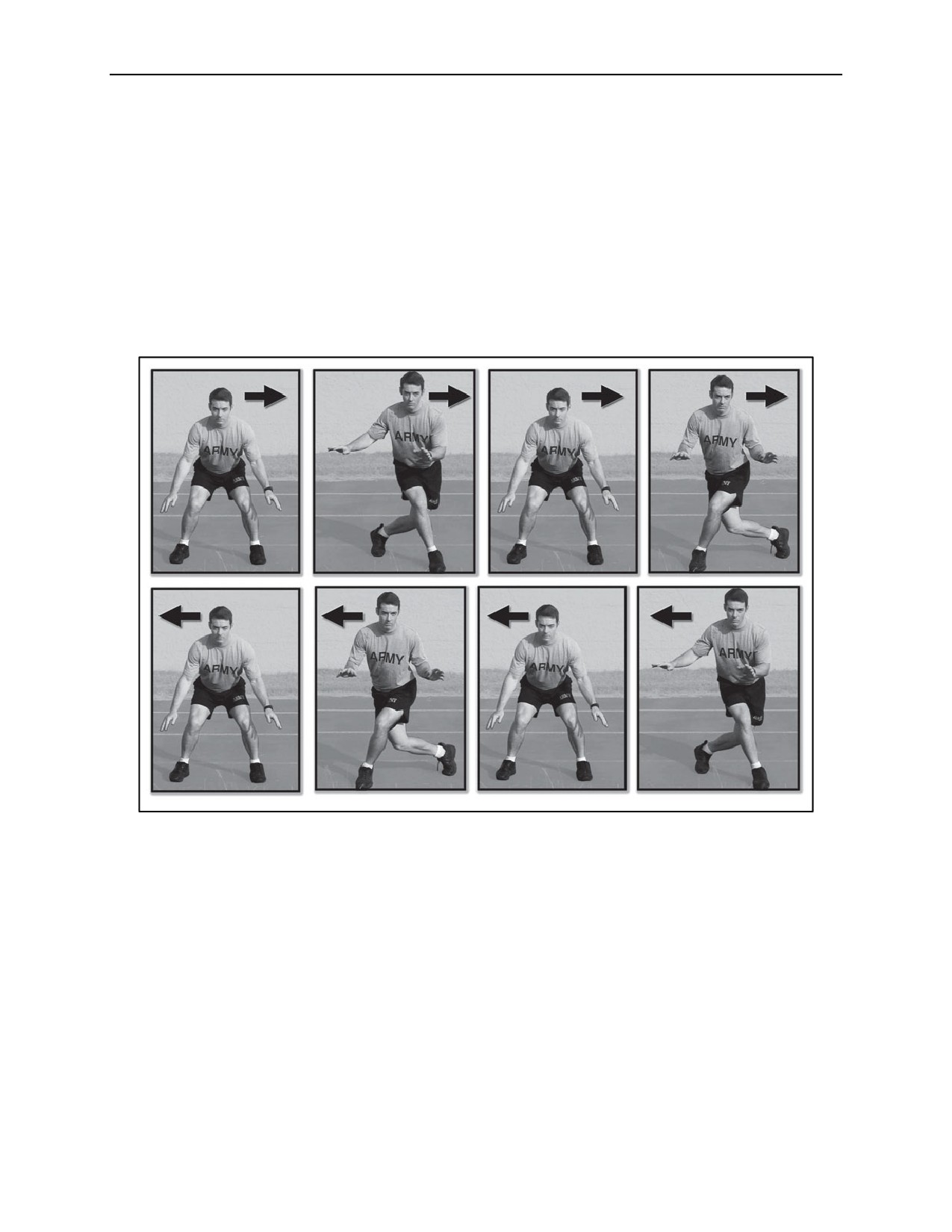
EXERCISE 2: CROSSOVERS
Purpose: This exercise improves leg coordination and trains Soldiers to move laterally (Figure 10-8).
Starting Position: Straddle stance, slightly crouched, with the back straight, arms at the side with elbows bent at
90-degrees, and palms facing forward or holding weapon. Face perpendicular to direction of movement.
Movement: Cross the trail leg first to the front of the lead leg and step in the direction of travel to return to the
starting position. Then cross the trail leg to the rear of the lead leg and step in the direction of travel to return to the
starting position. Repeat sequence to the 25-yard stop point. Always face the same direction so that movement of the
first 25-yards is to the left and movement of the second 25-yards is to the right.
Figure 10-8. Crossovers
Check Points:
z
Pick the feet up with each step. Avoid dragging the feet along the ground.
z
Crouch slightly while keeping the back straight.
z
Maintain the trunk perpendicular to the direction of travel while allowing the hips to move naturally.
z
Rank leaders will face their rank throughout the exercise.
Precaution: N/A
26 October 2012
FM 7-22
10-13
Chapter 10
MILITARY MOVEMENT DRILL 2
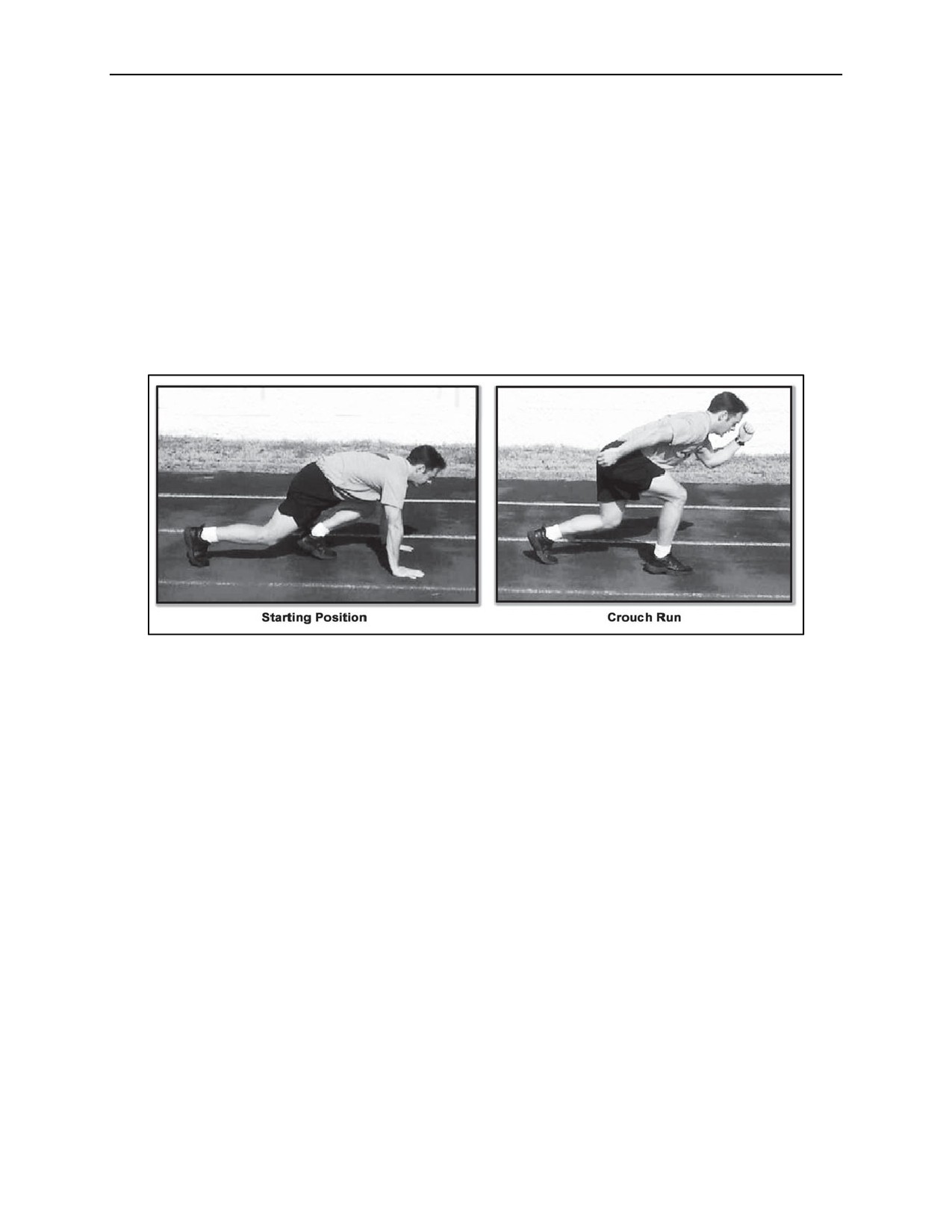
EXERCISE 3: CROUCH RUN
Purpose: This exercise develops the ability to run quickly in a crouched position (Figure 10-9).
Starting Position: Assume the starting position for exercise three of CD 1: mountain climber.
Movement: Power out of the starting position, performing one repetition of mountain climber, then upon finishing
count 4, run forward in the crouch position to the 25-yard mark. Turn clockwise while planting the left foot and
bending and squatting to touch the ground with the left hand, as in performing the shuttle sprint in MMD1. Crouch
run quickly back to the starting line and plant the right foot, turn counter-clockwise and touch the ground with the
right hand. Accelerate out of the crouch run to an upright position and sprint back to the 25-yard mark gradually
accelerating to near maximum speed.
Figure 10-9. Crouch run
Check Points:
z
Move from the crouch run starting position by executing one repetition of mountain climber and
firing out of count four with the right leg and swinging the left arm forward to the crouch run.
z
On the crouch run, stay low with minimal arm swing.
z
Soldiers should slow their movement before planting their feet and changing direction.
z
Soldiers should squat while bending the trunk when reaching to touch the ground as they change
direction.
z
Soldiers touch the ground with their left hand on the first turn, then with their right hand on the
second turn.
z
Accelerate to near maximum speed during the last 25-yard interval.
Precaution: Soldiers should use caution when performing this exercise on wet terrain.
10-14
FM 7-22
26 October 2012
Endurance and Mobility Activities
SPEED RUNNING
10-23. Speed running is based on the training principle that a greater amount of intense work can be
performed if the work is interspersed with periods of recovery. Improvements in physical fitness are affected to
a greater extent by the intensity of training than by the frequency or duration of the training. During speed
running, Soldiers perform a work interval in a specified time for a specific number of repetitions. The work
intervals are followed immediately by an active recovery interval. Multiple work intervals cause the onset of
fatigue many times during a single training session. Speed running improves the resistance to fatigue of the
active muscles by repeatedly exposing them to high intensity effort. As a result of their increased anaerobic and
aerobic endurance, Soldiers are able to sustain performance of physically demanding tasks at a higher intensity
for a longer duration. The training stimulus associated with speed running occurs from the combination of work
and recovery. A very short recovery period may not allow the body to recover sufficiently to perform the next
work interval at the desired intensity. A very long recovery period may allow the body to recover too much and
some of the training effect would be lost. Generally, duration of the recovery period depends on the intensity
and duration of the work interval. An appropriate work to recovery ratio for improving Soldier physical
readiness is 1:2. Speed running has three variables: work duration, recovery duration, and the number of
repetitions. The speed running activities appropriate for Soldiers to improve physical readiness and APFT
2-mile run performance are 30:60s and 60:120s. Refer to Table 10-2 for appropriate speed running prescriptions
for the toughening and sustaining phases. When conducting speed running, the AIs will perform the activity by
running with Soldiers in the unit. This allows the AI’s to continually monitor and motivate Soldiers throughout
the conduct of the exercise. The PRT leader positions himself to supervise the conduct of speed running and
uses a stopwatch and a whistle for signaling the “Start” and “Stop” of each work and rest interval. Refer to
Table 10-2 for endurance and mobility activities, prescriptions of intensity, and duration and volume within the
toughening and sustaining phases. In addition, Chapter 5, Planning Considerations, provides the template for
commanders and PRT leaders to implement endurance and mobility activities into their PRT programs.
30:60S
10-24. Soldiers will perform 30:60s adhering to a work to recovery ratio of 1:2. During the work interval,
Soldiers will sprint for 30 seconds. During the recovery interval, Soldiers walk for 60 seconds. This is one
repetition of a 30:60. Speed running will cause Soldiers to spread out over the course of the running track
during the work interval. If required, the PRT Leader will have Soldiers regroup before the start of the next
work interval. Soldiers run at a slow pace (jog) ¼ mile before beginning 30:60s. Table 10-2 shows speed
running progression. Soldiers should walk at least 3 minutes before performing additional activities or recovery.
60:120S
10-25. Soldiers perform 60:120s adhering to a work to recovery ratio of 1:2. During the work interval,
Soldiers sprint for 60 seconds. During the recovery interval, Soldiers walk for 120 seconds. This is one
repetition of a 60:120. Speed running causes Soldiers to spread out over the course of the running track during
the work interval. If required, the PRT leader has Soldiers regroup before the start of the next work interval. All
ability groups should run at a slow pace (jog) ¼ mile before beginning 60:120s. Table 10-2 shows speed
running progression. Soldiers should walk at least 3 minutes before performing additional activities or recovery.
TRAINING AREAS FOR SPEED RUNNING
10-26. Ideally, the training area for the conduct of 30:60s and 60:120s is a ¼-mile or a 400-meter oval running
track. The PRT leader should stand in the middle of the training area so he can see all Soldiers. From there, the
Soldiers can easily hear his whistled commands to start and stop walking and running intervals. If 30:60s or
60:120s are conducted on a road, the route MUST be wide enough for Soldiers to turn around and not collide.
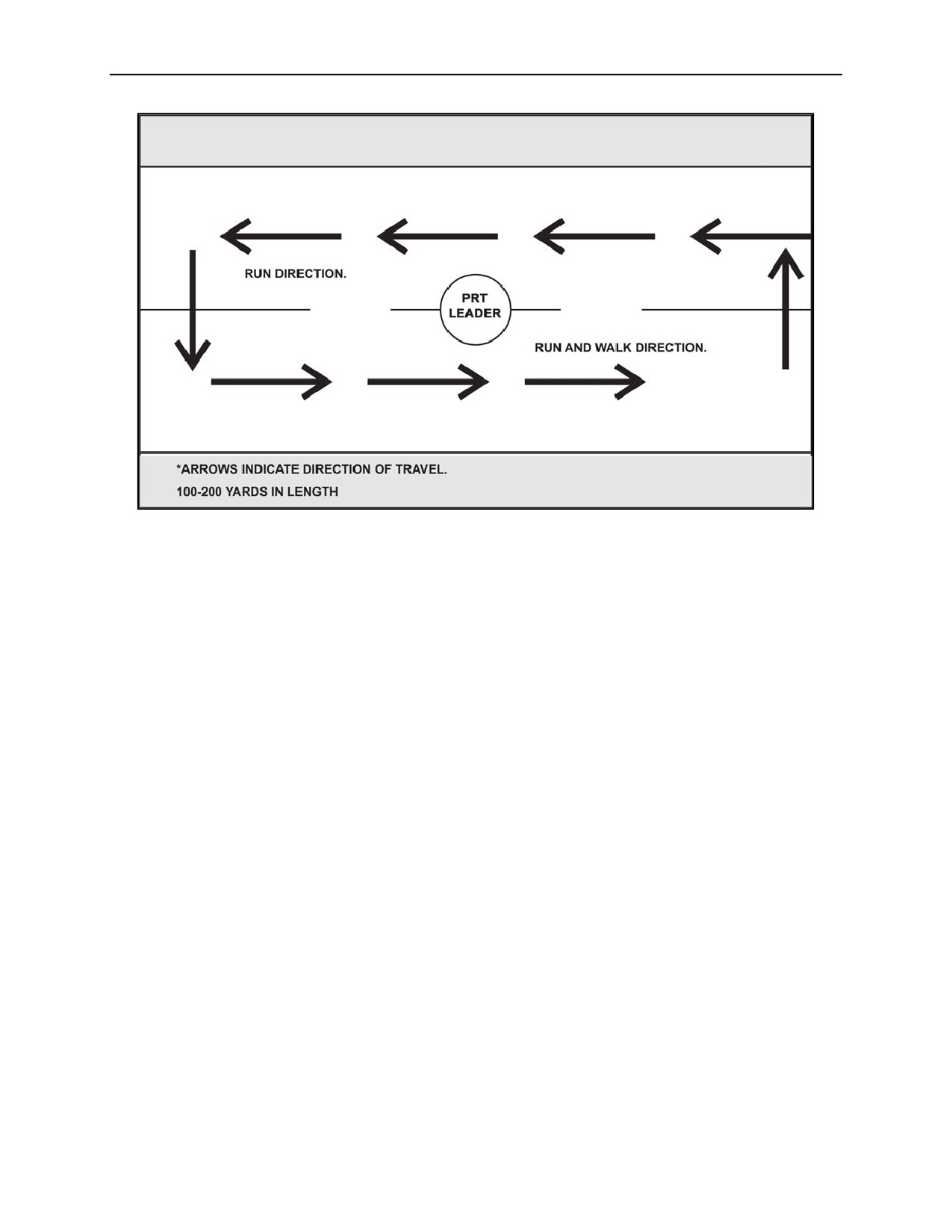
The recommended distances for conducting 30:60s or 60:120s on a straight road course is at least 100 yards and
a maximum of 200 yards (Figure 10-10).
26 October 2012
FM 7-22
10-15
Chapter 10
Figure 10-10. Speed running on a straight course
300-YARD SHUTTLE RUN
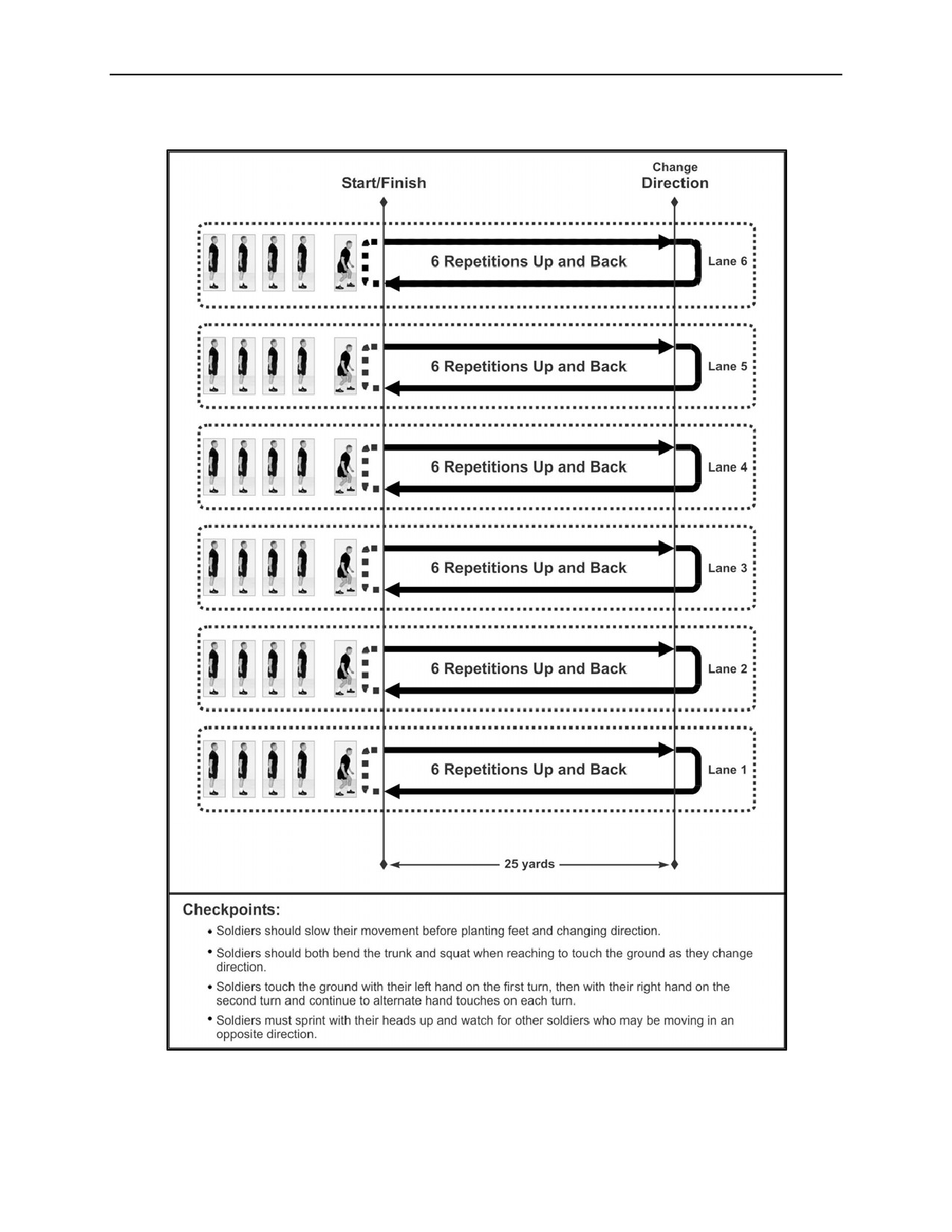
10-27. The 300-yard SR run develops the ability to repeatedly sprint after changing direction. It is an indicator
of the Soldier’s anaerobic endurance, speed, and agility. The 300-yard SR is conducted from the extended
rectangular formation (covered) as shown in Figure 10-3. On the command, ”Ready,” one Soldier in each
column will move behind the starting line and assume the ready position (staggered stance). On the command,
“GO,” Soldiers sprint to a line 25-yards from the starting line. They must touch the line or beyond it with their
left hand, then return to touch the starting/finish line with their right hand. This is considered one repetition.
Soldiers will perform six repetitions alternating touching the lines with opposite hands. On the last (sixth)
repetition, Soldiers sprint past the starting/finish line without touching it. The PRT leader and AIs ensure that
Soldiers sprint in their own lanes and run with their heads up to watch for other Soldiers who may be moving in
the opposite direction. Figure 10-11 shows the running patterns and requirements of the 300-yard SR. Refer to
Table 10-2 for endurance and mobility activities, prescriptions of intensity, duration, and volume within the
toughening and sustaining phases. In addition, Chapter 5, Planning Considerations, provides the template for
commanders and PRT leaders to implement endurance and mobility activities into their PRT programs.
10-16
FM 7-22
26 October 2012
Endurance and Mobility Activities
Figure 10-11. 300-yard shuttle run
26 October 2012
FM 7-22
10-17
Chapter 10
HILL REPEATS
10-28. Hill repeats are an effective means of developing explosive leg strength, speed and anaerobic
endurance. Both uphill and downhill running intervals are important. Uphill repeats build leg strength, power,
and anaerobic endurance, while downhill repeats improve speed though rapid leg turn-over and releasing neural
inhibitions. The intensity and duration of the repetitions will depend on the characteristics of the hill. The PRT
leader designates the number of repetitions and signals the start of each group or individual. Hill repeats should
not be conducted under load. Refer to Table 10-2 for endurance and mobility activities, prescriptions of
intensity, duration, and volume within the toughening and sustaining phases. In addition, Chapter 5, Planning
Considerations, provides the template for commanders and PRT leaders to implement endurance and mobility
activities into their PRT programs.
UPHILL REPEATS
10-29. A short, steep hill is ideal for explosive uphill efforts of 15-20 seconds sprinting up 40-60 yards and
60-90 seconds walking back down for 6 to 10 repetitions. On uphill repeats, lean slightly forward without
bending at the waist. On steep hills, the knees will need to rise higher than normal to permit a full stride. Refer
to Table 10-2 for endurance and mobility activities, prescriptions of intensity, duration, and volume within the
toughening and sustaining phases. In addition, Chapter 5, provides the template for commanders and PRT
leaders to implement endurance and mobility activities into their PRT programs.
DOWNHILL REPEATS
10-30. Long, gentle slopes are best for improving speed through downhill repeats. Downhill repeats are
performed at a high intensity of 15-20 seconds of downhill sprinting (near maximal effort) with rest intervals
consisting of walking back up the hill for 60-90 seconds for 6 to 10 repetitions. It is important to maintain good
form during HR, especially when running downhill. Refer to Table 10-2 for endurance and mobility activities,
prescriptions of intensity, duration, and volume within the toughening and sustaining phases. In addition,
Chapter 5, provides the template for commanders and PRT leaders to implement endurance and mobility
activities into their PRT programs.
ABILITY GROUP RUN
10-31. The AGR trains Soldiers in groups of near-equal ability. Each ability group runs at a prescribed pace
intense enough to produce a training effect for that group and each Soldier in it. Leaders should program these
runs for specific lengths of time, not miles to be run. This training method provides a challenge for each ability
group while controlling injuries. The PRT leader conducts a 1-mile run assessment to assign Soldiers in ability
groups. Based on each Soldier’s 1-mile run assessment time, the PRT leader assigns the Soldier to one of the
groups shown in Table 10-3.
Table 10-3. Ability group assignment
Toughening Phase AGR Assignments
Sustaining Phase AGR Assignments
A Group, 7:15 and faster
A Group, 6:30 and faster
B Group, 7:16 to 8:15
B Group, 6:31 to 7:15
C Group, 8:16 to 10:15
C Group, 7:16 to 8:00
D Group, 10:16 and slower
D Group, 8:01 and slower
10-32. Some Soldiers may make the cut off times to qualify for an ability group but are unable to maintain the
prescribed running pace listed in the PRT schedule. If this occurs, they may drop down to the slower group and
progress later to the faster running group. Ability group runs must be conducted for the duration and intensity
specified in the training schedules in Chapter 5, Planning Considerations. The frequency of AGRs is one or two
times per week. Ability group runs, speed running, and foot marching (greater than 5 km) should not be
conducted on the same or consecutive days. The running duration is determined by time, not distance. Soldiers
10-18
FM 7-22
26 October 2012
Endurance and Mobility Activities
should move to faster groups when they are ready because they progress at different rates. Those who have
difficulty maintaining the specified pace within an ability group should be placed in a slower ability group.
Supervision will prevent a constant shifting of Soldiers between groups due to lack of individual effort. See the
training schedules in Chapter 5, Planning Considerations, for AGR times and pace. Routes used for sustained
running in ability groups should be well lighted, free from hazards and traffic, and marked at ¼-mile intervals.
Ability group leaders will ensure running is at the proper pace prescribed for their group by checking their split
times at each ¼-mile marker along the route. Table 10-4 shows the appropriate ¼-mile split time based on the
AGR pace.
Table 10-4. Quarter-mile split times based on AGR pace
1/4-Mile
1/4-Mile
1/4-Mile
Pace/Mile
Pace/Mile
Pace/Mile
Split
Split
Split
6:00
1:30
8:15
2:03
10:30
2:38
6:15
1:34
8:30
2:07
10:45
2:42
6:30
1:37
8:45
2:11
11:00
2:45
6:45
1:42
9:00
2:15
11:15
2:49
7:00
1:45
9:15
2:19
11:30
2:53
7:15
1:48
9:30
2:23
11:45
2:57
7:30
1:52
9:45
2:27
12:00
3:00
7:45
1:56
10:00
2:30
12:15
3:04
8:00
2:00
10:15
2:34
12:30
3:07
10-33. Refer to Table 10-2 for endurance and mobility activities, prescriptions of intensity, duration, and
volume within the toughening and sustaining phases. In addition, Chapter 5, Planning Considerations, provides
the template for commanders and PRT leaders to implement endurance and mobility activities into their PRT
programs.
UNIT FORMATION RUN
10-34. The UFR elicits intangible rewards gained from running with a group, such as esprit de corps, team
building, and discipline. Unit formation runs are based on a time and/or distance that can be achieved with unit
integrity and a display of unit cohesion. Unit formation runs are organized by squad, platoon, company, or
battalion; not by ability. Keeping a large unit in step, with proper distance intervals and correct running form,
offers intangible benefits that commander’s desire. Commanders should not use UFRs as the foundation of their
PRT program. They should be performed no more than once per quarter due to the limited training effect
offered for the entire unit. The UFR begins with a gradual increase in intensity for the first three minutes or ¼
mile, then continues at a prescribed target pace for a specified time, and concludes with a gradual decrease in
intensity for the last three minutes or ¼ mile. The gradual increase and gradual decrease quarter miles will be
conducted at a pace two minutes slower than the target pace. The unit commander is responsible for establishing
a pace achievable by all Soldiers in the unit. Refer to Table 10-2 for endurance and mobility activities,
prescriptions of intensity, duration, and volume within the toughening and sustaining phases. In addition,
Chapter 5, Planning Considerations, provides the template for commanders and PRT leaders to implement
endurance and mobility activities into their PRT programs.
RELEASE RUN
10-35. The RR combines the benefits of formation running and individual performance at higher training
intensities. Soldiers will run in formation for a specified time (no more than 15 minutes), then released to run as
fast as they can back to the starting point. Upon completion of the release run, additional PRT activities may be
conducted or recovery performed. Refer to Table 10-2 for endurance and mobility activities, prescriptions of
intensity, duration, and volume within the toughening and sustaining phases. In addition, Chapter 5, Planning
Considerations, provides the template for commanders and PRT leaders to implement endurance and mobility
activities into their PRT programs.
26 October 2012
FM 7-22
10-19
Chapter 10
TERRAIN RUN
10-36. The TR applies the train for combat proficiency concept to PRT. Running through local training areas,
over hills, and around obstacles improves mobility, endurance, and the ability to stop, start, and change
direction. Terrain running is designed to be conducted with small unit integrity. This type of running is best
performed by squads and sections. Distances should generally be 1 mile for densely wooded areas and up to 2
miles on tank trails and open fields. Intensity is relative to the terrain. Physical readiness training leaders will
form the unit and maintain an interval suitable for the terrain and environmental conditions. Soldiers should
perform terrain running in ACUs and well-fitting boots. Soldiers may progress to performing terrain running
with IBA, ACH, individual weapon, and under fighting load. Refer to Table 10-2 for endurance and mobility
activities, prescriptions of intensity, duration, and volume within the toughening and sustaining phases. In
addition, Chapter 5, Planning Considerations, provides the template for commanders and PRT leaders to
implement endurance and mobility activities into their PRT programs.
FOOT MARCHES
10-37. Foot marching as a movement component of maneuver is a critical Soldier physical requirement.
Regular foot marching helps to avoid the cumulative effects of lower injury trauma and prepares Soldiers to
successfully move under load. See FM 21-18, Foot Marches, for specific instructions and guidance for the
conduct of foot marches.
CONDITIONING OBSTACLE COURSE
10-38. Obstacle course running develops physical capacities, fundamental skills, and abilities that are
important to Soldiers in combat operations. Soldiers must be able to crawl, creep, climb, walk, run, and jump.
Furthermore, with individual body armor and fighting load, they must be able to perform all these tasks for long
periods of time without exhaustion or injury, even after fatigue has set in. Refer to Appendix E for obstacle
negotiation.
ENDURANCE TRAINING MACHINES
10-39. When using ETM there are four primary variables to consider: exercise mode, training frequency,
exercise duration, and training intensity. Exercise prescription specifies training frequency, exercise duration,
and training intensity. The mode of exercise (type of ETM) is determined by environmental constraints and/or
training according to physical profile limitations
(temporary/permanent). Each ETM contains specific
instructions for proper use and adjustments for the Soldier to obtain optimal posture during endurance exercise
(seat height on cycle ergometers or seat distance on rowing machines). If the ETM has no visible list of
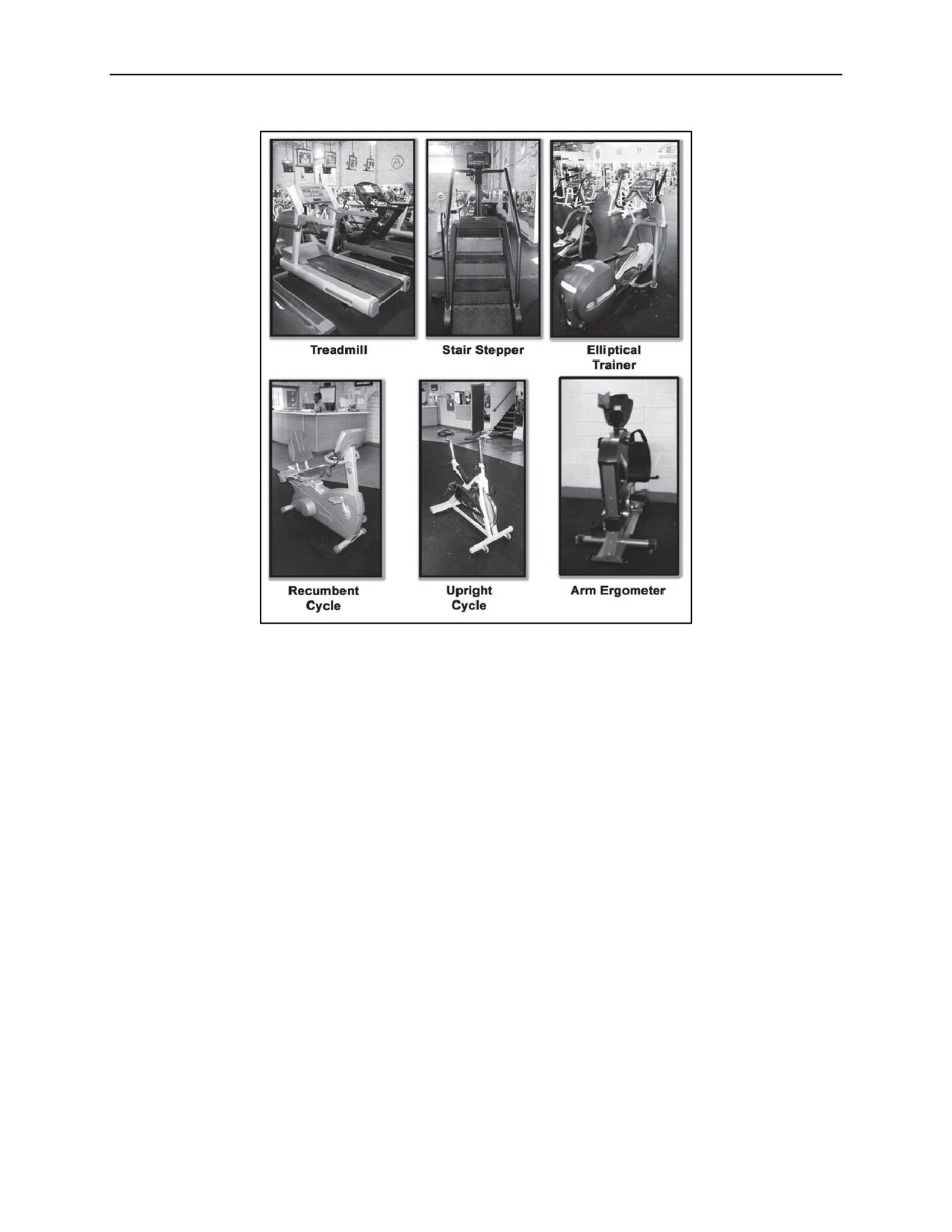
operating instructions, ask the PRT leader or AI for assistance (Figure 10-12).
EXERCISE MODE
10-40. Exercise mode refers to the specific activity performed by the Soldier: running, cycling, swimming,
and the use of a variety of endurance training equipment. There are advantages to using endurance training
equipment (environmental constraints, safety for Soldiers on physical profile, and isolation of specific muscle
groups to be trained during rehabilitation and reconditioning). Consideration for use of specific types of
equipment may be based on the Soldier’s ability to participate in weight-bearing or non-weight-bearing
activities. Weight-bearing activities include walking or running on a treadmill and using a stair
climbing/stepping machine. Non-weight-bearing and limited weight-bearing activities include use of cycle
ergometers (upright/recumbent) elliptical trainers, rowers, climbing machines, and cross-country ski machines.
Use of limited or non-weight-bearing endurance training equipment is desirable for obtaining higher caloric
expenditure through additional training sessions by overweight Soldiers trying to reduce body fat. Each of these
modes typically provide the Soldier with a variety of individual exercise routines that monitor and display
exercise duration, training intensity
(heart rate/pace/watts), caloric expenditure, and distance completed
(miles/km). See Figure 10-12 for examples of various types of endurance training equipment.
10-20
FM 7-22
26 October 2012
Endurance and Mobility Activities
Figure 10-12. Endurance training machines
TRAINING FREQUENCY
10-41. Training frequency refers to the number of training sessions conducted per day or per week. Training
frequency is determined by exercise duration and training intensity. Training sessions that involve high intensity
or longer duration may necessitate less frequent training to allow for adequate recovery. Normal endurance
training frequency is three to five exercise sessions per week.
EXERCISE DURATION
10-42. Exercise duration is 20 minutes or longer and varies from machine to machine, depending on the
intensity of the exercise routine being performed (hill profile, speed, degree of incline, resistance). Most
exercise sessions of high or moderate intensity should last 20 to 30 minutes. Endurance exercise sessions that
address additional caloric expenditure for body fat reduction should be of low intensity and may last up to 60
minutes.
TRAINING INTENSITY
10-43. Training intensity is typically monitored and displayed on the exercise equipment control panel in
terms of heart rate, pace (mph/kph, step rate), watts, kiloponds, caloric expenditure (kcals), or resistance.
26 October 2012
FM 7-22
10-21
Chapter 10
Summary
The activities in this chapter develop the endurance and mobility demanded of WTBDs. A
properly designed PRT running program strikes a balance between speed and sustained
running to train the full spectrum of endurance. Endurance training equipment is used to
accommodate environmental constraints and/or training according to Soldiers’ physical
profile limitations.
10-22
FM 7-22
26 October 2012
Appendix A
Army Physical Fitness Test (APFT)
The intent of the Army Physical Fitness Test (APFT) is to provide an assessment of the
PRT program. Physical fitness testing is designed to ensure the maintenance of a base
level of physical fitness essential for every Soldier, regardless of Army MOS or duty
assignment. PRT programs must be developed to take this base level of conditioning and
raise it to help meet or exceed mission-related physical performance tasks. Commanders
must ensure that physical fitness testing does not form the foundation of unit or
individual PRT programs. Temporary training periods solely devoted toward meeting
APFT requirements are highly discouraged. See AR
350-1 for policy guidelines
pertaining to the APFT.
APFT OVERVIEW
A-1. The APFT provides a measure of upper and lower body muscular endurance. It is a performance test that
indicates a Soldier’s ability to perform physically and handle his or her own body weight. Army Physical
Fitness Test standards are adjusted for age and physiological differences between the genders.
FITNESS STANDARDS
A-2. The APFT consists of push-ups, sit-ups, and a 2-mile run—done in that order—on the same day. Soldiers
are allowed a minimum of 10 minutes and a maximum of 20 minutes rest between events. All three events must
be completed within two hours. The test period is defined as the period of time that elapses from the start to the
finish of the three events (from the first push-up performed to the last Soldier crossing the finish line of the
2-mile run event).
A-3. In accordance with AR 350-1, all Soldiers must attain a score of at least 60 points on each event and an
overall score of at least 180 points. Soldiers in BCT must attain 50 points in each event and an overall score of
150 points. The maximum score a Soldier can attain on the APFT is 300 points. The use of extended scale
scoring IS NOT authorized.
A-4. Army Physical Fitness Test results will be recorded on DA Form 705 (sample and Army Knowledge
Online (AKO) form reference located at chapter end). One scorecard will be maintained for each Soldier. The
scorecard will be kept in a central location in the unit and will accompany the individual military personnel
records jacket at the time of permanent change of station according to AR 350-1. Units and separate offices
monitor the performance and progress of their Soldiers. Individual Soldiers are not authorized to administer the
APFT to themselves to simply satisfy record test requirements. A minimum of four Soldiers are required to
administer an APFT: OIC or NCOIC, an event supervisor(s), an event scorer, and support personnel. Another
Soldier being tested or support personnel may act as the holder to secure the Soldier’s ankles during the sit-up
event.
A-5. Any piece of clothing not prescribed as a component of the IPFU, ACU or commander authorized civilian
attire is not permitted for wear during the APFT. Neither are devices or equipment that offer any potential for
unfair advantage during testing. Unless prescribed as part of the Soldier’s medical profile, the wearing of the
following items are not authorized: nasal strips, weight lifting gloves, back braces, elastic bandages, or braces.
Electronic devices are also not authorized (MP3 players, radios, cell phones, and compact disc players).
AR 670-1, Wear and Appearance of Army Uniforms and Insignia, specifies the components of the IPFU
ensemble.
26 October 2012
FM 7-22
A-1
Appendix A
APFT ADMINISTRATION
SUPERVISION
A-6. The success of any physical fitness testing program depends on obtaining valid and accurate test results;
therefore, the APFT must be administered properly to accurately evaluate individual Soldier and unit physical
fitness. Supervision of the APFT is necessary to ensure the objectives of the physical fitness program are met.
Proper supervision provides for standardization in the following:
z
Test preparation.
z
Control of performance factors.
z
Training of test personnel.
z
Test scoring.
PREPARATION
A-7. Preparation for the APFT should be directed at securing the most accurate evaluation of personnel
participating in the test. Preparatory requirements include the following:
z
Selecting and training of event supervisors, scorers, timers, demonstrators, and support personnel.
z
Equipment inventory.
z
Securing the test site.
PLANNING
A-8. The commander should ensure that testing is consistent with regard to events, scoring, clothing,
equipment, and facilities. Testing should be planned to permit each Soldier to perform at his maximal level and
should ensure the following:
z
Soldiers are not tested when fatigued or ill.
z
Soldiers do not participate in tiring duties before taking an APFT.
z
Weather and environmental conditions do not inhibit physical performance.
z
Risk analysis is conducted.
DUTIES OF TEST PERSONNEL
RESPONSIBILITIES
A-9. The Army Physical Fitness Test personnel must be familiar with all aspects of administration of the
APFT. Supervision of Soldiers and laying out the test area are essential duties. The following test personnel are
recommended to conduct an APFT: an OIC and/or NCOIC, an event supervisor(s), a timer, a back-up timer, an
event scorer(s), a demonstrator(s), and support personnel. The minimum number of test personnel required to
administer the APFT is four: an OIC/NCOIC, an event supervisor, an event scorer, and support personnel to
hold the Soldiers’ feet on the sit-up event.
A-10. The OIC and the NCOIC are responsible for the administration of the APFT. Responsibilities include:
z
Preparation for push-up event (after reading instructions and before test start).
z
Administration of the test.
z
Conduct of recovery upon completion of the test.
z
Procurement of all necessary equipment and supplies.
z
Arrangement and layout of test area.
z
Training of event supervisors, scorers, timer, back-up timer demonstrators, and support personnel.
z
Ensure tests are properly administered and that events are explained, demonstrated, and scored
according to standard.
A-2
FM 7-22
26 October 2012
Army Physical Fitness Test (APFT)
z
When test personnel required to administer the APFT are limited, the OIC/NCOIC may perform
the duties of an event demonstrator and/or back-up timer.
z
Reports results of test.
A-11. The event supervisors are responsible for administration of test events. Responsibility includes the
following:
z
Administers one or more test events.
z
Ensures necessary equipment is on hand for each event(s).
z
Reads APFT event instructions.
z
Conducts APFT event demonstration.
z
When test personnel required to administer the APFT are limited, the event supervisor(s) may
perform the duties of the timer.
z
Supervises event scoring to standard.
z
Answers questions on scoring discrepancies and informs the OIC/NCOIC.
A-12. The event scorers are responsible for scoring events to standard. Responsibility includes the following:
z
Enforces test standards.
z
Records the correct number of repetitions in the raw score block on DA Form 705.
z
Records initials in initials box on DA Form 705.
z
Performs other duties assigned by the OIC or the NCOIC.
z
Receives training conducted by the OIC/NCOIC to ensure scoring is to standard.
A-13. The demonstrators are responsible for demonstrating the push-up and sit-up events to standard.
Responsibility includes the following:
z
Assists the event supervisor by demonstrating push-ups and sit-ups to standard during the reading
of event instructions.
z
Performs other duties assigned by the OIC or the NCOIC.
z
Receives training, conducted by the OIC/NCOIC, to ensure demonstration of push-ups and sit-ups
are to standard.
A-14. Timers and back-up timers are responsible for properly timing the push-up, sit-up, and 2-mile run events.
A-15. Support personnel assist in preventing unsafe acts to ensure smooth operation of the APFT. The use of
support personnel depends on local policy and unit standing operating procedures. For example, support
personnel may perform the duties of the holder during the sit-up event. Medical support on site is not required
unless specified by local policy. The OIC and/or the NCOIC should have a plan for medical support (if
required).
TEST SITE
A-16. The OIC and the NCOIC should select a test site that is flat and free of debris. The test site should have
the following:
z
A site that is free of any significant hazards.
z
A briefing area for the reading of event instructions.
z
A preparation area (can be same as briefing area).
z
A soft, flat, dry area for push-ups and sit-ups.
z
A flat, measure 2-mile running course with a solid surface that is not more than 3 percent grade.
A-17. Sound judgment must be used in the selection of a 2-mile run course. There is no requirement to survey
2-mile run courses; however, selected test sites should be free of significant hazards such as traffic, slippery
road surfaces, and areas where heavy pollution is present. Running tracks may be used to administer the 2-mile
run event. If a 400-meter track is used, the OIC/NCOIC must add an additional 61 feet, 4 inches to the standard
8 laps to ensure the test’s required 2-mile distance is covered. One lap on a 400-meter track is 92 inches shorter
26 October 2012
FM 7-22
A-3
Appendix A
than one lap on a 440-yard track. Eight laps on a 400-meter track is 736 inches shorter than eight laps (2 miles)
on a 440-yard tack. Therefore, Soldiers running on a 400-meter track must run an additional 61 feet, 4 inches.
TEST PROCEDURES
A-18. The APFT test sequence is the push-up, sit-up, and 2-mile run (or an approved alternate aerobic event).
The order of events cannot be changed. There are no exceptions to this sequence. Soldiers are allowed a
minimum of 10 minutes and a maximum of 20 minutes to recover between events. The OIC or the NCOIC
determines the recovery time. It is normally based on the number of Soldiers taking the test. If large numbers of
Soldiers are being tested, staggered start times should be planned to allow for proper recovery between test
events. Under no circumstances is the APFT valid if Soldiers cannot begin and end all three events in two hours
or less. The following paragraphs describe procedures for APFT administration. On test day, the OIC or the
NCOIC briefs Soldiers on the purpose and organization of the test. The OIC or the NCOIC explains test
administration including the scorecard, scoring standards, and test sequence. In addition, the wearing of
unauthorized items such as nasal strips, braces, elastic bandages, weight lifting gloves, electronic devices (MP3
players, radios, cell phones, and compact disc players) are addressed. Test instructions for the push-up, sit-up,
and 2-mile run (or approved alternate aerobic event) are read prior to conducting preparation. After preparation
is completed, the push-up event will begin. From the beginning of the push-up event to the completion of all
remaining events, the total time elapsed cannot exceed two hours. Upon completion of all events, recovery will
be conducted
A-19. The following instructions are READ aloud to all Soldiers taking the APFT.
YOU ARE ABOUT TO TAKE THE ARMY PHYSICAL FITNESS TEST, A TEST THAT
WILL MEASURE YOUR UPPER AND LOWER BODY MUSCULAR ENDURANCE. THE
RESULTS OF THIS TEST WILL GIVE YOU AND YOUR COMMANDERS AN
INDICATION OF YOUR STATE OF FITNESS AND WILL ACT AS A GUIDE IN
DETERMINING YOUR PHYSICAL TRAINING NEEDS. LISTEN CLOSELY TO THE
TEST INSTRUCTIONS, AND DO THE BEST YOU CAN ON EACH OF THE EVENTS.
A-20. If DA Form 705 has not been issued, scorecards will be handed out at this time. The OIC or the NCOIC
will then instruct the Soldiers to fill in the appropriate spaces with the required personal data. The following
instructions are READ aloud to all Soldiers taking the APFT:
“IN THE APPROPRIATE SPACES, PRINT IN INK THE PERSONAL INFORMATION
REQUIRED ON THE SCORECARD.”
Note: The preceding remark is omitted if scorecards were issued prior to arrival at the test site.
A-21. Soldiers are then given time to complete the required information. Next, the OIC or the NCOIC explains
procedures for scorecard use during testing. The following instructions are READ aloud to all Soldiers taking
the APFT:
A-4
FM 7-22
26 October 2012
Army Physical Fitness Test (APFT)
“YOU ARE TO CARRY THIS CARD WITH YOU TO EACH EVENT. BEFORE YOU
BEGIN, HAND THE CARD TO THE SCORER. AFTER YOU COMPLETE THE EVENT,
THE SCORER WILL RECORD YOUR RAW SCORE, INITIAL THE CARD, AND
RETURN IT TO YOU.”
A-22. Now the OIC or the NCOIC explains how raw scores are converted to point scores. At this point in time,
Soldiers are assigned to groups. The following instructions are READ aloud to all Soldiers taking the APFT:
“EACH OF YOU WILL BE ASSIGNED TO A GROUP. STAY WITH YOUR TEST
GROUP FOR THE ENTIRE TEST. WHAT ARE YOUR QUESTIONS ABOUT THE TEST
AT THIS POINT?”
INSTRUCTIONS
A-23. The OIC, the NCOIC, or the event supervisor will read all three event instructions prior to the start of the
test. Specific 2-mile run route instructions can be addressed at the 2-mile run event test site.
PUSH-UP
A-24. The OIC, the NCOIC, or the event supervisor must read the following before beginning the
push-up event (Figure A-1).
26 October 2012
FM 7-22
A-5
Appendix A
“THE PUSH-UP EVENT MEASURES THE ENDURANCE OF THE CHEST,
SHOULDER, AND TRICEPS MUSCLES. ON THE COMMAND, ‘GET SET’, ASSUME THE
FRONT-LEANING REST POSITION BY PLACING YOUR HANDS WHERE THEY ARE
COMFORTABLE FOR YOU. YOUR FEET MAY BE TOGETHER OR UP TO 12 INCHES
APART (MEASURED BETWEEN THE FEET). WHEN VIEWED FROM THE SIDE, YOUR
BODY SHOULD FORM A GENERALLY STRAIGHT LINE FROM YOUR SHOULDERS TO
YOUR ANKLES. ON THE COMMAND ‘GO’, BEGIN THE PUSH-UP BY BENDING YOUR
ELBOWS AND LOWERING YOUR ENTIRE BODY AS A SINGLE UNIT UNTIL YOUR
UPPER ARMS ARE AT LEAST PARALLEL TO THE GROUND. THEN, RETURN TO THE
STARTING POSITION BY RAISING YOUR ENTIRE BODY UNTIL YOUR ARMS ARE
FULLY EXTENDED. YOUR BODY MUST REMAIN RIGID IN A GENERALLY STRAIGHT
LINE AND MOVE AS A UNIT WHILE PERFORMING EACH REPETITION. AT THE END OF
EACH REPETITION, THE SCORER WILL STATE THE NUMBER OF REPETITIONS YOU
HAVE COMPLETED CORRECTLY. IF YOU FAIL TO KEEP YOUR BODY GENERALLY
STRAIGHT, TO LOWER YOUR WHOLE BODY UNTIL YOUR UPPER ARMS ARE AT
LEAST PARALLEL TO THE GROUND, OR TO EXTEND YOUR ARMS COMPLETELY,
THAT REPETITION WILL NOT COUNT, AND THE SCORER WILL REPEAT THE NUMBER
OF THE LAST CORRECTLY PERFORMED REPETITION.”
“IF YOU FAIL TO PERFORM THE FIRST 10 PUSH-UPS CORRECTLY, THE
SCORER WILL TELL YOU TO GO TO YOUR KNEES AND WILL EXPLAIN YOUR
DEFICIENCIES. YOU WILL THEN BE SENT TO THE END OF THE LINE TO BE
RETESTED. AFTER THE FIRST
10 PUSH-UPS HAVE BEEN PERFORMED AND
COUNTED, NO RESTARTS ARE ALLOWED. THE TEST WILL CONTINUE, AND ANY
INCORRECTLY PERFORMED PUSH-UPS WILL NOT BE COUNTED. AN ALTERED,
FRONT-LEANING REST POSITION IS THE ONLY AUTHORIZED REST POSITION. THAT
IS, YOU MAY SAG IN THE MIDDLE OR FLEX YOUR BACK. WHEN FLEXING YOUR
BACK, YOU MAY BEND YOUR KNEES, BUT NOT TO SUCH AN EXTENT THAT YOU ARE
SUPPORTING MOST OF YOUR BODY WEIGHT WITH YOUR LEGS. IF THIS OCCURS,
YOUR PERFORMANCE WILL BE TERMINATED. YOU MUST RETURN TO, AND PAUSE
IN, THE CORRECT STARTING POSITION BEFORE CONTINUING. IF YOU REST ON THE
GROUND OR RAISE EITHER HAND OR FOOT FROM THE GROUND, YOUR
PERFORMANCE WILL BE TERMINATED. YOU MAY REPOSITION YOUR HANDS
AND/OR FEET DURING THE EVENT AS LONG AS THEY REMAIN IN CONTACT WITH
THE GROUND AT ALL TIMES. CORRECT PERFORMANCE IS IMPORTANT. YOU WILL
HAVE TWO MINUTES IN WHICH TO DO AS MANY PUSH-UPS AS YOU CAN. WATCH
THIS DEMONSTRATION.”
Figure A-1. Push-up event narrative
A-6
FM 7-22
26 October 2012
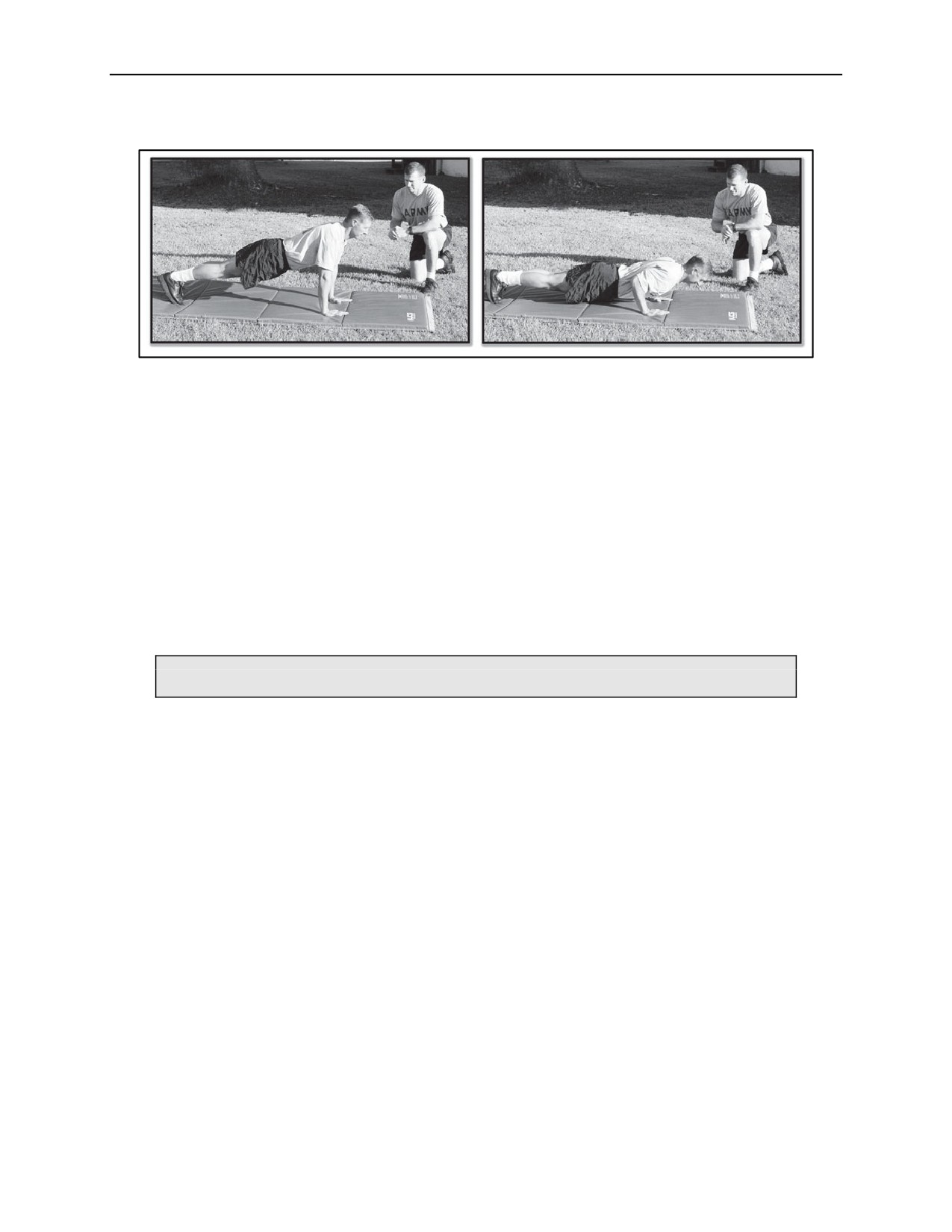
Army Physical Fitness Test (APFT)
Figure A-2. Push-up additional checkpoints
A-25. During the push-up event, scorers sit or kneel 3 feet from the Soldier’s left or right shoulder at a 45-
degree angle (refer to Figure A-2). Additional checkpoints to explain and demonstrate for the push-up event are
as follows:
z
“Your chest may touch the ground during the push-up as long as the contact does not provide an
advantage. You cannot bounce off the ground.”
z
“If a mat is used, your entire body must be on the mat. Sleeping mats are not authorized for use.”
z
“Your feet will not be braced during the push-up event.”
z
“You may do the push-up event on your fists.”
z
“You may not cross your feet while doing the push-up event.”
z
“You may not take any APFT event in bare feet.”
z
“You should not wear glasses while performing the push-up event.”
A-26. In conclusion, the OIC/NCOIC, or the event supervisors, asks:
“WHAT ARE YOUR QUESTIONS ABOUT THIS EVENT?”
SIT-UP
A-27. The OIC, the NCOIC, or the event supervisor, must READ the following before the sit-up event (Figure
A-3).
26 October 2012
FM 7-22
A-7
Appendix A
“THE SIT-UP EVENT MEASURES THE ENDURANCE OF THE ABDOMINAL AND
HIP-FLEXOR MUSCLES. ON THE COMMAND ‘GET SET’, ASSUME THE STARTING
POSITION BY LYING ON YOUR BACK WITH YOUR KNEES BENT AT A 90-DEGREE
ANGLE. YOUR FEET MAY BE TOGETHER OR UP TO 12 INCHES APART (MEASURED
BETWEEN THE FEET). ANOTHER PERSON WILL HOLD YOUR ANKLES WITH THE
HANDS ONLY. NO OTHER METHOD OF BRACING OR HOLDING THE FEET IS
AUTHORIZED. THE HEEL IS THE ONLY PART OF YOUR FOOT THAT MUST STAY IN
CONTACT WITH THE GROUND. YOUR FINGERS MUST BE INTERLOCKED BEHIND
YOUR HEAD AND THE BACKS OF YOUR HANDS MUST TOUCH THE GROUND. YOUR
ARMS AND ELBOWS NEED NOT TOUCH THE GROUND. ON THE COMMAND, ‘GO’,
BEGIN RAISING YOUR UPPER BODY FORWARD TO, OR BEYOND, THE VERTICAL
POSITION. THE VERTICAL POSITION MEANS THAT THE BASE OF YOUR NECK IS
ABOVE THE BASE OF YOUR SPINE. AFTER YOU HAVE REACHED OR SURPASSED
THE VERTICAL POSITION, LOWER YOUR BODY UNTIL THE BOTTOM OF YOUR
SHOULDER BLADES TOUCH THE GROUND. YOUR HEAD, HANDS, ARMS OR ELBOWS
DO NOT HAVE TO TOUCH THE GROUND. AT THE END OF EACH REPETITION, THE
SCORER WILL STATE THE NUMBER OF SIT-UPS YOU HAVE CORRECTLY
PERFORMED. A REPETITION WILL NOT COUNT IF YOU FAIL TO REACH THE
VERTICAL POSITION, FAIL TO KEEP YOUR FINGERS INTERLOCKED BEHIND YOUR
HEAD, ARCH OR BOW YOUR BACK AND RAISE YOUR BUTTOCKS OFF THE GROUND
TO RAISE YOUR UPPER BODY, OR LET YOUR KNEES EXCEED A 90-DEGREE ANGLE.
IF A REPETITION DOES NOT COUNT, THE SCORER WILL REPEAT THE NUMBER OF
YOUR LAST CORRECTLY PERFORMED SIT-UP. IF YOU FAIL TO PERFORM THE FIRST
10 SIT-UPS CORRECTLY, THE SCORER WILL TELL YOU TO ‘STOP’ AND WILL
EXPLAIN YOUR DEFICIENCIES. YOU WILL THEN BE SENT TO THE END OF THE LINE
TO BE RE-TESTED. AFTER THE FIRST 10 SIT-UPS HAVE BEEN PERFORMED AND
COUNTED, NO RESTARTS ARE ALLOWED. THE TEST WILL CONTINUE, AND ANY
INCORRECTLY PERFORMED SIT-UPS WILL NOT BE COUNTED. THE UP POSITION IS
THE ONLY AUTHORIZED REST POSITION.
“IF YOU STOP AND REST IN THE DOWN (STARTING) POSITION, THE EVENT
WILL BE TERMINATED. AS LONG AS YOU MAKE A CONTINUOUS PHYSICAL EFFORT
TO SIT UP, THE EVENT WILL NOT BE TERMINATED. YOU MAY NOT USE YOUR HANDS
OR ANY OTHER MEANS TO PULL OR PUSH YOURSELF UP TO THE UP (REST)
POSITION OR TO HOLD YOURSELF IN THE REST POSITION. IF YOU DO SO, YOUR
PERFORMANCE IN THE EVENT WILL BE TERMINATED. CORRECT PERFORMANCE IS
IMPORTANT. YOU WILL HAVE TWO MINUTES TO PERFORM AS MANY SIT-UPS AS
YOU CAN. WATCH THIS DEMONSTRATION.”
Figure A-3. Sit-up event narrative
A-8
FM 7-22
26 October 2012
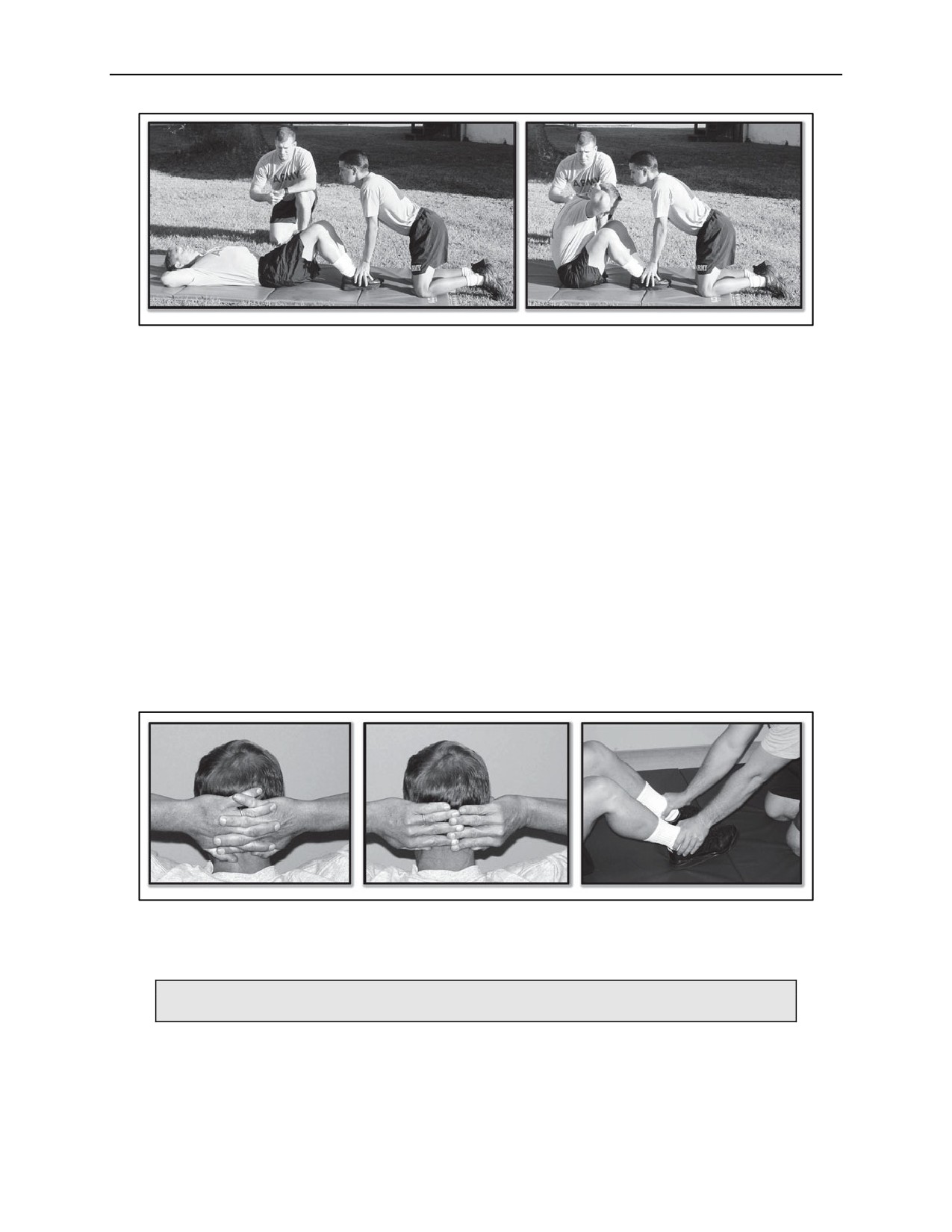
Army Physical Fitness Test (APFT)
Figure A-4. Sit-up additional checkpoints
A-28. During the sit-up event, the scorer kneels or sits 3 feet from the Soldier’s left or right hip. The scorer’s
head should be even with the Soldier’s shoulder when he is in the vertical (up) position (refer to Figure A-4).
Additional checkpoints to explain and demonstrate for the sit-up event are as follows:
z
“If a mat is used, your entire body must be on the mat. Sleeping mats are not authorized for use.”
z
“You may not swing your arms or use your hands to pull yourself up or push off the ground to
obtain the up position. If this occurs your performance in the event will be terminated.”
z
“You may wiggle to obtain the up position, but while in the up position, you may not use your
elbows or any part of the arms to lock on to or brace against the legs. Your elbows can go either
inside or outside the knees, but may not be used to hold yourself in the up position. If this occurs
your performance in the event will be terminated.”
z
“During your performance of the sit-up, your fingers must be interlocked behind your head. As
long as any of your fingers are overlapping to any degree, they are considered to be interlocked
(Figure A-5). If they do not remain interlocked, that repetition will not count and the scorer will
repeat the number of the last correct repetition performed.”
z
“Both heels must stay in contact with the ground (Figure A-5). If either foot breaks contact with
the ground during a repetition, that repetition will not count and the scorer will repeat the number
of the last correct repetition performed.”
Figure A-5. Sit-up hand and feet position
A-29. In conclusion, the OIC/NCOIC, or the event supervisors, asks:
“WHAT ARE YOUR QUESTIONS ABOUT THIS EVENT?”
26 October 2012
FM 7-22
A-9
Appendix A
2-MILE RUN
A-30. The OIC, the NCOIC, or the event supervisor, must read the following before the 2-mile run event
(Figure A-6).
“THE 2-MILE RUN MEASURES YOUR AEROBIC FITNESS AND ENDURANCE OF
THE LEG MUSCLES. YOU MUST COMPLETE THE RUN WITHOUT ANY PHYSICAL
HELP. AT THE START, ALL SOLDIERS WILL LINE UP BEHIND THE STARTING
LINE. ON THE COMMAND ‘GO’, THE CLOCK WILL START. YOU WILL BEGIN
RUNNING AT YOUR OWN PACE. TO RUN THE REQUIRED TWO MILES, YOU MUST
COMPLETE THE REQUIRED 2-MILE DISTANCE (DESCRIBE THE NUMBER OF
LAPS, START AND FINISH POINTS, AND COURSE LAYOUT). YOU ARE BEING
TESTED ON YOUR ABILITY TO COMPLETE THE TWO-MILE COURSE IN THE
SHORTEST TIME POSSIBLE. ALTHOUGH WALKING IS AUTHORIZED, IT IS
STRONGLY DISCOURAGED. IF YOU ARE PHYSICALLY HELPED IN ANY WAY (FOR
EXAMPLE, PULLED, PUSHED, PICKED UP AND/OR CARRIED), OR LEAVE THE
DESIGNATED RUNNING COURSE FOR ANY REASON, THE EVENT WILL BE
TERMINATED. IT IS LEGAL TO PACE A SOLDIER DURING THE TWO-MILE RUN AS
LONG AS THERE IS NO PHYSICAL CONTACT WITH THE PACED SOLDIER AND IT
DOES NOT PHYSICALLY HINDER OTHER SOLDIERS TAKING THE TEST. THE
PRACTICE OF RUNNING AHEAD OF, ALONG SIDE OF, OR BEHIND THE TESTED
SOLDIER WHILE SERVING AS A PACER IS PERMITTED. CHEERING OR CALLING
OUT THE ELAPSED TIME IS ALSO PERMITTED. THE NUMBER ON YOUR CHEST IS
FOR IDENTIFICATION. YOU MUST MAKE SURE IT IS VISIBLE AT ALL TIMES. TURN
IN YOUR NUMBER WHEN YOU FINISH THE RUN AND GO TO THE AREA
DESIGNATED FOR RECOVERY. DO NOT STAY NEAR THE SCORERS OR THE
FINISH LINE AS THIS MAY INTERFERE WITH TESTING.”
Figure A-6. 2-mile run event narrative
A-31. In conclusion, the OIC/NCOIC, or the event supervisors, asks:
“WHAT ARE YOUR QUESTIONS ABOUT THIS EVENT?”
APFT EQUIPMENT
A-32. The following equipment is required for administration of the APFT:
z
Two stopwatches, clipboards, and black pens for each scorer.
z
Run numbers and DA Forms 705 for each Soldier being tested.
APFT FACILITIES
A-33. The following facilities are required for administration of the APFT:
A-10
FM 7-22
26 October 2012
Army Physical Fitness Test (APFT)
z
Designated area for preparation and recovery.
z
One test station (6 feet wide by 15 feet deep) for every 8 Soldiers participating in the push-up and
sit-up events.
z
A measured 2-mile run course.
APFT PERSONNEL
A-34. The following personnel are recommended for administration of the APFT:
z
OIC and/or NCOIC.
z
Event supervisor.
z
One event scorer for every eight Soldiers being tested.
z
Timer and back-up timer.
z
Required support personnel.
APFT TIMER AND BACK-UP TIMER
A-35. The timer begins each push-up or sit-up event with the command, “GET SET.” On the command, “GO,”
time starts on both the timer’s and back-up timer’s watches. The timer indicates time remaining at one minute
(with the command, “ONE MINUTE REMAINING”), 30 seconds (with the command, “30 SECONDS
REMAINING”), and counts down the remaining 10 seconds (with the command, “10, 9, 8, 7, 6, 5, 4, 3, 2, 1,
STOP”). The timer begins the 2-mile run assessment with the command, “GET SET.” The 2-mile run time
starts on both the timer’s and back-up timer’s watches on the command, “GO.” As Soldiers near the finish line,
the timer calls out time in minutes and seconds (for example: “FOURTEEN-FIFTY-EIGHT, FOURTEEN-
FIFTY-NINE, FIFTEEN MINUTES, FIFTEEN-O-ONE”).
APFT SCORER
A-36. The scorer counts the correct number of repetitions out loud, repeats the last number of the correct
repetitions when incorrect repetitions are performed, and verbally corrects push-up and sit-up performances.
When Soldiers complete their APFT events, the scorer records the correct number of completed push-ups and
sit-ups, records the 2-mile run time, and initials the DA Form 705. During the push-up event, scorers sit or
kneel three feet from the Soldier’s left or right shoulder at a 45-degree angle (refer to Figure A-2). A scorer’s
head should be even with the Soldier’s shoulder when he is in the front-leaning rest position. During the sit-up
event, the scorer kneels or sits three feet from the Soldier’s left or right hip. The scorer’s head should be even
with the Soldier’s shoulder when he is in the vertical (up) position (refer to Figure A-4). During the 2-mile run
event, the scorer is at the finish line. When the scorer has entered the Soldier’s 2-mile run time on the DA Form
705, he converts the raw scores into point scores for each event, enters the total on the DA Form 705, and
initials each event on the scorecard. The scorer then returns all DA Forms 705 to the OIC or the NCOIC.
APFT FAILURES
A-37. Soldiers who fail to achieve the minimum passing score for their age and gender on any event are
considered test failures. If a Soldier is ill or becomes injured during the APFT and fails to achieve the minimum
passing score for their age and gender on any event, he is considered a test failure.
ALTERNATE AEROBIC EVENTS
A-38. Alternate aerobic events assess the cardio respiratory and muscular endurance of Soldiers with permanent
medical profiles, or long-term temporary profiles that cannot perform the 2-mile run. The alternate aerobic
APFT events are the following:
z
800-Yard-Swim Test.
z
6.2-Mile Stationary-Cycle Ergometer Test.
z
6.2-Mile Bicycle Test.
z
2.5-Mile Walk Test.
26 October 2012
FM 7-22
A-11
Appendix A
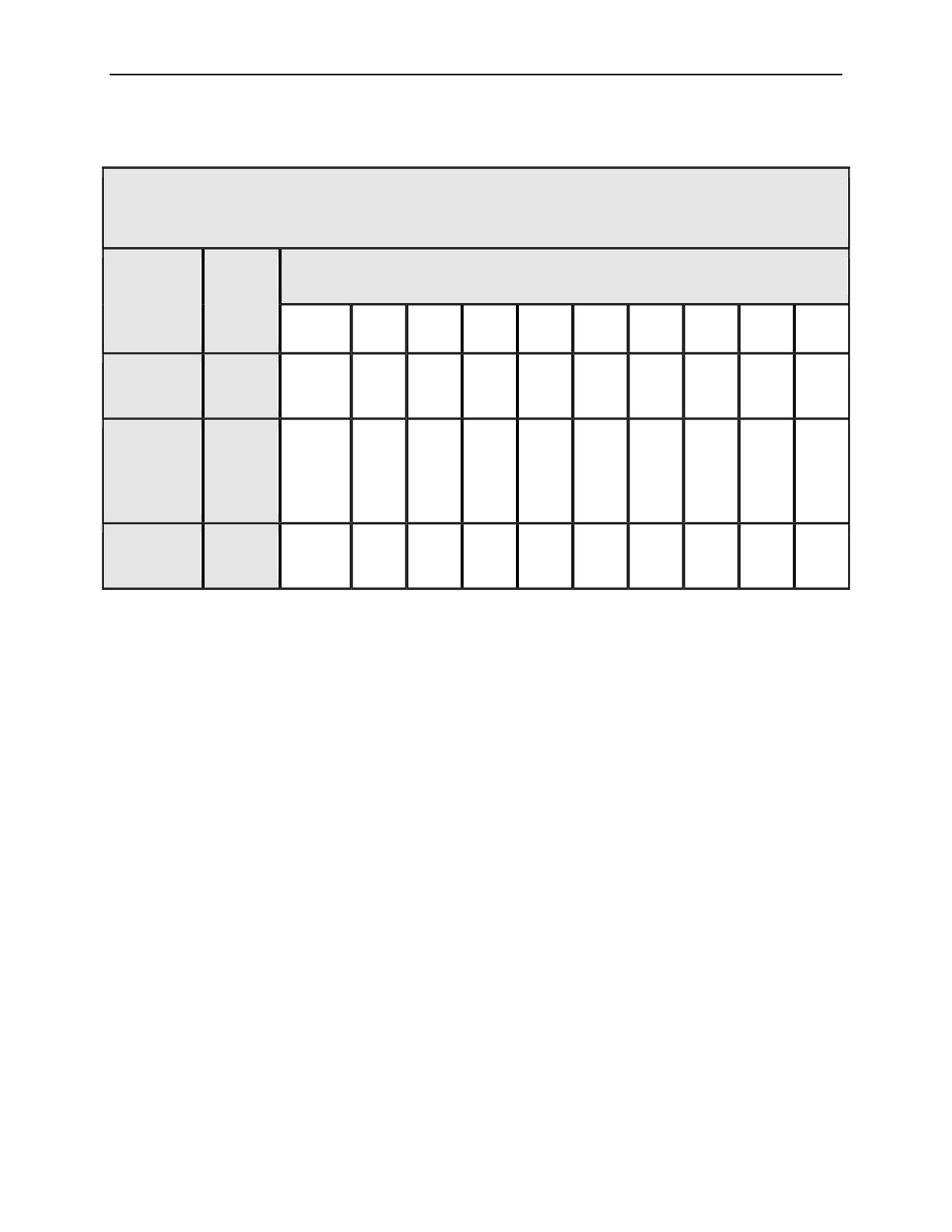
A-39. Required scores for alternate aerobic events are recorded in Table A-1.
Table A-1. Alternate aerobic event standards
ALTERNATE AEROBIC EVENT STANDARDS
AGE
EVENT
GENDER
17-21
22-26
27-31
32-36
37-41
42-46
47-51
52-56
57-61
62+
800-YARD
Men
20:00
20:30
21:00
21:30
22:00
22:30
23:00
24:00
24:30
25:00
SWIM
Women
21:00
21:30
22:00
22:30
23:00
23:30
24:00
25:00
25:30
26:00
6.2-MILE
CYCLE
ERGOMETER
Men
24:00
24:30
25:00
25:30
26:00
27:00
28:00
30:00
31:00
32:00
AND
Women
25:00
25:30
26:00
26:30
27:00
28:00
30:00
32:00
33:00
34:00
BICYCLE
TEST
2.5-MILE
Men
34:00
34:30
35:00
35:30
36:00
36:30
37:00
37:30
38:00
38:30
WALK
Women
37:00
37:30
38:00
38:30
39:00
39:30
40:00
40:30
41:00
41:30
A-40. Soldiers on permanent physical profile are given a DA Form 3349. This form annotates exercises and
activities suitable for the profiled Soldier. The form also stipulates the events and/or alternate aerobic event the
Soldier will do on the APFT. The Soldier must perform all regular APFT events his profile permits. Each
Soldier must score a minimum of 60 points on each regular event taken to PASS. The profiled Soldier must
complete the alternate aerobic event in a time equal to or less than the one listed in Table A-1. The Soldier must
receive a minimum passing score in the alternate event taken to PASS the test. Soldiers profiled for two or more
events must take the two-mile run or an alternate aerobic event to PASS the test. Soldiers who cannot perform
the 2-mile run or an alternate aerobic event cannot be tested. There is no point score annotated on the DA Form
705 for the performance of alternate aerobic events. These events are scored as a GO or NO GO.
A-41. Soldiers with temporary physical profiles must take a regular three event APFT after the profile has
expired. Soldiers with temporary profiles of long duration (more than three months) may take an alternate
aerobic event as determined by the commander with input from health-care personnel. Once the profile has been
lifted, the Soldier must be given twice the length of the profile (not to exceed 90 days) to train for the regular
three event APFT. If a regularly scheduled APFT occurs during the profile period, the Soldier should be given a
mandatory make-up date for the APFT.
800-YARD SWIM TEST
A-42. The 800-yard-swim test measures cardio respiratory
(aerobic) fitness. Administrative and support
requirements for this event are listed below.
EQUIPMENT
A-43. The timer and back-up timer each require a stopwatch and appropriate safety equipment. Event scorers
require a clipboard and black pen.
FACILITIES
A-44. A swimming pool at least 25 yards long and three feet deep is required.
A-12
FM 7-22
26 October 2012
Army Physical Fitness Test (APFT)
PERSONNEL
A-45. One event supervisor, one scorer for every three Soldiers, one timer, one back-up timer, and support
personnel to ensure proper control and safety. The event supervisor will not be an event scorer.
INSTRUCTIONS
A-46. The OIC, the NCOIC, or the event supervisor, must read the following before the 800-yard swim event
(Figure A-7).
"THE 800-YARD SWIM MEASURES YOUR LEVEL OF AEROBIC FITNESS.
YOU WILL BEGIN IN THE WATER; NO DIVING IS ALLOWED. AT THE START, YOUR
BODY MUST BE IN CONTACT WITH THE WALL OF THE POOL. ON THE COMMAND
‘GO’, THE CLOCK WILL START. YOU SHOULD THEN BEGIN SWIMMING AT YOUR
OWN PACE, USING ANY STROKE OR COMBINATION OF STROKES YOU WISH.
YOU MUST SWIM (STATE THE NUMBER) LAPS TO COMPLETE THIS DISTANCE.
YOU MUST TOUCH THE WALL OF THE POOL AT EACH END OF THE POOL AS
YOU TURN. ANY TYPE OF TURN IS AUTHORIZED. YOU WILL BE SCORED ON
YOUR ABILITY TO COMPLETE THE SWIM IN A TIME EQUAL TO, OR LESS THAN,
THAT LISTED FOR YOUR AGE AND GENDER. WALKING ON THE BOTTOM TO
RECUPERATE IS AUTHORIZED. SWIMMING GOGGLES ARE PERMITTED, BUT NO
OTHER EQUIPMENT IS AUTHORIZED.”
Figure A-7. 800-yard swim test narrative
A-47. In conclusion, the OIC/NCOIC, or the event supervisors, asks:
“WHAT ARE YOUR QUESTIONS ABOUT THIS EVENT?”
ADMINISTRATION
A-48. The OIC, the NCOIC, or the event supervisor, will read the instructions aloud and answer questions. The
event supervisor will assign each Soldier to a lane and tell the Soldier to enter the water. He allows for a short
acclimation and preparation period. The event supervisor must be alert to the safety of the Soldiers throughout
the test.
TIMING TECHNIQUES
A-49. When the timer gives the command, “GET SET” the Soldiers position themselves to begin the event.
Time begins when the timer gives the command, “GO.” The timer calls out times in minutes and seconds as
Soldiers near the finish. Time is recorded by the scorer when the Soldier touches the end of the pool or crosses a
predetermined line that establishes the 800-yard mark.
SCORER DUTIES
A-50. Scorers must observe the Soldiers assigned to them. They must ensure that each Soldier touches the
bulkhead (wall) at every turn. The scorer records the time in the time block and circles the GO or NO GO. The
800-yard swim is entered in the alternate event block. Refer to Figure A-11 for scoring this event. If the pool
26 October 2012
FM 7-22
A-13
Appendix A
length is measured in meters, the scorer can convert the exact distance to yards. To convert meters to yards,
multiply the number of meters by 39.37 and divide the product by 36.
6.2-MILE STATIONARY CYCLE ERGOMETER TEST
A-51. The 6.2-mile stationary cycle ergometer test measures cardio respiratory (aerobic) and leg muscle
endurance. Administrative and support requirements for this event follow.
EQUIPMENT
A-52. The event supervisor requires two stopwatches (the timer and back-up timer each require a stopwatch),
FM 7-22, Appendix A, and one stationary cycle ergometer. The ergometer must have mechanically adjustable
resistance measured in kiloponds or newtons and must be available for training and testing. The seat and
handlebars must be adjustable to accommodate Soldiers of different sizes. It should have an adjustable tension
setting (resistance) and an odometer. The resistance is set by a tension strap on a weighted pendulum connected
to the flywheel. The cycle ergometer must be calibrated prior to test administration. Event scorers require a
clipboard and black pen.
FACILITIES
A-53. The test site can be any location (usually a gym) where there is an approved cycle ergometer. The test
station should be two yards wide and four yards deep.
PERSONNEL
A-54. One event supervisor, one scorer for every three Soldiers tested, one timer, one back-up timer, and
support personnel to ensure proper control and safety are required. The event supervisor will not be an event
scorer.
INSTRUCTIONS
A-55. The OIC, the NCOIC, or the event supervisor, must read the following before the 6.2 cycle ergometer test
event (Figure A-8).
"THE 6.2-MILE STATIONARY-CYCLE ERGOMETER EVENT MEASURES YOUR
CARDIO-RESPIRATORY FITNESS AND LEG MUSCLE ENDURANCE. THE
ERGOMETER'S RESISTANCE MUST BE SET AT TWO KILOPOUNDS
(20 NEWTONS). ON THE COMMAND, 'GO', THE CLOCK WILL START, AND YOU
WILL BEGIN PEDALING AT YOUR OWN PACE WHILE MAINTAINING THE
RESISTANCE INDICATOR AT TWO KILOPOUNDS. YOU WILL BE SCORED ON
YOUR ABILITY TO COMPLETE 6.2 MILES (10 KILOMETERS), AS SHOWN ON THE
ODOMETER IN A TIME EQUAL TO OR LESS THAN THAT LISTED FOR YOUR AGE
AND GENDER.”
Figure A-8. 6.2-mile stationary cycle ergometer test narrative
A-14
FM 7-22
26 October 2012
Army Physical Fitness Test (APFT)
A-56. In conclusion, the OIC/NCOIC, or the event supervisors, asks:
“WHAT ARE YOUR QUESTIONS ABOUT THIS EVENT?”
ADMINISTRATION
A-57. The event supervisor will read the instructions aloud and answer questions. He will also allow each
Soldier a short warm-up period and an opportunity to adjust handlebar and seat height.
TIMING TECHNIQUES
A-58. When the timer gives the command, “GET SET” the Soldiers will position themselves to begin the event.
Time begins when the timer gives the command, “GO.” The timer will call out times in minutes and seconds as
Soldiers near the last two-tenths of the test distance. He calls out the time remaining every 30 seconds for the
last two minutes of the allowable time and every second during the last ten seconds.
SCORER DUTIES
A-59. The scorer must observe that the ergometer is functioning correctly. He must then make sure that the
ergometer’s tension settings have been calibrated and are accurate, and that the resistance of the ergometer has
been set at two kiloponds or 20 newtons. The scorer must observe the Soldiers throughout the event. He will
have to make small adjustments to the resistance to ensure that a continuous resistance of exactly 2 kiloponds is
maintained throughout the test. The scorer records the time in the time block and circles the GO or NO GO. The
6.2-mile stationary cycle ergometer is entered in the alternate event block. Refer to Figure A-11 for scoring of
this event.
6.2-MILE BICYCLE TEST
A-60. The 6.2-mile bicycle test measures cardio respiratory (aerobic) and leg muscle endurance. Administrative
and support requirements for this event are listed below.
EQUIPMENT
A-61. The event supervisor requires two stopwatches (the timer and back-up timer each require a watch) and
FM 7-22, Appendix A. One-speed or multispeed bicycles are authorized for use. If a multispeed bike is used,
the event supervisor and/or scorer will take measures to ensure that only one speed is used during the event.
This can be accomplished by taping the gear shifters. The Soldier taking the event sets the speed by selecting
the gear they wish to ride in. Event scorers require a clipboard, numbers, and black pen.
FACILITIES
A-62. A relatively flat course with a uniform surface and no obstacles must be used. The course must be clearly
marked. Quarter-mile tracks are not authorized for use. The Soldiers being tested must be in view of the scorers
at all times. The course should be free of walkers and runners.
PERSONNEL
A-63. One event supervisor, one scorer for every 10 Soldiers tested, one timer, one back-up timer and support
personnel to ensure proper control and safety are required. The event supervisor should not be an event scorer.
26 October 2012
FM 7-22
A-15
Appendix A
INSTRUCTIONS
A-64. The OIC, the NCOIC, or the event supervisor, must read the following before the 6.2 mile bicycle test
event (Figure A-9).
“THE
6.2-MILE BICYCLE TEST MEASURES CARDIO RESPIRATORY
FITNESS AND LEG MUSCLES ENDURANCE. YOU MUST COMPLETE THE
6.2-MILES WITHOUT ANY PHYSICAL HELP FROM OTHERS. YOU MUST KEEP
YOUR BICYCLE IN ONE GEAR OF YOUR CHOOSING FOR THE ENTIRE TEST.
CHANGING GEARS IS NOT PERMITTED AND WILL RESULT IN
DISQUALIFICATION. TO BEGIN, YOU WILL LINE UP BEHIND THE STARTING LINE.
ON THE COMMAND, ‘GO,’ THE CLOCK WILL START, AND YOU WILL BEGIN
PEDALING AT YOUR OWN PACE. TO COMPLETE THE REQUIRED DISTANCE OF
6.2-MILES, YOU MUST COMPLETE (DESCRIBE THE NUMBER OF LAPS, START
AND FINISH POINTS, AND COURSE LAYOUT). YOU WILL BE SCORED ON YOUR
ABILITY TO COMPLETE THE DISTANCE OF 6.2-MILES (10 KILOMETERS) IN A
TIME EQUAL TO OR LESS THAN THAT LISTED FOR YOUR AGE AND GENDER. IF
YOU LEAVE THE DESIGNATED COURSE FOR ANY REASON, YOU WILL BE
DISQUALIFIED.”
Figure A-9. 6.2-mile bicycle test narrative
A-65. In conclusion, the OIC/NCOIC, or the event supervisors, asks:
“WHAT ARE YOUR QUESTIONS ABOUT THIS EVENT?”
ADMINISTRATION
A-66. The OIC, the NCOIC, or the event supervisor, will read the instructions aloud and answer questions. He
then assigns Soldiers to a scorer. Each scorer assigns each Soldier a number and records the Soldier’s number
on their scorecard in the comment block.
TIMING TECHNIQUES
A-67. The event supervisor is the timer. When the timer gives the command, “GET SET” the Soldiers will
position themselves to begin the event. Time begins when the timer gives the command, “GO.” The timer will
call out times in minutes and seconds as Soldiers near the end of the 6.2-mile ride.
SCORER DUTIES
A-68. The scorer records the time in the time block and circles the GO or NO GO. The 6.2-mile-bicycle is
entered in the alternate event block. Refer to Figure A-11 for scoring of this event.
2.5-MILE WALK TEST
A-69. The 2.5-mile-walk test measures cardio respiratory (aerobic) and leg muscle endurance. Administrative
and support requirements for this event follow.
A-16
FM 7-22
26 October 2012
Army Physical Fitness Test (APFT)
EQUIPMENT
A-70. The event supervisor requires two stopwatches (the timer and back-up timer each require a stopwatch).
Event scorers require a clipboard, FM 7-22, Appendix A, numbers, and a black pen.
FACILITIES
A-71. The event uses the same course as the 2-mile run, with the addition of ½ mile added to the 2-mile
distance. The Soldiers being tested must be in view of the scorers at all time.
PERSONNEL
A-72. One event supervisor, one scorer for every three Soldiers tested, one timer, one back-up timer, and
support personnel to ensure proper control and safety are required. The event supervisor will not be an event
scorer.
INSTRUCTIONS
A-73. The OIC, the NCOIC, or the event supervisor, must read the following before the 2.5-mile walk test event
(Figure A-10):
"THE 2.5-MILE WALK MEASURES CARDIO RESPIRATORY FITNESS AND
LEG-MUSCLE ENDURANCE. ON THE COMMAND, ‘GO,’ THE CLOCK WILL START,
AND YOU WILL BEGIN WALKING AT YOUR OWN PACE. YOU MUST COMPLETE
(DESCRIBE THE NUMBER OF LAPS, START AND FINISH POINTS, AND COURSE
LAYOUT). ONE FOOT MUST BE IN CONTACT WITH THE GROUND AT ALL TIMES.
IF YOU BREAK INTO A RUNNING STRIDE AT ANY TIME OR HAVE BOTH FEET OFF
THE GROUND AT THE SAME TIME, YOUR PERFORMANCE IN THE EVENT WILL BE
TERMINATED. YOU WILL BE SCORED ON YOUR ABILITY TO COMPLETE THE
2.5-MILE COURSE IN A TIME EQUAL TO OR LESS THAN THAT LISTED FOR YOUR
AGE AND GENDER.”
Figure A-10. 2.5-mile walk narrative
A-74. In conclusion, the OIC/NCOIC, or the event supervisors, asks:
“WHAT ARE YOUR QUESTIONS ABOUT THIS EVENT?”
ADMINISTRATION
A-75. The OIC, the NCOIC, or the event supervisor, will read the instructions aloud and answer questions. He
then assigns Soldiers to a scorer. Each scorer assigns each Soldier a number and records the Soldier’s number
on their scorecard in the comment block.
TIMING TECHNIQUES
A-76. When the timer gives the command, “GET SET” the Soldiers will position themselves to begin the event.
Time begins when the timer gives the command, “GO.” The timer will call out times in minutes and seconds as
Soldiers near the end of the 2.5-mile walk.
26 October 2012
FM 7-22
A-17
Appendix A
SCORER DUTIES
A-77. Scorers must observe the Soldiers during the entire event and must ensure that the Soldiers maintain a
walking stride. Soldiers that break into any type of running stride will be terminated from the event and will be
a NO GO. The scorer records the time in the time block and circles the GO or NO GO. 2.5-mile walk is entered
in the alternate event block. Refer to figure A-11 for scoring of this event.
DA FORM 705 SAMPLE
A-78. The following is a sample of the Army Physical Training Fitness Test Scorecard that leaders use to test
the physical fitness of their units (Figure A-11, A through F). DA Form 705 can be downloaded from the AKO
My Forms link. Forms can be filled out on screen or by hand. The samples provided are not to be used for
scoring the APFT. Use the scorecard downloaded from AKO for scoring APFT events.
A-18
FM 7-22
26 October 2012
Appendix B
Climbing Bars
This appendix discusses climbing bars required for physical readiness training.
LAYOUT
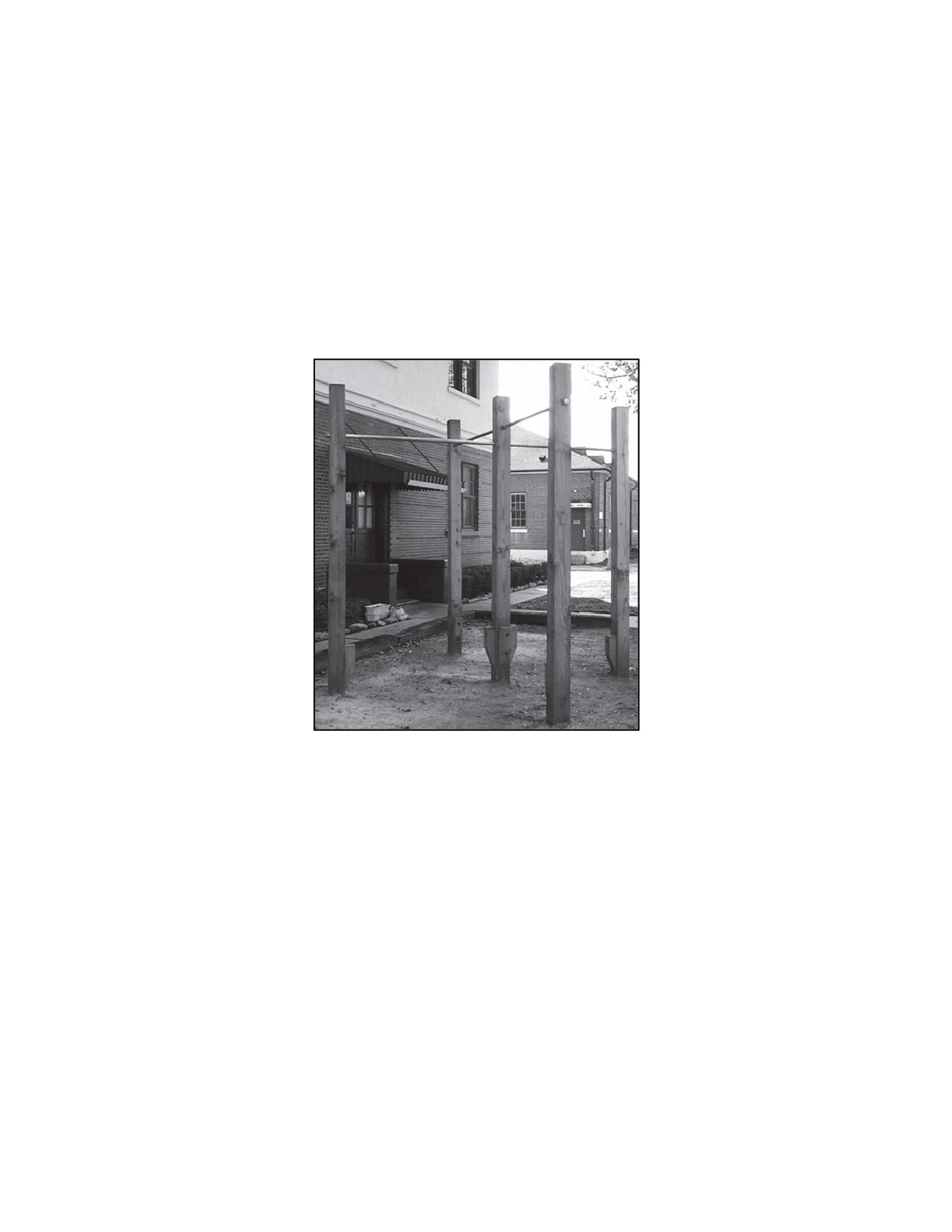
B-1. Figure B-1 shows the climbing bar layout required for toughening and sustaining phase PRT drills.
Figure B-1. Climbing bars
SPECIFICATIONS
B-2. The specifications for the climbing bars follow:
z
Five posts.
Each of the five posts measures 6 inches square by 12 feet long.
Each post is sunk 3 feet into the ground.
z
Two bars.
Each of the two bars is a threaded water pipe.
Each bar measures 1.5 inches outside diameter by 12 feet long.
Each bar has two 1-inch deep end caps.
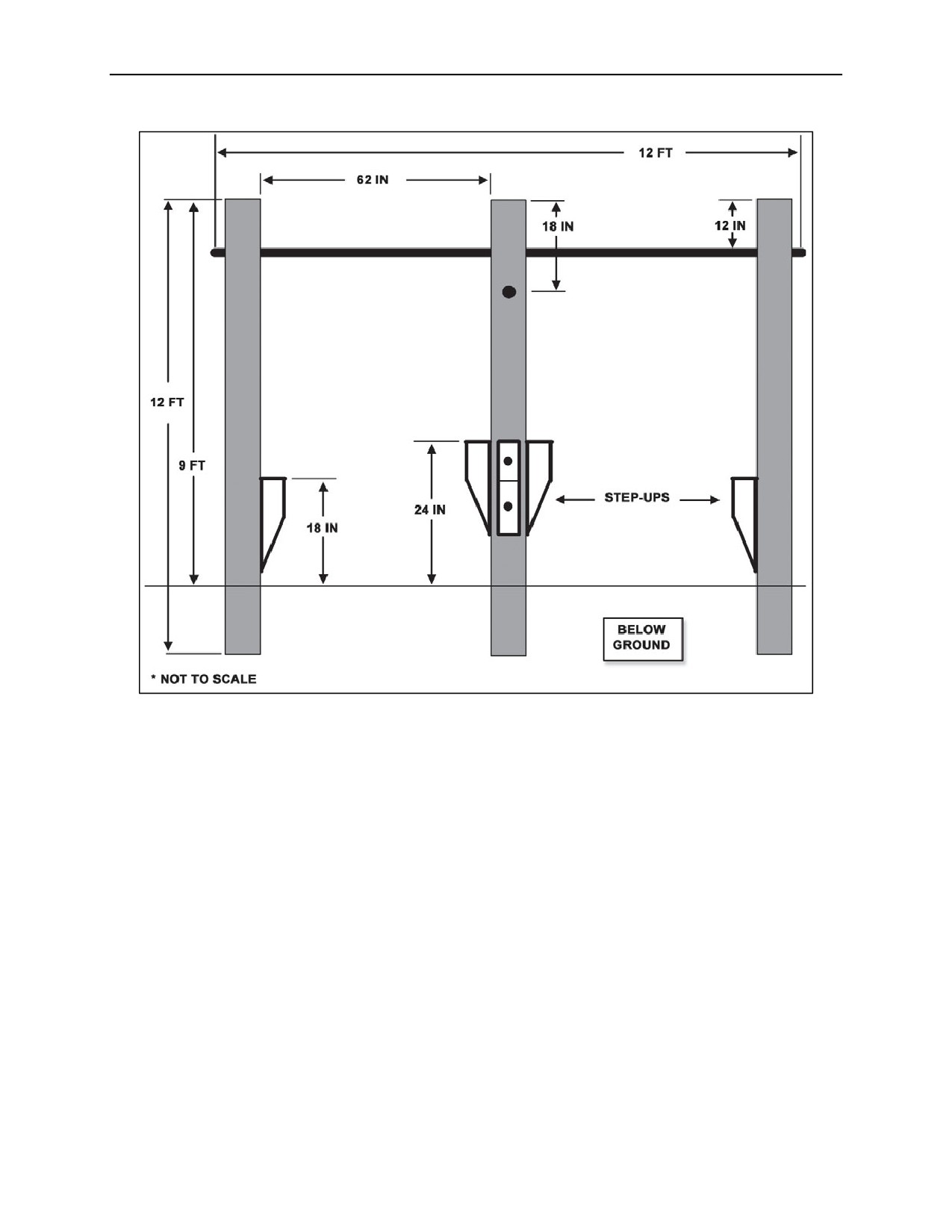
The bars are through the 6 by 6s at 7.5 and 8 feet above the ground.
z
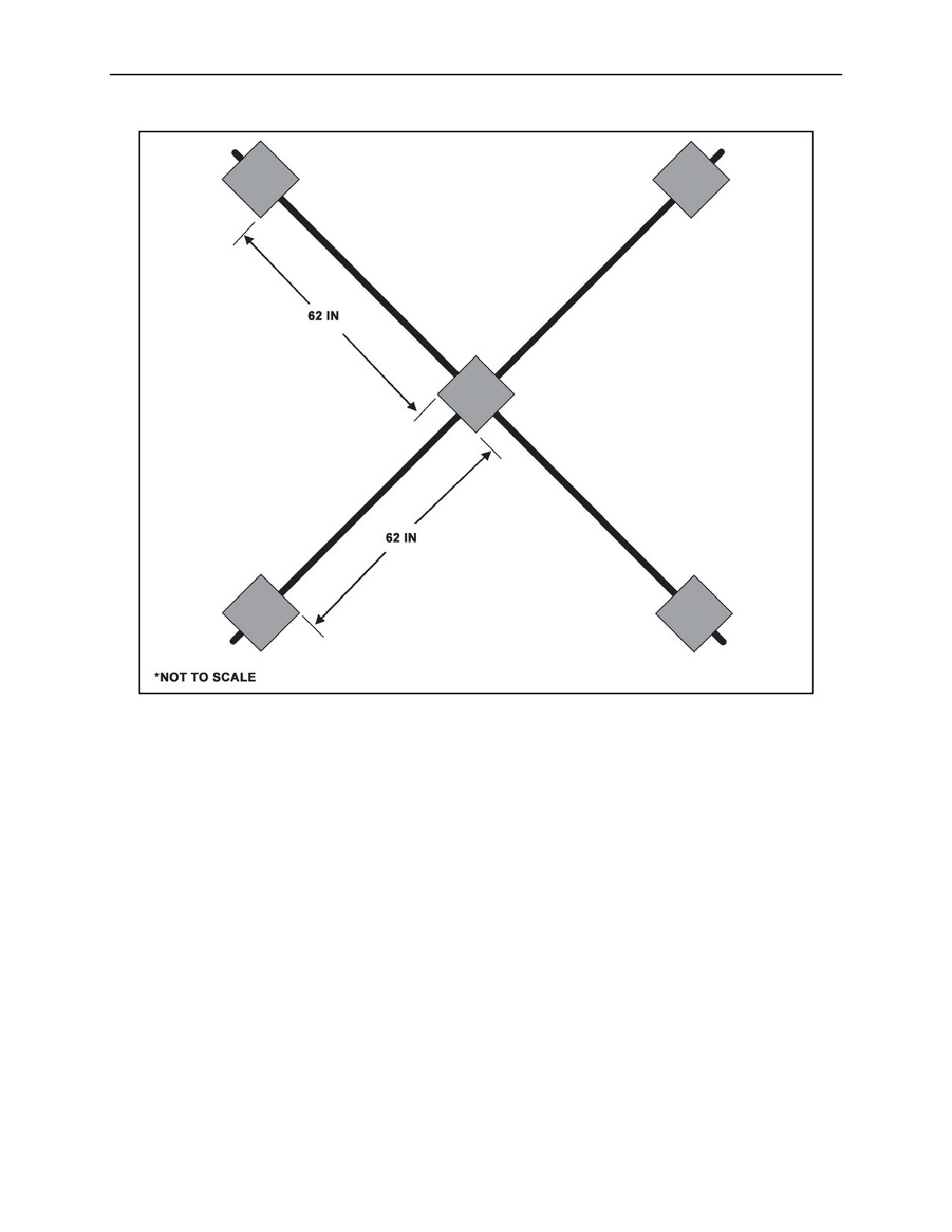
The distance from inside post edge to inside post edge is about 62 inches (Figure B-2). This is to
allow enough bar space to conduct all exercises safely.
z
The step-ups (16 inches long) are cut from 4 by 4 inches by 8-foot posts and secured to the 6 by 6s
with 3-inch screws that are countersunk.
z
The step-ups on the outside 6 by 6 posts are 18 inches from the ground; the step-ups on the inside
post are 24 inches above the ground (Figure B-3).
26 October 2012
FM 7-22
B-1
Appendix B
Figure B-2. Climbing bars, dimensions, top view
B-2
FM 7-22
26 October 2012
Climbing Bars
Figure B-3. Climbing bar dimensions, side view
PLANNING CONSIDERATIONS
B-3. The following planning considerations apply:
z
Climbing bars provide adequate space and facilitate better command and control than traditional
pull-up bars.
z
Traditional pull-up bars are too narrow to safely and efficiently conduct the CLs.
z
Use of multiple climbing bar “pods,” as shown in Figure B-4, allow for efficient mass training.
z
The CLs require one bar for every three Soldiers when performed as a single activity.
z
Total ground surface area for four pods is only 625 square feet.
z
Four pods will accommodate 16 stations of 3 Soldiers per station for a total of 48 Soldiers.
z
Additional freestanding pods should be constructed to accommodate more Soldiers.
26 October 2012
FM 7-22
B-3
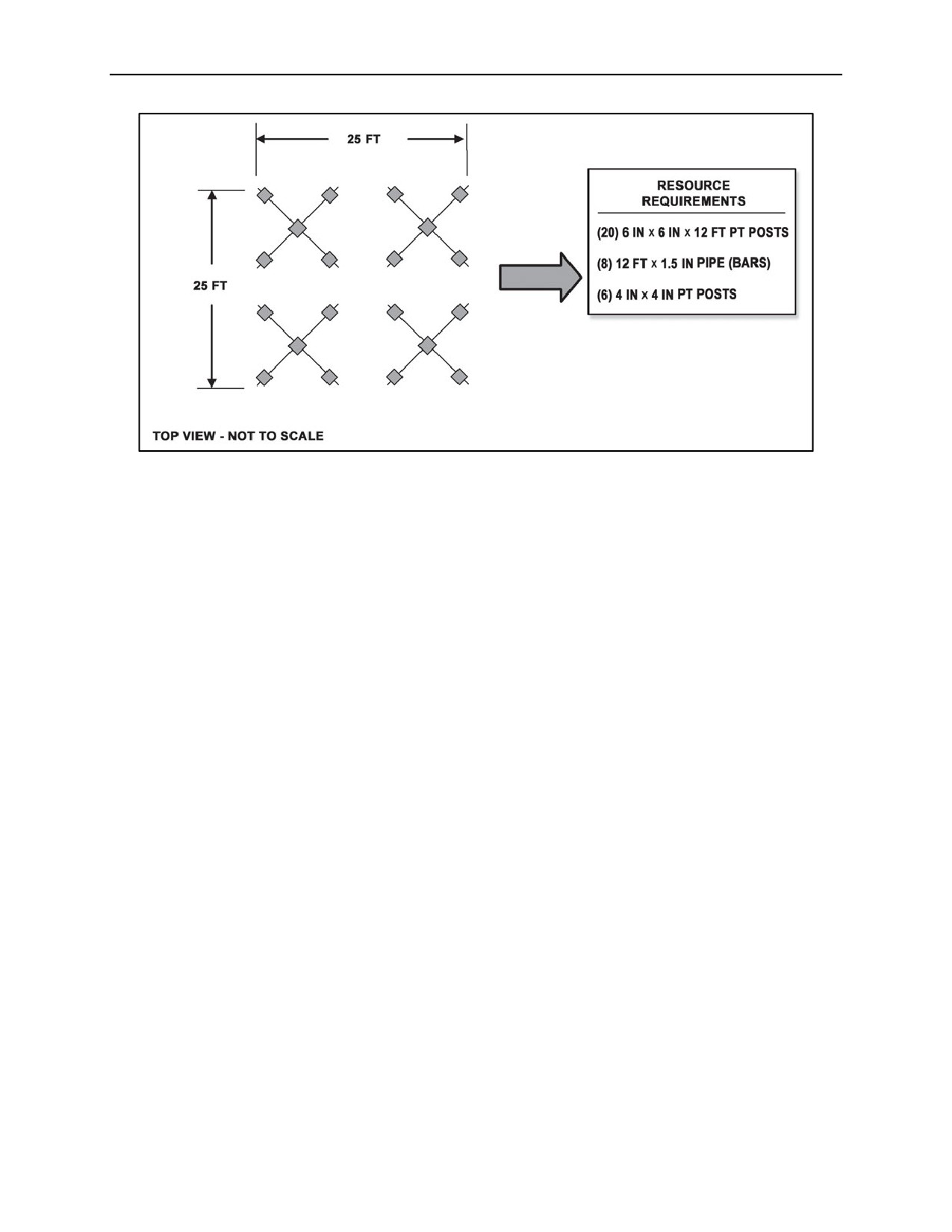
Appendix B
Figure B-4. Multiple climbing bar pods
B-4
FM 7-22
26 October 2012
Appendix C
Posture and Body Mechanics
“Good posture has many values for the Soldier. First, a Soldier is often judged by his
appearance-the man with good posture looks like a good Soldier, he commands attention.
Secondly, it is an accepted psychological fact that good posture is associated with good
morale-a man with good posture feels better and is more positive. A man with poor posture
cannot feel as positive, consequently he may develop a negative and discouraged attitude.
Thirdly, good posture permits the body to function most efficiently.”
FM 21-20, Physical Training (January 1946)
EFFECT OF POSTURE
C-1. Posture and body mechanics are critical factors for Soldier performance, allowing them to move
efficiently with an ability to create great force and absorb heavy resistance. Posture is any position in which the
body resides. It is further defined by the relationship of body segments to one another. Body mechanics is
posture in motion. Though posture is often thought of as a stationary position, control of moving postures is
perhaps even more important in task performance and injury control.
“In the training of anyone, nothing equals the importance of proper posture; it is the very
foundation upon which the entire fabric of a successful course in physical training must be
founded.”
LTC Herman J. Koehler
C-2. When body segments are aligned properly, movement is efficient, and injury risk is minimized. When
body segments are not aligned properly, movement is less efficient and risk of injury is increased. Consider a
Soldier attempting to lift a heavy load from the ground with his legs straight and trunk twisted. Not only will the
load seem heavier than if his knees were bent and his back straight, but he is at risk for injury. The back injury
that occurs during an improper lift is an obvious example of the relationship between posture, body mechanics,
performance, and health. Less obvious, but just as damaging, is the daily stress that takes its toll on the body
when faulty postures are consistently assumed.
EFFECT OF GRAVITY
C-3. Gravity molds body tissues. The body adapts to the stresses placed upon it. Gravity exerts a constant
influence. When body segments are not aligned properly, such as when the head is too far forward, gravity
works to further pull the head forward, placing undue stress on the structures of the neck and upper back. Over
time, the neck adapts to faulty posture and natural neck movements may become restricted. Another example of
this effect is seen among those who allow their shoulders to round forward. Gravity compounds this effect,
limiting overhead range-of-motion as shown in Figure C-1. By simply pulling the shoulders back as shown in
Figure C-2, the arms are free to move fully overhead. To maintain this optimal position, Soldiers need to
regularly stretch the chest muscles that are prone to tightness, and strengthen the upper back muscles that
promote proper carriage of the shoulder girdle. More importantly, they need greater awareness of the manner in
which they carry the shoulder girdle while performing everyday tasks. Rounding of the shoulders is a common
postural problem with many Soldiers, perhaps from emphasizing pushing exercises at the expense of pulling
motions.
26 October 2012
FM 7-22
C-1
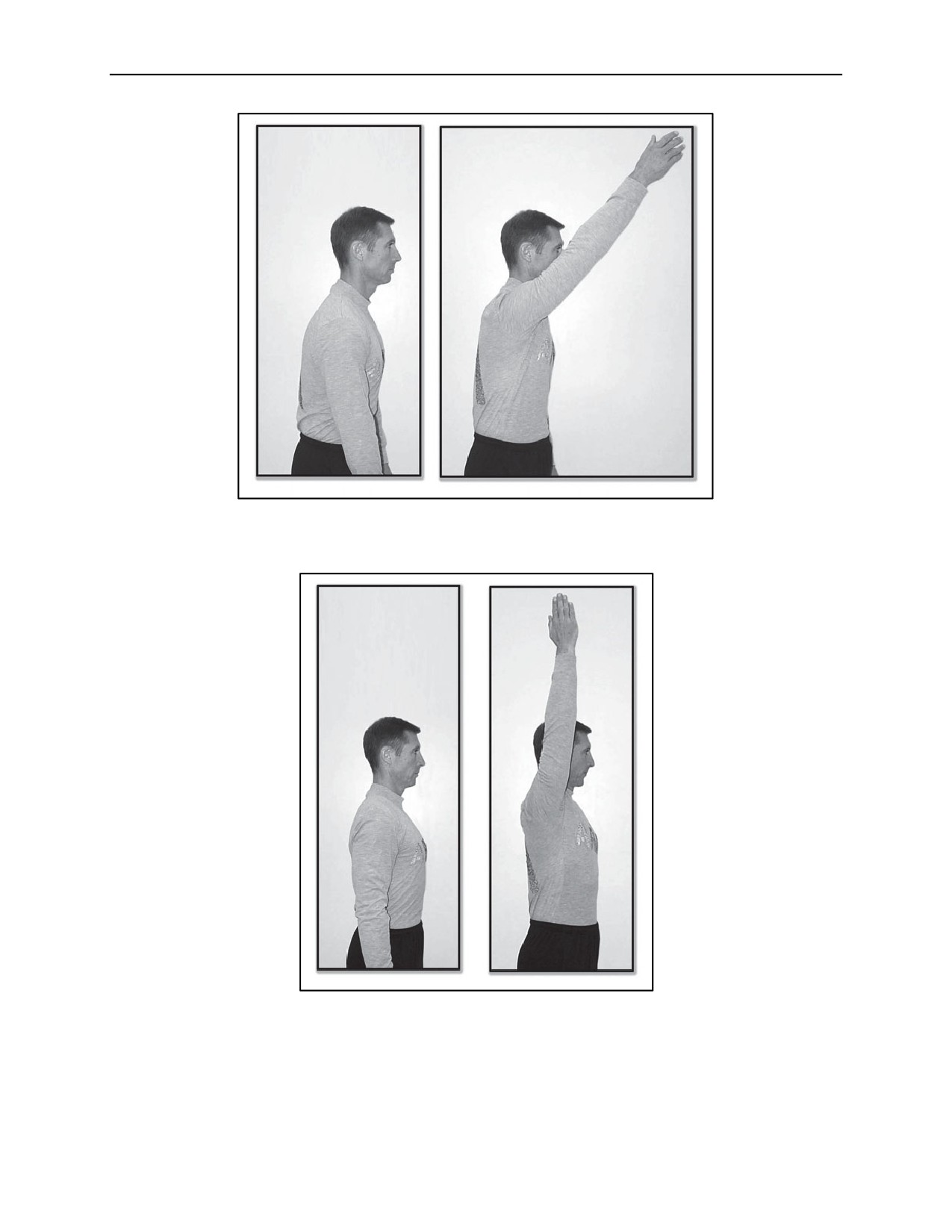
Appendix C
Figure C-1. Poor posture limits range of motion
Figure C-2. Good posture allows better range of motion
EFFECT OF EXERCISE
C-4. Like gravity, exercise also molds body tissues. As previously noted, imbalanced exercise practices may
adversely affect posture. When regularly performed with precision, the exercise drills and activities in this FM
C-2
FM 7-22
26 October 2012