FM 7-21.13 THE SOLDIER’S GUIDE (FEBRUARY 2004) - page 10
FM 7-21.13 ____________________________________________________________
Incoming First Sergeant: At the completion of the Army Song, the Incoming
First Sergeant moves forward to assume command of the unit from the
Senior Platoon Sergeant. After salutes are exchanged, the Incoming First
Sergeant waits until the Senior Platoon Sergeant is in position, executes an
about face, and renders a hand salute to the Company Commander and
reports “Sir, this concludes the ceremony.”
Company Commander: “Take charge of the company.”
Action: Salutes exchanged.
Narrator:
“This concludes the
(unit name) Change of Responsibility
ceremony. Please join us for refreshments in (location), bldg xxxx.”
* While the unit name “Company” is used, substitute as needed for Battery,
Troop or Detachment.
** See inside back cover for the words to the Army Song
C-10
____________________________________________________________ Appendix C
SECTION III - MEMORIAL CEREMONY
C-4. Memorial ceremonies are patriotic tributes to deceased soldiers.
These ceremonies are command-oriented so attendance is often mandatory.
The ceremony is a military function that is not normally conducted in a
chapel. The content of the ceremony may vary depending on the desires of
the commander.
C-5. In most cases, the unit prepares a program that may include a
biographical summary of the deceased soldier with mention of awards and
decorations. The following elements are commonly part of a memorial
ceremony:
• Prelude (often suitable music).
• Posting of the Colors.
• National Anthem.
• Invocation.
• Memorial Tribute (e.g., remarks by unit commander or a friend of the
deceased).
• Scripture Reading.
• Hymn or other special music.
• Meditation (quiet moment for attendees to reflect).
• Benediction.
• Last Roll Call. This is a final tribute paid by soldiers to their fallen
comrade. It has its origin in the accountability roll call conducted by
the unit First Sergeant following combat. Although sometimes
painful to listen through, the Last Roll is called with the conviction
held by soldiers that all unit members will be accounted for, and
none will ever be forgotten.
• Firing of rifle volleys.
• Taps.
C-11
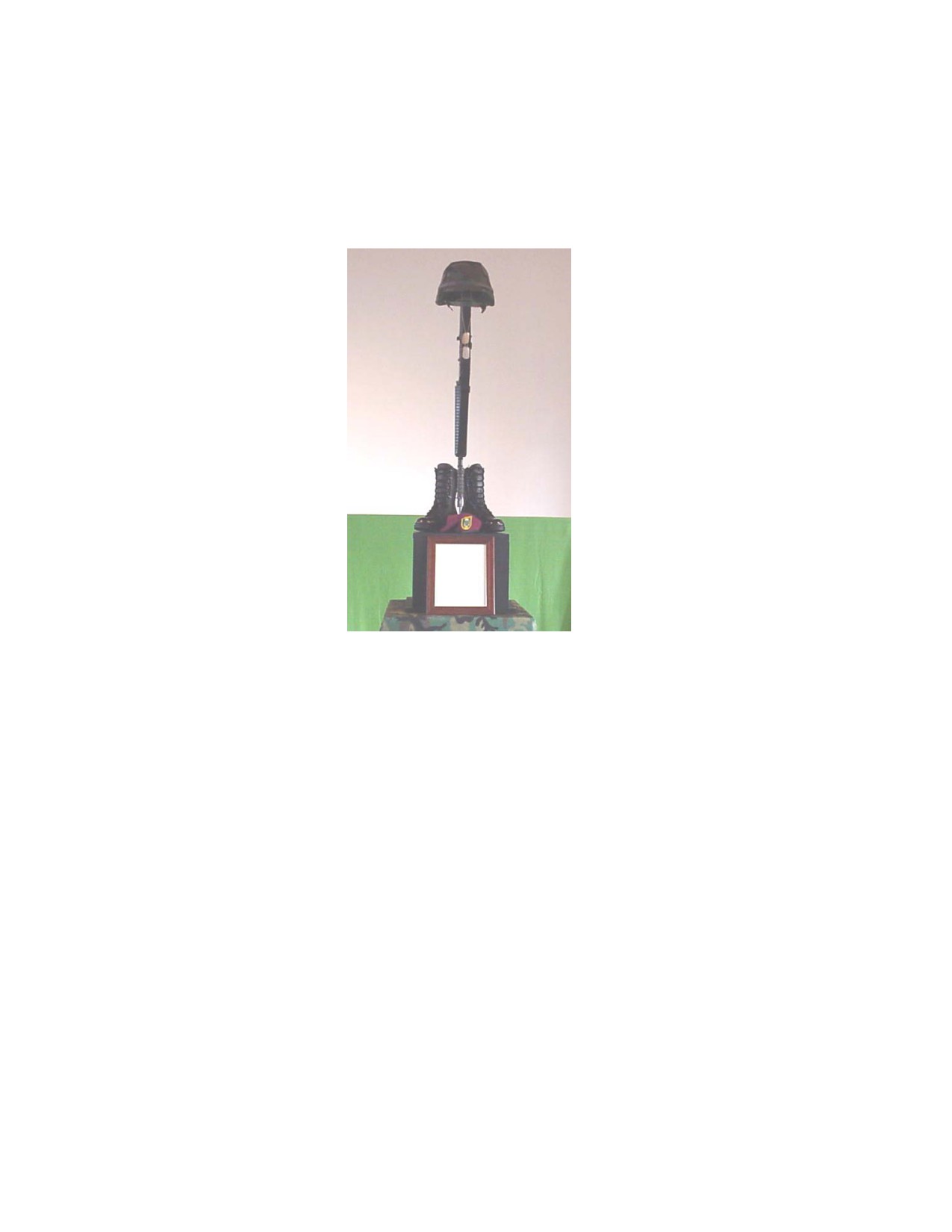
FM 7-21.13 ____________________________________________________________
Photo
Figure C-1. Fallen Soldier Display
C-6. Most units prepare a visible reminder of the deceased soldier similar
to that depicted in Figure C-1. The helmet and identification tags signify
the fallen soldier. The inverted rifle with bayonet signals a time for prayer,
a break in the action to pay tribute to our comrade. The combat boots
represent the final march of the last battle. The beret (in the case of
soldiers from airborne units) reminds us that the soldier has taken part in
his final jump.
C-12
____________________________________________________________ Appendix C
SECTION IV - MILITARY FUNERALS
C-7. Rendering military funeral honors is our Nation’s final tribute to
those who have made personal sacrifices in the service of our country.
Performing duties as part of a funeral detail is a privilege. It a distinct
means of honoring fellow soldiers who have served before us or who have
given their lives in defense of our Nation.
C-8. Since the January
2000 National Defense Act, military funeral
honors are authorized for all active duty soldiers, military retirees, and
honorably discharged veterans by their parent service. For active duty
soldiers and military retirees, honors include firing of rifle volleys,
uniformed soldiers as pallbearers, folding and presentation of the flag to the
next-of-kin, and playing of “Taps” by a bugler or a high quality recording.
For deceased veterans of the Armed Forces, honors rendered may be by a
two-person team to fold and present the flag and a high quality recording of
“Taps.”
The effect of having the Honor Guard perform their solemn
duties with care and precision shows how much we care for
our comrades in arms, as well as for the communities and
families they represent.
MG Robert Ivany
C-9. Army installations, reserve component units, and ROTC
detachments often support funerals of veterans by providing soldiers to
conduct the military honors for those funerals. Field Manual
3-21.5,
Chapter 14 provides a description of how to conduct a military graveside
service. That description shows how to do the service with 14 or more
soldiers. In this section you can find how to conduct the service with 8 or
fewer soldiers. In any case, if you are a member of a funeral detail,
remember this: you are taking part in a service for a deceased veteran and
there are people present who will take comfort in your professional attitude
and performance.
C-10. Many Army installations already have detailed instructions for
conducting military honors at a funeral. This section may be helpful to
soldiers who do not have access to such specific instructions. For every
military funeral, the OIC should contact the funeral director as early as
possible to determine if there will be any variations. At the completion of
the service, the OIC should again contact the funeral director to conduct an
informal after action review. Finally, when the detail returns to home
station, the OIC should AAR the service with the tasking authority.
C-11. For ease in distinguishing a preparatory command from a command
of execution, the commands of execution appear in BOLD CAP letters and
preparatory commands appear in Bold Italic letters. Reference to positions
and movements appear in Italics.
C-13
FM 7-21.13 ____________________________________________________________
8 SOLDIER FUNERAL DETAIL
COMPOSITION OF DETAIL
C-12. The 8 man funeral detail normally consists of an OIC or NCOIC
(depending on the rank of the deceased veteran), an NCOIC of the firing
party, a five or six soldier firing party (who also act as pallbearers) and a
bugler, if available. For this description there is an OIC of the funeral detail
and an NCOIC of the firing party/pallbearers.
DETAIL, WEAPONS ARE IN PLACE
C-13. Weapons are pre-stacked in an appropriate position, in plain view,
and a good distance from the gravesite. The firing party, acting as
pallbearers, is pre-positioned along the roadside; awaiting the arrival of the
hearse. The OIC is located where the hearse will stop.
RECEIVING THE CASKET
C-14. As the hearse approaches, the NCOIC orders the detail to
“ATTENTION” and “Present, ARMS.” Once the hearse has passed the
detail, the NCOIC calls the detail to “Order, ARMS” and “Parade, REST.”
The OIC comes to attention and present arms as the hearse approaches his
position. The OIC terminates his salute when the hearse comes to a halt.
C-15. After the vehicle has come to a halt, the driver gets out and opens the
rear door. The driver prepares the casket for movement to the gravesite by
removing the stock. The driver pulls the casket to the rear of the hearse.
The OIC, with a nod of his head, signals the NCOIC to move the pallbearers
to the end of the hearse, three on each side, to remove the casket. The
NCOIC marches the pallbearers into place, then orders
“Mark time,
MARCH;” “Detail, HALT” and “Center, FACE.” After the pallbearers are
facing inward, the individuals closest to the casket will grasp the handrails
and pull the casket from the hearse. Each pallbearer, in turn, grasps a
casket handle as it reaches him. The OIC will render a hand salute while
the casket is being removed.
Moving the Casket
C-16. On the NCOIC’s command of “Ready, FACE,” the pallbearers will
execute the appropriate facing movements so that they are all facing the
feet of the casket. The NCOIC orders the detail to “Forward, MARCH.” Led
by the OIC, the pallbearers incline to the proper direction to move to the
gravesite, ensuring the casket is level and feet first. Once the casket is over
the gravesite, the NCOIC commands “Mark Time, MARCH,” and “Detail,
HALT.” Once at the head of the gravesite, the OIC will come to render a
hand salute until the casket is placed on the lowering device. To maintain
uniformity the pallbearer NCOIC will command “Center, FACE.” When
pallbearers are facing center, the casket is set on the lowering device. After
the casket is set down, the pallbearers come to attention and the OIC will
drop his hand salute.
C-14
____________________________________________________________ Appendix C
MOVING TO THE WEAPONS
C-17. On the command “Ready, FACE,” by the pallbearer NCOIC, the
pallbearers all face toward the head of the casket. The next command is
“Forward, MARCH.” The pallbearers move from the gravesite to the
location of the weapons. Just prior to reaching the stacked arms, the firing
party NCOIC, and formerly the pallbearer NCOIC, gives “Mark Time,
MARCH” and “Detail, HALT.” The firing party NCOIC assumes their
position and gives a “File from the Left, Forward, MARCH.” On the
command “March” the firing party performs the proper movements to form
a single file to the rear of the weapons. When the firing party are to the
rear of the stacked arms, the NCOIC gives “Mark Time, MARCH” and
“Detail HALT,” and the appropriate facing movement to face the rifles.
Retrieving the Weapons and Conclusion of Religious Services
C-18. The next command given is “Take, ARMS.” On the command of
execution, the stack man secures the first two weapons. The left and right
soldiers receive the weapons from the stack man. The left and right soldiers
then pass the weapons to the outside soldiers. The stack man grasps his
center weapon. The left and right soldiers step toward the stack and remove
their weapons, returning to the position of Attention. Once the left and
right soldiers retrieve their weapons, the stack man secures his weapon and
comes to the position of Attention. Once all of the firing party is at Order
Arms, the firing party NCOIC gives them “Parade, REST.” The firing party
will remain at Parade Rest until the end of the religious services. Once the
religious services are over, the Chaplain steps away from the casket. The
OIC steps to the head of the casket and renders a hand salute. This is the
signal for the firing party NCOIC to command the firing party
“ATTENTION.”
Firing of Honors
C-19. After bringing the firing party to Attention, the NCOIC gives the
command of “Ready.” At the command of Ready, each rifleman executes
Port Arms, faces Half Right, and moves his right foot to the right ten
inches. Each rifleman then chambers a round, places his weapon on Fire,
and resumes Port Arms. When the firing party has completed the
movements, the firing party NCOIC gives the command “Aim.” On the
command of Aim, the detail shoulders their weapons with the muzzles of
the weapons at a 45-degree angle from the horizontal. When the NCOIC
commands “FIRE,” the detail fires and returns to Port Arms. On the
subsequent commands of “Ready,” each rifleman pulls and returns the
charging handle of his weapon. After the third round is fired each rifleman
resumes Port Arms, and the firing party NCOIC commands “CEASE
FIRE.” Each rifleman places his weapon on Safe, resumes the position of
Order Arms, and faces Half Left. The firing party NCOIC then commands
“Present, ARMS” for the playing of “Taps”. The bugler plays “Taps.” If a
bugler is not available, one soldier is positioned to turn on the high quality
recording (and is not part of the firing party).
C-15
FM 7-21.13 ____________________________________________________________
STACKING ARMS
C-20. After “Taps”, the NCOIC brings the firing party to “Order, ARMS,”
and then commands “Stack, ARMS.” On the command of execution, Arms,
the stack man grasps the barrel of his rifle and places his rifle directly in
front of him. At the same time, the left and right soldiers grasp the barrels
of their respective rifles, step toward the center and insert the muzzles
through the sling loop of the stack man’s weapon. Both soldiers swing the
butts of their rifles out and then down to the ground ensuring the stack is
steady. The two outside weapons are then passed to the stack man, who
adds them to the stack.
RETURNING TO GRAVESITE OR SHELTER
C-21. After Stack Arms is complete, the NCOIC moves the firing party two
steps backward and gives the appropriate facing movement to have the
firing party move back to the gravesite. From this position, the NCOIC will
form the firing party in two columns by giving the command “Column of
Two to the Right, MARCH.” Once in Column of Two formation, the NCOIC
takes the last position, and gives “Forward, MARCH.” The firing party
marches to the gravesite along either side of the casket. Once at the
gravesite the NCOIC gives “Mark Time, MARCH,” and “Detail, HALT.” The
NCOIC gives “Center, FACE,” to ensure that all of the pallbearers are
facing the casket.
FOLDING THE FLAG
C-22. After the pallbearers have faced the casket, they use their peripheral
vision to take their cues from the NCOIC. As a unit, the pallbearers reach
down and secure the flag. Once flag is secured, the detail folds flag. The flag
is first folded with the lower stripe area over the blue field. It is then folded
so that the folded edge meets the open edge. The triangular fold is started
at the striped end and is continued until only the blue field remains. The
flag margin is then tucked in and the flag is ready for presentation.
PRESENTING THE FLAG.
C-23. After the flag has been folded, it is passed down to the soldier closest
to the right side of the OIC. This soldier executes a Half Left as the OIC
executes a Half Right and the flag is then passed to the OIC at, chest level.
After the pallbearer has passed the flag, he salutes the flag for three
seconds then executes Order Arms. The soldier executes a Half Right as the
OIC executes a Half Left and resumes their original position. At this time
the pallbearers will leave the gravesite. The NCOIC commands “Outward,
FACE,” (pallbearers face towards the head of the casket) and “Forward,
MARCH.” Once the detail is out of the area, the OIC will present the flag to
the next of kin or Chaplain, it next of kin is not available. The OIC recites
the following passage:
C-16
____________________________________________________________ Appendix C
“Ma’am (sir), this flag is presented on behalf of a grateful
nation and the United States Army as a token of
appreciation for your loved one's honorable and faithful
service.”
C-24. At the conclusion of the remarks and presentation, the OIC will
render a hand salute and hold the salute for three seconds then assumes
Order, Arms. OIC then executes marching movement and marches back
towards the direction of the pallbearers.
CONCLUDING THE CEREMONY
C-25. The firing party returns to the location of the stacked arms in the
same manner as before. When commanded to “Take, ARMS,” the party
retrieves the rifles in the same manner as before. After retrieving the
weapons, the NCOIC marches the detail away from the funeral site to clear
and inspect the weapons. The firing party will police all of the brass after
the service is over and the next of kin have left the area. The OIC is not
required to escort the next of kin back to his/her vehicle.
2 SOLDIER FUNERAL DETAIL
RECEIVING THE CASKET
C-26. The OIC is located where the hearse will stop. The NCO is to the left
of the OIC. As the hearse approaches, the OIC brings himself and the NCO
to “ATTENTION” and “Present, ARMS.” The OIC gives the command of
“Order, ARMS,” after the hearse has come to a halt. The funeral director is
responsible for removing the casket from the hearse and placing it on the
lowering device at the gravesite. When the casket is being removed from
the hearse, the OIC commands “Present, ARMS.” Once the casket has
cleared the peripheral vision of the OIC, then the OIC commands “Order,
ARMS,” and “Parade, REST.”
CONCLUSION OF RELIGIOUS SERVICES
C-27. Once the religious services are over, the Chaplain steps away from
the casket. The OIC commands
“ATTENTION.” The OIC commands
“Ready, FACE,” and the OIC and NCO face in the direction of the casket.
OIC then commands “Forward, MARCH,” The OIC marches to the head of
the casket, and faces the head of the casket, while the NCO marches to the
foot of the casket facing the OIC. If a bugler is not available, the NCO
moves to the device that will play the high quality recording of “Taps.”
FOLDING THE FLAG
C-28. The OIC gives the command to the NCO to secure flag. Once the flag
is secure the bugler will play “Taps” and both the OIC and NCO execute
Present, Arms. When “Taps” is complete, both the OIC and NCO execute
Order, Arms. The OIC gives the command to side step march (just far
enough to preclude the flag from touching the casket). Once the OIC and
NCO have cleared the casket the OIC nods to begin folding the flag. NOTE:
If a bugler is not available, once the casket is on the lowering device, the
C-17
FM 7-21.13 ____________________________________________________________
NCOIC will march to the recording device and wait for the Chaplain to
conclude religious services. He will play “Taps” after the OIC is positioned
at the head of the casket. When “Taps” is complete, the NCOIC will march
to the foot of the casket and then assist in folding the flag.
C-29. The flag is first folded with the lower stripe area over the blue field.
It is then folded so that the folded edge meets the open edge. The triangular
fold is started at the striped end and is continued until only the blue field
remains. While folding the flag the NCO moves towards the OIC. The flag
margin is then tucked in by the OIC and the NCO presents the flag to the
OIC. Once the NCO presents the flag to the OIC, the NCO renders the hand
salute and holds the salute for three seconds then executes Order, Arms.
The OIC is ready for presenting the flag to the next of kin.
PRESENTING THE FLAG
C-30. After the flag has been folded and passed to the OIC, the OIC then
moves in the direction of the next of kin and presents the flag to the next of
kin while the NCO marches away from the gravesite. The OIC will present
the flag to the Chaplain if the next of kin is not available. The OIC recites
the following passage:
“Ma’am (sir), this flag is presented on behalf of a grateful
nation and the United States Army as a token of
appreciation for your loved one's honorable and faithful
service.”
C-31. At the conclusion of the passage and the flag presentation, the OIC
will render a hand salute and hold the salute for three seconds then
assumes Order, Arms. OIC then executes a marching movement and
marches away from the gravesite.
CONCLUDING THE CEREMONY
C-32. The OIC is not required to escort the next of kin back to his/her
vehicle.
NOTES
C-33. The meaning of the word gravesite also includes a committal shelter.
The meaning of the word casket also includes a receptacle containing the
cremated remains of the deceased. On windy days, the flag should already
be anchored to the casket by the funeral director. If the flag is not secured,
the detail will fold the flag immediately after placing the casket on the
lowering device, then hand the flag to the OIC.
OTHER CEREMONIES
C-34. NCO Induction Ceremony
- See FM
7-22.7, The Army
Noncommissioned Officer Guide, 23 Dec 2002, Appendix F.
C-18
____________________________________________________________ Appendix C
C-35. Retirement Ceremony
- Most installations conduct retirement
ceremonies, see your installation DPTMS for details.
C-36. Farewell Ceremony (for deploying units) - Most installations conduct
ceremonies to “send off” deploying units, see your installation DPTMS for
details.
C-37. Welcome Home Ceremony (for returning units) - Most installations
conduct ceremonies to welcome units back from deployments. These
ceremonies often include participation from the civilian community around
the installation. See your installation DPTMS for details.
C-19
FM 7-21.13 ____________________________________________________________
C-20
Appendix D
Internet Resources
D-1. The Internet is a remarkable conduit to a vast storehouse of
knowledge. Through the Internet, soldiers can, for example, find out how
where the housing office is at Fort Carson, study for a Soldier of the Month
Board, or “chat” with other maintenance soldiers in the Republic of Korea.
The potential is obvious: soldiers can access and share knowledge, lessons
learned and other important information in moments.
D-2. Some helpful websites are categorized as the following: General,
Leadership, Assistance, Personnel, Training, History, News and Unit sites.
Site addresses on the Internet often change without warning, but you can
link to most of these sites through the Army Homepage or Army Knowledge
Online.
GENERAL
Army Knowledge Online - www.us.army.mil
* Get your Army-wide email account here.
US Army homepage - www.army.mil
* The Army Homepage links to nearly every other official Army site.
Army National Guard homepage - www.arng.army.mil
Army Reserve homepage - www.army.mil/usar
Reimer Digital Library — www.adtdl.army.mil
* The Digital Library has electronic versions of most FMs, TCs, and
other training documents for online viewing or download.
US Army Publishing Agency - www.usapa.army.mil
* Find ARs, DAPAMs and other Army administrative publications.
Army Values - www.dtic.mil/armylink/graphics/values.html
Army Vision - www.army.mil/vision
Army Transformation - www.lewis.army.mil/transformation
Worldwide Locator - www.erec.army.mil
* Find active and reserve soldiers around the world.
LEADERSHIP
The Army Leadership homepage - www.leadership.army.mil
The Army Counseling homepage - www.counseling.army.mil
US Army Sergeants Major Academy - usasma.bliss.army.mil
* Find information on NCO matters, The NCO Journal Online and
information on NCO Academies.
ASSISTANCE
Army and Air Force Exchange Service - www.aafes.com
Army Career and Alumni Program - www.acap.army.mil
Army Emergency Relief - www.aerhq.org
Education - www.armyeducation.army.mil
D-1
FM 7-21.13 ____________________________________________________________
Employer Support of the Guard and Reserve - www.esgr.org
Delta Dental - www.deltadental.com
GI Bill - www.gibill.va.gov
Health Promotion and Wellness - www.hooah4health.com
Mobilization - www.defenselink.mil/ra/mobil
Morale, Welfare and Recreation - www.armymwr.com
Tricare - www.tricare.osd.mil
PERSONNEL
Assignments - https://www.hrc.army.mil
Career Management (AC) - https://www.hrc.army.mil
Career Management (RC) - https://www.2xcitizen.usar.army.mil
Department of Veterans Affairs - www.va.gov
Enlisted Records and Evaluation Center - www.erec.army.mil
Official Military personnel File (OMPF) - https://ompf.hoffman.army.mil
Pay Chart - www.dfas.mil/money/milpay/pay
Pay Issues - https://mypay.dfas.mil/mypay.asp
Promotions (AC) - https://www.hrc.army.mil/select/Promo.htm
Promotions (RC) - https://www.2xcitizen.usar.army.mil/soldierservices
Retirement Services - www.armyg1.army.mil
TRAINING
NCO Academies - https://www.hrc.army.mil/epncoes/ncoalink.htm
Battle Command Training Program - bctp.leavenworth.army.mil
Combat Maneuver Training Center - www.cmtc.7atc.army.mil
Joint Readiness Training Center - www.jrtc-polk.army.mil
National Training Center - www.irwin.army.mil
Center for Army Lessons Learned - call.army.mil
HISTORY
Army Center for Military History - www.army.mil/cmh-pg
Medal of Honor Society - www.cmohs.org
Military History Institute - carlisle-www.army.mil/usamhi
NEWS
Army News - www.dtic.mil/armylink
Army Newswatch - www.army.mil/newswatch.htm
Soldiers Radio and TV - www.army.mil/videos
Defense News - www.defenselink.mil
Early Bird News - ebird.dtic.mil
UNIT SITES
US Army Training and Doctrine Command - www.tradoc.army.mil
US Army Forces Command - www.forscom.army.mil
US Army Pacific Command - www.usarpac.army.mil
US Army Southern Command - www.usarso.army.mil
US Army, Europe - www.hqusareur.army.mil
D-2
____________________________________________________________ Appendix D
Eighth US Army - 8tharmy.korea.army.mil
US Army Special Operations Command - www.soc.mil
US Army Combined Arms Command - www.leavenworth.army.mil
US Army Combined Arms Support Command - www.cascom.army.mil
US Army Forces Central Command - www.arcent.army.mil
US Army Medical Command (MEDCOM) - www.armymedicine.army.mil
US Army Corps of Engineers - www.usace.army.mil
Military Traffic Management Command - www.mtmc.army.mil
I Corps - www.lewis.army.mil
III Corps - pao.hood.army.mil
V Corps - www.vcorps.army.mil
XVIII Airborne Corps - www.bragg.army.mil/18abn/default.htm
You can find most unit websites through the Army Homepage or Army
Knowledge Online (AKO).
D-3
FM 7-21.13 ____________________________________________________________
D-4
Appendix E
Professional Reading
E-1. Professional development, particularly self-development, requires
reading. In addition to TMs, FMs, regulations or training circulars, it is
worthwhile to read about our profession from the perspective of the many
great soldiers who came before us.
E-2. In June 2000, US Army Chief of Staff General Eric K. Shinseki
released a reading list to help soldiers further develop confidence, military
knowledge, habits of reflection, and intellectual growth, whether they are
officers, NCOs, or junior enlisted soldiers. The books on this list are
designed to provoke critical thinking concerning the profession of soldiering
and the unique role of our Army. There are works here that address issues
and challenges relevant to each of us, from private to general. This list
includes books that examine the past and those that consider the future.
These readings deepen our understanding of the Army's values and
traditions, the human face of battle, and the future's potential to transform
the profession of arms in the 21st Century.
BOOKS APPROPRIATE FOR JUNIOR ENLISTED SOLDIERS
AND JUNIOR NCOS
E-3. Band of Brothers: E Company, 506th Regiment, 101st Airborne from
Normandy to Hitler's Eagle's Nest. Stephen E. Ambrose, Touchstone Books,
New York, 1993. During World War II, Easy Company was a world-class
rifle company. Its soldiers fought on D-Day, in Arnhem, Bastogne and the
Bulge; they spearheaded the Rhine offensive, took possession of Adolf
Hitler's Eagle's Nest in Berchtesgaden, sustaining 150 percent casualties
along the way. Band of Brothers is an absorbing account of some of E
Company's most critical moments, providing insight into the lives of regular
soldiers and their commanders. The book is based on interviews with
survivors and soldiers' journals and letters.
E-4. The Long Gray Line. Rick Atkinson, Owl Books, New York, 1999.
The Long Gray Line follows the 1966 West Point class through its 25-year
journey from graduation to Vietnam into the difficulties of the peace that
followed. The Class lived during an extraordinary time in US history, and
Rick Atkinson speaks poignantly for a generation of people, such as
Douglas MacArthur and William Westmoreland, who dealt with that era's
turmoil, tragedy and disillusionment.
E-5. The Greatest Generation. Tom Brokaw, Random House, New York,
1998. Tom Brokaw tells the story of what he proclaims "the greatest
generation" through individual stories of people who came of age during the
Great Depression and World War II. These people were united by the
common values of duty, honor, economy, courage, service, love of family and
country and, most of all, responsibility for themselves. Brokaw introduces
E-1
FM 7-21.13 ____________________________________________________________
people who persevered through the Depression, then war, then went on to
create the United States as we now know it.
E-6. This Kind of War: The Classic Korean War History. T. R.
Fehrenbach, Brassey's, Dulles, VA, 2000. This book is a classic study in the
consequences an army faces when it enters a war unprepared. Fehrenbach
examines the challenges of maintaining a professional military force at
odds with the society it is intended to defend. With the authority of
personal experience, Fehrenbach describes battles and soldiers' hardships
during the Korean War, foretelling with eerie accuracy some of the
problems the US would face in Vietnam. In a human, realistic, concise
manner, Fehrenback provides timeless insight about the US volunteer
military.
E-7. America's First Battles: 1776-1965. Charles E. Heller and William A.
Stofft, University Press of Kansas, Lawrence, 1986. The eleven essays in
this book focus on the US Army's transition from the parade field to the
battlefield during every war in which it has fought. Through careful
analysis of organization, training and doctrine, each essay details strengths
and weaknesses evidenced by the outcome of each war's first significant
engagement. America's First Battles gives a novel, intellectually
challenging view of how the United States has prepared for war, developed
tactics and conducted operations.
E-8. A Concise History of the US Army: 225 Years of Service. David W.
Hogan Jr., Center of Military History, US Army, Washington, DC, 2000. In
this pamphlet David W. Hogan Jr., traces the US Army's proud 225-year
history during the rise of the United States as a nation, detailing the
Army's important contributions throughout US history.
E-9. The Face of Battle. John Keegan, Viking Press, New York, 1995.
John Keegan, a senior instructor at Sandhurst, the British Military
Academy, tries to answer the question: "What is it like to be in battle?" He
examines the battles of Agincourt in 1415, Waterloo in 1815 and the Somme
in 1916, comparing and contrasting various battlefield aspects, from hand-
to-hand combat to the long-distance, impersonal destruction of faceless men
in the industrial age.
E-10. We Were Soldiers Once…and Young: Ia Drang - The Battle That
Changed the War in Vietnam. Lieutenant General (LTG) Harold G. Moore
and Joeseph L. Galloway, Harper Perennial, New York, 1992. This book is a
detailed account of the
1965 Ia Drang Valley Battle that marked the
beginning of the massive ground war in Vietnam. As a lieutenant colonel,
Harold G. Moore was the battalion commander who led the fight; Joseph L.
Galloway was the journalist who accompanied Moore. From their
experiences and first-hand accounts, including those of North Vietnamese
commanders, they produced this chronicle of the 1st Battalion, 7th Cavalry.
The book is a vivid portrait of sacrifice, perseverance and courage.
E-11. Once An Eagle. Anton Myrer, Harper Collins, New York, 2000. This
gripping novel portrays the life of one special soldier, Sam Damon, and his
adversary Courtney Massengale. Damon is the consummate professional
E-2
____________________________________________________________ Appendix E
soldier, decorated in both world wars, who puts duty, honor, and soldiers
above self-interest. Massengale, the ultimate political animal, disdains the
average grunt while advancing his career by making inroads into
Washington's powerful elite. Once An Eagle is more than a chronicle of US
warfare in the 20th century; it is a study in character and the values the
US Army continues to cherish: courage, nobility, honesty and selflessness.
E-12. The Killer Angels. Michael Shaara, Ballantine Books, New York,
1974. The four days of the Battle of Gettysburg were the four bloodiest,
most courageous days in the Nation's history. Michael Shaara recreates the
battle in stunning detail. But the true brilliance of this historical novel is
its insight into what the war meant. Two armies fought for two dreams: one
for freedom, the other for a way of life. This book reveals the compassion of
the men who led the Civil War armies, making their decisions
understandable and even more admirable in the face of the confusion and
panic they endured during battle.
BOOKS APPROPRIATE FOR COMPANY GRADE OFFICERS,
WO1-CW3, AND COMPANY CADRE NCOS
E-13. Citizen Soldiers. Stephen Ambrose, Simon & Schuster, New York,
1997. A broad look at the American campaign on the Western Front in WW
II. The author considers every level of war, from strategy discussions of
generals, to the tactics employed by junior officers, and the life of the
combat soldier "on the ground." The dominant theme is that the "citizen
soldiers" were called from peaceful pursuits of civilian life and matched
against the fanaticism of the Third Reich, successfully. Readers gain an
appreciation of the magnitude of the victory in Europe as soldiers exercise
the utmost in leadership, courage, and innovation. The story is told mainly
through a series of vignettes outlining the experiences of junior officers and
NCOs. The book should serve any leader well as he or she prepares for the
realities of warfare in a democratic society.
E-14. The War To End All Wars: The American Military Experience in
World War I. Edward M. Coffman, Oxford University Press, New York,
1968. The War To End All Wars is the classic account of the American
military experience in World War I. Coffman conducted extensive research
in diaries and personal papers as well as official records and then filled out
the written record with interviews of survivors, including General of the
Armies Douglas MacArthur, General Charles L. Bolte, Lt. Gen. Charles D.
Herron, Lt. Gen. Ernest N. Huebner, and Maj. Gen. Hanson E. Ely. By
using these sources, Coffman sought to convey the human dimensions of the
conflict as well as the grand strategy and the tactics of the Western Front.
Coffman covers mobilization, the rudimentary training in the United
States, the Navy's role in convoying the troops overseas, the organization
and training of the American Expeditionary Forces in France, the American
role in the air war, logistics, ground combat culminating in the Meuse-
Argonne campaign, and demobilization. Coffman is particularly effective in
discussing operations at the division and corps levels.
E-3
FM 7-21.13 ____________________________________________________________
E-15. Soldier and the State. Samuel P. Huntington, Belknap Press of
Harvard University Press, Cambridge, MA, 1957. The author traces the
concept of the military professional through the two World Wars. More
important, he provides the first thorough analysis of the nature and scope
of professional officership. This book contains enough professional fodder to
provide inquiring cadets and young officers with an image of what they
might be as military professionals. A close reading of the book reveals a
staggering challenge to the will and intellect of the aspirant. A classic in the
basic tenets required of the professional officer in American society.
E-16. Embattled Courage: The Experience of Combat in the American Civil
War. Gerald F. Linderman, The Free Press, A Division of Macmillan, New
York, 1987. Combat studies tend to express themselves in two forms: as
narrative accounts of wars, campaigns, and battles; or as accounts of
individual soldiers, or groups of soldiers, in combat. Linderman’s Embattled
Courage, an example of the latter, examines the beliefs and behavior of
volunteers from both Union and Confederate sides who sallied forth in 1861
to defeat their enemy. Based as it is on exciting and graphic excerpts from
journals and letters of combat soldiers, Embattled Courage brims with
authenticity and authority. As such, it offers much to the professional
soldier. For those officers and enlisted personnel who have been in combat
the book establishes a larger historical context which may help to better
understand and digest their own experiences. For those who have not, but
who may well do so in the future, Linderman has created a framework
which may permit them to grasp, to a degree, the harsh realities, physical
as well as psychological, of combat. To the degree which they can know
these "harsh realities" through reading and study, they will adapt more
quickly and perform more efficiently to a combat environment.
E-17. Company Commander. Charles B. MacDonald, Burford Books,
Springfield, NJ,
1999. Original edition,
1947. Company Commander is
Charles MacDonald’s memoir of his experiences in World War II. Placed in
command in September 1944 of Company I, 23d Infantry at the age of
twenty-one, MacDonald, who had never been in battle, quickly underwent a
harsh baptism of fire. He commanded his company until the end of the war,
leading his men throughout the Battle of the Bulge, an unforgiving test of
his and his company’s mettle. MacDonald knew that he was responsible for
other men’s lives and that any mistake by him could mean someone’s death.
Written shortly after the war, the book communicates a keen sense of what
it was like for an inexperienced officer to be thrown into a leadership role in
combat, the personal skills it took to survive, and the intangibles that held
small units together in the face of danger and deprivation. This book is less
about tactics and weapons than what it takes on the personal and
psychological level to fight and survive and be a company commander.
E-18. Men Against Fire: The Problem of Battle Command in Future War.
S.L.A. Marshall. Reprint, Gloucester, Massachusetts: Peter Smith, 1978.
Originally published by Infantry Journal Press, 1947. An examination of
the infantry commander’s problems in motivating soldiers in combat.
Through a series of interviews with soldiers, the author describes how men
E-4
____________________________________________________________ Appendix E
can be conditioned to act as a cohesive unit under the stress of battle.
Marshall raises many fundamental questions, still germane today, about
why soldiers fail to fire their weapons in battle and how the lack of moral
leadership can destroy the effectiveness of fighting organizations.
E-19. For the Common Defense, A Military History of the United States of
America. Alan R. Millett, and Peter Maslowski. The Free Press, New York,
1984. For the Common Defense is one of the leading textbooks of American
military history. The volume examines the American military experience
from colonial times up to the fall of Saigon in 1975. Although the book
describes the nation’s major wars and military operations, its true focus is
the evolution of American military policy. For the Common Defense puts
narrower historical studies into a broader historical and intellectual
context. It is vital that soldiers be acquainted with these broader themes if
they are to understand the American military experience.
E-20. Certain Victory. Robert H. Scales, Jr., U.S. Army Command and
General Staff College Press, Reprint, Fort Leavenworth, Kansas, 1994. A
history of the US Army in the Gulf War (and related support activities)
produced by the Army’s Desert Storm Special Study Group, which was
commissioned by Chief of Staff General Gordon H. Sullivan and directed by
Brigadier General Robert H. Scales, Jr. The book provides one of the best
summaries of how the professional of the 1980s differed from the drug-
riddled and racially divided Army of the 1970s. Additionally, it shows the
value of state-of-the-art weaponry and what a well-trained and equipped
professional force can accomplish. The book also does an excellent job of
outlining how the Army planned to transition the force and lessons learned
from Desert Storm to the Army of the future. A careful and informed
reading of Certain Victory will provide the reader with a view of the US
Army that by 1990 knew a lot about ground combat. It was also an Army
that realized you needed good people, well trained, with quality weapons
and equipment to be successful on the modern battlefield. A must read for
the officer wanting to understand where his Army is tending.
E-21. George C. Marshall: Soldier-Statesman of the American Century.
Mark A. Stoler, Twayne Publishers, Boston, 1989. This fast-moving account
summarizes the life and career of the foremost American soldier-diplomat
of the twentieth century. He was born in a small town of an isolationist
nation but took leading roles in an industrialized world power. He was
trained as a nineteenth century citizen-soldier but commissioned in a
twentieth century army of empire. Finally, he was the first soldier to
receive the Nobel Peace Prize. In filling a series of high-level positions--
Army chief of staff, special envoy to China, secretary of state and of
defense--Marshall consistently acted as the dispassionate pragmatist,
carefully weighing pluses and minuses to the ultimate benefit of his
country. Repeatedly, Marshall mastered the nuances of congressional
appropriations, coalition diplomacy, and fast-changing foreign policies as
the Cold War overtook the wartime alliance, all the while retaining a fine
sense of the limits of military power as well as an appreciation of the
linkage between economic, military, and political issues. Marshall never let
E-5
FM 7-21.13 ____________________________________________________________
his ego get in the way of a job to be done, never confused his personal
interests with those of his country.
E-22. Buffalo Soldiers (Black Saber Chronicles). Tom Willard, Forge Press,
New York, 1996. The stories of black cavalrymen fighting along side their
white counterparts against the Plains Indians. Told through the eyes of
Samuel Sharps, a young man saved from slavery, who will go on to become
a sergeant major. This is the story of the all black unit nicknamed the
"Buffalo Soldiers" by the Indians they fought. The book provides the reader
with an appreciation of the hardships of war and frontier life and an
important social commentary related to the Buffalo Soldiers as free men.
OTHER BOOKS OF MILITARY INTEREST
E-23. Platoon Leader. James R. McDonough, Presidio Press, Novato, CA,
1985. This book is the story of one young lieutenant’s growth during the
year he fought in Vietnam. It is the story of the hard choices that a leader
will have to face in combat. The author’s main thesis is that war is a
constant struggle between responsibilities of a leader and the desire to
abandon your sense of humanity when faced with the gruesome reality of
war. This book is a must for any professional soldier’s reading list. The
lessons that can be derived are as appropriate for the professional NCO as
for the professional officer.
E-24. Small Unit Leadership: A Commonsense Approach. COL Dandridge
M. Malone, Presidio Press, Novato, CA, 1983. Malone wrote this book in a
way that most soldiers, especially leaders, can understand. It has real life
stories from Vietnam. Everything is tied into the five-paragraph field order.
His method is very much influenced by the behavioral science.
E-25. The Red Badge of Courage: An Episode of the American Civil War.
Stephen Crane, W. W. Norton, New York, 1982. This book was the first
unromanticized novel about the Civil War. Its heroes are not heroic
soldiers, but civilians under arms, enduring the test of battle in wonder of
fear. Crane describes his central character, Henry Fleming, as a youth
whose mind is in the “tumult of agony and despair.” This novel exposes the
imagination and modern view of the ambiguities of the American character.
The Red Badge of Courage has emerged as a bitter statement against the
physical and psychological horrors of war.
E-26. From Shield to Storm: High-Tech Weapons, Military Strategy, and
Coalition Warfare in The Persian Gulf. James F. Dunnigan, William
Morrow, New York, 1992. Dunnigan explores the interests, motives, and
miscalculations of both sides in Operation Desert Shield/Storm. He details
how the immense operations that brought coalition forces into the desert
were planned and executed, explains why the UN coalition’s victory
remains uncertain, and why what passes for peace in the Middle East will
be only slightly less contentious than combat.
E-27. None Died in Vain: The Saga of the American Civil War. Robert
Leckie, Harper Collins, New York, 1990. Based on solid scholarship and a
lifetime of reading, and enhanced by the authors insight as a leading
E-6
____________________________________________________________ Appendix E
historian and his compelling narrative gift, None Died in Vain is crowded
with in-depth profiles of fascinating and important Americans from North
and South-soldiers and political leaders, heroes, and rogues. It covers grand
strategy, politics, economics, and above all, the war’s great battles from the
siege and fall of Fort Sumter, the Union defeat at First Bull Run to the
siege and fall of Petersburg, and Lee’s moving surrender at Appomattox.
E-28. A Moral Victory. Sidney Axinn, Temple University Press,
Philadelphia, 1989. Should a soldier ever disobey a direct military order?
Are there restrictions on how we fight a war? What is meant by “military
honor,” and does it really affect the contemporary soldier? Is human dignity
possible under battlefield conditions? Sidney Axinn considers these basic
ethical questions within the context of the law of warfare and answers “yes”
to each of these questions. In this study of the conduct of war, he examines
actions that are honorable or dishonorable and provides the first full-length
treatment of the military conventions from a philosophical point of view.
E-29. To Hell and Back: The Audie Murphy Story. Audie Murphy, Owl
Books, New York, Reprint edition,
2002. America’s most-decorated GI
recounts his experiences in the foxholes and dugouts of World War II. It is a
first hand story of the men who had only their friends and their weapons
between them and the enemy. Told in simple and vital language, it is a
human record that novelists, reporters, and generals haven’t been able to
touch. Joining his outfit in Africa, Murphy fought through campaigns in
Sicily, Italy, France, and Germany. He emerged from the war as America’s
most decorated soldier.
E-30. Brave Decisions: Moral Courage from the Revolutionary War to
Desert Storm. COL Harry J. Maihafer, Brassey’s, Washington, DC, 1995.
This book contains 15 stories of how American soldiers made brave and
difficult decisions when faced with the choice of a courageous and ethical
path or a safe, easier alternative. Included are Daniel Morgan at the Battle
of Cowpens; Jackson at Chancellorsville; Pershing at Abbeville; and
William F. Dean in Korea.
E-31. The Story of the Noncommissioned Officer Corps: The Backbone Of
The Army. Arnold G. Fisch, Jr., Center of Military History, Washington,
DC, 1989. Published during the 1989 Year of the NCO, this is the first
major history of the US Army Noncommissioned Officer Corps. This book
provides an overall history of the Corps including vignettes and stories of
actual NCOs as well as selected documents related to the history and
development of the Corps.
E-32. The United States Constitution. The Constitution is the document
that our Nation is founded on, and is what every soldier promises to
support and defend. The delegates to the Constitutional Convention wrote
it in plain language in the late summer of 1787. It became effective 21 June
1788 when New Hampshire ratified it, the ninth state to do so. It describes
the framework of the United States government, specifies powers granted
to the government, and lists some of the individual rights of Americans. In
E-7
FM 7-21.13 ____________________________________________________________
addition to the basic document are 27 amendments, including the Bill of
Rights.
E-8
Appendix F
Arms and Services of the Army
The Army’s branches are broken down into three main
categories: combat arms (CA), combat support (CS) and
combat service support (CSS). There are various differences
between the enlisted, officer, and warrant officer personnel
management systems. This appendix highlights some of
those differences.
The Enlisted Personnel Management System and Career
Management
F-1
Professional Development
F-4
The Enlisted Classification System
F-6
Enlisted Military Occupational System
F-6
Military Occupational Specialty Code
F-7
The Officer Classification System
F-8
Warrant Officer Classification System
F-9
You can find more information about the Army’s occupational classification system in the
following publications:
- AR 611-1, Military Occupational Classification Structure Development and
Implementation.
- DA Pam 600-25, US Army Noncommissioned Officer Professional
Development Guide.
- DA Pam 611-21, Military Occupational Classification and Structure.
THE ENLISTED PERSONNEL MANAGEMENT SYSTEM AND
CAREER MANAGEMENT
F-1. The management of enlisted soldiers, who represent the majority of
the force, drives personnel readiness in all components of the Army. The
Enlisted Personnel Management System (EPMS) is the total process that
supports personnel readiness and the soldier’s professional development
and personal welfare. An eight-step life cycle process, EPMS includes
structure, acquisition, individual training and education, distribution,
deployment, sustainment, professional development, and separation.
• Structure is the basis underlying the personnel and all other Army
functional areas. The Force Structure Allowance (FSA) restricts the
total number of people (officers, enlisted and civilians) budgeted by
the US Congress, and defines skills and grades.
• Acquisition (Accession) is the procuring of people to fill the Army’s
end strength requirements. Accessions include the recruitment of
initial entry soldiers, reentry of prior service soldiers, and in-service
F-1
FM 7-21.13 ____________________________________________________________
recruiting of soldiers who leave the regular Army and enlist in the
Army National Guard (ARNG) and the Army Reserve.
• Individual training and education is the identification of training
criteria by career field, including required education and skills by
rank and Military Occupational Specialty (MOS).
• Distribution is the allocation, assignment, and reassignment of
individual soldiers, and, in some cases, small units throughout the
Army. Distribution is based on priorities established by the senior
Army leadership and the theater Commanders-in-Chief (CINCs).
• Deployment is the projection or movement of units and individuals to
locations throughout the world based on Army requirements. While
deployments normally mean deploying entire units, the Army does
identify individuals and small cells of non-unit individuals to deploy
on specific missions.
• Sustainment is the retention of soldiers within their component. This
life cycle area involves functions such as reenlistment and the
functions involved in the health and welfare of soldiers including
pay, health care, morale and welfare services, promotions, and
quality of life activities (family services and support).
• Professional development is the continuing education and training of
individual soldiers to ensure the Army continues to train competent
and capable leaders. These development functions include
institutional training, self-development programs, and operational
assignments that help soldiers develop their skills and knowledge.
• Separation is the discharge of soldiers from military control as a
result of retirement, voluntary separation at the end of a term of
service, or involuntary separation.
F-2. The purpose of EPMS is to—
• Shape the enlisted force through developing and managing the
inventory in accordance with Army needs.
• Distribute enlisted soldiers worldwide based on available inventory,
Army requirements and priorities established by HQDA to meet the
unit readiness needs of field commanders.
• Develop a professional enlisted force through programs that govern
the training, career development, assignment, and the utilization of
soldiers.
• Support the Army’s personnel life cycle functions of acquisition,
individual training, and education and distribution.
• Retain quality soldiers to maintain proper strength levels in all
components of the Army force.
F-3. Many factors continuously influence the environment in which EPMS
operates. Policy comes from the Executive Branch, which acts through
Department of Defense (DOD) and the Secretary of the Army. Policies are
F-2
____________________________________________________________ Appendix F
the guidelines used to access, train, professionally develop, promote, assign,
and separate the enlisted force.
F-4. The annual defense budget has a major impact on the career
development of enlisted soldiers. Funding limitations and allocations
imposed by Congress affect the entire spectrum of enlisted personnel
management, which includes force structure allowance of the enlisted force,
accessions, strength management, promotion rates and pin-on-time,
schooling, education programs, and permanent change of station (PCS)
timing. The defense budget reflects the will of Congress to meet the
perceived military threat as well as global and national economic
challenges.
F-5. Each personnel proponent, generally a school commandant, has
designed a career management field (CMF) based on Army requirements
and supervises the development of the enlisted force within that CMF.
Personnel proponents project future requirements for their CMFs and
sustain or modify elements of force structure and inventory to meet future
needs. Personnel proponents prescribe the requirements under the three
pillars of leader development (institution training, operational assignments,
and self-development) to attain qualification standards in each rank
required by the enlisted force.
F-6. The Army and EPMS respond to individual needs of soldiers as well
as to mission and requirements of the force. The enlisted force comes from
American society. The force represents a reflection of that society and will
span five decades of age groups. Career expectations, job satisfaction,
discipline, leader abilities, educational abilities, and importance of family
and cultural values vary widely among enlisted soldiers.
F-7. Besides the obvious advancement science and technology made in the
Army’s war fighting equipment, the quantum leap in information and
decision-making demands of modern doctrine and warfare call for broader
technological competence within most enlisted career fields. Complex and
lethal weapons, joint and combined organizations, and global political and
economic connectivity require the utmost competence in the enlisted force.
NCOs receive progressive and sequential education, training, and
experience through institutional training, operational assignments, and
self-development to meet this requirement.
THE COMPONENTS OF EPMS
F-8. The EPMS is an evolutionary system that balances the needs of the
Army with the development requirements of the enlisted force. Modified by
the environment, as well as force structure and leader development
principles, the EPMS remains flexible and responds to proponents,
commanders, and individuals to meet emerging needs. Three subsystems
make up EPMS.
F-9. Strength management involves accessing, promoting, distributing,
retaining, and transitioning soldiers to meet force structure requirements.
These are complex activities, with soldiers in all MOSs continually moving
through the personnel life cycle. Army force structure will continue to
F-3
FM 7-21.13 ____________________________________________________________
change as the Army’s needs change, and enlisted strength requires active
management to meet those needs defined by future force structure.
F-10. Evaluators are necessary for development feedback and are
important tools for selection boards to identify NCOs with the most
promising potential. The Army enlisted structure is similar to a pyramid,
where the top contains fewer NCOs in relation to the wider base.
Advancement to more responsible positions is based on assessments of
performance and potential. The tools used to evaluate an individual’s
performance and potential are the Noncommissioned Officer Evaluation
Report (NCOER) and the academic evaluation report (AER). Promotion,
selection for school, retention in service, and career development
opportunities, to include assignments, are strongly influenced by the
information contained in NCOERs and AERs.
F-11. Career development requires that each personnel proponent
determine the best mix of institutional training, self-development, and
operational assignments needed for sustained development by soldiers at
all ranks in each MOS. The development of the professional and technical
skills of enlisted soldiers to meet the needs of the Army is accomplished
through activities identified on proponent-designed professional
development models
(PDM) for each MOS. These PDMs combine the
assignments, required schooling, and self-development goals that define
branch-qualified soldiers in each rank by MOS. The models are based on
Army requirements, indicating the numbers and types of enlisted soldiers
to be accessed, retained, promoted, trained, and assigned. Career branches
develop each soldier’s career by using these templates while balancing
Army requirements with policies for enlisted management.
F-12. The size of the enlisted force inventory is limited by the factors
affecting EPMS. As requirements change over time, EPMS realigns the
strength and professional development goals of each CMF to meet new
challenges. As the strength and professional goals of the CMF change,
soldiers may require additional training, or retraining, to be qualified in the
realigned CMF.
PROFESSIONAL DEVELOPMENT
F-13. The CMF is the center of EPMS and is necessary to meet changing
requirements within the enlisted force. In simple terms, enlisted soldiers
can complete their careers in a variety of assignments centered on their
CMF developmental goals, such as TDA versus TOE units. One of the major
objectives of EPMS is to professionally develop enlisted soldiers in their
primary military occupational specialty (PMOS) and CMF through the
combined efforts of the soldier, the proponent, the field commander, and the
career branch managers of the Enlisted Personnel Management Division
(EPMD). These combined efforts help the Army execute a total enlisted
solder development program and this program includes the following:
• Development of skills and knowledge in soldiers’ MOS through
training and experience as they advance in rank and time in service.
At each level, soldiers learn the necessary skills and demonstrate the
F-4
____________________________________________________________ Appendix F
potential for advancement to the next higher rank, culminating their
career by serving at the senior NCO ranks of the Army.
• Professional development of enlisted soldiers including resident and
nonresident instruction, on-the-job training, and self-development.
• EPMD assignment managers that use the proponent-designed leader
development templates and professional development models in
determining assignments to meet Army needs while enhancing a
soldier’s career development. Assignments may vary between troop
and staff assignments.
• Unit commanders, senior NCOs, and career professional
development NCOs at US Army Personnel Command (PERSCOM),
State Area Commands or Regional Support Commands, that provide
career development counseling and mentoring.
F-14. Enlisted soldiers may decide sometime during their career to change
their MOS. Changing a PMOS is a major career decision and should be
discussed thoroughly with unit leaders and managers of both MOS career
branches involved so that soldiers make informed decisions. There may be a
time or a need for enlisted soldiers to request a PMOS change, but the later
in their career that they change their PMOS, the more difficult it is to
compete for promotions and duty assignments. Enlisted soldiers may decide
to change a PMOS for many reasons. They may have gained experience
more compatible with another MOS, such as an infantryman gaining
extensive experience as a maintenance NCO in an infantry battalion. They
may not be able to meet their career aspirations within their current MOS.
F-15. Army Reserve and ARNG soldiers may consider changing their
PMOS based on the availability of positions within their unit or
geographical area or by changes in their unit’s mission. You should fully
understand all issues before making this major career decision. More
information regarding MOS qualifications and prerequisites can be found
on the PERSCOM website.
F-16. Soldiers, commanders, proponents, and EPMD all play an important
part in the career development of enlisted soldiers and the enlisted force as
a whole. Individual soldiers are ultimately their own best career managers.
While Army requirements dictate the final outcome of all career
development actions, including assignments, in most cases the enlisted
soldier can participate in such decisions. Participation in the career
development process is possible when enlisted soldiers reenlist or volunteer
for training and education programs, complete assignment preferences,
apply for entry into special programs such as drill sergeant, and recruiter,
and plan long-range career goals.
F-17. Evaluation reports provide NCOs formal recognition for performance
of duty, measurement of professional values and personal traits and, along
with the performance-counseling checklist, are the basis for performance
counseling by rating officials. Senior/subordinate communication is
necessary to maintain high professional standards and is key to an effective
evaluation system. The performance evaluation recorded on the NCOER is
F-5
FM 7-21.13 ____________________________________________________________
for a specific rating period only. It focuses on comparing the NCO's
performance with duty position requirements, extra duties, and rater
standards. The potential evaluation contained on the NCOER is used to
assess the rated NCO's potential to meet increasing responsibilities in
future assignments. The NCOER should include recommendations for
schooling, promotion, and abilities to perform at her levels of responsibility.
F-18. Performance counseling provides the rater an opportunity to assess
and assist a subordinate. If a rater identifies an area needing improvement,
the rater is also tasked as the ratee's primary trainer to present and
implement a training plan to bring the subordinate up to the standard. The
NCO Evaluation Reporting System provides a natural stimulus for
continuous two-way communication to ensure rated NCOs are aware of the
specific nature of their duties. This includes changing mission requirements
or focus and provides the NCO with the opportunity to participate in the
counseling process. The rater uses the counseling sessions to give direction
and to develop subordinates, to obtain information about the status and
process of the organization and to systematically plan for accomplishing the
mission. The senior/subordinate counseling session also facilitates
communicating career development information, advice, and guidance to
the rated NCO. This enables the NCO to take advantage of the rater's
experience when making career decisions.
THE ENLISTED CLASSIFICATION SYSTEM
F-19. The classification of positions for enlisted skills and enlisted
personnel is based on qualifications. Also used are special qualification
identifiers (SQI) and additional skill identifiers (ASI). The classification
system impacts enlisted accessions, training, classification, evaluation,
distribution, deployment, sustainment, and professional development. The
classification system provides—
• Visible and logical career patterns for progression to successively
higher level positions of responsibility and rank.
• Standard grade-skill level relationships.
• Self-sustainment through new accessions or selected lateral entry
from other CMFs.
• Consolidations of MOS at higher ranks as practical.
ENLISTED MILITARY OCCUPATIONAL SYSTEM
F-20. The CMF identifies a group of related MOSs that is basically self-
renewing and managed in terms of both manpower and personnel
considerations. The CMF is used in the development, counseling, and
management of enlisted personnel. Characteristics of CMF are:
• The CMF provides a visible and logical progression from entry into
the training base to retirement at the rank of CSM.
• The MOSs are so related that soldiers serving in one specialty
potentially have the abilities and assignment in most or all of the
other specialists in that field.
F-6
____________________________________________________________ Appendix F
• The career content is supported by annual first-term accessions to
replenish the losses from the career force of the field.
F-21. Table F-1 shows the Army’s enlisted CMFs and where they fall into
combat arms, combat support, and combat service support branches.
Table F-1. Career Management Fields of the Army’s Enlisted Soldiers
Combat Arms
Combat Support
Combat Service Support
11 - Infantry
21 - Engineer
27 - Paralegal
13 - Field Artillery
25 - Communications & Information
35 - Electronic Maintenance &
14 - Air Defense
Systems Operations
Calibrations (del 0609)
Artillery
31 - Signal Operations (del 0509)
38 - Civil Affairs (RC)
15 - Aviation
31 - Military Police
42 - Adjutant General
18 - Special Forces
33 - Electronic Warfare/Intercept
44 - Financial Management
19 - Armor
System Maintenance
46 - Public Affairs
21 - Engineer
37 - Psychological Ops
55 - Ammunition (del 0509)
74 - Chemical
56 - Religious Support
88 - Transportation
63 - Mechanical Maintenance
96 - Military Intelligence
68 - Medical (add 0604)
98 - Signals Intelligence /Electronic
71 - Administration (del 0509)
Warfare Ops
77 - Petroleum & Water
79 - Recruitment &
Reenlistment
89 - Ammunition
91 - Medical (del 0709)
92 - Supply & Services
94 - Electronic Maintenance &
Calibrations
97 - Bands (del 0409)
F-22. Department of the Army Pamphlet 611-21, Part III, provides a career
progression figure for each CMF that groups the MOS to reflect the routes
for progression within and between the MOS. It also provides approved
MOS substitution options and unique MOS qualifications (e.g. classification
or training) where applicable. The MOS identifies a group of duty positions
that requires closely related skills. A soldier qualified in one duty position
in an MOS may, with adequate on-the-job training (OJT), perform in any of
the other positions that are at the same level of complexity or difficulty. The
MOS broadly identifies types of skill without regard to levels of skill.
MILITARY OCCUPATIONAL SPECIALTY CODE
F-23. The military occupational specialty code
(MOSC) provides more
specific occupational identity than the MOS and is used to—
• Classify enlisted soldiers.
• Classify enlisted positions in requirement and authorization
documents.
• Provide detailed occupational identity in records, orders, reports,
management systems, and databases.
• A basis for training, evaluation, promotion, and other related
management subsystems development.
F-7

FM 7-21.13 ____________________________________________________________
THE OFFICER CLASSIFICATION SYSTEM
F-24. The classification of positions requiring officer skills and personnel is
based on qualifications. Skill identification (SI) codes are used to identify
officer positions and personnel. The classification system supports the
officer identifiers in DA Pam
611-21, Part I
(includes the branches,
functional areas
(FAs), area of concentration
(AOCs), reporting
classifications, skills, and language identifiers and their related codes). The
classification system is used to classify positions in requirements and
authorization documents. Table F-2 shows the officer areas of concentration
by branches in relation to combat arms, combat support, and combat service
support.
Table F-2. Branches of the Army’s Officers.
Combat Arms
Combat Support
Combat Service Support
11 - Infantry
25 - Signal Corps
38 - Civil Affairs (RC)
13 - Field Artillery
31 - Military Police
42 - Adjutant General Corps
14 - Air Defense
35 - Military
44 - Finance Corps
Artillery
Intelligence
67 - Medical Service Corps
15 - Aviation
74 - Chemical
88 - Transportation Corps
18 - Special Forces
89 - Ammunition
19 - Armor
91 - Ordnance
21 - Corps of Engineers
92 - Quartermaster Corps
Special Branches:
27 - Judge Advocate
General’s Corps
56 - Chaplain
60, 61, 62 - Medical Corps
63 - Dental Corps
64 - Veterinary Corps
65 - Army Medical Specialist
Corps
66 - Army Nurse Corps
F-8
____________________________________________________________ Appendix F
F-25. Table F-3 shows other officer areas of concentration by functional
area (FA).
Table F-3. Area of Concentration by Functional Area.
FA - AOC
24 - Systems Engineering
30 - Information Operations
34 - Strategic Intelligence
37 - Psychological Operations (add 0604)
38 - Civil Affairs
39 - Psycholgical Operations & Civil Affairs (del 0709)
40 - Space Operations
43 - Human Resource Management
45 - Comptroller
46 - Public Affairs
47 - US Military Academy Stabilized Faculty
48 - Foreign Area Officer
49 - Operations Research/Systems Analysis (ORSA)
50 - Force Development
51 - Research, Development & Acquisition
52 - Nuclear Research & Operations
53 - Systems Automation Officer
57 - Simulations Operations
59 - Strategic Plans & Policy
70 - Health Services
71 - Laboratory Sciences
72 - Preventive Medicine Sciences
73 - Behavioral Sciences
90 - Logistics
WARRANT OFFICER CLASSIFICATION SYSTEM
F-26. The classification system provides the policy for the warrant officer
identifiers in DA Pam 611-21, Part II (includes the branches, AOC, MOS,
SQI, and ASI used to classify positions in requirements and authorization
documents). These data elements and their codes are combined as needed to
describe position requirements according to the position classification
structure. Positions are classified in Chapter 3 of DA Pam 611-1. Warrant
officers are classified by the designation of branch, AOC, MOS skills and
language identifiers as explained in DA Pam 611-21, Part II.
F-27. The principles of warrant officer management are for use in
determining whether certain officer level positions, per appropriate
regulations, should be designated for warrant officer incumbency. Such
positions are those that predominately involve the direct supervision of
performance of technical operations, administration, supply, and
maintenance activities.
F-28. The warrant officer MOS system is an orderly structuring of codes
authorized for the occupational classification of warrant officer positions
and personnel. DA Pam 611-21 prescribes procedures and criteria for award
of MOS to warrant officers. The MOS system is designed to support the
F-9
FM 7-21.13 ____________________________________________________________
Army’s recognized requirement for warrant officers as a necessary and
distinct category of officer by—
• Establishing occupational standards for appointment, selection,
training, and career development.
• Providing a basis to facilitate distribution and assignment.
F-29. Providing a framework to meet the demands imposed by technology
requiring new occupations, commensurate with the concepts of warrant
officer utilization.
F-30. Table F-4 shows the warrant officer branches within the combat
arms, combat support, and combat service support branches. Warrant
officers are classified by MOS, for example, Field Artillery Targeting
Technicians are 131A. The first two digits of the MOS correspond to the
warrant officer branch 13, for field artillery.
Table F-4. Branches of the Army’s Warrant Officers.
Combat Arms
Combat Support
Combat Service Support
13 - Field Artillery
21 - Corps of
27 - Judge Advocate
14 - Air Defense
Engineers
General’s Corps
Artillery
25 - Signal Corps
42 - Adjutant General’s Corps
15 - Aviation
31 - Military Police
60 - Medical Corps
18 - Special Forces
35 - Military
64 - Veterinary Corps
Intelligence
67 - Medical Service Corps
88 - Transportation Corps
89 - Ammunition
91 - Ordnance
92 - Quartermaster Corps
94 - Electronic Maintenance
F-31. Your branch works hard to ensure that you are informed with
updates to your personnel management system and career management.
The Army changes, combines, and adds various MOSs to reflect their needs
in the branch areas of combat arms (CA), combat support (CS) and combat
service support (CSS). All of the branches are equally important and
depend on each other to successfully accomplish the peacetime and wartime
mission. For additional information, visit PERSCOM Online, DA Pam 600-
25, DA Pam 611-21, and AR 611-1. Be proud of your branch, your unit and
your fellow soldiers.
F-10
Source Notes
These are the sources quoted or paraphrased in this field manual,
listed by page number. Where material appears in a paragraph,
both the page and paragraph number is shown. Boldface indicates
vignette titles. Unless otherwise indicated, vignettes about Medal of
Honor recipients are based on the respective Medal of Honor
citations.
Cover US Army photo by Cleveland A. McKnight.
Chapter 1—The Individual Soldier’s Role in the Army
1-2.
Quotation by SMA Glen E. Morrell: "The Army as an Institution,"
Sergeants’ Business (Mar-Apr 1987) 4.
1-3.
Quotation by General Douglas MacArthur: farewell speech given to
the Corps of Cadets at West Point (USMA, 12 May 1962) US
Military Academy Association of Graduates [Online]
1-5.
Creed of the 272d Chemical Company, Massachusetts Army
National Guard: 1SG Joseph P. Conlon, 272nd Chemical Company
Drill Newsletter (Reading, MA, 2 May 2003).
1-6.
A soldier provides security: US Army photo by SGT Craig
Zentkovich.
1-8.
Quotation by PV2 Jeremiah Arnold: Phil Tegtmeier, “NCOs
deployed to SW Asia learn about being leaders,” The NCO Journal
(Spring 2002) 13.
1-10.
Quotation by Dr. Martin Luther King, Jr., Speech at the Great
March on Detroit (Detroit, MI, 23 Jun 1963).
1-12.
Quotation by SSG David Santos: 1LT Jacqueline Guthrie, “Soldier
Skills, Soldier Values,” Soldiers Online (May 2000) [Online]
1-13.
Private First Class Silvestre Santana Herrera in France: C.
Douglas Sterner, “Silvestre Herrerra, Medal of Honor, WWII,”
Home of Heroes website, www.homeofheroes.com.
1-14.
Quotation by PFC Trent James David: Kate Walsh, “Another
Veteran's Day at War,” The Public Spirit (7 Nov 2002) [Online]
1-15.
Quotation by CSM Michael T. Hall: email message to the author.
Source Notes-1
FM 7-21.13 ____________________________________________________________
1-16.
An NCO inspects his soldiers prior to assuming guard duty: photo
courtesy of 340th Military Police Company, US Army Reserve,
Jamaica, NY.
1-17.
Quotation by GEN George S. Patton, Jr.: George S. Patton, Jr.,
Third US Army Letter of Instruction No. 2, 3 Apr 1944, War as I
Knew It (New York: Bantam Books, 1980) 377.
1-18.
Quotation by SGT Jack F. Holden: "The Role of the NCO in Our
Changing Army." Infantry (Jul-Sep 1959) 62.
1-19.
Quotation by SMA William G. Bainbridge in Top Sergeant: The
Life and Times of SMA William G. Bainbridge (New York: Fawcett-
Columbine, 1995) 163.
1-20.
“The one question…” in Manual for Noncommissioned Officers and
Privates of Infantry of the Army of the United States (Washington,
DC: Government Printing Office, 1917) 149-150.
1-21.
The Deployment is based on an actual incident.
1-23.
Figure 1-1, Army Leadership Framework, image of “To Relieve
Bastogne”: Don Stivers, 1990, Don Stivers Publishing.
1-24.
Quotation by Napoleon Bonaparte: quoted by BG Fletcher M.
Lamkin in “Academic Limits, the Teaching of PL 300, Military
Leadership,” US Military Academy Association of Graduates
website (Sep-Oct 1998) [Online] www.aog.usma.edu.
1-25.
A Better Way: Quotation by Major (US Army, Ret.) Dale E. Wilson,
Ph.D., "Patton, Eisenhower, and American Armor in the First
World War," in Steven Weingartner, ed., A Weekend With The
Great War (Wheaton, IL: The Cantigny First Division Foundation
and White Mane Publishing Company, Inc., 1995/1996), 159-175.
1-27.
Convoy operations brief during Operation Iraqi Freedom: US Army
photo by SGT Kyran V. Adams.
1-29.
Ethical Dilemma—Checkpoint is based on an actual incident.
1-30.
Figure 1-4, Ethical Reasoning Process: Chaplain (MAJ) Jeffrey L.
Zust, “Ethics 102: The Ethical Land Navigation Model,” The NCO
Journal (Jan 2003) 27- 28.
1-31.
Ethical Dilemma—Checkpoint (continued) is based on an actual
incident.
1-32.
Ethical Dilemma—Guard Duty is based on an actual incident.
1-33.
An NCO decides his team’s next move along the Administrative
Boundary Line in Kosovo: US Army photo by SGT Nathaniel
Nelson.
1-33.
“When [a corporal] first receives…”: BG August V. Kautz, Customs
of Service for Non-Commissioned Officers and Soldiers
(Philadelphia: J. B. Lippincott and Co., 1865) 104.
Source Notes-2
__________________________________________________________ Source Notes
1-34.
Quotation by SGT Kerensa Hardy: “Remembering the basics
makes for good leadership,” The Signal Online (25 Oct 02) [Online]
Chapter 2—The Army and the Nation
2-2.
2-1. Section I, except where cited: Dr. David W. Hogan, Jr., 225
Years of Service, The US Army 1775-2000, (Washington, DC:
Center of Military History, 2000).
2-3.
Crispus Attucks in the Boston Massacre: “The Boston Massacre,”
Library of Congress’ America’s Library [Online]
2-4.
2-7. “shot heard ‘round the world”: Ralph Waldo Emerson,
“Concord Hymn,” sung at the ceremony marking the completion of
the Concord Monument in Massachusetts, 4 Jul 1837.
2-4.
2-8. “Resolution of the Continental Congress in the Journals of
Congress”: Thursday, 15 Jun 1775, Center of Military History
(CMH).
2-4.
“…The Whites of Their Eyes”: National Guard Heritage Series
[Online] www.ngb.army.mil/gallery/heritage (hereafter cited as NG
Heritage).
2-5.
2-9- 2-11. Nathan Hale: Mary J. Ortner, Ph.D., “Captain Nathan
Hale (1755-1776),” 2001, Connecticut Society of the Sons of the
American Revolution [Online] www.ctssar.org.
2-5.
Quotation by Thomas Paine: The American Crisis I (Philadelphia,
1776).
2-6.
The Marquis de Lafayette—Patron of Liberty: Robert K. Wright,
Jr., The Continental Army (CMH, 1983).
2-7.
Quotation by Colonel John Laurens: Army Correspondence of
Colonel John Laurens, AmericanRevolution.org [Online]
2-7.
Von Steuben Instructs Soldiers at Valley Forge, 1778: Edwin A.
Abbey, “The Camp of the American Army at Valley Forge,” photo
courtesy of Pennsylvania Capitol Preservation Committee.
2-8.
2-20. Battle of Cowpens: Historical Statements Concerning the
Battle of Kings Mountain and the Battle of the Cowpens, South
Carolina (Washington, DC: Army War College, 1928); and “The
Battle of Cowpens,” NG Heritage.
2-9.
2-23. Legend has it that as British soldiers marched out of
Yorktown, their bands played “The World Turned Upside Down,” a
tune known to British and American soldiers with varying lyrics.
2-10.
“The Road to Fallen Timbers”: DA Poster 21-38, Center of Military
History Art Collection (hereafter cited as CMH Art).
Source Notes-3
FM 7-21.13 ____________________________________________________________
2-12.
2-35. Sergeant Patrick Gass’ experiences: Elliott Coves, History of
the Expedition Under the Command of Lewis and Clark (New
York: Lithotype Printing Co., 1893) 104.
2-12.
2-38- 2-41. Battle of New Orleans: William A. Stofft et al, American
Military History (CMH, 1989) (hereafter cited as American
Military History) 145.
2-13.
2-43- 2-45. General Winfield Scott’s Infantry Tactics: Ted Ballard,
Staff Ride Guide, Battle Of Ball's Bluff (CMH, 2001) 56; and from
American Military History, 155.
2-14.
2-48- 2-51. The Alamo: Stephen Hardin, "The Battle of the Alamo,"
Handbook of Texas Online, www.tsha.utexas.edu/handbook/online.
Used with permission.
2-18.
Antietam and Emancipation: “Battlefield Information,” National
Park Service [Online] www.nps.gov/anti.
2-19.
The First Medal of Honor Recipient: Don Rivers, “William
Pittenger, Medal of Honor Recipient,” Village News (13 Aug 1998)
Fallbrook Historical Society.
2-20.
The 1st Minnesota at Gettysburg: “July 2, 1863—‘A most terrible
day…’ the bloodiest day of the battle,” National Park Service
[Online] www.nps.gov/gett.
2-21.
President Abraham Lincoln’s letter to Mrs. Lydia Bixby: National
Park Service [Online] www.nps.gov/liho/souvenir.htm.
2-22.
“The Surrender. General Lee meets General Grant at
Appomattox”: Keith Rocco, photo courtesy of the Appomattox Court
House National Historical Park.
2-23.
The 7th Cavalry at the Little Bighorn: Dr. William G. Robertson et
al, Atlas of the Sioux Wars (Fort Leavenworth, KS: Combat
Studies Institute, 2003).
2-24.
“The Rough Riders”: Mort Kunstler, courtesy of NG Heritage.
2-25.
Private Augustus Walley in Cuba: “Augustus Walley,” 9th
Memorial Cavalry [Online] www.9thcavalry.com; and the MOH
citation for Private August Walley.
2-25.
2-82. Early Air Service history: “Evolution of the Department of
the Air Force,” Air Force History Support Office [Online]
2-26.
2-83. Villa’s raid on Columbus, New Mexico: Annual Report of the
Secretary of War for the Fiscal Year, 1916, Vol. 1 (Washington, DC:
War Department, 1916) 7-8.
2-27.
Quotation by Lieutenant Colonel Charles E. Stanton: speech at the
grave of the Marquis de Lafayette (Paris, 4 Jul 1917).
2-28.
Harlem Hellfighters: Bob Rosenburgh, “WWI `Harlem Hellfighter'
nominated for medal,” Army News Service (7 Feb 2001).
Source Notes-4
__________________________________________________________ Source Notes
2-28.
2-91- 2-93. 3d Infantry Division and 28th Infantry Division in WWI:
“Rock of the Marne,” CMH Art; and “Men of Iron,” NG Heritage.
2-29.
Sergeant Edward Greene at the Marne: “Quartermaster Cooks—
History of Dedication,” Quartermaster Professional Bulletin
(Summer 2002) [Online] www.quartermaster.army.mil.
2-30.
Corporal Harold W. Roberts at Montrebeau Woods: “Californians
and the Military, Corporal Harold W. Roberts, Medal Of Honor
Recipient,” California Military Museum [Online]
2-31.
The Unknown Soldier: “This Week in Quartermaster History, 11-
17 November,” US Army Quartermaster Corps Historian [Online]
2-33.
Transformation in the 1920s: Dr. Williamson Murray, “The Army’s
Advanced Strategic Art Program,” Parameters (Winter 2000-2001)
35.
2-33.
2-105. “The war to end all wars” is the title of a book by Edward M.
Coffman (New York: Oxford University Press, 1968).
2-35.
2-110. President Franklin D. Roosevelt coined the phrase “Arsenal
of Democracy” in his Fireside Chat radio address on national
security and the common cause (29 Dec 1940).
2-36.
Quotation by President Franklin D. Roosevelt: The Army and You
(Washington, DC: War Department, 1942) 7.
2-36.
Quotation by Ernie Pyle: Brave Men (New York: Henry Holt & Co.,
1944. Reprinted by Greenwood Press, 1974) 380.
2-37.
“Tip of the Avalanche”: NG Heritage.
2-38.
2-120. US casualties on D-Day: Gordon A. Harrison, Cross-Channel
Attack (Washington, DC: Office of the Chief of Military History,
1951).
2-38.
A Company, 116th Infantry on D-Day: Stephen E. Ambrose, D-
Day, June 6 1944: The Climactic Battle of World War II (New
York: Touchstone Books, 1994) 328.
2-39.
Krinkelt-Rocherath during the Battle of the Bulge: Charles B.
MacDonald, A Time for Trumpets: The Untold Story of the Battle
of the Bulge (New York: Bantam Books, 1985) 386; and from the
MOH citation for Tech/4 Truman Kimbro.
2-40.
A squad leader of the 25th Infantry Division: US Army Signal
Corps photograph, Center of Military History Photograph
Collection (hereafter cited as CMH Photographs).
2-42.
2-129. Casualty estimates for an invasion of Japan: D.M.
Giangreco, “Casualty Projections for the US Invasions of Japan,
1945-1946: Planning And Policy Implications,” Journal of Military
History (July 1997) 543.
Source Notes-5
FM 7-21.13 ____________________________________________________________
2-42.
7th Infantry Division Band: photo from National Archives and
Records Administration, John B. Wilson, Maneuver and Firepower:
The Evolution of Divisions and Separate Brigades (CMH, 1998)
211.
2-43.
Constabulary unit equipment: US Army photo, William E. Stacy,
US Army Border Operations in Germany, 1945-1983
(Headquarters, US Army Europe and 7th Army, 1984) 21.
2-44.
Task Force Smith: Spencer Tucker, “Fact Sheet, Task Force
Smith,” United States of America Korean War Commemoration
[Online] korea50.army.mil.
2-45.
Artillery Gun Crew: US Army Signal Corps photo, CMH
photographs.
2-46.
Chaplain Emil J. Kapaun in Korea: Rodger R. Venzke, The United
States Army Chaplaincy 1945-1975 (Washington, DC: Office of the
Chief of the Chaplains, 1977).
2-48.
Landing Zone (LZ) X-Ray in the Ia Drang Valley: LTG Harold
Moore and Joe Galloway, We Were Soldiers Once… And Young,
(New York: Random House, 1992).
2-49.
2-146- 2-148. Information on the Tet Offensive: “Named
Campaigns-Vietnam,” CMH [Online] www.army.mil/cmh-
pg/reference/vncmp.htm.
2-50.
Quotation by President Ronald Reagan: transcript of “Vietnam: A
Television History—Roots of a War (1945-1953),” Public
Broadcasting System [Online] www.pbs.org.
2-51.
Soldier of 725th Ordnance Company: US Army photo by PFC
Joshua Hutcheson.
2-53.
On the move during Operation Desert Storm: US Army photo.
2-54.
Task Force Ranger: MAJ Clifford E. Day, “Critical Analysis on the
Defeat of Task Force Ranger,” (Maxwell Air Force Base, AL: Air
Command and Staff College, Mar 1997).
2-56.
Soldiers of 101st Airborne Division at Kandahar: US Army photo by
SSG Alberto Betancourt.
2-57.
Soldiers from the 3rd Infantry Division: DOD photo by SGT Igor
Paustovski, U.S.Army.
2-62.
Quotation by GEN Peter J. Schoomaker: quoted by CSM Michael
Hall in an email message to the author.
2-63.
A Stryker Infantry Carrier Vehicle squad: US Army photo by CPT
Timothy Beninato.
2-63
Quotation by SMA Jack L. Tilley in “A Talk with Sergeant Major of
the Army Jack Tilley,” NCO Journal (Winter 00-01) 15.
Source Notes-6
__________________________________________________________ Source Notes
2-64.
Section III, except where indicated: Ben’s Guide to the US
Government [Online] bensguide.gpo.gov.
2-66.
“The liberties and heritage…”: The Noncom’s Guide (Chicago: The
Military Service Publishing Company, 1957) 52.
2-73.
Quotation by then Secretary of the Army Thomas E. White: speech
at the 124th NGAUS General Conference, 8 Sep 2002.
2-74.
Figure 2-4. Make up of The Army of One: data as of Oct 2001.
Chapter 3—Duties, Responsibilities, and Authority of the Soldier
3-3.
Quotation by 1SG Isaac Guest: “Portrait of a First Sergeant,”
Soldiers (Aug 1979) 34.
3-6.
Quotation by Admiral Hyman G. Rickover: “History of the Navy
Nuclear Power Program,” Lesson 4 Instructor Guide (NS 402
Submarine Capstone Course, US Naval Academy) 2.
3-8.
Quotation by Colonel Louis de Maud’Huy: Maneuver Theory
(Paris: Berger-Levrault, 1912) 13. Translation courtesy of former
soldier John P. Geraci, Jr.
3-13.
Making an On-the-Spot Correction is based on an actual incident.
3-15.
Quotation by General of the Army Douglas MacArthur: Annual
Report of the Chief of Staff, 1933, The Greenhill Dictionary of
Military Quotations, edited by Peter G. Tsouras (London: Greenhill
Books and Mechanicsburg,PA: Stackpole Books, 2000) (hereafter
cited as Tsouras) 486.
3-21.
Quotation by SGT Henry Giles: The G.I. Journal of Sergeant Giles,
edited by Janice Holt Giles (Boston: Houghton Mifflin, 1965) 4.
3-30.
Quotation by Senator Patrick Leahy, Chairman, Senate Judiciary
Committee: "DOJ Oversight: Preserving Our Freedoms While
Defending Against Terrorism,” 6 Dec 2001.
3-31.
Quotation by GEN Colin L. Powell and CSM Robert F. Beach: “The
Strength of the NCO Corps Is a National Strategic Asset,” Army
(Oct 1989) 48.
3-38.
Quotation by Stephen H. Ambrose: Citizen Soldiers (New York:
Touchstone Books, 1998) 485.
3-39.
Platoon Sergeant and Enlisted Soldier Relationship is based on an
actual incident.
3-40.
Officer-Enlisted Gambling is an example only.
Chapter 4—Customs, Courtesies, and Traditions
4-1.
“Often, it is these customs…”: R. Prasannan, “Colonial Hangover,”
The Week (28 Jan 2001) [Online] www.the-week.com.
4-3.
The Salute vignette is based on an actual incident.
Source Notes-7