FM 7-21.13 THE SOLDIER’S GUIDE (FEBRUARY 2004) - page 9
FM 7-21.13 ____________________________________________________________
Evaluation Preparation:
SETUP: You must use nerve agent antidote injection training aids to train
and evaluate this task. Actual autoinjectors will not be used. For self-aid,
have the soldier dress in MOPP level 2. Have the soldier wear a mask
carrier containing a mask and the training nerve agent autoinjectors. For
buddy-aid, have the soldier being tested and the casualty dress in MOPP
level 2. Have the casualty lie on the ground wearing the mask carrier
containing a mask and the training nerve agent autoinjectors.
BRIEF SOLDIER: For step 1, tell the soldier to state, in any order the mild
symptoms of nerve agent poisoning. The soldier must state seven of the
eight symptoms to be scored GO. Then, tell the soldier that he or she has
mild symptoms and to take appropriate action. After the soldier completes
step 4, ask what should be done next. Then ask what he or she should do
after putting on all protective clothing. Score steps 5 through 7 based upon
the soldier's responses. For step 8, tell the soldier to state, in any order, the
severe symptoms of nerve agent poisoning. The soldier must state eight of
the nine symptoms to be scored GO. Tell the soldier to treat the casualty for
nerve agent poisoning. After the soldier completes step 11, ask what else he
or she should do. Score steps 12 and 13 based upon the soldier's responses.
Performance Measures (1-14)
GO NO GO
1. Identified mild signs of nerve agent poisoning.
_____
_____
2. Reacted to the chemical hazard.
_____
_____
3. Correctly administered the nerve agent antidote to self.
_____
_____
4. Secured the used injectors.
_____
_____
5. Decontaminated skin if necessary.
_____
_____
6. Donned remaining protective clothing.
_____
_____
7. Sought help (buddy-aid).
_____
_____
8. Identified severe signs of nerve agent poisoning.
_____
_____
9. Masked the casualty.
_____
_____
10. Correctly administered nerve agent antidote to the casualty.
_____
_____
11. Secured the used injectors.
_____
_____
12. Decontaminated the casualty's skin if necessary.
_____
_____
13. Sought medical aid.
_____
_____
14. Performed steps 1 through 12 in the correct sequence.
_____
_____
Evaluation Guidance: Score the soldier GO if all the steps are passed. Score
the soldier NO GO if any of the steps are failed. If the soldier scores NO
GO, show what was done wrong and how to do it correctly.
A-34
____________________________________________________________ Appendix A
References
Required
Related
DVC 08-36
DVC 08-37
FM 4-25.11 (21-11)
FM 4-02.285 (8-285)
REACT TO CHEMICAL OR BIOLOGICAL HAZARD/ATTACK
031-503-1019
Conditions: You are given mission-oriented protection posture
(MOPP)
gear, a protective mask, individual decontaminating kits, and a tactical
environment in which chemical and biological (CB) weapons have been or
may be used by the enemy. You are in MOPP 1, and one or more of the
following automatic masking criteria happens:
1.
A chemical alarm sounds.
2.
A positive reading is obtained on detector paper.
3.
Individuals exhibit symptoms of CB agent poisoning.
4.
You observe a contamination marker.
5.
Your supervisor tells you to mask.
6.
You see personnel wearing protective masks.
7.
You observe other signs of a possible CB attack.
Standards: React to a chemical or biological hazard attack or attack without
becoming a casualty. Identify chemical contamination markers with 100
percent accuracy, and notify supervisor. Start steps to decontaminate
yourself within 1 minute of finding chemical contamination. Decontaminate
your individual equipment after you have completely decontaminated
yourself.
Performance Steps
1.
Identify the CB hazard automatic masking criteria.
a. Don your protective mask when there is a high probability of a
chemical attack, when--
(1) A chemical alarm sounds.
(2) A positive reading is obtained on detector paper.
(3) Individuals exhibit symptoms of CB agent poisoning.
(4) You observe a contamination marker.
(5) Your supervisor tells you to mask.
(6) You see personnel wearing protective masks.
(7) You observe other signs of a possible CB attack.
A-35
FM 7-21.13 ____________________________________________________________
b. Respond to the commander's policy of automatic masking.
NOTE: Commanders at all levels may establish a modified policy when
chemical weapons have been employed by designating additional events as
automatic masking criteria.
2.
Protect yourself from CB contamination using your assigned protective
mask without fastening the hood.
NOTE: The mask gives immediate protection against inhalation of agent
vapors. Do not fasten the hood. Go to the next step immediately.
3.
Give the alarm.
a. Yell "Gas."
b. Give the appropriate hand-and-arm signal.
4.
Take cover to reduce exposure, using whatever means is readily
available.
5.
Decontaminate exposed skin using the individual decontaminating kit,
as necessary.
6.
Assume MOPP 4. Cover all your skin (your head and shoulders are
already protected by the mask and the overgarment).
a. Put on the gloves with liners.
b. Zip and fasten the overgarment jacket.
c.
Secure the hood, and then secure the overgarment to increase
protection.
d. Put on the overboots.
Note. Combat boots provide protection but should be covered because
they absorb chemicals. It takes a long time to put on the overboots, so
put them on last in an emergency.
7.
Decontaminate personal equipment using the individual
decontaminating kit as necessary.
8.
Notify your supervisor of any CB hazard markers or indicators.
9.
Continue the mission.
NOTE: After assuming MOPP 4 and performing all the tasks according to
the unit standing operating procedure (SOP), perform the following actions:
A-36
____________________________________________________________ Appendix A
(1) Use all means of CB detection to check your surrounding area for
the presence of contamination.
(2) Contact your higher headquarters (HQ) if no contamination is
found or if you determine the attack was non-CB.
(3) Await further guidance.
(The higher HQ contacts all
adjacent/attached units to check the status of CB contamination in
their areas. If all units report the absence of contamination, the
information is reported up the chain of command.)
(4) Annotate the above actions on your duty log (Department of the
Army [DA] Form 1594).
Evaluation Preparation:
SETUP: A good time to evaluate this task is during a field exercise when a
variety of CB hazards can be simulated. Select a site with adequate cover,
and ensure that soldiers are in MOPP 1.
BRIEF SOLDIER: Tell the soldier that there will be an encounter with
simulated CB contamination and/or a CB alarm will be given. The task is to
recognize the hazard and/or alarm and to take appropriate action to protect
himself and warn other soldiers by giving the appropriate alarm.
Performance Measures (1-9)
GO NO GO
1.
Identified the CB hazard automatic masking criteria.
_____
_____
2.
Protected himself from CB contamination using his assigned protective
mask without fastening the hood.
_____
_____
3.
Gave the alarm.
_____
_____
4.
Took cover to reduce exposure, using whatever means was readily
available.
_____
_____
5.
Decontaminated exposed skin using the individual decontaminating kit
as necessary.
_____
_____
6.
Assumed MOPP 4. Covered all his skin.
_____
_____
7.
Decontaminated personal equipment using the individual
decontaminating kit as necessary.
_____
_____
8.
Notified the supervisor of any CB hazard markers or indicators.
_____
_____
9.
Continued the mission.
_____
_____
Evaluation Guidance: Score the soldier GO if all steps are passed (P). Score
the soldier NO-GO if any step is failed (F). If the soldier fails any step, show
him how to do it correctly.
A-37

FM 7-21.13 ____________________________________________________________
References
Required
Related
FM 3-11.4 (3-4)
FM 3-11.5 (3-5)
TM 3-4230-229-10
TM 3-4230-235-10
DECONTAMINATE YOURSELF AND INDIVIDUAL
EQUIPMENT USING CHEMICAL DECONTAMINATING KITS
031-503-1013
Conditions: You are at mission-oriented protection posture (MOPP) 2 given
the assigned protective mask, protective gloves, a full canteen of water, a
poncho, load-bearing equipment (LBE), assigned decontaminating kit(s)
and applicable technical manuals (TMs). Your skin is contaminated or has
been exposed to chemical agents, or you have passed through a chemically
contaminated area.
Standards: Decontaminate yourself and your individual equipment using
chemical decontaminating kits. Start the steps to decontaminate and eyes
within 1 minute after you found they were contaminated. Decontaminate
all exposed skin and your eyes as necessary before chemical agent
symptoms occur. Decontaminate all personal equipment for liquid
contamination after decontaminating your skin, face, and eyes.
Performance Steps
1.
Assume MOPP 3.
CAUTION
The M291 Decontaminating Kit is for external use only. Keep
decontaminating powder out of your eyes, cuts, and wounds. The
decontaminating powder may slightly irritate your skin or eyes.
Use water to wash the toxic agent out of your eyes, cuts, or
wounds.
WARNING
Death or injury may result if you breathe toxic agents while
decontaminating your face. If you need to breathe before you
finish, reseal your mask, clear it, check it, get your breath, and
then resume the decontaminating procedure.
A-38

____________________________________________________________ Appendix A
CAUTION
After decontamination with water, cover exposed cuts or wounds
with appropriate first aid wrap or bandages before handling the
decontaminating package.
2.
Decontaminate your skin using the M291 decontaminating kit
according to TM 3-4230-229 10. Go to step 3 after skin decontamination
is complete.
CAUTION
Keep the decontaminating powder out of your eyes, cuts, and
wounds. Do not handle or hold leaking packets above your head,
touch or rub your eyes with anything that has been in contact
with the decontaminating powder, or touch your lips or the inside
of your mouth with anything that has been in contact with the
decontaminating powder.
CAUTION
Do not attempt to decontaminate a loaded weapon. Always
unload, clear, and place weapons on safe before starting
decontaminating procedures.
CAUTION
Immediate decontaminating techniques remove only the liquid
hazard. Certain items may still present a vapor hazard. See your
supervisor for unmasking procedures.
a. Decontaminate your hands, your face, and the inside of your mask.
b. Assume MOPP 4.
c.
Remove the decontaminating powder with soap and water when
operational conditions permit.
3.
Decontaminate your individual equipment using the M295
decontaminating kit according to TM 3-4230-235-10.
a. Use the first mitt to decontaminate your gloves, the exposed areas
of your mask and hood, your weapon, and your helmet.
b. Use the second mitt to decontaminate your LBE and accessories,
your mask carrier, your overboots and your gloves again.
c.
Remove the decontaminating powder when operational conditions
permit.
4.
Dispose of hazardous waste materials.
A-39
FM 7-21.13 ____________________________________________________________
a. Dispose of uncontaminated hazardous waste materials.
(1) Dispose of expended or unserviceable materials according to
federal, state, and local laws; military regulations and
publications; host nation laws (if more restrictive than United
States [US] laws); and local standing operating procedures
(SOPs).
(2) Place used decontaminating materials in a sealed plastic bag,
and label it with the contents (as a minimum). Give the bag to
your supervisor.
b. Dispose of contaminated hazardous waste materials. Inform your
supervisor of the status of contaminated hazardous waste.
Evaluation Preparation:
SETUP: A good time to evaluate this task is while in a field environment.
Gather materials for disposal of hazardous waste according to federal,
state, and local rules and regulations.
BRIEF SOLDIER: Tell the soldier what body parts and equipment are
contaminated.
Performance Measures (1-4)
GO NO GO
1. Assumed MOPP 3.
_____
_____
2. Decontaminated his skin using the M291 decontaminating kit.
_____
_____
3.
Decontaminated his individual equipment using the M295
decontaminating kit.
_____
_____
4. Disposed of hazardous waste materials. Complied with all federal, state,
and local laws and regulations.
_____
_____
Evaluation Guidance: Score the soldier GO if all steps are passed (P). Score
the soldier NO-GO if any step is failed (F). If the soldier fails any step, show
him how to do it correctly.
References
Required
Related
FM 3-11.5 (3-5)
FM 3-11.4 (3-4)
TM 3-4230-229-10
TM 3-4230-235-10
A-40
____________________________________________________________ Appendix A
REACT TO INDIRECT FIRE WHILE DISMOUNTED
071-326-0510
Conditions: You are a member (without leadership responsibilities) of a
squad or team. You are either in a defensive position or moving on foot. You
hear incoming rounds, shells exploding or passing overhead, or someone
shouting "incoming."
Standards: Reacted to each situation by shouting "Incoming!" followed the
leader's directions if available. Took or maintained cover.
Performance Steps (1-4)
1.
Shout "incoming!" in a loud, easily recognizable voice.
2.
Look to your leader for additional instructions.
3.
Remain in your defensive position
(if appropriate), make no
unnecessary movements that could alert the enemy to your location.
4.
Take cover outside of the impact area (if you are in an exposed position
or moving), keep your body low if the leader is not in sight.
Evaluation Preparation:
SETUP: Take the soldiers on a simulated march or field exercise.
BRIEF SOLDIERS: Tell the soldiers they must react to indirect fire on the
move and when in a fixed position when they receive the command of
"Incoming."
Performance Measures
GO NO GO
1. Shouted "incoming" in a loud, easily recognizable voice.
_____
_____
2. Looked to the leader for additional instructions.
_____
_____
3. Remained in defensive position (if appropriate), made no unnecessary
movements that could alert the enemy to their location.
_____
_____
4. Took cover outside of the impact area (if they were in exposed position or
moving), kept their body low if the leader was not in sight.
_____
_____
Evaluation Guidance: Score the soldier GO if all performance measures are
passed. Score the soldier NO-GO if any performance measure is failed. If
the soldier scores NO-GO, show the soldier what was done wrong and how
to do it correctly.
A-41
FM 7-21.13 ____________________________________________________________
References
Required
Related
FM 3-21.75 (21-75)
REACT TO DIRECT FIRE WHILE MOUNTED
071-410-0002
Conditions: In a combat environment, given tracked vehicle and a
requirement to react to direct fire.
Standards: The vehicle has returned fire and taken appropriate action after
analysis of the situation based on an order received from the chain of
command.
Performance Steps
NOTE: If the vehicle is in formation, it moves IAW company tactical SOP. If
not, it should use evasive action as appropriate to avoid threat fire while
performing Step 2.
1.
Direct return fire to destroy or suppress threat fire.
NOTE: If threat is destroyed, continue the present mission.
2.
Direct the driver to a hull down position.
NOTE: Direct dismount, if appropriate, to establish a base of fire.
3.
Analyze the situation.
4.
Give a situation report.
5.
Take defensive or offensive action based on orders from chain-of-
command.
Evaluation Preparation:
SETUP: At the test site, provide a tracked vehicle all equipment and
materials listed in the task condition statement. Use only blank
ammunition for training. Take the soldiers on a simulated march.
A-42
____________________________________________________________ Appendix A
BRIEF SOLDIER: Tell the soldiers to simulate direct fire while mounted in
a tracked vehicle.
Performance Measures (1-5)
GO NO GO
1.
Directed return fire to destroy or suppress threat fire.
_____
_____
2.
Directed the driver to a hull-down position.
_____
_____
3.
Analyzed the situation.
_____
_____
4.
Gave a situation report.
_____
_____
5.
Took defensive or offensive action based on orders from the chain-of-
command.
_____
_____
Evaluation Guidance: Score the soldier GO if all performance measures are
passed. Score the soldier NO-GO if any performance measure is failed. If
the soldier scores NO-GO, show the soldier what was done wrong and how
to do it correctly.
References
Required
Related
FM 3-21.7 (7-7)
FM 3-21.71 (7-7J)
SELECT TEMPORARY FIGHTING POSITIONS
071-326-0513
Conditions: You must select a temporary fighting position when in an
overwatch position, after initial movement into a tentative defensive
position, at a halt during movement, or upon receiving direct fire.
Standards: Selected a firing position that protected you from enemy
observation and fire, and allowed you to place effective fire on enemy
positions without exposing most of your head and body.
Performance Steps (1-5)
1.
Choose a position that takes advantage of available cover and
concealment. See Figure A-7 (071-326-0513-1).
NOTE: Cover gives protection from bullets, fragments of exploding rounds,
flame, nuclear effects, and biological and chemical agents. Cover can also
A-43
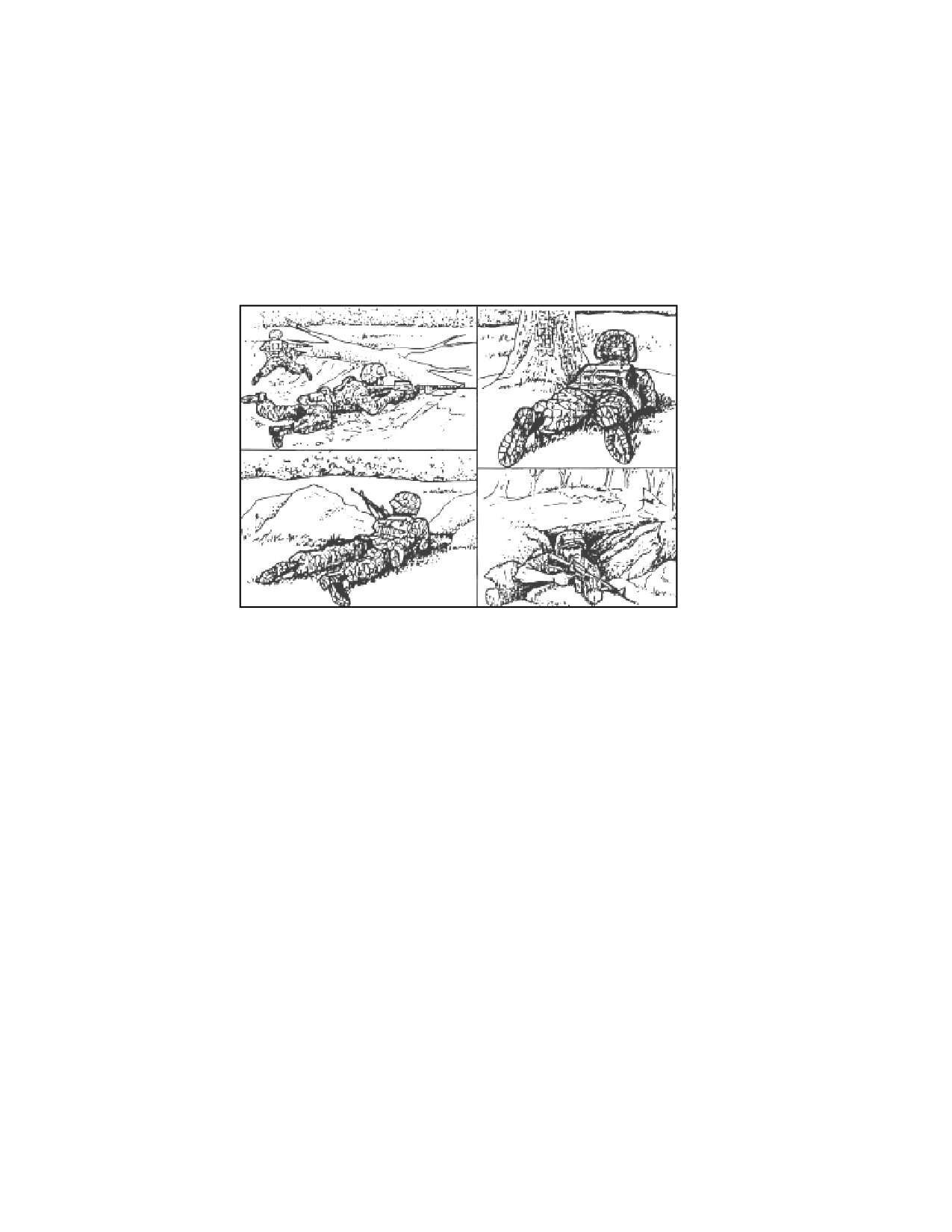
FM 7-21.13 ____________________________________________________________
conceal you from enemy observation. Cover can be natural or man-made.
Concealment is anything that hides you from enemy observation.
Concealment DOES NOT protect you from enemy fire. DO NOT think that
you are protected from the enemy's fire just because you are concealed.
Concealment, like cover, can also be natural or man-made.
Figure A-7. (071-326-0513-1) Temporary fighting positions.
2.
Choose a position that allows you to observe and fire around the side of
an object while concealing most of your head and body.
3.
Choose a position that allows you to stay low when observing and
firing, whenever possible.
NOTE: This position allows you to aim better and take advantage of
concealing vegetation.
4.
Choose a position with a background that does not silhouette you
against the surrounding environment.
NOTE: A position like this reduces your chances being detected.
5.
Follow your leader's directions after your initial selection of a
temporary battlefield position.
NOTE: Your leader may reposition you to gain better coverage of the area.
Evaluation Preparation:
A-44
____________________________________________________________ Appendix A
SETUP: Evaluate this task during a march or a simulated march in an area
with varying degrees of cover and concealment. Have the soldier in full
battle gear.
BRIEF SOLDIER: Tell soldier that the enemy has been reported in the area
and may be encountered at any time. At preselected points during the
march, at a rest halt, after ordering the soldier to take an overwatch
position, or after ordering the soldier to take a tentative defensive position,
have the soldier select a temporary fighting position.
Performance Measures
GO NO GO
1. Chose a position that took advantage of available cover and concealment.
_____
_____
2. Chose a position that allowed for observation and fire around the side of
an object while concealing most of your head and body.
_____
_____
3. Chose a position that allowed you to stay low when observing and firing,
whenever possible.
_____
_____
4. Chose a position with a background that did not silhouette you against
the surrounding environment.
_____
_____
5. Followed leader's directions after initial selection of a temporary
battlefield position.
_____
_____
Evaluation Guidance: Score the soldier GO if all performance measures are
passed. Score the soldier NO-GO if any performance measure is failed. If
the soldier scores NO-GO, show the soldier what was done wrong and how
to do it correctly.
References
Required
Related
FM 3-21.75 (21-75)
A-45
FM 7-21.13 ____________________________________________________________
A-46
Appendix B
Army Programs
Soldiers sometimes need help beyond what the chain-of-
command or NCO support channel can provide directly. In
those cases, soldiers may not be able to fully concentrate on
their duties if they or their families are working through
financial, substance abuse, or other problems. The Army has
therefore built agencies and programs to assist soldiers and
their families. Some are recreational in nature, others are
assistance programs, and still others are important tools for
maintaining discipline, morale, or soldier well-being. The
Army also has an extensive education program that includes
tuition assistance for attending college level courses. All this
shows that the Army takes care of its own. In this appendix
you’ll find a description of many of these programs.
Morale, Welfare, Recreation (MWR) and Family Programs
B-2
Soldier Assistance
B-3
Army Community Service (ACS)
B-3
Equal Opportunity Program in the Army
B-4
Equal Employment Opportunity
B-5
Army Substance Abuse Program
B-6
Army Career and Alumni Program - Transition Assistance
B-7
Army Emergency Relief
B-7
Total Army Sponsorship Program
B-8
Family Assistance
B-9
Army Family Action Plan
B-9
Army Family Team Building
B-10
Family Readiness Programs
B-10
Family Advocacy Program
B-10
Family Readiness Groups
B-11
Exceptional Family Member Program
B-11
Education
B-12
Army Continuing Education
B-12
Green to Gold Program
B-13
United States Military Academy Preparatory School (USMAPS) .. B-14
Funded Legal Education Program (FLEP)
B-14
Army Medical Department (AMEDD) Enlisted Commissioning
Program (AECP)
B-15
Other Assistance for the Soldier and Family
B-15
Better Opportunities for Single Soldiers (BOSS)
B-15
American Red Cross
B-16
Casualty Assistance Program
B-17
B-1
FM 7-21.13 ____________________________________________________________
MORALE, WELFARE, RECREATION (MWR) AND FAMILY
PROGRAMS
B-1. Morale, Welfare, and Recreation (MWR) is a name that covers many
different programs. Though we usually think of MWR as the bowling alley
or unit fund money, this term applies to Army Community Service, youth
services, family programs, and outdoor recreation programs. Do you like to
fish, work out, travel, play sports, act in plays, or coach? Or do your like
relaxing, watching the big game on TV, hanging out with friends and eating
hot pizza? Or maybe you’re a golfer, bowler, swimmer, racquetball player,
skier or snowboarder. Most importantly, you want your family taken care of
when you’re deployed. You want your children to have fun, yet be safe and
supervised. Lastly, you want to be heard if you have issues or concerns
about your life in the Army.
B-2. The US Army Community and Family Support Center,
Headquarters, Department of the Army agency, delivers more than 200
Morale, Welfare and Recreation (MWR), and family programs through a
worldwide
37,000-member workforce, including those stationed in the
Balkans and the Middle East to serve deployed troops. Commanders regard
MWR as a readiness multiplier that keeps soldiers physically fit, fosters
healthy families, reduces stress, builds skills and self-confidence, and
creates esprit de corps. The MWR philosophy is that soldier’s and their
families are entitled to the same quality of life as the Americans they
pledge to defend.
B-3. Child and youth services
(CYS) programs reduce the conflict
between mission and parental responsibilities. Basic CYS programs are
child development centers, family child care home systems, before and
after-school programs, school liaison and school transition services, youth
sports and fitness programs and partnerships with Boys & Girls Clubs and
4-H Clubs. Services are provided year-round and include full-day, part day,
after school, hourly, special needs, seasonal, supervised programs and care
options. Congress and the White House recognize the military childcare
system as a “model for the Nation.”
B-4. Individual and team sports for men and women include basketball,
soccer, volleyball, rugby, softball, and martial arts. At gymnasiums,
certified instructors conduct aerobics for cardiovascular fitness and
supervise strength training with weights. Recreation centers offer a variety
of social activities, games
(table tennis, billiards), classes, and meeting
space. Army libraries provide books, magazines, electronic information
resources, and professional reference services for academics and recreation
reading. Army libraries send book kits to remote and isolated sites as well
as to deployed soldiers.
B-5. Outdoor recreations (OR) opportunities vary by geographic location,
climate, and demand. They range from high-challenge activities such as
ropes courses, mountain climbing, and rappelling to extreme sports such as
snowboarding, para gliding, and windsurfing. Many installations have
B-2
____________________________________________________________ Appendix B
forests, parks, rivers, and lakes that invite fishing, hunting, hiking,
camping, and boating. Need equipment? Rent it from Outdoor Recreation.
B-6. Arts and crafts centers are outlets for creativity and are money-
savers. Trained staff members ensure safe use of tools and equipment. At
automotive craft shops, you can change your car’s oil or change a motor.
The centers offer tools, bays, classes, and assistance available for nominal
fees. Outlets for creative expression in the performing arts include music
and theater events such as Battle of the Bands, one-act play festivals, the
US Army Soldier Show, community theater, entertainment contests and
chart topping celebrity performers who stage concert at installations.
B-7.
Sports bars, casual dining restaurants, fast food outlets, and
community clubs offer ethnic and traditional foods as well as nightlife on
post. Military members enjoy significant discounts at many major
amusement parks, resorts, and attractions. For more information, visit
www.offdutytravel.com. The Army operates four Armed Forces recreation
centers: Disney World
(Orlando, Fla.), Garmisch/Chiemsee
(Bavaria,
Germany), Waikiki Beach (Hale Koa Hotel, Honolulu, Hawaii), and Dragon
Hill Lodge (Seoul, Korea).
B-8.
Expect to pay fees and charges for MWR and family programs;
profits are reinvested locally in MWR programs. A percentage of profits
from the Army and Air Force Exchange Service (AAFES) are used to fund
MWR programs. When you shop at AAFES and patronize MWR, you help
sustain these programs for the future. MWR programs are for all soldiers
and families: active duty, reserve components and retirees, married and
single, living on post or off. For additional information, visit the MWR
website at www.armymwr.com.
SOLDIER ASSISTANCE
ARMY COMMUNITY SERVICE (ACS)
B-9. Army Community Service (ACS) programs offers real-life solutions
for soldiers and their families. Your ACS equips people with the skills and
education they need to face the challenges of military life today and
tomorrow. Think of ACS when deploying or relocating, needing information
and referrals, needing financial assistance, employment services, or for
crisis and family assistance. The following are some of the ACS programs
that may exist at Army installations worldwide:
• Deployment and mobilization support.
• Assistance with family readiness groups.
• Relocation readiness.
Group training for pre/post moves.
Cross-cultural training for bicultural families.
SITES (Standard Installation Topic Exchange Service).
Guidance counseling before, during, and after the move.
B-3
FM 7-21.13 ____________________________________________________________
Outreach to waiting families.
Lending closet.
Sponsorship training.
• Financial Readiness.
Army Emergency Relief.
Education and financial planning, Consumer Affairs and Financial
Assistance Program (CAFAP).
Confidential budget counseling and debt management assistance.
Emergency food voucher.
Consumer information and advocacy.
• Family Advocacy Program.
Stress and anger management classes.
Victim advocacy.
Emergency placement care.
Family violence prevention briefings.
• Exceptional Family Member Program (EFMP).
• Installation Volunteer Program.
• Army Family Action Plan.
• Army Family Team Building (AFTB).
• Employment Services.
B-10. ACS facilitates a commander’s ability to provide comprehensive,
coordinated, and responsive services that support the readiness of soldiers,
civilian employees, and their families. For more information on Army
Community Service programs see the ACS homepage at
EQUAL OPPORTUNITY PROGRAM IN THE ARMY
B-11. The Equal Opportunity
(EO) program formulates, directs, and
sustains a comprehensive effort to maximize human potential and to ensure
fair treatment for all persons based solely on merit, fitness, and capability
in support of readiness. EO philosophy is based on fairness, justice, and
equity. Commanders are responsible for sustaining a positive EO climate
within their units. Specifically, the goals of the EO program are to—
• Provide EO for military personnel and family members, both on and
off post and within the limits of the laws of localities, states, and host
nations.
• Create and sustain effective units by eliminating discriminatory
behaviors or practices that undermine teamwork, mutual respect,
loyalty, and shared sacrifice of the men and women of the US Army.
B-4
____________________________________________________________ Appendix B
• Additionally, in many circumstances, Department of the Army (DA)
civilians may use the Equal Employment Opportunity complaint
system. Army Regulation 690-600, Equal Opportunity Employment
Discrimination Complaints, provides further guidance.
B-12. The Army provides equal opportunity and fair treatment for
military personnel, family members, and DA civilians without regard to
race, color, sex, religion, or national origin and provide an environment free
of unlawful discrimination and offensive behavior. This policy applies both
on and off post, during duty and non-duty hours, and applies to working,
living, and recreational environments
(including both on and off post
housing).
B-13. Soldiers will not be accessed, classified, trained, assigned, promoted,
or otherwise managed on the basis of race, color, religion, gender, or
national origin. The assignment and utilization of female soldiers is
partially governed by federal law. AR
600-13, Army Policy for the
Assignment of Female Soldiers, prescribes policies, procedures,
responsibilities, and the position coding system for female soldiers.
B-14. Rating and reviewing officials will evaluate each member’s
commitment to elimination of unlawful discrimination and/or sexual
harassment and document significant deviations from that commitment in
evaluation reports. Substantiated formal complaints require a “Does not
support EO” on the NCOER or the OER. This documentation includes
administering appropriate administrative, disciplinary, or legal action(s) to
correct inappropriate behavior.
B-15. Equal Opportunity references include the following:
• AR 600-20, Army Command Policy, Chapters 4, 5, 6 and Appendix E.
• Department of the Army Affirmative Action Plan (DA Pam 600-26).
• The Army’s Consideration of Others Handbook.
EQUAL EMPLOYMENT OPPORTUNITY
B-16. The Equal Employment Opportunity (EEO) Program has similar
goals as the EO Program but is designed to assist and protect the civilians
supporting the Army and Department of Defense, under Title VII of the
Civil Rights Act of 1964. It ensures equal opportunity in all aspects of
employment for Army civilian employees and applicants for employment.
Employment policies and practices in DA will be free from unlawful
discrimination based on race, color, religion, sex, age, national origin, or
handicap. The basic principle of equal employment opportunity underlies
all aspects of the civilian personnel management program in the Army. The
program allows civilian employees who believe they are victims of
discrimination to make complaints through several avenues.
B-17. It is DA policy to provide equal employment opportunity to all
soldiers and DA civilians under applicable EEO laws and regulations.
These laws and regulations include Title VII of the Civil Rights Act of 1964,
the Age Discrimination in Employment Act, the Rehabilitation Act, and AR
690-600. These laws and regulations prohibit discrimination in employment
B-5
FM 7-21.13 ____________________________________________________________
based on race, color, religion, sex, national origin, age, disability, or reprisal
and promote the realization of equal opportunity. The EEO office manages
the complaint-processing program and advises the commander on EEO
matters.
B-18. Mediation may be a means to address conflicts, disputes,
complaints, grievances, or other problems in the workplace. Mediation is
best described as assisted negotiations between two parties with neutral
mediators facilitating the process. It is a private process whereby the
parties are empowered to resolve their own issues. For additional
information read AR
690-12, Equal Employment Opportunity and
Affirmative Action, and AR 690-600 or visit your installation EEO office.
ARMY SUBSTANCE ABUSE PROGRAM
B-19. The Army Substance Abuse Program (ASAP) provides assistance to
active duty soldiers, DACs, family members, and retirees. The ASAP goal is
to strengthen the overall fitness and effectiveness of Army personnel and
enhance the combat readiness of soldiers. Command involvement
throughout the identification, referral, screening and elevation process is
critical. Details are in AR 600-85, Army Substance Abuse Program.
B-20. Soldiers who fail to participate as directed by the commander or do
not succeed in rehabilitation are subject to administrative separation.
Soldiers will reenroll except as determined by the clinical director in
consultation with the unit commander. Commanders will, without
exception, separate all soldiers who are identified as drug abusers.
Commanders must refer for evaluation all soldiers who they suspect of
having a problem with drugs or alcohol. This includes knowledge of any
convictions for Driving While Intoxicated (DWI).
B-21. The ASAP primary care manager (PCM) will conduct an initial
screening evaluation interview with referred soldiers to recommend one or
more of the following:
• Referral to Army Drug and Alcohol Prevention Training (ADAPT).
• Referral to ADAPT and enrollment in the out-patient program.
• Referral to the ASAP outpatient program and to the Community
Mental Health Clinic.
• Referral to an in-patient or partial program if the commander and
clinical director agree to in-patient or partial program placement.
• Counseling by the unit commander.
B-22. The commander’s involvement is critical in the rehabilitation
process. The commander must ensure that enrolled soldiers are attending
sessions, getting random biochemical testing and breathalyzers, and
participating in the program. The objectives of rehabilitation and treatment
are to return the soldier to full duty as soon as possible or identify for
separation those who cannot be rehabilitated. For more information, see AR
600-85 and the Army Center for Substance Abuse Programs website at
acsap.army.mil.
B-6
____________________________________________________________ Appendix B
ARMY CAREER AND ALUMNI PROGRAM - TRANSITION ASSISTANCE
B-23. The Army Career and Alumni Program (ACAP) assists military
personnel, Department of Defense (DOD) civilians affected by reduction in
force (RIF), and their family members with the employment search process
by providing the highest quality guidance, training, resources, and support
during their career transition from federal service. Family members and
veterans of all branches of the armed services can utilize ACAP services.
The program aids individuals and their family by identifying transitioning
needs and providing assistance in meeting those needs. The ACAP job
assistance personnel provide access to a national and local job resource
database and career counseling.
B-24. Soldiers preparing for retirement may begin pre-separation
counseling up to 24 months prior to retirement and all other soldiers may
begin pre-separation counseling up to
12 months prior to separation.
Through ACAP, the Army takes care of its own. Some of the specific
services include assistance in resume writing, interview techniques, job
search skills, listing of job opportunities with federal, state, and local
governments, and civilian agencies. The ACAP on-line is a program that
provides transition and job assistance information, job listings, and links to
related sites. For additional information, visit and your local installation
ACAP center, the ACAP website at www.acap.army.mil, or refer to DA
PAM 635-4, Preseparation Guide.
ARMY EMERGENCY RELIEF
B-25. Army Emergency Relief (AER) is a private nonprofit organization
incorporated in 1942 by the Secretary of War and the Army Chief of Staff.
Although AER is a private corporation, it is, in effect, the US Army’s own
emergency financial assistance organization. AER is dedicated to “Helping
the Army Take Care of Its Own” and providing emergency financial
assistance to the following persons:
• Soldiers on extended active duty and their dependents.
• Reserve component soldiers (ARNG and US Army Reserve) serving
under Title 10, US Code, on continuous active duty for more than 30
days and their dependents.
• Soldiers retired from active duty and their dependents.
• Surviving spouses and orphans of eligible soldiers who died while on
active duty or after they retired.
B-26. AER can provide emergency financial assistance for the following:
rent, utilities, food, emergency travel, emergency privately owned vehicle
(POV) repair, non-receipt of pay, funeral expenses, emergency medical or
dental expenses, clothing after fire or other disasters. Unless unusual
circumstances exist, AER cannot assist with the following: ordinary leave or
vacations, fines or legal expenses, debt payments, home purchases or
improvements, purchase, rental or lease of a vehicle, funds to cover bad
checks, and marriage or divorce. AER assistance is normally in the form of
B-7
FM 7-21.13 ____________________________________________________________
a loan. AER never charges interest on any loan. Sometimes the assistance
is available as a grant or combination loan and grant.
B-27. The AER provides emergency financial assistance to soldiers and
their dependents. However, as a secondary mission it provides monetary
assistance for undergraduate education of dependent children of soldiers
(active duty, retired or deceased) and spouses of active duty soldiers in
certain overseas locations.
B-28. Active duty soldiers who wish to request AER assistance may obtain
the appropriate application form (DA 1103) through their unit and must
obtain their commander’s recommendation. Unaccompanied family
members, surviving spouses or orphans, retirees, and others not assigned to
or under control of your installation may obtain the necessary forms at any
local AER office. All applicants must provide their military ID card and
substantiating documents (i.e., car repair estimate, rental contract, etc.).
B-29. Soldiers and their dependents can also receive assistance at any
Navy-Marine Corps Relief Society, Air Force Aid Society, or Coast Guard
Mutual Assistance office. If they are not near a military installation,
soldiers and their dependents can receive assistance through their local
chapter of the American Red Cross. For more information visit your local
AER office, the AER website at www.aerhq.org, or refer to AR 930-4, Army
Emergency Relief.
TOTAL ARMY SPONSORSHIP PROGRAM
B-30. The Total Army Sponsorship Program provides the structure and
foundation for units to welcome and help prepare soldiers, civilian
employees, and family members for their new duty station in advance of
their actual arrival. This program is available to soldiers in the active
Army, Army National Guard, Army Reserve, and civilian employees
assigned to positions within the Department of the Army. The sponsor is
the key to helping the new soldier, civilian employee, and family get
comfortably settled as quickly as possible, thereby putting his mind at rest
so he can concentrate on his new duties as soon as possible.
B-31. The unit will appoint a sponsor within 10 calendar days after the
organization receives DA Form
5434 or DA Form 5434-E unless the
incoming soldier or civilian employee declines. If no sponsor is desired, the
unit will send a welcome letter from the battalion or activity commander
(for officers); command sergeant major (for enlisted soldiers); or commander
or activity director
(for civilian employees). The unit will not provide
additional sponsorship action until arrival. Upon arrival, the unit will
assign a sponsor to the incoming soldier or civilian employee. The assigned
sponsor will be of equal or higher grade than the incoming soldier or
civilian employee when practical. The sponsor will also be of the same sex,
marital status, and military career field or occupational series as the
incoming soldier or civilian employee when feasible. The sponsor will be
familiar with the unit or activity and community.
B-32. The sponsor will normally not be the person being replaced by the
incoming soldier or civilian employee, or within 60 days of permanent
B-8
____________________________________________________________ Appendix B
change of station (PCS). For more information on Army sponsorship, see AR
600-8-8, The Total Army Sponsorship Program, your local Army
Community Service office, and your unit sponsorship program proponent.
FAMILY ASSISTANCE
ARMY FAMILY ACTION PLAN
B-33. The Army Family Action Plan (AFAP) is input (concerning family
issues) from the people of the Army to Army leadership. The Army’s leaders
have recognized that to have a quality Army, you must be satisfied with the
Army way of life. AFAP is a process that lets soldiers and families say
what's working, what isn't, and what they think will fix it. It alerts
commanders and Army leaders to areas of concern that need their
attention, and also gives them the opportunity to quickly put plans into
place to begin resolving the issues. AFAP also—
• Gives commanders a gauge to validate concerns and measure
satisfaction.
• Enhances Army’s corporate image.
• Helps retain the best and brightest.
• Results in legislation, policies, programs, and services that
strengthen readiness and retention.
• Safeguards well-being.
B-34. Since you are in the Army, you can become an AFAP participant—
• If you are a commander, you can support a strong AFAP program in
your community and you can draw on the real-time quality of life
information AFAP provides.
• If you are a soldier (active or reserve), retiree, civilian, or family
member you can be part of the AFAP program in the following ways:
Be a delegate and share your good ideas.
Volunteer to help with a conference, assist with the program, or be
a member of the local AFAP Advisory Committee.
Become familiar with current AFAP issues, tell people what’s
happening, and get them energized to promote Army well being
through the AFAP process.
B-35. AFAP starts with local AFAP forums, active Army, reserve
component soldiers, retirees, surviving spouses, DA civilians, family
members, and tenant organizations identifying issues they believe are
important to maintain a good standard of living. Commanders resolve local
issues at the installation level and update participants quarterly at in
process reviews (IPR) which are open to the public. Commanders may
forward more difficult issues requiring higher level involvement to higher
commands, including Headquarters, Department of the Army (HQDA)
AFAP. Delegates come from throughout the Army to address the top issues
and propose solutions. The General Officer Steering Committee (GOSC)
B-9
FM 7-21.13 ____________________________________________________________
reviews the progress of AFAP issues on a semiannual basis and is the final
deciding authority.
ARMY FAMILY TEAM BUILDING
B-36. Army Family Team Building (AFTB) is a volunteer-led organization
with a central tenet: provide training and knowledge to spouses and family
members to support the total Army effort. Strong families are the pillar of
support behind strong soldiers and AFTB’s mission is to educate and train
all of American’s Army in knowledge, skills, and behaviors designed to
prepare our Army families to move successfully into the future. AFTB’s
vision statement says it all: “Empowering families for the 21st century.”
The organization is about providing proactive, forward-thinking support for
today’s families and ensuring the strength of tomorrow’s Army. Army
Family Team Building has three separate tracks: soldiers (active and
reserve), DA civilians, and family members.
FAMILY READINESS PROGRAMS
B-37. The mission of family readiness programs is to foster total Army
family readiness, as mission accomplishment is directly linked to soldiers'
confidence when their families are safe and capable of carrying on during
their absence. A wide variety of resources are available to assist soldiers
and spouses. You can access most of these programs through Army
Knowledge Online (AKO) or your unit NCO support channel. Some of these
programs are as follows:
• Married Army Couples Program.
• Unit family readiness groups.
• Family care plans.
• Information and referral programs.
• Budget counseling.
• Counseling and counseling referrals.
• Child and spouse abuse treatment and prevention.
• Employment assistance.
• Exceptional Family Member Program (EFMP).
FAMILY ADVOCACY PROGRAM
B-38. The Department of the Army recognizes the importance of families
in retention and unit readiness. The Family Advocacy Program (FAP) uses
a coordinated community approach to support soldiers and families in an
attempt to prevent family violence. The key element of the FAP is
prevention through the education of families about the short and long term
effects of family violence. Prevention of and intervention in family violence
are a community responsibility. Various agencies within the community
work together to ensure an effective and comprehensive program. For
soldiers and family members involved in family violence, early referral
reduces risk, establishes safety limits, and provides treatment for victims
B-10
____________________________________________________________ Appendix B
and offenders affected or involved in abuse. The FAP provides training and
support to units and individuals in the following areas:
• Family violence.
• Intervention and treatment.
• Emotional support and counseling.
• Emergency financial assistance.
• Parenting education.
• Relationship support.
• Child care issues.
• Victim advocacy.
• Transitional compensation.
B-39. For additional information contact your installation Family
Advocacy Program Manager or refer to AR 608-18, The Army Family
Advocacy Program.
FAMILY READINESS GROUPS
B-40. The Family Readiness Groups (FRGs) purpose is to encourage self-
reliance among members by providing information, referral assistance, and
mutual support. FRGs achieve readiness by providing an atmosphere and
an agenda of activities, which builds cohesiveness among unit members.
FRGs serves as the conduit between the command and family members.
There is no rank in the family readiness groups and that is the key to its
success. All soldiers and family members are members of the FRG.
Common goals of FRGs include:
• Welcoming service and family members into the unit.
• Developing relationships that enable effective communication.
• Fostering a sense of belonging to the team in all family members.
• Creating forums for family members to develop friendships and
support each other.
• Establishing communication networks.
• Providing and participating in formal FRG professional development
training.
B-41. Every unit manages its family readiness group differently,
depending on the personality of leaders, the number of families involved,
available resources, etc. The core of the family readiness group is the unit.
All FRGs throughout the Army share the same purpose: to support Army
families.
EXCEPTIONAL FAMILY MEMBER PROGRAM
B-42. The Exceptional Family Member Program (EFMP) is a mandatory
enrollment program for those family members who require special medical
or educational services. The program provides comprehensive services
B-11
FM 7-21.13 ____________________________________________________________
consisting of medically related issues. It is also an educational and social
support service that enhances the readiness and quality of life for families
with special needs. An exceptional family member is a family member with
a physical, emotional, developmental, or intellectual disability that requires
special treatment, therapy, education, training, or counseling.
B-43. Special needs can range from learning disabilities to medical
conditions such as asthma, seizure activity and/or mental health conditions.
The program ensures medical and educational needs are accessible and
appropriate to accommodate these individuals’ needs. For additional
information, visit your ACS center and local EFMP office at your
installation.
EDUCATION
ARMY CONTINUING EDUCATION
B-44. The Army Continuing Education System (ACES) promotes lifelong
learning and sharpens the competitive edge of the Army now and for the
Future Force. It instills the organizational value of education within the
active Army, Army Reserve and Army National Guard. ACES is committed
to excellence in service, innovation, and deployability. Through Army
education centers worldwide, ACES provides educational programs and
services to support the professional and personal development of soldiers,
adult family members, and DA civilians.
B-45. ACES programs and services help to improve the combat readiness
of America’s Army by expanding soldier skills, knowledge, and aptitudes to
produce confident, competent leaders. The programs support leader
development and soldier career progression by building job-related critical
thinking and decision-making skills required for warfighting, sensitive
peacekeeping operations, and success on the digitized battlefield. Education
programs and services support the enlistment, retention, and transition of
soldiers.
The advancement and diffusion of knowledge is the only
guardian of true liberty.
James Madison
B-46. Army education centers offer a wide variety of programs (certificate,
associate, bachelor’s, and master’s degrees) through US vocational-technical
schools, colleges, and universities. Professional education counselors assist
soldiers to develop education goals and educational plans to achieve them in
a cost-effective, timely manner. For additional information visit your
installation
education
center
or
the
ACES website at
www.armyeducation.army.mil. Army continuing education policy and
guidance are found in Army Regulation (AR) 621-5, Army Continuing
Education System. Related publications include AR
621-202, Army
Education Incentives and Entitlements, and AR 611-5, Army Personnel
Selection and Classification.
B-12
____________________________________________________________ Appendix B
GREEN TO GOLD PROGRAM
B-47. The Green to Gold Program seeks talented young enlisted soldiers
who want to earn a commission as an Army officer. Quality enlisted soldiers
with leadership potential, who have served at least two years on active
duty, are allowed to voluntary request discharge from active duty to enroll
in the Army Reserve Officer Training Corps (ROTC).
B-48. Enlisted soldiers who meet the prerequisites can either apply for a
2, 3, or 4-year scholarship or can participate in the Green to Gold Program
(without applying for or earning a scholarship). Soldiers who participate in
this program are discharged from active duty under the provisions of
Chapter 16-2, Army Regulation 635-200. Cadets who entered the ROTC
through the Green to Gold program, whether under a scholarship or not,
may use their Montgomery GI Bill (MGIB) benefits and receive a tax-free
stipend.
B-49. Local Army ROTC cadre give periodic briefings on the Green to Gold
Program at Army installations. You may also receive information at the
ROTC detachment on a walk-in basis. Basic qualifications for Green to Gold
are as follows (some waivers are possible):
• Have served on active duty for two years.
• Attain a general technical (GT) score of 110 or higher.
• Recommended by your company commander and the first field grade
officer in the chain-of-command.
• Have neither UCMJ, civil convictions, nor have any such actions
pending.
• Have no more than three dependents and are not a single parent.
• Pass a physical examination in accordance with (IAW) AR 40-501,
Standards of Medical Fitness.
• Meet height and weight standards IAW AR 600-9, Army Weight
Control Program.
• Pass the Army physical fitness test (APFT) with a minimum of 60
points in each event.
• Eligible to reenlist.
• Accepted for admission by a college or university that offers ROTC.
• Receive a Letter of Acceptance into the ROTC program from the
Professor of Military Science (PMS) at the institution you will attend.
B-50. Scholarship requirements for the Green to Gold Program are the
following (no waivers):
• Complete your degree and Military Science requirements by your
25th birthday as of 30 June of the year you're commissioned. You can
add one year to the 25 year limit for each year of active duty up to
four years (i.e. maximum age for a scholarship is 29 regardless of
time on active duty).
B-13
FM 7-21.13 ____________________________________________________________
• Have a 2.5 grade point average (GPA) on all college work completed.
• Have a minimum American College Test (ACT) assessment score of
19 or Scholastic Assessment Test (SAT) score of 920 for a 3 and 4
year scholarship.
B-51. To participate in the Green to Gold Program without a scholarship
you must be accepted as an academic junior and have an approved
academic worksheet (Cadet Command Form 104-R) that shows you will
complete the program in two years.
B-52. You may enroll in Army ROTC the same time you enroll in college.
Army ROTC is available at more than 800 colleges and universities. For
more information visit your nearest ROTC representative or the Army
ROTC website at www.armyrotc.com.
UNITED STATES MILITARY ACADEMY PREPARATORY SCHOOL
(USMAPS)
B-53. Each year about 200 enlisted soldiers are offered admission to the
US Military Academy or the Preparatory School at Fort Monmouth, New
Jersey. Although some soldiers are offered direct admission to West Point,
most attend the Prep School first. All applications are made directly to
West Point. Soldiers not directly admitted to West Point will be
automatically considered for admission to the Prep School.
B-54. In addition to having a sincere interest in attending West Point and
becoming an Army officer, applicants must be—
• US citizens.
• Unmarried with no legal obligation to support dependents.
• Under 23 years of age prior to 1 July of the year entering USMA
(under 22 prior to 1 July of the year entering the Prep School).
• A high school graduate or have a General Education Development
(GED) certificate.
• Of high moral character.
B-55. Soldiers who meet the basic eligibility requirements, have achieved
SAT scores greater than 1000 or ACT composite score of 20 or higher and
achieved average grades or better in their high school curriculum are
especially encouraged to apply. Soldiers must obtain an endorsement from
their company or lowest-level unit commander. While this endorsement
constitutes a nomination, soldiers are also strongly encouraged to obtain
additional nominations from their congressional nomination sources.
FUNDED LEGAL EDUCATION PROGRAM (FLEP)
B-56. The Office of the Judge Advocate General (OTJAG) annually accepts
applications for the Army's Funded Legal Education Program (FLEP).
Under this program, the Army sends active duty commissioned officers to
law school at government expense if funding permits. Selected officers
remain on active duty while attending law school and have an active duty
service obligation (ADSO) upon completion.
B-14
____________________________________________________________ Appendix B
B-57. Details are in Chapter
14, AR 27-1. This program is open to
commissioned officers in the rank of second lieutenant through captain.
Applicants must have at least two but not more than six years of total
active Federal service at the time legal training begins. Eligibility is
governed by Title 10 of the US Code and is non-waivable. Your local Staff
Judge Advocate has further information.
ARMY MEDICAL DEPARTMENT (AMEDD) ENLISTED COMMISSIONING
PROGRAM (AECP)
B-58. The AECP allows active duty enlisted soldiers to obtain a
scholarship to attend college in a full-time student status while still
receiving full pay and benefits in their current grade. Application to the
AECP is open to all active duty army enlisted soldiers, regardless of MOS,
who are able to gain acceptance as a full time student to an accredited
nursing program with an academic and clinical curriculum in English; and
graduate within
24 calendar months. Soldier applicants must have a
minimum of 3 years and maximum of 10 years of active component enlisted
military service at the time of commission. Time in service waivers will be
approved or disapproved by PERSCOM on a case by case basis. Applicants
must extend or re-enlist to have at least 36 months of time remaining on
active duty after graduating from the Bachelor of Science in Nursing (BSN)
program, based on projected date of graduation.
B-59. Upon earning their BSN degree and successfully completing the
National Council for Licensure Examination-RN
(NCLEX-RN), these
soldiers are commissioned second lieutenants in the Army Nurse Corps
(active component). Selected soldiers will have an ADSO after
commissioning. For more information contact your local Army Education
Center or Army Medical Treatment Facility (MTF) Education Department.
You may also see the AECP website at http://www.usarec.army.mil/AECP/.
OTHER ASSISTANCE FOR THE SOLDIER AND FAMILY
BETTER OPPORTUNITIES FOR SINGLE SOLDIERS (BOSS)
B-60. Better Opportunities for Single Soldiers (BOSS) is a program that
helps commanders address the well-being and morale issues of the single
and unaccompanied soldiers in their units. It is one of more than 200 Army
morale, welfare, and recreation programs delivered by the US Army
Community and Family Support Center, a headquarters Department of the
Army agency.
B-61. Established in 1989 as a balance to the emphasis on increased
family-oriented programming, installation BOSS programs are governed by
Army Regulation 215-1, Morale, Welfare and Recreation Activities and
Nonappropriated Fund Instrumentalities, and Department of the Army
Circular
608-01-01, Better Opportunities for Single Soldiers Program.
Designed to provide a “voice” for single soldiers, BOSS has three key
components: well-being, community service, and recreation/leisure
activities.
B-15
FM 7-21.13 ____________________________________________________________
B-62. BOSS has programs at 48 installations in the continental US and 47
installations outside the US. Each installation has an MWR advisor for
BOSS programs, who is in the Directorate of Community [and Family]
Activities
(DCA or DCFA). An elected committee or council of soldier
representatives from installation units operate the BOSS program; the
command sergeant major approves the committee members who serve for
one year. Upon being elected or appointed, BOSS representatives are placed
on additional duty orders and are expected to be at all BOSS meetings
when the unit mission does not dictate otherwise.
B-63. Committee members coordinate single soldier activities and events
that fall within two key components of the program: community service and
recreation/ leisure activities. They also gather input on well-being issues,
input which is worked to resolution at the lowest command level.
Empowered with this responsibility, single soldiers feel more respected and
bonded into the “Army of One.” Likewise soldiers see that their voice counts
and they are heard on issues that affect their well-being.
B-64. BOSS representatives must brief their chain-of-command before any
program is implemented at the installation. With the aid of the MWR
advisor, the soldier representative plans and executes events in tandem
with the mission of the command. BOSS works in conjunction with other
MWR programs such as entertainment, recreation centers, or outdoor
recreation activities. BOSS soldiers assume a lead role in planning special
BOSS events that meet the needs and desires of the single soldiers on that
installation. BOSS councils have sponsored events such as soldier talent
competitions, concerts, dances, and trips.
B-65. BOSS further encourages and assists single soldiers in identifying
and participating in community service and volunteer opportunities. BOSS
representatives contribute to their communities by serving in post
organizations and on various councils, such as the Army and Air Force
Exchange Service
(AAFES), dining facilities, health promotion, MWR,
barracks, Defense Commissary Agency, and Army Family Action Plan.
B-66. BOSS members plan and execute community service projects with
national programs such as Big Brothers and Big Sisters, Habitat for
Humanity, Adopt-a-Highway and Special Olympics. BOSS representatives
coordinate partnerships with recruiters to take delayed entry program
recruits on tours of an installation. They have also initiated programs, such
as BOSS Against Drunk Drivers (BADD) and Adopt-a-Soldier, that address
commanders’ concerns about soldier isolation during holiday periods. BOSS
soldiers also support installation programs by volunteering with Child and
Youth Services. By partnering with the Army Community Service
Installation Volunteer Coordinator, BOSS ensures all soldier volunteer
hours are documented, giving soldiers valuable experience for future
referrals.
AMERICAN RED CROSS
B-67. Today's American Red Cross service to the Armed Forces is keeping
pace with the changing military through its network of 900 local chapters
B-16
____________________________________________________________ Appendix B
and 109 offices located on military installations worldwide. Both active duty
and community-based military can count on the Red Cross to provide
emergency communication services around-the-clock,
365 days a year,
keeping the service member and his/her family in touch across the miles.
B-68. Although we are most familiar with the Red Cross messages when
there is a family emergency, the Red Cross also provides access to financial
assistance through the military aid societies, counseling, information and
referral, and veteran’s assistance. While not a part of the Department of
Defense, Red Cross staff members deploy along side the military to such
areas as Afghanistan, Kosovo, Saudi Arabia, and Kuwait working and
living amongst the troops to ensure they receive vital Red Cross services.
B-69. The Red Cross often conducts blood drives and offers a full menu of
disaster and health and safety training courses. These activities are
available to service members and their families at Red Cross chapters and
on military installations. For additional information on Red Cross programs
and services, go to www.redcross.org and click on AFES (Armed Forces
Emergency Services) or call the toll free number 1-877-272-7337.
CASUALTY ASSISTANCE PROGRAM
B-70. The casualty assistance program provides assistance to the primary
next-of-kin
(PNOK) of deceased soldiers and retirees. The Army may
provide casualty assistance to the PNOK of all deceased soldiers in the
following categories—
• Active Duty military.
• USAR/ARNG enroute to/from/participating in Active Duty Training.
• Soldiers in AWOL status.
• Army retirees.
• Soldiers separated from the Army less than 120 days.
B-71. The main objectives of casualty assistance are the following:
• Assist the PNOK during the period immediately following a casualty.
• Eliminate delay in settling claims and paying survivor benefits.
• Assist the PNOK in other personnel-related affairs.
B-72. The Army has established Casualty Assistance Commands (CAC) at
most major installations where the PNOK of deceased soldiers can get help.
Department of the Army policy concerning casualty assistance is that the
CAC will appoint a Casualty Assistance Officer (CAO) when a soldier is
reported as deceased or missing. PNOK of retirees must request a CAO.
While casualty assistance is provided to the PNOK, advice and guidance
may be provided to other next of kin (NOK) if warranted by the situation,
but a CAO need not be appointed.
B-73. The CAO and CAC helps families cope with the loss of their soldier.
Primarily the CAO (or CAC if a CAO has not been appointed) helps the
PNOK in understanding the entitlements for a military funeral, applying
B-17
FM 7-21.13 ____________________________________________________________
for the various benefits due to the beneficiaries of the deceased and
providing other assistance in regards to military benefits.
B-74. Notification of the PNOK and secondary next of kin (SNOK) occurs
as promptly as possible and in a timely, professional, dignified and
understanding manner. In death and missing cases, a uniformed service
representative personally conducts the notification and confirms it by
written communication. Soldiers who perform the notification will always
be in Class A uniform. Only officers, warrant officers and senior
noncommissioned officers in grade sergeant first class through command
sergeant major will perform the notification. In other than death and
missing cases or in the case of retirees or separated soldiers, notification is
normally by telephone.
There's no more effective way of creating bitter enemies of the
Army than by falling to do everything we can possibly do in a
time of bereavement, nor is there a more effective way of
making friends for the Army than by showing we are
personally interested in every casualty which occurs.
General of the Army George C. Marshall
B-75. More information is available in AR
600-8-1, Army Casualty
Operations/Assistance/Insurance, DA Pam 608-4, A Guide for Survivors of
Deceased Army Members, DA Pam 600-5, Handbook for Retiring Soldiers
and Their Families, or contact your local casualty area command for
assistance. You may also visit the PERSCOM web site at
www.perscom.army.mil for detailed information on the casualty assistance
program.
B-18
Appendix C
Ceremonies
Ceremonies represent the pride, discipline, and teamwork of
the Army and, in particular, the units that are part of those
ceremonies. They are important in developing and
maintaining unit pride, building esprit de corps, and
preserving tradition. In some cases, funerals for example,
military ceremonies are the only contact and impression of
the Army that the public gets. In this appendix you will find
examples for a change of command, change of responsibility,
military funerals and memorial ceremony. You can also find
here some other common ceremonies and where to find
examples of them.
Section I - Change of Command
C-2
Section II - Change of Responsibility
C-6
Section III - Memorial Ceremony
C-11
Section IV - Military Funerals
C-13
8 Soldier Funeral Detail
C-14
2 Soldier Funeral Detail
C-17
Other Ceremonies
C-18
For more information on ceremonies, see FM 3-21.5, Drill and Ceremonies. The
change of command is in Chapter 10. Military funerals are in Chapter 14.
C-1. The examples in this appendix are not the only way to conduct these
ceremonies or even the best way. They are suggested ways so your unit
spends less time and energy “reinventing the wheel.” Many units already
have standard ways to conduct these ceremonies and don’t need this
appendix; that is outstanding. The important thing is to conduct them in a
professional, military manner. You may not be responsible for making the
ceremony happen, but these examples are available to save time and assist
in standardization.
C-2. A ceremony that isn’t widely known is called the
“Change of
Responsibility” ceremony, shown in Section II. This is used when a First
Sergeant or CSM change positions. Although many units don’t use it, it is
included here for those organizations that desire to do so. The passing of
the NCO sword is symbolically powerful—like the passing of the colors in a
change of command. The ceremony helps to reinforce NCO authority in the
Army and highlights the support NCOs provide to the chain of command.
C-1
FM 7-21.13 ____________________________________________________________
SECTION I - CHANGE OF COMMAND
C-3. The change of command ceremony is described in FM 3-21.5, Chapter
10. The example shown in this appendix is tailored to a company level
change of command. For ease in distinguishing a preparatory command
from a command of execution, the commands of execution appear in BOLD
CAP letters and preparatory commands appear in Bold Italic letters.
Reference to positions and movements appear in Italics.
COMPANY-LEVEL* CHANGE OF COMMAND CEREMONY
Note: Company is in formation at Parade Rest with platoon leaders in
charge of their platoons and XO/COT in charge of the company. The 1SG
and PSGs are to the rear of the formation.
Narrator: “Ladies and Gentlemen, the ceremony will begin in one minute,
please be seated.”
Action: The Outgoing and Incoming Commanders move to the ready line.
When the Outgoing and Incoming Commander are in their positions, the
COT starts the ceremony.
COT: Faces about and commands, “Company, ATTENTION” and “Present,
ARMS.” The COT executes an about face and salutes the Outgoing
Commander. Upon return of his salute, the COT does an about face,
commands “Order, ARMS” and “Parade, REST,” does an about face, and
assumes the position of parade rest.
Narrator:
“Good Morning and welcome to the Change of Command
Ceremony for (unit name). Today, CPT (Outgoing Commander’s name) will
relinquish Command of
(unit name) to CPT
(Incoming Commander’s
name).”
Narrator:
“SPC (name) is presenting a bouquet of red roses to Mrs.
(Outgoing Commander’s spouse) for her devotion, dedication and tireless
efforts to the soldiers and families of (unit name).”
Narrator: “SPC (name) is presenting Mr. (Incoming Commander’s spouse) a
bouquet of yellow flowers from the soldiers of (unit name) to welcome him
to the company.”
Narrator: (Reads Outgoing and Incoming Commanders’ biographies and
Unit History)
COT: At the completion of the unit history, executes an about face and
commands, “Company, ATTENTION” and “Present, ARMS.”
Narrator: “Ladies and gentlemen, please rise for the playing of the National
Anthem and remain standing for the invocation.”
C-2
____________________________________________________________ Appendix C
COT: On the last note of the National Anthem the COT drops his salute,
executes an about face and commands “Order, ARMS” and “Parade, REST.”
The COT executes an about face and assumes the position of parade rest.
Chaplain: Gives invocation.
Narrator: “Please be seated.”
Narrator: “The (battalion name) Battalion Commander, Lieutenant Colonel
(name), will now oversee the transfer of the guidon.”
Action: The Battalion Commander** moves to the ready line.
COT: When the Battalion Commander is in position, the COT does an about
face and commands “Company, ATTENTION” and “Present, ARMS”.
COT: Does and about face and goes to the position of present arms.
COT: After salutes are exchanged, the COT does an about face and
commands “Order, ARMS,” then does another about face.
COT: In a low voice commands “Guidon… Post.”
Guidon Bearer: On the command of “Guidon” the unit guidon bearer
assumes the position of attention, and the command “Post” the guidon
bearer takes two steps forward executing a right flank as in marching,
takes two steps, halts and executes a left face.
COT: In a low voice commands, “MARCH.”
Guidon Bearer: The guidon bearer takes three additional steps forward.
Action: When the guidon bearer has halted, the command group and First
Sergeant move to a designated position in front of the unit guidon.
Narrator: “The transfer of the company guidon is significant in many ways;
the history, traditions and accomplishments of (unit name) are embodied in
it. With the transfer, the unit’s legacy is passed as a building block for
future performance and achievement. Historically, the flag or colors of a
unit served as the point around which the soldiers of the organization
rallied as they moved forward into battle. The colors have traditionally
been at the side of the commander and were carried forward even when the
commander fell in combat. All others may perish, but the colors live on. The
guidon is an extension of the unit colors, to the company level. With the
transfer of the guidon here today goes the transfer of responsibility for the
accomplishment of the (unit name) mission and the welfare of the troops.”
C-3
FM 7-21.13 ____________________________________________________________
Narrator: “The senior NCO of the organization is traditionally responsible
for maintenance and care of the Colors and so the First Sergeant passes the
unit guidon to the Outgoing Commander, CPT (name), signifying the unit’s
appreciation for his leadership and guidance. CPT (Outgoing Commander’s
name) passes the company guidon to the Battalion Commander signifying
the relinquishing of his command and gratitude for the opportunity to lead
soldiers. LTC (name) then passes the guidon to the Incoming Commander,
CPT (name), entrusting her with the responsibility and care of the unit.
CPT (Incoming Commander’s name) passes the guidon back to the First
Sergeant, signifying her trust and confidence in the leaders and soldiers of
the organization.”
Action: The Outgoing Commander positions himself four steps in front of
his guidon; the senior commander is directly to his left. The old and new
commanders then take one step forward and execute facing movements so
that they are facing each other. The First Sergeant takes the guidon from
the guidon bearer (with his right hand above his left hand), and faces about.
The narrator reads the assumption-of-command order.
Narrator: “In accordance with AR 600-20, Paragraph 3-4, the undersigned
assumes command of the (unit name and location) effective (date). Signed,
(Incoming Commander’s signature block), commanding.”
Action: Upon completion of the reading, the First Sergeant steps forward
and presents the guidon to the Outgoing Commander (l), who grasps the
guidon with the left hand above his right hand. The Outgoing Commander
passes the guidon to the senior commander (2), who grasps the guidon with
his right hand above his left hand and, in turn, passes the guidon to the
Incoming Commander (3), who grasps the guidon with her left hand above
her right hand. The Incoming commander passes the guidon to the First
Sergeant (4) who grasps it with his right hand above his left hand, faces
about and returns the guidon to the guidon bearer. This procedure (1-4)
allows the guidon to be over the heart of the Incoming and Outgoing
commanders. As the First Sergeant faces about, both commanders then
execute facing movements back to their original direction facing the guidon.
Action: After the First Sergeant has returned the guidon to the Guidon
Bearer, the Battalion Commander, Incoming Commander, and Outgoing
Commander face about. The guidon bearer also faces about. The First
Sergeant commands “Forward, MARCH” and the commanders march back
to the ready line, the Outgoing and Incoming Commanders exchange
positions. (Incoming commander crosses in front of Outgoing). The First
Sergeant and guidon bearer return to their posts.
COT: After the command group is in position the COT does an about face
and commands “Parade, REST” then does and about face and assumes the
position of parade rest.
C-4
____________________________________________________________ Appendix C
Narrator:
“Ladies and gentlemen, the commander of the
(higher unit
name), Lieutenant Colonel (name).”
Battalion Commander: Battalion (senior) Commander remarks.
Narrator: “Captain (Outgoing Commander).”
Outgoing Commander: Outgoing Commander remarks.
Narrator:
“The Commander of
(unit name), Captain
(Incoming
Commander).”
Incoming Commander: Incoming Commander remarks.
Action: After remarks are complete the Incoming Commander returns to
position.
COT: Executes an about face and commands “Company, ATTENTION” and
faces about.
Narrator: “Ladies and Gentlemen, please stand for the playing of the
(branch/unit song) and the Army Song.” ***
Incoming Commander: At the completion of the Army Song, the Incoming
Commander moves forward to assume command of the unit from the COT.
After salutes are exchanged, the Incoming Commander waits until the COT
is in position, executes an about face, and renders a hand salute to the
Battalion Commander and reports “Sir, this concludes the ceremony.”
Battalion Commander: “Take charge of your company.”
Action: Salutes exchanged.
Narrator: “This concludes the (unit name) change of command ceremony.
Please join us for refreshments in the (location), bldg xxxx.”
* While the unit name “Company” is used, substitute as needed for Battery,
Troop or Detachment.
** While the unit name “battalion” is used, substitute as needed for the
appropriate higher unit commander.
*** See inside back cover for the words to the Army Song.
C-5
FM 7-21.13 ____________________________________________________________
SECTION II - CHANGE OF RESPONSIBILITY
For ease in distinguishing a preparatory command from a command of
execution, the commands of execution appear in BOLD CAP letters and
preparatory commands appear in Bold Italic letters. Reference to positions
and movements appear in Italics.
COMPANY-LEVEL* CHANGE OF RESPONSIBILITY
CEREMONY
Note: The colors are present, located so that the company is facing them
when the National Anthem is played. The guidon bearer has the NCO
sword on his belt.
Note: The Senior Platoon Sergeant (Senior Platoon Sergeant) controls the
company during the ceremony in place of the First Sergeant, similar to a
Commander of Troops (COT) in a change of command or review. Platoons,
under control of their platoon sergeants march to the final line five minutes
before the start of the ceremony. When the platoon reaches the final line
the platoon sergeant commands
“Mark Time, MARCH” and “Platoon,
HALT.”
Senior Platoon Sergeant
(Senior Platoon Sergeant): With platoons in
position, the Senior Platoon Sergeant commands “At close interval, dress
right, DRESS.”
Platoon Sergeants: Platoon Sergeant moves to the left or right flank of the
platoon, aligns the platoon, returns to the original position and commands
“Ready, FRONT.”
Senior Platoon Sergeant: When all Platoon Sergeants are in position, and
the platoons are at the position of Attention, the Senior Platoon Sergeant
commands “Parade, REST” and executes an about face.
Narrator: “Ladies and Gentlemen, the ceremony will begin in one minute,
please be seated.”
Action: The Outgoing and Incoming First Sergeants move to the ready line,
the Company Commander and the Senior Platoon Sergeant are standing off
to the side. When the Outgoing and Incoming First Sergeant are in
position, the Senior Platoon Sergeant starts the ceremony.
Senior Platoon Sergeant: Executes an about face and commands,
“Company, ATTENTION” and “Present, ARMS.” Then the Senior Platoon
Sergeant executes an about face and salutes the Outgoing First Sergeant.
Upon return of his salute, the Senior Platoon Sergeant does an about face,
commands “Order ARMS,” and “Parade, REST,” does an about face and
assumes the position of parade rest.
C-6
____________________________________________________________ Appendix C
Narrator: “Good Morning and welcome to the Change of Responsibility
Ceremony for
(unit name). Today, First Sergeant
(Outgoing First
Sergeant’s name) will turn over the duties of First Sergeant of (unit name)
to First Sergeant (Incoming First Sergeant’s name).”
Narrator: “SPC (name, often an outstanding soldier such as the soldier of
the month) is presenting a bouquet of red roses to
(Outgoing First
Sergeant’s spouse) for her devotion, dedication and tireless efforts to the
soldiers and families of (unit name).”
Narrator: “SPC (name) is presenting (Incoming First Sergeant’s spouse) a
bouquet of yellow flowers from the Officers and soldiers of (unit name) to
welcome her to the company.”
Narrator: (Reads Outgoing and Incoming First Sergeants’ biographies and
Unit History).
Senior Platoon Sergeant: At the completion of the unit history, executes an
about face and commands, “Company, ATTENTION” and “Present, ARMS.”
Narrator: “Ladies and gentlemen, please rise for the playing of the National
Anthem and remain standing for the invocation.”
Senior Platoon Sergeant: On the last note of the National Anthem the
Senior Platoon Sergeant drops his salute, executes an about face and
commands “Order, ARMS” and
“Parade, REST.” The Senior Platoon
Sergeant executes an about face and assumes the position of parade rest.
Narrator: “Please be seated.” After the audience is seated, “The (company
name) Company Commander, CPT (name), will now oversee the transfer of
responsibility.”
Action: The Company Commander and Senior Platoon Sergeant move to the
ready line.
Senior Platoon Sergeant: When the Company Commander and Senior
Platoon Sergeant are in position, the Senior Platoon Sergeant does an about
face and commands “Company, ATTENTION” and “Present, ARMS.”
Senior Platoon Sergeant: Does and about face and goes to the position of
present arms.
Senior Platoon Sergeant: After salutes are exchanged, the Senior Platoon
Sergeant does and about face and commands “Order, ARMS,” then does
another about face.
Senior Platoon Sergeant: In a low voice commands “Guidon… Post.”
C-7
FM 7-21.13 ____________________________________________________________
Guidon Bearer: On the command of “Guidon” the unit guidon bearer
assumes the position of attention, and on the command “Post” the guidon
bearer takes two steps forward executing a right flank as in marching,
takes two steps, halts and executes a left face.
Senior Platoon Sergeant: In a low voice commands, “MARCH.”
Guidon Bearer: The guidon bearer takes three additional steps forward.
Action: When the guidon bearer has halted, the command group and Senior
Platoon Sergeant move to a designated position in front of the unit guidon.
Narrator: At this time CPT (name) joins First Sergeant (outgoing First
Sergeant) and First Sergeant (incoming First Sergeant) for the passing of
the noncommissioned officers sword. The War Department in 1840 adopted
the unique noncommissioned officers sword. It is a completely functional
weapon, not intended for display, but rather for hard and dedicated use.
While no longer part of the Army’s inventory, American sergeants wore it
for over seventy years, during which occurred the Mexican-American War,
the Civil War, and the Spanish-American war. The passing of the sword
signifies the relinquishing of responsibility and authority from the outgoing
to the incoming First Sergeant. First sergeants may come and go, but the
sword remains razor sharp.
Narrator: “SFC (name), the Senior Platoon Sergeant, retrieves the sword
from SPC (name) the guidon bearer. The guidon bearer, entrusted with the
symbol of the unit, today also holds the First Sergeant’s sword, symbol of
the authority of the NCO. SFC (name) passes the sword to First Sergeant
(Outgoing First Sergeant) in final deference to his authority and leadership.
First Sergeant (Outgoing First Sergeant) passes the sword to the Company
Commander signifying the relinquishing of his duties and gratitude for the
opportunity to care for
(unit) Company’s fine soldiers. The Company
Commander passes the sword to First Sergeant (incoming First Sergeant),
delegating authority and entrusting him with the responsibility and care of
the unit. The new First Sergeant passes the sword back to SFC (name) and
the guidon bearer, symbolizing his dedication to the soldiers of (name)
Company and the continuity of the NCO support channel.”
Action: When the Narrator begins reading the previous paragraph, the
Outgoing First Sergeant positions himself four steps in front of his guidon;
the company commander is directly to his left. The old and new First
Sergeants then take one step forward and execute facing movements so
that they face each other. The Senior Platoon Sergeant secures the sword
with scabbard from the guidon bearer’s pistol belt (with his right hand
above his left hand), and faces about. The Senior Platoon Sergeant draws
the sword from the scabbard slightly (about 2 inches), steps forward and
presents the sword to the Outgoing First Sergeant (l), who grasps the sword
with the left hand above his right hand. The Outgoing First Sergeant
C-8
____________________________________________________________ Appendix C
passes the sword to the Company Commander (2), who grasps the sword
with his right hand above his left hand and, in turn, passes the sword to the
new First Sergeant (3), who grasps the sword with his left hand above his
right hand. The Incoming First Sergeant replaces the sword completely in
the scabbard and passes it to the Senior Platoon Sergeant (4) who grasps it
with his right hand above his left hand, faces about and reattaches the
sword on the guidon bearer’s pistol belt. This procedure (1-4) allows the hilt
of the sword to be over the heart of the Incoming and Outgoing First
Sergeants. As the Senior Platoon Sergeant faces about, both First
Sergeants then execute facing movements back to their original direction
facing the guidon.
Action: The Senior Platoon Sergeant and the reviewing party face about
and return to their post. The Senior Platoon Sergeant commands “Forward,
MARCH” and the command group marches back to the ready line, the
Outgoing and Incoming First Sergeants exchange positions. (Incoming First
Sergeant crosses in front of Outgoing). The First Sergeant steps off to the
left as in marching, and marches around the platoon to a position behind
and centered on the formation. The guidon bearer executes an about face
and returns to his position.
Senior Platoon Sergeant: After the command group is in position the Senior
Platoon Sergeant does an about face and commands “Parade, REST” then
does and about face and assumes the position of parade rest.
Narrator: “Ladies and gentlemen, the commander of (company name), CPT
(name).”
Company Commander: Company Commander remarks.
Narrator: “First Sergeant (Outgoing First Sergeant).”
Outgoing First Sergeant: Outgoing First Sergeant remarks.
Narrator: “The First Sergeant of (company name) First Sergeant (Incoming
First Sergeant).”
Incoming First Sergeant: Incoming First Sergeant remarks.
Action: After remarks are complete the Incoming First Sergeant returns to
position.
Senior Platoon Sergeant: Executes an about face and commands “Company,
ATTENTION” and faces about.
Narrator: “Ladies and Gentlemen, please stand for the playing of the
(branch/unit song) and the Army Song.” **
C-9