FM 7-21.13 THE SOLDIER’S GUIDE (FEBRUARY 2004) - page 8

FM 7-21.13 ____________________________________________________________
7-125. Table 7-5 shows the effect the character of a soldier’s discharge has
on the veteran’s benefits he might receive.
Table 7-5. Veteran’s Benefits and Discharge
Department of
Veterans Affairs
HON
GD (4)
OTH (5)
BCD
DD (6)
(10)
Dependency and
Indemnity
E
E
E
E
NE
Compensation
Pension for Non-
Service Connected
E
E
TBD
TBD
NE
Disability or Death
Medal of Honor Roll
E
E
TBD
TBD
NE
Pension
Veterans’ Group Life
TBD
TBD
TBD
E
E
Insurance (VGLI)
(11)
(11)
(11)
Service-Disabled
Veterans Insuarnce
E
E
TBD
TBD
NE
(S-DVI)
Veterans’ Mortgage Life
E
E
TBD
TBD
NE
Insurance (VMLI ) (DV)
Vocational
E
E
TBD
TBD
NE
Rehabilitation (DV)
Montgomery GI Bill
E
NE
NE
NE
NE
Post-Vietnam Veterans’
TBD
TBD
Educational Assistance
E
E
NE
Program (VEAP)
(15)
(15)
Dependents’
TBD
TBD
E
E
NE
Eduactional Assistance
(15)
(15)
Survivors &
Dependents
E
E
E
E
NE
Educational Assistance
Home & other Loans
E
E
TBD
TBD
NE
Hospitalization & Home
E
E
TBD
TBD
NE
Care
Medical & Dental
E
E
TBD
TBD
NE
Services
Prosthetic Appliances
E
E
TBD
TBD
NE
(DV)
Guide Dogs &
Equipment for
E
E
TBD
TBD
NE
Blindness (DV)
Special Housing (DV)
E
E
TBD
TBD
NE
Automobiles (DV)
E
E
TBD
TBD
NE
Funeral & Burial
E
E
TBD
TBD
NE
Expenses
Burial Flag
E
E
TBD
TBD
NE
Burial in National
E
E
TBD
TBD
NE
Cemeteries
Headstone Marker
E
E
TBD
TBD
NE
7-32

_____________________________________________________________ Chapter 7
7-126. Table 7-6 shows the effects different types of discharge have on
other Federal benefits.
Table 7-6. Other Federal Benefits and Discharge
Administration
by Other Federal
HON
GD (4)
OTH (5)
BCD
DD (6)
Agencies
Preference for Farm
Loan (Dept. of
E
E
E
E
NE
Agriculture, DAg)
Preference for Farm &
other Rural Housing
E
E
E
E
NE
Loans (DAg)
Civil Service Preference
(13) (Office of
E
E
NE
NE
NE
Personnel
Management)
Civil Service Retirement
E
NE
NE
NE
NE
Credit
Reemployment Rights
E
E
NE
NE
NE
(Dept. of Labor, DOL)
Job Counseling &
Employment Placement
E
E
E
E
NE
(DOL)
Unemployment
E
E
NE
NE
NE
Compensation (DOL)
Naturalization Benefits
(Dept. of Justice,
E
E
NE
NE
NE
Immigration &
Naturalization Service)
Old Age, Survivors &
Disability Insurance
NE
E
E
TBD
TBD
(Social Security
(12)
Administration)
Job Preference, Public
Works Projects (13)
E
E
TBD
TBD
NE
(Dept. of Commerce)
NOTES:
1. The veterans must have served “honestly and faithfully” for 20 years or been
disabled and excludes convicted felons, deserters, mutineers, or habitual drunkards
unless rehabilitated or soldier may become ineligible if that person following
discharge is convicted of a felony, or is not free from drugs, alcohol, or psychiatric
problems.
2. Only if an immediate relative is buried in the cemetery.
3. Only if no confinement is involved, or confinement is involved, people or release is
from a US military confinement facility or a confinement facility located outside the
US.
4. This discharge category includes the discharge of an officer under honorable
conditions but under circumstances involving serious misconduct. See AR 600-8-24.
7-33
FM 7-21.13 ____________________________________________________________
5. An officer who resigns for the good of the service (usually to avoid court-martial
charges) will be ineligible for benefits administered by the Department of Veterans
Affairs (DVA).
6. Including Commissioned and Warrant Officers who have been convicted and
sentenced to dismissal as a result of General Court-Martial. See AR 600-8-24,
Chapter 5.
7. Additional references include DA PAM 360-526, “Once a Veteran: Rights, Benefits
and Obligations,” and VA Fact Sheet IS-1, “Federal Benefits for Veterans and
Dependents”
8. Determined by the Secretary of the Army on a case-by-case basis.
9. Only if a Bad Conduct Discharge was a result of conviction by a General Court-
Martial.
10. Benefits from the Department of Veterans Affairs are not payable to a person
discharged for the following reasons:
(a) Conscientious objection and refusal to perform military duty, wear the
uniform, or comply with lawful orders of competent military authority.
(b) Sentence of a General Court-Martial.
(c) Resignation by an officer for the good of the service.
(d) Desertion.
(e) Alien during a period of hostilities.
A discharge for the following reasons is considered under dishonorable conditions and
thereby bar veterans’ benefits:
(f)
Acceptance of an Other than Honorable Discharge to avoid Court-
Martial.
(g) Mutiny or spying.
(h) Felony offense involving moral turpitude.
(i)
Willful and persistent misconduct.
(j)
Homosexual acts involving aggravating circumstances or other.
A discharge under dishonorable conditions from one period of service does
not bar payment if there is another period of eligible service honorable in
character.
11. Any person guilty of mutiny, spying, or desertion, or who, because of
conscientious objection, refuses to perform service in the Armed Forces or refuses to
wear the uniform shall forfeit all rights to Servicemembers’ Group Life Insurance.
12. Applies to Post-1957 service only: Post-1957 service qualifies for Social Security
benefits regardless of type of discharge. Pre-1957 service under conditions other than
dishonorable qualifies a soldier for a military wage credit for Social Security
purposes.
13. Disabled and Veteran-era veterans only: Post-Vietnam-era Veterans are those
who first entered on active duty as or first became members of the Armed Forces
after May 7, 1975. To be eligible, they must have served for a period of more than 180
day active duty and have other than a dishonorable discharge. The 180-day service
requirement does not apply to the following:
(a) Veterans separated from active duty because of a service-connected
disability, or
(b) Reserve and guard members who served on active duty during a
period of war (such as the Persian Gulf War) or in a military operation
for which a campaign or expeditionary medal is authorized.
7-34
_____________________________________________________________ Chapter 7
14. Transitional benefits and services are available only to soldiers separated
involuntarily, under other than adverse conditions.
15. To be determined by the Department of Veterans Affairs on a case-by-case basis.
VETERAN’S BENEFITS
7-127. Some of the more commonly known and used benefits include the
veteran’s home loan guaranty, civil service and government contracting
preferences, and education benefits. You must apply for your education
benefits within 10 years after leaving the service. The specifics change from
time to time, but you can see the current benefits in the Department of
Veterans Affairs Veteran’s Benefits Handbook, available on the
Department of Veterans Affairs website. Other government websites
describing benefits to veterans are the Federal Office of Personnel
Management website at www.opm.gov/veterans, or the Small Business
Administration at www.sba.gov.
7-128. The Department of Veterans Affairs (DVA) has a great health care
system for veterans who have service-connected conditions or disabilities.
When you decide to leave the service, you will go through a process before
and after discharge to determine if you have any service-connected
disabilities or conditions. You will have physical examinations and a board
will review your service medical file and exam results to make the
determination. It is in your best interest to ensure your service medical file
is complete, including any civilian treatment you may have had.
7-129. The disability “rating” is expressed as a percentage. Veterans who
have a disability percentage receive a payment from the Department of
Veterans’ Affairs that varies with the degree of disability. Retirees give up
the portion of their retirement check that equals the disability payment,
except for those retirees whose disability resulted from wounds or injuries
in combat or training for combat. Veterans who are not retired but receive a
DVA disability payment do not give up any other income to do so. Disability
payments are not taxable income. Soldiers may enroll in the DVA health
care system if they have a service-connected disability. Retirees also have
continued access to medical and dental treatment through TRICARE.
7-130. Soldiers who receive a DVA disability
“rating” are eligible for
additional benefits, including vocational rehabilitation and Service-
Disabled Veterans Insurance (SDVI). Soldiers who receive a DVA rating
that entitles them to specially adapted housing are eligible for Veterans’
Mortgage Life Insurance. Application for these insurances is made to DVA.
More information can be obtained at www.insurance.va.gov. Many states
also offer benefits to disabled veterans.
TRICARE HEALTH CARE BENEFITS FOR RETIREES AND FAMILY
MEMBERS
7-131. As a retiree and sponsor, you should understand that the way you
and your dependents use TRICARE on active duty changes when you retire.
An important first step is to keep DEERS information up-to-date to ensure
eligibility isn’t lost and make sure dependents get their ID cards renewed in
a timely manner. Retirees remain eligible for TRICARE Prime, Standard
7-35
FM 7-21.13 ____________________________________________________________
and Extra and a few other TRICARE programs. Health benefits advisors
are available at your local TRICARE Service Center (TSC) or military
treatment facility (MFT) to help you decide which option is best for you. For
additional information about TRICARE visit their website at
www.tricare.osd.mil or your local TRICARE Service Center.
TRICARE Prime
7-132. Retirees and their family members are encouraged, but not
required, to enroll in TRICARE Prime. TRICARE Prime offers less out-of-
pocket costs than any other TRICARE option. Retired soldiers pay an
annual enrollment fee of $230 for an individual or $460 for a family, and
minimal co-pays apply for care in the TRICARE network. Although Prime
offers a "point-of-service" option for care received outside of the TRICARE
Prime network, receiving care from a nonparticipating provider is not
encouraged.
7-133. TRICARE Prime enrollees receive most of their care from military
providers or from civilian providers who belong to the TRICARE Prime
network. Enrollees are assigned a primary care manager
(PCM) who
manages their care and provides referrals for specialty care. All referrals
for specialty care must be arranged by the PCM to avoid point-of-service
charges.
Our soldiers deserve and expect quality health care, for
themselves and their family members—in retirement, as well
as during their time of active service.
General John M. Keane
TRICARE Standard
7-134. TRICARE-eligible beneficiaries who elect not to enroll in TRICARE
Prime may enroll in TRICARE Standard. Beneficiaries may see any
TRICARE authorized provider they choose, and the government will share
the cost with the beneficiaries after deductibles.
TRICARE Extra
7-135. TRICARE-eligible beneficiaries who elect not to enroll in TRICARE
Prime may enroll in TRICARE Extra. Beneficiaries may see any TRICARE
authorized provider they choose, and the government will share the cost
with the beneficiaries after deductibles. TRICARE Extra is a preferred
provider option (PPO) in which beneficiaries choose a doctor, hospital, or
other medical provider within the TRICARE provider network.
TRICARE Overseas
7-136. Retirees and their families who live overseas can’t enroll in
TRICARE Prime, but they can use TRICARE Standard. TRICARE Prime
enrollees have access to both military medical facilities and to networks of
local civilian providers established by the commanders of military medical
facilities. Wherever possible or available, most of their care will be provided
7-36
_____________________________________________________________ Chapter 7
by their primary care manager. Regional TSCs will provide TRICARE
Prime beneficiaries with the necessary authorizations for specialty care
when referred by their primary care manager.
7-137. Overseas TRICARE Prime enrollees won’t need pre-authorization
for urgent or emergency care when receiving care in CONUS. Overseas
TRICARE Prime enrollees traveling in CONUS will have the same priority
for available appointments at MTFs as TRICARE Prime enrollees who live
near these facilities.
TRICARE for Life and TRICARE Plus
7-138. TRICARE for Life (TFL) provides expanded medical coverage for
Medicare-eligible retirees, including retired guard members and reservists;
Medicare-eligible family members and widow/widowers; and certain former
spouses if they were eligible for TRICARE before age 65.
7-139. Some MTFs will have the capacity to offer a primary care affiliation
program called TRICARE Plus. Enrolled beneficiaries have priority access
to care at MTFs; however, beneficiaries who choose to use TRICARE Extra,
TRICARE Standard or TRICARE for Life may also continue to receive care
in an MTF as capacity exists.
TRICARE Retiree Dental Program
7-140. The TRICARE Retiree Dental Program
(TRDP) is a unique,
comprehensive dental benefits program available to Uniformed Services
retirees and their family members. Retirees no longer receive routine
dental treatment at military facilities. Under TRDP the retiree and family
will continue to receive dental treatment through participating dentists.
7-141. The eligibility requirements for enrollment in the TRDP were set
forth in the law that established the program. Eligibility must be verified
before enrollment in the TRDP can be completed. Applicants may be
required to submit additional information if it is needed by Delta to verify
eligibility. To enroll an individual must be one of the following:
• A retired soldier entitled to retired pay, including RC retirees who
will begin drawing retired pay at age 60.
• A current spouse of an enrolled retired soldier.
• An enrolled soldier’s eligible child up to age 21 (or to age 23 for a full-
time student, or older if he or she becomes disabled before losing
eligibility)
• An un-remarried surviving spouse or eligible child of a deceased
soldier who died on retired status.
• An un-remarried surviving spouse or eligible child of a deceased
soldier who died on while active duty and whose family members are
not or are no longer eligible for dental benefits under the active duty
family member dental plan (or the TriCare Dental Program effective
February 2000).
• A family member of a non-enrolled soldier who meets certain criteria.
7-37
FM 7-21.13 ____________________________________________________________
7-142. Under most circumstances, the retiree must enroll in order for a
spouse or other eligible family member to enroll. However, the spouse
and/or eligible child of a non-enrolled member may join the TRDP with
documented proof that the non-enrolled member is—
• Eligible to receive ongoing, comprehensive dental care from the
Department of Veterans Affairs.
• Enrolled in a dental plan that is available to the member as a result
of civilian employment and that dental plan is not available to his
family members.
• Prevented from being able to obtain benefits under the Enhanced
TRICARE Retiree Dental Program due to a current and enduring
medical or dental condition.
7-143. Those who are not eligible for this program are—
• Former spouses of eligible members.
• Remarried surviving spouses of deceased members.
• Family members of non-enrolled retirees who do not meet one of the
three special circumstances noted above.
7-144. As with TRICARE medical coverage, retirees or family members
who visit a dentist who is not part of the TRDP system will also be
responsible for paying the difference between the enhanced program
allowed amount and the dentist's normal charge. For complete up-to-date
information visit the TRDP website at www.ddpdelta.org.
7-38
Appendix A
Selected Combat Tasks
Every soldier, regardless of rank, branch or MOS must be
proficient in certain individual combat tasks. This appendix
provides 11 of these tasks. These tasks are vitally important
for every soldier on the battlefield to know. You can find
these and other individual tasks in The Soldier’s Manual of
Common Tasks or your MOS-specific soldier’s manual.
Section I - Shoot, Move, and Communicate
A-3
Engage Targets with an M16A1 or M16A2 Rifle
A-3
Move Over, Through, or Around Obstacles (Except Minefields)
A-3
Navigate from One Point on the Ground to Another Point
while Dismounted
A-5
Perform Voice Communications
A-18
Section II - Survive
A-18
Evaluate a Casualty
A-18
Perform First Aid for Nerve Agent Injury
A-25
React to Chemical or Biological Hazard/Attack
A-35
Decontaminate Yourself and Individual Equipment Using
Chemical Decontaminating Kits
A-38
React to Indirect Fire While Dismounted
A-38
React to Direct Fire While Mounted
A-42
Select Temporary Fighting Positions
A-43
For more information on common tasks, see STP 21-1-SMCT, The Soldier’s Manual of
Common Tasks.
A-1. Every soldier, regardless of rank, position, and MOS must be able to
shoot, move, communicate, and survive in order to contribute to the team
and survive in combat. This appendix includes selected combat tasks that
support these basic soldier skills. Common tasks can, of course, also be
found in the Soldiers Manual of Common Tasks. You should master these
basic selected combat tasks as well as other task that your unit may deem
necessary.
A-2. SHOOT. Shoot means more than simply squeezing off rounds. It
means being able to place effective fire on the enemy with your individual
weapon. It is going out in combat and doing what is required of you and
with consistency.
A-3. MOVE. When in combat, you can expect to encounter times that you
might have to maneuver in or outside the perimeter, in cover of darkness,
and over, through and around obstacles. This also can include reacting to
indirect fire or direct fire when mounted. Your unit’s ability to move
depends on your movement skills and those of your fellow soldiers. These
A-1
FM 7-21.13 ____________________________________________________________
actions require certain skills to ensure your safety and the safety of
comrades (high crawl, low crawl and rush). Fire and move techniques.
Moving with maneuver units.
A-4. COMMUNICATE. Provide information to those who need it. There
are several means of communications; digital, radio, visual, wire, sound,
and messenger. The information must be transmitted and received and
understood. You must know how to communicate with your leaders and
fellow soldiers. You must be able to tell:
• What you see.
• What you are doing.
• What you have done.
• What you are going to do.
• What you need.
A-5. SURVIVE. Action taken to stay alive in the field with limited
resources. Survival requires knowledge of how to take care of yourself.
While thinking of survival you can not rule out security. You must do
everything possible for the security and protection of yourself and your unit.
Here is a list of some basic things:
• Be awake and alert.
• Keep your weapon and equipment in good operating condition.
• Move around only when necessary.
• Use lights only when necessary.
• Look and listen for enemy activity in your sector.
• Use challenge and a password.
• Use obstacle to prevent direct access in and out of perimeter.
• Employ intrusion devices on the edge of perimeter and mark them.
• Ensure that fighting position provide cover and concealment while
allowing maximum fields of fire. Improve position as time permits.
A-6. Listed on the following pages are selected combat tasks or actions that
are necessary and applicable for all soldiers in order to survive in battlefield
conditions. You can find the tasks, conditions, standards, performance steps
and measures here and in STP 21-1-SMCT, Soldier’s Manual of Common
Tasks.
A-2
____________________________________________________________ Appendix A
SECTION I - SHOOT, MOVE, AND COMMUNICATE
ENGAGE TARGETS WITH AN M16A1 OR M16A2 RIFLE
For more information see FM 3-22.9, M16A1 and M16A2 Rifle
Marksmanship.
Conditions: Given an M16A1 or M16A2 rifle, magazines, ammunition,
individual combat equipment, and stationary or moving targets (personnel
or equipment) at engageable ranges.
Standards: Detected and determined range to targets. Fired the M16A1 or
M16A2 rifle, engaged targets in assigned sector of fire. Applied correct
marksmanship fundamentals and target engagement techniques so that
each target was hit or suppressed. Hit 60 percent or more of the targets in
assigned sector of fire.
Performance Steps
1. Assume an appropriate firing position based on the situation. The firing
position should protect you from enemy fire and observation, yet allow you
to place effective fire on targets in your sector of fire.
a. Foxhole. Advantages: best when available. Disadvantages: no
overhead cover.
b. Prone. Advantages: steady, easy to assume, low silhouette, and
easily adapted to use of cover and support. Disadvantages:
effectiveness can be limited by terrain and vegetation
irregularities.
c. Prone supported. Advantages: steadier than prone, other
advantages the same as prone. Disadvantages: same as prone.
d. Kneeling. Advantages: used when firing from behind something;
used on ground that is level or gently sloping upward.
Disadvantage: exposed to small-arms fire.
e. Kneeling supported. Advantages: steadier than kneeling; other
advantages the same as kneeling. Disadvantages: exposed to
small- arms fire.
f. Standing. Advantages: used in assault to surprise targets or
when other positions are not appropriate. Disadvantages: exposed
to small-arms fire.
2. Identify targets in your designated sector of fire.
3. Determine range to a target.
a. You can use your M16A1 or M16A2 rifle sights to estimate range
to targets(s). Viewed through the front sight, a man-sized target
appears:
A-3
FM 7-21.13 ____________________________________________________________
(1) Twice the width as the front sight post at about 90
meters.
(2) The same width as the front sight post at about 175
meters.
(3) Half the width of the front sight post at about 350
meters.
4. Load and fire on targets using appropriate engagement techniques.
a. Load the weapon.
b. Use the appropriate aiming technique.
(1) Engage a stationary target using reference points or
sighting points.
(2) Engage a target moving towards you as you would a
stationary target.
(3) Engage a target moving laterally, using the single lead
technique, by placing the trailing edge of the front sight
post at the center of the target. This method causes the
lead to increase automatically as the range increases.
(4) Engage multiple targets by first firing at the one
presenting the greatest danger (usually the closest) and
then rapidly proceeding to next target.
c. Use the quick-fire technique when there is no time to properly
aim. Use this technique on targets within
30 meters of your
location. (This technique is most effective in urban terrain or heavy
bush.)
(1) Use the standing position.
(2) Use the raised stockwell. Looking two or three inches
above the sights, on a plane that is level with the barrel.
(3) Look at the target, NOT at the sights.
d. Fire on the targets until they are destroyed or until you receive
an order to cease fire.
Evaluation Preparation:
SETUP: On a live-fire range, provide sufficient quantities of equipment and
ammunition to support the number of soldiers tested. Have each soldier use his
own rifle and magazine.
BRIEF SOLDIER: Tell soldier that he is to detect and engage targets in his
sector and, when asked, state the range to the target.
Performance Measures (1-4)
GO NO GO
1. Assumed an appropriate firing position based on the situation.
_____
_____
2. Identified targets in your designated sector of fire.
_____
_____
A-4
____________________________________________________________ Appendix A
Performance Measures (cont’d)
GO NO GO
3. Determined range to a target.
_____
_____
4. Loaded and fired on targets using appropriate engagement techniques.
Hit 60 percent or more of the targets in your assigned sector.
_____
_____
Evaluation Guidance: Score the soldier GO if all performance measures are
passed. Score the soldier NO-GO if any performance measure is failed. If
the soldier scores NO-GO, show the soldier what was done wrong and how
to do it correctly.
References
Required
Related
FM 3-21.75 (21-75)
FM 3-22.9 (23-9)
TM 9-1005-319-10
MOVE OVER, THROUGH, OR AROUND OBSTACLES
(EXCEPT MINEFIELDS)
071-326-0503
Conditions: Given individual weapon, load carrying equipment (LCE), one
smoke grenade, wood or grass mats or chicken wire, a grappling hook,
wrapping material, wire cutters (optional) and a buddy. During daylight or
darkness, you are in a field location, moving over a route with natural and
manmade crossings and obstacles (walls and barbed wire entanglements)
Standards: Approached within 100 meters of suspected enemy position over
a specified route, negotiated each obstacle encountered within the time
designated while retaining all over your equipment without becoming a
casualty to a booby trap or early warning device.
Performance Steps (1-6)
1.
Cover your advance using smoke when crossing an obstacle. (Task 071-
325-4407)
2.
Ensure your buddy is covering you, since obstacles are normally
covered by either fire or observation.
3.
Cross barbed wire obstacles.
A-5
FM 7-21.13 ____________________________________________________________
WARNING
It is threat doctrine to attach tripwire-activated mines to barbed
wire.
a.
Check barbed wire for booby traps or early warning devices.
(1) Look for booby traps or early warning devices attached to
barbed wire.
(2) Throw a grappling hook with a length of rope attached over
the barbed wire.
(3) Pull the rope to set off any booby traps or early warning
devices.
b.
Cross over barbed wire using wood, grass mats, or some chicken
wire to protect you from the barbs
(1) Throw the wood, mat, or chicken wire over the barbed wire.
(2) Cross carefully because such a mat or net forms an unstable
path.
c.
Cross under the barbed wire.
(1) Slide headfirst on your back under the bottom strands.
(2) Push yourself forward with your shoulders and heels, carrying
your weapon lengthwise on your body and holding the barbed
wire with one hand while moving.
(3) Let the barbed wire slide on the weapon to keep wire from
catching on clothing and equipment.
d.
Cut your way through the barbed wire.
(1) Leave the top wire in place to make it less likely that the
enemy will discover the gap.
(2) Wrap cloth around the barbed wire between your hands.
(3) Cut partly through the barbed wire.
(4) Bend the barbed wire back and forth quietly until it separates.
(5) Cut only the lower strands
4.
Cross exposed danger areas such as roads, trails, or small streams.
a. Select a point at or near a bend in the road or stream. If possible,
select a bend that has cover and concealment on both sides.
b. Crawl up to the edge of the open area.
c.
Observe the other side carefully before crossing.
d.
Move rapidly but quietly across the exposed area.
e.
Take cover on the other side.
f.
Check the area around you.
5. Cross over a wall.
a. Roll quickly over the top.
A-6
____________________________________________________________ Appendix A
b. Do not go over standing upright.
6. Cover your buddy as he crosses the obstacle.
Performance Measures (1-6)
GO NO GO
1.
Covered your advance using smoke.
_____
_____
2.
Ensure your buddy was covering you.
_____
_____
3.
Crossed barbed wire obstacles.
_____
_____
a. Checked barbed wire for booby traps or early warning devices.
(1) Looked for booby traps or early warning devices attached to
the barbed wire.
(2) Threw a grappling hook with a length of rope attached over
the barbed wire.
(3) Pulled the rope to set off any booby traps or early warning
devices.
b. Crossed over barbed wire using wood, grass mat, or some chicken
wire.
(1) Threw the wood, mat or chicken wire over the barbed wire.
(2) Crossed carefully because such a mat or net forms an unstable
path.
c.
Crossed under barbed wire.
(1) Slide headfirst on your back under the bottom strand.
(2) Pushed yourself forward with your shoulders and heels,
carried your weapon lengthwise on your body, and held the
barbed wire with one hand while moving.
(3) Allowed the barbed wire to slide on the weapon so that the
wire did not catch on clothing and equipment.
d. Cut your way through the barbed wire.
(1) Left the top wire in place.
(2) Wrapped cloth around the barbed wire between your hands.
(3) Cut partly through the barbed wire.
(4) Bent the barbed wire quietly until it separated.
(5) Cut only the lower strand.
4.
Crossed exposed danger areas such as roads, trails, or small streams.
_____
_____
a. Selected a point at or near a bend in the road or stream that has
cover and concealment on both sides.
b. Crawled up to the opened area.
c.
Observed the other side before crossing.
d.
Move rapidly but quietly across the exposed area.
e.
Took cover on the other side.
f.
Checked the area around you.
A-7
FM 7-21.13 ____________________________________________________________
Performance Measures (cont’d):
GO NO GO
5.
Crossed over a wall.
_____
_____
a. Rolled quickly over the top.
b. Did not go over standing upright.
6.
Covered your buddy while crossing the obstacle.
_____
_____
Evaluation Guidance: Score the soldier GO if all performance measures are
passed. Scored the soldier NO-GO if any performance measure is failed. If
the soldier scores a NO-GO, show the soldier what was done wrong and how
to do it correctly.
References
Required
Related
FM 3-21.75 (21-75)
NAVIGATE FROM ONE POINT ON THE GROUND TO
ANOTHER POINT WHILE DISMOUNTED
071-329-1006
Conditions: Given a standard topographic map of the area, scale 1:50,000, a
coordinate scale and protractor, a compass, and writing materials.
Standards: Moved on foot to designated points at a rate of 3,000 meters in
an hour.
Performance Steps (1-4)
1. Determine your pace count.
a. When traveling on foot, measure distance by counting paces. The
average soldier uses 116 paces to travel 100 meters. Check your
pace length by practicing on a known 100-meter distance, like a
football field plus one end zone, which is 110 yards (about 100
meters).
b. When traveling cross-country as in the field, you use more paces
to travel 100 meters, usually about 148 instead of 116. This is
because you are not traveling over level ground, and must use
more paces to make up for your movement up and down hills. You
should pace yourself over at least
600 meters of crisscrossing
terrain to learn how many paces it takes you to travel an average
100 meters over such terrain.
A-8
____________________________________________________________ Appendix A
c. Be sure you know how many paces it takes you to walk 100
meters on both level and crisscrossing terrain.
(1) The problem in pacing is maintaining a straight line.
At night, you will tend to walk in a clockwise circle if you
do not use a compass. In daylight, you should use aiming
points and a compass. Also, remember to figure only the
straight-line distance when you have to walk around an
obstacle.
(2) Another problem is keeping count of paces taken. One
way is to use pebbles. For instance, suppose you want to
pace off one kilometer. (A kilometer is 1,000 meters or the
distance between two of the black grid lines on your map.)
Put ten pebbles in your right pocket. When you go 100
meters, move one pebble to your left pocket and start your
count over. When all ten pebbles had been moved to your
left pocket, you have traveled 1 kilometer. Or, you can tie
knots in a string, one knot per 100 meters.
d. Sample problem: You are to move 715 meters, and your pace
count for 100 meters is 116 paces.
(1) Using the pebble methods, you will need seven pebbles.
This will take you 700 meters. But what about the other
15 meters?
(2) To determine how many paces it will take to go the
remaining 15 meters, multiply 15 meters by your pace
count. (116--15 x 116 = 1,740). Mark out the last two
numbers (40). The remainder (17) is how many paces it
will take to go 15 meters.
(3) So you would go 715 meters using the pebble method
by pacing off 116 paces per 100 meters until all seven
pebbles are used, then go an additional 17 paces to arrive
at 715 meters.
2. Navigate from one point to another using terrain association.
a. This technique uses terrain or manmade features to serve as
landmarks or checkpoints for maintaining direction of movement.
It can be used anywhere, day or night, as long as there are
distinguishable terrain features. You use terrain association when
moving from the unit area to the motor pool. You walk down the
road or sidewalk using intersections or buildings to steer or turn on
(landmarks or checkpoints). In the field, with few roads and
buildings, use terrain features for your axis and checkpoints.
b. In using association, you locate first your position on the map,
then your destination or objective. It will seldom be the best way to
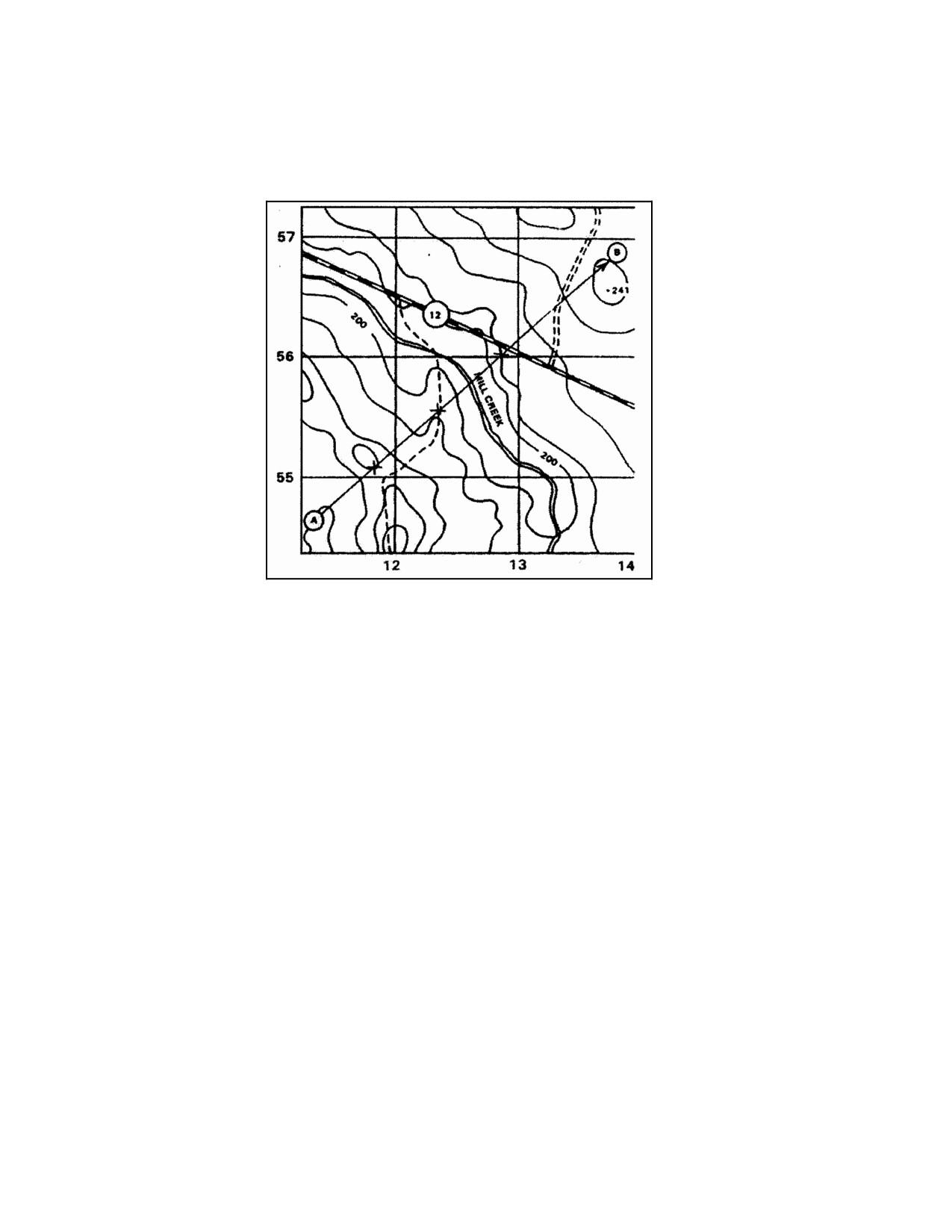
travel. For example, look at Figure A-1 (071-329-1006-1). Assume
that you are to move from point A to point B. You see that a
straight line could cause you to climb several small ridges and
valleys (the “X's” on Figure 071-329-1006).
A-9
FM 7-21.13 ____________________________________________________________
Figure A-1. (071-329-1006-1) Straight-line route.
c. When adjusting your route, consider the following:
(1) Tactical aspect. Avoid skylining open areas and danger
areas like streams or crossings on roads and hilltops. Your
tactical concern is survival. The mission is causing you to
move to your objective. You need to be sure you get to that
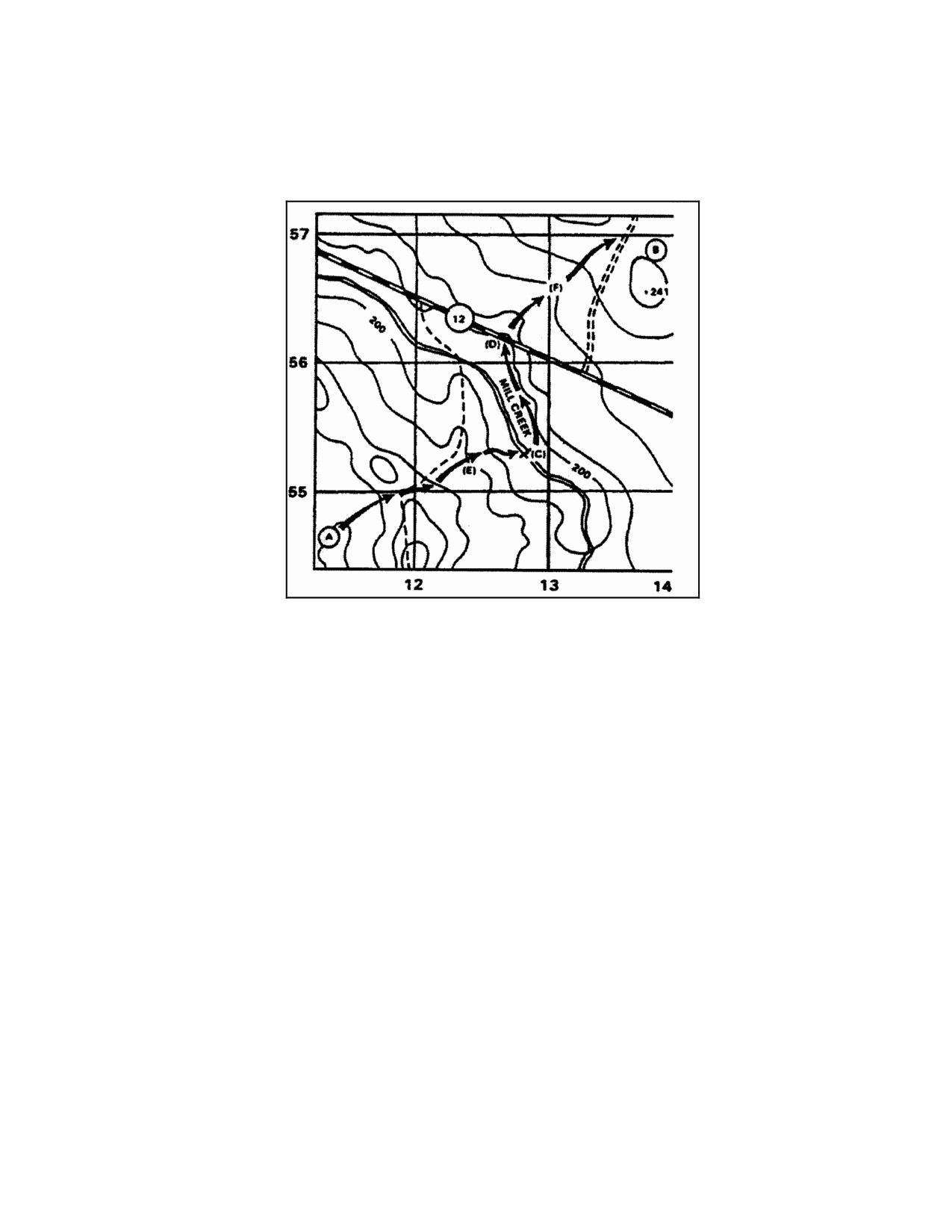
objective. Looking at Figure A-2
(071-329-1006-2), you
decide for tactical reasons to cross the stream where you
would not be seen from the road (C) and to cross the road
in a small valley (D). You know that valleys offer better
cover and concealment, so you will use them (E) (F).
A-10
____________________________________________________________ Appendix A
Figure A-2 (071-329-1006-2) Adjusted route.
(2) Ease of movement. Always pick the easiest route that
the tactical situation allows. However, you achieve
surprise by doing the unexpected. A difficult route
increases your chance of getting lost. A difficult route may
be noisy and may tire you out before you get to your
objective.
(3) Boundaries. It is almost impossible to travel in a
straight line, with or without a compass. Pick an axis or
corridor to travel along. Pick boundaries you will be able
to spot or feel. Hardtop roads, streams, high grounds, and
railroads all make good boundaries. If you start to wander
too far off course, you will know it.
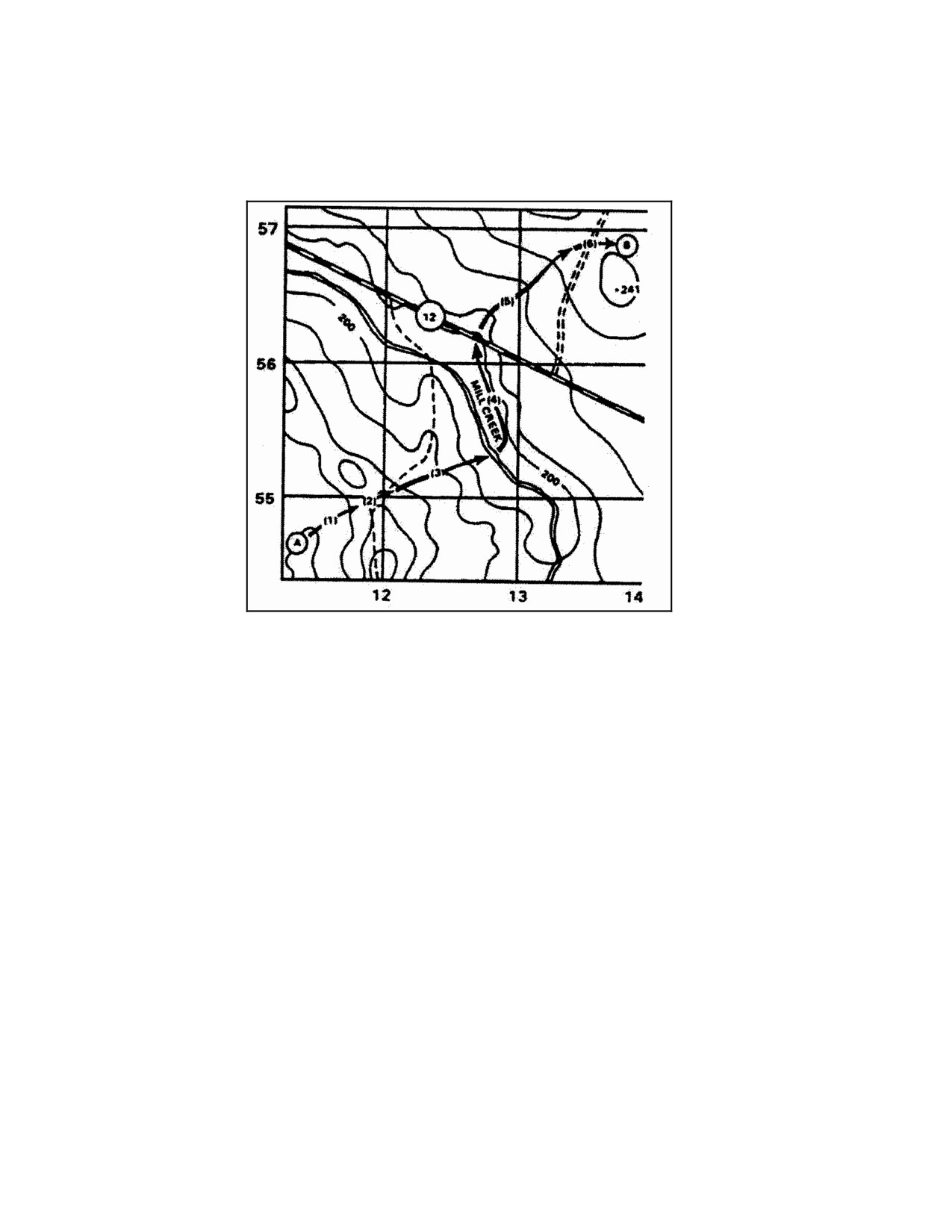
d. You decide the route shown in Figure A-3 (071-329-1006-3)
offers you easy movement. You check your axis up the valley (1);
across the ridge at the saddle (2); cross the stream, turning left and
keep the stream on the left, high ground on the right (4); to the
third valley (5); to the saddle, then on the objective (6).
A-11
FM 7-21.13 ____________________________________________________________
Figure A-3. (071-329-1006-3) Route of travel.
e. With boundaries to keep you straight, you need to know where
along your corridor you are. You do this with checkpoints. The best
checkpoint is a line or linear feature that you cannot miss. A linear
feature across your corridor, or axis, is crossed no matter where
you are in the axis. Use hardtop roads, railroads, power lines,
perennial streams
(solid blue lines, the dash blue lines are
frequently dry), rivers, ridges, and valleys.
NOTE: DO NOT use light-duty roads and trails, there is always more on
the ground than the map shows. DO NOT use wood lines, which are rarely
permanent.
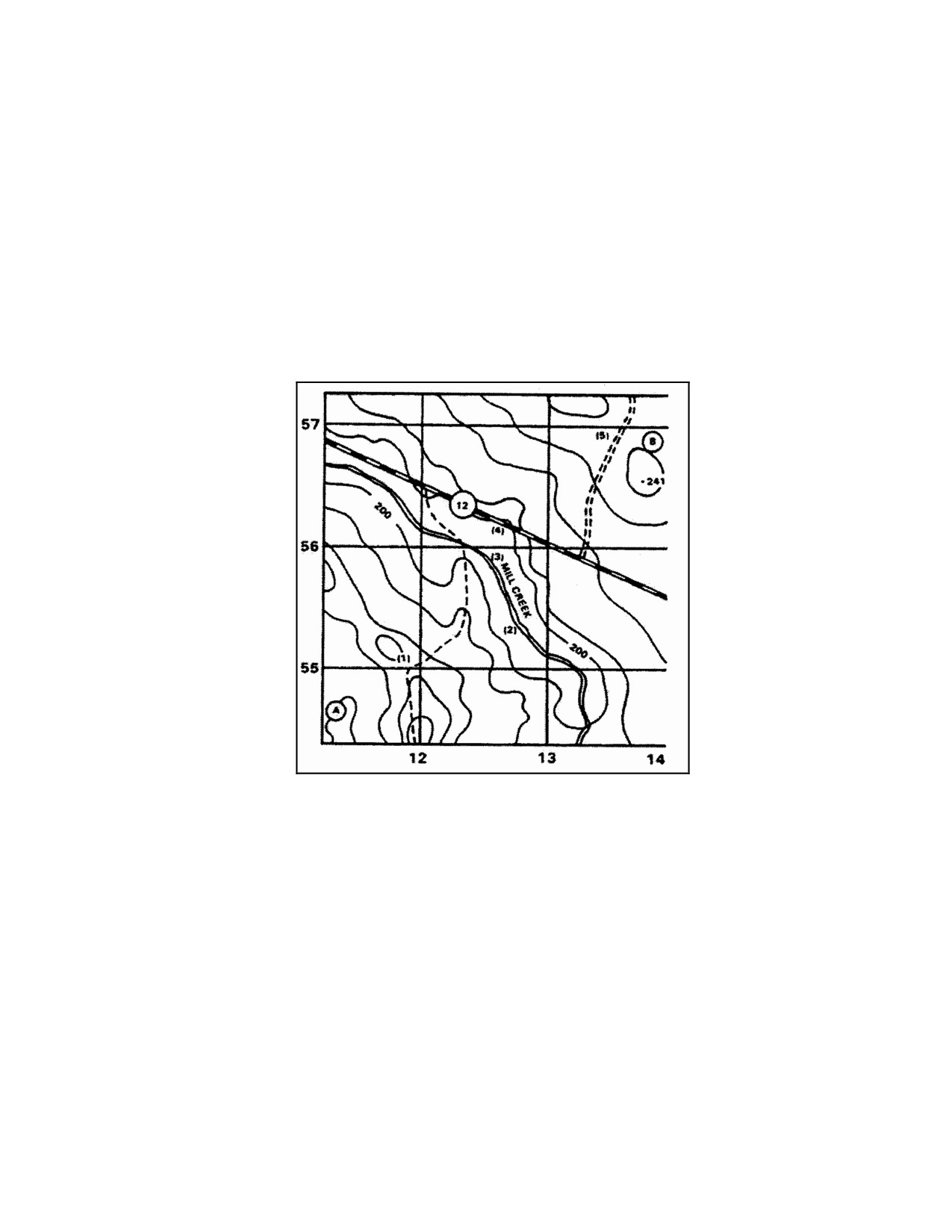
g. Referring to Figure A-4 (071-329-1006-4), pick your checkpoints.
(1) Saddle, use Hill 241 to line on up the right valley, and follow
to -
(2) Stream, move along it until—
(3) Bend in the stream, turn right to—
(4) Road in the valley (the ridge crossing on the road on the 12-
grid line will serve as a limiting feature), then up to—
(5) Far saddle, and right to your objective (B).
A-12
____________________________________________________________ Appendix A
g. If you cannot find linear features, use an elevation change--hill
or depressions, small ridge, or a valley. Look for one contour line of
change during the day, two at night. Regardless of contour
interval, you will spot a contour interval of change on foot.
h. Determine the distance between checkpoints. DISTANCE IS
THE CAUSE OF MOST NAVIGATIONAL MISTAKES. Estimate
or measure the distance from one checkpoint to another. Trust that
distance.
Figure A-4. (071-329-1006-4) Checkpoints.
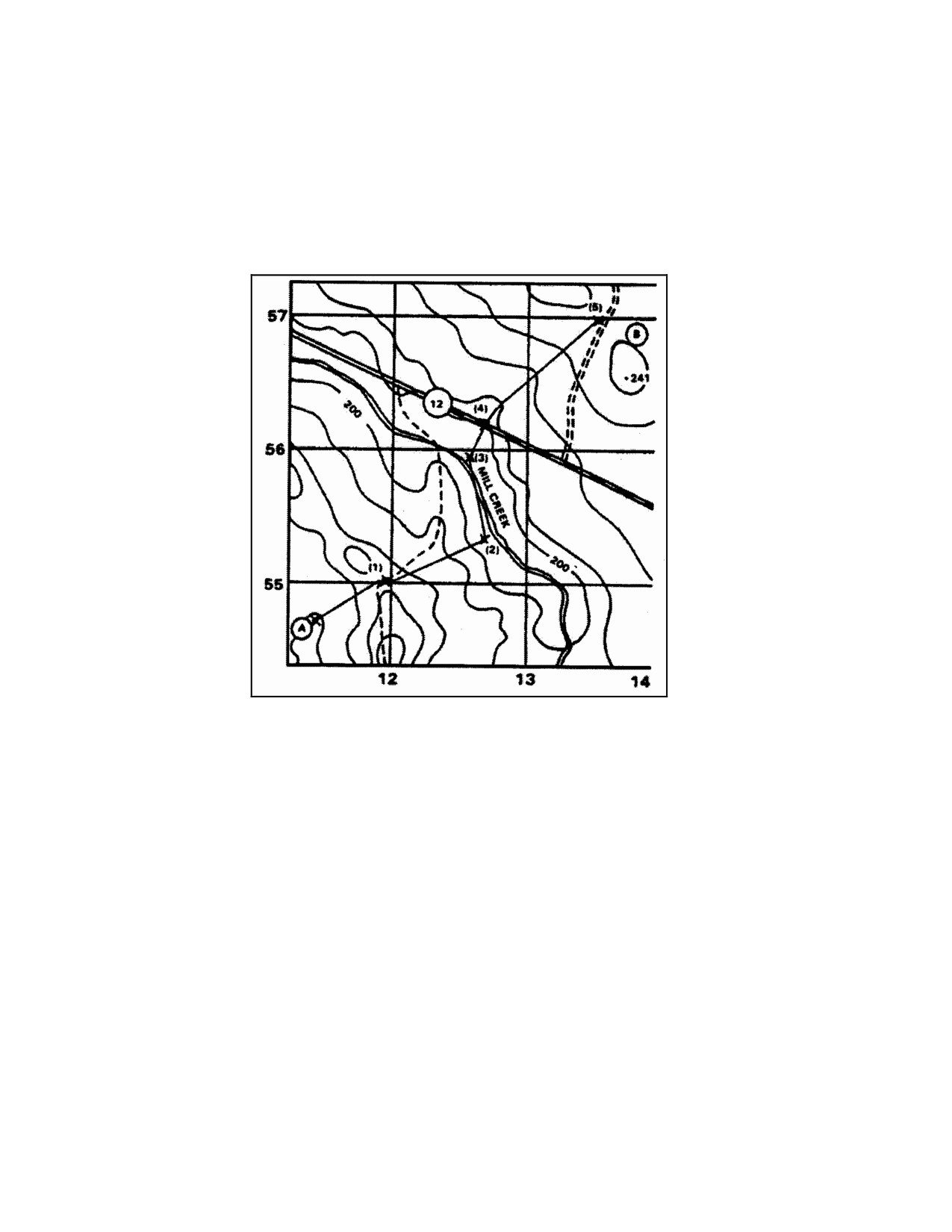
i. Referring to Figure A-5 (071-329-1006-5), check your distances:
(1) 500 meters to the saddle (1).
(2) 800 meters to the stream (2).
(3) 500 meters to the bend in the stream (3).
(4) 300 meters to the road (4).
(5) 1,000 meters to the far saddle (5).
3. Navigate from one point to another using dead reckoning.
a. Dead reckoning is a technique of following a set route or line for
a determined distance. This technique is used on flat terrain, like
A-13
FM 7-21.13 ____________________________________________________________
deserts and swamps. It can be used day or night. To use dead
reckoning--
(1) Locate the start point and finish point on the map.
Figure A-5 (071-329-1006-5).
Figure A-5. (071-329-1006-5) Distance between checkpoints.
(2) Determine the grid azimuth from the start point to the
finish point or to the first intermediate point on the map.
(3) Convert the grid azimuth taken from the map to a
magnetic azimuth.
(4) Determine the distance between the start point and
the finish point or any intermediate points on the map.
NOTE: If you do not know how many paces you take for each 100 meters,
you should move to a 100-meter course and determine your pace count.
(5) Convert the map distance to pace count.
(6) Make a thorough map reconnaissance of the area
between the start point and the finish point.
b. Before moving from the start point, shoot an azimuth on a well-
defined object on the ground in the direction of travel. These
A-14
____________________________________________________________ Appendix A
objects, known as steering points, may be lone trees, buildings,
rocks, or any easily identifiable point. At night, the most likely
steering point will be a star. Because of the rotation of the Earth,
the positions of the stars continually change. You must check your
azimuth frequently. Do this only when halted. Using your compass
while moving will cause you to go off-course. Your steering mark
may be beyond your objective. Remember to travel the distance you
determined.
c. Once you have selected a steering point, move toward it,
remembering to begin your count. You should have some methods
devised to keep track of the number of 100 meters you travel.
d. Upon reaching your first steering point, shoot an azimuth to
another steering mark, and repeat c, until you reach the finish
point.
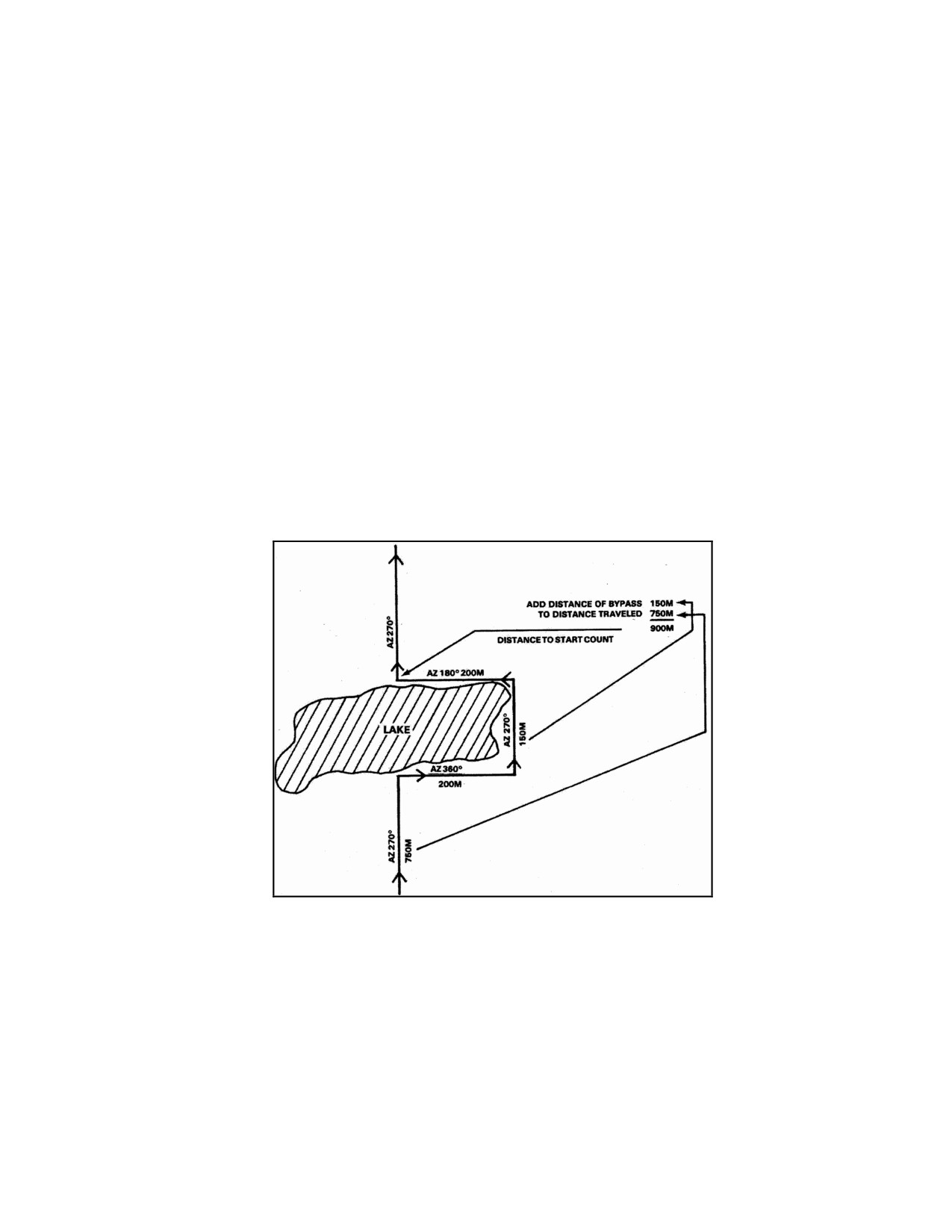
e. If you should encounter an obstacle, you may have to detour
around it. See Figure A-6 (071-329-1006-6). To do this, complete a
series of 90-degree turns until the obstacle is bypassed and you are
back on the original azimuth.
Figure A-6. (071-329-1006-6) Bypassing an obstacle.
(1) At the edge of the obstacle, make a note of the number
of paces taken to this point.
(2) If your detour is to the right, add 90 degrees to the
original azimuth.
A-15
FM 7-21.13 ____________________________________________________________
(3) Using the new azimuth, pick a steering mark and move
toward it, making sure you begin a new pace count. Move
on this azimuth until reaching the end of the obstacle.
(4) Stop and make a note of the number of paces taken,
again as in (2) above, add or subtract 90 degrees from the
azimuth just read, and move to the far side of the obstacle.
(5) Upon reaching the far side, stop the count and make
note of the number of paces taken; add this pace count to
the pace count noted in (1).
(6) At this time, again add or subtract 90 degrees from the
azimuth used. Using this new azimuth, move the same
number of paces taken on the first leg of the offset or
detour.
(7) Place the compass on your original azimuth, pick up
the pace count you ended with when you cleared the
obstacle, and proceed to your finish point.
f. Bypassing the same obstacle at night calls for special
considerations:
(1) To make a 90-degree turn, hold the compass as you
would to determine a Magnetic Azimuth.
(2) Turn until the center of the luminous letter "E" is
under the luminous line (do not change the setting of the
luminous line).
NOTE: If you turn to the right, "E" is under the luminous line. If you turn
to the left, "W" is under the line.
(3) Proceed in the direction until you have outflanked the
obstacle.
(4) Turn until the north arrow is under the luminous line
and proceed parallel to your original course until you have
bypassed the obstacle.
(5) Turn until the "W" is under the luminous line and
move back the same distance you originally moved.
(6) Finally, turn until the north arrow is under the
luminous line and proceed on your original course.
(7) You must do the pace count the same as you do for
bypassing the obstacle during daylight.
g. After reaching the finish point, conduct a detailed terrain
analysis to confirm your location.
4. Navigate from one point to another by combining terrain association with
dead reckoning.
a. Frequently, you must consider the advantage and disadvantage
of both navigation techniques.
A-16
____________________________________________________________ Appendix A
(1) Terrain association is fast and easy, and it allows for
mistakes. It also is subject to map accuracy and can only
be used with recognizable terrain features.
(2) Dead reckoning is accurate and works on flat terrain
that lacks terrain features; however, all work must be
precise, and the technique takes time.
b. There may be times when you combine both techniques. For
instance, in the desert, you may need to use dead reckoning to
arrive at or near a road, or a ridge, then use terrain association to
follow that feature to an objective.
Evaluation Preparation:
SETUP: Select an area with varying terrain and vegetation that is large
enough to have two points, 1,000 to 2,000 meters apart. Ensure each point
is on or near an identifiable terrain feature and marked on the ground with
a sign containing a letter or number. Place dummy signs not less than 100
meters but not more than 200 meters to the right and left of the correct
point. Clearly mark correct points on the map. Prepare a sheet of paper
giving the azimuth and distance for each leg of the course to be covered.
Have pencils available for the tested soldier.
BRIEF SOLDIER:
1. Terrain Association.
a. Give the soldier the map and tell him to identify the best route
to take between the two points that have been plotted on the
map (1,000 to 2,000 meters apart).
NOTE: The best route must have been determined by an SME
before the test.
b. Give the soldier the map and tell him he must move from point
A on the map to point B (1,000 to 2,000 meters apart) using terrain
association (no compass is used). Tell the soldier he has _______
(standards in minutes and/or hours) to complete the course.
2. Dead Reckoning. Give the soldier the sheet of paper with the azimuth
and the distance for each leg of the course (three to five points, 200 to 500
meters apart), and the compass; no map will be used. Tell the soldier to
move over the course shown by the azimuth and the distance on the paper.
Tell the soldier to record the letter or number at the end of each leg of the
course. Tell the soldier he has __________ (standards in minutes and/or
hours) to complete the course.
NOTE: Time standards are based on the average time it takes two SMEs to
complete the course plus 50 percent. For example, if the SMEs time is one
hour and thirty minutes. SME time(1 hour) + 50 percent (30 minutes) =
course test time of one hour and 30 minutes.
A-17
FM 7-21.13 ____________________________________________________________
Tell the soldier he has 10 minutes to study the map and determine a course.
At the end of this time, he will move to the start point and begins the test.
Time starts when soldier leaves the start point and ends when he crosses
the finish point.
Performance Measures
GO NO GO
1. Terrain association.
_____
_____
a. Identified the best route within 10 minutes and explained reason
for picking that route.
b. Wrote down the correct letter or number at the end of each leg of
the course.
2. Dead reckoning.
_____
_____
a. Wrote down the correct letter or number of each leg of the
course.
b. Arrived at correct destination within the specified time.
Evaluation Guidance: Score the soldier GO if all performance measures are
passed. Score the soldier NO-GO if any performance measure is failed. If
the soldier scores NO-GO, show the soldier what was done wrong and how
to do it correctly.
References
Required
Related
FM 3-25.26 (21-26)
STP 21-1-SMCT
PERFORM VOICE COMMUNICATIONS
113-571-1022
Conditions: Given one operational radio set (warmed up and set to the net
frequency) for each net member; a call sign information card (5 inches x 8
inches) consisting of net member duty position (S-1, S-2), net call sign
(letter-number-letter), suffix list (net control station [NCS] - 46, S-1 - 39, S-
2 - 13), and a message to be transmitted.
Situation: The net is considered to be secure and authentication is not
required.
NOTE: This task may have as many net members as there is equipment
available. Each net member must have a different suffix and message to
transmit.
A-18
____________________________________________________________ Appendix A
Standards: Enter a radio net, send a message, and left a radio net using the
proper call signs, call sign sequence, prowords, and phonetic alphabet and
numerals with 100 percent accuracy.
Performance Steps
1.
Enter the net.
a. Determine the abbreviated call sign and answering sequence for
your duty position.
b. Respond to the NCS issuing a net call.
c.
Answer in alphanumeric sequence.
NOTE: At this time, the NCS acknowledges and the net is open.
2.
Send a message.
a. Listen to make sure the net is clear. Do not interrupt any ongoing
communications.
b. Call the NCS and tell the operator the priority of the message you
have for his station.
c.
Receive a response from the NCS that he or she is ready to receive.
d.
Send your message using the correct prowords and pronunciation
of letters and numbers.
e. Get a receipt for the message.
3.
Leave the net in alphanumeric sequence.
a. You receive a call from the NCS who issues a close down order.
b. Answer in alphanumeric sequence.
NOTE: The NCS acknowledges and the net is closed. Note: The following
call signs are used in this task as an example: Net call sign - E3E, NCS -
E46, S-1 - E39, S-2 - E13.
Evaluation Preparation:
SETUP: Position operational radio sets in different rooms or tents or at
least 70 feet apart outside. Obtain call signs, suffixes, and a radio frequency
through the normal command chain. Select a message
15-25 words
containing some number groups such as map coordinates and times. Print
the call signs for the sender and the receiver, along with the message to be
sent, on 5 x 8 cards. Perform a communications check to ensure operation of
the radios. Have an assistant who is proficient in radio operation man the
NCS. Provide the assistant with the call signs. If the soldier has not
demonstrated sufficient progress to complete the task within 5 minutes,
give him a NO-GO. This time limit is an administrative requirement, not a
doctrinal one; so if the soldier has almost completed the task correctly, you
may decide to allow him to finish.
A-19
FM 7-21.13 ____________________________________________________________
BRIEF SOLDIER: Give the soldier the card containing the message and
call signs. Tell him the radio is ready for operation, the net is considered to
be secure and authentication is not required, and to send the message to
the NCS and get a receipt. Tell the soldier, if sufficient progress in
completing the task within 5 minutes has not been demonstrated, he or she
will receive a NO-GO for the task.
Performance Measures
GO NO GO
1.
Entered the net in alphanumeric sequence.
_____
_____
2.
Sent a message of 15 to 25 words using the correct prowords and
phonetic alphabet and numerals.
_____
_____
3. Left the net in alphanumeric sequence.
_____
_____
Evaluation Guidance: Score the soldier GO if all performance measures are
passed. Score the soldier NO-GO if any performance measure is failed. If
the soldier scores NO-GO, show the soldier what was done wrong and how
to do it correctly.
References
Required
Related
A-20
____________________________________________________________ Appendix A
SECTION II - SURVIVE
EVALUATE A CASUALTY
081-831-1000
Conditions: You have a casualty who has signs and/or symptoms of an
injury.
Standards: Evaluated the casualty following the correct sequence. All
injuries and/or conditions were identified. The casualty was immobilized if
a neck or back injury is suspected.
Performance Steps
NOTE: When evaluating and/or treating a casualty, seek medical aid as
soon as possible. Do not stop treatment, but, if the situation allows, send
another person to find medical aid.
WARNING
If there are signs of chemical or biological agent poisoning,
immediately mask the casualty. If it is not nerve agent poisoning,
decontaminate exposed skin and gross contamination (large wet
or oily spots) of the clothing or overgarments. If nerve agent
poisoning, administer the antidote before decontamination (see
task, Perform First Aid for Nerve Agent Injury, task number 081-
831-1044.)
WARNING
If a broken neck or back is suspected, do not move the casualty
unless to save his life.
1.
Check for responsiveness.
a. Ask in a loud, but calm voice, "Are you okay?"
b. Gently shake or tap the casualty on the shoulder.
c.
Watch for a response. If the casualty does not respond, go to step 2.
d.
If the casualty is conscious, ask where he feels different than usual
or where it hurts. Go to step 3. If the casualty is conscious but is
choking and cannot talk, stop the evaluation and begin treatment. (See
Task 081-831-1003.)
A-21
FM 7-21.13 ____________________________________________________________
2.
Check for breathing.
a. Look for rise and fall of the casualty's chest.
b. Listen for breathing by placing your ear about one inch above the
casualty's mouth and nose.
c. Feel for breathing by placing your hand or cheek about 1 inch above
the casualty's mouth and nose. If the casualty is not breathing, stop the
evaluation and begin treatment. (See Task, 081-831-1042.)
NOTE: Checking for pulse during mouth-to-mouth resuscitation, as
necessary.
3. Check for bleeding.
WARNING
In a chemically contaminated area, do not expose the wound(s).
a. Look for spurts of blood or blood-soaked clothes.
b. Look for entry and exit wounds.
c. If bleeding is present, stop the evaluation and begin treatment
as appropriate
(1) Arm or leg wound. (See Task 081-831-1032.)
(2) Partial or complete amputation. (See Task 081-831-
1032.)
(3) Open head wound. (See Task 081-831-1033.)
(4) Open abdominal wound. (See Task 081-831-1025.)
(5) Open chest wound. (See Task 081-831-1026.)
4. Check for shock.
a. Look for any of the following signs and/or symptoms:
(1) Sweaty but cool skin (clammy skin).
(2) Paleness of skin.
(3) Restlessness or nervousness.
(4) Thirst.
(5) Loss of blood (bleeding).
(6) Confusion.
(7) Faster than normal breathing rate.
(8) Blotchy or bluish skin, especially around the mouth.
(9) Nausea and/or vomiting.
b. If signs or symptoms of shock are present, stop the evaluation and
begin treatment. (See Task 081-831-1005.)
A-22
____________________________________________________________ Appendix A
WARNING
Leg fractures must be splinted before elevating the legs for shock
(See Task 081-831-1034.)
5. Check for fractures.
a. Look for the following signs and symptoms of a back or neck
injury:
(1) Pain or tenderness of the neck or back area.
(2) Cuts or bruises in the neck and back area.
(3) Inability of the casualty to move
(paralysis or
numbness).
(a) Ask about the ability to move (paralysis).
(b) Touch the casualty's arms and legs; ask
whether he or she can feel your hand (numbness).
(4) Unusual body or limb position.
WARNING
Unless there is immediate life-threatening danger, do not move a
casualty who has a suspected back or neck injury.
b. Immobilize any casualty suspected of having a neck or back
injury by doing the following:
(1) Tell the casualty not to move.
(2) If a back injury is suspected, place padding under the
natural arch of the casualty's back.
(3) If a neck injury is suspected, place a roll of cloth under
the casualty's neck and put boots (filled with dirt, sand,
etc.) or rocks on both sides of the head.
c. Check the casualty's arms and legs for open or closed fractures.
(1) Check for open fractures.
(a) Look for bleeding.
(b) Look for bone sticking through the skin.
(2) Check for closed fractures.
(a) Look for swelling.
(b) Look for discoloration.
(c) Look for deformity.
(d) Look for unusual body position.
d. If a fracture to an arm or leg is suspected, stop the evaluation
and begin treatment. (See Task 081-831-1034.)
A-23
FM 7-21.13 ____________________________________________________________
6. Check for burns.
a. Look carefully for reddened, blistered, or charred skin. Also
check for singed clothes.
b. If burns are found, stop the evaluation and begin treatment.
(See Task 081-831-1007.)
7. Check for head injury.
a. Look for the following signs and symptoms:
(1) Unequal pupils.
(2) Fluid from the ear(s), nose, mouth, or injury site.
(3) Slurred speech.
(4) Confusion.
(5) Sleepiness.
(6) Loss of memory or consciousness.
(7) Staggering in walking.
(8) Headache.
(9) Dizziness.
(10)Vomiting.
(11)Paralysis.
(12)Convulsions or twitches.
b. If a head injury is suspected, continue to watch for signs that
would require performance of mouth-to-mouth resuscitation (See
Task 081-831-1042), treatment for shock (See Task 081-831-1005),
or control of bleeding (See Task 081-831-1033.)
8. Seek medical aid. Seek medical assistance as soon as possible, but you
must not interrupt treatment. If possible send another person to find
medical aid.
Evaluation Preparation:
SETUP: Prepare a "casualty" for the soldier to evaluate by simulating one
or more wounds or conditions. Simulate the wounds using a war wounds
moulage set, casualty simulation kit, or other available materials. You can
coach a "conscious casualty" to show signs of such conditions as shock or
head injury and to respond to the soldier's questions about location of pain
or other symptoms of injury. However, you will have to cue the soldier
during evaluation of an "unconscious casualty" as to whether the casualty is
breathing and describe the signs or conditions, such as shock, as the soldier
is making the checks.
BRIEF SOLDIER: Tell the soldier to do, in order, all necessary steps to
evaluate the casualty and identify all wounds and/or conditions. Tell the
soldier to tell you what first aid action (give mouth-to-mouth resuscitation,
A-24
____________________________________________________________ Appendix A
bandage the wound, etc.) he or she would take but that no first aid is to be
performed unless a neck or back injury is found.
Performance Measures (1-10)
GO NO GO
1. Checked for responsiveness.
_____
_____
2. Checked for breathing, if necessary.
_____
_____
3. Checked for bleeding.
_____
_____
4. Checked for shock.
_____
_____
5. Checked for fractures and immobilized neck or back injuries, if found.
_____
_____
6. Checked for burns.
_____
_____
7. Checked for a head injury.
_____
_____
8. Sought medical aid.
_____
_____
9. Performed all necessary steps in sequence.
_____
_____
10. Identified all wounds and/or conditions.
_____
_____
Evaluation Guidance: Score the soldier GO if all steps are passed. Score the
soldier NO GO if any step is failed. If the soldier scores NO GO, show what
was done wrong and how to do it correctly.
References
Required
Related
FM 4-25.11 (21-11)
PERFORM FIRST AID FOR NERVE AGENT INJURY
081-831-1044
Conditions: You and your unit have come under a chemical attack. You are
wearing protective overgarments and/or mask, or they are immediately
available. There are casualties with nerve agent injuries. Necessary
materials and equipment: chemical protective gloves, overgarments,
overboots, protective mask and hood, mask carrier, and nerve agent
antidote autoinjectors. The casualty has three sets of MARK l nerve agent
antidote autoinjectors or three ATNAAs and one convulsant antidote for
nerve agents (CANA) autoinjector.
Standards: Administered correctly the antidote to self or administered
three sets of MARK l nerve agent antidote autoinjectors or three ATNAAs
followed by the CANA to a buddy following the correct sequence.
A-25
FM 7-21.13 ____________________________________________________________
Performance Steps (1-14)
NOTE: The Antidote Treatment, Nerve Agent, Autoinjector
(ATNAA)
system is a nerve agent antidote device that will be used by the Armed
Forces. A single ATNAA delivers both the atropine and 2 Pam Cl. The
ATNAA will replace the MARK I when supplies are exhausted. Procedures
for administering ATNAA will be contained in FM 4-25.11 (FM 21-11) and
FM 8-285.
NOTE: When performing first aid on a casualty, seek medical aid as soon as
possible. Do not stop the first aid; if the situation allows, send another
person to find medical aid.
1.
Identify mild signs and symptoms of nerve agent poisoning.
a. Unexplained runny nose.
b. Unexplained sudden headache.
c.
Excessive flow of saliva (drooling).
d.
Tightness of the chest causing breathing difficulties.
e.
Difficulty seeing (blurred vision).
f.
Muscular twitching around area of exposed or contaminated skin.
g.
Stomach cramps.
h.
Nausea.
NOTE: For the above signs and symptoms first aid is considered to be self-
aid.
2.
React to the chemical hazard.
a. Put on your protective mask.
NOTE: Seek overhead cover or use a poncho to provide cover, mission
permitting. Do not put on additional protective clothing at this time. Give
yourself the nerve agent antidote first. Then, decontaminate exposed skin
areas and put on remaining protective clothing.
b. Give the alarm.
3.
Administer nerve agent antidote to self (self-aid), if necessary.
a. MARK I.
(1) Prepare to administer one atropine injection.
(a) Remove one set of MARK I from your protective mask
carrier, from the pocket of the MOPP suit, or from another
location as specified by your unit SOP.
(b) With one hand, hold the set of injectors by the plastic clip
with the big injector on top.
A-26
____________________________________________________________ Appendix A
(c) With the other hand, check the injection site in order to
avoid buttons and objects in pockets where injecting. For
injections into the thigh, grasp the trouser cargo pocket and
pull forward, clearing possible obstructions from the site.
(d) Grasp the small injector without covering or holding the
needle (green) end, and pull it out of the clip with a smooth
motion.
(e) Form a fist around the autoinjector with the needle end
(green) extending beyond the little finger end of the fist. Be
careful not to inject yourself in the hand.
NOTE: If the injection is accidentally given in the hand, another small
injector must be obtained and the injection given in the proper site.
(f) Place the needle end of the injector against the outer thigh
muscle. For injections into the thigh, grasp the trouser cargo
pocket and pull forward, clearing possible obstructions from
the site.
NOTE: The injection can be given in any part of the lateral thigh muscle
from about a hand's width above the knee to a hand's width below the hip
joint.
NOTE: Very thin soldiers should give the injection in the upper outer part
of the buttocks.
CAUTION
When injecting antidote in the buttocks, be very careful to inject
only into the upper, outer quarter of the buttocks to avoid hitting
the major nerve that crosses the buttocks. Hitting the nerve may
cause paralysis.
(2) Administer the atropine injection.
(a) Push the injector into the muscle with firm, even pressure
until it functions.
NOTE: A jabbing motion is not necessary to trigger the activating
mechanism.
(b) Hold the injector firmly in place for at least 10 seconds.
(c) Remove the injector from your muscle and carefully place
this used injector between two fingers of the hand holding the
plastic clip.
(3) Prepare to administer one 2 PAM Cl injection.
A-27
FM 7-21.13 ____________________________________________________________
(a) Pull the large injector out of the clip and form a fist
around the autoinjector with the needle end extending beyond
the little finger.
(b) Place the needle (black) end of the injector against the
injection site.
(4) Administer the 2 Pam Cl injection.
(a) Push the injector into the muscle with firm, even pressure
until it functions.
(b) Hold the injector firmly in place for at least 10 seconds.
b. ATNAA.
(1) Prepare to administer one ATNAA.
(a) Remove one ATNAA from your protective mask carrier,
from the pocket of the MOPP suit, or from another location as
specified by your unit SOP.
(b) Remove the autoinjector from the pouch.
(c) With your dominant hand, hold the ATNAA in your closed
fist with the green needle end extending beyond the little
finger in front of you at eye level.
(d) With your nondominant hand, grasp the safety (gray) cap
with the thumb and first two fingers.
CAUTION
Do not cover or hold the needle end with your hand, thumb, or
fingers. You may accidentally inject yourself.
(e) Pull the safety cap off the bottom of the injector with a
smooth motion and drop it to the ground.
(f) With the nondominant hand, check the injection site in
order to avoid buttons and objects in pockets where injecting.
For injections into the thigh, grasp the trouser cargo pocket
and pull forward, clearing possible obstructions from the site.
(g) Hold the ATNAA in your closed fist with the green needle
end pointing out by your little finger.
(h) Place the needle end of the injector against the outer thigh
muscle.
NOTE: Very thin soldiers should give the injection in the upper outer part
of the buttocks.
CAUTION
When injecting antidote in the buttocks, be very careful to inject
only into the upper, outer quarter of the buttocks to avoid hitting
the major nerve that crosses the buttocks. Hitting the nerve may
cause paralysis.
A-28
____________________________________________________________ Appendix A
NOTE: The injection can be given in any part of the lateral thigh muscle
from about a hand's width above the knee to a hand's width below the hip
joint.
(2) Administer the injection.
(a) Push the injector into the muscle with firm, even pressure
until it functions.
NOTE: A jabbing motion is not necessary to trigger the activating
mechanism.
(b) Hold the injector firmly in place for at least 10 seconds.
(c) Remove the injector from your muscle.
4.
Secure the used injectors.
a. Drop the plastic clip (MARK I) without dropping the used injectors.
b. Use a hard surface to bend each needle to form a hook without
tearing protective gloves or clothing.
c.
Push the needle of each used injector (one at a time) through one of
the pocket flaps of the protective overgarment.
5.
Decontaminate skin if necessary.
NOTE: Information on this step is provided in Task 031-503-1013.
6.
Put on remaining protective clothing.
NOTE: Information on this step is covered in Task 031-503-1015.
WARNING
If, within
5 to 10 minutes after administering the first set of
injections, your heart begins beating rapidly and your mouth
becomes very dry; do not administer another set of injections.
7.
Seek buddy-aid or medical aid.
NOTE: After you have given yourself the first set of MARK I injections or
one ATNAA, you most likely will not need additional antidote if you are
ambulatory and know who and where you are. If needed, additional
injections will be given only by a buddy, a combat lifesaver, or medical
personnel.
8.
Identify severe signs and symptoms of nerve agent poisoning.
a. Strange and confused behavior.
A-29
FM 7-21.13 ____________________________________________________________
b. Gurgling sounds made when breathing.
c.
Severely pinpointed pupils.
d.
Red eyes with tearing.
e.
Vomiting.
f.
Severe muscular twitching.
g.
Loss of bladder and/or bowel control.
h.
Convulsions.
i.
Unconsciousness or stoppage of breathing.
NOTE: If the casualty is exhibiting severe symptoms, assistance (buddy-
aid) is required by the individual to complete first aid treatment.
9.
Mask the casualty if necessary.
WARNING
Do not kneel at any time while providing aid to the casualty.
Contact with the ground could force the chemical into or through
the protective clothing.
NOTE: Reposition the casualty on his back if necessary to mask the
individual.
a. Place the mask on the casualty.
b. If the casualty can follow directions, have him clear the mask.
c.
Check for a complete mask seal by covering the inlet valves of the
mask.
d. Pull the protective hood over the head, neck, and shoulders of the
casualty.
e. Position the casualty on the right side, similar to a swimmer
position, with head slanted down so that the casualty will not roll
back over.
10. Administer first aid to a nerve agent casualty (buddy-aid).
a. MARK I.
(1) Prepare to administer one atropine injection.
(a) Position yourself near the casualty's thigh.
(b) Remove all three sets of autoinjectors and the single CANA
autoinjector from the casualty's mask carrier, BDU pocket, or
from another location as specified by your unit SOP. Place the
autoinjectors and CANA on the casualty's side. DO NOT place
the unused devices on the ground.
(c) With one hand, hold the set of injectors by the plastic clip
with the big injector on top.
A-30
____________________________________________________________ Appendix A
(d) With the other hand, check the injection site to avoid
buttons and objects in pockets. For injections into the thigh,
grasp the trouser cargo pocket and pull forward (toward you),
clearing possible obstructions from the site.
(e) Grasp the small injector and pull it out of the clip with a
smooth motion.
(f) Hold the injector in your closed fist with the green needle
end pointing out by your little finger without covering the
needle end.
(g) Place the needle end of the injector against the casualty's
outer (lateral) thigh muscle.
NOTE: The injection can be given in any part of the lateral thigh muscle
from about a hand's width above the knee to a hand's width below the hip
joint.
NOTE: Very thin soldiers should be given the injections in the upper outer
part of the buttocks.
WARNING
When injecting antidote in the buttocks, be very careful to inject
only into the upper, outer quarter of the buttocks to avoid hitting
the major nerve that crosses the buttocks. Hitting the nerve may
cause paralysis.
(2) Administer the atropine injection.
(a) Push the injector into the muscle with firm, even pressure
until it functions.
(b) Hold the injector in place for at least 10 seconds.
(c) Remove the injector from the muscle and carefully place the
used injector between two fingers of the hand holding the clip.
(3) Prepare to administer one 2 PAM Cl injection.
(a) Pull the large injector out of the clip and hold the injector
in your closed fist with the black needle end pointing out by
your little finger without covering the needle end.
(b) Place the needle (black) end of the injector against the
injection site.
(4) Administer the 2 Pam Cl injection.
(a) Push the injector into the muscle with firm, even pressure
until it functions.
(b) Hold the injector in place for at least 10 seconds.
(c) Drop the clip without dropping injectors.
(d) Lay the used injectors on the casualty's side.
A-31
FM 7-21.13 ____________________________________________________________
NOTE: Repeat steps 10a through 10d until the casualty has received a total
(including self-administered) of three sets of antidote injections.
b. ATNAA
(1) Prepare to administer one ATNAA.
(a) Obtain three or all of the remaining ATNAAs and one
CANA from the casualty's protective mask carrier, from the
pocket of the MOPP suit, or from another location as specified
by your unit SOP.
(b) Remove one ATNAA from the pouch.
(c) With your dominant hand, hold the ATNAA in your closed
fist with the green needle and pointing out by your little finger
in front of you at eye level.
(d) With your nondominant hand, grasp the safety (gray) cap
with the thumb and first two fingers.
CAUTION
Do not cover or hold the needle end with your hand, thumb, or
fingers. You may accidentally inject yourself.
(e) Pull the safety cap off the bottom of the injector with a
smooth motion and drop it to the ground.
(f) With the nondominant hand, check the injection site in
order to avoid buttons and objects in pockets where injecting.
For injections into the thigh, grasp the trouser cargo pocket
and pull forward, clearing possible obstructions from the site.
(g) Hold the ATNAA in your closed fist.
(h) Place the needle end of the injector against the outer thigh
muscle.
NOTE: The injection can be given in any part of the lateral thigh muscle
from about a hand's width above the knee to a hand's width below the hip
joint.
NOTE: Very thin soldiers should give the injection in the upper outer part
of the buttocks.
CAUTION
When injecting antidote in the buttocks, be very careful to inject
only into the upper, outer quarter of the buttocks to avoid hitting
the major nerve that crosses the buttocks. Hitting the nerve may
cause paralysis.
(2) Administer the injection.
A-32
____________________________________________________________ Appendix A
(a) Push the injector into the muscle with firm, even
pressure until it functions.
NOTE: A jabbing motion is not necessary to trigger the activating
mechanism.
(b) Hold the injector firmly in place for at least 10 seconds.
(c) Remove the injector from the muscle.
(d) Place the used injector on the casualty's side.
(3) Repeat the procedure for a total of three ATNAAs.
11. Administer the anticonvulsant, CANA.
a. Prepare to administer the CANA injection.
(1) Tear open the protective plastic packet and remove the injector.
(2) With your dominant hand, hold the injector in your closed fist
with the black needle end pointing out by your little finger.
(3) With the other hand, pull the safety cap off the injector base to
arm the injector.
CAUTION
Do not touch the black (needle) end. You could accidentally inject
yourself.
(4) Place the black end of the injector against the casualty's
injection site.
b. Administer the CANA injection.
(1) Push the injector into the muscle with firm, even pressure until
it functions.
(2) Hold the injector in place for at least 10 seconds.
12. Secure the used injectors.
a. Using a hard surface bend each needle to form a hook without
tearing protective gloves or clothing.
b. Push the needle of each used injector (one at a time) through one of
the pocket flaps of the casualty's protective overgarment.
13. Decontaminate the casualty's skin if necessary.
NOTE: This information is covered in Task 031-503-1013.
14. Seek medical aid.
A-33