FM 7-21.13 THE SOLDIER’S GUIDE (FEBRUARY 2004) - page 6
FM 7-21.13 ____________________________________________________________
perform their individual critical tasks to the prescribed standard. STPs
help standardize individual training for the whole Army.
Gunners that can't shoot will die.
The Battalion Commander's Handbook
5-17. Individual tasks are the building blocks to collective tasks. Your
first-line supervisor will identify those individual tasks that support your
units mission essential task list (METL). If you have questions about which
tasks you must perform, ask your first-line supervisor for clarification,
assistance and guidance. Your first-line supervisor knows how to perform
each task or can direct you to the appropriate soldier training publications,
field manuals, technical manuals, and Army regulations. A good habit is to
periodically ask your supervisor or fellow soldier to check your task
performance to ensure that you can perform each task you are responsible
for to the prescribed standard.
Training then-both good and bad-is habit forming. The
difference is that one develops the battlefield habits that win;
the other gets you killed.
SMA Glen E. Morrell
LEADER TRAINING AND DEVELOPMENT
5-18. Competent and confident leaders are a prerequisite to training
ready units. Leader training and leader development are integral parts of
unit readiness. Leaders are soldiers first and must be technically and
tactically proficient in basic soldier skills. They are also adaptive, capable of
sensing their environment, adjusting the plan when appropriate and
properly applying the proficiency acquired through training.
5-19. Leader training is an expansion of these skills that qualifies them to
lead other soldiers. As such, the doctrine and principles of training leader
tasks is the same as that for any other task. Leader training occurs in the
institutional Army, the unit, the combat training centers, and through self-
development. Leader training is a part of leader development.
5-20. Leader development is the deliberate, continuous, sequential and
progressive process, grounded in Army values, that grows soldiers into
competent and confident leaders capable of decisive action. Leader
development comes from the knowledge, skills, and experiences gained
through institutional training and education, organizational training,
operational experience, and self-development. In always doing your best
during training you are developing leader skills and attributes. But this
won’t be enough to provide the insight, intuition and judgment necessary in
combat. Self-study and training is also essential. It begins with a candid
assessment of your strengths and weaknesses and then, with your
supervisor, develop a program to build on those strengths and minimize
those weaknesses. Often this involves reading about leadership, military
5-6
_____________________________________________________________ Chapter 5
history, or MOS-related subjects, for example. But it also may include other
activities, such as college or correspondence courses.
The most enduring legacy that we can leave for our future
generations of noncommissioned officers will be leader
development.
SMA Julius W. Gates
5-21. Another great resource available to help you in self-development
and leaders for training subordinates is US Army Training and Doctrine
Command’s digital library at http://www.adtdl.army.mil/atdls.htm. The
digital library database contains publications and additional information
not included in your STP. You can access this information through the
internet and through your Army Knowledge Online (AKO) account.
BATTLE FOCUS TRAINING MANAGEMENT
5-22. The foundation of the training process is the Army training
management cycle. The training management cycle and the necessary
guidelines on how to plan, execute, and assess training and leader
development is also found in FM 7-0. Understanding how the Army trains
the Army to fight is key to successful joint, multinational, interagency, and
combined arms operations. Effective training leads to units that execute the
Army’s core competencies and capabilities.
5-23. Training management starts with the unit mission. From mission,
unit leaders develop the mission essential task list (METL). The METL is
an unconstrained statement of the tasks required to accomplish wartime
missions. The availability of resources does not affect METL development,
but resources for training are constrained and compete with other missions
and requirements. Therefore, leaders develop the long-range, short-range,
and near-term training plans to effectively utilize available resources to
train for proficiency on METL tasks.
5-24. Planning is an extension of the battle focus concept that links
organizational METL with the subsequent preparation, execution, and
evaluation of training. The planning process ensures continuous
coordination from long range planning, through short-range planning to
near-term planning, which ultimately leads to training execution. The
commander’s assessment provides direction and focus to the planning
process. Through the training planning process, the commander’s guidance
(training vision, goals, and priorities) is melded together with the METL
and the training assessment into manageable training plans.
5-25. Long-range training plans:
• Are about one year out for AC battalion level organizations.
• Are about three years out for RC battalion level organizations.
• Disseminate METL and battle tasks.
• Establish training objectives for each METL.
5-7
FM 7-21.13 ____________________________________________________________
• Schedule projected major training events.
• Identify long lead-time resources and allocate major resources such
as major training area rotations.
• Identify major training support systems products and services and
identify new requirements.
5-26. Short-range training plans:
• Are about three months for AC battalion level organizations.
• Are about one year out for RC battalion level organizations.
• Refine and expand upon appropriate portions of long-range plan.
• Cross-reference each training event with specific training objectives.
• Identify and allocate short-range lead time resources such as local
training facilities.
5-27. Near-term training plans:
• Refine and expand upon short-range plan through conduct of
training meetings.
• Determine best sequence for training.
• Provide specific guidance for trainers.
• Allocate training support systems, products and services, simulators
and simulations, and similar resources to specific trainers.
• Publish detailed training schedules.
• Provide basis for executing and evaluating training.
5-28. Properly developed training plans will—
• Maintain a consistent battle focus.
• Be coordinated with habitually task organized supporting
organizations.
• Focus on the correct time horizon.
• Be concerned with future proficiency.
• Incorporate risk management into all training plans.
• Establish organizational stability.
• Make the most efficient use of resources.
5-29. After training plans are developed, units execute training by
preparing, conducting, and recovering from training. The process continues
with training evaluations that provide bottom-up input to the
organizational assessment. These assessments provide necessary feedback
to the senior commander that assist in preparing the training assessment.
TRAINING AND TIME MANAGEMENT
5-30. The purpose of time management is to achieve and sustain technical
and tactical competence and maintain training proficiency at an acceptable
5-8
_____________________________________________________________ Chapter 5
level. Time management systems identify, focus and protect prime time
training periods and the resources to support the training. There are three
periods in this time management cycle: green, amber and red.
Green
5-31. The training focus of units in green periods is multiechelon;
collective training that leads to METL proficiency. This period coincides
with the availability of major training resources and key training facilities
and devices. Organizations in Green periods conduct planned training
without distraction and external taskings.
Amber
5-32. The focus of units in amber periods is on training proficiency at the
platoon, squad and crew level. Individual self-development is maximized
through the use of education centers and distributed learning.
Organizations in Amber periods are assigned support taskings beyond the
capability of those units in the Red period. Commanders must strive for
minimal disruption to Amber units’ training programs.
Red
5-33. The training focus of units in the Red periods is on maximizing self-
development opportunities to improve leader and individual task
proficiency. Units in the Red periods execute details and other
administrative requirements and allow the maximum number of soldiers to
take leave. Block leave is a technique that permits an entire unit to take
leave for a designated period of time. Commanders maintain unit integrity
when executing administrative and support requirements i.e. Squad, Team,
Platoon integrity. This exercises the chain of command and provides
individual training opportunities for first line leaders.
TOP-DOWN/BOTTOM-UP APPROACH TO TRAINING
5-34. The Top-Down/Bottom-Up approach to training is a team effort in
which senior leader provide training focus, direction and resources, and
junior leaders provide feedback on unit training proficiency, identify
specific unit training needs, and execute training to standard in accordance
with the approved plan. It is a team effort that maintains training focus,
establishes training priorities, and enables effective communication
between command echelons.
5-35. Guidance based on wartime mission and priorities flows from the
top-down and results in subordinate units having to identify specific
collective and individual tasks that support the higher unit’s mission. Input
from the bottom up is essential because it identifies training needs to
achieve task proficiency on identified collective and individual tasks.
Leaders at all levels communicate with each other about requirements and
planning, preparing, executing, and evaluating training.
5-36. Some leaders centralize planning to provide a consistent training
focus throughout the organization. However, they decentralize execution to
ensure that the conduct of mission-related training sustains strengths and
5-9
FM 7-21.13 ____________________________________________________________
overcomes the weakness unique to each unit. Decentralize execution
promotes subordinates leaders’ initiative to train their units, but does not
mean senior leaders give up their responsibilities to supervise training,
develop leaders, and provide feedback.
BATTLE FOCUS
5-37. Battle focus is a concept used to derive peacetime training
requirements from assigned and anticipated missions. The priority of
training in units is to train to standard on wartime missions. Battle focus
guides the planning, preparation, executing, and assessment of each
organization’s training programs to ensure its members train as they will
fight. Battle focus training is critical throughout the entire training process
and is used by commanders to allocate resources for training based on
wartime and operational mission requirements.
5-38. Battle focus enables commanders and staffs at all echelons to
structure a training program that copes with non-mission related
requirements while focusing on mission essential training activities. In
garrison, peacetime operations most units cannot attain proficiency to
standard on every task whether due to time or other resource constraints.
Battle focus helps the commander to design a successful training program
by consciously focusing on a reduced number of critical tasks that are
essential to mission accomplishment.
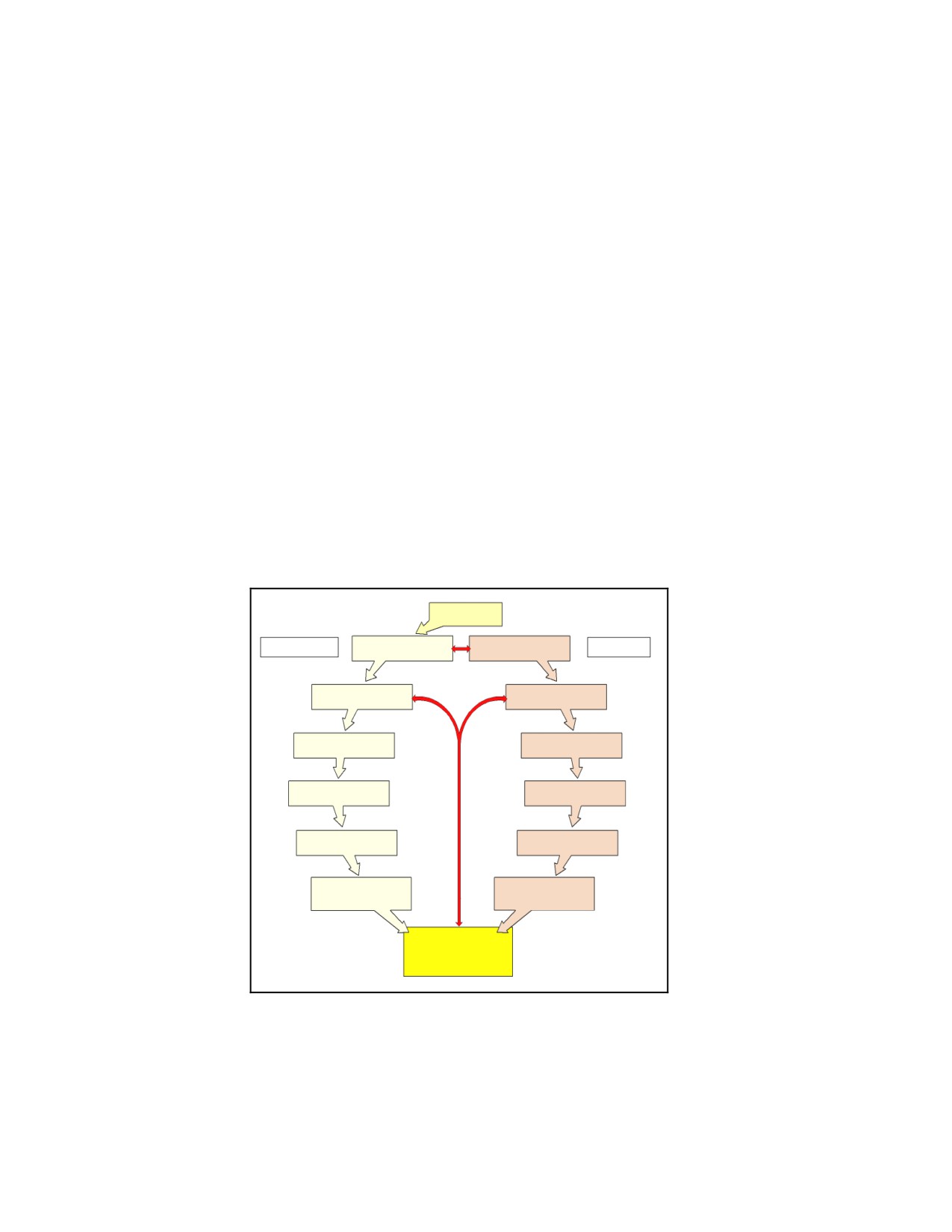
Battle Focus
Selects Collective
Selects Supporting
Commander
Mission Essential Task
Individual Task
1SG/CSM
Conducts Training
Conducts Training
Assessment
Assessment
Determines Training
Determines Training
Objectives
Objectives
Determines Strategy and
Determines Strategy and
Plans for Training
Plans for Training
Conducts Pre-Execution
Conducts Pre-Execution
Checks
Checks
Executes Training
Executes Training
and Conducts
and Conducts
After-Action Review
After-Action Review
Evaluates Training
Against Established
Standards
Figure 5-1. Integration of Collective and Individual Training
5-10
_____________________________________________________________ Chapter 5
5-39. A critical aspect of the battle-focus concept is to understand the
responsibility for and the linkage between the collective mission essential
tasks and the individual tasks that support them. The commander and the
command sergeant major or the first sergeant (CSM/1SG) must jointly
coordinate the collective mission-essential tasks and individual training
tasks on which the unit will concentrate its efforts during a given period.
The CSM/1SG must select the specific individual tasks that support each
collective task to be trained. Although NCOs have a primary role in
training and sustaining individual soldier skills, officers at every echelon
remain responsible for training to established standards during both
individual and collective training. Battle focus is applied to all missions
across the full spectrum of operations. Figure 5-1 shows this process.
TRAINING SCHEDULES
5-40. Near-term planning results in a detailed training schedule.
Backward planning is used to ensure that all tasks can be executed in the
time available and that tasks depending on other tasks are executed in the
correct sequence. Training is considered “Locked In” when the battalion
commander signs the training schedule. At a minimum, it should—
• Specify when training starts and where it takes place.
• Allocate adequate time for scheduled training and additional training
as required to correct anticipated deficiencies.
• Specify individual, leader, and collective tasks to be trained.
• Provide concurrent training topics that will efficiently use available
training time.
• Specify who conducts the training and who evaluates the training.
• Provide administrative information concerning uniform, weapon,
equipment, references, and safety precautions.
5-41. Senior commanders establish policies to minimize changes to the
training schedule. Training is locked in when training schedules are
published. Command responsibility is established to as follows—
• The company commander drafts the training schedule.
• The battalion commander approves and signs the schedule and
provides necessary administrative support.
• The brigade commander reviews each training schedule published in
his command.
• The division commander reviews selected training schedules in detail
and the complete list of organization wide training highlights
developed by the division staff.
CONDUCT OF TRAINING
5-42. Ideally, training is executed using the crawl-walk-run approach.
This allows and promotes an objective standard-based approach to training.
Training starts at this level. Crawl events are relatively simple to conduct
5-11
FM 7-21.13 ____________________________________________________________
and require minimum support from the unit. But after the crawl stage,
training becomes incrementally more difficult, requiring more resources
from the unit and home station and increasing the level of realism. At the
run stage, the level of difficulty for the training event intensifies. Run stage
training requires optimum resources and ideally approaches the level of
realism expected in combat. Progression from the walk to the run stage for
a particular task may occur during a one-day training exercise or may
require a succession of training periods over time. Achievement of the Army
standard determines progression between stages.
5-43. In crawl-walk-run training, the tasks and the standard remain the
same; however, the conditions under which they are trained change. For
example, commanders may change the conditions by increasing the
difficulty of the conditions under which the task is being performed,
increasing the tempo of the task training, increasing the number of tasks
being trained, or by increasing the number of personnel involved in the
training. Whichever approach is used, it is important that all leaders and
soldiers involved understand which stage they are currently training and
understand the Army standard.
5-44. An example of the crawl-walk-run approach occurs in the execution
of the infantry platoon task “conduct an attack.” In the crawl stage, the
platoon leader describes the task step-by-step, including what each soldier
does. In the walk stage, the platoon conducts a rehearsal of the attack at a
step-by-step pace. In the run stage, the platoon executes the task at combat
speed under tactical conditions against an opposing force (OPFOR). Ideally
this includes multiple iterations under increasingly difficult conditions—at
night, for example. Each time they practice the attack, the platoon strives
to achieve the tactical objective to the standard described in the training
and evaluation outline (T&EO) for “conduct an attack.”
THE AFTER-ACTION REVIEW
5-45. The After-action Review (AAR) is a structured review process that
allows all training participants to discover for themselves what happened,
why it happened, and how it can be done better. The unit leader or an
observer of the training can lead the discussion, but the key to having an
effective AAR is active involvment by all the soldiers who took part in the
training. All soldiers have a unique perspective of any given event and
should contribute to the AAR.
5-46. An effective AAR will focus on the training objectives and whether
the unit met the appropriate standards (not on who won or lost). The result
of an AAR is that soldiers learn lessons from the training. That requires
maximum participation of soldiers and leaders (including OPFOR) so those
lessons learned can be shared.
Most coaches study the films when they lose, I study them
when we win—to see if I can figure out what I did right.
Coach Paul “Bear” Bryant
5-12
_____________________________________________________________ Chapter 5
5-47. There are four distinct parts of an AAR. First, soldiers who
participated in the training review what was supposed to happen. Secondly,
you have to establish what, in fact, did happen, including the OPFOR’s
point of view. Then you determine what was right or wrong with what
happened, with respect to applicable standards. Finally—and this is vitally
important—you have to determine how the task should be done differently
next time.
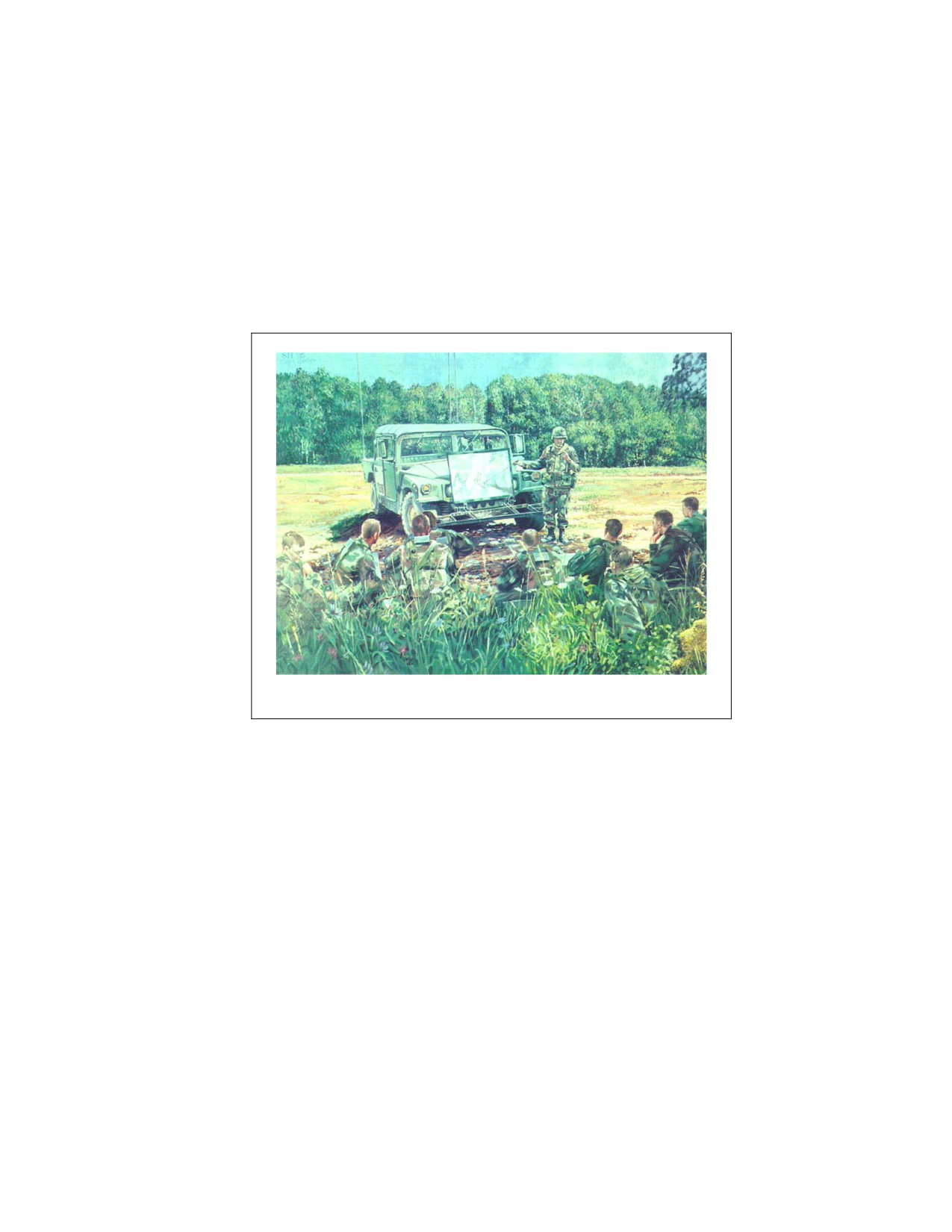
Hotwash—An AAR at the Combat Maneuver Training Center
Hohenfels, Germany.
5-48. An AAR should occur immediately after a training event and may
result in some additional training. You should expect to retrain on any task
that was not conducted to standard. That retraining will probably happen
at the earliest opportunity, if not immediately. Training is incomplete until
the task is trained to standard. Soldiers will remember the standard
enforced, not the one discussed. This same approach is useful in virtual and
constructive simulation as a means to train battle staffs and subordinate
organizations.
AARs are one of the best tools we have… AARs must be a two-
way communication between the NCO and the soldiers. They
are not lectures.
Center for Army Lessons Learned
5-13
FM 7-21.13 ____________________________________________________________
SERGEANT’S TIME TRAINING
5-49. Some training time during the week should be devoted to the small-
unit leader (such as a squad leader or a vehicle commander) to train his
soldiers. This enhances readiness and cohesion and it also allows the junior
NCO to learn and exercise the Army's training-management system at the
lowest level. The key is to train the trainer so that he can train his soldiers.
This requires the NCO to identify essential soldier and small-unit and team
tasks (drills) that support unit METL.
5-50. NCOs are the primary trainers of junior enlisted soldiers.
Sergeant’s Time Training (STT) affords a prime opportunity for developing
first line leaders while they gain their soldier’s confidence. Active
component commanders should institute STT as a regular part of the units
training program. This will allow NCOs to train their soldiers on certain
tasks in a small group environment.
5-51. Sergeant’s Time Training is a hands-on, practical training for
soldiers given by their NCOs. It provides the NCO with resources and the
authority to bring training publications or technical manuals to life and
develops the trust between leader and led to ensure success in combat. In
the active component, the chain of command and the NCO support channel
implement this training by scheduling five continuous uninterrupted hours
each week to STT. STT may be difficult for reserve component (RC) units to
accomplish during a typical training assembly or even during annual
training, but RC units should plan and conduct STT after mobilization.
5-52. NCOs or first line leaders are the primary trainers during STT and
should strive for
100% of their soldiers present for training. Platoon
sergeants assist in the preparation and execution of training and officers
provide the METL resources (time, personnel and equipment) to conduct
training and provide feedback to commanders. Senior NCOs should protect
this program against distractions and provide leadership and guidance as
necessary to the first-line leaders. NCOs conduct a training assessment and
recommend what individual tasks or crew and squad collective training
they need to conduct during STT. Topics are based on the small unit
leader’s assessment of training areas that need special attention. Sergeant’s
Time Training may be used to train soldiers in a low-density MOS by
consolidating soldiers across battalion/brigade and other organizations.
5-53. Many units have their own way of conducting STT but some aspects
are universal. For example, STT is standard oriented and not time oriented.
In other words, expect to train on a task until soldiers are proficient in that
task. In addition, all first-line supervisors maintain a file with the task,
conditions, and standards for each task and each soldier’s proficiency in
those tasks.
5-54. At the end of Sergeant’s Time Training, the supervisor will assesses
the training conducted and makes recommendations for future training. If
the task could not be trained to standard, then the supervisor should
reschedule the same task for a future Sergeant’s Time.
5-14
_____________________________________________________________ Chapter 5
TASK, CONDITIONS, AND STANDARDS
5-55. Task, conditions, and standards are the Army’s formula for training
tasks to standard. You should learn the specific conditions and standards
before training a task so you understand what is expected of you.
• Task: A clearly defined and measurable activity accomplished by
individuals and organizations. Tasks are specific activities that
contribute to the accomplishment of encompassing missions or other
requirements.
• Conditions: The circumstances and environment in which the task is
to be performed.
• Standard: The minimum acceptable proficiency required in the
performance of the training task under a specific set of conditions.
SECTION II: INDIVIDUAL SOLDIER TRAINING
5-56. The competence of the individual soldier is the heart of any unit’s
ability to conduct its mission. Individual training is the instruction of
soldiers to perform their critical individual tasks to the prescribed
standard. A soldier must be capable of performing these tasks in order to
serve as a viable member of a team and to contribute to the accomplishment
of a unit’s missions. Maintain proficiency in your individual tasks to build
self-confidence and trust among your fellow soldiers.
5-57. Individual training is initially conducted in the training base in a
formal school setting but subsequently may also be provided via
distributed learning that a soldier must complete in his unit or at a
distance learning site. Initial individual training is often conducted with
commercial firms, by specialized Army activities at civilian institutions,
and units in the field.
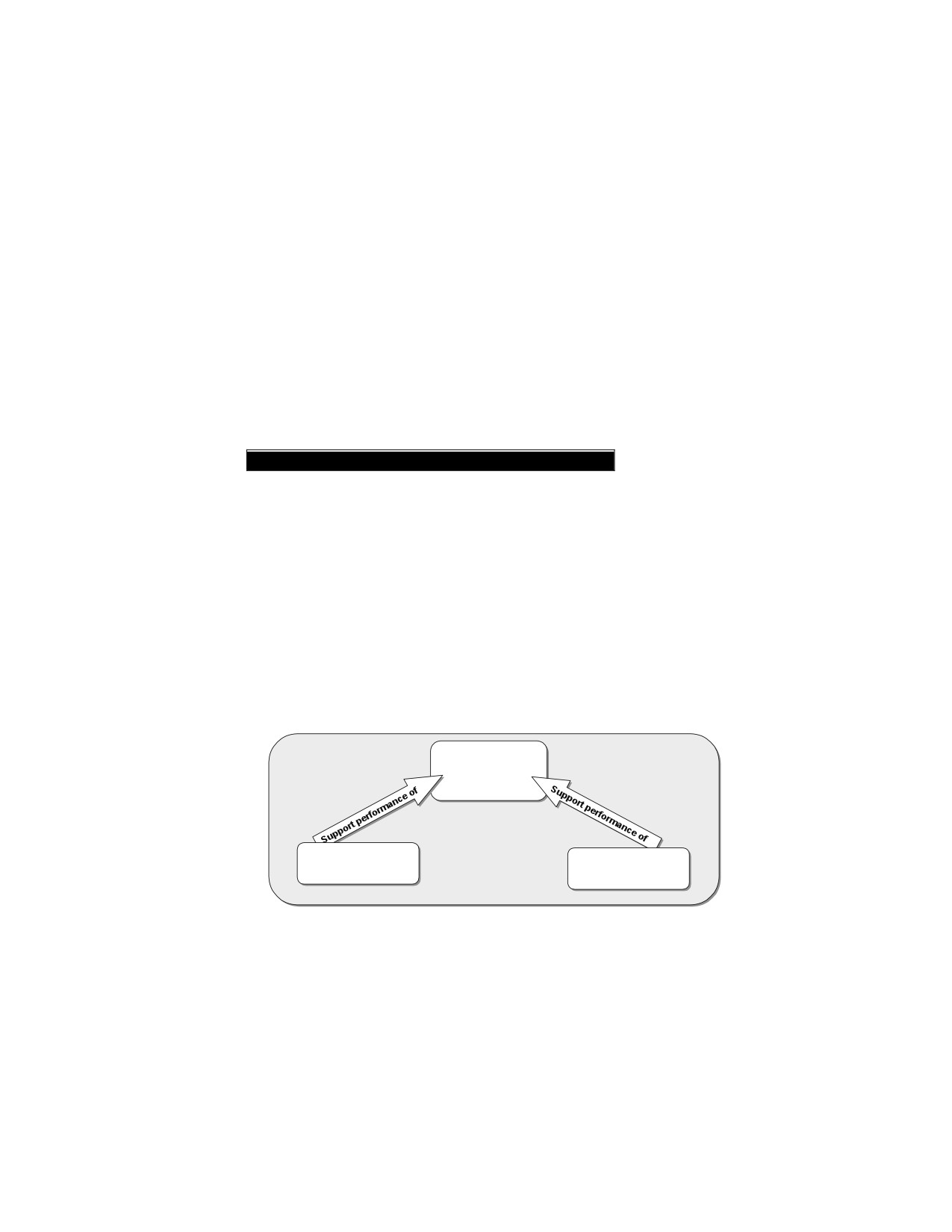
Your Unit’s
Mission Essential
Tasks
Common
Your MOS/AOC
Soldier Tasks
Soldier Tasks
Figure 5-2. Individual Task to METL Relationship
5-58. Individual training is also conducted in the unit on tasks not
trained in formal training or to sustain task performance proficiency. Army
training is task based. This is how the Army ensures units and soldiers are
trained to accomplish unit missions. Army units identify their mission
5-15
FM 7-21.13 ____________________________________________________________
essential tasks, the collective tasks that the unit must be able to perform to
accomplish its mission. For your unit to accomplish its mission, every
soldier in your unit must first be able to perform his individual tasks that
support those mission essential tasks. Figure 5-2 shows this relationship
between individual tasks and the METL.
PHYSICAL FITNESS
5-59. Your physical fitness has a direct impact on combat readiness. A
soldier who is physically unfit for duty is as much a casualty as if an enemy
bullet had hit him. When that unfitness is a result of the soldier’s own
carelessness or, worse yet, of his own misconduct, he is guilty of a breach of
trust with his comrades, the Army and his fellow Americans. The Army
expects you to keep in top physical condition and for that purpose provides
you with good food, clothing, sanitary facilities, physical training, and
medical care.
5-60. Your unit’s physical fitness program is but one component of total
fitness. Some of the others are weight control, diet and nutrition, stress
management, dental health, and spiritual and ethical fitness, as well as the
avoidance of hypertension, substance abuse, and tobacco use.
5-61. Even though soldiers are physically fit some still may become ill.
Daily “sick call” is aimed at revealing and halting illness at its beginning. If
you feel below par in the morning, Army doctors want to see you
immediately. They will diagnose and treat your ailment before it gets
worse. This is true regardless of where you are stationed. Army medical
experts have made and continue to make surveys of much of the world so
that they can diagnose, treat, and control the diseases found there.
PHYSICAL TRAINING
5-62. An important part of overall fitness is physical training. The
objective of physical training in the Army is to improve soldiers' abilities to
meet the physical demands of war. Any physical training that results in
numerous injuries or accidents works against this goal. Good, sound
physical training challenges soldiers but does not place them at undue risk
nor lead to situations where accidents or injuries are likely to occur.
5-63. The Army's physical fitness training program includes the USAR
and ARNG, encompasses all ages and ranks, and both male and female
soldiers. Its purpose is to physically condition all soldiers throughout their
careers beginning with basic combat training
(BCT). It also includes
soldiers with limiting physical profiles who must also participate in
physical fitness training.
Unit Programs
5-64. There are many types of units in the Army, and their missions often
require different levels of fitness. TOE and TDA units must emphasize
attaining and maintaining the fitness level required for the mission. The
unit's standards may exceed the Army's minimums. Army Regulation 350-1
5-16
_____________________________________________________________ Chapter 5
authorizes commanders to set higher standards that are justified by
mission requirements.
5-65. The considerations for the active component also apply to the
reserve component. However, since members of RC units cannot participate
together in collective physical training on a regular basis, RC unit programs
must focus on the individual's fitness responsibilities and efforts. But
commanders must still ensure that the unit's fitness level and individual
PT programs are maintained. Master Fitness Trainers (MFT) can assist RC
commanders and soldiers.
5-66. Soldiers everywhere must accept responsibility for their own
physical fitness. This is especially true for those assigned to duty positions
and organizations that offer little opportunity to participate in collective
unit PT programs. Some examples are Headquarters, Department of the
Army (HQDA) and Major Army Command (MACOM) staffs, hospitals,
service school staff and faculty, and recruiting.
Special Programs
5-67. The day-to-day unit PT program conducted for most soldiers may
not be appropriate for all unit members. Some of them may not be able to
exercise at the intensity or duration best suited to their needs. At least
three groups of soldiers may need special PT programs. They are as follows:
• Those who fail the APFT and do not have medical profiles.
• Those who are overweight/overfat according to AR 600-9.
• Those who have either permanent or temporary medical profiles.
5-68. Leaders should also give special consideration to soldiers who are
age 40 or older and to recent arrivals who cannot meet the standards of
their new unit. Special programs must be tailored to each soldier's needs,
and trained, knowledgeable leaders should develop and conduct them. This
training should be conducted with the unit. If this is impossible, it should at
least occur at the same time. There must be a positive approach to all
special fitness training.
FIELDCRAFT
5-69. Much can be done to discipline soldiers in garrison; however, in the
field, whether in training, combat or on an operational mission, whether
under blue skies, in storms, cold and heat, or marching, all soldiers must
endure regardless of the hardships. Fieldcraft are skills, knowledge and
adaptability that helps soldiers operate in the field so as to spend less effort
fighting the elements and more effort fighting the enemy. Being an expert
in fieldcraft reduces the likelihood of you being a casualty due to cold or
heat injuries, for example.
5-70. Another challenge for leaders is to develop and implement sleep
plans that will recharge soldiers and accomplish the mission. All soldiers,
but particularly leaders, are susceptible to sleep deprivation. Many poor
decisions have been made by leaders who went without sleep for
5-17
FM 7-21.13 ____________________________________________________________
unnecessarily long periods of time, putting their soldiers and units at
additional risk. Leaders must balance sleep and mission requirements to
maintain mental alertness and physical readiness.
INDIVIDUAL COMBAT SKILLS
5-71. Regardless of where you expect to be on or near the battlefield,
every soldier must be proficient in the performance of certain tasks to give
him the best possible chance for survival. Listed below are selected combat
tasks that are important for every soldier whether in combat arms (CA),
combat support (CS), and combat service support (CSS) branches or MOSs.
The inclusion or exclusion on this list of any particular individual task does
not imply that other common tasks are less important or that any MOS-
specific tasks are less important.
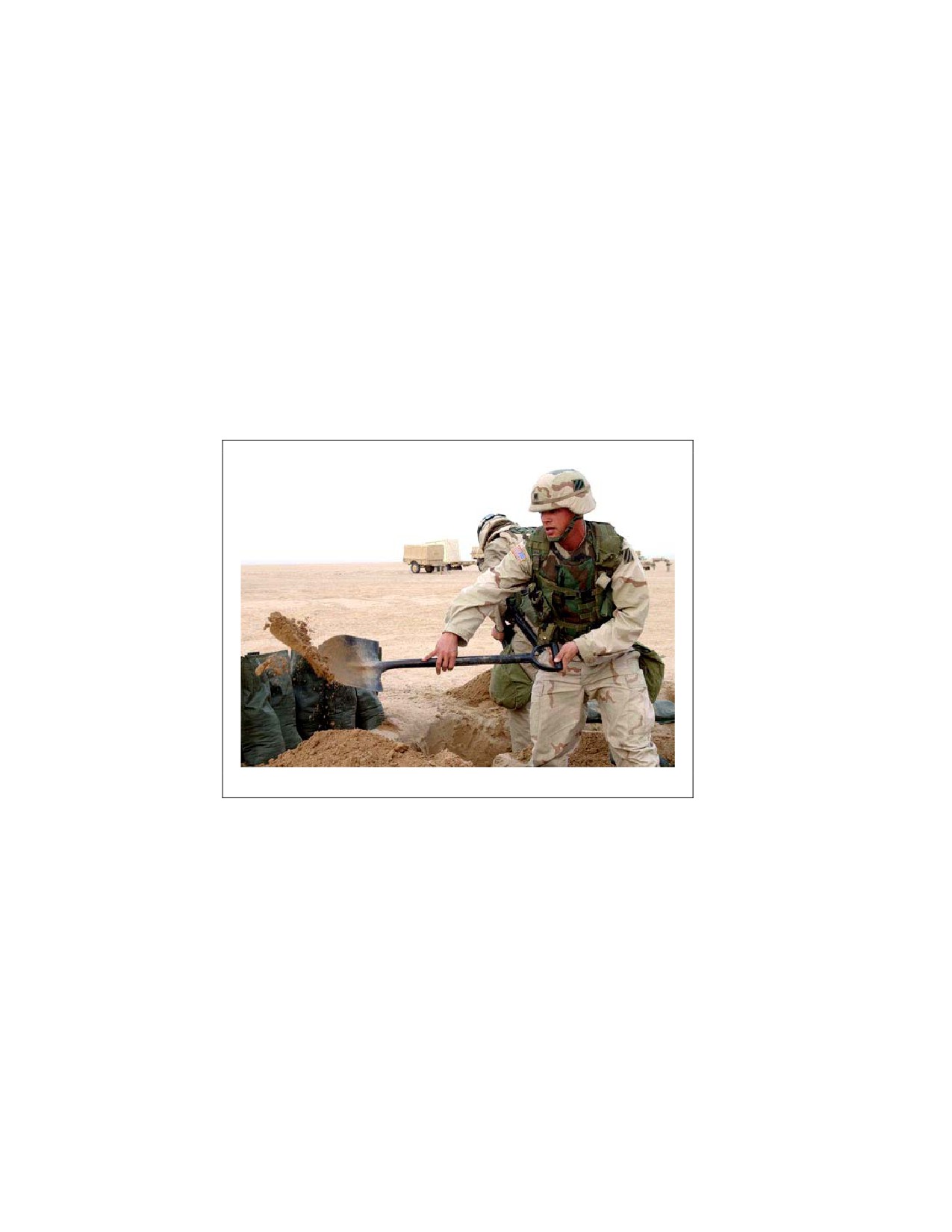
Building an individual fighting position during Operation Iraqi Freedom.
5-72. You can find the complete tasks with the performance measures in
Appendix A or in STP 21-1-SMCT, Soldier’s Manual of Common Tasks.
Tasks, conditions and standards sometimes change, so periodically check
for them in STP 21-1-SMCT and ensure that you can perform the listed
tasks to the prescribed standard.
SHOOT
5-73. Action: Engage Targets with an M16A1 or M16A2 Rifle. For more
information see FM 3-22.9, M16A1 and M16A2 Rifle Marksmanship.
5-18
_____________________________________________________________ Chapter 5
• Conditions: Given an M16A1 or M16A2 rifle, magazines,
ammunition, individual combat equipment, and stationary or moving
targets (personnel or equipment) at engageable ranges.
• Standards: Detected and determined range to targets. Fired the
M16A1 or M16A2 rifle, engaged targets in assigned sector of fire.
Applied correct marksmanship fundamentals and target engagement
techniques so that each target was hit or suppressed. Hit 60 percent
or more of the targets in assigned sector of fire.
MOVE
5-74. Task : Navigate from One Point on the Ground to Another Point
while dismounted (071-329-1006).
• Conditions: Given a standard topographic map of the area, scale
1:50,000, a coordinate scale and protractor, a compass, and writing
material.
• Standards: Move on foot to a designated point at a rate of 3,000
meters in an hour.
5-75. Task: Move Over, Through, or Around Obstacles (Except Minefields)
(071-326-0503).
• Conditions: Given individual weapon, load-carrying equipment
(LCE), one smoke grenade, wood or grass mats or chicken wire, a
grappling hook, wrapping material, wire cutters (optional) and a
buddy. During daylight or darkness, you are at a field location,
moving over a route with natural and man-made crossings and
obstacles (walls and barbed wire entanglements).
• Standards: Approached within 100 meters of a suspected enemy
position over a specified route, negotiated each obstacle encountered
within the time designated while retaining all of your equipment
without becoming a casualty to a bobby trap or early warning device.
COMMUNICATE
5-76. Task: Perform Voice Communication (113-571-1022).
• Conditions: Given: 1) One operational radio set for each member,
warmed up and set to the net frequency. 2) A call sign information
card consisting of: Net member duty position, net call sign, suffix list,
and a message to be transmitted. 3) Situation: the net is considered
to be secure and authenication is not required.
• Standards: Enter a radio net, send a message, and leave a radio net
using the proper call signs, call sign sequence, prowords, and
phonetic alphabet and numerals with 100 percent accuracy.
SURVIVE
5-77. Task: React to Chemical or Biological Attack/Hazard
(031-503-
1019).
5-19
FM 7-21.13 ____________________________________________________________
• Conditions: Given mission-oriented protective posture (MOPP) gear,
a protective mask, individual decontaminating kits, and a tactical
environment in which chemical and biological (CB) weapons have
been or may be used by the enemy. You are in MOPP Level 1, and
one or more of the following automatic masking criteria happens:
a. A chemical alarm sounds.
b. A positive reading is obtained on detector paper.
c. Individuals exhibit symptoms of CB agent poisoning.
d. You observe a contamination marker.
e. Your supervisor tells you to mask.
f. You see personnel wearing protective mask.
g. You observe other signs of a possible CB attack.
• Standards: Do not become a casualty. Identify chemical
contamination markers with 100 percent accuracy, and notify your
supervisor. Start the steps to decontaminate yourself within
1
minute of finding chemical contamination. Decontaminate your
individual equipment after you have completely decontaminated
yourself.
5-78. Task: Decontaminate Yourself and Individual Equipment Using
Chemical Decontaminating Kits (031-503-1013).
• Conditions: You are at mission-oriented protection posture (MOPP) 2
with remaining MOPP gear available. You have a full canteen of
water, a poncho, load bearing equipment
(LBE), assigned
decontaminating kit(s), and applicable technical manuals
(TMs).
Your skin is contaminated or has been exposed to chemical agents, or
you have passed through a chemically contaminated area.
• Standards: Start the steps to decontaminate your skin and/or eyes
within
1 minute after you find they are contaminated.
Decontaminate all exposed skin and your eyes as necessary before
chemical agent symptoms occur. Decontaminate all personal
equipment for liquid contamination after decontaminating your skin,
face and eyes.
5-79. Task: Evaluate a Casualty (081-831-1000).
• Conditions: You have a casualty who has signs and/or symptoms of
an injury.
• Standards: Evaluated the casualty following the correct sequence. All
injuries and
/or conditions were identified. The casualty was
immobilized if a neck or back injury is suspected.
5-80. Task: Perform First Aid for Nerve Agent Injury (081-831-1044).
• Conditions: You and your unit have come under a chemical attack.
You are wearing protective overgarments and/or mask, or they are
5-20
_____________________________________________________________ Chapter 5
immediately available. There are casualties with nerve agent
injuries. Necessary materials and equipment: chemical protective
gloves, overgarments, overboots, protective mask and hood, mask
carrier, and nerve agent antidote autoinjectors. The casualty has the
following:
Three antidote treatment, nerve agent, autoinjectors (ATNAA) and
one convulsant antidote for nerve agents (CANA) autoinjector.
OR three sets of MARK I nerve agent antidote autoinjectors.
• Standards: Administered correctly the antidote to self or
administered three sets of MARK I nerve agent antidote
autoinjectors or three ATNAAs followed by the CANA to a buddy
following the correct sequence. Take appropriate action to react to
the chemical hazard and treat yourself for nerve agent poisoning
following the correct sequence.
5-81. Task: React to Indirect Fire While Dismounted (071-326-0510).
• Conditions: You are a member (without leadership responsibilities) of
a section, squad or team. You are either in a defensive position or
moving on foot. You hear incoming rounds, shells exploding or
passing overhead, or someone shouting “incoming!”
• Standards: React to each situation by shouting “incoming,” following
the leaders direction if available and taking or maintaining cover.
5-82. Task: React to Direct Fire While Mounted (071-410-0002).
• Conditions: In a combat environment, given a tracked/wheeled
vehicle and a requirement to react to direct fire.
• Standards: The vehicle has returned fire and taken appropriate
action after analysis of the situation based on an order received from
the chain of command.
5-83. Task: Select Temporary Fighting Positions (071-326-0513).
• Conditions: You must select a temporary fighting position, when at
an overwatch position, after initial movement into a tentative
defensive position, at a halt during movement, or upon receiving
direct fire.
• Standards: Select a firing position that protected you from the enemy
observation and fire, and allowed you to place effective fire on enemy
positions without exposing most of your head and body.
OPPORTUNITY TRAINING
5-84. Opportunity training is the conduct of pre-selected, prepared
instruction on critical tasks that require little explanation. Sometimes
called
“hip-pocket” training, it is conducted when proficiency has been
reached on the scheduled primary training task and time is available.
Unscheduled breaks in exercises or assembly area operations, or while
waiting for transportation, provide time for opportunity training.
5-21
FM 7-21.13 ____________________________________________________________
5-85. Creative, aggressive leaders and soldiers use this time to sustain
skills. For example, a Bradley Stinger Fighting Vehicle commander might
conduct opportunity training on aircraft identification while waiting to have
his crew's multiple integrated laser engagement system (MILES) re-keyed
during an (FTX). Good leader books are necessary to select tasks for quality
opportunity training.
5-86. Leaders, especially NCOs who are first line supervisors, must be
prepared to present these impromptu classes at any opportunity. Any time
the squad leader has five minutes, he should also be prepared to instruct
squad members on subjects such as safety, personal hygiene, or
maintenance of equipment. In addition, most junior enlisted soldiers are
very capable of preparing and giving short blocks of instruction on Skill
Level 1 individual tasks.
DRILLS
5-87. Drills provide small units standard procedures for building strong,
aggressive units. A unit's ability to accomplish its mission depends on
soldiers, leaders, and units executing key actions quickly. All soldiers and
their leaders must understand their immediate reaction to enemy contact.
They must also understand squad or platoon follow-up actions to maintain
momentum and offensive spirit on the battlefield. Drills are actions in
situations requiring instantaneous response. Soldiers must execute drills
instinctively. This results from continual practice and rehearsals.
5-88. Drills provide standardized actions that link soldier and collective
tasks at platoon level and below. At company and above, integration of
systems and synchronization demand an analysis of mission, enemy,
terrain and weather, troops, time available, civil consideration (METT-TC).
Standard tactics, techniques and procedures
(TTP) help to speed the
decision and action cycle of units above platoon level, but they are not drills.
There are two types of drills—battle drills and crew drills.
5-89. A battle drill is a collective action rapidly executed without applying
a deliberate decision-making process. The following are characteristics of
battle drills:
• They require minimal leader orders to accomplish and are standard
throughout the Army.
• They continue sequential actions that are vital to success in combat
or critical to preserving life.
• They apply to platoon or smaller units.
• They are trained responses to enemy actions or leader’s orders.
• They represent mental steps followed for offensive and defensive
actions in training and combat.
5-90. Crew drill is a collective action that the crew of a weapon or system
must perform to employ the weapon or equipment. This action is a trained
response to a given stimulus, such as a leader order or the status of the
5-22
_____________________________________________________________ Chapter 5
weapon or equipment. Like a battle drill, a crew drill requires minimal
leader orders to accomplish and is standard throughout the Army.
ENVIRONMENTAL PROTECTION
5-91. Every soldier must protect the environment from damage when
conducting or participating in training. This means you personally must
know and take actions necessary to prevent that damage. Task performance
information, such as that in the STPs, identify environmental
considerations that you must take into account when performing the task.
Technical manuals and other how-to books also contain information. You
can also ask your leader for information and advice.
5-92. The Army has made great progress in protecting the environment
while conducting productive training. It is not just the protection of wildlife
or vegetation that is of concern to the Army. Many installations have sites
of archaeological significance and others restrict vehicular traffic to prevent
excessive soil erosion. The reason for these restrictions is to preserve the
environment for future Americans.
SAFETY
5-93. Every soldier is responsible to ensure realistic training is safe;
safety awareness protects combat power. Historically, more casualties occur
in combat due to accidents than from enemy action. Ensuring that realistic
training is safe instills the awareness that will save lives in combat.
Conducting realistic training is challenging business. The goal of the chain
of command is not training first nor safety first, but training safely.
Units that participate in tough, well-disciplined training, with
technically and tactically competent leaders present, have
significantly fewer accidents.
BG James E. Simmons, Director of Army Safety
5-94. The commander is the unit safety officer. He is ultimately
responsible for unit safety; however; every soldier is responsible for safe
training. This includes leaders throughout the chain of command and the
NCO support channel, not just range safety officers and NCOs, observer
controllers
(OCs), and soldiers conducting training. Well-trained junior
enlisted soldiers are often the first to observe unsafe actions or conditions.
5-95. Safety does not mean we won’t perform tasks or missions that carry
some amount of risk. In fact, safe training requires recognition of the risk
involved, determining the degree of risk and then applying effort to reduce
the risk while accomplishing the mission. This process is risk management,
and is a key part of planning all training and operations. The result of this
process is that soldiers are aware of potential safety problems in a task or
mission but also know that leaders have taken steps to reduce or eliminate
the effects of those problems.
5-23
FM 7-21.13 ____________________________________________________________
COMBAT STRESS
5-96. The purpose of training is to prepare you and your unit to
accomplish missions in combat or other operations. Combat is an
environment that will push you to your physical and emotional limits—and
beyond. Fear, fatigue, pressure to accomplish the mission and other factors
combine to raise stress to seemingly unbearable levels. That stress could
cause soldiers to exhibit unusual behavior in combat. Combat stress
behavior is the generic term that covers the full range of behaviors in
combat, from behaviors that are highly positive to those that are totally
negative. Keep in mind that such stress can occur in the combat-like
conditions of operations other than war, also. There is nothing wrong in
experiencing combat stress or exhibiting the resulting reactions, as long it
does not include misconduct.
5-97. Positive combat stress behaviors include heightened alertness,
strength, endurance, and tolerance to discomfort. Examples of positive
combat stress behaviors include the strong personal bonding between
combat soldiers and the pride and self-identification that they develop with
the unit's history and mission. These provide unit cohesion, the binding
force that keeps soldiers together and performing the mission in spite of
danger and death. The ultimate positive combat stress behaviors are acts of
extreme courage and action involving almost unbelievable strength. They
may even involve deliberate self-sacrifice.
5-98. The citations for recipients of the Medal of Honor or other awards
for valor in battle describe almost unbelievable feats of courage, strength,
and endurance. The recipient overcame the paralysis of fear, and in some
cases, also called forth muscle strength far beyond what he had ever used
before. He may have persevered in spite of wounds that would normally be
so painful as to be disabling. Some of these heroes willingly sacrificed their
lives for the sake of their buddies.
5-99. Positive combat stress behaviors and misconduct stress behaviors
are to some extent a double-edged sword. The same physiological and
psychological processes that result in heroic bravery in one situation can
produce criminal acts such as atrocities against enemy prisoners or
civilians in another. Stress may drag the sword down in the direction of the
misconduct edge, while sound, moral leadership and military training and
discipline must direct it upward toward the positive behaviors.
5-100. Examples of misconduct stress behaviors range from minor
breaches of unit orders or regulations to serious violations of the Uniform
Code of Military Justice (UCMJ). Misconduct stress behaviors are most
likely to occur in poorly trained and undisciplined soldiers. But these
behaviors can possibly occur in good, even heroic soldiers under extreme
combat stress. Misconduct stress behavior can be prevented by stress
control measures, but once serious misconduct has occurred, it must be
punished to prevent further erosion of discipline. Combat stress, even with
heroic combat performance, cannot justify criminal misconduct.
5-24
_____________________________________________________________ Chapter 5
COMBAT STRESS REACTION
5-101. Combat stress reaction is common, predictable, negative, emotional
and physical reaction of normal soldiers to the abnormal stressors of
combat. By definition, any such reactions interfere with mission
performance or well being but can be treated. These reactions do not
include misconduct stress behaviors. They range from fear, anxiety and
depression in minor cases to memory loss, physical impairment and even
hallucinations in the more severe cases. On the lower end of the scale the
behaviors are normal and common signs. As behaviors become
progressively more severe in their effects they are warning signs of serious
problems. Warning signs deserve immediate attention by the leader, medic,
or buddy to prevent potential harm to the soldier, others, or the mission.
5-102. Warning signs do not necessarily mean the soldier must be relieved
of duty or evacuated if they respond quickly to helping actions. However,
soldiers may need evaluation at medical treatment facilities to rule out
other physical or mental illness. If combat stress reaction persists and
makes the soldier unable to perform duties reliably, then further treatment
such as by specialized combat stress control teams, may be necessary. But
prompt treatment close to the soldier's unit provides the best potential for
returning the soldier to duty.
Just because you’re trained for something doesn’t mean you’re
prepared for it.
Anonymous
5-103. No training will completely prepare you for combat, but with proper
training, discipline and unit cohesion you will be able to do your job and
function as a member of the team. Stress in combat is unavoidable, but you
can minimize combat stress reaction by continuing to do your job and
talking to your fellow soldiers and leaders. Remember that your buddies are
under the same stress. They experience many of the same feelings as you do
so just talking about it can help them, too. Previous combat experience does
not immunize a soldier from the effects of combat stress, either. For more
information about the causes, effects, and treatment of combat stress, see
FM 6-22.5, Combat Stress.
SECTION III: FORCE PROTECTION
5-104. The operational environment demands that all soldiers are
proficient in certain combat tasks. This environment does not have rear
areas that are free of enemy interference. We must expect and plan for a
potential adversary to oppose Army operations from deployment to the
conclusion of the fight, and beyond. For this reason it is vitally important
soldiers take positive steps in force protection to minimize vulnerability to
terrorist acts.
5-105. Force protection is action taken to prevent or mitigate hostile
actions against Department of Defense (DOD) personnel (to include family
5-25
FM 7-21.13 ____________________________________________________________
members), resources, facilities, and critical information. These actions
conserve the force’s fighting potential so it can be applied at the decisive
time and place, and incorporates the coordinated and synchronized
offensive and defensive measures to enable the effective employment of the
joint force while degrading opportunities for the enemy.
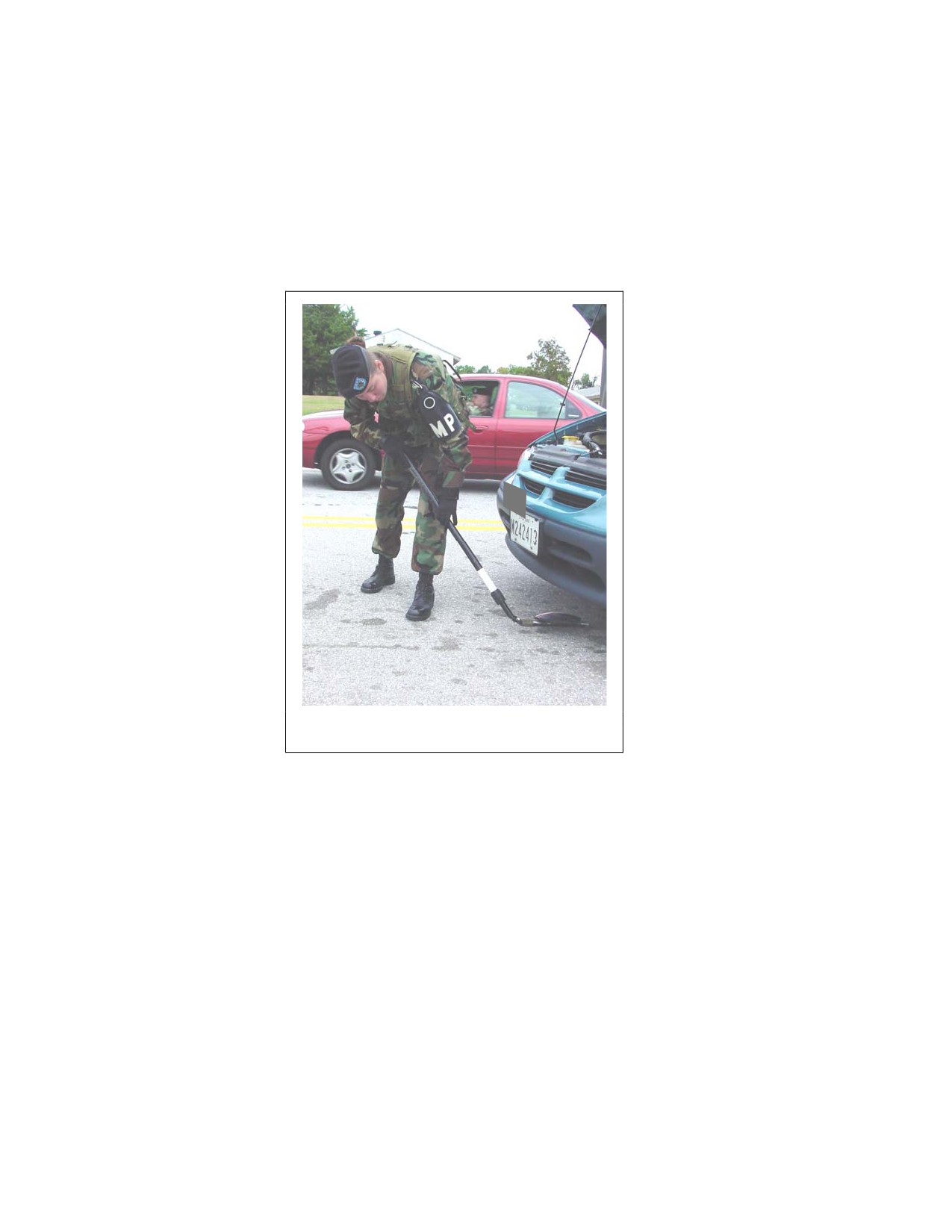
A Military Police soldier inspects a vehicle entering an
Army installation.
5-106. Force protection is a security program to protect soldiers, civilian
employees, family members, information, equipment, and facilities in all
location and situations. This is accomplished through a combination of
antiterrorism, physical security, and information operations; high-risk
personnel security; and law enforcement operations, all supported by
foreign intelligence, counter intelligence, and other security programs.
5-107. Force Protection does not include actions to defeat the enemy or
protect against accidents, weather, or disease. The goal is to protect
soldiers, DA civilians, their family members, facilities, information, and
other material resources from terrorism. The objectives of force protection
are to deter incidents, employ countermeasures, mitigate effects, and to
recover from an incident.
5-108. The scope of force protection includes pre-incident, incident, and
post-incident task and activities. The achievement of a comprehensive
5-26
_____________________________________________________________ Chapter 5
program requires that the full cycle of planning, preparation, execution,
and continuous assessment be accomplished before, during, and after the
threat event. A complete force protection operation crosses the entire
spectrum from pre-incident to post-incident. Force protection is everyone’s
business. Be vigilant!
5-109. Standard descriptions of force protection requirements and states of
readiness are called force protection conditions. There are five force
protection condition levels: Normal and ALPHA through DELTA. Each has
specified force protection tasks or security measures listed in AR 525-13,
Antiterrorism. Army installations supplement these with specific actions
for that installation. Force protection conditions are usually set by Army
major commands but may be altered by installation or local commanders,
based on local conditions, with higher approval.
5-110. How units conduct force protection may be different in a combat
environment only in the specific tasks performed. Regardless of location or
activity, the operational environment requires force protection awareness
throughout the Army. It doesn’t matter whether you are moving, resting or
actually fighting. Be alert for indications of terrorist activity or surveillance
and anything that seems out of place.
TERRORISM
5-111. Terrorism is the calculated use of unlawful violence or threat of
unlawful violence to instill fear; intended to coerce or to intimidate
governments or societies in the pursuit of goals that are generally political,
religious, or ideological. Terrorism has four key elements:
• It is premeditated—planned in advance rather than an impulsive act.
• It is political—designed to change the existing political order.
• It is usually aimed at civilians—not at combat-ready troops.
• It is carried out by subnational groups—not by the army of a country.
5-112. Every soldier has some role in fighting terrorism. Usually these are
actions in an installation or unit antiterrorism (AT) plan. As a minimum,
you should know what the likely terrorist threat is for your area. You
should know who to call if you see or hear something that “isn’t quite right.”
What would that be? Something that appears out of place: for example, a
van parked across the street from an entry control point that reappears at
the same time for several days. Reporting such unusual activity may seem
an overreaction but is prudent. If it is an innocent citizen who just
happened to be there by coincidence, no harm done. But if it was something
more, then you may have saved lives. Remember when reporting, just like
in giving a spot report by the SALUTE or SALT format, be accurate and as
detailed as possible without adding any speculation.
5-27
FM 7-21.13 ____________________________________________________________
Khobar
6th Battalion,
52d ADA deployed in early 1996 to Southwest Asia
(SWA) on a scheduled theater missile defense rotation. The unit was
trained and evaluated in all facets of its mission and well prepared for
it, but no more so than any other unit. Weeks passed, force protection
condition (FPCON) levels fluctuated, and soldiers were tested time and
time again. Staying focused was the watchword. Everything was
clicking, and the unit was like a boxer getting instructions from the
referee. The referee tells you to break from the tie-up but protect
yourself at all times. Boxers have gotten knocked out on the break.
By the early summer of 1996, the battalion's rotation was coming to a
close. Months of ups and downs in FPCON levels didn’t break this
disciplined, confident unit's morale. But at 2230 on the night of 25 June
1996, an explosion sent everyone in the Khobar Towers complex
scrambling. Some scrambled for their lives and others to tend the
numerous wounded. A large bomb had detonated just outside of the
cantonment area, destroying and damaging buildings and sending
window glass throughout the compound. Nineteen US Air Force airmen
died and hundreds were injured.
But the combat lifesavers and medics of Headquarters and
Headquarters Battery, 6-52 ADA quickly transitioned to their wartime
mission. That mission was to help save lives by "evaluating casualties"
and treating and caring for the wounded. But "treat mass casualties," a
task performed so well by the unit on its external evaluation, was no
longer a training task. It was real. Competence and confidence showed
on the stern faces of the soldiers as they and others carefully looked
through the debris for survivors to evaluate, treat, and evacuate from
the horrible scene. A long day consequently turned into a very long
night. Soldiers and airmen worked together as if they had been training
for years and everyone did more than his or her part. Guard shifts
doubled and sometimes tripled to ensure security was complete.
Later, SGT David Skinner, a combat medic for the battalion, was asked
if he was afraid of the possibility of another bomb going off. "You didn't
have time to think about another bomb. We get paid to save lives and
that's what we tried to do." He praised the courage and dedication of
the combat lifesavers that stood side by side with the medics. For the
actions of the soldiers that night and through the next early morning
hours, 6-52 ADA received the Army Superior Unit Award.
5-113. Level I antiterrorism training is required for all soldiers and DA
civilians. Army Regulation 525-13 and Department of Defense Instruction
2000.16, DOD Antiterrorism Standards require this annual training. You
can accomplish this training online using the DOD Antiterrorism Training
System at http://at-awareness.org. Soldiers and DACs traveling outside the
50 United States, its territories and possessions for any reason must have
an AOR update within two months of travel. Military and DAC family
members must receive antiterrorism awareness training within 12 months
of travel, on official orders, outside the US, its territories and possessions.
5-28
_____________________________________________________________ Chapter 5
5-114. The purpose of the annual antiterrorism training is to increase your
awareness of terrorism and to improve your ability to apply personal
protective measures. The training includes the following subjects:
• Terrorist operations.
• Individual protective measures.
• Terrorist surveillance techniques.
• Improvised explosive device (IED) attacks.
• Kidnapping and hostage survival.
• Explanation of terrorism threat levels and Force Protection
Condition (FPCON) system.
5-115. You may also receive antiterrorism training from a certified Level II
antiterrorism instructor. The Army’s goal is that all personnel are aware of
the terrorist threat and adequately trained in the application of protective
measures. Antiterrorism training should also be integrated into unit
collective training at every opportunity.
5-116. You, your family, or your neighborhood may be terrorist targets;
therefore, be prepared to alter your routine to disrupt surveillance. You
should know where to go if communications are disrupted. Your installation
and unit should have a force protection and antiterrorism plan. In these
plans are instructions for implementing higher levels of security and what
individual soldiers should be aware of. These plans also inform soldiers and
DACs of where to go in the event of an attack or emergency and provide
guidance on protecting family members and visitors on the installation.
Critical tasks of installation plans include the following:
• Collect, analyze, and disseminate threat information.
• Increase antiterrorism in every soldier, civilian, and family member.
• Maintain installation defenses in accordance with force protection
conditions (FPCON).
• Conduct exercises and evaluate/assess antiterrorism plans.
RULES OF ENGAGEMENT AND RULES FOR THE USE OF FORCE
5-117. Rules of engagements (ROE), rules for the use of force (RUF) and
the general orders help soldiers know how to react in difficult situations
before they arise. The ROE are directives that describe the circumstances
and limitations for military forces to start or continue combat engagement
with other forces.
5-118. The ROE are normally part of every operations plan (OPLAN) and
operations order (OPORD). The ROE help you in obeying the law of war
and help prevent escalating a conflict. Know the ROE and actively
determine if any changes to the ROE have occurred. The ROE will be
different with each operation, in different areas, and will change as the
situation changes. In no case, however, will the ROE limit your inherent
right to self defense.
5-29
FM 7-21.13 ____________________________________________________________
5-119. A thorough understanding of the specific ROE gives soldiers
confidence that they can and will react properly in the event of an attack or
encounter with local personnel. Confident soldiers do not hesitate to
properly defend themselves and their fellow soldiers. Likewise, confident,
disciplined soldiers will not take action that violates the ROE. In both
cases, confident soldiers protect lives and demonstrate professionalism,
both of which have positive effects on the local population and for the
overall Army mission.
Rules of Engagement
Company D, 1st Battalion, 41st Infantry, was assigned to Task Force
Eagle as part of Operation Joint Endeavor. Power struggles taking
place in Republika Srpsk sparked violent clashes in northeastern
Bosnia-Herzegovina. One such clash involved D Company.
On 5 September 1997, about 110 angry Serbs boxed in 60 soldiers
from D Company, guarding a checkpoint in Celopek, north of Zvornick.
Twenty-five of the US soldiers faced 70 Serbs to the south of the
checkpoint, while another 25 faced 40 Serbs to the north. The angry
Serbs, throwing rocks, bottles, and light fixtures, punched at least three
of D Company’s soldiers and attempted to drive vehicles through the
roadblock. At one point, as an automobile attempted to break through,
the crowd surged forward. The soldiers, well disciplined through
rigorous training and armed with a thorough understanding of the ROE,
held their ground and focused on the mission. The crowd finally backed
off after an hour and a half when the commander ordered his troops to
load their weapons and the Serb police arrived to assist.
The soldiers of D Company accomplished their mission while
displaying enormous restraint—the result of the discipline that had
been strengthened in their training. But for that discipline and
confidence, the incident might well have resulted in disaster, not only
for the soldiers, but also for the diplomatic mission they were assigned
to enforce. They were confident in the training they had conducted prior
to and during deployment and in their leadership. Their discipline in
adhering to the ROE allowed them to diffuse the situation using
appropriate force and resulted in the protection of the unit, the soldiers,
and the civilians.
5-120. A useful acronym for remembering some of the basics of the ROE is
RAMP.
• R—Return Fire with Aimed Fire. Return force with force. You always
have the right to repel hostile acts with necessary force.
• A—Anticipate Attack. Use force if, but only if, you see clear
indicators of hostile intent.
• M—Measure the amount of Force that you use, if time and
circumstances permit. Use only the amount of force necessary to
protect lives and accomplish the mission.
5-30
_____________________________________________________________ Chapter 5
• P—Protect with deadly force only human life, and property
designated by your commander. Stop short of deadly force when
protecting other property.
5-121. Rules on the use of force are escalating rules for US military
personnel performing security duties within the United States. Like the
ROE, RUF may vary depending on the operation and location, so be sure to
understand the RUF. These rules primarily limit the use of deadly force to
specifically defined situations. You have the inherent right of self-defense
and the defense of others against deadly force. But use only the minimum
force necessary to remove the threat. Deadly force is only used as the last
resort, typically as follows:
• For immediate threat of death or serious bodily injury to self or
others.
• For defense of persons under protection.
• To prevent theft, damage, or destruction of firearms, ammunition,
explosives, or property designated vital to national security.
5-122. When the situation permits, security personnel utilize escalating
degrees of force. The degrees are defined as follows:
• SHOUT—verbal warning to halt.
• SHOVE—nonlethal physical force.
• SHOW—intent to use weapon.
• SHOOT—deliberately aimed shots until threat no longer exists.
• Warning shots are not permitted.
5-123. Your training should include ROE or RUF. This should include
classroom type instruction that states what the rules are but also should be
a part of field training. For example, a field exercise could include
situations training soldiers on what to do if a large group of local civilians
appear outside the unit perimeter. In this way, soldiers can gain experience
in handling potentially hostile crowds while complying with the ROE.
Guard Duty
5-124. We can’t leave the subject of ROE and RUF without a word on
guard duty. Guard duty is important. It is a mission common to tactical and
garrison operations and key to physical and operational security. It is also
important in antiterrorism. A sentinel at a guard post is protecting his
fellow soldiers and may be the first line of defense against enemy soldiers,
thieves, spies, or even terrorists. It is for these reasons you should take
guard duty seriously and approach it with the same professionalism that
you do all your other duties. The General Orders are:
• General Order Number 1: I will guard everything within the limits of
my post and quit my post only when properly relieved.
• General Order Number 2: I will obey my special orders and perform
all my duties in a military manner.
5-31
FM 7-21.13 ____________________________________________________________
• General Order Number 3: I will report all violations of my special
orders, emergencies, and anything not covered in my instructions to
the commander of relief.
THE MEDIA
5-125. While not directly a part of force protection, interaction with the
media has an impact because potential adversaries can get useful
information about you, your unit, your mission, or even your family through
news reports. Commanders will implement operational and information
security programs to defeat terrorists’ efforts to gain information, but in
nearly every case, such programs involve knowledgeable and positive action
on the part of individual soldiers.
5-126. The media, that is, the civilian news gathering organizations of the
world, have a job to do—report what they see to the world. There are times
when the media will be interested in your unit or your family members.
Deployments and reunions are always newsworthy events that will attract
press attention, and so will gate closures or reports of casualties. But every
operation and every installation has specific guidance for speaking with the
media. That guidance will tell you what are appropriate or inappropriate
subjects to comment on and is intended to help you maintain operational
security. In any case, you should have your commander’s authorization to
speak with a member of the media before doing so, particularly when the
topic relates to the Army or the Department of Defense.
5-127. The military as an institution and the media have had their ups and
downs, but the rapport between individual soldiers and members of the
media has almost always been excellent and you should do your best to
keep that up. America benefits from a well-informed public. While you do
not have to speak if you do not feel comfortable, if you do communicate with
someone from the media, keep the following general rules in mind:
• Do know the local public affairs guidance regarding media relations.
• Do give honest and forthright answers in matters of which you have
direct knowledge.
• Do remember there is no such thing as “off the record”! Everything is
on the record.
• Do use a media opportunity to tell your story as an unofficial
ambassador for our nation and our Army.
• Don’t guess or make something up to answer a question. If you don’t
know the answer, say so.
• Don’t volunteer information that was not asked for.
• Don’t answer a question that is inappropriate. Refer the reporter to
the local Army public affairs officer.
• Don’t discuss politics or foreign policy and avoid labeling events or
actions. For example, only the Federal Bureau of Investigation and
the Department of Justice may call a crime a “terrorist” incident.
Until then, it is just an incident.
5-32
Chapter 6
Developmental Counseling and Professional
Development
You may or may not intend to make the Army a career, but
it is important to the future of the Army that you develop
and prepare to assume positions of greater responsibility.
The demands of combat may put even junior enlisted
soldiers into leadership positions in stressful situations.
This is why the Army puts so much effort into developing
soldiers and training them to lead. This chapter will provide
you with a basic understanding of the importance of
developmental counseling and its relation to professional
development. The Army has well-developed professional
development and education systems that will help you
learn-but you will have to do the work and provide the
motivation.
Section I - Developmental Counseling
6-2
Counseling is an obligation
6-2
Effective Counseling Program
6-3
The Developmental Counseling Process
6-4
Types of Developmental Counseling
6-4
Section II - Professional Development
6-8
Institutional Training
6-8
Operational Assignments
6-12
Self-development
6-13
Promotions
6-14
Section III - Retention And Reenlistment
6-20
Bonus Extension and Retraining (BEAR) Program
6-21
Types of Discharges
6-22
Bars to Reenlistment
6-22
For more information on developmental counseling see FM 6-22 (22-100), Army
Leadership, Appendix B and C and the Army counseling website at
For more information on professional development see AR 350-17, Noncommissioned
Officer Development Program, DA PAM 350-58, Leader Development for America’s
Army, and DA PAM
600-3, Commissioned Officer Development and Career
Management, DA PAM 600-11, Warrant Officer Professional Development or DA PAM
600-25, US Army Noncommissioned Officer Professional Development Guide.
For more information on retention and reenlistment see AR 140-111, US Army Reserve
Reenlistment Program, and AR 601-280, Army Retention Program.
6-1
FM 7-21.13 ____________________________________________________________
SECTION I - DEVELOPMENTAL COUNSELING
6-1. Development counseling is a type of communication that leaders use
to empower and enable soldiers. It is much more than providing feedback or
direction. It is communication to help develop a soldier’s ability to achieve
individual and unit goals. Leaders counsel soldiers to help them be
successful. Effective developmental counseling is one of the ways you will
learn and grow. Leaders owe their soldiers the best possible road map to
success. Leaders help their soldiers solve complex problems by guiding
them to workable solutions through effective counseling.
6-2. Developmental counseling is subordinate-centered communication
that outlines actions necessary for soldiers to achieve individual and
organizational goals and objectives. It is vital to the Army’s future that all
leaders conduct professional growth counseling with their soldiers to
develop the leaders of tomorrow.
6-3. Subordinate-centered, two way communication is simply a style of
communication where you as a subordinate are not a passive listener, but a
vital contributor in the communication process. The purpose of subordinate-
centered communication is to allow the subordinate to maintain control and
responsibility for the issue. This type of communication where you as a
subordinate take an active role takes longer. Subordinate participation is
absolutely necessary when leaders are attempting to develop and not
simply impart direction or advice.
COUNSELING IS AN OBLIGATION
6-4. NCOs counsel their subordinate NCOs and junior enlisted soldiers,
and officers will counsel subordinate leaders. For example, the company
commander counsels the first sergeant. There may be situations where
officers counsel junior enlisted soldiers. The point is this: every leader has
an obligation to develop their subordinates through developmental
counseling. The Army values play a very important role. Simply put the
values of loyalty, duty and selfless service require leaders to counsel their
soldiers. The values of honor, integrity and personal courage require both
leaders and soldiers to give straightforward feedback and, if possible, goal-
oriented tasks or solutions. The Army value of respect requires us all to find
the best way to communicate that feedback and goals.
6-5. Some skills leaders use in effective counseling are the following:
• Active listening: Giving full attention to subordinates; listening to
their words and the way they are spoken. Transmit and
understanding of message through responding.
• Responding: Use appropriate eye contact and gestures. Check
understandings, summarize, interpret and question.
• Questioning: Serves as a way to obtain valuable information and get
subordinates to think. Most questions should be open-ended.
6-2
_____________________________________________________________ Chapter 6
6-6. Some soldiers may perceive counseling as an adverse action, perhaps
because that is their experience. Developmental counseling most definitely
is not supposed to be an adverse action. Regular developmental counseling
is the Army’s most important tool for developing future leaders at every
level. Regular effective developmental counseling helps all soldiers become
better members of the team, maintain or improve performance, and prepare
them for the future. Regular counseling helps leaders and soldiers
communicate more clearly and efficiently. Therefore soldiers should want to
be counseled. Effective counseling must include some of the following
elements:
• Purpose: Clearly define the purpose of the counseling.
• Flexibility: Fit the counseling style to the character of each soldier
and to the relationship desired.
• Respect: View soldiers as unique, complex individuals, each with
their own sets of values, beliefs, and attitudes.
• Communication: Establish open, two-way communication with the
soldier using spoken language, non-verbal actions, and gestures and
body language. Effective counselors listen more than they speak.
• Support: Encourage soldiers through actions while guiding them
through their problems.
6-7. Leaders conduct counseling to assist soldiers in achieving and
developing personal, professional development and organizational goals,
and to prepare them for increased responsibility. Leaders are responsible
for developing soldiers through teaching, coaching, and counseling. This is
done effectively by identifying weaknesses, setting goals, developing and
implementing a plan of action, and providing oversight and motivation
throughout the process. Leaders are responsible for everything their units
do or fail to do; your leader is responsible for all your military actions.
Inherent in that responsibility is the duty to help you develop, and, one day,
make you ready to lead.
EFFECTIVE COUNSELING PROGRAM
6-8. It is in the unit’s best interest to establish an effective counseling
program. Four essential elements of an effective counseling program are
education and training; experience; continued support; and enforcement.
6-9. Education and training occurs in the institution
(for example,
Primary Leadership Development Course or Captain’s Career Course) and
unit
(NCO Development Program and correspondence courses), and
through mentorship and self-development. The Army provides a base line of
education to its soldiers in order to “show what right looks like.” The
Noncommissioned Officer Education System (NCOES) is an example and
educates the NCO Corps on counseling. However, NCOES cannot
accomplish this alone. Unit NCO development programs conduct training to
provide that base of education of what right looks like to all leaders.
6-3
FM 7-21.13 ____________________________________________________________
6-10. Soldiers learn by doing and receive guidance from more senior
leaders. After initial education and training, all leaders must put their
skills to use. NCOs must practice counseling while at the same time
receiving guidance and mentoring on how to improve counseling
techniques.
6-11. Continued support from both the Army and leaders is available from
the Army’s counseling website (www.counseling.army.mil), FM 6-22 (22-
100), Appendix B and C, and unit leaders (through spot checks and random
monitoring of counseling sessions). These provide necessary support and
critiques that will improve a young leader’s counseling skills.
6-12. Enforcement is a key component of an effective developmental
counseling program. Once leaders have the tools
(both education and
support) necessary for quality counseling, senior leaders must hold them
accountable to ensure acceptable counseling standards for both frequency
and content. This is often accomplished through some type of compliance
inspections.
THE DEVELOPMENTAL COUNSELING PROCESS
6-13. The Developmental Counseling process consists of four stages:
• Identify the need for counseling
• Prepare for counseling
Schedule the time.
Notify the counselee well in advance.
Organize information.
Outline the components of the counseling session.
Plan counseling strategy.
Establish the right atmosphere.
• Conduct the counseling session:
Open the session.
Discuss the issue.
Develop a plan of action (to include the leader’s responsibilities).
Record and Close the Session.
• Follow-up.
Support Plan of Action Implementation.
Assess Plan of Action.
TYPES OF DEVELOPMENTAL COUNSELING
6-14. Counseling serves many purposes. Each type of counseling has a
unique goal or desired outcome and sometimes uses a different method. In
some cases a specific event may trigger a need for developmental
counseling. In all cases, the goal is to improve the team’s performance by
6-4
_____________________________________________________________ Chapter 6
helping the counseled soldier become a more effective member of the team.
As a counselee you should expect to be actively involved in the
developmental counseling process. The leader is assisting you in identifying
your strengths and weaknesses.
EVENT-ORIENTED COUNSELING
6-15. Event-oriented counseling involves a specific event or situation. It
may precede events, such as going to a promotion board or attending a
school, or it may follow events, such as a noteworthy duty performance, a
problem with performance of mission accomplishment, or a personal
problem.
Counseling for Specific Instances
6-16. Sometimes counseling is tied to specific instances of superior or
substandard duty performance. For example, if you performed exceptionally
well during an inspection, your squad leader might review your preparation
for and conduct during the inspection. The key to successful counseling for
specific performance is to conduct the counseling session as close to the
time of the event as possible. It doesn’t necessarily occur next to a desk with
a counseling form in hand. It can occur in an informal setting. But it is
important to have a record of some kind for reference later in a regular
performance counseling.
Informal “Footlocker” Counseling
Bravo Company had gotten back from the field on Wednesday, and by
Thursday PFC Newman already had his HMMWV standing tall. SSG
Ulbrich, his squad leader, was impressed that he had squared his
vehicle away so quickly. She called him over to his vehicle and in a few
minutes they reviewed together the work he had accomplished to
conduct PMCS and get it ready to go again.
While she knew PFC Newman had worked through lunch, she also
learned he had helped another soldier clean his personal gear in the
barracks after duty hours.
“Keep this up, Newman,” she said, “You are a great example to the
other soldiers and are developing into a fine leader, too.”
At the end of the day, the platoon leader called PFC Newman out in
front of the formation and gave him a “pat on the back” in front of his
fellow soldiers.
Reception and Integration Counseling
6-17. Leaders must counsel new team members when they report in.
Reception and integration counseling serves two purposes: first, it identifies
and helps fix any problems or concerns that new members have, especially
any issues resulting from the new duty assignment; second, it lets you know
the unit standards and how you fit into the team. Reception and integration
counseling starts the team building process. It clarifies your responsibilities
6-5
FM 7-21.13 ____________________________________________________________
and sends the message that the chain of command cares. Reception and
integration counseling should begin immediately upon arrival so you can
quickly become integrated into the organization.
Promotion Counseling
6-18. Commanders or their designated representatives must conduct
promotion counseling for all specialists, corporals, and sergeants who are
eligible for advancement without waiver, but are not recommended for
promotion to the next higher grade. Army Regulation 600-8-19, Enlisted
Promotions and Reductions, requires that AC soldiers within this category
receive initial (event-oriented) counseling when they attain full eligibility
and then periodic (performance and personal growth) counseling at least
quarterly.
Promotion Counseling
SSG Dills counseled SPC Snyder on his eligibility for promotion and
sadi he would recommend him for the next promotion board. After
completion of the promotion point worksheet (DA Form 3355), SPC
Snyder found out that he had only 200 points—just enough to appear
before the board. The minimum requirement to be placed on the SGT
promotion list is 350 points. SPC Snyder would need to get a maximum
score on the board to obtain the additional 150 points required for
promotion to SGT. SPC Snyder was confident that he would pass the
board and assured SSG Dills, “This will be easy, I won’t have a
problem, Sergeant.”
SPC Snyder got his chance and appeared before the sergeant
promotion board. He received 149 points from the board members.
Although SSG Dills recommended SPC Snyder for promotion he would
have to counsel him again because he did not have enough points to be
added to the list.
During the next promotion counseling session, SSG Dills had
appropriate tools and paperwork available
(AR 600-8-19, DA Form
3355-Promotion Point Worksheet, and DA Form 4856-E--Counseling
Form) and a proposed plan of action that they talked over. SPC Snyder
helped develop the plan of action for ensuring he had enough points for
promotion next time.
Crisis Counseling
6-19. You may receive counseling to help you get through the initial shock
after receiving negative news, such as notification of the death of a loved
one. Your leader will help you by listening and providing assistance as
appropriate. That assistance may include help from a support activity or
coordinating external agency support. Crisis counseling focuses on your
immediate, short-term needs.
Referral Counseling
6-20. Referral counseling helps soldiers work through a personal situation
and may follow crisis counseling. Referral counseling also acts as
6-6
_____________________________________________________________ Chapter 6
preventative counseling before a situation becomes a problem. Usually, the
leader assists the soldier in identifying the problem.
6-21. Outside agencies can help your leaders help you resolve problems.
Although it is generally in your best interest to seek help first from your
immediate supervisor, leaders will always respect your right to contact
these agencies on your own. But leaders, through experience, have
developed a feel for what agency can help in a given situation and can refer
you to the appropriate resource, such as Army community services, a
chaplain, or a substance abuse counselor. You can find more information on
support activities in Appendix B, Army Programs or in FM 6-22 (22-100),
Appendix C.
Adverse Separation Counseling
6-22. Adverse separation counseling may involve informing a soldier of the
administrative actions available to the commander in the event
substandard performance continues and of the consequences associated
with those administrative actions. Developmental counseling may not apply
when a soldier has engaged in more serious acts of misconduct. In those
situations, the leader should refer the matter to the commander or the
servicing staff judge advocate’s office.
PERFORMANCE AND PROFESSIONAL GROWTH COUNSELING
Performance Counseling
6-23. During performance counseling, you review your duty performance
with your supervisor. You and your leader jointly establish performance
objectives and standards for the next period. Rather than dwelling on the
past, you both should focus the session on the strengths, areas needing
improvement, and potential. Performance counseling communicates
standards and is an opportunity for leaders to establish and clarify the
expected values, attributes, skills, and actions. Performance counseling is
required for noncommissioned officers; mandatory, face-to-face performance
counseling between the rater and the rated NCO is required under the
NCOER system. It is a generally accepted standard that all soldiers receive
performance counseling at least monthly.
Professional Growth Counseling
6-24. Professional growth counseling includes planning for the
accomplishment of the individual and professional goals. You conduct this
counseling to assist subordinates in achieving organizational and individual
goals. Professional growth counseling begins with an initial counseling
within the first 30 days of arrival. Additional counseling occurs quarterly
thereafter with a periodic assessment (perhaps at a minimum of once a
month). Counseling then is a continuous process.
6-25. During the counseling you and your leader will identify and discuss
together your strengths/weaknesses and then create a plan of action to
build upon your strengths and overcome weaknesses. The leader will help
6-7
FM 7-21.13 ____________________________________________________________
you help yourself and focus more towards the future. This future-oriented
approach establishes short and long-term goals and objectives. FM 6-22 (22-
100), Appendix B, provides the necessary tools to do a self-assessment to
help you identify your weaknesses and strengths and provide a means of
improving your abilities and skills.
SECTION II - PROFESSIONAL DEVELOPMENT
6-26. Leader development in the Army occurs in three pillars: institutional
training, operational assignments, and self development. The Army’s
education systems—institutional development—are key to leader
development. These systems provides leader and skill training in an
integrated system of resident training at multiple levels. In both the officer
and NCO systems, this is a continuous cycle of education, training,
experience, assessment, feedback, and reinforcement.
Everybody's got to know how to be a leader.
GEN Peter J. Schoomaker
6-27. The needs of the unit and the demonstrated potential of the leader
are always kept in focus and balance at all times. The emphasis is on
developing competent and confident leaders who understand and are able to
exploit the full potential of current and future Army doctrine. Self-
development ties together a soldiers’ experience and training to make them
better leaders, which ultimately benefit their units’ combat readiness.
INSTITUTIONAL TRAINING
6-28. Institutional training includes all the formal training you receive in
the
“schoolhouse.” Institutional training provides the basic knowledge,
technical, tactical, and leadership skills needed at appropriate levels in a
soldier’s career. Institutional training is primarily composed of the Officer,
Warrant Officer , Noncommissioned Officer Education Systems.
THE OFFICER EDUCATION SYSTEM (OES)
6-29. The OES prepares officers for increased responsibilities and
successful performance at the next higher level. It provides
precommissioning, branch, and leader development training to develop
officers to lead platoon, company, battalion, and higher level organizations.
The Officer Education System is a combination of branch-immaterial and
branch-specific courses providing progressive and sequential training
throughout an officer’s career.
Precommission Training
6-30. The United States Military Academy, ROTC, and Federal/State OCS
educate and train cadets/officer candidates and assess their readiness and
potential for commissioning as second lieutenants. Precommission sources
share a common goal that each graduate possesses the character,
6-8
_____________________________________________________________ Chapter 6
leadership, and other attributes essential to progressive and continuing
development throughout a career of exemplary service to the Nation.
Officer Basic Course (OBC)
6-31. The OBC is a branch-specific qualification course that provides new
second lieutenants an opportunity to acquire the basic leader, tactical, and
technical skills needed to succeed at their first duty assignment. Some
branch OBC graduates (military intelligence or chemical for example) are
trained for success as a battalion staff officer.
Captains Career Course (CCC)
6-32. The CCC is a multiple-phased course providing captains an
opportunity to acquire the advanced leader, tactical, and technical skills
needed to lead company-size units and serve at battalion and/or brigade
staff levels. The first phase is branch-specific training. The second phase is
branch-immaterial staff process training to provide skills necessary for
success in single service, joint, and combined environments. Captains learn
to function as staff officers by improving their abilities to analyze and solve
military problems, communicate, and interact as members of a staff.
Command and General Staff Officer Course (CGSOC)
6-33. The CGSOC educates promotable captains and majors in the values
and practice of the profession of arms. It emphasizes tactical and
operational skills required for warfighting at the corps and division levels.
Graduates of CGSOC receive credit for Joint Professional Military
Education Phase I. Alternate attendance may be at the Air Command and
Staff College, the Naval War College, the U.S. Marine Corps Command and
Staff College, the Western Hemisphere Institute for Security Cooperation
Command and Staff College, and foreign military colleges
approved/validated by CGSOC.
Army War College (AWC)
6-34. Various senior service colleges
(SSC) offer capstone professional
military education. The Army SSC is AWC at Carlisle Barracks, PA. The
AWC prepares selected military, civilian, and international leaders to
assume strategic leadership responsibilities in military or national security
organizations. It educates leaders and the Nation on the employment of
land power as part of a unified, joint, or multinational force in support of
the national military strategy; researches operational and strategic issues;
and conducts outreach programs that benefit the AWC, the Army, and the
Nation.
WARRANT OFFICER EDUCATION SYSTEM (WOES)
6-35. The WOES prepares warrant officers to successfully perform in
increasing levels of responsibility throughout an entire career. The WOES
provides the preappointment, branch MOS-specific, and leader development
training needed to produce technically and tactically competent warrant
6-9
FM 7-21.13 ____________________________________________________________
officer leaders for assignment to platoon, detachment, company, battalion,
and higher level organizations. The WOES is a combination of branch-
immaterial and branch-specific courses providing progressive and
sequential training throughout a warrant officer’s career.
Warrant Officer Candidate Course (WOCC)
6-36. The WOCC is a MOS/branch immaterial course that assesses the
potential of candidates to become successful Army warrant officers, and to
provide training in basic officer and leader competencies. Evaluation and
training occur in a mentally and physically demanding environment.
Contingent upon certification by a branch proponent that they are
technically and tactically qualified for award of an authorized warrant
officer MOS, WOCC graduates are appointed to warrant officer, grade
WO1.
Warrant Officer Basic Course (WOBC)
6-37. The WOBC (including the Initial Entry Rotary Wing Qualification
Course) is the MOS-specific training and technical certification process
conducted by branch proponents to ensure all warrant officers have
attained the degree of leadership, technical and tactical competence needed
to perform in their MOS at the platoon through battalion levels. Training is
performance-oriented and focuses on technical skills, leadership, effective
communication, unit training, maintenance operations, security, property
accountability, tactics, ethics, and development of and caring for
subordinates and their families.
Warrant Officer Advanced Course (WOAC)
6-38. The WOAC is MOS-specific designed to build on the tasks and VASA
developed through previous training and experience. The course provides
Chief Warrant Officers in grade CW3 the leader, tactical, and technical
training to serve in company and higher-level positions. Primary focus is
directed toward leadership skill reinforcement, staff skills, and advanced
MOS-specific training. Warrant Officer Advanced Course training consists
of a nonresident phase and a resident course.
Warrant Officer Staff Course (WOSC)
6-39. The WOSC is a branch-immaterial resident course. The course
focuses on the staff officer tasks, leadership skills, and knowledge needed to
serve in grade CW4 positions at battalion and higher levels. Instruction
includes decisionmaking, staff roles and functions, organizational theory,
structure of the Army, budget formation and execution, communication,
training management, personnel management, and special leadership
issues.
Warrant Officer Senior Staff Course (WOSSC)
6-40. The WOSSC is the capstone for warrant officer professional military
education. This branch-immaterial resident course provides warrant
officers with a broader Army perspective required for assignment to grade
6-10
_____________________________________________________________ Chapter 6
CW5-level positions as technical, functional, and branch systems
integrators and trainers at the highest organizational levels. Instruction
focuses on "how the Army runs" (force integration) and provides up-to-date
information on Army-level policy, programs, and special items of interest.
THE NCO EDUCATION SYSTEM (NCOES)
6-41. Institutional training for enlisted soldiers probably began in Initial
Entry Training (IET). But the continuing education of junior enlisted
soldiers is why our Army’s NCO corps is the best in the world. Soldiers who
have the potential for greater responsibility and the willingness to accept it
will receive training to prepare them for that responsibility.
Primary Leadership Development Course (PLDC)
6-42. The first leadership course a promotable specialist or NCO will
attend is the non-MOS specific Primary Leadership Development Course
(PLDC) conducted at NCO Academies (NCOA) worldwide. Soldiers on a
promotion list who have met a cutoff score and are otherwise qualified may
receive conditional promotion to Sergeant before completion of PLDC.
Basic Noncommissioned Officer Course (BNCOC)
6-43. Combat arms (CA), combat support (CS), and combat service support
(CSS) basic course occurs at proponent service schools. Successful
completion of BNCOC is a prerequisite for consideration for promotion to
sergeant first class. Active component sergeants promotable to staff
sergeant who have met an announced cutoff score can attend BNCOC but
must complete the course within one year. Reserve component sergeants
must first complete Phase I. Training varies in length from two to nineteen
weeks with an average of nine weeks. A 12-day common core designed by
the US Army Sergeants Major Academy supplements leadership training
received at PLDC. The Department of the Army funds all BNCOC courses.
Priority for attendance is SSGs and SGTs (P).
Advanced Noncommissioned Officer Course (ANCOC)
6-44. Department of the Army selects ANCOC attendees by a centralized
SFC/ANCOC selection board. The zone of consideration is announced by
personnel services command
(PERSCOM) before each board convenes.
Promotable SSGs can be conditionally promoted prior to attending ANCOC
but must complete the course within a year. Promotable SSGs who meet the
announced promotion sequence number can be conditionally promoted prior
to and during the course. All soldiers selected for promotion to SFC who
have not previously attended ANCOC are automatic selectees. Priority of
ANCOC attendance is for SFC and SSG (P).
Sergeants Major Course (SMC)
6-45. The Sergeants Major Course is the senior level NCOES course and
the capstone of NCO education. Soldiers selected for SMC attend a resident
course or a non-resident course. A Department of the Army centralized
6-11
FM 7-21.13 ____________________________________________________________
selection board determines who attends resident or non-resident training.
The nine month resident course is conducted at the US Army Sergeants
Major Academy (USASMA) in Fort Bliss, Texas. Selected individuals may
complete SMC through non-resident training, which includes a two week
resident phase at USASMA. Soldiers selected for promotion to SGM who
are not graduates will attend the next resident SMC. Soldiers may not
decline once selected. Successful completion of SMC is a requirement for
promotion to SGM. MSGs (P) can be conditionally promoted to SGM prior to
and during the course. NCOs who complete SMC incur a two-year service
obligation upon graduation.
OPERATIONAL ASSIGNMENTS
6-46. Operational experience provides soldiers the opportunity to use and
build upon what was learned through the process of formal education.
Experience gained through a variety of challenging duty assignments
prepares soldiers for combat or other operations. A soldier’s MOS is usually
the basis for operational assignment.
The successful leader knows that for him to excel, his soldiers
must excel.
MAJ Don T. Riley
6-47. Developing leaders is a priority mission in command and
organizations. Commanders, leaders and supervisors develop soldiers and
ensure necessary educational requirements are met. Commanders establish
formal unit LDPs that focus on developing individual leaders. These
programs normally consist of three phases: reception and integration, basic
skill development, and advanced development and sustainment.
• Reception and Integration. The squad leader and platoon sergeant
interview new soldiers and discuss his duty position, previous
experience and training, personal goals, and possible future
assignments. Some units may administer a diagnostic test to identify
strengths and weaknesses.
• Basic Skill Development. The new soldier attains a minimum
acceptable level of proficiency in critical tasks necessary to perform
his mission. The responsibility for this phase lies with the new
soldier’s immediate supervisor, assisted by other key NCOs and
officers.
• Advanced Development and Sustainment. This phase sustains
proficiency in tasks already mastered and develops new skills. This is
often done through additional duty assignments, technical or
developmental courses, and self-development.
6-48. Commanders and leaders use the unit Leader Development Program
(LDP) and NCO Development Program
(NCODP) to enhance NCO
development during operational assignments. The unit NCODP is the
CSM's leader development program for NCOs (CPL through CSM). The
unit NCODP encompasses most training at the unit level and is tailored to
6-12
_____________________________________________________________ Chapter 6
the unique requirements of the unit and its NCOs. The unit NCODP should
include primarily METL-driven tasks but may also include general military
subjects such as customs, courtesies and traditions of the US Army.
SELF-DEVELOPMENT
6-49. Self-development is a life-long, standards-based, and competency
driven process that is progressive and sequential and complements
institutional and operational experiences to provide personal and
professional development. It is accomplished through structured and non-
structured, technical and academic learning experiences conducted in
multiple environments using traditional, technology-enhanced and self-
directed methods. Self-development consists of individual study, education,
research, professional reading, practice, and self-assessment. You can find a
a list of Internet resources in Appendix D and a professional reading list in
Appendix E.
A [soldier] cannot lead without… studying, reading, observing,
learning. He must apply himself to gain the goal—to develop
the talent for military leadership.
MSG Frank K. Nicolas
6-50. Self-development includes both structured and self-motivated
development tasks. At junior levels, self-development is very structured and
narrowly focused. It is tailored towards building the basic leader skills and
closely tied with unit NCO development programs. The components may be
distance learning, directed reading programs, or other activities that
directly relate to building direct leader skills. As NCOs become more senior
in rank, self-motivated development becomes more important-activities like
professional reading or college courses that help the senior NCO develop
organizational leadership skills.
6-51. Professional development models (PDM) are available for each career
management field. You can find these at each career branch website and in
DA PAM 600-25, “The US Army Noncommissioned Officer Professional
Development Guide.” PDMs provide both career and educational road maps
for NCOs to assist in self-development.
EDUCATIONAL ACTIVITIES IN SUPPORT OF SELF-DEVELOPMENT
6-52. Self-development activities recommended in PDMs draw on the
programs and services offered through the Army Continuing Education
System (ACES) which operate education centers throughout the Army. In
addition, Army Knowledge Online (AKO) has links to computer-based
training courses (e-learning) available to all soldiers and DA civilians. Some
other educational services that may assist in self-development are the
following:
• Education Center Counseling Service.
• Functional Academic Skills Training.
6-13