FM 7-21.13 THE SOLDIER’S GUIDE (FEBRUARY 2004) - page 5

FM 7-21.13 ____________________________________________________________
front of the appeal authority (although he may request one) so he should
include written statements as to why the appeal should be granted. If the
soldier doesn’t submit these statements, the appeal authority may never get
his side of what happened. The appeal authority can take any action to
lessen the punishment but may NOT INCREASE the punishment given by
the original commander.
3-141. Article 15s come in different levels: Summarized, Company Grade
and Field Grade. They differ in two main respects: the severity of the
punishment and in how the record of it can affect a soldier’s future in the
Army. Maximum punishments are shown in Table 3-1 below.
Table 3-1. Maximum Punishments in Article 15
Summarized
Company Grade
Field Grade
Restriction
14 days
14 days
60 days
Extra Duty
14 days
14 days
45 days
½ month for 2
Pay Forfeiture
None
7 days
months
Rank Reduction
1 or more
None
1 grade
(E4 & below)
grades
Rank Reduction
None
None
1 grade
(E5 & E6)
Rank Reduction
None
None
None
(E7 & up)
Note: If both restriction and extra duty are imposed they must be served at the same
time. Pay forfeiture, restriction and extra duty may be all or partially suspended.
3-142. Article 15s can affect a soldier’s future. Summarized Article 15s are
filed in the local files (at the installation Staff Judge Advocate office) for a
period of two years or until the transfer of the soldier, whichever occurs
first. Company and Field Grade Article 15s can be filed in the soldier’s
official military personnel file (OMPF). The commander in each case decides
where to file the Article 15. An Article 15 in a soldier’s official records will
affect promotions, clearances, and special assignments.
ADMINISTRATIVE TOOLS
3-143. The Army has administrative means of discharging enlisted soldiers
earlier than their original service obligation. These are not part of the
UCMJ but are other tools commanders can use to maintain unit readiness.
The reasons a commander may take such action vary from the extreme of
soldier misconduct to the soldier’s request because of some hardship that
necessitates his discharge. These “chapters” are actually chapters of AR
635-200, Personnel Separations—Enlisted Personnel. Other regulations
also authorize discharge for certain reasons: AR
600-43, Conscientious
Objection; AR 635-40, Physical Evaluation for Retention, Retirement, or
Separation; and AR 604-10, Military Personnel Security Program. The
chapters in AR 635-200 are listed below in Table 3-2.
3-34
_____________________________________________________________ Chapter 3
Table 3-2. Types of Chapter Discharges
Chapter 3
Character of Service.
Chapter 4
Separation for Expiration of Service Obligation.
Chapter 5
Separation for Convenience of the Government.
Chapter 6
Separation Because of Dependency or Hardship.
Chapter 7
Defective Enlistment/Reenlistment and Extensions.
Chapter 8
Separation of Enlisted Women—Pregnancy.
Chapter 9
Alcohol or Other Drug Abuse Rehabilitation Failure.
Chapter 10
Discharge in Lieu of Trail by Court-Martial.
Chapter 11
Entry Level Performance and Conduct.
Chapter 12
Retirement for Length of Service.
Chapter 13
Separation for Unsatisfactory Performance.
Chapter 14
Separation for Misconduct.
Chapter 15
Discharge for Homosexual Conduct.
Chapter 16
Selected Changes in Service Obligations.
Chapter 18
Failure to Meet Body Fat Standards.
Chapter 19
Qualitative Management Program.
DISCHARGE
3-144. If separated, the soldier could receive one of three types of
discharges (depending on the type of chapter): honorable, general (under
honorable conditions) also called a general discharge, or a discharge under
other-than-honorable-conditions, also called an "OTH." An honorable
discharge is the best discharge a soldier can receive from the service. A
general discharge affects some of the benefits a veteran is eligible for. An
OTH discharge will deprive you of most of the benefits you would receive
with an honorable discharge and may cause you substantial prejudice in
civilian life. Generally, an OTH discharge is only possible under Chapters
14 and 15. Before you can be given an OTH, you have the right to have your
case heard by an administrative separation board.
3-145. The benefits available to you under the different types of discharges
are listed in Chapter 7. Note that with a general discharge, you keep most
of the pay entitlements or Veterans Administration (VA) benefits that you
might have accrued thus far. For example, you can still cash in your
accrued leave. However, you do lose any Montgomery GI Bill (MGIB)
contributions and any civil service retirement credit (that is, credit toward
federal civil service retirement for your active duty military time) to which
you would otherwise be entitled. The biggest problem with a general
discharge is that it is the second best type of discharge. As such, a future
employer may inquire as to why you didn’t get the best type.
3-146. The separation authority (your battalion or brigade commander, or
the commanding general, depending on your type of chapter) decides
whether or not you should be separated, and, if so, what type of discharge
you should get. There are three ways to have input into those decisions.
3-35
FM 7-21.13 ____________________________________________________________
3-147. If you have less than six years of military service you may submit
statements in your own behalf. If you have six years or more of military
service, or you are being considered for an OTH discharge, you have two
additional options. You may request a hearing before an administrative
separation board. The board’s job is to recommend to the separation
authority whether you should be separated and, if so, with what kind of
discharge. The separation authority makes the final decision but cannot do
anything less favorable to you than the board recommended. At the board
you have the right to legal representation
3-148. You also may submit a conditional waiver. A conditional waiver is a
document you send to the separation authority telling him that you will
agree to give up your right to a board hearing if he promises to give you a
better type of discharge (usually a general discharge). If the separation
authority agrees, you get that better type of discharge. If he turns down
your proposal, you still have the right to a board. In any case, you have the
right to consult with a military lawyer to decide which option is best.
LAW OF LAND WARFARE
3-149. American traditions and morals require us to educate and enforce
the laws of war among members of the Armed Forces. Throughout the
history of armed conflict, lives have been lost and property destroyed
because combatants failed to abide by the laws of war. Some of these
violations are caused by a blatant disregard for the international laws of
war, and some are a result of pure ignorance. The laws are not new. Some
versions of the present laws of war have been around a long time. Over 100
years ago most civilized nations recognized a need to prevent unnecessary
destruction of lives and property on the battlefield. Most nations endorse
these laws but do not always abide by them. The law of war today,
embodied by the Hague and Geneva Conventions, can be generally divided
into four categories:
• Conduct of hostilities, forbidden targets, illegal tactics, and unlawful
warfare techniques.
• Treatment of wounded and sick on land and sea.
• Treatment of prisoners of war.
• Treatment of civilians.
3-150. The conduct of armed hostilities on land is regulated by the law of
land warfare which is both written and unwritten. It is inspired by the
desire to diminish the evils of war. The purposes of the law of war are as
follows:
• Protect combatants and noncombatants from unnecessary suffering.
• Safeguard certain fundamental human rights of persons who fall into
the hands of the enemy, particularly prisoners of war, the wounded
and sick, and civilians.
• Facilitate the restoration of peace.
3-36
_____________________________________________________________ Chapter 3
BASIC PRINCIPLES
3-151. The law of war places limits on employing any kind or degree of
violence that is not actually necessary for military purposes. The law of war
also requires belligerents to conduct hostilities with regard for the
principles of humanity. The law of war is binding not only upon states but
also upon individuals and the members of their armed forces. American
soldiers must know and abide by the law of land warfare—even if the
enemy does not.
3-152. Any person, whether a member of the armed forces or a civilian who
commits an act which constitutes a crime under international law is
responsible and liable for punishment. The term "war crime" is a technical
expression for violation of the law of war by any person or persons, military
or civilian. Every violation of the law of war is a war crime.
3-153. In some cases, military commanders may be responsible for war
crimes committed by subordinate members of the armed forces or other
persons subject to their control. For example, if soldiers commit atrocities
against prisoners of war, the responsibility may rest not only with the
actual perpetrators but also with the commander, especially if the acts
occurred by an order of the commander concerned. The commander is also
responsible if he has or should have knowledge that soldiers or other
persons subject to his control are about to commit or have committed a war
crime and he fails to take steps to prevent such crime or to punish violators.
3-154. The United States normally punishes war crimes as such only if
they are committed by enemy nationals or by persons serving the interests
of the enemy state. Violations of the law of war committed by persons
subject to military law of the United States usually constitute violations of
the Uniform Code of Military Justice and are prosecuted under the UCMJ.
Commanders must insure that war crimes committed by members of their
forces against enemy personnel are promptly and adequately punished.
DEFENSE OF SUPERIOR ORDERS
3-155. The fact that the law of war has been violated even if on the order of
a superior authority, whether military or civil, does not change the act in
question of its character as a war crime. It does not constitute a defense in
the trial of an accused individual unless he did not know and could not
reasonably have been expected to know that the act was unlawful. In all
cases where the order is held not to constitute a defense to an allegation of
war crime, the fact that the individual was acting pursuant to orders may
be considered in mitigation of punishment.
3-156. In considering the question of whether a superior order constitutes
a valid defense, a court-martial takes into consideration the fact that
obedience to lawful military orders is the duty of every member of the
armed forces. At the same time, remember that members of the armed
forces are bound to obey only lawful orders.
3-37
FM 7-21.13 ____________________________________________________________
I’ve long since forgotten the name of the speaker, but I’ll never
forget what he said. ‘Imagine this. In the spring of 1945,
around the world, the sight of a twelve-man squad of teenage
boys, armed and in uniform, brought terror to people’s hearts.
Whether it was a Red Army squad in Berlin, Leipzig, or
Warsaw, or a German squad in Holland, or a Japanese squad
in Manila, Seoul, or Beijing, that squad meant rape, pillage,
looting, wanton destruction, senseless killing. But there was
one exception: a squad of GIs, a sight that brought the biggest
smiles you ever saw to people’s lips, and joy to their hearts.’
Stephen H. Ambrose
THE GENEVA CONVENTIONS ON THE LAWS OF WAR
3-157. Noncombatants are persons not taking part in hostilities, including
members of armed forces who have laid down their arms and those
incapacitated by sickness, wounds, detention, or any other cause.
Noncombatants shall in all circumstances be treated humanely without
exception. The following acts are and shall remain prohibited at any time
and in any place whatsoever with respect to noncombatants:
• Violence to life and person, in particular murder of all kinds,
mutilation, cruel treatment, and torture.
• Taking of hostages.
• Outrages upon personal dignity, in particular humiliating and
degrading treatment.
• Passing sentences and carrying out executions without previous
judgment of a regularly constituted court that affords all the judicial
guarantees recognized as indispensable by civilized peoples.
3-158. For more information about the law of land warfare, see FM 1-04.10
(27-10), The Law of Land Warfare.
SECTION IV - STANDARDS OF CONDUCT
3-159. Department of the Army personnel must place loyalty to country,
ethical principles, and law above private gain and other personal interests.
Army Regulation 600-20, Army Command Policy and DOD 5500.7-R, Joint
Ethics Regulation are the regulatory documents that affect Army standards
of conduct.
RELATIONSHIPS BETWEEN SOLDIERS OF DIFFERENT
RANK
3-160. Relationships between soldiers of different rank are prohibited if
they—
• Compromise, or appear to compromise, the integrity of supervisory
authority or the chain of command.
3-38
_____________________________________________________________ Chapter 3
• Cause actual or perceived partiality or unfairness.
• Involve, or appear to involve, the improper use of rank or position for
personal gain.
• Are, or are perceived to be, exploitative or coercive in nature.
• Create an actual or clearly predictable adverse impact on discipline,
authority, morale, or the ability of the command to accomplish its
mission.
Platoon Sergeant and Enlisted Soldier Relationship
SSG Young, a single male platoon sergeant of the 3rd Platoon, C
Company, is dating PV2 Owens, a single female soldier in A Company,
both in the same battalion. Their relationship is known to the command
and throughout both units since they have lunch together and hold
hands while walking in uniform. Both individuals say their relationship is
serious but marriage has not been discussed. Both commanders do not
believe that the relationship is presently affecting either unit. Should
their respective unit commanders counsel SSG Young and Private
Owens regarding this relationship?
Yes. They must be informed that holding hands while in uniform or while
in public places is inappropriate. In addition, they must avoid behavior
that could be perceived by other soldiers as suggesting that Private
Owens is receiving special treatment because of her relationship with
SSG Young.
3-161. Certain types of personal relationships between officers and enlisted
soldiers are prohibited. Prohibited relationships include on-going business
relationships between officers and enlisted soldiers. This prohibition does
not apply to landlord/tenant relationships or to one-time transactions such
as the sale of an automobile or house but does apply to borrowing or lending
money, commercial solicitation, and any other type of on-going financial or
business relationship. In case of Army National Guard (ARNG) or United
States Army Reserve (USAR) personnel, this prohibition does not apply to
relationships that exist due to their civilian occupation or employment.
3-162. Other prohibited relationships are dating, shared living
accommodations other than those directed by operational requirements,
and intimate or sexual relationships between officers and enlisted soldiers.
This prohibition does not apply to marriages prior to 1 March 2000. Other
exceptions are the following:
• Relationships that comply with this policy but then become non-
compliant due to a change in status of one of the members (for
example, two enlisted members are married and one is subsequently
selected as a warrant officer).
• Personal relationships outside of marriage between members of the
ARNG or USAR, when the relationship primarily exists due to
civilian acquaintances.
3-39
FM 7-21.13 ____________________________________________________________
• Personal relationships outside of marriage between members of the
regular Army and members of the ARNG or USAR when the
relationships primarily exist due to civilian association.
3-163. All soldiers must ensure that these relationships do not interfere
with good order and discipline. Commanders will ensure that personal
relationships, which exist between soldiers of different ranks emanating
from their civilian careers, will not influence training.
Officer - Enlisted Gambling
A long-standing tradition in the battalion has been to have weekly poker
games involving members of the staff. While both officers and enlisted
soldiers participate regularly, no one plays against other soldiers in the
same chain of command. They also enjoy office pools like football and
other sports events. Is this a problem?
Army regulation prohibits gambling between officers and enlisted
soldiers. Some states may also prohibit gambling, regardless of who is
playing the game. The Joint Ethics Regulation (JER) prohibits certain
gambling by DOD employees while on duty or on federally owned or
leased property. Soldiers must be aware of both Army policy and
applicable state law restrictions. Assuming this scenario does not violate
the JER or state or federal law, officers may participate in poker games
or pools only with other officers and enlisted only with enlisted soldiers.
In any case leaders should beware of potential problems of how such
activity is perceived.
3-164. All military personnel share the responsibility for maintaining
professional relationships. However, in any relationship between soldiers of
different grade or rank the senior member is generally in the best position
to terminate or limit the extent of the relationship. Nevertheless, all
members may be held accountable for relationships that violate this policy.
3-165. Commanders should seek to prevent inappropriate or
unprofessional relationships through proper training and leadership by
example. Should inappropriate relationships occur, commanders have
available a wide range of responses. These responses may include
counseling, reprimand, order to cease, reassignment, or adverse action.
Potential adverse action may include official reprimand, adverse evaluation
report(s), non-judicial punishment, separation, bar to reenlistment,
promotion denial, demotion, and courts-martial.
3-166. These prohibitions are not intended to preclude normal team
building associations, which occur in the context of activities such as
community organizations, religious activities, family gatherings, unit-based
social functions, or athletic teams or events.
OTHER PROHIBITED RELATIONSHIPS
3-167. Trainee and soldier relationships between permanent party
personnel and Initial Entry Training (IET) trainees not required by the
training mission are prohibited. This prohibition applies to permanent
3-40
_____________________________________________________________ Chapter 3
party personnel without regard to the installation of assignment of the
permanent party member or the trainee.
3-168. Recruiter and recruit relationships between permanent party
personnel assigned or attached to the United States Army Recruiting
Command and potential prospects, applicants, members of the Delayed
Entry Program (DEP), or members of the Delayed Training Program (DTP)
not required by the recruiting mission is prohibited. This prohibition
applies to United States Army Recruiting Command personnel without
regard to the unit of assignment of the permanent party member and the
potential prospects, applicants, DEP or DTP members.
EXTREMIST ORGANIZATIONS AND ACTIVITIES
3-169. Participation in extremist organizations and activities by Army
personnel is inconsistent with the responsibilities of military service. The
Army provides equal opportunity and treatment for all soldiers without
regard to race, color, religion, gender, or national origin. Commanders
enforce this Army policy because it is vitally important to unit cohesion and
morale, and is essential to the Army’s ability to accomplish its mission.
3-170. All soldiers must reject participation in extremist organizations and
activities. Extremist organizations and activities are those that advocate
racial, gender or ethnic hatred or intolerance. They are also those that
advocate, create, or engage in illegal discrimination based on race, color,
gender, religion, or national origin. Extremist organizations are also those
that advocate the use of or use force or violence or unlawful means to
deprive individuals of their rights under the United States Constitution or
the laws of the United States or any state, by unlawful means.
3-171. Soldiers are prohibited from the following actions in support of
extremist organizations or activities. Penalties for violations of these
prohibitions include the full range of statutory and regulatory sanctions,
both criminal (UCMJ), and administrative:
• Participating in public demonstrations or rallies.
• Attending a meeting or activity with the knowledge that the meeting
or activity involves an extremist cause.
• Fund-raising activities.
• Recruiting or training members.
• Creating, organizing or leading such an organization or activity.
• Distributing literature that supports extremist causes.
3-172. Commanders have the authority to prohibit soldiers from engaging
in or participating in any other activities that the commander determines
will adversely affect good order and discipline or morale within the
command. Commanders may order the removal of symbols, flags, posters,
or other displays from barracks. Commanders may also place areas or
activities off-limits, or to order soldiers not to participate in those activities
that are contrary to good order and discipline or morale of the unit or pose a
3-41
FM 7-21.13 ____________________________________________________________
threat to health, safety, and security of military personnel or a military
installation. Commanders have options for dealing with soldiers that are in
violation of the prohibitions. For example, the commander may use Article
15, bar to reenlistment or other administrative or disciplinary actions.
3-173. Commanders must investigate any soldier involved with an
extremist organization or activity. Indicators of such involvement are
membership, receipt of literature, or presence at an event that could
threaten the good order and discipline of the unit. Soldiers should be aware
of the potential adverse effects that violation of Army policy may have upon
good order and discipline in the unit and upon their military service.
HOMOSEXUAL CONDUCT
3-174. A person's sexual orientation is considered a personal and private
matter and is not a bar to entry or continued service unless manifested by
homosexual conduct. Homosexual conduct is grounds for separation from
the Army. “Homosexual conduct” is a homosexual act, a statement by a
soldier that demonstrates a propensity or intent to engage in homosexual
acts, the solicitation of another to engage in homosexual act or acts, or a
homosexual marriage or attempted marriage.
3-175. Only a soldier's commander is authorized to initiate fact-finding
inquiries involving homosexual conduct. A commander may initiate a fact-
finding inquiry only when he has received credible information that there is
a basis for discharge. Commanders are accountable for ensuring that
inquiries are conducted properly and that no abuse of authority occurs. It is
the commander’s responsibility alone to investigate and take action in cases
of alleged homosexual conduct. Other soldiers must not engage in behavior
that may injure unit cohesion and team integrity, such as repeating rumors
or harassing a soldier they believe has a different sexual orientation.
HAZING
3-176. The Army is a values-based organization where everyone is
encouraged to do what is right by treating others as they should be
treated—with dignity and respect. Hazing is in opposition to our values and
is prohibited. Hazing is any conduct whereby one military member or
employee, regardless of service or rank, unnecessarily causes another
military member or employee, regardless of service or rank, to suffer or be
exposed to an activity which is cruel, abusive, oppressive or harmful.
3-177. Hazing includes, but is not limited to any form of initiation, “rite of
passage” or congratulatory act that involves inflicting pain or encouraging
others to engage in illegal, harmful, demeaning or dangerous acts.
Physically striking another in order to inflict pain; piercing another’s skin
in any manner; forcing or requiring the consumption of excessive amounts
of food, alcohol, drugs, or other substances can be considered hazing. Simply
telling another soldier to participate in any such activity is also considered
hazing. Hazing need not involve physical contact among or between
military members or employees; it can be verbal or psychological in nature.
3-42
_____________________________________________________________ Chapter 3
3-178. Hazing is not limited to superior-subordinate relationships. It may
occur between peers or even, under certain circumstances, may involve
actions directed towards senior military personnel by those juniors in rank
or grade to them. Hazing has at times occurred during graduation
ceremonies or similar military “rites of passage.” However, it may also
happen in day-to-day military settings. It is prohibited in all cases, to
include off duty or “unofficial” celebrations or unit functions. Express or
implied consent to hazing is not a defense to violation of AR 600-20.
CODE OF CONDUCT
3-179. The Code of Conduct applies to all members of the US Armed
Forces. It is the duty of individual soldiers who become isolated from their
unit in the course of combat operations to continue to fight, evade capture,
and regain contact with friendly forces. But if captured, individual soldiers
must live, act and speak in a manner that leaves no doubt that they adhere
to the traditions of the US Army and resist enemy attempts of
interrogation, indoctrination and other exploitation. Individual soldiers are
accountable for their actions even while isolated from friendly forces or held
by the enemy. See The Code of Conduct in Figure 3-4.
The Code of Conduct
I am an American fighting in the forces that guard my country and our way
of life; I am prepared to give my life in their defense.
I will never surrender of my own free will. If in command, I will never
surrender the members of my command while they still have the means to
resist.
If I am captured I will continue to resist by all means available. I will make
every effort to escape and aid others to escape. I will accept neither parole
nor special favors from the enemy.
If I become a prisoner of war, I will keep faith with my fellow prisoners. I
will give no information or take part in any action, which might be harmful
to my comrades. If I am senior, I will take command. If not, I will obey the
lawful orders of those appointed over me and will back them up in every
way.
Should I become a prisoner of war, I am required to give name, rank,
service number, and date of birth. I will evade answering further questions
to the utmost of my ability. I will make no oral or written statements
disloyal to my country and its allies.
I will never forget that I am an American fighting for freedom, responsible
for my actions, and dedicated to the principles which made my country
free. I will trust in my God and in the United States of America.
Figure 3-4. The Code of Conduct
3-43
FM 7-21.13 ____________________________________________________________
3-180. Soldiers must take every reasonable step to prevent enemy
exploitation of themselves and the US Government. If unable to completely
prevent such exploitation, soldiers must limit exploitation as much as
possible. In a sense, detained soldiers often are catalysts for their own
release, based upon their ability to become unattractive sources of
exploitation. That is, one who resists successfully may expect captors to lose
interest in further exploitation attempts. Detainees or captives very often
must use their judgment as to which actions will increase their chances of
returning home with honor and dignity. Without exception, the soldier who
can say honestly that he has done his utmost to resist exploitation upholds
national policy, the founding principles of the United States, and the
highest traditions of military service.
3-181. Regardless of the type of detention or captivity or harshness of
treatment, soldiers will maintain their military bearing. They should make
every effort to remain calm and courteous and project personal dignity. This
is particularly important during the process of capture and the early stages
of internment when the captor may be uncertain of his control over the
captives. Rude behavior seldom serves the long-term interest of a detainee,
captive or hostage. Additionally, it often results in unnecessary
punishment, which in some situations can jeopardize survival and severely
complicate efforts to gain release of the detained or captured soldiers.
3-182. There are no circumstances in which a detainee or captive should
voluntarily give classified information or materials to unauthorized
persons. To the utmost of their ability, soldiers held as detainees, captives,
or hostages will protect all classified information. An unauthorized
disclosure of classified information, for whatever reason, does not justify
further disclosures. Detainees, captives, and hostages must resist, to the
utmost of their ability, each and every attempt by their captor to obtain
such information.
3-183. In situations where detained or captured soldiers are held in a
group, soldiers will organize, to the fullest extent possible, in a military
manner under the senior military member present (regardless of service).
Historically, establishment of a military chain of command has been a
tremendous source of strength for all captives. In such circumstances, make
every effort to establish and sustain communications with other detainees,
captives, or hostages. Military detainees, captives, or hostages will
encourage civilians being held with them to participate in the military
organization and accept the authority of the senior military member. The
senior military member is obligated to establish a military organization and
to ensure that the guidelines in support of the Department of Defense
(DOD) policy to survive with honor are not compromised. Army Regulation
350-30, Code of Conduct, Survival, Evasion, Resistance, and Escape (SERE)
Training covers the Code of Conduct.
3-44
_____________________________________________________________ Chapter 3
GIFTS AND DONATIONS
3-184. Army standards of conduct affect whether soldiers and Department
of the Army civilians (DAC) may give gifts to each other. A "gift" includes
nearly anything of monetary value, including services. A gift to the spouse
of a soldier or DAC with the knowledge and permission of the soldier/DAC
is considered a gift to that person. Items not considered gifts are—
• Coffee, doughnuts and similar modest items of food and refreshments
when offered other than as part of a meal.
• Greeting cards, most plaques, certificates and trophies, which are
intended solely for presentation.
• Any prize, commercial discount, or other benefit which is available to
the general public, all federal employees, or all military members
(e.g., military discounts).
GIFTS BETWEEN SOLDIERS
3-185. As a general rule, soldiers may not directly or indirectly, give a gift
to or make a donation toward a gift for an official superior. Soldiers likewise
may not accept a gift from a subordinate. An exception to the general rule is
that on an occasional basis, including any occasion on which gifts are
traditionally given or exchanged, the following may be given to an official
superior or accepted from a subordinate:
• Items, other than cash, with an aggregate market value of $10 or less
per occasion.
• Items such as food and refreshments to be shared in the office among
several soldiers/DACs.
• Personal, customary hospitality provided at a residence, for example,
inviting your supervisor over for dinner.
• Items given in connection with the receipt of personal hospitality if of
a type and value customarily given on such occasions, for example,
bringing your dinner party hostess a bouquet of flowers.
3-186. The other exception to the general rule is in giving gifts in
recognition of infrequently occurring occasions of personal significance.
Examples of these are as marriage, illness, the birth or adoption of a child,
or upon occasions that terminate a subordinate-superior relationship, such
as retirement, resignation, or transfer. The following limitations exist for
this infrequent occasion exception:
• The fair market value of a gift or gifts from a single donating group
should not exceed $300.
• The maximum amount that may be solicited for a gift or gifts for a
special, infrequent occasion is $10.
• The cost of food, refreshments, and entertainment provided to mark
the occasion for which the gift is given do not have to be included in
the $300/10 limitations.
3-45
FM 7-21.13 ____________________________________________________________
GIFTS FROM OUTSIDE SOURCES
3-187. Soldiers and DACs may not ask for gifts. Additionally, they may not
accept gifts from a “prohibited source” (generally defined as any person or
entity who does, or seeks to do, business with DOD). Even if an item would
otherwise be considered a prohibited gift from an outside source, there are a
few exceptions which permit acceptance. These include the following:
• Gifts with a retail value of $20 or less per occasion, provided that the
aggregate value of gifts received from any one person or entity does
not exceed $50 in a calendar year.
• Gifts which are clearly motivated by a family relationship or personal
friendship.
• Gifts resulting from the outside business activities of soldiers or their
spouses.
• Free attendance provided by the sponsor of an event for the day on
which a soldier is speaking or presenting information at the event.
• Free attendance provided by the sponsor of a widely attended
gathering of mutual interest that clearly has government interest.
• Gifts accepted by the soldier under a specific statute or regulation
(for example, foreign gifts valued at
$260 or less accepted in
accordance with AR 1-100, Gifts and Donations).
GIFTS FROM FOREIGN GOVERNMENTS
3-188. Congress has consented to the receipt of certain foreign gifts of
minimal value, i.e., with a retail value of $260 or less. It is the recipient's
burden to establish value. A personal memorandum for record should be
made and kept for all foreign gifts received under $260 for the recipient’s
personal protection.
3-189. Gifts over the $260 limit should be refused; however, if doing so will
result in embarrassment, or would offend or otherwise adversely affect the
foreign government giving the gift, then the gift may be accepted. In this
case the recipient must make a full record of the event, including the
circumstances surrounding the gift, the date and place of presentation.
3-190. Ordinarily, the gift, and supporting information above must be
forwarded to Commander, US Army Total Personnel Command
(PERSCOM), within 60 days of gift receipt. Gifts are then normally
forwarded to the General Services Agency for proper disposition.
Organizations may request to retain gifts locally for use in an official
capacity, (e.g., to display in the unit). Those requests also go to PERSCOM
but the gifts may be retained at the unit pending PERSCOM approval. In
some circumstances, the recipient may also purchase gifts for their full
retail value.
3-191. For additional information on giving or receiving gifts refer to AR 1-
100, Gifts and Donations.
3-46
_____________________________________________________________ Chapter 3
FUND-RAISING
3-192. Fund-raising events and activities for organizations may not conflict
or interfere with the annual Combined Federal Campaign (CFC) and Army
Emergency Relief (AER) fund drives. Generally, CFC and AER are the only
fund-raising authorized throughout the Army. Such fund-raising must be
conducted in accordance with (IAW) AR 600-29, Fund-Raising Within the
Department of the Army, or AR 930-4, Army Emergency Relief.
3-193. Provided no on-the-job fund-raising is involved, installation
commanders may authorize the following fund-raising activities—
• Fund-raising in support of installation Morale, Welfare and
Recreation (MWR) activities IAW AR 215-1, Morale, Welfare, and
Recreation Activities And Nonappropriated Fund Instrumentalities,
and AR 600-29.
• Occasional fund-raising in support of on-post-private organizations
IAW AR 600-29.
• Other limited fund-raising activities to assist the unfortunate. These
activities may include the use of “poppies” or other similar tokens by
veterans’ organizations, or the placement of collection boxes in public
use areas of Army buildings or installations for the voluntary
donation of foods or goods for charitable cause. Such activities must
be consistent with AR 600-29.
3-194. Fund-raising by religious organizations or their affiliates is
authorized only in connection with religious services and must be conducted
in accordance with AR 165-1, Chaplain Activities in the United States
Army.
LAUTENBERG AMENDMENT
3-195. The Lautenberg Amendment to the Gun Control Act of
1968,
effective
30 September 1996, makes it a felony for those convicted of
misdemeanor crimes of domestic violence to ship, transport, possess, or
receive firearms or ammunition. The Amendment also makes it a felony to
transfer a firearm or ammunition to an individual known, or reasonably
believed, to have such a conviction. Soldiers are not exempt from the
Lautenberg Amendment.
3-196. Summary court-martial convictions, nonjudicial punishment under
Article
15, UCMJ, and deferred prosecutions
(or similar alternative
dispositions) in civilian court do not constitute qualifying convictions within
the meaning of the Lautenberg Amendment. The prohibitions do not
preclude a soldier from operating major weapons systems or crew served
weapons such as tanks, missiles, and aircraft. The Lautenberg Amendment
applies to soldiers with privately owned firearms and ammunition stored on
or off post.
3-197. Army policy is that all soldiers known to have, or soldiers whom
commanders have reasonable cause to believe have, a conviction of a
3-47
FM 7-21.13 ____________________________________________________________
misdemeanor crime of domestic are non-deployable for missions that
require possession of firearms or ammunition. Soldiers affected by the
Lautenberg Amendment are not eligible for overseas assignment. However,
soldiers who are based outside the continental United States (OCONUS)
will continue to comply with their assignment instructions.
3-198. Soldiers with qualifying convictions may not be assigned or attached
to tables of organization and equipment (TOE) or modified TOE (MTOE)
units. Commanders will not appoint such soldiers to leadership positions
that would give them access to firearms and ammunition. Soldiers with
qualifying convictions may not attend any service school where instruction
with individual weapons or ammunition is part of the curriculum.
3-199. Soldiers whom commanders know, or have reasonable cause to
believe have, a qualifying conviction may extend if otherwise qualified, but
are limited to a one year extension. Affected soldiers may not reenlist and
are not eligible for the indefinite reenlistment program. Soldiers barred
from reenlistment based on a Lautenberg qualifying conviction occurring
after 30 September 1996 may not extend their enlistment. However, such
soldiers must be given a reasonable time to seek removal of the conviction
or a pardon.
3-200. Officers are subject to the provisions of the Lautenberg Amendment
like any other soldier. The effects of are somewhat different if an officer has
a qualifying conviction. Officers may request release from active duty or
submit an unqualified resignation under AR 600-8-24, Officer Transfers
and Discharges.
3-48
Chapter 4
Customs, Courtesies, and Traditions
The Army is an organization that instills pride in its
members because of its history, mission, capabilities, and
the respect it has earned in the service of the Nation. A
reflection of that pride is visible in the customs, courtesies,
and traditions the Army holds. Adherence to them connects
us with soldiers throughout America’s history.
Customs
4-1
Courtesies
4-2
The Hand Salute
4-3
Rendering Honor to the Flag
4-6
Traditions
4-8
The Bugle Call
4-8
Colors, Flags, and Guidons
4-10
The Army Flag and Its Streamers
4-11
The Campaigns of the United States Army
4-14
Officer and NCO Privileges of Rank
4-18
Lineage and Honors
4-19
For more information on Customs, Courtesies and Traditions see Army Regulation 600-
20, Army Command Policy, paragraph 4-3; AR 600-25, Salutes, Honors and Visits of
Courtesy; DA Pam 600-60, A Guide to Protocol and Etiquette; and FM 3-21.5, Drill and
Ceremonies.
For more information on Department of the Army policy for unit and individual flags,
guidons, and streamers see AR 840-10, Heraldic Activities—Flags, Guidons, Streamers,
Tabards, and Automobile and Aircraft Plates.
CUSTOMS
4-1. The Army has its own customs, both official and social. Some have
been handed down from the distant past while others are of comparatively
recent origin. Those customs that endure stand on their own merits. As a
long established social organization, the Army observes a number of
customs that add to the interest, pleasure, and graciousness of Army life.
Often it is these customs and traditions, strange to the civilian
eye but solemn to the soldier, that keep the man in the
uniform going in the unexciting times of peace. In war they
keep him fighting at the front. The fiery regimental spirit
fondly polished over decades and centuries possesses him in
the face of the enemy. [The soldier] fights for the regiment, his
battalion, his company, his platoon, his section, his comrade.
4-1
FM 7-21.13 ____________________________________________________________
4-2. A custom is an established practice. Customs include positive
actions—things you do, and taboos—things you avoid. All established arts,
trades, and professions, all races of people, all nations, and even different
sections of the same nation have their own practices and customs by which
they govern a part of their lives.
4-3. Many Army customs compliment procedures required by military
courtesy, while others add to the graciousness of garrison life. The breach of
some Army customs merely brands the offender as ignorant, careless, or ill
bred. Violations of other Army customs, however, will bring official censure
or disciplinary action. The customs of the Army are its common law. These
are a few:
• Never criticize the Army or a leader in public.
• Never go “over the heads” of superiors—don't jump the chain of
command.
• Never offer excuses.
• Never “wear” a superior's rank by saying something like, “the first
sergeant wants this done now,” when in fact the first sergeant said
no such thing. Speak with your own voice.
• Never turn and walk away to avoid giving the hand salute.
• Never run indoors or pretend you don't hear (while driving, for
example) to avoid standing reveille or retreat.
• Never appear in uniform while under the influence of alcohol.
• If you don't know the answer to a superior’s question, you will never
go wrong with the response, “I don't know sir, but I'll find out.”
COURTESIES
4-4. Courtesy among members of the Armed Forces is vital to maintain
discipline. Military courtesy means good manners and politeness in dealing
with other people. Courteous behavior provides a basis for developing good
human relations. The distinction between civilian and military courtesy is
that military courtesy was developed in a military atmosphere and has
become an integral part of serving in uniform.
4-5. Most forms of military courtesy have some counterpart in civilian
life. For example, we train soldiers to say sir or ma’am when talking to a
higher ranking officer. Young men and women are sometimes taught to say
sir to their fathers or ma’am to their mothers and likewise to other elders.
It is often considered good manners for a younger person to say sir or
ma’am when speaking to an older person. The use of the word sir is also
common in the business world, such as in the salutation of a letter or in any
well-ordered institution.
4-6. Military courtesy is not a one-way street. Enlisted personnel are
expected to be courteous to officers and likewise officers are expected to
return the courtesy. Mutual respect is a vital part of military courtesy. In
4-2
_____________________________________________________________ Chapter 4
the final analysis, military courtesy is the respect shown to each other by
members of the same profession. Some of the Army’s more common
courtesies include rendering the hand salute, standing at attention or
parade rest, or even addressing others by their rank.
THE HAND SALUTE
4-7. The salute is not simply an honor exchanged. It is a privileged
gesture of respect and trust among soldiers. Remember the salute is not
only prescribed by regulation but is also recognition of each other’s
commitment, abilities, and professionalism.
4-8. Some historians believe the hand salute began in late Roman times
when assassinations were common. A citizen who wanted to see a public
official had to approach with his right hand raised to show that he did not
hold a weapon. Knights in armor raised visors with the right hand when
meeting a comrade. This practice gradually became a way of showing
respect and, in early American history, sometimes involved removing the
hat. By 1820, the motion was modified to touching the hat, and since then it
has become the hand salute used today. You salute to show respect toward
an officer, flag, or our country.
4-9. The salute is widely misunderstood outside the military. Some
consider it to be a gesture of servility since the junior extends a salute to
the senior, but we know that it is quite the opposite. The salute is an
expression that recognizes each other as a member of the profession of
arms; that they have made a personal commitment of self-sacrifice to
preserve our way of life. The fact that the junior extends the greeting first
is merely a point of etiquette—a salute extended or returned makes the
same statement.
The Salute
1LT Thompson and his platoon’s newest NCO, SGT Jemison, were
walking toward the orderly room one morning. As they turned the corner
and approached the building, PFC Robertson walked out carrying a
large box. PFC Robertson said, “Good morning, sir,” and kept walking
past the two. As his hands were occupied, he didn’t salute.
But 1LT Thompson saluted and replied with the unit motto, “First Tank!”
After the soldier had passed, SGT Jemison asked the lieutenant why he
saluted since the soldier did not.
“He did by rendering the greeting of the day. If I had been carrying
something and he wasn’t, he would have saluted. It’s a privilege, not a
chore,” said 1LT Thompson. “It’s just as important for me to return a
salute as for a soldier to render it.”
4-10. The way you salute says a lot about you as a soldier. A proud, smart
salute shows pride in yourself and your unit and that you are confident in
your abilities as a soldier. A sloppy salute might mean that you’re ashamed
4-3
FM 7-21.13 ____________________________________________________________
of your unit, lack confidence, or at the very least, that you haven’t learned
how to salute correctly.
4-11. In saluting, turn your head and eyes toward the person or flag you
are saluting. Bring your hand up to the correct position in one, smart
motion without any preparatory movement. When dropping the salute,
bring your hand directly down to its natural position at your side, without
slapping your leg or moving your hand out to the side. Any flourish in the
salute is improper.
4-12. The proper way to salute when wearing the beret or without
headgear is to raise your right hand until the tip of your forefinger touches
the outer edge of your right eyebrow (just above and to the right of your
right eye). When wearing headgear, the forefinger touches the headgear
slightly above and to the right of your right eye. Your fingers are together,
straight, and your thumb snug along the hand in line with the fingers. Your
hand, wrist, and forearm are straight, forming a straight line from your
elbow to your fingertips. Your upper arm (elbow to shoulder) is horizontal to
the ground.
4-13. All soldiers in uniform are required to salute when they meet and
recognize persons entitled
(by grade) to a salute except when it is
inappropriate or impractical (in public conveyances such as planes and
buses, in public places such as inside theaters, or when driving a vehicle). A
salute is also rendered:
• When the United States National Anthem, "To the Color," "Hail to
the Chief," or foreign national anthems are played.
• To uncased National Color outdoors.
• On ceremonial occasions such as changes of command or funerals.
• At reveille and retreat ceremonies, during the raising or lowering of
the flag.
• During the sounding of honors.
• When pledging allegiance to the US flag outdoors.
• When turning over control of formations.
• When rendering reports.
• To officers of friendly foreign countries.
4-14. Salutes are not required when:
• Indoors, unless reporting to an officer or when on duty as a guard.
• A prisoner.
• Saluting is obviously inappropriate. In any case not covered by
specific instructions, render the salute.
• Either the senior or the subordinate is wearing civilian clothes.
4-15. In general, you don’t salute when you are working (for example,
under your vehicle doing maintenance), indoors (except when reporting), or
when saluting is not practical
(carrying articles with both hands, for
4-4
_____________________________________________________________ Chapter 4
example). A good rule of thumb is this: if you are outdoors and it is practical
to salute, do so. Outdoors includes theater marquees, shelters over gas
station pumps, covered walkways, and other similar shelters that are open
on the sides.
OTHER COURTESIES
4-16. Military courtesy shows respect and reflects self-discipline.
Consistent and proper military courtesy is an indicator of unit discipline, as
well. Soldiers demonstrate courtesy in the way we address officers or NCOs
of superior rank. Some other simple but visible signs of respect and self-
discipline are as follows:
• When talking to an officer of superior rank, stand at attention until
ordered otherwise.
• When you are dismissed, or when the officer departs, come to
attention and salute.
• When speaking to or being addressed a noncommissioned officer of
superior rank, stand at parade rest until ordered otherwise.
• When an officer of superior rank enters a room, the first soldier to
recognize the officer calls personnel in the room to attention but does
not salute. A salute indoors is rendered only when reporting.
• When an NCO of superior rank enters the room, the first soldier to
recognize the NCO calls the room to “At ease.”
• Walk on the left of an officer or NCO of superior rank.
• When entering or exiting a vehicle, the junior ranking soldier is the
first to enter, and the senior in rank is the first to exit.
• When outdoors and approached by an NCO, you greet the NCO by
saying, “Good morning, Sergeant,” for example.
• The first person who sees an officer enter a dining facility gives the
order “At ease,” unless a more senior officer is already present. Many
units extend this courtesy to senior NCOs, also.
• When you hear the command “At ease” in a dining facility, remain
seated, silent and continue eating unless directed otherwise.
4-17. When you report to an officer of superior rank, approach the officer to
whom you are reporting and stop about two steps from him, assuming the
position of attention. Give the proper salute and say, for example, “Sir,
Private Smith reports.” If you are indoors, use the same procedures as
above, except remove your headgear before reporting. If you are armed,
however, do not remove your headgear.
4-5
FM 7-21.13 ____________________________________________________________
Parade Rest
PV2 Robbs was new to the company and was on his way to see SGT
Putnam, his section leader, for reception and integration counseling.
SFC Stone, the platoon sergeant was present to monitor the counseling.
PV2 Robbs entered the room and immediately assumed the position of
parade rest but before he could report, SGT Putnam said, “You don’t
have to do that.”
But SFC Stone interjected, “Go ahead and stay at parade rest, Private,
you’re doing the right thing.” He continued, “You both need to know we
don’t want to lower any standards, here. Standing at parade rest is what
junior enlisted soldiers do when speaking with or being addressed by an
NCO. And by the way, Sergeant, we NCOs stand at parade rest when
speaking with NCOs of superior rank. Besides, you know the proper
command would be ‘at ease,’ ‘stand at ease,’ or ‘carry on.’ OK?”
“Hooah, Sergeant Stone,” said SGT Putnam and turned back to PV2
Robbs. “Welcome, Private Robbs. This is a great unit to soldier in…”
4-18. A soldier addressing a higher ranking officer uses the word sir or
ma’am in the same manner as a polite civilian speaking with a person to
whom he wishes to show respect. In the military service, the matter of who
says sir or ma’am to whom is clearly defined; in civilian life it is largely a
matter of discretion. In the case of NCOs and soldiers, we address them by
their rank because they’ve earned that rank.
4-19. Simple courtesy is an important indicator of a person’s bearing,
discipline, and manners. It is a fact that most people respond positively to
genuine politeness and courtesy. Walk down a street in most towns and
cities and see the response you get from people when you just say “good
morning.” It is no different for soldiers. Some units substitute the greeting
with their unit motto, such as “Deeds, not Words,” or “Keep up the Fire.”
These reiterate pride in the unit and demonstrate the discipline and
professionalism of a unit’s soldiers.
When I walk up to a soldier he should go to parade rest. Not
because I’m better than he is, but because he respects who he
is and who I am based on what we both do. It’s
professionalism.
SMA Jack L. Tilley
RENDERING HONOR TO THE FLAG
4-20. The flag of the United States is the symbol of our nation. The union,
white stars on a field of blue, is the honor point of the flag. The union of the
flag and the flag itself, when in company with other flags, are always given
the honor position, which is on the right. The rules for displaying the flag
are contained in AR
840-10, Heraldic Activities—Flags, Guidons,
4-6
_____________________________________________________________ Chapter 4
Streamers, Tabards, and Automobile and Aircraft Plates. Some of the rules
for displaying the flag are as follows:
• All Army installations will display the flag of the United States
outdoors.
• Continental United States (CONUS) Army installations will fly only
one flag of the United States at a time except as authorized by the
commanding generals of major Army commands.
• Installations will display the flag daily from reveille to retreat.
• When a number of flags are displayed from staffs set in a line, the
flag of the United States will be at the right; to the left of an observer
facing the display. If no foreign national flags are present, the flag of
the United States may be placed at the center of the line providing it
is displayed at a higher level.
• When the flag of the United States is displayed with state flags, all of
the state flags will be of comparable size.
4-21. When the flag is being raised in the morning, you should stand at
attention on the first note of “Reveille” and salute. In the evening "Retreat"
is played prior to “To the Colors.” ("Colors" refer to the flag of the United
States and can also include the unit flag). When you hear the first note of
“Retreat” come to the position of attention and face the flag (or the direction
the music is coming from if the flag is not visible). Render the hand salute
at the first note of “To the Colors.” You normally face the flag when saluting,
unless duty requires you to face in some other direction. At the conclusion of
the music, resume your regular duties. If you are involved in some duty
that would be hampered by saluting, you do not need to salute.
4-22. When in a formation or a group, the senior soldier present will call
the group to “Attention” and then “Parade, Rest” at the first note of
“Retreat.” That soldier will then call the group to “Attention” and “Present,
Arms” at the first note of “To the Colors” and then “Order, Arms” at the
conclusion. When in civilian clothing, the only change is to place your right
hand over your heart instead of saluting. Vehicles in motion should stop. If
you are in a car or on a motorcycle, dismount and salute. If you are with a
group in a military vehicle or bus, remain in the vehicle. The individual in
charge will dismount and salute. These honors also apply to the national
anthems of foreign countries during ceremonies or parades.
4-23. When you are passing or being passed by colors that are being
presented, paraded, or displayed, salute when the colors are six paces from
you. Hold the salute until the colors are six paces beyond you.
4-24. The Pledge of Allegiance is not recited in military formations or in
military ceremonies. At other functions where the Pledge of Allegiance is
recited, a soldier in uniform silently stands at attention facing the flag and
renders the hand salute. If indoors a soldier in uniform silently stands at
attention facing the flag. Where other participants are primarily civilians or
in civilian attire, soldiers in uniform indoors may recite the pledge if they
desire. A soldier in civilian clothing recites the pledge while standing at
4-7
FM 7-21.13 ____________________________________________________________
attention, facing the flag with the right hand over the heart. Male soldiers
in civilian clothing should remove headgear with their right hand and hold
it over the left shoulder so that the right hand is over the heart.
TRADITIONS
4-25. Tradition is a customary pattern of thought, action, or behavior help
by an identifiable group of people. It is information, beliefs, and customs
handed down by word of mouth or by example from one generation to
another without written instruction. Our military traditions are really the
"Army Way" of doing and thinking. An interesting thing about traditions is
that many of our Army traditions started out as something quite different
from what they are now.
4-26. Military tradition is an interesting and often amusing subject. It
gives a soldier a feeling of pride to understand just why we do things the
way we do. Traditions are expressed in the things we do, the uniform we
wear, and the things we say. Many of the words we use in the Army are
unique and have been added to our vocabulary from different parts of the
world and at different times in history.
4-27. Army traditions are the things that everyone in the Army does,
everywhere. Unit traditions are the unique things that you do in your unit
that other units may or may not do. Some unit traditions are—
• Ceremonial duties. Soldiers of the Old Guard, the 3d Infantry, have
been Sentinels of the Tomb of the Unknown Soldier since 1948.
• The green berets of the Army's Special Forces.
• Airborne units’ maroon beret.
• Cavalry units’ spurs and hats.
• Special designations
(authorized unit nicknames) such as
Cottonbalers, the 7th Infantry Regiment.
• Distinctive items of clothing worn in your unit such as headgear, belt
buckles, and tankers' boots.
• The promotion party.
• Unit mottoes such as “Victory!” or “Send me!”
• “Hooah!” This informal but always understood sound is less a word
than an audible affirmation of the warrior ethos. The soldier that
utters that sound understands his task and will not quit until it is
completed. That sound means soldiers are ready and willing to
accomplish the mission at hand.
THE BUGLE CALL
4-28. The music you hear at various hours of the day
(for example,
“Reveille,” “Retreat,” and “Taps”) or during ceremonies (funerals, change of
command, etc.) has come to us from the days when bugles were used to
communicate orders to large groups of soldiers on noisy battlefields.
4-8
_____________________________________________________________ Chapter 4
Military buglers have been communicating with soldiers for centuries.
Bugle calls told troops when to go to bed, when to wake up, when to eat,
when to attack, and when to retreat. There were stable calls, water calls,
drill calls, sick calls, and church calls on Sunday.
4-29. The Twilight Tattoo is a time honored military tradition that dates
back to the British Army 300 years ago when bugle calls were designed to
notify the troops to return to the barracks from the local towns. The
familiar tune of “Tattoo” signaled tavern owners to “doe den tap toe” or
“turn off the taps.” The troops knew the call meant “taps off,” and minutes
later they were back in their tents.
4-30. Bugles were first used for signaling in America by the British army
during the Revolutionary War. The sound of the bugle made it possible to
convey commands over a great distance and could usually be heard above
the roar of battle. Right up to the beginning of the First World War, bugles
were important tools in the control of units.
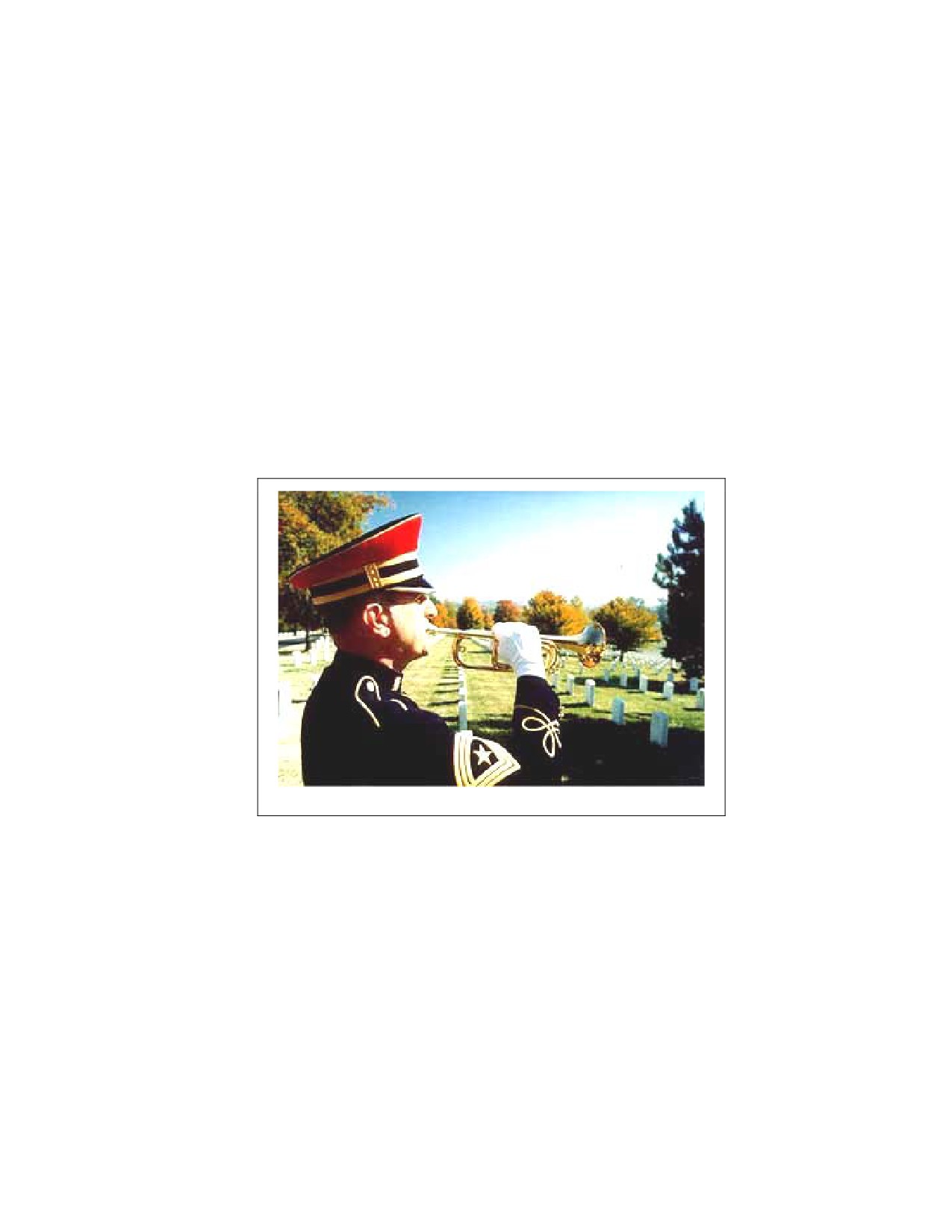
Bugler from the Army Band
4-31. As weapons became more lethal, with longer ranges, and required
greater dispersal of units, bugles lost effectiveness in controlling units. But
the Army still retains bugles and the music with which they communicate
to soldiers is another reminder of our heritage. With every note of Reveille
or Retreat we call to mind our common bond with soldiers of the
Continental Army and the sacrifices soldiers have made ever since. You can
hear the bugle calls still used today on the Army Homepage at
4-9
FM 7-21.13 ____________________________________________________________
COLORS, FLAGS, AND GUIDONS
4-32. The National and organizational flags carried by Color-bearing units
are called the National Color and the organizational color respectively (the
word color is capitalized when referring to the National flag only). When
used singularly, the term “Color” implies the National Color. The term
“Colors” means the national and organizational colors.
4-33. The Colors originated as a means of battlefield identification and
performed this function for many years. The old rank of Ensign—originally
an Army title, now used only in the Navy—was assigned to the regiment's
junior officer who carried the flag (ensign) into battle. Because the color
party marched into battle at the front and center of the regiment, casualties
were high. Victories in the old days were sometimes expressed in terms of
the number of enemy colors captured. The practice of carrying colors into
battle persisted through the American Civil War; the last Medals of Honor
awarded during this conflict were for capturing Confederate colors. Modern
armies now carry colors only in ceremonies.
… a small group of Union soldiers, held prisoners by the
Confederates, made a Stars and Stripes from their own
clothing, flew it for a few minutes from the rafters of the old
warehouse in which they were imprisoned, and then tore it
into 22 pieces, one for each man who helped make it. Every
one then hid the piece of flag in his clothing and took it with
him when released from prison. In the years following the war,
the pieces were finally recovered and sewed together again to
form the flag, which is still in existence.
FM 21-13, The Soldier’s Guide, 1952
4-34. Regiments and separate battalions are the only units that carry
colors. Divisions, brigades and other organizations have a distinguishing
standard that shows the shoulder-sleeve insignia. Company-size units carry
guidons (small flags) in the colors of their branches.
4-35. United States Army flags traditionally have been used for purposes
of identification and the fostering of esprit de corps. The present policies
stem from ideas and practices dating back to the Revolutionary War. In
turn, those were influenced by the military traditions of Western Europe to
a great extent. The English, French, Dutch, Spanish, and others brought to
North America their flags, military uniforms, and other official symbolism.
Also, leaders of the colonists were familiar with military traditions and
particularly those of England and France.
4-36. With the Declaration of Independence and the formation of troops,
came the need for items to identify the soldiers and military units. On
February 20, 1776, General Washington’s headquarters issued an order on
flags. It said that regiments should each have distinctive colors similar to
the uniforms of the regiment and that “the Number of the Regiment is to be
mark’d on the Colours, and such a Motto, as the Colonel may choose…”
4-10
_____________________________________________________________ Chapter 4
4-37. General Washington’s order emphasized the significance of
organizational colors to the Army by directing quick design and
procurement. As late as 1779, the designs of regimental and national colors
to be carried by Army organizations were the subject of correspondence
between Washington and the Board of War. The Americans intended to
follow the British practice of using two different designs for the National
flag: one for the naval or marine flag and the other for the battle or Army
flag. By 1780, the stars and stripes design adopted by the United States in
1777 was generally known as the marine (maritime) flag used extensively
at sea, but no Army National flag had been adopted prior to 1780.
4-38. The first Army National Color was blue incorporating the design of
an eagle displayed (somewhat similar to that in the coat of arms adopted for
the United States) and the name of the regiment. That National Color of
the Army was carried until 1841 when it became the regimental color. From
that blue flag evolved the eagle on regimental and battalion flags and,
finally, on Major Army Command flags. Continuous recognition of the
significance of flags to the soldiers’ morale resulted in a well-defined system
of flags for organizations at all echelons. In general, flags incorporate
design elements that are identical to or relate to the insignia worn by the
members of the organization.
THE ARMY FLAG AND ITS STREAMERS
4-39. Until 1956 no flag represented the Army as a whole. The first official
US Army flag was unfurled on 14 June 1956 at Independence Hall in
Philadelphia, Pennsylvania, by then Secretary of the Army Wilbur M.
Brucker. This flag was designed to meet the need for one banner to
represent the entire Army.
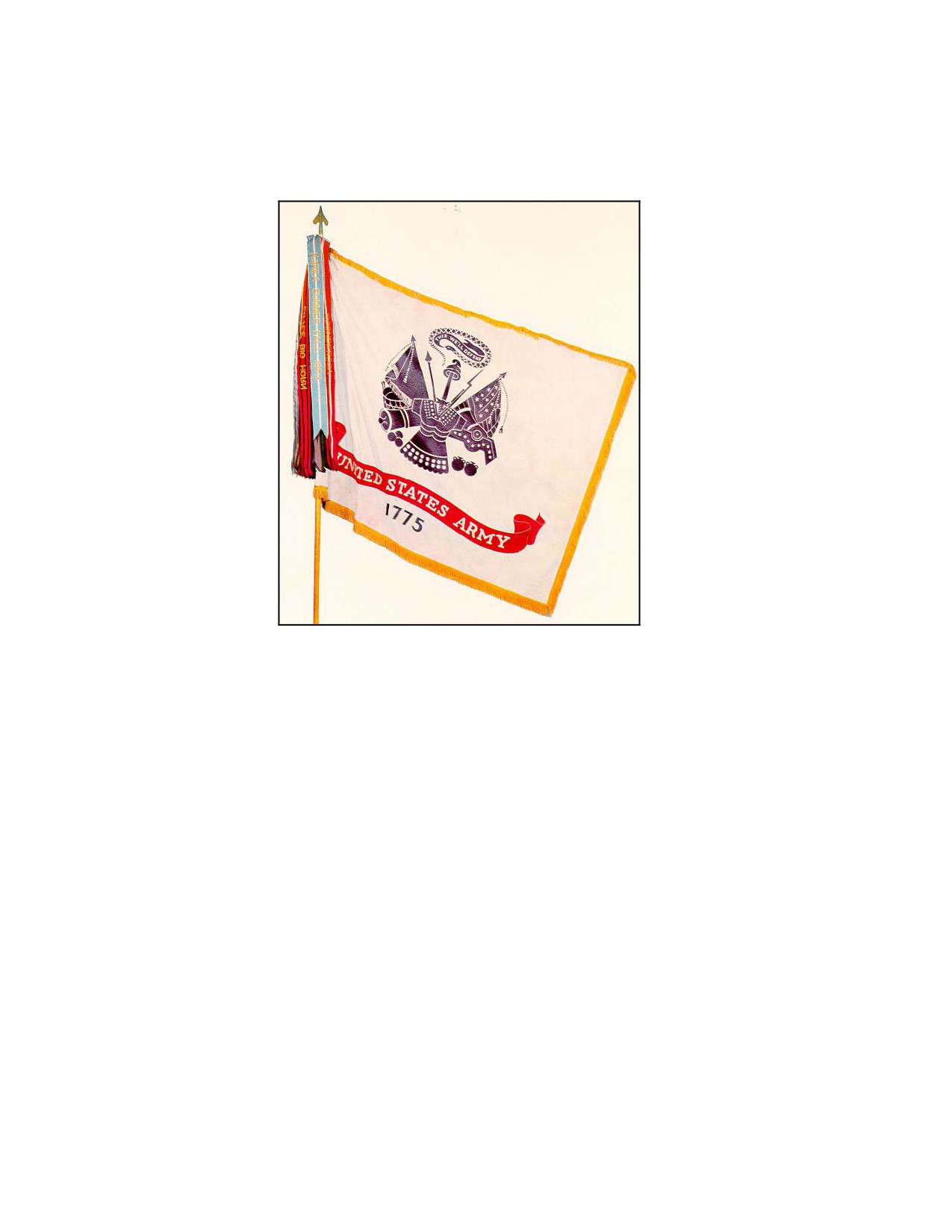
4-40. The Army flag is in the national colors of red, white, and blue with a
yellow fringe. It has a white field with the War Office seal in blue in its
center. Beneath the seal is a scarlet scroll with the inscription "United
States Army" in white letters. Below the scroll the numerals "1775" appears
in blue to commemorate the year in which the Army was created with the
appointment of General George Washington as Commander in Chief.
4-41. The historic War Office seal, somewhat modified from its original, is
the design feature that gives to the Army flag its greatest distinction. The
center of the seal depicts a roman breastplate over a jupon, or a leather
jacket. Above the breastplate rises a sword upon which rests a Phrygian
cap. Rising from the breastplate to the left (facing the viewer) is a pike, or
esponton, flanked by an unidentified organizational color. On the right side
rises a musket with fixed bayonet flanked by the National Color. Above the
sword is a rattlesnake holding in its mouth a scroll inscribed "This We'll
Defend." To the lower left of the breastplate is a cannon in front of a drum
with two drumsticks. Below the cannon are three cannon balls and to the
right is a mortar on a trunnion with two powder flasks below. See the Army
flag in figure 4-1 below.
4-11
FM 7-21.13 ____________________________________________________________
Figure 4-1. The Army Flag and Streamers
4-42. From its colors to its heraldic devices, the Army flag is rich in
symbolism that speaks of our nation's and the Army's origin and heritage.
The colors used in the flag were selected for their traditional significance.
Red, white, and blue are the colors, of course, of the national flag.
Furthermore, those colors symbolize in the language of heraldry the virtues
of hardiness and valor (red), purity and innocence (white), and vigilance,
perseverance, and justice (blue). Blue is especially significant since it has
been the unofficial color of the Army for more than two hundred years.
4-43. The meaning of the symbols that make up the heraldic design of the
seal can be fully understood only in terms of its eighteenth century origin.
For example, the placement of the two flags shown on the seal, the
organizational and the national flags are reversed in violation of heraldic
custom. The placing of the United States flag on the left (from the flag's
point of view) rather than on the right reflected the tendency of the leaders
of the Revolutionary War period to discard traditional European concepts.
The display of both an organizational color and the national flag was a
common practice of the Continental Army during the Revolutionary War.
See the Army seal in figure 4-2 below.
4-12

_____________________________________________________________ Chapter 4
Figure 4-2. The Army Seal
4-44. The implements of warfare, cannon, cannon balls, mortar, powder
flasks, pike, and rifle, are all of the type used in the Revolutionary War.
Their inclusion in the seal reflects the powers and duties of the
revolutionary era Board of War for the procurement and handling of
artillery, arms, ammunition, and other war-like stores belonging to the
United States. The pike is of the type carried by subordinate officers of
infantry. The drum and drumsticks are symbols of public notification,
reflecting the tradition of a citizen militia. Drums also served various
military purposes in the eighteenth century, such as the regulation of firing
in battle by the drummer's beat. The Phrygian cap atop the sword's point is
the type of cap given to ancient Roman slaves when they were granted
freedom. However, during the French Revolution, the cap was adopted and
worn as a "Cap of Liberty,” and is now a traditional symbol of liberty. The
coiled rattlesnake and scroll was a symbol that appeared frequently on
colonial flags, particularly those representing groups opposed to some
aspect of British rule.
4-45. The Army flag reflects our history and touches the lives of
generations of Americans. In 1956, Chief of Staff of the Army General
Maxwell D. Taylor called it the "American soldier's Flag… for those who
have gone before us, for those who man our ramparts today, and for those
who will stand guard over our freedoms in all of our tomorrows." The Army
4-13
FM 7-21.13 ____________________________________________________________
flag remains today a symbol of the Army's achievements in the past and of
its readiness to meet the challenges of the future.
The Army is hundreds of years older than you are and proud
of its experience. It draws strength from the past and offers
some of that strength to you through symbols.
FM 21-13, The Soldier’s Guide, 1952
4-46. The streamers attached to the Army flag staff denote campaigns
fought by the Army throughout our Nation’s history. Each streamer (2 ¾
inches wide and 4 feet long) is embroidered with the designation of a
campaign and the year(s) in which it occurred. The colors derive from the
campaign ribbon authorized for service in that particular war.
4-47. The concept of campaign streamers came to prominence in the Civil
War when Army organizations embroidered the names of battles on their
organizational colors. This was discontinued in
1890 when units were
authorized to place silver bands, engraved with the names of battles,
around the staffs of their organizational colors. When American
Expeditionary Force (AEF) units in World War I were unable to obtain
silver bands, General Pershing authorized the use of small ribbons bearing
the names of the World War I operations. In 1921 all color-bearing Army
organizations were authorized to use the large campaign streamers
currently displayed. To properly display the campaign streamers, a soldier
ensures the first
(Lexington) and last
(Kosovo Defense Campaign)
campaign streamers are visible.
The Campaigns of the United States Army
4-48. These are the campaigns the Army has been a part of:
Revolutionary War
• Germantown 4 Oct 1777
• Lexington 19 Apr 1775
• Monmouth 28 Jun 1778
• Ticonderoga 10 May 1775
• Savannah 29 Dec 1778;
16 Sep-10 Oct 1779
• Boston 17 Jun 1775-
17 Mar 1776
• Cowpens 17 Jan 1781
• Quebec 28 Augt 1775-3 Jul
• Guilford Court House 15 Mar
1776
1781
• Charleston 28-29 Jun 1776;
• Yorktown 28 Sep-19 Oct 1781
29 Mar-12 May 1780
War of 1812
• Long Island 26-29 Aug
• Canada 18 Jun 1812-17 Feb
1776
1815
• Trenton 26 Dec 1776
• Chippewa 5 Jul 1814
• Princeton 3 Jan 1777
• Lundy's Lane 25 Jul 1814
• Saratoga 2 Jul-17 Oct 1777
• Bladensburg 17-29 Aug 1814
• Brandywine 11 Sep 1777
4-14
_____________________________________________________________ Chapter 4
• McHenry 13 Sep 1814
• Vicksburg 29 Mar-4 Jul 1863
• New Orleans 23 Sep 1814-
• Chickamauga 16 Aug-
22
8 Jan 1815
Sep 1863
Mexican War
• Chattanooga 23-27 Nov 1863
• Palo Alto 8 May 1846
• Wilderness 4-7 May 1864
• Resaca de la Palma 9 May
• Atlanta 7 May-2 Sep 1864
1846
• Spotsylvania 8-21 May 1864
• Monterey 21 Sep 1846
• Cold Harbor 22 May-3 Jun
• Buena Vista 22-23 Feb
1864
1847
• Petersburg 4 Jun 1864-2 Apr
• Vera Cruz 9-29 Mar 1847
1865
• Cerro Gordo 17 Apr 1847
• Shenandoah 7 Aug-28 Nov
1864
• Contreras 18-20 Aug 1847
• Franklin 17-30 Nov 1864
• Churubusco 20 Aug 1847
• Nashville 1-16 Dec 1864
• Molino del Rey 8 Sep 1847
• Appomattox 3-9 Apr 1865
• Chapultepec 13 Sep 1847
Indian Wars
Civil War
• Miami Jan 1790-Aug 1795
• Sumter 12-13 Apr 1861
• Tippecanoe 21 Sep-18 Nov
• Bull Run 16-22 Jul 1861
1811
• Henry & Donelson
• Creeks 27 Jul 1813-Aug 1814;
6-16 Feb 1862
Feb 1836-Jul 1837
• Mississippi River 6 Feb
• Seminoles 20 Nov 1817-31 Oct
1862-9 Jul 1863
1818; 28 Dec 1835-14 Aug
• Peninsula 17 Mar-3 Aug
1842; 15 Dec 1855-May 1858
1862
• Black Hawk 26 Apr-20 Sep
• Shiloh 6-7 Apr 1862
1832
• Valley 15 May-17 Jun 1862
• Comanches 1867-1875
• Manassas 7 Aug-2 Sep
• Modocs 1872-1873
1862
• Apaches 1873; 1885-1886
• Antietam 3-17 Sept 1862
• Little Big Horn 1876-1877
• Fredericksburg 9 Nov-
• Nez Perces 1877
15 Dec 1862
• Bannocks 1878
• Murfreesborough 26 Dec
1862-4 Jan 1863
• Cheyennes 1878-1879
• Chancellorsville 27 Apr-
• Utes Sep 1879-Nov 1880
6 May 1863
• Pine Ridge Nov 1890-Jan 1891
• Gettysburg 29 Jun-3 Jul
War with Spain
1863
• Santiago 22 Jun-11 Jul 1898
4-15
FM 7-21.13 ____________________________________________________________
• Puerto Rico 25 Jul-13 Aug
• Champagne-Marne
1898
18 Jul-6 Aug 1918
• Manila 31 Jul-13 Aug 1898
• Aisne-Marne 15-18 Jul 1918
• Somme Offensive
China Relief Expedition
8 Aug-11 Nov 1918
• Tientsin 13 Jul 1900
• Oise-Aisne 18 Aug-11 Nov
1918
• Yang-tsun 6 Aug 1900
• Ypres-Lys 19 Aug-11 Nov
• Peking 14-15 Aug 1900
1918
Philippine Insurrection
• St. Mihiel 12-16 Sep 1918
• Manila 4 Feb-17 Mar 1899
• Meuse-Argonne 26 Sept-
• Iloilo 8-12 Feb 1899
11 Nov 1918
• Malolos 24 Mar-16 Aug
• Vittoria Veneto 24 Oct-4 Nov
1899
1918
• Laguna de Bay 8-17 Apr
1899
World War II
• San Isidro 12 Apr-30 May
American Theater
1899; 15 Oct-19 Nov 1899
• Antisubmarine 7 Dec 1941-
• Zapote River 13 Jun 1899
2 Sep 1945
• Cavite 7-13 Oct 1899;
Asiatic-Pacific Theater
4 Jan-9 Feb 1900
• Philippine Islands 7 Dec 1941-
• Tarlac 5-20 Nov 1899
10 May 1942
• San Fabian 6-19 Nov 1899
• Burma 7 Dec 1941-26 May
• Mindanao 4 Jul 1902-
1942
31 Dec 1904; 22 Oct 1905
• Central Pacific 7 Dec 1941-
• Jolo 1-24 May 1905;
6 Dec 1943
6-8 Mar 1906; 6 Aug 1906;
• East Indies 1 Jan-22 Jul 1942
11-15 Jun 1913
• India-Burma 2 Apr 1942-
Mexican Expedition
28 Jan 1945
• Mexico 1916-1917 14 Mar
• Air Offensive, Japan 17 Apr
1916-7 Feb 1917
1942-2 Sep 1945
World War I
• Aleutian Islands 3 Jun 1942-
• Cambrai 20 Nov-4 Dec
24 Aug 1943
1917
• China Defensive 4 Jul 1942-
• Somme Defensive 21 Mar-
4 May 1945
6 Apr 1918
• Papua 23 Jul 1942-23 Jan
• Lys 9-27 Apr 1918
1943
• Aisne 27 May-5 Jun 1918
• Guadalcanal 7 Aug 1942-
• Montdidier-Noyon 9-13 Jun
21 Feb 1943
1918
4-16
_____________________________________________________________ Chapter 4
• New Guinea 24 Jan 1943-
• Northern France 25 Jul-
31 Dec 1944
14 Sep 1944
• Northern Solomons
• Southern France 15 Aug-
14
22 Feb 1943-21 Nov 1944
Sep 1944
• Eastern Mandates
• Northern Apennines 10 Sep
31 Jan-14 Jun 1944
1944-4 Apr 1945
• Bismarck Archipelago
• Rhineland 15 Sep 1944-
15 Dec 1943-27 Nov 1944
21 Mar 1945
• Western Pacific 15 Jun
• Ardennes-Alsace 16 Dec 1944-
1944-2 Sep 1945
25 Jan 1945
• Leyte 17 Oct 1944-1 Jul
• Central Europe 22 Mar-
1945
11 May 1945
• Luzon 15 Dec 1944-4 Jul
• Po Valley 5 Apr-8 May 1945
1945
Korean War
• Central Burma 29 Jan-
• UN Defensive 27 Jun-15 Sep
15 Jul 1945
1950
• Southern Philippines
• UN Offensive 16 Sep-2 Nov
27 Feb-4 Jul 1945
1950
• Ryukyus 26 Mar-2 Jul
• CCF Intervention 3 Nov 1950-
1945
24 Jan 1951
• China Offensive 5 May-
• First UN Counteroffensive
2 Sep 1945
25 Jan-21 Apr 1951
European-African-Middle
• CCF Spring Offensive
Eastern Theater
22 Apr-8 Jul 1951
• Egypt-Libya 11 Jun 1942-
• UN Summer-Fall Offensive
12 Feb 1943
9 Jul-27 Nov 1951
• Air Offensive, Europe
• Second Korean Winter
4 Jul 1942-5 Jun 1944
28 Nov 1951-30 Apr 1952
• Algeria-French Morocco
• Korea, Summer-Fall 1952
8-11 Nov 1942
1 May-30 Nov 1952
• Tunisia 17 Nov 1942-
• Third Korean Winter
13 May 1943
1 Dec 1952-30 Apr 1953
• Sicily 9 Jul-17 Aug 1943
• Korea, Summer 1953 1 May-
• Naples-Foggia Air: 18 Aug
27 Jul 1953
1943-21 Jan 1944; Ground:
Vietnam
9 Sep 1943- 21 Jan 1944
• Advisory 15 Mar 1962-7 Mar
• Anzio 22 Jan-24 May 1944
1965
• Rome-Arno 22 Jan-9 Sep
• Defense 8 Mar-24 Dec 1965
1944
• Counteroffensive 25 Dec 1965-
• Normandy 6 Jun-24 Jul
30 Jun 1966
1944
4-17
FM 7-21.13 ____________________________________________________________
• Counteroffensive, Phase II
• Consolidation II
1
1 Jul 1966-31 May 1967
Dec 1971-29 Mar 1972
• Counteroffensive, Phase III
• Cease-Fire 30 Mar 1972-
1 Jun 1967-29 Jan 1968
28 Jan 1973
• Tet Counteroffensive
Armed Forces Expeditions
30 Jan-1 Apr 1968
• Dominican Republic 28 Apr
• Counteroffensive, Phase IV
1965-21 Sep 1966
2 Apr-30 Jun 1968
• Grenada 23 Oct-21 Nov 1983
• Counteroffensive, Phase V
• Panama 20 Dec 1989- 31 Jan
1 Jul-1 Nov 1968
1990
• Counteroffensive, Phase VI
Southwest Asia
2 Nov 1968-22 Feb 1969
• Defense of Saudi Arabia
• Tet 69 Counteroffensive
2 Aug 1990-16 Jan 1991
23 Feb-8 Jun 1969
• Liberation and Defense of
• Summer-Fall 1969 9 Jun-
Kuwait 17 Jan-11 Apr 1991
31 Oct 1969
• Cease-Fire 12 Apr 1991-
• Winter-Spring 1970
30 Nov 1995
1 Nov 1969-30 Apr 1970
Kosovo
• Sanctuary
• Kosovo Air Campaign
Counteroffensive 1 May -
24 Mar - 10 Jun 1999
30 Jun 1970
• Kosovo Defense Campaign
• Counteroffensive, Phase
11 Jun 1999 - (Closing date to
VII 1 Jul 1970-31 Jun
be determined)
1971
• Consolidation I 1 Jul-
30 Nov 1971
OFFICER AND NCO PRIVILEGES OF RANK
4-49. As you continue in your Army career, you will find there are
privileges that come with rank and responsibility. Some of these
privileges are higher pay, different housing or more barracks space,
NCO or Officers’ clubs, and dedicated vehicles or office space. Remember
first that with higher rank comes greater responsibility.
Each step up the ladder of leadership brings you a larger
share of pay, prestige, and privileges. These are earned
rewards for your willingness to accept greater
responsibilities. They are not outright gifts. You are
expected to pay back every dollar... in work and
conscientious concern for your men and your unit, in many
jobs well done.
The Noncom’s Guide, 1962
4-18
_____________________________________________________________ Chapter 4
4-50. The acceptance of greater responsibility merits greater
compensation to be sure. The other privileges are given to help the
leader do the job. The battalion command sergeant major, for example,
performs duties that are made more efficient and effective by having an
office in garrison.
4-51. The most important thing to remember in any discussion about
the “privileges of rank” is that with them come profound responsibilities.
That responsibility is for the performance of the team and the very lives
of the soldiers in it. Leaders willingly accept this responsibility as a
privilege in itself.
It is said that ‘rank has its privileges.’ This is as it should
be, particularly when we remember that one of the primary
privileges of rank is to be entrusted with responsibility.
MSG Frank K. Nicolas
LINEAGE AND HONORS
4-52. In combat, individual exploits and personal valor are important,
but team effort wins the fight. The Army pays close attention to team
performance, to the organizations in which soldiers serve and fight, and
to the flags and colors that symbolize those organizations.
4-53. The older an organization, the more soldiers, both active and
retired, have had the opportunity of serving in and identifying with it
and the more opportunities the organization has had to win battle
honors. As the Army got smaller, posts closed and units inactivated,
flags and colors moved around to ensure certain units continued. Such
actions have occurred throughout the Army's history, but increased
after World War II as the Army placed more emphasis on retaining
units with the most history and honors.
4-54. For those who say, "What does it matter" there is no response
since for those outside the military unit numbers mean little and their
history is unimportant—one organization is much the same as any
other. But for those soldiers who have served in the “Big Red One,” the
“Wolfhounds,” the “Rainbow Division," or the “Buffalos” (a misspelling
that just stuck), unit pride is very much a part of their lives.
4-55. US Army units, like soldiers, have an individual service record.
Units display their unit history and battle honors on their colors. These
honors are a source of unit pride and whenever soldiers gather to
compare the unit decorations on their uniforms there is an inherent
competition between them.
4-56. The Army did not originally have a system for tracing unit history
and honors. Units simply embroidered on their colors the names of the
battles in which they fought, but units often disagreed about what
differentiated a "skirmish" from a "battle" or a "campaign." By the
1920s, however, the Army found that it needed to standardize its battle
4-19
FM 7-21.13 ____________________________________________________________
honors and began to perform impartial research on unit histories (often
tracing them through a variety of redesignations) and to determine
campaign participation credit.
4-57. The Army, despite vigorous reorganization in the
1950s and
1960s, carried on the lineage and honors in units that exist still today.
Unit esprit de corps and unit cohesion are essential characteristics of an
effective fighting organization. Military history has demonstrated that
units with high esprit, a sense of tradition and pride in past
achievements, perform well in combat. Soldiers still proudly learn and
remember the history, customs, and traditions behind the regiments.
4-58. The customs, courtesies, and traditions of our Army provide a
connection with soldiers throughout the history of the Nation. As you
continue in your service, remember that these also help in unit and self-
discipline, building the team and demonstrating your professionalism.
4-20
Chapter 5
Training
Soldiers prepare to fight the Nation’s wars through tough,
realistic and relevant training. That training pushes
soldiers to their limit and beyond while maintaining high
standards. This chapter will familiarize you with the system
the Army uses to plan for, execute and assess the
effectiveness of training and your responsibilities in making
it happen. You must understand the importance of being
proficient in your individual tasks so that the team can
accomplish its collective tasks and mission. Force protection
is a part of every operation and you can enhance force
protection by knowing the rules of engagement.
Section I - Army Training Management
5-2
How the System Operates
5-3
Leader Training and Development
5-6
Battle Focus Training Management
5-7
Task, Conditions, and Standards
5-15
Section II - Individual Training
5-15
Physical Fitness
5-15
Individual Combat Skills
5-18
Opportunity Training
5-21
Drills
5-22
Safety
5-23
Section III - Force Protection
5-25
Terrorism
5-27
Rules of Engagement and Rules for the Use of Force
5-28
Guard Duty
5-31
The Media………………………………………………………
5-32
For more information on training, see FM 7-0 (25-100), Training the Force, FM 7-1
(25-101), Battle Focused Training, and AR 350-1, Army Training and Education.
For more information on common tasks and skills, see STP 21-1-SMCT, Soldier’s Manual
of Common Tasks, and FM 3-21.75 (21-75), Combat Skills of the Soldier.
For more information on physical training, see FM 3-22.20 (21-20), Physical Fitness
Training.
For more information on safety, see FM 5-19 (100-14), Risk Management, AR 385-10,
Army Safety Program, and DA PAM 385-1, Small Unit Safety Officer/NCO Guide.
For more information on force protection and antiterrorism, see FM 3-07.2 (100-35),
Force Protection, and AR 525-13, Antiterrorism.
For more information on guard duty, see FM 3-21.6 (22-6), Guard Duty.
5-1
FM 7-21.13 ____________________________________________________________
SECTION I: ARMY TRAINING MANAGEMENT
5-1.
Every soldier, NCO, warrant officer, and officer has one primary
mission—to be trained and ready to fight and win our Nations wars.
Success in battle does not happen by accident; it is a direct result of tough,
realistic, and challenging training. We exist as an Army to deter war, or if
deterrence fails, to reestablish peace through victory in combat. To
accomplish this, our Armed Forces must be able to perform their assigned
strategic, operational, and tactical missions. Now for deterrence to be
effective, potential enemies must know with certainty that the Army has
the credible, demonstrable capability to mobilize, deploy, fight, sustain, and
win any conflict.
Let every nation know, whether it wishes us well or ill, that
we shall pay any price, bear any burden, meet any hardship,
support any friend, oppose any foe, to assure the survival and
success of liberty.
John F. Kennedy
5-2.
Training is that process that melds human and materiel resources
into these required capabilities. The Army has an obligation to the
American people to ensure its soldiers go into battle with the assurance of
success and survival. This is an obligation that only rigorous and realistic
training, conducted to standard, can fulfill.
5-3.
We train the way we fight because our history shows the direct
relation between realistic training and success on the battlefield. Today’s
leaders must apply the lessons of history in planning training for
tomorrow’s battles. We can trace the connection between training and
success in battle to our Army’s earliest experiences during the American
Revolution. General George Washington had long sensed the need for
uniform training and organization, so he secured the appointment of Baron
Von Steuben as Inspector General in charge of training. Von Steuben
clearly understood the difference between the American citizen soldier and
the European professional. He noted that American soldiers had to be told
why they did things before they would do them well, and he applied this
same philosophy in his training which helped the continental soldiers
understand and endure the rigorous and demanding training he put them
through. After Valley Forge, Continentals would fight on equal terms with
British regulars. Von Steuben began the tradition of effective unit training
that today still develops leaders and forges battle-ready units for the Army.
With 2,000 years of examples behind us we have no excuses
when fighting, for not fighting well.
T.E. Lawrence
5-4.
Field Manual 7-0, Training the Force, points out that today our
Army must meet the challenge of a wider range of threats and a more
5-2
_____________________________________________________________ Chapter 5
complex set of operating environments while incorporating new and diverse
technologies. The Army meets these challenges through its core
competencies: shape the security environment, prompt response,
mobilization, forcible entry operations, sustained land dominance, and
support civil authorities. Field Manual 7-0 is the Army’s capstone training
doctrine and is applicable to all units, at all levels, and in all components.
While its focus is principally at division and below, FM 7-0 provides the
essential fundamentals for all individual, leader and unit training.
5-5.
Training for warfighting is our number one priority in peace and
war. Warfighting readiness comes from tactical and technical competence
and confidence. Competence relates to the ability to fight our doctrine
through tactical and technical execution. Confidence is the individual and
collective belief that we can do all things better than the adversary and that
our units possess the trust and will to accomplish the mission.
To lead an untrained people to war is to throw them away.
Confucius
5-6.
Field Manual 7-0 provides the training and leader development
methods that are the basis for developing competent and confident soldiers
and the units that will win decisively in any environment. Training is the
means to achieve tactical and technical competence for specific tasks,
conditions, and standards. Leader Development is the deliberate,
continuous, sequential and progressive process, based on values, that
develops soldiers and civilians into competent and confident leaders capable
of decisive action.
5-7.
Closing the gap between training, leader development, and
battlefield performance has always been the critical challenge for any
Army. Overcoming this challenge requires achieving the correct balance
between training management and training execution. Training
management focuses leaders on the science of training in terms of resource
efficiencies
(People, time, ammo, etc.) measured against tasks and
standards. Training execution focuses leaders on the art of leadership to
develop trust, will, and teamwork under varying conditions. Leaders
integrate this science and art to identify the right tasks, conditions, and
standards in training, foster unit will and spirit, and then adapt to the
battlefield to win decisively.
HOW THE SYSTEM OPERATES
5-8.
Soldier and leader training and development continue in all units in
the active and reserve components. Using the institutional foundation as
the basis, training in organizations and units focuses and hones individual
and team skills and knowledge. This requires all soldiers, at some level, to
take responsibility for the training and readiness of the unit.
5-3
FM 7-21.13 ____________________________________________________________
For they had learned that true safety was to be found in long
previous training, and not in eloquent exhortations uttered
when they were going into action.
Thucydides, History of the Peloponesian Wars
5-9.
Unit training consists of three components: collective training,
leader development and individual training. Collective training comes from
the unit’s mission essential task list (METL) and mission training plans
(MTP). Leader development is embedded in collective training tasks and in
some separate individual leader focused training. Individual training
establishes, improves, and sustains individual soldier proficiency in tasks
directly related to the unit’s METL. Commanders plan and conduct unit
collective training to prepare soldiers and leaders for unit missions.
COMMANDER’S RESPONSIBILITY
5-10. The commander is responsible for the wartime readiness of the
entire unit. The commander is therefore the primary trainer of the
organization and is responsible for ensuring that all training is conducted
to standard. This is a top priority of the commander, and the command
climate must reflect this priority. He analyzes the unit’s wartime mission
and develops the unit’s METL. Then, using appropriate doctrine and the
MTP, the commander plans training and briefs the training plan to the
next higher commander. The next higher commander provides resources,
protects the training from interference, and assesses the training.
5-11. The commander’s involvement and presence in planning, preparing,
executing and assessing unit training to standards is key to effective unit
training. They must ensure MTP standards are met during all training. If a
squad, platoon, or company fails to meet the established standard for
identified METL tasks, the unit must retrain until the tasks are performed
to standard. Sustaining METL proficiency is the critical factor commanders
adhere to when training small units.
NCO RESPONSIBILITY
5-12. A great strength of the US Army is its professional NCO Corps.
NCOs take pride in being responsible for the individual training of soldiers,
crews, and small teams. They continue the development of new soldiers
when they arrive in the unit. NCOs train soldiers to the non-negotiable
standards published in MTPs and soldier’s training publications (STPs),
including the common task manual. NCOs provide commanders with
assessments of individual and crew/team proficiency to support the training
management process.
5-13. Individual and crew/team training is an integral part of unit
training. Taking advantage of every training opportunity is a valuable
talent of NCOs. NCOs routinely help integrate individual training with unit
training to ensure soldiers can perform their tasks to prescribed standard
as a team member. In this way they assist the commander in forging a
5-4
_____________________________________________________________ Chapter 5
team capable of performing the unit’s METL to the prescribed standard and
accomplishing all assigned missions.
YOUR RESPONSIBILITY
5-14. You, as an individual soldier, are responsible for performing your
individual tasks to the prescribed standard. Training is the cornerstone of
success. It is a full time job in peacetime and continues in wartime. In
battle, you and your unit will fight as well or as poorly as you and your
fellow soldiers trained. Your proficiency will make a difference.
The Best Machinegunner in the 101st
Private “Tex” McMorries was a machine gunner in Company G, 501st
Parachute Infantry Regiment, during World War II. During Operation
Market Garden, the 501st landed in drop zones near the city of Veghel,
Holland. On 24 September 1944 the Germans attacked to recapture
the town. Private McMorries and his squad were holding a critical
roadblock on the Germans’ likeliest avenue of approach to the village.
When German reconnaissance had determined that the roadblock was
a weak area in the American line, they attacked. In the initial firefight
the Germans poured a tremendous amount of firepower on the
American position and six soldiers were wounded. The enemy
advanced to within 100 yards of the position when Private McMorries
opened fire with his machine gun, halting the German advance. The
Germans attacked again several times but the Americans threw them
back each time.
Private McMorries never received an award for his action that day.
When asked about his feelings on not being recognized with an award,
Tex McMorries replied, “I wanted no credit for my little part in 101st
history. I am only proud that if you asked a man of Company G, 501st,
who was the best machine gunner in the 101st, he will name me. That
is my decoration. It can’t be worn, only felt. It is the only one I care for
now.” He fulfilled his obligations to his unit and to his country. His
actions as an infantryman characterized the requirements that must be
possessed by all soldiers to ensure their effectiveness and ability to
fight and win on the battlefield.
5-15. You received a lot of critical skills training in Basic Combat
Training (BCT) and Advanced Individual Training (AIT) or in officer basic
course. But in your unit you learn more skills and how to function as a
member of the team under conditions that approximate battlefield
conditions. To maintain proficiency and gain new skills requires continual
self-development, which may take the form of training or education.
5-16. Soldier Training Publications
(STPs) contain individual critical
tasks, professional development information, and other training
information that are important to your success as a soldier. Your MOS-
specifc STP helps you maintain your task performance proficiency and it
aids unit leaders, unit trainers, and commanders to train subordinates to
5-5