FM 7-21.13 THE SOLDIER’S GUIDE (FEBRUARY 2004) - page 3
FM 7-21.13 ____________________________________________________________
Corporal Harold W. Roberts at Montrebeau Woods
Corporal Harold W. Roberts was a tank driver in A Company, 344th
Tank Battalion during the St. Mihiel and Meuse-Argonne offensives. His
company was advancing under heavy enemy artillery fire in the
Montrebeau Woods. After about a mile, the tank commander/gunner,
Sergeant Virgil Morgan and Corporal Roberts saw a disabled tank with
a soldier crouched by it. As Roberts stopped his tank, the soldier
crawled toward them, opened the door and asked for help. They said
they could not help at the moment but would return after the battle and
render aid and drove off into the heart of the German artillery barrage.
Ahead lay a large mass of bushes that they thought was a machine gun
nest and drove the tank into it. In an instant, they found themselves
overturned. Recovering from the shock they discovered the tank had
fallen into a tank trap with about 10 feet of water in it. The tank had only
one hatch and with water rushing in Roberts said to Morgan, "Well, only
one of us can get out, and out you go." With this he pushed Sergeant
Morgan from the tank. Morgan tried to assist Roberts, but with the
heavy gunfire around the area, was unable to do so. After the enemy
fire ceased, Sergeant Morgan returned but found Roberts dead.
Corporal Roberts was posthumously awarded the Medal of Honor, the
second tanker to receive it. Camp Nacimiento, California, was renamed
Camp Roberts in 1941. It was the only Army installation at the time to
be named for an enlisted soldier.
2-96. The airplane also demonstrated its potential. The Army first began
experimenting with aircraft before the war and, when war came, attempted
to build an air component to support its ground forces. Many enthusiastic
pilots fought in France, such as Eddie Rickenbacker and Frank Luke. By
the end of the war most American pilots were still flying French or British
aircraft as American industry had not caught up with the demand.
Nonetheless, aircraft and American flyers had proven their worth and that
of the US Army Air Service.
2-97. As a direct result of US entry into the war, Germany realized
victory was out of its reach. It still hoped to gain armistice terms allowing it
to retain captured territory. But as the American forces helped push the
German army back and the naval blockade of Germany made her citizens’
lives more miserable, revolutionary elements within Germany began to
exert influence. Finally it was clear to the German High Command that it
could not continue the war without risking complete destruction of the
nation and negotiated for peace.
2-98. The Armistice ended the fighting at the 11th hour of the 11th day of
the 11th month of 1918. Known for many years as Armistice Day, it is now
called Veteran’s Day in the United States. A final peace treaty was signed
at Versailles the following year, although the United States negotiated a
separate treaty with Germany in 1921. With the other allies, the US Army
began an occupation of Germany west of the Rhine near Cologne on 1 Dec
1918 but had withdrawn all soldiers by 24 January 1923.
2-30
_____________________________________________________________ Chapter 2
The Unknown Soldier
During and after World War I the Graves Registration Service positively
identified most of the remains of US servicemen who died in Europe
during the war. There were 1,237 who were never identified. Congress
resolved to construct a tomb as a final resting-place for one of the
unknowns to honor all of them.
On 24 October 1921, four caskets carrying the remains of unidentified
American soldiers were brought to a room in the Hotel De Ville in the
French town of Chalons-sur-Marne. One American soldier entered,
alone. Sergeant Edward F. Younger, Headquarters Company,
2d
Battalion, 50th Infantry, from Chicago, Illinois, had fought in the war as a
private, corporal and sergeant. He was wounded twice and had
received the Distinguished Service Cross for valor in battle. In his hands
he carried roses, a gift of Mr. Brasseur Bruffer, a former member of the
city council of Chalons, who had lost two sons in the war. As a French
band played a hymn outside, Sergeant Younger slowly walked around
the caskets several times and finally paused in front of one of them.
Gently he laid his roses on the casket, and then came to attention,
faced the body, and saluted. He had chosen "The Unknown."
"I went into the room and walked past the caskets," he later explained. "I
walked around them three times. Suddenly I stopped. It was as though
something had pulled me. A voice seemed to say: ‘This is a pal of
yours.’”
The remains were later transported to the French port of Le Havre, put
onboard the cruiser USS Olympia, and sailed for home, arriving on
November 9th. The body lay in state in the Capitol Rotunda for two days
as over 90,000 people quietly filed by. On 11 November 1921, this
brave soldier, whose true identify will forever be a mystery, was formally
interred on native soil. Since then unknown soldiers from World War II,
the Korean War and, for a time, the Vietnam War, have joined him. The
Unknown Soldier from the Vietnam War was later identified; the space
where he once rested remains empty.
BETWEEN THE WARS
2-99. Revolutionary turmoil in Soviet Russia induced President Wilson in
August 1918 to direct Army participation in allied stability and support
operations in European Russia and in Siberia. As a result, about 15,000
soldiers deployed to the Murmansk area and Siberia. These Army
contingents guarded supplies and lines of communication but incurred
about as many combat casualties as the Army did in Cuba in 1898. After
the withdrawal of American occupation forces from Germany and Russia,
few Army forces remained stationed on foreign soil. The Marine Corps
provided most of the small foreign garrisons and expeditionary forces
required after World War I, particularly in the Caribbean area.
2-100. One result of WWI was the creation of the League of Nations. This
international body, roughly similar to the United Nations of today, was
envisioned as a forum where disputes could be settled peacefully. If
peaceful negotiations failed, the League could collectively force one or more
2-31
FM 7-21.13 ____________________________________________________________
belligerents to comply with League mandates. The United States never
joined the League due to a variety of reasons, including George
Washington’s warning against “entangling alliances” and since a condition
of membership was a pledge to provide military forces when and where the
League called for them.
National Defense Act of 1920
2-101. Legislation following the First World War included the new
National Defense Act of June 4, 1920, which governed the organization and
regulation of the Army until 1950. The Act has been acknowledged as one of
the most constructive pieces of military legislation ever adopted in the
United States. It established the Army of the United States as an
organization of three components: the professional Regular Army, the
National Guard, and the Organized Reserves
(Officers' and Enlisted
Reserve Corps). Each component would contribute its appropriate share of
troops in a war emergency. In effect the Act acknowledged the actual
practice of the United States throughout its history of maintaining a
standing peacetime force too small to meet the needs of a major war and,
therefore, depending on a new Army of civilian soldiers for large
mobilizations.
2-102. The training of reserve components now became a major peacetime
task of the Regular Army. For this reason the Army was authorized a
maximum officer strength more than three times that before WWI. The act
also directed that officer promotions, except for doctors and chaplains,
would be made from a single list, a reform that equalized opportunity for
advancement throughout most of the Army. The Regular Army was
authorized a maximum enlisted strength of 280,000, but Congress soon
reduced that to below 150,000.
2-103. The Act of 1920 contemplated a National Guard of 436,000, but its
actual peacetime strength became stabilized at about 180,000. This force
relieved the regular Army of any duty in curbing domestic disturbances
within the states from 1921 until 1941 and stood ready for immediate
induction into the active Army whenever necessary. The War Department,
in addition to supplying large quantities of surplus World War I materiel
for equipment, applied about one-tenth of its military budget to the support
of the Guard in the years between wars. Guardsmen engaged in regular
armory drills and 15 days of field training each year. The increasingly
federalized Guard was better trained in 1939 than it had been when
mobilized for Mexican border duty in 1916. Numerically, the National
Guard was the largest component of the Army between 1922 and 1939.
2-104. From 1921 to 1936 Americans thought that the United States could
and should avoid future wars with other major powers by maintaining a
minimum of defensive military strength, avoiding entangling commitments
with Europe, and attempting to promote international peace and arms
limits. Subsequently a treaty in 1922 temporarily checked a naval arms
race. As long as both the United States and Japan honored treaty
provisions, neither side could operate offensively in the Pacific. In effect,
2-32
_____________________________________________________________ Chapter 2
these provisions also meant that it would be impossible for the United
States to defend the Philippines against a Japanese attack.
Transformation in the 1920s
After World War I ended, America discovered it had defeated its
principle adversary and there were no known nation-state opponents.
Technology provided new, more lethal weapons, notably the tank and
the airplane, which the Army sought to use effectively. The Army began
to put intellectual effort into determining both the best ways to use
existing technology and in how to best defend from current or future
threats realizing that warfare, tactics, weapons and priorities would also
change over time.
This situation, in some ways similar to the Transformation process our
Army is undergoing today, took advantage of an expected respite from
major conflicts. The Army conducted wargames, simulations and in-
depth studies during the 1920s and 1930s. While industry continued to
develop better radios, tanks, planes, and other tools of war, the Army
continued to think through the problems of integrating the new
technology, training soldiers, mobilization, and supporting mechanized
forces. But the Army had a serious drawback in the inability to conduct
large-scale exercises to confirm theory. Officers could visualize new
techniques might work, but could not prove them nor incorporate valid
lessons learned from actual application.
During this period the Army spent a great deal of its scarce resources
on educating officers so they could be adaptive and versatile leaders.
The Command and Staff College at Fort Leavenworth and the Infantry
School at Fort Benning were two of the most important centers, not only
in the educational processes, but also in the development of doctrine
and concepts.
2-105. The “war to end all wars,”—World War I—was poorly named. A
number of conflicts erupted in the 1920s and in 1931 the Japanese army
seized Manchuria. Japan quit the League of Nations and a few years later
renounced naval limitation treaties. In Europe, Adolf Hitler came to power
in Germany in 1933, and by 1936 Nazi Germany had denounced the Treaty
of Versailles, began rearming, and reoccupied the demilitarized Rhineland.
Italy's Benito Mussolini began his career of aggression by attacking
Ethiopia in 1935. A revolution in Spain in 1936 not only produced another
fascist dictatorship but also a war that became a proving ground for World
War II. The neutrality acts passed by the US Congress between 1935 and
1937 were a direct response to these European developments. The United
States opened diplomatic relations with Soviet Russia in 1933 and in 1934
promised eventual independence to the Philippines.
2-106. The Army concentrated on equipping and training its combat units
for mobile warfare rather than for the static warfare that had characterized
operations on the western front in the First World War. To increase the
maneuverability of its principal ground unit, the division, the Army decided
after field tests to reorganize the infantry division by reducing the number
2-33
FM 7-21.13 ____________________________________________________________
of its infantry regiments from four to three, and to make it more mobile by
using motor transportation only. The planned wartime strength of the new
division was to be little more than half the size of its World War I
counterpart.
WORLD WAR II
2-107. The German annexation of Austria in March 1938 followed by the
Czech crisis in September of the same year showed the United States and
the other democratic nations that another world conflict was likely. War
had already begun in the far east when Japan invaded China in 1937. After
Germany seized all of Czechoslovakia in March 1939, war in Europe
became inevitable. Hitler had no intention of stopping with that move and
Great Britain and France decided that they must fight rather than yield
anything more. On 23 August 1939 Nazi Germany and the Soviet Union
agreed to a non-aggression pact, a partition of Poland and a Soviet free
hand in Finland, Estonia, Latvia, and Lithuania. On 1 September 1939
Germany invaded Poland. France and Great Britain responded by declaring
war on Germany, a course that could not lead to victory without aid from
the United States. Still the majority of Americans wanted to stay out of the
new war if possible, and this tempered the Nation’s responses to the
international situation.
2-108. Immediately after the European war started, President Franklin D.
Roosevelt proclaimed a limited national emergency and authorized
increases in regular Army and National Guard enlisted strengths to
227,000 and 235,000 respectively. At his urging Congress soon gave indirect
support to the western democracies by ending the prohibition on sales of
munitions to nations at war. British and French orders for munitions
helped to prepare American industry for the large-scale war production that
was to come.
Expansion of the Army
2-109. Under the leadership of the Chief of Staff of the Army, General
George C. Marshall, in the summer of 1940 the Army began a large
expansion designed to protect the United States and the rest of the Western
Hemisphere against any hostile forces from Europe. To fill the ranks of the
newly expanded Army, Congress approved induction of the National Guard
into federal service and the calling up of the Organized Reserves. Then it
approved the first peacetime draft of untrained civilian manpower in the
Nation's history in the Selective Service and Training Act of 14 September
1940. Units of the National Guard, draftees and the Reserve officers to
train them, entered service as rapidly as the Army could build camps to
house them. During the last six months of 1940 the active Army more than
doubled in strength, and by mid-1941 it achieved its planned strength of
one and a half million officers and men. The increase in ground units and in
the Army Air Corps laid the foundation for even larger expansion when war
came the following year.
2-110. On the eve of France's defeat in June 1940 President Roosevelt had
directed the transfer or diversion of large stocks of Army World War I
2-34
_____________________________________________________________ Chapter 2
weapons, and of ammunition and aircraft, to both France and Great
Britain. The foreign aid program culminated in the Lend-Lease Act of
March 1941, which openly avowed the intention of the United States to
become an "arsenal of democracy" against aggression. Prewar foreign aid
was a measure of self defense; its basic purpose was to help contain the
military might of the Axis powers until the United States could complete its
own protective mobilization.
2-111. The Nazis invaded the Soviet Union on 22 June 1941. Three days
later US Army troops landed in Greenland to protect it against German
attack and to build bases for the air route across the North Atlantic. The
President also decided that Americans should relieve British troops
guarding Iceland. The initial contingent of American forces reached there in
early July followed by a sizable Army expeditionary force in September. In
August the President and British Prime Minister Winston Churchill met in
Newfoundland and drafted the Atlantic Charter, which defined the general
terms of a just peace for the world. The overt American moves in 1941
toward involvement in the war against Germany had solid backing in
public opinion, but Americans were still not in favor of a declaration of war.
2-112. As the United States prepared for war in the Atlantic, American
policy toward Japan toughened. Although the United States wanted to
avoid a two-front war, it would not do so by surrendering vital areas or
interests to the Japanese as the price for peace. When in late July 1941 the
Japanese moved large forces into former French colonies in southern
Indochina
(now Vietnam), the United States responded by freezing
Japanese assets and cutting off oil and steel shipments to Japan. The US
demanded Japanese withdrawal from the occupied areas. Although the
Japanese were unwilling to give up their newly acquired territory, they
could not maintain operations for long without US oil and steel. They
continued to negotiate with the United States but tentatively decided in
September to embark on a war of conquest in Southeast Asia and the Indies
as soon as possible. To enable this they would attack the great American
naval base of Pearl Harbor in Hawaii. When intensive last-minute
negotiations in November failed to produce any accommodation, the
Japanese made their decision for war irrevocable.
The United States Enters World War II
2-113. The Japanese attack of December 7, 1941 on Pearl Harbor and the
Philippines at once ended any division of American opinion toward
participation in the war. America went to war with popular support that
was unprecedented in the military history of the United States. This was
also the first time in its history that the United States had entered a war
with a large Army in being and an industrial system partially retooled for
war. The Army numbered 1,643,477 and was ready to defend the Western
Hemisphere against invasion. But it was not ready to take part in large-
scale operations across the oceans. Many months would pass before the
United States could launch even limited offensives. Still, General Marshall
had overseen a huge expansion of the Army and ensured its soldiers
received the best training possible to prepare them for war.
2-35
FM 7-21.13 ____________________________________________________________
Once again, the destiny of our country is in the hands of the
individual soldier. Upon your courage and efficiency depends
the salvation of all that we hold dear. Prepare yourselves,
then, to become good soldiers. For you will strike the mighty
blows that will surely destroy the evil tyrants who menace our
freedom, our homes, and our loved ones.
Message from President Franklin D. Roosevelt, The Army and You, 1941
2-114. During the first year after the Japanese attack on Pearl Harbor in
December 1941, the Army’s major task was to prevent disaster and
preserve American morale while building strength for the eventual
counteroffensive. Cut off from relief, American and Philippine soldiers
under General Douglas MacArthur held out for over four months against
superior Japanese air, naval, and ground power before they were forced to
surrender. MacArthur obeyed President Roosevelt’s orders to evacuate to
Australia prior to the final capitulation. But he vowed to return to the
Philippines, a promise which, combined with the heroism of the American
and Philippine defenders, gave the Nation a needed symbol of defiance.
2-115. In India Lieutenant General Joseph W. "Vinegar Joe" Stilwell
surveyed the remnants of his Chinese army after an arduous retreat from
Burma and frankly admitted, "We got a hell of a beating… I think we ought
to find out what caused it, go back, and retake it." The bombing raid on
Tokyo in April 1942 led by Colonel James H. Doolittle gave American
morale a boost. The US Navy’s victory in the Battle of Midway helped to
seize the initiative away from the Japanese forces. But it was not until
November 1942 that American soldiers could take the offensive on a large
scale, with the invasion of North Africa and the campaigns on Guadalcanal
and New Guinea. When they did so, they learned hard lessons in the
demands of modern combat. At Buna they bogged down in the jungle
against strong Japanese positions. After having overrun Morocco and
Algeria against little opposition, they took heavy losses at the hands of the
German Afrika Korps near Kasserine Pass in Tunisia.
2-116. During 1943 and early 1944, the Army overcame its early mistakes
and helped turn the tide against the Axis. In Tunisia, American troops
recovered from the defeat at Kasserine Pass to participate in an offensive
that forced the surrender of Axis forces in North Africa. Under the
leadership of General Dwight D. Eisenhower and Lieutenant General
George S. Patton, Jr., they joined with Allied forces to drive the Germans
and Italians from the island of Sicily. American and Allied troops then
landed on the Italian mainland and, against fierce German opposition,
slowly advanced up the peninsula to Rome by early June 1944. As early as
1942, US Army Air Force bombers took the war to the German heartland
and began preparing the way for the invasion of France.
A veteran of the last war pretty well summed up the two wars
when he said, “this is just like the last war, only the holes are
bigger.”
Ernie Pyle
2-36
_____________________________________________________________ Chapter 2
2-117. In the Pacific, MacArthur’s forces captured Buna and leapfrogged
their way along the northern New Guinea coastline. Soldiers, marines and
sailors advanced through the Solomon and Marshall Islands of the South
and Central Pacific. In northern Burma Stilwell’s Chinese army, aided by a
specially trained force of Americans known as Merrill’s Marauders, drove
back Japanese defenders and laid siege to the key crossroads city of
Myitkyina. By restoring land communications with China, Stilwell hoped to
supply the Chinese with the means to defeat the Japanese on the Asian
mainland while American forces converged on Japan from the Pacific.
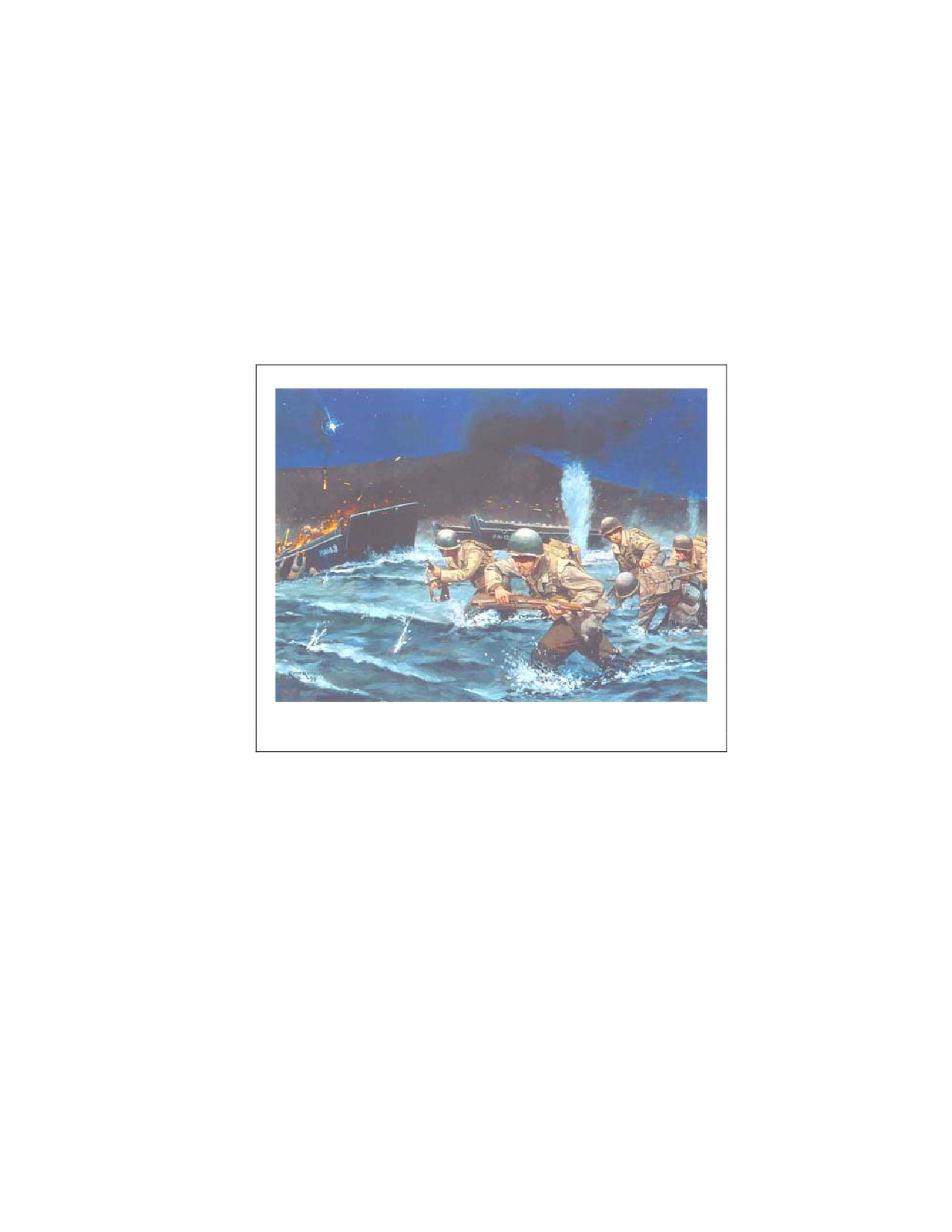
“Tip of the Avalanche.”
The 36th Infantry Division Lands at Salerno, Italy on 9 September 1943.
2-118. The immense mobilization of resources and the long drive back from
initial defeat led ultimately to the advance into the Axis homelands. In mid
1944, Allied forces everywhere were advancing. In the Pacific, US forces
continued a methodical island-hopping campaign and prepared for the
liberation of the Philippines. Allied forces in Italy struggled with the
terrain, weather, and the German army, but made progress anyway,
capturing Rome on 4 June 1944. In Great Britain, the Allies were ready to
spring across the English Channel to the coast of Normandy.
2-119. On D-Day, 6 June 1944, General Dwight D. Eisenhower’s Allied
armies landed in France. The 82d and 101st Airborne Divisions parachuted
into Normandy in the early morning darkness. Just after dawn, the 1st,
4th, and 29th Infantry Divisions assaulted the beaches codenamed Utah
and Omaha. At the same time, British and Canadian soldiers were landing
further east on the beaches known as Gold, Juno and Sword.
2-37
FM 7-21.13 ____________________________________________________________
2-120. The US sirborne drops scattered soldiers inland from Utah beach,
causing extreme confusion among the enemy. The 4th Infantry Division got
ashore at Utah with few losses. On Omaha beach the 1st and 29th Infantry
Divisions had more difficulty. Veteran German soldiers occupied strong
fortifications on bluffs overlooking the beaches. Their heavy fire at first put
the success of the landings in jeopardy. But the personal courage and
adaptability of individual soldiers allowed them to eventually get across the
beach, up the bluffs, and inland. The cost of gaining the foothold in France
was high. Over 6,000 Americans were killed, wounded, or missing.
A Company, 116th Infantry on D-Day
Many soldiers of the 116th Infantry Regiment were National Guardsmen
who had originally signed on with units in Virginia and Maryland. They
were part of the 29th Infantry Division and their regiment was in the first
wave of the landing on Omaha beach. 200 soldiers of A Company, 116th
Infantry were in seven of the first landing craft to hit the beach that
morning. Many of them came from Bedford, Virginia.
Strong currents had pushed many landing craft off target that morning,
but A Company was right on target—the sector codenamed Dog Green.
These soldiers landed almost alone as adjacent units landed further
east. With no other Americans in sight, German defenders there
concentrated all their fire on those seven landing craft.
One of the landing craft exploded after hitting a mine or being struck by
a German artillery shell. Another dropped its ramp right in front of a
German machine gun nest that killed every soldier before he could get
off the boat. In ten minutes, every officer and every noncommissioned
officer were dead or wounded. As A Company struggled ashore,
German fire eventually hit all but a few dozen soldiers.
But their sacrifice brought weapons, explosives, and ammunition
ashore, even if strewn across the beach, which was critical to the
following waves of soldiers coming ashore. As the tide rose, these
soldiers would abandon their equipment in the deep water but retrieved
and used what A Company soldiers had died to bring to the beach.
Bedford, at the time a town of a little over 3,000, lost 19 of her sons on
D-Day and 4 more before the war was won.
2-121. Also in June 1944 American soldiers and marines came ashore on
the Mariana Islands, part of the inner ring of Japan’s Pacific defenses.
After two months of near stalemate in the hedgerows of Normandy,
American troops under Lieutenant Generals Omar N. Bradley and Patton
broke through the German lines and raced across France. In little over a
month following the breakout, Allied armies had liberated nearly the whole
country. A second invasion near Toulon on 15 August sealed the German
army’s fate in France.
2-122. The Allied advance slowed in September due to gasoline shortages
brought on by the lack of a large, nearby port and the high tempo of
operations. The respite gave the Germans time to reorganize their defenses
2-38
_____________________________________________________________ Chapter 2
along the French-German border. By stripping units and reinforcements
from the Russian front, Hitler gambled on a surprise counteroffensive in
the Ardennes in December that became known as the Battle of the Bulge.
2-123. The German attack in the Ardennes on 16 December 1944 was a
surprise for the Allies because it fell on a sector that General Eisenhower
thought was poorly suited for decisive offensive operations. In defensive
positions early that morning were units that were brand new to the
European Theater of Operations (ETO) or those that were recovering from
extended duty on the line. The German attack also surprised these soldiers.
But it wasn’t long before they began to resist, slowing the German attack.
Krinkelt-Rocherath during the Battle of the Bulge
Krinkelt-Rocherath was the name of two adjacent villages on the
northern shoulder of the Ardennes attack. Defending these villages
were a patchwork of units, including parts of the 2d Infantry Division.
On 19 December 1944 Technician Fourth Grade (Tech/4) Truman
Kimbro, Company C, 2d Engineer Combat Battalion, led a squad to
emplace mines on a crossroads near Rocherath. Nearing the objective,
he and his squad were driven back under withering fire from an enemy
tank and at least 20 infantrymen. All approaches to the crossroads were
covered by intense enemy fire. Tech/4 Kimbro left his squad in a
covered position and crawled alone, with mines, toward the crossroads.
Close to his objective he was severely wounded, but continued to drag
himself forward and placed his mines across the road. As he tried to
return to his squad he was killed by enemy fire. The mines laid by
Tech/4 Kimbro delayed the enemy armor and prevented attacks on
withdrawing columns. He received the Medal of Honor posthumously.
Even though Americans would soon withdraw from Krinkelt-Rocherath,
soldiers were fighting hard and delaying the enemy at nearly every
crossroad and village. The northern shoulder would hold.
2-124. The Ardennes battle ended 31 January 1945 and cost over 80,000
American casualties, but the Allies ultimately prevailed due to the courage
and skill of US Army soldiers. While very difficult fighting remained,
German offensive power was seriously weakened. The fighting near
Colmar, France, was as difficult as any thus far in the war. At nearby
Holtzwihr 2LT Audie Murphy performed the actions for which he would
receive the Medal of Honor.
2-125. In the east, the Soviet Army was within reach of Berlin while in
Italy the Allies were steadily moving north to the Po River Valley. In
Germany itself, US and British forces were poised to cross the Rhine River.
On 7 March 1945 soldiers of the 9th Armored Division found an intact
bridge at Remagen, Germany. Realizing the importance of the opportunity,
they stormed across without hesitation, the first Allied soldiers to cross the
Rhine. Other crossings followed on 22 and 23 March 1945.
2-126. Once across the Rhine, German resistance soon crumbled and the
Army raced across Germany, into Czechoslovakia and Austria, linking up
2-39
FM 7-21.13 ____________________________________________________________
with Allied units coming up from Italy and with the Soviet Army at Torgau,
Germany on 25 April 1945. The war in Europe ended 8 May 1945.
2-127. In Burma, the fall of Myitkyina in August 1944 and further Chinese
and American advances to the south finally reopened the Burma Road in
February 1945. In the Pacific, American soldiers and marines captured the
Marianas in July 1944, bringing US Army Air Force B-29 bombers within
range of the Japanese home islands. General MacArthur’s forces landed at
Leyte in October, fulfilling his promise to return to the Philippines. By
February 1945 the US Sixth Army had recaptured Manila after bitter
house-to-house fighting and was securing the main Philippine island of
Luzon. The campaign would take a total of seven months and cost 40,000
American casualties.
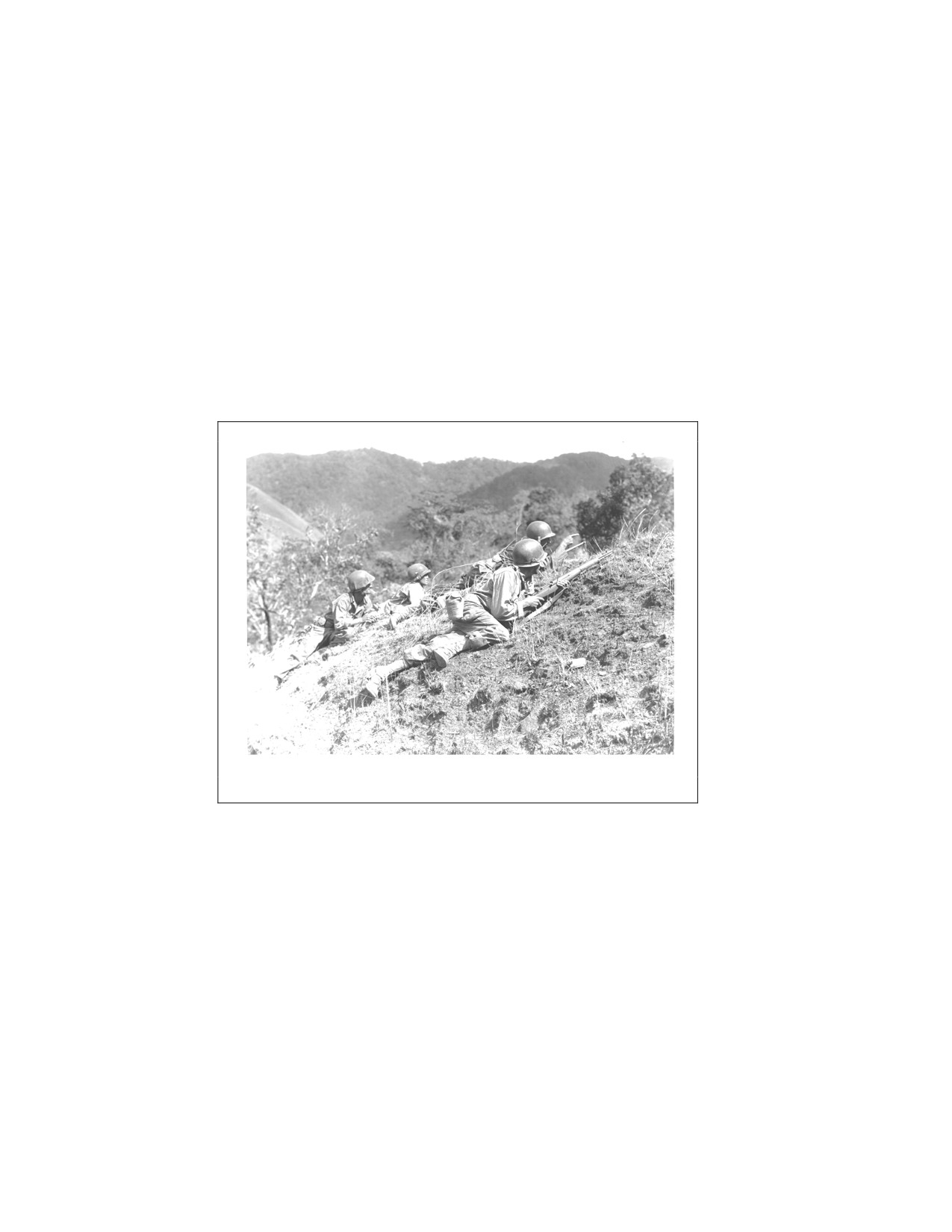
A squad leader of the 25th Infantry Division points out a suspected enemy
position near Baugio, Luzon on 23 March 1945.
2-128. Soldiers and marines invaded the island of Okinawa, part of Japan
itself, on 1 April 1945. Defending the island were 120,000 Japanese soldiers
and sailors, occupying strong fortifications inland. Capturing the island
took nearly three months of bitter fighting. All but 7,000 enemy soldiers
died, as did tens of thousands of Okinawan civilians caught in the terrible
battle. Over 7,000 American soldiers and marines were killed at Okinawa.
Army and Marine divisions suffered a 35% casualty rate. The US Navy was
under near constant Kamikaze attack as the battle wore on and 5,000
American sailors also lost their lives.
2-40
_____________________________________________________________ Chapter 2
Private First Class Desmond T. Doss at Okinawa
Private First Class Doss was a company medic with the 307th Infantry
Regiment in the 77th Infantry Division near Urasoe Mura, Okinawa. On
29 April 1945, the 1st Battalion assaulted a high escarpment. As our
soldiers reached the top, enemy artillery, mortar, and machinegun fire
inflicted about
75 casualties and drove the others back. PFC Doss
refused to seek cover and remained in the fire-swept area with the
wounded, carrying them one by one to the edge of the escarpment.
There he lowered them on a rope-supported litter down the face of a cliff
to friendly hands.
On 4 May PFC Doss treated four men who had been cut down while
assaulting a strongly defended cave. He advanced through a shower of
grenades to within 8 yards of the enemy in the cave's mouth, where he
treated the wounded before making four separate trips under fire to
evacuate them to safety.
On 5 May, when an American was severely wounded by fire from a
cave, PFC Doss crawled to him where he had fallen 25 feet from the
enemy position, rendered aid, and carried him 100 yards to safety while
continually exposed to enemy fire.
During a night attack on 21 May, PFC Doss remained exposed while the
rest of his company took cover, giving aid to the injured until he was
himself seriously wounded in the legs by the explosion of a grenade.
Rather than call another medic from cover, he cared for his own injuries
and waited 5 hours before litter bearers reached him and started
carrying him to cover. PFC Doss, seeing a more critically wounded man
nearby, crawled off the litter and insisted the bearers give their first
attention to the other man. Awaiting the litter bearers' return, he was
again struck, this time suffering a compound fracture of an arm. He
bound a rifle stock to his shattered arm as a splint and then crawled 300
yards over rough terrain to the aid station.
PFC Doss received the Medal of Honor from President Harry S. Truman
on 12 October 1945.
2-129. When American soldiers and marines completed the campaign on
Okinawa in June, they had closed the ring around Japan. This effectively
isolated it from its conquered territories in Asia and continued bombing by
Army Air Force B-29’s crippled its industry. But since the Japanese
government continued to ignore Allied demands for surrender, an invasion
of Japan seemed necessary. The Battle of Okinawa showed what the cost
might be if the United States had to invade the Japanese home islands.
Estimates of total American casualties in an invasion of Japan ran from
100,000 to as high as one million. Japanese casualties, both combatant and
noncombatant, would have been far heavier.
2-130. With this knowledge, President Truman authorized the use of two
atomic bombs against Japan, destroying Hiroshima on 6 August 1945 and
Nagasaki on 9 August 1945. Faced with the prospect of utter destruction of
his country and people, Japan’s Emperor Hirohito ordered his armed forces
2-41
FM 7-21.13 ____________________________________________________________
to cease resistance. In Tokyo Bay on 2 September 1945, Japan and the
Allies signed the document that ended the most destructive war in history.
Over 405,000 Americans had died, including 235,000 soldiers killed in
action.
COLD WAR
2-131. The Army was the principal occupation force in Europe and in
Japan after the war ended. As after all of America’s wars, the Nation
demobilized rapidly, so that by 1950 the active Army had a total of 591,000
soldiers in
10 Divisions in Japan, Europe, and the US. The reserve
component included 730,000 soldiers and 27 divisions.
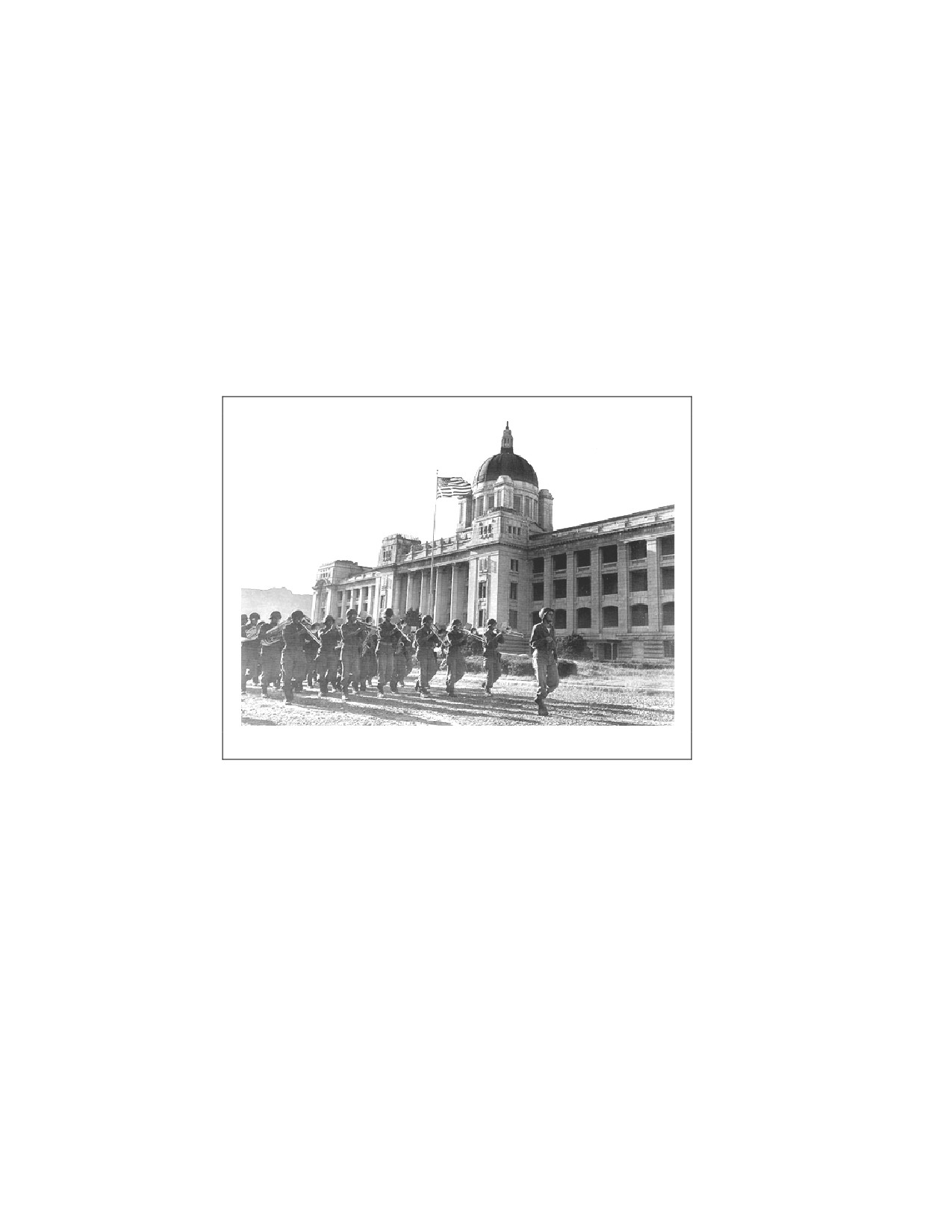
The 7th Infantry Division Band on the capital grounds in Seoul in 1945.
2-132. The end of WWII left the United States and the Soviet Union as the
greatest military powers in the world. Within two years after Hiroshima,
Americans found themselves in a "Cold War," a long-term global struggle of
power and ideology against the Soviet Union and international
communism. Aware that technology and changes in world politics had
ended the age of free security, the nation could no longer afford to leave to
others the task of fending off aggressors while it belatedly mobilized.
Americans gradually came to accept alliance commitments, such as the
North Atlantic Treaty Organization (NATO), a sizable professional military
establishment that stressed readiness and even a peacetime draft.
2-42
_____________________________________________________________ Chapter 2
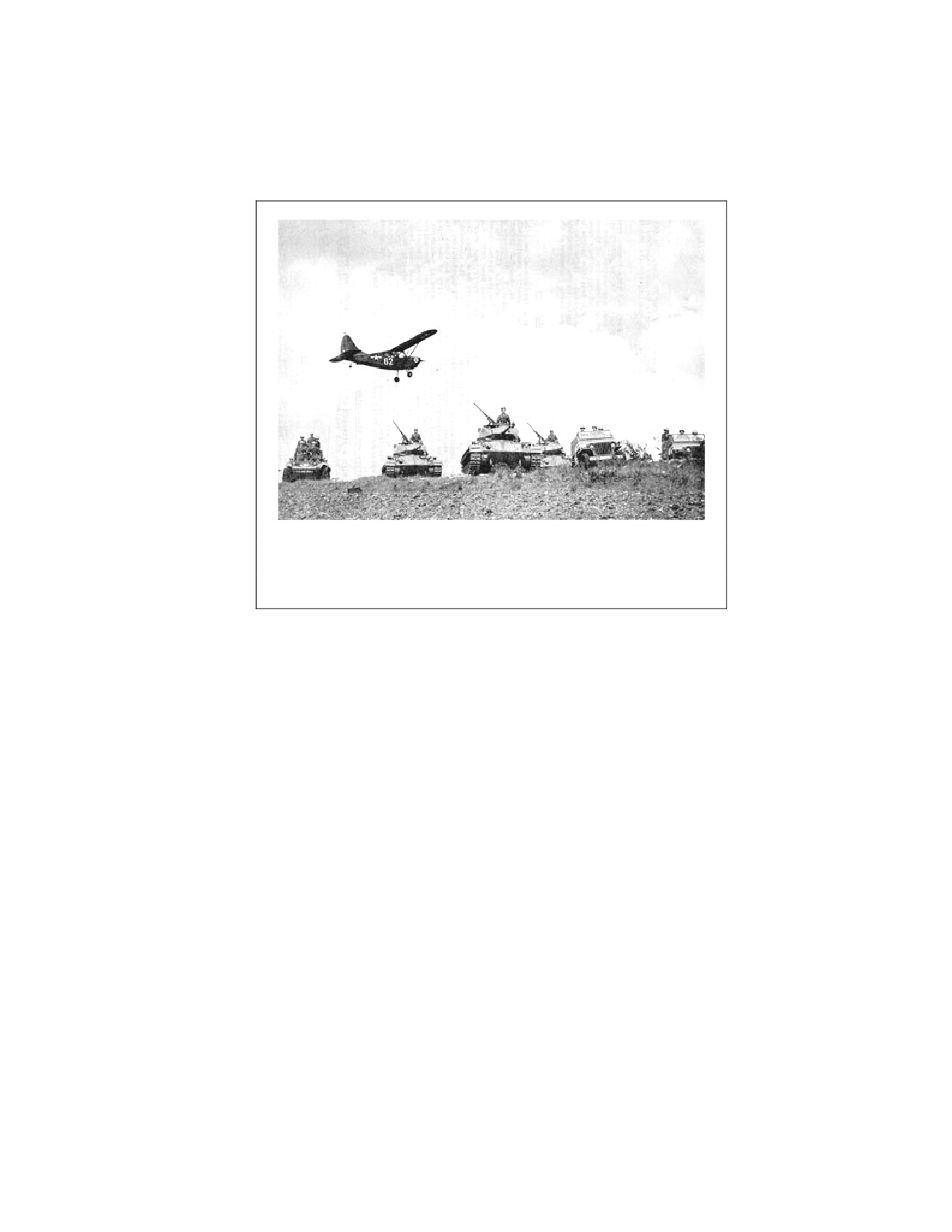
Equipment of the US Army Constabulary.
Army units occupying Germany in the years after World War II were called
constabulary units. Shown here are vehicles used by the Constabulary in
1946—from left to right: M8 armored car, M24 Chaffee light tank, 1/4-ton
jeep. Overhead is an L-5 Sentinel observation aircraft.
2-133. The National Security Act of 1947 was a sweeping reorganization of
the US military. It established the Department of Defense and separate
military departments of the Army, Navy, and a new, separate United
States Air Force made up of the former Army Air Force. The US Air Force
today cherishes as its own the traditions and stalwart service of the Air
Service, Army Air Corps, and Army Air Force.
2-134. The United States had demobilized after WWII but nonetheless
attempted to contain Soviet expansion. Eastern Europe was inextricably
under communist control, but the western Allies did help Greece avoid
falling under communist domination. In 1949 the Soviet Union successfully
tested an atomic bomb, an event that possibly emboldened communist
expansion. While the next 40 years were free of direct conflict between the
US and USSR, a number of smaller wars erupted as the US and western
Allies attempted to contain this expansion.
KOREA
2-135. The first major test of the US resolve to contain communist
expansion came on 25 June 1950 when seven infantry divisions and a tank
brigade of the North Korean People’s Army (NKPA) struck south across the
38th parallel. That was the line that in the last days of WWII the US and
USSR agreed would be the demarcation line between the occupation forces
of those two countries as they moved onto the Korean peninsula. The NKPA
2-43
FM 7-21.13 ____________________________________________________________
invasion was, at the time, thought to be part of a grand plan by the USSR
to achieve world domination through force of arms.
2-136. The North Korean forces quickly overran the poorly equipped army
of the Republic of Korea (ROK), and North Korean troops entered Seoul on
28 June. President Truman decided that the United States, with the United
Nations (UN), had to assist with military forces if the ROK was to remain a
free and independent nation. The United States alerted and deployed Army
forces from occupation duty in Japan, and a task force first met the enemy
north of Osan on 5 July 1950. Task Force Smith was overwhelmed by
NKPA forces in that first engagement, but despite the loss, America
continued to help South Korea resist the aggression.
Task Force Smith
The first ground combat unit in Korea was a task force built from the 1st
Battalion, 21st Infantry of the 24th Infantry Division, then on occupation
duty in Japan. Commanded by LTC Charles Smith, the task force
arrived in Pusan without two of its companies. The mission was to move
to Taejon and block the enemy as far north as possible. On 4 July 1950
a battery of 105-mm artillery joined the task force. The infantry dug in
north of Osan on high ground that had visibility all the way to the next
town of Suwon, and the artillery emplaced a mile back. The road on
which any NKPA force must advance led right through the task force.
Despite the excellent position, the task force had serious
disadvantages. It was alone, with no support on the left or right. It was
armed with few anti-tank weapons and most of these would not
penetrate the frontal armor of an enemy T-34 tank, and no anti-tank
mines were available.
At 0730 on 5 July 1950, a column of T-34 tanks approached from
Suwon. The soldiers of the task force stayed at their posts while 33
tanks bore down on them. The artillery, recoilless rifles, and bazooka
teams engaged these tanks but most of them passed through the task
force’s positions undamaged. They kept moving south, cutting
comunications with the artillery.
About an hour after the tanks had passed through, LTC Smith saw
trucks and over 1000 infantry approaching from Suwon. The task force
repelled all attempts at frontal attacks, but soon the enemy was moving
on the flanks. Without artillery support, low on ammunition, and with
more and more enemy infantry moving around his force, LTC Smith
decided at 1430 to disengage and head toward Ansong, east of Osan.
Most of the task force’s casualties occurred while withdrawing, but the
whole force might have been lost had they stayed any longer. The task
force lost its cohesion and small units and even individual soldiers made
their way to friendly lines. By 7 July LTC Smith could account for only
250 of his 400 soldiers. It was a rough start in a long war.
2-137. Two years before the Korean War started, President Truman had
directed the Armed Forces to integrate, that is, to end the practice of
segregating African-Americans into separate units. But the Army had not
2-44
_____________________________________________________________ Chapter 2
fully implemented that executive order when fighting began in Korea. As
casualties mounted and manpower needs increased, large numbers of
replacements, including African-American soldiers, came into the Korean
Theater of Operations. It became clear that to be effective and efficient, the
Army in Korea had to accelerate integration. The Army began to assign
soldiersto units regardless of race. By mid-1951 no segregated units
remained in Korea.
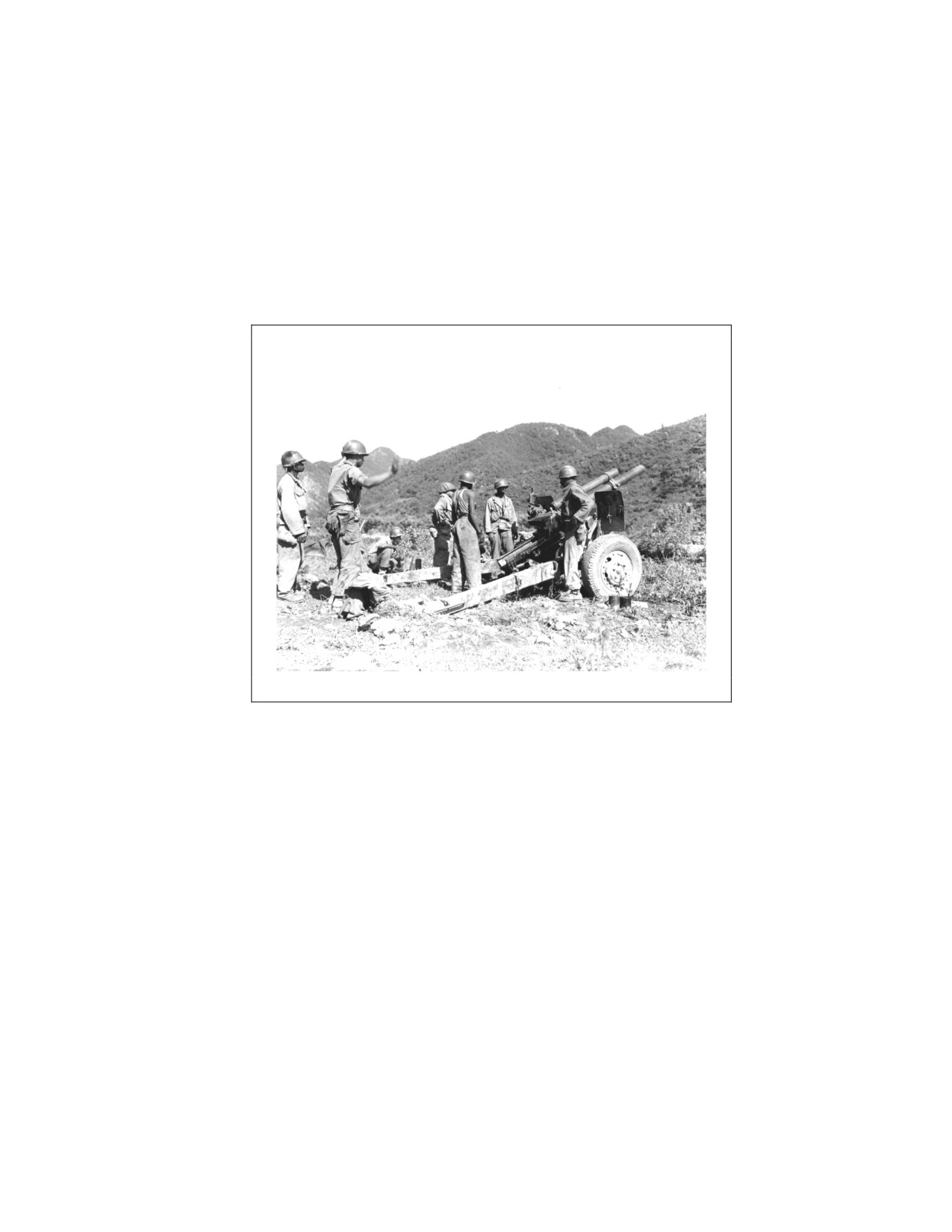
Artillery gun crew waits for the order to fire on the enemy, 25 July 1950.
2-138. During the first few months of the war the US Army and UN forces
fought a series of defensive actions to buy time to bring sufficient combat
power into Korea to attack. By the end of August 1950, the UN was
entrenched in the southeastern tip of the Korean peninsula called the
Pusan Perimeter. Air and ground action had reduced NKPA forces to the
point where the UN could counterattack. In conjunction with a US Army
and Marine amphibious assault on 15 September 1950 at Inch’on, west of
Seoul, the UN forces broke out of the Pusan perimeter. The NKPA was soon
in full retreat and the UN began a pursuit. On 26 October 1950 the ROK
Army 6th Division reached the Yalu River, along the Chinese border and
the US 7th Infantry Division did so on 21 November 1950.
2-139. As the US led UN forces passed the 38th Parallel on 7 October 1950,
The People’s Republic of China
(PRC) warned the UN through
intermediaries that it would not allow an approach to the Chinese border.
The UN Command ignored these warnings, as well as subsequent evidence
of Chinese intervention in Korea. The UN advance was halted by
Communist Chinese Forces (CCF) along the Ch’ong’Chon River and around
the Changjin (Chosin) Reservoir. UN forces transitioned to the defense as
2-45
FM 7-21.13 ____________________________________________________________
300,000 CCF soldiers poured into, around, and through UN lines. The UN
retreated through the fierce winter of 1950-1951. But soldiers regained
their confidence with a series of offensives beginning in January 1951 that
led to the recapture of Seoul, stabilizing the situation.
Chaplain Emil J. Kapaun in Korea
On 2 November 1950 the 8th Regiment of the 1st Cavalry Division,
especially the
3d Battalion, suffered heavy losses in fighting with
Chinese forces. Chaplain
(CPT) Emil J. Kapaun, a veteran of the
Burma-India Theater in World War II, was with them.
The battalion was nearly destroyed in the battle. Enemy soldiers
captured Chaplain Kapaun while he was with a group of over 50
wounded he had helped gather in an old dugout. Ordered to leave many
of those for whom he had risked his life, Kapaun and a few ambulatory
wounded eventually reached a prison camp. For 6 months, under the
most deprived conditions, he fought Communist indoctrination among
the men, ministered to the sick and dying, and stole food from the
enemy in trying to keep his fellow soldiers alive. Eventually, suffering
from a blood clot, pneumonia, and dysentery, he died there on 23 May
1951. Chaplain Kapaun received the Legion of Merit posthumously.
At a memorial service for Chaplain Kapaun in 1954, Chief of Chaplains
Patrick J. Ryan relayed the feelings of former prisoners, “Men said of
him that for a few minutes he could invest a seething hut with the
grandeur of a cathedral… he was able to inspire others so that they
could go on living—when it would have been easier for them to die.”
2-140. The United States and South Korea provided the vast majority of
the manpower and America provided most of the materiel to fight the
Korean War. Great Britain, Australia, New Zealand, Canada, Turkey, and
other nations also provided cobat forces. In addition, the US Army could not
have succeeded without the National Guard and US Army Reserve units
that mobilized and went to Korea.
2-141. While both sides had indicated willingness to end the war roughly
along the current front lines, they would continue to fight it out for 2 ½
more years as negotiators attempted to find a formula for peace. This period
was marked by offensives on each side that tried to gain concessions in the
negotiations with pressure on the battlefield. Some of the bloodiest actions
of the war occurred in these battles that tested the will of the UN or the
Chinese to continue the war. The problem at the truce negotiations rested
primarily on the issue of the return of prisoners of war
(POW). The
communists wanted all POWs returned without qualification while the UN,
recognizing that many enemy soldiers had been forced into service, wanted
to allow those who wished to stay in South Korea to do so.
2-142. When Dwight D. Eisenhower became President of the United States
and Stalin died in the Soviet Union, uncertainty enveloped the communist
cause. In addition, Chinese leader Mao Zedong began to see that the war in
Korea was detracting from his ability to address issues inside China. These
2-46
_____________________________________________________________ Chapter 2
factors contributed to a new commitment to end the war. As peace became
closer and closer a reality, so too did both sides desire to gain as favorable
terrain as possible. This led to a number of battles in the last days before
the truce was signed. The Armistice became effective on 27 July 1953.
Corporal Gilbert G. Collier, the Last Army Medal of Honor
Recipient of the Korean War
Corporal Collier was assigned to F Company,
2d Battalion,
223d
Infantry Regiment, 40th Infantry Division. On 20 July 1953, Corporal
Collier was point man and assistant leader of a night combat patrol
when he and his commanding officer slipped and fell from a sixty-foot
cliff. The leader, incapacitated by a badly sprained ankle, ordered the
patrol to return to the safety of friendly lines. Although suffering from a
painful back injury, Corporal Collier voluntarily remained with his leader.
The two managed to crawl over the ridgeline to the next valley, where
they waited until the next nightfall to continue toward their company’s
position. Shortly after leaving their hideout, they were ambushed and in
the ensuring firefight, Corporal Collier killed two of the enemy but was
wounded and separated from his companion. Ammunition expended, he
closed with four of the enemy, killing, wounding, and routing them with
his bayonet. Mortally wounded in this fight, he died while trying to reach
and assist his leader. He was posthumously promoted to sergeant and
then received the 130th Medal of Honor of the Korean War.
The Armistice that ended the Korean War went into effect 7 days later
on 27 July 1953.
VIETNAM
2-143. The containment policy, drawing a line against communism
throughout the world, led the Army to the Republic of Vietnam. In 1950 the
United States began aiding the French colonial rulers of Indochina, who
were attempting to suppress a revolt by the Communist-dominated Viet
Minh. When the French withdrew from Indochina in 1954, the former
colony became the nations of Laos, Cambodia, and North and South
Vietnam. US Army personnel played a key role in American assistance to
the fledgling South Vietnamese state. This aid increased in the early 1960s
as the Kennedy administration came to view Vietnam as a test case of
American ability to resist Communist wars of national liberation. Army
Special Forces teams formed paramilitary forces and established camps
along the border to cut down the infiltration of men and materiel from
North Vietnam, and other Army personnel trained South Vietnamese
troops and accompanied them as advisers in field operations.
2-144. Despite American efforts, the South Vietnamese government
seemed near to collapse through late 1963 and 1964, as repeated coups and
ongoing Communist infiltration and subversion undermined the regime’s
stability. In early 1965 President Johnson began a process of escalation
that put 184,000 American troops in South Vietnam by year’s end.
2-47
FM 7-21.13 ____________________________________________________________
Landing Zone (LZ) X-Ray in the Ia Drang Valley
On 14 November 1965, the 1st Battalion, 7th Cavalry, an understrength
infantry battalion of the 1st Cavalry Division, conducted an air assault to
find and destroy enemy forces suspected to be on the Chu Pong
Mountain near the Ia Drang Valley. What they found was a “reinforced
North Vietnamese regiment of 2000 soldiers fresh off the Ho Chi Minh
trail who were aggressively motivated to kill Americans.”
The first helicopter touched down at 1048 hours. Shortly after that, while
the rest of the battalion was still flying in, the enemy struck. Over the
next three days the 450 soldiers of 1-7 Cav fought waves of North
Vietnamese infantry who were determined to wipe out the Americans.
Alternately attacking and plugging gaps to prevent the enemy from
closing the LZ, soldiers fought with what they had available. SPC
Willard Parish was a mortar gunner in C Company. But at LZ X-Ray, he
took up an M60 machinegun. On the second morning the enemy had
brought hundreds of soldiers right up to the battalion’s lines. When they
attacked, SPC Parish’s training took over and, unaware of time, fought
until he ran out of 7.62 mm ammunition. Then he stood up and kept
firing at the enemy with a pistol in each hand. When all was quiet later,
there were over 100 enemy bodies in front of his position. SPC Parish
received the Silver Star for his actions.
The battalion had suffered over 100 killed and wounded and the enemy
was close to overrunning the LZ which would isolate the battalion. The
commander LTC Harold G. Moore committed his last reserve, the
reconnaissance platoon, to counterattack and stabilize the C and D
Company sectors. Then, after his soldiers marked their units’ positions,
he ordered strikes by over two dozen aircraft and called on the fires of
four batteries of artillery. That ended the immediate threat long enough
for reinforcements from the 2d Battalion, 5th Cavalry to arrive, having
moved cross-country from another LZ.
Some of these fresh troops took part in an attack that rescued a platoon
from B Company, 1-7 which had been cut off since shortly after the
battle began. Those soldiers, after being pinned down and isolated from
the rest of their company, had drawn up a tight perimeter and expertly
used artillery fires to defeat numerous enemy attacks. SGT Ernie
Savage had not lost another soldier since he took command of the
platoon after its other leaders had been killed.
Early the next morning, the North Vietnamese attacked with
300
soldiers against B Company,
2-7 Cavalry, reinforcements who had
arrived late the first day. Three times they attacked and three times the
B Company troopers threw them back with heavy casualties. Just after
daylight the North Vietnamese tried again. In less than 15 minutes, the
field was piled with enemy dead, but B Company had only 6 wounded.
The enemy had had enough in this fight. 1-7 Cav and the attached units
had lost 79 soldiers killed and 121 wounded in the three days of combat
but had inflicted over 1,300 casualties on the enemy.
2-145. From 1965 to 1969 American troop strength in Vietnam rose to
550,000. The Johnson administration sought to force the North Vietnamese
2-48
_____________________________________________________________ Chapter 2
and their Viet Cong allies in the South to either negotiate or abandon their
attempts to reunify Vietnam by force. Barred by policy from invading North
Vietnam, General William C. Westmoreland adopted a strategy of attrition,
seeking to inflict enough casualties on the enemy in the South to make him
more amenable to American objectives. In the mountains of the Central
Highlands, the jungles of the coastal lowlands, and the plains near the
South Vietnamese capital of Saigon, American forces attempted to locate
the elusive enemy and bring him to battle on favorable terms. As the North
Vietnamese admitted after the war, these operations inflicted significant
losses but never forced the communists to abandon their efforts.
Specialist Fifth Class Dwight H. Johnson
Specialist Fifth Class (SP5) Johnson, a tank driver with B Company, 1st
Battalion, 69th Armor, was a member of a reaction force near Dak To,
Vietnam on 15 January 1968. The force was moving to aid other
elements of his platoon, which was in contact with a battalion size North
Vietnamese force. SP5 Johnson's tank, upon reaching the battle, threw
a track and became immobilized. He climbed out of the vehicle armed
only with a .45 caliber pistol. Despite intense hostile fire, SP5 Johnson
killed several enemy soldiers before he had expended his ammunition.
Returning to his tank through a heavy volume of antitank rocket, small
arms and automatic weapons fire, he obtained a submachinegun with
which to continue his fight against the advancing enemy. Armed with
this weapon, SP5 Johnson again braved deadly enemy fire to return to
the center of the ambush site where he eliminated more of the
determined foe. When the last of his ammunition was expended, he
killed an enemy soldier with the stock end of his submachinegun. Now
weaponless, SP5 Johnson ignored the enemy fire around him, climbed
into his platoon sergeant's tank, extricated a wounded crewmember,
and carried him to an armored personnel carrier. He then returned to
the same tank and assisted in firing the main gun until it jammed.
In a magnificent display of courage, SP5 Johnson exited the tank and
again armed only with a .45 caliber pistol, engaged several North
Vietnamese troops in close proximity to the vehicle. Fighting his way
through devastating fire and remounting his own immobilized tank, he
remained fully exposed to the enemy as he engaged them with the
tank's externally-mounted .50 caliber machinegun until the situation was
brought under control. SP5 Johnson received the Medal of Honor.
The Tet Offensive
2-146. On 29 January 1968 the Allies began the Tet-lunar new year
expecting the usual 36-hour peaceful holiday truce. Instead, determined
enemy assaults began in the northern and central provinces before daylight
on 30 January and in Saigon and the Mekong Delta regions that night.
About 84,000 VC and North Vietnamese soldiers attacked or fired upon 36
of 44 provincial capitals, 5 of 6 autonomous cities, 64 of 242 district capitals
and 50 hamlets. In addition, the enemy raided a number of military
installations including almost every airfield.
2-49
FM 7-21.13 ____________________________________________________________
2-147. The attack in Saigon began with an assault against the US
Embassy. Other assaults were directed against the Presidential Palace, the
compound of the Vietnamese Joint General Staff, and nearby Ton San Nhut
air base. At Hue, eight enemy battalions infiltrated and fortified the city. It
took three US Army, three US Marine Corps, and eleven South Vietnamese
battalions to expel the enemy in fighting that lasted a month. American
and South Vietnamese units lost over 500 killed in recapturing Hue, while
enemy battle deaths may have been nearly 5,000. Among civilian casualties
were over 3,000 civic leaders executed by the communists. Heavy fighting
also occurred around the Special Forces camp at Dak To in the central
highlands and around the US Marine Corps base at Khe Sanh. In both
areas, the Allies defeated all attempts to dislodge them.
2-148. In tactical and operational terms, Tet proved a major defeat for the
communists. Instead of gathering support from the South Vietnamese, it
further alienated the people of the South and in fact pushed them toward
greater cooperation with their government. The soldiers of the Army of the
Republic of Vietnam performed professionally and inflicted heavy casualties
on the enemy. All told, the Viet Cong and North Vietnamese suffered over
40,000 casualties in the month-long battle. But strategically, images of
dead Americans in the US Embassy and the unexpected fury of the
offensive discouraged the US public and eroded support for seeing the war
through to victory.
2-149. Over the next five years, the Army slowly withdrew from Vietnam
while carrying out a policy of "Vietnamization" that transferred
responsibility for the battlefield to the South Vietnamese. Throughout the
process, President Richard M. Nixon sought to balance the need to respond
to domestic pressure for troop withdrawals with diplomatic and military
efforts to preserve American honor and ensure the survival of South
Vietnam. While some American units departed, other formations continued
operations in South Vietnam and even expanded the war into neighboring
Cambodia and Laos.
It's time that we recognized that ours was in truth a noble
cause.
President Ronald Reagan
2-150. By the end of 1971, the American military presence in Vietnam had
declined to a level of 157,000, and a year later it had decreased to 24,000. In
the spring of 1972, Army advisers played a key role in defeating the Easter
offensive, an all-out conventional attack by the North Vietnamese Army.
But within two years of the Paris Peace Accords of 1973, Saigon fell in April
1975 to the North Vietnamese communists.
WOMEN'S EXPANDED ROLE
2-151. Although women had long served proudly as nurses, clerks, and
telephone operators and in other supporting roles, they only officially
become part of the Army with the Army Nurse Corps' formation in 1901.
They achieved full military status only with the creation of the Women's
2-50
_____________________________________________________________ Chapter 2
Army Corps (WAC) in 1943. Even after World War II, WACs faced
numerous restrictions. They could not constitute over 2 percent of the
Army, serve in the combat arms, or obtain promotion to general officer
rank. They also faced discharge if they married or became pregnant. With
the reexamination of the role of women in American society during the
1960s and 1970s, and given the Army’s need for qualified recruits for the
post-Vietnam all-volunteer Army, these restrictions began to dissolve.
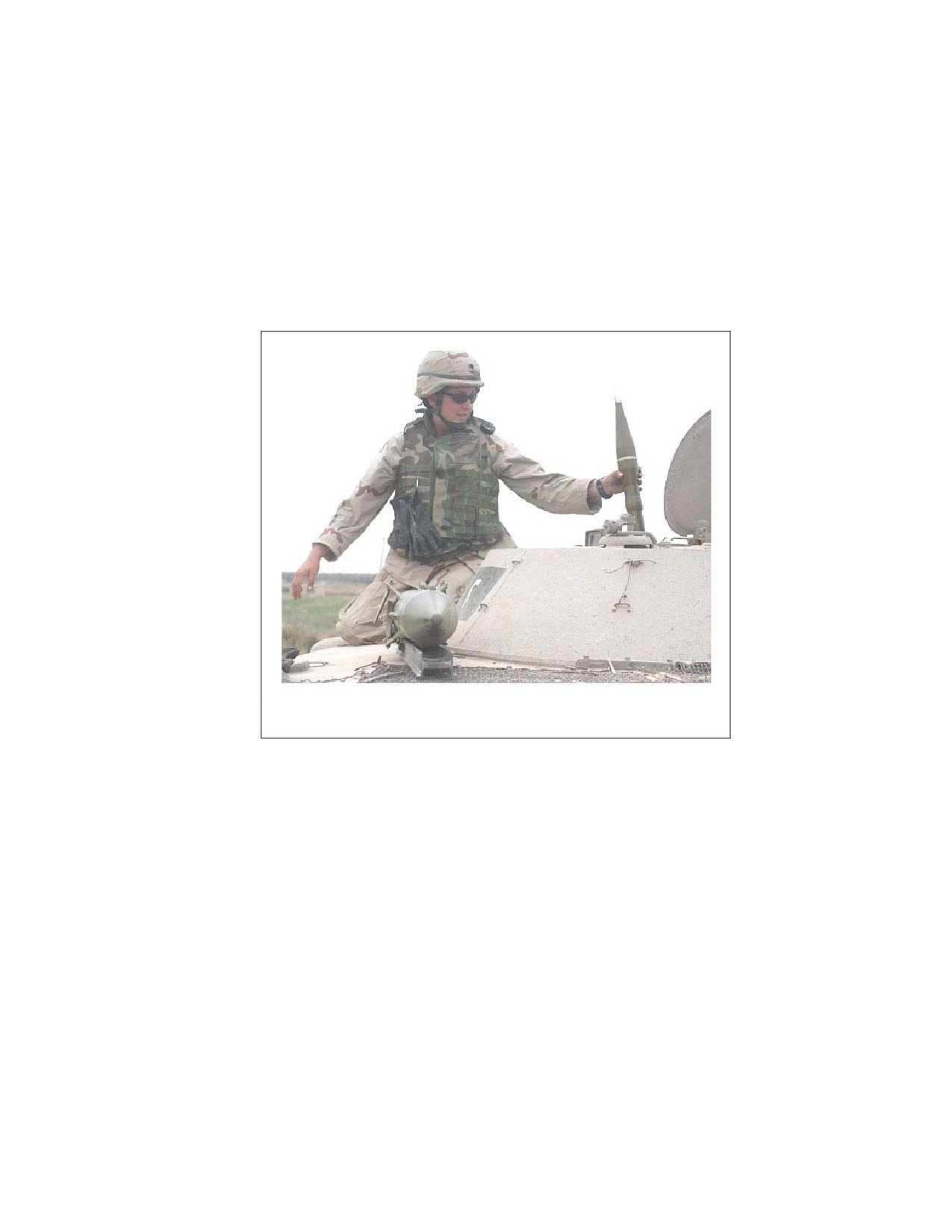
A female soldier assigned to the 725th Ordnance Company (Explosive
Ordnance Disposal) removes missiles and rocket-propelled-grenades from an
Iraqi armored vehicle during Operation Iraqi Freedom.
2-152. In 1967 President Lyndon B. Johnson eliminated the restrictions on
percentages of women and promotions, opening the door to the first female
generals in the Army in 1970. During the 1970s the Army expanded the
number of military occupational specialties (MOSs) open to women and
moved to ensure equal opportunity within those MOSs. The Army abolished
involuntary separation for parenthood, allowed women to command men in
noncombat units, and established innovative programs to assist military
couples with assignments, schooling, and dependent care. In 1972 women
first entered ROTC, and in 1976 they entered the US Military Academy.
POST-VIETNAM AND THE VOLUNTEER ARMY
2-153. The end of the draft and the advent of the all-volunteer Army soon
followed the end of the Vietnam War. While the Army struggled with the
same problems as the rest of American society, it built an enlisted
education system that helped overcome those problems. The NCO
2-51
FM 7-21.13 ____________________________________________________________
Education System is not only the envy of the world; it has produced a
professional, competent and dedicated corps of noncommissioned officers.
2-154. The Army maintained readiness to defend America’s interests
throughout the 1970s and 1980s, opposite Soviet-led Warsaw Pact forces in
Europe. It demonstrated that readiness in annual REFORGER (REturn of
FORces to GERmany) exercises and constant training at Hohenfels,
Grafenwohr and other training areas. The vigilance of the Army and
hundreds of thousands of soldiers over decades along the German border
was rewarded in
1989 when the Berlin Wall was dismantled. Soon
thereafter the Soviet Union itself unraveled and the Cold War ended.
2-155. US Army soldiers serving in the Republic of Korea have deterred
aggression on that peninsula since the end of the Korean War. Despite
periodic clashes and incidents along the DMZ soldiers have helped prevent
another outbreak of war.
URGENT FURY AND JUST CAUSE
2-156. Both Operations Urgent Fury (Grenada, 1983) and Just Cause
(Panama, 1989) were US interventions to protect American citizens in those
countries. The murder of Grenada’s prime minister in October 1983 created
a breakdown in civil order that threatened the lives of American medical
students living on the island. At the request of allied Caribbean nations,
the United States invaded the island to safeguard the Americans there.
Operation Urgent Fury included Army Rangers and paratroopers from the
82d Airborne Division. This action succeeded in the eventual
reestablishment of a representative form of government in Grenada at the
cost of 18 soldiers, sailors, and marines killed in action (KIA).
2-157. Manuel Noriega took control of Panama in 1983. Corruption in the
Panamanian government became widespread and eventually Noriega
threatened the security of the United States by cooperating with Colombian
drug producers. Harassment of American personnel increased and after a
US marine was shot in December 1989, the US launched Operation Just
Cause. This invasion, including over 25,000 soldiers, quickly secured its
objectives although 23 Americans were KIA. Noriega surrendered on 3
January 1990 and was later convicted on drug trafficking charges.
THE PERSIAN GULF WAR
2-158. Saddam Hussein’s armies overran Kuwait in August 1990 and
appeared poised for a further advance on Saudi Arabia. Rapid deployment
by the US XVIII Airborne Corps and US Marine Corps, as well as air and
sea power, deterred an Iraqi attack and bought time for the US VII Corps
and allied forces to take position along the Saudi-Kuwaiti border. By
January 1991 logisticians had built an enormous infrastructure in the
desert to support a force of 500,000 troops.
2-52
_____________________________________________________________ Chapter 2
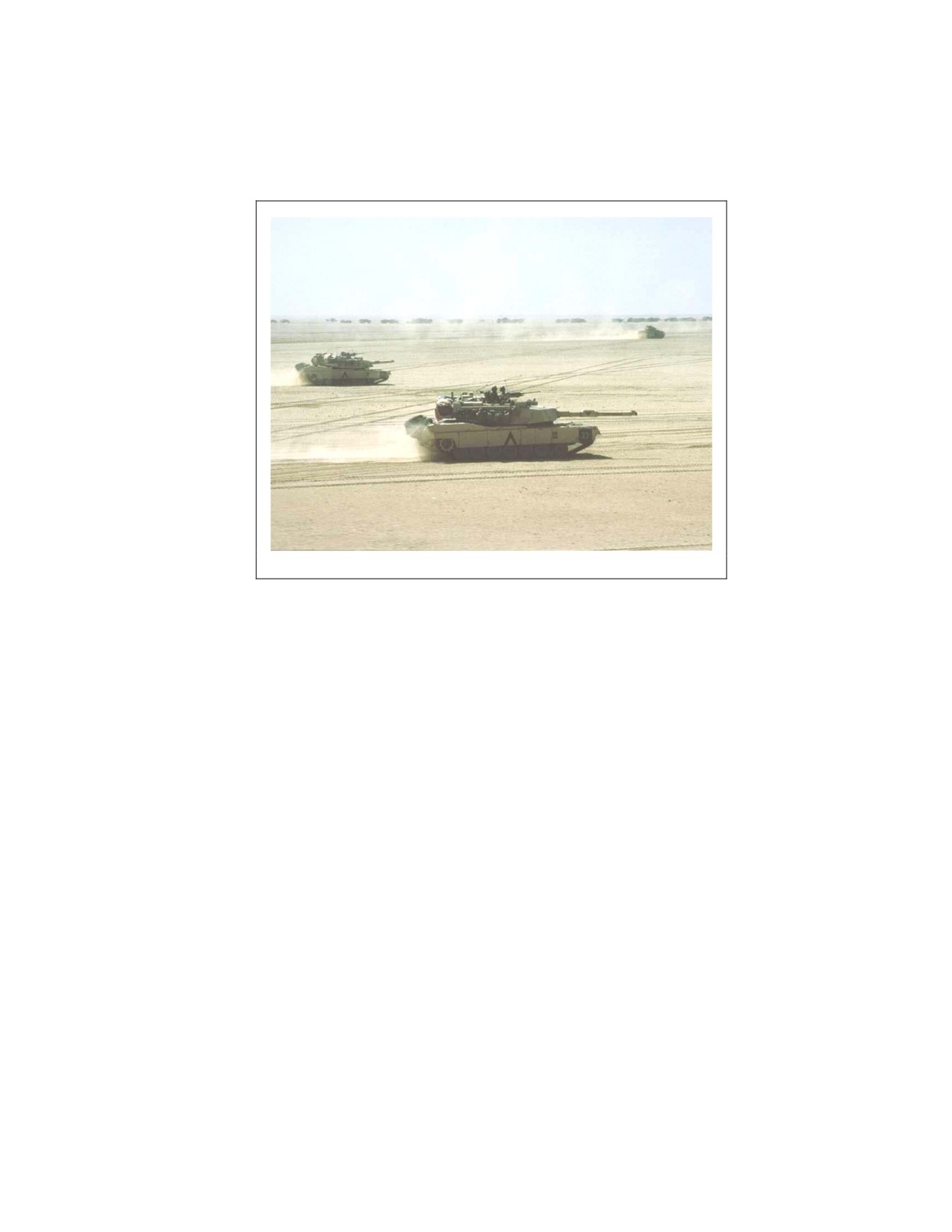
On the move during Operation Desert Storm.
2-159. After negotiations failed to dislodge Iraqi forces from Kuwait and an
overwhelming bombing offensive softened the enemy defenses, General H.
Norman Schwarzkopf and his Saudi counterpart Lieutenant General
Khalid ibn Sultan sent their multinational ground forces across the border
in late February 1991. Within 100 hours, the coalition destroyed almost
4,000 Iraqi tanks, captured an estimated 60,000 Iraqis, and ruined 36 Iraqi
divisions at the cost of
148 American KIA. Although Saddam Hussein
remained in power in Iraq, Operation Desert Storm liberated Kuwait and
destroyed much of the offensive capability of the Iraqi army.
RELIEF IN AFRICA
2-160. In the early 1990s Somalia was in the worst drought in over a
century and its people were starving. The international community
responded with humanitarian aid but clan violence threatened
international relief efforts. As a result the United Nations formed a US-led
coalition, Operation Restore Hope, to protect relief workers so aid could
continue to flow into the country and end the starvation of the Somali
people. US soldiers also assisted in civic projects that built and repaired
roads, schools, hospitals, and orphanages.
2-161. On 5 June 1993, Pakistani forces operating under UN command
were ambushed during a mission to find and destroy arms caches, killing 24
soldiers. The UN resolved to capture all those responsible for their deaths,
including Mohammed Aideed, leader of the powerful Somali National
Alliance
(SNA). In August, US Special Operations Forces (Task Force
Ranger) deployed to Somalia to assist in the manhunt. As the search
2-53
FM 7-21.13 ____________________________________________________________
intensified, increasing violence caused the various national contingents on
the UN force to curtail or even withdraw from operations entirely. But Task
Force (TF) Ranger successfully captured several SNA leaders on a number
of missions.
Task Force Ranger
On 3 October 1993 TF Ranger descended on the Olympic Hotel in
Mogadishu to capture key members of Aideed’s group. As Rangers
established security around the hotel, helicopters loitered to provide
support. Other US Special Operations soldiers entered the building and
took custody of Aideed's operatives. Soon small arms fire began,
wounding several members of the security team. The SNA had reacted
a few minutes faster than in previous raids. At that moment the US
ground convoy pulled up, ready to extract the team and its prisoners.
Then SNA forces shot down one of the hovering helicopters. Rangers
and Air Force personnel secured the crash site only 300 meters away
from the hotel. But when a second helicopter was hit by a rocket-
propelled grenade (RPG) it crashed 3 kilometers away. A ground rescue
attempt of this crew failed but two US Special Operations soldiers in
another helicopter saw growing numbers of SNA approaching the crash
site and volunteered to attempt a rescue. They landed near the downed
helicopter but the aircraft that inserted them was itself hit by RPG fire
and had to withdraw. With no air cover and little hope of rescue, MSG
Gary Gordon and SFC Randall Shughart defended the downed crew
against overwhelming numbers of SNA gunmen. They were killed, but
the pilot survived. MSG Gordon and SFC Shughart received the Medal
of Honor posthumously.
As darkness fell, TF Ranger soldiers near the hotel and the first crash
site were under constant attack by SNA forces. Ammunition, water and
medical supplies were running dangerously low and there were many
wounded. Pakistani and Malaysian armor joined American infantry and
Rangers in forming two relief columns to break through to the
surrounded Task Force Ranger soldiers. After fighting street by street
for two hours, the relief forces found and evacuated the soldiers from
the raid and first crash site, but found no one at the second crash site.
The mission succeeded in capturing a number of SNA leaders; 18
Americans died and 84 were wounded. But those who fought there
refused to leave any of their fellow soldiers behind.
2-162. America withdrew completely from Somalia in 1994. That same
year, ethnic hatred in Rwanda led to murder on a genocidal scale. Up to a
million Rwandans were killed and two million Rwandans fled and settled in
refugee camps in several central African locations. Appalling conditions,
starvation, and disease took even more lives. The international community
responded with one of the largest humanitarian relief efforts ever mounted.
The US military quickly established an atmosphere of collaboration and
coordination setting up the necessary infrastructure to complement and
support the humanitarian response community. In Operation Support
2-54
_____________________________________________________________ Chapter 2
Hope, US Army soldiers provided clean water, assisted in burying the dead,
and integrated the transportation and distribution of relief supplies.
HAITI
2-163. In December 1990 Jean-Bertrand Aristide was elected President of
Haiti in an election that international observers deemed largely free and
fair. However, once Aristide took office in February 1991 Haitian military
officers deposed him and he fled the country. The human rights climate
deteriorated as the military and the de facto government allowed atrocities
in defiance of the international community's condemnation. Large numbers
of Haitians attempted to flee by boat to the United States, many losing
their lives in the process. The United States led a Multinational Force to
return the previously elected Aristide regime to power, ensure security,
assist with the rehabilitation of civil administration, train a police force,
help prepare for elections, and turn over responsibility to the UN.
Operation Uphold Democracy succeeded both in restoring the
democratically elected government of Haiti and in stemming emigration. In
March 1995 the United States transferred the peacekeeping responsibilities
to the United Nations.
THE BALKANS
2-164. During the mid-1990s Yugoslavia was in a state of unrest as various
ethnic groups tried to create separate states for themselves. Serbia
attempted through military force to prevent any group from gaining
autonomy from the central government. After four years of conflict, the
warring parties reached a negotiated settlement in 1995. NATO forces,
including US Army units, bridged the Sava River and moved into Bosnia to
keep the peace intact in Operation Joint Endeavor. Army soldiers continue
to help maintain stability in the region and by so doing have saved many
thousands of lives in Bosnia because of their service.
2-165. In 1999 it became evident to the world that Serbian forces brutally
suppressed the separatist movement of ethnic Albanian Muslims in the
province of Kosovo, leaving hundreds dead and over 200,000 homeless. The
refusal of Serbia to negotiate peace and strong evidence of mass murder by
Serbian forces resulted in the commencement of Operation Allied Force. Air
strikes against Serbian military targets continued for 78 days in an effort to
bring an end to the atrocities that continued to be waged by the Serbs.
Serbian forces withdrew and NATO deployed a peacekeeping force,
including US Army soldiers, to restore stability to the region and assist in
the repair of the civilian infrastructure.
THE WAR ON TERRORISM
AFGHANISTAN
2-166. Terrorists of the al-Qaeda network attacked the United States on 11
September 2001, killing nearly 3000 people, damaging the Pentagon, and
destroying the World Trade Center in New York City. The United States,
with enormous support from the global community, responded 7 October
2-55
FM 7-21.13 ____________________________________________________________
2001 with attacks on the al-Qaeda network and the Taliban-controlled
government of Afghanistan that was supporting it. In Operation Enduring
Freedom, US and allied forces quickly toppled the Taliban regime and
severely damaged the al-Qaeda forces in Afghanistan. Special Operations
Forces led the way in ground operations and conventional Army units
began arriving in Afghanistan
4 December 2001. On 2 March 2002,
Operation Anaconda began, in which US Army and allied units began
assaults on Taliban and al-Qaeda forces still remaining in southeastern
Afghanistan. Enemy forces that stood and fought were destroyed and the
rest scattered.
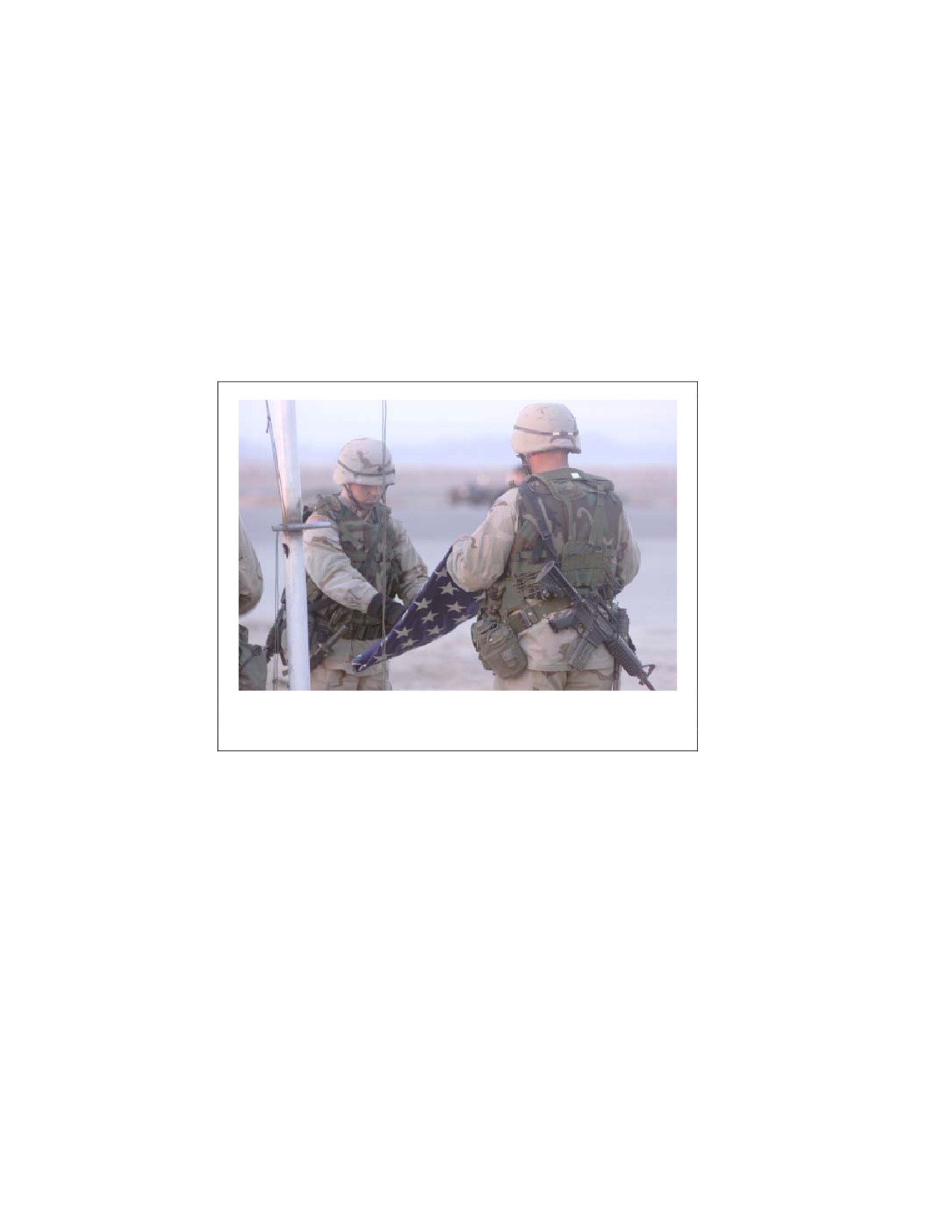
Soldiers assigned to the 101st Airborne Division (Air Assault), fold the
American Flag during a retreat ceremony at Kandahar International
Airport, Afghanistan.
2-167. The Army, through its continuing operations in Afghanistan,
provides support to its fledgling democracy and continues to seek out
remnants of the al-Qaeda network remaining in that nation. The goal is to
help Afghanis rebuild their country and give their people the benefits of a
truly representative government while at the same time reducing the
threat of terrorism to the US.
IRAQ
2-168. After the Persian Gulf War, Saddam Hussein had retained power in
Iraq. In defiance of numerous resolutions in the United Nations, despite the
presence of inspection teams, and ignoring the world’s demands that Iraq
disarm, Saddam Hussein continued to build weapons of mass destruction
(WMD). By late 2002 it had become evident to the United States that the
Baathist regime of Saddam Hussein was providing weapons, training and
other support to terrorists around the world. Intense diplomatic efforts by
2-56
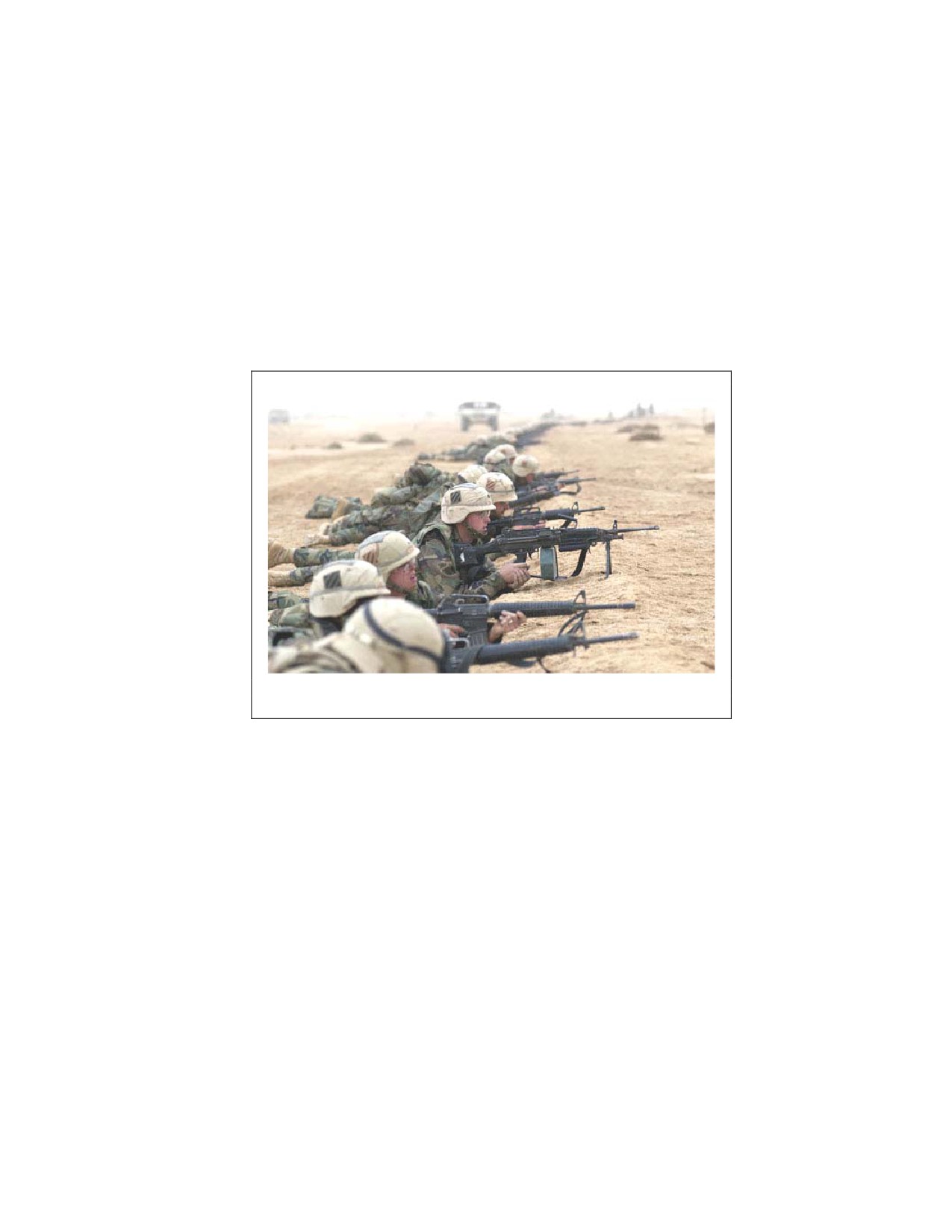
_____________________________________________________________ Chapter 2
the United States were unable to remove of Hussein and his regime. The
United States deployed its Armed Forces to the Gulf and prepared for
Operation Iraqi Freedom.
2-169. With a coalition that included Great Britain, Australia, Poland and
44 other nations, the United States on 20 March 2003 began offensive
military operations to remove Saddam Hussein from power and liberate
Iraq. US Army, US Marine Corps and British forces entered Iraq and in
only two weeks of simultaneous air and ground attacks had defeated most
organized Iraqi forces and were on the outskirts of Baghdad.
Soldiers from the 3d Infantry Division (Mechanized) in firing positions
during Operation Iraqi Freedom.
2-170. The 3d Infantry Division seized the main airport of Baghdad and
began powerful armored incursions into the city itself. The 101st Airborne
Division and US marines likewise closed in on Baghdad. In northern Iraq,
the 173d Airborne Brigade and Special Operations Forces alongside free
Iraqi forces from Kurdish areas defeated enemy units and liberated most of
the northern area of the country. In the west, Special Operations Forces
neutralized enemy units while searching for sites containing WMD.
Throughout the country, Special Operations Forces provided intelligence
and targeting data. In numerous, sharp engagements, Army units
performed with bravery and great skill in defeating enemy regular and
irregular forces while limiting US and civilian casualties. Operation Iraqi
Freedom succeeded in liberating Iraq from a despot and bringing the hope
for peace to the troubled Mideast. By the time major combat ended on 1
May 2003, 115 Americans had been killed in action, including 53 soldiers.
2-171. Despite continued attacks by remnants of Hussein’s regime, the
Army has helped create a secure environment for providing increased
humanitarian assistance to impoverished areas. Stability and support
2-57
FM 7-21.13 ____________________________________________________________
operations continue to eliminate remaining pockets of Baathist resistance,
restore utilities and services to the Iraqi people and create the conditions in
which the people of Iraq can form a new and peaceful government.
2-172. US Army soldiers play a leading role in the war on terrorism and
providing security to the Nation. Make no mistake about it: you are
defending not only the Constitution and our way of life, but the very lives of
our people and your own loved ones. Our enemies will try to strike us again.
But the Army and all the Armed Forces, working with civilian branches of
government and our allies, will make every effort to prevent such attacks.
2-173. The Army performs a long list of missions in support of American
foreign policy and in response to domestic needs. The collapse of the
Warsaw Pact in the early 1990s shifted the main focus of the Army’s
activities since World War II. Ancient hatreds and old rivalries have
created conflict and chaos in many parts of the world. In Korea the Army
still helps defend an armed border against a powerful enemy dedicated to
the forced reunification of the country under Communist rule. The Army
also has supported American foreign policy with peacekeeping or support
operations in Macedonia, the Sinai and East Timor, and it has worked
extensively with foreign and domestic agencies to curb terrorism. Since the
1980s the Army has worked closely with the Drug Enforcement Agency, the
US Customs Service, and foreign agencies to halt the flow of illicit drugs
into the United States. Initially, the Army merely loaned equipment; now it
also trains and transports personnel and shares intelligence.
2-174. From California and Florida to Kurdistan and Somalia, the Army
has aided victims of floods, earthquakes, hurricanes, war, famine, forest
fires, and other natural and man-made disasters. It has helped with toxic
waste removal as part of the Superfund cleanup program. It has provided
helicopters and paramedics to communities lacking the resources to
respond to medical emergencies. America’s Army has given hope to
oppressed peoples around the world. While performing all these
contemporary missions, the Army has sought to anticipate and prepare for
the future.
2-175. The more activist role of the federal government in American life
since
1900 has resulted in the Army responding more often to such
challenges as disaster relief, international terrorism, and organized crime.
Still, a review of American history makes clear that the missions of the
Army have always included a number of tasks beyond warfighting. The
precise character of the Army’s missions has varied depending on the needs
of the nation at a particular time, whether fighting a war for survival,
developing a transportation network and skilled engineers to support it,
providing disaster relief, keeping the peace, or supporting American
diplomacy. Throughout our long history, one can truly say of the Army,
“When we were needed, we were there.”
2-58
_____________________________________________________________ Chapter 2
HISTORY
2-176. To fully understand the events of history, how battles unfolded, and
why things occurred the way they did, it is often helpful to walk the ground
on which they happened. If you have the opportunity, go see the Gettysburg
Battlefield. You may be surprised at how big the overall battlefield is or
what a small area the 20th Maine fought in at the Little Round Top. If you
see Pointe du Hoc near Omaha Beach in Normandy, France, you can better
appreciate why Allied planners thought it had to be taken. Verdun, France
was the scene of a bitter struggle between France and Germany in the First
World War. There you can begin to understand some of the terrible and
heroic sacrifices of both sides. Some battlefields, like Antietam near
Sharpsburg, Maryland are well preserved and maintained by the National
Park Service. Volunteers or state agencies maintain other battlefields, such
as Mine Creek near Pleasonton, Kansas. Still others are on private property
and you need permission to enter, like the fields near Varennes, France
where the 3d Infantry Division and its 38th Infantry Regiment earned the
nickname “Rock of the Marne.”
2-177. But history isn’t just about battlefields, of course. The Grand
Canyon will take your breath away the first time you see it. Riding to the
top of the “Gateway Arch” in St. Louis is worth the trip. You can’t help but
feel pride and awe visiting the Smithsonian in Washington, DC. The
contrast between the roar of Niagara Falls and the quiet isolation of the
Badlands is amazing. It is no less amazing than the diversity of our people.
We Americans have our differences; in origin, in appearance, in priorities
and in how to get things done. But still we are one nation, and when
something is important enough, we unite to accomplish a task like no other
nation on earth can. Go see for yourself. You are defending America, go see
what she is all about.
SECTION II - THE OPERATIONAL ENVIRONMENT
2-178. The operational environment is the “composite of the conditions,
circumstances, and influences that affect the employment of military forces
and bear on the decisions of the unit commander” (Joint Pub 1-02). The
operational environment that exists today and in the near future (out to the
year
2020) includes threats that extend from small, lower-technology
opponents using more adaptive, guerrilla or terrorist type methods to large,
modernized forces able to engage deployed US forces in more conventional
ways. In some possible conflicts combinations of these types of threats could
be present.
2-179. Although we may sense dangerous trends and potential threats,
there is little certainty about how these threats may be used against
America. Uncertainty marks the global war on terrorism, and soldiers will
continue to operate in small scale contingencies and conflicts. These may
require small, dispersed teams of junior officers, NCOs and junior enlisted
soldiers and even civilians or contractors. Yet large scale conventional
2-59
FM 7-21.13 ____________________________________________________________
combat operations will also be possible. Victory in battle will require
versatile units and agile soldiers, who can deploy rapidly, undertake a
number of different missions, operate continuously over extended distances
without large logistics bases, and quickly maneuver with precision to gain
positional advantage. Soldiers must be capable of conducting prompt and
sustained land operations at varying intensity resulting in decisive victory.
2-180. The operational environment now and in the near future has the
following characteristics:
• Constant, high intensity, close combat.
• No rear areas, no sanctuary.
• Information operations effects down to the tactical level.
• Constantly changing rules of engagement (ROE) and tactics.
• Combatant and non-combatant roles blurred.
• Extreme stress, leader fatigue.
2-181. Soldiers in the operational environment must understand the
following:
• All soldiers, regardless of battlefield location, must be fully prepared
to engage in close combat.
• Rapid changes will require quick and accurate assessment of combat
situations.
• Rapid individual judgment and decision-making function at lower
levels.
• Dispersed distances will challenge discipline, motivation, and
confidence in self and team.
• Presence of media will test soldiers’ poise, bearing, and
understanding of commander’s intent.
• Increased physical and psychological stress over longer time frame.
2-182. Soldiers who succeed in the operational environment are imbued
with the warrior ethos and are physically and mentally tough. They are
also confident, decisive, and exercise sound judgment in their decisions.
Successful soldiers are self-disciplined and capable of taking the intiative in
a disciplined manner that helps the team accomplish the mission. Such
soldiers are also self-motivated and take active roles in their teams.
2-183. Soldiers who succeed in the operational environment are expert in
both warfighting and in the use of emerging technology. In the operational
environment soldiers will have to be versatile, taking on new tasks and able
to learn quickly to adapt to changes in the environment. Because of the
probability of operating in dispersed, small teams, successful soldiers have
leader potential and can step up to the challenge of leading other soldiers
when required. Above all, soldiers in the operational environment know
their own strengths, weaknesses, and take action to improve themselves.
2-60
_____________________________________________________________ Chapter 2
FULL SPECTRUM OPERATIONS
2-184. The Army operates in war or military operations other than war
(MOOTW) by conducting offense, defense, and stability and support
operations. These make up the full spectrum of military operations and
may occur in a variety of missions extending from humanitarian assistance
to disaster relief to peacekeeping and peacemaking to major theaters of
war. These missions could occur simultaneously or transition from one to
another. For example, a unit may be conducting an operation to destroy a
cache of weapons while only a few kilometers away other soldiers are
providing medical services to some of the local population. Full spectrum
operations require skillful assessment, planning, preparation and
execution. In order to successfully accomplish these missions, commanders
focus their mission essential task list (METL), training time, and resources
on combat tasks and conduct battle-focused training (for more on training
see Chapter 5).
2-185. The challenge soldiers face in full spectrum operation means that
you should conduct good training and always reach or surpass the
standard. Effective training is the cornerstone of success on the battlefield
or in other missions. Training to high standards is essential because the
Army cannot predict every operation it deploys to. Battle-focused training
on combat tasks prepares soldiers, units and leaders to deploy, fight and
win. Upon alert, initial-entry Army forces deploy immediately, conduct
operations and complete any needed mission-specific training in country.
Follow-on forces conduct pre- or post-deployment mission rehearsal
exercises, abbreviated if necessary, based on available time and resources.
HOMELAND SECURITY
2-186. Homeland security is the sum total of operations intended to
prepare for, prevent, deter, preempt, defend against, and respond to threats
and aggressions directed towards US territory, sovereignty, domestic
population and infrastructure. It also includes crisis management,
consequence management, and other domestic civil support. It encompasses
five distinct missions: domestic preparedness and civil support in case of
attacks on civilians, continuity of government, continuity of military
operations, border and coastal defense, and national missile defense. The
objectives of Homeland Security are to prevent terrorist attacks within the
United States, reduce America's vulnerability to terrorism, minimize the
damage, and recover from attacks that do occur. The Army’s role in
Homeland Security falls within Homeland Defense or Civil Support.
Your value to the fight is not determined by your proximity to
the target.
GEN Peter J. Schoomaker
2-187. Under homeland defense the Army has requirements in four areas:
defense of US territory, air and missile defense, information assurance and
weapons of mass destruction (WMD) defense and response. The Army
2-61
FM 7-21.13 ____________________________________________________________
supports civil authorities with disaster response, civil disturbance response,
and support to special events. Examples of these areas are the National
Guard support to airport security and the WMD Civil Support Teams
(CST). These WMD-CSTs support civil authorities in incidents involving
chemical, biological, radiological, nuclear or high-yield explosive devices.
Both of these National Guard missions illustrate the importance of the
reserve component in the Army’s role in homeland defense.
ARMY TRANSFORMATION
2-188. Change is a constant. People, organizations, cultures and even
geography change with time. Change is necessary to remain competitive
and relevant. The Army is no different. Periodic modernization has been
required throughout the Army’s history.
2-189. The Army is transforming itself into a force that is more
strategically responsive and dominant at every point on the spectrum of
military operations. Transformation is about changing the way we fight so
we can continue to decisively win our Nation's wars. The 21st century
operational environment and the potential of emerging technologies require
Army Transformation. The global war on terrorism reinforces the need for a
transformed Army that is more deployable, lethal, agile, versatile,
survivable, and sustainable than current forces.
2-190. The Army is implementing change across its doctrine, training,
leader development, organization, materiel, and soldier systems, as well as
across all of its components. Transformation will result in a different Army,
not just a modernized version of the current Army.
2-191. Transformation consists of three related parts—the Future Force,
the Stryker Force, and the Current Force. We will develop concepts and
technologies for the Future Force while fielding the Stryker Force to meet
the near-term requirement to bridge the operational gap between our heavy
and light forces. The third element of transformation is the modernization
of existing systems in the Current Force to provide these systems with
enhanced capabilities through the application of information technologies.
2-192. As the Army transforms, the Current Force will remain ready to
provide the Nation with the warfighting capability needed to keep America
strong and free. Through selective modernization the Current Force allows
the Army to meet today's challenges and provides the time and flexibility to
get transformation right. The Army is focusing resources on systems and
units that are essential to both sustaining near-term readiness and fielding
the Future Force while taking prudent risk with the remainder of the force.
In this the Army will rebuild or selectively upgrade existing weapons
systems and tactical vehicles, while also developing and procuring new
systems with improved warfighting capabilities.
2-62
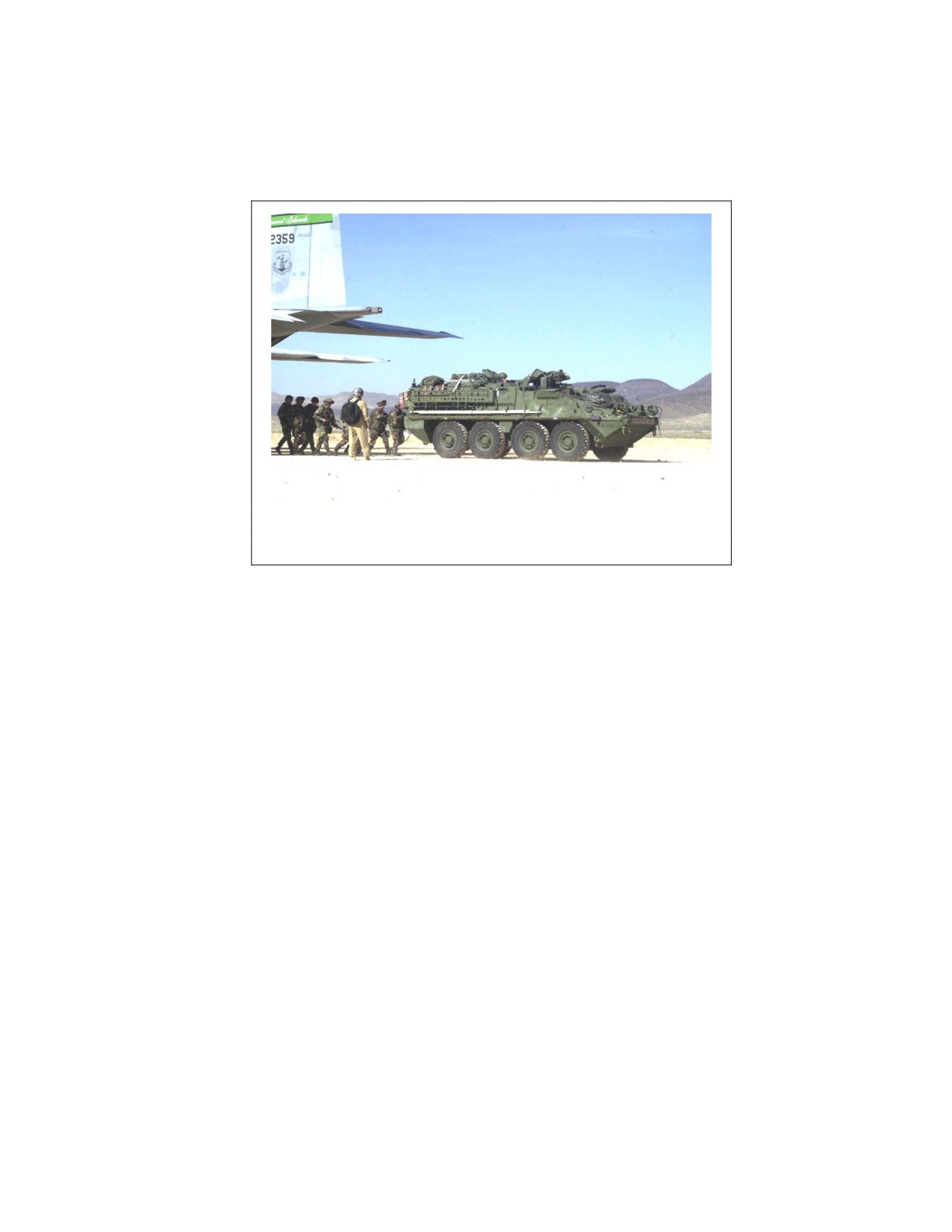
_____________________________________________________________ Chapter 2
A Stryker Infantry Carrier Vehicle squad follows their vehicle out of an Air
Force C130 Hercules aircraft after landing at Bicycle Lake Army Airfield at
the National Training Center, Fort Irwin, California.
2-193. The Stryker Force is a transition force that bridges the near-term
capability gap between our heavy and light forces. It combines the best
characteristics of current heavy, light and special operations forces.
Organized in Stryker Brigade Combat Teams (SBCT), it combines today's
technology with selected capabilities of the Current Force to serve as a link
to the Future Force. Most importantly, the Stryker Force allows exploration
of new operational concepts relevant to the Future Force.
One thing some soldiers may not fully understand yet is that
transformation involves a lot more than two brigades up at
Fort Lewis - it’s about the future and what kind of Army we’ll
have for decades to come. We will continue to man, modernize
and train our current forces throughout the transformation….
We will continue to need sharp, quick-thinking leaders. The
variety of missions and volume of information they’ll be given
will place a lot of responsibility on them.
Transformation could cause as many changes in training and
developing leaders in our schools as tactics and equipment.
The result will be a future that lets us put a more powerful
force on the ground faster and that will save a lot of lives…
SMA Jack L. Tilley
2-194. The end result of transformation is a new, more effective, and more
efficient Army with a new fighting structure—the Future Force. It will
provide our Nation with an increased range of options for crisis response,
engagement, or sustained land force operations. The Future Force will have
2-63
FM 7-21.13 ____________________________________________________________
the capability to fight in a dispersed and non-linear manner if that provides
a military advantage over its opponent. Future Force units will be highly
responsive, deploy rapidly because of reduced platform weight and smaller
logistical footprints, and arrive early to a crisis to deter conflict. These
forces will be capable of moving by air and descending upon multiple points
of entry. By applying their judgment to a detailed and accurate common
operational picture, Future Force soldiers will identify and attack critical
enemy capabilities and key vulnerabilities throughout the depth of the
battle area.
2-195. Transformation is not something the Army is doing alone. The Army
is coordinating transformation efforts with similar efforts by the other
Services, business and industry, and science and technology partners.
SECTION III - HOW THE US GOVERNMENT WORKS
2-196. The Declaration of Independence is an important document in US
history. It says that all people have rights that no government may deny.
This document signified the colonies’ separation from England and the rule
of George III. When the Second Continental Congress formed a committee
to write the Declaration, the Committee thought it would be better for only
one person to write it—Thomas Jefferson. It took Jefferson seventeen days
to write the Declaration of Independence. On 2 July 1776 the Congress
voted to declare independence from England. After two days of debate and
some changes to the document, the Congress voted to accept the
Declaration of Independence. This is why we celebrate the 4th of July as our
Independence Day.
You have rights antecedent to all earthly governments, rights
that cannot be repealed or restrained by human law.
President John Adams
THE CONSTITUTION
2-197. The Declaration of Independence is an important document, but the
foundation of our American government and its purpose, form, and
structure are found in the Constitution of the United States. We didn’t
always have the Constitution. During the Revolutionary War, the states
formed a “league of friendship” under the Articles of Confederation, which
was ratified in 1781. The Articles provided for a national legislature but
little else because the states feared a strong central government like the
one they lived with under England's rule. Americans soon discovered that
this weak form of government could not effectively respond to outside
threats and so they called for a convention in 1787 to revise the Articles.
Discussions and debate led the participants to draft an entirely new
document and government.
2-198. The Constitution was adopted 17 September 1787 and ratified 21
June 1788. It is the supreme law of the land because no law may be passed
2-64
_____________________________________________________________ Chapter 2
that contradicts its principles and no person or government is exempt from
following it. Members of the Armed Forces all promise to support and
defend the Constitution in recognition of its importance. Without the
Constitution, there would be no United States of America.
We the People of the United States, in Order to form a more
perfect Union, establish Justice, insure domestic Tranquility,
provide for the common defence, promote the general Welfare,
and secure the Blessings of Liberty to ourselves and our
Posterity, do ordain and establish this Constitution for the
United States of America.
Preamble to the Constitution of the United States
2-199. The Preamble of the Constitution describes the purpose of the
Constitution and, by extension, our Federal, that is, national Government.
In order to achieve this purpose the writers of the Constitution established
three main principles on which our Government is based:
• Inherent rights: Rights of all persons living in the United States.
• Self-government: Government by the people; citizens selected by
fellow citizens to govern.
• Separation of powers: Branches of government with different powers
that provide checks and balances to the other branches.
2-200. The United States Constitution is a remarkable document. In about
4,500 words it lays out the framework of our system of government and in
another 3,000 (the Amendments) enumerates individual rights and changes
to the basic document. It provides us with a firm foundation and yet also,
with effort, can change as our country changes. The Constitution
establishes a republic, an indivisible union of 50 sovereign States. In our
Nation, we the people, govern ourselves. We do this by choosing elected
officials through free and secret ballot at regular intervals—elections. In
this way, our Government derives its power from the people. The
Constitution—
• Defines and limits the power of the national government.
• Defines the relationship between the national government and
individual state governments.
• Describes some of the rights of the citizens of the United States.
2-201. The Constitution specifies the powers of the federal government,
and all other power remains with the people or the states. This government
system based on federalism shares power given by the people between the
national and state
(local) governments. Issues like defense are at the
federal level where sufficient resources are available to accomplish the
tasks required to defend our Nation. On the other hand, local issues like
licensing, building codes or zoning laws have been left up to the individual
states to decide based upon its people’s needs and philosophies.
2-65
FM 7-21.13 ____________________________________________________________
2-202. The Constitution can be changed through amendments to the
document. It is a difficult process that requires a 2/3 majority of Congress
agree to any proposed amendment and further that 3/4 of all the states also
ratify (agree to) the amendment. The Constitution may also be amended in
a Constitutional Convention if 2/3 of the states call for it but any changes
and amendments must still be ratified by 3/4 of the states. Currently there
are
27 amendments to the Constitution. The first ten amendments,
accepted at the same time as the Constitution itself, are also called the Bill
of Rights.
BRANCHES OF GOVERNMENT
2-203. The delegates to the Constitutional Convention wanted to ensure a
strong, cohesive central government, yet they also wanted to ensure that no
individual or small group in the government would become too powerful.
Under the Articles of Confederation, the national government lacked
authority and the delegates didn’t want to have that problem again. To
solve these problems, the delegates to the Constitutional Convention
created a government with separate branches, each with its own distinct
powers. This system would establish a strong central government, while
insuring a balance of power.
The liberties and heritage of the United States… are priceless.
The Noncom’s Guide, 1957
2-204. Governmental power and functions in the United States rest in
three branches of government: the legislative, judicial, and executive.
Article I of the Constitution defines the legislative branch and gives power
to make laws to the Congress of the United States. The executive powers of
the President are defined in Article 2. Article 3 places judicial power in the
hands of one Supreme Court and any lower courts Congress establishes.
2-205. In this system each branch operates independently of the others—a
separation of powers. However, there are built in checks and balances to
prevent concentration of power in any one branch and to protect the rights
and liberties of citizens. For example, the President can veto (disapprove)
bills approved by Congress, and the President nominates individuals to
serve in the Federal courts. The Supreme Court rules on the
constitutionality of a law enacted by Congress or an action by the President.
Congress approves whether tax dollars may be spent on a particular action
or program and can impeach and remove the President and Federal court
justices and judges. See the organization of the government of the United
States in Figure 2-1.
2-66
_____________________________________________________________ Chapter 2
The Constitution
Legislative Branch
Executive Branch
Judicial Branch
Senate House
The President
The Supreme Court of the United States
GAO, GPO, LOC, CBO
The Vice President
Courts of Appeals, District Courts
NSC, OMB
US Court of Appeals for the Armed Forces
Dept of Agriculture
Dept of Commerce
Dept of Defense
Dept of Education
Dept of Energy
Dept of Health & Human Svcs
Dept of Housing & Urban Devlp
Dept of the Interior
Dept of Justice
Dept of Labor
Dept of State
Dept of Transportation
Dept of the Treasury
Dept of Veterans Affairs
Dept of Homeland Security
GAO - General Accounting Office
NSC - National Security Council
GPO - Government Printing Office
OMB -Office of Management and Budget
LOC - Library of Congress
CBO - Congressional Budget Office
Figure 2-1. Organization of the US Government
LEGISLATIVE BRANCH
2-206. After much debate the delegates to the Constitutional Convention
agreed on the creation of the House of Representatives and the Senate. A
major issue involved how to determine representation in the legislative
body. The delegates from larger and more populated states argued that only
the size of a state’s population should determine congressional
representation. Fearing domination, delegates from smaller states were just
as adamant for equal representation. A delegate from Connecticut, Roger
Sherman, resolved the issue when he proposed a two-part (bicameral)
legislature, with representation based on population in one (the House of
Representatives) and with equal representation in the other (the Senate).
2-207. Congress refers many measures that may become law to various
committees of legislators in each chamber. These committees consider each
measure and select which will be actually brought to a vote and debated.
The vast majority of issues are not brought for a vote and no other action
occurs. An issue or “bill” that reaches the floor of the two chambers may not
become law until both House and Senate pass it with a majority vote in
each chamber. Then the bill is sent to the President for his signature,
making it law. The President may also exercise his veto power,
disapproving the bill and sending it back to the legislature with his reasons
why it should not become law. Congress may override the veto if 2/3 of both
House and Senate approve the bill. If the President takes no action, the bill
becomes law after 10 days.
2-208. The Constitution specifies certain powers of Congress with respect
to the military. Congress has the power to declare war and to set and collect
taxes (which pay for soldiers’ salaries, weapons, training, etc.). Congress
determines the strength (number of people) of the Armed Forces and how
2-67
FM 7-21.13 ____________________________________________________________
much money the Armed Forces may spend. Congress also makes the basic
rules for the Armed Forces and the Uniform Code of Military Justice.
Congress established the US Court of Appeals for the Armed Forces based
on its power to regulate the armed forces and to establish courts lower than
the Supreme Court.
EXECUTIVE BRANCH
2-209. When the delegates to the Constitutional Convention created the
executive branch of government, they were afraid of putting too much
power in the hands of one person and intensely debated the concept. In the
end, with the checks and balances included in the Constitution, the
delegates provided for a single President with a limited term of office to
manage the executive branch of government. This limited term was
different from any form of government in Europe at the time.
2-210. The executive branch of the government is responsible for enforcing
the laws of the land. The Vice President, department heads (Cabinet
members), and heads of independent agencies assist in this capacity. Unlike
the powers of the President, their responsibilities are not defined in the
Constitution but each has special powers and functions. The Cabinet
includes the Vice President and, by law, the heads of
15 executive
departments as shown in Figure 2-1. The National Security Council (NSC)
supports the President, as commander-in-chief, with the integration of
domestic, foreign, and military policies on National security.
2-211. The Constitution specifies that the President is the Commander-in-
Chief of the US Armed Forces. Presidents have initiated military activities
abroad over 200 times in our history, though Congress has declared war
only five times. The President’s signature on a bill is required before it can
become law, unless 2/3 of Congress vote for its passage. The President
nominates the Department of Defense and service secretaries (and other
cabinet chiefs), the Chairman of the Joint Chiefs of Staff, and the service
Chiefs of Staff. He also nominates the judges of the Supreme Court and
those who sit on the US Court of Appeals for the Armed Forces. Each of
these nominations requires confirmation by a majority of the Senate. The
President commissions the officers of the Armed Forces. The President may
also veto bills of Congress.
JUDICIAL BRANCH
2-212. Article III of the Constitution established the judicial branch of
government with the creation of the Supreme Court. It is the highest court
in the country and vested with the judicial powers of the government. There
are lower Federal courts that Congress deemed necessary and established
using power granted in the Constitution, such as the US Court of Appeals
for the Armed Forces.
2-213. Courts decide arguments about the meaning of laws and how they
are applied. The Supreme Court also has the authority to declare acts of
Congress, and by implication acts of the president, unconstitutional if they
exceeded the powers granted by the Constitution. The latter power is
known as judicial review and it is this process that the judiciary uses to
2-68
_____________________________________________________________ Chapter 2
provide checks and balances on the legislative and executive branches.
Judicial review is not specified in the Constitution but it is an implied
power, explained in a landmark Supreme Court decision, Marbury versus
Madison (1803). Most courts don’t rule on the constitutionality of laws but
rather decide matters of guilt or innocence in criminal proceedings or
adjudicate differences between civil parties.
DEPARTMENT OF DEFENSE
2-214. Among the departments within the executive branch of the federal
government is the Department of Defense. The National Security Act
Amendments of 1949 designated the National Military Establishment as
the Department of Defense with the Secretary of Defense as its head. The
Department of Defense is composed of the following
• Office of the Secretary of Defense.
• The military departments and the military services within those
departments.
• The Chairman of the Joint Chiefs of Staff and the Joint Staff.
• The unified combatant commands.
• The defense agencies and DOD field activities.
• Other organizations as may be established or designated by law, the
President or the Secretary of Defense.
2-215. The Secretary of Defense is the principal defense policy adviser to
the President and is responsible for the formulation of general defense
policy and policy related to DOD, and for the execution of approved policy.
Under the direction of the President, the Secretary exercises authority,
direction, and control over the Department of Defense.
2-216. Each military department is separately organized under its own
secretary and functions under the authority, direction, and control of the
Secretary of Defense. The Secretary of each military department is
responsible to the Secretary of Defense for the operation and efficiency of
that department. Orders to the military departments are issued through
the secretaries of these departments or their designees, by the Secretary of
Defense, or under authority specifically delegated in writing by the
Secretary of Defense, or provided by law. The organization of the
Department of Defense is shown in Figure 2-2.
2-69