FM 7-21.13 THE SOLDIER’S GUIDE (FEBRUARY 2004) - page 1
FM 7-21.13
Field Manual
Headquarters
No. 7-21.13
Department of the Army
Washington, DC, 2 February 2004
The Soldier’s Guide
Contents
Page
FIGURES
iii
TABLES
iv
VIGNETTES
v
ILLUSTRATIONS
vii
PREFACE
viii
INTRODUCTION
x
Chapter 1
THE INDIVIDUAL SOLDIER’S ROLE IN THE ARMY
1-1
Section I - The Warrior Ethos and Army Values
1-2
Section II - The Team
1-18
Chapter 2
THE ARMY AND THE NATION
2-1
Section I - A Short History of the US Army
2-2
Section II - The Operational Environment
2-59
Section III - How the US Government Works
2-64
Chapter 3
DUTIES, RESPONSIBILITIES, AND AUTHORITY
OF THE SOLDIER
3-1
Section I - Duties, Responsibilities, and Authority
3-3
Section II - Wear and Appearance
3-15
Section III - Uniform Code of Military Justice
3-30
Section IV - Standards of Conduct
3-38
Chapter 4
CUSTOMS, COURTESIES, AND TRADITIONS
4-1
Customs
4-1
Courtesies
4-2
Traditions
4-8
Chapter 5
TRAINING
5-1
Section I - Army Training Management
5-2
Section II - Individual Training
5-15
Section III - Force Protection
5-25
Chapter 6
DEVELOPMENTAL COUNSELING AND PROFESSIONAL
DEVELOPMENT
6-1
Section I - Developmental Counseling
6-2
Section II - Professional Development
6-8
Section III - Retention and Reenlistment
6-20
DISTRIBUTION RESTRICTION: Approved for public release; distribution is unlimited.
This publication supersedes FM 7-21.13, 15 October 2003.
i
FM 7-21.13 ____________________________________________________________
Page
Chapter 7
BENEFITS OF SERVICE
7-1
Section I - Pay and Allowances
7-4
Section II - Housing
7-7
Section III - Health
7-9
Section IV - Financial Readiness and Planning
7-16
Section V - Education
7-23
Section VI - Relocation Assistance
7-24
Section VII - Legal Issues
7-27
Section VIII - After the Army
7-29
Appendix A SELECTED COMBAT TASKS
A-1
Appendix B ARMY PROGRAMS
B-1
Appendix C CEREMONIES
C-1
Appendix D INTERNET RESOURCES
D-1
Appendix E PROFESSIONAL READING
E-1
Appendix F ARMS AND SERVICES OF THE ARMY
F-1
SOURCE NOTES
Source Notes-1
GLOSSARY
Glossary-1
BIBLIOGRAPHY
Bibliography-1
INDEX
Index-1
NOTES
Notes-1
ii
FM 7-21.13
Figures
Page
1-1. The Army Leadership Framework
1-23
1-2. The Problem Solving Steps
1-26
1-3. The Troop Leading Procedures
1-28
1-4. Ethical Reasoning Process
1-30
2-1. Organization of the US Government
2-67
2-2. Organization of the Department of Defense
2-70
2-3. Organization of the Department of the Army
2-72
2-4. Make up of the Army of One
2-74
3-1. On-the-Spot Correction Steps
3-13
3-2. Corrective Training Guidelines
3-14
3-3. Wear of the Beret, Male and Female
3-23
3-4. The Code of Conduct
3-43
4-1. The Army Flag and Streamers
4-12
4-2. The Army Seal
4-13
5-1. Integration of Collective and Individual Training
5-10
5-2. Individual Tasks to METL Relationship
5-15
A-1. Straight-line Route
A-10
A-2. Adjusted Route
A-11
A-3. Route of Travel
A-12
A-4. Checkpoints
A-13
A-5. Distance Between Checkpoints
A-14
A-6. Bypassing an Obstacle
A-15
A-7. Temporary Fighting Positions
A-44
C-1. Fallen Soldier Display
C-12
iii
FM 7-21.13
Tables
Page
1-1. Reverse Planning Example
1-28
3-1. Maximum Punishments in Article 15
3-34
3-2. Types of Chapter Discharges
3-35
6-1. Promotion Criteria-Active Duty
6-15
6-2. Promotion Criteria-Army National Guard
6-17
6-3. Promotion Criteria-Reserve TPU, PV2-SSG
6-18
6-4. Promotion Criteria-Reserve TPU, SFC-SGM
6-18
6-5. Promotion Criteria-Active Guard and Reserve
6-18
6-6. Promotion Criteria-IRR, IMA, and Standby Reserve (Active List)
6-19
7-1. Other Pay
7-5
7-2. Allowances
7-6
7-3. Administrative Effect of Discharge
7-31
7-4. Transitional Benefits and Discharge
7-31
7-5. Veteran’s Benefits and Discharge
7-32
7-6. Other Federal Benefits and Discharge
7-33
F-1. Career Management Fields of the Army’s Enlisted Soldiers
F-7
F-2. Branches of the Army’s Officers
F-8
F-3. Areas of Concentration by Functional Area
F-9
F-4. Branches of the Army’s Warrant Officers
F-10
iv
FM 7-21.13
Vignettes
Page
The Loyalty of Private First Class Ernest E. West
1-7
Private First Class Clarence Eugene Sasser and Duty
1-8
The Sentinel’s Creed
1-10
SPC Michael John Fitzmaurice at Khe Sanh
1-11
Private First Class Silvestre Santana Herrera in France
1-13
Private First Class Parker F. Dunn in the Argonne Forest
1-15
The Deployment
1-21
A Better Way
1-25
Ethical Dilemma—The Checkpoint
1-29
Ethical Dilemma—The Checkpoint (cont’d)
1-31
Ethical Dilemma—Guard Duty
1-32
Crispus Attucks in the Boston Massacre
2-3
The Marquis de Lafayette—Patron of Liberty
2-6
Antietam and Emancipation
2-18
The First Medal of Honor Recipient
2-19
The 1st Minnesota at Gettysburg
2-20
The 7th Cavalry at the Little Big Horn
2-23
Private Augustus Walley in Cuba
2-25
Harlem Hellfighters
2-28
Sergeant Edward Greene at the Marne
2-29
Corporal Harold W. Roberts at the Montrebeau Woods
2-30
The Unknown Soldier
2-31
Transformation in the 1920s
2-33
A Company, 116th Infantry on D-Day
2-38
Krinkelt-Rocherath during the Battle of the Bulge
2-39
Private First Class Desmond Doss at Okinawa
2-41
v
FM 7-21.13
Task Force Smith
2-44
Chaplain Emil J. Kapaun in Korea
2-46
Corporal Gilbert G. Collier, the Last Army Medal of Honor
Recipient of the Korean War
2-47
Landing Zone (LZ) X-Ray in the Ia Drang Valley
2-48
Specialist Fifth Class Dwight Johnson
2-49
Task Force Ranger
2-54
Making an On-the-Spot Correction
3-13
Platoon Sergeant and Enlisted Soldier Relationship
3-39
Officer-Enlisted Gambling
3-40
The Salute
4-3
Parade Rest
4-6
The Best Machinegunner in the 101st
5-5
Khobar
5-28
Rules of Engagement
5-30
Informal “Footlocker” Counseling
6-5
Promotion Counseling
6-6
The Oath of Enlistment
6-20
Medical Bills
7-15
vi
FM 7-21.13
Illustrations
Page
A Soldier Provides Security during Operation Iraqi Freedom
1-6
The Army Medal of Honor
1-12
An NCO Inspects his Soldiers Prior to Assuming Guard Duty
1-16
Convoy Briefing during Operation Iraqi Freedom
1-27
A Junior NCO Decides His Team’s Next Move
1-33
“…The Whites of Their Eyes.” The Battle of Bunker Hill
2-4
Von Steuben Instructs Soldiers at Valley Forge, 1778
2-7
The Road to Fallen Timbers
2-10
The Surrender—General Lee meets General Grant
2-22
The 1st Volunteer Cavalry—“The Rough Riders”—at Kettle Hill
2-24
“Tip of the Avalanche.” The 36th Infatry Division lands at Salerno
2-37
A Squad Leader of the 25th Infantry Division
2-40
The 7th Infantry Division Band on the Capitol Grounds in Seoul, 1945
2-42
The Equipment of the US Army Constabulary
2-43
Artillery Gun Crew in Korea Waits for the Order to Fire
2-45
A Female Soldier Assigned to the 725th Ordnance Company (EOD)
2-51
On the Move during Operation Desert Storm
2-53
Soldiers of the 101st Airborne Division Fold the Flag
2-56
Soldiers from the 3d Infantry Division in Firing Positions
2-57
A Stryker Infantry Carrier Vehicle Squad Follows their Vehicle
2-63
Bugler from the Army Band
4-9
Hot Wash—An AAR at the Combat Maneuver Training Center
5-13
Building an Individual Fighting Position
5-18
A Military Police Soldier Inspects a Vehicle
5-26
Reenlisting in Kandahar, Afghanistan
6-21
Soldiers of the 115th Military Police Company
7-28
vii
Preface
This Field Manual is dedicated to the men and women of the United States
Army in the active component, the Army National Guard and the US Army
Reserve—altogether America’s finest fighting machine. You are the soldiers
that fight and win the Nation’s wars. Be proud.
FM 7-21.13, The Soldier’s Guide, is a pocket reference for subjects in which all
soldiers must maintain proficiency, regardless of rank, component or military
occupational specialty
(MOS). It condenses information from other field
manuals, training circulars, soldier training publications, Army regulations,
and other sources. It addresses both general subjects and selected combat
tasks. While not all-inclusive or intended as a stand-alone document, the guide
offers soldiers a ready reference in many subjects.
FM 7-21.13 is divided into seven chapters. Chapter 1 describes the importance
of Army Values and the obligations of every soldier. Chapter 2 provides a short
history of the Army and examines the environment in which it operates.
Chapter 3 addresses the duties, responsibilities and authority of the soldier,
how to present a military appearance, and an introduction to the Uniform Code
of Military Justice. The importance of customs, courtesies, and traditions is in
Chapter 4. The soldier’s role in training and a brief description of training
management are in Chapter
5. Chapter
6 discusses the importance of
counseling and professional development. The benefits of serving in the Army
are described in Chapter 7. The appendices contain specific combat tasks that
are important to every soldier and information on programs the Army offers to
assist soldiers and their family members.
The Soldier’s Guide provides information critical to the success of soldiers in
the operational environment. Reading this manual will help prepare soldiers
for full spectrum operations and is a tool in building the Future Force soldier.
This book will be useful to every soldier who reads it.
The proponent for the publication is Headquarters, US Army Training and
Doctrine Command (TRADOC). Send comments and recommendations on DA
Form 2028 (Recommended Changes to Publications and Blank Forms) to
Commandant, US Army Sergeants Major Academy, ATTN: ATSS-D, Fort Bliss,
TX
79918-8002 or through the Sergeants Major Academy website at
usasma.bliss.army.mil.
Unless stated otherwise, masculine nouns or pronouns do not refer exclusively
to men.
This publication contains copyrighted material.
viii
__________________________________________________________________ Preface
ACKNOWLEDGMENTS
The copyright owners listed here have granted permission to reproduce
material from their works. The Source Notes lists other sources of quotations,
vignettes, and examples.
Top Sergeant: The Life and Times of Sergeant Major of the Army William G.
Bainbridge, by William G. Bainbridge, © William G. Bainbridge, New York:
Ballantine, 1995.
“To Relieve Bastogne,” by Don Stivers, © Don Stivers, Stivers Publishing, 1990.
Dale E. Wilson, “American Armor in the First World War,” A Weekend With
the Great War: Proceedings of the Fourth Annual Great War Interconference
Seminar, ed. by Steven Weingarten, © Cantigny First Division Foundation,
1996.
“Captain Nathan Hale (1755-1776),” by Mary J. Ortner, Ph.D., © Mary J.
Ortner, 2001, Connecticut Society of the Sons of the American Revolution.
Stephen Hardin, "The Battle of the Alamo," Handbook of Texas Online,
www.tsha.utexas.edu/handbook/online, © Texas State Historical Association,
2003. Used with permission.
Don Rivers, “William Pittenger, Medal of Honor Recipient,” Village News (13
Aug 1998) © Fallbrook Historical Society, Fallbrook, CA, 1998-1999.
We Were Soldiers Once… and Young, LTG Harold G. Moore, US Army
(Retired) and Joseph L. Galloway, © LTG H. G. Moore and Joseph L. Galloway,
Random House, Incorporated, 1992.
War as I Knew It by General George S. Patton. Copyright © 1947 by Beatrice
Patton Walters, Ruth Patton Totten, and George Smith Totten. Copyright ©
renewed 1975 by MG George Patton, Ruth Patton Totten, John K. Waters, Jr.,
and George P. Waters. Reprinted by permission of Houghton Mifflin Company.
All rights reserved.
The Greenhill Dictionary of Military Quotations, edited by Peter G. Tsouras.
Copyright © Peter G. Tsouras, London: Greenhill Books and Mechanicsburg,
PA: Stackpole Books, 2000.
Carl von Clausewitz, On War, edited by Michael Howard and Peter Paret.
Copyright © 1976 by Princeton University Press. Reprinted by permission of
Princeton University Press.
ix
Introduction
Since the events of 11 September 2001, it is more evident than ever that
every American has the duty to contribute to the well being of our Nation
and its people; military service is one form of contribution. It is a privilege
to bear arms as a soldier in the defense of a free people. This privilege is
afforded only to individuals of good standing and of good reputation. What
you do with this opportunity is up to you. You took an oath that binds you
to this organization called the Army. Taking that oath meant that you
would defend our Constitution and comply with all the orders, regulations
and directions given by superiors. Always remember this commitment.
Although being a soldier is a dangerous profession, it can be the greatest
and most rewarding adventure of your life. The friends you make while in
the service will be your friends for life. This is especially true if you serve
with them in combat. If you stay in the Army you may serve with them
again in various jobs and locations. Where the Army takes you depends on
your personal and professional goals. When I was drafted in May of 1966, I
planned to serve only two years, but given all the opportunities the Army
afforded me, I spent a total of 24 years in the service. Many of those
opportunities are available to you; it is up to you to place yourself in the
position to take advantage of them.
This manual is a general guide that gives you a wealth of information about
the United States Army. Throughout your military service you have many
questions. Even if this guide does not have every answer you need, it should
give you the source to find the answer. I remember reading my Soldier’s
Guide (the 1961 version) during basic training and advanced individual
training as a medical corpsman. While it answered some questions and was
helpful in refreshing my memory, its main purpose was to help us adjust to
Army life because the more we knew about the Army, the quicker the
adjustment would be. This manual you have today applies to every soldier
in the Army. Still, it’s a guide. You may have to look in other Army
publications for more detailed answers. Form the habit of using it whenever
a question about the Army comes to mind or in discussion with your fellow
soldiers.
Chapter 1 describes the individual soldier’s obligations to the Army and
leaders’ obligations to soldiers. You will find a discussion of Army values,
those qualities that make the Army the elite organization it has become.
Although you already know Army values, this chapter will help explain why
they are important. This chapter tells you about team building and its
importance in the successful completion of the mission. Some day you will
be ready to assume a leadership position. When you demonstrate the
qualities highlighted in this chapter, you will have to accept the
responsibility to lead. In 1968, I was a staff sergeant responsible for 100
soldiers going through medical training. My leaders saw something in me
and I also thought I could contribute even more to the Army, and so I
x
____________________________________________________________ Introduction
applied for a direct commission. The teaching, coaching, and mentoring of
my leaders and my own assessment of my leadership skills allowed me to
assume positions of greater responsibility. It is the nature of military
service for soldiers to become leaders.
Chapter 2 contains a short history of the Army and it describes the
environment in which the Army operates. You can also refresh your
knowledge of how our government is organized and the Army’s place within
the government. The history of our Army goes back over 300 years, and you
are part of a page in that history. I didn’t imagine when I came in the Army
that I would receive the Medal of Honor, much less among a group that, for
the first time ever, was composed of all four branches of the service. As you
are reading do your very best to understand where you fit in the larger
picture. As a member of the military you might serve in any number of
locations so be prepared to meet an ever widening set of situations. You are
a soldier but you could perform a variety of duties in the completion of your
service. Because you support and defend the Constitution, it is important to
understand how the government works and how it affects you.
Chapter 3 details the duties, responsibilities, and authority of soldiers. You
will learn the sources of military authority and the reasons why authority
exists. This chapter also provides a guide on appearance and uniform
standards of the Army and answers most questions you may have about the
Uniform Code of Military Justice and the Army’s standards of conduct.
These are basic requirements of all soldiers.
Chapter 4 addresses the customs, courtesies, and traditions of the Army.
Any organization that has been in existence as long as the Army has many
customs and traditions. They help make the Army and each unit unique. It
may be the motto or greeting that sets you apart as a member of a specific
unit, or it can even be the simple act of standing at parade rest, but our
customs and traditions are important to the spirit and morale of soldiers.
Take the time to learn these customs and traditions and what they mean,
always remembering that someone like you may have been the one that
started that tradition.
Chapter 5 contains information on training and how it will impact you. For
a person to be proficient in any skill, they must first have a good
understanding of what is to be accomplished. The knowledge needed may
come from classroom instruction, demonstrations, or field exercises. Keep in
mind that your training teaches you to shoot, move, communicate, and
survive so your unit can succeed in combat. The more you know the better
your chances for success. As a combat medic with an infantry company
during the Vietnam War, I trained on a number of skills that were not
normally expected of a medic. Our company required each soldier to be able
to adjust artillery, operate a radio, and many other tasks that, at the time, I
did not consider necessary. But a short time later I had to perform all those
tasks together, along with my basic medical training, and it made a
difference. During your training you must trust the knowledge and
experience of your leaders and learn all that is asked of you. Skills that you
consider unnecessary now may turn out to be important later.
xi
FM 7-21.13 _____________________________________________________________
Chapter 6 is about counseling and professional development. Here is how
the Army lets you know how you are doing and what you need to improve.
The service has a set path along which you can advance but you are
responsible for achieving your full potential. Your self-improvement
program is up to you. My experience over a period of 24 years shows how a
person can plan and advance in the service. Even though I had planned to
serve only two years when I was drafted, I discovered that I enjoyed
soldiering and wanted to continue being a soldier. I took advantage of
opportunities the Army offers every soldier who has the ability, discipline,
and desire to succeed and improve. I was able to have what was a
rewarding and successful career.
In Chapter 7 you’ll find detailed information on the benefits of serving in
the Army and in the appendices, the various programs the Army has to
help soldiers and their families. It is good information that will answer
many of the questions you have throughout your career.
I wish I could give you the secret of success, but I don’t have it. All I can say
is that your success in the Army is a direct reflection of your effort. Work
each day to improve yourself. Make a commitment to make your unit better
by being a productive, proactive member of that unit. Try to learn
something new each day because the Army is a fast moving organization
and you must never stop learning. Treat your fellow soldiers as if they were
part of your family. They are. In all things, do your best; what you make of
yourself is your responsibility. And one last thing—be proud of being a
soldier. You are defending our Nation, our people, and our way of life. There
is no more honorable profession. Even after you leave the service you can be
proud to say, “I am a soldier.”
Charles C. Hagemeister
LTC, US Army (Retired), MOH
1 September 2003
xii
____________________________________________________________ Introduction
Biography of LTC Charles C. Hagemeister, US Army (Retired),
MOH
Lieutenant Colonel Charles Chris Hagemeister (US Army, Retired) has
served the Nation in both the enlisted and commissioned ranks. He has
been both a reserve and regular Army officer. His assignments include
tactical and training units, in peacetime and in combat.
He was drafted into the United States Army in March 1966 and entered
service in May 1966 at Lincoln, Nebraska. He went through basic training
at Fort Polk, Louisiana, and completed advanced individual training as a
combat medic at Fort Sam Houston, Texas, in November 1966.
LTC Hagemeister was assigned to the 1st Battalion, 5th Cavalry of the 1st
Cavalry Division in the Republic of Vietnam. He was a Specialist 4 (SPC) at
the time, supporting a platoon in A Company in Binh Dinh Province on 20
March 1967 during the Vietnam War. SPC Hagemeister's platoon suddenly
came under heavy attack from three sides by an enemy force occupying well
concealed, fortified positions and supported by machineguns and mortars.
After SPC Hagemeister saw two of his comrades seriously wounded in the
initial action, he unhesitatingly and with total disregard for his safety raced
through the deadly hail of enemy fire to provide them medical aid. SPC
Hagemeister learned that the platoon leader and several other soldiers also
had been wounded. He continued to brave the withering enemy fire and
crawled forward to render lifesaving treatment and to offer words of
encouragement. While attempting to evacuate the seriously wounded
soldiers, SPC Hagemeister was taken under fire at close range by an enemy
sniper. Realizing that the lives of his fellow soldiers depended on his
actions, SPC Hagemeister seized a rifle from a fallen comrade and killed
the sniper and three other enemy soldiers who were attempting to encircle
his position. He then silenced an enemy machinegun that covered the area
with deadly fire.
Unable to remove the wounded to a less exposed location and aware of the
enemy's efforts to isolate his unit, he dashed through the heavy fire to
secure help from a nearby platoon. Returning with help, he placed men in
positions to cover his advance as he moved to evacuate the wounded
forward of his location. These efforts successfully completed, he then moved
to the other flank and evacuated additional wounded men, despite the fact
that his every move drew fire from the enemy. SPC Hagemeister's repeated
heroic and selfless actions at the risk of his life saved the lives of many of
his comrades and inspired their actions in repelling the enemy assault. SPC
Hagemeister received the Medal of Honor on 14 May 1968.
After his service in Vietnam, LTC Hagemeister (then Specialist 5) served at
McDonald Army Hospital in Fort Eustis, Virginia, and then as a medical
platoon sergeant in C Company, 1st Battalion, US Army Medical Training
Center at Fort Sam Houston, Texas.
LTC Hagemeister received a direct commission in the US Army Reserve as
an armor officer. After training at Fort Knox, Kentucky he was assigned to
Fort Hood, Texas where he served as a platoon leader, cavalry troop
xiii
FM 7-21.13 _____________________________________________________________
executive officer, and squadron liaison officer. In 1970 LTC Hagemeister
went to Schweinfurt, Germany where he commanded Headquarters and
Headquarters Troop, 3d Squadron, 7th Cavalry of the 3d Infantry Division
where he was also the Squadron Intelligence Officer.
After attending the Armor Officer Advanced Course and the Data
Processing Course LTC Hagemeister went back to Fort Hood in September
1977. There he served in the Communications Research and Development
Command as the Tactical Operations System Controller. In
1980 he
returned to Fort Knox and served as the Chief of Armor Test Development
branch and later became the Chief of Platoon, Company, and Troop
Training. LTC Hagemeister became a Regular Army officer on 15 December
1981 and was later promoted to Major. Following this promotion, LTC
Hagemeister became the executive officer for the 1st Battalion, 1st Training
Brigade at Fort Knox. He then attended the US Army Command and
General Staff College at Fort Leavenworth, Kansas. He remained at Fort
Leavenworth as the Director of the Division Commander’s Course and then
as the Author/Instructor for Corps Operations, Center for Army Tactics in
the Command and General Staff College.
LTC Hagemeister retired from the Army in June 1990 but continued to
serve the Nation as a contractor supporting the Battle Command Training
Program (BCTP) as a Maneuver and Fire Support Workstation Controller
with the World Class Opposing Forces (WCOPFOR).
xiv
Chapter 1
The Individual Soldier’s Role in the Army
Soldiers are the Army’s most important resource. Trained,
fit, and determined soldiers, strengthened by the warrior
ethos, win America’s wars. This chapter describes the
importance of the Army values in developing and
maintaining the warrior ethos—the will to win. The
importance of the team and the soldier’s role in it is in this
chapter, too. Here also are some of the basics of leadership—
decision making, ethical reasoning and what leaders must
BE, KNOW, and DO.
Section I - The Warrior Ethos and Army Values
1-2
Warrior Ethos
1-3
The Army Values
1-7
Discipline
1-12
Section II - The Team
1-17
Types of Teams
1-17
Leaders, Soldiers
1-20
Ethical Reasoning
1-29
Transition to a Leadership Position
1-32
Soldier Recognition
1-34
For more information on Army values, teambuilding, leadership, and ethical reasoning,
see FM 6-22 (22-100), Army Leadership and the Army Leadership website at
1-1
FM 7-21.13 ____________________________________________________________
SECTION I - THE WARRIOR ETHOS AND ARMY VALUES
1-1.
The profession of arms involves the disciplined use of legally
sanctioned force. It imposes many demands but imparts lasting rewards
upon those who enter it. While the professional calling of the soldier is to
support and defend the Constitution, the challenge is to learn the
profession well enough to accomplish any mission effectively while
protecting the force. The soldiers of the United States Army serve around
the world in a multitude of different missions and roles. We are all
volunteers. Although there are many reasons why each soldier joins the
service, at some level one of them is the desire to serve our Nation.
1-2.
Soldiers serve America, our fellow citizens, and protect our way of
life. That is a tough job and a great responsibility considering the
dangerous state of the world. But soldiers—and marines, sailors, airmen,
and coastguardsmen—throughout America’s history have stepped forward
and pledged their lives, their fortunes, and their sacred honor to do
precisely that. It is no different today.
The most impressive thing about any Army is the individual
Soldier. He will always be the one responsible for taking and
holding the ground in support of our foreign policy, mission,
goals, and objectives. Even with sophisticated technology and
advanced equipment, an Army cannot fight, sustain, and win a
war without individual, quality Soldiers.
SMA Glen E. Morrell
1-3.
In the oaths of enlistment and commissioning, every soldier
promises to support and defend the Constitution from all enemies and to be
faithful to it. Enlisted soldiers also promise to obey the orders of the
President and the officers appointed over them. Every team has a leader,
and that leader is responsible for what the team does or fails to do. That is
why obeying orders is necessary; your leader is responsible for all your
military actions. When you take this oath you put into words your belief in
the United States, our form of government, and our way of life. It is a
formal statement supporting our freedoms that you will, if necessary, fight
any enemy who tries to take those freedoms from us. In taking the oath,
you became subject to military law as well as civilian law. You became a
soldier. Because you are a soldier, you will bear arms in defense of our
country until released by lawful authority. These are the fundamental
obligations of every soldier in the US Army.
1-4.
Human nature and inalienable rights are the same now as when the
writers of the Declaration of Independence put those immortal words to
paper: “We hold these truths to be self-evident…” The dangers our Nation
and people face now are as real and daunting as then. We have a common
bond with those soldiers who first won our freedom and with those who
1-2
_____________________________________________________________ Chapter 1
paid in blood to maintain it. We today have their example to inspire and
educate us. We all stand a little taller because we share the title, soldier.
1-5.
The soldier, with comrades in arms from other services, is the
Nation’s ultimate guarantor of our way of life. Where America sends her
soldiers is where America makes the commitment to free the oppressed,
relieve suffering or protect freedom. The newly recruited Private and the
General who has served 35 years in multiple wars each have made the
same promise: to support and defend the Constitution of the United States.
We live by the same Army values and exhibit the same warrior ethos.
THE WARRIOR ETHOS
1-6.
Your adherence to Army values and your commitment to doing your
best is the basis of the warrior ethos. The warrior ethos is an individual and
collective quality of all soldiers. It is that frame of mind whereby soldiers
will not quit until they have accomplished their mission. It compels soldiers
to fight through all conditions to victory, no matter how long it takes and no
matter how much effort is required. It is the professional attitude that
inspires every soldier to fulfill his obligations, regardless of the obstacles.
Yours is the profession of arms, the will to win, the sure
knowledge that in war there is no substitute for victory, that if
you lose, the nation will be destroyed, that the very obsession
of your public service must be Duty, Honor, Country…
General of the Army Douglas MacArthur
1-7.
At its core, the warrior ethos is the refusal to accept failure and
instead overcome all obstacles with honor. It begins as the soldier’s selfless
commitment to the Nation, mission, unit and fellow soldiers. It is developed
and sustained through discipline, realistic training, commitment to Army
values, and pride in the Army’s heritage. This demands continual
development, learning new skills and preparing to lead soldiers. Take
another look at the Introduction to this FM. When (then) SPC Hagemeister,
a medic, saw that he would have to fight in order to do his job, he did it
without hesitation. He was trained and confident in his ability to provide
medical care for his fellow soldiers and in his ability to fight to get it done.
1-8.
The Army has forged the warrior ethos on training grounds from
Valley Forge to the Combat Training Centers and sharpened it in combat
from Bunker Hill to Baghdad. It echoes through the precepts in the Code of
Conduct. The warrior ethos produces the will to win. Will and a winning
spirit apply in more situations than just those requiring physical courage.
Sometimes you’ll have to carry on for long periods in very difficult
situations. The difficulties soldiers face may not always be ones of physical
danger, but of great physical, emotional, and mental stress, as can occur in
support operations. Will empowers you to drive on during extended
deployments, under appalling conditions, and without basic necessities.
1-9.
Confidence enhances both physical courage and will. That
confidence in the ability of leaders, fellow soldiers, and the justness of the
1-3
FM 7-21.13 ____________________________________________________________
mission strengthen the soldier’s resolve to fulfill his duty to the best of his
ability. He knows that if he is wounded, his buddies and the Army medical
system will do everything in their power to save his life. He knows that if
he is captured or missing, the Nation will spare no resource in returning
him to US control. And he knows that if he is killed in battle, he died
fighting for his fellow soldiers and protecting our people in a just cause.
1-10. Self-confidence is the faith that you’ll act correctly and ethically in
any situation, even one in which you’re under stress and don’t have all the
information you want. Self-confidence comes from competence. It’s based on
mastering skills, which takes hard work, realistic training and dedication.
Soldiers who know their own capabilities and believe in themselves are self-
confident. Don’t mistake loudmouthed bragging or self-promotion for self-
confidence. Self-confident soldiers don’t need to advertise because their
actions say it all. Self-confidence is important for leaders, soldiers, and
teams. Self-confident leaders instill confidence in their people. In combat,
self-confidence helps soldiers control doubt and reduce anxiety. Together
with will and self-discipline, self-confidence helps leaders act—do what
must be done in circumstances where it would be easier to do nothing—and
to convince their people to act as well.
No mission too difficult, no sacrifice too great—Duty First!
Motto of the 1st Infantry Division
1-11. The effect of the warrior ethos is that all soldiers understand they
must be prepared, and are confident in their ability, to accomplish their
assigned tasks—even in the face of enemy resistance—anytime, anywhere
on the battlefield. The clear message is this: regardless of where
adversaries encounter you, the American soldier, you will not hesitate to
destroy them if they attempt to interfere with your mission, whatever it
may be. Don’t overlook the importance of this. Many other soldiers depend
on what you do, so you cannot allow any obstacle or enemy action to prevent
you from accomplishing your assigned task.
1-12. America has a proud tradition of winning. The ability to forge
victory out of the chaos of battle includes overcoming fear, hunger,
deprivation, and fatigue. The Army wins because it fights hard; it fights
hard because it trains hard; and it trains hard because that’s the way to
win. The warrior ethos fuels the fire to fight through the worst of conditions
to victory no matter how long it takes, no matter how much effort is
required. It sustains the will to win when the situation looks hopeless and
doesn’t show any indications of getting better, when being away from home
and family is a profound hardship. The soldier who jumps on a grenade to
save his comrades is courageous, without question. That action requires
great physical courage, and pursuing victory over time also requires a deep
moral courage to persevere and concentrate on the mission.
1-13. Actions that safeguard the nation occur everywhere that you find
soldiers. The warrior ethos spurs the lead tank driver across a line of
departure into uncertainty. It causes the bone-tired medic continually to
1-4
_____________________________________________________________ Chapter 1
put others first. It pushes the sweat-soaked military police soldier to
remain vigilant regardless of the extreme temperature. It drives the
infantry soldier steadily toward the objective despite heavy enemy fire. It
presses the signaler to provide communications in a blinding sandstorm.
And the warrior ethos urges the truck driver along roads bounded by
minefields because fellow soldiers at an isolated outpost need supplies.
Such tireless motivation comes in part from the comradeship that springs
from the warrior ethos. Soldiers fight for each other; they would rather die
than let their buddies down. Such loyalty runs front to rear as well as left to
right: mutual support marks Army culture regardless of who you are, where
you are, or what you are doing.
We will always complete the Mission to the Best of our Ability.
We will Never Surrender.
We will Never leave a Soldier behind.
An attack on any one of us is an attack on us all.
Where goes one so goes us all.
Creed of the 272nd Chemical Company, Massachusetts ARNG
1-14. Each soldier has an important job to do, necessary to the overall
unit mission. Soldiers throughout the Army, for example, perform the
duties of medics, infantrymen, cooks, truck drivers, mechanics, legal clerks,
and aviators. We bring fuel to the tanks, we scout for the enemy, we listen
to the enemy’s signals, and we teach young Americans what it takes to be a
soldier. We defend against air attacks, ensure soldiers are properly paid,
and process awards to recognize soldiers’ accomplishments. We know that
these efforts and more support a team and that the whole is greater than
the sum of its parts. That realization, coupled with the warrior ethos, cause
us to complete our task successfully. If the enemy tries to interfere with our
ability to accomplish an assigned task, the warrior ethos causes us to defeat
that interference.
1-15. The warrior ethos concerns character, shaping who you are and
what you do. It is linked to Army values such as personal courage, loyalty to
comrades, and dedication to duty. Both loyalty and duty involve putting
your life on the line, even when there’s little chance of survival, for the good
of a cause larger than yourself. That’s the clearest example of selfless
service. Soldiers never give up on their comrades and they never
compromise on doing their duty. Integrity underlies the character of the
Army as well. The warrior ethos requires unrelenting and consistent
determination to do what is right and to do it with pride, both in war and
military operations other than war. Understanding what is right requires
respect for both your comrades and other people involved in complex arenas
like peace operations and nation assistance. In such situations, decisions to
use lethal or nonlethal force severely test judgment and discipline. In every
circumstance, soldiers turn the personal warrior ethos into a collective
commitment to win with honor.
1-5
FM 7-21.13 ____________________________________________________________
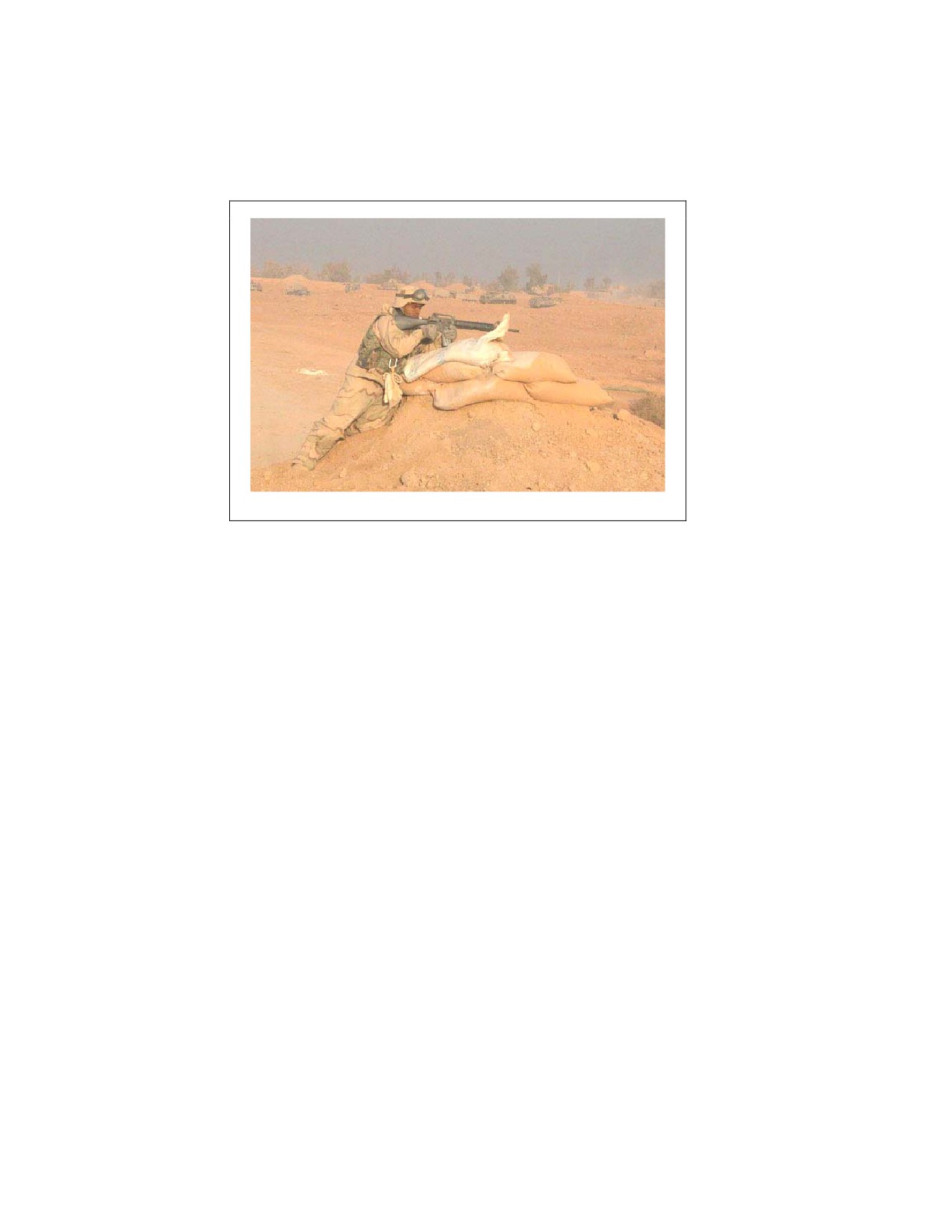
A soldier provides security during Operation Iraqi Freedom.
THE ARMY VALUES
1-16. Our individual effectiveness as part of the Army team comes from
within, from our upbringing, our character, and our values. The Army is an
organization that is guided by values. Army values are the basic building
blocks that enable us to see what is right or wrong in any situation. They
build the warrior ethos and they are mutually dependent—you can’t fully
follow one while ignoring another.
1-17. The Army’s core values are loyalty, duty, respect, selfless service,
honor, integrity and personal courage. They form the acronym LDRSHIP.
Fulfilling your obligations as an American soldier is possible by accepting
and living these values. These values tell you what you need to be, every
day, in every action you take and remind us and the world who we are and
what we stand for.
LOYALTY
1-18. Bear true faith and allegiance to the US Constitution, the Army,
your unit, and other soldiers.
To be a good leader and a good soldier, you must be loyal.
Stand by your organization and the officers, non-commissioned
officers, and fellow soldiers in it.
FM 21-13, The Soldier’s Guide, 1961
1-19. Bearing true faith and allegiance is a matter of believing in and
devoting yourself to something or someone. You began your Army career
by promising to support and defend the Constitution. Your loyalty to the
Constitution also means obedience to the orders of the President and higher
ranking officers and NCOs. Since before the founding of the republic,
1-6
_____________________________________________________________ Chapter 1
America’s Army has respected its subordination to the President—a
civilian. A loyal soldier is one who supports the leadership and stands
up for fellow soldiers. You show your loyalty to your unit by doing your
share, without complaint and to the best of your ability. The Army’s
service ethic is fundamental in building loyalty.
1-20. As a soldier who displays loyalty do the following:
• Put obligations in correct order: the Constitution, the Army, the unit,
and finally, self.
• Show faithfulness to unit and comrades by finishing all tasks with
them.
• Carry out tough orders without expressing personal criticism.
• Defend soldiers against unfair treatment from outside or above.
1-21. Loyalty to fellow soldiers is critical for generating confidence and
trust. Loyalty to one’s leaders and fellow soldiers is the most vital resource
a unit has. It is this commitment that causes units and soldiers to risk
everything to succeed and to bring everyone back. You will find that after
enduring a difficult experience the bond between the soldiers of your unit
will be even stronger.
The Loyalty of Private First Class Ernest E. West
Private First Class West, was a soldier assigned to L Company, 14th
Infantry Regiment in the 25th Infantry Division. On 12 October 1952,
near Sataeri, Korea, PFC West voluntarily accompanied a contingent to
locate and destroy a reported enemy outpost. Nearing the objective, the
patrol was ambushed and suffered numerous casualties. Observing his
wounded leader lying in an exposed position, Private First Class West
ordered the troops to withdraw and then braved intense fire to reach
and assist him.
While attempting evacuation, he was attacked by three hostile soldiers
employing grenades and small-arms fire. Quickly shifting his body to
shelter the officer, he killed the assailants with his rifle and then carried
the helpless man to safety. He was critically wounded, losing an eye in
this action, but courageously returned through withering fire and
bursting shells to assist other wounded soldiers. While evacuating two
comrades, he closed with and killed three more enemy soldiers. Private
First Class West's loyalty to his fellow soldiers and intrepid actions
inspired all who observed him. He received the Medal of Honor.
DUTY
1-22. Fulfill your obligations.
I just wanted to serve my country. So here I am.
PV2 Jeremiah Arnold
1-23. Duty is the sum total of all laws, rules and expectations that make
up our organizational, civic, and moral obligations. We expect all members
1-7
FM 7-21.13 ____________________________________________________________
of the Army to fulfill their obligations, and we often expect individuals to
exceed their duty, especially in ethical matters. Duty also means being able
to do your job as part of a team. We each have a part to play in
accomplishing the unit’s mission. Some parts may be more visible, as in the
leader’s role, but every task is important. Recognition and willingness to do
your duty is what protects all Americans’ liberty.
1-24. Expressing the value of duty means, at a minimum, doing the
following:
• Carry out the requirements of the position to the best of your ability.
• Fulfill legal, civic, and moral obligations.
• Sacrifice personal time in pursuit of excellence.
1-25. Duty begins with everything required of you by law, regulation, and
orders; but it includes much more than that. Professionals do their work not
just to the minimum standard, but to the very best of their ability and then
try to improve on their performance. Commit to excellence in all aspects of
your professional responsibility so that when the job is done you can look
back and say, "I could not have given any more."
Private First Class Clarence Eugene Sasser and Duty
While still a private first class, Sasser displayed devotion to duty while
assigned to Headquarters and Headquarters Company, 3d Battalion,
60th Infantry, 9th Infantry Division in Ding Tuong Province of the Republic
of Vietnam on 10 January 1968. He was serving as a medical aidman
with Company A, 3d Battalion, on a reconnaissance in force operation.
His company was making an air assault when suddenly it was taken
under heavy small arms, recoilless rifle, machinegun and rocket fire
from well fortified enemy positions on three sides of the landing zone.
The company sustained over 30 casualties in the first few minutes.
Without hesitation, PFC Sasser ran across an open rice paddy through
a hail of fire to assist the wounded. After helping one soldier to safety,
PFC Sasser was painfully wounded in the left shoulder by fragments of
an exploding rocket. Refusing medical attention, he ran through a
barrage of rocket and automatic weapons fire to aid casualties of the
initial attack and, after giving them urgently needed treatment, continued
to search for other wounded.
Despite two additional wounds immobilizing his legs, he dragged
himself through the mud toward another soldier
100 meters away.
Although in agonizing pain and faint from loss of blood, PFC Sasser
reached the man, treated him and proceeded on to encourage another
group of soldiers to crawl
200 meters to relative safety. There he
attended their wounds for five hours until they were evacuated. PFC
Sasser later received the Medal of Honor.
1-8
_____________________________________________________________ Chapter 1
RESPECT
1-26. Treat people as they should be treated.
Regardless of age or grade, soldiers should be treated as
mature individuals. They are engaged in an honorable
profession and deserve to be treated as such.
GEN Bruce C. Clarke
1-27. In the Soldier's Creed (on the back cover of this FM), we pledge to
"treat others with dignity and respect and expect others to do the same.”
The Army is one huge team, made up of hundreds of component parts.
There must be connections—ground rules—so that when one soldier
approaches, works with, or talks to another, it is with immediate and
unquestioned cooperation and respect. Respect is what allows us to expect
and appreciate the best in other people instead of distrusting what is
different. Respect is trusting fellow soldiers to do their duty, even while
checking the quality of their work, if you are in a leadership position.
Respect for others also means avoiding the use of profanity or obscene
gestures.
1-28. To consistently demonstrate respect, do the following:
• Have genuine concern for the safety and well being of others.
• Be discreet and tactful when correcting or questioning others.
• Be courteous and polite.
• Take care of yourself physically to show your self-respect.
1-29. Respect is an essential component for the development of
disciplined, cohesive, and effective war fighting teams. Discrimination or
harassment on any basis eats away at trust and erodes unit cohesion. The
Army has no tolerance for it. But respect also includes the broader issue of
civility, the way people treat each other and those they come in contact
with. Tact and courtesy demonstrate respect for others. Are there occasions
when someone needs to raise his voice? Of course. When a soldier sees a
safety problem, for example, he may have to get someone’s attention right
away, and it may be in a way that someone else may take offense to. But
most soldiers realize such occurrence results from the desire to keep fellow
soldiers free of unnecessary risk. Soldiers and DA civilians, like their
leaders, treat everyone with dignity and respect. The soldiers who stand
watch over the Tomb of the Unknown Soldier protect, for all of us, the
respect we have for those who gave their lives in the defense of freedom.
1-9
FM 7-21.13 ____________________________________________________________
The Sentinel’s Creed
My dedication to this sacred duty is total and wholehearted.
In the responsibility bestowed on me never will I falter.
And with dignity and perseverance my standard will remain perfection.
Through the years of diligence and praise and the discomfort of the
elements, I will walk my tour in humble reverence to the best of my
ability.
It is he who commands the respect I protect.
His bravery that made us so proud.
Surrounded by well meaning crowds by day, alone in the thoughtful
peace of night, this soldier will in honored glory rest under my eternal
vigilance.
(Creed of the Sentinel of the Tomb of the Unknown Soldier)
SELFLESS SERVICE
1-30. Put the welfare of the Nation, the Army, and your soldiers before
your own.
… If a man hasn't discovered something that he will die for, he
isn't fit to live.
Dr. Martin Luther King, Jr.
1-31. In serving your country, you are doing your duty loyally, without
thought of recognition or gain. Your fellow soldiers and the mission come
before your personal comfort or safety. Selfless service is your commitment
as a team member to go a little further, endure a little longer, and look a
little closer to see how you can add to the effort of the unit, platoon, or
company. Selfless service is larger than just one person. With dedication to
the value of selfless service, each and every soldier can rightfully look back
and say, "I am proud to have served my country as a soldier."
1-32. To demonstrate the value of selfless service, do the following:
• Focus your priorities on service to the Nation.
• Place the needs of the Army, your unit and your fellow soldiers above
your personal gain.
• Balance the mission, your family, and your personal needs.
• Accept personal responsibility for your own performance.
1-33. Selfless-service signifies the proper ordering of priorities. An old
saying from horse cavalry days is “the horse, the saddle, the man.” What it
means is to fulfill your duty before thinking of your own comfort. Think of it
as service before self. The welfare of the Nation and the organization come
before the individual. You can easily see how closely related selfless service
is with loyalty and duty. This only illustrates the importance of accepting
all the Army values and ignoring none.
1-10
_____________________________________________________________ Chapter 1
SPC Michael John Fitzmaurice at Khe Sanh
SPC Fitzmaurice, 3d Platoon, Troop D, 2d Squadron, 17th Cavalry
displayed selfless service at Khe Sanh in the Republic of Vietnam on 23
March 1971. SPC Fitzmaurice and three fellow soldiers were occupying
a bunker when a company of North Vietnamese sappers infiltrated the
area. At the onset of the attack SPC Fitzmaurice observed three
explosive charges which had been thrown into the bunker by the
enemy. Realizing the imminent danger to his comrades, and with
complete disregard for his personal safety, he hurled two of the charges
out of the bunker. He then threw his flak vest and himself over the
remaining charge. By this courageous act he absorbed the blast and
shielded his fellow-soldiers.
Although suffering from serious multiple wounds and partial loss of
sight, he charged out of the bunker, and engaged the enemy until his
rifle was damaged by the blast of an enemy hand grenade. While in
search of another weapon, SPC Fitzmaurice encountered and
overcame an enemy sapper in hand-to-hand combat. Having obtained
another weapon, he returned to his original fighting position and inflicted
additional casualties on the attacking enemy. Although seriously
wounded, SPC Fitzmaurice refused to be medically evacuated,
preferring to remain at his post. SPC Fitzmaurice's heroism in action at
the risk of his life contributed significantly to the successful defense of
the position and resulted in saving the lives of a number of his fellow
soldiers. SPC Fitzmaurice received the Medal of Honor.
HONOR
1-34. Live up to all the Army values.
Soldiers don't leave their buddies behind.
SSG David Santos
1-35. When we talk about "living up to" something, we mean being worthy
of it. We must make choices, decisions, and actions based on the Army core
values. Nowhere in our values training does it become more important to
emphasize the difference between "knowing" the values and "living" them
than when we discuss the value of honor. Honor is a matter of carrying out,
acting, and living the values of respect, duty, loyalty, selfless service,
integrity, and personal courage in everything you do.
1-11
FM 7-21.13 ____________________________________________________________
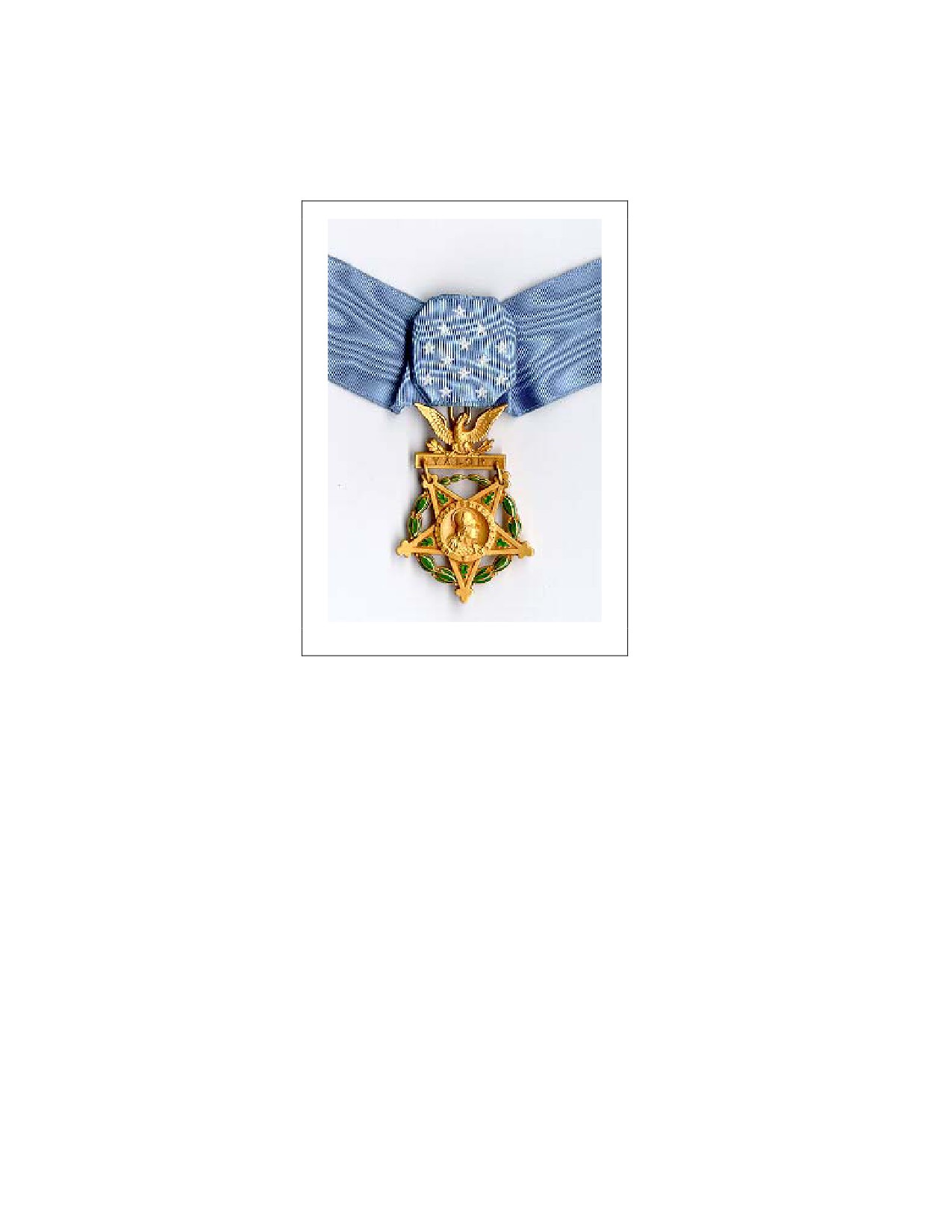
The Army Medal of Honor
1-36. As an individual with honor do the following:
• Develop and maintain a keen sense of ethical conduct.
• Adhere to a public code of professional Army values.
• Identify with the ideals embodied in the Army values.
• Realize that your actions reflect on the unit and soldiers around you
and act accordingly.
1-37. Noticing a problem and deciding to take action involves respect,
duty, and honor. It was a matter of honor that soldiers, at great risk to
themselves, distributed food in Somalia and kept the peace in Bosnia, while
managing to protect the communities within their unit areas of
responsibility. There are thousands of examples of soldiers who have
distinguished themselves with honorable actions and service. It is
significant that the Nation's highest military award is named The Medal of
Honor.
1-12
_____________________________________________________________ Chapter 1
Private First Class Silvestre Santana Herrera in France
The day the draft notice came, Silvestre S. Herrera learned for the first
time that he was not a US citizen. Even more shocking, the man he
thought was his father wasn’t. Herrera was born in Camargo, Mexico.
After his parents died, his uncle brought the infant Silvestre to El Paso,
Texas and raised him as his own son. Because he was a citizen of
Mexico, he didn't owe service to the United States. Besides, he was 27,
married with three kids, and another on the way. But he went anyway
because, in his words, “I didn't want anybody to die in my place."
He joined the
36th Infantry Division of the Texas National Guard.
Months later, on 15 March 1945, Private First Class Herrera was with
his unit, E Company, 142d Infantry Regiment, near Mertzwiller, France.
As his platoon was moving down a road, they came under heavy enemy
fire from the woods, forcing most of the men to seek cover. But PFC
Herrera charged the enemy alone and neutralized the position,
capturing eight enemy soldiers.
With that threat ended, the platoon continued down the road. They soon
came under enemy fire again from a second stronghold, pinning down
the platoon. This time a minefield stood between the soldiers and the
enemy gun emplacement. Disregarding the danger, Herrera rose to his
feet and entered the minefield to attack the enemy. Mines exploded
around him, but he continued to attack the enemy and draw their fire
away from his comrades. Then a mine exploded under him, severing his
leg below the knee. Still determined to stop the threat to his fellow
soldiers, he struggled back up on his good leg to continue the attack.
Another mine exploded, this one severing his other leg below the knee.
Despite intense pain and the unchecked bleeding of his wounds he lay
in the minefield, firing to suppress the enemy while others of his platoon
skirted the minefield to flank the enemy position.
His courage and fighting spirit reflected honor upon his adopted nation
and that of his birth. Private First Class Silvestre S. Herrera received the
Medal of Honor.
INTEGRITY
1-38. Do what’s right, legally and morally.
I hope I shall possess firmness and virtue enough to maintain
what I consider the most enviable of all titles, the character of
an honest man.
George Washington
1-39. When we say that someone has integrity, we mean that person
respects the rules of an organization, the country, and life. Such persons
can be counted on to do the right thing, live honestly, and relate to others
without playing games or having false agendas. Integrity is a quality you
develop by adhering to moral principles every day, 24/7. As your integrity
develops, so does the trust others place in you.
1-13
FM 7-21.13 ____________________________________________________________
1-40. Display integrity by the following actions:
• Act according to what you know to be right even at personal cost.
• Be truthful and show consistency between your words and deeds.
• Use the authority and power that comes with your rank or position
for mission accomplishment or for soldiers’ benefit.
1-41. Integrity requires us to pay our debts on time, return items that
someone else has lost, and follow rules and regulations. Integrity is
essential in self-discipline.
PERSONAL COURAGE
1-42. Face fear, danger, or adversity.
I knew when I signed up the job would bring risk. It's a risk
I'm willing to take.
PFC Trent James David
1-43. Personal courage includes the notion of taking responsibility for
your decisions and actions. Additionally, courage involves the ability to
perform critical self-assessment, to confront new ideas, and to change.
Leaders must make decisions that involve risk and often must take a stand
with incomplete information during times of great stress. Personal courage
has long been associated with our Army. Accounts of the dangers and
hardships that soldiers have successfully faced are legendary. Personal
courage is not the absence of fear; it is taking positive action in spite of the
fear. It takes two forms: physical and moral.
1-44. Physical courage means overcoming fears of bodily harm and still
being able to do your duty. It’s the bravery that allows a soldier to operate
in combat in spite of the fear of wounds or death. It is what gets the soldier
at airborne school out the aircraft door. It’s what allows an infantryman to
assault a bunker to save his buddies or a medic to treat the wounded while
under fire. With physical courage, it is a matter of enduring physical duress
and, at times, risking personal safety.
Fear is a natural reaction to the unknown; it is not necessarily
a negative. A positive from fear is the heightened awareness
that comes from being afraid. Harnessed, this heightened
awareness is an asset.
CSM Michael T. Hall
1-45. Moral courage is the willingness to stand firm on your values,
principles, and convictions, even when threatened. Moral courage is
sometimes overlooked, both in discussions of personal courage and in
routine, daily activities. Moral courage often expresses itself as candor.
Candor means being frank, honest, and sincere with others while keeping
your words free from bias, prejudice, or malice.
1-14
_____________________________________________________________ Chapter 1
1-46. Your courage will allow you to do the following:
• Control your fear in physical and moral contexts.
• Take responsibility for your actions, mistakes, and decisions.
• Confront problems and do what you believe is right.
• Report successes and failures with equal candor.
1-47. When considering personal courage, physical or moral, there is one
important point to be made. Nowhere does the value say that fear must
disappear—that you should not feel fear. Nor does it imply that courage is
only required in combat. Many soldiers who have never seen a battlefield
have carried out acts of great courage. Demonstrate personal courage by
daily standing up for and acting upon the things that you know are right.
Private First Class Parker F. Dunn in the Argonne Forest
Private First Class Dunn displayed personal courage while assigned to
the 1st Battalion, 312th Infantry Regiment of the 78th Division. On 23
October
1918, near Grand-Pre, France, PFC Dunn’s battalion
commander needed to send a message to a company in the advanced
lines of an attack. Because of the extreme danger due to heavy enemy
fire and limited prospect for survival, he hesitated to order a runner to
make the trip. But PFC Dunn, a member of the intelligence section,
volunteered for the mission.
After advancing only a short distance across a field swept by artillery
and machinegun fire, he was wounded but continued on. He was
wounded a second time and fell to the ground. Despite his painful
wounds he got up again and persistently attempted to carry out his
mission until enemy machinegun fire killed him before reaching the
advance line. PFC Dunn received the Medal of Honor posthumously.
DISCIPLINE
1-48. Many civilians—and maybe a few soldiers—misunderstand what
discipline really is. Discipline is the glue that holds units together in order
to accomplish assigned missions. It is the culmination of the genuine
acceptance of the Army values. This acceptance results in self-discipline,
without which there cannot be military discipline. Discipline, then is an
individual quality that allows the soldier to see that despite his own
preferences, he must accomplish assigned jobs well to ensure the team can
do its tasks. Discipline is an essential part of the warrior ethos.
1-15
FM 7-21.13 ____________________________________________________________
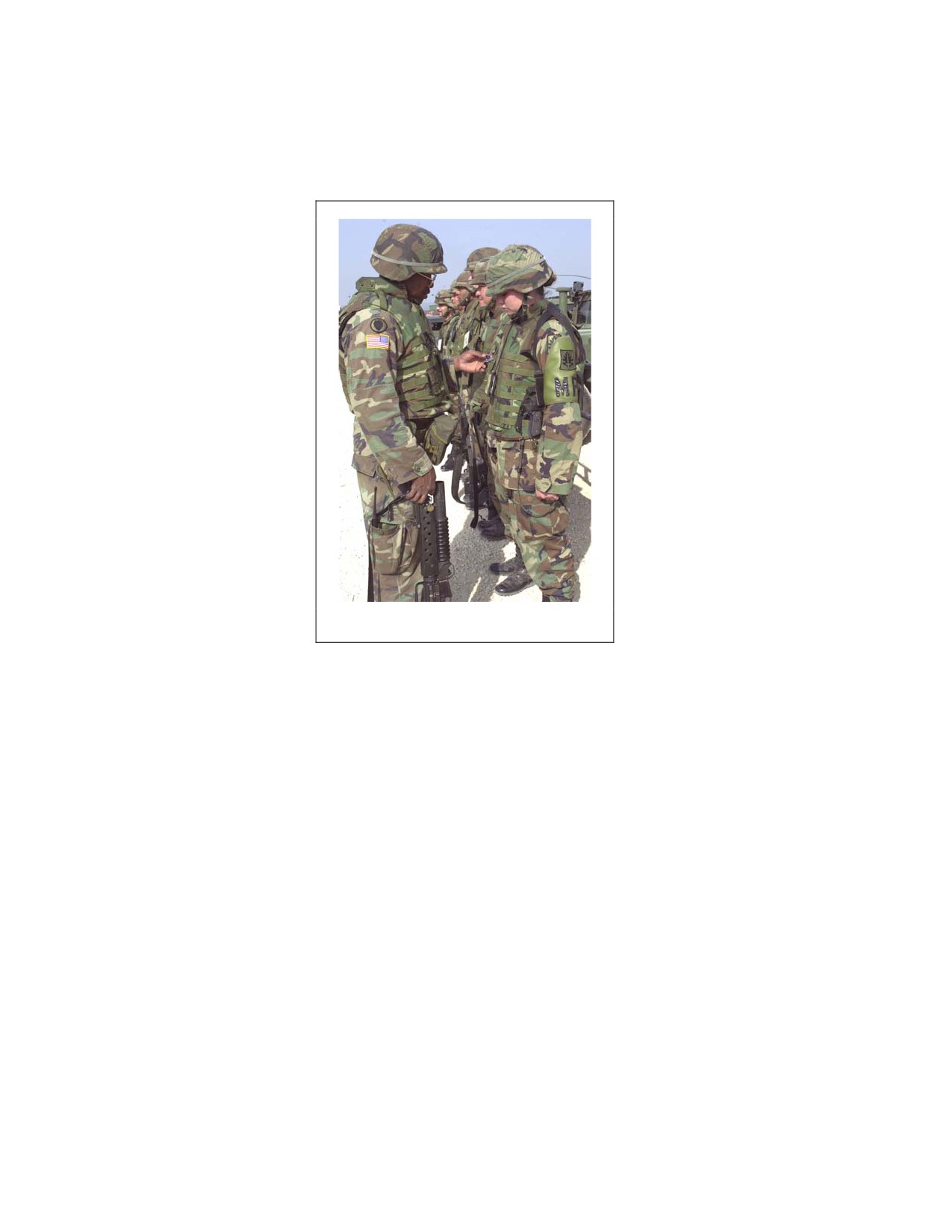
An NCO inspects his soldiers prior to
assuming guard duty.
1-49. Discipline isn’t blindly following orders or just imposing punishment
for infractions but is something leaders and soldiers build together. It is the
desire to do what is right even if it is difficult or dangerous. It doesn’t
matter if the “boss” isn’t watching; the task will be done and done properly.
It is the desire to accomplish the task well, not because of fear of
punishment, but because of pride in one’s unit and oneself. Discipline
means putting the task of the unit—the team—ahead of personal desires.
1-50. Your duties require you to accomplish tasks with your equipment
under the most difficult conditions: uncertainty, confusion, stress and fear
of battle. In those challenging circumstances your courage and that of your
fellow soldiers will be tested to the limit. You can expect fear to complicate
duty performance in crisis situations. Fear is a natural reaction to combat
and unknown situations. With the Army value of personal courage and the
discipline developed in training you will get the job done despite the
presence of fear. That discipline enhances the confidence that you’ll act
correctly and properly even under stressful conditions.
Discipline must be a habit so ingrained that it is stronger than
the excitement of battle or the fear of death.
GEN George S. Patton, Jr.
1-16
_____________________________________________________________ Chapter 1
1-51. Discipline in the Army is important because of the stakes involved.
In civilian life a lack of discipline may cause some discomfort or maybe
problems with the law. In the Army poor discipline could result in the
unnecessary loss of soldiers’ lives—a cost too high to pay. As a disciplined
soldier you place the unit’s mission above your personal welfare. It means
understanding your task and obeying orders promptly and cheerfully
because your fellow soldiers and leaders depend on you to do so. This is
military discipline; the kind of discipline that wins battles and saves lives.
1-52. The purpose of discipline is to make soldiers so well trained that
they carry out orders quickly and intelligently under the most difficult
conditions. Insistence on performing tasks properly enhances military
discipline. For example, ensuring soldiers wear their uniforms properly,
march well or repeat tasks until they do them correctly are part of military
discipline. This is not harassment or punishment. Proper and prompt
execution of orders will save lives in combat. This in no way means you
should not exercise initiative to solve a problem or to ensure the job gets
done. American soldiers have a long tradition of displaying initiative and
disciplined soldiers focus their efforts toward the success of the team.
1-53. Discipline is essential when we receive urgent orders. There are
times when success or failure depends on the immediate, correct execution
of tasks that may result in the deaths of the soldiers carrying them out. But
these successes are made possible through good training that breeds
confidence within units. Confidence in yourself, your fellow soldiers, and
your leaders all reinforce the discipline to finish the job, regardless of the
difficulty of the task.
Discipline is a measure of what a soldier does when the
commander is not there...
FM 22-100, Army Leadership, 1983
1-54. Discipline in routine things like saluting, police call and physical
training leads to discipline in the difficult things like advancing under fire,
disposing of unexploded ordnance, and safeguarding enemy prisoners of
war. That is why the Army insists on training to standard. It starts with
self-discipline but grows with pride in the unit and confidence in the
leaders’ and other soldiers’ abilities. A disciplined unit is made up of well-
trained soldiers who trust each other and know they can accomplish any
mission they are given. Those soldiers will not let each other down nor even
consider failure.
SECTION II - THE TEAM
1-55. The Army is made up of hundreds of thousands of men and women
from different backgrounds, with different views of the world, who look
different and may even have been born outside the US. But they all have
one thing in common: they are soldiers and Department of the Army
Civilians (DAC) who promised to support and defend the Constitution to
1-17
FM 7-21.13 ____________________________________________________________
keep our Nation free. This commitment is as it should be—free men and
women who have declared that, if necessary, they will fight to maintain the
right to live in our own American way and continue to enjoy the privileges
and benefits which are granted to no other nation.
The Army...mirrors the nation.
SGT Jack F. Holden
1-56. You are one of those great soldiers. You may be a US Army reservist
in Iraq, a national guardsman in Alaska, or an active component soldier in
Texas. Your unit and the soldiers you serve with are part of a team that can
only operate effectively when each of its parts works well together. This
great team also works with the other services—the Marine Corps, Navy, Air
Force, and Coast Guard—as well as allied nations. Our Army assists non-
Department of Defense
(DoD) governmental agencies and even non-
governmental organizations in disaster relief or support operations. But the
common factors remain the necessity, and the ability and willingness to
operate and succeed as a team.
1-57. Throughout your life, you have and will continue to perform as a
part of a team. It is true many people admire great leaders, sports stars or
celebrities. But it is equally true that when soldiers work together to
achieve a common goal the world sees the enormous strength of the people
of the United States. Teamwork has been a defining quality of our Army. It
overcomes individual shortcomings, builds confidence in the unit and
among soldiers, enhances each person’s courage, and magnifies the
commitment to succeed.
TYPES OF TEAMS
1-58. A team is a group of individuals banded together along
organizational lines for the purpose of accomplishing a certain goal. While
you are in the Army you will be a member of many teams and groups, often
many at the same time. To be a good soldier you must be a good team
member. We organize teams in different ways. The following shows types of
groups or teams:
• A functional team is organized to accomplish a particular task and is
one of long standing in the organization. Squads, platoons and
companies are examples of functional teams.
• Task groups are formed when two or more functional teams
contribute team members for a specific period of time to accomplish a
specific task. This is like task organization. Task groups are
disbanded after their mission is completed.
• Cliques are small informal groups held together by common interests
and friendship outside recognized organizational lines.
• Primary groups are closely knit and deeply committed to each other.
Your immediate family is an example of a primary group. In the
1-18
_____________________________________________________________ Chapter 1
Army, tank crews, two-person buddy teams, squads, and platoons
should be primary groups.
• Secondary groups are impersonal but in which members often
interact. Secondary groups could be private or professional
organizations or the larger Army organizations of which your unit is
a part (e.g. division and corps).
• Membership groups require little if any involvement of their
members. An example of this is an affiliated regiment.
• Reference groups influence our attitudes, values, and behavior.
Examples of reference groups are church or chapel groups, political
parties, or unit sports teams.
1-59. Most soldiers will be members of more than one, even many teams
or groups. Your family, your unit, your friends, and other associations form
some of those groups. Sometimes these different groups may have
conflicting values, priorities, or goals. If conflicts occur, solve them with the
problem solving steps or the ethical reasoning process found later in this
chapter.
Nothing wrong with having a clique, so long as everybody’s in
it.
SMA William G. Bainbridge
1-60. Teamwork thrives when the soldiers on the team are closely
associated with each other both on and off duty. Relationships, friendships,
and teamwork should spill over into the post housing area, the barracks,
the bowling alley, the chapel, the club system, the recreation center, and
other organizations. Such camaraderie increases esprit de corps and
improves the team’s performance.
1-61. Most of us have the ability and desire to be a part of a winning team
and to help it succeed. Once part of a team we can stay the course despite
obstacles. The Army’s service ethic is a soldier’s commitment to place the
Nation, the Army, its soldiers, and their families above self. This
commitment is expressed by the willingness to perform one’s duty at all
times and to subordinate personal welfare for the welfare of others, without
expecting reward or recognition.
1-62. Productive members of a team do their duty as well as they know
how and actively seek to improve their performance. They also cooperate
with other members of the team and help them willingly. The members of a
team are more interested in the success of the team than in personal gain.
Finally, the team knows that the leader has authority over the team
because he is responsible for the team’s performance.
1-19
FM 7-21.13 ____________________________________________________________
The one question that always presents itself on the battle field
every minute of the time to every person, whether he be a
general or a private, is
“What play has my team captain
ordered, and how best may I act so as to work in conjunction
with the other players to bring about the desired result?”... A
poor play in which every player enters with his whole heart
(teamwork) will often win, while, on the other hand, the best
play in which some of the players are skulkers and shirkers
will probably fail.
Manual for Noncommissioned Officers and Privates of Infantry of the
Army of the United States, 1917
1-63. Leaders and soldiers all contribute to teambuilding. In all training,
operations, and routine daily duties, the potential to further build the team
exists. Teambuilding also occurs in athletics, social activities, and unit
functions like a Dining-In or Dining-Out. Leaders are the primary
teambuilders, but every soldier properly motivated and trained can help in
teambuilding. Stay informed of what is going on. If you don’t know, ask.
You can’t help your fellow soldiers accomplish the unit’s mission if you don’t
know what the mission is or the commander’s intent for the operation.
Every soldier brings previous training and experience to benefit the team.
As long as you share that experience and accomplish your duties as best
you are able, you make a valuable contribution.
LEADERS, SOLDIERS
1-64. One of the great aspects of our Army is that we develop future
leaders from within the force. As soldiers gain training and experience, they
also develop the skills necessary to lead other soldiers of junior rank and
experience. Every soldier is a leader in the making. Leadership is learned,
and it takes time. It takes more than 20 years to develop a brigade
commander or command sergeant major. Today’s lieutenants and captains
will command tomorrow’s Future Force brigades and divisions. The enlisted
soldiers entering service today will be the 1SGs and CSMs of the Future
Force. Still, the necessities of combat may place soldiers into leadership
positions sooner than they expected. So even junior enlisted soldiers should
begin learning about leadership early in their careers.
1-65. Perhaps you are a junior enlisted soldier now, responsible for
performing the duties of your MOS. But some day, probably sooner than
you think, you will lead other soldiers. Even if you are already in a
leadership position as an NCO or officer, the following paragraphs should
help you in leading well. And this will help you understand how the Army
values can be put into action. You can find detailed information on direct
leadership—face-to-face, first-line leadership—in FM 6-22 (22-100) Army
Leadership. It is the Army’s key publication on the subject and provides all
the nuts and bolts you need to know in Chapters 1-5.
1-20
_____________________________________________________________ Chapter 1
Leaders’ Obligations to Soldiers
1-66. The first obligation of the leader of every organization is to
accomplish his assigned missions. In doing this, leaders must be proficient
in both individual and collective tasks. Leaders ensure soldiers are well
trained, informed, and capable of accomplishing the assigned mission.
Leaders create a disciplined environment where soldiers can learn and
grow both personally and professionally. It means holding their soldiers to
high standards, training them to do their jobs effectively in peace and win
in war. Leaders take care of soldiers by being fair, refusing to cut corners,
sharing their hardships, and setting the example.
1-67. Taking care of soldiers includes everything from enforcing training
standards, to making sure a soldier has time for an annual dental exam, to
ensuring soldiers’ housing is adequate. Leaders have an obligation to
ensure soldiers and their families are living in safe and healthy
environments. Leaders set up the systems to prepare families so soldiers
know their families will be taken care of, whether the soldier is home or
deployed. Family readiness also means ensuring there’s a support group in
place, that even the most junior soldier and most inexperienced family
members know where to turn for help when their soldier is deployed.
The Deployment
Preparations were almost complete. Equipment was loaded, the
soldiers’ gear was ready, and their families knew what was going on.
SFC Lamb thought his soldiers were as ready to deploy as any, except
for one. SPC Garrett is probably the best junior enlisted soldier in the
platoon, a real workhorse. But Mrs. Garrett is expecting their first child,
due three days after the unit deploys. SPC Garrett hasn’t asked for any
favors and he wants to be with the unit when it goes. He had arranged
for his mother to stay with his wife after the baby is born to help while he
is away. But SFC Lamb thought that SPC Garrett should not be
deprived of such an important experience as the birth of his child.
“I’ve spoken to the 1SG and he agrees with me and the Commander
okayed it. You’re going to stay and see your baby born. We’re
coordinating transportation for you with another unit leaving a week after
us.” Before SPC Garrett could protest, SFC Lamb went on, “It’s already
decided. I know you want to deploy with us, but we’ll make it without you
for a little while. Anyway, this is one of those things where the family can
and will come first. Sometimes that’s the way it has to be.”
SPC Garrett knew his platoon sergeant was right, but he also knew the
mission had to come first. He was a little surprised that didn’t seem to
be the case, this time. Or was it?
1-68. Taking care of soldiers also means demanding that soldiers do their
duty, even at the risk of their lives. It doesn’t mean coddling them or
making training easy or comfortable. In fact, that kind of training gets
soldiers killed unnecessarily. Training must be rigorous and as much like
combat as is possible while avoiding undue risk. Hard training is the best
1-21
FM 7-21.13 ____________________________________________________________
way to prepare soldiers for the rigors of combat. No training, no matter how
realistic, can prepare a soldier completely for combat. But leaders must
provide the best available training, equipment, and support to give soldiers
the best chance of survival while accomplishing the mission.
The Enduring Competencies: Self-Awareness and Adaptability
1-69. Effective Army leaders consistently demonstrate self-awareness and
adaptability. Self-awareness is the ability to understand how to assess your
abilities, know your strengths and weaknesses in the operational
environment and learn how to correct those weaknesses. For example, the
First Sergeant gave CPL Lawson a mission and three soldiers to accomplish
it. CPL Lawson was to lead the three soldiers from other platoons on a
detail to set up Target Reference Points (TRP) for training use that night.
CPL Lawson knew he had to refresh himself on the company’s SOP for
setting up TRPs so he allotted some time to review the SOP. He also knew
that heavy rain was expected by late afternoon so he wanted to get to work
with his soldiers quickly to put the TRPs in place before the rain.
Nonetheless, he prepared his soldiers for the environmental effects by
ensuring they brought appropriate rain gear. He knew one of the soldiers
had a HMMWV license and tasked him with requesting and preparing a
vehicle for use. CPL Lawson’s ability to recognize his own weaknesses
caused him to seek the knowledge he needed and he prepared himself and
his soldiers to adapt to foreseen environment changes.
1-70. Adaptability is the ability to recognize and react effectively to
changes in the environment. Let’s say that once out on the range and
executing his mission, CPL Lawson sees that it has gotten significantly
colder and instead of rain, it has started to snow. The cold and reduced
visibility were two of the variables he had not foreseen. Still CPL Lawson
adapted by having the soldiers warm up in the HMMWV periodically,
telling his driver to go slower due to the more slippery driving surface, and
calling the First Sergeant on the radio to inform him of the conditions.
1-71. Your unit will receive varied missions in varied environments and
you will have to adapt to the environment while training to perform many
different tasks. Infantry could be supporting relief operations after a
natural disaster or a quartermaster unit could be defending its perimeter
against a terrorist attack. But because of the speed that information travels
now and in the future, one soldier can have an impact far beyond his unit’s
actual area of operations. One soldier’s actions could determine the success
or failure of an operation. And that soldier could be you.
Be-Know-Do
1-72. With the competencies of self-awareness and adaptability, Army
leadership begins with what the leader must BE—the Army values and
attributes that shape a leader’s character. Interpersonal, conceptual,
technical, and tactical skills compose what a leader must KNOW.
Leadership demands competence in a range of human activities that
become more complex with positions of greater responsibility.
1-22
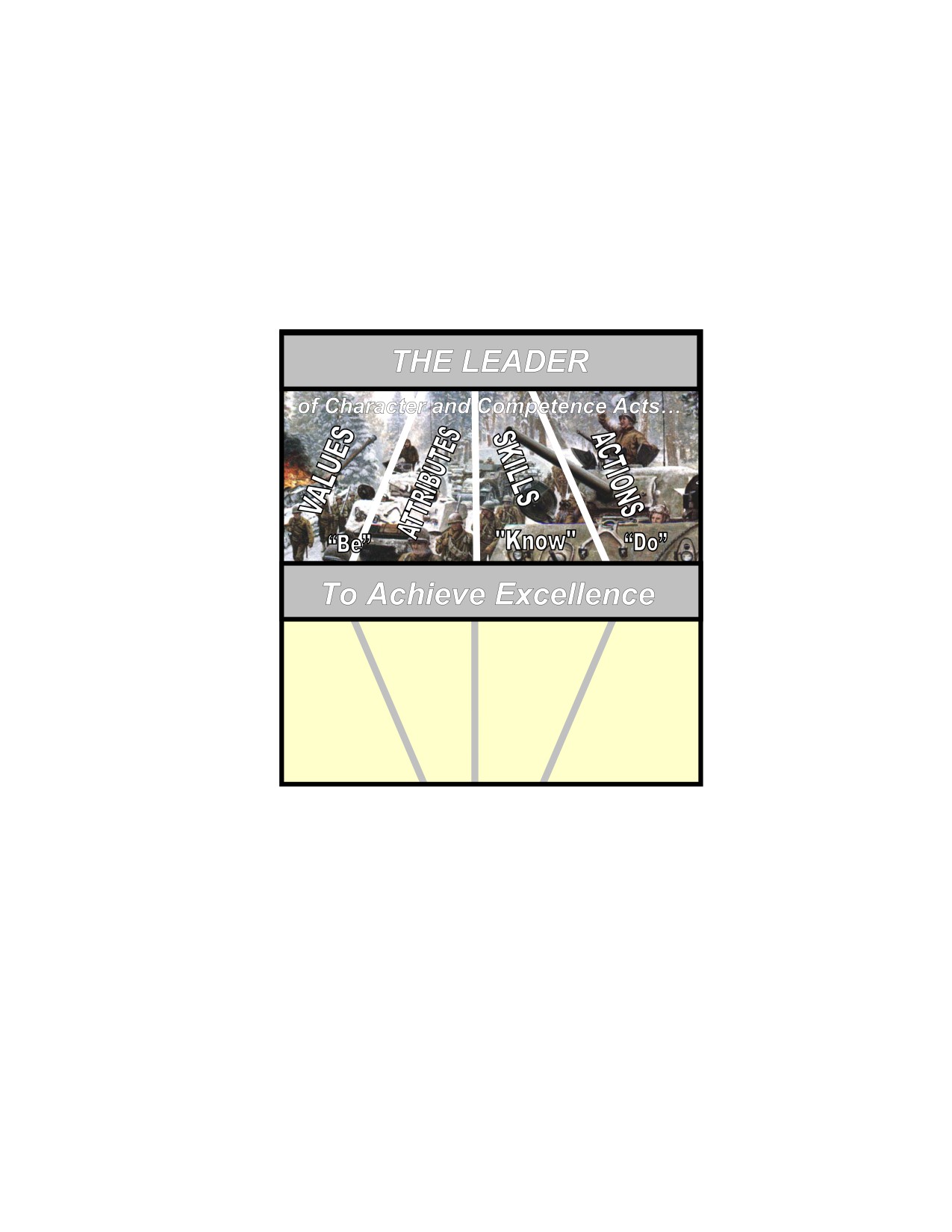
_____________________________________________________________ Chapter 1
1-73. But character and knowledge—while absolutely necessary—are not
enough. Leadership demands application—action to DO what is needed—
often in complex and dangerous conditions. Action is the essence of
leadership. The Army Leadership Framework
(Figure
1-1) shows the
relationship of values, attributes, skills and actions to Be, Know, and Do. It
isn’t important to memorize these as much as to understand what they
mean in your circumstances to best demonstrate and act upon them.
THE LEADER
of Character and
Competence Acts…
To Achieve Excellence
Mental
Interpersonal
Loyalty
Physical
Influencing
Conceptual
Duty
Respect
Operating
Emotional
Technical
Selfless Service
Improving
Honor
Tactical
Integrity
Personal Courage
Figure 1-1. The Army Leadership Framework
1-74. Be a person of character by living the Army values. Adhering to
Army values further develops character in a soldier. Remember that
character is an inner strength that helps you know what is right and what
is wrong. It is what gives you the desire and fortitude to do what is right
even in the toughest situations and it gives you the courage to keep doing
what is right regardless of the consequences. That desire and fortitude is
the warrior ethos. Your qualities and characteristics—attributes—are both
inherited (eye and hair color, for example) and learned (self-discipline and
military bearing, for example). Experience has shown that the Army values
and leader attributes make for better leaders. These are attributes worth
aspiring to even for a soldier not in a leadership position.
1-23
FM 7-21.13 ____________________________________________________________
1-75. One of the most obvious ways to demonstrate character is to be
honest. Tell it like it is, not how you think someone wants to hear it. The
Army and your fellow soldiers want, need and deserve the truth. If you
make a mistake, admit it. If something is wrong, you must be willing to say
so, even to higher-ranking NCOs and officers. Tell them in an objective,
straightforward and tactful manner and present the facts. This often takes
moral courage. What you have to say may not be easy or even welcomed,
but your candor is necessary to develop and maintain trust. Soldiers need to
know whether they have met the standard and leaders need to know the
true status of units. A mark of loyalty is a burning desire to help the team
improve its performance. That demands honesty. Make it a habit to be
candid because in battle, lives will depend on it.
1-76. Spiritual fitness can help develop the attributes of leaders. Often
(but not necessarily) religious in nature, spiritual fitness reflects a sense of
self-worth and the value of human lives. Many soldiers find solace and
draw moral strength from their religious beliefs that support the
acceptance of Army values. Other soldiers who do not practice a religion
may draw that same moral strength from other sources. Soldiers may freely
practice their religion or none at all as they desire. However expressed or
sought, spiritual fitness is an individual concern that can be enhanced.
There are only two powers in the world, the sword and the
spirit. In the long run the sword will always be conquered by
the spirit.
Napoleon Bonaparte
1-77. To be a good leader, know your job, know yourself, and know your
fellow soldiers. Every day the Army becomes more technologically
advanced. Our fellow citizens have entrusted us to use complex tools to
protect the Nation and our way of life. This requires each soldier to be
proficient in his job and to work as a member of a team. Know how to think
and plan ahead and learn to visualize the effects of your actions. Know your
equipment and tactics and how to make decisions based on available
information. Knowledge is reflected in a soldier’s skills. As you continue in
the Army, you will develop or improve these skills. Even the most senior
leaders work to improve certain skills. Knowledge is never complete; we
keep learning all our lives.
1-78. Being an expert in fieldcraft reduces the likelihood you will become
a casualty. The requirement to do one’s job in a field environment is one of
the differences between soldiering and most civilian occupations. Likewise,
the requirement that Army leaders make sure their soldiers take care of
themselves and provide them with the means to do so is unique. The
Soldier’s Manual of Common Tasks (STP 21-1-SMCT) lists individual skills
soldiers must master to operate effectively in the field. The field manual
Combat Skills of the Soldier (FM 3-21.75) is another good source. Those
skills include everything from how to keep your feet dry in the field to
tracking. Most MOSs require other skills and you can find them in unique
soldier training publications (STPs). If you see or know of a better way to
1-24
_____________________________________________________________ Chapter 1
perform a task, speak up. You may save your fellow soldiers’ time and effort
and perhaps even their lives!
A Better Way
In World War I, then Colonel George S. Patton was in France, training
American tankers and preparing to lead them in combat. “Given the
propensity of the tanks for breaking down, maintenance was one of
Patton's chief concerns. He was constantly after his men to keep their
tanks in good running condition, a difficult task greatly hampered by a
shortage of spare parts and the absence of repair facilities close to the
battlefield.
As it happened, it was neither Patton nor one of his officers, but rather
a… private who came up with a solution to the problem. The private,
whose name has long been forgotten, suggested that one tank in each
company be converted into a sort of roving repair shop loaded with
various spare parts (particularly fan belts) and equipped with towing
apparatus to retrieve damaged, mired, or broken-down vehicles from
the battlefield. Patton thought this an excellent idea and immediately
saw to its implementation.
This led to the creation of the first tank company maintenance team,
which consisted of mechanics from battalion headquarters who were
assigned to each tank company to operate the company's recovery
vehicle. It was the beginning of a system that is still in use today in
American armored units. And it is worth remembering that it was the
brainchild of a private, which just goes to show how much Patton
encouraged initiative in the ranks of the AEF Tank Corps.”
1-79. Know the rules of engagement (ROE) and, if applicable, rules on the
use of force. Conditions in every area of operations differ, and they will
change within those areas, as well. Knowing the ROE not only saves time
in reacting to a potential threat but gives soldiers the confidence that they
will react properly. See more on ROE in Chapter 5.
1-80. Know the commander’s intent. Included in every operation order,
commander’s intent is a clear, concise statement of what the unit must do
and the conditions the unit must meet to succeed with respect to the enemy,
terrain, and the desired end state. While usually specific to a given
operation or mission, knowing the commander’s intent and your unit’s
mission will help you accomplish the mission even in the absence of specific
orders. This isn’t just for leaders—every soldier should know their
commander’s intent and that of the next higher commander. The
comander’s intent channels the natural initiative of soldiers to take
advantage of opportunities on the battlefield in a disciplined manner. The
commander’s intent will let you know what is the most important thing the
unit has to accomplish and when it must be done.
1-81. Know your own capabilities and believe in yourself and your
training. Understand right now that courage is not a substitute for proper
training, working equipment or firepower. Putting rounds on target quickly
1-25
///////////////////////////////////////