FM 7-21.13 THE SOLDIER’S GUIDE (FEBRUARY 2004) - page 2
FM 7-21.13 ____________________________________________________________
and accurately is the best antidote to fear, but it requires well trained,
disciplined soldiers to accomplish.
Decision-Making
1-82. Do what is necessary to fulfill your duties and support your fellow
soldiers by putting your knowledge into action. Taking action requires
making decisions. Everyone makes decisions every day to solve problems. A
problem is an existing condition in which what you want to happen is
different from what actually is happening. So decision making is knowing
whether to decide and then when and what to decide. The Army uses a
method known as the problem solving steps to help choose the best course
of action. The seven problem solving steps are in Figure 1-2.
The Problem Solving Steps
Problem definition. Don’t be distracted by the symptoms or effects of the
problem, get at its root cause. For example, if you get called down to the
motor pool on Saturday because there is a lot of oil under your truck, the
problem is not the oil or the loss of free time. The problem is the worn seal
that is allowing the oil to leak out.
Information gathering. In the time you have available, gather facts about
the situation. You may also make assumptions to help in the next step.
Assumptions are statements of what you believe about the situation but
don’t have the facts to support them. Make only those assumptions you
believe are true and are necessary to come up with alternatives.
Course of action (COA) development. Courses of action are ways to
solve the problem. Develop as many different COAs as time permits. Don’t
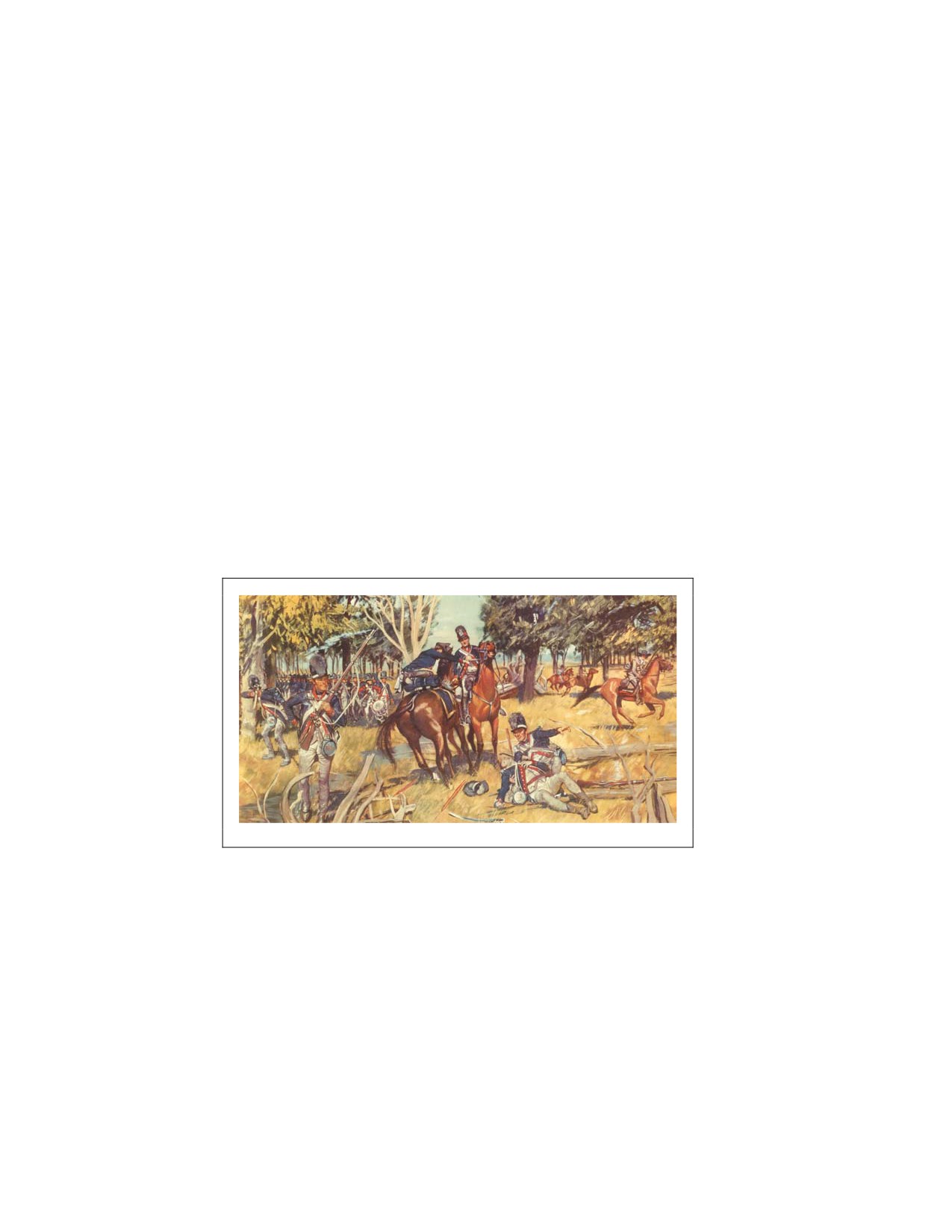
be satisfied with the first thing that comes into your mind. The third or
fourth or tenth COA you come up with might be the best one.
COA analysis. Identify what is likely to occur from each COA and any
resource or other constraints. Determine what are the advantages and
disadvantages of each COA, without favoring any COA over the others.
COA comparison. Evaluate each COA as to its probability of solving the
problem. Consider the cost of each COA, also. For example, replacing the
engine in your leaky truck might solve the problem, but so will replacing
the bad seal at far less cost.
Decision. Select the best COA that solves the problem.
Execution and Assessment. Once you’ve decided, make it happen! Plan
how to accomplish the tasks required to solve the problem so you can get
it done in an organized, efficient manner. Then assess the results. Does
the truck run properly? Is there any oil leaking?
Figure 1-2. The Problem Solving Steps
1-83. This process is the basis for all decision making and includes
understanding the consequences of your actions. Apply the problem solving
steps even when time is short. You can reduce the length of the process by
developing fewer COAs or gathering less information. Even when time is
1-26
_____________________________________________________________ Chapter 1
constrained, the steps will help you decide on the best available solution.
You may find that sometimes you need to take into account your
knowledge, your intuition, and your best judgment. Intuition comes from
accumulated experience and is often referred to as "gut feeling." But don’t
rely only on intuition, even if it has worked in the past. Use your
experience, listen to your instincts, but do your research as well.
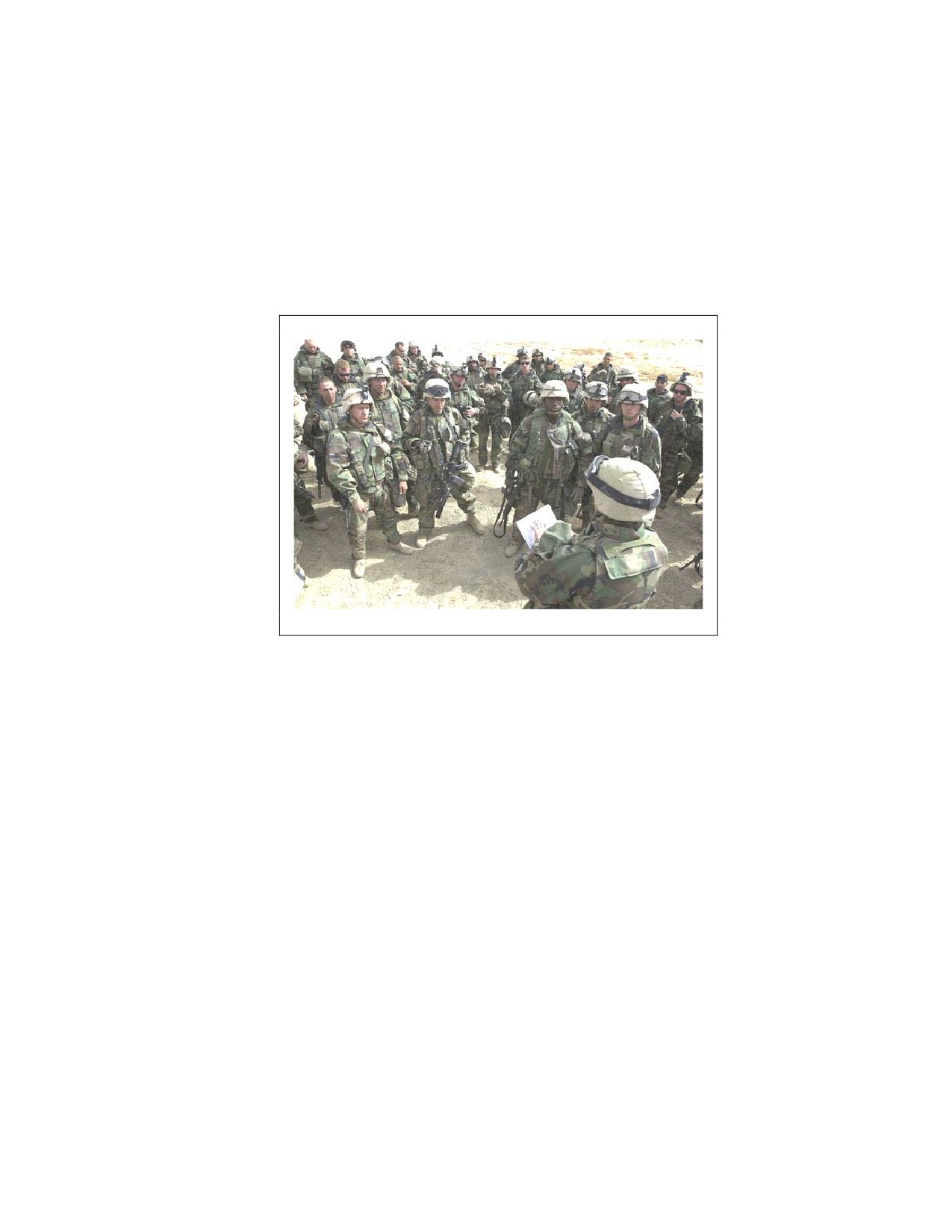
Convoy Briefing during Operation Iraqi Freedom.
1-84. Another tool that small unit leaders use is called the troop leading
procedures (TLP). The TLP, shown in Figure 1-3, elaborates on the problem
solving steps to support tactical decision-making. The TLP is a series of
eight inter-related steps that may be accomplished concurrently. The TLP
enables a leader to use available time effectively and efficiently in the
planning, preparing, executing, and assessing of missions. Collectively, the
TLP is a tool to assist leaders in making, issuing, and supervising operation
orders. While the TLP does not necessarily follow a rigid sequence, it is
important to accomplish every step to ensure planning is thorough and all
soldiers know their required tasks.
1-85. The TLP is the best tool for planning at the small unit level to be
sure every important detail is considered. Using the TLP keeps all soldiers
fully informed on future operations. But its usefulness is not limited to
tactical field conditions. You can use it even in garrison situations in
everyday tasks.
1-27

FM 7-21.13 ____________________________________________________________
The Troop Leading Procedures
Receive the mission. Once you receive your mission, analyze to
determine what exactly has to be done and what other factors will affect
your ability to do it.
Issue warning order. As soon as you understand the mission, let
subordinates know so they can begin planning.
Make a tentative plan. After analyzing the mission, develop some
different ways (courses of action -- COA) to get it done. Then compare
these COAs to determine which one is best.
Initiate movement. Begin soldiers’ and equipment movement to where
they will be needed or where they will rehearse the operation.
Conduct reconnaissance. Survey, as much as possible, the ground on
which you will operate. At a minimum, conduct a map reconnaissance.
Complete the plan. Based on the reconnaissance and any changes in
the situation complete the plan of action.
Issue the order. Fully brief soldiers on what has to get done, the
commander’s intent, and how you are going to accomplish the task.
Supervise and assess. Supervise preparation for the mission through
rehearsals and inspections.
Figure 1-3. The Troop Leading Procedures
Reverse Planning
1-86. The reverse planning process is a time management technique. You
develop your time schedule by starting at "mission time" and working
backward to the time it is now. For example, let’s say that you have a Class
A uniform inspection on Friday at 0900 and it is now Monday 1630. You
could list the tasks you have to do to prepare for the inspection, how much
time each will take, and when they should start, such as in Table 1-1.
Table 1-1. Reverse Planning Example
Action
Time
Start time
Class A uniform inspection
-
Friday, 0900
Final uniform check by your squad leader
10 minutes
Friday, 0850
Place awards, insignia, etc., on your uniform
20 minutes
Thursday, 1900
Clean and shine insignia and brass
30 minutes
Thursday, 1830
Get new ribbon mount from clothing sales
30 minutes
Thursday. 1800
Pick up uniform from the dry cleaner
30 minutes
Thursday, 1730
Drop off uniform with the dry cleaner
3 days
Monday, 1730
1-87. The reverse planning process helps you accomplish important tasks
without wasting time. By the example you can see that you would have to
turn in your uniform Monday night for cleaning and pick it up on Thursday.
Then you would pick up a new ribbon mount (you didn’t have a chance since
1-28
_____________________________________________________________ Chapter 1
getting that new ARCOM) Thursday afternoon before the PX closes. Finally
you’ll probably want to set up your uniform Thursday night for your squad
leader to check the next morning before the inspection. Reverse planning is
a tool to see if there is enough time to accomplish all required tasks.
Ethical Reasoning
1-88. Our nation places a premium on our professional values, and
entrusts the success of its defense to our actions. Ethics is the process of
putting our professional values into action. In making decisions we all come
across situations where more than one solution appears to be correct. As a
soldier who accepts and lives the Army values, the various COAs you
develop for any given problem will most likely be legal, appropriate and can
solve the problem. How then, do we select the right COA if they all appear
to be equally effective? In these situations we decide on a COA not only
because it can solve the problem, but because it can do so ethically, in a way
that is most consistent with Army values, rules and the situation.
1-89. The values themselves may, in certain situations, conflict with each
other or some other valid factor such as rules, orders or the situation itself.
An ethical dilemma is a situation where two or more factors conflict in
deciding the “right” course of action. These are dilemmas in which there are
two apparent “right” answers. So how do we decide which “right” is “right?”
Ethical Dilemma—The Checkpoint
Two days after a suicide car-bombing killed four soldiers at a
checkpoint, another unit is operating a similar checkpoint some distance
away. The unit was recently involved in offensive operations but was
beginning the transition to stability operations. Unit training has
emphasized the importance of helping the citizens return to a “normal”
lifestyle. Nonetheless, the events of the previous day demonstrate that
the enemy is still active, and will use civilian vehicles loaded with
explosives to kill themselves in an attempt to also kill US soldiers.
At this time, soldiers at the checkpoint notice a large civilian passenger
vehicle approaching at a high rate of speed.
1-90. In the example above we know that the rules, in this case the rules
of engagement (ROE), say that the US soldiers may anticipate an attack
and take action to prevent it—if an approaching vehicle appears to be a
suicide bomber, soldiers may use deadly force to stop it. The soldiers also
know that their mission is part of stability operation to maintain public
order and protect innocent civilians. Analysis of METT-TC for this type of
mission, the Law of Land Warfare, and both personal and Army values tells
soldiers to protect noncombatants. Yet those same values, orders, training,
and the mission also place a high value on protecting our fellow soldiers.
Innocent civilians could possibly be the occupants of the approaching
vehicle. What is the right thing to do?
1-91. This dilemma illustrates that we cannot, in some situations,
simultaneously honor two or more values and follow given rules while
1-29
FM 7-21.13 ____________________________________________________________
accomplishing the mission. In these situations we have an ethical dilemma.
When this happens the ethical reasoning process can help us decide the
correct course of action. This thinking must be done as part of mission
preparation—prior to the moment of decision. The ethical reasoning
process is outlined in Figure 1-4.
The Ethical Reasoning Process
Step 1. Problem definition. Same as the problem solving steps.
Step 2. Know the relevant rules and values at stake. Laws, ARs, ROE,
command policies, Army values, etc.
Step 3. Develop possible courses of action (COA) and evaluate them
using these criteria:
a. Rules—Does the COA violate rules, laws, regulations, etc.? For
example, torturing a prisoner might get him to reveal useful information
that will save lives, but the law of war prohibits torture under any
circumstances. Such a COA violates an absolute prohibition.
b. Effects—After visualizing the effects of the COA, do you foresee
bad effects that outweigh the good effects? For example, you are driving
along a railroad and you see a train on the tracks. If you speed up to beat
the train to the crossing, you might save a little time getting to your
destination. But the potential bad effects outweigh the time you might
save.
c. Circumstances—Do the circumstances of the situation favor one
of the values or rules in conflict? For example, your battle-buddy was at
PT formation this morning but now is absent at work call formation. Do you
cover for him? Your honor and loyalty to the unit outweigh your friendship
and loyalty to your buddy, so the ethical COA would be to report the truth
rather than lie about his whereabouts.
d. “Gut check”—Does the COA “feel” like it is the right thing to do?
Does it uphold Army values and develop your character or virtue? For
example, you come upon a traffic accident and a number of vehicles have
stopped, apparently to render aid, but you aren’t sure. Stopping may
cause further congestion in the area, but ensuring injured are cared for
and that emergency services are on the way further strengthens the
values of duty and honor.
Step 4. Now you should have at least one COA that has passed Step 3. If
there is more than one COA, choose the course of action that is best
aligned with the criteria in Step 3.
Figure 1-4. Ethical Reasoning Process
1-92. Ethical reasoning is patterned after the problem solving steps.
Ethical reasoning helps soldiers and DA civilians decide the best course of
action for ethical dilemmas. As explained in FM
6-22
(22-100), Army
Leadership, Chapter 4, ethical reasoning isn’t a separate process used only
when you have discovered an ethical problem. It is a part of making any
decision. Admittedly, most decisions don’t involve ethical dilemmas. But
1-30
_____________________________________________________________ Chapter 1
ethical reasoning will help you select the best COA from among those in
which there is no obvious best solution (because they all appear to be right).
1-93. In applying ethical reasoning to the
(Checkpoint) example, the
problem is that a possible suicide bomber in a large civilian passender
vehicle is approaching at a high rate of speed. The ethical dilemma is the
risk involved in civilian protection vs. force protection The relevant rules
include Army values, the ROE, the current mission, and the Law of Land
Warfare. So what should be done? There may be more, but let’s say there
are four possible Courses of Action (COA):
• COA a) do nothing.
• COA b) call higher for instructions.
• COA c) disable or destroy the vehicle.
• COA d) block the vehicle with a Bradley.
1-94. The first COA (a) reduces the risk of harming any noncombatants in
the approaching vehicle but it probably does not fulfill the unit’s mission at
the checkpoint. The second COA (b) offers a way to seek advice or higher
guidance on what to do but will probably take time, during which the
soldiers at the checkpoint could suffer casualties if the vehicle is carrying
explosives. The third COA (c) complies with the ROE and should stop the
vehicle but could harm any noncombatants in it. The fourth COA (d) puts
soldiers and equipment at risk but it might stop the vehicle without
harming any noncombatants in it.
Ethical Dilemma - The Checkpoint (continued)
The commander ordered the platoon manning the checkpoint to fire a
warning shot at the vehicle to signal the occupants to stop the vehicle.
When the vehicle continued to approach, he ordered the platoon to fire
into the vehicle’s radiator. When he saw nothing happening he ordered
the platoon to stop the vehicle, immediately followed by a number of
loud reports from the 25 mm guns of the Bradley Fighting Vehicles of
the platoon.
The commander ordered the platoon to cease firing. In the now
destroyed vehicle were a number of civilians, many killed or wounded
by the fire of the Bradleys. The vehicle contained no explosives or
weapons.
1-95. Nobody has a crystal ball to see all the future results of our actions.
However, ethical action requires us to live out our values in a way that
considers the future. The soldiers at the checkpoint, not realizing the
approaching vehicle carried noncombatants, made a decision to prevent an
anticipated attack against fellow soldiers. It demonstrates the serious
consequences of putting our values into action and their effect upon our
Nation, the Army, our fellow soldiers, and those whom we protect. Not all
ethical dilemmas have life or death consequences, but nevertheless they
affect our professional identity in the way we place our values into action.
1-31
FM 7-21.13 ____________________________________________________________
Ethical Dilemma—Guard Duty
PFC Rust was conducting a patrol of the motor pool while on guard duty
one night. He saw two figures about 20 meters away climbing over the
fence into the motor pool. He ordered them to halt and when he got
closer recognized them as two friends from his own company. They
explained they were on the way to the club on the other side of the
Motor Pool and were cutting across so they didn’t have to walk all the
way around. There didn’t seem to be any damage to the fence and it
was a long way around the motor pool to the club.
Should PFC Rust bring them to the sergeant of the guard (SOG) or let
them go their way?
1-96. In the guard duty ethical dilemma there is apparently more than
one right answer. Referring back to the ethical reasoning process, what are
the factors?
• Rules—the unit SOP requires soldiers to report in to the SOG if
going to the motor pool after duty hours.
• Effects—PFC Rust doesn’t want his buddies to get into trouble, but
he knows the effect on unit discipline by letting them go would be
worse.
• Circumstances—duty and honor cause PFC Rust to bring his friends
to the SOG because while they said they were just going to the club,
he isn’t completely sure of their intentions.
• “Gut check”—even though his friends might resent him for it, PFC
Rust feels best about taking the two soldiers to the SOG as it seems
to be the more professional COA.
1-97. The warrior ethos is defined by our professional values, and it is
lived out as we put those values into action. The ethical actions of a soldier
require both a self-understanding of these values and the determination to
apply them in all situations. But ethical reasoning is not a science, despite
the crisp procedure laid out in this manual. It is an art that improves as
your character grows stronger and as you gain experience. Even senior
leaders continue to learn and also work through ethical dilemmas.
1-98. Whenever time permits, seek advice from more experienced soldiers
to help you solve such problems. You will gradually gain the ability to solve
even complex dilemmas. Just like playing a sport where with enough
practice you begin to develop better coordination and “muscle memory,” so
too will it be as you develop character, gain experience, and find that you
can make decisions more quickly because of “ethical memory.”
TRANSITION TO A LEADERSHIP POSITION
1-99. Nearly every soldier, at some point in his service, will have to
supervise other soldiers of junior rank and experience. It may even happen
before promotion to the NCO ranks for enlisted soldiers. At that point, the
1-32
_____________________________________________________________ Chapter 1
leader is no longer “one of the guys” but accountable for accomplishing a
task and for the welfare of the soldiers he leads.
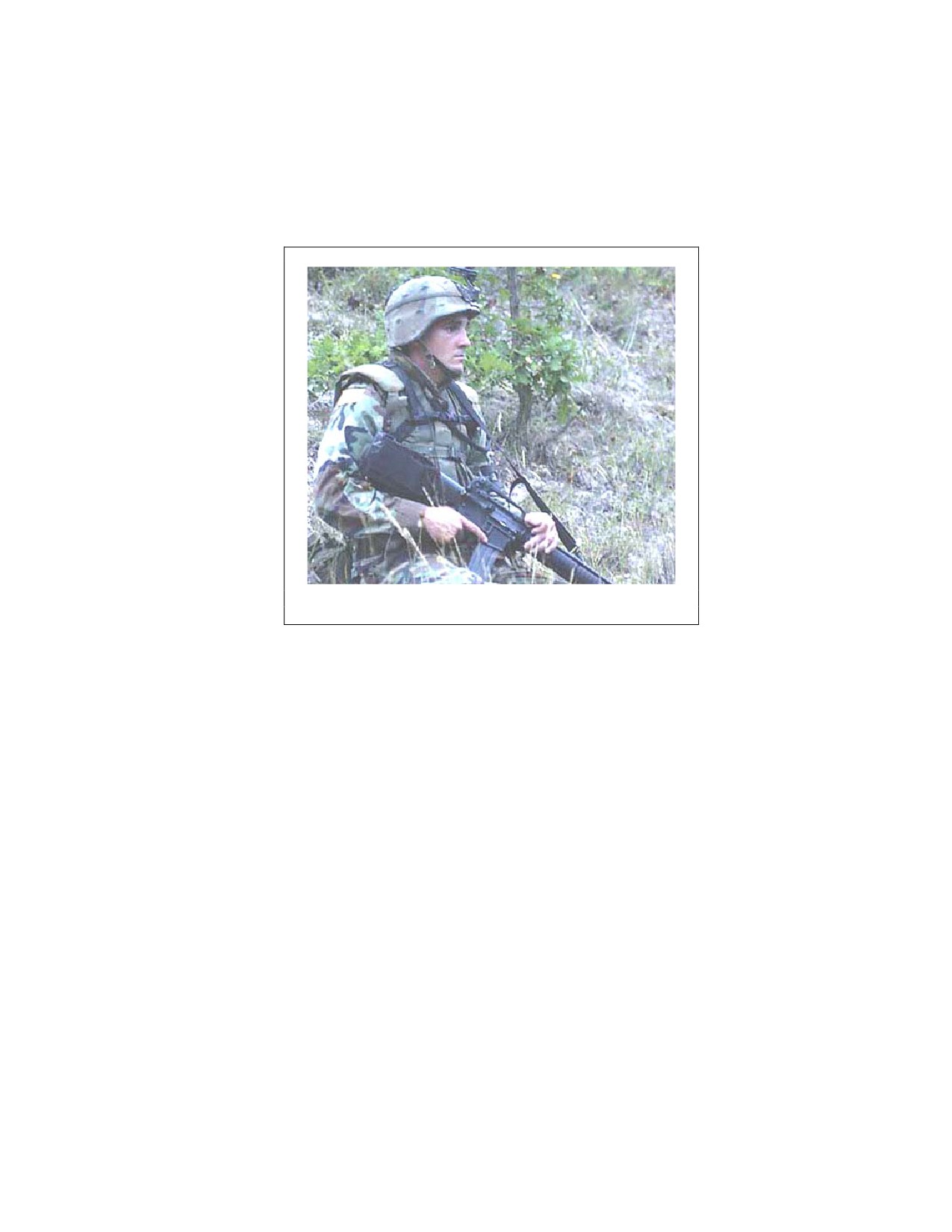
A junior NCO decides his team’s next move along the
Administrative Boundary Line in Kosovo.
1-100. The transition to a leadership position is from one that was cared
for to one who cares for others and from one who was taught to one that
teaches, prepares for, and supervises tasks. You might stay in the same
section or perhaps you will move to a different organization entirely. Either
way, you will do the job you have been selected to do; lead soldiers.
When [a corporal] first receives his appointment, his caliber
meets with the severest tests. Soldiers, for a time, will be apt
to try the material he is made of, which they do in many ways,
and by progressive steps, and, if not checked, will increase to a
complete disregard, and terminate in an entire inefficiency of
the corporal.
Customs of Service for Noncommissioned Officers and Soldiers, 1865
1-101. The transition to a leadership position may be difficult but is
important to make. Identify exactly whom you report to. You should learn
what your responsibilities are and what is expected of you. Right away, ask
what is the standard of performance so there won’t be any confusion later.
Once you know these things, look to the soldiers you will lead. What are
their strengths and weaknesses? Make sure the soldiers you lead and the
resources you have access to are sufficient to complete the mission.
Determine if additional preparation or training is necessary. Even if you
1-33
FM 7-21.13 ____________________________________________________________
are a PFC and in charge of two PV2s on police call, these steps will help you
complete the mission.
We should be shaping today’s soldiers to be tomorrow’s
leaders. The things we learned in basic training were taught
for a reason.
SGT Kerensa Hardy
1-102. Your experience helps prepare you for assuming a leadership
position. But you also have to make an effort to learn about leading through
study, reflection and observing leaders. Our Army’s history and the leaders
of your own unit are good places to start. The Army expects total
commitment from those who are selected to lead, train, and care for its
soldiers. It is an honor and a privilege to lead America’s finest men and
women during peacetime and at war. To learn more about the transition to
a leadership position take a look at FM 7-22.7, The Army Noncommissioned
Officer Guide, Chapter 2.
SOLDIER RECOGNITION
1-103. Leaders of effective teams recognize the good work of their soldiers.
The Army has a number of ways to recognize outstanding performance in
soldiers. The most obvious is through promotion. You receive promotions
because you have demonstrated the potential to succeed in the next higher
rank. Your leaders observe that potential in the daily performance of your
duties (a brief description of the Army’s promotion system is in Chapter 6).
Another way to recognize achievement or service is through awards,
decorations, and badges. Medals, ribbons, certificates, qualification badges,
patches and coins provide various degrees of recognition for a soldier’s hard
work. See AR 600-8-22, Military Awards, for a full description.
1-104. The Medal of Honor is the Nation’s highest military award. The
Medal of Honor may be given to a member of the Armed Forces of the
United States who in “action involving actual conflict with an enemy,
distinguish himself conspicuously by gallantry and intrepidity at the risk of
his life above and beyond the call of duty.” Many of the recipients of the
Medal of Honor were killed during the action for which they received it.
1-105. Other awards, below the Medal of Honor in the order of precedence,
recognize extraordinary bravery in combat. These are the Distinguished
Service Cross and the Silver Star. The Bronze Star may be awarded for
valor in action or for other meritorious service in a combat zone. The Purple
Heart is recognition of injuries received in combat or a terrorist attack. But
soldiers also do outstanding work in noncombat areas and for that they may
receive the Meritorious Service Medal, the Army Commendation Medal, or
the Army Achievement Medal. Soldiers performing noncombat heroic acts
may be recognized with the Soldier’s Medal.
1-106. Service ribbons and qualification badges are other visible means of
soldier recognition. By looking at the ribbons, badges, and insignia a soldier
wears, you can really discover a lot about him. For example, suppose you
1-34
_____________________________________________________________ Chapter 1
have just met your new platoon sergeant and she was wearing her Class A
uniform. You can deduce her name
(SSG Jordan), that she is a
quartermaster soldier who has been in the Army over six years, and is both
airborne qualified and a parachute rigger. She has completed Basic
Noncommissioned Officer Course (BNCOC) and been on two overseas tours
as well as a humanitarian relief mission. You can also see that her service
has been exemplary by noting a Meritorious Service Medal as well as both
the Army Commendation Medal and an Army Achievement Medal each
with three oak leaf clusters. You would probably conclude that your new
platoon sergeant is squared away. You would probably be correct.
1-107. Commanders and command sergeants major or first sergeants often
give certificates of achievement or the highly prized unit coin to recognize
the impact a hardworking soldier has on his unit. All in all, awards and
decorations serve to recognize soldiers for their accomplishments and tend
to both motivate fellow soldiers and build the team. When you receive an
award for a noteworthy accomplishment you should be proud. When your
leaders receive awards, be equally proud because your efforts are reflected
in those awards. As you progress in rank and assume supervisory roles,
remember that the awards you receive are the results of your soldiers’ work
as much as your own efforts.
1-108. Other means of recognition are in the form of competitions such as
Soldier of the Month or Year boards. These boards are held at the unit,
installation, and even Department of the Army Level. They challenge
soldiers’ knowledge and skill and often the winners receive awards and
prizes. NCOs also may compete in monthly, quarterly or yearly NCO boards
at the various levels. NCOs of outstanding ability may also compete for
membership in the prestigious Sergeant Audie Murphy or Sergeant
Morales clubs. Company grade officers may compete for the MacArthur
Leadership Award.
1-109. No form of recognition detracts from the Army value of selfless
service. As long as your priorities are straight, awards and decorations add
to the pride of a unit and to the confidence of individual soldiers.
1-110. Few professions in this world are more satisfying, rewarding and
challenging than that of the soldier. It isn’t easy and isn’t meant to be. We
have a serious job to do in protecting our freedom and our way of life. Do
your duty, treat people the way you wish to be treated, learn to lead and
prepare for the day when it is you in front of soldiers and they look to you to
make the right decisions. Look forward to it!
1-35
FM 7-21.13 ____________________________________________________________
1-36
Chapter 2
The Army and the Nation
The Army serves the Nation and defends the Constitution,
as it has done for nearly 230 years. The Army has had
enormous impact on the course of events throughout that
time. This chapter provides a brief description of the Army’s
role in our Nation’s history and of the environment the
Army operates in today. This chapter also shows the Army’s
place as a department of the Executive Branch of the federal
government.
Section I - A Short History of the US Army
2-2
Colonial Times to the Civil War
2-2
The Civil War to World War I
2-16
The World Wars and Containment…
2-26
Post-Vietnam and the Volunteer Army
2-51
The War on Terrorism
2-55
Section II - The Operational Environment
2-59
Full Spectrum Operations
2-61
Homeland Security
2-61
Army Transformation
2-62
Section III - How the US Government Works
2-64
The Constitution
2-64
Branches of Government
2-66
Department of Defense
2-69
Department of the Army
2-71
For more information on Army history, see the Center of Military History
(CMH)
homepage at www.army.mil/cmh-pg.
Much of Section I can also be found in CMH’s 225 Years of Service: The US Army 1775-
2000 and American Military History from the Center of Military History’s Army Historical
Series.
For more information on the operational environment, see FM 3-0, Operations. For more
information on Army Transformation see the Army homepage at www.army.mil or Army
Knowledge Online.
For more information on the US Constitution and our American system of government,
see Ben’s Guide to the US Government at bensguide.gpo.gov, the House of
Representatives homepage at www.house.gov, or the Federal Government information
website at www.firstgov.gov.
For more information on the Department of the Army organization and missions, see
FM 1, The Army, AR 10-5, Headquarters, Department of the Army, and DA PAM 10-1,
Organization of the United States Army and the Army Homepage.
2-1
FM 7-21.13 ____________________________________________________________
SECTION I - A SHORT HISTORY OF THE US ARMY
2-1.
The Army’s institutional culture is fundamentally historical in
nature. The Army cherishes its past, especially its combat history, and
nourishes its institutional memory through ceremony and custom. Our
formations preserve their unit histories and proudly display them in unit
crests, unit patches, and regimental mottoes. Such traditions reinforce
esprit de corps and the distinctiveness of the profession. Our history of past
battles bonds and sustains units and soldiers. History reminds soldiers of
who they are, of the cause they serve, and of their ties to soldiers who have
gone before them. An understanding of what has happened in the past can,
in many cases, help a soldier solve problems in the present.
Those who do not remember the past are condemned to repeat
it.
George Santayana
COLONIAL TIMES TO THE CIVIL WAR
2-2.
The oldest part of our Army, the Army National Guard, traces its
heritage to the early European colonists in America. In December 1636, the
Massachusetts Bay Colony organized America’s first militia regiments,
some of which still serve today in the Army National Guard. Those first
colonists and the regiments they formed were primarily made up from
colonists who came from England, who brought with them many traditions,
including the distrust of a standing army inherited from the English Civil
War of the 17th century.
2-3.
The colonists used the militia system of defense, requiring all males
of military age (which varied as years went by) to serve when called, to
provide their own weapons and to attend periodic musters. Theirs was a
reliance on citizen-soldiers who served in time of need to assist in the
colony’s defense. The various colonies
(later states) organized and
disbanded units as needed to face emergencies as they arose. Throughout
our Nation’s history, volunteer citizen-soldiers have stepped forward to fill
in the ranks and get the job done.
2-4.
In
1754, George Washington, then
22 years old, led Virginia
militiamen in a fight against French regulars at the beginning of the
French and Indian War. On one side of the war were the British and
American colonists with Indian allies versus the French and their Indian
allies. At stake was whether the colonies could continue to expand
westward or be limited to the eastern seaboard of the continent. This war
would determine who would control North America, the French or the
British and American colonists. Such groups as Rogers' Rangers won fame
with their abilities and successes. England won the war and assumed
control over the area east of the Mississippi—a vast empire in itself.
2-2
_____________________________________________________________ Chapter 2
2-5.
In 1763, the British king decreed that most of the newly acquired
territory was off-limits to new colonization and reserved for the use of the
native American Indians. The American colonies saw this as complete
disregard for what they saw as their right to use the western territories as
they saw fit. The following year, Britain imposed the first in a series of
taxes designed to pay the cost of British forces stationed in America. The
colonists objected to these new taxes. The Billeting Act of 1765 required the
Americans to quarter and support British troops. But it was the Stamp Act
of that year that most infuriated the colonists. The Stamp Act required that
a stamp be affixed to nearly all published materials and official documents
in the colonies, as was the case in Great Britain, to produce revenue
required for the defense of the colonies.
2-6.
Patrick Henry and the Virginia legislature denounced the Stamp
Act as “Taxation without Representation.” Americans broke into tax offices
and burned the stamps. The level of opposition astonished the British, who
thought the Stamp Act was an even, fair way of producing the revenue
needed to pay for the defense of the colonies. In the next few years,
additional taxes imposed upon other goods further angered Americans.
Emotions ran high in Boston where tax officials were occasionally
mistreated, causing the British to station two regiments there, which only
agitated Americans even more, prompting a number of violent incidents.
Crispus Attucks in the Boston Massacre
On the evening of March 5, 1770, a barber's apprentice chided a British
soldier for allegedly walking away without paying for his haircut. The
soldier struck him and news of the offense spread quickly. Groups of
angry citizens gathered in various places around town.
A group of men, led by the towering figure of Crispus Attucks, went to
the customs house and began taunting the lone British guard there.
Seven other soldiers soon came to his support. Attucks was a man who
had escaped from slavery and became a sailor to maintain his freedom.
He also was a man of some leadership ability. He and a growing crowd
confronted the soldiers. In some accounts Attucks struck a British
soldier but others say there was no such provocation. In any event, the
British fired and Attucks lay dead, struck by two bullets. Samuel Gray,
James Caldwell, Samuel Maverick and Patrick Carr also died instantly
or in the following days and six others were wounded. Citizens
immediately demanded the withdrawal of British troops. The deaths of
these men "effected in a moment what 17 months of petition and
discussion had failed to accomplish."
The town's response was significant. The bodies of the slain men lay in
state. For the funeral service, shops closed, bells rang, and thousands
of citizens from all walks of life formed a long procession, six people
deep, to the Old Granary Burial Ground where the bodies were
committed to a common grave. Until the signing of the Declaration of
Independence, Boston commemorated their deaths on March
5,
"Crispus Attucks Day."
2-3
FM 7-21.13 ____________________________________________________________
THE REVOLUTIONARY WAR
2-7.
The Declaration of Independence of 4 July 1776 is rightly associated
with the birth of our Nation, but the revolution had already been under way
for over a year. On 19 April 1775 at Lexington Green, 70 Massachusetts
citizen-soldiers stood their ground and refused to allow a British regiment
through to destroy a weapons cache in Concord. Without orders, someone
on one of the sides fired “the shot heard ‘round the world.” The British fired
and charged, killing eight of the Massachusetts soldiers in what began
eight years of war but ended with an independent Nation that one day
would become the beacon of freedom for uncounted millions around the
world. Those first days of our Army and the Republic it served were difficult
times. We lost many battles, but won just enough to hang on and maintain
the resolve to continue the fight.
2-8.
The United States Army began 14 June 1775, when the Continental
Congress adopted the New England army besieging Boston as an American
Army. The next day Congress selected George Washington to command the
first Continental Army: “Resolved, that a General be appointed to command
all the continental forces, raised, or to be raised, for the defence of
American liberty.” This resolution of the Second Continental Congress
established the beginnings of the United States Army as we know it today.
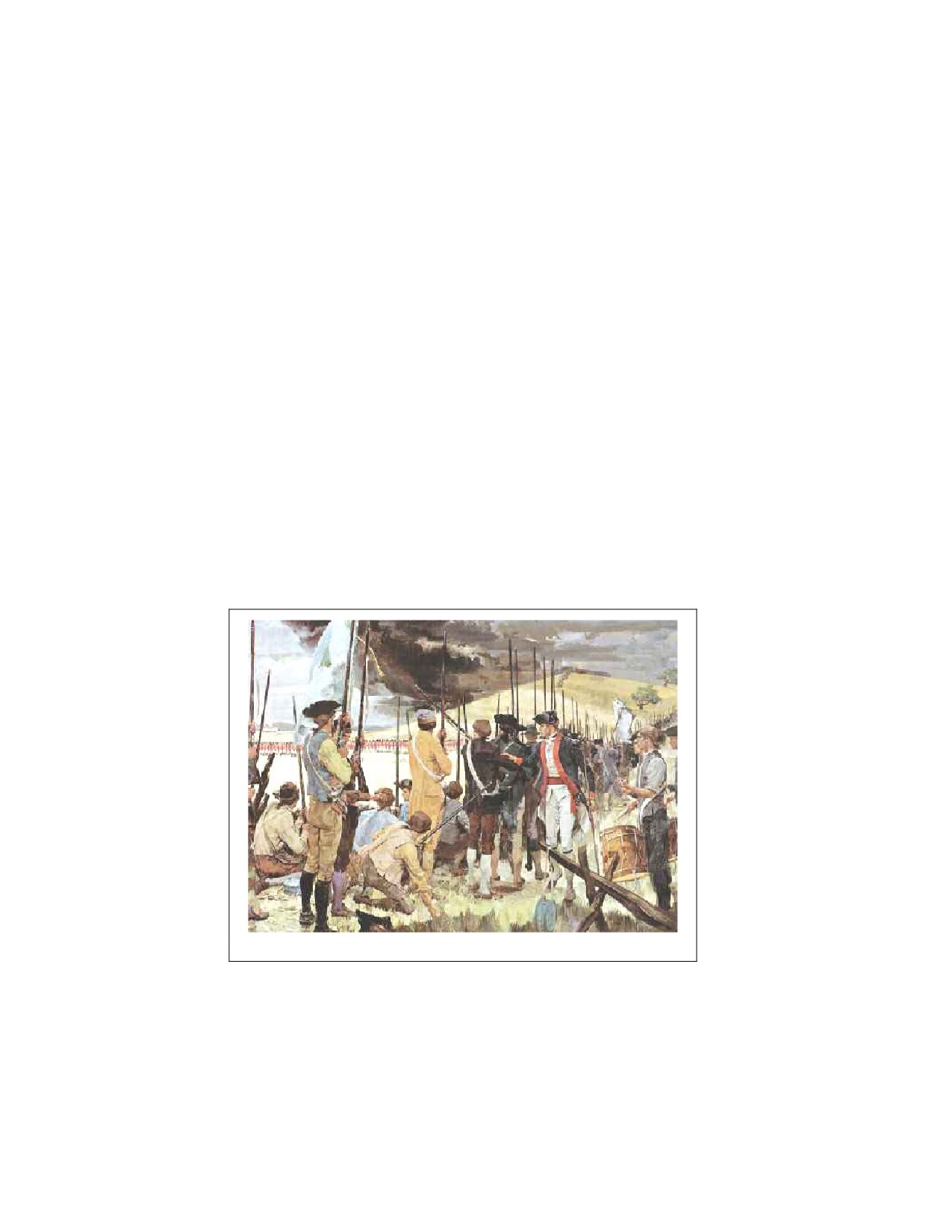
Those early days were tough and the British roughly handled the Army. Yet
the Battle of Bunker Hill on 17 June 1775 showed the patriots that they
could stand up to British regulars.
…The Whites of Their Eyes. The Battle of Bunker Hill.
New York
2-9.
In one of the first major actions of the war, General Washington
defended New York against a far more mobile British force on Long Island,
2-4
_____________________________________________________________ Chapter 2
whose evident intent was to seize New York. The patriots were preparing
defenses around New York City and expected an attack. But Washington
was desperate for information on British intentions and finally resorted to
sending a spy to reconnoiter the enemy positions. Captain Nathan Hale
volunteered for the mission.
2-10. After landing on Long Island’s northern shore, Captain Hale moved
toward New York. He soon discovered that the British had already begun
their attack against the Continental Army. Though the immediate purpose
of his mission was negated, Hale continued to try and obtain information of
value to the patriots’ cause. Perhaps betrayed by a kinsman, perhaps just
unlucky, Captain Hale was captured on
21 September
1776 with
incriminating notes of British dispositions. He was brought before General
Howe, the British commander. Captain Hale admitted his spying and
without a trial, Howe ordered him to be hanged the following morning.
Nathan Hale went bravely to his death, knowing he would be an example to
his fellow patriots. His last words were, “I only regret that I have but one
life to lose for my country.”
2-11. Despite Captain Hale’s bravery, the Americans lost New York to the
British and withdrew to New Jersey and then Pennsylvania. General
Washington knew that the Nation needed a victory to keep up its spirit and
with many soldiers near the end of their enlistment, knew such a victory
must come sooner than later. Those were the conditions when Washington
decided to attack the Hessian garrison of Trenton, New Jersey. Sailors
turned soldiers of Glover’s Regiment from Marblehead, Maine ferried the
little force of
2,400 across the icy Delaware on Christmas, 1776. After
marching nine miles through heavy snowfall, they charged into the town
early the next morning, taking the Hessians utterly by surprise. In 90
minutes it was over and the Army had won a victory to keep the fires of
liberty alive for awhile longer. Even though more defeats on the field of
battle were ahead, our people, our soldiers and our leaders never lost heart.
These are the times that try men's souls: The summer soldier
and the sunshine patriot will, in this crisis, shrink from the
service of their country; but he that stands it NOW deserves
the love and thanks of man and woman. Tyranny, like hell, is
not easily conquered; yet we have this consolation with us,
that the harder the conflict, the more glorious the triumph.
Thomas Paine
Saratoga
2-12. Nearly a year later, the Battles of Saratoga again tested the
determination of the patriots. The British had intended to seize Albany,
New York by simultaneous advances from Canada and New York City
along the Hudson River in order to divide the colonies along that vital
waterway, with a third axis from Oswego along the Mohawk Valley. The
British attack from New York never materialized, instead becoming
diverted to Philadelphia. American forces, swelled by many new volunteers
2-5
FM 7-21.13 ____________________________________________________________
from the state militias, were able to mass against the British coming south
from Canada. In a series of battles in September and October
1777,
America won its first major victory—a pivotal event in the war. It showed
the world that America remained unbowed and determined to win and led
to active assistance from the French that complicated the war for the
British. Ultimately, the British had to contend with America, France,
Spain, and the Netherlands.
The Marquis de Lafayette-Patron of Liberty
Gilbert du Motier, Marquis de Lafayette was born into French nobility in
1757. After service in the French army, Lafayette became interested in
the cause of American freedom. He desired to provide actual assistance
and not only sent money to America but also offered his services to the
American Congress in 1776. Since official French policy at the time was
to remain neutral, Lafayette went secretly to America. In July 1777,
Congress appointed him a major general, though stipulated he would
have to serve at his own expense—Lafayette received no pay.
After taking part in several battles in which he demonstrated both his
bravery and his skill in combat, Congress appointed Lafayette to
command an invasion of Canada. Unknown to him, Lafayette’s
appointment was wrapped up in a strange conspiracy known as the
Conway Cabal. A group of officers had decided that the conquest of
Canada was more important than loyalty to America or to General
Washington. Lafayette, who was intensely loyal to General Washington,
was appointed simply to provide the pretense of legitimacy to the affair.
He soon saw the plot for what it was. After determining the mission had
insufficient resources, he succeeded in canceling the ill-advised attack
entirely. Lafayette continued to lead well in battle elsewhere.
Soon after France allied herself to America, Lafayette decided he could
serve the American cause best by returning to France in order to
strengthen the relationship and enhance cooperation between the
Nations. Lafayette provided a full report on the situation in America and
persuasively argued for complete support of the Americans, including
ground troops. He returned to America with many French soldiers. The
assistance of France was essential to winning the Revolutionary War.
With the Marquis de Lafayette, General Washington won the Battle of
Yorktown in 1781.
Lafayette continued his support long after the Revolution, though he
returned to his native France. He returned to the United States in 1825
for a yearlong visit and was greeted by thunderous applause wherever
he went. Americans still remembered his important role in winning
freedom. Lafayette died in 1834 and was buried in Paris. An American
flag flies over his grave.
Valley Forge
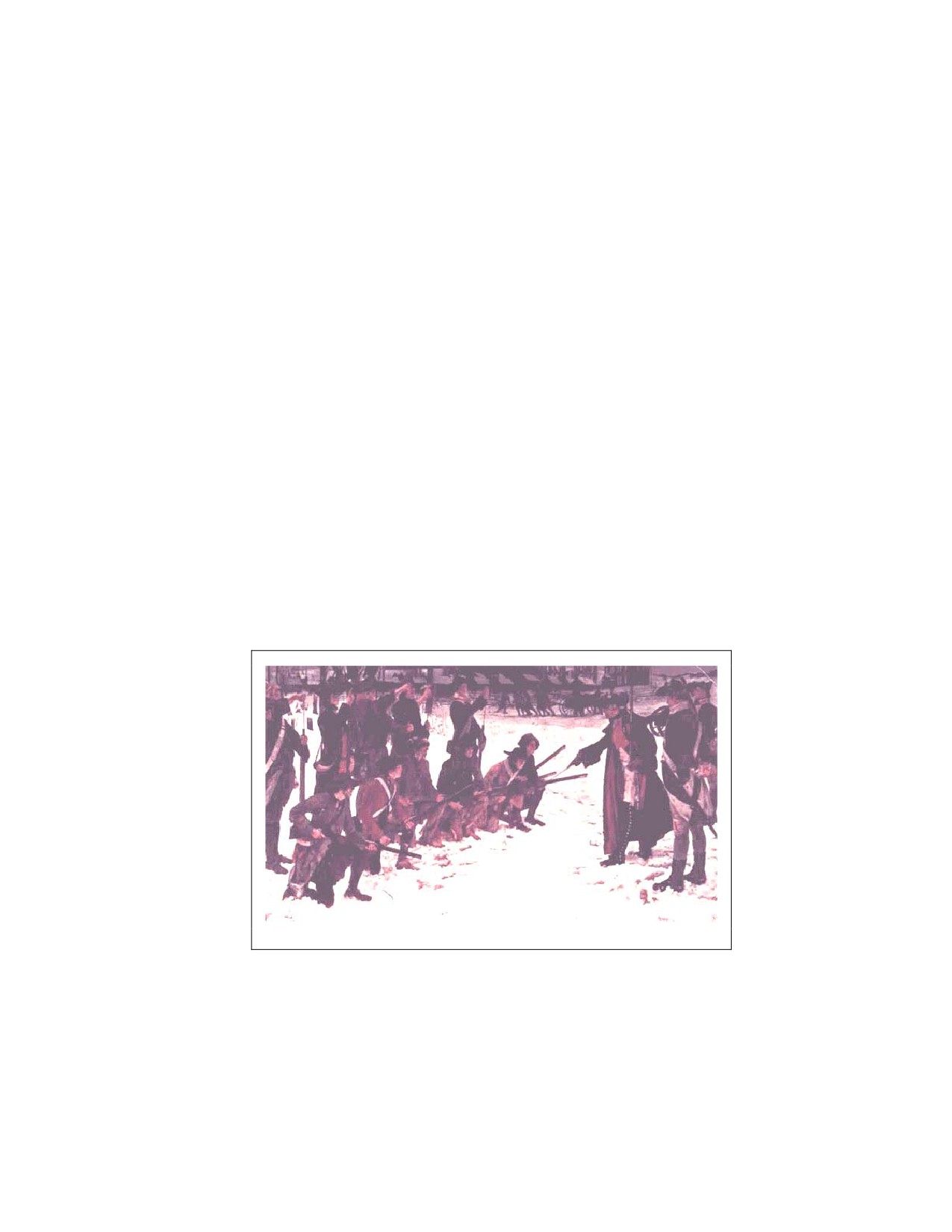
2-13. Our soldiers endured the harsh winter of 1777-1778 at Valley Forge
but learned how to make war under the tutelage of a Prussian drillmaster
named Friedrich Wilhelm “Baron” von Steuben. The self-styled “Baron” (he
2-6
_____________________________________________________________ Chapter 2
wasn’t really a baron, but the soldiers didn’t care) took the ragtag remnants
of two years of hard campaigning and turned them into a force that could
stand against the might of the British empire. Von Steuben carried out the
program during the late winter and early spring of 1778. He taught the
Continental Army a simplified but effective version of the drill formations
and movements of European armies, proper care of equipment, and the use
of the bayonet, a weapon in which British superiority had previously been
marked. He attempted to consolidate the understrength regiments and
companies and organized light infantry companies as the elite force of the
Army. He impressed upon officers their responsibility for taking care of the
soldiers and taught NCOs how to train and lead those soldiers.
I would cherish those dear, ragged Continentals, whose
patience will be the admiration of future ages, and glory in
bleeding with them.
Colonel John Laurens
2-14. Von Steuben never lost sight of the difference between the American
citizen soldier and the European professional. He realized that American
soldiers often had to be told why they did things before they would do them
well. He applied this philosophy in his training program. After Valley
Forge, Continentals would fight on equal terms with British regulars in the
open field. Much of what von Steuben taught our soldiers is still in use
today. After his training took effect, the Continental Army became the
equal of the British forces. Nonetheless, operations in the northern states
degenerated into a stalemate that lasted to the end of the war.
Von Steuben Instructs Soldiers at Valley Forge, 1778
War in the South
2-15. The Revolutionary War after
1777 was mainly fought in the
southern states. There it was a war between patriots and Tories—
2-7
FM 7-21.13 ____________________________________________________________
Americans who remained loyal to the crown and were recruited by the
British to fight the rebels. As such, it was more a civil war than not, and
neighbors and brothers fought each other in engagements that became
increasingly vicious and merciless. They fought as much to protect their
homes and families as for the future of the new nation.
2-16. On the patriot side, much of the combat power existed in bands of
guerrillas, employing hit and run tactics that helped whittle away British
strength and interrupt supplies. Francis Marion, the “Swamp Fox,” led one
of these partisan groups. What he lacked in numbers he made up for in
audacity and thorough knowledge of the terrain, his soldiers, and his
enemy. Over the course of three years he harassed the enemy, cut his
communications, and caused the British to divert many soldiers to
eliminating him.
2-17. The Tories were usually more organized, often led by a British
officer, and fought more in line with existing British tactical doctrine. But
some of the Tory units took up the practice of burning houses and
destroying crops to deny them to the patriots. It had the effect of pushing
the southern population, much of whom had been loyal to the Crown, into
the American cause. One of these Tory units was under the command of
Lieutenant Colonel Banastre Tarleton. Tarleton was the British
commander on the field at the American disaster of the Battle of Waxhaws.
2-18. In May 1780, the British captured Charleston, South Carolina and
its garrison, leaving the entire south open to attack. The prospects of
American victory had never looked worse. But General Washington
appointed Nathanael Greene as commander of the Southern Army. Greene
began to wear down the British by leading them on a six-month chase
through remote areas of the Carolinas and Virginia.
2-19. Greene never won a battle, but maintained constant pressure on the
enemy with local guerrilla groups. The British, low on supplies, began
stealing from any Americans they encountered, infuriating them. The
British recourse to theft and destruction of property turned the local
populace against the British. Many had been sympathetic to the Loyalist
cause, but no more. The British actions directly resulted in their defeat at
the Cowpens on 17 January 1781. Greene’s persistence won back the south
as the British abandoned post and city to return to the seacoast where they
could maintain unhindered communications.
Cowpens
2-20. Part of Greene’s strategy was to split his Army to cause the British
to weaken their forces in pursuit. It worked when the British commander
detached Tarleton’s command, reinforced by two regiments of British
regulars, to pursue one of the columns of Continentals and militia,
commanded by Brigadier General Daniel Morgan. Though untrained in
tactics or strategy, Morgan knew his soldiers’ strengths and weaknesses
and that of his enemy. He turned to face the British in a field known as
Hannah’s Cowpens and won a victory that altered the course of the war.
2-8
_____________________________________________________________ Chapter 2
2-21. Though outnumbered by Tarleton’s force, Morgan chose a low,
sparsely wooded hill to defend. He would place most of his his militia in the
front, instructing them to fire two shots before withdrawing. Behind these
militia troops would be his stalwart Continentals and trusty Virginia
militia in the main line and a small cavalry force as his reserve. Morgan
intended for the first lines of militiamen to fire at close range to strike down
enemy leaders and depart the field as if retreating. Then when the British
charged after them, they would run into the main line of Continentals and
Virginians. He spent much of the evening before the battle ensuring all his
soldiers knew the plan and what was expected of them. He knew each
soldier would do his duty.
2-22. Tarleton’s aggressiveness was also something Morgan counted on
when the battle began the next morning. As expected, after the militia fired
and withdrew, the British closed on the main line of patriots. They
attempted to outflank the American right, and a misunderstood order
caused the Continentals there to move to the rear. Tarleton thought they
were retreating and plunged recklessly after them. But Morgan turned the
Continentals about and charged the attacking British. While engaged to the
front, the American cavalry and the reformed militia surrounded Tarleton’s
force of
1,100 and killed, wounded, or captured all but 50 who barely
escaped, including Tarleton himself. This decisive victory seriously reduced
the British strength in the south.
Yorktown and Victory
2-23. Soon the British began a withdrawal to Yorktown where they would
evacuate part of the force to New York. Instead the French fleet arrived and
drove off the outnumbered British vessels that were guarding the
Chesapeake Bay. They landed 3,000 more French troops to join the 12,000
Americans and French that had surrounded Yorktown and began a
blockade to deny reinforcements or evacuation from Yorktown. The
resulting siege ended when the British surrendered on 19 October 1781, the
day “the world turned upside down.”
2-24. The victory at Yorktown broke the will of the British to continue the
war and ultimately decided it in America’s favor. The Revolutionary War
officially ended 3 September 1783 with the signing of a peace treaty in
Paris. The British recognized the United States as a free and independent
nation and that the US boundaries would be the Mississippi River in the
west and the Great Lakes in the north. The area west of the Appalachian
Mountains was called the Northwest Territory.
A NEW NATION
2-25. The United States initially were governed by a document called the
Articles of Confederation. After a few years Congress called for a convention
simply to mend the document’s flaws. But the convention soon decided to
write a new instrument, the Constitution. When it was ratified the
Constitution left in place a small professional Army supplemented by the
militia of all able-bodied males, under strict civilian control. Read more
about the Constitutionin Section III.
2-9
FM 7-21.13 ____________________________________________________________
Fallen Timbers
2-26. Despite the treaty provisions at the end of the Revolutionary War,
the British did not evacuate the Northwest Territory. Even so, American
Settlers began moving into the territory. The native American Indians in
the area believed the land was theirs because of previous treaties and
resisted this encroachment. Americans suspected that the British were
arming the Indians and perhaps encouraging their resistance. A
confederation of tribes led by Chief Little Turtle of the Miami soundly
defeated two major Army expeditions sent to protect the American settlers
from Indian raids. This caused a crisis of confidence in the effectiveness of
the Federal government and of the Constitution itself. President
Washington appointed General Anthony Wayne to prepare a force to
remove the Indian threat to the settlers if ongoing negotiations failed.
2-27. The negotiations did indeed fail. The US would not ban settlers
from moving across the Ohio River and the Indian tribes would not allow
such intrusion without a fight. On
11 September
1793, President
Washington ordered General Wayne to attack. Wayne built forts deeper
and deeper into Indian territory and defeated all attacks against them,
severely shaking the Indians’ confidence in their leaders and in their ability
to win the struggle. By August 1794, Wayne had offered the remaining
tribes a chance to end to the fighting but received no response.
The Road to Fallen Timbers
2-28. Expecting a battle, Wayne made known the Army would attack on
17 August. Realizing that the Indian warriors habitually did not eat on the
day they expected combat, Genereal Wayne waited an additional three days
believing many of the Indians would leave to seek food. He attacked on 20
August 1794 near Toledo, Ohio, and fought the remaining 800 Indian
warriors in a forest that had suffered severe damage from a recent storm,
giving the battle its name “Fallen Timbers.” In less than two hours Wayne
defeated the Indian force, paving the way for the Treaty of Greenville that
2-10
_____________________________________________________________ Chapter 2
secured southern and eastern Ohio and effectively ended British
interference in the Northwest Territory.
LEWIS AND CLARK
2-29. The young Nation more than doubled in size in 1803 when it
acquired a huge expanse of territory from France in what became known as
the Louisiana Purchase. President Jefferson sent the “Corps of Volunteers
for North Western Discovery” to explore and assert American authority
over the area. Sergeants John Ordway, Nathaniel Pryor and Charles Floyd
(and later Sergeant Patrick Gass when Floyd died along the Missouri River)
joined two Army officers, Captains Meriwether Lewis and William Clark.
2-30. With a select group of volunteers from the United States Army and
civilian life they ventured west towards the Pacific coast. The skill,
teamwork, and courage of each soldier contributed significantly to the
success of the expedition. When the soldiers finally returned in September
1806 after traveling almost 8,000 miles in under two and a half years, their
journey had already captured the admiration and imagination of the
American people.
WAR OF 1812
2-31. In the early 1800s Britain and France were at war with each other
and desperate for men and materiel. Both belligerents seized American
ships at sea but Britain was the chief offender because its Navy had greater
command of the seas. The British outrages took two distinct forms. The
first was the seizure and forced sale of merchant ships and their cargoes for
allegedly violating the British blockade of Europe. The second, more
insulting type of outrage was the capture of men from American vessels for
forced service in the Royal Navy.
2-32. The seat of anti-British sentiment appeared in the Northwest and
the lower Ohio Valley, where frontiersmen had no doubt that their troubles
with the Indians in the area were the result of British intrigue. Stories
circulated after every Indian raid of British Army muskets and equipment
being found on the field. By the year 1812 the westerners were convinced
that forcing the British out of Canada would best solve their problems.
Then on 1 June 1812, President Madison asked Congress to declare war,
which it narrowly did by six votes in the Senate.
2-33. American strategy was simple; conquer Canada and drive British
commerce from the seas. But in practice, it became clear that public support
for an enterprise was critical to the success of American operations. After a
few abortive attempts to invade Canada in which many regional militia
units were unwilling to take part, the Army quietly went into winter
quarters. Repeated attempts throughout the war to make gains in Canada
met with similar misfortune.
2-34. In 1813 American forces attempted to take the western panhandle
of Florida and southern Mississippi, then territories of Spain. Defending
the area were a few tribes of Indians that had long been difficult to control.
Initially poor logistics preparation stymied the small American force of
2-11
FM 7-21.13 ____________________________________________________________
volunteers, but after reorganization and additional reinforcements, they
drove the remaining tribes into Spanish-held Florida.
2-35. In 1814 the Army fought its finest engagements of the war. Though
strategically the US was frustrated yet again in failing to conquer Canada,
time after time the Army fought hard and well against the very best units
of the British Empire, many of which were veterans of the war against
Napoleon. At Lundy’s Lane, where Sergeant Patrick Gass fought with
distinction, Baltimore and Plattsburg, well-trained regulars and volunteers
acquitted themselves superbly against what was then believed to be the
finest infantry in the world.
2-36. In setbacks like Bladensburg, poor training and poor leadership
were the reasons why 5,000 hastily assembled Regulars, militia and naval
gunners were swept aside by an inferior British force that then entered and
burned Washington. Yet many of these same militia, after two weeks of
training, were resolute and inflicted heavy loss on the British in the defense
of Baltimore.
2-37. News of the British defeats at Baltimore and at Plattsburg caused
the British government to reevaluate its objectives in North America. As a
result it redoubled efforts to reach an agreement in peace negotiations that
were already underway, ultimately resulting in peace by the Treaty of
Ghent on 24 December 1814, two weeks before what was probably the most
famous battle of the war.
The Battle of New Orleans
2-38. In late 1814 the British sent 9,000 soldiers to capture New Orleans
in order to isolate the Louisiana Territory from the United States. They
landed at a shallow lagoon some ten miles east of New Orleans. During an
engagement on
23 December
1814, General Andrew Jackson almost
succeeded in cutting off an advance detachment of 2,000 British, but after a
3-hour fight in which casualties on both sides were heavy, Jackson was
compelled to retire behind fortifications covering New Orleans.
2-39. Opposite the British and behind a ditch stretching from the
Mississippi River to a swamp, Jackson prepared the defense with about
3,500 soldiers and another
1,000 in reserve. It was a varied group,
composed of the 7th and 44th Infantry Regiments, Major Beale's New
Orleans Sharpshooters, LaCoste and Daquin's battalions of free African-
Americans, the Louisiana militia, a band of Choctaw Indians, the
Baratorian pirates, and a battalion of volunteers from the New Orleans
aristocracy. To support his defenses, Jackson had assembled more than
twenty pieces of artillery, including nine heavy guns on the opposite bank of
the Mississippi. He was forced to scour New Orleans for a variety of
obsolete and rusty small arms to equip his entire force. Knowing many of
these dueling pistols and blunderbusses were nearly useless against British
muskets, he shaped the battlefield to his advantage by erecting formidable
earthworks, high enough to require scaling ladders for an assault.
2-40. After losing an artillery duel, the British commander decided to
launch a frontal assault with 5,400 of his force. On 8 January 1815, waiting
2-12
_____________________________________________________________ Chapter 2
patiently behind high banks of earth and cotton bales, the Americans
opened a murderous fire, first with artillery and then with small arms. In
the area of the main attack the British were decimated and the
commanding general killed. The British successor to command, horrified by
the losses, ordered a general withdrawal. Over 2,000 British soldiers were
killed or wounded as opposed to 13 on the American side.
2-41. Soon after, word came that a peace treaty had been signed on
Christmas Eve—two weeks before the battle. The War of 1812 was over,
and the Army had kept the Nation free. Although the United States did not
conquer Canada (President Jefferson once said it would be “a mere matter
of marching”), it did gain new respect abroad and inspired a sense of
national pride and confidence. The US Army was recognized as a
formidable force.
30 YEARS OF PEACE
2-42. After Wellington’s victory at Waterloo in June 1815, Americans
feared there would be another war with Britain. Such fears prompted
congress to triple the size of the peacetime regular Army (to 10,000), begin
an impressive program of building fortifications along the vulnerable
eastern seaboard, and improve the facilities at the US Military Academy at
West Point. Because of these efforts, America enjoyed 30 years of relative
peace, although sharply punctuated by wars with the Creek and Seminole
Nations, the Blackhawks, and other Indian tribes.
2-43. For the first time since von Steuben’s Blue Book, the Army
developed written regulations to standardize many aspects of Army
operations. The Army Regulations of 1821, written by General Winfield
Scott, covered every detail of the soldier’s life such as the hand salute, how
to conduct a march, and even how to make a good stew for the company.
General Scott was one of the most prolific writers in the Army of the early
19th century. Based on his combat experience in the War of 1812 and other
conflicts, he wrote a manual of infantry tactics that was used with minor
modification until the Civil War.
2-44. Scott believed that the US Army needed a formal system of tactics
to enable it to operate effectively. The tactics of the time, based on the line
formation, were a result of the small arms technology of that period.
Infantry armed with muskets had an effective range of less than one
hundred meters. This fact and the extremely slow rate of fire of the
weapons meant that to mass fires required massing soldiers. Soldiers had
to operate in tightly packed units. But firepower was really a means to an
end. The bayonet charge was the decisive movement and the ability to
maintain a tightly packed formation simply assured the attacker would be
able to outnumber the defender at the point of attack.
2-45. General Scott also explained the School of the Soldier, providing
explicit detail on how a soldier stands, walks and moves, all to most
efficiently move large groups of soldiers about the battlefield and to ensure
their fire was concentrated where the commander desired it. Scott’s Tactics
provides us a distant echo of how our Army trains today. In the School of
2-13
FM 7-21.13 ____________________________________________________________
the Soldier, School of the Company, and the School of the Battalion, we see
familiar traces of individual and collective training. It may be said that
Winfield Scott turned the US Army into a professional fighting force with
the methodical application of standardized training techniques.
2-46. As America grew, western expansion and exploration brought
settlers into more frequent conflict with the Indian nations. Much of the
regular Army was stationed on the western frontier to try and maintain
peace and order. But the expansion was free of European interference, due
to the isolation gained by Britain’s naval supremacy that kept the peace at
sea. That isolation enforced the Monroe Doctrine and allowed the Army to
turn its focus to the west. At times the Army was the buffer between the
settlers and the native Americans while at other times it was directed to
move the Indian tribes, by force if necessary, from their lands. One such
action turned into the Black Hawk War, in which Abraham Lincoln
participated as a captain of volunteer infantry.
2-47. From 1821-1830 large numbers of Americans, at the invitation of
the Mexican government, moved into the area called Texas. This soon
became the focus of a dispute that would lead to war with the United
States. The growing numbers of settlers from the United States created
suspicion in the Mexican government which then ordered a halt to all
immigration and began to reassert its authority in the area. Volunteers
from across the United States went to Texas to lend their support.
The Alamo
2-48. In December 1835 Texians (immigrants from the United States) and
Tejanos (Hispanic Texans), fighting for independence, seized the towns of
San Antonio de Bexar and Goliad and began preparing them as outposts for
an expected Mexican counterattack. The volunteers in San Antonio, under
the command of Colonel James C. Neill, expertly strengthened the existing
fortifications centered on the old mission of the Alamo. After Neill had to
leave to attend an illness in his family, Colonel Jim Bowie and Lieutenant
Colonel William B. Travis jointly commanded the garrison at the Alamo,
fully expecting Colonel Neill to return in a few weeks.
2-49. The Mexican Army under General Antonio Lopez de Santa Anna
would not give them that time. Santa Anna arrived outside the Alamo on 23
February 1836 and immediately demanded the surrender of the garrison,
who promptly refused by firing a cannon in reply. General Santa Anna
prepared for a siege and began pounding the fort with his artillery.
2-50. Travis took over sole command on 24 February 1836 when Colonel
Bowie fell seriously ill. He sent a number of messages calling for
reinforcements but only 32 more volunteers had arrived by 1 March 1836.
By 5 March 1836 only 189 Texians and Tejanos defended the Alamo. Still,
they kept the enemy at their distance, sniping at Mexican work parties and
gun crews. But on 5 March, even though the siege and bombardment were
having effect on the Alamo’s fortifications and defenders, General Santa
Anna abruptly decided to assault the fort before dawn the next morning.
2-14
_____________________________________________________________ Chapter 2
2-51. At 0400 on 6 March 1836, Santa Anna began his assault. About
1,800 Mexican soldiers attacked in four columns, but the rifle and cannon
fire of the defenders repelled the first two attempts to scale the outer walls.
The vast advantage in numbers allowed the Mexican force to continue its
attack and succeeded in breaching and scaling the walls on the third try.
The Mexican soldiers poured into the Alamo, killing every defender, but
suffered over 600 casualties in doing so. It was a very costly Mexican
victory that served to rally Texans in subsequent battles.
2-52. After Sam Houston’s decisive victory at San Jacinto the following
month, Mexican forces withdrew from Texas. For the next nine years Texas
operated as an independent republic although the Mexican government did
not recognize it as such. At the same time, Texas was trying to become part
of the United States. Their efforts were frustrated for a time over the issue
of slavery, but on 1 March 1845 Congress resolved to admit Texas to the
Union. Because Mexico had desired to regain control of Texas for itself, she
promptly broke off diplomatic relations with the United States and both
countries prepared for war. In addition to regulars, volunteers from Texas
and Louisiana joined General Zachary Taylor at the Rio Grande where they
built a number of fortified positions to pressure Mexico into accepting that
river as the international boundary.
WAR WITH MEXICO
2-53. Hostilities began 25 April 1846 near Matamoros and were soon
followed by the Battles of Palo Alto and Resaca de la Palma. In these
successive battles, the Army fought a defense against a force that was twice
as large. The next day, they attacked an entrenched enemy force and drove
it from the field. Enlisted soldiers demonstrated their toughness and
resiliency, and the officer corps provided skillful leadership, particularly in
the use of artillery. Yet these early victories were incomplete because
Taylor’s force had no means to cross the Rio Grande in pursuit of the
defeated Mexican force. By the time Taylor had brought boats from Point
Isabel, the enemy had withdrawn into the interior of Mexico.
2-54. To provide the necessary resources to win the war, Congress
authorized an increase of the Regular Army to 15,540 and also authorized
the President to call for 50,000 volunteers to serve for one year or the
duration of the war. The United States’ objective in the war was to seize all
Mexican territory north of the Rio Grande and Gila rivers all the way to the
Pacific. This area comprised what we know today as New Mexico, Arizona,
California, Nevada, Utah and parts of Colorado and Wyoming. To
accomplish this huge task the Army would attack to destroy the Mexican
Army’s offensive capability and occupy key points in northern Mexico to
obtain favorable terms. In attacks along three axes in northern Mexico, the
US Army never lost a battle. But Mexico continued to resist and American
leaders concluded that a direct strike at Mexico City was necessary.
2-55. The Army under General Winfield Scott made its first ever major
amphibious landing at Vera Cruz on 9 March 1847. While heavily fortified,
the city fell within the month and soon the Army was moving west. During
2-15
FM 7-21.13 ____________________________________________________________
the next five months, the Army’s soldiers again displayed fine fighting
qualities at Vera Cruz, Cerro Gordo, Churubusco, and Chapultepec. Army
officers distinguished themselves as scouts, engineers, staff officers,
military governors, and leaders of combat troops. Many of these officers,
including Robert E. Lee, Joseph E. Johnston, Thomas J. Jackson, Ulysses S.
Grant, and George B. McClellan, would command the armies that would
face each other in the American Civil War fourteen years later.
2-56. Ultimately, Mexico capitulated and signed the Treaty of Guadalupe
Hidalgo on 2 February 1848. After full ratification on both sides, Mexico
recognized the Rio Grande as the boundary of Texas and gave control of
New Mexico (including the present states of Arizona, California, New
Mexico, Nevada, Utah, and part of Wyoming) to the United States in
exchange for $15 million. This addition to the United States and the
settlement of the Oregon boundary dispute with Great Britain opened a
vast area that would occupy the Army’s attention until the Civil War.
THE CIVIL WAR TO WORLD WAR I
2-57. Slavery had been a bitterly divisive issue among Americans since
before the Revolutionary War. By the Presidential election of
1860, a
number of political compromises had averted war. Presidential candidate
Abraham Lincoln’s platform included that he would not support extending
slavery into the western territories. Southerners believed this would give
political advantage to the northern states. In addition, Congress had
imposed a tax on certain imported manufactured goods in order to protect
American industries, most of which were in the north. But it was the issue
of the expansion of slavery that most directly led to war.
THE CIVIL WAR
2-58. After American voters elected Lincoln as President, South Carolina
seceded from the Union. Other southern states soon followed, though some
took a wait and see approach. Virginia, for example, did not secede until
after Fort Sumter fell when the President ordered a partial mobilization to
suppress the rebellion. The American Civil War had been avoided for many
years but began when South Carolina militia forces fired on Fort Sumter in
Charleston Harbor in April 1861.
2-59. The regular Army at the beginning of the Civil War was tiny in
comparison to the task at hand and it was almost totally engaged with
peacekeeping on the western frontier. Both the North and the South had to
call for volunteers to fight for their respective sides. Initially, many in the
North thought it could suppress the rebellion in a short time so the
President called for volunteers for a short period of enlistment. The rush to
the Colors on both sides following the call for volunteers reflected the
country’s tradition of a citizenry ready to spring to arms when the Nation
was in danger.
2-60. In overall command at the beginning of the war was General
Winfield Scott (the same officer who fought in 1812 and against Mexico and
wrote the 1821 regulations). He understood that the defeat of the South
2-16
_____________________________________________________________ Chapter 2
would take a long time and the Union would have to attack the
Confederacy’s economy. His plan was to conduct a naval blockade of the
South to prevent imports and exports, split the Confederacy by seizing the
length of the Mississippi, and maintain continuous pressure along the
entire front while waiting for the Confederacy to either dissolve from
internal dissension or seek peace negotiations. But this strategy would take
time, so much so that it was initially ridiculed as the “Anaconda Plan”
because of the slow effect it would have. War fever was high and politicians,
newspaper editors, and the public wanted action. They thought that if the
Federal (Union) forces could simply seize the capital of the Confederacy, the
South would just give up.
Early Battles
2-61. The Union defeat at the First Battle of Bull Run showed the need
for more thorough preparation and for more soldiers. That realization
allowed professional Army officers like Major General George B. McClellan
to begin the hard work of transforming volunteers into soldiers. Within
months, the Army increased to almost 500,000 men, and it would grow
much larger in the ensuing years. Regular Army personnel, West Pointers
returning from civilian life, and self-educated citizen-officers all did their
part in transforming raw recruits into an effective fighting force.
2-62. Ultimately, the North adopted the essential elements of Scott’s
Anaconda Plan and it did, indeed, take time. The four years of bloody
warfare that followed cost nearly as many Americans’ lives as in all our
other wars combined, before and since. Civil wars, by their nature, are
brutal and merciless. Yet, for the common soldier on both sides, there were
examples of extraordinary courage, compassion, and fortitude. That they
endured is testament to the natural strength of the American soldier.
2-63. The Confederacy had clear disadvantages in comparison to the
Union states. The smaller population of the South and the huge disparity in
manufacturing capability were the most obvious of these. But these were
partially offset, at least initially, by the great skill of southern commanders
and the established trade the Confederacy continued with European
nations. The South’s greatest advantage was that it simply had to endure to
succeed. For the Union to win it would have to conquer the Confederacy or
force it to negotiate a truce that included rejoining the Union. This put the
northern states on the strategic offensive in order to succeed.
2-64. In its efforts to restore the Union in 1861 and 1862, the Army
achieved mixed results. It secured Washington, DC, and the border states,
and provided aid and comfort to Union loyalists in West Virginia. In
cooperation with the Union Navy, the Army seized key points along the
southern coast, including the port of New Orleans, while the Navy
conducted an increasingly stronger blockade of the Confederacy. Under
such leaders as Major General Ulysses S. Grant, the Army occupied west
and central Tennessee and secured almost all of the Mississippi River.
2-65. In the most visible theater of the war, however, the Union Army of
the Potomac under a series of commanders made little progress against the
2-17
FM 7-21.13 ____________________________________________________________
Confederate Army of Northern Virginia, commanded by General Robert E.
Lee. After victories in the battles of Seven Days and Second Bull Run, Lee
invaded Maryland. The Union victory at the Battle of Antietam forced Lee
to return to Virginia, although subsequent defeats at Fredericksburg and
Chancellorsville brought the Union effort in the East no closer to success
than it had been at the start of the war.
Antietam and Emancipation
Lee crossed the Potomac in 1862 for a number of compelling reasons.
Primarily he wanted to maintain the initiative in the war. A battle on
northern soil would show the people of the Union that it was going to be
a long, hard struggle to subdue the Confederacy. Perhaps it would push
them to vote more pro-southern politicians into office in the coming
election. He also hoped that such an invasion would encourage
European support of the Confederacy. Finally, since it was harvest time,
he wanted his army to subsist on northern crops.
President Lincoln wanted to prevent any European alliance with the
Confederacy. Since the Europeans were opposed to slavery, he thought
freeing the slaves would make it politically impossible for European
nations to side with the South. Emancipation would also gain the full
and continuing support of abolitionists in the North. But issuing an
Emancipation Proclamation while Union armies were losing battles
might be seen as an act of desperation, rather than one of strength.
The Battle of Antietam on 17 September 1862 was a bloody day on
which 6,000 soldiers were killed and 17,000 wounded in a twelve-hour
period. In tactical terms, Antietam was a draw. General Lee’s army was
severely outnumbered at the outset and his enemy, Major General
George McClellan, knew his invasion plan, yet the Confederates still
held the field at the end of the day. But the terrible losses Lee sustained
meant he could not continue operations on Union territory without risk of
complete destruction. Lee’s resulting withdrawal from Maryland was a
strategic victory for the Union and provided Lincoln the opportunity to
issue the Emancipation Proclamation.
2-66. President Lincoln’s Emancipation Proclamation on 22 September
1862 freed the slaves in any areas still under Confederate control as of 1
January 1863. This had no real effect until the Union Army took control of
those areas, but it expanded the Army’s mission of restoring the Union to
include freeing the slaves in the Confederate states. Soon Union armies
moving through the South were followed by a fast-growing multitude of
African-American refugees, most of them with little means of survival.
2-67. The Army gave food, clothing, and employment to the freedmen, and
it provided as many as possible with the means of self-sufficiency, including
instruction in reading and writing. African-Americans in the Union Army
were among those who achieved literacy. After years of excluding African-
Americans, the Army took 180,000 into its ranks. Formed into segregated
units under white officers, these free men and former slaves contributed
much to the eventual Union victory. One of the notable units was the 54th
2-18
_____________________________________________________________ Chapter 2
Massachusetts Regiment, which led an assault on Battery Wagner at
Morris Island on 18 July 1863.
The First Medal of Honor Recipient
Congress authorized the creation of the Medal of Honor on 12 July 1862
and on 25 March 1863, Private Jacob Parrott, Company K, 33d Ohio
Volunteer Infantry, received the first Medal of Honor ever awarded.
In April 1862 Private Parrott and 23 other volunteers were part of a raid
into Georgia to destroy track and bridges on the railroad line between
Atlanta and Chattanooga. They penetrated nearly 200 miles south and
boarded a train headed north. During a scheduled stop at Big Shanty,
Georgia, the group stayed on the train while the engineer, conductor,
and the rest of the passengers went to get breakfast. Then the Union
soldiers uncoupled the engine, tender and three boxcars from the rest of
the train. Most of the men got into the rear car, while the raid leader
boarded the engine with Privates Wilson Brown and William Knight,
both engineers, and another soldier who acted as fireman. The group
steamed out of the station without incident.
The Union soldiers drove the train north but soon the Confederates
began to chase them in another locomotive. The raiders tried to burn
bridges, but because they were followed so closely were unable to
destroy any. Even dropping off some of the train cars along the way did
not slow the pursuers. Eventually, they ran out of fuel north of Ringgold,
Georgia and the raiders tried to escape on foot. All were captured,
including Private Parrott. He returned to the Union after a prisoner
exchange in March 1863. For his part in the undercover mission, Private
Jacob Parrott became the first recipient of the Medal of Honor, soon
followed by other surviving raiders.
Gettysburg
2-68. In June 1863 General Lee decided to invade the North again. He
intended to draw the Union Army of the Potomac out of its strong defensive
positions guarding Washington, DC, and destroy it on ground of his
choosing. At the very least, he intended to disrupt the plans of the Army of
the Potomac. Lee led his Army of Northern Virginia into Pennsylvania and
the Army of the Potomac followed. They met at Gettysburg, Pennsylvania
on 1 July 1863, where Union cavalry had occupied favorable defensive
positions on Seminary Ridge west of the town. The cavalry held long
enough for infantry and artillery of the Army of the Potomac to begin
arriving. But then more Confederate units marched in from the north and
outflanked the Union positions. They drove the Union soldiers back through
Gettysburg onto Cemetery Ridge and Culp’s Hill east of the town, where
the Union line held.
2-69. On 2 July 1863 Lee attacked again, on both the Union right and left.
Though poorly coordinated and starting late in the day, it nearly succeeded.
On the Union left, resolute soldiers from Maine, New York, Pennsylvania,
and Minnesota helped prevent the Confederates from flanking the Union
2-19
FM 7-21.13 ____________________________________________________________
Army. On that day the names Peach Orchard, the Wheatfield, Devil’s Den,
and Little Round Top were etched into US Army history.
The 1st Minnesota at Gettysburg
On the second day of the Battle of Gettysburg, the Union III Corps
moved forward of the Union lines on Cemetery Ridge to occupy a
position about 600 meters to its front. While the position was good, the
III Corps was too small to secure its flanks and therefore was
vulnerable. This became obvious when two Confederate divisions
crashed into the III Corps’ southern flank.
The fighting in the Peach Orchard and the Wheatfield lasted through the
afternoon, but ultimately the III Corps was overwhelmed and began
streaming back over Cemetery Ridge with the Confederates in close
pursuit. If they succeeded in pushing over the ridge they could outflank
the Army of the Potomac and defeat it on northern soil, with disastrous
consequences to Union morale. Major General Winfield Hancock,
seeing the danger, ordered two brigades to Cemetery Ridge to plug the
gap left by the retreating III Corps, but it would take time. The only
troops in the area were the soldiers of the
1st Minnesota Infantry.
Hancock galloped to its commander, Colonel William Colvill, Jr., and
pointing at the enemy closing on the ridge told him, “Colonel! Do you
see those colors? Take them!” With no hesitation Colvill and his 262
soldiers moved down the slope toward the 1,600 Confederate soldiers.
The 1st Minnesota drove into the enemy, causing confusion and
stopping them in their tracks. Though they suffered terrible casualties,
the volunteers from Minnesota bought the five minutes needed to move
two brigades into position on Cemetery Ridge and so prevented a rout
of the Army of the Potomac. At the end, only 47 of the 262 soldiers on
the rolls that morning were left standing. This casualty rate of 82% was
the highest of any Union regiment in the war.
2-70. On 3 July 1863, the third day of the Battle of Gettysburg, General
Lee thought he could still win with one last attack. After an intense
artillery preparation about 13,000 Confederate soldiers advanced across a
mile of ground swept by Union artillery and small arms fire into the center
of the Union line. With the Confederates was Major General George
Pickett’s division. The courage of Americans on both sides was never more
clearly demonstrated than during Pickett’s Charge. Despite the loss of half
the attacking force, the Confederate infantry reached the Union line where
infantry and artillery turned them back with crippling losses, effectively
ending the battle. During the Battle of Gettysburg, a total of 51,000 Union
and Confederate soldiers were killed, wounded or became missing but it
was unquestionably a Union victory. Though the war would not end for
nearly two more years, Gettysburg gave the Union renewed hope in victory.
2-71. In July 1863 Grant’s triumph at Vicksburg gave the North control of
the entire Mississippi River. The capture of Chattanooga, Tennessee, in the
fall of 1863 opened the way for an invasion of the Confederate heartland.
Appointed commander of all the Union armies, Grant planned not only to
2-20
_____________________________________________________________ Chapter 2
annihilate the enemy’s armies but also to destroy the South’s means of
supporting them.
Washington, Nov. 21, 1864.
Dear Madam, --
I have been shown in the files of the War Department a
statement of the Adjutant General of Massachusetts that you
are the mother of five sons who have died gloriously on the
field of battle.
I feel how weak and fruitless must be any words of mine which
should attempt to beguile you from the grief of a loss so
overwhelming. But I cannot refrain from tendering to you the
consolation that may be found in the thanks of the Republic
that they died to save.
I pray that our Heavenly Father may assuage the anguish of
your bereavement, and leave you only the cherished memory
of the loved and lost, and the solemn pride that must be yours
to have laid so costly a sacrifice upon the altar of freedom.
Yours very sincerely and respectfully,
A. Lincoln
President Lincoln’s letter to Mrs. Lydia Bixby of Boston, Massachusetts
2-72. Grant wore down Lee’s army at the Wilderness, Spotsylvania Court
House, and Petersburg during the
1864 and
1865 campaigns. His
commander in the West, Major General William T. Sherman, drove through
Georgia and the Carolinas, burning crops, tearing up railroads, and
otherwise wrecking the economic infrastructure of those regions.
“Sherman’s March” showed that victory might be hastened by destroying
the enemy’s economic basis for continued resistance and demoralizing his
population.
2-73. In March and April 1865 Grant pursued Lee and his Army of
Northern Virginia to Appomattox Court House, Virginia. General Lee
recognized further bloodshed would not alter the outcome of the war and
surrendered his army on 9 April 1865. The Confederate formation under
General Joseph Johnston surrendered to General Sherman on 26 April
1865, twelve days after the assassination of President Lincoln. The last
major Confederate unit west of the Mississippi gave up on 26 May 1865.
2-74. The bloodiest war in American history was over, slavery was gone,
over
600,000 Americans on both sides had died, but the Union was
preserved and the South would be rebuilt. The Army’s role in reunifying the
nation was not finished with the end of the war. The Army had already
established military governments in occupied areas, cracking down on
Confederate sympathizers while providing food, schools, and improved
sanitation to the destitute. This role continued after the collapse of the
2-21
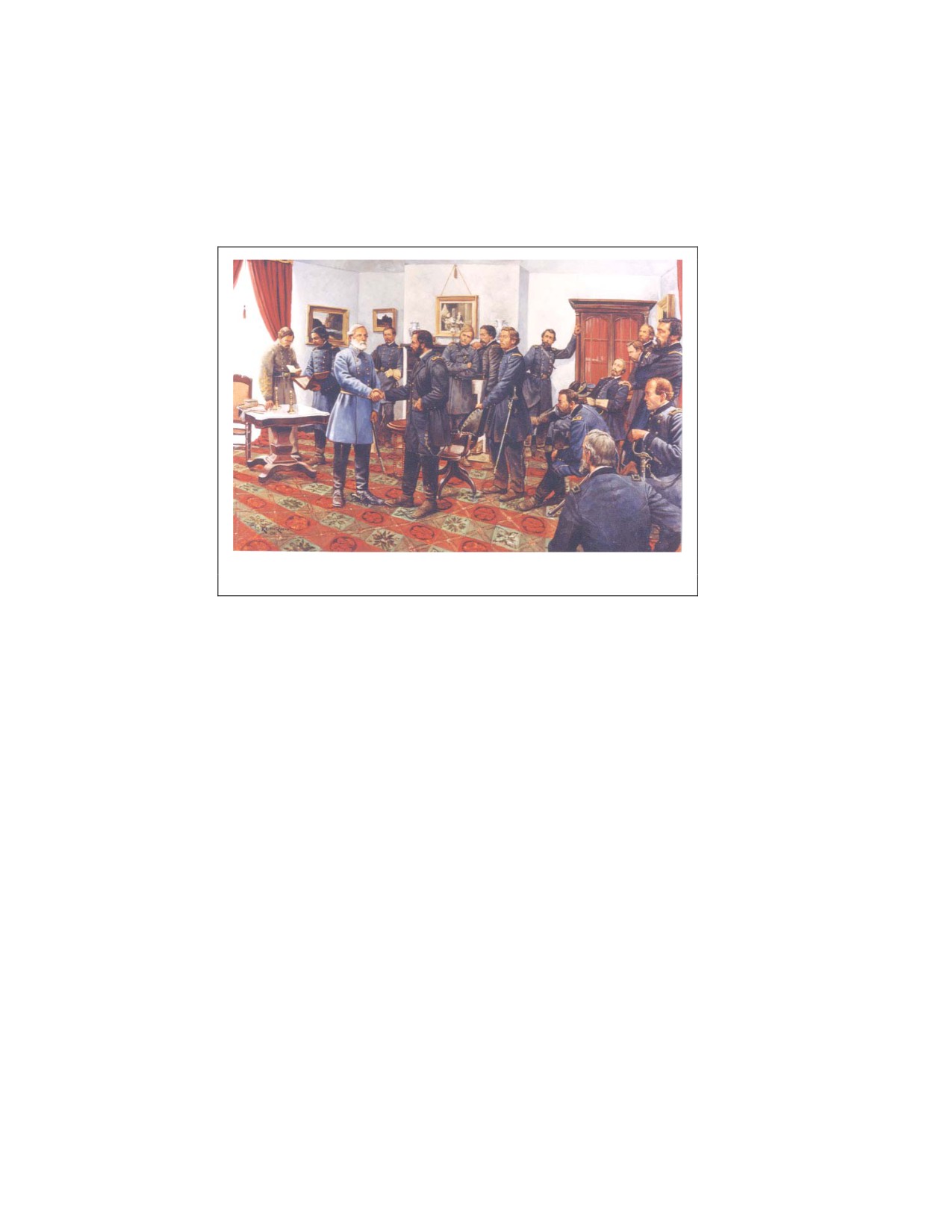
FM 7-21.13 ____________________________________________________________
Confederacy, when Congress adopted a tough "Reconstruction" policy to
restore the Southern states to the Union.
“The Surrender.”
General Lee meets General Grant at Appomattox, 9 April 1865.
2-75. The Army maintained order in the former Confederate states.
Keeping watch over local courts, the Army sought to ensure the rights of
African-Americans and Union loyalists, a task that became increasingly
difficult as support for Reconstruction waned and the occupation forces
declined in numbers. At the same time, military governors expedited the
South’s physical recovery from the war. Through the Freedmen’s Bureau,
the Army provided
21 million rations, operated over fifty hospitals,
arranged labor for wages in former plantation areas, and established
schools for the freedmen. The Army’s role in Reconstruction ended when the
last federal troops withdrew from occupation duties in 1877.
THE WESTERN FRONTIER
2-76. Soon after the Civil War the bulk of the Regular Army returned to
its traditional role of frontier constabulary. Early settlers from Europe had
been in conflict with native Americans as early as 1622. For over 250 years
there were periodic wars and battles as settlers moved west into the
wilderness. Conflict often resulted as the Indian nations fought to preserve
their way of life while the Army fought to protect settlers, property, and the
continued expansion of the United States.
2-77. Army officers negotiated treaties with the Sioux, Cheyenne, and
other western tribes and tried to maintain order between the various tribes
and the prospectors, hunters, ranchers, and farmers moving west. Native
American tribes were pushed off lands they had inhabited for centuries.
They fought against the encroachment, periodically raiding settlements,
2-22
_____________________________________________________________ Chapter 2
work parties or wagon trains. When hostilities erupted, the Army was
usually ordered to force the Indians onto reservations. Campaigns generally
took the form of converging columns invading hostile territory in an
attempt to bring the enemy to battle. Most of the time, the tribes lacked the
numbers or inclination to challenge an Army unit of any size.
The 7th Cavalry at the Little Bighorn
In 1875, the Sioux and Cheyenne left their reservations, infuriated at
violations of their sacred lands in the Black Hills. They gathered in
Montana with Sitting Bull and vowed to fight. Victories in early 1876
made them confident to continue fighting through the summer. The 7th
Cavalry and other units moved to find and destroy hostile encampments
and force the Indians back onto their reservations.
On 25 June 1876 Lieutenant Colonel George A. Custer, commanding
the 7th Cavalry, learned that a Sioux village was in the valley of the Little
Bighorn River in Montana. He expected that the village contained only a
few hundred warriors at most and that the Indians would try to slip away
from the cavalry as in previous engagments. Custer divided his force of
652 soldiers into four columns to simultaneously attack the northern and
southern ends of the village and also block any escape. But the plan did
not account for difficult terrain or the fact that the village was much
larger than he expected. The village actually contained
1,800 well
armed warriors, and they intended to stay and fight.
At about 1500, Major Marcus A. Reno’s element of 175 soldiers began
their attack on the southern end of the village. Hundreds of Indian
warriors spilled out of the village and routed the cavalrymen. By 1630
the Indians had turned their attention to Custer’s column of 221 soldiers
approaching the village from the east. The Indians pushed them back
onto a ridge and encircled them. In an hour all of the soldiers in Custer’s
group were dead. Though the united Sioux and Cheyenne nations had
achieved a great victory, it had aroused the American public who
demanded retribution. The boundaries of the reservation were redrawn
to exclude the Black Hills and settlers flooded the area. Within a year
the Sioux and Cheyenne were defeated.
2-78. The Army contributed in other ways to the development of the West.
One Army officer, Captain Richard H. Pratt, established the US Indian
Training and Industrial School at Carlisle Barracks, Pennsylvania, to teach
Native American youth new skills. At the same time, other soldiers
conducted explorations to finish the task of mapping the continent. The
surveys from 1867 through 1879 completed the work of Lewis and Clark,
while discoveries at Yosemite, Yellowstone, and elsewhere led to the
establishment of a system of national parks. Army expeditions explored the
newly purchased territory of Alaska. For ten years before the formation of a
civilian government, the Army governed the Alaska Territory.
SPANISH-AMERICAN WAR
2-79. As the nineteenth century drew to an end, the Army again served
the Nation during the American intervention in Cuba’s war of liberation
2-23
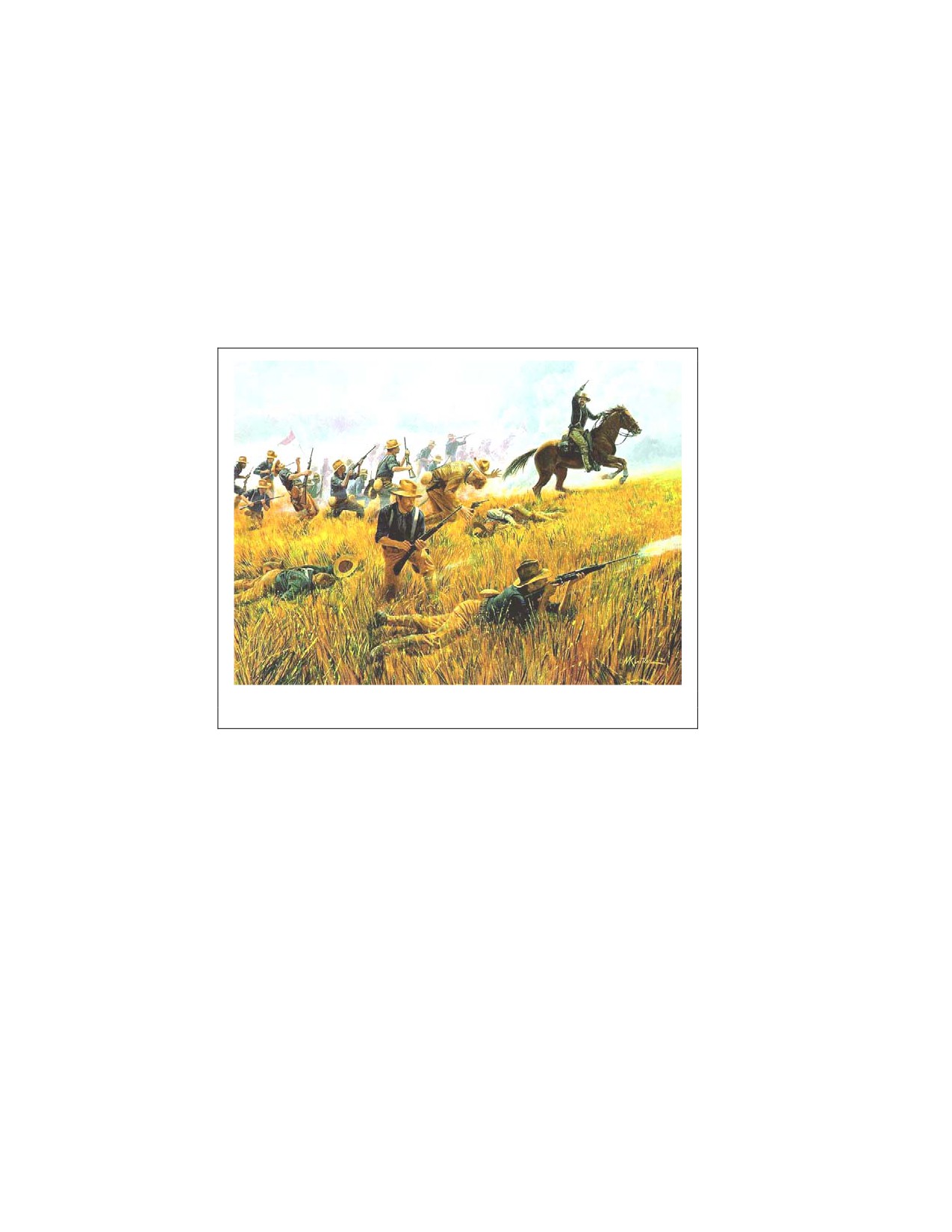
FM 7-21.13 ____________________________________________________________
from Spain in 1898. A US Navy battleship, the USS Maine, anchored in the
harbor at Havana, Cuba, mysteriously exploded on the night of 15 February
1898 killing 266 American sailors. Public opinion quickly turned hostile
toward Spain and Congress declared war on 25 April 1898. The Army once
again struggled to organize, equip, instruct, and care for raw recruits
flooding into its training camps. By the end of June 1898 the Army had
embarked 17,000 soldiers enroute to attack approximately 200,000 Spanish
soldiers occupying Cuba.
The 1st Volunteer Cavalry—“The Rough Riders”— at Kettle Hill near
Santiago, Cuba on 1 July 1898.
2-80. The expeditionary force that included Lieutenant Colonel Theodore
Roosevelt’s volunteer cavalry regiment began landing in Cuba on 22 June
1898. The Army drove the Spanish from the San Juan Heights overlooking
the port of Santiago, causing the enemy ships in the port to flee into the
waiting guns of the United States Navy. Other expeditionary forces landed
in the Spanish possessions of Puerto Rico and the Philippines, following
Commodore George Dewey’s naval victory at the Battle of Manila Bay. With
the end of the war and American acquisition of the Philippines, the Army’s
task of establishing American authority led to a series of arduous
counterguerrilla campaigns to suppress the insurrectos—Filipinos who still
fought for independence.
2-24
_____________________________________________________________ Chapter 2
Private Augustus Walley in Cuba
On 24 June 1898 during the Battle of Las Guasimas, Cuba, Major Bell
of the 1st Cavalry had gone down with a wound to the leg. Another
officer attempted to carry him from the field, but his shattered leg bone
broke through the skin, causing so much pain that he had to let Bell
down. The fire was so intense that in one plot of ground, fifty feet
square, sixteen men were killed or wounded. Still, a fellow American
soldier was badly hurt and in need of assistance. Private Augustus
Walley of the
10th Cavalry, the
“Buffalo Soldiers,” his compassion
overcoming self-preservation, ran to help the wounded soldier. He and
the officer together dragged Major Bell to safety.
Conspicuous gallantry under fire was not new to Walley. He had
received the Medal of Honor while assigned to the 9th Cavalry for his
actions on August 16, 1881 in combat against hostile Apaches at the
Cuchillo Mountains, New Mexico. During the fight Private Burton’s horse
bolted and carried him into enemy fire where Burton fell from his saddle.
Assumed dead, the command was given to fall back to another position,
but Burton called out for help. Private Walley, under heavy fire went to
Private Burton's assistance and brought him to safety.
Walley was recommended for a second Medal of Honor for his role in
saving Major Bell at Las Guasimas. Instead he received a Certificate of
Merit for his extraordinary exertion in the preservation of human life. In
1918 Congress upgraded Certificates of Merit to the Distinguished
Service Medal and in 1934 to the Distinguished Service Cross.
2-81. The experience of the Spanish-American War, the perception of
increased external threats in a shrinking world, and other looming
challenges of the new century called for a thorough reform of Army
organization, education, and promotion policies. The new Secretary of War,
Elihu Root, added an Army War College as the high point of the service’s
educational system. He also took steps to replace War Department bureaus
and a commanding general with a chief of staff and general staff that could
engage in long-range war planning. Also, a new militia act laid the
foundation for improved cooperation between the Regular Army and the
National Guard. These reforms, as well as some first steps toward joint
Army-Navy planning, reflected the emphasis on professionalism,
specialization, and organization that characterized the Progressive Era and
were in accord with Secretary Root’s conviction that the “real object of
having an Army is to prepare for war.” Subsequently, Congress authorized
100,000 as the regular Army strength in 1902.
2-82. After the turn of the century, the Army began to look into the value
of aircraft. Balloons used for artillery spotting had already proven their
worth in the Civil War. But new developments, the dirigible and the
airplane, caught the interest of President Theodore Roosevelt. On 1 August
1907 Captain Charles D. Chandler became the head of the Aeronautical
Division of the Signal Corps, newly established to develop all forms of
flying. In 1908 the corps ordered a dirigible balloon of the Zeppelin type,
then in use in Germany, and contracted with the Wright brothers for an
2-25
FM 7-21.13 ____________________________________________________________
airplane. Despite a crash that destroyed the first model, the Wright plane
was delivered in 1909. The inventors then began to teach a few enthusiastic
young officers to fly; Army aviation was born.
PANCHO VILLA AND THE PUNITIVE EXPEDITION
2-83. Years of injustice and chafing under dictatorial rule caused the
Mexican people to revolt in 1910. The United States attempted to stay out
of the affair but was reluctantly drawn into the Mexican Revolution. A
number of incidents raised tension between the United States and Mexico,
and America began to take sides in the conflict. In May 1916 Pancho Villa’s
Mexican rebels killed eighteen American soldiers and civilians in a raid on
Columbus, New Mexico. Part of the 13th Cavalry, then garrisoned in
Columbus, drove Villa off and hastily pursued, killing about 100 “Villistas”
before returning to Columbus.
2-84. In an attempt to bring Villa to justice or destroy his ability to raid
the US, President Woodrow Wilson sent Brigadier General John J.
Pershing to lead an expedition south of the border in an unsuccessful
pursuit of Villa. The Mexican government threatened war over the violation
of its territory, causing Wilson to call up 112,000 National Guardsmen and
to send most of the Regular Army to the border. But the two nations
avoided a larger conflict and America withdrew the punitive expedition.
THE WORLD WARS AND CONTAINMENT
2-85. World War I began in August 1914 after a Bosnian separatist
murdered the Archduke Francis Ferdinand of Austria-Hungary and his
wife during a visit to Sarajevo. Austria-Hungary demanded that Serbia
allow them to investigate the crime but under conditions that Serbia would
not accept. Because of numerous alliances and agreements, Austria-
Hungary’s subsequent declaration of war on Serbia soon embroiled most of
Europe. For nearly three years the United States remained technically
neutral, though its trade favored the Allies who controlled the seas.
America, with its large immigrant population, was not eager to go to war
against any of the nations in Europe. Even after German submarines sank
the passenger ships Lusitania and Sussex, the United States refrained from
joining the conflict. The war in Western Europe degenerated into a bloody
stalemate, nearly destroying an entire generation of young men. Both the
western allies and Germany launched offensive after offensive in the hopes
of achieving a breakthrough that would end the war but all in vain.
THE UNITED STATES ENTERS WORLD WAR I
2-86. On 23 February 1917 the British turned over to the US Government
an intercepted note from the German foreign minister to the German
ambassador in Mexico. In the note were instructions to offer Mexico an
alliance in the event of war with the United States and promising that
Mexico could regain Texas, New Mexico and Arizona. Coupled with
Germany’s recent resumption of unrestricted submarine warfare, this was
the last provocation America needed. On 2 April 1917 President Wilson
2-26
_____________________________________________________________ Chapter 2
asked Congress to declare war on Germany because “the world must be
made safe for democracy.”
2-87. A much more professional Army spearheaded American
intervention in World War I. After Wilson’s war message in April 1917,
Army officers worked with business and government counterparts to
mobilize the nation’s resources. Yet enormous difficulties resulted from the
huge size of the effort. To meet the need for a massive ground force capable
of fighting on the European battlefield, the Army drew on its Civil War
expertise and on popular acceptance of a more activist federal government
to develop a more efficient system of manpower allocation through
conscription.
Lafayette, we are here.
LTC Charles E. Stanton, at the grave of the Marquis de Lafayette
2-88. The 1st Infantry Division reached Paris in time to participate in a
Fourth of July parade, raising French spirits at a low point in the war.
Ultimately, 8 regular Army divisions, 17 National Guard divisions, and 17
newly organized National Army divisions served in France. The US
divisions were twice the size of Allied and German divisions but American
soldiers and marines had a lot to learn about trench warfare. At training
centers near the front they practiced and received a hint of what lay ahead.
2-89. Though slower to arrive than France and Britain wished, the sight
of fresh, eager, and strong American soldiers in great numbers, with
millions more available, raised the allies’ spirits and eroded German
morale. But the Allies wanted American soldiers sent directly to British
and French formations as individual or unit replacements. However, the
Commander in Chief of the American Expeditionary Forces (AEF), General
John J. Pershing was determined to preserve the independence of the AEF.
He would not allow Americans merely to be absorbed into existing British
and French units.
2-90. This stance was based not only on national pride but also on
President Wilson’s vision that the United States would have to take a more
active, leading role in the post-war world. Enabling that role would require
a significant role in the war as a distinct fighting force. On occasion
Pershing did offer the use of American regiments and in a few instances,
even smaller units in the British and French sectors. In fact, two US
divisions fought as a corps in the British sector. But Pershing resisted all
attempts to get American soldiers sent directly to British and French units
as individual replacements.
2-27
FM 7-21.13 ____________________________________________________________
Harlem Hellfighters
By early 1918 General Pershing relented somewhat in his policy of not
sending Americans directly to the Allies. He provided the infantry
regiments of one of the African-American infantry divisions, the 93d,
(the US Army was still segregated at the time) directly to the French
Army. One of these regiments, the 369th Infantry, was formed from the
National Guard’s 15th New York and was in combat longer than any
other American regiment in the war.
In May 1918, Privates Henry Johnson and Needham Roberts of the
369th were part of a five-man patrol on duty in a listening post along the
front line. The other three soldiers were off-watch and sleeping in a
dugout to the rear when a 24-man German raiding party caught the post
by surprise with a grenade attack. Both Johnson and Roberts were
seriously wounded but fought off the first attack and crawled to their
own supply of grenades. Throwing them one after another like baseballs
at batting practice, they fought back with explosives as Johnson
shouted, "turn out the guard," over and over. Grabbing his rifle, he shot
a German soldier and clubbed another. He then saw three enemy
soldiers trying to drag Roberts away.
Out of grenades and with his rifle now jammed and broken, Johnson
pulled out his knife and attacked the three Germans, killing one. Roberts
broke free and continued fighting. Hit by fire, Johnson fell wounded and
dazed, but nonetheless took a grenade off a dead enemy soldier and
threw it at his attackers. It devastated the remaining enemy and they
withdrew leaving their dead and a number of rifles and automatic
weapons. When reinforcements arrived, they found the two soldiers
laughing and singing. Privates Johnson and Roberts were both
peppered with shrapnel and shot several times, but remained in good
humor and reportedly saw the experience as a great adventure.
Later promoted to Sergeant, Johnson was the first American in World
War I awarded the Croix de Guerre with Palm, France’s highest award
for gallantry. On 13 February 2003, Sergeant Henry Johnson received
the Distinguished Service Cross posthumously.
2-91. Germany saw the potential of the United States and resolved to
defeat the French and British allies before US power could be fully brought
into the war. In July 1918 the Germans launched an offensive that carried
it nearly to the outskirts of Paris. In the line east of Chateau-Thierry was
the 3d Infantry Division, just arrived to try to stem the German advance at
the Marne River.
2-92. The division’s infantry regiments were deployed along the south
bank of the Marne River with the French 125th Division on its right.
Attached to the French division were four companies of the US
28th
Division, National Guardsmen from Pennsylvania. As the German attack
reached and began crossing the Marne River, the French units were forced
to withdraw but did not inform the American Guardsmen. The Keystone
soldiers fought against many times their own number, delaying and
inflicting heavy losses on the enemy, but ultimately most of the Americans
2-28
_____________________________________________________________ Chapter 2
were killed or captured. Nonetheless, their bravery and sacrifice helped
make the historic stand of the 3d Division possible.
2-93. The 38th Infantry Regiment soon found itself under attack from
three sides and the other regiments of the 3d Division under great enemy
pressure, as well. Wave after wave of German infantry crossed the Marne
and assailed the front and flanks of the 38th, but the resolute Doughboys
held on. When asked by a French commander if his division could hold,
Major General Joseph Dickman replied, “Nous resterons la”—We shall
remain there. They did, helping to break the German attack and entering
into Army history. Two months later the US First Army attacked at St.
Mihiel. In the Meuse-Argonne campaign, the AEF contributed to the final
Allied drive before the Armistice.
Sergeant Edward Greene at the Marne
Sergeant Greene was a cook for the 3d Division’s Battery F, 10th Field
Artillery in July 1918. He was without a mission when his field kitchens
were destroyed in the pre-assault bombardment prior to the German
attack across the Marne river. Sergeant Greene, without being ordered,
began carrying ammunition forward to his battery’s guns.
For several hours while under constant artillery shell fire and enemy
observation, he performed his mission until wounded. He had to be
ordered to the rear for medical attention. Sergeant Greene received the
Distinguished Service Cross.
2-94. World War I was the impetus for many new innovations in
weaponry, industry, and medicine. In an attempt to break the stalemate on
the Western Front, the Germans used chlorine gas as a weapon in 1915.
Not having anticipated the effectiveness of the weapon against unprepared
troops, they did not exploit the resulting panic among the Allied soldiers in
the affected area. The Allies soon developed defensive measures to mitigate
the effects of chemical weapons, though even today they have terrifying
potential against unprotected targets.
2-95. The British first brought the tank to the Western Front in 1916. But
while its initial use was poorly exploited, even later, well-prepared attacks
using tanks did not always achieve hoped for success because of the poor
reliability and maneuverability of the equipment. Nonetheless, the dawn of
tank warfare showed many great military thinkers that fixed fortifications
and static positions would soon be obsolete. The US Army fielded two tank
brigades in Europe, one of which was commanded by Colonel George S.
Patton. The tanks were mostly of French manufacture with American
crews, and they also suffered from poor mechanical reliability and
maneuverability across the moonscape of “no-man’s land.” But when the
AEF was able to break into the open country, tanks were very useful and
gave an indication of their future capabilities.
2-29